US9798316B2 - Motion controller capable of specifying program execution pace - Google Patents
Motion controller capable of specifying program execution pace Download PDFInfo
- Publication number
- US9798316B2 US9798316B2 US14/321,953 US201414321953A US9798316B2 US 9798316 B2 US9798316 B2 US 9798316B2 US 201414321953 A US201414321953 A US 201414321953A US 9798316 B2 US9798316 B2 US 9798316B2
- Authority
- US
- United States
- Prior art keywords
- program
- execution time
- time
- block
- section
- Prior art date
- Legal status (The legal status is an assumption and is not a legal conclusion. Google has not performed a legal analysis and makes no representation as to the accuracy of the status listed.)
- Expired - Fee Related, expires
Links
Images



Classifications
-
- G—PHYSICS
- G05—CONTROLLING; REGULATING
- G05B—CONTROL OR REGULATING SYSTEMS IN GENERAL; FUNCTIONAL ELEMENTS OF SUCH SYSTEMS; MONITORING OR TESTING ARRANGEMENTS FOR SUCH SYSTEMS OR ELEMENTS
- G05B19/00—Programme-control systems
- G05B19/02—Programme-control systems electric
- G05B19/18—Numerical control [NC], i.e. automatically operating machines, in particular machine tools, e.g. in a manufacturing environment, so as to execute positioning, movement or co-ordinated operations by means of programme data in numerical form
- G05B19/4155—Numerical control [NC], i.e. automatically operating machines, in particular machine tools, e.g. in a manufacturing environment, so as to execute positioning, movement or co-ordinated operations by means of programme data in numerical form characterised by programme execution, i.e. part programme or machine function execution, e.g. selection of a programme
-
- G—PHYSICS
- G05—CONTROLLING; REGULATING
- G05B—CONTROL OR REGULATING SYSTEMS IN GENERAL; FUNCTIONAL ELEMENTS OF SUCH SYSTEMS; MONITORING OR TESTING ARRANGEMENTS FOR SUCH SYSTEMS OR ELEMENTS
- G05B11/00—Automatic controllers
- G05B11/01—Automatic controllers electric
- G05B11/36—Automatic controllers electric with provision for obtaining particular characteristics, e.g. proportional, integral, differential
-
- G—PHYSICS
- G05—CONTROLLING; REGULATING
- G05B—CONTROL OR REGULATING SYSTEMS IN GENERAL; FUNCTIONAL ELEMENTS OF SUCH SYSTEMS; MONITORING OR TESTING ARRANGEMENTS FOR SUCH SYSTEMS OR ELEMENTS
- G05B2219/00—Program-control systems
- G05B2219/30—Nc systems
- G05B2219/34—Director, elements to supervisory
- G05B2219/34384—Execute next block after predetermined time
-
- G—PHYSICS
- G05—CONTROLLING; REGULATING
- G05B—CONTROL OR REGULATING SYSTEMS IN GENERAL; FUNCTIONAL ELEMENTS OF SUCH SYSTEMS; MONITORING OR TESTING ARRANGEMENTS FOR SUCH SYSTEMS OR ELEMENTS
- G05B2219/00—Program-control systems
- G05B2219/30—Nc systems
- G05B2219/35—Nc in input of data, input till input file format
- G05B2219/35386—Look ahead processing of plural block data from buffer
Definitions
- the present invention relates to a motion controller capable of specifying a program execution pace.
- the peripheral device may invade the movable range of the apparatus and the apparatus and the peripheral device may interfere with each other when the program fails to end in a given time.
- the execution time of the entire program is preliminarily determined and the ratio between the execution time and a desired time is set to be an override value so that the program execution time is adjusted by varying the moving speeds of axes.
- the system performs loading, machining, and unloading in order.
- An external conductor determines an execution pace for the whole system, and each apparatus operates in an assigned time to satisfy the execution pace. For example, when the conductor gives a command to set the pace of the whole system to be 50%, each apparatus performs its own operation at a pace of 50%.
- the ratio between the pre-measured execution time of the program and the specified time is set to be an override value, and the moving speeds of the axes are changed.
- an element such as an in-position check or time fixed acceleration and deceleration is present for which the execution time is independent of overriding, the program execution time and the specified time may deviate from each other in spite of a set override time.
- Japanese Patent Application Laid-open No. 2007-234002 discloses that, when a single block is included in a program, the program is executed in a specified time. However, this technique is not applied to a program with a plurality of blocks.
- the override value is conventionally set to a greater value to make the execution time of the program slightly shorter than the specified time. This allows interference to be avoided, but needs faster movement or acceleration than execution in the specified time. As a result, much power needs to be consumed.
- the following are preliminarily executed: measurement of an execution time elapsed when a program is executed under no control, setting of a desired execution time, and setting of a time immediately after completion of a pulse output for each block in the program until an in-position state is established. Then, a speed or an acceleration and deceleration time constant for each block which allows the program to be executed in the specified execution time is calculated based on the measured program execution time and the desired execution time, and the time needed to establish the set in-position state. The program is executed using the calculated speed or acceleration and deceleration time constant.
- a first aspect of the motion controller is a motion controller that sequentially executes a preregistered program formed of a plurality of blocks.
- the motion controller includes: a block execution time measuring section that actually measures an execution time of each of the blocks constituting the program; a program execution time specifying section that specifies an execution time of the entire program; a positioning time setting section that sets a time immediately after a pulse output for the block is completed until an in-position state is established; a calculation section that calculates a speed or an acceleration and deceleration time constant for each block which allows the program to be executed in the program execution time specified by the program execution time specifying section, on the basis of the execution time of each block actually measured by the block execution time measuring section, the program execution time specified by the program execution time specifying section, and the time needed to establish the in-position state and set by the positioning time setting section; and an execution section that executes the program in use of the speed or the acceleration and deceleration time constant calculated by the calculation section.
- a second aspect of the motion controller according to the present invention is a motion controller that sequentially executes a preregistered program formed of a plurality of blocks.
- the motion controller includes: a block execution time measuring section that actually measures an execution time of each of the blocks constituting the program; a program execution time specifying section that specifies an execution time of the entire program; a positioning time measuring section that actually measures a time immediately after a pulse output for the block is completed until an in-position state is established; a calculation section that calculates a speed or an acceleration and deceleration time constant for each block which allows the program to be executed in the program execution time specified by the program execution time specifying section, on the basis of the execution time of each block actually measured by the block execution time measuring section, the program execution time specified by the program execution time specifying section, and the time needed to establish the in-position state and actually measured by the positioning time measuring section; and an execution section that executes the program in use of the speed or the acceleration and deceleration time constant calculated by the calculation section.
- the motion controller may further include an auxiliary function execution time setting section that sets a time needed to execute an auxiliary function.
- the calculation section may calculate the speed or the acceleration and deceleration time constant for each block which allows the program to be executed in the specified execution time also taking into account the execution time of the auxiliary function set by the auxiliary function execution time setting section.
- the motion controller may further include an auxiliary function execution time measuring section that actually measures the time needed to execute the auxiliary function.
- the calculation section may calculate the speed or the acceleration and deceleration time constant for each block which allows the program to be executed in the specified execution time also taking into account the execution time of the auxiliary function actually measured by the auxiliary function execution time setting section.
- a third aspect of the motion controller according to the present invention is a motion controller that sequentially executes a preregistered program formed of a plurality of blocks.
- the motion controller includes: a block execution time analyzing section that analyzes an execution time of each of the blocks constituting the program; a program execution time specifying section that specifies an execution time of the entire program; a positioning time setting section that sets a time immediately after a pulse output for the block is completed until an in-position state is established; a calculation section that calculates a speed or an acceleration and deceleration time constant for each block which allows the program to be executed in the program execution time specified by the program execution time specifying section, on the basis of the execution time of each block analyzed by the block execution time analyzing section, the program execution time specified by the program execution time specifying section, and the time needed to establish the in-position state and set by the positioning time setting section; and an execution section that executes the program in use of the speed or the acceleration and deceleration time constant calculated by the calculation section.
- a fourth aspect of the motion controller is a motion controller that sequentially executes a preregistered program formed of a plurality of blocks.
- the motion controller includes: a block execution time measuring section that actually measures an execution time of each of the blocks constituting the program; a program execution pace ratio specifying section that specifies a ratio of an execution pace for the entire program; a positioning time setting section that sets a time immediately after a pulse output for the block is completed until an in-position state is established; a calculation section that calculates a speed or an acceleration and deceleration time constant for each block which allows the program to be executed at an program execution pace ratio specified by the program execution pace ratio specifying section, on the basis of the execution time of each block actually measured by the block execution time measuring section, the program execution pace ratio specified by the program execution pace ratio specifying section, and the time needed to establish the in-position state and set by the positioning time setting section; and an execution section that executes the program in use of the speed or the acceleration and deceleration time constant calculated by the calculation section.
- a fifth aspect of the motion controller according to the present invention is a motion controller that simultaneously executes a plurality of preregistered programs formed of a plurality of blocks respectively.
- the motion controller includes: a block execution time measuring section that measures an execution time of each of the blocks constituting each of the programs; a specified program measuring section that actually measures an execution time of the whole of a program specified from among the plurality of programs; a program execution time specifying section that specifies an execution time of each program; a positioning time setting section that sets a time immediately after a pulse output for the block is completed until an in-position state is established; a calculation section that calculates a speed or an acceleration and deceleration time constant for each block which allows each program to be executed in the same program execution time as the execution time of the specified program, on the basis of the execution time of each program specified by the program execution time specifying section, the execution time of the whole of the specified program measured by the specified program measuring section, and the time needed to establish the in-position state and set by the positioning time setting section; and an
- the motion controller may further include a block execution time measuring section that actually measures the execution time of each of the blocks constituting the program while the program is being executed, and a block speed/acceleration and deceleration time constant calculating section that calculates a speed or an acceleration and deceleration time constant to be executed next time on the basis of the block execution time actually measured by the block execution time measuring section.
- a target block is executed using the speed or the acceleration and deceleration time constant calculated by the block speed/acceleration and deceleration time constant calculating section, to change an execution pace for the entire program in such a manner that the execution pace corresponds to the execution time or ratio specified by the program.
- the motion controller may further include a block acceleration analyzing section that analyzes an acceleration of each of the blocks included in the program, and a speed/acceleration and deceleration time constant calculating section that compares the accelerations of the blocks analyzed by the block acceleration analyzing section to calculate a speed or an acceleration and deceleration time constant in such a manner that the acceleration is reduced for a block with a high acceleration.
- the acceleration is reduced, in a concentrated manner, for a high acceleration part of the entire program to be executed, to change an execution pace for the entire program in such a manner that the execution pace corresponds to the execution time or ratio specified by the program.
- the present invention allows the program to be executed in a desired time in spite of presence of an element such as an in-position check or time fixed acceleration and deceleration for which the execution time is independent of overriding. This reduces power consumption to a minimum needed amount.
- FIG. 1 is a diagram illustrating operation of a system including a machining machine, a loader, and a motion controller;
- FIG. 2 is a diagram of an example of a program illustrating Embodiment 1 of the motion controller according to the present invention
- FIG. 3 is a diagram illustrating the relation between the execution time Tpr of the entire program and the execution times Tbr_1 and Tbr_2 of blocks (block 1 and block 2) providing a program;
- FIG. 4 is a diagram illustrating the relations among the actually measured program execution time Tpr, an actually measured block execution time Tbr_i, a desired program execution time Tps, and a block execution time Tbs_i elapsed when the program is executed in the desired program execution time Tps;
- FIG. 5 is a diagram illustrating the relations among the block execution time Tbs_i elapsed when the program is executed in the desired time, a moving distance L_i, an acceleration and deceleration time constant Tcon_i, an in-position predicted time Tinp, and a moving speed Fs_i;
- FIG. 6 is a diagram of an example of a program illustrating Embodiment 3 of the motion controller according to the present invention.
- FIG. 7 is a diagram illustrating the relation between a movement command block execution time Tbr_i and the program execution time Tpr;
- FIG. 8 is a diagram illustrating the relations among the actually measured program execution time Tpr, the actually measured movement command block execution time Tbr_i, the desired program execution time Tps, an auxiliary function predicted execution time Taux_xx, and the block execution time Tbs_i elapsed when the program is executed in the desired program execution time Tps;
- FIG. 9 is a flowchart illustrating a process executed by Embodiment 1 of the motion controller according to the present invention.
- FIG. 10 is a flowchart illustrating a process executed by Embodiment 2 of the motion controller according to the present invention.
- FIG. 11 is a flowchart illustrating a process executed by Embodiment 3 of the motion controller according to the present invention.
- FIG. 12 is a flowchart illustrating a process executed by Embodiment 4 of the motion controller according to the present invention.
- FIG. 13 is a flowchart illustrating a process executed by Embodiment 5 of the motion controller according to the present invention.
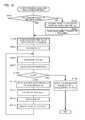
- FIG. 14 is a flowchart illustrating a process executed by Embodiment 6 of the motion controller according to the present invention.
- FIG. 15 is a flowchart illustrating a process executed by Embodiment 8 of the motion controller according to the present invention.
- FIG. 16 is a flowchart illustrating a process executed by Embodiment 9 of the motion controller according to the present invention.
- FIG. 17 is a block diagram illustrating the motion controller.
- a motion controller which stores a program shown in FIG. 2 in a memory for the motion controller and which then sequentially executes the program.
- a configuration of the motion controller will be described below with reference to FIG. 17 .
- fast feeding for positioning to a position X100.0 is performed at a speed of 10,000 (block 1).
- linear interpolation for positioning to a position X300.0 is performed at a speed of 2,000 (block 2).
- the program is preliminarily executed under no control with a measurement signal for time measurement turned on. Then, the following are measured: the execution time Tbr_i (i: block number) of each of the blocks (that is, a block i) included in the program and the execution time Tpr of the entire program (hereinafter referred to as the “actually measured program execution time”).
- the execution time Tbr_i i: block number
- Tpr the execution time of the entire program
- FIG. 3 shows the relation between the execution time Tbr_i of each block and the actually measured program execution time Tpr.
- the program includes a block with number 1 and a block with number 2.
- parameters are provided which set a predicted time (that is, an in-position predicted time Tinp) immediately after completion of a pulse output for the block with number i until an in-position state is established.
- a parameter is provided which sets the execution time Tps of the desired entire program (hereinafter referred to as the “specified program execution time”).
- FIG. 4 shows the relations among the actually measured program execution time Tpr, the actually measured block execution time Tbr_i, a program execution time Tps specified using a parameter, and the execution time Tbs_i of each block calculated in accordance with Equation (1).
- a moving speed Fs_i for each block achieved when the program is executed in the specified program execution time Tps is calculated in accordance with Formula (2).
- Formula (2) corresponds to a case of time fixed acceleration and deceleration.
- the moving distance L_i is data specified in a machining program.
- the acceleration and deceleration time constant Tcon_i is data pre-specified using a parameter.
- Fs _ i L _ i /( Tbs _ i ⁇ T con_ i ⁇ T inp) (2)
- FIG. 5 shows, in the machining program block i, the relations among the execution time Tbs_i of each block, the moving distance L_i, the acceleration and deceleration time constant Tcon_i, the in-position predicted time Tinp, and the moving speed Fs_i calculated in accordance with Formula (2).
- the execution time of the entire program can be set equal to the specified program execution time Tps by executing, after the above-described process is carried out, the program with a specified speed for each block of the program substituted with the calculated moving speed Fs_i.
- the execution time of the entire program may also be set equal to the specified program execution time Tps by determining the acceleration and deceleration time constant Tcon_i instead of the moving speed Fs_i and executing the program with the acceleration and deceleration time constant for each block substituted with the calculated value.
- FIG. 9 is a flowchart illustrating a process executed by Embodiment 1 of the motion controller. The process will be described in accordance with steps.
- the in-position predicted time Tinp and the specified program execution time Tps are preliminarily set and stored in the memory.
- Step SA 01 It is determined whether or not the program execution time has been saved. If the program execution time has been saved (YES), the process proceeds to step SA 04 . If the program execution time has not been saved (NO), the process proceeds to step SA 02 .
- Step SA 02 The program is executed, and the execution time Tbr_i of each of the blocks providing the program and the actually measured program execution time Tpr are measured.
- Step SA 03 The measurement results are saved to a data area, and the process proceeds to step SA 04 .
- Step SA 04 The in-position predicted time Tinp is loaded.
- Step SA 05 The specified program execution time Tps is loaded.
- Step SA 06 The execution time Tbs_i of each block is calculated in accordance with Formula (1).
- Step SA 07 The moving speed Fs_i for each block is calculated in accordance with Formula (2).
- Step SA 08 The moving speed for each block is substituted with the moving speed Fs_i calculated in step SA 07 , and the process is ended.
- the time needed to establish the in-position state may vary among the blocks.
- the use of the method according to Embodiment 1 needs parameters that set the time needed to establish the in-position state as many as the blocks have.
- the amount of time and effort needed to set the time needed to establish the in-position state increases consistently with the number of block.
- Embodiment 2 actually measures the time needed to establish the in-position state instead of presetting the amount of time using the appropriate parameter.
- the program is preliminarily executed under no control with the measurement signal for time measurement turned on. Then, the following are measured: the execution time Tbr_i (i: block number) of each of the blocks included in the program and the actually measured program execution time Tpr of the entire program. At this time, the following is also measured: the time immediately after completion of a pulse output for each block until the in-position state is established, that is, the in-position time Tinp_i.
- the actually measured in-position time Tinp_i is saved to the internal data area, re-measurement is unnecessary unless the program is changed.
- the execution time of the entire program can be set equal to the specified program execution time Tps, the desired time, by executing, after the above-described process is carried out, the program with the specified speed for each block substituted with the moving speed Fs_i.
- FIG. 10 is a flowchart illustrating a process executed by Embodiment 2 of the motion controller. The process will be described in accordance with steps.
- the in-position predicted time Tinp and the specified program execution time Tps are preliminarily set and stored in the memory.
- Step SB 01 It is determined whether or not the program execution time has been saved. If the program execution time has been saved (YES), the process proceeds to step SB 04 . If the program execution time has not been saved (NO), the process proceeds to step SB 02 .
- Step SB 02 The program is executed, and the following are measured: the actually measured execution time Tbr_i of each of the blocks providing the program, the time Tinp_i needed to establish the in-position state in each block, and the actually measured program execution time Tpr of the entire program.
- Step SB 03 The measurement results are saved to the data area, and the process proceeds to step SB 04 .
- Step SB 04 The specified program execution time Tps is loaded.
- Step SA 05 The execution time Tbs_i of each block is calculated in accordance with Formula (1).
- Step SB 06 The moving speed Fs_i for each block is calculated in accordance with Formula (3).
- Step SB 07 The moving speed for each block is substituted with the moving speed Fs_i calculated in step SB 06 , and the process is ended.
- the program for the motion controller may include an auxiliary function in order to operate an external apparatus in the middle of the program.
- the next block is executed when the external apparatus completes operation.
- the time needed to complete the operation is generally constant in spite of a change in overriding.
- the methods according to Embodiment 1 and Embodiment 2 fail to deal with a program with an auxiliary function. Thus, the following method is added.
- a motion controller which stores and sequentially executes a program shown in FIG. 6 .
- the program in FIG. 6 in G00, fast feeding for positioning to a position X100.0 is performed at a speed of 10,000 (block 1).
- M20 a peripheral device is operated (block 2).
- G01 linear interpolation for positioning to a position X300.0 is performed at a speed of 2,000 (block 3).
- M30 indicates a program end (block 4).
- the program is preliminarily executed under no control with a measurement signal for time measurement turned on. Then, the following are measured: the execution time Tbr_i (i: block number) of each of movement command blocks included in the program and the execution time Tpr of the entire program.
- FIG. 7 shows the relation between the actually measured block execution time Tbr_i and the actually measured program execution time Tpr.
- parameters are provided which set the predicted time (in-position predicted time Tinp) immediately after completion of a pulse output for the block i until the in-position state is established and the predicted execution time Taux_xx of each auxiliary function (Mxx).
- T aux T aux_ i (4)
- the total of the execution times of the blocks with the movement commands is determined in order to set only blocks with movement commands to be targets for a change in execution pace.
- the total of the execution times is Tpr ⁇ Taux in case where the program is executed under no control and is Tps ⁇ Taux in case where the program is executed in a specified execution time.
- Tbs_i Tbr _ i ⁇ ( Tps ⁇ T aux)/( Tpr ⁇ T aux) (5)
- FIG. 8 shows the relations between the actually measured program execution time Tpr, the actually measured execution time Tbr_i of each block, the parameter specified program execution time Tps, the predicted execution time Taux_xx of each auxiliary function, and the execution time Tbs_i of each block calculated in accordance with Formula (5).
- the execution time of the entire program can be set equal to the desired specified program execution time Tps by determining the moving speed Fs_i of each block, and then executing the program with the specified speed for each block substituted with the moving speed Fs_i.
- FIG. 11 is a flowchart illustrating a process executed by Embodiment 3 of the motion controller. The process will be described in accordance with steps.
- Step SC 01 It is determined whether or not the program execution time has been saved. If the program execution time has been saved (YES), the process proceeds to step SC 04 . If the program execution time has not been saved (NO), the process proceeds to step SC 02 .
- Step SC 02 The program is executed, and the actually measured execution time Tbr_i of each of the blocks providing the program and the actually measured program execution time Tpr are measured.
- Step SC 03 The measurement results are saved to the data area, and the process proceeds to step SC 04 .
- Step SC 04 The in-position predicted time Tinp needed to establish the in-position state is loaded.
- Step SC 05 The predicted execution time Taux_xx of each auxiliary function (Mxx) is loaded.
- Step SC 06 The specified program execution time Tps, the desired execution time of the entire program, is loaded.
- Step SC 07 The total Taux of the execution times of the auxiliary function blocks included in the program is calculated.
- Step SC 08 The total of the execution times of movement command blocks is calculated. The calculated total value is Tpr ⁇ Taux when the program is executed under no control and is Tps ⁇ Taux when the program is executed in a specified execution time.
- Step SC 09 The execution time Tbs_i of each block with the movement command is calculated in accordance with Formula (5).
- Step SC 10 The moving speed Fs_i for each block is calculated in accordance with Formula (2).
- Step SC 11 The specified speed for each block is substituted with the moving speed Fs_i calculated in step SC 10 . The process is then ended.
- Embodiment 3 needs to set a parameter for each auxiliary function (Mxx). Consequently, the amount of time and effort needed for the setting increases consistently with the number of external apparatuses.
- Embodiment 4 adopts a method of actually measuring the execution time of the auxiliary function instead of setting the execution time using the appropriate parameter.
- the program is preliminarily executed under no control with the measurement signal for time measurement turned on, and the execution time Tbr_i (i: block number) of each of the blocks included in the program and the actually measured program execution time Tpr are measured.
- the execution time Taux_i of each block for which a command to provide the auxiliary function has been given is also measured.
- the actually measured execution times Taux_i of the auxiliary functions for the blocks are summed to determine the total Taux of the execution times of the auxiliary function blocks included in the program.
- the actually measured block execution time Tbr_i and the actually measured program execution time Tpr when the total Taux of the execution times of the auxiliary function blocks is saved to the internal data area, re-measurement of the total Taux is unnecessary unless the program is changed.
- an operation similar to that in Embodiment 3 is performed to set the execution time of the entire program equal to the desired time Tps.
- FIG. 12 is a flowchart illustrating a process executed by Embodiment 4 of the motion controller. The process will be described in accordance with steps.
- the in-position predicted time Tinp and the specified program execution time Tps are preliminarily set and stored in the memory.
- Step SD 01 It is determined whether or not the program execution time has been saved. If the program execution time has been saved (YES), the process proceeds to step SD 04 . If the program execution time has not been saved (NO), the process proceeds to step SD 02 .
- Step SD 02 The program is executed, and the following are measured: the actually measured execution time Tbr_i of each of the blocks providing the program, the execution time Taux_i of the auxiliary function (that is, execution time of the block for which a command to provide the auxiliary function has been given), and the actually measured program execution time Tpr (that is, execution time of the entire program). [Step SD 03 ] The measurement results are saved to the data area, and the process proceeds to step SD 04 .
- Step SD 04 The in-position predicted time Tinp until the in-position state is established is loaded.
- Step SD 05 The specified program execution time Tps, the desired execution time of the entire program, is loaded.
- Step SD 06 The total Taux of the execution times of the auxiliary function blocks included in the program is calculated.
- Step SD 07 The total of the execution times of movement command blocks is calculated. The calculated total value is Tpr ⁇ Taux when the program is executed under no control and is Tps ⁇ Taux when the program is executed in a specified execution time.
- Step SD 08 The execution time Tbs_i of each block with the movement command is calculated in accordance with Formula (5).
- Step SD 09 The moving speed Fs_i for each block is calculated in accordance with Formula (2).
- Step SD 10 The specified speed for each block is substituted with the moving speed Fs_i calculated in step SD 09 . The process is then ended.
- Embodiment 5 uses a method of determining the execution time of the program by analyzing the program based on simulation instead of actually measuring the execution time.
- the execution time Tbr_i of each block and the actually measured program execution time Tpr according to Embodiment 1 are substituted with values determined using the method according to Embodiment 5.
- the execution time Tbr_i (i: block number) of each block is calculated in accordance with Formula (6).
- Formula (6) corresponds to a case of time fixed acceleration and deceleration.
- Tbr _ i L _ i/Fs _ i+T con_ i+T inp (6)
- FIG. 13 is a flowchart illustrating a process executed by Embodiment 5 of the motion controller. The process will be described in accordance with steps.
- the in-position predicted time and the specified program execution time Tps are preliminarily set.
- Step SE 01 The in-position predicted time is loaded.
- Step SE 02 The program is analyzed, and for each of the blocks included in the program, the actually measured block execution time Tbr_i is calculated based on the moving distance L_i, the specified speed F_i, the acceleration and deceleration time constant Tcon_i, and the in-position predicted time Tinp set using the appropriate parameter. And the process proceeds to step S 03 .
- the specified program execution time Tps is loaded.
- the execution time Tbs_i of each block is calculated in accordance with Formula (1).
- Step SE 05 The moving speed Fs_i for each block is calculated in accordance with Formula (2).
- Step SE 06 The specified speed for each block is substituted with the moving speed Fs_i calculated in step SE 05 .
- the process is then ended.
- Embodiment 6 additionally has the following technique.
- FIG. 14 is a flowchart illustrating a process executed by Embodiment 6 of the motion controller. The process will be described in accordance with steps.
- the program execution pace ratio r and the in-position predicted time Tinp are preset.
- Step SF 01 It is determined whether or not the program execution time has been saved. If the program execution time has been saved (YES), the process proceeds to step SF 04 . If the program execution time has not been saved (NO), the process proceeds to step SF 02 .
- step SF 02 The program is executed, and the actually measured execution time Tbr_i of each of the blocks providing the program and the actually measured program execution time Tpr are measured.
- Step SF 03 The measurement results are saved to the data area, and the process proceeds to step SF 04 .
- Step SF 04 The in-position predicted time Tinp is loaded.
- Step SF 05 The program execution pace ratio r is loaded.
- Step SF 06 The program execution time Tps′ is calculated in accordance with Formula (7).
- Step SF 07 The execution time Tbs_i′ of each block is calculated in accordance with Formula (8).
- Step SF 08 The moving speed Fs_i′ for each block is calculated in accordance with Formula (9).
- Step SF 09 The specified speed for each block is substituted with the moving speed Fs_i′ calculated in step SF 09 . The process is then ended.
- Embodiment 1 when the desired execution time Tps of the entire program is set equal to the execution time of a specified program, the program can be executed in the same amount of time as that in which the specified program is executed.
- Embodiment 7 uses this to make the execution time of each of programs conform to the longest execution time of a program, from among those programs, that has such a longest execution time so as to minimize the power consumption without increasing cycle time.
- Embodiment 8 uses the following method.
- the moving speed Fs_i+1′ of the second block is determined in accordance with Formula (11).
- Fs _ i′ L _ i /( Tbs _ i′ ⁇ T con_ i ⁇ T inp) (11)
- the above-described process means that the difference between the pre-calculated execution time of the first block and actually needed execution time is compensated by changing the speed for the second block.
- FIG. 15 is a flowchart illustrating a process executed by Embodiment 8 of the motion controller. The process will be described in accordance with steps.
- Step SG 01 The execution time Tba_i of block being executed is measured.
- Tbs_i+1 calculated in step SG 02 as the execution time of the block
- the i+1th moving speed Fs_i+1′ is calculated in accordance with Formula (11).
- Step SG 04 The process is ended with the speed for the i+1th block substituted with Fs_i+1′.
- Embodiment 9 additionally uses the following technique. First, the acceleration for each block is determined using the following procedure.
- T con_sum ⁇ j ( F _ j/A 1) (13) ⁇ 5>
- the acceleration A which is achieved by extending the total acceleration and deceleration time Tcon_sum for the blocks in ⁇ 4> by ⁇ T, is determined in accordance with Formula (14).
- A ⁇ j ( F _ j )/( T con_sum+ ⁇ T ) (14)
- ⁇ 6> For A ⁇ A2, the acceleration for the block in ⁇ 4> is updated to A to complete the process of determining the acceleration.
- the acceleration for the block in ⁇ 4> is updated to A2, and the total acceleration and deceleration time Tcon_sum′ is recalculated in accordance with Formula (15). The process then proceeds to ⁇ 7>.
- T con_sum′ ⁇ j ( F _ j/A 2)
- ⁇ 7> ⁇ T is recalculated ( ⁇ T′) in accordance with Formula (16) utilizing the results of ⁇ 4> and ⁇ 6> to update the value of ⁇ T to ⁇ T′. Then, to further reduce the acceleration below the second highest acceleration A2, the process returns to ⁇ 3>.
- ⁇ T′ ⁇ T ⁇ ( T com_sum′ ⁇ T con_sum) (16)
- the program is executed with the acceleration for each block substituted with the determined acceleration. Then, the execution time of the entire program is equal to the desired time Tps, and higher accelerations in the program can be reduced in a concentrated manner.
- FIG. 16 is a flowchart illustrating a process executed by Embodiment 9 of the motion controller. The process will be described in accordance with steps.
- Step SH 01 It is determined whether or not the program execution time has been saved. If the program execution time has been saved (YES), the process proceeds to step SH 04 . If the program execution time has not been saved (NO), the process proceeds to step SH 02 .
- step SH 02 The program is executed, and the actually measured program execution time Tpr is measured.
- Step SH 03 The measurement results are saved to the data area.
- Step SH 04 The execution time Tps of the entire specified program is loaded.
- Step SH 05 The difference ⁇ T between the execution time Tps of the entire specified program and the execution time Tpr is calculated in accordance with Formula (12).
- Step SH 06 The total acceleration and deceleration time Tcon_sum for the blocks with the acceleration A1 is calculated in accordance with Formula (13) using the specified speed F_j for each block (the acceleration A1 corresponds to the highest acceleration).
- Step SH 07 The acceleration A, which is achieved by extending the total acceleration and deceleration time Tcon_sum in step SH 06 in ⁇ 4> by ⁇ T calculated in step SH 05 , is determined in accordance with Formula (14).
- Step SH 08 It is determined whether or not the acceleration A calculated in step SH 07 is equal to or higher than the acceleration A2. If the acceleration A is equal to or higher than the acceleration A2 (YES), the process proceeds to step SH 09 .
- step SH 10 If the acceleration A is lower than the acceleration A2 (NO), the process proceeds to step SH 10 .
- Step SH 09 The acceleration for blocks with the acceleration A1 is updated to A, and the process is ended.
- Blocks with the acceleration A1 are set to be blocks with the acceleration A2.
- Step SH 11 The total acceleration and deceleration time Tcon_sum′ for the acceleration A2 is calculated in accordance with Formula (15).
- Step SH 12 ⁇ T′ is calculated in accordance with Formula (16).
- Step SH 13 The value of ⁇ T is updated to ⁇ T′, and the process returns to step SH 06 .
- FIG. 17 is a functional block diagram showing an essential part of the motion controller.
- a processor (CPU) 11 in a numerical controller 10 is a processor that controls the numerical controller 10 as a whole.
- the processor 11 reads, via a bus 21 , a system program stored in a ROM 12 , to control comprehensively the numerical controller 10 in accordance with the system program.
- a RAM 13 stores, for example, temporary calculation data and display data, and various data input by an operator via a manual data input with a liquid crystal display (LCD/MDI unit) 70 .
- LCD/MDI unit liquid crystal display
- a SRAM 14 is configured as a nonvolatile memory which is backed up by a battery (not shown in the drawings) and which holds the storage state of the memory even when the numerical controller 10 is powered off.
- the SRAM 14 stores, for example, a program including the timing program according to the present invention, data needed to carry out the present invention, a machining program described below and loaded via an interface 15 , and a machining program input via the LCD/MDI unit 70 .
- the ROM 12 includes a various system programs pre-written thereto and configured to execute a process for an edition mode needed to create and edit a machining program and a process for automatic operation.
- the interface 15 is an interface for an external apparatus which can be connected to the numerical controller 10 .
- An external apparatus 72 such as an external storage apparatus is connected to the interface 15 .
- a machining program, a thermal displacement measurement program, and the like are loaded from the external storage apparatus.
- a PMC (Programmable Machine Controller) 16 controls an auxiliary apparatus and the like on a machine tool side using a sequence program incorporated in the numerical controller 10 . That is, the PMC 16 modifies signals needed for the auxiliary apparatus side in the sequence program in accordance with an M function, an S function, and a T function specified in a machining program, and outputs the resultant signals to the auxiliary apparatus side through an I/O unit 17 .
- auxiliary apparatuses such as actuators are activated.
- receiving signals sent by operation of switches on a control panel provided on the main body of the machine tool the PMC 16 implements necessary processing before transmitting the same to the processor 11 .
- Image signals such as the current position of each shaft of the machine tool, alarms, parameters, and image data are transmitted to the LCD/MDI unit 70 and displayed on a display of the LCD/MDI unit 70 .
- the LCD/MDI unit 70 is a manual data input apparatus including the display and a keyboard.
- An interface 18 receives data from the keyboard of the LCD/MDI unit 70 and passes the data to the processor 11 .
- An interface 19 is connected to a manual pulse generator 71 .
- the manual pulse generator 71 is mounted in a control panel of the machine tool and used to precisely position movable portions of the machine tool by controlling respective axes based on manual operation using distributed pulses.
- Axis control circuits 30 to 32 for an X axis, a Y axis, and an Z axis, respectively, which move a table T of the machine tool receives movement commands for the axes from the processor 11 and outputs the commands for the axes to servo amplifiers 40 to 42 .
- the servo amplifiers 40 to 42 receive the commands to drive servo motors 50 to 52 for the respective axes.
- the servo motors 50 to 52 for the respective axes each incorporate a position detector. A position signal from the position detector is fed back as a pulse train.
Landscapes
- Engineering & Computer Science (AREA)
- Physics & Mathematics (AREA)
- General Physics & Mathematics (AREA)
- Automation & Control Theory (AREA)
- Human Computer Interaction (AREA)
- Manufacturing & Machinery (AREA)
- Programmable Controllers (AREA)
- Debugging And Monitoring (AREA)
Abstract
Description
Tbs_i=Tbr_i×Tps/Tpr (1)
Fs_i=L_i/(Tbs_i−Tcon_i−Tinp) (2)
[Step SA02] The program is executed, and the execution time Tbr_i of each of the blocks providing the program and the actually measured program execution time Tpr are measured.
[Step SA03] The measurement results are saved to a data area, and the process proceeds to step SA04.
[Step SA04] The in-position predicted time Tinp is loaded.
[Step SA05] The specified program execution time Tps is loaded.
[Step SA06] The execution time Tbs_i of each block is calculated in accordance with Formula (1).
[Step SA07] The moving speed Fs_i for each block is calculated in accordance with Formula (2).
[Step SA08] The moving speed for each block is substituted with the moving speed Fs_i calculated in step SA07, and the process is ended.
Fs_i=L_i/(Tbs_i−Tcon_i−Tinp_i) (3)
[Step SB02] The program is executed, and the following are measured: the actually measured execution time Tbr_i of each of the blocks providing the program, the time Tinp_i needed to establish the in-position state in each block, and the actually measured program execution time Tpr of the entire program.
[Step SB03] The measurement results are saved to the data area, and the process proceeds to step SB04.
[Step SB04] The specified program execution time Tps is loaded.
[Step SA05] The execution time Tbs_i of each block is calculated in accordance with Formula (1).
[Step SB06] The moving speed Fs_i for each block is calculated in accordance with Formula (3).
[Step SB07] The moving speed for each block is substituted with the moving speed Fs_i calculated in step SB06, and the process is ended.
Taux=ΣTaux_i (4)
Tbs_i=Tbr_i×(Tps−Taux)/(Tpr−Taux) (5)
[Step SC02] The program is executed, and the actually measured execution time Tbr_i of each of the blocks providing the program and the actually measured program execution time Tpr are measured.
[Step SC03] The measurement results are saved to the data area, and the process proceeds to step SC04.
[Step SC04] The in-position predicted time Tinp needed to establish the in-position state is loaded.
[Step SC05] The predicted execution time Taux_xx of each auxiliary function (Mxx) is loaded.
[Step SC06] The specified program execution time Tps, the desired execution time of the entire program, is loaded.
[Step SC07] The total Taux of the execution times of the auxiliary function blocks included in the program is calculated.
[Step SC08] The total of the execution times of movement command blocks is calculated. The calculated total value is Tpr−Taux when the program is executed under no control and is Tps−Taux when the program is executed in a specified execution time.
[Step SC09] The execution time Tbs_i of each block with the movement command is calculated in accordance with Formula (5).
[Step SC10] The moving speed Fs_i for each block is calculated in accordance with Formula (2).
[Step SC11] The specified speed for each block is substituted with the moving speed Fs_i calculated in step SC10. The process is then ended.
[Step SD02] The program is executed, and the following are measured: the actually measured execution time Tbr_i of each of the blocks providing the program, the execution time Taux_i of the auxiliary function (that is, execution time of the block for which a command to provide the auxiliary function has been given), and the actually measured program execution time Tpr (that is, execution time of the entire program).
[Step SD03] The measurement results are saved to the data area, and the process proceeds to step SD04.
[Step SD04] The in-position predicted time Tinp until the in-position state is established is loaded.
[Step SD05] The specified program execution time Tps, the desired execution time of the entire program, is loaded.
[Step SD06] The total Taux of the execution times of the auxiliary function blocks included in the program is calculated.
[Step SD07] The total of the execution times of movement command blocks is calculated. The calculated total value is Tpr−Taux when the program is executed under no control and is Tps−Taux when the program is executed in a specified execution time.
[Step SD08] The execution time Tbs_i of each block with the movement command is calculated in accordance with Formula (5).
[Step SD09] The moving speed Fs_i for each block is calculated in accordance with Formula (2).
[Step SD10] The specified speed for each block is substituted with the moving speed Fs_i calculated in step SD09. The process is then ended.
Tbr_i=L_i/Fs_i+Tcon_i+Tinp (6)
[Step SE03] The specified program execution time Tps is loaded.
[Step SE04] The execution time Tbs_i of each block is calculated in accordance with Formula (1).
[Step SE05] The moving speed Fs_i for each block is calculated in accordance with Formula (2).
[Step SE06] The specified speed for each block is substituted with the moving speed Fs_i calculated in step SE05. The process is then ended.
Tps′=Tpr×r (7)
Tbs_i′=Tbr_i×Tps′/Tpr (8)
Fs_i′=L_i/(Tbs_i′−Tcon_i−Tinp) (9)
[Step SF02] The program is executed, and the actually measured execution time Tbr_i of each of the blocks providing the program and the actually measured program execution time Tpr are measured.
[Step SF03] The measurement results are saved to the data area, and the process proceeds to step SF04.
[Step SF04] The in-position predicted time Tinp is loaded.
[Step SF05] The program execution pace ratio r is loaded.
[Step SF06] The program execution time Tps′ is calculated in accordance with Formula (7).
[Step SF07] The execution time Tbs_i′ of each block is calculated in accordance with Formula (8).
[Step SF08] The moving speed Fs_i′ for each block is calculated in accordance with Formula (9).
[Step SF09] The specified speed for each block is substituted with the moving speed Fs_i′ calculated in step SF09. The process is then ended.
Tbs_i+1′=Tbs_i+1+(Tba_i−Tbs_i) (10)
Fs_i′=L_i/(Tbs_i′−Tcon_i−Tinp) (11)
[Step SG03] Using Tbs_i+1 calculated in step SG02 as the execution time of the block, the i+1th moving speed Fs_i+1′ is calculated in accordance with Formula (11).
[Step SG04] The process is ended with the speed for the i+1th block substituted with Fs_i+1′.
ΔT=Tps−Tpr (12)
<3> Of the accelerations A_i (i: block number) of the blocks in the program, the highest acceleration A1 and the second highest acceleration A2 are determined.
<4> For all the blocks with the acceleration A1, the total acceleration and deceleration time Tcon_sum is calculated in accordance with Formula (13) using the specified speed F_i for each block. In this case, the number of a block with the acceleration A1 is denoted by j in Formula (13).
Tcon_sum=Σj(F_j/A1) (13)
<5> The acceleration A, which is achieved by extending the total acceleration and deceleration time Tcon_sum for the blocks in <4> by ΔT, is determined in accordance with Formula (14).
A=Σj(F_j)/(Tcon_sum+ΔT) (14)
<6> For A≧A2, the acceleration for the block in <4> is updated to A to complete the process of determining the acceleration. On the other hand, for A<A2, the acceleration for the block in <4> is updated to A2, and the total acceleration and deceleration time Tcon_sum′ is recalculated in accordance with Formula (15). The process then proceeds to <7>.
Tcon_sum′=Σj(F_j/A2) (15)
<7>ΔT is recalculated (ΔT′) in accordance with Formula (16) utilizing the results of <4> and <6> to update the value of ΔT to ΔT′. Then, to further reduce the acceleration below the second highest acceleration A2, the process returns to <3>.
ΔT′=ΔT−(Tcom_sum′−Tcon_sum) (16)
[Step SH02] The program is executed, and the actually measured program execution time Tpr is measured.
[Step SH03] The measurement results are saved to the data area.
[Step SH04] The execution time Tps of the entire specified program is loaded.
[Step SH05] The difference ΔT between the execution time Tps of the entire specified program and the execution time Tpr is calculated in accordance with Formula (12).
[Step SH06] The total acceleration and deceleration time Tcon_sum for the blocks with the acceleration A1 is calculated in accordance with Formula (13) using the specified speed F_j for each block (the acceleration A1 corresponds to the highest acceleration).
[Step SH07] The acceleration A, which is achieved by extending the total acceleration and deceleration time Tcon_sum in step SH06 in <4> by ΔT calculated in step SH05, is determined in accordance with Formula (14).
[Step SH08] It is determined whether or not the acceleration A calculated in step SH07 is equal to or higher than the acceleration A2. If the acceleration A is equal to or higher than the acceleration A2 (YES), the process proceeds to step SH09. If the acceleration A is lower than the acceleration A2 (NO), the process proceeds to step SH10.
[Step SH09] The acceleration for blocks with the acceleration A1 is updated to A, and the process is ended.
[Step SH10] Blocks with the acceleration A1 are set to be blocks with the acceleration A2.
[Step SH11] The total acceleration and deceleration time Tcon_sum′ for the acceleration A2 is calculated in accordance with Formula (15).
[Step SH12] ΔT′ is calculated in accordance with Formula (16).
[Step SH13] The value of ΔT is updated to ΔT′, and the process returns to step SH06.
Claims (9)
Applications Claiming Priority (2)
| Application Number | Priority Date | Filing Date | Title |
|---|---|---|---|
| JP2013140102A JP5715195B2 (en) | 2013-07-03 | 2013-07-03 | Motion controller that can specify the program execution pace |
| JP2013-140102 | 2013-07-03 |
Publications (2)
| Publication Number | Publication Date |
|---|---|
| US20150012120A1 US20150012120A1 (en) | 2015-01-08 |
| US9798316B2 true US9798316B2 (en) | 2017-10-24 |
Family
ID=52106430
Family Applications (1)
| Application Number | Title | Priority Date | Filing Date |
|---|---|---|---|
| US14/321,953 Expired - Fee Related US9798316B2 (en) | 2013-07-03 | 2014-07-02 | Motion controller capable of specifying program execution pace |
Country Status (4)
| Country | Link |
|---|---|
| US (1) | US9798316B2 (en) |
| JP (1) | JP5715195B2 (en) |
| CN (1) | CN104281445B (en) |
| DE (1) | DE102014108964B4 (en) |
Families Citing this family (5)
| Publication number | Priority date | Publication date | Assignee | Title |
|---|---|---|---|---|
| JP6151729B2 (en) | 2015-01-16 | 2017-06-21 | ファナック株式会社 | A control system with a function to optimize the control software of a numerical controller according to the machining program |
| JP6250894B2 (en) * | 2015-04-22 | 2017-12-20 | ファナック株式会社 | Numerical control device with coordinate value acquisition function that does not require skip signals or key operations |
| JP6200456B2 (en) * | 2015-06-29 | 2017-09-20 | ファナック株式会社 | Interference check system between machine tool and robot |
| JP6378249B2 (en) * | 2016-05-16 | 2018-08-22 | ファナック株式会社 | Numerical control device with machining time prediction function considering servo control and machine motion delay |
| JP7332443B2 (en) | 2019-11-20 | 2023-08-23 | ファナック株式会社 | ROBOT CONTROL DEVICE AND ROBOT CONTROL METHOD |
Citations (12)
| Publication number | Priority date | Publication date | Assignee | Title |
|---|---|---|---|---|
| CN1061755A (en) | 1992-01-17 | 1992-06-10 | 清华大学 | Method and device for fully automatic quantitative loading |
| JPH09282019A (en) | 1996-02-14 | 1997-10-31 | Mitsubishi Electric Corp | Numerical control unit |
| JPH1031509A (en) | 1996-07-15 | 1998-02-03 | Mitsubishi Electric Corp | Numerical control unit |
| DE10343809A1 (en) | 2002-09-27 | 2004-04-15 | Siemens Ag | Numeric control of a machine tool, robot or production machine, wherein a control axis is used in conjunction with a look-up table within an interpolation cycle |
| US20050034128A1 (en) | 2003-08-05 | 2005-02-10 | Fanuc Ltd | Programmable controller |
| US20050228533A1 (en) * | 2004-04-07 | 2005-10-13 | Katsuya Hioki | Machining time calculating apparatus |
| JP2007234002A (en) | 2006-02-06 | 2007-09-13 | Citizen Holdings Co Ltd | Numerically controlled machine tool and workpiece machining method in this numerically controlled machine tool |
| US20080212224A1 (en) * | 2007-01-31 | 2008-09-04 | Evans Nigel Ronald | Method and apparatus for controlling motion of storage media |
| US20120239978A1 (en) * | 2011-03-15 | 2012-09-20 | Omron Corporation | Controller support apparatus, controller support program executed on the apparatus, storage medium storing the program, and method of estimating execution time of control program |
| WO2013038543A1 (en) | 2011-09-15 | 2013-03-21 | 三菱電機株式会社 | Processing program creation device, numeric control device, processing system, processing program creation method, numeric control method, and processing program |
| US20140088734A1 (en) * | 2011-03-15 | 2014-03-27 | Omron Corporation | Controller support device, controller support program to be executed in said device, and recording medium storing said program |
| US20150134100A1 (en) * | 2012-05-15 | 2015-05-14 | Mitsubishi Electric Corporation | Numerical control device |
-
2013
- 2013-07-03 JP JP2013140102A patent/JP5715195B2/en not_active Expired - Fee Related
-
2014
- 2014-06-26 DE DE102014108964.2A patent/DE102014108964B4/en not_active Expired - Fee Related
- 2014-07-02 US US14/321,953 patent/US9798316B2/en not_active Expired - Fee Related
- 2014-07-03 CN CN201410315927.4A patent/CN104281445B/en not_active Expired - Fee Related
Patent Citations (14)
| Publication number | Priority date | Publication date | Assignee | Title |
|---|---|---|---|---|
| CN1061755A (en) | 1992-01-17 | 1992-06-10 | 清华大学 | Method and device for fully automatic quantitative loading |
| JPH09282019A (en) | 1996-02-14 | 1997-10-31 | Mitsubishi Electric Corp | Numerical control unit |
| JPH1031509A (en) | 1996-07-15 | 1998-02-03 | Mitsubishi Electric Corp | Numerical control unit |
| DE10343809A1 (en) | 2002-09-27 | 2004-04-15 | Siemens Ag | Numeric control of a machine tool, robot or production machine, wherein a control axis is used in conjunction with a look-up table within an interpolation cycle |
| US20050034128A1 (en) | 2003-08-05 | 2005-02-10 | Fanuc Ltd | Programmable controller |
| US20050228533A1 (en) * | 2004-04-07 | 2005-10-13 | Katsuya Hioki | Machining time calculating apparatus |
| JP2007234002A (en) | 2006-02-06 | 2007-09-13 | Citizen Holdings Co Ltd | Numerically controlled machine tool and workpiece machining method in this numerically controlled machine tool |
| US20080212224A1 (en) * | 2007-01-31 | 2008-09-04 | Evans Nigel Ronald | Method and apparatus for controlling motion of storage media |
| US20120239978A1 (en) * | 2011-03-15 | 2012-09-20 | Omron Corporation | Controller support apparatus, controller support program executed on the apparatus, storage medium storing the program, and method of estimating execution time of control program |
| US20140088734A1 (en) * | 2011-03-15 | 2014-03-27 | Omron Corporation | Controller support device, controller support program to be executed in said device, and recording medium storing said program |
| WO2013038543A1 (en) | 2011-09-15 | 2013-03-21 | 三菱電機株式会社 | Processing program creation device, numeric control device, processing system, processing program creation method, numeric control method, and processing program |
| US20140214193A1 (en) | 2011-09-15 | 2014-07-31 | Dmg Mori Seiki Co., Ltd. | Machining program creating device numerical control device, machining system, machining program creating method, numerical control method, and machining program |
| DE112011105627T5 (en) | 2011-09-15 | 2014-08-28 | Dmg Mori Seiki Co., Ltd. | A machining program creating device, a numerical control device, a machining system, a machining program creating method, a numerical control method, and a machining program |
| US20150134100A1 (en) * | 2012-05-15 | 2015-05-14 | Mitsubishi Electric Corporation | Numerical control device |
Non-Patent Citations (3)
| Title |
|---|
| Decision to Grant a Patent mailed Feb. 17, 2015, corresponding to Japanese patent application No. 2013-140102. |
| Office Action in CN Application No. 201410315927.4, mailed Dec. 2, 2015. |
| Office Action in DE Application No. 102014108964.2, dated May 30, 2017. |
Also Published As
| Publication number | Publication date |
|---|---|
| CN104281445B (en) | 2016-10-05 |
| DE102014108964B4 (en) | 2019-04-04 |
| JP2015014849A (en) | 2015-01-22 |
| CN104281445A (en) | 2015-01-14 |
| DE102014108964A1 (en) | 2015-01-08 |
| US20150012120A1 (en) | 2015-01-08 |
| JP5715195B2 (en) | 2015-05-07 |
Similar Documents
| Publication | Publication Date | Title |
|---|---|---|
| US9798316B2 (en) | Motion controller capable of specifying program execution pace | |
| US10514676B2 (en) | Thermal displacement correction apparatus for machine tool | |
| US11119464B2 (en) | Controller and machine learning device | |
| US20140074299A1 (en) | Themal dispalcement compensating device of machine tool | |
| US10191472B2 (en) | Numerical controller provided with program pre-reading function | |
| CN105843167B (en) | The thermal displacement correction device of lathe | |
| JP2004227163A (en) | Servo control device | |
| KR20190056993A (en) | Controller and machine learning device | |
| US20160116896A1 (en) | Numerical control device | |
| US11565331B2 (en) | Numerical controller | |
| CN110554656A (en) | Numerical controller | |
| EP1835367A2 (en) | Machine with program check function | |
| US9606528B2 (en) | Numerical controller controlling acceleration and deceleration on basis of stopping distance | |
| CN105938350A (en) | Numerical controller reestablishing machine coordinate value by using absolute position detector | |
| EP1696290A2 (en) | Conversational numerical control apparatus | |
| EP1688806A1 (en) | Numerical controller | |
| JP6646025B2 (en) | Control device and machine learning device | |
| US9891613B2 (en) | Numerical controller having function of superimposing superposition cycle synchronized with periodic operation cycle | |
| JP6105548B2 (en) | Numerical control device with interference avoidance positioning function | |
| US11415965B2 (en) | Control apparatus and control system | |
| JP6490118B2 (en) | Numerical controller | |
| JP2622417B2 (en) | Load monitoring control method of programmable controller | |
| WO2024013896A1 (en) | Numerical control device | |
| US20190033817A1 (en) | Numerical controller |
Legal Events
| Date | Code | Title | Description |
|---|---|---|---|
| AS | Assignment |
Owner name: FANUC CORPORATION, JAPAN Free format text: ASSIGNMENT OF ASSIGNORS INTEREST;ASSIGNOR:YOSHIMURA, RYOUTA;REEL/FRAME:033229/0231 Effective date: 20140410 |
|
| STCF | Information on status: patent grant |
Free format text: PATENTED CASE |
|
| MAFP | Maintenance fee payment |
Free format text: PAYMENT OF MAINTENANCE FEE, 4TH YEAR, LARGE ENTITY (ORIGINAL EVENT CODE: M1551); ENTITY STATUS OF PATENT OWNER: LARGE ENTITY Year of fee payment: 4 |
|
| FEPP | Fee payment procedure |
Free format text: MAINTENANCE FEE REMINDER MAILED (ORIGINAL EVENT CODE: REM.); ENTITY STATUS OF PATENT OWNER: LARGE ENTITY |
|
| LAPS | Lapse for failure to pay maintenance fees |
Free format text: PATENT EXPIRED FOR FAILURE TO PAY MAINTENANCE FEES (ORIGINAL EVENT CODE: EXP.); ENTITY STATUS OF PATENT OWNER: LARGE ENTITY |
|
| FP | Lapsed due to failure to pay maintenance fee |
Effective date: 20251024 |