US9796923B2 - Color tunable multifunctional nanophosphor, synthesis method thereof, and polymer composite including the nanophosphor - Google Patents
Color tunable multifunctional nanophosphor, synthesis method thereof, and polymer composite including the nanophosphor Download PDFInfo
- Publication number
- US9796923B2 US9796923B2 US14/250,769 US201414250769A US9796923B2 US 9796923 B2 US9796923 B2 US 9796923B2 US 201414250769 A US201414250769 A US 201414250769A US 9796923 B2 US9796923 B2 US 9796923B2
- Authority
- US
- United States
- Prior art keywords
- nanophosphor
- solution
- precursor
- shell
- fluoride
- Prior art date
- Legal status (The legal status is an assumption and is not a legal conclusion. Google has not performed a legal analysis and makes no representation as to the accuracy of the status listed.)
- Active, expires
Links
Images




Classifications
-
- C—CHEMISTRY; METALLURGY
- C09—DYES; PAINTS; POLISHES; NATURAL RESINS; ADHESIVES; COMPOSITIONS NOT OTHERWISE PROVIDED FOR; APPLICATIONS OF MATERIALS NOT OTHERWISE PROVIDED FOR
- C09K—MATERIALS FOR MISCELLANEOUS APPLICATIONS, NOT PROVIDED FOR ELSEWHERE
- C09K11/00—Luminescent materials, e.g. electroluminescent or chemiluminescent
- C09K11/08—Luminescent materials, e.g. electroluminescent or chemiluminescent containing inorganic luminescent materials
- C09K11/77—Luminescent materials, e.g. electroluminescent or chemiluminescent containing inorganic luminescent materials containing rare earth metals
-
- C—CHEMISTRY; METALLURGY
- C09—DYES; PAINTS; POLISHES; NATURAL RESINS; ADHESIVES; COMPOSITIONS NOT OTHERWISE PROVIDED FOR; APPLICATIONS OF MATERIALS NOT OTHERWISE PROVIDED FOR
- C09K—MATERIALS FOR MISCELLANEOUS APPLICATIONS, NOT PROVIDED FOR ELSEWHERE
- C09K11/00—Luminescent materials, e.g. electroluminescent or chemiluminescent
- C09K11/08—Luminescent materials, e.g. electroluminescent or chemiluminescent containing inorganic luminescent materials
- C09K11/77—Luminescent materials, e.g. electroluminescent or chemiluminescent containing inorganic luminescent materials containing rare earth metals
- C09K11/7766—Luminescent materials, e.g. electroluminescent or chemiluminescent containing inorganic luminescent materials containing rare earth metals containing two or more rare earth metals
- C09K11/7772—Halogenides
- C09K11/7773—Halogenides with alkali or alkaline earth metal
-
- A—HUMAN NECESSITIES
- A61—MEDICAL OR VETERINARY SCIENCE; HYGIENE
- A61K—PREPARATIONS FOR MEDICAL, DENTAL OR TOILETRY PURPOSES
- A61K49/00—Preparations for testing in vivo
- A61K49/001—Preparation for luminescence or biological staining
- A61K49/0063—Preparation for luminescence or biological staining characterised by a special physical or galenical form, e.g. emulsions, microspheres
- A61K49/0065—Preparation for luminescence or biological staining characterised by a special physical or galenical form, e.g. emulsions, microspheres the luminescent/fluorescent agent having itself a special physical form, e.g. gold nanoparticle
- A61K49/0067—Preparation for luminescence or biological staining characterised by a special physical or galenical form, e.g. emulsions, microspheres the luminescent/fluorescent agent having itself a special physical form, e.g. gold nanoparticle quantum dots, fluorescent nanocrystals
-
- A—HUMAN NECESSITIES
- A61—MEDICAL OR VETERINARY SCIENCE; HYGIENE
- A61K—PREPARATIONS FOR MEDICAL, DENTAL OR TOILETRY PURPOSES
- A61K49/00—Preparations for testing in vivo
- A61K49/06—Nuclear magnetic resonance [NMR] contrast preparations; Magnetic resonance imaging [MRI] contrast preparations
- A61K49/18—Nuclear magnetic resonance [NMR] contrast preparations; Magnetic resonance imaging [MRI] contrast preparations characterised by a special physical form, e.g. emulsions, microcapsules, liposomes
- A61K49/1818—Nuclear magnetic resonance [NMR] contrast preparations; Magnetic resonance imaging [MRI] contrast preparations characterised by a special physical form, e.g. emulsions, microcapsules, liposomes particles, e.g. uncoated or non-functionalised microparticles or nanoparticles
- A61K49/1821—Nuclear magnetic resonance [NMR] contrast preparations; Magnetic resonance imaging [MRI] contrast preparations characterised by a special physical form, e.g. emulsions, microcapsules, liposomes particles, e.g. uncoated or non-functionalised microparticles or nanoparticles coated or functionalised microparticles or nanoparticles
- A61K49/1824—Nuclear magnetic resonance [NMR] contrast preparations; Magnetic resonance imaging [MRI] contrast preparations characterised by a special physical form, e.g. emulsions, microcapsules, liposomes particles, e.g. uncoated or non-functionalised microparticles or nanoparticles coated or functionalised microparticles or nanoparticles coated or functionalised nanoparticles
- A61K49/1827—Nuclear magnetic resonance [NMR] contrast preparations; Magnetic resonance imaging [MRI] contrast preparations characterised by a special physical form, e.g. emulsions, microcapsules, liposomes particles, e.g. uncoated or non-functionalised microparticles or nanoparticles coated or functionalised microparticles or nanoparticles coated or functionalised nanoparticles having a (super)(para)magnetic core, being a solid MRI-active material, e.g. magnetite, or composed of a plurality of MRI-active, organic agents, e.g. Gd-chelates, or nuclei, e.g. Eu3+, encapsulated or entrapped in the core of the coated or functionalised nanoparticle
-
- B—PERFORMING OPERATIONS; TRANSPORTING
- B82—NANOTECHNOLOGY
- B82B—NANOSTRUCTURES FORMED BY MANIPULATION OF INDIVIDUAL ATOMS, MOLECULES, OR LIMITED COLLECTIONS OF ATOMS OR MOLECULES AS DISCRETE UNITS; MANUFACTURE OR TREATMENT THEREOF
- B82B1/00—Nanostructures formed by manipulation of individual atoms or molecules, or limited collections of atoms or molecules as discrete units
-
- C—CHEMISTRY; METALLURGY
- C08—ORGANIC MACROMOLECULAR COMPOUNDS; THEIR PREPARATION OR CHEMICAL WORKING-UP; COMPOSITIONS BASED THEREON
- C08K—Use of inorganic or non-macromolecular organic substances as compounding ingredients
- C08K3/00—Use of inorganic substances as compounding ingredients
-
- C—CHEMISTRY; METALLURGY
- C09—DYES; PAINTS; POLISHES; NATURAL RESINS; ADHESIVES; COMPOSITIONS NOT OTHERWISE PROVIDED FOR; APPLICATIONS OF MATERIALS NOT OTHERWISE PROVIDED FOR
- C09K—MATERIALS FOR MISCELLANEOUS APPLICATIONS, NOT PROVIDED FOR ELSEWHERE
- C09K11/00—Luminescent materials, e.g. electroluminescent or chemiluminescent
- C09K11/02—Use of particular materials as binders, particle coatings or suspension media therefor
- C09K11/025—Use of particular materials as binders, particle coatings or suspension media therefor non-luminescent particle coatings or suspension media
-
- C—CHEMISTRY; METALLURGY
- C09—DYES; PAINTS; POLISHES; NATURAL RESINS; ADHESIVES; COMPOSITIONS NOT OTHERWISE PROVIDED FOR; APPLICATIONS OF MATERIALS NOT OTHERWISE PROVIDED FOR
- C09K—MATERIALS FOR MISCELLANEOUS APPLICATIONS, NOT PROVIDED FOR ELSEWHERE
- C09K11/00—Luminescent materials, e.g. electroluminescent or chemiluminescent
- C09K11/08—Luminescent materials, e.g. electroluminescent or chemiluminescent containing inorganic luminescent materials
-
- C—CHEMISTRY; METALLURGY
- C09—DYES; PAINTS; POLISHES; NATURAL RESINS; ADHESIVES; COMPOSITIONS NOT OTHERWISE PROVIDED FOR; APPLICATIONS OF MATERIALS NOT OTHERWISE PROVIDED FOR
- C09K—MATERIALS FOR MISCELLANEOUS APPLICATIONS, NOT PROVIDED FOR ELSEWHERE
- C09K11/00—Luminescent materials, e.g. electroluminescent or chemiluminescent
- C09K11/08—Luminescent materials, e.g. electroluminescent or chemiluminescent containing inorganic luminescent materials
- C09K11/77—Luminescent materials, e.g. electroluminescent or chemiluminescent containing inorganic luminescent materials containing rare earth metals
- C09K11/7783—Luminescent materials, e.g. electroluminescent or chemiluminescent containing inorganic luminescent materials containing rare earth metals containing two or more rare earth metals one of which being europium
- C09K11/779—Halogenides
- C09K11/7791—Halogenides with alkali or alkaline earth metals
Definitions
- the following disclosure relates to a color tunable multifunctional nanophosphor, a synthesis method thereof, and a polymer composite including the nanophosphor, and particularly, to a nanophosphor capable of being implemented by tuning various colors of green, yellowish green, yellow, orange, red and the like under a single wavelength excitation in a manner of adjusting doping elements, and a synthesis method thereof.
- the nanophosphor may also be nanophosphors which are capable of being used as contrast agents of magnetic resonance imaging by forming a shell, and also being applied to transparent displays in a form of polymer composite.
- Nanophosphors have a structure that lanthanide is doped on an oxide, fluoride, sulfide or nitride-based host material with a size less than 100 nm.
- a nanophosphor doped with trivalent lanthanide ions except for Ce 3+ ion represents an inherent luminescent color depending on the doped lanthanide element, irrespective of a type of host [luminescent materials (1994)]. This is because the photoluminescence (luminescence) of the nanophosphor is generated by 4f-4f transition due to 4f electrons of the doped lanthanide 3+ ions. Therefore, a desired photoluminescence wavelength may be advantageously maintained even if sizes of particles are differently adjusted when necessary.
- the nanophosphors exhibit fixed luminescent colors, such as red or green, according to doped elements, they have difficulties in obtaining desired luminescent colors, except for several fixed colors.
- various colors can be implemented but excitation light sources with different wavelengths have to be disadvantageously used. This may result from the fact that each element has a specific absorption wavelength range for photoluminescence via 4f-4f transition, and accordingly the mixed phosphors do not all emit light under a single excitation wavelength.
- organic to dyes are widely used as the bio imaging contrast agents.
- the organic dyes have characteristics of representing various luminescent colors and exhibiting high photoluminescence intensity according to types. However, due to extremely low photostability, a slight increase in an exposure time to excitation light may cause drastic lowering of the photoluminescence intensity [ACS Nano vol. 6, 3888-3897 (2012)].
- quantum dots cause photoblinking of light [Nature vol. 459, 686-689 (2009)], and are difficult to be applied upon containing a heavy metal, such as Cd, for example, containing CdSe.
- the nanophosphor may be applied as bio imaging contrast agents capable of detecting different materials, and enable the implementation of a display device with ultrahigh image quality, capable of representing various colors.
- the present disclosure has been invented to overcome those drawbacks of the related art, and an aspect of the detailed description is to provide a nanophosphor capable of realizing various luminescent colors merely by changing a composition ratio of a doping agent under a single excitation wavelength using Ce, Tb and Eu co-doped on a fluoride-based host material.
- the present disclosure relates to a nanophosphor, capable of being applied to contrast agents of magnetic resonance imaging, fluorescent contrast agents and a light emitter of a display device, and a synthesis method thereof, and more particularly, a nanophosphor including fluoride-based nanoparticles, capable of having particle sizes in the range of 1 to 50 nm, emitting visible rays with tunable colors of green, yellowish green, yellow, orange, red and the like by virtue of excitation by ultraviolet rays, and having a ⁇ -phase hexagonal structure with a magnetic characteristic, and a synthesis thereof.
- a nanophosphor in accordance with one exemplary embodiment may include a fluoride-based nanoparticle expressed by the following chemical formula 1 and co-doped with Ce 3+ and one selected from a group consisting of Tb 3+ , Eu 3+ and any combination thereof.
- a fluoride-based nanoparticle expressed by the following chemical formula 1 and co-doped with Ce 3+ and one selected from a group consisting of Tb 3+ , Eu 3+ and any combination thereof.
- x denotes a real number in the range of 0.1 ⁇ x ⁇ 0.5
- y denotes a real number in the range of 0 ⁇ y ⁇ 0.4
- z denotes a real number in the range of 0 ⁇ z ⁇ 0.3
- w denotes a real number in the range of 0 ⁇ w ⁇ 0.9.
- 0 ⁇ y+z and 0 ⁇ w+x+y+z ⁇ 1 are satisfied.
- a nanophosphor in accordance with another exemplary embodiment may have a core-shell structure which includes a core expressed by chemical formula 1 and comprising a fluoride-based nanoparticle co-doped with Ce 3+ and one selected from a group consisting of Tb 3+ , Eu 3+ and any combination thereof, and a shell covering a surface of the core.
- the shell may consist of a compound expressed by the following chemical formula 2. NaGd 1-r M r F 4 [Chemical formula 2]
- r denotes a real number in the range of 0 ⁇ r ⁇ 1
- M denotes one selected from a group consisting of yttrium (Y), a lanthanide element and a combination thereof.
- a size of the fluoride-based nanoparticle may be in the range of 1 to 50 nm.
- the size of the fluoride-based nanoparticle may be below 5 nm.
- the fluoride-based nanoparticle may have a hexagonal structure.
- the core-shell nanophosphor may be greater than 1 nm and smaller than or equal to 60 nm.
- the nanophosphor may have a down-conversion photoluminescence property of emitting a green, yellowish green, yellow, orange or red color under a single wavelength excitation according to the content of the lanthanide element.
- the nanophosphor may include a fluoride-based nanoparticle containing Tb 3+ and Eu 3+ in a molar ratio of 30 to 15:1, and have a yellowish green-emitting photoluminescence property.
- the nanophosphor may include a fluoride-based nanoparticle containing Tb 3+ and Eu 3+ in a molar ratio of 7 to 8:1, and have a yellow-emitting photoluminescence property.
- the nanophosphor may include a fluoride-based nanoparticle containing Tb 3+ and Eu 3+ in a molar ratio of 3 to 4:1, and have an orange-emitting photoluminescence property.
- the nanophosphor may include a fluoride-based nanoparticle containing to Tb 3+ and Eu 3+ in a molar ratio of 1 to 2:1, and have a scarlet-emitting photoluminescence property.
- a method of synthesizing a nanophosphor in accordance with another exemplary embodiment may comprise a complex compound preparing step of preparing a lanthanide complex compound by heat treatment for a mixture containing at least one selected from a group, which consists of terbium precursor and europium precursor, yttrium precursor, gadolinium precursor, cerium precursor, oleic acid, and a mixture solvent, a first mixed-solution preparing step of mixing the lanthanide complex compound with a solution containing oleic acid and 1-octadecene to prepare a first mixed-solution containing the lanthanide complex compound, a reaction-solution preparing step of mixing the first mixed-solution with a second mixed-solution containing sodium precursor, fluorine precursor and alcohol to prepare a reaction-solution, and a nanoparticle preparing step of forming a fluoride-based nanoparticle by removing the alcohol from the reaction-solution, followed by heat treatment.
- the fluoride-based nanoparticle may be expressed by the
- the yttrium precursor may be one selected from a group consisting of yttrium acetate (Y(CH 3 COO) 3 ), yttrium chloride (YCl 3 ), yttrium chloride hydrate (YCl 3 .6H 2 O), and any combination thereof.
- the gadolinium precursor may be one selected from a group consisting of gadolinium acetate (Gd(CH 3 COO) 3 ), gadolinium chloride (GdCl 3 ), gadolinium chloride hydrate (GdCl 3 .6H 2 O), and any combination thereof.
- the cerium precursor may be one selected from a group consisting of cerium acetate (Ce(CH 3 COO) 3 ), cerium chloride (CeCl 3 ), cerium chloride hydrate (CeCl 3 .7H 2 O), and any combination thereof.
- the terbium precursor may be one selected from a group consisting of terbium acetate (Tb(CH 3 COO) 3 ), terbium chloride (TbCl 3 ), terbium chloride hydrate (TbCl 3 .6H 2 O), and any combination thereof.
- the europium precursor may be one selected from a group consisting of europium acetate (Eu(CH 3 COO) 3 ), europium chloride (EuCl 3 ), europium chloride hydrate (EuCl 3 .6H 2 O), and any combination thereof.
- the heat treatment in the nanoparticle preparing step may be carried out at temperature of 200° C. to 370° C. for 10 minutes to four hours.
- the synthesis method may further include a shell preparing step after the nanoparticle preparing step.
- the shell preparing step may include a shell solution preparing step of preparing a third mixed-solution containing lanthanide precursor, which includes gadolinium precursor, oleic acid, and 1-octadecene, a nanoparticle mixing step of heat-treating the third mixed-solution to form gadolinium oleate therein and mixing the heat-treated third mixed-solution with fluoride-based nanoparticles to prepare a fourth mixed-solution, a shell reaction-solution preparing step of mixing the fourth mixed-solution with a solution containing sodium precursor, fluorine precursor and alcohol to prepare a shell reaction-solution, and a shell forming step of growing a shell on a surface of a core, which comprises the fluoride-based nanoparticles, by removing the alcohol from the shell reaction-solution, followed by heat treatment.
- the shell may consist of a compound expressed by the chemical formula 2.
- the gadolinium precursor may be one selected from a group consisting of gadolinium acetate (Gd(CH 3 COO) 3 ), gadolinium chloride (GdCl 3 ), gadolinium chloride hydrate (GdCl 3 .6H 2 O), and any combination thereof.
- a nanophosphor-polymer composite in accordance with another exemplary embodiment may include the nanophosphor and polymer.
- a contrast agent in accordance with another exemplary embodiment may include the nanophosphor, and may be a fluorescent contrast agent or contrast agent of magnetic resonance imaging.
- An anti-counterfeit code in accordance with another exemplary embodiment may include the nanophosphor.
- a nanophosphor in accordance with the present disclosure may include a fluoride-based nanoparticle co-doped with Ce 3+ and one selected from a group consisting of Tb 3+ , Eu 3+ and a combination thereof.
- the fluoride-based nanoparticle may be expressed by the following Chemical Formula 1. NaY 1-w-x-y-z Gd w F 4 :Ce 3+ x ,Tb 3+ y ,Eu 3+ z [Chemical formula 1]
- x denotes a real number in the range of 0.1 ⁇ x ⁇ 0.5
- y denotes a real number in the range of 0 ⁇ y ⁇ 0.4
- z denotes a real number in the range of 0 ⁇ z ⁇ 0.3
- w denotes a real number in the range of 0 ⁇ w ⁇ 0.9.
- 0 ⁇ y+z and 0 ⁇ w+x+y+z ⁇ 1 are satisfied.
- the y may be a real number in the range of 0 ⁇ y ⁇ 0.4 and the z may be a real number in the range of 0 ⁇ z ⁇ 0.3.
- a molar ratio of y and z may be 1:0.03 to 0.7.
- the fluoride-based nanoparticle may provide the nanophosphor, which is capable of emitting light of various colors from green to red by virtue of the co-doped Ce 3+ and Tb 3+ and/or Eu 3+ .
- Ce 3+ as the co-dopant of the nanophosphor may absorb light, and transfer the absorbed energy to Tb 3+ and/or Eu 3+ , thereby exhibiting photoluminescence peak in a green and red region and acquiring a desired luminescent color by adjusting a relative quantity thereof.
- a red luminescent color may be emitted upon being co-doped with only Ce 3+ and Eu 3+ (i.e., without Tb 3+ ).
- a red luminescent color may be emitted upon being co-doped with only Ce 3+ and Tb 3+ (i.e., without Eu 3+ ).
- a bluish green luminescent color may be emitted upon being co-doped with only Ce 3+ and Tb 3+ (i.e., without Eu 3+ ).
- a yellowish green luminescent color may be emitted when Tb 3+ and Eu 3+ are contained in a molar ratio of 30 to 15:1
- a yellow luminescent color may be emitted when Tb 3+ and Eu 3+ are contained in a molar ratio of 7 to 8:1
- an orange luminescent color may be emitted when Tb 3+ and Eu 3+ are contained in a molar ratio of 3 to 4:1
- a scarlet luminescent color may be emitted when Tb 3+ and Eu 3+ are contained in a molar ratio of 1 to 2:1.
- nanophosphors which exhibits high photostability without photoblinking, and have various luminescent colors from green to yellow and red by adjusting contents of elements co-doped.
- the fluoride-based nanoparticle may have a size in the range of 1 to 50 nm, or in the range of 1 to 10 nm. Especially, when a size of the fluoride-based nanoparticle is 10 nm or less, it may result in sufficient reduction of the size of the nanophosphor, so as to be applied to in vivo imaging. Also, the fluoride-based nanoparticle comprised in the nanophosphor may have a size less than 5 nm. By virtue of the sufficiently fine fluoride-based nanoparticles, the nanophosphors with the size small enough to be appropriate for in vivo imaging even when forming the shell later may be provided.
- the nanoparticle may have a hexagonal structure.
- the nanophosphor may have a down-conversion property allowing color coordinate tuning.
- a nanophosphor according to another exemplary embodiment may be a nanophosphor having a core-shell structure, including a core comprising the fluoride-based nanoparticle and a shell covering a surface of the core.
- the shell may consist of a compound expressed by the following chemical formula 2. NaGd 1-r M r F 4 [Chemical formula 2]
- r denotes a real number in the range of 0 ⁇ r ⁇ 1
- M denotes one selected from a group consisting of yttrium (Y), lanthanide element and a combination thereof.
- the lanthanide element may be one selected from a group consisting of La, Pr, Nd, Pm, Sm, Er, Gd, Dy, Ho, Tm and Lu.
- the shell may be crystalline and formed by epitaxial growth.
- a surface defect of the nanoparticle may be reduced, which may result in obtaining high photoluminescence properties.
- the size of the nanophosphor having the core-shell structure may be 60 nm or less, greater than 2 nm and 60 nm or less, or 10 nm or less.
- the nanophosphor which comprises the fluoride-based nanoparticle, as the core, co-doped with Ce 3+ , Tb 3+ and/or Eu 3+ having high luminescence intensities, may exhibit superior photoluminescence properties even with such fine size. This may allow the nanophosphors to be applied to in vitro experiment and in vivo experiment.
- the nanophosphor may include the core expressed by Chemical Formula 1 and the shell expressed by Chemical Formula 2, so as to implement high luminescence intensity in spite of the fine size.
- a method of synthesizing a nanophosphor in accordance with another exemplary embodiment may include a complex compound preparing step, a first mixed-solution preparing step, a reaction-solution preparing step, and a nanoparticle preparing step.
- the nanoparticle may be a fluoride-based nanoparticle, co-doped with Ce 3+ and one selected from a group consisting of Tb 3+ , Eu 3+ , and a combination thereof.
- the complex compound preparing step may include a process of preparing a lanthanide complex compound by heat-treating a mixture, which contains at least one selected from a group consisting of terbium precursor and europium precursor, yttrium precursor, gadolinium precursor, a cerium precursor, oleic acid and a mixture solvent.
- the terbium precursor may be one selected from a group consisting of terbium acetate (Tb(CH 3 COO) 3 ), terbium chloride (TbCl 3 ), terbium chloride hydrate (TbCl 3 .6H 2 O), and any combination thereof.
- the europium precursor may be one selected from a group consisting of europium acetate (Eu(CH 3 COO) 3 ), europium chloride (EuCl 3 ), europium chloride hydrate (EuCl 3 .6H 2 O), and any combination thereof.
- the yttrium precursor may be one selected from a group consisting of yttrium acetate (Y(CH 3 COO) 3 ), yttrium chloride (YCl 3 ), yttrium chloride hydrate (YCl 3 .6H 2 O), and any combination thereof.
- the gadolinium precursor may be one selected from a group consisting of gadolinium acetate (Gd(CH 3 COO) 3 ), gadolinium chloride (GdCl 3 ), gadolinium chloride hydrate (GdCl 3 .6H 2 O), and any combination thereof.
- the cerium precursor may be one selected from a group consisting of cerium acetate (Ce(CH 3 COO) 3 ), cerium chloride (CeCl 3 ), cerium chloride hydrate (CeCl 3 .7H 2 O), and any combination thereof.
- the oleate may be one selected from a group consisting of sodium oleate (C 18 H 33 O 2 Na), potassium oleate (C 18 H 33 O 2 K), and any combination thereof.
- the mixture solvent may be applied if it can dissolve the precursors, the oleic acid and the like, preferably, a mixed solution of water, alcohol and hexane may be applied as the mixture solvent.
- the heat treatment of the complex compound preparing step may be carried out at temperature in the range of 40 to 90° C., or in the range of 60 to 80° C.
- the lanthanide oleate complex compound may be well formed.
- the first mixed-solution preparing step may include a process of preparing a first mixed-solution containing the lanthanide complex compound by mixing the lanthanide complex compound with a solution which contains oleic acid and 1-octadecene. After the mixing, heat treatment may further be carried out so as to prepare the first mixed-solution containing the lanthanide complex compound.
- the heat treatment of the first mixed-solution preparing step may be carried out at temperature in the range of 100 to 200° C., or in the range of 130 to 180° C. When the heat treatment of the first mixed-solution preparing step is carried out within the temperature range, a mixed solution in which the lanthanide complex compound is uniformly dispersed may be prepared.
- the reaction-solution preparing step may include a process of preparing a reaction-solution by mixing the first mixed-solution with a second mixed-solution containing sodium precursor, fluorine precursor and alcohol.
- the sodium precursor may be one selected from a group consisting of sodium hydroxide, sodium fluoride, and a combination thereof.
- the fluorine precursor may be one selected from a group consisting of ammonium fluoride, sodium fluoride, and a combination thereof.
- the sodium fluoride may be applied as not only the sodium precursor but also the fluorine precursor.
- the nanoparticle preparing step may include a process of preparing fluoride-based nanoparticles by removing alcohol from the reaction-solution and heat-treating the alcohol-removed reaction-solution.
- the heat treatment may be carried out at temperature of 200 to 370° C. for 20 minutes to 4 hours, or at temperature of 250 to 330° C. for 50 minutes to 3 hours, under an inert gas atmosphere.
- ⁇ -phase nano-crystalline particles having high crystalline properties may be formed. Accordingly, the nanophosphors may exhibit high photoluminescence properties.
- the heat treatment temperature below 200° C. a single ⁇ -phase nanocrystal may be formed incompletely and low luminescence intensity may be exhibited.
- the heat treatment temperature exceeds 370° C. particle lumping may be caused, nanoparticles may not be evenly dispersed in a solution, and brightness of the nanoparticles may be lowered.
- the method may further include a shell preparing step after the nanoparticle preparing step.
- the shell preparing step may include a shell solution preparing step, a nanoparticle mixing step, a shell reaction-solution preparing step, and a shell preparing step.
- the shell solution preparing step may include a process of preparing a third mixed-solution containing oleic acid, 1-octadecene, and lanthanide precursor including gadolinium precursor.
- the gadolinium precursor may be one selected from a group consisting of gadolinium acetate (Gd(CH 3 COO) 3 ), gadolinium chloride (GdCl 3 ), gadolinium chloride hydrate (GdCl 3 .6H 2 O), and any combination thereof.
- the nanoparticle mixing step may include a process of preparing a fourth mixed-solution by mixing the third mixed-solution with the nanoparticles formed in the nanoparticle preparing step.
- the nanoparticle formed in the nanoparticle preparing step may be a nanoparticle formed in the nanoparticle preparing step or a nanoparticle which has been cooled or washed.
- the shell reaction-solution preparing step may include a process of preparing a shell reaction-solution by mixing the fourth mixed-solution with a solution containing sodium precursor, fluorine precursor and alcohol.
- the sodium precursor may be one selected from a group consisting of sodium hydroxide, sodium fluoride, and a combination thereof.
- the fluorine precursor may be one selected from a group consisting of ammonium fluoride, sodium fluoride, and a combination thereof.
- the sodium fluoride may be applied as not only the sodium precursor but also the fluorine precursor.
- the shell forming step may include a process of growing the shell on a surface of a core comprising the nanoparticles, by removing the alcohol from the shell reaction-solution and heat-treating the alcohol-removed shell reaction-solution.
- the heat treatment may be carried out at temperature of 200 to 370° C. for 20 minutes to 4 hours, or at temperature of 250 to 330° C. for 50 minutes to 3 hours, under an inert gas atmosphere.
- a ⁇ -phase nanocrystalline shell may be epitaxially formed, and the nanophosphor may exhibit photoluminescence properties, which is more excellent than that of a nanophosphor formed merely including the nanoparticles, in spite of its fine size.
- the heat treatment temperature is less than 200° C.
- a single ⁇ -phase crystalline shell may be incompletely formed.
- the shell precursor may form even the core as well as the shell. This may interfere with effective formation of the shell.
- the fluoride-based nanoparticle or nanophosphor fabricated through those processes may be stored by being dispersed in a non-polar solvent.
- the non-polar solvent may be one selected from a group consisting of hexane, toluene, chloroform, and any combination thereof, but may not be limited to this.
- the nanophosphor according to the present disclosure may exhibit high luminescence intensity and realize various luminescent colors, by way of doping onto one host at least one of a lanthanide element emitting a green color and a lanthanide element emitting a red color and doping onto the host a co-doping agent which can effectively adsorb excitation energy to transfer to the doping agent.
- a nanophosphor-polymer composite may include the nanophosphor and polymer.
- the polymer may be implemented by any one if it can adsorb the excitation energy of the nanophosphor and does not interfere with photoluminescence of the nanophosphor.
- the polymer may be one selected from a group consisting of polydimethylsiloxane, polymethylmethacrylate, and a combination thereof.
- the nanophosphor may be a nanophosphor comprising the fluoride-based nanoparticles or a nanophosphor having a core-shell structure, which further includes the shell on a surface of the core comprising the nanoparticle.
- the nanophosphor-polymer composite may be prepared by mixing the nanophosphor, polymer or monomer thereof, and an additive (curing agent, etc.).
- the nanophosphor-polymer composite may also be molded into a shape of film and the like. Specifically, when the nanophosphor is prepared into a composite by being synthesized with a transparent polymer, the composite may exhibit high transparency and excellent photoluminescence property, and a flexible composite may also be synthesized according to a type of polymer.
- the composite may be applied as an element of a transparent display device.
- a contrast agent in accordance with another exemplary embodiment may include the nanophosphor.
- the contrast agent may be a fluorescent contrast agent or a contrast agent for magnetic resonance imaging.
- the nanophosphor may be a nanophosphor comprising the fluoride-based nanoparticle or a nanophosphor having the core-shell structure further including the shell on a surface of the core comprising the nanoparticle.
- An anti-counterfeit code in accordance with another exemplary embodiment may include the nanophosphor.
- the nanophosphor may be a nanophosphor comprising the fluoride-based nanoparticle or a nanophosphor having the core-shell structure further including the shell on a surface of the core comprising the nanoparticle.
- the anti-counterfeit code may be implemented by generating patterns each with a predetermined shape using nanoparticles emitting different luminescent colors and applying each of the patterns as a security code.
- the security codes may also be distinguishable by various luminescent colors emitted by a single wavelength excitation, as well as the shapes of patterns. This may allow for applying the anti-counterfeit code with high reliability.
- Nanophosphors according to the present disclosure may emit various luminescent colors of green, yellow, orange, red and the like by being excited by ultraviolet rays of single wavelength, and exhibit photostability without photoblinking.
- the nanophosphors may be utilizable as bio imaging contrast agents capable of detecting various materials, and applicable to transparent display devices. Also, upon generating patterns with predetermined shapes using nanoparticles of different compositions emitting different luminescent colors, the patterns may be applicable as security codes, allowing for utilization in various fields.
- FIG. 1 illustrates photoluminescence (PL) spectra of respective Examples with varied contents of Tb and Eu of Na(Y,Gd)F 4 :Ce,Tb,Eu nanophosphor in accordance with an exemplary embodiment of the present disclosure
- FIG. 2 illustrates TEM images of respective Examples with varied contents of Tb and Eu of Na(Y,Gd)F 4 :Ce,Tb,Eu nanophosphor in accordance with an exemplary embodiment of the present disclosure
- FIG. 3 illustrates X-ray diffraction patterns of respective Examples with varied contents of Tb and Eu of Na(Y,Gd)F 4 :Ce,Tb,Eu nanophosphor in accordance with an exemplary embodiments of the present disclosure
- FIG. 4 illustrates color coordinates of luminescent colors of each Example with varied contents of Tb and Eu of Na(Y,Gd)F 4 :Ce,Tb,Eu nanophosphor in accordance with an exemplary embodiment of the present disclosure
- FIG. 5 illustrates luminescence images of nanophosphor solutions of each Example with varied contents of Tb and Eu of Na(Y,Gd)F 4 :Ce,Tb,Eu nanophosphor in accordance with an exemplary embodiment of the present disclosure
- FIG. 6 is a TEM image of Na(Y,Gd)F 4 :Ce,Tb,Eu core nanophosphor having a size less than 10 nm in accordance with an exemplary embodiments of the present disclosure
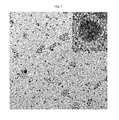
- FIG. 7 is a TEM image of Na(Y,Gd)F 4 :Ce,Tb,Eu/NaGdF 4 core-shell nanophosphor in accordance with an exemplary embodiment of the present disclosure
- FIG. 8 illustrates a PL spectrum of Na(Y,Gd)F 4 :Ce,Tb,Eu/NaGdF 4 core-shell nanophosphor in accordance with an exemplary embodiment of the present disclosure
- FIG. 9 is an image of a polymer composite that Na(Y,Gd)F 4 :Ce,Tb,Eu/NaGdF 4 core-shell nanophosphor is dispersed in polydimethylsiloxane (PDMS) polymer in accordance with an exemplary embodiment of the present disclosure.
- PDMS polydimethylsiloxane
- Example 1 Synthesis of Green-Emitting Nanophosphor as 0.1 mmol Ce 3+ , 0.15 mmol Tb 3+ , and 0 mmol Eu 3+ -Doped Fluoride-Based Nanoparticle
- the lanthanide complex compound was mixed with a solution containing oleic acid and 1-octadicene, and heat-treated at 150° C. for 30 minutes, preparing a first mixed-solution containing the lanthanide complex compound (First mixed-solution preparing step).
- reaction-solution preparing step 2.5 mmol of sodium hydroxide was mixed with 10 ml of methanol solution containing 4 mmol of ammonium fluoride, to prepare a second mixed-solution. The second mixed-solution was then mixed with the first mixed-solution, to prepare a reaction-solution (Reaction-solution preparing step).
- the reaction-solution was cooled down to room temperature, thereby obtaining a nanophosphor of Example 1 which was in a colloid state having a diameter of about 18.5 nm.
- the thusly obtained nanophosphor of Example 1 was washed with acetone or ethanol, and stored by being dispersed in a non-polar solvent, such as hexane, toluene, chloroform and the like.
- Example 2 Fabrication of Yellowish Green-Emitting Nanophosphor as 0.1 mmol Ce 3+ , 0.15 mmol Tb 3+ , and 0.005 mmol Eu 3+ -Doped Fluoride-Based Nanoparticle
- a reaction-solution was prepared by carrying out the complex compound preparing step, the first mixed-solution preparing step and the reaction-solution preparing step, as equal to Example 1, except for a mixture, applied in the complex compound preparing step, which was prepared by adding in a mixture solvent 0.145 mmol of yttrium chloride hydrate (YCl 3 .6H 2 O), 0.6 mmol of gadolinium chloride hydrate (GdCl 3 .6H 2 O), 0.1 mmol of cerium chloride hydrate (CeCl 3 .7H 2 O), 0.15 mmol of terbium chloride hydrate (TbCl 3 .6H 2 O), 0.005 mmol of europium chloride hydrate (EuCl 3 .6H 2 O), and 3.1 mmol of sodium oleate (C 18 H 33 NaO 2 ).
- the heat treatment of the nanoparticle preparing step was carried out at 320° C. for 1.5 hours. After completion of the heat treatment, the reaction-solution was cooled down to room temperature, thereby obtaining a nanophosphor of Example 2 which was in a colloid state having a diameter of about 16.5 nm. The thusly obtained nanophosphor of Example 2 was stored as equal to Example 1.
- Example 3 Fabrication of Greenish Yellow-Emitting Nanophosphor as 0.1 mmol Ce 3+ , 0.15 mmol Tb 3+ , and 0.01 mmol Eu 3+ -Doped Fluoride-Based Nanoparticle
- a reaction-solution was prepared by carrying out the complex compound preparing step, the first mixed-solution preparing step and the reaction-solution preparing step, as equal to Example 1, except for a mixture, applied in the complex compound preparing step, which was prepared by adding in a mixture solvent 0.14 mmol of yttrium chloride hydrate (YCl 3 .6H 2 O), 0.6 mmol of gadolinium chloride hydrate (GdCl 3 .6H 2 O), 0.1 mmol of cerium chloride hydrate (CeCl 3 .7H 2 O), 0.15 mmol of terbium chloride hydrate (TbCl 3 .6H 2 O), 0.01 mmol of europium chloride hydrate (EuCl 3 .6H 2 O), and 3.1 mmol of sodium oleate (C 18 H 33 NaO 2 ).
- the heat treatment of the nanoparticle preparing step was carried out at 320° C. for 1.5 hours. After completion of the heat treatment, the reaction-solution was cooled down to room temperature, thereby obtaining a nanophosphor of Example 3 which was in a colloid state having a diameter of about 15.7 nm. The thusly obtained nanophosphor of Example 3 was stored as equal to Example 1.
- Example 4 Fabrication of Yellow-Emitting Nanophosphor as 0.1 mmol Ce 3+ , 0.15 mmol Tb 3+ , and 0.02 mmol Eu 3+ -Doped Fluoride-Based Nanoparticle
- a reaction-solution was prepared by carrying out the complex compound preparing step, the first mixed-solution preparing step and the reaction-solution preparing step, as equal to Example 1, except for a mixture, applied in the complex compound preparing step, which was prepared by adding in a mixture solvent 0.13 mmol of yttrium chloride hydrate (YCl 3 .6H 2 O), 0.6 mmol of gadolinium chloride hydrate (GdCl 3 .6H 2 O), 0.1 mmol of cerium chloride hydrate (CeCl 3 .7H 2 O), 0.15 mmol of terbium chloride hydrate (TbCl 3 .6H 2 O), 0.02 mmol of europium chloride hydrate (EuCl 3 .6H 2 O), and 3.1 mmol of sodium oleate (C 18 H 33 NaO 2 ).
- the heat treatment of the nanoparticle preparing step was carried out at 320° C. for 1.5 hours. After completion of the heat treatment, the reaction-solution was cooled down to room temperature, thereby obtaining a nanophosphor of Example 4 which was in a colloid state having a diameter of about 15.5 nm. The thusly obtained nanophosphor of Example 4 was stored as equal to Example 1.
- Example 5 Fabrication of Orange-Emitting Nanophosphor as 0.1 mmol Ce 3+ , 0.15 mmol Tb 3+ , and 0.05 mmol Eu 3+ -Doped Fluoride-Based Nanoparticle
- a reaction-solution was prepared by carrying out the complex compound preparing step, the first mixed-solution preparing step and the reaction-solution preparing step, as equal to Example 1, except for a mixture, applied in the complex compound preparing step, which was prepared by adding in a mixture solvent 0.1 mmol of yttrium chloride hydrate (YCl 3 .6H 2 O), 0.6 mmol of gadolinium chloride hydrate (GdCl 3 .6H 2 O), 0.1 mmol of cerium chloride hydrate (CeCl 3 .7H 2 O), 0.15 mmol of terbium chloride hydrate (TbCl 3 .6H 2 O), 0.05 mmol of europium chloride hydrate (EuCl 3 .6H 2 O), and 3.1 mmol of sodium oleate (C 18 H 33 NaO 2 ).
- the heat treatment of the nanoparticle preparing step was carried out at 320° C. for 1.5 hours. After completion of the heat treatment, the reaction-solution was cooled down to room temperature, thereby obtaining a nanophosphor of Example 5 which was in a colloid state having a diameter of about 14.6 nm. The thusly obtained nanophosphor of Example 5 was stored as equal to Example 1.
- Example 6 Fabrication of Scarlet-Emitting Nanophosphor as 0.1 mmol Ce 3+ , 0.15 mmol Tb 3+ , and 0.1 mmol Eu 3+ -Doped Fluoride-Based Nanoparticle
- a reaction-solution was prepared by carrying out the complex compound preparing step, the first mixed-solution preparing step and the reaction-solution preparing step, as equal to Example 1, except for a mixture, applied in the complex compound preparing step, which was prepared by adding in a mixture solvent 0.05 mmol of yttrium chloride hydrate (YCl 3 .6H 2 O), 0.6 mmol of gadolinium chloride hydrate (GdCl 3 .6H 2 O), 0.1 mmol of cerium chloride hydrate (CeCl 3 .7H 2 O), 0.15 mmol of terbium chloride hydrate (TbCl 3 .6H 2 O), 0.1 mmol of europium chloride hydrate (EuCl 3 .6H 2 O), and 3.1 mmol of sodium oleate (C 18 H 33 NaO 2 ).
- the heat treatment of the nanoparticle preparing step was carried out at 320° C. for 1.5 hours. After completion of the heat treatment, the reaction-solution was cooled down to room temperature, thereby obtaining a nanophosphor of Example 6 which was in a colloid state having a diameter of about 13.7 nm. The thusly obtained nanophosphor of Example 6 was stored as equal to Example 1.
- Example 7 Fabrication of Red-Emitting Nanophosphor as 0.1 mmol Ce 3+ , 0 mmol Tb 3+ , and 0.05 mmol Eu 3+ -Doped Fluoride-Based Nanoparticle
- a reaction-solution was prepared by carrying out the complex compound preparing step, the first mixed-solution preparing step and the reaction-solution preparing step, as equal to Example 1, except for a mixture, applied in the complex compound preparing step, which was prepared by adding in a mixture solvent 0.25 mmol of yttrium chloride hydrate (YCl 3 .6H 2 O), 0.6 mmol of gadolinium chloride hydrate (GdCl 3 .6H 2 O), 0.1 mmol of cerium chloride hydrate (CeCl 3 .7H 2 O), 0.05 mmol of europium chloride hydrate (EuCl 3 .6H 2 O), and 3.1 mmol of sodium oleate (C 18 H 33 NaO 2 ).
- the heat treatment of the nanoparticle preparing step was carried out at 320° C. for 1.5 hours. After completion of the heat treatment, the reaction-solution was cooled down to room temperature, thereby obtaining a nanophosphor of Example 7 which was in a colloid state having a diameter of about 16.4 nm. The thusly obtained nanophosphor of Example 7 was stored as equal to Example 1.
- Photoluminescence spectra of the nanophosphors of Examples 1 to 7 have been measured using F-7000 model of Hitachi, and the measurement results are shown in FIG. 1 .
- FIG. 1 it can be understood that relative intensities of PL peaks from green to red regions are changed in response to variation of the content of europium when the nanophosphor is excited by 254-nm ultraviolet rays. That is, it can be noticed that the green-emitting peak is reduced and the red-emitting peak is increasing as the content of europium increases within the nanoparticle host. It may thusly be observed from such results that the nanophosphors with the tuned PL peaks from green to red regions by adjustment of the content of europium can be fabricated.
- TEM images of the nanophosphors synthesized in Examples 1 to 7 have been measured, respectively, by using FEI TECNAI F20 G2, and the measurement results are shown in FIG. 2 .
- the nanophosphors synthesized according to the present disclosure all exhibit nano-scaled sizes less than 50 nm, and have sizes in the range of 13.7 nm to 18.5 nm irrespective of the contents of the doped terbium and europium.
- FIG. 3 X-ray diffraction patterns of the nanophosphors synthesized in Examples 1 to 7 are shown in FIG. 3 .
- a single ⁇ -phase without impurities has been formed irrespective of the content of terbium or europium doped.
- FWHM full width at half maximum
- FIG. 4 A CIE chromaticity diagram of the nanophosphors of Examples 1 to 7 are shown in FIG. 4 .
- FIG. 4 As the same as being observed in FIG. 1 , it can be noticed that the relative intensities of PL spectra of the green and red regions are changed in response to the variation of the contents of terbium and europium within the nanophosphor host, and accordingly the color emitted from each nanophosphor is tunable.
- Photoluminescence images of the nanophosphors synthesized in Examples 1 to 7 are shown in FIG. 5 .
- the nanophosphors fabricated according to the present disclosure can emit various luminescent colors of green, yellowish green, yellow, orange and red under an excitation condition of the same wavelength of ultraviolet rays.
- Example 8 Fabrication of Orange-Emitting Nanophosphor as 0.1 mmol Ce 3+ , 0.15 mmol Tb 3+ , 0.05 mmol Eu 3+ -Doped Fluoride-Based Nanoparticle with Size Below 10 nm
- the lanthanide complex compound was mixed with a solution containing oleic acid and 1-octadicene, and heat treated at 150° C. for 30 minutes, preparing a first mixed-solution containing the lanthanide complex compound (First mixed-solution preparing step).
- reaction-solution preparing step 2.5 mmol of sodium hydroxide was mixed with 10 ml of methanol solution containing 4 mmol of ammonium fluoride, to prepare a second mixed-solution. The second mixed-solution was then mixed with the first mixed-solution, to prepare a reaction-solution (Reaction-solution preparing step).
- the reaction-solution was cooled down to room temperature, thereby obtaining a nanophosphor in a colloid state having a diameter of about 4.9 nm.
- the thusly obtained nanophosphor was washed with acetone or ethanol, and stored by being dispersed in a non-polar solvent, such as hexane, toluene, chloroform and the like.
- Example 8 ⁇ -NaY 0.1 Gd 0.6 F 4 :Ce 3+ 0.1 ,Tb 3+ 0.15 Eu 0.05 nanoparticle having a size below 10 nm, obtained through Example 8, was used as a core, and a shell, which exhibited a magnetic characteristic, was formed around the core according to a method to be explained hereinafter.
- a third mixed-solution was prepared by dissolving 1.0 mmol of gadolinium chloride hydrate (GdCl 3 .6H 2 O) in 6 ml of oleic acid and 15 ml of 1-octadicene. Afterwards, ⁇ -NaY 0.1 Gd 0.6 F 4 :Ce 3+ 0.1 ,Tb 3+ 0.15 Eu 0.05 dispersed in 10 ml of hexane was added into the third mixed-solution, thereby preparing a fourth mixed-solution (Shell solution preparing step and nanoparticle mixing step).
- Example 9 After evenly mixing the fourth mixed-solution using a magnetic stirrer, 10 ml of methanol solution containing 2.5 mmol of sodium chloride and 4 mmol of ammonium chloride was injected into the fourth mixed-solution (Shell reaction-solution preparing step), followed by heat treatment as disclosed in Example 1 (Shell preparing step). After the heat treatment, the mixture was washed with ethanol, obtaining a nanophosphor having the core and the shell, with a size of about 8.8 nm. The nanophosphor of Example 9 was stored by being dispersed in chloroform.
- the nanophosphors of Examples 8 and 9 have been observed, respectively, using FEI TECNAI F20 G2, and the observed results are shown in FIGS. 6 and 7 .
- FIG. 6 is a TEM image and a high resolution TEM image of the nanophosphor synthesized in Example 8.
- the nanophosphor synthesized in Example 8 has a size of 4.9 nm.
- a lattice pattern is clearly observed on one nanophosphor particle. This may indicate that the synthesized nanophosphor has an extremely high crystallinity.
- the nanophosphor of Example 8 may exhibit a strong PL characteristic by virtue of the high crystallinity in spite of the ultra small size below 10 nm.
- FIG. 7 is a TEM image of a ⁇ -NaY 0.1 Gd 0.6 F 4 :Ce 3+ 0.1 ,Tb 3+ 0.15 Eu 0.05 / ⁇ -NaGdF 4 core-shell nanophosphor, synthesized in Example 9. It can be observed that the core-shell nanophosphor synthesized in Example 9 has a size of 8.8 nm, which is greater than the nanophosphor of Example 8 used as the core, by virtue of the growth of the shell around the core. Referring to the high resolution TEM image shown on a right upper end of FIG. 7 , it can be noticed that a lattice pattern of the core-shell nanoparticle is clearly observed and the shell has been epitaxially grown based on the continuous lattice pattern around the core nanoparticle.
- Photoluminescence spectra of the nanophosphor consisting of the nanoparticle synthesized in Example 8, and the core-shell nanophosphor synthesized in Example 9 have been measured using Hitachi F-7000, and the measurement results are shown in FIG. 8 .
- FIG. 8 it can be observed that the photoluminescence of the nanophosphor of Example 9 has greatly increased as compared to Example 8.
- the nanophosphor of Example 9 exhibits the increase in photoluminescence intensity by about 2.3 times than the nanophosphor of Example 8. This may result from the growth (formation) of the epitaxial shell around the core.
- Example 9 0.4 ml of the core-shell nanophosphor obtained in Example 9 was mixed with 4 ml of polydimethylsiloxane (PDMS) and 0.4 ml of curing agent, preparing a core-shell nanophosphor polymer mixture. The mixture was cooled down to room temperature after being maintained at 80° C. for one hour, thereby obtaining nanophosphor-polymer composite of Example 10.
- PDMS polydimethylsiloxane
- the image of the nanophosphor-polymer composite of Example 10 is shown in FIG. 9 .
- FIG. 9 a left image of FIG. 9 , it can be noticed that the composite is very transparent and characters of a document laid under it are clearly visible. Also, referring to a right image of FIG. 9 , which is a photoluminescence image obtained when the nanophosphor was excited by 254-nm ultraviolet lamp, a red luminescent color is observed. The synthesis of the nanophosphor-polymer composite having high transparency and superior photoluminescence property was confirmed from the images of FIG. 9 .
Landscapes
- Chemical & Material Sciences (AREA)
- Engineering & Computer Science (AREA)
- Health & Medical Sciences (AREA)
- Nanotechnology (AREA)
- Materials Engineering (AREA)
- Organic Chemistry (AREA)
- Inorganic Chemistry (AREA)
- Life Sciences & Earth Sciences (AREA)
- Animal Behavior & Ethology (AREA)
- Veterinary Medicine (AREA)
- Public Health (AREA)
- Nuclear Medicine, Radiotherapy & Molecular Imaging (AREA)
- General Health & Medical Sciences (AREA)
- Epidemiology (AREA)
- Radiology & Medical Imaging (AREA)
- Biomedical Technology (AREA)
- Crystallography & Structural Chemistry (AREA)
- Polymers & Plastics (AREA)
- Medicinal Chemistry (AREA)
- Chemical Kinetics & Catalysis (AREA)
- Luminescent Compositions (AREA)
Abstract
Description
NaY1-w-x-y-zGdwF4:Ce3+ x,Tb3+ y,Eu3+ z [Chemical formula 1]
NaGd1-rMrF4 [Chemical formula 2]
NaY1-w-x-y-zGdwF4:Ce3+ x,Tb3+ y,Eu3+ z [Chemical formula 1]
NaGd1-rMrF4 [Chemical formula 2]
Claims (19)
NaY1-w-x-y-zGdwF4:Ce3+ x,Tb3+ y,Eu3+ z [Chemical formula 1]
NaY1-w-x-y-zGdwF4:Ce3+ x,Tb3+ y,Eu3+ z [Chemical formula 1]
NaGd1-rMrF4 [Chemical formula 2]
NaY1-w-x-y-zGdwF4:Ce3+ x,Tb3+ y,Eu3+ z [Chemical formula 1]
NaGd1-rMrF4 [Chemical formula 2]
Applications Claiming Priority (2)
| Application Number | Priority Date | Filing Date | Title |
|---|---|---|---|
| KR1020130040471A KR101513134B1 (en) | 2013-04-12 | 2013-04-12 | Color tunable multifunctional nanophosphor, synthesis method thereof, and polymer composite including the nanophosphor |
| KR10-2013-0040471 | 2013-04-12 |
Publications (2)
| Publication Number | Publication Date |
|---|---|
| US20140308213A1 US20140308213A1 (en) | 2014-10-16 |
| US9796923B2 true US9796923B2 (en) | 2017-10-24 |
Family
ID=51686942
Family Applications (1)
| Application Number | Title | Priority Date | Filing Date |
|---|---|---|---|
| US14/250,769 Active 2036-07-29 US9796923B2 (en) | 2013-04-12 | 2014-04-11 | Color tunable multifunctional nanophosphor, synthesis method thereof, and polymer composite including the nanophosphor |
Country Status (2)
| Country | Link |
|---|---|
| US (1) | US9796923B2 (en) |
| KR (1) | KR101513134B1 (en) |
Families Citing this family (11)
| Publication number | Priority date | Publication date | Assignee | Title |
|---|---|---|---|---|
| KR101646675B1 (en) * | 2015-07-22 | 2016-08-09 | 한국과학기술연구원 | Dual-mode-emitting nanophosphor with core-multishell structure and synthetic method thereof and transparent polymer composite including the nanophosphor |
| CN109367266A (en) * | 2018-09-07 | 2019-02-22 | 中华人民共和国北京出入境边防检查总站 | A kind of the fluorescence true color image and process for making of ultraviolet excitation |
| KR102204359B1 (en) * | 2019-03-27 | 2021-01-19 | 한국과학기술연구원 | Core/multi-shell upconversion fluoride nanophosphor showing luminescence under various excitation wavelengths and methods of forming the same |
| CN110184062A (en) * | 2019-04-24 | 2019-08-30 | 中国计量大学 | A kind of Ratio-type red light emitting phosphor and its application as Ratio-type fluorescent pH probe |
| CN110055070B (en) * | 2019-04-28 | 2021-11-19 | 中国计量大学 | Ratio type green light emission fluorescent material |
| CN110041908B (en) * | 2019-04-30 | 2021-06-01 | 中国计量大学 | Novel red light emitting fluorescent material |
| CN110129052B (en) * | 2019-05-05 | 2021-11-23 | 中国计量大学 | Yellow light emitting fluorescent material and application thereof as pH probe |
| CN110041909B (en) * | 2019-05-07 | 2021-06-01 | 中国计量大学 | A novel green-emitting fluorescent material and its application as a pH probe |
| CN111909029B (en) * | 2020-08-24 | 2022-09-06 | 北京石油化工学院 | Preparation method of Eu/Tb (OH) (BDC) for detecting creatinine |
| CN114574192B (en) * | 2022-04-11 | 2023-05-16 | 中国科学院合肥物质科学研究院 | Preparation of nuclear shell structure up-conversion nano fluorescence sensing probe and application of nuclear shell structure up-conversion nano fluorescence sensing probe in mesna detection |
| CN114813688B (en) * | 2022-05-06 | 2025-06-03 | 江苏大学 | A method for detecting acrylamide content based on upconversion nanobiosensor system |
-
2013
- 2013-04-12 KR KR1020130040471A patent/KR101513134B1/en active Active
-
2014
- 2014-04-11 US US14/250,769 patent/US9796923B2/en active Active
Non-Patent Citations (7)
| Title |
|---|
| Boyer, John-Christopher, et al. "Synthesis, characterization, and spectroscopy of NaGdF4: Ce3+, Tb3+/NaYF4 core/shell nanoparticles." Chemistry of materials 19.14 (2007): 3358-3360. |
| Kiliaan, H. S., et al. "Energy Transfer in the Luminescent System Na (Y, Gd) F 4: Ce, Tb." Journal of the Electrochemical Society 134.9 (1987): 2359-2364. |
| Korean Notice of Allowance dated Mar. 31, 2015 in Korean counterpart Application No. KR 10-2013-0040471 (2 pages, in Korean). |
| Korean Office Action dated Dec. 29, 2014 in counterpart Application No. KR 10-2013-0040471 (3 pages, in Korean). |
| Sotiriou, Georgios A., et al. "Optically stable biocompatible flame-made SiO2-coated Y2O3: Tb3+ nanophosphors for cell imaging." ACS Nano vol. 6 No. 5 (2012): (14 pages). |
| Wang, Feng, et al. "Multicolour PEI/NaGdF4: Ce3+, Ln3+ nanocrystals by single-wavelength excitation." Nanotechnology vol. 18 (2007): 025701. (6 pages). |
| Wang, Xiaoyong, et al. "Non-blinking semiconductor nanocrystals." Nature vol. 459 (2009): 686-689. |
Also Published As
| Publication number | Publication date |
|---|---|
| US20140308213A1 (en) | 2014-10-16 |
| KR20140123304A (en) | 2014-10-22 |
| KR101513134B1 (en) | 2015-04-17 |
Similar Documents
| Publication | Publication Date | Title |
|---|---|---|
| US20140308213A1 (en) | Color tunable multifunctional nanophosphor, synthesis method thereof, and polymer composite including the nanophosphor | |
| JP5721767B2 (en) | Multifunctional magnetic nanophosphor having core / shell structure and method for producing the same | |
| KR101343423B1 (en) | Core/shell magnetic nanophosphor and method for synthesizing thereof | |
| Zhao et al. | Synthesis of Sr4Al14O25: Eu2+, Dy3+ phosphor nanometer powders by combustion processes and its optical properties | |
| Kim et al. | Highly bright multicolor tunable ultrasmall β-Na (Y, Gd) F 4: Ce, Tb, Eu/β-NaYF 4 core/shell nanocrystals | |
| Liu et al. | General synthesis of LiLn (MO 4) 2: Eu 3+(Ln= La, Eu, Gd, Y; M= W, Mo) nanophosphors for near UV-type LEDs | |
| US11254866B2 (en) | Core/multi-shell upconversion fluoride nanophosphor exhibiting luminescence under various excitation wavelengths, and method of synthesizing the same | |
| Sharma et al. | Synthesis and luminescence properties of CaMO 4: Dy 3+(M= W, Mo) nanoparticles prepared via an ethylene glycol route | |
| KR101792800B1 (en) | Color tunable upconversion nanophosphor and method of fabricating the same | |
| Liu et al. | Microwave-assisted solvothermal preparation and photoluminescence properties of Y2O3: Eu3+ phosphors | |
| Guan et al. | Energy transfer and tunable multicolor emission and paramagnetic properties of GdF 3: Dy 3+, Tb 3+, Eu 3+ phosphors | |
| US11680205B2 (en) | Full-color-tunable upconversion nanophosphor | |
| KR101646675B1 (en) | Dual-mode-emitting nanophosphor with core-multishell structure and synthetic method thereof and transparent polymer composite including the nanophosphor | |
| Motloung et al. | Effect of Tb3+ concentration on the structure and optical properties of triply doped ZnAl2O4: 1% Ce3+, 1% Eu3+, x% Tb3+ nano-phosphors synthesized via citrate sol-gel method | |
| Park et al. | Solvothermal synthesis and luminescence properties of Tb3+-doped gadolinium aluminum garnet | |
| US9657225B2 (en) | Multicolor tunable nanophosphor and its synthesis method and transparent polymer composite including the nanophosphor | |
| Rambabu et al. | Luminescence optimization with superior asymmetric ratio (red/orange) and color purity of MBO 3: Eu 3+@ SiO 2 (M= Y, Gd and Al) nano down-conversion phosphors | |
| KR102037373B1 (en) | Upconversion nanophosphor showing luminescence under various excitation wavelengths and methods of fabricating the same | |
| Cervantes-Vásquez et al. | Quantum efficiency of silica-coated rare-earth doped yttrium silicate | |
| KR20190048646A (en) | Multicolor tunable upconversion nanophosphors under various excitation wavelengths and method of fabricating the same | |
| Jung | White luminescent calcium molybdate phosphor synthesized at room temperature via the Co-precipitation method used in a LED flexible composite | |
| Ali et al. | Energy transfer between Ce and Sm co-doped YAG nanocrystals for white light emitting devices | |
| Yang et al. | Tb-doped YPO4 phosphors: Polyacrylamide gel synthesis and optical properties | |
| KR102016557B1 (en) | Upconversion nanophosphor showing multicolor luminescence with under 10 ㎚ size and methods of fabricating the same | |
| Lingling et al. | Spectroscopic properties of Gd2O3: Dy3+ nanocrystals |
Legal Events
| Date | Code | Title | Description |
|---|---|---|---|
| AS | Assignment |
Owner name: KOREA INSTITUTE OF SCIENCE AND TECHNOLOGY, KOREA, Free format text: ASSIGNMENT OF ASSIGNORS INTEREST;ASSIGNORS:JANG, HO SEONG;WOO, KYOUNGJA;KIM, SU YEON;REEL/FRAME:032656/0654 Effective date: 20140402 |
|
| STCF | Information on status: patent grant |
Free format text: PATENTED CASE |
|
| MAFP | Maintenance fee payment |
Free format text: PAYMENT OF MAINTENANCE FEE, 4TH YR, SMALL ENTITY (ORIGINAL EVENT CODE: M2551); ENTITY STATUS OF PATENT OWNER: SMALL ENTITY Year of fee payment: 4 |
|
| MAFP | Maintenance fee payment |
Free format text: PAYMENT OF MAINTENANCE FEE, 8TH YR, SMALL ENTITY (ORIGINAL EVENT CODE: M2552); ENTITY STATUS OF PATENT OWNER: SMALL ENTITY Year of fee payment: 8 |