US9790220B2 - Substituted cyclopentanes, tetrahydrofuranes and pyrrolidines as orexin receptor antagonists - Google Patents
Substituted cyclopentanes, tetrahydrofuranes and pyrrolidines as orexin receptor antagonists Download PDFInfo
- Publication number
- US9790220B2 US9790220B2 US15/120,002 US201515120002A US9790220B2 US 9790220 B2 US9790220 B2 US 9790220B2 US 201515120002 A US201515120002 A US 201515120002A US 9790220 B2 US9790220 B2 US 9790220B2
- Authority
- US
- United States
- Prior art keywords
- cyclopentyl
- carboxamide
- amino
- fluoro
- benzothiazol
- Prior art date
- Legal status (The legal status is an assumption and is not a legal conclusion. Google has not performed a legal analysis and makes no representation as to the accuracy of the status listed.)
- Expired - Fee Related
Links
- 0 [1*]*C1(C)CCCC1(C)N([2*])C([3*])=O Chemical compound [1*]*C1(C)CCCC1(C)N([2*])C([3*])=O 0.000 description 15
- WZTWSNNHLOGHMP-UHFFFAOYSA-N CCOC1=CC=C(C)N=C1C(=O)NC1CCCC1CC1=NC2=CC=CC=C2C=C1 Chemical compound CCOC1=CC=C(C)N=C1C(=O)NC1CCCC1CC1=NC2=CC=CC=C2C=C1 WZTWSNNHLOGHMP-UHFFFAOYSA-N 0.000 description 2
- MPYPTCXWQCTPSK-ZFWWWQNUSA-N COC1=C(C(=O)N(C)[C@H]2CCC[C@@H]2NC2=NC3=C(C=C(F)C=C3)S2)N=CC=C1 Chemical compound COC1=C(C(=O)N(C)[C@H]2CCC[C@@H]2NC2=NC3=C(C=C(F)C=C3)S2)N=CC=C1 MPYPTCXWQCTPSK-ZFWWWQNUSA-N 0.000 description 2
- WBSYSMRWVPPLPI-STQMWFEESA-N COC1=C(C(=O)N[C@H]2CCC[C@@H]2NC2=NC3=C(C=C(F)C=C3)O2)N=CC=C1 Chemical compound COC1=C(C(=O)N[C@H]2CCC[C@@H]2NC2=NC3=C(C=C(F)C=C3)O2)N=CC=C1 WBSYSMRWVPPLPI-STQMWFEESA-N 0.000 description 2
- CBYYYYRJKKWLDI-UHFFFAOYSA-N COC1=C(Cl)N=C(C(F)(F)F)C=C1 Chemical compound COC1=C(Cl)N=C(C(F)(F)F)C=C1 CBYYYYRJKKWLDI-UHFFFAOYSA-N 0.000 description 2
- LGPHVTUAYBELNI-HOTGVXAUSA-N COC1CN(C2=C(C(=O)N[C@H]3CCC[C@@H]3NC3=NC4=C(C=C(F)C=C4)S3)N=CC=C2)C1 Chemical compound COC1CN(C2=C(C(=O)N[C@H]3CCC[C@@H]3NC3=NC4=C(C=C(F)C=C4)S3)N=CC=C2)C1 LGPHVTUAYBELNI-HOTGVXAUSA-N 0.000 description 2
- RLOLWTGEOZNNDX-STQMWFEESA-N O=C(N[C@H]1CCC[C@@H]1NC1=NC2=C(C=C(F)C=C2)S1)C1=C(Cl)C=CC=N1 Chemical compound O=C(N[C@H]1CCC[C@@H]1NC1=NC2=C(C=C(F)C=C2)S1)C1=C(Cl)C=CC=N1 RLOLWTGEOZNNDX-STQMWFEESA-N 0.000 description 2
- XJWOCKIDOISONA-UHFFFAOYSA-N O=C(O)C1=C(OC(F)F)C=CC=N1.[NaH] Chemical compound O=C(O)C1=C(OC(F)F)C=CC=N1.[NaH] XJWOCKIDOISONA-UHFFFAOYSA-N 0.000 description 2
- DICHJXHVCKRPCF-HRTRMLIBSA-M BrCC1=NC2=CC=CC=C2C=C1.C1=CC=C([P+](CC2=NC3=CC=CC=C3C=C2)(C2=CC=CC=C2)C2=CC=CC=C2)C=C1.CC(C)(C)OC(=O)NC1CCC/C1=C\C1=NC2=CC=CC=C2C=C1.CC(C)(C)OC(=O)NC1CCCC1CC1=NC2=CC=CC=C2C=C1.CC1=NC2=CC=CC=C2C=C1.NClC1CCCC1CC1=NC2=CC=CC=C2C=C1.[Br-] Chemical compound BrCC1=NC2=CC=CC=C2C=C1.C1=CC=C([P+](CC2=NC3=CC=CC=C3C=C2)(C2=CC=CC=C2)C2=CC=CC=C2)C=C1.CC(C)(C)OC(=O)NC1CCC/C1=C\C1=NC2=CC=CC=C2C=C1.CC(C)(C)OC(=O)NC1CCCC1CC1=NC2=CC=CC=C2C=C1.CC1=NC2=CC=CC=C2C=C1.NClC1CCCC1CC1=NC2=CC=CC=C2C=C1.[Br-] DICHJXHVCKRPCF-HRTRMLIBSA-M 0.000 description 1
- DAQRBIQKACWJLB-UHFFFAOYSA-N C1=CC2=CC=NC=C2C=C1.C1=CC2=NC=CN=C2C=C1.C1=CC=C2CC=CC2=C1.C1=CC=C2CN=CC2=C1.C1=CC=C2N=NCC2=C1.C1=CC=NC=C1.C1=CC=NN=C1.C1=CCN=C1.C1=CN=C2C=CC=CC2=C1.C1=CN=CC1.C1=CN=CC=N1.C1=CN=CN=C1.C1=CNN=N1 Chemical compound C1=CC2=CC=NC=C2C=C1.C1=CC2=NC=CN=C2C=C1.C1=CC=C2CC=CC2=C1.C1=CC=C2CN=CC2=C1.C1=CC=C2N=NCC2=C1.C1=CC=NC=C1.C1=CC=NN=C1.C1=CCN=C1.C1=CN=C2C=CC=CC2=C1.C1=CN=CC1.C1=CN=CC=N1.C1=CN=CN=C1.C1=CNN=N1 DAQRBIQKACWJLB-UHFFFAOYSA-N 0.000 description 1
- ZIVXNVAYWXIYHN-PEMVXDBASA-N CC(C)(C)OC(=O)N[C@H]1CCC[C@@H]1N.CC(C)(C)OC(=O)N[C@H]1CCC[C@@H]1NC(=O)C1=CC=CC=C1OC(F)F.NCl[C@H]1CCC[C@@H]1NC(=O)C1=CC=CC=C1OC(F)F Chemical compound CC(C)(C)OC(=O)N[C@H]1CCC[C@@H]1N.CC(C)(C)OC(=O)N[C@H]1CCC[C@@H]1NC(=O)C1=CC=CC=C1OC(F)F.NCl[C@H]1CCC[C@@H]1NC(=O)C1=CC=CC=C1OC(F)F ZIVXNVAYWXIYHN-PEMVXDBASA-N 0.000 description 1
- APLKWPZXILPQQD-RQUYFAIASA-N CC(C)(C)OC(=O)N[C@H]1CCC[C@@H]1N.CC(C)(C)OC(=O)N[C@H]1CCC[C@@H]1NC1=NC2=CC=C(F)C=C2S1.CN[C@H]1CCC[C@@H]1NC1=NC2=CC=C(F)C=C2S1 Chemical compound CC(C)(C)OC(=O)N[C@H]1CCC[C@@H]1N.CC(C)(C)OC(=O)N[C@H]1CCC[C@@H]1NC1=NC2=CC=C(F)C=C2S1.CN[C@H]1CCC[C@@H]1NC1=NC2=CC=C(F)C=C2S1 APLKWPZXILPQQD-RQUYFAIASA-N 0.000 description 1
- MHXXIWPIZLRLNG-GKHDJOBYSA-N CC(C)(C)OC(=O)N[C@H]1CCC[C@@H]1N.COC1=C(C(=O)N[C@H]2CCC[C@@H]2ClN)N=CC=C1.COC1=C(C(=O)N[C@H]2CCC[C@@H]2NC(=O)OC(C)(C)C)N=CC=C1 Chemical compound CC(C)(C)OC(=O)N[C@H]1CCC[C@@H]1N.COC1=C(C(=O)N[C@H]2CCC[C@@H]2ClN)N=CC=C1.COC1=C(C(=O)N[C@H]2CCC[C@@H]2NC(=O)OC(C)(C)C)N=CC=C1 MHXXIWPIZLRLNG-GKHDJOBYSA-N 0.000 description 1
- GEMNPXAJORQFOB-GJZGRUSLSA-N CC(C)OC1=C(C(=O)N[C@H]2CCC[C@@H]2NC2=NC3=C(C=C(F)C=C3)S2)N=CC=C1 Chemical compound CC(C)OC1=C(C(=O)N[C@H]2CCC[C@@H]2NC2=NC3=C(C=C(F)C=C3)S2)N=CC=C1 GEMNPXAJORQFOB-GJZGRUSLSA-N 0.000 description 1
- HIVPCGKLSKXCCA-UHFFFAOYSA-N CC1=CC=C(O)C(CO)=N1.CCOC1=CC=C(C)N=C1C(=O)O.CCOC1=CC=C(C)N=C1CO Chemical compound CC1=CC=C(O)C(CO)=N1.CCOC1=CC=C(C)N=C1C(=O)O.CCOC1=CC=C(C)N=C1CO HIVPCGKLSKXCCA-UHFFFAOYSA-N 0.000 description 1
- IVVYZNAACSNYDB-KBPBESRZSA-N CCOC1=C(C(=O)N[C@H]2CCC[C@@H]2NC2=NC3=C(C=C(F)C=C3)S2)N=CC=C1 Chemical compound CCOC1=C(C(=O)N[C@H]2CCC[C@@H]2NC2=NC3=C(C=C(F)C=C3)S2)N=CC=C1 IVVYZNAACSNYDB-KBPBESRZSA-N 0.000 description 1
- CXYVUHCWDSBPOT-UHFFFAOYSA-N CCOC1=C(C(=O)O)N=CC=C1.CCOC1=C(C(=O)OC)N=CC=C1.COC(=O)C1=C(O)C=CC=N1.Cl Chemical compound CCOC1=C(C(=O)O)N=CC=C1.CCOC1=C(C(=O)OC)N=CC=C1.COC(=O)C1=C(O)C=CC=N1.Cl CXYVUHCWDSBPOT-UHFFFAOYSA-N 0.000 description 1
- QTVCNUYGSSNMDT-UHFFFAOYSA-N CCOC1=C(C(=O)O)N=CC=C1.Cl Chemical compound CCOC1=C(C(=O)O)N=CC=C1.Cl QTVCNUYGSSNMDT-UHFFFAOYSA-N 0.000 description 1
- XUYJQZIULVDUOP-UHFFFAOYSA-N CCOC1=CC=C(C)N=C1C(=O)O Chemical compound CCOC1=CC=C(C)N=C1C(=O)O XUYJQZIULVDUOP-UHFFFAOYSA-N 0.000 description 1
- KVMQAXWNXTZZON-UWVGGRQHSA-N CN[C@H]1CCC[C@@H]1NC1=NC2=CC=C(F)C=C2S1 Chemical compound CN[C@H]1CCC[C@@H]1NC1=NC2=CC=C(F)C=C2S1 KVMQAXWNXTZZON-UWVGGRQHSA-N 0.000 description 1
- KYOPDZVPVBBQFE-UHFFFAOYSA-N COC(=O)C1=C(OC(F)F)C=CC=N1 Chemical compound COC(=O)C1=C(OC(F)F)C=CC=N1 KYOPDZVPVBBQFE-UHFFFAOYSA-N 0.000 description 1
- JDRRXEXIXCFLDF-IUCAKERBSA-N COC1=C(C(=O)N[C@H]2CCC[C@@H]2ClN)N=CC=C1 Chemical compound COC1=C(C(=O)N[C@H]2CCC[C@@H]2ClN)N=CC=C1 JDRRXEXIXCFLDF-IUCAKERBSA-N 0.000 description 1
- SWXKPGJTLFTPBA-RYUDHWBXSA-N COC1=C(C(=O)N[C@H]2CCC[C@@H]2NC2=NC3=C(C=C(F)C=C3)S2)N=C(Br)C=C1 Chemical compound COC1=C(C(=O)N[C@H]2CCC[C@@H]2NC2=NC3=C(C=C(F)C=C3)S2)N=C(Br)C=C1 SWXKPGJTLFTPBA-RYUDHWBXSA-N 0.000 description 1
- AXQZCEQKOXUPFY-RYUDHWBXSA-N COC1=C(C(=O)N[C@H]2CCC[C@@H]2NC2=NC3=C(C=C(F)C=C3)S2)N=C(C(F)(F)F)C=C1 Chemical compound COC1=C(C(=O)N[C@H]2CCC[C@@H]2NC2=NC3=C(C=C(F)C=C3)S2)N=C(C(F)(F)F)C=C1 AXQZCEQKOXUPFY-RYUDHWBXSA-N 0.000 description 1
- CNLWZWSMSVBPFS-KBPBESRZSA-N COC1=C(C(=O)N[C@H]2CCC[C@@H]2NC2=NC3=C(C=C(F)C=C3)S2)N=C(C)C=C1 Chemical compound COC1=C(C(=O)N[C@H]2CCC[C@@H]2NC2=NC3=C(C=C(F)C=C3)S2)N=C(C)C=C1 CNLWZWSMSVBPFS-KBPBESRZSA-N 0.000 description 1
- ZWKYVGREYBVNPI-STQMWFEESA-N COC1=C(C(=O)N[C@H]2CCC[C@@H]2NC2=NC3=C(C=C(F)C=C3)S2)N=CC=C1 Chemical compound COC1=C(C(=O)N[C@H]2CCC[C@@H]2NC2=NC3=C(C=C(F)C=C3)S2)N=CC=C1 ZWKYVGREYBVNPI-STQMWFEESA-N 0.000 description 1
- LSDCDEGRFDJGSU-HOTGVXAUSA-N COC1=C(C(=O)N[C@H]2CCC[C@@H]2NC2=NC3=C(C=CC=C3)N=C2)N=CC=C1 Chemical compound COC1=C(C(=O)N[C@H]2CCC[C@@H]2NC2=NC3=C(C=CC=C3)N=C2)N=CC=C1 LSDCDEGRFDJGSU-HOTGVXAUSA-N 0.000 description 1
- BKRURXKFJGXMOZ-IUCAKERBSA-N Cl.N[C@H]1CCC[C@@H]1NC1=NC2=C(C=C(Cl)C=C2)S1 Chemical compound Cl.N[C@H]1CCC[C@@H]1NC1=NC2=C(C=C(Cl)C=C2)S1 BKRURXKFJGXMOZ-IUCAKERBSA-N 0.000 description 1
- YXXBDUYOVKSSKO-IUCAKERBSA-N Cl.N[C@H]1CCC[C@@H]1NC1=NC2=C(C=C(F)C=C2)S1 Chemical compound Cl.N[C@H]1CCC[C@@H]1NC1=NC2=C(C=C(F)C=C2)S1 YXXBDUYOVKSSKO-IUCAKERBSA-N 0.000 description 1
- ZLLVCICYYNPBSV-UHFFFAOYSA-N N#CC1=NC=CC=C1Br.N#CC1=NC=CC=C1N1N=CC=N1.O=C(O)C1=NC=CC=C1N1N=CC=N1 Chemical compound N#CC1=NC=CC=C1Br.N#CC1=NC=CC=C1N1N=CC=N1.O=C(O)C1=NC=CC=C1N1N=CC=N1 ZLLVCICYYNPBSV-UHFFFAOYSA-N 0.000 description 1
- XIEAHMUGXAIADT-UHFFFAOYSA-N NClC1CCCC1CC1=NC2=CC=CC=C2C=C1 Chemical compound NClC1CCCC1CC1=NC2=CC=CC=C2C=C1 XIEAHMUGXAIADT-UHFFFAOYSA-N 0.000 description 1
- URXLECRGXKCVJD-UWVGGRQHSA-N NCl[C@H]1CCC[C@@H]1NC(=O)C1=CC=CC=C1OC(F)F Chemical compound NCl[C@H]1CCC[C@@H]1NC(=O)C1=CC=CC=C1OC(F)F URXLECRGXKCVJD-UWVGGRQHSA-N 0.000 description 1
- NLXHVFSKCJYTNM-RYUDHWBXSA-N O=C(N[C@H]1CCC[C@@H]1NC1=NC2=C(C=C(Cl)C=C2)O1)C1=C(OC(F)F)C=CC=N1 Chemical compound O=C(N[C@H]1CCC[C@@H]1NC1=NC2=C(C=C(Cl)C=C2)O1)C1=C(OC(F)F)C=CC=N1 NLXHVFSKCJYTNM-RYUDHWBXSA-N 0.000 description 1
- YADZPQTWBQGVJH-KBPBESRZSA-N O=C(N[C@H]1CCC[C@@H]1NC1=NC2=C(C=C(Cl)C=C2)S1)C1=C(N2N=CC=N2)C=CC=N1 Chemical compound O=C(N[C@H]1CCC[C@@H]1NC1=NC2=C(C=C(Cl)C=C2)S1)C1=C(N2N=CC=N2)C=CC=N1 YADZPQTWBQGVJH-KBPBESRZSA-N 0.000 description 1
- ACBLFXUXHCYYBZ-RYUDHWBXSA-N O=C(N[C@H]1CCC[C@@H]1NC1=NC2=C(C=C(Cl)C=C2)S1)C1=C(OC(F)F)C=CC=N1 Chemical compound O=C(N[C@H]1CCC[C@@H]1NC1=NC2=C(C=C(Cl)C=C2)S1)C1=C(OC(F)F)C=CC=N1 ACBLFXUXHCYYBZ-RYUDHWBXSA-N 0.000 description 1
- XAAVMVUBZCOXHB-RYUDHWBXSA-N O=C(N[C@H]1CCC[C@@H]1NC1=NC2=C(C=C(F)C=C2)O1)C1=C(OC(F)F)C=CC=N1 Chemical compound O=C(N[C@H]1CCC[C@@H]1NC1=NC2=C(C=C(F)C=C2)O1)C1=C(OC(F)F)C=CC=N1 XAAVMVUBZCOXHB-RYUDHWBXSA-N 0.000 description 1
- PCPVMZZUSCLODN-STQMWFEESA-N O=C(N[C@H]1CCC[C@@H]1NC1=NC2=C(C=C(F)C=C2)S1)C1=C(Br)C=CC=N1 Chemical compound O=C(N[C@H]1CCC[C@@H]1NC1=NC2=C(C=C(F)C=C2)S1)C1=C(Br)C=CC=N1 PCPVMZZUSCLODN-STQMWFEESA-N 0.000 description 1
- VHNXXNYTMWVDNN-STQMWFEESA-N O=C(N[C@H]1CCC[C@@H]1NC1=NC2=C(C=C(F)C=C2)S1)C1=C(F)C=CC=N1 Chemical compound O=C(N[C@H]1CCC[C@@H]1NC1=NC2=C(C=C(F)C=C2)S1)C1=C(F)C=CC=N1 VHNXXNYTMWVDNN-STQMWFEESA-N 0.000 description 1
- ZNHYIIOVQSLYRA-GJZGRUSLSA-N O=C(N[C@H]1CCC[C@@H]1NC1=NC2=C(C=C(F)C=C2)S1)C1=C(N2C=CC=N2)C=CC=N1 Chemical compound O=C(N[C@H]1CCC[C@@H]1NC1=NC2=C(C=C(F)C=C2)S1)C1=C(N2C=CC=N2)C=CC=N1 ZNHYIIOVQSLYRA-GJZGRUSLSA-N 0.000 description 1
- ZGCIMHAIPBFOLG-KBPBESRZSA-N O=C(N[C@H]1CCC[C@@H]1NC1=NC2=C(C=C(F)C=C2)S1)C1=C(N2C=CN=N2)C=CC=N1 Chemical compound O=C(N[C@H]1CCC[C@@H]1NC1=NC2=C(C=C(F)C=C2)S1)C1=C(N2C=CN=N2)C=CC=N1 ZGCIMHAIPBFOLG-KBPBESRZSA-N 0.000 description 1
- MAQVRJKITUBSAT-GJZGRUSLSA-N O=C(N[C@H]1CCC[C@@H]1NC1=NC2=C(C=C(F)C=C2)S1)C1=C(N2CCC2)C=CC=N1 Chemical compound O=C(N[C@H]1CCC[C@@H]1NC1=NC2=C(C=C(F)C=C2)S1)C1=C(N2CCC2)C=CC=N1 MAQVRJKITUBSAT-GJZGRUSLSA-N 0.000 description 1
- KIELRMBPXHVTPP-HOTGVXAUSA-N O=C(N[C@H]1CCC[C@@H]1NC1=NC2=C(C=C(F)C=C2)S1)C1=C(N2CCCC2)C=CC=N1 Chemical compound O=C(N[C@H]1CCC[C@@H]1NC1=NC2=C(C=C(F)C=C2)S1)C1=C(N2CCCC2)C=CC=N1 KIELRMBPXHVTPP-HOTGVXAUSA-N 0.000 description 1
- WZHLDCUPCBTAMU-IRXDYDNUSA-N O=C(N[C@H]1CCC[C@@H]1NC1=NC2=C(C=C(F)C=C2)S1)C1=C(N2CCCCC2)C=CC=N1 Chemical compound O=C(N[C@H]1CCC[C@@H]1NC1=NC2=C(C=C(F)C=C2)S1)C1=C(N2CCCCC2)C=CC=N1 WZHLDCUPCBTAMU-IRXDYDNUSA-N 0.000 description 1
- QVYRXKGNJCFOKV-KBPBESRZSA-N O=C(N[C@H]1CCC[C@@H]1NC1=NC2=C(C=C(F)C=C2)S1)C1=C(N2N=CC=N2)C=CC=N1 Chemical compound O=C(N[C@H]1CCC[C@@H]1NC1=NC2=C(C=C(F)C=C2)S1)C1=C(N2N=CC=N2)C=CC=N1 QVYRXKGNJCFOKV-KBPBESRZSA-N 0.000 description 1
- ZAOXKKUGQHHIBI-RYUDHWBXSA-N O=C(N[C@H]1CCC[C@@H]1NC1=NC2=C(C=C(F)C=C2)S1)C1=C(OC(F)(F)F)C=CC=N1 Chemical compound O=C(N[C@H]1CCC[C@@H]1NC1=NC2=C(C=C(F)C=C2)S1)C1=C(OC(F)(F)F)C=CC=N1 ZAOXKKUGQHHIBI-RYUDHWBXSA-N 0.000 description 1
- LDQUCGPAZZUNGU-RYUDHWBXSA-N O=C(N[C@H]1CCC[C@@H]1NC1=NC2=C(C=C(F)C=C2)S1)C1=C(OC(F)F)C=CC=N1 Chemical compound O=C(N[C@H]1CCC[C@@H]1NC1=NC2=C(C=C(F)C=C2)S1)C1=C(OC(F)F)C=CC=N1 LDQUCGPAZZUNGU-RYUDHWBXSA-N 0.000 description 1
- HJBTXZYRCCWERT-UHFFFAOYSA-N O=C(O)C1=NC=CC=C1N1N=CC=N1 Chemical compound O=C(O)C1=NC=CC=C1N1N=CC=N1 HJBTXZYRCCWERT-UHFFFAOYSA-N 0.000 description 1
Classifications
-
- C—CHEMISTRY; METALLURGY
- C07—ORGANIC CHEMISTRY
- C07D—HETEROCYCLIC COMPOUNDS
- C07D417/00—Heterocyclic compounds containing two or more hetero rings, at least one ring having nitrogen and sulfur atoms as the only ring hetero atoms, not provided for by group C07D415/00
- C07D417/14—Heterocyclic compounds containing two or more hetero rings, at least one ring having nitrogen and sulfur atoms as the only ring hetero atoms, not provided for by group C07D415/00 containing three or more hetero rings
-
- A—HUMAN NECESSITIES
- A61—MEDICAL OR VETERINARY SCIENCE; HYGIENE
- A61K—PREPARATIONS FOR MEDICAL, DENTAL OR TOILETRY PURPOSES
- A61K31/00—Medicinal preparations containing organic active ingredients
- A61K31/01—Hydrocarbons
- A61K31/015—Hydrocarbons carbocyclic
-
- A—HUMAN NECESSITIES
- A61—MEDICAL OR VETERINARY SCIENCE; HYGIENE
- A61K—PREPARATIONS FOR MEDICAL, DENTAL OR TOILETRY PURPOSES
- A61K31/00—Medicinal preparations containing organic active ingredients
- A61K31/16—Amides, e.g. hydroxamic acids
-
- A—HUMAN NECESSITIES
- A61—MEDICAL OR VETERINARY SCIENCE; HYGIENE
- A61K—PREPARATIONS FOR MEDICAL, DENTAL OR TOILETRY PURPOSES
- A61K31/00—Medicinal preparations containing organic active ingredients
- A61K31/33—Heterocyclic compounds
- A61K31/395—Heterocyclic compounds having nitrogen as a ring hetero atom, e.g. guanethidine or rifamycins
- A61K31/41—Heterocyclic compounds having nitrogen as a ring hetero atom, e.g. guanethidine or rifamycins having five-membered rings with two or more ring hetero atoms, at least one of which being nitrogen, e.g. tetrazole
- A61K31/425—Thiazoles
- A61K31/428—Thiazoles condensed with carbocyclic rings
-
- A—HUMAN NECESSITIES
- A61—MEDICAL OR VETERINARY SCIENCE; HYGIENE
- A61K—PREPARATIONS FOR MEDICAL, DENTAL OR TOILETRY PURPOSES
- A61K31/00—Medicinal preparations containing organic active ingredients
- A61K31/33—Heterocyclic compounds
- A61K31/395—Heterocyclic compounds having nitrogen as a ring hetero atom, e.g. guanethidine or rifamycins
- A61K31/435—Heterocyclic compounds having nitrogen as a ring hetero atom, e.g. guanethidine or rifamycins having six-membered rings with one nitrogen as the only ring hetero atom
- A61K31/44—Non condensed pyridines; Hydrogenated derivatives thereof
- A61K31/4427—Non condensed pyridines; Hydrogenated derivatives thereof containing further heterocyclic ring systems
- A61K31/4439—Non condensed pyridines; Hydrogenated derivatives thereof containing further heterocyclic ring systems containing a five-membered ring with nitrogen as a ring hetero atom, e.g. omeprazole
-
- A—HUMAN NECESSITIES
- A61—MEDICAL OR VETERINARY SCIENCE; HYGIENE
- A61K—PREPARATIONS FOR MEDICAL, DENTAL OR TOILETRY PURPOSES
- A61K31/00—Medicinal preparations containing organic active ingredients
- A61K31/33—Heterocyclic compounds
- A61K31/395—Heterocyclic compounds having nitrogen as a ring hetero atom, e.g. guanethidine or rifamycins
- A61K31/435—Heterocyclic compounds having nitrogen as a ring hetero atom, e.g. guanethidine or rifamycins having six-membered rings with one nitrogen as the only ring hetero atom
- A61K31/44—Non condensed pyridines; Hydrogenated derivatives thereof
- A61K31/445—Non condensed piperidines, e.g. piperocaine
- A61K31/4523—Non condensed piperidines, e.g. piperocaine containing further heterocyclic ring systems
- A61K31/4545—Non condensed piperidines, e.g. piperocaine containing further heterocyclic ring systems containing a six-membered ring with nitrogen as a ring hetero atom, e.g. pipamperone, anabasine
-
- A—HUMAN NECESSITIES
- A61—MEDICAL OR VETERINARY SCIENCE; HYGIENE
- A61K—PREPARATIONS FOR MEDICAL, DENTAL OR TOILETRY PURPOSES
- A61K31/00—Medicinal preparations containing organic active ingredients
- A61K31/33—Heterocyclic compounds
- A61K31/395—Heterocyclic compounds having nitrogen as a ring hetero atom, e.g. guanethidine or rifamycins
- A61K31/435—Heterocyclic compounds having nitrogen as a ring hetero atom, e.g. guanethidine or rifamycins having six-membered rings with one nitrogen as the only ring hetero atom
- A61K31/47—Quinolines; Isoquinolines
- A61K31/4709—Non-condensed quinolines and containing further heterocyclic rings
-
- A—HUMAN NECESSITIES
- A61—MEDICAL OR VETERINARY SCIENCE; HYGIENE
- A61K—PREPARATIONS FOR MEDICAL, DENTAL OR TOILETRY PURPOSES
- A61K31/00—Medicinal preparations containing organic active ingredients
- A61K31/33—Heterocyclic compounds
- A61K31/395—Heterocyclic compounds having nitrogen as a ring hetero atom, e.g. guanethidine or rifamycins
- A61K31/495—Heterocyclic compounds having nitrogen as a ring hetero atom, e.g. guanethidine or rifamycins having six-membered rings with two or more nitrogen atoms as the only ring heteroatoms, e.g. piperazine or tetrazines
- A61K31/498—Pyrazines or piperazines ortho- and peri-condensed with carbocyclic ring systems, e.g. quinoxaline, phenazine
-
- A—HUMAN NECESSITIES
- A61—MEDICAL OR VETERINARY SCIENCE; HYGIENE
- A61K—PREPARATIONS FOR MEDICAL, DENTAL OR TOILETRY PURPOSES
- A61K45/00—Medicinal preparations containing active ingredients not provided for in groups A61K31/00 - A61K41/00
- A61K45/06—Mixtures of active ingredients without chemical characterisation, e.g. antiphlogistics and cardiaca
-
- A—HUMAN NECESSITIES
- A61—MEDICAL OR VETERINARY SCIENCE; HYGIENE
- A61P—SPECIFIC THERAPEUTIC ACTIVITY OF CHEMICAL COMPOUNDS OR MEDICINAL PREPARATIONS
- A61P25/00—Drugs for disorders of the nervous system
- A61P25/04—Centrally acting analgesics, e.g. opioids
-
- A—HUMAN NECESSITIES
- A61—MEDICAL OR VETERINARY SCIENCE; HYGIENE
- A61P—SPECIFIC THERAPEUTIC ACTIVITY OF CHEMICAL COMPOUNDS OR MEDICINAL PREPARATIONS
- A61P25/00—Drugs for disorders of the nervous system
- A61P25/18—Antipsychotics, i.e. neuroleptics; Drugs for mania or schizophrenia
-
- A—HUMAN NECESSITIES
- A61—MEDICAL OR VETERINARY SCIENCE; HYGIENE
- A61P—SPECIFIC THERAPEUTIC ACTIVITY OF CHEMICAL COMPOUNDS OR MEDICINAL PREPARATIONS
- A61P25/00—Drugs for disorders of the nervous system
- A61P25/22—Anxiolytics
-
- A—HUMAN NECESSITIES
- A61—MEDICAL OR VETERINARY SCIENCE; HYGIENE
- A61P—SPECIFIC THERAPEUTIC ACTIVITY OF CHEMICAL COMPOUNDS OR MEDICINAL PREPARATIONS
- A61P25/00—Drugs for disorders of the nervous system
- A61P25/28—Drugs for disorders of the nervous system for treating neurodegenerative disorders of the central nervous system, e.g. nootropic agents, cognition enhancers, drugs for treating Alzheimer's disease or other forms of dementia
-
- A—HUMAN NECESSITIES
- A61—MEDICAL OR VETERINARY SCIENCE; HYGIENE
- A61P—SPECIFIC THERAPEUTIC ACTIVITY OF CHEMICAL COMPOUNDS OR MEDICINAL PREPARATIONS
- A61P25/00—Drugs for disorders of the nervous system
- A61P25/30—Drugs for disorders of the nervous system for treating abuse or dependence
-
- A—HUMAN NECESSITIES
- A61—MEDICAL OR VETERINARY SCIENCE; HYGIENE
- A61P—SPECIFIC THERAPEUTIC ACTIVITY OF CHEMICAL COMPOUNDS OR MEDICINAL PREPARATIONS
- A61P43/00—Drugs for specific purposes, not provided for in groups A61P1/00-A61P41/00
-
- C—CHEMISTRY; METALLURGY
- C07—ORGANIC CHEMISTRY
- C07D—HETEROCYCLIC COMPOUNDS
- C07D401/00—Heterocyclic compounds containing two or more hetero rings, having nitrogen atoms as the only ring hetero atoms, at least one ring being a six-membered ring with only one nitrogen atom
- C07D401/02—Heterocyclic compounds containing two or more hetero rings, having nitrogen atoms as the only ring hetero atoms, at least one ring being a six-membered ring with only one nitrogen atom containing two hetero rings
- C07D401/12—Heterocyclic compounds containing two or more hetero rings, having nitrogen atoms as the only ring hetero atoms, at least one ring being a six-membered ring with only one nitrogen atom containing two hetero rings linked by a chain containing hetero atoms as chain links
-
- C—CHEMISTRY; METALLURGY
- C07—ORGANIC CHEMISTRY
- C07D—HETEROCYCLIC COMPOUNDS
- C07D413/00—Heterocyclic compounds containing two or more hetero rings, at least one ring having nitrogen and oxygen atoms as the only ring hetero atoms
- C07D413/02—Heterocyclic compounds containing two or more hetero rings, at least one ring having nitrogen and oxygen atoms as the only ring hetero atoms containing two hetero rings
- C07D413/12—Heterocyclic compounds containing two or more hetero rings, at least one ring having nitrogen and oxygen atoms as the only ring hetero atoms containing two hetero rings linked by a chain containing hetero atoms as chain links
-
- C—CHEMISTRY; METALLURGY
- C07—ORGANIC CHEMISTRY
- C07D—HETEROCYCLIC COMPOUNDS
- C07D417/00—Heterocyclic compounds containing two or more hetero rings, at least one ring having nitrogen and sulfur atoms as the only ring hetero atoms, not provided for by group C07D415/00
- C07D417/02—Heterocyclic compounds containing two or more hetero rings, at least one ring having nitrogen and sulfur atoms as the only ring hetero atoms, not provided for by group C07D415/00 containing two hetero rings
- C07D417/12—Heterocyclic compounds containing two or more hetero rings, at least one ring having nitrogen and sulfur atoms as the only ring hetero atoms, not provided for by group C07D415/00 containing two hetero rings linked by a chain containing hetero atoms as chain links
Definitions
- the present invention relates to amide derivatives, processes for their preparation, pharmaceutical compositions containing them and their use in therapy, particularly in the treatment or prevention of conditions having an association with the orexin sub-type 1 receptor.
- orexin peptides also known as hypocretins, were discovered in 1998 by two groups (Sakurai et al., Cell, 1998, 92, 573 and De Lecea et al., Proc. Nat. Acad. Sci., 1998, 95, 322). These neuropeptides are both derived from the common precursor pre-pro-orexin and are produced in the lateral hypothalamus.
- OxA is a 33 amino acid residue which has similar potency at both the Ox1R (orexin 1 receptors) and Ox2R (orexin 2 receptors) whereas OxB is made up of 28 amino acids and binds selectively to the Ox2R.
- Orexin receptors are believed to be implicated in both feeding behaviour (Sakurai et al., Cell, 1998, 92, 573) and also in regulating sleep architecture (Chemelli el al., Cell, 1999, 98, 437). More recently, it has been shown that orexin receptors are implicated in arousal, reward, learning and memory (Harris et al., Trends Neurosci., 2006, 29, 571).
- WO 2003/099276 describes a broad class of compounds, including certain amides, which are useful as factor Xa inhibitors for treating thromboembolic disorders.
- an “alkyl” substituent group or an alkyl moiety in a substituent group may be linear or branched.
- Examples of C 1 -C 8 alkyl groups/moieties include methyl, ethyl, propyl, 2-methyl-1-propyl, 2-methyl-2-propyl, 2-methyl-1-butyl, 3-methyl-1-butyl, 2-methyl-3-butyl, 2,2-dimethyl-1-propyl, 2-methyl-1-pentyl, 3-meth-1-pentyl, 4-methyl-1-pentyl, 2-methyl-2-pentyl, 3-methyl-2-pentyl, 4-methyl-2-pentyl, 2,2-dimethyl-1-butyl, 3,3-dimethyl-1-butyl, 2-ethyl-1-butyl, n-butyl, isobutyl, tert-butyl, n-pentyl, isopentyl, neopentyl
- alkenyl substituent group or an alkenyl moiety in a substituent group refers to an unsaturated alkyl group having one or more double bonds.
- Examples of C 2 -C 6 alkenyl groups/moieties include ethenyl, propenyl, 1-butenyl, 2-butenyl, 1-pentenyl, 1-hexenyl, 1,3-butadienyl, 1,3-pentadienyl, 1,4-pentadienyl and 1,4-hexadienyl.
- a “cycloalkyl” substituent group/moiety is a saturated hydrocarbyl ring containing, for example, from 3 to 8 carbon atoms, examples of which include cyclopropyl, cyclobutyl, cyclopentyl and cyclohexyl.
- a “haloalkyl” or “haloalkoxy” substituent group/moiety comprises at least one halogen atom, e.g. one, two, three, four or five halogen atoms.
- Examples of C 1 -C 6 haloalkyl and C 1 -C 6 haloalkoxy groups/moieties include fluoromethyl, difluoromethyl, trifluoro ethyl, 2,2,2-trifluoroethyl, pentafluoroethyl, fluoromethoxy, difluoromethoxy and trifluoromethoxy.
- the heterocyclic ring may contain one or more (e.g. one or two) further ring heteroatoms (e.g. nitrogen, oxygen or sulphur atoms) in addition to the nitrogen atom to which R 4 and R 5 are attached.
- further ring heteroatoms e.g. nitrogen, oxygen or sulphur atoms
- the invention does not encompass any unstable ring structures or any O—O, O—S or S—S bonds. If a substituent is present on the ring, it may be attached to any suitable ring atom.
- heterocyclic rings examples include azetidinyl, pyrrolidinyl, piperidinyl, morpholinyl, thiomorpholinyl, piperazinyl, 1,4-azathianyl, azepanyl and 1,4-oxaazepanyl moieties. Similar comments apply with respect to R 6 and R 7 , R 10 and R 11 , and R 12 and R 13 when they form a 4- to 7-membered saturated heterocyclic ring.
- a “C 6 -C 10 aryl” group refers to a group derived from an aromatic hydrocarbon containing from six to ten carbon atoms.
- the aryl group may be monocyclic or polycyclic (e.g. bicyclic) in which the two or more rings are fused, examples of which include phenyl, 1-naphthyl and 2-naphthyl.
- An aryl group may be bonded at any suitable ring atom.
- heteroaryl or heteroaromatic group is an aryl group in which from 1 to 4 ring carbon atoms are replaced by heteroatoms independently selected from nitrogen, oxygen and sulphur.
- the heteroaryl or heteroaromatic group can be bonded at any suitable ring atom (i.e. at any carbon or heteroatom of the ring system).
- Examples of 5- to 10-membered heteroaryl or heteroaromatic groups include the following:
- R 1 represents an 8-, 9- or 10-membered fused bicyclic heteroaromatic group optionally substituted by at least one substituent, e.g. one, two, three or four substituents, independently selected from halogen (e.g. fluorine, chlorine, bromine or iodine), cyano, hydroxyl, C 3 -C 6 cycloalkyl (cyclopropyl, cyclobutyl, cyclopentyl or cyclohexyl), C 1 , C 2 or C 3 alkyl, C 1 , C 2 or C 3 alkoxy, C 1 , C 2 or C 3 alkoxycarbonyl, C 1 , C 2 or C 3 alkoxycarbonylamino, C 1 , C 2 or C 3 haloalkoxy, —NR 4 R 5 , C 3 -C 6 cycloalkylamino (cyclopropylamino, cyclobutylamino, cyclopentylamino or cyclo
- the fused bicyclic heteroaromatic group in R 1 comprises one or more, e.g. one, two, three or four, ring heteroatoms independently selected from nitrogen, oxygen and sulphur.
- heteroaromatic groups include quinoxalinyl, benzothiazolyl, benzoxazolyl, quinolinyl, quinazolinyl, indolyl, 7-azaindolyl, indolizinyl, indazolyl, imidazo[1,2-a]pyridinyl and 7H-pyrrolo[2,3-d]pyrimidinyl.
- R 1 represents a 9- or 10-membered fused bicyclic heteroaromatic group containing one or two ring heteroatoms independently selected from nitrogen, oxygen and sulphur (such as quinoxalinyl, benzothiazolyl, benzoxazolyl, quinolinyl and quinazolinyl), the heteroaromatic group being optionally substituted by at least one substituent, e.g. one, two, three or four substituents, independently selected from halogen (e.g.
- C 3 -C 6 cycloalkyl cyclopropyl, cyclobutyl, cyclopentyl or cyclohexyl
- C 1 , C 2 or C 3 alkyl C 1 , C 2 or C 3 alkoxy, C 1 , C 2 or C 3 alkoxycarbonyl, C 1 , C 2 or C 3 alkoxycarbonylamino, C 1 , C 2 or C 3 haloalkoxy, —NR 4 R 5 , C 3 -C 6 cycloalkylamino (cyclopropylamino, cyclobutylamino, cyclopentylamino or cyclohexylamino), C 1 , C 2 or C 3 alkylcarbonyloxy, C 1 , C 2 or C 3 alkylcarbonylamino, sulphonamido, C 1 , C 2 or C 3 alkyls
- R 1 represents a 9- or 10-membered fused bicyclic heteroaromatic group containing one or two ring heteroatoms independently selected from nitrogen, oxygen and sulphur (such as quinoxalinyl, benzothiazolyl, benzoxazolyl, quinolinyl and quinazolinyl), the heteroaromatic group being optionally substituted by one, two, three or four substituents independently selected from halogen (e.g.
- R 1 represents a 9- or 10-membered fused bicyclic heteroaromatic group containing one or two ring heteroatoms independently selected from nitrogen, oxygen and sulphur (such as quinoxalinyl, benzothiazolyl, benzoxazolyl, quinolinyl and quinazolinyl), the heteroaromatic group being optionally substituted by one or more (e.g. one or two) halogen, particularly fluorine or chlorine, atoms.
- halogen particularly fluorine or chlorine
- R 1 represents any one of the following moieties or is selected from a group containing two or more of such moieties in any combination:
- L represents CH 2 or NH.
- L represents NH
- R a and R b each independently represent a hydrogen atom or a C 1 , C 2 or C 3 alkyl or C 1 , C 2 or C 3 haloalkyl group.
- R a and R b each represent a hydrogen atom.
- one of R a and R b represents a hydrogen atom and the other of R a and R b represents a C 1 alkyl (i.e. methyl) or haloalkyl (e.g. trifluoromethyl) group.
- X represents CHR 8 .
- R 8 represents a hydrogen or halogen (e.g. fluorine, chlorine, bromine or iodine) atom or a hydroxyl group.
- halogen e.g. fluorine, chlorine, bromine or iodine
- R 8 represents a hydrogen or fluorine atom or a hydroxyl group.
- R 8 represents a hydrogen atom.
- R 2 represents a hydrogen atom or a C 1 -C 6 , or C 1 -C 4 , or C 1 -C 7 alkyl or C 3 -C 6 cycloalkyl (cyclopropyl, cyclobutyl, cyclopentyl or cyclohexyl) group.
- R 2 represents a hydrogen atom or methyl group.
- R 3 represents a 5- or 6-membered monocyclic heteroaromatic group optionally substituted by at least one substituent, e.g. one, two, three or four substituents, independently selected from halogen (e.g. fluorine, chlorine, bromine or iodine), hydroxyl, cyano, C 1 , C 2 or C 3 alkyl, C 1 , C 2 or C 3 haloalkyl, C 1 , C 2 or C 3 hydroxyalkyl, C 1 , C 2 or C 3 alkoxy, C 1 , C 2 or C 3 haloalkoxy, C 2 , C 3 or C 4 alkenyl, C 1 , C 2 or C 3 alkylcarbonyloxy, C 1 , C 2 or C 3 alkoxycarbonyl, —NR 10 R 11 , —C(O)NR 12 R 13 , C 3 -C 6 cycloalkyl (cyclopropyl, cyclobutyl, cyclopentyl or
- substituents independently selected from C 1 -C 6 or C 1 -C 4 , or C 1 -C 2 alkyl, C 1 -C 6 , or C 1 -C 4 , or C 1 -C 2 alkoxy and C 1 -C 6 , or C 1 -C 4 , or C 1 -C 2 haloalkoxy.
- R 3 represents a 5- or 6-membered monocyclic heteroaromatic group.
- This R 3 heteroaromatic group comprises one or more, e.g. one, two, three or four, ring heteroatoms independently selected from nitrogen, oxygen and sulphur.
- Examples of such 5- or 6-membered monocyclic heteroaromatic groups include pyrrolyl, imidazolyl, pyrazolyl, triazolyl, tetrazolyl, pyridinyl, pyrazinyl, pyrimidinyl, pyridazinyl, triazinyl, thienyl, furyl, furazanyl, oxazolyl, thiazolyl, oxadiazolyl, isothiazolyl, isoxazolyl, thiadiazolyl and tetrazinyl.
- the R 3 heteroaromatic group may optionally be substituted with at least one 5- or 6-membered heteroaryl group.
- heteroaryl refers to a monocyclic heteroaromatic group having a total of 5 or 6 ring atoms, of which one, two, three or four ring atoms are heteroatoms independently selected from nitrogen, oxygen and sulphur atoms.
- heteroaryl groups include pyrrolyl, imidazolyl, pyrazolyl, triazolyl, tetrazolyl, pyridinyl, pyrazinyl, pyrimidinyl, pyridazinyl, triazinyl, thienyl, furyl, furazanyl, oxazolyl, thiazolyl, oxadiazolyl, isothiazolyl, isoxazolyl, thiadiazolyl and tetrazinyl.
- R 3 represents a 5- or 6-membered monocyclic heteroaromatic group containing one or two ring heteroatoms independently selected from nitrogen, oxygen and sulphur (such as pyridinyl, pyrimidinyl and pyrazinyl), the heteroaromatic group being optionally substituted by at least one substituent, e.g.
- substituents independently selected from fluorine, chlorine, bromine, hydroxyl, cyano, C 1 , C 2 or C 3 alkyl, C 1 , C 2 or C 3 haloalkyl, C 1 , C 2 or C 3 hydroxyalkyl, C 1 , C 2 or C 3 alkoxy, C 1 , C 2 or C 3 haloalkoxy, C 2 , C 3 or C 4 alkenyl, C 1 , C 2 or C 3 alkylcarbonyloxy, C 1 , C 2 or C 3 alkoxycarbonyl, —NR 10 R 11 , —C(O)NR 12 R 13 , C 3 -C 5 cycloalkyl, C 3 -C 5 cycloalkyloxy, C 3 -C 5 cycloalkylmethyl or a 5- or 6-membered heteroaryl group (such as triazolyl, pyrazolyl, oxadiazolyl, pyrimidinyl and imidazoly
- substituents independently selected from C 1 -C 6 , or C 1 -C 4 or C 1 -C 2 alkyl, C 1 -C 6 , or C 1 -C 4 or C 1 -C 2 alkoxy and C 1 -C 6 , or C 1 -C 4 , or C 1 -C 2 haloalkoxy.
- R 3 represents a 5- or 6-membered monocyclic heteroaromatic group containing one or two ring heteroatoms independently selected from nitrogen, oxygen and sulphur (such as pyridinyl, pyrimidinyl and pyrazinyl), the heteroaromatic group being optionally substituted by one, two, three or four substituents independently selected from fluorine, chlorine, bromine, C 1 , C 2 or C 3 alkyl, C 1 , C 2 or C 3 haloalkyl, C 1 , C 2 or C 3 alkoxy, C 1 , C 2 or C 3 haloalkoxy, cyclopropyl or a 5- or 6-membered heteroaryl group (such as triazolyl, pyrazolyl, oxadiazolyl, pyrimidinyl and imidazolyl), the heteroaryl group being optionally substituted by at least one substituent, e.g. one, two, three or four substituents, independently selected from C 1 -C
- R 3 represents a 5- or 6-membered monocyclic heteroaromatic group containing one or two ring heteroatoms independently selected from nitrogen, oxygen and sulphur (such as pyridinyl, pyrimidinyl and pyrazinyl), the heteroaromatic group being optionally substituted by one, two or three (particularly one or two) substituents independently selected from fluorine, chlorine, bromine, C 1 , C 2 or C 3 alkyl, C 1 , C 2 or C 3 alkoxy, C 1 , C 2 or C 3 haloalkoxy, cyclopropyl or a 5- or 6-membered heteroaryl group (such as triazolyl, pyrazolyl, oxadiazolyl, pyrimidinyl and imidazolyl), the heteroaryl group being optionally substituted by one or two substituents independently selected from C 1 -C 2 alkyl, C 1 -C 2 alkoxy and C 1 -C 2 haloalk
- R 3 represents a 6-membered monocyclic heteroaromatic group containing one or two ring nitrogen atoms, the heteroaromatic group being optionally substituted by one, two, three or four substituents independently selected from fluorine, chlorine, bromine, C 1 , C 2 or C 3 alkyl, C 1 , C 2 or C 3 haloalkyl, C 1 , C 2 or C 3 alkoxy, C 1 , C 2 or C 3 haloalkoxy, —NR 10 R 11 or a 5- to 6-membered heteroaryl group which is unsubstituted.
- R 3 represents any one of the following moieties or is selected from a group containing two or more of such moieties in any combination:
- R 3 represents a substituted 5- or 6-membered monocyclic heteroaromatic group
- the substituent(s) is/are independently any one of the following moieties or is/are independently selected from a group containing two or more of such moieties in any combination:
- R 3 represents a substituted 6-membered monocyclic heteroaromatic group
- the substituent(s) is/are preferably attached in the ortho- and/or meta-positions relative to the point of attachment of the amide moiety, —NR 2 C(O)—.
- R 4 and R 5 each independently represent a hydrogen atom or a C 1 , C 2 or C 3 alkyl or C 3 -C 6 cycloalkyl (cyclopropyl, cyclobutyl, cyclopentyl or cyclohexyl) group, or R 4 and R 5 may together with the nitrogen atom to which they are attached form a 4-, 5-, 6- or 7-membered saturated heterocyclic ring optionally substituted by at least one substituent, e.g. one or two substituents, independently selected from halogen (e.g. fluorine, chlorine, bromine or iodine), hydroxyl and C 1 , C 2 or C 3 alkoxy.
- halogen e.g. fluorine, chlorine, bromine or iodine
- the saturated heterocyclic ring may contain a single ring heteroatom (being the nitrogen atom to which R 4 and R 5 are attached).
- the saturated heterocyclic ring may contain a second ring heteroatom selected from a nitrogen or oxygen atom.
- R 4 and R 5 each independently represent a hydrogen atom or a C 1 , C 2 or C 3 alkyl or C 3 -C 6 or C 3 -C 5 or C 5 -C 6 cycloalkyl, particularly cyclopropyl, group, or R 4 and R 5 may together with the nitrogen atom to which they are attached form a 4- or 5-membered saturated heterocyclic ring optionally substituted by one or two substituents independently selected from fluorine, chlorine, bromine, hydroxyl and methoxy.
- R 4 and R 5 each represent a hydrogen atom.
- R 4 and R 5 each represent a C 1 -C 3 alkyl group.
- one of R 4 and R 5 represents a hydrogen atom and the other of R 4 and R 5 represents a C 1 -C 3 alkyl group.
- one of R 4 and R 5 represents a cyclopropyl group and the other of R 4 and R 5 represents a C 1 -C 3 alkyl group.
- R 4 and R 5 together with the nitrogen atom to which they are attached form an azetidinyl or pyrrolidinyl ring, each optionally substituted by one or two substituents independently selected from fluorine, hydroxyl and methoxy.
- R 4 and R 5 together with the nitrogen atom to which they are attached form an azetidinyl, pyrrolidinyl or piperidinyl ring, each optionally substituted by a methoxy group.
- R 6 and R 7 each independently represent a hydrogen atom or a C 1 , C 2 or C 3 alkyl or C 3 -C 6 cycloalkyl (cyclopropyl, cyclobutyl, cyclopentyl or cyclohexyl) group, or R 6 and R 7 may together with the nitrogen atom to which they are attached form a 4-, 5-, 6- or 7-membered saturated heterocyclic ring optionally substituted by at least one substituent, e.g. one or two substituents, independently selected from halogen (e.g. fluorine, chlorine, bromine or iodine) and hydroxyl.
- halogen e.g. fluorine, chlorine, bromine or iodine
- the saturated heterocyclic ring may contain a single ring heteroatom being the nitrogen atom which R 6 and R 7 are attached).
- the saturated heterocyclic ring may contain a second ring heteroatom selected from a nitrogen or oxygen atom.
- R 6 and R 7 each independently represent a hydrogen atom or a C 1 , C 2 or C 3 alkyl or C 3 -C 6 or C 3 -C 5 or C 5 -C 6 cycloalkyl, particularly cyclopropyl, and group, or R 6 and R 7 may together with the nitrogen atom to which they are attached form a 4 or 5-membered saturated heterocyclic ring optionally substituted by one or two substituents independently selected from fluorine, chlorine, bromine and hydroxyl.
- R 6 and R 7 each represent a hydrogen atom.
- R 6 and R 7 each represent a C 1 -C 3 alkyl group.
- one of R 6 and R 7 represents a hydrogen atom and the other of R 6 and R 7 represents a C 1 -C 3 alkyl group.
- one of R 6 and R 7 represents a cyclopropyl group and the other of R 6 and R 7 represents a C 1 -C 3 alkyl group.
- R 6 and R 7 together with the nitrogen atom to which they are attached form an azetidinyl or pyrrolidinyl ring optionally substituted by one or two substituents independently selected from fluorine and hydroxyl.
- R 9 represents a C 1 -C 6 , or C 1 -C 4 , or C 1 -C 2 alkyl, C 1 -C 6 , or C 1 -C 4 , or C 1 -C 2 alkoxy, benzyloxy, C 6 -C 10 aryl, or heteroaryl group.
- R 9 represents a C 1 -C 2 alkyl, C 1 -C 2 alkoxy or benzyloxy group.
- R 9 represents a C 1 -C 2 alkoxy or benzyloxy group.
- R 10 and R 11 are defined as for R 4 and R 5 above.
- R 12 and R 13 are defined as for R 6 and R 7 above.
- Examples of compounds of the invention include:
- the present invention further provides a process for the preparation of a compound of formula (I) or a pharmaceutically acceptable salt thereof as defined above which comprises
- R 20 represents a halogen atom (e.g. chlorine atom) or a hydroxyl group and R 3 is as defined in formula (I), or a salt (e.g. hydrochloride salt) thereof; or (ii) when L represents NH or N(CH 3 ), reacting a compound of formula
- R 25 represents a hydrogen atom or methyl group and X, R a , R b , R 2 and R 3 are as defined in formula (I), with a compound of formula (V), R 1 -LG 1 , wherein LG 1 represents a leaving group (e.g. a halogen atom) and R 1 is as defined in formula (I); and optionally thereafter carrying out one or more of the following procedures:
- Process (i) may conveniently be carried out by combining the amine of formula (II) with an acid chloride of formula (III) in the presence of a base such as triethyl amine or DIPEA (N,N-diisopropylethylamine) in a solvent such as dichloromethane.
- a base such as triethyl amine or DIPEA (N,N-diisopropylethylamine) in a solvent such as dichloromethane.
- reaction can be carried out from the amine of formula (II) and a carboxylic acid of formula (III) using any of the known coupling reagents such as EDC (1-ethyl-3-(3-dimethylaminopropyl)carbodiimide) and HOAt (7-aza-1-hydroxybenzotriazole), with or HATU (1[bis(dimethylamino)methylene]-1H-1,2,3-triazolo[4,5-b]pyridinium 3-oxid hexafluorophosphate) with a base such as DIPEA.
- Another method is to activate the carboxylic acid to the corresponding acid chloride in situ for example with oxalyl chloride in the presence of a catalytic amount of DMF.
- Process (ii) may conveniently be carried out by mixing the compound of formula (IV) with the compound of formula (V) in a solvent such as DMSO, acetonitrile or toluene and optionally in the presence of a base such as DIPEA, and heating conventionally or using microwave irradiation.
- a solvent such as DMSO, acetonitrile or toluene
- a base such as DIPEA
- LG 2 represents a protecting group such as a tert-butyloxycarbonyl group
- X, R a , R b , R 2 and R 25 are as defined in formula (IV) above, with a compound of formula (V) as defined above.
- Compounds of formula (IV) may be prepared by reacting a compound of formula (VII) with a compound of formula (III) followed by removal of the protecting group, LG 2 , by acid treatment using, for example, an acid such as hydrochloric acid.
- R a , R b , R 2 , R 3 and R 25 are as defined in formula (IV), with an acylating agent of formula (IX) as defined above.
- the compounds of formula (I) above may be converted to a pharmaceutically acceptable salt thereof, preferably an acid addition salt such as a formate, hemi-formate, hydrochloride, hydrobromide, benzenesulphonate (besylate), saccharin (e.g. monosaccharin), trifluoroacetate, sulphate, nitrate, phosphate, acetate, fumarate, maleate, tartrate, lactate, citrate, pyruvate, succinate, valerate, propanoate, butanoate, malonate, oxalate, 1-hydroxy-2-napthoate (xinafoate), methanesulphonate or p-toluenesulphonate salt.
- an acid addition salt such as a formate, hemi-formate, hydrochloride, hydrobromide, benzenesulphonate (besylate), saccharin (e.g. monosaccharin), trifluoroa
- compounds of formula (I) may bear one or more radiolabels.
- radiolabels may be introduced by using radiolabel-containing reagents in the synthesis of the compounds of formula (I), or may be introduced by coupling the compounds of formula (I) to chelating moieties capable of binding to a radioactive metal atom.
- radiolabeled versions of the compounds may be used, for example, in diagnostic imaging studies.
- any atom specified herein may also be an isotope of said atom.
- hydrogen encompasses 1 H, 2 H and 3 H.
- carbon atoms are to be understood to include 12 C, 13 C and 14 C
- nitrogen atoms are to be understood to include 14 N and 15 N
- oxygen atoms are to be understood to include 16 O, 17 O and 18 O.
- compounds of formula may be isotopically labelled.
- an “isotopically labelled” compound is one in which the abundance of a particular nuclide at a particular atomic position within the molecule is increased above the level at which it occurs in nature.
- Compounds of formula (I) and their salts may be in the form of hydrates or solvates which form an aspect of the present invention.
- Such solvates may be formed with common organic solvents, including but not limited to, alcoholic solvents e.g. methanol, ethanol or isopropanol.
- Compounds of formula (I) and their salts may be amorphous or in a polymorphic form or a mixture of any of these, each of which forms an aspect of the present invention.
- the compounds of formula (I) and their pharmaceutically acceptable salts have activity as pharmaceuticals, in particular as orexin receptor antagonists, and may be used in the treatment of schizophrenia and other psychotic disorders (e.g., psychotic disorder, psychosis or schizoaffective disorder); dementia and other cognitive disorders; anxiety disorders (e.g., generalized anxiety disorder, post-traumatic stress disorder, panic disorders, acute stress disorder, social anxiety disorder, phobias including agoraphobia, obsessive compulsive disorder, trichlofillomania or body dismorphic disorder); mood disorders (e.g., depressive disorders, major depressive disorders, bipolar disorders including bipolar I and II, bipolar mania, bipolar depression); addiction including substance dependence (e.g.
- eating disorders e.g. binge eating, bulimia nervosa, anorexia nervosa or obesity
- sleep disorders e.g. rapid eye movement sleep disorder
- disorders usually first diagnosed in infancy, childhood, or adolescence e.g., attention-deficit disorder, autistic spectrum disorders, Rett syndrome, Fragile X syndrome, Asperger syndrome and disruptive behaviour disorders
- restless leg syndrome e.g. neuropathic pain including chemotherapy induced pain or migraine
- neurodegenerative disorders e.g. Parkinson's or Alzheimer's disease.
- the present invention provides a compound of formula (I) or a pharmaceutically acceptable salt thereof as hereinbefore defined for use in therapy, in particular for the treatment of conditions whose development or symptoms are linked to orexin receptor activity.
- the present invention also provides the use of a compound of formula (I) or a pharmaceutically acceptable salt thereof as hereinbefore defined for the preparation of a medicament for the treatment of conditions whose development or symptoms are linked to orexin receptor activity.
- the term “therapy” also includes “prophylaxis” unless there are specific indications to the contrary.
- the terms “therapeutic” and “therapeutically” should be construed accordingly.
- Prophylaxis is expected to be particularly relevant to the treatment of persons who have suffered a previous episode of, or are otherwise considered to be at increased risk of, the disorder or condition in question.
- Persons at risk of developing a particular disorder or condition generally include those having a family history of the disorder or condition, or those who have been identified by genetic testing or screening to be particularly susceptible to developing the disorder or condition or those in the prodromal phase of a disorder.
- the compounds of the invention may be used in the treatment of the positive symptoms of schizophrenia, schizophreniform disorder or schizoaffective disorder (e.g. voices or hallucinations), cognitive disorders (such as dementia and impaired learning), anxiety disorders (such as post-traumatic stress disorder or panic disorders), or addiction.
- schizophrenia schizophreniform disorder or schizoaffective disorder
- cognitive disorders such as dementia and impaired learning
- anxiety disorders such as post-traumatic stress disorder or panic disorders
- addiction addiction
- the invention also provides a method of treating at least one symptom or condition associated with schizophrenia and other psychotic disorders (e.g., psychotic disorder, psychosis or schizoaffective disorder); dementia and other cognitive disorders; anxiety disorders (e.g., generalized anxiety disorder, post-traumatic stress disorder, panic disorders, acute stress disorder, social anxiety disorder, phobias including agoraphobia, obsessive compulsive disorder, trichlofillomania or body dismorphic disorder); mood disorders (e.g., depressive disorders, major depressive disorders, bipolar disorders including bipolar I and II, bipolar mania, bipolar depression); addiction including substance dependence (e.g. cocaine, opiates, cannabis or prescription drug dependence), alcohol dependence, nicotine dependence or gambling disorder; eating disorders (e.g.
- sleep disorders e.g. rapid eye movement sleep disorder
- disorders usually first diagnosed in infancy, childhood, or adolescence e.g., attention-deficit disorder, autistic spectrum disorders, Rett syndrome, Fragile X syndrome, Asperger syndrome and disruptive behaviour disorders
- restless leg syndrome e.g. neuropathic pain including chemotherapy induced pain or migraine
- neurodegenerative disorders e.g. Parkinson's or Alzheimer's disease
- Such symptoms and conditions include, but are not limited to, anxiety, agitation, hostility, panic, an eating disorder, an affective symptom, a mood symptom, a negative and positive psychotic symptom commonly associated with psychosis and neurodegenerative disorder.
- the daily dosage of the compound of the invention if inhaled, may be in the range from 0.05 micrograms per kilogram body weight ( ⁇ g/kg) to 100 micrograms per kilogram body weight ( ⁇ g/kg).
- the daily dosage of the compound of the invention may be in the range from 0.01 micrograms per kilogram body weight ( ⁇ g/kg) to 100 milligrams per kilogram body weight (mg/kg).
- the compounds of formula (I) and pharmaceutically acceptable salts thereof may be used on their own but will generally be administered in the form of a pharmaceutical composition in which the formula (I) compound/salt (active ingredient) is in association with a pharmaceutically acceptable adjuvant, diluent or carrier.
- the present invention further provides a pharmaceutical composition
- a pharmaceutical composition comprising a compound of formula (I) or a pharmaceutically acceptable salt thereof as hereinbefore defined, in association with a pharmaceutically acceptable adjuvant, diluent or carrier.
- the invention still further provides a process for the preparation of a pharmaceutical composition of the invention which comprises mixing a compound of formula (I) or a pharmaceutically acceptable salt thereof as hereinbefore defined with a pharmaceutically acceptable adjuvant, diluent or carrier.
- compositions of the invention are those conventionally employed in the field of pharmaceutical formulation, and include, but are not limited to, sugars, sugar alcohols, starches, ion exchangers, alumina, aluminium stearate, lecithin, serum proteins such as human serum albumin, buffer substances such as phosphates, glycerine, sorbic acid, potassium sorbate, partial glyceride mixtures of saturated vegetable fatty acids, water, salts or electrolytes such as protamine sulphate, disodium hydrogen phosphate, potassium hydrogen phosphate, sodium chloride, zinc salts, colloidal silica, magnesium trisilicate, polyvinyl pyrrolidone, cellulose-based substances, polyethylene glycol, sodium carboxymethylcellulose, polyacrylates, waxes, polyethylene-polyoxypropylene-block polymers, polyethylene glycol and wool fat.
- compositions of the present invention may be administered orally, parenterally, by inhalation spray, rectally, nasally, buccally, vaginally or via an implanted reservoir. Oral administration is preferred.
- the pharmaceutical compositions of the invention may contain any conventional non-toxic pharmaceutically acceptable adjuvants, diluents or carriers.
- parenteral as used herein includes subcutaneous, intracutaneous, intravenous, intramuscular, intra-articular, intrasynovial, intrasternal, intrathecal, intralesional and intracranial injection or infusion techniques.
- the pharmaceutical compositions may be in the form of a sterile injectable preparation, for example, as a sterile injectable aqueous or oleaginous suspension.
- the suspension may be formulated according to techniques known in the art using suitable dispersing or wetting agents (such as, for example, Tween 80) and suspending agents.
- the sterile injectable preparation may also be a sterile injectable solution or suspension in a non-toxic parenterally acceptable diluent or solvent, for example, as a solution in 1,3-butanediol.
- suitable diluents and solvents that may be employed are mannitol, water, Ringer's solution and isotonic sodium chloride solution.
- sterile, fixed oils are conventionally employed as a solvent or suspending medium.
- any bland fixed oil may be employed including synthetic mono- or diglycerides.
- Fatty acids, such as oleic acid and its glyceride derivatives are useful in the preparation of injectables, as are natural pharmaceutically acceptable oils, such as olive oil or castor oil, especially in their polyoxyethylated versions.
- These oil solutions or suspensions may also contain a long-chain alcohol diluent or dispersant.
- compositions of this invention may be orally administered in any orally acceptable dosage form including, but not limited to, capsules, tablets, powders, granules, and aqueous suspensions and solutions. These dosage forms are prepared according to techniques well-known in the art of pharmaceutical formulation. In the case of tablets for oral use, carriers which are commonly used include lactose and corn starch. Lubricating agents, such as magnesium stearate, are also typically added. For oral administration in a capsule form, useful diluents include lactose and dried corn starch. When aqueous suspensions are administered orally, the active ingredient is combined with emulsifying and suspending agents. If desired, certain sweetening and/or flavouring and/or colouring agents may be added.
- compositions of the invention may also be administered in the form of suppositories for rectal administration.
- These compositions can be prepared by mixing the active ingredient with a suitable non-irritating excipient which is solid at room temperature but liquid at the rectal temperature and therefore will melt in the rectum to release the active ingredient.
- suitable non-irritating excipient include, but are not limited to, cocoa butter, beeswax and polyethylene glycols.
- compositions of this invention may be administered by nasal aerosol or inhalation.
- Such compositions are prepared according to techniques well-known in the art of pharmaceutical formulation and may be prepared as solutions in saline, employing benzyl alcohol or other suitable preservatives, absorption promoters to enhance bioavailability, fluorocarbons, and/or other solubilising or dispersing agents known in the art.
- the pharmaceutical composition will preferably comprise from 0.05 to 99% w (percent by weight), more preferably from 0.05 to 80% w, still more preferably from 0.10 to 70% w, and even more preferably from 0.10 to 50% of active ingredient, all percentages by weight being based on total composition.
- the compounds of the invention may also be administered in conjunction with other compounds used for the treatment of the above conditions.
- the invention therefore further relates to combination therapies wherein a compound of the invention or a pharmaceutical composition or formulation comprising a compound of the invention is administered with another therapeutic agent or agents for the treatment of one or more of the conditions previously indicated.
- therapeutic agents may be selected from the following:
- antidepressants such as, for example, amitriptyline, amoxapine, bupropion, citalopram, clomipramine, desipramine, doxepin duloxetine, elzasonan, escitalopram, fluvoxamine, fluoxetine, gepirone, imipramine, ipsapirone, maprotiline, nortriptyline, nefazodone, paroxetine, phenelzine, protriptyline, reboxetine, robaizotan, sertraline, sibutramine, tianeptine, thionisoxetine, tranylcypromaine, trazodone, trimipratnine, venlafaxine, vortioxetine and equivalents and pharmaceutically active isomer(s) and/or metabolite(s) thereof; (ii) antipsychotics including, for example, amisulpride, aripiprazole, as
- Example anxiolytics include adinazolam, alprazolam, balezepam, bentazepam, bromazepam, brotizolam, buspirone, clonazepam, clorazepate, chlordiazepoxide, cyprazepam, diazepam, diphenhydramine, estazolam, fenobam, flunitrazepam, flurazepam, fosazepam, lorazepam, lormetazepam, meprobamate, midazolam, nitrazepam, oxazepam, prazepam, quazepam, reclazepam, tracazolate, trepipam, temazepam, triazolam, uldazepam, and zolazepam; and equivalents and pharmaceutically active isomer(s) and/or metabolite(s) thereof; (iv) anticonvul
- Such combination products employ the compounds of this invention within the dosage range described herein and the other pharmaceutically active agent within approved dosage ranges and/or the dosage such as described in the publication reference.
- the present invention provides a combination (for example for the treatment of schizophrenia, cognitive disorders or pain) of a compound of formula (I) or a pharmaceutically acceptable salt thereof as hereinbefore defined and one or more agents selected from carbamazepine, olanzapine, quetiapine, verapamil, lamotrigine, oxcarbazepine, risperidone, aripiprazole, ziprasidone and lithium.
- the invention also provides a pharmaceutical product comprising, in combination, a preparation of a first active ingredient which is a compound of formula (I) or a pharmaceutically acceptable salt thereof as hereinbefore defined, and a preparation of a second active ingredient which is carbamazepine, olanzapine, quetiapine, verapamil, lamotrigine, oxcarbazepine, risperidone, aripiprazole, ziprasidone or lithium, for simultaneous, sequential or separate use in therapy.
- a pharmaceutical product comprising, in combination, a preparation of a first active ingredient which is a compound of formula (I) or a pharmaceutically acceptable salt thereof as hereinbefore defined, and a preparation of a second active ingredient which is carbamazepine, olanzapine, quetiapine, verapamil, lamotrigine, oxcarbazepine, risperidone, aripiprazole, ziprasidone or lithium, for simultaneous, sequential
- the invention provides a kit comprising a preparation of a first active ingredient which is a compound of formula (I) or a pharmaceutically acceptable salt thereof as hereinbefore defined, and a preparation of a second active ingredient which is carbamazepine, olanzapine, quetiapine, verapamil, lamotrigine, oxcarbazepine, risperidone, aripiprazole, ziprasidone or lithium, and instructions for the simultaneous, sequential or separate administration of the preparations to a patient in need thereof.
- a preparation of a first active ingredient which is a compound of formula (I) or a pharmaceutically acceptable salt thereof as hereinbefore defined
- a preparation of a second active ingredient which is carbamazepine, olanzapine, quetiapine, verapamil, lamotrigine, oxcarbazepine, risperidone, aripiprazole, ziprasidone or lithium
- Nuclear magnetic resonance (NMR) spectra were recorded at 400 MHz; the chemical shifts ( ⁇ ) are reported in parts per million. Spectra were recorded using a Bruker 400 Avance instrument fitted with a 5 mm BBFO probe or DUL probe. Instrument control was by Bruker TopSpin 2.1 software, unless stated otherwise.
- Mass spectra were recorded with a Waters SQD single quadrupole mass spectrometer using atmospheric pressure ionisation, unless stated otherwise.
- HPLC Preparative High Performance Liquid Chromatography
- room temperature denotes a temperature in the range from 20° C. to 25° C.
- a microwave vial was charged with tert-butyl N-[(1S,2S)-2-aminocyclopentyl]carbamate (CAS number 586961-34-4; 1.00 g, 4.99 mmol) and 2-chloro-6-fluoro-1,3-benzothiazole (CAS number 399-74-6; 1.03 g, 5.49 mmol) in dry DMSO (15 ml). DIPEA (2.62 ml, 14.98 mmol) was added, the vial flushed with nitrogen and sealed. The reaction mixture was subjected to microwave irradiation at 140° C. for 1.5 hours and upon cooling was dissolved in ethyl acetate and washed with HCl (0.5 M), water and brine.
- a microwave vial was charged with tert-butyl N-[(1S,2S)-2-aminocyclopentyl]carbamate (CAS number 586961-34-4; 1.00 g, 4.99 mmol) and 2-chloro-6-fluoro-1,3-benzothiazole (CAS number 399-74-6; 1.03 g, 5.49 mmol) in dry DMSO (16 ml). DIPEA (2.62 ml, 14.98 mmol) was added, the vial flushed with nitrogen and sealed. The reaction mixture was subjected to microwave irradiation at 140° C. for 1.5 hours then partitioned between ethyl acetate and water.
- a microwave vial was charged with tert-butyl N-[(1S,2S)-2-aminocyclopentyl]carbamate (CAS number 586961-34-4; 500 mg, 2.50 mmol), 2,6-dichloro-1,3-benzothiazole (CAS number 3622-23-9; 560 mg, 2.75 mmol) and DIPEA (1308 ⁇ l, 7.49 mmol) in dry DMSO (8.3 ml).
- the reaction mixture was subjected to microwave irradiation at 140° C. for 2 hours then partitioned between ethyl acetate and water. The organics were washed with water and brine, dried over magnesium sulfate, filtered and concentrated in mow.
- the crude material was purified by column chromatography (silica, 0-100% ethyl acetate/petrol). The resultant solid was then stirred in HCl in 1,4-dioxane (4 M, 6 ml) and methanol (6 ml) at room temperature for 4 hours. The reaction mixture was concentrated in vacuo, azeotroping with toluene to afford the title compound.
- a microwave vial was charged with 3-bromopyridine-2-carbonitrile (CAS number 55758-02-6; 500 mg, 2.73 mmol), 2H-1,2,3-triazole (CAS number 288-36-8; 377 mg, 5.46 mmol), trans-1-N,2-N-dimethylcyclohexane-1,2-diamine (78 mg, 0.55 mmol), copper (I) trifluoromethanesulfonate benzene complex (70 mg, 0.14 mmol), cesium carbonate (1.78 g, 5.46 mmol) and DMF (5 ml). The mixture was degassed and subjected to microwave irradiation at 120° C. for 45 minutes.
- the reaction mixture was diluted with water and extracted with ethyl acetate. The organics were washed with water and brine, dried over sodium sulfate, filtered and concentrated in vacuo. The crude material was purified by column chromatography (silica, 0-50% ethyl acetate/petrol) to afford the title compound.
- the reaction mixture was diluted with ethyl acetate and washed with water, brine, dried over sodium sulfate, filtered and concentrated in vacuo.
- the crude product was purified by column chromatography (silica, 0-80% ethyl acetate/petrol) to afford the title compound.
- the organics were filtered through a hydrophobic frit and concentrated in vacuo.
- the crude material was purified by column chromatography (silica, 0-100% ethyl acetate/petrol then 0-30% methanol/ethyl acetate) and then further purified by column chromatography (silica, 0-100% ethyl acetate/petrol then 0-30% methanol/ethyl acetate) to afford the title compound.
- the reaction was sealed, evacuated and purged with nitrogen and subjected to microwave irradiation at 100° C. for 1 hour.
- the reaction mixture was partitioned between ethyl acetate and water then the organics washed with water, filtered through a hydrophobic frit and concentrated in vacuo.
- the crude material was purified by column chromatography (silica, 0-100% ethyl acetate/petrol then 0-20% methanol/ethyl acetate) to afford the title compound.
- reaction mixture was subjected to microwave irradiation at 120° C. for 1 hour then partitioned between ethyl acetate and water. The organics were washed with brine, filtered through a hydrophobic frit and concentrated in vacuo. The crude material was purified by reverse phase preparative HPLC (eluted with acetonitrile/water containing 0.1% ammonia) to afford the title compound.
- reaction mixture was subjected to microwave irradiation at 100° C. for 1 hour then partitioned between ethyl acetate and water. The organics were washed with water then brine, filtered through a hydrophobic frit and concentrated in vacuo. The crude material was purified by reverse phase preparative HPLC (eluted with acetonitrile/water containing 0.1% ammonia) to afford the title compound.
- reaction mixture was subjected to microwave irradiation at 100° C. for 1 hour then partitioned between ethyl acetate and water. The organics were washed with water then brine, filtered through a hydrophobic frit and concentrated in vacuo. The crude material was purified by reverse phase preparative HPLC (eluted with acetonitrile/water containing 0.1% ammonia) to afford the title compound.
- reaction mixture was subjected to microwave irradiation at 100° C. for 1 hour then partitioned between ethyl acetate and water. The organics were washed with water then brine, filtered through a hydrophobic frit and concentrated in vacuo. The crude material was purified by reverse phase preparative HPLC (eluted with acetonitrile/water containing 0.1% ammonia) to afford the title compound.
- the reaction mixture was subjected to microwave irradiation at 125° C. for 1 hour then partitioned between ethyl acetate and water. The organics were washed with water and brine, filtered through a hydrophobic frit and concentrated in vacuo.
- the crude material was purified by reverse phase preparative HPLC (eluted with acetonitrile/water containing 0.1% ammonia) then further purified by column chromatography (silica, 0-100% ethyl acetate/petrol then 0-30% methanol/ethyl acetate) to afford the tide compound.
- the reaction was subjected to microwave irradiation at 125° C. for 25 minutes then partitioned between ethyl acetate and water. The organics were washed with water and brine, filtered through a hydrophobic frit and concentrated in vacuo.
- the crude material was purified by column chromatography (silica, 0-100% ethyl acetate/petrol then 0-30% methanol/ethyl acetate) then further purified by reverse phase preparative HPLC (eluted with acetonitrile/water containing 0.1% ammonia) to afford the title compound.
- the reaction mixture was stirred at room temperature for 72 hours then partitioned between DCM and a saturated solution of sodium bicarbonate. The organics were filtered through a hydrophobic frit and concentrated in vacuo. The crude material was purified by column chromatography (silica, 0-100% ethyl acetate/petrol, then 0-30% methanol/ethyl acetate) to afford the title compound.
- the reaction mixture was subjected to microwave irradiation at 120° C. for 1 hour then partitioned between ethyl acetate and water. The organics were washed with water and brine, dried over magnesium sulfate, filtered and concentrated in vacuo.
- the crude material was purified by column chromatography (silica, 50-100% ethyl acetate/petrol then 0-30% methanol/ethyl acetate) then purified further by column chromatography (silica, 50-100% ethyl acetate/petrol then 0-20% methanol/ethyl acetate). The resultant material was recrystallised from ethyl acetate to afford the title compound.
- the crude material was purified by reverse phase chromatography (C18 silica, 0-100% water (with 0.05% ammonia)/acetonitrile) then further purified by column chromatography (basic silica, 0-35% ethyl acetate/petrol) to afford the title compound.
- Orexin antagonist activity was determined by measuring changes in intracellular calcium levels using a Ca 2+ sensitive fluorescent dye. The changes in fluorescent signal were monitored by Fluorescent Imaging Plate Reader (FLIPRTM) technology available from Molecular Devices, LLC, U.S.A. Orexin mediated increases in intracellular Ca 2+ concentration were readily detected upon activation with orexin-A. Twenty-four hours prior to the assay, RBL-2H3 cells stably expressing either human orexin receptor 1 or human orexin receptor 2 were seeded in cell culture medium in black, clear-bottom 384-well plates (commercially available from Corning Inc., U.S.A.) and grown overnight at 37° C., 5% CO 2 .
- FLIPRTM Fluorescent Imaging Plate Reader
Landscapes
- Health & Medical Sciences (AREA)
- Chemical & Material Sciences (AREA)
- Organic Chemistry (AREA)
- General Health & Medical Sciences (AREA)
- Veterinary Medicine (AREA)
- Public Health (AREA)
- Pharmacology & Pharmacy (AREA)
- Animal Behavior & Ethology (AREA)
- Life Sciences & Earth Sciences (AREA)
- Medicinal Chemistry (AREA)
- Epidemiology (AREA)
- Bioinformatics & Cheminformatics (AREA)
- Engineering & Computer Science (AREA)
- Neurology (AREA)
- Biomedical Technology (AREA)
- General Chemical & Material Sciences (AREA)
- Chemical Kinetics & Catalysis (AREA)
- Nuclear Medicine, Radiotherapy & Molecular Imaging (AREA)
- Neurosurgery (AREA)
- Psychiatry (AREA)
- Hospice & Palliative Care (AREA)
- Pain & Pain Management (AREA)
- Addiction (AREA)
- Pharmaceuticals Containing Other Organic And Inorganic Compounds (AREA)
- Plural Heterocyclic Compounds (AREA)
- Acyclic And Carbocyclic Compounds In Medicinal Compositions (AREA)
- Nitrogen Condensed Heterocyclic Rings (AREA)
- Pyridine Compounds (AREA)
Abstract

Description

wherein
-
- R1 represents an 8- to 10-membered fused bicyclic heteroaromatic group optionally substituted by at least one substituent independently selected from halogen, cyano, hydroxyl, C3-C6 cycloalkyl, C1-C3 alkyl, C1-C3 alkoxy, C1-C3 alkoxycarbonyl, C1-C3 alkoxycarbonylamino, C1-C3 haloalkoxy, —NR4R5, C3-C6 cycloalkylamino, C1-C3 alkylcarbonyloxy, C1-C3 alkylcarbonylamino, sulphonamido (—SO2NH2), C1-C3 alkylsulphonyl, C1-C3 alkylsulphonylamino and —C(O)NR6R7;
- L represents a bond, CH2, O, NH or N(CH3);
- Ra represents a hydrogen atom or a C1-C3 alkyl or C1-C3 haloalkyl group;
- Rb represents a hydrogen atom or a C1-C3 alkyl or C1-C3 haloalkyl group;
- X represents CF2, CHR8, O or NC(O)R9;
- R2 represents a hydrogen atom or a C1-C6 alkyl or C3-C6 cycloalkyl group;
- R3 represents a 5- or 6-membered monocyclic heteroaromatic group optionally substituted by at least one substituent independently selected from halogen, hydroxyl, cyano, C1-C3 alkyl, C1-C3 haloalkyl, C1-C3 hydroxyalkyl, C1-C3 alkoxy, C1-C3 haloalkoxy, C2-C4 alkenyl, C1-C3 alkylcarbonyloxy, C1-C3 alkoxycarbonyl, —NR10R11, —C(O)NR12R13, C3-C6 cycloalkyl, C3-C6 cycloalkyloxy, C3-C6 cycloalkylmethyl or a 5- or 6-membered heteroaryl group, the heteroaryl group being optionally substituted by at least one substituent independently selected from C1-C6 alkyl, C1-C6 alkoxy and C1-C6 haloalkoxy;
- R4 and R5 each independently represent a hydrogen atom or a C1-C3 alkyl or C3-C6 cycloalkyl group, or R4 and R5 may together with the nitrogen atom to which they are attached form a 4- to 7-membered saturated heterocyclic ring optionally substituted by at least one substituent independently selected from halogen, hydroxyl and C1-C3 alkoxy;
- R6 and R7 each independently represent a hydrogen atom or a C1-C3 alkyl or C3-C6 cycloalkyl group, or R6 and R7 may together with the nitrogen atom to which they are attached form a 4- to 7-membered saturated heterocyclic ring optionally substituted by at least one substituent independently selected from halogen and hydroxyl;
- R8 represents a hydrogen or halogen atom or a hydroxyl group;
- R9 represents a C1-C6 alkyl, C1-C6 alkoxy, benzyloxy, C6-C10 aryl, or heteroaryl group;
- R10 and R11 each independently represent a hydrogen atom or a C1-C3 alkyl or C3-C6 cycloalkyl group, or R10 and R11 may together with the nitrogen atom to which they are attached form a 4- to 7-membered saturated heterocyclic ring optionally substituted by at least one substituent independently selected from halogen, hydroxyl and C1-C3 alkoxy; and
- R12 and R13 each independently represent a hydrogen atom or a C1-C3 alkyl or C3-C6 cycloalkyl group, or R12 and R13 may together with the nitrogen atom to which they are attached form a 4- to 7-membered saturated heterocyclic ring optionally substituted by at least one substituent independently selected from halogen and hydroxyl;
or a pharmaceutically acceptable salt thereof.

- (i) quinoxalin-2-yl,
- (ii) 6-fluoro-1,3-benzothiazol-2-yl,
- (iii) 5-fluoro-1,3-benzothiazol-2-yl,
- (iv) 1,3-benzothiazol-2-yl,
- (v) 5-chloro-1,3-benzothiazol-2-yl,
- (vi) 1,3-benzoxazol-2-yl,
- (vii) 6-chloro-1,3-benzothiazol-2-yl,
- (viii) 6-chloro-1,3-benzoxazol-2-yl,
- (ix) quinolin-2-yl,
- (x) quinazolin-2-yl,
- (xi) 6-fluoro-1,3-benzoxazol-2-yl, and
- (xii) 5-fluoro-1,3-benzoxazol-2-yl.
- (i) 3-chloropyridin-2-yl,
- (ii) 3-bromopyridin-2-yl,
- (iii) 3-methoxypyridin-2-yl,
- (iv) 3-(propan-2-yloxy)pyridin-2-yl,
- (v) 6-bromo-3-methoxypyridin-2-yl,
- (vi) 3-(1H-pyrazol-1-yl)pyridin-2-yl,
- (vii) 3-fluoropyridin-2-yl,
- (viii) 3-(piperidin-1-yl)pyridin-2-yl,
- (ix) 3-(azetidin-1-yl)pyridin-2-yl,
- (x) 3-(pyrrolidin-1-yl)pyridin-2-yl,
- (xi) 3-(3-methoxyazetidin-1-yl)pyridin-2-yl,
- (xii) 3-methoxy-6-(trifluoromethyl)pyridin-2-yl,
- (xiii) 3-ethoxypyridin-2-yl,
- (xiv) 3-(trifluoromethoxy)pyridin-2-yl,
- (xv) 3-(difluoromethoxy)pyridin-2-yl,
- (xvi) 3-(1H-1,2,3-triazol-1-yl)pyridin-2-yl,
- (xvii) 3-ethoxy-6-methylpyridin-2-yl,
- (xviii) 3-methoxy-6-methylpyridin-2-yl, and
- (xix) 3-(2H-1,2,3-triazol-2-yl)pyridin-2-yl.
- (i) methyl,
- (ii) trifluoromethyl,
- (iii) methoxy,
- (iv) ethoxy,
- (v) isopropyloxy,
- (vi) difluoromethoxy,
- (vii) trifluoromethoxy,
- (viii) fluorine,
- (ix) chlorine,
- (x) bromine,
- (xi) triazolyl (e.g. 1,2,3-triazol-2-yl, 1,2,3-triazol-1-yl or 1,2,4-triazol-1-yl),
- (xii) pyrazolyl (e.g. pyrazol-1-yl),
- (xiii) oxadiazolyl,
- (xiv) 3-methyl-1,2,4-oxadiazol-5-yl,
- (xv) azetidinyl (e.g. azetidin-1-yl),
- (xvi) 3-methoxyazetidin-1-yl,
- (xvii) pyrrolidinyl (e.g. pyrrolidin-1-yl),
- (xviii) piperidinyl (e.g. piperidin-1-yl),
- (xix) pyrimidinyl (e.g. pyrimidin-2-yl),
- (xx) imidazolyl (e.g. imidazol-1-yl), and
- (xxi) cyclopropyl.
-
- R1 represents a 9- or 10-membered fused bicyclic heteroaromatic group optionally substituted by at least one halogen atom;
- L represents NH;
- Ra represents a hydrogen atom;
- Rb represents a hydrogen atom;
- X represents CHR8;
- R2 represents hydrogen or methyl;
- R3 represents a 5- or 6-membered monocyclic heteroaromatic group optionally substituted by at least one substituent independently selected from fluorine, chlorine, bromine, C1-C3 alkyl, C1-C3 alkoxy, or a 5- or 6-membered heteroaryl group; and
- R8 represents a hydrogen atom.
-
- R1 represents a 9- or 10-membered fused bicyclic heteroaromatic group optionally substituted by at least one halogen atom;
- L represents NH;
- Ra represents a hydrogen atom;
- Rb represents a hydrogen atom;
- X represents CHR8;
- R2 represents hydrogen or methyl;
- R3 represents a pyridinyl group optionally substituted by at least one substituent, e.g. one or two substituents, independently selected from fluorine, chlorine, bromine, C1-C3 alkyl, C1-C3 haloalkyl, C1-C3 alkoxy, C1-C3 haloalkoxy, —NR10R11 or a 5- to 6-membered heteroaryl group which is unsubstituted;
- R8 represents a hydrogen atom; and
- R10 and R11 together with the nitrogen atom to which they are attached form a 4- to 6-membered saturated heterocyclic ring optionally substituted by at least one C1-C3 alkoxy group.
- 3-Bromo-N-[(1S,2S)-2-[(6-fluoro-1,3-benzothiazol-2-yl)amino]cyclopentyl]-pyridine-2-carboxamide;
- 6-Bromo-N-[(1S,2S)-2-[(6-fluoro-1,3-benzothiazol-2-yl)amino]cyclopentyl]-3-methoxypyridine-2-carboxamide;
- N-[(1S,2S)-2-[(6-Fluoro-1,3-benzothiazol-2-yl)amino]cyclopentyl]-3-methoxypyridine-2-carboxamide;
- 3-Chloro-N-[(1S,2S)-2-[(6-fluoro-1,3-benzothiazol-amino]cyclopentyl]pyridine-2-carboxamide;
- N-[(1S,2S)-2-[(6-Fluoro-1,3-benzothiazol-2-yl)amino]cyclopentyl]-3-methoxy-N-methylpyridine-2-carboxamide;
- N-[(1S,2S)-2-[(6-Fluoro-1,3-benzothiazol-2-yl)amino]cyclopentyl]-3-(2H-1,2,3-triazol-2-yl)pyridine-2-carboxamide;
- N-[(1S,2S)-2-[(6-Fluoro-1,3-benzoxazol-2-yl)amino]cyclopentyl]-3-methoxypyridine-2-carboxamide;
- N-[(1S,2S)-2-[(6-Fluoro-1,3-benzothiazol-2-yl)amino]cyclopentyl]-3-(propan-2-yloxy)pyridine-2-carboxamide;
- N-[(1S,2S)-2-[(6-Fluoro-1,3-benzothiazol-2-yl)amino]cyclopentyl]-3-methoxy-6-methylpyridine-2-carboxamide;
- N-[(1S,2S)-2-[(6-fluoro-1,3-benzothiazol-2-yl)amino]cyclopentyl]-3-(1H-pyrazol-1-yl)pyridine-2-carboxamide;
- 3-Fluoro-N-[(1S,2S)-2-[(6-fluoro-1,3-benzothiazol-2-yl)amino]cyclopentyl]pyridine-2-carboxamide;
- N-[(1S,2S)-2-[(6-Fluoro-1,3-benzothiazol-2-yl)amino]cyclopentyl]-3-(piperidin-1-yl)pyridine-2-carboxamide;
- 3-(Azetidin-1-yl)-N-[(1S,2S)-2-[(6-fluoro-1,3-benzothiazol-2-yl)amino]cyclopentyl]pyridine-2-carboxamide;
- N-[(1S,2S)-2-[(6-Fluoro-1,3-benzothiazol-2-yl)amino]cyclopentyl]-3-(pyrrolidin-1-yl)pyridine-2-carboxamide;
- N-[(1S,2S)-2-[(6-Fluoro-1,3-benzothiazol-2-yl)amino]cyclopentyl]-3-(3-methoxyazetidin-1-yl)pyridine-2-carboxamide;
- 3-Methoxy-N-[(1S,2S)-2-[(quinoxalin-2-yl)amino]cyclopentyl]pyridine-2-carboxamide;
- N-[(1S,2S)-2-[(6-Fluoro-1,3-benzothiazol-2-yl)amino]cyclopentyl]-3-methoxy-6-(trifluoromethyl)pyridine-2-carboxamide;
- 3-Ethoxy-N-[(1S,2S)-2-[(6-fluoro-1,3-benzothiazol-2-yl)amino]cyclopentyl]pyridine-2-carboxamide;
- N-[(1S,2S)-2-[(6-fluoro-1,3-benzothiazol-2-yl)amino]cyclopentyl]-3-(trifluoromethoxy)pyridine-2-carboxamide;
- 3-(Difluoromethoxy)-N-[(1S,2S)-2-[(6-fluoro-1,3-benzothiazol-2-yl)amino]cyclopentyl]pyridine-2-carboxamide;
- N-[(1S,2S)-2-[(6-Chloro-1,3-benzothiazol-2-yl)amino]cyclopentyl]-3-(2H-1,2,3-triazol-2-yl)pyridine-2-carboxamide;
- N-[(1S,2S)-2-[(6-Chloro-1,3-benzothiazol-2-yl)amino]cyclopentyl]-3-(difluoromethoxy)pyridine-2-carboxamide;
- 3-(Difluoromethoxy)-N-[(1S,2S)-2-[(6-fluoro-1,3-benzoxazol-2-yl)amino]cyclopentyl]pyridine-2-carboxamide;
- N-[(1S,2S)-2-[(6-Fluoro-1,3-benzothiazol-2-yl)amino]cyclopentyl]-3-(1H-1,2,3-triazol-1-yl)pyridine-2-carboxamide;
- N-[(1S,2S)-2-[(6-Chloro-1,3-benzoxazol-2-yl)amino]cyclopentyl]-3-(difluoromethoxy)pyridine-2-carboxamide;
- 3-Ethoxy-6-methyl-N-[2-(quinolin-2-ylmethyl)cyclopentyl]pyridine-2-carboxamide;
- 3-Ethoxy-6-methyl-N-[2-(quinolin-2-ylmethyl)cyclopentyl]pyridine-2-carboxamide;
- enantiomers thereof and pharmaceutically acceptable salts of any of the foregoing.

wherein L, X, Ra, Rb, R1 and R2 are as defined in formula (I), with a compound of formula

wherein R20 represents a halogen atom (e.g. chlorine atom) or a hydroxyl group and R3 is as defined in formula (I), or a salt (e.g. hydrochloride salt) thereof; or
(ii) when L represents NH or N(CH3), reacting a compound of formula

wherein R25 represents a hydrogen atom or methyl group and X, Ra, Rb, R2 and R3 are as defined in formula (I), with a compound of formula (V), R1-LG1, wherein LG1 represents a leaving group (e.g. a halogen atom) and R1 is as defined in formula (I);
and optionally thereafter carrying out one or more of the following procedures:
-
- converting a compound of formula (I) into another compound of formula (I)
- removing any protecting groups
- forming a pharmaceutically acceptable salt.


wherein X, Ra, Rb and R2 is as defined in formula (II), with a compound of formula (V) as defined above, in the presence of a base such as sodium hydride.

in which LG2 represents a protecting group such as a tert-butyloxycarbonyl group, and X, Ra, Rb, R2 and R25 are as defined in formula (IV) above, with a compound of formula (V) as defined above.

in which L, Ra, Rb, R1 and R2 are as defined in formula (II), with an acylating agent of formula (IX), R9C(O)-LG3, in which LG3 represents a leaving group (e.g. a halogen atom) and R is as defined in formula (I).

in which Ra, Rb, R2, R3 and R25 are as defined in formula (IV), with an acylating agent of formula (IX) as defined above.
(ii) antipsychotics including, for example, amisulpride, aripiprazole, asenapine, benzisoxidil, bifeprunox, brexpiprazole, carbamazepine, cariprazine, clozapine, chlorpromazine, debenzapine, divalproex, duloxetine, eszopiclone, haloperidol, iloperidone, lamotrigine, loxapine, lurasidone, mesoridazine, olanzapine, paliperidone, perlapine, perphenazine, phenothiazine, phenylbutlypiperidine, pimozide, prochlorperazine, quetiapine, risperidone, sertindole, sulpiride, suproclone, suriclone, thioridazine, trifluoperazine, trimetozine, valproate, valproic acid, zopiclone, zotepine, zicronapine, ziprasidone, and equivalents and pharmaceutically active isomer(s) and/or metabolite(s) thereof;
(iii) anxiolytics including, for example, alnespirone, azapirones, benzodiazepines, barbiturates, and equivalents and pharmaceutically active isomer(s) and/or metabolite(s) thereof. Example anxiolytics include adinazolam, alprazolam, balezepam, bentazepam, bromazepam, brotizolam, buspirone, clonazepam, clorazepate, chlordiazepoxide, cyprazepam, diazepam, diphenhydramine, estazolam, fenobam, flunitrazepam, flurazepam, fosazepam, lorazepam, lormetazepam, meprobamate, midazolam, nitrazepam, oxazepam, prazepam, quazepam, reclazepam, tracazolate, trepipam, temazepam, triazolam, uldazepam, and zolazepam; and equivalents and pharmaceutically active isomer(s) and/or metabolite(s) thereof;
(iv) anticonvulsants including, for example, carbamazepine, valproate, lamotrigine, levetiracetam and gabapentin, and equivalents and pharmaceutically active isomer(s) and/or metabolite(s) thereof;
(v) Alzheimer's therapies including, for example, donepezil, galantamine, memantine, rivastigmine, tacrine, and equivalents and pharmaceutically active isomer(s) and/or metabolite(s) thereof;
(vi) Parkinson's therapies including, for example, L-dopa, ropinirole, pramipexole, monoamine oxidase type B (MAO-B) inhibitors such as deprenyl, selegiline and rasagiline, catechol-O-methyl transferase (COMT) inhibitors such as entacapone or tolcapone, adenosine A-2 inhibitors, dopamine re-uptake inhibitors, NMDA antagonists, Nicotine agonists, and Dopamine agonists and inhibitors of neuronal nitric oxide synthase, and equivalents and pharmaceutically active isomer(s) and/or metabolite(s) thereof;
(vii) migraine therapies including, for example, almotriptan, amantadine, botulinum toxin A, bromocriptine, butalbital, cabergoline, dichloralphenazone, dihydroergotamine, eletriptan, frovatriptan, lisuride, naratriptan, pergolide, pramipexole, rizatriptan, ropinirole, sumatriptan, topiramate, zolmitriptan, and zomitriptan, and equivalents and pharmaceutically active isomer(s) and/or metabolite(s) thereof;
(viii) stroke therapies including, for example, abciximab, activase, citicoline, desmoteplase, and equivalents and pharmaceutically active isomer(s) and/or metabolite(s) thereof;
(ix) urinary incontinence therapies including, for example, darafenacin, duloxetine, falvoxate, mirabegron, oxybutynin, propiverine, robalzotan, solifenacin, and tolterodine, and equivalents and pharmaceutically active isomer(s) and/or metabolite(s) thereof;
(x) neuropathic pain therapies including, for example, capsaicin, gabapentin, lidoderm, and pregabalin, and equivalents and pharmaceutically active isomer(s) and/or metabolite(s) thereof;
(xi) nociceptive pain therapies such as, for example, celecoxib, etoricoxib, lumiracoxib, rofecoxib, valdecoxib, diclofenac, loxoprofen, naproxen, and paracetamol, and equivalents and pharmaceutically active isomer(s) and/or metabolite(s) thereof;
(xii) insomnia therapies including, for example, allobarbital, alonimid, amobarbital, benzoctamine, butabarbital, capuride, chloral, cloperidone, clorethate, dexclamol, ethchlorvynol, eszopiclone, etomidate, glutethimide, halazepam, hydroxyzine, lorediplon, mecloqualone, melatonin, mephobarbital, methaqualone, midaflur, nisobamate, pentobarbital, phenobarbital, propofol, ralmeteon, roletamide, suvorexant, triclofos, secobarbital, zaleplon, and zolpidem, zopiclone and equivalents and pharmaceutically active isomer(s) and/or metabolite(s) thereof;
(xiii) mood stabilizers including, for example, carbamazepine, divalproex, gabapentin, lamotrigine, lithium, olanzapine, quetiapine, valproate, valproic acid, and verapamil, and equivalents and pharmaceutically active isomer(s) and/or metabolite(s) thereof;
(xiv) 5HT1B ligands such as, for example, compounds disclosed in WO 99/05134 and WO 02/08212;
(xv) mGluR2 agonists;
(xvi) alpha 7 nicotinic agonists such as, for example, compounds disclosed in WO 96/006098, WO 97/030998, WO 99/003859, WO 00/042044, WO 01/029034, WO 01/60821, WO 01/36417, WO 02/096912, WO 03/087102, WO 03/087103, WO 03/087104, WO 2004/016617, WO 2004/016616, and WO 2004/019947;
(xvii) chemokine receptor CCR1 inhibitors; and
(xviii) delta opioid agonists such as, for example, compounds disclosed in WO 97/23466 and WO 02/094794.
- Aza-HOBt (HOAt)=7-Aza-1-hydroxybenzoniazole
- Boc=tert-Butyloxycarbonyl
- DCM=Dichloromethane
- DIPEA=N,N-Diisopropylethylamine
- DMF=N,N-Dimethylformamide
- DMSO=Dimethyl sulfoxide
- EDC=1-Ethyl-3-(3-dimethylaminopropyl)carbodiimide
- HATU=1-[Bis(dimethylamino)methylene]-1H-1,2,3-triazolo[4,5-b]pyridinium 3-oxid hexafluorophosphate
- Herrmanns Catalyst=trans-bis(Acetato)bis[o-(di-o-tolylphosphino)benzyl] dipalladium(II)
- RuPhos-Palladacycle=Chloro(2-dicyclohexylphosphino-2′,6′-di-i-propoxy-1,1′-biphenyl)[2-(2-aminoethylphenyl)]palladium(II), methyl-t-butylether adduct
- TBTU=O-(Benzotriazol-1-yl)-N,N,N′,N′-tetramethyluronium tetrafluoroborate
- THF=Tetrahydrofuran


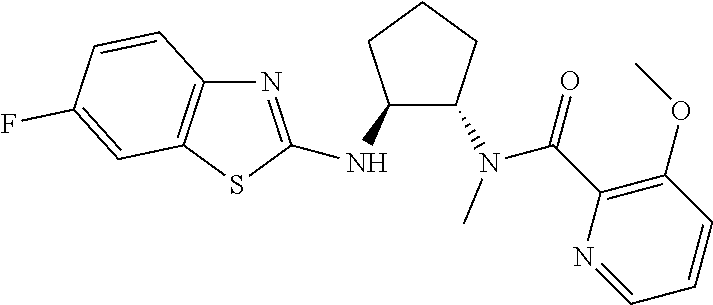


| Example | Human Orexin1R | Human Orexin2R |
| Number | IC50 (nM) | IC50 (nM) |
| 1 | 43 | >10,000 |
| 2 | 128 | NT |
| 3 | 170 | >10,000 |
| 4 | NT | NT |
| 5 | 14 | 2800 |
| 6 | 8.6 | >10,000 |
| 7 | 540 | >10,000 |
| 8 | 34 | 3300 |
| 9 | 84 | >10,000 |
| 10 | 21 | >10,000 |
| 11 | 330 | >10,000 |
| 12 | 42 | >10,000 |
| 13 | 69 | >10,000 |
| 14 | 170 | >10,000 |
| 15 | 150 | >10,000 |
| 16 | 630 | NT |
| 17 | 210 | 9600 |
| 18 | 41 | 8800 |
| 19 | 33 | 3600 |
| 20 | 100 | >10,000 |
| 21 | 24 | >10,000 |
| 22 | 300 | >10,000 |
| 23 | 290 | >10,000 |
| 24 | 86 | >10,000 |
| 25 | 660 | >10,000 |
| 26 | 910 | NT |
| 27 | 71 | 6000 |
Claims (12)

Applications Claiming Priority (4)
| Application Number | Priority Date | Filing Date | Title |
|---|---|---|---|
| EP14156010.2 | 2014-02-20 | ||
| EP14156010 | 2014-02-20 | ||
| EP14156010 | 2014-02-20 | ||
| PCT/GB2015/050482 WO2015124934A1 (en) | 2014-02-20 | 2015-02-19 | Subsituted cyclopentanes, tetrahydrofuranes and pyrrolidines as orexin receptor antagonists |
Publications (2)
| Publication Number | Publication Date |
|---|---|
| US20170073340A1 US20170073340A1 (en) | 2017-03-16 |
| US9790220B2 true US9790220B2 (en) | 2017-10-17 |
Family
ID=50115775
Family Applications (1)
| Application Number | Title | Priority Date | Filing Date |
|---|---|---|---|
| US15/120,002 Expired - Fee Related US9790220B2 (en) | 2014-02-20 | 2015-02-19 | Substituted cyclopentanes, tetrahydrofuranes and pyrrolidines as orexin receptor antagonists |
Country Status (20)
| Country | Link |
|---|---|
| US (1) | US9790220B2 (en) |
| EP (1) | EP3107907A1 (en) |
| JP (1) | JP6466465B2 (en) |
| KR (1) | KR20160124188A (en) |
| CN (1) | CN106164064B (en) |
| AU (1) | AU2015220553B2 (en) |
| CA (1) | CA2940047A1 (en) |
| CL (1) | CL2016002085A1 (en) |
| CR (1) | CR20160373A (en) |
| EA (1) | EA031982B1 (en) |
| EC (1) | ECSP16074482A (en) |
| GE (2) | GEAP201814272A (en) |
| IL (1) | IL247195A0 (en) |
| MA (1) | MA39229A1 (en) |
| MX (1) | MX2016010745A (en) |
| PE (1) | PE20161374A1 (en) |
| PH (1) | PH12016501625A1 (en) |
| SG (1) | SG11201606839SA (en) |
| WO (1) | WO2015124934A1 (en) |
| ZA (1) | ZA201604924B (en) |
Cited By (2)
| Publication number | Priority date | Publication date | Assignee | Title |
|---|---|---|---|---|
| US10370380B2 (en) | 2015-11-23 | 2019-08-06 | Sunshine Lake Pharma Co., Ltd. | Octahydropyrrolo[3,4-c]pyrrole derivatives and uses thereof |
| EP3870292A1 (en) | 2018-10-26 | 2021-09-01 | The Research Foundation for The State University of New York | Combination serotonin specific reuptake inhibitor and serotonin 1a receptor partial agonist for reducing l-dopa-induced dyskinesia |
Families Citing this family (3)
| Publication number | Priority date | Publication date | Assignee | Title |
|---|---|---|---|---|
| TW201613864A (en) | 2014-02-20 | 2016-04-16 | Takeda Pharmaceutical | Novel compounds |
| CN106659750B (en) | 2014-04-17 | 2021-02-12 | 韩国生命工学研究院 | Pharmaceutical composition for preventing or treating chronic obstructive pulmonary disease |
| KR102298546B1 (en) * | 2018-10-18 | 2021-09-08 | 에이치케이이노엔 주식회사 | Novel N-(isopropyl-triazolyl)pyridinyl)-heteroaryl-carboxamide derivatives and use thereof |
Citations (1)
| Publication number | Priority date | Publication date | Assignee | Title |
|---|---|---|---|---|
| WO2008038841A1 (en) | 2006-09-30 | 2008-04-03 | Japan Tobacco Inc. | Thiadiazolone derivative and use thereof |
Family Cites Families (4)
| Publication number | Priority date | Publication date | Assignee | Title |
|---|---|---|---|---|
| CZ20033437A3 (en) * | 2001-06-28 | 2004-09-15 | Smithkline Beecham P.L.C. | N-aroyl cyclic amine derivatives functioning as orexin receptor antagonists |
| JP5847087B2 (en) * | 2009-10-23 | 2016-01-20 | ヤンセン ファーマシューティカ エヌ.ベー. | Fused heterocyclic compounds as orexin receptor modulators |
| US20110144081A1 (en) * | 2009-12-15 | 2011-06-16 | Henner Knust | Pyrrolidine derivatives |
| ES2617863T3 (en) * | 2012-06-04 | 2017-06-20 | Actelion Pharmaceuticals Ltd. | Benzimidazole-proline derivatives |
-
2015
- 2015-02-19 GE GEAP201814272A patent/GEAP201814272A/en unknown
- 2015-02-19 MX MX2016010745A patent/MX2016010745A/en unknown
- 2015-02-19 JP JP2016552540A patent/JP6466465B2/en not_active Expired - Fee Related
- 2015-02-19 AU AU2015220553A patent/AU2015220553B2/en not_active Expired - Fee Related
- 2015-02-19 CR CR20160373A patent/CR20160373A/en unknown
- 2015-02-19 EP EP15706518.6A patent/EP3107907A1/en not_active Withdrawn
- 2015-02-19 CA CA2940047A patent/CA2940047A1/en not_active Abandoned
- 2015-02-19 WO PCT/GB2015/050482 patent/WO2015124934A1/en not_active Ceased
- 2015-02-19 KR KR1020167025660A patent/KR20160124188A/en not_active Withdrawn
- 2015-02-19 GE GEAP201514272A patent/GEP20186909B/en unknown
- 2015-02-19 EA EA201691673A patent/EA031982B1/en not_active IP Right Cessation
- 2015-02-19 MA MA39229A patent/MA39229A1/en unknown
- 2015-02-19 SG SG11201606839SA patent/SG11201606839SA/en unknown
- 2015-02-19 PE PE2016001444A patent/PE20161374A1/en unknown
- 2015-02-19 US US15/120,002 patent/US9790220B2/en not_active Expired - Fee Related
- 2015-02-19 CN CN201580009703.3A patent/CN106164064B/en not_active Expired - Fee Related
-
2016
- 2016-07-15 ZA ZA2016/04924A patent/ZA201604924B/en unknown
- 2016-08-09 IL IL247195A patent/IL247195A0/en unknown
- 2016-08-15 PH PH12016501625A patent/PH12016501625A1/en unknown
- 2016-08-18 CL CL2016002085A patent/CL2016002085A1/en unknown
- 2016-09-15 EC ECIEPI201674482A patent/ECSP16074482A/en unknown
Patent Citations (1)
| Publication number | Priority date | Publication date | Assignee | Title |
|---|---|---|---|---|
| WO2008038841A1 (en) | 2006-09-30 | 2008-04-03 | Japan Tobacco Inc. | Thiadiazolone derivative and use thereof |
Non-Patent Citations (12)
| Title |
|---|
| C J Winrow et al: "Discovery and development of orexin receptor antagonists as therapeutics for insomnia", British Journal of Pharmacology, vol. 171, No. 2, Dec. 23, 2013 (Dec. 23, 2013), pp. 283-293, XP055120026, ISSN: 0007-1188, DOI: 10.1111/bph.12261 Almorexant, SB-649868. |
| C J WINROW, J J RENGER: "Discovery and development of orexin receptor antagonists as therapeutics for insomnia", BRITISH JOURNAL OF PHARMACOLOGY, NATURE PUB. GROUP, ETC., vol. 171, no. 2, 1 January 2014 (2014-01-01), pages 283 - 293, XP055120026, ISSN: 00071188, DOI: 10.1111/bph.12261 |
| CHEMICAL ABSTRACTS, 1 January 2000, Columbus, Ohio, US; PALOMBA MICHELE, ET AL: "Anti-inflammatory and analgesic amides. New developments" XP002724962 |
| Christopher, John A.: "orexin receptor antagonists", Pharm. Pat. Analyst, vol. 1, No. 3, 2012, pp. 329-346, XP009178221, p. 330; figure 1; compounds 1, 2, p. 335-p. 336; figures 5, 6; compounds 38, 40, 41, 43-54. |
| Database CA [Online], Chemical Abstracts Service, Columbus, Ohio, US; Palomba, Michele et al: "Anti-inflammatory and analgesic amides. New developments", XP002724962, retrieved from STN Database accession No. 2000:45655, abstract; and Palomba, Michele et al: "Anti-inflammatory and analgesic amides. New developments", Archly Der Pharmazie (Weinheim, Germany), 333(1), 17-26 Goden: Arpmas; ISSN: 0365-6233, 2000, DOI: 10.1002(SIXI) 1521-4184(200001)333:1 17::Aid-Ardp173.0.CO;2-0 10.1002/(SICI) 1521-4184(200001)333:1 17::AID-ARDP173.0. |
| International Search Report and Written Opinion, PCT/GB2015/050482, May 19, 2015. |
| JOHN A. CHRISTOPHER: "Orexin receptor antagonists", PHARMACEUTICAL PATENT ANALYST, FUTURE MEDICINE, GB, vol. 1, no. 3, 1 January 2012 (2012-01-01), GB, pages 329 - 346, XP009178221, ISSN: 2046-8962, DOI: 10.4155/ppa.12.27 |
| Notification Concerning Transmittal of International Preliminary Report on Patentability Chapter I of the Patent Cooperation Treaty mailed Sep. 1, 2016 for PCT/GB2015/050482 filed Feb. 19, 2015. |
| Rong Jiang et al: "Disubstituted piperidines as potent orexin (hypocretin) receptor antagonists", Bioorganic & Medicinal Chemistry Letters, Pergamon, Amsterdam, NL, vol. 22, No. 12, Apr. 27, 2012 (Apr. 27, 2012), pp. 3890-3894 XP028509301, ISSN: 0960-894X, DOI: 10.1016/J.BMCL.2012.04.122 [retrieved on May 4, 2012], the whole document. |
| RONG JIANG; XINYI SONG; PURVA BALI; ANTHONY SMITH; CLAUDIA RUIZ BAYONA; LI LIN; MICHAEL D. CAMERON; PATRICIA H. MCDONALD; PAUL J. : "Disubstituted piperidines as potent orexin (hypocretin) receptor antagonists", BIOORGANIC & MEDICINAL CHEMISTRY LETTERS, PERGAMON, AMSTERDAM, NL, vol. 22, no. 12, 27 April 2012 (2012-04-27), AMSTERDAM, NL, pages 3890 - 3894, XP028509301, ISSN: 0960-894X, DOI: 10.1016/j.bmcl.2012.04.122 |
| Sifferlen Thierry et al: "Discovery of substituted lactams as novel dual orexin receptor antagonists. Synthesis, preliminary structure-activity relationship studies and efforts towards improved metabolic stability and pharmacokinetic properties. Pa", Bioorganic & Medicinal Chemistry Letters, vol. 24, No. 4, Dec. 30, 2013 (Dec. 30, 2013), pp. 1201-1208, XP028606685, ISSN: 0960-894X, DOI: 10.1016/J.BMCL.2012.12.092, the whole document. |
| SIFFERLEN THIERRY; BOLLER AMANDINE; CHARDONNEAU AUDREY; COTTREEL EMMANUELLE; HOECKER JOHANNES; AISSAOUI HAMED; WILLIAMS JODI T.; B: "Discovery of substituted lactams as novel dual orexin receptor antagonists. Synthesis, preliminary structure–activity relationship studies and efforts towards improved metabolic stability and pharmacokinetic properties. Pa", BIOORGANIC & MEDICINAL CHEMISTRY LETTERS, PERGAMON, AMSTERDAM, NL, vol. 24, no. 4, 1 January 1900 (1900-01-01), AMSTERDAM, NL, pages 1201 - 1208, XP028606685, ISSN: 0960-894X, DOI: 10.1016/j.bmcl.2013.12.092 |
Cited By (2)
| Publication number | Priority date | Publication date | Assignee | Title |
|---|---|---|---|---|
| US10370380B2 (en) | 2015-11-23 | 2019-08-06 | Sunshine Lake Pharma Co., Ltd. | Octahydropyrrolo[3,4-c]pyrrole derivatives and uses thereof |
| EP3870292A1 (en) | 2018-10-26 | 2021-09-01 | The Research Foundation for The State University of New York | Combination serotonin specific reuptake inhibitor and serotonin 1a receptor partial agonist for reducing l-dopa-induced dyskinesia |
Also Published As
| Publication number | Publication date |
|---|---|
| CN106164064B (en) | 2019-03-22 |
| CN106164064A (en) | 2016-11-23 |
| EP3107907A1 (en) | 2016-12-28 |
| SG11201606839SA (en) | 2016-09-29 |
| CA2940047A1 (en) | 2015-08-27 |
| EA201691673A1 (en) | 2017-01-30 |
| AU2015220553B2 (en) | 2019-06-27 |
| CL2016002085A1 (en) | 2017-06-09 |
| MA39229A1 (en) | 2018-01-31 |
| CR20160373A (en) | 2016-12-02 |
| GEAP201814272A (en) | 2018-07-10 |
| WO2015124934A1 (en) | 2015-08-27 |
| ZA201604924B (en) | 2019-04-24 |
| AU2015220553A1 (en) | 2016-07-21 |
| JP2017506239A (en) | 2017-03-02 |
| WO2015124934A8 (en) | 2016-07-21 |
| EA031982B1 (en) | 2019-03-29 |
| JP6466465B2 (en) | 2019-02-06 |
| KR20160124188A (en) | 2016-10-26 |
| MX2016010745A (en) | 2017-02-02 |
| IL247195A0 (en) | 2016-09-29 |
| PH12016501625A1 (en) | 2016-11-07 |
| ECSP16074482A (en) | 2018-05-31 |
| GEP20186909B (en) | 2018-10-25 |
| PE20161374A1 (en) | 2016-12-17 |
| US20170073340A1 (en) | 2017-03-16 |
Similar Documents
| Publication | Publication Date | Title |
|---|---|---|
| US10689373B2 (en) | 1,2-substituted cyclopentanes as orexin receptor antagonists | |
| US9493432B2 (en) | Cyclopentylbenzamide derivatives and their use for the treatment of psychotic and cognitive disorders | |
| KR102530580B1 (en) | Therapeutic compounds as inhibitors of the orexin-1 receptor | |
| WO2014062938A1 (en) | Rory modulators | |
| US10526323B2 (en) | Indazole and azaindazole substituted compounds as mGluR4 allosteric potentiators, compositions, and methods of treating neurological dysfunction | |
| US8987310B2 (en) | Heterocycle amide T-type calcium channel antagonists | |
| US9790220B2 (en) | Substituted cyclopentanes, tetrahydrofuranes and pyrrolidines as orexin receptor antagonists | |
| CN109219606B (en) | Halogen-substituted piperidines of orexin receptor modulators | |
| TW201300396A (en) | Compounds and their use for treatment of A β -related diseases | |
| US10562882B2 (en) | Piperidine derivatives for use in the treatment or prevention of psychiatric and neurological conditions | |
| US10208016B2 (en) | 1-sulfonyl piperidine derivatives as modulators of prokineticin receptors | |
| HK1227385B (en) | 1,2-substituted cyclopentanes as orexin receptor antagonists | |
| HK1227386B (en) | Piperidine derivatives for use in the treatment or prevention of psychiatric and neurological conditions |
Legal Events
| Date | Code | Title | Description |
|---|---|---|---|
| AS | Assignment |
Owner name: TAKEDA PHARMACEUTICAL COMPANY LIMITED, JAPAN Free format text: ASSIGNMENT OF ASSIGNORS INTEREST;ASSIGNORS:FIELDHOUSE, CHARLOTTE;GLEN, ANGELA;FUJIMOTO, TATSUHIKO;AND OTHERS;SIGNING DATES FROM 20160802 TO 20160818;REEL/FRAME:040280/0066 |
|
| STCF | Information on status: patent grant |
Free format text: PATENTED CASE |
|
| FEPP | Fee payment procedure |
Free format text: MAINTENANCE FEE REMINDER MAILED (ORIGINAL EVENT CODE: REM.); ENTITY STATUS OF PATENT OWNER: LARGE ENTITY |
|
| LAPS | Lapse for failure to pay maintenance fees |
Free format text: PATENT EXPIRED FOR FAILURE TO PAY MAINTENANCE FEES (ORIGINAL EVENT CODE: EXP.); ENTITY STATUS OF PATENT OWNER: LARGE ENTITY |
|
| STCH | Information on status: patent discontinuation |
Free format text: PATENT EXPIRED DUE TO NONPAYMENT OF MAINTENANCE FEES UNDER 37 CFR 1.362 |
|
| FP | Lapsed due to failure to pay maintenance fee |
Effective date: 20211017 |