US9790207B2 - Pan-genomic inhibitors of NS5A protein encoded by HCV, pharmaceutical compositions, intermediates for inhibitor synthesis, and their synthesis and application methods - Google Patents
Pan-genomic inhibitors of NS5A protein encoded by HCV, pharmaceutical compositions, intermediates for inhibitor synthesis, and their synthesis and application methods Download PDFInfo
- Publication number
- US9790207B2 US9790207B2 US14/845,333 US201514845333A US9790207B2 US 9790207 B2 US9790207 B2 US 9790207B2 US 201514845333 A US201514845333 A US 201514845333A US 9790207 B2 US9790207 B2 US 9790207B2
- Authority
- US
- United States
- Prior art keywords
- imidazol
- methyl
- pyrrolidine
- pyrrolidin
- phenyl
- Prior art date
- Legal status (The legal status is an assumption and is not a legal conclusion. Google has not performed a legal analysis and makes no representation as to the accuracy of the status listed.)
- Expired - Fee Related
Links
- 0 C*Cc(cc1)ccc1-c1cc(-c2cnc([C@](CCC3)N3C([C@](C(C)C)NC(OC)=O)=O)[n]2)cc(F)c1C#CC#Cc1cnc([C@](CCC2)N2C([C@](C(C)C)NC(OC)=O)=O)[n]1 Chemical compound C*Cc(cc1)ccc1-c1cc(-c2cnc([C@](CCC3)N3C([C@](C(C)C)NC(OC)=O)=O)[n]2)cc(F)c1C#CC#Cc1cnc([C@](CCC2)N2C([C@](C(C)C)NC(OC)=O)=O)[n]1 0.000 description 17
- SRULDELKULKQEL-XIFAHFMWSA-N C#CC#CC1=CC=C(C2=CN=C([C@@H]3CCCN3C(=O)OC(C)(C)C)N2)C=C1C1=CC=C2C=CC=CC2=C1.C#CC#CC1=CC=C(C2=CN=C([C@@H]3CCCN3C(=O)OC(C)(C)C)N2)C=C1C1=CC=CC(C(C)(C)C)=C1.C#CC#CC1=CC=C(C2=CN=C([C@@H]3CCCN3C(=O)OC(C)(C)C)N2)C=C1C1=CC=CC(C2=CC=CC=C2)=C1.C#CC#CC1=CC=C(C2=CN=C([C@@H]3CCCN3C(=O)OC(C)(C)C)N2)C=C1C1=CC=CC=C1.C#CC#CC1=CN=C([C@@H]2CCCN2C(=O)[C@@H](NC(=O)OC)C(C)C)N1.COC(=O)N[C@H](C(=O)N1CCC[C@H]1C1=NC=C(C#CC#C[Si](C)(C)C)N1)C(C)C Chemical compound C#CC#CC1=CC=C(C2=CN=C([C@@H]3CCCN3C(=O)OC(C)(C)C)N2)C=C1C1=CC=C2C=CC=CC2=C1.C#CC#CC1=CC=C(C2=CN=C([C@@H]3CCCN3C(=O)OC(C)(C)C)N2)C=C1C1=CC=CC(C(C)(C)C)=C1.C#CC#CC1=CC=C(C2=CN=C([C@@H]3CCCN3C(=O)OC(C)(C)C)N2)C=C1C1=CC=CC(C2=CC=CC=C2)=C1.C#CC#CC1=CC=C(C2=CN=C([C@@H]3CCCN3C(=O)OC(C)(C)C)N2)C=C1C1=CC=CC=C1.C#CC#CC1=CN=C([C@@H]2CCCN2C(=O)[C@@H](NC(=O)OC)C(C)C)N1.COC(=O)N[C@H](C(=O)N1CCC[C@H]1C1=NC=C(C#CC#C[Si](C)(C)C)N1)C(C)C SRULDELKULKQEL-XIFAHFMWSA-N 0.000 description 1
- ZANLAOORRQFBTC-IBGZPJMESA-N C#CC#CC1=CC=C(C2=CN=C([C@@H]3CCCN3C(=O)OC(C)(C)C)N2)C=C1[Ar] Chemical compound C#CC#CC1=CC=C(C2=CN=C([C@@H]3CCCN3C(=O)OC(C)(C)C)N2)C=C1[Ar] ZANLAOORRQFBTC-IBGZPJMESA-N 0.000 description 1
- HCEWCPAHKMVPAU-PAQNJEODSA-N C#CC#CC1=CN=C([C@@H]2CCCN2C(=O)OC(C)(C)C)N1.CC(C)(C)OC(=O)N1CCC[C@H]1C1=NC=C(C#CC#CC2=CC=C(C3=CN=C([C@@H]4CCCN4C(=O)OC(C)(C)C)N3)C=C2[Ar])N1.CC(C)(C)OC(=O)N1CCC[C@H]1C1=NC=C(C#CC#C[Si](C)(C)C)N1.[Ar]C1=CC(C2=CN=C(C3CCCC3)N2)=CC=C1C#CC#CC1=CN=C(C2CCCC2)N1 Chemical compound C#CC#CC1=CN=C([C@@H]2CCCN2C(=O)OC(C)(C)C)N1.CC(C)(C)OC(=O)N1CCC[C@H]1C1=NC=C(C#CC#CC2=CC=C(C3=CN=C([C@@H]4CCCN4C(=O)OC(C)(C)C)N3)C=C2[Ar])N1.CC(C)(C)OC(=O)N1CCC[C@H]1C1=NC=C(C#CC#C[Si](C)(C)C)N1.[Ar]C1=CC(C2=CN=C(C3CCCC3)N2)=CC=C1C#CC#CC1=CN=C(C2CCCC2)N1 HCEWCPAHKMVPAU-PAQNJEODSA-N 0.000 description 1
- SEHFGUMFXKEDAC-HRKUZEQKSA-N C#CC#CC1=CN=C([C@@H]2CCCN2C(=O)[C@@H](C)C(C)C)N1.CC(C)[C@H](C)C(=O)N1CCC[C@H]1C1=NC=C(C#CC#C[Si](C)(C)C)N1.COC(=O)N[C@H](C(=O)N1CCC[C@H]1C1=NC=C(C#CC#CC2=CC=C(C3=CN=C([C@@H]4CCCN4C(=O)OC(C)(C)C)N3)C=C2C2=CC=CC=C2)N1)C(C)C.C[Si](C)(C)C#CC#CC1=CN=C(C2CCCC2)N1.O=C(O)C(F)(F)F Chemical compound C#CC#CC1=CN=C([C@@H]2CCCN2C(=O)[C@@H](C)C(C)C)N1.CC(C)[C@H](C)C(=O)N1CCC[C@H]1C1=NC=C(C#CC#C[Si](C)(C)C)N1.COC(=O)N[C@H](C(=O)N1CCC[C@H]1C1=NC=C(C#CC#CC2=CC=C(C3=CN=C([C@@H]4CCCN4C(=O)OC(C)(C)C)N3)C=C2C2=CC=CC=C2)N1)C(C)C.C[Si](C)(C)C#CC#CC1=CN=C(C2CCCC2)N1.O=C(O)C(F)(F)F SEHFGUMFXKEDAC-HRKUZEQKSA-N 0.000 description 1
- HYCFYDGKTMFAGC-IKXQUJFKSA-N C#CC#C[Si](C)(C)C.CC(C)(C)OC(=O)N1CCC[C@H]1C1=NC=C(C2=CC=C(C#CC#C[Si](C)(C)C)C([Ar])=C2)N1.C[Si](C)(C)C#CC#C[Si](C)(C)C Chemical compound C#CC#C[Si](C)(C)C.CC(C)(C)OC(=O)N1CCC[C@H]1C1=NC=C(C2=CC=C(C#CC#C[Si](C)(C)C)C([Ar])=C2)N1.C[Si](C)(C)C#CC#C[Si](C)(C)C HYCFYDGKTMFAGC-IKXQUJFKSA-N 0.000 description 1
- IEEGTQRPGCLMDT-GUAJHIRRSA-N C(C#CC1=CC=C(C2=CN=C(C3CCCC3)N2)C=C1C1=CC=C2C=CC=CC2=C1)#CC1=CN=C(C2CCCC2)N1.C(C#CC1=CC=C(C2=CN=C(C3CCCC3)N2)C=C1C1=CC=CC(C2=CC=CC=C2)=C1)#CC1=CN=C(C2CCCC2)N1.C(C#CC1=CC=C(C2=CN=C(C3CCCC3)N2)C=C1C1=CC=CC=C1)#CC1=CN=C(C2CCCC2)N1.CC(C)(C)C1=CC(C2=CC(C3=CN=C(C4CCCC4)N3)=CC=C2C#CC#CC2=CN=C(C3CCCC3)N2)=CC=C1.CC1=C(C#CC#CC2=CN=C(C3CCCC3)N2)C(C2=CC=CC=C2)=CC(C2=CN=C(C3CCCC3)N2)=C1.COC(=O)N[C@H](C(=O)N1CCC[C@H]1C1=NC=C(C2=CC=C(C#CC#CC3=CN=C(C4CCCC4)N3)C(C3=CC=CC=C3)=C2)N1)C(C)C.FC1=C(C#CC#CC2=CN=C(C3CCCC3)N2)C(C2=CC=CC=C2)=CC(C2=CN=C(C3CCCC3)N2)=C1 Chemical compound C(C#CC1=CC=C(C2=CN=C(C3CCCC3)N2)C=C1C1=CC=C2C=CC=CC2=C1)#CC1=CN=C(C2CCCC2)N1.C(C#CC1=CC=C(C2=CN=C(C3CCCC3)N2)C=C1C1=CC=CC(C2=CC=CC=C2)=C1)#CC1=CN=C(C2CCCC2)N1.C(C#CC1=CC=C(C2=CN=C(C3CCCC3)N2)C=C1C1=CC=CC=C1)#CC1=CN=C(C2CCCC2)N1.CC(C)(C)C1=CC(C2=CC(C3=CN=C(C4CCCC4)N3)=CC=C2C#CC#CC2=CN=C(C3CCCC3)N2)=CC=C1.CC1=C(C#CC#CC2=CN=C(C3CCCC3)N2)C(C2=CC=CC=C2)=CC(C2=CN=C(C3CCCC3)N2)=C1.COC(=O)N[C@H](C(=O)N1CCC[C@H]1C1=NC=C(C2=CC=C(C#CC#CC3=CN=C(C4CCCC4)N3)C(C3=CC=CC=C3)=C2)N1)C(C)C.FC1=C(C#CC#CC2=CN=C(C3CCCC3)N2)C(C2=CC=CC=C2)=CC(C2=CN=C(C3CCCC3)N2)=C1 IEEGTQRPGCLMDT-GUAJHIRRSA-N 0.000 description 1
- ZLQMMHZNCBDCCQ-MUFQUMRZSA-N CBrC(=O)C1=CC(Br)=C([N+](=O)[O-])C=C1.CC(=O)C1=CC(Br)=C(N)C=C1.CC(=O)C1=CC(Br)=C([N+](=O)[O-])C=C1.CC(=O)C1=CC=C(N)C=C1.CC(C)(C)OC(=O)N1CCC[C@H]1C(=O)OCC(=O)C1=CC(Br)=C([N+](=O)[O-])C=C1.CC(C)(C)OC(=O)N1CCC[C@H]1C1=NC=C(C2=CC(Br)=C([N+](=O)[O-])C=C2)N1.CC(C)(C)OC(=O)N1CCC[C@H]1C1=NC=C(C2=CC(SC3=CC=CC=C3)=C(N)C=C2)N1.CC(C)(C)OC(=O)N1CCC[C@H]1C1=NC=C(C2=CC(SC3=CC=CC=C3)=C([N+](=O)[O-])C=C2)N1 Chemical compound CBrC(=O)C1=CC(Br)=C([N+](=O)[O-])C=C1.CC(=O)C1=CC(Br)=C(N)C=C1.CC(=O)C1=CC(Br)=C([N+](=O)[O-])C=C1.CC(=O)C1=CC=C(N)C=C1.CC(C)(C)OC(=O)N1CCC[C@H]1C(=O)OCC(=O)C1=CC(Br)=C([N+](=O)[O-])C=C1.CC(C)(C)OC(=O)N1CCC[C@H]1C1=NC=C(C2=CC(Br)=C([N+](=O)[O-])C=C2)N1.CC(C)(C)OC(=O)N1CCC[C@H]1C1=NC=C(C2=CC(SC3=CC=CC=C3)=C(N)C=C2)N1.CC(C)(C)OC(=O)N1CCC[C@H]1C1=NC=C(C2=CC(SC3=CC=CC=C3)=C([N+](=O)[O-])C=C2)N1 ZLQMMHZNCBDCCQ-MUFQUMRZSA-N 0.000 description 1
- YKVKWAGCMSJZJL-DUGQXYKTSA-N CBrC(=O)C1=CC=C(I)C([Ar])=C1.CC(=O)C1=CC=C(I)C([Ar])=C1.CC(=O)NC1=CC=C(C(C)=O)C=C1Br.CC(=O)NC1=CC=C(C(C)=O)C=C1[Ar].CC(C)(C)OC(=O)N1CCC[C@H]1C(=O)OCC(=O)C1=CC=C(I)C([Ar])=C1.CC(C)(C)OC(=O)N1CCC[C@H]1C1=NC=C(C2=CC=C(I)C([Ar])=C2)N1.OB(O)[Ar] Chemical compound CBrC(=O)C1=CC=C(I)C([Ar])=C1.CC(=O)C1=CC=C(I)C([Ar])=C1.CC(=O)NC1=CC=C(C(C)=O)C=C1Br.CC(=O)NC1=CC=C(C(C)=O)C=C1[Ar].CC(C)(C)OC(=O)N1CCC[C@H]1C(=O)OCC(=O)C1=CC=C(I)C([Ar])=C1.CC(C)(C)OC(=O)N1CCC[C@H]1C1=NC=C(C2=CC=C(I)C([Ar])=C2)N1.OB(O)[Ar] YKVKWAGCMSJZJL-DUGQXYKTSA-N 0.000 description 1
- PZGYXLPVVYSCAR-QWUKPICASA-N CBrC(=O)C1=CC=C([N+](=O)[O-])C(Br)=C1.CN1CCC[C@H]1C(=O)OCC(=O)C1=CC=C([N+](=O)[O-])C(Br)=C1.CN1CCC[C@H]1C1=NC=C(C2=CC=C([N+](=O)[O-])C(Br)=C2)N1.COC(=O)C[C@H](C(=O)N1CCC[C@H]1C1=NC=C(C2=CC=C(I)C([Ar])=C2)N1)C(C)C.COC(=O)C[C@H](C(=O)N1CCC[C@H]1C1=NC=C(C2=CC=C(N)C([Ar])=C2)N1)C(C)C.COC(=O)C[C@H](C(=O)N1CCC[C@H]1C1=NC=C(C2=CC=C([N+](=O)[O-])C(Br)=C2)N1)C(C)C.COC(=O)C[C@H](C(=O)N1CCC[C@H]1C1=NC=C(C2=CC=C([N+](=O)[O-])C([Ar])=C2)N1)C(C)C.O=[N+]([O-])C1=CC=C(C2=CN=C(C3CCCC3)N2)C=C1Br Chemical compound CBrC(=O)C1=CC=C([N+](=O)[O-])C(Br)=C1.CN1CCC[C@H]1C(=O)OCC(=O)C1=CC=C([N+](=O)[O-])C(Br)=C1.CN1CCC[C@H]1C1=NC=C(C2=CC=C([N+](=O)[O-])C(Br)=C2)N1.COC(=O)C[C@H](C(=O)N1CCC[C@H]1C1=NC=C(C2=CC=C(I)C([Ar])=C2)N1)C(C)C.COC(=O)C[C@H](C(=O)N1CCC[C@H]1C1=NC=C(C2=CC=C(N)C([Ar])=C2)N1)C(C)C.COC(=O)C[C@H](C(=O)N1CCC[C@H]1C1=NC=C(C2=CC=C([N+](=O)[O-])C(Br)=C2)N1)C(C)C.COC(=O)C[C@H](C(=O)N1CCC[C@H]1C1=NC=C(C2=CC=C([N+](=O)[O-])C([Ar])=C2)N1)C(C)C.O=[N+]([O-])C1=CC=C(C2=CN=C(C3CCCC3)N2)C=C1Br PZGYXLPVVYSCAR-QWUKPICASA-N 0.000 description 1
- IVXBHRCAIDDWDM-DSBSNLGSSA-N CC(C)(C)OC(=O)N1CCC[C@H]1C(=O)OCC(=O)C1=CC(F)=C(I)C([Ar])=C1.CC(C)(C)OC(=O)N1CCC[C@H]1C1=NC=C(C2=CC(F)=C(I)C([Ar])=C2)N1.CC1=CC(F)=C(I)C([Ar])=C1.CC1=CC(F)=C(N)C(Br)=C1.CC1=CC(F)=C(N)C([Ar])=C1.O=C(CCl)C1=CC(F)=C(I)C([Ar])=C1.O=C(O)C1=CC(F)=C(I)C([Ar])=C1.[N-]=[N+]=CC(=O)C1=CC(F)=C(I)C([Ar])=C1 Chemical compound CC(C)(C)OC(=O)N1CCC[C@H]1C(=O)OCC(=O)C1=CC(F)=C(I)C([Ar])=C1.CC(C)(C)OC(=O)N1CCC[C@H]1C1=NC=C(C2=CC(F)=C(I)C([Ar])=C2)N1.CC1=CC(F)=C(I)C([Ar])=C1.CC1=CC(F)=C(N)C(Br)=C1.CC1=CC(F)=C(N)C([Ar])=C1.O=C(CCl)C1=CC(F)=C(I)C([Ar])=C1.O=C(O)C1=CC(F)=C(I)C([Ar])=C1.[N-]=[N+]=CC(=O)C1=CC(F)=C(I)C([Ar])=C1 IVXBHRCAIDDWDM-DSBSNLGSSA-N 0.000 description 1
- DDCYSVREXYGGTL-ZPEBXLLRSA-N CC(C)(C)OC(=O)N1CCC[C@H]1C1=NC=C(C2=CC(F)=C(I)C(C3=CC=C(F)C=C3)=C2)N1.CC(C)(C)OC(=O)N1CCC[C@H]1C1=NC=C(C2=CC(F)=C(I)C(C3=CC=CC=C3)=C2)N1.CC1=CC=C(C2=CC(C3=CN=C([C@@H]4CCCN4C(=O)OC(C)(C)C)N3)=CC(F)=C2I)C=C1.COC(=O)C[C@H](C(=O)N1CCC[C@H]1C1=NC=C(C2=CC=C(I)C(C3=CC=C(N4CCN(C)CC4)C=C3)=C2)N1)C(C)C.COC(=O)C[C@H](C(=O)N1CCC[C@H]1C1=NC=C(C2=CC=C(I)C(C3=CC=CN=C3)=C2)N1)C(C)C Chemical compound CC(C)(C)OC(=O)N1CCC[C@H]1C1=NC=C(C2=CC(F)=C(I)C(C3=CC=C(F)C=C3)=C2)N1.CC(C)(C)OC(=O)N1CCC[C@H]1C1=NC=C(C2=CC(F)=C(I)C(C3=CC=CC=C3)=C2)N1.CC1=CC=C(C2=CC(C3=CN=C([C@@H]4CCCN4C(=O)OC(C)(C)C)N3)=CC(F)=C2I)C=C1.COC(=O)C[C@H](C(=O)N1CCC[C@H]1C1=NC=C(C2=CC=C(I)C(C3=CC=C(N4CCN(C)CC4)C=C3)=C2)N1)C(C)C.COC(=O)C[C@H](C(=O)N1CCC[C@H]1C1=NC=C(C2=CC=C(I)C(C3=CC=CN=C3)=C2)N1)C(C)C DDCYSVREXYGGTL-ZPEBXLLRSA-N 0.000 description 1
- INXRUIKJCZKZEN-SPRNNCODSA-N CC(C)(C)OC(=O)N1CCC[C@H]1C1=NC=C(C2=CC(OC3=CC=CC=C3)=C([N+](=O)[O-])C=C2)N1.CC(C)(C)OC(=O)N1CCC[C@H]1C1=NC=C(I)N1.CC(C)[C@H](C)C(=O)N1CCC[C@H]1C1=NC=C(C2=CC=C([N+](=O)[O-])C(OC3=CC=CC=C3)=C2)N1.CC1(C)OB(C2=CC=C([N+](=O)[O-])C(OC3=CC=CC=C3)=C2)OC1(C)C.O=[N+]([O-])C1=C(OC2=CC=CC=C2)C=C(C2=CN=C(C3CCCC3)N2)C=C1.O=[N+]([O-])C1=CC=C(Br)C=C1OC1=CC=CC=C1 Chemical compound CC(C)(C)OC(=O)N1CCC[C@H]1C1=NC=C(C2=CC(OC3=CC=CC=C3)=C([N+](=O)[O-])C=C2)N1.CC(C)(C)OC(=O)N1CCC[C@H]1C1=NC=C(I)N1.CC(C)[C@H](C)C(=O)N1CCC[C@H]1C1=NC=C(C2=CC=C([N+](=O)[O-])C(OC3=CC=CC=C3)=C2)N1.CC1(C)OB(C2=CC=C([N+](=O)[O-])C(OC3=CC=CC=C3)=C2)OC1(C)C.O=[N+]([O-])C1=C(OC2=CC=CC=C2)C=C(C2=CN=C(C3CCCC3)N2)C=C1.O=[N+]([O-])C1=CC=C(Br)C=C1OC1=CC=CC=C1 INXRUIKJCZKZEN-SPRNNCODSA-N 0.000 description 1
- LEPBFYBCBFGYRL-UNFPTWNOSA-N CC(C)(C)OC(=O)N1CCC[C@H]1C1=NC=C(C2=CC(SC3=CC=CC=C3)=C(I)C=C2)N1.COC(=O)C[C@H](C(=O)N1CCC[C@H]1C1=NC=C(C2=CC(SC3=CC=CC=C3)=C(I)C=C2)N1)C(C)C.IC1=C(SC2=CC=CC=C2)C=C(C2=CN=C(C3CCCC3)N2)C=C1 Chemical compound CC(C)(C)OC(=O)N1CCC[C@H]1C1=NC=C(C2=CC(SC3=CC=CC=C3)=C(I)C=C2)N1.COC(=O)C[C@H](C(=O)N1CCC[C@H]1C1=NC=C(C2=CC(SC3=CC=CC=C3)=C(I)C=C2)N1)C(C)C.IC1=C(SC2=CC=CC=C2)C=C(C2=CN=C(C3CCCC3)N2)C=C1 LEPBFYBCBFGYRL-UNFPTWNOSA-N 0.000 description 1
- HQDQKHCEWXDKGV-CZRPESOFSA-N CC(C)(C)OC(=O)N1CCC[C@H]1C1=NC=C(C2=CC=C(C#CC#C[Si](C)(C)C)C(C3=CC=C4C=CC=CC4=C3)=C2)N1.CC(C)(C)OC(=O)N1CCC[C@H]1C1=NC=C(C2=CC=C(C#CC#C[Si](C)(C)C)C(C3=CC=CC(C(C)(C)C)=C3)=C2)N1.CC(C)(C)OC(=O)N1CCC[C@H]1C1=NC=C(C2=CC=C(C#CC#C[Si](C)(C)C)C(C3=CC=CC(C4=CC=CC=C4)=C3)=C2)N1.CC(C)(C)OC(=O)N1CCC[C@H]1C1=NC=C(C2=CC=C(C#CC#C[Si](C)(C)C)C(C3=CC=CC=C3)=C2)N1.COC(=O)N[C@H](C(=O)N1CCC[C@H]1C1=NC=C(C2=CC=C(I)C(N(C)C3=CC=CC=C3)=C2)N1)C(C)C Chemical compound CC(C)(C)OC(=O)N1CCC[C@H]1C1=NC=C(C2=CC=C(C#CC#C[Si](C)(C)C)C(C3=CC=C4C=CC=CC4=C3)=C2)N1.CC(C)(C)OC(=O)N1CCC[C@H]1C1=NC=C(C2=CC=C(C#CC#C[Si](C)(C)C)C(C3=CC=CC(C(C)(C)C)=C3)=C2)N1.CC(C)(C)OC(=O)N1CCC[C@H]1C1=NC=C(C2=CC=C(C#CC#C[Si](C)(C)C)C(C3=CC=CC(C4=CC=CC=C4)=C3)=C2)N1.CC(C)(C)OC(=O)N1CCC[C@H]1C1=NC=C(C2=CC=C(C#CC#C[Si](C)(C)C)C(C3=CC=CC=C3)=C2)N1.COC(=O)N[C@H](C(=O)N1CCC[C@H]1C1=NC=C(C2=CC=C(I)C(N(C)C3=CC=CC=C3)=C2)N1)C(C)C HQDQKHCEWXDKGV-CZRPESOFSA-N 0.000 description 1
- QYWXFMVSPXKZGW-ITXWXQCJSA-N CC(C)(C)OC(=O)N1CCC[C@H]1C1=NC=C(C2=CC=C(I)C(C3=CC(C(C)(C)C)=CC=C3)=C2)N1.CC(C)(C)OC(=O)N1CCC[C@H]1C1=NC=C(C2=CC=C(I)C(C3=CC(C4=CC=CC=C4)=CC=C3)=C2)N1.CC(C)(C)OC(=O)N1CCC[C@H]1C1=NC=C(C2=CC=C(I)C(C3=CC=C(F)C=C3)=C2)N1.CC(C)(C)OC(=O)N1CCC[C@H]1C1=NC=C(C2=CC=C(I)C(C3=CC=CC=C3)=C2)N1.CC1=CC=C(C2=CC(C3=CN=C([C@@H]4CCCN4C(=O)OC(C)(C)C)N3)=CC=C2I)C=C1 Chemical compound CC(C)(C)OC(=O)N1CCC[C@H]1C1=NC=C(C2=CC=C(I)C(C3=CC(C(C)(C)C)=CC=C3)=C2)N1.CC(C)(C)OC(=O)N1CCC[C@H]1C1=NC=C(C2=CC=C(I)C(C3=CC(C4=CC=CC=C4)=CC=C3)=C2)N1.CC(C)(C)OC(=O)N1CCC[C@H]1C1=NC=C(C2=CC=C(I)C(C3=CC=C(F)C=C3)=C2)N1.CC(C)(C)OC(=O)N1CCC[C@H]1C1=NC=C(C2=CC=C(I)C(C3=CC=CC=C3)=C2)N1.CC1=CC=C(C2=CC(C3=CN=C([C@@H]4CCCN4C(=O)OC(C)(C)C)N3)=CC=C2I)C=C1 QYWXFMVSPXKZGW-ITXWXQCJSA-N 0.000 description 1
- FBFHSAQAFMGQIJ-QYZQAOSXSA-N CC(C)(C)OC(=O)N1CCC[C@H]1C1=NC=C(C2=CC=C(I)C(C3=CC4=CC=CC=C4C=C3)=C2)N1.COC(=O)C[C@H](C(=O)N1CCC[C@H]1C1=NC=C(C2=CC=C(I)C(C3=C(C)C=CC=C3)=C2)N1)C(C)C.COC(=O)C[C@H](C(=O)N1CCC[C@H]1C1=NC=C(C2=CC=C(I)C(C3=C(F)C=CC=C3)=C2)N1)C(C)C.COC(=O)C[C@H](C(=O)N1CCC[C@H]1C1=NC=C(C2=CC=C(I)C(C3=CC=CC(C(C)(C)C)=C3)=C2)N1)C(C)C.COC(=O)C[C@H](C(=O)N1CCC[C@H]1C1=NC=C(C2=CC=C(I)C(C3=CC=CC=C3)=C2)N1)C(C)C Chemical compound CC(C)(C)OC(=O)N1CCC[C@H]1C1=NC=C(C2=CC=C(I)C(C3=CC4=CC=CC=C4C=C3)=C2)N1.COC(=O)C[C@H](C(=O)N1CCC[C@H]1C1=NC=C(C2=CC=C(I)C(C3=C(C)C=CC=C3)=C2)N1)C(C)C.COC(=O)C[C@H](C(=O)N1CCC[C@H]1C1=NC=C(C2=CC=C(I)C(C3=C(F)C=CC=C3)=C2)N1)C(C)C.COC(=O)C[C@H](C(=O)N1CCC[C@H]1C1=NC=C(C2=CC=C(I)C(C3=CC=CC(C(C)(C)C)=C3)=C2)N1)C(C)C.COC(=O)C[C@H](C(=O)N1CCC[C@H]1C1=NC=C(C2=CC=C(I)C(C3=CC=CC=C3)=C2)N1)C(C)C FBFHSAQAFMGQIJ-QYZQAOSXSA-N 0.000 description 1
- UGPVWPAHBMHGRR-XSYILFPWSA-N CC(C)(C)OC(=O)N1CCC[C@H]1C1=NC=C(C2=CC=C(I)C(SC3=CC=CC=C3)=C2)N1.COC(=O)N[C@H](C(=O)N1CCC[C@H]1C1=NC=C(C2=CC=C(I)C(OC3=CC=CC=C3)=C2)N1)C(C)C.COC(=O)N[C@H](C(=O)N1CCC[C@H]1C1=NC=C(C2=CC=C(I)C(O[C@H](C)C3=CC=CC=C3)=C2)N1)C(C)C.COC(=O)N[C@H](C(=O)N1CCC[C@H]1C1=NC=C(C2=CC=C(I)C(SC3=CC=CC=C3)=C2)N1)C(C)C.IC1=CC=C(C2=CN=C(C3CCCC3)N2)C=C1SC1=CC=CC=C1 Chemical compound CC(C)(C)OC(=O)N1CCC[C@H]1C1=NC=C(C2=CC=C(I)C(SC3=CC=CC=C3)=C2)N1.COC(=O)N[C@H](C(=O)N1CCC[C@H]1C1=NC=C(C2=CC=C(I)C(OC3=CC=CC=C3)=C2)N1)C(C)C.COC(=O)N[C@H](C(=O)N1CCC[C@H]1C1=NC=C(C2=CC=C(I)C(O[C@H](C)C3=CC=CC=C3)=C2)N1)C(C)C.COC(=O)N[C@H](C(=O)N1CCC[C@H]1C1=NC=C(C2=CC=C(I)C(SC3=CC=CC=C3)=C2)N1)C(C)C.IC1=CC=C(C2=CN=C(C3CCCC3)N2)C=C1SC1=CC=CC=C1 UGPVWPAHBMHGRR-XSYILFPWSA-N 0.000 description 1
- BYQMZJZFBPTHRZ-ITMZJIMRSA-N CC(C)[C@@H](C(N(CCC1)[C@@H]1c1ncc(-c(cc2-c3cc(-c4ccccc4)ccc3)ccc2C#CC#Cc2cnc([C@H](CCC3)N3C([C@H](C(C)C)NC(OC)=O)=O)[nH]2)[nH]1)=O)NC(OC)=O Chemical compound CC(C)[C@@H](C(N(CCC1)[C@@H]1c1ncc(-c(cc2-c3cc(-c4ccccc4)ccc3)ccc2C#CC#Cc2cnc([C@H](CCC3)N3C([C@H](C(C)C)NC(OC)=O)=O)[nH]2)[nH]1)=O)NC(OC)=O BYQMZJZFBPTHRZ-ITMZJIMRSA-N 0.000 description 1
- BHTFDCZPHVDEMQ-IWWWZYECSA-N CC(C)[C@@H](C(N(CCC1)[C@@H]1c1ncc(-c(cc2-c3ccc(cccc4)c4c3)ccc2C#CC#Cc2cnc([C@H](CCC3)N3C([C@H](C(C)C)NC(OC)=O)=O)[nH]2)[nH]1)=O)NC(OC)=O Chemical compound CC(C)[C@@H](C(N(CCC1)[C@@H]1c1ncc(-c(cc2-c3ccc(cccc4)c4c3)ccc2C#CC#Cc2cnc([C@H](CCC3)N3C([C@H](C(C)C)NC(OC)=O)=O)[nH]2)[nH]1)=O)NC(OC)=O BHTFDCZPHVDEMQ-IWWWZYECSA-N 0.000 description 1
- ILCYGGYQURGKRX-JGFLOGFOSA-N CC(C)[C@@H](C(N(CCC1)[C@@H]1c1ncc(C#CC#Cc(c(-c2cccc(C(C)(C)C)c2)c2)ccc2-c2cnc([C@H](CCC3)N3C([C@H](C=C(C)C)NC(OC)=O)=O)[nH]2)[nH]1)=O)NC(OC)=O Chemical compound CC(C)[C@@H](C(N(CCC1)[C@@H]1c1ncc(C#CC#Cc(c(-c2cccc(C(C)(C)C)c2)c2)ccc2-c2cnc([C@H](CCC3)N3C([C@H](C=C(C)C)NC(OC)=O)=O)[nH]2)[nH]1)=O)NC(OC)=O ILCYGGYQURGKRX-JGFLOGFOSA-N 0.000 description 1
- NUCMYROUJIIVFI-GFQZDFIRSA-N CC(C)[C@H](C)C(=O)N1CCC[C@H]1C1=NC=C(C2=CC=C(I)C(OC3=CC=CC=C3)=C2)N1.CC(C)[C@H](C)C(=O)N1CCC[C@H]1C1=NC=C(C2=CC=C(N)C(OC3=CC=CC=C3)=C2)N1 Chemical compound CC(C)[C@H](C)C(=O)N1CCC[C@H]1C1=NC=C(C2=CC=C(I)C(OC3=CC=CC=C3)=C2)N1.CC(C)[C@H](C)C(=O)N1CCC[C@H]1C1=NC=C(C2=CC=C(N)C(OC3=CC=CC=C3)=C2)N1 NUCMYROUJIIVFI-GFQZDFIRSA-N 0.000 description 1
- GVLPXOPLXXMOKW-SCVXEEFUSA-N CC(C)[C@H](C)C(=O)N1CCC[C@H]1C1=NC=C(C2=CC=C(I)C(O[C@H](C)C3=CC=CC=C3)=C2)N1.CC(C)[C@H](C)C(=O)N1CCC[C@H]1C1=NC=C(C2=CC=C(N)C(O[C@H](C)C3=CC=CC=C3)=C2)N1.CC(C)[C@H](C)C(=O)N1CCC[C@H]1C1=NC=C(C2=CC=C([N+](=O)[O-])C(O[C@H](C)C3=CC=CC=C3)=C2)N1.CC(C)[C@H](C)C(=O)N1CCC[C@H]1C1=NC=C(I)N1.C[C@H](OC1=CC(B2OC(C)(C)C(C)(C)O2)=CC=C1[N+](=O)[O-])C1=CC=CC=C1.C[C@H](OC1=CC(Br)=CC=C1[N+](=O)[O-])C1=CC=CC=C1.O=[N+]([O-])C1=CC=C(Br)C=C1F Chemical compound CC(C)[C@H](C)C(=O)N1CCC[C@H]1C1=NC=C(C2=CC=C(I)C(O[C@H](C)C3=CC=CC=C3)=C2)N1.CC(C)[C@H](C)C(=O)N1CCC[C@H]1C1=NC=C(C2=CC=C(N)C(O[C@H](C)C3=CC=CC=C3)=C2)N1.CC(C)[C@H](C)C(=O)N1CCC[C@H]1C1=NC=C(C2=CC=C([N+](=O)[O-])C(O[C@H](C)C3=CC=CC=C3)=C2)N1.CC(C)[C@H](C)C(=O)N1CCC[C@H]1C1=NC=C(I)N1.C[C@H](OC1=CC(B2OC(C)(C)C(C)(C)O2)=CC=C1[N+](=O)[O-])C1=CC=CC=C1.C[C@H](OC1=CC(Br)=CC=C1[N+](=O)[O-])C1=CC=CC=C1.O=[N+]([O-])C1=CC=C(Br)C=C1F GVLPXOPLXXMOKW-SCVXEEFUSA-N 0.000 description 1
- UTSHQHPPAUQHII-PXXRLBIESA-N CC1=C(I)C(C2=CC=C(F)C=C2)=CC(C2=CN=C([C@@H]3CCCN3C(=O)OC(C)(C)C)N2)=C1.CC1=C(I)C(C2=CC=CC=C2)=CC(C2=CN=C([C@@H]3CCCN3C(=O)OC(C)(C)C)N2)=C1.CC1=CC=C(C2=CC(C3=CN=C([C@@H]4CCCN4C(=O)OC(C)(C)C)N3)=CC(C)=C2I)C=C1.COC(=O)N[C@H](C(=O)N1CCC[C@H]1C1=NC=C(C2=CC(F)=C(I)C(C3=CC=CC=C3)=C2)N1)C(C)C.COC(=O)N[C@H](C(=O)N1CCC[C@H]1C1=NC=C(C2=CC(F)=C(I)C(C3=CC=CC=C3)=C2)N1)C(C)C Chemical compound CC1=C(I)C(C2=CC=C(F)C=C2)=CC(C2=CN=C([C@@H]3CCCN3C(=O)OC(C)(C)C)N2)=C1.CC1=C(I)C(C2=CC=CC=C2)=CC(C2=CN=C([C@@H]3CCCN3C(=O)OC(C)(C)C)N2)=C1.CC1=CC=C(C2=CC(C3=CN=C([C@@H]4CCCN4C(=O)OC(C)(C)C)N3)=CC(C)=C2I)C=C1.COC(=O)N[C@H](C(=O)N1CCC[C@H]1C1=NC=C(C2=CC(F)=C(I)C(C3=CC=CC=C3)=C2)N1)C(C)C.COC(=O)N[C@H](C(=O)N1CCC[C@H]1C1=NC=C(C2=CC(F)=C(I)C(C3=CC=CC=C3)=C2)N1)C(C)C UTSHQHPPAUQHII-PXXRLBIESA-N 0.000 description 1
- JWGREKHWCWVGHO-UHFFFAOYSA-N CC1=C(I)C([Ar])=CC(C(=O)C=[N+]=[N-])=C1.CC1=C(I)C([Ar])=CC(C(=O)CCl)=C1.CC1=C(I)C([Ar])=CC(C(=O)O)=C1.COC(=O)C1=CC(C)=C(I)C([Ar])=C1.COC(=O)C1=CC(C)=C(N)C(Br)=C1.COC(=O)C1=CC(C)=C(N)C([Ar])=C1.COC(=O)C1=CC(C)=C(N)C=C1 Chemical compound CC1=C(I)C([Ar])=CC(C(=O)C=[N+]=[N-])=C1.CC1=C(I)C([Ar])=CC(C(=O)CCl)=C1.CC1=C(I)C([Ar])=CC(C(=O)O)=C1.COC(=O)C1=CC(C)=C(I)C([Ar])=C1.COC(=O)C1=CC(C)=C(N)C(Br)=C1.COC(=O)C1=CC(C)=C(N)C([Ar])=C1.COC(=O)C1=CC(C)=C(N)C=C1 JWGREKHWCWVGHO-UHFFFAOYSA-N 0.000 description 1
- FDLPIMHTHWAQFY-WMISSQJSSA-N CC1=C(I)C([Ar])=CC(C(=O)COC(=O)[C@@H]2CCCN2C(=O)OC(C)(C)C)=C1.CC1=C(I)C([Ar])=CC(C2=CN=C([C@@H]3CCCN3C(=O)OC(C)(C)C)N2)=C1 Chemical compound CC1=C(I)C([Ar])=CC(C(=O)COC(=O)[C@@H]2CCCN2C(=O)OC(C)(C)C)=C1.CC1=C(I)C([Ar])=CC(C2=CN=C([C@@H]3CCCN3C(=O)OC(C)(C)C)N2)=C1 FDLPIMHTHWAQFY-WMISSQJSSA-N 0.000 description 1
- XKRLYNXIZQQNIS-QXUXCZDSSA-N CC1=CC(C2=CN=C([C@@H]3CCCN3C(=O)[C@@H](C)C(C)C)N2)=CC=C1C#CC#CC1=CN=C([C@@H]2CCCN2C(=O)OC(C)(C)C)N1.CC1=CC(C2=CN=C([C@@H]3CCCN3C(=O)[C@@H](C)C(C)C)N2)=CC=C1C#CC#CC1=CN=C([C@@H]2CCCN2C(=O)OC(C)(C)C)N1.CC1=CC(C2=CN=C([C@@H]3CCCN3C(=O)[C@@H](C)C(C)C)N2)=CC=C1I Chemical compound CC1=CC(C2=CN=C([C@@H]3CCCN3C(=O)[C@@H](C)C(C)C)N2)=CC=C1C#CC#CC1=CN=C([C@@H]2CCCN2C(=O)OC(C)(C)C)N1.CC1=CC(C2=CN=C([C@@H]3CCCN3C(=O)[C@@H](C)C(C)C)N2)=CC=C1C#CC#CC1=CN=C([C@@H]2CCCN2C(=O)OC(C)(C)C)N1.CC1=CC(C2=CN=C([C@@H]3CCCN3C(=O)[C@@H](C)C(C)C)N2)=CC=C1I XKRLYNXIZQQNIS-QXUXCZDSSA-N 0.000 description 1
- ZMTNYRKHQZCNNL-DUPVZZADSA-N CN(C1=CC=CC=C1)C1=CC(B2OC(C)(C)C(C)(C)O2)=CC=C1[N+](=O)[O-].CN(C1=CC=CC=C1)C1=CC(Br)=CC=C1[N+](=O)[O-].COC(=O)N[C@H](C(=O)N1CCC[C@H]1C1=NC=C(C2=CC=C([N+](=O)[O-])C(N(C)C3=CC=CC=C3)=C2)N1)C(C)C.O=[N+]([O-])C1=CC=C(Br)C=C1NC1=CC=CC=C1 Chemical compound CN(C1=CC=CC=C1)C1=CC(B2OC(C)(C)C(C)(C)O2)=CC=C1[N+](=O)[O-].CN(C1=CC=CC=C1)C1=CC(Br)=CC=C1[N+](=O)[O-].COC(=O)N[C@H](C(=O)N1CCC[C@H]1C1=NC=C(C2=CC=C([N+](=O)[O-])C(N(C)C3=CC=CC=C3)=C2)N1)C(C)C.O=[N+]([O-])C1=CC=C(Br)C=C1NC1=CC=CC=C1 ZMTNYRKHQZCNNL-DUPVZZADSA-N 0.000 description 1
- CWEIBNDMXXTHIO-IAMZKQBXSA-N COC(=O)C[C@H](C(=O)N1CCC[C@H]1C1=NC=C(C2=CC(C)=C(C#CC#CC3=CN=C([C@@H]4CCCN4C(=O)[C@H](CC(=O)OC)C4=CC=CC=C4)N3)C(C3=CC=CC=C3)=C2)N1)C(C)C.COC(=O)C[C@H](C(=O)N1CCC[C@H]1C1=NC=C(C2=CC(F)=C(C#CC#CC3=CN=C([C@@H]4CCCN4C(=O)[C@H](CC(=O)OC)C4=CC=CC=C4)N3)C(C3=CC=CC=C3)=C2)N1)C(C)C.COC(=O)C[C@H](C(=O)N1CCC[C@H]1C1=NC=C(C2=CC=C(C#CC#CC3=CN=C([C@@H]4CCCN4C(=O)[C@H](CC(=O)OC)C4=CC=CC=C4)N3)C(OC3=CC=CC=C3)=C2)N1)C(C)C.COC(=O)C[C@H](C(=O)N1CCC[C@H]1C1=NC=C(C2=CC=C(C#CC#CC3=CN=C([C@@H]4CCCN4C(=O)[C@H](CC(=O)OC)C4=CC=CC=C4)N3)C(SC3=CC=CC=C3)=C2)N1)C(C)C Chemical compound COC(=O)C[C@H](C(=O)N1CCC[C@H]1C1=NC=C(C2=CC(C)=C(C#CC#CC3=CN=C([C@@H]4CCCN4C(=O)[C@H](CC(=O)OC)C4=CC=CC=C4)N3)C(C3=CC=CC=C3)=C2)N1)C(C)C.COC(=O)C[C@H](C(=O)N1CCC[C@H]1C1=NC=C(C2=CC(F)=C(C#CC#CC3=CN=C([C@@H]4CCCN4C(=O)[C@H](CC(=O)OC)C4=CC=CC=C4)N3)C(C3=CC=CC=C3)=C2)N1)C(C)C.COC(=O)C[C@H](C(=O)N1CCC[C@H]1C1=NC=C(C2=CC=C(C#CC#CC3=CN=C([C@@H]4CCCN4C(=O)[C@H](CC(=O)OC)C4=CC=CC=C4)N3)C(OC3=CC=CC=C3)=C2)N1)C(C)C.COC(=O)C[C@H](C(=O)N1CCC[C@H]1C1=NC=C(C2=CC=C(C#CC#CC3=CN=C([C@@H]4CCCN4C(=O)[C@H](CC(=O)OC)C4=CC=CC=C4)N3)C(SC3=CC=CC=C3)=C2)N1)C(C)C CWEIBNDMXXTHIO-IAMZKQBXSA-N 0.000 description 1
- QBAOQVLCDRZDTK-SLCVGFRNSA-N COC(=O)C[C@H](C(=O)N1CCC[C@H]1C1=NC=C(C2=CC(C3=CC=CC=C3)=C(C3=CC=C(C4=CN=C(C5CCCC5)N4)C=C3)C(C)=C2)N1)C(C)C.COC(=O)C[C@H](C(=O)N1CCC[C@H]1C1=NC=C(C2=CC(C3=CC=CC=C3)=C(C3=CC=C(C4=CN=C(C5CCCC5)N4)C=C3)C(F)=C2)N1)C(C)C Chemical compound COC(=O)C[C@H](C(=O)N1CCC[C@H]1C1=NC=C(C2=CC(C3=CC=CC=C3)=C(C3=CC=C(C4=CN=C(C5CCCC5)N4)C=C3)C(C)=C2)N1)C(C)C.COC(=O)C[C@H](C(=O)N1CCC[C@H]1C1=NC=C(C2=CC(C3=CC=CC=C3)=C(C3=CC=C(C4=CN=C(C5CCCC5)N4)C=C3)C(F)=C2)N1)C(C)C QBAOQVLCDRZDTK-SLCVGFRNSA-N 0.000 description 1
- PATCYIHSSLHPLN-UJTZTPRKSA-N COC(=O)C[C@H](C(=O)N1CCC[C@H]1C1=NC=C(C2=CC(C3=CC=CC=C3)=C(C3=CC=C(C4=CN=C(C5CCCC5)N4)C=C3)C=C2)N1)C(C)C.COC(=O)C[C@H](C(=O)N1CCC[C@H]1C1=NC=C(C2=CC(N(C)C3=CC=CC=C3)=C(C3=CC=C(C4=CN=C(C5CCCC5)N4)C=C3)C=C2)N1)C(C)C.COC(=O)C[C@H](C(=O)N1CCC[C@H]1C1=NC=C(C2=CC(OC3=CC=CC=C3)=C(C3=CC=C(C4=CN=C(C5CCCC5)N4)C=C3)C=C2)N1)C(C)C.COC(=O)C[C@H](C(=O)N1CCC[C@H]1C1=NC=C(C2=CC(SC3=CC=CC=C3)=C(C3=CC=C(C4=CN=C(C5CCCC5)N4)C=C3)C=C2)N1)C(C)C.COC(=O)N[C@H](C(=O)N1CCC[C@H]1C1=NC=C(C2=CC=C(C#CC#CC3=CN=C(C4CCCC4)N3)C(N(C)C3=CC=CC=C3)=C2)N1)C(C)C Chemical compound COC(=O)C[C@H](C(=O)N1CCC[C@H]1C1=NC=C(C2=CC(C3=CC=CC=C3)=C(C3=CC=C(C4=CN=C(C5CCCC5)N4)C=C3)C=C2)N1)C(C)C.COC(=O)C[C@H](C(=O)N1CCC[C@H]1C1=NC=C(C2=CC(N(C)C3=CC=CC=C3)=C(C3=CC=C(C4=CN=C(C5CCCC5)N4)C=C3)C=C2)N1)C(C)C.COC(=O)C[C@H](C(=O)N1CCC[C@H]1C1=NC=C(C2=CC(OC3=CC=CC=C3)=C(C3=CC=C(C4=CN=C(C5CCCC5)N4)C=C3)C=C2)N1)C(C)C.COC(=O)C[C@H](C(=O)N1CCC[C@H]1C1=NC=C(C2=CC(SC3=CC=CC=C3)=C(C3=CC=C(C4=CN=C(C5CCCC5)N4)C=C3)C=C2)N1)C(C)C.COC(=O)N[C@H](C(=O)N1CCC[C@H]1C1=NC=C(C2=CC=C(C#CC#CC3=CN=C(C4CCCC4)N3)C(N(C)C3=CC=CC=C3)=C2)N1)C(C)C PATCYIHSSLHPLN-UJTZTPRKSA-N 0.000 description 1
- YNIZHTQFCKOQAW-LONZZONMSA-N COC(=O)C[C@H](C(=O)N1CCC[C@H]1C1=NC=C(C2=CC=C(C#CC#CC3=CN=C([C@@H]4CCCN4C(=O)[C@H](CC(=O)OC)C4=CC=CC=C4)N3)C(C3=C(C)C=CC=C3)=C2)N1)C(C)C.COC(=O)C[C@H](C(=O)N1CCC[C@H]1C1=NC=C(C2=CC=C(C#CC#CC3=CN=C([C@@H]4CCCN4C(=O)[C@H](CC(=O)OC)C4=CC=CC=C4)N3)C(C3=C(F)C=CC=C3)=C2)N1)C(C)C.COC(=O)C[C@H](C(=O)N1CCC[C@H]1C1=NC=C(C2=CC=C(C#CC#CC3=CN=C([C@@H]4CCCN4C(=O)[C@H](CC(=O)OC)C4=CC=CC=C4)N3)C(C3=CC=CC=C3)=C2)N1)C(C)C.COC(=O)N[C@H](C(=O)N1CCC[C@H]1C1=NC=C(C#CC#CC2=C(C3=CC=CC=C3)C=C(C3=CN=C([C@@H]4CCCN4C(=O)[C@@H](NC(=O)OC)C(C)C)N3)C=C2C)N1)C(C)C Chemical compound COC(=O)C[C@H](C(=O)N1CCC[C@H]1C1=NC=C(C2=CC=C(C#CC#CC3=CN=C([C@@H]4CCCN4C(=O)[C@H](CC(=O)OC)C4=CC=CC=C4)N3)C(C3=C(C)C=CC=C3)=C2)N1)C(C)C.COC(=O)C[C@H](C(=O)N1CCC[C@H]1C1=NC=C(C2=CC=C(C#CC#CC3=CN=C([C@@H]4CCCN4C(=O)[C@H](CC(=O)OC)C4=CC=CC=C4)N3)C(C3=C(F)C=CC=C3)=C2)N1)C(C)C.COC(=O)C[C@H](C(=O)N1CCC[C@H]1C1=NC=C(C2=CC=C(C#CC#CC3=CN=C([C@@H]4CCCN4C(=O)[C@H](CC(=O)OC)C4=CC=CC=C4)N3)C(C3=CC=CC=C3)=C2)N1)C(C)C.COC(=O)N[C@H](C(=O)N1CCC[C@H]1C1=NC=C(C#CC#CC2=C(C3=CC=CC=C3)C=C(C3=CN=C([C@@H]4CCCN4C(=O)[C@@H](NC(=O)OC)C(C)C)N3)C=C2C)N1)C(C)C YNIZHTQFCKOQAW-LONZZONMSA-N 0.000 description 1
- NVXAFPOCKMWGKU-BPUZWMHRSA-N COC(=O)C[C@H](C(=O)N1CCC[C@H]1C1=NC=C(C2=CC=C(C#CC#CC3=CN=C([C@@H]4CCCN4C(=O)[C@H](CC(=O)OC)C4=CC=CC=C4)N3)C(C3=CC=C(C(C)(C)C)C=C3)=C2)N1)C(C)C.COC(=O)C[C@H](C(=O)N1CCC[C@H]1C1=NC=C(C2=CC=C(C#CC#CC3=CN=C([C@@H]4CCCN4C(=O)[C@H](CC(=O)OC)C4=CC=CC=C4)N3)C(C3=CC=C(C4=CC=CC=C4)C=C3)=C2)N1)C(C)C.COC(=O)C[C@H](C(=O)N1CCC[C@H]1C1=NC=C(C2=CC=C(C#CC#CC3=CN=C([C@@H]4CCCN4C(=O)[C@H](CC(=O)OC)C4=CC=CC=C4)N3)C(C3=CC=CC(C(C)(C)C)=C3)=C2)N1)C(C)C.COC(=O)C[C@H](C(=O)N1CCC[C@H]1C1=NC=C(C2=CC=C(C#CC#CC3=CN=C([C@@H]4CCCN4C(=O)[C@H](CC(=O)OC)C4=CC=CC=C4)N3)C(C3=CC=CC(C4=CC=CC=C4)=C3)=C2)N1)C(C)C Chemical compound COC(=O)C[C@H](C(=O)N1CCC[C@H]1C1=NC=C(C2=CC=C(C#CC#CC3=CN=C([C@@H]4CCCN4C(=O)[C@H](CC(=O)OC)C4=CC=CC=C4)N3)C(C3=CC=C(C(C)(C)C)C=C3)=C2)N1)C(C)C.COC(=O)C[C@H](C(=O)N1CCC[C@H]1C1=NC=C(C2=CC=C(C#CC#CC3=CN=C([C@@H]4CCCN4C(=O)[C@H](CC(=O)OC)C4=CC=CC=C4)N3)C(C3=CC=C(C4=CC=CC=C4)C=C3)=C2)N1)C(C)C.COC(=O)C[C@H](C(=O)N1CCC[C@H]1C1=NC=C(C2=CC=C(C#CC#CC3=CN=C([C@@H]4CCCN4C(=O)[C@H](CC(=O)OC)C4=CC=CC=C4)N3)C(C3=CC=CC(C(C)(C)C)=C3)=C2)N1)C(C)C.COC(=O)C[C@H](C(=O)N1CCC[C@H]1C1=NC=C(C2=CC=C(C#CC#CC3=CN=C([C@@H]4CCCN4C(=O)[C@H](CC(=O)OC)C4=CC=CC=C4)N3)C(C3=CC=CC(C4=CC=CC=C4)=C3)=C2)N1)C(C)C NVXAFPOCKMWGKU-BPUZWMHRSA-N 0.000 description 1
- NQEBKCXSOSKUMA-MGHGCSAFSA-N COC(=O)C[C@H](C(=O)N1CCC[C@H]1C1=NC=C(C2=CC=C(C#CC#CC3=CN=C([C@@H]4CCCN4C(=O)[C@H](CC(=O)OC)C4=CC=CC=C4)N3)C(C3=CC=C(N(C)C)C=C3)=C2)N1)C(C)C.COC(=O)C[C@H](C(=O)N1CCC[C@H]1C1=NC=C(C2=CC=C(C#CC#CC3=CN=C([C@@H]4CCCN4C(=O)[C@H](CC(=O)OC)C4=CC=CC=C4)N3)C(C3=CC=C(N4CCN(C)CC4)C=C3)=C2)N1)C(C)C.COC(=O)C[C@H](C(=O)N1CCC[C@H]1C1=NC=C(C2=CC=C(C#CC#CC3=CN=C([C@@H]4CCCN4C(=O)[C@H](CC(=O)OC)C4=CC=CC=C4)N3)C(C3=CC=CN=C3)=C2)N1)C(C)C Chemical compound COC(=O)C[C@H](C(=O)N1CCC[C@H]1C1=NC=C(C2=CC=C(C#CC#CC3=CN=C([C@@H]4CCCN4C(=O)[C@H](CC(=O)OC)C4=CC=CC=C4)N3)C(C3=CC=C(N(C)C)C=C3)=C2)N1)C(C)C.COC(=O)C[C@H](C(=O)N1CCC[C@H]1C1=NC=C(C2=CC=C(C#CC#CC3=CN=C([C@@H]4CCCN4C(=O)[C@H](CC(=O)OC)C4=CC=CC=C4)N3)C(C3=CC=C(N4CCN(C)CC4)C=C3)=C2)N1)C(C)C.COC(=O)C[C@H](C(=O)N1CCC[C@H]1C1=NC=C(C2=CC=C(C#CC#CC3=CN=C([C@@H]4CCCN4C(=O)[C@H](CC(=O)OC)C4=CC=CC=C4)N3)C(C3=CC=CN=C3)=C2)N1)C(C)C NQEBKCXSOSKUMA-MGHGCSAFSA-N 0.000 description 1
- LLXKJNCZSGGSAZ-SPCHKDCYSA-N COC(=O)C[C@H](C(=O)N1CCC[C@H]1C1=NC=C(C2=CC=C(C#CC#CC3=CN=C([C@@H]4CCCN4C(=O)[C@H](CC(=O)OC)C4=CC=CC=C4)N3)C(N(C)C3=CC=CC=C3)=C2)N1)C(C)C.COC(=O)C[C@H](C(=O)N1CCC[C@H]1C1=NC=C(C2=CC=C(C3=CC=C(C4=CN=C([C@@H]5CCCN5C(=O)[C@H](CC(=O)OC)C5=CC=CC=C5)N4)C=C3)C(C3=CC=CC=C3)=C2)N1)C(C)C.COC(=O)C[C@H](C(=O)N1CCC[C@H]1C1=NC=C(C2=CC=C(C3=CC=C(C4=CN=C([C@@H]5CCCN5C(=O)[C@H](CC(=O)OC)C5=CC=CC=C5)N4)C=C3)C(OC3=CC=CC=C3)=C2)N1)C(C)C.COC(=O)C[C@H](C(=O)N1CCC[C@H]1C1=NC=C(C2=CC=C(C3=CC=C(C4=CN=C([C@@H]5CCCN5C(=O)[C@H](CC(=O)OC)C5=CC=CC=C5)N4)C=C3)C(SC3=CC=CC=C3)=C2)N1)C(C)C Chemical compound COC(=O)C[C@H](C(=O)N1CCC[C@H]1C1=NC=C(C2=CC=C(C#CC#CC3=CN=C([C@@H]4CCCN4C(=O)[C@H](CC(=O)OC)C4=CC=CC=C4)N3)C(N(C)C3=CC=CC=C3)=C2)N1)C(C)C.COC(=O)C[C@H](C(=O)N1CCC[C@H]1C1=NC=C(C2=CC=C(C3=CC=C(C4=CN=C([C@@H]5CCCN5C(=O)[C@H](CC(=O)OC)C5=CC=CC=C5)N4)C=C3)C(C3=CC=CC=C3)=C2)N1)C(C)C.COC(=O)C[C@H](C(=O)N1CCC[C@H]1C1=NC=C(C2=CC=C(C3=CC=C(C4=CN=C([C@@H]5CCCN5C(=O)[C@H](CC(=O)OC)C5=CC=CC=C5)N4)C=C3)C(OC3=CC=CC=C3)=C2)N1)C(C)C.COC(=O)C[C@H](C(=O)N1CCC[C@H]1C1=NC=C(C2=CC=C(C3=CC=C(C4=CN=C([C@@H]5CCCN5C(=O)[C@H](CC(=O)OC)C5=CC=CC=C5)N4)C=C3)C(SC3=CC=CC=C3)=C2)N1)C(C)C LLXKJNCZSGGSAZ-SPCHKDCYSA-N 0.000 description 1
- AIDCBAKGAPIWHM-OICMZRMMSA-N COC(=O)C[C@H](C(=O)N1CCC[C@H]1C1=NC=C(C2=CC=C(I)C(C3=CC(C4=CC=CC=C4)=CC=C3)=C2)N1)C(C)C.COC(=O)C[C@H](C(=O)N1CCC[C@H]1C1=NC=C(C2=CC=C(I)C(C3=CC=C(C(C)(C)C)C=C3)=C2)N1)C(C)C.COC(=O)C[C@H](C(=O)N1CCC[C@H]1C1=NC=C(C2=CC=C(I)C(C3=CC=C(C4=CC=CC=C4)C=C3)=C2)N1)C(C)C.COC(=O)C[C@H](C(=O)N1CCC[C@H]1C1=NC=C(C2=CC=C(I)C(C3=CC=C(N(C)C)C=C3)=C2)N1)C(C)C Chemical compound COC(=O)C[C@H](C(=O)N1CCC[C@H]1C1=NC=C(C2=CC=C(I)C(C3=CC(C4=CC=CC=C4)=CC=C3)=C2)N1)C(C)C.COC(=O)C[C@H](C(=O)N1CCC[C@H]1C1=NC=C(C2=CC=C(I)C(C3=CC=C(C(C)(C)C)C=C3)=C2)N1)C(C)C.COC(=O)C[C@H](C(=O)N1CCC[C@H]1C1=NC=C(C2=CC=C(I)C(C3=CC=C(C4=CC=CC=C4)C=C3)=C2)N1)C(C)C.COC(=O)C[C@H](C(=O)N1CCC[C@H]1C1=NC=C(C2=CC=C(I)C(C3=CC=C(N(C)C)C=C3)=C2)N1)C(C)C AIDCBAKGAPIWHM-OICMZRMMSA-N 0.000 description 1
- CTZGIFCLNDNEIS-LEAGYILHSA-N COC(=O)NC(C(=O)N1CCC[C@H]1C1=NC=C(C#CC#CC2=CC=C(C3=CN=C(C4CCCC4)N3)C=C2C2=CC=CC=C2)N1)C(C)C.COC(=O)N[C@H](C(=O)N1CCC[C@H]1C1=NC=C(C2=CC(C)=C(C#CC#CC3=CN=C(C4CCCC4)N3)C(C3=CC=CC=C3)=C2)N1)C(C)C.COC(=O)N[C@H](C(=O)N1CCC[C@H]1C1=NC=C(C2=CC(F)=C(C#CC#CC3=CN=C(C4CCCC4)N3)C(C3=CC=CC=C3)=C2)N1)C(C)C.COC(=O)N[C@H](C(=O)N1CCC[C@H]1C1=NC=C(C2=CC=C(C#CC#CC3=CN=C(C4CCCC4)N3)C(OC3=CC=CC=C3)=C2)N1)C(C)C.COC(=O)N[C@H](C(=O)N1CCC[C@H]1C1=NC=C(C2=CC=C(C#CC#CC3=CN=C(C4CCCC4)N3)C(SC3=CC=CC=C3)=C2)N1)C(C)C Chemical compound COC(=O)NC(C(=O)N1CCC[C@H]1C1=NC=C(C#CC#CC2=CC=C(C3=CN=C(C4CCCC4)N3)C=C2C2=CC=CC=C2)N1)C(C)C.COC(=O)N[C@H](C(=O)N1CCC[C@H]1C1=NC=C(C2=CC(C)=C(C#CC#CC3=CN=C(C4CCCC4)N3)C(C3=CC=CC=C3)=C2)N1)C(C)C.COC(=O)N[C@H](C(=O)N1CCC[C@H]1C1=NC=C(C2=CC(F)=C(C#CC#CC3=CN=C(C4CCCC4)N3)C(C3=CC=CC=C3)=C2)N1)C(C)C.COC(=O)N[C@H](C(=O)N1CCC[C@H]1C1=NC=C(C2=CC=C(C#CC#CC3=CN=C(C4CCCC4)N3)C(OC3=CC=CC=C3)=C2)N1)C(C)C.COC(=O)N[C@H](C(=O)N1CCC[C@H]1C1=NC=C(C2=CC=C(C#CC#CC3=CN=C(C4CCCC4)N3)C(SC3=CC=CC=C3)=C2)N1)C(C)C CTZGIFCLNDNEIS-LEAGYILHSA-N 0.000 description 1
- YFFMHMCGXVINBV-UTMVSJDISA-N COC(=O)N[C@H](C(=O)N1CCC[C@H]1C(=O)NC1=CC=C([C@@H]2CC[C@@H](C3=CC=C(NC(=O)[C@@H]4CCCN4C(=O)[C@@H](NC(=O)OC)C(C)C)C=C3)N2C2=CC=C(C(C)(C)C)C=C2)C=C1)C(C)C.COC(=O)N[C@H](C(=O)N1CCC[C@H]1C1=NC=C(C#CC#CC2=CC=C(C3=CN=C([C@@H]4CCCN4C(=O)[C@@H](NC(=O)OC)C(C)C)N3)C=C2)C1)C(C)C.COC(=O)N[C@H](C(=O)N1CCC[C@H]1C1=NC=C(C2=CC=C(C3=CC=C(C4=CN=C([C@@H]5CCCN5C(=O)[C@@H](NC(=O)OC)C(C)C)N4)C=C3)C=C2)C1)C(C)C.COC(=O)N[C@H](C(=O)N1CCC[C@H]1C1=NC=C(C2=CC=C3C4=CC=C(C5=CN=C([C@@H]6[C@H]7CC[C@H](C7)N6C(=O)[C@@H](NC(=O)OC)C(C)C)C5)C=C4C(F)(F)C3=C2)N1)C(C)C Chemical compound COC(=O)N[C@H](C(=O)N1CCC[C@H]1C(=O)NC1=CC=C([C@@H]2CC[C@@H](C3=CC=C(NC(=O)[C@@H]4CCCN4C(=O)[C@@H](NC(=O)OC)C(C)C)C=C3)N2C2=CC=C(C(C)(C)C)C=C2)C=C1)C(C)C.COC(=O)N[C@H](C(=O)N1CCC[C@H]1C1=NC=C(C#CC#CC2=CC=C(C3=CN=C([C@@H]4CCCN4C(=O)[C@@H](NC(=O)OC)C(C)C)N3)C=C2)C1)C(C)C.COC(=O)N[C@H](C(=O)N1CCC[C@H]1C1=NC=C(C2=CC=C(C3=CC=C(C4=CN=C([C@@H]5CCCN5C(=O)[C@@H](NC(=O)OC)C(C)C)N4)C=C3)C=C2)C1)C(C)C.COC(=O)N[C@H](C(=O)N1CCC[C@H]1C1=NC=C(C2=CC=C3C4=CC=C(C5=CN=C([C@@H]6[C@H]7CC[C@H](C7)N6C(=O)[C@@H](NC(=O)OC)C(C)C)C5)C=C4C(F)(F)C3=C2)N1)C(C)C YFFMHMCGXVINBV-UTMVSJDISA-N 0.000 description 1
- IQSBAMBHQGVMCE-YWEXXFEBSA-N COC(=O)N[C@H](C(=O)N1CCC[C@H]1C1=NC=C(C#CC#CC2=C(C3=CC=C4C=CC=CC4=C3)C=C(C3=CN=C([C@@H]4CCCN4C(=O)[C@@H](NC(=O)OC)C(C)C)N3)C=C2)N1)C(C)C.COC(=O)N[C@H](C(=O)N1CCC[C@H]1C1=NC=C(C#CC#CC2=C(C3=CC=CC(C(C)(C)C)=C3)C=C(C3=CN=C([C@@H]4CCCN4C(=O)[C@@H](NC(=O)OC)C(C)C)N3)C=C2)N1)C(C)C.COC(=O)N[C@H](C(=O)N1CCC[C@H]1C1=NC=C(C#CC#CC2=C(C3=CC=CC(C4=CC=CC=C4)=C3)C=C(C3=CN=C([C@@H]4CCCN4C(=O)[C@@H](NC(=O)OC)C(C)C)N3)C=C2)N1)C(C)C.COC(=O)N[C@H](C(=O)N1CCC[C@H]1C1=NC=C(C#CC#CC2=C(C3=CC=CC=C3)C=C(C3=CN=C([C@@H]4CCCN4C(=O)[C@@H](NC(=O)OC)C(C)C)N3)C=C2F)N1)C(C)C Chemical compound COC(=O)N[C@H](C(=O)N1CCC[C@H]1C1=NC=C(C#CC#CC2=C(C3=CC=C4C=CC=CC4=C3)C=C(C3=CN=C([C@@H]4CCCN4C(=O)[C@@H](NC(=O)OC)C(C)C)N3)C=C2)N1)C(C)C.COC(=O)N[C@H](C(=O)N1CCC[C@H]1C1=NC=C(C#CC#CC2=C(C3=CC=CC(C(C)(C)C)=C3)C=C(C3=CN=C([C@@H]4CCCN4C(=O)[C@@H](NC(=O)OC)C(C)C)N3)C=C2)N1)C(C)C.COC(=O)N[C@H](C(=O)N1CCC[C@H]1C1=NC=C(C#CC#CC2=C(C3=CC=CC(C4=CC=CC=C4)=C3)C=C(C3=CN=C([C@@H]4CCCN4C(=O)[C@@H](NC(=O)OC)C(C)C)N3)C=C2)N1)C(C)C.COC(=O)N[C@H](C(=O)N1CCC[C@H]1C1=NC=C(C#CC#CC2=C(C3=CC=CC=C3)C=C(C3=CN=C([C@@H]4CCCN4C(=O)[C@@H](NC(=O)OC)C(C)C)N3)C=C2F)N1)C(C)C IQSBAMBHQGVMCE-YWEXXFEBSA-N 0.000 description 1
- LVKACYSIQQGTDZ-ZWUNAGAKSA-N COC(=O)N[C@H](C(=O)N1CCC[C@H]1C1=NC=C(C#CC#CC2=C(C3=CC=CC=C3)C=C(C3=CN=C([C@@H]4CCCN4C(=O)[C@@H](NC(=O)OC)C(C)C)N3)C=C2)N1)C(C)C.COC(=O)N[C@H](C(=O)N1CCC[C@H]1C1=NC=C(C#CC#CC2=C(C3=CC=CC=C3)C=C(C3=CN=C([C@@H]4CCCN4C(=O)[C@@H](NC(=O)OC)C(C)C)N3)C=C2)N1)C(C)C.COC(=O)N[C@H](C(=O)N1CCC[C@H]1C1=NC=C(C#CC#CC2=C(C3=CC=CC=C3)C=C(C3=CN=C([C@@H]4CCCN4C(=O)[C@@H](NC(=O)OC)C(C)C)N3)C=C2)N1)C(C)C.O=S(=O)(O)C1=CC=CC2=C(S(=O)(=O)O)C=CC=C12 Chemical compound COC(=O)N[C@H](C(=O)N1CCC[C@H]1C1=NC=C(C#CC#CC2=C(C3=CC=CC=C3)C=C(C3=CN=C([C@@H]4CCCN4C(=O)[C@@H](NC(=O)OC)C(C)C)N3)C=C2)N1)C(C)C.COC(=O)N[C@H](C(=O)N1CCC[C@H]1C1=NC=C(C#CC#CC2=C(C3=CC=CC=C3)C=C(C3=CN=C([C@@H]4CCCN4C(=O)[C@@H](NC(=O)OC)C(C)C)N3)C=C2)N1)C(C)C.COC(=O)N[C@H](C(=O)N1CCC[C@H]1C1=NC=C(C#CC#CC2=C(C3=CC=CC=C3)C=C(C3=CN=C([C@@H]4CCCN4C(=O)[C@@H](NC(=O)OC)C(C)C)N3)C=C2)N1)C(C)C.O=S(=O)(O)C1=CC=CC2=C(S(=O)(=O)O)C=CC=C12 LVKACYSIQQGTDZ-ZWUNAGAKSA-N 0.000 description 1
- IQVKTVMOKCCANC-MFDNGWNGSA-N COC(=O)N[C@H](C(=O)N1CCC[C@H]1C1=NC=C(C#CC#CC2=C(C3=CC=CC=C3)C=C(C3=CN=C([C@@H]4CCCN4C(=O)[C@@H](NC(=O)OC)C(C)C)N3)C=C2)N1)C1=CC=CC=C1 Chemical compound COC(=O)N[C@H](C(=O)N1CCC[C@H]1C1=NC=C(C#CC#CC2=C(C3=CC=CC=C3)C=C(C3=CN=C([C@@H]4CCCN4C(=O)[C@@H](NC(=O)OC)C(C)C)N3)C=C2)N1)C1=CC=CC=C1 IQVKTVMOKCCANC-MFDNGWNGSA-N 0.000 description 1
- VPBLJAWWDVXVCB-NWFQBCRASA-N COC(=O)N[C@H](C(=O)N1CCC[C@H]1C1=NC=C(C#CC#CC2=CC=C(C3=CN=C([C@@H]4CCCN4C(=O)C(C)C4=CC=CC=C4)N3)C=C2C2=CC=CC=C2)N1)C(C)C Chemical compound COC(=O)N[C@H](C(=O)N1CCC[C@H]1C1=NC=C(C#CC#CC2=CC=C(C3=CN=C([C@@H]4CCCN4C(=O)C(C)C4=CC=CC=C4)N3)C=C2C2=CC=CC=C2)N1)C(C)C VPBLJAWWDVXVCB-NWFQBCRASA-N 0.000 description 1
- OKVDSRBYHCFRQD-PURPACIKSA-N COC(=O)N[C@H](C(=O)N1CCC[C@H]1C1=NC=C(C#CC#CC2=CC=C(C3=CN=C([C@@H]4CCCN4C(=O)[C@@H](NC(=O)OC)C(C)C)N3)C=C2OC(C)C2=CC=CC=C2)N1)C(C)C.COC(=O)N[C@H](C(=O)N1CCC[C@H]1C1=NC=C(C#CC#CC2=CC=C(C3=CN=C([C@@H]4CCCN4C(=O)[C@@H](NC(=O)OC)C(C)C)N3)C=C2OCC2=CC=CC=C2)N1)C(C)C.COC(=O)N[C@H](C(=O)N1CCC[C@H]1C1=NC=C(C#CC#CC2=CC=C(C3=CN=C([C@@H]4CCCN4C(=O)[C@H](NC(=O)OC)C4=CC=CC=C4)N3)C=C2C2=CC=CC=C2)N1)C(C)C.COC(=O)N[C@H](C(=O)N1CCC[C@H]1C1=NC=C(C2=CC=C(C#CC#CC3=CN=C([C@@H]4CCCN4C(=O)[C@@H](NC(=O)OC)C(C)C)N3)C(C3=CC=CC=C3)=C2)N1)C1=CC=CC=C1 Chemical compound COC(=O)N[C@H](C(=O)N1CCC[C@H]1C1=NC=C(C#CC#CC2=CC=C(C3=CN=C([C@@H]4CCCN4C(=O)[C@@H](NC(=O)OC)C(C)C)N3)C=C2OC(C)C2=CC=CC=C2)N1)C(C)C.COC(=O)N[C@H](C(=O)N1CCC[C@H]1C1=NC=C(C#CC#CC2=CC=C(C3=CN=C([C@@H]4CCCN4C(=O)[C@@H](NC(=O)OC)C(C)C)N3)C=C2OCC2=CC=CC=C2)N1)C(C)C.COC(=O)N[C@H](C(=O)N1CCC[C@H]1C1=NC=C(C#CC#CC2=CC=C(C3=CN=C([C@@H]4CCCN4C(=O)[C@H](NC(=O)OC)C4=CC=CC=C4)N3)C=C2C2=CC=CC=C2)N1)C(C)C.COC(=O)N[C@H](C(=O)N1CCC[C@H]1C1=NC=C(C2=CC=C(C#CC#CC3=CN=C([C@@H]4CCCN4C(=O)[C@@H](NC(=O)OC)C(C)C)N3)C(C3=CC=CC=C3)=C2)N1)C1=CC=CC=C1 OKVDSRBYHCFRQD-PURPACIKSA-N 0.000 description 1
- HPKPQDAAYBUBJO-YGAMZYLMSA-N COC(=O)N[C@H](C(=O)N1CCC[C@H]1C1=NC=C(C2=CC=C(C#CC#CC3=CN=C(C4CCCC4)N3)C(C3=C(C)C=CC=C3)=C2)N1)C(C)C.COC(=O)N[C@H](C(=O)N1CCC[C@H]1C1=NC=C(C2=CC=C(C#CC#CC3=CN=C(C4CCCC4)N3)C(C3=C(F)C=CC=C3)=C2)N1)C(C)C.COC(=O)N[C@H](C(=O)N1CCC[C@H]1C1=NC=C(C2=CC=C(C#CC#CC3=CN=C(C4CCCC4)N3)C(C3=CC=C(C(C)(C)C)C=C3)=C2)N1)C(C)C.COC(=O)N[C@H](C(=O)N1CCC[C@H]1C1=NC=C(C2=CC=C(C#CC#CC3=CN=C(C4CCCC4)N3)C(C3=CC=CC(C(C)(C)C)=C3)=C2)N1)C(C)C.COC(=O)N[C@H](C(=O)N1CCC[C@H]1C1=NC=C(C2=CC=C(C#CC#CC3=CN=C(C4CCCC4)N3)C(C3=CC=CC(C4=CC=CC=C4)=C3)=C2)N1)C(C)C Chemical compound COC(=O)N[C@H](C(=O)N1CCC[C@H]1C1=NC=C(C2=CC=C(C#CC#CC3=CN=C(C4CCCC4)N3)C(C3=C(C)C=CC=C3)=C2)N1)C(C)C.COC(=O)N[C@H](C(=O)N1CCC[C@H]1C1=NC=C(C2=CC=C(C#CC#CC3=CN=C(C4CCCC4)N3)C(C3=C(F)C=CC=C3)=C2)N1)C(C)C.COC(=O)N[C@H](C(=O)N1CCC[C@H]1C1=NC=C(C2=CC=C(C#CC#CC3=CN=C(C4CCCC4)N3)C(C3=CC=C(C(C)(C)C)C=C3)=C2)N1)C(C)C.COC(=O)N[C@H](C(=O)N1CCC[C@H]1C1=NC=C(C2=CC=C(C#CC#CC3=CN=C(C4CCCC4)N3)C(C3=CC=CC(C(C)(C)C)=C3)=C2)N1)C(C)C.COC(=O)N[C@H](C(=O)N1CCC[C@H]1C1=NC=C(C2=CC=C(C#CC#CC3=CN=C(C4CCCC4)N3)C(C3=CC=CC(C4=CC=CC=C4)=C3)=C2)N1)C(C)C HPKPQDAAYBUBJO-YGAMZYLMSA-N 0.000 description 1
- DBOMAXBPAOGSSX-UEWAPEFYSA-N COC(=O)N[C@H](C(=O)N1CCC[C@H]1C1=NC=C(C2=CC=C(C#CC#CC3=CN=C(C4CCCC4)N3)C(C3=CC=C(C4=CC=CC=C4)C=C3)=C2)N1)C(C)C.COC(=O)N[C@H](C(=O)N1CCC[C@H]1C1=NC=C(C2=CC=C(C#CC#CC3=CN=C(C4CCCC4)N3)C(C3=CC=C(N(C)C)C=C3)=C2)N1)C(C)C.COC(=O)N[C@H](C(=O)N1CCC[C@H]1C1=NC=C(C2=CC=C(C#CC#CC3=CN=C(C4CCCC4)N3)C(C3=CC=C(N4CCN(C)CC4)C=C3)=C2)N1)C(C)C.COC(=O)N[C@H](C(=O)N1CCC[C@H]1C1=NC=C(C2=CC=C(C#CC#CC3=CN=C(C4CCCC4)N3)C(C3=CC=CN=C3)=C2)N1)C(C)C Chemical compound COC(=O)N[C@H](C(=O)N1CCC[C@H]1C1=NC=C(C2=CC=C(C#CC#CC3=CN=C(C4CCCC4)N3)C(C3=CC=C(C4=CC=CC=C4)C=C3)=C2)N1)C(C)C.COC(=O)N[C@H](C(=O)N1CCC[C@H]1C1=NC=C(C2=CC=C(C#CC#CC3=CN=C(C4CCCC4)N3)C(C3=CC=C(N(C)C)C=C3)=C2)N1)C(C)C.COC(=O)N[C@H](C(=O)N1CCC[C@H]1C1=NC=C(C2=CC=C(C#CC#CC3=CN=C(C4CCCC4)N3)C(C3=CC=C(N4CCN(C)CC4)C=C3)=C2)N1)C(C)C.COC(=O)N[C@H](C(=O)N1CCC[C@H]1C1=NC=C(C2=CC=C(C#CC#CC3=CN=C(C4CCCC4)N3)C(C3=CC=CN=C3)=C2)N1)C(C)C DBOMAXBPAOGSSX-UEWAPEFYSA-N 0.000 description 1
- HANQTSZFUBFCEN-HZWDEHNZSA-N COC(=O)N[C@H](C(=O)N1CCC[C@H]1C1=NC=C(C2=CC=C(C3=C(C4=CC=CC=C4)C=C(C4=CN=C([C@@H]5CCCN5C(=O)[C@@H](NC(=O)OC)C(C)C)N4)C=C3F)C=C2)N1)C(C)C Chemical compound COC(=O)N[C@H](C(=O)N1CCC[C@H]1C1=NC=C(C2=CC=C(C3=C(C4=CC=CC=C4)C=C(C4=CN=C([C@@H]5CCCN5C(=O)[C@@H](NC(=O)OC)C(C)C)N4)C=C3F)C=C2)N1)C(C)C HANQTSZFUBFCEN-HZWDEHNZSA-N 0.000 description 1
- IRUJNYICHVRXFA-WIZQBWEJSA-N COC(=O)N[C@H](C(=O)N1CCC[C@H]1C1=NC=C(C2=CC=C(I)C(N(C)C3=CC=CC=C3)=C2)N1)C(C)C.COC(=O)N[C@H](C(=O)N1CCC[C@H]1C1=NC=C(C2=CC=C(N)C(N(C)C3=CC=CC=C3)=C2)N1)C(C)C Chemical compound COC(=O)N[C@H](C(=O)N1CCC[C@H]1C1=NC=C(C2=CC=C(I)C(N(C)C3=CC=CC=C3)=C2)N1)C(C)C.COC(=O)N[C@H](C(=O)N1CCC[C@H]1C1=NC=C(C2=CC=C(N)C(N(C)C3=CC=CC=C3)=C2)N1)C(C)C IRUJNYICHVRXFA-WIZQBWEJSA-N 0.000 description 1
- BVAZQCUMNICBAQ-PZHYSIFUSA-N COC(=O)N[C@H](C(=O)N1CCC[C@H]1C1=NC=C(C2=CC=C3C(=C2)C=C2C4=C(C=C(C5=CN=C([C@@H]6CCCN6C(=O)[C@@H](NC(=O)OC)C(C)C)N5)C=C4)O[C@@H](C4=CC=CC=C4)N32)N1)C(C)C Chemical compound COC(=O)N[C@H](C(=O)N1CCC[C@H]1C1=NC=C(C2=CC=C3C(=C2)C=C2C4=C(C=C(C5=CN=C([C@@H]6CCCN6C(=O)[C@@H](NC(=O)OC)C(C)C)N5)C=C4)O[C@@H](C4=CC=CC=C4)N32)N1)C(C)C BVAZQCUMNICBAQ-PZHYSIFUSA-N 0.000 description 1
- OJERNIUEQYTCME-GJZGRUSLSA-O [C+]#CC#CC1=CN=C([C@@H]2CCCN2C(=O)[C@@H](NC(=O)OC)C(C)C)N1 Chemical compound [C+]#CC#CC1=CN=C([C@@H]2CCCN2C(=O)[C@@H](NC(=O)OC)C(C)C)N1 OJERNIUEQYTCME-GJZGRUSLSA-O 0.000 description 1
Classifications
-
- C—CHEMISTRY; METALLURGY
- C07—ORGANIC CHEMISTRY
- C07D—HETEROCYCLIC COMPOUNDS
- C07D403/00—Heterocyclic compounds containing two or more hetero rings, having nitrogen atoms as the only ring hetero atoms, not provided for by group C07D401/00
- C07D403/14—Heterocyclic compounds containing two or more hetero rings, having nitrogen atoms as the only ring hetero atoms, not provided for by group C07D401/00 containing three or more hetero rings
-
- A—HUMAN NECESSITIES
- A61—MEDICAL OR VETERINARY SCIENCE; HYGIENE
- A61K—PREPARATIONS FOR MEDICAL, DENTAL OR TOILETRY PURPOSES
- A61K31/00—Medicinal preparations containing organic active ingredients
- A61K31/33—Heterocyclic compounds
- A61K31/395—Heterocyclic compounds having nitrogen as a ring hetero atom, e.g. guanethidine or rifamycins
- A61K31/41—Heterocyclic compounds having nitrogen as a ring hetero atom, e.g. guanethidine or rifamycins having five-membered rings with two or more ring hetero atoms, at least one of which being nitrogen, e.g. tetrazole
- A61K31/4164—1,3-Diazoles
- A61K31/4178—1,3-Diazoles not condensed 1,3-diazoles and containing further heterocyclic rings, e.g. pilocarpine, nitrofurantoin
-
- A—HUMAN NECESSITIES
- A61—MEDICAL OR VETERINARY SCIENCE; HYGIENE
- A61K—PREPARATIONS FOR MEDICAL, DENTAL OR TOILETRY PURPOSES
- A61K31/00—Medicinal preparations containing organic active ingredients
- A61K31/33—Heterocyclic compounds
- A61K31/395—Heterocyclic compounds having nitrogen as a ring hetero atom, e.g. guanethidine or rifamycins
- A61K31/41—Heterocyclic compounds having nitrogen as a ring hetero atom, e.g. guanethidine or rifamycins having five-membered rings with two or more ring hetero atoms, at least one of which being nitrogen, e.g. tetrazole
- A61K31/425—Thiazoles
- A61K31/427—Thiazoles not condensed and containing further heterocyclic rings
-
- A—HUMAN NECESSITIES
- A61—MEDICAL OR VETERINARY SCIENCE; HYGIENE
- A61K—PREPARATIONS FOR MEDICAL, DENTAL OR TOILETRY PURPOSES
- A61K31/00—Medicinal preparations containing organic active ingredients
- A61K31/33—Heterocyclic compounds
- A61K31/395—Heterocyclic compounds having nitrogen as a ring hetero atom, e.g. guanethidine or rifamycins
- A61K31/435—Heterocyclic compounds having nitrogen as a ring hetero atom, e.g. guanethidine or rifamycins having six-membered rings with one nitrogen as the only ring hetero atom
- A61K31/44—Non condensed pyridines; Hydrogenated derivatives thereof
- A61K31/4427—Non condensed pyridines; Hydrogenated derivatives thereof containing further heterocyclic ring systems
- A61K31/4439—Non condensed pyridines; Hydrogenated derivatives thereof containing further heterocyclic ring systems containing a five-membered ring with nitrogen as a ring hetero atom, e.g. omeprazole
-
- A—HUMAN NECESSITIES
- A61—MEDICAL OR VETERINARY SCIENCE; HYGIENE
- A61K—PREPARATIONS FOR MEDICAL, DENTAL OR TOILETRY PURPOSES
- A61K31/00—Medicinal preparations containing organic active ingredients
- A61K31/33—Heterocyclic compounds
- A61K31/395—Heterocyclic compounds having nitrogen as a ring hetero atom, e.g. guanethidine or rifamycins
- A61K31/495—Heterocyclic compounds having nitrogen as a ring hetero atom, e.g. guanethidine or rifamycins having six-membered rings with two or more nitrogen atoms as the only ring heteroatoms, e.g. piperazine or tetrazines
- A61K31/496—Non-condensed piperazines containing further heterocyclic rings, e.g. rifampin, thiothixene or sparfloxacin
-
- A—HUMAN NECESSITIES
- A61—MEDICAL OR VETERINARY SCIENCE; HYGIENE
- A61K—PREPARATIONS FOR MEDICAL, DENTAL OR TOILETRY PURPOSES
- A61K31/00—Medicinal preparations containing organic active ingredients
- A61K31/70—Carbohydrates; Sugars; Derivatives thereof
- A61K31/7042—Compounds having saccharide radicals and heterocyclic rings
- A61K31/7052—Compounds having saccharide radicals and heterocyclic rings having nitrogen as a ring hetero atom, e.g. nucleosides, nucleotides
- A61K31/7056—Compounds having saccharide radicals and heterocyclic rings having nitrogen as a ring hetero atom, e.g. nucleosides, nucleotides containing five-membered rings with nitrogen as a ring hetero atom
-
- A—HUMAN NECESSITIES
- A61—MEDICAL OR VETERINARY SCIENCE; HYGIENE
- A61K—PREPARATIONS FOR MEDICAL, DENTAL OR TOILETRY PURPOSES
- A61K38/00—Medicinal preparations containing peptides
- A61K38/16—Peptides having more than 20 amino acids; Gastrins; Somatostatins; Melanotropins; Derivatives thereof
- A61K38/17—Peptides having more than 20 amino acids; Gastrins; Somatostatins; Melanotropins; Derivatives thereof from animals; from humans
- A61K38/19—Cytokines; Lymphokines; Interferons
- A61K38/21—Interferons [IFN]
-
- A—HUMAN NECESSITIES
- A61—MEDICAL OR VETERINARY SCIENCE; HYGIENE
- A61K—PREPARATIONS FOR MEDICAL, DENTAL OR TOILETRY PURPOSES
- A61K38/00—Medicinal preparations containing peptides
- A61K38/16—Peptides having more than 20 amino acids; Gastrins; Somatostatins; Melanotropins; Derivatives thereof
- A61K38/43—Enzymes; Proenzymes; Derivatives thereof
- A61K38/46—Hydrolases (3)
- A61K38/48—Hydrolases (3) acting on peptide bonds (3.4)
- A61K38/482—Serine endopeptidases (3.4.21)
-
- A—HUMAN NECESSITIES
- A61—MEDICAL OR VETERINARY SCIENCE; HYGIENE
- A61K—PREPARATIONS FOR MEDICAL, DENTAL OR TOILETRY PURPOSES
- A61K45/00—Medicinal preparations containing active ingredients not provided for in groups A61K31/00 - A61K41/00
- A61K45/06—Mixtures of active ingredients without chemical characterisation, e.g. antiphlogistics and cardiaca
-
- A—HUMAN NECESSITIES
- A61—MEDICAL OR VETERINARY SCIENCE; HYGIENE
- A61K—PREPARATIONS FOR MEDICAL, DENTAL OR TOILETRY PURPOSES
- A61K47/00—Medicinal preparations characterised by the non-active ingredients used, e.g. carriers or inert additives; Targeting or modifying agents chemically bound to the active ingredient
- A61K47/06—Organic compounds, e.g. natural or synthetic hydrocarbons, polyolefins, mineral oil, petrolatum or ozokerite
- A61K47/08—Organic compounds, e.g. natural or synthetic hydrocarbons, polyolefins, mineral oil, petrolatum or ozokerite containing oxygen, e.g. ethers, acetals, ketones, quinones, aldehydes, peroxides
- A61K47/10—Alcohols; Phenols; Salts thereof, e.g. glycerol; Polyethylene glycols [PEG]; Poloxamers; PEG/POE alkyl ethers
-
- A—HUMAN NECESSITIES
- A61—MEDICAL OR VETERINARY SCIENCE; HYGIENE
- A61K—PREPARATIONS FOR MEDICAL, DENTAL OR TOILETRY PURPOSES
- A61K9/00—Medicinal preparations characterised by special physical form
- A61K9/0012—Galenical forms characterised by the site of application
- A61K9/0019—Injectable compositions; Intramuscular, intravenous, arterial, subcutaneous administration; Compositions to be administered through the skin in an invasive manner
-
- A—HUMAN NECESSITIES
- A61—MEDICAL OR VETERINARY SCIENCE; HYGIENE
- A61K—PREPARATIONS FOR MEDICAL, DENTAL OR TOILETRY PURPOSES
- A61K9/00—Medicinal preparations characterised by special physical form
- A61K9/20—Pills, tablets, discs, rods
- A61K9/2004—Excipients; Inactive ingredients
- A61K9/2013—Organic compounds, e.g. phospholipids, fats
- A61K9/2018—Sugars, or sugar alcohols, e.g. lactose, mannitol; Derivatives thereof, e.g. polysorbates
-
- A—HUMAN NECESSITIES
- A61—MEDICAL OR VETERINARY SCIENCE; HYGIENE
- A61K—PREPARATIONS FOR MEDICAL, DENTAL OR TOILETRY PURPOSES
- A61K9/00—Medicinal preparations characterised by special physical form
- A61K9/20—Pills, tablets, discs, rods
- A61K9/2004—Excipients; Inactive ingredients
- A61K9/2022—Organic macromolecular compounds
- A61K9/205—Polysaccharides, e.g. alginate, gums; Cyclodextrin
- A61K9/2059—Starch, including chemically or physically modified derivatives; Amylose; Amylopectin; Dextrin
-
- A—HUMAN NECESSITIES
- A61—MEDICAL OR VETERINARY SCIENCE; HYGIENE
- A61K—PREPARATIONS FOR MEDICAL, DENTAL OR TOILETRY PURPOSES
- A61K9/00—Medicinal preparations characterised by special physical form
- A61K9/48—Preparations in capsules, e.g. of gelatin, of chocolate
- A61K9/4841—Filling excipients; Inactive ingredients
- A61K9/4858—Organic compounds
-
- A—HUMAN NECESSITIES
- A61—MEDICAL OR VETERINARY SCIENCE; HYGIENE
- A61P—SPECIFIC THERAPEUTIC ACTIVITY OF CHEMICAL COMPOUNDS OR MEDICINAL PREPARATIONS
- A61P31/00—Antiinfectives, i.e. antibiotics, antiseptics, chemotherapeutics
- A61P31/12—Antivirals
- A61P31/14—Antivirals for RNA viruses
-
- A—HUMAN NECESSITIES
- A61—MEDICAL OR VETERINARY SCIENCE; HYGIENE
- A61P—SPECIFIC THERAPEUTIC ACTIVITY OF CHEMICAL COMPOUNDS OR MEDICINAL PREPARATIONS
- A61P31/00—Antiinfectives, i.e. antibiotics, antiseptics, chemotherapeutics
- A61P31/12—Antivirals
- A61P31/20—Antivirals for DNA viruses
-
- C—CHEMISTRY; METALLURGY
- C07—ORGANIC CHEMISTRY
- C07D—HETEROCYCLIC COMPOUNDS
- C07D401/00—Heterocyclic compounds containing two or more hetero rings, having nitrogen atoms as the only ring hetero atoms, at least one ring being a six-membered ring with only one nitrogen atom
- C07D401/14—Heterocyclic compounds containing two or more hetero rings, having nitrogen atoms as the only ring hetero atoms, at least one ring being a six-membered ring with only one nitrogen atom containing three or more hetero rings
-
- C—CHEMISTRY; METALLURGY
- C07—ORGANIC CHEMISTRY
- C07D—HETEROCYCLIC COMPOUNDS
- C07D403/00—Heterocyclic compounds containing two or more hetero rings, having nitrogen atoms as the only ring hetero atoms, not provided for by group C07D401/00
- C07D403/02—Heterocyclic compounds containing two or more hetero rings, having nitrogen atoms as the only ring hetero atoms, not provided for by group C07D401/00 containing two hetero rings
- C07D403/04—Heterocyclic compounds containing two or more hetero rings, having nitrogen atoms as the only ring hetero atoms, not provided for by group C07D401/00 containing two hetero rings directly linked by a ring-member-to-ring-member bond
-
- C—CHEMISTRY; METALLURGY
- C12—BIOCHEMISTRY; BEER; SPIRITS; WINE; VINEGAR; MICROBIOLOGY; ENZYMOLOGY; MUTATION OR GENETIC ENGINEERING
- C12Y—ENZYMES
- C12Y304/00—Hydrolases acting on peptide bonds, i.e. peptidases (3.4)
- C12Y304/21—Serine endopeptidases (3.4.21)
Definitions
- the present invention relates to novel antiviral agents and intermediates for their synthesis. More specifically, the present invention relates to compounds that are pan-genomic inhibitors of NS5A protein encoded by Hepatitis C virus (HCV), pharmaceutical compositions comprising such compounds, methods for inhibiting HCV viral replication, and methods for treating or preventing HCV infection.
- HCV Hepatitis C virus
- the present invention also relates to novel substituted imidazoles useful as intermediates for the synthesis of antiviral agents disclosed herein.
- the invention also relates to processes for making the compounds.
- Hepatitis C infection caused by HCV is among the most common liver diseases; widespread throughout the world.
- WHO World Health Organization
- Acute disease states are frequently observe long-term and asymptomatic periods. Approximately 75-85% of newly infected persons become chronically infected. Among these patients, 60-70% will suffer chronic liver disease.
- liver transplantation In 5-20% of cases, cirrhosis or liver cancer is diagnosed, resulting in 1-5% lethal outcomes. It is not surprising that HCV is the leading indication for liver transplantation [Germani, G. et al. HCV in liver transplantation. Semin. Immunopathol. 2013, 35 (1), 101-110].
- Daclatasvir BMS-790052
- BMS-790052 Daclatasvir
- Ledipasvir GS-5885
- Ombitasvir ABT-267
- pan-genomic HCV NS5A inhibitors Daclatasvir, Ombitasvir, and Elbasvir have limited bioavailability (Table 1), and Ledipasvir and AV-4025 have insufficient activities against GT3a and GT5a of HCV NS5A.
- searching for new pan-genomic HCV NS5A inhibitors with improved characteristics is an important task.
- the present invention relates to a novel compound of formula (1):
- R1 is hydrogen, tert-butoxycarbonyl
- R11 is an optionally substituted C 1 -C 6 alkyl, an optionally substituted C 3 -C 6 cycloalkyl, or an optionally substituted C 1 -C 6 alkyloxy, and arrows ( ⁇ ) indicate the position of substituents attachment;
- R2 is hydrogen, halogen, C 1 -C 4 alkyl;
- R3 is an optionally substituted aryl, an optionally substituted aryloxy, an optionally substituted arylsulfanyl, an optionally substituted arylamino, or an optionally substituted nitrogen hetaryl;
- R41 is an optionally substituted C 1 -C 6 alkyl, an optionally substituted C 3 -C 6 cycloalkyl, or an optionally substituted C 1 -C 6 alkyloxy
- X is buta-1,3-diynylene or 1,4-phenylene
- arrows ( ⁇ ) indicate the position of substituents attachment.
- the compounds of formula 1.2 or a pharmaceutically acceptable salt, a hydrate, or a crystalline form containing, in contrast to known HCV NS5A inhibitors Daclatasvir, Ledipasvir, and AV-4025, a linker comprising volumetric aryl or hetaryl substituent R2 and/or R3 are highly effective pan-genomic HCV NS5A inhibitors.
- R42 is phenyl or isopropyl
- C* is (R) or (S) chiral carbon
- R1, R2, R3, R11, R41, X and arrows ( ⁇ ) are as defined above.
- the most preferred inhibitor is one selected from the group of compounds 2(1)-2(33) or a pharmaceutically acceptable salt, a hydrate, or a crystalline form thereof.
- the new inhibitors of formula 2 demonstrate a very high picomolar activity both against GT1b HCV (EC 50 usually ⁇ 2 pM, Table 2) and against GT2a and GT3a HCV, said activity drastically exceeding that of Daclatasvir, Ledipasvir, and AV-4025 (Table 3).
- the EC 50 activities against GT2a HCV of the new inhibitors given in Table 3 vary from 3.0 pM (inhibitor 2(18).2HCl) to 12.8 pM (inhibitor 2(14).2HCl), while for Daclatasvir, Ledipasvir, and AV-4025, the EC 50 activities against GT2a HCV are 71 pM, 20.800 pM, and 51 pM, respectively.
- the new inhibitors are highly active against GT3a HCV (Table 3) as well, with EC 50 varying from 9.2 pM (inhibitor 2(26).2HCl) to 40.3 pM (inhibitor 2(19).2HCl), while for Daclatasvir, Ledipasvir, and AV-4025, the EC 50 activities against GT3a HCV are 103 pM, 10.100 pM, and 2.569 pM, respectively (Table 1). As compared with Daclatasvir, Ombitasvir, and Elbasvir, the new inhibitors have a higher bioavailability. For example, the bioavailability of inhibitor 2(7).2HCl in rats is 31%, while those for Daclatasvir, Ombitasvir, and Elbasvir are 11%, 6.2%, and 9%, respectively (Table 1).
- a further embodiment of the present invention includes pharmaceutical compositions comprising any single compound of formula 2 or a combination of two or more compounds of formula 2 delineated herein, or a pharmaceutically acceptable salt of any of thereof, with a pharmaceutically acceptable carrier or excipient.
- compounds of formula 2 of the present invention can be administered as a sole active pharmaceutical agent, or used in combination with one or more agents to treat or prevent hepatitis C infections or symptoms associated with HCV infection.
- agents to be administered in combination with one or more compounds of formula 2 of the present invention include therapeuticals for diseases caused by HCV infection that suppresses HCV viral replication by direct or indirect mechanisms.
- agents include, but not limited to, host immune modulators (for example, interferon-alpha, pegylated interferon-alpha, consensus interferon, interferon-beta, interferon-gamma, CpG oligonucleotides, and the like); antiviral compounds that inhibit host cellular functions such as inosine monophosphate dehydrogenase (for example, ribavirin and the like); cytokines that modulate immune function (for example, interleukin 2, interleukin 6, and interleukin 12); a compound that enhances the development of type 1 helper T cell response; interfering RNA; antisense RNA; vaccines comprising HCV antigens or antigen adjuvant combinations directed against HCV; and any agent or combination of agents that inhibit the replication of HCV by targeting other proteins of the viral genome involved in the viral replication and/or interfere with the function of other viral targets, such as inhibitors of NS3/NS4A protease, NS3 helicase, NS
- one embodiment of the present invention provides a method for treating or preventing an infection caused by an RNA-containing virus comprising co-administering to a patient in need of such treatment one or more agents selected from the group consisting of a host immune modulator and a second or more antiviral agents, or a combination thereof, with a therapeutically effective amount of a compound of formula 2 or a combination of compounds of formula 2 of the present invention, or a pharmaceutically acceptable salt thereof.
- Examples of the host immune modulator are, but not limited to, interferon-alpha, pegylated-interferon-alpha, interferon-beta, interferon-gamma, a cytokine, a vaccine, and a vaccine comprising an antigen and an adjuvant, and said second antiviral agent inhibits replication of HCV either by inhibiting host cellular functions associated with viral replication or by targeting proteins of the viral genome.
- RNA-containing virus is hepatitis C virus (HCV).
- a further embodiment of the present invention provides a method for treating or preventing infection caused by an RNA-containing virus comprising co-administering to a patient in need of such treatment an agent or a combination of agents that treat or alleviate symptoms of HCV infection including cirrhosis and inflammation of the liver, with a therapeutically effective amount of a compound of formula 2 or a combination of compounds of formula 2 of the present invention, or a pharmaceutically acceptable salt thereof.
- RNA-containing virus is hepatitis C virus (HCV).
- Yet another embodiment of the present invention provides a method for treating or preventing infection caused by an RNA-containing virus comprising co-administering to a patient in need of such treatment one or more agents that treat patients for disease caused by hepatitis B (HBV) infection, with a therapeutically effective amount of a compound of formula 2 or a combination of compounds of formula 2 of the present invention, or a pharmaceutically acceptable salt thereof.
- An agent that treats patients for disease caused by hepatitis B (HBV) infection may be, for example, but not limited to, L-deoxythymidine, adefovir, lamivudine or tenfovir, or any combination thereof.
- a non-limiting example of an RNA-containing virus is hepatitis C virus (HCV).
- a further embodiment of the present invention provides a method for treating or preventing infection caused by an RNA-containing virus comprising co-administering to a patient in need of such treatment one or more agents that treat patients for disease caused by human immunodeficiency virus (HIV) infection, with a therapeutically effective amount of a compound of formula 2 or a combination of compounds of formula 2 of the present invention, or a pharmaceutically acceptable salt thereof.
- HIV human immunodeficiency virus
- the agent that treats patients for disease caused by human immunodeficiency virus (HIV) infection may include, but is not limited to, ritonavir, lopinavir, indinavir, nelfinavir, saquinavir, amprenavir, atazanavir, tipranavir, TMC-114, fosamprenavir, zidovudine, lamivudine, didanosine, stavudine, tenofovir, zalcitabine, abacavir, efavirenz, nevirapine, delavirdine, TMC-125, L-870812, S-1360, enfuvirtide (T-20) or T-1249, or any combination thereof.
- a non-limiting example of an RNA-containing virus is hepatitis C virus (HCV).
- a patient may be co-infected with hepatitis C virus and one or more other viruses, including, but not limited to, human immunodeficiency virus (HIV), hepatitis A virus (HAV), or hepatitis B virus (HBV).
- HAV human immunodeficiency virus
- HAV hepatitis A virus
- HBV hepatitis B virus
- combination therapy to treat such co-infections by co-administering a compound of formula 2 according to the present invention with at least one HIV, HAY, or HBV inhibitor.
- the present invention provides the use of a compound or a combination of compounds of formula 2 of the invention, or a therapeutically acceptable salt thereof, and one or more agents selected from a group consisting of a host immune modulator and one or more additional antiviral agents, or a combination thereof, to prepare a medicament for the treatment of an infection caused by an RNA-containing virus in a patient, particularly, hepatitis C virus.
- a host immune modulator are, but not limited to, interferon-alpha, pegylated-interferon-alpha, interferon-beta, interferon-gamma, a cytokine, and a vaccine.
- said additional antiviral agent inhibits replication of HCV either by inhibiting host cellular functions associated with viral replication or by targeting proteins of the viral genome.
- the combination of one or more compounds of formula 2 of the present invention, together with one or more agents as defined herein above can be employed in a pure form or, where such forms exist, as a pharmaceutically acceptable salt thereof.
- such combination of therapeutic agents can be administered as a pharmaceutical composition containing a therapeutically effective amount of the compound or a combination of compounds of interest, or a pharmaceutically acceptable salt thereof, in combination with one or more agents as defined hereinabove, and a pharmaceutically acceptable carrier.
- Such pharmaceutical compositions can be used for inhibiting the replication of an RNA-containing virus, particularly Hepatitis C virus (HCV), by contacting said virus with said pharmaceutical composition.
- HCV Hepatitis C virus
- such compositions are useful for the treatment or prevention of an infection caused by an RNA-containing virus, particularly Hepatitis C virus (HCV).
- a still further embodiment of the invention provides a method for treating or preventing infection caused by an RNA-containing virus, particularly, a hepatitis C virus (HCV), comprising administering to a patient in need of such treatment a pharmaceutical composition comprising a compound of formula 2 or a combination of compounds of formula 2 of the invention or a pharmaceutically acceptable salt thereof, and one or more agents as defined hereinabove, with a pharmaceutically acceptable carrier.
- RNA-containing virus particularly, a hepatitis C virus (HCV)
- HCV hepatitis C virus
- the therapeutic agents When administered as a combination, the therapeutic agents can be formulated as separate compositions given at the same time or within a predetermined period of time, or the therapeutic agents can be given as a single unit dosage form.
- Antiviral agents contemplated for use in such combination therapy include agents (compounds or biologicals) that are effective to inhibit the formation and/or replication of a virus in a mammal, including but not limited to, agents that interfere with either host or viral mechanisms necessary for the formation and/or replication of the virus in a mammal.
- agents can be selected from another anti-HCV agent, an HIV inhibitor, an HAY inhibitor, or an HBV inhibitor.
- cytochrome P450 monooxygenase inhibitor herein also referred to as a CYP inhibitor
- the cytochrome P450 monooxygenase inhibitor would be in an amount effective to inhibit the metabolism of the compounds claimed herein.
- the CYP inhibitor is administered in an amount sufficient to increase the bioavailiablity of the compound of formula 2 of the invention, when the bioavailability is increased in comparison with the bioavailability in the absence of the CYP inhibitor.
- the invention provides methods for improving the pharmacokinetics of the compounds of formula 2 of the invention.
- the advantages of improving the pharmacokinetics of drugs are recognized in the art (see, for example, US Patent App. No. 2004/0091527; US 2004/0152625; and US2004/0091527). Accordingly, one embodiment of this invention provides a method comprising administering an inhibitor of CYP3A4 and compound 2.
- Another embodiment of this invention provides a method comprising administering a compound of formula 2 of the invention and an inhibitor of isozyme 3A4 (“CYP3A4”), isozyme 2C19 (“CYP2C19”), isozyme 2D6 (“CYP2D6”), isozyme 1A2 (“CYP1A2”), isozyme 2C9 (“CYP2C9”), or isozyme 2E1 (“CYP2E1”).
- the CYP inhibitor preferably inhibits CYP3A4. Any CYP inhibitor that improves the pharma cokinetics of the compound of formula 2 of the invention may be used in the method of this invention.
- CYP inhibitors include, but are not limited to, ritonavir (see, for example, WO 94/14436), ketoconazole, troleandomycin, 4-methylpyrazole, cyclosporin, clomethiazole, cimetidine, itraconazole, fluconazole, miconazole, fluvoxamine, fluoxetine, nefazodone, sertraline, indinavir, nelfinavir, amprenavir, fosamprenavir, saquinavir, lopinavir, delavirdine, erythromycin, VX-944, and VX-497.
- Preferred CYP inhibitors include ritonavir, ketoconazole, troleandomycin, 4-methylpyrazole, cyclosporin, and clomethiazole.
- a further aspect of the invention is a pack comprising at least one compound of formula 2 of the invention and a CYP inhibitor as well as an information insert containing directions for the use of the combination of the invention.
- the pack further comprises one or more additional agents as described herein.
- the additional agent or agents may be provided in the same pack or in separate packs.
- kits for a patient to use for treating or preventing HCV infection comprising: a single or a plurality of pharmaceutical formulations of each pharmaceutical component; a container housing the pharmaceutical formulation(s) during storage and prior to administration; and instructions for drug administration in a manner effective to treat or prevent HCV infection.
- kits for simultaneous or sequential administration of a compound of formula 2 of the invention with a CYP inhibitor (and optionally an additional agent) or derivatives thereof being prepared in a conventional manner.
- kit will comprise, e.g., a composition of a compound of formula 2 of the invention and optionally an additional agent(s) in a pharmaceutically acceptable carrier (and in one or in a plurality of pharmaceutical formulations) and written instructions for simultaneous or sequential administration.
- a packaged kit contains one or more dosage forms for self-administration; a container means, preferably sealed, for housing the dosage forms during storage and prior to use; and instructions for drug administration.
- the instructions will typically be written instructions on a package insert, a label, and/or on other components of the kit, and the dosage form or forms are as described herein.
- Each dosage form may be individually housed, as in a sheet of metal plastic foil laminate, with each dosage form isolated from the others in individual cells or bubbles, or the dosage forms may be housed in a single container, as in a plastic bottle.
- the present kits will also typically include means for packaging individual kit components, i.e., dosage forms, container means, and written instructions for use.
- Such packaging means may take the form of a cardboard or paper box, a plastic or foil pouch, etc.
- Another embodiment of this invention provides intermediates of formula 3, 4 or a pharmaceutically acceptable salt thereof. These intermediates of formula 3, 4 or a pharmaceutically acceptable salt thereof are used for the synthesis of compounds of formula 2 of the invention.
- W is iodo, 4-trimethylsilanyl-buta-1,3-diynyl and 3-buta-1,3-diynyl;
- R43 is hydrogen, tert-butoxycarbonyl,
- R1, R2, R3, R11, X, and arrows ( ⁇ ) are as defined above;
- the most preferred intermediates are those selected from the groups of compounds 3(1)-3(40) and 4(1)-4(28) or a pharmaceutically acceptable salt thereof
- R H (4(1)-4(4)).3HCl, (2(1)-2(4)).2HCl, (2(1), 2(4)).2CH 3 SO 3 H, 2(1).naphthalene-1,5-disulfonic acid); F (4(17).3HCl, 2(5).2HCl); Me (4(18).3HCl, 2(6).2HCl).
- Ar Ph (4(1).4HCl, 2(1).2HCl, 2(1).2CH 3 SO 3 H, 2(1).naphthalene-1,5-disulfonic acid, 2(5).2HCl, 2(6).2HCl), 3-tert-Bu-Ph (4(2).4HCl, 2(2).2HCl), 3-Ph-Ph (4(1).4HCl, 2(3).2HCl), 2-naphthyl (4(1).4HCl, 2(4).2HCl, 2(4).2CH 3 SO 3 H).
- Reagents and conditions (a) Moc-(R)-PhGly-OH, HATU, DMF, DIPEA, ⁇ 20° C.
- Reagents and conditions (a) Pd(PPh 3 ) 2 Cl 2 , Na 2 CO 3 , EtOH, H 2 O, 80° C.; (b) i—HCl, reflux, 5 h, ii—HCl, NaNO 2 , KI; (c) Br 2 , AcOH; (d) Boc-L-proline, DIPEA, MeCN; (e) NH 4 OAc, PhMe, 100° C.;
- Reagents and conditions (a) Boc-L-proline, DIPEA, MeCN; (b) NH 4 OAc, PhMe, 100° C.; (c) HCl, dioxane; (d) Moc-L-Val-OH, HATU, DMF, DIPEA, 4° C.; (e) ArB(OH) 2 , Pd(PPh 3 ) 2 Cl 2 , Na 2 CO 3 , EtOH, H 2 O, 65° C.; (f) H 2 , Pd/C, EtOH; (g) TsOH.H 2 O, NaNO 2 , KI, MeCN, H 2 O.
- Ar is Ph (67, 70, 73, 76, 79, 82, 3(17)), 4-Me-Ph (68, 71, 74, 77, 80, 83, 3(18)), 4-F-Ph (69, 72, 75, 78, 81, 84, 3(19)).
- Reagents and conditions (a) PhB(OH) 2 , Na 2 CO 3 , Pd(PPh 3 ) 2 Cl 2 , EtOH, H 2 O, 80° C.; (b) TsOH.H 2 O, NaNO 2 , KI, t-BuOH, H 2 O; (c) KMnO 4 , Py, H 2 O, 4 h, 70-80° C.; (d) (COCl) 2 , DCM; (e) MeCN, TMS-diazomethane, 15 h, 4° C.; (f) HCl, EtOAc; (g) Boc-L-proline, DIPEA, MeCN; (h) NH 4 OAc, PhMe, 100° C.
- Ar is Ph (87, 90, 93, 96, 99, 102, 3(20)), 4-Me-Ph (88, 91, 94, 97, 100, 103, 3(21)), 4-F-Ph (89, 92, 95, 98, 101, 103, 3(22)).
- Reagents and conditions (a) NBS, AcOH; CuI, DMF, Et 3 N, 45° C.; (b) PhB(OH) 2 , Na 2 CO 3 , Pd(PPh 3 ) 2 Cl 2 , EtOH, H 2 O, 80° C.; (c) TsOH.H 2 O, NaNO 2 , KI, t-BuOH, H 2 O; (d) LiOH, THF, MeOH, H 2 O; (e) (COCl) 2 , DCM; (f) MeCN, TMS-diazomethane, 15 h, 4° C.; (g) HCl, EtOAc; (h) Boc-L-proline, DIPEA, MeCN; (i) NH 4 OAc, PhMe, 100° C.
- R is F (3(17), 3(23)) and Me (3(20), 3(24)).
- Reagents and conditions (a) HCl, dioxane; (b) Moc-L-Val-OH, HATU, DMF, DIPEA, 4° C.
- Reagents and conditions (a) NaH, (S)-1-phenylethanol, DMSO; (b) B 2 pin 2 , Pd(dppf)Cl 2 , KOAc, dioxane, 80° C.; (c) Pd(PPh 3 ) 2 Cl 2 , Na 2 CO 3 , EtOH, H 2 O, 70° C.; (d) Na 2 S 2 O 4 , Et 3 N, EtOH, 80° C.; (e) TsOH.H 2 O, NaNO 2 , KI, MeCN, H 2 O; (f) methyl (S)-3-methyl-1-oxo-1- ⁇ (S)-2-[5-(buta-1,3-diynyl)-1H-imidazol-2-yl]pyrrolidin-1-yl ⁇ butan-2-ylcarbamate (67), Pd(PPh 3 ) 4 , CuI, DMF, Et 3 N, 45° C.
- Reagents and conditions (a) PhOH, K 2 CO 3 , DMF, 75° C., 3 h; (b) B 2 Pin 2 , Pd(PPh 3 ) 4 , KOAc, dioxane, 90° C., 15 h; (c) Pd(PPh 3 ) 4 , Na 2 CO 3 , dioxane-H 2 O, 90° C., 15 h, (d) 2M HCl in dioxane, 2 h, rt, then Moc-L-valine, DIPEA, TBTU, MeCN, (e) H 2 , 10% Pd(C), MeOH, 4 h, rt, (f) p-TsOH, MeCN, 10° C., then NaNO 2 , KI, H 2 O, 3 h, rt.
- Reagents and conditions (a) NBS, NH 4 OAc, MeCN, RT, 10 min; (b) m-CPBA, toluene, reflux, 6 h; (c) Br 2 , dioxane, 10° C.
- Reagents and conditions (a) PhNH 2 , K 2 CO 3 , NMP, 50° C., 48 h; (b) CH 3 I, DMF, 0° C., 2 h; (c), B 2 Pin 2 , KOAc, Pd(dppf)Cl 2 , 80° C., 20 h; (d) Na 2 CO 3 , Pd(PPh 3 ) 4 , dioxane-H 2 O, 90° C., 20 h; (e) H 2 , Pd/C, MeOH, 3 h, RT; (f) p-TsOH, MeCN, KI, H 2 O, then NaNO 2 , H 2 O, 20 h, RT.
- Ar Ph (3(35), 133, 4(1).4HCl), 3-tert-Bu-Ph (3(36), 134, 4(2).4HCl), 3-Ph-Ph (3(37), 135, 4(3).4HCl), 2-naphthyl (3(38), 136, 4(4).4HCl).
- R F (139, 4(5)), Me (140, 4(6)).
- Reagents and conditions (a) Pd(PPh 3 ) 4 , CuI, THF, Et 3 N, 45° C.; (b) K 2 CO 3 , THF, MeOH; (c) Pd(PPh 3 ) 4 , CuI, THF, Et 3 N, 40° C.; (d) HCl, dioxane.
- Reagents and conditions (a) Pd(PPh 3 ) 4 , CuI, THF, Et 3 N, 45° C.; (b) Moc-L-valine, DIPEA, TBTU, DMF, 3 h, rt; (c) K 2 CO 3 , THF, MeOH; (d) Pd(PPh 3 ) 4 , CuI, THF, Et 3 N, 40° C.; (e) HCl, dioxane.
- aryl refers to a mono- or polycyclic carbocyclic ring system including, but not limited to, phenyl, naphthyl, tetrahydronaphthyl, indanyl, or indenyl.
- heteroaryl refers to a mono- or polycyclic aromatic radical having one or more ring atom selected from S, O and N; and the remaining ring atoms are carbon. Heteroaryl includes, but is not limited to, pyridinyl, pyrazinyl, pyrimidinyl, quinolinyl, isoquinolinyl, benzimidazolyl, benzooxazolyl, or quinoxalinyl.
- any of the aryls, substituted aryls, heteroaryls and substituted heteroaryls described herein can be any aromatic group.
- Aromatic groups can be substituted or unsubstituted.
- C 1 -C 6 alkyl refers to saturated, straight- or branched-chain hydrocarbon radicals containing from one to six carbon atoms.
- the examples of C 1 -C 6 alkyl radicals include, but are not limited to, methyl, ethyl, propyl, isopropyl, n-butyl, and tert-butyl.
- “Lower alkyl” refers to an unbranched or branched alkyl chain comprising 1-4 carbon atoms.
- C 1 -C 6 alkyloxy refers to alkyl-O-group where “alkyl” listed in this section.
- the examples of C 1 -C 6 alkyloxy radicals include, but are not limited to, methoxy, ethoxy, propoxy, iso-propoxy, butoxy.
- C 3 -C 6 cycloalkyl refers to carbocyclic ring system containing from 3 to six carbon atoms.
- the examples of C 3 -C 6 cycloalkyl radicals include, but are not limited to, cyclopropyl, cyclobutyl, cyclopentyl, cyclohexyl.
- Active component refers to a physiologically active compound of synthetic or other (biotechnological, vegetable, animal, microbicidal, and so on) origins exhibiting a pharmacological activity, which is an active ingredient of the pharmaceutical composition employed in production.
- “Medicament” is a compound (or a mixture of compounds as a pharmaceutical composition) and a preparation of medicaments in the form of tablets, capsules, injections, ointments, and other ready forms intended for restoration, improvement, or modification of physiological functions in humans and animals and for the treatment and prophylaxis of diseases, for diagnostics, anesthesia, contraception, cosmetology, and so on.
- “Therapeutic cocktail” represents a simultaneously administered combination of two or more medicaments exhibiting a different mechanism of pharmacological action and directed to various biotargets taking part in the disease process.
- “Pharmaceutical composition” means a composition comprising a compound of general formula 2 and at least one component selected from a group consisting of pharmaceutically acceptable and pharmacologically compatible fillers, solvents, diluents, carriers, auxiliaries, distributors and exipients, delivery agents, such as preservatives, stabilizers, fillers, disintegrators, moisteners, emulsifiers, suspending agents, thickeners, sweeteners, flavouring agents, aromatizing agents, antibacterial agents, fungicides, lubricants, and prolonged delivery controllers, choice and suitable proportions of which depend on the nature and way of administration and dosage.
- delivery agents such as preservatives, stabilizers, fillers, disintegrators, moisteners, emulsifiers, suspending agents, thickeners, sweeteners, flavouring agents, aromatizing agents, antibacterial agents, fungicides, lubricants, and prolonged delivery controllers, choice and suitable proportions of which depend on the nature and way of administration and dosage
- suspending agents examples include ethoxylated isostearyl alcohol, polyoxyethene, sorbitol and sorbitol ether, microcrystalline cellulose, aluminum metahydroxide, bentonite, agar-agar and tragacant, and mixtures thereof.
- composition may also comprise isotonic agents, such as, for example, sugar, sodium chloride, and similar compounds.
- isotonic agents such as, for example, sugar, sodium chloride, and similar compounds.
- the prolonged effect of a composition may be achieved by agents slowing down the absorption of the active ingredient, for example, aluminum monostearate or gelatine.
- suitable carriers, solvents, diluents, and delivery agents include water, ethanol, polyalcohols and mixtures thereof, natural oils (such as olive oil), and organic esters (such as ethyl oleate) for injections.
- fillers are lactose, milk sugar, sodium citrate, calcium carbonate, calcium phosphate, and the like.
- disintegrators and distributors are starch, alginic acid and its salts, and silicates.
- suitable lubricants are magnesium stearate, sodium lauryl sulfate, talc, and high molecular weight polyethylene glycol.
- a pharmaceutical composition for peroral, sublingval, transdermal, intramuscular, intravenous, subcutaneous, and local or rectal administration of the active ingredient, alone or in combination with another active compound, may be administered to humans and animals in standard administration form, or in a mixture with traditional pharmaceutical carriers.
- Suitable standard administration forms include peroral forms such as tablets, gelatin capsules, pills, powders, granules, chewing gums, and peroral solutions or suspensions; sublingval and transbuccal administration forms; aerosols; implants; local, transdermal, subcutaneous, intramuscular, intravenous, intranasal or intraocular forms, and rectal administration forms.
- “Pharmaceutically acceptable salt” means relatively nontoxic, both organic and inorganic, salts of acids and bases disclosed in this invention.
- the salts could be prepared in situ in the processes of synthesis, isolation, or purification of compounds or they could be prepared specially.
- Pharmaceutically acceptable salts may be prepared from inorganic or organic acids.
- suitable inorganic acids include, but are not limited to, hydrochloric, hydrobromic, nitric, carbonic, sulfuric, and phosphoric acids.
- suitable organic acids include, but are not limited to, aliphatic, cycloaliphatic, aromatic, araliphatic, heterocyclyl, carboxylic, and sulfonic classes of organic acids.
- suitable organic acids include acetate, trifluoroacetate, formate, propionate, succinate, glycolate, gluconate, digluconate, lactate, malate, tartaric acid, citrate, ascorbate, glucuronate, maleate, fumarate, pyruvate, aspartate, glutamate, benzoate, anthranilic acid, mesylate, stearate, salicylate, p-hydroxybenzoate, phenylacetate, mandelate, embonate (pamoate), methanesulfonate, ethanesulfonate, benzenesulfonate, pantothenate, toluenesulfonate, 2-hydroxyethanesulfonate, sulfanilate, cyclohexylaminosulfonate, algenic acid, hydroxybutyric acid, galactarate, galacturonate, adipate, alginate, bisulfate, buty
- the compounds or salts of the present invention may exist in the form of solvates, such as with water (i.e., hydrates), or with organic solvents (e.g., with methanol, ethanol or acetonitrile to form methanolate, ethanolate or acetonitrilate, respectively).
- solvates such as with water (i.e., hydrates), or with organic solvents (e.g., with methanol, ethanol or acetonitrile to form methanolate, ethanolate or acetonitrilate, respectively).
- organic solvents e.g., with methanol, ethanol or acetonitrile to form methanolate, ethanolate or acetonitrilate, respectively.
- the compounds or salts of the present invention may also be used in the form of prodrugs.
- the compounds of the invention may comprise asymmetrically substituted carbon atoms known as chiral centers. These compounds may exist, without limitation, as single stereoisomers (e.g., single enantiomers or single diastereomer), mixtures of stereoisomers (e.g. a mixture of enantiomers or diastereomers), or racemic mixtures. Compounds identified herein as single stereoisomers are meant to describe compounds that are present in a form that is substantially free from other stereoisomers (e.g., substantially free from other enantiomers or diastereomers).
- substantially free it is meant that at least 80% of the compound in a composition is the described stereoisomer; preferably, at least 90% of the compound in a composition is the described stereoisomer; and, more preferably, at least 95%, 96%, 97%, 98%, or 99% of the compound in a composition is the described stereoisomer.
- the stereochemistry of a chiral carbon is not specified in the chemical structure of a compound, the chemical structure is intended to encompass compounds containing either stereoisomer of the chiral center.
- Individual stereoisomers of the compounds of this invention can be prepared using a variety of methods known in the art.
- These methods include, but are not limited to, stereospecific synthesis, chromatographic separation of diastereomers, chromatographic resolution of enantiomers, conversion of enantiomers in an enantiomeric mixture to diastereomers followed by chromatographic separation of the diastereomers and regeneration of the individual enantiomers, and enzymatic resolution.
- Stereospecific synthesis typically involves the use of appropriate optically pure (enantiomerically pure) or substantially optically pure materials and synthetic reactions that do not cause racemization or inversion of stereochemistry at the chiral centers.
- Mixtures of stereoisomers of compounds, including racemic mixtures, resulting from a synthetic reaction may be separated, for example, by chromatographic techniques as appreciated by those of ordinary skill in the art. Chromatographic resolution of enantiomers can be accomplished by using chiral chromatography resins, many of which are commercially available.
- racemate is placed in a solution and loaded onto the column containing a chiral stationary phase. Enantiomers can then be separated by HPLC.
- the resolution of enantiomers can also be improved by converting enantiomers in a mixture to diastereomers by reaction with chiral auxiliaries.
- the resulting diastereomers can be separated by column chromatography or crystallization/re-crystallization. This technique is useful when the compounds to be separated contain a carboxyl, amino or hydroxyl group that will form a salt or a covalent bond with the chiral auxiliary.
- suitable chiral auxiliaries include chirally pure amino acids, organic carboxylic acids, or organosulfonic acids.
- Enzymes such as esterases, phosphatases, or lipases can be useful for the resolution of derivatives of enantiomers in an enantiomeric mixture.
- an ester derivative of a carboxyl group in the compounds to be separated can be treated with an enzyme, which selectively hydrolyzes only one of the enantiomers in the mixture.
- the resulting enantiomerically pure acid can then be separated from the unhydrolyzed ester.
- salts of enantiomers in a mixture can be prepared using any suitable method known in the art, including treating the carboxylic acid with a suitable optically pure base, such as alkaloids or phenethylamine, followed by precipitation or crystallization/re-crystallization of the enantiomerically pure salts.
- a suitable optically pure base such as alkaloids or phenethylamine
- Methods suitable for the resolution/separation of a mixture of stereoisomers, including racemic mixtures can be found in ENANTIOMERS, RACEMATES, AND RESOLUTIONS (Jacques et al., 1981, John Wiley and Sons, New York, N.Y.).
- a recited compound is not limited to any one specific tautomer, but rather is intended to encompass all tautomeric forms.
- the compounds of the invention may exist in different stable conformational forms, which may be separable. Torsional asymmetry due to restricted rotations about an asymmetric single bond, for example, because of steric hindrance or ring strain, may permit separation of different conformers.
- the invention encompasses each conformational isomer of these compounds and mixtures thereof.
- the compounds of the present invention are generally described herein using standard nomenclature.
- a recited compound having asymmetric center(s) it should be understood that all of the stereoisomers of the compound and mixtures thereof are encompassed in the present invention unless otherwise specified.
- Non-limiting examples of stereoisomers include enantiomers, diastereomers, and cis- transisomers.
- a recited compound exists in various tautomeric forms, the compound is intended to encompass all tautomeric forms.
- the number of carbon atoms in a hydrocarbyl moiety can be indicated by the prefix “C x -C y ” where x is the minimum and y is the maximum number of carbon atoms in the moiety.
- C 1 -C 6 alkyl refers to an alkyl substituent containing from 1 to 6 carbon atoms.
- the dash(es) indicates the portion of the moiety that has the free valence(s). If a moiety is described as being “optionally substituted”, the moiety may be either substituted or unsubstituted. If a moiety is described as being optionally substituted with up to a particular number of non-hydrogen radicals, said moiety may be either unsubstituted, or substituted by up to that particular number of non-hydrogen radicals, or by up to the maximum number of substitutable positions on the moiety, whichever is less.
- any heterocycle with less than three substitutable positions will be optionally substituted by up to only as many non-hydrogen radicals as the heterocycle has substitutable positions.
- pharmaceutically acceptable is used adjectivally to mean that the modified noun is appropriate for use as a pharmaceutical product or as a part of a pharmaceutical product.
- terapéuticaally effective amount refers to the total amount of each active substance that is sufficient to show a meaningful patient benefit, e.g., a reduction in viral load.
- prodrug refers to derivatives of the compounds of the invention which have chemically or metabolically cleavable groups and become, by solvolysis or under physiological conditions, the compounds of the invention, which are pharmaceutically active in vivo.
- a prodrug of a compound may be formed in a conventional manner by reaction of a functional group of the compound (such as an amino, hydroxy or carboxy group).
- Prodrugs often offer advantages of solubility, tissue compatibility, or delayed release in mammals (see, Bungard, H., Desing of products, pp. 7-9, 21-24, Elsevier, Amsterdam 1985).
- Prodrugs include acid derivatives well known to practitioners in the art, such as, for example, esters prepared by reaction of the parent acidic compound with a suitable alcohol, or amides prepared by reaction of the parent acid compound with a suitable amine.
- Examples of prodrugs include, but are not limited to, acetate, formate, benzoate or other acylated derivatives of alcohol or amine functional groups within the compounds of the invention.
- solvate refers to a physical association of a compound of this invention with one or more solvent molecules, whether organic or inorganic. This physical association often includes hydrogen bonding. In certain instances, the solvate will be capable of isolation, for example, when one or more solvent molecules are incorporated in the crystal lattice of the crystalline solid. “Solvate” encompasses both solution-phase and isolable solvates. Exemplary solvates include, but are not limited to, hydrates, ethanolates, and methanolates.
- N-protecting group or “N-protected” refers to those groups capable of protecting an amino group against undesirable reactions. Commonly used N-protecting groups are described in Greene and Wuts, Protecting groups in chemical synthesis (3 rd ed., John Wiley & Sons, NY (1999)).
- Non-limiting examples of N-protecting groups include acyl groups, such as formyl, acetyl, propionyl, pivaloyl, t-butylacetyl, 2-chloroacetyl, 2-bromoacetyl, trifluoroacetyl, trichloroacetyl, phthalyl, o-nitrophenoxyacetyl, benzoyl, 4-chlorobenzoyl, 4-bromobenzoyl, or 4-nitrobenzoyl; sulfonyl groups such as benzenesulfonyl or p-toluenesulfonyl; sulfenyl groups such as phenylsulfenyl (phenyl-S—) or triphenylmethylsulfenyl (trityl-S—); sulfinyl groups such as p-methylphenylsulfinyl (p-methylphenyl-S(O)—
- N-protecting groups include formyl, acetyl, benzoyl, pivaloyl, t-butylacetyl, phenylsulfonyl, benzyl, t-butyloxycarbonyl (Boc) and benzyloxycarbonyl (Cbz).
- N-(5-acetylbiphenyl-2-yl)acetamide (17) is 2.28 g (90%).
- ester 27 (0.938 g, 1.75 mmol) and ammonium acetate (0.675 g, 8.76 mmol) in 10 mL of toluene was stirred at 100° C. for 15 h. The cooled mixture was diluted with water, extracted with toluene, dried over Na 2 SO 4 , rotovapped, and subjected to column chromatography on silica gel (CHCl 3 :Me 2 CO 19:1) to afford 0.685 g (76%) of (S)-2-[5-(6-iodo-biphenyl-3-yl)-1H-imidazol-2-yl]-pyrrolidine-1-carboxylic acid tert-butyl ester (3(1)), LC-MS (ESI) 516 (M+H) + .
- N-Moc-L-valine 91 mg, 0.52 mmol
- HATU 225 mg, 0.59 mmol
- DIPEA 0.412 mL, 2.36 mmol
- Compound 82 has LC-MS (ESI) 554 (M+H) + , 1 H NMR (CDCl 3 , 400 MHz) ⁇ 7.59 (s, 1H), 7.55 (m, 1H), 7.48 (m, 3H), 7.34 (m, 2H), 5.32 (m, 2H), 4.45 (m, 1H), 3.59 (m, 1H), 3.45 (m, 1H), 2.31 (m, 2H), 2.06 (m, 1H), 1.94 (m, 1H), 1.44, 1.47 (2 s, 9H).
- ester 90 (3.3 g, 9.37 mmol) in 30 mL of THF and 30 mL of MeOH, a solution of LiOH H 2 O (0.786 g, 18.74 mmol) was added, and the mixture was stirred for 15 h. The solution was rotovapped, dissolved in 50 mL of water, and acidified with 1.7 mL of hydrochloric acid.
- the layers were separated, and the organic layer was washed with brine, dried over Na 2 SO 4 , filtered, and concentrated.
- the crude material was purified by silica gel chromatography using hexane/DCM (stepwise gradient, 9:1 to 4:1 to 2:1).
- N-Moc-L-valine (0.41 g, 2.34 mmol)
- HATU (0.89 g, 2.34 mmol)
- TEA TEA
- Inhibitor 2(28).2HCl (LC-MS (ESI) 821 (M+H) + ) was prepared from the product of 4(7).3HCl and Moc-(S)-PhGly-OH similarly to inhibitors (2(7)-2(21)).nHCl) described in Example 19.
- Inhibitors 2(29).2HCl and 2(30).2HCl were prepared from the product of 4(19).3HCl and Moc-(S)-PhGly-OH or Moc-(R)-PhGly-OH or similarly to inhibitors ((2(7)-2(21)).nHCl) described in Example 19. Inhibitors 2(29).2HCl and 2(30).2HCl have LC-MS (ESI) 821 (M+H) + .
- the HCV replicon assay was used to determine the antiviral activity of compounds of general formula 2 (test compounds).
- the test cell line used in the HCV Replicon Assay was the human hepatoma cell line Huh7 incorporating the HCV replicons synthesized by an outside vendor.
- 96-well plates were seeded with cells at a density of 7.5 ⁇ 10 3 cells per well in 50 ⁇ l of assay media.
- the compound stock solution was made up freshly in an assay medium (DMEM 1 ⁇ , Cellgro; cat. #10-013-CV) as a 2 ⁇ stock.
- DMEM 1 ⁇ , Cellgro cat. #10-013-CV
- a total of 11 serial 3-fold dilutions of test compounds were prepared from the 2 ⁇ stock in the assay media ranging from 20 nM-0.2 pM final concentrations.
- compound treatment was initiated by adding 50 ⁇ l of compound dilution to the plates.
- the final concentrations of compound therefore ranged from 10 nM to 0.1 pM when diluted 1:1 in culture media.
- the final DMSO concentration was 0.5%.
- the cells were washed three times with PBS and incubated with 100 ⁇ l/well HRP-Goat Anti-Mouse antibody (diluted 1:3.500 in 10% FBS-PBS) for 1 hour at 37° C.
- the cells were then washed three times with PBS and developed with an OPD solution, 100 ⁇ l/well (1 OPD tablet+12 ml citrate/phosphate buffer+5 ⁇ l 30% H 2 O 2 per plate), for 30 minutes in the dark at room temperature.
- the reaction was stopped with 2N H 2 SO 4 (100 ⁇ l/well), and the absorbance was measured at A 490 X on a Victor 3 V 1420 multilabel counter (Perkin Elmer).
- the EC 50 values were calculated for test compounds from the resulting best-fit equations determined by Xlfit software (Table 2 and 3).
- the cytotoxicity of the test compounds was studied in parallel using the same cell line, Huh7.
- Cell viability was determined using the ATPLite Kit (Perkin-Elmer, Boston, USA), according to manufacturer's instructions.
- 96-well black/transparent bottom plates were seeded with cells at a density of 7.5 ⁇ 10 3 cells per well in 50 ⁇ l medium. After 18 hours, compound treatment was initiated by adding 50 ⁇ l of compound dilution into the plates. Each compound dilution was tested in triplicates. The cells and inhibitors were then incubated for 96 hours at 37° C./5% CO 2 .
- the plates were washed twice with PBS (0.2 ml/well), and then lysed by adding lysis buffer, 0.05 ml/well (all reagents were included with the ATPLite Kit). After rocking for 5 min on a rocking platform, substrate buffer was added (0.05 ml/well). After additional 5-min incubation, the plates were kept in dark for 10 min, and the luminescence was read using TopCount NXT (Packard, Perkin Elmer). CC 50 values for all test compounds were determined using XLfit 4.1 software (Table 2).
- the invention could be used in medicine, veterinary, biochemistry.
Landscapes
- Health & Medical Sciences (AREA)
- Chemical & Material Sciences (AREA)
- Life Sciences & Earth Sciences (AREA)
- Organic Chemistry (AREA)
- Medicinal Chemistry (AREA)
- Pharmacology & Pharmacy (AREA)
- Animal Behavior & Ethology (AREA)
- General Health & Medical Sciences (AREA)
- Public Health (AREA)
- Veterinary Medicine (AREA)
- Epidemiology (AREA)
- Engineering & Computer Science (AREA)
- Molecular Biology (AREA)
- Virology (AREA)
- General Chemical & Material Sciences (AREA)
- Chemical Kinetics & Catalysis (AREA)
- Bioinformatics & Cheminformatics (AREA)
- Immunology (AREA)
- Gastroenterology & Hepatology (AREA)
- Proteomics, Peptides & Aminoacids (AREA)
- Communicable Diseases (AREA)
- Oncology (AREA)
- Nuclear Medicine, Radiotherapy & Molecular Imaging (AREA)
- Zoology (AREA)
- Biophysics (AREA)
- Dermatology (AREA)
- Oil, Petroleum & Natural Gas (AREA)
- Biotechnology (AREA)
- Pharmaceuticals Containing Other Organic And Inorganic Compounds (AREA)
- Plural Heterocyclic Compounds (AREA)
- Medicines That Contain Protein Lipid Enzymes And Other Medicines (AREA)
Abstract

or a pharmaceutically acceptable salt, a hydrate, a crystalline form, or a stereoisomer thereof, wherein:
R1 is hydrogen, tert-butoxycarbonyl,

where R11 is an optionally substituted C1-C6 alkyl, an optionally substituted C3-C6 cycloalkyl, or an optionally substituted C1-C6 alkyloxy, and arrows (←) indicate the position of substituents attachment;
R2 is hydrogen, halogen, or C1-C4alkyl;
R3 is an optionally substituted aryl, an optionally substituted aryloxy, an optionally substituted arylsulfanyl, an optionally substituted arylamino, or an optionally substituted nitrogen hetaryl;

-
- where R41 is an optionally substituted C1-C6 alkyl, an optionally substituted C3-C6 cycloalkyl, or an optionally substituted C1-C6 alkyloxy; X is buta-1,3-diynylene or 1,4-phenylene; arrows (←) indicate the position of substituents attachment.
Description


| TABLE 1 |
| The activity and bioavailability of known HCV NS5A inhibitors. |
| EC50, pM | ||
| HCV Genotype NS5A | Bioavailability |
| NS5A inhibitors | GT1a | GT1b | GT2a | GT3a | GT4a | GT5a | in rat, F, % |
| Daclatasvir (BMS-790052), BMSa | 50 | 9 | 71 | 103 | 12 | 33 | 11.0b |
| Ledipasvir (GS-5885), Giliadc | 31a | 5a | 20,800a | 10,100a | 7a | 32.5 | |
| AV-4025, AllaChemd | 59b | 3.4d | 51b | 2,569 | 12 | 172 | 65.0 |
| Ombitasvir (ABT-267), Abbota,e | 14.1 | 5 | 12.4 | 19.3 | 1.7 | 4.3 | 6.2 |
| Elbasvir (MK-8742), Mercka,f | 4 | 3 | 3 | 20 | 3 | 9.0 | |
| aBelema, M. et al. (2014) J. Med. Chem. 57, 1643-1672. | |||||||
| b[hyperlink removed] | |||||||
| cLink, J. et al. (2014) J. Med. Chem. 57, 2033-2046. | |||||||
| dIvachtchenko, A. V. et al. (2014) J. Med. Chem. 57, 7716-7730. | |||||||
| eDeGoey, et al. (2014). J. Med. Chem. 57, 2047-2057. | |||||||
| fCoburn, C. A. et al. (2013). ChemMedChem. 8, 1930-1940. | |||||||

or a pharmaceutically acceptable salt, a hydrate, a crystalline form, or a stereoisomer thereof, wherein:
R1 is hydrogen, tert-butoxycarbonyl,

where R11 is an optionally substituted C1-C6 alkyl, an optionally substituted C3-C6 cycloalkyl, or an optionally substituted C1-C6 alkyloxy, and arrows (←) indicate the position of substituents attachment;
R2 is hydrogen, halogen, C1-C4alkyl;
R3 is an optionally substituted aryl, an optionally substituted aryloxy, an optionally substituted arylsulfanyl, an optionally substituted arylamino, or an optionally substituted nitrogen hetaryl;

where R41 is an optionally substituted C1-C6 alkyl, an optionally substituted C3-C6 cycloalkyl, or an optionally substituted C1-C6 alkyloxy; X is buta-1,3-diynylene or 1,4-phenylene; arrows (←) indicate the position of substituents attachment.

wherein:
R42 is phenyl or isopropyl;
C* is (R) or (S) chiral carbon;
R1, R2, R3, R11, R41, X and arrows (←) are as defined above.


- [(S)-1-((S)-2-{5-[4-(5-{2-[(S)-1-((S)-2-Methoxycarbonylamino-3-methyl-butyryl)-pyrrolidin-2-yl]-3H-imidazol-4-yl}-biphenyl-2-yl)-buta-1,3-diynyl]-1H-imidazol-2-yl}-pyrrolidine-1-carbonyl)-2-methyl-propyl]-carbamic acid methyl ester dihydrochloride (2(1).2HCl),
- [(S)-1-((S)-2-{5-[4-(5-{2-[(S)-1-((S)-2-Methoxycarbonylamino-3-methyl-butyryl)-pyrrolidin-2-yl]-3H-imidazol-4-yl}-biphenyl-2-yl)-buta-1,3-diynyl]-1H-imidazol-2-yl}-pyrrolidine-1-carbonyl)-2-methyl-propyl]-carbamic acid methyl ester dimesylate (2(1).2CH3SO3H),
- [(S)-1-((S)-2-{5-[4-(5-{2-[(S)-1-((S)-2-Methoxycarbonylamino-3-methyl-butyryl)-pyrrolidin-2-yl]-3H-imidazol-4-yl}-biphenyl-2-yl)-buta-1,3-diynyl]-1H-imidazol-2-yl}-pyrrolidine-1-carbonyl)-2-methyl-propyl]-carbamic acid methyl ester naphtalene-1,5-disulfonate (2(1).2CH3SO3H),
- [(S)-1-((S)-2-{5-[4-(3′-tert-Butyl-5-{2-[(S)-1-((S)-2-methoxycarbonylamino-3-methyl-butyryl)-pyrrolidin-2-yl]-3H-imidazol-4-yl}-biphenyl-2-yl)-buta-1,3-diynyl]-1H-imidazol-2-yl}-pyrrolidine-1-carbonyl)-2-methyl-propyl]-carbamic acid methyl ester dihydrochloride (2(2).2HCl),
- [(S)-1-((S)-2-{5-[4-(5-{2-[(S)-1-((S)-2-Methoxycarbonylamino-3-methyl-butyryl)-pyrrolidin-2-yl]-3H-imidazol-4-yl}-[1,1′; 3′,1″]terphenyl-2-yl)-buta-1,3-diynyl]-1H-imidazol-2-yl}-pyrrolidine-1-carbonyl)-2-methyl-propyl]-carbamic acid methyl ester dihydrochloride (2(3).2HCl),
- [(S)-1-((S)-2-{5-[4-(4-{2-[(S)-1-((S)-2-Methoxycarbonylamino-3-methyl-butyryl)-pyrrolidin-2-yl]-3H-imidazol-4-yl}-2-naphthalen-2-yl-phenyl)-buta-1,3-diynyl]-1H-imidazol-2-yl}-pyrrolidine-1-carbonyl)-2-methyl-propyl]-carbamic acid methyl ester dihydrochloride (2(4).2HCl),
- [(S)-1-((S)-2-{5-[4-(2-Fluoro-4-{2-[(S)-1-((S)-2-methoxycarbonylamino-3-methyl-butyryl)-pyrrolidin-2-yl]-3H-imidazol-4-yl}-phenyl)-buta-1,3-diynyl]-1H-imidazol-2-yl}-pyrrolidine-1-carbonyl)-2-methyl-propyl]-carbamic acid methyl ester dihydrochloride (2(5).2HCl),
- [(S)-1-((S)-2-{5-[4-(4-{2-[(S)-1-((S)-2-Methoxycarbonylamino-3-methyl-butyryl)-pyrrolidin-2-yl]-3H-imidazol-4-yl}-2-methyl-phenyl)-buta-1,3-diynyl]-1H-imidazol-2-yl}-pyrrolidine-1-carbonyl)-2-methyl-propyl]-carbamic acid methyl ester dihydrochloride (2(6).2HCl),
- [(S)-1-((S)-2-{5-[6-(4-{2-[(S)-1-((R)-2-Methoxycarbonylamino-2-phenyl-acetyl)-pyrrolidin-2-yl]-3H-imidazol-4-yl}-buta-1,3-diynyl)-biphenyl-3-yl]-1H-imidazol-2-yl}-pyrrolidine-1-carbonyl)-2-methyl-propyl]-carbamic acid methyl ester dihydrochloride (2(7).2HCl),
- [(S)-1-((S)-2-{5-[6-(4-{2-[(S)-1-((R)-2-Methoxycarbonylamino-2-phenyl-acetyl)-pyrrolidin-2-yl]-3H-imidazol-4-yl}-buta-1,3-diynyl)-2′-methyl-biphenyl-3-yl]-1H-imidazol-2-yl}-pyrrolidine-1-carbonyl)-2-methyl-propyl]-carbamic acid methyl ester dihydrochloride (2(8).2HCl),
- [(S)-1-((S)-2-{5-[2′-Fluoro-6-(4-{2-[(S)-1-((R)-2-methoxycarbonylamino-2-phenyl-acetyl)-pyrrolidin-2-yl]-3H-imidazol-4-yl}-buta-1,3-diynyl)-biphenyl-3-yl]-1H-imidazol-2-yl}-pyrrolidine-1-carbonyl)-2-methyl-propyl]-carbamic acid methyl ester dihydrochloride (2(9).2HCl),
- [(S)-1-((S)-2-{5-[3′-tert-Butyl-6-(4-{2-[(S)-1-((R)-2-methoxycarbonylamino-2-phenyl-acetyl)-pyrrolidin-2-yl]-3H-imidazol-4-yl}-buta-1,3-diynyl)-biphenyl-3-yl]-1H-imidazol-2-yl}-pyrrolidine-1-carbonyl)-2-methyl-propyl]-carbamic acid methyl ester dihydrochloride (2(10).2HCl),
- [(S)-1-((S)-2-{5-[4′-tert-Butyl-6-(4-{2-[(S)-1-((R)-2-methoxycarbonylamino-2-phenyl-acetyl)-pyrrolidin-2-yl]-3H-imidazol-4-yl}-buta-1,3-diynyl)-biphenyl-3-yl]-1H-imidazol-2-yl}-pyrrolidine-1-carbonyl)-2-methyl-propyl]-carbamic acid methyl ester dihydrochloride (2(11).2HCl),
- [(S)-1-((S)-2-{5-[6-(4-{2-[(S)-1-((R)-2-Methoxycarbonylamino-2-phenyl-acetyl)-pyrrolidin-2-yl]-3H-imidazol-4-yl}-buta-1,3-diynyl)-[1,1′;3′,1″]terphenyl-3-yl]-1H-imidazol-2-yl}-pyrrolidine-1-carbonyl)-2-methyl-propyl]-carbamic acid methyl ester dihydrochloride (2(12).2HCl),
- [(S)-1-((S)-2-{5-[6-(4-{2-[(S)-1-((R)-2-Methoxycarbonylamino-2-phenyl-acetyl)-pyrrolidin-2-yl]-3H-imidazol-4-yl}-buta-1,3-diynyl)-[1,1′;4′,1″]terphenyl-3-yl]-1H-imidazol-2-yl}-pyrrolidine-1-carbonyl)-2-methyl-propyl]-carbamic acid methyl ester dihydrochloride (2(13).2HCl),
- [(S)-1-((S)-2-{5-[4′-Dimethylamino-6-(4-{2-[(S)-1-((R)-2-methoxycarbonylamino-2-phenyl-acetyl)-pyrrolidin-2-yl]-3H-imidazol-4-yl}-buta-1,3-diynyl)-biphenyl-3-yl]-1H-imidazol-2-yl}-pyrrolidine-1-carbonyl)-2-methyl-propyl]-carbamic acid methyl ester troihydrochloride (2(14).3HCl),
- [(S)-1-((S)-2-{5-[4′-(4-Methyl-piperazin-1-yl)-6-(4-{2-[(S)-1-((R)-2-methoxycarbonylamino-2-phenyl-acetyl)-pyrrolidin-2-yl]-3H-imidazol-4-yl}-buta-1,3-diynyl)-biphenyl-3-yl]-1H-imidazol-2-yl}-pyrrolidine-1-carbonyl)-2-methyl-propyl]-carbamic acid methyl ester tetrahydrochloride (2(15).4HCl),
- [(S)-1-((S)-2-{5-[4-(4-{2-[(S)-1-((R)-2-Methoxycarbonylamino-2-phenyl-acetyl)-pyrrolidin-2-yl]-3H-imidazol-4-yl}-buta-1,3-diynyl)-3-pyridin-3-yl-phenyl]-1H-imidazol-2-yl}-pyrrolidine-1-carbonyl)-2-methyl-propyl]-carbamic acid methyl ester trihydrochloride (2(16).3HCl),
- [(S)-1-((S)-2-{5-[5-Fluoro-6-(4-{2-[(S)-1-((R)-2-methoxycarbonylamino-2-phenyl-acetyl)-pyrrolidin-2-yl]-3H-imidazol-4-yl}-buta-1,3-diynyl)-biphenyl-3-yl]-1H-imidazol-2-yl}-pyrrolidine-1-carbonyl)-2-methyl-propyl]-carbamic acid methyl ester dihydrochloride (2(17).2HCl),
- [(S)-1-((S)-2-{5-[6-(4-{2-[(S)-1-((R)-2-Methoxycarbonylamino-2-phenyl-acetyl)-pyrrolidin-2-yl]-3H-imidazol-4-yl}-buta-1,3-diynyl)-5-methyl-biphenyl-3-yl]-1H-imidazol-2-yl}-pyrrolidine-1-carbonyl)-2-methyl-propyl]-carbamic acid methyl ester dihydrochloride (2(18).2HCl),
- [(S)-1-((S)-2-{5-[4-(4-{2-[(S)-1-((R)-2-Methoxycarbonylamino-2-phenyl-acetyl)-pyrrolidin-2-yl]-3H-imidazol-4-yl}-buta-1,3-diynyl)-3-phenoxy-phenyl]-1H-imidazol-2-yl}-pyrrolidine-1-carbonyl)-2-methyl-propyl]-carbamic acid methyl ester dihydrochloride (2(19).2HCl),
- [(S)-1-((S)-2-{5-[4-(4-{2-[(S)-1-((R)-2-Methoxycarbonylamino-2-phenyl-acetyl)-pyrrolidin-2-yl]-3H-imidazol-4-yl}-buta-1,3-diynyl)-3-phenyl sulfanyl-phenyl]-1H-imidazol-2-yl}-pyrrolidine-1-carbonyl)-2-methyl-propyl]-carbamic acid methyl ester dihydrochloride (2(20).2HCl),
- [(S)-1-((S)-2-{5-[4-(4-{2-[(S)-1-((R)-2-Methoxycarbonylamino-2-phenyl-acetyl)-pyrrolidin-2-yl]-3H-imidazol-4-yl}-buta-1,3-diynyl)-3-(methyl-phenyl-amino)-phenyl]-1H-imidazol-2-yl}-pyrrolidine-1-carbonyl)-2-methyl-propyl]-carbamic acid methyl ester trihydrochloride (2(21).3HCl),
- ((S)-1-{(S)-2-[5-(4-{2-[(S)-1-((R)-2-Methoxycarbonylamino-2-phenyl-acetyl)-pyrrolidin-2-yl]-3H-imidazol-4-yl}-[1,1′;2′,1″]terphenyl-4′-yl)-1H-imidazol-2-yl]-pyrrolidine-1-carbonyl}-2-methyl-propyl)-carbamic acid methyl ester dihydrochloride (2(22).2HCl),
- ((S)-1-{(S)-2-[5-(4′-{2-[(S)-1-((R)-2-Methoxycarbonylamino-2-phenyl-acetyl)-pyrrolidin-2-yl]-3H-imidazol-4-yl}-2-phenoxy-biphenyl-4-yl)-1H-imidazol-2-yl]-pyrrolidine-1-carbonyl}-2-methyl-propyl)-carbamic acid methyl ester dihydrochloride (2(23).2HCl),
- ((S)-1-{(S)-2-[5-(4′-{2-[(S)-1-((R)-2-Methoxycarbonylamino-2-phenyl-acetyl)-pyrrolidin-2-yl]-3H-imidazol-4-yl}-2-phenyl sulfanyl-biphenyl-4-yl)-1H-imidazol-2-yl]-pyrrolidine-1-carbonyl}-2-methyl-propyl)-carbamic acid methyl ester dihydrochloride (2(24).2HCl),
- [(S)-1-((S)-2-{5-[4′-{2-[(S)-1-((R)-2-Methoxycarbonylamino-2-phenyl-acetyl)-pyrrolidin-2-yl]-3H-imidazol-4-yl}-2-(methyl-phenyl-amino)-biphenyl-4-yl]-1H-imidazol-2-yl}-pyrrolidine-1-carbonyl)-2-methyl-propyl]-carbamic acid methyl ester trihydrochloride (2(25).3HCl),
- ((S)-1-{(S)-2-[5-(6′-Fluoro-4-{2-[(S)-1-((R)-2-methoxycarbonylamino-2-phenyl-acetyl)-pyrrolidin-2-yl]-3H-imidazol-4-yl}-[1,1′;2′,1″]terphenyl-4′-yl)-1H-imidazol-2-yl]-pyrrolidine-1-carbonyl}-2-methyl-propyl)-carbamic acid methyl ester dihydrochloride (2(26).2HCl),
- ((S)-1-{(S)-2-[5-(4-{2-[(S)-1-((R)-2-Methoxycarbonylamino-2-phenyl-acetyl)-pyrrolidin-2-yl]-3H-imidazol-4-yl}-6′-methyl-[1,1′;2′,1″]terphenyl-4′-yl)-1H-imidazol-2-yl]-pyrrolidine-1-carbonyl}-2-methyl-propyl)-carbamic acid methyl ester dihydrochloride (2(27).2HCl),
- [(S)-1-((S)-2-{5-[6-(4-{2-[(S)-1-((S)-2-Methoxycarbonylamino-2-phenyl-acetyl)-pyrrolidin-2-yl]-3H-imidazol-4-yl}-buta-1,3-diynyl)-biphenyl-3-yl]-1H-imidazol-2-yl}-pyrrolidine-1-carbonyl)-2-methyl-propyl]-carbamic acid methyl ester dihydrochloride (2(28).2HCl),
- [(S)-1-((S)-2-{5-[4-(5-{2-[(S)-1-((S)-2-Methoxycarbonylamino-2-phenyl-acetyl)-pyrrolidin-2-yl]-3H-imidazol-4-yl}-biphenyl-2-yl)-buta-1,3-diynyl]-1H-imidazol-2-yl}-pyrrolidine-1-carbonyl)-2-methyl-propyl]-carbamic acid methyl ester dihydrochloride (2(29).2HCl),
- [(S)-1-((S)-2-{5-[4-(5-{2-[(S)-1-((R)-2-Methoxycarbonylamino-2-phenyl-acetyl)-pyrrolidin-2-yl]-3H-imidazol-4-yl}-biphenyl-2-yl)-buta-1,3-diynyl]-1H-imidazol-2-yl}-pyrrolidine-1-carbonyl)-2-methyl-propyl]-carbamic acid methyl ester dihydrochloride (2(30).2HCl),
- [(S)-1-((S)-2-{5-[4-(4-{2-[(S)-1-((S)-2-Methoxycarbonylamino-3-methyl-butyryl)-pyrrolidin-2-yl]-3H-imidazol-4-yl}-buta-1,3-diynyl)-3-((R)-1-phenyl-ethoxy)-phenyl]-1H-imidazol-2-yl}-pyrrolidine-1-carbonyl)-2-methyl-propyl]-carbamic acid methyl ester dihydrochloride (2(31).2HCl),
- [(S)-1-((S)-2-{5-[3-Benzyloxy-4-(4-{2-[(S)-1-((S)-2-methoxycarbonylamino-3-methyl-butyryl)-pyrrolidin-2-yl]-3H-imidazol-4-yl}-buta-1,3-diynyl)-phenyl]-1H-imidazol-2-yl}-pyrrolidine-1-carbonyl)-2-methyl-propyl]-carbamic acid methyl ester dihydrochloride (2(32).2HCl),
- ((S)-1-{(S)-2-[5-(3′-Fluoro-5′-{2-[(S)-1-((S)-2-methoxycarbonylamino-3-methyl-butyryl)-pyrrolidin-2-yl]-3H-imidazol-4-yl}-[1,1′;2′,1″]terphenyl-4″-yl)-1H-imidazol-2-yl]-pyrrolidine-1-carbonyl}-2-methyl-propyl)-carbamic acid methyl ester dihydrochloride (2(33).2HCl),
| TABLE 2 |
| Activity and cytotoxicity of pan-genomic HCV NS5A inhibitors against gT1b |
| Mean value | Cytotox |
| gT1b 10% FBS, EC50 | gT1b 40% NHS, EC50 | gT1b 10% FBS |
| (pM) | (pM) | CC50 | max. |
| Sample_ID | mean | min | Max | mean | min | max | (nM) | inh. |
| 2(1)•2HCl | 1.79 | 1.25 | 2.57 | 12.39 | 9.12 | 16.85 | N/A | 42% |
| 2(2)•2HCl | 1.67 | 1.20 | 2.33 | 6.60 | 4.14 | 10.51 | N/A | 38% |
| 2(3)•2HCl | 1.24 | 0.88 | 1.77 | 17.15 | 15.68 | 18.76 | N/A | 29% |
| 2(4)•2HCl | 1.56 | 1.16 | 2.09 | 16.28 | 12.03 | 22.03 | N/A | 31% |
| 2(5)•2HCl | 1.53 | 1.05 | 2.23 | 7.40 | 4.94 | 11.08 | N/A | 38% |
| 2(6)•2HCl | 2.25 | 1.49 | 3.39 | 18.71 | 14.77 | 23.70 | N/A | 46% |
| 2(7)•2HCl | 1.92 | 1.29 | 2.86 | 12.55 | 10.49 | 15.01 | N/A | 32% |
| 2(10)•2HCl | 1.22 | 1.02 | 1.47 | 8.13 | 6.25 | 10.56 | N/A | 37% |
| 2(11)•2HCl | 1.24 | 0.89 | 1.74 | 10.73 | 7.93 | 14.52 | N/A | 29% |
| 2(12)•2HCl | 1.79 | 1.44 | 2.23 | 13.45 | 10.80 | 16.75 | N/A | 29% |
| 2(13)•2HCl | 1.61 | 1.00 | 2.56 | 14.42 | 10.51 | 19.77 | N/A | 24% |
| 2(14)•2HCl | 1.51 | 1.18 | 1.92 | 12.99 | 10.32 | 16.36 | N/A | 23% |
| 2(15)•2HCl | 3.65 | 2.27 | 5.88 | 23.86 | 12.15 | 46.85 | 16200 | 82% |
| 2(16)•2HCl | 4.70 | 2.71 | 8.13 | 36.21 | 31.04 | 42.24 | N/A | 32% |
| 2(17)•2HCl | 1.36 | 0.97 | 1.90 | 9.18 | 6.58 | 12.81 | N/A | 22% |
| 2(18)•2HCl | 1.89 | 1.35 | 2.65 | 10.92 | 7.34 | 16.24 | N/A | 12% |
| 2(19)•2HCl | 1.53 | 1.19 | 1.97 | 8.41 | 5.92 | 11.96 | N/A | 38% |
| 2(20)•2HCl | 1.70 | 1.05 | 2.77 | 9.02 | 7.22 | 11.27 | N/A | 43% |
| 2(21)•2HCl | 1.79 | 1.15 | 2.79 | 14.17 | 12.42 | 16.16 | N/A | 14% |
| 2(22)•2HCl | 2.58 | 1.87 | 3.56 | 38.81 | 30.23 | 49.82 | N/A | 30% |
| 2(23)•2HCl | 2.10 | 1.76 | 2.50 | 15.73 | 9.20 | 26.89 | N/A | 27% |
| 2(24)•2HCl | 1.33 | 1.04 | 1.71 | 8.02 | 6.18 | 10.41 | N/A | 42% |
| 2(25)•2HCl | 1.72 | 0.98 | 2.99 | 11.50 | 9.08 | 14.57 | N/A | 18% |
| 2(30)•2HCl | 2.10 | 1.28 | 3.43 | 25.33 | 21.38 | 30.02 | N/A | 33% |
| 2(26)•2HCl | 3.2 | 2.1 | 5.0 | 14.5 | 10.6 | 20.0 | N/A | 39% |
| 2(27)•2HCl | 5.1 | 4.0 | 6.6 | 14.5 | 8.3 | 25.4 | N/A | 31% |
| TABLE 3 |
| Activity and cytotoxicity of pan-genomic HCV NS5A inhibitors against gT1b |
| gT1a, | gT2a, | gT3a, | gT4a, | gT5a, | |
| EC50 (pM) | EC50 (pM) | EC50 (pM) | EC50 (pM) | EC50 (pM) |
| ID | mean | min | max | mean | min | max | mean | min | max | mean | min | max | mean | min | max |
| 2(7)•2HCl | 22.5 | 10.5 | 48.0 | 5.9 | 3.6 | 9.6 | 23.0 | 11.7 | 45.3 | 8.5 | 6.8 | 10.7 | 19.8 | 14.8 | 26.6 |
| 2(14)•2HCl | 137.6 | 88.0 | 215.2 | 12.8 | 4.7 | 34.9 | 38.5 | 25.2 | 58.7 | 10.8 | 25.2 | 58.7 | 52.0 | 582.3 | 824.9 |
| 2(17)•2HCl | 50.8 | 35.2 | 73.4 | 5.0 | 3.0 | 8.5 | 20.1 | 16.9 | 24.0 | 11.8 | 16.9 | 24.0 | 26.0 | 115.1 | 124.7 |
| 2(18)•2HCl | 124.1 | 94.9 | 162.3 | 3.0 | 1.3 | 7.1 | 26.0 | 20.0 | 33.8 | 9.6 | 20.0 | 33.8 | 19.2 | 20.3 | 33.1 |
| 2(19)•2HCl | 213.7 | 150.7 | 303.3 | 12.6 | 7.2 | 22.0 | 40.3 | 28.6 | 56.8 | 6.0 | 28.6 | 56.8 | 18.8 | 20.7 | 22.5 |
| 2(21)•2HCl | 72.0 | 54.5 | 95.0 | 10.6 | 8.0 | 13.9 | 35.1 | 30.4 | 40.6 | 11.0 | 30.4 | 40.6 | 26.6 | 15.1 | 24.4 |
| 2(22)•2HCl | 117.0 | 75.8 | 180.6 | 3.9 | 2.4 | 6.4 | 16.6 | 11.6 | 23.8 | 9.4 | 11.6 | 23.8 | 31.3 | 277.0 | 457.2 |
| 2(23)•2HCl | 154.5 | 114.2 | 209.2 | 4.1 | 3.1 | 5.3 | 10.3 | 8.9 | 11.8 | 5.4 | 8.9 | 11.8 | 13.6 | 29.2 | 33.5 |
| 2(24)•2HCl | 557.1 | 526.9 | 589.0 | 4.0 | 2.3 | 6.8 | 28.5 | 20.2 | 40.1 | 8.3 | 20.2 | 40.1 | 21.6 | 10.7 | 17.3 |
| 2(25)•2HCl | 345.1 | 263.7 | 451.5 | 5.5 | 4.6 | 6.7 | 24.2 | 18.6 | 31.5 | 13.9 | 18.6 | 31.5 | 43.2 | 24.5 | 28.8 |
| 2(26)•2HCl | 30.3 | 28.1 | 32.8 | 3.1 | 2.4 | 3.8 | 9.8 | 6.3 | 15.0 | 7.9 | 5.2 | 12.2 | 14.3 | 11.9 | 17.2 |
| 2(27)•2HCl | 202.8 | 75.5 | 545.2 | 7.9 | 4.2 | 14.9 | 25.2 | 17.4 | 36.6 | 12.3 | 9.4 | 16.1 | 25.8 | 22.3 | 29.9 |

wherein:
W is iodo, 4-trimethylsilanyl-buta-1,3-diynyl and 3-buta-1,3-diynyl;
R43 is hydrogen, tert-butoxycarbonyl,

R1, R2, R3, R11, X, and arrows (←) are as defined above;


- (S)-2-[5-(6-Iodo-biphenyl-3-yl)-1H-imidazol-2-yl]-pyrrolidine-1-carboxylic acid tert-butyl ester (3(1)),
- (S)-2-[5-(6-Iodo-4′-methyl-biphenyl-3-yl)-1H-imidazol-2-yl]-pyrrolidine-1-carboxylic acid tert-butyl ester (3(2)),
- (S)-2-[5-(3′-tert-Butyl-6-iodo-biphenyl-3-yl)-1H-imidazol-2-yl]-pyrrolidine-1-carboxylic acid tert-butyl ester (3(3)),
- (S)-2-[5-(4′-Fluoro-6-iodo-biphenyl-3-yl)-1H-imidazol-2-yl]-pyrrolidine-1-carboxylic acid tert-butyl ester (3(4)),
- (S)-2-[5-(6-Iodo-[1,1′;3′,1″]terphenyl-3-yl)-1H-imidazol-2-yl]-pyrrolidine-1-carboxylic acid tert-butyl ester (3(5)),
- (S)-2-[5-(4-Iodo-3-naphthalen-2-yl-phenyl)-1H-imidazol-2-yl]-pyrrolidine-1-carboxylic acid tert-butyl ester (3(6)),
- ((S)-1-{(S)-2-[5-(6-Iodo-biphenyl-3-yl)-1H-imidazol-2-yl]-pyrrolidine-1-carbonyl}-2-methyl-propyl)-carbamic acid methyl ester (3(7)),
- ((S)-1-{(S)-2-[5-(2′-Fluoro-6-iodo-biphenyl-3-yl)-1H-imidazol-2-yl]-pyrrolidine-1-carbonyl}-2-methyl-propyl)-carbamic acid methyl ester (3(8)),
- ((S)-1-{(S)-2-[5-(6-Iodo-2′-methyl-biphenyl-3-yl)-1H-imidazol-2-yl]-pyrrolidine-1-carbonyl}-2-methyl-propyl)-carbamic acid methyl ester (3(9)),
- ((S)-1-{(S)-2-[5-(3′-tert-Butyl-6-iodo-biphenyl-3-yl)-1H-imidazol-2-yl]-pyrrolidine-1-carbonyl}-2-methyl-propyl)-carbamic acid methyl ester (3(10)),
- ((S)-1-{(S)-2-[5-(4′-tert-Butyl-6-iodo-biphenyl-3-yl)-1H-imidazol-2-yl]-pyrrolidine-1-carbonyl}-2-methyl-propyl)-carbamic acid methyl ester (3(11)),
- ((S)-1-{(S)-2-[5-(6-Iodo-[1,1′;3′,1″]terphenyl-3-yl)-1H-imidazol-2-yl]-pyrrolidine-1-carbonyl}-2-methyl-propyl)-carbamic acid methyl ester (3(12)),
- ((S)-1-{(S)-2-[5-(6-Iodo-[1,1′;4′,1″]terphenyl-3-yl)-1H-imidazol-2-yl]-pyrrolidine-1-carbonyl}-2-methyl-propyl)-carbamic acid methyl ester (3(13)),
- ((S)-1-{(S)-2-[5-(4′-Dimethylamino-6-iodo-biphenyl-3-yl)-1H-imidazol-2-yl]-pyrrolidine-1-carbonyl}-2-methyl-propyl)-carbamic acid methyl ester (3(14)),
- [(S)-1-((S)-2-{5-[6-Iodo-4′-(4-methyl-piperazin-1-yl)-biphenyl-3-yl]-1H-imidazol-2-yl}-pyrrolidine-1-carbonyl)-2-methyl-propyl]-carbamic acid methyl ester (3(15)),
- ((S)-1-{(S)-2-[5-(4-Iodo-3-pyridin-3-yl-phenyl)-1H-imidazol-2-yl]-pyrrolidine-1-carbonyl}-2-methyl-propyl)-carbamic acid methyl ester (3(16)),
- (S)-2-[5-(5-Fluoro-6-iodo-biphenyl-3-yl)-1H-imidazol-2-yl]-pyrrolidine-1-carboxylic acid tert-butyl ester (3(17)),
- (S)-2-[5-(5-Fluoro-6-iodo-4′-methyl-biphenyl-3-yl)-1H-imidazol-2-yl]-pyrrolidine-1-carboxylic acid tert-butyl ester (3(18)),
- (S)-2-[5-(5,4′-Difluoro-6-iodo-biphenyl-3-yl)-1H-imidazol-2-yl]-pyrrolidine-1-carboxylic acid tert-butyl ester (3(19)),
- (S)-2-[5-(6-Iodo-5-methyl-biphenyl-3-yl)-1H-imidazol-2-yl]-pyrrolidine-1-carboxylic acid tert-butyl ester (3(20)),
- (S)-2-[5-(6-Iodo-5,4′-dimethyl-biphenyl-3-yl)-1H-imidazol-2-yl]-pyrrolidine-1-carboxylic acid tert-butyl ester (3(21)),
- (S)-2-[5-(4′-Fluoro-6-iodo-5-methyl-biphenyl-3-yl)-1H-imidazol-2-yl]-pyrrolidine-1-carboxylic acid tert-butyl ester (3(22)),
- ((S)-1-{(S)-2-[5-(5-Fluoro-6-iodo-biphenyl-3-yl)-1H-imidazol-2-yl]-pyrrolidine-1-carbonyl}-2-methyl-propyl)-carbamic acid methyl ester (3(23)),
- ((S)-1-{(S)-2-[5-(5-Fluoro-6-iodo-biphenyl-3-yl)-1H-imidazol-2-yl]-pyrrolidine-1-carbonyl}-2-methyl-propyl)-carbamic acid methyl ester (3(24)),
- [(S)-1-((S)-2-{5-[4-Iodo-3-((R)-1-phenyl-ethoxy)-phenyl]-1H-imidazol-2-yl}-pyrrolidine-1-carbonyl)-2-methyl-propyl]-carbamic acid methyl ester (3(25)),
- ((S)-1-{(S)-2-[5-(4-Iodo-3-phenoxy-phenyl)-1H-imidazol-2-yl]-pyrrolidine-1-carbonyl}-2-methyl-propyl)-carbamic acid methyl ester (3(26)),
- (S)-2-[5-(4-Iodo-3-phenylsulfanyl-phenyl)-1H-imidazol-2-yl]-pyrrolidine-1-carboxylic acid tert-butyl ester (3(27)),
- 5-(4-Iodo-3-phenylsulfanyl-phenyl)-2-(S)-pyrrolidin-2-yl-1H-imidazole (3(28)),
- ((S)-1-{(S)-2-[5-(4-Iodo-3-phenylsulfanyl-phenyl)-1H-imidazol-2-yl]-pyrrolidine-1-carbonyl}-2-methyl-propyl)-carbamic acid methyl ester (3(29)),
- [(S)-1-((S)-2-{5-[4-Iodo-3-(methyl-phenyl-amino)-phenyl]-1H-imidazol-2-yl}-pyrrolidine-1-carbonyl)-2-methyl-propyl]-carbamic acid methyl ester (3(30)),
- (S)-2-{5-[6-(4-Trimethylsilanyl-buta-1,3-diynyl)-biphenyl-3-yl]-1H-imidazol-2-yl}-pyrrolidine-1-carboxylic acid tert-butyl ester (3(31)),
- (S)-2-{5-[3′-tert-Butyl-6-(4-trimethylsilanyl-buta-1,3-diynyl)-biphenyl-3-yl]-1H-imidazol-2-yl}-pyrrolidine-1-carboxylic acid tert-butyl ester (3(32)),
- (S)-2-{5-[6-(4-Trimethylsilanyl-buta-1,3-diynyl)-[1,1′;3′,1″]terphenyl-3-yl]-1H-imidazol-2-yl}-pyrrolidine-1-carboxylic acid tert-butyl ester (3(33)),
- (S)-2-{5-[3-Naphthalen-2-yl-4-(4-trimethylsilanyl-buta-1,3-diynyl)-phenyl]-1H-imidazol-2-yl}-pyrrolidine-1-carboxylic acid tert-butyl ester (3(34)),
- (S)-2-[5-(6-Buta-1,3-diynyl-biphenyl-3-yl)-1H-imidazol-2-yl]-pyrrolidine-1-carboxylic acid tert-butyl ester (3(35)),
- (S)-2-[5-(6-Buta-1,3-diynyl-3′-tert-butyl-biphenyl-3-yl)-1H-imidazol-2-yl]-pyrrolidine-1-carboxylic acid tert-butyl ester (3(36)),
- (S)-2-[5-(6-Buta-1,3-diynyl-[1,1′;3′,1″]terphenyl-3-yl)-1H-imidazol-2-yl]-pyrrolidine-1-carboxylic acid tert-butyl ester (3(37)),
- (S)-2-[5-(4-Buta-1,3-diynyl-3-naphthalen-2-yl-phenyl)-1H-imidazol-2-yl]-pyrrolidine-1-carboxylic acid tert-butyl ester (3(38)),
- ((S)-2-Methyl-1-{(S)-2-[5-(4-trimethylsilanyl-buta-1,3-diynyl)-1H-imidazol-2-yl]-pyrrolidine-1-carbonyl}-propyl)-carbamic acid methyl ester (3(39)),
- {(S)-1-[(S)-2-(5-Buta-1,3-diynyl-1H-imidazol-2-yl)-pyrrolidine-1-carbonyl]-2-methyl-propyl}-carbamic acid methyl ester (3(40)).


- (S)-2-(5-{6-[4-((S)-2-Pyrrolidin-2-yl-3H-imidazol-4-yl)-buta-1,3-diynyl]-biphenyl-3-yl}-1H-imidazol-2-yl)-pyrrolidine tetrahydrochloride (4(1).4HCl),
- (S)-2-(5-{3′-tert-Butyl-6-[4-((S)-2-pyrrolidin-2-yl-3H-imidazol-4-yl)-buta-1,3-diynyl]-biphenyl-3-yl}-1H-imidazol-2-yl)-pyrrolidine tetrahydrochloride (4(2).4HCl),
- (S)-2-(5-{6-[4-((S)-2-Pyrrolidin-2-yl-3H-imidazol-4-yl)-buta-1,3-diynyl]-[1,1′,3′,1″]terphenyl-3-yl}-1H-imidazol-2-yl)-pyrrolidine tetrahydrochloride (4(3).4HCl),
- (S)-2-(5-{3-Naphthalen-2-yl-4-[4-((S)-2-pyrrolidin-2-yl-3H-imidazol-4-yl)-buta-1,3-diynyl]-phenyl}-1H-imidazol-2-yl)-pyrrolidine tetrahydrochloride (4(4).4HCl),
- (S)-2-(5-{5-Fluoro-6-[4-((S)-2-pyrrolidin-2-yl-3H-imidazol-4-yl)-buta-1,3-diynyl]-biphenyl-3-yl}-1H-imidazol-2-yl)-pyrrolidine tetrahydrochloride (4(5).4HCl),
- (S)-2-(5-{5-Methyl-6-[4-((S)-2-pyrrolidin-2-yl-3H-imidazol-4-yl)-buta-1,3-diynyl]-biphenyl-3-yl}-1H-imidazol-2-yl)-pyrrolidine tetrahydrochloride (4(6).4HCl),
- {(S)-2-Methyl-1-((S)-2-(5-{6-[4-((S)-2-pyrrolidin-2-yl-3H-imidazol-4-yl)-1H-imidazol-2-yl)-pyrrolidine-1-carbonyl]-propyl}-carbamic acid methyl ester trihydrochloride (4(7).3HCl),
- {(S)-2-Methyl-1-[(S)-2-(5-{2′-methyl-6-[4-((S)-2-pyrrolidin-2-yl-3H-imidazol-4-yl)-buta-1,3-diynyl]-biphenyl-3-yl}-1H-imidazol-2-yl)-pyrrolidine-1-carbonyl]-propyl}-carbamic acid methyl ester trihydrochloride (4(8).3HCl),
- {(S)-1-[(S)-2-(5-{2′-Fluoro-6-[4-((S)-2-pyrrolidin-2-yl-3H-imidazol-4-yl)-buta-1,3-diynyl]-biphenyl-3-yl}-1H-imidazol-2-yl)-pyrrolidine-1-carbonyl]-2-methyl-propyl}-carbamic acid methyl ester trihydrochloride (4(9).3HCl),
- {(S)-1-[(S)-2-(5-{3′-tert-Butyl-6-[4-((S)-2-pyrrolidin-2-yl-3H-imidazol-4-yl)-buta-1,3-diynyl]-biphenyl-3-yl}-1H-imidazol-2-yl)-pyrrolidine-1-carbonyl]-2-methyl-propyl}-carbamic acid methyl ester trihydrochloride (4(10).3HCl),
- {(S)-1-[(S)-2-(5-{4′-tert-Butyl-6-[4-((S)-2-pyrrolidin-2-yl-3H-imidazol-4-yl)-buta-1,3-diynyl]-biphenyl-3-yl}-1H-imidazol-2-yl)-pyrrolidine-1-carbonyl]-2-methyl-propyl}-carbamic acid methyl ester trihydrochloride (4(11).3HCl),
- {(S)-2-Methyl-1-[(S)-2-(5-{6-[4-((S)-2-pyrrolidin-2-yl-3H-imidazol-4-yl)-buta-1,3-diynyl]-[1,1′;3′,1″]terphenyl-3-yl}-1H-imidazol-2-yl)-pyrrolidine-1-carbonyl]-propyl}-carbamic acid methyl ester trihydrochloride (4(12).3HCl),
- {(S)-2-Methyl-1-[(S)-2-(5-{6-[4-((S)-2-pyrrolidin-2-yl-3H-imidazol-4-yl)-buta-1,3-diynyl]-[1,1′;4′,1″]terphenyl-3-yl}-1H-imidazol-2-yl)-pyrrolidine-1-carbonyl]-propyl}-carbamic acid methyl ester trihydrochloride (4(13).3HCl),
- {(S)-1-[(S)-2-(5-{4′-Dimethylamino-6-[4-((S)-2-pyrrolidin-2-yl-3H-imidazol-4-yl)-buta-1,3-diynyl]-biphenyl-3-yl}-1H-imidazol-2-yl)-pyrrolidine-1-carbonyl]-2-methyl-propyl}-carbamic acid methyl ester tetrahydrochloride (4(14).4HCl),
- {(S)-2-Methyl-1-[(S)-2-(5-{4′-(4-methyl-piperazin-1-yl)-6-[4-((S)-2-pyrrolidin-2-yl-3H-imidazol-4-yl)-buta-1,3-diynyl]-biphenyl-3-yl}-1H-imidazol-2-yl)-pyrrolidine-1-carbonyl]-propyl}-carbamic acid methyl ester pentahydrochloride (4(15).5HCl),
- {(S)-2-Methyl-1-[(S)-2-(5-{3-pyridin-3-yl-4-[4-((S)-2-pyrrolidin-2-yl-3H-imidazol-4-yl)-buta-1,3-diynyl]-phenyl}-1H-imidazol-2-yl)-pyrrolidine-1-carbonyl]-propyl}-carbamic acid methyl ester tetrahydrochloride (4(16).4HCl),
- {(S)-1-[(S)-2-(5-{5-Fluoro-6-[4-((S)-2-pyrrolidin-2-yl-3H-imidazol-4-yl)-buta-1,3-diynyl]-biphenyl-3-yl}-1H-imidazol-2-yl)-pyrrolidine-1-carbonyl]-2-methyl-propyl}-carbamic acid methyl ester trihydrochloride (4(17).3HCl),
- {(S)-2-Methyl-1-[(S)-2-(5-{5-methyl-6-[4-((S)-2-pyrrolidin-2-yl-3H-imidazol-4-yl)-buta-1,3-diynyl]-biphenyl-3-yl}-1H-imidazol-2-yl)-pyrrolidine-1-carbonyl]-propyl}-carbamic acid methyl ester trihydrochloride (4(18).3HCl),
- {(S)-2-Methyl-1-[(S)-2-(5-{4-[5-((S)-2-pyrrolidin-2-yl-3H-imidazol-4-yl)-biphenyl-2-yl]-buta-1,3-diynyl}-1H-imidazol-2-yl)-pyrrolidine-1-carbonyl]-propyl}-carbamic acid methyl ester trihydrochloride (4(19).3HCl),
- {(S)-2-Methyl-1-[(S)-2-(5-{3-phenoxy-4-[4-((S)-2-pyrrolidin-2-yl-3H-imidazol-4-yl)-buta-1,3-diynyl]-phenyl}-1H-imidazol-2-yl)-pyrrolidine-1-carbonyl]-propyl}-carbamic acid methyl ester trihydrochloride (4(20).3HCl),
- (S)-2-Methyl-1-[(S)-2-(5-{3-phenyl sulfanyl-4-[4-((S)-2-pyrrolidin-2-yl-3H-imidazol-4-yl)-buta-1,3-diynyl]-phenyl}-1H-imidazol-2-yl)-pyrrolidine-1-carbonyl]-propyl}-carbamic acid methyl ester trihydrochloride (4(21).3HCl),
- {(S)-2-Methyl-1-[(S)-2-(5-{3-(methyl-phenyl-amino)-4-[4-((S)-2-pyrrolidin-2-yl-3H-imidazol-4-yl)-buta-1,3-diynyl]-phenyl}-1H-imidazol-2-yl)-pyrrolidine-1-carbonyl]-propyl}-carbamic acid methyl ester tetrahydrochloride (4(22).4HCl),
- [(S)-2-Methyl-1-((S)-2-{5-[4-((S)-2-pyrrolidin-2-yl-3H-imidazol-4-yl)-[1,1′;2′,1″]terphenyl-4′-yl]-1H-imidazol-2-yl}-pyrrolidine-1-carbonyl)-propyl]-carbamic acid methyl ester trihydrochloride (4(23).3HCl),
- [(S)-2-Methyl-1-((S)-2-{5-[2-phenoxy-4′-((S)-2-pyrrolidin-2-yl-3H-imidazol-4-yl)-biphenyl-4-yl]-1H-imidazol-2-yl}-pyrrolidine-1-carbonyl)-propyl]-carbamic acid methyl ester trihydrochloride (4(24).3HCl),
- [(S)-2-Methyl-1-((S)-2-{5-[2-phenylsulfanyl-4′-((S)-2-pyrrolidin-2-yl-3H-imidazol-4-yl)-biphenyl-4-yl]-1H-imidazol-2-yl}-pyrrolidine-1-carbonyl)-propyl]-carbamic acid methyl ester trihydrochloride (4(25).3HCl),
- [(S)-2-Methyl-1-((S)-2-{5-[2-(methyl-phenyl-amino)-4′-((S)-2-pyrrolidin-2-yl-3H-imidazol-4-yl)-biphenyl-4-yl]-1H-imidazol-2-yl}-pyrrolidine-1-carbonyl)-propyl]-carbamic acid methyl ester tetrahydrochloride (4(26).4HCl),
- [(S)-1-((S)-2-{5-[6′-Fluoro-4-((S)-2-pyrrolidin-2-yl-3H-imidazol-4-yl)-[1,1′;2′,1″]terphenyl-4′-yl]-1H-imidazol-2-yl}-pyrrolidine-1-carbonyl)-2-methyl-propyl]-carbamic acid methyl ester trihydrochloride (4(27).3HCl),
- [(S)-2-Methyl-1-((S)-2-{5-[6′-methyl-4-((S)-2-pyrrolidin-2-yl-3H-imidazol-4-yl)-[1,1′;2′,1″]terphenyl-4′-yl]-1H-imidazol-2-yl}-pyrrolidine-1-carbonyl)-propyl]-carbamic acid methyl ester trihydrochloride (4(28).3HCl).

where R=H (4(1)-4(4)).3HCl, (2(1)-2(4)).2HCl, (2(1), 2(4)).2CH3SO3H, 2(1).naphthalene-1,5-disulfonic acid); F (4(17).3HCl, 2(5).2HCl); Me (4(18).3HCl, 2(6).2HCl). Ar=Ph (4(1).4HCl, 2(1).2HCl, 2(1).2CH3SO3H, 2(1).naphthalene-1,5-disulfonic acid, 2(5).2HCl, 2(6).2HCl), 3-tert-Bu-Ph (4(2).4HCl, 2(2).2HCl), 3-Ph-Ph (4(1).4HCl, 2(3).2HCl), 2-naphthyl (4(1).4HCl, 2(4).2HCl, 2(4).2CH3SO3H). Reagents and conditions: (a) Moc-L-Val-OH, HATU, DMF, DIPEA, 4° C. (b) Acetone, HCl, dioxane; acetone, CH3SO3H, dioxane; or ethanol, naphthaline-1,5-disulphonic acid. (c) Acetone, HCl, dioxane; acetone, CH3SO3H, dioxane.

where Ar=Ph (4(7).3HCl, 4(17).3HCl, 4(18).3HCl, 2(7).2HCl, 2(17).2HCl, 2(18).2HCl); 2-Me-Ph (4(8).3HCl), 2(8).2HCl); 2-F-Ph (4(9).3HCl), 2(9).2HCl); 3-t-Bu-Ph (4(10).3HCl, 2(10).2HCl); 4-t-Bu-Ph (4(11).3HCl, 2(11).2HCl); 3-Ph-Ph (4(12).3HCl, 2(12).2HCl); 4-Ph-Ph (4(13).3HCl, 2(13).2HCl); 4-Me2N-Ph (4(14).4HCl, 2(14).3HCl); 4-(4-methylpiperazin-1-yl)-Ph (4(15).5HCl, 2(15).4HCl); 3-Py (4(16).4HCl, 2(16).2HCl); PhO (4(20), 2(19).2HCl); PhS (4(21), 2(20).2HCl); PhMeN (4(22), 2(21).2HCl). R=H ((4(7)-4(16), 4(19)-4(22)).nHCl), F (4(17).3HCl), Me (4(18).3HCl). Reagents and conditions: (a) Moc-(R)-PhGly-OH, HATU, DMF, DIPEA, −20° C.

where Ar=Ph (4(7).3HCl, 4(29) 3HCl, 4(30).3HCl, 2(22).2HCl, 2(26).2HCl, 2(27).2HCl); PhO (4(26), 2(23).2HCl); PhS (4(27), 2(24).2HCl); PhMeN (4(27), 2(25).2HCl). R=H ((4(25)-4(28)).nHCl, (2(22)-2(25)).nHCl; F (4(29).3HCl, 2(26).2HCl), Me (4(30).3HCl, 2(27).2HCl). Reagents and conditions: (a) Moc-(R)-PhGly-OH, HATU, DMF, DIPEA, −20° C.

Reagents and conditions: (a) Moc-(R)-PhGly-OH, HATU, DMF, DIPEA, −20° C.

Reagents and conditions: (a) Moc-(S)-PhGly-OH for 2(20).2HCl and Moc-(R)-PhGly-OH for 2(21).2HCl, HATU, DMF, DIPEA, −20° C.

Reagents and conditions: (a) Pd(PPh3)4, CuI, DMF, Et3N, 45° C.

where Ar=Ph (11, 17, 23, 29, 35, 3(1)), 4-Me-Ph (12, 18, 24, 30, 36, 3(2)), 3-tert-Bu-Ph (13, 19, 25, 31, 37, 3(3)), 4-F-Ph (14, 20, 26, 32, 38, 3(4)), 3-Ph-Ph (15, 21, 27, 33, 39, 3(5)), and 2-naphthyl (16, 22, 28, 34, 40, 3(6)). Reagents and conditions: (a) Pd(PPh3)2Cl2, Na2CO3, EtOH, H2O, 80° C.; (b) i—HCl, reflux, 5 h, ii—HCl, NaNO2, KI; (c) Br2, AcOH; (d) Boc-L-proline, DIPEA, MeCN; (e) NH4OAc, PhMe, 100° C.;

where Ar=Ph (46, 56, 3(7)), 2-F-Ph (47, 57, 3(8)), 2-Me-Ph (48, 58, 3(9)), 3-tert-Bu-Ph (49, 59, 3(10)), 4-t-Bu-Ph (50, 60, 3(11)), 3-Ph-Ph (51, 61, 3(12)), 4-Ph-Ph (52, 62, 3(13)), 4-Me2N-Ph (53, 63, 3(14)), 4-(4-methylpiperazin-1-yl)-Ph (54, 64, 3(15)), and 3-Py (55, 65, 3(16)). Reagents and conditions: (a) Boc-L-proline, DIPEA, MeCN; (b) NH4OAc, PhMe, 100° C.; (c) HCl, dioxane; (d) Moc-L-Val-OH, HATU, DMF, DIPEA, 4° C.; (e) ArB(OH)2, Pd(PPh3)2Cl2, Na2CO3, EtOH, H2O, 65° C.; (f) H2, Pd/C, EtOH; (g) TsOH.H2O, NaNO2, KI, MeCN, H2O.
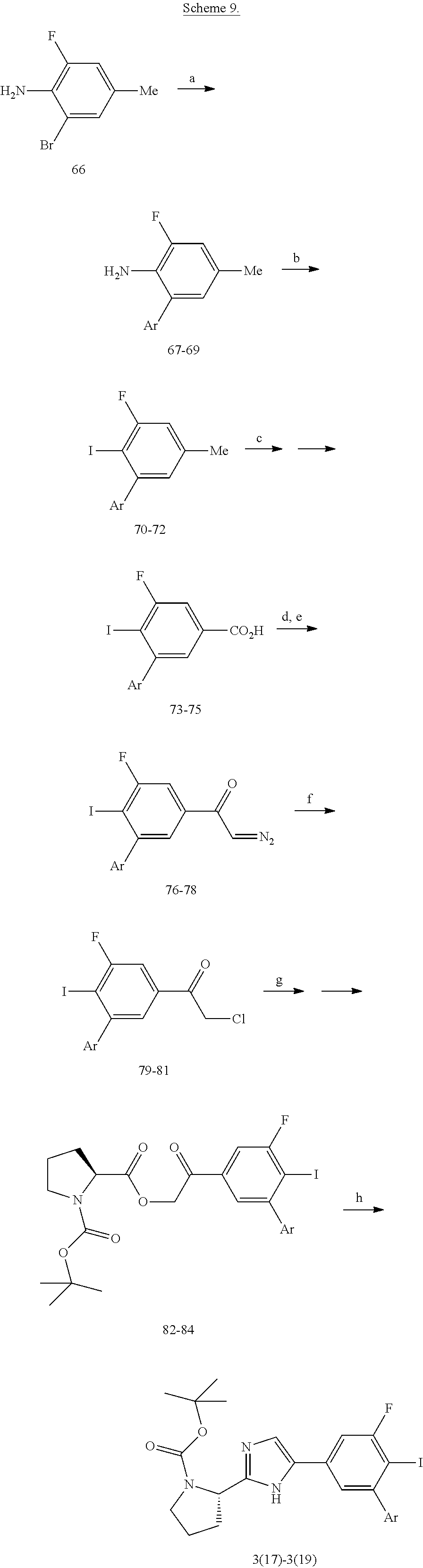
where Ar is Ph (67, 70, 73, 76, 79, 82, 3(17)), 4-Me-Ph (68, 71, 74, 77, 80, 83, 3(18)), 4-F-Ph (69, 72, 75, 78, 81, 84, 3(19)). Reagents and conditions: (a) PhB(OH)2, Na2CO3, Pd(PPh3)2Cl2, EtOH, H2O, 80° C.; (b) TsOH.H2O, NaNO2, KI, t-BuOH, H2O; (c) KMnO4, Py, H2O, 4 h, 70-80° C.; (d) (COCl)2, DCM; (e) MeCN, TMS-diazomethane, 15 h, 4° C.; (f) HCl, EtOAc; (g) Boc-L-proline, DIPEA, MeCN; (h) NH4OAc, PhMe, 100° C.


where Ar is Ph (87, 90, 93, 96, 99, 102, 3(20)), 4-Me-Ph (88, 91, 94, 97, 100, 103, 3(21)), 4-F-Ph (89, 92, 95, 98, 101, 103, 3(22)). Reagents and conditions: (a) NBS, AcOH; CuI, DMF, Et3N, 45° C.; (b) PhB(OH)2, Na2CO3, Pd(PPh3)2Cl2, EtOH, H2O, 80° C.; (c) TsOH.H2O, NaNO2, KI, t-BuOH, H2O; (d) LiOH, THF, MeOH, H2O; (e) (COCl)2, DCM; (f) MeCN, TMS-diazomethane, 15 h, 4° C.; (g) HCl, EtOAc; (h) Boc-L-proline, DIPEA, MeCN; (i) NH4OAc, PhMe, 100° C.

where R is F (3(17), 3(23)) and Me (3(20), 3(24)). Reagents and conditions: (a) HCl, dioxane; (b) Moc-L-Val-OH, HATU, DMF, DIPEA, 4° C.

Reagents and conditions: (a) NaH, (S)-1-phenylethanol, DMSO; (b) B2pin2, Pd(dppf)Cl2, KOAc, dioxane, 80° C.; (c) Pd(PPh3)2Cl2, Na2CO3, EtOH, H2O, 70° C.; (d) Na2S2O4, Et3N, EtOH, 80° C.; (e) TsOH.H2O, NaNO2, KI, MeCN, H2O; (f) methyl (S)-3-methyl-1-oxo-1-{(S)-2-[5-(buta-1,3-diynyl)-1H-imidazol-2-yl]pyrrolidin-1-yl}butan-2-ylcarbamate (67), Pd(PPh3)4, CuI, DMF, Et3N, 45° C.


Reagents and conditions: (a) PhOH, K2CO3, DMF, 75° C., 3 h; (b) B2Pin2, Pd(PPh3)4, KOAc, dioxane, 90° C., 15 h; (c) Pd(PPh3)4, Na2CO3, dioxane-H2O, 90° C., 15 h, (d) 2M HCl in dioxane, 2 h, rt, then Moc-L-valine, DIPEA, TBTU, MeCN, (e) H2, 10% Pd(C), MeOH, 4 h, rt, (f) p-TsOH, MeCN, 10° C., then NaNO2, KI, H2O, 3 h, rt.


Reagents and conditions: (a) NBS, NH4OAc, MeCN, RT, 10 min; (b) m-CPBA, toluene, reflux, 6 h; (c) Br2, dioxane, 10° C. to RT, 1 h; (d) Boc-L-proline, DIPEA, MeCN, 15 h, RT; (e) NH4OAc, PhMe, 110° C., 48 h; (f) PhSH, EtOH, 60° C., 48 h; (g) SnCl2×2H2O, EtOH, RT, ON; (h) p-TsOH, MeCN, then NaNO2, KI, H2O, 2 h, RT; (i) 4M HCl in dioxane, 2 h, RT; (j) Moc-L-valine, DIPEA, TBTU, DMF, 3 h, rt.


Reagents and conditions: (a) PhNH2, K2CO3, NMP, 50° C., 48 h; (b) CH3I, DMF, 0° C., 2 h; (c), B2Pin2, KOAc, Pd(dppf)Cl2, 80° C., 20 h; (d) Na2CO3, Pd(PPh3)4, dioxane-H2O, 90° C., 20 h; (e) H2, Pd/C, MeOH, 3 h, RT; (f) p-TsOH, MeCN, KI, H2O, then NaNO2, H2O, 20 h, RT.

where Ar=Ph (3(1), 3(31)), 3-tert-Bu-Ph (3(3), 3(32)), 3-Ph-Ph (3(5), 3(33)), 2-naphthyl (3(6), 3(34)). Reagents and conditions: (a) ether, argon, MeLi.LiBr, r.t., 15 h; (b) Pd(PPh3)4, CuI, THF, Et3N, 45° C.

where Ar=Ph (3(31), 3(35)), 3-tert-Bu-Ph (3(32), 3(36)), 3-Ph-Ph (3(33), 3(37)), 2-naphthyl (3(34), 3(38)). Reagents and conditions: (a) K2CO3, THF, MeOH.

Ar=Ph (3(35), 133, 4(1).4HCl), 3-tert-Bu-Ph (3(36), 134, 4(2).4HCl), 3-Ph-Ph (3(37), 135, 4(3).4HCl), 2-naphthyl (3(38), 136, 4(4).4HCl). Reagents and conditions: (a) Pd(PPh3)4, CuI, THF, Et3N, 40° C.; (b) HCl, dioxane.

where R=F (139, 4(5)), Me (140, 4(6)). Reagents and conditions: (a) Pd(PPh3)4, CuI, THF, Et3N, 45° C.; (b) K2CO3, THF, MeOH; (c) Pd(PPh3)4, CuI, THF, Et3N, 40° C.; (d) HCl, dioxane.

where Ar=Ph (3(7), 3(23), 3(24), 139, 151, 152, 4(7).3HCl, 4(17).3HCl, 4(18).3HCl), 2-Me-Ph (3(9), 140, 4(8).3HCl), 2-F-Ph (3(8), 141, 4(9).3HCl), 3-t-Bu-Ph (3(10), 142, 4(10).3HCl), 4-t-Bu-Ph (3(11), 143, 4(11).3HCl), 3-Ph-Ph (3(12), 144, 4(12).3HCl), 4-Ph-Ph (3(13), 145, 4(13).3HCl), 4-Me2N-Ph (3(14), 146, 4(14).4HCl), 4-(4-methylpiperazin-1-yl)-Ph (3(15), 147, 4(15).5HCl), 3-Py (3(16), 148, 4(16).4HCl). R=H (141-150, (4(7)-4(16)).nHCl), F (151, 4(17).3HCl), Me (152, 4(18).3HCl). Reagents and conditions: (a) Pd(PPh3)4, CuI, THF, Et3N, 40° C.; (b) HCl, dioxane.

Reagents and conditions: (a) Pd(PPh3)4, CuI, THF, Et3N, 45° C.; (b) Moc-L-valine, DIPEA, TBTU, DMF, 3 h, rt; (c) K2CO3, THF, MeOH; (d) Pd(PPh3)4, CuI, THF, Et3N, 40° C.; (e) HCl, dioxane.

where Z=PhO (3(26), 4(20).3HCl, 157); PhS (3(29), 4(21).3HCl, 158); PhNH (3(30), 4(22).4HCl, 159). Reagents and conditions: (a) Pd(PPh3)4, CuI, THF, Et3N, 40° C.; (b) HCl, dioxane.

where
| Compounds numbers | R | Z | ||
| 3(7) → 161 → 4(23)•3HCl | H | Ph | ||
| 3(23) → 165 → 4(27)•3HCl | F | Ph | ||
| 3(24) → 166 → 4(28)•3HCl | CH3 | Ph | ||
| 3(26) → 162 → 4(24)•3HCl | H | PhO | ||
| 3(29) → 163 → 4(25)•3HCl | H | PhS | ||
| 3(30) → 164 → 4(26)•4HCl | H | PhHN | ||
Reagents and conditions: (a) PhS (3(27), 163, 4(26).3HCl); Pd(PPh3)4, NaHCO3, dioxane-H2O, 15 h, 90° C.; (b) 2M HCl in dioxane, 2 h, r.
Claims (10)


Priority Applications (5)
| Application Number | Priority Date | Filing Date | Title |
|---|---|---|---|
| US14/845,333 US9790207B2 (en) | 2015-09-04 | 2015-09-04 | Pan-genomic inhibitors of NS5A protein encoded by HCV, pharmaceutical compositions, intermediates for inhibitor synthesis, and their synthesis and application methods |
| EP16842471.1A EP3344617A4 (en) | 2015-09-04 | 2016-06-24 | PAN-GENOMIC INHIBITORS OF HEPATITIS C (HCV) VIRUS CODED NSSA PROTEIN, PHARMACEUTICAL COMPOSITIONS, INTERMEDIATES FOR THE SYNTHESIS OF THESE INHIBITORS, AND METHODS OF SYNTHESIS AND APPLICATION THEREOF |
| PCT/US2016/039152 WO2017039791A1 (en) | 2015-09-04 | 2016-06-24 | Pan-genomic inhibitors of ns5a protein encoded by hcv, pharmaceutical compositions, intermediates for inhibitor synthesis, and their synthesis and application methods. |
| RU2017120825A RU2669919C1 (en) | 2015-09-04 | 2016-06-24 | Pan-genomic inhibitors of the hepatitis c virus protein ns5a, pharmaceutical compositions, intermediates for the synthesis of inhibitors, and methods for their preparation and use |
| EA201800065A EA034084B1 (en) | 2015-09-04 | 2016-06-24 | Pan-genomic inhibitors of ns5a protein of hepatitis c virus, pharmaceutical compositions, intermediates for inhibitor synthesis, and their synthesis and application methods |
Applications Claiming Priority (1)
| Application Number | Priority Date | Filing Date | Title |
|---|---|---|---|
| US14/845,333 US9790207B2 (en) | 2015-09-04 | 2015-09-04 | Pan-genomic inhibitors of NS5A protein encoded by HCV, pharmaceutical compositions, intermediates for inhibitor synthesis, and their synthesis and application methods |
Publications (2)
| Publication Number | Publication Date |
|---|---|
| US20170066746A1 US20170066746A1 (en) | 2017-03-09 |
| US9790207B2 true US9790207B2 (en) | 2017-10-17 |
Family
ID=58188960
Family Applications (1)
| Application Number | Title | Priority Date | Filing Date |
|---|---|---|---|
| US14/845,333 Expired - Fee Related US9790207B2 (en) | 2015-09-04 | 2015-09-04 | Pan-genomic inhibitors of NS5A protein encoded by HCV, pharmaceutical compositions, intermediates for inhibitor synthesis, and their synthesis and application methods |
Country Status (5)
| Country | Link |
|---|---|
| US (1) | US9790207B2 (en) |
| EP (1) | EP3344617A4 (en) |
| EA (1) | EA034084B1 (en) |
| RU (1) | RU2669919C1 (en) |
| WO (1) | WO2017039791A1 (en) |
Cited By (1)
| Publication number | Priority date | Publication date | Assignee | Title |
|---|---|---|---|---|
| US20230346899A1 (en) * | 2022-03-31 | 2023-11-02 | Alexandre Vasilievich Ivachtchenko | PHARMACEUTICAL COMBINATION THERAPY AND PREVENTION WITH APROTININ + NIRMATRELVIR OF SARS-CoV-2 AND/OR DISEASE ASSOCIATED WITH THIS INFECTION, INCLUDING COVID-19 |
Citations (2)
| Publication number | Priority date | Publication date | Assignee | Title |
|---|---|---|---|---|
| US20100158862A1 (en) * | 2006-08-11 | 2010-06-24 | Bristol-Myers Squibb Company | Hepatitis C Virus Inhibitors |
| US20130253008A1 (en) * | 2010-11-30 | 2013-09-26 | Alla Chem Llc | Substituted azoles, antiviral active component, pharmaceutical composition, method for preparation and use thereof |
Family Cites Families (2)
| Publication number | Priority date | Publication date | Assignee | Title |
|---|---|---|---|---|
| CN101998952B (en) * | 2008-02-12 | 2014-10-08 | 百时美施贵宝公司 | Hepatitis c virus inhibitors |
| US8653070B2 (en) * | 2009-12-14 | 2014-02-18 | Enanta Pharmaceuticals, Inc. | Hepatitis C virus inhibitors |
-
2015
- 2015-09-04 US US14/845,333 patent/US9790207B2/en not_active Expired - Fee Related
-
2016
- 2016-06-24 EA EA201800065A patent/EA034084B1/en not_active IP Right Cessation
- 2016-06-24 EP EP16842471.1A patent/EP3344617A4/en not_active Withdrawn
- 2016-06-24 RU RU2017120825A patent/RU2669919C1/en active IP Right Revival
- 2016-06-24 WO PCT/US2016/039152 patent/WO2017039791A1/en not_active Ceased
Patent Citations (2)
| Publication number | Priority date | Publication date | Assignee | Title |
|---|---|---|---|---|
| US20100158862A1 (en) * | 2006-08-11 | 2010-06-24 | Bristol-Myers Squibb Company | Hepatitis C Virus Inhibitors |
| US20130253008A1 (en) * | 2010-11-30 | 2013-09-26 | Alla Chem Llc | Substituted azoles, antiviral active component, pharmaceutical composition, method for preparation and use thereof |
Non-Patent Citations (1)
| Title |
|---|
| lvachtchenko et al., J. Med. Chem. 57, 7716-30 (2014). * |
Cited By (1)
| Publication number | Priority date | Publication date | Assignee | Title |
|---|---|---|---|---|
| US20230346899A1 (en) * | 2022-03-31 | 2023-11-02 | Alexandre Vasilievich Ivachtchenko | PHARMACEUTICAL COMBINATION THERAPY AND PREVENTION WITH APROTININ + NIRMATRELVIR OF SARS-CoV-2 AND/OR DISEASE ASSOCIATED WITH THIS INFECTION, INCLUDING COVID-19 |
Also Published As
| Publication number | Publication date |
|---|---|
| EP3344617A1 (en) | 2018-07-11 |
| WO2017039791A1 (en) | 2017-03-09 |
| RU2669919C1 (en) | 2018-10-17 |
| EA034084B1 (en) | 2019-12-25 |
| EA201800065A1 (en) | 2018-08-31 |
| US20170066746A1 (en) | 2017-03-09 |
| EP3344617A4 (en) | 2019-06-12 |
Similar Documents
| Publication | Publication Date | Title |
|---|---|---|
| US10538519B2 (en) | Derivatives and methods of treating hepatitis B infections | |
| US9120779B2 (en) | Inhibitors of HCV NS5A | |
| US9428491B2 (en) | Substituted azoles, antiviral active component, pharmaceutical composition, method for preparation and use thereof | |
| CN102414199B (en) | Diaryl ether | |
| US8709999B2 (en) | Substituted bicyclic HCV inhibitors | |
| US8669234B2 (en) | Antiviral compounds | |
| US20120040977A1 (en) | Inhibitors of hcv ns5a | |
| US20130072523A1 (en) | Analogues for the treatment or prevention of flavivirus infections | |
| US20110172238A1 (en) | Benzimidazole analogues for the treatment or prevention of flavivirus infections | |
| US20130310427A1 (en) | Inhibitors of hcv ns5a protein | |
| US20260103471A1 (en) | Cyclic urea thiazolyl compounds for treatment of hsv | |
| US20090215778A1 (en) | Alpha-substituted Arylmethyl Piperazine Pyrazolo [1,5-alpha]Pyrimidine Amide Derivatives | |
| US20130296311A1 (en) | Inhibitors of hcv ns5a | |
| KR20120034603A (en) | Hepatitis c virus inhibitors | |
| US20140308243A1 (en) | Hepatitis c virus inhibitors | |
| US10807971B2 (en) | Pyrrolidinone compounds | |
| RU2669919C1 (en) | Pan-genomic inhibitors of the hepatitis c virus protein ns5a, pharmaceutical compositions, intermediates for the synthesis of inhibitors, and methods for their preparation and use | |
| RU2723482C1 (en) | Pangenotypic ns5a protein inhibitor of hepatitis c virus, a pharmaceutical composition and methods for preparing and using | |
| US20250332276A1 (en) | Inhibitors of Molluscum Contagiosum Infection and Methods Using the Same | |
| EA045261B1 (en) | PANGENOTYPICAL INHIBITOR OF HEPATITIS C VIRUS NS5A PROTEIN, PHARMACEUTICAL COMPOSITION AND METHODS FOR THEIR PRODUCTION AND APPLICATION | |
| TW202106677A (en) | Dicarbamate inhibitors of ns5a for the treatment of hepatitis c virus infections | |
| WO2014123457A1 (en) | Alkyl [2-(2-{5-[4-(4-{2-[1-(2-methoxycarbonylamino-acetyl)-pyrrolidine-2-yl]-3h-imidazole-4-yl}-phenyl)-buta-1,3-dienyl]-1h-imidazole-2-yl}-pyrrolidine-1-yl)-2-oxo-ethyl]carbamate, pharmaceutical composition, medicinal agent and method for treatment of viral diseases | |
| TW201038558A (en) | Hepatitis C virus inhibitors |
Legal Events
| Date | Code | Title | Description |
|---|---|---|---|
| STCF | Information on status: patent grant |
Free format text: PATENTED CASE |
|
| MAFP | Maintenance fee payment |
Free format text: PAYMENT OF MAINTENANCE FEE, 4TH YR, SMALL ENTITY (ORIGINAL EVENT CODE: M2551); ENTITY STATUS OF PATENT OWNER: SMALL ENTITY Year of fee payment: 4 |
|
| FEPP | Fee payment procedure |
Free format text: MAINTENANCE FEE REMINDER MAILED (ORIGINAL EVENT CODE: REM.); ENTITY STATUS OF PATENT OWNER: SMALL ENTITY |
|
| LAPS | Lapse for failure to pay maintenance fees |
Free format text: PATENT EXPIRED FOR FAILURE TO PAY MAINTENANCE FEES (ORIGINAL EVENT CODE: EXP.); ENTITY STATUS OF PATENT OWNER: SMALL ENTITY |
|
| STCH | Information on status: patent discontinuation |
Free format text: PATENT EXPIRED DUE TO NONPAYMENT OF MAINTENANCE FEES UNDER 37 CFR 1.362 |
|
| FP | Lapsed due to failure to pay maintenance fee |
Effective date: 20251017 |