US9777218B2 - Liquid crystal display element - Google Patents
Liquid crystal display element Download PDFInfo
- Publication number
- US9777218B2 US9777218B2 US14/779,508 US201414779508A US9777218B2 US 9777218 B2 US9777218 B2 US 9777218B2 US 201414779508 A US201414779508 A US 201414779508A US 9777218 B2 US9777218 B2 US 9777218B2
- Authority
- US
- United States
- Prior art keywords
- group
- liquid crystal
- substrate
- display device
- present
- Prior art date
- Legal status (The legal status is an assumption and is not a legal conclusion. Google has not performed a legal analysis and makes no representation as to the accuracy of the status listed.)
- Active
Links
- 0 [21*]CCCCC[22*] Chemical compound [21*]CCCCC[22*] 0.000 description 10
- ZWJMKDWSBGLFEL-UHFFFAOYSA-N C=C(C)C(=O)OC1=CC=C(C2=CC=C(OC(=O)C(=C)C)C(F)=C2)C=C1 Chemical compound C=C(C)C(=O)OC1=CC=C(C2=CC=C(OC(=O)C(=C)C)C(F)=C2)C=C1 ZWJMKDWSBGLFEL-UHFFFAOYSA-N 0.000 description 3
- UGXZKVQKCTUZDN-GSRHIGSDSA-N C/C=C/C.C/C=C/CCC.C=CC.C=CCCC Chemical compound C/C=C/C.C/C=C/CCC.C=CC.C=CCCC UGXZKVQKCTUZDN-GSRHIGSDSA-N 0.000 description 2
- VLNYMLWWMOOPQJ-UHFFFAOYSA-N C=C(C(=O)OC)C(F)(F)F.C=C(C)C(=O)OC.C=CC(=O)CC.C=CC(=O)OC.C=CCOC.C=COC.CC1CO1.CC1OC1(C)C.CCCC1(C)COC1.COCC1(C)CO1.COCC1CCC2OC2C1.COCC1CO1 Chemical compound C=C(C(=O)OC)C(F)(F)F.C=C(C)C(=O)OC.C=CC(=O)CC.C=CC(=O)OC.C=CCOC.C=COC.CC1CO1.CC1OC1(C)C.CCCC1(C)COC1.COCC1(C)CO1.COCC1CCC2OC2C1.COCC1CO1 VLNYMLWWMOOPQJ-UHFFFAOYSA-N 0.000 description 2
- RLXJLKKGIXBGHX-UHFFFAOYSA-N CCC1(COC)COC1.CN1C(=O)C=CC1=O.CS Chemical compound CCC1(COC)COC1.CN1C(=O)C=CC1=O.CS RLXJLKKGIXBGHX-UHFFFAOYSA-N 0.000 description 2
- XWLCXPMOVYWSAL-UHFFFAOYSA-N C=C(C)C(=O)OC1=CC=C(CCC(=O)OC2=CC=C(C3=CC=C(OC(=O)C(=C)C)C(OC(=O)C(=C)C)=C3)C=C2)C=C1 Chemical compound C=C(C)C(=O)OC1=CC=C(CCC(=O)OC2=CC=C(C3=CC=C(OC(=O)C(=C)C)C(OC(=O)C(=C)C)=C3)C=C2)C=C1 XWLCXPMOVYWSAL-UHFFFAOYSA-N 0.000 description 1
- BEDBEGCEOOGONP-UHFFFAOYSA-N C=CC(=O)COCCOC1=CC=C(C2=CC=C(OCCCOC(=O)C(=C)C)C=C2)C=C1 Chemical compound C=CC(=O)COCCOC1=CC=C(C2=CC=C(OCCCOC(=O)C(=C)C)C=C2)C=C1 BEDBEGCEOOGONP-UHFFFAOYSA-N 0.000 description 1
- ORQKWRWGYDDNSQ-UHFFFAOYSA-N CC1=CC=C(C2=C(F)C(F)=C(C3=CC=C(C)C=C3)C=C2)C=C1.CC1=CC=C(C2=CC=C(C3=CC=C(C4=CC=C(C)C(F)=C4F)C=C3)C=C2)C=C1.CC1=CC=C(C2=CC=C(C3=CC=C(C4CCC(C)CC4)C=C3)C=C2)C(F)=C1F.CC1=CC=C(C2=CC=C(COC3=CC=C(C)C(F)=C3F)C=C2)C=C1.CC1=CC=C(OCC2CCC(C3CCC(C)CC3)CC2)C(F)=C1F Chemical compound CC1=CC=C(C2=C(F)C(F)=C(C3=CC=C(C)C=C3)C=C2)C=C1.CC1=CC=C(C2=CC=C(C3=CC=C(C4=CC=C(C)C(F)=C4F)C=C3)C=C2)C=C1.CC1=CC=C(C2=CC=C(C3=CC=C(C4CCC(C)CC4)C=C3)C=C2)C(F)=C1F.CC1=CC=C(C2=CC=C(COC3=CC=C(C)C(F)=C3F)C=C2)C=C1.CC1=CC=C(OCC2CCC(C3CCC(C)CC3)CC2)C(F)=C1F ORQKWRWGYDDNSQ-UHFFFAOYSA-N 0.000 description 1
- CBKRIMIOXBYRBI-UHFFFAOYSA-N CC1=CC=C(C2=CC=C(C)C=C2)C=C1.CC1=CC=C(C2=CC=C(C3=CC=C(C)C=C3)C=C2)C=C1.CC1=CC=C(C2=CC=C(C3CCC(C)CC3)C=C2)C=C1.CC1=CC=C(C2CCC(C)CC2)C=C1.CC1=CC=C(C2CCC(C3CCC(C)CC3)CC2)C=C1.CC1CCC(C2CCC(C)CC2)CC1 Chemical compound CC1=CC=C(C2=CC=C(C)C=C2)C=C1.CC1=CC=C(C2=CC=C(C3=CC=C(C)C=C3)C=C2)C=C1.CC1=CC=C(C2=CC=C(C3CCC(C)CC3)C=C2)C=C1.CC1=CC=C(C2CCC(C)CC2)C=C1.CC1=CC=C(C2CCC(C3CCC(C)CC3)CC2)C=C1.CC1CCC(C2CCC(C)CC2)CC1 CBKRIMIOXBYRBI-UHFFFAOYSA-N 0.000 description 1
- JRNHXNPPWSAXTA-UHFFFAOYSA-N CC1=CC=C(C2=CC=C(C3CCC(C)CC3)C=C2)C(F)=C1F.CC1=CC=C(C2CCC(C)CC2)C(F)=C1F.CC1=CC=C(C2CCC(C3CCC(C)CC3)CC2)C(F)=C1F.CC1=CC=C(CCC2CCC(C)CC2)C(F)=C1F.CC1=CC=C(CCC2CCC(C3CCC(C)CC3)CC2)C(F)=C1F.CC1=CC=C(COC2=CC=C(C)C(F)=C2F)C=C1.CC1=CC=C(OCC2CCC(C)CC2)C(F)=C1F Chemical compound CC1=CC=C(C2=CC=C(C3CCC(C)CC3)C=C2)C(F)=C1F.CC1=CC=C(C2CCC(C)CC2)C(F)=C1F.CC1=CC=C(C2CCC(C3CCC(C)CC3)CC2)C(F)=C1F.CC1=CC=C(CCC2CCC(C)CC2)C(F)=C1F.CC1=CC=C(CCC2CCC(C3CCC(C)CC3)CC2)C(F)=C1F.CC1=CC=C(COC2=CC=C(C)C(F)=C2F)C=C1.CC1=CC=C(OCC2CCC(C)CC2)C(F)=C1F JRNHXNPPWSAXTA-UHFFFAOYSA-N 0.000 description 1
- QBKIBHHURQODLS-UHFFFAOYSA-N CC1CCC(C)CC1.Cc1ccc(C)c(F)c1F.Cc1ccc(C)cc1 Chemical compound CC1CCC(C)CC1.Cc1ccc(C)c(F)c1F.Cc1ccc(C)cc1 QBKIBHHURQODLS-UHFFFAOYSA-N 0.000 description 1
- SEEYREPSKCQBBF-UHFFFAOYSA-N CN(C(C=C1)=O)C1=O Chemical compound CN(C(C=C1)=O)C1=O SEEYREPSKCQBBF-UHFFFAOYSA-N 0.000 description 1
- DYSJQUQJVBYIOT-UHFFFAOYSA-N Cc(ccc(C)c1F)c1F Chemical compound Cc(ccc(C)c1F)c1F DYSJQUQJVBYIOT-UHFFFAOYSA-N 0.000 description 1
- WYOJVZMPZXJFJQ-UHFFFAOYSA-N Cc1ccc(-c2ccc(C)c(F)c2)cc1.Cc1ccc(-c2ccc(C)c(F)c2)cc1F.Cc1ccc(-c2ccc(C)cc2F)c(F)c1.Cc1ccc(-c2ccc(C)cc2F)cc1 Chemical compound Cc1ccc(-c2ccc(C)c(F)c2)cc1.Cc1ccc(-c2ccc(C)c(F)c2)cc1F.Cc1ccc(-c2ccc(C)cc2F)c(F)c1.Cc1ccc(-c2ccc(C)cc2F)cc1 WYOJVZMPZXJFJQ-UHFFFAOYSA-N 0.000 description 1
Images


Classifications
-
- C—CHEMISTRY; METALLURGY
- C09—DYES; PAINTS; POLISHES; NATURAL RESINS; ADHESIVES; COMPOSITIONS NOT OTHERWISE PROVIDED FOR; APPLICATIONS OF MATERIALS NOT OTHERWISE PROVIDED FOR
- C09K—MATERIALS FOR MISCELLANEOUS APPLICATIONS, NOT PROVIDED FOR ELSEWHERE
- C09K19/00—Liquid crystal materials
- C09K19/04—Liquid crystal materials characterised by the chemical structure of the liquid crystal components, e.g. by a specific unit
- C09K19/06—Non-steroidal liquid crystal compounds
- C09K19/08—Non-steroidal liquid crystal compounds containing at least two non-condensed rings
- C09K19/30—Non-steroidal liquid crystal compounds containing at least two non-condensed rings containing saturated or unsaturated non-aromatic rings, e.g. cyclohexane rings
- C09K19/3001—Cyclohexane rings
- C09K19/3066—Cyclohexane rings in which the rings are linked by a chain containing carbon and oxygen atoms, e.g. esters or ethers
-
- C—CHEMISTRY; METALLURGY
- C09—DYES; PAINTS; POLISHES; NATURAL RESINS; ADHESIVES; COMPOSITIONS NOT OTHERWISE PROVIDED FOR; APPLICATIONS OF MATERIALS NOT OTHERWISE PROVIDED FOR
- C09K—MATERIALS FOR MISCELLANEOUS APPLICATIONS, NOT PROVIDED FOR ELSEWHERE
- C09K19/00—Liquid crystal materials
- C09K19/04—Liquid crystal materials characterised by the chemical structure of the liquid crystal components, e.g. by a specific unit
- C09K19/06—Non-steroidal liquid crystal compounds
- C09K19/08—Non-steroidal liquid crystal compounds containing at least two non-condensed rings
- C09K19/10—Non-steroidal liquid crystal compounds containing at least two non-condensed rings containing at least two benzene rings
- C09K19/20—Non-steroidal liquid crystal compounds containing at least two non-condensed rings containing at least two benzene rings linked by a chain containing carbon and oxygen atoms as chain links, e.g. esters or ethers
- C09K19/2007—Non-steroidal liquid crystal compounds containing at least two non-condensed rings containing at least two benzene rings linked by a chain containing carbon and oxygen atoms as chain links, e.g. esters or ethers the chain containing -COO- or -OCO- groups
- C09K19/2014—Non-steroidal liquid crystal compounds containing at least two non-condensed rings containing at least two benzene rings linked by a chain containing carbon and oxygen atoms as chain links, e.g. esters or ethers the chain containing -COO- or -OCO- groups containing additionally a linking group other than -COO- or -OCO-, e.g. -CH2-CH2-, -CH=CH-, -C=C-; containing at least one additional carbon atom in the chain containing -COO- or -OCO- groups, e.g. -(CH2)m-COO-(CH2)n-
-
- C—CHEMISTRY; METALLURGY
- C09—DYES; PAINTS; POLISHES; NATURAL RESINS; ADHESIVES; COMPOSITIONS NOT OTHERWISE PROVIDED FOR; APPLICATIONS OF MATERIALS NOT OTHERWISE PROVIDED FOR
- C09K—MATERIALS FOR MISCELLANEOUS APPLICATIONS, NOT PROVIDED FOR ELSEWHERE
- C09K19/00—Liquid crystal materials
- C09K19/52—Liquid crystal materials characterised by components which are not liquid crystals, e.g. additives with special physical aspect: solvents, solid particles
- C09K19/54—Additives having no specific mesophase characterised by their chemical composition
- C09K19/542—Macromolecular compounds
-
- G—PHYSICS
- G02—OPTICS
- G02F—OPTICAL DEVICES OR ARRANGEMENTS FOR THE CONTROL OF LIGHT BY MODIFICATION OF THE OPTICAL PROPERTIES OF THE MEDIA OF THE ELEMENTS INVOLVED THEREIN; NON-LINEAR OPTICS; FREQUENCY-CHANGING OF LIGHT; OPTICAL LOGIC ELEMENTS; OPTICAL ANALOGUE/DIGITAL CONVERTERS
- G02F1/00—Devices or arrangements for the control of the intensity, colour, phase, polarisation or direction of light arriving from an independent light source, e.g. switching, gating or modulating; Non-linear optics
- G02F1/01—Devices or arrangements for the control of the intensity, colour, phase, polarisation or direction of light arriving from an independent light source, e.g. switching, gating or modulating; Non-linear optics for the control of the intensity, phase, polarisation or colour
- G02F1/13—Devices or arrangements for the control of the intensity, colour, phase, polarisation or direction of light arriving from an independent light source, e.g. switching, gating or modulating; Non-linear optics for the control of the intensity, phase, polarisation or colour based on liquid crystals, e.g. single liquid crystal display cells
- G02F1/133—Constructional arrangements; Operation of liquid crystal cells; Circuit arrangements
- G02F1/1333—Constructional arrangements; Manufacturing methods
- G02F1/1337—Surface-induced orientation of the liquid crystal molecules, e.g. by alignment layers
- G02F1/133711—Surface-induced orientation of the liquid crystal molecules, e.g. by alignment layers by organic films, e.g. polymeric films
-
- G—PHYSICS
- G02—OPTICS
- G02F—OPTICAL DEVICES OR ARRANGEMENTS FOR THE CONTROL OF LIGHT BY MODIFICATION OF THE OPTICAL PROPERTIES OF THE MEDIA OF THE ELEMENTS INVOLVED THEREIN; NON-LINEAR OPTICS; FREQUENCY-CHANGING OF LIGHT; OPTICAL LOGIC ELEMENTS; OPTICAL ANALOGUE/DIGITAL CONVERTERS
- G02F1/00—Devices or arrangements for the control of the intensity, colour, phase, polarisation or direction of light arriving from an independent light source, e.g. switching, gating or modulating; Non-linear optics
- G02F1/01—Devices or arrangements for the control of the intensity, colour, phase, polarisation or direction of light arriving from an independent light source, e.g. switching, gating or modulating; Non-linear optics for the control of the intensity, phase, polarisation or colour
- G02F1/13—Devices or arrangements for the control of the intensity, colour, phase, polarisation or direction of light arriving from an independent light source, e.g. switching, gating or modulating; Non-linear optics for the control of the intensity, phase, polarisation or colour based on liquid crystals, e.g. single liquid crystal display cells
- G02F1/133—Constructional arrangements; Operation of liquid crystal cells; Circuit arrangements
- G02F1/1333—Constructional arrangements; Manufacturing methods
- G02F1/1337—Surface-induced orientation of the liquid crystal molecules, e.g. by alignment layers
- G02F1/13378—Surface-induced orientation of the liquid crystal molecules, e.g. by alignment layers by treatment of the surface, e.g. embossing, rubbing or light irradiation
- G02F1/133788—Surface-induced orientation of the liquid crystal molecules, e.g. by alignment layers by treatment of the surface, e.g. embossing, rubbing or light irradiation by light irradiation, e.g. linearly polarised light photo-polymerisation
-
- C—CHEMISTRY; METALLURGY
- C08—ORGANIC MACROMOLECULAR COMPOUNDS; THEIR PREPARATION OR CHEMICAL WORKING-UP; COMPOSITIONS BASED THEREON
- C08F—MACROMOLECULAR COMPOUNDS OBTAINED BY REACTIONS ONLY INVOLVING CARBON-TO-CARBON UNSATURATED BONDS
- C08F220/00—Copolymers of compounds having one or more unsaturated aliphatic radicals, each having only one carbon-to-carbon double bond, and only one being terminated by only one carboxyl radical or a salt, anhydride ester, amide, imide or nitrile thereof
- C08F220/02—Monocarboxylic acids having less than ten carbon atoms; Derivatives thereof
- C08F220/10—Esters
- C08F220/12—Esters of monohydric alcohols or phenols
- C08F220/16—Esters of monohydric alcohols or phenols of phenols or of alcohols containing two or more carbon atoms
- C08F220/18—Esters of monohydric alcohols or phenols of phenols or of alcohols containing two or more carbon atoms with acrylic or methacrylic acids
-
- C—CHEMISTRY; METALLURGY
- C08—ORGANIC MACROMOLECULAR COMPOUNDS; THEIR PREPARATION OR CHEMICAL WORKING-UP; COMPOSITIONS BASED THEREON
- C08F—MACROMOLECULAR COMPOUNDS OBTAINED BY REACTIONS ONLY INVOLVING CARBON-TO-CARBON UNSATURATED BONDS
- C08F220/00—Copolymers of compounds having one or more unsaturated aliphatic radicals, each having only one carbon-to-carbon double bond, and only one being terminated by only one carboxyl radical or a salt, anhydride ester, amide, imide or nitrile thereof
- C08F220/02—Monocarboxylic acids having less than ten carbon atoms; Derivatives thereof
- C08F220/10—Esters
- C08F220/26—Esters containing oxygen in addition to the carboxy oxygen
- C08F220/30—Esters containing oxygen in addition to the carboxy oxygen containing aromatic rings in the alcohol moiety
-
- C—CHEMISTRY; METALLURGY
- C09—DYES; PAINTS; POLISHES; NATURAL RESINS; ADHESIVES; COMPOSITIONS NOT OTHERWISE PROVIDED FOR; APPLICATIONS OF MATERIALS NOT OTHERWISE PROVIDED FOR
- C09K—MATERIALS FOR MISCELLANEOUS APPLICATIONS, NOT PROVIDED FOR ELSEWHERE
- C09K19/00—Liquid crystal materials
- C09K19/04—Liquid crystal materials characterised by the chemical structure of the liquid crystal components, e.g. by a specific unit
- C09K2019/0444—Liquid crystal materials characterised by the chemical structure of the liquid crystal components, e.g. by a specific unit characterized by a linking chain between rings or ring systems, a bridging chain between extensive mesogenic moieties or an end chain group
- C09K2019/0448—Liquid crystal materials characterised by the chemical structure of the liquid crystal components, e.g. by a specific unit characterized by a linking chain between rings or ring systems, a bridging chain between extensive mesogenic moieties or an end chain group the end chain group being a polymerizable end group, e.g. -Sp-P or acrylate
-
- C—CHEMISTRY; METALLURGY
- C09—DYES; PAINTS; POLISHES; NATURAL RESINS; ADHESIVES; COMPOSITIONS NOT OTHERWISE PROVIDED FOR; APPLICATIONS OF MATERIALS NOT OTHERWISE PROVIDED FOR
- C09K—MATERIALS FOR MISCELLANEOUS APPLICATIONS, NOT PROVIDED FOR ELSEWHERE
- C09K19/00—Liquid crystal materials
- C09K19/04—Liquid crystal materials characterised by the chemical structure of the liquid crystal components, e.g. by a specific unit
- C09K19/06—Non-steroidal liquid crystal compounds
- C09K19/08—Non-steroidal liquid crystal compounds containing at least two non-condensed rings
- C09K19/10—Non-steroidal liquid crystal compounds containing at least two non-condensed rings containing at least two benzene rings
- C09K19/12—Non-steroidal liquid crystal compounds containing at least two non-condensed rings containing at least two benzene rings at least two benzene rings directly linked, e.g. biphenyls
- C09K2019/121—Compounds containing phenylene-1,4-diyl (-Ph-)
- C09K2019/122—Ph-Ph
-
- C—CHEMISTRY; METALLURGY
- C09—DYES; PAINTS; POLISHES; NATURAL RESINS; ADHESIVES; COMPOSITIONS NOT OTHERWISE PROVIDED FOR; APPLICATIONS OF MATERIALS NOT OTHERWISE PROVIDED FOR
- C09K—MATERIALS FOR MISCELLANEOUS APPLICATIONS, NOT PROVIDED FOR ELSEWHERE
- C09K19/00—Liquid crystal materials
- C09K19/04—Liquid crystal materials characterised by the chemical structure of the liquid crystal components, e.g. by a specific unit
- C09K19/06—Non-steroidal liquid crystal compounds
- C09K19/08—Non-steroidal liquid crystal compounds containing at least two non-condensed rings
- C09K19/10—Non-steroidal liquid crystal compounds containing at least two non-condensed rings containing at least two benzene rings
- C09K19/12—Non-steroidal liquid crystal compounds containing at least two non-condensed rings containing at least two benzene rings at least two benzene rings directly linked, e.g. biphenyls
- C09K2019/121—Compounds containing phenylene-1,4-diyl (-Ph-)
- C09K2019/123—Ph-Ph-Ph
-
- C—CHEMISTRY; METALLURGY
- C09—DYES; PAINTS; POLISHES; NATURAL RESINS; ADHESIVES; COMPOSITIONS NOT OTHERWISE PROVIDED FOR; APPLICATIONS OF MATERIALS NOT OTHERWISE PROVIDED FOR
- C09K—MATERIALS FOR MISCELLANEOUS APPLICATIONS, NOT PROVIDED FOR ELSEWHERE
- C09K19/00—Liquid crystal materials
- C09K19/04—Liquid crystal materials characterised by the chemical structure of the liquid crystal components, e.g. by a specific unit
- C09K19/06—Non-steroidal liquid crystal compounds
- C09K19/08—Non-steroidal liquid crystal compounds containing at least two non-condensed rings
- C09K19/10—Non-steroidal liquid crystal compounds containing at least two non-condensed rings containing at least two benzene rings
- C09K19/12—Non-steroidal liquid crystal compounds containing at least two non-condensed rings containing at least two benzene rings at least two benzene rings directly linked, e.g. biphenyls
- C09K2019/121—Compounds containing phenylene-1,4-diyl (-Ph-)
- C09K2019/124—Ph-Ph-Ph-Ph
-
- C—CHEMISTRY; METALLURGY
- C09—DYES; PAINTS; POLISHES; NATURAL RESINS; ADHESIVES; COMPOSITIONS NOT OTHERWISE PROVIDED FOR; APPLICATIONS OF MATERIALS NOT OTHERWISE PROVIDED FOR
- C09K—MATERIALS FOR MISCELLANEOUS APPLICATIONS, NOT PROVIDED FOR ELSEWHERE
- C09K19/00—Liquid crystal materials
- C09K19/04—Liquid crystal materials characterised by the chemical structure of the liquid crystal components, e.g. by a specific unit
- C09K19/06—Non-steroidal liquid crystal compounds
- C09K19/08—Non-steroidal liquid crystal compounds containing at least two non-condensed rings
- C09K19/30—Non-steroidal liquid crystal compounds containing at least two non-condensed rings containing saturated or unsaturated non-aromatic rings, e.g. cyclohexane rings
- C09K19/3001—Cyclohexane rings
- C09K19/3003—Compounds containing at least two rings in which the different rings are directly linked (covalent bond)
- C09K2019/3004—Cy-Cy
-
- C—CHEMISTRY; METALLURGY
- C09—DYES; PAINTS; POLISHES; NATURAL RESINS; ADHESIVES; COMPOSITIONS NOT OTHERWISE PROVIDED FOR; APPLICATIONS OF MATERIALS NOT OTHERWISE PROVIDED FOR
- C09K—MATERIALS FOR MISCELLANEOUS APPLICATIONS, NOT PROVIDED FOR ELSEWHERE
- C09K19/00—Liquid crystal materials
- C09K19/04—Liquid crystal materials characterised by the chemical structure of the liquid crystal components, e.g. by a specific unit
- C09K19/06—Non-steroidal liquid crystal compounds
- C09K19/08—Non-steroidal liquid crystal compounds containing at least two non-condensed rings
- C09K19/30—Non-steroidal liquid crystal compounds containing at least two non-condensed rings containing saturated or unsaturated non-aromatic rings, e.g. cyclohexane rings
- C09K19/3001—Cyclohexane rings
- C09K19/3003—Compounds containing at least two rings in which the different rings are directly linked (covalent bond)
- C09K2019/301—Cy-Cy-Ph
-
- C—CHEMISTRY; METALLURGY
- C09—DYES; PAINTS; POLISHES; NATURAL RESINS; ADHESIVES; COMPOSITIONS NOT OTHERWISE PROVIDED FOR; APPLICATIONS OF MATERIALS NOT OTHERWISE PROVIDED FOR
- C09K—MATERIALS FOR MISCELLANEOUS APPLICATIONS, NOT PROVIDED FOR ELSEWHERE
- C09K19/00—Liquid crystal materials
- C09K19/04—Liquid crystal materials characterised by the chemical structure of the liquid crystal components, e.g. by a specific unit
- C09K19/06—Non-steroidal liquid crystal compounds
- C09K19/08—Non-steroidal liquid crystal compounds containing at least two non-condensed rings
- C09K19/30—Non-steroidal liquid crystal compounds containing at least two non-condensed rings containing saturated or unsaturated non-aromatic rings, e.g. cyclohexane rings
- C09K19/3001—Cyclohexane rings
- C09K19/3003—Compounds containing at least two rings in which the different rings are directly linked (covalent bond)
- C09K2019/3016—Cy-Ph-Ph
-
- C—CHEMISTRY; METALLURGY
- C09—DYES; PAINTS; POLISHES; NATURAL RESINS; ADHESIVES; COMPOSITIONS NOT OTHERWISE PROVIDED FOR; APPLICATIONS OF MATERIALS NOT OTHERWISE PROVIDED FOR
- C09K—MATERIALS FOR MISCELLANEOUS APPLICATIONS, NOT PROVIDED FOR ELSEWHERE
- C09K19/00—Liquid crystal materials
- C09K19/04—Liquid crystal materials characterised by the chemical structure of the liquid crystal components, e.g. by a specific unit
- C09K19/06—Non-steroidal liquid crystal compounds
- C09K19/08—Non-steroidal liquid crystal compounds containing at least two non-condensed rings
- C09K19/30—Non-steroidal liquid crystal compounds containing at least two non-condensed rings containing saturated or unsaturated non-aromatic rings, e.g. cyclohexane rings
- C09K19/3001—Cyclohexane rings
- C09K19/3028—Cyclohexane rings in which at least two rings are linked by a carbon chain containing carbon to carbon single bonds
- C09K2019/3037—Cy-Cy-C2H4-Ph
-
- C—CHEMISTRY; METALLURGY
- C09—DYES; PAINTS; POLISHES; NATURAL RESINS; ADHESIVES; COMPOSITIONS NOT OTHERWISE PROVIDED FOR; APPLICATIONS OF MATERIALS NOT OTHERWISE PROVIDED FOR
- C09K—MATERIALS FOR MISCELLANEOUS APPLICATIONS, NOT PROVIDED FOR ELSEWHERE
- C09K19/00—Liquid crystal materials
- C09K19/52—Liquid crystal materials characterised by components which are not liquid crystals, e.g. additives with special physical aspect: solvents, solid particles
- C09K19/54—Additives having no specific mesophase characterised by their chemical composition
- C09K19/542—Macromolecular compounds
- C09K2019/548—Macromolecular compounds stabilizing the alignment; Polymer stabilized alignment
-
- C—CHEMISTRY; METALLURGY
- C09—DYES; PAINTS; POLISHES; NATURAL RESINS; ADHESIVES; COMPOSITIONS NOT OTHERWISE PROVIDED FOR; APPLICATIONS OF MATERIALS NOT OTHERWISE PROVIDED FOR
- C09K—MATERIALS FOR MISCELLANEOUS APPLICATIONS, NOT PROVIDED FOR ELSEWHERE
- C09K2219/00—Aspects relating to the form of the liquid crystal [LC] material, or by the technical area in which LC material are used
- C09K2219/03—Aspects relating to the form of the liquid crystal [LC] material, or by the technical area in which LC material are used in the form of films, e.g. films after polymerisation of LC precursor
-
- C—CHEMISTRY; METALLURGY
- C09—DYES; PAINTS; POLISHES; NATURAL RESINS; ADHESIVES; COMPOSITIONS NOT OTHERWISE PROVIDED FOR; APPLICATIONS OF MATERIALS NOT OTHERWISE PROVIDED FOR
- C09K—MATERIALS FOR MISCELLANEOUS APPLICATIONS, NOT PROVIDED FOR ELSEWHERE
- C09K2323/00—Functional layers of liquid crystal optical display excluding electroactive liquid crystal layer characterised by chemical composition
- C09K2323/02—Alignment layer characterised by chemical composition
-
- G—PHYSICS
- G02—OPTICS
- G02F—OPTICAL DEVICES OR ARRANGEMENTS FOR THE CONTROL OF LIGHT BY MODIFICATION OF THE OPTICAL PROPERTIES OF THE MEDIA OF THE ELEMENTS INVOLVED THEREIN; NON-LINEAR OPTICS; FREQUENCY-CHANGING OF LIGHT; OPTICAL LOGIC ELEMENTS; OPTICAL ANALOGUE/DIGITAL CONVERTERS
- G02F1/00—Devices or arrangements for the control of the intensity, colour, phase, polarisation or direction of light arriving from an independent light source, e.g. switching, gating or modulating; Non-linear optics
- G02F1/01—Devices or arrangements for the control of the intensity, colour, phase, polarisation or direction of light arriving from an independent light source, e.g. switching, gating or modulating; Non-linear optics for the control of the intensity, phase, polarisation or colour
- G02F1/13—Devices or arrangements for the control of the intensity, colour, phase, polarisation or direction of light arriving from an independent light source, e.g. switching, gating or modulating; Non-linear optics for the control of the intensity, phase, polarisation or colour based on liquid crystals, e.g. single liquid crystal display cells
- G02F1/133—Constructional arrangements; Operation of liquid crystal cells; Circuit arrangements
- G02F1/1333—Constructional arrangements; Manufacturing methods
- G02F1/1337—Surface-induced orientation of the liquid crystal molecules, e.g. by alignment layers
- G02F1/133742—Surface-induced orientation of the liquid crystal molecules, e.g. by alignment layers for homeotropic alignment
-
- G02F2001/133742—
-
- Y10T428/1005—
Definitions
- the present invention relates to a liquid crystal display device useful as a constituent member of liquid crystal TV and the like and a method for manufacturing the device.
- Liquid crystal display devices have been used for watches and electronic calculators, various home electric appliances, measuring apparatuses, automotive panels, word processors, electronic notebooks, printers, computers, televisions, etc.
- Typical examples of a liquid crystal display mode include a TN (twisted nematic) mode, a STN (super twisted nematic) mode, a DS (dynamic light scattering) mode, a GH (guest host) mode, an IPS (in-plane switching) mode, an OCB (optically compensated birefringence) mode, an ECB (electrically controlled birefringence) mode, a VA (vertical alignment) mode, a CSH (color super homeotropic) mode, a FLC (ferroelectric liquid crystal), and the like.
- examples of a driving method include static driving, multiplex driving, simple matrix method, and an active matrix (AM)) method of driving by TFT (thin-film transistor), TFD (thin-film diode), or the like.
- the IPS mode, the ECB mode, the VA mode, the CSH mode, or the like is characterized by using a liquid crystal material showing a negative value of ⁇ .
- the VA display mode by AM driving is used for applications to display devices required to exhibit a high speed and a wide viewing angle, for example, televisions and the like.
- a VA-mode display uses a liquid crystal composition having negative ⁇ and is widely used for liquid crystal TV etc.
- low-voltage driving, fast response, and a wide operating temperature range are required for all driving methods. That is, a large absolute value of ⁇ , low viscosity ( ⁇ ), and a high nematic-isotropic liquid phase transition temperature (T ni ) are required.
- T ni nematic-isotropic liquid phase transition temperature
- ⁇ n ⁇ d which is the product of ⁇ n and a cell gap (d)
- it is necessary to adjust ⁇ n of a liquid crystal composition within a proper range according to the cell gap when a liquid crystal display device is applied to a television or the like, fast response is regarded as important, and thus a liquid crystal composition having low rotational viscosity ( ⁇ 1 ) is required.
- MVA multi-domain vertical alignment
- the MVA-mode liquid crystal display device has excellent viewing angle characteristics but has a problem in which the vicinity of the projecting structure and a portion far from the projecting structure on the substrate have different response speeds and the response speed as a whole is unsatisfactory because of the influence of liquid crystal molecules at low response speed in the portion far from the projecting structure, thereby causing the problem of degrading transmittance due to the projecting structure.
- a PSA liquid crystal display device (polymer stabilized alignment, including a PS liquid crystal display device (polymer stabilized)) is developed as a method for giving a uniform pre-tilt angle in a divided pixel without providing a non-transmissive projecting structure in a cell unlike in a usual MVA-mode liquid display device.
- the PSA liquid crystal display device is manufactured by adding a small amount of reactive monomer to a liquid crystal composition, introducing the liquid crystal composition into a liquid crystal cell, and then polymerizing the reactive monomer in the liquid crystal composition by irradiation with active energy rays while applying a voltage between electrodes.
- a problem of the PSA-mode liquid crystal display device is to apply a pre-tilt angle by active energy ray irradiation within a short time and to decrease unreacted monomers having an adverse effect on the display device.
- specified liquid crystal compositions are investigated (refer to Patent Literature 2).
- compositions each including combination of a specified liquid crystal compound and a specified reactive monomer is investigated (refer to Patent Literature 3).
- Another problem is the occurrence of a display defect due to image sticking or the like.
- the known causes of image sticking are impurities and a change with time in alignment of liquid crystal molecules (change with time in a pre-tilt angle).
- An example of the cause of a change in a pre-tilt angle is that when a polymer which is a cured product of a polymerizable compound is flexible, the polymer structure is changed in long-term continuous display of the same pattern in a liquid crystal display device, resulting in a change in the pre-tilt angle in some cases.
- a PSA-mode display device (refer to Patent Literature 4) using a polymerizable compound having a structure of a 1,4-phenylene group or the like and a PSA-mode display device (refer to Patent Literature 5) using a polymerizable compound having a biaryl structure are investigated.
- a problem to be solved by the present invention is to provide a PSA-mode liquid crystal display device in which liquid crystal molecules are substantially vertically aligned between substrates, and the alignment of the liquid crystal molecules is controlled by applying a voltage, and in which a pre-tilt angle is appropriately given without inhibiting the formation of the pre-tilt angle of the liquid crystal molecules, thereby causing good alignment stability and uniform alignment within a substrate with no or suppressed display defects, and also provide a method for manufacturing the display device.
- the present invention provides a liquid crystal composition of the present invention including a first substrate having a common electrode, a second substrate having a pixel electrode, a liquid crystal composition layer held between the first substrate and the second substrate, a polymer that regulates an alignment direction of a liquid crystal composition, and a vertical alignment film provided on at least one of the first substrate and the second substrate, the alignment direction of liquid crystal molecules in the liquid crystal composition layer being controlled by the vertical alignment film to be substantially vertical to the first substrate and the second substrate on the sides adjacent to the liquid crystal composition layer, and the liquid crystal molecules in the liquid crystal composition layer being controlled by applying, between the common electrode and the pixel electrodes, a voltage substantially vertically to the first substrate and the second substrate, wherein the polymer has a number-average molecular weight of 50,000 or more in terms of polystyrene. Also, the present invention provides a method for manufacturing the liquid crystal display device.
- a liquid crystal display device of the present invention achieves the formation of a good pre-tilt angle and has a uniform alignment state within a substrate and high display quality with no or suppressed display defects, and can be effectively used as a display device for liquid crystal TV, a monitor, and the like. Also, according to the present invention, a liquid crystal display device with high display quality can be manufactured.
- FIG. 1 is a schematic perspective view showing a liquid crystal display device according to an embodiment of the present invention.
- FIG. 2 is a schematic plan view of an example of a slit electrode (comb-shaped electrode) used in a liquid crystal display device of the present invention.
- FIG. 3 is a drawing showing the definition of a pre-tilt angle in a liquid crystal display device of the present invention.
- FIG. 4 is a scanning electron micrograph of a vertical alignment film of a liquid crystal display device shown in Example 1.
- FIG. 5 is a scanning electron micrograph of a vertical alignment film of a liquid crystal display device shown in Example 2.
- FIG. 6 is a scanning electron micrograph of a vertical alignment film of a liquid crystal display device shown in Example 3.
- FIG. 7 is a scanning electron micrograph of a vertical alignment film of a liquid crystal display device shown in Comparative Example 1.
- FIG. 8 is a scanning electron micrograph of a vertical alignment film of a liquid crystal display device shown in Comparative Example 2.
- FIG. 9 is a scanning electron micrograph of a vertical alignment film of a liquid crystal display device shown in Comparative Example 3.
- a liquid crystal display device and a method for manufacturing the same according to embodiments of the present invention are described.
- a liquid crystal display device is one that has a liquid crystal composition layer held between a pair of electrodes, and is based on a principle that liquid crystal molecules in the liquid crystal composition layer are caused to function as an optical switch by Freedericksz transition induced by applying a voltage to the liquid crystal composition layer.
- a known common technique can be used.
- Two substrates each have an electrode for inducing Freedericksz transition of liquid crystal molecules
- a usual vertical alignment liquid crystal display device generally uses a method in which a voltage is vertically applied between the two substrate.
- one of the electrodes serves as a common electrode
- the other electrode serves as a pixel electrode. The most typical example of this method is described below.
- FIG. 1 is a schematic perspective view showing a liquid crystal display device according to an embodiment of the present invention.
- a liquid crystal display device 10 of the embodiment is schematically configured by a first substrate 11 , a second substrate 12 , a liquid crystal composition layer 13 held between the first electrode 11 and the second electrode 12 , a common electrode 14 provided on a surface of the first substrate 11 so as to face the liquid crystal composition layer 13 , a pixel electrode 15 provided on a surface of the second substrate 12 so as to face the liquid crystal composition layer 13 , a vertical alignment film 16 provided on a surface of the common electrode 14 so as to face the liquid crystal composition layer 13 , a vertical alignment film 17 provided on a surface of the pixel electrode 15 so as to face the liquid crystal composition layer 13 , and a color filter 18 provided between the first substrate 11 and the common electrode 14 .
- a glass substrate or plastic substrate is used as each of the first substrate 11 and the second substrate 12 .
- plastic substrate used examples include substrates composed of resins such as an acryl resin, a methacryl resin, polyethylene terephthalate, polycarbonate, a cyclic olefin resin, and the like.
- the common electrode 14 is generally composed of a material with transparency, such as indium-added tin oxide (ITO) or the like.
- ITO indium-added tin oxide
- the pixel electrode 15 is generally composed of a material with transparency, such as indium-added tin oxide (ITO) or the like.
- ITO indium-added tin oxide
- the pixel electrode 15 is disposed in a matrix shape on the second substrate 12 .
- the pixel electrode 15 is controlled by a drain electrode of an active element represented by a TFT switching element, and the TFT switching element has a matrix of gate lines serving as address signal lines and source lines serving as data lines. The configuration of the TFT switching element is not shown.
- a pixel electrode having slits (portions in which an electrode is not formed) having a stripe-shaped or V-shaped pattern may be provided in each pixel.
- FIG. 2 is a schematic plan view showing a typical form of a slit electrode (comb-shaped electrode) when a pixel is divided into four regions.
- the slit electrode has comb-shaped slits arranged in four directions from a center of a pixel, and thus with no voltage applied, the liquid crystal molecules are aligned substantially vertically to the substrates in a pixel, while with a voltage applied, the liquid crystal molecular directors are directed in four different directions and come close to horizontal alignment.
- the alignment direction of liquid crystal in a pixel can be divided into plural directions, thereby causing a very wide viewing angle characteristic.
- a method of providing a linear projection or the like in a pixel can be used as a method for diving a pixel.
- the alignment direction of liquid crystal molecules can be divided by any one of these methods, but a configuration using a slit electrode is preferred in view of transmittance and the ease of manufacture.
- a pixel electrode provided with slits has no driving force to liquid crystal molecules with no voltage applied, and thus a pre-tilt angle cannot be given to liquid crystal molecules.
- a pre-tilt angle can be given by using an alignment film material used in the present invention, and a wide viewing angle can be achieved by pixel division performed by combination with a slit electrode for dividing a pixel.
- “having a pre-tilt angle” presents a state in which with no voltage applied, the liquid crystal molecular directors are slightly different from a direction vertical to a substrate surface (a surface of each of the first substrate 11 and the second substrate 12 on the side adjacent to the liquid crystal composition layer 13 ).
- the liquid crystal display device of the present invention is a vertical alignment (VA)-mode liquid crystal display device, and thus, with no voltage applied, the liquid crystal molecular directors are aligned substantially vertically to the substrate surface.
- a vertical alignment film is generally used. Examples of a material used for forming the vertical alignment film include polyimide, polyamide, polysiloxane, and the like, and among these, polyimide is preferred.
- the vertical alignment film material may contain a mesogenic moiety, but, unlike a polymerizable compound described below, the vertical alignment film material preferably does not contain a mesogenic moiety.
- the vertical alignment film material contains a mesogenic moiety, repeated application of a voltage may cause image sticking or the like due to disturbance in a molecular arrangement.
- the vertical alignment film is composed of polyimide
- a polyimide solution prepared by dissolving or dispersing a mixture of tetracarboxylic dianhydride and diisocyanate, polyamic acid, and polyimide in a solvent.
- the polyimide content in the polyimide solution is preferably 1% by mass or more ad 10% by mass or less, more preferably 3% by mass or more and 5% by mass or less, and further preferably 10% by mass or less.
- a polysiloxane-based vertical alignment film is used, a polysiloxane solution prepared by dissolving polysiloxane can be used, the polysiloxane being produced by mixing an alkoxy group-containing silicon compound, an alcohol derivative, and an oxalic acid derivative at a predetermined mixing ratio and then heating the resultant mixture.
- the liquid crystal display device of the present invention contains a polymer which regulates the alignment direction apart from the vertical alignment film made of polyimide or the like.
- the polymer imparts the function of fixing the pre-tilt angle of liquid crystal molecules.
- the liquid crystal molecular directors in a pixel can be tilted in different directions by using a slit electrode or the like.
- a slit electrode with no voltage applied, liquid crystal molecules are aligned substantially vertically to the substrate surface, and thus a pre-tilt angle is not produced.
- the tilt direction of liquid crystal molecules can be controlled by giving a proper pre-tilt angle using the polymer.
- a mixture of a liquid crystal composition and a polymerizable compound is sealed between the electrode substrates each having the vertical alignment film which controls alignment substantially vertically, and in a state where the liquid crystal molecules are slightly tilted by applying a voltage between the electrodes, the reactive compound in the mixture is polymerized to form a polymer by irradiation with energy rays such as ultraviolet light or the like, thereby giving a proper pre-tilt angle.
- the polymer has a number-average molecular weight of 50,000 or more in terms of polystyrene, and thus in a process of polymerizing the polymerizable compound, a polymer layer can be formed by sufficient phase separation of the polymer from the mixture with the liquid crystal composition and adhesion to the substrate having the vertical alignment film.
- the polymer layer can give a direction in which liquid crystal molecules are tilted when a voltage is applied, and at the same time, a good pre-tilt angle and a uniform substrate over the entire thereof can be obtained.
- the result liquid crystal display device has substantially no or unsatisfactory pre-tilt angle.
- the number-average molecular weight of the polymer can be measured by using GPC (gel permeation chromatography).
- GPC gel permeation chromatography
- the polymer layer adhering to the substrate having the vertical alignment film and the polymer present in the liquid crystal composition are dissolved in a solvent and subjected to GPC measurement.
- the molecular weight of the polymer can be determined comparing the retention time of a polymer peak obtained in GPC measurement to a molecular weight calibration curve formed by using standards having known molecular weights.
- polystyrenes are widely used as the standards having known molecular weights.
- the molecular weight in terms of polystyrene can be determined by comparing the retention time of a peak to the molecular weight calibration curve formed by using polystyrenes as the standards.
- a polymer peak obtained by GPC measurement is generally broad. This is because a polymer has a molecular weight distribution, not a single molecular weight.
- the molecular weight of a polymer having a molecular weight distribution is generally expressed by an average molecular weight. There are various definitions of the average molecular weight, such as number-average molecular weight, weight-average molecular weight, viscosity-average molecular weight, and the like, and the number-average molecular weight is used in the present invention.
- the liquid crystal display device having a good pre-tilt angle can be produced by using the polymer having a number-average molecular weight of 50,000 or more in terms of polystyrene.
- the polymer having a number-average molecular weight of 50,000 or more in terms of polystyrene is preferred because it contains a small amount of low-molecular-weight component, resulting in a liquid crystal display device having a good pre-tilt angle.
- the number-average molecular weight is more preferably 70,000 or more because of a smaller amount of low-molecular-weight component.
- uniformity of the polymer layer may be degraded, and thus the number-average molecular weight is preferably 10,000,000 or less.
- the degree of uniformity of the polymer layer is also affected by the vertical alignment film and liquid crystal composition used.
- the number-average molecular weight of the polymer in terms of polystyrene is more preferably a value of 4,000,000 or less at which uniformity of the polymer can be maintained by absorbing the external factors.
- substantially vertically represents a state in which the directors of vertically aligned liquid crystal molecules are given a pre-tilt angle and slightly fall from the vertical direction.
- the pre-tilt angles in completely vertical alignment and homogeneous alignment are 90° and 0°, respectively
- the pre-tilt angle in substantially vertical alignment is preferably 89° to 86° and more preferably 89° to 87°.
- the polymerizable compound which forms the polymer preferably has a difunctional or tri- or more functional reactive group.
- the reactive group in the polymerizable compound is preferably a substituent having optical polymerizability.
- the polymerizable compound is preferably a compound represented by general formula (II) below.
- R 21 and R 22 each independently represent any one of formula (R-1) to formula (R-15) below,
- S 21 and S 22 each independently represent an alkyl group having 1 to 12 carbon atoms or a single bond, a methylene group in the alkyl group may be substituted by an oxygen atom, —COO—, —OCO—, or —OCOO— so that oxygen atoms are not directly bonded to each other
- L 21 represents a single bond, —O—, —CH 2 —, —OCH 2 —, —CH 2 O—, —CO—, —C 2 H 4 —, —COO—, —OCO—, —CH ⁇ CH—COO—, —COO—CH ⁇ CH—, —OCO—CH ⁇ CH—, —CH ⁇ CH—OCO—, —COOC 2 H 4 —, —OCOC 2 H 4 —, —C 2 H 4 OCO—, —C 2 H 4 COO—, —OCOCH 2 —, —CH 2 COO—, —CH ⁇ CH—, —CF ⁇ CH—
- M 22 represents a 1,4-phenylene group, a 1,4-cyclohexylene group, a naphthalene-2,6-diyl group, an anthracene-2,6-diyl group, or a phenathrene-2,7-diyl group, which may be unsubstituted or in which a hydrogen containing the group may be substituted by a fluorine atom, a chlorine atom, an alkyl group having 1 to 8 carbon atoms, a halogenated alkyl group, a halogenated alkoxy group, an alkoxy group, a nitro group, or —S 21 —R 21 [Chem. 4] when a plurality of M 22 are present, they may be the same or different, and m 21 is 0, 1, 2, or 3).
- R 21 and R 22 are each preferably the formula (R-1) or the formula (R-2), L 21 is preferably a single bond, —O—, —OCH 2 —, —CH 2 O—, —C 2 H 4 —, —COO—, —OCO—, —COO—CH ⁇ CH—, —CH ⁇ CH—OCO—, —OCOC 2 H 4 —, —C 2 H 4 OCO—, —OCOCH 2 —, or —CH 2 COO—, M 21 and M 22 are each preferably a 1,4-phenylene group, which is unsubstituted or has a fluorine atom or an alkyl group having 1 to 8 carbon atoms, and m 21 represents 0, 1, 2, or 3 and is preferably 0, 1, or 2.
- polymerizable compound represented by the general formula (II) is preferably a compound represented by general formula (II-1) below,
- R 21 and S 21 each represent the same meaning as R 21 and S 21 in the general formula (II), and X 211 to X 218 each represent hydrogen or fluorine).
- the structure of a biphenyl skeleton described above is preferably formula (IV-11) to formula (IV-14), and the formula (IV-14) is preferred.
- the polymerizable compound having a skeleton represented by the formula (IV-11) to the formula (IV-14) has optimum alignment regulating force after polymerization, thereby providing a good alignment state.
- the compound represented by the general formula (II) may be a compound represented by general formula (II-2),
- R 21 , S 21 , L 21 , and M 21 each represent the same meaning as R 21 , S 21 , L 21 , and M 21 in the general formula (II)
- L 22 represents the same meaning as L 21
- X 21 to X 25 each represent hydrogen or fluorine
- the liquid crystal composition contains 1 or 2 or more polymerizable compounds, preferably contains 1 to 5 polymerizable compounds, and more preferably contains 1 to 3 polymerizable compounds.
- the polymerizable compound With the polymerizable compound at a low content, the alignment regulating force to the liquid crystal composition is weakened. Conversely, with the polymerizable compound at an excessively high content, the energy required for polymerization is increased, and thus the amount of the polymerizable compound remaining unpolymerized is increased, thereby causing display defects. Therefore, the content is preferably 0.01% to 2.00% by mass, more preferably 0.05% to 1.00% by mass, and particularly preferably 0.10% to 0.50% by mass.
- polymerization of the polymerizable compound proceeds even in the absence of a polymerization initiator, but the polymerization initiator may be added for accelerating polymerization.
- the polymerization initiator include benzoin ethers, benzophenones, acetophenones, benzylketals, acylphosphine oxides, and the like.
- a stabilizer may be added for improving storage stability.
- stabilizer examples include hydroquinones, hydroquinone monoalkyl ethers, tertiary butyl catechols, pyrogallols, thiophenols, nitro compounds, ⁇ -naphthyl amines, ⁇ -naphthols, nitroso compounds, and the like.
- the liquid crystal composition used in the liquid crystal display device of the present invention contains a compound having negative dielectric anisotropy ( ⁇ ). Specifically, compounds represented by general formula (Ia), general formula (Ib), and general formula (Ic)
- R 11 , R 12 , R 13 , R 14 , R 15 , and R 16 each independently represent an alkyl group having 1 to 10 carbon atoms or an alkenyl group having 2 to 10 carbon atoms, one or two or more unadjacent methylene groups present in the group may be substituted by —O— or —S—, one or two or more hydrogen atoms present in the group may be substituted by a fluorine atom or chlorine atom
- R 11 , R 12 , and R 13 are each preferably an alkyl group having 1 to 5 carbon atoms, an alkoxy group having 1 to 5 carbon atoms, an alkenyl group having 2 to 5 carbon atoms, or an alkenyloxy group having 2 to 5 carbon atoms, more preferably an alkyl group having 1 to 5 carbon atoms or an alkenyl group having 2 to 5 carbon atoms, and further preferably an alkyl group having 1 to 3 carbon atoms or an alkenyl group having
- R 11 , R 12 , R 13 , R 14 , R 15 , and R 16 each independently represent an alkenyl group, structures below are preferred.
- a vinyl group or 1-propenyl group which is an alkenyl group having 2 or 3 carbon atoms is more preferred.
- u, v, w, x, y, and z each independently represent 0, 1, or 2, and u+v, w+x, and y+z are 2 or less.
- M 11 , M 12 , M 13 , M 14 , M 15 , M 16 , M 17 , M 18 , and M 19 each independently represent a group selected from the group consisting of
- L 11 , L 12 , L 13 , L 14 , L 15 , L 16 , L 17 , L 18 , and L 19 each independently represent a single bond, —COO—, —OCO—, —CH 2 CH 2 —, —(CH 2 ) 4 —, —OCH 2 —, —CH 2 O—, —OCF 2 —, —CF 2 O—, or —C ⁇ C—; and when a plurality of each of L 11 , L 13 , L 14 , L 16 , L 17 , and L 18 are present, these may be the same or different, and L 12 , L 15 , and L 18 are preferably each independently —CH 2 CH 2 —, —(CH 2 ) 4 —, —CH 2 O—, or —CF 2 O— and more preferably —CH 2 CH 2 — or —CH 2 O—.
- L 11 , L 13 , L 14 , L 16 , L 17 , and L 18 are preferably each independently a single bond, —CH 2 CH 2 —, —OCH 2 —, —CH 2 O—, —OCF 2 —, or —CF 2 O—, and more preferably a single bond.
- X 11 and X 12 each independently represent a trifluoromethyl group, a trifluoromethoxy group, or a fluorine atom and are each preferably a fluorine atom.
- X 13 , X 14 , and X 15 each independently represent a hydrogen atom, a trifluoromethyl group, a trifluoromethoxy group, or a fluorine atom, any one of X 13 , X 14 , and X 15 represents a fluorine atom, and all of X 13 , X 14 , and X 15 are preferably fluorine atoms.
- X 16 , X 17 , and X 18 each independently represent a hydrogen atom, a trifluoromethyl group, a trifluoromethoxy group, or a fluorine atom, any one of X 16 , X 17 , and X 18 represents a fluorine atom, X 16 and X 17 do not simultaneously represent fluorine atoms, X 16 and X 18 do not simultaneously represent fluorine atoms, X 16 is preferably a hydrogen atom, and X 17 and X 18 are each preferably a fluorine atom.
- G represents a methylene group or —O— and is preferably —O—.
- the compound represented by the general formula (Ia) is particularly preferred.
- the compound represented by the general formula (Ia) is preferably a compound selected from general formula (Ia-1) to general formula (Ia-12) below,
- R a and R b each independently represent an alkyl group having 1 to 7 carbon atoms, an alkoxy group, an alkenyl group having 2 to 6 carbon atoms, or an alkenyloxy group, a methylene group in the alkyl group, the alkenyl group, the alkoxy group, or the alkenyloxy group may be substituted by oxygen at least one position as long as oxygen atoms are not continuously bonded to each other, and a hydrogen atom in the alkyl group, the alkoxy group, the alkenyl group, or the alkenyloxy group may be substituted by a fluorine atom at least one position.
- R a is preferably an alkyl group having 1 to 5 carbon atoms, an alkoxy group, or an alkenyl group having 2 to 5 carbon atoms
- R b is preferably an alkyl group having 1 to 5 carbon atoms or an alkoxy group
- the content of a compound having negative dielectric anisotropy ( ⁇ ) in the liquid crystal composition used in the liquid crystal display device of the resent invention is preferably 10% to 60% by mass and more preferably 15% to 50% by mass.
- the liquid crystal composition used in the liquid crystal display device of the resent invention may further contain a compound having substantially zero dielectric anisotropy ( ⁇ ). Specifically, a compound represented by general formula (IV)
- R 41 and R 42 each independently represent an alkyl group having 1 to 10 carbon atoms or an alkenyl group having 2 to 10 carbon atoms, one methylene group or two or more unadjacent methylene groups present in the group may be substituted by —O— or —S—, one or two or more hydrogen atoms present in the group may be substituted by a fluorine atom or chlorine atom, and R 41 and R 42 are each preferably an alkyl group having 1 to 5 carbon atoms, an alkoxy group, or an alkenyl group having 2 to 5 carbon atoms.
- R 41 and R 42 each independently represent an alkenyl group, structures below are preferred.
- a vinyl group or 1-propenyl group which is an alkenyl group having 2 or 3 carbon atoms is more preferred.
- o 0, 1, or 2 and is preferably 0 or 1.
- M 41 , M 42 , and M 43 each independently represent a group selected from the group consisting of
- trans-1,4-cyclohexylene group one methylene group or two or more unadjacent methylene groups present in the group may be substituted by —O— or —S—;
- a 1,4-phenylene group (one —CH ⁇ or unadjacent two or more —CH ⁇ present in the group may be substituted by a nitrogen atom), a 3-fluoro-1,4-phenylene group, and a 3,5-difluoro-1,4-phenylene group;
- a 1,4-cyclohexenylene group (f) a 1,4-cyclohexenylene group, a 1,4-bicyclo(2.2.2)octylene group, a piperizine-2,5-diyl group, a naphthalene-2,6-diyl group, a decahydronaphthalene-2,6-diyl group, and a 1,2,3,4-tetrahydronaphthalene-2,6-diyl group; when a plurality of M 43 are present, they may be the same or different and are each preferably a trans-1,4-cyclohexylene group, a 1,4-phenylene group, or a 3-fluoro-1,4-phenylene group and more preferably a trans-1,4-cyclohexylene group or a 1,4-phenylene group.
- L 41 and L 42 each independently represent a single bond, —CH 2 CH 2 —, —(CH 2 ) 4 —, —OCH 2 —, —CH 2 O—, —OCF 2 —, —CF 2 O—, —CH ⁇ CH—, —CH ⁇ N—N ⁇ CH—, or —C ⁇ C—; and when a plurality of L 42 are present, they may be the same or different and are each preferably a single bond, —CH 2 CH 2 —, —(CH 2 ) 4 —, —OCH 2 —, —CH 2 O—, —OCF 2 —, —CF 2 O—, or —CH ⁇ CH—, more preferably a single bond or —CH 2 CH 2 —, and particularly preferably a single bond.
- Preferred examples of the compound represented by the general formula (IV) include compounds represented by general formula (IV-1) to general formula (IV-6),
- R c and R d each independently represent an alkyl group having 1 to 7 carbon atoms, an alkoxy group, an alkenyl group having 2 to 6 carbon atoms, or an alkenyloxy group, a methylene group in the alkyl group, the alkenyl group, the alkoxy group, or the alkenyloxy group may be substituted by oxygen at least one position as long as oxygen atoms are not continuously bonded to each other, and a hydrogen atom in the group may be substituted by a fluorine atom at least one position).
- one or two or more compounds represented by general formula (VIII-a), general formula (VIII-c), or general formula (VIII-d) can be contained as the compound having substantially zero dielectric anisotropy ( ⁇ ).
- R 51 and R 52 each independently represent an alkyl group having 1 to 5 carbon atoms, an alkenyl group having 2 to 5 carbon atoms, or an alkoxy group having 1 to 4 carbon atoms.
- R 51 and R 52 each independently represent an alkyl group having 1 to 5 carbon atoms, an alkenyl group having 2 to 5 carbon atoms, or an alkoxy group having 1 to 4 carbon atoms
- X 51 and X 52 each independently represent a fluorine atom or a hydrogen atom, at least one of X 51 and X 52 is a fluorine atom, and X 51 and X 52 are not both a fluorine atom.
- R 51 and R 52 each independently represent an alkyl group having 1 to 5 carbon atoms, an alkenyl group having 2 to 5 carbon atoms, or an alkoxy group having 1 to 4 carbon atoms
- X 51 and X 52 each independently represent a fluorine atom or a hydrogen atom, at least one of X 51 and X 52 is a fluorine atom, and X 51 and X 52 are not simultaneously fluorine atoms.
- the content of the compound having substantially zero dielectric anisotropy ( ⁇ ) in the liquid crystal composition used in the liquid crystal display device of the resent invention is preferably 10% to 80% by mass, more preferably 20% to 70% by mass, and further preferably 25% to 60% by mass.
- the dielectric anisotropy ( ⁇ ) at 25° C. of the liquid crystal composition of the present invention is ⁇ 2.0 to ⁇ 8.0, preferably ⁇ 2.0 to ⁇ 6.0, more preferably ⁇ 2.0 to ⁇ 5.0, and particularly preferably ⁇ 2.5 to ⁇ 4.0.
- the refractive index anisotropy ( ⁇ n) at 20° C. of the liquid crystal composition of the present invention is 0.08 to 0.14, more preferably 0.09 to 0.13, and particularly preferably 0.09 to 0.12.
- the refractive index anisotropy in correspondence with a thin cell gap, is preferably 0.10 to 0.13, and in correspondence with a thick cell gap, the refractive index anisotropy is preferably 0.08 to 0.10.
- the viscosity ( ⁇ ) at 20° C. of the liquid crystal composition of the present invention is 10 to 30 mPa ⁇ s, more preferably 10 to 25 mPa ⁇ s, and particularly preferably 10 to 22 mPa ⁇ s.
- the rotational viscosity ( ⁇ 1 ) at 20° C. of the liquid crystal composition of the present invention is 60 to 130 mPa ⁇ s, more preferably 60 to 110 mPa ⁇ s, and particularly preferably 60 to 100 mPa ⁇ s.
- a ratio ( ⁇ 1 /K 33 ) of rotational viscosity ( ⁇ 1 ) at 20° C. to elastic constant (K 33 ) of the liquid crystal composition of the present invention is 3.5 to 9.0 mPa ⁇ s ⁇ pN ⁇ 1 , more preferably 3.5 to 8.0 mPa ⁇ s ⁇ pN ⁇ 1 , and particularly preferably 3.5 to 7.0 mPa ⁇ s ⁇ pN ⁇ 1 .
- the liquid crystal composition of the present invention has a nematic-isotropic liquid phase transition temperature (T ni ) of 60° C. to 120° C., more preferably 70° C. to 100° C., and particularly preferably 70° C. to 85° C.
- T ni nematic-isotropic liquid phase transition temperature
- a method for manufacturing the liquid crystal display device of the present invention is described with reference to FIG. 1 .
- a vertical alignment material is applied to the surface of the first substrate 11 on which the common electrode 14 is formed and the surface of the second substrate 12 on which the pixel electrode 15 is formed and then heated to form the vertical alignment films 16 and 17 .
- a polymer compound precursor is, for example, a polyimide solution prepared by dissolving or dispersing a mixture of tetracarboxylic dianhydride and diisocyanate, polyamic acid, and polyimide in a solvent.
- the content of polyimide in the polyimide solution is preferably 1% by mass or more and 10% by mass or less, and more preferably 3% by mass or more and 5% by mass or less.
- a polymer compound precursor is, for example, a polysiloxane solution prepared by synthesizing polysiloxane by mixing an alkoxy group-containing silicon compound, a halogenated alkoxy group-containing silicon compound, alcohol, and oxalic acid at a predetermined mixing ratio and then heating the resultant mixture, and then dissolving the polysiloxane in a solvent.
- the vertical alignment material is applied or printed on each of the first substrate 11 and the second substrate 12 so as to cover the common electrode 14 , the pixel electrode 15 , and a slit portion (not shown), and then treated by heating or the like.
- the polymer compound precursor contained in the applied or printed alignment material is polymerized and cured to form a polymer compound, thereby forming the vertical alignment films 16 and 17 .
- the temperature is preferably 80° C. or more and more preferably 150° C. to 200° C.
- the first substrate 11 and the second substrate 12 are combined, and the liquid crystal composition layer 13 containing the liquid crystal composition and the polymerizable compound is sealed between the substrates.
- spacer projections for example, plastic beads or the like, for securing a cell gap are dispersed on the surface on which the vertical alignment film 16 or 17 is formed, and a seal portion is printed by, for example, a screen printing method using an epoxy adhesive or the like.
- first substrate 11 and the second substrate 12 are bonded together through the spacer projections and the seal portion so that the vertical alignment films 16 and 17 face each other, and the liquid crystal composition containing liquid crystal molecules is injected.
- the seal portion is cured by heating to seal the liquid crystal composition between the first substrate 11 and the second substrate 12 .
- the liquid crystal composition layer 13 can be injected by dropping the liquid crystal composition layer 13 containing the liquid crystal composition and the polymerizable compound on the first substrate 11 and then bonding the second substrate 12 in vacuum.
- a voltage is applied between the common electrode 14 and the pixel electrode 15 by using a voltage application unit.
- the voltage is applied with a magnitude of, for example, 5 to 30 (V).
- the inclination angle of the liquid crystal molecules 19 is substantially equal to the pre-tilt angle ⁇ given to the liquid crystal molecules 19 in a step described below. Therefore, the pre-tilt ⁇ of the liquid crystal molecules 19 can be controlled by appropriately adjusting the magnitude of voltage (refer to FIG. 3 ).
- the polymerizable compound in the vertical alignment films 16 and 17 is polymerized by irradiating the liquid crystal composition layer 13 with energy rays, for example, from the outside of the first substrate 11 while the voltage is applied, thereby forming a second polymer compound.
- energy rays for example, from the outside of the first substrate 11 while the voltage is applied, thereby forming a second polymer compound.
- ultraviolet light is particularly preferred as the energy rays.
- a metal halide lamp, a high-pressure mercury lamp, a superhigh-pressure mercury lamp, or the like can be used a lamp which generates ultraviolet light.
- a wavelength of irradiating ultraviolet light irradiation with ultraviolet light within a wavelength region which is not an absorption wavelength region of the liquid crystal composition is preferred, and if required, ultraviolet light is preferably partially cut off.
- the intensity of irradiating ultraviolet light may be constant or may not be constant, and when the intensity of irradiation is changed, the irradiation time at each intensity is an arbitrary value.
- the irradiation intensity in the second or later stage in the irradiation step is preferably selected to be weaker than that in the first stage, and the total irradiation time and total irradiation energy in the second or later stage are longer and larger than those in the first stage.
- the average irradiation intensity in the first half of the total time of the irradiation step is preferably higher than that in the second half, the intensity immediately after the start of irradiation is more preferably highest, and the irradiation intensity is further preferably continuously decreased to a certain value with the passage of irradiation time.
- the intensity of ultraviolet light UV is preferably 2 mW/cm 2 to 100 W/cm 2 .
- the irradiation intensity in the first stage of multi-stage irradiation or the maximum irradiation intensity in the entire irradiation step when the irradiation intensity is discontinuously changed is more preferably 10 mW/cm 2 to 100 W/cm 2 .
- the irradiation intensity in the second or latter stage of multi-stage irradiation or the minimum irradiation intensity in the irradiation step when the irradiation intensity is discontinuously changed is more preferably 2 mW/cm 2 to 50 W/cm 2 .
- the total amount of irradiation energy is preferably 10 J to 300 J, more preferably 50 J to 250 J, and further preferably 100 J to 250 J.
- the applied voltage may be an alternating-current electric field or a direct-current voltage.
- the temperature during irradiation is preferably within a temperature range in which the liquid crystal state of the liquid crystal composition of the present invention is maintained.
- Polymerization is preferably performed at a temperature close to room temperature, that is, typically a temperature of 15° C. to 35° C.
- the alignment regulating portion has the function to apply the pre-tilt ⁇ to the liquid crystal molecules 19 in the liquid crystal composition layer 13 at a position near the interface with each of the alignment films 16 and 17 .
- ultraviolet light is applied from the outside of the first substrate 11
- ultraviolet light may be applied from the outside of the second substrate 12 or allied from the outsides of both the first substrate 11 and the second substrate 12 .
- the liquid crystal molecules 19 in the liquid crystal composition layer 13 have predetermined pre-tilt ⁇ . Therefore, the liquid crystal display device is characterized by being significantly improved in response speed to a drive voltage as compared with a liquid crystal display device not subjected to pre-tilt treatment and a liquid crystal display apparatus provided with the device.
- the liquid crystal display device of the present invention is particularly useful for liquid crystal display devices for active matrix drive.
- the pixel electrode in the pixel electrode substrate was formed by etching ITO so that slits without the pixel electrode were present in order to divide alignment of liquid crystal molecules.
- a vertical alignment film composed of polyimide was formed on each of the common electrode substrate and the pixel electrode substrate.
- JALS2096 manufactured by JSR Corporation was used as a vertical alignment film forming material.
- a polymerizable liquid crystal composition containing a polymerizable compound was held between the common electrode substrate and the pixel electrode substrate each having the vertical alignment film formed thereon, and then a polymerizable liquid crystal composition layer was formed by curing a sealing agent. In this case, the thickness of the polymerizable liquid crystal composition layer was adjusted to 3 ⁇ m by using spacers having a thickness of 3 ⁇ m.
- the polymerizable compound in the polymerizable liquid crystal composition layer was polymerized by ultraviolet irradiation in a state where a rectangular alternating-current electric field of 7 V was applied between the common electrode and the pixel electrodes, thereby producing a liquid crystal display device.
- UIS-S2511RZ manufactured by Ushio Inc. was used as an irradiation apparatus, and USH-250BY manufactured by Ushio Inc. was used as an ultraviolet lamp.
- a pre-tilt angle was given to liquid crystal molecules in the liquid crystal display device.
- the pre-tilt angle is defined as shown in FIG. 3 .
- the pre-tilt angle ( ⁇ ) in the case of completely vertical alignment is 90°, and when the pre-tilt angle is given, the pre-tilt angle ( ⁇ ) is smaller than 90°.
- the pre-tilt angle of the liquid crystal display device was measured by a crystal rotation method using TBA-105 manufactured by Autronic Inc.
- the molecular weight of the polymer produced by polymerizing the polymerizable compound contained in the liquid crystal composition was measured.
- a measuring method is described below. First, the common electrode substrate and the pixel electrode substrate were separated to obtain a strip-shaped small piece. The piece, together with the liquid crystal composition adhering to the surfaces thereof, was immersed in tetrahydrofuran for high-performance liquid chromatography manufactured by Wako Pure Chemical Industries, Ltd. and violently shaken for 10 minutes by using a shaker. The substrate fragments etc.
- the appearance of the polymerizable compound polymer formed on the vertical alignment film was observed with a scanning electron microscope.
- An observation method is described below.
- the common electrode substrate and the pixel electrode substrate of the produced liquid crystal display device were separated, and the device was cut into a size which can be placed on a sample stage of the scanning electron microscope.
- the liquid crystal composition adhering the device cut piece was removed by quietly flowing acetone on surfaces of the device cut piece.
- the surface of the device cut piece was coated with platinum by using a sputtering apparatus to impart conductivity.
- the resultant sample was observed by using a scanning electron microscope (JSM6010-LA manufactured by JEOL Ltd.) under the conditions of an acceleration voltage of 15 kV and a magnification of 10,000 times.
- the liquid crystal display device was disassembled, and an acetonitrile solution of eluted components including the liquid crystal composition, the polymer, and the unpolymerized polymerizable compound was prepared.
- the acetonitrile solution was analyzed by high-performance chromatography (ACQUITY UPLC manufactured by Waters Corporation), and a peak area of each of the components was measured.
- the amount of the polymerizable compound remaining was determined from a ratio of the peak area of the unpolymerized polymerizable compound to the peak area of a liquid crystal compound used as an index. The amount of the polymerizable compound remaining was determined from the ratio and the amount of the polymerizable compound initially added. The detection limit of the amount of the polymerizable compound remaining was 100 ppm.
- T ni nematic-isotropic liquid phase transition temperature (° C.)
- ⁇ n refractive index anisotropy at 20° C.
- Liquid crystal compositions LC-1 to LC-5 were prepared, and the physical property values thereof were measured.
- the compositions of the liquid crystal compositions and the results of the physical property values are as shown in Table 1.
- a liquid crystal display device was produced by using CLC-1 according to the method described above. However, in the step of irradiating the device with ultraviolet light in a state in which a rectangular alternating-current electric field of 7 V was applied between the common electrode and the pixel electrodes, an intensity of irradiation measured at a center wavelength of 365 nm by using an accumulated UV meter UIT-150 manufactured by Ushio Inc. was adjusted to 100 mW/cm 2 , and ultraviolet light in an accumulated light quantity of 100 J/cm 2 was applied over 1,000 seconds.
- FIG. 4 shows the result of scanning electron microscope observation of the vertical alignment film of the liquid crystal display device of Example 1. A state was observed, in which innumerable polymer fine particles produced by polymerizing the polymerizable compound adhere to the vertical alignment film.
- a liquid crystal display device was produced by using CLC-2 according to the method described above. However, in the step of irradiating the device with ultraviolet light in a state in which a rectangular alternating-current electric field of 7 V was applied between the common electrode and the pixel electrodes, an intensity of irradiation measured at a center wavelength of 365 nm by using an accumulated UV meter UIT-150 manufactured by Ushio Inc. was adjusted to 20 mW/cm 2 , and ultraviolet light in an accumulated light quantity of 100 J/cm 2 was applied over 5000 seconds.
- FIG. 5 shows the result of scanning electron microscope observation of the vertical alignment film of the liquid crystal display device of Example 2. A state was observed, in which innumerable polymer fine particles produced by polymerizing the polymerizable compound adhere to the vertical alignment film.
- a liquid crystal display device was produced by using CLC-1 according to the method described above. However, in the step of irradiating the device with ultraviolet light in a state in which a rectangular alternating-current electric field of 7 V was applied between the common electrode and the pixel electrodes, an intensity of irradiation measured at a center wavelength of 365 nm by using an accumulated UV meter UIT-150 manufactured by Ushio Inc. was adjusted to 100 mW/cm 2 , and ultraviolet light in an accumulated light quantity of 100 J/cm 2 was applied over 1000 seconds.
- the pre-tilt angle of the liquid crystal display device measured before the ultraviolet irradiation step was 87.1°
- the pre-tilt angle of the liquid crystal display device measured after the ultraviolet irradiation step was 85.4°.
- the polymer produced by ultraviolet irradiation had a number-average molecular weight of 608,000 in terms of polystyrene.
- FIG. 6 shows the result of scanning electron microscope observation of the vertical alignment film of the liquid crystal display device of Example 3. A state was observed, in which innumerable polymer fine particles produced by polymerizing the polymerizable compound adhere to the vertical alignment film.
- a liquid crystal display device was produced by using CLC-2 according to the method described above. However, in the step of irradiating the device with ultraviolet light in a state in which a rectangular alternating-current electric field of 7 V was applied between the common electrode and the pixel electrodes, an intensity of irradiation measured at a center wavelength of 365 nm by using an accumulated UV meter UIT-150 manufactured by Ushio Inc. was adjusted to 100 mW/cm 2 , and ultraviolet light in an accumulated light quantity of 100 J/cm 2 was applied over 1,000 seconds.
- FIG. 7 shows the result of scanning electron microscope observation of the vertical alignment film of the liquid crystal display device of Comparative Example 1. Unlike in the examples, a state in which polymer fine particles adhere to the vertical alignment film was not observed.
- a liquid crystal display device was produced by using CLC-4 according to the method described above. However, in the step of irradiating the device with ultraviolet light in a state in which a rectangular alternating-current electric field of 7 V was applied between the common electrode and the pixel electrodes, an intensity of irradiation measured at a center wavelength of 365 nm by using an accumulated UV meter UIT-150 manufactured by Ushio Inc. was adjusted to 100 mW/cm 2 , and ultraviolet light in an accumulated light quantity of 100 J/cm 2 was applied over 1000 seconds.
- the pre-tilt angle of the liquid crystal display device measured before the ultraviolet irradiation step was 87.5°
- the pre-tilt angle of the liquid crystal display device measured after the ultraviolet irradiation step was 89.0°.
- the polymer produced by ultraviolet irradiation had a number-average molecular weight of 2,200 in terms of polystyrene.
- FIG. 8 shows the result of scanning electron microscope observation of the vertical alignment film of the liquid crystal display device of Comparative Example 2. Unlike in the examples, a state in which polymer fine particles adhere to the vertical alignment film was not observed.
- a liquid crystal display device was produced by using CLC-4 according to the method described above. However, in the step of irradiating the device with ultraviolet light in a state in which a rectangular alternating-current electric field of 7 V was applied between the common electrode and the pixel electrodes, an intensity of irradiation measured at a center wavelength of 365 nm by using an accumulated UV meter UIT-150 manufactured by Ushio Inc. was adjusted to 20 mW/cm 2 , and ultraviolet light in an accumulated light quantity of 100 J/cm 2 was applied over 5000 seconds.
- the pre-tilt angle of the liquid crystal display device measured before the ultraviolet irradiation step was 87.5°
- the pre-tilt angle of the liquid crystal display device measured after the ultraviolet irradiation step was 88.3°.
- the polymer produced by ultraviolet irradiation had a number-average molecular weight of 1,600 in terms of polystyrene.
- FIG. 9 shows the result of scanning electron microscope observation of the vertical alignment film of the liquid crystal display device of Comparative Example 3. Unlike in the examples, a state in which polymer fine particles adhere to the vertical alignment film was not observed.
- Pre-tilt angle produced in ultraviolet irradiation step represents a degree of decrease in the pre-tilt angle after the ultraviolet irradiation step as compared with that before the ultraviolet irradiation step, and the decrease is preferably a positive vale of 1 to 2° or more.
- Table 2 indicates that in any one of the liquid crystal display devices of Examples 1 to 3, the pre-tilt angle produced by the ultraviolet irradiation step is a positive value of 1 to 2° or more.
- the pre-tilt angle produced by the ultraviolet irradiation step is not a positive value but rather is a negative value (more vertical alignment). Therefore, the falling direction of liquid crystal molecules cannot be controlled, and thus the liquid crystal display device has poor quality such as the occurrence of display defects or the like.
- the liquid crystal display devices of Examples 1 to 3 were greatly different from the liquid crystal display devices of Comparative Examples 1 to 3 in terms of the state of the polymerizable compound polymer formed on the vertical alignment film. In the liquid crystal display devices of Examples 1 to 3, many fine particles of the polymerizable compound polymer adhered to the vertical alignment films. On the other than, in the liquid crystal display devices of Comparative Examples 1 to 3, no fine particle of the polymerizable compound polymer was observed on the vertical alignment films. It is considered that in the liquid crystal display devices of Comparative Examples 1 to 3, no fine particle of the polymerizable compound polymer adhere to the vertical alignment film, and thus a preferred pre-tilt angle is not produced.
- the results of number-average molecular weight measurement of the polymer indicate that the polymer in any one of the liquid crystal display devices of Examples 1 to 3 has a number-average molecular weight of 50,000 or more, while the polymer in any one of the liquid crystal display devices of Comparative Examples 1 to 3 has a number-average molecular weight of 50,000 or less. That is, it is considered that in any one of the liquid crystal display devices of Examples 1 to 3, the molecular weight of the polymer of the polymerizable compound is increased by ultraviolet irradiation, resulting in separation of the polymer from the liquid crystal composition and adhesion of fine particles to the vertical alignment film.
- the formation of a good pre-tilt angle can be achieved, and thus high display quality can be obtained.
Landscapes
- Chemical & Material Sciences (AREA)
- Physics & Mathematics (AREA)
- Crystallography & Structural Chemistry (AREA)
- Nonlinear Science (AREA)
- Organic Chemistry (AREA)
- Materials Engineering (AREA)
- Engineering & Computer Science (AREA)
- Spectroscopy & Molecular Physics (AREA)
- Mathematical Physics (AREA)
- General Physics & Mathematics (AREA)
- Optics & Photonics (AREA)
- Liquid Crystal (AREA)
- Liquid Crystal Substances (AREA)
- Health & Medical Sciences (AREA)
- Chemical Kinetics & Catalysis (AREA)
- Medicinal Chemistry (AREA)
- Polymers & Plastics (AREA)
- Addition Polymer Or Copolymer, Post-Treatments, Or Chemical Modifications (AREA)
Abstract
Description
(wherein Mn=number−average molecular weight, Mi=molecular weight i, and Ni=number of molecules having molecular weight Mi).


S21 and S22 each independently represent an alkyl group having 1 to 12 carbon atoms or a single bond, a methylene group in the alkyl group may be substituted by an oxygen atom, —COO—, —OCO—, or —OCOO— so that oxygen atoms are not directly bonded to each other, L21 represents a single bond, —O—, —CH2—, —OCH2—, —CH2O—, —CO—, —C2H4—, —COO—, —OCO—, —CH═CH—COO—, —COO—CH═CH—, —OCO—CH═CH—, —CH═CH—OCO—, —COOC2H4—, —OCOC2H4—, —C2H4OCO—, —C2H4COO—, —OCOCH2—, —CH2COO—, —CH═CH—, —CF═CH—, —CH═CF—, —CF═CF—, —CF2—, —CF2O—, —OCF2—, —CF2CH2—, CH2CF2—, —CF2CF2—, or —C≡C—, when a plurality of L21 are present, they may be the same or different, M21 represents a 1,4-phenylene group, a naphthalene-2,6-diyl group, an anthracene-2,6-diyl group, or a phenathrene-2,7-diyl group, which may be unsubstituted or in which a hydrogen containing the group may be substituted by a fluorine atom, a chlorine atom, an alkyl group having 1 to 8 carbon atoms, a halogenated alkyl group, a halogenated alkoxy group, an alkoxy group, a nitro group, or
—S21—R21 [Chem. 3]
M22 represents a 1,4-phenylene group, a 1,4-cyclohexylene group, a naphthalene-2,6-diyl group, an anthracene-2,6-diyl group, or a phenathrene-2,7-diyl group, which may be unsubstituted or in which a hydrogen containing the group may be substituted by a fluorine atom, a chlorine atom, an alkyl group having 1 to 8 carbon atoms, a halogenated alkyl group, a halogenated alkoxy group, an alkoxy group, a nitro group, or
—S21—R21 [Chem. 4]
when a plurality of M22 are present, they may be the same or different, and m21 is 0, 1, 2, or 3).

(in the formula, R21 and S21 each represent the same meaning as R21 and S21 in the general formula (II), and X211 to X218 each represent hydrogen or fluorine).


(in the formula, R21, S21, L21, and M21 each represent the same meaning as R21, S21, L21, and M21 in the general formula (II), L22 represents the same meaning as L21, and X21 to X25 each represent hydrogen or fluorine).

can be used as the compound having negative dielectric anisotropy (Δ∈).

(In the formulae, the right end is bonded to a ring structure.)


(in the formulae, Ra and Rb each independently represent an alkyl group having 1 to 7 carbon atoms, an alkoxy group, an alkenyl group having 2 to 6 carbon atoms, or an alkenyloxy group, a methylene group in the alkyl group, the alkenyl group, the alkoxy group, or the alkenyloxy group may be substituted by oxygen at least one position as long as oxygen atoms are not continuously bonded to each other, and a hydrogen atom in the alkyl group, the alkoxy group, the alkenyl group, or the alkenyloxy group may be substituted by a fluorine atom at least one position. Ra is preferably an alkyl group having 1 to 5 carbon atoms, an alkoxy group, or an alkenyl group having 2 to 5 carbon atoms, and Rb is preferably an alkyl group having 1 to 5 carbon atoms or an alkoxy group).

is preferably contained.
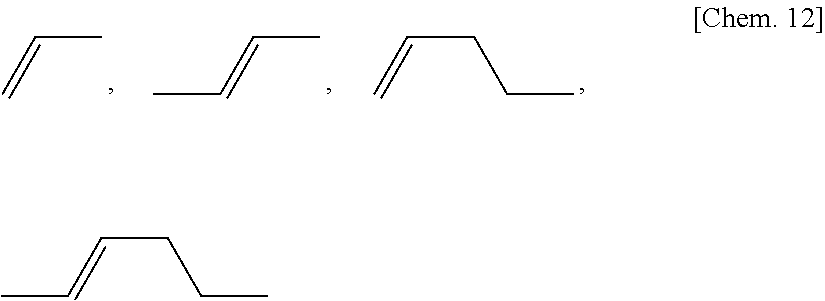
(In the formulae, the right end is bonded to a ring structure.)

(in the formulae, Rc and Rd each independently represent an alkyl group having 1 to 7 carbon atoms, an alkoxy group, an alkenyl group having 2 to 6 carbon atoms, or an alkenyloxy group, a methylene group in the alkyl group, the alkenyl group, the alkoxy group, or the alkenyloxy group may be substituted by oxygen at least one position as long as oxygen atoms are not continuously bonded to each other, and a hydrogen atom in the group may be substituted by a fluorine atom at least one position).


| TABLE 1 | ||||
| LC-1 | LC-2 | |||
| 5-Ph-Ph-1 | 10 | |||
| 5-Ph-Ph-O1 | 6 | |||
| 3-Cy-Cy-V | 41 | |||
| 3-Cy-Cy-V1 | 2 | |||
| 3-Cy-Cy-2 | 15 | |||
| 3-Cy-Cy-4 | 8 | |||
| 3-Cy-Cy-5 | 4 | |||
| 3-Cy-Cy-Ph-1 | 7 | |||
| 3-Cy-Cy-Ph-3 | 4 | |||
| 3-Cy-1O-Ph5-O1 | 6 | |||
| 3-Cy-1O-Ph5-O2 | 7 | 5 | ||
| 2-Cy-Cy-1O-Ph5-O2 | 7 | |||
| 3-Cy-Cy-1O-Ph5-O2 | 6 | 3 | ||
| 4-Cy-Cy-1O-Ph5-O2 | 2 | 3 | ||
| V-Cy-Cy-1O-Ph5-O2 | 9 | |||
| 3-Cy-Ph-Ph5-O3 | 6 | 3 | ||
| 3-Cy-Ph-Ph5-O4 | 6 | 3 | ||
| 4-Cy-Ph-Ph5-O3 | 4 | 3 | ||
| 5-Cy-Ph-Ph5-O3 | 2 | |||
| 1V-Cy-1O-Ph5-O2 | 10 | |||
| V2-Ph-Ph5-Ph-2V | 11 | |||
| V2-Ph-Ph5-Ph-2 | 7 | |||
| Total [%] | 100 | 100 | ||
| Tni [° C.] | 76.0 | 75.3 | ||
| Δn | 0.102 | 0.109 | ||
| Δε | −2.9 | −3.1 | ||
| γ1 [mPa · s] | 122 | 83 | ||
| K33 [pN] | 13.0 | 14.8 | ||
| γ1/K33 [mPa · s · pN−1] | 9.4 | 5.6 | ||

was added and uniformly dissolved to prepare polymerizable liquid crystal composition CLC-1. A liquid crystal display device was produced by using CLC-1 according to the method described above. However, in the step of irradiating the device with ultraviolet light in a state in which a rectangular alternating-current electric field of 7 V was applied between the common electrode and the pixel electrodes, an intensity of irradiation measured at a center wavelength of 365 nm by using an accumulated UV meter UIT-150 manufactured by Ushio Inc. was adjusted to 100 mW/cm2, and ultraviolet light in an accumulated light quantity of 100 J/cm2 was applied over 1,000 seconds. The pre-tilt angle of the liquid crystal display device measured before the ultraviolet irradiation step was 87.9°, and the pre-tilt angle of the liquid crystal display device measured after the ultraviolet irradiation step was 81.3°. The polymer produced by ultraviolet irradiation had a number-average molecular weight of 75,000 in terms of polystyrene.

was added and uniformly dissolved to prepare polymerizable liquid crystal composition CLC-2. A liquid crystal display device was produced by using CLC-2 according to the method described above. However, in the step of irradiating the device with ultraviolet light in a state in which a rectangular alternating-current electric field of 7 V was applied between the common electrode and the pixel electrodes, an intensity of irradiation measured at a center wavelength of 365 nm by using an accumulated UV meter UIT-150 manufactured by Ushio Inc. was adjusted to 20 mW/cm2, and ultraviolet light in an accumulated light quantity of 100 J/cm2 was applied over 5000 seconds. The pre-tilt angle of the liquid crystal display device measured before the ultraviolet irradiation step was 87.3°, and the pre-tilt angle of the liquid crystal display device measured after the ultraviolet irradiation step was 85.2°. The polymer produced by ultraviolet irradiation had a number-average molecular weight of 495,000 in terms of polystyrene.

was added and uniformly dissolved to prepare polymerizable liquid crystal composition CLC-3. A liquid crystal display device was produced by using CLC-1 according to the method described above. However, in the step of irradiating the device with ultraviolet light in a state in which a rectangular alternating-current electric field of 7 V was applied between the common electrode and the pixel electrodes, an intensity of irradiation measured at a center wavelength of 365 nm by using an accumulated UV meter UIT-150 manufactured by Ushio Inc. was adjusted to 100 mW/cm2, and ultraviolet light in an accumulated light quantity of 100 J/cm2 was applied over 1000 seconds. The pre-tilt angle of the liquid crystal display device measured before the ultraviolet irradiation step was 87.1°, and the pre-tilt angle of the liquid crystal display device measured after the ultraviolet irradiation step was 85.4°. The polymer produced by ultraviolet irradiation had a number-average molecular weight of 608,000 in terms of polystyrene.

was added and uniformly dissolved to prepare polymerizable liquid crystal composition CLC-4. A liquid crystal display device was produced by using CLC-4 according to the method described above. However, in the step of irradiating the device with ultraviolet light in a state in which a rectangular alternating-current electric field of 7 V was applied between the common electrode and the pixel electrodes, an intensity of irradiation measured at a center wavelength of 365 nm by using an accumulated UV meter UIT-150 manufactured by Ushio Inc. was adjusted to 100 mW/cm2, and ultraviolet light in an accumulated light quantity of 100 J/cm2 was applied over 1000 seconds. The pre-tilt angle of the liquid crystal display device measured before the ultraviolet irradiation step was 87.5°, and the pre-tilt angle of the liquid crystal display device measured after the ultraviolet irradiation step was 89.0°. The polymer produced by ultraviolet irradiation had a number-average molecular weight of 2,200 in terms of polystyrene.
| TABLE 2 | |||||||
| Comparative | Comparative | Comparative | |||||
| Example 1 | Example 2 | Example 3 | Example 1 | Example 2 | Example 3 | ||
| Liquid crystal composition | LC-1 | LC-2 | LC-2 | LC-2 | LC-2 | LC-2 |
| Polymerizable compound | A | A | B | A | C | C |
| Intensity of irradiation at | 100 | 20 | 100 | 100 | 100 | 20 |
| center wavelength of 365 nm | ||||||
| [mW/cm2] | ||||||
| Number-average molecular | 75,000 | 495,000 | 608,000 | 27,000 | 2,200 | 1,600 |
| weight of polymer | ||||||
| Adhesion of polymer fine | Yes | Yes | Yes | No | No | No |
| particles to vertical alignment | ||||||
| film surface | ||||||
| Pre-tilt angle before | 87.9 | 87.3 | 87.1 | 87.3 | 87.5 | 87.5 |
| ultraviolet irradiation step [°] | ||||||
| Pre-tilt angle after ultraviolet | 81.3 | 85.2 | 85.4 | 87.8 | 89.0 | 88.3 |
| irradiation step [°] | ||||||
| Pre-tilt angle formed in | 6.6 | 2.1 | 1.7 | −0.5 | −1.5 | −0.8 |
| ultraviolet irradiation step [°] | ||||||
Claims (4)


—S21—R21,


Applications Claiming Priority (3)
| Application Number | Priority Date | Filing Date | Title |
|---|---|---|---|
| JP2013062039 | 2013-03-25 | ||
| JP2013-062039 | 2013-03-25 | ||
| PCT/JP2014/057286 WO2014156815A1 (en) | 2013-03-25 | 2014-03-18 | Liquid crystal display element |
Publications (2)
| Publication Number | Publication Date |
|---|---|
| US20160060523A1 US20160060523A1 (en) | 2016-03-03 |
| US9777218B2 true US9777218B2 (en) | 2017-10-03 |
Family
ID=51623795
Family Applications (1)
| Application Number | Title | Priority Date | Filing Date |
|---|---|---|---|
| US14/779,508 Active US9777218B2 (en) | 2013-03-25 | 2014-03-18 | Liquid crystal display element |
Country Status (7)
| Country | Link |
|---|---|
| US (1) | US9777218B2 (en) |
| EP (1) | EP2980640B1 (en) |
| JP (1) | JP5761469B2 (en) |
| KR (1) | KR101687594B1 (en) |
| CN (1) | CN105122127B (en) |
| TW (1) | TWI617586B (en) |
| WO (1) | WO2014156815A1 (en) |
Families Citing this family (10)
| Publication number | Priority date | Publication date | Assignee | Title |
|---|---|---|---|---|
| JP5761469B2 (en) | 2013-03-25 | 2015-08-12 | Dic株式会社 | Liquid crystal display element |
| CN104298005B (en) * | 2014-10-11 | 2017-02-22 | 深圳市华星光电技术有限公司 | Method for manufacturing liquid crystal display panel |
| KR102260871B1 (en) * | 2015-01-19 | 2021-06-04 | 삼성디스플레이 주식회사 | Liquid crystal display device and method of manufacturing the same |
| WO2017051709A1 (en) * | 2015-09-25 | 2017-03-30 | Jnc株式会社 | Liquid crystal display element |
| JP6233550B1 (en) | 2016-04-27 | 2017-11-22 | Dic株式会社 | Liquid crystal composition and liquid crystal display element |
| TWI737834B (en) * | 2016-10-26 | 2021-09-01 | 日商迪愛生股份有限公司 | Spontaneous alignment aid for liquid crystal composition |
| WO2019003894A1 (en) * | 2017-06-28 | 2019-01-03 | Jnc株式会社 | Method for manufacturing liquid crystal display element |
| CN110577832A (en) * | 2018-06-11 | 2019-12-17 | 石家庄诚志永华显示材料有限公司 | Negative dielectric anisotropy liquid crystal composition, liquid crystal display element and liquid crystal display |
| JP7180247B2 (en) * | 2018-09-28 | 2022-11-30 | Dic株式会社 | Method for manufacturing liquid crystal display element |
| JP7392434B2 (en) * | 2019-12-02 | 2023-12-06 | Dic株式会社 | Liquid crystal composition and liquid crystal display element |
Citations (13)
| Publication number | Priority date | Publication date | Assignee | Title |
|---|---|---|---|---|
| JP2002357830A (en) | 2001-03-30 | 2002-12-13 | Fujitsu Ltd | Liquid crystal display |
| JP2003307720A (en) | 2002-04-16 | 2003-10-31 | Fujitsu Ltd | Liquid crystal display |
| US20080024705A1 (en) * | 2006-07-14 | 2008-01-31 | Kabushiki Kaisha Toshiba | Liquid crystal display apparatus |
| WO2008018213A1 (en) | 2006-08-10 | 2008-02-14 | Sharp Kabushiki Kaisha | Liquid crystal display device |
| US20080111107A1 (en) * | 2004-12-15 | 2008-05-15 | Shotaro Kawakami | Nematic Liquid Crystal Composition And Liquid Crystal Display Device Using The Same |
| JP2008116931A (en) | 2006-10-12 | 2008-05-22 | Merck Patent Gmbh | Liquid crystal display |
| JP2009102639A (en) | 2007-10-22 | 2009-05-14 | Merck Patent Gmbh | Liquid crystal medium |
| WO2010098059A1 (en) | 2009-02-25 | 2010-09-02 | シャープ株式会社 | Liquid crystal display device and manufacturing method therefor |
| JP2010256904A (en) | 2009-04-23 | 2010-11-11 | Merck Patent Gmbh | Liquid crystal display |
| WO2010131600A1 (en) | 2009-05-11 | 2010-11-18 | チッソ株式会社 | Polymerizable compound and liquid crystal composition containing same |
| US20110253933A1 (en) | 2010-04-16 | 2011-10-20 | Dic Corporation | Liquid crystal composition containing polymerizable compound and liquid crystal display element using the same |
| US20120292568A1 (en) | 2011-05-20 | 2012-11-22 | Dic Corporation | Liquid crystal composition containing polymerizable compound and liquid crystal display element manufactured using the same |
| TW201502146A (en) | 2013-03-25 | 2015-01-16 | Dainippon Ink & Chemicals | Liquid crystal display element |
Family Cites Families (2)
| Publication number | Priority date | Publication date | Assignee | Title |
|---|---|---|---|---|
| TWI413809B (en) * | 2004-12-27 | 2013-11-01 | Dainippon Ink & Chemicals | Optical film, elliptically polarizing plate, circularly polarizing plate, liquid crystal display element, and method of producing optical film |
| EP2657318B1 (en) * | 2010-12-24 | 2015-10-21 | DIC Corporation | Liquid crystal composition containing polymerizable compound and liquid crystal display device |
-
2014
- 2014-03-18 JP JP2014548226A patent/JP5761469B2/en active Active
- 2014-03-18 US US14/779,508 patent/US9777218B2/en active Active
- 2014-03-18 KR KR1020157021149A patent/KR101687594B1/en active Active
- 2014-03-18 WO PCT/JP2014/057286 patent/WO2014156815A1/en not_active Ceased
- 2014-03-18 EP EP14773468.5A patent/EP2980640B1/en active Active
- 2014-03-18 CN CN201480017922.1A patent/CN105122127B/en active Active
- 2014-03-25 TW TW103111009A patent/TWI617586B/en active
Patent Citations (21)
| Publication number | Priority date | Publication date | Assignee | Title |
|---|---|---|---|---|
| JP2002357830A (en) | 2001-03-30 | 2002-12-13 | Fujitsu Ltd | Liquid crystal display |
| JP2003307720A (en) | 2002-04-16 | 2003-10-31 | Fujitsu Ltd | Liquid crystal display |
| US20080111107A1 (en) * | 2004-12-15 | 2008-05-15 | Shotaro Kawakami | Nematic Liquid Crystal Composition And Liquid Crystal Display Device Using The Same |
| US20080024705A1 (en) * | 2006-07-14 | 2008-01-31 | Kabushiki Kaisha Toshiba | Liquid crystal display apparatus |
| WO2008018213A1 (en) | 2006-08-10 | 2008-02-14 | Sharp Kabushiki Kaisha | Liquid crystal display device |
| US20090207357A1 (en) | 2006-08-10 | 2009-08-20 | Kunihiro Tashiro | Liquid crystal display device |
| JP2008116931A (en) | 2006-10-12 | 2008-05-22 | Merck Patent Gmbh | Liquid crystal display |
| JP2009102639A (en) | 2007-10-22 | 2009-05-14 | Merck Patent Gmbh | Liquid crystal medium |
| US20110299018A1 (en) * | 2009-02-25 | 2011-12-08 | Masatoshi Itoh | Liquid crystal display device and manufacturing method therefor |
| WO2010098059A1 (en) | 2009-02-25 | 2010-09-02 | シャープ株式会社 | Liquid crystal display device and manufacturing method therefor |
| JP2010256904A (en) | 2009-04-23 | 2010-11-11 | Merck Patent Gmbh | Liquid crystal display |
| WO2010131600A1 (en) | 2009-05-11 | 2010-11-18 | チッソ株式会社 | Polymerizable compound and liquid crystal composition containing same |
| US20120092608A1 (en) | 2009-05-11 | 2012-04-19 | Jnc Petrochemical Corporation | Polymerizable compound and liquid crystal composition including it |
| JP2011227187A (en) | 2010-04-16 | 2011-11-10 | Dic Corp | Liquid crystal composition containing polymerizable compound and liquid crystal display element using the liquid crystal composition |
| US20110253933A1 (en) | 2010-04-16 | 2011-10-20 | Dic Corporation | Liquid crystal composition containing polymerizable compound and liquid crystal display element using the same |
| US20120292568A1 (en) | 2011-05-20 | 2012-11-22 | Dic Corporation | Liquid crystal composition containing polymerizable compound and liquid crystal display element manufactured using the same |
| JP2012241124A (en) | 2011-05-20 | 2012-12-10 | Dic Corp | Polymerizable compound-containing liquid crystal composition and liquid crystal display element using the same |
| TW201502146A (en) | 2013-03-25 | 2015-01-16 | Dainippon Ink & Chemicals | Liquid crystal display element |
| KR20150106894A (en) | 2013-03-25 | 2015-09-22 | 디아이씨 가부시끼가이샤 | Liquid crystal display element |
| CN105122127A (en) | 2013-03-25 | 2015-12-02 | Dic株式会社 | Liquid crystal display element |
| EP2980640A1 (en) | 2013-03-25 | 2016-02-03 | DIC Corporation | Liquid crystal display element |
Non-Patent Citations (1)
| Title |
|---|
| International Search Report dated Jun. 17, 2014, issued in counterpart International Application No. PCT/JP2014/057286 (1 page). |
Also Published As
| Publication number | Publication date |
|---|---|
| EP2980640B1 (en) | 2019-03-06 |
| CN105122127B (en) | 2018-06-05 |
| EP2980640A4 (en) | 2016-12-28 |
| JPWO2014156815A1 (en) | 2017-02-16 |
| CN105122127A (en) | 2015-12-02 |
| WO2014156815A1 (en) | 2014-10-02 |
| TW201502146A (en) | 2015-01-16 |
| US20160060523A1 (en) | 2016-03-03 |
| JP5761469B2 (en) | 2015-08-12 |
| TWI617586B (en) | 2018-03-11 |
| KR101687594B1 (en) | 2016-12-19 |
| EP2980640A1 (en) | 2016-02-03 |
| KR20150106894A (en) | 2015-09-22 |
Similar Documents
| Publication | Publication Date | Title |
|---|---|---|
| US9777218B2 (en) | Liquid crystal display element | |
| US9677003B2 (en) | Liquid crystal display device and method for producing the same | |
| US10011771B2 (en) | Liquid crystal composition containing polymerizable compound and liquid crystal display element using same | |
| US9261733B2 (en) | Liquid crystal display device and method for producing the same | |
| US9250476B2 (en) | Liquid crystal display device and method for producing the same | |
| KR101643209B1 (en) | Liquid crystal display element and manufacturing method thereof | |
| KR101508226B1 (en) | Liquid crystal composition and liquid crystal display device using the same | |
| US20160122650A1 (en) | Polymerizable compound-containing liquid crystal composition and liquid crystal display element using same | |
| KR102450332B1 (en) | Liquid crystal display element and method of manufacturing the same | |
| US20200301213A1 (en) | Liquid crystal display element and method for manufacturing same | |
| WO2018096932A1 (en) | Liquid crystal composition and liquid crystal display component | |
| US11415840B2 (en) | Liquid crystal display device | |
| KR101846284B1 (en) | Liquid crystal display element and method for producing same | |
| US9963636B2 (en) | Liquid crystal composition and liquid crystal display device using same | |
| JP6395007B2 (en) | Liquid crystal display element and manufacturing method thereof | |
| US20190025656A1 (en) | Liquid crystal display element and method for producing same |
Legal Events
| Date | Code | Title | Description |
|---|---|---|---|
| AS | Assignment |
Owner name: DIC CORPORATION, JAPAN Free format text: ASSIGNMENT OF ASSIGNORS INTEREST;ASSIGNORS:HARA, TOMOAKI;WU, WEI;KAWAKAMI, SHOTARO;SIGNING DATES FROM 20161128 TO 20161130;REEL/FRAME:040693/0874 |
|
| STCF | Information on status: patent grant |
Free format text: PATENTED CASE |
|
| MAFP | Maintenance fee payment |
Free format text: PAYMENT OF MAINTENANCE FEE, 4TH YEAR, LARGE ENTITY (ORIGINAL EVENT CODE: M1551); ENTITY STATUS OF PATENT OWNER: LARGE ENTITY Year of fee payment: 4 |
|
| AS | Assignment |
Owner name: SHIJIAZHUANG CHENGZHI YONGHUA DISPLAY MATERIAL CO., LTD., CHINA Free format text: ASSIGNMENT OF ASSIGNORS INTEREST;ASSIGNOR:DIC CORPORATION;REEL/FRAME:067528/0688 Effective date: 20240426 |
|
| MAFP | Maintenance fee payment |
Free format text: PAYMENT OF MAINTENANCE FEE, 8TH YEAR, LARGE ENTITY (ORIGINAL EVENT CODE: M1552); ENTITY STATUS OF PATENT OWNER: LARGE ENTITY Year of fee payment: 8 |