US9769464B2 - Image display device - Google Patents

Image display device Download PDF

Info

Publication number
US9769464B2
US9769464B2 US14/506,807 US201414506807A US9769464B2 US 9769464 B2 US9769464 B2 US 9769464B2 US 201414506807 A US201414506807 A US 201414506807A US 9769464 B2 US9769464 B2 US 9769464B2
Authority
US
United States
Prior art keywords
light
panel
mode
polarizer
linearly polarized
Prior art date
Legal status (The legal status is an assumption and is not a legal conclusion. Google has not performed a legal analysis and makes no representation as to the accuracy of the status listed.)
Expired - Fee Related, expires
Application number
US14/506,807
Other versions
US20150181201A1 (en
Inventor
Keun Bae JEON
Masaru Minami
Hyeong Sik Choi
Current Assignee (The listed assignees may be inaccurate. Google has not performed a legal analysis and makes no representation or warranty as to the accuracy of the list.)
Samsung Electronics Co Ltd
Original Assignee
Samsung Electronics Co Ltd
Priority date (The priority date is an assumption and is not a legal conclusion. Google has not performed a legal analysis and makes no representation as to the accuracy of the date listed.)
Filing date
Publication date
Application filed by Samsung Electronics Co Ltd filed Critical Samsung Electronics Co Ltd
Assigned to SAMSUNG ELECTRONICS CO., LTD. reassignment SAMSUNG ELECTRONICS CO., LTD. ASSIGNMENT OF ASSIGNORS INTEREST (SEE DOCUMENT FOR DETAILS). Assignors: JEON, KEUN BAE, MINAMI, MASARU, CHOI, HYEONG SIK
Publication of US20150181201A1 publication Critical patent/US20150181201A1/en
Application granted granted Critical
Publication of US9769464B2 publication Critical patent/US9769464B2/en
Expired - Fee Related legal-status Critical Current
Adjusted expiration legal-status Critical

Links

Images

Classifications

    • GPHYSICS
    • G02OPTICS
    • G02BOPTICAL ELEMENTS, SYSTEMS OR APPARATUS
    • G02B30/00Optical systems or apparatus for producing three-dimensional [3D] effects, e.g. stereoscopic images
    • G02B30/20Optical systems or apparatus for producing three-dimensional [3D] effects, e.g. stereoscopic images by providing first and second parallax images to an observer's left and right eyes
    • G02B30/26Optical systems or apparatus for producing three-dimensional [3D] effects, e.g. stereoscopic images by providing first and second parallax images to an observer's left and right eyes of the autostereoscopic type
    • G02B30/30Optical systems or apparatus for producing three-dimensional [3D] effects, e.g. stereoscopic images by providing first and second parallax images to an observer's left and right eyes of the autostereoscopic type involving parallax barriers
    • G02B30/31Optical systems or apparatus for producing three-dimensional [3D] effects, e.g. stereoscopic images by providing first and second parallax images to an observer's left and right eyes of the autostereoscopic type involving parallax barriers involving active parallax barriers
    • HELECTRICITY
    • H04ELECTRIC COMMUNICATION TECHNIQUE
    • H04NPICTORIAL COMMUNICATION, e.g. TELEVISION
    • H04N13/00Stereoscopic video systems; Multi-view video systems; Details thereof
    • H04N13/30Image reproducers
    • H04N13/302Image reproducers for viewing without the aid of special glasses, i.e. using autostereoscopic displays
    • H04N13/0402
    • G02B27/2214
    • G02B27/26
    • GPHYSICS
    • G02OPTICS
    • G02BOPTICAL ELEMENTS, SYSTEMS OR APPARATUS
    • G02B27/00Optical systems or apparatus not provided for by any of the groups G02B1/00 - G02B26/00, G02B30/00
    • G02B27/28Optical systems or apparatus not provided for by any of the groups G02B1/00 - G02B26/00, G02B30/00 for polarising
    • G02B27/283Optical systems or apparatus not provided for by any of the groups G02B1/00 - G02B26/00, G02B30/00 for polarising used for beam splitting or combining
    • G02B27/285Optical systems or apparatus not provided for by any of the groups G02B1/00 - G02B26/00, G02B30/00 for polarising used for beam splitting or combining comprising arrays of elements, e.g. microprisms
    • GPHYSICS
    • G02OPTICS
    • G02BOPTICAL ELEMENTS, SYSTEMS OR APPARATUS
    • G02B30/00Optical systems or apparatus for producing three-dimensional [3D] effects, e.g. stereoscopic images
    • G02B30/20Optical systems or apparatus for producing three-dimensional [3D] effects, e.g. stereoscopic images by providing first and second parallax images to an observer's left and right eyes
    • G02B30/22Optical systems or apparatus for producing three-dimensional [3D] effects, e.g. stereoscopic images by providing first and second parallax images to an observer's left and right eyes of the stereoscopic type
    • G02B30/25Optical systems or apparatus for producing three-dimensional [3D] effects, e.g. stereoscopic images by providing first and second parallax images to an observer's left and right eyes of the stereoscopic type using polarisation techniques
    • GPHYSICS
    • G02OPTICS
    • G02BOPTICAL ELEMENTS, SYSTEMS OR APPARATUS
    • G02B30/00Optical systems or apparatus for producing three-dimensional [3D] effects, e.g. stereoscopic images
    • G02B30/20Optical systems or apparatus for producing three-dimensional [3D] effects, e.g. stereoscopic images by providing first and second parallax images to an observer's left and right eyes
    • G02B30/26Optical systems or apparatus for producing three-dimensional [3D] effects, e.g. stereoscopic images by providing first and second parallax images to an observer's left and right eyes of the autostereoscopic type
    • G02B30/27Optical systems or apparatus for producing three-dimensional [3D] effects, e.g. stereoscopic images by providing first and second parallax images to an observer's left and right eyes of the autostereoscopic type involving lenticular arrays
    • GPHYSICS
    • G02OPTICS
    • G02BOPTICAL ELEMENTS, SYSTEMS OR APPARATUS
    • G02B5/00Optical elements other than lenses
    • G02B5/30Polarising elements
    • G02B5/3025Polarisers, i.e. arrangements capable of producing a definite output polarisation state from an unpolarised input state
    • H04N13/0418
    • H04N13/0434
    • HELECTRICITY
    • H04ELECTRIC COMMUNICATION TECHNIQUE
    • H04NPICTORIAL COMMUNICATION, e.g. TELEVISION
    • H04N13/00Stereoscopic video systems; Multi-view video systems; Details thereof
    • H04N13/30Image reproducers
    • H04N13/302Image reproducers for viewing without the aid of special glasses, i.e. using autostereoscopic displays
    • H04N13/32Image reproducers for viewing without the aid of special glasses, i.e. using autostereoscopic displays using arrays of controllable light sources; using moving apertures or moving light sources
    • HELECTRICITY
    • H04ELECTRIC COMMUNICATION TECHNIQUE
    • H04NPICTORIAL COMMUNICATION, e.g. TELEVISION
    • H04N13/00Stereoscopic video systems; Multi-view video systems; Details thereof
    • H04N13/30Image reproducers
    • H04N13/332Displays for viewing with the aid of special glasses or head-mounted displays [HMD]
    • H04N13/337Displays for viewing with the aid of special glasses or head-mounted displays [HMD] using polarisation multiplexing
    • GPHYSICS
    • G02OPTICS
    • G02FOPTICAL DEVICES OR ARRANGEMENTS FOR THE CONTROL OF LIGHT BY MODIFICATION OF THE OPTICAL PROPERTIES OF THE MEDIA OF THE ELEMENTS INVOLVED THEREIN; NON-LINEAR OPTICS; FREQUENCY-CHANGING OF LIGHT; OPTICAL LOGIC ELEMENTS; OPTICAL ANALOGUE/DIGITAL CONVERTERS
    • G02F1/00Devices or arrangements for the control of the intensity, colour, phase, polarisation or direction of light arriving from an independent light source, e.g. switching, gating or modulating; Non-linear optics
    • G02F1/01Devices or arrangements for the control of the intensity, colour, phase, polarisation or direction of light arriving from an independent light source, e.g. switching, gating or modulating; Non-linear optics for the control of the intensity, phase, polarisation or colour 
    • G02F1/13Devices or arrangements for the control of the intensity, colour, phase, polarisation or direction of light arriving from an independent light source, e.g. switching, gating or modulating; Non-linear optics for the control of the intensity, phase, polarisation or colour  based on liquid crystals, e.g. single liquid crystal display cells
    • G02F1/133Constructional arrangements; Operation of liquid crystal cells; Circuit arrangements
    • G02F1/1333Constructional arrangements; Manufacturing methods
    • G02F1/1335Structural association of cells with optical devices, e.g. polarisers or reflectors
    • G02F1/133528Polarisers
    • G02F1/133538Polarisers with spatial distribution of the polarisation direction
    • G02F2001/133538

Definitions

  • Devices consistent with the exemplary embodiments relate to an image display device, and more specifically, to a glass-free image display device having an improved structure for implementing a two-dimensional (2D) and three-dimensional (3D) image.
  • Stereoscopic image display devices implement a 3D image using a stereoscopic technique or an auto-stereoscopic technique.
  • the stereoscopic technique uses a parallax image between a user's left and right eye which has a great stereoscopic effect.
  • the stereoscopic technique may be classified as a glass type or a glass-free type technique.
  • an image is displayed on a direct-view display device or a projector by changing a polarization direction of the parallax image between the left and right eye or by using a time division method.
  • a stereoscopic image is implemented using polarized eyeglasses or liquid crystal shutter eyeglasses.
  • a stereoscopic image is implemented by installing optical components, such as a lenticular lens, and a parallax barrier in front of and behind a display screen in order to separate an optical axis of the parallax image between the left and right eye.
  • a 3D stereoscopic image is implemented by separating a right-eye image and a left-eye image using the lenticular lens.
  • the method using the lenticular lens since it is impossible to turn optical separation of the lenticular lens on and off, only the 3D stereoscopic image is implemented and conversion between the 3D stereoscopic image and a 2D plane image is not possible.
  • a crystal lenticular lens capable of converting a 2D and 3D image in which a lenticular lens is implemented by electrically controlling a refractive index of a liquid crystal, has been proposed.
  • a liquid crystal lenticular lens has a problem in that an arrangement direction of liquid crystal molecules needs to be adjusted in accordance with a 2D image and a 3D image, the lens is expensive, and a large scale lens is difficult to manufacture.
  • a parallax barrier method is more advantageous than the lenticular lens method in terms of a cross-talk and a view angle, but luminance may decrease, and two sheets of cells need to be used since an image cell and a barrier cell are composed of a double structure.
  • exemplary embodiments provide a glass-free 2D and 3D image display device including a mask-type polarizer without an anisotropic lens, such as a lenticular lens.
  • the exemplary embodiment also provides a glass-free 2D and 3D image display device including a polarizer in which reflectivity of a surface is improved such that luminance of an image display device is improved.
  • an image display device includes a light source and a polarizer including a first polarizing region configured to linearly polarize light output from the light source and a second polarizing region configured to circularly polarize light output from the light source.
  • the first polarizing region and the second polarizing region may be formed so as to alternate.
  • the first polarizing region and the second polarizing region of the polarizer may have a same transmittance.
  • the first polarizing region may be larger region than the second polarizing region.
  • reflectivity of a first surface facing the light source may be higher than a reflectivity of a second surface of the polarizer which does not face the light source.
  • the device may further include a polarizing switch (PS) panel configured to use polarized light output from the polarizer as incident light, and configured to perform one of polarizing the incident light into light in a direction perpendicular to the PS panel or allow the incident light to pass through the PS panel without changing the incident light.
  • PS polarizing switch
  • the device may further include a PS panel located between the light source and the polarizer, and configured to use light output from the light source as incident light and polarize the incident light into light in a direction perpendicular to the PS panel or allow the incident light to pass through the PS panel without changing the incident light.
  • a PS panel located between the light source and the polarizer, and configured to use light output from the light source as incident light and polarize the incident light into light in a direction perpendicular to the PS panel or allow the incident light to pass through the PS panel without changing the incident light.
  • the PS panel may be a liquid crystal panel configured to polarize the incident light into the light in the direction perpendicular to the PS panel or allow the incident light to pass through the PS panel without changing the incident light according to dielectric anisotropy of a liquid crystal operating in a twisted nematic (TN) mode.
  • TN twisted nematic
  • the PS panel may polarize the incident light into the light in the direction perpendicular to the PS panel when power is applied to the PS panel and the PS panel may allow the incident light to pass through the PS panel without changing the incident light when power of the PS panel is blocked, or the PS panel may allow the incident light to pass through without changing the incident light when power is applied to the PS panel and the PS panel may polarize the incident light into the light in the direction perpendicular to the PS panel when power of the PS panel is blocked.
  • the device may further include a display panel configured to output an image.
  • the display panel may be a liquid crystal panel operating in a twisted nematic (TN) mode.
  • TN twisted nematic
  • the display panel may include a liquid crystal layer, a first polarizing film located on an observer side of the liquid crystal layer, and a second polarizing film located on a side opposite to the observer side of the liquid crystal layer.
  • the display panel may be located after the polarizer with respect to an output direction of light from the light source.
  • the polarizer may be located between the liquid crystal layer and the second polarizing film.
  • FIG. 1 is a diagram illustrating a schematic configuration of a glass-free image display device according to an exemplary embodiment
  • FIG. 2 is a diagram illustrating a structure of the mask-type polarizer in FIG. 1 , in accordance with an exemplary embodiment
  • FIG. 3A is a diagram illustrating a structure of a mirror-type polarizer in which reflectivity of a surface increases, in accordance with an exemplary embodiment
  • FIG. 3B is a diagram illustrating a process of recycling light through the polarizer illustrated in FIG. 3A , in accordance with an exemplary embodiment
  • FIG. 4 is a diagram illustrating a structure of a polarizing switch (PS) panel made of a liquid crystal panel operating in a twisted nematic (TN) mode, in accordance with an exemplary embodiment
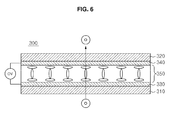
  • FIGS. 5 and 6 are diagrams illustrating a process of operating the PS panel which is made of the liquid crystal panel and operating in the TN mode, in accordance with an exemplary embodiment
  • FIG. 7 is a diagram illustrating a structure of a display panel in FIG. 1 , in accordance with an exemplary embodiment
  • FIG. 8 is a diagram illustrating a process of displaying a two-dimensional (2D) image and a three-dimensional (3D) image through the glass-free image display device according to the exemplary embodiment
  • FIG. 9 is a diagram illustrating a schematic configuration of a glass-free image display device according to another exemplary embodiment.
  • FIG. 10 is a diagram illustrating a process of displaying a 2D image and a 3D image through the glass-free image display device according to another exemplary embodiment.
  • FIGS. 11A and 11B are diagrams illustrating a liquid crystal operating principle of a liquid crystal layer, in accordance with an exemplary embodiment.
  • FIG. 1 is a diagram illustrating a schematic configuration of a glass-free image display device 10 according to an exemplary embodiment.
  • the glass-free image display device 10 includes a light source 100 configured to output light, a polarizer 200 disposed above the light source 100 , a polarizing switch (PS) panel 300 disposed above the polarizer 200 , and a display panel 400 disposed above the PS panel 300 .
  • the polarizer 200 , the PS panel 300 , and the display panel 400 may be sequentially stacked on a light propagating path as illustrated in FIG. 1 .
  • the positions of the panels may be changed as can be easily conceived by those skilled in the art.
  • each configuration of the image display device 10 will be described in detail by exemplifying a case in which the polarizer 200 , the PS panel 300 , and the display panel 400 are sequentially stacked on the light propagating path as illustrated in FIG. 1 .
  • the polarizer 200 is a mask-type polarizer 200 .
  • FIG. 2 is a diagram illustrating a structure of the mask-type polarizer 200 in FIG. 1 in accordance with an exemplary embodiment.
  • the mask-type polarizer 200 includes a first polarizing region 210 configured to linearly polarize light which is output from the light source 100 and a second polarizing region 220 configured to circularly polarize light which is output from the light source 100 .
  • the first polarizing region 210 and the second polarizing region 220 may be provided as having a strip structure.
  • the first polarizing region 210 and the second polarizing region 220 may be formed so as to alternate.
  • the strip structure refers to a polarizing region having an elongated shape.
  • the first polarizing region 210 and the second polarizing region 220 may have various structures, and is not limited to the strip structure, as can be easily conceived by those skilled in the art.
  • the first polarizing region 210 linearly polarizes light which is output from the light source 100 in a specific direction so that light from the other directions is blocked. That is, a part in which the first polarizing region 210 of the polarizer 200 is formed serves as a barrier and blocks some light output from the light source 100 . Therefore, a 3D image can be implemented in the same format as in a barrier method.
  • the second polarizing region 220 allows light output from the light source 100 to be unconditionally passed through. That is, a blank may be formed in a part other than the first polarizing region 210 of the polarizer 200 and is defined as the second polarizing region 220 .
  • the first polarizing region 210 may be formed larger than the second polarizing region 220 in order to effectively implement a 3D image, and the second polarizing region 220 may be disposed on the polarizer 200 at predetermined intervals. Also, the first polarizing region 210 and the second polarizing region 220 of the mask-type polarizer 200 may be prepared so as to have the same transmittance in order to adjust the intensity of light to be output, such that the first polarizing region 210 and the second polarizing region 220 have the same luminance in a 2D mode.
  • the image display device 10 since some light which is output from the light source 100 is blocked by the barrier above the light source 100 , the luminance of a final output image may decrease. Since the image display device 10 according to the exemplary embodiment also uses the same format as in the barrier method in order to implement a 3D image, the same problem may occur.
  • FIG. 3A is a diagram illustrating a structure of a mirror-type polarizer 200 of which reflectivity of a surface is improved, in accordance with an exemplary embodiment
  • FIG. 3B is a diagram illustrating a process of recycling light by applying the polarizer 200 in FIG. 3A , in accordance with an exemplary embodiment.
  • the mirror-type polarizer 200 may have a structure in which a surface of the first polarizing region 210 of the polarizer 200 which faces the light source 100 is coated with coating particles which have high reflectivity.
  • the luminance of the image display device 10 may be improved.
  • FIG. 3B illustrates a case in which light is incident again on the first polarizing region 210 of the polarizer 200 , and some light L 2 ′ of the light L 2 passes through the polarizer 200 and the remaining light L 2 ′′ is recycled.
  • the light is circularly polarized and passes through the polarizer 200 .
  • the PS panel 300 is disposed above the polarizer 200 , and uses light, which is linearly polarized or circularly polarized in the polarizer 200 , and is output, as incident light.
  • the PS panel 300 polarizes the incident light into light in a direction perpendicular to the PS panel 300 or allows the incident light to pass through without change.
  • the PS panel 300 also provides the light in a direction of the display panel 400 disposed above the PS panel 300 .
  • a liquid crystal panel having a liquid crystal layer 350 operating in a twisted nematic (TN) mode may be used, and a liquid crystal panel operating in a vertical alignment (VA) mode, in a plane switching (IPS) mode, and in a fringe field switching (FFS) mode may also be used.
  • VA vertical alignment
  • IPS plane switching
  • FFS fringe field switching
  • FIG. 4 is a diagram illustrating a structure of the PS panel 300 , which is made of the liquid crystal panel, operating in the TN mode, in accordance with an exemplary embodiment.
  • the PS panel 300 has a structure in which the liquid crystal layer 350 is interposed between a lower substrate 310 and an upper substrate 320 .
  • the lower substrate 310 and the upper substrate 320 may be made of a glass or a transparent plastic.
  • a lower electrode 330 and an upper electrode 340 are formed on the entire surfaces of the lower substrate 310 and the upper substrate 320 , respectively.
  • the lower electrode 330 and the upper electrode 340 are made of a transparent conductive material, such as indium tin oxide (ITO) and indium-doped zinc oxide (IZO).
  • ITO indium tin oxide
  • IZO indium-doped zinc oxide
  • the liquid crystal layer 350 is disposed between the lower electrode 330 and the upper electrode 340 .
  • Liquid crystal molecules constituting the liquid crystal layer 350 are made of positive liquid crystals.
  • a positive liquid crystal is a liquid crystal in which a long-axis direction dielectric constant of a liquid crystal molecule is greater than a short-axis direction dielectric constant. These liquid crystals are disposed between upper and lower alignment layers (not illustrated) and are pre-tilted.
  • FIGS. 5 and 6 are diagrams illustrating a process of operating the PS panel 300 which is made of the liquid crystal panel and operating in the TN mode, in accordance with an exemplary embodiment.
  • the liquid crystals are arranged so as to pass through light without change.
  • the liquid crystals are arranged so that linearly polarized light along a vertical-direction ( ⁇ ) of light is rotated by 90° and is converted into linearly polarized light along a horizontal-direction ( ). Therefore, as illustrated in FIG. 5 , while the electric field is applied, the PS panel 300 linearly polarizes light having a polarization axis along the vertical-direction ( ⁇ ) into light having a polarization axis along the horizontal-direction ( ), and allows the light to pass through. As illustrated in FIG.
  • the PS panel 300 when no electric field is applied, the PS panel 300 allows the light having a polarization axis along the vertical-direction ( ⁇ ) to pass through without change, and thereby a polarization axis of the passing light also lies in the vertical-direction ( ⁇ ).
  • the display panel 400 is a display device for displaying 2D and 3D image data, and may be implemented by a liquid crystal display (LCD), a field emission display (FED), a plasma display panel (PDP), an electroluminescence (EL) device, including an inorganic electroluminescence device and an organic light emitting diode (OLED), and a flat panel display, such as an electrophoresis (EPD).
  • LCD liquid crystal display
  • FED field emission display
  • PDP plasma display panel
  • EL electroluminescence
  • OLED organic light emitting diode
  • EPD electrophoresis
  • FIG. 7 is a diagram illustrating a structure of the display panel 400 , in accordance with an exemplary embodiment.
  • a structure of the display panel 400 will be described in detail with reference to the accompanying drawings, focusing on when the display panel 400 is the display panel 400 of the liquid crystal display.
  • the display panel 400 may include a liquid crystal layer 420 , a first polarizing film 410 located on an observer side of the liquid crystal layer 420 , and a second polarizing film 430 located on a side opposite to the observer side of the liquid crystal layer 420 .
  • the first polarizing film 410 and the second polarizing film 430 may have a structure in which the liquid crystal layer 420 is interposed between them.
  • the first polarizing film 410 may be a film in which a polarizer is attached to a surface of a thin film transistor (TFT) substrate having a pixel array formed on the TFT substrate.
  • the second polarizing film 430 may be a film in which a polarizer having an optical absorption axis of 90° with respect to the polarizer attached to the first polarizing film 410 is attached to a surface of a color filter substrate implementing colors.
  • FIG. 8 is a diagram illustrating a process of implementing a 2D image and a 3D image through the glass-free image display device 10 according to the exemplary embodiment.
  • optical components which are output from the light source 100 optical components having polarization axes along the vertical-direction ( ⁇ ) and horizontal-direction ( ) are exemplified, and an example to which the mask-type polarizer 200 is applied will be described.
  • light output from the light source 100 is incident on the mask-type polarizer 200 .
  • the mask-type polarizer 200 In order to output an image in a 2D mode, light output from the light source 100 is incident on the mask-type polarizer 200 .
  • light incident on the mask-type polarizer 200 light incident on the first polarizing region 210 passes through the first polarizing region 210 and is linearly polarized, and light incident on the second polarizing region 220 is circularly polarized.
  • FIG. 8 illustrates an example in which the first polarizing region 210 linearly polarizes only light having a polarization axis along the vertical-direction ( ⁇ ). Due to a structure of the first polarizing region 210 , of the light incident on the first polarizing region 210 , only light having a polarization axis along the vertical-direction ( ⁇ ) is linearly polarized and passes through, and the remaining light, including light having a polarization axis along the horizontal-direction ( ), is blocked.
  • light passing through the polarizer 200 has a polarization axis along the vertical-direction ( ⁇ ) and light passing through the second polarizing region 220 is circularly polarized light.
  • Light output from the polarizer 200 is incident on the PS panel 300 .
  • the electric field is applied when a 2D mode is implemented.
  • Liquid crystals are arranged so that linearly polarized light along the vertical-direction ( ⁇ ) of light is rotated by 90° and is converted into linearly polarized light along the horizontal-direction ( ), and linearly polarized light along the horizontal-direction ( ) of light is rotated by 90° and is converted into linearly polarized light along the vertical-direction ( ⁇ ).
  • linearly polarized light along the vertical-direction ( ⁇ ) of light is rotated by 90° and is output in the form of linearly polarized light having a polarization axis along the horizontal-direction ( ).
  • linearly polarized light along the vertical-direction ( ⁇ ) of light is rotated by 90° and is output in the form of linearly polarized light along the horizontal-direction ( ), and linearly polarized light along the horizontal-direction ( ) of light is rotated by 90°, and is converted into linearly polarized light along the vertical-direction ( ⁇ ) and is output.
  • the second polarizing film 430 may include a polarizer which allows only light having a polarization axis along the horizontal-direction ( ) to pass through. Therefore, of the light incident on the second polarizing film 430 , only light having a polarization axis along the horizontal-direction ( ) passes through the second polarizing film 430 .
  • Light passing through the second polarizing film 430 passes through the liquid crystal layer 420 of the display panel 400 .
  • the light propagating path is rotated by the liquid crystal layer 420 of the display panel 400 and is converted into light having a polarization axis along the vertical-direction ( ⁇ ).
  • the first polarizing film 410 is formed to pass through only light having a polarization axis along the vertical-direction ( ⁇ ). Therefore, of the light incident on the first polarizing film 410 , only light having a polarization axis along the vertical-direction ( ⁇ ) passes through the first polarizing film 410 .
  • light output from the light source 100 is incident on the mask-type polarizer 200 the same as in the 2D mode.
  • the mask-type polarizer 200 In of the light incident on the mask-type polarizer 200 , light incident on the first polarizing region 210 passes through the first polarizing region 210 and is linearly polarized, and light incident on the second polarizing region 220 is circularly polarized. Since a process and a principle of passing light through the polarizer 200 are the same as in the 2D mode, the repeated description about the polarizer 200 will be omitted.
  • the PS panel 300 is designed so that liquid crystals are arranged to pass through light, which has not changed, when no electric field is applied to the PS panel 300 , and thereby a 3D mode is implemented. As a result, light which is output from the polarizer 200 passes through the PS panel 300 without changing.
  • the second polarizing film 430 includes a polarizer which allows only light having a polarization axis along the horizontal-direction ( ) to pass through, out of the light incident on the second polarizing film 430 , only light having a polarization axis along the horizontal-direction ( ) passes through the second polarizing film 430 .
  • Light passing through the second polarizing film 430 passes through the liquid crystal layer 420 of the display panel 400 , the light propagating path is rotated by the liquid crystal layer 420 of the display panel 400 , and the light is converted into light having a polarization axis along the vertical-direction ( ⁇ ).
  • the first polarizing film 410 includes a polarizer which allows only light having a polarization axis along the vertical-direction ( ⁇ ) to pass through, of the light incident on the first polarizing film 410 , only light having a polarization axis along the vertical-direction ( ⁇ ) passes through the first polarizing film 410 .
  • the display panel 400 As a result, in the display panel 400 , light having a polarization axis along the vertical-direction ( ⁇ ) is output from only a region corresponding to the second polarizing region 220 of the polarizer 200 . Since light is output from only the region corresponding to the second polarizing region 220 of the polarizer 200 , a parallax between a left eye and a right eye is formed and thereby the 3D mode may be implemented.
  • FIG. 9 is a diagram illustrating a schematic configuration of the glass-free image display device 10 a according to another exemplary embodiment.
  • the glass-free image display device 10 a includes a light source 100 a configured to output light to an upper side, a PS panel 300 a disposed above the light source 100 a , a polarizer 200 a disposed above the PS panel 300 a , and a display panel 400 a disposed above the polarizer 200 a .
  • the PS panel 300 a , the polarizer 200 a , and the display panel 400 a may be sequentially stacked on a light propagating path, and the position and location may be changed as can be easily conceived by those skilled in the art.
  • FIG. 9 exemplifies a case in which a second polarizing film 430 a in a configuration of the display panel 400 a is disposed between the light source 100 a and the PS panel 300 a.
  • the display panel 400 a is a display device for displaying 2D and 3D image data.
  • FIG. 9 exemplifies a case in which an image is implemented by an LCD device.
  • a configuration of the display panel 400 a illustrated in FIG. 9 is the same as in FIG. 1 .
  • a second polarizing film 430 a of the display panel 400 a may be separated from a liquid crystal layer 420 a and located between the light source 100 a and the PS panel 300 a.
  • FIG. 10 is a diagram illustrating a process of implementing a 2D image and a 3D image through the glass-free image display device 10 a according to another exemplary embodiment.
  • optical components output from the light source 100 a optical components having polarization axes along the vertical-direction ( ⁇ ) and the horizontal-direction ( ) are exemplified and an example in which the mask-type polarizer 200 a is applied will be described.
  • the second polarizing film 430 a In order to output an image in a 2D mode, light which is output from the light source 100 a is incident on the second polarizing film 430 a .
  • the second polarizing film 430 a includes a polarizer which allows only light having a polarization axis along the horizontal-direction ( ) to pass through, of the light incident on the second polarizing film 430 a , only light having a polarization axis along the horizontal-direction ( ) passes through the second polarizing film 430 a.
  • the PS panel 300 a is designed so that, when the electric field is applied to the PS panel 300 a , liquid crystals are arranged so that linearly polarized light along the horizontal-direction ( ) of light is rotated by 90° and is converted into linearly polarized light along the vertical-direction ( ⁇ ), and thereby a 2D mode is implemented. As a result, an optical component having a polarization axis along the vertical-direction ( ⁇ ) is output from the PS panel 300 a.
  • Light output from the PS panel 300 a is incident on the mask-type polarizer 200 a .
  • the mask-type polarizer 200 a Of the light incident on the mask-type polarizer 200 a , light incident on a first polarizing region 210 a passes through the first polarizing region 210 a and is linearly polarized, and light incident on a second polarizing region 220 a is circularly polarized.
  • FIG. 10 illustrates an example in which the first polarizing region 210 a linearly polarizes only light having a polarization axis along the vertical-direction ( ⁇ ).
  • polarization axis along the vertical-direction
  • the incident light maintains the polarization axis along the vertical-direction ( ⁇ ) and passes through without change.
  • the second polarizing region 220 a allows light having a polarization axis along the vertical-direction ( ⁇ ) or light having a polarization axis along the horizontal-direction ( ) to pass through, the light that is incident on the second polarizing region 220 a and has a polarization axis along the vertical-direction ( ⁇ ) maintains the polarization axis along the vertical-direction ( ⁇ ) and passes through without change.
  • the mask-type polarizer 200 a light having a polarization axis along the vertical-direction ( ⁇ ) is output from an entire region of the polarizer 200 a.
  • FIGS. 11A and 11B are diagrams illustrating a liquid crystal operating principle of a liquid crystal layer in accordance with an exemplary embodiment.
  • FIG. 8 liquid crystal particles are operated as in FIG. 11A .
  • a polarization axis of an optical component passing through the liquid crystal layer 420 a is rotated by 90°, and thereby the 2D mode is implemented.
  • FIG. 10 liquid crystal particles are conversely operated as in FIG. 11B .
  • a polarization axis of an optical component passing through the liquid crystal layer 420 a does not rotate, and thereby the 2D mode is implemented.
  • the second polarizing film 430 a includes a polarizer which allows only light having a polarization axis along the horizontal-direction ( ) to pass through, of the light incident on the second polarizing film 430 a , only light having a polarization axis along the horizontal-direction ( ) passes through the second polarizing film 430 a . Since this is the same as in the process of outputting an image in a 2D mode, a repeated description will be omitted.
  • the PS panel 300 a is designed so that liquid crystals are arranged to pass through light without change when no electric field is applied to the PS panel 300 a , and thereby the 3D mode is implemented. As a result, light having a polarization axis along the horizontal-direction ( ) output from the second polarizing film 430 a passes through the PS panel 300 a without change.
  • Light output from the PS panel 300 a is incident on the mask-type polarizer 200 a .
  • the mask-type polarizer 200 a Of the light incident on the mask-type polarizer 200 a , light incident on the first polarizing region 210 a passes through the first polarizing region 210 a and is linearly polarized, and light incident on the second polarizing region 220 a is circularly polarized.
  • FIG. 10 illustrates an example in which the first polarizing region 210 a linearly polarizes only light having a polarization axis along the vertical-direction ( ⁇ ), of the light incident on the first polarizing region 210 a , only light having a polarization axis along the vertical-direction ( ⁇ ) is linearly polarized and passes through, and the remaining light including light having a polarization axis along the horizontal-direction ( ) is blocked.
  • polarization axis along the vertical-direction
  • the second polarizing region 220 a allows light having a polarization axis along the vertical-direction ( ⁇ ) or light having a polarization axis along the horizontal-direction ( ) to pass through, light that is incident on the second polarizing region 220 a and has a polarization axis along the horizontal-direction ( ) maintains the polarization axis along the horizontal-direction ( ) and passes through without change.
  • the mask-type polarizer 200 a light having a polarization axis along the horizontal-direction ( ) is output from the second polarizing region 220 a.
  • Light output from the polarizer 200 a is incident on the liquid crystal layer 420 a .
  • a polarization direction of the first polarizing film 410 a and a polarization direction of the light incident on the liquid crystal layer 420 a form an angle of 90°
  • it is beneficial that the liquid crystal operation of the liquid crystal layer 420 a is implemented the same as in FIG. 8 in order to implement the 3D mode.
  • a light propagating path of the light incident on the liquid crystal layer 420 a is rotated by the liquid crystal layer 420 a , and the light is converted into light having a polarization axis along the vertical-direction ( ⁇ ).
  • the first polarizing film 410 a includes a polarizer which allows only light having a polarization axis along the vertical-direction ( ⁇ ) to pass through, out of the light incident on the first polarizing film 410 a , only light having a polarization axis along the vertical-direction ( ⁇ ) passes through the first polarizing film 410 a.
  • the display panel 400 a As a result, in the display panel 400 a , light having a polarization axis along the vertical-direction ( ⁇ ) is output from only a region corresponding to the second polarizing region 220 a of the polarizer 200 a . Since light is output from only the region corresponding to the second polarizing region 220 a ′ of the polarizer 200 a , a parallax between the left eye and the right eye is formed and thereby the 3D mode may be implemented.
  • the image display device configured as described above and in accordance with the exemplary embodiments has the following effects.
  • a mask-type polarizer instead of an anisotropic lens is used, and thereby it is advantageous in terms of costs.
  • the reflectivity of a surface of the mask-type polarizer improves, and thereby the luminance of the image display device increases.

Landscapes

  • Physics & Mathematics (AREA)
  • General Physics & Mathematics (AREA)
  • Optics & Photonics (AREA)
  • Engineering & Computer Science (AREA)
  • Multimedia (AREA)
  • Signal Processing (AREA)
  • Liquid Crystal (AREA)

Abstract

An image display device is provided. The image display device includes a light source and a polarizer including a first polarizing region configured to linearly polarize light which is output from the light source and a second polarizing region configured to circularly polarize light which is output from the light source.

Description

CROSS-REFERENCE TO RELATED APPLICATION
This application claims priority from Korean Patent Application No. 10-2013-0159539, filed on Dec. 19, 2013 in the Korean Intellectual Property Office, the disclosure of which is incorporated herein by reference in its entirety.
BACKGROUND
1. Field
Devices consistent with the exemplary embodiments relate to an image display device, and more specifically, to a glass-free image display device having an improved structure for implementing a two-dimensional (2D) and three-dimensional (3D) image.
2. Description of the Related Art
Stereoscopic image display devices implement a 3D image using a stereoscopic technique or an auto-stereoscopic technique. The stereoscopic technique uses a parallax image between a user's left and right eye which has a great stereoscopic effect. The stereoscopic technique may be classified as a glass type or a glass-free type technique.
In the glass type technique, an image is displayed on a direct-view display device or a projector by changing a polarization direction of the parallax image between the left and right eye or by using a time division method. A stereoscopic image is implemented using polarized eyeglasses or liquid crystal shutter eyeglasses. In the glass-free method, a stereoscopic image is implemented by installing optical components, such as a lenticular lens, and a parallax barrier in front of and behind a display screen in order to separate an optical axis of the parallax image between the left and right eye.
As an example of the glass-free methods, in a method of using the lenticular lens, a 3D stereoscopic image is implemented by separating a right-eye image and a left-eye image using the lenticular lens. In the method using the lenticular lens, since it is impossible to turn optical separation of the lenticular lens on and off, only the 3D stereoscopic image is implemented and conversion between the 3D stereoscopic image and a 2D plane image is not possible.
In order to address problems related to the use of the lenticular lens, a crystal lenticular lens capable of converting a 2D and 3D image, in which a lenticular lens is implemented by electrically controlling a refractive index of a liquid crystal, has been proposed. However, such a liquid crystal lenticular lens has a problem in that an arrangement direction of liquid crystal molecules needs to be adjusted in accordance with a 2D image and a 3D image, the lens is expensive, and a large scale lens is difficult to manufacture.
As another example of the glass-free methods, a parallax barrier method is more advantageous than the lenticular lens method in terms of a cross-talk and a view angle, but luminance may decrease, and two sheets of cells need to be used since an image cell and a barrier cell are composed of a double structure.
SUMMARY
In view of the aforementioned problems, exemplary embodiments provide a glass-free 2D and 3D image display device including a mask-type polarizer without an anisotropic lens, such as a lenticular lens.
The exemplary embodiment also provides a glass-free 2D and 3D image display device including a polarizer in which reflectivity of a surface is improved such that luminance of an image display device is improved.
According to an aspect of an exemplary embodiment, there is provided an image display device. The device includes a light source and a polarizer including a first polarizing region configured to linearly polarize light output from the light source and a second polarizing region configured to circularly polarize light output from the light source.
In the polarizer, the first polarizing region and the second polarizing region may be formed so as to alternate.
The first polarizing region and the second polarizing region of the polarizer may have a same transmittance.
The first polarizing region may be larger region than the second polarizing region.
In the polarizer, reflectivity of a first surface facing the light source may be higher than a reflectivity of a second surface of the polarizer which does not face the light source.
The device may further include a polarizing switch (PS) panel configured to use polarized light output from the polarizer as incident light, and configured to perform one of polarizing the incident light into light in a direction perpendicular to the PS panel or allow the incident light to pass through the PS panel without changing the incident light.
The device may further include a PS panel located between the light source and the polarizer, and configured to use light output from the light source as incident light and polarize the incident light into light in a direction perpendicular to the PS panel or allow the incident light to pass through the PS panel without changing the incident light.
The PS panel may be a liquid crystal panel configured to polarize the incident light into the light in the direction perpendicular to the PS panel or allow the incident light to pass through the PS panel without changing the incident light according to dielectric anisotropy of a liquid crystal operating in a twisted nematic (TN) mode.
The PS panel may polarize the incident light into the light in the direction perpendicular to the PS panel when power is applied to the PS panel and the PS panel may allow the incident light to pass through the PS panel without changing the incident light when power of the PS panel is blocked, or the PS panel may allow the incident light to pass through without changing the incident light when power is applied to the PS panel and the PS panel may polarize the incident light into the light in the direction perpendicular to the PS panel when power of the PS panel is blocked.
The device may further include a display panel configured to output an image.
The display panel may be a liquid crystal panel operating in a twisted nematic (TN) mode.
The display panel may include a liquid crystal layer, a first polarizing film located on an observer side of the liquid crystal layer, and a second polarizing film located on a side opposite to the observer side of the liquid crystal layer.
The display panel may be located after the polarizer with respect to an output direction of light from the light source.
The polarizer may be located between the liquid crystal layer and the second polarizing film.
BRIEF DESCRIPTION OF THE DRAWINGS
These and/or other aspects of the exemplary embodiments will become apparent and more readily appreciated from the following description of the exemplary embodiments, taken in conjunction with the accompanying drawings of which:
FIG. 1 is a diagram illustrating a schematic configuration of a glass-free image display device according to an exemplary embodiment;
FIG. 2 is a diagram illustrating a structure of the mask-type polarizer in FIG. 1, in accordance with an exemplary embodiment;
FIG. 3A is a diagram illustrating a structure of a mirror-type polarizer in which reflectivity of a surface increases, in accordance with an exemplary embodiment, and FIG. 3B is a diagram illustrating a process of recycling light through the polarizer illustrated in FIG. 3A, in accordance with an exemplary embodiment;
FIG. 4 is a diagram illustrating a structure of a polarizing switch (PS) panel made of a liquid crystal panel operating in a twisted nematic (TN) mode, in accordance with an exemplary embodiment;
FIGS. 5 and 6 are diagrams illustrating a process of operating the PS panel which is made of the liquid crystal panel and operating in the TN mode, in accordance with an exemplary embodiment;
FIG. 7 is a diagram illustrating a structure of a display panel in FIG. 1, in accordance with an exemplary embodiment;
FIG. 8 is a diagram illustrating a process of displaying a two-dimensional (2D) image and a three-dimensional (3D) image through the glass-free image display device according to the exemplary embodiment;
FIG. 9 is a diagram illustrating a schematic configuration of a glass-free image display device according to another exemplary embodiment;
FIG. 10 is a diagram illustrating a process of displaying a 2D image and a 3D image through the glass-free image display device according to another exemplary embodiment; and
FIGS. 11A and 11B are diagrams illustrating a liquid crystal operating principle of a liquid crystal layer, in accordance with an exemplary embodiment.
DETAILED DESCRIPTION
Exemplary embodiments disclosed in this specification and configurations illustrated in the drawings are only exemplary examples, and there may be various modifications that can replace the exemplary embodiments and the drawings of this specification.
Hereinafter, exemplary embodiments will be described in detail with reference to the accompanying drawings.
FIG. 1 is a diagram illustrating a schematic configuration of a glass-free image display device 10 according to an exemplary embodiment.
As illustrated in FIG. 1, the glass-free image display device 10 according to the exemplary embodiment includes a light source 100 configured to output light, a polarizer 200 disposed above the light source 100, a polarizing switch (PS) panel 300 disposed above the polarizer 200, and a display panel 400 disposed above the PS panel 300. Here, the polarizer 200, the PS panel 300, and the display panel 400 may be sequentially stacked on a light propagating path as illustrated in FIG. 1. However, in the exemplary embodiments, the positions of the panels may be changed as can be easily conceived by those skilled in the art.
Hereinafter, each configuration of the image display device 10, according to the exemplary embodiments, will be described in detail by exemplifying a case in which the polarizer 200, the PS panel 300, and the display panel 400 are sequentially stacked on the light propagating path as illustrated in FIG. 1.
The polarizer 200 is a mask-type polarizer 200. FIG. 2 is a diagram illustrating a structure of the mask-type polarizer 200 in FIG. 1 in accordance with an exemplary embodiment.
As illustrated in FIG. 2, the mask-type polarizer 200, according to the exemplary embodiment, includes a first polarizing region 210 configured to linearly polarize light which is output from the light source 100 and a second polarizing region 220 configured to circularly polarize light which is output from the light source 100.
The first polarizing region 210 and the second polarizing region 220 according to the exemplary embodiment may be provided as having a strip structure. The first polarizing region 210 and the second polarizing region 220 may be formed so as to alternate. Here, the strip structure refers to a polarizing region having an elongated shape. However, the first polarizing region 210 and the second polarizing region 220 may have various structures, and is not limited to the strip structure, as can be easily conceived by those skilled in the art.
The first polarizing region 210 linearly polarizes light which is output from the light source 100 in a specific direction so that light from the other directions is blocked. That is, a part in which the first polarizing region 210 of the polarizer 200 is formed serves as a barrier and blocks some light output from the light source 100. Therefore, a 3D image can be implemented in the same format as in a barrier method.
The second polarizing region 220 allows light output from the light source 100 to be unconditionally passed through. That is, a blank may be formed in a part other than the first polarizing region 210 of the polarizer 200 and is defined as the second polarizing region 220.
Here, the first polarizing region 210 may be formed larger than the second polarizing region 220 in order to effectively implement a 3D image, and the second polarizing region 220 may be disposed on the polarizer 200 at predetermined intervals. Also, the first polarizing region 210 and the second polarizing region 220 of the mask-type polarizer 200 may be prepared so as to have the same transmittance in order to adjust the intensity of light to be output, such that the first polarizing region 210 and the second polarizing region 220 have the same luminance in a 2D mode.
Meanwhile, in the barrier method, since some light which is output from the light source 100 is blocked by the barrier above the light source 100, the luminance of a final output image may decrease. Since the image display device 10 according to the exemplary embodiment also uses the same format as in the barrier method in order to implement a 3D image, the same problem may occur.
Therefore, it is possible to improve the luminance by recycling light that was output from the light source 100 and blocked in the first polarizing region 210. More specifically, it is possible to increase luminance such that light which is blocked in the first polarizing region 210 is incident again on the first polarizing region 210 by increasing the reflectivity of the first polarizing region 210 of the polarizer 200 which faces the light source 100.
FIG. 3A is a diagram illustrating a structure of a mirror-type polarizer 200 of which reflectivity of a surface is improved, in accordance with an exemplary embodiment, and FIG. 3B is a diagram illustrating a process of recycling light by applying the polarizer 200 in FIG. 3A, in accordance with an exemplary embodiment.
As illustrated in FIG. 3A, the mirror-type polarizer 200 according to the exemplary embodiment may have a structure in which a surface of the first polarizing region 210 of the polarizer 200 which faces the light source 100 is coated with coating particles which have high reflectivity.
As illustrated in FIG. 3A, when reflectivity of the first polarizing region 210 of the polarizer 200 facing the light source 100 is improved, light that was output from the light source 100 and then was blocked in the first polarizing region 210 is recycled and is incident again on the first polarizing region 210 or the second polarizing region 220. As a result, the luminance of the image display device 10 may be improved.
More specifically, a process of recycling light will be described with reference to FIG. 3B. When light L1 is output from the light source 100, some light L1′ of the light L1 passes through the first polarizing region 210, which is provided in a mirror type region, and the remaining light L1″ is recycled. The L1″ is reflected again at a boundary surface of the light source 100 and is incident again on the polarizer 200 in the form of light L2. FIG. 3B illustrates a case in which light is incident again on the first polarizing region 210 of the polarizer 200, and some light L2′ of the light L2 passes through the polarizer 200 and the remaining light L2″ is recycled. Meanwhile, although not illustrated in FIG. 3B, when the light L2 is incident on the second polarizing region 220, the light is circularly polarized and passes through the polarizer 200.
The PS panel 300 is disposed above the polarizer 200, and uses light, which is linearly polarized or circularly polarized in the polarizer 200, and is output, as incident light. The PS panel 300 polarizes the incident light into light in a direction perpendicular to the PS panel 300 or allows the incident light to pass through without change. The PS panel 300 also provides the light in a direction of the display panel 400 disposed above the PS panel 300.
In addition, as the PS panel 300 according to the exemplary embodiment, a liquid crystal panel having a liquid crystal layer 350 operating in a twisted nematic (TN) mode may be used, and a liquid crystal panel operating in a vertical alignment (VA) mode, in a plane switching (IPS) mode, and in a fringe field switching (FFS) mode may also be used.
Hereinafter, a configuration of the PS panel 300 will be described in detail with reference to the accompanying drawings. FIG. 4 is a diagram illustrating a structure of the PS panel 300, which is made of the liquid crystal panel, operating in the TN mode, in accordance with an exemplary embodiment.
As illustrated in FIG. 4, the PS panel 300 has a structure in which the liquid crystal layer 350 is interposed between a lower substrate 310 and an upper substrate 320. The lower substrate 310 and the upper substrate 320 may be made of a glass or a transparent plastic. A lower electrode 330 and an upper electrode 340 are formed on the entire surfaces of the lower substrate 310 and the upper substrate 320, respectively. The lower electrode 330 and the upper electrode 340 are made of a transparent conductive material, such as indium tin oxide (ITO) and indium-doped zinc oxide (IZO). In addition, the liquid crystal layer 350 is disposed between the lower electrode 330 and the upper electrode 340.
Liquid crystal molecules constituting the liquid crystal layer 350 are made of positive liquid crystals. A positive liquid crystal is a liquid crystal in which a long-axis direction dielectric constant of a liquid crystal molecule is greater than a short-axis direction dielectric constant. These liquid crystals are disposed between upper and lower alignment layers (not illustrated) and are pre-tilted.
FIGS. 5 and 6 are diagrams illustrating a process of operating the PS panel 300 which is made of the liquid crystal panel and operating in the TN mode, in accordance with an exemplary embodiment.
When no electric field is applied to the PS panel 300, the liquid crystals are arranged so as to pass through light without change. When an electric field is applied to the PS panel 300, the liquid crystals are arranged so that linearly polarized light along a vertical-direction (⊙) of light is rotated by 90° and is converted into linearly polarized light along a horizontal-direction (
Figure US09769464-20170919-P00001
). Therefore, as illustrated in FIG. 5, while the electric field is applied, the PS panel 300 linearly polarizes light having a polarization axis along the vertical-direction (⊙) into light having a polarization axis along the horizontal-direction (
Figure US09769464-20170919-P00001
), and allows the light to pass through. As illustrated in FIG. 6, when no electric field is applied, the PS panel 300 allows the light having a polarization axis along the vertical-direction (⊙) to pass through without change, and thereby a polarization axis of the passing light also lies in the vertical-direction (⊙).
The display panel 400 is a display device for displaying 2D and 3D image data, and may be implemented by a liquid crystal display (LCD), a field emission display (FED), a plasma display panel (PDP), an electroluminescence (EL) device, including an inorganic electroluminescence device and an organic light emitting diode (OLED), and a flat panel display, such as an electrophoresis (EPD).
FIG. 7 is a diagram illustrating a structure of the display panel 400, in accordance with an exemplary embodiment. Hereinafter, a structure of the display panel 400 will be described in detail with reference to the accompanying drawings, focusing on when the display panel 400 is the display panel 400 of the liquid crystal display.
As illustrated in FIG. 7, the display panel 400 according to the exemplary embodiment may include a liquid crystal layer 420, a first polarizing film 410 located on an observer side of the liquid crystal layer 420, and a second polarizing film 430 located on a side opposite to the observer side of the liquid crystal layer 420. Here, the first polarizing film 410 and the second polarizing film 430 may have a structure in which the liquid crystal layer 420 is interposed between them.
The first polarizing film 410 may be a film in which a polarizer is attached to a surface of a thin film transistor (TFT) substrate having a pixel array formed on the TFT substrate. The second polarizing film 430 may be a film in which a polarizer having an optical absorption axis of 90° with respect to the polarizer attached to the first polarizing film 410 is attached to a surface of a color filter substrate implementing colors.
Hereinafter, a process of implementing a 2D and 3D image of the glass-free image display device 10 configured in this way will be described in detail.
FIG. 8 is a diagram illustrating a process of implementing a 2D image and a 3D image through the glass-free image display device 10 according to the exemplary embodiment. In FIG. 8, among optical components which are output from the light source 100, optical components having polarization axes along the vertical-direction (⊙) and horizontal-direction (
Figure US09769464-20170919-P00002
) are exemplified, and an example to which the mask-type polarizer 200 is applied will be described.
In order to output an image in a 2D mode, light output from the light source 100 is incident on the mask-type polarizer 200. Of the light incident on the mask-type polarizer 200, light incident on the first polarizing region 210 passes through the first polarizing region 210 and is linearly polarized, and light incident on the second polarizing region 220 is circularly polarized.
FIG. 8 illustrates an example in which the first polarizing region 210 linearly polarizes only light having a polarization axis along the vertical-direction (⊙). Due to a structure of the first polarizing region 210, of the light incident on the first polarizing region 210, only light having a polarization axis along the vertical-direction (⊙) is linearly polarized and passes through, and the remaining light, including light having a polarization axis along the horizontal-direction (
Figure US09769464-20170919-P00002
), is blocked. As a result, of the light passing through the polarizer 200, light passing through the first polarizing region 210 has a polarization axis along the vertical-direction (⊙) and light passing through the second polarizing region 220 is circularly polarized light.
Light output from the polarizer 200 is incident on the PS panel 300. In the PS panel 300, according to the exemplary embodiment, the electric field is applied when a 2D mode is implemented. Liquid crystals are arranged so that linearly polarized light along the vertical-direction (⊙) of light is rotated by 90° and is converted into linearly polarized light along the horizontal-direction (
Figure US09769464-20170919-P00002
), and linearly polarized light along the horizontal-direction (
Figure US09769464-20170919-P00002
) of light is rotated by 90° and is converted into linearly polarized light along the vertical-direction (⊙).
As a result, in light passing through the PS panel 300 of a part corresponding to the first polarizing region 210 of the polarizer 200, linearly polarized light along the vertical-direction (⊙) of light is rotated by 90° and is output in the form of linearly polarized light having a polarization axis along the horizontal-direction (
Figure US09769464-20170919-P00002
). In addition, in light passing through the PS panel 300 of a part corresponding to the second polarizing region 220 of the polarizer 200, linearly polarized light along the vertical-direction (⊙) of light is rotated by 90° and is output in the form of linearly polarized light along the horizontal-direction (
Figure US09769464-20170919-P00002
), and linearly polarized light along the horizontal-direction (
Figure US09769464-20170919-P00002
) of light is rotated by 90°, and is converted into linearly polarized light along the vertical-direction (⊙) and is output.
Light output from the PS panel 300 is incident on the display panel 400, and more specifically, incident on the second polarizing film 430 of the display panel 400. As illustrated in FIG. 8, the second polarizing film 430 may include a polarizer which allows only light having a polarization axis along the horizontal-direction (
Figure US09769464-20170919-P00002
) to pass through. Therefore, of the light incident on the second polarizing film 430, only light having a polarization axis along the horizontal-direction (
Figure US09769464-20170919-P00002
) passes through the second polarizing film 430.
Light passing through the second polarizing film 430 passes through the liquid crystal layer 420 of the display panel 400. The light propagating path is rotated by the liquid crystal layer 420 of the display panel 400 and is converted into light having a polarization axis along the vertical-direction (⊙).
Light passing through the liquid crystal layer 420 is incident on the first polarizing film 410 of the display panel 400. As illustrated in FIG. 8, the first polarizing film 410 is formed to pass through only light having a polarization axis along the vertical-direction (⊙). Therefore, of the light incident on the first polarizing film 410, only light having a polarization axis along the vertical-direction (⊙) passes through the first polarizing film 410.
As a result, since light having a polarization axis along the vertical-direction (⊙) is output through a front of the display panel 400, a general 2D image may be implemented.
Next, a process of outputting an image in a 3D mode in the glass-free image output device according to the exemplary embodiment will be described.
In order to output an image in a 3D mode, light output from the light source 100 is incident on the mask-type polarizer 200 the same as in the 2D mode. Out of the light incident on the mask-type polarizer 200, light incident on the first polarizing region 210 passes through the first polarizing region 210 and is linearly polarized, and light incident on the second polarizing region 220 is circularly polarized. Since a process and a principle of passing light through the polarizer 200 are the same as in the 2D mode, the repeated description about the polarizer 200 will be omitted.
Light output from the polarizer 200 is incident on the PS panel 300. The PS panel 300 according to the exemplary embodiment is designed so that liquid crystals are arranged to pass through light, which has not changed, when no electric field is applied to the PS panel 300, and thereby a 3D mode is implemented. As a result, light which is output from the polarizer 200 passes through the PS panel 300 without changing.
Light output from the PS panel 300 is incident on the display panel 400, and more specifically, is incident on the second polarizing film 430 of the display panel 400. As described above, since the second polarizing film 430 includes a polarizer which allows only light having a polarization axis along the horizontal-direction (
Figure US09769464-20170919-P00002
) to pass through, out of the light incident on the second polarizing film 430, only light having a polarization axis along the horizontal-direction (
Figure US09769464-20170919-P00001
) passes through the second polarizing film 430. That is, no light passes through a region corresponding to the first polarizing region 210 of the polarizer 200 out of a polarizing region of the second polarizing film 430, and only light having a polarization axis along the horizontal-direction (
Figure US09769464-20170919-P00002
) passes through a region corresponding to the second polarizing region 220 of the polarizer 200 out of the polarizing region of the second polarizing film 430.
Light passing through the second polarizing film 430 passes through the liquid crystal layer 420 of the display panel 400, the light propagating path is rotated by the liquid crystal layer 420 of the display panel 400, and the light is converted into light having a polarization axis along the vertical-direction (⊙).
Light passing through the liquid crystal layer 420 is incident on the first polarizing film 410 of the display panel 400. As illustrated in FIG. 8, since the first polarizing film 410 includes a polarizer which allows only light having a polarization axis along the vertical-direction (⊙) to pass through, of the light incident on the first polarizing film 410, only light having a polarization axis along the vertical-direction (⊙) passes through the first polarizing film 410.
As a result, in the display panel 400, light having a polarization axis along the vertical-direction (⊙) is output from only a region corresponding to the second polarizing region 220 of the polarizer 200. Since light is output from only the region corresponding to the second polarizing region 220 of the polarizer 200, a parallax between a left eye and a right eye is formed and thereby the 3D mode may be implemented.
In summary, by turning the electric field applied to the PS panel 300 on and off, it is possible to easily implement the 2D and 3D mode. As illustrated in FIG. 8, it is possible to design the image display device so that the 2D mode is implemented when the electric field is applied to the PS panel 300 and the 3D mode is implemented when an electric field is not applied to the PS panel 300 or vice versa.
Next, a glass-free image display device 10 a according to another exemplary embodiment will be described in detail. FIG. 9 is a diagram illustrating a schematic configuration of the glass-free image display device 10 a according to another exemplary embodiment.
As illustrated in FIG. 9, the glass-free image display device 10 a according to another exemplary embodiment includes a light source 100 a configured to output light to an upper side, a PS panel 300 a disposed above the light source 100 a, a polarizer 200 a disposed above the PS panel 300 a, and a display panel 400 a disposed above the polarizer 200 a. Here, the PS panel 300 a, the polarizer 200 a, and the display panel 400 a may be sequentially stacked on a light propagating path, and the position and location may be changed as can be easily conceived by those skilled in the art. FIG. 9 exemplifies a case in which a second polarizing film 430 a in a configuration of the display panel 400 a is disposed between the light source 100 a and the PS panel 300 a.
Since operating principles and functions of each configuration of the image display device 10 a illustrated in FIG. 9 are similar to each configuration illustrated in FIG. 1, repeated descriptions about the PS panel 300 a and the polarizer 200 a will be omitted.
The display panel 400 a is a display device for displaying 2D and 3D image data. FIG. 9 exemplifies a case in which an image is implemented by an LCD device. A configuration of the display panel 400 a illustrated in FIG. 9 is the same as in FIG. 1. However, in FIG. 9, a second polarizing film 430 a of the display panel 400 a may be separated from a liquid crystal layer 420 a and located between the light source 100 a and the PS panel 300 a.
In addition, as shown in FIG. 9, since a polarization direction of light incident on the liquid crystal layer 420 a and a polarization direction of light of the first polarizing film 410 a are the same, a liquid crystal operation of the 2D liquid crystal layer 420 a needs to be conversely applied. This will described in detail below in a process of implementing a 2D image of the image display device 10 a.
Next, a process of implementing a 2D and 3D image of the glass-free image display device 10 a configured as in FIG. 9 will be described in detail. FIG. 10 is a diagram illustrating a process of implementing a 2D image and a 3D image through the glass-free image display device 10 a according to another exemplary embodiment. In FIG. 10, of the optical components output from the light source 100 a, optical components having polarization axes along the vertical-direction (⊙) and the horizontal-direction (
Figure US09769464-20170919-P00002
) are exemplified and an example in which the mask-type polarizer 200 a is applied will be described.
In order to output an image in a 2D mode, light which is output from the light source 100 a is incident on the second polarizing film 430 a. As illustrated in FIG. 10, since the second polarizing film 430 a includes a polarizer which allows only light having a polarization axis along the horizontal-direction (
Figure US09769464-20170919-P00002
) to pass through, of the light incident on the second polarizing film 430 a, only light having a polarization axis along the horizontal-direction (
Figure US09769464-20170919-P00002
) passes through the second polarizing film 430 a.
Light passing through the second polarizing film 430 a is incident on the PS panel 300 a. The PS panel 300 a according to another exemplary embodiment is designed so that, when the electric field is applied to the PS panel 300 a, liquid crystals are arranged so that linearly polarized light along the horizontal-direction (
Figure US09769464-20170919-P00002
) of light is rotated by 90° and is converted into linearly polarized light along the vertical-direction (⊙), and thereby a 2D mode is implemented. As a result, an optical component having a polarization axis along the vertical-direction (⊙) is output from the PS panel 300 a.
Light output from the PS panel 300 a is incident on the mask-type polarizer 200 a. Of the light incident on the mask-type polarizer 200 a, light incident on a first polarizing region 210 a passes through the first polarizing region 210 a and is linearly polarized, and light incident on a second polarizing region 220 a is circularly polarized.
More specifically, FIG. 10 illustrates an example in which the first polarizing region 210 a linearly polarizes only light having a polarization axis along the vertical-direction (⊙). Of the light incident on the first polarizing region 210 a, only light having a polarization axis along the vertical-direction (⊙) is linearly polarized and passes through, and the remaining light including light having a polarization axis along the horizontal-direction (
Figure US09769464-20170919-P00002
) is blocked. However, in the 2D mode illustrated in FIG. 10, since the light incident on the first polarizing region 210 a has already passed through the first polarizing film 410 a and the PS panel 300 a and has a polarization axis along the vertical-direction (⊙), the incident light maintains the polarization axis along the vertical-direction (⊙) and passes through without change. Since the second polarizing region 220 a allows light having a polarization axis along the vertical-direction (⊙) or light having a polarization axis along the horizontal-direction (
Figure US09769464-20170919-P00002
) to pass through, the light that is incident on the second polarizing region 220 a and has a polarization axis along the vertical-direction (⊙) maintains the polarization axis along the vertical-direction (⊙) and passes through without change. As a result, in the mask-type polarizer 200 a, light having a polarization axis along the vertical-direction (⊙) is output from an entire region of the polarizer 200 a.
Light output from the polarizer 200 a is incident on the liquid crystal layer 420 a. As illustrated in FIG. 10, since a polarization direction of the first polarizing film 410 a and a polarization direction of the light incident on the liquid crystal layer 420 a are the same, it is necessary to implement a liquid crystal operation of the liquid crystal layer 420 a conversely as in FIG. 8 in order to implement a 2D mode.
More specifically, the liquid crystal operation of the liquid crystal layer 420 a will be described with reference to FIGS. 11A and 11B. FIGS. 11A and 11B are diagrams illustrating a liquid crystal operating principle of a liquid crystal layer in accordance with an exemplary embodiment. In FIG. 8, liquid crystal particles are operated as in FIG. 11A. A polarization axis of an optical component passing through the liquid crystal layer 420 a is rotated by 90°, and thereby the 2D mode is implemented. In FIG. 10, liquid crystal particles are conversely operated as in FIG. 11B. A polarization axis of an optical component passing through the liquid crystal layer 420 a does not rotate, and thereby the 2D mode is implemented.
As a result, light having a polarization axis along the vertical-direction (⊙) is output from the liquid crystal layer 420 a. This light passes through the first polarizing film 410 a which polarizes light in the vertical-direction (⊙), and thereby an image in a 2D mode is implemented.
Next, a process of outputting an image in a 3D mode in a glass-free image output device according to another embodiment will be described, as shown in FIG. 10.
In order to output an image in a 3D mode, light output from the light source 100 a is incident on the second polarizing film 430 a the same way as in the 2D mode. As illustrated in FIG. 10, since the second polarizing film 430 a includes a polarizer which allows only light having a polarization axis along the horizontal-direction (
Figure US09769464-20170919-P00002
) to pass through, of the light incident on the second polarizing film 430 a, only light having a polarization axis along the horizontal-direction (
Figure US09769464-20170919-P00002
) passes through the second polarizing film 430 a. Since this is the same as in the process of outputting an image in a 2D mode, a repeated description will be omitted.
Light passing through the second polarizing film 430 a is incident on the PS panel 300 a. The PS panel 300 a according to the exemplary embodiment is designed so that liquid crystals are arranged to pass through light without change when no electric field is applied to the PS panel 300 a, and thereby the 3D mode is implemented. As a result, light having a polarization axis along the horizontal-direction (
Figure US09769464-20170919-P00002
) output from the second polarizing film 430 a passes through the PS panel 300 a without change.
Light output from the PS panel 300 a is incident on the mask-type polarizer 200 a. Of the light incident on the mask-type polarizer 200 a, light incident on the first polarizing region 210 a passes through the first polarizing region 210 a and is linearly polarized, and light incident on the second polarizing region 220 a is circularly polarized.
More specifically, since FIG. 10 illustrates an example in which the first polarizing region 210 a linearly polarizes only light having a polarization axis along the vertical-direction (⊙), of the light incident on the first polarizing region 210 a, only light having a polarization axis along the vertical-direction (⊙) is linearly polarized and passes through, and the remaining light including light having a polarization axis along the horizontal-direction (
Figure US09769464-20170919-P00002
) is blocked. As a result, in the 3D mode illustrated in FIG. 10, since light incident on the first polarizing region 210 a passes through the first polarizing film 410 a and the PS panel 300 a and has a polarization axis along the horizontal-direction (
Figure US09769464-20170919-P00002
), the incident light does not pass through the first polarizing region 210 a and is blocked. On the other hand, since the second polarizing region 220 a allows light having a polarization axis along the vertical-direction (⊙) or light having a polarization axis along the horizontal-direction (
Figure US09769464-20170919-P00002
) to pass through, light that is incident on the second polarizing region 220 a and has a polarization axis along the horizontal-direction (
Figure US09769464-20170919-P00002
) maintains the polarization axis along the horizontal-direction (
Figure US09769464-20170919-P00002
) and passes through without change. As a result, in the mask-type polarizer 200 a, light having a polarization axis along the horizontal-direction (
Figure US09769464-20170919-P00002
) is output from the second polarizing region 220 a.
Light output from the polarizer 200 a is incident on the liquid crystal layer 420 a. As illustrated in FIG. 10, since a polarization direction of the first polarizing film 410 a and a polarization direction of the light incident on the liquid crystal layer 420 a form an angle of 90°, it is beneficial that the liquid crystal operation of the liquid crystal layer 420 a is implemented the same as in FIG. 8 in order to implement the 3D mode. As a result, a light propagating path of the light incident on the liquid crystal layer 420 a is rotated by the liquid crystal layer 420 a, and the light is converted into light having a polarization axis along the vertical-direction (⊙).
Light which passes through the liquid crystal layer 420 a is incident on the first polarizing film 410 a of the display panel 400 a. As illustrated in FIG. 10, since the first polarizing film 410 a includes a polarizer which allows only light having a polarization axis along the vertical-direction (⊙) to pass through, out of the light incident on the first polarizing film 410 a, only light having a polarization axis along the vertical-direction (⊙) passes through the first polarizing film 410 a.
As a result, in the display panel 400 a, light having a polarization axis along the vertical-direction (⊙) is output from only a region corresponding to the second polarizing region 220 a of the polarizer 200 a. Since light is output from only the region corresponding to the second polarizing region 220 a′ of the polarizer 200 a, a parallax between the left eye and the right eye is formed and thereby the 3D mode may be implemented.
The image display device configured as described above and in accordance with the exemplary embodiments has the following effects.
First, a mask-type polarizer instead of an anisotropic lens is used, and thereby it is advantageous in terms of costs.
Also, the reflectivity of a surface of the mask-type polarizer improves, and thereby the luminance of the image display device increases.
Those skilled in the art may variously modify and change the above described exemplary embodiments without departing from the scope and spirit of the exemplary embodiments. Therefore, the technological scope of the exemplary embodiments is not limited to detailed description herein but may be understood as concepts including the invention that can be easily conceived by those skilled in the art through the detailed description of the specification.
Although a few exemplary embodiments have been shown and described, it would be appreciated by those skilled in the art that changes may be made in these exemplary embodiments without departing from the principles and spirit of the exemplary embodiments, the scope of which is defined in the claims and their equivalents.

Claims (12)

What is claimed is:
1. An image display device, comprising:
a light source;
a polarizer comprising a first polarizing region configured to pass linearly polarized light having a first polarization direction among light output from the light source and a second polarizing region configured to pass circularly polarized light among the light output from the light source; and
a polarization switch (PS) panel configured to:
switch between a first mode and a second mode,
in the first mode, pass the linearly polarized light after changing a polarization direction of the linearly polarized light to a second polarization direction that is orthogonal to the first polarization direction, and pass linearly polarized light having the first and second polarization directions among the circularly polarized light, and
in the second mode, pass the linearly polarized light and the circularly polarized light output from the polarizer without changing the polarization direction of the linearly polarized light; and
a display panel comprising:
a first polarizing film configured to pass linearly polarized light having the second polarization direction among light output from the PS panel;
a twisted nematic liquid crystal layer configured to, when there is no voltage applied, orthogonally change a polarization direction of the linearly polarized light that passes the first polarizing film; and
a second polarizing film configured to pass linearly polarized light having the first polarization direction, among light that passes the twisted nematic liquid crystal layer.
2. The device according to claim 1, wherein, in the polarizer, the first polarizing region and the second polarizing region are formed on the polarizer so as to alternate.
3. The device according to claim 1, wherein the first polarizing region and the second polarizing region of the polarizer have a same transmittance.
4. The device according to claim 1, wherein the first polarizing region is a larger region than the second polarizing region.
5. The device according to claim 1, wherein a reflectivity of a first surface of the polarizer facing the light source is higher than a reflectivity of a second surface of the polarizer which does not face the light source.
6. The device according to claim 1, wherein the PS panel is a liquid crystal panel configured to switch between the first mode and the second mode using a dielectric anisotropy of a liquid crystal operating in a twisted nematic (TN) mode.
7. The device according to claim 1, wherein the PS panel is further configured to operate in the first mode when a predetermined electric field is applied to the PS panel, and operate in the second mode when no electric field is applied to the PS panel.
8. The device according to claim 1, the display panel is further configured to output an image.
9. The device according to claim 8, wherein the display panel is located after the polarizer with respect to an output direction of the light output from the light source.
10. An image display device, comprising:
a polarizing film configured to pass linearly polarized light having a first polarization direction among light output from a light source;
a polarization switch (PS) panel configured to:
switch between a first mode and a second mode,
in the first mode, pass the linearly polarized light output from the polarizing film after changing a polarization direction to a second polarization direction that is orthogonal to the first polarization direction, and
in the second mode, pass the linearly polarized light output from the polarizing film without changing the polarization direction;
a polarizer comprising a first polarizing region configured to pass linearly polarized light having the second polarization direction among light output from the PS panel, and a second polarizing region configured to pass linearly polarized light having the first and second polarization directions among the light output from the PS panel; and
a twisted nematic liquid crystal layer configured to, when a non-zero voltage is applied, pass linearly polarized light output from the polarizer without changing a polarization direction of the linearly polarized light output from the polarizer when the PS panel is operating in the first mode, and, when no voltage is applied, orthogonally change the polarization direction of the linearly polarized light output from the polarizer when the PS panel is operating in the second mode.
11. The device according to claim 10, wherein the PS panel is a liquid crystal panel configured to switch between the first mode and the second mode using a dielectric anisotropy of a liquid crystal operating in a twisted nematic (TN) mode.
12. The device according to claim 10, wherein the PS panel is further configured to operate in the first mode when a predetermined electric field is applied to the PS panel, and operate in the second mode when no electric field is applied to the PS panel.
US14/506,807 2013-12-19 2014-10-06 Image display device Expired - Fee Related US9769464B2 (en)

Applications Claiming Priority (2)

Application Number Priority Date Filing Date Title
KR1020130159539A KR20150072175A (en) 2013-12-19 2013-12-19 Image display device
KR10-2013-0159539 2013-12-19

Publications (2)

Publication Number Publication Date
US20150181201A1 US20150181201A1 (en) 2015-06-25
US9769464B2 true US9769464B2 (en) 2017-09-19

Family

ID=51786801

Family Applications (1)

Application Number Title Priority Date Filing Date
US14/506,807 Expired - Fee Related US9769464B2 (en) 2013-12-19 2014-10-06 Image display device

Country Status (3)

Country Link
US (1) US9769464B2 (en)
EP (1) EP2887108A1 (en)
KR (1) KR20150072175A (en)

Families Citing this family (1)

* Cited by examiner, † Cited by third party
Publication number Priority date Publication date Assignee Title
KR102209462B1 (en) * 2014-08-18 2021-01-28 엘지디스플레이 주식회사 Switchable barrier and 3d display device having thereof

Citations (7)

* Cited by examiner, † Cited by third party
Publication number Priority date Publication date Assignee Title
EP0829744A2 (en) 1996-09-12 1998-03-18 Sharp Kabushiki Kaisha Parallax barrier and display passive polarisation modulating optical element & method of making such an element
US5844717A (en) * 1990-06-11 1998-12-01 Reveo, Inc. Method and system for producing micropolarization panels for use in micropolarizing spatially multiplexed images of 3-D objects during stereoscopic display processes
US5875055A (en) * 1995-06-29 1999-02-23 Canon Kabushiki Kaisha Stereoscopic image display method and stereoscopic image display apparatus using the same
GB2331812A (en) 1997-11-26 1999-06-02 Sharp Kk Optical retardation devices
US7404642B2 (en) * 2004-11-29 2008-07-29 Samsung Electronics Co., Ltd. Autostereoscopic display
WO2012003215A1 (en) 2010-06-30 2012-01-05 3M Innovative Properties Company Retarder film combinations with spatially selective birefringence reduction
KR20120031531A (en) 2010-07-28 2012-04-04 엘지디스플레이 주식회사 Stereoscopic image display device

Patent Citations (8)

* Cited by examiner, † Cited by third party
Publication number Priority date Publication date Assignee Title
US5844717A (en) * 1990-06-11 1998-12-01 Reveo, Inc. Method and system for producing micropolarization panels for use in micropolarizing spatially multiplexed images of 3-D objects during stereoscopic display processes
US5875055A (en) * 1995-06-29 1999-02-23 Canon Kabushiki Kaisha Stereoscopic image display method and stereoscopic image display apparatus using the same
EP0829744A2 (en) 1996-09-12 1998-03-18 Sharp Kabushiki Kaisha Parallax barrier and display passive polarisation modulating optical element & method of making such an element
US6046849A (en) * 1996-09-12 2000-04-04 Sharp Kabushiki Kaisha Parallax barrier, display, passive polarisation modulating optical element and method of making such an element
GB2331812A (en) 1997-11-26 1999-06-02 Sharp Kk Optical retardation devices
US7404642B2 (en) * 2004-11-29 2008-07-29 Samsung Electronics Co., Ltd. Autostereoscopic display
WO2012003215A1 (en) 2010-06-30 2012-01-05 3M Innovative Properties Company Retarder film combinations with spatially selective birefringence reduction
KR20120031531A (en) 2010-07-28 2012-04-04 엘지디스플레이 주식회사 Stereoscopic image display device

Non-Patent Citations (1)

* Cited by examiner, † Cited by third party
Title
Communication dated Apr. 30, 2015 issued by European Patent Office in counterpart European Application No. 14188937.8.

Also Published As

Publication number Publication date
US20150181201A1 (en) 2015-06-25
EP2887108A1 (en) 2015-06-24
KR20150072175A (en) 2015-06-29

Similar Documents

Publication Publication Date Title
US9977251B2 (en) Display device and a driving method for the display device
CN102141707B (en) Light transmission mode switching device and two-dimensional/three-dimensional switchable display equipment
KR101876558B1 (en) 2-Dimensional and 3-Dimensional Display Device without glasses
KR102143373B1 (en) Switchable lens device, and 2-dimensional and 3-dimensional image display device using the same
CN103592772A (en) Stereoscopic image display device
US8547488B2 (en) Optical unit and display device having the same
CN103698893B (en) Three-dimensional liquid crystal display device
WO2012048485A1 (en) Two dimension/three dimension switchable liquid crystal lens assembly and display device
US20160091726A1 (en) Polarization control unit and 2d and 3d image display device having the same
KR20150092424A (en) Display device
US20150362741A1 (en) Stereoscopic image display apparatus
CN104243963B (en) The method for showing equipment and touch panel and showing picture frame
CN102749769A (en) 2D/3D switchable free stereo display device based on double-layer liquid crystal lenses
US20150241711A1 (en) 3d display apparatus
CN105739161A (en) Polariztion control unit
KR20170089472A (en) 3-dimensional image display device and method for driving the same
US20140160381A1 (en) 2d and 3d switchable display device and liquid crystal lenticular lens thereof
WO2014075297A1 (en) Liquid crystal lens component and stereoscopic image display device
US20150323801A1 (en) Display device and display system
TW201334510A (en) Naked eye type and glasses type switchable stereoscopic display device
US9769464B2 (en) Image display device
CN103091856B (en) Stereoscopic image display device and stereoscopic image driving method
CN205210485U (en) Automatically controlled liquid crystal lens array panel and stereoscopic display ware thereof
KR102193610B1 (en) Switchable Lens Device, and Stereoscopic Display Device Using The Same
US20160147090A1 (en) Liquid crystal lens unit and 3d display device

Legal Events

Date Code Title Description
AS Assignment

Owner name: SAMSUNG ELECTRONICS CO., LTD., KOREA, REPUBLIC OF

Free format text: ASSIGNMENT OF ASSIGNORS INTEREST;ASSIGNORS:JEON, KEUN BAE;MINAMI, MASARU;CHOI, HYEONG SIK;SIGNING DATES FROM 20140921 TO 20140922;REEL/FRAME:033890/0746

STCF Information on status: patent grant

Free format text: PATENTED CASE

FEPP Fee payment procedure

Free format text: MAINTENANCE FEE REMINDER MAILED (ORIGINAL EVENT CODE: REM.); ENTITY STATUS OF PATENT OWNER: LARGE ENTITY

LAPS Lapse for failure to pay maintenance fees

Free format text: PATENT EXPIRED FOR FAILURE TO PAY MAINTENANCE FEES (ORIGINAL EVENT CODE: EXP.); ENTITY STATUS OF PATENT OWNER: LARGE ENTITY

STCH Information on status: patent discontinuation

Free format text: PATENT EXPIRED DUE TO NONPAYMENT OF MAINTENANCE FEES UNDER 37 CFR 1.362

FP Lapsed due to failure to pay maintenance fee

Effective date: 20210919