US9750466B2 - Device and method for tomosynthesis imaging - Google Patents

Device and method for tomosynthesis imaging Download PDF

Info

Publication number
US9750466B2
US9750466B2 US15/112,727 US201515112727A US9750466B2 US 9750466 B2 US9750466 B2 US 9750466B2 US 201515112727 A US201515112727 A US 201515112727A US 9750466 B2 US9750466 B2 US 9750466B2
Authority
US
United States
Prior art keywords
dimensional
image
tomosynthesis imaging
geometric model
binary mask
Prior art date
Legal status (The legal status is an assumption and is not a legal conclusion. Google has not performed a legal analysis and makes no representation as to the accuracy of the status listed.)
Expired - Fee Related
Application number
US15/112,727
Other versions
US20170035372A1 (en
Inventor
Hanno Heyke Homann
Frank Bergner
Klaus Erhard
Henning Per Johan BERGLUND
Current Assignee (The listed assignees may be inaccurate. Google has not performed a legal analysis and makes no representation or warranty as to the accuracy of the list.)
Koninklijke Philips NV
Original Assignee
Koninklijke Philips NV
Priority date (The priority date is an assumption and is not a legal conclusion. Google has not performed a legal analysis and makes no representation as to the accuracy of the date listed.)
Filing date
Publication date
Application filed by Koninklijke Philips NV filed Critical Koninklijke Philips NV
Publication of US20170035372A1 publication Critical patent/US20170035372A1/en
Assigned to KONINKLIJKE PHILIPS N.V. reassignment KONINKLIJKE PHILIPS N.V. ASSIGNMENT OF ASSIGNORS INTEREST (SEE DOCUMENT FOR DETAILS). Assignors: HOMANN, HANNO HEYKE, BERGLUND, Henning Per Johan, BERGNER, FRANK, ERHARD, KLAUS
Application granted granted Critical
Publication of US9750466B2 publication Critical patent/US9750466B2/en
Expired - Fee Related legal-status Critical Current
Anticipated expiration legal-status Critical

Links

Images

Classifications

    • AHUMAN NECESSITIES
    • A61MEDICAL OR VETERINARY SCIENCE; HYGIENE
    • A61BDIAGNOSIS; SURGERY; IDENTIFICATION
    • A61B6/00Apparatus or devices for radiation diagnosis; Apparatus or devices for radiation diagnosis combined with radiation therapy equipment
    • A61B6/02Arrangements for diagnosis sequentially in different planes; Stereoscopic radiation diagnosis
    • A61B6/025Tomosynthesis
    • AHUMAN NECESSITIES
    • A61MEDICAL OR VETERINARY SCIENCE; HYGIENE
    • A61BDIAGNOSIS; SURGERY; IDENTIFICATION
    • A61B5/00Measuring for diagnostic purposes; Identification of persons
    • A61B5/0059Measuring for diagnostic purposes; Identification of persons using light, e.g. diagnosis by transillumination, diascopy, fluorescence
    • A61B5/0062Arrangements for scanning
    • A61B5/0064Body surface scanning
    • AHUMAN NECESSITIES
    • A61MEDICAL OR VETERINARY SCIENCE; HYGIENE
    • A61BDIAGNOSIS; SURGERY; IDENTIFICATION
    • A61B6/00Apparatus or devices for radiation diagnosis; Apparatus or devices for radiation diagnosis combined with radiation therapy equipment
    • A61B6/04Positioning of patients; Tiltable beds or the like
    • A61B6/0407Supports, e.g. tables or beds, for the body or parts of the body
    • A61B6/0414Supports, e.g. tables or beds, for the body or parts of the body with compression means
    • AHUMAN NECESSITIES
    • A61MEDICAL OR VETERINARY SCIENCE; HYGIENE
    • A61BDIAGNOSIS; SURGERY; IDENTIFICATION
    • A61B6/00Apparatus or devices for radiation diagnosis; Apparatus or devices for radiation diagnosis combined with radiation therapy equipment
    • A61B6/40Arrangements for generating radiation specially adapted for radiation diagnosis
    • A61B6/4035Arrangements for generating radiation specially adapted for radiation diagnosis the source being combined with a filter or grating
    • A61B6/4042K-edge filters
    • AHUMAN NECESSITIES
    • A61MEDICAL OR VETERINARY SCIENCE; HYGIENE
    • A61BDIAGNOSIS; SURGERY; IDENTIFICATION
    • A61B6/00Apparatus or devices for radiation diagnosis; Apparatus or devices for radiation diagnosis combined with radiation therapy equipment
    • A61B6/42Arrangements for detecting radiation specially adapted for radiation diagnosis
    • A61B6/4208Arrangements for detecting radiation specially adapted for radiation diagnosis characterised by using a particular type of detector
    • A61B6/4241Arrangements for detecting radiation specially adapted for radiation diagnosis characterised by using a particular type of detector using energy resolving detectors, e.g. photon counting
    • AHUMAN NECESSITIES
    • A61MEDICAL OR VETERINARY SCIENCE; HYGIENE
    • A61BDIAGNOSIS; SURGERY; IDENTIFICATION
    • A61B6/00Apparatus or devices for radiation diagnosis; Apparatus or devices for radiation diagnosis combined with radiation therapy equipment
    • A61B6/48Diagnostic techniques
    • A61B6/481Diagnostic techniques involving the use of contrast agents
    • AHUMAN NECESSITIES
    • A61MEDICAL OR VETERINARY SCIENCE; HYGIENE
    • A61BDIAGNOSIS; SURGERY; IDENTIFICATION
    • A61B6/00Apparatus or devices for radiation diagnosis; Apparatus or devices for radiation diagnosis combined with radiation therapy equipment
    • A61B6/48Diagnostic techniques
    • A61B6/482Diagnostic techniques involving multiple energy imaging
    • AHUMAN NECESSITIES
    • A61MEDICAL OR VETERINARY SCIENCE; HYGIENE
    • A61BDIAGNOSIS; SURGERY; IDENTIFICATION
    • A61B6/00Apparatus or devices for radiation diagnosis; Apparatus or devices for radiation diagnosis combined with radiation therapy equipment
    • A61B6/50Apparatus or devices for radiation diagnosis; Apparatus or devices for radiation diagnosis combined with radiation therapy equipment specially adapted for specific body parts; specially adapted for specific clinical applications
    • A61B6/502Apparatus or devices for radiation diagnosis; Apparatus or devices for radiation diagnosis combined with radiation therapy equipment specially adapted for specific body parts; specially adapted for specific clinical applications for diagnosis of breast, i.e. mammography
    • AHUMAN NECESSITIES
    • A61MEDICAL OR VETERINARY SCIENCE; HYGIENE
    • A61BDIAGNOSIS; SURGERY; IDENTIFICATION
    • A61B6/00Apparatus or devices for radiation diagnosis; Apparatus or devices for radiation diagnosis combined with radiation therapy equipment
    • A61B6/52Devices using data or image processing specially adapted for radiation diagnosis
    • A61B6/5205Devices using data or image processing specially adapted for radiation diagnosis involving processing of raw data to produce diagnostic data
    • AHUMAN NECESSITIES
    • A61MEDICAL OR VETERINARY SCIENCE; HYGIENE
    • A61BDIAGNOSIS; SURGERY; IDENTIFICATION
    • A61B6/00Apparatus or devices for radiation diagnosis; Apparatus or devices for radiation diagnosis combined with radiation therapy equipment
    • A61B6/52Devices using data or image processing specially adapted for radiation diagnosis
    • A61B6/5211Devices using data or image processing specially adapted for radiation diagnosis involving processing of medical diagnostic data
    • A61B6/5229Devices using data or image processing specially adapted for radiation diagnosis involving processing of medical diagnostic data combining image data of a patient, e.g. combining a functional image with an anatomical image
    • A61B6/5247Devices using data or image processing specially adapted for radiation diagnosis involving processing of medical diagnostic data combining image data of a patient, e.g. combining a functional image with an anatomical image combining images from an ionising-radiation diagnostic technique and a non-ionising radiation diagnostic technique, e.g. X-ray and ultrasound
    • AHUMAN NECESSITIES
    • A61MEDICAL OR VETERINARY SCIENCE; HYGIENE
    • A61BDIAGNOSIS; SURGERY; IDENTIFICATION
    • A61B6/00Apparatus or devices for radiation diagnosis; Apparatus or devices for radiation diagnosis combined with radiation therapy equipment
    • A61B6/52Devices using data or image processing specially adapted for radiation diagnosis
    • A61B6/5258Devices using data or image processing specially adapted for radiation diagnosis involving detection or reduction of artifacts or noise
    • GPHYSICS
    • G06COMPUTING OR CALCULATING; COUNTING
    • G06TIMAGE DATA PROCESSING OR GENERATION, IN GENERAL
    • G06T11/002D [Two Dimensional] image generation
    • G06T11/003Reconstruction from projections, e.g. tomography
    • G06T11/005Specific pre-processing for tomographic reconstruction, e.g. calibration, source positioning, rebinning, scatter correction, retrospective gating
    • G06T12/10
    • GPHYSICS
    • G06COMPUTING OR CALCULATING; COUNTING
    • G06TIMAGE DATA PROCESSING OR GENERATION, IN GENERAL
    • G06T2211/00Image generation
    • G06T2211/40Computed tomography
    • G06T2211/436Limited angle

Definitions

  • a three-dimensional image volume is reconstructed using X-ray projections from an angular range less than 180°, e.g. typically 10°-60° in human breast tomosynthesis. Due to the limited angular range of the setup, the spatial extent of an object under examination in the principal direction of the X-rays cannot be accurately reconstructed by known image reconstruction techniques.
  • EP 2,101,648 B1 describes a method and a device for generating a tomosynthetic three-dimensional X-ray image, in which a plurality of digital two-dimensional X-ray projection images are recorded from an examination object with different projection angles in a limited angular range with an X-ray source and a digital X-ray detector, so-called fan artefacts are eliminated by a binary three-dimensional mask, which is determined from the projection image data of a first two-dimensional X-ray image recorded at a first projection angle and the projection image data of a second two-dimensional X-ray image recorded at a second projection angle.
  • FR 2,978,911 A1 describes a method of illuminating apart of the human body, e.g. a human breast, with low energy radiation in order to acquire a low energy image by an imaging detector.
  • the body part is positioned between the radiation source and the detector.
  • a composite medical image is generated from the low and high energy images by a controller, so that tissues of the body part are displayable in the composite medical image.
  • a system for acquisition and processing of a medical image of a body including an implant is further described.
  • An aspect of the invention relates to a device for tomosynthesis imaging, the device comprising: a mask generator module configured to generate a binary mask based on a geometric three-dimensional model of a scanned object; an image capturing module configured to scan a series of two-dimensional projection images of the object; and an image processing module configured to apply the generated binary mask during a reconstruction of a three-dimensional image volume from the scanned series of two-dimensional projection images and to restrict an extent of the reconstructed image volume to the extent of the geometric model.
  • a further aspect of the invention relates to an X-ray medical imaging system comprising a mammography device and a device for tomosynthesis imaging.
  • a further aspect of the invention relates to a method for tomosynthesis imaging, the method comprising the steps of: generating a binary mask based on a geometric model of a scanned object; scanning a series of two-dimensional projection images of the object; and applying the generated binary mask to the scanned series of two-dimensional projection images and restricting an extent of each of the reconstructed three-dimensional image volume to the dimensions of the geometric model.
  • the present invention provides an approach overcome the occurrence of image artifacts outside the object due to the limited angular range. Such artifacts also manifest within the object, e.g. as low frequency intensity variations because the true attenuation cannot be recovered.
  • the present invention advantageously also identifies X-rays with a non-zero line-integral value, using the spectral information of these X-rays.
  • the present invention advantageously provides that the multi-energy projection data can be decomposed into basis material images, e.g. absorptions due to photo-effect and due to Compton-effect. This advantageously allows a quantitative expression of the length of each ray through the object if the volume can be decomposed in mixtures of two materials. This is the case for mammographic volumes, as breast tissue is in most cases a mixture of fatty and glandular tissue. The decomposition can then be expressed as height and glandularity.
  • basis material images e.g. absorptions due to photo-effect and due to Compton-effect.
  • the local height can also be estimated from conventional single-energy projection data for those locations where one tissue type, preferably fatty tissue, dominates. Height information for the other locations can then be obtained by interpolation.
  • This kind of geometric height model information can be represented as a binary image.
  • This binary image can then be used as a mask in the actual tomosynthesis image formation allows for a better reconstruction of the object extent in the principal X-ray direction and hence improves the tomosynthesis:
  • the method can be used for tomosynthesis images, as it effectively “looks behind the breast” at angles which are outside the coverage of the tomosynthesis scan, which would otherwise be impossible due to the limited tomo-angle, tomo-angle or tomographic angle is the amplitude of tube travel expressed in degrees.
  • scanned object or “imaged object” used within the description of the present invention relates to the object to be scanned or any other object or part of the human body, for instance, investigated by Mammography or any other process of using high- or low-energy X-rays to examine the human breast and used as a diagnostic and a screening tool.
  • energy-resolved X-ray images or “spectral X-ray images” may be understood as images acquired using any kind of X-ray technique, wherein more than two types of materials can be effectively separated, e.g. with the use of an energy resolved photon-counting detector and classification methodology. Specifically, this applies to the case when contrast agents that contain K-absorption edges in the energy range of interest are present in the object. This separation is enabled via the use of recently developed energy resolved photon-counting detectors with multiple thresholds, which allow simultaneous measurements of the x-ray attenuation at multiple energies.
  • the mask generator module is configured to generate the binary mask based on the geometric model derived from a laser scanning of the object. This may be combined with intensity information from the projection images.
  • the mask generator module is configured to determine the geometric model of the object based on an intensity profile of the at least one two-dimensional projection image of the object.
  • a computer program performing the method of the present invention may be stored on a computer-readable medium.
  • a computer-readable medium may be a floppy disk, a hard disk, a CD, a DVD, an USB (Universal Serial Bus) storage device, a RAM (Random Access Memory), a ROM (Read Only Memory) and an EPROM (Erasable Programmable Read Only Memory).
  • a computer-readable medium may also be a data communication network, for example the Internet, which allows downloading a program code.
  • the methods, systems and devices described herein may be implemented as software in a Digital Signal Processor, DSP, in a micro-controller or in any other side-processor or as hardware circuit within an application specific integrated circuit, ASIC.
  • DSP Digital Signal Processor
  • ASIC application specific integrated circuit
  • the present invention can be implemented in digital electronic circuitry, or in computer hardware, firmware, software, or in combinations thereof, e.g. in available hardware of conventional mobile devices or in new hardware dedicated for processing the methods described herein.
  • FIG. 2 shows a schematic flowchart diagram of a method for tomosynthesis imaging according to an exemplary embodiment of the invention
  • FIGS. 7-9 each shows a back-projection for explaining the invention.
  • FIG. 1 shows a schematic diagram of a device for tomosynthesis imaging according to an exemplary embodiment of the invention.
  • a device 100 for tomosynthesis imaging may comprise a mask generator module 101 configured to generate a binary mask based on a geometric three-dimensional model of a scanned object.
  • the device may comprise an image processing module 103 configured to apply the generated binary mask during a reconstruction of a three-dimensional image volume from the scanned series of two-dimensional projection images and to restrict an extent of the reconstructed image volume to the extent of the geometric model.
  • an image processing module 103 configured to apply the generated binary mask during a reconstruction of a three-dimensional image volume from the scanned series of two-dimensional projection images and to restrict an extent of the reconstructed image volume to the extent of the geometric model.
  • FIG. 2 shows a schematic flowchart diagram of a method for tomosynthesis imaging according to an exemplary embodiment of the invention.
  • generating S 1 a binary mask based on a geometric model of a scanned object is conducted.
  • scanning S 2 a series of two-dimensional projection images of the object is performed.
  • the step of scanning S 2 the series may also be performed prior to the step of generating S 1 the binary mask, if, for instance, the geometric model of the scanned object is based on produced projection images which are scanned in the step of scanning S 2 the series. If, for instance, the binary mask is generated from an object thickness value measured by a mechanical compression unit, the step of scanning S 2 may be performed subsequently to the step of generating S 1 the binary mask, as illustrated in the schematic flowchart diagram of FIG. 2 .
  • these steps may be carried out simultaneously, divided into multiple operations or tasks or iterated.
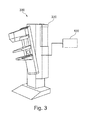
  • FIG. 3 shows a schematic diagram of an X-ray medical imaging system comprising a mammography device and a device for tomosynthesis imaging according to an exemplary embodiment of the invention.
  • An X-ray medical imaging system 300 may comprise a mammography device 200 and a device 100 for tomosynthesis imaging.
  • the device for tomosynthesis imaging may be integrated to the mammography device 200 .
  • the medical imaging system 300 may further comprise an operator's computer or a control terminal.
  • the mammography device 200 may comprise a mechanical compression unit, which may contain two plates for compressing the breast during mammography or biopsy.
  • Diagnostic mammography may include cranio-caudal, medio-lateral oblique and other views, including geometrically magnified and spot-compressed views of the particular area of concern.
  • FIGS. 4-6 show a decomposition of spectral mammography data:
  • FIG. 4 shows a two-dimensional projection image for explaining the invention.
  • mammogram data is measured with at least two different energy spectra.
  • FIG. 5 shows a decomposition of the spectral mammogram into a height image, the values are given in mm.
  • FIG. 6 illustrates a glandularity image, also obtained by spectral decomposition, showing the percentage of glandular tissue.
  • the height information is used and taken from different angles to calculate the three-dimensional breast shape.
  • FIGS. 7-9 show a back-projection for explaining the invention showing cross-section through a tomosynthesis image volume, the principal X-ray direction is from top to bottom.
  • FIG. 7 shows a tomo-synthesis reconstruction of an elliptical object, e.g. a cross-section through the breast, shaded in dark gray.
  • the spatial extend of the object cannot be reconstructed in the principal X-ray direction, leading to artifacts, the X-rays represented by the light gray areas, but also by artifacts within the object.
  • FIG. 8 shows a reconstruction using a binary mask obtained pure by identification of background rays which can reduce the artifacts.
  • FIG. 9 shows a reconstruction using binary mask generated from a geometric model, e.g. by the spectral height image in FIG. 5 in combination with binary spectral tomosynthesis, recovering the true object outline, thus also reducing artifacts within the object.
  • binary spectral tomosynthesis refers to a reconstruction of a binary three-dimensional volume representing the object's spatial extent using spectral mammography projection images.
  • a computer program or a computer program element is provided that is characterized by being adapted to execute the method steps of the method according to one of the preceding embodiments, on an appropriate system.
  • the computer program element might therefore be stored on a computer unit, which might also be part of an embodiment of the present invention.
  • This computing unit may be adapted to perform or induce a performing of the steps of the method described above.
  • the computing unit can be adapted to operate automatically and/or to execute the orders of a user.
  • a computer program may be loaded into a working memory of a data processor.
  • the data processor may thus be equipped to carry out the method of the invention.
  • This exemplary embodiment of the invention covers both, a computer program that right from the beginning uses the invention and a computer program that by means of an up-date turns an existing program into a program that uses the invention.
  • the computer program element might be able to provide all necessary steps to fulfill the procedure of an exemplary embodiment of the method as described above.
  • a computer readable medium such as a CD-ROM
  • the computer readable medium has a computer program element stored on it, which computer program element is described by the preceding section.
  • the present invention may be used for X-ray tomosynthesis in different medical fields, like, for instance, breast imaging, chest imaging, or dental imaging.
  • a computer program may be stored and/or distributed on a suitable medium, such as an optical storage medium or a solid state medium supplied together with or as part of other hardware, but may also be distributed in other forms, such as via the internet or other wired or wireless telecommunication systems.
  • the computer program may also be presented over a network like the World Wide Web and can be downloaded into the working memory of a data processor from such a network.
  • a medium for making a computer program element available for downloading is provided, which computer program element is arranged to perform a method according to one of the previously described embodiments of the invention.

Landscapes

  • Health & Medical Sciences (AREA)
  • Life Sciences & Earth Sciences (AREA)
  • Engineering & Computer Science (AREA)
  • Medical Informatics (AREA)
  • Physics & Mathematics (AREA)
  • Public Health (AREA)
  • Molecular Biology (AREA)
  • Biophysics (AREA)
  • Nuclear Medicine, Radiotherapy & Molecular Imaging (AREA)
  • Veterinary Medicine (AREA)
  • Pathology (AREA)
  • Radiology & Medical Imaging (AREA)
  • Biomedical Technology (AREA)
  • Heart & Thoracic Surgery (AREA)
  • General Health & Medical Sciences (AREA)
  • Surgery (AREA)
  • Animal Behavior & Ethology (AREA)
  • High Energy & Nuclear Physics (AREA)
  • Optics & Photonics (AREA)
  • Computer Vision & Pattern Recognition (AREA)
  • Dentistry (AREA)
  • Oral & Maxillofacial Surgery (AREA)
  • Apparatus For Radiation Diagnosis (AREA)
  • General Physics & Mathematics (AREA)
  • Theoretical Computer Science (AREA)

Abstract

The present invention relates to a device for tomosynthesis imaging, the device comprising: a mask generator module (101) configured to generate a binary mask based on a geometric three-dimensional model of a scanned object; an image capturing module (102) configured to scan a series of two-dimensional projection images of the object; and an image processing module (103) configured to apply the generated binary mask during a reconstruction of a three-dimensional image volume from the scanned series of two-dimensional projection images and to restrict an extent of the reconstructed image volume to the extent of the geometric model.

Description

CROSS REFERENCE TO RELATED APPLICATIONS
This application is the U.S. National Phase application under 35 U.S.C. §371 of International Application No. PCT/EP2015/058220, filed Apr. 16, 2015, published as WO 2015/165737 on Nov. 5, 2015, which claims the benefit of European Patent Application Number 14166405.2 filed Apr. 29, 2014. These applications are hereby incorporated by reference herein.
FIELD OF THE INVENTION
The present invention relates to a device and a method for imaging techniques. In particular, the present invention relates to a device and a method for tomosynthesis imaging.
BACKGROUND OF THE INVENTION
In tomosynthesis, a three-dimensional image volume is reconstructed using X-ray projections from an angular range less than 180°, e.g. typically 10°-60° in human breast tomosynthesis. Due to the limited angular range of the setup, the spatial extent of an object under examination in the principal direction of the X-rays cannot be accurately reconstructed by known image reconstruction techniques.
EP 2,101,648 B1 describes a method and a device for generating a tomosynthetic three-dimensional X-ray image, in which a plurality of digital two-dimensional X-ray projection images are recorded from an examination object with different projection angles in a limited angular range with an X-ray source and a digital X-ray detector, so-called fan artefacts are eliminated by a binary three-dimensional mask, which is determined from the projection image data of a first two-dimensional X-ray image recorded at a first projection angle and the projection image data of a second two-dimensional X-ray image recorded at a second projection angle.
FR 2,978,911 A1 describes a method of illuminating apart of the human body, e.g. a human breast, with low energy radiation in order to acquire a low energy image by an imaging detector. The body part is positioned between the radiation source and the detector. A composite medical image is generated from the low and high energy images by a controller, so that tissues of the body part are displayable in the composite medical image. A system for acquisition and processing of a medical image of a body including an implant is further described.
SUMMARY OF THE INVENTION
There may be a need to improve the digital image processing for tomosynthesis imaging.
These needs are met by the subject-matter of the independent claims. Further exemplary embodiments are evident from the dependent claims and the following description.
An aspect of the invention relates to a device for tomosynthesis imaging, the device comprising: a mask generator module configured to generate a binary mask based on a geometric three-dimensional model of a scanned object; an image capturing module configured to scan a series of two-dimensional projection images of the object; and an image processing module configured to apply the generated binary mask during a reconstruction of a three-dimensional image volume from the scanned series of two-dimensional projection images and to restrict an extent of the reconstructed image volume to the extent of the geometric model.
A further aspect of the invention relates to an X-ray medical imaging system comprising a mammography device and a device for tomosynthesis imaging.
A further aspect of the invention relates to a method for tomosynthesis imaging, the method comprising the steps of: generating a binary mask based on a geometric model of a scanned object; scanning a series of two-dimensional projection images of the object; and applying the generated binary mask to the scanned series of two-dimensional projection images and restricting an extent of each of the reconstructed three-dimensional image volume to the dimensions of the geometric model.
The present invention provides an approach overcome the occurrence of image artifacts outside the object due to the limited angular range. Such artifacts also manifest within the object, e.g. as low frequency intensity variations because the true attenuation cannot be recovered.
The present invention advantageously solves this problem by applying a mask image generated by a binary tomosynthesis reconstruction.
The present invention advantageously also identifies X-rays with a non-zero line-integral value, using the spectral information of these X-rays.
The present invention advantageously provides that the multi-energy projection data can be decomposed into basis material images, e.g. absorptions due to photo-effect and due to Compton-effect. This advantageously allows a quantitative expression of the length of each ray through the object if the volume can be decomposed in mixtures of two materials. This is the case for mammographic volumes, as breast tissue is in most cases a mixture of fatty and glandular tissue. The decomposition can then be expressed as height and glandularity.
If multi-energy projection data are not available, the local height can also be estimated from conventional single-energy projection data for those locations where one tissue type, preferably fatty tissue, dominates. Height information for the other locations can then be obtained by interpolation.
As such height or length information through the volume is available from images taken at different angles; one can reconstruct a binary image volume describing the outer shape of the scanned object. This problem is in general Non-deterministic Polynomial-time hard, in short: NP-hard, but can be relaxed by introducing geometrical priors, e.g. connectedness, smoothness and convexity constraints. Also further boundary conditions are known: The maximum length through the breast is given by the compression height, which is constant over a large area across the breast. And also the skin-line can be correctly delineated at the points where the X-rays are parallel to the skin.
This kind of geometric height model information can be represented as a binary image. This binary image can then be used as a mask in the actual tomosynthesis image formation allows for a better reconstruction of the object extent in the principal X-ray direction and hence improves the tomosynthesis:
  • allowing a delineation of the breast outline for all slices (i.e. in 3D) and improved background masking; and
  • avoiding the intensity drop towards the breast edge (no need for a post-processing thickness equalization/compensation is given); and
  • reduction of resulting image artifacts inside and outside the imaged object, for instance, the imaged human breast.
    In other words, the present invention advantageously proposes to generate a three-dimensional mask image using length information from spectral image decomposition. This removes image artifacts and overcomes the need for thickness equalization.
The method can be used for tomosynthesis images, as it effectively “looks behind the breast” at angles which are outside the coverage of the tomosynthesis scan, which would otherwise be impossible due to the limited tomo-angle, tomo-angle or tomographic angle is the amplitude of tube travel expressed in degrees.
The term “scanned object” or “imaged object” used within the description of the present invention relates to the object to be scanned or any other object or part of the human body, for instance, investigated by Mammography or any other process of using high- or low-energy X-rays to examine the human breast and used as a diagnostic and a screening tool.
The term “energy-resolved X-ray images” or “spectral X-ray images” may be understood as images acquired using any kind of X-ray technique, wherein more than two types of materials can be effectively separated, e.g. with the use of an energy resolved photon-counting detector and classification methodology. Specifically, this applies to the case when contrast agents that contain K-absorption edges in the energy range of interest are present in the object. This separation is enabled via the use of recently developed energy resolved photon-counting detectors with multiple thresholds, which allow simultaneous measurements of the x-ray attenuation at multiple energies.
The binary mask is based on a geometric three-dimensional model of a scanned object mask representing the object's three-dimensional, possibly curved, spatial extent.
According to an exemplary embodiment of the present invention, the mask generator module is configured to generate the binary mask based on the geometric model derived from a laser scanning of the object. This may be combined with intensity information from the projection images.
This advantageously provides an improved matching of the geometric three-dimensional model with the scanned object.
According to an exemplary embodiment of the present invention, the mask generator module is configured to generate the binary mask based on the geometric model derived from image analysis of the at least one two-dimensional projection image of the scanned series of two-dimensional projection images of the object.
This advantageously provides an improved matching of the geometric three-dimensional model with the scanned object.
According to an exemplary embodiment of the present invention, the mask generator module is configured to determine the geometric model of the object based on an intensity profile of the at least one two-dimensional projection image of the object.
This advantageously provides an improved matching of the geometric three-dimensional model with the scanned object.
According to an exemplary embodiment of the present invention, the image capturing module is capable of acquiring energy-resolved X-ray images and the geometric model is derived from a quantitative height model obtained from a spectral material decomposition of the energy-resolved two-dimensional projection images.
According to an exemplary embodiment of the present invention, the mask generator module is configured to generate the binary mask using an object thickness value measured by a mechanical compression unit.
According to an exemplary embodiment of the present invention, the image processing module is configured to apply the generated binary mask during a reconstruction procedure of the scanned series of two-dimensional projection images.
A computer program performing the method of the present invention may be stored on a computer-readable medium. A computer-readable medium may be a floppy disk, a hard disk, a CD, a DVD, an USB (Universal Serial Bus) storage device, a RAM (Random Access Memory), a ROM (Read Only Memory) and an EPROM (Erasable Programmable Read Only Memory). A computer-readable medium may also be a data communication network, for example the Internet, which allows downloading a program code.
The methods, systems and devices described herein may be implemented as software in a Digital Signal Processor, DSP, in a micro-controller or in any other side-processor or as hardware circuit within an application specific integrated circuit, ASIC. The present invention can be implemented in digital electronic circuitry, or in computer hardware, firmware, software, or in combinations thereof, e.g. in available hardware of conventional mobile devices or in new hardware dedicated for processing the methods described herein.
The present invention can be implemented for the use of image reconstruction in various image processing applications and aims at demonstrating the usefulness of this transformation for image altering and segmentation tasks.
A more complete appreciation of the invention and the attendant advantages thereof will be more clearly understood by reference to the following schematic drawings, which are not to scale, wherein:
FIG. 1 shows a schematic diagram of a device for tomosynthesis imaging according to an exemplary embodiment of the invention;
FIG. 2 shows a schematic flowchart diagram of a method for tomosynthesis imaging according to an exemplary embodiment of the invention;
FIG. 3 shows a schematic diagram of an X-ray medical imaging system comprising a mammography device and a device for tomosynthesis imaging according to an exemplary embodiment of the invention;
FIGS. 4-6 each shows a two-dimensional projection image for explaining the invention; and
FIGS. 7-9 each shows a back-projection for explaining the invention.
DETAILED DESCRIPTION OF EMBODIMENTS
The illustration in the drawings is purely schematically and does not intend to provide scaling relations or size information. In different drawings, similar or identical elements are provided with the same reference numerals. Generally, identical parts, units, entities or steps are provided with the same reference symbols in the description.
FIG. 1 shows a schematic diagram of a device for tomosynthesis imaging according to an exemplary embodiment of the invention.
A device 100 for tomosynthesis imaging may comprise a mask generator module 101 configured to generate a binary mask based on a geometric three-dimensional model of a scanned object.
The device 100 may further comprise an image capturing module 102 configured to scan a series of two-dimensional projection images of the object.
Further, the device may comprise an image processing module 103 configured to apply the generated binary mask during a reconstruction of a three-dimensional image volume from the scanned series of two-dimensional projection images and to restrict an extent of the reconstructed image volume to the extent of the geometric model.
FIG. 2 shows a schematic flowchart diagram of a method for tomosynthesis imaging according to an exemplary embodiment of the invention.
The method is visualized in terms of a block diagram. The method may comprise three steps S1, S2, and S3.
As a first step of the method, generating S1 a binary mask based on a geometric model of a scanned object is conducted.
As a second step of the method, scanning S2 a series of two-dimensional projection images of the object is performed. The step of scanning S2 the series may also be performed prior to the step of generating S1 the binary mask, if, for instance, the geometric model of the scanned object is based on produced projection images which are scanned in the step of scanning S2 the series. If, for instance, the binary mask is generated from an object thickness value measured by a mechanical compression unit, the step of scanning S2 may be performed subsequently to the step of generating S1 the binary mask, as illustrated in the schematic flowchart diagram of FIG. 2.
As a third step of the method, applying S3 the generated binary mask to the scanned series of two-dimensional projection images and restricting an extent of each of the images to the dimensions of the geometric model is performed.
According to an exemplary embodiment of the invention, these steps may be carried out simultaneously, divided into multiple operations or tasks or iterated.
FIG. 3 shows a schematic diagram of an X-ray medical imaging system comprising a mammography device and a device for tomosynthesis imaging according to an exemplary embodiment of the invention.
An X-ray medical imaging system 300 may comprise a mammography device 200 and a device 100 for tomosynthesis imaging. According to a further exemplary embodiment of the present invention, on the contrary to FIG. 3, the device for tomosynthesis imaging may be integrated to the mammography device 200. Further, also in contrast to the representation of FIG. 3, the medical imaging system 300 may further comprise an operator's computer or a control terminal. The mammography device 200 may comprise a mechanical compression unit, which may contain two plates for compressing the breast during mammography or biopsy.
During the procedure, the breast is compressed using the dedicated mammography device. Parallel-plate compression of the mechanical compression unit evens out the thickness of breast tissue to increase image quality by reducing the thickness of tissue that x-rays must penetrate, decreasing the amount of scattered radiation, scatter degrades image quality, reducing the required radiation dose, and holding the breast still preventing motion blur. Diagnostic mammography may include cranio-caudal, medio-lateral oblique and other views, including geometrically magnified and spot-compressed views of the particular area of concern.
FIGS. 4-6 show a decomposition of spectral mammography data: FIG. 4 shows a two-dimensional projection image for explaining the invention. In FIG. 4, mammogram data is measured with at least two different energy spectra. FIG. 5 shows a decomposition of the spectral mammogram into a height image, the values are given in mm. FIG. 6 illustrates a glandularity image, also obtained by spectral decomposition, showing the percentage of glandular tissue.
According to a further exemplary embodiment of the present invention, the height information is used and taken from different angles to calculate the three-dimensional breast shape.
FIGS. 7-9 show a back-projection for explaining the invention showing cross-section through a tomosynthesis image volume, the principal X-ray direction is from top to bottom.
FIG. 7 shows a tomo-synthesis reconstruction of an elliptical object, e.g. a cross-section through the breast, shaded in dark gray. The spatial extend of the object cannot be reconstructed in the principal X-ray direction, leading to artifacts, the X-rays represented by the light gray areas, but also by artifacts within the object. FIG. 8 shows a reconstruction using a binary mask obtained pure by identification of background rays which can reduce the artifacts. FIG. 9 shows a reconstruction using binary mask generated from a geometric model, e.g. by the spectral height image in FIG. 5 in combination with binary spectral tomosynthesis, recovering the true object outline, thus also reducing artifacts within the object.
The term “binary spectral tomosynthesis” refers to a reconstruction of a binary three-dimensional volume representing the object's spatial extent using spectral mammography projection images.
In another exemplary embodiment of the present invention, a computer program or a computer program element is provided that is characterized by being adapted to execute the method steps of the method according to one of the preceding embodiments, on an appropriate system.
According to a further exemplary embodiment of the present invention, the computer program element might therefore be stored on a computer unit, which might also be part of an embodiment of the present invention. This computing unit may be adapted to perform or induce a performing of the steps of the method described above.
Moreover, it may be adapted to operate the components of the above described apparatus. The computing unit can be adapted to operate automatically and/or to execute the orders of a user. A computer program may be loaded into a working memory of a data processor. The data processor may thus be equipped to carry out the method of the invention. This exemplary embodiment of the invention covers both, a computer program that right from the beginning uses the invention and a computer program that by means of an up-date turns an existing program into a program that uses the invention.
Further on, the computer program element might be able to provide all necessary steps to fulfill the procedure of an exemplary embodiment of the method as described above.
According to a further exemplary embodiment of the present invention, a computer readable medium, such as a CD-ROM, is presented wherein the computer readable medium has a computer program element stored on it, which computer program element is described by the preceding section.
The present invention may be used for X-ray tomosynthesis in different medical fields, like, for instance, breast imaging, chest imaging, or dental imaging. A computer program may be stored and/or distributed on a suitable medium, such as an optical storage medium or a solid state medium supplied together with or as part of other hardware, but may also be distributed in other forms, such as via the internet or other wired or wireless telecommunication systems.
However, the computer program may also be presented over a network like the World Wide Web and can be downloaded into the working memory of a data processor from such a network.
According to a further exemplary embodiment of the present invention, a medium for making a computer program element available for downloading is provided, which computer program element is arranged to perform a method according to one of the previously described embodiments of the invention.
It has to be noted that embodiments of the invention are described with reference to different subject matters. In particular, some embodiments are described with reference to method type claims whereas other embodiments are described with reference to the device type claims.
However, a person skilled in the art will gather from the above and the following description that, unless otherwise notified, in addition to any combination of features belonging to one type of subject matter also any combination between features relating to different subject matters is considered to be disclosed with this application. However, all features can be combined providing synergetic effects that are more than the simple summation of the features.
While the invention has been illustrated and described in detail in the drawings and foregoing description, such illustration and description are to be considered illustrative or exemplary and not restrictive; the invention is not limited to the disclosed embodiments. Other variations to the disclosed embodiments can be understood and effected by those skilled in the art and practicing the claimed invention, from a study of the drawings, the disclosure, and the appended claims.
In the claims, the word “comprising” does not exclude other elements or steps, and the indefinite article “a” or “an” does not exclude a plurality. A single processor or controller or other unit may fulfill the functions of several items recited in the claims. The mere fact that certain measures are recited in mutually different dependent claims does not indicate that a combination of these measures cannot be used to advantage. Any reference signs in the claims should not be construed as limiting the scope.

Claims (13)

The invention claimed is:
1. A device for tomosynthesis imaging, the device comprising:
a mask generator module configured to generate a binary mask based on a geometric three-dimensional model of a scanned object, derived from a laser scanning of the object;
an image capturing module configured to scan a series of two-dimensional projection images of the object; and
an image processing module configured to apply the generated binary mask during a reconstruction of a three-dimensional image volume from the scanned series of two-dimensional projection images and to restrict an extent of the reconstructed image volume to the extent of the geometric model.
2. The device for tomosynthesis imaging according to claim 1, wherein the mask generator module is configured to generate the binary mask based on the geometric model derived from image analysis of at least one two-dimensional projection image of the scanned series of two-dimensional projection images of the object.
3. The device for tomosynthesis imaging according to claim 2, wherein the mask generator module is configured to determine the geometric model of the object based on an intensity profile of the at least one two-dimensional projection image of the object.
4. The device for tomosynthesis imaging according to claim 1, where the image capturing module is capable of acquiring energy-resolved two-dimensional X-ray protection images and the geometric model is derived from a quantitative height model obtained from a spectral material decomposition using the energy-resolved two-dimensional X-ray projection images.
5. The device for tomosynthesis imaging according to claim 1, wherein the mask generator module is configured to generate the binary mask using an object thickness value measured by a mechanical compression unit.
6. The device for tomosynthesis imaging according to claim 1, wherein the image processing module is configured to apply the generated binary mask during a reconstruction procedure of the scanned series of two-dimensional projection images.
7. An X-ray medical imaging system comprising a mammography device and a device for tomosynthesis imaging according to claim 1.
8. A method for tomosynthesis imaging, the method comprising the steps of:
generating a binary mask based on a geometric model of a scanned object, derived from a laser scanning of the object;
scanning a series of two-dimensional projection images of the object; and
applying the generated binary mask to the scanned series of two-dimensional projection images and restricting an extent of each of the images to the dimensions of the geometric model.
9. The method for tomosynthesis imaging according to claim 8, wherein the step of generating the binary mask based on the geometric model further comprises deriving from image analysis of the at least one two-dimensional projection image of the scanned series of two-dimensional projection images of the object.
10. The method for tomosynthesis imaging according to claim 8, wherein the step of generating the binary mask based on the geometric model further comprises determining the geometric model of the object based on a intensity profile of the at least one two-dimensional projection image of the object.
11. The method for tomosynthesis imaging according to claim 8, where the step of generating the binary mask based on the geometric model further acquiring energy-resolved two-dimensional X-ray projection images, wherein the geometric model is derived from a quantitative height model obtained from a spectral material decomposition of the energy-resolved two-dimensional X-ray projection images.
12. The method for tomosynthesis imaging according to claim 8, wherein the step of generating the binary mask based on the geometric model further comprises deriving a geometric model using an object thickness value measured by a mechanical compression unit.
13. The method for tomosynthesis imaging according to claim 8, wherein the method further comprises the step of generating a binary mask during a reconstruction procedure using the scanned series of two-dimensional projection images.
US15/112,727 2014-04-29 2015-04-16 Device and method for tomosynthesis imaging Expired - Fee Related US9750466B2 (en)

Applications Claiming Priority (4)

Application Number Priority Date Filing Date Title
EP14166405 2014-04-29
EP14166405.2 2014-04-29
EP14166405 2014-04-29
PCT/EP2015/058220 WO2015165737A1 (en) 2014-04-29 2015-04-16 Device and method for tomosynthesis imaging

Publications (2)

Publication Number Publication Date
US20170035372A1 US20170035372A1 (en) 2017-02-09
US9750466B2 true US9750466B2 (en) 2017-09-05

Family

ID=50555104

Family Applications (1)

Application Number Title Priority Date Filing Date
US15/112,727 Expired - Fee Related US9750466B2 (en) 2014-04-29 2015-04-16 Device and method for tomosynthesis imaging

Country Status (5)

Country Link
US (1) US9750466B2 (en)
EP (1) EP3076872B1 (en)
JP (1) JP6209688B2 (en)
CN (1) CN105992558B (en)
WO (1) WO2015165737A1 (en)

Cited By (1)

* Cited by examiner, † Cited by third party
Publication number Priority date Publication date Assignee Title
US11154267B2 (en) * 2014-09-16 2021-10-26 Dentsply Sirona Inc. Methods, systems, apparatuses, and computer programs for processing tomographic images

Families Citing this family (3)

* Cited by examiner, † Cited by third party
Publication number Priority date Publication date Assignee Title
WO2019077385A1 (en) * 2017-10-19 2019-04-25 Profound Medical Inc. Processing system and dynamic correction method for thermal therapy
US11790598B2 (en) * 2020-12-16 2023-10-17 Nvidia Corporation Three-dimensional tomography reconstruction pipeline
US11954853B2 (en) * 2021-07-21 2024-04-09 GE Precision Healthcare LLC Systems and methods for fast mammography data handling

Citations (13)

* Cited by examiner, † Cited by third party
Publication number Priority date Publication date Assignee Title
US4896343A (en) 1988-05-02 1990-01-23 Saunders Allan M Radiation apparatus with distance mapper for dose control
US20050135664A1 (en) * 2003-12-23 2005-06-23 Kaufhold John P. Methods and apparatus for reconstruction of volume data from projection data
JP2006204329A (en) 2005-01-25 2006-08-10 Hitachi Medical Corp X-ray tomographic equipment
DE102005028415A1 (en) 2005-06-20 2006-12-21 Siemens Ag Determining radiological thickness of object involves determining geometrical object thickness for defined through radiation direction from model measurement data, determining radiological thickness using at least one absorption parameter
US20070183641A1 (en) 2006-02-09 2007-08-09 Peters Gero L Method and apparatus for tomosynthesis projection imaging for detection of radiological signs
US20070286470A1 (en) 2006-06-07 2007-12-13 Sylvain Bernard Method for the processing of radiological images in tomosynthesis for a detection of radiological signs
WO2008074681A1 (en) 2006-12-19 2008-06-26 Siemens Aktiengesellschaft Method and device for generating a tomosynthetic 3d x-ray image
US20080292217A1 (en) 2003-12-23 2008-11-27 General Electric Company Quantitative image reconstruction method and system
JP2008292217A (en) 2007-05-23 2008-12-04 Yokogawa Electric Corp Diaphragm seal type pressure measuring device
US20090164541A1 (en) 2007-12-20 2009-06-25 Palma Giovanni Procedure for deriving a three-dimensional digital mask starting from a series of two-dimensional masks, plus a device for doing this
FR2978911A1 (en) 2011-08-11 2013-02-15 Gen Electric Method for acquisition and processing of medical image of breast to detect and characterize radiological signs during e.g. treatment of breast cancer, involves generating composite medical image from low and high energy images
US20140031603A1 (en) 2011-03-07 2014-01-30 Dalhousie University Methods and apparatus for imaging in conjunction with radiotherapy
US9610052B2 (en) 2010-02-02 2017-04-04 Planmeca Oy Dental imaging apparatus

Family Cites Families (4)

* Cited by examiner, † Cited by third party
Publication number Priority date Publication date Assignee Title
EP1009283A1 (en) * 1997-08-28 2000-06-21 Qualia Computing, Inc. Method and system for automated detection of clustered microcalcifications from digital mammograms
US6707878B2 (en) * 2002-04-15 2004-03-16 General Electric Company Generalized filtered back-projection reconstruction in digital tomosynthesis
EP2513865A2 (en) * 2009-12-17 2012-10-24 Koninklijke Philips Electronics N.V. Reconstructing an object of interest
US9014449B2 (en) * 2011-10-04 2015-04-21 Siemens Aktiengesellschaft Method and system for segmentation and removal of pulmonary arteries, veins, left atrial appendage

Patent Citations (13)

* Cited by examiner, † Cited by third party
Publication number Priority date Publication date Assignee Title
US4896343A (en) 1988-05-02 1990-01-23 Saunders Allan M Radiation apparatus with distance mapper for dose control
US20080292217A1 (en) 2003-12-23 2008-11-27 General Electric Company Quantitative image reconstruction method and system
US20050135664A1 (en) * 2003-12-23 2005-06-23 Kaufhold John P. Methods and apparatus for reconstruction of volume data from projection data
JP2006204329A (en) 2005-01-25 2006-08-10 Hitachi Medical Corp X-ray tomographic equipment
DE102005028415A1 (en) 2005-06-20 2006-12-21 Siemens Ag Determining radiological thickness of object involves determining geometrical object thickness for defined through radiation direction from model measurement data, determining radiological thickness using at least one absorption parameter
US20070183641A1 (en) 2006-02-09 2007-08-09 Peters Gero L Method and apparatus for tomosynthesis projection imaging for detection of radiological signs
US20070286470A1 (en) 2006-06-07 2007-12-13 Sylvain Bernard Method for the processing of radiological images in tomosynthesis for a detection of radiological signs
WO2008074681A1 (en) 2006-12-19 2008-06-26 Siemens Aktiengesellschaft Method and device for generating a tomosynthetic 3d x-ray image
JP2008292217A (en) 2007-05-23 2008-12-04 Yokogawa Electric Corp Diaphragm seal type pressure measuring device
US20090164541A1 (en) 2007-12-20 2009-06-25 Palma Giovanni Procedure for deriving a three-dimensional digital mask starting from a series of two-dimensional masks, plus a device for doing this
US9610052B2 (en) 2010-02-02 2017-04-04 Planmeca Oy Dental imaging apparatus
US20140031603A1 (en) 2011-03-07 2014-01-30 Dalhousie University Methods and apparatus for imaging in conjunction with radiotherapy
FR2978911A1 (en) 2011-08-11 2013-02-15 Gen Electric Method for acquisition and processing of medical image of breast to detect and characterize radiological signs during e.g. treatment of breast cancer, involves generating composite medical image from low and high energy images

Non-Patent Citations (1)

* Cited by examiner, † Cited by third party
Title
Alvarez, et al., "Energy-Selectrive Reconstructions in X-ray Computerized Tomography", Phys. Med. Biol., 1976, vol. 21, No. 5, 733-744.

Cited By (1)

* Cited by examiner, † Cited by third party
Publication number Priority date Publication date Assignee Title
US11154267B2 (en) * 2014-09-16 2021-10-26 Dentsply Sirona Inc. Methods, systems, apparatuses, and computer programs for processing tomographic images

Also Published As

Publication number Publication date
US20170035372A1 (en) 2017-02-09
EP3076872A1 (en) 2016-10-12
CN105992558B (en) 2017-12-08
WO2015165737A1 (en) 2015-11-05
JP6209688B2 (en) 2017-10-04
EP3076872B1 (en) 2018-06-13
JP2017513605A (en) 2017-06-01
CN105992558A (en) 2016-10-05

Similar Documents

Publication Publication Date Title
JP6999576B2 (en) Systems and methods for noise control in multi-energy CT images based on spatial and spectral information
CN111656405A (en) Using Deep Learning to Reduce Metal Artifacts
JP6894928B2 (en) Improving the accuracy and resolution of quantitative imaging by combining spectral and non-spectral material decomposition
US20140050378A1 (en) System and method for detecting materials or disease states using multi-energy computed tomography
US9895126B2 (en) System and method for quantification of muscle and fat using abdominal CT imaging
CN110636796A (en) Beam Hardening Correction in X-ray Dark Field Imaging
US9750466B2 (en) Device and method for tomosynthesis imaging
KR20220038101A (en) SYSTEMS AND METHODS FOR GENERATING MULTI-VIEW SYNTHETIC DENTAL RADIOGRAPHS FOR INTRAORAL TOMOSYNTHESIS
EP3102108B1 (en) Generating a breast parameter map
US10888291B2 (en) Breast imaging device, image processing device, and image processing method
EP2998936B1 (en) Method for generating a combined projection image
US10089728B2 (en) Radiation-image processing device and method
WO2021153592A1 (en) Image processing device, radiography device, image processing method, and program
Lee et al. Quantitative evaluation of anatomical noise in chest digital tomosynthesis, digital radiography, and computed tomography
Akter et al. 3D CT to 2D low dose single-plane fluoroscopy registration algorithm for in-vivo knee motion analysis
KR20170078180A (en) Method and system for establishing region-of-interest in tomography
O’Connor et al. Development of an ensemble of digital breast object models
Jeon et al. Improving decomposition image quality in dual‐energy chest radiography using two‐dimensional crisscrossed anti‐scatter grid
Wu et al. Dose reduction for digital breast tomosynthesis by patch-based denoising in reconstruction
KR101860145B1 (en) Dual energy imaging method for digital tomosynthesis apparatus, system using photon counting detector and digital tomosynthesis system thereof
Elangovan et al. A modelling framework for evaluation of 2d-mammography and breast tomosynthesis systems
Barca et al. Image Quality Comparison between Digital and Synthetic 2D Mammograms: A Qualitative and Quantitative Phantom Study.
JP7177678B2 (en) X-ray tomosynthesis device and image generation device
Kovalovs et al. Automatic medical image analysis for measuring cortical bone porosity
Han et al. A preliminary study of an image synthesis method to simulate the change in the incident X-ray spectrum by using thickness information

Legal Events

Date Code Title Description
AS Assignment

Owner name: KONINKLIJKE PHILIPS N.V., NETHERLANDS

Free format text: ASSIGNMENT OF ASSIGNORS INTEREST;ASSIGNORS:HOMANN, HANNO HEYKE;BERGNER, FRANK;ERHARD, KLAUS;AND OTHERS;SIGNING DATES FROM 20150416 TO 20160817;REEL/FRAME:043154/0464

STCF Information on status: patent grant

Free format text: PATENTED CASE

MAFP Maintenance fee payment

Free format text: PAYMENT OF MAINTENANCE FEE, 4TH YEAR, LARGE ENTITY (ORIGINAL EVENT CODE: M1551); ENTITY STATUS OF PATENT OWNER: LARGE ENTITY

Year of fee payment: 4

FEPP Fee payment procedure

Free format text: MAINTENANCE FEE REMINDER MAILED (ORIGINAL EVENT CODE: REM.); ENTITY STATUS OF PATENT OWNER: LARGE ENTITY

LAPS Lapse for failure to pay maintenance fees

Free format text: PATENT EXPIRED FOR FAILURE TO PAY MAINTENANCE FEES (ORIGINAL EVENT CODE: EXP.); ENTITY STATUS OF PATENT OWNER: LARGE ENTITY

STCH Information on status: patent discontinuation

Free format text: PATENT EXPIRED DUE TO NONPAYMENT OF MAINTENANCE FEES UNDER 37 CFR 1.362

FP Lapsed due to failure to pay maintenance fee

Effective date: 20250905