US9749529B2 - Image pickup apparatus having wireless transmitter-receiver unit - Google Patents

Image pickup apparatus having wireless transmitter-receiver unit Download PDF

Info

Publication number
US9749529B2
US9749529B2 US14/793,967 US201514793967A US9749529B2 US 9749529 B2 US9749529 B2 US 9749529B2 US 201514793967 A US201514793967 A US 201514793967A US 9749529 B2 US9749529 B2 US 9749529B2
Authority
US
United States
Prior art keywords
image pickup
wireless transmitter
pickup apparatus
circuit board
image
Prior art date
Legal status (The legal status is an assumption and is not a legal conclusion. Google has not performed a legal analysis and makes no representation as to the accuracy of the status listed.)
Expired - Fee Related
Application number
US14/793,967
Other versions
US20150312480A1 (en
Inventor
Ayumu Kawamura
Current Assignee (The listed assignees may be inaccurate. Google has not performed a legal analysis and makes no representation or warranty as to the accuracy of the list.)
Canon Inc
Original Assignee
Canon Inc
Priority date (The priority date is an assumption and is not a legal conclusion. Google has not performed a legal analysis and makes no representation as to the accuracy of the date listed.)
Filing date
Publication date
Application filed by Canon Inc filed Critical Canon Inc
Priority to US14/793,967 priority Critical patent/US9749529B2/en
Publication of US20150312480A1 publication Critical patent/US20150312480A1/en
Application granted granted Critical
Publication of US9749529B2 publication Critical patent/US9749529B2/en
Expired - Fee Related legal-status Critical Current
Anticipated expiration legal-status Critical

Links

Images

Classifications

    • H04N5/23241
    • HELECTRICITY
    • H04ELECTRIC COMMUNICATION TECHNIQUE
    • H04NPICTORIAL COMMUNICATION, e.g. TELEVISION
    • H04N23/00Cameras or camera modules comprising electronic image sensors; Control thereof
    • H04N23/50Constructional details
    • H04N23/53Constructional details of electronic viewfinders, e.g. rotatable or detachable
    • H04N23/531Constructional details of electronic viewfinders, e.g. rotatable or detachable being rotatable or detachable
    • HELECTRICITY
    • H04ELECTRIC COMMUNICATION TECHNIQUE
    • H04NPICTORIAL COMMUNICATION, e.g. TELEVISION
    • H04N23/00Cameras or camera modules comprising electronic image sensors; Control thereof
    • H04N23/50Constructional details
    • H04N23/54Mounting of pick-up tubes, electronic image sensors, deviation or focusing coils
    • HELECTRICITY
    • H04ELECTRIC COMMUNICATION TECHNIQUE
    • H04NPICTORIAL COMMUNICATION, e.g. TELEVISION
    • H04N23/00Cameras or camera modules comprising electronic image sensors; Control thereof
    • H04N23/50Constructional details
    • H04N23/55Optical parts specially adapted for electronic image sensors; Mounting thereof
    • HELECTRICITY
    • H04ELECTRIC COMMUNICATION TECHNIQUE
    • H04NPICTORIAL COMMUNICATION, e.g. TELEVISION
    • H04N23/00Cameras or camera modules comprising electronic image sensors; Control thereof
    • H04N23/60Control of cameras or camera modules
    • H04N23/667Camera operation mode switching, e.g. between still and video, sport and normal or high- and low-resolution modes
    • H04N5/2253
    • H04N5/2254
    • H04N5/23245
    • H04N5/23293
    • HELECTRICITY
    • H04ELECTRIC COMMUNICATION TECHNIQUE
    • H04NPICTORIAL COMMUNICATION, e.g. TELEVISION
    • H04N23/00Cameras or camera modules comprising electronic image sensors; Control thereof
    • H04N23/60Control of cameras or camera modules
    • H04N23/65Control of camera operation in relation to power supply

Definitions

  • the present invention relates to an image pickup apparatus that has a wireless transmitter-receiver unit.
  • Some image pickup apparatus has a wireless transmitter-receiver unit that wirelessly transmits data of an image, which is picked up by an image pickup device such as a CCD sensor or a CMOS sensor, and wirelessly receives image data from outside. If heat generated by the wireless transmitter-receiver unit in operation is conveyed to the image pickup device, the quality of picked-up image is deteriorated due to the influence of the heat.
  • an image pickup device such as a CCD sensor or a CMOS sensor
  • the present invention provides an image pickup apparatus capable of avoiding an image pickup device and control system devices from being affected by heat generated by a wireless transmitter-receiver unit, thereby stably operating the control system devices, while avoiding the quality of photographed image from being deteriorated by the generated heat.
  • an image pickup apparatus comprising an image pickup device configured to photoelectrically convert an object image into image signals, an image processing unit configured to perform image processing on the image signals output from the image pickup device, a control unit configured to control the image pickup device and the image processing unit, a power unit configured to supply electric power to the image pickup device, the image processing unit, and the control unit, a board having a mounting surface on which the image processing unit, the control unit, and the power unit are mounted, and a wireless transmitter-receiver unit configured to wirelessly transmit and receive image data, wherein the power unit has heat resistance higher than those of the image pickup device, the image processing unit, and the control unit, and the wireless transmitter-receiver unit is disposed facing the mounting surface of the board in such a manner that a distance between the wireless transmitter-receiver unit and the power unit becomes shorter than a distance between the wireless transmitter-receiver unit and the image pickup device, becomes shorter than a distance between the wireless transmitter-receiver unit and the image processing
  • FIG. 1 is a block diagram showing a control system of a digital video camera, which is an example of an image pickup apparatus according to one embodiment of this invention
  • FIG. 2 is an external perspective view of the digital video camera as seen from the rear of the camera;
  • FIG. 3 is an external perspective view showing a state where an image display unit of the digital video camera is open;
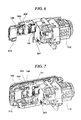
  • FIG. 4 is a perspective view of a main board of the camera
  • FIG. 5 is a perspective view showing an example arrangement of the main board and a lens unit in the camera
  • FIG. 6 is a perspective view showing a state where a wireless transmitter-receiver unit is connected to the main board;
  • FIG. 7 is a perspective view showing a positional relation between the main board and the image display unit.
  • FIG. 8 is a flowchart showing a switch operation disabling process performed by a control unit of the camera to make an ON-operation of a wireless transmission reception ON/OFF switch ineffective.
  • FIG. 1 shows, in block diagram, a control system of a digital video camera, which is an example of an image pickup apparatus according to one embodiment of this invention.
  • the digital video camera of this embodiment includes an image pickup device 104 , which is comprised of, e.g., a CCD sensor or a CMOS sensor.
  • An object image passing through a lens unit 112 is formed on the image pickup device 104 that photoelectrically converts the object image into a series of analog image signals.
  • the analog image signals are output to an A/D converter 105 .
  • the A/D converter 105 converts the analog image signals into digital image signals and outputs these signals to an image processing unit 106 under the control of the control unit 101 .
  • the digital image signals are sequentially output from the A/D converter 105 to an image display unit 108 , and an image is displayed on the image display unit 108 .
  • the image display unit 108 functions as an electronic view finder or an LCD monitor.
  • the image processing unit 106 performs various image processing such as enlargement/reduction processing on the digital image signals supplied from the A/D converter 105 .
  • image recording processing the digital image signals subjected to image processing are sequentially accumulated into, e.g., a RAM (not shown). Then, the accumulated image signals are encoded, together with photographing time information and frame rate information, into moving image data of AVCHD format, and are recorded into a recording medium 107 .
  • the image processing unit 106 Under the control of the control unit 101 , the image processing unit 106 reads and decodes the encoded moving image data recorded in the recording medium 107 , and outputs the decoded moving image data to the image display unit 108 . Also, the image processing unit 106 performs image processing on moving image data and on GUI data stored in a ROM 102 , synthesizes the processed moving image data and the processed GUI data together, and outputs the synthesized data to the image display unit 108 .
  • An operation input unit 103 accepts a user operation input, and notifies the control unit 101 of a content of the operation input.
  • the operation input unit 103 includes, for example, a mode changeover switch 201 , trigger switch 202 , power ON/OFF switch 203 , and wireless transmission reception ON/OFF switch 204 (see FIGS. 2 and 3 ).
  • a wireless transmitter-receiver unit 109 performs processing for wireless transmission on moving image data or still image data stored in the recording medium 107 or on picked-up image data, and transmits the processed image data via an antenna (not shown).
  • the wireless transmitter-receiver unit 109 receives image data via the antenna, performs predetermined processing on the received image data, and outputs the processed data to the image display unit 108 .
  • the wireless transmitter-receiver unit 109 sometimes generates heat and becomes high temperature.
  • a power unit 110 converts electric power supplied from each of a battery 111 and an external power supply unit 209 into a predetermined voltage, and supplies the power of the predetermined voltage to respective parts of the camera.
  • the control unit 101 controls the entire camera. To this end, the control unit 101 reads out a control program stored in, e.g., the ROM 102 , develops the control program on the RAM (not shown), and executes the control program to thereby control operations of respective parts of the camera.
  • a control program stored in, e.g., the ROM 102 , develops the control program on the RAM (not shown), and executes the control program to thereby control operations of respective parts of the camera.
  • the control unit 101 and the image processing unit 106 (which are control system devices of the camera) each have a low upper limit of guaranteed temperature, and each become unstable in operation when the upper limit of guaranteed temperature is exceeded.
  • an upper limit of guaranteed temperature of the image pickup device 104 is exceeded, the quality of picked-up image tends to be deteriorated.
  • FIG. 2 shows in external perspective view the digital video camera as seen from a photographer's side (i.e., from the rear of the camera).
  • FIG. 3 shows in external perspective view a state where the image display unit 108 of the digital video camera is open.
  • a grip belt 205 is provided on a right side surface of the camera body 100 as seen from the photographer's side.
  • the photographer can hold the camera body 100 with one hand placed between the camera body 100 and the grip belt 205 .
  • the image display unit 108 is openably and closably provided on a left side surface of the camera body 100 through a hinge 206 . The image display unit 108 when closed is received in the left side surface of the camera body 100 .
  • the mode changeover switch 201 and the power ON/OFF switch 203 are provided on an upper surface of the camera body 100 , and the trigger switch 202 , wireless transmission reception ON/OFF switch 204 , external power supply unit 209 , and battery 111 are provided on a rear surface of the camera body 100 .
  • FIG. 4 shows in perspective view a main board 302
  • FIG. 5 shows in perspective view an example arrangement of the main board 302 and the lens unit 112
  • FIG. 6 shows in perspective view a state where the wireless transmitter-receiver unit 109 is connected to the main board 302
  • FIG. 7 shows a positional relation between the main board 302 and the image display unit 108 in perspective view.
  • the control unit 101 , the image processing unit 106 , and power inductors 301 of the power unit 110 are mounted on the main board 302 .
  • the main board 302 is disposed in the camera body 100 in such a manner that the side of the main board 302 on which the power inductors 301 are mounted (i.e., the left side of the main board 302 as seen in FIG. 4 ) faces the rear surface of the camera body 100 .
  • the power inductors 301 are mounted near the external power supply unit 209 and near the battery 111 , whereby wirings between the power inductors 301 and the external power supply unit 209 and between the power inductors 301 and the battery 111 can be shortened in length.
  • the power inductors 301 have an upper limit of guaranteed temperature higher than those of the image pickup device 104 , control unit 101 , and image processing unit 106 .
  • the power inductors 301 of the power unit 110 are higher in heat resistance than the image pickup device 104 , control unit 101 , and image processing unit 106 .
  • the power inductors 301 hardly become unstable in operation, even if the upper limit of guaranteed temperature is exceeded.
  • the main board 302 is disposed between the lens unit 112 and the left side surface of the camera body 100 and substantially parallel to the left side surface in which the image display unit 108 in the closed state is received.
  • heat generated in the main board 302 is hardly conveyed to the right side surface of the camera body 100 on which the grip belt 205 is provided.
  • the main board 302 serving as a board of this invention has amounting surface thereof disposed on a side close to the lens unit 112 .
  • the mounting surface of the main board 302 has a central portion thereof on which the control unit 101 is mounted, a front-end side thereof (which is close to the lens unit 112 ) on which the image processing unit 106 is mounted, and a rear-end side thereof on which the power inductors 301 are mounted.
  • Connectors 303 , 304 are mounted on the main board 302 .
  • the connector 303 is disposed between the power inductors 301 and the control unit 101 .
  • the connector 304 is disposed downward of the power inductors 301 .
  • a device board 307 on which the image pickup device 104 is mounted is disposed to extend perpendicular to the main board 302 .
  • the main board 302 is supplied with electric power from the battery 111 or from the external power supply unit 209 through a flexible board (not shown) and the connector 303 .
  • the power supplied to the main board 302 is converted into a predetermined voltage by the power unit 110 that includes the power inductors 301 , and then the power of the predetermined voltage is supplied to respective parts of the camera.
  • Power to the wireless transmitter-receiver unit 109 is supplied via the connector 304 and a flexible board 310 (see FIG. 6 ).
  • the wireless transmitter-receiver unit 109 is disposed substantially parallel to and facing the mounting surface of the main board 302 so as to be close to and so as to cover the power inductors 301 mounted on the main board 302 .
  • a distance between the transmitter-receiver unit 109 and the power inductors 301 becomes shorter than a distance between the transmitter-receiver unit 109 and the control unit 101 , becomes shorter than a distance between the transmitter-receiver unit 109 and the image processing unit 106 , and becomes shorter than a distance between the transmitter-receiver unit 109 and the image pickup device 104 .
  • the power inductors 301 having a high upper limit of guaranteed temperature are most affected by the heating of the wireless transmitter-receiver unit 109 .
  • the operation mode of the camera can be switched between a photographing mode and a playback mode by using the mode changeover switch 201 .
  • the photographing mode In the photographing mode, however, an amount of heat generated by the power inductors 301 increases.
  • the wireless transmission reception ON/OFF switch 204 When the wireless transmission reception ON/OFF switch 204 is turned on in the photographing mode, the wireless transmitter-receiver unit 109 operates and generates heat.
  • the image pickup device 104 , control unit 101 , and image processing unit 106 which are disposed away from the wireless transmitter-receiver unit 109 , are affected by the heat generated by the power inductors 301 and by the wireless transmitter-receiver unit 109 .
  • the ON-operation of the wireless transmission reception ON/OFF switch 204 is made ineffective in the photographing mode.
  • the control unit 101 executes a switch operation disabling process shown in FIG. 8 .
  • the control unit 101 determines based on a signal from the mode changeover switch 201 whether the camera operates in the photographing mode (step S 401 ). When the camera operates in the photographing mode, the process proceeds to step S 402 where the control unit 101 makes the ON-operation of the wireless transmission reception ON/OFF switch 204 ineffective. On the other hand, when the camera does not operate in the photographing mode, the process proceeds to step S 403 where the control unit 101 makes the ON-operation of the wireless transmission reception ON/OFF switch 204 effective.
  • the control unit 101 performs control to cause the wireless transmitter-receiver unit 109 to become inoperable. It should be noted that in the photographing mode, the control unit 101 can perform control to stop the operation per se of the wireless transmitter-receiver unit 109 instead of making the ON-operation of the wireless transmission reception ON/OFF switch 204 ineffective.
  • the distance between the wireless transmitter-receiver unit 109 and the power inductors 301 is made shorter than the distance between the transmitter-receiver unit 109 and the control unit 101 , is made shorter than the distance between transmitter-receiver unit 109 and the image processing unit 106 , and is made shorter than the distance between the transmitter-receiver unit 109 and the image pickup device 104 .
  • the power inductors 301 each have heat resistance higher than those of component parts of the image pickup device 104 , and higher than those of component parts of the control system devices (such as the control unit 101 and the image processing unit 106 ) of the video camera.
  • the video camera is not brought into an inoperable state, even if the power inductors 301 are affected by the heating of the wireless transmitter-receiver unit 109 . Furthermore, influences of heat generated by the wireless transmitter-receiver unit 109 on the image pickup device 104 and on the control system devices can be reduced, whereby the control system devices can stably be operated while avoiding the quality of photographed image from being deteriorated.

Landscapes

  • Engineering & Computer Science (AREA)
  • Multimedia (AREA)
  • Signal Processing (AREA)
  • Studio Devices (AREA)
  • Camera Bodies And Camera Details Or Accessories (AREA)

Abstract

An image pickup apparatus is provided that is capable of avoiding an image pickup device and control system devices thereof from being affected by heat generated by a wireless transmitter-receiver unit, whereby the control system devices can stably be operated, while avoiding the quality of photographed image from being deteriorated. In the image pickup apparatus, a power unit has an upper limit of guaranteed temperature higher than that of the image pickup device and higher than those of an image processing unit and a control unit which are the control system devices, and is mounted on a mounting surface of a board together with the image processing unit and the control unit. A wireless transmitter-receiver unit is disposed parallel to and facing the mounting surface of the board so as to cover the power unit mounted on the board.

Description

CROSS-REFERENCE TO RELATED APPLICATIONS
This application is a continuation of application Ser. No. 13/517,825, filed Jun. 14, 2012 the entire disclosure of which is hereby incorporated by reference.
BACKGROUND OF THE INVENTION
Field of the Invention
The present invention relates to an image pickup apparatus that has a wireless transmitter-receiver unit.
Description of the Related Art
Some image pickup apparatus has a wireless transmitter-receiver unit that wirelessly transmits data of an image, which is picked up by an image pickup device such as a CCD sensor or a CMOS sensor, and wirelessly receives image data from outside. If heat generated by the wireless transmitter-receiver unit in operation is conveyed to the image pickup device, the quality of picked-up image is deteriorated due to the influence of the heat.
In Japanese Laid-open Patent Publication No. 2005-79931, there is proposed a technique in which an image pickup device and a wireless transmitter-receiver unit are disposed away from each other to avoid heat generated by the wireless transmitter-receiver unit from being conveyed to the image pickup device, thereby avoiding the quality of picked-up image from being deteriorated by the generated heat.
However, even if the heat generated by the wireless transmitter-receiver unit can be avoided from being conveyed to the image pickup device by the technique disclosed in Japanese Laid-open Patent Publication No. 2005-79931, there is a fear that the generated heat is conveyed to control system devices such as an image processing unit and a control unit. In that case, the control system devices are affected by the heat and become unstable in operation.
SUMMARY OF THE INVENTION
The present invention provides an image pickup apparatus capable of avoiding an image pickup device and control system devices from being affected by heat generated by a wireless transmitter-receiver unit, thereby stably operating the control system devices, while avoiding the quality of photographed image from being deteriorated by the generated heat.
According to one aspect of this invention, there is provided an image pickup apparatus comprising an image pickup device configured to photoelectrically convert an object image into image signals, an image processing unit configured to perform image processing on the image signals output from the image pickup device, a control unit configured to control the image pickup device and the image processing unit, a power unit configured to supply electric power to the image pickup device, the image processing unit, and the control unit, a board having a mounting surface on which the image processing unit, the control unit, and the power unit are mounted, and a wireless transmitter-receiver unit configured to wirelessly transmit and receive image data, wherein the power unit has heat resistance higher than those of the image pickup device, the image processing unit, and the control unit, and the wireless transmitter-receiver unit is disposed facing the mounting surface of the board in such a manner that a distance between the wireless transmitter-receiver unit and the power unit becomes shorter than a distance between the wireless transmitter-receiver unit and the image pickup device, becomes shorter than a distance between the wireless transmitter-receiver unit and the image processing unit, and becomes shorter than a distance between the wireless transmitter-receiver unit and the control unit.
With this invention, it is possible to avoid the image pickup device and control system devices of the image pickup apparatus from being affected by the heat generated by the wireless transmitter-receiver unit of the image pickup apparatus, whereby the control system devices can stably be operated, while avoiding the quality of photographed image from being deteriorated.
Further features of the present invention will become apparent from the following description of an exemplary embodiment with reference to the attached drawings.
BRIEF DESCRIPTION OF THE DRAWINGS
FIG. 1 is a block diagram showing a control system of a digital video camera, which is an example of an image pickup apparatus according to one embodiment of this invention;
FIG. 2 is an external perspective view of the digital video camera as seen from the rear of the camera;
FIG. 3 is an external perspective view showing a state where an image display unit of the digital video camera is open;
FIG. 4 is a perspective view of a main board of the camera;
FIG. 5 is a perspective view showing an example arrangement of the main board and a lens unit in the camera;
FIG. 6 is a perspective view showing a state where a wireless transmitter-receiver unit is connected to the main board;
FIG. 7 is a perspective view showing a positional relation between the main board and the image display unit; and
FIG. 8 is a flowchart showing a switch operation disabling process performed by a control unit of the camera to make an ON-operation of a wireless transmission reception ON/OFF switch ineffective.
DESCRIPTION OF THE EMBODIMENTS
The present invention will now be described in detail below with reference to the drawings showing a preferred embodiment thereof.
FIG. 1 shows, in block diagram, a control system of a digital video camera, which is an example of an image pickup apparatus according to one embodiment of this invention.
As shown in FIG. 1, the digital video camera of this embodiment includes an image pickup device 104, which is comprised of, e.g., a CCD sensor or a CMOS sensor. An object image passing through a lens unit 112 is formed on the image pickup device 104 that photoelectrically converts the object image into a series of analog image signals. Under the control of a control unit 101, the analog image signals are output to an A/D converter 105.
The A/D converter 105 converts the analog image signals into digital image signals and outputs these signals to an image processing unit 106 under the control of the control unit 101. In, e.g., a recording mode, the digital image signals are sequentially output from the A/D converter 105 to an image display unit 108, and an image is displayed on the image display unit 108. The image display unit 108 functions as an electronic view finder or an LCD monitor.
The image processing unit 106 performs various image processing such as enlargement/reduction processing on the digital image signals supplied from the A/D converter 105. In, e.g., image recording processing, the digital image signals subjected to image processing are sequentially accumulated into, e.g., a RAM (not shown). Then, the accumulated image signals are encoded, together with photographing time information and frame rate information, into moving image data of AVCHD format, and are recorded into a recording medium 107.
Under the control of the control unit 101, the image processing unit 106 reads and decodes the encoded moving image data recorded in the recording medium 107, and outputs the decoded moving image data to the image display unit 108. Also, the image processing unit 106 performs image processing on moving image data and on GUI data stored in a ROM 102, synthesizes the processed moving image data and the processed GUI data together, and outputs the synthesized data to the image display unit 108.
An operation input unit 103 accepts a user operation input, and notifies the control unit 101 of a content of the operation input. The operation input unit 103 includes, for example, a mode changeover switch 201, trigger switch 202, power ON/OFF switch 203, and wireless transmission reception ON/OFF switch 204 (see FIGS. 2 and 3).
A wireless transmitter-receiver unit 109 performs processing for wireless transmission on moving image data or still image data stored in the recording medium 107 or on picked-up image data, and transmits the processed image data via an antenna (not shown). The wireless transmitter-receiver unit 109 receives image data via the antenna, performs predetermined processing on the received image data, and outputs the processed data to the image display unit 108. At image data transmission and reception, the wireless transmitter-receiver unit 109 sometimes generates heat and becomes high temperature.
A power unit 110 converts electric power supplied from each of a battery 111 and an external power supply unit 209 into a predetermined voltage, and supplies the power of the predetermined voltage to respective parts of the camera.
The control unit 101 controls the entire camera. To this end, the control unit 101 reads out a control program stored in, e.g., the ROM 102, develops the control program on the RAM (not shown), and executes the control program to thereby control operations of respective parts of the camera.
The control unit 101 and the image processing unit 106 (which are control system devices of the camera) each have a low upper limit of guaranteed temperature, and each become unstable in operation when the upper limit of guaranteed temperature is exceeded. When an upper limit of guaranteed temperature of the image pickup device 104 is exceeded, the quality of picked-up image tends to be deteriorated.
FIG. 2 shows in external perspective view the digital video camera as seen from a photographer's side (i.e., from the rear of the camera). FIG. 3 shows in external perspective view a state where the image display unit 108 of the digital video camera is open.
As shown in FIGS. 2 and 3, a grip belt 205 is provided on a right side surface of the camera body 100 as seen from the photographer's side. The photographer can hold the camera body 100 with one hand placed between the camera body 100 and the grip belt 205. The image display unit 108 is openably and closably provided on a left side surface of the camera body 100 through a hinge 206. The image display unit 108 when closed is received in the left side surface of the camera body 100.
The mode changeover switch 201 and the power ON/OFF switch 203 are provided on an upper surface of the camera body 100, and the trigger switch 202, wireless transmission reception ON/OFF switch 204, external power supply unit 209, and battery 111 are provided on a rear surface of the camera body 100.
FIG. 4 shows in perspective view a main board 302, FIG. 5 shows in perspective view an example arrangement of the main board 302 and the lens unit 112, and FIG. 6 shows in perspective view a state where the wireless transmitter-receiver unit 109 is connected to the main board 302. FIG. 7 shows a positional relation between the main board 302 and the image display unit 108 in perspective view.
As shown in FIG. 4, the control unit 101, the image processing unit 106, and power inductors 301 of the power unit 110 are mounted on the main board 302. The main board 302 is disposed in the camera body 100 in such a manner that the side of the main board 302 on which the power inductors 301 are mounted (i.e., the left side of the main board 302 as seen in FIG. 4) faces the rear surface of the camera body 100. Thus, the power inductors 301 are mounted near the external power supply unit 209 and near the battery 111, whereby wirings between the power inductors 301 and the external power supply unit 209 and between the power inductors 301 and the battery 111 can be shortened in length.
The power inductors 301 have an upper limit of guaranteed temperature higher than those of the image pickup device 104, control unit 101, and image processing unit 106. In other words, the power inductors 301 of the power unit 110 are higher in heat resistance than the image pickup device 104, control unit 101, and image processing unit 106. In addition, the power inductors 301 hardly become unstable in operation, even if the upper limit of guaranteed temperature is exceeded.
As shown in FIGS. 5 and 7, the main board 302 is disposed between the lens unit 112 and the left side surface of the camera body 100 and substantially parallel to the left side surface in which the image display unit 108 in the closed state is received. Thus, heat generated in the main board 302 is hardly conveyed to the right side surface of the camera body 100 on which the grip belt 205 is provided. The main board 302 serving as a board of this invention has amounting surface thereof disposed on a side close to the lens unit 112. The mounting surface of the main board 302 has a central portion thereof on which the control unit 101 is mounted, a front-end side thereof (which is close to the lens unit 112) on which the image processing unit 106 is mounted, and a rear-end side thereof on which the power inductors 301 are mounted.
Connectors 303, 304 are mounted on the main board 302. The connector 303 is disposed between the power inductors 301 and the control unit 101. The connector 304 is disposed downward of the power inductors 301. On the rear-end side of the lens unit 112, a device board 307 on which the image pickup device 104 is mounted is disposed to extend perpendicular to the main board 302.
The main board 302 is supplied with electric power from the battery 111 or from the external power supply unit 209 through a flexible board (not shown) and the connector 303. The power supplied to the main board 302 is converted into a predetermined voltage by the power unit 110 that includes the power inductors 301, and then the power of the predetermined voltage is supplied to respective parts of the camera. Power to the wireless transmitter-receiver unit 109 is supplied via the connector 304 and a flexible board 310 (see FIG. 6).
The wireless transmitter-receiver unit 109 is disposed substantially parallel to and facing the mounting surface of the main board 302 so as to be close to and so as to cover the power inductors 301 mounted on the main board 302. Thus, a distance between the transmitter-receiver unit 109 and the power inductors 301 becomes shorter than a distance between the transmitter-receiver unit 109 and the control unit 101, becomes shorter than a distance between the transmitter-receiver unit 109 and the image processing unit 106, and becomes shorter than a distance between the transmitter-receiver unit 109 and the image pickup device 104. In other words, among the component parts mounted on the main board 302, the power inductors 301 having a high upper limit of guaranteed temperature are most affected by the heating of the wireless transmitter-receiver unit 109.
In this embodiment, the operation mode of the camera can be switched between a photographing mode and a playback mode by using the mode changeover switch 201. In the photographing mode, however, an amount of heat generated by the power inductors 301 increases. When the wireless transmission reception ON/OFF switch 204 is turned on in the photographing mode, the wireless transmitter-receiver unit 109 operates and generates heat. Thus, there is a fear that the image pickup device 104, control unit 101, and image processing unit 106, which are disposed away from the wireless transmitter-receiver unit 109, are affected by the heat generated by the power inductors 301 and by the wireless transmitter-receiver unit 109.
Accordingly, in this embodiment, the ON-operation of the wireless transmission reception ON/OFF switch 204 is made ineffective in the photographing mode. To this end, the control unit 101 executes a switch operation disabling process shown in FIG. 8.
In the switch operation disabling process of FIG. 8, the control unit 101 determines based on a signal from the mode changeover switch 201 whether the camera operates in the photographing mode (step S401). When the camera operates in the photographing mode, the process proceeds to step S402 where the control unit 101 makes the ON-operation of the wireless transmission reception ON/OFF switch 204 ineffective. On the other hand, when the camera does not operate in the photographing mode, the process proceeds to step S403 where the control unit 101 makes the ON-operation of the wireless transmission reception ON/OFF switch 204 effective.
Accordingly, in the photographing mode where the amount of heat generated by the power inductors 301 becomes large, the control unit 101 performs control to cause the wireless transmitter-receiver unit 109 to become inoperable. It should be noted that in the photographing mode, the control unit 101 can perform control to stop the operation per se of the wireless transmitter-receiver unit 109 instead of making the ON-operation of the wireless transmission reception ON/OFF switch 204 ineffective.
As describe above, according to this embodiment, the distance between the wireless transmitter-receiver unit 109 and the power inductors 301 is made shorter than the distance between the transmitter-receiver unit 109 and the control unit 101, is made shorter than the distance between transmitter-receiver unit 109 and the image processing unit 106, and is made shorter than the distance between the transmitter-receiver unit 109 and the image pickup device 104. On the other hand, the power inductors 301 each have heat resistance higher than those of component parts of the image pickup device 104, and higher than those of component parts of the control system devices (such as the control unit 101 and the image processing unit 106) of the video camera. Thus, the video camera is not brought into an inoperable state, even if the power inductors 301 are affected by the heating of the wireless transmitter-receiver unit 109. Furthermore, influences of heat generated by the wireless transmitter-receiver unit 109 on the image pickup device 104 and on the control system devices can be reduced, whereby the control system devices can stably be operated while avoiding the quality of photographed image from being deteriorated.
While the present invention has been described with reference to an exemplary embodiment, it is to be understood that the invention is not limited to the disclosed exemplary embodiment. The scope of the following claims is to be accorded the broadest interpretation so as to encompass all such modifications and equivalent structures and functions.
This application claims the benefit of Japanese Patent Application No. 2011-136219, filed Jun. 20, 2011, which is hereby incorporated by reference herein in its entirety.

Claims (24)

What is claimed is:
1. An image pickup apparatus comprising:
an image pickup device configured to photoelectrically convert an object image into image signals;
a lens unit configured to form the object image on the image pickup device;
an image processor for processing the image signals output from the image pickup device;
a controller for controlling the image pickup device and the image processor;
a converter for converting electric power supplied from a battery and supplying the converted electric power to the image pickup device, the image processor, and the controller;
a first circuit board on which the image processor, the controller and the converter are mounted; and
a wireless transmitter for wirelessly transmitting data,
wherein the wireless transmitter is disposed on the first circuit board,
wherein the image pickup device is mounted on the lens unit via a second circuit board,
wherein the first circuit board is disposed in such a manner that the converter mounted on the first circuit board does not overlap the image pickup device and the lens unit,
wherein the wireless transmitter is disposed in such a manner that the wireless transmitter overlaps the converter,
wherein the converter has heat resistance higher than any one of the image pickup device, the image processor, and the controller, and
wherein the wireless transmitter is disposed in such a manner that a distance between the wireless transmitter and the converter is shorter than any one of a distance between the wireless transmitter and the image pickup device, a distance between the wireless transmitter and the image processor, and a distance between the wireless transmitter and the controller.
2. The image pickup apparatus according to claim 1,
wherein the second circuit board extends perpendicular to the first circuit board, and
wherein the wireless transmitter is disposed substantially parallel to the mounting surface of the first circuit board so as to overlap the converter.
3. The image pickup apparatus according to claim 1, further including:
an image display unit configured to be rotatably provided on a side surface of the image pickup apparatus,
wherein the first circuit board is disposed between the lens unit and the side surface of the image pickup apparatus.
4. The image pickup apparatus according to claim 1, further including:
a mode changeover switch configured to switch an operation mode of the image pickup apparatus between a photographing mode and a playback mode,
wherein in a case where the controller determines, based on a signal from the mode changeover switch, that the image pickup apparatus operates in the photographing mode, the controller controls the wireless transmitter such that the wireless transmitter does not operate.
5. The image pickup apparatus according to claim 4, further including:
a wireless transmission reception ON/OFF switch configured to be ON-OFF operated,
wherein in a case where the controller determines that the image pickup apparatus operates in the photographing mode, the controller makes an ON-operation of the wireless transmission reception ON/OFF switch ineffective.
6. An image pickup apparatus comprising:
an image pickup device configured to photoelectrically convert an object image into image signals;
a lens unit configured to form the object image on the image pickup device;
an image processor for processing the image signals output from the image pickup device;
a converter for converting electric power supplied from a battery and supplying the converted electric power to the image pickup device and the image processor;
a first circuit board on which the image processor and the converter are mounted; and
a wireless transmitter for wirelessly transmitting data,
wherein the wireless transmitter is disposed on the first circuit board,
wherein the image pickup device is mounted on the lens unit via a second circuit board,
wherein the first circuit board is disposed in such a manner that the converter mounted on the first circuit board does not overlap the image pickup device and the lens unit,
wherein the wireless transmitter is disposed in such a manner that the wireless transmitter overlaps the converter, and
wherein the wireless transmitter is disposed in such a manner that a distance between the wireless transmitter and the converter is shorter than any one of a distance between the wireless transmitter and the image pickup device, and a distance between the wireless transmitter and the image processor.
7. The image pickup apparatus according to claim 6,
wherein the second circuit board extends perpendicular to the first circuit board, and
wherein the wireless transmitter is disposed substantially parallel to the first circuit board so as to cover the converter.
8. The image pickup apparatus according to claim 6, further including:
an image display unit configured to be rotatably provided on a side surface of the image pickup apparatus,
wherein the first circuit board is disposed between the lens unit and the side surface of the image pickup apparatus.
9. The image pickup apparatus according to claim 6, further including:
a mode changeover switch configured to switch an operation mode of the image pickup apparatus between a photographing mode and a playback mode,
wherein in a case where a controller determines, based on a signal from the mode changeover switch, that the image pickup apparatus operates in the photographing mode, the controller controls the wireless transmitter such that the wireless transmitter does not operate.
10. The image pickup apparatus according to claim 9, further including:
a wireless transmission reception ON/OFF switch configured to be ON-OFF operated,
wherein in a case where the controller determines that the image pickup apparatus operates in the photographing mode, the controller makes an ON-operation of the wireless transmission reception ON/OFF switch ineffective.
11. An image pickup apparatus comprising:
an image pickup device configured to photoelectrically convert an object image into image signals;
a lens unit configured to form the object image on the image pickup device;
a controller for controlling the image pickup device;
a converter for converting electric power supplied from a battery and supplying the converted electric power to the image pickup device and the controller;
a first circuit board on which the controller and the converter are mounted; and
a wireless transmitter for wirelessly transmitting data,
wherein the wireless transmitter is disposed on the first circuit board,
wherein the image pickup device is mounted on the lens unit via a second circuit board,
wherein the first circuit board is disposed in such a manner that the converter mounted on the first circuit board does not overlap the image pickup device and the lens unit,
wherein the wireless transmitter is disposed in such a manner that the wireless transmitter overlaps the converter, and
wherein the wireless transmitter is disposed in such a manner that a distance between the wireless transmitter and the converter is shorter than any one of a distance between the wireless transmitter and the image pickup device, and a distance between the wireless transmitter and the controller.
12. The image pickup apparatus according to claim 11,
wherein the second circuit board extends perpendicular to the first circuit board, and
wherein the wireless transmitter is disposed substantially parallel to the first circuit board so as to overlap the converter.
13. The image pickup apparatus according to claim 11, further including:
an image display unit configured to be rotatably provided on a side surface of the image pickup apparatus,
wherein the first circuit board is disposed between the lens unit and the side surface of the image pickup apparatus.
14. The image pickup apparatus according to claim 11, further including:
a mode changeover switch configured to switch an operation mode of the image pickup apparatus between a photographing mode and a playback mode,
wherein in a case where the controller determines, based on a signal from the mode changeover switch, that the image pickup apparatus operates in the photographing mode, the controller controls the wireless transmitter such that the wireless transmitter does not operate.
15. The image pickup apparatus according to claim 11, further including:
a wireless transmission reception ON/OFF switch configured to be ON-OFF operated,
wherein in a case where the controller determines that the image pickup apparatus operates in the photographing mode, the controller makes an ON-operation of the wireless transmission reception ON/OFF switch ineffective.
16. The image pickup apparatus according to claim 1,
wherein the wireless transmitter is disposed on the first circuit board in such a manner that the wireless transmitter covers another circuit element on the first circuit board.
17. The image pickup apparatus according to claim 16,
wherein said another circuit element includes the converter.
18. The image pickup apparatus according to claim 1,
wherein the converter includes inductors.
19. The image pickup apparatus according to claim 6,
wherein the wireless transmitter is disposed on the first circuit board in such a manner that the wireless transmitter covers another circuit element on the first circuit board.
20. The image pickup apparatus according to claim 19,
wherein the said another circuit element includes the converter.
21. The image pickup apparatus according to claim 6,
wherein the converter includes inductors.
22. The image pickup apparatus according to claim 11,
wherein the wireless transmitter is disposed on the first circuit board in such a manner that the wireless transmitter covers another circuit element on the first circuit board.
23. The image pickup apparatus according to claim 22,
wherein said another circuit element includes the converter.
24. The image pickup apparatus according to claim 11,
wherein the converter includes inductors.
US14/793,967 2011-06-20 2015-07-08 Image pickup apparatus having wireless transmitter-receiver unit Expired - Fee Related US9749529B2 (en)

Priority Applications (1)

Application Number Priority Date Filing Date Title
US14/793,967 US9749529B2 (en) 2011-06-20 2015-07-08 Image pickup apparatus having wireless transmitter-receiver unit

Applications Claiming Priority (4)

Application Number Priority Date Filing Date Title
JP2011136219A JP5875258B2 (en) 2011-06-20 2011-06-20 Imaging device
JP2011-136219 2011-06-20
US13/517,825 US9729790B2 (en) 2011-06-20 2012-06-14 Image pickup apparatus having wireless transmitter-receiver unit
US14/793,967 US9749529B2 (en) 2011-06-20 2015-07-08 Image pickup apparatus having wireless transmitter-receiver unit

Related Parent Applications (1)

Application Number Title Priority Date Filing Date
US13/517,825 Continuation US9729790B2 (en) 2011-06-20 2012-06-14 Image pickup apparatus having wireless transmitter-receiver unit

Publications (2)

Publication Number Publication Date
US20150312480A1 US20150312480A1 (en) 2015-10-29
US9749529B2 true US9749529B2 (en) 2017-08-29

Family

ID=47353398

Family Applications (2)

Application Number Title Priority Date Filing Date
US13/517,825 Active 2032-08-16 US9729790B2 (en) 2011-06-20 2012-06-14 Image pickup apparatus having wireless transmitter-receiver unit
US14/793,967 Expired - Fee Related US9749529B2 (en) 2011-06-20 2015-07-08 Image pickup apparatus having wireless transmitter-receiver unit

Family Applications Before (1)

Application Number Title Priority Date Filing Date
US13/517,825 Active 2032-08-16 US9729790B2 (en) 2011-06-20 2012-06-14 Image pickup apparatus having wireless transmitter-receiver unit

Country Status (3)

Country Link
US (2) US9729790B2 (en)
JP (1) JP5875258B2 (en)
CN (1) CN102843503B (en)

Families Citing this family (2)

* Cited by examiner, † Cited by third party
Publication number Priority date Publication date Assignee Title
JP5765357B2 (en) * 2013-03-22 2015-08-19 カシオ計算機株式会社 Circuit board structure and electronic device
CN107277319B (en) * 2017-06-28 2020-06-05 上海创功通讯技术有限公司 Control method and system for camera of mobile terminal

Citations (19)

* Cited by examiner, † Cited by third party
Publication number Priority date Publication date Assignee Title
US20010009439A1 (en) * 2000-01-21 2001-07-26 Hwang Jeong Hwan Personal computer camera with various applications
US20020109733A1 (en) 2001-02-13 2002-08-15 Mikio Watanabe Image sensing system
US20030016284A1 (en) 2001-02-28 2003-01-23 Eastman Kodak Company Intra-oral camera with touch screen integral display and contamination control
US20040239765A1 (en) * 2003-05-29 2004-12-02 Casio Computer Co., Ltd. Photographed image transmitting apparatus
US20050043587A1 (en) 2003-08-04 2005-02-24 Olympus Corporation Capsular endoscope
JP2005079931A (en) 2003-09-01 2005-03-24 Auto Network Gijutsu Kenkyusho:Kk Car camera
US20050140823A1 (en) * 2003-12-25 2005-06-30 Hitachi, Ltd. Video camera
US20050187433A1 (en) 2001-07-26 2005-08-25 Given Imaging Ltd. In-vivo imaging device providing constant bit rate transmission
US20050193424A1 (en) * 2002-12-26 2005-09-01 Shuuji Matsuura Tuner for use in cable modem and cable modem including the tuner
US20060170787A1 (en) 2005-02-02 2006-08-03 Mteye Security Ltd. Device, system, and method of rapid image acquisition
JP2006526300A (en) 2003-05-22 2006-11-16 フィコ ミロールス,エセ ア External environment monitoring camera system applicable to vehicle rear view mirrors
US20070285517A1 (en) 2006-06-13 2007-12-13 Shinichi Ishikuro Imaging apparatus
US20080002027A1 (en) * 2002-10-18 2008-01-03 Sony Corporation Information processing system and method, information processing apparatus, image-capturing device and method, recording medium, and program
US20090322937A1 (en) * 2003-07-17 2009-12-31 Battelle Energy Alliance, Llc Sealed camera assembly and heat removal system therefor
US20100007749A1 (en) 2007-02-19 2010-01-14 Seiichi Azuma Electronic camera
US20100271468A1 (en) 2009-04-25 2010-10-28 Capso Vision, Inc. Multiple capsule camera apparatus and methods for using the same
US20110099302A1 (en) 2009-10-26 2011-04-28 Sanyo Electric Co., Ltd. Content processing apparatus
US20110199482A1 (en) 2009-10-07 2011-08-18 Morgan Arthur C Long Range Day/Night Surveillance Video Camera
US20120075484A1 (en) * 2010-09-27 2012-03-29 Hal Laboratory Inc. Computer-readable storage medium having image processing program stored therein, image processing apparatus, image processing system, and image processing method

Family Cites Families (1)

* Cited by examiner, † Cited by third party
Publication number Priority date Publication date Assignee Title
CN1756302A (en) * 2004-09-29 2006-04-05 顾浩民 Multifunctional Personal Portable Digital Image Capture Device

Patent Citations (19)

* Cited by examiner, † Cited by third party
Publication number Priority date Publication date Assignee Title
US20010009439A1 (en) * 2000-01-21 2001-07-26 Hwang Jeong Hwan Personal computer camera with various applications
US20020109733A1 (en) 2001-02-13 2002-08-15 Mikio Watanabe Image sensing system
US20030016284A1 (en) 2001-02-28 2003-01-23 Eastman Kodak Company Intra-oral camera with touch screen integral display and contamination control
US20050187433A1 (en) 2001-07-26 2005-08-25 Given Imaging Ltd. In-vivo imaging device providing constant bit rate transmission
US20080002027A1 (en) * 2002-10-18 2008-01-03 Sony Corporation Information processing system and method, information processing apparatus, image-capturing device and method, recording medium, and program
US20050193424A1 (en) * 2002-12-26 2005-09-01 Shuuji Matsuura Tuner for use in cable modem and cable modem including the tuner
JP2006526300A (en) 2003-05-22 2006-11-16 フィコ ミロールス,エセ ア External environment monitoring camera system applicable to vehicle rear view mirrors
US20040239765A1 (en) * 2003-05-29 2004-12-02 Casio Computer Co., Ltd. Photographed image transmitting apparatus
US20090322937A1 (en) * 2003-07-17 2009-12-31 Battelle Energy Alliance, Llc Sealed camera assembly and heat removal system therefor
US20050043587A1 (en) 2003-08-04 2005-02-24 Olympus Corporation Capsular endoscope
JP2005079931A (en) 2003-09-01 2005-03-24 Auto Network Gijutsu Kenkyusho:Kk Car camera
US20050140823A1 (en) * 2003-12-25 2005-06-30 Hitachi, Ltd. Video camera
US20060170787A1 (en) 2005-02-02 2006-08-03 Mteye Security Ltd. Device, system, and method of rapid image acquisition
US20070285517A1 (en) 2006-06-13 2007-12-13 Shinichi Ishikuro Imaging apparatus
US20100007749A1 (en) 2007-02-19 2010-01-14 Seiichi Azuma Electronic camera
US20100271468A1 (en) 2009-04-25 2010-10-28 Capso Vision, Inc. Multiple capsule camera apparatus and methods for using the same
US20110199482A1 (en) 2009-10-07 2011-08-18 Morgan Arthur C Long Range Day/Night Surveillance Video Camera
US20110099302A1 (en) 2009-10-26 2011-04-28 Sanyo Electric Co., Ltd. Content processing apparatus
US20120075484A1 (en) * 2010-09-27 2012-03-29 Hal Laboratory Inc. Computer-readable storage medium having image processing program stored therein, image processing apparatus, image processing system, and image processing method

Non-Patent Citations (1)

* Cited by examiner, † Cited by third party
Title
Mar. 31, 2015 Japanese Office Action, which is enclosed without an English Translation, that issued in Japanese Patent Application No. 2011-136219.

Also Published As

Publication number Publication date
CN102843503B (en) 2015-10-07
CN102843503A (en) 2012-12-26
US9729790B2 (en) 2017-08-08
US20120320259A1 (en) 2012-12-20
JP2013005323A (en) 2013-01-07
US20150312480A1 (en) 2015-10-29
JP5875258B2 (en) 2016-03-02

Similar Documents

Publication Publication Date Title
KR100637315B1 (en) Image pickup apparatus and camera module
US8692923B2 (en) Digital camera
JP2008193457A (en) Digital camera and digital camera control method
US9438784B2 (en) Camera operation terminal, camera, imaging system, imaging method, and computer-readable device
US9749529B2 (en) Image pickup apparatus having wireless transmitter-receiver unit
US7512416B2 (en) Accessory part for a mobile station
US20120086817A1 (en) Digital camera
JP2011223310A (en) Image capturing apparatus
US20230199290A1 (en) Image capture apparatus and control method
KR100810387B1 (en) Horizontal Corrector of Camera Lens Module
WO2009017364A3 (en) Cradle
KR20050083231A (en) Camera and antenna one body type mobile phone
US7361879B2 (en) Method for capturing an image with an electronic handheld device
JP2011139242A (en) Lens device
WO2006085717A1 (en) Auto-focusing camera module
JP3972165B2 (en) camera
JP7541842B2 (en) Imaging device
KR20080041007A (en) Photographing device with external cameras and mode switching method thereof
KR101218121B1 (en) A set top box and camera signal transmission system use it
JP6887850B2 (en) Communication device, control method of communication device, program
KR100594690B1 (en) Imaging system and imaging method of mobile communication terminal
KR101254581B1 (en) A set top box and camera signal transmission system use it
JP2008109215A (en) Electronic still camera
JP4745924B2 (en) Cradle device and imaging device control method
JP2009005093A (en) Photographing apparatus

Legal Events

Date Code Title Description
STCF Information on status: patent grant

Free format text: PATENTED CASE

MAFP Maintenance fee payment

Free format text: PAYMENT OF MAINTENANCE FEE, 4TH YEAR, LARGE ENTITY (ORIGINAL EVENT CODE: M1551); ENTITY STATUS OF PATENT OWNER: LARGE ENTITY

Year of fee payment: 4

FEPP Fee payment procedure

Free format text: MAINTENANCE FEE REMINDER MAILED (ORIGINAL EVENT CODE: REM.); ENTITY STATUS OF PATENT OWNER: LARGE ENTITY

LAPS Lapse for failure to pay maintenance fees

Free format text: PATENT EXPIRED FOR FAILURE TO PAY MAINTENANCE FEES (ORIGINAL EVENT CODE: EXP.); ENTITY STATUS OF PATENT OWNER: LARGE ENTITY

STCH Information on status: patent discontinuation

Free format text: PATENT EXPIRED DUE TO NONPAYMENT OF MAINTENANCE FEES UNDER 37 CFR 1.362

FP Lapsed due to failure to pay maintenance fee

Effective date: 20250829