US9742270B2 - Voltage regulator circuits, systems and methods for having improved supply to voltage rejection (SVR) - Google Patents
Voltage regulator circuits, systems and methods for having improved supply to voltage rejection (SVR) Download PDFInfo
- Publication number
- US9742270B2 US9742270B2 US14/986,425 US201514986425A US9742270B2 US 9742270 B2 US9742270 B2 US 9742270B2 US 201514986425 A US201514986425 A US 201514986425A US 9742270 B2 US9742270 B2 US 9742270B2
- Authority
- US
- United States
- Prior art keywords
- node
- voltage
- coupled
- noise
- supply voltage
- Prior art date
- Legal status (The legal status is an assumption and is not a legal conclusion. Google has not performed a legal analysis and makes no representation as to the accuracy of the status listed.)
- Active
Links
Images


Classifications
-
- H—ELECTRICITY
- H02—GENERATION; CONVERSION OR DISTRIBUTION OF ELECTRIC POWER
- H02M—APPARATUS FOR CONVERSION BETWEEN AC AND AC, BETWEEN AC AND DC, OR BETWEEN DC AND DC, AND FOR USE WITH MAINS OR SIMILAR POWER SUPPLY SYSTEMS; CONVERSION OF DC OR AC INPUT POWER INTO SURGE OUTPUT POWER; CONTROL OR REGULATION THEREOF
- H02M3/00—Conversion of DC power input into DC power output
- H02M3/02—Conversion of DC power input into DC power output without intermediate conversion into AC
- H02M3/04—Conversion of DC power input into DC power output without intermediate conversion into AC by static converters
- H02M3/10—Conversion of DC power input into DC power output without intermediate conversion into AC by static converters using discharge tubes with control electrode or semiconductor devices with control electrode
- H02M3/145—Conversion of DC power input into DC power output without intermediate conversion into AC by static converters using discharge tubes with control electrode or semiconductor devices with control electrode using devices of a triode or transistor type requiring continuous application of a control signal
- H02M3/155—Conversion of DC power input into DC power output without intermediate conversion into AC by static converters using discharge tubes with control electrode or semiconductor devices with control electrode using devices of a triode or transistor type requiring continuous application of a control signal using semiconductor devices only
- H02M3/156—Conversion of DC power input into DC power output without intermediate conversion into AC by static converters using discharge tubes with control electrode or semiconductor devices with control electrode using devices of a triode or transistor type requiring continuous application of a control signal using semiconductor devices only with automatic control of output voltage or current, e.g. switching regulators
-
- G—PHYSICS
- G05—CONTROLLING; REGULATING
- G05F—SYSTEMS FOR REGULATING ELECTRIC OR MAGNETIC VARIABLES
- G05F1/00—Automatic systems in which deviations of an electric quantity from one or more predetermined values are detected at the output of the system and fed back to a device within the system to restore the detected quantity to its predetermined value or values, i.e. retroactive systems
- G05F1/10—Regulating voltage or current
- G05F1/625—Regulating voltage or current wherein it is irrelevant whether the variable actually regulated is AC or DC
-
- H—ELECTRICITY
- H02—GENERATION; CONVERSION OR DISTRIBUTION OF ELECTRIC POWER
- H02M—APPARATUS FOR CONVERSION BETWEEN AC AND AC, BETWEEN AC AND DC, OR BETWEEN DC AND DC, AND FOR USE WITH MAINS OR SIMILAR POWER SUPPLY SYSTEMS; CONVERSION OF DC OR AC INPUT POWER INTO SURGE OUTPUT POWER; CONTROL OR REGULATION THEREOF
- H02M1/00—Details of apparatus for conversion
- H02M1/44—Circuits or arrangements for compensating for electromagnetic interference in converters or inverters
Definitions
- the present disclosure relates generally to voltage regulators, and more specifically to supply voltage rejection (SVR) in voltage regulators.
- SVR supply voltage rejection
- Supply voltage rejection is one of the most important parameters utilized to characterize the performance of a voltage regulator.
- a voltage regulator receives an input or supply voltage and generates a controlled or regulated output voltage having an approximately constant value independent of variations in the supply voltage. Variations in the value of the supply voltage may be present because of an alternating component or noise signal present on the supply voltage. This noise signal or simply “noise” may be caused by a variety of factors, such as switching of components in electronic circuitry coupled to or positioned proximate the regulator.
- the SVR of the voltage regulator indicates the ability of the voltage regulator to suppress this noise such that these variations are not present on the output voltage of the regulator. SVR is typically measured in decibels on a logarithmic scale utilizing the ratio of the variations in the output voltage divided by variations in the input voltage.
- the SVR of a voltage regulator is a frequency dependent parameter having characteristics determined by the type of circuitry utilized in forming the voltage regulator as well as the physical layout of this circuitry.
- the SVR typically worsens as frequency increases and is influenced by parasitic components in the voltage regulator, which are present in all electronic circuits. This is true because as the frequency of the noise on the input increases, more of this noise is coupled to the output of the regulator through these parasitic components, degrading the SVR of the regulator.
- the distances between components forming the regulator may be extremely small, resulting in parasitic elements, particularly capacitive parasitic elements, having significant values that may adversely affect the SVR of the voltage regulator.
- parasitic elements particularly capacitive parasitic elements
- conductive layers separated by extremely thin interlayer dielectrics may result in parasitic capacitances in the femtofarad range.
- femtofarad parasitic capacitances have extremely small values in absolute terms
- the reactance values and resulting capacitive coupling introduced by such parasitic capacitances can be significant in the frequency operating ranges of modern integrated circuits, particularly in the Megahertz and Gigahertz frequency ranges. This unwanted capacitive coupling lowers the SVR of the voltage regulator, which is of course undesirable.
- the capacitive coupling of these parasitic capacitances increases, as will be appreciated by those skilled in the art.
- a method of controlling a voltage regulator to improve supply voltage rejection includes cancelling a noise or alternating component of a supply voltage signal that is capacitively coupled to a high-impedance node in the voltage regulator. This cancellation is done by capacitively coupling an inverted version of the alternating component to the high-impedance node to thereby substantially cancel the alternating component present on the node.
- the high-impedance node may be a high-impedance voltage reference node of the voltage regulator.
- FIG. 1 is a schematic of a voltage regulator including a noise compensation circuit according to one embodiment of the present disclosure.
- FIG. 2 is a schematic showing in more detail the structure of the noise compensation circuit of FIG. 1 according to one embodiment of the present disclosure.
- FIG. 3 is graph showing supply voltage rejection (SVR) as function of frequency for a post-layout simulation (PLS) of the voltage regulator of FIG. 2 including the noise compensation circuit and a post-layout simulation of the same voltage regulator without the compensation circuit.
- SVR supply voltage rejection
- PLS post-layout simulation
- FIG. 4 is a graph showing SVR as a function of frequency for a real integrated circuit embodiment of the voltage regulator of FIG. 2 .
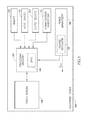
- FIG. 5 is a functional block diagram of an electronic device including the voltage regulator of FIG. 1 or 2 according to one embodiment of the present disclosure.
- FIG. 1 is a schematic of a voltage regulator 100 including a noise compensation circuit 102 that improves the supply voltage rejection (SVR) of the voltage regulator according to one embodiment of the present disclosure.
- the most significant parasitic capacitive couplings are those between the input or supply voltage line and high impedance nodes in the regulator.
- the supply voltage line is designated as an input or supply voltage node 104 and the noise compensation circuit 102 is coupled between this supply voltage node and a high impedance reference voltage node 106 in the regulator 100 .
- the noise compensation circuit 102 In operation, the noise compensation circuit 102 generates a noise cancellation signal NC on the reference voltage node 106 that cancels or at least reduces a noise signal N present on the high impedance reference voltage node 106 due to parasitic capacitive coupling between the reference voltage node and the supply voltage node 104 , as will be described in more detail below. Noise on the nodes 104 and 106 may also be referred to as a “noise signal” on these nodes in the present description.
- the voltage regulator 100 includes a voltage reference circuit 108 that is coupled between the supply voltage node 104 and a reference node 110 that is coupled to ground GND in the embodiment of FIG. 1 .
- the voltage reference circuit 108 generates a reference voltage VREF from the supply voltage VIN having an approximately constant value independent of the value of the supply voltage, provided the supply voltage is within a specified operating range.
- the reference voltage VREF is provided through a low pass RC filter 111 to provide a filtered reference voltage VREF_FILT on the high impedance reference voltage node 106 .
- the RC filter 111 filters high frequency noise that may be present on the VREF voltage from the voltage reference circuit 108 and includes a resistor RFILT coupled between the output of the voltage reference circuit 108 and the reference voltage node 106 .
- a filter capacitor CFILT of the RC filter 111 is coupled between the reference voltage node and the reference node 110 coupled to ground GND.
- the voltage regulator 100 further includes an output circuit 112 operable to generate an output voltage VOUT on an output node 114 in response to the filtered reference voltage VREF_FILT on the high impedance reference voltage node 106 .
- the output circuit includes an error amplifier 116 that is an operational amplifier in the embodiment of FIG. 1 .
- the error amplifier 116 drives a PMOS transistor 118 having it source coupled to the supply voltage node 104 and drain coupled to the output node 114 .
- a voltage divider 120 including resistors R 1 and R 2 is coupled in series with the PMOS transistor 118 between the output node 114 and the reference node 110 coupled to ground GND.
- a feedback node 122 defined at the interconnection of the resistors R 1 and R 2 provides a feedback voltage VF to the inverting input of the error amplifier 116 .
- the error amplifier 116 drives the PMOS transistor 118 so that the feedback voltage VF on the node 122 is equal to the filtered reference voltage VREF_FILT on the high impedance reference voltage node 106 .
- the values of the resistors R 1 and R 2 are chosen so that when the feedback voltage VF is equal to the filtered reference voltage VREF_FILT the output voltage VOUT has the desired value.
- the characteristics of the reference voltage node 106 will first be discussed in more detail. Filtering of the reference voltage node in voltage regulators through an RC filter is typically done in conventional voltage regulators. This RC filtering reduces high frequency noise on the reference voltage node, improves SVR performance of the voltage regulator, and provides soft-startup waveform definition, as will be appreciated by those skilled in the art.
- the RC filter 111 also provides all these functions for the voltage regulator 100 .
- the reference voltage signal VREF from the voltage reference circuit 108 is filtered by RC filter 111 to provide the filtered reference voltage signal VREF_FILT.
- the cutoff frequency of RC filter 111 should be low enough to remove the largest possible portion of the noise spectrum of the VREF signal from the voltage reference circuit 108 , as well as to remove possible high frequency signals coupled to reference voltage node 106 from the supply voltage VIN on the supply voltage node 104 .
- the values of the resistor RFILT and capacitor CFILT forming the filter must have sufficiently large values. Because the values of capacitances that can be formed in a typical integrated circuit, the maximum value of the capacitor CFILT is limited to approximately 100-200 picofarads (pF) typically. As a result, to achieve the desired low cutoff frequency of the RC filter 111 the value of the resistor RFILT must be quite large, typically in the range of 10 M ⁇ to 100 M ⁇ . This very large value for the resistor RFILT makes the reference voltage node 106 a very high impedance node.
- Noise can be coupled to the reference voltage node 106 in different ways, but the most dominant way is capacitive coupling between the supply voltage node 104 that receives the supply voltage VIN and the reference voltage node. This capacitive coupling is depicted on FIG. 1 as the parasitic capacitance CPAR coupled between the node 104 and the reference voltage node 106 .
- the coupling of noise present on the supply voltage node 104 to the reference voltage node 106 may adversely affect SVR performance of the voltage regulator 100 because any noise present on the reference voltage node 106 may be amplified by the error amplifier 116 and provided on the output node 114 superimposed on the output voltage VOUT.
- the coupling of noise from the node 104 to the high impedance reference node 106 would be minimized for good SVR performance of the regulator 100 .
- the value of the parasitic capacitance CPAR is difficult to reduce to a small enough value to avoid a negative impact on the SVR of the regulator 100 .
- the noise compensation circuit 102 Instead of trying to minimize the value of parasitic capacitance CPAR and thereby the coupling between the nodes 104 and 106 , the noise compensation circuit 102 generates the noise cancellation signal NC on the reference voltage node 106 to reduce or cancel the noise signal N present on the high impedance reference voltage node 106 due to the parasitic capacitance CPAR between the reference voltage node and the supply voltage node 104 .
- the noise compensation circuit 102 generates the noise cancellation signal NC that is inverted or has a 180 degree phase shift relative to the noise signal N. Accordingly, in the embodiment of FIG.
- the noise compensation circuit 102 includes an inverting buffer 124 that inverts the noise signal N present on the node 104 to generate the noise compensation signal NC which, in turn, is supplied through a compensation capacitor CCOMP to the reference voltage node 106 .
- the compensation circuit 102 in this way generates a signal through a compensation path that is equal in magnitude but 180 degrees shifted in phase (i.e., inverted) relative to the noise signal N that is coupled through a parasitic path.
- the compensation and parasitic paths are indicated with arrows in FIG. 1 .
- the inverting buffer 124 of the compensation circuit 102 has a wide bandwidth for effective cancellation of the noise signal N. This is true because the only those parts of the frequency spectrum of the noise signal N that are amplified and phase shifted by the inverting buffer 124 will be cancelled.
- the bandwidth of the inverting buffer 124 is thus ideally at least as wide as and overlapping the frequency spectrum of the noise signal N.
- FIG. 2 is a schematic showing in more detail the structure of the noise compensation circuit 102 of FIG. 1 according to one embodiment of the present disclosure. Components that are the same as those in FIG. 1 have been given the same reference designations and will not again be described in detail.
- FIG. 2 illustrates one embodiment of the inverting buffer 124 in the compensation circuit 102 .
- the inverting buffer 124 is formed by a PMOS transistor 200 having its drain D and source S coupled in series with a current source 202 between the voltage reference node 106 and ground node 110 .
- the PMOS transistor 200 is coupled as a diode-coupled transistor with its drain D coupled to its gate G.
- the body or bulk B of the PMOS transistor 200 is coupled to the supply voltage node 104 and is utilized in achieving the desired signal inversion of the noise signal N to generate the noise compensation signal, as will be described in more detail below.
- This embodiment of the inverting buffer 124 is a simple circuit including only the PMOS transistor 200 and current source 202 for biasing the PMOS transistor at a DC drain-to-source current IB.
- This simplicity of the buffer 124 reduces the required silicon area occupied by the circuit and also the current consumption of the circuit.
- the bias current IB defines the gate-to-source voltage V GS of the PMOS transistor 200 .
- This gate-to-source voltage V GS is also, however, a function of the source-to-bulk voltage VSB of the transistor.
- This source-to-bulk voltage VSB depends on the noise signal N present on the supply voltage node 104 since the source is maintained at the constant reference voltage VREF provided by the voltage reference circuit 108 .
- the gate-to-source voltage VGS of the transistor 200 is increasing as well. Because the source S of the transistor 200 is held at the fixed reference voltage VREF, the fact that the gate-to-source voltage VGS voltage is increasing means that the voltages of the gate G and drain D, which are coupled together, must be decreasing. This must be true for the gate-to-source voltage VGS voltage to be increasing. As a result, the polarity and thus the phases of the voltages on the gate G and drain D are the opposite relative to the voltage on the bulk B, which is the voltage on the supply voltage node 104 . Thus, as seen in FIG.
- the noise signal N present on the supply voltage node 104 and thereby the bulk B of the transistor 200 results in the transistor generating an inverted or 180 degree phase shifted version of this signal in the form of the noise cancellation signal NC on the gate G of the transistor.
- This NC signal is again applied through the compensation capacitor CCOMP to the reference voltage node 106 to cancel the noise signal N coupled to that node through the parasitic capacitor CPAR, as discussed above with reference to FIG. 1 .
- the gate G and drain D voltages have the opposite polarity (i.e., are inverted) with respect to noise signal N present on supply voltage VIN on the node 104 .
- the relationship between the source-to-bulk voltage V SB and the gate-to-source voltage V GS of the transistor 200 is given by following formula:
- ⁇ V T V T ⁇ ⁇ 0 + ⁇ ⁇ ( ⁇ ⁇ ⁇ V S ⁇ ⁇ B + 2 ⁇ ⁇ B - 2 ⁇ ⁇ B ) Eqn . ⁇ 1
- ⁇ the body effect parameter of the transistor
- the DC voltage present on the drain D and gate G of the PMOS transistor 200 does not affect the operation of the transistor because the gate and drain are coupled isolated for DC signals from the reference voltage node 106 by the compensation capacitor CCOMP. Instead, the transfer characteristics of the PMOS transistor 200 are of significance since these transfer characteristics need to handle signals in the specified range of frequencies over which the SVR of the regulator 100 is to be improved.
- the SVR is a frequency-dependent parameter as mentioned above, and thus the transfer characteristics of the PMOS transistor 200 must operate on signals in the frequency range that the SVR is to be improved.
- FIG. 3 is graph showing in the solid line the supply voltage rejection (SVR) as function of frequency for a post-layout simulation of the voltage regulator 100 of FIG. 2 including the noise compensation circuit 102 .
- FIG. 3 also shows through the dashed line a post-layout simulation of the SVR of the regulator 100 of FIG. 1 or 2 with the compensation circuit 102 omitted.
- a post-layout simulation is a computer simulation of the operation of a circuit after a computer-generated physical layout for the circuit has been generated, as will be appreciated by those skilled in the art.
- the graph of FIG. 3 shows the SVR in decibels dB on the vertical axis and frequency along the horizontal axis. The frequency range of interest in the example in FIG.
- FIG. 4 is a graph again showing SVR a function of frequency for an actual integrated circuit embodiment of the voltage regulator 100 of FIG. 2 .
- the vertical axis of the graph again shows the SVR in decibels dB while frequency is again shown along the horizontal axis. Up until about 1 kHz the SVR is very high as just below +90 dB and at about 1 kHz the SVR starts decreasing in magnitude. The more positive the SVR the better and as seen in FIG. 4 even at 10 kHz the SVR is still almost +80 dB.
- FIG. 4 illustrates the a real embodiment of the voltage regulator 100 of FIG. 2 actually formed in a semiconductor chip provides a good SVR over the frequency range of interest, namely 10 Hz-10 kHz.
- FIG. 5 is a functional block diagram of an electronic device 500 including the voltage regulator 100 of FIG. 1 or 2 according to one embodiment of the present disclosure.
- the electronic device 500 in the example embodiment of FIG. 5 includes processing circuitry 502 that controls the overall operation of the electronic device 500 and also executes applications or “apps” 504 that provide specific functionality for a user of the electronic device.
- the voltage regulator 100 is shown as being contained in a power management subsystem 506 of the electronic device 500 and provides the generated output voltage VOUT to other components in the electronic device.
- the electronic device 500 may be any type of electronic device, such as a smart phone, tablet computer, laptop computer, desktop computer, other types of portable electronic devices like music players, wearable electronic devices like a heart rate or activity monitors, and so on.
- the power management subsystem 506 of the electronic device 500 is coupled to the processing circuitry 502 and may include a battery for powering the electronic device 500 and also control circuitry for controlling power-related operating modes of the device such as charging of the battery, power-savings modes, and so on.
- the electronic device 500 further includes a video component such as a touch screen 508 with a touch display (not shown) like a liquid crystal display (LCD) and a touch panel (not shown) attached to or formed as an integral part of the touch display.
- the touch screen 508 senses touches of a user of the electronic device 500 and provides sensed touch information to the processing circuitry 502 to thereby allow the user to interface with and control the operation of the electronic device.
- the processing circuitry 502 also controls the touch screen 508 to display desired visual content on the touch display portion of the touch screen.
- the electronic device 500 further includes data storage or memory 510 coupled to the processing circuitry 502 for storing and retrieving data including the apps 504 and other software executing on the processing circuitry and utilized by the electronic device 500 during operation.
- Examples of typical types of memory 510 include solid state memory such as DRAM, SRAM and FLASH, solid state drives (SSDs), and may include any other type of memory suited to the desired functionality of the electronic device 500 including digital video disks (DVDs), compact disk read-only (CD-ROMs), compact disk read-write (CD-RW) memories, magnetic tape, hard and floppy magnetic disks, tape cassettes, and so on.
- Input devices 512 are coupled to the processing circuitry 502 and may include a keypad, whether implemented through the touch screen 508 or separately, a pressure sensor, accelerometer, microphone, keyboard, mouse, digital camera to capture still and video images, and other suitable input devices.
- Output devices 514 are coupled to the processing circuitry 502 and may include, for example, audio output devices such as a speaker, printer, vibration device, and so on.
- the input devices 512 and output devices 514 collectively may include other types of typical communications ports for the electronic device 500 , such as USB ports, HDMI ports, and so on.
- the electronic device 500 further includes communications subsystems 516 coupled to the processing circuitry 502 and which may include Wi-Fi, GPS, cellular and Bluetooth subsystems for providing the device with the corresponding functionality.
- the specific type and number of input devices 512 , output devices 514 , communications subsystems 516 , and even the specific functionality of the power management subsystem 506 will of course depend on the type of the electronic device 500
Landscapes
- Engineering & Computer Science (AREA)
- Power Engineering (AREA)
- Physics & Mathematics (AREA)
- Electromagnetism (AREA)
- General Physics & Mathematics (AREA)
- Radar, Positioning & Navigation (AREA)
- Automation & Control Theory (AREA)
- Continuous-Control Power Sources That Use Transistors (AREA)
Abstract
Description
where ΔVT is the change in threshold voltage VT of the
where A is now the
The DC voltage present on the drain D and gate G of the
Claims (15)
Priority Applications (3)
| Application Number | Priority Date | Filing Date | Title |
|---|---|---|---|
| US14/986,425 US9742270B2 (en) | 2015-12-31 | 2015-12-31 | Voltage regulator circuits, systems and methods for having improved supply to voltage rejection (SVR) |
| CN201621061920.5U CN206610190U (en) | 2015-12-31 | 2016-09-18 | Voltage regulator and electronic equipment |
| CN201610829684.5A CN106933287B (en) | 2015-12-31 | 2016-09-18 | Voltage modulator circuit, system and method with the inhibition of improved supply voltage |
Applications Claiming Priority (1)
| Application Number | Priority Date | Filing Date | Title |
|---|---|---|---|
| US14/986,425 US9742270B2 (en) | 2015-12-31 | 2015-12-31 | Voltage regulator circuits, systems and methods for having improved supply to voltage rejection (SVR) |
Publications (2)
| Publication Number | Publication Date |
|---|---|
| US20170194855A1 US20170194855A1 (en) | 2017-07-06 |
| US9742270B2 true US9742270B2 (en) | 2017-08-22 |
Family
ID=59235901
Family Applications (1)
| Application Number | Title | Priority Date | Filing Date |
|---|---|---|---|
| US14/986,425 Active US9742270B2 (en) | 2015-12-31 | 2015-12-31 | Voltage regulator circuits, systems and methods for having improved supply to voltage rejection (SVR) |
Country Status (2)
| Country | Link |
|---|---|
| US (1) | US9742270B2 (en) |
| CN (2) | CN106933287B (en) |
Cited By (1)
| Publication number | Priority date | Publication date | Assignee | Title |
|---|---|---|---|---|
| US11940829B2 (en) | 2020-08-07 | 2024-03-26 | Scalinx | Voltage regulator and methods of regulating a voltage, including examples of compensation networks |
Families Citing this family (9)
| Publication number | Priority date | Publication date | Assignee | Title |
|---|---|---|---|---|
| TWI598718B (en) * | 2016-08-26 | 2017-09-11 | 瑞昱半導體股份有限公司 | Voltage regulator with noise cancellation |
| CN106786104B (en) * | 2017-01-12 | 2019-06-07 | 天津市先智电气设备有限公司 | Vertical lift type dual power supply device |
| US9899922B1 (en) * | 2017-02-13 | 2018-02-20 | Qualcomm Incorporated | Digital sub-regulators |
| US10185344B1 (en) * | 2018-06-01 | 2019-01-22 | Semiconductor Components Industries, Llc | Compensation of input current of LDO output stage |
| DE112018007763B4 (en) | 2018-06-27 | 2023-02-23 | Dialog Semiconductor (Uk) Limited | CIRCUIT AND METHOD FOR REDUCING NOISE SIGNAL |
| CN110928352B (en) * | 2019-11-21 | 2021-09-10 | 思瑞浦微电子科技(苏州)股份有限公司 | Large-capacitance slow-start circuit and method |
| CN116136701B (en) * | 2021-11-17 | 2025-01-24 | 科奇芯有限公司 | Voltage Regulator Circuit |
| TWI826902B (en) * | 2021-11-17 | 2023-12-21 | 香港商科奇芯有限公司 | Charge pump circuit |
| US11789478B2 (en) * | 2022-02-22 | 2023-10-17 | Credo Technology Group Limited | Voltage regulator with supply noise cancellation |
Citations (4)
| Publication number | Priority date | Publication date | Assignee | Title |
|---|---|---|---|---|
| US6157180A (en) * | 1999-03-04 | 2000-12-05 | National Semiconductor Corporation | Power supply regulator circuit for voltage-controlled oscillator |
| US6603293B2 (en) * | 2001-11-19 | 2003-08-05 | Dialog Semiconductor Gmbh | Power supply rejection ratio optimization during test |
| US20040017698A1 (en) * | 2002-07-25 | 2004-01-29 | Micron Technology, Inc. | Refined gate coupled noise compensation for open-drain output from semiconductor device |
| US20070029981A1 (en) * | 2005-08-02 | 2007-02-08 | Dell Products L.P. | Information handling system including a power supply unit with a switching regulator that reduces transient load release |
Family Cites Families (2)
| Publication number | Priority date | Publication date | Assignee | Title |
|---|---|---|---|---|
| CN102681582A (en) * | 2012-05-29 | 2012-09-19 | 昆山锐芯微电子有限公司 | Linear voltage stabilizing circuit with low voltage difference |
| US9645594B2 (en) * | 2015-10-13 | 2017-05-09 | STMicroelectronics Design & Application S.R.O. | Voltage regulator with dropout detector and bias current limiter and associated methods |
-
2015
- 2015-12-31 US US14/986,425 patent/US9742270B2/en active Active
-
2016
- 2016-09-18 CN CN201610829684.5A patent/CN106933287B/en active Active
- 2016-09-18 CN CN201621061920.5U patent/CN206610190U/en active Active
Patent Citations (4)
| Publication number | Priority date | Publication date | Assignee | Title |
|---|---|---|---|---|
| US6157180A (en) * | 1999-03-04 | 2000-12-05 | National Semiconductor Corporation | Power supply regulator circuit for voltage-controlled oscillator |
| US6603293B2 (en) * | 2001-11-19 | 2003-08-05 | Dialog Semiconductor Gmbh | Power supply rejection ratio optimization during test |
| US20040017698A1 (en) * | 2002-07-25 | 2004-01-29 | Micron Technology, Inc. | Refined gate coupled noise compensation for open-drain output from semiconductor device |
| US20070029981A1 (en) * | 2005-08-02 | 2007-02-08 | Dell Products L.P. | Information handling system including a power supply unit with a switching regulator that reduces transient load release |
Cited By (1)
| Publication number | Priority date | Publication date | Assignee | Title |
|---|---|---|---|---|
| US11940829B2 (en) | 2020-08-07 | 2024-03-26 | Scalinx | Voltage regulator and methods of regulating a voltage, including examples of compensation networks |
Also Published As
| Publication number | Publication date |
|---|---|
| US20170194855A1 (en) | 2017-07-06 |
| CN106933287B (en) | 2018-12-21 |
| CN106933287A (en) | 2017-07-07 |
| CN206610190U (en) | 2017-11-03 |
Similar Documents
| Publication | Publication Date | Title |
|---|---|---|
| US20170194855A1 (en) | Voltage regulator circuits, systems and methods for having improved supply to voltage rejection (svr) | |
| US9383618B2 (en) | Semiconductor structures for enhanced transient response in low dropout (LDO) voltage regulators | |
| CN105024653B (en) | Low-noise amplifier for MEMS capacitive transducer | |
| CN111417914B (en) | Low dropout voltage stabilizer of turnover voltage follower | |
| CN108964451B (en) | LDO (Low dropout regulator) and operation method thereof | |
| US8779736B2 (en) | Adaptive miller compensated voltage regulator | |
| EP3208942B1 (en) | Input device | |
| JP5818761B2 (en) | Voltage regulator | |
| CN115461975A (en) | Current mode feed forward ripple cancellation | |
| JP5501977B2 (en) | Variable impedance gate decoupling cell | |
| US20160085250A1 (en) | Linear Regulator with Improved Power Supply Ripple Rejection | |
| CN116643609B (en) | Voltage regulator with power supply noise cancellation | |
| US9706312B2 (en) | Sensing circuit and method of detecting an electrical signal generated by a microphone | |
| US10582309B2 (en) | MEMS transducer amplifiers | |
| US7525347B1 (en) | Differential peak detector | |
| US10775822B2 (en) | Circuit for voltage regulation and voltage regulating method | |
| CN108334149B (en) | Low quiescent current high PSRR low dropout linear regulator circuit | |
| US10042373B2 (en) | High unity gain bandwidth voltage regulation for integrated circuits | |
| Kim et al. | A high-PSRR NMOS LDO regulator with intrinsic gain-tracking ripple cancellation technique | |
| WO2016095693A1 (en) | Driving circuit and driving method for touch device, touch device and display device | |
| US9077287B2 (en) | Sound detecting circuit and amplifier circuit thereof | |
| US10216206B1 (en) | Optical sensor device and voltage regulator apparatus with improved noise rejection capability | |
| Ahmadi et al. | Double-OTA External Capless Low-power LDO Regulator with Enhanced PSR and Transient Response | |
| Pei et al. | A low power LDO with high PSR over a wide frequency range based on an impedance attenuation buffer | |
| US9553578B2 (en) | Transistor switch having constant on resistance with input signal with having variable voltage component |
Legal Events
| Date | Code | Title | Description |
|---|---|---|---|
| AS | Assignment |
Owner name: STMICROELECTRONICS DESIGN AND APPLICATION S.R.O., Free format text: ASSIGNMENT OF ASSIGNORS INTEREST;ASSIGNOR:PETENYI, SANDOR;REEL/FRAME:037456/0257 Effective date: 20160111 |
|
| STCF | Information on status: patent grant |
Free format text: PATENTED CASE |
|
| MAFP | Maintenance fee payment |
Free format text: PAYMENT OF MAINTENANCE FEE, 4TH YEAR, LARGE ENTITY (ORIGINAL EVENT CODE: M1551); ENTITY STATUS OF PATENT OWNER: LARGE ENTITY Year of fee payment: 4 |
|
| AS | Assignment |
Owner name: STMICROELECTRONICS INTERNATIONAL N.V., SWITZERLAND Free format text: ASSIGNMENT OF ASSIGNORS INTEREST;ASSIGNOR:STMICROELECTRONICS DESIGN AND APPLICATION S.R.O.;REEL/FRAME:061796/0218 Effective date: 20221031 |
|
| MAFP | Maintenance fee payment |
Free format text: PAYMENT OF MAINTENANCE FEE, 8TH YEAR, LARGE ENTITY (ORIGINAL EVENT CODE: M1552); ENTITY STATUS OF PATENT OWNER: LARGE ENTITY Year of fee payment: 8 |