US9738628B2 - Substituted 1H-indazol-1-OL analogs as inhibitors of beta catenin/Tcf protein-protein interactions - Google Patents
Substituted 1H-indazol-1-OL analogs as inhibitors of beta catenin/Tcf protein-protein interactions Download PDFInfo
- Publication number
- US9738628B2 US9738628B2 US15/017,296 US201615017296A US9738628B2 US 9738628 B2 US9738628 B2 US 9738628B2 US 201615017296 A US201615017296 A US 201615017296A US 9738628 B2 US9738628 B2 US 9738628B2
- Authority
- US
- United States
- Prior art keywords
- compound
- polyhaloalkyl
- alkoxy
- haloalkyl
- halogen
- Prior art date
- Legal status (The legal status is an assumption and is not a legal conclusion. Google has not performed a legal analysis and makes no representation as to the accuracy of the status listed.)
- Expired - Fee Related
Links
- 0 *C1=C(*)C2=C(CCC2)C(*)=C1*C1=NCCN1 Chemical compound *C1=C(*)C2=C(CCC2)C(*)=C1*C1=NCCN1 0.000 description 40
- QUJLMJZZIJSCRS-UHFFFAOYSA-N ON1N=NC2=C1C=CC(COCC1=NN=NN1)=C2 Chemical compound ON1N=NC2=C1C=CC(COCC1=NN=NN1)=C2 QUJLMJZZIJSCRS-UHFFFAOYSA-N 0.000 description 4
- OHYDJHRBBHFTSX-UHFFFAOYSA-N C=C1CC(CC2=CC3=C(C=C2)N(O)N=C3)=NO1.C=C1CC(CC2=CC3=C(C=C2)N(O)N=N3)=NO1.C=C1CC(CC2=CC3=C(C=C2)N(O)N=N3)=NO1.O=C1NC(CCC2=CC3=C(C=C2)N(O)N=N3)=NO1.ON1N=CC2=C1C=CC(CCC1=CNN=N1)=C2.ON1N=NC2=C1C=CC(CC1=NCN=N1)=C2.ON1N=NC2=C1C=CC(CCC1=NOC(=S)C1)=C2.ON1N=NC2=C1C=CC(OCC1=NNN=N1)=C2 Chemical compound C=C1CC(CC2=CC3=C(C=C2)N(O)N=C3)=NO1.C=C1CC(CC2=CC3=C(C=C2)N(O)N=N3)=NO1.C=C1CC(CC2=CC3=C(C=C2)N(O)N=N3)=NO1.O=C1NC(CCC2=CC3=C(C=C2)N(O)N=N3)=NO1.ON1N=CC2=C1C=CC(CCC1=CNN=N1)=C2.ON1N=NC2=C1C=CC(CC1=NCN=N1)=C2.ON1N=NC2=C1C=CC(CCC1=NOC(=S)C1)=C2.ON1N=NC2=C1C=CC(OCC1=NNN=N1)=C2 OHYDJHRBBHFTSX-UHFFFAOYSA-N 0.000 description 3
- JNSVORJMTUYYER-UHFFFAOYSA-N CC(=O)N(CC1=NCCN1)C1=CC2=C(C=C1)CCC2.CCC(=O)N(CC1=NCCN1)C1=CC2=C(C=C1)CCC2.CCCC(=O)N(CC1=NCCN1)C1=CC2=C(C=C1)CCC2 Chemical compound CC(=O)N(CC1=NCCN1)C1=CC2=C(C=C1)CCC2.CCC(=O)N(CC1=NCCN1)C1=CC2=C(C=C1)CCC2.CCCC(=O)N(CC1=NCCN1)C1=CC2=C(C=C1)CCC2 JNSVORJMTUYYER-UHFFFAOYSA-N 0.000 description 3
- KZGDVTUGJXOUGN-UHFFFAOYSA-N O=C(C1=CC(Cl)=CC=C1)N(CC1=NNN=N1)C1=CC2=C(C=C1)N(O)N=C2 Chemical compound O=C(C1=CC(Cl)=CC=C1)N(CC1=NNN=N1)C1=CC2=C(C=C1)N(O)N=C2 KZGDVTUGJXOUGN-UHFFFAOYSA-N 0.000 description 3
- MAAUHNIURJDPHL-UHFFFAOYSA-N O=C(CCC1=CC=CC=C1)N(CC1=NNN=N1)C1=CC2=C(C=C1)N(O)N=C2 Chemical compound O=C(CCC1=CC=CC=C1)N(CC1=NNN=N1)C1=CC2=C(C=C1)N(O)N=C2 MAAUHNIURJDPHL-UHFFFAOYSA-N 0.000 description 3
- SSXAVDZNNRACMV-UHFFFAOYSA-N O=C1CC(CCC2=CC=C3C(=C2)/N=N\N3O)=NO1 Chemical compound O=C1CC(CCC2=CC=C3C(=C2)/N=N\N3O)=NO1 SSXAVDZNNRACMV-UHFFFAOYSA-N 0.000 description 3
- AIFSGKBMHFNKCB-UHFFFAOYSA-N O=C1NC(CC2=CC=C3C(=C2)/N=N\N3O)=NO1 Chemical compound O=C1NC(CC2=CC=C3C(=C2)/N=N\N3O)=NO1 AIFSGKBMHFNKCB-UHFFFAOYSA-N 0.000 description 3
- GTIJMCQFLLAPKH-UHFFFAOYSA-N ON1/N=N\C2=CC(CC3=NN=NN3)=CC=C21 Chemical compound ON1/N=N\C2=CC(CC3=NN=NN3)=CC=C21 GTIJMCQFLLAPKH-UHFFFAOYSA-N 0.000 description 3
- HRTDXMYXTKTDAF-UHFFFAOYSA-N ON1/N=N\C2=CC(CC3=NOC(=S)N3)=CC=C21 Chemical compound ON1/N=N\C2=CC(CC3=NOC(=S)N3)=CC=C21 HRTDXMYXTKTDAF-UHFFFAOYSA-N 0.000 description 3
- ILSPBLDTHMAASO-UHFFFAOYSA-N ON1N=NC2=CC(CCC3=NNN=N3)=CC=C21 Chemical compound ON1N=NC2=CC(CCC3=NNN=N3)=CC=C21 ILSPBLDTHMAASO-UHFFFAOYSA-N 0.000 description 3
- KOYKKIGEWMZWKY-UHFFFAOYSA-N C1=CC2=C(C=NN2)C=C1CCC1=CNN=N1.CC1=CC=CC(C(=O)N(CC2=NNN=N2)C2=CC3=C(C=C2)N(O)N=C3)=C1.CC1=COC(C)=C1C(=O)N(CC1=NNN=N1)C1=CC2=C(C=C1)N(O)N=C2.O=C(C1=CC(F)=CC(Br)=C1)N(CC1=NNN=N1)C1=CC2=C(C=C1)N(O)N=C2.O=C(C1=CN=CC=C1)N(CC1=NNN=N1)C1=CC2=C(C=C1)N(O)N=C2.O=C(CCC1=CC=CC=C1)N(CC1=NNN=N1)C1=CC2=C(C=C1)N(O)N=C2.ON1N=CC2=C1C=CC(NCC1=CNN=N1)=C2 Chemical compound C1=CC2=C(C=NN2)C=C1CCC1=CNN=N1.CC1=CC=CC(C(=O)N(CC2=NNN=N2)C2=CC3=C(C=C2)N(O)N=C3)=C1.CC1=COC(C)=C1C(=O)N(CC1=NNN=N1)C1=CC2=C(C=C1)N(O)N=C2.O=C(C1=CC(F)=CC(Br)=C1)N(CC1=NNN=N1)C1=CC2=C(C=C1)N(O)N=C2.O=C(C1=CN=CC=C1)N(CC1=NNN=N1)C1=CC2=C(C=C1)N(O)N=C2.O=C(CCC1=CC=CC=C1)N(CC1=NNN=N1)C1=CC2=C(C=C1)N(O)N=C2.ON1N=CC2=C1C=CC(NCC1=CNN=N1)=C2 KOYKKIGEWMZWKY-UHFFFAOYSA-N 0.000 description 2
- YTFHECDZYLMUFV-UHFFFAOYSA-N CC1=CC=CC(C(=O)N(CC2=NNN=N2)C2=CC3=C(C=C2)N(O)/N=C\3)=C1.CC1=COC(C)=C1C(=O)N(CC1=NNN=N1)C1=CC2=C(C=C1)N(O)/N=C\2.CCC(=O)N(CC1=NNN=N1)C1=CC2=C(C=C1)N(O)/N=C\2.O=C(C1=CC(F)=CC(Br)=C1)N(CC1=NNN=N1)C1=CC2=C(C=C1)N(O)/N=C\2.O=C(C1=CN=CC=C1)N(CC1=NNN=N1)C1=CC2=C(C=C1)N(O)/N=C\2.O=C(C1CC1)N(CC1=NNN=N1)C1=CC2=C(C=C1)N(O)/N=C\2.O=C(CCC1=CC=CC=C1)N(CC1=NNN=N1)C1=CC2=C(C=C1)N(O)/N=C\2.O=C(CCC1CCCC1)N(CC1=NNN=N1)C1=CC2=C(C=C1)N(O)/N=C\2 Chemical compound CC1=CC=CC(C(=O)N(CC2=NNN=N2)C2=CC3=C(C=C2)N(O)/N=C\3)=C1.CC1=COC(C)=C1C(=O)N(CC1=NNN=N1)C1=CC2=C(C=C1)N(O)/N=C\2.CCC(=O)N(CC1=NNN=N1)C1=CC2=C(C=C1)N(O)/N=C\2.O=C(C1=CC(F)=CC(Br)=C1)N(CC1=NNN=N1)C1=CC2=C(C=C1)N(O)/N=C\2.O=C(C1=CN=CC=C1)N(CC1=NNN=N1)C1=CC2=C(C=C1)N(O)/N=C\2.O=C(C1CC1)N(CC1=NNN=N1)C1=CC2=C(C=C1)N(O)/N=C\2.O=C(CCC1=CC=CC=C1)N(CC1=NNN=N1)C1=CC2=C(C=C1)N(O)/N=C\2.O=C(CCC1CCCC1)N(CC1=NNN=N1)C1=CC2=C(C=C1)N(O)/N=C\2 YTFHECDZYLMUFV-UHFFFAOYSA-N 0.000 description 2
- WQLNZJGOQRIITG-UHFFFAOYSA-N CC1=NOC(C)=C1C(=O)N(CC1=NNN=N1)C1=CC2=C(C=C1)N(O)N=C2 Chemical compound CC1=NOC(C)=C1C(=O)N(CC1=NNN=N1)C1=CC2=C(C=C1)N(O)N=C2 WQLNZJGOQRIITG-UHFFFAOYSA-N 0.000 description 2
- BXHGOWYNCVCAGC-UHFFFAOYSA-N CCC(=O)N(CC1=NNN=N1)C1=CC2=C(C=C1)N(O)N=C2 Chemical compound CCC(=O)N(CC1=NNN=N1)C1=CC2=C(C=C1)N(O)N=C2 BXHGOWYNCVCAGC-UHFFFAOYSA-N 0.000 description 2
- ZMJRGEOIQKSFCJ-UHFFFAOYSA-N CCC(=O)N(CC1=NNN=N1)C1=CC2=C(C=C1)N(O)N=C2.O=C(C1CC1)N(CC1=NNN=N1)C1=CC2=C(C=C1)N(O)N=C2.O=C(CCC1CCCC1)N(CC1=NNN=N1)C1=CC2=C(C=C1)N(O)N=C2 Chemical compound CCC(=O)N(CC1=NNN=N1)C1=CC2=C(C=C1)N(O)N=C2.O=C(C1CC1)N(CC1=NNN=N1)C1=CC2=C(C=C1)N(O)N=C2.O=C(CCC1CCCC1)N(CC1=NNN=N1)C1=CC2=C(C=C1)N(O)N=C2 ZMJRGEOIQKSFCJ-UHFFFAOYSA-N 0.000 description 2
- JFDYMNOCOFGFRA-UHFFFAOYSA-N N#CCN(C(=O)CCC1=CC=CC=C1)C1=CC2=C(C=C1)N(OCC1=CC=CC=C1)N=C2 Chemical compound N#CCN(C(=O)CCC1=CC=CC=C1)C1=CC2=C(C=C1)N(OCC1=CC=CC=C1)N=C2 JFDYMNOCOFGFRA-UHFFFAOYSA-N 0.000 description 2
- YZLNSVZRTXSQTI-UHFFFAOYSA-N O=C(C1=CC(Br)=CC(F)=C1)N(CC1=NNN=N1)C1=CC2=C(C=C1)N(O)N=C2 Chemical compound O=C(C1=CC(Br)=CC(F)=C1)N(CC1=NNN=N1)C1=CC2=C(C=C1)N(O)N=C2 YZLNSVZRTXSQTI-UHFFFAOYSA-N 0.000 description 2
- GVKKXZXZIKWEIT-UHFFFAOYSA-N O=C(C1=CN=CC=C1)N(CC1=NNN=N1)C1=CC2=C(C=C1)N(O)N=C2 Chemical compound O=C(C1=CN=CC=C1)N(CC1=NNN=N1)C1=CC2=C(C=C1)N(O)N=C2 GVKKXZXZIKWEIT-UHFFFAOYSA-N 0.000 description 2
- FVEWKTKQFYGCKR-UHFFFAOYSA-N O=C(C1CC1)N(CC1=NNN=N1)C1=CC2=C(C=C1)N(O)N=C2 Chemical compound O=C(C1CC1)N(CC1=NNN=N1)C1=CC2=C(C=C1)N(O)N=C2 FVEWKTKQFYGCKR-UHFFFAOYSA-N 0.000 description 2
- VNEXKWGCBXCBNE-UHFFFAOYSA-N O=C(CCC1CCCC1)N(CC1=NNN=N1)C1=CC2=C(C=C1)N(O)N=C2 Chemical compound O=C(CCC1CCCC1)N(CC1=NNN=N1)C1=CC2=C(C=C1)N(O)N=C2 VNEXKWGCBXCBNE-UHFFFAOYSA-N 0.000 description 2
- FLGKDVDMZZTEOX-UHFFFAOYSA-N ON1/N=N\C2=CC(CCC3=NOC(=S)C3)=CC=C21 Chemical compound ON1/N=N\C2=CC(CCC3=NOC(=S)C3)=CC=C21 FLGKDVDMZZTEOX-UHFFFAOYSA-N 0.000 description 2
- SJMQAQGXIMWSTO-UHFFFAOYSA-N ON1/N=N\C2=CC(OCC3=NNN=N3)=CC=C21 Chemical compound ON1/N=N\C2=CC(OCC3=NNN=N3)=CC=C21 SJMQAQGXIMWSTO-UHFFFAOYSA-N 0.000 description 2
- BMXZPKFXZVKHRY-UHFFFAOYSA-N ON1N=CC2=C1C=CC(CC1=NNN=N1)=C2 Chemical compound ON1N=CC2=C1C=CC(CC1=NNN=N1)=C2 BMXZPKFXZVKHRY-UHFFFAOYSA-N 0.000 description 2
- TWVUMBVGMTYEEA-UHFFFAOYSA-N BrCC1=CC2=C(C=C1)CN=C2 Chemical compound BrCC1=CC2=C(C=C1)CN=C2 TWVUMBVGMTYEEA-UHFFFAOYSA-N 0.000 description 1
- JRWUWRGGKKPNNN-UHFFFAOYSA-N C.C.C.C.C.CN1N=CN=C1CO.CN1N=NC(CO)=N1.CN1N=NC2=CC(CBr)=CC=C21.CN1N=NN=C1COCC1=CC2=C(C=C1)N(C)N=N2.N#CCO.N#C[Na].ON1N=NC2=C1C=CC(COCC1=NN=NN1)=C2 Chemical compound C.C.C.C.C.CN1N=CN=C1CO.CN1N=NC(CO)=N1.CN1N=NC2=CC(CBr)=CC=C21.CN1N=NN=C1COCC1=CC2=C(C=C1)N(C)N=N2.N#CCO.N#C[Na].ON1N=NC2=C1C=CC(COCC1=NN=NN1)=C2 JRWUWRGGKKPNNN-UHFFFAOYSA-N 0.000 description 1
- SNCSPCIOLPGALW-UHFFFAOYSA-N C.CC1=CC=C([N+](=O)[O-])C(Cl)=C1.CC1=CC=C2C(=C1)N=NN2C.CC1=CC=C2C(=C1)N=NN2O.CCCC[Sn](CCCC)(CCCC)N=[N+]=[N-].CN1N=NC2=CC(CBr)=CC=C21.CN1N=NC2=CC(CC#N)=CC=C21.CN1N=NC2=CC(CC3=NN=NN3)=CC=C21.N#C[Na].ON1N=NC2=CC(CC3=NN=NN3)=CC=C21 Chemical compound C.CC1=CC=C([N+](=O)[O-])C(Cl)=C1.CC1=CC=C2C(=C1)N=NN2C.CC1=CC=C2C(=C1)N=NN2O.CCCC[Sn](CCCC)(CCCC)N=[N+]=[N-].CN1N=NC2=CC(CBr)=CC=C21.CN1N=NC2=CC(CC#N)=CC=C21.CN1N=NC2=CC(CC3=NN=NN3)=CC=C21.N#C[Na].ON1N=NC2=CC(CC3=NN=NN3)=CC=C21 SNCSPCIOLPGALW-UHFFFAOYSA-N 0.000 description 1
- WBCGPVOSNKZXBY-UHFFFAOYSA-N C.CCCC[Sn](CCCC)(CCCC)N=[N+]=[N-].CN1N=NC2=CC(OCC#N)=CC=C21.CN1N=NC2=CC(OCC3=NNN=N3)=CC=C21.COC1=CC=C(COC2=CC=C3C(=C2)N=NN3C)C=C1.COC1=CC=C(COC2=CC=C3C(=C2)N=NN3O)C=C1.O=[N+]([O-])C1=CC=C(O)C=C1F.ON1N=NC2=CC(OCC3=NNN=N3)=CC=C21 Chemical compound C.CCCC[Sn](CCCC)(CCCC)N=[N+]=[N-].CN1N=NC2=CC(OCC#N)=CC=C21.CN1N=NC2=CC(OCC3=NNN=N3)=CC=C21.COC1=CC=C(COC2=CC=C3C(=C2)N=NN3C)C=C1.COC1=CC=C(COC2=CC=C3C(=C2)N=NN3O)C=C1.O=[N+]([O-])C1=CC=C(O)C=C1F.ON1N=NC2=CC(OCC3=NNN=N3)=CC=C21 WBCGPVOSNKZXBY-UHFFFAOYSA-N 0.000 description 1
- GCMQAJBHFIKXKP-UHFFFAOYSA-N C1=CC2=C(C=C1CC1=NCCN1)CCC2.C1=CC2=C(C=C1CCC1=NCCN1)CCC2.C1=CC2=C(C=C1CCCC1=NCCN1)CCC2.C1=CC2=C(C=C1CNCC1=NCCN1)CCC2.C1=CC2=C(C=C1COCC1=NCCN1)CCC2.C1=CC2=C(C=C1NCC1=NCCN1)CCC2.C1=CC2=C(C=C1OCC1=NCCN1)CCC2 Chemical compound C1=CC2=C(C=C1CC1=NCCN1)CCC2.C1=CC2=C(C=C1CCC1=NCCN1)CCC2.C1=CC2=C(C=C1CCCC1=NCCN1)CCC2.C1=CC2=C(C=C1CNCC1=NCCN1)CCC2.C1=CC2=C(C=C1COCC1=NCCN1)CCC2.C1=CC2=C(C=C1NCC1=NCCN1)CCC2.C1=CC2=C(C=C1OCC1=NCCN1)CCC2 GCMQAJBHFIKXKP-UHFFFAOYSA-N 0.000 description 1
- DCWDWZASZPIQFP-UHFFFAOYSA-N C1=CC2=C(C=C1CCC1=NNN=N1)/C=N\N2.C=C1CC(CC2=CC3=C(C=C2)N(O)/N=C\3)=NO1.ON1/N=C\C2=C1C=CC(CC1=NCN=N1)=C2.ON1/N=C\C2=C1C=CC(CCC1=NOC(=S)C1)=C2.ON1/N=C\C2=C1C=CC(COCC1=NNN=N1)=C2.ON1/N=C\C2=C1C=CC(NCC1=NNN=N1)=C2.ON1/N=N\C2=C1C=CC(CCC1=NNN=N1)=C2 Chemical compound C1=CC2=C(C=C1CCC1=NNN=N1)/C=N\N2.C=C1CC(CC2=CC3=C(C=C2)N(O)/N=C\3)=NO1.ON1/N=C\C2=C1C=CC(CC1=NCN=N1)=C2.ON1/N=C\C2=C1C=CC(CCC1=NOC(=S)C1)=C2.ON1/N=C\C2=C1C=CC(COCC1=NNN=N1)=C2.ON1/N=C\C2=C1C=CC(NCC1=NNN=N1)=C2.ON1/N=N\C2=C1C=CC(CCC1=NNN=N1)=C2 DCWDWZASZPIQFP-UHFFFAOYSA-N 0.000 description 1
- RBVHZNSOIKKYOJ-UHFFFAOYSA-N C1=CC2=C(C=C1CCC1=NNN=N1)N=NC2 Chemical compound C1=CC2=C(C=C1CCC1=NNN=N1)N=NC2 RBVHZNSOIKKYOJ-UHFFFAOYSA-N 0.000 description 1
- HFDDQQCOOUDMJU-UHFFFAOYSA-N C1=CC2=C(C=NC2)C=C1CCC1=NNN=N1 Chemical compound C1=CC2=C(C=NC2)C=C1CCC1=NNN=N1 HFDDQQCOOUDMJU-UHFFFAOYSA-N 0.000 description 1
- AFTKSYWTEVKVBX-UHFFFAOYSA-N C1=CC2=C(C=NN2)C=C1CCC1=NNN=N1 Chemical compound C1=CC2=C(C=NN2)C=C1CCC1=NNN=N1 AFTKSYWTEVKVBX-UHFFFAOYSA-N 0.000 description 1
- QIQRDUIQUGKPHV-UHFFFAOYSA-N C1=CC2=C(C=NN2)C=C1CCC1=NNN=N1.C=C1CC(CC2=CC3=C(C=C2)N(O)N=C3)=NO1.O=C1CC(CCC2=CC3=C(C=C2)N(O)N=C3)=NO1.ON1N=CC2=C1C=CC(CC1=NCN=N1)=C2.ON1N=CC2=C1C=CC(CCC1=NOC(=S)N1)=C2.ON1N=CC2=C1C=CC(COCC1=NNN=N1)=C2.ON1N=NC2=C1C=CC(CCC1=NNN=N1)=C2.ON1N=NC2=C1C=CC(COCC1=NNN=N1)=C2 Chemical compound C1=CC2=C(C=NN2)C=C1CCC1=NNN=N1.C=C1CC(CC2=CC3=C(C=C2)N(O)N=C3)=NO1.O=C1CC(CCC2=CC3=C(C=C2)N(O)N=C3)=NO1.ON1N=CC2=C1C=CC(CC1=NCN=N1)=C2.ON1N=CC2=C1C=CC(CCC1=NOC(=S)N1)=C2.ON1N=CC2=C1C=CC(COCC1=NNN=N1)=C2.ON1N=NC2=C1C=CC(CCC1=NNN=N1)=C2.ON1N=NC2=C1C=CC(COCC1=NNN=N1)=C2 QIQRDUIQUGKPHV-UHFFFAOYSA-N 0.000 description 1
- DVFBQELNPMVLGK-UHFFFAOYSA-N C1=CC=C(CON2/N=C\C3=C2C=CC(CCC2=NNN=N2)=C3)C=C1.CC(C)(C)OC(=O)NC1=CC2=C(C=C1)N(O)/N=C\2.CC(C)(C)OC(=O)OC(=O)OC(C)(C)C.CC1=CC(C(=O)O)=CC=C1[N+](=O)[O-].N#CCCC1=CC2=C(C=C1)N(OCC1=CC=CC=C1)/N=C\2.N#CCNC1=CC2=C(C=C1)N(OCC1=CC=CC=C1)/N=C\2.O=C(O)C1=CC2=C(C=C1)N(O)/N=C\2.O=C(O)C1=CC2=C(C=C1)N(O)/N=C\2.ON1/N=C\C2=C1C=CC(CCC1=NNN=N1)=C2 Chemical compound C1=CC=C(CON2/N=C\C3=C2C=CC(CCC2=NNN=N2)=C3)C=C1.CC(C)(C)OC(=O)NC1=CC2=C(C=C1)N(O)/N=C\2.CC(C)(C)OC(=O)OC(=O)OC(C)(C)C.CC1=CC(C(=O)O)=CC=C1[N+](=O)[O-].N#CCCC1=CC2=C(C=C1)N(OCC1=CC=CC=C1)/N=C\2.N#CCNC1=CC2=C(C=C1)N(OCC1=CC=CC=C1)/N=C\2.O=C(O)C1=CC2=C(C=C1)N(O)/N=C\2.O=C(O)C1=CC2=C(C=C1)N(O)/N=C\2.ON1/N=C\C2=C1C=CC(CCC1=NNN=N1)=C2 DVFBQELNPMVLGK-UHFFFAOYSA-N 0.000 description 1
- OVSWIERHMNIJPJ-UHFFFAOYSA-N C=C1CC(CC2=CC3=C(C=C2)N(O)/N=C\3)=NO1.C=C1CC(CC2=CC3=C(C=C2)N(O)/N=N\3)=NO1.C=C1CC(CC2=CC3=C(C=C2)N(O)/N=N\3)=NO1.O=C1CC(CCC2=CC3=C(C=C2)N(O)/N=C\3)=NO1.O=C1NC(CCC2=CC3=C(C=C2)N(O)/N=N\3)=NO1.ON1/N=N\C2=C1C=CC(CC1=NCN=N1)=C2.ON1/N=N\C2=C1C=CC(CCC1=CNN=N1)=C2.ON1/N=N\C2=C1C=CC(CCC1=NOC(=S)C1)=C2.ON1/N=N\C2=C1C=CC(COCC1=NNN=N1)=C2.ON1/N=N\C2=C1C=CC(OCC1=NNN=N1)=C2 Chemical compound C=C1CC(CC2=CC3=C(C=C2)N(O)/N=C\3)=NO1.C=C1CC(CC2=CC3=C(C=C2)N(O)/N=N\3)=NO1.C=C1CC(CC2=CC3=C(C=C2)N(O)/N=N\3)=NO1.O=C1CC(CCC2=CC3=C(C=C2)N(O)/N=C\3)=NO1.O=C1NC(CCC2=CC3=C(C=C2)N(O)/N=N\3)=NO1.ON1/N=N\C2=C1C=CC(CC1=NCN=N1)=C2.ON1/N=N\C2=C1C=CC(CCC1=CNN=N1)=C2.ON1/N=N\C2=C1C=CC(CCC1=NOC(=S)C1)=C2.ON1/N=N\C2=C1C=CC(COCC1=NNN=N1)=C2.ON1/N=N\C2=C1C=CC(OCC1=NNN=N1)=C2 OVSWIERHMNIJPJ-UHFFFAOYSA-N 0.000 description 1
- BJFOYSKJSXIVPP-UHFFFAOYSA-N C=C1CC(CC2=CC3=C(C=C2)N(O)N=C3)=NO1.O=C1CC(CCC2=CC3=C(C=C2)N(O)N=C3)=NO1.ON1N=CC2=C1C=CC(CC1=NCN=N1)=C2.ON1N=CC2=C1C=CC(CCC1=NOC(=S)N1)=C2.ON1N=CC2=C1C=CC(COCC1=NNC=N1)=C2.ON1N=NC2=C1C=CC(CCC1=NNN=N1)=C2.ON1N=NC2=C1C=CC(COCC1=NNN=N1)=C2 Chemical compound C=C1CC(CC2=CC3=C(C=C2)N(O)N=C3)=NO1.O=C1CC(CCC2=CC3=C(C=C2)N(O)N=C3)=NO1.ON1N=CC2=C1C=CC(CC1=NCN=N1)=C2.ON1N=CC2=C1C=CC(CCC1=NOC(=S)N1)=C2.ON1N=CC2=C1C=CC(COCC1=NNC=N1)=C2.ON1N=NC2=C1C=CC(CCC1=NNN=N1)=C2.ON1N=NC2=C1C=CC(COCC1=NNN=N1)=C2 BJFOYSKJSXIVPP-UHFFFAOYSA-N 0.000 description 1
- JIQXUAVLWJLQNR-UHFFFAOYSA-N CC(=O)N(CC1=NCCN1)C1=CC2=C(C=C1)CCC2.CC(C)C(=O)N(CC1=NCCN1)C1=CC2=C(C=C1)CCC2.CCC(=O)N(CC1=NCCN1)C1=CC2=C(C=C1)CCC2.CCCC(=O)N(CC1=NCCN1)C1=CC2=C(C=C1)CCC2 Chemical compound CC(=O)N(CC1=NCCN1)C1=CC2=C(C=C1)CCC2.CC(C)C(=O)N(CC1=NCCN1)C1=CC2=C(C=C1)CCC2.CCC(=O)N(CC1=NCCN1)C1=CC2=C(C=C1)CCC2.CCCC(=O)N(CC1=NCCN1)C1=CC2=C(C=C1)CCC2 JIQXUAVLWJLQNR-UHFFFAOYSA-N 0.000 description 1
- KKCIJTMKQVLYGT-MXQNDDHXSA-N CC(C)/N=C(\O)C(C)C.[H]/C(=C(/O)C(C)C)C(C)C.[H]C([H])(C(=O)C(C)C)C(C)C.[H]N(C(=O)C(C)C)C(C)C Chemical compound CC(C)/N=C(\O)C(C)C.[H]/C(=C(/O)C(C)C)C(C)C.[H]C([H])(C(=O)C(C)C)C(C)C.[H]N(C(=O)C(C)C)C(C)C KKCIJTMKQVLYGT-MXQNDDHXSA-N 0.000 description 1
- OFVHUALAYNDQRX-UHFFFAOYSA-N CC.CC(C)(C)C1=CC=CC=C1 Chemical compound CC.CC(C)(C)C1=CC=CC=C1 OFVHUALAYNDQRX-UHFFFAOYSA-N 0.000 description 1
- WGZWEEHVPCGJOR-UHFFFAOYSA-N CC1=C(C)C(C)=C(C(C)(C)C)C(C)=C1C Chemical compound CC1=C(C)C(C)=C(C(C)(C)C)C(C)=C1C WGZWEEHVPCGJOR-UHFFFAOYSA-N 0.000 description 1
- NCSHZXNGQYSKLR-UNOMPAQXSA-N CC1=CC(/C=C2\SC(=O)N(C3=CC=CC=C3)C2=O)=C(C)N1C1=CN=CC=C1 Chemical compound CC1=CC(/C=C2\SC(=O)N(C3=CC=CC=C3)C2=O)=C(C)N1C1=CN=CC=C1 NCSHZXNGQYSKLR-UNOMPAQXSA-N 0.000 description 1
- NXJUMOAETDMQRA-UHFFFAOYSA-N CC1=CC(Br)=CC(C(=O)N(CC2=NNN=N2)C2=CC3=C(C=C2)N(O)/N=C\3)=C1.CC1=CC=CC(C(=O)N(CC2=NNN=N2)C2=CC3=C(C=C2)N(O)/N=C\3)=C1.O=C(C1=CC=CC=C1)N(CC1=NNN=N1)C1=CC2=C(C=C1)N(O)/N=C\2.O=C(C1CC1)N(CC1=NNN=N1)C1=CC2=C(C=C1)N(O)/N=C\2.O=C(CCC1=CC=CC=C1)N(CC1=NNN=N1)C1=CC2=C(C=C1)N(O)/N=C\2.O=C(CCC1CCCC1)N(CC1=NNN=N1)C1=CC2=C(C=C1)N(O)/N=C\2 Chemical compound CC1=CC(Br)=CC(C(=O)N(CC2=NNN=N2)C2=CC3=C(C=C2)N(O)/N=C\3)=C1.CC1=CC=CC(C(=O)N(CC2=NNN=N2)C2=CC3=C(C=C2)N(O)/N=C\3)=C1.O=C(C1=CC=CC=C1)N(CC1=NNN=N1)C1=CC2=C(C=C1)N(O)/N=C\2.O=C(C1CC1)N(CC1=NNN=N1)C1=CC2=C(C=C1)N(O)/N=C\2.O=C(CCC1=CC=CC=C1)N(CC1=NNN=N1)C1=CC2=C(C=C1)N(O)/N=C\2.O=C(CCC1CCCC1)N(CC1=NNN=N1)C1=CC2=C(C=C1)N(O)/N=C\2 NXJUMOAETDMQRA-UHFFFAOYSA-N 0.000 description 1
- LBNASNUBBZAFBL-UHFFFAOYSA-N CC1=CC(CBr)=C([N+](=O)[O-])C=C1 Chemical compound CC1=CC(CBr)=C([N+](=O)[O-])C=C1 LBNASNUBBZAFBL-UHFFFAOYSA-N 0.000 description 1
- KQWFOORCSSAIKB-UHFFFAOYSA-N CC1=CC2=C(C=C1)N(O)N=C2 Chemical compound CC1=CC2=C(C=C1)N(O)N=C2 KQWFOORCSSAIKB-UHFFFAOYSA-N 0.000 description 1
- JJEDWBQZCRESJL-DEDYPNTBSA-N CC1=CC=C(/C=N/NC(=O)C2=CC=CC=C2OC2=CC=CC=C2)O1 Chemical compound CC1=CC=C(/C=N/NC(=O)C2=CC=CC=C2OC2=CC=CC=C2)O1 JJEDWBQZCRESJL-DEDYPNTBSA-N 0.000 description 1
- XMUAGMCFZMDQTI-UHFFFAOYSA-N CC1=CC=C2C(=C1)N=NN2O Chemical compound CC1=CC=C2C(=C1)N=NN2O XMUAGMCFZMDQTI-UHFFFAOYSA-N 0.000 description 1
- NYTBTKIQCXZGAG-UHFFFAOYSA-N CC1=CC=C2C(=C1)N=NN2OCC1=CC=CC=C1 Chemical compound CC1=CC=C2C(=C1)N=NN2OCC1=CC=CC=C1 NYTBTKIQCXZGAG-UHFFFAOYSA-N 0.000 description 1
- BKWVWDBWEOANFR-UHFFFAOYSA-N CC1=COC(C)=C1C(=O)N(CC1=NNN=N1)C1=CC2=C(C=C1)N(O)/N=C\2.CCC(=O)N(CC1=NNN=N1)C1=CC2=C(C=C1)N(O)/N=C\2 Chemical compound CC1=COC(C)=C1C(=O)N(CC1=NNN=N1)C1=CC2=C(C=C1)N(O)/N=C\2.CCC(=O)N(CC1=NNN=N1)C1=CC2=C(C=C1)N(O)/N=C\2 BKWVWDBWEOANFR-UHFFFAOYSA-N 0.000 description 1
- QNZAJTJNEYQFHS-UHFFFAOYSA-N CC1=NOC(C)=C1C(=O)Cl.CC1=NOC(C)=C1C(=O)N(CC#N)C1=CC2=C(C=C1)N(OCC1=CC=CC=C1)/N=C\2.CC1=NOC(C)=C1C(=O)N(CC1=NNN=N1)C1=CC2=C(C=C1)N(O)/N=C\2.CC1=NOC(C)=C1C(=O)N(CC1=NNN=N1)C1=CC2=C(C=C1)N(OCC1=CC=CC=C1)/N=C\2.CCCC[Sn](CCCC)(CCCC)N=[N+]=[N-].CO.N#CCNC1=CC2=C(C=C1)N(OCC1=CC=CC=C1)/N=C\2 Chemical compound CC1=NOC(C)=C1C(=O)Cl.CC1=NOC(C)=C1C(=O)N(CC#N)C1=CC2=C(C=C1)N(OCC1=CC=CC=C1)/N=C\2.CC1=NOC(C)=C1C(=O)N(CC1=NNN=N1)C1=CC2=C(C=C1)N(O)/N=C\2.CC1=NOC(C)=C1C(=O)N(CC1=NNN=N1)C1=CC2=C(C=C1)N(OCC1=CC=CC=C1)/N=C\2.CCCC[Sn](CCCC)(CCCC)N=[N+]=[N-].CO.N#CCNC1=CC2=C(C=C1)N(OCC1=CC=CC=C1)/N=C\2 QNZAJTJNEYQFHS-UHFFFAOYSA-N 0.000 description 1
- DRPNAOGCIIVQQF-UHFFFAOYSA-N CC1=NOC(C)=C1C(=O)N(CC#N)C1=CC2=C(C=C1)N(C)N=C2 Chemical compound CC1=NOC(C)=C1C(=O)N(CC#N)C1=CC2=C(C=C1)N(C)N=C2 DRPNAOGCIIVQQF-UHFFFAOYSA-N 0.000 description 1
- QUTKHGQYWPYSSB-UHFFFAOYSA-N CC1=NOC(C)=C1C(=O)N(CC1=NNN=N1)C1=CC2=C(C=C1)N(C)N=C2 Chemical compound CC1=NOC(C)=C1C(=O)N(CC1=NNN=N1)C1=CC2=C(C=C1)N(C)N=C2 QUTKHGQYWPYSSB-UHFFFAOYSA-N 0.000 description 1
- GAJLTFSMRRURAC-UHFFFAOYSA-N CCC(=O)Cl.CCC(=O)N(CC#N)C1=CC2=C(C=C1)N(OCC1=CC=CC=C1)/N=C\2.CCC(=O)N(CC1=NNN=N1)C1=CC2=C(C=C1)N(O)/N=C\2.CCC(=O)N(CC1=NNN=N1)C1=CC2=C(C=C1)N(OCC1=CC=CC=C1)/N=C\2.CCCC[Sn](CCCC)(CCCC)N=[N+]=[N-].CO.N#CCNC1=CC2=C(C=C1)N(OCC1=CC=CC=C1)/N=C\2 Chemical compound CCC(=O)Cl.CCC(=O)N(CC#N)C1=CC2=C(C=C1)N(OCC1=CC=CC=C1)/N=C\2.CCC(=O)N(CC1=NNN=N1)C1=CC2=C(C=C1)N(O)/N=C\2.CCC(=O)N(CC1=NNN=N1)C1=CC2=C(C=C1)N(OCC1=CC=CC=C1)/N=C\2.CCCC[Sn](CCCC)(CCCC)N=[N+]=[N-].CO.N#CCNC1=CC2=C(C=C1)N(OCC1=CC=CC=C1)/N=C\2 GAJLTFSMRRURAC-UHFFFAOYSA-N 0.000 description 1
- OAXMXGOSXGVWQJ-UHFFFAOYSA-N CCC(=O)N(CC#N)C1=CC2=C(C=C1)N(C)N=C2 Chemical compound CCC(=O)N(CC#N)C1=CC2=C(C=C1)N(C)N=C2 OAXMXGOSXGVWQJ-UHFFFAOYSA-N 0.000 description 1
- NZXKVKILJHYYQK-UHFFFAOYSA-N CCC(=O)N(CC1=NNN=N1)C1=CC2=C(C=C1)N(C)N=C2 Chemical compound CCC(=O)N(CC1=NNN=N1)C1=CC2=C(C=C1)N(C)N=C2 NZXKVKILJHYYQK-UHFFFAOYSA-N 0.000 description 1
- SJOLPPYTTZXYND-UHFFFAOYSA-N CCC(N(Cc1n[nH]nn1)c(cc1cn2)ccc1[n]2OCc1ccccc1)=O Chemical compound CCC(N(Cc1n[nH]nn1)c(cc1cn2)ccc1[n]2OCc1ccccc1)=O SJOLPPYTTZXYND-UHFFFAOYSA-N 0.000 description 1
- BYRLYVAEOKARLM-UHFFFAOYSA-N CCC1=CC=C(C2=NC(CSCC(=O)CCCC3=CC=CC=C3)=C(C)O2)C=C1 Chemical compound CCC1=CC=C(C2=NC(CSCC(=O)CCCC3=CC=CC=C3)=C(C)O2)C=C1 BYRLYVAEOKARLM-UHFFFAOYSA-N 0.000 description 1
- RRXYCKAEYQRCGN-UHFFFAOYSA-N CCCC[Sn](CCCC)(CCCC)N=[N+]=[N-].CO.N#CCN(C(=O)C1=CC(Br)=CC(F)=C1)C1=CC2=C(C=C1)N(OCC1=CC=CC=C1)/N=C\2.N#CCNC1=CC2=C(C=C1)N(OCC1=CC=CC=C1)/N=C\2.O=C(C1=CC(Br)=CC(F)=C1)N(CC1=NNN=N1)C1=CC2=C(C=C1)N(O)/N=C\2.O=C(C1=CC(Br)=CC(F)=C1)N(CC1=NNN=N1)C1=CC2=C(C=C1)N(OCC1=CC=CC=C1)/N=C\2.O=C(Cl)C1=CC(F)=CC(Br)=C1 Chemical compound CCCC[Sn](CCCC)(CCCC)N=[N+]=[N-].CO.N#CCN(C(=O)C1=CC(Br)=CC(F)=C1)C1=CC2=C(C=C1)N(OCC1=CC=CC=C1)/N=C\2.N#CCNC1=CC2=C(C=C1)N(OCC1=CC=CC=C1)/N=C\2.O=C(C1=CC(Br)=CC(F)=C1)N(CC1=NNN=N1)C1=CC2=C(C=C1)N(O)/N=C\2.O=C(C1=CC(Br)=CC(F)=C1)N(CC1=NNN=N1)C1=CC2=C(C=C1)N(OCC1=CC=CC=C1)/N=C\2.O=C(Cl)C1=CC(F)=CC(Br)=C1 RRXYCKAEYQRCGN-UHFFFAOYSA-N 0.000 description 1
- DNHSWTVWEZPCRJ-UHFFFAOYSA-N CCCC[Sn](CCCC)(CCCC)N=[N+]=[N-].CO.N#CCN(C(=O)C1=CC(Cl)=CC=C1)C1=CC2=C(C=C1)N(OCC1=CC=CC=C1)/N=C\2.N#CCNC1=CC2=C(C=C1)N(OCC1=CC=CC=C1)/N=C\2.O=C(C1=CC(Cl)=CC=C1)N(CC1=NNN=N1)C1=CC2=C(C=C1)N(O)/N=C\2.O=C(C1=CC(Cl)=CC=C1)N(CC1=NNN=N1)C1=CC2=C(C=C1)N(OCC1=CC=CC=C1)/N=C\2.O=C(Cl)C1=CC=CC(Cl)=C1 Chemical compound CCCC[Sn](CCCC)(CCCC)N=[N+]=[N-].CO.N#CCN(C(=O)C1=CC(Cl)=CC=C1)C1=CC2=C(C=C1)N(OCC1=CC=CC=C1)/N=C\2.N#CCNC1=CC2=C(C=C1)N(OCC1=CC=CC=C1)/N=C\2.O=C(C1=CC(Cl)=CC=C1)N(CC1=NNN=N1)C1=CC2=C(C=C1)N(O)/N=C\2.O=C(C1=CC(Cl)=CC=C1)N(CC1=NNN=N1)C1=CC2=C(C=C1)N(OCC1=CC=CC=C1)/N=C\2.O=C(Cl)C1=CC=CC(Cl)=C1 DNHSWTVWEZPCRJ-UHFFFAOYSA-N 0.000 description 1
- NMGOGIPNQJAGEF-UHFFFAOYSA-N CCCC[Sn](CCCC)(CCCC)N=[N+]=[N-].CO.N#CCN(C(=O)C1=CN=CC=C1)C1=CC2=C(C=C1)N(OCC1=CC=CC=C1)/N=C\2.N#CCNC1=CC2=C(C=C1)N(OCC1=CC=CC=C1)/N=C\2.O=C(C1=CN=CC=C1)N(CC1=NNN=N1)C1=CC2=C(C=C1)N(O)/N=C\2.O=C(C1=CN=CC=C1)N(CC1=NNN=N1)C1=CC2=C(C=C1)N(OCC1=CC=CC=C1)/N=C\2.O=C(Cl)C1=CC=CN=C1 Chemical compound CCCC[Sn](CCCC)(CCCC)N=[N+]=[N-].CO.N#CCN(C(=O)C1=CN=CC=C1)C1=CC2=C(C=C1)N(OCC1=CC=CC=C1)/N=C\2.N#CCNC1=CC2=C(C=C1)N(OCC1=CC=CC=C1)/N=C\2.O=C(C1=CN=CC=C1)N(CC1=NNN=N1)C1=CC2=C(C=C1)N(O)/N=C\2.O=C(C1=CN=CC=C1)N(CC1=NNN=N1)C1=CC2=C(C=C1)N(OCC1=CC=CC=C1)/N=C\2.O=C(Cl)C1=CC=CN=C1 NMGOGIPNQJAGEF-UHFFFAOYSA-N 0.000 description 1
- AQANAYBMXDJCFX-UHFFFAOYSA-N CCCC[Sn](CCCC)(CCCC)N=[N+]=[N-].CO.N#CCN(C(=O)C1CC1)C1=CC2=C(C=C1)N(OCC1=CC=CC=C1)/N=C\2.N#CCNC1=CC2=C(C=C1)N(OCC1=CC=CC=C1)/N=C\2.O=C(C1CC1)N(CC1=NNN=N1)C1=CC2=C(C=C1)N(O)/N=C\2.O=C(C1CC1)N(CC1=NNN=N1)C1=CC2=C(C=C1)N(OCC1=CC=CC=C1)/N=C\2.O=C(Cl)C1CC1 Chemical compound CCCC[Sn](CCCC)(CCCC)N=[N+]=[N-].CO.N#CCN(C(=O)C1CC1)C1=CC2=C(C=C1)N(OCC1=CC=CC=C1)/N=C\2.N#CCNC1=CC2=C(C=C1)N(OCC1=CC=CC=C1)/N=C\2.O=C(C1CC1)N(CC1=NNN=N1)C1=CC2=C(C=C1)N(O)/N=C\2.O=C(C1CC1)N(CC1=NNN=N1)C1=CC2=C(C=C1)N(OCC1=CC=CC=C1)/N=C\2.O=C(Cl)C1CC1 AQANAYBMXDJCFX-UHFFFAOYSA-N 0.000 description 1
- YSIWTHSXQUCGCS-UHFFFAOYSA-N CCCC[Sn](CCCC)(CCCC)N=[N+]=[N-].CO.N#CCN(C(=O)CCC1CCCC1)C1=CC2=C(C=C1)N(OCC1=CC=CC=C1)/N=C\2.N#CCNC1=CC2=C(C=C1)N(OCC1=CC=CC=C1)/N=C\2.O=C(CCC1CCCC1)N(CC1=NNN=N1)C1=CC2=C(C=C1)N(O)/N=C\2.O=C(CCC1CCCC1)N(CC1=NNN=N1)C1=CC2=C(C=C1)N(OCC1=CC=CC=C1)/N=C\2.O=C(Cl)CCC1CCCC1 Chemical compound CCCC[Sn](CCCC)(CCCC)N=[N+]=[N-].CO.N#CCN(C(=O)CCC1CCCC1)C1=CC2=C(C=C1)N(OCC1=CC=CC=C1)/N=C\2.N#CCNC1=CC2=C(C=C1)N(OCC1=CC=CC=C1)/N=C\2.O=C(CCC1CCCC1)N(CC1=NNN=N1)C1=CC2=C(C=C1)N(O)/N=C\2.O=C(CCC1CCCC1)N(CC1=NNN=N1)C1=CC2=C(C=C1)N(OCC1=CC=CC=C1)/N=C\2.O=C(Cl)CCC1CCCC1 YSIWTHSXQUCGCS-UHFFFAOYSA-N 0.000 description 1
- ZQUYDCRESSKIOM-UHFFFAOYSA-N CCCC[Sn](CCCC)(CCCC)N=[N+]=[N-].CO.N#CCN(C(=O)CCC1CCCCC1)C1=CC2=C(C=C1)N(OCC1=CC=CC=C1)/N=C\2.N#CCNC1=CC2=C(C=C1)N(OCC1=CC=CC=C1)/N=C\2.O=C(CCC1=CC=CC=C1)N(CC1=NNN=N1)C1=CC2=C(C=C1)N(O)/N=C\2.O=C(CCC1=CC=CC=C1)N(CC1=NNN=N1)C1=CC2=C(C=C1)N(OCC1=CC=CC=C1)/N=C\2.O=C(Cl)CCC1=CC=CC=C1 Chemical compound CCCC[Sn](CCCC)(CCCC)N=[N+]=[N-].CO.N#CCN(C(=O)CCC1CCCCC1)C1=CC2=C(C=C1)N(OCC1=CC=CC=C1)/N=C\2.N#CCNC1=CC2=C(C=C1)N(OCC1=CC=CC=C1)/N=C\2.O=C(CCC1=CC=CC=C1)N(CC1=NNN=N1)C1=CC2=C(C=C1)N(O)/N=C\2.O=C(CCC1=CC=CC=C1)N(CC1=NNN=N1)C1=CC2=C(C=C1)N(OCC1=CC=CC=C1)/N=C\2.O=C(Cl)CCC1=CC=CC=C1 ZQUYDCRESSKIOM-UHFFFAOYSA-N 0.000 description 1
- NYHJRKNYRVIOEK-UHFFFAOYSA-N CCCC[Sn](CCCC)(CCCC)N=[N+]=[N-].COCON1/N=C\C2=C1C=CC(CBr)=C2.COCON1/N=C\C2=C1C=CC(CCC#N)=C2.COCON1/N=C\C2=C1C=CC(CCC1=NNN=N1)=C2.ON1/N=C\C2=C1C=CC(CCC1=NNN=N1)=C2 Chemical compound CCCC[Sn](CCCC)(CCCC)N=[N+]=[N-].COCON1/N=C\C2=C1C=CC(CBr)=C2.COCON1/N=C\C2=C1C=CC(CCC#N)=C2.COCON1/N=C\C2=C1C=CC(CCC1=NNN=N1)=C2.ON1/N=C\C2=C1C=CC(CCC1=NNN=N1)=C2 NYHJRKNYRVIOEK-UHFFFAOYSA-N 0.000 description 1
- OSUZHHPMRAIJDY-UHFFFAOYSA-N CN1/N=N\C2=CC(CBr)=CC=C21 Chemical compound CN1/N=N\C2=CC(CBr)=CC=C21 OSUZHHPMRAIJDY-UHFFFAOYSA-N 0.000 description 1
- YDBJMASMJSIKAI-UHFFFAOYSA-N CN1/N=N\C2=CC(CC#N)=CC=C21 Chemical compound CN1/N=N\C2=CC(CC#N)=CC=C21 YDBJMASMJSIKAI-UHFFFAOYSA-N 0.000 description 1
- UPQRXUPMGOIFLZ-UHFFFAOYSA-N CN1/N=N\C2=CC(CC3=NN=NN3)=CC=C21 Chemical compound CN1/N=N\C2=CC(CC3=NN=NN3)=CC=C21 UPQRXUPMGOIFLZ-UHFFFAOYSA-N 0.000 description 1
- FNZZIUJKXGIAQK-UHFFFAOYSA-N CN1/N=N\C2=CC(CC3=NOC(=O)N3)=CC=C21 Chemical compound CN1/N=N\C2=CC(CC3=NOC(=O)N3)=CC=C21 FNZZIUJKXGIAQK-UHFFFAOYSA-N 0.000 description 1
- HXEWUEYDXUZROF-UHFFFAOYSA-N CN1/N=N\C2=CC(CC3=NOC(=S)N3)=CC=C21 Chemical compound CN1/N=N\C2=CC(CC3=NOC(=S)N3)=CC=C21 HXEWUEYDXUZROF-UHFFFAOYSA-N 0.000 description 1
- HNDMXKDHSYECST-UHFFFAOYSA-N CN1/N=N\C2=CC(CCC3=NOC(=S)C3)=CC=C21 Chemical compound CN1/N=N\C2=CC(CCC3=NOC(=S)C3)=CC=C21 HNDMXKDHSYECST-UHFFFAOYSA-N 0.000 description 1
- KBCBRXTWFCKEAZ-UHFFFAOYSA-N CN1/N=N\C2=CC(OCC#N)=CC=C21 Chemical compound CN1/N=N\C2=CC(OCC#N)=CC=C21 KBCBRXTWFCKEAZ-UHFFFAOYSA-N 0.000 description 1
- SNGUOKRFSUUDFM-UHFFFAOYSA-N CN1/N=N\C2=CC(OCC3=NNN=N3)=CC=C21 Chemical compound CN1/N=N\C2=CC(OCC3=NNN=N3)=CC=C21 SNGUOKRFSUUDFM-UHFFFAOYSA-N 0.000 description 1
- VWIWCHCBXWBREL-UHFFFAOYSA-N CN1N=CC2=C1C=CC(C(=O)O)=C2 Chemical compound CN1N=CC2=C1C=CC(C(=O)O)=C2 VWIWCHCBXWBREL-UHFFFAOYSA-N 0.000 description 1
- XKUXNLKLTPSMOX-UHFFFAOYSA-N CN1N=CC2=C1C=CC(C/C(N)=N/O)=C2 Chemical compound CN1N=CC2=C1C=CC(C/C(N)=N/O)=C2 XKUXNLKLTPSMOX-UHFFFAOYSA-N 0.000 description 1
- GETXVJDRZHCMDS-UHFFFAOYSA-N CN1N=CC2=C1C=CC(CBr)=C2 Chemical compound CN1N=CC2=C1C=CC(CBr)=C2 GETXVJDRZHCMDS-UHFFFAOYSA-N 0.000 description 1
- MUMBWHURJOLVGB-UHFFFAOYSA-N CN1N=CC2=C1C=CC(CC#N)=C2 Chemical compound CN1N=CC2=C1C=CC(CC#N)=C2 MUMBWHURJOLVGB-UHFFFAOYSA-N 0.000 description 1
- NBWPOVSRPMYJPA-UHFFFAOYSA-N CN1N=CC2=C1C=CC(CC/C(N)=N/O)=C2 Chemical compound CN1N=CC2=C1C=CC(CC/C(N)=N/O)=C2 NBWPOVSRPMYJPA-UHFFFAOYSA-N 0.000 description 1
- CISRERZOXKJRIB-UHFFFAOYSA-N CN1N=CC2=C1C=CC(CC1=NNN=N1)=C2 Chemical compound CN1N=CC2=C1C=CC(CC1=NNN=N1)=C2 CISRERZOXKJRIB-UHFFFAOYSA-N 0.000 description 1
- VVKOPZBQWQGVGI-UHFFFAOYSA-N CN1N=CC2=C1C=CC(CC1=NOC(=O)N1)=C2 Chemical compound CN1N=CC2=C1C=CC(CC1=NOC(=O)N1)=C2 VVKOPZBQWQGVGI-UHFFFAOYSA-N 0.000 description 1
- GFIVTVDHWBETPS-UHFFFAOYSA-N CN1N=CC2=C1C=CC(CC1=NOC(=S)N1)=C2 Chemical compound CN1N=CC2=C1C=CC(CC1=NOC(=S)N1)=C2 GFIVTVDHWBETPS-UHFFFAOYSA-N 0.000 description 1
- BSCRNFRVMPELRB-UHFFFAOYSA-N CN1N=CC2=C1C=CC(CCC#N)=C2 Chemical compound CN1N=CC2=C1C=CC(CCC#N)=C2 BSCRNFRVMPELRB-UHFFFAOYSA-N 0.000 description 1
- VMCCMDQEUZHYOI-UHFFFAOYSA-N CN1N=CC2=C1C=CC(CCC1=NNN=N1)=C2 Chemical compound CN1N=CC2=C1C=CC(CCC1=NNN=N1)=C2 VMCCMDQEUZHYOI-UHFFFAOYSA-N 0.000 description 1
- DDOWLAISQMYGDY-UHFFFAOYSA-N CN1N=CC2=C1C=CC(CCC1=NOC(=O)C1)=C2 Chemical compound CN1N=CC2=C1C=CC(CCC1=NOC(=O)C1)=C2 DDOWLAISQMYGDY-UHFFFAOYSA-N 0.000 description 1
- KBQGCHWFJQNBOM-UHFFFAOYSA-N CN1N=CC2=C1C=CC(CCC1=NOC(=S)C1)=C2 Chemical compound CN1N=CC2=C1C=CC(CCC1=NOC(=S)C1)=C2 KBQGCHWFJQNBOM-UHFFFAOYSA-N 0.000 description 1
- NKOKZAGXEHICJJ-UHFFFAOYSA-N CN1N=CC2=C1C=CC(N(CC#N)C(=O)C1CC1)=C2 Chemical compound CN1N=CC2=C1C=CC(N(CC#N)C(=O)C1CC1)=C2 NKOKZAGXEHICJJ-UHFFFAOYSA-N 0.000 description 1
- FEDJLCNSTGNTKB-UHFFFAOYSA-N CN1N=CC2=C1C=CC(N(CC#N)C(=O)OC(C)(C)C)=C2 Chemical compound CN1N=CC2=C1C=CC(N(CC#N)C(=O)OC(C)(C)C)=C2 FEDJLCNSTGNTKB-UHFFFAOYSA-N 0.000 description 1
- GHDCNMGQBVVNMF-UHFFFAOYSA-N CN1N=CC2=C1C=CC(N(CC1=NNN=N1)C(=O)C1CC1)=C2 Chemical compound CN1N=CC2=C1C=CC(N(CC1=NNN=N1)C(=O)C1CC1)=C2 GHDCNMGQBVVNMF-UHFFFAOYSA-N 0.000 description 1
- WRXAEMPKMRJRIV-UHFFFAOYSA-N CN1N=CC2=C1C=CC(N(CC1=NNN=N1)C(=O)OC(C)(C)C)=C2 Chemical compound CN1N=CC2=C1C=CC(N(CC1=NNN=N1)C(=O)OC(C)(C)C)=C2 WRXAEMPKMRJRIV-UHFFFAOYSA-N 0.000 description 1
- GZPDBQCXUVUTRC-UHFFFAOYSA-N CN1N=CC2=C1C=CC(NC(=O)OC(C)(C)C)=C2 Chemical compound CN1N=CC2=C1C=CC(NC(=O)OC(C)(C)C)=C2 GZPDBQCXUVUTRC-UHFFFAOYSA-N 0.000 description 1
- VWSLLBDSIOPMGR-UHFFFAOYSA-N CN1N=CC2=C1C=CC(NCC#N)=C2 Chemical compound CN1N=CC2=C1C=CC(NCC#N)=C2 VWSLLBDSIOPMGR-UHFFFAOYSA-N 0.000 description 1
- BHCHOWQCNXTVHT-UHFFFAOYSA-N CN1N=CN=C1CO.CN1N=NC(CO)=N1 Chemical compound CN1N=CN=C1CO.CN1N=NC(CO)=N1 BHCHOWQCNXTVHT-UHFFFAOYSA-N 0.000 description 1
- QIEZUGNUJDRVAC-UHFFFAOYSA-N CN1N=CN=C1CO.CN1N=NN=C1COCC1=CC2=C(C=C1)N(C)N=C2.COCON1/N=C\C2=C1C=CC(CBr)=C2.ON1N=CC2=C1C=CC(COCC1=NN=NN1)=C2 Chemical compound CN1N=CN=C1CO.CN1N=NN=C1COCC1=CC2=C(C=C1)N(C)N=C2.COCON1/N=C\C2=C1C=CC(CBr)=C2.ON1N=CC2=C1C=CC(COCC1=NN=NN1)=C2 QIEZUGNUJDRVAC-UHFFFAOYSA-N 0.000 description 1
- SLGRAIAQIAUZAQ-UHFFFAOYSA-N CN1N=CN=C2C(=O)N(C)C(=O)N=C21 Chemical compound CN1N=CN=C2C(=O)N(C)C(=O)N=C21 SLGRAIAQIAUZAQ-UHFFFAOYSA-N 0.000 description 1
- DFOQSZHOMLRWFM-UHFFFAOYSA-N CN1N=NC2=CC(CC/C(N)=N/O)=CC=C21 Chemical compound CN1N=NC2=CC(CC/C(N)=N/O)=CC=C21 DFOQSZHOMLRWFM-UHFFFAOYSA-N 0.000 description 1
- GCBUPWMMQTWJFO-UHFFFAOYSA-N CN1N=NC2=CC(CCC#N)=CC=C21 Chemical compound CN1N=NC2=CC(CCC#N)=CC=C21 GCBUPWMMQTWJFO-UHFFFAOYSA-N 0.000 description 1
- MGDZLXBMNCSQKH-UHFFFAOYSA-N CN1N=NC2=CC(CCC3=NNN=N3)=CC=C21 Chemical compound CN1N=NC2=CC(CCC3=NNN=N3)=CC=C21 MGDZLXBMNCSQKH-UHFFFAOYSA-N 0.000 description 1
- VLTQUJXRTGUDEP-UHFFFAOYSA-N CN1N=NC2=CC(CCC3=NOC(=O)C3)=CC=C21 Chemical compound CN1N=NC2=CC(CCC3=NOC(=O)C3)=CC=C21 VLTQUJXRTGUDEP-UHFFFAOYSA-N 0.000 description 1
- ODPOAUQWDFHILZ-UHFFFAOYSA-N CN1N=NN=C1COCC1=CC2=C(C=C1)N(C)N=C2 Chemical compound CN1N=NN=C1COCC1=CC2=C(C=C1)N(C)N=C2 ODPOAUQWDFHILZ-UHFFFAOYSA-N 0.000 description 1
- HVVDMNRMXFUREO-UHFFFAOYSA-N CN1N=NN=C1COCC1=CC2=C(C=C1)N(C)N=N2 Chemical compound CN1N=NN=C1COCC1=CC2=C(C=C1)N(C)N=N2 HVVDMNRMXFUREO-UHFFFAOYSA-N 0.000 description 1
- DGAZLNHJYDOWLG-QWRGUYRKSA-N COC1=C(C[C@H](C)O)/C2=C3C4=C5C(=CC(O)=C4C(=O)\C(OC)=C/3C[C@H](C)O)OCOC3=CC(O)=C(C1=O)C2=C35 Chemical compound COC1=C(C[C@H](C)O)/C2=C3C4=C5C(=CC(O)=C4C(=O)\C(OC)=C/3C[C@H](C)O)OCOC3=CC(O)=C(C1=O)C2=C35 DGAZLNHJYDOWLG-QWRGUYRKSA-N 0.000 description 1
- IJWKSBPTJQMUHJ-LCYFTJDESA-N COC1=C(OC)C=C(/C=C2\SC(=S)N(CCCC(=O)O)C2=O)C=C1 Chemical compound COC1=C(OC)C=C(/C=C2\SC(=S)N(CCCC(=O)O)C2=O)C=C1 IJWKSBPTJQMUHJ-LCYFTJDESA-N 0.000 description 1
- SRJYZPCBWDVSGO-NHCUHLMSSA-N COC1=CC(O)=C2C(=O)C(OC)=C(C[C@@H](C)OC(=O)C3=CC=CC=C3)/C3=C4C5=C(C(OC)=CC(O)=C5C(=O)\C(OC)=C/4C[C@@H](C)OC(=O)OC4=CC=C(O)C=C4)C1=C23 Chemical compound COC1=CC(O)=C2C(=O)C(OC)=C(C[C@@H](C)OC(=O)C3=CC=CC=C3)/C3=C4C5=C(C(OC)=CC(O)=C5C(=O)\C(OC)=C/4C[C@@H](C)OC(=O)OC4=CC=C(O)C=C4)C1=C23 SRJYZPCBWDVSGO-NHCUHLMSSA-N 0.000 description 1
- PRVAEDKGEBJCCL-UHFFFAOYSA-N COC1=CC=C(COC2=CC=C3C(=C2)/N=N\N3C)C=C1 Chemical compound COC1=CC=C(COC2=CC=C3C(=C2)/N=N\N3C)C=C1 PRVAEDKGEBJCCL-UHFFFAOYSA-N 0.000 description 1
- OGEXTQVFZQCODU-UHFFFAOYSA-N COC1=CC=C(COC2=CC=C3C(=C2)/N=N\N3O)C=C1 Chemical compound COC1=CC=C(COC2=CC=C3C(=C2)/N=N\N3O)C=C1 OGEXTQVFZQCODU-UHFFFAOYSA-N 0.000 description 1
- GWZWAFHPNJUIAA-UHFFFAOYSA-N COCON1/N=C\C2=C1C=CC(C/C(N)=N/O)=C2.COCON1/N=C\C2=C1C=CC(CC1=NOC(=S)C1)=C2.ON1/N=C\C2=C1C=CC(CC1=NOC(=S)C1)=C2 Chemical compound COCON1/N=C\C2=C1C=CC(C/C(N)=N/O)=C2.COCON1/N=C\C2=C1C=CC(CC1=NOC(=S)C1)=C2.ON1/N=C\C2=C1C=CC(CC1=NOC(=S)C1)=C2 GWZWAFHPNJUIAA-UHFFFAOYSA-N 0.000 description 1
- BREPDXDKTFDYNR-UHFFFAOYSA-N COCON1/N=C\C2=C1C=CC(CC/C(N)=N/O)=C2.COCON1/N=C\C2=C1C=CC(CCC#N)=C2.COCON1/N=C\C2=C1C=CC(CCC1=NOC(=O)N1)=C2.O=C1NC(CCC2=CC3=C(C=C2)N(O)/N=C\3)=NO1 Chemical compound COCON1/N=C\C2=C1C=CC(CC/C(N)=N/O)=C2.COCON1/N=C\C2=C1C=CC(CCC#N)=C2.COCON1/N=C\C2=C1C=CC(CCC1=NOC(=O)N1)=C2.O=C1NC(CCC2=CC3=C(C=C2)N(O)/N=C\3)=NO1 BREPDXDKTFDYNR-UHFFFAOYSA-N 0.000 description 1
- GPLFTABEWALRMQ-UHFFFAOYSA-N COCON1/N=C\C2=C1C=CC(CC/C(N)=N/O)=C2.COCON1/N=C\C2=C1C=CC(CCC1=NOC(=S)N1)=C2.ON1/N=C\C2=C1C=CC(CCC1=NOC(=S)N1)=C2 Chemical compound COCON1/N=C\C2=C1C=CC(CC/C(N)=N/O)=C2.COCON1/N=C\C2=C1C=CC(CCC1=NOC(=S)N1)=C2.ON1/N=C\C2=C1C=CC(CCC1=NOC(=S)N1)=C2 GPLFTABEWALRMQ-UHFFFAOYSA-N 0.000 description 1
- PQUBLAUIOKIXMF-UHFFFAOYSA-N N#CCCC1=CC2=C(C=C1)CN=C2 Chemical compound N#CCCC1=CC2=C(C=C1)CN=C2 PQUBLAUIOKIXMF-UHFFFAOYSA-N 0.000 description 1
- MGESJHURNDHLPW-UHFFFAOYSA-N N#CCN(C(=O)C1=CC(Br)=CC(F)=C1)C1=CC2=C(C=C1)N(OCC1=CC=CC=C1)N=C2 Chemical compound N#CCN(C(=O)C1=CC(Br)=CC(F)=C1)C1=CC2=C(C=C1)N(OCC1=CC=CC=C1)N=C2 MGESJHURNDHLPW-UHFFFAOYSA-N 0.000 description 1
- PQDYFZUHOHJXTR-UHFFFAOYSA-N N#CCN(C(=O)C1=CC(Cl)=CC=C1)C1=CC2=C(C=C1)N(OCC1=CC=CC=C1)N=C2 Chemical compound N#CCN(C(=O)C1=CC(Cl)=CC=C1)C1=CC2=C(C=C1)N(OCC1=CC=CC=C1)N=C2 PQDYFZUHOHJXTR-UHFFFAOYSA-N 0.000 description 1
- SCNZLACWLYDGLP-UHFFFAOYSA-N N#CCN(C(=O)C1=CN=CC=C1)C1=CC2=C(C=C1)N(OCC1=CC=CC=C1)N=C2 Chemical compound N#CCN(C(=O)C1=CN=CC=C1)C1=CC2=C(C=C1)N(OCC1=CC=CC=C1)N=C2 SCNZLACWLYDGLP-UHFFFAOYSA-N 0.000 description 1
- QKWSJVXQXLCUDH-UHFFFAOYSA-N N#CCN(C(=O)CCC1CCCC1)C1=CC2=C(C=C1)N(OCC1=CC=CC=C1)N=C2 Chemical compound N#CCN(C(=O)CCC1CCCC1)C1=CC2=C(C=C1)N(OCC1=CC=CC=C1)N=C2 QKWSJVXQXLCUDH-UHFFFAOYSA-N 0.000 description 1
- LTYRAPJYLUPLCI-UHFFFAOYSA-N N#CCO Chemical compound N#CCO LTYRAPJYLUPLCI-UHFFFAOYSA-N 0.000 description 1
- PPQWSCYWQKHYNX-UHFFFAOYSA-N N/C(CC1=CC=C2C(=C1)/N=N\N2O)=N\O Chemical compound N/C(CC1=CC=C2C(=C1)/N=N\N2O)=N\O PPQWSCYWQKHYNX-UHFFFAOYSA-N 0.000 description 1
- YMEZTKSOAYXJTO-UHFFFAOYSA-N O=C(C1=CC(Br)=CC(F)=C1)N(CC1=NN=NN1)C1=CC2=C(C=C1)N(OCC1=CC=CC=C1)N=C2 Chemical compound O=C(C1=CC(Br)=CC(F)=C1)N(CC1=NN=NN1)C1=CC2=C(C=C1)N(OCC1=CC=CC=C1)N=C2 YMEZTKSOAYXJTO-UHFFFAOYSA-N 0.000 description 1
- RKQAMFSAJVOFFZ-UHFFFAOYSA-N O=C(C1=CC(Cl)=CC=C1)N(CC1=NNN=N1)C1=CC2=C(C=C1)N(OCC1=CC=CC=C1)N=C2 Chemical compound O=C(C1=CC(Cl)=CC=C1)N(CC1=NNN=N1)C1=CC2=C(C=C1)N(OCC1=CC=CC=C1)N=C2 RKQAMFSAJVOFFZ-UHFFFAOYSA-N 0.000 description 1
- BKADVIQJVACKAR-UHFFFAOYSA-N O=C(C1=CN=CC=C1)N(CC1=NNN=N1)C1=CC2=C(C=C1)N(OCC1=CC=CC=C1)N=C2 Chemical compound O=C(C1=CN=CC=C1)N(CC1=NNN=N1)C1=CC2=C(C=C1)N(OCC1=CC=CC=C1)N=C2 BKADVIQJVACKAR-UHFFFAOYSA-N 0.000 description 1
- XVXOGPJUFBFFIA-UHFFFAOYSA-N O=C(CCC1=CC=CC=C1)N(CC1=NNN=N1)C1=CC2=C(C=C1)N(OCC1=CC=CC=C1)N=C2 Chemical compound O=C(CCC1=CC=CC=C1)N(CC1=NNN=N1)C1=CC2=C(C=C1)N(OCC1=CC=CC=C1)N=C2 XVXOGPJUFBFFIA-UHFFFAOYSA-N 0.000 description 1
- CBQJOVWRWMFLHO-UHFFFAOYSA-N O=C(CCC1CCCC1)N(CC1=NNN=N1)C1=CC2=C(C=C1)N(OCC1=CC=CC=C1)N=C2 Chemical compound O=C(CCC1CCCC1)N(CC1=NNN=N1)C1=CC2=C(C=C1)N(OCC1=CC=CC=C1)N=C2 CBQJOVWRWMFLHO-UHFFFAOYSA-N 0.000 description 1
- BSTQWJABIRLZNI-UHFFFAOYSA-N O=C(O)C1=CC2=C(C=C1)N(O)N=C2 Chemical compound O=C(O)C1=CC2=C(C=C1)N(O)N=C2 BSTQWJABIRLZNI-UHFFFAOYSA-N 0.000 description 1
- BITYBFFVOZIXOZ-UHFFFAOYSA-N O=C1CC(CC2=CC3=C(C=C2)N(O)N=C3)=NO1.O=C1CC(CCC2=CC3=C(C=C2)N(O)N=C3)=NO1.ON1N=CC2=C1C=CC(CC1=NCN=N1)=C2.ON1N=CC2=C1C=CC(CCC1=NOC(=S)N1)=C2.ON1N=CC2=C1C=CC(COCC1=NNC=N1)=C2.ON1N=NC2=C1C=CC(CCC1=NNN=N1)=C2.ON1N=NC2=C1C=CC(COCC1=NNN=N1)=C2 Chemical compound O=C1CC(CC2=CC3=C(C=C2)N(O)N=C3)=NO1.O=C1CC(CCC2=CC3=C(C=C2)N(O)N=C3)=NO1.ON1N=CC2=C1C=CC(CC1=NCN=N1)=C2.ON1N=CC2=C1C=CC(CCC1=NOC(=S)N1)=C2.ON1N=CC2=C1C=CC(COCC1=NNC=N1)=C2.ON1N=NC2=C1C=CC(CCC1=NNN=N1)=C2.ON1N=NC2=C1C=CC(COCC1=NNN=N1)=C2 BITYBFFVOZIXOZ-UHFFFAOYSA-N 0.000 description 1
- VMUFBJAUDYLMGE-UHFFFAOYSA-N O=C1CC(CCC2=CC3=C(C=C2)N(O)N=C3)=NO1 Chemical compound O=C1CC(CCC2=CC3=C(C=C2)N(O)N=C3)=NO1 VMUFBJAUDYLMGE-UHFFFAOYSA-N 0.000 description 1
- QNWKYRSHUJZWSB-UHFFFAOYSA-N O=C1NC(CC2=CC3=C(C=C2)N(O)N=C3)=NO1 Chemical compound O=C1NC(CC2=CC3=C(C=C2)N(O)N=C3)=NO1 QNWKYRSHUJZWSB-UHFFFAOYSA-N 0.000 description 1
- AEIYJGONTCZEGV-UHFFFAOYSA-N O=C1ON=C(Cc(cc2nn3)ccc2[n]3OCc2ccccc2)N1 Chemical compound O=C1ON=C(Cc(cc2nn3)ccc2[n]3OCc2ccccc2)N1 AEIYJGONTCZEGV-UHFFFAOYSA-N 0.000 description 1
- OLWVPPWSNNRIFG-UHFFFAOYSA-N ON1N=CC2=C1C=CC(CC1=NOC(=S)N1)=C2 Chemical compound ON1N=CC2=C1C=CC(CC1=NOC(=S)N1)=C2 OLWVPPWSNNRIFG-UHFFFAOYSA-N 0.000 description 1
- YGDLGRHJAGOPII-UHFFFAOYSA-N ON1N=CC2=C1C=CC(CCC1=NNN=N1)=C2 Chemical compound ON1N=CC2=C1C=CC(CCC1=NNN=N1)=C2 YGDLGRHJAGOPII-UHFFFAOYSA-N 0.000 description 1
- BKCHGYUYTPXWPP-UHFFFAOYSA-N ON1N=CC2=C1C=CC(CCC1=NOC(=S)C1)=C2 Chemical compound ON1N=CC2=C1C=CC(CCC1=NOC(=S)C1)=C2 BKCHGYUYTPXWPP-UHFFFAOYSA-N 0.000 description 1
- KCBRFWAOPMJGIL-UHFFFAOYSA-N ON1N=CC2=C1C=CC(COCC1=NN=NN1)=C2 Chemical compound ON1N=CC2=C1C=CC(COCC1=NN=NN1)=C2 KCBRFWAOPMJGIL-UHFFFAOYSA-N 0.000 description 1
- KCMSSQPFBCSREZ-UHFFFAOYSA-N ON1N=CC2=C1C=CC(NCC1=CNN=N1)=C2 Chemical compound ON1N=CC2=C1C=CC(NCC1=CNN=N1)=C2 KCMSSQPFBCSREZ-UHFFFAOYSA-N 0.000 description 1
- ZFVZZHFDFFZYPO-UHFFFAOYSA-N ON1N=CC2=C1C=CC(NCC1=NNN=N1)=C2 Chemical compound ON1N=CC2=C1C=CC(NCC1=NNN=N1)=C2 ZFVZZHFDFFZYPO-UHFFFAOYSA-N 0.000 description 1
- DWZKFBAAAYKDGT-UHFFFAOYSA-N ON1N=NC2=C1C=CC(NCC1=NNN=N1)=C2 Chemical compound ON1N=NC2=C1C=CC(NCC1=NNN=N1)=C2 DWZKFBAAAYKDGT-UHFFFAOYSA-N 0.000 description 1
- GHWDEXDPBSOKTF-UHFFFAOYSA-N O[n]1nnc2cc(CCC(N3)=NOC3=O)ccc12 Chemical compound O[n]1nnc2cc(CCC(N3)=NOC3=O)ccc12 GHWDEXDPBSOKTF-UHFFFAOYSA-N 0.000 description 1
- GZYMLWCLOAOVHP-UHFFFAOYSA-N [H]N1N=NC(C(C)C)=N1.[H]N1N=NN=C1C(C)C Chemical compound [H]N1N=NC(C(C)C)=N1.[H]N1N=NN=C1C(C)C GZYMLWCLOAOVHP-UHFFFAOYSA-N 0.000 description 1
- IMAMKCOLXXNHTB-UHFFFAOYSA-N [Tl][n]1nnnc1COCc(cc1nn2)ccc1[n]2OCc1ccccc1 Chemical compound [Tl][n]1nnnc1COCc(cc1nn2)ccc1[n]2OCc1ccccc1 IMAMKCOLXXNHTB-UHFFFAOYSA-N 0.000 description 1
Images


Classifications
-
- C—CHEMISTRY; METALLURGY
- C07—ORGANIC CHEMISTRY
- C07D—HETEROCYCLIC COMPOUNDS
- C07D403/00—Heterocyclic compounds containing two or more hetero rings, having nitrogen atoms as the only ring hetero atoms, not provided for by group C07D401/00
- C07D403/02—Heterocyclic compounds containing two or more hetero rings, having nitrogen atoms as the only ring hetero atoms, not provided for by group C07D401/00 containing two hetero rings
- C07D403/06—Heterocyclic compounds containing two or more hetero rings, having nitrogen atoms as the only ring hetero atoms, not provided for by group C07D401/00 containing two hetero rings linked by a carbon chain containing only aliphatic carbon atoms
-
- C—CHEMISTRY; METALLURGY
- C07—ORGANIC CHEMISTRY
- C07D—HETEROCYCLIC COMPOUNDS
- C07D401/00—Heterocyclic compounds containing two or more hetero rings, having nitrogen atoms as the only ring hetero atoms, at least one ring being a six-membered ring with only one nitrogen atom
- C07D401/14—Heterocyclic compounds containing two or more hetero rings, having nitrogen atoms as the only ring hetero atoms, at least one ring being a six-membered ring with only one nitrogen atom containing three or more hetero rings
-
- C—CHEMISTRY; METALLURGY
- C07—ORGANIC CHEMISTRY
- C07D—HETEROCYCLIC COMPOUNDS
- C07D403/00—Heterocyclic compounds containing two or more hetero rings, having nitrogen atoms as the only ring hetero atoms, not provided for by group C07D401/00
- C07D403/02—Heterocyclic compounds containing two or more hetero rings, having nitrogen atoms as the only ring hetero atoms, not provided for by group C07D401/00 containing two hetero rings
- C07D403/12—Heterocyclic compounds containing two or more hetero rings, having nitrogen atoms as the only ring hetero atoms, not provided for by group C07D401/00 containing two hetero rings linked by a chain containing hetero atoms as chain links
-
- C—CHEMISTRY; METALLURGY
- C07—ORGANIC CHEMISTRY
- C07D—HETEROCYCLIC COMPOUNDS
- C07D405/00—Heterocyclic compounds containing both one or more hetero rings having oxygen atoms as the only ring hetero atoms, and one or more rings having nitrogen as the only ring hetero atom
- C07D405/02—Heterocyclic compounds containing both one or more hetero rings having oxygen atoms as the only ring hetero atoms, and one or more rings having nitrogen as the only ring hetero atom containing two hetero rings
- C07D405/06—Heterocyclic compounds containing both one or more hetero rings having oxygen atoms as the only ring hetero atoms, and one or more rings having nitrogen as the only ring hetero atom containing two hetero rings linked by a carbon chain containing only aliphatic carbon atoms
-
- C—CHEMISTRY; METALLURGY
- C07—ORGANIC CHEMISTRY
- C07D—HETEROCYCLIC COMPOUNDS
- C07D405/00—Heterocyclic compounds containing both one or more hetero rings having oxygen atoms as the only ring hetero atoms, and one or more rings having nitrogen as the only ring hetero atom
- C07D405/14—Heterocyclic compounds containing both one or more hetero rings having oxygen atoms as the only ring hetero atoms, and one or more rings having nitrogen as the only ring hetero atom containing three or more hetero rings
-
- C—CHEMISTRY; METALLURGY
- C07—ORGANIC CHEMISTRY
- C07D—HETEROCYCLIC COMPOUNDS
- C07D413/00—Heterocyclic compounds containing two or more hetero rings, at least one ring having nitrogen and oxygen atoms as the only ring hetero atoms
- C07D413/02—Heterocyclic compounds containing two or more hetero rings, at least one ring having nitrogen and oxygen atoms as the only ring hetero atoms containing two hetero rings
- C07D413/06—Heterocyclic compounds containing two or more hetero rings, at least one ring having nitrogen and oxygen atoms as the only ring hetero atoms containing two hetero rings linked by a carbon chain containing only aliphatic carbon atoms
-
- C—CHEMISTRY; METALLURGY
- C07—ORGANIC CHEMISTRY
- C07D—HETEROCYCLIC COMPOUNDS
- C07D413/00—Heterocyclic compounds containing two or more hetero rings, at least one ring having nitrogen and oxygen atoms as the only ring hetero atoms
- C07D413/14—Heterocyclic compounds containing two or more hetero rings, at least one ring having nitrogen and oxygen atoms as the only ring hetero atoms containing three or more hetero rings
Definitions
- the canonical Wnt/ ⁇ -catenin pathway is of particular importance in regulating cell proliferation, differentiation and cell-cell communication.
- the aberrant activation of Wnt/ ⁇ -catenin signaling leads to the initiation and progression of many cancers such as colorectal cancers (P. Morin, et al. Science 275 (1997) 1787-1790), hepatocellular carcinoma (A., de La Coste, et al. Proc. Natl. Acad. Sci. U S. A. 95 (1998) 8847-8851), breast cancers (C. Scheel, E. N. Eaton, S. H. Li, et al. Cell 145 (2011) 926-940), leukemia (D. Lu, et al. Proc. Natl.
- cancer stem cells which are resistant to conventional chemotherapies and are especially virulent, are controlled by the overactivated Wnt/ ⁇ -catenin signaling (L. Vermeulen, E. De Sousa, F. Melo, et al. Nat. Cell Biol. 2010, 12(5), 468-476; C. Scheel, E. N. Eaton, S. Li, et al. Cell 2011, 145(6), 926-940).
- fibrotic diseases e.g. pulmonary fibrosis (W. R. Henderson Jr., et al. Proc. Natl. Acad. Sci. U S. A. 107 (2010) 14309-14314), liver fibrosis (J. H. Cheng, et al. Am. J. Physiol. Gastrointest.Liver Physiol. 294 (2008) G39-G49) and cystic kidney disease (M. A. Lancaster, et al. Nat. Med. 15 (2009) 1046-1054).
- pulmonary fibrosis W. R. Henderson Jr., et al. Proc. Natl. Acad. Sci. U S. A. 107 (2010) 14309-14314
- liver fibrosis J. H. Cheng, et al. Am. J. Physiol. Gastrointest.Liver Physiol. 294 (2008) G39-G49
- cystic kidney disease M. A. Lancaster, et al. Nat. Med. 15 (2009) 1046-1054
- ⁇ -catenin is the key mediator of the canonical Wnt pathway. It is tightly controlled by a multi-protein destruction complex composed of scaffolding protein Axin, tumor suppressor adenomatous polyposis coli (APC), casein kinase 1 (CK1) and glycogen synthase kinase 3 ⁇ (GSK3 ⁇ ), which phosphorylates ⁇ -catenin and induces its ubiquitination and proteasomal degradation (H. Clevers. Cell 127 (2006) 469-480).
- APC tumor suppressor adenomatous polyposis coli
- CK1 casein kinase 1
- GSK3 ⁇ glycogen synthase kinase 3 ⁇
- ⁇ -catenin forms a complex with the N-terminus of T-cell factor (Tcf)/Lymphoid enhancer factor (Lef), and activates the transcription of Wnt target genes, such as c-myc, cyclin D1 and survivin, which lead to the initiation and proliferation of cancer cells, fibrotic cells, and/or the self-renewal of cancer stem cells.
- Tcf T-cell factor
- Lef Lymphoid enhancer factor
- Shivdasani and co-workers screened libraries of synthetic and natural compounds and identified six natural products as the inhibitors of ⁇ -catenin/Tcf protein-protein interactions.
- Three compounds were isolated from fungal organisms, and are planar multi-ring perylenequinones, PKF115-584, CGP049090 and PKF222-815.
- Three compounds were isolated from the Actinomycete strains, ZTM000990, PKF118-310 and PKF118-744.
- the IC 50 values of these compounds in an ELISA-based ⁇ -catenin/Tcf interaction assay are between 0.64 and 8.7 ⁇ M (M. Lepourcelet, Y. P. Chen, D. S. France, et al. Cancer Cell 5 (2004) 91-102).
- PKF115-584 and CGP049090 Two compounds, PKF115-584 and CGP049090 (shown in FIG. 1 ) have been reported to inhibit Tcf reporter activity, block the expression of Wnt target genes and the growth of colon cancer cells. Subsequent studies suggested that these two compounds, PKF115-584 and CGP049090, selectively induced the apoptosis of primary acute myeloid leukemia (AML) (K. S. Minke, P. Staib, A. Puetter, et al. Eur. J. Haematol. 82 (2009) 165-175), adrenocortical carcinoma (M. Doghman, J. Cazareth, E. Lalli. J. Clin. Endocrinol. Metab.
- AML primary acute myeloid leukemia
- adrenocortical carcinoma M. Doghman, J. Cazareth, E. Lalli. J. Clin. Endocrinol. Meta
- CLL B-cell chronic lymphocytic leukemia
- HCC hepatocellular carcinoma
- PKF115-584 and CGP049090 suppress the growth of tumors and prolong survival, e.g. xenografts of human multiple myeloma (K. Sukhdeo, M. Mani, Y.
- This cell-based assay was designed to identify inhibitors of the Wnt cascade downstream of the multi-protein destruction complex composed of scaffolding protein Axin, tumor suppressor adenomatous polyposis coli (APC), casein kinase 1 (CK1) and glycogen synthase kinase 3 ⁇ (GSK3 ⁇ ).
- APC tumor suppressor adenomatous polyposis coli
- CK1 casein kinase 1
- GSK3 ⁇ glycogen synthase kinase 3 ⁇
- a protein pulldown assay using GST (26 kD)-fused human Tcf4 (residues 1-55, 5.8 kD) and ⁇ -catenin revealed that these compounds, iCRT3, iCRT5 and iCRT14, disrupted ⁇ -catenin/Tcf interactions, and inhibited the transcription of Wnt target genes and the growth of colon cancer cells.
- WO 98/42296 discloses purified ⁇ -catenin proteins and conventional heterogeneous bioassays, such as ELISA, to screen inhibitors of ⁇ -catenin/Tcf interactions.
- WO 01/19353A2 discloses potential “targetable” pockets that may be responsible for ⁇ -catenin/Tcf4 interactions. Also described therein is a in silico screening algorithm and inhibitors were identified by an ELISA screening.
- WO 02/44378A2 discloses a luciferase reporter gene assay for screening inhibitors of ⁇ -catenin/Tcf interaction.
- WO02/096430A1 discloses cephalosoporin derivatives as possible inhibitors to disrupt ⁇ -catenin/Tcf interaction.
- WO 03/006447A2 discloses PNU-74654 and related compounds identified via a combination of virtual screening, WaterLOGSY NMR and isothermal titration calorimetry (ITC) studies.
- US 2004/0005313A1 and US 2006/0165699A1 describes the use of microarray technology, Northern blot and RT-PCR analyses of a group of target genes regulated by ⁇ -catenin/Tcf complexes, and used this information to identify possible inhibitors.
- WO 2008/147713A1 discloses debromohymenialdesine (dBHD) and related derivatives as inhibitors of ⁇ -catenin/Tcf protein-protein interactions.
- dBHD debromohymenialdesine
- JP2008/214243A discloses aureothin as an inhibitor of ⁇ -catenin/Tcf interaction.
- WO 2009/097113A2 describes the compounds iCRT3, iCRT5, and iCRT14, as well as related derivative, that were identified through an RNAi-based high-throughput screenings.
- WO 2010/014043A1 discloses that RUNX3 forms a ternary complex with the ⁇ -catenin/Tcf complex and attenuates the Wnt signaling. The phosphorylation of RUNX3 is reported to diminish the formation of the ternary complex, thus increasing Wnt signaling. The inhibition of RUNX3 phosphorylation by inhibitors is a possible therapeutic approach targeting this pathway.
- U.S. Pat. No. 7,999,089B1 describes RNA aptamers that bind to ⁇ -catenin and disrupt the ⁇ -catenin/Tcf complex.
- the invention in one aspect, relates to compounds useful as inhibitors of ⁇ -catenin/Tcf protein-protein interactions, methods of making same, pharmaceutical compositions comprising same, and methods of treating disorders, e.g. various tumors and cancers, associated with a ⁇ -catenin/Tcf protein-protein interaction dysfunction or a Wnt pathway dysregulation using same.
- a 1 is selected from —N ⁇ , —NH—, and —CR 2a ⁇ ; wherein A 2 is selected from ⁇ N—, (C ⁇ O), (C ⁇ S), and ⁇ CR 2b —; wherein A 3 is selected from —N(OH)— and —O—; provided that valency is satisfied for A 1 , A 2 , and A 3 ; wherein L is selected from —CH 2 —, —(CH 2 ) 2 —, —(CH 2 ) 3 —, —OCH 2 —, —NHCH 2 —, —CH 2 NHCH 2 —, and —CH 2 OCH 2 —; wherein B 1 is selected from —N ⁇ , —O—, and —S—; wherein B 2 is selected from ⁇ N—, (C ⁇ O), (S ⁇ O), and (C ⁇ S); provided that valency is satisfied for B 1 and B 2 ; wherein each of R 1a , R 1b , and R 1c
- a 1 is selected from —N ⁇ , —NH—, and —CR 2a ⁇ ; wherein A 2 is selected from ⁇ N—, (C ⁇ O), (C ⁇ S), and ⁇ CR 2b —; wherein A 3 is selected from —N(OH)— and —O—; provided that valency is satisfied for A 1 , A 2 , and A 3 ; wherein L is selected from —CH 2 —, —(CH 2 ) 2 —, —(CH 2 ) 3 —, —OCH 2 —, —NHCH 2 —, —CH 2 NHCH 2 —, and —CH 2 OCH 2 —; wherein B 1 is selected from —N ⁇ , —O—, and —S—; wherein B 2 is selected from ⁇ N—, (C ⁇ O), and (S ⁇ O); provided that valency is satisfied for B 1 and B 2 ; wherein each of R 1a , R 1b , and R 1c is independently selected from hydrogen
- a 1 is selected from —N ⁇ , —NH—, and —CR 2a ⁇ ; wherein A 2 is selected from ⁇ N—, (C ⁇ O), (C ⁇ S), and ⁇ CR 2b —; wherein A 3 is selected from —N(OH)— and —O—; provided that valency is satisfied for A 1 , A 2 , and A 3 ; wherein L is selected from —CH 2 —, —(CH 2 ) 2 —, —(CH 2 ) 3 —, —OCH 2 —, —NHCH 2 —, —CH 2 NHCH 2 —, and —CH 2 OCH 2 —; wherein B 1 is selected from —N ⁇ , —O—, and —S—; wherein B 2 is selected from ⁇ N—, (C ⁇ O), (C ⁇ S), and (S ⁇ O); provided that valency is satisfied for B 1 and B 2 ; wherein each of R 1a , R 1b , and R 1c
- a 1 is selected from —N ⁇ , —NH—, and —CR 2a ⁇ ; wherein A 2 is selected from ⁇ N—, (C ⁇ O), (C ⁇ S), and ⁇ CR 2b —; wherein A 3 is selected from —N(OH)— and —O—; provided that valency is satisfied for A 1 , A 2 , and A 3 ; wherein L is selected from —CH 2 —, —(CH 2 ) 2 —, —(CH 2 ) 3 —, —OCH 2 —, —NHCH 2 —, —CH 2 NHCH 2 —, and —CH 2 OCH 2 —; wherein B 1 is selected from —N ⁇ , —O—, and —S—; wherein B 2 is selected from ⁇ N—, (C ⁇ O), and (C ⁇ S); provided that valency is satisfied for B 1 and B 2 ; wherein each of R 1a , R 1b , and R 1c is independently selected from hydrogen
- compositions comprising a therapeutically effective amount of a disclosed compound and a pharmaceutically acceptable carrier.
- Also disclosed are methods for the treatment of a disorder associated with a ⁇ -catenin/Tcf protein-protein interaction dysfunction in a mammal comprising the step of administering to the mammal a therapeutically effective amount of a disclosed compound, or a pharmaceutically acceptable salt, hydrate, solvate, or polymorph thereof.
- Also disclosed are methods for the treatment of a disorder associated with a Wnt pathway dysregulation in a mammal comprising the step of administering to the mammal a therapeutically effective amount of a disclosed compound, or a pharmaceutically acceptable salt, hydrate, solvate, or polymorph thereof.
- Also disclosed are method for inhibition of ⁇ -catenin/Tcf protein-protein interactions in a mammal comprising the step of administering to the mammal a therapeutically effective amount of least one disclosed compound, or a pharmaceutically acceptable salt, hydrate, solvate, or polymorph thereof.
- Also disclosed are method for inhibition of the Wnt pathway in a mammal comprising the step of administering to the mammal a therapeutically effective amount of least one disclosed compound, or a pharmaceutically acceptable salt, hydrate, solvate, or polymorph thereof.
- Also disclosed are methods for inhibiting ⁇ -catenin/Tcf protein-protein interactions in at least one cell comprising the step of contacting the at least one cell with an effective amount of least one disclosed compound, or a pharmaceutically acceptable salt, hydrate, solvate, or polymorph thereof.
- Also disclosed are methods for inhibiting the Wnt pathway in at least one cell comprising the step of contacting the at least one cell with an effective amount of least one disclosed compound, or a pharmaceutically acceptable salt, hydrate, solvate, or polymorph thereof.
- compositions comprising a pharmaceutically acceptable carrier and an effective amount of a disclosed compound, or a pharmaceutically acceptable salt, hydrate, solvate, or polymorph thereof.
- kits comprising at least one disclosed compound, or a pharmaceutically acceptable salt, hydrate, solvate, or polymorph thereof, and one or more of: (a) at least one agent known to activate the Wnt pathway; (b) at least one agent known to inhibit the Wnt pathway; (c) at least one agent known to treat a disorder of uncontrolled cellular proliferation; or (d) instructions for treating a disorder associated with uncontrolled cellular proliferation.
- Also disclosed are methods for manufacturing a medicament comprising combining at least one disclosed compound or at least one disclosed product with a pharmaceutically acceptable carrier or diluent.
- the invention relates to the use of a disclosed compound in the manufacture of a medicament for the treatment of a disorder associated with a Wnt pathway dysregulation.
- the Wnt pathway dysregulation is a ⁇ -catenin/Tcf protein-protein interactions dysfunction.
- the invention relates to the use of a disclosed compound in the manufacture of a medicament for the treatment of a disorder of uncontrolled cellular proliferation.
- FIG. 1 shows chemical structures of six known ⁇ -catenin/Tcf inhibitors, PKF115-584, CGP049090, PNU-74654, iCRT3, iCRT5 and iCRT14.
- FIG. 2 shows representative data for inhibition of growth of a colon cancer cell line by representative disclosed compounds.
- Ranges can be expressed herein as from “about” one particular value, and/or to “about” another particular value. When such a range is expressed, a further aspect includes from the one particular value and/or to the other particular value. Similarly, when values are expressed as approximations, by use of the antecedent “about,” it will be understood that the particular value forms a further aspect. It will be further understood that the endpoints of each of the ranges are significant both in relation to the other endpoint, and independently of the other endpoint. It is also understood that there are a number of values disclosed herein, and that each value is also herein disclosed as “about” that particular value in addition to the value itself. For example, if the value “10” is disclosed, then “about 10” is also disclosed. It is also understood that each unit between two particular units are also disclosed. For example, if 10 and 15 are disclosed, then 11, 12, 13, and 14 are also disclosed.
- references in the specification and concluding claims to parts by weight of a particular element or component in a composition denotes the weight relationship between the element or component and any other elements or components in the composition or article for which a part by weight is expressed.
- X and Y are present at a weight ratio of 2:5, and are present in such ratio regardless of whether additional components are contained in the compound.
- a weight percent (wt. %) of a component is based on the total weight of the formulation or composition in which the component is included.
- the terms “optional” or “optionally” means that the subsequently described event or circumstance can or can not occur, and that the description includes instances where said event or circumstance occurs and instances where it does not.
- derivative refers to a compound having a structure derived from the structure of a parent compound (e.g., a compound disclosed herein) and whose structure is sufficiently similar to those disclosed herein and based upon that similarity, would be expected by one skilled in the art to exhibit the same or similar activities and utilities as the claimed compounds, or to induce, as a precursor, the same or similar activities and utilities as the claimed compounds.
- exemplary derivatives include salts, esters, amides, salts of esters or amides, and N-oxides of a parent compound.
- a residue of a chemical species refers to the moiety that is the resulting product of the chemical species in a particular reaction scheme or subsequent formulation or chemical product, regardless of whether the moiety is actually obtained from the chemical species.
- an ethylene glycol residue in a polyester refers to one or more —OCH 2 CH 2 O— units in the polyester, regardless of whether ethylene glycol was used to prepare the polyester.
- a sebacic acid residue in a polyester refers to one or more —CO(CH 2 ) 8 CO— moieties in the polyester, regardless of whether the residue is obtained by reacting sebacic acid or an ester thereof to obtain the polyester.
- the term “substituted” is contemplated to include all permissible substituents of organic compounds.
- the permissible substituents include acyclic and cyclic, branched and unbranched, carbocyclic and heterocyclic, and aromatic and nonaromatic substituents of organic compounds.
- Illustrative substituents include, for example, those described below.
- the permissible substituents can be one or more and the same or different for appropriate organic compounds.
- the heteroatoms, such as nitrogen can have hydrogen substituents and/or any permissible substituents of organic compounds described herein which satisfy the valences of the heteroatoms.
- substitution or “substituted with” include the implicit proviso that such substitution is in accordance with permitted valence of the substituted atom and the substituent, and that the substitution results in a stable compound, e.g., a compound that does not spontaneously undergo transformation such as by rearrangement, cyclization, elimination, etc. It is also contemplated that, in certain aspects, unless expressly indicated to the contrary, individual substituents can be further optionally substituted (i.e., further substituted or unsubstituted).
- a 1 ,” “A 2 ,” “A 3 ,” and “A 4 ” are used herein as generic symbols to represent various specific substituents. These symbols can be any substituent, not limited to those disclosed herein, and when they are defined to be certain substituents in one instance, they can, in another instance, be defined as some other substituents.
- alkyl as used herein is a branched or unbranched saturated hydrocarbon group of 1 to 24 carbon atoms, such as methyl, ethyl, n-propyl, isopropyl, n-butyl, isobutyl, s-butyl, t-butyl, n-pentyl, isopentyl, s-pentyl, neopentyl, hexyl, heptyl, octyl, nonyl, decyl, dode cyl, tetradecyl, hexadecyl, eicosyl, tetracosyl, and the like.
- the alkyl group can be cyclic or acyclic.
- the alkyl group can be branched or unbranched.
- the alkyl group can also be substituted or unsubstituted.
- the alkyl group can be substituted with one or more groups including, but not limited to, alkyl, cycloalkyl, alkoxy, amino, ether, halide, hydroxy, nitro, silyl, sulfo-oxo, or thiol, as described herein.
- a “lower alkyl” group is an alkyl group containing from one to six (e.g., from one to four) carbon atoms.
- alkyl is generally used to refer to both unsubstituted alkyl groups and substituted alkyl groups; however, substituted alkyl groups are also specifically referred to herein by identifying the specific substituent(s) on the alkyl group.
- halogenated alkyl or “haloalkyl” specifically refers to an alkyl group that is substituted with one or more halide, e.g., fluorine, chlorine, bromine, or iodine.
- alkoxyalkyl specifically refers to an alkyl group that is substituted with one or more alkoxy groups, as described below.
- alkylamino specifically refers to an alkyl group that is substituted with one or more amino groups, as described below, and the like.
- alkyl is used in one instance and a specific term such as “alkylalcohol” is used in another, it is not meant to imply that the term “alkyl” does not also refer to specific terms such as “alkylalcohol” and the like.
- cycloalkyl refers to both unsubstituted and substituted cycloalkyl moieties
- the substituted moieties can, in addition, be specifically identified herein; for example, a particular substituted cycloalkyl can be referred to as, e.g., an “alkylcycloalkyl.”
- a substituted alkoxy can be specifically referred to as, e.g., a “halogenated alkoxy”
- a particular substituted alkenyl can be, e.g., an “alkenylalcohol,” and the like.
- the practice of using a general term, such as “cycloalkyl,” and a specific term, such as “alkylcycloalkyl,” is not meant to imply that the general term does not also include the specific term.
- cycloalkyl as used herein is a non-aromatic carbon-based ring composed of at least three carbon atoms.
- examples of cycloalkyl groups include, but are not limited to, cyclopropyl, cyclobutyl, cyclopentyl, cyclohexyl, norbornyl, and the like.
- heterocycloalkyl is a type of cycloalkyl group as defined above, and is included within the meaning of the term “cycloalkyl,” where at least one of the carbon atoms of the ring is replaced with a heteroatom such as, but not limited to, nitrogen, oxygen, sulfur, or phosphorus.
- the cycloalkyl group and heterocycloalkyl group can be substituted or unsubstituted.
- the cycloalkyl group and heterocycloalkyl group can be substituted with one or more groups including, but not limited to, alkyl, cycloalkyl, alkoxy, amino, ether, halide, hydroxy, nitro, silyl, sulfo-oxo, or thiol as described herein.
- polyalkylene group as used herein is a group having two or more CH 2 groups linked to one another.
- the polyalkylene group can be represented by the formula —(CH 2 ) a —, where “a” is an integer of from 2 to 500.
- Alkoxy also includes polymers of alkoxy groups as just described; that is, an alkoxy can be a polyether such as —OA 1 -OA 2 or —OA 1 -(OA 2 ) a -OA 3 , where “a” is an integer of from 1 to 200 and A 1 , A 2 , and A 3 are alkyl and/or cycloalkyl groups.
- alkenyl as used herein is a hydrocarbon group of from 2 to 24 carbon atoms with a structural formula containing at least one carbon-carbon double bond.
- Asymmetric structures such as (A 1 A 2 )C ⁇ C(A 3 A 4 ) are intended to include both the E and Z isomers. This can be presumed in structural formulae herein wherein an asymmetric alkene is present, or it can be explicitly indicated by the bond symbol C ⁇ C.
- the alkenyl group can be substituted with one or more groups including, but not limited to, alkyl, cycloalkyl, alkoxy, alkenyl, cycloalkenyl, alkynyl, cycloalkynyl, aryl, heteroaryl, aldehyde, amino, carboxylic acid, ester, ether, halide, hydroxy, ketone, azide, nitro, silyl, sulfo-oxo, or thiol, as described herein.
- groups including, but not limited to, alkyl, cycloalkyl, alkoxy, alkenyl, cycloalkenyl, alkynyl, cycloalkynyl, aryl, heteroaryl, aldehyde, amino, carboxylic acid, ester, ether, halide, hydroxy, ketone, azide, nitro, silyl, sulfo-oxo, or thiol, as described here
- cycloalkenyl as used herein is a non-aromatic carbon-based ring composed of at least three carbon atoms and containing at least one carbon-carbon double bound, i.e., C ⁇ C.
- Examples of cycloalkenyl groups include, but are not limited to, cyclopropenyl, cyclobutenyl, cyclopentenyl, cyclopentadienyl, cyclohexenyl, cyclohexadienyl, norbornenyl, and the like.
- heterocycloalkenyl is a type of cycloalkenyl group as defined above, and is included within the meaning of the term “cycloalkenyl,” where at least one of the carbon atoms of the ring is replaced with a heteroatom such as, but not limited to, nitrogen, oxygen, sulfur, or phosphorus.
- the cycloalkenyl group and heterocycloalkenyl group can be substituted or unsubstituted.
- the cycloalkenyl group and heterocycloalkenyl group can be substituted with one or more groups including, but not limited to, alkyl, cycloalkyl, alkoxy, alkenyl, cycloalkenyl, alkynyl, cycloalkynyl, aryl, heteroaryl, aldehyde, amino, carboxylic acid, ester, ether, halide, hydroxy, ketone, azide, nitro, silyl, sulfo-oxo, or thiol as described herein.
- alkynyl as used herein is a hydrocarbon group of 2 to 24 carbon atoms with a structural formula containing at least one carbon-carbon triple bond.
- the alkynyl group can be unsubstituted or substituted with one or more groups including, but not limited to, alkyl, cycloalkyl, alkoxy, alkenyl, cycloalkenyl, alkynyl, cycloalkynyl, aryl, heteroaryl, aldehyde, amino, carboxylic acid, ester, ether, halide, hydroxy, ketone, azide, nitro, silyl, sulfo-oxo, or thiol, as described herein.
- cycloalkynyl as used herein is a non-aromatic carbon-based ring composed of at least seven carbon atoms and containing at least one carbon-carbon triple bound.
- cycloalkynyl groups include, but are not limited to, cycloheptynyl, cyclooctynyl, cyclononynyl, and the like.
- heterocycloalkynyl is a type of cycloalkenyl group as defined above, and is included within the meaning of the term “cycloalkynyl,” where at least one of the carbon atoms of the ring is replaced with a heteroatom such as, but not limited to, nitrogen, oxygen, sulfur, or phosphorus.
- the cycloalkynyl group and heterocycloalkynyl group can be substituted or unsubstituted.
- the cycloalkynyl group and heterocycloalkynyl group can be substituted with one or more groups including, but not limited to, alkyl, cycloalkyl, alkoxy, alkenyl, cycloalkenyl, alkynyl, cycloalkynyl, aryl, heteroaryl, aldehyde, amino, carboxylic acid, ester, ether, halide, hydroxy, ketone, azide, nitro, silyl, sulfo-oxo, or thiol as described herein.
- aryl as used herein is a group that contains any carbon-based aromatic group including, but not limited to, benzene, naphthalene, phenyl, biphenyl, phenoxybenzene, and the like.
- aryl also includes “heteroaryl,” which is defined as a group that contains an aromatic group that has at least one heteroatom incorporated within the ring of the aromatic group. Examples of heteroatoms include, but are not limited to, nitrogen, oxygen, sulfur, and phosphorus.
- non-heteroaryl which is also included in the term “aryl,” defines a group that contains an aromatic group that does not contain a heteroatom. The aryl group can be substituted or unsubstituted.
- the aryl group can be substituted with one or more groups including, but not limited to, alkyl, cycloalkyl, alkoxy, alkenyl, cycloalkenyl, alkynyl, cycloalkynyl, aryl, heteroaryl, aldehyde, amino, carboxylic acid, ester, ether, halide, hydroxy, ketone, azide, nitro, silyl, sulfo-oxo, or thiol as described herein.
- groups including, but not limited to, alkyl, cycloalkyl, alkoxy, alkenyl, cycloalkenyl, alkynyl, cycloalkynyl, aryl, heteroaryl, aldehyde, amino, carboxylic acid, ester, ether, halide, hydroxy, ketone, azide, nitro, silyl, sulfo-oxo, or thiol as described herein.
- biasing is a specific type of aryl group and is included in the definition of “aryl.”
- Biaryl refers to two aryl groups that are bound together via a fused ring structure, as in naphthalene, or are attached via one or more carbon-carbon bonds, as in biphenyl.
- aldehyde as used herein is represented by the formula —C(O)H. Throughout this specification “C(O)” is a short hand notation for a carbonyl group, i.e., C ⁇ O.
- amine or “amino” as used herein are represented by the formula —NA 1 A 2 , where A 1 and A 2 can be, independently, hydrogen or alkyl, cycloalkyl, alkenyl, cycloalkenyl, alkynyl, cycloalkynyl, aryl, or heteroaryl group as described herein.
- alkylamino as used herein is represented by the formula —NH(-alkyl) where alkyl is a described herein.
- Representative examples include, but are not limited to, methylamino group, ethylamino group, propylamino group, isopropylamino group, butylamino group, isobutylamino group, (sec-butyl)amino group, (tert-butyl)amino group, pentylamino group, isopentylamino group, (tert-pentyl)amino group, hexylamino group, and the like.
- dialkylamino as used herein is represented by the formula —N(-alkyl) 2 where alkyl is a described herein.
- Representative examples include, but are not limited to, dimethylamino group, diethylamino group, dipropylamino group, diisopropylamino group, dibutylamino group, diisobutylamino group, di(sec-butyl)amino group, di(tert-butyl)amino group, dipentylamino group, diisopentylamino group, di(tert-pentyl)amino group, dihexylamino group, N-ethyl-N-methylamino group, N-methyl-N-propylamino group, N-ethyl-N-propylamino group and the like.
- carboxylic acid as used herein is represented by the formula —C(O)OH.
- esters as used herein is represented by the formula —OC(O)A 1 or —C(O)OA 1 , where A 1 can be alkyl, cycloalkyl, alkenyl, cycloalkenyl, alkynyl, cycloalkynyl, aryl, or heteroaryl group as described herein.
- polyester as used herein is represented by the formula -(A 1 O(O)C-A 2 -C(O)O) a — or -(A 1 O(O)C-A 2 -OC(O)) a —, where A 1 and A 2 can be, independently, an alkyl, cycloalkyl, alkenyl, cycloalkenyl, alkynyl, cycloalkynyl, aryl, or heteroaryl group described herein and “a” is an integer from 1 to 500. “Polyester” is as the term used to describe a group that is produced by the reaction between a compound having at least two carboxylic acid groups with a compound having at least two hydroxyl groups.
- ether as used herein is represented by the formula A 1 OA 2 , where A 1 and A 2 can be, independently, an alkyl, cycloalkyl, alkenyl, cycloalkenyl, alkynyl, cycloalkynyl, aryl, or heteroaryl group described herein.
- polyether as used herein is represented by the formula -(A 1 O-A 2 O) a —, where A 1 and A 2 can be, independently, an alkyl, cycloalkyl, alkenyl, cycloalkenyl, alkynyl, cycloalkynyl, aryl, or heteroaryl group described herein and “a” is an integer of from 1 to 500.
- Examples of polyether groups include polyethylene oxide, polypropylene oxide, and polybutylene oxide.
- halide refers to the halogens fluorine, chlorine, bromine, and iodine.
- heterocycle refers to single and multi-cyclic aromatic or non-aromatic ring systems in which at least one of the ring members is other than carbon.
- Heterocycle includes azetidine, dioxane, furan, imidazole, isothiazole, isoxazole, morpholine, oxazole, oxazole, including, 1,2,3-oxadiazole, 1,2,5-oxadiazole and 1,3,4-oxadiazole, piperazine, piperidine, pyrazine, pyrazole, pyridazine, pyridine, pyrimidine, pyrrole, pyrrolidine, tetrahydrofuran, tetrahydropyran, tetrazine, including 1,2,4,5-tetrazine, tetrazole, including 1,2,3,4-tetrazole and 1,2,4,5-tetrazole, thiadiazole, including, 1,2,3-
- hydroxyl as used herein is represented by the formula —OH.
- ketone as used herein is represented by the formula A 1 C(O)A 2 , where A 1 and A 2 can be, independently, an alkyl, cycloalkyl, alkenyl, cycloalkenyl, alkynyl, cycloalkynyl, aryl, or heteroaryl group as described herein.
- nitro as used herein is represented by the formula —NO 2 .
- nitrile as used herein is represented by the formula —CN.
- sil as used herein is represented by the formula —SiA 1 A 2 A 3 , where A 1 , A 2 , and A 3 can be, independently, hydrogen or an alkyl, cycloalkyl, alkoxy, alkenyl, cycloalkenyl, alkynyl, cycloalkynyl, aryl, or heteroaryl group as described herein.
- sulfo-oxo as used herein is represented by the formulas —S(O)A 1 , —S(O) 2 A 1 , —OS(O) 2 A 1 , or —OS(O) 2 OA 1 , where A 1 can be hydrogen or an alkyl, cycloalkyl, alkenyl, cycloalkenyl, alkynyl, cycloalkynyl, aryl, or heteroaryl group as described herein.
- S(O) is a short hand notation for S ⁇ O.
- sulfonyl is used herein to refer to the sulfo-oxo group represented by the formula —S(O) 2 A 1 , where A 1 can be hydrogen or an alkyl, cycloalkyl, alkenyl, cycloalkenyl, alkynyl, cycloalkynyl, aryl, or heteroaryl group as described herein.
- a 1 S(O) 2 A 2 is represented by the formula A 1 S(O) 2 A 2 , where A 1 and A 2 can be, independently, an alkyl, cycloalkyl, alkenyl, cycloalkenyl, alkynyl, cycloalkynyl, aryl, or heteroaryl group as described herein.
- sulfoxide as used herein is represented by the formula A 1 S(O)A 2 , where A 1 and A 2 can be, independently, an alkyl, cycloalkyl, alkenyl, cycloalkenyl, alkynyl, cycloalkynyl, aryl, or heteroaryl group as described herein.
- thiol as used herein is represented by the formula —SH.
- R 1 ,” “R 2 ,” “R 3 ,” “R n ,” where n is an integer, as used herein can, independently, possess one or more of the groups listed above.
- R 1 is a straight chain alkyl group
- one of the hydrogen atoms of the alkyl group can optionally be substituted with a hydroxyl group, an alkoxy group, an alkyl group, a halide, and the like.
- a first group can be incorporated within second group or, alternatively, the first group can be pendant (i.e., attached) to the second group.
- the amino group can be incorporated within the backbone of the alkyl group.
- the amino group can be attached to the backbone of the alkyl group.
- the nature of the group(s) that is (are) selected will determine if the first group is embedded or attached to the second group.
- compounds of the invention may contain “optionally substituted” moieties.
- substituted whether preceded by the term “optionally” or not, means that one or more hydrogens of the designated moiety are replaced with a suitable substituent.
- an “optionally substituted” group may have a suitable substituent at each substitutable position of the group, and when more than one position in any given structure may be substituted with more than one substituent selected from a specified group, the substituent may be either the same or different at every position.
- Combinations of substituents envisioned by this invention are preferably those that result in the formation of stable or chemically feasible compounds.
- individual substituents can be further optionally substituted (i.e., further substituted or unsubstituted).
- stable refers to compounds that are not substantially altered when subjected to conditions to allow for their production, detection, and, in certain aspects, their recovery, purification, and use for one or more of the purposes disclosed herein.
- leaving group refers to an atom (or a group of atoms) with electron withdrawing ability that can be displaced as a stable species, taking with it the bonding electrons.
- suitable leaving groups include halides and sulfonate esters, including, but not limited to, triflate, mesylate, tosylate, brosylate, and halides.
- hydrolysable group and “hydrolysable moiety” refer to a functional group capable of undergoing hydrolysis, e.g., under basic or acidic conditions.
- hydrolysable residues include, without limitatation, acid halides, activated carboxylic acids, and various protecting groups known in the art (see, for example, “Protective Groups in Organic Synthesis,” T. W. Greene, P. G. M. Wuts, Wiley-Interscience, 1999).
- organic residue defines a carbon containing residue, i.e., a residue comprising at least one carbon atom, and includes but is not limited to the carbon-containing groups, residues, or radicals defined hereinabove.
- Organic residues can contain various heteroatoms, or be bonded to another molecule through a heteroatom, including oxygen, nitrogen, sulfur, phosphorus, or the like. Examples of organic residues include but are not limited alkyl or substituted alkyls, alkoxy or substituted alkoxy, mono or di-substituted amino, amide groups, etc.
- Organic residues can preferably comprise 1 to 18 carbon atoms, 1 to 15, carbon atoms, 1 to 12 carbon atoms, 1 to 8 carbon atoms, 1 to 6 carbon atoms, or 1 to 4 carbon atoms.
- an organic residue can comprise 2 to 18 carbon atoms, 2 to 15, carbon atoms, 2 to 12 carbon atoms, 2 to 8 carbon atoms, 2 to 4 carbon atoms, or 2 to 4 carbon atoms.
- a very close synonym of the term “residue” is the term “radical,” which as used in the specification and concluding claims, refers to a fragment, group, or substructure of a molecule described herein, regardless of how the molecule is prepared.
- radical refers to a fragment, group, or substructure of a molecule described herein, regardless of how the molecule is prepared.
- a 2,4-thiazolidinedione radical in a particular compound has the structure
- radical for example an alkyl
- substituted alkyl can be further modified (i.e., substituted alkyl) by having bonded thereto one or more “substituent radicals.”
- the number of atoms in a given radical is not critical to the present invention unless it is indicated to the contrary elsewhere herein.
- Organic radicals contain one or more carbon atoms.
- An organic radical can have, for example, 1-26 carbon atoms, 1-18 carbon atoms, 1-12 carbon atoms, 1-8 carbon atoms, 1-6 carbon atoms, or 1-4 carbon atoms.
- an organic radical can have 2-26 carbon atoms, 2-18 carbon atoms, 2-12 carbon atoms, 2-8 carbon atoms, 2-6 carbon atoms, or 2-4 carbon atoms.
- Organic radicals often have hydrogen bound to at least some of the carbon atoms of the organic radical.
- an organic radical that comprises no inorganic atoms is a 5, 6, 7, 8-tetrahydro-2-naphthyl radical.
- an organic radical can contain 1-10 inorganic heteroatoms bound thereto or therein, including halogens, oxygen, sulfur, nitrogen, phosphorus, and the like.
- organic radicals include but are not limited to an alkyl, substituted alkyl, cycloalkyl, substituted cycloalkyl, mono-substituted amino, di-substituted amino, acyloxy, cyano, carboxy, carboalkoxy, alkylcarboxamide, substituted alkylcarboxamide, dialkylcarboxamide, substituted dialkylcarboxamide, alkylsulfonyl, alkylsulfinyl, thioalkyl, thiohaloalkyl, alkoxy, substituted alkoxy, haloalkyl, haloalkoxy, aryl, substituted aryl, heteroaryl, heterocyclic, or substituted heterocyclic radicals, wherein the terms are defined elsewhere herein.
- organic radicals that include heteroatoms include alkoxy radicals, trifluoromethoxy radicals, acetoxy radicals, dimethylamino radicals and the like.
- Inorganic radicals contain no carbon atoms and therefore comprise only atoms other than carbon.
- Inorganic radicals comprise bonded combinations of atoms selected from hydrogen, nitrogen, oxygen, silicon, phosphorus, sulfur, selenium, and halogens such as fluorine, chlorine, bromine, and iodine, which can be present individually or bonded together in their chemically stable combinations.
- Inorganic radicals have 10 or fewer, or preferably one to six or one to four inorganic atoms as listed above bonded together. Examples of inorganic radicals include, but not limited to, amino, hydroxy, halogens, nitro, thiol, sulfate, phosphate, and like commonly known inorganic radicals.
- the inorganic radicals do not have bonded therein the metallic elements of the periodic table (such as the alkali metals, alkaline earth metals, transition metals, lanthanide metals, or actinide metals), although such metal ions can sometimes serve as a pharmaceutically acceptable cation for anionic inorganic radicals such as a sulfate, phosphate, or like anionic inorganic radical.
- Inorganic radicals do not comprise metalloids elements such as boron, aluminum, gallium, germanium, arsenic, tin, lead, or tellurium, or the noble gas elements, unless otherwise specifically indicated elsewhere herein.
- a formula with chemical bonds shown only as solid lines and not as wedges or dashed lines contemplates each possible isomer, e.g., each enantiomer and diastereomer, and a mixture of isomers, such as a racemic or scalemic mixture.
- Compounds described herein can contain one or more asymmetric centers and, thus, potentially give rise to diastereomers and optical isomers.
- the present invention includes all such possible diastereomers as well as their racemic mixtures, their substantially pure resolved enantiomers, all possible geometric isomers, and pharmaceutically acceptable salts thereof. Mixtures of stereoisomers, as well as isolated specific stereoisomers, are also included.
- the products of such procedures can be a mixture of stereoisomers.
- a specific stereoisomer can also be referred to as an enantiomer, and a mixture of such isomers is often called an enantiomeric mixture.
- a 50:50 mixture of enantiomers is referred to as a racemic mixture.
- Many of the compounds described herein can have one or more chiral centers and therefore can exist in different enantiomeric forms. If desired, a chiral carbon can be designated with an asterisk (*). When bonds to the chiral carbon are depicted as straight lines in the disclosed formulas, it is understood that both the (R) and (S) configurations of the chiral carbon, and hence both enantiomers and mixtures thereof, are embraced within the formula.
- one of the bonds to the chiral carbon can be depicted as a wedge (bonds to atoms above the plane) and the other can be depicted as a series or wedge of short parallel lines is (bonds to atoms below the plane).
- the Cahn-Inglod-Prelog system can be used to assign the (R) or (S) configuration to a chiral carbon.
- Compounds described herein comprise atoms in both their natural isotopic abundance and in non-natural abundance.
- the disclosed compounds can be isotopically-labelled or isotopically-substituted compounds identical to those described, but for the fact that one or more atoms are replaced by an atom having an atomic mass or mass number different from the atomic mass or mass number typically found in nature.
- isotopes that can be incorporated into compounds of the invention include isotopes of hydrogen, carbon, nitrogen, oxygen, phosphorous, fluorine and chlorine, such as 2 H, 3 H, 13 C, 14 C, 15 N, 18 O, 17 O, 35 S, 18 F and 36 Cl, respectively.
- Compounds further comprise prodrugs thereof, and pharmaceutically acceptable salts of said compounds or of said prodrugs which contain the aforementioned isotopes and/or other isotopes of other atoms are within the scope of this invention.
- Certain isotopically-labelled compounds of the present invention for example those into which radioactive isotopes such as 3 H and 14 C are incorporated, are useful in drug and/or substrate tissue distribution assays. Tritiated, i.e., 3 H, and carbon-14, i.e., 14 C, isotopes are particularly preferred for their ease of preparation and detectability.
- Isotopically labelled compounds of the present invention and prodrugs thereof can generally be prepared by carrying out the procedures below, by substituting a readily available isotopically labelled reagent for a non-isotopically labelled reagent.
- ketones with an ⁇ -hydrogen can exist in an equilibrium mixture of the keto form and the enol form.
- amides with an N-hydrogen can exist in an equilibrium mixture of the amide form and the imidic acid form.
- tetrazoles can exist in two tautomeric forms, N 1 -unsubstituted and N 2 -unsubstituted, as shown below.
- the invention includes all such possible tautomers.
- the compounds described in the invention can be present as a solvate.
- the solvent used to prepare the solvate is an aqueous solution, and the solvate is then often referred to as a hydrate.
- the compounds can be present as a hydrate, which can be obtained, for example, by crystallization from a solvent or from aqueous solution.
- one, two, three or any arbitrary number of solvate or water molecules can combine with the compounds according to the invention to form solvates and hydrates.
- the invention includes all such possible solvates.
- co-crystal means a physical association of two or more molecules which owe their stability through non-covalent interaction.
- One or more components of this molecular complex provide a stable framework in the crystalline lattice.
- the guest molecules are incorporated in the crystalline lattice as anhydrates or solvates, see e.g. “Crystal Engineering of the Composition of Pharmaceutical Phases. Do Pharmaceutical Co-crystals Represent a New Path to Improved Medicines?” Almarasson, O., et. al., The Royal Society of Chemistry, 1889-1896, 2004.
- Examples of co-crystals include p-toluenesulfonic acid and benzenesulfonic acid.
- polymorphic forms It is known that chemical substances form solids which are present in different states of order which are termed polymorphic forms or modifications.
- the different modifications of a polymorphic substance can differ greatly in their physical properties.
- the compounds according to the invention can be present in different polymorphic forms, with it being possible for particular modifications to be metastable. Unless stated to the contrary, the invention includes all such possible polymorphic forms.
- a structure of a compound can be represented by a formula:
- n is typically an integer. That is, R n is understood to represent five independent substituents, R n(a) , R n(b) , R n(c) , R n(d) , R n(e) .
- independent substituents it is meant that each R substituent can be independently defined. For example, if in one instance R n(a) is halogen, then R n(b) is not necessarily halogen in that instance.
- Certain materials, compounds, compositions, and components disclosed herein can be obtained commercially or readily synthesized using techniques generally known to those of skill in the art.
- the starting materials and reagents used in preparing the disclosed compounds and compositions are either available from commercial suppliers such as Aldrich Chemical Co., (Milwaukee, Wis.), Acros Organics (Morris Plains, N.J.), Fisher Scientific (Pittsburgh, Pa.), or Sigma (St.
- compositions of the invention Disclosed are the components to be used to prepare the compositions of the invention as well as the compositions themselves to be used within the methods disclosed herein.
- these and other materials are disclosed herein, and it is understood that when combinations, subsets, interactions, groups, etc. of these materials are disclosed that while specific reference of each various individual and collective combinations and permutation of these compounds can not be explicitly disclosed, each is specifically contemplated and described herein. For example, if a particular compound is disclosed and discussed and a number of modifications that can be made to a number of molecules including the compounds are discussed, specifically contemplated is each and every combination and permutation of the compound and the modifications that are possible unless specifically indicated to the contrary.
- compositions disclosed herein have certain functions. Disclosed herein are certain structural requirements for performing the disclosed functions, and it is understood that there are a variety of structures that can perform the same function that are related to the disclosed structures, and that these structures will typically achieve the same result.
- the invention relates to compounds useful as inhibitors of ⁇ -catenin/Tcf protein-protein interactions, and thus down-regulating Wnt signaling.
- the compounds of the invention are useful in the treatment of disorders, e.g. various tumors and cancers, associated with a ⁇ -catenin/Tcf protein-protein interaction dysfunction or a Wnt pathway dysregulation using same, and other diseases in which ⁇ -catenin/Tcf or the Wnt signaling pathway are involved, as further described herein.
- disorders e.g. various tumors and cancers, associated with a ⁇ -catenin/Tcf protein-protein interaction dysfunction or a Wnt pathway dysregulation using same, and other diseases in which ⁇ -catenin/Tcf or the Wnt signaling pathway are involved, as further described herein.
- each disclosed derivative can be optionally further substituted. It is also contemplated that any one or more derivative can be optionally omitted from the invention. It is understood that a disclosed compound can be provided by the disclosed methods. It is also understood that the disclosed compounds can be employed in the disclosed methods of using.
- the invention relates to a compound having a structure represented by a formula:
- a 1 is selected from —N ⁇ , —NH—, and —CR 2a ⁇ ; wherein A 2 is selected from ⁇ N—, (C ⁇ O), (C ⁇ S), and ⁇ CR 2b —; wherein A 3 is selected from —NH—, —N(OH)—, —S— and —O—; provided that valency is satisfied for A 1 , A 2 , and A 3 ; wherein L is selected from —CH 2 —, —(CH 2 ) 2 —, —(CH 2 ) 3 —, —OCH 2 —, —NHCH 2 —, —CH 2 NHCH 2 —, and —CH 2 OCH 2 —; wherein B 1 is selected from —N ⁇ , —O—, and —S—; wherein B 2 is selected from ⁇ N—, (C ⁇ O), (S ⁇ O), and (C ⁇ S); provided that valency is satisfied for B 1 and B 2 ; wherein each of R 1a
- the invention relates to a compound having a structure represented by a formula:
- a 1 is selected from —N ⁇ , —NH—, and —CR 2a ⁇ ; wherein A 2 is selected from ⁇ N—, (C ⁇ O), (C ⁇ S), and ⁇ CR 2b —; wherein A 3 is selected from —N(OH)— and —O—; provided that valency is satisfied for A 1 , A 2 , and A 3 ; wherein L is selected from —CH 2 —, —(CH 2 ) 2 —, —(CH 2 ) 3 —, —OCH 2 —, —NHCH 2 —, —CH 2 NHCH 2 —, and —CH 2 OCH 2 —; wherein B 1 is selected from —N ⁇ , —O—, and —S—; wherein B 2 is selected from ⁇ N—, (C ⁇ O), and (C ⁇ S); provided that valency is satisfied for B 1 and B 2 ; wherein each of R 1a , R 1b , and R 1c is independently selected from hydrogen
- the invention relates to a compound having a structure represented by a formula:
- a 1 is selected from —N ⁇ , —NH—, and —CR 2a ⁇ ; wherein A 2 is selected from ⁇ N—, (C ⁇ O), (C ⁇ S), and ⁇ CR 2b —; wherein A 3 is selected from —N(OH)— and —O—; provided that valency is satisfied for A 1 , A 2 , and A 3 ; wherein L is selected from —CH 2 —, —(CH 2 ) 2 —, —(CH 2 ) 3 —, —OCH 2 —, —NHCH 2 —, —CH 2 NHCH 2 —, and —CH 2 OCH 2 —; wherein B 1 is selected from —N ⁇ , —O—, and —S—; wherein B 2 is selected from ⁇ N—, (C ⁇ O), (C ⁇ S), and (S ⁇ O); provided that valency is satisfied for B 1 and B 2 ; wherein each of R 1a , R 1b , and R 1c
- the invention relates to a compound having a structure represented by a formula:
- a 1 is selected from —N ⁇ , —NH—, and —CR 2a ⁇ ; wherein A 2 is selected from ⁇ N—, (C ⁇ O), (C ⁇ S), and ⁇ CR 2b —; wherein A 3 is selected from —N(OH)— and —O—; provided that valency is satisfied for A 1 , A 2 , and A 3 ; wherein L is selected from —CH 2 —, —(CH 2 ) 2 —, —(CH 2 ) 3 —, —OCH 2 —, —NHCH 2 —, —CH 2 NHCH 2 —, and —CH 2 OCH 2 —; wherein B 1 is selected from —N ⁇ , —O—, and —S—; wherein B 2 is selected from ⁇ N—, (C ⁇ O), and (C ⁇ S); provided that valency is satisfied for B 1 and B 2 ; wherein each of R 1a , R 1b , and R 1c is independently selected from hydrogen
- the compound has a structure represented by a formula listed below:
- the compound has a structure represented by a formula listed below:
- the compound has a structure represented by a formula listed below:
- the compound has a structure represented by a formula listed below:
- the compound has a structure represented by a formula listed below:
- the compound has a structure represented by a formula listed below:
- the compound has a structure represented by a formula listed below:
- the compound has a structure represented by a formula listed below:
- the compound has a structure represented by a formula listed below:
- the compound has a structure represented by a formula listed below:
- the compound has a structure represented by a formula listed below:
- the compound has a structure represented by a formula listed below:
- the compound has a structure represented by a formula listed below:
- the compound has a structure represented by a formula listed below:
- the compound has a structure represented by a formula listed below:
- the compound has a structure represented by a formula listed below:
- the compound has a structure represented by a formula listed below:
- the compound has a structure represented by a formula listed below:
- the compound has a structure represented by a formula listed below:
- the compound has a structure represented by a formula listed below:
- the compound has a structure represented by a formula listed below:
- each of R 10a , R 10b , R 10c , R 10d , and R 10e is independently selected from hydrogen, halogen, —OH, —NH 2 , C1-C3 haloalkyl, C1-C3 polyhaloalkyl, and C1-C3 alkoxy, provided that at least two of R 10a , R 10b , R 10c , R 10d , and R 10e are hydrogen.
- the compound has a structure represented by a formula listed below:
- each of R 10a , R 10b , R 10c , R 10d , and R 10e is independently selected from hydrogen, halogen, —OH, —NH 2 , C1-C3 haloalkyl, C1-C3 polyhaloalkyl, and C1-C3 alkoxy, provided that at least two of R 10a , R 10b , R 10c , R 10d , and R 10e are hydrogen.
- the compound has a structure represented by a formula listed below:
- each of R 10a , R 10b , R 10c , R 10d , and R 10e is independently selected from hydrogen, halogen, —OH, —NH 2 , C1-C3 haloalkyl, C1-C3 polyhaloalkyl, and C1-C3 alkoxy, provided that at least two of R 10a , R 10b , R 10c , R 10d , and R 10e are hydrogen.
- the compound has a structure represented by a formula listed below:
- each of R 10a , R 10b , R 10c , R 10d , and R 10e is independently selected from hydrogen, halogen, —OH, —NH 2 , C1-C3 haloalkyl, C1-C3 polyhaloalkyl, and C1-C3 alkoxy, provided that at least two of R 10a , R 10b , R 10c , R 10d , and R 10e are hydrogen.
- the compound has a structure represented by a formula listed below:
- each of R 10a , R 10b , R 10c , R 10d , and R 10e is independently selected from hydrogen, halogen, —OH, —NH 2 , C1-C3 haloalkyl, C1-C3 polyhaloalkyl, and C1-C3 alkoxy, provided that at least two of R 10a , R 10b , R 10c , R 10d , and R 10e are hydrogen.
- the compound has a structure represented by a formula listed below:
- each of R 10a , R 10b , R 10c , R 10d , and R 10e is independently selected from hydrogen, halogen, —OH, —NH 2 , C1-C3 haloalkyl, C1-C3 polyhaloalkyl, and C1-C3 alkoxy, provided that at least two of R 10a , R 10b , R 10c , R 10d , and R 10e are hydrogen.
- L is selected from —CH 2 —, —(CH 2 ) 2 —, —(CH 2 ) 3 —, —OCH 2 —, and —CH 2 OCH 2 —.
- L is selected from —CH 2 —, —(CH 2 ) 2 —, and —(CH 2 ) 3 —.
- L is selected from —OCH 2 — and —CH 2 OCH 2 —.
- L is selected from —NHCH 2 — and —CH 2 NHCH 2 —.
- L is —CH 2 —.
- L is —(CH 2 ) 2 —. In an even further aspect, L is —(CH 2 ) 3 —. In a yet further aspect, L is —OCH 2 —. In a still further aspect, L is —NHCH 2 —. In an even further aspect, L is —CH 2 NHCH 2 —. In a still further aspect, L is —CH 2 OCH 2 —.
- the invention also relates to compounds having structures represented by a formula:
- the invention includes all such possible tautomers.
- a compound can be present as:
- a compound can be present as:
- a compound can be present as:
- a compound can be present as:
- a compound can be present as:
- the invention relates to pharmaceutical compositions comprising the disclosed compounds. That is, a pharmaceutical composition can be provided comprising a therapeutically effective amount of at least one disclosed compound or at least one product of a disclosed method and a pharmaceutically acceptable carrier.
- the disclosed pharmaceutical compositions comprise the disclosed compounds (including pharmaceutically acceptable salt(s) thereof) as an active ingredient, a pharmaceutically acceptable carrier, and, optionally, other therapeutic ingredients or adjuvants.
- the instant compositions include those suitable for oral, rectal, topical, and parenteral (including subcutaneous, intramuscular, and intravenous) administration, although the most suitable route in any given case will depend on the particular host, and nature and severity of the conditions for which the active ingredient is being administered.
- the pharmaceutical compositions can be conveniently presented in unit dosage form and prepared by any of the methods well known in the art of pharmacy.
- salts refers to salts prepared from pharmaceutically acceptable non-toxic bases or acids.
- the compound of the present invention is acidic, its corresponding salt can be conveniently prepared from pharmaceutically acceptable non-toxic bases, including inorganic bases and organic bases.
- Salts derived from such inorganic bases include aluminum, ammonium, calcium, copper (-ic and -ous), ferric, ferrous, lithium, magnesium, manganese (-ic and -ous), potassium, sodium, zinc and the like salts. Particularly preferred are the ammonium, calcium, magnesium, potassium and sodium salts.
- Salts derived from pharmaceutically acceptable organic non-toxic bases include salts of primary, secondary, and tertiary amines, as well as cyclic amines and substituted amines such as naturally occurring and synthesized substituted amines.
- Other pharmaceutically acceptable organic non-toxic bases from which salts can be formed include ion exchange resins such as, for example, arginine, betaine, caffeine, choline, N,N′-dibenzylethylenediamine, diethylamine, 2-diethylaminoethanol, 2-dimethylaminoethanol, ethanolamine, ethylenediamine, N-ethylmorpholine, N-ethylpiperidine, glucamine, glucosamine, histidine, hydrabamine, isopropylamine, lysine, methylglucamine, morpholine, piperazine, piperidine, polyamine resins, procaine, purines, theobromine, triethylamine, trimethylamine,
- the term “pharmaceutically acceptable non-toxic acids”, includes inorganic acids, organic acids, and salts prepared therefrom, for example, acetic, benzenesulfonic, benzoic, camphorsulfonic, citric, ethanesulfonic, fumaric, gluconic, glutamic, hydrobromic, hydrochloric, isethionic, lactic, maleic, malic, mandelic, methanesulfonic, mucic, nitric, pamoic, pantothenic, phosphoric, succinic, sulfuric, tartaric, p-toluenesulfonic acid and the like.
- the compounds of the invention, or pharmaceutically acceptable salts thereof, of this invention can be combined as the active ingredient in intimate admixture with a pharmaceutical carrier according to conventional pharmaceutical compounding techniques.
- the carrier can take a wide variety of forms depending on the form of preparation desired for administration, e.g., oral or parenteral (including intravenous).
- the pharmaceutical compositions of the present invention can be presented as discrete units suitable for oral administration such as capsules, cachets or tablets each containing a predetermined amount of the active ingredient.
- compositions can be presented as a powder, as granules, as a solution, as a suspension in an aqueous liquid, as a non-aqueous liquid, as an oil-in-water emulsion or as a water-in-oil liquid emulsion.
- the compounds of the invention, and/or pharmaceutically acceptable salt(s) thereof can also be administered by controlled release means and/or delivery devices.
- the compositions can be prepared by any of the methods of pharmacy. In general, such methods include a step of bringing into association the active ingredient with the carrier that constitutes one or more necessary ingredients. In general, the compositions are prepared by uniformly and intimately admixing the active ingredient with liquid carriers or finely divided solid carriers or both. The product can then be conveniently shaped into the desired presentation.
- compositions of this invention can include a pharmaceutically acceptable carrier and a compound or a pharmaceutically acceptable salt of the compounds of the invention.
- the compounds of the invention, or pharmaceutically acceptable salts thereof, can also be included in pharmaceutical compositions in combination with one or more other therapeutically active compounds.
- the pharmaceutical carrier employed can be, for example, a solid, liquid, or gas.
- solid carriers include lactose, terra alba, sucrose, talc, gelatin, agar, pectin, acacia, magnesium stearate, and stearic acid.
- liquid carriers are sugar syrup, peanut oil, olive oil, and water.
- gaseous carriers include carbon dioxide and nitrogen.
- any convenient pharmaceutical media can be employed.
- water, glycols, oils, alcohols, flavoring agents, preservatives, coloring agents and the like can be used to form oral liquid preparations such as suspensions, elixirs and solutions; while carriers such as starches, sugars, microcrystalline cellulose, diluents, granulating agents, lubricants, binders, disintegrating agents, and the like can be used to form oral solid preparations such as powders, capsules and tablets.
- carriers such as starches, sugars, microcrystalline cellulose, diluents, granulating agents, lubricants, binders, disintegrating agents, and the like
- oral solid preparations such as powders, capsules and tablets.
- tablets and capsules are the preferred oral dosage units whereby solid pharmaceutical carriers are employed.
- tablets can be coated by standard aqueous or nonaqueous techniques
- a tablet containing the composition of this invention can be prepared by compression or molding, optionally with one or more accessory ingredients or adjuvants.
- Compressed tablets can be prepared by compressing, in a suitable machine, the active ingredient in a free-flowing form such as powder or granules, optionally mixed with a binder, lubricant, inert diluent, surface active or dispersing agent. Molded tablets can be made by molding in a suitable machine, a mixture of the powdered compound moistened with an inert liquid diluent.
- compositions of the present invention comprise a compound of the invention (or pharmaceutically acceptable salts thereof) as an active ingredient, a pharmaceutically acceptable carrier, and optionally one or more additional therapeutic agents or adjuvants.
- the instant compositions include compositions suitable for oral, rectal, topical, and parenteral (including subcutaneous, intramuscular, and intravenous) administration, although the most suitable route in any given case will depend on the particular host, and nature and severity of the conditions for which the active ingredient is being administered.
- the pharmaceutical compositions can be conveniently presented in unit dosage form and prepared by any of the methods well known in the art of pharmacy.
- compositions of the present invention suitable for parenteral administration can be prepared as solutions or suspensions of the active compounds in water.
- a suitable surfactant can be included such as, for example, hydroxypropylcellulose.
- Dispersions can also be prepared in glycerol, liquid polyethylene glycols, and mixtures thereof in oils. Further, a preservative can be included to prevent the detrimental growth of microorganisms.
- compositions of the present invention suitable for injectable use include sterile aqueous solutions or dispersions.
- the compositions can be in the form of sterile powders for the extemporaneous preparation of such sterile injectable solutions or dispersions.
- the final injectable form must be sterile and must be effectively fluid for easy syringability.
- the pharmaceutical compositions must be stable under the conditions of manufacture and storage; thus, preferably should be preserved against the contaminating action of microorganisms such as bacteria and fungi.
- the carrier can be a solvent or dispersion medium containing, for example, water, ethanol, polyol (e.g., glycerol, propylene glycol and liquid polyethylene glycol), vegetable oils, and suitable mixtures thereof.
- compositions of the present invention can be in a form suitable for topical use such as, for example, an aerosol, cream, ointment, lotion, dusting powder, mouth washes, gargles, and the like. Further, the compositions can be in a form suitable for use in transdermal devices. These formulations can be prepared, utilizing a compound of the invention, or pharmaceutically acceptable salts thereof, via conventional processing methods. As an example, a cream or ointment is prepared by mixing hydrophilic material and water, together with about 5 wt % to about 10 wt % of the compound, to produce a cream or ointment having a desired consistency.
- compositions of this invention can be in a form suitable for rectal administration wherein the carrier is a solid. It is preferable that the mixture forms unit dose suppositories. Suitable carriers include cocoa butter and other materials commonly used in the art. The suppositories can be conveniently formed by first admixing the composition with the softened or melted carrier(s) followed by chilling and shaping in moulds.
- the pharmaceutical formulations described above can include, as appropriate, one or more additional carrier ingredients such as diluents, buffers, flavoring agents, binders, surface-active agents, thickeners, lubricants, preservatives (including anti-oxidants) and the like.
- additional carrier ingredients such as diluents, buffers, flavoring agents, binders, surface-active agents, thickeners, lubricants, preservatives (including anti-oxidants) and the like.
- additional carrier ingredients such as diluents, buffers, flavoring agents, binders, surface-active agents, thickeners, lubricants, preservatives (including anti-oxidants) and the like.
- additional carrier ingredients such as diluents, buffers, flavoring agents, binders, surface-active agents, thickeners, lubricants, preservatives (including anti-oxidants) and the like.
- other adjuvants can be included to render the formulation isotonic with the blood of the intended recipient
- an appropriate dosage level will generally be about 0.01 to 500 mg per kg patient body weight per day and can be administered in single or multiple doses.
- the dosage level will be about 0.1 to about 250 mg/kg per day; more preferably 0.5 to 100 mg/kg per day.
- a suitable dosage level can be about 0.01 to 250 mg/kg per day, about 0.05 to 100 mg/kg per day, or about 0.1 to 50 mg/kg per day. Within this range the dosage can be 0.05 to 0.5, 0.5 to 5.0 or 5.0 to 50 mg/kg per day.
- compositions are preferably provided in the from of tablets containing 1.0 to 1000 miligrams of the active ingredient, particularly 1.0, 5.0, 10, 15, 20, 25, 50, 75, 100, 150, 200, 250, 300, 400, 500, 600, 750, 800, 900 and 1000 milligrams of the active ingredient for the symptomatic adjustment of the dosage of the patient to be treated.
- the compound can be administered on a regimen of 1 to 4 times per day, preferably once or twice per day. This dosing regimen can be adjusted to provide the optimal therapeutic response.
- the specific dose level for any particular patient will depend upon a variety of factors. Such factors include the age, body weight, general health, sex, and diet of the patient. Other factors include the time and route of administration, rate of excretion, drug combination, and the type and severity of the particular disease undergoing therapy.
- the present invention is further directed to a method for the manufacture of a medicament for inhibiting ⁇ -catenin/Tcf protein-protein interactions (e.g., treatment of one or more disorders of uncontrolled cellular proliferation associated with ⁇ -catenin/Tcf protein-protein interaction dysfunction or Wnt dysregulation) in mammals (e.g., humans) comprising combining one or more disclosed compounds, products, or compositions with a pharmaceutically acceptable carrier or diluent.
- the invention relates to a method for manufacturing a medicament comprising combining at least one disclosed compound or at least one disclosed product with a pharmaceutically acceptable carrier or diluent.
- compositions can further comprise other therapeutically active compounds, which are usually applied in the treatment of the above mentioned pathological conditions.
- compositions can be prepared from the disclosed compounds. It is also understood that the disclosed pharmaceutical compositions can be employed in the disclosed methods of using.
- compositions and methods of the present invention can further comprise other therapeutically active compounds as noted herein which are usually applied in the treatment of the above mentioned pathological conditions.
- the disclosed compounds can be used as single agents or in combination with one or more other drugs in the treatment, prevention, control, amelioration or reduction of risk of the aforementioned diseases, disorders and conditions for which compounds of formula I or the other drugs have utility, where the combination of drugs together are safer or more effective than either drug alone.
- the other drug(s) can be administered by a route and in an amount commonly used therefore, contemporaneously or sequentially with a disclosed compound.
- a pharmaceutical composition in unit dosage form containing such drugs and the disclosed compound is preferred.
- the combination therapy can also be administered on overlapping schedules. It is also envisioned that the combination of one or more active ingredients and a disclosed compound will be more efficacious than either as a single agent.
- a treatment can include selective inhibition of ⁇ -catenin/Tcf protein-protein interaction to an extent effective to effect down-regulation of Wnt pathway signaling activity.
- a method of treating or preventing a disorder in a subject comprising the step of administering to the subject at least one disclosed compound; at least one disclosed pharmaceutical composition; and/or at least one disclosed product in a dosage and amount effective to treat the disorder in the subject.
- Also provided is a method for the treatment of one or more disorders, for which ⁇ -catenin/Tcf protein-protein interaction inhibition is predicted to be beneficial, in a subject comprising the step of administering to the subject at least one disclosed compound; at least one disclosed pharmaceutical composition; and/or at least one disclosed product in a dosage and amount effective to treat the disorder in the subject.
- a method for treating a disorder of uncontrolled cellular proliferation comprising: administering to a subject at least one disclosed compound; at least one disclosed pharmaceutical composition; and/or at least one disclosed product in a dosage and amount effective to treat the disorder in the subject.
- a method for treating or preventing a disorder characterized by fibrosis comprising: administering to a subject at least one disclosed compound; at least one disclosed pharmaceutical composition; and/or at least one disclosed product in a dosage and amount effective to treat the disorder in the subject.
- a method for the treatment of a disorder in a mammal comprising the step of administering to the mammal at least one disclosed compound, composition, or medicament.
- the invention is directed at the use of described chemical compositions to treat diseases or disorders in patients (preferably human) wherein ⁇ -catenin/Tcf protein-protein interaction inhibition would be predicted to have a therapeutic effect, such as disorders of uncontrolled cellular proliferation (e.g. tumors and cancers) and disorders characterized by fibrosis (e.g. polycystic kidney disease), by administering one or more disclosed compounds or products.
- diseases or disorders in patients preferably human
- ⁇ -catenin/Tcf protein-protein interaction inhibition would be predicted to have a therapeutic effect, such as disorders of uncontrolled cellular proliferation (e.g. tumors and cancers) and disorders characterized by fibrosis (e.g. polycystic kidney disease), by administering one or more disclosed compounds or products.
- the compounds disclosed herein are useful for treating, preventing, ameliorating, controlling or reducing the risk of a variety of disorders of uncontrolled cellular proliferation.
- the disorder of uncontrolled cellular proliferation is associated with dysregulation of the Wnt signaling pathway.
- the Wnt signaling pathway dysregulation is associated with a ⁇ -catenin/Tcf protein-protein interaction dysfunction.
- the method of use is directed to the treatment of a disorder.
- the disclosed compounds can be used as single agents or in combination with one or more other drugs in the treatment, prevention, control, amelioration or reduction of risk of the aforementioned diseases, disorders and conditions for which the compound or the other drugs have utility, where the combination of drugs together are safer or more effective than either drug alone.
- the other drug(s) can be administered by a route and in an amount commonly used therefore, contemporaneously or sequentially with a disclosed compound.
- a pharmaceutical composition in unit dosage form containing such drugs and the disclosed compound is preferred.
- the combination therapy can also be administered on overlapping schedules. It is also envisioned that the combination of one or more active ingredients and a disclosed compound can be more efficacious than either as a single agent.
- disorders associated with ⁇ -catenin/Tcf protein-protein interaction dysfunction include a disorder of uncontrolled cellular proliferation.
- the disorder of uncontrolled cellular proliferation is cancer.
- the cancer is a myeloma.
- the cancer is colorectal cancer.
- the cancer is breast cancer.
- the cancer is prostate cancer.
- cancer refer to or describe the physiological condition in mammals that is typically characterized by unregulated cell growth.
- the cancer may be multi-drug resistant (MDR) or drug-sensitive.
- MDR multi-drug resistant
- cancer include but are not limited to, carcinoma, lymphoma, blastoma, sarcoma, and leukemia. More particular examples of such cancers include breast cancer, prostate cancer, colon cancer, squamous cell cancer, small-cell lung cancer, non-small cell lung cancer, gastrointestinal cancer, pancreatic cancer, cervical cancer, ovarian cancer, peritoneal cancer, liver cancer, e.g., hepatic carcinoma, bladder cancer, colorectal cancer, endometrial carcinoma, kidney cancer, and thyroid cancer.
- cancers are basal cell carcinoma, biliary tract cancer; bone cancer; brain and CNS cancer; choriocarcinoma; connective tissue cancer; esophageal cancer; eye cancer; cancer of the head and neck; gastric cancer; intra-epithelial neoplasm; larynx cancer; lymphoma including Hodgkin's and Non-Hodgkin's lymphoma; melanoma; myeloma; neuroblastoma; oral cavity cancer (e.g., lip, tongue, mouth, and pharynx); retinoblastoma; rhabdomyosarcoma; rectal cancer; cancer of the respiratory system; sarcoma; skin cancer; stomach cancer; testicular cancer; uterine cancer; cancer of the urinary system, as well as other carcinomas and sarcomas
- lymphoma including Hodgkin's and Non-Hodgkin's lymphoma
- melanoma myelom
- the cancer is a hematological cancer.
- the hematological cancer is selected from acute myeloid leukemia (AML), acute lymphoblastic leukemia (ALL), chronic myeloid leukemia (CML), chronic lymphocytic leukemia (CLL), hairy cell leukemia, chronic myelomonocytic leukemia (CMML), juvenile myelomonocytic leukemia (JMML), Hodgkin lymphoma, Non-Hodgkin lymphoma, multiple myeloma, solitary myeloma, localized myeloma, and extramedullary myeloma.
- the cancer is selected from chronic lymphocytic leukemia, small lymphocytic lymphoma, B-cell non-Hodgkin lymphoma, and large B-cell lymphoma.
- the cancer is a cancer of the brain.
- the cancer of the brain is selected from a glioma, medulloblastoma, primitive neuroectodermal tumor (PNET), acoustic neuroma, glioma, meningioma, pituitary adenoma, schwannoma, CNS lymphoma, primitive neuroectodermal tumor, craniopharyngioma, chordoma, medulloblastoma, cerebral neuroblastoma, central neurocytoma, pineocytoma, pineoblastoma, atypical teratoid rhabdoid tumor, chondrosarcoma, chondroma, choroid plexus carcinoma, choroid plexus papilloma, craniopharyngioma, dysembryoplastic neuroepithelial tumor, gangliocytoma, germinoma, hemangioblasto
- PNET neuroectodermal
- the glioma is selected from ependymoma, astrocytoma, oligodendroglioma, and oligoastrocytoma.
- the glioma is selected from juvenile pilocytic astrocytoma, subependymal giant cell astrocytoma, ganglioglioma, subependymoma, pleomorphic xanthoastrocytom, anaplastic astrocytoma, glioblastoma multiforme, brain stem glioma, oligodendroglioma, ependymoma, oligoastrocytoma, cerebellar astrocytoma, desmoplastic infantile astrocytoma, subependymal giant cell astrocytoma, diffuse astrocytoma, mixed glioma, optic glioma, gliomatosis cerebri,
- the cancer can be a cancer selected from cancers of the blood, brain, genitourinary tract, gastrointestinal tract, colon, rectum, breast, kidney, lymphatic system, stomach, lung, pancreas, and skin.
- the cancer is selected from prostate cancer, glioblastoma multiforme, endometrial cancer, breast cancer, and colon cancer.
- the cancer is selected from a cancer of the breast, ovary, prostate, head, neck, and kidney.
- the cancer is selected from cancers of the blood, brain, genitourinary tract, gastrointestinal tract, colon, rectum, breast, livery, kidney, lymphatic system, stomach, lung, pancreas, and skin.
- the cancer is selected from a cancer of the lung and liver. In an even further aspect, the cancer is selected from a cancer of the breast, ovary, testes and prostate In a still further aspect, the cancer is a cancer of the breast. In a yet further aspect, the cancer is a cancer of the ovary. In an even further aspect, the cancer is a cancer of the prostate. In a still further aspect, the cancer is a cancer of the testes.
- disorders associated with a ⁇ -catenin/Tcf protein-protein interaction dysfunction include disorders characterized by fibrosis.
- the fibrotic disease is selected from pulmonary fibrosis, liver fibrosis, and polycystic kidney disease.
- the compounds are further useful in a method for the prevention, treatment, control, amelioration, or reducation of risk of the diseases, disorders and conditions noted herein.
- the compounds are further useful in a method for the prevention, treatment, control, amelioration, or reduction of risk of the aforementioned diseases, disorders and conditions in combination with other agents.
- the present invention is further directed to administration of a ⁇ -catenin/Tcf protein-protein interaction inhibitor for improving treatment outcomes in the context of disorders of uncontrolled cellular proliferation, including cancer. That is, in one aspect, the invention relates to a cotherapeutic method comprising the step of administering to a mammal an effective amount and dosage of at least one compound of the invention in connection with cancer therapy.
- adminstration improves treatment outcomes in the context of cancer therapy.
- Adminstration in connection with cancer therapy can be continuous or intermittent.
- Adminstration need not be simultaneous with therapy and can be before, during, and/or after therapy.
- cancer therapy can be provided within 1, 2, 3, 4, 5, 6, 7 days before or after administration of the compound.
- cancer therapy can be provided within 1, 2, 3, or 4 weeks before or after administration of the compound.
- cognitive or behavioral therapy can be provided before or after administration within a period of time of 1, 2, 3, 4, 5, 6, 7, 8, 9, or 10 half-lives of the administered compound.
- the disclosed compounds can be used in combination with one or more other drugs in the treatment, prevention, control, amelioration, or reduction of risk of diseases or conditions for which disclosed compounds or the other drugs can have utility, where the combination of the drugs together are safer or more effective than either drug alone.
- Such other drug(s) can be administered, by a route and in an amount commonly used therefor, contemporaneously or sequentially with a compound of the present invention.
- a pharmaceutical composition in unit dosage form containing such other drugs and a disclosed compound is preferred.
- the combination therapy can also include therapies in which a disclosed compound and one or more other drugs are administered on different overlapping schedules. It is also contemplated that when used in combination with one or more other active ingredients, the disclosed compounds and the other active ingredients can be used in lower doses than when each is used singly.
- compositions include those that contain one or more other active ingredients, in addition to a compound of the present invention.
- the above combinations include combinations of a disclosed compound not only with one other active compound, but also with two or more other active compounds.
- disclosed compounds can be used in combination with other drugs that are used in the prevention, treatment, control, amelioration, or reduction of risk of the diseases or conditions for which disclosed compounds are useful.
- Such other drugs can be administered, by a route and in an amount commonly used therefor, contemporaneously or sequentially with a compound of the present invention.
- a pharmaceutical composition containing such other drugs in addition to a disclosed compound is preferred.
- the pharmaceutical compositions include those that also contain one or more other active ingredients, in addition to a compound of the present invention.
- the weight ratio of a disclosed compound to the second active ingredient can be varied and will depend upon the effective dose of each ingredient. Generally, an effective dose of each will be used. Thus, for example, when a compound of the present invention is combined with another agent, the weight ratio of a disclosed compound to the other agent will generally range from about 1000:1 to about 1:1000, preferably about 200:1 to about 1:200. Combinations of a compound of the present invention and other active ingredients will generally also be within the aforementioned range, but in each case, an effective dose of each active ingredient should be used.
- a disclosed compound and other active agents can be administered separately or in conjunction.
- the administration of one element can be prior to, concurrent to, or subsequent to the administration of other agent(s).
- the subject compounds can be used alone or in combination with other agents which are known to be beneficial in the subject indications or other drugs that affect receptors or enzymes that either increase the efficacy, safety, convenience, or reduce unwanted side effects or toxicity of the disclosed compounds.
- the subject compound and the other agent can be coadministered, either in concomitant therapy or in a fixed combination.
- the compound can be employed in combination with anti-cancer therapeutic agents.
- the anti-cancer therapeutic agent is selected from 13-cis-Retinoic Acid, 2-CdA, 2-Chlorodeoxyadenosine, 5-Azacitidine, 5-Fluorouracil, 5-FU, 6-Mercaptopurine, 6-MP, 6-TG, 6-Thioguanine, Abraxane, Accutane®, Actinomycin-D, Adriamycin®, Adrucil®, Afinitor®, Agrylin®, Ala-Cort®, Aldesleukin, Alemtuzumab, ALIMTA, Alitretinoin, Alkaban-AQ®, Alkeran®, All-transretinoic Acid, Alpha Interferon, Altretamine, Amethopterin, Amifostine, Aminoglutethimide, Anagrelide, Anandron®, Anastrozole, Arabinosylcytosine, Ara-C, Ara
- the subject compounds can be administered in combination with 13-cis-Retinoic Acid, 2-CdA, 2-Chlorodeoxyadenosine, 5-Azacitidine, 5-Fluorouracil, 5-FU, 6-Mercaptopurine, 6-MP, 6-TG, 6-Thioguanine, Abraxane, Accutane®, Actinomycin-D, Adriamycin®, Adrucil®, Afinitor®, Agrylin®, Ala-Cort®, Aldesleukin, Alemtuzumab, ALIMTA, Alitretinoin, Alkaban-AQ®, Alkeran®, All-transretinoic Acid, Alpha Interferon, Altretamine, Amethopterin, Amifostine, Aminoglutethimide, Anagrelide, Anandron®, Anastrozole, Arabinosylcytosine, Ara-C, Aranesp®, Aredia®, Arimidex®, Aromasin®, Arranon®
- the subject compound can be used in combination with 13-cis-Retinoic Acid, 2-CdA, 2-Chlorodeoxyadenosine, 5-Azacitidine, 5-Fluorouracil, 5-FU, 6-Mercaptopurine, 6-MP, 6-TG, 6-Thioguanine, Abraxane, Accutane®, Actinomycin-D, Adriamycin®, Adrucil®, Afinitor®, Agrylin®, Ala-Cort®, Aldesleukin, Alemtuzumab, ALIMTA, Alitretinoin, Alkaban-AQ®, Alkeran®, All-transretinoic Acid, Alpha Interferon, Altretamine, Amethopterin, Amifostine, Aminoglutethimide, Anagrelide, Anandron®, Anastrozole, Arabinosylcytosine, Ara-C, Aranesp®, Aredia®, Arimidex®, Aromasin®, Arranon®
- an appropriate dosage level will generally be about 0.01 to 1000 mg per kg patient body weight per day which can be administered in single or multiple doses.
- the dosage level will be about 0.1 to about 250 mg/kg per day; more preferably about 0.5 to about 100 mg/kg per day.
- a suitable dosage level can be about 0.01 to 250 mg/kg per day, about 0.05 to 100 mg/kg per day, or about 0.1 to 50 mg/kg per day. Within this range the dosage can be 0.05 to 0.5, 0.5 to 5 or 5 to 50 mg/kg per day.
- compositions are preferably provided in the form of tablets containing 1.0 to 1000 milligrams of the active ingredient, particularly 1.0, 5.0, 10, 15, 20, 25, 50, 75, 100, 150, 200, 250, 300, 400, 500, 600, 750, 800, 900, and 1000 milligrams of the active ingredient for the symptomatic adjustment of the dosage to the patient to be treated.
- the compounds can be administered on a regimen of 1 to 4 times per day, preferably once or twice per day. This dosage regimen can be adjusted to provide the optimal therapeutic response.
- the invention relates to methods for inhibiting or negatively modulating ⁇ -catenin/Tcf protein-protein interaction in at least one cell, comprising the step of contacting the at least one cell with at least one compound of the invention, in an amount effective to negatively modulate ⁇ -catenin/Tcf protein-protein interaction in the at least one cell.
- the cell is mammalian, for example human.
- the cell has been isolated from a subject prior to the contacting step.
- contacting is via administration to a subject.
- a disorder of uncontrolled cellular proliferation in a mammal comprising the step of administering to the mammal an effective amount of at least one compound having a structure represented by a formula:
- a 1 is selected from —N ⁇ , —NH—, and —CR 2a ⁇ ; wherein A 2 is selected from ⁇ N—, (C ⁇ O), (C ⁇ S), and ⁇ CR 2b —; wherein A 3 is selected from —N(OH)— and —O—; provided that valency is satisfied for A 1 , A 2 , and A 3 ; wherein L is selected from —CH 2 —, —(CH 2 ) 2 —, —(CH 2 ) 3 —, —OCH 2 —, —NHCH 2 —, —CH 2 NHCH 2 —, and —CH 2 OCH 2 —; wherein B 1 is selected from —N ⁇ , —O—, and —S—; wherein B 2 is selected from ⁇ N—, (C ⁇ O), (C ⁇ S), and (S ⁇ O); provided that valency is satisfied for B 1 and B 2 ; wherein each of R 1a , R 1b , and R 1c
- Also disclosed are methods for the treatment of a disorder of uncontrolled cellular proliferation associated with a ⁇ -catenin/Tcf protein-protein interaction dysfunction in a mammal comprising the step of administering to the mammal an effective amount of at least one compound having a structure represented by a formula:
- a 1 is selected from —N ⁇ , —NH—, and —CR 2a ⁇ ; wherein A 2 is selected from ⁇ N—, (C ⁇ O), (C ⁇ S), and ⁇ CR 2b —; wherein A 3 is selected from —N(OH)— and —O—; provided that valency is satisfied for A 1 , A 2 , and A 3 ; wherein L is selected from —CH 2 —, —(CH 2 ) 2 —, —(CH 2 ) 3 —, —OCH 2 —, —NHCH 2 —, —CH 2 NHCH 2 —, and —CH 2 OCH 2 —; wherein B 1 is selected from —N ⁇ , —O—, and —S—; wherein B 2 is selected from ⁇ N—, (C ⁇ O), (C ⁇ S), and (S ⁇ O); provided that valency is satisfied for B 1 and B 2 ; wherein each of R 1a , R 1b , and R 1c
- Also disclosed are methods for inhibiting ⁇ -catenin/Tcf protein-protein interactions in a mammal comprising the step of administering to the mammal an effective amount of at least one compound having a structure represented by a formula:
- a 1 is selected from —N ⁇ , —NH—, and —CR 2a ⁇ ; wherein A 2 is selected from ⁇ N—, (C ⁇ O), (C ⁇ S), and ⁇ CR 2b —; wherein A 3 is selected from —N(OH)— and —O—; provided that valency is satisfied for A 1 , A 2 , and A 3 ; wherein L is selected from —CH 2 —, —(CH 2 ) 2 —, —(CH 2 ) 3 —, —OCH 2 —, —NHCH 2 —, —CH 2 NHCH 2 —, and —CH 2 OCH 2 —; wherein B 1 is selected from —N ⁇ , —O—, and —S—; wherein B 2 is selected from ⁇ N—, (C ⁇ O), (C ⁇ S), and (S ⁇ O); provided that valency is satisfied for B 1 and B 2 ; wherein each of R 1a , R 1b , and R 1c
- a 1 is selected from —N ⁇ , —NH—, and —CR 2a ⁇ ; wherein A 2 is selected from ⁇ N—, (C ⁇ O), (C ⁇ S), and ⁇ CR 2b —; wherein A 3 is selected from —N(OH)— and —O—; provided that valency is satisfied for A 1 , A 2 , and A 3 ; wherein L is selected from —CH 2 —, —(CH 2 ) 2 —, —(CH 2 ) 3 —, —OCH 2 —, —NHCH 2 —, —CH 2 NHCH 2 —, and —CH 2 OCH 2 —; wherein B 1 is selected from —N ⁇ , —O—, and —S—; wherein B 2 is selected from ⁇ N—, (C ⁇ O), (C ⁇ S), and (S ⁇ O); provided that valency is satisfied for B 1 and B 2 ; wherein each of R 1a , R 1b , and R 1c
- Also disclosed are methods for inhibiting ⁇ -catenin/Tcf protein-protein interactions in at least one cell comprising the step comprising the step of contacting the cell with an effective amount of at least one compound having a structure represented by a formula:
- a 1 is selected from —N ⁇ , —NH—, and —CR 2a ⁇ ; wherein A 2 is selected from ⁇ N—, (C ⁇ O), (C ⁇ S), and ⁇ CR 2b —; wherein A 3 is selected from —N(OH)— and —O—; provided that valency is satisfied for A 1 , A 2 , and A 3 ; wherein L is selected from —CH 2 —, —(CH 2 ) 2 —, —(CH 2 ) 3 —, —OCH 2 —, —NHCH 2 —, —CH 2 NHCH 2 —, and —CH 2 OCH 2 —; wherein B 1 is selected from —N ⁇ , —O—, and —S—; wherein B 2 is selected from ⁇ N—, (C ⁇ O), (C ⁇ S), and (S ⁇ O); provided that valency is satisfied for B 1 and B 2 ; wherein each of R 1a , R 1b , and R 1c
- a disorder of uncontrolled cellular proliferation in a mammal comprising the step of administering to the mammal an effective amount of at least one compound having a structure represented by a formula:
- a 1 is selected from —N ⁇ , —NH—, and —CR 2a ⁇ ; wherein A 2 is selected from ⁇ N—, (C ⁇ O), (C ⁇ S), and ⁇ CR 2b —; wherein A 3 is selected from —N(OH)— and —O—; provided that valency is satisfied for A 1 , A 2 , and A 3 ; wherein L is selected from —CH 2 —, —(CH 2 ) 2 —, —(CH 2 ) 3 —, —OCH 2 —, —NHCH 2 —, —CH 2 NHCH 2 —, and —CH 2 OCH 2 —; wherein B 1 is selected from —N ⁇ , —O—, and —S—; wherein B 2 is selected from ⁇ N—, (C ⁇ O), and (C ⁇ S); provided that valency is satisfied for B 1 and B 2 ; wherein each of R 1a , R 1b , and R 1c is independently selected from hydrogen
- Also disclosed are methods for the treatment of a disorder of uncontrolled cellular proliferation associated with a ⁇ -catenin/Tcf protein-protein interaction dysfunction in a mammal comprising the step of administering to the mammal an effective amount of at least one compound having a structure represented by a formula:
- a 1 is selected from —N ⁇ , —NH—, and —CR 2a ⁇ ; wherein A 2 is selected from ⁇ N—, (C ⁇ O), (C ⁇ S), and ⁇ CR 2b —; wherein A 3 is selected from —N(OH)— and —O—; provided that valency is satisfied for A 1 , A 2 , and A 3 ; wherein L is selected from —CH 2 —, —(CH 2 ) 2 —, —(CH 2 ) 3 —, —OCH 2 —, —NHCH 2 —, —CH 2 NHCH 2 —, and —CH 2 OCH 2 —; wherein B 1 is selected from —N ⁇ , —O—, and —S—; wherein B 2 is selected from ⁇ N—, (C ⁇ O), and (C ⁇ S); provided that valency is satisfied for B 1 and B 2 ; wherein each of R 1a , R 1b , and R 1c is independently selected from hydrogen
- Also disclosed are methods for inhibiting ⁇ -catenin/Tcf protein-protein interactions in a mammal comprising the step of administering to the mammal an effective amount of at least one compound having a structure represented by a formula:
- a 1 is selected from —N ⁇ , —NH—, and —CR 2a ⁇ ; wherein A 2 is selected from ⁇ N—, (C ⁇ O), (C ⁇ S), and ⁇ CR 2b —; wherein A 3 is selected from —N(OH)— and —O—; provided that valency is satisfied for A 1 , A 2 , and A 3 ; wherein L is selected from —CH 2 —, —(CH 2 ) 2 —, —(CH 2 ) 3 —, —OCH 2 —, —NHCH 2 —, —CH 2 NHCH 2 —, and —CH 2 OCH 2 —; wherein B 1 is selected from —N ⁇ , —O—, and —S—; wherein B 2 is selected from ⁇ N—, (C ⁇ O), and (C ⁇ S); provided that valency is satisfied for B 1 and B 2 ; wherein each of R 1a , R 1b , and R 1c is independently selected from hydrogen
- a 1 is selected from —N ⁇ , —NH—, and —CR 2a ⁇ ; wherein A 2 is selected from ⁇ N—, (C ⁇ O), (C ⁇ S), and ⁇ CR 2b —; wherein A 3 is selected from —N(OH)— and —O—; provided that valency is satisfied for A 1 , A 2 , and A 3 ; wherein L is selected from —CH 2 —, —(CH 2 ) 2 —, —(CH 2 ) 3 —, —OCH 2 —, —NHCH 2 —, —CH 2 NHCH 2 —, and —CH 2 OCH 2 —; wherein B 1 is selected from —N ⁇ , —O—, and —S—; wherein B 2 is selected from ⁇ N—, (C ⁇ O), and (C ⁇ S); provided that valency is satisfied for B 1 and B 2 ; wherein each of R 1a , R 1b , and R 1c is independently selected from hydrogen
- Also disclosed are methods for inhibiting ⁇ -catenin/Tcf protein-protein interactions in at least one cell comprising the step comprising the step of contacting the cell with an effective amount of at least one compound having a structure represented by a formula:
- a 1 is selected from —N ⁇ , —NH—, and —CR 2a ⁇ ; wherein A 2 is selected from ⁇ N—, (C ⁇ O), (C ⁇ S), and ⁇ CR 2b —; wherein A 3 is selected from —N(OH)— and —O—; provided that valency is satisfied for A 1 , A 2 , and A 3 ; wherein L is selected from —CH 2 —, —(CH 2 ) 2 —, —(CH 2 ) 3 —, —OCH 2 —, —NHCH 2 —, —CH 2 NHCH 2 —, and —CH 2 OCH 2 —; wherein B 1 is selected from —N ⁇ , —O—, and —S—; wherein B 2 is selected from ⁇ N—, (C ⁇ O), and (C ⁇ S); provided that valency is satisfied for B 1 and B 2 ; wherein each of R 1a , R 1b , and R 1c is independently selected from hydrogen
- a disorder of uncontrolled cellular proliferation in a mammal comprising the step of administering to the mammal an effective amount of at least one compound having a structure represented by a formula:
- a 1 is selected from —N ⁇ , —NH—, and —CR 2a ⁇ ; wherein A 2 is selected from ⁇ N—, (C ⁇ O), (C ⁇ S), and ⁇ CR 2b —; wherein A 3 is selected from —N(OH)— and —O—; provided that valency is satisfied for A 1 , A 2 , and A 3 ; wherein L is selected from —CH 2 —, —(CH 2 ) 2 —, —(CH 2 ) 3 —, —OCH 2 —, —NHCH 2 —, —CH 2 NHCH 2 —, and —CH 2 OCH 2 —; wherein B 1 is selected from —N ⁇ , —O—, and —S—; wherein B 2 is selected from ⁇ N—, (C ⁇ O), (C ⁇ S), and (S ⁇ O); provided that valency is satisfied for B 1 and B 2 ; wherein each of R 1a , R 1b , and R 1c
- Also disclosed are methods for the treatment of a disorder of uncontrolled cellular proliferation associated with a ⁇ -catenin/Tcf protein-protein interaction dysfunction in a mammal comprising the step of administering to the mammal an effective amount of at least one compound having a structure represented by a formula:
- a 1 is selected from —N ⁇ , —NH—, and —CR 2a ⁇ ; wherein A 2 is selected from ⁇ N—, (C ⁇ O), (C ⁇ S), and ⁇ CR 2b —; wherein A 3 is selected from —N(OH)— and —O—; provided that valency is satisfied for A 1 , A 2 , and A 3 ; wherein L is selected from —CH 2 —, —(CH 2 ) 2 —, —(CH 2 ) 3 —, —OCH 2 —, —NHCH 2 —, —CH 2 NHCH 2 —, and —CH 2 OCH 2 —; wherein B 1 is selected from —N ⁇ , —O—, and —S—; wherein B 2 is selected from ⁇ N—, (C ⁇ O), (C ⁇ S), and (S ⁇ O); provided that valency is satisfied for B 1 and B 2 ; wherein each of R 1a , R 1b , and R 1c
- Also disclosed are methods for inhibiting ⁇ -catenin/Tcf protein-protein interactions in a mammal comprising the step of administering to the mammal an effective amount of at least one compound having a structure represented by a formula:
- a 1 is selected from —N ⁇ , —NH—, and —CR 2a ⁇ ; wherein A 2 is selected from ⁇ N—, (C ⁇ O), (C ⁇ S), and ⁇ CR 2b —; wherein A 3 is selected from —N(OH)— and —O—; provided that valency is satisfied for A 1 , A 2 , and A 3 ; wherein L is selected from —CH 2 —, —(CH 2 ) 2 —, —(CH 2 ) 3 —, —OCH 2 —, —NHCH 2 —, —CH 2 NHCH 2 —, and —CH 2 OCH 2 —; wherein B 1 is selected from —N ⁇ , —O—, and —S—; wherein B 2 is selected from ⁇ N—, (C ⁇ O), (C ⁇ S), and (S ⁇ O); provided that valency is satisfied for B 1 and B 2 ; wherein each of R 1a , R 1b , and R 1c
- a 1 is selected from —N ⁇ , —NH—, and —CR 2a ⁇ ; wherein A 2 is selected from ⁇ N—, (C ⁇ O), (C ⁇ S), and ⁇ CR 2b —; wherein A 3 is selected from —N(OH)— and —O—; provided that valency is satisfied for A 1 , A 2 , and A 3 ; wherein L is selected from —CH 2 —, —(CH 2 ) 2 —, —(CH 2 ) 3 —, —OCH 2 —, —NHCH 2 —, —CH 2 NHCH 2 —, and —CH 2 OCH 2 —; wherein B 1 is selected from —N ⁇ , —O—, and —S—; wherein B 2 is selected from ⁇ N—, (C ⁇ O), (C ⁇ S), and (S ⁇ O); provided that valency is satisfied for B 1 and B 2 ; wherein each of R 1a , R 1b , and R 1c
- Also disclosed are methods for inhibiting ⁇ -catenin/Tcf protein-protein interactions in at least one cell comprising the step comprising the step of contacting the cell with an effective amount of at least one compound having a structure represented by a formula:
- a 1 is selected from —N ⁇ , —NH—, and —CR 2a ⁇ ; wherein A 2 is selected from ⁇ N—, (C ⁇ O), (C ⁇ S), and ⁇ CR 2b —; wherein A 3 is selected from —N(OH)— and —O—; provided that valency is satisfied for A 1 , A 2 , and A 3 ; wherein L is selected from —CH 2 —, —(CH 2 ) 2 —, —(CH 2 ) 3 —, —OCH 2 —, —NHCH 2 —, —CH 2 NHCH 2 —, and —CH 2 OCH 2 —; wherein B 1 is selected from —N ⁇ , —O—, and —S—; wherein B 2 is selected from ⁇ N—, (C ⁇ O), (C ⁇ S), and (S ⁇ O); provided that valency is satisfied for B 1 and B 2 ; wherein each of R 1a , R 1b , and R 1c
- a disorder of uncontrolled cellular proliferation in a mammal comprising the step of administering to the mammal an effective amount of at least one compound having a structure represented by a formula:
- a 1 is selected from —N ⁇ , —NH—, and —CR 2a ⁇ ; wherein A 2 is selected from ⁇ N—, (C ⁇ O), (C ⁇ S), and ⁇ CR 2b —; wherein A 3 is selected from —N(OH)— and —O—; provided that valency is satisfied for A 1 , A 2 , and A 3 ; wherein L is selected from —CH 2 —, —(CH 2 ) 2 —, —(CH 2 ) 3 —, —OCH 2 —, —NHCH 2 —, —CH 2 NHCH 2 —, and —CH 2 OCH 2 —; wherein B 1 is selected from —N ⁇ , —O—, and —S—; wherein B 2 is selected from ⁇ N—, (C ⁇ O), and (C ⁇ S); provided that valency is satisfied for B 1 and B 2 ; wherein each of R 1a , R 1b , and R 1c is independently selected from hydrogen
- Also disclosed are methods for the treatment of a disorder of uncontrolled cellular proliferation associated with a ⁇ -catenin/Tcf protein-protein interaction dysfunction in a mammal comprising the step of administering to the mammal an effective amount of at least one compound having a structure represented by a formula:
- a 1 is selected from —N ⁇ , —NH—, and —CR 2a ⁇ ; wherein A 2 is selected from ⁇ N—, (C ⁇ O), (C ⁇ S), and ⁇ CR 2b —; wherein A 3 is selected from —N(OH)— and —O—; provided that valency is satisfied for A 1 , A 2 , and A 3 ; wherein L is selected from —CH 2 —, —(CH 2 ) 2 —, —(CH 2 ) 3 —, —OCH 2 —, —NHCH 2 —, —CH 2 NHCH 2 —, and —CH 2 OCH 2 —; wherein B 1 is selected from —N ⁇ , —O—, and —S—; wherein B 2 is selected from ⁇ N—, (C ⁇ O), and (C ⁇ S); provided that valency is satisfied for B 1 and B 2 ; wherein each of R 1a , R 1b , and R 1c is independently selected from hydrogen
- Also disclosed are methods for inhibiting ⁇ -catenin/Tcf protein-protein interactions in a mammal comprising the step of administering to the mammal an effective amount of at least one compound having a structure represented by a formula:
- a 1 is selected from —N ⁇ , —NH—, and —CR 2a ⁇ ; wherein A 2 is selected from ⁇ N—, (C ⁇ O), (C ⁇ S), and ⁇ CR 2b —; wherein A 3 is selected from —N(OH)— and —O—; provided that valency is satisfied for A 1 , A 2 , and A 3 ; wherein L is selected from —CH 2 —, —(CH 2 ) 2 —, —(CH 2 ) 3 —, —OCH 2 —, —NHCH 2 —, —CH 2 NHCH 2 —, and —CH 2 OCH 2 —; wherein B 1 is selected from —N ⁇ , —O—, and —S—; wherein B 2 is selected from ⁇ N—, (C ⁇ O), and (C ⁇ S); provided that valency is satisfied for B 1 and B 2 ; wherein each of R 1a , R 1b , and R 1c is independently selected from hydrogen
- a 1 is selected from —N ⁇ , —NH—, and —CR 2a ⁇ ; wherein A 2 is selected from ⁇ N—, (C ⁇ O), (C ⁇ S), and ⁇ CR 2b —; wherein A 3 is selected from —N(OH)— and —O—; provided that valency is satisfied for A 1 , A 2 , and A 3 ; wherein L is selected from —CH 2 —, —(CH 2 ) 2 —, —(CH 2 ) 3 —, —OCH 2 —, —NHCH 2 —, —CH 2 NHCH 2 —, and —CH 2 OCH 2 —; wherein B 1 is selected from —N ⁇ , —O—, and —S—; wherein B 2 is selected from ⁇ N—, (C ⁇ O), and (C ⁇ S); provided that valency is satisfied for B 1 and B 2 ; wherein each of R 1a , R 1b , and R 1c is independently selected from hydrogen
- Also disclosed are methods for inhibiting ⁇ -catenin/Tcf protein-protein interactions in at least one cell comprising the step comprising the step of contacting the cell with an effective amount of at least one compound having a structure represented by a formula:
- a 1 is selected from —N ⁇ , —NH—, and —CR 2a ⁇ ; wherein A 2 is selected from ⁇ N—, (C ⁇ O), (C ⁇ S), and ⁇ CR 2b —; wherein A 3 is selected from —N(OH)— and —O—; provided that valency is satisfied for A 1 , A 2 , and A 3 ; wherein L is selected from —CH 2 —, —(CH 2 ) 2 —, —(CH 2 ) 3 —, —OCH 2 —, —NHCH 2 —, —CH 2 NHCH 2 —, and —CH 2 OCH 2 —; wherein B 1 is selected from —N ⁇ , —O—, and —S—; wherein B 2 is selected from ⁇ N—, (C ⁇ O), and (C ⁇ S); provided that valency is satisfied for B 1 and B 2 ; wherein each of R 1a , R 1b , and R 1c is independently selected from hydrogen
- the invention relates to a method for the manufacture of a medicament for inhibition of ⁇ -catenin/Tcf protein-protein interaction in a mammal comprising combining a therapeutically effective amount of a disclosed compound or product of a disclosed method with a pharmaceutically acceptable carrier or diluent.
- the invention relates to a method for the manufacture of a medicament for inhibition of the Wnt signaling pathway in a mammal comprising combining a therapeutically effective amount of a disclosed compound or product of a disclosed method with a pharmaceutically acceptable carrier or diluent.
- the invention relates to the use of a compound having a structure represented by a formula:
- a 1 is selected from —N ⁇ , —NH—, and —CR 2a ⁇ ; wherein A 2 is selected from ⁇ N—, (C ⁇ O), (C ⁇ S), and ⁇ CR 2b —; wherein A 3 is selected from —N(OH)— and —O—; provided that valency is satisfied for A 1 , A 2 , and A 3 ; wherein L is selected from —CH 2 —, —(CH 2 ) 2 —, —(CH 2 ) 3 —, —OCH 2 —, —NHCH 2 —, —CH 2 NHCH 2 —, and —CH 2 OCH 2 —; wherein B 1 is selected from —N ⁇ , —O—, and —S—; wherein B 2 is selected from ⁇ N—, (C ⁇ O), (C ⁇ S), and (S ⁇ O); provided that valency is satisfied for B 1 and B 2 ; wherein each of R 1a , R 1b , and R 1c
- the invention relates to the use of a compound having a structure represented by a formula:
- a 1 is selected from —N ⁇ , —NH—, and —CR 2a ⁇ ; wherein A 2 is selected from ⁇ N—, (C ⁇ O), (C ⁇ S), and ⁇ CR 2b —; wherein A 3 is selected from —N(OH)— and —O—; provided that valency is satisfied for A 1 , A 2 , and A 3 ; wherein L is selected from —CH 2 —, —(CH 2 ) 2 —, —(CH 2 ) 3 —, —OCH 2 —, —NHCH 2 —, —CH 2 NHCH 2 —, and —CH 2 OCH 2 —; wherein B 1 is selected from —N ⁇ , —O—, and —S—; wherein B 2 is selected from ⁇ N—, (C ⁇ O), and (C ⁇ S); provided that valency is satisfied for B 1 and B 2 ; wherein each of R 1a , R 1b , and R 1c is independently selected from hydrogen
- the invention relates to the use of a compound having a structure represented by a formula:
- a 1 is selected from —N ⁇ , —NH—, and —CR 2a ⁇ ; wherein A 2 is selected from ⁇ N—, (C ⁇ O), (C ⁇ S), and ⁇ CR 2b —; wherein A 3 is selected from —N(OH)— and —O—; provided that valency is satisfied for A 1 , A 2 , and A 3 ; wherein L is selected from —CH 2 —, —(CH 2 ) 2 —, —(CH 2 ) 3 —, —OCH 2 —, —NHCH 2 —, —CH 2 NHCH 2 —, and —CH 2 OCH 2 —; wherein B 1 is selected from —N ⁇ , —O—, and —S—; wherein B 2 is selected from ⁇ N—, (C ⁇ O), (C ⁇ S), and (S ⁇ O); provided that valency is satisfied for B 1 and B 2 ; wherein each of R 1a , R 1b , and R 1c
- the invention relates to the use of a compound having a structure represented by a formula:
- a 1 is selected from —N ⁇ , —NH—, and —CR 2a ⁇ ; wherein A 2 is selected from ⁇ N—, (C ⁇ O), (C ⁇ S), and ⁇ CR 2b —; wherein A 3 is selected from —N(OH)— and —O—; provided that valency is satisfied for A 1 , A 2 , and A 3 ; wherein L is selected from —CH 2 —, —(CH 2 ) 2 —, —(CH 2 ) 3 —, —OCH 2 —, —NHCH 2 —, —CH 2 NHCH 2 —, and —CH 2 OCH 2 —; wherein B 1 is selected from —N ⁇ , —O—, and —S—; wherein B 2 is selected from ⁇ N—, (C ⁇ O), and (C ⁇ S); provided that valency is satisfied for B 1 and B 2 ; wherein each of R 1a , R 1b , and R 1c is independently selected from hydrogen
- the compound of the use is a disclosed compound or a product of a disclosed method of making a compound.
- the use is therapeutic treatment of a mammal.
- the mammal is human.
- the use is inhibition of ⁇ -catenin/Tcf protein-protein interactions.
- the use is inhibition of the Wnt signaling pathway.
- the need for inhibition of ⁇ -catenin/Tcf protein-protein interactions is associated with treatment of a disorder of uncontrolled cellular proliferation.
- inhibition of the Wnt signaling pathway treats a disorder of uncontrolled cellular proliferation.
- the disorder of uncontrolled cellular proliferation is a cancer.
- cancer is a leukemia.
- the cancer is a meyloma.
- cancer is a solid tumor.
- the cancer is a lymphoma.
- the cancer is selected from the cancer is selected from cancers of the blood, brain, prostate, genitourinary tract, gastrointestinal tract, colon, rectum, breast, livery, kidney, lymphatic system, stomach, lung, pancreas, and skin.
- the cancer is selected from a cancer of the colon, rectum, breast, prostate, liver, skin and lung.
- the cancer is selected from a cancer of the breast, ovary, testes and prostate.
- the cancer is a cancer of the breast.
- the cancer is a cancer of the liver.
- the cancer is a cancer of the prostate.
- the cancer is a cancer of the colon or rectum.
- the disorder is characterized by fibrosis.
- the fibrotic disorder is selected from pulmonary fibrosis, liver fibrosis, and polycystic kidney disease.
- the invention relates to a kit comprising at least one compound having a structure represented by a formula:
- a 1 is selected from —N ⁇ , —NH—, and —CR 2a ⁇ ; wherein A 2 is selected from ⁇ N—, (C ⁇ O), (C ⁇ S), and ⁇ CR 2b —; wherein A 3 is selected from —N(OH)— and —O—; provided that valency is satisfied for A 1 , A 2 , and A 3 ; wherein L is selected from —CH 2 —, —(CH 2 ) 2 —, —(CH 2 ) 3 —, —OCH 2 —, —NHCH 2 —, —CH 2 NHCH 2 —, and —CH 2 OCH 2 —; wherein B 1 is selected from —N ⁇ , —O—, and —S—; wherein B 2 is selected from ⁇ N—, (C ⁇ O), (C ⁇ S), and (S ⁇ O); provided that valency is satisfied for B 1 and B 2 ; wherein each of R 1a , R 1b , and R 1c
- the invention relates to a kit comprising at least one compound having a structure represented by a formula:
- a 1 is selected from —N ⁇ , —NH—, and —CR 2a ⁇ ; wherein A 2 is selected from ⁇ N—, (C ⁇ O), (C ⁇ S), and ⁇ CR 2b —; wherein A 3 is selected from —N(OH)— and —O—; provided that valency is satisfied for A 1 , A 2 , and A 3 ; wherein L is selected from —CH 2 —, —(CH 2 ) 2 —, —(CH 2 ) 3 —, —OCH 2 —, —NHCH 2 —, —CH 2 NHCH 2 —, and —CH 2 OCH 2 —; wherein B 1 is selected from —N ⁇ , —O—, and —S—; wherein B 2 is selected from ⁇ N—, (C ⁇ O), and (C ⁇ S); provided that valency is satisfied for B 1 and B 2 ; wherein each of R 1a , R 1b , and R 1c is independently selected from hydrogen
- the invention relates to a kit comprising at least one compound having a structure represented by a formula:
- a 1 is selected from —N ⁇ , —NH—, and —CR 2a ⁇ ; wherein A 2 is selected from ⁇ N—, (C ⁇ O), (C ⁇ S), and ⁇ CR 2b —; wherein A 3 is selected from —N(OH)— and —O—; provided that valency is satisfied for A 1 , A 2 , and A 3 ; wherein L is selected from —CH 2 —, —(CH 2 ) 2 —, —(CH 2 ) 3 —, —OCH 2 —, —NHCH 2 —, —CH 2 NHCH 2 —, and —CH 2 OCH 2 —; wherein B 1 is selected from —N ⁇ , —O—, and —S—; wherein B 2 is selected from ⁇ N—, (C ⁇ O), (C ⁇ S), and (S ⁇ O); provided that valency is satisfied for B 1 and B 2 ; wherein each of R 1a , R 1b , and R 1c
- the invention relates to a kit comprising at least one compound having a structure represented by a formula:
- a 1 is selected from —N ⁇ , —NH—, and —CR 2a ⁇ ; wherein A 2 is selected from ⁇ N—, (C ⁇ O), (C ⁇ S), and ⁇ CR 2b —; wherein A 3 is selected from —N(OH)— and —O—; provided that valency is satisfied for A 1 , A 2 , and A 3 ; wherein L is selected from —CH 2 —, —(CH 2 ) 2 —, —(CH 2 ) 3 —, —OCH 2 —, —NHCH 2 —, —CH 2 NHCH 2 —, and —CH 2 OCH 2 —; wherein B 1 is selected from —N ⁇ , —O—, and —S—; wherein B 2 is selected from ⁇ N—, (C ⁇ O), and (C ⁇ S); provided that valency is satisfied for B 1 and B 2 ; wherein each of R 1a , R 1b , and R 1c is independently selected from hydrogen
- the compound of the kit is a disclosed compound or a product of a disclosed method of making a compound.
- the at least one compound or the at least one product and the at least one agent are co-formulated. In a still further aspect, the at least one compound or the at least one product and the at least one agent are co-packaged.
- the at least one agent is a hormone therapy agent.
- the hormone therapy agent is selected from one or more of the group consisting of leuprolide, tamoxifen, raloxifene, megestrol, fulvestrant, triptorelin, medroxyprogesterone, letrozole, anastrozole, exemestane, bicalutamide, goserelin, histrelin, fluoxymesterone, estramustine, flutamide, toremifene, degarelix, nilutamide, abarelix, and testolactone, or a pharmaceutically acceptable salt, hydrate, solvate, or polymorph thereof.
- the at least one agent is a chemotherapeutic agent.
- the chemotherapeutic agent is selected from one or more of the group consisting of an alkylating agent, an antimetabolite agent, an antineoplastic antibiotic agent, a mitotic inhibitor agent, a mTor inhibitor agent or other chemotherapeutic agent.
- the antineoplastic antibiotic agent is selected from one or more of the group consisting of doxorubicin, mitoxantrone, bleomycin, daunorubicin, dactinomycin, epirubicin, idarubicin, plicamycin, mitomycin, pentostatin, and valrubicin, or a pharmaceutically acceptable salt, hydrate, solvate, or polymorph thereof.
- the antimetabolite agent is selected from one or more of the group consisting of gemcitabine, 5-fluorouracil, capecitabine, hydroxyurea, mercaptopurine, pemetrexed, fludarabine, nelarabine, cladribine, clofarabine, cytarabine, decitabine, pralatrexate, floxuridine, methotrexate, and thioguanine, or a pharmaceutically acceptable salt, hydrate, solvate, or polymorph thereof.
- the alkylating agent is selected from one or more of the group consisting of carboplatin, cisplatin, cyclophosphamide, chlorambucil, melphalan, carmustine, busulfan, lomustine, dacarbazine, oxaliplatin, ifosfamide, mechlorethamine, temozolomide, thiotepa, bendamustine, and streptozocin, or a pharmaceutically acceptable salt, hydrate, solvate, or polymorph thereof.
- the mitotic inhibitor agent is selected from one or more of the group consisting of irinotecan, topotecan, rubitecan, cabazitaxel, docetaxel, paclitaxel, etopside, vincristine, ixabepilone, vinorelbine, vinblastine, and teniposide, or a pharmaceutically acceptable salt, hydrate, solvate, or polymorph thereof.
- the mTor inhibitor agent is selected from one or more of the group consisting of everolimus, siroliumus, and temsirolimus, or a pharmaceutically acceptable salt, hydrate, solvate, or polymorph thereof.
- the disorder of uncontrolled cellular proliferation is associated with a ⁇ -catenin/Tcf protein-protein interaction dysfunction.
- the disorder of uncontrolled cellular proliferation is a cancer.
- cancer is a leukemia.
- the cancer is a sarcoma.
- cancer is a solid tumor.
- the cancer is a lymphoma.
- the cancer is selected from chronic lymphocytic leukemia, small lymphocytic lymphoma, B-cell non-Hodgkin lymphoma, and large B-cell lymphoma.
- the cancer is selected from cancers of the blood, brain, genitourinary tract, gastrointestinal tract, colon, rectum, breast, livery, kidney, lymphatic system, stomach, lung, pancreas, and skin.
- the cancer is selected from a cancer of the lung and liver.
- the cancer is selected from a cancer of the breast, ovary, testes and prostate.
- the cancer is a cancer of the breast.
- the cancer is a cancer of the ovary.
- the cancer is a cancer of the prostate.
- the cancer is a cancer of the testes.
- racemic mixtures of one or more enantiomers or diastereomers were obtained as racemic mixtures of one or more enantiomers or diastereomers.
- the compounds may be separated by one skilled in the art to isolate individual enantiomers. Separation can be carried out by the coupling of a racemic mixture of compounds to an enantiomerically pure compound to form a diastereomeric mixture, followed by separation of the individual diastereomers by standard methods, such as fractional crystallization or chromatography. A racemic or diastereomeric mixture of the compounds can also be separated directly by chromatographic methods using chiral stationary phases.
- AlphaScreen His-tag fusion detection 10000 assay point kit and Opti-384 plates were purchased from PerkinElmer (Waltham, Mass.). 96-Well Microfluor 2 black plates were purchased from Thermo Fisher Scientific (Waltham, Mass.). ⁇ -catenin (residues 138-686) was cloned into a pEHISTEV vector carrying a N-terminal 6 ⁇ histidine (obtained from Dr. Hanting Liu, St. Andrew University, UK) and transformed into E. coli BL21 DE3 (Novagen).
- Cells were cultured in LB medium with 30 g/mL kanamycin until the OD 600 was approximately 0.8, and then protein expression was induced with 400 ⁇ M of IPTG at 20° C. overnight.
- Benzyl chloroformate (126 mg, 0.74 mmol) was added dropwise to an ice-cooled mixture of 34 (220 mg, 0.74 mmol) and pyridine (120 mg, 1.48 mmol) in CH 2 Cl 2 (5 mL).
- the 0.17 M LiDBB solution in THF was prepared as follows: to a mixture of di-tert-butylbiphenyl (0.37 g, 1.4 mmol) in THF (8 mL) at 0° C. was added lithium metal (60 mg, 8.6 mmol), and the resulting mixture was sonicated at 0° C. for 1 h and then stirred at 0° C. for 1 h.
- 5-methyl-2-nitrobenzoic acid (10.0 g, 55.2 mmol) were dissolved in THF (100 mL) followed by dropping 2.0 M borane dimethlsulfide comples (110 mL, 221.1 mmol) and heating at 80° C. After 1.5 hours, 100 ml of 1 M HCl were dropped into this reaction system while cooling with ice and stirring. The system was extracted with ethyl acetate, and then was dried with Na2SO4 followed by concentration under reduced pressure and drying to obtain benzylic alcohol (9.1 g, 99% yield) as viscous colorless oil.
- the 2-nitrobenzylamine (1.45 g, 8.73 mmol) was treated with a 1M methanolic solution of sodium hydroxide (20 mL) and heated at 80° C. overnight. The mixture was concentrated and H 2 O (50 mL) was added. The aqueous phase was washed with EtOAc (10 mL ⁇ 2) and then was acidified with 1 N HCl to PH to 4. The aqueous phase was exacted with EtOAc (20 mL ⁇ 2) and then was dried over Na 2 SO 4 and concentrated to provide the product 50 (930 mg, 72% yield) as a pink solid.
- the 3-(aminomethyl)-4-nitrobenzoic acid (1.71 g, 8.73 mmol) was treated with a 1M methanolic solution of sodium hydroxide (20 mL) and heated at 80° C. overnight. The mixture was concentrated and H 2 O (50 mL) was added. The aqueous phase was washed with EtOAc (10 mL ⁇ 2), and then was acidified with 1 N HCl to pH 4. The aqueous phase was extracted with EtOAc (20 mL ⁇ 2), and then was dried over Na 2 SO 4 and concentrated to provide product 70 (1.18 g, 76% yield) as a pink solid.
- Benzyl bromide (481.3 mg, 2.81 mmol) was added dropwise to an ice-cooled mixture of 70 (477 mg, 2.68 mmol) and DBU (427.5 mg, 2.81 mmol) in CH 2 Cl 2 (20 mL). The resulting mixture was stirred at room temperature for 30 min, diluted with water, and then extracted with EtOAc (10 mL ⁇ 2). The extract was washed with water and brine, and dried over Na 2 SO 4 . The solvent was evaporated in vacuo. The residue was purified by column chromatography to yield the desired product, 71, as a colorless oil (610.0 mg, 85% yield).
- Boc 2 O 481.3 mg, 2.81 mmol was added dropwise to an ice-cooled mixture of 73 (477 mg, 2.68 mmol) and Et 3 N (427.5 mg, 2.81 mmol) in CH 2 Cl 2 (20 mL). The resulting mixture was stirred at room temperature for 30 min, diluted with water, and extracted with EtOAc (10 mL ⁇ 2). The extract was washed with water and brine, and dried over Na 2 SO 4 . The solvent was evaporated in vacuo. The residue was purified by column chromatography to yield the desired product, 74, as a colorless oil (610.0 mg, 85% yield).
- 3,5-Dimethylisoxazole-4-carbonyl chloride (118 mg, 0.74 mmol) was added dropwise to an ice-cooled mixture of 74 (206 mg, 0.74 mmol) and Et 3 N (150 mg, 1.48 mmol) in CH 2 C 2 (10 mL). The resulting mixture was stirred at room temperature over night, diluted with water, and extracted with ethyl acetate. The extract was washed with brine and dried over Na 2 SO 4 . The solvent was evaporated in vacuo. The residue was purified by column chromatography to yield the desired product, 77, (208 mg, 70% yield) as colorless oil.
- ⁇ -Catenin (residues 138-686) was cloned into a pEHISTEV vector carrying a N-terminal 6 ⁇ histidine (a gift from Dr. Hanting Liu, St. Andrew University, UK) and transformed into E. Coli BL21 DE3 (Novagen).
- Cells were cultured in LB medium with 30 g/mL kanamycin until the OD 600 was approximately 0.8, and then protein expression was induced with 400 ⁇ M of IPTG at 20° C. overnight.
- the positive controls refer to only 5.0 nM of biotinylated Tcf4 45-mer and 10 g/mL donor and acceptor beads in a final volume of 25 ⁇ L.
- the IC 50 value was determined by nonlinear least-square analysis of GraphPad Prism 5.0. Experiments were performed in triplicate and carried out in the presence of 1% DMSO.
- I s and I p are the parallel and perpendicular emission intensity of the sample, respectively.
- G the G factor, was determined to be 0.993.
- the competitive FP assays used 2.5 nM of Tcf4 fluorescence tracer, 10 nM of ⁇ -catenin, and different concentrations of the tested inhibitors in 100 ⁇ L of assay buffer. Each assay plate was covered black and gently mixed on an orbital shaker for 3 h to reach equilibrium before polarization values were read.
- the negative controls (equivalent to 0% inhibition) refer to 2.5 nM of Tcf4 fluorescence tracer and 10 nM of ⁇ -catenin, but no tested peptide inhibitor was presented.
- the positive controls (equivalent to 100% inhibition) refer to only 2.5 nM of Tcf4 fluorescence tracer in a final volume of 100 ⁇ L.
- % ⁇ ⁇ ⁇ Inhibition 100 ⁇ [ 1 - mP - mP free mP bound - mP free ]
- mP free is the signal of the positive control
- mP bound is the signal of the negative control
- mP is the signal of the tested inhibitor compound.
- the IC 50 values were determined by nonlinear least-square analysis using GraphPad Prism 5.0. Experiments were performed in triplicate and carried out in the presence of 1% DMSO.
- a competitive inhibition assay was used to determine inhibitor selectivities for ⁇ -catenin/Tcf over ⁇ -catenin/E-cadherin and ⁇ -catenin/APC-R3 interactions.
- 10 nM human ⁇ -catenin (residues 138-686) was incubated with 2.5 nM of C-terminally fluorescent-labeled human Tcf4 (residues 7-51) in assay buffer for 30 min at 4° C. Different concentrations of the tested compounds in the assay buffer were added to each test plates to make a final volume of 100 ⁇ L.
- ⁇ -catenin/E-cadherin inhibition assay 150 nM human ⁇ -catenin (residues 138-686) was incubated with 5 nM of C-terminally fluorescent-labeled human E-cadherin (residues 819-873) in assay buffer for 30 min at 4° C. Different concentrations of the tested compounds in the assay buffer were added to each test plates to make a final volume of 100 ⁇ L.
- ⁇ -catenin/APC-R3 inhibition assay 1440 nM human ⁇ -catenin (residues 138-686) was incubated with 5 nM of C-terminally fluorescent-labeled human APC-R3 (residues 1477-1519) in assay buffer for 30 min at 4° C. Different concentrations of the tested compounds in the assay buffer were added to each test plates to make a final volume of 100 ⁇ L. Each assay plate was covered black and gently mixed on an orbital shaker at 4° C. for 2.5 h to reach equilibrium before the polarization values were read.
- the Tcf/cahderin selectivity ratios were calculated based on the respective K i value of ⁇ -catenin/E-cadherin interactions over that of ⁇ -catenin/Tcf4 interactions.
- the Tcf/APC selectivity ratios were calculated based on the respective K i value of ⁇ -catenin/APC-R3 interactions over that of ⁇ -catenin/Tcf4 interactions.
- HCT116 colon cancer cell line (ATCC CCL-247) was purchased from American Type Culture Collection (ATCC, Manassas, Va.).
- HEK293 human embryonic kidney cell line was a kind gift from of Dr. Katharine S. Ullman of the Hunstman Cancer Institute at the University of Utah.
- the cell proliferation agent 3-(4,5-dimethylthiazol-2-yl)-5-(3-carboxymethoxyphenyl)-2-(4-sulfophenyl)-2H-tetrazolium (“MTS”), was purchased from Promega (Madison, Wis.) and phenazinemethosulfate from Sigma-Aldrich (St. Louis, Mo.).
- the inhibitory activities of six known ⁇ -catenin/Tcf inhibitors were determined and compared under the same assay conditions, as shown in Table 2, for representative disclosed compounds (compound numbers 1-25). A comparison of the results obtained with representative disclosed compounds with the known inhibitors suggests that the representative disclosed compounds are more potent.
- Cell-based assay was performed to assess the ability of compounds 7, 11, 12, and 14 to inhibit the growth of colon cancer cell HCT116 using the MTS-based cell proliferation assay described above. It was found that the four compounds can inhibit the proliferation of colon cancer cell line HCT116 in a dose-dependent as shown in FIG. 2 .
- HCT116 cells bear a deletion of codon S45 in ⁇ -catenin that makes the protein refractory to phosphorylation and degradation. It results in Wnt targets such as Cylin D1 and c-myc are thus overexpressed.
- Wnt targets such as Cylin D1 and c-myc are thus overexpressed.
- a Western blot assay for Cyclin D1 can be performed. Briefly, HCT116 cells are seeded at 10 6 cells/plate, cultured overnight at 37° C., treated with different concentrations of compounds for 24 h and washed by PBS.
- Cells are lysed in buffer A (150 mM NaCl, 1% NP-40, 50 mM TrisHCl, pH 8.0, 5 mM EDTA, 1 mM PMSF, 5 ⁇ M pepstatin, 10 ⁇ M Bestatin, and 5 ⁇ M E64) for 30 min. Protein concentration was determined by BCA assay. 25 ⁇ g protein is resolved by 12% SDS-PAGE. The separated proteins are transferred to a PDVF membrane. After transfer, the membrane is saturated by incubation at 4° C.
- buffer A 150 mM NaCl, 1% NP-40, 50 mM TrisHCl, pH 8.0, 5 mM EDTA, 1 mM PMSF, 5 ⁇ M pepstatin, 10 ⁇ M Bestatin, and 5 ⁇ M E64
- a 1 is selected from —N ⁇ , —NH—, and —CR 2a ⁇ ; wherein A 2 is selected from ⁇ N—, (C ⁇ O), (C ⁇ S), and ⁇ CR 2b —; wherein A 3 is selected from —N(OH)— and —O—; provided that valency is satisfied for A 1 , A 2 , and A 3 ; wherein L is selected from —CH 2 —, —(CH 2 ) 2 —, —(CH 2 ) 3 —, —OCH 2 —, —NHCH 2 —, —CH 2 NHCH 2 —, and —CH 2 OCH 2 —; wherein B 1 is selected from —N ⁇ , —O—, and —S—; wherein B 2 is selected from ⁇ N—, (C ⁇ O), and (C ⁇ S); provided that valency is satisfied for B 1 and B 2 ; wherein each of R 1a , R 1b , and R 1c is independently selected from hydrogen
- agents which inhibit the Wnt pathway including ⁇ -catenin/Tcf protein-protein interaction inhibitors, are expected to display efficacy in preclinical models of cancer.
- In vivo effects of the compounds described in the preceding examples are expected to be shown in various animal models of cancer known to the skilled person, such as tumor xenograft models. These models are typically conducted in rodent, most often in mouse, but may be conducted in other animal species as is convenient to the study goals.
- Compounds, products, and compositions disclosed herein are expected to show in vivo effects in various animal models of cancer known to the skilled person, such as mouse tumor xenograft models.
- a typical cell-line used for the tumor xenograft study can be HCT116 cells (a colon cancer cell line; ATCC CCL-247, ATCC, Manassas, Va.).
- HCT116 cells a colon cancer cell line; ATCC CCL-247, ATCC, Manassas, Va.
- Other suitable cell-lines for these studies are breast or prostate cancer cell lines available from ATCC. The cells are cultured prior to harvesting for this protocol as described herein.
- the tumors are allowed to grow to 100 mm 3 before the animals are randomized into treatment groups (e.g. vehicle, positive control and various dose levels of the test compound; the number of animals per group is typically 8-12.
- Day 1 of study corresponds to the day that the animals receive their first dose.
- the efficacy of a test compound can be determined in studies of various length dependent upon the goals of the study. Typical study periods are for 14, 21 and 28-days.
- the dosing frequency e.g. whether animals are dosed with test compound daily, every other day, every third day or other frequencies
- a typical study design would involve dosing daily (M-F) with the test compound with recovery on the weekend.
- tumor volumes and body weights are measured twice a week.
- the animals are euthanized and the tumors harvested and frozen for further analysis.
- a 1 is selected from —N ⁇ , —NH—, and —CR 2a ⁇ ; wherein A 2 is selected from ⁇ N—, (C ⁇ O), (C ⁇ S), and ⁇ CR 2b —; wherein A 3 is selected from —N(OH)— and —O—; provided that valency is satisfied for A 1 , A 2 , and A 3 ; wherein L is selected from —CH 2 —, —(CH 2 ) 2 —, —(CH 2 ) 3 —, —OCH 2 —, —NHCH 2 —, —CH 2 NHCH 2 —, and —CH 2 OCH 2 —; wherein B 1 is selected from —N ⁇ , —O—, and —S—; wherein B 2 is selected from ⁇ N—, (C ⁇ O), and (C ⁇ S); provided that valency is satisfied for B 1 and B 2 ; wherein each of R 1a , R 1b , and R 1c is independently selected from hydrogen
- Active ingredient as used herein throughout these examples relates to one or more disclosed compounds, or a product of a disclosed method of making, or a pharmaceutically acceptable salt, solvate, polymorph, hydrate and the stereochemically isomeric form thereof.
- the following examples of the formulation of the compounds of the present invention in tablets, suspension, injectables and ointments are prophetic.
- Typical examples of recipes for the formulation of the invention are as given below.
- Various other dosage forms can be applied herein such as a filled gelatin capsule, liquid emulsion/suspension, ointments, suppositories or chewable tablet form employing the disclosed compounds in desired dosage amounts in accordance with the present invention.
- a tablet can be prepared as follows:
- a disclosed compound 50 mg of lactose (monohydrate), 50 mg of maize starch (native), 10 mg of polyvinylpyrrolidone (PVP 25) (e.g. from BASF, Ludwigshafen, Germany) and 2 mg of magnesium stearate are used per tablet.
- the mixture of active component, lactose and starch is granulated with a 5% solution (m/m) of the PVP in water. After drying, the granules are mixed with magnesium stearate for 5 min.
- This mixture is moulded using a customary tablet press (e.g. tablet format: diameter 8 mm, curvature radius 12 mm).
- the moulding force applied is typically about 15 kN.
- a disclosed compound can be administered in a suspension formulated for oral use.
- a suspension formulated for oral use for example, about 100-5000 mg of the desired disclosed compound, 1000 mg of ethanol (96%), 400 mg of xanthan gum, and 99 g of water are combined with stirring.
- a single dose of about 10-500 mg of the desired disclosed compound according can be provided by 10 ml of oral suspension.
- active ingredient can be replaced with the same amount of any of the compounds according to the present invention, in particular by the same amount of any of the exemplified compounds.
- a capsule e.g. a filled gelatin capsule, instead of a tablet form.
- the choice of tablet or capsule will depend, in part, upon physicochemical characteristics of the particular disclosed compound used.
- alternative useful carriers for making oral preparations are lactose, sucrose, starch, talc, magnesium stearate, crystalline cellulose, methyl cellulose, hydroxypropyl cellulose, hydroxypropylmethyl cellulose, carboxymethyl cellulose, glycerin, sodium alginate, gum arabic, etc. These alternative carriers can be substituted for those given above as required for desired dissolution, absorption, and manufacturing characteristics.
- the amount of a disclosed compound per tablet for use in a pharmaceutical composition for human use is determined from both toxicological and pharmacokinetic data obtained in suitable animal models, e.g. rat and at least one non-rodent species, and adjusted based upon human clinical trial data. For example, it could be appropriate that a disclosed compound is present at a level of about 10 to 1000 mg per tablet dosage unit.
- a parenteral composition can be prepared as follows:
- Component Amount Active ingredient 10 to 500 mg Sodium carbonate 560 mg* Sodium hydroxide 80 mg* Distilled, sterile water Quantity sufficient to prepare total volumen indicated below.
- a pharmaceutical composition for intravenous injection can be used, with composition comprising about 100-5000 mg of a disclosed compound, 15 g polyethylenglycol 400 and 250 g water in saline with optionally up to about 15% Cremophor EL, and optionally up to 15% ethyl alcohol, and optionally up to 2 equivalents of a pharmaceutically suitable acid such as citric acid or hydrochloric acid are used.
- the preparation of such an injectable composition can be accomplished as follows: The disclosed compound and the polyethylenglycol 400 are dissolved in the water with stirring. The solution is sterile filtered (pore size 0.22 m) and filled into heat sterilized infusion bottles under aseptic conditions. The infusion bottles are sealed with rubber seals.
- a pharmaceutical composition for intravenous injection can be used, with composition comprising about 10-500 mg of a disclosed compound, standard saline solution, optionally with up to 15% by weight of Cremophor EL, and optionally up to 15% by weight of ethyl alcohol, and optionally up to 2 equivalents of a pharmaceutically suitable acid such as citric acid or hydrochloric acid.
- Preparation can be accomplished as follows: a desired disclosed compound is dissolved in the saline solution with stirring.
- Cremophor EL, ethyl alcohol or acid are added.
- the solution is sterile filtered (pore size 0.22 ⁇ m) and filled into heat sterilized infusion bottles under aseptic conditions. The infusion bottles are sealed with rubber seals.
- active ingredient can be replaced with the same amount of any of the compounds according to the present invention, in particular by the same amount of any of the exemplified compounds.
- the amount of a disclosed compound per ampule for use in a pharmaceutical composition for human use is determined from both toxicological and pharmacokinetic data obtained in suitable animal models, e.g. rat and at least one non-rodent species, and adjusted based upon human clinical trial data. For example, it could be appropriate that a disclosed compound is present at a level of about 10 to 1000 mg per tablet dosage unit.
- Carriers suitable for parenteral preparations are, for example, water, physiological saline solution, etc. which can be used with tris(hydroxymethyl)aminomethane, sodium carbonate, sodium hydroxide or the like serving as a solubilizer or pH adjusting agent.
- the parenteral preparations contain preferably 50 to 1000 mg of a disclosed compound per dosage unit.
Landscapes
- Chemical & Material Sciences (AREA)
- Organic Chemistry (AREA)
- Pharmaceuticals Containing Other Organic And Inorganic Compounds (AREA)
Abstract
Description

wherein A1 is selected from —N═, —NH—, and —CR2a═; wherein A2 is selected from ═N—, (C═O), (C═S), and ═CR2b—; wherein A3 is selected from —N(OH)— and —O—; provided that valency is satisfied for A1, A2, and A3; wherein L is selected from —CH2—, —(CH2)2—, —(CH2)3—, —OCH2—, —NHCH2—, —CH2NHCH2—, and —CH2OCH2—; wherein B1 is selected from —N═, —O—, and —S—; wherein B2 is selected from ═N—, (C═O), (S═O), and (C═S); provided that valency is satisfied for B1 and B2; wherein each of R1a, R1b, and R1c is independently selected from hydrogen, halogen, —OH, —NH2, C1-C3 haloalkyl, C1-C3 polyhaloalkyl, and C1-C3 alkoxy; and wherein each of R2a and R2b is independently selected from hydrogen, halogen, —OH, —NH2, C1-C3 haloalkyl, C1-C3 polyhaloalkyl, and C1-C3 alkoxy; or pharmaceutically acceptable salt, ester, hydrate, solvate, or polymorph thereof.

wherein A1 is selected from —N═, —NH—, and —CR2a═; wherein A2 is selected from ═N—, (C═O), (C═S), and ═CR2b—; wherein A3 is selected from —N(OH)— and —O—; provided that valency is satisfied for A1, A2, and A3; wherein L is selected from —CH2—, —(CH2)2—, —(CH2)3—, —OCH2—, —NHCH2—, —CH2NHCH2—, and —CH2OCH2—; wherein B1 is selected from —N═, —O—, and —S—; wherein B2 is selected from ═N—, (C═O), and (S═O); provided that valency is satisfied for B1 and B2; wherein each of R1a, R1b, and R1c is independently selected from hydrogen, halogen, —OH, —NH2, C1-C3 haloalkyl, C1-C3 polyhaloalkyl, and C1-C3 alkoxy; and wherein each of R2a and R2b is independently selected from hydrogen, halogen, —OH, —NH2, C1-C3 haloalkyl, C1-C3 polyhaloalkyl, and C1-C3 alkoxy; or pharmaceutically acceptable salt, ester, hydrate, solvate, or polymorph thereof.

wherein A1 is selected from —N═, —NH—, and —CR2a═; wherein A2 is selected from ═N—, (C═O), (C═S), and ═CR2b—; wherein A3 is selected from —N(OH)— and —O—; provided that valency is satisfied for A1, A2, and A3; wherein L is selected from —CH2—, —(CH2)2—, —(CH2)3—, —OCH2—, —NHCH2—, —CH2NHCH2—, and —CH2OCH2—; wherein B1 is selected from —N═, —O—, and —S—; wherein B2 is selected from ═N—, (C═O), (C═S), and (S═O); provided that valency is satisfied for B1 and B2; wherein each of R1a, R1b, and R1c is independently selected from hydrogen, halogen, —OH, —NH2, C1-C3 haloalkyl, C1-C3 polyhaloalkyl, and C1-C3 alkoxy; and wherein each of R2a and R2b is independently selected from hydrogen, halogen, —OH, —NH2, C1-C3 haloalkyl, C1-C3 polyhaloalkyl, and C1-C3 alkoxy; wherein R3 is selected from C1-C6 alkyl, C1-C6 monohaloalkyl, C1-C6 polyhaloalkyl, Ar1, Ar2, Cy1, —(C1-C6)-Ar1, —(C1-C6)-Ar2, and —(C1-C6)-Cy1; wherein Ar1 is phenyl substituted with 0-3 substituents independently selected from halogen, —OH, —NH2, C1-C3 haloalkyl, C1-C3 polyhaloalkyl, and C1-C3 alkoxy; wherein Ar2 is monocyclic heteroaryl substituted with 0-3 substituents independently selected from halogen, —OH, —NH2, C1-C3 haloalkyl, C1-C3 polyhaloalkyl, and C1-C3 alkoxy; and wherein Cy1 is C3-C6 cycloalkyl or C2-C5 heterocycloalkyl substituted with 0-3 substituents independently selected from halogen, —OH, —NH2, C1-C3 haloalkyl, C1-C3 polyhaloalkyl, and C1-C3 alkoxy; or pharmaceutically acceptable salt, ester, hydrate, solvate, or polymorph thereof.

wherein A1 is selected from —N═, —NH—, and —CR2a═; wherein A2 is selected from ═N—, (C═O), (C═S), and ═CR2b—; wherein A3 is selected from —N(OH)— and —O—; provided that valency is satisfied for A1, A2, and A3; wherein L is selected from —CH2—, —(CH2)2—, —(CH2)3—, —OCH2—, —NHCH2—, —CH2NHCH2—, and —CH2OCH2—; wherein B1 is selected from —N═, —O—, and —S—; wherein B2 is selected from ═N—, (C═O), and (C═S); provided that valency is satisfied for B1 and B2; wherein each of R1a, R1b, and R1c is independently selected from hydrogen, halogen, —OH, —NH2, C1-C3 haloalkyl, C1-C3 polyhaloalkyl, and C1-C3 alkoxy; and wherein each of R2a and R2b is independently selected from hydrogen, halogen, —OH, —NH2, C1-C3 haloalkyl, C1-C3 polyhaloalkyl, and C1-C3 alkoxy; wherein R3 is selected from C1-C6 alkyl, C1-C6 monohaloalkyl, C1-C6 polyhaloalkyl, Ar1, Ar2, Cy1, —(C1-C6)-Ar1, —(C1-C6)-Ar2, and —(C1-C6)-Cy1; wherein Ar1 is phenyl substituted with 0-3 substituents independently selected from halogen, —OH, —NH2, C1-C3 haloalkyl, C1-C3 polyhaloalkyl, and C1-C3 alkoxy; wherein Ar2 is monocyclic heteroaryl substituted with 0-3 substituents independently selected from halogen, —OH, —NH2, C1-C3 haloalkyl, C1-C3 polyhaloalkyl, and C1-C3 alkoxy; and wherein Cy1 is C3-C6 cycloalkyl or C2-C5 heterocycloalkyl substituted with 0-3 substituents independently selected from halogen, —OH, —NH2, C1-C3 haloalkyl, C1-C3 polyhaloalkyl, and C1-C3 alkoxy; or pharmaceutically acceptable salt, ester, hydrate, solvate, or polymorph thereof.

regardless of whether thiazolidinedione is used to prepare the compound. In some embodiments the radical (for example an alkyl) can be further modified (i.e., substituted alkyl) by having bonded thereto one or more “substituent radicals.” The number of atoms in a given radical is not critical to the present invention unless it is indicated to the contrary elsewhere herein.

Likewise, amides with an N-hydrogen can exist in an equilibrium mixture of the amide form and the imidic acid form. As another example, tetrazoles can exist in two tautomeric forms, N1-unsubstituted and N2-unsubstituted, as shown below.

Unless stated to the contrary, the invention includes all such possible tautomers.

which is understood to be equivalent to a formula:

wherein n is typically an integer. That is, Rn is understood to represent five independent substituents, Rn(a), Rn(b), Rn(c), Rn(d), Rn(e). By “independent substituents,” it is meant that each R substituent can be independently defined. For example, if in one instance Rn(a) is halogen, then Rn(b) is not necessarily halogen in that instance.

wherein A1 is selected from —N═, —NH—, and —CR2a═; wherein A2 is selected from ═N—, (C═O), (C═S), and ═CR2b—; wherein A3 is selected from —NH—, —N(OH)—, —S— and —O—; provided that valency is satisfied for A1, A2, and A3; wherein L is selected from —CH2—, —(CH2)2—, —(CH2)3—, —OCH2—, —NHCH2—, —CH2NHCH2—, and —CH2OCH2—; wherein B1 is selected from —N═, —O—, and —S—; wherein B2 is selected from ═N—, (C═O), (S═O), and (C═S); provided that valency is satisfied for B1 and B2; wherein each of R1a, R1b, and R1c is independently selected from hydrogen, halogen, —OH, —NH2, C1-C3 haloalkyl, C1-C3 polyhaloalkyl, and C1-C3 alkoxy; and wherein each of R2a and R2b is independently selected from hydrogen, halogen, —OH, —NH2, C1-C3 haloalkyl, C1-C3 polyhaloalkyl, and C1-C3 alkoxy; or pharmaceutically acceptable salt, ester, hydrate, solvate, or polymorph thereof.

wherein A1 is selected from —N═, —NH—, and —CR2a═; wherein A2 is selected from ═N—, (C═O), (C═S), and ═CR2b—; wherein A3 is selected from —N(OH)— and —O—; provided that valency is satisfied for A1, A2, and A3; wherein L is selected from —CH2—, —(CH2)2—, —(CH2)3—, —OCH2—, —NHCH2—, —CH2NHCH2—, and —CH2OCH2—; wherein B1 is selected from —N═, —O—, and —S—; wherein B2 is selected from ═N—, (C═O), and (C═S); provided that valency is satisfied for B1 and B2; wherein each of R1a, R1b, and R1c is independently selected from hydrogen, halogen, —OH, —NH2, C1-C3 haloalkyl, C1-C3 polyhaloalkyl, and C1-C3 alkoxy; and wherein each of R2a and R2b is independently selected from hydrogen, halogen, —OH, —NH2, C1-C3 haloalkyl, C1-C3 polyhaloalkyl, and C1-C3 alkoxy; or pharmaceutically acceptable salt, ester, hydrate, solvate, or polymorph thereof.

wherein A1 is selected from —N═, —NH—, and —CR2a═; wherein A2 is selected from ═N—, (C═O), (C═S), and ═CR2b—; wherein A3 is selected from —N(OH)— and —O—; provided that valency is satisfied for A1, A2, and A3; wherein L is selected from —CH2—, —(CH2)2—, —(CH2)3—, —OCH2—, —NHCH2—, —CH2NHCH2—, and —CH2OCH2—; wherein B1 is selected from —N═, —O—, and —S—; wherein B2 is selected from ═N—, (C═O), (C═S), and (S═O); provided that valency is satisfied for B1 and B2; wherein each of R1a, R1b, and R1c is independently selected from hydrogen, halogen, —OH, —NH2, C1-C3 haloalkyl, C1-C3 polyhaloalkyl, and C1-C3 alkoxy; and wherein each of R2a and R2b is independently selected from hydrogen, halogen, —OH, —NH2, C1-C3 haloalkyl, C1-C3 polyhaloalkyl, and C1-C3 alkoxy; wherein R3 is selected from C1-C6 alkyl, C1-C6 monohaloalkyl, C1-C6 polyhaloalkyl, Ar1, Ar2, Cy1, —(C1-C6)-Ar1, —(C1-C6)-Ar2, and —(C1-C6)-Cy1; wherein Ar1 is phenyl substituted with 0-3 substituents independently selected from halogen, —OH, —NH2, C1-C3 haloalkyl, C1-C3 polyhaloalkyl, and C1-C3 alkoxy; wherein Ar2 is monocyclic heteroaryl substituted with 0-3 substituents independently selected from halogen, —OH, —NH2, C1-C3 haloalkyl, C1-C3 polyhaloalkyl, and C1-C3 alkoxy; and wherein Cy1 is C3-C6 cycloalkyl or C2-C5 heterocycloalkyl substituted with 0-3 substituents independently selected from halogen, —OH, —NH2, C1-C3 haloalkyl, C1-C3 polyhaloalkyl, and C1-C3 alkoxy; or pharmaceutically acceptable salt, ester, hydrate, solvate, or polymorph thereof.

wherein A1 is selected from —N═, —NH—, and —CR2a═; wherein A2 is selected from ═N—, (C═O), (C═S), and ═CR2b—; wherein A3 is selected from —N(OH)— and —O—; provided that valency is satisfied for A1, A2, and A3; wherein L is selected from —CH2—, —(CH2)2—, —(CH2)3—, —OCH2—, —NHCH2—, —CH2NHCH2—, and —CH2OCH2—; wherein B1 is selected from —N═, —O—, and —S—; wherein B2 is selected from ═N—, (C═O), and (C═S); provided that valency is satisfied for B1 and B2; wherein each of R1a, R1b, and R1c is independently selected from hydrogen, halogen, —OH, —NH2, C1-C3 haloalkyl, C1-C3 polyhaloalkyl, and C1-C3 alkoxy; and wherein each of R2a and R2b is independently selected from hydrogen, halogen, —OH, —NH2, C1-C3 haloalkyl, C1-C3 polyhaloalkyl, and C1-C3 alkoxy; wherein R3 is selected from C1-C6 alkyl, C1-C6 monohaloalkyl, C1-C6 polyhaloalkyl, Ar1, Ar2, Cy1, —(C1-C6)-Ar1, —(C1-C6)-Ar2, and —(C1-C6)-Cy1; wherein Ar1 is phenyl substituted with 0-3 substituents independently selected from halogen, —OH, —NH2, C1-C3 haloalkyl, C1-C3 polyhaloalkyl, and C1-C3 alkoxy; wherein Ar2 is monocyclic heteroaryl substituted with 0-3 substituents independently selected from halogen, —OH, —NH2, C1-C3 haloalkyl, C1-C3 polyhaloalkyl, and C1-C3 alkoxy; and wherein Cy1 is C3-C6 cycloalkyl or C2-C5 heterocycloalkyl substituted with 0-3 substituents independently selected from halogen, —OH, —NH2, C1-C3 haloalkyl, C1-C3 polyhaloalkyl, and C1-C3 alkoxy; or pharmaceutically acceptable salt, ester, hydrate, solvate, or polymorph thereof.


wherein each of R10a, R10b, R10c, R10d, and R10e is independently selected from hydrogen, halogen, —OH, —NH2, C1-C3 haloalkyl, C1-C3 polyhaloalkyl, and C1-C3 alkoxy, provided that at least two of R10a, R10b, R10c, R10d, and R10e are hydrogen.

wherein each of R10a, R10b, R10c, R10d, and R10e is independently selected from hydrogen, halogen, —OH, —NH2, C1-C3 haloalkyl, C1-C3 polyhaloalkyl, and C1-C3 alkoxy, provided that at least two of R10a, R10b, R10c, R10d, and R10e are hydrogen.

wherein each of R10a, R10b, R10c, R10d, and R10e is independently selected from hydrogen, halogen, —OH, —NH2, C1-C3 haloalkyl, C1-C3 polyhaloalkyl, and C1-C3 alkoxy, provided that at least two of R10a, R10b, R10c, R10d, and R10e are hydrogen.

wherein each of R10a, R10b, R10c, R10d, and R10e is independently selected from hydrogen, halogen, —OH, —NH2, C1-C3 haloalkyl, C1-C3 polyhaloalkyl, and C1-C3 alkoxy, provided that at least two of R10a, R10b, R10c, R10d, and R10e are hydrogen.

wherein each of R10a, R10b, R10c, R10d, and R10e is independently selected from hydrogen, halogen, —OH, —NH2, C1-C3 haloalkyl, C1-C3 polyhaloalkyl, and C1-C3 alkoxy, provided that at least two of R10a, R10b, R10c, R10d, and R10e are hydrogen.

wherein each of R10a, R10b, R10c, R10d, and R10e is independently selected from hydrogen, halogen, —OH, —NH2, C1-C3 haloalkyl, C1-C3 polyhaloalkyl, and C1-C3 alkoxy, provided that at least two of R10a, R10b, R10c, R10d, and R10e are hydrogen.

For example, in certain aspects, the invention also relates to compounds having structures represented by a formula:

Unless stated to the contrary, the invention includes all such possible tautomers.


C. Pharmaceutical Compositions

wherein A1 is selected from —N═, —NH—, and —CR2a═; wherein A2 is selected from ═N—, (C═O), (C═S), and ═CR2b—; wherein A3 is selected from —N(OH)— and —O—; provided that valency is satisfied for A1, A2, and A3; wherein L is selected from —CH2—, —(CH2)2—, —(CH2)3—, —OCH2—, —NHCH2—, —CH2NHCH2—, and —CH2OCH2—; wherein B1 is selected from —N═, —O—, and —S—; wherein B2 is selected from ═N—, (C═O), (C═S), and (S═O); provided that valency is satisfied for B1 and B2; wherein each of R1a, R1b, and R1c is independently selected from hydrogen, halogen, —OH, —NH2, C1-C3 haloalkyl, C1-C3 polyhaloalkyl, and C1-C3 alkoxy; and wherein each of R2a and R2b is independently selected from hydrogen, halogen, —OH, —NH2, C1-C3 haloalkyl, C1-C3 polyhaloalkyl, and C1-C3 alkoxy; or pharmaceutically acceptable salt, ester, hydrate, solvate, or polymorph thereof.

wherein A1 is selected from —N═, —NH—, and —CR2a═; wherein A2 is selected from ═N—, (C═O), (C═S), and ═CR2b—; wherein A3 is selected from —N(OH)— and —O—; provided that valency is satisfied for A1, A2, and A3; wherein L is selected from —CH2—, —(CH2)2—, —(CH2)3—, —OCH2—, —NHCH2—, —CH2NHCH2—, and —CH2OCH2—; wherein B1 is selected from —N═, —O—, and —S—; wherein B2 is selected from ═N—, (C═O), (C═S), and (S═O); provided that valency is satisfied for B1 and B2; wherein each of R1a, R1b, and R1c is independently selected from hydrogen, halogen, —OH, —NH2, C1-C3 haloalkyl, C1-C3 polyhaloalkyl, and C1-C3 alkoxy; and wherein each of R2a and R2b is independently selected from hydrogen, halogen, —OH, —NH2, C1-C3 haloalkyl, C1-C3 polyhaloalkyl, and C1-C3 alkoxy; or pharmaceutically acceptable salt, ester, hydrate, solvate, or polymorph thereof.

wherein A1 is selected from —N═, —NH—, and —CR2a═; wherein A2 is selected from ═N—, (C═O), (C═S), and ═CR2b—; wherein A3 is selected from —N(OH)— and —O—; provided that valency is satisfied for A1, A2, and A3; wherein L is selected from —CH2—, —(CH2)2—, —(CH2)3—, —OCH2—, —NHCH2—, —CH2NHCH2—, and —CH2OCH2—; wherein B1 is selected from —N═, —O—, and —S—; wherein B2 is selected from ═N—, (C═O), (C═S), and (S═O); provided that valency is satisfied for B1 and B2; wherein each of R1a, R1b, and R1c is independently selected from hydrogen, halogen, —OH, —NH2, C1-C3 haloalkyl, C1-C3 polyhaloalkyl, and C1-C3 alkoxy; and wherein each of R2a and R2b is independently selected from hydrogen, halogen, —OH, —NH2, C1-C3 haloalkyl, C1-C3 polyhaloalkyl, and C1-C3 alkoxy; or pharmaceutically acceptable salt, ester, hydrate, solvate, or polymorph thereof.

wherein A1 is selected from —N═, —NH—, and —CR2a═; wherein A2 is selected from ═N—, (C═O), (C═S), and ═CR2b—; wherein A3 is selected from —N(OH)— and —O—; provided that valency is satisfied for A1, A2, and A3; wherein L is selected from —CH2—, —(CH2)2—, —(CH2)3—, —OCH2—, —NHCH2—, —CH2NHCH2—, and —CH2OCH2—; wherein B1 is selected from —N═, —O—, and —S—; wherein B2 is selected from ═N—, (C═O), (C═S), and (S═O); provided that valency is satisfied for B1 and B2; wherein each of R1a, R1b, and R1c is independently selected from hydrogen, halogen, —OH, —NH2, C1-C3 haloalkyl, C1-C3 polyhaloalkyl, and C1-C3 alkoxy; and wherein each of R2a and R2b is independently selected from hydrogen, halogen, —OH, —NH2, C1-C3 haloalkyl, C1-C3 polyhaloalkyl, and C1-C3 alkoxy; or pharmaceutically acceptable salt, ester, hydrate, solvate, or polymorph thereof.

wherein A1 is selected from —N═, —NH—, and —CR2a═; wherein A2 is selected from ═N—, (C═O), (C═S), and ═CR2b—; wherein A3 is selected from —N(OH)— and —O—; provided that valency is satisfied for A1, A2, and A3; wherein L is selected from —CH2—, —(CH2)2—, —(CH2)3—, —OCH2—, —NHCH2—, —CH2NHCH2—, and —CH2OCH2—; wherein B1 is selected from —N═, —O—, and —S—; wherein B2 is selected from ═N—, (C═O), (C═S), and (S═O); provided that valency is satisfied for B1 and B2; wherein each of R1a, R1b, and R1c is independently selected from hydrogen, halogen, —OH, —NH2, C1-C3 haloalkyl, C1-C3 polyhaloalkyl, and C1-C3 alkoxy; and wherein each of R2a and R2b is independently selected from hydrogen, halogen, —OH, —NH2, C1-C3 haloalkyl, C1-C3 polyhaloalkyl, and C1-C3 alkoxy; or pharmaceutically acceptable salt, ester, hydrate, solvate, or polymorph thereof.

wherein A1 is selected from —N═, —NH—, and —CR2a═; wherein A2 is selected from ═N—, (C═O), (C═S), and ═CR2b—; wherein A3 is selected from —N(OH)— and —O—; provided that valency is satisfied for A1, A2, and A3; wherein L is selected from —CH2—, —(CH2)2—, —(CH2)3—, —OCH2—, —NHCH2—, —CH2NHCH2—, and —CH2OCH2—; wherein B1 is selected from —N═, —O—, and —S—; wherein B2 is selected from ═N—, (C═O), and (C═S); provided that valency is satisfied for B1 and B2; wherein each of R1a, R1b, and R1c is independently selected from hydrogen, halogen, —OH, —NH2, C1-C3 haloalkyl, C1-C3 polyhaloalkyl, and C1-C3 alkoxy; and wherein each of R2a and R2b is independently selected from hydrogen, halogen, —OH, —NH2, C1-C3 haloalkyl, C1-C3 polyhaloalkyl, and C1-C3 alkoxy; or pharmaceutically acceptable salt, ester, hydrate, solvate, or polymorph thereof.

wherein A1 is selected from —N═, —NH—, and —CR2a═; wherein A2 is selected from ═N—, (C═O), (C═S), and ═CR2b—; wherein A3 is selected from —N(OH)— and —O—; provided that valency is satisfied for A1, A2, and A3; wherein L is selected from —CH2—, —(CH2)2—, —(CH2)3—, —OCH2—, —NHCH2—, —CH2NHCH2—, and —CH2OCH2—; wherein B1 is selected from —N═, —O—, and —S—; wherein B2 is selected from ═N—, (C═O), and (C═S); provided that valency is satisfied for B1 and B2; wherein each of R1a, R1b, and R1c is independently selected from hydrogen, halogen, —OH, —NH2, C1-C3 haloalkyl, C1-C3 polyhaloalkyl, and C1-C3 alkoxy; and wherein each of R2a and R2b is independently selected from hydrogen, halogen, —OH, —NH2, C1-C3 haloalkyl, C1-C3 polyhaloalkyl, and C1-C3 alkoxy; or pharmaceutically acceptable salt, ester, hydrate, solvate, or polymorph thereof.

wherein A1 is selected from —N═, —NH—, and —CR2a═; wherein A2 is selected from ═N—, (C═O), (C═S), and ═CR2b—; wherein A3 is selected from —N(OH)— and —O—; provided that valency is satisfied for A1, A2, and A3; wherein L is selected from —CH2—, —(CH2)2—, —(CH2)3—, —OCH2—, —NHCH2—, —CH2NHCH2—, and —CH2OCH2—; wherein B1 is selected from —N═, —O—, and —S—; wherein B2 is selected from ═N—, (C═O), and (C═S); provided that valency is satisfied for B1 and B2; wherein each of R1a, R1b, and R1c is independently selected from hydrogen, halogen, —OH, —NH2, C1-C3 haloalkyl, C1-C3 polyhaloalkyl, and C1-C3 alkoxy; and wherein each of R2a and R2b is independently selected from hydrogen, halogen, —OH, —NH2, C1-C3 haloalkyl, C1-C3 polyhaloalkyl, and C1-C3 alkoxy; or pharmaceutically acceptable salt, ester, hydrate, solvate, or polymorph thereof.

wherein A1 is selected from —N═, —NH—, and —CR2a═; wherein A2 is selected from ═N—, (C═O), (C═S), and ═CR2b—; wherein A3 is selected from —N(OH)— and —O—; provided that valency is satisfied for A1, A2, and A3; wherein L is selected from —CH2—, —(CH2)2—, —(CH2)3—, —OCH2—, —NHCH2—, —CH2NHCH2—, and —CH2OCH2—; wherein B1 is selected from —N═, —O—, and —S—; wherein B2 is selected from ═N—, (C═O), and (C═S); provided that valency is satisfied for B1 and B2; wherein each of R1a, R1b, and R1c is independently selected from hydrogen, halogen, —OH, —NH2, C1-C3 haloalkyl, C1-C3 polyhaloalkyl, and C1-C3 alkoxy; and wherein each of R2a and R2b is independently selected from hydrogen, halogen, —OH, —NH2, C1-C3 haloalkyl, C1-C3 polyhaloalkyl, and C1-C3 alkoxy; or pharmaceutically acceptable salt, ester, hydrate, solvate, or polymorph thereof.

wherein A1 is selected from —N═, —NH—, and —CR2a═; wherein A2 is selected from ═N—, (C═O), (C═S), and ═CR2b—; wherein A3 is selected from —N(OH)— and —O—; provided that valency is satisfied for A1, A2, and A3; wherein L is selected from —CH2—, —(CH2)2—, —(CH2)3—, —OCH2—, —NHCH2—, —CH2NHCH2—, and —CH2OCH2—; wherein B1 is selected from —N═, —O—, and —S—; wherein B2 is selected from ═N—, (C═O), and (C═S); provided that valency is satisfied for B1 and B2; wherein each of R1a, R1b, and R1c is independently selected from hydrogen, halogen, —OH, —NH2, C1-C3 haloalkyl, C1-C3 polyhaloalkyl, and C1-C3 alkoxy; and wherein each of R2a and R2b is independently selected from hydrogen, halogen, —OH, —NH2, C1-C3 haloalkyl, C1-C3 polyhaloalkyl, and C1-C3 alkoxy; or pharmaceutically acceptable salt, ester, hydrate, solvate, or polymorph thereof.

wherein A1 is selected from —N═, —NH—, and —CR2a═; wherein A2 is selected from ═N—, (C═O), (C═S), and ═CR2b—; wherein A3 is selected from —N(OH)— and —O—; provided that valency is satisfied for A1, A2, and A3; wherein L is selected from —CH2—, —(CH2)2—, —(CH2)3—, —OCH2—, —NHCH2—, —CH2NHCH2—, and —CH2OCH2—; wherein B1 is selected from —N═, —O—, and —S—; wherein B2 is selected from ═N—, (C═O), (C═S), and (S═O); provided that valency is satisfied for B1 and B2; wherein each of R1a, R1b, and R1c is independently selected from hydrogen, halogen, —OH, —NH2, C1-C3 haloalkyl, C1-C3 polyhaloalkyl, and C1-C3 alkoxy; and wherein each of R2a and R2b is independently selected from hydrogen, halogen, —OH, —NH2, C1-C3 haloalkyl, C1-C3 polyhaloalkyl, and C1-C3 alkoxy; wherein R3 is selected from C1-C6 alkyl, C1-C6 monohaloalkyl, C1-C6 polyhaloalkyl, Ar1, Ar2, Cy1, —(C1-C6)-Ar1, —(C1-C6)-Ar2, and —(C1-C6)-Cy1; wherein Ar1 is phenyl substituted with 0-3 substituents independently selected from halogen, —OH, —NH2, C1-C3 haloalkyl, C1-C3 polyhaloalkyl, and C1-C3 alkoxy; wherein Ar2 is monocyclic heteroaryl substituted with 0-3 substituents independently selected from halogen, —OH, —NH2, C1-C3 haloalkyl, C1-C3 polyhaloalkyl, and C1-C3 alkoxy; and wherein Cy1 is C3-C6 cycloalkyl or C2-C5 heterocycloalkyl substituted with 0-3 substituents independently selected from halogen, —OH, —NH2, C1-C3 haloalkyl, C1-C3 polyhaloalkyl, and C1-C3 alkoxy; or pharmaceutically acceptable salt, ester, hydrate, solvate, or polymorph thereof.

wherein A1 is selected from —N═, —NH—, and —CR2a═; wherein A2 is selected from ═N—, (C═O), (C═S), and ═CR2b—; wherein A3 is selected from —N(OH)— and —O—; provided that valency is satisfied for A1, A2, and A3; wherein L is selected from —CH2—, —(CH2)2—, —(CH2)3—, —OCH2—, —NHCH2—, —CH2NHCH2—, and —CH2OCH2—; wherein B1 is selected from —N═, —O—, and —S—; wherein B2 is selected from ═N—, (C═O), (C═S), and (S═O); provided that valency is satisfied for B1 and B2; wherein each of R1a, R1b, and R1c is independently selected from hydrogen, halogen, —OH, —NH2, C1-C3 haloalkyl, C1-C3 polyhaloalkyl, and C1-C3 alkoxy; and wherein each of R2a and R2b is independently selected from hydrogen, halogen, —OH, —NH2, C1-C3 haloalkyl, C1-C3 polyhaloalkyl, and C1-C3 alkoxy; wherein R3 is selected from C1-C6 alkyl, C1-C6 monohaloalkyl, C1-C6 polyhaloalkyl, Ar1, Ar2, Cy1, —(C1-C6)-Ar1, —(C1-C6)-Ar2, and —(C1-C6)-Cy1; wherein Ar1 is phenyl substituted with 0-3 substituents independently selected from halogen, —OH, —NH2, C1-C3 haloalkyl, C1-C3 polyhaloalkyl, and C1-C3 alkoxy; wherein Ar2 is monocyclic heteroaryl substituted with 0-3 substituents independently selected from halogen, —OH, —NH2, C1-C3 haloalkyl, C1-C3 polyhaloalkyl, and C1-C3 alkoxy; and wherein Cy1 is C3-C6 cycloalkyl or C2-C5 heterocycloalkyl substituted with 0-3 substituents independently selected from halogen, —OH, —NH2, C1-C3 haloalkyl, C1-C3 polyhaloalkyl, and C1-C3 alkoxy; or pharmaceutically acceptable salt, ester, hydrate, solvate, or polymorph thereof.

wherein A1 is selected from —N═, —NH—, and —CR2a═; wherein A2 is selected from ═N—, (C═O), (C═S), and ═CR2b—; wherein A3 is selected from —N(OH)— and —O—; provided that valency is satisfied for A1, A2, and A3; wherein L is selected from —CH2—, —(CH2)2—, —(CH2)3—, —OCH2—, —NHCH2—, —CH2NHCH2—, and —CH2OCH2—; wherein B1 is selected from —N═, —O—, and —S—; wherein B2 is selected from ═N—, (C═O), (C═S), and (S═O); provided that valency is satisfied for B1 and B2; wherein each of R1a, R1b, and R1c is independently selected from hydrogen, halogen, —OH, —NH2, C1-C3 haloalkyl, C1-C3 polyhaloalkyl, and C1-C3 alkoxy; and wherein each of R2a and R2b is independently selected from hydrogen, halogen, —OH, —NH2, C1-C3 haloalkyl, C1-C3 polyhaloalkyl, and C1-C3 alkoxy; wherein R3 is selected from C1-C6 alkyl, C1-C6 monohaloalkyl, C1-C6 polyhaloalkyl, Ar1, Ar2, Cy1, —(C1-C6)-Ar1, —(C1-C6)-Ar2, and —(C1-C6)-Cy1; wherein Ar1 is phenyl substituted with 0-3 substituents independently selected from halogen, —OH, —NH2, C1-C3 haloalkyl, C1-C3 polyhaloalkyl, and C1-C3 alkoxy; wherein Ar2 is monocyclic heteroaryl substituted with 0-3 substituents independently selected from halogen, —OH, —NH2, C1-C3 haloalkyl, C1-C3 polyhaloalkyl, and C1-C3 alkoxy; and wherein Cy1 is C3-C6 cycloalkyl or C2-C5 heterocycloalkyl substituted with 0-3 substituents independently selected from halogen, —OH, —NH2, C1-C3 haloalkyl, C1-C3 polyhaloalkyl, and C1-C3 alkoxy; or pharmaceutically acceptable salt, ester, hydrate, solvate, or polymorph thereof.

wherein A1 is selected from —N═, —NH—, and —CR2a═; wherein A2 is selected from ═N—, (C═O), (C═S), and ═CR2b—; wherein A3 is selected from —N(OH)— and —O—; provided that valency is satisfied for A1, A2, and A3; wherein L is selected from —CH2—, —(CH2)2—, —(CH2)3—, —OCH2—, —NHCH2—, —CH2NHCH2—, and —CH2OCH2—; wherein B1 is selected from —N═, —O—, and —S—; wherein B2 is selected from ═N—, (C═O), (C═S), and (S═O); provided that valency is satisfied for B1 and B2; wherein each of R1a, R1b, and R1c is independently selected from hydrogen, halogen, —OH, —NH2, C1-C3 haloalkyl, C1-C3 polyhaloalkyl, and C1-C3 alkoxy; and wherein each of R2a and R2b is independently selected from hydrogen, halogen, —OH, —NH2, C1-C3 haloalkyl, C1-C3 polyhaloalkyl, and C1-C3 alkoxy; wherein R3 is selected from C1-C6 alkyl, C1-C6 monohaloalkyl, C1-C6 polyhaloalkyl, Ar1, Ar2, Cy1, —(C1-C6)-Ar1, —(C1-C6)-Ar2, and —(C1-C6)-Cy1; wherein Ar1 is phenyl substituted with 0-3 substituents independently selected from halogen, —OH, —NH2, C1-C3 haloalkyl, C1-C3 polyhaloalkyl, and C1-C3 alkoxy; wherein Ar2 is monocyclic heteroaryl substituted with 0-3 substituents independently selected from halogen, —OH, —NH2, C1-C3 haloalkyl, C1-C3 polyhaloalkyl, and C1-C3 alkoxy; and wherein Cy1 is C3-C6 cycloalkyl or C2-C5 heterocycloalkyl substituted with 0-3 substituents independently selected from halogen, —OH, —NH2, C1-C3 haloalkyl, C1-C3 polyhaloalkyl, and C1-C3 alkoxy; or pharmaceutically acceptable salt, ester, hydrate, solvate, or polymorph thereof.

wherein A1 is selected from —N═, —NH—, and —CR2a═; wherein A2 is selected from ═N—, (C═O), (C═S), and ═CR2b—; wherein A3 is selected from —N(OH)— and —O—; provided that valency is satisfied for A1, A2, and A3; wherein L is selected from —CH2—, —(CH2)2—, —(CH2)3—, —OCH2—, —NHCH2—, —CH2NHCH2—, and —CH2OCH2—; wherein B1 is selected from —N═, —O—, and —S—; wherein B2 is selected from ═N—, (C═O), (C═S), and (S═O); provided that valency is satisfied for B1 and B2; wherein each of R1a, R1b, and R1c is independently selected from hydrogen, halogen, —OH, —NH2, C1-C3 haloalkyl, C1-C3 polyhaloalkyl, and C1-C3 alkoxy; and wherein each of R2a and R2b is independently selected from hydrogen, halogen, —OH, —NH2, C1-C3 haloalkyl, C1-C3 polyhaloalkyl, and C1-C3 alkoxy; wherein R3 is selected from C1-C6 alkyl, C1-C6 monohaloalkyl, C1-C6 polyhaloalkyl, Ar1, Ar2, Cy1, —(C1-C6)-Ar1, —(C1-C6)-Ar2, and —(C1-C6)-Cy1; wherein Ar1 is phenyl substituted with 0-3 substituents independently selected from halogen, —OH, —NH2, C1-C3 haloalkyl, C1-C3 polyhaloalkyl, and C1-C3 alkoxy; wherein Ar2 is monocyclic heteroaryl substituted with 0-3 substituents independently selected from halogen, —OH, —NH2, C1-C3 haloalkyl, C1-C3 polyhaloalkyl, and C1-C3 alkoxy; and wherein Cy1 is C3-C6 cycloalkyl or C2-C5 heterocycloalkyl substituted with 0-3 substituents independently selected from halogen, —OH, —NH2, C1-C3 haloalkyl, C1-C3 polyhaloalkyl, and C1-C3 alkoxy; or pharmaceutically acceptable salt, ester, hydrate, solvate, or polymorph thereof.

wherein A1 is selected from —N═, —NH—, and —CR2a═; wherein A2 is selected from ═N—, (C═O), (C═S), and ═CR2b—; wherein A3 is selected from —N(OH)— and —O—; provided that valency is satisfied for A1, A2, and A3; wherein L is selected from —CH2—, —(CH2)2—, —(CH2)3—, —OCH2—, —NHCH2—, —CH2NHCH2—, and —CH2OCH2—; wherein B1 is selected from —N═, —O—, and —S—; wherein B2 is selected from ═N—, (C═O), and (C═S); provided that valency is satisfied for B1 and B2; wherein each of R1a, R1b, and R1c is independently selected from hydrogen, halogen, —OH, —NH2, C1-C3 haloalkyl, C1-C3 polyhaloalkyl, and C1-C3 alkoxy; and wherein each of R2a and R2b is independently selected from hydrogen, halogen, —OH, —NH2, C1-C3 haloalkyl, C1-C3 polyhaloalkyl, and C1-C3 alkoxy; wherein R3 is selected from C1-C6 alkyl, C1-C6 monohaloalkyl, C1-C6 polyhaloalkyl, Ar1, Ar2, Cy1, —(C1-C6)-Ar1, —(C1-C6)-Ar2, and —(C1-C6)-Cy1; wherein Ar1 is phenyl substituted with 0-3 substituents independently selected from halogen, —OH, —NH2, C1-C3 haloalkyl, C1-C3 polyhaloalkyl, and C1-C3 alkoxy; wherein Ar2 is monocyclic heteroaryl substituted with 0-3 substituents independently selected from halogen, —OH, —NH2, C1-C3 haloalkyl, C1-C3 polyhaloalkyl, and C1-C3 alkoxy; and wherein Cy1 is C3-C6 cycloalkyl or C2-C5 heterocycloalkyl substituted with 0-3 substituents independently selected from halogen, —OH, —NH2, C1-C3 haloalkyl, C1-C3 polyhaloalkyl, and C1-C3 alkoxy; or pharmaceutically acceptable salt, ester, hydrate, solvate, or polymorph thereof.

wherein A1 is selected from —N═, —NH—, and —CR2a═; wherein A2 is selected from ═N—, (C═O), (C═S), and ═CR2b—; wherein A3 is selected from —N(OH)— and —O—; provided that valency is satisfied for A1, A2, and A3; wherein L is selected from —CH2—, —(CH2)2—, —(CH2)3—, —OCH2—, —NHCH2—, —CH2NHCH2—, and —CH2OCH2—; wherein B1 is selected from —N═, —O—, and —S—; wherein B2 is selected from ═N—, (C═O), and (C═S); provided that valency is satisfied for B1 and B2; wherein each of R1a, R1b, and R1c is independently selected from hydrogen, halogen, —OH, —NH2, C1-C3 haloalkyl, C1-C3 polyhaloalkyl, and C1-C3 alkoxy; and wherein each of R2a and R2b is independently selected from hydrogen, halogen, —OH, —NH2, C1-C3 haloalkyl, C1-C3 polyhaloalkyl, and C1-C3 alkoxy; wherein R3 is selected from C1-C6 alkyl, C1-C6 monohaloalkyl, C1-C6 polyhaloalkyl, Ar1, Ar2, Cy1, —(C1-C6)-Ar1, —(C1-C6)-Ar2, and —(C1-C6)-Cy1; wherein Ar1 is phenyl substituted with 0-3 substituents independently selected from halogen, —OH, —NH2, C1-C3 haloalkyl, C1-C3 polyhaloalkyl, and C1-C3 alkoxy; wherein Ar2 is monocyclic heteroaryl substituted with 0-3 substituents independently selected from halogen, —OH, —NH2, C1-C3 haloalkyl, C1-C3 polyhaloalkyl, and C1-C3 alkoxy; and wherein Cy1 is C3-C6 cycloalkyl or C2-C5 heterocycloalkyl substituted with 0-3 substituents independently selected from halogen, —OH, —NH2, C1-C3 haloalkyl, C1-C3 polyhaloalkyl, and C1-C3 alkoxy; or pharmaceutically acceptable salt, ester, hydrate, solvate, or polymorph thereof.

wherein A1 is selected from —N═, —NH—, and —CR2a═; wherein A2 is selected from ═N—, (C═O), (C═S), and ═CR2b—; wherein A3 is selected from —N(OH)— and —O—; provided that valency is satisfied for A1, A2, and A3; wherein L is selected from —CH2—, —(CH2)2—, —(CH2)3—, —OCH2—, —NHCH2—, —CH2NHCH2—, and —CH2OCH2—; wherein B1 is selected from —N═, —O—, and —S—; wherein B2 is selected from ═N—, (C═O), and (C═S); provided that valency is satisfied for B1 and B2; wherein each of R1a, R1b, and R1c is independently selected from hydrogen, halogen, —OH, —NH2, C1-C3 haloalkyl, C1-C3 polyhaloalkyl, and C1-C3 alkoxy; and wherein each of R2a and R2b is independently selected from hydrogen, halogen, —OH, —NH2, C1-C3 haloalkyl, C1-C3 polyhaloalkyl, and C1-C3 alkoxy; wherein R3 is selected from C1-C6 alkyl, C1-C6 monohaloalkyl, C1-C6 polyhaloalkyl, Ar1, Ar2, Cy1, —(C1-C6)-Ar1, —(C1-C6)-Ar2, and —(C1-C6)-Cy1; wherein Ar1 is phenyl substituted with 0-3 substituents independently selected from halogen, —OH, —NH2, C1-C3 haloalkyl, C1-C3 polyhaloalkyl, and C1-C3 alkoxy; wherein Ar2 is monocyclic heteroaryl substituted with 0-3 substituents independently selected from halogen, —OH, —NH2, C1-C3 haloalkyl, C1-C3 polyhaloalkyl, and C1-C3 alkoxy; and wherein Cy1 is C3-C6 cycloalkyl or C2-C5 heterocycloalkyl substituted with 0-3 substituents independently selected from halogen, —OH, —NH2, C1-C3 haloalkyl, C1-C3 polyhaloalkyl, and C1-C3 alkoxy; or pharmaceutically acceptable salt, ester, hydrate, solvate, or polymorph thereof.

wherein A1 is selected from —N═, —NH—, and —CR2a═; wherein A2 is selected from ═N—, (C═O), (C═S), and ═CR2b—; wherein A3 is selected from —N(OH)— and —O—; provided that valency is satisfied for A1, A2, and A3; wherein L is selected from —CH2—, —(CH2)2—, —(CH2)3—, —OCH2—, —NHCH2—, —CH2NHCH2—, and —CH2OCH2—; wherein B1 is selected from —N═, —O—, and —S—; wherein B2 is selected from ═N—, (C═O), and (C═S); provided that valency is satisfied for B1 and B2; wherein each of R1a, R1b, and R1c is independently selected from hydrogen, halogen, —OH, —NH2, C1-C3 haloalkyl, C1-C3 polyhaloalkyl, and C1-C3 alkoxy; and wherein each of R2a and R2b is independently selected from hydrogen, halogen, —OH, —NH2, C1-C3 haloalkyl, C1-C3 polyhaloalkyl, and C1-C3 alkoxy; wherein R3 is selected from C1-C6 alkyl, C1-C6 monohaloalkyl, C1-C6 polyhaloalkyl, Ar1, Ar2, Cy1, —(C1-C6)-Ar1, —(C1-C6)-Ar2, and —(C1-C6)-Cy1; wherein Ar1 is phenyl substituted with 0-3 substituents independently selected from halogen, —OH, —NH2, C1-C3 haloalkyl, C1-C3 polyhaloalkyl, and C1-C3 alkoxy; wherein Ar2 is monocyclic heteroaryl substituted with 0-3 substituents independently selected from halogen, —OH, —NH2, C1-C3 haloalkyl, C1-C3 polyhaloalkyl, and C1-C3 alkoxy; and wherein Cy1 is C3-C6 cycloalkyl or C2-C5 heterocycloalkyl substituted with 0-3 substituents independently selected from halogen, —OH, —NH2, C1-C3 haloalkyl, C1-C3 polyhaloalkyl, and C1-C3 alkoxy; or pharmaceutically acceptable salt, ester, hydrate, solvate, or polymorph thereof.

wherein A1 is selected from —N═, —NH—, and —CR2a═; wherein A2 is selected from ═N—, (C═O), (C═S), and ═CR2b—; wherein A3 is selected from —N(OH)— and —O—; provided that valency is satisfied for A1, A2, and A3; wherein L is selected from —CH2—, —(CH2)2—, —(CH2)3—, —OCH2—, —NHCH2—, —CH2NHCH2—, and —CH2OCH2—; wherein B1 is selected from —N═, —O—, and —S—; wherein B2 is selected from ═N—, (C═O), and (C═S); provided that valency is satisfied for B1 and B2; wherein each of R1a, R1b, and R1c is independently selected from hydrogen, halogen, —OH, —NH2, C1-C3 haloalkyl, C1-C3 polyhaloalkyl, and C1-C3 alkoxy; and wherein each of R2a and R2b is independently selected from hydrogen, halogen, —OH, —NH2, C1-C3 haloalkyl, C1-C3 polyhaloalkyl, and C1-C3 alkoxy; wherein R3 is selected from C1-C6 alkyl, C1-C6 monohaloalkyl, C1-C6 polyhaloalkyl, Ar1, Ar2, Cy1, —(C1-C6)-Ar1, —(C1-C6)-Ar2, and —(C1-C6)-Cy1; wherein Ar1 is phenyl substituted with 0-3 substituents independently selected from halogen, —OH, —NH2, C1-C3 haloalkyl, C1-C3 polyhaloalkyl, and C1-C3 alkoxy; wherein Ar2 is monocyclic heteroaryl substituted with 0-3 substituents independently selected from halogen, —OH, —NH2, C1-C3 haloalkyl, C1-C3 polyhaloalkyl, and C1-C3 alkoxy; and wherein Cy1 is C3-C6 cycloalkyl or C2-C5 heterocycloalkyl substituted with 0-3 substituents independently selected from halogen, —OH, —NH2, C1-C3 haloalkyl, C1-C3 polyhaloalkyl, and C1-C3 alkoxy; or pharmaceutically acceptable salt, ester, hydrate, solvate, or polymorph thereof.

wherein A1 is selected from —N═, —NH—, and —CR2a═; wherein A2 is selected from ═N—, (C═O), (C═S), and ═CR2b—; wherein A3 is selected from —N(OH)— and —O—; provided that valency is satisfied for A1, A2, and A3; wherein L is selected from —CH2—, —(CH2)2—, —(CH2)3—, —OCH2—, —NHCH2—, —CH2NHCH2—, and —CH2OCH2—; wherein B1 is selected from —N═, —O—, and —S—; wherein B2 is selected from ═N—, (C═O), (C═S), and (S═O); provided that valency is satisfied for B1 and B2; wherein each of R1a, R1b, and R1c is independently selected from hydrogen, halogen, —OH, —NH2, C1-C3 haloalkyl, C1-C3 polyhaloalkyl, and C1-C3 alkoxy; and wherein each of R2a and R2b is independently selected from hydrogen, halogen, —OH, —NH2, C1-C3 haloalkyl, C1-C3 polyhaloalkyl, and C1-C3 alkoxy; or pharmaceutically acceptable salt, ester, hydrate, solvate, or polymorph thereof.

wherein A1 is selected from —N═, —NH—, and —CR2a═; wherein A2 is selected from ═N—, (C═O), (C═S), and ═CR2b—; wherein A3 is selected from —N(OH)— and —O—; provided that valency is satisfied for A1, A2, and A3; wherein L is selected from —CH2—, —(CH2)2—, —(CH2)3—, —OCH2—, —NHCH2—, —CH2NHCH2—, and —CH2OCH2—; wherein B1 is selected from —N═, —O—, and —S—; wherein B2 is selected from ═N—, (C═O), and (C═S); provided that valency is satisfied for B1 and B2; wherein each of R1a, R1b, and R1c is independently selected from hydrogen, halogen, —OH, —NH2, C1-C3 haloalkyl, C1-C3 polyhaloalkyl, and C1-C3 alkoxy; and wherein each of R2a and R2b is independently selected from hydrogen, halogen, —OH, —NH2, C1-C3 haloalkyl, C1-C3 polyhaloalkyl, and C1-C3 alkoxy; or pharmaceutically acceptable salt, ester, hydrate, solvate, or polymorph thereof.

wherein A1 is selected from —N═, —NH—, and —CR2a═; wherein A2 is selected from ═N—, (C═O), (C═S), and ═CR2b—; wherein A3 is selected from —N(OH)— and —O—; provided that valency is satisfied for A1, A2, and A3; wherein L is selected from —CH2—, —(CH2)2—, —(CH2)3—, —OCH2—, —NHCH2—, —CH2NHCH2—, and —CH2OCH2—; wherein B1 is selected from —N═, —O—, and —S—; wherein B2 is selected from ═N—, (C═O), (C═S), and (S═O); provided that valency is satisfied for B1 and B2; wherein each of R1a, R1b, and R1c is independently selected from hydrogen, halogen, —OH, —NH2, C1-C3 haloalkyl, C1-C3 polyhaloalkyl, and C1-C3 alkoxy; and wherein each of R2a and R2b is independently selected from hydrogen, halogen, —OH, —NH2, C1-C3 haloalkyl, C1-C3 polyhaloalkyl, and C1-C3 alkoxy; wherein R3 is selected from C1-C6 alkyl, C1-C6 monohaloalkyl, C1-C6 polyhaloalkyl, Ar1, Ar2, Cy1, —(C1-C6)-Ar1, —(C1-C6)-Ar2, and —(C1-C6)-Cy1; wherein Ar1 is phenyl substituted with 0-3 substituents independently selected from halogen, —OH, —NH2, C1-C3 haloalkyl, C1-C3 polyhaloalkyl, and C1-C3 alkoxy; wherein Ar2 is monocyclic heteroaryl substituted with 0-3 substituents independently selected from halogen, —OH, —NH2, C1-C3 haloalkyl, C1-C3 polyhaloalkyl, and C1-C3 alkoxy; and wherein Cy1 is C3-C6 cycloalkyl or C2-C5 heterocycloalkyl substituted with 0-3 substituents independently selected from halogen, —OH, —NH2, C1-C3 haloalkyl, C1-C3 polyhaloalkyl, and C1-C3 alkoxy; or pharmaceutically acceptable salt, ester, hydrate, solvate, or polymorph thereof.

wherein A1 is selected from —N═, —NH—, and —CR2a═; wherein A2 is selected from ═N—, (C═O), (C═S), and ═CR2b—; wherein A3 is selected from —N(OH)— and —O—; provided that valency is satisfied for A1, A2, and A3; wherein L is selected from —CH2—, —(CH2)2—, —(CH2)3—, —OCH2—, —NHCH2—, —CH2NHCH2—, and —CH2OCH2—; wherein B1 is selected from —N═, —O—, and —S—; wherein B2 is selected from ═N—, (C═O), and (C═S); provided that valency is satisfied for B1 and B2; wherein each of R1a, R1b, and R1c is independently selected from hydrogen, halogen, —OH, —NH2, C1-C3 haloalkyl, C1-C3 polyhaloalkyl, and C1-C3 alkoxy; and wherein each of R2a and R2b is independently selected from hydrogen, halogen, —OH, —NH2, C1-C3 haloalkyl, C1-C3 polyhaloalkyl, and C1-C3 alkoxy; wherein R3 is selected from C1-C6 alkyl, C1-C6 monohaloalkyl, C1-C6 polyhaloalkyl, Ar1, Ar2, Cy1, —(C1-C6)-Ar1, —(C1-C6)-Ar2, and —(C1-C6)-Cy1; wherein Ar1 is phenyl substituted with 0-3 substituents independently selected from halogen, —OH, —NH2, C1-C3 haloalkyl, C1-C3 polyhaloalkyl, and C1-C3 alkoxy; wherein Ar2 is monocyclic heteroaryl substituted with 0-3 substituents independently selected from halogen, —OH, —NH2, C1-C3 haloalkyl, C1-C3 polyhaloalkyl, and C1-C3 alkoxy; and wherein Cy1 is C3-C6 cycloalkyl or C2-C5 heterocycloalkyl substituted with 0-3 substituents independently selected from halogen, —OH, —NH2, C1-C3 haloalkyl, C1-C3 polyhaloalkyl, and C1-C3 alkoxy; or pharmaceutically acceptable salt, ester, hydrate, solvate, or polymorph thereof.

wherein A1 is selected from —N═, —NH—, and —CR2a═; wherein A2 is selected from ═N—, (C═O), (C═S), and ═CR2b—; wherein A3 is selected from —N(OH)— and —O—; provided that valency is satisfied for A1, A2, and A3; wherein L is selected from —CH2—, —(CH2)2—, —(CH2)3—, —OCH2—, —NHCH2—, —CH2NHCH2—, and —CH2OCH2—; wherein B1 is selected from —N═, —O—, and —S—; wherein B2 is selected from ═N—, (C═O), (C═S), and (S═O); provided that valency is satisfied for B1 and B2; wherein each of R1a, R1b, and R1c is independently selected from hydrogen, halogen, —OH, —NH2, C1-C3 haloalkyl, C1-C3 polyhaloalkyl, and C1-C3 alkoxy; and wherein each of R2a and R2b is independently selected from hydrogen, halogen, —OH, —NH2, C1-C3 haloalkyl, C1-C3 polyhaloalkyl, and C1-C3 alkoxy; or pharmaceutically acceptable salt, ester, hydrate, solvate, or polymorph thereof, and one or more of:
-
- (a) at least one agent known to activate the Wnt pathway;
- (b) at least one agent known to inhibit the Wnt pathway;
- (c) at least one agent known to treat a disorder of uncontrolled cellular proliferation; or
- (d) instructions for treating a disorder associated with uncontrolled cellular proliferation.

wherein A1 is selected from —N═, —NH—, and —CR2a═; wherein A2 is selected from ═N—, (C═O), (C═S), and ═CR2b—; wherein A3 is selected from —N(OH)— and —O—; provided that valency is satisfied for A1, A2, and A3; wherein L is selected from —CH2—, —(CH2)2—, —(CH2)3—, —OCH2—, —NHCH2—, —CH2NHCH2—, and —CH2OCH2—; wherein B1 is selected from —N═, —O—, and —S—; wherein B2 is selected from ═N—, (C═O), and (C═S); provided that valency is satisfied for B1 and B2; wherein each of R1a, R1b, and R1c is independently selected from hydrogen, halogen, —OH, —NH2, C1-C3 haloalkyl, C1-C3 polyhaloalkyl, and C1-C3 alkoxy; and wherein each of R2a and R2b is independently selected from hydrogen, halogen, —OH, —NH2, C1-C3 haloalkyl, C1-C3 polyhaloalkyl, and C1-C3 alkoxy; or pharmaceutically acceptable salt, ester, hydrate, solvate, or polymorph thereof, and one or more of:
-
- (a) at least one agent known to activate the Wnt pathway;
- (b) at least one agent known to inhibit the Wnt pathway;
- (c) at least one agent known to treat a disorder of uncontrolled cellular proliferation; or
- (d) instructions for treating a disorder associated with uncontrolled cellular proliferation.

wherein A1 is selected from —N═, —NH—, and —CR2a═; wherein A2 is selected from ═N—, (C═O), (C═S), and ═CR2b—; wherein A3 is selected from —N(OH)— and —O—; provided that valency is satisfied for A1, A2, and A3; wherein L is selected from —CH2—, —(CH2)2—, —(CH2)3—, —OCH2—, —NHCH2—, —CH2NHCH2—, and —CH2OCH2—; wherein B1 is selected from —N═, —O—, and —S—; wherein B2 is selected from ═N—, (C═O), (C═S), and (S═O); provided that valency is satisfied for B1 and B2; wherein each of R1a, R1b, and R1c is independently selected from hydrogen, halogen, —OH, —NH2, C1-C3 haloalkyl, C1-C3 polyhaloalkyl, and C1-C3 alkoxy; and wherein each of R2a and R2b is independently selected from hydrogen, halogen, —OH, —NH2, C1-C3 haloalkyl, C1-C3 polyhaloalkyl, and C1-C3 alkoxy; wherein R3 is selected from C1-C6 alkyl, C1-C6 monohaloalkyl, C1-C6 polyhaloalkyl, Ar1, Ar2, Cy1, —(C1-C6)-Ar1, —(C1-C6)-Ar2, and —(C1-C6)-Cy1; wherein Ar1 is phenyl substituted with 0-3 substituents independently selected from halogen, —OH, —NH2, C1-C3 haloalkyl, C1-C3 polyhaloalkyl, and C1-C3 alkoxy; wherein Ar2 is monocyclic heteroaryl substituted with 0-3 substituents independently selected from halogen, —OH, —NH2, C1-C3 haloalkyl, C1-C3 polyhaloalkyl, and C1-C3 alkoxy; and wherein Cy1 is C3-C6 cycloalkyl or C2-C5 heterocycloalkyl substituted with 0-3 substituents independently selected from halogen, —OH, —NH2, C1-C3 haloalkyl, C1-C3 polyhaloalkyl, and C1-C3 alkoxy; or pharmaceutically acceptable salt, ester, hydrate, solvate, or polymorph thereof, or pharmaceutically acceptable salt, ester, hydrate, solvate, or polymorph thereof, and one or more of:
-
- (a) at least one agent known to activate the Wnt pathway;
- (b) at least one agent known to inhibit the Wnt pathway;
- (c) at least one agent known to treat a disorder of uncontrolled cellular proliferation; or
- (d) instructions for treating a disorder associated with uncontrolled cellular proliferation.

wherein A1 is selected from —N═, —NH—, and —CR2a═; wherein A2 is selected from ═N—, (C═O), (C═S), and ═CR2b—; wherein A3 is selected from —N(OH)— and —O—; provided that valency is satisfied for A1, A2, and A3; wherein L is selected from —CH2—, —(CH2)2—, —(CH2)3—, —OCH2—, —NHCH2—, —CH2NHCH2—, and —CH2OCH2—; wherein B1 is selected from —N═, —O—, and —S—; wherein B2 is selected from ═N—, (C═O), and (C═S); provided that valency is satisfied for B1 and B2; wherein each of R1a, R1b, and R1c is independently selected from hydrogen, halogen, —OH, —NH2, C1-C3 haloalkyl, C1-C3 polyhaloalkyl, and C1-C3 alkoxy; and wherein each of R2a and R2b is independently selected from hydrogen, halogen, —OH, —NH2, C1-C3 haloalkyl, C1-C3 polyhaloalkyl, and C1-C3 alkoxy; wherein R3 is selected from C1-C6 alkyl, C1-C6 monohaloalkyl, C1-C6 polyhaloalkyl, Ar1, Ar2, Cy1, —(C1-C6)-Ar1, —(C1-C6)-Ar2, and —(C1-C6)-Cy1; wherein Ar1 is phenyl substituted with 0-3 substituents independently selected from halogen, —OH, —NH2, C1-C3 haloalkyl, C1-C3 polyhaloalkyl, and C1-C3 alkoxy; wherein Ar2 is monocyclic heteroaryl substituted with 0-3 substituents independently selected from halogen, —OH, —NH2, C1-C3 haloalkyl, C1-C3 polyhaloalkyl, and C1-C3 alkoxy; and wherein Cy1 is C3-C6 cycloalkyl or C2-C5 heterocycloalkyl substituted with 0-3 substituents independently selected from halogen, —OH, —NH2, C1-C3 haloalkyl, C1-C3 polyhaloalkyl, and C1-C3 alkoxy; or pharmaceutically acceptable salt, ester, hydrate, solvate, or polymorph thereof; or pharmaceutically acceptable salt, ester, hydrate, solvate, or polymorph thereof, and one or more of:
-
- (a) at least one agent known to activate the Wnt pathway;
- (b) at least one agent known to inhibit the Wnt pathway;
- (c) at least one agent known to treat a disorder of uncontrolled cellular proliferation; or
- (d) instructions for treating a disorder associated with uncontrolled cellular proliferation.
| TABLE 1 | |
| Peptide/SEQ ID NO: | Sequences |
| Biotinylated Tcf4 45- | H-7GGGDDLGANDELISFKDEGE |
| mer SEQ ID NO: 1 | QEEKSSENSSAERDLADVKSSL |
| VNE51K(Biotin)-NH2 | |
| Fluorescein-labeled Tcf4 | H-7GGGDDLGANDELISFKDEGE |
| 45-mer SEQ ID NO: 2 | QEEKSSENSSAERDLADVKSSL |
| VNE51K(FITC)-NH2 | |
| Biotinylated E-cadherin | H-819DTDPTAPPYDSLLVFDYE |
| 55-mer SEQ ID NO: 3 | GSGSEAASLSSLNSSESDKDQD |
| YDYLNEWGNRFKKLA873K | |
| (Biotin)-NH2 | |
| Fluorescein-labeled | H-819DTDPTAPPYDSLLVFDYE |
| E-cadherin 55-mer | GSGSEAASLSSLNSSESDKDQD |
| SEQ ID NO: 4 | YDYLNEWGNRFKKLA873K |
| (FITC)-NH2 | |
| Biotinylated APC-R3 43- | H-1477QRVQVLPDADTLLHFAT |
| mer SEQ ID NO: 5 | ESTPDGFSCSSSLSALSLDEP |
| FIQKD1519K(Biotin)-NH2 | |
| Fluorescein-labeled APC- | H-1477QRVQVLPDADTLLHFAT |
| R3 43-mer SEQ ID NO: 6 | ESTPDGFSCSSSLSALSLDEPF |
| IQKD1519K(FITC)-NH2 | |


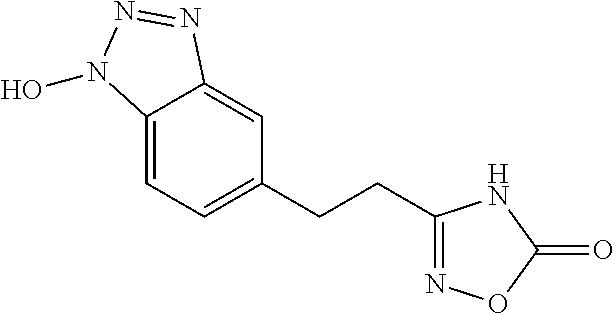


In the above equation, Is and Ip are the parallel and perpendicular emission intensity of the sample, respectively. G, the G factor, was determined to be 0.993.
In the foregoing equation, mPfree is the signal of the positive control; mPbound is the signal of the negative control; and mP is the signal of the tested inhibitor compound. The IC50 values were determined by nonlinear least-square analysis using GraphPad Prism 5.0. Experiments were performed in triplicate and carried out in the presence of 1% DMSO.
| TABLE 2 | ||
| Ki (μM) | ||
| Compound | Structure | FP* | AlphaScreen |
| PKF115-584 |
 |
17.78 ± 2.13 | —a |
| CGP049090 |
 |
35.56 ± 4.4 | —a |
| PKF118-310 |
 |
5.82 ± 0.24 | 3.65 ± 0.68 |
| PNU-74654 |
 |
180.99 ± 0.68 | 24.39 ± 0.74 |
| iCRT3 |
 |
364.71 ± 6.32 | 195.47 ± 0.87 |
| iCRT5 |
 |
80.34 ± 4.17 | 46.81 ± 2.10 |
| iCRT14 |
 |
53.51 ± 5.24 | 40.67 ± 1.02 |
| 1 |
 |
1304 ± 2.03 | N.D.b |
| 2 |
 |
165.4 ± 1.45 | N.D.b |
| 3 |
 |
105.9 ± 0.18 | N.D.b |
| 4 |
 |
155.1 ± 1.17 | N.D.b |
| 5 |
 |
54.2 ± 0.36 | N.D.b |
| 6 |
 |
551.25 ± 0.897 | N.D.b |
| 7 |
 |
24.36 ± 0.63 | N.D.b |
| 8 |
 |
50.4 ± 3.11 | N.D.b |
| 9 |
 |
94.4 ± 0.76 | N.D.b |
| 10 |
 |
125.1 ± 1.30 | N.D.b |
| 11 |
 |
22.4 ± 0.97 | 42.02 ± 4.00 |
| 12 |
 |
3.14 ± 0.48 | 7.60 ± 1.67, 3.83 ± 0.45 |
| 13 |
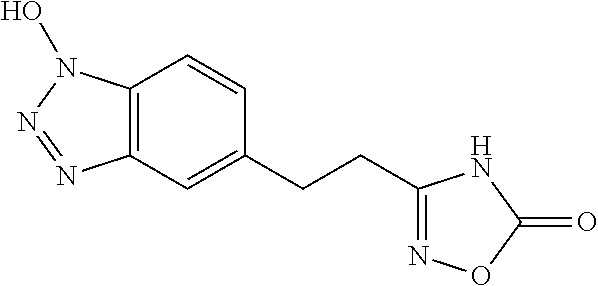 |
97.7 ± 0.45 | N.D.b |
| 14 |
 |
7.24 ± 0.13 | 70.37 ± 1.82 |
| 15 |
 |
13.55 ± 0.19 | N.D.b |
| 16 |
 |
179.93 ± 2.91 | N.D.b |
| 17 |
 |
3.38 ± 0.61 | N.D.b |
| 18 |
 |
16.57 ± 0.73 | N.D.b |
| 19 |
 |
28.74 ± 0.86 | N.D.b |
| 20 |
 |
33.14 ± 2.97 | N.D.b |
| 21 |
 |
179.93 ± 2.91 | N.D.b |
| 22 |
 |
N.D.b | N.D.b |
| 23 |
 |
N.D.b | N.D.b |
| 24 |
 |
N.D.b | N.D.b |
| 25 |
 |
N.D.b | N.D.b |
| *“FP” means “Fluorescence Polarization Assay.” | |||
| aPKF115-584 and CGPP049090 interfere with the AlphaScreen assay. | |||
| b“N.D”. indicates that assay value is “not determined.” | |||
| TABLE III | |||
| Ki ± SD (μM) | Selectivity | ||
| Compounds | β-catenin/Tcf4 | β-catenin/E-cadherin | β-catenin/APC-R3 | Tcf/cadherin | Tcf/APC |
| CGPC049090 | 5.87 ± 0.96 | 11.67 ± 1.48 | 8.31 ± 1.05 | 2.0 | 1.4 |
| PKF118-310 | 3.65 ± 0.68 | 19.94 ± 1.71 | 66.23 ± 3.39 | 5.5 | 18.2 |
| 12 | 3.83 ± 0.45 | 105.35 ± 2.25 | 170.65 ± 7.20 | 27.5 | 44.6 |
| TABLE IV | |||
| Ki ± SD (μm) | Selectivity | ||
| Compounds | β-catenin/Tcf4 | β-catenin/E-cadherin | β-catenin/APC-R3 | Tcf/cadherin | Tcf/APC |
| PKF115-584 | 17.78 ± 2.13 | 13.04 ± 0.31 | 53.85 ± 0.08 | 0.7 | 3.0 |
| CGP049090 | 35.56 ± 4.43 | 14.39 ± 0.32 | 62.49 ± 0.05 | 0.4 | 1.8 |
| PKF118-310 | 5.82 ± 0.24 | 13.30 ± 0.11 | 171.25 ± 0.13 | 2.3 | 29.4 |
| 12 | 3.14 ± 0.48 | 103.64 ± 0.42 | 176.04 ± 0.12 | 33.0 | 56.0 |

wherein A1 is selected from —N═, —NH—, and —CR2a═; wherein A2 is selected from ═N—, (C═O), (C═S), and ═CR2b—; wherein A3 is selected from —N(OH)— and —O—; provided that valency is satisfied for A1, A2, and A3; wherein L is selected from —CH2—, —(CH2)2—, —(CH2)3—, —OCH2—, —NHCH2—, —CH2NHCH2—, and —CH2OCH2—; wherein B1 is selected from —N═, —O—, and —S—; wherein B2 is selected from ═N—, (C═O), and (C═S); provided that valency is satisfied for B1 and B2; wherein each of R1a, R1b, and R1c is independently selected from hydrogen, halogen, —OH, —NH2, C1-C3 haloalkyl, C1-C3 polyhaloalkyl, and C1-C3 alkoxy; and wherein each of R2a and R2b is independently selected from hydrogen, halogen, —OH, —NH2, C1-C3 haloalkyl, C1-C3 polyhaloalkyl, and C1-C3 alkoxy; or pharmaceutically acceptable salt, ester, hydrate, solvate, or polymorph thereof

wherein A1 is selected from —N═, —NH—, and —CR2a═; wherein A2 is selected from ═N—, (C═O), (C═S), and ═CR2b—; wherein A3 is selected from —N(OH)— and —O—; provided that valency is satisfied for A1, A2, and A3; wherein L is selected from —CH2—, —(CH2)2—, —(CH2)3—, —OCH2—, —NHCH2—, —CH2NHCH2—, and —CH2OCH2—; wherein B1 is selected from —N═, —O—, and —S—; wherein B2 is selected from ═N—, (C═O), and (C═S); provided that valency is satisfied for B1 and B2; wherein each of R1a, R1b, and R1c is independently selected from hydrogen, halogen, —OH, —NH2, C1-C3 haloalkyl, C1-C3 polyhaloalkyl, and C1-C3 alkoxy; and wherein each of R2a and R2b is independently selected from hydrogen, halogen, —OH, —NH2, C1-C3 haloalkyl, C1-C3 polyhaloalkyl, and C1-C3 alkoxy; or pharmaceutically acceptable salt, ester, hydrate, solvate, or polymorph thereof.
| Component | Amount | ||
| Active ingredient | 10 to 500 | | |
| Lactose | |||
| 100 | | ||
| Crystalline cellulose | |||
| 60 | mg | ||
| Magnesium stearate | 5 | mg |
| Starch (e.g. potato starch) | Amount necessary to yield total | |
| weight indicated below |
| Total (per capsule) | 1000 | mg | ||
| Component | Amount | ||
| Active ingredient | 10 to 500 | mg | |
| Sodium carbonate | 560 | mg* | |
| |
80 | mg* |
| Distilled, sterile water | Quantity sufficient to prepare | ||
| total volumen indicated below. | |||
| Total (per capsule) | 10 ml per ampule | ||
| *Amount adjusted as required to maintain physiological pH in the context of the amount of active ingredient, and form of active ingredient, e.g. a particular salt form of the active ingredient. | |||
Claims (20)


Priority Applications (1)
| Application Number | Priority Date | Filing Date | Title |
|---|---|---|---|
| US15/017,296 US9738628B2 (en) | 2012-02-10 | 2016-02-05 | Substituted 1H-indazol-1-OL analogs as inhibitors of beta catenin/Tcf protein-protein interactions |
Applications Claiming Priority (4)
| Application Number | Priority Date | Filing Date | Title |
|---|---|---|---|
| US201261597640P | 2012-02-10 | 2012-02-10 | |
| PCT/US2013/025474 WO2013120045A1 (en) | 2012-02-10 | 2013-02-10 | Substituted 1h-indazol-1-ol analogs as inhibitors of beta catenin/tcf protein-protein interactions |
| US201414377839A | 2014-08-08 | 2014-08-08 | |
| US15/017,296 US9738628B2 (en) | 2012-02-10 | 2016-02-05 | Substituted 1H-indazol-1-OL analogs as inhibitors of beta catenin/Tcf protein-protein interactions |
Related Parent Applications (2)
| Application Number | Title | Priority Date | Filing Date |
|---|---|---|---|
| PCT/US2013/025474 Continuation WO2013120045A1 (en) | 2012-02-10 | 2013-02-10 | Substituted 1h-indazol-1-ol analogs as inhibitors of beta catenin/tcf protein-protein interactions |
| US14/377,839 Continuation US9284299B2 (en) | 2012-02-10 | 2013-02-10 | Substituted 1H-indazol-1-ol analogs as inhibitors of beta catenin/Tcf protein-protein interactions |
Publications (2)
| Publication Number | Publication Date |
|---|---|
| US20160297801A1 US20160297801A1 (en) | 2016-10-13 |
| US9738628B2 true US9738628B2 (en) | 2017-08-22 |
Family
ID=48948085
Family Applications (2)
| Application Number | Title | Priority Date | Filing Date |
|---|---|---|---|
| US14/377,839 Expired - Fee Related US9284299B2 (en) | 2012-02-10 | 2013-02-10 | Substituted 1H-indazol-1-ol analogs as inhibitors of beta catenin/Tcf protein-protein interactions |
| US15/017,296 Expired - Fee Related US9738628B2 (en) | 2012-02-10 | 2016-02-05 | Substituted 1H-indazol-1-OL analogs as inhibitors of beta catenin/Tcf protein-protein interactions |
Family Applications Before (1)
| Application Number | Title | Priority Date | Filing Date |
|---|---|---|---|
| US14/377,839 Expired - Fee Related US9284299B2 (en) | 2012-02-10 | 2013-02-10 | Substituted 1H-indazol-1-ol analogs as inhibitors of beta catenin/Tcf protein-protein interactions |
Country Status (2)
| Country | Link |
|---|---|
| US (2) | US9284299B2 (en) |
| WO (1) | WO2013120045A1 (en) |
Families Citing this family (11)
| Publication number | Priority date | Publication date | Assignee | Title |
|---|---|---|---|---|
| US9284299B2 (en) | 2012-02-10 | 2016-03-15 | University Of Utah Research Foundation | Substituted 1H-indazol-1-ol analogs as inhibitors of beta catenin/Tcf protein-protein interactions |
| WO2016187050A1 (en) * | 2015-05-18 | 2016-11-24 | University Of Utah Research Foundation | Methods and compositions of substituted 5h-[1,2,5]oxadiazolo[3',4':5,6] pyraziono[2,3-b]indole analogs as inhibitors of beta-catenin/t-cell factor protein-protein interactions |
| US10624949B1 (en) | 2015-07-27 | 2020-04-21 | National Technology & Engineering Solutions Of Sandia, Llc | Methods for treating diseases related to the wnt pathway |
| EP3876939A4 (en) | 2018-11-07 | 2022-08-10 | Dana-Farber Cancer Institute, Inc. | BENZOTHIAZOLE DERIVATIVES AND 7-AZA-BENZOTHIAZOLE DERIVATIVES AS JANUS KINASE-2 INHIBITORS AND USES THEREOF |
| US12509455B2 (en) | 2018-11-07 | 2025-12-30 | Dana-Farber Cancer Institute, Inc. | Imidazopyridine derivatives and aza-imidazopyridine derivatives as Janus kinase 2 inhibitors and uses thereof |
| WO2020097396A1 (en) | 2018-11-07 | 2020-05-14 | Dana-Farber Cancer Institute, Inc. | Benzimidazole derivatives and aza-benzimidazole derivatives as janus kinase 2 inhibitors and uses thereof |
| CA3156828A1 (en) | 2019-10-03 | 2021-04-08 | Dana-Farber Cancer Institute, Inc. | Tricyclic kinase inhibitors and uses thereof |
| TW202204350A (en) | 2020-05-06 | 2022-02-01 | 美商雅捷可斯治療公司 | 6-heteroaryloxy benzimidazoles and azabenzimidazoles as jak2 inhibitors |
| EP4267574B1 (en) | 2020-12-23 | 2025-04-23 | Ajax Therapeutics, Inc. | 6-heteroaryloxy benzimidazoles and azabenzimidazoles as jak2 inhibitors |
| CA3234638A1 (en) | 2021-11-09 | 2023-05-19 | Ajax Therapeutics, Inc. | 6-heteroaryloxy benzimidazoles and azabenzimidazoles as jak2 inhibitors |
| US12162881B2 (en) | 2021-11-09 | 2024-12-10 | Ajax Therapeutics, Inc. | Forms and compositions of inhibitors of JAK2 |
Citations (6)
| Publication number | Priority date | Publication date | Assignee | Title |
|---|---|---|---|---|
| US5039677A (en) | 1987-06-01 | 1991-08-13 | Janssen Pharmaceutica N.V. | 6-(1H-azol-1-ylmethyl)-1-(pyrimidinyloxy)-1H benzotriazoles |
| US5298520A (en) | 1991-02-01 | 1994-03-29 | Merck Sharp & Dohme Limited | Triazole containing indole derivatives |
| US6069282A (en) | 1997-06-06 | 2000-05-30 | Consortium Fur Elektrochemische Industrie Gmbh | Process for the preparation of aldehydes and ketones |
| US20060042026A1 (en) | 2004-08-26 | 2006-03-02 | The Procter & Gamble Company | Keratin dyeing compounds, keratin dyeing compositions containing them, and use thereof |
| US20100256208A1 (en) | 2007-06-04 | 2010-10-07 | Gore Vinayak G | Novel process |
| WO2013120045A1 (en) | 2012-02-10 | 2013-08-15 | University Of Utah Research Foundation | Substituted 1h-indazol-1-ol analogs as inhibitors of beta catenin/tcf protein-protein interactions |
-
2013
- 2013-02-10 US US14/377,839 patent/US9284299B2/en not_active Expired - Fee Related
- 2013-02-10 WO PCT/US2013/025474 patent/WO2013120045A1/en not_active Ceased
-
2016
- 2016-02-05 US US15/017,296 patent/US9738628B2/en not_active Expired - Fee Related
Patent Citations (7)
| Publication number | Priority date | Publication date | Assignee | Title |
|---|---|---|---|---|
| US5039677A (en) | 1987-06-01 | 1991-08-13 | Janssen Pharmaceutica N.V. | 6-(1H-azol-1-ylmethyl)-1-(pyrimidinyloxy)-1H benzotriazoles |
| US5298520A (en) | 1991-02-01 | 1994-03-29 | Merck Sharp & Dohme Limited | Triazole containing indole derivatives |
| US6069282A (en) | 1997-06-06 | 2000-05-30 | Consortium Fur Elektrochemische Industrie Gmbh | Process for the preparation of aldehydes and ketones |
| US20060042026A1 (en) | 2004-08-26 | 2006-03-02 | The Procter & Gamble Company | Keratin dyeing compounds, keratin dyeing compositions containing them, and use thereof |
| US20100256208A1 (en) | 2007-06-04 | 2010-10-07 | Gore Vinayak G | Novel process |
| WO2013120045A1 (en) | 2012-02-10 | 2013-08-15 | University Of Utah Research Foundation | Substituted 1h-indazol-1-ol analogs as inhibitors of beta catenin/tcf protein-protein interactions |
| US20150025114A1 (en) | 2012-02-10 | 2015-01-22 | University Of Utah Research Foundation | Substituted 1h-indazol-1-ol analogs as inhibitors of beta catenin/tcf protein-protein interactions |
Non-Patent Citations (16)
| Title |
|---|
| Amendment filed on Oct. 13, 2015 for U.S. Appl. No. 14/377,839, filed Aug. 8, 2014 (Inventor-Haitao, et al. // Applicant-University of Utah Research Foundation) (11 pages). |
| Amendment filed on Oct. 13, 2015 for U.S. Appl. No. 14/377,839, filed Aug. 8, 2014 (Inventor—Haitao, et al. // Applicant—University of Utah Research Foundation) (11 pages). |
| Golub et al, 1999, Science, vol. 531, p. 531-537. * |
| International Preliminary Report on Patentability mailed on Aug. 21, 2014 for application PCT/US2013/025474, filed on Feb. 10, 2013 (Applicant-University of Utah Research Foundation) (5 pages). |
| International Preliminary Report on Patentability mailed on Aug. 21, 2014 for application PCT/US2013/025474, filed on Feb. 10, 2013 (Applicant—University of Utah Research Foundation) (5 pages). |
| International Search Report and Written Opinion of the International Searching Authority mailed on May 2, 2013 for application PCT/US2013/025474, filed on Feb. 10, 2013 (Applicant-University of Utah Research Foundation) (19 pages). |
| International Search Report and Written Opinion of the International Searching Authority mailed on May 2, 2013 for application PCT/US2013/025474, filed on Feb. 10, 2013 (Applicant—University of Utah Research Foundation) (19 pages). |
| Notice of Allowance issued by the U.S. Patent and Trademark Office on Nov. 12, 2015 for U.S. Appl. No. 14/377,839, filed Aug. 8, 2014 (Inventor-Haitao, et al. // Applicant-University of Utah Research Foundation) (10 pages). |
| Notice of Allowance issued by the U.S. Patent and Trademark Office on Nov. 12, 2015 for U.S. Appl. No. 14/377,839, filed Aug. 8, 2014 (Inventor—Haitao, et al. // Applicant—University of Utah Research Foundation) (10 pages). |
| Response filed on Sep. 30, 2015 to Restriction Requirement issued by the U.S. Patent and Trademark Office on Jun. 30, 2015 for U.S. Appl. No. 14/377,839, filed Aug. 8, 2014 (Inventor-Haitao, et al. // Applicant-University of Utah Research Foundation) (16 pages). |
| Response filed on Sep. 30, 2015 to Restriction Requirement issued by the U.S. Patent and Trademark Office on Jun. 30, 2015 for U.S. Appl. No. 14/377,839, filed Aug. 8, 2014 (Inventor—Haitao, et al. // Applicant—University of Utah Research Foundation) (16 pages). |
| Restriction Requirement issued by the U.S. Patent and Trademark Office on Jun. 30, 2015 for U.S. Appl. No. 14/377,839, filed Aug. 8, 2014 (Inventor-Haitao, et al. // Applicant-University of Utah Research Foundation) (10 pages). |
| Restriction Requirement issued by the U.S. Patent and Trademark Office on Jun. 30, 2015 for U.S. Appl. No. 14/377,839, filed Aug. 8, 2014 (Inventor—Haitao, et al. // Applicant—University of Utah Research Foundation) (10 pages). |
| Targeted Cancer Therapies, http://www.cancer.gov/aboutcancer/treatment/types/targetedtherapies/targetedtherapiesfactsheet, retrieved Dec. 8, 2015. * |
| Thakur, 2013, J. Cell. Mol. Med., vol. 17, No. 4, p. 449-456. * |
| U.S. Appl. No. 61/597,640, filed Feb. 10, 2012, Ji (University of Utah Research Foundation). |
Also Published As
| Publication number | Publication date |
|---|---|
| US20160297801A1 (en) | 2016-10-13 |
| US9284299B2 (en) | 2016-03-15 |
| WO2013120045A1 (en) | 2013-08-15 |
| US20150025114A1 (en) | 2015-01-22 |
Similar Documents
| Publication | Publication Date | Title |
|---|---|---|
| US9284299B2 (en) | Substituted 1H-indazol-1-ol analogs as inhibitors of beta catenin/Tcf protein-protein interactions | |
| US8846707B2 (en) | Substituted 2-hydroxy-4-(2-(phenylsulfonamido)acetamido)benzoic acid analogs as inhibitors of stat protein | |
| TWI851542B (en) | Octahydrocyclopenta[c]pyrrole allosteric inhibitors of shp2 | |
| US20250122194A1 (en) | Novel small molecule inhibitors of tead transcription factors | |
| US12286422B2 (en) | Methods and compositions of 4-substituted benzoylpiperazine-1-substituted carbonyls as β-catenin/B-cell lymphoma 9 inhibitors | |
| US10590079B2 (en) | Cyano-substituted indoles as LSD1 inhibitors | |
| US11555026B2 (en) | AHR inhibitors and uses thereof | |
| US9174969B2 (en) | Indoline scaffold SHP-2 inhibitors and cancer treatment method | |
| US20140288077A1 (en) | Substituted 4-phenoxyphenol analogs as modulators of proliferating cell nuclear antigen activity | |
| US20180092866A1 (en) | Substituted n-([1,1'-biphenyl]-3-yl)-[1,1'-biphenyl]-3-carboxamide analogs as inhibitors for beta-catenin/b-cell lymphoma 9 interactions | |
| US9783513B2 (en) | STAT3 inhibitors and their anticancer use | |
| US20170247374A1 (en) | CaMKII INHIBITORS AND USES THEREOF | |
| US20130172340A1 (en) | Substituted 2-(9h-purin-9-yl) acetic acid analogues as inhibitors of stat3 | |
| US11478461B2 (en) | [1.1.1] bicyclo compounds as indoleamine 2,3-dioxygenase inhibitors | |
| US10273246B2 (en) | Methods and compositions of substituted 5H-[1,2,5] oxadiazolo [3′,4′:5,6] pyrazino[2,3-B] indole analogs as inhibitors of β-catenin/T-cell factor protein-protein interactions | |
| CA2553289A1 (en) | Piperazine derivatives which exhibit activity as serotonin and noradrenaline re-uptake inhibitors |
Legal Events
| Date | Code | Title | Description |
|---|---|---|---|
| AS | Assignment |
Owner name: UNIVERSITY OF UTAH, UTAH Free format text: ASSIGNMENT OF ASSIGNORS INTEREST;ASSIGNORS:JI, HAITAO;YU, BINXUN;ZHANG, MIN;AND OTHERS;SIGNING DATES FROM 20140928 TO 20141002;REEL/FRAME:042030/0327 Owner name: UNIVERSITY OF UTAH RESEARCH FOUNDATION, UTAH Free format text: ASSIGNMENT OF ASSIGNORS INTEREST;ASSIGNOR:UNIVERSITY OF UTAH;REEL/FRAME:042030/0548 Effective date: 20141023 |
|
| STCF | Information on status: patent grant |
Free format text: PATENTED CASE |
|
| MAFP | Maintenance fee payment |
Free format text: PAYMENT OF MAINTENANCE FEE, 4TH YR, SMALL ENTITY (ORIGINAL EVENT CODE: M2551); ENTITY STATUS OF PATENT OWNER: SMALL ENTITY Year of fee payment: 4 |
|
| FEPP | Fee payment procedure |
Free format text: MAINTENANCE FEE REMINDER MAILED (ORIGINAL EVENT CODE: REM.); ENTITY STATUS OF PATENT OWNER: SMALL ENTITY |
|
| LAPS | Lapse for failure to pay maintenance fees |
Free format text: PATENT EXPIRED FOR FAILURE TO PAY MAINTENANCE FEES (ORIGINAL EVENT CODE: EXP.); ENTITY STATUS OF PATENT OWNER: SMALL ENTITY |
|
| STCH | Information on status: patent discontinuation |
Free format text: PATENT EXPIRED DUE TO NONPAYMENT OF MAINTENANCE FEES UNDER 37 CFR 1.362 |
|
| FP | Lapsed due to failure to pay maintenance fee |
Effective date: 20250822 |