US9738055B2 - Fiber-reinforced composite, a component and a method - Google Patents
Fiber-reinforced composite, a component and a method Download PDFInfo
- Publication number
- US9738055B2 US9738055B2 US14/587,353 US201414587353A US9738055B2 US 9738055 B2 US9738055 B2 US 9738055B2 US 201414587353 A US201414587353 A US 201414587353A US 9738055 B2 US9738055 B2 US 9738055B2
- Authority
- US
- United States
- Prior art keywords
- fibers
- resin
- modulus
- young
- reinforced composite
- Prior art date
- Legal status (The legal status is an assumption and is not a legal conclusion. Google has not performed a legal analysis and makes no representation as to the accuracy of the status listed.)
- Active, expires
Links
Images



Classifications
-
- B—PERFORMING OPERATIONS; TRANSPORTING
- B29—WORKING OF PLASTICS; WORKING OF SUBSTANCES IN A PLASTIC STATE IN GENERAL
- B29C—SHAPING OR JOINING OF PLASTICS; SHAPING OF MATERIAL IN A PLASTIC STATE, NOT OTHERWISE PROVIDED FOR; AFTER-TREATMENT OF THE SHAPED PRODUCTS, e.g. REPAIRING
- B29C70/00—Shaping composites, i.e. plastics material comprising reinforcements, fillers or preformed parts, e.g. inserts
- B29C70/04—Shaping composites, i.e. plastics material comprising reinforcements, fillers or preformed parts, e.g. inserts comprising reinforcements only, e.g. self-reinforcing plastics
- B29C70/06—Fibrous reinforcements only
- B29C70/10—Fibrous reinforcements only characterised by the structure of fibrous reinforcements, e.g. hollow fibres
-
- B—PERFORMING OPERATIONS; TRANSPORTING
- B32—LAYERED PRODUCTS
- B32B—LAYERED PRODUCTS, i.e. PRODUCTS BUILT-UP OF STRATA OF FLAT OR NON-FLAT, e.g. CELLULAR OR HONEYCOMB, FORM
- B32B5/00—Layered products characterised by the non- homogeneity or physical structure, i.e. comprising a fibrous, filamentary, particulate or foam layer; Layered products characterised by having a layer differing constitutionally or physically in different parts
- B32B5/02—Layered products characterised by the non- homogeneity or physical structure, i.e. comprising a fibrous, filamentary, particulate or foam layer; Layered products characterised by having a layer differing constitutionally or physically in different parts characterised by structural features of a fibrous or filamentary layer
- B32B5/12—Layered products characterised by the non- homogeneity or physical structure, i.e. comprising a fibrous, filamentary, particulate or foam layer; Layered products characterised by having a layer differing constitutionally or physically in different parts characterised by structural features of a fibrous or filamentary layer characterised by the relative arrangement of fibres or filaments of different layers, e.g. the fibres or filaments being parallel or perpendicular to each other
-
- B—PERFORMING OPERATIONS; TRANSPORTING
- B29—WORKING OF PLASTICS; WORKING OF SUBSTANCES IN A PLASTIC STATE IN GENERAL
- B29C—SHAPING OR JOINING OF PLASTICS; SHAPING OF MATERIAL IN A PLASTIC STATE, NOT OTHERWISE PROVIDED FOR; AFTER-TREATMENT OF THE SHAPED PRODUCTS, e.g. REPAIRING
- B29C70/00—Shaping composites, i.e. plastics material comprising reinforcements, fillers or preformed parts, e.g. inserts
- B29C70/04—Shaping composites, i.e. plastics material comprising reinforcements, fillers or preformed parts, e.g. inserts comprising reinforcements only, e.g. self-reinforcing plastics
- B29C70/06—Fibrous reinforcements only
- B29C70/08—Fibrous reinforcements only comprising combinations of different forms of fibrous reinforcements incorporated in matrix material, forming one or more layers, and with or without non-reinforced layers
-
- B—PERFORMING OPERATIONS; TRANSPORTING
- B29—WORKING OF PLASTICS; WORKING OF SUBSTANCES IN A PLASTIC STATE IN GENERAL
- B29C—SHAPING OR JOINING OF PLASTICS; SHAPING OF MATERIAL IN A PLASTIC STATE, NOT OTHERWISE PROVIDED FOR; AFTER-TREATMENT OF THE SHAPED PRODUCTS, e.g. REPAIRING
- B29C70/00—Shaping composites, i.e. plastics material comprising reinforcements, fillers or preformed parts, e.g. inserts
- B29C70/04—Shaping composites, i.e. plastics material comprising reinforcements, fillers or preformed parts, e.g. inserts comprising reinforcements only, e.g. self-reinforcing plastics
- B29C70/06—Fibrous reinforcements only
- B29C70/10—Fibrous reinforcements only characterised by the structure of fibrous reinforcements, e.g. hollow fibres
- B29C70/16—Fibrous reinforcements only characterised by the structure of fibrous reinforcements, e.g. hollow fibres using fibres of substantial or continuous length
- B29C70/22—Fibrous reinforcements only characterised by the structure of fibrous reinforcements, e.g. hollow fibres using fibres of substantial or continuous length oriented in at least two directions forming a two-dimensional [2D] structure
-
- B—PERFORMING OPERATIONS; TRANSPORTING
- B29—WORKING OF PLASTICS; WORKING OF SUBSTANCES IN A PLASTIC STATE IN GENERAL
- B29C—SHAPING OR JOINING OF PLASTICS; SHAPING OF MATERIAL IN A PLASTIC STATE, NOT OTHERWISE PROVIDED FOR; AFTER-TREATMENT OF THE SHAPED PRODUCTS, e.g. REPAIRING
- B29C70/00—Shaping composites, i.e. plastics material comprising reinforcements, fillers or preformed parts, e.g. inserts
- B29C70/04—Shaping composites, i.e. plastics material comprising reinforcements, fillers or preformed parts, e.g. inserts comprising reinforcements only, e.g. self-reinforcing plastics
- B29C70/06—Fibrous reinforcements only
- B29C70/10—Fibrous reinforcements only characterised by the structure of fibrous reinforcements, e.g. hollow fibres
- B29C70/16—Fibrous reinforcements only characterised by the structure of fibrous reinforcements, e.g. hollow fibres using fibres of substantial or continuous length
- B29C70/22—Fibrous reinforcements only characterised by the structure of fibrous reinforcements, e.g. hollow fibres using fibres of substantial or continuous length oriented in at least two directions forming a two-dimensional [2D] structure
- B29C70/226—Fibrous reinforcements only characterised by the structure of fibrous reinforcements, e.g. hollow fibres using fibres of substantial or continuous length oriented in at least two directions forming a two-dimensional [2D] structure the structure comprising mainly parallel filaments interconnected by a small number of cross threads
-
- B—PERFORMING OPERATIONS; TRANSPORTING
- B29—WORKING OF PLASTICS; WORKING OF SUBSTANCES IN A PLASTIC STATE IN GENERAL
- B29C—SHAPING OR JOINING OF PLASTICS; SHAPING OF MATERIAL IN A PLASTIC STATE, NOT OTHERWISE PROVIDED FOR; AFTER-TREATMENT OF THE SHAPED PRODUCTS, e.g. REPAIRING
- B29C70/00—Shaping composites, i.e. plastics material comprising reinforcements, fillers or preformed parts, e.g. inserts
- B29C70/04—Shaping composites, i.e. plastics material comprising reinforcements, fillers or preformed parts, e.g. inserts comprising reinforcements only, e.g. self-reinforcing plastics
- B29C70/28—Shaping operations therefor
- B29C70/30—Shaping by lay-up, i.e. applying fibres, tape or broadsheet on a mould, former or core; Shaping by spray-up, i.e. spraying of fibres on a mould, former or core
-
- B—PERFORMING OPERATIONS; TRANSPORTING
- B29—WORKING OF PLASTICS; WORKING OF SUBSTANCES IN A PLASTIC STATE IN GENERAL
- B29C—SHAPING OR JOINING OF PLASTICS; SHAPING OF MATERIAL IN A PLASTIC STATE, NOT OTHERWISE PROVIDED FOR; AFTER-TREATMENT OF THE SHAPED PRODUCTS, e.g. REPAIRING
- B29C70/00—Shaping composites, i.e. plastics material comprising reinforcements, fillers or preformed parts, e.g. inserts
- B29C70/04—Shaping composites, i.e. plastics material comprising reinforcements, fillers or preformed parts, e.g. inserts comprising reinforcements only, e.g. self-reinforcing plastics
- B29C70/28—Shaping operations therefor
- B29C70/30—Shaping by lay-up, i.e. applying fibres, tape or broadsheet on a mould, former or core; Shaping by spray-up, i.e. spraying of fibres on a mould, former or core
- B29C70/34—Shaping by lay-up, i.e. applying fibres, tape or broadsheet on a mould, former or core; Shaping by spray-up, i.e. spraying of fibres on a mould, former or core and shaping or impregnating by compression, i.e. combined with compressing after the lay-up operation
- B29C70/342—Shaping by lay-up, i.e. applying fibres, tape or broadsheet on a mould, former or core; Shaping by spray-up, i.e. spraying of fibres on a mould, former or core and shaping or impregnating by compression, i.e. combined with compressing after the lay-up operation using isostatic pressure
-
- B—PERFORMING OPERATIONS; TRANSPORTING
- B29—WORKING OF PLASTICS; WORKING OF SUBSTANCES IN A PLASTIC STATE IN GENERAL
- B29C—SHAPING OR JOINING OF PLASTICS; SHAPING OF MATERIAL IN A PLASTIC STATE, NOT OTHERWISE PROVIDED FOR; AFTER-TREATMENT OF THE SHAPED PRODUCTS, e.g. REPAIRING
- B29C70/00—Shaping composites, i.e. plastics material comprising reinforcements, fillers or preformed parts, e.g. inserts
- B29C70/04—Shaping composites, i.e. plastics material comprising reinforcements, fillers or preformed parts, e.g. inserts comprising reinforcements only, e.g. self-reinforcing plastics
- B29C70/28—Shaping operations therefor
- B29C70/40—Shaping or impregnating by compression not applied
- B29C70/42—Shaping or impregnating by compression not applied for producing articles of definite length, i.e. discrete articles
- B29C70/46—Shaping or impregnating by compression not applied for producing articles of definite length, i.e. discrete articles using matched moulds, e.g. for deforming sheet moulding compounds [SMC] or prepregs
- B29C70/48—Shaping or impregnating by compression not applied for producing articles of definite length, i.e. discrete articles using matched moulds, e.g. for deforming sheet moulding compounds [SMC] or prepregs and impregnating the reinforcements in the closed mould, e.g. resin transfer moulding [RTM], e.g. by vacuum
-
- B—PERFORMING OPERATIONS; TRANSPORTING
- B29—WORKING OF PLASTICS; WORKING OF SUBSTANCES IN A PLASTIC STATE IN GENERAL
- B29K—INDEXING SCHEME ASSOCIATED WITH SUBCLASSES B29B, B29C OR B29D, RELATING TO MOULDING MATERIALS OR TO MATERIALS FOR MOULDS, REINFORCEMENTS, FILLERS OR PREFORMED PARTS, e.g. INSERTS
- B29K2105/00—Condition, form or state of moulded material or of the material to be shaped
- B29K2105/06—Condition, form or state of moulded material or of the material to be shaped containing reinforcements, fillers or inserts
- B29K2105/08—Condition, form or state of moulded material or of the material to be shaped containing reinforcements, fillers or inserts of continuous length, e.g. cords, rovings, mats, fabrics, strands or yarns
- B29K2105/10—Cords, strands or rovings, e.g. oriented cords, strands or rovings
- B29K2105/101—Oriented
- B29K2105/108—Oriented arranged in parallel planes and crossing at substantial angles
-
- B—PERFORMING OPERATIONS; TRANSPORTING
- B29—WORKING OF PLASTICS; WORKING OF SUBSTANCES IN A PLASTIC STATE IN GENERAL
- B29K—INDEXING SCHEME ASSOCIATED WITH SUBCLASSES B29B, B29C OR B29D, RELATING TO MOULDING MATERIALS OR TO MATERIALS FOR MOULDS, REINFORCEMENTS, FILLERS OR PREFORMED PARTS, e.g. INSERTS
- B29K2995/00—Properties of moulding materials, reinforcements, fillers, preformed parts or moulds
- B29K2995/0037—Other properties
- B29K2995/0077—Yield strength; Tensile strength
-
- B—PERFORMING OPERATIONS; TRANSPORTING
- B29—WORKING OF PLASTICS; WORKING OF SUBSTANCES IN A PLASTIC STATE IN GENERAL
- B29L—INDEXING SCHEME ASSOCIATED WITH SUBCLASS B29C, RELATING TO PARTICULAR ARTICLES
- B29L2031/00—Other particular articles
- B29L2031/08—Blades for rotors, stators, fans, turbines or the like, e.g. screw propellers
- B29L2031/082—Blades, e.g. for helicopters
- B29L2031/085—Wind turbine blades
-
- B—PERFORMING OPERATIONS; TRANSPORTING
- B32—LAYERED PRODUCTS
- B32B—LAYERED PRODUCTS, i.e. PRODUCTS BUILT-UP OF STRATA OF FLAT OR NON-FLAT, e.g. CELLULAR OR HONEYCOMB, FORM
- B32B2262/00—Composition or structural features of fibres which form a fibrous or filamentary layer or are present as additives
- B32B2262/02—Synthetic macromolecular fibres
-
- B—PERFORMING OPERATIONS; TRANSPORTING
- B32—LAYERED PRODUCTS
- B32B—LAYERED PRODUCTS, i.e. PRODUCTS BUILT-UP OF STRATA OF FLAT OR NON-FLAT, e.g. CELLULAR OR HONEYCOMB, FORM
- B32B2262/00—Composition or structural features of fibres which form a fibrous or filamentary layer or are present as additives
- B32B2262/02—Synthetic macromolecular fibres
- B32B2262/0223—Vinyl resin fibres
-
- B—PERFORMING OPERATIONS; TRANSPORTING
- B32—LAYERED PRODUCTS
- B32B—LAYERED PRODUCTS, i.e. PRODUCTS BUILT-UP OF STRATA OF FLAT OR NON-FLAT, e.g. CELLULAR OR HONEYCOMB, FORM
- B32B2262/00—Composition or structural features of fibres which form a fibrous or filamentary layer or are present as additives
- B32B2262/02—Synthetic macromolecular fibres
- B32B2262/0246—Acrylic resin fibres
-
- B—PERFORMING OPERATIONS; TRANSPORTING
- B32—LAYERED PRODUCTS
- B32B—LAYERED PRODUCTS, i.e. PRODUCTS BUILT-UP OF STRATA OF FLAT OR NON-FLAT, e.g. CELLULAR OR HONEYCOMB, FORM
- B32B2262/00—Composition or structural features of fibres which form a fibrous or filamentary layer or are present as additives
- B32B2262/02—Synthetic macromolecular fibres
- B32B2262/0253—Polyolefin fibres
-
- B—PERFORMING OPERATIONS; TRANSPORTING
- B32—LAYERED PRODUCTS
- B32B—LAYERED PRODUCTS, i.e. PRODUCTS BUILT-UP OF STRATA OF FLAT OR NON-FLAT, e.g. CELLULAR OR HONEYCOMB, FORM
- B32B2262/00—Composition or structural features of fibres which form a fibrous or filamentary layer or are present as additives
- B32B2262/02—Synthetic macromolecular fibres
- B32B2262/0276—Polyester fibres
-
- B—PERFORMING OPERATIONS; TRANSPORTING
- B32—LAYERED PRODUCTS
- B32B—LAYERED PRODUCTS, i.e. PRODUCTS BUILT-UP OF STRATA OF FLAT OR NON-FLAT, e.g. CELLULAR OR HONEYCOMB, FORM
- B32B2262/00—Composition or structural features of fibres which form a fibrous or filamentary layer or are present as additives
- B32B2262/02—Synthetic macromolecular fibres
- B32B2262/0276—Polyester fibres
- B32B2262/0284—Polyethylene terephthalate [PET] or polybutylene terephthalate [PBT]
-
- B—PERFORMING OPERATIONS; TRANSPORTING
- B32—LAYERED PRODUCTS
- B32B—LAYERED PRODUCTS, i.e. PRODUCTS BUILT-UP OF STRATA OF FLAT OR NON-FLAT, e.g. CELLULAR OR HONEYCOMB, FORM
- B32B2603/00—Vanes, blades, propellers, rotors with blades
-
- Y—GENERAL TAGGING OF NEW TECHNOLOGICAL DEVELOPMENTS; GENERAL TAGGING OF CROSS-SECTIONAL TECHNOLOGIES SPANNING OVER SEVERAL SECTIONS OF THE IPC; TECHNICAL SUBJECTS COVERED BY FORMER USPC CROSS-REFERENCE ART COLLECTIONS [XRACs] AND DIGESTS
- Y10—TECHNICAL SUBJECTS COVERED BY FORMER USPC
- Y10T—TECHNICAL SUBJECTS COVERED BY FORMER US CLASSIFICATION
- Y10T428/00—Stock material or miscellaneous articles
- Y10T428/24—Structurally defined web or sheet [e.g., overall dimension, etc.]
- Y10T428/24058—Structurally defined web or sheet [e.g., overall dimension, etc.] including grain, strips, or filamentary elements in respective layers or components in angular relation
- Y10T428/24124—Fibers
Definitions
- the present invention relates to a fiber-reinforced composite, a component and a method.
- Modern wind turbine rotor blades are built from fiber-reinforced composites combined with core members, such as balsa wood or plastic foam.
- EP 2 123 431 A1 describes a method for manufacturing a rotor blade using a vacuum-assisted resin transfer molding (VARTM)-process.
- VARTM vacuum-assisted resin transfer molding
- a typical E-modulus of the resin is 3 GPa and a typical E-modulus for a glass fiber material is 75 GPa or more.
- the E-modulus for carbon fibers can be, for example, 240 GPa.
- UD laminates have a lower resistance to transverse loads. This can be attributed to bonding failures at the interface between the resin and the fiber material when the stress direction is perpendicular to the fiber surface.
- transverse stabilizing fibers To improve the resistance to transverse loads of unidirectional laminates (in final use or during handling and transportation), it is known to reinforce these with transverse stabilizing fibers.
- the unidirectional laminate When the unidirectional laminate is loaded in its main direction (corresponding to the lengthwise direction of the fibers), the transverse stabilizing fibers are loaded perpendicularly to their lengthwise axes.
- One object of the present invention is to provide an improved fiber-reinforced composite.
- a further objective is to provide an improved component for a wind turbine. Even further, it is an objective to provide an improved method for manufacturing a component for a wind turbine.
- a fiber-reinforced composite for manufacturing a component for a wind turbine.
- the fiber-reinforced composite comprises: a plurality of first fibers, the first fibers being arranged in a unidirectional or biax-configuration, a plurality of second fibers, the second fibers being arranged perpendicularly with respect to a lengthwise direction of the first fibers, and a resin impregnating the first and second fibers, wherein the E-modulus of the resin equals an E-modulus of the second fibers.
- the E-modulus of the resin being equal to the E-modulus of the second fibers it is meant that the E-moduli are equal or substantially equal. “Substantially equal” is to be interpreted in the light of the first fibers typically having a very large E-modulus of 70 GPa (or more) in the case of glass fibers, or 240 GPa (or more) in the case of carbon fibers.
- an E-modulus of the second fibers which is a multiple of the E-modulus of the resin (or vice versa) may still be small and thus equal to that of the resin when considering the high E-modulus of the first fibers:
- the E-modulus of the second fibers may be up to 5 times, or 3 times, or even 2 times or even 1.5 times the E-modulus of the resin.
- the E-modulus of the resin may be up to 5 times, or 3 times, or even 2 times or even 1.5 times the E-modulus of the second fibers.
- the E-modulus of the first fibers is larger than 60 GPa, or larger than 100 GPa or even larger than 200 GPa.
- “Unidirectional” is to say that all the first fibers extend in a single direction (herein called the lengthwise direction).
- “Biax” is to say that the first fibers are arranged at angles of +45° and ⁇ 45° with respect to a direction herein called the “lengthwise direction”.
- second fibers being arranged “perpendicularly” with respect to the lengthwise direction of the first fibers, it is meant that an angle between a respective second fiber and a respective first fiber lies within the range of 90° ⁇ 45°, or 90° ⁇ 20° or even 90° ⁇ 5°.
- Examples of a resin which may be used for impregnating the first and second fibers are epoxy, polyester, vinylester or any other suitable thermoplastic or duroplastic material.
- fiber in relation to the “second fibers” is to be understood in a broad sense and to include fibers, yarns, fiber filaments, beads (of adhesive, for example), bands, strips, strings or the like.
- the diameter of a respective second fiber is smaller than the diameter of a respective first fiber.
- the E-modulus of the resin and the second fibers is smaller than the E-modulus of the first fibers.
- the E-modulus of the first fibers is much larger than that of the resin or the second fibers as explained above.
- the second fibers are made of a thermoplastic material and/or of a resin. These materials typically have a E-modulus equal to that of the resin impregnating the first and second fibers.
- the second fibers are made of an epoxy resin, polyethylene terephthalate (PET/PETP) or polyester.
- the epoxy resin as well as PETP, PET or polyester have an E-modulus in the range of 2-4, or 2.5-3.5 GPa and are therefore well suited for the intended application.
- the second fibers may be made of acrylic, polycarbonate, polyimide, ABS or polypropylene.
- These materials may have an E-modulus ranging from 1-4 GPa, or from 1.5-2 GPa.
- the second fibers may also comprise combinations of the materials mentioned above.
- the second fibers each comprise multiple filaments.
- the filaments are combined to form a rigid yarn.
- the filaments may, for example, be made of a thermoplastic material.
- each filament has a diameter ranging from 2-20 ⁇ m.
- the second fibers are each formed as a single fiber.
- a respective single fiber is made from a single, connected piece of material.
- the single fibers may be made of a thermoplastic material, for example.
- the diameter of a respective single fiber ranges from 50-500 ⁇ m.
- the single fibers may be, for example, made of a thermosetting resin.
- the E-modulus of the second fibers and the resin is in the range of 1-6 GPa.
- the E-modulus is in the range of 2-4, or even, 2.5-3.5 GPa.
- the second fibers are attached to the first fibers by means of a stitching yarn.
- a stitching yarn made of PET may be used.
- the second fibers are treated with a coupling agent.
- the coupling agent improves the mechanical connection at the interface between the second fibers and the resin.
- a component for a wind turbine in particular a rotor blade, is provided.
- the component comprises the fiber-reinforced composite described above.
- a method for manufacturing a component for a wind turbine comprises the steps of a) providing a fiber material comprising a plurality of first fibers, the first fibers being arranged in a unidirectional or biax-configuration, and a plurality of second fibers, the second fibers being arranged perpendicularly with respect to a lengthwise direction of the first fibers, b) laying the fiber material onto a mold surface, and c) curing a resin impregnating the first and second fibers to form the component.
- the fiber material comprising the first and second fibers may be supplied in a pre-impregnated state (so-called prepreg material) or in an unimpregnated state. In the latter case, the fiber material is impregnated with the resin before step c).
- the resin may be injected into the fiber material in a resin transfer molding (RTM) or vacuum-assisted resin transfer molding (VARTM)-process.
- RTM resin transfer molding
- VARTM vacuum-assisted resin transfer molding
- the fiber material is covered in a vacuum bag.
- a vacuum is applied to the region between the vacuum bag and the mold surface. Then, resin is injected in said region.
- the vacuum bag and/or the mold is removed and the final component, for example the rotor blade, is obtained.
- the final component for example the rotor blade
- the mold may be an open or a closed mold.
- the mold may comprise one or more parts, in particular a lower part and an upper part.
- “Cured” or “set” refers to a resin being hardened and/or cross-linked to an extent where the shape of the fiber material impregnated with the resin will not or not change significantly any more.
- “Layup” as used herein refers to one or more layers of fiber material.
- Wind turbine presently refers to an apparatus converting the wind's kinetic energy into rotational energy, which may again be converted to electrical energy by the apparatus.
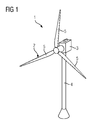
- FIG. 1 is a perspective view of a wind turbine according to an embodiment
- FIG. 2A shows a top view of a fiber-reinforced composite according to an embodiment
- FIG. 2B shows an enlarged view from FIG. 2A according to an embodiment
- FIG. 2C shows an enlarged view from FIG. 2A according to a further embodiment
- FIG. 3 shows a top view of a fiber-reinforced composite according to a further embodiment
- FIG. 4 shows a top view of a fiber-reinforced composite according to a further embodiment
- FIG. 5 shows a section view from a VARTM-process according to a method for manufacturing the rotor blade of FIG. 1 ;
- FIG. 6 shows a flowchart in accordance with an embodiment of a method for manufacturing a component for a wind turbine.
- FIG. 1 shows a wind turbine 1 according to an embodiment.
- the wind turbine 1 comprises a rotor 2 , connected to a generator (not shown) arranged inside a nacelle 3 .
- the nacelle 3 is arranged at the upper end of a tower 4 of the wind turbine 1 .
- the rotor 2 comprises three blades 5 .
- Rotors 2 of this kind may have diameters ranging from, for example, 30 to 160 meters.
- the blades 5 are subjected to high wind loads.
- the blades 5 need to be lightweight.
- the blades 5 in modern wind turbines 1 are manufactured from fiber-reinforced composite material. Therein, glass fibers are generally preferred over carbon fibers for cost reasons.
- the blades 5 may each comprise one or more core members made of a lightweight material to reduce the weight of the blades 5 .
- FIG. 2A shows in a top view a fiber-reinforced composite 6 according to an embodiment.
- the fiber-reinforced composite 6 comprises a plurality of first fibers 7 .
- the first fibers 7 are configured as rovings, but may also take a different form.
- the first fibers 7 are arranged in a unidirectional configuration, i.e. all fibers 7 extend in the same direction 8 hereinafter referred to as the “lengthwise direction” of the first fibers 7 .
- the fiber reinforced composite 6 comprises second fibers 9 .
- the second fibers 9 may be configured as fibers, yarns, rovings, beads of adhesive, strings or bands of material.
- the second fibers may be made of (partially or fully) epoxy resin, PETP, PET, polyester, acrylic, polycarbonate, polyimide, ABS, polypropylene or combinations thereof. Epoxy resin, PETP, PET, polyester may be preferred.
- E-modulus values also called Young's modulus
- the resin 10 may comprise an epoxy resin, for example.
- the epoxy resin has an E-modulus of 3 and is thus very similar to the E-modulus of the material of the second fibers 9 .
- the E-modulus of the first fibers which may be made of glass fibers and/or carbon fibers having an E-modulus of 75 GPa and 240 GPa, respectively, the E-moduli of the resin 10 and the second fibers 9 are considered equal.
- An individual fiber 9 as shown in FIG. 2A may be configured has illustrated in FIG. 2B or 2C , for example.
- the fiber 9 comprises multiple filaments 11 .
- Each filament 11 may have a diameter D ranging from 2 to 20 ⁇ m, for example.
- the fiber 9 is configured as a single fiber.
- the fiber 9 has a diameter D ranging from 50 to 500 ⁇ m, for example.
- the second fibers 9 may be attached to the first fibers 7 by means of a stitching yarn 12 .
- FIG. 2A illustrates that the second fibers 9 may extend at an angle ⁇ of 90° with respect to the lengthwise direction 8 .
- FIG. 3 shows a top view of a composite 6 according to a further embodiment.
- the embodiment of FIG. 3 differs from the embodiment of FIG. 2A in that the second fibers 9 are arranged at an angle ⁇ of 45° with respect to the lengthwise direction 8 .
- the second fibers 9 are thus arranged in a zigzag configuration.
- the angle may range between 45° and 90°, or between 70° and 90°.
- FIG. 4 shows a top view of a composite 6 according to a further embodiment.
- the embodiment of FIG. 4 differs from the embodiment of FIG. 2A in that the first fibers 7 are arranged in a biax configuration. In other words, the first fibers 7 are arranged at angles of +/ ⁇ 45° with respect to the lengthwise direction 8 .
- FIG. 5 illustrates a section view from a VARTM-process in accordance of an embodiment of the present invention.
- FIG. 6 illustrating a low diagram of a method for manufacturing a rotor blade 5 as shown in FIG. 1 , for example.
- step S 1 an (optional) vacuum distribution layer 13 is arranged on a mold surface 14 of a mold 15 .
- a fiber material 16 is provided.
- the fiber material 16 comprises first and second fibers 7 , 9 as shown in FIGS. 2A to 4 above.
- the fibers 7 , 9 may at this point be fastened together by a stitching yarn 12 to improve handling of the fibers 7 , 9 .
- a step S 3 the fiber material 16 is arranged on top of the vacuum distribution layer 13 , or directly on the mold surface 14 when no vacuum distribution layer 13 is provided.
- a step S 4 the fiber material 16 is covered with a vacuum bag 17 . Then vacuum is applied to the space between the vacuum bag 17 and the mold surface 14 by a vacuum pump 18 .
- the vacuum distribution layer 13 is arranged on top of the fiber material 16 . Then, the vacuum bag 17 is arranged on top of the vacuum distribution layer 13 .
- a resin in particular an epoxy resin, is injected into said space.
- the second fibers 9 may be treated with a coupling agent (not shown) before injecting the resin 10 in step S 5 .
- step S 6 external heat is applied to the mold 15 curing the epoxy resin.
- the finished blade 5 may be removed from the mold in a step S 7 .
- steps S 1 to S 7 may be modified to include the positioning of a mold core (not shown) and/or a web (not shown) in the mold 15 to provide a blade of 5 reinforced by a web or balsa wood and/or foam core, for example.
Landscapes
- Engineering & Computer Science (AREA)
- Chemical & Material Sciences (AREA)
- Composite Materials (AREA)
- Mechanical Engineering (AREA)
- Textile Engineering (AREA)
- Wind Motors (AREA)
- Moulding By Coating Moulds (AREA)
Abstract
Description
| TABLE | |||
| Material | Youngs modulus/E-modulus [GPa] | ||
| Epoxy resin | 3 | ||
| PET, Polyester | 2-2.7 | ||
| Acrylic | 3.2 | ||
| Poly Carbonate | 2.6 | ||
| Poly imid | 2.5 | ||
| ABS | 2.3 | ||
| Poly propylene | 1.5-2 | ||
Claims (18)
Applications Claiming Priority (3)
| Application Number | Priority Date | Filing Date | Title |
|---|---|---|---|
| EP14158528.1A EP2918398B1 (en) | 2014-03-10 | 2014-03-10 | A fiber-reinforced composite, a component and a method |
| EP14158528.1 | 2014-03-10 | ||
| EP14158528 | 2014-03-10 |
Publications (2)
| Publication Number | Publication Date |
|---|---|
| US20150251380A1 US20150251380A1 (en) | 2015-09-10 |
| US9738055B2 true US9738055B2 (en) | 2017-08-22 |
Family
ID=50239454
Family Applications (1)
| Application Number | Title | Priority Date | Filing Date |
|---|---|---|---|
| US14/587,353 Active 2035-04-25 US9738055B2 (en) | 2014-03-10 | 2014-12-31 | Fiber-reinforced composite, a component and a method |
Country Status (4)
| Country | Link |
|---|---|
| US (1) | US9738055B2 (en) |
| EP (1) | EP2918398B1 (en) |
| CN (1) | CN104908331B (en) |
| DK (1) | DK2918398T3 (en) |
Cited By (1)
| Publication number | Priority date | Publication date | Assignee | Title |
|---|---|---|---|---|
| US20220397100A1 (en) * | 2019-11-15 | 2022-12-15 | Jupiter Bach A/S | Nacelle Cover for a Wind Turbine |
Families Citing this family (6)
| Publication number | Priority date | Publication date | Assignee | Title |
|---|---|---|---|---|
| EP3161199B1 (en) * | 2014-06-30 | 2019-04-03 | Hexcel Holding GmbH | Non-woven fabrics |
| WO2017195363A1 (en) * | 2016-05-13 | 2017-11-16 | Ykk株式会社 | Polyamide resin composition for slide fastener, slide fastener component, and slide fastener equipped with same |
| US10436118B2 (en) * | 2017-06-19 | 2019-10-08 | Rohr, Inc. | Acoustic panel with folding chamber |
| FI3758923T3 (en) | 2018-02-26 | 2024-06-18 | Vitrulan Composites Oy | A stitched multi-axial reinforcement and a method of producing the same |
| FI129079B (en) | 2019-03-11 | 2021-06-30 | Munksjoe Ahlstrom Oyj | A stitched multi-axial reinforcement |
| ES2974710T3 (en) | 2019-12-17 | 2024-07-01 | Vestas Wind Sys As | wind turbine blade |
Citations (4)
| Publication number | Priority date | Publication date | Assignee | Title |
|---|---|---|---|---|
| EP2123431A1 (en) | 2008-05-21 | 2009-11-25 | Siemens Aktiengesellschaft | Method for manufacturing a composite and a wind turbine blade |
| EP2687356A1 (en) | 2012-07-20 | 2014-01-22 | Ahlstrom Corporation | A unidirectional reinforcement and a method of producing a unidirectional reinforcement |
| WO2014013138A1 (en) | 2012-07-20 | 2014-01-23 | Ahlstrom Corporation | A stitched unidirectional or multi-axial reinforcement and a method of producing the same |
| US20150041081A1 (en) * | 2013-08-09 | 2015-02-12 | The Regents Of The University Of Michigan | Natural fiber reinforced composite panel and method |
Family Cites Families (2)
| Publication number | Priority date | Publication date | Assignee | Title |
|---|---|---|---|---|
| WO1997049542A1 (en) * | 1996-06-27 | 1997-12-31 | E.I. Du Pont De Nemours And Company | Method for molding fiber-reinforced resin composite container |
| JP2013049750A (en) * | 2011-08-30 | 2013-03-14 | Teijin Ltd | Organic fiber random mat and fiber composite material using the same |
-
2014
- 2014-03-10 EP EP14158528.1A patent/EP2918398B1/en active Active
- 2014-03-10 DK DK14158528.1T patent/DK2918398T3/en active
- 2014-12-31 US US14/587,353 patent/US9738055B2/en active Active
-
2015
- 2015-03-10 CN CN201510103614.7A patent/CN104908331B/en active Active
Patent Citations (4)
| Publication number | Priority date | Publication date | Assignee | Title |
|---|---|---|---|---|
| EP2123431A1 (en) | 2008-05-21 | 2009-11-25 | Siemens Aktiengesellschaft | Method for manufacturing a composite and a wind turbine blade |
| EP2687356A1 (en) | 2012-07-20 | 2014-01-22 | Ahlstrom Corporation | A unidirectional reinforcement and a method of producing a unidirectional reinforcement |
| WO2014013138A1 (en) | 2012-07-20 | 2014-01-23 | Ahlstrom Corporation | A stitched unidirectional or multi-axial reinforcement and a method of producing the same |
| US20150041081A1 (en) * | 2013-08-09 | 2015-02-12 | The Regents Of The University Of Michigan | Natural fiber reinforced composite panel and method |
Cited By (2)
| Publication number | Priority date | Publication date | Assignee | Title |
|---|---|---|---|---|
| US20220397100A1 (en) * | 2019-11-15 | 2022-12-15 | Jupiter Bach A/S | Nacelle Cover for a Wind Turbine |
| US12044216B2 (en) * | 2019-11-15 | 2024-07-23 | Jupiter Bach A/S | Nacelle cover for a wind turbine |
Also Published As
| Publication number | Publication date |
|---|---|
| CN104908331B (en) | 2019-08-27 |
| EP2918398A1 (en) | 2015-09-16 |
| US20150251380A1 (en) | 2015-09-10 |
| CN104908331A (en) | 2015-09-16 |
| EP2918398B1 (en) | 2017-06-21 |
| DK2918398T3 (en) | 2017-08-28 |
Similar Documents
| Publication | Publication Date | Title |
|---|---|---|
| US20150251380A1 (en) | Fiber-reinforced composite, a component and a method | |
| US10330074B2 (en) | Wind turbine blade with improved fibre transition | |
| CN108700028B (en) | Wind turbine blades and related methods of manufacture | |
| US9889619B2 (en) | Method for manufacturing a rotor blade for a wind turbine | |
| US10723089B2 (en) | Method of manufacturing a composite laminate structure of a wind turbine blade part and related wind turbine blade part | |
| EP3099471B1 (en) | Method for manufacturing a wind turbine blade part in two steps | |
| US20120009069A1 (en) | Method to manufacture a component of a composite structure | |
| CN101855396B (en) | A structural mat for reinforcing a wind turbine blade structure, a wind turbine blade and a method for manufacturing a wind turbine blade | |
| US20150285083A1 (en) | Fiber mat, a component for a wind turbine, an apparatus for producing the fiber mat and a method for producing the fiber mat | |
| US12331715B2 (en) | Fibre-reinforcement fabric for a wind turbine blade component | |
| CN117120718A (en) | Fiber-reinforced fabrics for wind turbine blade components | |
| EP2918405A1 (en) | A method for manufacturing a component for a wind turbine |
Legal Events
| Date | Code | Title | Description |
|---|---|---|---|
| AS | Assignment |
Owner name: SIEMENS AKTIENGESELLSCHAFT, GERMANY Free format text: ASSIGNMENT OF ASSIGNORS INTEREST;ASSIGNOR:SIEMENS WIND POWER A/S;REEL/FRAME:034935/0366 Effective date: 20150115 Owner name: SIEMENS WIND POWER A/S, DENMARK Free format text: ASSIGNMENT OF ASSIGNORS INTEREST;ASSIGNOR:GROVE-NIELSEN, ERIK;REEL/FRAME:034935/0352 Effective date: 20150107 |
|
| FEPP | Fee payment procedure |
Free format text: PAYOR NUMBER ASSIGNED (ORIGINAL EVENT CODE: ASPN) |
|
| STCF | Information on status: patent grant |
Free format text: PATENTED CASE |
|
| AS | Assignment |
Owner name: SIEMENS GAMESA RENEWABLE ENERGY A/S, DENMARK Free format text: ASSIGNMENT OF ASSIGNORS INTEREST;ASSIGNOR:SIEMENS AKTIENGESELLSCHAFT;REEL/FRAME:048003/0631 Effective date: 20181025 |
|
| MAFP | Maintenance fee payment |
Free format text: PAYMENT OF MAINTENANCE FEE, 4TH YEAR, LARGE ENTITY (ORIGINAL EVENT CODE: M1551); ENTITY STATUS OF PATENT OWNER: LARGE ENTITY Year of fee payment: 4 |
|
| MAFP | Maintenance fee payment |
Free format text: PAYMENT OF MAINTENANCE FEE, 8TH YEAR, LARGE ENTITY (ORIGINAL EVENT CODE: M1552); ENTITY STATUS OF PATENT OWNER: LARGE ENTITY Year of fee payment: 8 |