US9722817B2 - Equalization method for a parsimonious communication channel and device implementing the method - Google Patents
Equalization method for a parsimonious communication channel and device implementing the method Download PDFInfo
- Publication number
- US9722817B2 US9722817B2 US15/017,226 US201615017226A US9722817B2 US 9722817 B2 US9722817 B2 US 9722817B2 US 201615017226 A US201615017226 A US 201615017226A US 9722817 B2 US9722817 B2 US 9722817B2
- Authority
- US
- United States
- Prior art keywords
- symbols
- block
- trellis
- sub
- equalization
- Prior art date
- Legal status (The legal status is an assumption and is not a legal conclusion. Google has not performed a legal analysis and makes no representation as to the accuracy of the status listed.)
- Active
Links
Images




Classifications
-
- H—ELECTRICITY
- H04—ELECTRIC COMMUNICATION TECHNIQUE
- H04L—TRANSMISSION OF DIGITAL INFORMATION, e.g. TELEGRAPHIC COMMUNICATION
- H04L25/00—Baseband systems
- H04L25/02—Details ; arrangements for supplying electrical power along data transmission lines
- H04L25/03—Shaping networks in transmitter or receiver, e.g. adaptive shaping networks
- H04L25/03006—Arrangements for removing intersymbol interference
- H04L25/03012—Arrangements for removing intersymbol interference operating in the time domain
- H04L25/03019—Arrangements for removing intersymbol interference operating in the time domain adaptive, i.e. capable of adjustment during data reception
-
- H—ELECTRICITY
- H04—ELECTRIC COMMUNICATION TECHNIQUE
- H04L—TRANSMISSION OF DIGITAL INFORMATION, e.g. TELEGRAPHIC COMMUNICATION
- H04L25/00—Baseband systems
- H04L25/02—Details ; arrangements for supplying electrical power along data transmission lines
- H04L25/03—Shaping networks in transmitter or receiver, e.g. adaptive shaping networks
- H04L25/03006—Arrangements for removing intersymbol interference
- H04L25/03171—Arrangements involving maximum a posteriori probability [MAP] detection
-
- H—ELECTRICITY
- H04—ELECTRIC COMMUNICATION TECHNIQUE
- H04L—TRANSMISSION OF DIGITAL INFORMATION, e.g. TELEGRAPHIC COMMUNICATION
- H04L25/00—Baseband systems
- H04L25/02—Details ; arrangements for supplying electrical power along data transmission lines
- H04L25/03—Shaping networks in transmitter or receiver, e.g. adaptive shaping networks
- H04L25/03006—Arrangements for removing intersymbol interference
- H04L25/03178—Arrangements involving sequence estimation techniques
- H04L25/03203—Trellis search techniques
- H04L25/03216—Trellis search techniques using the M-algorithm
-
- H—ELECTRICITY
- H04—ELECTRIC COMMUNICATION TECHNIQUE
- H04L—TRANSMISSION OF DIGITAL INFORMATION, e.g. TELEGRAPHIC COMMUNICATION
- H04L25/00—Baseband systems
- H04L25/02—Details ; arrangements for supplying electrical power along data transmission lines
- H04L25/03—Shaping networks in transmitter or receiver, e.g. adaptive shaping networks
- H04L25/03006—Arrangements for removing intersymbol interference
- H04L2025/0335—Arrangements for removing intersymbol interference characterised by the type of transmission
- H04L2025/03375—Passband transmission
- H04L2025/03414—Multicarrier
Definitions
- the field of the invention is that of wireless digital communications and, more specifically, communications through a so-called parsimonious transmission channel, by which is meant a channel that can principally be modelled by two paths delayed by multiple symbols and having different powers.
- a model can be applied, in particular, to an aeronautical communication link, for example a downlink between a satellite and an aircraft.
- the invention more specifically pertains to an equalization method and device of low implementational complexity, which is particularly suited to a parsimonious transmission channel.
- the equalization of the received signal is an important task for a signal receiver, especially when the propagation channel is disrupted by the presence of multiple paths.
- the known equalization methods implement a function for removing interference that requires an interdependence between the parallel trellises, which may entail increased implementational complexity.
- Such methods are described in particular in references [5]-[8]. These methods have the additional drawback that they do not allow parallelization and total independence of the processing operations that are executed on the different trellises as a result of their interdependence.
- the present invention aims to overcome the drawbacks of the equalization methods that are known from the prior art by proposing an equalization method suited to a parsimonious channel that makes a high degree of parallelization possible in the implemented processing operations.
- a subject of the invention is thus, in a first embodiment, a method for equalizing a signal comprising a plurality of modulated symbols, said signal being transmitted by a sender, through a transmission channel, to a receiver, said method comprising the following steps that are applied to a block of N received symbols:
- the step of removing instances of interference and the second equalization step are executed iteratively.
- said equalization algorithm is configured to operate on a trellis, each state of the trellis representing a possible symbol, each branch between two consecutive states of the trellis being associated with a received modulated symbol.
- said equalization algorithm operating on a trellis comprises a first step of traversing the trellis in the forward direction, in which step a first probability of occurrence of said state, knowing the possible symbols that are associated with the prior states up to the section preceding the current state, is calculated for each section of the trellis and for each current state of the section, a block of equalized symbols being determined as the sequence of states in the trellis which makes it possible to maximize said first probabilities.
- said equalization algorithm operating on a trellis comprises a second step of traversing the trellis in the backward direction, in which step a second probability of occurrence of a sequence of possible symbols that are associated with the sections that are subsequent to said section, knowing the current state, is calculated for each section of the trellis and for each current state of the section, a block of equalized symbols being determined as the sequence of states in the trellis which makes it possible to maximize the products between said first probability and said second probability.
- Another subject of the invention in a second embodiment, is a method for equalizing a signal comprising a plurality of modulated symbols, said signal being transmitted by a sender, through a transmission channel, to a receiver, said method comprising the following steps that are applied to a block of N received symbols:
- the method according to the invention furthermore comprises at least one iteration of the successive execution of the step of removing instances of interference and of the first equalization step.
- the method according to the invention furthermore comprises at least one iteration of the successive execution of a first occurrence of the step of removing instances of interference, of the first equalization step, of a second occurrence of the step of removing instances of interference and of the second equalization step.
- said equalization algorithm is an MAP algorithm, for example a BCJR (Bahl, Cocke, Jelinek, Raviv) algorithm.
- the demultiplexing factor L is equal to the duration, expressed as a whole number of symbols, between the two paths of higher power in the impulse response of the transmission channel.
- the generation of the interference term is carried out by the convolution of the block of N equalized symbols with an estimate of the impulse response of the transmission channel, in which the coefficients corresponding to the two paths of higher power are set to zero.
- Yet another subject of the invention is a computer program, comprising instructions for the execution of the method for equalizing a received signal according to the invention when the program is executed by a processor, a recording medium that is readable by a processor, on which a program comprising instructions for the execution of the method for equalizing a received signal according to the invention when the program is executed by a processor has been recorded, a device for equalizing a received signal, comprising means configured for executing the method for equalizing a received signal according to the invention, and a signal receiver, comprising a device for equalizing the received signal according to the invention.
- FIG. 1 shows an overview of an equalizer according to the invention in a first embodiment
- FIG. 2 shows a graph illustrating a hypothetical impulse response of the propagation channel
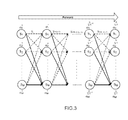
- FIG. 3 shows a diagram illustrating a traverse in the forward direction through a trellis at the time of the implementation of an equalization algorithm of BCJR type
- FIG. 4 shows a diagram illustrating a traverse in the backward direction through a trellis at the time of the implementation of an equalization algorithm of BCJR type
- FIG. 5 shows an overview of an equalizer according to the invention in a second embodiment.
- the invention pertains to a method for equalizing a signal that is received by a receiver and an equalization device suitable for executing the method.
- the signal is transmitted by a sender through a propagation channel subjected to the influence of multiple paths that are linked to the reflections of the signal on different elements of the transmission environment.
- the signal is modulated with the aid of a given modulation diagram.
- the signal that is received by the receiver is sampled and processed in order to provide symbols at the pace of the modulator.
- the sampled symbols must then be equalized in order to remove the instances of interference that are linked to the imperfect response of the transmission channel.
- FIG. 1 shows an overview of an equalizer according to a first embodiment of the invention.
- the invention is based on the hypothesis that the transmission channel between the sender and the receiver can be modelled by two remote high-power paths of a duration that is equivalent to a number L of modulated symbols.
- the other paths are considered to have a low power in relation to the two dominant paths.
- This model is particularly, but not solely, suited to the representation of an aeronautical propagation channel connecting a satellite to an aircraft.
- the path of highest power corresponds to the direct path between the satellite and the aircraft while the second path, of power that is high but lower than that of the main path, corresponds to the reflection of the signal on the surface of the earth.
- FIG. 2 shows, in a timing diagram, an example of the appearance of the impulse response of a transmission channel with two main paths.
- the two paths are spaced apart by a time period ⁇ m that is equivalent to a number L of symbols, a symbol having a duration Ts.
- the relationship (1) represents a sequence of N received symbols y i as a function of the N sent symbols x i and the parameters of the channel.
- L channel is the total length of the impulse response of the channel.
- ( y 1 y 2 . . . ⁇ y N ⁇ 1 y N ) conv( [x 1 x 2 . . . ⁇ x N ⁇ 1 x N ], [h 1 h 2 , . . . h L ⁇ 1 , h L , . . . h Lchannel ])+ B (1)
- the first term is the product of convolution between the sequence of symbols that are sent with the impulse response of the channel of length L channel .
- the second term B represents the thermal noise that is added to the signal being received.
- the equalization of the received symbols can be carried out by an MAP (Maximum A Posteriori) equalizer, which aims to calculate, for each symbol of the received sequence, the a posteriori probability of the associated symbol, knowing the sequence of received symbols.
- MAP Maximum A Posteriori
- This type of equalization algorithm is based on the use of a trellis whose states correspond to the memory of the channel, in other words to the last L Lchannel ⁇ 1 symbols received.
- the number of states of the trellis is therefore equal to M L channel ⁇ 1 , where M is the order of the modulation. It is therefore clearly apparent that a drawback resides in the implementational complexity of such an algorithm when the length of the estimated channel L channel is great.
- the invention proposes a different representation of the received signal, which is given by the relationship (2).
- ( y 1 y 2 . . . ⁇ y N ⁇ 1 y N ) conv( [x 1 x 2 . . . ⁇ x N ⁇ 1 x N ],[h 1 ,0, . . . 0, h L ,0 . . . 0])+ ISI+B (2)
- the first term is the product of convolution between the sequence of symbols that are sent with the impulse response, of the channel, in which only the two paths having the highest amplitude h 1 , h L are kept while the other paths are forced to 0.
- the response of the channel is thus represented by the vector [h 1 , 0, . . . 0, h L , 0 . . . 0] of length L channel .
- the second term ISI represents a term for symbol interference resulting from the convolution of the symbols that are sent with the impulse response of the channel, this time comprising solely the paths having low amplitude, while the two paths having greater amplitudes are set to zero.
- the third term B represents the thermal noise that is added to the signal being received.
- the first term corresponds to the signal that is affected by the interference generated by a parsimonious channel with two unique paths.
- Such a channel can be reduced, in an equivalent manner, to multiple independent channels comprising two successive paths.
- the signal on each of these routes is affected by a channel of length equal to two, in other words a channel with two successive paths.
- the equalization of each of its sub-sampled routes by an MAP equalizer is then less complex to implement as the memory of the equalizer is no longer equal to L channel , but equal to two.
- the second term ISI for interference that is linked to the paths having secondary amplitude on the channel is considered to have little influence on the decisions on the equalization structure that is parallelized on L routes.
- the invention proposes removal of the interference that is linked to this second term by regenerating it at the output of the equalization block, then subtracting it from the received signal and iterating the process.
- FIG. 1 thus shows the overall structure of the equalizer that is proposed according to the invention.
- the equalizer according to the invention is shown in the form of a block diagram corresponding to modules that are implemented by an overall device. Each module may equally also be understood to be a step of the equalization method according to the invention.
- the device 101 thus comprises a demultiplexer 110 having a factor L equal to the distance, in number of symbols, between the two paths having higher amplitudes in the impulse response of the channel.
- the demultiplexer 110 receives a block of N received symbols and produces, at the output, L parallel routes comprising the same symbols divided into L sub-sampled sub-blocks.
- an equalizer 12 1 , 12 2 , . . . 12 L ⁇ 1 of MAP equalizer type, is applied.
- the MAP-type equalizer can be replaced by a linear equalizer, for example an equalizer of DFE (Decision Feedback Equalizer) or MMSE (Minimum Mean Square Error) or ZF (Zero Forcing) type.
- DFE Decision Feedback Equalizer
- MMSE Minimum Mean Square Error
- ZF Zero Forcing
- a multiplexer 130 reconstructs a block of N equalized symbols from the outputs of the L equalizers.
- the equalized symbols may be soft-value or LLR (log likelihood ratio) symbols or binary values.
- the coefficients of the impulse response of the channel can be obtained using a channel estimation algorithm for which a person skilled in the art knows at least one implementation among the known techniques of the prior art. Such a method is not elaborated upon here.
- the interference term is next subtracted 150 from the received symbols in order to perform a second iteration of the processing operations described above.
- Multiple successive iterations may be carried out in order to converge towards an optimum sequence of symbols, for the two-path channel model, in which the interference that is linked to the second term ISI is removed completely.
- An advantage of the structure of the equalizer 101 according to the invention is that it makes a high level of parallelization possible, as, on each output route of the demultiplexer 110 , L identical equalizers can be simultaneously executed in parallel, since there is no interdependence between these equalizers.
- An MAP equalizer is based on the search, for a sequence of received symbols, for the sent sequence corresponding to the symbols having the highest a posteriori probability.
- the MAP equalizer uses a “forward-backward” algorithm which is based on a trellis whose states correspond to the memory of the channel, in other words to the last L channel ⁇ 1 symbols received, and each branch between two states of the trellis corresponds to a new received symbol.
- the implemented trellis has a number N of sections equal to the number N of symbols per block that is processed at the input of the equalizer according to the invention.
- the “forward-backward” algorithm implements a traverse through the trellis in two steps.
- a first step consists of traversing the trellis in the forward direction and of calculating, over the course of the traverse and for each state of the trellis, a first probability of being in a given state, knowing all of the observations up to the preceding section of trellis. An observation signifies a received symbol.
- a second step consists of traversing the trellis in the backward direction and of calculating, for each state of the trellis, a second probability of obtaining the sequence of observations in the subsequent sections of the trellis, knowing the state in question.
- the MAP equalization algorithm usually comprises a first step of traversing the trellis in the forward direction and a second step of traversing the trellis in the backward direction.
- the demultiplexing of the signal that is received on L parallel sub-sampled routes makes it possible to get down, on each route, to an equivalent signal that is affected by a transmission channel whose memory has a value of 1 rather than L channel ⁇ 1.
- the number of states of the trellis is equal to M L channel ⁇ 1 , where M is the order of the modulation.
- FIG. 3 illustrates an exemplary traverse through a trellis in the forward direction, which corresponds to the “forward” step of the “forward-backward” algorithm.
- this probability ⁇ j k can be calculated using the following algorithm. Any known variant for the implementation of this algorithm may also be considered, while remaining within the limits of the general knowledge of a person skilled in the art.
- N is the number of symbols of the received block of symbols to which the equalizer is applied.
- FIG. 4 describes an exemplary traverse through a trellis in the backward direction, which corresponds to the “backward” step of the “forward-backward” algorithm.
- ⁇ 1 N L - 1 + 1 ⁇ ⁇ and ⁇ ⁇ ⁇ ⁇ j ⁇ 1 N L - 1 + 1 are initially set to values that are dependent on the strategy for implementing closure of the trellis.
- the equalized symbols that are kept are those that correspond to the maximum probabilities for each section of the trellis. By operating in this manner, the symbol error rate on the block of equalized symbols is minimized.
- the equalizers 12 1 , 12 2 , . . . 12 L ⁇ 1 implement solely a “forward” step rather than a “forward” step followed by a “backward” step.
- FIG. 5 diagrammatically illustrates a second embodiment of an equalization device 501 according to the invention.
- an additional step of removing interference 530 is introduced between the “forward” step of the equalization and the “backward” step.
- the device 501 comprises a first demultiplexer 510 that is identical to the demultiplexer 110 of the device of FIG. 1 , which produces, at the output, L parallel routes comprising the same symbols divided into L sub-sampled sub-blocks.
- a first equalizer F 1 , F 2 , . . . F L ⁇ 1 of MAP equalizer type is applied, but implementing solely the step of traversing the trellis in the forward direction, or the “forward” step.
- a first multiplexer 520 that is identical to the multiplexer 130 of FIG. 1 reconstructs a block of N equalized symbols from the outputs of the L first equalizers F 1 , F 2 , . . . F L ⁇ 1 .
- the equalized symbols can be soft-value or LLR (log likelihood ratio) symbols or decided values.
- a first interference generator 530 that is identical to the generator 140 of FIG. 1 takes the block of equalized symbols at the input and produces an estimate of the interference term ISI at the output. This interference term is subtracted 531 from the received symbols in order to produce equalized symbols corrected for the residual intersymbol interference linked to the secondary paths of the propagation channel.
- the symbols obtained are then produced at the input of a second module comprising a second demultiplexer 540 that is identical to the first demultiplexer 510 , L second equalizers B 1 , B 2 , . . . B L ⁇ 1 and a second multiplexer 550 that is identical to the first multiplexer 520 .
- the second equalizers B 1 , B 2 , . . . B L ⁇ 1 implement only the step of traversing the trellis in the backward direction, or the “backward” step.
- the symbols that are obtained at the output of the multiplexer 550 can be used as final equalized symbols.
- the second embodiment of the invention does not require iterations as the residual interference is managed between the “forward” steps and the “backward” steps.
- An advantage of this implementation is that it reduces the number of processing operations to be carried out and therefore the overall latency of the equalization operation.
- the device 501 furthermore comprises a second interference generator 560 that operates in a manner that is identical to the interference generator 140 of FIG. 1 and corrects 561 the residual interference of the input symbols of the device 501 .
- the system according to this variant may be iterated over multiple iterations. It may also be stopped from the first half-iteration, in other words, during the first iteration, the method may stop without executing the “backward” equalization steps B 1 , B 2 , . . . B L ⁇ 1 . In this case, the symbols corrected for the residual interference generated by the generator 530 are retained as being the final equalized symbols.
- FIGS. 1 and 5 must be understood as describing both an equalization device composed of multiple modules (demultiplexer, multiplexer, equalizers, interference generator) and an equalization method executing multiple steps (demultiplexing, multiplexing, equalization, interference generation).
- the equalization device 101 , 501 can comprise, in order to implement the demultiplexers 110 , 510 , 540 , the multiplexers 130 , 520 , 550 , the equalizers 12 1 , 12 2 , . . . 12 L ⁇ 1 , F 1 , . . . F L ⁇ 1 , B 1 , . . . B L ⁇ 1 and the interference generators 140 , 530 , 560 , hardware and/or software elements.
- it can comprise a processor and a memory.
- the processer may be a generic processor, a specific processor, an integrated circuit that is specific to an application (known as an ASIC for “Application-Specific Integrated Circuit”) or a network of gates programmable in situ (known as FPGAs for “Field-Programmable Gate Arrays”).
- ASIC Application-Specific Integrated Circuit
- FPGAs Field-Programmable Gate Arrays
- the device may use one or more dedicated electronic circuits or a general-purpose circuit.
- the technique of the invention may be carried out on a reprogrammable computing machine (a processor or a microcontroller, for example) executing a program comprising a sequence of instructions, or on a dedicated computing machine (for example a set of logic gates such as an FPGA or an ASIC, or any other hardware module).
- the equalization device according to the invention is intended to be integrated in a receiver of signals transmitted by radio.
- the equalization method according to the invention may be implemented as a computer program comprising instructions for its execution.
- the computer program may be recorded on a recording medium that is readable by a processor.
- the medium may be electronic, magnetic, optical or electromagnetic.
- the reference to a computer program which, when it is executed, carries out any one of the previously described functions is not limited to an application program that is executed on a single host computer.
- the terms computer program and software are used here in a general sense in order to refer to any type of computer code (for example a piece of application software, a piece of firmware, a microcode, or any other form of computer instruction) which can be used to program one or more processors for implementing aspects of the techniques described here.
- the computing means or resources can in particular be distributed (“cloud computing”), potentially using peer-to-peer technologies.
- the software code may be executed on any suitable processor (for example a microprocessor), processor core or a set of processors, whether provided in a single computing device or distributed between multiple computing devices (such as those potentially accessible in the environment of the device, for example).
- the executable code of each program making it possible for the programmable device to implement the processes according to the invention may be stored, for example, on the hard disk or in read-only memory.
- the program or programs may be loaded into one of the storage means of the device before being executed.
- the central unit may control and direct the execution of the instructions or segments of software code from the program or programs according to the invention, the instructions being stored on the hard disk or in the read-only memory, or else in the other aforementioned storage elements.
Landscapes
- Engineering & Computer Science (AREA)
- Power Engineering (AREA)
- Computer Networks & Wireless Communication (AREA)
- Signal Processing (AREA)
- Physics & Mathematics (AREA)
- Probability & Statistics with Applications (AREA)
- Cable Transmission Systems, Equalization Of Radio And Reduction Of Echo (AREA)
- Error Detection And Correction (AREA)
Abstract
Description
-
- a first step of equalizing said block comprising:
- i. the demultiplexing of the N received symbols by a factor L so as to generate a predetermined number L of sub-blocks of symbols, each comprising a version of said block of N received symbols that is sub-sampled by a factor L,
- ii. the independent equalization of each sub-block using an identical equalization algorithm,
- iii. the multiplexing of the equalized symbols of each sub-block in order to obtain a block of N equalized symbols,
- a step of removing instances of interference that are linked to paths other than the two paths of higher power comprising:
- i. the generation of an interference term resulting from the influence, on said equalized symbols, of all of the paths of the channel having the impulse response of the transmission channel except the two paths of higher power,
- ii. the subtraction of said interference term from the symbols of the block of N received symbols,
- a second equalization step equal to a second iteration of the first equalization step.
- a first step of equalizing said block comprising:
-
- a first step of equalizing said block comprising:
- i. the demultiplexing of the N received symbols by a factor L so as to generate a predetermined number L of sub-blocks of symbols, each comprising a version of said block of N received symbols that is sub-sampled by a factor L,
- ii. the independent equalization of each sub-block using an equalization algorithm operating on a trellis, each state of the trellis representing a possible symbol, each branch between two consecutive states of the trellis being associated with a received modulated symbol, said equalization algorithm comprising a step of traversing the trellis in the forward direction, in which step a first probability of occurrence of said state, knowing the possible symbols that are associated with the prior states up to the section preceding the current state, is calculated for each section of the trellis and for each current state of the section, a block of equalized symbols being determined as the sequence of states in the trellis which makes it possible to maximize said first probabilities,
- iii. the multiplexing of the equalized symbols of each sub-block in order to obtain a block of N equalized symbols,
- a step of removing instances of interference that are linked to paths other than the two paths of higher power comprising:
- i. the generation of an interference term resulting from the influence, on said equalized symbols, of all of the paths of the channel having the impulse response of the transmission channel except the two paths of higher power,
- ii. the subtraction of said interference term from the symbols of the block of N received symbols,
- a second equalization step comprising:
- i. the demultiplexing of the block of N symbols by a factor L so as to generate a predetermined number L of sub-blocks of symbols, each comprising a version of said block that is sub-sampled by a factor L,
- ii. the independent equalization of each sub-block using an equalization algorithm operating on a trellis, each state of the trellis representing a possible symbol, each branch between two consecutive states of the trellis being associated with a received modulated symbol, said equalization algorithm comprising a step of traversing the trellis in the backward direction, in which step a second probability of occurrence of a sequence of possible symbols that are associated with the sections that are subsequent to said section, knowing the current state, is calculated for each section of the trellis and for each current state of the section, a block of equalized symbols being determined as the sequence of states in the trellis which makes it possible to maximize the products between said first probability and said second probability,
- iii. the multiplexing of the equalized symbols of each sub-block in order to obtain a block of N equalized symbols.
- a first step of equalizing said block comprising:
(y 1 y 2 . . . ·y N−1 y N)=conv([x 1 x 2 . . . ·x N−1 x N ], [h 1 h 2 , . . . h L−1 , h L , . . . h Lchannel])+B (1)
(y 1 y 2 . . . ·y N−1 y N)=conv([x 1 x 2 . . . ·x N−1 x N ],[h 1,0, . . . 0,h L,0 . . . 0])+ISI+B (2)
ISI=conv([x 1 x 2 . . . ·x N−1 x N],[0,h 2 , . . . h L−1,0,h L+1 , . . . h Lchannel])


|
|
|||
| For j from 1 to M | |||
|
|
|||
| End | |||
| end | |||
are initially set to values that are dependent on the strategy for implementing closure of the trellis.
|
|
|||
| For j from 1 to M | |||
| βj k = Σj γi(S′, S) βj k+1 | |||
| end | |||
| end | |||
- [1] N. Benvenuto and R. Marchesani, “The viterbi algorithm for sparse channels,” Communications, IEEE Transactions on, vol. 44, no. 3, pp. 287-289, March 1996.
- [2] N. McGinty, R. Kennedy, and P. Hocher, “Parallel trellis viterbi algorithm for sparse channels,” Communications Letters, IEEE, vol. 2, no. 5, pp. 143-145, May 1998.
- [3] F. H. Lee and P. Mclane, “Parallel-Trellis Turbo Equalizers for Sparse Coded Transmission over SISO and MIMO Sparse Multipath Channels,” IEEE Transactions on Wreless Communications, vol. 5, no. 12, pp. 3568-3578, December 2006.
- [4] J. Mietzner, S. Badri-Hoeher, I. Land, and P. a. Hoeher, “Equalization of Sparse Intersymbol-Interference Channels Revisited,” EURASIP Journal on Wireless Communications and Networking, vol. 2006, pp. 1-13, 2006.
- [5] J. Mietzner, S. Badri-Hoeher, I. Land, and P. Hoeher, “Trellis-based equalization for sparse ISI channels revisited,” Proceedings. International Symposium on Information Theory, 2005.
ISIT 2005, pp. 229-233, 2005. - [6] F. Lee and P. McLane, “Iterative parallel-trellis MAP equalizers with nonuniformly-spaced prefilters for sparse multipath channels,” Proceedings IEEE 56th Vehicular Technology Conference, vol. 4, pp. 2201-2205, 2002.
- [7] J. Park and S. Gelfand, “Turbo equalizations for sparse channels,” In Wireless Communications and Networking Conference, 2004. WCNC. 2004 IEEE, vol. 4, March 2004, pp. 2301-2306 Vol. 4.
- [8] “Sparse map equalizers for turbo equalizations,” in Vehicular Technology Conference, 2005. VTC 2005-Spring. 2005 IEEE 61st, vol. 2, May 2005, pp. 762-766 Vol. 2.
- [9] <<L. Bahl, J. Cocke, F. Jelinek, and J. Raviv, “Optimal Decoding of Linear Codes for minimizing symbol error rate”, IEEE Transactions on Information Theory, vol. IT-20(2), pp. 284-287, March 1974.
Claims (14)
Applications Claiming Priority (2)
| Application Number | Priority Date | Filing Date | Title |
|---|---|---|---|
| FR1500232 | 2015-02-06 | ||
| FR1500232A FR3032577B1 (en) | 2015-02-06 | 2015-02-06 | EQUALIZATION METHOD FOR A PARCIMONIOUS COMMUNICATION CHANNEL AND DEVICE IMPLEMENTING THE METHOD |
Publications (2)
| Publication Number | Publication Date |
|---|---|
| US20160234044A1 US20160234044A1 (en) | 2016-08-11 |
| US9722817B2 true US9722817B2 (en) | 2017-08-01 |
Family
ID=53758255
Family Applications (1)
| Application Number | Title | Priority Date | Filing Date |
|---|---|---|---|
| US15/017,226 Active US9722817B2 (en) | 2015-02-06 | 2016-02-05 | Equalization method for a parsimonious communication channel and device implementing the method |
Country Status (4)
| Country | Link |
|---|---|
| US (1) | US9722817B2 (en) |
| EP (1) | EP3054638B1 (en) |
| CA (1) | CA2920127C (en) |
| FR (1) | FR3032577B1 (en) |
Citations (5)
| Publication number | Priority date | Publication date | Assignee | Title |
|---|---|---|---|---|
| US6904085B1 (en) | 2000-04-07 | 2005-06-07 | Zenith Electronics Corporation | Multipath ghost eliminating equalizer with optimum noise enhancement |
| US20060088113A1 (en) * | 2004-09-30 | 2006-04-27 | Infineon Technologies Ag | Method and circuit arrangement for reducing RFI interference |
| US20070104265A1 (en) * | 2005-11-04 | 2007-05-10 | Hou-Wei Lin | Equalizer and Equalizing Method thereof |
| US20080101451A1 (en) * | 2006-10-30 | 2008-05-01 | Haifeng Wang | Method and Apparatus for Subblock-Wise Frequency Domain Equalization |
| US20100027608A1 (en) * | 2006-09-29 | 2010-02-04 | Paolo Priotti | Scrambled multicarrier transmission |
-
2015
- 2015-02-06 FR FR1500232A patent/FR3032577B1/en not_active Expired - Fee Related
-
2016
- 2016-02-01 EP EP16153649.5A patent/EP3054638B1/en active Active
- 2016-02-05 US US15/017,226 patent/US9722817B2/en active Active
- 2016-02-05 CA CA2920127A patent/CA2920127C/en active Active
Patent Citations (5)
| Publication number | Priority date | Publication date | Assignee | Title |
|---|---|---|---|---|
| US6904085B1 (en) | 2000-04-07 | 2005-06-07 | Zenith Electronics Corporation | Multipath ghost eliminating equalizer with optimum noise enhancement |
| US20060088113A1 (en) * | 2004-09-30 | 2006-04-27 | Infineon Technologies Ag | Method and circuit arrangement for reducing RFI interference |
| US20070104265A1 (en) * | 2005-11-04 | 2007-05-10 | Hou-Wei Lin | Equalizer and Equalizing Method thereof |
| US20100027608A1 (en) * | 2006-09-29 | 2010-02-04 | Paolo Priotti | Scrambled multicarrier transmission |
| US20080101451A1 (en) * | 2006-10-30 | 2008-05-01 | Haifeng Wang | Method and Apparatus for Subblock-Wise Frequency Domain Equalization |
Non-Patent Citations (9)
| Title |
|---|
| F. Lee et al., "Iterative parallel-trellis MAP equalizers with nonuniformly-spaced prefilters for sparse multipath channels," Proceedings IEEE 56th Vehicular Technology Conference, vol. 4, pp. 2201-2205, 2002. |
| F. Lee et al., "Parallel-Trellis Turbo Equlizers for Sparse-Coded Transmission over SISO and MIMO Sparse Multipath Channels," IEEE Transactions on Wireless Communications, vol. 5, No. 12, Dec. 2006, pp. 3568-3578. |
| J. Mietzner et al., "Equalization of Sparse Intersymbol-Interterence Channels Revisited," EURASIP Journal on Wireless communications and Networking, vol. 2006, pp. 1-13, 2006. |
| J. Mietzner et al., "Trellis-based equalization for sparse ISI channels revisited," Proceedings International Symposium on Information Theory, 2005, pp. 229-233. |
| J. Park et al., "Sparse map equalizers for turbo equalizations," IEEE 61st Conference in Vehicular Technology, 2005. vol. 2, May 2005, pp. 762-766. |
| J. Park et al., "Turbo equalizations for sparse channels," In Wireless Communications and Networking Conference, 2004, IEEE, vol. 4, Mar. 2004, pp. 2301-2306. |
| L.Bahl et al., "Optimal Decoding of Linear Codes for minimizing symbol error rate," IEEE Transactions on Information Theory, vol. IT-20(2), pp. 284-287, Mar. 1974. |
| N. Benvenuto et al., "The viterbi algorithm for sparse channels," IEEE Transactions on Communications, vol. 44, No. 3, pp. 287-289, Mar. 1996. |
| N. McGinty et al., "Parallel trellis viterbi algorithm for sparse channels," Communications Letters, IEEE, vol. 2, No. 5, pp. 143-145, May 1998. |
Also Published As
| Publication number | Publication date |
|---|---|
| FR3032577B1 (en) | 2017-02-10 |
| US20160234044A1 (en) | 2016-08-11 |
| FR3032577A1 (en) | 2016-08-12 |
| BR102016002686A2 (en) | 2016-09-20 |
| CA2920127A1 (en) | 2016-08-06 |
| EP3054638B1 (en) | 2018-08-22 |
| EP3054638A1 (en) | 2016-08-10 |
| CA2920127C (en) | 2023-06-13 |
Similar Documents
| Publication | Publication Date | Title |
|---|---|---|
| US6993070B1 (en) | Method and system of iteratively detecting and decoding received symbols coupled with re-estimation of the coefficients of the transmission channel | |
| US9118519B2 (en) | Reception of inter-symbol-correlated signals using symbol-by-symbol soft-output demodulator | |
| EP2929661B1 (en) | Data detection method and data detector for signals transmitted over a communication channel with inter-symbol interference | |
| US7027497B2 (en) | Adaptive equalization method and adaptive equalizer | |
| US6763075B2 (en) | Symbol estimation using soft-output algorithm and feedback | |
| Cheng et al. | Row-column soft-decision feedback algorithm for two-dimensional intersymbol interference | |
| Hagiwara et al. | Node selection for belief propagation based channel equalization | |
| US20170272283A1 (en) | Parallelizable reduced state sequence estimation via bcjr algorithm | |
| KR101195499B1 (en) | Soft decision enhancement | |
| EP1794960B1 (en) | Metrics calculations utilising pre-stored values | |
| EP4140046B1 (en) | Equalisation method and apparatus | |
| Chen et al. | Iterative soft decision feedback zig-zag equalizer for 2D intersymbol interference channels | |
| US20160234044A1 (en) | Equalization method for a parsimonious communication channel and device implementing the method | |
| CN102185617A (en) | Simplified Turbo Equalization Algorithm | |
| Abdulkader et al. | Neural networks-based turbo equalization of a satellite communication channel | |
| Liu et al. | Joint channel estimation and decoding using Gaussian approximation in a factor graph over multipath channel | |
| de Jong et al. | Iterative trellis search detection for asynchronous MIMO systems | |
| EP1198892B1 (en) | Method and arrangement for implementing convolutional decoding | |
| Yu et al. | Low-complexity detection for FTN signaling based on weighted FG-SS-BP equalization method | |
| Tüchler et al. | Graphical models for coded data transmission over inter‐symbol interference channels | |
| EP3545657B1 (en) | Systems and methods for decoding of modulated symbols or compensating channel frequency response of the modulated symbols | |
| BR102016002686B1 (en) | EQUALIZATION METHOD FOR A SCARCE COMMUNICATION CHANNEL, DEVICE AND RECEIVER PERFORMING THE PROCEDURE | |
| EP2717501A1 (en) | Uplink receiving method and device | |
| Dangl et al. | Convergence behavior of iterative equalization and decoding schemes with equalization and memory | |
| No et al. | Multi-directional self-iterating soft equalization for 2D intersymbol interference |
Legal Events
| Date | Code | Title | Description |
|---|---|---|---|
| AS | Assignment |
Owner name: CENTRE NATIONAL DE LA RECHERCHE SCIENTIFIQUE, FRAN Free format text: ASSIGNMENT OF ASSIGNORS INTEREST;ASSIGNORS:RADDADI, BILEL;GADAT, BENJAMIN;POULLIAT, CHARLY;AND OTHERS;SIGNING DATES FROM 20160316 TO 20160329;REEL/FRAME:038175/0789 Owner name: THALES, FRANCE Free format text: ASSIGNMENT OF ASSIGNORS INTEREST;ASSIGNORS:RADDADI, BILEL;GADAT, BENJAMIN;POULLIAT, CHARLY;AND OTHERS;SIGNING DATES FROM 20160316 TO 20160329;REEL/FRAME:038175/0789 Owner name: INSTITUT NATIONAL POLYTECHNIQUE DE TOULOUSE, FRANC Free format text: ASSIGNMENT OF ASSIGNORS INTEREST;ASSIGNORS:RADDADI, BILEL;GADAT, BENJAMIN;POULLIAT, CHARLY;AND OTHERS;SIGNING DATES FROM 20160316 TO 20160329;REEL/FRAME:038175/0789 |
|
| STCF | Information on status: patent grant |
Free format text: PATENTED CASE |
|
| MAFP | Maintenance fee payment |
Free format text: PAYMENT OF MAINTENANCE FEE, 4TH YEAR, LARGE ENTITY (ORIGINAL EVENT CODE: M1551); ENTITY STATUS OF PATENT OWNER: LARGE ENTITY Year of fee payment: 4 |
|
| MAFP | Maintenance fee payment |
Free format text: PAYMENT OF MAINTENANCE FEE, 8TH YEAR, LARGE ENTITY (ORIGINAL EVENT CODE: M1552); ENTITY STATUS OF PATENT OWNER: LARGE ENTITY Year of fee payment: 8 |