US9718808B2 - Inhibitors of the renal outer medullary potassium channel - Google Patents
Inhibitors of the renal outer medullary potassium channel Download PDFInfo
- Publication number
- US9718808B2 US9718808B2 US15/106,847 US201515106847A US9718808B2 US 9718808 B2 US9718808 B2 US 9718808B2 US 201515106847 A US201515106847 A US 201515106847A US 9718808 B2 US9718808 B2 US 9718808B2
- Authority
- US
- United States
- Prior art keywords
- methyl
- mmol
- pharmaceutically acceptable
- oxo
- compound
- Prior art date
- Legal status (The legal status is an assumption and is not a legal conclusion. Google has not performed a legal analysis and makes no representation as to the accuracy of the status listed.)
- Active
Links
- 0 *.*C1(*)CC2(CCC([3*])(N([4*])CC)CC2)C(=O)N1C1=C([1*])C(=O)OC1.CC Chemical compound *.*C1(*)CC2(CCC([3*])(N([4*])CC)CC2)C(=O)N1C1=C([1*])C(=O)OC1.CC 0.000 description 26
- IKHGUXGNUITLKF-UHFFFAOYSA-N CC=O Chemical compound CC=O IKHGUXGNUITLKF-UHFFFAOYSA-N 0.000 description 4
- DBZFRHICXDBCJP-WKSODFJRSA-N CC(C[C@]1(CC2)CC[C@H]2NCc2ncc(-[n]3nnnc3)nc2)N(C(CO2)=CC2=O)C1=O Chemical compound CC(C[C@]1(CC2)CC[C@H]2NCc2ncc(-[n]3nnnc3)nc2)N(C(CO2)=CC2=O)C1=O DBZFRHICXDBCJP-WKSODFJRSA-N 0.000 description 3
- KRRTXVSBTPCDOS-UHFFFAOYSA-N NC1=NC=C(Br)N=C1 Chemical compound NC1=NC=C(Br)N=C1 KRRTXVSBTPCDOS-UHFFFAOYSA-N 0.000 description 3
- BNIYICGDWWJUAX-UHFFFAOYSA-N CC(=O)C1=CC=C(N2C=NN=N2)N=C1 Chemical compound CC(=O)C1=CC=C(N2C=NN=N2)N=C1 BNIYICGDWWJUAX-UHFFFAOYSA-N 0.000 description 2
- PPZUQTQUGLAYEY-YVKJMFSBSA-N CC(C)C(C)C(C)C.CC(C)C(C)C(C)C.CC(C)C(C)C(C)C.CC(C)C(CO)C(C)C.CC(C)C(CO)C(C)C.CC(C)CC(C)C.CC(C)CC(O)C(C)C.CC(C)CCC(C)C.CC(C)C[C@@H](O)C(C)C.CC(C)C[C@H](O)C(C)C Chemical compound CC(C)C(C)C(C)C.CC(C)C(C)C(C)C.CC(C)C(C)C(C)C.CC(C)C(CO)C(C)C.CC(C)C(CO)C(C)C.CC(C)CC(C)C.CC(C)CC(O)C(C)C.CC(C)CCC(C)C.CC(C)C[C@@H](O)C(C)C.CC(C)C[C@H](O)C(C)C PPZUQTQUGLAYEY-YVKJMFSBSA-N 0.000 description 2
- XKBKQCTVLSRZIN-UHFFFAOYSA-N CC(C)C(C)C(C)C.CC(C)C(C)C(C)C.CC(C)C(C)C(C)C.CC(C)CC(C)C Chemical compound CC(C)C(C)C(C)C.CC(C)C(C)C(C)C.CC(C)C(C)C(C)C.CC(C)CC(C)C XKBKQCTVLSRZIN-UHFFFAOYSA-N 0.000 description 2
- ANCPQXJVQCMSDR-UZSYQUHHSA-N CC1=C(N2C(=O)[C@]3(CC[C@H](N(C)CC4=CN=C(N5C=NN=N5)C=N4)CC3)C[C@H]2C)COC1=O Chemical compound CC1=C(N2C(=O)[C@]3(CC[C@H](N(C)CC4=CN=C(N5C=NN=N5)C=N4)CC3)C[C@H]2C)COC1=O ANCPQXJVQCMSDR-UZSYQUHHSA-N 0.000 description 2
- WVBBDUXEBLEFEH-YHQOMNDMSA-N CC1=C(N2C(=O)[C@]3(CC[C@H](NCC4=NN=C(N5C=NN=N5)C=C4)CC3)C[C@@H]2C)COC1=O Chemical compound CC1=C(N2C(=O)[C@]3(CC[C@H](NCC4=NN=C(N5C=NN=N5)C=C4)CC3)C[C@@H]2C)COC1=O WVBBDUXEBLEFEH-YHQOMNDMSA-N 0.000 description 2
- KOMQFNUNOYWXGI-XZMJRDFISA-N CC1=C(N2CC[C@]3(CC[C@@H](N(C)CC4=C/C=C5/C6=NN=NN6C/C5=C\4)CC3)C2=O)COC1=O Chemical compound CC1=C(N2CC[C@]3(CC[C@@H](N(C)CC4=C/C=C5/C6=NN=NN6C/C5=C\4)CC3)C2=O)COC1=O KOMQFNUNOYWXGI-XZMJRDFISA-N 0.000 description 2
- SOEOPQNCIUISSI-YGFACIEFSA-N CC1=C(N2CC[C@]3(CC[C@@H](N(C)CC4=C\C=C5\C6=NN=NN6C\C5=C\4C)CC3)C2=O)COC1=O Chemical compound CC1=C(N2CC[C@]3(CC[C@@H](N(C)CC4=C\C=C5\C6=NN=NN6C\C5=C\4C)CC3)C2=O)COC1=O SOEOPQNCIUISSI-YGFACIEFSA-N 0.000 description 2
- NQDLAFOJEIWNTM-UHFFFAOYSA-N CC1=C2CN3N=NN=C3C2=CC=C1C=O Chemical compound CC1=C2CN3N=NN=C3C2=CC=C1C=O NQDLAFOJEIWNTM-UHFFFAOYSA-N 0.000 description 2
- XKUZFBGEHDMHIC-CIEDQVTBSA-N CC1=NC(N2C=NN=N2)=CN=C1CN(C)[C@H]1CC[C@@]2(CCN(C3=C(C)C(=O)OC3)C2=O)CC1 Chemical compound CC1=NC(N2C=NN=N2)=CN=C1CN(C)[C@H]1CC[C@@]2(CCN(C3=C(C)C(=O)OC3)C2=O)CC1 XKUZFBGEHDMHIC-CIEDQVTBSA-N 0.000 description 2
- LJIZMRDHQSOIKQ-WKSODFJRSA-N CC1C[C@]2(CC[C@@H](NCC3=NN=C(N4C=NN=N4)C=C3)CC2)C(=O)N1C1=CC(=O)OC1 Chemical compound CC1C[C@]2(CC[C@@H](NCC3=NN=C(N4C=NN=N4)C=C3)CC2)C(=O)N1C1=CC(=O)OC1 LJIZMRDHQSOIKQ-WKSODFJRSA-N 0.000 description 2
- LJIZMRDHQSOIKQ-PJSUUKDQSA-N C[C@H]1C[C@]2(CC[C@H](NCC3=NN=C(N4C=NN=N4)C=C3)CC2)C(=O)N1C1=CC(=O)OC1 Chemical compound C[C@H]1C[C@]2(CC[C@H](NCC3=NN=C(N4C=NN=N4)C=C3)CC2)C(=O)N1C1=CC(=O)OC1 LJIZMRDHQSOIKQ-PJSUUKDQSA-N 0.000 description 2
- VXIVSQZSERGHQP-UHFFFAOYSA-N NC(=O)CCl Chemical compound NC(=O)CCl VXIVSQZSERGHQP-UHFFFAOYSA-N 0.000 description 2
- WDFQBORIUYODSI-UHFFFAOYSA-N NC1=CC=C(Br)C=C1 Chemical compound NC1=CC=C(Br)C=C1 WDFQBORIUYODSI-UHFFFAOYSA-N 0.000 description 2
- WGOLHUGPTDEKCF-UHFFFAOYSA-N NC1=CC=C(Br)C=N1 Chemical compound NC1=CC=C(Br)C=N1 WGOLHUGPTDEKCF-UHFFFAOYSA-N 0.000 description 2
- XTHKRYHULUJQHN-UHFFFAOYSA-N NC1=CN=C(Br)C=C1 Chemical compound NC1=CN=C(Br)C=C1 XTHKRYHULUJQHN-UHFFFAOYSA-N 0.000 description 2
- BIGCTWCUQPWPCK-UHFFFAOYSA-N O=CC1=CC2=C(C=C1)N1N=NN=C1C=C2 Chemical compound O=CC1=CC2=C(C=C1)N1N=NN=C1C=C2 BIGCTWCUQPWPCK-UHFFFAOYSA-N 0.000 description 2
- LDLCZOVUSADOIV-UHFFFAOYSA-N OCCBr Chemical compound OCCBr LDLCZOVUSADOIV-UHFFFAOYSA-N 0.000 description 2
- LWCWWVKGNJIBJW-UHFFFAOYSA-N *.CC.CC(C)C.CC(C)C1=C(F)C2=C(C=C1)C1=NN=NN1C2.CC(C)C1=CC2=C(C=C1)C1=NN=NN1C2.CC(C)C1=CC2=C(C=C1)C1=NN=NN1C2C.CC(C)C1=CC2=C(C=C1)CN1N=NN=C21.CC(C)C1=CC2=C(C=C1)N1N=NN=C1C=C2.CC(C)C1=CC2=C(C=C1)N1N=NN=C1CC2.CC(C)C1=CC2=C(N=C1)C1=NN=NN1C2.CC1=C(C(C)C)C=CC2=C1CN1N=NN=C21.CC1=CC2=C(C=C1C(C)C)CN1N=NN=C21 Chemical compound *.CC.CC(C)C.CC(C)C1=C(F)C2=C(C=C1)C1=NN=NN1C2.CC(C)C1=CC2=C(C=C1)C1=NN=NN1C2.CC(C)C1=CC2=C(C=C1)C1=NN=NN1C2C.CC(C)C1=CC2=C(C=C1)CN1N=NN=C21.CC(C)C1=CC2=C(C=C1)N1N=NN=C1C=C2.CC(C)C1=CC2=C(C=C1)N1N=NN=C1CC2.CC(C)C1=CC2=C(N=C1)C1=NN=NN1C2.CC1=C(C(C)C)C=CC2=C1CN1N=NN=C21.CC1=CC2=C(C=C1C(C)C)CN1N=NN=C21 LWCWWVKGNJIBJW-UHFFFAOYSA-N 0.000 description 1
- QOHCTBFBBSNPNO-UHFFFAOYSA-N *.CC.CC(C)C.CC(C)C1=CC2=C(C=C1)C(=O)OC2.CC1=C(C(C)C)C=CC2=C1COC2=O Chemical compound *.CC.CC(C)C.CC(C)C1=CC2=C(C=C1)C(=O)OC2.CC1=C(C(C)C)C=CC2=C1COC2=O QOHCTBFBBSNPNO-UHFFFAOYSA-N 0.000 description 1
- YQKALJKSVIASBU-UHFFFAOYSA-N B=NS.C=CC1=CC2=C(C=C1)C1=NN=NN1C2C.C=C[K].CC.CC.CC.CC.CC.CC.CC1=CC2=C(C=C1)C1=NN=NN1C2C.CC1C2=C(C=CC(C=O)=C2)C2=NN=NN21.FB(F)F.O=CC(F)(F)F.[C-]#[N+]C1=C(C(C)Br)C=C(C)C=C1.[C-]#[N+]C1=C(C(C)[N+]#[C-])C=C(C)C=C1.[C-]#[N+]C1=C(CC)C=C(C)C=C1.[N-]=[N+]=N[Na] Chemical compound B=NS.C=CC1=CC2=C(C=C1)C1=NN=NN1C2C.C=C[K].CC.CC.CC.CC.CC.CC.CC1=CC2=C(C=C1)C1=NN=NN1C2C.CC1C2=C(C=CC(C=O)=C2)C2=NN=NN21.FB(F)F.O=CC(F)(F)F.[C-]#[N+]C1=C(C(C)Br)C=C(C)C=C1.[C-]#[N+]C1=C(C(C)[N+]#[C-])C=C(C)C=C1.[C-]#[N+]C1=C(CC)C=C(C)C=C1.[N-]=[N+]=N[Na] YQKALJKSVIASBU-UHFFFAOYSA-N 0.000 description 1
- LHBVQJYQWJYNIS-UHFFFAOYSA-N BrC1=C/C=C2\C3=NN=NN3C\C2=C\1 Chemical compound BrC1=C/C=C2\C3=NN=NN3C\C2=C\1 LHBVQJYQWJYNIS-UHFFFAOYSA-N 0.000 description 1
- JNPQLIKAIQMNEP-UHFFFAOYSA-N BrC1=CC2=C(C=C1)N1N=NN=C1CC2.C=CC1=CC2=C(C=C1)N1N=NN=C1CC2.C=C[K].CC.CC.CC.CC.FB(F)F.O=C1CCC2=C(C=CC(Br)=C2)C1.O=CC1=CC2=C(C=C1)N1N=NN=C1CC2 Chemical compound BrC1=CC2=C(C=C1)N1N=NN=C1CC2.C=CC1=CC2=C(C=C1)N1N=NN=C1CC2.C=C[K].CC.CC.CC.CC.FB(F)F.O=C1CCC2=C(C=CC(Br)=C2)C1.O=CC1=CC2=C(C=C1)N1N=NN=C1CC2 JNPQLIKAIQMNEP-UHFFFAOYSA-N 0.000 description 1
- UCTRXDCEQOVIJC-UHFFFAOYSA-N BrC1=CC=C2C(=C1)CCC1=NN=NN21 Chemical compound BrC1=CC=C2C(=C1)CCC1=NN=NN21 UCTRXDCEQOVIJC-UHFFFAOYSA-N 0.000 description 1
- ZQKCKTXJYJQPNG-HYXAFXHYSA-N C/C=C(\SC(N)=C)/Br Chemical compound C/C=C(\SC(N)=C)/Br ZQKCKTXJYJQPNG-HYXAFXHYSA-N 0.000 description 1
- YBZGGMWUFQHSBT-UHFFFAOYSA-N C1=CC(N2C=NN=N2)=CC=C1C1CO1.C=CC1=CC=C(N2C=NN=N2)C=C1.C=C[B-](F)(F)F.CC.CC.CC.CC.CC.CC.CC.CC1=CC=C(N)C=C1.CC1=CC=C(N2C=NN=N2)C=C1.O=CC1=CC=C(N2C=NN=N2)C=C1.O=CC1=CC=C(N2C=NN=N2)C=C1.O=I(=O)(=O)O[Na].OCC(O)C1=CC=C(N2C=NN=N2)C=C1.[K+] Chemical compound C1=CC(N2C=NN=N2)=CC=C1C1CO1.C=CC1=CC=C(N2C=NN=N2)C=C1.C=C[B-](F)(F)F.CC.CC.CC.CC.CC.CC.CC.CC1=CC=C(N)C=C1.CC1=CC=C(N2C=NN=N2)C=C1.O=CC1=CC=C(N2C=NN=N2)C=C1.O=CC1=CC=C(N2C=NN=N2)C=C1.O=I(=O)(=O)O[Na].OCC(O)C1=CC=C(N2C=NN=N2)C=C1.[K+] YBZGGMWUFQHSBT-UHFFFAOYSA-N 0.000 description 1
- ILYSOCQVWBFMTF-UHFFFAOYSA-N C1=CC(N2C=NN=N2)=CC=C1C1CO1.CC.CC.CC.N.O=CCC1=CC=C(N2C=NN=N2)C=C1.O=CO.OCCC1=CC=C(N2C=NN=N2)C=C1 Chemical compound C1=CC(N2C=NN=N2)=CC=C1C1CO1.CC.CC.CC.N.O=CCC1=CC=C(N2C=NN=N2)C=C1.O=CO.OCCC1=CC=C(N2C=NN=N2)C=C1 ILYSOCQVWBFMTF-UHFFFAOYSA-N 0.000 description 1
- VDGDLFQWYXWRHZ-YYICRYSPSA-N C=CB(F)(F)F.C=CC1=CC=C2C(=O)OCC2=C1.CC.CC.CC.CC.CC.CC.CC1=CC=C2C(=O)OCC2=C1.O=C1OCC2=CC(C3CO3)=CC=C12.O=C1OCC2=CC([C@@H]3CO3)=CC=C12.O=C1OCC2=CC([C@H]3CO3)=CC=C12.O=CC1=CC=C2C(=O)OCC2=C1.[K+].[Pd] Chemical compound C=CB(F)(F)F.C=CC1=CC=C2C(=O)OCC2=C1.CC.CC.CC.CC.CC.CC.CC1=CC=C2C(=O)OCC2=C1.O=C1OCC2=CC(C3CO3)=CC=C12.O=C1OCC2=CC([C@@H]3CO3)=CC=C12.O=C1OCC2=CC([C@H]3CO3)=CC=C12.O=CC1=CC=C2C(=O)OCC2=C1.[K+].[Pd] VDGDLFQWYXWRHZ-YYICRYSPSA-N 0.000 description 1
- NNIVDARFNRLYSY-UHFFFAOYSA-N C=CC1=CC2=C(C=C1)N1N=NN=C1C=C2.C=C[K].CC.CC.CC.CC.CC1=CC2=C(C=C1)N1N=NN=C1C=C2.CC1=CC2=C(C=C1)N=C(Cl)C=C2.FB(F)F.O=CC1=CC2=C(C=C1)N1N=NN=C1C=C2 Chemical compound C=CC1=CC2=C(C=C1)N1N=NN=C1C=C2.C=C[K].CC.CC.CC.CC.CC1=CC2=C(C=C1)N1N=NN=C1C=C2.CC1=CC2=C(C=C1)N=C(Cl)C=C2.FB(F)F.O=CC1=CC2=C(C=C1)N1N=NN=C1C=C2 NNIVDARFNRLYSY-UHFFFAOYSA-N 0.000 description 1
- ZJSISXDHFZUKEJ-UHFFFAOYSA-N C=CCC1=CC=C2C(=O)OCC2=C1.C=CC[Sn](CCCC)(CCCC)CCCC.CC.CC.CC.CC.CC1=CC=C2C(=O)OCC2=C1.Cl.O=C1OCC2=CC(CC3OCCO3)=CC=C12.O=CCC1=CC=C2C(=O)OCC2=C1.[Pd].[Pd].[Zn]BrCC1OCCO1 Chemical compound C=CCC1=CC=C2C(=O)OCC2=C1.C=CC[Sn](CCCC)(CCCC)CCCC.CC.CC.CC.CC.CC1=CC=C2C(=O)OCC2=C1.Cl.O=C1OCC2=CC(CC3OCCO3)=CC=C12.O=CCC1=CC=C2C(=O)OCC2=C1.[Pd].[Pd].[Zn]BrCC1OCCO1 ZJSISXDHFZUKEJ-UHFFFAOYSA-N 0.000 description 1
- QRBRBXFYBWGBPP-UHFFFAOYSA-N CC(=O)C1=CC=C(N2C=NN=N2)C=C1 Chemical compound CC(=O)C1=CC=C(N2C=NN=N2)C=C1 QRBRBXFYBWGBPP-UHFFFAOYSA-N 0.000 description 1
- STYYIXGSPVZORG-UHFFFAOYSA-N CC(=O)C1=CC=C2C(=C1)CCC1=NN=NN21 Chemical compound CC(=O)C1=CC=C2C(=C1)CCC1=NN=NN21 STYYIXGSPVZORG-UHFFFAOYSA-N 0.000 description 1
- RZPYDEQTXCWNGX-UHFFFAOYSA-N CC(=O)C1=CC=C2C(=C1)CN1N=NN=C21 Chemical compound CC(=O)C1=CC=C2C(=C1)CN1N=NN=C21 RZPYDEQTXCWNGX-UHFFFAOYSA-N 0.000 description 1
- OSLXGUCDIFSCHH-UHFFFAOYSA-N CC(=O)C1=NC=C(N2C=NN=N2)C=C1 Chemical compound CC(=O)C1=NC=C(N2C=NN=N2)C=C1 OSLXGUCDIFSCHH-UHFFFAOYSA-N 0.000 description 1
- GSVJJVUCHJPDCA-UHFFFAOYSA-N CC(=O)C1=NC=C(N2C=NN=N2)N=C1 Chemical compound CC(=O)C1=NC=C(N2C=NN=N2)N=C1 GSVJJVUCHJPDCA-UHFFFAOYSA-N 0.000 description 1
- NCNMSHMELXAPGM-UHFFFAOYSA-N CC(=O)C1=NN=C(N2C=NN=N2)C=C1 Chemical compound CC(=O)C1=NN=C(N2C=NN=N2)C=C1 NCNMSHMELXAPGM-UHFFFAOYSA-N 0.000 description 1
- VYZSQJNADGSIIF-UHFFFAOYSA-N CC(=O)C1=NN=C(N2C=NN=N2)C=C1C Chemical compound CC(=O)C1=NN=C(N2C=NN=N2)C=C1C VYZSQJNADGSIIF-UHFFFAOYSA-N 0.000 description 1
- TWSHZFOQDNLBCW-UHFFFAOYSA-N CC(C(OC1)=O)=C1N(CCC12CCC3(CC3)CC1)C2=O Chemical compound CC(C(OC1)=O)=C1N(CCC12CCC3(CC3)CC1)C2=O TWSHZFOQDNLBCW-UHFFFAOYSA-N 0.000 description 1
- XAKXRVOGHSQXIW-QRTMHTFLSA-N CC(C(OC1)=O)=C1N(CC[C@]1(CC2)CC[C@@H]2N(C)Cc(cc2)ccc2-[n]2nncn2)C1=O Chemical compound CC(C(OC1)=O)=C1N(CC[C@]1(CC2)CC[C@@H]2N(C)Cc(cc2)ccc2-[n]2nncn2)C1=O XAKXRVOGHSQXIW-QRTMHTFLSA-N 0.000 description 1
- WDAOUWYJDOUQOS-LMTLIKQPSA-N CC(C(OC1)=O)=C1N(CC[C@]1(CC2)CC[C@@H]2NCc(cc2)ccc2-[n]2nncn2)C1=O Chemical compound CC(C(OC1)=O)=C1N(CC[C@]1(CC2)CC[C@@H]2NCc(cc2)ccc2-[n]2nncn2)C1=O WDAOUWYJDOUQOS-LMTLIKQPSA-N 0.000 description 1
- DFYUFYYHTQXTAO-GGYDESQDSA-N CC(C(OC1)=O)=C1N(CC[C@]1(CC2)CC[C@@H]2NCc(cc2)ncc2-[n]2nnnc2)C1=O Chemical compound CC(C(OC1)=O)=C1N(CC[C@]1(CC2)CC[C@@H]2NCc(cc2)ncc2-[n]2nnnc2)C1=O DFYUFYYHTQXTAO-GGYDESQDSA-N 0.000 description 1
- HFGKVOZPKDBYKG-QBNMFFNISA-N CC(C(OC1)=O)=C1N(CC[C@]1(CC2)CC[C@H]2NCc2ccc3-c4nnn[n]4Cc3c2)C1=O Chemical compound CC(C(OC1)=O)=C1N(CC[C@]1(CC2)CC[C@H]2NCc2ccc3-c4nnn[n]4Cc3c2)C1=O HFGKVOZPKDBYKG-QBNMFFNISA-N 0.000 description 1
- USNJPNXDEJMENF-UHFFFAOYSA-N CC(C)C(C)C(C)C.CC(C)C(C)C(C)C.CC(C)C(C)C(C)C.CC(C)CC(C)C.CC(C)CCC(C)C Chemical compound CC(C)C(C)C(C)C.CC(C)C(C)C(C)C.CC(C)C(C)C(C)C.CC(C)CC(C)C.CC(C)CCC(C)C USNJPNXDEJMENF-UHFFFAOYSA-N 0.000 description 1
- WQUQCTSEHLGCAY-ISURCPIRSA-N CC(C)C(CO)C(C)C.CC(C)C(CO)C(C)C.CC(C)CC(O)C(C)C.CC(C)C[C@@H](O)C(C)C.CC(C)C[C@H](O)C(C)C Chemical compound CC(C)C(CO)C(C)C.CC(C)C(CO)C(C)C.CC(C)CC(O)C(C)C.CC(C)C[C@@H](O)C(C)C.CC(C)C[C@H](O)C(C)C WQUQCTSEHLGCAY-ISURCPIRSA-N 0.000 description 1
- GTWDTTSNSJEVDI-UHFFFAOYSA-N CC(C)N1C=NN=N1 Chemical compound CC(C)N1C=NN=N1 GTWDTTSNSJEVDI-UHFFFAOYSA-N 0.000 description 1
- FSUZMMQXLCKWNL-UHFFFAOYSA-N CC(C)N1C=NN=N1.CC(C)N1N=CN=N1 Chemical compound CC(C)N1C=NN=N1.CC(C)N1N=CN=N1 FSUZMMQXLCKWNL-UHFFFAOYSA-N 0.000 description 1
- GUCHKXYEXZMOHO-UHFFFAOYSA-N CC(C)N1N=CN=N1 Chemical compound CC(C)N1N=CN=N1 GUCHKXYEXZMOHO-UHFFFAOYSA-N 0.000 description 1
- HVZXZGMOKNJIOQ-UHFFFAOYSA-N CC.CC(C)C1=CC=C(C(C)C)C=C1 Chemical compound CC.CC(C)C1=CC=C(C(C)C)C=C1 HVZXZGMOKNJIOQ-UHFFFAOYSA-N 0.000 description 1
- BHLPUVCVOAQINJ-UHFFFAOYSA-N CC1=C(Br)C=CC(C#N)=C1C Chemical compound CC1=C(Br)C=CC(C#N)=C1C BHLPUVCVOAQINJ-UHFFFAOYSA-N 0.000 description 1
- IRAKZLQFUGTIGE-UHFFFAOYSA-N CC1=C(Br)C=CC2=C1COC2=O Chemical compound CC1=C(Br)C=CC2=C1COC2=O IRAKZLQFUGTIGE-UHFFFAOYSA-N 0.000 description 1
- CAGVHYUDSYQEHN-UHFFFAOYSA-N CC1=C(Br)N=NC(N)=C1 Chemical compound CC1=C(Br)N=NC(N)=C1 CAGVHYUDSYQEHN-UHFFFAOYSA-N 0.000 description 1
- WNVUTFDOGUGEIS-UHFFFAOYSA-N CC1=C(C#N)C=C(Br)C=C1 Chemical compound CC1=C(C#N)C=C(Br)C=C1 WNVUTFDOGUGEIS-UHFFFAOYSA-N 0.000 description 1
- ATWKXXGBCZWOCX-UHFFFAOYSA-N CC1=C(C#N)C=CC(Br)=C1F Chemical compound CC1=C(C#N)C=CC(Br)=C1F ATWKXXGBCZWOCX-UHFFFAOYSA-N 0.000 description 1
- YQLAZVRXBCSLAI-UHFFFAOYSA-N CC1=C(C2CO2)C=CC2=C1COC2=O Chemical compound CC1=C(C2CO2)C=CC2=C1COC2=O YQLAZVRXBCSLAI-UHFFFAOYSA-N 0.000 description 1
- DAPBOHSFASBLBY-UHFFFAOYSA-N CC1=C(C=O)C=C2CN3N=NN=C3C2=C1 Chemical compound CC1=C(C=O)C=C2CN3N=NN=C3C2=C1 DAPBOHSFASBLBY-UHFFFAOYSA-N 0.000 description 1
- OITSCQTZUMBONU-UHFFFAOYSA-N CC1=C(C=O)C=CC2=C1COC2=O Chemical compound CC1=C(C=O)C=CC2=C1COC2=O OITSCQTZUMBONU-UHFFFAOYSA-N 0.000 description 1
- RGTSCBARUQAEMT-UHFFFAOYSA-N CC1=C(C=O)N=NC(N2C=NN=N2)=C1 Chemical compound CC1=C(C=O)N=NC(N2C=NN=N2)=C1 RGTSCBARUQAEMT-UHFFFAOYSA-N 0.000 description 1
- PBNRJPNOPUMLQY-QFMRLBMFSA-N CC1=C(CC[C@H]2CC[C@@]3(CCN(C4=C(C)C(=O)OC4)C3=O)CC2)C=CC2=C1CN1N=NN=C21 Chemical compound CC1=C(CC[C@H]2CC[C@@]3(CCN(C4=C(C)C(=O)OC4)C3=O)CC2)C=CC2=C1CN1N=NN=C21 PBNRJPNOPUMLQY-QFMRLBMFSA-N 0.000 description 1
- GHIROJPDVCYLEP-UHFFFAOYSA-N CC1=C(N)N=NC(Br)=C1 Chemical compound CC1=C(N)N=NC(Br)=C1 GHIROJPDVCYLEP-UHFFFAOYSA-N 0.000 description 1
- RFLPEQZHIUWQAV-IEBVAXJPSA-N CC1=C(N2C(=O)C3(CCC(N)CC3)C[C@@H]2C)COC1=O Chemical compound CC1=C(N2C(=O)C3(CCC(N)CC3)C[C@@H]2C)COC1=O RFLPEQZHIUWQAV-IEBVAXJPSA-N 0.000 description 1
- RFLPEQZHIUWQAV-IWPPJYEWSA-N CC1=C(N2C(=O)C3(CCC(N)CC3)C[C@H]2C)COC1=O Chemical compound CC1=C(N2C(=O)C3(CCC(N)CC3)C[C@H]2C)COC1=O RFLPEQZHIUWQAV-IWPPJYEWSA-N 0.000 description 1
- WOQURGMIQJILSN-LMZHUWQESA-N CC1=C(N2C(=O)[C@]3(CC[C@@H](CCC4=C/C=C5/C6=NN=NN6C/C5=C\4)CC3)C[C@@H]2C)COC1=O Chemical compound CC1=C(N2C(=O)[C@]3(CC[C@@H](CCC4=C/C=C5/C6=NN=NN6C/C5=C\4)CC3)C[C@@H]2C)COC1=O WOQURGMIQJILSN-LMZHUWQESA-N 0.000 description 1
- QIJCZVARYGWSOV-JLQAJEQSSA-N CC1=C(N2C(=O)[C@]3(CC[C@@H](CCC4=C/C=C5/C6=NN=NN6C/C5=C\4)CC3)C[C@@H]2C)COC1=O.CC1=C(N2C(=O)[C@]3(CC[C@@H](CCC4=C/C=C5/C6=NN=NN6C/C5=C\4)CC3)C[C@H]2C)COC1=O.CC1=C(N2C(=O)[C@]3(CC[C@@H](NCC4=CN=C(N5C=NN=N5)C=N4)CC3)C[C@@H]2C)COC1=O.CC1=C(N2C(=O)[C@]3(CC[C@H](CCC4=C/C=C5/C6=NN=NN6C/C5=C\4)CC3)C[C@@H]2C)COC1=O.CC1=C(N2C(=O)[C@]3(CC[C@H](CCC4=C/C=C5/C6=NN=NN6C/C5=C\4)CC3)C[C@H]2C)COC1=O.CC1=C(N2CC[C@]3(CC[C@@H](CCC4=C(C)/C5=C(/C=C/4)C4=NN=NN4C5)CC3)C2=O)COC1=O.CC1=C(N2CC[C@]3(CC[C@@H](CCC4=C(F)/C5=C(/C=C/4)C4=NN=NN4C5)CC3)C2=O)COC1=O Chemical compound CC1=C(N2C(=O)[C@]3(CC[C@@H](CCC4=C/C=C5/C6=NN=NN6C/C5=C\4)CC3)C[C@@H]2C)COC1=O.CC1=C(N2C(=O)[C@]3(CC[C@@H](CCC4=C/C=C5/C6=NN=NN6C/C5=C\4)CC3)C[C@H]2C)COC1=O.CC1=C(N2C(=O)[C@]3(CC[C@@H](NCC4=CN=C(N5C=NN=N5)C=N4)CC3)C[C@@H]2C)COC1=O.CC1=C(N2C(=O)[C@]3(CC[C@H](CCC4=C/C=C5/C6=NN=NN6C/C5=C\4)CC3)C[C@@H]2C)COC1=O.CC1=C(N2C(=O)[C@]3(CC[C@H](CCC4=C/C=C5/C6=NN=NN6C/C5=C\4)CC3)C[C@H]2C)COC1=O.CC1=C(N2CC[C@]3(CC[C@@H](CCC4=C(C)/C5=C(/C=C/4)C4=NN=NN4C5)CC3)C2=O)COC1=O.CC1=C(N2CC[C@]3(CC[C@@H](CCC4=C(F)/C5=C(/C=C/4)C4=NN=NN4C5)CC3)C2=O)COC1=O QIJCZVARYGWSOV-JLQAJEQSSA-N 0.000 description 1
- WOQURGMIQJILSN-HMFAJSFMSA-N CC1=C(N2C(=O)[C@]3(CC[C@@H](CCC4=C/C=C5\C6=NN=NN6C\C5=C\4)CC3)C[C@H]2C)COC1=O Chemical compound CC1=C(N2C(=O)[C@]3(CC[C@@H](CCC4=C/C=C5\C6=NN=NN6C\C5=C\4)CC3)C[C@H]2C)COC1=O WOQURGMIQJILSN-HMFAJSFMSA-N 0.000 description 1
- LRABHRXOEQUQTD-JSXNVLRUSA-N CC1=C(N2C(=O)[C@]3(CC[C@@H](N(C)CC4=C/C=C5/C6=NN=NN6C/C5=C\4)CC3)C[C@H]2C)COC1=O Chemical compound CC1=C(N2C(=O)[C@]3(CC[C@@H](N(C)CC4=C/C=C5/C6=NN=NN6C/C5=C\4)CC3)C[C@H]2C)COC1=O LRABHRXOEQUQTD-JSXNVLRUSA-N 0.000 description 1
- WSBBJQYXRJHQIH-ZAXNODCCSA-N CC1=C(N2C(=O)[C@]3(CC[C@@H](N(C)CC4=CC=C5C(=C4)CN4N=NN=C54)CC3)C[C@H]2C)COC1=O.CC1=C(N2C(=O)[C@]3(CC[C@H](N(C)CC4=CC=C5C(=C4)CN4N=NN=C54)CC3)C[C@@H]2C)COC1=O.CC1=C(N2C(=O)[C@]3(CC[C@H](N(C)CC4=NN=C(N5C=NN=N5)C=C4)CC3)C[C@H]2C)COC1=O.CC1=C(N2CC[C@]3(CC[C@@H](N(C)CC4=C(F)C5=C(C=C4)C4=NN=NN4C5)CC3)C2=O)COC1=O.CC1=C(N2CC[C@]3(CC[C@@H](N(C)CC4=CC=C(N5N=CN=N5)N=C4)CC3)C2=O)COC1=O.CC1=C(N2CC[C@]3(CC[C@@](C)(N(C)CC4=NN=C(N5C=NN=N5)C=C4)CC3)C2=O)COC1=O Chemical compound CC1=C(N2C(=O)[C@]3(CC[C@@H](N(C)CC4=CC=C5C(=C4)CN4N=NN=C54)CC3)C[C@H]2C)COC1=O.CC1=C(N2C(=O)[C@]3(CC[C@H](N(C)CC4=CC=C5C(=C4)CN4N=NN=C54)CC3)C[C@@H]2C)COC1=O.CC1=C(N2C(=O)[C@]3(CC[C@H](N(C)CC4=NN=C(N5C=NN=N5)C=C4)CC3)C[C@H]2C)COC1=O.CC1=C(N2CC[C@]3(CC[C@@H](N(C)CC4=C(F)C5=C(C=C4)C4=NN=NN4C5)CC3)C2=O)COC1=O.CC1=C(N2CC[C@]3(CC[C@@H](N(C)CC4=CC=C(N5N=CN=N5)N=C4)CC3)C2=O)COC1=O.CC1=C(N2CC[C@]3(CC[C@@](C)(N(C)CC4=NN=C(N5C=NN=N5)C=C4)CC3)C2=O)COC1=O WSBBJQYXRJHQIH-ZAXNODCCSA-N 0.000 description 1
- ANCPQXJVQCMSDR-ICSGCJEQSA-N CC1=C(N2C(=O)[C@]3(CC[C@@H](N(C)CC4=CN=C(N5C=NN=N5)C=N4)CC3)C[C@@H]2C)COC1=O Chemical compound CC1=C(N2C(=O)[C@]3(CC[C@@H](N(C)CC4=CN=C(N5C=NN=N5)C=N4)CC3)C[C@@H]2C)COC1=O ANCPQXJVQCMSDR-ICSGCJEQSA-N 0.000 description 1
- QNNHDZFDLWLDAA-CGAQUZTESA-N CC1=C(N2C(=O)[C@]3(CC[C@@H](N(C)CC4=CN=C(N5C=NN=N5)C=N4)CC3)C[C@@H]2C)COC1=O.CC1=C(N2C(=O)[C@]3(CC[C@H](N(C)CC4=CN=C(N5C=NN=N5)C=N4)CC3)C[C@H]2C)COC1=O.CC1=C(N2CC[C@]3(CC[C@@H](N(C)CC4=C/C=C5C(=C/4)/C=C\C4=NN=NN4/5)CC3)C2=O)COC1=O.CC1=C(N2CC[C@]3(CC[C@@H](N(C)[C@@H](CO)C4=CC=C(N5C=NN=N5)N=C4)CC3)C2=O)COC1=O.CC1=C(N2CC[C@]3(CC[C@H](N(C)[C@@H](CO)C4=CC=C(N5C=NN=N5)N=C4)CC3)C2=O)COC1=O.CC1=C2CN3N=NN=C3C2=CC=C1CN(C)[C@H]1CC[C@@]2(CCN(C3=C(C)C(=O)OC3)C2=O)CC1.CC1=C2CN3N=NN=C3C2=CC=C1CN(C)[C@H]1CC[C@]2(CCN(C3=C(C)C(=O)OC3)C2=O)CC1 Chemical compound CC1=C(N2C(=O)[C@]3(CC[C@@H](N(C)CC4=CN=C(N5C=NN=N5)C=N4)CC3)C[C@@H]2C)COC1=O.CC1=C(N2C(=O)[C@]3(CC[C@H](N(C)CC4=CN=C(N5C=NN=N5)C=N4)CC3)C[C@H]2C)COC1=O.CC1=C(N2CC[C@]3(CC[C@@H](N(C)CC4=C/C=C5C(=C/4)/C=C\C4=NN=NN4/5)CC3)C2=O)COC1=O.CC1=C(N2CC[C@]3(CC[C@@H](N(C)[C@@H](CO)C4=CC=C(N5C=NN=N5)N=C4)CC3)C2=O)COC1=O.CC1=C(N2CC[C@]3(CC[C@H](N(C)[C@@H](CO)C4=CC=C(N5C=NN=N5)N=C4)CC3)C2=O)COC1=O.CC1=C2CN3N=NN=C3C2=CC=C1CN(C)[C@H]1CC[C@@]2(CCN(C3=C(C)C(=O)OC3)C2=O)CC1.CC1=C2CN3N=NN=C3C2=CC=C1CN(C)[C@H]1CC[C@]2(CCN(C3=C(C)C(=O)OC3)C2=O)CC1 QNNHDZFDLWLDAA-CGAQUZTESA-N 0.000 description 1
- HHYHHKKEEJISTH-XLDJFRKUSA-N CC1=C(N2C(=O)[C@]3(CC[C@@H](NCC4=CN=C(N5C=NN=N5)C=N4)CC3)C[C@@H]2C)COC1=O Chemical compound CC1=C(N2C(=O)[C@]3(CC[C@@H](NCC4=CN=C(N5C=NN=N5)C=N4)CC3)C[C@@H]2C)COC1=O HHYHHKKEEJISTH-XLDJFRKUSA-N 0.000 description 1
- WOQURGMIQJILSN-RTNKVPBISA-N CC1=C(N2C(=O)[C@]3(CC[C@H](CCC4=C/C=C5/C6=NN=NN6C/C5=C\4)CC3)C[C@@H]2C)COC1=O Chemical compound CC1=C(N2C(=O)[C@]3(CC[C@H](CCC4=C/C=C5/C6=NN=NN6C/C5=C\4)CC3)C[C@@H]2C)COC1=O WOQURGMIQJILSN-RTNKVPBISA-N 0.000 description 1
- WOQURGMIQJILSN-XVNUGVHUSA-N CC1=C(N2C(=O)[C@]3(CC[C@H](CCC4=C/C=C5/C6=NN=NN6C/C5=C\4)CC3)C[C@H]2C)COC1=O Chemical compound CC1=C(N2C(=O)[C@]3(CC[C@H](CCC4=C/C=C5/C6=NN=NN6C/C5=C\4)CC3)C[C@H]2C)COC1=O WOQURGMIQJILSN-XVNUGVHUSA-N 0.000 description 1
- LRABHRXOEQUQTD-BIUIGEDTSA-N CC1=C(N2C(=O)[C@]3(CC[C@H](N(C)CC4=C/C=C5/C6=NN=NN6C/C5=C\4)CC3)C[C@@H]2C)COC1=O Chemical compound CC1=C(N2C(=O)[C@]3(CC[C@H](N(C)CC4=C/C=C5/C6=NN=NN6C/C5=C\4)CC3)C[C@@H]2C)COC1=O LRABHRXOEQUQTD-BIUIGEDTSA-N 0.000 description 1
- OGFNJSWHSRGSBW-JKXTWKSPSA-N CC1=C(N2C(=O)[C@]3(CC[C@H](N(C)CC4=NN=C(N5C=NN=N5)C=C4)CC3)C[C@@H]2C)COC1=O Chemical compound CC1=C(N2C(=O)[C@]3(CC[C@H](N(C)CC4=NN=C(N5C=NN=N5)C=C4)CC3)C[C@@H]2C)COC1=O OGFNJSWHSRGSBW-JKXTWKSPSA-N 0.000 description 1
- KSWHHXWAIUNZDR-NJZMWXLOSA-N CC1=C(N2C(=O)[C@]3(CC[C@H](N(C)CC4=NN=C(N5C=NN=N5)C=C4)CC3)C[C@@H]2C)COC1=O.CC1=C(N2CC[C@]3(CC[C@@H](N(C)CC4=C/C=C5C(=C/4)/CCC4=NN=NN4/5)CC3)C2=O)COC1=O.CC1=C(N2CC[C@]3(CC[C@@H](N(C)CC4=CC=C(N5N=CN=N5)N=N4)CC3)C2=O)COC1=O.CC1=C(N2CC[C@]3(CC[C@H](N(C)CC4=CC=C(N5N=CN=N5)C=C4)CC3)C2=O)COC1=O.CC1=C(N2CC[C@]3(CC[C@H](N(C)CC4=CC=C(N5N=CN=N5)N=N4)CC3)C2=O)COC1=O.CC1=C(N2CC[C@]3(CC[C@](C)(N(C)CC4=NN=C(N5C=NN=N5)C=C4)CC3)C2=O)COC1=O Chemical compound CC1=C(N2C(=O)[C@]3(CC[C@H](N(C)CC4=NN=C(N5C=NN=N5)C=C4)CC3)C[C@@H]2C)COC1=O.CC1=C(N2CC[C@]3(CC[C@@H](N(C)CC4=C/C=C5C(=C/4)/CCC4=NN=NN4/5)CC3)C2=O)COC1=O.CC1=C(N2CC[C@]3(CC[C@@H](N(C)CC4=CC=C(N5N=CN=N5)N=N4)CC3)C2=O)COC1=O.CC1=C(N2CC[C@]3(CC[C@H](N(C)CC4=CC=C(N5N=CN=N5)C=C4)CC3)C2=O)COC1=O.CC1=C(N2CC[C@]3(CC[C@H](N(C)CC4=CC=C(N5N=CN=N5)N=N4)CC3)C2=O)COC1=O.CC1=C(N2CC[C@]3(CC[C@](C)(N(C)CC4=NN=C(N5C=NN=N5)C=C4)CC3)C2=O)COC1=O KSWHHXWAIUNZDR-NJZMWXLOSA-N 0.000 description 1
- OGFNJSWHSRGSBW-UZSYQUHHSA-N CC1=C(N2C(=O)[C@]3(CC[C@H](N(C)CC4=NN=C(N5C=NN=N5)C=C4)CC3)C[C@H]2C)COC1=O Chemical compound CC1=C(N2C(=O)[C@]3(CC[C@H](N(C)CC4=NN=C(N5C=NN=N5)C=C4)CC3)C[C@H]2C)COC1=O OGFNJSWHSRGSBW-UZSYQUHHSA-N 0.000 description 1
- HNTMPRNTRMFDKF-XHZGANETSA-N CC1=C(N2C(=O)[C@]3(CC[C@H](NCC4=CN=C(N5C=NN=N5)C=N4)CC3)CC2C)COC1=O.CC1=C(N2C(=O)[C@]3(CC[C@H](NCC4=CN=C(N5C=NN=N5)C=N4)CC3)CC2C)COC1=O.CC1=C(N2CC[C@]3(CC[C@@H](CCC4=C/C5=C(/C=C/4)C4=NN=NN4C5C)CC3)C2=O)COC1=O.CC1=C(N2CC[C@]3(CC[C@@H](CCC4=C/C=C5C(=C/4)/CCC4=NN=NN4/5)CC3)C2=O)COC1=O.CC1=C(N2CC[C@]3(CC[C@@H](CCC4=C/N=C5/C6=NN=NN6C/C5=C\4)CC3)C2=O)COC1=O.CC1=C(N2CC[C@]3(CC[C@@H](NCC4=C/C=C5/CN6N=NN=C6/C5=C\4)CC3)C2=O)COC1=O.CC1=C(N2CC[C@]3(CC[C@@](C)(NCC4=NN=C(N5C=NN=N5)C=C4)CC3)C2=O)COC1=O Chemical compound CC1=C(N2C(=O)[C@]3(CC[C@H](NCC4=CN=C(N5C=NN=N5)C=N4)CC3)CC2C)COC1=O.CC1=C(N2C(=O)[C@]3(CC[C@H](NCC4=CN=C(N5C=NN=N5)C=N4)CC3)CC2C)COC1=O.CC1=C(N2CC[C@]3(CC[C@@H](CCC4=C/C5=C(/C=C/4)C4=NN=NN4C5C)CC3)C2=O)COC1=O.CC1=C(N2CC[C@]3(CC[C@@H](CCC4=C/C=C5C(=C/4)/CCC4=NN=NN4/5)CC3)C2=O)COC1=O.CC1=C(N2CC[C@]3(CC[C@@H](CCC4=C/N=C5/C6=NN=NN6C/C5=C\4)CC3)C2=O)COC1=O.CC1=C(N2CC[C@]3(CC[C@@H](NCC4=C/C=C5/CN6N=NN=C6/C5=C\4)CC3)C2=O)COC1=O.CC1=C(N2CC[C@]3(CC[C@@](C)(NCC4=NN=C(N5C=NN=N5)C=C4)CC3)C2=O)COC1=O HNTMPRNTRMFDKF-XHZGANETSA-N 0.000 description 1
- HHYHHKKEEJISTH-MFLXSWDHSA-N CC1=C(N2C(=O)[C@]3(CC[C@H](NCC4=CN=C(N5C=NN=N5)C=N4)CC3)C[C@H]2C)COC1=O Chemical compound CC1=C(N2C(=O)[C@]3(CC[C@H](NCC4=CN=C(N5C=NN=N5)C=N4)CC3)C[C@H]2C)COC1=O HHYHHKKEEJISTH-MFLXSWDHSA-N 0.000 description 1
- UAICYNATECBVKR-RMYWIQNJSA-N CC1=C(N2C(=O)[C@]3(CC[C@H](NCC4=CN=C(N5C=NN=N5)C=N4)CC3)C[C@H]2C)COC1=O.CC1=C(N2CC[C@]3(CC[C@@H](NCC4=CN=C(N5C=NN=N5)S4)CC3)C2=O)COC1=O.CC1=CC2=C(C=C1CC[C@H]1CC[C@@]3(CCN(C4=C(C)C(=O)OC4)C3=O)CC1)CN1N=NN=C21.C[C@@H]1C[C@]2(CC[C@H](CCC3=C/C=C4/C5=NN=NN5C/C4=C\3)CC2)C(=O)N1C1=CC(=O)OC1.C[C@H]1C[C@]2(CC[C@@H](CCC3=C/C=C4/C5=NN=NN5C/C4=C\3)CC2)C(=O)N1C1=CC(=O)OC1.C[C@H]1C[C@]2(CC[C@@H](NCC3=CN=C(N4C=NN=N4)C=N3)CC2)C(=O)N1C1=CC(=O)OC1.C[C@H]1C[C@]2(CC[C@H](CCC3=C/C=C4/C5=NN=NN5C/C4=C\3)CC2)C(=O)N1C1=CC(=O)OC1 Chemical compound CC1=C(N2C(=O)[C@]3(CC[C@H](NCC4=CN=C(N5C=NN=N5)C=N4)CC3)C[C@H]2C)COC1=O.CC1=C(N2CC[C@]3(CC[C@@H](NCC4=CN=C(N5C=NN=N5)S4)CC3)C2=O)COC1=O.CC1=CC2=C(C=C1CC[C@H]1CC[C@@]3(CCN(C4=C(C)C(=O)OC4)C3=O)CC1)CN1N=NN=C21.C[C@@H]1C[C@]2(CC[C@H](CCC3=C/C=C4/C5=NN=NN5C/C4=C\3)CC2)C(=O)N1C1=CC(=O)OC1.C[C@H]1C[C@]2(CC[C@@H](CCC3=C/C=C4/C5=NN=NN5C/C4=C\3)CC2)C(=O)N1C1=CC(=O)OC1.C[C@H]1C[C@]2(CC[C@@H](NCC3=CN=C(N4C=NN=N4)C=N3)CC2)C(=O)N1C1=CC(=O)OC1.C[C@H]1C[C@]2(CC[C@H](CCC3=C/C=C4/C5=NN=NN5C/C4=C\3)CC2)C(=O)N1C1=CC(=O)OC1 UAICYNATECBVKR-RMYWIQNJSA-N 0.000 description 1
- YEUFWJIVNJQBFT-JVGKXLIKSA-N CC1=C(N2C(=O)[C@]3(CC[C@H](NCC4=NN=C(N5C=NN=N5)C=C4)CC3)C[C@@H]2C)COC1=O.CC1=C(N2C(=O)[C@]3(CC[C@H](NCC4=NN=C(N5C=NN=N5)C=C4)CC3)C[C@H]2C)COC1=O.CC1=CC(CN[C@H]2CC[C@@]3(CCN(C4=C(C)C(=O)OC4)C3=O)CC2)=NN=C1N1C=NN=N1.C[C@@H]1C[C@]2(CC[C@@H](NCC3=NN=C(N4C=NN=N4)C=C3)CC2)C(=O)N1C1=CC(=O)OC1.C[C@H]1C[C@]2(CC[C@@H](NCC3=NN=C(N4C=NN=N4)C=C3)CC2)C(=O)N1C1=CC(=O)OC1.C[C@H]1C[C@]2(CC[C@H](NCC3=NN=C(N4C=NN=N4)C=C3)CC2)C(=O)N1C1=CC(=O)OC1 Chemical compound CC1=C(N2C(=O)[C@]3(CC[C@H](NCC4=NN=C(N5C=NN=N5)C=C4)CC3)C[C@@H]2C)COC1=O.CC1=C(N2C(=O)[C@]3(CC[C@H](NCC4=NN=C(N5C=NN=N5)C=C4)CC3)C[C@H]2C)COC1=O.CC1=CC(CN[C@H]2CC[C@@]3(CCN(C4=C(C)C(=O)OC4)C3=O)CC2)=NN=C1N1C=NN=N1.C[C@@H]1C[C@]2(CC[C@@H](NCC3=NN=C(N4C=NN=N4)C=C3)CC2)C(=O)N1C1=CC(=O)OC1.C[C@H]1C[C@]2(CC[C@@H](NCC3=NN=C(N4C=NN=N4)C=C3)CC2)C(=O)N1C1=CC(=O)OC1.C[C@H]1C[C@]2(CC[C@H](NCC3=NN=C(N4C=NN=N4)C=C3)CC2)C(=O)N1C1=CC(=O)OC1 YEUFWJIVNJQBFT-JVGKXLIKSA-N 0.000 description 1
- WVBBDUXEBLEFEH-MFLXSWDHSA-N CC1=C(N2C(=O)[C@]3(CC[C@H](NCC4=NN=C(N5C=NN=N5)C=C4)CC3)C[C@H]2C)COC1=O Chemical compound CC1=C(N2C(=O)[C@]3(CC[C@H](NCC4=NN=C(N5C=NN=N5)C=C4)CC3)C[C@H]2C)COC1=O WVBBDUXEBLEFEH-MFLXSWDHSA-N 0.000 description 1
- MOIBUSZYLWCQGA-UHFFFAOYSA-N CC1=C(N2CCC3(CCC(=O)CC3)C2=O)COC1=O Chemical compound CC1=C(N2CCC3(CCC(=O)CC3)C2=O)COC1=O MOIBUSZYLWCQGA-UHFFFAOYSA-N 0.000 description 1
- UGLUEFHMGPBZDW-KQDUVHHGSA-N CC1=C(N2CCC3(CCC(C)(CCC4=NC=C(N5C=NN=N5)N=C4)CC3)C2=O)COC1=O.CC1=C(N2CCC3(CCC(C)(CCC4=NC=C(N5C=NN=N5)N=C4)CC3)C2=O)COC1=O.CC1=C(N2CC[C@]3(CC[C@H](NCC4=CC=C(N5N=CN=N5)N=N4)CC3)C2=O)COC1=O.C[C@@H]1C[C@]2(CC[C@@H](NCC3=CN=C(N4C=NN=N4)S3)CC2)C(=O)N1C1=CC(=O)OC1.C[C@H]1C[C@]2(CC[C@@H](NCC3=CN=C(N4C=NN=N4)S3)CC2)C(=O)N1C1=CC(=O)OC1.O=C1C=C(N2CC[C@]3(CC[C@@H](CCC4=NC=C(N5C=NN=N5)N=C4)CC3)C2=O)CO1.O=C1C=C(N2CC[C@]3(CC[C@H](CCC4=NC=C(N5C=NN=N5)N=C4)CC3)C2=O)CO1 Chemical compound CC1=C(N2CCC3(CCC(C)(CCC4=NC=C(N5C=NN=N5)N=C4)CC3)C2=O)COC1=O.CC1=C(N2CCC3(CCC(C)(CCC4=NC=C(N5C=NN=N5)N=C4)CC3)C2=O)COC1=O.CC1=C(N2CC[C@]3(CC[C@H](NCC4=CC=C(N5N=CN=N5)N=N4)CC3)C2=O)COC1=O.C[C@@H]1C[C@]2(CC[C@@H](NCC3=CN=C(N4C=NN=N4)S3)CC2)C(=O)N1C1=CC(=O)OC1.C[C@H]1C[C@]2(CC[C@@H](NCC3=CN=C(N4C=NN=N4)S3)CC2)C(=O)N1C1=CC(=O)OC1.O=C1C=C(N2CC[C@]3(CC[C@@H](CCC4=NC=C(N5C=NN=N5)N=C4)CC3)C2=O)CO1.O=C1C=C(N2CC[C@]3(CC[C@H](CCC4=NC=C(N5C=NN=N5)N=C4)CC3)C2=O)CO1 UGLUEFHMGPBZDW-KQDUVHHGSA-N 0.000 description 1
- WTVACMPUODRBMA-UHFFFAOYSA-N CC1=C(N2CCC3(CCC(N)CC3)C2=O)COC1=O Chemical compound CC1=C(N2CCC3(CCC(N)CC3)C2=O)COC1=O WTVACMPUODRBMA-UHFFFAOYSA-N 0.000 description 1
- VBOWEXIMGHZMLX-AOVWKMQPSA-N CC1=C(N2CC[C@]3(CC[C@@H](CCC4=C(F)C5=C(C=C4)C4=NN=NN4C5)CC3)C2=O)COC1=O Chemical compound CC1=C(N2CC[C@]3(CC[C@@H](CCC4=C(F)C5=C(C=C4)C4=NN=NN4C5)CC3)C2=O)COC1=O VBOWEXIMGHZMLX-AOVWKMQPSA-N 0.000 description 1
- KYJQDZAUUOOHIF-SMZASGDASA-N CC1=C(N2CC[C@]3(CC[C@@H](CCC4=CC5=C(C=C4)C4=NN=NN4C5C)CC3)C2=O)COC1=O Chemical compound CC1=C(N2CC[C@]3(CC[C@@H](CCC4=CC5=C(C=C4)C4=NN=NN4C5C)CC3)C2=O)COC1=O KYJQDZAUUOOHIF-SMZASGDASA-N 0.000 description 1
- RNMWDMCHDZFHHT-RXAXNXDRSA-N CC1=C(N2CC[C@]3(CC[C@@H](CCC4=CC=C(N5C=NN=N5)C=C4)CC3)C2=O)COC1=O Chemical compound CC1=C(N2CC[C@]3(CC[C@@H](CCC4=CC=C(N5C=NN=N5)C=C4)CC3)C2=O)COC1=O RNMWDMCHDZFHHT-RXAXNXDRSA-N 0.000 description 1
- UOJHQVMHYIGQPF-SOIOVQFOSA-N CC1=C(N2CC[C@]3(CC[C@@H](CCC4=CC=C(N5C=NN=N5)C=C4)CC3)C2=O)COC1=O.CC1=C(N2CC[C@]3(CC[C@@H](CCC4=CC=C(N5N=CN=N5)C=C4)CC3)C2=O)COC1=O.CC1=C(N2CC[C@]3(CC[C@H](CCC4=CC=C(N5C=NN=N5)C=C4)CC3)C2=O)COC1=O.CC1=C(N2CC[C@]3(CC[C@H](CCC4=CC=C(N5N=CN=N5)C=C4)CC3)C2=O)COC1=O.CC1=C(N2CC[C@]3(CC[C@](C)(NCC4=NN=C(N5C=NN=N5)C=C4)CC3)C2=O)COC1=O.CC1=C2CN3N=NN=C3C2=CC=C1CCC1CCC2(CC1)CCN(C1=C(C)C(=O)OC1)C2=O.CC1=CC(N2C=NN=N2)=NN=C1[C@@H](C)C[C@H]1CC[C@@]2(CCN(C3=C(C)C(=O)OC3)C2=O)CC1 Chemical compound CC1=C(N2CC[C@]3(CC[C@@H](CCC4=CC=C(N5C=NN=N5)C=C4)CC3)C2=O)COC1=O.CC1=C(N2CC[C@]3(CC[C@@H](CCC4=CC=C(N5N=CN=N5)C=C4)CC3)C2=O)COC1=O.CC1=C(N2CC[C@]3(CC[C@H](CCC4=CC=C(N5C=NN=N5)C=C4)CC3)C2=O)COC1=O.CC1=C(N2CC[C@]3(CC[C@H](CCC4=CC=C(N5N=CN=N5)C=C4)CC3)C2=O)COC1=O.CC1=C(N2CC[C@]3(CC[C@](C)(NCC4=NN=C(N5C=NN=N5)C=C4)CC3)C2=O)COC1=O.CC1=C2CN3N=NN=C3C2=CC=C1CCC1CCC2(CC1)CCN(C1=C(C)C(=O)OC1)C2=O.CC1=CC(N2C=NN=N2)=NN=C1[C@@H](C)C[C@H]1CC[C@@]2(CCN(C3=C(C)C(=O)OC3)C2=O)CC1 UOJHQVMHYIGQPF-SOIOVQFOSA-N 0.000 description 1
- QYYDVUINFSEDEN-CIEDQVTBSA-N CC1=C(N2CC[C@]3(CC[C@@H](CCC4=CC=C(N5C=NN=N5)C=N4)CC3)C2=O)COC1=O Chemical compound CC1=C(N2CC[C@]3(CC[C@@H](CCC4=CC=C(N5C=NN=N5)C=N4)CC3)C2=O)COC1=O QYYDVUINFSEDEN-CIEDQVTBSA-N 0.000 description 1
- JXSQIWLJEWAVPO-PDPIOUMZSA-N CC1=C(N2CC[C@]3(CC[C@@H](CCC4=CC=C(N5C=NN=N5)C=N4)CC3)C2=O)COC1=O.CC1=C(N2CC[C@]3(CC[C@@H](CCC4=CC=C5C(=C4)CN4N=NN=C54)CC3)C2=O)COC1=O.CC1=C(N2CC[C@]3(CC[C@@H](C[C@@H](C)C4=CC=C(N5C=NN=N5)N=C4)CC3)C2=O)COC1=O.CC1=C(N2CC[C@]3(CC[C@@H](C[C@H](C)C4=CC=C(N5C=NN=N5)N=C4)CC3)C2=O)COC1=O.CC1=C(N2CC[C@]3(CC[C@@H](NCC4=CN=C(N5C=NN=N5)C=N4)CC3)C2=O)COC1=O.CC1=CC(N2C=NN=N2)=NN=C1CN[C@H]1CC[C@@]2(CCN(C3=C(C)C(=O)OC3)C2=O)CC1.CC1=NC(N2C=NN=N2)=CN=C1CN[C@H]1CC[C@@]2(CCN(C3=C(C)C(=O)OC3)C2=O)CC1 Chemical compound CC1=C(N2CC[C@]3(CC[C@@H](CCC4=CC=C(N5C=NN=N5)C=N4)CC3)C2=O)COC1=O.CC1=C(N2CC[C@]3(CC[C@@H](CCC4=CC=C5C(=C4)CN4N=NN=C54)CC3)C2=O)COC1=O.CC1=C(N2CC[C@]3(CC[C@@H](C[C@@H](C)C4=CC=C(N5C=NN=N5)N=C4)CC3)C2=O)COC1=O.CC1=C(N2CC[C@]3(CC[C@@H](C[C@H](C)C4=CC=C(N5C=NN=N5)N=C4)CC3)C2=O)COC1=O.CC1=C(N2CC[C@]3(CC[C@@H](NCC4=CN=C(N5C=NN=N5)C=N4)CC3)C2=O)COC1=O.CC1=CC(N2C=NN=N2)=NN=C1CN[C@H]1CC[C@@]2(CCN(C3=C(C)C(=O)OC3)C2=O)CC1.CC1=NC(N2C=NN=N2)=CN=C1CN[C@H]1CC[C@@]2(CCN(C3=C(C)C(=O)OC3)C2=O)CC1 JXSQIWLJEWAVPO-PDPIOUMZSA-N 0.000 description 1
- DSZQNGDHIIOCJT-CIEDQVTBSA-N CC1=C(N2CC[C@]3(CC[C@@H](CCC4=CC=C(N5C=NN=N5)N=C4)CC3)C2=O)COC1=O Chemical compound CC1=C(N2CC[C@]3(CC[C@@H](CCC4=CC=C(N5C=NN=N5)N=C4)CC3)C2=O)COC1=O DSZQNGDHIIOCJT-CIEDQVTBSA-N 0.000 description 1
- QMRYYMMZPWOSQD-HJQCLOQTSA-N CC1=C(N2CC[C@]3(CC[C@@H](CCC4=CC=C(N5C=NN=N5)N=C4)CC3)C2=O)COC1=O.CC1=C(N2CC[C@]3(CC[C@@H](CCC4=CC=C(N5C=NN=N5)N=N4)CC3)C2=O)COC1=O.CC1=C(N2CC[C@]3(CC[C@@H](NCCC4=CC5=C(C=C4)C(=O)OC5)CC3)C2=O)COC1=O.CC1=C(N2CC[C@]3(CC[C@H](CCC4=CC=C(N5C=NN=N5)C=N4)CC3)C2=O)COC1=O.CC1=C(N2CC[C@]3(CC[C@H](CCC4=CC=C(N5C=NN=N5)N=C4)CC3)C2=O)COC1=O.CC1=C(N2CC[C@]3(CC[C@H](CCCC4=C/C=C5/C(=O)OC/C5=C\4)CC3)C2=O)COC1=O.CC1=C2COC(=O)C2=CC=C1CC[C@H]1CC[C@]2(CCN(C3=C(C)C(=O)OC3)C2=O)CC1 Chemical compound CC1=C(N2CC[C@]3(CC[C@@H](CCC4=CC=C(N5C=NN=N5)N=C4)CC3)C2=O)COC1=O.CC1=C(N2CC[C@]3(CC[C@@H](CCC4=CC=C(N5C=NN=N5)N=N4)CC3)C2=O)COC1=O.CC1=C(N2CC[C@]3(CC[C@@H](NCCC4=CC5=C(C=C4)C(=O)OC5)CC3)C2=O)COC1=O.CC1=C(N2CC[C@]3(CC[C@H](CCC4=CC=C(N5C=NN=N5)C=N4)CC3)C2=O)COC1=O.CC1=C(N2CC[C@]3(CC[C@H](CCC4=CC=C(N5C=NN=N5)N=C4)CC3)C2=O)COC1=O.CC1=C(N2CC[C@]3(CC[C@H](CCCC4=C/C=C5/C(=O)OC/C5=C\4)CC3)C2=O)COC1=O.CC1=C2COC(=O)C2=CC=C1CC[C@H]1CC[C@]2(CCN(C3=C(C)C(=O)OC3)C2=O)CC1 QMRYYMMZPWOSQD-HJQCLOQTSA-N 0.000 description 1
- KRNHPYQDKKHIQE-WEHONNDLSA-N CC1=C(N2CC[C@]3(CC[C@@H](CCC4=CC=C(N5C=NN=N5)N=N4)CC3)C2=O)COC1=O Chemical compound CC1=C(N2CC[C@]3(CC[C@@H](CCC4=CC=C(N5C=NN=N5)N=N4)CC3)C2=O)COC1=O KRNHPYQDKKHIQE-WEHONNDLSA-N 0.000 description 1
- UEVKAXBCGFJCQM-RXAXNXDRSA-N CC1=C(N2CC[C@]3(CC[C@@H](CCC4=CC=C(N5N=CN=N5)C=C4)CC3)C2=O)COC1=O Chemical compound CC1=C(N2CC[C@]3(CC[C@@H](CCC4=CC=C(N5N=CN=N5)C=C4)CC3)C2=O)COC1=O UEVKAXBCGFJCQM-RXAXNXDRSA-N 0.000 description 1
- WCXHCSJTYVFWSP-CIEDQVTBSA-N CC1=C(N2CC[C@]3(CC[C@@H](CCC4=CC=C(N5N=CN=N5)N=C4)CC3)C2=O)COC1=O Chemical compound CC1=C(N2CC[C@]3(CC[C@@H](CCC4=CC=C(N5N=CN=N5)N=C4)CC3)C2=O)COC1=O WCXHCSJTYVFWSP-CIEDQVTBSA-N 0.000 description 1
- OWVADGLWBNIZLW-KRTIXBJYSA-N CC1=C(N2CC[C@]3(CC[C@@H](CCC4=CC=C(N5N=CN=N5)N=C4)CC3)C2=O)COC1=O.CC1=C(N2CC[C@]3(CC[C@@H](N(C)CC4=NN=C(N5C=NN=N5)C=C4)CC3)C2=O)COC1=O.CC1=C(N2CC[C@]3(CC[C@@H](NCC4=CC=C(N5N=CN=N5)N=N4)CC3)C2=O)COC1=O.CC1=C(N2CC[C@]3(CC[C@H](C[C@H](CO)C4=CC=C(N5C=NN=N5)N=C4)CC3)C2=O)COC1=O.CC1=C2COC(=O)C2=CC=C1CN(C)[C@H]1CC[C@]2(CCN(C3=C(C)C(=O)OC3)C2=O)CC1.CC1=C2COC(=O)C2=CC=C1[C@@H](O)CN[C@H]1CC[C@@]2(CCN(C3=C(C)C(=O)OC3)C2=O)CC1.CC1=C2COC(=O)C2=CC=C1[C@@H](O)CN[C@H]1CC[C@]2(CCN(C3=C(C)C(=O)OC3)C2=O)CC1 Chemical compound CC1=C(N2CC[C@]3(CC[C@@H](CCC4=CC=C(N5N=CN=N5)N=C4)CC3)C2=O)COC1=O.CC1=C(N2CC[C@]3(CC[C@@H](N(C)CC4=NN=C(N5C=NN=N5)C=C4)CC3)C2=O)COC1=O.CC1=C(N2CC[C@]3(CC[C@@H](NCC4=CC=C(N5N=CN=N5)N=N4)CC3)C2=O)COC1=O.CC1=C(N2CC[C@]3(CC[C@H](C[C@H](CO)C4=CC=C(N5C=NN=N5)N=C4)CC3)C2=O)COC1=O.CC1=C2COC(=O)C2=CC=C1CN(C)[C@H]1CC[C@]2(CCN(C3=C(C)C(=O)OC3)C2=O)CC1.CC1=C2COC(=O)C2=CC=C1[C@@H](O)CN[C@H]1CC[C@@]2(CCN(C3=C(C)C(=O)OC3)C2=O)CC1.CC1=C2COC(=O)C2=CC=C1[C@@H](O)CN[C@H]1CC[C@]2(CCN(C3=C(C)C(=O)OC3)C2=O)CC1 OWVADGLWBNIZLW-KRTIXBJYSA-N 0.000 description 1
- QLKLDBGGVYNCIX-QFMRLBMFSA-N CC1=C(N2CC[C@]3(CC[C@@H](CCC4=CC=C5C(=C4)CCC4=NN=NN54)CC3)C2=O)COC1=O Chemical compound CC1=C(N2CC[C@]3(CC[C@@H](CCC4=CC=C5C(=C4)CCC4=NN=NN54)CC3)C2=O)COC1=O QLKLDBGGVYNCIX-QFMRLBMFSA-N 0.000 description 1
- FKGZYMIWZNPUJX-BCTVQRCUSA-N CC1=C(N2CC[C@]3(CC[C@@H](CCC4=CC=C5C(=C4)CN4N=NN=C54)CC3)C2=O)COC1=O Chemical compound CC1=C(N2CC[C@]3(CC[C@@H](CCC4=CC=C5C(=C4)CN4N=NN=C54)CC3)C2=O)COC1=O FKGZYMIWZNPUJX-BCTVQRCUSA-N 0.000 description 1
- RBVLGDDYVFQKHZ-CWSKOGRWSA-N CC1=C(N2CC[C@]3(CC[C@@H](CCC4=CN=C5C(=C4)CN4N=NN=C54)CC3)C2=O)COC1=O Chemical compound CC1=C(N2CC[C@]3(CC[C@@H](CCC4=CN=C5C(=C4)CN4N=NN=C54)CC3)C2=O)COC1=O RBVLGDDYVFQKHZ-CWSKOGRWSA-N 0.000 description 1
- APBCHQHMXUIMAR-JCPKFWBTSA-N CC1=C(N2CC[C@]3(CC[C@@H](C[C@@H](C)C4=C/C=C5C(=C/4)/CCC4=NN=NN4/5)CC3)C2=O)COC1=O.CC1=C(N2CC[C@]3(CC[C@@H](C[C@H](C)C4=NC=C(N5C=NN=N5)N=C4)CC3)C2=O)COC1=O.CC1=C(N2CC[C@]3(CC[C@@H](N[C@@H](C)C4=NC=C(N5C=NN=N5)N=C4)CC3)C2=O)COC1=O.C[C@@H]1C[C@]2(CC[C@@H](NCC3=CN=C(N4C=NN=N4)C=C3)CC2)C(=O)N1C1=CC(=O)OC1.C[C@@H]1C[C@]2(CC[C@H](NCC3=CN=C(N4C=NN=N4)C=C3)CC2)C(=O)N1C1=CC(=O)OC1.C[C@@H]1C[C@]2(CC[C@H](NCC3=CN=C(N4C=NN=N4)C=N3)CC2)C(=O)N1C1=CC(=O)OC1.C[C@H]1C[C@]2(CC[C@H](NCC3=CN=C(N4C=NN=N4)C=C3)CC2)C(=O)N1C1=CC(=O)OC1 Chemical compound CC1=C(N2CC[C@]3(CC[C@@H](C[C@@H](C)C4=C/C=C5C(=C/4)/CCC4=NN=NN4/5)CC3)C2=O)COC1=O.CC1=C(N2CC[C@]3(CC[C@@H](C[C@H](C)C4=NC=C(N5C=NN=N5)N=C4)CC3)C2=O)COC1=O.CC1=C(N2CC[C@]3(CC[C@@H](N[C@@H](C)C4=NC=C(N5C=NN=N5)N=C4)CC3)C2=O)COC1=O.C[C@@H]1C[C@]2(CC[C@@H](NCC3=CN=C(N4C=NN=N4)C=C3)CC2)C(=O)N1C1=CC(=O)OC1.C[C@@H]1C[C@]2(CC[C@H](NCC3=CN=C(N4C=NN=N4)C=C3)CC2)C(=O)N1C1=CC(=O)OC1.C[C@@H]1C[C@]2(CC[C@H](NCC3=CN=C(N4C=NN=N4)C=N3)CC2)C(=O)N1C1=CC(=O)OC1.C[C@H]1C[C@]2(CC[C@H](NCC3=CN=C(N4C=NN=N4)C=C3)CC2)C(=O)N1C1=CC(=O)OC1 APBCHQHMXUIMAR-JCPKFWBTSA-N 0.000 description 1
- MZSCFPCOFHMDCA-QDOIMOTRSA-N CC1=C(N2CC[C@]3(CC[C@@H](C[C@@H](C)C4=CC=C(N5C=NN=N5)N=C4)CC3)C2=O)COC1=O Chemical compound CC1=C(N2CC[C@]3(CC[C@@H](C[C@@H](C)C4=CC=C(N5C=NN=N5)N=C4)CC3)C2=O)COC1=O MZSCFPCOFHMDCA-QDOIMOTRSA-N 0.000 description 1
- PLRVCVHQRSMZEK-LBISXTPBSA-N CC1=C(N2CC[C@]3(CC[C@@H](C[C@@H](C)C4=CC=C5C(=C4)CCC4=NN=NN54)CC3)C2=O)COC1=O Chemical compound CC1=C(N2CC[C@]3(CC[C@@H](C[C@@H](C)C4=CC=C5C(=C4)CCC4=NN=NN54)CC3)C2=O)COC1=O PLRVCVHQRSMZEK-LBISXTPBSA-N 0.000 description 1
- VINPVTFVKHAIRH-XVNUGVHUSA-N CC1=C(N2CC[C@]3(CC[C@@H](C[C@@H](C)C4=CC=C5C(=C4)CN4N=NN=C54)CC3)C2=O)COC1=O Chemical compound CC1=C(N2CC[C@]3(CC[C@@H](C[C@@H](C)C4=CC=C5C(=C4)CN4N=NN=C54)CC3)C2=O)COC1=O VINPVTFVKHAIRH-XVNUGVHUSA-N 0.000 description 1
- CQXUPCONAOZHFA-FAUCDSGSSA-N CC1=C(N2CC[C@]3(CC[C@@H](C[C@@H](C)C4=CC=C5C(=C4)CN4N=NN=C54)CC3)C2=O)COC1=O.CC1=C(N2CC[C@]3(CC[C@@H](C[C@H](C)C4=CC=C5C(=C4)CN4N=NN=C54)CC3)C2=O)COC1=O.CC1=C(N2CC[C@]3(CC[C@@H](C[C@H](C)C4=NC=C(N5C=NN=N5)C=C4)CC3)C2=O)COC1=O.CC1=C(N2CC[C@]3(CC[C@@H](N[C@@H](C)C4=NC=C(N5C=NN=N5)C=C4)CC3)C2=O)COC1=O.CC1C[C@]2(CC[C@@H](CCC3=CN=C(N4C=NN=N4)C=N3)CC2)C(=O)N1C1=CC(=O)OC1.C[C@H]1C[C@]2(CC[C@H](NCC3=CN=C(N4C=NN=N4)C=N3)CC2)C(=O)N1C1=CC(=O)OC1 Chemical compound CC1=C(N2CC[C@]3(CC[C@@H](C[C@@H](C)C4=CC=C5C(=C4)CN4N=NN=C54)CC3)C2=O)COC1=O.CC1=C(N2CC[C@]3(CC[C@@H](C[C@H](C)C4=CC=C5C(=C4)CN4N=NN=C54)CC3)C2=O)COC1=O.CC1=C(N2CC[C@]3(CC[C@@H](C[C@H](C)C4=NC=C(N5C=NN=N5)C=C4)CC3)C2=O)COC1=O.CC1=C(N2CC[C@]3(CC[C@@H](N[C@@H](C)C4=NC=C(N5C=NN=N5)C=C4)CC3)C2=O)COC1=O.CC1C[C@]2(CC[C@@H](CCC3=CN=C(N4C=NN=N4)C=N3)CC2)C(=O)N1C1=CC(=O)OC1.C[C@H]1C[C@]2(CC[C@H](NCC3=CN=C(N4C=NN=N4)C=N3)CC2)C(=O)N1C1=CC(=O)OC1 CQXUPCONAOZHFA-FAUCDSGSSA-N 0.000 description 1
- SNRLMWAJELTNKV-VKIFBMEASA-N CC1=C(N2CC[C@]3(CC[C@@H](C[C@@H](C)C4=NC=C(N5C=NN=N5)N=C4)CC3)C2=O)COC1=O Chemical compound CC1=C(N2CC[C@]3(CC[C@@H](C[C@@H](C)C4=NC=C(N5C=NN=N5)N=C4)CC3)C2=O)COC1=O SNRLMWAJELTNKV-VKIFBMEASA-N 0.000 description 1
- CWPXGCYSVAJHHU-PORRSJHVSA-N CC1=C(N2CC[C@]3(CC[C@@H](C[C@H](C)C4=C/C=C5C(=C/4)/CCC4=NN=NN4/5)CC3)C2=O)COC1=O.CC1=C(N2CC[C@]3(CC[C@@H](NC(C)C4=NC=C(N5C=NN=N5)N=C4)CC3)C2=O)COC1=O.CC1=C(N2CC[C@]3(CC[C@@H](N[C@@H](C)C4=NN=C(N5C=NN=N5)C=C4)CC3)C2=O)COC1=O.CC1=C(N2CC[C@]3(CC[C@@H](N[C@H](C)C4=NN=C(N5C=NN=N5)C=C4)CC3)C2=O)COC1=O.CC1=C(N2CC[C@]3(CC[C@H](C[C@H](C)C4=C/C=C5C(=C/4)/CCC4=NN=NN4/5)CC3)C2=O)COC1=O.CC1C[C@]2(CC[C@@H](NCC3=NN=C(N4C=NN=N4)C=C3)CC2)C(=O)N1C1=CC(=O)OC1 Chemical compound CC1=C(N2CC[C@]3(CC[C@@H](C[C@H](C)C4=C/C=C5C(=C/4)/CCC4=NN=NN4/5)CC3)C2=O)COC1=O.CC1=C(N2CC[C@]3(CC[C@@H](NC(C)C4=NC=C(N5C=NN=N5)N=C4)CC3)C2=O)COC1=O.CC1=C(N2CC[C@]3(CC[C@@H](N[C@@H](C)C4=NN=C(N5C=NN=N5)C=C4)CC3)C2=O)COC1=O.CC1=C(N2CC[C@]3(CC[C@@H](N[C@H](C)C4=NN=C(N5C=NN=N5)C=C4)CC3)C2=O)COC1=O.CC1=C(N2CC[C@]3(CC[C@H](C[C@H](C)C4=C/C=C5C(=C/4)/CCC4=NN=NN4/5)CC3)C2=O)COC1=O.CC1C[C@]2(CC[C@@H](NCC3=NN=C(N4C=NN=N4)C=C3)CC2)C(=O)N1C1=CC(=O)OC1 CWPXGCYSVAJHHU-PORRSJHVSA-N 0.000 description 1
- MZSCFPCOFHMDCA-YGJVYZRNSA-N CC1=C(N2CC[C@]3(CC[C@@H](C[C@H](C)C4=CC=C(N5C=NN=N5)N=C4)CC3)C2=O)COC1=O Chemical compound CC1=C(N2CC[C@]3(CC[C@@H](C[C@H](C)C4=CC=C(N5C=NN=N5)N=C4)CC3)C2=O)COC1=O MZSCFPCOFHMDCA-YGJVYZRNSA-N 0.000 description 1
- PLRVCVHQRSMZEK-TYFXEQRTSA-N CC1=C(N2CC[C@]3(CC[C@@H](C[C@H](C)C4=CC=C5C(=C4)CCC4=NN=NN54)CC3)C2=O)COC1=O Chemical compound CC1=C(N2CC[C@]3(CC[C@@H](C[C@H](C)C4=CC=C5C(=C4)CCC4=NN=NN54)CC3)C2=O)COC1=O PLRVCVHQRSMZEK-TYFXEQRTSA-N 0.000 description 1
- VINPVTFVKHAIRH-RTNKVPBISA-N CC1=C(N2CC[C@]3(CC[C@@H](C[C@H](C)C4=CC=C5C(=C4)CN4N=NN=C54)CC3)C2=O)COC1=O Chemical compound CC1=C(N2CC[C@]3(CC[C@@H](C[C@H](C)C4=CC=C5C(=C4)CN4N=NN=C54)CC3)C2=O)COC1=O VINPVTFVKHAIRH-RTNKVPBISA-N 0.000 description 1
- ZACCDQLYRYJBKQ-YGJVYZRNSA-N CC1=C(N2CC[C@]3(CC[C@@H](C[C@H](C)C4=NC=C(N5C=NN=N5)C=C4)CC3)C2=O)COC1=O Chemical compound CC1=C(N2CC[C@]3(CC[C@@H](C[C@H](C)C4=NC=C(N5C=NN=N5)C=C4)CC3)C2=O)COC1=O ZACCDQLYRYJBKQ-YGJVYZRNSA-N 0.000 description 1
- SNRLMWAJELTNKV-DDVAMESESA-N CC1=C(N2CC[C@]3(CC[C@@H](C[C@H](C)C4=NC=C(N5C=NN=N5)N=C4)CC3)C2=O)COC1=O Chemical compound CC1=C(N2CC[C@]3(CC[C@@H](C[C@H](C)C4=NC=C(N5C=NN=N5)N=C4)CC3)C2=O)COC1=O SNRLMWAJELTNKV-DDVAMESESA-N 0.000 description 1
- ITWLVAGNJXSZJG-BCTVQRCUSA-N CC1=C(N2CC[C@]3(CC[C@@H](N(C)CC4=C(F)C5=C(C=C4)C4=NN=NN4C5)CC3)C2=O)COC1=O Chemical compound CC1=C(N2CC[C@]3(CC[C@@H](N(C)CC4=C(F)C5=C(C=C4)C4=NN=NN4C5)CC3)C2=O)COC1=O ITWLVAGNJXSZJG-BCTVQRCUSA-N 0.000 description 1
- NLXUMBVYAWHOAE-FEHRVWHQSA-N CC1=C(N2CC[C@]3(CC[C@@H](N(C)CC4=C/C5=C(/C=C/4C)C4=NN=NN4C5)CC3)C2=O)COC1=O Chemical compound CC1=C(N2CC[C@]3(CC[C@@H](N(C)CC4=C/C5=C(/C=C/4C)C4=NN=NN4C5)CC3)C2=O)COC1=O NLXUMBVYAWHOAE-FEHRVWHQSA-N 0.000 description 1
- IEFAYEJLTWWIAF-FEHRVWHQSA-N CC1=C(N2CC[C@]3(CC[C@@H](N(C)CC4=C/C=C5C(=C/4)\C=C/C4=NN=NN4\5)CC3)C2=O)COC1=O Chemical compound CC1=C(N2CC[C@]3(CC[C@@H](N(C)CC4=C/C=C5C(=C/4)\C=C/C4=NN=NN4\5)CC3)C2=O)COC1=O IEFAYEJLTWWIAF-FEHRVWHQSA-N 0.000 description 1
- JRTUAAXOKMXVBZ-FEHRVWHQSA-N CC1=C(N2CC[C@]3(CC[C@@H](N(C)CC4=C/C=C5C(=C/4)\CCC4=NN=NN4\5)CC3)C2=O)COC1=O Chemical compound CC1=C(N2CC[C@]3(CC[C@@H](N(C)CC4=C/C=C5C(=C/4)\CCC4=NN=NN4\5)CC3)C2=O)COC1=O JRTUAAXOKMXVBZ-FEHRVWHQSA-N 0.000 description 1
- AVMOZFSWAPRXAV-VVOJOOEHSA-N CC1=C(N2CC[C@]3(CC[C@@H](N(C)CC4=CC=C(N5C=NN=N5)C=N4)CC3)C2=O)COC1=O Chemical compound CC1=C(N2CC[C@]3(CC[C@@H](N(C)CC4=CC=C(N5C=NN=N5)C=N4)CC3)C2=O)COC1=O AVMOZFSWAPRXAV-VVOJOOEHSA-N 0.000 description 1
- RBACGRHWSJAFCC-OJOZHZCZSA-N CC1=C(N2CC[C@]3(CC[C@@H](N(C)CC4=CC=C(N5C=NN=N5)C=N4)CC3)C2=O)COC1=O.CC1=C(N2CC[C@]3(CC[C@@H](N(C)CC4=CC=C(N5C=NN=N5)N=C4)CC3)C2=O)COC1=O.CC1=C(N2CC[C@]3(CC[C@@H](N(C)[C@H](CO)C4=CC=C(N5C=NN=N5)N=C4)CC3)C2=O)COC1=O.CC1=C(N2CC[C@]3(CC[C@H](N(C)CC4=CC=C(N5C=NN=N5)C=N4)CC3)C2=O)COC1=O.CC1=C(N2CC[C@]3(CC[C@H](N(C)CC4=CC=C(N5C=NN=N5)N=C4)CC3)C2=O)COC1=O.CC1=C(N2CC[C@]3(CC[C@H](N(C)[C@H](CO)C4=CC=C(N5C=NN=N5)N=C4)CC3)C2=O)COC1=O.CC1=C2COC(=O)C2=CC=C1CN(C)[C@H]1CC[C@@]2(CCN(C3=C(C)C(=O)OC3)C2=O)CC1 Chemical compound CC1=C(N2CC[C@]3(CC[C@@H](N(C)CC4=CC=C(N5C=NN=N5)C=N4)CC3)C2=O)COC1=O.CC1=C(N2CC[C@]3(CC[C@@H](N(C)CC4=CC=C(N5C=NN=N5)N=C4)CC3)C2=O)COC1=O.CC1=C(N2CC[C@]3(CC[C@@H](N(C)[C@H](CO)C4=CC=C(N5C=NN=N5)N=C4)CC3)C2=O)COC1=O.CC1=C(N2CC[C@]3(CC[C@H](N(C)CC4=CC=C(N5C=NN=N5)C=N4)CC3)C2=O)COC1=O.CC1=C(N2CC[C@]3(CC[C@H](N(C)CC4=CC=C(N5C=NN=N5)N=C4)CC3)C2=O)COC1=O.CC1=C(N2CC[C@]3(CC[C@H](N(C)[C@H](CO)C4=CC=C(N5C=NN=N5)N=C4)CC3)C2=O)COC1=O.CC1=C2COC(=O)C2=CC=C1CN(C)[C@H]1CC[C@@]2(CCN(C3=C(C)C(=O)OC3)C2=O)CC1 RBACGRHWSJAFCC-OJOZHZCZSA-N 0.000 description 1
- GVTSJXVTGCBGHE-VVOJOOEHSA-N CC1=C(N2CC[C@]3(CC[C@@H](N(C)CC4=CC=C(N5C=NN=N5)N=C4)CC3)C2=O)COC1=O Chemical compound CC1=C(N2CC[C@]3(CC[C@@H](N(C)CC4=CC=C(N5C=NN=N5)N=C4)CC3)C2=O)COC1=O GVTSJXVTGCBGHE-VVOJOOEHSA-N 0.000 description 1
- XAKXRVOGHSQXIW-RXAXNXDRSA-N CC1=C(N2CC[C@]3(CC[C@@H](N(C)CC4=CC=C(N5N=CN=N5)C=C4)CC3)C2=O)COC1=O Chemical compound CC1=C(N2CC[C@]3(CC[C@@H](N(C)CC4=CC=C(N5N=CN=N5)C=C4)CC3)C2=O)COC1=O XAKXRVOGHSQXIW-RXAXNXDRSA-N 0.000 description 1
- MLNCPBVPAXIZSJ-FBHNOBHASA-N CC1=C(N2CC[C@]3(CC[C@@H](N(C)CC4=CC=C(N5N=CN=N5)C=C4)CC3)C2=O)COC1=O.CC1=C(N2CC[C@]3(CC[C@@H](N(C)CC4=CC=C5C(=C4)CN4N=NN=C54)CC3)C2=O)COC1=O.CC1=C(N2CC[C@]3(CC[C@H](N(C)CCC4=C/C=C5\C(=O)OC\C5=C\4)CC3)C2=O)COC1=O.CC1=CC(N2C=NN=N2)=NN=C1CN(C)[C@H]1CC[C@@]2(CCN(C3=C(C)C(=O)OC3)C2=O)CC1.CN(CC1=CC=C(N2C=NN=N2)N=N1)C1CCC2(CC1)CCN(C1=CC(=O)OC1)C2=O.C[C@@H]1C[C@]2(CC[C@@H](N(C)CC3=NN=C(N4C=NN=N4)C=C3)CC2)C(=O)N1C1=CC(=O)OC1.C[C@H]1C[C@]2(CC[C@@H](N(C)CC3=NN=C(N4C=NN=N4)C=C3)CC2)C(=O)N1C1=CC(=O)OC1 Chemical compound CC1=C(N2CC[C@]3(CC[C@@H](N(C)CC4=CC=C(N5N=CN=N5)C=C4)CC3)C2=O)COC1=O.CC1=C(N2CC[C@]3(CC[C@@H](N(C)CC4=CC=C5C(=C4)CN4N=NN=C54)CC3)C2=O)COC1=O.CC1=C(N2CC[C@]3(CC[C@H](N(C)CCC4=C/C=C5\C(=O)OC\C5=C\4)CC3)C2=O)COC1=O.CC1=CC(N2C=NN=N2)=NN=C1CN(C)[C@H]1CC[C@@]2(CCN(C3=C(C)C(=O)OC3)C2=O)CC1.CN(CC1=CC=C(N2C=NN=N2)N=N1)C1CCC2(CC1)CCN(C1=CC(=O)OC1)C2=O.C[C@@H]1C[C@]2(CC[C@@H](N(C)CC3=NN=C(N4C=NN=N4)C=C3)CC2)C(=O)N1C1=CC(=O)OC1.C[C@H]1C[C@]2(CC[C@@H](N(C)CC3=NN=C(N4C=NN=N4)C=C3)CC2)C(=O)N1C1=CC(=O)OC1 MLNCPBVPAXIZSJ-FBHNOBHASA-N 0.000 description 1
- KIRXVGJHGOPHPL-VVOJOOEHSA-N CC1=C(N2CC[C@]3(CC[C@@H](N(C)CC4=CC=C(N5N=CN=N5)N=C4)CC3)C2=O)COC1=O Chemical compound CC1=C(N2CC[C@]3(CC[C@@H](N(C)CC4=CC=C(N5N=CN=N5)N=C4)CC3)C2=O)COC1=O KIRXVGJHGOPHPL-VVOJOOEHSA-N 0.000 description 1
- AZWBPKCQCOMYOY-OQIWPSSASA-N CC1=C(N2CC[C@]3(CC[C@@H](N(C)CC4=CC=C(N5N=CN=N5)N=N4)CC3)C2=O)COC1=O Chemical compound CC1=C(N2CC[C@]3(CC[C@@H](N(C)CC4=CC=C(N5N=CN=N5)N=N4)CC3)C2=O)COC1=O AZWBPKCQCOMYOY-OQIWPSSASA-N 0.000 description 1
- XXLKVVHCBUTBQN-DMQATTHOSA-N CC1=C(N2CC[C@]3(CC[C@@H](N(C)CC4=CC=C5C(=C4)CN4N=NN=C54)CC3)C2=O)COC1=O.CC1=C(N2CC[C@]3(CC[C@@H](N(C)CC4=CN=C(N5C=NN=N5)C=N4)CC3)C2=O)COC1=O.CC1=C(N2CC[C@]3(CC[C@@H](N(C)[C@@H](C)C4=CN=C(N5C=NN=N5)C=C4)CC3)C2=O)COC1=O.CC1=C(N2CC[C@]3(CC[C@@H](N(C)[C@H](C)C4=CN=C(N5C=NN=N5)C=C4)CC3)C2=O)COC1=O.CC1=C(N2CC[C@]3(CC[C@H](N(C)CC4=CC=C5C(=C4)CN4N=NN=C54)CC3)C2=O)COC1=O.CC1=C(N2CC[C@]3(CC[C@H](N(C)CC4=CN=C(N5C=NN=N5)C=N4)CC3)C2=O)COC1=O.CC1=C(N2CC[C@]3(CC[C@H](N(C)[C@H](C)C4=CN=C(N5C=NN=N5)C=C4)CC3)C2=O)COC1=O Chemical compound CC1=C(N2CC[C@]3(CC[C@@H](N(C)CC4=CC=C5C(=C4)CN4N=NN=C54)CC3)C2=O)COC1=O.CC1=C(N2CC[C@]3(CC[C@@H](N(C)CC4=CN=C(N5C=NN=N5)C=N4)CC3)C2=O)COC1=O.CC1=C(N2CC[C@]3(CC[C@@H](N(C)[C@@H](C)C4=CN=C(N5C=NN=N5)C=C4)CC3)C2=O)COC1=O.CC1=C(N2CC[C@]3(CC[C@@H](N(C)[C@H](C)C4=CN=C(N5C=NN=N5)C=C4)CC3)C2=O)COC1=O.CC1=C(N2CC[C@]3(CC[C@H](N(C)CC4=CC=C5C(=C4)CN4N=NN=C54)CC3)C2=O)COC1=O.CC1=C(N2CC[C@]3(CC[C@H](N(C)CC4=CN=C(N5C=NN=N5)C=N4)CC3)C2=O)COC1=O.CC1=C(N2CC[C@]3(CC[C@H](N(C)[C@H](C)C4=CN=C(N5C=NN=N5)C=C4)CC3)C2=O)COC1=O XXLKVVHCBUTBQN-DMQATTHOSA-N 0.000 description 1
- SXUCCBKSRLWIBH-OQIWPSSASA-N CC1=C(N2CC[C@]3(CC[C@@H](N(C)CC4=CN=C(N5C=NN=N5)C=N4)CC3)C2=O)COC1=O Chemical compound CC1=C(N2CC[C@]3(CC[C@@H](N(C)CC4=CN=C(N5C=NN=N5)C=N4)CC3)C2=O)COC1=O SXUCCBKSRLWIBH-OQIWPSSASA-N 0.000 description 1
- FCUPQIPZCJGCDN-OYOVHJISSA-N CC1=C(N2CC[C@]3(CC[C@@H](N(C)CC4=CN=C(N5C=NN=N5)S4)CC3)C2=O)COC1=O Chemical compound CC1=C(N2CC[C@]3(CC[C@@H](N(C)CC4=CN=C(N5C=NN=N5)S4)CC3)C2=O)COC1=O FCUPQIPZCJGCDN-OYOVHJISSA-N 0.000 description 1
- MFEBFLQVKVPBFF-JOCHEVDJSA-N CC1=C(N2CC[C@]3(CC[C@@H](N(C)CC4=CN=C(N5C=NN=N5)S4)CC3)C2=O)COC1=O.CC1=C(N2CC[C@]3(CC[C@@](C)(N(C)CC4=NC=C(N5C=NN=N5)N=C4)CC3)C2=O)COC1=O.CC1=C([C@@H](O)CN(C)[C@H]2CC[C@]3(CCN(C4=C(C)C(=O)OC4)C3=O)CC2)C=CC2=C1COC2=O.CC1=C2COC(=O)C2=CC=C1[C@@H](O)CN(C)C1CCC2(CC1)CCN(C1=C(C)C(=O)OC1)C2=O.CC1=CC2=C(C=C1CN(C)[C@H]1CC[C@@]3(CCN(C4=C(C)C(=O)OC4)C3=O)CC1)CN1N=NN=C21.CC1=NC(N2C=NN=N2)=CN=C1CN(C)[C@H]1CC[C@@]2(CCN(C3=C(C)C(=O)OC3)C2=O)CC1.CN(CC1=CN=C(N2C=NN=N2)C=N1)C1CCC2(CC1)CCN(C1=CC(=O)OC1)C2=O Chemical compound CC1=C(N2CC[C@]3(CC[C@@H](N(C)CC4=CN=C(N5C=NN=N5)S4)CC3)C2=O)COC1=O.CC1=C(N2CC[C@]3(CC[C@@](C)(N(C)CC4=NC=C(N5C=NN=N5)N=C4)CC3)C2=O)COC1=O.CC1=C([C@@H](O)CN(C)[C@H]2CC[C@]3(CCN(C4=C(C)C(=O)OC4)C3=O)CC2)C=CC2=C1COC2=O.CC1=C2COC(=O)C2=CC=C1[C@@H](O)CN(C)C1CCC2(CC1)CCN(C1=C(C)C(=O)OC1)C2=O.CC1=CC2=C(C=C1CN(C)[C@H]1CC[C@@]3(CCN(C4=C(C)C(=O)OC4)C3=O)CC1)CN1N=NN=C21.CC1=NC(N2C=NN=N2)=CN=C1CN(C)[C@H]1CC[C@@]2(CCN(C3=C(C)C(=O)OC3)C2=O)CC1.CN(CC1=CN=C(N2C=NN=N2)C=N1)C1CCC2(CC1)CCN(C1=CC(=O)OC1)C2=O MFEBFLQVKVPBFF-JOCHEVDJSA-N 0.000 description 1
- KOCJMIXVIBHYKK-OQIWPSSASA-N CC1=C(N2CC[C@]3(CC[C@@H](N(C)CC4=NN=C(N5C=NN=N5)C=C4)CC3)C2=O)COC1=O Chemical compound CC1=C(N2CC[C@]3(CC[C@@H](N(C)CC4=NN=C(N5C=NN=N5)C=C4)CC3)C2=O)COC1=O KOCJMIXVIBHYKK-OQIWPSSASA-N 0.000 description 1
- HEZDKVKJONLSMJ-CEXJFXJFSA-N CC1=C(N2CC[C@]3(CC[C@@H](N(C)[C@@H](C)C4=CN=C(N5C=NN=N5)C=C4)CC3)C2=O)COC1=O Chemical compound CC1=C(N2CC[C@]3(CC[C@@H](N(C)[C@@H](C)C4=CN=C(N5C=NN=N5)C=C4)CC3)C2=O)COC1=O HEZDKVKJONLSMJ-CEXJFXJFSA-N 0.000 description 1
- WJOPMQBIEVWPDW-BSRJHKFKSA-N CC1=C(N2CC[C@]3(CC[C@@H](N(C)[C@@H](CO)C4=CC=C(N5C=NN=N5)N=C4)CC3)C2=O)COC1=O Chemical compound CC1=C(N2CC[C@]3(CC[C@@H](N(C)[C@@H](CO)C4=CC=C(N5C=NN=N5)N=C4)CC3)C2=O)COC1=O WJOPMQBIEVWPDW-BSRJHKFKSA-N 0.000 description 1
- HEZDKVKJONLSMJ-JTUHZDRVSA-N CC1=C(N2CC[C@]3(CC[C@@H](N(C)[C@H](C)C4=CN=C(N5C=NN=N5)C=C4)CC3)C2=O)COC1=O Chemical compound CC1=C(N2CC[C@]3(CC[C@@H](N(C)[C@H](C)C4=CN=C(N5C=NN=N5)C=C4)CC3)C2=O)COC1=O HEZDKVKJONLSMJ-JTUHZDRVSA-N 0.000 description 1
- WJOPMQBIEVWPDW-PMAPCBKXSA-N CC1=C(N2CC[C@]3(CC[C@@H](N(C)[C@H](CO)C4=CC=C(N5C=NN=N5)N=C4)CC3)C2=O)COC1=O Chemical compound CC1=C(N2CC[C@]3(CC[C@@H](N(C)[C@H](CO)C4=CC=C(N5C=NN=N5)N=C4)CC3)C2=O)COC1=O WJOPMQBIEVWPDW-PMAPCBKXSA-N 0.000 description 1
- HZHNDIGNLLSUAI-QBNMFFNISA-N CC1=C(N2CC[C@]3(CC[C@@H](N(CC(N)=O)CC4=CC=C(N5C=NN=N5)N=C4)CC3)C2=O)COC1=O Chemical compound CC1=C(N2CC[C@]3(CC[C@@H](N(CC(N)=O)CC4=CC=C(N5C=NN=N5)N=C4)CC3)C2=O)COC1=O HZHNDIGNLLSUAI-QBNMFFNISA-N 0.000 description 1
- ZARCHIFXRNWNMG-FWKBWFPDSA-N CC1=C(N2CC[C@]3(CC[C@@H](N(CC(N)=O)CC4=CC=C(N5C=NN=N5)N=C4)CC3)C2=O)COC1=O.CC1=C(N2CC[C@]3(CC[C@@H](N(CCO)CC4=NN=C(N5C=NN=N5)C=C4)CC3)C2=O)COC1=O.CC1=C(N2CC[C@]3(CC[C@H](N(CC(=O)N(C)C)CC4=CC=C(N5C=NN=N5)N=C4)CC3)C2=O)COC1=O.CC1=C(N2CC[C@]3(CC[C@H](N(CC(N)=O)CC4=CC=C(N5C=NN=N5)N=C4)CC3)C2=O)COC1=O.CC1=C(N2CC[C@]3(CC[C@H](N(CCO)CC4=CC=C(N5C=NN=N5)C=N4)CC3)C2=O)COC1=O.CCN(CC1=C(C)C2=C(C=C1)C(=O)OC2)C1CCC2(CC1)CCN(C1=C(C)C(=O)OC1)C2=O.CCN(CC1=CC=C(N2C=NN=N2)C=N1)[C@H]1CC[C@]2(CCN(C3=C(C)C(=O)OC3)C2=O)CC1 Chemical compound CC1=C(N2CC[C@]3(CC[C@@H](N(CC(N)=O)CC4=CC=C(N5C=NN=N5)N=C4)CC3)C2=O)COC1=O.CC1=C(N2CC[C@]3(CC[C@@H](N(CCO)CC4=NN=C(N5C=NN=N5)C=C4)CC3)C2=O)COC1=O.CC1=C(N2CC[C@]3(CC[C@H](N(CC(=O)N(C)C)CC4=CC=C(N5C=NN=N5)N=C4)CC3)C2=O)COC1=O.CC1=C(N2CC[C@]3(CC[C@H](N(CC(N)=O)CC4=CC=C(N5C=NN=N5)N=C4)CC3)C2=O)COC1=O.CC1=C(N2CC[C@]3(CC[C@H](N(CCO)CC4=CC=C(N5C=NN=N5)C=N4)CC3)C2=O)COC1=O.CCN(CC1=C(C)C2=C(C=C1)C(=O)OC2)C1CCC2(CC1)CCN(C1=C(C)C(=O)OC1)C2=O.CCN(CC1=CC=C(N2C=NN=N2)C=N1)[C@H]1CC[C@]2(CCN(C3=C(C)C(=O)OC3)C2=O)CC1 ZARCHIFXRNWNMG-FWKBWFPDSA-N 0.000 description 1
- XVBOVAYOLGCRKR-XZMJRDFISA-N CC1=C(N2CC[C@]3(CC[C@@H](N(CC4=NN=C(N5C=NN=N5)C=C4)CC4=NC=CO4)CC3)C2=O)COC1=O Chemical compound CC1=C(N2CC[C@]3(CC[C@@H](N(CC4=NN=C(N5C=NN=N5)C=C4)CC4=NC=CO4)CC3)C2=O)COC1=O XVBOVAYOLGCRKR-XZMJRDFISA-N 0.000 description 1
- PJRDQKXRNRCTEQ-KZDJEREFSA-N CC1=C(N2CC[C@]3(CC[C@@H](N(CC4=NN=C(N5C=NN=N5)C=C4)CC4=NC=CO4)CC3)C2=O)COC1=O.CC1=C(N2CC[C@]3(CC[C@@H](N(CCO)CC4=CC=C(N5C=NN=N5)N=C4)CC3)C2=O)COC1=O.CC1=C(N2CC[C@]3(CC[C@@](C)(N(C)CC4=NC=C(N5C=NN=N5)N=C4)CC3)C2=O)COC1=O.CC1=C(N2CC[C@]3(CC[C@H](N(CCO)CC4=CC=C(N5C=NN=N5)N=C4)CC3)C2=O)COC1=O.CCCN(C[C@H](O)C1=CC=C2C(=O)OCC2=C1C)C1CCC2(CC1)CCN(C1=C(C)C(=O)OC1)C2=O.CCN(CC1=CC=C(N2C=NN=N2)N=C1)[C@H]1CC[C@]2(CCN(C3=C(C)C(=O)OC3)C2=O)CC1.CCN(CC1=CC=C2C(=C1)CN1N=NN=C21)[C@H]1CC[C@@]2(CCN(C3=C(C)C(=O)OC3)C2=O)CC1 Chemical compound CC1=C(N2CC[C@]3(CC[C@@H](N(CC4=NN=C(N5C=NN=N5)C=C4)CC4=NC=CO4)CC3)C2=O)COC1=O.CC1=C(N2CC[C@]3(CC[C@@H](N(CCO)CC4=CC=C(N5C=NN=N5)N=C4)CC3)C2=O)COC1=O.CC1=C(N2CC[C@]3(CC[C@@](C)(N(C)CC4=NC=C(N5C=NN=N5)N=C4)CC3)C2=O)COC1=O.CC1=C(N2CC[C@]3(CC[C@H](N(CCO)CC4=CC=C(N5C=NN=N5)N=C4)CC3)C2=O)COC1=O.CCCN(C[C@H](O)C1=CC=C2C(=O)OCC2=C1C)C1CCC2(CC1)CCN(C1=C(C)C(=O)OC1)C2=O.CCN(CC1=CC=C(N2C=NN=N2)N=C1)[C@H]1CC[C@]2(CCN(C3=C(C)C(=O)OC3)C2=O)CC1.CCN(CC1=CC=C2C(=C1)CN1N=NN=C21)[C@H]1CC[C@@]2(CCN(C3=C(C)C(=O)OC3)C2=O)CC1 PJRDQKXRNRCTEQ-KZDJEREFSA-N 0.000 description 1
- YHNQCIRYSHDPBD-RXAXNXDRSA-N CC1=C(N2CC[C@]3(CC[C@@H](N(CCO)CC4=CC=C(N5C=NN=N5)N=C4)CC3)C2=O)COC1=O Chemical compound CC1=C(N2CC[C@]3(CC[C@@H](N(CCO)CC4=CC=C(N5C=NN=N5)N=C4)CC3)C2=O)COC1=O YHNQCIRYSHDPBD-RXAXNXDRSA-N 0.000 description 1
- ITOVMGCDMDWVOG-VVOJOOEHSA-N CC1=C(N2CC[C@]3(CC[C@@H](N(CCO)CC4=NN=C(N5C=NN=N5)C=C4)CC3)C2=O)COC1=O Chemical compound CC1=C(N2CC[C@]3(CC[C@@H](N(CCO)CC4=NN=C(N5C=NN=N5)C=C4)CC3)C2=O)COC1=O ITOVMGCDMDWVOG-VVOJOOEHSA-N 0.000 description 1
- WTVACMPUODRBMA-YPFXGUDJSA-N CC1=C(N2CC[C@]3(CC[C@@H](N)CC3)C2=O)COC1=O Chemical compound CC1=C(N2CC[C@]3(CC[C@@H](N)CC3)C2=O)COC1=O WTVACMPUODRBMA-YPFXGUDJSA-N 0.000 description 1
- MSGZUWTYSOXMNR-OUFXTQKJSA-N CC1=C(N2CC[C@]3(CC[C@@H](NC(C)C4=NC=C(N5C=NN=N5)N=C4)CC3)C2=O)COC1=O Chemical compound CC1=C(N2CC[C@]3(CC[C@@H](NC(C)C4=NC=C(N5C=NN=N5)N=C4)CC3)C2=O)COC1=O MSGZUWTYSOXMNR-OUFXTQKJSA-N 0.000 description 1
- GYWPYIVIZPQBMD-OYOVHJISSA-N CC1=C(N2CC[C@]3(CC[C@@H](NCC4=CC=C(N5N=CN=N5)N=N4)CC3)C2=O)COC1=O Chemical compound CC1=C(N2CC[C@]3(CC[C@@H](NCC4=CC=C(N5N=CN=N5)N=N4)CC3)C2=O)COC1=O GYWPYIVIZPQBMD-OYOVHJISSA-N 0.000 description 1
- KBDBLNQRQRXNJB-QBNMFFNISA-N CC1=C(N2CC[C@]3(CC[C@@H](NCC4=CC=C5CN6N=NN=C6C5=C4)CC3)C2=O)COC1=O Chemical compound CC1=C(N2CC[C@]3(CC[C@@H](NCC4=CC=C5CN6N=NN=C6C5=C4)CC3)C2=O)COC1=O KBDBLNQRQRXNJB-QBNMFFNISA-N 0.000 description 1
- FXOHWWFLEKEBKJ-OYOVHJISSA-N CC1=C(N2CC[C@]3(CC[C@@H](NCC4=CN=C(N5C=NN=N5)C=N4)CC3)C2=O)COC1=O Chemical compound CC1=C(N2CC[C@]3(CC[C@@H](NCC4=CN=C(N5C=NN=N5)C=N4)CC3)C2=O)COC1=O FXOHWWFLEKEBKJ-OYOVHJISSA-N 0.000 description 1
- CXRFQNXQMAAOOP-HJGJAMNPSA-N CC1=C(N2CC[C@]3(CC[C@@H](NCC4=CN=C(N5C=NN=N5)S4)CC3)C2=O)COC1=O Chemical compound CC1=C(N2CC[C@]3(CC[C@@H](NCC4=CN=C(N5C=NN=N5)S4)CC3)C2=O)COC1=O CXRFQNXQMAAOOP-HJGJAMNPSA-N 0.000 description 1
- KRNHBHZDYVAIAD-XZMJRDFISA-N CC1=C(N2CC[C@]3(CC[C@@H](NCCC4=CC5=C(C=C4)C(=O)OC5)CC3)C2=O)COC1=O Chemical compound CC1=C(N2CC[C@]3(CC[C@@H](NCCC4=CC5=C(C=C4)C(=O)OC5)CC3)C2=O)COC1=O KRNHBHZDYVAIAD-XZMJRDFISA-N 0.000 description 1
- CCENBMQPGJZUDC-WCJKSRRJSA-N CC1=C(N2CC[C@]3(CC[C@@H](N[C@@H](C)C4=NC=C(N5C=NN=N5)C=C4)CC3)C2=O)COC1=O Chemical compound CC1=C(N2CC[C@]3(CC[C@@H](N[C@@H](C)C4=NC=C(N5C=NN=N5)C=C4)CC3)C2=O)COC1=O CCENBMQPGJZUDC-WCJKSRRJSA-N 0.000 description 1
- NPDOSYWYKCUXFF-GXZWQRSESA-N CC1=C(N2CC[C@]3(CC[C@@H](N[C@@H](C)C4=NN=C(N5C=NN=N5)C=C4)CC3)C2=O)COC1=O Chemical compound CC1=C(N2CC[C@]3(CC[C@@H](N[C@@H](C)C4=NN=C(N5C=NN=N5)C=C4)CC3)C2=O)COC1=O NPDOSYWYKCUXFF-GXZWQRSESA-N 0.000 description 1
- NPDOSYWYKCUXFF-VTJXTGGHSA-N CC1=C(N2CC[C@]3(CC[C@@H](N[C@H](C)C4=NN=C(N5C=NN=N5)C=C4)CC3)C2=O)COC1=O Chemical compound CC1=C(N2CC[C@]3(CC[C@@H](N[C@H](C)C4=NN=C(N5C=NN=N5)C=C4)CC3)C2=O)COC1=O NPDOSYWYKCUXFF-VTJXTGGHSA-N 0.000 description 1
- FCKHWHJNQHAWRS-HZCBDIJESA-N CC1=C(N2CC[C@]3(CC[C@@](C)(CCC4=NC=C(N5C=NN=N5)N=C4)CC3)C2=O)COC1=O Chemical compound CC1=C(N2CC[C@]3(CC[C@@](C)(CCC4=NC=C(N5C=NN=N5)N=C4)CC3)C2=O)COC1=O FCKHWHJNQHAWRS-HZCBDIJESA-N 0.000 description 1
- ANRXKFACCNZSRX-HZCBDIJESA-N CC1=C(N2CC[C@]3(CC[C@@](C)(N(C)CC4=NC=C(N5C=NN=N5)N=C4)CC3)C2=O)COC1=O Chemical compound CC1=C(N2CC[C@]3(CC[C@@](C)(N(C)CC4=NC=C(N5C=NN=N5)N=C4)CC3)C2=O)COC1=O ANRXKFACCNZSRX-HZCBDIJESA-N 0.000 description 1
- VFDCHOBHXKPWFT-HZCBDIJESA-N CC1=C(N2CC[C@]3(CC[C@@](C)(N(C)CC4=NN=C(N5C=NN=N5)C=C4)CC3)C2=O)COC1=O Chemical compound CC1=C(N2CC[C@]3(CC[C@@](C)(N(C)CC4=NN=C(N5C=NN=N5)C=C4)CC3)C2=O)COC1=O VFDCHOBHXKPWFT-HZCBDIJESA-N 0.000 description 1
- RXSKBDOHXLAOCC-SHTZXODSSA-N CC1=C(N2CC[C@]3(CC[C@@](C)(N)CC3)C2=O)COC1=O Chemical compound CC1=C(N2CC[C@]3(CC[C@@](C)(N)CC3)C2=O)COC1=O RXSKBDOHXLAOCC-SHTZXODSSA-N 0.000 description 1
- OMYBKWDCOGNJFP-MEMLXQNLSA-N CC1=C(N2CC[C@]3(CC[C@@](C)(NCC4=NN=C(N5C=NN=N5)C=C4)CC3)C2=O)COC1=O Chemical compound CC1=C(N2CC[C@]3(CC[C@@](C)(NCC4=NN=C(N5C=NN=N5)C=C4)CC3)C2=O)COC1=O OMYBKWDCOGNJFP-MEMLXQNLSA-N 0.000 description 1
- RNMWDMCHDZFHHT-QRTMHTFLSA-N CC1=C(N2CC[C@]3(CC[C@H](CCC4=CC=C(N5C=NN=N5)C=C4)CC3)C2=O)COC1=O Chemical compound CC1=C(N2CC[C@]3(CC[C@H](CCC4=CC=C(N5C=NN=N5)C=C4)CC3)C2=O)COC1=O RNMWDMCHDZFHHT-QRTMHTFLSA-N 0.000 description 1
- QYYDVUINFSEDEN-MIRVZWSXSA-N CC1=C(N2CC[C@]3(CC[C@H](CCC4=CC=C(N5C=NN=N5)C=N4)CC3)C2=O)COC1=O Chemical compound CC1=C(N2CC[C@]3(CC[C@H](CCC4=CC=C(N5C=NN=N5)C=N4)CC3)C2=O)COC1=O QYYDVUINFSEDEN-MIRVZWSXSA-N 0.000 description 1
- DSZQNGDHIIOCJT-MIRVZWSXSA-N CC1=C(N2CC[C@]3(CC[C@H](CCC4=CC=C(N5C=NN=N5)N=C4)CC3)C2=O)COC1=O Chemical compound CC1=C(N2CC[C@]3(CC[C@H](CCC4=CC=C(N5C=NN=N5)N=C4)CC3)C2=O)COC1=O DSZQNGDHIIOCJT-MIRVZWSXSA-N 0.000 description 1
- UEVKAXBCGFJCQM-QRTMHTFLSA-N CC1=C(N2CC[C@]3(CC[C@H](CCC4=CC=C(N5N=CN=N5)C=C4)CC3)C2=O)COC1=O Chemical compound CC1=C(N2CC[C@]3(CC[C@H](CCC4=CC=C(N5N=CN=N5)C=C4)CC3)C2=O)COC1=O UEVKAXBCGFJCQM-QRTMHTFLSA-N 0.000 description 1
- NLPHZJVUSDUAMD-CKQQTVSASA-N CC1=C(N2CC[C@]3(CC[C@H](CCCC4=CC=C5C(=O)OCC5=C4)CC3)C2=O)COC1=O Chemical compound CC1=C(N2CC[C@]3(CC[C@H](CCCC4=CC=C5C(=O)OCC5=C4)CC3)C2=O)COC1=O NLPHZJVUSDUAMD-CKQQTVSASA-N 0.000 description 1
- PLRVCVHQRSMZEK-KLHYBKMASA-N CC1=C(N2CC[C@]3(CC[C@H](C[C@H](C)C4=CC=C5C(=C4)CCC4=NN=NN54)CC3)C2=O)COC1=O Chemical compound CC1=C(N2CC[C@]3(CC[C@H](C[C@H](C)C4=CC=C5C(=C4)CCC4=NN=NN54)CC3)C2=O)COC1=O PLRVCVHQRSMZEK-KLHYBKMASA-N 0.000 description 1
- VCGDKGQAJDFAGF-UQNRQAKVSA-N CC1=C(N2CC[C@]3(CC[C@H](C[C@H](CO)C4=CC=C(N5C=NN=N5)N=C4)CC3)C2=O)COC1=O Chemical compound CC1=C(N2CC[C@]3(CC[C@H](C[C@H](CO)C4=CC=C(N5C=NN=N5)N=C4)CC3)C2=O)COC1=O VCGDKGQAJDFAGF-UQNRQAKVSA-N 0.000 description 1
- KOMQFNUNOYWXGI-OWWJJEGGSA-N CC1=C(N2CC[C@]3(CC[C@H](N(C)CC4=C/C=C5/C6=NN=NN6C/C5=C\4)CC3)C2=O)COC1=O Chemical compound CC1=C(N2CC[C@]3(CC[C@H](N(C)CC4=C/C=C5/C6=NN=NN6C/C5=C\4)CC3)C2=O)COC1=O KOMQFNUNOYWXGI-OWWJJEGGSA-N 0.000 description 1
- AVMOZFSWAPRXAV-LMTLIKQPSA-N CC1=C(N2CC[C@]3(CC[C@H](N(C)CC4=CC=C(N5C=NN=N5)C=N4)CC3)C2=O)COC1=O Chemical compound CC1=C(N2CC[C@]3(CC[C@H](N(C)CC4=CC=C(N5C=NN=N5)C=N4)CC3)C2=O)COC1=O AVMOZFSWAPRXAV-LMTLIKQPSA-N 0.000 description 1
- GVTSJXVTGCBGHE-LMTLIKQPSA-N CC1=C(N2CC[C@]3(CC[C@H](N(C)CC4=CC=C(N5C=NN=N5)N=C4)CC3)C2=O)COC1=O Chemical compound CC1=C(N2CC[C@]3(CC[C@H](N(C)CC4=CC=C(N5C=NN=N5)N=C4)CC3)C2=O)COC1=O GVTSJXVTGCBGHE-LMTLIKQPSA-N 0.000 description 1
- AZWBPKCQCOMYOY-NBEIKUQISA-N CC1=C(N2CC[C@]3(CC[C@H](N(C)CC4=CC=C(N5N=CN=N5)N=N4)CC3)C2=O)COC1=O Chemical compound CC1=C(N2CC[C@]3(CC[C@H](N(C)CC4=CC=C(N5N=CN=N5)N=N4)CC3)C2=O)COC1=O AZWBPKCQCOMYOY-NBEIKUQISA-N 0.000 description 1
- SXUCCBKSRLWIBH-NBEIKUQISA-N CC1=C(N2CC[C@]3(CC[C@H](N(C)CC4=CN=C(N5C=NN=N5)C=N4)CC3)C2=O)COC1=O Chemical compound CC1=C(N2CC[C@]3(CC[C@H](N(C)CC4=CN=C(N5C=NN=N5)C=N4)CC3)C2=O)COC1=O SXUCCBKSRLWIBH-NBEIKUQISA-N 0.000 description 1
- IPMDRPNJVNITEH-HMRCJKRNSA-N CC1=C(N2CC[C@]3(CC[C@H](N(C)CC4=C\C=C5\C(=O)OC\C5=C\4C)CC3)C2=O)COC1=O Chemical compound CC1=C(N2CC[C@]3(CC[C@H](N(C)CC4=C\C=C5\C(=O)OC\C5=C\4C)CC3)C2=O)COC1=O IPMDRPNJVNITEH-HMRCJKRNSA-N 0.000 description 1
- SOEOPQNCIUISSI-HMRCJKRNSA-N CC1=C(N2CC[C@]3(CC[C@H](N(C)CC4=C\C=C5\C6=NN=NN6C\C5=C\4C)CC3)C2=O)COC1=O Chemical compound CC1=C(N2CC[C@]3(CC[C@H](N(C)CC4=C\C=C5\C6=NN=NN6C\C5=C\4C)CC3)C2=O)COC1=O SOEOPQNCIUISSI-HMRCJKRNSA-N 0.000 description 1
- HQGCQEFXIOWWKT-KJDSRRNHSA-N CC1=C(N2CC[C@]3(CC[C@H](N(C)CCC4=CC=C5C(=O)OCC5=C4)CC3)C2=O)COC1=O Chemical compound CC1=C(N2CC[C@]3(CC[C@H](N(C)CCC4=CC=C5C(=O)OCC5=C4)CC3)C2=O)COC1=O HQGCQEFXIOWWKT-KJDSRRNHSA-N 0.000 description 1
- WJOPMQBIEVWPDW-IUKKYPGJSA-N CC1=C(N2CC[C@]3(CC[C@H](N(C)[C@@H](CO)C4=CC=C(N5C=NN=N5)N=C4)CC3)C2=O)COC1=O Chemical compound CC1=C(N2CC[C@]3(CC[C@H](N(C)[C@@H](CO)C4=CC=C(N5C=NN=N5)N=C4)CC3)C2=O)COC1=O WJOPMQBIEVWPDW-IUKKYPGJSA-N 0.000 description 1
- HEZDKVKJONLSMJ-UQNRQAKVSA-N CC1=C(N2CC[C@]3(CC[C@H](N(C)[C@H](C)C4=CN=C(N5C=NN=N5)C=C4)CC3)C2=O)COC1=O Chemical compound CC1=C(N2CC[C@]3(CC[C@H](N(C)[C@H](C)C4=CN=C(N5C=NN=N5)C=C4)CC3)C2=O)COC1=O HEZDKVKJONLSMJ-UQNRQAKVSA-N 0.000 description 1
- WJOPMQBIEVWPDW-PNCHPQGNSA-N CC1=C(N2CC[C@]3(CC[C@H](N(C)[C@H](CO)C4=CC=C(N5C=NN=N5)N=C4)CC3)C2=O)COC1=O Chemical compound CC1=C(N2CC[C@]3(CC[C@H](N(C)[C@H](CO)C4=CC=C(N5C=NN=N5)N=C4)CC3)C2=O)COC1=O WJOPMQBIEVWPDW-PNCHPQGNSA-N 0.000 description 1
- UJGCILCVESUJIL-KJDSRRNHSA-N CC1=C(N2CC[C@]3(CC[C@H](N(CC(=O)N(C)C)CC4=CC=C(N5C=NN=N5)N=C4)CC3)C2=O)COC1=O Chemical compound CC1=C(N2CC[C@]3(CC[C@H](N(CC(=O)N(C)C)CC4=CC=C(N5C=NN=N5)N=C4)CC3)C2=O)COC1=O UJGCILCVESUJIL-KJDSRRNHSA-N 0.000 description 1
- HZHNDIGNLLSUAI-LBEPJEHYSA-N CC1=C(N2CC[C@]3(CC[C@H](N(CC(N)=O)CC4=CC=C(N5C=NN=N5)N=C4)CC3)C2=O)COC1=O Chemical compound CC1=C(N2CC[C@]3(CC[C@H](N(CC(N)=O)CC4=CC=C(N5C=NN=N5)N=C4)CC3)C2=O)COC1=O HZHNDIGNLLSUAI-LBEPJEHYSA-N 0.000 description 1
- MPVFEGNINCVMIT-QRTMHTFLSA-N CC1=C(N2CC[C@]3(CC[C@H](N(CCO)CC4=CC=C(N5C=NN=N5)C=N4)CC3)C2=O)COC1=O Chemical compound CC1=C(N2CC[C@]3(CC[C@H](N(CCO)CC4=CC=C(N5C=NN=N5)C=N4)CC3)C2=O)COC1=O MPVFEGNINCVMIT-QRTMHTFLSA-N 0.000 description 1
- YHNQCIRYSHDPBD-QRTMHTFLSA-N CC1=C(N2CC[C@]3(CC[C@H](N(CCO)CC4=CC=C(N5C=NN=N5)N=C4)CC3)C2=O)COC1=O Chemical compound CC1=C(N2CC[C@]3(CC[C@H](N(CCO)CC4=CC=C(N5C=NN=N5)N=C4)CC3)C2=O)COC1=O YHNQCIRYSHDPBD-QRTMHTFLSA-N 0.000 description 1
- GYWPYIVIZPQBMD-LDTOLXSISA-N CC1=C(N2CC[C@]3(CC[C@H](NCC4=CC=C(N5N=CN=N5)N=N4)CC3)C2=O)COC1=O Chemical compound CC1=C(N2CC[C@]3(CC[C@H](NCC4=CC=C(N5N=CN=N5)N=N4)CC3)C2=O)COC1=O GYWPYIVIZPQBMD-LDTOLXSISA-N 0.000 description 1
- FCKHWHJNQHAWRS-SZPZYZBQSA-N CC1=C(N2CC[C@]3(CC[C@](C)(CCC4=NC=C(N5C=NN=N5)N=C4)CC3)C2=O)COC1=O Chemical compound CC1=C(N2CC[C@]3(CC[C@](C)(CCC4=NC=C(N5C=NN=N5)N=C4)CC3)C2=O)COC1=O FCKHWHJNQHAWRS-SZPZYZBQSA-N 0.000 description 1
- ANRXKFACCNZSRX-SZPZYZBQSA-N CC1=C(N2CC[C@]3(CC[C@](C)(N(C)CC4=NC=C(N5C=NN=N5)N=C4)CC3)C2=O)COC1=O Chemical compound CC1=C(N2CC[C@]3(CC[C@](C)(N(C)CC4=NC=C(N5C=NN=N5)N=C4)CC3)C2=O)COC1=O ANRXKFACCNZSRX-SZPZYZBQSA-N 0.000 description 1
- VFDCHOBHXKPWFT-SZPZYZBQSA-N CC1=C(N2CC[C@]3(CC[C@](C)(N(C)CC4=NN=C(N5C=NN=N5)C=C4)CC3)C2=O)COC1=O Chemical compound CC1=C(N2CC[C@]3(CC[C@](C)(N(C)CC4=NN=C(N5C=NN=N5)C=C4)CC3)C2=O)COC1=O VFDCHOBHXKPWFT-SZPZYZBQSA-N 0.000 description 1
- RXSKBDOHXLAOCC-GASCZTMLSA-N CC1=C(N2CC[C@]3(CC[C@](C)(N)CC3)C2=O)COC1=O Chemical compound CC1=C(N2CC[C@]3(CC[C@](C)(N)CC3)C2=O)COC1=O RXSKBDOHXLAOCC-GASCZTMLSA-N 0.000 description 1
- OMYBKWDCOGNJFP-OYRHEFFESA-N CC1=C(N2CC[C@]3(CC[C@](C)(NCC4=NN=C(N5C=NN=N5)C=C4)CC3)C2=O)COC1=O Chemical compound CC1=C(N2CC[C@]3(CC[C@](C)(NCC4=NN=C(N5C=NN=N5)C=C4)CC3)C2=O)COC1=O OMYBKWDCOGNJFP-OYRHEFFESA-N 0.000 description 1
- QYJKUXKIJXNAHY-UHFFFAOYSA-N CC1=C(OS(=O)(=O)C(F)(F)F)COC1=O Chemical compound CC1=C(OS(=O)(=O)C(F)(F)F)COC1=O QYJKUXKIJXNAHY-UHFFFAOYSA-N 0.000 description 1
- UAIWKSTWMXUHHT-VAQYAFAPSA-N CC1=C([C@@H](O)CN(C)[C@H]2CC[C@]3(CCN(C4=C(C)C(=O)OC4)C3=O)CC2)C=CC2=C1COC2=O Chemical compound CC1=C([C@@H](O)CN(C)[C@H]2CC[C@]3(CCN(C4=C(C)C(=O)OC4)C3=O)CC2)C=CC2=C1COC2=O UAIWKSTWMXUHHT-VAQYAFAPSA-N 0.000 description 1
- PBNRJPNOPUMLQY-UHFFFAOYSA-N CC1=C2CN3N=NN=C3C2=CC=C1CCC1CCC2(CC1)CCN(C1=C(C)C(=O)OC1)C2=O Chemical compound CC1=C2CN3N=NN=C3C2=CC=C1CCC1CCC2(CC1)CCN(C1=C(C)C(=O)OC1)C2=O PBNRJPNOPUMLQY-UHFFFAOYSA-N 0.000 description 1
- SLMNWHLIXWHOKR-CKQQTVSASA-N CC1=C2COC(=O)C2=CC=C1CC[C@H]1CC[C@]2(CCN(C3=C(C)C(=O)OC3)C2=O)CC1 Chemical compound CC1=C2COC(=O)C2=CC=C1CC[C@H]1CC[C@]2(CCN(C3=C(C)C(=O)OC3)C2=O)CC1 SLMNWHLIXWHOKR-CKQQTVSASA-N 0.000 description 1
- IPMDRPNJVNITEH-YGFACIEFSA-N CC1=C2COC(=O)C2=CC=C1CN(C)[C@H]1CC[C@@]2(CCN(C3=C(C)C(=O)OC3)C2=O)CC1 Chemical compound CC1=C2COC(=O)C2=CC=C1CN(C)[C@H]1CC[C@@]2(CCN(C3=C(C)C(=O)OC3)C2=O)CC1 IPMDRPNJVNITEH-YGFACIEFSA-N 0.000 description 1
- UAIWKSTWMXUHHT-ITRMUVNCSA-N CC1=C2COC(=O)C2=CC=C1[C@@H](O)CN(C)C1CCC2(CC1)CCN(C1=C(C)C(=O)OC1)C2=O Chemical compound CC1=C2COC(=O)C2=CC=C1[C@@H](O)CN(C)C1CCC2(CC1)CCN(C1=C(C)C(=O)OC1)C2=O UAIWKSTWMXUHHT-ITRMUVNCSA-N 0.000 description 1
- ZIZPRZCVFBJSRF-YVPSIOQSSA-N CC1=C2COC(=O)C2=CC=C1[C@@H](O)CN[C@H]1CC[C@@]2(CCN(C3=C(C)C(=O)OC3)C2=O)CC1 Chemical compound CC1=C2COC(=O)C2=CC=C1[C@@H](O)CN[C@H]1CC[C@@]2(CCN(C3=C(C)C(=O)OC3)C2=O)CC1 ZIZPRZCVFBJSRF-YVPSIOQSSA-N 0.000 description 1
- ZIZPRZCVFBJSRF-WZSOFCAESA-N CC1=C2COC(=O)C2=CC=C1[C@@H](O)CN[C@H]1CC[C@]2(CCN(C3=C(C)C(=O)OC3)C2=O)CC1 Chemical compound CC1=C2COC(=O)C2=CC=C1[C@@H](O)CN[C@H]1CC[C@]2(CCN(C3=C(C)C(=O)OC3)C2=O)CC1 ZIZPRZCVFBJSRF-WZSOFCAESA-N 0.000 description 1
- YQLAZVRXBCSLAI-JTQLQIEISA-N CC1=C2COC(=O)C2=CC=C1[C@@H]1CO1 Chemical compound CC1=C2COC(=O)C2=CC=C1[C@@H]1CO1 YQLAZVRXBCSLAI-JTQLQIEISA-N 0.000 description 1
- YQLAZVRXBCSLAI-SNVBAGLBSA-N CC1=C2COC(=O)C2=CC=C1[C@H]1CO1 Chemical compound CC1=C2COC(=O)C2=CC=C1[C@H]1CO1 YQLAZVRXBCSLAI-SNVBAGLBSA-N 0.000 description 1
- HZMQTNIFPKVBFC-UHFFFAOYSA-N CC1=CC(C#N)=C(C)C=C1Br Chemical compound CC1=CC(C#N)=C(C)C=C1Br HZMQTNIFPKVBFC-UHFFFAOYSA-N 0.000 description 1
- MIOSVPYYPHUWJB-UHFFFAOYSA-N CC1=CC(C=O)=NN=C1N1C=NN=N1 Chemical compound CC1=CC(C=O)=NN=C1N1C=NN=N1 MIOSVPYYPHUWJB-UHFFFAOYSA-N 0.000 description 1
- CUSUMHLOQDYBGA-CIEDQVTBSA-N CC1=CC(CC[C@H]2CC[C@@]3(CCN(C4=C(C)C(=O)OC4)C3=O)CC2)=NN=C1N1C=NN=N1 Chemical compound CC1=CC(CC[C@H]2CC[C@@]3(CCN(C4=C(C)C(=O)OC4)C3=O)CC2)=NN=C1N1C=NN=N1 CUSUMHLOQDYBGA-CIEDQVTBSA-N 0.000 description 1
- UWDLNRUFHRYMSE-UHFFFAOYSA-N CC1=CC(N)=NN=C1Cl Chemical compound CC1=CC(N)=NN=C1Cl UWDLNRUFHRYMSE-UHFFFAOYSA-N 0.000 description 1
- SJIFRBZNCYHIQE-RGUAHJAXSA-N CC1=CC(N2C=NN=N2)=NC=C1[C@@H](C)C[C@H]1CC[C@@]2(CCN(C3=C(C)C(=O)OC3)C2=O)CC1 Chemical compound CC1=CC(N2C=NN=N2)=NC=C1[C@@H](C)C[C@H]1CC[C@@]2(CCN(C3=C(C)C(=O)OC3)C2=O)CC1 SJIFRBZNCYHIQE-RGUAHJAXSA-N 0.000 description 1
- LLSXPRSOYCXUOF-CIEDQVTBSA-N CC1=CC(N2C=NN=N2)=NN=C1CN(C)[C@H]1CC[C@@]2(CCN(C3=C(C)C(=O)OC3)C2=O)CC1 Chemical compound CC1=CC(N2C=NN=N2)=NN=C1CN(C)[C@H]1CC[C@@]2(CCN(C3=C(C)C(=O)OC3)C2=O)CC1 LLSXPRSOYCXUOF-CIEDQVTBSA-N 0.000 description 1
- UJYGEAHGUYPWAD-WEHONNDLSA-N CC1=CC(N2C=NN=N2)=NN=C1CN[C@H]1CC[C@@]2(CCN(C3=C(C)C(=O)OC3)C2=O)CC1 Chemical compound CC1=CC(N2C=NN=N2)=NN=C1CN[C@H]1CC[C@@]2(CCN(C3=C(C)C(=O)OC3)C2=O)CC1 UJYGEAHGUYPWAD-WEHONNDLSA-N 0.000 description 1
- MCECITJKQTXLKT-QFMRLBMFSA-N CC1=CC2=C(C=C1CC[C@H]1CC[C@@]3(CCN(C4=C(C)C(=O)OC4)C3=O)CC1)CN1N=NN=C21 Chemical compound CC1=CC2=C(C=C1CC[C@H]1CC[C@@]3(CCN(C4=C(C)C(=O)OC4)C3=O)CC1)CN1N=NN=C21 MCECITJKQTXLKT-QFMRLBMFSA-N 0.000 description 1
- YNMLUNRXLAUIDA-UHFFFAOYSA-N CC1=NC(N)=CN=C1Br Chemical compound CC1=NC(N)=CN=C1Br YNMLUNRXLAUIDA-UHFFFAOYSA-N 0.000 description 1
- SPNLVBNWKIJBDK-UHFFFAOYSA-N CC1=NC(N2C=NN=N2)=CN=C1C=O Chemical compound CC1=NC(N2C=NN=N2)=CN=C1C=O SPNLVBNWKIJBDK-UHFFFAOYSA-N 0.000 description 1
- POQASXJOSFSRGF-WEHONNDLSA-N CC1=NC(N2C=NN=N2)=CN=C1CN[C@H]1CC[C@@]2(CCN(C3=C(C)C(=O)OC3)C2=O)CC1 Chemical compound CC1=NC(N2C=NN=N2)=CN=C1CN[C@H]1CC[C@@]2(CCN(C3=C(C)C(=O)OC3)C2=O)CC1 POQASXJOSFSRGF-WEHONNDLSA-N 0.000 description 1
- IUHCEQLMHKLULG-UHFFFAOYSA-N CC1C2=C(C=CC(C=O)=C2)C2=NN=NN21 Chemical compound CC1C2=C(C=CC(C=O)=C2)C2=NN=NN21 IUHCEQLMHKLULG-UHFFFAOYSA-N 0.000 description 1
- SUIZUYFEKZKBJE-OUFXTQKJSA-N CC1C[C@]2(CC[C@@H](CCC3=CN=C(N4C=NN=N4)C=N3)CC2)C(=O)N1C1=CC(=O)OC1 Chemical compound CC1C[C@]2(CC[C@@H](CCC3=CN=C(N4C=NN=N4)C=N3)CC2)C(=O)N1C1=CC(=O)OC1 SUIZUYFEKZKBJE-OUFXTQKJSA-N 0.000 description 1
- VUURGDZKINGLFY-JZWOKSBVSA-N CCCN(C[C@H](O)C1=CC=C2C(=O)OCC2=C1C)C1CCC2(CC1)CCN(C1=C(C)C(=O)OC1)C2=O Chemical compound CCCN(C[C@H](O)C1=CC=C2C(=O)OCC2=C1C)C1CCC2(CC1)CCN(C1=C(C)C(=O)OC1)C2=O VUURGDZKINGLFY-JZWOKSBVSA-N 0.000 description 1
- IIPVMVNSURGBDA-UHFFFAOYSA-N CCN(CC1=C(C)C2=C(C=C1)C(=O)OC2)C1CCC2(CC1)CCN(C1=C(C)C(=O)OC1)C2=O Chemical compound CCN(CC1=C(C)C2=C(C=C1)C(=O)OC2)C1CCC2(CC1)CCN(C1=C(C)C(=O)OC1)C2=O IIPVMVNSURGBDA-UHFFFAOYSA-N 0.000 description 1
- DLTIVAYYCZJCRT-FEHRVWHQSA-N CCN(CC1=C/C=C2/C3=NN=NN3C/C2=C\1)[C@H]1CC[C@@]2(CCN(C3=C(C)C(=O)OC3)C2=O)CC1 Chemical compound CCN(CC1=C/C=C2/C3=NN=NN3C/C2=C\1)[C@H]1CC[C@@]2(CCN(C3=C(C)C(=O)OC3)C2=O)CC1 DLTIVAYYCZJCRT-FEHRVWHQSA-N 0.000 description 1
- IURKHOZJYVHYKW-QRTMHTFLSA-N CCN(CC1=CC=C(N2C=NN=N2)C=N1)[C@H]1CC[C@]2(CCN(C3=C(C)C(=O)OC3)C2=O)CC1 Chemical compound CCN(CC1=CC=C(N2C=NN=N2)C=N1)[C@H]1CC[C@]2(CCN(C3=C(C)C(=O)OC3)C2=O)CC1 IURKHOZJYVHYKW-QRTMHTFLSA-N 0.000 description 1
- YFKGRJNZOORPNF-QRTMHTFLSA-N CCN(CC1=CC=C(N2C=NN=N2)N=C1)[C@H]1CC[C@]2(CCN(C3=C(C)C(=O)OC3)C2=O)CC1 Chemical compound CCN(CC1=CC=C(N2C=NN=N2)N=C1)[C@H]1CC[C@]2(CCN(C3=C(C)C(=O)OC3)C2=O)CC1 YFKGRJNZOORPNF-QRTMHTFLSA-N 0.000 description 1
- QMXXZRQHWYAYFW-UHFFFAOYSA-N CCOC(=O)C1CCC(=O)CC1.CCOC(=O)C1CCC2(CC1)OCCO2.N#CCBr.O=C1NCCC12CCC1(CC2)OCCO1.OCCO.[C-]#[N+]CC1(C(=O)OCC)CCC2(CC1)OCCO2 Chemical compound CCOC(=O)C1CCC(=O)CC1.CCOC(=O)C1CCC2(CC1)OCCO2.N#CCBr.O=C1NCCC12CCC1(CC2)OCCO1.OCCO.[C-]#[N+]CC1(C(=O)OCC)CCC2(CC1)OCCO2 QMXXZRQHWYAYFW-UHFFFAOYSA-N 0.000 description 1
- XBPPLECAZBTMMK-UHFFFAOYSA-N CN(C)C(=O)CCl Chemical compound CN(C)C(=O)CCl XBPPLECAZBTMMK-UHFFFAOYSA-N 0.000 description 1
- TVEDWEILZQDQTQ-UHFFFAOYSA-N CN(CC1=CC=C(N2C=NN=N2)N=N1)C1CCC2(CC1)CCN(C1=CC(=O)OC1)C2=O Chemical compound CN(CC1=CC=C(N2C=NN=N2)N=N1)C1CCC2(CC1)CCN(C1=CC(=O)OC1)C2=O TVEDWEILZQDQTQ-UHFFFAOYSA-N 0.000 description 1
- VNPYLIUROYJJEA-UHFFFAOYSA-N CN(CC1=CN=C(N2C=NN=N2)C=N1)C1CCC2(CC1)CCN(C1=CC(=O)OC1)C2=O Chemical compound CN(CC1=CN=C(N2C=NN=N2)C=N1)C1CCC2(CC1)CCN(C1=CC(=O)OC1)C2=O VNPYLIUROYJJEA-UHFFFAOYSA-N 0.000 description 1
- VQGHPJXTAFHLSW-UHFFFAOYSA-N CNC(C1)(C1O)c1ccc(-[n]2nnnc2)nc1 Chemical compound CNC(C1)(C1O)c1ccc(-[n]2nnnc2)nc1 VQGHPJXTAFHLSW-UHFFFAOYSA-N 0.000 description 1
- CSVSWBLDKHNUQV-BIUIGEDTSA-N C[C@@H](C[C@]1(CC2)CC[C@H]2N(C)Cc(cc2CN3)ccc2/C3=N/N=N)N(C(CO2)=C(C)C2=O)C1=O Chemical compound C[C@@H](C[C@]1(CC2)CC[C@H]2N(C)Cc(cc2CN3)ccc2/C3=N/N=N)N(C(CO2)=C(C)C2=O)C1=O CSVSWBLDKHNUQV-BIUIGEDTSA-N 0.000 description 1
- OLZXZXPVDADGHF-NAUIOFCNSA-N C[C@@H]1CC2(CCC(N)CC2)C(=O)N1C1=CC(=O)OC1 Chemical compound C[C@@H]1CC2(CCC(N)CC2)C(=O)N1C1=CC(=O)OC1 OLZXZXPVDADGHF-NAUIOFCNSA-N 0.000 description 1
- ZSJNYGSDBXIEFC-ARGWCVDVSA-N C[C@@H]1C[C@]2(CC[C@@H](CCC3=CN=C(N4C=NN=N4)S3)CC2)C(=O)N1C1=CC(=O)OC1 Chemical compound C[C@@H]1C[C@]2(CC[C@@H](CCC3=CN=C(N4C=NN=N4)S3)CC2)C(=O)N1C1=CC(=O)OC1 ZSJNYGSDBXIEFC-ARGWCVDVSA-N 0.000 description 1
- ZJNBZEVOVVURRE-IUSZMWJPSA-N C[C@@H]1C[C@]2(CC[C@@H](N(C)CC3=NN=C(N4C=NN=N4)C=C3)CC2)C(=O)N1C1=CC(=O)OC1 Chemical compound C[C@@H]1C[C@]2(CC[C@@H](N(C)CC3=NN=C(N4C=NN=N4)C=C3)CC2)C(=O)N1C1=CC(=O)OC1 ZJNBZEVOVVURRE-IUSZMWJPSA-N 0.000 description 1
- GTLWLLGKWDITSL-IUSZMWJPSA-N C[C@@H]1C[C@]2(CC[C@@H](NCC3=CN=C(N4C=NN=N4)C=C3)CC2)C(=O)N1C1=CC(=O)OC1 Chemical compound C[C@@H]1C[C@]2(CC[C@@H](NCC3=CN=C(N4C=NN=N4)C=C3)CC2)C(=O)N1C1=CC(=O)OC1 GTLWLLGKWDITSL-IUSZMWJPSA-N 0.000 description 1
- LJIZMRDHQSOIKQ-ARGWCVDVSA-N C[C@@H]1C[C@]2(CC[C@@H](NCC3=NN=C(N4C=NN=N4)C=C3)CC2)C(=O)N1C1=CC(=O)OC1 Chemical compound C[C@@H]1C[C@]2(CC[C@@H](NCC3=NN=C(N4C=NN=N4)C=C3)CC2)C(=O)N1C1=CC(=O)OC1 LJIZMRDHQSOIKQ-ARGWCVDVSA-N 0.000 description 1
- PIAQJLBFJSKZNC-JOWJHRDDSA-N C[C@@H]1C[C@]2(CC[C@H](CCC3=C/C=C4/C5=NN=NN5C/C4=C\3)CC2)C(=O)N1C1=CC(=O)OC1 Chemical compound C[C@@H]1C[C@]2(CC[C@H](CCC3=C/C=C4/C5=NN=NN5C/C4=C\3)CC2)C(=O)N1C1=CC(=O)OC1 PIAQJLBFJSKZNC-JOWJHRDDSA-N 0.000 description 1
- GTLWLLGKWDITSL-NVAPDCRFSA-N C[C@@H]1C[C@]2(CC[C@H](NCC3=CN=C(N4C=NN=N4)C=C3)CC2)C(=O)N1C1=CC(=O)OC1 Chemical compound C[C@@H]1C[C@]2(CC[C@H](NCC3=CN=C(N4C=NN=N4)C=C3)CC2)C(=O)N1C1=CC(=O)OC1 GTLWLLGKWDITSL-NVAPDCRFSA-N 0.000 description 1
- DBZFRHICXDBCJP-JZKQVHKSSA-N C[C@@H]1C[C@]2(CC[C@H](NCC3=CN=C(N4C=NN=N4)C=N3)CC2)C(=O)N1C1=CC(=O)OC1 Chemical compound C[C@@H]1C[C@]2(CC[C@H](NCC3=CN=C(N4C=NN=N4)C=N3)CC2)C(=O)N1C1=CC(=O)OC1 DBZFRHICXDBCJP-JZKQVHKSSA-N 0.000 description 1
- LKLKAEBNJSTZLD-NLWZSEAUSA-N C[C@H](C[C@]1(CC2)CC[C@@H]2NCc(cc2)cc3c2-c2nnn[n]2C3)N(C(CO2)=C(C)C2=O)C1=O Chemical compound C[C@H](C[C@]1(CC2)CC[C@@H]2NCc(cc2)cc3c2-c2nnn[n]2C3)N(C(CO2)=C(C)C2=O)C1=O LKLKAEBNJSTZLD-NLWZSEAUSA-N 0.000 description 1
- WOHKKVONNFPSOE-VLXJIEOASA-N C[C@H](C[C@]1(CC2)CC[C@H]2NCc2cnc(-[n]3nnnc3)[s]2)N(C(CO2)=CC2=O)C1=O Chemical compound C[C@H](C[C@]1(CC2)CC[C@H]2NCc2cnc(-[n]3nnnc3)[s]2)N(C(CO2)=CC2=O)C1=O WOHKKVONNFPSOE-VLXJIEOASA-N 0.000 description 1
- CCENBMQPGJZUDC-XCGNWRKASA-N C[C@H](c(cc1)ncc1-[n]1nnnc1)N[C@H](CC1)CC[C@]1(CCN1C(CO2)=C(C)C2=O)C1=O Chemical compound C[C@H](c(cc1)ncc1-[n]1nnnc1)N[C@H](CC1)CC[C@]1(CCN1C(CO2)=C(C)C2=O)C1=O CCENBMQPGJZUDC-XCGNWRKASA-N 0.000 description 1
- OLZXZXPVDADGHF-IPWFMCSPSA-N C[C@H]1CC2(CCC(N)CC2)C(=O)N1C1=CC(=O)OC1 Chemical compound C[C@H]1CC2(CCC(N)CC2)C(=O)N1C1=CC(=O)OC1 OLZXZXPVDADGHF-IPWFMCSPSA-N 0.000 description 1
- PIAQJLBFJSKZNC-YWTKSJFSSA-N C[C@H]1C[C@]2(CC[C@@H](CCC3=C/C=C4/C5=NN=NN5C/C4=C\3)CC2)C(=O)N1C1=CC(=O)OC1 Chemical compound C[C@H]1C[C@]2(CC[C@@H](CCC3=C/C=C4/C5=NN=NN5C/C4=C\3)CC2)C(=O)N1C1=CC(=O)OC1 PIAQJLBFJSKZNC-YWTKSJFSSA-N 0.000 description 1
- LNMUJWKITXDPRZ-GXZWQRSESA-N C[C@H]1C[C@]2(CC[C@@H](CCC3=NN=C(N4C=NN=N4)C=C3)CC2)C(=O)N1C1=CC(=O)OC1 Chemical compound C[C@H]1C[C@]2(CC[C@@H](CCC3=NN=C(N4C=NN=N4)C=C3)CC2)C(=O)N1C1=CC(=O)OC1 LNMUJWKITXDPRZ-GXZWQRSESA-N 0.000 description 1
- ZJNBZEVOVVURRE-HTZUNMPGSA-N C[C@H]1C[C@]2(CC[C@@H](N(C)CC3=NN=C(N4C=NN=N4)C=C3)CC2)C(=O)N1C1=CC(=O)OC1 Chemical compound C[C@H]1C[C@]2(CC[C@@H](N(C)CC3=NN=C(N4C=NN=N4)C=C3)CC2)C(=O)N1C1=CC(=O)OC1 ZJNBZEVOVVURRE-HTZUNMPGSA-N 0.000 description 1
- DBZFRHICXDBCJP-YRVVQQKDSA-N C[C@H]1C[C@]2(CC[C@@H](NCC3=CN=C(N4C=NN=N4)C=N3)CC2)C(=O)N1C1=CC(=O)OC1 Chemical compound C[C@H]1C[C@]2(CC[C@@H](NCC3=CN=C(N4C=NN=N4)C=N3)CC2)C(=O)N1C1=CC(=O)OC1 DBZFRHICXDBCJP-YRVVQQKDSA-N 0.000 description 1
- WOHKKVONNFPSOE-JMERFSKESA-N C[C@H]1C[C@]2(CC[C@@H](NCC3=CN=C(N4C=NN=N4)S3)CC2)C(=O)N1C1=CC(=O)OC1 Chemical compound C[C@H]1C[C@]2(CC[C@@H](NCC3=CN=C(N4C=NN=N4)S3)CC2)C(=O)N1C1=CC(=O)OC1 WOHKKVONNFPSOE-JMERFSKESA-N 0.000 description 1
- PIAQJLBFJSKZNC-CCHLGUQTSA-N C[C@H]1C[C@]2(CC[C@H](CCC3=C/C=C4/C5=NN=NN5C/C4=C\3)CC2)C(=O)N1C1=CC(=O)OC1 Chemical compound C[C@H]1C[C@]2(CC[C@H](CCC3=C/C=C4/C5=NN=NN5C/C4=C\3)CC2)C(=O)N1C1=CC(=O)OC1 PIAQJLBFJSKZNC-CCHLGUQTSA-N 0.000 description 1
- GTLWLLGKWDITSL-WDUKFBBWSA-N C[C@H]1C[C@]2(CC[C@H](NCC3=CN=C(N4C=NN=N4)C=C3)CC2)C(=O)N1C1=CC(=O)OC1 Chemical compound C[C@H]1C[C@]2(CC[C@H](NCC3=CN=C(N4C=NN=N4)C=C3)CC2)C(=O)N1C1=CC(=O)OC1 GTLWLLGKWDITSL-WDUKFBBWSA-N 0.000 description 1
- DBZFRHICXDBCJP-PJSUUKDQSA-N C[C@H]1C[C@]2(CC[C@H](NCC3=CN=C(N4C=NN=N4)C=N3)CC2)C(=O)N1C1=CC(=O)OC1 Chemical compound C[C@H]1C[C@]2(CC[C@H](NCC3=CN=C(N4C=NN=N4)C=N3)CC2)C(=O)N1C1=CC(=O)OC1 DBZFRHICXDBCJP-PJSUUKDQSA-N 0.000 description 1
- FWERPCOJOIIKMV-MEMLXQNLSA-N C[C@](CC1)(CC[C@@]1(CCN1C(CO2)=C(C)C2=O)C1=O)NCc1ncc(-[n]2nnnc2)nc1 Chemical compound C[C@](CC1)(CC[C@@]1(CCN1C(CO2)=C(C)C2=O)C1=O)NCc1ncc(-[n]2nnnc2)nc1 FWERPCOJOIIKMV-MEMLXQNLSA-N 0.000 description 1
- FXTDHDQFLZNYKW-UHFFFAOYSA-N NC1=CC=C(Br)N=N1 Chemical compound NC1=CC=C(Br)N=N1 FXTDHDQFLZNYKW-UHFFFAOYSA-N 0.000 description 1
- ARHCLXWELPFVFQ-UHFFFAOYSA-N NC1=NC=C(Br)S1 Chemical compound NC1=NC=C(Br)S1 ARHCLXWELPFVFQ-UHFFFAOYSA-N 0.000 description 1
- JEVSYVFKWNRYSC-UHFFFAOYSA-N NC1CCC2(CC1)CCN(C1=CC(=O)OC1)C2=O Chemical compound NC1CCC2(CC1)CCN(C1=CC(=O)OC1)C2=O JEVSYVFKWNRYSC-UHFFFAOYSA-N 0.000 description 1
- PISQOAAYXCARKH-UHFFFAOYSA-N NCC1=CC=C(N2N=CN=N2)N=C1 Chemical compound NCC1=CC=C(N2N=CN=N2)N=C1 PISQOAAYXCARKH-UHFFFAOYSA-N 0.000 description 1
- RFGADDKPVLBEKP-UHFFFAOYSA-N NCC1=CC=C(N2N=CN=N2)N=N1 Chemical compound NCC1=CC=C(N2N=CN=N2)N=N1 RFGADDKPVLBEKP-UHFFFAOYSA-N 0.000 description 1
- AYARPCLDZHBTBS-ZETCQYMHSA-N N[C@@H](CO)C1=CN=C(N2C=NN=N2)C=C1 Chemical compound N[C@@H](CO)C1=CN=C(N2C=NN=N2)C=C1 AYARPCLDZHBTBS-ZETCQYMHSA-N 0.000 description 1
- AYARPCLDZHBTBS-SSDOTTSWSA-N N[C@H](CO)C1=CN=C(N2C=NN=N2)C=C1 Chemical compound N[C@H](CO)C1=CN=C(N2C=NN=N2)C=C1 AYARPCLDZHBTBS-SSDOTTSWSA-N 0.000 description 1
- YRCRBXFIKSUDBR-HJGJAMNPSA-N O=C([C@](CC1)(CC2)CC[C@@H]2NCc2ncc(-[n]3nnnc3)nc2)N1C(CO1)=CC1=O Chemical compound O=C([C@](CC1)(CC2)CC[C@@H]2NCc2ncc(-[n]3nnnc3)nc2)N1C(CO1)=CC1=O YRCRBXFIKSUDBR-HJGJAMNPSA-N 0.000 description 1
- RUIVMENWEOODGD-OYOVHJISSA-N O=C1C=C(N2CC[C@]3(CC[C@@H](CCC4=NC=C(N5C=NN=N5)N=C4)CC3)C2=O)CO1 Chemical compound O=C1C=C(N2CC[C@]3(CC[C@@H](CCC4=NC=C(N5C=NN=N5)N=C4)CC3)C2=O)CO1 RUIVMENWEOODGD-OYOVHJISSA-N 0.000 description 1
- RUIVMENWEOODGD-LDTOLXSISA-N O=C1C=C(N2CC[C@]3(CC[C@H](CCC4=NC=C(N5C=NN=N5)N=C4)CC3)C2=O)CO1 Chemical compound O=C1C=C(N2CC[C@]3(CC[C@H](CCC4=NC=C(N5C=NN=N5)N=C4)CC3)C2=O)CO1 RUIVMENWEOODGD-LDTOLXSISA-N 0.000 description 1
- IYMFSZMYUGSSDI-UHFFFAOYSA-N O=CC1=CC2=C(C=C1)N1N=NN=C1CC2 Chemical compound O=CC1=CC2=C(C=C1)N1N=NN=C1CC2 IYMFSZMYUGSSDI-UHFFFAOYSA-N 0.000 description 1
- VFRYCIYNEGUTBM-UHFFFAOYSA-N O=CC1=CC2=C(N=C1)C1=NN=NN1C2 Chemical compound O=CC1=CC2=C(N=C1)C1=NN=NN1C2 VFRYCIYNEGUTBM-UHFFFAOYSA-N 0.000 description 1
- VEMCUKMTDNYGCY-UHFFFAOYSA-N O=CC1=CC=C(N2C=NN=N2)C=C1 Chemical compound O=CC1=CC=C(N2C=NN=N2)C=C1 VEMCUKMTDNYGCY-UHFFFAOYSA-N 0.000 description 1
- FBULDHFUGLEBTK-UHFFFAOYSA-N O=CC1=CC=C(N2C=NN=N2)C=N1 Chemical compound O=CC1=CC=C(N2C=NN=N2)C=N1 FBULDHFUGLEBTK-UHFFFAOYSA-N 0.000 description 1
- ISXLBJYJHRYBKX-UHFFFAOYSA-N O=CC1=CC=C(N2N=CN=N2)C=C1 Chemical compound O=CC1=CC=C(N2N=CN=N2)C=C1 ISXLBJYJHRYBKX-UHFFFAOYSA-N 0.000 description 1
- YGULBHQFTIICAX-UHFFFAOYSA-N O=CC1=CC=C2C(=C1)CN1N=NN=C21 Chemical compound O=CC1=CC=C2C(=C1)CN1N=NN=C21 YGULBHQFTIICAX-UHFFFAOYSA-N 0.000 description 1
- VKCNIAAUXTUEFA-UHFFFAOYSA-N O=CC1=CC=C2C3=NN=NN3CC2=C1F Chemical compound O=CC1=CC=C2C3=NN=NN3CC2=C1F VKCNIAAUXTUEFA-UHFFFAOYSA-N 0.000 description 1
- DFUZSZOQHHQSBH-UHFFFAOYSA-N O=CC1=CC=C2CN3N=NN=C3C2=C1 Chemical compound O=CC1=CC=C2CN3N=NN=C3C2=C1 DFUZSZOQHHQSBH-UHFFFAOYSA-N 0.000 description 1
- RYDGNVCYWURARU-UHFFFAOYSA-N O=CC1=CN=C(N2C=NN=N2)C=C1 Chemical compound O=CC1=CN=C(N2C=NN=N2)C=C1 RYDGNVCYWURARU-UHFFFAOYSA-N 0.000 description 1
- XSOKBFBWNQGLOD-UHFFFAOYSA-N O=CC1=CN=C(N2C=NN=N2)S1 Chemical compound O=CC1=CN=C(N2C=NN=N2)S1 XSOKBFBWNQGLOD-UHFFFAOYSA-N 0.000 description 1
- SFICOYJMWISGHT-UHFFFAOYSA-N O=CC1=NC=C(N2C=NN=N2)N=C1 Chemical compound O=CC1=NC=C(N2C=NN=N2)N=C1 SFICOYJMWISGHT-UHFFFAOYSA-N 0.000 description 1
- TYHOSUCCUICRLM-UHFFFAOYSA-N O=CC1=NC=CO1 Chemical compound O=CC1=NC=CO1 TYHOSUCCUICRLM-UHFFFAOYSA-N 0.000 description 1
- UEBVFAPPMLJMTB-UHFFFAOYSA-N O=CC1=NN=C(N2C=NN=N2)C=C1 Chemical compound O=CC1=NN=C(N2C=NN=N2)C=C1 UEBVFAPPMLJMTB-UHFFFAOYSA-N 0.000 description 1
- ILBOKWNLAXHFBK-UHFFFAOYSA-N O=CCC1=CC2=C(C=C1)C(=O)OC2 Chemical compound O=CCC1=CC2=C(C=C1)C(=O)OC2 ILBOKWNLAXHFBK-UHFFFAOYSA-N 0.000 description 1
Classifications
-
- C—CHEMISTRY; METALLURGY
- C07—ORGANIC CHEMISTRY
- C07D—HETEROCYCLIC COMPOUNDS
- C07D405/00—Heterocyclic compounds containing both one or more hetero rings having oxygen atoms as the only ring hetero atoms, and one or more rings having nitrogen as the only ring hetero atom
- C07D405/14—Heterocyclic compounds containing both one or more hetero rings having oxygen atoms as the only ring hetero atoms, and one or more rings having nitrogen as the only ring hetero atom containing three or more hetero rings
-
- A—HUMAN NECESSITIES
- A61—MEDICAL OR VETERINARY SCIENCE; HYGIENE
- A61K—PREPARATIONS FOR MEDICAL, DENTAL OR TOILETRY PURPOSES
- A61K31/00—Medicinal preparations containing organic active ingredients
- A61K31/33—Heterocyclic compounds
- A61K31/395—Heterocyclic compounds having nitrogen as a ring hetero atom, e.g. guanethidine or rifamycins
- A61K31/40—Heterocyclic compounds having nitrogen as a ring hetero atom, e.g. guanethidine or rifamycins having five-membered rings with one nitrogen as the only ring hetero atom, e.g. sulpiride, succinimide, tolmetin, buflomedil
- A61K31/403—Heterocyclic compounds having nitrogen as a ring hetero atom, e.g. guanethidine or rifamycins having five-membered rings with one nitrogen as the only ring hetero atom, e.g. sulpiride, succinimide, tolmetin, buflomedil condensed with carbocyclic rings, e.g. carbazole
-
- A—HUMAN NECESSITIES
- A61—MEDICAL OR VETERINARY SCIENCE; HYGIENE
- A61K—PREPARATIONS FOR MEDICAL, DENTAL OR TOILETRY PURPOSES
- A61K31/00—Medicinal preparations containing organic active ingredients
- A61K31/33—Heterocyclic compounds
- A61K31/395—Heterocyclic compounds having nitrogen as a ring hetero atom, e.g. guanethidine or rifamycins
- A61K31/41—Heterocyclic compounds having nitrogen as a ring hetero atom, e.g. guanethidine or rifamycins having five-membered rings with two or more ring hetero atoms, at least one of which being nitrogen, e.g. tetrazole
-
- A—HUMAN NECESSITIES
- A61—MEDICAL OR VETERINARY SCIENCE; HYGIENE
- A61K—PREPARATIONS FOR MEDICAL, DENTAL OR TOILETRY PURPOSES
- A61K31/00—Medicinal preparations containing organic active ingredients
- A61K31/33—Heterocyclic compounds
- A61K31/395—Heterocyclic compounds having nitrogen as a ring hetero atom, e.g. guanethidine or rifamycins
- A61K31/41—Heterocyclic compounds having nitrogen as a ring hetero atom, e.g. guanethidine or rifamycins having five-membered rings with two or more ring hetero atoms, at least one of which being nitrogen, e.g. tetrazole
- A61K31/425—Thiazoles
- A61K31/427—Thiazoles not condensed and containing further heterocyclic rings
-
- A—HUMAN NECESSITIES
- A61—MEDICAL OR VETERINARY SCIENCE; HYGIENE
- A61K—PREPARATIONS FOR MEDICAL, DENTAL OR TOILETRY PURPOSES
- A61K31/00—Medicinal preparations containing organic active ingredients
- A61K31/33—Heterocyclic compounds
- A61K31/395—Heterocyclic compounds having nitrogen as a ring hetero atom, e.g. guanethidine or rifamycins
- A61K31/435—Heterocyclic compounds having nitrogen as a ring hetero atom, e.g. guanethidine or rifamycins having six-membered rings with one nitrogen as the only ring hetero atom
- A61K31/4353—Heterocyclic compounds having nitrogen as a ring hetero atom, e.g. guanethidine or rifamycins having six-membered rings with one nitrogen as the only ring hetero atom ortho- or peri-condensed with heterocyclic ring systems
- A61K31/437—Heterocyclic compounds having nitrogen as a ring hetero atom, e.g. guanethidine or rifamycins having six-membered rings with one nitrogen as the only ring hetero atom ortho- or peri-condensed with heterocyclic ring systems the heterocyclic ring system containing a five-membered ring having nitrogen as a ring hetero atom, e.g. indolizine, beta-carboline
-
- A—HUMAN NECESSITIES
- A61—MEDICAL OR VETERINARY SCIENCE; HYGIENE
- A61K—PREPARATIONS FOR MEDICAL, DENTAL OR TOILETRY PURPOSES
- A61K31/00—Medicinal preparations containing organic active ingredients
- A61K31/33—Heterocyclic compounds
- A61K31/395—Heterocyclic compounds having nitrogen as a ring hetero atom, e.g. guanethidine or rifamycins
- A61K31/435—Heterocyclic compounds having nitrogen as a ring hetero atom, e.g. guanethidine or rifamycins having six-membered rings with one nitrogen as the only ring hetero atom
- A61K31/44—Non condensed pyridines; Hydrogenated derivatives thereof
- A61K31/4427—Non condensed pyridines; Hydrogenated derivatives thereof containing further heterocyclic ring systems
- A61K31/4439—Non condensed pyridines; Hydrogenated derivatives thereof containing further heterocyclic ring systems containing a five-membered ring with nitrogen as a ring hetero atom, e.g. omeprazole
-
- A—HUMAN NECESSITIES
- A61—MEDICAL OR VETERINARY SCIENCE; HYGIENE
- A61K—PREPARATIONS FOR MEDICAL, DENTAL OR TOILETRY PURPOSES
- A61K31/00—Medicinal preparations containing organic active ingredients
- A61K31/33—Heterocyclic compounds
- A61K31/395—Heterocyclic compounds having nitrogen as a ring hetero atom, e.g. guanethidine or rifamycins
- A61K31/495—Heterocyclic compounds having nitrogen as a ring hetero atom, e.g. guanethidine or rifamycins having six-membered rings with two or more nitrogen atoms as the only ring heteroatoms, e.g. piperazine or tetrazines
- A61K31/4965—Non-condensed pyrazines
- A61K31/497—Non-condensed pyrazines containing further heterocyclic rings
-
- A—HUMAN NECESSITIES
- A61—MEDICAL OR VETERINARY SCIENCE; HYGIENE
- A61K—PREPARATIONS FOR MEDICAL, DENTAL OR TOILETRY PURPOSES
- A61K31/00—Medicinal preparations containing organic active ingredients
- A61K31/33—Heterocyclic compounds
- A61K31/395—Heterocyclic compounds having nitrogen as a ring hetero atom, e.g. guanethidine or rifamycins
- A61K31/495—Heterocyclic compounds having nitrogen as a ring hetero atom, e.g. guanethidine or rifamycins having six-membered rings with two or more nitrogen atoms as the only ring heteroatoms, e.g. piperazine or tetrazines
- A61K31/50—Pyridazines; Hydrogenated pyridazines
- A61K31/501—Pyridazines; Hydrogenated pyridazines not condensed and containing further heterocyclic rings
-
- A—HUMAN NECESSITIES
- A61—MEDICAL OR VETERINARY SCIENCE; HYGIENE
- A61K—PREPARATIONS FOR MEDICAL, DENTAL OR TOILETRY PURPOSES
- A61K31/00—Medicinal preparations containing organic active ingredients
- A61K31/33—Heterocyclic compounds
- A61K31/395—Heterocyclic compounds having nitrogen as a ring hetero atom, e.g. guanethidine or rifamycins
- A61K31/495—Heterocyclic compounds having nitrogen as a ring hetero atom, e.g. guanethidine or rifamycins having six-membered rings with two or more nitrogen atoms as the only ring heteroatoms, e.g. piperazine or tetrazines
- A61K31/505—Pyrimidines; Hydrogenated pyrimidines, e.g. trimethoprim
- A61K31/506—Pyrimidines; Hydrogenated pyrimidines, e.g. trimethoprim not condensed and containing further heterocyclic rings
-
- A—HUMAN NECESSITIES
- A61—MEDICAL OR VETERINARY SCIENCE; HYGIENE
- A61K—PREPARATIONS FOR MEDICAL, DENTAL OR TOILETRY PURPOSES
- A61K45/00—Medicinal preparations containing active ingredients not provided for in groups A61K31/00 - A61K41/00
- A61K45/06—Mixtures of active ingredients without chemical characterisation, e.g. antiphlogistics and cardiaca
-
- A—HUMAN NECESSITIES
- A61—MEDICAL OR VETERINARY SCIENCE; HYGIENE
- A61P—SPECIFIC THERAPEUTIC ACTIVITY OF CHEMICAL COMPOUNDS OR MEDICINAL PREPARATIONS
- A61P1/00—Drugs for disorders of the alimentary tract or the digestive system
- A61P1/16—Drugs for disorders of the alimentary tract or the digestive system for liver or gallbladder disorders, e.g. hepatoprotective agents, cholagogues, litholytics
-
- A—HUMAN NECESSITIES
- A61—MEDICAL OR VETERINARY SCIENCE; HYGIENE
- A61P—SPECIFIC THERAPEUTIC ACTIVITY OF CHEMICAL COMPOUNDS OR MEDICINAL PREPARATIONS
- A61P13/00—Drugs for disorders of the urinary system
- A61P13/12—Drugs for disorders of the urinary system of the kidneys
-
- A—HUMAN NECESSITIES
- A61—MEDICAL OR VETERINARY SCIENCE; HYGIENE
- A61P—SPECIFIC THERAPEUTIC ACTIVITY OF CHEMICAL COMPOUNDS OR MEDICINAL PREPARATIONS
- A61P3/00—Drugs for disorders of the metabolism
- A61P3/08—Drugs for disorders of the metabolism for glucose homeostasis
- A61P3/10—Drugs for disorders of the metabolism for glucose homeostasis for hyperglycaemia, e.g. antidiabetics
-
- A—HUMAN NECESSITIES
- A61—MEDICAL OR VETERINARY SCIENCE; HYGIENE
- A61P—SPECIFIC THERAPEUTIC ACTIVITY OF CHEMICAL COMPOUNDS OR MEDICINAL PREPARATIONS
- A61P7/00—Drugs for disorders of the blood or the extracellular fluid
- A61P7/10—Antioedematous agents; Diuretics
-
- A—HUMAN NECESSITIES
- A61—MEDICAL OR VETERINARY SCIENCE; HYGIENE
- A61P—SPECIFIC THERAPEUTIC ACTIVITY OF CHEMICAL COMPOUNDS OR MEDICINAL PREPARATIONS
- A61P9/00—Drugs for disorders of the cardiovascular system
-
- A—HUMAN NECESSITIES
- A61—MEDICAL OR VETERINARY SCIENCE; HYGIENE
- A61P—SPECIFIC THERAPEUTIC ACTIVITY OF CHEMICAL COMPOUNDS OR MEDICINAL PREPARATIONS
- A61P9/00—Drugs for disorders of the cardiovascular system
- A61P9/04—Inotropic agents, i.e. stimulants of cardiac contraction; Drugs for heart failure
-
- A—HUMAN NECESSITIES
- A61—MEDICAL OR VETERINARY SCIENCE; HYGIENE
- A61P—SPECIFIC THERAPEUTIC ACTIVITY OF CHEMICAL COMPOUNDS OR MEDICINAL PREPARATIONS
- A61P9/00—Drugs for disorders of the cardiovascular system
- A61P9/10—Drugs for disorders of the cardiovascular system for treating ischaemic or atherosclerotic diseases, e.g. antianginal drugs, coronary vasodilators, drugs for myocardial infarction, retinopathy, cerebrovascula insufficiency, renal arteriosclerosis
-
- C—CHEMISTRY; METALLURGY
- C07—ORGANIC CHEMISTRY
- C07D—HETEROCYCLIC COMPOUNDS
- C07D413/00—Heterocyclic compounds containing two or more hetero rings, at least one ring having nitrogen and oxygen atoms as the only ring hetero atoms
- C07D413/14—Heterocyclic compounds containing two or more hetero rings, at least one ring having nitrogen and oxygen atoms as the only ring hetero atoms containing three or more hetero rings
-
- C—CHEMISTRY; METALLURGY
- C07—ORGANIC CHEMISTRY
- C07D—HETEROCYCLIC COMPOUNDS
- C07D417/00—Heterocyclic compounds containing two or more hetero rings, at least one ring having nitrogen and sulfur atoms as the only ring hetero atoms, not provided for by group C07D415/00
- C07D417/14—Heterocyclic compounds containing two or more hetero rings, at least one ring having nitrogen and sulfur atoms as the only ring hetero atoms, not provided for by group C07D415/00 containing three or more hetero rings
-
- C—CHEMISTRY; METALLURGY
- C07—ORGANIC CHEMISTRY
- C07D—HETEROCYCLIC COMPOUNDS
- C07D471/00—Heterocyclic compounds containing nitrogen atoms as the only ring hetero atoms in the condensed system, at least one ring being a six-membered ring with one nitrogen atom, not provided for by groups C07D451/00 - C07D463/00
- C07D471/02—Heterocyclic compounds containing nitrogen atoms as the only ring hetero atoms in the condensed system, at least one ring being a six-membered ring with one nitrogen atom, not provided for by groups C07D451/00 - C07D463/00 in which the condensed system contains two hetero rings
- C07D471/04—Ortho-condensed systems
-
- C—CHEMISTRY; METALLURGY
- C07—ORGANIC CHEMISTRY
- C07D—HETEROCYCLIC COMPOUNDS
- C07D487/00—Heterocyclic compounds containing nitrogen atoms as the only ring hetero atoms in the condensed system, not provided for by groups C07D451/00 - C07D477/00
- C07D487/02—Heterocyclic compounds containing nitrogen atoms as the only ring hetero atoms in the condensed system, not provided for by groups C07D451/00 - C07D477/00 in which the condensed system contains two hetero rings
- C07D487/04—Ortho-condensed systems
-
- A—HUMAN NECESSITIES
- A61—MEDICAL OR VETERINARY SCIENCE; HYGIENE
- A61K—PREPARATIONS FOR MEDICAL, DENTAL OR TOILETRY PURPOSES
- A61K2300/00—Mixtures or combinations of active ingredients, wherein at least one active ingredient is fully defined in groups A61K31/00 - A61K41/00
Definitions
- ROMK Renal Outer Medullary Potassium channel
- Kir1.1 The Renal Outer Medullary Potassium (ROMK) channel (Kir1.1) (see e.g., Ho, K., et al., Cloning and expression of an inwardly rectifying ATP - regulated potassium channel , Nature, 1993, 362(6415): p. 31-8.1, 2; and Shuck, M. E., et al., Cloning and characterization of multiple forms of the human kidney ROM - K potassium channel , J Biol Chem, 1994, 269(39): p.
- ROMK Renal Outer Medullary Potassium
- TALH thick ascending loop of Henle
- CCD cortical collecting duct
- ROMK provides a pathway for potassium secretion that is tightly coupled to sodium uptake through the amiloride-sensitive sodium channel (see Reinalter, S. C., et al., Pharmacotyping of hypokalaemic salt - losing tubular disorders , Acta Physiol Scand, 2004, 181(4): p. 513-21; and Wang, W., Renal potassium channels: recent developments , Curr Opin Nephrol Hypertens, 2004, 13(5): p. 549-55).
- ROMK channel also referred to herein as inhibitors of ROMK or ROMK inhibitors
- ROMK channel also referred to herein as inhibitors of ROMK or ROMK inhibitors
- ROMK inhibitors are expected to represent novel diuretics for the treatment of hypertension and other conditions where treatment with a diuretic would be beneficial with potentially reduced liabilities (i.e., hypo- or hyperkalemia, new onset of diabetes, dyslipidemia) over the currently used clinical agents (see Lifton, R. P., A. G. Gharavi, and D. S. Geller, Molecular mechanisms of human hypertension , Cell, 2001, 104(4): p. 545-56).
- Human genetics Ji, W., et al., Rare independent mutations in renal salt handling genes contribute to blood pressure variation , Nat Genet, 2008, 40(5): p.
- the continued discovery of selective small molecule inhibitors of ROMK is needed for the development of new treatments for hypertension, heart failure, edematous states and related disorders.
- the compounds of Formula I and salts thereof of this invention are selective inhibitors of the ROMK channel and could be used for the treatment of hypertension, heart failure and other conditions where treatment with a diuretic or natriuretic would be beneficial.
- the present invention provides compounds of Formula I
- the compounds of Formula I are inhibitors of the ROMK (Kir1.1) channel.
- the compounds of Formula I could be used in methods of treatment, inhibition or amelioration of one or more disease states that could benefit from inhibition of ROMK.
- the compounds of this invention could be used in methods of treatment which comprise administering a therapeutically or prophylactically effective amount of a compound of Formula I to a patient in need of a diuretic and/or natriuretic agent. Therefore, the compounds of Formula I could be valuable pharmaceutically active compounds for the therapy, prophylaxis or both of medical conditions, including, but not limited to, cardiovascular diseases such as hypertension and heart failure as well as chronic kidney disease, and conditions associated with excessive salt and water retention.
- the compounds of this invention could further be used in combination with other therapeutically effective agents, including but not limited to, other drugs which are useful for the treatment of hypertension, heart failure and conditions associated with excessive salt and water retention.
- the invention furthermore relates to processes for preparing compounds of Formula I, and pharmaceutical compositions which comprise compounds of Formula I.
- the present invention is directed to compounds having structural Formula I:
- R 1 is hydrogen or methyl. In one embodiment, R 1 is hydrogen. In another embodiment, R 1 is (C 1-3 )alkyl. In one class of this embodiment, R 1 is methyl.
- R 2a is hydrogen.
- R 2b is (C 1-3 )alkyl. In a subclass of this class, R 2b is methyl.
- R 2b is hydrogen.
- R 2a is (C 1-3 )alkyl. In a subclass of this class, R 2a is methyl.
- R 3 is hydrogen. In one embodiment, R 3 is (C 1-3 )alkyl. In one class of this embodiment, R 3 is methyl.
- R 3 is hydrogen or methyl.
- R 4 is hydrogen. In one embodiment, R 4 is (C 1-6 )alkyl. In one embodiment, R 4 is (C 1-3 )alkyl. In one class of this embodiment, R 4 is methyl, ethyl, or propyl. In one subclass of this class, R 4 is methyl. In one subclass of this class, R 4 is ethyl. In one subclass of this class, R 4 is propyl.
- R 4 is hydroxy(C 1-6 )alkyl. In one class of this embodiment, R 4 is -ethyl-OH.
- R 4 is (C 1-3 )alkylC(O)N(R 7 ) 2 .
- one R 7 is hydrogen and the other R 7 is (C 1-3 )alkyl.
- the two R 7 groups are each hydrogen.
- the two R 7 groups are each (C 1-3 )alkyl.
- the two R 7 groups are each methyl.
- R 4 is (C 1-3 )alkyl-heteroaryl, containing 1-3 heteroatoms independently selected from the group consisting of N, O, and S. In one class of this embodiment, R 4 is (C 1-3 )alkyl-heteroaryl, containing 1-2 heteroatoms independently selected from the group consisting of N and O. In one class of this embodiment, R 4 is —CH 2 -oxazolyl.
- R 4 is hydrogen or methyl.
- R 5 is oxo, methyl, or fluoro.
- n is 1. In one class of this embodiment, n is 2. In one class of this embodiment, n is 3.
- R 5 is methyl
- n is 0. In one embodiment, n is 1. In one embodiment, n is 2. In one embodiment, n is 3.
- ring A is aryl, wherein the aryl ring is unsubstituted or substituted by R 6 .
- ring A is a fused aryl unsubstituted by R 6 .
- ring A is 1,3-dihydroisobenzofuran.
- ring A is phenyl substituted by R 6 .
- ring A is 5- or 6-membered heteroaryl, containing 1-3 heteroatoms independently selected from the group consisting of N, O, and S, wherein the heteroaryl ring is substituted by R 6 .
- ring A is pyridinyl, pyrazinyl, pyridazinyl, or thiazolyl, wherein each ring is substituted by R 6 .
- ring A is pyridinyl substituted by R 6 .
- ring A is pyrazinyl substituted by R 6 .
- ring A is pyridazinyl substituted by R 6 .
- ring A is thiazolyl substituted by R 6 .
- ring A is a fused tricyclic heteroaryl, containing 2-6 N heteroatoms. In one class of this embodiment, ring A is a fused tricyclic heteroaryl, containing 4-5 N heteroatoms. In one class of this embodiment, ring A is 5H-tetrazolo[5,1-a]isoindole, 4,5-dihydrotetrazolo[1,5-a]quinolone, 8H-tetrazolo[1′,5′:1,2]pyrrolo[3,4-b]pyridine, or tetrazolo[1,5-a]quinoline.
- R 6 is tetrazolyl
- R 1 is methyl.
- R 3 is methyl.
- R 6 is tetrazolyl.
- R 3 is hydrogen.
- R 6 is tetrazolyl.
- R 1 is hydrogen. In one subclass of this class, R 3 is methyl. In one sub-subclass of this subclass, R 6 is tetrazolyl. In one subclass of this class, R 3 is hydrogen. In one sub-subclass of this subclass, R 6 is tetrazolyl.
- R 6 is tetrazolyl
- R 1 is methyl.
- R 3 is methyl.
- R 6 is tetrazolyl.
- R 3 is hydrogen.
- R 6 is tetrazolyl.
- R 1 is hydrogen. In one subclass of this class, R 3 is methyl. In one sub-subclass of this subclass, R 6 is tetrazolyl. In one subclass of this class, R 3 is hydrogen. In one sub-subclass of this subclass, R 6 is tetrazolyl.
- R 6 is tetrazolyl
- R 1 is methyl.
- R 3 is methyl.
- R 6 is tetrazolyl.
- R 3 is hydrogen.
- R 6 is tetrazolyl.
- R 1 is hydrogen. In one subclass of this class, R 3 is methyl. In one sub-subclass of this subclass, R 6 is tetrazolyl. In one subclass of this class, R 3 is hydrogen. In one sub-subclass of this subclass, R 6 is tetrazolyl.
- R 1 is methyl. In one subclass of this class, R 3 is methyl. In one subclass of this class, R 3 is hydrogen.
- R 1 is hydrogen. In one subclass of this class, R 3 is methyl. In one subclass of this class, R 3 is hydrogen.
- R 1 is methyl. In one subclass of this class, R 3 is methyl. In one subclass of this class, R 3 is hydrogen.
- R 1 is hydrogen. In one subclass of this class, R 3 is methyl. In one subclass of this class, R 3 is hydrogen.
- R 6 is tetrazolyl. In one class of this embodiment, R 6 is
- R 6 is
- R 6 is
- X is
- R 1 is methyl. In one subclass of this class, R 3 is methyl. In one sub-subclass of this subclass, R 4 is hydrogen. In one sub-subclass of this subclass, R 4 is methyl. In one subclass of this class, R 3 is hydrogen. In one sub-subclass of this subclass, R 4 is hydrogen. In one sub-subclass of this subclass, R 4 is methyl.
- R 1 is hydrogen. In one subclass of this class, R 3 is methyl. In one sub-subclass of this subclass, R 4 is hydrogen. In one sub-subclass of this subclass, R 4 is methyl. In one subclass of this class, R 3 is hydrogen. In one sub-subclass of this subclass, R 4 is hydrogen. In one sub-subclass of this subclass, R 4 is methyl.
- X is
- R 1 is hydrogen. In one sub-subclass of this subclass, R 3 is hydrogen. In one sub-subclass of this subclass, R 3 is methyl. In one subclass of this class, R 1 is methyl. In one sub-subclass of this subclass, R 3 is hydrogen. In one sub-subclass of this subclass, R 3 is methyl.
- X is
- R 1 is hydrogen. In one sub-subclass of this subclass, R 3 is hydrogen. In one sub-subclass of this subclass, R 3 is methyl. In one subclass of this class, R 1 is methyl. In one sub-subclass of this subclass, R 3 is hydrogen. In one sub-subclass of this subclass, R 3 is methyl.
- R 1 is hydrogen or methyl
- R 2a and R 2b is independently hydrogen, or methyl
- R 3 is hydrogen or methyl
- R 4 is hydrogen or methyl
- R 5 is methyl
- X is
- R 6 is tetrazolyl.
- the present invention is directed to compounds of Formula I-a:
- R 1 , R 2a , R 2b , R 3 , R 4 , R 5 , R 6 , R 7 , X, and n are as previously defined.
- the present invention is directed to compounds of Formula I-b:
- R 1 , R 2a , R 2b , R 3 , R 4 , R 5 , R 6 , R 7 , X, and n are as previously defined.
- the present invention is directed to compounds of Formula I-c:
- R 1 , R 2a , R 2b , R 3 , R 4 , R 5 , R 6 , R 7 , X, and n are as previously defined.
- the present invention is directed to compounds of Formula I-d:
- R 1 , R 2a , R 2b , R 3 , R 4 , R 5 , R 6 , R 7 , X, and n are as previously defined.
- the present invention is directed to compounds of Formula I-e:
- R 1 , R 2a , R 2b , R 3 , R 4 , R 5 , R 6 , R 7 , X, and n are as previously defined.
- the present invention is directed to compounds of Formula I-f:
- R 1 , R 2a , R 2b , R 3 , R 4 , R 5 , R 6 , R 7 , X, and n are as previously defined.
- the present invention is directed to compounds of Formula I-g:
- R 1 , R 2a , R 2b , R 3 , R 4 , R 5 , R 6 , R 7 , X, and n are as previously defined.
- the present invention is directed to compounds of Formula I-h:
- R 1 , R 2a , R 2b , R 3 , R 4 , R 5 , R 7 , X, and n are as previously defined.
- the present invention is directed to compounds of Formula I-i
- R 1 , R 2a , R 2b , R 3 , R 4 , R 5 , R 7 , X, and n are as previously defined.
- alkyl is intended to include both branched- and straight-chain saturated aliphatic hydrocarbon groups having the specified number of carbon atoms. Commonly used abbreviations for alkyl groups are used throughout the specification.
- alkyl is C 1-6 alkyl or C 1-3 alkyl.
- Cycloalkyl is a cyclized alkyl ring having the indicated number of carbon atoms. Examples of cycloalkyl include cyclopropyl, cyclobutyl, cyclopentyl and cyclohexyl. In specific embodiments, cycloalkyl is C 3-8 cycloalkyl, C 3-6 cycloalkyl, or cyclopropyl.
- an “alkyl” group is a linking group between two other moieties, then it may also be a straight or branched chain; examples include, but are not limited to —CH 2 —, —CH 2 CH 2 —, —CH 2 CH(CH 3 )CH 2 —, —CH 2 CH(CH 2 CH 3 )CH 2 —.
- Halo or “halogen” means —F, —Cl, —Br, or —I. Fluoro or chloro are preferred.
- Aryl is commonly used to refer to carbocyclic aromatic structures. The most common aryl groups are phenyl and naphthyl. Phenyl is generally the most preferred aryl group. Aryl can be fused with other groups such as cycloalkyl and heterocyloalkyl. An example of a fused aryl is 1,3-dihydroisobenzofuran. The fusion may be bridged or spiro. If aryl is fused with a heteroaryl group, it will be defined as a heteroaryl group.
- Heteroaryl means a heteroaromatic ring containing at least one ring heteroatom selected from N, O and S (including SO and SO 2 ), as defined more specifically herein.
- heteroaryl include pyrrolyl, isoxazolyl, isothiazolyl, pyrazolyl, pyridyl, oxazolyl, oxadiazolyl, thiadiazolyl, thiazolyl, imidazolyl, triazolyl, tetrazolyl, furanyl, triazinyl, thienyl, pyrimidyl, pyridazinyl, pyrazinyl, benzisoxazolyl, benzoxazolyl, benzothiazolyl, benzimidazolyl, indazolyl, benzofuranyl, benzothiophene (including S-oxide and dioxide), furo(2,3-b)pyridyl, quinolyl, indolyl, in
- the heteroaryl group may be fused one or more times with other groups such as cycloalkyl, cycloalkenyl, heterocycloalkyl, aryl or other heteroaryl groups.
- groups such as cycloalkyl, cycloalkenyl, heterocycloalkyl, aryl or other heteroaryl groups.
- An example of a fused heteroaryl is 7-(oxiran-2-yl)tetrazolo[1,5-a]quinolone.
- the fusions may form bridges and spiro groups.
- variables depicted in a structural formula with a “floating” bond, such as R 5 are permitted on any available carbon atom in the ring to which the variable is attached.
- the compounds of Formula I may have one or more chiral (asymmetric) centers.
- the present invention encompasses all stereoisomeric forms of the compounds of Formula I. Centers of asymmetry that are present in the compounds of Formula I can all independently of one another have (R) or (S) configurations. When bonds to a chiral carbon are depicted as straight lines in the structural Formulas of the invention, or when a compound name is recited without an (R) or (S) chiral designation for a chiral carbon, it is understood that both the (R) and (S) configurations of each such chiral carbon, and hence each enantiomer or diastereomer and mixtures thereof, are embraced within the Formula or by the name.
- the production of specific stereoisomers or mixtures thereof may be identified in the Examples where such stereoisomers or mixtures were obtained, but this in no way limits the inclusion of all stereoisomers and mixtures thereof from being within the scope of this invention.
- the invention includes all possible enantiomers and diastereomers and mixtures of two or more stereoisomers, for example mixtures of enantiomers and/or diastereomers, in all ratios.
- enantiomers are a subject of the invention in enantiomerically pure form, both as levorotatory and as dextrorotatory antipodes, in the form of racemates and in the form of mixtures of the two enantiomers in all ratios.
- the invention includes both the cis form and the trans form as well as mixtures of these forms in all ratios.
- the preparation of individual stereoisomers can be carried out, if desired, by separation of a mixture by customary methods, for example by chromatography or crystallization, by the use of stereochemically uniform starting materials for the synthesis or by stereoselective synthesis.
- a derivatization can be carried out before a separation of stereoisomers.
- the separation of a mixture of stereoisomers can be carried out as an intermediate step during the synthesis of a compound of Formula I or it can be done on a final racemic product.
- Absolute stereochemistry may be determined by X-ray crystallography of crystalline products or crystalline intermediates which are derivatized, if necessary, with a reagent containing a stereogenic center of known configuration.
- absolute stereochemistry may be determined by Vibrational Circular Dichroism (VCD) spectroscopy analysis.
- VCD Vibrational Circular Dichroism
- compounds of this invention are capable of tautomerization, all individual tautomers as well as mixtures thereof are included in the scope of this invention.
- the present invention includes all such isomers, as well as salts, solvates (which includes hydrates) and solvated salts of such racemates, enantiomers, diastereomers and tautomers and mixtures thereof.
- Reference to the compounds of Formula I herein encompasses the compounds of Formulas I-a to I-i and all embodiments and classes thereof.
- Reference to the compounds of this invention as those of a specific formula or embodiment, e.g., Formula I or embodiments thereof, or any other generic structural formula or specific compound described or claimed herein, is intended to encompass the specific compound or compounds falling within the scope of the Formula or embodiment, including salts thereof, particularly pharmaceutically acceptable salts, solvates (including hydrates) of such compounds and solvated salt forms thereof, where such forms are possible, unless specified otherwise.
- the atoms may exhibit their natural isotopic abundances, or one or more of the atoms may be artificially enriched in a particular isotope having the same atomic number, but an atomic mass or mass number different from the atomic mass or mass number predominantly found in nature.
- the present invention is meant to include all suitable isotopic variations of the compounds of Formula I.
- different isotopic forms of hydrogen (H) include protium (1H) and deuterium (2H).
- Protium is the predominant hydrogen isotope found in nature. Enriching for deuterium may afford certain therapeutic advantages, such as increasing in vivo half-life or reducing dosage requirements, or may provide a compound useful as a standard for characterization of biological samples.
- Isotopically-enriched compounds within Formula I can be prepared without undue experimentation by conventional techniques well known to those skilled in the art or by processes analogous to those described in the Schemes and Examples herein using appropriate isotopically-enriched reagents and/or intermediates.
- the invention also includes the corresponding pharmaceutically acceptable salts.
- the compounds of Formula I which contain acidic groups can be used according to the invention as, for example but not limited to, alkali metal salts, alkaline earth metal salts or as ammonium salts.
- alkali metal salts alkaline earth metal salts or as ammonium salts.
- salts include but are not limited to sodium salts, potassium salts, calcium salts, magnesium salts or salts with ammonia or organic amines such as, for example, ethylamine, ethanolamine, triethanolamine or amino acids.
- Compounds of Formula I which contain one or more basic groups i.e.
- the invention also includes, in addition to the salt forms mentioned, inner salts or betaines (zwitterions). Salts can be obtained from the compounds of Formula I by customary methods which are known to the person skilled in the art, for example by combination with an organic or inorganic acid or base in a solvent or dispersant, or by anion exchange or cation exchange from other salts.
- the present invention also includes all salts of the compounds of Formula I which, owing to low physiological compatibility, are not directly suitable for use in pharmaceuticals but which can be used, for example, as intermediates for chemical reactions or for the preparation of pharmaceutically acceptable salts.
- compounds of the present invention may exist in amorphous form and/or one or more crystalline forms, and as such all amorphous and crystalline forms and mixtures thereof of the compounds of Formula I are intended to be included within the scope of the present invention.
- some of the compounds of the instant invention may form solvates with water (i.e., a hydrate) or common organic solvents.
- solvates and hydrates, particularly the pharmaceutically acceptable solvates and hydrates, of the instant compounds are likewise encompassed within the scope of this invention, along with un-solvated and anhydrous forms.
- esters can optionally be made by esterification of an available carboxylic acid group or by formation of an ester on an available hydroxy group in a compound.
- labile amides can be made.
- Pharmaceutically acceptable esters or amides of the compounds of this invention may be prepared to act as pro-drugs which can be hydrolyzed back to an acid (or —COO— depending on the pH of the fluid or tissue where conversion takes place) or hydroxy form particularly in vivo and as such are encompassed within the scope of this invention.
- Examples of pharmaceutically acceptable pro-drug modifications include, but are not limited to, —C 1-6 alkyl esters and —C 1-6 alkyl substituted with phenyl esters.
- the compounds within the generic structural formulas, embodiments and specific compounds described and claimed herein encompass salts, all possible stereoisomers and tautomers, physical forms (e.g., amorphous and crystalline forms), solvate and hydrate forms thereof and any combination of these forms, as well as the salts thereof, pro-drug forms thereof, and salts of pro-drug forms thereof, where such forms are possible unless specified otherwise.
- the compounds of Formula I according to the invention are inhibitors of ROMK, and therefore could be used as diuretic and/or natriuretic agents.
- ROMK inhibitors may be used to help to increase urination and increase urine volume and also to prevent or reduce reabsorption of sodium in the kidneys leading to increased excretion of sodium and water. Therefore, the compounds could be used for treatment or prophylaxis or both of disorders that benefit from increased excretion of water and sodium from the body. Accordingly, the compounds of this invention could be used in a method for inhibiting ROMK comprising administering a compound of Formula I in a ROMK-inhibitory effective amount to a patient in need thereof.
- This also encompasses the use of the compounds for inhibiting ROMK in a patient comprising administering a compound of claim 1 in a therapeutically effective amount to a patient in need of diueresis, natriuresis or both.
- the inhibition of ROMK by the compounds of Formula I can be examined, for example, in the Thallium Flux Assay described below.
- this invention also relates to the use of the compounds of Formula I or salts thereof to validate in vitro assays, for example but not limited to the Thallium Flux Assay described herein.
- the compounds of this invention could be used in a method for causing diuresis, natriuresis or both, comprising administering a compound of Formula I in a therapeutically effective amount to a patient in need thereof. Therefore, the compounds of Formula I of this invention could be used in methods for treatment of, prevention of or reduction of risk for developing medical conditions that benefit from increased excretion of water and sodium, such as but not limited to one or more of hypertension, such as essential hypertension (also known as primary or idiopathic hypertension) which is a form of hypertension for which no cause can be found, heart failure (which includes both acute heart failure and chronic heart failure, the latter also known as congestive heart failure) and/or other conditions associated with excessive salt and water retention.
- hypertension such as essential hypertension (also known as primary or idiopathic hypertension) which is a form of hypertension for which no cause can be found
- heart failure which includes both acute heart failure and chronic heart failure, the latter also known as congestive heart failure
- other conditions associated with excessive salt and water retention
- the compounds could also be used to treat hypertension which is associated with any of several primary diseases, such as renal, pulmonary, endocrine, and vascular diseases, including treatment of patients with medical conditions such as heart failure and/or chronic kidney disease.
- the compounds of Formula I could be used in methods for treatment of, prevention of or reduction of risk for developing one or more disorders such as pulmonary hypertension, particularly pulmonary arterial hypertension (PAH), cardiovascular disease, edematous states, diabetes mellitus, diabetes insipidus, post-operative volume overload, endothelial dysfunction, diastolic dysfunction, systolic dysfunction, stable and unstable angina pectoris, thromboses, restenosis, myocardial infarction, stroke, cardiac insufficiency, pulmonary hypertonia, atherosclerosis, hepatic cirrhosis, ascitis, pre-eclampsia, cerebral edema, nephropathy, glomerulonephritis, nephrotic syndrome, acute kidney insuff
- the compounds of Formula I may potentially have reduced liabilities (for example, hypo- or hyperkalemia, new onset of diabetes, dyslipidemia, etc.) over currently used clinical agents. Also the compounds may have reduced risk for diuretic tolerance, which can be a problem with long-term use of loop diuretics.
- compounds that are ROMK inhibitors can be identified as those compounds which, when tested, have an IC 50 of 5 ⁇ M or less, preferably 1 ⁇ M or less, and more preferably 0.25 ⁇ M or less, in the Thallium Flux Assay, described in more detail further below.
- the dosage amount of the compound to be administered depends on the individual case and is, as is customary, to be adapted to the individual circumstances to achieve an optimum effect. Thus, it depends on the nature and the severity of the disorder to be treated, and also on the sex, age, weight and individual responsiveness of the human or animal to be treated, on the efficacy and duration of action of the compounds used, on whether the therapy is acute or chronic or prophylactic, or on whether other active compounds are administered in addition to compounds of Formula I. A consideration of these factors is well within the purview of the ordinarily skilled clinician for the purpose of determining the therapeutically effective or prophylactically effective dosage amount needed to prevent, counter, or arrest the progress of the condition. It is expected that the compound will be administered chronically on a daily basis for a length of time appropriate to treat or prevent the medical condition relevant to the patient, including a course of therapy lasting days, months, years or the life of the patient.
- a daily dose of approximately 0.001 to 100 mg/kg, preferably 0.001 to 30 mg/kg, in particular 0.001 to 10 mg/kg (in each case mg per kg of body weight) is appropriate for administration to an adult weighing approximately 75 kg in order to obtain the desired results.
- the daily dose is preferably administered in a single dose or can be divided into several, for example two, three or four individual doses, and may be, for example but not limited to, 0.1 mg, 0.25 mg, 0.5 mg, 0.75 mg, 1 mg, 1.25 mg, 2 mg, 2.5 mg, 5 mg, 10 mg, 20 mg, 40 mg, 50 mg, 75 mg, 100 mg, 125 mg, 150 mg, 175 mg, 200 mg, etc., on a daily basis.
- the compound may be formulated for immediate or modified release such as extended or controlled release.
- patient includes animals, preferably mammals and especially humans, who use the instant active agents for the prophylaxis or treatment of a medical condition.
- Administering of the drug to the patient includes both self-administration and administration to the patient by another person.
- the patient may be in need of treatment for an existing disease or medical condition, or may desire prophylactic treatment to prevent or reduce the risk for developing said disease or medical condition or developing long-term complications from a disease or medical condition.
- therapeutically effective amount is intended to mean that amount of a drug or pharmaceutical agent that will elicit the biological or medical response of a tissue, a system, animal or human that is being sought by a researcher, veterinarian, medical doctor or other clinician.
- a prophylactically effective amount is intended to mean that amount of a pharmaceutical drug that will prevent or reduce the risk of occurrence of the biological or medical event that is sought to be prevented in a tissue, a system, animal or human by a researcher, veterinarian, medical doctor or other clinician.
- the terms “preventing,” “prevention,” “prophylactic” and derivatives of these terms as used herein refer to administering a compound to a patient before the onset of clinical symptoms of a condition not yet present in the patient.
- a specific daily dosage amount can simultaneously be both a therapeutically effective amount, e.g., for treatment of hypertension, and a prophylactically effective amount, e.g., for prevention or reduction of risk of myocardial infarction or prevention or reduction of risk for complications related to hypertension.
- the ROMK inhibitors may be administered via any suitable route of administration such as, for example, orally, parenterally, or rectally in dosage unit formulations containing conventional non-toxic pharmaceutically acceptable carriers, adjuvants and vehicles.
- parenteral as used herein includes subcutaneous injections, intravenous (IV), intramuscular, intrasternal injection or infusion techniques.
- Oral formulations are preferred for treatment of chronic indications such as hypertension or chronic heart failure, particularly solid oral dosage units such as pills, tablets or capsules, and more particularly tablets. IV dosing is preferred for acute treatment, for example for the treatment of acute heart failure.
- compositions comprised of a compound of Formula I and a pharmaceutically acceptable carrier which is comprised of one or more excipients or additives.
- An excipient or additive is an inert substance used to formulate the active drug ingredient.
- the pharmaceutical compositions of this invention containing the active ingredient may be in forms such as pills, tablets, troches, lozenges, aqueous or oily suspensions, dispersible powders or granules, emulsions, hard or soft capsules, or syrups or elixirs.
- Compositions intended for oral use may be prepared according to any method known to the art for the manufacture of pharmaceutical compositions.
- Tablets contain the active ingredient in admixture with non-toxic pharmaceutically acceptable excipients which are suitable for the manufacture of tablets.
- the excipients may be for example, inert diluents, such as calcium carbonate, sodium carbonate, lactose, mannitol, calcium phosphate or sodium phosphate; granulating and disintegrating agents, for example, corn starch, or alginic acid; binding agents, for example starch, gelatin or acacia, and lubricating agents, for example, magnesium stearate, stearic acid or talc.
- compositions may also contain other customary additives, for example but not limited to, wetting agents, stabilizers, emulsifiers, dispersants, preservatives, sweeteners, colorants, flavorings, aromatizers, thickeners, buffer substances, solvents, solubilizers, agents for achieving a depot effect, salts for altering the osmotic pressure, coating agents or antioxidants.
- Oral immediate-release and time-controlled release dosage forms may be employed, as well as enterically coated oral dosage forms. Tablets may be uncoated or they may be coated by known techniques for aesthetic purposes, to mask taste or for other reasons. Coatings can also be used to delay disintegration and absorption in the gastrointestinal tract and thereby provide a sustained action over a longer period.
- a time delay material such as glyceryl monostearate or glyceryl distearate may be employed.
- Formulations for oral use may also be presented as hard gelatin capsules wherein the active ingredient is mixed with an inert solid diluent, for example, calcium carbonate, calcium phosphate or kaolin, or as soft gelatin capsules wherein the active ingredients is mixed with water or miscible solvents such as propylene glycol, PEGs and ethanol, or an oil medium, for example peanut oil, liquid paraffin, or olive oil.
- an inert solid diluent for example, calcium carbonate, calcium phosphate or kaolin
- water or miscible solvents such as propylene glycol, PEGs and ethanol
- an oil medium for example peanut oil, liquid paraffin, or olive oil.
- Aqueous suspensions contain the active material in admixture with excipients suitable for the manufacture of aqueous suspensions.
- Oily suspensions may be formulated by suspending the active ingredient in a vegetable oil, for example arachis oil, olive oil, sesame oil or coconut oil, or in mineral oil such as liquid paraffin.
- the oily suspensions may contain a thickening agent, for example beeswax, hard paraffin or cetyl alcohol.
- Sweetening agents and flavoring agents may be added to provide a palatable oral preparation. These compositions may be preserved by the addition of an anti-oxidant such as ascorbic acid.
- Syrups and elixirs may be formulated with sweetening agents, for example glycerol, propylene glycol, sorbitol or sucrose.
- the instant invention also encompasses a process for preparing a pharmaceutical composition comprising combining a compound of Formula I with a pharmaceutically acceptable carrier. Also encompassed is the pharmaceutical composition which is made by combining a compound of Formula I with a pharmaceutically acceptable carrier. Furthermore, a therapeutically effective amount of a compound of this invention can be used for the preparation of a medicament useful for inhibiting ROMK, for causing diuresis and/or natriuresis, and/or for treating, preventing or reducing the risk for any of the medical conditions described herein, in dosage amounts described herein.
- the amount of active compound of Formula I and/or its pharmaceutically acceptable salts in the pharmaceutical composition may be, for example but not limited to, from about 0.1 mg to 1 g, particularly 0.1 mg to about 200 mg, more particularly from about 0.1 mg to about 100 mg, and even more particularly from about 0.1 to about 50 mg, per dose on a free acid/free base weight basis, but depending on the type of the pharmaceutical composition, potency of the active ingredient and/or the medical condition being treated, it could also be lower or higher.
- Pharmaceutical compositions usually comprise about 0.5 to about 90 percent by weight of the active compound on a free acid/free base weight basis.
- the compounds of Formula I inhibit ROMK. Due to this property, apart from use as pharmaceutically active compounds in human medicine and veterinary medicine, they can also be employed as a scientific tool or as aid for biochemical investigations in which such an effect on ROMK is intended, and also for diagnostic purposes, for example in the in vitro diagnosis of cell samples or tissue samples.
- the compounds of Formula I can also be employed as intermediates for the preparation of other pharmaceutically active compounds.
- One or more additional pharmacologically active agents may be administered in combination with a compound of Formula I.
- the additional active agent (or agents) is intended to mean a medicinal compound that is different from the compound of Formula I, and which is a pharmaceutically active agent (or agents) that is active in the body, including pro-drugs, for example esterified forms, that convert to pharmaceutically active form after administration, and also includes free-acid, free-base and pharmaceutically acceptable salts of said additional active agents when such forms are sold commercially or are otherwise chemically possible.
- any suitable additional active agent or agents including but not limited to anti-hypertensive agents, additional diuretics, anti-atherosclerotic agents such as a lipid modifying compound, anti-diabetic agents and/or anti-obesity agents may be used in any combination with the compound of Formula I in a single dosage formulation (a fixed dose drug combination), or may be administered to the patient in one or more separate dosage formulations which allows for concurrent or sequential administration of the active agents (co-administration of the separate active agents).
- additional active agent or agents including but not limited to anti-hypertensive agents, additional diuretics, anti-atherosclerotic agents such as a modifying compound, anti-diabetic agents and/or anti-obesity agents may be used in any combination with the compound of Formula I in a single dosage formulation (a fixed dose drug combination), or may be administered to the patient in one or more separate dosage formulations which allows for concurrent or sequential administration of the active agents (co-administration of the separate active agents).
- the one or more additional active agents include but are not limited to thiazide-like diuretics, e.g., hydrochlorothiazide (HCTZ or HCT); angiotensin converting enzyme inhibitors (e.g, alacepril, benazepril, captopril, ceronapril, cilazapril, delapril, enalapril, enalaprilat, fosinopril, imidapril, lisinopril, moveltipril, perindopril, quinapril, ramipril, spirapril, temocapril, or trandolapril); dual inhibitors of angiotensin converting enzyme (ACE) and neutral endopeptidase (NEP) such as omapatrilat, sampatrilat and fasidotril; angiotensin II receptor antagonists, also known as angiotensin II
- urea derivatives of di- and tri-peptides See U.S. Pat. No. 5,116,835), amino acids and derivatives (U.S. Pat. Nos. 5,095,119 and 5,104,869), amino acid chains linked by non-peptidic bonds (U.S. Pat. No. 5,114,937), di- and tri-peptide derivatives (U.S. Pat. No. 5,106,835), peptidyl amino diols (U.S. Pat. Nos. 5,063,208 and 4,845,079) and peptidyl beta-aminoacyl aminodiol carbamates (U.S. Pat. No. 5,089,471); also, a variety of other peptide analogs as disclosed in the following U.S.
- statone-containing peptides U.S. Pat. No. 5,066,643; enalkrein; RO 42-5892; A 65317; CP 80794; ES 1005; ES 8891; SQ 34017; aliskiren (2(S),4(S),5(S),7(S)—N-(2-carbamoyl-2-methylpropyl)-5-amino-4-hydroxy-2,7-diisopropyl-8-[4-methoxy-3-(3-methoxypropoxy)-phenyl]-octanamid hemifumarate) SPP600, SPP630 and SPP635); endothelin receptor antagonists; vasodilators (e.g.
- calcium channel blockers e.g., amlodipine, nifedipine, verapamil, diltiazem, felodipine, gallopamil, niludipine, nimodipine, nicardipine, bepridil, nisoldipine
- potassium channel activators e.g., nicorandil, pinacidil, cromakalim, minoxidil, aprilkalim, loprazolam
- sympatholitics e.g., beta-adrenergic blocking drugs (e.g., acebutolol, atenolol, betaxolol, bisoprolol, carvedilol, metoprolol, metoprolol tartate, nadolol, propranolol, sotalol, timolol); alpha adrenergic blocking drugs (e.g., doxazocin, prazocin or alpha
- lipid lowering agents e.g., HMG-CoA reductase inhibitors such as simvastatin and lovastatin which are marketed as ZOCOR® and MEVACOR® in lactone pro-drug form and function as inhibitors after administration, and pharmaceutically acceptable salts of dihydroxy open ring acid HMG-CoA reductase inhibitors such as atorvastatin (particularly the calcium salt sold in LIPITOR®), rosuvastatin (particularly the calcium salt sold in CRESTOR®), pravastatin (particularly the sodium salt sold in PRAVACHOL®), and fluvastatin (particularly the sodium salt sold in LESCOL®); a cholesterol absorption inhibitor such as ezetimibe (ZETIA®), and ezetimibe in combination with any other lipid lowering agents such as the HMG-CoA reductase inhibitors noted above and particularly
- HMG-CoA reductase inhibitors such as simvastatin and lovastatin which are marketed as ZOCOR®
- a as defined in Formulas I and I-a through I-f encompasses the six-carbon phen-di-yl ring or the ring having one or two nitrogens replacing one or two of the carbons.
- Compounds of formulas 1.4 and 1.6 can be prepared by sequence shown in Scheme 1.
- Aldehydes or ketones (1.2 and 1.5) may be used in reductive alkylation reactions of spirocyclic amines 1.3 to afford ROMK inhibitors of the formulas 1.4 and 1.6 by using various reductive amination conditions (for example using sodium cyanoborohydride, sodium triacetoxy borohydride, or titanium tetra-isopropoxide, followed by sodium borohydride or sodium cyanoborohydride).
- Spirocyclic amines may be free bases, or they may be salts, in which case a base such as triethylamine or N;N-diisopropylethylamine may be added.
- the column separation may be applied to separate two diastereomers.
- Chiral HPLC separation of enantiomers or diastereomers of 1.4 and 1.6 may be performed to provide single enantiomers or diastereomers when a non-enantiomerically pure amine 1.3 is used.
- N-methyl analogs 1.1 and 1.7 may be synthesized from the NH analogs 1.4 and 1.6, respectively, by reductive amination with formaldehyde, aldehydes, sodium acetate and sodium cyanoborohydride at room temperature.
- Spirocyclic amines may be free bases, or they may be salts, in which case a base such as triethylamine or N,N-diisopropylethylamine may be added.
- a base such as triethylamine or N,N-diisopropylethylamine may be added.
- N-methyl analogs with formula 2.1 and 2.6 may be synthesized from the NH analogs 2.3 and 2.5, respectively, by reductive amination with formaldehyde, aldehydes, sodium acetate and sodium cynoborohydride at room temperature.
- formation of the tetrazole ring can be accomplished by stirring CF 3 CO 2 TMS, N 3 TMS and CH(OEt) 3 in ethyl acetate or NaN 3 and CH(OEt) 3 in acetic acid at room temperature.
- This is followed by treatment of tetrazole intermediate 3.2 (where X is chloride, bromide, iodide, OTf) with potassium vinyl trifluoroborate (Molander, G.; Luciana, A.
- the styrene 3.4 can be directly converted into aldehydes 3.5 by oxidation, for example with NaIO 4 /OsO 4cat .
- the styrene 3.4 can also be transformed to aldehydes of formula 3.5 by epoxidation for example with NBS/NaOH or mCPBA. Ring opening of epoxides of type 3.7 by water followed by oxidation for example with NaIO 4 to afford aldehyds of formula 3.5.
- Tetrazole ketone can be prepared as shown in Scheme 4.
- Treatment of 4.1 (where X is bromide or iodide or OTf) with commercially available alkenyl butylether 4.2 under palladium catalyzed conditions with a suitable ligand (for example Pd(OAc) 2 , DPPP) can provide the enol ether 4.3.
- Enol ethers may also be prepared using other methods known in the art. Hydrolysis of 4.3 in acidic aqueous gives the desired compounds of type 4.4.
- Aldehydes of type 5.3 can be prepared in numerous ways.
- Scheme 5 describes a method from epoxide 3.7 (Scheme 3) that can be converted to aldehyde 5.3 by reduction of epoxides 3.7 for example with HCO 2 NH 4 /Pd/C or hydrogenation followed by oxidation for example with Dess-Martin periodinane.
- Epoxides 6.3 (and single enantiomers (R)-6.5 and (S)-6.6) can be prepared following the method detailed in Scheme 6.
- Treatment of 6.1 (where X is chloride, bromide, iodide, or trifluoromethane sulfonate) with commercially available potassium vinyl trifluoroborate (Molander, G.; Luciana, A. Journal of Organic Chemistry, 2005, 70(10), 3950-3956) under palladium catalyzed coupling conditions with an appropriate phosphine ligand gives rise to styrene 6.2 (Molander, G.; Brown, A. Journal of Organic Chemistry, 2006, 71(26), 9681-9686).
- styrenes 6.2 can be converted to the corresponding epoxides 6.3 under various epoxidation conditions, for example, with m-CPBA (Fringuelli, F. et al. Organic Preparations and Procedures International, 1989, 21(6), 757-761).
- the racemic epoxide 6.3 can be resolved under chiral HPLC chromatography conditions to afford its enantiomers 6.5 and 6.6, which can be used in place of 6.3 according to Scheme 1.
- Styrene 6.2 can also be converted to aldehyde 6.4 by oxidation (for example, NaIO4-OsO4).
- Aldehydes 7.3 may be prepared in many ways, with two approaches described in Scheme 7. Treatment of 6.4 (where X is bromide, iodide, or trifluoromethane sulfonate) with bromo(1,3-dioxolan-2-ylmethyl)zinc in the presence of an appropriate palladium catalyst and ligand, such as palladium(II) acetate and tri-t-butylphosphine-BF4 complex, provides the corresponding aryl 1,3-dioxolan-2-ylmethyl derivative 7.2. Then the aldehyde 7.3 may be obtained by treatment with HCl in the presence of water and an organic solvent.
- an appropriate palladium catalyst and ligand such as palladium(II) acetate and tri-t-butylphosphine-BF4 complex
- reaction of 6.4 (where X is bromide, iodide, or trifluoromethane sulfonate) with allyltributylstannane in the presence of palladium catalyst affords the allyl product 7.4.
- Aldehydes of type 8.6 can be synthesized from bromides of type 8.1. Bromination on the benzylic position of starting material 8.1 (where X is chloride, bromide, iodide, or trifluoromethane sulfonate) followed by nucleophilic substitution reaction of the formed bromide with sodium azide to afford azide 8.3. Ring closure of 8.3 can be accomplished by stirring in TFA to give tricycles of type 8.4. Treatment of 8.4 with commercially available potassium vinyl trifluoroborate (Molander, G.; Luciana, A.
- Aldehydes of type 9.4 can be synthesized from quinolines of type 9.1 (where X is chloride, bromide, iodide, or trifluoromethane sulfonate). Condensation of quinoline 9.1 with sodium azide in DMF at 130° C. produces tetrazoles of type 9.2. Treatment of 9.2 with commercially available potassium vinyl trifluoroborate under palladium catalyzed coupling conditions with an appropriate phosphine ligand gives rise to styrene 9.3. Oxidative cleavage, employing, for example, osmium tetroxide and sodium periodate provides aldehydes of kind 9.4.
- Scheme 10 describes synthesis of aldehydes of type 10.4.
- Tetrahydroquinolone 10.1 (where X is chloride, bromide, iodide, or trifluoromethane sulfonate) was reacted with DPPA in the presence of DIAD and (2-pyridyl)PPh 2 to give tetrazoles of 10.2.
- Oxidative cleavage employing, for example, osmium tetroxide and sodium periodate provides aldehydes of type 10.4.
- the iso-tetrazole aldehydes of type 11.3 can be prepared from commercially available iso-tetrazoles of type 11.1 (where X is chloride, bromide, iodide, OTf) using the same procedure as shown in Scheme 3.
- the tetrazole amines of type 11.6 can be prepared from chlorides of type 11.4 with nitrile substituent. Treatment of chlorides of 11.4 with tetrazole and a base such as Cs 2 CO 3 afford tetrazoles of type 11.5 as the major isomer. Reduction of the nitrile with, for example, hydrogenation over Reney Ni produces the desired amines of type 11.6.
- Spirocyclic lactams of type 12.4 can be prepared in numerous ways, including those described in Scheme 12.
- Commercially available ketoesters 12.1 can be protected as ketals (12.2), then alkylated with bromoacetonitrile using a base such as lithium diisopropylamide to afford nitrile intermediates of type 12.3.
- Reduction for example using Reney Ni or platinum oxide and hydrogen, affords lactams of type 12.4.
- ketal-esters may be alkylated with allylic halides 13.2 using a base such as lithium diisopropylamide to furnish allyl intermediates 13.3.
- Oxidative cleavage employing, for example, osmium tetroxide and sodium periodate provides ketones or aldehydes 13.4.
- Reductive amination of the ketone or aldehyde by, for example, ammonium acetate and sodium cynoborohydride or hydoxyamine followed by hydrogenation over palladium gives lactams of type 13.6.
- Spirocyclic aminofuranones 14.4 can be prepared as described in Scheme 14.
- Spirocyclic lactams 12.4 or 13.6, can be coupled to furanone triflates or bromides 14.1 using a palladium catalyst and ligand, for example palladium acetate and 4,5-Bis(diphenylphosphino)-9,9-dimethylxanthene to give Intermediates of type 14.2.
- Intermediates 14.2 with R group may be separated by chiral HPLC, then are converted to spirocyclic aminofuranones 14.4 by removal of the protective group followed by reductive amination with ammonium acetate and sodium cynoborohydride. The mixture of two isomers can be separated by chiral HPLC.
- the enantiomerically pure isomers of 14.4 can also be made by enzyme catalyzed reductive amination.
- the subject compounds may be prepared by modification of the procedures disclosed in the Examples as appropriate. Starting materials are commercially available or made by known procedures or as illustrated.
- reactions sensitive to moisture or air were performed under nitrogen or argon using anhydrous solvents and reagents.
- the progress of reactions was determined by either analytical thin layer chromatography (TLC) usually performed with E. MerckTM pre-coated TLC plates, silica gel 60E-254, layer thickness 0.25 mm or liquid chromatography-mass spectrometry (LC-MS).
- TLC analytical thin layer chromatography
- E. MerckTM pre-coated TLC plates silica gel 60E-254, layer thickness 0.25 mm
- LC-MS liquid chromatography-mass spectrometry
- the analytical LC-MS system used consisted of a Waters ZQ platform with electrospray ionization in positive ion detection mode with an AGILENT 1100 series HPLC with autosampler.
- the column was usually a Water XTERRA MS C18, 3.0 ⁇ 50 mm, 5 ⁇ m.
- the flow rate was 1 mL/min, and the injection volume was 10 ⁇ L.
- UV detection was in the range 210-400 nm.
- the mobile phase consisted of solvent A (water plus 0.06% TFA) and solvent B (acetonitrile plus 0.05% TFA) with a gradient of 100% solvent A for 0.7 min changing to 100% solvent B over 3.75 min, maintained for 1.1 min, then reverting to 100% solvent A over 0.2 min.
- Preparative HPLC purifications were usually performed using a mass spectrometry directed system. Usually they were performed on a Waters Chromatography Workstation configured with LC-MS System Consisting of: Waters ZQ single quad MS system with Electrospray Ionization, Waters 2525 Gradient Pump, Waters 2767 Injector/Collector, Waters 996 PDA Detector, the MS Conditions of: 150-750 amu, Positive Electrospray, Collection Triggered by MS, and a Waters SUNFIRE C-18 5 micron, 30 mm (id) ⁇ 100 mm column.
- the mobile phases consisted of mixtures of acetonitrile (10-100%) in water containing 0.1% TFA. Flow rates were maintained at 50 mL/min, the injection volume was 1800 ⁇ L, and the UV detection range was 210-400 nm. Mobile phase gradients were optimized for the individual compounds.
- Chiral analytical chromatography was usually performed on one of CHIRALPAK AS, CHIRALPAK AD, CHIRALCEL OD, CHIRALCEL IA, or CHIRALCEL OJ columns (250 ⁇ 4.6 mm) (Daicel Chemical Industries, Ltd.) with noted percentage of either ethanol in hexane (% Et/Hex) or isopropanol in heptane (% IPA/Hep) as isocratic solvent systems.
- Chiral preparative chromatography was sometimes conducted on one of CHIRALPAK AS, CHIRALPAK AD, CHIRALCEL OD, Ciralcel IA, or CHIRALCEL OJ columns (20 ⁇ 250 mm) (Daicel Chemical Industries, Ltd.) with desired isocratic solvent systems identified on chiral analytical chromatography or by supercritical fluid (SFC) conditions.
- chiral preparative chromatography was by supercritical fluid (SFC) conditions using one of CHIRALPAK AS, CHIRALPAK AD-H, CHIRALCEL OD-H, CHIRALPAK IC, or CHIRALCEL OJ-H columns (250 ⁇ 21.2 mm) (Daicel Chemical Industries, Ltd.).
- retention times are provided in the Examples and Tables, they are not intended to be a definitive characteristic of a particular compound since, as known to those skilled in the art, retention times will vary and the timing and/or order of peak elution may change depending on the chromatographic conditions, such as the column used, the condition of the column, and the solvent system and instruments used. Concentration of solutions was generally carried out on a rotary evaporator under reduced pressure
- racemic or racemate (rac.); starting material (SM); round-bottom flask (RB or RBF); aqueous (aq); saturated aqueous (sat'd); saturated aqueous sodium chloride solution (brine); medium pressure liquid chromatography (MPLC); high pressure liquid chromatography (HPLC); preparative HPLC (prep-HPLC); flash chromatography (FC); liquid chromatography (LC); supercritical fluid chromatography (SFC); thin layer chromatography (TLC); preparative TLC (prep-TLC); mass spectrum (ms or MS); liquid chromatography-mass spectrometry (LC-MS, LCMS or LC/MS); column volume (CV); room temperature (rt, r.t.
- CELITE® is a trademark name for diatomaceous earth
- SOLKA FLOC® is a trademark name for powdered cellulose.
- X or x may be used to express the number of times an action was repeated (e.g., washed with 2 ⁇ 200 mL 1N HCl), or to convey a dimension (e.g., the dimension of a column is 30 ⁇ 250 mm).
- a chiral center in a compound may exist in the “S” or stereoconfigurations, or as a mixture of both.
- such compounds having a chiral center were separated into single stereoisomers, for example, referred to as isomer A (or enantiomer A or the like), which refers to the observed faster eluting isomer, and isomer B (or enantiomer B or the like), which referes to the observed slower eluting isomer, and each such isomer may also be noted in the example as either the fast or slow eluting isomer.
- Intermediate 2 the racemic parent title compound would be referred to as Intermediate 2 (or I-2), and the separated stereoisomers are noted as Intermediates 2A and 2B (or I-2A and I-2B).
- Any intermediates described below may be referred to herein by their number preceded by “I-”; for example, Intermediate 2A is shortened to I-2A.
- compounds having a chiral center were derived synthetically from a single isomer intermediate; e.g., Example 2 was made using stereoisomer I-1B. Except for a defined chiral center in a parent isomer mixture, absolute stereochemistry (R or S) of each of the separated isomers was not determined, unless specifically described otherwise. An asterisk (*) may be used in a chemical structure drawing that indicates the location of a chiral center.
- Step B 3-(1H-tetrazol-1-yl)-6-vinylpyridazine
- Step D 7-vinyl-5H-tetrazolo[5,1-a]isoindole
- Step B 7-vinyl-4,5-dihydrotetrazolo[1,5-a]quinoline
- Step B 7-vinyltetrazolo[1,5-a]quinoline
- Step D 1-(tetrazolo[1,5-a]quinolin-7-yl)ethane-1,2-diol
- Step E tetrazolo[1,5-a]quinoline-7-carbaldehyde
- Step B 4-bromo-2-(1-bromoethyl)benzonitrile
- Step D 7-bromo-5-methyl-5H-tetrazolo[5,1-c]isoindole
- Step F 5-methyl-5H-tetrazolo[5,1-a]isoindole-7-carbaldehyde
- Step D 6-bromo-8H-tetrazolo[1′,5′:1,2]pyrrolo[3,4-b]pyridine
- Step E 6-vinyl-8H-tetrazolo[1′,5′:1,2]pyrrolo[3,4-b]pyridine
- Step F 8H-tetrazolo[1′,5′:1,2]pyrrolo[3,4-b]pyridine-6-carbaldehyde
- Step B 1-(6-(1H-tetrazol-1-yl)pyridin-3-yl)ethanone
- Step B 2-(1H-tetrazol-1-yl)-5-vinylpyridine
- Step C (R)-5-(oxiran-2-yl)-2-(1H-tetrazol-1-yl)pyridine
- Step D (S)-2-(6-(1H-tetrazol-1-yl)pyridin-3-yl)-2-azidoethanol
- Step E (S)-2-(6-(1H-tetrazol-1-yl)pyridin-3-yl)-2-aminoethanol
- Step D 4-methyl-5-oxiran-2-yl-2-benzofuran-1(3H)-one
- Racemic 4-methyl-5-oxiran-2-yl-2-benzofuran-1(3H)-one was resolved on a CHIRALPAK® AD-H column (5 ⁇ 25 cm) under supercritical fluid chromatography (SFC) conditions on a Berger MGIII preparative SFC instrument.
- the racemate was diluted to 50 mg/mL in 1:1 DCM:MeOH. The separation was accomplished using 10% EtOH/CO 2 , flow rate 200 mL/min, 100 bar, 25° C. 500 ul Injections were spaced every 2.12 mins.
- the resolution could also be achieved using a mobile phase of 8% MeOH/98% CO 2 with a flow rate of 100 mL/min.
- the sample was prepared by dissolving in methanol, 20 mg/mL, and using a 1 mL volume per injection. After separation, the fractions were dried off via rotary evaporator at bath temperature 40° C.
- Step C 4-Methyl-5-oxo-2,5-dihydrofuran-3-yl trifluoromethanesulfonate
- Step A 4-(2H-tetrazol-2-yl)phenyl trifluoromethanesulfonate
- Step B tert-butyl ((6-(2H-tetrazol-2-yl)pyridazin-3-yl)methyl)carbamate
- Step A Ethyl 1,4-dioxaspiro[4.5]decane-8-carboxylate
- Step B Ethyl 8-(cyanomethyl)-1,4-dioxaspiro[4.5]decane-8-carboxylate
- Step D 2-(4-Methyl-5-oxo-2,5-dihydrofuran-3-yl)-2-azaspiro[4.5]decane-1,8-dione
- Step E 8-Amino-2-(4-methyl-5-oxo-2,5-dihydrofuran-3-yl)-2-azaspiro[4.5]decan-1-one
- Step A ethyl 1,4-dioxaspiro[4.5]decane-8-carboxylate
- Step B ethyl 8-allyl-1,4-dioxaspiro[4.5]decane-8-carboxylate
- Step C ethyl 8-(2-oxopropyl)-1,4-dioxaspiro[4.5]decane-8-carboxylate
- Step D ethyl 8-(2-(hydroxyimino)propyl)-1,4-dioxaspiro[4.5]decane-8-carboxylate
- Step E 8,8-ethylenedioxo-3-methyl-2-azaspiro[4.5]decan-1-one
- Step F 8,8-ethylenedioxo-3-methyl-2-(4-methyl-5-oxo-2,5-dihydrofuran-3-yl)-2-azaspiro[4.5]decan-1-one
- dioxane 100 mL
- compound 8,8-ethylenedioxo-3-methyl-2-azaspiro[4.5]decan-1-one (1.60 g, 7.10 mmol) was added under nitrogen atmosphere.
- the flask was degassed and re-filled with nitrogen several times. The mixture was stirred at 100° C. for 17 hr.
- Step G (R)-8-amino-3-methyl-2-(4-methyl-5-oxo-2,5-dihydrofuran-3-yl)-2-azaspiro[4.5]decan-1-one (38A)
- Step A 8-hydroxy-8-methyl-2-(4-methyl-5-oxo-2,5-dihydrofuran-3-yl)-2-azaspiro[4.5]decan-1-one
- Step B 2-chloro-N-(8-methyl-2-(4-methyl-5-oxo-2,5-dihydrofuran-3-yl)-1-oxo-2-azaspiro[4.5]-decan-8-yl)acetamide
- Step C (5r,8r)-8-amino-8-methyl-2-(4-methyl-5-oxo-2,5-dihydrofuran-3-yl)-2-azaspiro[4.5]-decan-1-one & (5s,8s)-8-amino-8-methyl-2-(4-methyl-5-oxo-2,5-dihydrofuran-3-yl)-2-azaspiro-[4.5]decan-1-one
- Int. 41 was prepared following procedure for Int. 36 and Int. 37 using 4-bromofuran-2(5H)-one (Boukouvalas, et al., Tetrahedron Lett. 2007, 48, 105-107).
- 6-(1H-tetrazol-1-yl)pyridazine-3-carbaldehyde (Intermediate 1, 4.0 g, 21.5 mmol) in 80 mL of MeOH and 80 mL of DCM was added (5r,8r)-8-amino-2-(4-methyl-5-oxo-2,5-dihydrofuran-3-yl)-2-azaspiro[4.5]decan-1-one (INTERMEDIATE 37A, 5.7 g, 21.5 mmol) and Ti(i-PrO) 4 (18 g, 64 mmol). The resulting mixture was stirred at room temperature for 2 hr, then NaBH 3 CN (1.6 g, 26 mmol) was added.
- Step A (5r,8r)-8-(((6-(1H-tetrazol-1-yl)pyridazin-3-yl)methyl)amino)-2-(4-methyl-5-oxo-2,5-dihydrofuran-3-yl)-2-azaspiro[4.5]decan-1-one
- Step B (5r,8r)-2-(4-methyl-5-oxo-2,5-dihydrofuran-3-yl)-8-(methyl ⁇ [6-(1H-tetrazol-1-yl)pyridazin-3-yl]methyl ⁇ amino)-2-azaspiro[4.5]decan-1-one
Landscapes
- Health & Medical Sciences (AREA)
- Chemical & Material Sciences (AREA)
- Organic Chemistry (AREA)
- General Health & Medical Sciences (AREA)
- Veterinary Medicine (AREA)
- Public Health (AREA)
- Medicinal Chemistry (AREA)
- Animal Behavior & Ethology (AREA)
- Pharmacology & Pharmacy (AREA)
- Life Sciences & Earth Sciences (AREA)
- Epidemiology (AREA)
- Bioinformatics & Cheminformatics (AREA)
- Engineering & Computer Science (AREA)
- General Chemical & Material Sciences (AREA)
- Chemical Kinetics & Catalysis (AREA)
- Nuclear Medicine, Radiotherapy & Molecular Imaging (AREA)
- Cardiology (AREA)
- Diabetes (AREA)
- Heart & Thoracic Surgery (AREA)
- Hematology (AREA)
- Urology & Nephrology (AREA)
- Emergency Medicine (AREA)
- Endocrinology (AREA)
- Obesity (AREA)
- Hospice & Palliative Care (AREA)
- Gastroenterology & Hepatology (AREA)
- Vascular Medicine (AREA)
- Pharmaceuticals Containing Other Organic And Inorganic Compounds (AREA)
Abstract

Description

and pharmaceutically acceptable salts thereof. The compounds of Formula I are inhibitors of the ROMK (Kir1.1) channel. As a result, the compounds of Formula I could be used in methods of treatment, inhibition or amelioration of one or more disease states that could benefit from inhibition of ROMK. The compounds of this invention could be used in methods of treatment which comprise administering a therapeutically or prophylactically effective amount of a compound of Formula I to a patient in need of a diuretic and/or natriuretic agent. Therefore, the compounds of Formula I could be valuable pharmaceutically active compounds for the therapy, prophylaxis or both of medical conditions, including, but not limited to, cardiovascular diseases such as hypertension and heart failure as well as chronic kidney disease, and conditions associated with excessive salt and water retention. The compounds of this invention could further be used in combination with other therapeutically effective agents, including but not limited to, other drugs which are useful for the treatment of hypertension, heart failure and conditions associated with excessive salt and water retention. The invention furthermore relates to processes for preparing compounds of Formula I, and pharmaceutical compositions which comprise compounds of Formula I. These and other aspects of the invention will be evident from the description contained herein.

or a pharmaceutically acceptable salt thereof wherein:
ring A is
-
- (1) aryl, wherein the aryl ring is unsubstituted or substituted by R6,
- (2) 5- or 6-membered heteroaryl, containing 1-3 heteroatoms independently selected from the group consisting of N, O, and S, wherein the heteroaryl ring is substituted by R6, or
- (3) fused tricyclic heteroaryl, containing 2-6 N heteroatoms;
R1 is - (1) hydrogen, or
- (2) (C1-3)alkyl;
R2a and R2b are independently - (1) hydrogen, or
- (2) (C1-3)alkyl;
R3 is - (1) hydrogen, or
- (2) (C1-3)alkyl;
R4 is - (1) hydrogen,
- (2) (C1-6)alkyl,
- (3) hydroxy(C1-6)alkyl,
- (4) (C1-3)alkylC(O)N(R7)2, or
- (5) (C1-3)alkyl-heteroaryl, wherein heteroaryl is 5- or 6-membered monocyclic ring and contains 1-3 heteroatoms independently selected from the group consisting of N, O, and S;
each R5 is - (1) oxo
- (2) (C1-3)alkyl, or
- (3) halo;
R6 is a five-membered heteroaryl containing 1-4 heteroatoms independently selected from the group consisting of N, O, and S;
each R7 is - (1) hydrogen, or
- (2) (C1-3)alkyl;
X is —(C1-3)alkyl- optionally substituted by hydroxy; and
n is 0, 1, 2, or 3.

In one class of this embodiment, R6 is tetrazolyl.

In one class of this embodiment, R6 is tetrazolyl.

In one class of this embodiment, R6 is tetrazolyl.


In one subclass of this class, R6 is

In one subclass of this class, R6 is


In one subclass of this class, R1 is hydrogen. In one sub-subclass of this subclass, R3 is hydrogen. In one sub-subclass of this subclass, R3 is methyl. In one subclass of this class, R1 is methyl. In one sub-subclass of this subclass, R3 is hydrogen. In one sub-subclass of this subclass, R3 is methyl.

In one subclass of this class, R1 is hydrogen. In one sub-subclass of this subclass, R3 is hydrogen. In one sub-subclass of this subclass, R3 is methyl. In one subclass of this class, R1 is methyl. In one sub-subclass of this subclass, R3 is hydrogen. In one sub-subclass of this subclass, R3 is methyl.

and n is 0, 1, or 2. In one class of this embodiment, R6 is tetrazolyl.

or a pharmaceutically acceptable salt thereof, wherein R1, R2a, R2b, R3, R4, R5, R6, R7, X, and n are as previously defined.

or a pharmaceutically acceptable salt thereof, wherein R1, R2a, R2b, R3, R4, R5, R6, R7, X, and n are as previously defined.

or a pharmaceutically acceptable salt thereof, wherein R1, R2a, R2b, R3, R4, R5, R6, R7, X, and n are as previously defined.

or a pharmaceutically acceptable salt thereof, wherein R1, R2a, R2b, R3, R4, R5, R6, R7, X, and n are as previously defined.

or a pharmaceutically acceptable salt thereof, wherein R1, R2a, R2b, R3, R4, R5, R6, R7, X, and n are as previously defined.

or a pharmaceutically acceptable salt thereof, wherein R1, R2a, R2b, R3, R4, R5, R6, R7, X, and n are as previously defined.

or a pharmaceutically acceptable salt thereof, wherein R1, R2a, R2b, R3, R4, R5, R6, R7, X, and n are as previously defined.

or a pharmaceutically acceptable salt thereof, wherein R1, R2a, R2b, R3, R4, R5, R7, X, and n are as previously defined.

or a pharmaceutically acceptable salt thereof, wherein R1, R2a, R2b, R3, R4, R5, R7, X, and n are as previously defined.

is intended to represent A as defined in Formulas I and I-a through I-f encompasses the six-carbon phen-di-yl ring or the ring having one or two nitrogens replacing one or two of the carbons.


| TABLE 1 |
| Aldehydes prepared using either method A or method B. |
| Starting material | LC-MS | ||
| Int # | and method | Structure and Name | [M + H]+ |
| 2 |
 |
 |
176 |
| 3 |
 |
 |
176 |
| 4 |
 |
 |
177 |
| 5 |
 |
 |
191 |
| 6 |
 |
 |
191 |
| 7 |
 |
 |
191 |
| 8 |
 |
 |
175 |
| 9 |
 |
 |
182 |

| TABLE 2 | |||
| LC-MS | |||
| Int. # | SM | Structure and Name | [M + H]+ |
| 11 |
 |
 |
201 |
| 12 |
 |
 |
205 |
| 13 |
 |
 |
201 |
| 14 |
 |
 |
177 |
| 15 |
 |
 |
187 |


| TABLE 3 |
| Ketones prepared using the method described for Int. 20. |
| LC-MS | |||
| Int. # | SM | Structure and Name | [M + H]+ |
| 21 |
 |
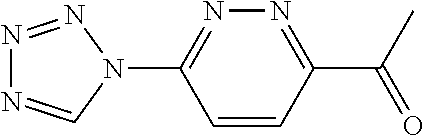 |
191 |
| 22 |
 |
 |
191 |
| 23 |
 |
 |
190 |
| 24 |
 |
 |
201 |
| 25 |
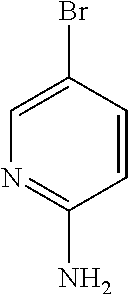 |
 |
190 |
| 26 |
 |
 |
205 |
| 27 |
 |
 |
189 |
| 28 |
 |
 |
215 |


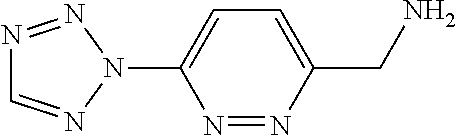


| TABLE 4 |
| Compounds prepared following the procedure for EXAMPLE 1 |
| Ex. # | Int-A | Int-B | Structure and Name | MS [M + H]+ |
| 2 | 30 | 37 |
 |
425.2 |
| (5r,8r)-2-(4-methyl-5-oxo-2,5-dihydrofuran-3-yl)- | ||||
| 8-{[2-(1-oxo-1,3-dihydro-2-benzofuran-5- | ||||
| yl)ethyl]amino}-2-azaspiro[4.5]decan-1-one | ||||
| 3 | 30 | 37 |
 |
425.2 |
| (5s,8s)-2-(4-methyl-5-oxo-2,5-dihydrofuran-3-yl)- | ||||
| 8-{[2-(1-oxo-1,3-dihydro-2-benzofuran-5- | ||||
| yl)ethyl]amino}-2-azaspiro[4.5]decan-1-one | ||||
| 4 | 14 | 37 |
 |
425.3 |
| (5s,8s)-8-(((4-methyl-1-oxo-1,3-dihydroisobenzofuran- | ||||
| 5-yl)methyl)amino)-2-(4-methyl-5-oxo-2,5-dihydrofuran- | ||||
| 3-yl)-2-azaspiro[4.5]decan-1-one | ||||
| 5 | 2 | 37 |
 |
424.2 |
| (5r,8r)-2-(4-methyl-5-oxo-2,5-dihydrofuran-3-yl)- | ||||
| 8-({[6-(1H-tetrazol-1-yl)pyridin-3- | ||||
| yl]methyl}amino)-2-azaspiro[4.5]decan-1-one | ||||
| 6 | 2 | 37 |
 |
424.2 |
| (5s,8s)-2-(4-methyl-5-oxo-2,5-dihydrofuran-3-yl)- | ||||
| 8-({[6-(1H-tetrazol-1-yl)pyridin-3- | ||||
| yl]methyl}amino)-2-azaspiro[4.5]decan-1-one | ||||
| 7A | 3 | 37 |
 |
424.2 |
| (5s,8s)-2-(4-methyl-5-oxo-2,5-dihydrofuran-3-yl)- | ||||
| 8-({[5-(1H-tetrazol-1-yl)pyridin-2- | ||||
| yl]methyl}amino)-2-azaspiro[4.5]decan-1-one | ||||
| 7B | 3 | 37 |
 |
424.2 |
| (5r,8r)-2-(4-methyl-5-oxo-2,5-dihydrofuran-3-yl)- | ||||
| 8-({[5-(1H-tetrazol-1-yl)pyridin-2- | ||||
| yl]methyl}amino)-2-azaspiro[4.5]decan-1-one | ||||
| 9 | 25 | 37 |
 |
438.2 |
| (5S,8r)-2-(4-methyl-5-oxo-2,5-dihydrofuran-3- | ||||
| yl)-8-({(1S)-1-[6-(1H-tetrazol-1-yl)pyridin-3- | ||||
| yl]ethyl}amino)-2-azaspiro[4.5]decan-1-one | ||||
| 10 | 25 | 37 |
 |
438.2 |
| (5R,8r)-8-(((R)-1-(6-(1H-tetrazol-1-yl)pyridin-3- | ||||
| yl)ethyl)amino)-2-(4-methyl-5-oxo-2,5- | ||||
| dihydrofuran-3-yl)-2-azaspiro[4.5]decan-1-oneSeparated | ||||
| 11 | 10 | 37 |
 |
435.2 |
| (5r,8r)-2-(4-methyl-5-oxo-2,5-dihydrofuran-3-yl)- | ||||
| 8-[(5H-tetrazolo[5,1-a]isoindol-7- | ||||
| ylmethyl)amino]-2-azaspiro[4.5]decan-1-one | ||||
| 12 | 5 | 37 |
 |
411.2 |
| (5r,8r)-2-(4-methyl-5-oxo-2,5-dihydrofuran-3-yl)- | ||||
| 8-({[4-methyl-6-(1H-tetrazol-1-yl)pyridazin-3- | ||||
| yl]methyl}amino)-2-azaspiro[4.5]decan-1-one | ||||
| 13 | 4 | 37 |
 |
397.3 |
| (5s,8s)-2-(4-methyl-5-oxo-2,5-dihydrofuran-3-yl)- | ||||
| 8-({[5-(1H-tetrazol-1-yl)pyrazin-2- | ||||
| yl]methyl}amino)-2-azaspiro[4.5]decan-1-one | ||||
| 14 | 6 | 37 |
 |
411.2 ([M + 1-28]+) |
| (5r,8r)-2-(4-methyl-5-oxo-2,5-dihydrofuran-3-yl)- | ||||
| 8-({[3-methyl-5-(1H-tetrazol-1-yl)pyrazin-2- | ||||
| yl]methyl}amino)-2-azaspiro[4.5]decan-1-one | ||||
| 15 | 21 | 37 |
 |
411.2 ([M + 1-28]+) |
| (5R,8r)-2-(4-methyl-5-oxo-2,5-dihydrofuran-3-yl)- | ||||
| 8-({(1R)-1-[6-(1H-tetrazol-1-yl)pyridazin-3- | ||||
| yl]ethyl}amino)-2-azaspiro[4.5]decan-1-one | ||||
| 16 | 21 | 37 |
 |
411.2 ([M + 1-28]+) |
| (5r,8r)-2-(4-methyl-5-oxo-2,5-dihydrofuran-3-yl)- | ||||
| 8-({1-[6-(1H-tetrazol-1-yl)pyridazin-3- | ||||
| yl]ethyl}amino)-2-azaspiro[4.5]decan-1-one | ||||
| 17 | 28 | 37 |
 |
463.2 |
| (5S,8s)-8-{[(1R)-1-(4,5-dihydrotetrazolo[1,5- | ||||
| a]quinolin-7-yl)ethyl]amino}-2-(4-methyl-5-oxo- | ||||
| 2,5-dihydrofuran-3-yl)-2-azaspiro[4.5]decan-1-one | ||||
| 18 | 28 | 37 |
 |
463.2 |
| (5R,8r)-8-{[(1R)-1-(4,5-dihydrotetrazolo[1,5- | ||||
| a]quinolin-7-yl)ethyl]amino}-2-(4-methyl-5-oxo- | ||||
| 2,5-dihydrofuran-3-yl)-2-azaspiro[4.5]decan-1-one | ||||
| 19 | 1 | 39B |
 |
397.2 |
| (5r,8r)-3-methyl-2-(5-oxo-2,5-dihydrofuran-3-yl)- | ||||
| 8-({[6-(1H-tetrazol-1-yl)pyridazin-3- | ||||
| yl]methyl}amino)-2-azaspiro[4.5]decan-1-one | ||||
| 20 | 22 | 37 |
 |
411.2 ([M + 1-28]+) |
| (5R,8r)-2-(4-methyl-5-oxo-2,5-dihydrofuran-3-yl)- | ||||
| 8-({(1R)-1-[5-(1H-tetrazol-1-yl)pyrazin-2- | ||||
| yl]ethyl}amino)-2-azaspiro[4.5]decan-1-one | ||||
| 21 | 28 | 37 |
 |
463.2 |
| (5S,8r)-8-{[(1S)-1-(4,5-dihydrotetrazolo[1,5- | ||||
| a]quinolin-7-yl)ethyl]amino}-2-(4-methyl-5-oxo- | ||||
| 2,5-dihydrofuran-3-yl)-2-azaspiro[4.5]decan-1-one | ||||
| 22 | 2 | 39B |
 |
424.2 |
| (3S,5s,8R)-3-methyl-2-(5-oxo-2,5-dihydrofuran-3- | ||||
| yl)-8-({[6-(1H-tetrazol-1-yl)pyridin-3- | ||||
| yl]methyl}amino)-2-azaspiro[4.5]decan-1-one | ||||
| 23 | 2 | 39A |
 |
424.2 |
| (3R,5r,8R)-3-methyl-2-(5-oxo-2,5-dihydrofuran-3- | ||||
| yl)-8-({[6-(1H-tetrazol-1-yl)pyridin-3- | ||||
| yl]methyl}amino)-2-azaspiro[4.5]decan-1-one | ||||
| 24 | 22 | 37 |
 |
411.2 ([M + 1-28]+) |
| (5R,8r)-2-(4-methyl-5-oxo-2,5-dihydrofuran-3-yl)- | ||||
| 8-({(1R)-1-[5-(1H-tetrazol-1-yl)pyrazin-2- | ||||
| yl]ethyl}amino)-2-azaspiro[4.5]decan-1-one | ||||
| 25 | 22 | 37 |
 |
411.2 |
| (5R,8r)-2-(4-methyl-5-oxo-2,5-dihydrofuran-3-yl)- | ||||
| 8-({(1R)-1-[5-(1H-tetrazol-1-yl)pyrazin-2- | ||||
| yl]ethyl}amino)-2-azaspiro[4.5]decan-1-one | ||||
| 26 | 4 | 39A |
 |
425.2 |
| (3R,5s,8S)-3-methyl-2-(5-oxo-2,5-dihydrofuran-3- | ||||
| yl)-8-({[5-(1H-tetrazol-1-yl)pyrazin-2- | ||||
| yl]methyl}amino)-2-azaspiro[4.5]decan-1-one | ||||
| 27 | 2 | 39A |
 |
424.1 |
| (3R,5s,8S)-3-methyl-2-(5-oxo-2,5-dihydrofuran-3- | ||||
| yl)-8-({[6-(1H-tetrazol-1-yl)pyridin-3- | ||||
| yl]methyl}amino)-2-azaspiro[4.5]decan-1-one | ||||
| 28 | 4 | 39B |
 |
425.2 |
| (3S,5s,8R)-3-methyl-2-(5-oxo-2,5-dihydrofuran-3- | ||||
| yl)-8-({[5-(1H-tetrazol-1-yl)pyrazin-2- | ||||
| yl]methyl}amino)-2-azaspiro[4.5]decan-1-one | ||||
| 29 | 23 | 37 |
 |
438.2 |
| (5S,8r)-2-(4-methyl-5-oxo-2,5-dihydrofuran-3-yl)- | ||||
| 8-({(1S)-1-[5-(1H-tetrazol-1-yl)pyridin-2- | ||||
| yl]ethyl}amino)-2-azaspiro[4.5]decan-1-one. | ||||
| 30 | 24 | 37 |
 |
449.2 |
| (5R,8r)-2-(4-methyl-5-oxo-2,5-dihydrofuran-3-yl)- | ||||
| 8-{[(1R)-1-(5H-tetrazolo[5,1-a]isoindol-7- | ||||
| yl)ethyl]amino}-2-azaspiro[4.5]decan-1-one | ||||
| 31 | 24 | 37 |
 |
449.2 |
| (5S,8r)-2-(4-methyl-5-oxo-2,5-dihydrofuran-3-yl)- | ||||
| 8-{[(1S)-1-(5H-tetrazolo[5,1-a]isoindol-7- | ||||
| yl)ethyl]amino}-2-azaspiro[4.5]decan-1-one | ||||
| 32 | 23 | 37 |
 |
438.2 |
| 5R,8r)-2-(4-methyl-5-oxo-2,5-dihydrofuran-3-yl)- | ||||
| 8-({(1R)-1-[5-(1H-tetrazol-1-yl)pyridin-2- | ||||
| yl]ethyl}amino)-2-azaspiro[4.5]decan-1-one | ||||
| 33 | 4 | 39 |
 |
397.1 ([M + 1-28]+) |
| (5r,8r)-3-methyl-2-(5-oxo-2,5-dihydrofuran-3-yl)- | ||||
| 8-({[5-(1H-tetrazol-1-yl)pyrazin-2- | ||||
| yl]methyl}amino)-2-azaspiro[4.5]decan-1-one | ||||
| 34 | 7 | 37 |
 |
411.2 ([M + 1-28]+) |
| (5r,8r)-2-(4-methyl-5-oxo-2,5-dihydrofuran-3-yl)- | ||||
| 8-({[5-methyl-6-(1H-tetrazol-1-yl)pyridazin-3- | ||||
| yl]methyl}amino)-2-azaspiro[4.5]decan-1-one | ||||
| 35 | 1 | 39B |
 |
397.2 ([M + 1-28]+) |
| (3S,5s,8R)-8-(((6-(1H-tetrazol-1-yl)pyridazin-3- | ||||
| yl)methyl)amino)-3-methyl-2-(5-oxo-2,5- | ||||
| dihydrofuran-3-yl)-2-azaspiro[4.5]decan-1-one | ||||
| 36 | 1 | 39A |
 |
397.2 ([M + 1-28]+) |
| (3R,5r,8R)-3-methyl-2-(5-oxo-2,5-dihydrofuran-3- | ||||
| yl)-8-({[6-(1H-tetrazol-1-yl)pyridazin-3- | ||||
| yl]methyl}amino)-2-azaspiro[4.5]decan-1-one | ||||
| 37 | 1 | 39B |
 |
397.2 ([M + 1-28]+) |
| (3S,5r,8S)-8-(((6-(1H-tetrazol-1-yl)pyridazin-3- | ||||
| yl)methyl)amino)-3-methyl-2-(5-oxo-2,5- | ||||
| dihydrofuran-3-yl)-2-azaspiro[4.5]decan-1-one | ||||
| 38 | 1 | 38B |
 |
411.2 ([M + 1-28]+) |
| (3S,5r,8S)-8-(((6-(1H-tetrazol-1-yl)pyridazin-3- | ||||
| yl)methyl)amino)-3-methyl-2-(4-methyl-5-oxo- | ||||
| 2,5-dihydrofuran-3-yl)-2-azaspiro[4.5]decan-1-one | ||||
| 39 | 1 | 38A |
 |
411.2 ([M + 1-28]+) |
| (3R,5r,8R)-8-(((6-(1H-tetrazol-1-yl)pyridazin-3- | ||||
| yl)methyl)amino)-3-methyl-2-(4-methyl-5-oxo- | ||||
| 2,5-dihydrofuran-3-yl)-2-azaspiro[4.5]decan-1-one | ||||
| 40 | 33 | 37 |
 |
423.6 |
| (5s,8s)-2-(4-methyl-5-oxo-2,5-dihydrofuran-3-yl)- | ||||
| 8-{[4-(2H-tetrazol-2-yl)benzyl]amino}-2- | ||||
| azaspiro[4.5]decan-1-one | ||||
| 41 | 33 | 37 |
 |
423.6 |
| (5r,8r)-2-(4-methyl-5-oxo-2,5-dihydrofuran-3-yl)- | ||||
| 8-{[4-(2H-tetrazol-2-yl)benzyl]amino}-2- | ||||
| azaspiro[4.5]decan-1-one | ||||
| 42 | 1 | 40B |
 |
439.7 |
| (5s,8s)-8-methyl-2-(4-methyl-5-oxo-2,5-dihydrofuran-3- | ||||
| yl)-8-({[6-(1H-tetrazol-1-yl)pyridazin-3-yl] | ||||
| methyl}amino)-2-azaspiro[4.5]decan-1-one | ||||
| 43 | 8 | 37 |
 |
423.2 |
| (5s,8s)-2-(4-methyl-5-oxo-2,5-dihydrofuran-3-yl)- | ||||
| 8-{[4-(1H-tetrazol-1-yl)benzyl]amino}-2- | ||||
| azaspiro[4.5]decan-1-one | ||||
| 44 | 8 | 37 |
 |
423.2 |
| (5r,8r)-2-(4-methyl-5-oxo-2,5-dihydrofuran-3-yl)- | ||||
| 8-{[4-(1H-tetrazol-1-yl)benzyl]amino}-2- | ||||
| azaspiro[4.5]decan-1-one | ||||
| 45 | 11 | 37 |
 |
471.1 |
| 2-(4-methyl-5-oxo-2,5-dihydrofuran-3-yl)-8-{[(6-methyl- | ||||
| 5H-tetrazolo[5,1-a]isoindol-7-yl)methyl]amino}-2-azaspiro[4.5] | ||||
| decan-1-one (a mixture of two isomers) | ||||
| 46 | 26 | 37 |
 |
425.2 |
| (5R,8r)-2-(4-methyl-5-oxo-2,5-dihydrofuran-3-yl)- | ||||
| 8-(((R)-1-(4-methyl-6-(1H-tetrazol-1-yl)pyridazin- | ||||
| 3-yl)ethyl)amino)-2-azaspiro[4.5]decan-1-one. | ||||
| 47 | 15 | 37 |
 |
435.2 |
| (5r,8r)-2-(4-methyl-5-oxo-2,5-dihydrofuran-3-yl)- | ||||
| 8-[(5H-tetrazolo[5,1-a]isoindol-8- | ||||
| ylmethyl)amino]-2-azaspiro[4.5]decan-1-one | ||||
| 48 | 1 | 39 |
 |
439.5 |
| (5r,8r)-8-methyl-2-(4-methyl-5-oxo-2,5-dihydrofuran- | ||||
| 3-yl)-8-({[6-(1H-tetrazol-1-yl)pyridazin-3-yl] | ||||
| methyl}amino)-2-azaspiro[4.5]decan-1-one | ||||
| 49 | 4 | 39 |
 |
425.7 |
| (5r,8r)-3-methyl-2-(5-oxo-2,5-dihydrofuran-3-yl)- | ||||
| 8-({[5-(1H-tetrazol-1-yl)pyrazin-2- | ||||
| yl]methyl}amino)-2-azaspiro[4.5]decan-1-one | ||||
| 50 | 4 | 40 |
 |
425.7 |
| (5r,8r)-3-methyl-2-(5-oxo-2,5-dihydrofuran-3-yl)- | ||||
| 8-({[5-(1H-tetrazol-1-yl)pyrazin-2- | ||||
| yl]methyl}amino)-2-azaspiro[4.5]decan-1-one | ||||
| 51 | 16 | 37 |
 |
449.2 |
| (5r,8r)-8-(((4,5-dihydrotetrazolo[1,5-a]quinolin-7- | ||||
| yl)methyl)amino)-2-(4-methyl-5-oxo-2,5- | ||||
| dihydrofuran-3-yl)-2-azaspiro[4.5]decan-1-one | ||||
| 52 | 19 | 37 |
 |
436.1 |
| (5r,8r)-8-(((8H-tetrazolo[1′,5′:1,2]pyrrolo[3,4- | ||||
| b]pyridin-6-yl)methyl)amino)-2-(4-methyl-5-oxo- | ||||
| 2,5-dihydrofuran-3-yl)-2-azaspiro[4.5]decan-1-one | ||||
| 53 | 18 | 37 |
 |
449.2 |
| (5r,8r)-2-(4-methyl-5-oxo-2,5-dihydrofuran-3-yl)- | ||||
| 8-(((5-methyl-5H-tetrazolo[5,1-a]isoindol-7- | ||||
| yl)methyl)amino)-2-azaspiro[4.5]decan-1-one | ||||
| 54 | 11 | 37 |
 |
449.2 |
| (5r,8r)-2-(4-methyl-5-oxo-2,5-dihydrofuran-3-yl)- | ||||
| 8-(((6-methyl-5H-tetrazolo[5,1-a]isoindol-7- | ||||
| yl)methyl)amino)-2-azaspiro[4.5]decan-1-one | ||||
| 55 | 10 | 38A |
 |
449.2 |
| (3R,5s,8S)-8-(((5H-tetrazolo[5,1-a]isoindol-7- | ||||
| yl)methyl)amino)-3-methyl-2-(4-methyl-5-oxo- | ||||
| 2,5-dihydrofuran-3-yl)-2-azaspiro[4.5]decan-1-one | ||||
| 56 | 10 | 38B |
 |
449.2 |
| (3S,5r,8S)-8-(((5H-tetrazolo[5,1-a]isoindol-7- | ||||
| yl)methyl)amino)-3-methyl-2-(4-methyl-5-oxo- | ||||
| 2,5-dihydrofuran-3-yl)-2-azaspiro[4.5]decan-1-one | ||||
| 57 | 4 | 38B |
 |
411.2 ([M + 1-28]+) |
| (3S,5s,8R)-8-(((5-(1H-tetrazol-1-yl)pyrazin-2- | ||||
| yl)methyl)amino)-3-methyl-2-(4-methyl-5-oxo- | ||||
| 2,5-dihydrofuran-3-yl)-2-azaspiro[4.5]decan-1-one | ||||
| 58 | 10 | 38B |
 |
449.2 |
| (3S,5s,8R)-8-(((5H-tetrazolo[5,1-a]isoindol-7- | ||||
| yl)methyl)amino)-3-methyl-2-(4-methyl-5-oxo- | ||||
| 2,5-dihydrofuran-3-yl)-2-azaspiro[4.5]decan-1-one. | ||||
| 59 | 12 | 37 |
 |
453.2 |
| (5r,8r)-8-(((6-fluoro-5H-tetrazolo[5,1-a]isoindol- | ||||
| 7-yl)methyl)amino)-2-(4-methyl-5-oxo-2,5- | ||||
| dihydrofuran-3-yl)-2-azaspiro[4.5]decan-1-one | ||||
| 60 | 10 | 38A |
 |
449.2 |
| (3R,5r,8R)-8-(((5H-tetrazolo[5,1-a]isoindol-7- | ||||
| yl)methyl)amino)-3-methyl-2-(4-methyl-5-oxo- | ||||
| 2,5-dihydrofuran-3-yl)-2-azaspiro[4.5]decan-1-one | ||||
| 61 | 13 | 37 |
 |
449.2 |
| (5r,8r)-2-(4-methyl-5-oxo-2,5-dihydrofuran-3-yl)- | ||||
| 8-(((8-methyl-5H-tetrazolo[5,1-a]isoindol-7- | ||||
| yl)methyl)amino)-2-azaspiro[4.5]decan-1-one | ||||
| 62 | 10 | 39B |
 |
435.2 |
| (3S,5s,8R)-8-(((5H-tetrazolo[5,1-a]isoindol-7- | ||||
| yl)methyl)amino)-3-methyl-2-(5-oxo-2,5- | ||||
| dihydrofuran-3-yl)-2-azaspiro[4.5]decan-1-one | ||||
| 63 | 10 | 39B |
 |
435.2 |
| (3S,5r,8S)-8-(((5H-tetrazolo[5,1-a]isoindol-7- | ||||
| yl)methyl)amino)-3-methyl-2-(5-oxo-2,5- | ||||
| dihydrofuran-3-yl)-2-azaspiro[4.5]decan-1-one | ||||
| 64 | 4 | 38A |
 |
411.2 ([M + 1-28]+) |
| (3R,5r,8R)-8-(((5-(1H-tetrazol-1-yl)pyrazin-2- | ||||
| yl)methyl)amino)-3-methyl-2-(4-methyl-5-oxo- | ||||
| 2,5-dihydrofuran-3-yl)-2-azaspiro[4.5]decan-1-one | ||||
| 65 | 10 | 39A |
 |
435.2 |
| (3R,5s,8S)-8-(((5H-tetrazolo[5,1-a]isoindol-7- | ||||
| yl)methyl)amino)-3-methyl-2-(5-oxo-2,5- | ||||
| dihydrofuran-3-yl)-2-azaspiro[4.5]decan-1-one | ||||
| 66 | 4 | 39B |
 |
425.1 |
| (3S,5r,8S)-8-(((5-(1H-tetrazol-1-yl)pyrazin-2- | ||||
| yl)methyl)amino)-3-methyl-2-(5-oxo-2,5- | ||||
| dihydrofuran-3-yl)-2-azaspiro[4.5]decan-1-one | ||||
| 67 | 9 | 37 |
 |
452.0 |
| (5r,8r)-8-(((2-(1H-tetrazol-1-yl)thiazol-5- | ||||
| yl)methyl)amino)-2-(4-methyl-5-oxo-2,5- | ||||
| dihydrofuran-3-yl)-2-azaspiro[4.5]decan-1-one | ||||
| 68 | 4 | 40B |
 |
439.4 |
| (5s,8s)-8-(((5-(1H-tetrazol-1-yl)pyrazin-2- | ||||
| yl)methyl)amino)-8-methyl-2-(4-methyl-5-oxo- | ||||
| 2,5-dihydrofuran-3-yl)-2-azaspiro[4.5]decan-1-one | ||||
| 69 | 4 | 40A |
 |
439.4 |
| (5r,8r)-8-(((5-(1H-tetrazol-1-yl)pyrazin-2- | ||||
| yl)methyl)amino)-8-methyl-2-(4-methyl-5-oxo- | ||||
| 2,5-dihydrofuran-3-yl)-2-azaspiro[4.5]decan-1-one | ||||
| 70 | 9 | 39B |
 |
402.0 |
| (3S,5r,8S)-8-(((2-(1H-tetrazol-1-yl)thiazol-5- | ||||
| yl)methyl)amino)-3-methyl-2-(5-oxo-2,5- | ||||
| dihydrofuran-3-yl)-2-azaspiro[4.5]decan-1-one | ||||
| 71 | 9 | 39A |
 |
402.0 |
| (3R,5r,8R)-8-(((2-(1H-tetrazol-1-yl)thiazol-5- | ||||
| yl)methyl)amino)-3-methyl-2-(5-oxo-2,5- | ||||
| dihydrofuran-3-yl)-2-azaspiro[4.5]decan-1-one | ||||
| 72 | 4 | 41 |
 |
411.3 |
| (5r,8r)-8-(((5-(1H-tetrazol-1-yl)pyrazin-2- | ||||
| yl)methyl)amino)-2-(5-oxo-2,5-dihydrofuran-3- | ||||
| yl)-2-azaspiro[4.5]decan-1-one | ||||
| 73 | 4 | 41 |
 |
411.3 |
| (5s,8s)-8-(((5-(1H-tetrazol-1-yl)pyrazin-2- | ||||
| yl)methyl)amino)-2-(5-oxo-2,5-dihydrofuran-3- | ||||
| yl)-2-azaspiro[4.5]decan-1-one | ||||
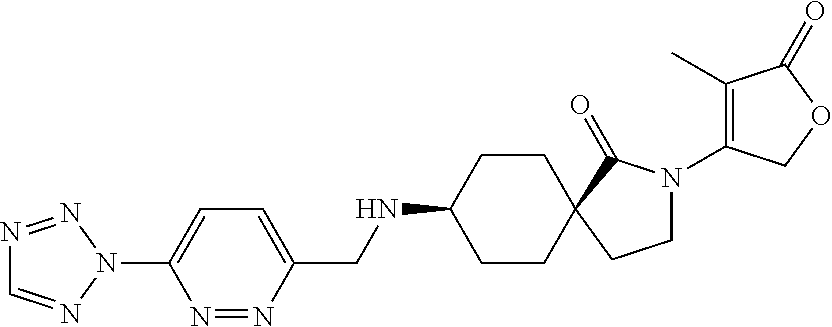

| TABLE 5 |
| Compounds prepared following the procedure for Examples 74 and 75 |
| Ex. | MS | |||
| # | Int-A | Int-B | Compound and Name | [M + H]+ |
| 76 | 35 | 37 |
 |
424.3 |
| 77 | 29A | 36 |
 |
454.3 |


| TABLE 6 |
| Compounds prepared following the procedure for EXAMPLE 80 |
| Ex. | MS | |||
| # | Int-A | Int-B | Compound and Name | [M + H]+ |
| 81 | 14 | 37 |
 |
439.2 |
| 82 | 14 | 37 |
 |
439.2 |
| 83 | 2 | 37 |
 |
438.2 |
| 84 | 2 | 37 |
 |
438.2 |
| 85 | 29A | 37 |
 |
468.2 |
| 86 | 29A | 37 |
 |
468.2 |
| 87 | 3 | 37 |
 |
438.2 |
| 88 | 3 | 37 |
 |
438.2 |
| 89 | 10 | 37 |
 |
449.2 |
| 90 | 10 | 37 |
 |
449.2 |
| 91 | 4 | 37 |
 |
439.1 |
| 92 | 4 | 37 |
 |
439.1 |
| 93 | 25 | 37 |
 |
452.2 |
| 94 | 25 | 37 |
 |
452.2 |
| 95 | 25 | 37 |
 |
452.2 |
| 96 | 17 | 37 |
 |
461.2 |
| 97 | 11 | 37 |
 |
463.2 |
| 98 | 11 | 37 |
 |
463.2 |
| 99 | 4 | 38B |
 |
425.2 |
| 100 | 4 | 38A |
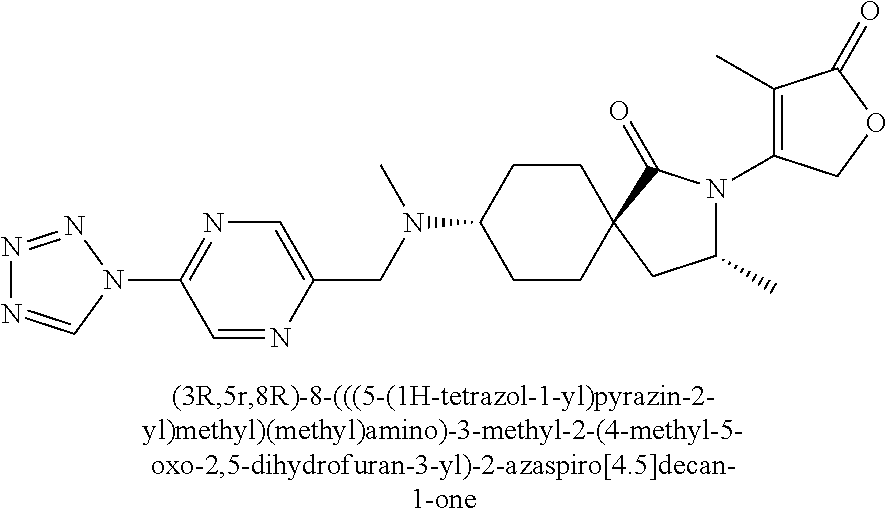 |
425.2 |
| 101 | 29B | 37 |
 |
468.2 |
| 102 | 29B | 37 |
 |
468.2 |
| 103 | 1 | 41 |
 |
425.6 |

| TABLE 7 |
| Compounds prepared following the procedure for Ex. 104 |
| Ex. | SM | MS | |
| # | Ex. # | Structure and Name | [M + H]+ |
| 105 | 2 |
 |
439.5 |
| 106 | 11 |
 |
449.2 |
| 107 | 12 |
 |
453.4 |
| 108 | 36 |
 |
411.2 ([M + 1 − 28]+) |
| 109 | 41 |
 |
437.3 |
| 110 | 38 |
 |
425.2 |
| 111 | 40 |
 |
437.6 |
| 112 | 51 |
 |
463.2 |
| 113 | 75 |
 |
439.6 |
| 114 | 74 |
 |
439.6 |
| 115 | 42 |
 |
453.6 |
| 116 | 48 |
 |
453.6 |
| 117 | 76 |
 |
437.6 |
| 118 | 39 |
 |
425.2 |
| 119 | 55 |
 |
439.6 |
| 120 | 56 |
 |
463.2 |
| 121 | 59 |
 |
467.4 |
| 122 | 61 |
 |
463.2 |
| 123 | 79 |
 |
469.5 |
| 124 | 78 |
 |
469.4 |
| 125 | 14 |
 |
453.4 |
| 126 | 67 |
 |
416.2 |
| 127 | 68 |
 |
453.3 |
| 128 | 72 |
 |
425.2 |
| 129 | 69 |
 |
453.2 |


| TABLE 8 |
| Compounds prepared following the procedure for EXAMPLE 132 |
| Ex. | MS | |||
| # | SM-A | SM-B | Structure and Name | [M + H]+ |
| 133 |
 |
Ex. 11 |
 |
463.2 |
| 134 |
 |
Ex. 5 |
 |
452.2 |
| 135 |
 |
Ex. 1 |
 |
478.2 ([M + 1 − 28]+) |
| 136 |
 |
Ex. 7 5S Isomer |
 |
468.2 |
| 137 |
 |
Ex. 1 |
 |
468.2 |
| 138 |
 |
Ex. 7 5s, 8s isomer |
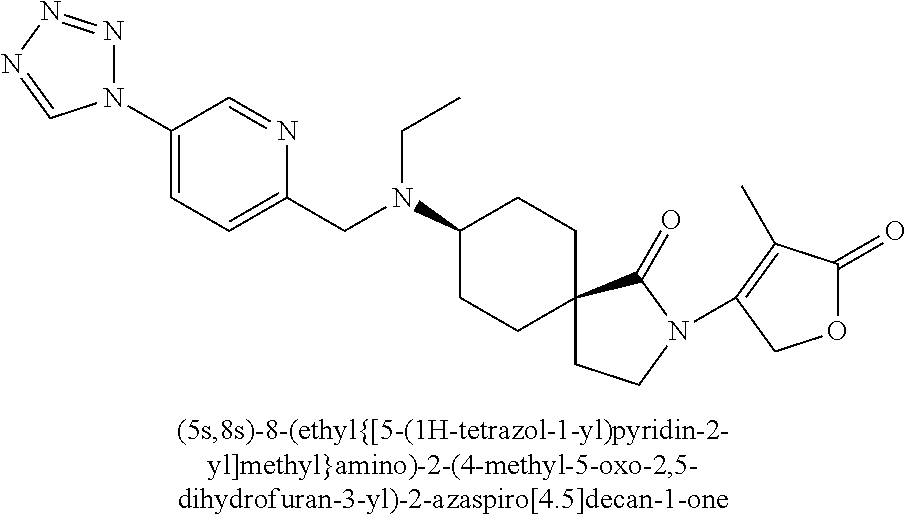 |
452.2 |
| 139 |
 |
Ex. 6 5s, 8s isomer |
 |
509.2 |
| 140 |
 |
Ex. 6 5s, 8s isomer |
 |
481.2 |
| 141 |
 |
Ex. 5 |
 |
481.2 |
| 142 |
 |
Ex. 3 |
 |
453.2 |
| TABLE 10 | |||
| Thallium Flux | |||
| Ex. No. | IC50 (μM) | ||
| 1 | 0.01 | ||
| 2 | 0.044 | ||
| 3 | 0.20 | ||
| 4 | 0.35 | ||
| 5 | 0.016 | ||
| 6 | 0.45 | ||
| 7 | 0.024 | ||
| 8 | 0.71 | ||
| 9 | 0.034 | ||
| 10 | 0.018 | ||
| 11 | 0.11 | ||
| 12 | 0.0083 | ||
| 13 | 0.032 | ||
| 14 | 0.030 | ||
| 15 | 0.092 | ||
| 16 | 0.32 | ||
| 17 | 0.34 | ||
| 18 | 0.33 | ||
| 19 | 0.028 | ||
| 20 | 0.17 | ||
| 21 | 0.044 | ||
| 22 | 0.13 | ||
| 23 | 0.72 | ||
| 24 | 0.12 | ||
| 25 | 0.26 | ||
| 26 | 0.19 | ||
| 27 | 0.038 | ||
| 28 | 0.25 | ||
| 29 | 0.020 | ||
| 30 | 0.15 | ||
| 31 | 0.26 | ||
| 32 | 0.11 | ||
| 33 | 0.046 | ||
| 34 | 0.0084 | ||
| 35 | 0.0084 | ||
| 36 | 0.11 | ||
| 37 | 0.030 | ||
| 38 | 0.040 | ||
| 39 | 0.023 | ||
| 40 | 0.11 | ||
| 41 | 0.0033 | ||
| 42 | 0.070 | ||
| 43 | 0.049 | ||
| 44 | 0.0031 | ||
| 45 | 0.019 | ||
| 46 | 0.18 | ||
| 47 | 0.55 | ||
| 48 | 0.0077 | ||
| 49 | 0.24 | ||
| 50 | 0.039 | ||
| 51 | 0.0043 | ||
| 52 | 0.16 | ||
| 53 | 0.019 | ||
| 54 | 0.032 | ||
| 55 | 0.015 | ||
| 56 | 0.52 | ||
| 57 | 0.42 | ||
| 58 | 0.18 | ||
| 59 | 0.0060 | ||
| 60 | 0.65 | ||
| 61 | 0.023 | ||
| 62 | 0.020 | ||
| 63 | 0.023 | ||
| 64 | 0.065 | ||
| 65 | 0.019 | ||
| 66 | 0.0070 | ||
| 67 | 0.092 | ||
| 68 | 0.14 | ||
| 69 | 0.015 | ||
| 70 | 0.024 | ||
| 71 | 0.19 | ||
| 72 | 0.34 | ||
| 73 | 2 | ||
| 74 | 0.21 | ||
| 75 | 0.0093 | ||
| 76 | 0.18 | ||
| 77 | 0.36 | ||
| 78 | 0.21 | ||
| 79 | 0.28 | ||
| 80 | 0.019 | ||
| 81 | 1.18 | ||
| 0.69 | |||
| 82 | 0.13 | ||
| 0.054 | |||
| 83 | 0.028 | ||
| 84 | 0.74 | ||
| 85 | 0.19 | ||
| 86 | 0.48 | ||
| 87 | 0.55 | ||
| 88 | 0.007 | ||
| 89 | 0.95 | ||
| 90 | 0.022 | ||
| 91 | 0.69 | ||
| 92 | 0.029 | ||
| 93 | 0.51 | ||
| 94 | 0.011 | ||
| 95 | 0.024 | ||
| 96 | 0.021 | ||
| 97 | 0.17 | ||
| 98 | 0.0097 | ||
| 99 | 0.31 | ||
| 100 | 0.20 | ||
| 101 | 0.29 | ||
| 102 | 0.30 | ||
| 103 | 0.087 | ||
| 104 | 0.041 | ||
| 105 | 0.15 | ||
| 106 | 0.0088 | ||
| 107 | 0.022 | ||
| 108 | 0.27 | ||
| 109 | 0.0034 | ||
| 110 | 0.20 | ||
| 111 | 0.30 | ||
| 112 | 0.032 | ||
| 113 | 0.036 | ||
| 114 | 0.43 | ||
| 115 | 0.015 | ||
| 116 | 0.024 | ||
| 117 | 0.64 | ||
| 118 | 0.20 | ||
| 119 | 0.018 | ||
| 120 | 0.043 | ||
| 121 | 0.023 | ||
| 122 | 0.026 | ||
| 123 | 0.077 | ||
| 124 | 0.064 | ||
| 125 | 0.022 | ||
| 126 | 0.030 | ||
| 127 | 0.091 | ||
| 128 | 0.093 | ||
| 129 | 0.045 | ||
| 130 | 0.030 | ||
| 131 | 0.16 | ||
| 132 | 0.10 | ||
| 133 | 0.036 | ||
| 134 | 0.47 | ||
| 135 | 0.21 | ||
| 136 | 0.16 | ||
| 137 | 0.15 | ||
| 138 | 0.034 | ||
| 139 | 0.12 | ||
| 140 | 0.11 | ||
| 141 | 0.68 | ||
| 142 | 0.49 | ||
Claims (16)


Applications Claiming Priority (4)
| Application Number | Priority Date | Filing Date | Title |
|---|---|---|---|
| PCT/CN2014/070384 WO2015103756A1 (en) | 2014-01-09 | 2014-01-09 | Inhibitors of the renal outer medullary potassium channel |
| CNPCT/CN2014/070384 | 2014-01-09 | ||
| WOPCT/CN2014/070384 | 2014-01-09 | ||
| PCT/US2015/010091 WO2015105736A1 (en) | 2014-01-09 | 2015-01-05 | Inhibitors of the renal outer medullary potassium channel |
Publications (2)
| Publication Number | Publication Date |
|---|---|
| US20170037037A1 US20170037037A1 (en) | 2017-02-09 |
| US9718808B2 true US9718808B2 (en) | 2017-08-01 |
Family
ID=53523451
Family Applications (1)
| Application Number | Title | Priority Date | Filing Date |
|---|---|---|---|
| US15/106,847 Active US9718808B2 (en) | 2014-01-09 | 2015-01-05 | Inhibitors of the renal outer medullary potassium channel |
Country Status (3)
| Country | Link |
|---|---|
| US (1) | US9718808B2 (en) |
| EP (1) | EP3092230B1 (en) |
| WO (2) | WO2015103756A1 (en) |
Cited By (2)
| Publication number | Priority date | Publication date | Assignee | Title |
|---|---|---|---|---|
| US10160751B2 (en) | 2015-02-12 | 2018-12-25 | Merck Sharp & Dohme Corp. | Inhibitors of the renal outer medullary potassium channel |
| US10208064B2 (en) | 2014-07-14 | 2019-02-19 | Merck Sharp & Dohme Corp. | Inhibitors of the renal outer medullary potassium channel |
Families Citing this family (14)
| Publication number | Priority date | Publication date | Assignee | Title |
|---|---|---|---|---|
| WO2014150132A1 (en) | 2013-03-15 | 2014-09-25 | Merck Sharp & Dohme Corp. | Inhibitors of the renal outer medullary potassium channel |
| WO2015017305A1 (en) | 2013-07-31 | 2015-02-05 | Merck Sharp & Dohme Corp | Inhibitors of the renal outer medullary potassium channel |
| WO2015103756A1 (en) * | 2014-01-09 | 2015-07-16 | Merck Sharp & Dohme Corp. | Inhibitors of the renal outer medullary potassium channel |
| EP3445762B1 (en) | 2016-04-20 | 2023-09-13 | Bristol-Myers Squibb Company | Substituted bicyclic heterocyclic compounds |
| EP3535258B1 (en) * | 2016-11-03 | 2021-11-24 | Bristol-Myers Squibb Company | Substituted bicycle heterocyclic derivatives useful as romk channel inhibitors |
| HUE056142T2 (en) | 2017-06-01 | 2022-01-28 | Bristol Myers Squibb Co | Substituted nitrogen containing compounds |
| SG11202001685TA (en) | 2017-08-28 | 2020-03-30 | Enanta Pharm Inc | Hepatitis b antiviral agents |
| IL283190B2 (en) | 2018-11-21 | 2025-08-01 | Enanta Pharm Inc | Heterocyclics that function as antibiotic agents |
| CN109608457B (en) * | 2019-01-21 | 2020-05-12 | 牡丹江医学院 | A kind of medicine for treating pneumonia and preparation method thereof |
| WO2020247561A1 (en) | 2019-06-04 | 2020-12-10 | Enanta Pharmaceuticals, Inc, | Hepatitis b antiviral agents |
| CN110183451A (en) * | 2019-06-12 | 2019-08-30 | 华东师范大学 | A kind of preparation method and application of 21- methyl-narrow dapple money alkali |
| US11738019B2 (en) | 2019-07-11 | 2023-08-29 | Enanta Pharmaceuticals, Inc. | Substituted heterocycles as antiviral agents |
| US11236108B2 (en) | 2019-09-17 | 2022-02-01 | Enanta Pharmaceuticals, Inc. | Functionalized heterocycles as antiviral agents |
| WO2021188414A1 (en) * | 2020-03-16 | 2021-09-23 | Enanta Pharmaceuticals, Inc. | Functionalized heterocyclic compounds as antiviral agents |
Citations (11)
| Publication number | Priority date | Publication date | Assignee | Title |
|---|---|---|---|---|
| US4216221A (en) | 1977-02-10 | 1980-08-05 | U C B, Societe Anonyme | 1,3-Disubstituted (2-thio)ureas |
| US20100160255A1 (en) | 2005-07-29 | 2010-06-24 | Takeda Pharmaceutical Company Limited | Spiro-cyclic compound |
| WO2010129379A1 (en) | 2009-05-06 | 2010-11-11 | Merck Sharp & Dohme Corp. | Inhibitors of the renal outer medullary potassium channel |
| WO2011045292A1 (en) | 2009-10-15 | 2011-04-21 | F. Hoffmann-La Roche Ag | Spiro-condensed cyclohexane derivatives as hsl inhibitors useful for the treatment of diabetes |
| US20120238594A1 (en) | 2011-03-17 | 2012-09-20 | Daniel Hunziker | Azaspirodecanone compounds |
| WO2012130679A1 (en) | 2011-03-25 | 2012-10-04 | F. Hoffmann-La Roche Ag | New azaspirodecanone compounds as hsl inhibitors |
| WO2013028474A1 (en) | 2011-08-19 | 2013-02-28 | Merck Sharp & Dohme Corp. | Inhibitors of the renal outer medullary potassium channel |
| WO2013066718A2 (en) | 2011-10-31 | 2013-05-10 | Merck Sharp & Dohme Corp. | Inhibitors of the renal outer medullary potassium channel |
| WO2014018764A1 (en) | 2012-07-26 | 2014-01-30 | Merck Sharp & Dohme Corp. | Spiro - fused piperidine derivatives for use as inhibitors of the renal outer medullary potassium channel |
| WO2014150132A1 (en) | 2013-03-15 | 2014-09-25 | Merck Sharp & Dohme Corp. | Inhibitors of the renal outer medullary potassium channel |
| WO2015103756A1 (en) | 2014-01-09 | 2015-07-16 | Merck Sharp & Dohme Corp. | Inhibitors of the renal outer medullary potassium channel |
-
2014
- 2014-01-09 WO PCT/CN2014/070384 patent/WO2015103756A1/en not_active Ceased
-
2015
- 2015-01-05 EP EP15735293.1A patent/EP3092230B1/en active Active
- 2015-01-05 WO PCT/US2015/010091 patent/WO2015105736A1/en not_active Ceased
- 2015-01-05 US US15/106,847 patent/US9718808B2/en active Active
Patent Citations (11)
| Publication number | Priority date | Publication date | Assignee | Title |
|---|---|---|---|---|
| US4216221A (en) | 1977-02-10 | 1980-08-05 | U C B, Societe Anonyme | 1,3-Disubstituted (2-thio)ureas |
| US20100160255A1 (en) | 2005-07-29 | 2010-06-24 | Takeda Pharmaceutical Company Limited | Spiro-cyclic compound |
| WO2010129379A1 (en) | 2009-05-06 | 2010-11-11 | Merck Sharp & Dohme Corp. | Inhibitors of the renal outer medullary potassium channel |
| WO2011045292A1 (en) | 2009-10-15 | 2011-04-21 | F. Hoffmann-La Roche Ag | Spiro-condensed cyclohexane derivatives as hsl inhibitors useful for the treatment of diabetes |
| US20120238594A1 (en) | 2011-03-17 | 2012-09-20 | Daniel Hunziker | Azaspirodecanone compounds |
| WO2012130679A1 (en) | 2011-03-25 | 2012-10-04 | F. Hoffmann-La Roche Ag | New azaspirodecanone compounds as hsl inhibitors |
| WO2013028474A1 (en) | 2011-08-19 | 2013-02-28 | Merck Sharp & Dohme Corp. | Inhibitors of the renal outer medullary potassium channel |
| WO2013066718A2 (en) | 2011-10-31 | 2013-05-10 | Merck Sharp & Dohme Corp. | Inhibitors of the renal outer medullary potassium channel |
| WO2014018764A1 (en) | 2012-07-26 | 2014-01-30 | Merck Sharp & Dohme Corp. | Spiro - fused piperidine derivatives for use as inhibitors of the renal outer medullary potassium channel |
| WO2014150132A1 (en) | 2013-03-15 | 2014-09-25 | Merck Sharp & Dohme Corp. | Inhibitors of the renal outer medullary potassium channel |
| WO2015103756A1 (en) | 2014-01-09 | 2015-07-16 | Merck Sharp & Dohme Corp. | Inhibitors of the renal outer medullary potassium channel |
Non-Patent Citations (22)
| Title |
|---|
| Bhave,G., Development of a selective small-molecule inhibitor Kir1.1, the renal outer medullary potassium channel, Mol. Pharmacol., 2011, 42-50, 79. |
| Boukouvalas, J. et al., Facile access to 4-(1-alkynyl)-2(5H)-furanones by Sonogashira coupling of terminal acetylenes with B-tetronic acid bromide: efficient synthesis of cleviolide, Tetrahedron Letters, 2007, p. 105-107, vol. 48. |
| Dong, Shuzhi, et al., Improvement of hERG-ROMK index of spirocyclic ROMK inhibitors through scaffold optimization and incorporation of novel pharmacophores, Bioorganic & Medicinal Chemistry Letters, 2017, p. 2559-2566, vol. 27. |
| Fringuelli, F. et al., A Simple Procedure for the Synthesis of Labile Aryl Oxiranes by Epdxidation, Organic Preparations and Procedures Int., 1989, p. 757-761, vol. 21, No. 6. |
| Hebert, S. C. et al., Molecular Diversity and Regulation of Renal Potassium Channels, Physiol Rev., 2005, p. 319-371, vol. 85. |
| Ho, K. et al., Cloning and expression of an inwardly rectifying ATP-regulated potassium channel, Nature, 1993, p. 31-38, vol. 362. |
| International Preliminary Report on Patentability for PCT/US2015/010091 mailed on Jul. 12, 2016, 5 pages. |
| International Search Report for PCT/CN2014/070384 mailed on Sep. 29, 2014, 15 pages. |
| International Search Report for PCT/US2015/010091 mailed on Apr. 3, 2015, 8 pages. |
| International Search Report PCT/US 15/10091 dated Apr. 3, 2015, 8 pages. |
| Ji, W. et al., Rare independent mutations in renal salt handling genes contribute to blood pressure variation, Nature Genetics, 2008, p. 592-599, vol. 40, No. 5. |
| Lewis, L. M., High-throughput screening reveals a small-molecule inhibitor of the Renal Outer Medullary Potassium Channel and Kir7.1, Mol. Phamcol., 2009, 1094-1103, 76. |
| Lifton, R. P. et al., Molecular Mechanisms of Human Hypertension, Cell, 2001, p. 545-556, vol. 104. |
| Lorenz, J. N. et al., Impaired Renal NaC1 Absorption inMic Lacking the ROMK Potassium Cannel, a Model for Type II Bartter's Syndrome, The Journal of Biological Chemistry, 2002, p. 37871-37880, vol. 277, No. 40. |
| Lu, M. et al., Absence of Small Conductance K+ Channel (SK) Activity in Apical Membranes of Thick Ascending Limb and Cortical Collectiong Duct in ROMK (Bartter's) Knockout Mice, The Journal of Biological Chemistry, 2002, p. 37881-37887, vol. 277, No. 40. |
| Molander, G. A. et al., Stereoselective Suzuki-Miyaura Cross-Coupling Reactions of Potassium Alkenyltrifiuoroborates with Alkenyl Bromides, J. Org. Chem, 2005, p. 3950-3956, vol. 70. |
| Molander, G. A. et al., Suzuki-Miyaura Cross-Coupling Reactions of Potassium Vinyltrifluoroborate with Aryl and Heteroaryl Electrophiles, J. Org. Chem, 2006, p. 9861-9686, vol. 71. |
| Nomura, Y. et al., Synthesis and Structure-Activity Relationships of 2-(4-Benzhydryl-1-piperazinyl)-1-phenylethanols as New Calcium Blockers, Chem. Phar. Bull, 1995, p. 241-246, vol. 43, No. 2. |
| Reinalter, S. C. et al., Pharmacotyping of hypokalaemic salt-losing tubular disorders, Acta Physiol Scand, 2004, p. 513-521, vol. 181. |
| Shuck, M. E. et al., Cloning and Characterization of Multiple Forms of the Human Kidney ROM-K Potassium Channel, The Journal of Biological Chemistry, 1994, p. 24261-24270, Vo. 269, No. 39. |
| Tobin, M. D. et al., Common Variants in Genes Underlying Monogenic Hypertension and Hypotension and Blood Pressure in the General Population, Hypertension, 2008, p. 1658-1664, vol. 51. No. 6. |
| Wang, W. et al., Renal potassium channesl: recent developments, Current Opinion in Nephrology and Hypertension, 2004, p. 549-555, vol. 13, No. 5. |
Cited By (2)
| Publication number | Priority date | Publication date | Assignee | Title |
|---|---|---|---|---|
| US10208064B2 (en) | 2014-07-14 | 2019-02-19 | Merck Sharp & Dohme Corp. | Inhibitors of the renal outer medullary potassium channel |
| US10160751B2 (en) | 2015-02-12 | 2018-12-25 | Merck Sharp & Dohme Corp. | Inhibitors of the renal outer medullary potassium channel |
Also Published As
| Publication number | Publication date |
|---|---|
| EP3092230A1 (en) | 2016-11-16 |
| EP3092230B1 (en) | 2018-07-11 |
| WO2015105736A1 (en) | 2015-07-16 |
| EP3092230A4 (en) | 2017-06-14 |
| US20170037037A1 (en) | 2017-02-09 |
| WO2015103756A1 (en) | 2015-07-16 |
Similar Documents
| Publication | Publication Date | Title |
|---|---|---|
| US9718808B2 (en) | Inhibitors of the renal outer medullary potassium channel | |
| US9751881B2 (en) | Inhibitors of the renal outer medullary potassium channel | |
| US9765074B2 (en) | Inhibitors of the renal outer medullary potassium channel | |
| US9839629B2 (en) | Inhibitors of the renal outer medullary potassium channel | |
| US10208064B2 (en) | Inhibitors of the renal outer medullary potassium channel | |
| US9850245B2 (en) | Inhibitors of the renal outer medullary potassium channel | |
| US10513518B2 (en) | Inhibitors of the renal outer medullary potassium channel | |
| US9862720B2 (en) | Inhibitors of the renal outer medullary potassium channel | |
| WO2016069430A1 (en) | Inhibitors of the renal outer medullary potassium channel | |
| US9926317B2 (en) | Inhibitors of the renal outer medullary potassium channel | |
| WO2015095097A2 (en) | Inhibitors of the renal outer medullary potassium channel | |
| US20170275302A1 (en) | Inhibitors of the renal outer medullary potassium channel | |
| US20170275292A1 (en) | Inhibitors of the renal outer medullary potassium channel |
Legal Events
| Date | Code | Title | Description |
|---|---|---|---|
| AS | Assignment |
Owner name: MERCK SHARP & DOHME CORP., NEW JERSEY Free format text: ASSIGNMENT OF ASSIGNORS INTEREST;ASSIGNORS:BISWAS, DIPSHIKHA;DING, FA-XIANG;DONG, SHUZHI;AND OTHERS;SIGNING DATES FROM 20140912 TO 20140922;REEL/FRAME:038965/0475 Owner name: WUXI APPTEC (SHANGHAI) CO., LTD., CHINA Free format text: ASSIGNMENT OF ASSIGNORS INTEREST;ASSIGNORS:SUZUKI, TAKAO;VACCA, JOSEPH;XU, SHOUNING;SIGNING DATES FROM 20140915 TO 20140923;REEL/FRAME:038965/0602 Owner name: MERCK SHARP & DOHME CORP., NEW JERSEY Free format text: ASSIGNMENT OF ASSIGNORS INTEREST;ASSIGNOR:WUXI APPTEC (SHANGHAI) CO., LTD.;REEL/FRAME:038965/0956 Effective date: 20140916 |
|
| STCF | Information on status: patent grant |
Free format text: PATENTED CASE |
|
| CC | Certificate of correction | ||
| MAFP | Maintenance fee payment |
Free format text: PAYMENT OF MAINTENANCE FEE, 4TH YEAR, LARGE ENTITY (ORIGINAL EVENT CODE: M1551); ENTITY STATUS OF PATENT OWNER: LARGE ENTITY Year of fee payment: 4 |
|
| AS | Assignment |
Owner name: MERCK SHARP & DOHME LLC, NEW JERSEY Free format text: MERGER;ASSIGNOR:MERCK SHARP & DOHME CORP.;REEL/FRAME:061102/0145 Effective date: 20220407 |
|
| MAFP | Maintenance fee payment |
Free format text: PAYMENT OF MAINTENANCE FEE, 8TH YEAR, LARGE ENTITY (ORIGINAL EVENT CODE: M1552); ENTITY STATUS OF PATENT OWNER: LARGE ENTITY Year of fee payment: 8 |