US971609A - Process of cleaning and separating grains. - Google Patents
Process of cleaning and separating grains. Download PDFInfo
- Publication number
- US971609A US971609A US35256707A US1907352567A US971609A US 971609 A US971609 A US 971609A US 35256707 A US35256707 A US 35256707A US 1907352567 A US1907352567 A US 1907352567A US 971609 A US971609 A US 971609A
- Authority
- US
- United States
- Prior art keywords
- cleaning
- blast
- stream
- air
- separation
- Prior art date
- Legal status (The legal status is an assumption and is not a legal conclusion. Google has not performed a legal analysis and makes no representation as to the accuracy of the status listed.)
- Expired - Lifetime
Links
- 238000000034 method Methods 0.000 title description 17
- 238000004140 cleaning Methods 0.000 title description 9
- 239000000463 material Substances 0.000 description 33
- 238000000926 separation method Methods 0.000 description 11
- 239000002245 particle Substances 0.000 description 7
- 241000723377 Coffea Species 0.000 description 4
- 235000021028 berry Nutrition 0.000 description 4
- 235000016213 coffee Nutrition 0.000 description 4
- 235000013353 coffee beverage Nutrition 0.000 description 4
- 239000012535 impurity Substances 0.000 description 4
- 239000010409 thin film Substances 0.000 description 4
- 235000010627 Phaseolus vulgaris Nutrition 0.000 description 3
- 244000046052 Phaseolus vulgaris Species 0.000 description 3
- 239000010408 film Substances 0.000 description 3
- 241001284615 Frangula californica Species 0.000 description 2
- 235000004433 Simmondsia californica Nutrition 0.000 description 2
- 239000000428 dust Substances 0.000 description 2
- 239000008187 granular material Substances 0.000 description 2
- 230000005484 gravity Effects 0.000 description 2
- 230000001105 regulatory effect Effects 0.000 description 2
- 238000012216 screening Methods 0.000 description 2
- 241000234435 Lilium Species 0.000 description 1
- 241000533293 Sesbania emerus Species 0.000 description 1
- 238000013019 agitation Methods 0.000 description 1
- 239000012141 concentrate Substances 0.000 description 1
- 238000007599 discharging Methods 0.000 description 1
- 239000010903 husk Substances 0.000 description 1
- 239000010902 straw Substances 0.000 description 1
Images


Classifications
-
- B—PERFORMING OPERATIONS; TRANSPORTING
- B07—SEPARATING SOLIDS FROM SOLIDS; SORTING
- B07B—SEPARATING SOLIDS FROM SOLIDS BY SIEVING, SCREENING, SIFTING OR BY USING GAS CURRENTS; SEPARATING BY OTHER DRY METHODS APPLICABLE TO BULK MATERIAL, e.g. LOOSE ARTICLES FIT TO BE HANDLED LIKE BULK MATERIAL
- B07B4/00—Separating solids from solids by subjecting their mixture to gas currents
- B07B4/08—Separating solids from solids by subjecting their mixture to gas currents while the mixtures are supported by sieves, screens, or like mechanical elements
Definitions
- lily invention relates to the process of cleaning, separating and grading materials, particularly granular material or material composed of relatively small particles.
- My process consists in general in driving the material upward in a continuous stream by air pressure, the path of said stream, which may be straight but is preferably curved, being given an oblique direction so that particles composing the stream of material are drawn from the stream by gravity at different points along the stream according to the weights of the several articles.
- the process further consists in confining the stream under a curved or bowed wall against which it is continually impinging lso as to concentrate the air blast into a relatively thin current and thereby increase the accuracy of the separation.
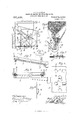
- Figure 1 is a side elevation oi? one form of apparatus suitable for carrying out my proc "1; Fig. 2, a front view of the same; Fig. 3, a detail side view of the side opposite that of Fig. 1; Fig. l, a section through the feed hoppers; Figs. 5 and (3, details of the pin roller; Fig. T, a longitudinal section through one of the screens; Fig. 8. a section on line A--A of Fig. 7; Fig. 9, a, plan view of one of the screens, and Fig. 10, a section on line l-i li of Fig. 9.
- the chute is preferably, though not necessarily, curved or bowed, as shown so that a smooth bowed or curved wall 7) is presented to the stream of matcrial and is preferably perforate along its under side as at G.
- a blast of air is made to discharge into the lower end of the chute. preferably in a thin stream of the breadth ol the chute.
- 0 represents a fan to generate such a blast
- n the con ducting nozzle which has a. broad, fiat discharge end. The material is introduced between the discharge end of this nozzle and the lower end of the chute.
- the stream of material follows a curved path under a containing wall, such as the upper side of the chute shown in the drawings, it will be clear that it will constantly impinge against such wall so that the force of the blast is, as it were, concentrated into a relatively thin stream.
- a short distance below the upper wall the air will be but little if any disturbed, and consequently when the materials are drawn but a slight distance out of the main current by the action of gravity they will immediately fall into receptacles placed there such as the spouts 0, (Z and e.
- These intercepting devices also serve to narrow the chute at successive points so as to cause the air current to be alternately concentrated and diffused.
- they are made of perforate material so as to permit the air to escape little by little from the chute and thus gradually weaken the blast.
- the process is applied to cof fee it is cleaned, then run over screens. Preferably this is done before the separation in the chute and the devices used are associated with or utilized to obtain an even ond bin or hopper 8 through an opening controlled by a gate 1*.
- an abrasive cleaning device which I term a pin roller and which I have shown as a shaft 10 having the projections 09.
- the hopper s has a discharge opening controlled by a gate 7?.
- the pin roller is revolved, causing the material, for instance the coffee berries, to be rubbed together and thereby cleaned.
- the bin 8 should be kept filled above the pin roller. Therefore the discharge opening is provided with a gate which permits the outflow of material to be regulated.
- Beneath the discharge aperture is a feed roller a, the gate 2/ being located so as to control the amount of material passing out of the hopper s over the roll.
- Beneath the feed roller a are any desired number of screens. I have here shown four, Z, m and the screen j here tofore referred to. In cleaning coffee screen Z will take out the very large coffee beans, the pea berry or round beans, and m which is located under the screen j will take the screenings from j and separate the dirt from the small beans. These screens may be agitated by any suitable means.
- the material is described as being preferably fed into the air blast in a thin film. This term is intended to indicate that the material should not be heaped or piled up, but it is not intended to convey the idea that the particles need be in continuity with one another.
- the process of separating granular material which consists in spreading the same out into a thin film, feeding such film over a supporting perforated body transversely to an air current, subjecting such thin supported and spread out film of material to a confined current of air forced against it from below, passing such current of air with the material to be separated from the film space along a confined upwardly and laterally extending path, and discharging the material therefrom at intervals depending upon the weight of the materials.
Landscapes
- Engineering & Computer Science (AREA)
- Mechanical Engineering (AREA)
- Combined Means For Separation Of Solids (AREA)
Description
A. T. HEDPELDT.
PROCESS OF CLEANING AND SEPARATING GRAINS.
APPLICATION FILED JAN. 16, 190? ?1 9 Patented 0013.4, 1910.
3SHEET8SHEET l.
THE Ncmzls PETERS C0,, WASHINGTON, u c.
A. T. HEDPELDT.
rnoosss 0F CLEANING AND SEPARATING GRAINS.
APPLICATION TILED JAN. 16, 1907.
Patented Oct. 4, 1910.
THE NORRIS PETERS c WASHINGTON, u. c.
A. T. HEDFBLDT.
rnoczss or CLEANING AND SEPARATING GRAINS.
W APPLICATION FILED JAN.16, 1907. i'} Patented Oct 4, 1910.
3 BHEBTS SHEET 3.
THE NORRIS PETERS cm, wnsnmcmm, n. c.
AXEL T. HEDFELDT, OF CHICAGO, ILLINOIS.
PROCESS OF CLEANING AND SEPARATING GRAINS.
Specification of Letters Patent.
Patented Oct. 4, 1910.
Application filed January 16, 1907. Serial No. 352,567.
To all whom it may concern:
Be it. known that I, Axon T. Hnnrnnn'r, a citizen or the United States, residing at Chicago, in the county of Cook and fitate of Illinois, have invented a certain new and useful Improvement in Processes for Cleaning and Separating Grains, of which the.
following is a specification.
lily invention relates to the process of cleaning, separating and grading materials, particularly granular material or material composed of relatively small particles.
I shall describe the process as applied to the grading of coffee berries, having selected this material because it presents many of the dilliculties standing in the way of ettecti've separation which my method of handling is designed to overcome. It will be obvious, however, that my process might be applied to the cleanil'ig, grading or other separation of materials differing in some of their characteristics from coiiee.
ln material such as coffee, it is desirable to separate the light or dead beans trom the heavy, full sized ones. I urthcrmorc it is sometimes expedient to separate the berries, all of which may be good enough to use, into grades according to their size and weight. At the same time coffee, as it comes trom the fields, contains impurities such as stones, husks, chaff, dust, and the like. Foreign matters and impurities are perhaps easily enough removable by means of any of the ordinary fanning mills now in use, but the separation of the good, sound berries from the dead ones and from other impurities ditlering but little perhaps in weight from the sound berries. and the grading or separation of theberries according to size and weight, are results which have never before been obtained except, perhaps, by subjecting the material to a number of. diflerent processes, some of which required a great deal of time and attention.
My process consists in general in driving the material upward in a continuous stream by air pressure, the path of said stream, which may be straight but is preferably curved, being given an oblique direction so that particles composing the stream of material are drawn from the stream by gravity at different points along the stream according to the weights of the several articles.
The process further consists in confining the stream under a curved or bowed wall against which it is continually impinging lso as to concentrate the air blast into a relatively thin current and thereby increase the accuracy of the separation.
it further cons .in spreading the material out into a relatively thin film at the time it is acted upon by the blast so that all of the particles of less than a given weight may have equal chances of being carried upward by the blast.
In the accompanying drawings 1 have shown somewhat diagrammatically, apparatus suitable for carrying out the several steps of my process.
Figure 1 is a side elevation oi? one form of apparatus suitable for carrying out my proc "1; Fig. 2, a front view of the same; Fig. 3, a detail side view of the side opposite that of Fig. 1; Fig. l, a section through the feed hoppers; Figs. 5 and (3, details of the pin roller; Fig. T, a longitudinal section through one of the screens; Fig. 8. a section on line A--A of Fig. 7; Fig. 9, a, plan view of one of the screens, and Fig. 10, a section on line l-i li of Fig. 9.
Like parts are indicated by the same letter in all the drawings.
(1 a chute inclined from the vertical and provided on its under side with a series of spouts 0, (Z and c. The chute is preferably, though not necessarily, curved or bowed, as shown so that a smooth bowed or curved wall 7) is presented to the stream of matcrial and is preferably perforate along its under side as at G. A blast of air is made to discharge into the lower end of the chute. preferably in a thin stream of the breadth ol the chute. In the drawings, 0 represents a fan to generate such a blast, and n, the con ducting nozzle which has a. broad, fiat discharge end. The material is introduced between the discharge end of this nozzle and the lower end of the chute.
In order that all of the material might be acted upon with equal force by the air blast, it is, of course, essential to the accurate carrying out of my method of separation that the material is presented to the blast in a thin film substantially at right angles to the direction of the blast. In the apparatus shown I provide an inclined screen j, the material being fed upon this screen at the upper end and caused to pass down over the screen by the agitation thereof which will, of course, cause the material to be spread out evenly. All of the material of less than a certain weight will be carried upward by the blast, the latter being regulated for that purpose. Any very heavy materials such, for example, as the stones often found in cofiee will, not be affected by the blast but will pass over the screen through a suitable spout.
hen the stream of material follows a curved path under a containing wall, such as the upper side of the chute shown in the drawings, it will be clear that it will constantly impinge against such wall so that the force of the blast is, as it were, concentrated into a relatively thin stream. A short distance below the upper wall the air will be but little if any disturbed, and consequently when the materials are drawn but a slight distance out of the main current by the action of gravity they will immediately fall into receptacles placed there such as the spouts 0, (Z and e. In order to make the separation still more accurate I prefer to arrange intercepting devices it between these spouts, which devices have inclined surfaces set at an angle to each other and conducting to the adjacent spouts. These intercepting devices also serve to narrow the chute at successive points so as to cause the air current to be alternately concentrated and diffused. Preferably they are made of perforate material so as to permit the air to escape little by little from the chute and thus gradually weaken the blast.
The air thus escaping from the main stream carries with it against the screen It the lighter particles and thus aids the process of separation. It will be seen that this operation is quite distinct from the operation of fanning or winnowing mills where the ighter impurities such as dust, chafi and straw, are blown out by a draft or suction, while the mass of the material remains unaffected by the air blast. In the process of this application the material is so disposed that substantially all of it is carried upward by the air blast and since the blast acts with. equal force upon each and every particle, the altitudes to which the several particles are carried will be determined by their weights. In certain kinds of material the process also involves the cleaning and screening of the material before or after the pneumatic separation. hen the process is applied to cof fee it is cleaned, then run over screens. Preferably this is done before the separation in the chute and the devices used are associated with or utilized to obtain an even ond bin or hopper 8 through an opening controlled by a gate 1*. In the second hopper s is placed an abrasive cleaning device which I term a pin roller and which I have shown as a shaft 10 having the projections 09. The hopper s has a discharge opening controlled by a gate 7?. The pin roller is revolved, causing the material, for instance the coffee berries, to be rubbed together and thereby cleaned. To get the best results the bin 8 should be kept filled above the pin roller. Therefore the discharge opening is provided with a gate which permits the outflow of material to be regulated. Beneath the discharge aperture is a feed roller a, the gate 2/ being located so as to control the amount of material passing out of the hopper s over the roll. Beneath the feed roller a are any desired number of screens. I have here shown four, Z, m and the screen j here tofore referred to. In cleaning coffee screen Z will take out the very large coffee beans, the pea berry or round beans, and m which is located under the screen j will take the screenings from j and separate the dirt from the small beans. These screens may be agitated by any suitable means.
It will be understood that the steps described above as preliminary to the pneumatic separation may or may not be necessary, or may be necessary only in part according to the kind of material operated upon and its condition. These several steps may sometimes be omitted entirely or their order of sequence may be changed.
The material is described as being preferably fed into the air blast in a thin film. This term is intended to indicate that the material should not be heaped or piled up, but it is not intended to convey the idea that the particles need be in continuity with one another.
I claim:
The process of separating granular material which consists in spreading the same out into a thin film, feeding such film over a supporting perforated body transversely to an air current, subjecting such thin supported and spread out film of material to a confined current of air forced against it from below, passing such current of air with the material to be separated from the film space along a confined upwardly and laterally extending path, and discharging the material therefrom at intervals depending upon the weight of the materials.
AXEL T. HEDFELDT. lVitnesses LUCY A. FALKENBERG, PERCIVAL I-I. TRUMAN.
Priority Applications (1)
| Application Number | Priority Date | Filing Date | Title |
|---|---|---|---|
| US35256707A US971609A (en) | 1907-01-16 | 1907-01-16 | Process of cleaning and separating grains. |
Applications Claiming Priority (1)
| Application Number | Priority Date | Filing Date | Title |
|---|---|---|---|
| US35256707A US971609A (en) | 1907-01-16 | 1907-01-16 | Process of cleaning and separating grains. |
Publications (1)
| Publication Number | Publication Date |
|---|---|
| US971609A true US971609A (en) | 1910-10-04 |
Family
ID=3039995
Family Applications (1)
| Application Number | Title | Priority Date | Filing Date |
|---|---|---|---|
| US35256707A Expired - Lifetime US971609A (en) | 1907-01-16 | 1907-01-16 | Process of cleaning and separating grains. |
Country Status (1)
| Country | Link |
|---|---|
| US (1) | US971609A (en) |
Cited By (1)
| Publication number | Priority date | Publication date | Assignee | Title |
|---|---|---|---|---|
| US4907720A (en) * | 1987-05-13 | 1990-03-13 | Frito-Lay, Inc. | Method and apparatus for uniformly dispensing a seasoning material |
-
1907
- 1907-01-16 US US35256707A patent/US971609A/en not_active Expired - Lifetime
Cited By (1)
| Publication number | Priority date | Publication date | Assignee | Title |
|---|---|---|---|---|
| US4907720A (en) * | 1987-05-13 | 1990-03-13 | Frito-Lay, Inc. | Method and apparatus for uniformly dispensing a seasoning material |
Similar Documents
| Publication | Publication Date | Title |
|---|---|---|
| US269461A (en) | Machine for cleaning and grading coffee | |
| US1517509A (en) | Apparatus for classifying granular material | |
| US30679A (en) | Grain-separator | |
| US197897A (en) | Improvement in apparatus for classifying and concentrating ores | |
| US3826367A (en) | Grain cleaner | |
| US27274A (en) | Graiw-sepaiiatob | |
| US850447A (en) | Separating or grading machine. | |
| US971608A (en) | Cleaning and separating machine. | |
| US1010239A (en) | Separator and purifier. | |
| US525138A (en) | detwilee | |
| US443901A (en) | Apparatus for separating and grading ores | |
| US3080905A (en) | Method for decorticating safflower seed | |
| US1898249A (en) | Grain or fine particle grader | |
| US645442A (en) | Grain-cleaner. | |
| US409258A (en) | Edwin f | |
| US661996A (en) | Screening apparatus. | |
| US1119662A (en) | Process of and apparatus for sizing comminuted material. | |
| US343999A (en) | Grain-separating machine | |
| US1152920A (en) | Method of cleaning grain. | |
| US1385674A (en) | Method and apparatus for treating pulverized material | |
| US244114A (en) | Louis de soulages | |
| US548377A (en) | lovett | |
| US499995A (en) | Process of manufacturing whiting | |
| US845870A (en) | Cleaning and separating machine. | |
| US28499A (en) | Improvement in machines for crushing mineral ores |