US9701146B2 - Ink set and thermal transfer recording sheet - Google Patents
Ink set and thermal transfer recording sheet Download PDFInfo
- Publication number
- US9701146B2 US9701146B2 US15/130,695 US201615130695A US9701146B2 US 9701146 B2 US9701146 B2 US 9701146B2 US 201615130695 A US201615130695 A US 201615130695A US 9701146 B2 US9701146 B2 US 9701146B2
- Authority
- US
- United States
- Prior art keywords
- group
- substituent
- alkyl group
- general formula
- aryl
- Prior art date
- Legal status (The legal status is an assumption and is not a legal conclusion. Google has not performed a legal analysis and makes no representation as to the accuracy of the status listed.)
- Expired - Fee Related
Links
- 0 [1*]C1=NN([2*])C(=O)/C1=C\C1=C([3*])N=C(N([4*])[5*])S1 Chemical compound [1*]C1=NN([2*])C(=O)/C1=C\C1=C([3*])N=C(N([4*])[5*])S1 0.000 description 47
- XTVWXQYMEZWSPQ-GZJHRQIBSA-N CC(=O)NC1=C/C(=N\C2=CC=C(N(C)C)C=C2C)C(C)=C(Cl)C1=O.CCC(=O)NC1=C/C(=N\C2=CC=C(N(CC)CC)C=C2C)C(C)=C(Cl)C1=O.CCCCN(CCCC)C1=CC=C(/N=C2\C=C(NC(C)=O)C(=O)C(Cl)=C2C)C(C)=C1.CCN(CC)C1=CC=C(/N=C2\C=C(NC(=O)C3=CC=CC=C3)C(=O)C(Cl)=C2C)C(C)=C1.CCN(CC)C1=CC=C(/N=C2\C=C(NC(C)=O)C(=O)C(Cl)=C2C)C(C)=C1 Chemical compound CC(=O)NC1=C/C(=N\C2=CC=C(N(C)C)C=C2C)C(C)=C(Cl)C1=O.CCC(=O)NC1=C/C(=N\C2=CC=C(N(CC)CC)C=C2C)C(C)=C(Cl)C1=O.CCCCN(CCCC)C1=CC=C(/N=C2\C=C(NC(C)=O)C(=O)C(Cl)=C2C)C(C)=C1.CCN(CC)C1=CC=C(/N=C2\C=C(NC(=O)C3=CC=CC=C3)C(=O)C(Cl)=C2C)C(C)=C1.CCN(CC)C1=CC=C(/N=C2\C=C(NC(C)=O)C(=O)C(Cl)=C2C)C(C)=C1 XTVWXQYMEZWSPQ-GZJHRQIBSA-N 0.000 description 1
- BUVXZAMXGFKJOR-UHFFFAOYSA-N CC(C)C1=C/C2=C(\C=C/1)N=C(C1C(=O)C3=C(C=C(C(=O)N(C)C)C=C3)C1=O)C(O)=C2.CC(C)CN(CC(C)C)C(=O)C1=CC2=C(C=C1)C(=O)C(C1=NC3=C(C=C1O)/C=C(C(C)C)\C=C/3)C2=O.CC1=CC=C(N(C(=O)C2=CC3=C(C=C2)C(=O)C(C2=NC4=C(C=C2O)/C=C(C(C)C)\C=C/4)C3=O)C2=CC=C(C)C=C2)C=C1.CC1=CC=CC(N(C(=O)C2=CC3=C(C=C2)C(=O)C(C2=NC4=C(C=C2O)/C=C(C(C)C)\C=C/4)C3=O)C2=CC=CC(C)=C2)=C1.CCN(C)C(=O)C1=CC2=C(C=C1)C(=O)C(C1=NC3=C(C=C1O)/C=C(C(C)C)\C=C/3)C2=O Chemical compound CC(C)C1=C/C2=C(\C=C/1)N=C(C1C(=O)C3=C(C=C(C(=O)N(C)C)C=C3)C1=O)C(O)=C2.CC(C)CN(CC(C)C)C(=O)C1=CC2=C(C=C1)C(=O)C(C1=NC3=C(C=C1O)/C=C(C(C)C)\C=C/3)C2=O.CC1=CC=C(N(C(=O)C2=CC3=C(C=C2)C(=O)C(C2=NC4=C(C=C2O)/C=C(C(C)C)\C=C/4)C3=O)C2=CC=C(C)C=C2)C=C1.CC1=CC=CC(N(C(=O)C2=CC3=C(C=C2)C(=O)C(C2=NC4=C(C=C2O)/C=C(C(C)C)\C=C/4)C3=O)C2=CC=CC(C)=C2)=C1.CCN(C)C(=O)C1=CC2=C(C=C1)C(=O)C(C1=NC3=C(C=C1O)/C=C(C(C)C)\C=C/3)C2=O BUVXZAMXGFKJOR-UHFFFAOYSA-N 0.000 description 1
- JAJLURWBJGVCFR-UHFFFAOYSA-N CC(C)C1=C/C2=C(\C=C/1)N=C(C1C(=O)C3=C(C=C(C(=O)N(C4=CC=CC=C4)C4=CC=CC=C4)C=C3)C1=O)C(O)=C2.CCCCC(CC)CN(CC(CC)CCCC)C(=O)C1=CC2=C(C=C1)C(=O)C(C1=NC3=C(C=C1O)/C=C(C(C)C)\C=C/3)C2=O.CCCCN(CCCC)C(=O)C1=CC2=C(C=C1)C(=O)C(C1=NC3=C(C=C1O)/C=C(C(C)C)\C=C/3)C2=O.CCCN(CCC)C(=O)C1=CC2=C(C=C1)C(=O)C(C1=NC3=C(C=C1O)/C=C(C(C)C)\C=C/3)C2=O Chemical compound CC(C)C1=C/C2=C(\C=C/1)N=C(C1C(=O)C3=C(C=C(C(=O)N(C4=CC=CC=C4)C4=CC=CC=C4)C=C3)C1=O)C(O)=C2.CCCCC(CC)CN(CC(CC)CCCC)C(=O)C1=CC2=C(C=C1)C(=O)C(C1=NC3=C(C=C1O)/C=C(C(C)C)\C=C/3)C2=O.CCCCN(CCCC)C(=O)C1=CC2=C(C=C1)C(=O)C(C1=NC3=C(C=C1O)/C=C(C(C)C)\C=C/3)C2=O.CCCN(CCC)C(=O)C1=CC2=C(C=C1)C(=O)C(C1=NC3=C(C=C1O)/C=C(C(C)C)\C=C/3)C2=O JAJLURWBJGVCFR-UHFFFAOYSA-N 0.000 description 1
- MNIISNCWGKPYAG-UHFFFAOYSA-N CC1=CC(C)=CC(OC2=C(N)C3=C(C(=O)C4=C(C=CC=C4)C3=O)C(N)=C2OC2=CC(C)=CC(C)=C2)=C1.CC1=CC=C(OC2=C(N)C3=C(C(=O)C4=C(C=CC=C4)C3=O)C(N)=C2OC2=CC=C(C)C=C2)C=C1.CCCCC1=CC=C(OC2=C(N)C3=C(C(=O)C4=C(C=CC=C4)C3=O)C(N)=C2OC2=CC=C(CCCC)C=C2)C=C1 Chemical compound CC1=CC(C)=CC(OC2=C(N)C3=C(C(=O)C4=C(C=CC=C4)C3=O)C(N)=C2OC2=CC(C)=CC(C)=C2)=C1.CC1=CC=C(OC2=C(N)C3=C(C(=O)C4=C(C=CC=C4)C3=O)C(N)=C2OC2=CC=C(C)C=C2)C=C1.CCCCC1=CC=C(OC2=C(N)C3=C(C(=O)C4=C(C=CC=C4)C3=O)C(N)=C2OC2=CC=C(CCCC)C=C2)C=C1 MNIISNCWGKPYAG-UHFFFAOYSA-N 0.000 description 1
- QDJURLBTOHOTDL-UHFFFAOYSA-N CC1=CC(N(C)CCOC2=CC=C(C3=CC=CC=C3)C=C2)=CC=C1C=C(C#N)C#N.CCCCC1=CC=C(OCCN(CC)C2=CC=C(C=C(C#N)C#N)C(C)=C2)C=C1.CCCCCCCCN(CCOC1=CC=C(C2CCCCC2)C=C1)C1=CC=C(C=C(C#N)C#N)C(C)=C1.CCN(CCOC1=CC=C(C)C=C1)C1=CC=C(C=C(C#N)C#N)C(C)=C1.CCN(CCOC1=CC=C(C2CCCCC2)C=C1)C1=CC=C(C=C(C#N)C#N)C(C)=C1 Chemical compound CC1=CC(N(C)CCOC2=CC=C(C3=CC=CC=C3)C=C2)=CC=C1C=C(C#N)C#N.CCCCC1=CC=C(OCCN(CC)C2=CC=C(C=C(C#N)C#N)C(C)=C2)C=C1.CCCCCCCCN(CCOC1=CC=C(C2CCCCC2)C=C1)C1=CC=C(C=C(C#N)C#N)C(C)=C1.CCN(CCOC1=CC=C(C)C=C1)C1=CC=C(C=C(C#N)C#N)C(C)=C1.CCN(CCOC1=CC=C(C2CCCCC2)C=C1)C1=CC=C(C=C(C#N)C#N)C(C)=C1 QDJURLBTOHOTDL-UHFFFAOYSA-N 0.000 description 1
- UOHZGOVBPGXSJG-UHFFFAOYSA-N CC1=CC(NC2=CC=C(NC3=CC=CC=C3)C3=C2C(=O)C2=C(C=CC=C2)C3=O)=CC=C1.CCCCC1=CC=C(NC2=CC=C(NC3=CC=C(CCCC)C=C3)C3=C2C(=O)C2=C(C=CC=C2)C3=O)C=C1.CCCCNC1=CC=C(NCCCC)C2=C1C(=O)C1=C(C=CC=C1)C2=O.CNC1=CC=C(NC)C2=C1C(=O)C1=C(C=CC=C1)C2=O.CNC1=CC=C(NC2=CC=CC(C)=C2)C2=C1C(=O)C1=C(C=CC=C1)C2=O Chemical compound CC1=CC(NC2=CC=C(NC3=CC=CC=C3)C3=C2C(=O)C2=C(C=CC=C2)C3=O)=CC=C1.CCCCC1=CC=C(NC2=CC=C(NC3=CC=C(CCCC)C=C3)C3=C2C(=O)C2=C(C=CC=C2)C3=O)C=C1.CCCCNC1=CC=C(NCCCC)C2=C1C(=O)C1=C(C=CC=C1)C2=O.CNC1=CC=C(NC)C2=C1C(=O)C1=C(C=CC=C1)C2=O.CNC1=CC=C(NC2=CC=CC(C)=C2)C2=C1C(=O)C1=C(C=CC=C1)C2=O UOHZGOVBPGXSJG-UHFFFAOYSA-N 0.000 description 1
- QUBJUKDBRGXURO-UHFFFAOYSA-N CC1=CC(OC2=C(N)C3=C(C(=O)C4=C(C=CC=C4)C3=O)C(N)=C2OC2=CC=CC=C2)=CC=C1.CC1=CC=C(OC2=C(N)C3=C(C(=O)C4=C(C=CC=C4)C3=O)C(N)=C2OC2=CC=CC=C2)C=C1.CC1=CC=CC=C1OC1=C(N)C2=C(C(=O)C3=C(C=CC=C3)C2=O)C(N)=C1OC1=CC=CC=C1.CCCCOC1=C(N)C2=C(C(=O)C3=C(C=CC=C3)C2=O)C(N)=C1OCCCC.COC1=C(N)C2=C(C(=O)C3=C(C=CC=C3)C2=O)C(N)=C1OC.NC1=C(OC2=CC=CC=C2)C(OC2=CC=CC=C2)=C(N)C2=C1C(=O)C1=C(C=CC=C1)C2=O Chemical compound CC1=CC(OC2=C(N)C3=C(C(=O)C4=C(C=CC=C4)C3=O)C(N)=C2OC2=CC=CC=C2)=CC=C1.CC1=CC=C(OC2=C(N)C3=C(C(=O)C4=C(C=CC=C4)C3=O)C(N)=C2OC2=CC=CC=C2)C=C1.CC1=CC=CC=C1OC1=C(N)C2=C(C(=O)C3=C(C=CC=C3)C2=O)C(N)=C1OC1=CC=CC=C1.CCCCOC1=C(N)C2=C(C(=O)C3=C(C=CC=C3)C2=O)C(N)=C1OCCCC.COC1=C(N)C2=C(C(=O)C3=C(C=CC=C3)C2=O)C(N)=C1OC.NC1=C(OC2=CC=CC=C2)C(OC2=CC=CC=C2)=C(N)C2=C1C(=O)C1=C(C=CC=C1)C2=O QUBJUKDBRGXURO-UHFFFAOYSA-N 0.000 description 1
- TVOVXXKVZHVNJI-UHFFFAOYSA-N CC1=CC(OC2=C(N)C3=C(C(=O)C4=C(C=CC=C4)C3=O)C(O)=C2)=CC=C1.CC1=CC=C(OC2=C(N)C3=C(C(=O)C4=C(C=CC=C4)C3=O)C(O)=C2)C=C1.CC1=CC=CC=C1OC1=C(N)C2=C(C(=O)C3=C(C=CC=C3)C2=O)C(O)=C1.COC1=C(N)C2=C(C(=O)C3=C(C=CC=C3)C2=O)C(O)=C1.COC1=CC=C(OC2=C(N)C3=C(C(=O)C4=C(C=CC=C4)C3=O)C(O)=C2)C=C1.NC1=C(OC2=CC=CC=C2)C=C(O)C2=C1C(=O)C1=C(C=CC=C1)C2=O Chemical compound CC1=CC(OC2=C(N)C3=C(C(=O)C4=C(C=CC=C4)C3=O)C(O)=C2)=CC=C1.CC1=CC=C(OC2=C(N)C3=C(C(=O)C4=C(C=CC=C4)C3=O)C(O)=C2)C=C1.CC1=CC=CC=C1OC1=C(N)C2=C(C(=O)C3=C(C=CC=C3)C2=O)C(O)=C1.COC1=C(N)C2=C(C(=O)C3=C(C=CC=C3)C2=O)C(O)=C1.COC1=CC=C(OC2=C(N)C3=C(C(=O)C4=C(C=CC=C4)C3=O)C(O)=C2)C=C1.NC1=C(OC2=CC=CC=C2)C=C(O)C2=C1C(=O)C1=C(C=CC=C1)C2=O TVOVXXKVZHVNJI-UHFFFAOYSA-N 0.000 description 1
- GUIFGZQJDPDQEJ-PVGVQIQKSA-N CC1=CC=C(N2N=C(C)/C(=C/C3C(=O)N(C4=CC=C(C)C=C4)N=C3C)C2=O)C=C1.CC1=CC=CC(N2N=C(C)C(/C=C3\C(=O)N(C4=CC=CC(C)=C4)N=C3C)C2=O)=C1.CC1=CC=CC=C1N1N=C(C)/C(=C/C2C(=O)N(C3=C(C)C=CC=C3)N=C2C)C1=O.CC1=NN(C)C(=O)/C1=C\C1C(=O)N(C)N=C1C.CC1=NN(C2=CC=CC=C2)C(=O)/C1=C\C1C(=O)N(C2=CC=CC=C2)N=C1C.CCN1N=C(C)/C(=C/C2C(=O)N(CC)N=C2C)C1=O Chemical compound CC1=CC=C(N2N=C(C)/C(=C/C3C(=O)N(C4=CC=C(C)C=C4)N=C3C)C2=O)C=C1.CC1=CC=CC(N2N=C(C)C(/C=C3\C(=O)N(C4=CC=CC(C)=C4)N=C3C)C2=O)=C1.CC1=CC=CC=C1N1N=C(C)/C(=C/C2C(=O)N(C3=C(C)C=CC=C3)N=C2C)C1=O.CC1=NN(C)C(=O)/C1=C\C1C(=O)N(C)N=C1C.CC1=NN(C2=CC=CC=C2)C(=O)/C1=C\C1C(=O)N(C2=CC=CC=C2)N=C1C.CCN1N=C(C)/C(=C/C2C(=O)N(CC)N=C2C)C1=O GUIFGZQJDPDQEJ-PVGVQIQKSA-N 0.000 description 1
- ONMOQLJBDNITHM-UHFFFAOYSA-N CC1=CC=CC(NC2=CC=C(NC3=CC=CC(C)=C3)C3=C2C(=O)C2=C(C=CC=C2)C3=O)=C1 Chemical compound CC1=CC=CC(NC2=CC=C(NC3=CC=CC(C)=C3)C3=C2C(=O)C2=C(C=CC=C2)C3=O)=C1 ONMOQLJBDNITHM-UHFFFAOYSA-N 0.000 description 1
- IQFSPDAVLQEZLO-UNHQKFLHSA-N CCC1=C(Cl)C(=O)C(NC(C)=O)=C/C1=N\C1=CC=C(N(CC)CC)C=C1C.CCN(CC)C1=CC=C(/N=C2\C=C(NC(=O)C(C)(C)C)C(=O)C(Cl)=C2C)C(C)=C1 Chemical compound CCC1=C(Cl)C(=O)C(NC(C)=O)=C/C1=N\C1=CC=C(N(CC)CC)C=C1C.CCN(CC)C1=CC=C(/N=C2\C=C(NC(=O)C(C)(C)C)C(=O)C(Cl)=C2C)C(C)=C1 IQFSPDAVLQEZLO-UNHQKFLHSA-N 0.000 description 1
- CNSIWNUPVHHNSC-UWKWXQGXSA-N CCC1=NN2C(C3=CC=CC=C3)=NN=C2/C1=N/C1=CC=C(N(CC)CC)N=C1C.CCCC1=NN=C2/C(=N/C3=CC=C(N(CC)CC)N=C3C)C(C)=NN12.CCN(CC)C1=CC=C(/N=C2/C3=NN=C(C4=CC=C(C)C=C4)N3N=C2C(C)(C)C)C(C)=N1.CCN(CC)C1=CC=C(/N=C2/C3=NN=C(C4=CC=CC(C)=C4)N3N=C2C(C)(C)C)C(C)=N1.CCN(CC)C1=CC=C(/N=C2/C3=NN=C(C4=CC=CC=C4)N3N=C2C(C)(C)C)C(C)=N1 Chemical compound CCC1=NN2C(C3=CC=CC=C3)=NN=C2/C1=N/C1=CC=C(N(CC)CC)N=C1C.CCCC1=NN=C2/C(=N/C3=CC=C(N(CC)CC)N=C3C)C(C)=NN12.CCN(CC)C1=CC=C(/N=C2/C3=NN=C(C4=CC=C(C)C=C4)N3N=C2C(C)(C)C)C(C)=N1.CCN(CC)C1=CC=C(/N=C2/C3=NN=C(C4=CC=CC(C)=C4)N3N=C2C(C)(C)C)C(C)=N1.CCN(CC)C1=CC=C(/N=C2/C3=NN=C(C4=CC=CC=C4)N3N=C2C(C)(C)C)C(C)=N1 CNSIWNUPVHHNSC-UWKWXQGXSA-N 0.000 description 1
- CXOUFOKVPMQNFW-YHFBBCKWSA-N CCCCC(CC)C1=N/N2C(=O)C(C#N)=C(C)C(=N/C3=C(C(C)(C)C)N=C(N(CCCC)CCCC)S3)\C2=N\1.CCCCC(CC)C1=N/N2C(=O)C(C#N)=C(C)C(=N/C3=C(C4=CC=CC=C4)N=C(N(CCCC)CCCC)S3)\C2=N\1.CCCCC(CC)CN(CC(CC)CCCC)C1=NC(C2=CC=CC=C2)=C(/N=C2C(C)=C(C#N)C(=O)N3/N=C(C(CC)CCCC)/N=C/23)S1.CCCCC1=C(C#N)C(=O)N2/N=C(C(CC)CCCC)\N=C2\C1=N/C1=C(C(C)(C)C)N=C(N(CCCC)CCCC)S1 Chemical compound CCCCC(CC)C1=N/N2C(=O)C(C#N)=C(C)C(=N/C3=C(C(C)(C)C)N=C(N(CCCC)CCCC)S3)\C2=N\1.CCCCC(CC)C1=N/N2C(=O)C(C#N)=C(C)C(=N/C3=C(C4=CC=CC=C4)N=C(N(CCCC)CCCC)S3)\C2=N\1.CCCCC(CC)CN(CC(CC)CCCC)C1=NC(C2=CC=CC=C2)=C(/N=C2C(C)=C(C#N)C(=O)N3/N=C(C(CC)CCCC)/N=C/23)S1.CCCCC1=C(C#N)C(=O)N2/N=C(C(CC)CCCC)\N=C2\C1=N/C1=C(C(C)(C)C)N=C(N(CCCC)CCCC)S1 CXOUFOKVPMQNFW-YHFBBCKWSA-N 0.000 description 1
- AMFUIGFPGWHVOJ-ZMARYSBRSA-N CCCCC(CC)C1=N/N2C(=O)C(C#N)=C(C)C(=N/C3=C(C(C)C)N=C(N(CCCC)CCCC)S3)\C2=N\1.CCCCC(CC)C1=N/N2C(=O)C(C#N)=C(C)C(=N/C3=C(C4=CC=CC=C4)N=C(N(CCC(C)C)CCC(C)C)S3)\C2=N\1 Chemical compound CCCCC(CC)C1=N/N2C(=O)C(C#N)=C(C)C(=N/C3=C(C(C)C)N=C(N(CCCC)CCCC)S3)\C2=N\1.CCCCC(CC)C1=N/N2C(=O)C(C#N)=C(C)C(=N/C3=C(C4=CC=CC=C4)N=C(N(CCC(C)C)CCC(C)C)S3)\C2=N\1 AMFUIGFPGWHVOJ-ZMARYSBRSA-N 0.000 description 1
- ZWISQKUEASDYBP-ORYQBSIJSA-N CCCCC(CC)CC(CC(CC)CCCC)C(=O)C1=CC=CC=C1/N=N/C1C(=O)NC(=O)C(C(=O)OCC)=C1C.CCCCC(CC)CN(CC(CC)CCCC)C(=O)C1=CC(/N=N/C2C(=O)N(CC)C(=O)C(C#N)=C2C)=CC=C1.CCCCC(CC)CN(CC(CC)CCCC)C(=O)C1=CC=CC=C1/N=N/C1C(=O)N(CC)C(=O)C(C#N)=C1C.CCCCC(CC)CN(CC(CC)CCCC)C(=O)C1=CC=CC=C1/N=N/C1C(=O)NC(=O)C(C#N)=C1C Chemical compound CCCCC(CC)CC(CC(CC)CCCC)C(=O)C1=CC=CC=C1/N=N/C1C(=O)NC(=O)C(C(=O)OCC)=C1C.CCCCC(CC)CN(CC(CC)CCCC)C(=O)C1=CC(/N=N/C2C(=O)N(CC)C(=O)C(C#N)=C2C)=CC=C1.CCCCC(CC)CN(CC(CC)CCCC)C(=O)C1=CC=CC=C1/N=N/C1C(=O)N(CC)C(=O)C(C#N)=C1C.CCCCC(CC)CN(CC(CC)CCCC)C(=O)C1=CC=CC=C1/N=N/C1C(=O)NC(=O)C(C#N)=C1C ZWISQKUEASDYBP-ORYQBSIJSA-N 0.000 description 1
- KITJQANKDSTAGK-SZDCCQQISA-N CCCCC(CC)CN(CC(CC)CCCC)C(=O)C1=CC(/N=N/C2C(=O)N(CC)C(=O)C(C(=O)NC(C)C)=C2C)=CC=C1.CCCCC(CC)CN(CC(CC)CCCC)C(=O)C1=CC=C(/N=N/C2C(=O)N(CC)C(=O)C(C#N)=C2C)C=C1.CCCCC(CC)CN1C(=O)C=C(C2=CC=CC=C2)C(/N=N/C2=CC=CC=C2S(=O)(=O)N(CC(CC)CCCC)CC(CC)CCCC)C1=O Chemical compound CCCCC(CC)CN(CC(CC)CCCC)C(=O)C1=CC(/N=N/C2C(=O)N(CC)C(=O)C(C(=O)NC(C)C)=C2C)=CC=C1.CCCCC(CC)CN(CC(CC)CCCC)C(=O)C1=CC=C(/N=N/C2C(=O)N(CC)C(=O)C(C#N)=C2C)C=C1.CCCCC(CC)CN1C(=O)C=C(C2=CC=CC=C2)C(/N=N/C2=CC=CC=C2S(=O)(=O)N(CC(CC)CCCC)CC(CC)CCCC)C1=O KITJQANKDSTAGK-SZDCCQQISA-N 0.000 description 1
- XTSRHUHWBIEEPF-GLWMCNJKSA-N CCCCC(CC)CN(CC(CC)CCCC)C(=O)C1=CC(/N=N/C2C(=O)N(N(C)C)C(=O)C(C#N)=C2C)=CC=C1.CCCCC(CC)CN(CC(CC)CCCC)C(=O)C1=CC(/N=N/C2C(=O)N(N)C(=O)C(C#N)=C2C)=CC=C1.CCCCC(CC)CN(CC(CC)CCCC)S(=O)(=O)C1=CC(/N=N/C2C(=O)N(N)C(=O)C(C#N)=C2C)=CC=C1.CCCCC(CC)CN(CC(CC)CCCC)S(=O)(=O)C1=CC(/N=N/C2C(=O)NC(=O)C(C(=O)OCC)=C2C)=CC=C1 Chemical compound CCCCC(CC)CN(CC(CC)CCCC)C(=O)C1=CC(/N=N/C2C(=O)N(N(C)C)C(=O)C(C#N)=C2C)=CC=C1.CCCCC(CC)CN(CC(CC)CCCC)C(=O)C1=CC(/N=N/C2C(=O)N(N)C(=O)C(C#N)=C2C)=CC=C1.CCCCC(CC)CN(CC(CC)CCCC)S(=O)(=O)C1=CC(/N=N/C2C(=O)N(N)C(=O)C(C#N)=C2C)=CC=C1.CCCCC(CC)CN(CC(CC)CCCC)S(=O)(=O)C1=CC(/N=N/C2C(=O)NC(=O)C(C(=O)OCC)=C2C)=CC=C1 XTSRHUHWBIEEPF-GLWMCNJKSA-N 0.000 description 1
- KKLFPTGEUSYNGM-SMABJQPJSA-N CCCCC(CC)CN(CC(CC)CCCC)C1=NC(C(C)(C)C)=C(/C=C2\C(=O)N(C)N=C2C(C)(C)C)S1.CCCCC(CC)CN(CC(CC)CCCC)C1=NC(C(C)(C)C)=C(/C=C2\C(=O)N(C3=CC=CC=C3)N=C2C(=O)O)S1.CCCCC(CC)CN(CC(CC)CCCC)C1=NC(C(C)(C)C)=C(/C=C2\C(=O)N(C3=CC=CC=C3)N=C2N(C)C)S1.CCCCC(CC)CN(CC(CC)CCCC)C1=NC(C2=CC=CC=C2)=C(/C=C2\C(=O)N(C)N=C2C(C)(C)C)S1 Chemical compound CCCCC(CC)CN(CC(CC)CCCC)C1=NC(C(C)(C)C)=C(/C=C2\C(=O)N(C)N=C2C(C)(C)C)S1.CCCCC(CC)CN(CC(CC)CCCC)C1=NC(C(C)(C)C)=C(/C=C2\C(=O)N(C3=CC=CC=C3)N=C2C(=O)O)S1.CCCCC(CC)CN(CC(CC)CCCC)C1=NC(C(C)(C)C)=C(/C=C2\C(=O)N(C3=CC=CC=C3)N=C2N(C)C)S1.CCCCC(CC)CN(CC(CC)CCCC)C1=NC(C2=CC=CC=C2)=C(/C=C2\C(=O)N(C)N=C2C(C)(C)C)S1 KKLFPTGEUSYNGM-SMABJQPJSA-N 0.000 description 1
- RLJZYCQWIBPJJE-HSNONGNLSA-N CCCCC(CC)CN(CC(CC)CCCC)C1=NC(C(C)(C)C)=C(/C=C2\C(=O)N(C)N=C2C(C)C)S1.CCCCC(CC)CN(CC(CC)CCCC)C1=NC(C(C)(C)C)=C(/C=C2\C(=O)N(C)N=C2C)S1.CCCCC(CC)CN(CC(CC)CCCC)C1=NC(C(C)(C)C)=C(/C=C2\C(=O)N(C)N=C2C2=CC=CC=C2)S1.CCCCC(CC)CN(CC(CC)CCCC)C1=NC(C2=CC=CC=C2)=C(/C=C2\C(=O)N(C)N=C2C2=CC=CC=C2)S1 Chemical compound CCCCC(CC)CN(CC(CC)CCCC)C1=NC(C(C)(C)C)=C(/C=C2\C(=O)N(C)N=C2C(C)C)S1.CCCCC(CC)CN(CC(CC)CCCC)C1=NC(C(C)(C)C)=C(/C=C2\C(=O)N(C)N=C2C)S1.CCCCC(CC)CN(CC(CC)CCCC)C1=NC(C(C)(C)C)=C(/C=C2\C(=O)N(C)N=C2C2=CC=CC=C2)S1.CCCCC(CC)CN(CC(CC)CCCC)C1=NC(C2=CC=CC=C2)=C(/C=C2\C(=O)N(C)N=C2C2=CC=CC=C2)S1 RLJZYCQWIBPJJE-HSNONGNLSA-N 0.000 description 1
- XWTCURLJXZHDMZ-LYZLNKPESA-N CCCCC(CC)CN(CC(CC)CCCC)C1=NC(C(C)(C)C)=C(/C=C2\C(=O)N(C3=CC=C(C)C=C3)N=C2C)S1.CCCCC(CC)CN(CC(CC)CCCC)C1=NC(C(C)(C)C)=C(/C=C2\C(=O)N(C3=CC=C(OC)C=C3)N=C2C)S1.CCCCC(CC)CN(CC(CC)CCCC)C1=NC(C(C)(C)C)=C(/C=C2\C(=O)N(C3=CC=CC(C)=C3)N=C2C)S1 Chemical compound CCCCC(CC)CN(CC(CC)CCCC)C1=NC(C(C)(C)C)=C(/C=C2\C(=O)N(C3=CC=C(C)C=C3)N=C2C)S1.CCCCC(CC)CN(CC(CC)CCCC)C1=NC(C(C)(C)C)=C(/C=C2\C(=O)N(C3=CC=C(OC)C=C3)N=C2C)S1.CCCCC(CC)CN(CC(CC)CCCC)C1=NC(C(C)(C)C)=C(/C=C2\C(=O)N(C3=CC=CC(C)=C3)N=C2C)S1 XWTCURLJXZHDMZ-LYZLNKPESA-N 0.000 description 1
- AREDDWHFSPKVEU-ZDIWVXRUSA-N CCCCC(CC)CN(CC(CC)CCCC)C1=NC(C(C)(C)C)=C(/C=C2\C(=O)N(C3=CC=CC(S(N)(=O)=O)=C3)N=C2C)S1.CCCCC(CC)CN(CC(CC)CCCC)C1=NC(C(C)C)=C(/C=C2\C(=O)N(C3=CC=CC=C3)N=C2C)S1.CCCCC(CC)CN(CC(CC)CCCC)C1=NC(C)=C(/C=C2\C(=O)N(C3=CC=CC=C3)N=C2C)S1.CCCCC(CC)CN(CC(CC)CCCC)C1=NC(C2=CC=CC=C2)=C(/C=C2\C(=O)N(C3=CC=CC=C3)N=C2C)S1 Chemical compound CCCCC(CC)CN(CC(CC)CCCC)C1=NC(C(C)(C)C)=C(/C=C2\C(=O)N(C3=CC=CC(S(N)(=O)=O)=C3)N=C2C)S1.CCCCC(CC)CN(CC(CC)CCCC)C1=NC(C(C)C)=C(/C=C2\C(=O)N(C3=CC=CC=C3)N=C2C)S1.CCCCC(CC)CN(CC(CC)CCCC)C1=NC(C)=C(/C=C2\C(=O)N(C3=CC=CC=C3)N=C2C)S1.CCCCC(CC)CN(CC(CC)CCCC)C1=NC(C2=CC=CC=C2)=C(/C=C2\C(=O)N(C3=CC=CC=C3)N=C2C)S1 AREDDWHFSPKVEU-ZDIWVXRUSA-N 0.000 description 1
- RSLTYDSZOLNDPU-UGLKRULCSA-N CCCCC(CC)CN(CC(CC)CCCC)C1=NC(C(C)(C)C)=C(/C=C2\C(=O)N(C3=CC=CC=C3)N=C2C#N)S1.CCCCC(CC)CN(CC(CC)CCCC)C1=NC(C(C)(C)C)=C(/C=C2\C(=O)N(C3=CC=CC=C3)N=C2C(=O)N(C)C)S1.CCCCC(CC)CN(CC(CC)CCCC)C1=NC(C(C)(C)C)=C(/C=C2\C(=O)N(C3=CC=CC=C3)N=C2C(C)=O)S1.CCCCC(CC)CN(CC(CC)CCCC)C1=NC(C(C)(C)C)=C(/C=C2\C(=O)N(C3=CC=CC=C3)N=C2OCC)S1 Chemical compound CCCCC(CC)CN(CC(CC)CCCC)C1=NC(C(C)(C)C)=C(/C=C2\C(=O)N(C3=CC=CC=C3)N=C2C#N)S1.CCCCC(CC)CN(CC(CC)CCCC)C1=NC(C(C)(C)C)=C(/C=C2\C(=O)N(C3=CC=CC=C3)N=C2C(=O)N(C)C)S1.CCCCC(CC)CN(CC(CC)CCCC)C1=NC(C(C)(C)C)=C(/C=C2\C(=O)N(C3=CC=CC=C3)N=C2C(C)=O)S1.CCCCC(CC)CN(CC(CC)CCCC)C1=NC(C(C)(C)C)=C(/C=C2\C(=O)N(C3=CC=CC=C3)N=C2OCC)S1 RSLTYDSZOLNDPU-UGLKRULCSA-N 0.000 description 1
- IVFKDYZQALFSCB-CFCWXPIUSA-N CCCCC(CC)CN(CC(CC)CCCC)C1=NC(C(C)(C)C)=C(/C=C2\C(=O)N(C3=CC=CC=C3)N=C2C(=O)OCC)S1.CCCCC(CC)CN(CC(CC)CCCC)C1=NC(C(C)(C)C)=C(/C=C2\C(=O)N(C3=CC=CC=C3)N=C2C2=CC=CC=C2)S1.CCCCC(CC)CN(CC(CC)CCCC)C1=NC(C2=CC=CC=C2)=C(/C=C2\C(=O)N(C3=CC=CC=C3)N=C2C(=O)OCC)S1.CCCCC(CC)CN(CC(CC)CCCC)C1=NC(C2=CC=CC=C2)=C(/C=C2\C(=O)N(C3=CC=CC=C3)N=C2C2=CC=CC=C2)S1 Chemical compound CCCCC(CC)CN(CC(CC)CCCC)C1=NC(C(C)(C)C)=C(/C=C2\C(=O)N(C3=CC=CC=C3)N=C2C(=O)OCC)S1.CCCCC(CC)CN(CC(CC)CCCC)C1=NC(C(C)(C)C)=C(/C=C2\C(=O)N(C3=CC=CC=C3)N=C2C2=CC=CC=C2)S1.CCCCC(CC)CN(CC(CC)CCCC)C1=NC(C2=CC=CC=C2)=C(/C=C2\C(=O)N(C3=CC=CC=C3)N=C2C(=O)OCC)S1.CCCCC(CC)CN(CC(CC)CCCC)C1=NC(C2=CC=CC=C2)=C(/C=C2\C(=O)N(C3=CC=CC=C3)N=C2C2=CC=CC=C2)S1 IVFKDYZQALFSCB-CFCWXPIUSA-N 0.000 description 1
- LNABKNZGVXLJQJ-SWBGBOISSA-N CCCCC(CC)CN(CC(CC)CCCC)C1=NC(C(C)(C)C)=C(/C=C2\C(=O)N(C3=CC=CC=C3)N=C2C(C)(C)C)S1.CCCCC(CC)CN(CC(CC)CCCC)C1=NC(C(C)(C)C)=C(/C=C2\C(=O)N(C3=CC=CC=C3)N=C2C(C)C)S1.CCCCC(CC)CN(CC(CC)CCCC)C1=NC(C(C)(C)C)=C(/C=C2\C(=O)N(C3=CC=CC=C3)N=C2CC)S1.CCCCCCCCN(CCCCCCCC)C1=NC(C(C)(C)C)=C(/C=C2\C(=O)N(C3=CC=CC=C3)N=C2C)S1 Chemical compound CCCCC(CC)CN(CC(CC)CCCC)C1=NC(C(C)(C)C)=C(/C=C2\C(=O)N(C3=CC=CC=C3)N=C2C(C)(C)C)S1.CCCCC(CC)CN(CC(CC)CCCC)C1=NC(C(C)(C)C)=C(/C=C2\C(=O)N(C3=CC=CC=C3)N=C2C(C)C)S1.CCCCC(CC)CN(CC(CC)CCCC)C1=NC(C(C)(C)C)=C(/C=C2\C(=O)N(C3=CC=CC=C3)N=C2CC)S1.CCCCCCCCN(CCCCCCCC)C1=NC(C(C)(C)C)=C(/C=C2\C(=O)N(C3=CC=CC=C3)N=C2C)S1 LNABKNZGVXLJQJ-SWBGBOISSA-N 0.000 description 1
- PRBAYAXEMABNFD-HYHZJYTQSA-N CCCCC(CC)CN(CC(CC)CCCC)C1=NC(C(C)(C)C)=C(/C=C2\C(=O)N(C3=CC=CC=C3)N=C2C)S1.CCCCC(CC)CN(CC(CC)CCCC)C1=NC(C(C)(C)C)=C(/C=C2\C(=O)N(C3=CC=CC=C3C)N=C2C)S1.CCCCN(CCCC)C1=NC(C(C)(C)C)=C(/C=C2\C(=O)N(C3=CC=CC=C3)N=C2C)S1.CCCCN(CCCC)C1=NC(C2=CC=CC=C2)=C(/C=C2\C(=O)N(C3=CC=CC=C3)N=C2C)S1 Chemical compound CCCCC(CC)CN(CC(CC)CCCC)C1=NC(C(C)(C)C)=C(/C=C2\C(=O)N(C3=CC=CC=C3)N=C2C)S1.CCCCC(CC)CN(CC(CC)CCCC)C1=NC(C(C)(C)C)=C(/C=C2\C(=O)N(C3=CC=CC=C3C)N=C2C)S1.CCCCN(CCCC)C1=NC(C(C)(C)C)=C(/C=C2\C(=O)N(C3=CC=CC=C3)N=C2C)S1.CCCCN(CCCC)C1=NC(C2=CC=CC=C2)=C(/C=C2\C(=O)N(C3=CC=CC=C3)N=C2C)S1 PRBAYAXEMABNFD-HYHZJYTQSA-N 0.000 description 1
- CITFIEQJUFTZRS-GPXDQVOHSA-N CCCCC(CC)CN(CC(CC)CCCC)C1=NC(C(C)(C)C)=C(/C=C2\C(=O)N(N(C(C)=O)C(=O)C(C)(C)C)C(=O)C(C#N)=C2C)S1.CCCCC(CC)CN(CC(CC)CCCC)C1=NC(C(C)(C)C)=C(/C=C2\C(=O)N(N(C)C(=O)C(C)(C)C)C(=O)C(C#N)=C2C)S1.CCCCC1=C(C#N)C(=O)N(N(C)C(=O)C(C)(C)C)C(=O)/C1=C\C1=C(C(C)(C)C)N=C(N(CC(CC)CCCC)CC(CC)CCCC)S1.CCCCN(CCCC)C1=NC(C(C)(C)C)=C(/C=C2\C(=O)N(N(C(C)=O)C(=O)C3=CC=CC=C3)C(=O)C(C#N)=C2C)S1 Chemical compound CCCCC(CC)CN(CC(CC)CCCC)C1=NC(C(C)(C)C)=C(/C=C2\C(=O)N(N(C(C)=O)C(=O)C(C)(C)C)C(=O)C(C#N)=C2C)S1.CCCCC(CC)CN(CC(CC)CCCC)C1=NC(C(C)(C)C)=C(/C=C2\C(=O)N(N(C)C(=O)C(C)(C)C)C(=O)C(C#N)=C2C)S1.CCCCC1=C(C#N)C(=O)N(N(C)C(=O)C(C)(C)C)C(=O)/C1=C\C1=C(C(C)(C)C)N=C(N(CC(CC)CCCC)CC(CC)CCCC)S1.CCCCN(CCCC)C1=NC(C(C)(C)C)=C(/C=C2\C(=O)N(N(C(C)=O)C(=O)C3=CC=CC=C3)C(=O)C(C#N)=C2C)S1 CITFIEQJUFTZRS-GPXDQVOHSA-N 0.000 description 1
- AUIWSJZPDBOFCM-KTLRNSPBSA-N CCCCC(CC)CN(CC(CC)CCCC)C1=NC(C(C)(C)C)=C(/C=C2\C(=O)N(N(C)C(=O)C(C)(C)C)C(=O)C(C#N)=C2CC(C)C(C)(C)C)S1.CCCCC1=C(C#N)C(=O)N(N(C)C(=O)C2=CC=CC=C2)C(=O)/C1=C\C1=C(C(C)(C)C)N=C(N(CC(CC)CCCC)CC(CC)CCCC)S1.CCCCC1=C(C#N)C(=O)N(N(C)C(C)=O)C(=O)/C1=C\C1=C(C(C)(C)C)N=C(N(CC(CC)CCCC)CC(CC)CCCC)S1 Chemical compound CCCCC(CC)CN(CC(CC)CCCC)C1=NC(C(C)(C)C)=C(/C=C2\C(=O)N(N(C)C(=O)C(C)(C)C)C(=O)C(C#N)=C2CC(C)C(C)(C)C)S1.CCCCC1=C(C#N)C(=O)N(N(C)C(=O)C2=CC=CC=C2)C(=O)/C1=C\C1=C(C(C)(C)C)N=C(N(CC(CC)CCCC)CC(CC)CCCC)S1.CCCCC1=C(C#N)C(=O)N(N(C)C(C)=O)C(=O)/C1=C\C1=C(C(C)(C)C)N=C(N(CC(CC)CCCC)CC(CC)CCCC)S1 AUIWSJZPDBOFCM-KTLRNSPBSA-N 0.000 description 1
- QHCCUYSTXBNBJA-REQCFFINSA-N CCCCC(CC)CN(CC(CC)CCCC)C1=NC(C(C)(C)C)=C(/C=C2\C(=O)N(N(C)C(=O)C(C)C)C(=O)C(C#N)=C2C)S1.CCCCC(CC)CN(CC(CC)CCCC)C1=NC(C(C)(C)C)=C(/C=C2\C(=O)N(N(C)C)C(=O)C(C#N)=C2C)S1.CCCCN(CCCC)C1=NC(C(C)(C)C)=C(/C=C2\C(=O)N(N(CC)C(=O)C(C)(C)C)C(=O)C(C#N)=C2C)S1.CCCCN(CCCC)C1=NC(C(C)(C)C)=C(/C=C2\C(=O)N(N(CCCC)CCCC)C(=O)C(C#N)=C2C)S1 Chemical compound CCCCC(CC)CN(CC(CC)CCCC)C1=NC(C(C)(C)C)=C(/C=C2\C(=O)N(N(C)C(=O)C(C)C)C(=O)C(C#N)=C2C)S1.CCCCC(CC)CN(CC(CC)CCCC)C1=NC(C(C)(C)C)=C(/C=C2\C(=O)N(N(C)C)C(=O)C(C#N)=C2C)S1.CCCCN(CCCC)C1=NC(C(C)(C)C)=C(/C=C2\C(=O)N(N(CC)C(=O)C(C)(C)C)C(=O)C(C#N)=C2C)S1.CCCCN(CCCC)C1=NC(C(C)(C)C)=C(/C=C2\C(=O)N(N(CCCC)CCCC)C(=O)C(C#N)=C2C)S1 QHCCUYSTXBNBJA-REQCFFINSA-N 0.000 description 1
- NTQJUDJRSMWGBH-SWNYSHQZSA-N CCCCC(CC)CN(CC(CC)CCCC)C1=NC(C(C)(C)C)=C(/C=C2\C(=O)N(N(C)C(=O)C34CC5CC(CC(C5)C3)C4)C(=O)C(C#N)=C2C)S1.CCCCC(CC)CN(CC(CC)CCCC)C1=NC(C(C)(C)C)=C(/C=C2\C(=O)N(N(C)C(=O)C3=CC=CC=C3)C(=O)C(C#N)=C2C)S1.CCCCC(CC)CN(CC(CC)CCCC)C1=NC(C(C)(C)C)=C(/C=C2\C(=O)N(N(C)C(=O)C3=CC=CC=C3)C(=O)C(C#N)=C2CC(C)C)S1.CCCCCCCCN(CCCCCCCC)C1=NC(C(C)(C)C)=C(/C=C2\C(=O)N(N(C)C(=O)C3=CC=C(C)C=C3)C(=O)C(C#N)=C2C)S1 Chemical compound CCCCC(CC)CN(CC(CC)CCCC)C1=NC(C(C)(C)C)=C(/C=C2\C(=O)N(N(C)C(=O)C34CC5CC(CC(C5)C3)C4)C(=O)C(C#N)=C2C)S1.CCCCC(CC)CN(CC(CC)CCCC)C1=NC(C(C)(C)C)=C(/C=C2\C(=O)N(N(C)C(=O)C3=CC=CC=C3)C(=O)C(C#N)=C2C)S1.CCCCC(CC)CN(CC(CC)CCCC)C1=NC(C(C)(C)C)=C(/C=C2\C(=O)N(N(C)C(=O)C3=CC=CC=C3)C(=O)C(C#N)=C2CC(C)C)S1.CCCCCCCCN(CCCCCCCC)C1=NC(C(C)(C)C)=C(/C=C2\C(=O)N(N(C)C(=O)C3=CC=C(C)C=C3)C(=O)C(C#N)=C2C)S1 NTQJUDJRSMWGBH-SWNYSHQZSA-N 0.000 description 1
- ALBOVQNTFYWHKQ-BTXGKEECSA-N CCCCC(CC)CN(CC(CC)CCCC)C1=NC(C(C)(C)C)=C(/C=C2\C(=O)N(N(C)C(=O)C3=CC=C(OC)C=C3)C(=O)C(C#N)=C2CCC)S1.CCCCC(CC)CN(CC(CC)CCCC)C1=NC(C(C)(C)C)=C(/C=C2\C(=O)N(N(CC)C(=O)C(C)(C)C)C(=O)C(C#N)=C2C)S1.CCCCCCCCCCCCN(CCCCCCCCCCCC)C1=NC(C(C)(C)C)=C(/C=C2\C(=O)N(N(C)C(=O)C3=CC=CC=C3)C(=O)C(C#N)=C2C)S1 Chemical compound CCCCC(CC)CN(CC(CC)CCCC)C1=NC(C(C)(C)C)=C(/C=C2\C(=O)N(N(C)C(=O)C3=CC=C(OC)C=C3)C(=O)C(C#N)=C2CCC)S1.CCCCC(CC)CN(CC(CC)CCCC)C1=NC(C(C)(C)C)=C(/C=C2\C(=O)N(N(CC)C(=O)C(C)(C)C)C(=O)C(C#N)=C2C)S1.CCCCCCCCCCCCN(CCCCCCCCCCCC)C1=NC(C(C)(C)C)=C(/C=C2\C(=O)N(N(C)C(=O)C3=CC=CC=C3)C(=O)C(C#N)=C2C)S1 ALBOVQNTFYWHKQ-BTXGKEECSA-N 0.000 description 1
- MKXBCGZLFZPCCQ-QKLAWULNSA-N CCCCC(CC)CN(CC(CC)CCCC)C1=NC(C(C)(C)C)=C(/C=C2\C(=O)N(N3CCCCC3)C(=O)C(C#N)=C2C)S1.CCCCCCCCN(CCCCCCCC)C1=NC(C(C)(C)C)=C(/C=C2\C(=O)N(N(C)C(=O)C(C)(C)C)C(=O)C(C#N)=C2C)S1.CCCCN(CCCC)C1=NC(C(C)(C)C)=C(/C=C2\C(=O)N(N(C)C(=O)C(C)(C)C)C(=O)C(C#N)=C2C)S1.CCCCN(CCCC)C1=NC(C(C)(C)C)=C(/C=C2\C(=O)N(N(C)C(=O)C3=CC=CC=C3)C(=O)C(C#N)=C2C)S1 Chemical compound CCCCC(CC)CN(CC(CC)CCCC)C1=NC(C(C)(C)C)=C(/C=C2\C(=O)N(N3CCCCC3)C(=O)C(C#N)=C2C)S1.CCCCCCCCN(CCCCCCCC)C1=NC(C(C)(C)C)=C(/C=C2\C(=O)N(N(C)C(=O)C(C)(C)C)C(=O)C(C#N)=C2C)S1.CCCCN(CCCC)C1=NC(C(C)(C)C)=C(/C=C2\C(=O)N(N(C)C(=O)C(C)(C)C)C(=O)C(C#N)=C2C)S1.CCCCN(CCCC)C1=NC(C(C)(C)C)=C(/C=C2\C(=O)N(N(C)C(=O)C3=CC=CC=C3)C(=O)C(C#N)=C2C)S1 MKXBCGZLFZPCCQ-QKLAWULNSA-N 0.000 description 1
- MSLHUVRXUHCLPC-UHFFFAOYSA-N CCCCC(CC)CN(CC(CC)CCCC)C1=NC(C(C)(C)C)=C(C=O)S1.CCCCC(CC)CN(CC(CC)CCCC)C1=NC(C2=CC=CC=C2)=C(C=O)S1.CCCCCCCCN(CCCCCCCC)C1=NC(C(C)(C)C)=C(C=O)S1.CCCCN(CCCC)C1=NC(C(C)(C)C)=C(C=O)S1.CCCCN(CCCC)C1=NC(C2=CC=CC=C2)=C(C=O)S1 Chemical compound CCCCC(CC)CN(CC(CC)CCCC)C1=NC(C(C)(C)C)=C(C=O)S1.CCCCC(CC)CN(CC(CC)CCCC)C1=NC(C2=CC=CC=C2)=C(C=O)S1.CCCCCCCCN(CCCCCCCC)C1=NC(C(C)(C)C)=C(C=O)S1.CCCCN(CCCC)C1=NC(C(C)(C)C)=C(C=O)S1.CCCCN(CCCC)C1=NC(C2=CC=CC=C2)=C(C=O)S1 MSLHUVRXUHCLPC-UHFFFAOYSA-N 0.000 description 1
- CLSXQCYLSYMIPH-UHFFFAOYSA-N CCCCC(CC)CN(CC(CC)CCCC)C1=NC(C(C)C)=C(C=O)S1.CCCCCCCCN(CCCCCCCC)C1=NC(C2=CC=CC=C2)=C(C=O)S1.CCCCN(CCCC)C1=NC(C2=C(C)C=CC=C2C)=C(C=O)S1 Chemical compound CCCCC(CC)CN(CC(CC)CCCC)C1=NC(C(C)C)=C(C=O)S1.CCCCCCCCN(CCCCCCCC)C1=NC(C2=CC=CC=C2)=C(C=O)S1.CCCCN(CCCC)C1=NC(C2=C(C)C=CC=C2C)=C(C=O)S1 CLSXQCYLSYMIPH-UHFFFAOYSA-N 0.000 description 1
- KFPLOSUGEFURQO-PXVJSXGISA-N CCCCC(CC)CN(CC(CC)CCCC)C1=NC(C2=C(C)C=C(C)C=C2C)=C(/C=C2\C(=O)N(N3CCCCC3)C(=O)C(C#N)=C2C)S1.CCCCC(CC)CN(CC(CC)CCCC)C1=NC(C2=CC=CC=C2)=C(/C=C2\C(=O)N(CCCC)C(=O)C(C#N)=C2C)S1.CCCCCCCCN(CCCCCCCC)C1=NC(C2=CC=CC=C2)=C(/C=C2\C(=O)N(N(C(C)=O)C(=O)C3=CC=CC=C3)C(=O)C(C#N)=C2C)S1 Chemical compound CCCCC(CC)CN(CC(CC)CCCC)C1=NC(C2=C(C)C=C(C)C=C2C)=C(/C=C2\C(=O)N(N3CCCCC3)C(=O)C(C#N)=C2C)S1.CCCCC(CC)CN(CC(CC)CCCC)C1=NC(C2=CC=CC=C2)=C(/C=C2\C(=O)N(CCCC)C(=O)C(C#N)=C2C)S1.CCCCCCCCN(CCCCCCCC)C1=NC(C2=CC=CC=C2)=C(/C=C2\C(=O)N(N(C(C)=O)C(=O)C3=CC=CC=C3)C(=O)C(C#N)=C2C)S1 KFPLOSUGEFURQO-PXVJSXGISA-N 0.000 description 1
- ZIOYCLRACUTVOB-UHFFFAOYSA-N CCCCC(CC)COC1=C(N)C2=C(C(=O)C3=C(C=CC=C3)C2=O)C(O)=C1.CCOCCOCCOC1=C(N)C2=C(C(=O)C3=C(C=CC=C3)C2=O)C(O)=C1.NC1=C(OC2=CC=C3C=CC=CC3=C2)C=C(O)C2=C1C(=O)C1=C(C=CC=C1)C2=O Chemical compound CCCCC(CC)COC1=C(N)C2=C(C(=O)C3=C(C=CC=C3)C2=O)C(O)=C1.CCOCCOCCOC1=C(N)C2=C(C(=O)C3=C(C=CC=C3)C2=O)C(O)=C1.NC1=C(OC2=CC=C3C=CC=CC3=C2)C=C(O)C2=C1C(=O)C1=C(C=CC=C1)C2=O ZIOYCLRACUTVOB-UHFFFAOYSA-N 0.000 description 1
- JXBJRUQQEFDWTR-YWEGRXLOSA-N CCCCC1=CC(C#N)=C(/N=N/C2=C(NS(C)(=O)=O)C=C(N(CC)CC)C=C2)C(C#N)=C1.CCCCN(CCCC)C1=CC(NS(=O)(=O)C2=CC=CC=C2)=C(/N=N/C2=C(C#N)C=C(C)C=C2C#N)C=C1.CCN(CC)C1=CC(NS(=O)(=O)C2=CC=C(C)C=C2)=C(/N=N/C2=C(C#N)C=C(C)C=C2C#N)C=C1.CCN(CC)C1=CC(NS(C)(=O)=O)=C(/N=N/C2=C(C#N)C=C(C3=CC=CC=C3)C=C2C#N)C=C1 Chemical compound CCCCC1=CC(C#N)=C(/N=N/C2=C(NS(C)(=O)=O)C=C(N(CC)CC)C=C2)C(C#N)=C1.CCCCN(CCCC)C1=CC(NS(=O)(=O)C2=CC=CC=C2)=C(/N=N/C2=C(C#N)C=C(C)C=C2C#N)C=C1.CCN(CC)C1=CC(NS(=O)(=O)C2=CC=C(C)C=C2)=C(/N=N/C2=C(C#N)C=C(C)C=C2C#N)C=C1.CCN(CC)C1=CC(NS(C)(=O)=O)=C(/N=N/C2=C(C#N)C=C(C3=CC=CC=C3)C=C2C#N)C=C1 JXBJRUQQEFDWTR-YWEGRXLOSA-N 0.000 description 1
- UWVUFVONFHDILL-PEWQTISXSA-N CCCCN(CCCC)C1=CC(NS(C)(=O)=O)=C(/N=N/C2=C(C#N)C=C(C)C=C2C#N)C=C1.CCCN(CCC)C1=CC(NS(C)(=O)=O)=C(/N=N/C2=C(C#N)C=C(C(C)(C)C)C=C2C#N)C=C1.CCCN(CCC)C1=CC(NS(C)(=O)=O)=C(/N=N/C2=C(C#N)C=C(C)C=C2C#N)C=C1.CCN(CC)C1=CC(NS(C)(=O)=O)=C(/N=N/C2=C(C#N)C=C(C(C)C)C=C2C#N)C=C1.CCN(CC)C1=CC(NS(C)(=O)=O)=C(/N=N/C2=C(C#N)C=C(C)C=C2C#N)C=C1 Chemical compound CCCCN(CCCC)C1=CC(NS(C)(=O)=O)=C(/N=N/C2=C(C#N)C=C(C)C=C2C#N)C=C1.CCCN(CCC)C1=CC(NS(C)(=O)=O)=C(/N=N/C2=C(C#N)C=C(C(C)(C)C)C=C2C#N)C=C1.CCCN(CCC)C1=CC(NS(C)(=O)=O)=C(/N=N/C2=C(C#N)C=C(C)C=C2C#N)C=C1.CCN(CC)C1=CC(NS(C)(=O)=O)=C(/N=N/C2=C(C#N)C=C(C(C)C)C=C2C#N)C=C1.CCN(CC)C1=CC(NS(C)(=O)=O)=C(/N=N/C2=C(C#N)C=C(C)C=C2C#N)C=C1 UWVUFVONFHDILL-PEWQTISXSA-N 0.000 description 1
- PNQZTBOOKDSNOQ-UUBHBHJTSA-N CCCCN(CCCC)C1=CC=C(/N=C2/C3=NN=C(C4=CC=CC(C)=C4)N3N=C2C(C)(C)C)C(C)=N1.CCN(CC)C1=CC=C(/N=C2/C3=NN=C(C4=CC=C(OC)C=C4)N3N=C2C(C)(C)C)C(C)=N1.CCN(CC)C1=CC=C(/N=C2/C3=NN=C(C4=CC=CC=C4C)N3N=C2C(C)(C)C)C(C)=N1.CCN(CC)C1=CC=C(/N=C2\C(C3=CC=CC=C3)=NN3C(C4=CC=CC=C4)=NN=C23)C(C)=N1 Chemical compound CCCCN(CCCC)C1=CC=C(/N=C2/C3=NN=C(C4=CC=CC(C)=C4)N3N=C2C(C)(C)C)C(C)=N1.CCN(CC)C1=CC=C(/N=C2/C3=NN=C(C4=CC=C(OC)C=C4)N3N=C2C(C)(C)C)C(C)=N1.CCN(CC)C1=CC=C(/N=C2/C3=NN=C(C4=CC=CC=C4C)N3N=C2C(C)(C)C)C(C)=N1.CCN(CC)C1=CC=C(/N=C2\C(C3=CC=CC=C3)=NN3C(C4=CC=CC=C4)=NN=C23)C(C)=N1 PNQZTBOOKDSNOQ-UUBHBHJTSA-N 0.000 description 1
- FVBNHXZXRUSTLG-CLCOLTQESA-N CCCCN(CCCC)C1=NC(C2=C(OC)C=CC=C2CO)=C(/C=C2\C(=O)N(N(CC)C(=O)C(C)(C)C)C(=O)C(C#N)=C2C)S1 Chemical compound CCCCN(CCCC)C1=NC(C2=C(OC)C=CC=C2CO)=C(/C=C2\C(=O)N(N(CC)C(=O)C(C)(C)C)C(=O)C(C#N)=C2C)S1 FVBNHXZXRUSTLG-CLCOLTQESA-N 0.000 description 1
- PCLCAVLQBHSPHO-KGECNAJQSA-N CCCCN(CCCC)C1=NC(C2=CC=CC=C2)=C(/C=C2\C(=O)N(N(C(C)=O)C(=O)C3=CC=CC=C3)C(=O)C(C#N)=C2C)S1.CCCCN(CCCC)C1=NC(C2=CC=CC=C2)=C(/C=C2\C(=O)N(NC(=O)C3=CC=CC=C3)C(=O)C(C#N)=C2C)S1.CCCCN(CCCC)C1=NC(C2=CC=CC=C2)=C(/C=C2\C(=O)NC(=O)C(C#N)=C2C)S1 Chemical compound CCCCN(CCCC)C1=NC(C2=CC=CC=C2)=C(/C=C2\C(=O)N(N(C(C)=O)C(=O)C3=CC=CC=C3)C(=O)C(C#N)=C2C)S1.CCCCN(CCCC)C1=NC(C2=CC=CC=C2)=C(/C=C2\C(=O)N(NC(=O)C3=CC=CC=C3)C(=O)C(C#N)=C2C)S1.CCCCN(CCCC)C1=NC(C2=CC=CC=C2)=C(/C=C2\C(=O)NC(=O)C(C#N)=C2C)S1 PCLCAVLQBHSPHO-KGECNAJQSA-N 0.000 description 1
- MPZDFJSHTBRQTC-YZCFBJHCSA-N CN1N=C(C2=CC=CC=C2)/C(=C/C2C(=O)N(C)N=C2C2=CC=CC=C2)C1=O.O=C1/C(=C\C2C(=O)N(C3=CC=CC=C3)N=C2C2=CC=CC=C2)C(C2=CC=CC=C2)=NN1C1=CC=CC=C1 Chemical compound CN1N=C(C2=CC=CC=C2)/C(=C/C2C(=O)N(C)N=C2C2=CC=CC=C2)C1=O.O=C1/C(=C\C2C(=O)N(C3=CC=CC=C3)N=C2C2=CC=CC=C2)C(C2=CC=CC=C2)=NN1C1=CC=CC=C1 MPZDFJSHTBRQTC-YZCFBJHCSA-N 0.000 description 1
Classifications
-
- B—PERFORMING OPERATIONS; TRANSPORTING
- B41—PRINTING; LINING MACHINES; TYPEWRITERS; STAMPS
- B41M—PRINTING, DUPLICATING, MARKING, OR COPYING PROCESSES; COLOUR PRINTING
- B41M5/00—Duplicating or marking methods; Sheet materials for use therein
- B41M5/26—Thermography ; Marking by high energetic means, e.g. laser otherwise than by burning, and characterised by the material used
- B41M5/382—Contact thermal transfer or sublimation processes
- B41M5/385—Contact thermal transfer or sublimation processes characterised by the transferable dyes or pigments
- B41M5/3858—Mixtures of dyes, at least one being a dye classifiable in one of groups B41M5/385 - B41M5/39
-
- C—CHEMISTRY; METALLURGY
- C07—ORGANIC CHEMISTRY
- C07D—HETEROCYCLIC COMPOUNDS
- C07D417/00—Heterocyclic compounds containing two or more hetero rings, at least one ring having nitrogen and sulfur atoms as the only ring hetero atoms, not provided for by group C07D415/00
- C07D417/02—Heterocyclic compounds containing two or more hetero rings, at least one ring having nitrogen and sulfur atoms as the only ring hetero atoms, not provided for by group C07D415/00 containing two hetero rings
- C07D417/06—Heterocyclic compounds containing two or more hetero rings, at least one ring having nitrogen and sulfur atoms as the only ring hetero atoms, not provided for by group C07D415/00 containing two hetero rings linked by a carbon chain containing only aliphatic carbon atoms
-
- C—CHEMISTRY; METALLURGY
- C09—DYES; PAINTS; POLISHES; NATURAL RESINS; ADHESIVES; COMPOSITIONS NOT OTHERWISE PROVIDED FOR; APPLICATIONS OF MATERIALS NOT OTHERWISE PROVIDED FOR
- C09B—ORGANIC DYES OR CLOSELY-RELATED COMPOUNDS FOR PRODUCING DYES, e.g. PIGMENTS; MORDANTS; LAKES
- C09B1/00—Dyes with anthracene nucleus not condensed with any other ring
- C09B1/16—Amino-anthraquinones
- C09B1/20—Preparation from starting materials already containing the anthracene nucleus
- C09B1/22—Dyes with unsubstituted amino groups
-
- C—CHEMISTRY; METALLURGY
- C09—DYES; PAINTS; POLISHES; NATURAL RESINS; ADHESIVES; COMPOSITIONS NOT OTHERWISE PROVIDED FOR; APPLICATIONS OF MATERIALS NOT OTHERWISE PROVIDED FOR
- C09B—ORGANIC DYES OR CLOSELY-RELATED COMPOUNDS FOR PRODUCING DYES, e.g. PIGMENTS; MORDANTS; LAKES
- C09B1/00—Dyes with anthracene nucleus not condensed with any other ring
- C09B1/50—Amino-hydroxy-anthraquinones; Ethers and esters thereof
- C09B1/54—Amino-hydroxy-anthraquinones; Ethers and esters thereof etherified
- C09B1/545—Anthraquinones with aliphatic, cycloaliphatic or araliphatic ether groups
-
- C—CHEMISTRY; METALLURGY
- C09—DYES; PAINTS; POLISHES; NATURAL RESINS; ADHESIVES; COMPOSITIONS NOT OTHERWISE PROVIDED FOR; APPLICATIONS OF MATERIALS NOT OTHERWISE PROVIDED FOR
- C09B—ORGANIC DYES OR CLOSELY-RELATED COMPOUNDS FOR PRODUCING DYES, e.g. PIGMENTS; MORDANTS; LAKES
- C09B1/00—Dyes with anthracene nucleus not condensed with any other ring
- C09B1/50—Amino-hydroxy-anthraquinones; Ethers and esters thereof
- C09B1/54—Amino-hydroxy-anthraquinones; Ethers and esters thereof etherified
- C09B1/547—Anthraquinones with aromatic ether groups
-
- C—CHEMISTRY; METALLURGY
- C09—DYES; PAINTS; POLISHES; NATURAL RESINS; ADHESIVES; COMPOSITIONS NOT OTHERWISE PROVIDED FOR; APPLICATIONS OF MATERIALS NOT OTHERWISE PROVIDED FOR
- C09B—ORGANIC DYES OR CLOSELY-RELATED COMPOUNDS FOR PRODUCING DYES, e.g. PIGMENTS; MORDANTS; LAKES
- C09B23/00—Methine or polymethine dyes, e.g. cyanine dyes
- C09B23/0075—Methine or polymethine dyes, e.g. cyanine dyes the polymethine chain being part of an heterocyclic ring
-
- C—CHEMISTRY; METALLURGY
- C09—DYES; PAINTS; POLISHES; NATURAL RESINS; ADHESIVES; COMPOSITIONS NOT OTHERWISE PROVIDED FOR; APPLICATIONS OF MATERIALS NOT OTHERWISE PROVIDED FOR
- C09B—ORGANIC DYES OR CLOSELY-RELATED COMPOUNDS FOR PRODUCING DYES, e.g. PIGMENTS; MORDANTS; LAKES
- C09B23/00—Methine or polymethine dyes, e.g. cyanine dyes
- C09B23/02—Methine or polymethine dyes, e.g. cyanine dyes the polymethine chain containing an odd number of >CH- or >C[alkyl]- groups
- C09B23/04—Methine or polymethine dyes, e.g. cyanine dyes the polymethine chain containing an odd number of >CH- or >C[alkyl]- groups one >CH- group, e.g. cyanines, isocyanines, pseudocyanines
-
- C—CHEMISTRY; METALLURGY
- C09—DYES; PAINTS; POLISHES; NATURAL RESINS; ADHESIVES; COMPOSITIONS NOT OTHERWISE PROVIDED FOR; APPLICATIONS OF MATERIALS NOT OTHERWISE PROVIDED FOR
- C09B—ORGANIC DYES OR CLOSELY-RELATED COMPOUNDS FOR PRODUCING DYES, e.g. PIGMENTS; MORDANTS; LAKES
- C09B25/00—Quinophthalones
-
- C—CHEMISTRY; METALLURGY
- C09—DYES; PAINTS; POLISHES; NATURAL RESINS; ADHESIVES; COMPOSITIONS NOT OTHERWISE PROVIDED FOR; APPLICATIONS OF MATERIALS NOT OTHERWISE PROVIDED FOR
- C09B—ORGANIC DYES OR CLOSELY-RELATED COMPOUNDS FOR PRODUCING DYES, e.g. PIGMENTS; MORDANTS; LAKES
- C09B26/00—Hydrazone dyes; Triazene dyes
- C09B26/02—Hydrazone dyes
-
- C—CHEMISTRY; METALLURGY
- C09—DYES; PAINTS; POLISHES; NATURAL RESINS; ADHESIVES; COMPOSITIONS NOT OTHERWISE PROVIDED FOR; APPLICATIONS OF MATERIALS NOT OTHERWISE PROVIDED FOR
- C09B—ORGANIC DYES OR CLOSELY-RELATED COMPOUNDS FOR PRODUCING DYES, e.g. PIGMENTS; MORDANTS; LAKES
- C09B29/00—Monoazo dyes prepared by diazotising and coupling
- C09B29/0003—Monoazo dyes prepared by diazotising and coupling from diazotized anilines
- C09B29/0007—Monoazo dyes prepared by diazotising and coupling from diazotized anilines containing acid groups, e.g. CO2H, SO3H, PO3H2, OSO3H, OPO2H2; Salts thereof
-
- C—CHEMISTRY; METALLURGY
- C09—DYES; PAINTS; POLISHES; NATURAL RESINS; ADHESIVES; COMPOSITIONS NOT OTHERWISE PROVIDED FOR; APPLICATIONS OF MATERIALS NOT OTHERWISE PROVIDED FOR
- C09B—ORGANIC DYES OR CLOSELY-RELATED COMPOUNDS FOR PRODUCING DYES, e.g. PIGMENTS; MORDANTS; LAKES
- C09B29/00—Monoazo dyes prepared by diazotising and coupling
- C09B29/0025—Monoazo dyes prepared by diazotising and coupling from diazotized amino heterocyclic compounds
- C09B29/0029—Monoazo dyes prepared by diazotising and coupling from diazotized amino heterocyclic compounds the heterocyclic ring containing only nitrogen as heteroatom
- C09B29/0048—Monoazo dyes prepared by diazotising and coupling from diazotized amino heterocyclic compounds the heterocyclic ring containing only nitrogen as heteroatom containing a six-membered heterocyclic ring with one nitrogen atom
-
- C—CHEMISTRY; METALLURGY
- C09—DYES; PAINTS; POLISHES; NATURAL RESINS; ADHESIVES; COMPOSITIONS NOT OTHERWISE PROVIDED FOR; APPLICATIONS OF MATERIALS NOT OTHERWISE PROVIDED FOR
- C09B—ORGANIC DYES OR CLOSELY-RELATED COMPOUNDS FOR PRODUCING DYES, e.g. PIGMENTS; MORDANTS; LAKES
- C09B29/00—Monoazo dyes prepared by diazotising and coupling
- C09B29/06—Monoazo dyes prepared by diazotising and coupling from coupling components containing amino as the only directing group
- C09B29/08—Amino benzenes
- C09B29/0805—Amino benzenes free of acid groups
- C09B29/0807—Amino benzenes free of acid groups characterised by the amino group
- C09B29/0809—Amino benzenes free of acid groups characterised by the amino group substituted amino group
- C09B29/081—Amino benzenes free of acid groups characterised by the amino group substituted amino group unsubstituted alkylamino, alkenylamino, alkynylamino, cycloalkylamino, aralkylamino or arylamino
-
- C—CHEMISTRY; METALLURGY
- C09—DYES; PAINTS; POLISHES; NATURAL RESINS; ADHESIVES; COMPOSITIONS NOT OTHERWISE PROVIDED FOR; APPLICATIONS OF MATERIALS NOT OTHERWISE PROVIDED FOR
- C09B—ORGANIC DYES OR CLOSELY-RELATED COMPOUNDS FOR PRODUCING DYES, e.g. PIGMENTS; MORDANTS; LAKES
- C09B29/00—Monoazo dyes prepared by diazotising and coupling
- C09B29/34—Monoazo dyes prepared by diazotising and coupling from other coupling components
- C09B29/36—Monoazo dyes prepared by diazotising and coupling from other coupling components from heterocyclic compounds
- C09B29/3604—Monoazo dyes prepared by diazotising and coupling from other coupling components from heterocyclic compounds containing only a nitrogen as heteroatom
- C09B29/3617—Monoazo dyes prepared by diazotising and coupling from other coupling components from heterocyclic compounds containing only a nitrogen as heteroatom containing a six-membered heterocyclic with only one nitrogen as heteroatom
- C09B29/3621—Monoazo dyes prepared by diazotising and coupling from other coupling components from heterocyclic compounds containing only a nitrogen as heteroatom containing a six-membered heterocyclic with only one nitrogen as heteroatom from a pyridine ring
- C09B29/3626—Monoazo dyes prepared by diazotising and coupling from other coupling components from heterocyclic compounds containing only a nitrogen as heteroatom containing a six-membered heterocyclic with only one nitrogen as heteroatom from a pyridine ring from a pyridine ring containing one or more hydroxyl groups (or = O)
- C09B29/363—Monoazo dyes prepared by diazotising and coupling from other coupling components from heterocyclic compounds containing only a nitrogen as heteroatom containing a six-membered heterocyclic with only one nitrogen as heteroatom from a pyridine ring from a pyridine ring containing one or more hydroxyl groups (or = O) from diazotized amino carbocyclic rings
-
- C—CHEMISTRY; METALLURGY
- C09—DYES; PAINTS; POLISHES; NATURAL RESINS; ADHESIVES; COMPOSITIONS NOT OTHERWISE PROVIDED FOR; APPLICATIONS OF MATERIALS NOT OTHERWISE PROVIDED FOR
- C09B—ORGANIC DYES OR CLOSELY-RELATED COMPOUNDS FOR PRODUCING DYES, e.g. PIGMENTS; MORDANTS; LAKES
- C09B55/00—Azomethine dyes
- C09B55/009—Azomethine dyes, the C-atom of the group -C=N- being part of a ring (Image)
-
- C—CHEMISTRY; METALLURGY
- C09—DYES; PAINTS; POLISHES; NATURAL RESINS; ADHESIVES; COMPOSITIONS NOT OTHERWISE PROVIDED FOR; APPLICATIONS OF MATERIALS NOT OTHERWISE PROVIDED FOR
- C09B—ORGANIC DYES OR CLOSELY-RELATED COMPOUNDS FOR PRODUCING DYES, e.g. PIGMENTS; MORDANTS; LAKES
- C09B57/00—Other synthetic dyes of known constitution
-
- C—CHEMISTRY; METALLURGY
- C09—DYES; PAINTS; POLISHES; NATURAL RESINS; ADHESIVES; COMPOSITIONS NOT OTHERWISE PROVIDED FOR; APPLICATIONS OF MATERIALS NOT OTHERWISE PROVIDED FOR
- C09D—COATING COMPOSITIONS, e.g. PAINTS, VARNISHES OR LACQUERS; FILLING PASTES; CHEMICAL PAINT OR INK REMOVERS; INKS; CORRECTING FLUIDS; WOODSTAINS; PASTES OR SOLIDS FOR COLOURING OR PRINTING; USE OF MATERIALS THEREFOR
- C09D11/00—Inks
- C09D11/30—Inkjet printing inks
-
- C—CHEMISTRY; METALLURGY
- C09—DYES; PAINTS; POLISHES; NATURAL RESINS; ADHESIVES; COMPOSITIONS NOT OTHERWISE PROVIDED FOR; APPLICATIONS OF MATERIALS NOT OTHERWISE PROVIDED FOR
- C09D—COATING COMPOSITIONS, e.g. PAINTS, VARNISHES OR LACQUERS; FILLING PASTES; CHEMICAL PAINT OR INK REMOVERS; INKS; CORRECTING FLUIDS; WOODSTAINS; PASTES OR SOLIDS FOR COLOURING OR PRINTING; USE OF MATERIALS THEREFOR
- C09D11/00—Inks
- C09D11/30—Inkjet printing inks
- C09D11/32—Inkjet printing inks characterised by colouring agents
- C09D11/328—Inkjet printing inks characterised by colouring agents characterised by dyes
-
- C—CHEMISTRY; METALLURGY
- C09—DYES; PAINTS; POLISHES; NATURAL RESINS; ADHESIVES; COMPOSITIONS NOT OTHERWISE PROVIDED FOR; APPLICATIONS OF MATERIALS NOT OTHERWISE PROVIDED FOR
- C09D—COATING COMPOSITIONS, e.g. PAINTS, VARNISHES OR LACQUERS; FILLING PASTES; CHEMICAL PAINT OR INK REMOVERS; INKS; CORRECTING FLUIDS; WOODSTAINS; PASTES OR SOLIDS FOR COLOURING OR PRINTING; USE OF MATERIALS THEREFOR
- C09D11/00—Inks
- C09D11/30—Inkjet printing inks
- C09D11/40—Ink-sets specially adapted for multi-colour inkjet printing
-
- B—PERFORMING OPERATIONS; TRANSPORTING
- B41—PRINTING; LINING MACHINES; TYPEWRITERS; STAMPS
- B41M—PRINTING, DUPLICATING, MARKING, OR COPYING PROCESSES; COLOUR PRINTING
- B41M2205/00—Printing methods or features related to printing methods; Location or type of the layers
- B41M2205/30—Thermal donors, e.g. thermal ribbons
Definitions
- the present disclosure relates to an ink set and a thermal transfer recording sheet.
- a thermal transfer recording system employing a thermal transfer sheet is known.
- coloring materials for use in the thermal transfer recording system examples using a yellow dye, a magenta dye, and a cyan dye have been reported (Japanese Patent Laid-Open Nos. 05-262056, 07-096675, and 08-011450).
- Image formation is performed using ink sheets created using the yellow dye, the magenta dye, and the cyan dye. Therefore, the reproduction of black can be achieved by mixing the three colors (process black).
- process black In order to obtain a high grade process black, it is necessary to use a combination of coloring materials having uniform absorption in all the regions of the visible light spectrum.
- the present disclosure provides an ink set and a thermal transfer recording sheet having a wide reproducible color gamut in the red region and capable of reproducing a black color with a high density and a low color saturation.
- the purpose described above can be achieved by forming an image using an ink set separately having a first ink containing a compound represented by the following general formula (1) and a second ink containing a compound represented by the following general formula (2), i.e., using the first ink and the second ink in combination.
- thermal transfer recording sheet having a first ink layer containing the compound represented by the following general formula (1) and a second ink layer containing the compound represented by the following general formula (2).
- R 1 represents an alkyl group, an unsubstituted aryl group, an aryl group having a substituent, an acyl group, a carboxy group, an alkoxycarbonyl group, a carboxamide group, an amino group, an alkoxy group, or a cyano group
- R 2 represents an alkyl group, an unsubstituted aryl group, or an aryl group having a substituent
- R 3 represents an alkyl group, an unsubstituted aryl group, an aryl group having a substituent, or a heterocyclic group
- R 4 and R 5 each independently represent an alkyl group, and when R 1 to R 3 are the aryl groups having a substituent, the substituent is an alkyl group, an alkoxy group, or a sulfonic acid salt group.
- R 6 and R 7 each independently represent an alkyl group
- R 8 represents an alkyl group or an aryl group
- R 9 represents an alkyl group, an aryl group, or an amino group
- R 10 represents a hydrogen atom, an alkyl group, an aryl group, or —N(—R 11 )R 12 , in which R 11 and R 12 each independently represent an alkyl group or an acyl group and R 11 and R 12 may be bonded to form a ring.
- the present inventors have conducted an extensive research, and, as a result, have obtained a finding that the problems described above can be solved by forming an image using an ink set separately containing a first ink containing a compound represented by the following general formula (1) and a second ink containing a compound represented by the following general formula (2) to use the first ink and the second ink in combination.
- the present inventors have also obtained a finding that the problems described above can be solved by the use of a thermal transfer recording sheet having a first ink layer containing the compound represented by the following general formula (1) and a second ink layer containing the compound represented by the following general formula (2).
- R 1 represents an alkyl group, an unsubstituted aryl group, an aryl group having a substituent, an acyl group, a carboxy group, an alkoxycarbonyl group, a carboxamide group, an amino group, an alkoxy group, or a cyano group
- R 2 represents an alkyl group, an unsubstituted aryl group, or an aryl group having a substituent
- R 3 represents an alkyl group, an unsubstituted aryl group, an aryl group having a substituent, or a heterocyclic group
- R 4 and R 5 each independently represent an alkyl group, and when R 1 to R 3 are the aryl groups having a substituent, the substituent is an alkyl group, an alkoxy group, or a sulfonic acid salt group.
- the alkyl group in R 1 in General Formula (1) is not particularly limited.
- the alkyl group include, for example, saturated or unsaturated linear, branched, or cyclic primary to tertiary alkyl groups having 1 to 20 carbon atoms, such as a methyl group, an ethyl group, an n-propyl group, an iso-propyl group, an n-butyl group, a sec-butyl group, a tert-butyl group, an octyl group, a dodecyl group, a nonadecyl group, a cyclobutyl group, a cyclopentyl group, a cyclohexyl group, a methylcyclohexyl group, 2-ethylpropyl, a 2-ethylhexyl group, and a cyclohexenylethyl group.
- alkyl groups having 1 to 4 carbon atoms such as a methyl group, an ethyl group, an n-propyl group, an iso-propyl group, and an n-butyl group are used, the reproducible color gamut in the red region can be enlarged, and thus the alkyl groups are suitable.
- both the unsubstituted aryl group and the aryl group having a substituent can be used.
- substituent include an alkyl group, an alkoxy group, and a sulfonic acid salt group.
- a phenyl group and a naphthyl group are mentioned.
- the reproducible color gamut in the red region can be enlarged, and thus the phenyl group is suitable.
- the acyl group in R 1 is not particularly limited and an acetyl group, a propionyl group, a benzoyl group, and the like are mentioned, for example.
- the alkoxycarbonyl group in R 1 is not particularly limited and a methoxycarbonyl group, an ethoxycarbonyl group, a propoxycarbonyl group, and the like are mentioned, for example.
- the carboxamide group in R 1 is not particularly limited and a dimethylamide carboxylic acid group, a diethylamide carboxylic acid group, a methylamide carboxylic acid group, an ethylamide carboxylic acid group, and the like are mentioned, for example.
- the amino group in R 1 is not particularly limited and a dialkylamino group, such as a dimethylamino group, a diethylamino group, a dipropylamino group, or a dibutylamino group, a monoalkylamino group, such as a methylamino group, an ethylamino group, a propylamino group, or a butylamino group, a diphenylamino group, a phenylamino group, or the like is mentioned, for example.
- a dialkylamino group such as a dimethylamino group, a diethylamino group, a dipropylamino group, or a dibutylamino group
- a monoalkylamino group such as a methylamino group, an ethylamino group, a propylamino group, or a butylamino group
- the alkoxy group in R 1 is not particularly limited and a methoxy group, an ethoxy group, a propoxy group, a butoxy group, and the like are mentioned, for example.
- the alkyl group in R 2 in General Formula (1) is not particularly limited and examples of the alkyl group include, for example, saturated or unsaturated linear, branched, or cyclic primary to tertiary alkyl groups having 1 to 20 carbon atoms, such as a methyl group, an ethyl group, an n-propyl group, an iso-propyl group, an n-butyl group, a sec-butyl group, a tert-butyl group, an octyl group, a dodecyl group, a nonadecyl group, a cyclobutyl group, a cyclopentyl group, a cyclohexyl group, a methylcyclohexyl group, 2-ethylpropyl, a 2-ethylhexyl group, and a cyclohexenylethyl group.
- alkyl groups having 1 to 4 carbon atoms such as a methyl group, an ethyl group, an n-propyl group, an iso-propyl group, and an n-butyl group are used, the reproducible color gamut in the red region can be enlarged, and thus the alkyl groups are suitable.
- both the unsubstituted aryl group and the aryl group having a substituent can be used.
- substituent include an alkyl group, an alkoxy group, and a sulfonic acid salt group.
- a phenyl group and a naphthyl group are mentioned.
- the reproducible color gamut in the red region can be enlarged, and thus the phenyl group is suitable.
- the alkyl group in R 3 in General Formula (1) is not particularly limited and examples of the alkyl group include, for example, saturated or unsaturated linear, branched, or cyclic primary to tertiary alkyl groups having 1 to 20 carbon atoms, such as a methyl group, an ethyl group, an n-propyl group, an iso-propyl group, an n-butyl group, a sec-butyl group, a tert-butyl group, an octyl group, a dodecyl group, a nonadecyl group, a cyclobutyl group, a cyclopentyl group, a cyclohexyl group, a methylcyclohexyl group, 2-ethylpropyl, a 2-ethylhexyl group, and a cyclohexenylethyl group.
- a methyl group is used, the reproducible color gamut in
- both the unsubstituted aryl group and the aryl group having a substituent can be used.
- substituent include an alkyl group, an alkoxy group, and a sulfonic acid salt group.
- a phenyl group and a naphthyl group are mentioned.
- the reproducible color gamut in the red region can be enlarged, and thus the phenyl group is suitable.
- the heterocyclic group in R 3 is not particularly limited and a pyridyl group, a thienyl group, and the like are mentioned, for example.
- the alkyl groups in R 4 and R 5 in General Formula (1) are not particularly limited and examples of the alkyl groups include, for example, saturated or unsaturated linear, branched, or cyclic primary to tertiary alkyl groups having 1 to 20 carbon atoms, such as a methyl group, an ethyl group, an n-propyl group, an iso-propyl group, an n-butyl group, a sec-butyl group, a tert-butyl group, an octyl group, a dodecyl group, a nonadecyl group, a cyclobutyl group, a cyclopentyl group, a cyclohexyl group, a methylcyclohexyl group, 2-ethylpropyl, a 2-ethylhexyl group, and a cyclohexenylethyl group.
- the compound represented by General Formula (1) of the present disclosure can be easily produced from an ester compound (A).
- an ester compound (A) and a hydrazine compound (B) are reacted to obtain a pyrazolone compound (C), and then an aldehyde compound (D) is subsequently reacted without taking out the pyrazolone compound (C) from a reaction vessel, whereby the compound represented by General Formula (1) can be obtained.
- the compound represented by General Formula (1) can be produced with reference to known methods of Journal of Medicinal Chemistry, Vol. 44, No. 22, pp. 3730-3745 (2001), for example.
- ester compound (A) and the hydrazine compound (B) are commercially available, and thus can be easily obtained.
- the ester compound (A) and the hydrazine compound (B) can be easily synthesized by known methods (for example, JIKKEN KAGAKU KOZA (Experimental Chemistry Course) 14.
- YUKI KAGOBUTSU NO GOSEI TO HANNO Synthesis and Reaction of Organic Compound [III], pp. 1573 to 1584).
- specific examples thereof include, for example, methylhydrazine, ethylhydrazine, n-propylhydrazine, isopropylhydrazine, n-butylhydrazine, isobutylhydrazine, sec-butylhydrazine, tert-butylhydrazine, cyclopropylhydrazine, cyclobutylhydrazine, cyclopentylhydrazine, phenylhydrazine, phenethylhydrazine, naphthylhydrazine, benzylhydrazine, and the like.
- the solvent to be used is not particularly limited insofar as the reaction is not blocked.
- the solvent include, for example, water, alcohols, such as methanol, ethanol, and propyl alcohol, esters, such as methyl acetate, ethyl acetate, and propyl acetate, ethers, such as diethylether, tetrahydrofuran, and dioxane, aromatic hydrocarbon solvents, such as benzene, toluene, and xylene, amides, such as N,N-dimethylformamide and N,N-dimethylimidazolidinone, nitriles, such as acetonitrile and propionitrile, and acids, such as hydrochloric acid, formic acid, acetic acid, and propionic acid.
- the use amount of the solvent to be used in the present disclosure is in the range of 0.1 to 1000 mass times, preferably 0.5 to 100 mass times, and more preferably 1.0 to 20 mass times the use amount of the ester compound (A).
- the reaction is performed at a temperature range of ⁇ 80° C. to 250° C., preferably ⁇ 50° C. to 200° C., and more preferably ⁇ 20° C. to 150° C. In usual, the reaction is completed within 24 hours.
- the aldehyde compound (D) can be synthesized referring to a known method described in WO92/19684.
- aldehyde compounds (1) to (8) are shown below but the aldehyde compound (D) is not limited to the following compounds.
- the usable acids include inorganic acids, such as hydrochloric acid, sulfuric acid, and phosphoric acid, organic acids, such as p-toluenesulfonic acid, formic acid, acetic acid, propionic acid, and trifluoroacetic acid, inorganic acid salts, such as ammonium formate and ammonium acetate, and the like.
- organic acids such as p-toluenesulfonic acid, formic acid, acetic acid, propionic acid, and trifluoroacetic acid
- inorganic acid salts such as ammonium formate and ammonium acetate, and the like.
- p-toluenesulfonic acid, ammonium formate, and ammonium acetate are suitable.
- the use amount of the acids is preferably 0.01 to 20% by mass and more preferably 0.1 to 5% by mass based on the use amount of the aldehyde compound (D).
- usable bases include organic bases, such as pyridine, piperidine, 2-methylpyridine, diethylamine, diisopropylamine, triethylamine, phenylethylamine, isopropylethylamine, methylaniline, 1,4-diazabicyclo[2.2.2]octane (DABCO), tetrabutyl ammonium hydroxide, 1,8-diazabicyclo[5.4.0]undecene (DBU), and potassium acetate; organic metals, such as n-butyl lithium and tert-butyl magnesium chloride; inorganic bases, such as sodium borohydride, metallic sodium, potassium hydride, and calcium oxide; and metal alkoxides, such as potassium tert-butoxide, sodium tert-butoxide, and sodium ethoxide.
- organic bases such as pyridine, piperidine, 2-methylpyridine, diethylamine, diisopropylamine, trieth
- triethylamine or piperidine is suitable and triethylamine is more suitable.
- the use amount of the base is preferably 0.1 to 20% by mass and more preferably 0.2 to 5% by mass based on the use amount of the aldehyde compound (D).
- the obtained compound having the structure represented by General Formula (1) is treated according an aftertreatment method in a usual organic synthesis reaction, and then, the treated compound is purified by liquid separating operation, recrystallization, reprecipitation, and column chromatography, for example, and thus, a compound with high purity can be obtained.
- the compounds having the structure represented by General Formula (1) may be used alone or in combination of two or more kinds thereof in order to adjust the color tone and the like according to the purpose of the application. Furthermore, two or more kinds of known pigments or dyes may be used in combination.
- suitable compounds are the compounds (1), (3), (6), (7), (9), (11), (14), (16), (19), (20), (22), and (31).
- the compounds (1), (3), (6), (14), (20), and (31) are suitable because the effects of the present disclosure become more remarkable.
- R 6 and R 7 each independently represent an alkyl group
- R 8 represents a hydrogen atom, an alkyl group, an unsubstituted aryl group, or an aryl group having a substituent
- R 9 represents an alkyl group, an unsubstituted aryl group, or an aryl group having a substituent
- R 10 represents a hydrogen atom, an alkyl group, an unsubstituted aryl group, an aryl group having a substituent, or —N(—R 11 )R 12 , in which R 11 and R 12 each independently represent a hydrogen atom, an alkyl group, or an acyl group and R 11 and R 12 may be bonded to form a ring, and when R 8 to R 10 are the aryl groups having a substituent, the substituent is an alkyl group or an alkoxy group.
- the alkyl groups in R 6 and R 7 are not particularly limited and examples of the alkyl groups include, for example, saturated or unsaturated linear, branched, or cyclic primary to tertiary alkyl groups having 1 to 20 carbon atoms, such as a methyl group, an ethyl group, an n-propyl group, an iso-propyl group, an n-butyl group, a sec-butyl group, a tert-butyl group, an octyl group, a dodecyl group, a nonadecyl group, a cyclobutyl group, a cyclopentyl group, a cyclohexyl group, a methylcyclohexyl group, 2-ethylpropyl, a 2-ethylhexyl group, and a cyclohexenylethyl group.
- the branched alkyl group such as
- the alkyl group in R 8 is not particularly limited and examples of the alkyl group include, for example, saturated or unsaturated linear, branched, or cyclic primary to tertiary alkyl groups having 1 to 20 carbon atoms, such as a methyl group, an ethyl group, an n-propyl group, an iso-propyl group, an n-butyl group, a sec-butyl group, a tert-butyl group, an octyl group, a dodecyl group, a nonadecyl group, a cyclobutyl group, a cyclopentyl group, a cyclohexyl group, a methylcyclohexyl group, 2-ethylpropyl, a 2-ethylhexyl group, and a cyclohexenylethyl group.
- a tert-butyl group the alkyl group include, for example,
- both the unsubstituted aryl group and the aryl group having a substituent can be used.
- an unsubstituted phenyl group and a phenyl group having a substituent are mentioned.
- the substituent include an alkyl group, an alkoxy group, and a sulfonic acid salt group.
- a phenyl group, a 2-methylphenyl group, a 3-methylphenyl group, a 4-methylphenyl group, a 2,6-dimethylphenyl group, a 2,6-diethylphenyl group, a 2,6-dimethoxy phenyl group, a 2,4,6-trimethylphenyl group, a 2,4,6-triethylphenyl group, and a 3-methoxy phenyl group are mentioned.
- R 8 is suitably an unsubstituted phenyl group or a tert-butyl group and most suitably a tert-butyl group. In this case, the effects of the present disclosure become more remarkable.
- the alkyl group in R 9 is not particularly limited and alkyl groups having 1 to 4 carbon atoms, such as a methyl group, an ethyl group, an n-propyl group, an iso-propyl group, an n-butyl group, an iso-butyl group, a 2-methylbutyl group, and a 2,3,3-trimethylbutyl group are mentioned, for example.
- alkyl groups having 1 to 4 carbon atoms such as a methyl group, an ethyl group, an n-propyl group, an iso-propyl group, an n-butyl group, an iso-butyl group, a 2-methylbutyl group, and a 2,3,3-trimethylbutyl group are mentioned, for example.
- a methyl group the reproducible color gamut in the red region can be enlarged and black color with high density and low color saturation can be represented.
- an unsubstituted aryl group and an aryl group having a substituent can be used as the aryl group in R 9 .
- substituent in this case include an alkyl group and an alkoxy group.
- a phenyl group, a 2-methylphenyl group, a 3-methylphenyl group, a 4-methylphenyl group, a 4-methoxyphenyl group, 3, and a 3,5-dimethylphenyl group are mentioned.
- the alkyl group in R 10 is not particularly limited and a methyl group, an ethyl group, an n-propyl group, an iso-propyl group, an n-butyl group, and an iso-butyl group are mentioned, for example.
- a methyl group the reproducible color gamut in the red region can be enlarged and black color with high density and low color saturation can be represented.
- both the unsubstituted aryl group and the aryl group having a substituent can be used.
- substituent in this case include an alkyl group and an alkoxy group.
- an unsubstituted phenyl group and a phenyl group having a substituent are mentioned.
- the alkyl groups in R 11 and R 12 are not particularly limited and examples of the alkyl groups include, for example, saturated or unsaturated linear, branched, or cyclic primary to tertiary alkyl groups having 1 to 20 carbon atoms, such as a methyl group, an ethyl group, an n-propyl group, an iso-propyl group, an n-butyl group, a sec-butyl group, a tert-butyl group, an octyl group, a dodecyl group, a nonadecyl group, a cyclobutyl group, a cyclopentyl group, a cyclohexyl group, a methylcyclohexyl group, 2-ethylpropyl, a 2-ethylhexyl group, and a cyclohexenylethyl group. Particularly in the following the alkyl groups include, for example, saturated or unsatur
- the acyl groups in R 11 and R 12 are not particularly limited and a formyl group, substituted or unsubstituted alkyl carbonyl groups having 2 to 30 carbon atoms, substituted or unsubstituted aryl carbonyl groups having 7 to 30 carbon atoms, and a heterocyclic carbonyl group are mentioned, for example. Specifically, an acetyl group, a propionyl group, a pivaloyl group, a benzoyl group, a naphthoyl group, a 2-pyridyl carbonyl group, and a 2-furyl carbonyl group are mentioned.
- the ring formed by bonding of R 11 and R 12 is not particularly limited and a piperidine ring, a piperazine ring, and a morpholine ring are mentioned.
- R 11 or R 12 is an alkyl group, particularly in the case of a methyl group, the reproducible color gamut in the red region can be enlarged and black color with high density and low color saturation can be represented.
- suitable compounds are the compounds (32), (34), (37), (42), (44), (52), and (54).
- the compounds (32), (34), (42), and (44) are particularly suitable and, in this case, the effects of the present disclosure become more remarkable.
- At least either the first ink or the second ink may further contain a compound selected from the group consisting of compounds represented by the following general formulae (3) to (13).
- R 13 or R 14 represents an alkyl group and the other one represents a hydrogen atom or an alkyl group
- R 15 represents an alkyl group, an unsubstituted aryl group, an aryl group having a substituent, or an amino group
- R 16 represents a hydrogen atom, a cyano group, a carbamoyl group, an alkoxycarbonyl group, or a carboxamide group
- R 17 represents a hydrogen atom, an alkyl group, an unsubstituted aryl group, an aryl group having a substituent, or —N(—R 18 )R 19 , in which R 18 and R 19 each independently represent a hydrogen atom, an alkyl group, or an acyl group and R 18 and R 19 may be bonded to each other to form a ring
- R 15 and R 17 are the aryl groups having a substituent, the substituent is an alkyl group
- X represents a carbonyl group or a s
- the alkyl groups in R 13 and R 14 are not particularly limited and examples of the alkyl group include, for example, saturated or unsaturated linear, branched, or cyclic primary to tertiary alkyl groups having 1 to 20 carbon atoms, such as a methyl group, an ethyl group, an n-propyl group, an iso-propyl group, an n-butyl group, a sec-butyl group, a tert-butyl group, an octyl group, a dodecyl group, a nonadecyl group, a cyclobutyl group, a cyclopentyl group, a cyclohexyl group, a methylcyclohexyl group, 2-ethylpropyl, a 2-ethylhexyl group, and a cyclohexenylethyl group.
- R 13 and R 14 each independently represent an ethyl group, an n-butyl group, a sec-butyl group, a dodecyl group, a cyclohexyl group, a methylcyclohexyl group, 2-ethylpropyl, a 2-ethylhexyl group, or a cyclohexenylethyl group because the lightfastness is excellent and it is more suitable that R 13 and R 14 each independently represent an n-butyl group or a 2-ethylhexyl group. Moreover, it is suitable that R 13 and R 14 represent the same alkyl group because high color saturation and wide color gamut reproducibility are imparted and high grade process black can be represented.
- the alkyl group in R 15 is not particularly limited and a methyl group, an ethyl group, a propyl group, and a butyl group are mentioned.
- the aryl group in R 15 may be unsubstituted or may have a substituent, and an alkyl group is mentioned as the substituent in this case.
- an alkyl group is mentioned as the substituent in this case.
- a phenyl group and a methylphenyl group are mentioned.
- the amino group in R 15 is not particularly limited and an amino group and a dimethylamino group are mentioned.
- R 15 is an alkyl group
- the reproducible color gamut in the red region can be expanded and black color with high density and low color saturation can be represented.
- a methyl group is more suitable.
- the alkoxycarbonyl group in R 16 is not particularly limited and a methoxycarbonyl group and an ethoxycarbonyl group are mentioned.
- examples of the carboxamide group in R 16 include carboxy dialkylamide groups, such as a carboxy dimethylamide group and a carboxy diethylamide group, and carboxy monoalkylamide groups, such as a carboxy methylamide group and a carboxy ethylamide group.
- the alkyl group in R 17 is not particularly limited and examples of the alkyl group include, for example, saturated or unsaturated linear, branched, or cyclic primary to tertiary alkyl groups having 1 to 20 carbon atoms, such as a methyl group, an ethyl group, an n-propyl group, an iso-propyl group, an n-butyl group, a sec-butyl group, a tert-butyl group, an octyl group, a dodecyl group, a nonadecyl group, a cyclobutyl group, a cyclopentyl group, a cyclohexyl group, a methylcyclohexyl group, 2-ethylpropyl, a 2-ethylhexyl group, and a cyclohexenylethyl group.
- a methyl group, an ethyl group, an n-propyl group, an iso-propyl group, an n-butyl group and a 2-ethylhexyl group are suitable. Particularly in the case of an ethyl group and an n-propyl group, the reproducible color gamut in the red region can be enlarged and black color with high density and low color saturation can be represented.
- the aryl group in R 17 may be unsubstituted or may have a substituent, and an alkyl group is mentioned as the substituent in this case.
- an alkyl group is mentioned as the substituent in this case.
- a phenyl group and a methylphenyl group are mentioned.
- the alkyl groups in R 18 and R 19 are not particularly limited and examples of the alkyl groups include, for example, saturated or unsaturated linear, branched, or cyclic primary to tertiary alkyl groups having 1 to 20 carbon atoms, such as a methyl group, an ethyl group, an n-propyl group, an iso-propyl group, an n-butyl group, a sec-butyl group, a tert-butyl group, an octyl group, a dodecyl group, a nonadecyl group, a cyclobutyl group, a cyclopentyl group, a cyclohexyl group, a methylcyclohexyl group, 2-ethylpropyl, a 2-ethylhexyl group, and a cyclohexenylethyl group.
- the acyl groups in R 18 and R 19 are not particularly limited and a formyl group, an acetyl group, an ethylhexanoyl group, and a benzoyl group are mentioned.
- R 18 or R 19 is an alkyl group
- the effects of the present disclosure become more remarkable, and thus the case is suitable.
- a methyl group is suitable.
- the ring formed by bonding of R 18 and R 19 is not particularly limited insofar as high color saturation and wide color gamut reproducibility are imparted and the representation of high grade process black is not adversely affected.
- a pyrrolidine ring, a piperidine ring, an azepane ring, and an azocane ring are mentioned.
- n is suitably an integer of 1 to 3. In this case, the effects of the present disclosure become more remarkable. In particular, n is suitably 1.
- General Formula (3) shows the azo form, and a tautomer which is a hydrazo form also falls under the scope of the present disclosure.
- the compound having the structure represented by General Formula (3) can be synthesized referring to a known method described in WO08/114886.
- suitable compounds are the compounds (62), (63), (67), (68), and (71).
- the compounds (67), (68), and (71) are particularly suitable and the effects of the present disclosure become more remarkable in this case.
- R 20 to R 23 each independently represent an alkyl group, an unsubstituted aryl group, or an aryl group having a substituent.
- R 20 to R 23 are the aryl groups having a substituent, the substituent is an alkyl group or an alkoxy group.
- the alkyl groups in R 20 to R 23 are not particularly limited and examples of the alkyl groups include, for example, saturated or unsaturated linear, branched, or cyclic primary to tertiary alkyl groups having 1 to 20 carbon atoms, such as a methyl group, an ethyl group, an n-propyl group, an iso-propyl group, an n-butyl group, a sec-butyl group, a tert-butyl group, an octyl group, a dodecyl group, a nonadecyl group, a cyclobutyl group, a cyclopentyl group, a cyclohexyl group, a methylcyclohexyl group, 2-ethylpropyl, a 2-ethylhexyl group, and a cyclohexenylethyl group.
- alkyl groups having 1 to 2 carbon atoms such as a
- the aryl groups in R 20 to R 23 may be unsubstituted or may have a substituent.
- the substituent is an alkyl group or an alkoxy group.
- a phenyl group and a naphthyl group are mentioned.
- the reproducible color gamut in the red region can be enlarged and black color with high density and low color saturation can be represented.
- suitable compounds are the compounds (74), (75), (76), and (77).
- the compound (74) is particularly suitable and the effects of the present disclosure become more remarkable in this case.
- R 24 and R 25 each independently represent an alkyl group, an unsubstituted aryl group, or an aryl group having a substituent.
- R 24 and R 25 are the aryl groups having a substituent, the substituent is an alkyl group.
- the alkyl groups in R 24 and R 25 are not particularly limited and examples of the alkyl groups include, for example, saturated or unsaturated linear, branched, or cyclic primary to tertiary alkyl groups having 1 to 20 carbon atoms, such as a methyl group, an ethyl group, an n-propyl group, an iso-propyl group, an n-butyl group, a sec-butyl group, a tert-butyl group, an octyl group, a dodecyl group, a nonadecyl group, a cyclobutyl group, a cyclopentyl group, a cyclohexyl group, a methylcyclohexyl group, 2-ethylpropyl, a 2-ethylhexyl group, and a cyclohexenylethyl group.
- the reproducible color gamut in the red region can be enlarged and black color with high density and low color saturation can be represented.
- the aryl groups in R 24 and R 25 may be unsubstituted or may have a substituent.
- the substituent is an alkyl group.
- a phenyl group and a naphthyl group are mentioned. Particularly in the case of using a phenyl group, the effects of the present disclosure become more remarkable, and thus the case is suitable.
- the compounds (85) and (86) are suitable.
- the reproducible color gamut in the red region can be enlarged and black color with high density and low color saturation can be represented.
- R 26 and R 27 each independently represent an alkyl group, an unsubstituted aryl group, or an aryl group having a substituent.
- R 26 and R 27 are the aryl groups having a substituent, the substituent is an alkyl group.
- the alkyl groups in R 26 and R 27 are not particularly limited and examples of the alkyl groups include, for example, saturated or unsaturated linear, branched, or cyclic primary to tertiary alkyl groups having 1 to 20 carbon atoms, such as a methyl group, an ethyl group, an n-propyl group, an iso-propyl group, an n-butyl group, a sec-butyl group, a tert-butyl group, an octyl group, a dodecyl group, a nonadecyl group, a cyclobutyl group, a cyclopentyl group, a cyclohexyl group, a methylcyclohexyl group, 2-ethylpropyl, a 2-ethylhexyl group, and a cyclohexenylethyl group.
- the reproducible color gamut in the red region can be enlarged and black color with high density and low color saturation can be represented.
- the aryl groups in R 26 and R 27 may be unsubstituted or may have a substituent.
- the substituent is an alkyl group.
- a phenyl group and a naphthyl group are mentioned. Particularly in the case of using a phenyl group, the effects of the present disclosure become more remarkable, and thus the case is suitable.
- suitable compounds are the compounds (89), (90), (91), (92), (93), and (94).
- the compounds (89), (93), and (94) are particularly suitable. In this case, the effects of the present disclosure become more remarkable.
- R 28 to R 32 each independently represent an alkyl group, an unsubstituted aryl group, or an aryl group having a substituent.
- R 28 to R 32 are the aryl groups having a substituent, the substituent is an alkyl group or an alkoxy group.
- the alkyl groups in R 28 to R 32 are not particularly limited and examples of the alkyl groups include, for example, saturated or unsaturated linear, branched, or cyclic primary to tertiary alkyl groups having 1 to 20 carbon atoms, such as a methyl group, an ethyl group, an n-propyl group, an iso-propyl group, an n-butyl group, a sec-butyl group, a tert-butyl group, an octyl group, a dodecyl group, a nonadecyl group, a cyclobutyl group, a cyclopentyl group, a cyclohexyl group, a methylcyclohexyl group, 2-ethylpropyl, a 2-ethylhexyl group, and a cyclohexenylethyl group.
- the reproducible color gamut in the red region can be enlarged and black color with high density and low color saturation can be represented.
- the aryl groups in R 28 to R 32 may be unsubstituted or may have a substituent.
- the substituent is an alkyl group or an alkoxy group.
- a phenyl group and a naphthyl group are mentioned. Particularly in the case of using a phenyl group, the effects of the present disclosure become more remarkable, and thus the case is suitable.
- suitable compounds are the compounds (98), (99), (100), (101), and (102).
- the compounds (99), (100), and (101) are particularly suitable. In this case, the effects of the present disclosure become more remarkable.
- R 33 to R 36 each independently represent an alkyl group, an unsubstituted aryl group, or an aryl group having a substituent.
- R 33 to R 36 are the aryl groups having a substituent, the substituent is an alkyl group.
- the alkyl groups in R 33 and R 36 are not particularly limited and examples of the alkyl groups include, for example, saturated or unsaturated linear, branched, or cyclic primary to tertiary alkyl groups having 1 to 20 carbon atoms, such as a methyl group, an ethyl group, an n-propyl group, an iso-propyl group, an n-butyl group, a sec-butyl group, a tert-butyl group, an octyl group, a dodecyl group, a nonadecyl group, a cyclobutyl group, a cyclopentyl group, a cyclohexyl group, a methylcyclohexyl group, 2-ethylpropyl, a 2-ethylhexyl group, and a cyclohexenylethyl group.
- the reproducible color gamut in the red region can be enlarged and black color with high density and low color saturation can be represented.
- the aryl groups in R 33 and R 36 may be unsubstituted or may have a substituent.
- the substituent is an alkyl group.
- an unsubstituted phenyl group and an unsubstituted naphthyl group are mentioned. Particularly in the case of using an unsubstituted phenyl group, the effects of the present disclosure become more remarkable, and thus the case is suitable.
- suitable compounds are the compounds (105), (107), (108), and (109).
- the compound (107) is suitable, and the effects of the present disclosure become more remarkable.
- R 37 represents an alkyl group, an unsubstituted aryl group, an aryl group having a substituent, or —(R 52 —O)n-R 53 , in which R 52 is an alkylene, R 53 is an alkyl group and n is 1 or 2.
- R 37 is the aryl group having a substituent, the substituent is an alkyl group or an alkoxy group.
- the alkyl group in R 37 is not particularly limited and examples of the alkyl group include, for example, saturated or unsaturated linear, branched, or cyclic primary to tertiary alkyl groups having 1 to 20 carbon atoms, such as a methyl group, an ethyl group, an n-propyl group, an iso-propyl group, an n-butyl group, a sec-butyl group, a tert-butyl group, an octyl group, a dodecyl group, a nonadecyl group, a cyclobutyl group, a cyclopentyl group, a cyclohexyl group, a methylcyclohexyl group, 2-ethylpropyl, a 2-ethylhexyl group, and a cyclohexenylethyl group.
- the reproducible color gamut in the red region can be enlarged and black color with high density and low color saturation can be represented.
- the aryl group in R 37 may be unsubstituted or may have a substituent.
- the substituent is an alkyl group or an alkoxy group.
- an unsubstituted phenyl group and an unsubstituted naphthyl group are mentioned.
- the reproducible color gamut in the red region can be enlarged and black color with high density and low color saturation can be represented.
- R 37 is —(R 52 —O)n-R 53 .
- R 52 is an alkylene, such as an ethylene group
- R 53 is an alkyl group, such as an ethyl group
- n is 1 or 2.
- suitable compounds are the compounds (114), (115), (116), (117), and (118).
- the compounds (114) and (115) are particularly suitable. In this case, the effects of the present disclosure become more remarkable.
- R 38 to R 42 each independently represent an alkyl group, an unsubstituted aryl group, or an aryl group having a substituent.
- R 38 to R 42 are the aryl groups having a substituent, the substituent is an alkyl group
- the alkyl groups in R 38 to R 42 are not particularly limited and examples of the alkyl groups include, for example, saturated or unsaturated linear, branched, or cyclic primary to tertiary alkyl groups having 1 to 20 carbon atoms, such as a methyl group, an ethyl group, an n-propyl group, an iso-propyl group, an n-butyl group, a sec-butyl group, a tert-butyl group, an octyl group, a dodecyl group, a nonadecyl group, a cyclobutyl group, a cyclopentyl group, a cyclohexyl group, a methylcyclohexyl group, 2-ethylpropyl, a 2-ethylhexyl group, and a cyclohexenylethyl group.
- the reproducible color gamut in the red region can be enlarged and black color with high density and low color saturation can be represented.
- the aryl groups in R 38 to R 42 may be unsubstituted or may have a substituent.
- the substituent is an alkyl group.
- a phenyl group and a naphthyl group are mentioned.
- the reproducible color gamut in the red region can be enlarged and black color with high density and low color saturation can be represented.
- suitable compounds are the compounds (123), (124), and (125).
- the compound (124) is particularly suitable. In this case, the effects of the present disclosure become more remarkable.
- R 43 and R 44 each independently represent an alkyl group, an unsubstituted aryl group, or an aryl group having a substituent.
- R 43 and R 44 are the aryl groups having a substituent, the substituent is an alkyl group.
- the alkyl groups in R 43 and R 44 are not particularly limited and examples of the alkyl groups include, for example, saturated or unsaturated linear, branched, or cyclic primary to tertiary alkyl groups having 1 to 20 carbon atoms, such as a methyl group, an ethyl group, an n-propyl group, an iso-propyl group, an n-butyl group, a sec-butyl group, a tert-butyl group, an octyl group, a dodecyl group, a nonadecyl group, a cyclobutyl group, a cyclopentyl group, a cyclohexyl group, a methylcyclohexyl group, 2-ethylpropyl, a 2-ethylhexyl group, and a cyclohexenylethyl group.
- the reproducible color gamut in the red region can be enlarged and black color with high density and low color saturation can be represented.
- the aryl groups in R 43 and R 44 may be unsubstituted or may have a substituent.
- the substituent is an alkyl group.
- an unsubstituted phenyl group and an unsubstituted naphthyl group are mentioned.
- the reproducible color gamut in the red region can be enlarged and black color with high density and low color saturation can be represented.
- suitable compounds are the compounds (131), (132), and (133).
- the compound (132) is particularly suitable. In this case, the effects of the present disclosure become more remarkable.
- R 45 to R 49 each independently represent an alkyl group, an unsubstituted aryl group, or an aryl group having a substituent.
- R 45 to R 49 are the aryl groups having a substituent, the substituent is an alkyl group.
- the alkyl groups in R 45 to R 49 are not particularly limited and examples of the alkyl groups include, for example, saturated or unsaturated linear, branched, or cyclic primary to tertiary alkyl groups having 1 to 20 carbon atoms, such as a methyl group, an ethyl group, an n-propyl group, an iso-propyl group, an n-butyl group, a sec-butyl group, a tert-butyl group, an octyl group, a dodecyl group, a nonadecyl group, a cyclobutyl group, a cyclopentyl group, a cyclohexyl group, a methylcyclohexyl group, 2-ethylpropyl, a 2-ethylhexyl group, and a cyclohexenylethyl group.
- the reproducible color gamut in the red region can be enlarged and black color with high density and low color saturation can be represented.
- the aryl groups in R 45 to R 49 may be unsubstituted or may have a substituent.
- the substituent is an alkyl group.
- an unsubstituted phenyl group and an unsubstituted naphthyl group are mentioned.
- the reproducible color gamut in the red region can be enlarged and black color with high density and low color saturation can be represented.
- suitable compounds are the compounds (136), (137), and (141).
- the compound (136) is particularly suitable. In this case, the effects of the present disclosure become more remarkable.
- R 50 and R 51 each independently represent an alkyl group, an unsubstituted aryl group, or an aryl group having a substituent.
- R 50 and R 51 are the aryl groups having a substituent, the substituent is an alkyl group.
- the alkyl groups in R 50 and R 51 are not particularly limited and examples of the alkyl groups include, for example, saturated or unsaturated linear, branched, or cyclic primary to tertiary alkyl groups having 1 to 20 carbon atoms, such as a methyl group, an ethyl group, an n-propyl group, an iso-propyl group, an n-butyl group, a sec-butyl group, a tert-butyl group, an octyl group, a dodecyl group, a nonadecyl group, a cyclobutyl group, a cyclopentyl group, a cyclohexyl group, a methylcyclohexyl group, 2-ethylpropyl, a 2-ethylhexyl group, and a cyclohexenylethyl group.
- the reproducible color gamut in the red region can be enlarged and black color with high density and low color saturation can be represented.
- the aryl groups in R 50 and R 51 may be unsubstituted or may have a substituent.
- the substituent is an alkyl group.
- an unsubstituted phenyl group and an unsubstituted naphthyl group are mentioned.
- the reproducible color gamut in the red region can be enlarged and black color with high density and low color saturation can be represented.
- suitable compounds are the compounds (146), (147), and (148).
- the compound (147) is particularly suitable. In this case, the effects of the present disclosure become more remarkable.
- a first aspect of the present disclosure is an ink set separately having a first ink containing the compound represented by General Formula (1) above and a second ink containing the compound represented by General Formula (2) above.
- the compounds represented by General Formulae (3) to (13) above can be selected and used as appropriate according to the purpose.
- Coloring materials for use in an ink layer are not limited.
- the compounds represented by General Formulae (1), (3), (4), (5), and (13) are suitable as compounds for use in a yellow ink and the compounds represented by General Formulae (2), (6), (7), (8), and (9) are suitable as compounds for use in a magenta ink.
- the compounds represented by General formulae (1), (3), and (5) are suitably selected as the compounds for use in a yellow ink
- the compounds represented by General Formula (2), (7), and (9) are suitably selected as the compounds for use in a magenta ink
- the compounds represented by General Formula (10) and (11) are suitably selected as the compounds for use in a cyan ink.
- the ink set may be produced by adding a process black ink whose color is adjusted by combining the compounds of General Formulae (1) to (13) as appropriate or a known black ink.
- the ink of the present disclosure is obtained as follows.
- the compounds of the present disclosure are gradually added to a medium under stirring, as necessary, together with another coloring agent, an emulsifier, and a resin, so as to be sufficiently mixed with the medium. Then, the mixture is stably dissolved or dispersed by applying mechanical shearing force with a disperser, and thus, the ink of the present disclosure can be obtained.
- the “medium” means water or an organic solvent.
- the type of the organic solvent is not particularly limited and is determined according to the purpose and the application of the coloring agent.
- the organic solvent include alcohols, such as methanol, ethanol, denatured ethanol, isopropanol, n-butanol, isobutanol, tert-butanol, sec-butanol, 2-methyl-2-butanol, 3-pentanol, octanol, benzyl alcohol, and cyclohexanol, glycols, such as methyl cellosolve, ethyl cellosolve, diethylene glycol, and diethylene glycol monobutyl ether, ketones, such as acetone, methyl ethyl ketone, and methyl isobutyl ketone, esters, such as ethyl acetate, butyl acetate, ethyl propionate, and cellosolve acetate, alipha-1-butanol, methyl methyl methyl
- a polymerizable monomer can also be used as the organic solvent usable in the ink of the present disclosure.
- the polymerizable monomer is an addition polymerizable monomer or a condensation polymerizable monomer and is suitably an addition polymerizable monomer.
- polymerizable monomers examples include, styrene monomers, such as styrene, ⁇ -methylstyrene, ⁇ -ethylstyrene, o-methylstyrene, m-methylstyrene, p-methylstyrene, o-ethylstyrene, m-ethylstyrene and p-ethylstyrene, acrylate monomers, such as methyl acrylate, ethyl acrylate, propyl acrylate, butyl acrylate, octyl acrylate, dodecyl acrylate, stearyl acrylate, behenyl acrylate, 2-ethylhexyl acrylate, dimethylaminoethyl acrylate, diethylaminoethyl acrylate, acrylonitrile and acrylic acid amide, methacrylate monomers, such as methyl
- the coloring agent forming the ink of the present disclosure the compound represented by General Formula (1) or (2) is used and another coloring agent may be used in combination as necessary insofar as the solubility or the dispersibility of the compound in the medium is not impeded.
- Examples of the other coloring agents usable in combination include, but are not limited thereto, a condensed azo compound, an azo metal complex, a metin compound, and the like.
- the content of the coloring agent contained in the ink of the present disclosure is preferably 1.0 to 30.0 parts by mass, more preferably 2.0 to 20.0 parts by mass, and still more preferably 3.0 to 15.0 parts by mass based on 100.0 parts by mass of the medium. In the case of the ranges mentioned above, sufficient tinting strength is obtained and the dispersibility of the coloring agent is improved.
- an emulsifier may be added as necessary for obtaining good dispersion stability of the coloring agent.
- Emulsifiers that can be added are not particularly limited, and a cationic surfactant, an anionic surfactant, and a nonionic surfactant are mentioned.
- Examples of the cationic surfactant include dodecyl ammonium chloride, dodecyl ammonium bromide, dodecyl trimethyl ammonium bromide, dodecyl pyridinium chloride, dodecyl pyridinium bromide, and hexadecyl trimethyl ammonium bromide.
- anionic surfactant examples include fatty acid soap, such as a formalin condensate of aromatic sulfonic acid, sodium stearate, and sodium dodecanoate, sodium dodecyl sulfate, sodium dodecylbenzene sulfate, and sodium lauryl sulfate.
- nonionic surfactant examples include dodecyl polyoxyethylene ether, hexadecyl polyoxyethylene ether, nonylphenyl polyoxyethylene ether, lauryl polyoxyethylene ether, sorbitan monoleate polyoxyethylene ether, and monodecanoyl sucrose.
- the ink may further contain a resin.
- the type of the resin that can be contained in the ink of the present disclosure is not particularly limited but can be determined according to the purpose and the application.
- the resin include a polystyrene resin, a styrene copolymer, a polyacrylic acid resin, a polymethacrylic acid resin, a polyacrylate resin, a polymethacrylate resin, an acrylic acid copolymer, a methacrylic acid copolymer, a polyester resin, a polyvinyl ether resin, a polyvinyl methyl ether resin, a polyvinyl alcohol resin, a polyvinyl butyral resin, a polyurethane resin, and a polypeptide resin. These resins may be used alone or in combination of two or more kinds thereof.
- the disperser is not particularly limited, and a media type disperser, such as a rotary shearing homogenizer, a ball mill, a sand mill, or an attritor, or a high-pressure counter collision disperser can be used.
- a media type disperser such as a rotary shearing homogenizer, a ball mill, a sand mill, or an attritor, or a high-pressure counter collision disperser can be used.
- the ink set of the present disclosure may be applied to any device without causing any problem insofar as the device forms an image.
- image forming devices employing an ink jet system and an electrophotographic system can be mentioned.
- the effects of the present disclosure are obtained by forming an image on a fabric using the ink set of the present disclosure by a known method.
- the effects of the present disclosure are more notably obtained when the first ink and the second ink of the present disclosure are placed in the same ink-jet printer, an image is formed on an intermediate transfer body, the surface to which the inks are given and the dyeing surface of a dyeing target are heated in a state where the surfaces are made to face each other, and then the image is formed on the fabric by a method of transferring the image to the surface to be dyed.
- the fabric which can be subjected to printing is not particularly limited insofar as the fabric is dyed.
- fibers containing polyester, acetate, and triacetate may be used in any form of a woven stuff, a knitted stuff, or a nonwoven stuff.
- Fabrics containing cotton, silk, hemp, polyurethane, acryl, nylon, wool, and rayon fibers, or fabrics containing a mixture of two or more kinds of these fibers are mentioned.
- a second aspect of the present disclosure is a thermal transfer recording sheet having a first coloring material layer containing the compound represented by General Formula (1) above and a second coloring material layer containing the compound represented by General Formula (2) above.
- the thermal transfer recording sheet is a sheet used for forming an image on a recording medium by heating the thermal transfer recording sheet by a heating unit to sublimate the coloring materials present in the coloring material layers to move the same to the recording medium.
- a heating unit a thermal head is generally used but infrared rays or laser beams can also be utilized. Alternatively, heat can be generated by passing electricity through a substrate of the thermal transfer recording sheet.
- thermo transfer recording sheet having both red color reproducibility and black color reproducibility can be obtained. More specifically, the reproducible color gamut in the red region can be enlarged and black color with high density and low color saturation can be represented.
- thermo transfer sheet at least containing a yellow layer, a magenta layer, and a cyan layer.
- the first coloring material layer and the second coloring material layer of the present disclosure may be some of these layers.
- the compounds represented by General Formulae (3) to (13) above can be blended.
- the coloring material for use in the coloring material layers is not limited.
- Compounds for use in the yellow layer are suitably the compounds represented by General Formulae (1), (3), (4), (5), and (13).
- Compounds for use in the magenta layer are suitably the compounds represented by General Formulae (2), (6), (7), (8), and (9).
- Compounds for use in the cyan layer to be used in combination with these layers are suitably the compounds represented by General Formula (10), (11), and (12).
- the compounds represented by General Formulae (1), (3), and (5) are suitably selected as the compounds for use in the yellow layer.
- the compounds represented by General Formulae (2), (7), and (9) are suitably selected as the compounds for use in the magenta layer.
- the compounds represented by General Formulae (10) and (11) are suitably selected as the compounds for use in the cyan layer.
- thermal transfer coloring material may be further added for use.
- a substrate configuring the thermal transfer recording sheet supports ink layers described later and known substrates can be used.
- Known substrates may be used without particular limitation insofar as the substrates have a certain degree of heat resistance and strength.
- a polyethylene terephthalate film, a polyethylenenaphthalate film, a polycarbonate film, a polyimide film, a polyamide film, an aramid film, a polystyrene film, a 1,4-polycyclohexylenedimethylene terephthalate film, a polysulphone film, a polypropylene film, a polyphenylene sulfide film, a polyvinyl alcohol film, cellophane, a cellulose derivative, a polyethylene film, a polyvinylchloride film, a nylon film, a condenser paper, and a wax paper are mentioned.
- a polyethylene terephthalate film is more suitable in the respects of mechanical strength, solvent resistance, and economical efficiency.
- the thickness of the substrate is 0.5 to 50 ⁇ m and preferably 3 to 10 ⁇ m in terms of transferability.
- the substrate is suitably subjected to adhesion processing on one surface or both surfaces as necessary.
- a dye ink When a dye ink is applied in order to form a dye layer on the substrate, it is usually suitable to perform the adhesion processing because the wettability, adhesiveness, and the like of a coating liquid are likely to be insufficient.
- the adhesion processing is not particularly limited and, for example, ozone treatment, corona discharge treatment, ultraviolet ray treatment, plasma treatment, low-temperature plasma treatment, primer treatment, chemical treatment, and the like can be mentioned, for example. Two or more kinds of the treatment above may be combined.
- an adhesive layer may be applied onto the substrate.
- the adhesive layer is not particularly limited and, for example, organic materials, such as polyester resin, polystyrene resin, polyacrylic ester resin, polyamide resin, polyether resin, polyvinyl acetate resin, polyethylene resin, polypropylene resin, polyvinyl chloride resin, polyvinyl alcohol resin, and polyvinyl butyral resin, inorganic fine particles, such as silica, alumina, magnesium carbonate, magnesium oxide, and titanium oxide are mentioned.
- organic materials such as polyester resin, polystyrene resin, polyacrylic ester resin, polyamide resin, polyether resin, polyvinyl acetate resin, polyethylene resin, polypropylene resin, polyvinyl chloride resin, polyvinyl alcohol resin, and polyvinyl butyral resin
- inorganic fine particles such as silica, alumina, magnesium carbonate, magnesium oxide, and titanium oxide are mentioned.
- thermo transfer recording sheet of the present disclosure at least a yellow layer, a magenta layer, and a cyan layer as coloring material layers are formed on the substrate.
- a known former black layer may be added as the coloring material layer.
- each ink layer is configured in a plane sequential manner (state in which the layers are not laminated but are horizontally disposed side by side) on the substrate but the configuration is not particularly limited thereto.
- a plurality of ink layers of yellow, magenta, cyan, black, and the like are repeatedly configured in a plane sequential manner in the form of a substrate sheet.
- a transferable protective layer can be added in a plane sequential manner.
- a heat-melting black may be added.
- a method for forming the thermal transfer recording sheet of the present disclosure is not particularly limited and the thermal transfer recording sheet can be obtained as follows.
- a coloring agent containing the specific compounds described above, a binder resin, and a surfactant and, as necessary, a wax are gradually added into a medium under stirring, so as to be sufficiently mixed with the medium. Furthermore, the composition is stably dissolved or finely dispersed by applying mechanical shearing force with a disperser, and thus, an ink of the present disclosure is prepared. Next, the ink is applied onto a base film serving as the substrate and then dried to form coloring material layers, and thus, the thermal transfer recording sheet of the present disclosure can be prepared.
- the thermal transfer recording sheet of the present disclosure is not limited to a thermal transfer recording sheet produced by the production method.
- the medium usable in the production method described above are not particularly limited and, for example, water or an organic solvent is mentioned.
- organic solvent alcohols, such as methanol, ethanol, isopropanol, and isobutanol, cellosolves, such as methyl cellosolve and ethyl cellosolve, aromatic hydrocarbons, such as toluene, xylene, and chlorobenzene, esters, such as ethyl acetate and butyl acetate, ketones, such as acetone, methyl ethyl ketone, methyl isobutyl ketone, and cyclohexanone, halogenated hydrocarbons, such as methylene chloride, chloroform, and trichloroethylene, ethers, such as tetrahydrofuran and dioxane, N,N-dimethylformamide, and N-methyl pyrrolidone are suitably used.
- organic solvents may be used alone or in
- the use amount of the coloring material for use in the formation of the coloring material layer is 50 to 300 parts by mass, preferably 80 to 280 parts by mass, and more preferably 85 to 250 parts by mass based on 100 parts by mass of the binder resin.
- the use amount above is the total amount of the compounds when a mixture of two or more kinds of the compounds of the present disclosure and known compounds, such as pigments, is used.
- the binder resin usable in the thermal transfer recording sheet various kinds of resin are mentioned.
- water soluble resin such as a cellulose resin, a polyacrylic acid resin, a starch resin, and an epoxy resin
- organic solvent soluble resin such as a polyacrylate resin, a polymethacrylate resin, a polystyrene resin, a polycarbonate resin, a polyether sulfone resin, a polyvinyl butyral resin, an ethyl cellulose resin, an acetyl cellulose resin, a polyester resin, an AS resin, and a phenoxy resin.
- the various kinds of resin may be used alone or in combination of two or more of kinds thereof.
- a surfactant may be added in order to give sufficient lubricity in heating with a thermal head (in image printing).
- the surfactants which can be added thereto include cationic surfactants, anionic surfactants, and nonionic surfactants.
- cationic surfactants examples include dodecyl ammonium chloride, dodecyl ammonium bromide, dodecyl trimethyl ammonium bromide, dodecyl pyridinium chloride, dodecyl pyridinium bromide, and hexadecyl trimethyl ammonium bromide.
- anionic surfactants include fatty acid soap, such as sodium stearate and sodium dodecanoate, sodium dodecyl sulfate, sodium dodecylbenzene sulfate, and sodium lauryl sulfate.
- nonionic surfactants examples include dodecyl polyoxyethylene ether, hexadecyl polyoxyethylene ether, nonylphenyl polyoxyethylene ether, lauryl polyoxyethylene ether, sorbitan monoleate polyoxyethylene ether, and monodecanoyl sucrose.
- a wax may be added in order to give sufficient lubricity when not heated with a thermal head.
- the wax that can be added include, but are not limited thereto, a polyethylene wax, a paraffin wax, and a fatty acid ester wax.
- a UV absorber an antiseptic agent, an antioxidant, an antistatic agent, and a viscosity modifier may be added as necessary in addition to the aforementioned additives.
- layers of a lubricant, heat-resistant fine particles with high lubricity, and a thermal resin, such as a binding agent are suitably provided on a surface opposite to the surface on which the coloring material layers are provided of the substrate for the purpose of improving the heat resistance and the travelling performance of the thermal head.
- the lubricant include an amino-modified silicone compound and a carboxy-modified silicone compound.
- the heat-resistant fine particles include fine particles, such as silica.
- the binding agent include an acrylic resin.
- a method for applying the ink onto the substrate is not particularly limited, and methods employing a bar coater, a gravure coater, a reverse roll coater, a rod coater, and an air doctor coater are mentioned.
- a gravure coater is particularly suitable.
- the drying may be performed for about 1 second to about 5 minutes at a temperature of 50 to 120° C. but is not particularly limited thereto. When the drying is insufficient, scumming or offset of ink in winding occurs in some cases.
- the application amount of the ink it is suitable to apply the ink in such a manner that the thickness after drying of the coloring material layers is in the range of 0.1 to 5 ⁇ m in terms of transferability.
- a transfer protective layer which protects an image surface after image formation may be formed in a plane sequential manner with the coloring material layers described above.
- the thermal transfer recording sheet of the present disclosure may have a heat-resistant lubricant layer for preventing sticking, wrinkles of a printed image, and the like on the substrate surface opposite to the surface on which the dye layers described above are to be formed.
- the heat-resistant lubricant layer is formed from a heat-resistant resin.
- the heat-resistant resin is not particularly limited and, for example, polyvinyl butyral resin, polyvinyl acetal resin, polyester resin, polyether resin, polybutadiene resin, vinyl chloride-vinyl acetate copolymer resin, styrene-butadiene copolymer resin, polyurethane acrylate, polyester acrylate, polyimide resin, and polycarbonate resin are mentioned.
- a crosslinking agent e.g., ethylene glycol dimethacrylate copolymer, ethylene glycol dimethacrylate copolymer, ethylene glycol dimethacrylate copolymer, ethylene glycol dimethacrylate copolymer, ethylene glycol dimethacrylate copolymer, ethylene glycol dimethacrylate copolymer, ethylene glycol dimethacrylate copolymer, ethylene glycol dimethacrylate, ethylene glycol dimethacrylate, ethylene glycol dimethacrylate, ethylene glycol dimethacrylate, acrylate, st copolymer, graft copolymer, graft copolymer, graft copolymer, graft copolymer, graft copolymer, graft copolymer, graft copolymer, graft copolymer, graft copolymer, graft copolymer, graft copolymer, graft
- the resin and the additives mentioned above are added to a solvent, and then dissolved or dispersed to produce a heat-resistant lubricant layer coating liquid. Then, the heat-resistant lubricant layer coating liquid is applied.
- a method for applying the heat-resistant lubricant layer coating liquid is not particularly limited, and methods employing a bar coater, a gravure coater, a reverse roll coater, a rod coater, and an air doctor coater are mentioned.
- a gravure coater is particularly suitable.
- the application amount of the heat-resistant lubricant layer coating liquid it is suitable to apply the heat-resistant lubricant layer coating liquid in such a manner that the thickness after drying of the coloring material layers is in the range of 0.1 to 5 ⁇ m in terms of transferability.
- Y, M, and C in each table represent yellow, magenta, and cyan, respectively.
- the ink for producing a thermal transfer recording sheet (1) was applied to a 4.5 ⁇ m thick polyethylene terephthalate film (Lumirror; manufactured by Toray Industries, Inc.) in such a manner that the thickness after drying was 1 ⁇ m, and then dried, whereby a thermal transfer recording sheet (Y1) was produced.
- a thermal transfer recording sheet (Y1) was produced.
- Thermal transfer recording sheets (Y2) to (Y16) were obtained in the same manner as in Production Example 1, except using compounds of the “compounding ratio” of General Formulae (1), (3) to (5), and (13) shown in Table 1 in place of using the compound (1) in Production Example 1.
- Thermal transfer recording sheets (M1) to (M12) were obtained in the same manner as in Production Example 1, except using compounds of the “compounding ratio” of General Formulae (2) and (6) to (9) shown in Table 2 in place of using the compound (1) in Production Example 1.
- Thermal transfer recording sheets (C1) to (C7) were obtained in the same manner as in Production Example 1, except using compounds of the “compounding ratio” of General Formulae (10) to (12) shown in Table 3 in place of using the compound (1) in Production Example 1.
- Image samples were prepared by transferring, onto a photographic paper, the thermal transfer recording sheets Y1, M1, and C1 using a modified machine of a printer, Selphy, manufactured by CANON KABUSHIKI KAISHA.
- image samples data obtained by changing and combining the print output of each of Y, M, and C from 0% to 100% in increments of 10% were used.
- Image sample (2) to (14) and comparative image samples (1) to (4) were produced by the same operation as that of Example 1, except changing the combination of the thermal transfer recording sheets Y1, M1, and C1 to the combination of the thermal transfer recording sheets shown in Table 4.
- the image samples (1) to (14) and the comparative image samples (1) to (4) obtained by thermal transfer were measured for chromaticity (L*, a*, and b*) in the L*a*b* color system of the combination of a primary color and a secondary color using a reflection densitometer, Spectro Lino (manufactured by Gretag Macbeth AG).
- the color reproduction area was simulated using the measurement results, and then the color reproduction area of the first quadrant which was a red reproduction region was evaluated.
- the color reproduction area of Comparative Example 2 not containing the compound of General Formula (1) and the compound of General Formula (2) was set to 100%.
- the print density was specified as a value obtained by adding the spectrum reflection density of each of magenta, yellow, and cyan.
- the image samples having a print density of 6.0 or more were evaluated to be excellent.
- the reproducibility of the process black was specified as a difference ( ⁇ E) between the maximum reflectivity and the minimum reflectivity of the measured spectrum reflection spectra. Then, the case where ⁇ E was smaller than 0.02 was judged that the reproducibility of the process black was good.
- Example 1 Y1 M1 C1 B (105) A (6.22) B (0.011)
- Example 2 Y2 M2 C2 A (117) A (6.23) A (0.009)
- Example 3 Y3 M3 C3 A (115) A (6.35)
- Example 4 Y4 M4 C4 B (112) B (6.00) A (0.009)
- Example 5 Y5 M5 C5 B (110) B (6.11) B (0.015)
- Example 7 Y7 M7 C7 A (116) A (6.42) A (0.008)
- Example 8 Y8 M8 C1 B (108) B (6.01) B (0.011)
- Example 9 Y9 M9 C2 B (111) B (6.14) B (0.011)
- Example 10 Y10 M10 C3 A (119) A (6.53) A (0.007)
- Example 11 Y11 M3 C4 B (107) B (6.11) B (0.010)
- Example 12 Y12
- Dispersion liquids (2) to (7) were obtained by the same preparation method as that of the dispersion liquid (1), except using the corresponding compounds shown in Table 5 for the dispersion liquids in place of using the compound (1).
- Dispersion liquid (1) Compound (1) Dispersion liquid (2) Compound (71) Dispersion liquid (3) Compound (74) Dispersion liquid (4) Compound (44) Dispersion liquid (5) Compound (89) Dispersion liquid (6) Compound (132) Dispersion liquid (7) Compound (124) ⁇ Preparation of Ink A>
- Inks B to G were obtained by the same preparation method as that of the ink A, except changing the dispersion liquid (1) and the dispersion liquid (2) to the dispersion liquids shown in Table 6 in the preparation of the ink A.
- Dispersion liquid to be used Ink A Dispersion liquid 1: 10 parts Dispersion liquid 2: 10 parts Ink B Dispersion liquid 1: 10 parts Dispersion liquid 3: 10 parts Ink C Dispersion liquid 3: 20 parts Ink D Dispersion liquid 4: 10 parts Dispersion liquid 5: 10 parts Ink E Dispersion liquid 5: 20 parts Ink F Dispersion liquid 6: 10 parts Dispersion liquid 7: 10 parts Ink G Dispersion liquid 7: 20 parts
- the ink A, the ink D, and the ink F described above were placed in a LaboJet-500 (Trade name, manufactured by MICROJET), the print output of each of the Y, the M, and the C was changed in increments of 10% from 0% to 100%, and then an image was formed on an ink jet sublimation transfer paper of a basis weight 70 g/square meter (manufactured by Sanryu Co., Ltd.) using the combined data.
- the surface to which the inks were given was laminated on polyester satin (manufactured by Toray Industries, Inc.) in such a manner as to face each other, and then the laminate was heated at 200° C. for 45 seconds with a heat pressing machine to obtain a dyed substance (1).
- a dyed substance (2) was obtained in the same manner as in Example 15, except changing the ink A to the ink B in Example 15.
- a dyed substance (3) was obtained in the same manner as in Example 15, except changing the ink A to the ink C, the ink D to the ink E, and the ink F to the ink G in Example 15.
- the dyed substances (1) to (3) were measured for chromaticity (L*, a*, and b*) in the L*a*b* color system of the combination of a primary color and a secondary color using a reflection densitometer, Spectro Lino (manufactured by Gretag Macbeth AG).
- the color reproduction area was simulated using the measurement results, and then the color reproduction area of the first quadrant which was a red reproduction region was evaluated.
- the color reproduction area of Comparative Example 5 not containing the compound of General Formula (1) and the compound of General Formula (2) was set to 100%.
- the process black portion was measured for the spectrum reflection spectrum using a reflection densitometer, Spectro Lino.
- the reproducibility of the process black was specified as a difference ( ⁇ E) between the maximum reflectivity and the minimum reflectivity of the measured spectrum reflection spectra. Then, the case where ⁇ E was smaller than 0.02 was judged that the reproducibility of the process black was good.
Landscapes
- Chemical & Material Sciences (AREA)
- Organic Chemistry (AREA)
- Life Sciences & Earth Sciences (AREA)
- Engineering & Computer Science (AREA)
- Materials Engineering (AREA)
- Wood Science & Technology (AREA)
- Physics & Mathematics (AREA)
- Optics & Photonics (AREA)
- Thermal Transfer Or Thermal Recording In General (AREA)
- Ink Jet Recording Methods And Recording Media Thereof (AREA)
- Inks, Pencil-Leads, Or Crayons (AREA)
Abstract
Description

[In General Formula (1),
R1 represents an alkyl group, an unsubstituted aryl group, an aryl group having a substituent, an acyl group, a carboxy group, an alkoxycarbonyl group, a carboxamide group, an amino group, an alkoxy group, or a cyano group,
R2 represents an alkyl group, an unsubstituted aryl group, or an aryl group having a substituent,
R3 represents an alkyl group, an unsubstituted aryl group, an aryl group having a substituent, or a heterocyclic group,
R4 and R5 each independently represent an alkyl group, and when R1 to R3 are the aryl groups having a substituent, the substituent is an alkyl group, an alkoxy group, or a sulfonic acid salt group.]

[In General Formula (2), R6 and R7 each independently represent an alkyl group, R8 represents an alkyl group or an aryl group, R9 represents an alkyl group, an aryl group, or an amino group, and R10 represents a hydrogen atom, an alkyl group, an aryl group, or —N(—R11)R12, in which R11 and R12 each independently represent an alkyl group or an acyl group and R11 and R12 may be bonded to form a ring.]

[In General Formula (1),
R1 represents an alkyl group, an unsubstituted aryl group, an aryl group having a substituent, an acyl group, a carboxy group, an alkoxycarbonyl group, a carboxamide group, an amino group, an alkoxy group, or a cyano group,
R2 represents an alkyl group, an unsubstituted aryl group, or an aryl group having a substituent,
R3 represents an alkyl group, an unsubstituted aryl group, an aryl group having a substituent, or a heterocyclic group,
R4 and R5 each independently represent an alkyl group, and when R1 to R3 are the aryl groups having a substituent, the substituent is an alkyl group, an alkoxy group, or a sulfonic acid salt group.]

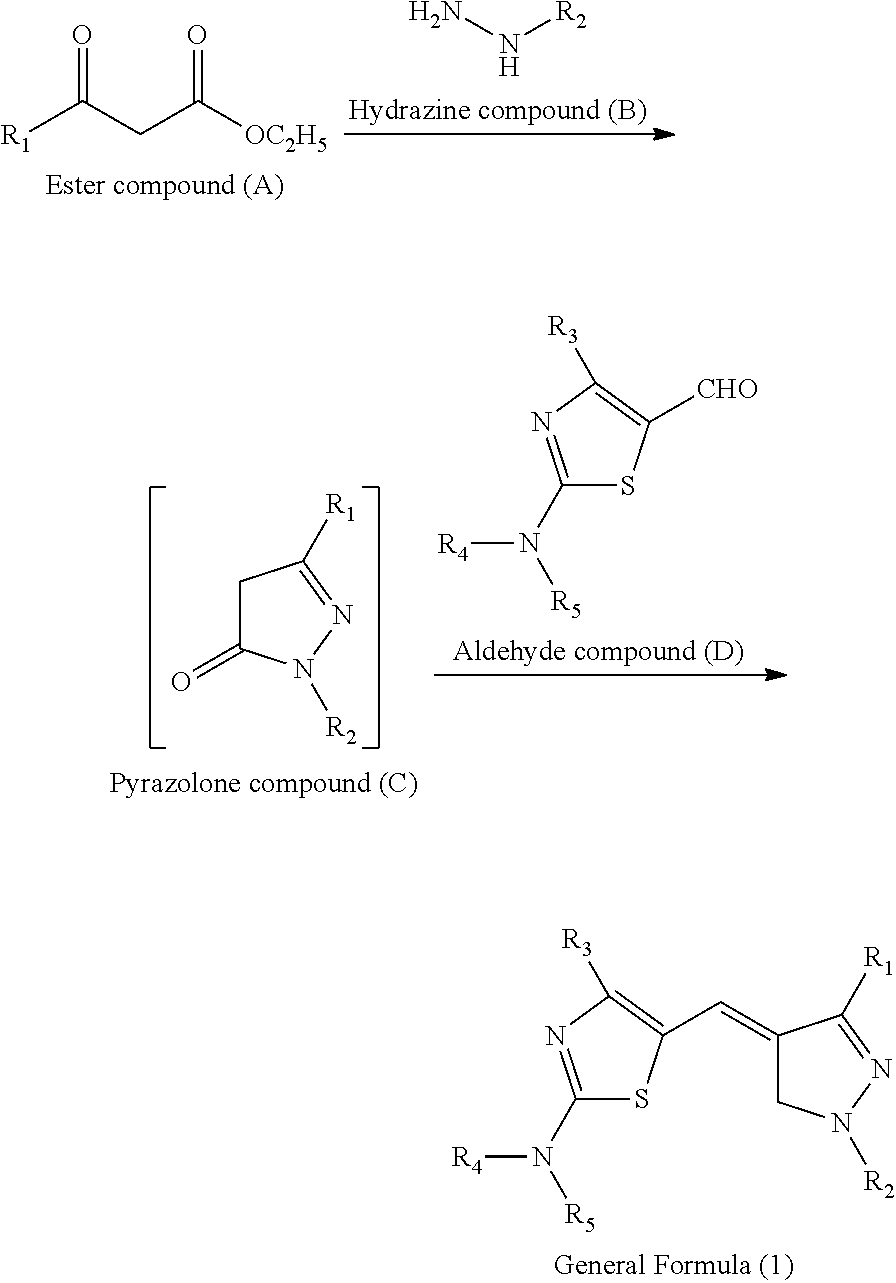


[In General Formula (2),
R6 and R7 each independently represent an alkyl group,
R8 represents a hydrogen atom, an alkyl group, an unsubstituted aryl group, or an aryl group having a substituent,
R9 represents an alkyl group, an unsubstituted aryl group, or an aryl group having a substituent,
R10 represents a hydrogen atom, an alkyl group, an unsubstituted aryl group, an aryl group having a substituent, or —N(—R11)R12, in which R11 and R12 each independently represent a hydrogen atom, an alkyl group, or an acyl group and R11 and R12 may be bonded to form a ring, and when R8 to R10 are the aryl groups having a substituent, the substituent is an alkyl group or an alkoxy group.]


In General Formula (3),
either R13 or R14 represents an alkyl group and the other one represents a hydrogen atom or an alkyl group,
R15 represents an alkyl group, an unsubstituted aryl group, an aryl group having a substituent, or an amino group,
R16 represents a hydrogen atom, a cyano group, a carbamoyl group, an alkoxycarbonyl group, or a carboxamide group,
R17 represents a hydrogen atom, an alkyl group, an unsubstituted aryl group, an aryl group having a substituent, or —N(—R18)R19, in which R18 and R19 each independently represent a hydrogen atom, an alkyl group, or an acyl group and R18 and R19 may be bonded to each other to form a ring, when R15 and R17 are the aryl groups having a substituent, the substituent is an alkyl group,
X represents a carbonyl group or a sulfonyl group, and
n represents an integer of 1 to 3.


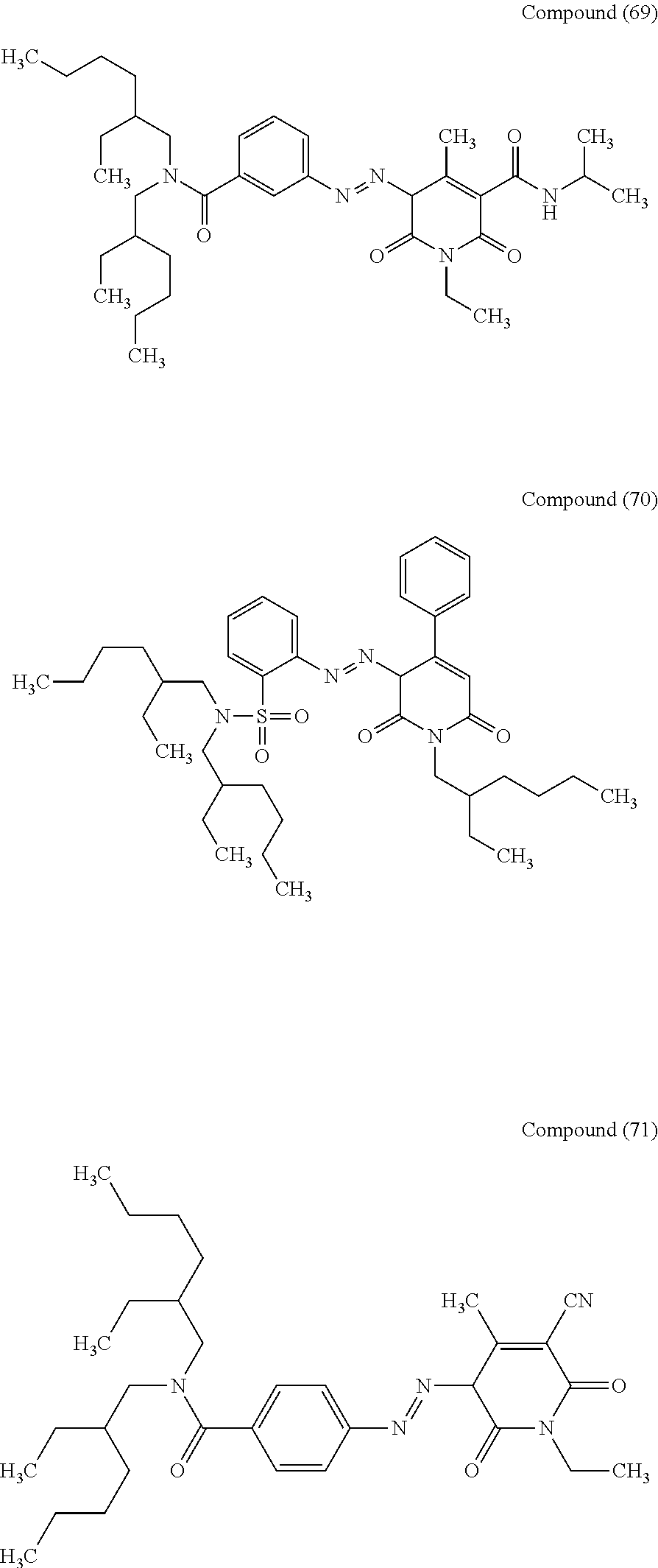

[In General Formula (4), R20 to R23 each independently represent an alkyl group, an unsubstituted aryl group, or an aryl group having a substituent. When R20 to R23 are the aryl groups having a substituent, the substituent is an alkyl group or an alkoxy group.]


[In General Formula (5), R24 and R25 each independently represent an alkyl group, an unsubstituted aryl group, or an aryl group having a substituent. When R24 and R25 are the aryl groups having a substituent, the substituent is an alkyl group.]


[In General Formula (6), R26 and R27 each independently represent an alkyl group, an unsubstituted aryl group, or an aryl group having a substituent. When R26 and R27 are the aryl groups having a substituent, the substituent is an alkyl group.]


[In General Formula (7), R28 to R32 each independently represent an alkyl group, an unsubstituted aryl group, or an aryl group having a substituent. When R28 to R32 are the aryl groups having a substituent, the substituent is an alkyl group or an alkoxy group.]


[In General Formula (8), R33 to R36 each independently represent an alkyl group, an unsubstituted aryl group, or an aryl group having a substituent. When R33 to R36 are the aryl groups having a substituent, the substituent is an alkyl group.]


[In General Formula (10), R38 to R42 each independently represent an alkyl group, an unsubstituted aryl group, or an aryl group having a substituent. When R38 to R42 are the aryl groups having a substituent, the substituent is an alkyl group]


[In General Formula (11), R43 and R44 each independently represent an alkyl group, an unsubstituted aryl group, or an aryl group having a substituent. When R43 and R44 are the aryl groups having a substituent, the substituent is an alkyl group.]


[In General Formula (12), R45 to R49 each independently represent an alkyl group, an unsubstituted aryl group, or an aryl group having a substituent. When R45 to R49 are the aryl groups having a substituent, the substituent is an alkyl group.]


[In General Formula (13), R50 and R51 each independently represent an alkyl group, an unsubstituted aryl group, or an aryl group having a substituent. When R50 and R51 are the aryl groups having a substituent, the substituent is an alkyl group.]


| TABLE 1 | ||||||
| Thermal | ||||||
| transfer | General | |||||
| recording | General | General | General | General | Formula | Compounding |
| sheet | Formula (1) | Formula (3) | Formula (4) | Formula (5) | (13) | ratio |
| Y1 | Compound (1) | — | — | — | — | 1:0:0:0:0 |
| Y2 | Compound (3) | Compound | Compound | — | — | 1:1:1:0:0 |
| (67) | (74) | |||||
| Y3 | Compound (6) | Compound | — | — | Compound | 1:1:0:0:1 |
| (68) | (147) | |||||
| Y4 | Compound (7) | — | Compound | Compound | — | 2:0:1:1:0 |
| (75) | (86) | |||||
| Y5 | Compound (9) | — | Compound | — | — | 1:0:1:0:0 |
| (76) | ||||||
| Y6 | Compound (11) | — | Compound | — | — | 1:0:1:0:0 |
| (77) | ||||||
| Y7 | Compound (14) | — | — | — | Compound | 1:0:0:0:1 |
| (147) | ||||||
| Y8 | Compound (16) | Compound | — | — | Compound | 1:1:0:0:1 |
| (62) | (146) | |||||
| Y9 | Compound (19) | Compound | — | — | Compound | 1:1:0:0:1 |
| (63) | (148) | |||||
| Y10 | Compound (20) | Compound | — | — | — | 1:1:0:0:0 |
| (71) | ||||||
| Y11 | Compound (22) | — | — | — | Compound | 1:0:0:0:1 |
| (146) | ||||||
| Y12 | Mixture (1:1) of | — | — | Compound | — | 1:0:0:1:0 |
| Compound (31) | (85) | |||||
| and Compound | ||||||
| (20) | ||||||
| Y13 | — | — | — | Compound | Compound | 0:0:0:3:1 |
| (86) | (146) | |||||
| Y14 | — | — | Compound | — | Compound | 0:0:1:0:1 |
| (76) | (148) | |||||
| Y15 | Compound (13) | — | — | — | Compound | 1:0:0:0:1 |
| (146) | ||||||
| Y16 | Compound (15) | — | — | — | Compound | 1:0:0:0:1 |
| (146) | ||||||
| TABLE 2 | ||||||
| Thermal | ||||||
| transfer | ||||||
| recording | General | General | General | General | General | Compounding |
| sheet | Formula (2) | Formula (6) | Formula (7) | Formula (8) | Formula (9) | ratio |
| M1 | Compound | — | — | — | — | 1:0:0:0:0 |
| (44) | ||||||
| M2 | Compound | Compound | Compound | — | — | 2:1:1:0:0 |
| (32) | (89) | (99) | ||||
| M3 | Compound | — | — | Compound | — | 3:0:0:1:0 |
| (34) | (107) | |||||
| M4 | Compound | Compound | — | Compound | Compound | 2:2:0:1:1 |
| (37) | (91) | (105) | (118) | |||
| M5 | Compound | Compound | Compound | — | — | 3:1:1:0:0 |
| (52) | (92) | (102) | ||||
| M6 | Compound | Compound | Compound | Compound | — | 2:1:1:1:0 |
| (54) | (90) | (98) | (109) | |||
| M7 | Compound | Compound | Compound | Compound | Compound | 4:1:1:1:1 |
| (42) | (93) | (100) | (107) | (115) | ||
| M8 | Compound | — | — | — | Compound | 2:0:0:0:1 |
| (52) | (116) | |||||
| M9 | Compound | — | — | Compound | Compound | 3:0:0:1:1 |
| (54) | (108) | (117) | ||||
| M10 | Compound | Compound | Compound | — | Compound | 2:1:1:0:1 |
| (44) | (94) | (101) | (114) | |||
| M11 | — | — | Compound | Compound | 0:0:0:1:1 | |
| (108) | (116) | |||||
| M12 | — | Compound | Compound | — | — | 0:2:1:0:0 |
| (92) | (98) | |||||
| TABLE 3 | ||||
| Thermal transfer | General Formula | General Formula | General Formula | Compounding |
| recording sheet | (10) | (11) | (12) | ratio |
| C1 | Compound (124) | Compound (133) | Compound (136) | 1:1:1 |
| C2 | Compound (125) | Compound (132) | Compound (137) | 1:2:1 |
| C3 | Compound (124) | — | Compound (136) | 1:0:1 |
| C4 | Compound (125) | Compound (132) | — | 1:1:0 |
| C5 | Compound (123) | Compound (131) | — | 1:1:0 |
| C6 | Compound (124) | Compound (133) | Compound (141) | 2:1:1 |
| C7 | Compound (123) | Compound (132) | — | 2:1:0 |
115%≦Color reproduction area A:
105%≦Color reproduction area<115% B:
Color reproduction area<105% C:
[Evaluation of Print Density]
6.2≦Print density A:
6.0≦Print density<6.2 B:
Print density<6.0 C:
[Evaluation of Reproducibility of Process Black]
ΔE<0.01 A:
0.01≦ΔE<0.02 B:
0.0≦ΔE C:
| TABLE 4 | |||||||
| Y | M | C | Color | Process | |||
| sheet | sheet | sheet | gamut area | density | black | ||
| Example 1 | Y1 | M1 | C1 | B (105) | A (6.22) | B (0.011) |
| Example 2 | Y2 | M2 | C2 | A (117) | A (6.23) | A (0.009) |
| Example 3 | Y3 | M3 | C3 | A (115) | A (6.35) | A (0.008) |
| Example 4 | Y4 | M4 | C4 | B (112) | B (6.00) | A (0.009) |
| Example 5 | Y5 | M5 | C5 | B (110) | B (6.11) | B (0.015) |
| Example 6 | Y6 | M6 | C6 | A (115) | B (6.09) | B (0.013) |
| Example 7 | Y7 | M7 | C7 | A (116) | A (6.42) | A (0.008) |
| Example 8 | Y8 | M8 | C1 | B (108) | B (6.01) | B (0.011) |
| Example 9 | Y9 | M9 | C2 | B (111) | B (6.14) | B (0.011) |
| Example 10 | Y10 | M10 | C3 | A (119) | A (6.53) | A (0.007) |
| Example 11 | Y11 | M3 | C4 | B (107) | B (6.11) | B (0.010) |
| Example 12 | Y12 | M10 | C5 | B (112) | A (6.41) | A (0.007) |
| Example 13 | Y15 | M3 | C4 | B (108) | A (6.39) | B (0.011) |
| Example 14 | Y16 | M3 | C4 | B (110) | A (6.35) | B (0.012) |
| Comparative | Y13 | M11 | C4 | C (96) | C (5.98) | B (0.019) |
| Example 1 | ||||||
| Comparative | Y13 | M12 | C2 | C (100) | C (5.78) | C (0.024) |
| Example 2 | ||||||
| Comparative | Y14 | M4 | C3 | C (105) | C (5.90) | C (0.022) |
| Example 3 | ||||||
| Comparative | Y4 | M11 | C2 | C (98) | C (5.81) | B (0.014) |
| Example 4 | ||||||
| TABLE 5 | |||
| Compound to be used | |||
| Dispersion liquid (1) | Compound (1) | ||
| Dispersion liquid (2) | Compound (71) | ||
| Dispersion liquid (3) | Compound (74) | ||
| Dispersion liquid (4) | Compound (44) | ||
| Dispersion liquid (5) | Compound (89) | ||
| Dispersion liquid (6) | Compound (132) | ||
| Dispersion liquid (7) | Compound (124) | ||
<Preparation of Ink A>
| TABLE 6 | |||
| Dispersion liquid to be used | |||
| Ink A | Dispersion liquid 1: 10 parts | ||
| Dispersion liquid 2: 10 parts | |||
| Ink B | Dispersion liquid 1: 10 parts | ||
| Dispersion liquid 3: 10 parts | |||
| Ink C | Dispersion liquid 3: 20 parts | ||
| Ink D | Dispersion liquid 4: 10 parts | ||
| Dispersion liquid 5: 10 parts | |||
| Ink E | Dispersion liquid 5: 20 parts | ||
| Ink F | Dispersion liquid 6: 10 parts | ||
| Dispersion liquid 7: 10 parts | |||
| Ink G | Dispersion liquid 7: 20 parts | ||
115%≦Color reproduction area A:
105%≦Color reproduction area<115% B:
Color reproduction area<105% C:
[Evaluation of Print Density]
4.5≦Print density A:
4.2≦Print density<4.5 B:
Print density<4.2 C:
[Evaluation of Reproducibility of Process Black]
ΔE<0.01 A:
0.01≦ΔE<0.02 B:
0.02≦ΔE C:
| TABLE 7 | |||||||
| Color gamut | Process | ||||||
| Y ink | M ink | C ink | area | density | black | ||
| Example 15 | Ink A | Ink D | Ink F | A (120) | A (4.6) | A (0.008) |
| Example 16 | Ink B | Ink D | Ink F | A (117) | A (4.7) | A (0.009) |
| Comparative | Ink C | Ink E | Ink G | C (100) | C (4.1) | C (0.025) |
| Example 5 | ||||||
Claims (6)


Applications Claiming Priority (2)
| Application Number | Priority Date | Filing Date | Title |
|---|---|---|---|
| JP2015085300 | 2015-04-17 | ||
| JP2015-085300 | 2015-04-17 |
Publications (2)
| Publication Number | Publication Date |
|---|---|
| US20160303882A1 US20160303882A1 (en) | 2016-10-20 |
| US9701146B2 true US9701146B2 (en) | 2017-07-11 |
Family
ID=57128654
Family Applications (1)
| Application Number | Title | Priority Date | Filing Date |
|---|---|---|---|
| US15/130,695 Expired - Fee Related US9701146B2 (en) | 2015-04-17 | 2016-04-15 | Ink set and thermal transfer recording sheet |
Country Status (2)
| Country | Link |
|---|---|
| US (1) | US9701146B2 (en) |
| JP (1) | JP2016204651A (en) |
Cited By (2)
| Publication number | Priority date | Publication date | Assignee | Title |
|---|---|---|---|---|
| US11472962B2 (en) * | 2018-01-17 | 2022-10-18 | Canon Kabushiki Kaisha | Compound, ink, resist composition for color filter, sheet for heat-sensitive transfer recording, and toner |
| US12098288B2 (en) | 2018-07-30 | 2024-09-24 | Canon Kabushiki Kaisha | Compound, ink, resist composition for color filter, color filter, sheet for thermal transfer recording, and toner |
Families Citing this family (4)
| Publication number | Priority date | Publication date | Assignee | Title |
|---|---|---|---|---|
| JP6543116B2 (en) * | 2015-07-02 | 2019-07-10 | キヤノン株式会社 | Dye compound, toner and method for producing the toner |
| CN106748833B (en) * | 2016-11-29 | 2018-08-03 | 安徽清科瑞洁新材料有限公司 | A kind of preparation method of 63 dyestuff of solvent blue |
| JP7154746B2 (en) * | 2016-12-20 | 2022-10-18 | キヤノン株式会社 | Thermal transfer recording sheet |
| JP7218243B2 (en) * | 2018-05-31 | 2023-02-06 | キヤノン株式会社 | Water-based coloring liquids, inkjet inks, writing instrument inks |
Citations (6)
| Publication number | Priority date | Publication date | Assignee | Title |
|---|---|---|---|---|
| WO1992019684A1 (en) | 1991-05-03 | 1992-11-12 | Basf Aktiengesellschaft | N-aminopyridone dyes |
| JPH05262056A (en) | 1992-01-21 | 1993-10-12 | Dainippon Printing Co Ltd | Thermal transfer sheet |
| JPH0796675A (en) | 1993-05-25 | 1995-04-11 | Dainippon Printing Co Ltd | Thermal transfer sheet for color image formation |
| JPH0811450A (en) | 1994-07-04 | 1996-01-16 | Dainippon Printing Co Ltd | Thermal transfer sheet for color image formation |
| WO2008114886A1 (en) | 2007-03-19 | 2008-09-25 | Canon Kabushiki Kaisha | Dye compound, yellow toner, thermal transfer recording sheet, and ink |
| JP2014080539A (en) | 2012-10-18 | 2014-05-08 | Seiko Epson Corp | Ink for sublimation transfer, manufacturing method of dyed product and dyed product |
-
2016
- 2016-04-15 US US15/130,695 patent/US9701146B2/en not_active Expired - Fee Related
- 2016-04-15 JP JP2016082363A patent/JP2016204651A/en active Pending
Patent Citations (6)
| Publication number | Priority date | Publication date | Assignee | Title |
|---|---|---|---|---|
| WO1992019684A1 (en) | 1991-05-03 | 1992-11-12 | Basf Aktiengesellschaft | N-aminopyridone dyes |
| JPH05262056A (en) | 1992-01-21 | 1993-10-12 | Dainippon Printing Co Ltd | Thermal transfer sheet |
| JPH0796675A (en) | 1993-05-25 | 1995-04-11 | Dainippon Printing Co Ltd | Thermal transfer sheet for color image formation |
| JPH0811450A (en) | 1994-07-04 | 1996-01-16 | Dainippon Printing Co Ltd | Thermal transfer sheet for color image formation |
| WO2008114886A1 (en) | 2007-03-19 | 2008-09-25 | Canon Kabushiki Kaisha | Dye compound, yellow toner, thermal transfer recording sheet, and ink |
| JP2014080539A (en) | 2012-10-18 | 2014-05-08 | Seiko Epson Corp | Ink for sublimation transfer, manufacturing method of dyed product and dyed product |
Cited By (2)
| Publication number | Priority date | Publication date | Assignee | Title |
|---|---|---|---|---|
| US11472962B2 (en) * | 2018-01-17 | 2022-10-18 | Canon Kabushiki Kaisha | Compound, ink, resist composition for color filter, sheet for heat-sensitive transfer recording, and toner |
| US12098288B2 (en) | 2018-07-30 | 2024-09-24 | Canon Kabushiki Kaisha | Compound, ink, resist composition for color filter, color filter, sheet for thermal transfer recording, and toner |
Also Published As
| Publication number | Publication date |
|---|---|
| JP2016204651A (en) | 2016-12-08 |
| US20160303882A1 (en) | 2016-10-20 |
Similar Documents
| Publication | Publication Date | Title |
|---|---|---|
| US20160303882A1 (en) | Ink set and thermal transfer recording sheet | |
| US20140005417A1 (en) | Water-insoluble coloring compound, ink, resist composition for color filter, and thermal transfer recording sheet | |
| US9592695B2 (en) | Thermal transfer recording sheet | |
| US8974708B2 (en) | Coloring matter compound, ink, resist composition for color filter, and heat-sensitive transfer recording sheet | |
| US9481192B2 (en) | Thermal transfer recording sheet | |
| TW200811246A (en) | Azo dye, heat-sensitive transfer recording ink sheet, heat-sensitive transfer recording method, color toner, inkjet ink and color filter | |
| US10195886B2 (en) | Thermal transfer recording sheet set and image forming method | |
| US8940087B2 (en) | Coloring matter compound, ink, resist composition for color filter, and heat-sensitive transfer recording sheet | |
| JP3997651B2 (en) | Novel dye, image recording material, thermal transfer material and ink jet recording liquid | |
| JP7336198B2 (en) | Liquid composition, thermal transfer recording sheet, toner, resist composition for color filter, and color filter | |
| US10501631B2 (en) | Coloring compound and thermal transfer recording sheet | |
| EP3339045B1 (en) | Thermal transfer donor sheet | |
| JP7154746B2 (en) | Thermal transfer recording sheet | |
| US9650367B2 (en) | Compound, and ink, color filter resist composition, thermal transfer recording sheet and toner containing the same | |
| JP5090966B2 (en) | Arylidenepyrazolone dye, coloring composition, thermal transfer recording ink sheet, thermal transfer recording method, color toner, inkjet ink and color filter | |
| JP3704926B2 (en) | Thermal transfer material and ink jet recording liquid containing dye containing pyridazine structure | |
| JP3997615B2 (en) | Image recording material, thermal transfer material and ink jet recording liquid using novel dye | |
| JP2001334755A (en) | Heat-sensitive transfer recording material, method of heat-sensitive transfer recording, ink for ink-jet recording, color toner, and color filter | |
| JPH11152417A (en) | Pyrimidine structure-containing dye, thermotransferring material and ink jet printing liquid | |
| JP2008088200A (en) | Azo dye compound, coloring composition, thermal transfer recording ink sheet, thermal transfer recording method, color toner, inkjet ink and color filter | |
| JPH11151865A (en) | Heat-sensitive transfer material, and ink jet recording liquid | |
| JP2001334756A (en) | Thermal transfer recording material, thermal transfer recording method, color filter, toner and ink | |
| JP2003064273A (en) | New compound, dyestuff, ink composition, ink-jet recording ink, and ink-jet recording method | |
| JPH11152421A (en) | Pyrazine structure-containing dye, thermotransferring material and ink jet printing liquid | |
| CN104583335A (en) | Pigment compound, ink, sheet for thermosensitive transfer recording, and resist composition for colour filter |
Legal Events
| Date | Code | Title | Description |
|---|---|---|---|
| AS | Assignment |
Owner name: CANON KABUSHIKI KAISHA, JAPAN Free format text: ASSIGNMENT OF ASSIGNORS INTEREST;ASSIGNORS:SHIROTA, KOROMO;SHINTOU, TAICHI;NAKANO, MASAO;REEL/FRAME:039034/0680 Effective date: 20160331 |
|
| STCF | Information on status: patent grant |
Free format text: PATENTED CASE |
|
| MAFP | Maintenance fee payment |
Free format text: PAYMENT OF MAINTENANCE FEE, 4TH YEAR, LARGE ENTITY (ORIGINAL EVENT CODE: M1551); ENTITY STATUS OF PATENT OWNER: LARGE ENTITY Year of fee payment: 4 |
|
| FEPP | Fee payment procedure |
Free format text: MAINTENANCE FEE REMINDER MAILED (ORIGINAL EVENT CODE: REM.); ENTITY STATUS OF PATENT OWNER: LARGE ENTITY |
|
| LAPS | Lapse for failure to pay maintenance fees |
Free format text: PATENT EXPIRED FOR FAILURE TO PAY MAINTENANCE FEES (ORIGINAL EVENT CODE: EXP.); ENTITY STATUS OF PATENT OWNER: LARGE ENTITY |
|
| STCH | Information on status: patent discontinuation |
Free format text: PATENT EXPIRED DUE TO NONPAYMENT OF MAINTENANCE FEES UNDER 37 CFR 1.362 |
|
| FP | Lapsed due to failure to pay maintenance fee |
Effective date: 20250711 |