US9695152B2 - 3,4-dihydro-2H-isoquinoline-1-one and 2,3-dihydro-isoindol-1-one compounds - Google Patents
3,4-dihydro-2H-isoquinoline-1-one and 2,3-dihydro-isoindol-1-one compounds Download PDFInfo
- Publication number
- US9695152B2 US9695152B2 US14/947,768 US201514947768A US9695152B2 US 9695152 B2 US9695152 B2 US 9695152B2 US 201514947768 A US201514947768 A US 201514947768A US 9695152 B2 US9695152 B2 US 9695152B2
- Authority
- US
- United States
- Prior art keywords
- amino
- chloro
- carbonyl
- azetidin
- pyridyl
- Prior art date
- Legal status (The legal status is an assumption and is not a legal conclusion. Google has not performed a legal analysis and makes no representation as to the accuracy of the status listed.)
- Active
Links
- 0 [1*]C1([2*])C2=CC([13*])=CC=C2C(=O)N(C2=C([15*])C(N([14*])C([5*])([6*])C([7*])([8*])C([9*])([10*])CN([11*])*[12*])=CN=C2)C1([3*])[4*] Chemical compound [1*]C1([2*])C2=CC([13*])=CC=C2C(=O)N(C2=C([15*])C(N([14*])C([5*])([6*])C([7*])([8*])C([9*])([10*])CN([11*])*[12*])=CN=C2)C1([3*])[4*] 0.000 description 14
- SFUQSKFZFRDQEC-UHFFFAOYSA-N CN(C1=CC(N2C(=O)C3=C(C=C(Cl)C=C3)C2(C)C)=CN=C1)C1CCN(S(=O)(=O)C2CC2)C1 Chemical compound CN(C1=CC(N2C(=O)C3=C(C=C(Cl)C=C3)C2(C)C)=CN=C1)C1CCN(S(=O)(=O)C2CC2)C1 SFUQSKFZFRDQEC-UHFFFAOYSA-N 0.000 description 5
- TUSGAOGTUYPRAO-UHFFFAOYSA-N CC1(C)C2=CC(Cl)=CC=C2C(=O)N1C1=CN=CC(CC2CN(S(=O)(=O)C3CC3)C2)=C1 Chemical compound CC1(C)C2=CC(Cl)=CC=C2C(=O)N1C1=CN=CC(CC2CN(S(=O)(=O)C3CC3)C2)=C1 TUSGAOGTUYPRAO-UHFFFAOYSA-N 0.000 description 3
- DQVCNEFERHUONP-UHFFFAOYSA-N CC1(C)NC(=O)C2=CC=C(Cl)C=C21 Chemical compound CC1(C)NC(=O)C2=CC=C(Cl)C=C21 DQVCNEFERHUONP-UHFFFAOYSA-N 0.000 description 3
- ULXSVQMBCDSWFV-UHFFFAOYSA-N CC(C)(C)OC(=O)N1CC(CC2=CC(N3C(=O)C4=C(C=C(Cl)C=C4)C3(C)C)=CN=C2)C1 Chemical compound CC(C)(C)OC(=O)N1CC(CC2=CC(N3C(=O)C4=C(C=C(Cl)C=C4)C3(C)C)=CN=C2)C1 ULXSVQMBCDSWFV-UHFFFAOYSA-N 0.000 description 2
- GHHPREUBZJAQJN-UHFFFAOYSA-N CC1(C)C2=CC(Cl)=CC=C2C(=O)N1C1=CN=CC(CC2CCCN(S(=O)(=O)C3CC3)C2)=C1 Chemical compound CC1(C)C2=CC(Cl)=CC=C2C(=O)N1C1=CN=CC(CC2CCCN(S(=O)(=O)C3CC3)C2)=C1 GHHPREUBZJAQJN-UHFFFAOYSA-N 0.000 description 2
- HOFCUOLCDJXVCK-MRXNPFEDSA-N CC1=C(C(=O)N2CC(CC3=CC(N4C(=O)C5=C(C=C(Cl)C=C5)[C@H]4C)=CN=C3)C2)C=NC=C1 Chemical compound CC1=C(C(=O)N2CC(CC3=CC(N4C(=O)C5=C(C=C(Cl)C=C5)[C@H]4C)=CN=C3)C2)C=NC=C1 HOFCUOLCDJXVCK-MRXNPFEDSA-N 0.000 description 2
- FWMUGNLCTKEPNH-UHFFFAOYSA-N CC1NC(=O)C2=CC=C(Cl)C=C21 Chemical compound CC1NC(=O)C2=CC=C(Cl)C=C21 FWMUGNLCTKEPNH-UHFFFAOYSA-N 0.000 description 2
- UUYWCADMDYCGSA-UHFFFAOYSA-N COC(=O)NCCC1=CC(Cl)=CC=C1 Chemical compound COC(=O)NCCC1=CC(Cl)=CC=C1 UUYWCADMDYCGSA-UHFFFAOYSA-N 0.000 description 2
- IIMTZZFIQMGUOJ-CYBMUJFWSA-N C[C@@H]1C2=C(C=CC(Cl)=C2)C(=O)N1C1=CN=CC(CC2CN(S(=O)(=O)C3CC3)C2)=C1 Chemical compound C[C@@H]1C2=C(C=CC(Cl)=C2)C(=O)N1C1=CN=CC(CC2CN(S(=O)(=O)C3CC3)C2)=C1 IIMTZZFIQMGUOJ-CYBMUJFWSA-N 0.000 description 2
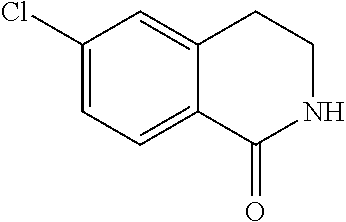
- RQKCSUSXBKSENU-UHFFFAOYSA-N O=C1NCCC2=CC(Cl)=CC=C12 Chemical compound O=C1NCCC2=CC(Cl)=CC=C12 RQKCSUSXBKSENU-UHFFFAOYSA-N 0.000 description 2
- UWFXPRNRLJWMAU-UHFFFAOYSA-N [C-]#[N+]C1=CC=C2C(=O)NC(C)(C)C2=C1 Chemical compound [C-]#[N+]C1=CC=C2C(=O)NC(C)(C)C2=C1 UWFXPRNRLJWMAU-UHFFFAOYSA-N 0.000 description 2
- PYRPPNWWNPIHJA-UHFFFAOYSA-N CC(C)(C)OC(=O)N1CC(CC2=CC(N3C(=O)C4=CC=C(C#N)C=C4C3(C)C)=CN=C2)C1 Chemical compound CC(C)(C)OC(=O)N1CC(CC2=CC(N3C(=O)C4=CC=C(C#N)C=C4C3(C)C)=CN=C2)C1 PYRPPNWWNPIHJA-UHFFFAOYSA-N 0.000 description 1
- CFLBBIPLCBAWBB-UHFFFAOYSA-N CC(C)(C)OC(=O)N1CC(NC2=CC(N3CCC4=C(C=CC(Cl)=C4)C3=O)=CN=C2)C1 Chemical compound CC(C)(C)OC(=O)N1CC(NC2=CC(N3CCC4=C(C=CC(Cl)=C4)C3=O)=CN=C2)C1 CFLBBIPLCBAWBB-UHFFFAOYSA-N 0.000 description 1
- FKLNMVDMZPPCGE-UHFFFAOYSA-N CC(C)(C)OC(=O)N1CC2(CC(NC3=CC(N4C(=O)C5=CC=C(Cl)C=C5C4(C)C)=CN=C3)C2)C1 Chemical compound CC(C)(C)OC(=O)N1CC2(CC(NC3=CC(N4C(=O)C5=CC=C(Cl)C=C5C4(C)C)=CN=C3)C2)C1 FKLNMVDMZPPCGE-UHFFFAOYSA-N 0.000 description 1
- KSTLAHUOHWRZBD-UHFFFAOYSA-N CC(C)(C)OC(=O)N1CCC(CC2=CC(N3C(=O)C4=CC=C(C#N)C=C4C3(C)C)=CN=C2)CC1 Chemical compound CC(C)(C)OC(=O)N1CCC(CC2=CC(N3C(=O)C4=CC=C(C#N)C=C4C3(C)C)=CN=C2)CC1 KSTLAHUOHWRZBD-UHFFFAOYSA-N 0.000 description 1
- UCYOEWWWEQEERI-UHFFFAOYSA-N CC(C)(C)OC(=O)N1CCCC(NC2=CC(N3C(=O)C4=CC=C(Cl)C=C4C3(C)C)=CN=C2)C1 Chemical compound CC(C)(C)OC(=O)N1CCCC(NC2=CC(N3C(=O)C4=CC=C(Cl)C=C4C3(C)C)=CN=C2)C1 UCYOEWWWEQEERI-UHFFFAOYSA-N 0.000 description 1
- IAQOXWPETVZRDU-UHFFFAOYSA-N CC(C)(C)OC(N(CC1)CCC1Nc1cc(N(C(C)(C)c2c3ccc(Cl)c2)C3=O)cnc1)=O Chemical compound CC(C)(C)OC(N(CC1)CCC1Nc1cc(N(C(C)(C)c2c3ccc(Cl)c2)C3=O)cnc1)=O IAQOXWPETVZRDU-UHFFFAOYSA-N 0.000 description 1
- YMMPZZARIQCFSW-UHFFFAOYSA-N CC(C)(N)C1=CC(Cl)=CC=C1Br Chemical compound CC(C)(N)C1=CC(Cl)=CC=C1Br YMMPZZARIQCFSW-UHFFFAOYSA-N 0.000 description 1
- FRHXIYCLMUCQGW-UHFFFAOYSA-N CC(C)(c(cc(cc1)C#N)c1C1=O)N1c1cc(NC(CC2)CCN2C(c2cnc[n]2C)=O)cnc1 Chemical compound CC(C)(c(cc(cc1)C#N)c1C1=O)N1c1cc(NC(CC2)CCN2C(c2cnc[n]2C)=O)cnc1 FRHXIYCLMUCQGW-UHFFFAOYSA-N 0.000 description 1
- HSAZFVDXJBXNRU-UHFFFAOYSA-N CC(C)(c(cc(cc1)C#N)c1C1=O)N1c1cncc(NC(CC2)CCN2C(c2c[n](C)nc2)=O)c1 Chemical compound CC(C)(c(cc(cc1)C#N)c1C1=O)N1c1cncc(NC(CC2)CCN2C(c2c[n](C)nc2)=O)c1 HSAZFVDXJBXNRU-UHFFFAOYSA-N 0.000 description 1
- ODITXVOCXCXIOY-UHFFFAOYSA-N CC(C)(c1c2ccc(C#N)c1)NC2=O Chemical compound CC(C)(c1c2ccc(C#N)c1)NC2=O ODITXVOCXCXIOY-UHFFFAOYSA-N 0.000 description 1
- YWAIBVYCGUKECT-UHFFFAOYSA-N CC(N)C1=CC(Cl)=CC=C1Br Chemical compound CC(N)C1=CC(Cl)=CC=C1Br YWAIBVYCGUKECT-UHFFFAOYSA-N 0.000 description 1
- YXXHTGWWXVSREB-UHFFFAOYSA-N CC1(C)C2=C(C=CC(C#N)=C2)C(=O)N1C1=CC(CC2CCN(C(=O)C3=NC=CC=C3Cl)CC2)=CN=C1 Chemical compound CC1(C)C2=C(C=CC(C#N)=C2)C(=O)N1C1=CC(CC2CCN(C(=O)C3=NC=CC=C3Cl)CC2)=CN=C1 YXXHTGWWXVSREB-UHFFFAOYSA-N 0.000 description 1
- QCAITZUBZVNFEB-UHFFFAOYSA-N CC1(C)C2=C(C=CC(C#N)=C2)C(=O)N1C1=CC(CC2CCN(S(=O)(=O)C3CC3)CC2)=CN=C1 Chemical compound CC1(C)C2=C(C=CC(C#N)=C2)C(=O)N1C1=CC(CC2CCN(S(=O)(=O)C3CC3)CC2)=CN=C1 QCAITZUBZVNFEB-UHFFFAOYSA-N 0.000 description 1
- ZNRIEKOHVSZVQI-UHFFFAOYSA-N CC1(C)C2=C(C=CC(C#N)=C2)C(=O)N1C1=CC(CC2CN(C(=O)C3=NC=CC=C3Cl)C2)=CN=C1 Chemical compound CC1(C)C2=C(C=CC(C#N)=C2)C(=O)N1C1=CC(CC2CN(C(=O)C3=NC=CC=C3Cl)C2)=CN=C1 ZNRIEKOHVSZVQI-UHFFFAOYSA-N 0.000 description 1
- BLQOXCVIFGWFPN-UHFFFAOYSA-N CC1(C)C2=C(C=CC(C#N)=C2)C(=O)N1C1=CC(CC2CN(S(=O)(=O)C3CC3)C2)=CN=C1 Chemical compound CC1(C)C2=C(C=CC(C#N)=C2)C(=O)N1C1=CC(CC2CN(S(=O)(=O)C3CC3)C2)=CN=C1 BLQOXCVIFGWFPN-UHFFFAOYSA-N 0.000 description 1
- JQHPKOMWGOZKOP-UHFFFAOYSA-N CC1(C)C2=C(C=CC(Cl)=C2)C(=O)N1C1=CN=CC(CC2CNC2)=C1 Chemical compound CC1(C)C2=C(C=CC(Cl)=C2)C(=O)N1C1=CN=CC(CC2CNC2)=C1 JQHPKOMWGOZKOP-UHFFFAOYSA-N 0.000 description 1
- GMJNJYPIDUNPAS-UHFFFAOYSA-N CC1(C)C2=C(C=CC(Cl)=C2)C(=O)N1C1=CN=CC(I)=C1 Chemical compound CC1(C)C2=C(C=CC(Cl)=C2)C(=O)N1C1=CN=CC(I)=C1 GMJNJYPIDUNPAS-UHFFFAOYSA-N 0.000 description 1
- AVLWIWQYKZDYIJ-UHFFFAOYSA-N CC1(C)C2=CC(Cl)=CC=C2C(=O)N1C1=CN=CC(CC2CN(C(=O)C3=NC=CC=C3Cl)C2)=C1 Chemical compound CC1(C)C2=CC(Cl)=CC=C2C(=O)N1C1=CN=CC(CC2CN(C(=O)C3=NC=CC=C3Cl)C2)=C1 AVLWIWQYKZDYIJ-UHFFFAOYSA-N 0.000 description 1
- QRUMYJQSZUABPB-UHFFFAOYSA-N CC1=CC(C(=O)N2CC(CC3=CC(N4C(=O)C5=CC=C(Cl)C=C5C4(C)C)=CN=C3)C2)=CN=C1 Chemical compound CC1=CC(C(=O)N2CC(CC3=CC(N4C(=O)C5=CC=C(Cl)C=C5C4(C)C)=CN=C3)C2)=CN=C1 QRUMYJQSZUABPB-UHFFFAOYSA-N 0.000 description 1
- KHGYBNHNKASBCU-UHFFFAOYSA-N CC1=CC(C(=O)N2CC(CC3=CC(N4CCC5=CC(Cl)=CC=C5C4=O)=CN=C3)C2)=CN=C1 Chemical compound CC1=CC(C(=O)N2CC(CC3=CC(N4CCC5=CC(Cl)=CC=C5C4=O)=CN=C3)C2)=CN=C1 KHGYBNHNKASBCU-UHFFFAOYSA-N 0.000 description 1
- SNNUWBKQHYJYRD-UHFFFAOYSA-N CC1=CC=NC=C1C(=O)N1CC(CC2=CC(N3C(=O)C4=CC=C(Cl)C=C4C3(C)C)=CN=C2)C1 Chemical compound CC1=CC=NC=C1C(=O)N1CC(CC2=CC(N3C(=O)C4=CC=C(Cl)C=C4C3(C)C)=CN=C2)C1 SNNUWBKQHYJYRD-UHFFFAOYSA-N 0.000 description 1
- HOFCUOLCDJXVCK-UHFFFAOYSA-N CC1=CC=NC=C1C(=O)N1CC(CC2=CC(N3C(=O)C4=CC=C(Cl)C=C4C3C)=CN=C2)C1 Chemical compound CC1=CC=NC=C1C(=O)N1CC(CC2=CC(N3C(=O)C4=CC=C(Cl)C=C4C3C)=CN=C2)C1 HOFCUOLCDJXVCK-UHFFFAOYSA-N 0.000 description 1
- ZFLNRCNAIZVIER-UHFFFAOYSA-N CC1=CC=NC=C1C(=O)N1CC(CC2=CC(N3CCC4=CC(Cl)=CC=C4C3=O)=CN=C2)C1 Chemical compound CC1=CC=NC=C1C(=O)N1CC(CC2=CC(N3CCC4=CC(Cl)=CC=C4C3=O)=CN=C2)C1 ZFLNRCNAIZVIER-UHFFFAOYSA-N 0.000 description 1
- SHPKDJPZGFIOTQ-UHFFFAOYSA-N CC1=CC=NC=C1C(=O)N1CC(CC2=CN=CC(N3C(=O)C4=C(C=C(C#N)C=C4)C3(C)C)=C2)C1 Chemical compound CC1=CC=NC=C1C(=O)N1CC(CC2=CN=CC(N3C(=O)C4=C(C=C(C#N)C=C4)C3(C)C)=C2)C1 SHPKDJPZGFIOTQ-UHFFFAOYSA-N 0.000 description 1
- DIMGSFBWKUZFSL-UHFFFAOYSA-N CC1=CC=NC=C1C(=O)N1CC2(CC(CC3=CC(N4C(=O)C5=CC=C(Cl)C=C5C4(C)C)=CN=C3)C2)C1 Chemical compound CC1=CC=NC=C1C(=O)N1CC2(CC(CC3=CC(N4C(=O)C5=CC=C(Cl)C=C5C4(C)C)=CN=C3)C2)C1 DIMGSFBWKUZFSL-UHFFFAOYSA-N 0.000 description 1
- RWYWTFFNSXZKLQ-UHFFFAOYSA-N CC1=CC=NC=C1C(=O)N1CCC(CC2=CN=CC(N3C(=O)C4=C(C=C(C#N)C=C4)C3(C)C)=C2)CC1 Chemical compound CC1=CC=NC=C1C(=O)N1CCC(CC2=CN=CC(N3C(=O)C4=C(C=C(C#N)C=C4)C3(C)C)=C2)CC1 RWYWTFFNSXZKLQ-UHFFFAOYSA-N 0.000 description 1
- MKUCRELAHUPQMP-UHFFFAOYSA-N CC1=NOC(C)=C1C(=O)N1CC(CC2=CC(N3C(=O)C4=C(C=C(Cl)C=C4)C3(C)C)=CN=C2)C1 Chemical compound CC1=NOC(C)=C1C(=O)N1CC(CC2=CC(N3C(=O)C4=C(C=C(Cl)C=C4)C3(C)C)=CN=C2)C1 MKUCRELAHUPQMP-UHFFFAOYSA-N 0.000 description 1
- CPYLXYIQVIMRSY-UHFFFAOYSA-N CC1=NOC(C)=C1C(=O)N1CC(CC2=CC(N3CCC4=C(C=CC(Cl)=C4)C3=O)=CN=C2)C1 Chemical compound CC1=NOC(C)=C1C(=O)N1CC(CC2=CC(N3CCC4=C(C=CC(Cl)=C4)C3=O)=CN=C2)C1 CPYLXYIQVIMRSY-UHFFFAOYSA-N 0.000 description 1
- GKHRGPYCUFUTMW-UHFFFAOYSA-N CC1C2=CC(Cl)=CC=C2C(=O)N1C1=CN=CC(CC2CN(C(=O)C3=NC=CC=C3Cl)C2)=C1 Chemical compound CC1C2=CC(Cl)=CC=C2C(=O)N1C1=CN=CC(CC2CN(C(=O)C3=NC=CC=C3Cl)C2)=C1 GKHRGPYCUFUTMW-UHFFFAOYSA-N 0.000 description 1
- IIMTZZFIQMGUOJ-UHFFFAOYSA-N CC1C2=CC(Cl)=CC=C2C(=O)N1C1=CN=CC(CC2CN(S(=O)(=O)C3CC3)C2)=C1 Chemical compound CC1C2=CC(Cl)=CC=C2C(=O)N1C1=CN=CC(CC2CN(S(=O)(=O)C3CC3)C2)=C1 IIMTZZFIQMGUOJ-UHFFFAOYSA-N 0.000 description 1
- RHTFOPGCKFZZNR-UHFFFAOYSA-N CC1C2=CC(Cl)=CC=C2C(=O)N1C1=CN=CC(NC2CN(C(=O)OC(C)(C)C)C2)=C1 Chemical compound CC1C2=CC(Cl)=CC=C2C(=O)N1C1=CN=CC(NC2CN(C(=O)OC(C)(C)C)C2)=C1 RHTFOPGCKFZZNR-UHFFFAOYSA-N 0.000 description 1
- WSGBRPBIMSVIJF-UHFFFAOYSA-N CN(C1=CC(N2C(=O)C3=C(C=C(Cl)C=C3)C2(C)C)=CN=C1)C1CCN(C(=O)OC(C)(C)C)C1 Chemical compound CN(C1=CC(N2C(=O)C3=C(C=C(Cl)C=C3)C2(C)C)=CN=C1)C1CCN(C(=O)OC(C)(C)C)C1 WSGBRPBIMSVIJF-UHFFFAOYSA-N 0.000 description 1
- VTKQMFBTTVEDMM-UHFFFAOYSA-N CN(C1=CC(N2C(=O)C3=C(C=C(Cl)C=C3)C2(C)C)=CN=C1)C1CCNC1 Chemical compound CN(C1=CC(N2C(=O)C3=C(C=C(Cl)C=C3)C2(C)C)=CN=C1)C1CCNC1 VTKQMFBTTVEDMM-UHFFFAOYSA-N 0.000 description 1
- BKRGYTMUZQACFC-UHFFFAOYSA-N CN(C1=CC(N2C(=O)C3=C(C=C(Cl)C=C3)C2(C)C)=CN=C1)C1CN(C(=O)OC(C)(C)C)C1 Chemical compound CN(C1=CC(N2C(=O)C3=C(C=C(Cl)C=C3)C2(C)C)=CN=C1)C1CN(C(=O)OC(C)(C)C)C1 BKRGYTMUZQACFC-UHFFFAOYSA-N 0.000 description 1
- NYFREXVYBJDHKI-UHFFFAOYSA-N CN(C1=CC(N2C(=O)C3=C(C=C(Cl)C=C3)C2(C)C)=CN=C1)C1CNC1 Chemical compound CN(C1=CC(N2C(=O)C3=C(C=C(Cl)C=C3)C2(C)C)=CN=C1)C1CNC1 NYFREXVYBJDHKI-UHFFFAOYSA-N 0.000 description 1
- KXJBVZRVQHSTHN-UHFFFAOYSA-N CN(C1=CC(N2C(=O)C3=CC=C(Cl)C=C3C2(C)C)=CN=C1)C1CCN(S(=O)(=O)C2CC2)CC1 Chemical compound CN(C1=CC(N2C(=O)C3=CC=C(Cl)C=C3C2(C)C)=CN=C1)C1CCN(S(=O)(=O)C2CC2)CC1 KXJBVZRVQHSTHN-UHFFFAOYSA-N 0.000 description 1
- XETUWQYIZDRINA-UHFFFAOYSA-N CN(C1=CC(N2C(=O)C3=CC=C(Cl)C=C3C2(C)C)=CN=C1)C1CN(S(=O)(=O)C2CC2)C1 Chemical compound CN(C1=CC(N2C(=O)C3=CC=C(Cl)C=C3C2(C)C)=CN=C1)C1CN(S(=O)(=O)C2CC2)C1 XETUWQYIZDRINA-UHFFFAOYSA-N 0.000 description 1
- YPRQMCNTQLXOSA-UHFFFAOYSA-N CN1C=C(C(=O)N2CC(CC3=CC(N4C(=O)C5=C(C=C(Cl)C=C5)C4(C)C)=CN=C3)C2)C=N1 Chemical compound CN1C=C(C(=O)N2CC(CC3=CC(N4C(=O)C5=C(C=C(Cl)C=C5)C4(C)C)=CN=C3)C2)C=N1 YPRQMCNTQLXOSA-UHFFFAOYSA-N 0.000 description 1
- FSIACFIIXPJNNT-UHFFFAOYSA-N CN1C=C(C(=O)N2CC(CC3=CC(N4CCC5=C(C=CC(Cl)=C5)C4=O)=CN=C3)C2)C=N1 Chemical compound CN1C=C(C(=O)N2CC(CC3=CC(N4CCC5=C(C=CC(Cl)=C5)C4=O)=CN=C3)C2)C=N1 FSIACFIIXPJNNT-UHFFFAOYSA-N 0.000 description 1
- FTBVHRHHGHDNRN-UHFFFAOYSA-N CN1C=C(C(=O)N2CC(CC3=CN=CC(N4C(=O)C5=C(C=C(C#N)C=C5)C4(C)C)=C3)C2)C=N1 Chemical compound CN1C=C(C(=O)N2CC(CC3=CN=CC(N4C(=O)C5=C(C=C(C#N)C=C5)C4(C)C)=C3)C2)C=N1 FTBVHRHHGHDNRN-UHFFFAOYSA-N 0.000 description 1
- NKGKPWXKBQPXII-UHFFFAOYSA-N CN1C=C(C(=O)N2CCC(CC3=CN=CC(N4C(=O)C5=C(C=C(C#N)C=C5)C4(C)C)=C3)CC2)C=N1 Chemical compound CN1C=C(C(=O)N2CCC(CC3=CN=CC(N4C(=O)C5=C(C=C(C#N)C=C5)C4(C)C)=C3)CC2)C=N1 NKGKPWXKBQPXII-UHFFFAOYSA-N 0.000 description 1
- ZEZPTDUHONFKFN-UHFFFAOYSA-N CN1C=CN=C1C(=O)N1CC(CC2=CC(N3C(=O)C4=CC=C(Cl)C=C4C3(C)C)=CN=C2)C1 Chemical compound CN1C=CN=C1C(=O)N1CC(CC2=CC(N3C(=O)C4=CC=C(Cl)C=C4C3(C)C)=CN=C2)C1 ZEZPTDUHONFKFN-UHFFFAOYSA-N 0.000 description 1
- WMNLWHIZHXKXHA-UHFFFAOYSA-N CN1C=CN=C1C(=O)N1CC(CC2=CC(N3CCC4=C(C=CC(Cl)=C4)C3=O)=CN=C2)C1 Chemical compound CN1C=CN=C1C(=O)N1CC(CC2=CC(N3CCC4=C(C=CC(Cl)=C4)C3=O)=CN=C2)C1 WMNLWHIZHXKXHA-UHFFFAOYSA-N 0.000 description 1
- FQNXZSNTJYJSDQ-UHFFFAOYSA-N CN1C=CN=C1C(=O)N1CC(CC2=CN=CC(N3C(=O)C4=C(C=C(C#N)C=C4)C3(C)C)=C2)C1 Chemical compound CN1C=CN=C1C(=O)N1CC(CC2=CN=CC(N3C(=O)C4=C(C=C(C#N)C=C4)C3(C)C)=C2)C1 FQNXZSNTJYJSDQ-UHFFFAOYSA-N 0.000 description 1
- PSPUQZLIVBICDZ-UHFFFAOYSA-N CN1C=CN=C1C(=O)N1CCC(CC2=CN=CC(N3C(=O)C4=C(C=C(C#N)C=C4)C3(C)C)=C2)CC1 Chemical compound CN1C=CN=C1C(=O)N1CCC(CC2=CN=CC(N3C(=O)C4=C(C=C(C#N)C=C4)C3(C)C)=C2)CC1 PSPUQZLIVBICDZ-UHFFFAOYSA-N 0.000 description 1
- KRLCQQMIMLASTM-UHFFFAOYSA-N CN1C=NC=C1C(=O)N1CC(CC2=CN=CC(N3C(=O)C4=C(C=C(C#N)C=C4)C3(C)C)=C2)C1 Chemical compound CN1C=NC=C1C(=O)N1CC(CC2=CN=CC(N3C(=O)C4=C(C=C(C#N)C=C4)C3(C)C)=C2)C1 KRLCQQMIMLASTM-UHFFFAOYSA-N 0.000 description 1
- GHCVPAICGNQQTA-UHFFFAOYSA-N CN1C=NC=C1C(=O)N1CCC(CC2=CN=CC(N3C(=O)C4=C(C=C(C#N)C=C4)C3(C)C)=C2)CC1 Chemical compound CN1C=NC=C1C(=O)N1CCC(CC2=CN=CC(N3C(=O)C4=C(C=C(C#N)C=C4)C3(C)C)=C2)CC1 GHCVPAICGNQQTA-UHFFFAOYSA-N 0.000 description 1
- CYEXEOXALMJXDI-UHFFFAOYSA-N COC(=O)C1=CC=C(Br)C=C1C Chemical compound COC(=O)C1=CC=C(Br)C=C1C CYEXEOXALMJXDI-UHFFFAOYSA-N 0.000 description 1
- GKHRGPYCUFUTMW-CQSZACIVSA-N C[C@@H]1C2=C(C=CC(Cl)=C2)C(=O)N1C1=CN=CC(CC2CN(C(=O)C3=C(Cl)C=CC=N3)C2)=C1 Chemical compound C[C@@H]1C2=C(C=CC(Cl)=C2)C(=O)N1C1=CN=CC(CC2CN(C(=O)C3=C(Cl)C=CC=N3)C2)=C1 GKHRGPYCUFUTMW-CQSZACIVSA-N 0.000 description 1
- GKHRGPYCUFUTMW-AWEZNQCLSA-N C[C@H]1C2=C(C=CC(Cl)=C2)C(=O)N1C1=CN=CC(CC2CN(C(=O)C3=C(Cl)C=CC=N3)C2)=C1 Chemical compound C[C@H]1C2=C(C=CC(Cl)=C2)C(=O)N1C1=CN=CC(CC2CN(C(=O)C3=C(Cl)C=CC=N3)C2)=C1 GKHRGPYCUFUTMW-AWEZNQCLSA-N 0.000 description 1
- XCDXMNZQRAUCAP-UHFFFAOYSA-N Cc1n[o]c(C)c1C(N(C1)CC1Nc1cc(N(CCc2c3ccc(Cl)c2)C3=O)cnc1)=O Chemical compound Cc1n[o]c(C)c1C(N(C1)CC1Nc1cc(N(CCc2c3ccc(Cl)c2)C3=O)cnc1)=O XCDXMNZQRAUCAP-UHFFFAOYSA-N 0.000 description 1
- ZCXLAJCAJAMPHC-UHFFFAOYSA-N IC1=CN=CC(I)=C1 Chemical compound IC1=CN=CC(I)=C1 ZCXLAJCAJAMPHC-UHFFFAOYSA-N 0.000 description 1
- YRIVOFRJBWSMSY-UHFFFAOYSA-N O=C(C1=NC=CC=C1Cl)N1CC(CC2=CC(N3CCC4=CC(Cl)=CC=C4C3=O)=CN=C2)C1 Chemical compound O=C(C1=NC=CC=C1Cl)N1CC(CC2=CC(N3CCC4=CC(Cl)=CC=C4C3=O)=CN=C2)C1 YRIVOFRJBWSMSY-UHFFFAOYSA-N 0.000 description 1
- CZBQNUZRNGONGR-UHFFFAOYSA-N O=C1C2=CC=C(Cl)C=C2CCN1C1=CN=CC(CC2CN(S(=O)(=O)C3CC3)C2)=C1 Chemical compound O=C1C2=CC=C(Cl)C=C2CCN1C1=CN=CC(CC2CN(S(=O)(=O)C3CC3)C2)=C1 CZBQNUZRNGONGR-UHFFFAOYSA-N 0.000 description 1
- QXXPQUYOXQTHLQ-UHFFFAOYSA-N [C-]#[N+]C1=CC=C(C(=O)OC)C(C)=C1 Chemical compound [C-]#[N+]C1=CC=C(C(=O)OC)C(C)=C1 QXXPQUYOXQTHLQ-UHFFFAOYSA-N 0.000 description 1
- SQJSRKHSLMGGMV-UHFFFAOYSA-N [C-]#[N+]C1=CC=C(C(=O)OC)C(CBr)=C1 Chemical compound [C-]#[N+]C1=CC=C(C(=O)OC)C(CBr)=C1 SQJSRKHSLMGGMV-UHFFFAOYSA-N 0.000 description 1
- KJVPGMXJGHXAKH-UHFFFAOYSA-N [C-]#[N+]C1=CC=C2C(=O)N(CC3=CC=C(OC)C=C3)C(C)(C)C2=C1 Chemical compound [C-]#[N+]C1=CC=C2C(=O)N(CC3=CC=C(OC)C=C3)C(C)(C)C2=C1 KJVPGMXJGHXAKH-UHFFFAOYSA-N 0.000 description 1
- MLJQMICQVCHZRG-UHFFFAOYSA-N [C-]#[N+]C1=CC=C2C(=O)N(CC3=CC=C(OC)C=C3)CC2=C1 Chemical compound [C-]#[N+]C1=CC=C2C(=O)N(CC3=CC=C(OC)C=C3)CC2=C1 MLJQMICQVCHZRG-UHFFFAOYSA-N 0.000 description 1
Classifications
-
- C—CHEMISTRY; METALLURGY
- C07—ORGANIC CHEMISTRY
- C07D—HETEROCYCLIC COMPOUNDS
- C07D401/00—Heterocyclic compounds containing two or more hetero rings, having nitrogen atoms as the only ring hetero atoms, at least one ring being a six-membered ring with only one nitrogen atom
- C07D401/14—Heterocyclic compounds containing two or more hetero rings, having nitrogen atoms as the only ring hetero atoms, at least one ring being a six-membered ring with only one nitrogen atom containing three or more hetero rings
-
- A—HUMAN NECESSITIES
- A61—MEDICAL OR VETERINARY SCIENCE; HYGIENE
- A61K—PREPARATIONS FOR MEDICAL, DENTAL OR TOILETRY PURPOSES
- A61K31/00—Medicinal preparations containing organic active ingredients
- A61K31/33—Heterocyclic compounds
- A61K31/395—Heterocyclic compounds having nitrogen as a ring hetero atom, e.g. guanethidine or rifamycins
- A61K31/435—Heterocyclic compounds having nitrogen as a ring hetero atom, e.g. guanethidine or rifamycins having six-membered rings with one nitrogen as the only ring hetero atom
- A61K31/44—Non condensed pyridines; Hydrogenated derivatives thereof
- A61K31/4427—Non condensed pyridines; Hydrogenated derivatives thereof containing further heterocyclic ring systems
-
- A—HUMAN NECESSITIES
- A61—MEDICAL OR VETERINARY SCIENCE; HYGIENE
- A61P—SPECIFIC THERAPEUTIC ACTIVITY OF CHEMICAL COMPOUNDS OR MEDICINAL PREPARATIONS
- A61P13/00—Drugs for disorders of the urinary system
-
- A—HUMAN NECESSITIES
- A61—MEDICAL OR VETERINARY SCIENCE; HYGIENE
- A61P—SPECIFIC THERAPEUTIC ACTIVITY OF CHEMICAL COMPOUNDS OR MEDICINAL PREPARATIONS
- A61P13/00—Drugs for disorders of the urinary system
- A61P13/12—Drugs for disorders of the urinary system of the kidneys
-
- A—HUMAN NECESSITIES
- A61—MEDICAL OR VETERINARY SCIENCE; HYGIENE
- A61P—SPECIFIC THERAPEUTIC ACTIVITY OF CHEMICAL COMPOUNDS OR MEDICINAL PREPARATIONS
- A61P43/00—Drugs for specific purposes, not provided for in groups A61P1/00-A61P41/00
-
- A—HUMAN NECESSITIES
- A61—MEDICAL OR VETERINARY SCIENCE; HYGIENE
- A61P—SPECIFIC THERAPEUTIC ACTIVITY OF CHEMICAL COMPOUNDS OR MEDICINAL PREPARATIONS
- A61P5/00—Drugs for disorders of the endocrine system
- A61P5/38—Drugs for disorders of the endocrine system of the suprarenal hormones
-
- A—HUMAN NECESSITIES
- A61—MEDICAL OR VETERINARY SCIENCE; HYGIENE
- A61P—SPECIFIC THERAPEUTIC ACTIVITY OF CHEMICAL COMPOUNDS OR MEDICINAL PREPARATIONS
- A61P5/00—Drugs for disorders of the endocrine system
- A61P5/38—Drugs for disorders of the endocrine system of the suprarenal hormones
- A61P5/42—Drugs for disorders of the endocrine system of the suprarenal hormones for decreasing, blocking or antagonising the activity of mineralocorticosteroids
-
- A—HUMAN NECESSITIES
- A61—MEDICAL OR VETERINARY SCIENCE; HYGIENE
- A61P—SPECIFIC THERAPEUTIC ACTIVITY OF CHEMICAL COMPOUNDS OR MEDICINAL PREPARATIONS
- A61P9/00—Drugs for disorders of the cardiovascular system
-
- A—HUMAN NECESSITIES
- A61—MEDICAL OR VETERINARY SCIENCE; HYGIENE
- A61P—SPECIFIC THERAPEUTIC ACTIVITY OF CHEMICAL COMPOUNDS OR MEDICINAL PREPARATIONS
- A61P9/00—Drugs for disorders of the cardiovascular system
- A61P9/04—Inotropic agents, i.e. stimulants of cardiac contraction; Drugs for heart failure
-
- A—HUMAN NECESSITIES
- A61—MEDICAL OR VETERINARY SCIENCE; HYGIENE
- A61P—SPECIFIC THERAPEUTIC ACTIVITY OF CHEMICAL COMPOUNDS OR MEDICINAL PREPARATIONS
- A61P9/00—Drugs for disorders of the cardiovascular system
- A61P9/12—Antihypertensives
-
- C—CHEMISTRY; METALLURGY
- C07—ORGANIC CHEMISTRY
- C07D—HETEROCYCLIC COMPOUNDS
- C07D413/00—Heterocyclic compounds containing two or more hetero rings, at least one ring having nitrogen and oxygen atoms as the only ring hetero atoms
- C07D413/14—Heterocyclic compounds containing two or more hetero rings, at least one ring having nitrogen and oxygen atoms as the only ring hetero atoms containing three or more hetero rings
Definitions
- the present invention relates to organic compounds useful for therapy or prophylaxis in a mammal, and in particular to aldosterone synthase inhibitors for the treatment or prophylaxis of chronic kidney disease, congestive heart failure, hypertension, primary aldosteronism and Cushing syndrome.
- the present invention provides novel compounds of formula (I)
- renin angiotensin aldosterone system is a pathway that has been linked to hypertension, volume and salt balance and more recently to contribute directly to end organ damage in advanced stages of heart failure or kidney disease.
- ACE inhibitors and angiotensin receptor blockers are successfully used to improve duration and quality of life of patients. These drugs are not yielding maximum protection.
- ACE and ARB's lead to so-called aldosterone breakthrough, a phenomenon where aldosterone levels, after a first initial decline, return to pathological levels. It has been demonstrated that the deleterious consequences of inappropriately increased aldosterone levels (in relation to salt intake/levels) can be minimized by aldosterone blockade with mineralocorticoid receptor antagonists. A direct inhibition of aldosterone synthesis is expected to provide even better protection as it will also reduce non-genomic effects of aldosterone as well.
- aldosterone The effects of aldosterone on Na/K transport lead to increased re-absorption of sodium and water and the secretion of potassium in the kidneys. Overall this results in increased blood volume and, therefore, increased blood pressure. Beyond its role in the regulation of renal sodium re-absorption aldosterone can exert deleterious effects on the kidney, the heart and the vascular system especially in a “high sodium” context. It has been shown that under such conditions aldosterone leads to increased oxidative stress which ultimately may contribute to organ damage.
- aldosterone was shown to increase the expression of the adhesion molecule ICAM-1 in the kidney. ICAM-1 is critically involved in glomerular inflammation. Similarly, aldosterone was shown to increase the expression of inflammatory cytokines, such as interleukin IL-1b and IL-6, MCP-1 and osteopontin. On a cellular level it was demonstrated that in vascular fibroblasts aldosterone increased the expression of type I collagen mRNA, a mediator of fibrosis. Aldosterone also stimulates type IV collagen accumulation in rat mesangial cells and induces plasminogen activator inhibitor-1 (PAI-1) expression in smooth muscle cells. In summary aldosterone has emerged as a key hormone involved in renal damage. Aldosterone plays an equally important role in mediating cardiovascular risk.
- inflammatory cytokines such as interleukin IL-1b and IL-6, MCP-1 and osteopontin.
- type I collagen mRNA a mediator of fibrosis.
- MR-antagonists spironolactone and eplerenone
- CYP11B2 inhibitor FAD286 and the MR antagonist spironolactone were evaluated in a rat model of chronic kidney disease (high angiotensin II exposure; high salt and uni-nephrectomy).
- Angiotensin II and high salt treatment caused albuminuria, azotemia, renovascular hypertrophy, glomerular injury, increased PAI-1, and osteopontin mRNA expression, as well as tubulointerstitial fibrosis.
- the compounds of the present invention according formula (I) are potent inhibitors of CYPB 11B2 and present an improved selectivity towards CYP11B2 versus CYP11B1 combined with an improved metabolic stability.
- Objects of the present invention are the compounds of formula (I) and their aforementioned salts and esters and their use as therapeutically active substances, a process for the manufacture of the said compounds, intermediates, pharmaceutical compositions, medicaments containing the said compounds, their pharmaceutically acceptable salts or esters, the use of the said compounds, salts or esters for the treatment or prophylaxis of illnesses, especially in the treatment or prophylaxis of chronic kidney disease, congestive heart failure, hypertension, primary aldosteronism and Cushing syndrome and the use of the said compounds, salts or esters for the production of medicaments for the treatment or prophylaxis of chronic kidney disease, congestive heart failure, hypertension, primary aldosteronism and Cushing syndrome.
- alkyl denotes a monovalent linear or branched saturated hydrocarbon group of 1 to 12 carbon atoms. In particular embodiments, alkyl has 1 to 7 carbon atoms, and in more particular embodiments 1 to 4 carbon atoms. Examples of alkyl include methyl, ethyl, propyl and isopropyl, n-butyl, iso-butyl, sec-butyl, and. Particular alkyl groups include methyl, ethyl, propyl and isopropyl. More particular alkyl group is methyl.
- cycloalkyl denotes a monovalent saturated monocyclic hydrocarbon group of 3 to 10 ring carbon atoms.
- cycloalkyl denotes a monovalent saturated monocyclic hydrocarbon group of 3 to 8 ring carbon atoms.
- Examples for cycloalkyl are cyclopropyl, cyclobutanyl, cyclopentyl, cyclohexyl or cycloheptyl.
- Particular cycloalkyl group is cyclopropyl.
- halogen and “halo” are used interchangeably herein and denote fluoro, chloro, bromo, or iodo. Particular halogens are chloro and fluoro. Particular halogen is chloro.
- heteroaryl denotes a monovalent aromatic heterocyclic mono- or bicyclic ring system of 5 to 12 ring atoms, comprising 1, 2, 3 or 4 heteroatoms selected from N, O and S, the remaining ring atoms being carbon.
- heteroaryl group examples include pyrrolyl, furanyl, thienyl, imidazolyl, oxazolyl, thiazolyl, triazolyl, oxadiazolyl, thiadiazolyl, tetrazolyl, pyridinyl, pyrazinyl, pyrazolyl, pyridazinyl, pyrimidinyl, triazinyl, azepinyl, diazepinyl, isoxazolyl, benzofuranyl, isothiazolyl, benzothienyl, indolyl, isoindolyl, isobenzofuranyl, benzimidazolyl, benzoxazolyl, benzoisoxazolyl, benzothiazolyl, benzoisothiazolyl, benzooxadiazolyl, benzothiadiazolyl, benzotriazolyl, purinyl, quinolinyl, isoquinolin
- heteroaryl group is pyridinyl.
- heteroaryl groups are imidazolyl, isoxazolyl, oxazolyl, pyrazolyl and pyrimidinyl.
- heteroaryl groups are pyridinyl, imidazolyl, isoxazolyl and pyrazolyl.
- hydroxy denotes a —OH group.
- salts refers to those salts which retain the biological effectiveness and properties of the free bases or free acids, which are not biologically or otherwise undesirable.
- the salts are formed with inorganic acids such as hydrochloric acid, hydrobromic acid, sulfuric acid, nitric acid, phosphoric acid and the like, in particular hydrochloric acid, and organic acids such as acetic acid, propionic acid, glycolic acid, pyruvic acid, oxalic acid, maleic acid, malonic acid, succinic acid, fumaric acid, tartaric acid, citric acid, benzoic acid, cinnamic acid, mandelic acid, methanesulfonic acid, ethanesulfonic acid, p-toluenesulfonic acid, salicylic acid, N-acetylcystein and the like.
- salts derived from an inorganic base include, but are not limited to, the sodium, potassium, lithium, ammonium, calcium, magnesium salts and the like.
- Salts derived from organic bases include, but are not limited to salts of primary, secondary, and tertiary amines, substituted amines including naturally occurring substituted amines, cyclic amines and basic ion exchange resins, such as isopropylamine, trimethylamine, diethylamine, triethylamine, tripropylamine, ethanolamine, lysine, arginine, N-ethylpiperidine, piperidine, polyimine resins and the like.
- Particular pharmaceutically acceptable salts of compounds of formula (I) are the hydrochloride salts, methanesulfonic acid salts and citric acid salts.
- “Pharmaceutically acceptable esters” means that compounds of general formula (I) may be derivatised at functional groups to provide derivatives which are capable of conversion back to the parent compounds in vivo. Examples of such compounds include physiologically acceptable and metabolically labile ester derivatives, such as methoxymethyl esters, methylthiomethyl esters and pivaloyloxymethyl esters. ⁇ Additionally, any physiologically acceptable equivalents of the compounds of general formula (I), similar to the metabolically labile esters, which are capable of producing the parent compounds of general formula (I) in vivo, are within the scope of this invention.
- protecting group denotes the group which selectively blocks a reactive site in a multifunctional compound such that a chemical reaction can be carried out selectively at another unprotected reactive site in the meaning conventionally associated with it in synthetic chemistry.
- Protecting groups can be removed at the appropriate point.
- Exemplary protecting groups are amino-protecting groups, carboxy-protecting groups or hydroxy-protecting groups.
- Particular protecting groups are the tert-butoxycarbonyl (Boc), benzyloxycarbonyl (Cbz), fluorenylmethoxycarbonyl (Fmoc) and benzyl (Bn).
- Further particular protecting groups are the tert-butoxycarbonyl (Boc) and the fluorenylmethoxycarbonyl (Fmoc). More particular protecting group is the tert-butoxycarbonyl (Boc).
- uM means microMolar and is equivalent to the symbol ⁇ M.
- the compounds of the present invention can also contain unnatural proportions of atomic isotopes at one or more of the atoms that constitute such compounds.
- the present invention also embraces isotopically-labeled variants of the present invention which are identical to those recited herein, but for the fact that one or more atoms are replaced by an atom having the atomic mass or mass number different from the predominant atomic mass or mass number usually found in nature for the atom. All isotopes of any particular atom or element as specified are contemplated within the scope of the compounds of the invention, and their uses.
- Exemplary isotopes that can be incorporated in to compounds of the invention include isotopes of hydrogen, carbon, nitrogen, oxygen, phosphorous, sulfur, fluorine, chlorine and iodine, such as 2 H (“D”), 3 H (“T”), 11 C, 13 C, 14 C, 13 N, 15 N, 15 O, 17 O, 18 O, 32 P, 33 P, 35 S, 18 F, 36 Cl, 123 I and 125 I.
- Certain isotopically labeled compounds of the present invention e.g., those labeled with 3 H or 14 C
- Tritiated ( 3 H) and carbon-14 ( 14 C) isotopes are useful for their ease of preparation and detectability.
- isotopes such as deuterium (i.e., 2 H) may afford certain therapeutic advantages resulting from greater metabolic stability (e.g., increased in vivo half-life or reduced dosage requirements) and hence may be preferred in some circumstances.
- Positron emitting isotopes such as 15 O, 13 N, 11 C, and 18 F are useful for positron emission tomography (PET) studies to examine substrate receptor occupancy.
- Isotopically labeled compounds of the present inventions can generally be prepared by following procedures analogous to those disclosed in the Schemes and/or in the Examples herein below, by substituting a non-isotopically labeled reagent with a isotopically labeled reagent.
- compounds of formula (I) wherein one or more H atom have been replaced by a 2 H atom are also an embodiment of this invention.
- the compounds of formula (I) can contain several asymmetric centers and can be present in the form of optically pure enantiomers, mixtures of enantiomers such as, for example, racemates, optically pure diastereioisomers, mixtures of diastereoisomers, diastereoisomeric racemates or mixtures of diastereoisomeric racemates.
- the asymmetric carbon atom can be of the “R” or “S” configuration.
- an embodiment of the present invention are compounds according to formula (I) as described herein and pharmaceutically acceptable salts or esters thereof, in particular compounds according to formula (I) as described herein and pharmaceutically acceptable salts thereof, more particularly compounds according to formula (I) as described herein.
- the present invention also relates to compounds according to formuöa (I) as described herein, wherein
- an embodiment of the present invention are compounds according to formula (I) as described herein wherein A is —S(O) 2 —.
- Another embodiment of the present invention are compounds according to formula (I) as described herein, wherein A is —C(O)—.
- R 12 is cycloalkyl or substituted pyridinyl, wherein substituted pyridinyl is substituted with one to three substituent independently selected from H, alkyl and halogen.
- a particular embodiment of the present invention are compounds according to formula (I) as described herein, wherein R 12 is cycloalkyl or substituted pyridinyl, wherein substituted pyridinyl is substituted with one to three substituent independently selected from alkyl and halogen.
- a more embodiment of the present invention are compounds according to formula (I) as described herein, wherein R 12 is cycloalkyl.
- Another further embodiment of the present invention are compounds according to formula (I) as described herein, wherein R 12 is substituted heteroaryl, wherein substituted heteroaryl is substituted with one to three substituent independently selected from alkyl and halogen.
- R 12 is substituted pyridinyl, substituted imidazolyl or substituted pyrazolyl, wherein substituted pyridinyl, substituted imidazolyl and substituted pyrazolyl substituted with one alkyl or halogen.
- R 12 is substituted pyridinyl, wherein substituted pyridinyl is substituted with one to three substituent independently selected from alkyl and halogen.
- Another embodiment of the present invention are compounds according to formula (I) as described herein, wherein R 1 and R 2 are independently selected from H and alkyl.
- a particular embodiment of the present invention are compounds according to formula (I) as described herein, wherein R 1 and R 2 are alkyl.
- a further particular embodiment of the present invention are compounds according to formula (I) as described herein, wherein R 1 and R 2 are methyl.
- a further particular of the present invention are compounds according to formula (I) as described herein, wherein w is 1 or 2.
- a particular embodiment of the present invention are compounds according to formula (I) as described herein, wherein R 3 and R 4 are H.
- Another embodiment of the present invention are compounds according to formula (I) as described herein, wherein R 5 , R 7 and R 9 are H.
- a particular embodiment of the present invention are compounds according to formula (I) as described herein, wherein R 14 is H or alkyl.
- a further particular embodiment of the present invention are compounds according to formula (I) as described herein, wherein R 14 is H.
- a further particular embodiment of the present invention are compounds according to formula (I) as described herein, wherein R 13 is chloro.
- a more particular embodiment of the present invention are compounds according to formula (I) as described herein, wherein R 15 is H.
- the preparation of compounds of formula (I) of the present invention may be carried out in sequential or convergent synthetic routes. Syntheses of the invention are shown in the following general schemes. The skills required for carrying out the reaction and purification of the resulting products are known to those persons skilled in the art. In case a mixture of enantiomers or diastereoisomers is produced during a reaction, these enantiomers or diastereoisomers can be separated by methods described herein or known to the man skilled in the art such as e.g. chiral chromatography or crystallization. The substituents and indices used in the following description of the processes have the significance given herein.
- Halogen or triflate preferably iodo substituted pyridine compounds 2 or 8 react with aryl lactams 1 in solvents like 1,4-dioxane, in the presence of copper (I) iodide, potassium or cesium carbonate, a chelating 1,2-diamino compound like N,N′-dimethylethylenediamine or trans-1,2-diamino-cyclohexane or a chelating beta keto ester compound like 2-isobutyryl-cyclohexanone, at elevated temperatures, preferable with the aid of microwave heating to form lactam substituted heterocyclic compounds 3 and 5 as described in Scheme 1a and Scheme 1b (step a).
- Amino compounds 4 or 6 react with substituted pyridine compounds 3 under similar conditions as used in step a (step b), the conditions preferred for primary amino compounds 4 or 6 or by using ‘Buchwald’ conditions, e.g. using catalysts like Pd(OAc) 2 and chelating ligands like Xanphos in the presence of a base like t-BuONa in solvents like dioxane at elevated temperature (conditions preferred for secondary amino compounds 4 or 6) giving compounds 5 or 7.
- Compounds 5 with R 101 being a protecting group, e.g. the Boc group can then be converted into compounds 7 by removal of the protecting group R 101 and reaction with a suitable activated carboxyl or sulfonyl compound (steps c, d; Schemes 1a and 1b).
- Carbamates 101 react with polyphosphoric acid at elevated temperature (e.g. 100-180° C.) to form 3,4-dihydro-2H-isoquinolin-1-one derivatives 102 (step a).
- Trifluroacetamides 103 can be cyclized to 1-(3,4-dihydro-1H-isoquinolin-2-yl)-2,2,2-trifluoro-ethanone compounds 104 by treatment with paraformaldehyde in a mixture of concentrated sulfuric acid and acetic acid preferably around room temperature (step b). Removal of the trifluoroacteyl group by treatment with e.g.
- Compounds 114 with R 1 ⁇ H and R 2 being an alkyl group can be obtained from cyano compounds 113 and suitable Grignard reagents in solvents like THF preferably in a temperature range between 0° C. and RT (step k) followed by reduction of the imine formed with sodium borohydride in e.g. methanol around RT (step k).
- Compounds 114 undergo ring closure by reaction with catalysts like dichloro[1,1′-bis(diphenylphosphino)-ferrocene]palladium(II) in solvents like DMF in the presence of a base like iPr 2 NEt preferably in a temperature range between about 100° C. and 150° C. in autoclave in the presence of carbon monoxide (step 1).
- Halogen or triflate substituted compounds 8 can be prepared by reaction of amino compounds 4 with di-halo or di-triflate substituted pyridines 2 using conditions as described in Schemes 1 (Scheme 3) (step a).
- an embodiment of the present invention is a process to prepare a compound of formula (I) as defined above comprising
- step a) in the presence of copper (I) iodide, potassium or cesium carbonate, a chelating 1,2-diamino compound like N,N′-dimethylethylenediamine or trans-1,2-diamino-cyclohexane or a chelating beta keto ester compound like 2-isobutyryl-cyclohexanone, at elevated temperatures, preferable with the aid of microwave heating and in solvents like 1,4-dioxane.
- copper (I) iodide, potassium or cesium carbonate a chelating 1,2-diamino compound like N,N′-dimethylethylenediamine or trans-1,2-diamino-cyclohexane or a chelating beta keto ester compound like 2-isobutyryl-cyclohexanone
- step b) in the presence of a base, such as triethylamine, in a solvent such as dichloromethane at a temperature comprise between ⁇ 10° C. and RT.
- a base such as triethylamine
- a solvent such as dichloromethane
- an object of the present invention is a compound according to formula (I) as described herein for use as therapeutically active substance.
- an object of the present invention is a pharmaceutical composition
- a pharmaceutical composition comprising a compound according to formula (I) as described herein and a therapeutically inert carrier.
- the present invention also relates to the use of a compound according to formula (I) as described herein for the treatment or prophylaxis of chronic kidney disease, congestive heart failure, hypertension, primary aldosteronism and Cushing syndrome.
- the present invention also relates to the use of a compound according to formula (I) as described herein for the treatment or prophylaxis of diabetic nephropathy.
- the present invention also relates to the use of a compound according to formula (I) as described herein for the treatment or prophylaxis of kidney or heart fibrosis.
- the present invention also relates to the use of a compound according to formula (I) as described herein for the treatment or prophylaxis of chronic kidney disease.
- the present invention also relates to the use of a compound according to formula (I) as described herein for the treatment or prophylaxis of congestive heart failure.
- the present invention also relates to the use of a compound according to formula (I) as described herein for the treatment or prophylaxis of hypertension.
- the present invention also relates to the use of a compound according to formula (I) as described herein for the treatment or prophylaxis of primary aldosteronism.
- a particular embodiment of the present invention is a compound according to formula (I) as described herein for the treatment or prophylaxis of chronic kidney disease, congestive heart failure, hypertension, primary aldosteronism and Cushing syndrome.
- a particular embodiment of the present invention is a compound according to formula (I) as described herein for the treatment or prophylaxis of diabetic nephropathy.
- Another particular embodiment of the present invention is a compound according to formula (I) as described herein for the treatment or prophylaxis of kidney or heart fibrosis.
- a particular embodiment of the present invention is a compound according to formula (I) as described herein for the treatment or prophylaxis of chronic kidney disease.
- a particular embodiment of the present invention is a compound according to formula (I) as described herein for the treatment or prophylaxis of congestive heart failure.
- a particular embodiment of the present invention is a compound according to formula (I) as described herein for the treatment or prophylaxis of hypertension.
- a particular embodiment of the present invention is a compound according to formula (I) as described herein for the treatment or prophylaxis of primary aldosteronism.
- the present invention also relates to the use of a compound according to formula (I) as described herein for the preparation of a medicament for the treatment or prophylaxis of chronic kidney disease, congestive heart failure, hypertension, primary aldosteronism and Cushing syndrome.
- the present invention also relates to the use of a compound according to formula (I) as described herein for the preparation of a medicament for the treatment or prophylaxis of diabetic nephropathy.
- the present invention also relates to the use of a compound according to formula (I) as described herein for the preparation of a medicament for the treatment or prophylaxis of kidney or heart fibrosis.
- an embodiment of the present invention is the use of a compound according to formula (I) as described herein for the preparation of a medicament for the treatment or prophylaxis of chronic kidney disease.
- an embodiment of the present invention is the use of a compound according to formula (I) as described herein for the preparation of a medicament for the treatment or prophylaxis of congestive heart failure.
- an embodiment of the present invention is the use of a compound according to formula (I) as described herein for the preparation of a medicament for the treatment or prophylaxis of hypertension.
- an embodiment of the present invention is the use of a compound according to formula (I) as described herein for the preparation of a medicament for the treatment or prophylaxis of primary aldosteronism.
- an object of the invention is a method for the treatment or prophylaxis of chronic kidney disease, congestive heart failure, hypertension, primary aldosteronism and Cushing syndrome, which method comprises administering an effective amount of a compound according to formula (I) as described herein.
- an object of the invention is a method for the treatment or prophylaxis of diabetic nephropathy, which method comprises administering an effective amount of a compound according to formula (I) as described herein.
- an object of the invention is a method for the treatment or prophylaxis of kidney or heart fibrosis, which method comprises administering an effective amount of a compound according to formula (I) as described herein.
- an embodiment of the present invention is a method for the treatment or prophylaxis of chronic kidney disease, which method comprises administering an effective amount of a compound according to formula (I) as described herein.
- an embodiment of the present invention is a method for the treatment or prophylaxis of congestive heart failure, which method comprises administering an effective amount of a compound according to formula (I) as described herein.
- an embodiment of the present invention is a method for the treatment or prophylaxis of hypertension, which method comprises administering an effective amount of a compound according to formula (I) as described herein.
- an embodiment of the present invention is a method for the treatment or prophylaxis of primary aldosteronism, which method comprises administering an effective amount of a compound according to formula (I) as described herein.
- an embodiment of the present invention is a compound of formula (I) as described herein, when manufactured according to any one of the described processes.
- the G-402 cell line as a host cell to ectopically express (transiently or stably) enzymes of the CYP11 family.
- stable G-402 cells expressing ectopically human CYP11B1, human CYP11B2, human CYP11A1, cynmolgus CYP11B1 or cynomolgus CYP11B2 enzyme activity.
- the identified cell line G-402 expresses co-factors (adrenodoxin and adrenodoxin reductase) important for the activity of the CYP11 family and no relevant enzyme activity of the CYP11 family (in comparison to H295R cells) was detected in these cells. Therefore the G-402 cell line is uniquely suited as a host cell for the ectopic expression of enzymes from the CYP11 family.
- G-402 cells can be obtained from ATCC (CRL-1440) and were originally derived from a renal leiomyoblastoma.
- the expression plasmids contains the ORF for either human/cyno CYP11B1 or CYP11B2 under the control of a suitable promoter (CMV-promoter) and a suitable resistance marker (neomycin). Using standard techniques the expression plasmid is transfected into G-402 cells and these cells are then selected for expressing the given resistance markers. Individual cell-clones are then selected and assessed for displaying the desired enzymatic activity using 11-Deoxycorticosterone (Cyp11B2) or 11-Deoxycortisol (Cyp11B1) as a substrate.
- CMV-promoter a suitable promoter
- neomycin neomycin
- G-402 cells expressing CYP11 constructs were established as described above and maintained in McCoy's 5a Medium Modified, ATCC Catalog No. 30-2007 containing 10% FCS and 400 ⁇ g/ml G418 (Geneticin) at 37° C. under an atmosphere of 5% CO2/95% air.
- Cellular enzyme assays were performed in DMEM/F12 medium containing 2.5% charcoal treated FCS and appropriate concentration of substrate (0.3-10 uM 11-Deoxycorticosterone, 11-Deoxycortisol or Corticosterone). For assaying enzymatic activity, cells were plated onto 96 well plates and incubated for 16 h.
- Inhibition of the release of produced steroids can be used as a measure of the respective enzyme inhibition by test compounds added during the cellular enzyme assay.
- the dose dependent inhibition of enzymatic activity by a compound is calculated by means of plotting added inhibitor concentrations (x-axes) vs. measured steroid/product level (y-axes).
- the inhibition is then calculated by fitting the following 4-parameter sigmoidal function (Morgan-Mercer-Flodin (MMF) model) to the raw data points using the least squares method:
- y AB + Cx D B + x D
- A is the maximum y value
- B is the EC50 factor determined using XLFit
- C is the minimum y value
- D is the slope value
- the maximum value A corresponds to the amount of steroid produced in the absence of an inhibitor
- the value C corresponds to the amount of steroid detected when the enzyme is fully inhibited.
- Cyp11B2 enzyme activity was tested in presence of 1 ⁇ M Deoxycorticosterone and variable amounts of inhibitors; Cyp11B1 enzyme activity was tested in presence of 1 ⁇ M Deoxycortisol and variable amounts of inhibitors.
- EC50 EC50 human human CYP11B2 CYP11B1 Example nM nM 1 9 1254 2 4 450 3 0.4 18 4 2 56 5 1 133 6 1 4 7 230 >30000 8 365 19533 9 7 297 10 11 1745 11 3 1953 12 18 1826 13 7 4902 14 131 2892 15 148 9565 16 10 5345 17 145 1912 18 9 1289 19 86 10910 20 55 3880 21 7 16909 22 23 2088 23 30 5954 24 1 6020 25 7 4359 26 16 1907 27 20 1134 28 27 533 29 29 5810 30 18 652 31 12 6996 32 27 6140 33 31 29468 34 5 586 35 24 13331 36 22 1400 37 70 10460 38 31 1203 39 25 13932 40 52 9574 41 17 190 42 56 10594
- Compounds of formula (I) and their pharmaceutically acceptable salts or esters thereof as described herein have EC 50 (CYP11B2) values between 0.000001 uM and 1000 uM, particular compounds have EC 50 (CYP11B2) values between 0.00005 uM and 500 uM, further particular compounds have EC 50 (CYP11B2) values between 0.0005 uM and 50 uM, more particular compounds have EC 50 (CYP11B2) values between 0.0005 uM and 5 uM. These results have been obtained by using the described enzymatic assay.
- the compounds of formula (I) and their pharmaceutically acceptable salts can be used as medicaments (e.g. in the form of pharmaceutical preparations).
- the pharmaceutical preparations can be administered internally, such as orally (e.g. in the form of tablets, coated tablets, dragées, hard and soft gelatin capsules, solutions, emulsions or suspensions), nasally (e.g. in the form of nasal sprays) or rectally (e.g. in the form of suppositories).
- the administration can also be effected parentally, such as intramuscularly or intravenously (e.g. in the form of injection solutions).
- the compounds of formula (I) and their pharmaceutically acceptable salts can be processed with pharmaceutically inert, inorganic or organic adjuvants for the production of tablets, coated tablets, dragées and hard gelatin capsules.
- Lactose, corn starch or derivatives thereof, talc, stearic acid or its salts etc. can be used, for example, as such adjuvants for tablets, dragées and hard gelatin capsules.
- Suitable adjuvants for soft gelatin capsules are, for example, vegetable oils, waxes, fats, semi-solid substances and liquid polyols, etc.
- Suitable adjuvants for the production of solutions and syrups are, for example, water, polyols, saccharose, invert sugar, glucose, etc.
- Suitable adjuvants for injection solutions are, for example, water, alcohols, polyols, glycerol, vegetable oils, etc.
- Suitable adjuvants for suppositories are, for example, natural or hardened oils, waxes, fats, semi-solid or liquid polyols, etc.
- the pharmaceutical preparations can contain preservatives, solubilizers, viscosity-increasing substances, stabilizers, wetting agents, emulsifiers, sweeteners, colorants, flavorants, salts for varying the osmotic pressure, buffers, masking agents or antioxidants. They can also contain still other therapeutically valuable substances.
- the dosage can vary in wide limits and will, of course, be fitted to the individual requirements in each particular case.
- the compounds of formula (I) or their pharmaceutically acceptable salts and esters can be used for the treatment or prophylaxis of aldosterone mediated diseases.
- the compounds of formula (I) or their pharmaceutically acceptable salts and esters herein are inhibitiors of CYP11B2.
- the compounds of formula (I) or their pharmaceutically acceptable salts and esters herein display also variable inhibition of CYP11B1 but present an improved selectivity towards CYP11B2 versus CYP11B1.
- Such compounds may be used for treatment or prophylaxis of conditions displaying excessive cortisol production/levels or both excessive cortisol and aldosterone levels (for ex.
- Cushing syndrome burn trauma patients, depression, post-traumatic stress disorders, chronic stress, corticotrophic adenomas, Morbus Cushing).
- the compounds of formula (I) or their pharmaceutically acceptable salts and esters can be used for the treatment or prophylaxis of cardiovascular conditions (including hypertension and heart failure), vascular conditions, endothelial dysfunction, baroreceptor dysfunction, renal conditions, liver conditions, fibrotic diseases, inflammatory conditions, retinopathy, neuropathy (such as peripheral neuropathy), pain, insulinopathy, edema, edematous conditions, depression and the like.
- cardiovascular conditions including hypertension and heart failure
- vascular conditions including hypertension and heart failure
- endothelial dysfunction including baroreceptor dysfunction
- renal conditions including liver conditions, fibrotic diseases, inflammatory conditions, retinopathy, neuropathy (such as peripheral neuropathy), pain, insulinopathy, edema, edematous conditions, depression and the like.
- neuropathy such as peripheral neuropathy
- Cardiovascular conditions include congestive heart failure, coronary heart disease, arrhythmia, arterial fibrillation, cardiac lesions, decreased ejection fraction, diastolic and systolic heart dysfunction, fibrinoid necrosis of coronary arteries, cardiac fibrosis, hypertrophic cardiomyopathy, impaired arterial compliance, impaired diastolic filling, ischemia, left ventricular hypertrophy, myocardial and vascular fibrosis, myocardial infarction, myocardial necrotic lesions, cardiac arrhythmias, prevention of sudden cardiac death, restenosis, stroke, vascular damage.
- Renal conditions include acute and chronic renal failure, nephropathy, end-stage renal disease, diabetic nephropathy, decreased creatinine clearance, decreased glomerular filtration rate, expansion of reticulated mesangial matrix with or without significant hypercellularity, focal thrombosis of glomerular capillaries, global fibrinoid necrosis, glomerulosclerosis, ischemic lesions, malignant nephrosclerosis (such as ischemic retraction, microalbuminuria, proteinuria, reduced renal blood flow, renal arteriopathy, swelling and proliferation of intracapillary (endothelial and mesangial) and/or extracapillary cells (crescents).
- Renal conditions also include glomerulonephritis (such as diffuse proliferative, focal proliferative, mesangial proliferative, membranoproliferative, minimal change membranous glomerulonephritis), lupus nephritis, non-immune basement membrane abnormalities (such as Alport syndrome), renal fibrosis and glomerulosclerosis (such as nodular or global and focal segmental glomerulosclerosis).
- glomerulonephritis such as diffuse proliferative, focal proliferative, mesangial proliferative, membranoproliferative, minimal change membranous glomerulonephritis
- lupus nephritis such as Alport syndrome
- renal fibrosis and glomerulosclerosis such as nodular or global and focal segmental glomerulosclerosis.
- Liver conditions include, but are not limited to, liver steatosis, nonalcoholic steatohepatitis, liver cirrhosis, liver ascites, hepatic congestionand the like.
- vascular conditions include, but are not limited to, thrombotic vascular disease (such as mural fibrinoid necrosis, extravasation and fragmentation of red blood cells, and luminal and/or mural thrombosis), proliferative arteriopathy (such as swollen myointimal cells surrounded by mucinous extracellular matrix and nodular thickening), atherosclerosis, decreased vascular compliance (such as stiffness, reduced ventricular compliance and reduced vascular compliance), endothelial dysfunction, and the like.
- thrombotic vascular disease such as mural fibrinoid necrosis, extravasation and fragmentation of red blood cells, and luminal and/or mural thrombosis
- proliferative arteriopathy such as swollen myointimal cells surrounded by mucinous extracellular matrix and nodular thickening
- atherosclerosis decreased vascular compliance (such as stiffness, reduced ventricular compliance and reduced vascular compliance), endothelial dysfunction, and the like.
- Inflammatory conditions include, but are not limited to, arthritis (for example, osteoarthritis), inflammatory airways diseases (for example, chronic obstructive pulmonary disease (COPD)), and the like.
- arthritis for example, osteoarthritis
- COPD chronic obstructive pulmonary disease
- Pain includes, but is not limited to, acute pain, chronic pain (for example, arthralgia), and the like.
- Edema includes, but is not limited to, peripheral tissue edema, hepatic congestion, liver ascites, splenic congestion, respiratory or lung congestion, and the like.
- Insulinopathies include, but are not limited to, insulin resistance, Type I diabetes mellitus, Type II diabetes mellitus, glucose sensitivity, pre-diabetic state, pre-diabetes, syndrome X, and the like.
- Fibrotic diseases include, but are not limited to myocardial and intrarenal fibrosis, renal interstitial fibrosis and liver fibrosis.
- the compounds of formula (I) or their pharmaceutically acceptable salts and esters as described herein can also be used for the treatment or prophylaxis of cardiovascular condition selected from the group consisting of hypertension, heart failure (particularly heart failure post myocardial infarction), left ventricular hypertrophy, and stroke.
- the cardiovascular condition is hypertension.
- the cardiovascular condition is treatment-resistant hypertension.
- the cardiovascular condition is heart failure.
- the cardiovascular condition is left ventricular hypertrophy.
- the cardiovascular condition is congestive heart failure, more particularly in patients with preserved left ventricular ejection fraction.
- the cardiovascular condition is stroke.
- the compounds of formula (I) or their pharmaceutically acceptable salts and esters can be used for the treatment or prophylaxis renal condition.
- the renal condition is nephropathy.
- the renal condition is auto-immune glomerulonephritis.
- the chronic kidney disease is diabetic nephropathy.
- the fibrotic disease is kidney or heart fibrosis.
- the compounds of formula (I) or their pharmaceutically acceptable salts and esters can be used for the treatment or prophylaxis Type II diabetes mellitus.
- the compounds of formula (I) or their pharmaceutically acceptable salts and esters can be used for the treatment or prophylaxis Type I diabetes mellitus.
- the compounds of formula (I) or their pharmaceutically acceptable salts and esters can be used for the treatment or prophylaxis of diabetic retinopathy.
- the pure enantiomers can be separated by methods described herein or by methods known to the man skilled in the art, such as e.g. chiral chromatography or crystallization.
- A-7 3-[5-(5-Chloro-3-methyl-1-oxo-1,3-dihydro-isoindol-2-yl)- pyridin-3-ylamino]-azetidine-1-carboxylic acid tert-butyl ester 5-Chloro-3-methyl-2,3- dihydro-isoindol-1-one (Intermediate A-2), 3,5- diiodo-pyridine (Intermediate A-5), and 3-amino-azetidine- 1-carboxylic acid tert- butyl ester 429.1
- A-8 3-[5-(6-Chloro-1-oxo-3,4-dihydro-1H-isoquinolin-2-yl)-pyridin-3- ylamino]-azetidine-1-carboxylic acid tert-butyl ester 6-Chloro-3,4-dihydro-2H- iso
- a compound of formula (I) can be used in a manner known per se as the active ingredient for the production of tablets of the following composition:
- a compound of formula (I) can be used in a manner known per se as the active ingredient for the production of capsules of the following composition:
Landscapes
- Chemical & Material Sciences (AREA)
- Health & Medical Sciences (AREA)
- Organic Chemistry (AREA)
- General Health & Medical Sciences (AREA)
- Veterinary Medicine (AREA)
- Public Health (AREA)
- Medicinal Chemistry (AREA)
- Engineering & Computer Science (AREA)
- Bioinformatics & Cheminformatics (AREA)
- Pharmacology & Pharmacy (AREA)
- Life Sciences & Earth Sciences (AREA)
- Animal Behavior & Ethology (AREA)
- Nuclear Medicine, Radiotherapy & Molecular Imaging (AREA)
- General Chemical & Material Sciences (AREA)
- Chemical Kinetics & Catalysis (AREA)
- Cardiology (AREA)
- Heart & Thoracic Surgery (AREA)
- Diabetes (AREA)
- Endocrinology (AREA)
- Urology & Nephrology (AREA)
- Hospice & Palliative Care (AREA)
- Epidemiology (AREA)
- Pharmaceuticals Containing Other Organic And Inorganic Compounds (AREA)
- Plural Heterocyclic Compounds (AREA)
Abstract

wherein R1, R2, R3, R4, R5, R6, R7, R8, R9, R10, R11, R12, R13, R14, R15, A, m, n and p are as described herein, compositions including the compounds and methods of using the compounds.
Description

-
- wherein
- R1, R2, R3 and R4 are independently selected from H, alkyl and cycloalkyl;
- R5, R7 and R9 are independently selected from H or alkyl;
- R8 and R11 together form —CH2—CH2—;
- R10 is H or R10 and R11 together form —(CH2)w—;
- or R6 and R9 together form —CH2—, R8 is H and R10 and R11 together form —CH2—;
- A is —C(O)— or —S(O)2—;
- B is —C— or —N—;
- R12 is cycloalkyl or substituted heteroaryl, wherein substituted heteroaryl is substituted with one to three substituent independently selected from H, alkyl, cycloalkyl, hydroxy, alkoxy, cyano and halogen;
- R13 is halogen, cyano, alkoxy or haloalkoxy;
- R14 is H, alkyl or cycloalkyl;
- R15 is H, alkyl, cycloalkyl or halogen;
- m, n and p are independently selected from zero and 1;
- w is 1, 2 or 3;
- and pharmaceutically acceptable salts thereof.

-
- wherein
- R1, R2, R3 and R4 are independently selected from H, alkyl and cycloalkyl;
- R5, R7 and R9 are independently selected from H or alkyl;
- R8 and R11 together form —CH2—CH2—;
- R10 is H or R10 and R11 together form —(CH2)w—;
- or R6 and R9 together form —CH2—, R8 is H and R10 and R11 together form —CH2—;
- A is —C(O)— or —S(O)2—;
- R12 is cycloalkyl or substituted heteroaryl, wherein substituted heteroaryl is substituted with one to three substituent independently selected from H, alkyl and halogen;
- R13 is halogen;
- R14 is H, alkyl or cycloalkyl;
- R15 is H, alkyl, cycloalkyl or halogen;
- m, n and p are independently selected from zero and 1;
- w is 1, 2 or 3;
- and pharmaceutically acceptable salts thereof.
- 5-Chloro-2-[5-[(1-cyclopropylsulfonylazetidin-3-yl)amino]pyridin-3-yl]-3,3-dimethylisoindol-1-one;
- 5-Chloro-2-[5-[(1-cyclopropylsulfonylazetidin-3-yl)-methylamino]pyridin-3-yl]-3,3-dimethylisoindol-1-one;
- 5-Chloro-2-[5-[[(3R or 3S)-1-cyclopropylsulfonylpyrrolidin-3-yl]-methylamino]pyridin-3-yl]-3,3-dimethylisoindol-1-one;
- 5-Chloro-2-[5-[[(3S or 3R)-1-cyclopropylsulfonylpyrrolidin-3-yl]-methylamino]pyridin-3-yl]-3,3-dimethylisoindol-1-one;
- 5-Chloro-2-[5-[(1-cyclopropylsulfonylpiperidin-4-yl)-methylamino]pyridin-3-yl]-3,3-dimethylisoindol-1-one;
- 5-Chloro-2-[5-[[(3R or 3S)-1-cyclopropylsulfonylpiperidin-3-yl]amino]pyridin-3-yl]-3,3-dimethylisoindol-1-one;
- 5-Chloro-2-[5-[[(3S or 3R)-1-cyclopropylsulfonylpiperidin-3-yl]amino]pyridin-3-yl]-3,3-dimethylisoindol-1-one;
- 5-Chloro-2-[5-[[1-(3-chloropyridine-2-carbonyl)azetidin-3-yl]amino]pyridin-3-yl]-3,3-dimethylisoindol-1-one;
- 5-Chloro-3,3-dimethyl-2-[5-[[1-(4-methylpyridine-3-carbonyl)azetidin-3-yl]amino]pyridin-3-yl]isoindol-1-one;
- 5-Chloro-3,3-dimethyl-2-[5-[[1-(5-methylpyridine-3-carbonyl)azetidin-3-yl]amino]pyridin-3-yl]isoindol-1-one;
- 5-Chloro-2-[5-[[1-(3-chloropyridine-2-carbonyl)azetidin-3-yl]amino]pyridin-3-yl]-3-methyl-3H-isoindol-1-one;
- 5-Chloro-3-methyl-2-[5-[[1-(4-methylpyridine-3-carbonyl)azetidin-3-yl]amino]pyridin-3-yl]-3H-isoindol-1-one;
- 5-Chloro-2-[5-[(1-cyclopropylsulfonylazetidin-3-yl)amino]pyridin-3-yl]-3-methyl-3H-isoindol-1-one;
- 6-Chloro-2-[5-[(1-cyclopropylsulfonylazetidin-3-yl)amino]pyridin-3-yl]-3,4-dihydroisoquinolin-1-one;
- 6-Chloro-2-[5-[[1-(4-methylpyridine-3-carbonyl)azetidin-3-yl]amino]pyridin-3-yl]-3,4-dihydroisoquinolin-1-one;
- 6-Chloro-2-[5-[[1-(3-chloropyridine-2-carbonyl)azetidin-3-yl]amino]pyridin-3-yl]-3,4-dihydroisoquinolin-1-one;
- 6-Chloro-2-[5-[[1-(5-methylpyridine-3-carbonyl)azetidin-3-yl]amino]pyridin-3-yl]-3,4-dihydroisoquinolin-1-one;
- 5-Chloro-3,3-dimethyl-2-[5-[[2-(4-methylpyridine-3-carbonyl)-2-azaspiro[3.3]heptan-6-yl]amino]pyridin-3-yl]isoindol-1-one;
- 5-Chloro-3,3-dimethyl-2-[5-[[1-(1-methylimidazole-2-carbonyl)azetidin-3-yl]amino]-3-pyridyl]isoindolin-1-one;
- 6-Chloro-2-[5-[[1-(3,5-dimethylisoxazole-4-carbonyl)azetidin-3-yl]amino]-3-pyridyl]-3,4-dihydroisoquinolin-1-one;
- 6-Chloro-2-[5-[[1-(1-methylpyrazole-4-carbonyl)azetidin-3-yl]amino]-3-pyridyl]-3,4-dihydroisoquinolin-1-one;
- 6-Chloro-2-[5-[[1-(1-methylimidazole-2-carbonyl)azetidin-3-yl]amino]-3-pyridyl]-3,4-dihydroisoquinolin-1-one;
- 5-Chloro-2-[5-[[1-(3,5-dimethylisoxazole-4-carbonyl)azetidin-3-yl]amino]-3-pyridyl]-3,3-dimethyl-isoindolin-1-one;
- 5-Chloro-3,3-dimethyl-2-[5-[[1-(1-methylpyrazole-4-carbonyl)azetidin-3-yl]amino]-3-pyridyl]isoindolin-1-one;
- (3R or 3S)-5-Chloro-3-methyl-2-[5-[[1-(4-methylpyridine-3-carbonyl)azetidin-3-yl]amino]-3-pyridyl]isoindolin-1-one;
- (3S or 3R)-5-Chloro-3-methyl-2-[5-[[1-(4-methylpyridine-3-carbonyl)azetidin-3-yl]amino]-3-pyridyl]isoindolin-1-one;
- (3R or 3 S)-5-Chloro-2-[5-[[1-(3-chloropyridine-2-carbonyl)azetidin-3-yl]amino]-3-pyridyl]-3-methyl-isoindolin-1-one;
- (3S or 3R)-5-Chloro-2-[5-[[1-(3-chloropyridine-2-carbonyl)azetidin-3-yl]amino]-3-pyridyl]-3-methyl-isoindolin-1-one;
- (3R or 3S)-5-Chloro-2-[5-[(1-cyclopropylsulfonylazetidin-3-yl)amino]-3-pyridyl]-3-methyl-isoindolin-1-one;
- (3S or 3R)-5-Chloro-2-[5-[(1-cyclopropylsulfonylazetidin-3-yl)amino]-3-pyridyl]-3-methyl-isoindolin-1-one;
- 2-[5-[(1-Cyclopropylsulfonylazetidin-3-yl)amino]-3-pyridyl]-3,3-dimethyl-1-oxo-isoindoline-5-carbonitrile;
- 3,3-Dimethyl-2-[5-[[1-(4-methylpyridine-3-carbonyl)azetidin-3-yl]amino]-3-pyridyl]-1-oxo-isoindoline-5-carbonitrile;
- 3,3-Dimethyl-2-[5-[[1-(1-methylpyrazole-4-carbonyl)azetidin-3-yl]amino]-3-pyridyl]-1-oxo-isoindoline-5-carbonitrile;
- 3,3-Dimethyl-2-[5-[[1-(1-methylimidazole-2-carbonyl)azetidin-3-yl]amino]-3-pyridyl]-1-oxo-isoindoline-5-carbonitrile;
- 2-[5-[(1-Cyclopropylsulfonyl-4-piperidyl)amino]-3-pyridyl]-3,3-dimethyl-1-oxo-isoindoline-5-carbonitrile;
- 2-[5-[[1-(3-Chloropyridine-2-carbonyl)-4-piperidyl]amino]-3-pyridyl]-3,3-dimethyl-1-oxo-isoindoline-5-carbonitrile;
- 3,3-Dimethyl-2-[5-[[1-(4-methylpyridine-3-carbonyl)-4-piperidyl]amino]-3-pyridyl]-1-oxo-isoindoline-5-carbonitrile;
- 2-[5-[[1-(3-Chloropyridine-2-carbonyl)azetidin-3-yl]amino]-3-pyridyl]-3,3-dimethyl-1-oxo-isoindoline-5-carbonitrile;
- 3,3-Dimethyl-2-[5-[[1-(3-methylimidazole-4-carbonyl)azetidin-3-yl]amino]-3-pyridyl]-1-oxo-isoindoline-5-carbonitrile;
- 3,3-Dimethyl-2-[5-[[1-(1-methylpyrazole-4-carbonyl)-4-piperidyl]amino]-3-pyridyl]-1-oxo-isoindoline-5-carbonitrile;
- 3,3-Dimethyl-2-[5-[[1-(1-methylimidazole-2-carbonyl)-4-piperidyl]amino]-3-pyridyl]-1-oxo-isoindoline-5-carbonitrile;
- 3,3-Dimethyl-2-[5-[[1-(3-methylimidazole-4-carbonyl)-4-piperidyl]amino]-3-pyridyl]-1-oxo-isoindoline-5-carbonitrile;
- 5-Chloro-2-[5-[(1-cyclopropylsulfonylazetidin-3-yl)amino]pyridin-3-yl]-3,3-dimethylisoindol-1-one;
- 5-Chloro-2-[5-[[(3S or 3R)-1-cyclopropylsulfonylpyrrolidin-3-yl]-methylamino]pyridin-3-yl]-3,3-dimethylisoindol-1-one;
- 5-Chloro-3,3-dimethyl-2-[5-[[1-(4-methylpyridine-3-carbonyl)azetidin-3-yl]amino]pyridin-3-yl]isoindol-1-one;
- 5-Chloro-3,3-dimethyl-2-[5-[[1-(5-methylpyridine-3-carbonyl)azetidin-3-yl]amino]pyridin-3-yl]isoindol-1-one;
- 5-Chloro-3,3-dimethyl-2-[5-[[1-(1-methylimidazole-2-carbonyl)azetidin-3-yl]amino]-3-pyridyl]isoindolin-1-one;
- 6-Chloro-2-[5-[[1-(4-methylpyridine-3-carbonyl)azetidin-3-yl]amino]pyridin-3-yl]-3,4-dihydroisoquinolin-1-one;
- 6-Chloro-2-[5-[[1-(1-methylpyrazole-4-carbonyl)azetidin-3-yl]amino]-3-pyridyl]-3,4-dihydroisoquinolin-1-one;
- 5-Chloro-3,3-dimethyl-2-[5-[[1-(1-methylpyrazole-4-carbonyl)azetidin-3-yl]amino]-3-pyridyl]isoindolin-1-one;
- (3R or 3S)-5-Chloro-3-methyl-2-[5-[[1-(4-methylpyridine-3-carbonyl)azetidin-3-yl]amino]-3-pyridyl]isoindolin-1-one;
- 2-[5-[(1-Cyclopropylsulfonylazetidin-3-yl)amino]-3-pyridyl]-3,3-dimethyl-1-oxo-isoindoline-5-carbonitrile;
- 3,3-Dimethyl-2-[5-[[1-(1-methylimidazole-2-carbonyl)azetidin-3-yl]amino]-3-pyridyl]-1-oxo-isoindoline-5-carbonitrile;


Carbamates 101 (Scheme 2a) react with polyphosphoric acid at elevated temperature (e.g. 100-180° C.) to form 3,4-dihydro-2H-isoquinolin-1-one derivatives 102 (step a). Trifluroacetamides 103 can be cyclized to 1-(3,4-dihydro-1H-isoquinolin-2-yl)-2,2,2-trifluoro-ethanone compounds 104 by treatment with paraformaldehyde in a mixture of concentrated sulfuric acid and acetic acid preferably around room temperature (step b). Removal of the trifluoroacteyl group by treatment with e.g. potassium hydroxide in a solvent like ethanol at temperatures around room temperature gives tetrahydro-isoquinoline compounds 105 (step c). Oxidation of tetrahydro-isoquinoline compounds 105 e.g. with iodoso benzene and potassium bromide preferably in water gives 3,4-dihydro-2H-isoquinolin-1-one compounds 102 (step d). Reaction of isoindole-1,3-dione compounds 106 (Scheme 2b) with a Grignard reagent R1MgX in a solvent like THF preferably around 0° C. gives adducts 107 (step e). Subsequent treatment with triethylsilane and boron trifluoride etherate in a solvent like dichloromethane and in a temperature range preferably between −25° C. and RT gives isoindolone compounds 108 (step f). Introduction a methoxybenzyl protecting group into isoindolone compounds 109 (e.g. by treatment with sodium bis(trimethylsilyl)amide and 1-bromomethyl-4-methoxy-benzene in THF between 0° C. and RT) gives protected compounds 110 (step g); similarly, a methoxybenzyl protecting group can be introduced into compounds 108. Treatment of compounds 108 carrying an additional methoxybenzyl protecting group or compounds 110 with a base like sodium hydride in a solvent like THF and then with an alkyl halide, mesylate or tosylate preferably between RT and the reflux temperature of the solvent gives compounds 111 with structurally different or structurally identical R1 and R2 groups (step h). Alternatively, treatment of compounds 108 carrying an additional methoxybenzyl protecting group or compounds 110 with a base like NaH, LDA or LiHMDS in solvents like DMF, tetrahydrofuran or 1,2-dimethoxyethane and then with one or sequentially with two different alkyl halides, mesylates or tosylates preferably between −78° C. and the reflux temperature of the solvent gives compounds 111 with structurally different or structurally identical R1 and R2 groups (step h). Removal of the protecting group, e.g. by treatment with trifluoroacetic acid at elevated temperature gives isoindolone compounds 112 (step i). Alternatively (Scheme 2c), compounds 114 with R1 and R2 being alkyl groups can be obtained from cyano compounds 113 and suitable Grignard reagents, either by addition of two different reagents sequentially or a single Grignard reagent in excess (to obtain compounds with identical R1 and R2) preferably in the presence of titanium tetra-isopropoxide in solvents like THF preferably in a temperature range between 0° C. and RT (step k). Compounds 114 with R1═H and R2 being an alkyl group can be obtained from cyano compounds 113 and suitable Grignard reagents in solvents like THF preferably in a temperature range between 0° C. and RT (step k) followed by reduction of the imine formed with sodium borohydride in e.g. methanol around RT (step k). Compounds 114 undergo ring closure by reaction with catalysts like dichloro[1,1′-bis(diphenylphosphino)-ferrocene]palladium(II) in solvents like DMF in the presence of a base like iPr2NEt preferably in a temperature range between about 100° C. and 150° C. in autoclave in the presence of carbon monoxide (step 1).


Halogen or triflate substituted compounds 8 can be prepared by reaction of amino compounds 4 with di-halo or di-triflate substituted pyridines 2 using conditions as described in Schemes 1 (Scheme 3) (step a).

-
- a) the reaction of a compound of formula (II) in the presence of a compound of formula (III);

-
- or
- b) the reaction of a compound of formula (IV) in the presence of a compound of formula (V);

-
- wherein R1, R2, R3, R4, R5, R6, R7, R8, R9, R10, R11, R12, R13, R14, A, m, n and p are as described herein and X in step a) is halogen or triflate and in step b) is halogen.
wherein, A is the maximum y value, B is the EC50 factor determined using XLFit, C is the minimum y value and D is the slope value.
| EC50 | EC50 | |
| human | human | |
| CYP11B2 | CYP11B1 | |
| Example | nM | nM |
| 1 | 9 | 1254 |
| 2 | 4 | 450 |
| 3 | 0.4 | 18 |
| 4 | 2 | 56 |
| 5 | 1 | 133 |
| 6 | 1 | 4 |
| 7 | 230 | >30000 |
| 8 | 365 | 19533 |
| 9 | 7 | 297 |
| 10 | 11 | 1745 |
| 11 | 3 | 1953 |
| 12 | 18 | 1826 |
| 13 | 7 | 4902 |
| 14 | 131 | 2892 |
| 15 | 148 | 9565 |
| 16 | 10 | 5345 |
| 17 | 145 | 1912 |
| 18 | 9 | 1289 |
| 19 | 86 | 10910 |
| 20 | 55 | 3880 |
| 21 | 7 | 16909 |
| 22 | 23 | 2088 |
| 23 | 30 | 5954 |
| 24 | 1 | 6020 |
| 25 | 7 | 4359 |
| 26 | 16 | 1907 |
| 27 | 20 | 1134 |
| 28 | 27 | 533 |
| 29 | 29 | 5810 |
| 30 | 18 | 652 |
| 31 | 12 | 6996 |
| 32 | 27 | 6140 |
| 33 | 31 | 29468 |
| 34 | 5 | 586 |
| 35 | 24 | 13331 |
| 36 | 22 | 1400 |
| 37 | 70 | 10460 |
| 38 | 31 | 1203 |
| 39 | 25 | 13932 |
| 40 | 52 | 9574 |
| 41 | 17 | 190 |
| 42 | 56 | 10594 |




| TABLE 1 | |||
| MS | |||
| Intermediate | Name | Reactants | (M + H+) |
| A-7 | 3-[5-(5-Chloro-3-methyl-1-oxo-1,3-dihydro-isoindol-2-yl)- pyridin-3-ylamino]-azetidine-1-carboxylic acid tert-butyl ester  |
5-Chloro-3-methyl-2,3- dihydro-isoindol-1-one (Intermediate A-2), 3,5- diiodo-pyridine (Intermediate A-5), and 3-amino-azetidine- 1-carboxylic acid tert- butyl ester | 429.1 |
| A-8 | 3-[5-(6-Chloro-1-oxo-3,4-dihydro-1H-isoquinolin-2-yl)-pyridin-3- ylamino]-azetidine-1-carboxylic acid tert-butyl ester  |
6-Chloro-3,4-dihydro-2H- isoquinolin-1-one (Intermediate A-1), 3,5- diiodo-pyridine (Intermediate A-5), and 3-amino-azetidine-1- carboxylic acid tert-butyl ester | 429.1 |
| A-9 | 3-[5-(6-Chloro-1,1-dimethyl-3-oxo-1,3-dihydro-isoindol-2-yl)- pyridin-3-ylamino]-piperidine-1-carboxylic acid tert-butyl ester  |
5-Chloro-3,3-dimethyl- 2,3-dihydro-isoindol-1-one (Intermediate A-3), 3,5- diiodo-pyridine (Intermediate A-5), and 3- amino-piperidine-1- carboxylic acid tert-butyl ester | 471.1 |
| A-10 | 6-[5-(6-Chloro-1,1-dimethyl-3-oxo-1,3-dihydro-isoindol-2-yl)- pyridin-3-ylamino]-2-aza-spiro[3.3]heptane-2-carboxylic acid tert-butyl ester  |
5-Chloro-3,3-dimethyl- 2,3-dihydro-isoindol-1-one (Intermediate A-3), 3,5- diiodo-pyridine (Intermediate A-5), and 6- amino-2-aza- spiro[3.3]heptane-2- carboxylic acid tert-butyl ester | 483.1 |
| A-11 | tert-Butyl 3-[[5-(6-cyano-1,1-dimethyl-3-oxo-isoindolin-2-yl)-3- pyridyl]amino]azetidine-1-carboxylate  |
3,3-Dimethyl-1-oxo-2,3- dihydro-1H-isoindole-5- carbonitrile (Intermediate A-4), 3,5-diiodo-pyridine (Intermediate A-5), and 3- amino-azetidine-1- carboxylic acid tert-butyl ester | 434.1 |
| A-12 | tert-Butyl 4-[[5-(6-cyano-[1,1-dimethyl-3-oxo-isoindolin-2-yl)-3- pyridyl]amino]piperidine-1-carboxylate  |
3,3-Dimethyl-1-oxo-2,3- dihydro-1H-isoindole-5- carbonitrile (Intermediate A-4), 3,5-diiodo-pyridine (Intermediate A-5), and 4- amino-piperidine-1- carboxylic acid tert-butyl ester | 462.1 |


Example 4, (+)-(—R or S)

Example 5, (−)-(S or R)


Example 4, (+)-(R or S)

Example 5, (−)-(S or R)
| TABLE 2 | |||
| Ex | Name/Structure/MS (M + H+) | Reactant | Reference |
| 6 | 5-Chloro-2-[5-(1-cyclopropylsulfonylpiperidin-4-yl)-methylamino]pyridin- 3-yl]-3,3-dimethylisoindol-1-one  |
5-Chloro-3,3- dimethyl-2-[5- (methyl- piperidin-4-yl- amino)- pyridin-3-yl]- 2,3-dihydro- isoindol-1-one and cyclopropane sulfonyl chloride | Expl. 3 |
| 7 | (+)-5-Chloro-2-[5-[[(3R or 3S)-1-cyclopropylsulfonylpiperidin-3- yl]amino]pyridin-3-yl]-3,3-dimethylisoindol-1-one.  |
3-[5-(6- Chloro-1,1- dimethyl-3- oxo-1,3- dihydro- isoindol-2-yl)- pyridin-3- ylamino]- piperidine-1- carboxylic acid tert-butyl ester (Intermediate A-9) and cyclopropyl sulfonyl chloride | Expl. 4 and chiral separation |
| 8 | (−)-5-Chloro-2-[5-[[3S or 3R)-1-cyclopropylsulfonylpiperidin-3- yl]amino]pyridin-3-yl]-3,3-dimethylisoindol-1-one  |
3-[5-(6- Chloro-1,1- dimethyl-3- oxo-1,3- dihydro- isoindol-2-yl)- pyridin-3- ylamino]- piperidine-1- carboxylic acid tert-butyl ester (Intermediate A-9) and cyclopropyl sulfonyl chloride | Expl. 4 and chiral separation |
| 9 | 5-Chloro-2-[5-[[1-(3-chloropyridine-2-carbonyl)azetidin-3- yl]amino]pyridin-3-yl]-3,3-dimethylisoindol-1-one  |
2-[5-(azetidin- 3-ylamino)- pyridin-3-yl]- 5-chloro-3,3- dimethyl-2,3- dihydro- isoindol-1-one (Example 1[A]) and 3- chloropyridine- 2-carboxylic acid | Expl. 2 |
| 10 | 5-Chloro-3,3-dimethyl-2-[5-[[1-(4-methylpyridin-3-carbonyl)azetidin-3- yl]amino]pyridin-3-yl]isoindol-1-one  |
2-[5-(azetidin- 3-ylamino)- pyridin-3-yl]- 5-chloro-3,3- dimethyl-2,3- dihydro- isoindol-1-one (Example 1[A]) and 4- methylpyridine- 3-carboxylic acid | Expl. 2 |
| 11 | 5-Chloro-3,3-dimethyl-2-[5-[[1-(5-methylpyridine-3-carbonyl)azetidin-3- yl]amino]pyridin-3-yl]isoindol-1-one  |
2-[5-(azetidin- 3-ylamino)- pyridin-3-yl]- 5-chloro-3,3- dimethyl-2,3- dihydro- isoindol-1-one (Example 1[A]) and 5- methylpyridine- 3-carboxylic acid | Expl. 2 |
| 12 | 5-Chloro-2-[5-[[1-(3-chloropyridine-2-carbonyl)azetidin-3- yl]amino]pyridin-3-yl]-3-methyl-3H-isoindol-1-one  |
3-[5-(5- Chloro-3- methyl-1-oxo- 1,3-dihydro- isoindol-2-yl)- pyridin-3- ylamino]- azetidine-1- carboxylic acid tert-butyl ester (Intermediate 7) and 3- chloropyridine- 2-carboxylic acid | Expl. 2 |
| 13 | 5-Chloro-3-methyl-2-[5-[[1-(4-methylpyridine-3-carbonyl)azetidin-3- yl]amino]pyridin-3-yl]-3H-isoindol-1-one  |
3-[5-(5- Chloro-3- methyl-1-oxo- 1,3-dihydro- isoindol-2-yl)- pyridin-3- ylamino]- azetidine-1- carboxylic acid tert-butyl ester (Intermediate 7) and 4- methylpyridine- 3-carboxylic acid | Expl. 2 |
| 14 | 5-Chloro-2-[5-[(1-cyclopropylsulfonylazetidin-3-yl)amino]pyridin-3- yl]-3-methyl-3H-isoindol-1-one  |
3-[5-(5- Chloro-3- methyl-1-oxo- 1,3-dihydro- isoindol-2-yl)- pyridin-3- ylamino]- azetidine-1- carboxylic acid tert-butyl ester (Intermediate A-7) and cyclopropane- sulfonyl chloride | Expl. 1 |
| 15 | 6-Chloro-2-[5-[(1-cyclopropylsulfonylazetidin-3-yl)amino]pyridin-3-yl]-3,4- dihydroisoquinolin-1-one  |
3-[5-(6- Chloro-1-oxo- 3,4-dihydro- 1H- isoquinolin-2- yl)-pyridin-3- ylamino]- azetidine-1- carboxylic acid tert-butyl ester (Intermediate A-8) and cyclopropane- sulfonyl chloride | Expl. 1 |
| 16 | 6-Chloro-2-[5-[[1-(4-methylpyridine-3-carbonyl)azetidin-3- yl]amino]pyridin-3-yl]-3,4-dihydroisoquinolin-1-one  |
3-[5-(6- Chloro-1-oxo- 3,4-dihydro- 1H- isoquinolin-2- yl)-pyridin-3- ylamino]- azetidine-1- carboxylic acid tert-butyl ester (Intermediate A-8) and 4- methylpyridine- 3-carboxylic acid | Expl. 2 |
| 17 | 6-Chloro-2-[5-[[1-(3-chloropyridine-2-carbonyl)azetidin-3- yl]amino]pyridin-3-yl]-3,4-dihydroisoquinolin-1-one  |
3-[5-(6- Chloro-1-oxo- 3,4-dihydro- 1H- isoquinolin-2- yl)-pyridin-3- ylamino]- azetidine-1- carboxylic acid tert-butyl ester (Intermediate A-8) and 3- chloropyridine- 2-carboxylic acid | Expl. 2 |
| 18 | 6-Chloro-2-[5-[[1-(5-methylpyridine-3-carbonyl)azetidin-3- yl]amino]pyridin-3-yl]-3,4-dihydroisoquinolin-1-one  |
3-[5-(6- Chloro-1-oxo- 3,4-dihydro- 1H- isoquinolin-2- yl)-pyridin-3- ylamino]- azetidine-1- carboxylic acid tert-butyl ester (Intermediate A-8) and 4- methylpyridine- 3-carboxylic acid | Expl. 2 |
| 19 | 5-Chloro-3,3-dimethyl-2-[5-[[2-(4-methylpyridine-3-carbonyl)-2- azaspiro[3.3]heptan-6-yl]amino]pyridin-3-yl]isoindol-1-one  |
6-[5-(6- Chloro-1,1- dimethyl-3- oxo-1,3- dihydro- isoindol-2-yl)- pyridin-3- ylamino]-2-aza- spiro[3.3]heptane- 2-carboxylic acid tert-butyl ester (Intermediate 10) and 4- methylpyridine- 3-carboxylic acid | Expl. 2 |
| 20 | 6-Chloro-2-[5-[[1-(3,5-dimethylisoxazole-4-carbonyl)azetidin-3- yl]amino]-3-pyridyl]-3,4-dihydroisoquinolin-1-one  |
3-[5-(6- Chloro-1-oxo- 3,4-dihydro-1H- isoquinolin-2- yl)-pyridin-3- ylamino]- azetidine-1- carboxylic acid tert-butyl ester (Intermediate A-8) and 3,5- dimethylisoxazole- 4-carboxylic acid | Expl. 2 |
| 21 | 6-Chloro-2-[5-[[1-(1-methylpyrazole-4-carbonyl)azetidin-3- yl]amino]-3-pyridyl]-3,4-dihydroisoquinolin-1-one  |
3-[5-(6- Chloro-1-oxo- 3,4-dihydro- 1H- isoquinolin-2- yl)-pyridin-3- ylamino]- azetidine-1- carboxylic acid tert-butyl ester (Intermediate A-8) and 1- methylpyrazole- 4-carboxylic acid | Expl. 2 |
| 22 | 6-Chloro-2-[5-[[1-(1-methylimidazole-2-carbonyl)azetidin-3- yl]amino]-3-pyridyl]-3,4-dihydroisoquinolin-1-one  |
3-[5-(6- Chloro-1-oxo- 3,4-dihydro-1H- isoquinolin-2- yl)-pyridin-3- ylamino]- azetidine-1- carboxylic acid tert-butyl ester (Intermediate A-8) and 1- methylimidazole- 2-carboxylic acid | Expl. 2 |
| 23 | 5-Chloro-2-[5-[[1-(3,5-dimethylisoxazole-4-carbonyl)azetidin-3- yl]amino]-3-pyridyl]-3,3-dimethyl-isoindolin-1-one  |
2-[5-(Azetidin- 3-ylamino)- pyridin-3-yl]- 5-chloro-3,3- dimethyl-2,3- dihydro- isoindol-1-one (Example 1[A]) and 3,5- dimethylisoxazole- 4-carboxylic acid | Expl. 2 |
| 24 | 5-Chloro-3,3-dimethyl-2-[5-[[1-(1-methylpyrazole-4- carbonyl)azetidin-3-yl]amino]-3-pyridyl]isoindolin-1-one  |
2-[5-(Azetidin- 3-ylamino)- pyridin-3-yl]- 5-chloro-3,3- dimethyl-2,3- dihydro- isoindol-1-one (Example 1[A]) and 1- methylpyrazole- 4-carboxylic acid | Expl. 2 |
| 25 | (3R or 3S)-5-Chloro-3-methyl-2-[5-[[1-(4-methylpyridine-3- carbonyl)azetidin-3-yl]amino]-3-pyridyl]isoindolin-1-one  |
Chloro-3- methyl-1-oxo- 1,3-dihydro- isoindol-2-yl)- pyridin-3- ylamino]- azetidine-1- carboxylic acid tert-butyl ester (Intermediate A-7) and 4- methylpyridine-3- carboxylic acid | Expl. 2 and chiral separation |
| 26 | (3S or 3R)-5-Chloro-3-methyl-2-[5-[[1-(4-methylpyridine-3- carbonyl)azetidin-3-yl]amino]-3-pyridyl]isoindolin-1-one  |
Chloro-3- methyl-1-oxo- 1,3-dihydro- isoindol-2-yl)- pyridin-3- ylamino]- azetidine-1- carboxylic acid tert-butyl ester (Intermediate A-7) and 4- methylpyridine- 3-carboxylic acid | Expl. 2 and chiral separation |
| 27 | (3R or 3S)-5-Chloro-2-[5-[[1-(3-chloropyridine-2-carbonyl)azetidin-3- yl]amino]-3-pyridyl]-3-methyl-isoindolin-1-one  |
Chloro-3- methyl-1-oxo- 1,3-dihydro- isoindol-2-yl)- pyridin-3- ylamino]- azetidine-1- carboxylic acid tert-butyl ester (Intermediate A-7) and 3- chloropyridine- 2-carboxylic acid | Expl. 2 and chiral separation |
| 28 | (3S or 3R)-5-Chloro-2-[5-[[1-(3-chloropyridine-2-carbonyl)azetidin- 3-yl]amino]-3-pyridyl]-3-methyl-isoindolin-1-one  |
Chloro-3- methyl-1-oxo- 1,3-dihydro- isoindol-2-yl)- pyridin-3- ylamino]- azetidine-1- carboxylic acid tert-butyl ester (Intermediate A-7) and 3- chloropyridine- 2-carboxylic acid | Expl. 2 and chiral separation |
| 29 | (3R or 3S)-5-Chloro-2-[5-[(1-cyclopropylsulfonylazetidin-3- yl)amino]-3-pyridyl]-3-methyl-isoindolin-1-one  |
Chloro-3- methyl-1-oxo- 1,3-dihydro- isoindol-2-yl)- pyridin-3- ylamino]- azetidine-1- carboxylic acid tert-butyl ester (Intermediate A-7) and cyclopropane- sulfonyl chloride | Expl. 1 and chiral separation |
| 30 | (3S or 3R)-5-Chloro-2-[5-[(1-cyclopropylsulfonylazetidin- 3-yl)amino]-3-pyridyl]-3-methyl-isoindolin-1-one  |
Chloro-3- methyl-1-oxo- 1,3-dihydro- isoindol-2-yl)- pyridin-3- ylamino]- azetidine-1- carboxylic acid tert-butyl ester (Intermediate A-7) and cyclopropane- sulfonyl chloride | Expl. 1 and chiral separation |
| 31 | 2-[5-[(1-Cyclopropylsulfonylazetidin-3-yl)amino]-3-pyridyl]-3,3- dimethyl-1-oxo-isoindoline-5-carbonitrile  |
tert-Butyl 3- [[5-(6-cyano- 1,1-dimethyl- 3-oxo- isoindolin-2- yl)-3- pyridyl]amino] azetidine-1- carboxylate (Intermediate 11) and cyclopropane- sulfonyl chloride | Expl. 1 |
| 32 | 3,3-Dimethyl-2-[5-[[1-(4-methylpyridine-3-carbonyl)azetidin-3- yl]amino]-3-pyridyl]-1-oxo-isoindoline-5-carbonitrile  |
tert-Butyl 3- [[5-(6-cyano- 1,1-dimethyl- 3-oxo- isoindolin-2- yl)-3- pyridyl]amino] azetidine-1- carboxylate (Intermediate 11) and 4- methylpyridine- 3-carboxylic acid | Expl. 2 |
| 33 | 3,3-Dimethyl-2-[5-[[1-methylpyrazole-4-carbonyl)azetidin-3-yl]amino]- 3-pyridyl]-1-oxo-isoindoline-5-carbonitrile  |
tert-Butyl 3- [[5-(6-cyano- 1,1-dimethyl- 3-oxo- isoindolin-2- yl)-3- pyridyl]amino] azetidine-1- carboxylate (Intermediate 11) and 1- methylpyrazole- 4-carboxylic acid | Expl. 2 |
| 34 | 3,3-Dimethyl-2[5-[[1-(1-methylimidazole-2-carbonyl)azetidin-3- yl]amino]-3-pyridyl]-1-oxo-isoindoline-5-carbonitrile  |
tert-Butyl 3- [[5-(6-cyano- 1,1-dimethyl- 3-oxo- isoindolin-2- yl)-3- pyridyl]amino] azetidine-1- carboxylate (Intermediate 11) and 1- methylimidazole- 2-carboxylic acid | Expl. 2 |
| 35 | 2-[5-[(1-Cyclopropylsulfonyl-4-piperidyl)amino]-3-pyridyl]- 3,3-dimethyl-1-oxo-isoindoline-5-carbonitrile  |
tert-Butyl 4- [[5-(6-cyano- 1,1-dimethyl- 3-oxo- isoindolin-2- yl)-3- pyridyl]amino] piperidine-1- carboxylate (Intermediate 12) and cyclopropane- sulfonyl chloride | Expl. 1 |
| 36 | 2-[5-[[1-(3-Chloropyridine-2-carbonyl)-4-piperidyl]amino]-3-pyridyl]- 3,3-dimethyl-1-oxo-isoindoline-5-carbonitrile  |
tert-Butyl 4- [[5-(6-cyano- 1,1-dimethyl- 3-oxo- isoindolin-2- yl)-3- pyridyl]amino] piperidine-1- carboxylate (Intermediate 12) and 3- chloropyridine- 2-carboxylic acid | Expl. 2 |
| 37 | 3,3-Dimethyl-2[5-[[1-(4-methylpyridine-3-carbonyl)-4-piperidyl]amino]- 3-pyridyl]-1-oxo-isoindoline-5-carbonitrile  |
tert-Butyl 4- [[5-(6-cyano- 1,1-dimethyl- 3-oxo- isoindolin-2- yl)-3- pyridyl]amino] piperidine-1- carboxylate (Intermediate 12) and 4- methylpyridine- 3-carboxylic acid | Expl. 2 |
| 38 | 2-[5-[[1-(3-Chloropyridine-2-carbonyl)azetidin-3-yl]amino]-3-pyridyl]- 3,3-dimethyl-1-oxo-isoindoline-5-carbonitrile  |
tert-Butyl 3- [[5-(6-cyano- 1,1-dimethyl- 3-oxo- isoindolin-2- yl)-3- pyridyl]amino] azetidine-1- carboxylate (Intermediate 11) and 3- chloropyridine- 2-carboxylic acid | Expl. 2 |
| 39 | 3,3-Dimethyl-2-[5-[[1-(3-methylimidazole-4-carbonyl)azetidin-3- yl]amino]-3-pyridyl]-1-oxo-isoindoline-5-carbonitrile  |
tert-Butyl 3- [[5-(6-cyano- 1,1-dimethyl- 3-oxo- isoindolin-2- yl)-3- pyridyl]amino] azetidine-1- carboxylate (Intermediate 11) and 3- methylimidazole- 4-carboxylic acid | Expl. 2 |
| 40 | 3,3-Dimethyl-2-[5-[[1-(1-methylpyrazole-4-carbonyl)-4-piperidyl]amino]-3- pyridyl]-1-oxo-isoindoline-5-carbonitrile  |
tert-Butyl 4- [[5-(6-cyano- 1,1-dimethyl- 3-oxo- isoindolin-2- yl)-3- pyridyl]amino] piperidine-1- carboxylate (Intermediate 12) and 1- methylpyrazole- 4-carboxylic acid | Expl. 2 |
| 41 | 3,3-Dimethyl-2-[5-[[1-(1-methylimidazole-2-carbonyl)-4-piperidyl]amino]- 3-pyridyl]-1-oxo-isoindoline-5-carbonitrile  |
tert-Butyl 4- [[5-(6-cyano- 1,1-dimethyl- 3-oxo- isoindolin-2- yl)-3- pyridyl]amino] piperidine-1- carboxylate (Intermediate 12) and 1- methylimidazole- 2-carboxylic acid | Exp1. 2 |
| 42 | 3,3-Dimethyl-2-[5-[[1-(3-methylimidazole-4-carbonyl)-4-piperidyl]amino]- 3-pyridyl]-1-oxo-isoindoline-5-carbonitrile  |
tert-Butyl 4- [[5-(6-cyano- 1,1-dimethyl- 3-oxo- isoindolin-2- yl)-3- pyridyl]amino] piperidine-1- carboxylate (Intermediate 12) and 3- methylimidazole- 4-carboxylic acid | Expl. 2 |
| Per tablet | ||
| Active ingredient | 200 | mg | |
| Microcrystalline cellulose | 155 | mg | |
| Corn starch | 25 | mg | |
| Talc | 25 | mg | |
| Hydroxypropylmethylcellulose | 20 | mg | |
| 425 | mg | ||
| Per capsule | ||
| Active ingredient | 100.0 | mg | |
| Corn starch | 20.0 | mg | |
| Lactose | 95.0 | mg | |
| Talc | 4.5 | mg | |
| Magnesium stearate | 0.5 | mg | |
| 220.0 | mg | ||
Claims (23)


Applications Claiming Priority (4)
| Application Number | Priority Date | Filing Date | Title |
|---|---|---|---|
| CN2013076285 | 2013-05-27 | ||
| CNPCT/CN2013/076285 | 2013-05-27 | ||
| WOPCT/CN2013/076285 | 2013-05-27 | ||
| PCT/EP2014/060794 WO2014191340A1 (en) | 2013-05-27 | 2014-05-26 | New 3,4-dihydro-2h-isoquinoline-1-one and 2,3-dihydro-isoindol-1-one compounds |
Related Parent Applications (1)
| Application Number | Title | Priority Date | Filing Date |
|---|---|---|---|
| PCT/EP2014/060794 Continuation WO2014191340A1 (en) | 2013-05-27 | 2014-05-26 | New 3,4-dihydro-2h-isoquinoline-1-one and 2,3-dihydro-isoindol-1-one compounds |
Publications (2)
| Publication Number | Publication Date |
|---|---|
| US20160075688A1 US20160075688A1 (en) | 2016-03-17 |
| US9695152B2 true US9695152B2 (en) | 2017-07-04 |
Family
ID=50819739
Family Applications (1)
| Application Number | Title | Priority Date | Filing Date |
|---|---|---|---|
| US14/947,768 Active US9695152B2 (en) | 2013-05-27 | 2015-11-20 | 3,4-dihydro-2H-isoquinoline-1-one and 2,3-dihydro-isoindol-1-one compounds |
Country Status (19)
| Country | Link |
|---|---|
| US (1) | US9695152B2 (en) |
| EP (1) | EP3004076B1 (en) |
| JP (2) | JP6416230B2 (en) |
| AR (1) | AR096425A1 (en) |
| BR (1) | BR112015029691B1 (en) |
| CA (1) | CA2902848C (en) |
| DK (1) | DK3004076T3 (en) |
| ES (1) | ES2763424T3 (en) |
| HR (1) | HRP20192242T1 (en) |
| HU (1) | HUE046739T2 (en) |
| LT (1) | LT3004076T (en) |
| MX (1) | MX368759B (en) |
| PL (1) | PL3004076T3 (en) |
| PT (1) | PT3004076T (en) |
| RS (1) | RS59663B1 (en) |
| RU (1) | RU2693698C2 (en) |
| SI (1) | SI3004076T1 (en) |
| TW (1) | TWI704143B (en) |
| WO (1) | WO2014191340A1 (en) |
Cited By (4)
| Publication number | Priority date | Publication date | Assignee | Title |
|---|---|---|---|---|
| US20170204107A1 (en) * | 2014-10-08 | 2017-07-20 | Hoffmann-La Roche Inc. | Spirodiamine derivatives as aldosterone synthase inhibitors |
| US11325896B2 (en) | 2017-12-20 | 2022-05-10 | Vanderbilt University | Antagonists of the muscarinic acetylcholine receptor M4 |
| US12577234B2 (en) | 2017-10-20 | 2026-03-17 | Vanderbilt University | Antagonists of the muscarinic acetylcholine receptor M4 |
| US12600726B2 (en) | 2017-07-12 | 2026-04-14 | Vanderbilt University | Antagonists of the muscarinic acetylcholine receptor M4 |
Families Citing this family (1)
| Publication number | Priority date | Publication date | Assignee | Title |
|---|---|---|---|---|
| PL3004077T3 (en) * | 2013-05-27 | 2020-04-30 | F.Hoffmann-La Roche Ag | New 3,4-dihydro-2h-isoquinoline-1-one and 2,3-dihydro-isoindol-1-one compounds |
Citations (2)
| Publication number | Priority date | Publication date | Assignee | Title |
|---|---|---|---|---|
| US20110118241A1 (en) | 2008-05-06 | 2011-05-19 | Universitat Des Saarlandes | 6-Pyridin-3-YL-3,4-Dihydro-1H-Quinolin-2-One Derivatives and Related Compounds as Inhibitors of the Human Aldosterone Synthase CYP11B2 |
| US20130072679A1 (en) | 2011-09-15 | 2013-03-21 | Johannes Aebi | Dihydroquinoline-2-one derivatives |
Family Cites Families (3)
| Publication number | Priority date | Publication date | Assignee | Title |
|---|---|---|---|---|
| US6482951B2 (en) * | 2000-12-13 | 2002-11-19 | Hoffmann-La Roche Inc. | Isoindolin-1-one glucokinase activators |
| JP2013537210A (en) * | 2010-09-16 | 2013-09-30 | ノバルティス アーゲー | 17α-hydroxylase / C17,20-lyase inhibitor |
| US9353081B2 (en) * | 2011-09-23 | 2016-05-31 | Hoffmann-La Roche Inc. | Bicyclic dihydroquinoline-2-one derivatives |
-
2014
- 2014-05-26 SI SI201431431T patent/SI3004076T1/en unknown
- 2014-05-26 JP JP2016515760A patent/JP6416230B2/en active Active
- 2014-05-26 DK DK14726363.6T patent/DK3004076T3/en active
- 2014-05-26 RS RS20191616A patent/RS59663B1/en unknown
- 2014-05-26 WO PCT/EP2014/060794 patent/WO2014191340A1/en not_active Ceased
- 2014-05-26 CA CA2902848A patent/CA2902848C/en active Active
- 2014-05-26 HU HUE14726363A patent/HUE046739T2/en unknown
- 2014-05-26 BR BR112015029691-2A patent/BR112015029691B1/en not_active IP Right Cessation
- 2014-05-26 EP EP14726363.6A patent/EP3004076B1/en active Active
- 2014-05-26 LT LTEP14726363.6T patent/LT3004076T/en unknown
- 2014-05-26 TW TW103118319A patent/TWI704143B/en not_active IP Right Cessation
- 2014-05-26 RU RU2015149956A patent/RU2693698C2/en active
- 2014-05-26 PT PT147263636T patent/PT3004076T/en unknown
- 2014-05-26 MX MX2015015058A patent/MX368759B/en active IP Right Grant
- 2014-05-26 AR ARP140102073A patent/AR096425A1/en active IP Right Grant
- 2014-05-26 ES ES14726363T patent/ES2763424T3/en active Active
- 2014-05-26 HR HRP20192242TT patent/HRP20192242T1/en unknown
- 2014-05-26 PL PL14726363T patent/PL3004076T3/en unknown
-
2015
- 2015-11-20 US US14/947,768 patent/US9695152B2/en active Active
-
2018
- 2018-10-03 JP JP2018188236A patent/JP2019014738A/en active Pending
Patent Citations (2)
| Publication number | Priority date | Publication date | Assignee | Title |
|---|---|---|---|---|
| US20110118241A1 (en) | 2008-05-06 | 2011-05-19 | Universitat Des Saarlandes | 6-Pyridin-3-YL-3,4-Dihydro-1H-Quinolin-2-One Derivatives and Related Compounds as Inhibitors of the Human Aldosterone Synthase CYP11B2 |
| US20130072679A1 (en) | 2011-09-15 | 2013-03-21 | Johannes Aebi | Dihydroquinoline-2-one derivatives |
Cited By (6)
| Publication number | Priority date | Publication date | Assignee | Title |
|---|---|---|---|---|
| US20170204107A1 (en) * | 2014-10-08 | 2017-07-20 | Hoffmann-La Roche Inc. | Spirodiamine derivatives as aldosterone synthase inhibitors |
| US10035804B2 (en) * | 2014-10-08 | 2018-07-31 | Hoffman-La Roche Inc. | Spirodiamine derivatives as aldosterone synthase inhibitors |
| AU2015330141B2 (en) * | 2014-10-08 | 2019-12-05 | F. Hoffmann-La Roche Ag | Spirodiamine derivatives as aldosterone synthase inhibitors |
| US12600726B2 (en) | 2017-07-12 | 2026-04-14 | Vanderbilt University | Antagonists of the muscarinic acetylcholine receptor M4 |
| US12577234B2 (en) | 2017-10-20 | 2026-03-17 | Vanderbilt University | Antagonists of the muscarinic acetylcholine receptor M4 |
| US11325896B2 (en) | 2017-12-20 | 2022-05-10 | Vanderbilt University | Antagonists of the muscarinic acetylcholine receptor M4 |
Also Published As
| Publication number | Publication date |
|---|---|
| TWI704143B (en) | 2020-09-11 |
| ES2763424T3 (en) | 2020-05-28 |
| MX2015015058A (en) | 2016-02-11 |
| RU2693698C2 (en) | 2019-07-04 |
| EP3004076A1 (en) | 2016-04-13 |
| MX368759B (en) | 2019-10-15 |
| PT3004076T (en) | 2019-12-18 |
| BR112015029691B1 (en) | 2023-03-28 |
| PL3004076T3 (en) | 2020-04-30 |
| DK3004076T3 (en) | 2020-01-02 |
| SI3004076T1 (en) | 2020-02-28 |
| BR112015029691A2 (en) | 2017-07-25 |
| CA2902848A1 (en) | 2014-12-04 |
| JP2019014738A (en) | 2019-01-31 |
| RU2015149956A (en) | 2017-07-04 |
| WO2014191340A1 (en) | 2014-12-04 |
| US20160075688A1 (en) | 2016-03-17 |
| CA2902848C (en) | 2021-09-21 |
| JP2016520106A (en) | 2016-07-11 |
| HRP20192242T1 (en) | 2020-03-06 |
| EP3004076B1 (en) | 2019-10-23 |
| HUE046739T2 (en) | 2020-03-30 |
| HK1213556A1 (en) | 2016-07-08 |
| RU2015149956A3 (en) | 2018-03-19 |
| JP6416230B2 (en) | 2018-10-31 |
| RS59663B1 (en) | 2020-01-31 |
| TW201534596A (en) | 2015-09-16 |
| AR096425A1 (en) | 2015-12-30 |
| LT3004076T (en) | 2020-01-10 |
Similar Documents
| Publication | Publication Date | Title |
|---|---|---|
| US10035804B2 (en) | Spirodiamine derivatives as aldosterone synthase inhibitors | |
| US9695151B2 (en) | 3,4-dihydro-2H-isoquinoline-1-one and 2,3-dihydro-isoindol-1-one compounds | |
| US9505742B2 (en) | 3,4-dihydro-2H-isoquinoline-1-one and 2,3-dihydro-isoindol-1-one compounds | |
| US9695152B2 (en) | 3,4-dihydro-2H-isoquinoline-1-one and 2,3-dihydro-isoindol-1-one compounds | |
| US9593107B2 (en) | Dihydroquinoline-2-one derivatives | |
| US9636338B2 (en) | Phenyl-dihydropyridine derivatives as inhibitors of aldosterone synthase | |
| US9796702B2 (en) | Dihydroquinoline pyrazolyl compounds | |
| CN105143205B (en) | The new ketone of 3,4 dihydro 2H isoquinolin 1 and the assimilation compound of 2,3 xylylenimine 1 | |
| KR102322959B1 (en) | New 3,4-dihydro-2h-isoquinoline-1-one and 2,3-dihydro-isoindol-1-one compounds | |
| KR20160014610A (en) | New 3,4-dihydro-2h-isoquinoline-1-one and 2,3-dihydro-isoindol-1-one compounds |
Legal Events
| Date | Code | Title | Description |
|---|---|---|---|
| AS | Assignment |
Owner name: ROCHE R&D CENTER (CHINA) LTD., CHINA Free format text: ASSIGNMENT OF ASSIGNORS INTEREST;ASSIGNORS:TAN, XUEFEI;LI, YONGFU;WANG, LISHA;AND OTHERS;SIGNING DATES FROM 20130813 TO 20130913;REEL/FRAME:042079/0764 Owner name: ROCHE R&D CENTER (CHINA) LTD., CHINA Free format text: ASSIGNMENT OF ASSIGNORS INTEREST;ASSIGNOR:CHEN, WENMING;REEL/FRAME:042079/0790 Effective date: 20130825 Owner name: F. HOFFMANN-LA ROCHE AG, SWITZERLAND Free format text: ASSIGNMENT OF ASSIGNORS INTEREST;ASSIGNORS:MAYWEG, ALEXANDER V.;MAERKI, HANS P.;AMREIN, KURT;AND OTHERS;REEL/FRAME:042079/0823 Effective date: 20130802 Owner name: F. HOFFMANN-LA ROCHE AG, SWITZERLAND Free format text: ASSIGNMENT OF ASSIGNORS INTEREST;ASSIGNOR:ROCHE R&D CENTER (CHINA) LTD.;REEL/FRAME:042079/0810 Effective date: 20131115 Owner name: HOFFMANN-LA ROCHE INC., NEW JERSEY Free format text: ASSIGNMENT OF ASSIGNORS INTEREST;ASSIGNOR:F. HOFFMANN-LA ROCHE AG;REEL/FRAME:042079/0843 Effective date: 20140217 |
|
| STCF | Information on status: patent grant |
Free format text: PATENTED CASE |
|
| MAFP | Maintenance fee payment |
Free format text: PAYMENT OF MAINTENANCE FEE, 4TH YEAR, LARGE ENTITY (ORIGINAL EVENT CODE: M1551); ENTITY STATUS OF PATENT OWNER: LARGE ENTITY Year of fee payment: 4 |
|
| MAFP | Maintenance fee payment |
Free format text: PAYMENT OF MAINTENANCE FEE, 8TH YEAR, LARGE ENTITY (ORIGINAL EVENT CODE: M1552); ENTITY STATUS OF PATENT OWNER: LARGE ENTITY Year of fee payment: 8 |
|
| AS | Assignment |
Owner name: CINCOR PHARMA, INC., DELAWARE Free format text: ASSIGNMENT OF ASSIGNORS INTEREST;ASSIGNOR:HOFFMANN-LA ROCHE INC.;REEL/FRAME:071166/0614 Effective date: 20241203 |