US9690048B2 - Optical fiber fixtures and methods for laser cleaving - Google Patents
Optical fiber fixtures and methods for laser cleaving Download PDFInfo
- Publication number
- US9690048B2 US9690048B2 US14/828,059 US201514828059A US9690048B2 US 9690048 B2 US9690048 B2 US 9690048B2 US 201514828059 A US201514828059 A US 201514828059A US 9690048 B2 US9690048 B2 US 9690048B2
- Authority
- US
- United States
- Prior art keywords
- cleaving
- optical fiber
- ferrule
- holding member
- cutting plane
- Prior art date
- Legal status (The legal status is an assumption and is not a legal conclusion. Google has not performed a legal analysis and makes no representation as to the accuracy of the status listed.)
- Active, expires
Links
Images




Classifications
-
- G—PHYSICS
- G02—OPTICS
- G02B—OPTICAL ELEMENTS, SYSTEMS OR APPARATUS
- G02B6/00—Light guides; Structural details of arrangements comprising light guides and other optical elements, e.g. couplings
- G02B6/24—Coupling light guides
- G02B6/25—Preparing the ends of light guides for coupling, e.g. cutting
-
- G—PHYSICS
- G02—OPTICS
- G02B—OPTICAL ELEMENTS, SYSTEMS OR APPARATUS
- G02B6/00—Light guides; Structural details of arrangements comprising light guides and other optical elements, e.g. couplings
- G02B6/24—Coupling light guides
- G02B6/36—Mechanical coupling means
- G02B6/3616—Holders, macro size fixtures for mechanically holding or positioning fibres, e.g. on an optical bench
Definitions
- This disclosure generally relates to cleaving optical fibers and more particularly relates to laser cleaving optical fibers and fixtures for holding optical fibers during cleaving.
- a typical fiber-optic cable generally includes concentric layers of protective or supporting material with an optical fiber located at the center of the cable. These fiber-optic cables typically have connectors located on each end to connect them to another fiber-optic cable or to a peripheral device. These connectors are high precision devices which position the fiber-optic cable in line with another fiber-optic cable or to a port on a peripheral device.
- the end of the optical fiber within the connector In order to properly connect with a port or another cable, the end of the optical fiber within the connector must typically abut the end of the optical fiber in an adjacent cable or port.
- the finish of the end face of the fibers will typically determine the amount of back reflection at the connection site, thus greatly affecting the ability of the fiber-optic cable to transmit information.
- the apex offset, protrusion/recession, insertion loss, return loss, and angularity are also integral parameters of a connector's geometry.
- the end faces of a connector's fiber(s) are usually polished to exacting standards so as to produce a finish with minimal back reflection.
- Fiber-optic cables having multiple optical fibers can also be polished to produce a particular finish and geometry.
- Another approach for achieving the necessary finish of the end face of the connector and optical fiber therein is to cleave the optical fibers using a mechanical cleaving process or a laser cleaving process.
- the cleaving process is an initial step to achieve a rough finish, after which the fiber ends are polished.
- the cleaving process produces a finish that is adequate without polishing.
- the angle of the fiber optic end face with respect to the axis of the fiber contributes a significant role in the performance of the fiber cable.
- Some fiber optic cables are specifically made with an angle to reduce back reflection and have keyed connectors installed so they properly mate with specific fiber cables of the same angle in an opposite direction.
- the reader should note that fiber cables are made in significant volume both with an angled physical contact (APC) of the end face and with a non-angled ultra-physical contact (UPC) end face.
- APC angled physical contact
- UPC ultra-physical contact
- Laser cleaving devices typically require a user to change the fixture when running a new product type in order to accommodate different types of connectors as well as different end face angles for connectors.
- the process of swapping an entire fixture is time consuming, requires the user to open up the part of the cleaving device that is accessible to the high power laser, which is a potential safety problem, and can affect quality and consistency based on repeated machine adjustment and re-alignment between changes.
- Embodiments of the invention provide systems and methods related to positioning and cleaving optical fibers with a laser cleaving device.
- One aspect of the invention includes a holding system for laser cleaving an optical fiber.
- the holding system includes, among other things, a support structure, a pivot mechanism, and a holding member pivotally coupled to the support structure with the pivot mechanism.
- the support structure is located at least partially within a laser cleaving device and includes an exterior surface having a first aperture formed there through.
- the holding member includes a first surface accessible through the first aperture and a second surface opposite the first surface.
- the holding member also defines a second aperture extending there through from the first surface to the second surface for receiving a corresponding mounted optical fiber.
- the pivot mechanism pivotally couples the holding member to the support structure and the holding member is thus pivotable relative to the support structure and a cutting plane of the laser cleaving device. Pivoting of the holding member provides a plurality of cleaving angles between the cutting plane and the optical fiber.
- Implementations of the holding system for laser cleaving an optical fiber may optionally include one or more of the following features.
- the plurality of cleaving angles includes a first cleaving angle that is zero degrees for cleaving a perpendicular end face of the optical fiber and a second cleaving angle other than zero degrees for cleaving an angled end face of the optical fiber.
- the second cleaving angle is greater than zero degrees or less than zero degrees.
- the optical fiber is sometimes mounted within a ferrule having an end face. The optical fiber extends from the end face of the ferrule to the cutting plane, which may optionally define a cut length.
- the first cleaving angle provides a cut length with respect to the perpendicular end face that is substantially the same as a cut length provided by the second cleaving angle with respect to the angled end face.
- the fiber holding system also includes an optional pivot catch assembly.
- the pivot catch assembly includes a first part provided by the support structure and a second part provided by the holding member.
- a first engagement of the first and second parts corresponds to a first cleaving angle and a second engagement of the first and the second parts corresponds to a second cleaving angle.
- one of the first and the second parts includes recesses and the other one of the first and the second parts includes spring-loaded elements for engaging the recesses.
- Some implementations involve the optical fiber being mounted within a ferrule corresponding to the second aperture.
- the ferrule has an end face from which an end of the optical fiber extends.
- the second aperture is configured to receive the ferrule with the ferrule extending past the second surface of the holding member to position the end face of the ferrule proximate the cutting plane.
- the fiber holding system include a stop member configured to stop movement of the ferrule into the cutting plane.
- the stop member can include a stop surface located between the cutting plane and the second surface of the holding member.
- a laser output of the laser cleaving device generates the cutting plane.
- the stop member optionally includes a blocking portion that extends from the stop surface toward the holding member and between the ferrule and the laser output.
- the stop member includes a first stop surface and a second stop surface that engage the end face of the ferrule on opposite sides of the optical fiber.
- the laser cleaving device includes a laser output that generates the cutting plane.
- the stop member can include a first extension member that provides the first stop surface and a second extension member that provides the second stop surface.
- Each of the first and the second extension members includes first ends proximal to the laser output and second ends distal to the laser output.
- the first extension member optionally angles away from the ferrule from the first end of the first extension member to the second end of the first extension member.
- the second extension member optionally angles away from the ferrule from the first end of the second extension member to the second end of the second extension member.
- the end face of the ferrule is perpendicular to an axis of the optical fiber.
- One optional feature involves the stop member allowing complete loading of the ferrule within the second aperture at a first cleaving angle and stopping the ferrule from being completely loaded within the second aperture at a second cleaving angle.
- at least one cleaving angle is greater than zero degrees or less than zero degrees and the end face of the ferrule includes an angled surface corresponding to the at least one cleaving angle.
- the stop member allows complete loading of the ferrule within the second aperture at the at least one cleaving angle if the ferrule is loaded with the angled surface parallel to the cutting plane.
- the stop member stops the ferrule from being completely loaded within the second aperture at the at least one cleaving angle if the ferrule is loaded with the angled surface not parallel to the cutting plane.
- the support structure includes a mounting portion fastened within the laser cleaving device, and the support structure can be unfastened to remove the holding system from the laser cleaving device.
- the optical fiber fixture for use with a laser cleaving device.
- the optical fiber fixture includes a fixture body including a frame portion and a mounting portion for mounting the fixture body within a laser cleaving device.
- the laser cleaving device includes a housing and a cutting plane.
- the frame portion defines a first aperture
- the mounting portion defines a void adjacent to the first aperture
- the mounting portion is removably mountable within the housing to make the frame portion accessible through an opening in the housing and to locate the cutting plane within the void.
- the optical fiber fixture also includes a holding member pivotally coupled to the fixture body within the void.
- the holding member includes a first surface accessible through the first aperture and a second surface opposite the first surface.
- the holding member defines a second aperture extending there through from the first surface to the second surface for receiving and positioning a corresponding mounted optical fiber relative to the cutting plane.
- the holding member is pivotable relative to the fixture body and the cutting plane to provide a plurality of cleaving angles between the cutting plane and the optical fiber.
- the plurality of cleaving angles include at least a first cleaving angle that is zero degrees and a second cleaving angle that is a non-zero cleaving angle.
- Implementations of the optical fiber fixture may optionally include one or more of the following features.
- the plurality of cleaving angles includes multiple discrete cleaving angles.
- the optical fiber fixture also includes a pivot catch assembly including a first part provided by the fixture body and a second part provided by the holding member. The first part and the second part include multiple engagement configurations corresponding to the multiple discrete cleaving angles.
- one of the first and the second parts of the pivot catch assembly includes recesses and the other one of the first and the second parts includes spring-loaded elements for engaging the recesses.
- the optical fiber fixture may sometimes include a stop member attached to the fixture body for stopping movement of the ferrule into the cutting plane.
- the stop member includes an extension member extending through the cutting plane toward the second surface of the holding member.
- the extension member includes a stop surface located between the cutting plane and the second surface of the holding member.
- the stop member allows complete loading of a ferrule within the second aperture at the first cleaving angle if the end face of the ferrule is perpendicular to an axis of the optical fiber. In this case, the stop member stops the ferrule from being completely loaded within the second aperture at the second cleaving angle.
- One general aspect includes a method for cleaving an optical fiber.
- the method includes providing a laser cleaving device, providing a holding system, tilting a holding member, loading an optical fiber, and cutting the optical fiber with the laser of the cleaving device.
- the laser cleaving device includes a housing and a laser mounted within the housing for cleaving the optical fiber along the cutting plane.
- the holding system includes a support structure and a holding member pivotally coupled to the support structure.
- the holding member includes a first surface accessible through an opening in the housing. The surface defines an aperture extending from the first surface to a second surface of the holding member. Tilting the holding member also involves tilting the aperture to one of a plurality of cleaving angles provided by the holding system.
- Implementations may include one or more of the following features.
- the optical fiber is a first optical fiber mounted within a ferrule having a perpendicular end face, and a first cleaving angle is zero degrees.
- the method involves removing the first optical fiber from the aperture after cutting the optical fiber with the laser and then tilting the holding member to a second cleaving angle different than zero degrees.
- the method may include providing a second optical fiber mounted within a ferrule having an angled end face. The second optical is loaded into the aperture after removing the first optical fiber and then cut with the laser.
- the optical fiber is mounted in a ferrule having a perpendicular end face and the method involves incorrectly loading the optical fiber into the aperture after tilting the holding member to a non-zero cleaving angle.
- the method further includes stopping the incorrect loading of the optical fiber into the aperture before the perpendicular end face of the ferrule crosses the cutting plane.
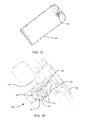
- FIG. 1A is a perspective view of an optical fiber laser cleaving device including an optical fiber holding system.
- FIG. 1B is an enlarged view of the optical fiber holding system as depicted in FIG. 1A .
- FIG. 1C is a bottom perspective view of the laser cleaving device of FIG. 1A with a bottom housing portion removed.
- FIG. 1D is an enlarged view of the laser cleaving device of FIG. 1C showing a portion of the optical fiber holding system.
- FIG. 2A is a partial cross-sectional view of the laser cleaving device and optical fiber holding system of FIG. 1A providing a zero degree cleaving angle.
- FIG. 2B is a partial cross-sectional view of the laser cleaving device and optical fiber holding system of FIG. 1A providing a non-zero cleaving angle.
- FIG. 2C is an enlarged view of the laser cleaving device and optical fiber holding system of FIG. 2A .
- FIG. 2D is an enlarged view of the laser cleaving device and optical fiber holding system of FIG. 2B .
- FIG. 3A is a top perspective view of an optical fiber fixture for use with a laser cleaving device.
- FIG. 3B is a top view of the optical fiber fixture of FIG. 3A .
- FIG. 3C is a side elevation view of the optical fiber fixture of FIG. 3A .
- FIG. 3D is a bottom perspective view of the optical fiber fixture of FIG. 3A .
- FIG. 3E is a bottom view of the optical fiber fixture of FIG. 3A .
- FIG. 4 is an exploded view of the optical fiber fixture of FIG. 3A .
- FIGS. 5A-5B are top and bottom perspective views of a fixture body of the optical fiber fixture of FIG. 4 .
- FIG. 5C is a side elevation view of the fixture body of FIGS. 5A-5B .
- FIG. 6A is a top perspective view of a holding member and pivot pins of the optical fiber fixture of FIG. 4 .
- FIG. 6B is a front elevation view of the holding member and pivot pins of FIG. 6A .
- FIG. 6C is a side elevation view of the holding member and pivot pins of FIG. 6A .
- FIGS. 7A-7B are perspective views of a stop member of the optical fiber fixture of FIG. 4 .
- FIG. 8 is a partial cross-sectional view of a fiber holding system holding an optical fiber and ferrule.
- FIGS. 9-10 are partial perspective and cross-sectional views of the fiber holding system and optical fiber and ferrule of FIG. 8 .
- FIG. 11 is a partial cross-sectional view of a fiber holding system holding an optical fiber and ferrule.
- FIG. 12 is a flow diagram illustrating a method for cleaving an optical fiber.
- FIG. 13 is a flow diagram illustrating a method for cleaving an optical fiber.
- FIG. 14 is a flow diagram illustrating steps for limiting damage to an optical fiber ferrule during a method for cleaving an optical fiber.
- FIG. 1A is a perspective view of an optical fiber laser cleaving device 100 that includes an optical fiber holding system 150 according to an implementation of the invention.
- FIG. 1B is a view of part of FIG. 1A showing portions of the holding system 150 in enlarged detail.
- the laser cleaving device 100 has a housing 102 that contains a laser cutting system for cleaving optical fibers.
- the holding system 150 is generally configured to hold and position one or more optical fibers with respect to the laser cutting system to facilitate desired fiber cutting and cleaving.
- One aspect of the fiber holding system 150 that will be described in detail hereinafter involves a tilt-adjustable holding member 170 that can be pivoted relative to the laser cutting plane of the cleaving device 100 .
- the ability of the holding member 170 to tilt or pivot with respect to the cutting plane enables a technician to adjust the holding member 170 for more than one cleaving angle, which in turn means that the optical fiber holding system 150 can be used to cleave more than one type of fiber and/or fiber/ferrule configuration.
- One practical implementation involves configuring the holding system 150 to work with both perpendicular end face configurations and angled end face configurations.
- FIGS. 1A-1B illustrate one possible implementation in which the holding system 150 is holding an MT-type fiber ferrule 140 connected to a multi-fiber ribbon cable 142 .
- the holding system 150 is holding an MT-type fiber ferrule 140 connected to a multi-fiber ribbon cable 142 .
- various aspects, implementations, and optional features are described and illustrated herein using the example of the MT ferrule 140 and the fiber ribbon 142 shown in FIGS. 1A-1B . Even so, it should be appreciated that embodiments of the invention are not limited to any particular configuration of fibers, ferrules, connectors, and/or cables.
- optical fiber connector/ferrule/fiber adaptable for laser cleaving examples include, but are not limited to, multi-fiber ferrules and cables, single fiber connectors and cables, single and multimode fibers, connectorized fibers, and bare fibers.
- the fiber holding system can also be implemented to receive and hold optical fiber connectors having other form factors. Examples include, but are not limited to, fiber connector types such as SC, LC, SMA, and FC types.
- optical fiber is used herein to refer to single optical fibers, and also used as shorthand to refer to one optical fiber within a group of optical fibers.
- the description herein at times refers to the multi-fiber ribbon cable 142 as “the optical fiber” for convenience.
- the disclosure refers to “the optical fiber” extending from the end face of a multi-fiber ferrule when there are additional fibers extending from the ferrule as well.
- Such references are used for convenience, and can be considered to refer to one of the multiple optical fibers present in such cases.
- Such references are also a reminder of the general applicability of the invention to just one optical fiber or to just one connector and/or ferrule with a single fiber.
- an optical fiber may be referred to herein as “mounted” or “unmounted.”
- the disclosure may refer to bare fibers, e.g., fibers that are not mounted within a ferrule or other structure, as “unmounted.”
- a fiber that is fixed or mounted within a ferrule may be referred to as “mounted.”
- the term “mounted optical fiber” can also refer to a fiber that is mounted within some other type of structure.
- one or more bare fibers may be loaded within a mounting structure apart from a ferrule for cleaving. It is contemplated that such mounting structures would removably hold the fiber(s) for cleaving, and be loadable within a holding member such as the tilt-adjustable holding member 170 shown in FIGS. 1A-1B .
- the housing 102 of the laser cleaving device 100 is optionally formed from a top portion 104 fastened together with a bottom portion 106 .
- the top portion 104 of the housing includes an opening 110 that is configured for accessing the fiber holding member 170 .
- the opening 110 is shown with a rounded, square configuration, which corresponds to the shape of the accessible portion of the holding member 170 .
- the size and/or shape of the opening 110 may optionally vary in other implementations depending, for example, upon the type of optical fiber and/or mounting that is supported by the fiber holding member 170 .
- the optical fiber holding system 150 includes support structure having an exterior surface 152 that fits within and is accessible through the opening 110 in the housing 102 of the cleaving device.
- the support structure and holding member 170 of the fiber holding system 150 are partially located within the housing 102 of the laser cleaving device 100 .
- the exterior surface 152 of the support structure is accessible through the opening 110 in the cleaver housing 102 .
- the fiber holding member 170 is mounted within an aperture 156 defined in the exterior surface 152 of the support structure.
- the holding member 170 is pivotally mounted to the support structure, as will be discussed in greater detail hereinafter.
- the holding member 170 defines another aperture that receives the mounted optical fiber 142 , enabling precise positioning of the optical fiber 142 relative to the laser cutting system within the housing 102 .
- FIGS. 1A-1B additionally illustrate an optional adjustment mechanism that can be used to adjust the cleaving laser cutting plane with respect to the position of one or more of the mounted optical fibers 142 , the holding member 170 , and/or the entire fiber holding system 150 , within the device 100 .
- the implementation of the adjustment mechanism shown in FIGS. 1A-1B includes a thumb wheel 112 that can be used to finely adjust the position of the laser cutting plane when cleaving one or more fibers.
- the optional adjustment mechanism provides height and/or vertical adjustment of the laser cutting plane relative to the fiber holding member 170 .
- the laser cleaving device 100 typically includes control circuitry and a laser cutting system supplied by a high power laser module.
- the output of the laser module is directed toward the one or more optical fibers being cleaved using an optical system.
- directing the laser output can sometimes include using one or more actuators that move one or more optical components.
- Most of the internal components of the laser cleaving device 100 are omitted from FIGS. 1C-1D for simplicity and to allow greater focus on the fiber holding system 150 . Referring to FIG.
- the laser output 120 of a laser cutting system is represented by dashed lines and shown focusing to a point near the fiber holding system 150 and one or more optical fibers held therein.
- the laser output 120 is directed through a lens on the way to the optical fiber. As the laser output 120 is swept back and forth across the width of the lens, the lens redirects the continuously moving laser output toward the fiber holding system 150 along a planar path.
- the planar path of cumulative laser output corresponds to the laser cutting plane used to cleave the optical fiber(s) held by the fiber holding system 150 .
- 6,963,687 entitled “Process for Cutting an Optical Fiber” discloses a process for “cutting or splitting at least one optical fiber at a predetermined angle, wherein the fiber is introduced into a holding and positioning device and is cut by a pulsed laser beam.”
- U.S. Pat. No. 6,774,341 teaches a “method of severing an optical fiber using a laser beam, in which a laser beam emitted from a laser beam source is applied through a square light transmitting section and a lens to an optical fiber, to form a square light spot on the irradiated portion, for melting, evaporating and severing the optical fiber at said irradiated portion.” Abstract.
- FIG. 1D is an enlarged view of the optical fiber holding system 150 mounted within the laser cleaving device 100 .
- the fiber holding system 150 includes support structure 160 that is located within or at least partially within the housing 102 of the laser cleaving device 100 .
- the support structure 160 includes a frame portion 162 that fits within the opening 110 in the top portion 104 of the housing.
- the exterior surface 152 of the support structure 160 shown in FIGS. 1A-1B is formed on the opposite side of the frame portion 162 (not shown in FIG. 1D ).
- the support structure 160 in this example also includes a mounting portion 164 that can be attached or fastened within the cleaving device housing 102 using, for example, bolts (not shown).
- the mounting portion 164 and the frame portion 162 are provided as integral portions of the support structure 160 , though the individual portions can optionally be formed separately and then fastened together.
- FIG. 1D partially shows a bottom perspective view of the fiber holding member 170 as it is mounted within part of the support structure 160 .
- the fiber holding member 170 is pivotally coupled to the support structure 160 to provide multiple cleaving angles for laser cleaving the mounted optical fiber held by the system.
- the holding member 170 is pivotable relative to the support structure 160 itself, and is also pivotable relative to the laser cutting plane generated by the laser cutting system of the cleaving device 100 .
- FIG. 1D illustrates the laser output 120 generated by the laser cleaving device 100 in dotted line.
- the holding member 170 thus positions (e.g., tilts) the mounted optical fiber relative to the support structure 160 and the laser cuts the optical fiber along a laser cutting plane corresponding to the path 120 .
- FIG. 1D further illustrates an optional stopping feature provided by a stop member 180 .
- the stop member 180 is configured to stop a ferrule or other mounting structure from moving into the laser cutting plane.
- the stop member 180 is formed separately and fastened to the mounting portion 164 of the support structure 160 .
- the stop member 180 includes at least one stop surface that engages with the end face of the optical fiber's mounting portion (e.g., ferrule) in order to stop the mounting portion from advancing into the damaging laser cutting plane.
- FIGS. 2A and 2B are partial cross-sectional views of the optical fiber holding system 150 illustrated in FIGS. 1A-1D , mounted within the assembled laser cleaving device 100 shown in FIG. 1A .
- an output 120 of the laser cutting system is represented by dashed lines and shown focusing to a point near one or more optical fibers held within the fiber holding member 170 . Sweeping of the focused laser output is generally along a laser cutting plane 200 .
- the laser output and the holding member 170 are located relative to one another so that the cutting plane 200 is located just below a portion of the holding member 170 .
- FIG. 2A shows part of the top portion 104 of the laser cleaving device housing 102 in cross-section.
- the support structure 160 of the fiber holding system 150 includes the frame portion 162 that is positioned within the opening 110 , in this case so that the exterior surface 152 of the frame member is adjoining the perimeter of the opening 110 .
- the support structure 160 also includes the mounting portion 164 , which extends downward from the frame portion 162 and is fastened to the housing of the laser cleaving device.
- the holding member 170 defines an aperture 210 that is configured to receive the mounted optical fiber and position the mounted fiber proximate the cutting plane 200 of the laser system for cleaving.
- the aperture 210 is configured with a width, length, and other dimensions that correspond with the size and shape of the mounting structure in which an optical fiber 212 is mounted.
- the optical fiber 212 is mounted within a ferrule 214 .
- the ferrule 214 has a length extending through the aperture 210 to an end face 216 of the ferrule 214 .
- the aperture 210 is configured to receive the ferrule 214 with the ferrule extending through the aperture 210 out from the bottom of the holding member 170 .
- the ferrule 214 also includes a shoulder 230 that abuts the rim of the aperture 210 when the ferrule and mounted optical fiber 212 are fully and completely loaded into the aperture 210 for cleaving.
- the abutment of the ferrule shoulder 230 against the edge of the aperture 210 and the configuration of the aperture help ensure that the end face 216 of the ferrule is precisely positioned proximate to the cutting plane 200 in order to achieve the desired cleaving effect on the optical fiber 212 .
- the fiber holding member 170 of the fiber holding system 150 is pivotable relative to the support structure 160 and the cutting plane 200 to provide multiple cleaving angles between the cutting plane 200 and the optical fiber 212 .
- the fiber holding system 150 includes a pivot mechanism to enable relative tilting between the support structure 160 of the holding system and the fiber holding member 170 .
- FIG. 2A illustrates one possible pivot configuration of the fiber holding system 150 .
- the ferrule 214 holding the optical fiber 212 is configured as a straight ferrule in that the ferrule has an end face that is straight and perpendicular to the axis of the optical fiber 212 .
- the pivot configuration of the fiber holding system 150 in FIG. 2A provides a cleaving angle of zero degrees, as measured between the cutting plane 200 and a plane perpendicular to axis of the optical fiber 212 .
- the zero angle cleaving angle can be used to cleave the optical fiber 212 protruding from the end face 216 of the straight ferrule 214 , thus providing the end of the fiber 212 a cleave that is perpendicular to the axis of the fiber.
- FIG. 2B illustrates another optional pivot configuration that provides an angle different from the cleaving angle shown in FIG. 2A .
- the same fiber holding system 150 as is shown in FIG. 2A is used to provide a non-zero cleaving angle, which in this configuration is greater than zero degrees.
- the fiber holding member 170 is tilted or rotated with respect to the support structure 160 and the laser cutting plane 200 , backward and away from the source of the laser output 120 .
- the aperture 210 of the fiber holding member 170 is shown holding an optical fiber 220 mounted within an angled ferrule 222 .
- the rotation of the fiber holding member 170 creates an angular separation A between the laser cutting plane 200 and a plane 240 perpendicular to the axis 242 of the optical fiber 220 and the ferrule 222 .
- the angular separation A corresponds to the non-zero cleaving angle, as well as to the angular end face 218 of the ferrule 222 in this example.
- the pivoting of the fiber holding member 170 between the two pivot configurations in FIGS. 2A and 2B creates multiple cleaving angles between the cutting plane 200 of the laser cleaving device and the optical fiber positioned by the holding system.
- one practical implementation involves configuring the holding system 150 to work with both a perpendicular end face configuration as shown in FIG. 2A , as well as with an angled end face configuration as shown in FIG. 2B .
- the angled end face configuration shown in FIG. 2B may have a cleaving angle of substantially eight degrees to correspond to angled physical contact (APC) connectors formed with an angle of eight degrees.
- API physical contact
- angles are possible and implementations are not limited to any one cleaving angle or any particular range or group of cleaving angles.
- the illustrated pivot configurations are described herein in terms of zero degree cleaving angles and cleaving angles that are non-zero and/or greater than zero as the angular separation A increases in the clockwise direction as depicted in FIG. 2B . It should be appreciated, though, that the angular separation A could also be described as a negative angle if positive angles were instead associated with counter-clockwise rotation.
- the fiber holding member 170 can be configured to pivot or tilt forward with respect to the holding system 150 , toward the source of the laser output 120 , which in FIG. 2B would be illustrated as a counter-clockwise rotation. In this case the fiber holding member 170 would tilt toward the laser output 120 to provide a non-zero cleaving angle that could be described as greater than zero degrees or less than zero degrees depending upon the labeling convention being used.
- the fiber holding system 170 may be configured to provide more than two distinct laser cleaving angles in some cases.
- the holding system 170 could potentially provide a continuous range of cleaving angles as the holding member 170 is pivoted back and forth with respect to the cutting plane 200 .
- two, three, or more discrete cleaving angles may be provided by the fiber holding system 170 .
- Continuous angle ranges and/or discrete cleaving angles can include a zero degree angle, angles less than zero degrees, angles greater than zero degrees, and any combination of these angles depending on the particular implementation and angular measuring convention being used. Referring to the figures, one possible implementation could include discrete angles that include the zero degree configuration shown in FIG. 2A , the greater than zero degree angle shown in FIG.
- cleaving angle (not shown) that is less than zero degrees in the sense that it mirrors the configuration in FIG. 2B with the fiber holding member 170 tilted forward/counter-clockwise.
- Another possible implementation could include a continuous range of cleaving angles that include the same angles as the discrete range example.
- FIGS. 2C and 2D are enlarged views of FIGS. 2A and 2B , respectively, illustrating potential differences in the cut height (e.g., the length of the fiber protruding from the end face of the ferrule after cleaving) for different cleaving angles.
- the cut height (i.e., length) of the laser cleaving device can be determined as a distance along the axis of the ferrule, extending between the cutting plane 200 and the end face of the ferrule. Based on this characterization, a cut height or length 250 is illustrated in FIG. 2C as the distance or length between the laser cutting plane 200 and the end face 216 of the ferrule 214 .
- a cut height or length 252 is illustrated in FIG. 2D as the distance between the laser cutting plane 200 and the end face 218 of the ferrule 222 .
- the cut height 252 is depicted as the distance between the laser cutting plane 200 and the angled portion of the end face 218 , which in this implementation becomes parallel to the cutting plane 200 when the ferrule 222 is tilted as shown in FIG. 2D .
- Another optional feature that is included in some implementations provides substantially the same cutting length for both straight and angled fibers.
- the cut length 250 provided by the fiber holding system for the zero degrees cleaving angle shown in FIG. 2C is substantially the same as the cut length 252 provided by the fiber holding system for the non-zero cleaving angle shown in FIG. 2D .
- a single fiber holding system may optionally define the cut length 250 corresponding to one cleaving angle as being substantially the same as the cut length(s) defined by one or more additional cleaving angle(s).
- the depicted implementation of the fiber holding system 150 is formed as a separate fixture body that can be removably fastened within the laser cleaving device housing 102 , and also unfastened to remove the holding system 150 from the laser cleaving device 100 .
- This particular implementation of the fiber holding system 150 thus optionally provides a removable adapter that can be configured for loading a particular type of ferrule or other fiber mounting portions. Additional adapters can be further configured for other types of ferrules and/or fiber mounting portions.
- one aspect that can optionally be provided is a set of removable fiber/connector adapters that can be swapped in and out of the laser cleaving device 100 .
- configuring the adapters to include tilt-adjustable holding members provides another feature that also increases the versatility of each individual adapter.
- FIGS. 3A-11 and the accompanying description provide additional details about the removable adapter implementation for the fiber holding system 150 discussed above with respect to FIGS. 1A-1D .
- the depicted and described fiber holding system 150 is just one possible implementation of the features and other aspects disclosed herein.
- Optional modifications are contemplated and can be made to vary aspects and features of the fiber holding system depending, for example, on the particular design requirements for a particular implementation.
- the support structure 160 of the fiber holding system 150 can be considered as including one or more parts of the laser cleaving device housing 102 , and may optionally be part of or integral with the housing 102 .
- the mounting portion 164 of the support structure 160 may be integral with the top portion 104 of the housing.
- the exterior surface 152 of the support structure may be integral to the top housing portion 104 rather than a separate component that fits within the opening 110 .
- the fixture 300 is generally configured to be removably fastened within the laser cleaving device 100 shown in FIGS. 1A-2D , and also unfastened to remove the fixture from the laser cleaving device. Accordingly, the fixture 300 provides an example of one possible implementation of a fiber holding system for a laser cleaving device.
- FIG. 3A is a top perspective view of the optical fiber fixture 300 for use with a laser cleaving device such as the laser cleaving device 100 discussed above.
- the fixture 300 includes a fixture body 302 that has a frame portion 304 and a mounting portion 306 for mounting the fixture body 302 within a laser cleaving device that has a housing and defines a laser cutting plane such as the cutting plane 200 illustrated in other figures herein.
- FIG. 3B-3E provide additional views of the fixture 300
- FIG. 4 provides an exploded view of the optical fiber fixture 300 of FIG. 3A
- the frame portion 304 of the fixture body defines a first aperture 310
- the mounting portion 306 defines a void 312 that is adjacent to the first aperture 310
- the mounting portion 306 is removably mountable within a housing of a laser cleaving device to make the frame portion 304 accessible through an opening in the housing, and to locate the cutting plane within the void 312 .
- the optical fiber fixture 300 also includes a holding member 330 that is pivotally coupled to the fixture body 302 within the void 312 .
- the holding member 330 has a first surface 332 that is accessible through the first aperture 310 .
- the holding member 330 also has a second surface 334 opposite the first surface 332 .
- a second aperture 336 extends through the holding member 330 from the first surface 332 to the second surface 334 and is configured to receive and position a corresponding mounted optical fiber relative to the cutting plane in a laser cleaving device.
- the holding member 330 is pivotable relative to the fixture body 302 and an associated cutting plane to provide a plurality of cleaving angles between the cutting plane and the mounted optical fiber.
- the plurality of cleaving angles can in some cases include a first cleaving angle that is zero degrees and a second cleaving angle that is greater than zero degrees.
- the non-zero cleaving angle may be eight degrees.
- a non-zero cleaving angle may be considered to be an angle that is less than zero degrees depending on the particular angular measurement system being used.
- the plurality of cleaving angles may optionally include a zero degree cleaving angle, and at least one cleaving angle that is greater than zero degrees and at least one cleaving angle that is less than zero degrees.
- the fiber fixture 300 includes a laser deflector 350 , which is mounted to the frame portion 304 of the fixture body 302 .
- the laser deflector 350 includes an angled face that directs the laser output down away from the fiber holding system and optical fiber/ferrule after it has accomplished the desired cleaving.
- the fiber fixture 300 includes a stop member 400 , that is configured to stop an optical fiber ferrule or other mounting structure from advancing into the laser cutting plane.
- the stop member 400 in this example includes two extension members 402 that extend up from a base 404 of the stop member toward the holding member 330 .
- Each of the extension members 402 includes an angled face 406 that directs stray laser output downward in a manner similar to that of the laser deflector 350 .
- FIG. 3E illustrates another aspect of the disclosure that can optionally be implemented in some cases.
- the extension members 402 of the stop member 400 angle away from a ferrule that would be held in the aperture 336 of the holding member 330 .
- the angling of the extension member 402 can facilitate a sharper laser output and cutting plane.
- FIG. 7B illustrates how the width of each extension member 402 in this example decreases from the angled face 406 toward a narrower rear face 408 as the extension member angles away from the aperture 336 .
- FIGS. 5A-5B are top and bottom perspective views of the fixture body 302 of the optical fiber fixture 300 of FIG. 4 .
- FIG. 5C is a side elevation view of the fixture body 302 of FIGS. 5A-5B .
- FIGS. 5C and 4 illustrate an optional pivot catch assembly that includes a first part provided spring-loaded elements 500 that may in some cases be spring-loaded ball plungers.
- the pivot catch assembly also includes a second part that in this case is provided by recesses or detents 510 .
- the spring-loaded elements engage with the recesses 510 on the fiber holding member 330 in order to provide multiple discrete cleaving angles.
- the optical fiber fixture 300 includes four spring-loaded elements 500 with a set of two elements above another set of two elements.
- FIG. 6C illustrates four corresponding recesses or detents 510 formed in the side of the fiber holding member 330 so as to engage with the spring-loaded elements 500 mounted within the fixture body 302 .
- the recesses 510 have a spacing and angled layout so that the two bottom recesses 510 engage with the two bottom spring-loaded elements 500 to provide a zero degrees cleaving angle such as is shown in FIGS. 2A and 2C .
- the top two recesses 510 engage the top two spring-loaded elements 500 mounted in the fixture body 302 .
- This kind of positive engagement between the spring-loaded elements and the recesses advantageously provides the fiber holding fixture and corresponding laser cleaving devices with a highly repeatable and accurate mounting configuration for multiple cleaving angles.
- a holding member may include spring-loaded elements that engage with corresponding detents provided in a fixture body.
- FIG. 6A is a top perspective view of the holding member 330 and pivot pins 600 of the optical fiber fixture 300 of FIG. 4 .
- the pivot pins 600 operate as a pivot mechanism that pivotally couples the holding member 330 to the support structure/fixture body 302 .
- the fixture body 302 includes pivot pin holes 602 (seen in FIGS. 4, 5C ) that receive the pivot pins 600 and together provide a pivot mechanism for pivotally coupling the holding member 330 to the support structure provided by the fixture body 302 .
- FIG. 6B is a front elevation view of the holding member 330 and pivot pins 600 of FIG. 6A .
- FIG. 6C is a side elevation view of the holding member 330 and pivot pins 600 of FIG. 6A .
- FIG. 6C also illustrates the placement of the optional recesses 510 that engage with the spring-loaded elements
- FIGS. 7A-7B are perspective views of a stop member 400 of the optical fiber fixture 300 of FIG. 4 .
- the stop member 400 is configured to stop movement of an optical fiber ferrule or other mounting structure so that it does not inadvertently enter the laser cutting plane of a laser cleaving device. This optional feature advantageously addresses situations in which a technician may incorrectly load a mounted optical fiber (e.g., a fiber mounted within a ferrule or other mounting structure) into the slot 336 of the holding member 330 .
- a mounted optical fiber e.g., a fiber mounted within a ferrule or other mounting structure
- the stop member 400 in this example includes two extension members 402 that extend up from a base 404 of the stop member.
- Each extension member 402 includes a stop surface 700 .
- the base 404 and extension members 402 are configured to position the stop surface 700 of each extension member 402 just above the laser cutting plane within a laser cleaving device.
- the extension members 402 are spaced apart so that the stop surfaces 700 engage outer portions of the end face of a fiber mounting structure (e.g., ferrule end face), thus allowing the optical fiber(s) exiting the end face to extend into the laser cutting plane between and just below the stop surfaces 700 for cleaving.
- a fiber mounting structure e.g., ferrule end face
- each of the extension members 402 in the depicted implementation includes an angled face 406 that directs stray laser output downward in a manner similar to that of the laser deflector 350 . Directing the laser output in this way can be useful for reducing and/or preventing reflections back to the laser output and/or in other undesired directions.
- One optional feature incorporated into the embodiment as shown in FIGS. 7A and 7B includes a blocking portion 702 of each extension member 402 that extends upward from the stop surface 700 .
- a ferrule or other fiber mounting structure is positioned upon or above the stop surfaces 700 , with the blocking portions 700 of the extension members 402 located between the ferrule and the laser output. The extra height of each blocking portion 702 above the stop surface 700 allows the extension member to stop the laser output from entering into any gap existing between the end face of the ferrule and the stop surface 700 of the extension member.
- FIG. 7B also illustrates how the extension members 402 are designed with a decreasing width 704 that results in a narrower gap between the front angled faces 406 , and a wider gap between the end faces 408 of the extension members.
- the angled sides of the extension members 402 created by the narrowing width can in some cases facilitate a sharper laser output and cutting plane for cleaving optical fibers.
- FIGS. 8-10 will now be discussed to illustrate the stop member 400 engaging a fiber ferrule that is incorrectly loaded within a fiber holding system for optical fiber laser cleaving.
- FIG. 8 is a partial cross-sectional view of a fiber holding system for an optical fiber laser cleaving device. As can be seen, in this example, the fiber holding system is depicted as the removable optical fiber adapter 300 shown in FIGS. 3A-3E . An MT-type fiber ferrule 214 connected to a multi-fiber ribbon cable 212 is loaded within the second aperture 336 of the fixture's holding member 330 .
- FIGS. 9-10 are partial perspective and cross-sectional views of the same fiber holding system and optical fibers 212 mounted within the MT ferrule 214 .
- the optical fiber adapter 300 includes the stop member 400 and corresponding stop surfaces 700 that are configured to stop an incorrectly loaded ferrule from extending into the laser cutting plane 200 .
- FIGS. 8-10 shows that the MT ferrule 214 has a straight or perpendicular end face 216 , but that the ferrule 214 is incorrectly loaded into the fiber holding member 330 when it is tilted to a non-zero cleaving angle.
- the MT ferrule 214 includes a shoulder 230 that abuts a rim 800 of the aperture 336 if and when the ferrule and optical fiber 212 are completely loaded into the aperture 336 for cleaving.
- the rim 800 is also part of the first surface 332 of the holding member 330 in this example.
- the abutment of the ferrule shoulder 230 against the rim or edge 800 of the aperture 336 ordinarily helps ensure that the ferrule is precisely positioned next to the cutting plane 200 for cleaving when the holding member 330 is in the zero cleaving angle pivot configuration shown in FIG. 2A .
- the end face 216 of the ferrule contacts the stop surfaces 700 before the shoulder 230 of the ferrule 214 reaches the rim 800 of the aperture 336 .
- the stop member 400 thus stops the straight ferrule 214 from being completely loaded within the holding member aperture 336 in this non-zero cleaving angle pivot configuration. Stopping the complete loading of the straight ferrule in this way advantageously prevents the end face 216 of the ferrule from crossing into the cutting plane 200 , avoiding damage to the ferrule 214 .
- FIG. 11 is also a partial cross-sectional view of the optical fiber holding system 300 .
- the holding member 330 is tilted backward into a nonzero cleaving angle pivot configuration.
- Another MT ferrule 222 in this case with an angled end face 218 , is incorrectly loaded in the holding member 330 in a backward orientation.
- the tip of the ferrule 222 could potentially cross into the cutting plane 200 if it were completely loaded into the aperture 336 of the holding member 330 .
- the stop surfaces 700 of the stop member 400 are located between the cutting plane 200 and the second surface 334 of the holding member 330 .
- the stop surfaces 700 engage the end face 218 and stop movement of the ferrule 222 into the cutting plane 200 .
- the incomplete loading of the ferrule 222 e.g., FIG. 11 shows that the shoulder 230 of the ferrule is not abutting the rim 800 of the loading slot or aperture 336 ) is an indication to a technician that the ferrule is incorrectly loaded and must be removed.
- FIGS. 12-14 are flow diagrams that illustrate various methods related to cleaving an optical fiber.
- FIG. 12 an example of a method 1200 for cleaving an optical fiber is depicted.
- the method 1200 in this example includes steps that enable an optical fiber technician to change the cleaving angle of an optical fiber laser cleaving device.
- Existing approaches for changing cleaving angles typically involve opening a laser cleaving device to completely remove and replace the mounting adapter with a new adapter having a different cleaving angle. Opening the laser cleaving device can expose the technician to powerful and potentially harmful laser radiation within the device.
- the cleaving method 1200 allows a technician to change the laser cleaving angle without opening the cleaving device and risking exposure to the laser.
- a laser cleaving device 1202 that has a housing in which is mounted a laser for cleaving an optical fiber along a cutting plane.
- the method includes providing 1204 an optical fiber holding system within the housing of the laser cleaving device.
- the holding system includes a fiber holding member that is pivotally coupled to a support structure within the laser cleaving device. Examples of fiber holding systems are described elsewhere herein, including with respect to FIGS. 2A-2D , and with respect to FIGS. 3A-11 .
- the holding member has a first surface that is accessible through an opening in the laser cleaving device housing.
- the first surface also defines an aperture that extends from the first surface to a second surface of the holding member.
- the method 1200 includes tilting 1206 the holding member and the aperture to one of multiple cleaving angles provided by the holding system. After tilting the holding member, an optical fiber is loaded 1208 into the aperture. Once loaded in the tilted position, the method 1200 involves cutting 1210 the optical fiber with the laser.
- the cutting step 1210 is part of a typical cleaving process and will be familiar to those skilled in the art. Of course, after cutting/cleaving the optical fiber, the fiber is unloaded from the fiber holding system after which any further desirable processing of the fiber may be performed (e.g., polishing, connectorizing, installing, etc.).
- the method 1300 includes tilting 1302 a fiber holding member (such as one of those described herein) to a cleaving angle of zero degrees, which is one of multiple possible cleaving angles. Afterward, a first optical fiber is loaded 1304 into the loading slot or aperture of the fiber holding member. In some cases the first optical fiber is mounted within a ferrule having a perpendicular end face. The method 1300 then involves cutting 1306 the first optical fiber with the laser cleaving device.
- a fiber holding member such as one of those described herein
- the fiber is removed 1308 from the aperture.
- the method 1300 involves tilting 1310 the holding member to a second cleaving angle. As discussed above with respect to earlier Figures, in some cases the second cleaving angle is greater than zero degrees, or possibly less than zero degrees depending on the reference system being used to measure angles.
- the method further involves a second optical fiber mounted within a ferrule having an angled end face. As shown in FIG. 13 , the method 1300 includes loading 1312 the second optical fiber into the aperture of the fiber holding system. The second optical fiber is then cut 1314 using the laser cleaving device. Although not shown in FIG. 13 , the method 1300 may also optionally include loading and cutting additional fibers at one of the same cleaving angles in steps 1302 or 1310 , or a different cleaving angle as desired.
- FIG. 14 illustrates steps 1400 in a method for cleaving optical fibers that may involve an incorrectly loaded optical fiber as discussed above with respect to FIGS. 8-11 .
- the method includes first tilting 1402 the fiber holding member to a cleaving angle that is greater than zero degrees (or, alternatively, less than zero degrees). Afterward, an optical fiber is loaded 1404 into the aperture of the fiber holding member.
- the optical fiber is optionally mounted in a ferrule having a perpendicular end face, but could also be mounted in a ferrule having an angled end face as illustrated in FIG. 11 .
- the method involves stopping 1406 loading of the optical fiber into the aperture before the perpendicular end face of the ferrule crosses the cutting plane.
- the fiber holding system includes a stop member for stopping the loading of the optical fiber.
- the stop member can include at least one stop surface located between the cutting plane and the second surface of the holding member.
Landscapes
- Physics & Mathematics (AREA)
- General Physics & Mathematics (AREA)
- Optics & Photonics (AREA)
- Lasers (AREA)
- Optical Couplings Of Light Guides (AREA)
Abstract
Description
Claims (16)
Priority Applications (1)
| Application Number | Priority Date | Filing Date | Title |
|---|---|---|---|
| US14/828,059 US9690048B2 (en) | 2015-07-07 | 2015-08-17 | Optical fiber fixtures and methods for laser cleaving |
Applications Claiming Priority (2)
| Application Number | Priority Date | Filing Date | Title |
|---|---|---|---|
| US201562189741P | 2015-07-07 | 2015-07-07 | |
| US14/828,059 US9690048B2 (en) | 2015-07-07 | 2015-08-17 | Optical fiber fixtures and methods for laser cleaving |
Publications (2)
| Publication Number | Publication Date |
|---|---|
| US20170010416A1 US20170010416A1 (en) | 2017-01-12 |
| US9690048B2 true US9690048B2 (en) | 2017-06-27 |
Family
ID=57730125
Family Applications (1)
| Application Number | Title | Priority Date | Filing Date |
|---|---|---|---|
| US14/828,059 Active 2035-09-08 US9690048B2 (en) | 2015-07-07 | 2015-08-17 | Optical fiber fixtures and methods for laser cleaving |
Country Status (1)
| Country | Link |
|---|---|
| US (1) | US9690048B2 (en) |
Cited By (2)
| Publication number | Priority date | Publication date | Assignee | Title |
|---|---|---|---|---|
| US11703652B2 (en) | 2019-05-22 | 2023-07-18 | Corning Research & Development Corporation | Fiber optic cable assembly with integrated shuffle and fabrication method |
| US12358831B2 (en) | 2020-07-22 | 2025-07-15 | Optek Systems, Inc. | Assembly and method for cleaving a glass body with a laser |
Families Citing this family (2)
| Publication number | Priority date | Publication date | Assignee | Title |
|---|---|---|---|---|
| CN113510387A (en) * | 2021-07-01 | 2021-10-19 | 东风柳州汽车有限公司 | Development method and device of laser cutting tool |
| CN115113332B (en) * | 2022-06-29 | 2024-05-17 | 东莞市新美洋技术有限公司 | Optical fiber cutting device |
Citations (18)
| Publication number | Priority date | Publication date | Assignee | Title |
|---|---|---|---|---|
| US5459564A (en) | 1994-02-18 | 1995-10-17 | Chivers; James T. | Apparatus and method for inspecting end faces of optical fibers and optical fiber connectors |
| US6244488B1 (en) | 1996-05-23 | 2001-06-12 | Asahi Kohden Co., Ltd. | Method and apparatus for cutting optical fiber |
| US6510271B1 (en) | 1999-01-08 | 2003-01-21 | Valdor Fiber Optics, Inc. | Optical fiber mounting and cleaving device and method |
| US6695191B1 (en) | 1999-10-08 | 2004-02-24 | Leviton Manufacturing Co., Inc. | Optical fiber cleaver |
| US20040047587A1 (en) | 2000-10-25 | 2004-03-11 | Osborne Michael R. | Laser cutting method and apparatus for optical fibres or waveguides |
| US6774341B2 (en) | 2002-07-31 | 2004-08-10 | Moritex Corporation | Method of severing an optical fiber using a laser beam |
| US6963687B2 (en) | 1998-09-18 | 2005-11-08 | The Whitaker Corporation | Process for cutting an optical fiber |
| US7025239B2 (en) | 2002-11-25 | 2006-04-11 | Leviton Manufacturing Co., Inc. | Optical fiber cleaver |
| US7090414B2 (en) | 2003-03-25 | 2006-08-15 | Aurora Instruments, Inc. | Automatic apparatus for cleaving optical fiber waveguides |
| US7216512B2 (en) | 2003-10-31 | 2007-05-15 | Corning Cable Systems, Llc | Method of making an optical fiber by laser cleaving |
| US7305169B2 (en) | 2004-03-15 | 2007-12-04 | Sumitomo Electric Industries, Ltd. | Fiber cleaver |
| US7428365B1 (en) | 2007-03-29 | 2008-09-23 | Corning Cable Systems Llc | Retention and rotation clamp assembly for use with an angled optical fiber cleaver |
| US20120141082A1 (en) * | 2009-08-28 | 2012-06-07 | Sawicki Joseph C | Bladeless optical fiber cleaver |
| US8340485B2 (en) | 2009-05-29 | 2012-12-25 | Corning Cable Systems Llc | Laser-shaped optical fibers along with optical assemblies and methods therefor |
| US20130255055A1 (en) * | 2012-04-02 | 2013-10-03 | Oxford Fiber Ltd | Profiling of cleaved angled end faces of optical fiber(s) |
| US8881553B2 (en) | 2011-06-01 | 2014-11-11 | US Conec, Ltd | Assembly for precision datum alignment and method of use |
| US9008481B2 (en) | 2008-12-19 | 2015-04-14 | Ccs Technology, Inc. | Arrangement for processing optical waveguides |
| US20160124150A1 (en) * | 2014-10-31 | 2016-05-05 | Corning Optical Communications LLC | Laser cleaving multi-row ribbon fibers |
-
2015
- 2015-08-17 US US14/828,059 patent/US9690048B2/en active Active
Patent Citations (19)
| Publication number | Priority date | Publication date | Assignee | Title |
|---|---|---|---|---|
| US5459564A (en) | 1994-02-18 | 1995-10-17 | Chivers; James T. | Apparatus and method for inspecting end faces of optical fibers and optical fiber connectors |
| US6244488B1 (en) | 1996-05-23 | 2001-06-12 | Asahi Kohden Co., Ltd. | Method and apparatus for cutting optical fiber |
| US6963687B2 (en) | 1998-09-18 | 2005-11-08 | The Whitaker Corporation | Process for cutting an optical fiber |
| US6510271B1 (en) | 1999-01-08 | 2003-01-21 | Valdor Fiber Optics, Inc. | Optical fiber mounting and cleaving device and method |
| US6695191B1 (en) | 1999-10-08 | 2004-02-24 | Leviton Manufacturing Co., Inc. | Optical fiber cleaver |
| US20040047587A1 (en) | 2000-10-25 | 2004-03-11 | Osborne Michael R. | Laser cutting method and apparatus for optical fibres or waveguides |
| US6774341B2 (en) | 2002-07-31 | 2004-08-10 | Moritex Corporation | Method of severing an optical fiber using a laser beam |
| US7025239B2 (en) | 2002-11-25 | 2006-04-11 | Leviton Manufacturing Co., Inc. | Optical fiber cleaver |
| US7090414B2 (en) | 2003-03-25 | 2006-08-15 | Aurora Instruments, Inc. | Automatic apparatus for cleaving optical fiber waveguides |
| US7216512B2 (en) | 2003-10-31 | 2007-05-15 | Corning Cable Systems, Llc | Method of making an optical fiber by laser cleaving |
| US7305169B2 (en) | 2004-03-15 | 2007-12-04 | Sumitomo Electric Industries, Ltd. | Fiber cleaver |
| US7428365B1 (en) | 2007-03-29 | 2008-09-23 | Corning Cable Systems Llc | Retention and rotation clamp assembly for use with an angled optical fiber cleaver |
| US7539389B2 (en) | 2007-03-29 | 2009-05-26 | Corning Cable Systems Llc | Retention and rotation clamp assembly for use with an angled optical fiber cleaver |
| US9008481B2 (en) | 2008-12-19 | 2015-04-14 | Ccs Technology, Inc. | Arrangement for processing optical waveguides |
| US8340485B2 (en) | 2009-05-29 | 2012-12-25 | Corning Cable Systems Llc | Laser-shaped optical fibers along with optical assemblies and methods therefor |
| US20120141082A1 (en) * | 2009-08-28 | 2012-06-07 | Sawicki Joseph C | Bladeless optical fiber cleaver |
| US8881553B2 (en) | 2011-06-01 | 2014-11-11 | US Conec, Ltd | Assembly for precision datum alignment and method of use |
| US20130255055A1 (en) * | 2012-04-02 | 2013-10-03 | Oxford Fiber Ltd | Profiling of cleaved angled end faces of optical fiber(s) |
| US20160124150A1 (en) * | 2014-10-31 | 2016-05-05 | Corning Optical Communications LLC | Laser cleaving multi-row ribbon fibers |
Non-Patent Citations (9)
| Title |
|---|
| "DE2503 Fiber Optic Inspection Scope User's Guide," Domaille Engineering, Jan. 2015 (20 pages). |
| "LaserCleave-1500," Product Brochure, OpTek Systems, 2015 (1 page). |
| "LaserCleave-500 MT," Product Brochure, OpTek Systems, 2015 (1 page). |
| "LaserCleave-500 SC," Product Brochure, OpTek Systems, 2015 (1 page). |
| "LaserCleave-Simplex," Product Specification Sheet and Webpage, www.opteksystems.co.uk/simplex, OpTek Systems, 2007-2008 (2 pages). |
| "OptiSaber OS700M Information Sheet," Domaille Engineering, www.domailleengineering.com/optical-fiber-polishing/polishing-machines/optisaber.php, accessed Jun. 28, 2015 (1 page). |
| "LaserCleave—1500," Product Brochure, OpTek Systems, 2015 (1 page). |
| "LaserCleave—500 MT," Product Brochure, OpTek Systems, 2015 (1 page). |
| "LaserCleave—500 SC," Product Brochure, OpTek Systems, 2015 (1 page). |
Cited By (2)
| Publication number | Priority date | Publication date | Assignee | Title |
|---|---|---|---|---|
| US11703652B2 (en) | 2019-05-22 | 2023-07-18 | Corning Research & Development Corporation | Fiber optic cable assembly with integrated shuffle and fabrication method |
| US12358831B2 (en) | 2020-07-22 | 2025-07-15 | Optek Systems, Inc. | Assembly and method for cleaving a glass body with a laser |
Also Published As
| Publication number | Publication date |
|---|---|
| US20170010416A1 (en) | 2017-01-12 |
Similar Documents
| Publication | Publication Date | Title |
|---|---|---|
| JP5967722B2 (en) | Ferrule assembly method | |
| TWI579607B (en) | Receptacle ferrule assemblies with gradient index lenses and fiber optic connectors using same | |
| US7377700B2 (en) | Ferrule assembly | |
| US7082250B2 (en) | Laser cleaving method and apparatus for optical fiber cables | |
| US8573856B2 (en) | Method for preparing a ferrule assembly | |
| JP6434079B2 (en) | Fiber optic assembly | |
| US7474822B2 (en) | Optical fiber collimator | |
| US8254417B2 (en) | Fiber laser system with controllably alignable optical components thereof | |
| US9933571B2 (en) | Profiling of cleaved angled end faces of optical fiber(s) | |
| US20170010416A1 (en) | Optical fiber fixtures and methods for laser cleaving | |
| US20170031110A1 (en) | Ferrule holder for optical fiber processing tool | |
| US20150177460A1 (en) | Optical fiber cleaving mechanism and method of use | |
| EP3133427A1 (en) | Expanded beam connector with discrete alignment assembly | |
| US20200292756A1 (en) | Fabrication Method for Endcapped Fiber Laser Pigtails with Sub-Micron Virtual Waist Positional Accuracy | |
| US10336644B2 (en) | Methods of ferrule reshaping for correcting core-to-ferrule concentricity errors, and optical fiber cable assemblies related to such methods | |
| US11256039B2 (en) | Methods and systems for laser cleaving optical fibers | |
| US6196732B1 (en) | Optical connector, method of making the same, and ferrule for optical connector | |
| JP5895727B2 (en) | Connector and manufacturing method thereof | |
| US20120305807A1 (en) | Assembly for Precision Datum Alignment and Method of Use | |
| US11420293B2 (en) | Methods of ferrule reshaping for correcting core-to-ferrule concentricity errors, and optical fiber cable assemblies related to such methods | |
| EP1130429A1 (en) | Method and apparatus for aligning and splicing of optical fibers | |
| EP4669993A1 (en) | CONNECTION AND COUPLING OF FIBER OPTIC COLLIMATORS |
Legal Events
| Date | Code | Title | Description |
|---|---|---|---|
| AS | Assignment |
Owner name: DOMAILLE ENGINEERING, LLC, MINNESOTA Free format text: ASSIGNMENT OF ASSIGNORS INTEREST;ASSIGNORS:HAGEN, JOHN;SCHUMACHER, GREG;FRAZER, JAMES;REEL/FRAME:036801/0362 Effective date: 20150909 |
|
| AS | Assignment |
Owner name: BYLINE BANK, AS AGENT, ILLINOIS Free format text: SECURITY INTEREST;ASSIGNOR:DOMAILLE ENGINEERING, LLC;REEL/FRAME:040492/0937 Effective date: 20161130 |
|
| AS | Assignment |
Owner name: ORIX CORPORATE CAPITAL INC., AS AGENT, TEXAS Free format text: SECURITY INTEREST;ASSIGNOR:DOMAILLE ENGINEERING, LLC;REEL/FRAME:040536/0745 Effective date: 20161130 |
|
| STCF | Information on status: patent grant |
Free format text: PATENTED CASE |
|
| AS | Assignment |
Owner name: BYLINE BANK, AS AGENT, ILLINOIS Free format text: SECURITY INTEREST;ASSIGNORS:DOMAILLE ENGINEERING, LLC;TECH MANUFACTURING, LLC;REEL/FRAME:044796/0533 Effective date: 20180131 |
|
| AS | Assignment |
Owner name: DOMAILLE ENGINEERING, LLC, MINNESOTA Free format text: RELEASE BY SECURED PARTY;ASSIGNOR:BYLINE BANK, AS AGENT;REEL/FRAME:048223/0323 Effective date: 20190201 Owner name: DOMAILLE ENGINEERING, LLC, MINNESOTA Free format text: RELEASE BY SECURED PARTY;ASSIGNOR:ORIX CORPORATE CAPITAL INC.;REEL/FRAME:048223/0210 Effective date: 20190131 Owner name: TECH MANUFACTURING, LLC, MINNESOTA Free format text: RELEASE BY SECURED PARTY;ASSIGNOR:ORIX CORPORATE CAPITAL INC.;REEL/FRAME:048223/0210 Effective date: 20190131 Owner name: TECH MANUFACTURING, LLC, MISSOURI Free format text: RELEASE BY SECURED PARTY;ASSIGNOR:BYLINE BANK, AS AGENT;REEL/FRAME:048223/0323 Effective date: 20190201 Owner name: BMO HARRIS BANK N.A., AS AGENT, ILLINOIS Free format text: PATENT SECURITY AGREEMENT;ASSIGNOR:DOMAILLE ENGINEERING, LLC;REEL/FRAME:048226/0368 Effective date: 20190201 |
|
| AS | Assignment |
Owner name: BMO HARRIS BANK N.A., AS AGENT, ILLINOIS Free format text: PATENT SECURITY AGREEMENT;ASSIGNOR:DOMAILLE ENGINEERING, LLC;REEL/FRAME:048247/0778 Effective date: 20190201 |
|
| MAFP | Maintenance fee payment |
Free format text: PAYMENT OF MAINTENANCE FEE, 4TH YR, SMALL ENTITY (ORIGINAL EVENT CODE: M2551); ENTITY STATUS OF PATENT OWNER: SMALL ENTITY Year of fee payment: 4 |
|
| AS | Assignment |
Owner name: TECH MANUFACTURING, LLC, MISSOURI Free format text: RELEASE BY SECURED PARTY;ASSIGNOR:BMO HARRIS BANK N.A., AS AGENT;REEL/FRAME:058247/0482 Effective date: 20211130 Owner name: DOMAILLE ENGINEERING, LLC, MINNESOTA Free format text: RELEASE BY SECURED PARTY;ASSIGNOR:BMO HARRIS BANK N.A., AS AGENT;REEL/FRAME:058247/0482 Effective date: 20211130 |
|
| AS | Assignment |
Owner name: ALLY BANK, AS COLLATERAL AGENT, NEW YORK Free format text: SECURITY AGREEMENT;ASSIGNORS:DOMAILLE ENGINEERING, LLC;TECH MANUFACTURING, LLC;ADDMAN ENGINEERING, LLC;REEL/FRAME:058293/0252 Effective date: 20211130 |
|
| MAFP | Maintenance fee payment |
Free format text: PAYMENT OF MAINTENANCE FEE, 8TH YR, SMALL ENTITY (ORIGINAL EVENT CODE: M2552); ENTITY STATUS OF PATENT OWNER: SMALL ENTITY Year of fee payment: 8 |
|
| AS | Assignment |
Owner name: STELLUS CAPITAL INVESTMENT CORPORATION, AS ADMINISTRATIVE AGENT, TEXAS Free format text: SECURITY INTEREST;ASSIGNOR:DOMAILLE ENGINEERING, LLC;REEL/FRAME:072342/0612 Effective date: 20250922 |
|
| AS | Assignment |
Owner name: DOMAILLE ENGINEERING, LLC, MINNESOTA Free format text: RELEASE BY SECURED PARTY;ASSIGNOR:ALLY BANK, AS COLLATERAL AGENT;REEL/FRAME:072355/0130 Effective date: 20250922 Owner name: DOMAILLE ENGINEERING, LLC, MINNESOTA Free format text: RELEASE OF SECURITY INTEREST;ASSIGNOR:ALLY BANK, AS COLLATERAL AGENT;REEL/FRAME:072355/0130 Effective date: 20250922 |