US9686344B2 - Method for implementing cross-domain jump, browser, and domain name server - Google Patents
Method for implementing cross-domain jump, browser, and domain name server Download PDFInfo
- Publication number
- US9686344B2 US9686344B2 US14/594,705 US201514594705A US9686344B2 US 9686344 B2 US9686344 B2 US 9686344B2 US 201514594705 A US201514594705 A US 201514594705A US 9686344 B2 US9686344 B2 US 9686344B2
- Authority
- US
- United States
- Prior art keywords
- domain
- domain name
- identifier
- cross
- user
- Prior art date
- Legal status (The legal status is an assumption and is not a legal conclusion. Google has not performed a legal analysis and makes no representation as to the accuracy of the status listed.)
- Active, expires
Links
Images



Classifications
-
- H—ELECTRICITY
- H04—ELECTRIC COMMUNICATION TECHNIQUE
- H04L—TRANSMISSION OF DIGITAL INFORMATION, e.g. TELEGRAPHIC COMMUNICATION
- H04L67/00—Network arrangements or protocols for supporting network services or applications
- H04L67/01—Protocols
- H04L67/02—Protocols based on web technology, e.g. hypertext transfer protocol [HTTP]
-
- G—PHYSICS
- G06—COMPUTING OR CALCULATING; COUNTING
- G06F—ELECTRIC DIGITAL DATA PROCESSING
- G06F16/00—Information retrieval; Database structures therefor; File system structures therefor
- G06F16/90—Details of database functions independent of the retrieved data types
- G06F16/95—Retrieval from the web
- G06F16/957—Browsing optimisation, e.g. caching or content distillation
- G06F16/9574—Browsing optimisation, e.g. caching or content distillation of access to content, e.g. by caching
-
- G06F17/30902—
-
- H—ELECTRICITY
- H04—ELECTRIC COMMUNICATION TECHNIQUE
- H04L—TRANSMISSION OF DIGITAL INFORMATION, e.g. TELEGRAPHIC COMMUNICATION
- H04L63/00—Network architectures or network communication protocols for network security
- H04L63/04—Network architectures or network communication protocols for network security for providing a confidential data exchange among entities communicating through data packet networks
- H04L63/0428—Network architectures or network communication protocols for network security for providing a confidential data exchange among entities communicating through data packet networks wherein the data content is protected, e.g. by encrypting or encapsulating the payload
-
- H—ELECTRICITY
- H04—ELECTRIC COMMUNICATION TECHNIQUE
- H04L—TRANSMISSION OF DIGITAL INFORMATION, e.g. TELEGRAPHIC COMMUNICATION
- H04L63/00—Network architectures or network communication protocols for network security
- H04L63/08—Network architectures or network communication protocols for network security for authentication of entities
- H04L63/0815—Network architectures or network communication protocols for network security for authentication of entities providing single-sign-on or federations
Definitions
- the present invention relates to network techniques, more particularly, to a method for implementing a cross-domain jump, a browser, a first domain name server and a second domain name server.
- Domain name is a computer name or a computer group name that consists of a series of names separated by dots on internet and is used for showing an electronic location (sometimes a physical location) of a computer when transmitting data.
- Each website corresponds to only one domain name. Switching visits between different websites is called a cross-domain jump, such as clicking a link of other website in one website is the cross-domain jump.
- a method for implementing a cross-domain jump includes the following steps:
- a second domain name server obtaining a cross-domain jump request of jumping from a first domain name to a second domain name sent by a browser, the cross-domain jump request including a cross-domain user identifier corresponding to a first identifier of a user in the first domain name; the second domain name server obtaining a second identifier of the user in the second domain name corresponding to the cross-domain user identifier, and generating a user login state of the user in the second domain name according to the second identifier.
- a browser includes:
- a request obtaining module configured to obtain a request of jumping from a first domain name to a second domain name
- a browser sending module configured to send the second domain name and a first identifier of a user in the first domain name to a first domain name server;
- a browser receiving module configured to receive a cross-domain user identifier sent by the first domain name server and generated according to the second domain name and the first identifier, the cross-domain user identifier corresponding to a second identifier of the user in the second domain name; the browser sending module further configured to send a cross-domain jump request of jumping from the first domain name to the second domain name to the second domain name server, the cross-domain jump request including the cross-domain user identifier.
- the browser After receiving the request of jumping from the first domain name to the second domain name, the browser generates the cross-domain user identifier according to the second domain name and the first identifier, and sends the cross-domain jump request including the cross-domain user identifier to the second domain name server.
- the cross-domain user identifier corresponds to the second identifier of the user in the second domain name. Therefore, the user does not need to log in, while still maintaining the login state of the user. This reduces operation time of the user in a terminal after the cross-domain jump, and saves electric power, especially for a mobile terminal with limited electric power, increases a battery life.
- a first domain name server includes:
- a first receiving module configured to receive a second domain name and a first identifier of a user in a first domain name sent by a browser.
- a cross-domain identifier generating module configured to generate a cross-domain user identifier according to the second domain name and the first identifier, the cross-domain user identifier corresponding to a second identifier of the user in the second domain name; and a first sending module configured to send the cross-domain user identifier to the browser.
- the first domain name server After receiving the second domain name and the first identifier of the user in the first domain name sent by the browser, the first domain name server generates the cross-domain user identifier according to the second domain name and the first identifier. The generated cross-domain user identifier corresponds to the second identifier of the user in the second domain name.
- the first domain name server sends the cross-domain user identifier to the browser, which makes that when requesting web page sources from the second domain name, the browser can send the cross-domain user identifier indicative of the second identifier of the user in the second domain name to the second domain name server, so that the user does not need to log in the second domain name, while still maintaining the login state of the user.
- a second domain name server includes:
- a second receiving module configured to receive a cross-domain jump request of jumping from a first domain name to a second domain name sent by a browser, the cross-domain jump request including a cross-domain user identifier corresponding to a first identifier of a user in the first domain name; a second identifier obtaining module configured to obtain a second identifier of the user in the second domain name corresponding to the cross-domain user identifier; and a login state generating module configured to generate a user login state of the user in the second domain name according to the second identifier.
- the second domain name server receives the cross-domain jump request including the cross-domain user identifier sent by the browser, and generates the second identifier of the user in the second domain name according to the cross-domain user identifier, and recognizes the identity of the user according to the second identifier, so that the user does not need to log in the second domain name while still maintaining the login state of the user.
- the cross-domain jump request of jumping from the first domain name and the second domain name includes the cross-domain user identifier corresponding to the first identifier of the user in the first domain name.
- the second domain name server can generate the second identifier of the user in the second domain name according to the cross-domain user identifier and recognize the identity of the user according to the second identifier, so that the user does not need to log in again while still maintaining the user login state when jumping from the first domain name to the second domain name. This reduces operation time of the user in a terminal after the cross-domain jump, and saves electric power, especially for a mobile terminal with limited electric power, increases a battery life.
- FIG. 1 is a flow diagram of a method of implementing a cross-domain jump according to an embodiment.
- FIG. 2 is a flow diagram of a method of implementing a cross-domain jump according to another embodiment.
- FIG. 3 is a flow diagram of a method for implementing a cross-domain jump according to yet another embodiment.
- FIG. 4 is a work flowchart of a method for implementing a cross-domain jump according to an embodiment.
- FIG. 5 is a block diagram of a browser according to an embodiment.
- FIG. 6 is a block diagram of a first domain name server according to an embodiment.
- FIG. 7 is a block diagram of a second domain name server according to an embodiment.
- FIG. 8 is a block diagram of a second domain name server according to another embodiment.
- FIG. 9 is a block diagram of a system for implementing a cross-domain jump according to an embodiment.
- FIG. 10 is a block diagram of a browser according to another embodiment.
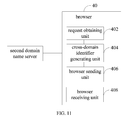
- FIG. 11 is a block diagram of a browser according to yet another embodiment.
- FIG. 12 is a block diagram of a system for implementing a cross-domain jump according to another embodiment.
- a method for implementing a cross-domain jump includes the following steps:
- Step S 102 a second domain name server obtains a cross-domain jump request of jumping from a first domain name to a second domain name sent by a browser, the cross-domain jump request includes a cross-domain user identifier corresponding to a first identifier of a user in the first domain name.
- a request of jumping from the first domain name to the second domain name is triggered.
- the cross-domain user identifier corresponding to the first identifier of the user in the first domain name can be obtained, and the cross-domain jump request including the cross-domain user identifier is generated.
- the cross-domain jump request is sent to the second domain name server.
- the first identifier of the user in the first domain name is a username or a user account or an assigned identification number for the user after the user logs in the first domain name.
- Step S 104 the second domain name server obtains a second identifier of the user in the second domain name corresponding to the cross-domain user identifier, and generates a user login state of the user in the second domain name according to the second identifier.
- the second domain name server can analyze the cross-domain jump request according to a pre-set way, extract the cross-domain user identifier from the cross-domain jump request, decrypt the cross-domain user identifier to obtain a decrypted cross-domain user identifier, check legality of the decrypted cross-domain user identifier and find the second identifier of the user in the second domain name corresponding to the decrypted cross-domain user identifier.
- legal cross-domain user identifiers are pre-stored.
- the second domain name server can find the decrypted cross-domain user identifier in the pre-stored legal cross-domain user identifiers. If successfully found, then the decrypted cross-domain user identifier is legal. If unsuccessfully found, then the decrypted cross-domain user identifier is illegal.
- the user login state of the second identifier can be labeled as an already-logged-in state in a user login state database of the second domain name.
- a method for implementing a cross-domain jump includes the following steps:
- Step S 202 a first domain name server obtains a request of jumping from a first domain name to a second domain name sent by a browser, the request includes the second domain name and a first identifier of a user in the first domain name.
- the method for implementing the cross-domain jump further includes the steps of: the browser obtaining a login request of the user to the first domain name, the login request including the first identifier (a username or a user account) and a user password of the user in the first domain name; the browser sending the login request to the first domain name server; the first domain name server verifying the login request and sending a verification result to the browser; the browser generating a file that stores already-logged-in user information of the first domain name if the browser receiving a verification-pass result and writing the first identifier into the file and further storing the file in a pre-set path.
- the already-logged-in user information can be used for identifying a user that operates on a web page of the first domain name.
- the browser reads the first identifier of the user in the first domain name from the file that stores the already-logged-in user information of the first domain name in the pre-set path, and further generates the request of jumping from the first domain name to the second domain name and including the second domain name and the first identifier, and sends the request to the first domain name server.
- Step S 204 the first domain server generates a cross-domain user identifier according to the second domain name and the first identifier and returns the cross-domain user identifier to the browser.
- the first domain name server generating the cross-domain user identifier according to the second domain name and the first identifier includes: the first domain name server finding a registered identifier and a second domain name key corresponding to the second domain name, combining the registered identifier with the first identifier, further, the first domain name server encrypting the combined identifier according to the second domain name key and generating the cross-domain user identifier.
- the second domain name can be pre-registered in the first domain name.
- the first domain name server can pre-store the registered identifier of the second domain name (referred as appid) and the second domain name key of the second domain name (referred as appkey).
- the first domain name server can send the cross-domain user identifier to the browser.
- the browser generates a cross-domain jump request including the cross-domain user identifier and the second domain name. Further, the browser sends the cross-domain jump request to the second domain name server.
- the second domain name server can generate the cross-domain jump request including the cross-domain user identifier and the second domain name and send the cross-domain jump request to the browser.
- Step S 206 the second domain name server obtains the cross-domain jump request of jumping from the first domain name to the second domain name sent by the browser, the cross-domain jump request includes the cross-domain user identifier corresponding to the first identifier of the user in the first domain name.
- Step S 208 the second domain name server obtains a second identifier of the user in the second domain name corresponding to the cross-domain user identifier, and generates a user login state of the user in the second domain name according to the second identifier.
- a method for implementing a cross-domain jump includes the following steps:
- Step S 302 a browser obtains a request of jumping from a first domain name to a second domain name, and generates a cross-domain user identifier according to the second domain name and a first identifier.
- the browser generating the cross-domain user identifier according to the second domain name and the first identifier includes: the browser finding a registered identifier and a second domain name key corresponding to the second domain name, and combining the registered identifier and the first identifier; the browser encrypting the combined identifier according to the second domain name key to generate the cross-domain user identifier.
- the first domain name server when the browser requests web page sources from the first domain name server, can embed the registered identifier and the second domain name key of the second domain name into the web page sources, and embed a program of the cross-domain user identifier generated according to the second domain name and the first identifier into the web page sources, and distribute the web page sources to the browser.
- the browser can execute the program of the cross-domain user identifier generated according to the second domain name and the first identifier and pre-embedded into the web page sources to obtain the cross-domain user identifier.
- Step S 304 the browser generates a cross-domain jump request according to the cross-domain user identifier and the second domain name and sends the cross-domain jump request to the second domain name server.
- the browser can generate the cross-domain jump request of jumping from the first domain name to the second domain name and including the cross-domain user identifier and the second domain name, and send the cross-domain name request to the second domain name server.
- Step S 306 the second domain name server obtains the cross-domain jump request of jumping from the first domain name to the second domain name sent by the browser.
- the cross-domain jump request includes the cross-domain user identifier corresponding to the first identifier of the user in the first domain name.
- Step S 308 the second domain name server obtains a second identifier of the user corresponding to the cross-domain user identifier in the second domain name, and generates a user login state of the user in the second domain name according to the second identifier.
- the method for implementing the cross-domain jump further includes the steps of: the second domain name server returning the web page sources corresponding to the cross-domain jump request and the user identify information corresponding to the second identifier to the browser; the browser displaying a web page corresponding to the web page sources, and displaying the user identity information corresponding to the second identifier in the web page.
- the browser can display the user identity information, such as a username or a user nickname, etc. corresponding to the second identifier on a corresponding position of the web page to indicate that the user has logged in the second domain name.
- the user identity information such as a username or a user nickname, etc. corresponding to the second identifier on a corresponding position of the web page to indicate that the user has logged in the second domain name.
- the method for implementing the cross-domain jump further includes a step of: the browser storing the second identifier in the file used for storing already-logged-in user information of the second domain name in the pre-set path.
- the browser can encrypt the second identifier according to a pre-set format, further, can store the encrypted second identifier in the file used for storing already-logged-in user information of the second domain name in the pre-set path.
- the browser sends a login request of logging in the first domain name to the first domain name server.
- the first domain name server verifies the login request and returns information indicative of the login request of a user being passed and the web page sources of the first domain name to the user browser.
- the browser obtains a request of the user of jumping from the first domain name to the second domain name, obtains a first identifier of the user in the first domain name, and sends a processing request including a second domain name and the first identifier to the first domain name server.
- the first domain name server receives the processing request, generates a cross-domain user identifier according to the second domain name and the first identifier, and generates a cross-domain jump request of jumping from the first domain name to the second domain name and including the cross-domain user identifier, and sends the cross-domain jump request to the browser.
- the browser sends the cross-domain jump request to the second domain name server.
- the second domain name server analyzes the cross-domain jump request, extracts the cross-domain user identifier, generates a second identifier of the user in the second domain name according to the cross-domain user identifier, and generates a user login state of the user in the second domain name according to the second identifier, and further obtains the web page sources corresponding to the second domain name.
- the second domain name server sends the web page sources and the second identifier corresponding to the cross-domain jump request to the browser.
- a browser 10 includes a request obtaining module 102 , a browser sending module 104 and a browser receiving module 106 .
- the request obtaining module 102 is configured to obtain a request of jumping from a first domain name to a second domain name.
- the request of jumping from the first domain name to the second domain name is triggered.
- the browser sending module 104 is configured to send the second domain name and a first identifier of a user in the first domain name to a first domain name server.
- the first identifier of the user in the first domain name is a username or a user account inputted when the user logs in the first domain name or an identification number assigned to the user after the user logs in the first domain name.
- the browser 10 obtains a login request of the user to the first domain name.
- the login request includes the first identifier (a username or a user account) and a user password of the user in the first domain name.
- the browser 10 sends the login request to the first domain name server.
- the first domain name server verifies the login request, and sends a verification result to the browser 10 .
- the browser 10 generates a file that stores already-logged-in user information of the first domain name if the browser 10 receives a verification-pass result, and writes the first identifier into the file, and further stores the file in a pre-set path.
- the browser 10 reads the first identifier of the user from the file that stores the already-logged-in user information of the first domain name in the pre-set path, and further sends the second domain name and the read first identifier to the first domain name server.
- the browser receiving module 106 is configured to receive a cross-domain user identifier generated according to the second domain name and the first identifier and sent by the first domain name server.
- the cross-domain user identifier corresponds to a second identifier of the user in the second domain name.
- the first domain name server generates the cross-domain user identifier according to the second domain name and the first identifier, and sends the generated cross-domain user information to the browser 10 .
- the browser sending module 104 is further configured to send a cross-domain jump request of jumping from the first domain name to the second domain name to the second domain name server.
- the cross-domain jump request includes the cross-domain user identifier.
- the browser 10 further includes a cross-domain request generating module (not shown in the figures) configured to generate the cross-domain jump request according to the cross-domain user identifier and the second domain name.
- the cross-domain request generating module can generate the cross-domain jump request of jumping from the first domain name and the second domain name and including the cross-domain user identifier and the second domain name.
- the browser receiving module 106 is further configured to receive web page sources corresponding to the cross-domain jump request and the user identity information corresponding to the second identifier sent by the second domain name server.
- the browser 10 further includes a display module (not shown in the figures) configured to display a web page corresponding to the web page sources and display the user identity information corresponding to the second identifier in the web page.
- a display module (not shown in the figures) configured to display a web page corresponding to the web page sources and display the user identity information corresponding to the second identifier in the web page.
- the display module can display the user identity information, such as a username or a user account, corresponding to the second identifier in a corresponding position of the web page to indicate that the user has logged in the second domain name.
- the user identity information such as a username or a user account
- the browser 10 further includes an identifier storing module (not shown in the figures) configured to store the second identifier in the file that stores already-logged-in user information of the second domain name in the pre-set path.
- the identifier storing module can encrypt the second identifier according to a pre-set format, furthermore, stores the encrypted second identifier in the file that stores already-logged-in user information of the second domain name in the pre-set path.
- the already-logged-in user information of the second domain name can be used for identifying a user that operates on the web page of the second domain name.
- the browser 10 obtains the request of jumping from the first domain name to the second domain name, receives the cross-domain user identifier sent by the first domain name server and generated according to the second domain name and the first identifier, and sends the cross-domain jump request including the cross-domain user identifier to the second domain name server.
- the cross-domain user identifier corresponds to the second identifier of the user in the second domain name. Therefore, it is unnecessary to log in again, and the login state of the user can be maintained. This reduces operation time of the user in the terminal after the cross-domain jump, and saves electric power, especially for a mobile terminal with limited electric power, increases a battery life.
- a first domain name server 20 includes a first receiving module 202 , a cross-domain identifier generating module 204 and a first sending module 206 .
- the first receiving module 202 is configured to receive a second domain name and a first identifier of a user in a first domain name sent by a browser.
- the cross-domain identifier generating module 204 is configured to generate a cross-domain user identifier according to the second domain name and the first identifier.
- the cross-domain user identifier corresponds to a second identifier of the user in the second domain name.
- the cross-domain identifier generating module 204 is configured to find a registered identifier and a second domain name key corresponding to the second domain name, combine the registered identifier with the first identifier, encrypt the combined identifier according to the second domain name key and generate the cross-domain user identifier.
- the second domain name can be pre-registered in the first domain name.
- the first domain name server 20 can pre-store the registered identifier of the second domain name (referred as appid) and the second domain name key of the second domain name (referred as appkey).
- the first sending module 206 is configured to send the cross-domain user identifier to the browser.
- the first domain name server 20 further includes a cross-domain request generating module (not shown in the figures) configured to generate a cross-domain jump request including the cross-domain user identifier and the second domain name.
- the first sending module 206 is configured to send the cross-domain jump request to the browser.
- the first domain name server 20 After receiving the second domain name and the first identifier of the user in the first domain name sent by the browser, the first domain name server 20 generates the cross-domain user identifier according to the second domain name and the first identifier. The generated cross-domain user identifier corresponds to the second identifier of the user in the second domain name.
- the first domain name server 20 sends the cross-domain user identifier to the browser, which makes that when requesting web page sources from the second domain name, the browser can send the cross-domain user identifier indicative of the second identifier of the user in the second domain name to the second domain name server, so that the user does not need to log in the second domain name, while still maintaining the login state of the user.
- a second domain name server 30 includes a second receiving module 302 , a second identifier obtaining module 304 and a login state generating module 306 .
- the second receiving module 302 is configured to receive a cross-domain jump request of jumping from a first domain name to a second domain name sent by a browser.
- the cross-domain jump request includes a cross-domain user identifier corresponding to a first identifier of a user in the first domain name.
- the second identifier obtaining module 304 is configured to obtain a second identifier of the user in the second domain name corresponding to the cross-domain user identifier.
- the second identifier obtaining module 304 is configured to analyze the cross-domain jump request according to a pre-set way, extract the cross-domain user identifier from the cross-domain jump request, decrypt the cross-domain user identifier to obtain a decrypted cross-domain user identifier, check legality of the decrypted cross-domain user identifier and find the second identifier of the user in the second domain name corresponding to the decrypted cross-domain user identifier.
- the second domain name server can pre-store legal cross-domain user identifiers.
- the second identifier obtaining module 304 can find the decrypted cross-domain user identifier in the pre-stored legal cross-domain user identifiers. If successfully found, then the decrypted cross-domain user identifier is legal. If unsuccessfully found, then the decrypted cross-domain user identifier is illegal.
- the login state generating module 306 is configured to generate a user login state of the user in the second domain name according to the second identifier.
- the login state generating module 306 is further configured to label the user login state of the second identifier as an already-logged-in state in a user login state database of the second domain name.
- the second domain name server 30 further includes an information returning module 308 configured to return web page sources corresponding to the cross-domain jump request and a user identity information corresponding to the second identifier to the browser.
- the second domain name server 30 receives the cross-domain jump request including the cross-domain user identifier sent by the browser, and generates the second identifier of the user in the second domain name according to the cross-domain user identifier, and recognizes the identity of the user according to the second identifier, so that the user does not need to log in the second domain name while still maintaining the login state of the user.
- a system for implementing a cross-domain jump includes the browser 10 , the first domain name server 20 and the second domain name server 30 of any one of the above embodiments.
- the browser 10 includes the request obtaining module 102 , the browser sending module 104 and the browser receiving module 106 shown in FIG. 5 .
- the first domain name server 20 includes the first receiving module 202 , the cross-domain identifier generating module 204 and the first sending module 206 shown in FIG. 6 .
- the second domain name server 30 includes the second receiving module 302 , the second identifier obtaining module 304 and the login state generating module 306 shown in FIG. 7 .
- the request obtaining module 102 is configured to obtain a request of jumping from a first domain name to a second domain name.
- the browser sending module 104 is configured to send the second domain name and a first identifier of a user in the first domain name to the first domain name server 20 .
- the first receiving module 202 is configured to receive the second domain name and the first identifier of the user in the first domain name sent by the browser 10 .
- the cross-domain identifier generating module 204 is configured to generate a cross-domain user identifier according to the second domain name and the first identifier.
- the first sending module 206 is configured to send the cross-domain user identifier to the browser 10 .
- the browser receiving module 106 is configured to receive the cross-domain user identifier sent by the first domain name server 20 .
- the browser sending module 104 is further configured to send a cross-domain jump request of jumping from the first domain name to the second domain name to the second domain name server 30 .
- the cross-domain jump request includes the cross-domain user identifier.
- the second receiving module 302 is configured to receive the cross-domain jump request of jumping from the first domain name to the second domain name sent by the browser 10 .
- the second identifier obtaining module 304 is configured to obtain a second identifier of the user in the second domain name corresponding to the cross-domain user identifier.
- the login state generating module 306 is configured to generate a user login state of the user in the second domain name according to the second identifier.
- a browser 40 includes a request obtaining unit 402 , a cross-domain identifier generating unit 404 and a browser sending unit 406 .
- the request obtaining unit 402 is configured to obtain a request of jumping from a first domain name to a second domain name.
- the cross-domain identifier generating unit 404 is configured to generate a cross-domain user identifier according to the second domain name and a first identifier of a user in the first domain name.
- the cross-domain user identifier corresponds to a second identifier of the user in the second domain name.
- the cross-domain identifier generating unit 404 is configured to find a registered identifier and a second domain name key corresponding to the second domain name, combine the registered identifier with the first identifier, encrypt the combined identifier according to the second domain name key and generate the cross-domain user identifier.
- the first domain name server when the browser requests web page sources from the first domain name server, can embed the registered identifier and the second domain name key of the second domain name into the web page sources, and embed a program of the cross-domain user identifier generated according to the second domain name and the first identifier, and distribute the web page sources to the browser.
- the cross-domain identifier generating unit 404 can execute the program of the cross-domain user identifier generated according to the second domain name and the first identifier and pre-embedded into the web page sources to generate the cross-domain user identifier.
- the browser sending unit 406 is configured to send the cross-domain jump request of jumping from the first domain name to the second domain name to the second domain name server.
- the cross-domain jump request includes the cross-domain user identifier.
- the browser 40 further includes a browser receiving unit 408 configured to receive the web page sources corresponding to the cross-domain jump request and a user identity information corresponding to the second identifier sent by the second domain name server.
- the browser 40 further includes a display module (not shown in the figures) configured to display a web page corresponding to the web page sources and display the user identity information corresponding to the second identifier in the web page.
- a display module (not shown in the figures) configured to display a web page corresponding to the web page sources and display the user identity information corresponding to the second identifier in the web page.
- the browser 40 After receiving the request of jumping from the first domain name to the second domain name, the browser 40 generates the cross-domain user identifier according to the second domain name and the first identifier, and sends the cross-domain jump request including the cross-domain user identifier to the second domain name server.
- the cross-domain user identifier corresponds to the second identifier of the user in the second domain name. Therefore, the user does not need to log in, while still maintaining the login state of the user. This reduces operation time of the user in the terminal after the cross-domain jump, and saves electric power, especially for a mobile terminal with limited electric power, increases a battery life.
- a system for implementing a cross-domain jump includes the browser 40 and the second domain name server 30 of any one of the above embodiments.
- the browser 40 includes the request obtaining unit 402 , the cross-domain identifier generating unit 404 and the browser sending unit 406 shown in FIG. 10 .
- the second domain name server 30 includes the second receiving module 302 , the second identifier obtaining module 304 and the login state generating module 306 shown in FIG. 7 .
- the request obtaining unit 402 is configured to obtain a request of jumping from a first domain name to a second domain name.
- the cross-domain identifier generating unit 404 is configured to generate a cross-domain user identifier according to the second domain name and a first identifier of a user in the first domain name.
- the cross-domain user identifier corresponds to a second identifier of the user in the second domain name.
- the browser sending unit 406 is configured to send a cross-domain jump request of jumping from the first domain name to the second domain name to the second domain name server.
- the cross-domain jump request includes the cross-domain user identifier.
- the second receiving module 302 is configured to receive the cross-domain jump request of jumping from the first domain name to the second domain name sent by the browser 40 .
- the second identifier obtaining module 304 is configured to obtain a second identifier of the user in the second domain name corresponding to the cross-domain user identifier.
- the login state generating module 306 is configured to generate a user login state of the user in the second domain name according to the second identifier.
- the cross-domain jump request of jumping from the first domain name and the second domain name includes the cross-domain user identifier corresponding to the first identifier of the user in the first domain name.
- the second domain name server can generate the second identifier of the user in the second domain name according to the cross-domain user identifier and recognize the identity of the user according to the second identifier, so that the user does not need to log in again while still maintaining the user login state when jumping from the first domain name to the second domain name. This reduces operation time of the user in a terminal after the cross-domain jump, and saves electric power, especially for a mobile terminal with limited electric power, increases a battery life.
Landscapes
- Engineering & Computer Science (AREA)
- General Engineering & Computer Science (AREA)
- Computer Security & Cryptography (AREA)
- Computer Networks & Wireless Communication (AREA)
- Signal Processing (AREA)
- Databases & Information Systems (AREA)
- Theoretical Computer Science (AREA)
- Computing Systems (AREA)
- Computer Hardware Design (AREA)
- Data Mining & Analysis (AREA)
- Physics & Mathematics (AREA)
- General Physics & Mathematics (AREA)
- Information Transfer Between Computers (AREA)
Abstract
Description
the second domain name server obtaining a second identifier of the user in the second domain name corresponding to the cross-domain user identifier, and generating a user login state of the user in the second domain name according to the second identifier.
the browser sending module further configured to send a cross-domain jump request of jumping from the first domain name to the second domain name to the second domain name server, the cross-domain jump request including the cross-domain user identifier.
a first sending module configured to send the cross-domain user identifier to the browser.
a second identifier obtaining module configured to obtain a second identifier of the user in the second domain name corresponding to the cross-domain user identifier; and
a login state generating module configured to generate a user login state of the user in the second domain name according to the second identifier.
Claims (9)
Applications Claiming Priority (4)
| Application Number | Priority Date | Filing Date | Title |
|---|---|---|---|
| CN201210241298.6 | 2012-07-12 | ||
| CN201210241298.6A CN103546432B (en) | 2012-07-12 | 2012-07-12 | Realize method and system and browser, the name server of cross-domain redirect |
| CN201210241298 | 2012-07-12 | ||
| PCT/CN2013/079124 WO2014008858A1 (en) | 2012-07-12 | 2013-07-10 | Method for implementing cross-domain jump, browser, and domain name server |
Related Parent Applications (1)
| Application Number | Title | Priority Date | Filing Date |
|---|---|---|---|
| PCT/CN2013/079124 Continuation WO2014008858A1 (en) | 2012-07-12 | 2013-07-10 | Method for implementing cross-domain jump, browser, and domain name server |
Publications (2)
| Publication Number | Publication Date |
|---|---|
| US20150127943A1 US20150127943A1 (en) | 2015-05-07 |
| US9686344B2 true US9686344B2 (en) | 2017-06-20 |
Family
ID=49915417
Family Applications (1)
| Application Number | Title | Priority Date | Filing Date |
|---|---|---|---|
| US14/594,705 Active 2034-03-18 US9686344B2 (en) | 2012-07-12 | 2015-01-12 | Method for implementing cross-domain jump, browser, and domain name server |
Country Status (5)
| Country | Link |
|---|---|
| US (1) | US9686344B2 (en) |
| EP (1) | EP2874074B1 (en) |
| CN (1) | CN103546432B (en) |
| RU (1) | RU2595931C1 (en) |
| WO (1) | WO2014008858A1 (en) |
Families Citing this family (20)
| Publication number | Priority date | Publication date | Assignee | Title |
|---|---|---|---|---|
| US9503501B2 (en) * | 2012-09-17 | 2016-11-22 | Salesforce.Com, Inc. | Cross domain in-browser proxy |
| CN105472052B (en) * | 2014-09-03 | 2019-12-31 | 阿里巴巴集团控股有限公司 | A login method and system for a cross-domain server |
| CN105610855A (en) * | 2016-01-21 | 2016-05-25 | 北京京东尚科信息技术有限公司 | Method and device for login verification of cross-domain system |
| CN107196892B (en) * | 2016-03-15 | 2020-03-06 | 阿里巴巴集团控股有限公司 | Website login method and device |
| CN107306296A (en) * | 2016-04-17 | 2017-10-31 | 王正伟 | Domain name substitutes application method |
| CN105897746A (en) * | 2016-05-26 | 2016-08-24 | 深圳市金立通信设备有限公司 | Cross-website login method, terminal and website server |
| CN106060189B (en) * | 2016-07-08 | 2019-03-29 | 厦门纳网科技股份有限公司 | A kind of distribution domain name registration system |
| CN106973037B (en) * | 2017-02-16 | 2018-09-04 | 咪咕视讯科技有限公司 | A kind of method and system of control data transmission |
| CN108574709B (en) * | 2017-03-10 | 2021-09-07 | 北京京东尚科信息技术有限公司 | Implementation method and device for cross-domain operation |
| CN108632209A (en) * | 2017-03-20 | 2018-10-09 | 北京京东尚科信息技术有限公司 | System, method and apparatus for handling information |
| CN107909330B (en) * | 2017-08-31 | 2020-10-09 | 平安科技(深圳)有限公司 | Workflow data processing method and device, storage medium and computer equipment |
| US10992612B2 (en) * | 2018-11-12 | 2021-04-27 | Salesforce.Com, Inc. | Contact information extraction and identification |
| CN109918146A (en) * | 2019-02-02 | 2019-06-21 | 北京字节跳动网络技术有限公司 | Page generation method and device |
| CN111931088B (en) * | 2020-10-13 | 2021-01-26 | 北京拓课网络科技有限公司 | Webpage link processing method and device and electronic equipment |
| CN112511491B (en) * | 2020-10-30 | 2022-12-06 | 福建福诺移动通信技术有限公司 | A single sign-on method combined with message queue in front-end and back-end separation mode |
| CN115905765B (en) * | 2022-12-12 | 2026-04-21 | 上海秉玉软件技术服务有限公司 | Incremental Website Management Method and System Based on Dynamic Subdomains |
| CN116582298B (en) * | 2023-04-11 | 2026-05-15 | 北京水滴科技集团有限公司 | A cross-domain login method, server, and readable storage medium |
| CN116800838A (en) * | 2023-07-14 | 2023-09-22 | 福建天泉教育科技有限公司 | Cross-domain request processing method and system |
| US12621284B2 (en) * | 2024-03-15 | 2026-05-05 | Aetna Inc. | Systems and methods for user authentication using subject identifier and/or subject identifier documents |
| CN119696889A (en) * | 2024-12-16 | 2025-03-25 | 航天信息股份有限公司 | Identity authentication method, system, electronic device, storage medium and program product |
Citations (9)
| Publication number | Priority date | Publication date | Assignee | Title |
|---|---|---|---|---|
| EP1081914A2 (en) | 1999-04-28 | 2001-03-07 | Sun Microsystems, Inc. | Single sign-on for network system that includes multiple separately-controlled restricted access resources |
| WO2002039237A2 (en) | 2000-11-09 | 2002-05-16 | International Business Machines Corporation | Method and system for web-based cross-domain single-sign-on authentication |
| JP2003296277A (en) | 2002-03-29 | 2003-10-17 | Fuji Xerox Co Ltd | Network device, authentication server, network system, authentication method |
| CN1855814A (en) | 2005-04-29 | 2006-11-01 | 中国科学院计算机网络信息中心 | Safety uniform certificate verification design |
| CN101075875A (en) | 2007-06-14 | 2007-11-21 | 中国电信股份有限公司 | Method and system for realizing monopoint login between gate and system |
| GB2452283A (en) | 2007-08-30 | 2009-03-04 | Clickstream Technologies Plc | Establishing a common ID in first and second domain |
| CN101540734A (en) | 2008-03-21 | 2009-09-23 | 阿里巴巴集团控股有限公司 | Method, system and device for accessing Cookie by crossing domain names |
| CN100586066C (en) | 2006-06-26 | 2010-01-27 | 北京金山软件有限公司 | System and method for implementing single sign-on |
| US20110302631A1 (en) | 2010-06-07 | 2011-12-08 | Salesforce.Com, Inc. | Systems and methods for logging into an application on a second domain from a first domain in a multi-tenant database system environment |
Family Cites Families (6)
| Publication number | Priority date | Publication date | Assignee | Title |
|---|---|---|---|---|
| US6119234A (en) * | 1997-06-27 | 2000-09-12 | Sun Microsystems, Inc. | Method and apparatus for client-host communication over a computer network |
| CA2346231A1 (en) * | 2000-05-08 | 2001-11-08 | Internet Number Corporation | Method and system for accessing information on a network using message aliasing functions having shadow callback functions |
| JP2005514673A (en) * | 2001-06-22 | 2005-05-19 | オモイグイ,ノサ | Knowledge acquisition, management, communication and presentation system and method |
| US6993596B2 (en) * | 2001-12-19 | 2006-01-31 | International Business Machines Corporation | System and method for user enrollment in an e-community |
| CN1835438B (en) * | 2006-03-22 | 2011-07-27 | 阿里巴巴集团控股有限公司 | Method of realizing single time accession between websites and website thereof |
| RU2413278C1 (en) * | 2009-05-27 | 2011-02-27 | Общество с ограниченной ответственностью "МэйлАдмин" | Method of selecting information on internet and using said information on separate website and server computer for realising said method |
-
2012
- 2012-07-12 CN CN201210241298.6A patent/CN103546432B/en active Active
-
2013
- 2013-07-10 WO PCT/CN2013/079124 patent/WO2014008858A1/en not_active Ceased
- 2013-07-10 EP EP13817388.5A patent/EP2874074B1/en active Active
- 2013-07-10 RU RU2015104540/08A patent/RU2595931C1/en active
-
2015
- 2015-01-12 US US14/594,705 patent/US9686344B2/en active Active
Patent Citations (9)
| Publication number | Priority date | Publication date | Assignee | Title |
|---|---|---|---|---|
| EP1081914A2 (en) | 1999-04-28 | 2001-03-07 | Sun Microsystems, Inc. | Single sign-on for network system that includes multiple separately-controlled restricted access resources |
| WO2002039237A2 (en) | 2000-11-09 | 2002-05-16 | International Business Machines Corporation | Method and system for web-based cross-domain single-sign-on authentication |
| JP2003296277A (en) | 2002-03-29 | 2003-10-17 | Fuji Xerox Co Ltd | Network device, authentication server, network system, authentication method |
| CN1855814A (en) | 2005-04-29 | 2006-11-01 | 中国科学院计算机网络信息中心 | Safety uniform certificate verification design |
| CN100586066C (en) | 2006-06-26 | 2010-01-27 | 北京金山软件有限公司 | System and method for implementing single sign-on |
| CN101075875A (en) | 2007-06-14 | 2007-11-21 | 中国电信股份有限公司 | Method and system for realizing monopoint login between gate and system |
| GB2452283A (en) | 2007-08-30 | 2009-03-04 | Clickstream Technologies Plc | Establishing a common ID in first and second domain |
| CN101540734A (en) | 2008-03-21 | 2009-09-23 | 阿里巴巴集团控股有限公司 | Method, system and device for accessing Cookie by crossing domain names |
| US20110302631A1 (en) | 2010-06-07 | 2011-12-08 | Salesforce.Com, Inc. | Systems and methods for logging into an application on a second domain from a first domain in a multi-tenant database system environment |
Non-Patent Citations (3)
| Title |
|---|
| International Search Report issued by State Intellectual Property Office of the P. R. China dated Sep. 18, 2013 for Application No. PTC/CN2013/079124. |
| State Intellectual Property Office of the P.R.C., "Office Action", Apr. 3, 2015, China. |
| Supplementary European Search Report and Written Opinion issued by the EPO for EP13817388 dated Feb. 10, 2016. |
Also Published As
| Publication number | Publication date |
|---|---|
| US20150127943A1 (en) | 2015-05-07 |
| EP2874074B1 (en) | 2019-02-27 |
| CN103546432A (en) | 2014-01-29 |
| RU2595931C1 (en) | 2016-08-27 |
| EP2874074A4 (en) | 2016-03-09 |
| WO2014008858A1 (en) | 2014-01-16 |
| EP2874074A1 (en) | 2015-05-20 |
| CN103546432B (en) | 2015-12-16 |
Similar Documents
| Publication | Publication Date | Title |
|---|---|---|
| US20150127943A1 (en) | Method for implementing cross-domain jump, browser, and domain name server | |
| CN104144419B (en) | Identity authentication method, device and system | |
| CN104735066B (en) | A kind of single-point logging method of object web page application, device and system | |
| US8763101B2 (en) | Multi-factor authentication using a unique identification header (UIDH) | |
| CN104967604B (en) | Login method and system | |
| US9887999B2 (en) | Login method and apparatus | |
| US9152808B1 (en) | Adapting decoy data present in a network | |
| EP2963958B1 (en) | Network device, terminal device and information security improving method | |
| CN113645226B (en) | Data processing method, device, equipment and storage medium based on gateway layer | |
| CN103227786B (en) | A kind of website login information filling method and device | |
| CN105025041A (en) | File upload method, file upload apparatus and system | |
| CN104320377A (en) | An anti-stealing-link method and device for stream media file | |
| CN109039987A (en) | A kind of user account login method, device, electronic equipment and storage medium | |
| CN103685311A (en) | Log-in validation method and device | |
| KR20160083930A (en) | Method and system for determining whether a terminal logging into a website is a mobile terminal | |
| CN107508822B (en) | Access control method and device | |
| CN104284213A (en) | Hotlink protection method, client side and system | |
| CN105472052A (en) | Login method and system of cross-domain server | |
| CN114826729B (en) | Data processing method, page updating method and related hardware | |
| CN109818906B (en) | Equipment fingerprint information processing method and device and server | |
| CN104683407A (en) | Method and device for transmitting page data and application data | |
| CN106330817A (en) | Webpage access method, device and terminal | |
| CN115695023B (en) | Access system of remote terminal service container | |
| CN107294921A (en) | The processing method and processing device that a kind of web terminal is accessed | |
| CN115567271A (en) | Authentication method and device, page skip method and device, electronic equipment and medium |
Legal Events
| Date | Code | Title | Description |
|---|---|---|---|
| AS | Assignment |
Owner name: TENCENT TECHNOLOGY (SHENZHEN) COMPANY LIMITED, CHI Free format text: ASSIGNMENT OF ASSIGNORS INTEREST;ASSIGNORS:LUO, MAOZHENG;YANG, YONG;MAO, YU;AND OTHERS;REEL/FRAME:034684/0416 Effective date: 20150112 |
|
| STCF | Information on status: patent grant |
Free format text: PATENTED CASE |
|
| MAFP | Maintenance fee payment |
Free format text: PAYMENT OF MAINTENANCE FEE, 4TH YEAR, LARGE ENTITY (ORIGINAL EVENT CODE: M1551); ENTITY STATUS OF PATENT OWNER: LARGE ENTITY Year of fee payment: 4 |
|
| MAFP | Maintenance fee payment |
Free format text: PAYMENT OF MAINTENANCE FEE, 8TH YEAR, LARGE ENTITY (ORIGINAL EVENT CODE: M1552); ENTITY STATUS OF PATENT OWNER: LARGE ENTITY Year of fee payment: 8 |