US9684354B2 - Remote customer relationship management activity workspace - Google Patents
Remote customer relationship management activity workspace Download PDFInfo
- Publication number
- US9684354B2 US9684354B2 US13/955,310 US201313955310A US9684354B2 US 9684354 B2 US9684354 B2 US 9684354B2 US 201313955310 A US201313955310 A US 201313955310A US 9684354 B2 US9684354 B2 US 9684354B2
- Authority
- US
- United States
- Prior art keywords
- monitoring
- workspace
- router
- communication channel
- communication
- Prior art date
- Legal status (The legal status is an assumption and is not a legal conclusion. Google has not performed a legal analysis and makes no representation as to the accuracy of the status listed.)
- Active, expires
Links
Images


Classifications
-
- G—PHYSICS
- G06—COMPUTING OR CALCULATING; COUNTING
- G06F—ELECTRIC DIGITAL DATA PROCESSING
- G06F1/00—Details not covered by groups G06F3/00 - G06F13/00 and G06F21/00
- G06F1/26—Power supply means, e.g. regulation thereof
- G06F1/32—Means for saving power
- G06F1/3203—Power management, i.e. event-based initiation of a power-saving mode
- G06F1/3206—Monitoring of events, devices or parameters that trigger a change in power modality
- G06F1/3209—Monitoring remote activity, e.g. over telephone lines or network connections
-
- G—PHYSICS
- G06—COMPUTING OR CALCULATING; COUNTING
- G06F—ELECTRIC DIGITAL DATA PROCESSING
- G06F21/00—Security arrangements for protecting computers, components thereof, programs or data against unauthorised activity
- G06F21/70—Protecting specific internal or peripheral components, in which the protection of a component leads to protection of the entire computer
- G06F21/81—Protecting specific internal or peripheral components, in which the protection of a component leads to protection of the entire computer by operating on the power supply, e.g. enabling or disabling power-on, sleep or resume operations
-
- G—PHYSICS
- G06—COMPUTING OR CALCULATING; COUNTING
- G06F—ELECTRIC DIGITAL DATA PROCESSING
- G06F21/00—Security arrangements for protecting computers, components thereof, programs or data against unauthorised activity
- G06F21/70—Protecting specific internal or peripheral components, in which the protection of a component leads to protection of the entire computer
- G06F21/82—Protecting input, output or interconnection devices
- G06F21/85—Protecting input, output or interconnection devices interconnection devices, e.g. bus-connected or in-line devices
-
- G—PHYSICS
- G08—SIGNALLING
- G08B—SIGNALLING SYSTEMS, e.g. PERSONAL CALLING SYSTEMS; ORDER TELEGRAPHS; ALARM SYSTEMS
- G08B13/00—Burglar, theft or intruder alarms
-
- G—PHYSICS
- G08—SIGNALLING
- G08B—SIGNALLING SYSTEMS, e.g. PERSONAL CALLING SYSTEMS; ORDER TELEGRAPHS; ALARM SYSTEMS
- G08B13/00—Burglar, theft or intruder alarms
- G08B13/22—Electrical actuation
- G08B13/24—Electrical actuation by interference with electromagnetic field distribution
- G08B13/2491—Intrusion detection systems, i.e. where the body of an intruder causes the interference with the electromagnetic field
Definitions
- Embodiments are generally related to customer relationship management systems and particularly customer relationship management systems requiring control of confidential data.
- CRM customer relationship management
- BPO business process outsourcing
- Multichannel environments provide customers with the ability to interface with CRM agents in the form of voice, mobile/SMS, email, social networking, web form, interactive voice response (IVR) or other communication methods.
- Service devices such as computer workstations, provide access to an inquiring client's account, configuration, or other such information to understand the inquiry and determine a solution if warranted.
- Workstations are connected to central computers containing customer, services and product data, as well as to administrator computers to provide oversight to the process.
- Call center supervisors are tasked with managing agents to maintain efficiency, reliability and monitor agent workload.
- Sophisticated integrated systems provide the tools required to route an incoming customer request with the appropriate agent as well as measure key attributes associated with the request and agent.
- Agents are monitored (by supervisors and systems) to insure the agent provides support that meets or exceeds pre-defined expectations.
- Achievement based compensation systems are employed as a variable pay system that ties the achievement of specific metrics measuring quality and quantity of the agent's performance with compensation. Additionally, agents are monitored to prevent unauthorized recordation or disclosure of sensitive information.
- Sensitive information comprises, but is not limited to, private, confidential, personal identifiable information (PII), classified, financial or medical information.
- Exchanges are both inbound (requestor to agent) and outbound (agent to requestor) and can include transmission of audible and visual information.
- Sensitive information can be exposed using CRM equipment such as a display, speaker or printed hardcopy.
- CRM services providing support for sensitive information are located in secure facilities to prevent unauthorized exploitation of the sensitive information. Facilities control physical access using security personnel, identification card readers, biometric authentication, and other such devices at security checkpoints located at entrances and exits.
- Secure areas are designated and monitored for illicit equipment and employee behavior. Paperless environments are created to prevent recordation and removal of sensitive material. Equipment capable of capturing (e.g., audio recorders and cameras) or transmitting (e.g., cell phones, personal digital assistants and smart phones) sensitive information is prohibited in secure areas. Certified CRM equipment is modified to prevent unauthorized use and/or abuse security policies (e.g., disabling internet access, disabling USB ports, eliminating removable digital data storage devices, etc.). Security cameras, one-way mirrors, call and workstation monitoring are commonplace in CRM facilities. Moreover, CRM systems employing speech analytics technology listen to agent calls in order to identify additional training opportunities and improve agent performance.
- Speech analytics technology listen to agent calls in order to identify additional training opportunities and improve agent performance.
- Examples of industries requiring customer relationship management services providing support of sensitive information include: medical, insurance, pharmaceutical, legal, financial and banking.
- CRM facilities are operated and staffed on a 24-hour basis. Some agents are assigned overnight shifts requiring entry and/or exit of the CRM facilities in the middle of the night when crime rates are elevated. To minimize crime, CRM facilities are designed with access controls and cameras in well-lit and staffed parking lots to protect their employees.
- CRM call center support is used as an example designs herein are applicable to other work environments.
- the embodiments herein provide the integration of remote work environments, monitoring of workers and data security systems and methods.
- Two-way conferencing using secure, modular and movable enclosures are known in the industry.
- the enclosures are constructed of soundproofing material to prevent unauthorized personnel located outside of the enclosure from hearing conversations held inside the enclosure. Physical access is controlled using locking mechanisms and security features such as magnetic card readers.
- Equipment security is provided using dedicated equipment lockers or closets to prevent equipment theft. Additionally, metal sensors are used to prevent prohibited physical items from leaving the enclosure.
- Data transmissions to an unsecure location can be contained using a monitoring system in conjunction with a managing system.
- the monitoring system provides security detection of an activity workspace's exterior as well as monitoring ability to the activity workspace's interior.
- a monitoring device detects a potential security breach using a sensor to determine if the activity workspace has been opened. Penetrating the activity workspace through an intended entrance or other opening, such as a vent or window, creates a potential security breach and requires preventative measures.
- Preventative measures include muting audible sound and other data originating from the activity workspace or elsewhere to the activity workspace. This is accomplished through the control of the managing system by the monitoring device.
- the monitoring system provides unaffected capability between the activity workspace and another location such as a CRM management system.
- a sensor is used to determine the presence of an object or person, which could result in a breach of the activity workspace.
- One specific embodiment herein is a system that monitors an access port to an activity workspace to determine which devices to disable to prohibit the exposure of sensitive information outside the activity workspace.
- FIG. 1 illustrates a schematic view of the remote CRM system with other systems as disclosed in the embodiments
- FIG. 2A illustrates a graphical representation of the remote CRM system detection monitoring device in accordance with the embodiments
- FIG. 2B illustrates a graphical representation of the remote CRM system detection monitoring device in accordance with the embodiments
- FIG. 2C illustrates a graphical representation of the remote CRM system detection monitoring device in accordance with the embodiments
- FIG. 2D illustrates a graphical representation of the remote CRM system detection monitoring device in accordance with the embodiments
- FIG. 2E illustrates a graphical representation of the remote CRM system detection monitoring device in accordance with the embodiments
- FIG. 2F illustrates a graphical representation of the remote CRM system detection monitoring device in accordance with the embodiments
- FIG. 3 illustrates a schematic view of the remote CRM system in accordance with the embodiments
- FIG. 4A is a door detection system flowchart according to embodiments of the present invention.
- FIG. 4B is an object detection system flowchart according to embodiments of the present invention.
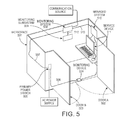
- FIG. 5 is a graphical illustration of a dedicated enclosure equipped with a remote CRM workspace system according to embodiments of the present invention.
- Customer Relationship Management business strategy for managing a company's interactions with current and future customers.
- Call Center service provided to a company's current and future customers for relaying business information, resolving problems, generating new business, or responding to inquiries.
- Sensitive Information material containing personal or business data, facts, statistics, records, or other such information which is not intended for public availability.
- Monitoring Device for detecting the condition of an opening to the workspace or presence of individual(s) near the workspace.
- Exemplary devices include, but are not limited to, ultrasonic sensor, infrared sensor, and interlock switches.
- Monitoring Router Communication switch used to regulate data communication between multiple points.
- a monitoring router is achieved using a dedicated device or integrated in a general-purpose computer or system.
- Managed Router Communication switch used to enable data communication between monitoring router and service device(s).
- Service Device Equipment used to conduct business such as computer, terminal, and/or phone.
- Service Outlet Registered and controlled power source for service devices requiring power.
- CRM management system 102 is connected to remote CRM workspace 101 A and remote CRM workspace 101 B through communication links 105 A and 105 B, respectively. Additionally, CRM management system 102 is also connected to CRM administrator 104 A and CRM administrator 104 B through communication links 106 A and 106 B, respectively, client 103 A and client 103 B through communication links 107 A and 107 B, respectively, and local agents 108 A and local agents 108 B through communication links 109 A and 109 B, respectively. Any number of remote CRM workspace ( 101 A and 101 B), CRM administrator ( 104 A and 104 B), client ( 103 A and 103 B) and local agents ( 108 A and 108 B) can be communicatively connected to CRM management system 102 .
- Each of communication link 105 A, 105 B, 106 A, 106 B, 107 A, 107 B, 109 A, and 109 B are ones suitable to enable transmission of audio, video and/or digital information to enable communication between remote CRM workspace 101 A and CRM management system 102 .
- Ethernet or other communication standards such as Integrated Services Digital Network (ISDN) are capable of serving multiple simultaneous connections in any combination of data, voice, video, and fax over a single line.
- ISDN enabled communication system provides a means for multiple devices to be serviced concurrently.
- ISDN Digital Subscriber Lines (DSL), Leased Lines, Fiber-to-the-x (FTTx), Broadband over Power Line (BPL), Wireless Broadband, Satellite Broadband, or Mobile Broadband.
- Other communication methods albeit with somewhat inferior capability, include Public Switched Telephone Network (PSTN) and Plain Old Telephone Service (POTS). The use of a communication method is not intended to limit the usefulness of the present invention.
- PSTN Public Switched Telephone Network
- POTS Plain Old Telephone
- connection 105 A, 105 B, 106 A, 106 B, 107 A, 107 B, 109 A, and 109 B between each of remote CRM workspace 101 A, remote CRM workspace 101 B, CRM administrator 104 A, CRM administrator 104 B, client 103 A, client 103 B, local agents 108 A and local agents 108 B, respectively, to CRM management system 102 are not required to be of the same type. That is, connection 105 A could be of type ISDN, whereas the connection 107 A could be of type POTS.
- Present CRM management systems provide hardware and software components to interface with a variety of communication protocols and CRM management system 102 is designed to handle multiple communication standards, protocols and connections.
- CRM management system 102 provides call routing to enable a client 103 A to establish a communication path with a CRM agent ( 101 A, 101 B, 108 A or 108 B) and when needed, a CRM administrator ( 104 A or 104 B).
- a CRM agent 101 A, 101 B, 108 A or 108 B
- CRM administrator 104 A or 104 B
- CRM management system 102 is capable of serving more than one remote CRM workspace 101 A and 101 B, more than one client 103 A and 103 B, more than one CRM administrator 104 A and 104 B, and more than one local agent 108 A and 108 B.
- the invention includes the flexibility of operating in a dedicated mode, such as an enclosure described below, or a modular mode which can be used to adopt an existing workspace into a secure workspace.
- workspace apparatus is equipped in a kit form with managing and monitoring functionality to enable transformation of a non-secure workspace into a secure workspace.
- the modular mode includes minor modifications of a non-secure workspace including, but not limited to, strategic placement of workspace apparatus, connection of monitoring device(s) to existing structures or use of auxiliary normally present monitoring devices.
- remote CRM workspace 200 is equipped with four walls, a ceiling (not shown) and a floor (not shown) to create an enclosure.
- the material used to construct the walls, ceiling and floor are that of adequate sound dampening material to sufficiently prevent sound from travelling through them.
- An entrance with a door 201 is installed in at least one of the walls to allow physical access to the remote CRM workspace 200 via the entrance.
- the type of door 201 is not of particular importance, however the embodiment illustrates a single door hinged to the enclosure's walls positioned at the entrance.
- the doorway is suitable to allow access to a person walking through the entrance or rolling while seated in a wheelchair.
- Other door styles are contemplated such as sliding, folding, overhead and rotating.
- An exemplary enclosure is the VpodTM V1 manufactured by Vpod Solutions.
- a VpodTM V1 enclosure is a standalone fully integrated point-to-point video conferencing environment constructed of acoustic panels installed to reduce reverberation. It is designed for use with high definition video conferencing equipment and provides a consistent video conferencing environment. Access to the enclosure is accomplished using a pocket door. The enclosure is equipped with sufficient lighting, providing both daylight lighting via ceiling window and powered LED lamps. Lighting and an integrated ventilation system is controlled using a passive infrared (PIR) sensor to detect enclosure occupancy. Also included in the enclosure are a microphone, speaker, video camera and a high definition liquid crystal display (LCD) screen for video conferencing. The enclosure requires 13 amp electrical power and access to a network using category 5 e unshielded twisted pair. A seat and desk are integrated to provide an efficient work area during teleconferences.
- PIR passive infrared
- VpodTM V1 manufactured by Vpod Solutions is an exemplary enclosure.
- enclosures designed or manufactured by alternate suppliers can be substituted.
- a suitable enclosure such as a room, booth, berth, or closet can be substituted. Any enclosure that provides privacy and the ability to monitor physical access is a usable substitute requiring minor modifications to make use of the invention.
- sensor 202 A and 202 B are installed to monitor the state of the door 201 .
- Monitored states include but are not limited to open, as depicted in FIG. 2A , and closed, as depicted in FIG. 2B , and also include other conditions such as ajar or agape. Additional sensing is contemplated such as detection of interaction with the door handle and proximity sensing to determine if someone has made contact with the door 201 .
- the sensor 202 A can be attached to the door 201 components (e.g., stiles, rails or latch), area around the door or doorframe (e.g., jamb, sill, or lintel) or other components of the enclosure such as the walls.
- FIG. 2C illustrates a hinge sensor
- FIG. 2D illustrates a sensor located outside the enclosure.
- switches intrusion sensing technology (e.g., aJ-OrionTM security system), but not limited to: push-button door mechanical switch; roller plunger mechanical switch; magnetic contact reed switch; door hinge mechanical switch; or a door hinge magnetic switch.
- Additional sensors are used for supplementary portals such as window(s), skylight(s), vent(s) or other such openings that would allow access to audio or video inside the enclosure.
- proximity sensors are used to detect the presence of nearby objects without any immediate contact. Sensing is accomplished by comparing changes of a returned signal from an emitted electromagnetic field or a beam of electromagnetic radiation. Common forms of proximity sensors emit infrared electromagnetic radiation or ultrasonic waves and sense the return signal. In these embodiments, sensor 202 E is positioned inside the enclosure and sensor 202 F is positioned outside the enclosure.
- monitoring device receives an input signal from at least one sensor to enable control of the managed system.
- monitoring system 304 monitoring subsystem 310 , managed system 315 and managed subsystem 319 will be explained in the context of remote CRM workspace 300 .
- primary power switch 302 controls power from AC power 301 to power source 303 .
- AC power 301 is shown as an external power source, but could be integrated with the workspace avoiding the need for external power.
- Primary power switch 302 is contemplated to be a simple mechanical switch and/or secure switch utilizing authentication systems and methods to restrict access to the power signal transmitted on power conduit 303 .
- Monitoring system 304 is powered by power conduit 303 enabling operation of its devices.
- Exemplary monitoring system 304 includes a converter 306 that provides alternating current to direct current power conversion for network router 306 , which is capable of forwarding data packets between multiple communication devices. Additionally, managed system 315 includes a converter 316 that provides alternating current to direct current power conversion for network router 317 , as illustrated.
- the type of device to facilitate transmission of data by the monitoring system 304 and managed system 315 is not limited by these embodiments.
- the monitoring system 304 router 306 of FIG. 3 provides a data conduit between communication channel 307 , using communication link 308 , and monitoring subsystem 310 , using communication links 309 A and 309 B, and managed system 315 , using communication link 309 C.
- Communication channel 307 is shown as an external source, which could be comprised of a hardwired data cable or a wireless data transmission device. Standard operation of the system will now be described.
- primary power switch 302 is active thereby providing power from AC power 301 to power conduit 303 and monitoring system router 306 thereby making it active and available for access to the communication channel 307 , using communication link 308 .
- monitoring system 304 is capable of serving other devices and systems such as monitoring subsystem 310 and managed system 315 .
- Monitoring device 313 is also active as power from power conduit 303 is provided.
- devices served by monitoring system 304 include devices such as surveillance device 311 , using communication link 309 B, and communication device 312 , using communication link 309 A.
- surveillance device 311 provides a mechanism to visually and audibly observe the workspace activity.
- Common devices capable of providing surveillance include computers, cameras and microphones.
- Communication device 312 provides an appliance enabling communication across the active network.
- Device such as a computer or network-enabled phone, also known as a voice over IP, provide voice and video services over a network.
- the devices of monitoring subsystem 310 provide the ability to detect the state of monitoring device 313 and transmit an appropriate signal using one or more of conduit 323 A or 323 B thus allowing monitoring subsystem 310 to communicate the status of monitoring device 313 through communication channel 307 for data logging, communication management and/or call management. Additionally functionality is enabled using conduit 323 A or conduit 323 B including controlling the type of data provided to the workspace through the communication channel 307 based on the state of the monitoring device 313 .
- surveillance device 311 is communicatively coupled to the communication channel 307 through conduit 308 , router 306 and conduit 309 B, and/or communication device 312 is communicatively coupled to the communication channel 307 through conduit 308 , router 306 and conduit 309 A.
- communication paths enable the CRM management system 102 to detect the condition of monitoring device 313 to manage the type of information provided to the remote CRM workspace 300 through communication channel 307 .
- CRM management system 102 if CRM management system 102 is provided with a signal from remote CRM workspace 300 indicating monitoring device 313 detects a breach of the remote CRM workspace 300 , CRM management system 102 prevents access to sensitive information by closing a window or application running on service device 320 .
- CRM management system 102 is capable of other actions to restrict access to sensitive information such as disabling audio and/or video provided to the managed subsystem 319 .
- monitoring device 313 to enable power to managed system 314 such that managed system 315 , served by monitoring system 304 , using communication link 309 C, actively serves managed subsystem 319 , using communication link 318 .
- Devices in managed subsystem 319 include any network capable service device 320 , such as a computer or network-enabled phone or other such devices capable of communicating over a network or any device requiring managed power such as service outlet 322 .
- Exemplary service devices suggested in this embodiment include a network-enabled phone, which also offers connectivity to a computing device.
- Service device 320 is contemplated to be of the type of device, which provides intensive on-board computing power, or limited on-board computing power and relies on services provided by external server(s), or a hybrid configuration.
- exemplary devices include, but are not limited to: CiscoTM 890 Series Integrated Services Router (as a router); CiscoTM Video Surveillance 2611 IP Dome (as a surveillance device); CiscoTM Unified IP Phone 9971 (as a service device or communication device); and CiscoTM Virtualization Experience Client 2111 (as a service device).
- These exemplary devices, as well as similar devices, include capability for powering the device over the communication link, known as Power-over-Ethernet (PoE). While only one connection from router 317 to managed subsystem 319 is shown, those skilled in the art recognize multiple connections are feasible between router 317 and managed subsystem 319 thus providing multiple service devices 320 .
- PoE Power-over-Ethernet
- FIG. 4A the flow chart depicted in FIG. 4A will be described.
- power is enabled to the monitoring system and monitoring device thus allowing a door's state to be detected as shown in blocks 401 A and 402 A.
- path 406 A is selected by condition block 403 A and the managed system is activated as shown in block 407 A.
- Detection of the door continues as illustrated by path 408 A.
- path 404 A is selected and managed system is deactivated as illustrated in block 405 A. Active monitoring of the door is continued as shown in path 409 A.
- An additional embodiment includes the detection of an object in which operation is illustrated in FIG. 4B .
- power is enabled to the monitoring system and monitoring device thus allowing an object to be detected as shown in blocks 401 B and 402 B.
- path 406 B is selected by condition block 403 B and the managed system is activated as shown in block 407 B.
- Continued object detection is enabled as illustrated by path 408 B.
- path 404 B is selected and managed system is deactivated as illustrated in block 405 B and active monitoring is continued as shown by path 409 B.
- Embodiments of FIG. 4A and FIG. 4B are capable of conglomeration in part or in whole to create a managed system controlled by door state detection and object detection.
- FIG. 5 illustrates an exemplary implementation of the present invention.
- Workspace 501 enclosure includes walls, floor, ceiling/roof (not shown) and entry provided by door A 502 and door B 503 .
- a monitoring device 504 is configured such that detection of closures of door A 502 and door B 503 is achieved.
- AC power is routed into the workspace 501 and through a primary power switch 505 .
- the switched power is routed to the monitoring device 504 by way of connection 506 and to the monitoring system 508 by way of connection 507 .
- Monitoring device 504 is connected to managed system 510 to control service device 511 .
- Monitoring system 508 is provided with network connectivity by an external communication channel as shown and is also connected to monitoring subsystem 509 by use of connection 512 and managed system 510 by use of connection 513 .
- monitoring device 504 In this embodiment monitoring device 504 , monitoring system 508 , monitoring subsystem 509 and managed system 510 can be concealed to avoid tampering or unauthorized use of the control devices. Other embodiments utilize a variation of FIG. 5 . Such as monitoring device 504 configured to detect the presence of someone near the workspace 501 . In this design the monitoring device 504 would be mounted external to workspace 501 to allow of detection of an individual outside of the workspace 501 .
Landscapes
- Engineering & Computer Science (AREA)
- Theoretical Computer Science (AREA)
- Computer Hardware Design (AREA)
- Physics & Mathematics (AREA)
- General Engineering & Computer Science (AREA)
- General Physics & Mathematics (AREA)
- Computer Security & Cryptography (AREA)
- Software Systems (AREA)
- Telephonic Communication Services (AREA)
Abstract
Description
Claims (20)
Priority Applications (1)
| Application Number | Priority Date | Filing Date | Title |
|---|---|---|---|
| US13/955,310 US9684354B2 (en) | 2013-07-31 | 2013-07-31 | Remote customer relationship management activity workspace |
Applications Claiming Priority (1)
| Application Number | Priority Date | Filing Date | Title |
|---|---|---|---|
| US13/955,310 US9684354B2 (en) | 2013-07-31 | 2013-07-31 | Remote customer relationship management activity workspace |
Publications (2)
| Publication Number | Publication Date |
|---|---|
| US20150040215A1 US20150040215A1 (en) | 2015-02-05 |
| US9684354B2 true US9684354B2 (en) | 2017-06-20 |
Family
ID=52428952
Family Applications (1)
| Application Number | Title | Priority Date | Filing Date |
|---|---|---|---|
| US13/955,310 Active 2033-11-21 US9684354B2 (en) | 2013-07-31 | 2013-07-31 | Remote customer relationship management activity workspace |
Country Status (1)
| Country | Link |
|---|---|
| US (1) | US9684354B2 (en) |
Families Citing this family (7)
| Publication number | Priority date | Publication date | Assignee | Title |
|---|---|---|---|---|
| US9366065B2 (en) * | 2014-09-18 | 2016-06-14 | Vivint, Inc. | Hinge sensor for barrier |
| US9990819B2 (en) * | 2014-09-18 | 2018-06-05 | Vivint, Inc. | Magnetic hinge sensor for barrier |
| US10352734B2 (en) | 2014-09-18 | 2019-07-16 | Vivint, Inc. | Hinge sensor for barrier |
| WO2020186476A1 (en) * | 2019-03-20 | 2020-09-24 | 深圳迈瑞生物医疗电子股份有限公司 | Medical device and data management method therefor |
| US11217051B2 (en) * | 2019-04-22 | 2022-01-04 | Soloinsight, Inc. | System and method for providing credential activation layered security |
| US11868493B2 (en) * | 2020-09-04 | 2024-01-09 | Avaya Management L.P. | Work-from-home agent security compliance |
| US20220198861A1 (en) * | 2020-12-18 | 2022-06-23 | Sensormatic Electronics, LLC | Access control system screen capture facial detection and recognition |
Citations (17)
| Publication number | Priority date | Publication date | Assignee | Title |
|---|---|---|---|---|
| US5585839A (en) | 1993-04-28 | 1996-12-17 | Hitachi Ltd. | Audio and video telecommunication system with remote monitoring function and remote device control function |
| US6205716B1 (en) | 1995-12-04 | 2001-03-27 | Diane P. Peltz | Modular video conference enclosure |
| US20020056046A1 (en) * | 1998-03-09 | 2002-05-09 | Dean A. Klein | Method for automatically initiating a computer security and/or screen saver mode |
| US6614450B1 (en) | 1999-03-03 | 2003-09-02 | Gateway, Inc. | Information display system for scheduling the utilization of a facility |
| US20070022090A1 (en) * | 1998-12-09 | 2007-01-25 | Network Ice Corporation, Inc. | Method and Apparatus for Providing Network and Computer System Security |
| US20070225995A1 (en) * | 2006-03-17 | 2007-09-27 | Moore Barrett H | Method and Security Modules for an Incident Deployment and Response System for Facilitating Access to Private Civil Security Resources |
| US20090241615A1 (en) * | 2008-03-25 | 2009-10-01 | John Christopher Hansknecht | Defeatable room access control system and method |
| US7756544B1 (en) * | 2005-01-13 | 2010-07-13 | Enterasys Networks, Inc. | Power controlled network devices for security and power conservation |
| US20110023113A1 (en) * | 2005-11-09 | 2011-01-27 | Munyon Paul J | System and method for inhibiting access to a computer |
| US20110074570A1 (en) * | 2009-09-25 | 2011-03-31 | At&T Intellectual Property I, Lp | Systems and Methods for Remote Building Security and Automation |
| US20110113472A1 (en) * | 2009-11-10 | 2011-05-12 | Hei Tao Fung | Integrated Virtual Desktop and Security Management System |
| US20110181412A1 (en) * | 2010-01-22 | 2011-07-28 | Assa Abloy Hospitality, Inc. | Energy management and security in multi-unit facilities |
| US8224401B1 (en) * | 2010-01-19 | 2012-07-17 | Adtran, Inc. | System and method for controlling a powered device that draws power from a communications network in response to user detection |
| US20120278640A1 (en) * | 2011-04-27 | 2012-11-01 | Leviton Manufacturing Co., Inc. | Workstation with occupancy sensing |
| US20120302226A1 (en) * | 2011-05-27 | 2012-11-29 | Basil Isaiah Jesudason | Workspace energy management using multifactor presence detection and mobile phone identity verification |
| US20130167207A1 (en) * | 2011-09-24 | 2013-06-27 | Marc E. Davis | Network Acquired Behavioral Fingerprint for Authentication |
| US20140149758A1 (en) * | 2012-11-27 | 2014-05-29 | Qualcomm Incorporated | Power management of devices in a network |
-
2013
- 2013-07-31 US US13/955,310 patent/US9684354B2/en active Active
Patent Citations (17)
| Publication number | Priority date | Publication date | Assignee | Title |
|---|---|---|---|---|
| US5585839A (en) | 1993-04-28 | 1996-12-17 | Hitachi Ltd. | Audio and video telecommunication system with remote monitoring function and remote device control function |
| US6205716B1 (en) | 1995-12-04 | 2001-03-27 | Diane P. Peltz | Modular video conference enclosure |
| US20020056046A1 (en) * | 1998-03-09 | 2002-05-09 | Dean A. Klein | Method for automatically initiating a computer security and/or screen saver mode |
| US20070022090A1 (en) * | 1998-12-09 | 2007-01-25 | Network Ice Corporation, Inc. | Method and Apparatus for Providing Network and Computer System Security |
| US6614450B1 (en) | 1999-03-03 | 2003-09-02 | Gateway, Inc. | Information display system for scheduling the utilization of a facility |
| US7756544B1 (en) * | 2005-01-13 | 2010-07-13 | Enterasys Networks, Inc. | Power controlled network devices for security and power conservation |
| US20110023113A1 (en) * | 2005-11-09 | 2011-01-27 | Munyon Paul J | System and method for inhibiting access to a computer |
| US20070225995A1 (en) * | 2006-03-17 | 2007-09-27 | Moore Barrett H | Method and Security Modules for an Incident Deployment and Response System for Facilitating Access to Private Civil Security Resources |
| US20090241615A1 (en) * | 2008-03-25 | 2009-10-01 | John Christopher Hansknecht | Defeatable room access control system and method |
| US20110074570A1 (en) * | 2009-09-25 | 2011-03-31 | At&T Intellectual Property I, Lp | Systems and Methods for Remote Building Security and Automation |
| US20110113472A1 (en) * | 2009-11-10 | 2011-05-12 | Hei Tao Fung | Integrated Virtual Desktop and Security Management System |
| US8224401B1 (en) * | 2010-01-19 | 2012-07-17 | Adtran, Inc. | System and method for controlling a powered device that draws power from a communications network in response to user detection |
| US20110181412A1 (en) * | 2010-01-22 | 2011-07-28 | Assa Abloy Hospitality, Inc. | Energy management and security in multi-unit facilities |
| US20120278640A1 (en) * | 2011-04-27 | 2012-11-01 | Leviton Manufacturing Co., Inc. | Workstation with occupancy sensing |
| US20120302226A1 (en) * | 2011-05-27 | 2012-11-29 | Basil Isaiah Jesudason | Workspace energy management using multifactor presence detection and mobile phone identity verification |
| US20130167207A1 (en) * | 2011-09-24 | 2013-06-27 | Marc E. Davis | Network Acquired Behavioral Fingerprint for Authentication |
| US20140149758A1 (en) * | 2012-11-27 | 2014-05-29 | Qualcomm Incorporated | Power management of devices in a network |
Non-Patent Citations (2)
| Title |
|---|
| Malcolm Wheatley, "Call Center Security: How to Protect Employees and Customers" May 12, 1998, 5 pages http://www.csoonline.com/article/356064/call-center-security-how-to-protect-employees-and-customers. |
| Venkatraman, "Computer crimes: Taxonomy and prevention strategies", 1997, pp. 58-71. * |
Also Published As
| Publication number | Publication date |
|---|---|
| US20150040215A1 (en) | 2015-02-05 |
Similar Documents
| Publication | Publication Date | Title |
|---|---|---|
| US20150040215A1 (en) | Remote customer relationship management activity workspace | |
| US8917848B2 (en) | Call management for secure facilities | |
| US10326760B2 (en) | Privacy controls for sensitive discussions | |
| US9135807B2 (en) | Mobile wireless device with location-dependent capability | |
| US8904515B2 (en) | System and method for controlling devices at a location | |
| CN101273616B (en) | Method and apparatus for multiparty collaboration enhancement | |
| US20140125754A1 (en) | Web portal for managing premise security | |
| US20140334610A1 (en) | Inmate communications | |
| US20120314063A1 (en) | Threat based adaptable network and physical security system | |
| US20060099965A1 (en) | Methods, systems and computer program products for remotely controlling wireless terminals | |
| EP2515497A1 (en) | Method for performing authentication in a distributed authentication system and authentication system | |
| US20120257615A1 (en) | Self-Contained Security System Including Voice and Video Calls Via the Internet | |
| JP2009206716A (en) | Base station and mobile device | |
| CA2747520A1 (en) | Threat based adaptable network and physical security system | |
| US20090189971A1 (en) | Methods and apparatus for interactive automated receptionist | |
| JP6090761B1 (en) | Electronic lock system | |
| IE86505B1 (en) | An access control system | |
| JPWO2020188680A1 (en) | Visitor entry / exit management system | |
| JP3757176B2 (en) | Intercom collective entrance machine linkage information terminal system | |
| CN202339616U (en) | Home safety device | |
| JP3765817B2 (en) | Apartment house security system | |
| AU2014205109A1 (en) | Web portal for managing premise security | |
| CA2555769C (en) | System and architecture for the handling of shared and personal preferences in call processing and presence for ip telephony and collaborative applications | |
| US10447971B2 (en) | System for continuously monitoring movements in general | |
| JP3739754B2 (en) | Remote management method and remote management system for managed facilities |
Legal Events
| Date | Code | Title | Description |
|---|---|---|---|
| AS | Assignment |
Owner name: XEROX BUSINESS SERVICES, LLC, TEXAS Free format text: ASSIGNMENT OF ASSIGNORS INTEREST;ASSIGNORS:BLODGETT, LYNN , ,;CONLEE, ROY G, ,;JOHNSON, DALE R, ,;SIGNING DATES FROM 20130718 TO 20130730;REEL/FRAME:030921/0981 |
|
| FEPP | Fee payment procedure |
Free format text: PAYOR NUMBER ASSIGNED (ORIGINAL EVENT CODE: ASPN); ENTITY STATUS OF PATENT OWNER: LARGE ENTITY |
|
| AS | Assignment |
Owner name: JPMORGAN CHASE BANK, N.A., AS ADMINISTRATIVE AGENT, NEW YORK Free format text: SECURITY AGREEMENT;ASSIGNORS:XEROX COMMERCIAL SOLUTIONS, LLC (F/K/A ACS COMMERCIAL SOLUTIONS, INC.);XEROX STATE & LOCAL SOLUTIONS, INC. (F/K/A ACS STATE AND LOCAL SOLUTIONS, INC.);RSA MEDICAL LLC;AND OTHERS;REEL/FRAME:040905/0458 Effective date: 20161207 Owner name: JPMORGAN CHASE BANK, N.A., AS ADMINISTRATIVE AGENT Free format text: SECURITY AGREEMENT;ASSIGNORS:XEROX COMMERCIAL SOLUTIONS, LLC (F/K/A ACS COMMERCIAL SOLUTIONS, INC.);XEROX STATE & LOCAL SOLUTIONS, INC. (F/K/A ACS STATE AND LOCAL SOLUTIONS, INC.);RSA MEDICAL LLC;AND OTHERS;REEL/FRAME:040905/0458 Effective date: 20161207 |
|
| AS | Assignment |
Owner name: CONDUENT BUSINESS SERVICES, LLC, TEXAS Free format text: CHANGE OF NAME;ASSIGNOR:XEROX BUSINESS SERVICES, LLC;REEL/FRAME:042259/0451 Effective date: 20170115 |
|
| AS | Assignment |
Owner name: CONDUENT BUSINESS SERVICES, LLC, TEXAS Free format text: CHANGE OF NAME;ASSIGNOR:XEROX BUSINESS SERVICES, LLC;REEL/FRAME:042417/0944 Effective date: 20170215 |
|
| STCF | Information on status: patent grant |
Free format text: PATENTED CASE |
|
| MAFP | Maintenance fee payment |
Free format text: PAYMENT OF MAINTENANCE FEE, 4TH YEAR, LARGE ENTITY (ORIGINAL EVENT CODE: M1551); ENTITY STATUS OF PATENT OWNER: LARGE ENTITY Year of fee payment: 4 |
|
| AS | Assignment |
Owner name: CONDUENT HEALTH ASSESSMENTS, LLC, NEW JERSEY Free format text: RELEASE BY SECURED PARTY;ASSIGNOR:JPMORGAN CHASE BANK, N.A.;REEL/FRAME:057969/0180 Effective date: 20211015 Owner name: CONDUENT CASUALTY CLAIMS SOLUTIONS, LLC, NEW JERSEY Free format text: RELEASE BY SECURED PARTY;ASSIGNOR:JPMORGAN CHASE BANK, N.A.;REEL/FRAME:057969/0180 Effective date: 20211015 Owner name: CONDUENT BUSINESS SOLUTIONS, LLC, NEW JERSEY Free format text: RELEASE BY SECURED PARTY;ASSIGNOR:JPMORGAN CHASE BANK, N.A.;REEL/FRAME:057969/0180 Effective date: 20211015 Owner name: CONDUENT COMMERCIAL SOLUTIONS, LLC, NEW JERSEY Free format text: RELEASE BY SECURED PARTY;ASSIGNOR:JPMORGAN CHASE BANK, N.A.;REEL/FRAME:057969/0180 Effective date: 20211015 Owner name: ADVECTIS, INC., GEORGIA Free format text: RELEASE BY SECURED PARTY;ASSIGNOR:JPMORGAN CHASE BANK, N.A.;REEL/FRAME:057969/0180 Effective date: 20211015 Owner name: CONDUENT TRANSPORT SOLUTIONS, INC., NEW JERSEY Free format text: RELEASE BY SECURED PARTY;ASSIGNOR:JPMORGAN CHASE BANK, N.A.;REEL/FRAME:057969/0180 Effective date: 20211015 Owner name: CONDUENT STATE & LOCAL SOLUTIONS, INC., NEW JERSEY Free format text: RELEASE BY SECURED PARTY;ASSIGNOR:JPMORGAN CHASE BANK, N.A.;REEL/FRAME:057969/0180 Effective date: 20211015 Owner name: CONDUENT BUSINESS SERVICES, LLC, NEW JERSEY Free format text: RELEASE BY SECURED PARTY;ASSIGNOR:JPMORGAN CHASE BANK, N.A.;REEL/FRAME:057969/0180 Effective date: 20211015 |
|
| AS | Assignment |
Owner name: BANK OF AMERICA, N.A., NORTH CAROLINA Free format text: SECURITY INTEREST;ASSIGNOR:CONDUENT BUSINESS SERVICES, LLC;REEL/FRAME:057970/0001 Effective date: 20211015 Owner name: U.S. BANK, NATIONAL ASSOCIATION, CONNECTICUT Free format text: SECURITY INTEREST;ASSIGNOR:CONDUENT BUSINESS SERVICES, LLC;REEL/FRAME:057969/0445 Effective date: 20211015 |
|
| MAFP | Maintenance fee payment |
Free format text: PAYMENT OF MAINTENANCE FEE, 8TH YEAR, LARGE ENTITY (ORIGINAL EVENT CODE: M1552); ENTITY STATUS OF PATENT OWNER: LARGE ENTITY Year of fee payment: 8 |