US9669106B2 - Conjugate of monomethyl auristatin F and trastuzumab and its use for the treatment of cancer - Google Patents
Conjugate of monomethyl auristatin F and trastuzumab and its use for the treatment of cancer Download PDFInfo
- Publication number
- US9669106B2 US9669106B2 US14/923,022 US201514923022A US9669106B2 US 9669106 B2 US9669106 B2 US 9669106B2 US 201514923022 A US201514923022 A US 201514923022A US 9669106 B2 US9669106 B2 US 9669106B2
- Authority
- US
- United States
- Prior art keywords
- compound
- mmol
- methyl
- drug
- amino
- Prior art date
- Legal status (The legal status is an assumption and is not a legal conclusion. Google has not performed a legal analysis and makes no representation as to the accuracy of the status listed.)
- Expired - Fee Related
Links
- 0 CCCCCCCCC[C@@](C[C@](C)*CC[C@@]([C@](C)CCCC)[C@@]1C[C@]([C@@](C[C@]2C)C[C@@]2[C@@](C[C@]2C)C[C@@]2[C@]2C[C@@](C)CC2)[C@](C)CC1)[C@](CCCC1)[C@@](C)C[C@]1[C@](CC1)C[C@@](C)CC[C@]1[C@](CCC1)C[C@@](C)[C@]1[C@](CCC1)CC[C@]1C(C)C Chemical compound CCCCCCCCC[C@@](C[C@](C)*CC[C@@]([C@](C)CCCC)[C@@]1C[C@]([C@@](C[C@]2C)C[C@@]2[C@@](C[C@]2C)C[C@@]2[C@]2C[C@@](C)CC2)[C@](C)CC1)[C@](CCCC1)[C@@](C)C[C@]1[C@](CC1)C[C@@](C)CC[C@]1[C@](CCC1)C[C@@](C)[C@]1[C@](CCC1)CC[C@]1C(C)C 0.000 description 16
- MHFNOSYHNHDJHM-UHFFFAOYSA-N CC(C)(C)CC1=CC=C(COC(C)(C)C)C=C1 Chemical compound CC(C)(C)CC1=CC=C(COC(C)(C)C)C=C1 MHFNOSYHNHDJHM-UHFFFAOYSA-N 0.000 description 4
- WEWNQVCRRXTPDI-BROMLMFJSA-N CCC1=CC=C(CCN(C)[C@H](C(=O)C[C@H](C(=O)N(C)[C@@H]([C@@H](C)CC)[C@@H](CC(=O)N2CCC[C@H]2[C@H](OC)[C@@H](C)C(=O)N[C@@H](CC2=CC=CC=C2)C(=O)O)OC)C(C)C)C(C)C)C=C1 Chemical compound CCC1=CC=C(CCN(C)[C@H](C(=O)C[C@H](C(=O)N(C)[C@@H]([C@@H](C)CC)[C@@H](CC(=O)N2CCC[C@H]2[C@H](OC)[C@@H](C)C(=O)N[C@@H](CC2=CC=CC=C2)C(=O)O)OC)C(C)C)C(C)C)C=C1 WEWNQVCRRXTPDI-BROMLMFJSA-N 0.000 description 3
- QVXVZMFDDPTNBK-UHFFFAOYSA-N CC(=O)CCCCCC(C)C Chemical compound CC(=O)CCCCCC(C)C QVXVZMFDDPTNBK-UHFFFAOYSA-N 0.000 description 2
- NHFMVSGCHISUQG-UHFFFAOYSA-N BrC1=NC=CS1.CON(C)C(=O)CC1=CC=CC=C1.O=C(CC1=CC=CC=C1)C1=NC=CS1 Chemical compound BrC1=NC=CS1.CON(C)C(=O)CC1=CC=CC=C1.O=C(CC1=CC=CC=C1)C1=NC=CS1 NHFMVSGCHISUQG-UHFFFAOYSA-N 0.000 description 1
- SVQHYGMRHMYZHX-XZVVQQHRSA-N C.CC(C)(C)OC(=O)CC1=CC=C(CC=O)C=C1.CC(C)(C)OC(=O)CC1=CC=C(CCO)C=C1.[2H]CC Chemical compound C.CC(C)(C)OC(=O)CC1=CC=C(CC=O)C=C1.CC(C)(C)OC(=O)CC1=CC=C(CCO)C=C1.[2H]CC SVQHYGMRHMYZHX-XZVVQQHRSA-N 0.000 description 1
- PSWAATRYRJLHJR-KJPHCZHLSA-N C.CC(C)[C@@H](C(=O)O)N(C)CCC1=CC=C(N(C)C(=O)OC(C)(C)C)C=C1.CC[C@H](C)[C@@H]([C@@H](CC(=O)N1CCC[C@H]1[C@H](OC)[C@@H](C)C(=O)N[C@@H](CC1=CC=CC=C1)C1=NC=CS1)OC)N(C)C(=O)[C@@H](CC(=O)[C@H](C(C)C)N(C)CCC1=CC=C(N(C)C(=O)OC(C)(C)C)C=C1)C(C)C.CC[C@H](C)[C@@H]([C@@H](CC(=O)N1CCC[C@H]1[C@H](OC)[C@@H](C)C(=O)N[C@@H](CC1=CC=CC=C1)C1=NC=CS1)OC)N(C)C(=O)[C@@H](N)C(C)C Chemical compound C.CC(C)[C@@H](C(=O)O)N(C)CCC1=CC=C(N(C)C(=O)OC(C)(C)C)C=C1.CC[C@H](C)[C@@H]([C@@H](CC(=O)N1CCC[C@H]1[C@H](OC)[C@@H](C)C(=O)N[C@@H](CC1=CC=CC=C1)C1=NC=CS1)OC)N(C)C(=O)[C@@H](CC(=O)[C@H](C(C)C)N(C)CCC1=CC=C(N(C)C(=O)OC(C)(C)C)C=C1)C(C)C.CC[C@H](C)[C@@H]([C@@H](CC(=O)N1CCC[C@H]1[C@H](OC)[C@@H](C)C(=O)N[C@@H](CC1=CC=CC=C1)C1=NC=CS1)OC)N(C)C(=O)[C@@H](N)C(C)C PSWAATRYRJLHJR-KJPHCZHLSA-N 0.000 description 1
- BFYYRKDDFSZFBH-ULBPADBUSA-N C.CC(C)[C@H](C)C(=O)N[C@@H](CCCNC(N)=O)C(=O)CC1=CC=C(CCN(C)[C@H](C(=O)O)C(C)C)C=C1.CC[C@H](C)[C@@H]([C@@H](CC(=O)N1CCC[C@H]1[C@H](OC)[C@@H](C)C(=O)N[C@@H](CC1=CC=CC=C1)C(=O)OC)OC)N(C)C(=O)[C@@H](CC(=O)[C@H](C(C)C)N(C)CCC1=CC=C(CC(=O)[C@H](CCCNC(N)=O)NC(=O)[C@@H](C)C(C)C)C=C1)C(C)C.CC[C@H](C)[C@@H]([C@@H](CC(=O)N1CCC[C@H]1[C@H](OC)[C@@H](C)C(=O)N[C@@H](CC1=CC=CC=C1)C(=O)OC)OC)N(C)C(=O)[C@@H](N)C(C)C Chemical compound C.CC(C)[C@H](C)C(=O)N[C@@H](CCCNC(N)=O)C(=O)CC1=CC=C(CCN(C)[C@H](C(=O)O)C(C)C)C=C1.CC[C@H](C)[C@@H]([C@@H](CC(=O)N1CCC[C@H]1[C@H](OC)[C@@H](C)C(=O)N[C@@H](CC1=CC=CC=C1)C(=O)OC)OC)N(C)C(=O)[C@@H](CC(=O)[C@H](C(C)C)N(C)CCC1=CC=C(CC(=O)[C@H](CCCNC(N)=O)NC(=O)[C@@H](C)C(C)C)C=C1)C(C)C.CC[C@H](C)[C@@H]([C@@H](CC(=O)N1CCC[C@H]1[C@H](OC)[C@@H](C)C(=O)N[C@@H](CC1=CC=CC=C1)C(=O)OC)OC)N(C)C(=O)[C@@H](N)C(C)C BFYYRKDDFSZFBH-ULBPADBUSA-N 0.000 description 1
- OAUVJAYOGKFUPK-UHFFFAOYSA-N C1CCOC1.CC(C)(C)OC(=O)CC1=CC=C(CCO)C=C1.CC(C)(C)OC(=O)OC(=O)OC(C)(C)C.NC1=CC=C(CCO)C=C1 Chemical compound C1CCOC1.CC(C)(C)OC(=O)CC1=CC=C(CCO)C=C1.CC(C)(C)OC(=O)OC(=O)OC(C)(C)C.NC1=CC=C(CCO)C=C1 OAUVJAYOGKFUPK-UHFFFAOYSA-N 0.000 description 1
- TXGIFECIKZEIDH-UHFFFAOYSA-N C1CCOC1.CC(C)(C)OC(=O)NC1=CC=CC(CO)=C1.CC(C)(C)OC(=O)OC(=O)OC(C)(C)C.NC1=CC=CC(CO)=C1 Chemical compound C1CCOC1.CC(C)(C)OC(=O)NC1=CC=CC(CO)=C1.CC(C)(C)OC(=O)OC(=O)OC(C)(C)C.NC1=CC=CC(CO)=C1 TXGIFECIKZEIDH-UHFFFAOYSA-N 0.000 description 1
- NMYCLBOGGUISDU-MKZQLBLYSA-N C1CCOC1.CC(C)[C@H](C)C(=O)O.CC[C@H](C(=O)O)C(C)C Chemical compound C1CCOC1.CC(C)[C@H](C)C(=O)O.CC[C@H](C(=O)O)C(C)C NMYCLBOGGUISDU-MKZQLBLYSA-N 0.000 description 1
- XMISZQAPTHKYPE-CYUAZGILSA-N C1CCOC1.O[C@H](CC1=CC=CC=C1)C1=NC=CS1.[N-]=[N+]=N[C@@H](CC1=CC=CC=C1)C1=NC=CS1 Chemical compound C1CCOC1.O[C@H](CC1=CC=CC=C1)C1=NC=CS1.[N-]=[N+]=N[C@@H](CC1=CC=CC=C1)C1=NC=CS1 XMISZQAPTHKYPE-CYUAZGILSA-N 0.000 description 1
- IFBJAYKSFPJDSW-UHFFFAOYSA-N C=C(OC(C)(C)C)O[Si](C)(C)C(C)(C)C.CC(=O)OC(C)(C)C.CC(C)(C)[Si](C)(C)Cl Chemical compound C=C(OC(C)(C)C)O[Si](C)(C)C(C)(C)C.CC(=O)OC(C)(C)C.CC(C)(C)[Si](C)(C)Cl IFBJAYKSFPJDSW-UHFFFAOYSA-N 0.000 description 1
- KPPRLGDDJVHATE-GSJSLEKASA-N C=C(OC(C)(C)C)O[Si](C)(C)C(C)(C)C.CC[C@H](C)[C@@H](C(OC)OC)N(C)CC1=CC=CC=C1.CC[C@H](C)[C@@H]([C@@H](CC(=O)OC(C)(C)C)OC)N(C)CC1=CC=CC=C1 Chemical compound C=C(OC(C)(C)C)O[Si](C)(C)C(C)(C)C.CC[C@H](C)[C@@H](C(OC)OC)N(C)CC1=CC=CC=C1.CC[C@H](C)[C@@H]([C@@H](CC(=O)OC(C)(C)C)OC)N(C)CC1=CC=CC=C1 KPPRLGDDJVHATE-GSJSLEKASA-N 0.000 description 1
- VXMIMMMUESWMRB-OJYIHNBOSA-N C=C/C=C(\C=C)CC(=O)N(C)OC.CCOC.Cl.O=C(O)CC1=CC=CC=C1 Chemical compound C=C/C=C(\C=C)CC(=O)N(C)OC.CCOC.Cl.O=C(O)CC1=CC=CC=C1 VXMIMMMUESWMRB-OJYIHNBOSA-N 0.000 description 1
- XYUQZLSKRXMYJR-AQUBBQGTSA-N CC#N.CC[C@H](C)[C@@H]([C@@H](CC(=O)N1CCC[C@H]1[C@H](OC)[C@@H](C)C(=O)N[C@H](C)[C@@H](O)C1=CC=CC=C1)OC)N(C)C(=O)[C@@H](C)C(C)C.CC[C@H](C)[C@@H]([C@@H](CC(=O)N1CCC[C@H]1[C@H](OC)[C@@H](C)C(=O)N[C@H](C)[C@@H](O)C1=CC=CC=C1)OC)N(C)C(=O)[C@@H](N)C(C)C Chemical compound CC#N.CC[C@H](C)[C@@H]([C@@H](CC(=O)N1CCC[C@H]1[C@H](OC)[C@@H](C)C(=O)N[C@H](C)[C@@H](O)C1=CC=CC=C1)OC)N(C)C(=O)[C@@H](C)C(C)C.CC[C@H](C)[C@@H]([C@@H](CC(=O)N1CCC[C@H]1[C@H](OC)[C@@H](C)C(=O)N[C@H](C)[C@@H](O)C1=CC=CC=C1)OC)N(C)C(=O)[C@@H](N)C(C)C XYUQZLSKRXMYJR-AQUBBQGTSA-N 0.000 description 1
- KCNCWUKCOAFYNT-WYJMOXKJSA-N CC(=O)[C@H](C(C)C)N(C)CCC1=CC=C(N(C)C(=O)OCC2=CC=C(CC(=O)[C@H](CCCNC(N)=O)NC(=O)[C@@H](CC(=O)CCCCCN3C(=O)C=CC3=O)C(C)C)C=C2)C=C1.CC[C@H](C(=O)N(C)[C@@H]([C@@H](C)CC)[C@@H](CC(=O)N1CCC[C@H]1[C@H](OC)[C@@H](C)C(=O)N[C@@H](CC1=CC=CC=C1)C(=O)O)OC)C(C)C Chemical compound CC(=O)[C@H](C(C)C)N(C)CCC1=CC=C(N(C)C(=O)OCC2=CC=C(CC(=O)[C@H](CCCNC(N)=O)NC(=O)[C@@H](CC(=O)CCCCCN3C(=O)C=CC3=O)C(C)C)C=C2)C=C1.CC[C@H](C(=O)N(C)[C@@H]([C@@H](C)CC)[C@@H](CC(=O)N1CCC[C@H]1[C@H](OC)[C@@H](C)C(=O)N[C@@H](CC1=CC=CC=C1)C(=O)O)OC)C(C)C KCNCWUKCOAFYNT-WYJMOXKJSA-N 0.000 description 1
- HQZNSDBEFZXMLT-UHFFFAOYSA-N CC(C)(C)O.CC(C)(C)OC(=O)OC(=O)OC(C)(C)C.COC(=O)C1=CC(CC(=O)OC(C)(C)C)=NC=C1.COC(=O)C1=CC(N)=NC=C1 Chemical compound CC(C)(C)O.CC(C)(C)OC(=O)OC(=O)OC(C)(C)C.COC(=O)C1=CC(CC(=O)OC(C)(C)C)=NC=C1.COC(=O)C1=CC(N)=NC=C1 HQZNSDBEFZXMLT-UHFFFAOYSA-N 0.000 description 1
- JYBZWDGKSIDQKL-VCJXADSFSA-N CC(C)(C)OC(=O)CC1=CC=C(CC=O)C=C1.CC(C)[C@@H](C(=O)OCC1=CC=CC=C1)N(C)CCC1=CC=C(CC(=O)OC(C)(C)C)C=C1.CN[C@H](C(=O)OCC1=CC=CC=C1)C(C)C.Cl Chemical compound CC(C)(C)OC(=O)CC1=CC=C(CC=O)C=C1.CC(C)[C@@H](C(=O)OCC1=CC=CC=C1)N(C)CCC1=CC=C(CC(=O)OC(C)(C)C)C=C1.CN[C@H](C(=O)OCC1=CC=CC=C1)C(C)C.Cl JYBZWDGKSIDQKL-VCJXADSFSA-N 0.000 description 1
- IMLLKUNMOFEQMB-UHFFFAOYSA-N CC(C)(C)OC(=O)CC1=NC=CC(C=O)=C1.CC(C)(C)OC(=O)CC1=NC=CC(CO)=C1.O=[Mn]=O Chemical compound CC(C)(C)OC(=O)CC1=NC=CC(C=O)=C1.CC(C)(C)OC(=O)CC1=NC=CC(CO)=C1.O=[Mn]=O IMLLKUNMOFEQMB-UHFFFAOYSA-N 0.000 description 1
- GLDPGNRJPDGZIC-HKUUFJQYSA-N CC(C)(C)OC(=O)CC1=NC=CC(C=O)=C1.CC(C)[C@@H](C(=O)OCC1=CC=CC=C1)N(C)CC1=CC(CC(=O)OC(C)(C)C)=NC=C1.CN[C@H](C(=O)OCC1=CC=CC=C1)C(C)C.Cl Chemical compound CC(C)(C)OC(=O)CC1=NC=CC(C=O)=C1.CC(C)[C@@H](C(=O)OCC1=CC=CC=C1)N(C)CC1=CC(CC(=O)OC(C)(C)C)=NC=C1.CN[C@H](C(=O)OCC1=CC=CC=C1)C(C)C.Cl GLDPGNRJPDGZIC-HKUUFJQYSA-N 0.000 description 1
- WWECIZWOOSSNQM-UHFFFAOYSA-N CC(C)(C)OC(=O)CC1=NC=CC(CO)=C1.CCO.COC(=O)C1=CC(CC(=O)OC(C)(C)C)=NC=C1 Chemical compound CC(C)(C)OC(=O)CC1=NC=CC(CO)=C1.CCO.COC(=O)C1=CC(CC(=O)OC(C)(C)C)=NC=C1 WWECIZWOOSSNQM-UHFFFAOYSA-N 0.000 description 1
- BQRRKPRCJKJZBQ-XXHAXISISA-N CC(C)(C)OC(=O)CCCC=O.CC(C)[C@@H](C(=O)O)N(C)CCCNC(=O)OC(C)(C)C.CN[C@H](C(=O)OCC1=CC=CC=C1)C(C)C.CO Chemical compound CC(C)(C)OC(=O)CCCC=O.CC(C)[C@@H](C(=O)O)N(C)CCCNC(=O)OC(C)(C)C.CN[C@H](C(=O)OCC1=CC=CC=C1)C(C)C.CO BQRRKPRCJKJZBQ-XXHAXISISA-N 0.000 description 1
- SCDBQOFJQJUBOS-UHFFFAOYSA-N CC(C)(C)OC(=O)CCCC=O.CCCC(OCC)OCC Chemical compound CC(C)(C)OC(=O)CCCC=O.CCCC(OCC)OCC SCDBQOFJQJUBOS-UHFFFAOYSA-N 0.000 description 1
- IWSBLISHZFOION-OZWCWBEYSA-N CC(C)(C)OC(=O)C[C@@H](CC1=CC=CC=C1)C1=NC=CS1.CO[C@@H]([C@@H]1CCCN1C(=O)OC(C)(C)C)[C@@H](C)C(=O)C[C@@H](CC1=CC=CC=C1)C1=NC=CS1 Chemical compound CC(C)(C)OC(=O)C[C@@H](CC1=CC=CC=C1)C1=NC=CS1.CO[C@@H]([C@@H]1CCCN1C(=O)OC(C)(C)C)[C@@H](C)C(=O)C[C@@H](CC1=CC=CC=C1)C1=NC=CS1 IWSBLISHZFOION-OZWCWBEYSA-N 0.000 description 1
- NMVNUIMJHJYRPO-OUCFWDASSA-N CC(C)(C)OC(=O)C[C@@H](CC1=CC=CC=C1)C1=NC=CS1.[N-]=[N+]=N[C@@H](CC1=CC=CC=C1)C1=NC=CS1 Chemical compound CC(C)(C)OC(=O)C[C@@H](CC1=CC=CC=C1)C1=NC=CS1.[N-]=[N+]=N[C@@H](CC1=CC=CC=C1)C1=NC=CS1 NMVNUIMJHJYRPO-OUCFWDASSA-N 0.000 description 1
- SLYSHBODEHFBBB-DIHLCQCESA-N CC(C)(C)OC(=O)N1CCC[C@H]1C=O.CCC(=O)N1C(=O)O[C@@H](C2=CC=CC=C2)[C@H]1C.C[C@@H](C(=O)N1C(=O)OC(C2=CC=CC=C2)[C@H]1C)[C@@H](O)[C@@H]1CCCN1C(=O)OC(C)(C)C Chemical compound CC(C)(C)OC(=O)N1CCC[C@H]1C=O.CCC(=O)N1C(=O)O[C@@H](C2=CC=CC=C2)[C@H]1C.C[C@@H](C(=O)N1C(=O)OC(C2=CC=CC=C2)[C@H]1C)[C@@H](O)[C@@H]1CCCN1C(=O)OC(C)(C)C SLYSHBODEHFBBB-DIHLCQCESA-N 0.000 description 1
- FPORBWQWOGNOPF-UHFFFAOYSA-N CC(C)(C)OC(=O)NC1=CC=CC(C=O)=C1.CC(C)(C)OC(=O)NC1=CC=CC(CO)=C1.O=[Mn]=O Chemical compound CC(C)(C)OC(=O)NC1=CC=CC(C=O)=C1.CC(C)(C)OC(=O)NC1=CC=CC(CO)=C1.O=[Mn]=O FPORBWQWOGNOPF-UHFFFAOYSA-N 0.000 description 1
- FGSFLEZLWZEJHE-VMKFKLTCSA-N CC(C)(C)OC(=O)NC1=CC=CC(C=O)=C1.CC(C)[C@@H](C(=O)OCC1=CC=CC=C1)N(C)CC1=CC(CC(=O)OC(C)(C)C)=CC=C1.CN[C@H](C(=O)OCC1=CC=CC=C1)C(C)C.Cl Chemical compound CC(C)(C)OC(=O)NC1=CC=CC(C=O)=C1.CC(C)[C@@H](C(=O)OCC1=CC=CC=C1)N(C)CC1=CC(CC(=O)OC(C)(C)C)=CC=C1.CN[C@H](C(=O)OCC1=CC=CC=C1)C(C)C.Cl FGSFLEZLWZEJHE-VMKFKLTCSA-N 0.000 description 1
- KMICRLZOQWYLFY-IXYLFWBMSA-N CC(C)C1CC(=O)N(CCCCCC(=O)C[C@H](C(=O)N[C@@H](CCCNC(N)=O)C(=O)CC2=CC=C(COC(=O)N(C)C)C=C2)C(C)C)C1=O.CC[C@H](C)[C@@H]([C@@H](CC(=O)N1CCC[C@H]1[C@H](OC)[C@@H](C)C(=O)N[C@@H](CC1=CC=CC=C1)C(=O)O)OC)N(C)C(=O)[C@@H](CC(=O)[C@H](C(C)C)N(C)CCC1=CC=C(C)C=C1)C(C)C.CC[C@H](C)[C@@H]([C@@H](CC(=O)N1CCC[C@H]1[C@H](OC)[C@@H](C)C(=O)N[C@@H](CC1=CC=CC=C1)C(=O)O)OC)N(C)C(=O)[C@@H](CC(=O)[C@H](C(C)C)N(C)CCC1=CC=C(N(C)C(=O)CCCCCN2C(=O)CC(C(C)C)C2=O)C=C1)C(C)C Chemical compound CC(C)C1CC(=O)N(CCCCCC(=O)C[C@H](C(=O)N[C@@H](CCCNC(N)=O)C(=O)CC2=CC=C(COC(=O)N(C)C)C=C2)C(C)C)C1=O.CC[C@H](C)[C@@H]([C@@H](CC(=O)N1CCC[C@H]1[C@H](OC)[C@@H](C)C(=O)N[C@@H](CC1=CC=CC=C1)C(=O)O)OC)N(C)C(=O)[C@@H](CC(=O)[C@H](C(C)C)N(C)CCC1=CC=C(C)C=C1)C(C)C.CC[C@H](C)[C@@H]([C@@H](CC(=O)N1CCC[C@H]1[C@H](OC)[C@@H](C)C(=O)N[C@@H](CC1=CC=CC=C1)C(=O)O)OC)N(C)C(=O)[C@@H](CC(=O)[C@H](C(C)C)N(C)CCC1=CC=C(N(C)C(=O)CCCCCN2C(=O)CC(C(C)C)C2=O)C=C1)C(C)C KMICRLZOQWYLFY-IXYLFWBMSA-N 0.000 description 1
- MGZBFPUESFPGDG-FNUAVNSDSA-N CC(C)O[Ti](OC(C)C)(OC(C)C)OC(C)C.CC(C)[C@@H](C(=O)OCC1=CC=CC=C1)N(C)CC1=CC=NC=C1.CN[C@H](C(=O)OCC1=CC=CC=C1)C(C)C.Cl.O=CC1=CC=NC=C1 Chemical compound CC(C)O[Ti](OC(C)C)(OC(C)C)OC(C)C.CC(C)[C@@H](C(=O)OCC1=CC=CC=C1)N(C)CC1=CC=NC=C1.CN[C@H](C(=O)OCC1=CC=CC=C1)C(C)C.Cl.O=CC1=CC=NC=C1 MGZBFPUESFPGDG-FNUAVNSDSA-N 0.000 description 1
- YKJPQHQNBQDBLS-OGGACVMKSA-N CC(C)[C@@H](C(=O)O)N(C)CC1=CC(CC(=O)OC(C)(C)C)=CC=C1.CC(C)[C@@H](C(=O)OCC1=CC=CC=C1)N(C)CC1=CC(CC(=O)OC(C)(C)C)=CC=C1 Chemical compound CC(C)[C@@H](C(=O)O)N(C)CC1=CC(CC(=O)OC(C)(C)C)=CC=C1.CC(C)[C@@H](C(=O)OCC1=CC=CC=C1)N(C)CC1=CC(CC(=O)OC(C)(C)C)=CC=C1 YKJPQHQNBQDBLS-OGGACVMKSA-N 0.000 description 1
- ATUXGXGKNHKYIW-KWOVBRKJSA-N CC(C)[C@@H](C(=O)O)N(C)CC1=CC(CC(=O)OC(C)(C)C)=CC=C1.CC[C@H](C)[C@@H]([C@@H](CC(=O)N1CCC[C@H]1[C@H](OC)[C@@H](C)C(=O)N[C@@H](CC1=CC=CC=C1)C1=NC=CS1)OC)N(C)C(=O)[C@@H](CC(=O)[C@H](C(C)C)N(C)CC1=CC(CC(=O)OC(C)(C)C)=CC=C1)C(C)C.CC[C@H](C)[C@@H]([C@@H](CC(=O)N1CCC[C@H]1[C@H](OC)[C@@H](C)C(=O)N[C@@H](CC1=CC=CC=C1)C1=NC=CS1)OC)N(C)C(=O)[C@@H](N)C(C)C Chemical compound CC(C)[C@@H](C(=O)O)N(C)CC1=CC(CC(=O)OC(C)(C)C)=CC=C1.CC[C@H](C)[C@@H]([C@@H](CC(=O)N1CCC[C@H]1[C@H](OC)[C@@H](C)C(=O)N[C@@H](CC1=CC=CC=C1)C1=NC=CS1)OC)N(C)C(=O)[C@@H](CC(=O)[C@H](C(C)C)N(C)CC1=CC(CC(=O)OC(C)(C)C)=CC=C1)C(C)C.CC[C@H](C)[C@@H]([C@@H](CC(=O)N1CCC[C@H]1[C@H](OC)[C@@H](C)C(=O)N[C@@H](CC1=CC=CC=C1)C1=NC=CS1)OC)N(C)C(=O)[C@@H](N)C(C)C ATUXGXGKNHKYIW-KWOVBRKJSA-N 0.000 description 1
- ZJQNMIUQPUEYLM-MQPQYVOESA-N CC(C)[C@@H](C(=O)O)N(C)CC1=CC(CC(=O)OC(C)(C)C)=NC=C1.CC(C)[C@@H](C(=O)OCC1=CC=CC=C1)N(C)CC1=CC(CC(=O)OC(C)(C)C)=NC=C1 Chemical compound CC(C)[C@@H](C(=O)O)N(C)CC1=CC(CC(=O)OC(C)(C)C)=NC=C1.CC(C)[C@@H](C(=O)OCC1=CC=CC=C1)N(C)CC1=CC(CC(=O)OC(C)(C)C)=NC=C1 ZJQNMIUQPUEYLM-MQPQYVOESA-N 0.000 description 1
- DLLNIWKEGCCWOF-FJWVFWDYSA-N CC(C)[C@@H](C(=O)O)N(C)CC1=CC(CC(=O)OC(C)(C)C)=NC=C1.CC[C@H](C)[C@@H]([C@@H](CC(=O)N1CCC[C@H]1[C@H](OC)[C@@H](C)C(=O)N[C@H](C)[C@@H](O)C1=CC=CC=C1)OC)N(C)C(=O)[C@@H](CC(=O)[C@H](C(C)C)N(C)CC1=CC(CC(=O)OC(C)(C)C)=NC=C1)C(C)C.CC[C@H](C)[C@@H]([C@@H](CC(=O)N1CCC[C@H]1[C@H](OC)[C@@H](C)C(=O)N[C@H](C)[C@@H](O)C1=CC=CC=C1)OC)N(C)C(=O)[C@@H](N)C(C)C Chemical compound CC(C)[C@@H](C(=O)O)N(C)CC1=CC(CC(=O)OC(C)(C)C)=NC=C1.CC[C@H](C)[C@@H]([C@@H](CC(=O)N1CCC[C@H]1[C@H](OC)[C@@H](C)C(=O)N[C@H](C)[C@@H](O)C1=CC=CC=C1)OC)N(C)C(=O)[C@@H](CC(=O)[C@H](C(C)C)N(C)CC1=CC(CC(=O)OC(C)(C)C)=NC=C1)C(C)C.CC[C@H](C)[C@@H]([C@@H](CC(=O)N1CCC[C@H]1[C@H](OC)[C@@H](C)C(=O)N[C@H](C)[C@@H](O)C1=CC=CC=C1)OC)N(C)C(=O)[C@@H](N)C(C)C DLLNIWKEGCCWOF-FJWVFWDYSA-N 0.000 description 1
- CRBFQZIBUJXNSL-KCDHXDAOSA-N CC(C)[C@@H](C(=O)O)N(C)CC1=CC=CC(CC(=O)OC(C)(C)C)=C1.CC[C@H](C)[C@@H]([C@@H](CC(=O)N1CCC[C@H]1[C@H](OC)[C@@H](C)C(=O)N[C@@H](CC1=CC=CC=C1)C(=O)OC)OC)N(C)C(=O)[C@@H](CC(=O)[C@H](C(C)C)N(C)CC1=CC=CC(CC(=O)OC(C)(C)C)=C1)C(C)C.CC[C@H](C)[C@@H]([C@@H](CC(=O)N1CCC[C@H]1[C@H](OC)[C@@H](C)C(=O)N[C@@H](CC1=CC=CC=C1)C(=O)OC)OC)N(C)C(=O)[C@@H](N)C(C)C Chemical compound CC(C)[C@@H](C(=O)O)N(C)CC1=CC=CC(CC(=O)OC(C)(C)C)=C1.CC[C@H](C)[C@@H]([C@@H](CC(=O)N1CCC[C@H]1[C@H](OC)[C@@H](C)C(=O)N[C@@H](CC1=CC=CC=C1)C(=O)OC)OC)N(C)C(=O)[C@@H](CC(=O)[C@H](C(C)C)N(C)CC1=CC=CC(CC(=O)OC(C)(C)C)=C1)C(C)C.CC[C@H](C)[C@@H]([C@@H](CC(=O)N1CCC[C@H]1[C@H](OC)[C@@H](C)C(=O)N[C@@H](CC1=CC=CC=C1)C(=O)OC)OC)N(C)C(=O)[C@@H](N)C(C)C CRBFQZIBUJXNSL-KCDHXDAOSA-N 0.000 description 1
- MODALJJRCLXWAL-UCNZBORXSA-N CC(C)[C@@H](C(=O)O)N(C)CC1=CC=NC=C1.CC(C)[C@@H](C(=O)OCC1=CC=CC=C1)N(C)CC1=CC=NC=C1.CCOC(C)=O Chemical compound CC(C)[C@@H](C(=O)O)N(C)CC1=CC=NC=C1.CC(C)[C@@H](C(=O)OCC1=CC=CC=C1)N(C)CC1=CC=NC=C1.CCOC(C)=O MODALJJRCLXWAL-UCNZBORXSA-N 0.000 description 1
- LMIFIHCZPHBHIV-PTQGBDKTSA-N CC(C)[C@@H](C(=O)O)N(C)CCC1=CC=C(CC(=O)OC(C)(C)C)C=C1.CC(C)[C@@H](C(=O)O)N(C)CCC1=CC=C(N(C)C(=O)OC(C)(C)C)C=C1.CI Chemical compound CC(C)[C@@H](C(=O)O)N(C)CCC1=CC=C(CC(=O)OC(C)(C)C)C=C1.CC(C)[C@@H](C(=O)O)N(C)CCC1=CC=C(N(C)C(=O)OC(C)(C)C)C=C1.CI LMIFIHCZPHBHIV-PTQGBDKTSA-N 0.000 description 1
- XVZZKSYLABHUKT-DFSHHESFSA-N CC(C)[C@@H](C(=O)O)N(C)CCC1=CC=C(CC(=O)OC(C)(C)C)C=C1.CC(C)[C@@H](C(=O)OCC1=CC=CC=C1)N(C)CCC1=CC=C(CC(=O)OC(C)(C)C)C=C1.CO Chemical compound CC(C)[C@@H](C(=O)O)N(C)CCC1=CC=C(CC(=O)OC(C)(C)C)C=C1.CC(C)[C@@H](C(=O)OCC1=CC=CC=C1)N(C)CCC1=CC=C(CC(=O)OC(C)(C)C)C=C1.CO XVZZKSYLABHUKT-DFSHHESFSA-N 0.000 description 1
- AAZQJLMMSHXRLV-ALKXEWLGSA-N CC(C)[C@@H](C(=O)O)N(C)CCC1=CC=C(N)C=C1.CC1=CC=C(CCN(C)[C@H](C(=O)O)C(C)C)C=C1 Chemical compound CC(C)[C@@H](C(=O)O)N(C)CCC1=CC=C(N)C=C1.CC1=CC=C(CCN(C)[C@H](C(=O)O)C(C)C)C=C1 AAZQJLMMSHXRLV-ALKXEWLGSA-N 0.000 description 1
- STUFKFLIDMHBKX-DGFBXLLPSA-N CC(C)[C@@H](C(=O)O)N(C)CCCNC(=O)OC(C)(C)C.CC[C@H](C)[C@@H]([C@@H](CC(=O)N1CCC[C@H]1[C@H](OC)[C@@H](C)C(=O)N[C@@H](CC1=CC=CC=C1)C(=O)OC)OC)N(C)C(=O)[C@@H](CC(=O)[C@H](C(C)C)N(C)CCCNC(=O)OC(C)(C)C)C(C)C.CC[C@H](C)[C@@H]([C@@H](CC(=O)N1CCC[C@H]1[C@H](OC)[C@@H](C)C(=O)N[C@@H](CC1=CC=CC=C1)C(=O)OC)OC)N(C)C(=O)[C@@H](N)C(C)C Chemical compound CC(C)[C@@H](C(=O)O)N(C)CCCNC(=O)OC(C)(C)C.CC[C@H](C)[C@@H]([C@@H](CC(=O)N1CCC[C@H]1[C@H](OC)[C@@H](C)C(=O)N[C@@H](CC1=CC=CC=C1)C(=O)OC)OC)N(C)C(=O)[C@@H](CC(=O)[C@H](C(C)C)N(C)CCCNC(=O)OC(C)(C)C)C(C)C.CC[C@H](C)[C@@H]([C@@H](CC(=O)N1CCC[C@H]1[C@H](OC)[C@@H](C)C(=O)N[C@@H](CC1=CC=CC=C1)C(=O)OC)OC)N(C)C(=O)[C@@H](N)C(C)C STUFKFLIDMHBKX-DGFBXLLPSA-N 0.000 description 1
- OYKPQFMISRKISN-PHEIPRECSA-N CC(C)[C@@H](C(=O)O)N(C)CCCNC(=O)OC(C)(C)C.CC[C@H](C)[C@@H]([C@@H](CC(O)N1CCC[C@H]1[C@H](OC)[C@@H](C)C(=O)N[C@@H](CC1=CC=CC=C1)C1=NC=CS1)OC)N(C)C(=O)[C@@H](CC(=O)[C@H](C(C)C)N(C)CCCNC(=O)OC(C)(C)C)C(C)C Chemical compound CC(C)[C@@H](C(=O)O)N(C)CCCNC(=O)OC(C)(C)C.CC[C@H](C)[C@@H]([C@@H](CC(O)N1CCC[C@H]1[C@H](OC)[C@@H](C)C(=O)N[C@@H](CC1=CC=CC=C1)C1=NC=CS1)OC)N(C)C(=O)[C@@H](CC(=O)[C@H](C(C)C)N(C)CCCNC(=O)OC(C)(C)C)C(C)C OYKPQFMISRKISN-PHEIPRECSA-N 0.000 description 1
- PEKJEWWBRJMEII-FLQREZBPSA-N CC(C)[C@@H](C(=O)OCC1=CC=CC=C1)N(C)CCC1=CC=C(N)C=C1.CC(C)[C@H](C)C(=O)N[C@@H](CCC(N)=O)C(=O)O.CC(C)[C@H](C)C(=O)N[C@@H](CCCNC(N)=O)C(=O)CC1=CC=C(CCN(C)[C@H](C(=O)OCC2=CC=CC=C2)C(C)C)C=C1 Chemical compound CC(C)[C@@H](C(=O)OCC1=CC=CC=C1)N(C)CCC1=CC=C(N)C=C1.CC(C)[C@H](C)C(=O)N[C@@H](CCC(N)=O)C(=O)O.CC(C)[C@H](C)C(=O)N[C@@H](CCCNC(N)=O)C(=O)CC1=CC=C(CCN(C)[C@H](C(=O)OCC2=CC=CC=C2)C(C)C)C=C1 PEKJEWWBRJMEII-FLQREZBPSA-N 0.000 description 1
- NZRWUFNHAJALLK-UQMKSMMSSA-N CC(C)[C@@H](C(=O)OCC1=CC=CC=C1)N(C)CCC1=CC=C(N)C=C1.CC1=CC=C(CCN(C)[C@H](C(=O)OCC2=CC=CC=C2)C(C)C)C=C1 Chemical compound CC(C)[C@@H](C(=O)OCC1=CC=CC=C1)N(C)CCC1=CC=C(N)C=C1.CC1=CC=C(CCN(C)[C@H](C(=O)OCC2=CC=CC=C2)C(C)C)C=C1 NZRWUFNHAJALLK-UQMKSMMSSA-N 0.000 description 1
- FGPLXUHJKPHGMD-AWEZNQCLSA-N CC(C)[C@@H](C(O)=O)N(C)Cc1cc(NC(OC(C)(C)C)=O)ncc1 Chemical compound CC(C)[C@@H](C(O)=O)N(C)Cc1cc(NC(OC(C)(C)C)=O)ncc1 FGPLXUHJKPHGMD-AWEZNQCLSA-N 0.000 description 1
- MWWVFYACSWQDDH-ZOSXDHOZSA-N CC(C)[C@H](C)C(=O)N[C@@H](CCCNC(N)=O)C(=O)CC1=CC=C(CCN(C)[C@H](C(=O)O)C(C)C)C=C1.CC(C)[C@H](C)C(=O)N[C@@H](CCCNC(N)=O)C(=O)CC1=CC=C(CCN(C)[C@H](C(=O)OCC2=CC=CC=C2)C(C)C)C=C1 Chemical compound CC(C)[C@H](C)C(=O)N[C@@H](CCCNC(N)=O)C(=O)CC1=CC=C(CCN(C)[C@H](C(=O)O)C(C)C)C=C1.CC(C)[C@H](C)C(=O)N[C@@H](CCCNC(N)=O)C(=O)CC1=CC=C(CCN(C)[C@H](C(=O)OCC2=CC=CC=C2)C(C)C)C=C1 MWWVFYACSWQDDH-ZOSXDHOZSA-N 0.000 description 1
- IAQXBGSLRREKOZ-RBQFXYPTSA-N CC(C)[C@H](C)C(=O)N[C@@H](CCCNC(N)=O)C(=O)CC1=CC=C(CCN(C)[C@H](C(=O)O)C(C)C)C=C1.CC[C@H](C)[C@@H]([C@@H](CC(=O)N1CCC[C@H]1[C@H](OC)[C@@H](C)C(=O)N[C@@H](CC1=CC=CC=C1)C1=NC=CS1)OC)N(C)C(=O)[C@@H](CC(=O)[C@H](C(C)C)N(C)CCC1=CC=C(CC(=O)[C@H](CCCNC(N)=O)NC(=O)[C@@H](C)C(C)C)C=C1)C(C)C.CC[C@H](C)[C@@H]([C@@H](CC(=O)N1CCC[C@H]1[C@H](OC)[C@@H](C)C(=O)N[C@@H](CC1=CC=CC=C1)C1=NC=CS1)OC)N(C)C(=O)[C@@H](N)C(C)C Chemical compound CC(C)[C@H](C)C(=O)N[C@@H](CCCNC(N)=O)C(=O)CC1=CC=C(CCN(C)[C@H](C(=O)O)C(C)C)C=C1.CC[C@H](C)[C@@H]([C@@H](CC(=O)N1CCC[C@H]1[C@H](OC)[C@@H](C)C(=O)N[C@@H](CC1=CC=CC=C1)C1=NC=CS1)OC)N(C)C(=O)[C@@H](CC(=O)[C@H](C(C)C)N(C)CCC1=CC=C(CC(=O)[C@H](CCCNC(N)=O)NC(=O)[C@@H](C)C(C)C)C=C1)C(C)C.CC[C@H](C)[C@@H]([C@@H](CC(=O)N1CCC[C@H]1[C@H](OC)[C@@H](C)C(=O)N[C@@H](CC1=CC=CC=C1)C1=NC=CS1)OC)N(C)C(=O)[C@@H](N)C(C)C IAQXBGSLRREKOZ-RBQFXYPTSA-N 0.000 description 1
- OINXIYKOQONJNY-HBQYTBQASA-N CC(C)[C@H](C)C(=O)N[C@@H](CCCNC(N)=O)C(=O)CC1=CC=C(CO)C=C1.CC(C)[C@H](C)C(=O)N[C@@H](CCCNC(N)=O)C(=O)CC1=CC=C(COC(=O)OC2=C(F)C(F)=C(F)C(F)=C2F)C=C1.O=C(OC1=C(F)C(F)=C(F)C(F)=C1F)OC1=C(F)C(F)=C(F)C(F)=C1F Chemical compound CC(C)[C@H](C)C(=O)N[C@@H](CCCNC(N)=O)C(=O)CC1=CC=C(CO)C=C1.CC(C)[C@H](C)C(=O)N[C@@H](CCCNC(N)=O)C(=O)CC1=CC=C(COC(=O)OC2=C(F)C(F)=C(F)C(F)=C2F)C=C1.O=C(OC1=C(F)C(F)=C(F)C(F)=C1F)OC1=C(F)C(F)=C(F)C(F)=C1F OINXIYKOQONJNY-HBQYTBQASA-N 0.000 description 1
- WSEMHMBLPMPMCF-SZKCLYBTSA-N CC(C)[C@H](C)C(=O)N[C@@H](CCCNC(N)=O)C(=O)CC1=CC=C(CO)C=C1.CC(C)[C@H](C)C(=O)N[C@@H](CCCNC(N)=O)C(=O)CC1=CC=C(COC(=O)OC2=CC=C([N+](=O)[O-])C=C2)C=C1.O=C(OC1=CC=C([N+](=O)[O-])C=C1)OC1=CC=C([N+](=O)[O-])C=C1 Chemical compound CC(C)[C@H](C)C(=O)N[C@@H](CCCNC(N)=O)C(=O)CC1=CC=C(CO)C=C1.CC(C)[C@H](C)C(=O)N[C@@H](CCCNC(N)=O)C(=O)CC1=CC=C(COC(=O)OC2=CC=C([N+](=O)[O-])C=C2)C=C1.O=C(OC1=CC=C([N+](=O)[O-])C=C1)OC1=CC=C([N+](=O)[O-])C=C1 WSEMHMBLPMPMCF-SZKCLYBTSA-N 0.000 description 1
- FLUGODUEAULQNU-GEAVHYMNSA-N CC(C)[C@H](C)C(=O)N[C@@H](CCCNC(N)=O)C(=O)CC1=CC=C(CO)C=C1.CC(C)[C@H](C)C(=O)N[C@@H](CCCNC(N)=O)C(=O)O.NC1=CC=C(CO)C=C1 Chemical compound CC(C)[C@H](C)C(=O)N[C@@H](CCCNC(N)=O)C(=O)CC1=CC=C(CO)C=C1.CC(C)[C@H](C)C(=O)N[C@@H](CCCNC(N)=O)C(=O)O.NC1=CC=C(CO)C=C1 FLUGODUEAULQNU-GEAVHYMNSA-N 0.000 description 1
- ZSXRNRACMRIBBG-BZQGLOPOSA-N CC(C)[C@H](C)C(=O)N[C@@H](CCCNC(N)=O)C(=O)CC1=CC=C(COC(=O)OC2=C(F)C(F)=C(F)C(F)=C2F)C=C1.CC[C@H](C)[C@@H]([C@@H](CC(=O)N1CCC[C@H]1[C@H](OC)[C@@H](C)C(=O)N[C@@H](CC1=CC=CC=C1)C(=O)OC)OC)N(C)C(=O)[C@@H](CC(=O)[C@H](C(C)C)N(C)CCC1=CC=C(N(C)C(=O)OCC2=CC=C(CC(=O)[C@H](CCCNC(N)=O)NC(=O)[C@@H](C)C(C)C)C=C2)C=C1)C(C)C.CC[C@H](C)[C@@H]([C@@H](CC(=O)N1CCC[C@H]1[C@H](OC)[C@@H](C)C(=O)N[C@@H](CC1=CC=CC=C1)C(=O)OC)OC)N(C)C(=O)[C@@H](CC(=O)[C@H](C(C)C)N(C)CCC1=CC=C(NC)C=C1)C(C)C Chemical compound CC(C)[C@H](C)C(=O)N[C@@H](CCCNC(N)=O)C(=O)CC1=CC=C(COC(=O)OC2=C(F)C(F)=C(F)C(F)=C2F)C=C1.CC[C@H](C)[C@@H]([C@@H](CC(=O)N1CCC[C@H]1[C@H](OC)[C@@H](C)C(=O)N[C@@H](CC1=CC=CC=C1)C(=O)OC)OC)N(C)C(=O)[C@@H](CC(=O)[C@H](C(C)C)N(C)CCC1=CC=C(N(C)C(=O)OCC2=CC=C(CC(=O)[C@H](CCCNC(N)=O)NC(=O)[C@@H](C)C(C)C)C=C2)C=C1)C(C)C.CC[C@H](C)[C@@H]([C@@H](CC(=O)N1CCC[C@H]1[C@H](OC)[C@@H](C)C(=O)N[C@@H](CC1=CC=CC=C1)C(=O)OC)OC)N(C)C(=O)[C@@H](CC(=O)[C@H](C(C)C)N(C)CCC1=CC=C(NC)C=C1)C(C)C ZSXRNRACMRIBBG-BZQGLOPOSA-N 0.000 description 1
- DBDYNBFJNAOPEQ-JVMRZAFMSA-N CC(C)[C@H](C)C(=O)N[C@@H](CCCNC(N)=O)C(=O)CC1=CC=C(COC(=O)OC2=CC=C([N+](=O)[O-])C=C2)C=C1.CC[C@H](C)[C@@H]([C@@H](CC(=O)N1CCC[C@H]1[C@H](OC)[C@@H](C)C(=O)N[C@@H](CC1=CC=CC=C1)C(=O)OC)OC)N(C)C(=O)[C@@H](CC(=O)[C@H](C(C)C)N(C)CC1=CC(CC(=O)OCC2=CC=C(CC(=O)[C@H](CCCNC(N)=O)NC(=O)[C@@H](C)C(C)C)C=C2)=CC=C1)C(C)C.CC[C@H](C)[C@@H]([C@@H](CC(=O)N1CCC[C@H]1[C@H](OC)[C@@H](C)C(=O)N[C@@H](CC1=CC=CC=C1)C(=O)OC)OC)N(C)C(=O)[C@@H](CC(=O)[C@H](C(C)C)N(C)CC1=CC(N)=CC=C1)C(C)C Chemical compound CC(C)[C@H](C)C(=O)N[C@@H](CCCNC(N)=O)C(=O)CC1=CC=C(COC(=O)OC2=CC=C([N+](=O)[O-])C=C2)C=C1.CC[C@H](C)[C@@H]([C@@H](CC(=O)N1CCC[C@H]1[C@H](OC)[C@@H](C)C(=O)N[C@@H](CC1=CC=CC=C1)C(=O)OC)OC)N(C)C(=O)[C@@H](CC(=O)[C@H](C(C)C)N(C)CC1=CC(CC(=O)OCC2=CC=C(CC(=O)[C@H](CCCNC(N)=O)NC(=O)[C@@H](C)C(C)C)C=C2)=CC=C1)C(C)C.CC[C@H](C)[C@@H]([C@@H](CC(=O)N1CCC[C@H]1[C@H](OC)[C@@H](C)C(=O)N[C@@H](CC1=CC=CC=C1)C(=O)OC)OC)N(C)C(=O)[C@@H](CC(=O)[C@H](C(C)C)N(C)CC1=CC(N)=CC=C1)C(C)C DBDYNBFJNAOPEQ-JVMRZAFMSA-N 0.000 description 1
- UPUBIXFMVLLRAV-MWCGHIQVSA-N CC(C)[C@H](C)C(=O)N[C@@H](CCCNC(N)=O)C(=O)CC1=CC=C(COC(=O)OC2=CC=C([N+](=O)[O-])C=C2)C=C1.CC[C@H](C)[C@@H]([C@@H](CC(=O)N1CCC[C@H]1[C@H](OC)[C@@H](C)C(=O)N[C@@H](CC1=CC=CC=C1)C1=NC=CS1)OC)N(C)C(=O)[C@@H](CC(=O)[C@H](C(C)C)N(C)CCC1=CC=C(N(C)C(=O)OCC2=CC=C(CC(=O)[C@H](CCCNC(N)=O)NC(=O)[C@@H](C)C(C)C)C=C2)C=C1)C(C)C.CC[C@H](C)[C@@H]([C@@H](CC(=O)N1CCC[C@H]1[C@H](OC)[C@@H](C)C(=O)N[C@@H](CC1=CC=CC=C1)C1=NC=CS1)OC)N(C)C(=O)[C@@H](CC(=O)[C@H](C(C)C)N(C)CCC1=CC=C(NC)C=C1)C(C)C Chemical compound CC(C)[C@H](C)C(=O)N[C@@H](CCCNC(N)=O)C(=O)CC1=CC=C(COC(=O)OC2=CC=C([N+](=O)[O-])C=C2)C=C1.CC[C@H](C)[C@@H]([C@@H](CC(=O)N1CCC[C@H]1[C@H](OC)[C@@H](C)C(=O)N[C@@H](CC1=CC=CC=C1)C1=NC=CS1)OC)N(C)C(=O)[C@@H](CC(=O)[C@H](C(C)C)N(C)CCC1=CC=C(N(C)C(=O)OCC2=CC=C(CC(=O)[C@H](CCCNC(N)=O)NC(=O)[C@@H](C)C(C)C)C=C2)C=C1)C(C)C.CC[C@H](C)[C@@H]([C@@H](CC(=O)N1CCC[C@H]1[C@H](OC)[C@@H](C)C(=O)N[C@@H](CC1=CC=CC=C1)C1=NC=CS1)OC)N(C)C(=O)[C@@H](CC(=O)[C@H](C(C)C)N(C)CCC1=CC=C(NC)C=C1)C(C)C UPUBIXFMVLLRAV-MWCGHIQVSA-N 0.000 description 1
- XIPXLNKRGWXXOA-OBHIZVOLSA-N CC(C)[C@H](C)C(=O)N[C@@H](CCCNC(N)=O)C(=O)N(C)C1=CC=C(CCN(C)[C@H](C(=O)O)C(C)C)C=C1.CC(C)[C@H](C)C(=O)N[C@@H](CCCNC(N)=O)C(=O)N(C)C1=CC=C(CCN(C)[C@H](C(=O)OCC2=CC=CC=C2)C(C)C)C=C1 Chemical compound CC(C)[C@H](C)C(=O)N[C@@H](CCCNC(N)=O)C(=O)N(C)C1=CC=C(CCN(C)[C@H](C(=O)O)C(C)C)C=C1.CC(C)[C@H](C)C(=O)N[C@@H](CCCNC(N)=O)C(=O)N(C)C1=CC=C(CCN(C)[C@H](C(=O)OCC2=CC=CC=C2)C(C)C)C=C1 XIPXLNKRGWXXOA-OBHIZVOLSA-N 0.000 description 1
- SGQKPNMMJZRHAN-WVEXWGLESA-N CC(C)[C@H](C)C(=O)N[C@@H](CCCNC(N)=O)C(=O)N(C)C1=CC=C(CCN(C)[C@H](C(=O)O)C(C)C)C=C1.CC[C@H](C)[C@@H]([C@@H](CC(=O)N1CCC[C@H]1[C@H](OC)[C@@H](C)C(=O)N[C@@H](CC1=CC=CC=C1)C(=O)OC)OC)N(C)C(=O)[C@@H](CC(=O)[C@H](C(C)C)N(C)CCC1=CC=C(N(C)C(=O)[C@H](CCCNC(N)=O)NC(=O)[C@@H](C)C(C)C)C=C1)C(C)C.CC[C@H](C)[C@@H]([C@@H](CC(=O)N1CCC[C@H]1[C@H](OC)[C@@H](C)C(=O)N[C@@H](CC1=CC=CC=C1)C(=O)OC)OC)N(C)C(=O)[C@@H](N)C(C)C Chemical compound CC(C)[C@H](C)C(=O)N[C@@H](CCCNC(N)=O)C(=O)N(C)C1=CC=C(CCN(C)[C@H](C(=O)O)C(C)C)C=C1.CC[C@H](C)[C@@H]([C@@H](CC(=O)N1CCC[C@H]1[C@H](OC)[C@@H](C)C(=O)N[C@@H](CC1=CC=CC=C1)C(=O)OC)OC)N(C)C(=O)[C@@H](CC(=O)[C@H](C(C)C)N(C)CCC1=CC=C(N(C)C(=O)[C@H](CCCNC(N)=O)NC(=O)[C@@H](C)C(C)C)C=C1)C(C)C.CC[C@H](C)[C@@H]([C@@H](CC(=O)N1CCC[C@H]1[C@H](OC)[C@@H](C)C(=O)N[C@@H](CC1=CC=CC=C1)C(=O)OC)OC)N(C)C(=O)[C@@H](N)C(C)C SGQKPNMMJZRHAN-WVEXWGLESA-N 0.000 description 1
- SIWHXYJLKDVYIP-YQXQSVHDSA-N CC(C)[C@H](C)C(=O)N[C@@H](CCCNC(N)=O)C(=O)N(C)C1=CC=C(CCN(C)[C@H](C(=O)OCC2=CC=CC=C2)C(C)C)C=C1.CC(C)[C@H](C)C(=O)N[C@@H](CCCNC(N)=O)C(=O)O.CNC1=CC=C(CCN(C)[C@H](C(=O)OCC2=CC=CC=C2)C(C)C)C=C1 Chemical compound CC(C)[C@H](C)C(=O)N[C@@H](CCCNC(N)=O)C(=O)N(C)C1=CC=C(CCN(C)[C@H](C(=O)OCC2=CC=CC=C2)C(C)C)C=C1.CC(C)[C@H](C)C(=O)N[C@@H](CCCNC(N)=O)C(=O)O.CNC1=CC=C(CCN(C)[C@H](C(=O)OCC2=CC=CC=C2)C(C)C)C=C1 SIWHXYJLKDVYIP-YQXQSVHDSA-N 0.000 description 1
- SOBLWIBPXUGZTA-NKZQBMOBSA-M CC(C)[C@H](C)C(=O)N[C@@H](CCCNC(N)=O)C(=O)O.CO.COC(=O)[C@H](CCCNC(N)=O)NC(=O)[C@@H](C)C(C)C.O[Na] Chemical compound CC(C)[C@H](C)C(=O)N[C@@H](CCCNC(N)=O)C(=O)O.CO.COC(=O)[C@H](CCCNC(N)=O)NC(=O)[C@@H](C)C(C)C.O[Na] SOBLWIBPXUGZTA-NKZQBMOBSA-M 0.000 description 1
- FGQBZJNSBMVFEF-GNRAFECCSA-N CC(C)[C@H](C)C(=O)ON1C(=O)CCC1=O.COC(=O)[C@@H](N)CCCNC(N)=O.COC(=O)[C@H](CCCNC(N)=O)NC(=O)[C@@H](C)C(C)C Chemical compound CC(C)[C@H](C)C(=O)ON1C(=O)CCC1=O.COC(=O)[C@@H](N)CCCNC(N)=O.COC(=O)[C@H](CCCNC(N)=O)NC(=O)[C@@H](C)C(C)C FGQBZJNSBMVFEF-GNRAFECCSA-N 0.000 description 1
- CDGATZDQLTYSFT-MZTZAOAUSA-N CC(C)[C@H](CC(=O)OCC1=CC=CC=C1)C(=O)O.CC[C@H](C)[C@@H]([C@@H](CC(=O)OC(C)(C)C)OC)N(C)C(=O)[C@@H](CC(=O)OCC1=CC=CC=C1)C(C)C.CC[C@H](C)[C@H](NC)[C@@H](CC(=O)OC(C)(C)C)OC Chemical compound CC(C)[C@H](CC(=O)OCC1=CC=CC=C1)C(=O)O.CC[C@H](C)[C@@H]([C@@H](CC(=O)OC(C)(C)C)OC)N(C)C(=O)[C@@H](CC(=O)OCC1=CC=CC=C1)C(C)C.CC[C@H](C)[C@H](NC)[C@@H](CC(=O)OC(C)(C)C)OC CDGATZDQLTYSFT-MZTZAOAUSA-N 0.000 description 1
- PNYBOTQHYUMLIS-VSVJVKJOSA-N CC1=CC=C(CC(=O)[C@H](CCCNC(N)=O)NC(=O)[C@@H](CC(=O)CCCCCN2C(=O)C=CC2=O)C(C)C)C=C1.CCOC(=O)CC1=CC=CC(CN(C)[C@H](C(=O)C[C@H](C(=O)N(C)[C@@H]([C@@H](C)CC)[C@@H](CC(=O)N2CCC[C@H]2[C@H](OC)[C@@H](C)C(=O)N[C@@H](CC2=CC=CC=C2)C(=O)OC)OC)C(C)C)C(C)C)=C1 Chemical compound CC1=CC=C(CC(=O)[C@H](CCCNC(N)=O)NC(=O)[C@@H](CC(=O)CCCCCN2C(=O)C=CC2=O)C(C)C)C=C1.CCOC(=O)CC1=CC=CC(CN(C)[C@H](C(=O)C[C@H](C(=O)N(C)[C@@H]([C@@H](C)CC)[C@@H](CC(=O)N2CCC[C@H]2[C@H](OC)[C@@H](C)C(=O)N[C@@H](CC2=CC=CC=C2)C(=O)OC)OC)C(C)C)C(C)C)=C1 PNYBOTQHYUMLIS-VSVJVKJOSA-N 0.000 description 1
- YYAPTDRGVCXROW-CCPFXUJSSA-N CC1=CC=C(CC(=O)[C@H](CCCNC(N)=O)NC(=O)[C@@H](CC(=O)CCCCCN2C(=O)C=CC2=O)C(C)C)C=C1.CCOC(=O)N(C)C1=CC=C(CCN(C)[C@H](C(=O)C[C@H](C(=O)N(C)[C@@H]([C@@H](C)CC)[C@@H](CC(=O)N2CCC[C@H]2[C@H](OC)[C@@H](C)C(=O)N[C@@H](CC2=CC=CC=C2)C(=O)OC)OC)C(C)C)C(C)C)C=C1 Chemical compound CC1=CC=C(CC(=O)[C@H](CCCNC(N)=O)NC(=O)[C@@H](CC(=O)CCCCCN2C(=O)C=CC2=O)C(C)C)C=C1.CCOC(=O)N(C)C1=CC=C(CCN(C)[C@H](C(=O)C[C@H](C(=O)N(C)[C@@H]([C@@H](C)CC)[C@@H](CC(=O)N2CCC[C@H]2[C@H](OC)[C@@H](C)C(=O)N[C@@H](CC2=CC=CC=C2)C(=O)OC)OC)C(C)C)C(C)C)C=C1 YYAPTDRGVCXROW-CCPFXUJSSA-N 0.000 description 1
- BHUXFYSPLBHHSU-RANJIIOLSA-N CC1=CC=C(CCN(C)[C@H](C(=O)OCC2=CC=CC=C2)C(C)C)C=C1.CCC1=CC=C(CCN(C)[C@H](C(=O)OCC2=CC=CC=C2)C(C)C)C=C1 Chemical compound CC1=CC=C(CCN(C)[C@H](C(=O)OCC2=CC=CC=C2)C(C)C)C=C1.CCC1=CC=C(CCN(C)[C@H](C(=O)OCC2=CC=CC=C2)C(C)C)C=C1 BHUXFYSPLBHHSU-RANJIIOLSA-N 0.000 description 1
- HDRRJZLIEPDCQY-ONJXAATKSA-N CC1=CC=C(N(C)C(=O)CCCCCN2C(=O)CC(C)C2=O)C=C1.CCCN(C)[C@H](C(=O)C[C@H](C(=O)N(C)[C@@H]([C@@H](C)CC)[C@@H](CC(=O)N1CCC[C@H]1[C@H](OC)[C@@H](C)C(=O)N[C@@H](CC1=CC=CC=C1)C(=O)O)OC)C(C)C)C(C)C Chemical compound CC1=CC=C(N(C)C(=O)CCCCCN2C(=O)CC(C)C2=O)C=C1.CCCN(C)[C@H](C(=O)C[C@H](C(=O)N(C)[C@@H]([C@@H](C)CC)[C@@H](CC(=O)N1CCC[C@H]1[C@H](OC)[C@@H](C)C(=O)N[C@@H](CC1=CC=CC=C1)C(=O)O)OC)C(C)C)C(C)C HDRRJZLIEPDCQY-ONJXAATKSA-N 0.000 description 1
- DLJRUSKKQXQWBB-ZJDBJHAPSA-N CC1=CC=C(N(C)C(=O)OCC2=CC=C(CC(=O)[C@H](CCCNC(N)=O)NC(=O)[C@@H](CC(=O)CCCCCN3C(=O)CC(C)C3=O)C(C)C)C=C2)C=C1.CCCN(C)[C@H](C(=O)C[C@H](C(=O)N(C)[C@@H]([C@@H](C)CC)[C@@H](CC(=O)N1CCC[C@H]1[C@H](OC)[C@@H](C)C(=O)N[C@@H](CC1=CC=CC=C1)C(=O)O)OC)C(C)C)C(C)C Chemical compound CC1=CC=C(N(C)C(=O)OCC2=CC=C(CC(=O)[C@H](CCCNC(N)=O)NC(=O)[C@@H](CC(=O)CCCCCN3C(=O)CC(C)C3=O)C(C)C)C=C2)C=C1.CCCN(C)[C@H](C(=O)C[C@H](C(=O)N(C)[C@@H]([C@@H](C)CC)[C@@H](CC(=O)N1CCC[C@H]1[C@H](OC)[C@@H](C)C(=O)N[C@@H](CC1=CC=CC=C1)C(=O)O)OC)C(C)C)C(C)C DLJRUSKKQXQWBB-ZJDBJHAPSA-N 0.000 description 1
- CPPNCQRGVCWNLE-SAEMHJHMSA-N CCC(=O)Cl.CCC(=O)N1C(=O)O[C@@H](C2=CC=CC=C2)[C@H]1C.C[C@H]1NC(=O)O[C@H]1C1=CC=CC=C1 Chemical compound CCC(=O)Cl.CCC(=O)N1C(=O)O[C@@H](C2=CC=CC=C2)[C@H]1C.C[C@H]1NC(=O)O[C@H]1C1=CC=CC=C1 CPPNCQRGVCWNLE-SAEMHJHMSA-N 0.000 description 1
- XWTBELSGITZHCV-YVPXSSITSA-N CCC1=CC=C(CC(=O)[C@H](CCCNC(N)=O)NC(=O)[C@@H](CC(=O)CCCCCN2C(=O)C=CC2=O)C(C)C)C=C1.CC[C@H](C)[C@@H]([C@@H](CC(=O)N1CCC[C@H]1[C@H](OC)[C@@H](C)C(=O)N[C@@H](CC1=CC=CC=C1)C1=NC=CS1)OC)N(C)C(=O)[C@@H](CC(=O)[C@H](C(C)C)N(C)CCC1=CC=C(N(C)C(=O)OC)C=C1)C(C)C.CC[C@H](C)[C@@H]([C@@H](CC(=O)N1CCC[C@H]1[C@H](OC)[C@@H](C)C(=O)N[C@@H](CC1=CC=CC=C1)C1=NC=CS1)OC)N(C)C(=O)[C@@H](CC(=O)[C@H](C(C)C)N(C)CCC1=CC=C(N(C)C(=O)OCC2=CC=C(CC(=O)[C@H](CCCNC(N)=O)NC(=O)[C@@H](C)C(C)C)C=C2)C=C1)C(C)C.O=C(CCCCCN1C(=O)C=CC1=O)ON1C(=O)CCC1=O Chemical compound CCC1=CC=C(CC(=O)[C@H](CCCNC(N)=O)NC(=O)[C@@H](CC(=O)CCCCCN2C(=O)C=CC2=O)C(C)C)C=C1.CC[C@H](C)[C@@H]([C@@H](CC(=O)N1CCC[C@H]1[C@H](OC)[C@@H](C)C(=O)N[C@@H](CC1=CC=CC=C1)C1=NC=CS1)OC)N(C)C(=O)[C@@H](CC(=O)[C@H](C(C)C)N(C)CCC1=CC=C(N(C)C(=O)OC)C=C1)C(C)C.CC[C@H](C)[C@@H]([C@@H](CC(=O)N1CCC[C@H]1[C@H](OC)[C@@H](C)C(=O)N[C@@H](CC1=CC=CC=C1)C1=NC=CS1)OC)N(C)C(=O)[C@@H](CC(=O)[C@H](C(C)C)N(C)CCC1=CC=C(N(C)C(=O)OCC2=CC=C(CC(=O)[C@H](CCCNC(N)=O)NC(=O)[C@@H](C)C(C)C)C=C2)C=C1)C(C)C.O=C(CCCCCN1C(=O)C=CC1=O)ON1C(=O)CCC1=O XWTBELSGITZHCV-YVPXSSITSA-N 0.000 description 1
- ZNPZNEXKOVTEDJ-DVRCEMQCSA-N CCC1=CC=C(CCN(C)[C@H](C(=O)C[C@H](C(=O)N(C)[C@@H]([C@@H](C)CC)[C@@H](CC(=O)N2CCC[C@H]2[C@H](OC)[C@@H](C)C(=O)N[C@@H](CC2=CC=CC=C2)C(=O)OC)OC)C(C)C)C(C)C)C=C1 Chemical compound CCC1=CC=C(CCN(C)[C@H](C(=O)C[C@H](C(=O)N(C)[C@@H]([C@@H](C)CC)[C@@H](CC(=O)N2CCC[C@H]2[C@H](OC)[C@@H](C)C(=O)N[C@@H](CC2=CC=CC=C2)C(=O)OC)OC)C(C)C)C(C)C)C=C1 ZNPZNEXKOVTEDJ-DVRCEMQCSA-N 0.000 description 1
- ZOGQKYMSEIZVLR-KQXMAADQSA-N CCC1=CC=C(CCN(C)[C@H](C(=O)C[C@H](C(=O)N(C)[C@@H]([C@@H](C)CC)[C@@H](CC(=O)N2CCC[C@H]2[C@H](OC)[C@@H](C)C(=O)N[C@@H](CC2=CC=CC=C2)C2=NC=CS2)OC)C(C)C)C(C)C)C=C1 Chemical compound CCC1=CC=C(CCN(C)[C@H](C(=O)C[C@H](C(=O)N(C)[C@@H]([C@@H](C)CC)[C@@H](CC(=O)N2CCC[C@H]2[C@H](OC)[C@@H](C)C(=O)N[C@@H](CC2=CC=CC=C2)C2=NC=CS2)OC)C(C)C)C(C)C)C=C1 ZOGQKYMSEIZVLR-KQXMAADQSA-N 0.000 description 1
- WLAAQERLPOISRM-RANJIIOLSA-N CCC1=CC=C(CCN(C)[C@H](C(=O)OCC2=CC=CC=C2)C(C)C)C=C1.CNC1=CC=C(CCN(C)[C@H](C(=O)OCC2=CC=CC=C2)C(C)C)C=C1 Chemical compound CCC1=CC=C(CCN(C)[C@H](C(=O)OCC2=CC=CC=C2)C(C)C)C=C1.CNC1=CC=C(CCN(C)[C@H](C(=O)OCC2=CC=CC=C2)C(C)C)C=C1 WLAAQERLPOISRM-RANJIIOLSA-N 0.000 description 1
- NAAYINPTPWGVRE-UHFFFAOYSA-N CCCC(OCC)OCC.CCOC(CCN)OCC Chemical compound CCCC(OCC)OCC.CCOC(CCN)OCC NAAYINPTPWGVRE-UHFFFAOYSA-N 0.000 description 1
- FQGLURDPVKEDAX-UHFFFAOYSA-N CCN1C(=O)CC(C(C)C)C1=O Chemical compound CCN1C(=O)CC(C(C)C)C1=O FQGLURDPVKEDAX-UHFFFAOYSA-N 0.000 description 1
- GHAZCVNUKKZTLG-UHFFFAOYSA-N CCN1C(=O)CCC1=O Chemical compound CCN1C(=O)CCC1=O GHAZCVNUKKZTLG-UHFFFAOYSA-N 0.000 description 1
- LLZOBVFFCVVJCU-YQFADDPSSA-N CCOCC.O=C(CC1=CC=CC=C1)C1=NC=CS1.O[C@H](CC1=CC=CC=C1)C1=NC=CS1 Chemical compound CCOCC.O=C(CC1=CC=CC=C1)C1=NC=CS1.O[C@H](CC1=CC=CC=C1)C1=NC=CS1 LLZOBVFFCVVJCU-YQFADDPSSA-N 0.000 description 1
- RFSHCQSJBQKYGU-DHRULLOMSA-N CC[C@H](C(=O)O)C(C)C.CC[C@H](C(=O)OCC1=CC=CC=C1)C(C)C.[2H]CF Chemical compound CC[C@H](C(=O)O)C(C)C.CC[C@H](C(=O)OCC1=CC=CC=C1)C(C)C.[2H]CF RFSHCQSJBQKYGU-DHRULLOMSA-N 0.000 description 1
- SFIJOHRHZQVAHS-SGMULAFOSA-N CC[C@H](C(=O)OCC1=CC=CC=C1)C(C)C.CN[C@H](C(=O)OCC1=CC=CC=C1)C(C)C.Cl.Cl.[2H]CC Chemical compound CC[C@H](C(=O)OCC1=CC=CC=C1)C(C)C.CN[C@H](C(=O)OCC1=CC=CC=C1)C(C)C.Cl.Cl.[2H]CC SFIJOHRHZQVAHS-SGMULAFOSA-N 0.000 description 1
- RCRJXMZGJIEDCE-CJTSCXPWSA-N CC[C@H](C)[C@@H](C(=O)O)N(C)CC1=CC=CC=C1.CC[C@H](C)[C@@H](CO)N(C)CC1=CC=CC=C1 Chemical compound CC[C@H](C)[C@@H](C(=O)O)N(C)CC1=CC=CC=C1.CC[C@H](C)[C@@H](CO)N(C)CC1=CC=CC=C1 RCRJXMZGJIEDCE-CJTSCXPWSA-N 0.000 description 1
- BTIGOGCADVTYBL-FRJVPODDSA-N CC[C@H](C)[C@@H](C(=O)O)N(C)CC1=CC=CC=C1.CC[C@H](C)[C@H](NCC1=CC=CC=C1)C(=O)O Chemical compound CC[C@H](C)[C@@H](C(=O)O)N(C)CC1=CC=CC=C1.CC[C@H](C)[C@H](NCC1=CC=CC=C1)C(=O)O BTIGOGCADVTYBL-FRJVPODDSA-N 0.000 description 1
- FLVKZKBZOYPHFR-YDSWDZDCSA-N CC[C@H](C)[C@@H](C(OC)OC)N(C)CC1=CC=CC=C1.CC[C@H](C)[C@@H](C=O)N(C)CC1=CC=CC=C1.COC(OC)OC Chemical compound CC[C@H](C)[C@@H](C(OC)OC)N(C)CC1=CC=CC=C1.CC[C@H](C)[C@@H](C=O)N(C)CC1=CC=CC=C1.COC(OC)OC FLVKZKBZOYPHFR-YDSWDZDCSA-N 0.000 description 1
- LGXCKDUSTGXXTK-LHHGSUGJSA-N CC[C@H](C)[C@@H](C=O)N(C)CC1=CC=CC=C1.CC[C@H](C)[C@@H](CO)N(C)CC1=CC=CC=C1.O=C(Cl)C(=O)Cl Chemical compound CC[C@H](C)[C@@H](C=O)N(C)CC1=CC=CC=C1.CC[C@H](C)[C@@H](CO)N(C)CC1=CC=CC=C1.O=C(Cl)C(=O)Cl LGXCKDUSTGXXTK-LHHGSUGJSA-N 0.000 description 1
- XWIGHUWYMOLHKM-BPDRACFNSA-N CC[C@H](C)[C@@H]([C@@H](CC(=O)N1CCC[C@H]1[C@H](OC)[C@@H](C)C(=O)C[C@@H](CC1=CC=CC=C1)C(=O)O)OC)N(C)C(=O)[C@@H](NC(=O)C(C(C)C)N(C)CCC1=CC=C(C(=O)O)C=C1)C(C)C Chemical compound CC[C@H](C)[C@@H]([C@@H](CC(=O)N1CCC[C@H]1[C@H](OC)[C@@H](C)C(=O)C[C@@H](CC1=CC=CC=C1)C(=O)O)OC)N(C)C(=O)[C@@H](NC(=O)C(C(C)C)N(C)CCC1=CC=C(C(=O)O)C=C1)C(C)C XWIGHUWYMOLHKM-BPDRACFNSA-N 0.000 description 1
- UTTPBPQOMAVHRZ-YTWDHRFVSA-N CC[C@H](C)[C@@H]([C@@H](CC(=O)N1CCC[C@H]1[C@H](OC)[C@@H](C)C(=O)C[C@@H](CC1=CC=CC=C1)C(=O)O)OC)N(C)C(=O)[C@@H](NC(=O)C(C(C)C)N(C)CCC1=CC=C(NC)C=C1)C(C)C Chemical compound CC[C@H](C)[C@@H]([C@@H](CC(=O)N1CCC[C@H]1[C@H](OC)[C@@H](C)C(=O)C[C@@H](CC1=CC=CC=C1)C(=O)O)OC)N(C)C(=O)[C@@H](NC(=O)C(C(C)C)N(C)CCC1=CC=C(NC)C=C1)C(C)C UTTPBPQOMAVHRZ-YTWDHRFVSA-N 0.000 description 1
- IJSYMOAULSDAEY-ZMGVFYPFSA-N CC[C@H](C)[C@@H]([C@@H](CC(=O)N1CCC[C@H]1[C@H](OC)[C@@H](C)C(=O)C[C@@H](CC1=CC=CC=C1)C(=O)OC)OC)N(C)C(=O)[C@@H](NC(=O)C(C(C)C)N(C)CC1=CC=CC(N)=C1)C(C)C Chemical compound CC[C@H](C)[C@@H]([C@@H](CC(=O)N1CCC[C@H]1[C@H](OC)[C@@H](C)C(=O)C[C@@H](CC1=CC=CC=C1)C(=O)OC)OC)N(C)C(=O)[C@@H](NC(=O)C(C(C)C)N(C)CC1=CC=CC(N)=C1)C(C)C IJSYMOAULSDAEY-ZMGVFYPFSA-N 0.000 description 1
- MOYUELKMGSVVLZ-YUOZOVFDSA-N CC[C@H](C)[C@@H]([C@@H](CC(=O)N1CCC[C@H]1[C@H](OC)[C@@H](C)C(=O)C[C@@H](CC1=CC=CC=C1)C(=O)OC)OC)N(C)C(=O)[C@@H](NC(=O)C(C(C)C)N(C)CCC1=CC=C(C(=O)O)C=C1)C(C)C Chemical compound CC[C@H](C)[C@@H]([C@@H](CC(=O)N1CCC[C@H]1[C@H](OC)[C@@H](C)C(=O)C[C@@H](CC1=CC=CC=C1)C(=O)OC)OC)N(C)C(=O)[C@@H](NC(=O)C(C(C)C)N(C)CCC1=CC=C(C(=O)O)C=C1)C(C)C MOYUELKMGSVVLZ-YUOZOVFDSA-N 0.000 description 1
- PXPDAMNXLYVTJA-JAJHCJQFSA-N CC[C@H](C)[C@@H]([C@@H](CC(=O)N1CCC[C@H]1[C@H](OC)[C@@H](C)C(=O)C[C@@H](CC1=CC=CC=C1)C(=O)OC)OC)N(C)C(=O)[C@@H](NC(=O)C(C(C)C)N(C)CCC1=CC=C(NC)C=C1)C(C)C Chemical compound CC[C@H](C)[C@@H]([C@@H](CC(=O)N1CCC[C@H]1[C@H](OC)[C@@H](C)C(=O)C[C@@H](CC1=CC=CC=C1)C(=O)OC)OC)N(C)C(=O)[C@@H](NC(=O)C(C(C)C)N(C)CCC1=CC=C(NC)C=C1)C(C)C PXPDAMNXLYVTJA-JAJHCJQFSA-N 0.000 description 1
- QZKHKBURNGIDHH-YMUGTJLFSA-N CC[C@H](C)[C@@H]([C@@H](CC(=O)N1CCC[C@H]1[C@H](OC)[C@@H](C)C(=O)N[C@@H](CC1=CC=CC=C1)C(=O)O)OC)N(C)C(=O)[C@@H](CC(=O)[C@H](C(C)C)N(C)CC1=CC=CC(CC(C)C)=C1)C(C)C.CC[C@H](C)[C@@H]([C@@H](CC(=O)N1CCC[C@H]1[C@H](OC)[C@@H](C)C(=O)N[C@@H](CC1=CC=CC=C1)C(=O)OC)OC)N(C)C(=O)[C@@H](CC(=O)[C@H](C(C)C)N(C)CC1=CC=CC(CC(C)C)=C1)C(C)C.CC[C@H](C)[C@@H]([C@@H](CC(=O)N1CCC[C@H]1[C@H](OC)[C@@H](C)C(=O)N[C@@H](CC1=CC=CC=C1)C1=NC=CS1)OC)N(C)C(=O)[C@@H](CC(=O)[C@H](C(C)C)N(C)CC1=CC=C(NC(C)C)C=C1)C(C)C.CC[C@H](C)[C@@H]([C@@H](CC(=O)N1CCC[C@H]1[C@H](OC)[C@@H](C)C(=O)N[C@@H](CC1=CC=CC=C1)C1=NC=CS1)OC)N(C)C(=O)[C@@H](CC(=O)[C@H](C(C)C)N(C)CCC1=CC=C(CC(C)C)C=C1)C(C)C Chemical compound CC[C@H](C)[C@@H]([C@@H](CC(=O)N1CCC[C@H]1[C@H](OC)[C@@H](C)C(=O)N[C@@H](CC1=CC=CC=C1)C(=O)O)OC)N(C)C(=O)[C@@H](CC(=O)[C@H](C(C)C)N(C)CC1=CC=CC(CC(C)C)=C1)C(C)C.CC[C@H](C)[C@@H]([C@@H](CC(=O)N1CCC[C@H]1[C@H](OC)[C@@H](C)C(=O)N[C@@H](CC1=CC=CC=C1)C(=O)OC)OC)N(C)C(=O)[C@@H](CC(=O)[C@H](C(C)C)N(C)CC1=CC=CC(CC(C)C)=C1)C(C)C.CC[C@H](C)[C@@H]([C@@H](CC(=O)N1CCC[C@H]1[C@H](OC)[C@@H](C)C(=O)N[C@@H](CC1=CC=CC=C1)C1=NC=CS1)OC)N(C)C(=O)[C@@H](CC(=O)[C@H](C(C)C)N(C)CC1=CC=C(NC(C)C)C=C1)C(C)C.CC[C@H](C)[C@@H]([C@@H](CC(=O)N1CCC[C@H]1[C@H](OC)[C@@H](C)C(=O)N[C@@H](CC1=CC=CC=C1)C1=NC=CS1)OC)N(C)C(=O)[C@@H](CC(=O)[C@H](C(C)C)N(C)CCC1=CC=C(CC(C)C)C=C1)C(C)C QZKHKBURNGIDHH-YMUGTJLFSA-N 0.000 description 1
- JDBLMYDSLQGUJG-MQHDUVMTSA-N CC[C@H](C)[C@@H]([C@@H](CC(=O)N1CCC[C@H]1[C@H](OC)[C@@H](C)C(=O)N[C@@H](CC1=CC=CC=C1)C(=O)O)OC)N(C)C(=O)[C@@H](CC(=O)[C@H](C(C)C)N(C)CC1=CC=CC(N)=C1)C(C)C Chemical compound CC[C@H](C)[C@@H]([C@@H](CC(=O)N1CCC[C@H]1[C@H](OC)[C@@H](C)C(=O)N[C@@H](CC1=CC=CC=C1)C(=O)O)OC)N(C)C(=O)[C@@H](CC(=O)[C@H](C(C)C)N(C)CC1=CC=CC(N)=C1)C(C)C JDBLMYDSLQGUJG-MQHDUVMTSA-N 0.000 description 1
- ZUGYNEIERUQATI-ZQCQVESFSA-N CC[C@H](C)[C@@H]([C@@H](CC(=O)N1CCC[C@H]1[C@H](OC)[C@@H](C)C(=O)N[C@@H](CC1=CC=CC=C1)C(=O)O)OC)N(C)C(=O)[C@@H](CC(=O)[C@H](C(C)C)N(C)CC1=CC=NC=C1)C(C)C Chemical compound CC[C@H](C)[C@@H]([C@@H](CC(=O)N1CCC[C@H]1[C@H](OC)[C@@H](C)C(=O)N[C@@H](CC1=CC=CC=C1)C(=O)O)OC)N(C)C(=O)[C@@H](CC(=O)[C@H](C(C)C)N(C)CC1=CC=NC=C1)C(C)C ZUGYNEIERUQATI-ZQCQVESFSA-N 0.000 description 1
- KXXIQHBXNAAURM-VESKZTIGSA-N CC[C@H](C)[C@@H]([C@@H](CC(=O)N1CCC[C@H]1[C@H](OC)[C@@H](C)C(=O)N[C@@H](CC1=CC=CC=C1)C(=O)O)OC)N(C)C(=O)[C@@H](CC(=O)[C@H](C(C)C)N(C)CCC1=CC=C(CC(=O)[C@H](CCCNC(N)=O)NC(=O)[C@@H](C)C(C)C)C=C1)C(C)C.CC[C@H](C)[C@@H]([C@@H](CC(=O)N1CCC[C@H]1[C@H](OC)[C@@H](C)C(=O)N[C@@H](CC1=CC=CC=C1)C(=O)O)OC)N(C)C(=O)[C@@H](CC(=O)[C@H](C(C)C)N(C)CCC1=CC=C(CC(=O)[C@H](CCCNC(N)=O)NC(=O)[C@@H](N)C(C)C)C=C1)C(C)C Chemical compound CC[C@H](C)[C@@H]([C@@H](CC(=O)N1CCC[C@H]1[C@H](OC)[C@@H](C)C(=O)N[C@@H](CC1=CC=CC=C1)C(=O)O)OC)N(C)C(=O)[C@@H](CC(=O)[C@H](C(C)C)N(C)CCC1=CC=C(CC(=O)[C@H](CCCNC(N)=O)NC(=O)[C@@H](C)C(C)C)C=C1)C(C)C.CC[C@H](C)[C@@H]([C@@H](CC(=O)N1CCC[C@H]1[C@H](OC)[C@@H](C)C(=O)N[C@@H](CC1=CC=CC=C1)C(=O)O)OC)N(C)C(=O)[C@@H](CC(=O)[C@H](C(C)C)N(C)CCC1=CC=C(CC(=O)[C@H](CCCNC(N)=O)NC(=O)[C@@H](N)C(C)C)C=C1)C(C)C KXXIQHBXNAAURM-VESKZTIGSA-N 0.000 description 1
- FAEQKPJDIACPIW-YPVALXSRSA-N CC[C@H](C)[C@@H]([C@@H](CC(=O)N1CCC[C@H]1[C@H](OC)[C@@H](C)C(=O)N[C@@H](CC1=CC=CC=C1)C(=O)O)OC)N(C)C(=O)[C@@H](CC(=O)[C@H](C(C)C)N(C)CCC1=CC=C(CC(=O)[C@H](CCCNC(N)=O)NC(=O)[C@@H](C)C(C)C)C=C1)C(C)C.CC[C@H](C)[C@@H]([C@@H](CC(=O)N1CCC[C@H]1[C@H](OC)[C@@H](C)C(=O)N[C@@H](CC1=CC=CC=C1)C(=O)OC)OC)N(C)C(=O)[C@@H](CC(=O)[C@H](C(C)C)N(C)CCC1=CC=C(CC(=O)[C@H](CCCNC(N)=O)NC(=O)[C@@H](C)C(C)C)C=C1)C(C)C Chemical compound CC[C@H](C)[C@@H]([C@@H](CC(=O)N1CCC[C@H]1[C@H](OC)[C@@H](C)C(=O)N[C@@H](CC1=CC=CC=C1)C(=O)O)OC)N(C)C(=O)[C@@H](CC(=O)[C@H](C(C)C)N(C)CCC1=CC=C(CC(=O)[C@H](CCCNC(N)=O)NC(=O)[C@@H](C)C(C)C)C=C1)C(C)C.CC[C@H](C)[C@@H]([C@@H](CC(=O)N1CCC[C@H]1[C@H](OC)[C@@H](C)C(=O)N[C@@H](CC1=CC=CC=C1)C(=O)OC)OC)N(C)C(=O)[C@@H](CC(=O)[C@H](C(C)C)N(C)CCC1=CC=C(CC(=O)[C@H](CCCNC(N)=O)NC(=O)[C@@H](C)C(C)C)C=C1)C(C)C FAEQKPJDIACPIW-YPVALXSRSA-N 0.000 description 1
- SGAMECAJIKKSII-INUCBLJLSA-N CC[C@H](C)[C@@H]([C@@H](CC(=O)N1CCC[C@H]1[C@H](OC)[C@@H](C)C(=O)N[C@@H](CC1=CC=CC=C1)C(=O)O)OC)N(C)C(=O)[C@@H](CC(=O)[C@H](C(C)C)N(C)CCC1=CC=C(CC(=O)[C@H](CCCNC(N)=O)NC(=O)[C@@H](CC(=O)CCCCCN2C(=O)C=CC2=O)C(C)C)C=C1)C(C)C Chemical compound CC[C@H](C)[C@@H]([C@@H](CC(=O)N1CCC[C@H]1[C@H](OC)[C@@H](C)C(=O)N[C@@H](CC1=CC=CC=C1)C(=O)O)OC)N(C)C(=O)[C@@H](CC(=O)[C@H](C(C)C)N(C)CCC1=CC=C(CC(=O)[C@H](CCCNC(N)=O)NC(=O)[C@@H](CC(=O)CCCCCN2C(=O)C=CC2=O)C(C)C)C=C1)C(C)C SGAMECAJIKKSII-INUCBLJLSA-N 0.000 description 1
- SYCWYYKXPYQNRB-VJSSMHEZSA-N CC[C@H](C)[C@@H]([C@@H](CC(=O)N1CCC[C@H]1[C@H](OC)[C@@H](C)C(=O)N[C@@H](CC1=CC=CC=C1)C(=O)O)OC)N(C)C(=O)[C@@H](CC(=O)[C@H](C(C)C)N(C)CCC1=CC=C(CC(=O)[C@H](CCCNC(N)=O)NC(=O)[C@@H](CC(=O)CCCCCN2C(=O)C=CC2=O)C(C)C)C=C1)C(C)C.CC[C@H](C)[C@@H]([C@@H](CC(=O)N1CCC[C@H]1[C@H](OC)[C@@H](C)C(=O)N[C@@H](CC1=CC=CC=C1)C(=O)O)OC)N(C)C(=O)[C@@H](CC(=O)[C@H](C(C)C)N(C)CCC1=CC=C(CC(=O)[C@H](CCCNC(N)=O)NC(=O)[C@@H](N)C(C)C)C=C1)C(C)C.O=C(CCCCCN1C(=O)C=CC1=O)ON1C(=O)CCC1=O Chemical compound CC[C@H](C)[C@@H]([C@@H](CC(=O)N1CCC[C@H]1[C@H](OC)[C@@H](C)C(=O)N[C@@H](CC1=CC=CC=C1)C(=O)O)OC)N(C)C(=O)[C@@H](CC(=O)[C@H](C(C)C)N(C)CCC1=CC=C(CC(=O)[C@H](CCCNC(N)=O)NC(=O)[C@@H](CC(=O)CCCCCN2C(=O)C=CC2=O)C(C)C)C=C1)C(C)C.CC[C@H](C)[C@@H]([C@@H](CC(=O)N1CCC[C@H]1[C@H](OC)[C@@H](C)C(=O)N[C@@H](CC1=CC=CC=C1)C(=O)O)OC)N(C)C(=O)[C@@H](CC(=O)[C@H](C(C)C)N(C)CCC1=CC=C(CC(=O)[C@H](CCCNC(N)=O)NC(=O)[C@@H](N)C(C)C)C=C1)C(C)C.O=C(CCCCCN1C(=O)C=CC1=O)ON1C(=O)CCC1=O SYCWYYKXPYQNRB-VJSSMHEZSA-N 0.000 description 1
- CZKDFBRDPFHGFF-QCVXJNOYSA-N CC[C@H](C)[C@@H]([C@@H](CC(=O)N1CCC[C@H]1[C@H](OC)[C@@H](C)C(=O)N[C@@H](CC1=CC=CC=C1)C(=O)O)OC)N(C)C(=O)[C@@H](CC(=O)[C@H](C(C)C)N(C)CCC1=CC=C(CC(C)C)C=C1)C(C)C.CC[C@H](C)[C@@H]([C@@H](CC(=O)N1CCC[C@H]1[C@H](OC)[C@@H](C)C(=O)N[C@@H](CC1=CC=CC=C1)C(=O)OC)OC)N(C)C(=O)[C@@H](CC(=O)[C@H](C(C)C)N(C)CCC1=CC=C(CC(C)C)C=C1)C(C)C Chemical compound CC[C@H](C)[C@@H]([C@@H](CC(=O)N1CCC[C@H]1[C@H](OC)[C@@H](C)C(=O)N[C@@H](CC1=CC=CC=C1)C(=O)O)OC)N(C)C(=O)[C@@H](CC(=O)[C@H](C(C)C)N(C)CCC1=CC=C(CC(C)C)C=C1)C(C)C.CC[C@H](C)[C@@H]([C@@H](CC(=O)N1CCC[C@H]1[C@H](OC)[C@@H](C)C(=O)N[C@@H](CC1=CC=CC=C1)C(=O)OC)OC)N(C)C(=O)[C@@H](CC(=O)[C@H](C(C)C)N(C)CCC1=CC=C(CC(C)C)C=C1)C(C)C CZKDFBRDPFHGFF-QCVXJNOYSA-N 0.000 description 1
- YUJJTKQSVMGEBI-SATIJDEQSA-N CC[C@H](C)[C@@H]([C@@H](CC(=O)N1CCC[C@H]1[C@H](OC)[C@@H](C)C(=O)N[C@@H](CC1=CC=CC=C1)C(=O)O)OC)N(C)C(=O)[C@@H](CC(=O)[C@H](C(C)C)N(C)CCC1=CC=C(N(C)C(=O)CCCCCN2C(=O)C=CC2=O)C=C1)C(C)C Chemical compound CC[C@H](C)[C@@H]([C@@H](CC(=O)N1CCC[C@H]1[C@H](OC)[C@@H](C)C(=O)N[C@@H](CC1=CC=CC=C1)C(=O)O)OC)N(C)C(=O)[C@@H](CC(=O)[C@H](C(C)C)N(C)CCC1=CC=C(N(C)C(=O)CCCCCN2C(=O)C=CC2=O)C=C1)C(C)C YUJJTKQSVMGEBI-SATIJDEQSA-N 0.000 description 1
- WJTLELOETQXFSY-VXSJSLHDSA-N CC[C@H](C)[C@@H]([C@@H](CC(=O)N1CCC[C@H]1[C@H](OC)[C@@H](C)C(=O)N[C@@H](CC1=CC=CC=C1)C(=O)O)OC)N(C)C(=O)[C@@H](CC(=O)[C@H](C(C)C)N(C)CCC1=CC=C(N(C)C(=O)CCCCCN2C(=O)C=CC2=O)C=C1)C(C)C.CC[C@H](C)[C@@H]([C@@H](CC(=O)N1CCC[C@H]1[C@H](OC)[C@@H](C)C(=O)N[C@@H](CC1=CC=CC=C1)C(=O)O)OC)N(C)C(=O)[C@@H](CC(=O)[C@H](C(C)C)N(C)CCC1=CC=C(NC)C=C1)C(C)C.O=C(Cl)CCCCCN1C(=O)C=CC1=O Chemical compound CC[C@H](C)[C@@H]([C@@H](CC(=O)N1CCC[C@H]1[C@H](OC)[C@@H](C)C(=O)N[C@@H](CC1=CC=CC=C1)C(=O)O)OC)N(C)C(=O)[C@@H](CC(=O)[C@H](C(C)C)N(C)CCC1=CC=C(N(C)C(=O)CCCCCN2C(=O)C=CC2=O)C=C1)C(C)C.CC[C@H](C)[C@@H]([C@@H](CC(=O)N1CCC[C@H]1[C@H](OC)[C@@H](C)C(=O)N[C@@H](CC1=CC=CC=C1)C(=O)O)OC)N(C)C(=O)[C@@H](CC(=O)[C@H](C(C)C)N(C)CCC1=CC=C(NC)C=C1)C(C)C.O=C(Cl)CCCCCN1C(=O)C=CC1=O WJTLELOETQXFSY-VXSJSLHDSA-N 0.000 description 1
- OUSNYRTZSZBJAA-MOZLTBAVSA-N CC[C@H](C)[C@@H]([C@@H](CC(=O)N1CCC[C@H]1[C@H](OC)[C@@H](C)C(=O)N[C@@H](CC1=CC=CC=C1)C(=O)O)OC)N(C)C(=O)[C@@H](CC(=O)[C@H](C(C)C)N(C)CCC1=CC=C(N(C)C(=O)CCCCCN2C(=O)CC(C(C)C)C2=O)C=C1)C(C)C.CC[C@H](C)[C@@H]([C@@H](CC(=O)N1CCC[C@H]1[C@H](OC)[C@@H](C)C(=O)N[C@@H](CC1=CC=CC=C1)C(=O)O)OC)N(C)C(=O)[C@@H](CC(=O)[C@H](C(C)C)N(C)CCC1=CC=C(N(C)C(=O)OCC2=CC=C(CC(=O)[C@H](CCCNC(N)=O)NC(=O)[C@@H](CC(=O)CCCCCN3C(=O)CC(C(C)C)C3=O)C(C)C)C=C2)C=C1)C(C)C Chemical compound CC[C@H](C)[C@@H]([C@@H](CC(=O)N1CCC[C@H]1[C@H](OC)[C@@H](C)C(=O)N[C@@H](CC1=CC=CC=C1)C(=O)O)OC)N(C)C(=O)[C@@H](CC(=O)[C@H](C(C)C)N(C)CCC1=CC=C(N(C)C(=O)CCCCCN2C(=O)CC(C(C)C)C2=O)C=C1)C(C)C.CC[C@H](C)[C@@H]([C@@H](CC(=O)N1CCC[C@H]1[C@H](OC)[C@@H](C)C(=O)N[C@@H](CC1=CC=CC=C1)C(=O)O)OC)N(C)C(=O)[C@@H](CC(=O)[C@H](C(C)C)N(C)CCC1=CC=C(N(C)C(=O)OCC2=CC=C(CC(=O)[C@H](CCCNC(N)=O)NC(=O)[C@@H](CC(=O)CCCCCN3C(=O)CC(C(C)C)C3=O)C(C)C)C=C2)C=C1)C(C)C OUSNYRTZSZBJAA-MOZLTBAVSA-N 0.000 description 1
- OGNIUVKYGRIVCU-YBHDHKJPSA-N CC[C@H](C)[C@@H]([C@@H](CC(=O)N1CCC[C@H]1[C@H](OC)[C@@H](C)C(=O)N[C@@H](CC1=CC=CC=C1)C(=O)O)OC)N(C)C(=O)[C@@H](CC(=O)[C@H](C(C)C)N(C)CCC1=CC=C(N(C)C(=O)CCCCCN2C(=O)CC(C)C2=O)C=C1)C(C)C.CC[C@H](C)[C@@H]([C@@H](CC(=O)N1CCC[C@H]1[C@H](OC)[C@@H](C)C(=O)N[C@@H](CC1=CC=CC=C1)C(=O)O)OC)N(C)C(=O)[C@@H](CC(=O)[C@H](C(C)C)N(C)CCC1=CC=C(N(C)C(=O)OCC2=CC=C(CC(=O)[C@H](CCCNC(N)=O)NC(=O)[C@@H](CC(=O)CCCCCN3C(=O)CC(C)C3=O)C(C)C)C=C2)C=C1)C(C)C Chemical compound CC[C@H](C)[C@@H]([C@@H](CC(=O)N1CCC[C@H]1[C@H](OC)[C@@H](C)C(=O)N[C@@H](CC1=CC=CC=C1)C(=O)O)OC)N(C)C(=O)[C@@H](CC(=O)[C@H](C(C)C)N(C)CCC1=CC=C(N(C)C(=O)CCCCCN2C(=O)CC(C)C2=O)C=C1)C(C)C.CC[C@H](C)[C@@H]([C@@H](CC(=O)N1CCC[C@H]1[C@H](OC)[C@@H](C)C(=O)N[C@@H](CC1=CC=CC=C1)C(=O)O)OC)N(C)C(=O)[C@@H](CC(=O)[C@H](C(C)C)N(C)CCC1=CC=C(N(C)C(=O)OCC2=CC=C(CC(=O)[C@H](CCCNC(N)=O)NC(=O)[C@@H](CC(=O)CCCCCN3C(=O)CC(C)C3=O)C(C)C)C=C2)C=C1)C(C)C OGNIUVKYGRIVCU-YBHDHKJPSA-N 0.000 description 1
- LGYDPDRDSOBVLZ-DJIHVZNLSA-N CC[C@H](C)[C@@H]([C@@H](CC(=O)N1CCC[C@H]1[C@H](OC)[C@@H](C)C(=O)N[C@@H](CC1=CC=CC=C1)C(=O)O)OC)N(C)C(=O)[C@@H](CC(=O)[C@H](C(C)C)N(C)CCC1=CC=C(N(C)C(=O)OCC2=CC=C(CC(=O)[C@H](CCCNC(N)=O)NC(=O)[C@@H](C)C(C)C)C=C2)C=C1)C(C)C.CC[C@H](C)[C@@H]([C@@H](CC(=O)N1CCC[C@H]1[C@H](OC)[C@@H](C)C(=O)N[C@@H](CC1=CC=CC=C1)C(=O)O)OC)N(C)C(=O)[C@@H](CC(=O)[C@H](C(C)C)N(C)CCC1=CC=C(N(C)C(=O)OCC2=CC=C(CC(=O)[C@H](CCCNC(N)=O)NC(=O)[C@@H](N)C(C)C)C=C2)C=C1)C(C)C Chemical compound CC[C@H](C)[C@@H]([C@@H](CC(=O)N1CCC[C@H]1[C@H](OC)[C@@H](C)C(=O)N[C@@H](CC1=CC=CC=C1)C(=O)O)OC)N(C)C(=O)[C@@H](CC(=O)[C@H](C(C)C)N(C)CCC1=CC=C(N(C)C(=O)OCC2=CC=C(CC(=O)[C@H](CCCNC(N)=O)NC(=O)[C@@H](C)C(C)C)C=C2)C=C1)C(C)C.CC[C@H](C)[C@@H]([C@@H](CC(=O)N1CCC[C@H]1[C@H](OC)[C@@H](C)C(=O)N[C@@H](CC1=CC=CC=C1)C(=O)O)OC)N(C)C(=O)[C@@H](CC(=O)[C@H](C(C)C)N(C)CCC1=CC=C(N(C)C(=O)OCC2=CC=C(CC(=O)[C@H](CCCNC(N)=O)NC(=O)[C@@H](N)C(C)C)C=C2)C=C1)C(C)C LGYDPDRDSOBVLZ-DJIHVZNLSA-N 0.000 description 1
- DATFBOSYBYWSJB-FATJJPIZSA-N CC[C@H](C)[C@@H]([C@@H](CC(=O)N1CCC[C@H]1[C@H](OC)[C@@H](C)C(=O)N[C@@H](CC1=CC=CC=C1)C(=O)O)OC)N(C)C(=O)[C@@H](CC(=O)[C@H](C(C)C)N(C)CCC1=CC=C(N(C)C(=O)OCC2=CC=C(CC(=O)[C@H](CCCNC(N)=O)NC(=O)[C@@H](C)C(C)C)C=C2)C=C1)C(C)C.CC[C@H](C)[C@@H]([C@@H](CC(=O)N1CCC[C@H]1[C@H](OC)[C@@H](C)C(=O)N[C@@H](CC1=CC=CC=C1)C(=O)OC)OC)N(C)C(=O)[C@@H](CC(=O)[C@H](C(C)C)N(C)CCC1=CC=C(N(C)C(=O)OCC2=CC=C(CC(=O)[C@H](CCCNC(N)=O)NC(=O)[C@@H](C)C(C)C)C=C2)C=C1)C(C)C Chemical compound CC[C@H](C)[C@@H]([C@@H](CC(=O)N1CCC[C@H]1[C@H](OC)[C@@H](C)C(=O)N[C@@H](CC1=CC=CC=C1)C(=O)O)OC)N(C)C(=O)[C@@H](CC(=O)[C@H](C(C)C)N(C)CCC1=CC=C(N(C)C(=O)OCC2=CC=C(CC(=O)[C@H](CCCNC(N)=O)NC(=O)[C@@H](C)C(C)C)C=C2)C=C1)C(C)C.CC[C@H](C)[C@@H]([C@@H](CC(=O)N1CCC[C@H]1[C@H](OC)[C@@H](C)C(=O)N[C@@H](CC1=CC=CC=C1)C(=O)OC)OC)N(C)C(=O)[C@@H](CC(=O)[C@H](C(C)C)N(C)CCC1=CC=C(N(C)C(=O)OCC2=CC=C(CC(=O)[C@H](CCCNC(N)=O)NC(=O)[C@@H](C)C(C)C)C=C2)C=C1)C(C)C DATFBOSYBYWSJB-FATJJPIZSA-N 0.000 description 1
- IFXZPCYRTGKTDP-XFEATPJNSA-N CC[C@H](C)[C@@H]([C@@H](CC(=O)N1CCC[C@H]1[C@H](OC)[C@@H](C)C(=O)N[C@@H](CC1=CC=CC=C1)C(=O)O)OC)N(C)C(=O)[C@@H](CC(=O)[C@H](C(C)C)N(C)CCC1=CC=C(N(C)C(=O)OCC2=CC=C(CC(=O)[C@H](CCCNC(N)=O)NC(=O)[C@@H](CC(=O)CCCCCN3C(=O)C=CC3=O)C(C)C)C=C2)C=C1)C(C)C.CC[C@H](C)[C@@H]([C@@H](CC(=O)N1CCC[C@H]1[C@H](OC)[C@@H](C)C(=O)N[C@@H](CC1=CC=CC=C1)C(=O)O)OC)N(C)C(=O)[C@@H](CC(=O)[C@H](C(C)C)N(C)CCC1=CC=C(N(C)C(=O)OCC2=CC=C(CC(=O)[C@H](CCCNC(N)=O)NC(=O)[C@@H](N)C(C)C)C=C2)C=C1)C(C)C.O=C(CCCCCN1C(=O)C=CC1=O)ON1C(=O)CCC1=O Chemical compound CC[C@H](C)[C@@H]([C@@H](CC(=O)N1CCC[C@H]1[C@H](OC)[C@@H](C)C(=O)N[C@@H](CC1=CC=CC=C1)C(=O)O)OC)N(C)C(=O)[C@@H](CC(=O)[C@H](C(C)C)N(C)CCC1=CC=C(N(C)C(=O)OCC2=CC=C(CC(=O)[C@H](CCCNC(N)=O)NC(=O)[C@@H](CC(=O)CCCCCN3C(=O)C=CC3=O)C(C)C)C=C2)C=C1)C(C)C.CC[C@H](C)[C@@H]([C@@H](CC(=O)N1CCC[C@H]1[C@H](OC)[C@@H](C)C(=O)N[C@@H](CC1=CC=CC=C1)C(=O)O)OC)N(C)C(=O)[C@@H](CC(=O)[C@H](C(C)C)N(C)CCC1=CC=C(N(C)C(=O)OCC2=CC=C(CC(=O)[C@H](CCCNC(N)=O)NC(=O)[C@@H](N)C(C)C)C=C2)C=C1)C(C)C.O=C(CCCCCN1C(=O)C=CC1=O)ON1C(=O)CCC1=O IFXZPCYRTGKTDP-XFEATPJNSA-N 0.000 description 1
- TYUBSOVVFGSHDD-RVWHONPYSA-N CC[C@H](C)[C@@H]([C@@H](CC(=O)N1CCC[C@H]1[C@H](OC)[C@@H](C)C(=O)N[C@@H](CC1=CC=CC=C1)C(=O)O)OC)N(C)C(=O)[C@@H](CC(=O)[C@H](C(C)C)N(C)CCC1=CC=C(N(C)C(=O)[C@H](CCCNC(N)=O)NC(=O)[C@@H](C)C(C)C)C=C1)C(C)C.CC[C@H](C)[C@@H]([C@@H](CC(=O)N1CCC[C@H]1[C@H](OC)[C@@H](C)C(=O)N[C@@H](CC1=CC=CC=C1)C(=O)O)OC)N(C)C(=O)[C@@H](CC(=O)[C@H](C(C)C)N(C)CCC1=CC=C(N(C)C(=O)[C@H](CCCNC(N)=O)NC(=O)[C@@H](CC(=O)CCCCCN2C(=O)C=CC2=O)C(C)C)C=C1)C(C)C.O=C(CCCCCN1C(=O)C=CC1=O)ON1C(=O)CCC1=O Chemical compound CC[C@H](C)[C@@H]([C@@H](CC(=O)N1CCC[C@H]1[C@H](OC)[C@@H](C)C(=O)N[C@@H](CC1=CC=CC=C1)C(=O)O)OC)N(C)C(=O)[C@@H](CC(=O)[C@H](C(C)C)N(C)CCC1=CC=C(N(C)C(=O)[C@H](CCCNC(N)=O)NC(=O)[C@@H](C)C(C)C)C=C1)C(C)C.CC[C@H](C)[C@@H]([C@@H](CC(=O)N1CCC[C@H]1[C@H](OC)[C@@H](C)C(=O)N[C@@H](CC1=CC=CC=C1)C(=O)O)OC)N(C)C(=O)[C@@H](CC(=O)[C@H](C(C)C)N(C)CCC1=CC=C(N(C)C(=O)[C@H](CCCNC(N)=O)NC(=O)[C@@H](CC(=O)CCCCCN2C(=O)C=CC2=O)C(C)C)C=C1)C(C)C.O=C(CCCCCN1C(=O)C=CC1=O)ON1C(=O)CCC1=O TYUBSOVVFGSHDD-RVWHONPYSA-N 0.000 description 1
- CPJDFVVSGRWJIF-IYCLAVTQSA-N CC[C@H](C)[C@@H]([C@@H](CC(=O)N1CCC[C@H]1[C@H](OC)[C@@H](C)C(=O)N[C@@H](CC1=CC=CC=C1)C(=O)O)OC)N(C)C(=O)[C@@H](CC(=O)[C@H](C(C)C)N(C)CCC1=CC=C(N(C)C(=O)[C@H](CCCNC(N)=O)NC(=O)[C@@H](C)C(C)C)C=C1)C(C)C.CC[C@H](C)[C@@H]([C@@H](CC(=O)N1CCC[C@H]1[C@H](OC)[C@@H](C)C(=O)N[C@@H](CC1=CC=CC=C1)C(=O)OC)OC)N(C)C(=O)[C@@H](CC(=O)[C@H](C(C)C)N(C)CCC1=CC=C(N(C)C(=O)[C@H](CCCNC(N)=O)NC(=O)[C@@H](C)C(C)C)C=C1)C(C)C Chemical compound CC[C@H](C)[C@@H]([C@@H](CC(=O)N1CCC[C@H]1[C@H](OC)[C@@H](C)C(=O)N[C@@H](CC1=CC=CC=C1)C(=O)O)OC)N(C)C(=O)[C@@H](CC(=O)[C@H](C(C)C)N(C)CCC1=CC=C(N(C)C(=O)[C@H](CCCNC(N)=O)NC(=O)[C@@H](C)C(C)C)C=C1)C(C)C.CC[C@H](C)[C@@H]([C@@H](CC(=O)N1CCC[C@H]1[C@H](OC)[C@@H](C)C(=O)N[C@@H](CC1=CC=CC=C1)C(=O)OC)OC)N(C)C(=O)[C@@H](CC(=O)[C@H](C(C)C)N(C)CCC1=CC=C(N(C)C(=O)[C@H](CCCNC(N)=O)NC(=O)[C@@H](C)C(C)C)C=C1)C(C)C CPJDFVVSGRWJIF-IYCLAVTQSA-N 0.000 description 1
- VRHHYUWODKLQGG-SQNJTOHGSA-N CC[C@H](C)[C@@H]([C@@H](CC(=O)N1CCC[C@H]1[C@H](OC)[C@@H](C)C(=O)N[C@@H](CC1=CC=CC=C1)C(=O)O)OC)N(C)C(=O)[C@@H](CC(=O)[C@H](C(C)C)N(C)CCC1=CC=C(N(C)C(=O)[C@H](CCCNC(N)=O)NC(=O)[C@@H](CC(=O)CCCCCN2C(=O)C=CC2=O)C(C)C)C=C1)C(C)C Chemical compound CC[C@H](C)[C@@H]([C@@H](CC(=O)N1CCC[C@H]1[C@H](OC)[C@@H](C)C(=O)N[C@@H](CC1=CC=CC=C1)C(=O)O)OC)N(C)C(=O)[C@@H](CC(=O)[C@H](C(C)C)N(C)CCC1=CC=C(N(C)C(=O)[C@H](CCCNC(N)=O)NC(=O)[C@@H](CC(=O)CCCCCN2C(=O)C=CC2=O)C(C)C)C=C1)C(C)C VRHHYUWODKLQGG-SQNJTOHGSA-N 0.000 description 1
- YXNGDEDLCDLYOE-YXZFQQPKSA-N CC[C@H](C)[C@@H]([C@@H](CC(=O)N1CCC[C@H]1[C@H](OC)[C@@H](C)C(=O)N[C@@H](CC1=CC=CC=C1)C(=O)O)OC)N(C)C(=O)[C@@H](CC(=O)[C@H](C(C)C)N(C)CCC1=CC=C(N(C)C(C)C)C=C1)C(C)C.CC[C@H](C)[C@@H]([C@@H](CC(=O)N1CCC[C@H]1[C@H](OC)[C@@H](C)C(=O)N[C@@H](CC1=CC=CC=C1)C(=O)OC)OC)N(C)C(=O)[C@@H](CC(=O)[C@H](C(C)C)N(C)CCC1=CC=C(N(C)C(C)C)C=C1)C(C)C.CC[C@H](C)[C@@H]([C@@H](CC(=O)N1CCC[C@H]1[C@H](OC)[C@@H](C)C(=O)N[C@@H](CC1=CC=CC=C1)C1=NC=CS1)OC)N(C)C(=O)[C@@H](CC(=O)[C@H](C(C)C)N(C)CC1=CC(CC(C)C)=CC=C1)C(C)C.CC[C@H](C)[C@@H]([C@@H](CC(=O)N1CCC[C@H]1[C@H](OC)[C@@H](C)C(=O)N[C@@H](CC1=CC=CC=C1)C1=NC=CS1)OC)N(C)C(=O)[C@@H](CC(=O)[C@H](C(C)C)N(C)CCC1=CC=C(N(C)C(C)C)C=C1)C(C)C Chemical compound CC[C@H](C)[C@@H]([C@@H](CC(=O)N1CCC[C@H]1[C@H](OC)[C@@H](C)C(=O)N[C@@H](CC1=CC=CC=C1)C(=O)O)OC)N(C)C(=O)[C@@H](CC(=O)[C@H](C(C)C)N(C)CCC1=CC=C(N(C)C(C)C)C=C1)C(C)C.CC[C@H](C)[C@@H]([C@@H](CC(=O)N1CCC[C@H]1[C@H](OC)[C@@H](C)C(=O)N[C@@H](CC1=CC=CC=C1)C(=O)OC)OC)N(C)C(=O)[C@@H](CC(=O)[C@H](C(C)C)N(C)CCC1=CC=C(N(C)C(C)C)C=C1)C(C)C.CC[C@H](C)[C@@H]([C@@H](CC(=O)N1CCC[C@H]1[C@H](OC)[C@@H](C)C(=O)N[C@@H](CC1=CC=CC=C1)C1=NC=CS1)OC)N(C)C(=O)[C@@H](CC(=O)[C@H](C(C)C)N(C)CC1=CC(CC(C)C)=CC=C1)C(C)C.CC[C@H](C)[C@@H]([C@@H](CC(=O)N1CCC[C@H]1[C@H](OC)[C@@H](C)C(=O)N[C@@H](CC1=CC=CC=C1)C1=NC=CS1)OC)N(C)C(=O)[C@@H](CC(=O)[C@H](C(C)C)N(C)CCC1=CC=C(N(C)C(C)C)C=C1)C(C)C YXNGDEDLCDLYOE-YXZFQQPKSA-N 0.000 description 1
- UBTGLQKJCSLCGP-BAGXLOCOSA-N CC[C@H](C)[C@@H]([C@@H](CC(=O)N1CCC[C@H]1[C@H](OC)[C@@H](C)C(=O)N[C@@H](CC1=CC=CC=C1)C(=O)O)OC)N(C)C(=O)[C@@H](CC(=O)[C@H](C(C)C)N(C)CCC1=CC=C(N)C=C1)C(C)C Chemical compound CC[C@H](C)[C@@H]([C@@H](CC(=O)N1CCC[C@H]1[C@H](OC)[C@@H](C)C(=O)N[C@@H](CC1=CC=CC=C1)C(=O)O)OC)N(C)C(=O)[C@@H](CC(=O)[C@H](C(C)C)N(C)CCC1=CC=C(N)C=C1)C(C)C UBTGLQKJCSLCGP-BAGXLOCOSA-N 0.000 description 1
- PTRFZSBINAXCAN-RFROFXBRSA-N CC[C@H](C)[C@@H]([C@@H](CC(=O)N1CCC[C@H]1[C@H](OC)[C@@H](C)C(=O)N[C@@H](CC1=CC=CC=C1)C(=O)O)OC)N(C)C(=O)[C@@H](CC(=O)[C@H](C(C)C)N(C)CCCN)C(C)C Chemical compound CC[C@H](C)[C@@H]([C@@H](CC(=O)N1CCC[C@H]1[C@H](OC)[C@@H](C)C(=O)N[C@@H](CC1=CC=CC=C1)C(=O)O)OC)N(C)C(=O)[C@@H](CC(=O)[C@H](C(C)C)N(C)CCCN)C(C)C PTRFZSBINAXCAN-RFROFXBRSA-N 0.000 description 1
- LLWYDBRERPQREQ-OFXAFBSCSA-N CC[C@H](C)[C@@H]([C@@H](CC(=O)N1CCC[C@H]1[C@H](OC)[C@@H](C)C(=O)N[C@@H](CC1=CC=CC=C1)C(=O)OC)OC)N(C)C(=O)[C@@H](C)C(C)C.CC[C@H](C)[C@@H]([C@@H](CC(=O)N1CCC[C@H]1[C@H](OC)[C@@H](C)C(=O)N[C@@H](CC1=CC=CC=C1)C(=O)OC)OC)N(C)C(=O)[C@@H](N)C(C)C Chemical compound CC[C@H](C)[C@@H]([C@@H](CC(=O)N1CCC[C@H]1[C@H](OC)[C@@H](C)C(=O)N[C@@H](CC1=CC=CC=C1)C(=O)OC)OC)N(C)C(=O)[C@@H](C)C(C)C.CC[C@H](C)[C@@H]([C@@H](CC(=O)N1CCC[C@H]1[C@H](OC)[C@@H](C)C(=O)N[C@@H](CC1=CC=CC=C1)C(=O)OC)OC)N(C)C(=O)[C@@H](N)C(C)C LLWYDBRERPQREQ-OFXAFBSCSA-N 0.000 description 1
- KIZTYHWXUQTNNF-NAHAGEPHSA-N CC[C@H](C)[C@@H]([C@@H](CC(=O)N1CCC[C@H]1[C@H](OC)[C@@H](C)C(=O)N[C@@H](CC1=CC=CC=C1)C(=O)OC)OC)N(C)C(=O)[C@@H](C)C(C)C.CC[C@H](C)[C@@H]([C@@H](CC(=O)O)OC)N(C)C(=O)[C@@H](C)C(C)C.COC(=O)[C@@H](CC(=O)[C@H](C)[C@@H](OC)[C@@H]1CCCN1)CC1=CC=CC=C1 Chemical compound CC[C@H](C)[C@@H]([C@@H](CC(=O)N1CCC[C@H]1[C@H](OC)[C@@H](C)C(=O)N[C@@H](CC1=CC=CC=C1)C(=O)OC)OC)N(C)C(=O)[C@@H](C)C(C)C.CC[C@H](C)[C@@H]([C@@H](CC(=O)O)OC)N(C)C(=O)[C@@H](C)C(C)C.COC(=O)[C@@H](CC(=O)[C@H](C)[C@@H](OC)[C@@H]1CCCN1)CC1=CC=CC=C1 KIZTYHWXUQTNNF-NAHAGEPHSA-N 0.000 description 1
- XUJMUMSAQXYWAG-AZXQSRHTSA-N CC[C@H](C)[C@@H]([C@@H](CC(=O)N1CCC[C@H]1[C@H](OC)[C@@H](C)C(=O)N[C@@H](CC1=CC=CC=C1)C(=O)OC)OC)N(C)C(=O)[C@@H](CC(=O)[C@H](C(C)C)N(C)CC1=CC(CC(=O)CCCCCN2C(=O)C=CC2=O)=CC=C1)C(C)C Chemical compound CC[C@H](C)[C@@H]([C@@H](CC(=O)N1CCC[C@H]1[C@H](OC)[C@@H](C)C(=O)N[C@@H](CC1=CC=CC=C1)C(=O)OC)OC)N(C)C(=O)[C@@H](CC(=O)[C@H](C(C)C)N(C)CC1=CC(CC(=O)CCCCCN2C(=O)C=CC2=O)=CC=C1)C(C)C XUJMUMSAQXYWAG-AZXQSRHTSA-N 0.000 description 1
- GPRLFESJAAXMRK-XTPQALCCSA-N CC[C@H](C)[C@@H]([C@@H](CC(=O)N1CCC[C@H]1[C@H](OC)[C@@H](C)C(=O)N[C@@H](CC1=CC=CC=C1)C(=O)OC)OC)N(C)C(=O)[C@@H](CC(=O)[C@H](C(C)C)N(C)CC1=CC(CC(=O)CCCCCN2C(=O)C=CC2=O)=CC=C1)C(C)C.CC[C@H](C)[C@@H]([C@@H](CC(=O)N1CCC[C@H]1[C@H](OC)[C@@H](C)C(=O)N[C@@H](CC1=CC=CC=C1)C(=O)OC)OC)N(C)C(=O)[C@@H](CC(=O)[C@H](C(C)C)N(C)CC1=CC(N)=CC=C1)C(C)C.O=C(Cl)CCCCCN1C(=O)C=CC1=O Chemical compound CC[C@H](C)[C@@H]([C@@H](CC(=O)N1CCC[C@H]1[C@H](OC)[C@@H](C)C(=O)N[C@@H](CC1=CC=CC=C1)C(=O)OC)OC)N(C)C(=O)[C@@H](CC(=O)[C@H](C(C)C)N(C)CC1=CC(CC(=O)CCCCCN2C(=O)C=CC2=O)=CC=C1)C(C)C.CC[C@H](C)[C@@H]([C@@H](CC(=O)N1CCC[C@H]1[C@H](OC)[C@@H](C)C(=O)N[C@@H](CC1=CC=CC=C1)C(=O)OC)OC)N(C)C(=O)[C@@H](CC(=O)[C@H](C(C)C)N(C)CC1=CC(N)=CC=C1)C(C)C.O=C(Cl)CCCCCN1C(=O)C=CC1=O GPRLFESJAAXMRK-XTPQALCCSA-N 0.000 description 1
- FPABIRVFLMKTNS-GVHCYTGJSA-N CC[C@H](C)[C@@H]([C@@H](CC(=O)N1CCC[C@H]1[C@H](OC)[C@@H](C)C(=O)N[C@@H](CC1=CC=CC=C1)C(=O)OC)OC)N(C)C(=O)[C@@H](CC(=O)[C@H](C(C)C)N(C)CC1=CC(CC(=O)OCC2=CC=C(CC(=O)[C@H](CCCNC(N)=O)NC(=O)[C@@H](C)C(C)C)C=C2)=CC=C1)C(C)C.CC[C@H](C)[C@@H]([C@@H](CC(=O)N1CCC[C@H]1[C@H](OC)[C@@H](C)C(=O)N[C@@H](CC1=CC=CC=C1)C(=O)OC)OC)N(C)C(=O)[C@@H](CC(=O)[C@H](C(C)C)N(C)CC1=CC(CC(=O)OCC2=CC=C(CC(=O)[C@H](CCCNC(N)=O)NC(=O)[C@@H](N)C(C)C)C=C2)=CC=C1)C(C)C Chemical compound CC[C@H](C)[C@@H]([C@@H](CC(=O)N1CCC[C@H]1[C@H](OC)[C@@H](C)C(=O)N[C@@H](CC1=CC=CC=C1)C(=O)OC)OC)N(C)C(=O)[C@@H](CC(=O)[C@H](C(C)C)N(C)CC1=CC(CC(=O)OCC2=CC=C(CC(=O)[C@H](CCCNC(N)=O)NC(=O)[C@@H](C)C(C)C)C=C2)=CC=C1)C(C)C.CC[C@H](C)[C@@H]([C@@H](CC(=O)N1CCC[C@H]1[C@H](OC)[C@@H](C)C(=O)N[C@@H](CC1=CC=CC=C1)C(=O)OC)OC)N(C)C(=O)[C@@H](CC(=O)[C@H](C(C)C)N(C)CC1=CC(CC(=O)OCC2=CC=C(CC(=O)[C@H](CCCNC(N)=O)NC(=O)[C@@H](N)C(C)C)C=C2)=CC=C1)C(C)C FPABIRVFLMKTNS-GVHCYTGJSA-N 0.000 description 1
- RIVQHRZUAKKODX-OMKRDTDVSA-N CC[C@H](C)[C@@H]([C@@H](CC(=O)N1CCC[C@H]1[C@H](OC)[C@@H](C)C(=O)N[C@@H](CC1=CC=CC=C1)C(=O)OC)OC)N(C)C(=O)[C@@H](CC(=O)[C@H](C(C)C)N(C)CC1=CC(CC(=O)OCC2=CC=C(CC(=O)[C@H](CCCNC(N)=O)NC(=O)[C@@H](CC(=O)CCCCCN3C(=O)C=CC3=O)C(C)C)C=C2)=CC=C1)C(C)C.CC[C@H](C)[C@@H]([C@@H](CC(=O)N1CCC[C@H]1[C@H](OC)[C@@H](C)C(=O)N[C@@H](CC1=CC=CC=C1)C(=O)OC)OC)N(C)C(=O)[C@@H](CC(=O)[C@H](C(C)C)N(C)CC1=CC(CC(=O)OCC2=CC=C(CC(=O)[C@H](CCCNC(N)=O)NC(=O)[C@@H](N)C(C)C)C=C2)=CC=C1)C(C)C.O=C(CCCCCN1C(=O)C=CC1=O)ON1C(=O)CCC1=O Chemical compound CC[C@H](C)[C@@H]([C@@H](CC(=O)N1CCC[C@H]1[C@H](OC)[C@@H](C)C(=O)N[C@@H](CC1=CC=CC=C1)C(=O)OC)OC)N(C)C(=O)[C@@H](CC(=O)[C@H](C(C)C)N(C)CC1=CC(CC(=O)OCC2=CC=C(CC(=O)[C@H](CCCNC(N)=O)NC(=O)[C@@H](CC(=O)CCCCCN3C(=O)C=CC3=O)C(C)C)C=C2)=CC=C1)C(C)C.CC[C@H](C)[C@@H]([C@@H](CC(=O)N1CCC[C@H]1[C@H](OC)[C@@H](C)C(=O)N[C@@H](CC1=CC=CC=C1)C(=O)OC)OC)N(C)C(=O)[C@@H](CC(=O)[C@H](C(C)C)N(C)CC1=CC(CC(=O)OCC2=CC=C(CC(=O)[C@H](CCCNC(N)=O)NC(=O)[C@@H](N)C(C)C)C=C2)=CC=C1)C(C)C.O=C(CCCCCN1C(=O)C=CC1=O)ON1C(=O)CCC1=O RIVQHRZUAKKODX-OMKRDTDVSA-N 0.000 description 1
- BRZTXYFSEHITMH-BAGXLOCOSA-N CC[C@H](C)[C@@H]([C@@H](CC(=O)N1CCC[C@H]1[C@H](OC)[C@@H](C)C(=O)N[C@@H](CC1=CC=CC=C1)C(=O)OC)OC)N(C)C(=O)[C@@H](CC(=O)[C@H](C(C)C)N(C)CC1=CC=CC(N)=C1)C(C)C Chemical compound CC[C@H](C)[C@@H]([C@@H](CC(=O)N1CCC[C@H]1[C@H](OC)[C@@H](C)C(=O)N[C@@H](CC1=CC=CC=C1)C(=O)OC)OC)N(C)C(=O)[C@@H](CC(=O)[C@H](C(C)C)N(C)CC1=CC=CC(N)=C1)C(C)C BRZTXYFSEHITMH-BAGXLOCOSA-N 0.000 description 1
- VBKKKRGYZJHYIA-RPNRJUHNSA-N CC[C@H](C)[C@@H]([C@@H](CC(=O)N1CCC[C@H]1[C@H](OC)[C@@H](C)C(=O)N[C@@H](CC1=CC=CC=C1)C(=O)OC)OC)N(C)C(=O)[C@@H](CC(=O)[C@H](C(C)C)N(C)CC1=CC=NC=C1)C(C)C Chemical compound CC[C@H](C)[C@@H]([C@@H](CC(=O)N1CCC[C@H]1[C@H](OC)[C@@H](C)C(=O)N[C@@H](CC1=CC=CC=C1)C(=O)OC)OC)N(C)C(=O)[C@@H](CC(=O)[C@H](C(C)C)N(C)CC1=CC=NC=C1)C(C)C VBKKKRGYZJHYIA-RPNRJUHNSA-N 0.000 description 1
- IZQBKLXWLSIFQL-YUQBHEADSA-N CC[C@H](C)[C@@H]([C@@H](CC(=O)N1CCC[C@H]1[C@H](OC)[C@@H](C)C(=O)N[C@@H](CC1=CC=CC=C1)C(=O)OC)OC)N(C)C(=O)[C@@H](CC(=O)[C@H](C(C)C)N(C)CCC1=CC=C(CC(=O)[C@H](CCCNC(N)=O)NC(=O)[C@@H](C)C(C)C)C=C1)C(C)C.CC[C@H](C)[C@@H]([C@@H](CC(=O)N1CCC[C@H]1[C@H](OC)[C@@H](C)C(=O)N[C@@H](CC1=CC=CC=C1)C(=O)OC)OC)N(C)C(=O)[C@@H](CC(=O)[C@H](C(C)C)N(C)CCC1=CC=C(CC(=O)[C@H](CCCNC(N)=O)NC(=O)[C@@H](N)C(C)C)C=C1)C(C)C Chemical compound CC[C@H](C)[C@@H]([C@@H](CC(=O)N1CCC[C@H]1[C@H](OC)[C@@H](C)C(=O)N[C@@H](CC1=CC=CC=C1)C(=O)OC)OC)N(C)C(=O)[C@@H](CC(=O)[C@H](C(C)C)N(C)CCC1=CC=C(CC(=O)[C@H](CCCNC(N)=O)NC(=O)[C@@H](C)C(C)C)C=C1)C(C)C.CC[C@H](C)[C@@H]([C@@H](CC(=O)N1CCC[C@H]1[C@H](OC)[C@@H](C)C(=O)N[C@@H](CC1=CC=CC=C1)C(=O)OC)OC)N(C)C(=O)[C@@H](CC(=O)[C@H](C(C)C)N(C)CCC1=CC=C(CC(=O)[C@H](CCCNC(N)=O)NC(=O)[C@@H](N)C(C)C)C=C1)C(C)C IZQBKLXWLSIFQL-YUQBHEADSA-N 0.000 description 1
- SIHOXQHZWCHWON-LHJTXMPYSA-N CC[C@H](C)[C@@H]([C@@H](CC(=O)N1CCC[C@H]1[C@H](OC)[C@@H](C)C(=O)N[C@@H](CC1=CC=CC=C1)C(=O)OC)OC)N(C)C(=O)[C@@H](CC(=O)[C@H](C(C)C)N(C)CCC1=CC=C(CC(=O)[C@H](CCCNC(N)=O)NC(=O)[C@@H](CC(=O)CCCCCN2C(=O)C=CC2=O)C(C)C)C=C1)C(C)C Chemical compound CC[C@H](C)[C@@H]([C@@H](CC(=O)N1CCC[C@H]1[C@H](OC)[C@@H](C)C(=O)N[C@@H](CC1=CC=CC=C1)C(=O)OC)OC)N(C)C(=O)[C@@H](CC(=O)[C@H](C(C)C)N(C)CCC1=CC=C(CC(=O)[C@H](CCCNC(N)=O)NC(=O)[C@@H](CC(=O)CCCCCN2C(=O)C=CC2=O)C(C)C)C=C1)C(C)C SIHOXQHZWCHWON-LHJTXMPYSA-N 0.000 description 1
- XEFMIXMDZDIFMP-XLWVKECNSA-N CC[C@H](C)[C@@H]([C@@H](CC(=O)N1CCC[C@H]1[C@H](OC)[C@@H](C)C(=O)N[C@@H](CC1=CC=CC=C1)C(=O)OC)OC)N(C)C(=O)[C@@H](CC(=O)[C@H](C(C)C)N(C)CCC1=CC=C(CC(=O)[C@H](CCCNC(N)=O)NC(=O)[C@@H](CC(=O)CCCCCN2C(=O)C=CC2=O)C(C)C)C=C1)C(C)C.CC[C@H](C)[C@@H]([C@@H](CC(=O)N1CCC[C@H]1[C@H](OC)[C@@H](C)C(=O)N[C@@H](CC1=CC=CC=C1)C(=O)OC)OC)N(C)C(=O)[C@@H](CC(=O)[C@H](C(C)C)N(C)CCC1=CC=C(CC(=O)[C@H](CCCNC(N)=O)NC(=O)[C@@H](N)C(C)C)C=C1)C(C)C.O=C(CCCCCN1C(=O)C=CC1=O)ON1C(=O)CCC1=O Chemical compound CC[C@H](C)[C@@H]([C@@H](CC(=O)N1CCC[C@H]1[C@H](OC)[C@@H](C)C(=O)N[C@@H](CC1=CC=CC=C1)C(=O)OC)OC)N(C)C(=O)[C@@H](CC(=O)[C@H](C(C)C)N(C)CCC1=CC=C(CC(=O)[C@H](CCCNC(N)=O)NC(=O)[C@@H](CC(=O)CCCCCN2C(=O)C=CC2=O)C(C)C)C=C1)C(C)C.CC[C@H](C)[C@@H]([C@@H](CC(=O)N1CCC[C@H]1[C@H](OC)[C@@H](C)C(=O)N[C@@H](CC1=CC=CC=C1)C(=O)OC)OC)N(C)C(=O)[C@@H](CC(=O)[C@H](C(C)C)N(C)CCC1=CC=C(CC(=O)[C@H](CCCNC(N)=O)NC(=O)[C@@H](N)C(C)C)C=C1)C(C)C.O=C(CCCCCN1C(=O)C=CC1=O)ON1C(=O)CCC1=O XEFMIXMDZDIFMP-XLWVKECNSA-N 0.000 description 1
- IXTQNOPYRMRKMD-WUWMDRHQSA-N CC[C@H](C)[C@@H]([C@@H](CC(=O)N1CCC[C@H]1[C@H](OC)[C@@H](C)C(=O)N[C@@H](CC1=CC=CC=C1)C(=O)OC)OC)N(C)C(=O)[C@@H](CC(=O)[C@H](C(C)C)N(C)CCC1=CC=C(N(C)C(=O)CCCCCN2C(=O)C=CC2=O)C=C1)C(C)C Chemical compound CC[C@H](C)[C@@H]([C@@H](CC(=O)N1CCC[C@H]1[C@H](OC)[C@@H](C)C(=O)N[C@@H](CC1=CC=CC=C1)C(=O)OC)OC)N(C)C(=O)[C@@H](CC(=O)[C@H](C(C)C)N(C)CCC1=CC=C(N(C)C(=O)CCCCCN2C(=O)C=CC2=O)C=C1)C(C)C IXTQNOPYRMRKMD-WUWMDRHQSA-N 0.000 description 1
- PRFQVQVNJMDGQV-VOPBBUHQSA-N CC[C@H](C)[C@@H]([C@@H](CC(=O)N1CCC[C@H]1[C@H](OC)[C@@H](C)C(=O)N[C@@H](CC1=CC=CC=C1)C(=O)OC)OC)N(C)C(=O)[C@@H](CC(=O)[C@H](C(C)C)N(C)CCC1=CC=C(N(C)C(=O)CCCCCN2C(=O)C=CC2=O)C=C1)C(C)C.CC[C@H](C)[C@@H]([C@@H](CC(=O)N1CCC[C@H]1[C@H](OC)[C@@H](C)C(=O)N[C@@H](CC1=CC=CC=C1)C(=O)OC)OC)N(C)C(=O)[C@@H](CC(=O)[C@H](C(C)C)N(C)CCC1=CC=C(NC)C=C1)C(C)C.O=C(Cl)CCCCCN1C(=O)C=CC1=O Chemical compound CC[C@H](C)[C@@H]([C@@H](CC(=O)N1CCC[C@H]1[C@H](OC)[C@@H](C)C(=O)N[C@@H](CC1=CC=CC=C1)C(=O)OC)OC)N(C)C(=O)[C@@H](CC(=O)[C@H](C(C)C)N(C)CCC1=CC=C(N(C)C(=O)CCCCCN2C(=O)C=CC2=O)C=C1)C(C)C.CC[C@H](C)[C@@H]([C@@H](CC(=O)N1CCC[C@H]1[C@H](OC)[C@@H](C)C(=O)N[C@@H](CC1=CC=CC=C1)C(=O)OC)OC)N(C)C(=O)[C@@H](CC(=O)[C@H](C(C)C)N(C)CCC1=CC=C(NC)C=C1)C(C)C.O=C(Cl)CCCCCN1C(=O)C=CC1=O PRFQVQVNJMDGQV-VOPBBUHQSA-N 0.000 description 1
- NWIQEUBHNFHQLJ-VOMBFRAYSA-N CC[C@H](C)[C@@H]([C@@H](CC(=O)N1CCC[C@H]1[C@H](OC)[C@@H](C)C(=O)N[C@@H](CC1=CC=CC=C1)C(=O)OC)OC)N(C)C(=O)[C@@H](CC(=O)[C@H](C(C)C)N(C)CCC1=CC=C(N(C)C(=O)OCC2=CC=C(CC(=O)[C@H](CCCNC(N)=O)NC(=O)[C@@H](C)C(C)C)C=C2)C=C1)C(C)C.CC[C@H](C)[C@@H]([C@@H](CC(=O)N1CCC[C@H]1[C@H](OC)[C@@H](C)C(=O)N[C@@H](CC1=CC=CC=C1)C(=O)OC)OC)N(C)C(=O)[C@@H](CC(=O)[C@H](C(C)C)N(C)CCC1=CC=C(N(C)C(=O)OCC2=CC=C(CC(=O)[C@H](CCCNC(N)=O)NC(=O)[C@@H](N)C(C)C)C=C2)C=C1)C(C)C Chemical compound CC[C@H](C)[C@@H]([C@@H](CC(=O)N1CCC[C@H]1[C@H](OC)[C@@H](C)C(=O)N[C@@H](CC1=CC=CC=C1)C(=O)OC)OC)N(C)C(=O)[C@@H](CC(=O)[C@H](C(C)C)N(C)CCC1=CC=C(N(C)C(=O)OCC2=CC=C(CC(=O)[C@H](CCCNC(N)=O)NC(=O)[C@@H](C)C(C)C)C=C2)C=C1)C(C)C.CC[C@H](C)[C@@H]([C@@H](CC(=O)N1CCC[C@H]1[C@H](OC)[C@@H](C)C(=O)N[C@@H](CC1=CC=CC=C1)C(=O)OC)OC)N(C)C(=O)[C@@H](CC(=O)[C@H](C(C)C)N(C)CCC1=CC=C(N(C)C(=O)OCC2=CC=C(CC(=O)[C@H](CCCNC(N)=O)NC(=O)[C@@H](N)C(C)C)C=C2)C=C1)C(C)C NWIQEUBHNFHQLJ-VOMBFRAYSA-N 0.000 description 1
- BBAYRADSFDOZCX-RXRYOCSZSA-N CC[C@H](C)[C@@H]([C@@H](CC(=O)N1CCC[C@H]1[C@H](OC)[C@@H](C)C(=O)N[C@@H](CC1=CC=CC=C1)C(=O)OC)OC)N(C)C(=O)[C@@H](CC(=O)[C@H](C(C)C)N(C)CCC1=CC=C(N(C)C(=O)OCC2=CC=C(CC(=O)[C@H](CCCNC(N)=O)NC(=O)[C@@H](CC(=O)CCCCCN3C(=O)C=CC3=O)C(C)C)C=C2)C=C1)C(C)C.CC[C@H](C)[C@@H]([C@@H](CC(=O)N1CCC[C@H]1[C@H](OC)[C@@H](C)C(=O)N[C@@H](CC1=CC=CC=C1)C(=O)OC)OC)N(C)C(=O)[C@@H](CC(=O)[C@H](C(C)C)N(C)CCC1=CC=C(N(C)C(=O)OCC2=CC=C(CC(=O)[C@H](CCCNC(N)=O)NC(=O)[C@@H](N)C(C)C)C=C2)C=C1)C(C)C.O=C(CCCCCN1C(=O)C=CC1=O)ON1C(=O)CCC1=O Chemical compound CC[C@H](C)[C@@H]([C@@H](CC(=O)N1CCC[C@H]1[C@H](OC)[C@@H](C)C(=O)N[C@@H](CC1=CC=CC=C1)C(=O)OC)OC)N(C)C(=O)[C@@H](CC(=O)[C@H](C(C)C)N(C)CCC1=CC=C(N(C)C(=O)OCC2=CC=C(CC(=O)[C@H](CCCNC(N)=O)NC(=O)[C@@H](CC(=O)CCCCCN3C(=O)C=CC3=O)C(C)C)C=C2)C=C1)C(C)C.CC[C@H](C)[C@@H]([C@@H](CC(=O)N1CCC[C@H]1[C@H](OC)[C@@H](C)C(=O)N[C@@H](CC1=CC=CC=C1)C(=O)OC)OC)N(C)C(=O)[C@@H](CC(=O)[C@H](C(C)C)N(C)CCC1=CC=C(N(C)C(=O)OCC2=CC=C(CC(=O)[C@H](CCCNC(N)=O)NC(=O)[C@@H](N)C(C)C)C=C2)C=C1)C(C)C.O=C(CCCCCN1C(=O)C=CC1=O)ON1C(=O)CCC1=O BBAYRADSFDOZCX-RXRYOCSZSA-N 0.000 description 1
- RACWAQFRCXDQDX-KAQMWZRLSA-N CC[C@H](C)[C@@H]([C@@H](CC(=O)N1CCC[C@H]1[C@H](OC)[C@@H](C)C(=O)N[C@@H](CC1=CC=CC=C1)C(=O)OC)OC)N(C)C(=O)[C@@H](CC(=O)[C@H](C(C)C)N(C)CCC1=CC=C(N)C=C1)C(C)C Chemical compound CC[C@H](C)[C@@H]([C@@H](CC(=O)N1CCC[C@H]1[C@H](OC)[C@@H](C)C(=O)N[C@@H](CC1=CC=CC=C1)C(=O)OC)OC)N(C)C(=O)[C@@H](CC(=O)[C@H](C(C)C)N(C)CCC1=CC=C(N)C=C1)C(C)C RACWAQFRCXDQDX-KAQMWZRLSA-N 0.000 description 1
- ZJNDSVCLGQJGFY-IZDTVKTDSA-N CC[C@H](C)[C@@H]([C@@H](CC(=O)N1CCC[C@H]1[C@H](OC)[C@@H](C)C(=O)N[C@@H](CC1=CC=CC=C1)C(=O)OC)OC)N(C)C(=O)[C@@H](CC(=O)[C@H](C(C)C)N(C)CCCN)C(C)C Chemical compound CC[C@H](C)[C@@H]([C@@H](CC(=O)N1CCC[C@H]1[C@H](OC)[C@@H](C)C(=O)N[C@@H](CC1=CC=CC=C1)C(=O)OC)OC)N(C)C(=O)[C@@H](CC(=O)[C@H](C(C)C)N(C)CCCN)C(C)C ZJNDSVCLGQJGFY-IZDTVKTDSA-N 0.000 description 1
- HOGVFCVGUZXKQP-HIDOYAKFSA-N CC[C@H](C)[C@@H]([C@@H](CC(=O)N1CCC[C@H]1[C@H](OC)[C@@H](C)C(=O)N[C@@H](CC1=CC=CC=C1)C1=NC=CS1)OC)N(C)C(=O)[C@@H](C)C(C)C.CC[C@H](C)[C@@H]([C@@H](CC(=O)O)OC)N(C)C(=O)[C@@H](CC(=O)OCC1C2=C(C=CC=C2)C2=C1C=CC=C2)C(C)C Chemical compound CC[C@H](C)[C@@H]([C@@H](CC(=O)N1CCC[C@H]1[C@H](OC)[C@@H](C)C(=O)N[C@@H](CC1=CC=CC=C1)C1=NC=CS1)OC)N(C)C(=O)[C@@H](C)C(C)C.CC[C@H](C)[C@@H]([C@@H](CC(=O)O)OC)N(C)C(=O)[C@@H](CC(=O)OCC1C2=C(C=CC=C2)C2=C1C=CC=C2)C(C)C HOGVFCVGUZXKQP-HIDOYAKFSA-N 0.000 description 1
- QUUMHFFHFKEUOV-KAQMWZRLSA-N CC[C@H](C)[C@@H]([C@@H](CC(=O)N1CCC[C@H]1[C@H](OC)[C@@H](C)C(=O)N[C@@H](CC1=CC=CC=C1)C1=NC=CS1)OC)N(C)C(=O)[C@@H](CC(=O)[C@H](C(C)C)N(C)CC1=CC(N)=CC=C1)C(C)C Chemical compound CC[C@H](C)[C@@H]([C@@H](CC(=O)N1CCC[C@H]1[C@H](OC)[C@@H](C)C(=O)N[C@@H](CC1=CC=CC=C1)C1=NC=CS1)OC)N(C)C(=O)[C@@H](CC(=O)[C@H](C(C)C)N(C)CC1=CC(N)=CC=C1)C(C)C QUUMHFFHFKEUOV-KAQMWZRLSA-N 0.000 description 1
- KSILWQREBRNZNS-KAQMWZRLSA-N CC[C@H](C)[C@@H]([C@@H](CC(=O)N1CCC[C@H]1[C@H](OC)[C@@H](C)C(=O)N[C@@H](CC1=CC=CC=C1)C1=NC=CS1)OC)N(C)C(=O)[C@@H](CC(=O)[C@H](C(C)C)N(C)CC1=CC=C(N)C=C1)C(C)C Chemical compound CC[C@H](C)[C@@H]([C@@H](CC(=O)N1CCC[C@H]1[C@H](OC)[C@@H](C)C(=O)N[C@@H](CC1=CC=CC=C1)C1=NC=CS1)OC)N(C)C(=O)[C@@H](CC(=O)[C@H](C(C)C)N(C)CC1=CC=C(N)C=C1)C(C)C KSILWQREBRNZNS-KAQMWZRLSA-N 0.000 description 1
- SOKHIEOVTKLQFS-KDMWYXNQSA-N CC[C@H](C)[C@@H]([C@@H](CC(=O)N1CCC[C@H]1[C@H](OC)[C@@H](C)C(=O)N[C@@H](CC1=CC=CC=C1)C1=NC=CS1)OC)N(C)C(=O)[C@@H](CC(=O)[C@H](C(C)C)N(C)CCC1=CC=C(CC(=O)[C@H](CCCNC(N)=O)NC(=O)[C@@H](C)C(C)C)C=C1)C(C)C.CC[C@H](C)[C@@H]([C@@H](CC(=O)N1CCC[C@H]1[C@H](OC)[C@@H](C)C(=O)N[C@@H](CC1=CC=CC=C1)C1=NC=CS1)OC)N(C)C(=O)[C@@H](CC(=O)[C@H](C(C)C)N(C)CCC1=CC=C(CC(=O)[C@H](CCCNC(N)=O)NC(=O)[C@@H](N)C(C)C)C=C1)C(C)C Chemical compound CC[C@H](C)[C@@H]([C@@H](CC(=O)N1CCC[C@H]1[C@H](OC)[C@@H](C)C(=O)N[C@@H](CC1=CC=CC=C1)C1=NC=CS1)OC)N(C)C(=O)[C@@H](CC(=O)[C@H](C(C)C)N(C)CCC1=CC=C(CC(=O)[C@H](CCCNC(N)=O)NC(=O)[C@@H](C)C(C)C)C=C1)C(C)C.CC[C@H](C)[C@@H]([C@@H](CC(=O)N1CCC[C@H]1[C@H](OC)[C@@H](C)C(=O)N[C@@H](CC1=CC=CC=C1)C1=NC=CS1)OC)N(C)C(=O)[C@@H](CC(=O)[C@H](C(C)C)N(C)CCC1=CC=C(CC(=O)[C@H](CCCNC(N)=O)NC(=O)[C@@H](N)C(C)C)C=C1)C(C)C SOKHIEOVTKLQFS-KDMWYXNQSA-N 0.000 description 1
- KBOJDTFXCASSTL-AVCGZMEWSA-N CC[C@H](C)[C@@H]([C@@H](CC(=O)N1CCC[C@H]1[C@H](OC)[C@@H](C)C(=O)N[C@@H](CC1=CC=CC=C1)C1=NC=CS1)OC)N(C)C(=O)[C@@H](CC(=O)[C@H](C(C)C)N(C)CCC1=CC=C(CC(=O)[C@H](CCCNC(N)=O)NC(=O)[C@@H](CC(=O)CCCCCN2C(=O)C=CC2=O)C(C)C)C=C1)C(C)C Chemical compound CC[C@H](C)[C@@H]([C@@H](CC(=O)N1CCC[C@H]1[C@H](OC)[C@@H](C)C(=O)N[C@@H](CC1=CC=CC=C1)C1=NC=CS1)OC)N(C)C(=O)[C@@H](CC(=O)[C@H](C(C)C)N(C)CCC1=CC=C(CC(=O)[C@H](CCCNC(N)=O)NC(=O)[C@@H](CC(=O)CCCCCN2C(=O)C=CC2=O)C(C)C)C=C1)C(C)C KBOJDTFXCASSTL-AVCGZMEWSA-N 0.000 description 1
- RFYNQJJWWMAWLR-FTZBSNCBSA-N CC[C@H](C)[C@@H]([C@@H](CC(=O)N1CCC[C@H]1[C@H](OC)[C@@H](C)C(=O)N[C@@H](CC1=CC=CC=C1)C1=NC=CS1)OC)N(C)C(=O)[C@@H](CC(=O)[C@H](C(C)C)N(C)CCC1=CC=C(CC(=O)[C@H](CCCNC(N)=O)NC(=O)[C@@H](CC(=O)CCCCCN2C(=O)C=CC2=O)C(C)C)C=C1)C(C)C.CC[C@H](C)[C@@H]([C@@H](CC(=O)N1CCC[C@H]1[C@H](OC)[C@@H](C)C(=O)N[C@@H](CC1=CC=CC=C1)C1=NC=CS1)OC)N(C)C(=O)[C@@H](CC(=O)[C@H](C(C)C)N(C)CCC1=CC=C(CC(=O)[C@H](CCCNC(N)=O)NC(=O)[C@@H](N)C(C)C)C=C1)C(C)C.O=C(CCCCCN1C(=O)C=CC1=O)ON1C(=O)CCC1=O Chemical compound CC[C@H](C)[C@@H]([C@@H](CC(=O)N1CCC[C@H]1[C@H](OC)[C@@H](C)C(=O)N[C@@H](CC1=CC=CC=C1)C1=NC=CS1)OC)N(C)C(=O)[C@@H](CC(=O)[C@H](C(C)C)N(C)CCC1=CC=C(CC(=O)[C@H](CCCNC(N)=O)NC(=O)[C@@H](CC(=O)CCCCCN2C(=O)C=CC2=O)C(C)C)C=C1)C(C)C.CC[C@H](C)[C@@H]([C@@H](CC(=O)N1CCC[C@H]1[C@H](OC)[C@@H](C)C(=O)N[C@@H](CC1=CC=CC=C1)C1=NC=CS1)OC)N(C)C(=O)[C@@H](CC(=O)[C@H](C(C)C)N(C)CCC1=CC=C(CC(=O)[C@H](CCCNC(N)=O)NC(=O)[C@@H](N)C(C)C)C=C1)C(C)C.O=C(CCCCCN1C(=O)C=CC1=O)ON1C(=O)CCC1=O RFYNQJJWWMAWLR-FTZBSNCBSA-N 0.000 description 1
- BCBVAZUVPSJIMM-GYCBFHRISA-N CC[C@H](C)[C@@H]([C@@H](CC(=O)N1CCC[C@H]1[C@H](OC)[C@@H](C)C(=O)N[C@@H](CC1=CC=CC=C1)C1=NC=CS1)OC)N(C)C(=O)[C@@H](CC(=O)[C@H](C(C)C)N(C)CCC1=CC=C(N(C)C(=O)OCC2=CC=C(CC(=O)[C@H](CCCNC(N)=O)NC(=O)[C@@H](CC(=O)CCCCCN3C(=O)C=CC3=O)C(C)C)C=C2)C=C1)C(C)C Chemical compound CC[C@H](C)[C@@H]([C@@H](CC(=O)N1CCC[C@H]1[C@H](OC)[C@@H](C)C(=O)N[C@@H](CC1=CC=CC=C1)C1=NC=CS1)OC)N(C)C(=O)[C@@H](CC(=O)[C@H](C(C)C)N(C)CCC1=CC=C(N(C)C(=O)OCC2=CC=C(CC(=O)[C@H](CCCNC(N)=O)NC(=O)[C@@H](CC(=O)CCCCCN3C(=O)C=CC3=O)C(C)C)C=C2)C=C1)C(C)C BCBVAZUVPSJIMM-GYCBFHRISA-N 0.000 description 1
- PNLHGHJQFKGOKV-BROMLMFJSA-N CC[C@H](C)[C@@H]([C@@H](CC(=O)N1CCC[C@H]1[C@H](OC)[C@@H](C)C(=O)N[C@@H](CC1=CC=CC=C1)C1=NC=CS1)OC)N(C)C(=O)[C@@H](CC(=O)[C@H](C(C)C)N(C)CCC1=CC=C(N)C=C1)C(C)C Chemical compound CC[C@H](C)[C@@H]([C@@H](CC(=O)N1CCC[C@H]1[C@H](OC)[C@@H](C)C(=O)N[C@@H](CC1=CC=CC=C1)C1=NC=CS1)OC)N(C)C(=O)[C@@H](CC(=O)[C@H](C(C)C)N(C)CCC1=CC=C(N)C=C1)C(C)C PNLHGHJQFKGOKV-BROMLMFJSA-N 0.000 description 1
- OGKCTVCQKDYDEM-UXLMVLINSA-N CC[C@H](C)[C@@H]([C@@H](CC(=O)N1CCC[C@H]1[C@H](OC)[C@@H](C)C(=O)N[C@@H](CC1=CC=CC=C1)C1=NC=CS1)OC)N(C)C(=O)[C@@H](CC(=O)[C@H](C(C)C)N(C)CCCN)C(C)C Chemical compound CC[C@H](C)[C@@H]([C@@H](CC(=O)N1CCC[C@H]1[C@H](OC)[C@@H](C)C(=O)N[C@@H](CC1=CC=CC=C1)C1=NC=CS1)OC)N(C)C(=O)[C@@H](CC(=O)[C@H](C(C)C)N(C)CCCN)C(C)C OGKCTVCQKDYDEM-UXLMVLINSA-N 0.000 description 1
- PJCLEHUNAIOVOK-WOZNZJNDSA-N CC[C@H](C)[C@@H]([C@@H](CC(=O)N1CCC[C@H]1[C@H](OC)[C@@H](C)C(=O)N[C@H](C)[C@@H](O)C1=CC=CC=C1)OC)N(C)C(=O)[C@@H](C)C(C)C.CC[C@H](C)[C@@H]([C@@H](CC(=O)O)OC)N(C)C(=O)[C@@H](CC(=O)OCC1C2=C(C=CC=C2)C2=C1C=CC=C2)C(C)C.CO[C@@H]([C@@H]1CCCN1)[C@@H](C)C(=O)C[C@H](C)[C@@H](O)C1=CC=CC=C1 Chemical compound CC[C@H](C)[C@@H]([C@@H](CC(=O)N1CCC[C@H]1[C@H](OC)[C@@H](C)C(=O)N[C@H](C)[C@@H](O)C1=CC=CC=C1)OC)N(C)C(=O)[C@@H](C)C(C)C.CC[C@H](C)[C@@H]([C@@H](CC(=O)O)OC)N(C)C(=O)[C@@H](CC(=O)OCC1C2=C(C=CC=C2)C2=C1C=CC=C2)C(C)C.CO[C@@H]([C@@H]1CCCN1)[C@@H](C)C(=O)C[C@H](C)[C@@H](O)C1=CC=CC=C1 PJCLEHUNAIOVOK-WOZNZJNDSA-N 0.000 description 1
- TUOUCOAEOJEYEF-RHVNOFLGSA-N CC[C@H](C)[C@@H]([C@@H](CC(=O)N1CCC[C@H]1[C@H](OC)[C@@H](C)C(=O)N[C@H](C)[C@@H](O)C1=CC=CC=C1)OC)N(C)C(=O)[C@@H](CC(=O)[C@H](C(C)C)N(C)CC1=CC(N)=NC=C1)C(C)C Chemical compound CC[C@H](C)[C@@H]([C@@H](CC(=O)N1CCC[C@H]1[C@H](OC)[C@@H](C)C(=O)N[C@H](C)[C@@H](O)C1=CC=CC=C1)OC)N(C)C(=O)[C@@H](CC(=O)[C@H](C(C)C)N(C)CC1=CC(N)=NC=C1)C(C)C TUOUCOAEOJEYEF-RHVNOFLGSA-N 0.000 description 1
- CFMZPZYNJOIZHI-IWXWGEBSSA-N CC[C@H](C)[C@@H]([C@@H](CC(=O)O)OC)N(C)C(=O)[C@@H](CC(=O)OCC1C2=C(C=CC=C2)C2=C1C=CC=C2)C(C)C.CC[C@H](C)[C@@H]([C@@H](CC(=O)OC(C)(C)C)OC)N(C)C(=O)[C@@H](CC(=O)OCC1C2=C(C=CC=C2)C2=C1C=CC=C2)C(C)C Chemical compound CC[C@H](C)[C@@H]([C@@H](CC(=O)O)OC)N(C)C(=O)[C@@H](CC(=O)OCC1C2=C(C=CC=C2)C2=C1C=CC=C2)C(C)C.CC[C@H](C)[C@@H]([C@@H](CC(=O)OC(C)(C)C)OC)N(C)C(=O)[C@@H](CC(=O)OCC1C2=C(C=CC=C2)C2=C1C=CC=C2)C(C)C CFMZPZYNJOIZHI-IWXWGEBSSA-N 0.000 description 1
- XBNOLDREXLJQOG-OWVWAUNTSA-N CC[C@H](C)[C@@H]([C@@H](CC(=O)OC(C)(C)C)OC)N(C)C(=O)[C@@H](CC(=O)OCC1=CC=CC=C1)C(C)C.CC[C@H](C)[C@@H]([C@@H](CC(=O)OC(C)(C)C)OC)N(C)C(=O)[C@@H](N)C(C)C Chemical compound CC[C@H](C)[C@@H]([C@@H](CC(=O)OC(C)(C)C)OC)N(C)C(=O)[C@@H](CC(=O)OCC1=CC=CC=C1)C(C)C.CC[C@H](C)[C@@H]([C@@H](CC(=O)OC(C)(C)C)OC)N(C)C(=O)[C@@H](N)C(C)C XBNOLDREXLJQOG-OWVWAUNTSA-N 0.000 description 1
- KLXXIGXBHHMZGQ-LFGZTFIBSA-N CC[C@H](C)[C@@H]([C@@H](CC(=O)OC(C)(C)C)OC)N(C)C(=O)[C@@H](CC(=O)OCC1C2=C(C=CC=C2)C2=C1C=CC=C2)C(C)C.CC[C@H](C)[C@@H]([C@@H](CC(=O)OC(C)(C)C)OC)N(C)C(=O)[C@@H](N)C(C)C.O=C(Cl)OCC1C2=C(C=CC=C2)C2=C1/C=C\C=C/2 Chemical compound CC[C@H](C)[C@@H]([C@@H](CC(=O)OC(C)(C)C)OC)N(C)C(=O)[C@@H](CC(=O)OCC1C2=C(C=CC=C2)C2=C1C=CC=C2)C(C)C.CC[C@H](C)[C@@H]([C@@H](CC(=O)OC(C)(C)C)OC)N(C)C(=O)[C@@H](N)C(C)C.O=C(Cl)OCC1C2=C(C=CC=C2)C2=C1/C=C\C=C/2 KLXXIGXBHHMZGQ-LFGZTFIBSA-N 0.000 description 1
- QSGPUUHBKSCFCW-PXCJETJOSA-N CC[C@H](C)[C@@H]([C@@H](CC(=O)OC(C)(C)C)OC)N(C)CC1=CC=CC=C1.CC[C@H](C)[C@H](NC)[C@@H](CC(=O)OC(C)(C)C)OC.Cl Chemical compound CC[C@H](C)[C@@H]([C@@H](CC(=O)OC(C)(C)C)OC)N(C)CC1=CC=CC=C1.CC[C@H](C)[C@H](NC)[C@@H](CC(=O)OC(C)(C)C)OC.Cl QSGPUUHBKSCFCW-PXCJETJOSA-N 0.000 description 1
- HEQPAGFGEYYAAT-FONBTESGSA-N CC[C@H](C)[C@@H]([C@@H](CC(N(CCC1)[C@@H]1[C@@H]([C@@H](C)C(N[C@@H](Cc1ccccc1)C(O)=O)=O)OC)=O)OC)N(C)C([C@H](C(C)C)NC([C@H](C(C)C)N(C)Cc1cccc(N)c1)=O)=O Chemical compound CC[C@H](C)[C@@H]([C@@H](CC(N(CCC1)[C@@H]1[C@@H]([C@@H](C)C(N[C@@H](Cc1ccccc1)C(O)=O)=O)OC)=O)OC)N(C)C([C@H](C(C)C)NC([C@H](C(C)C)N(C)Cc1cccc(N)c1)=O)=O HEQPAGFGEYYAAT-FONBTESGSA-N 0.000 description 1
- DQQYRYWPEFIICT-UFABYPHNSA-N CC[C@H](C)[C@@H]([C@@H](CC(N(CCC1)[C@@H]1[C@@H]([C@@H](C)C(N[C@@H](Cc1ccccc1)C(OC)=O)=O)OC)=O)OC)N(C)C([C@H](C(C)C)NC([C@H](C(C)C)N(C)CCc(cc1)ccc1N(C)C(CCCCCN(C(C=C1)=O)C1=O)=O)=O)=O Chemical compound CC[C@H](C)[C@@H]([C@@H](CC(N(CCC1)[C@@H]1[C@@H]([C@@H](C)C(N[C@@H](Cc1ccccc1)C(OC)=O)=O)OC)=O)OC)N(C)C([C@H](C(C)C)NC([C@H](C(C)C)N(C)CCc(cc1)ccc1N(C)C(CCCCCN(C(C=C1)=O)C1=O)=O)=O)=O DQQYRYWPEFIICT-UFABYPHNSA-N 0.000 description 1
- OMSVXEVCXOMULF-DCLSRZEJSA-N CC[C@H](C)[C@@H]([C@@H](CC(N(CCC1)[C@@H]1[C@@H]([C@@H](C)C(N[C@@H](Cc1ccccc1)C(OC)=O)=O)OC)=O)OC)N(C)C([C@H](C(C)C)NC([C@H](C(C)C)N(C)CCc(cc1)ccc1NC)=O)=O Chemical compound CC[C@H](C)[C@@H]([C@@H](CC(N(CCC1)[C@@H]1[C@@H]([C@@H](C)C(N[C@@H](Cc1ccccc1)C(OC)=O)=O)OC)=O)OC)N(C)C([C@H](C(C)C)NC([C@H](C(C)C)N(C)CCc(cc1)ccc1NC)=O)=O OMSVXEVCXOMULF-DCLSRZEJSA-N 0.000 description 1
- VQSMLSMVLAFVGC-RCLZJNSRSA-N CC[C@H](C)[C@@H]([C@@H](CC(N(CCC1)[C@@H]1[C@@H]([C@@H](C)C(N[C@H](C)[C@H](c1ccccc1)O)=O)OC)=O)OC)N(C)C([C@H](C(C)C)N)=O Chemical compound CC[C@H](C)[C@@H]([C@@H](CC(N(CCC1)[C@@H]1[C@@H]([C@@H](C)C(N[C@H](C)[C@H](c1ccccc1)O)=O)OC)=O)OC)N(C)C([C@H](C(C)C)N)=O VQSMLSMVLAFVGC-RCLZJNSRSA-N 0.000 description 1
- PDHCIGMLKCPJIU-GQPUCSSMSA-N CC[C@H](C)[C@@H]([C@@H](CC(N(CCC1)[C@@H]1[C@@H]([C@@H](C)C(N[C@H](C)[C@H](c1ccccc1)O)=O)OC)=O)OC)N(C)C([C@H](C(C)C)NC([C@H](C(C)C)N(C)Cc1ccnc(NC(OC(C)(C)C)=O)c1)=O)=O Chemical compound CC[C@H](C)[C@@H]([C@@H](CC(N(CCC1)[C@@H]1[C@@H]([C@@H](C)C(N[C@H](C)[C@H](c1ccccc1)O)=O)OC)=O)OC)N(C)C([C@H](C(C)C)NC([C@H](C(C)C)N(C)Cc1ccnc(NC(OC(C)(C)C)=O)c1)=O)=O PDHCIGMLKCPJIU-GQPUCSSMSA-N 0.000 description 1
- JWYVLPBRCSQFJF-JZLPAQLLSA-N CC[C@H](C)[C@H](N)C(=O)O.CC[C@H](C)[C@H](NCC1=CC=CC=C1)C(=O)O.O=CC1=CC=CC=C1 Chemical compound CC[C@H](C)[C@H](N)C(=O)O.CC[C@H](C)[C@H](NCC1=CC=CC=C1)C(=O)O.O=CC1=CC=CC=C1 JWYVLPBRCSQFJF-JZLPAQLLSA-N 0.000 description 1
- VKOAGZSMMYDRPK-KPMZXDFFSA-N COC(=O)[C@@H](CC(=O)[C@H](C)[C@@H](OC)[C@@H]1CCCN1)CC1=CC=CC=C1.COC(=O)[C@@H](CC(=O)[C@H](C)[C@@H](OC)[C@@H]1CCCN1C(=O)OC(C)(C)C)CC1=CC=CC=C1 Chemical compound COC(=O)[C@@H](CC(=O)[C@H](C)[C@@H](OC)[C@@H]1CCCN1)CC1=CC=CC=C1.COC(=O)[C@@H](CC(=O)[C@H](C)[C@@H](OC)[C@@H]1CCCN1C(=O)OC(C)(C)C)CC1=CC=CC=C1 VKOAGZSMMYDRPK-KPMZXDFFSA-N 0.000 description 1
- AHGSEBXXRUMNRZ-IMKXCNSUSA-N COC(=O)[C@@H](CC(=O)[C@H](C)[C@@H](OC)[C@@H]1CCCN1C(=O)OC(C)(C)C)CC1=CC=CC=C1.COC(=O)[C@@H](N)CC1=CC=CC=C1.CO[C@@H]([C@@H]1CCCN1C(=O)OC(C)(C)C)[C@@H](C)C(=O)O Chemical compound COC(=O)[C@@H](CC(=O)[C@H](C)[C@@H](OC)[C@@H]1CCCN1C(=O)OC(C)(C)C)CC1=CC=CC=C1.COC(=O)[C@@H](N)CC1=CC=CC=C1.CO[C@@H]([C@@H]1CCCN1C(=O)OC(C)(C)C)[C@@H](C)C(=O)O AHGSEBXXRUMNRZ-IMKXCNSUSA-N 0.000 description 1
- WCWUMXTVYNSMCJ-VDQHJUMDSA-N COC(=O)[C@@H](N)CCCNC(N)=O.Cl.NC(=O)NCCC[C@H](N)C(=O)O Chemical compound COC(=O)[C@@H](N)CCCNC(N)=O.Cl.NC(=O)NCCC[C@H](N)C(=O)O WCWUMXTVYNSMCJ-VDQHJUMDSA-N 0.000 description 1
- QVDAVLIKWHWJQN-VKCNFAOVSA-N CO[C@@H](C1CCCC1)[C@@H](C)C(=O)C[C@@H](CC1=CC=CC=C1)C1=NC=CS1.CO[C@@H]([C@@H]1CCCN1)[C@@H](C)C(=O)C[C@@H](CC1=CC=CC=C1)C1=NC=CS1 Chemical compound CO[C@@H](C1CCCC1)[C@@H](C)C(=O)C[C@@H](CC1=CC=CC=C1)C1=NC=CS1.CO[C@@H]([C@@H]1CCCN1)[C@@H](C)C(=O)C[C@@H](CC1=CC=CC=C1)C1=NC=CS1 QVDAVLIKWHWJQN-VKCNFAOVSA-N 0.000 description 1
- FTVXEMCHLDWALQ-CHTNLCGBSA-N CO[C@@H]([C@@H]1CCCN1)[C@@H](C)C(=O)C[C@H](C)[C@@H](O)C1=CC=CC=C1.CO[C@@H]([C@@H]1CCCN1C(=O)OC(C)(C)C)[C@@H](C)C(=O)C[C@H](C)[C@@H](O)C1=CC=CC=C1 Chemical compound CO[C@@H]([C@@H]1CCCN1)[C@@H](C)C(=O)C[C@H](C)[C@@H](O)C1=CC=CC=C1.CO[C@@H]([C@@H]1CCCN1C(=O)OC(C)(C)C)[C@@H](C)C(=O)C[C@H](C)[C@@H](O)C1=CC=CC=C1 FTVXEMCHLDWALQ-CHTNLCGBSA-N 0.000 description 1
- UARALENFNVYNKT-STTSWGTPSA-N CO[C@@H]([C@@H]1CCCN1C(=O)OC(C)(C)C)[C@@H](C)C(=O)C[C@H](C)[C@@H](O)C1=CC=CC=C1.CO[C@@H]([C@@H]1CCCN1C(=O)OC(C)(C)C)[C@@H](C)C(=O)O.C[C@@H](N)[C@@H](O)C1=CC=CC=C1 Chemical compound CO[C@@H]([C@@H]1CCCN1C(=O)OC(C)(C)C)[C@@H](C)C(=O)C[C@H](C)[C@@H](O)C1=CC=CC=C1.CO[C@@H]([C@@H]1CCCN1C(=O)OC(C)(C)C)[C@@H](C)C(=O)O.C[C@@H](N)[C@@H](O)C1=CC=CC=C1 UARALENFNVYNKT-STTSWGTPSA-N 0.000 description 1
- ZUGRDGSXRIYHOQ-BBWGXHBMSA-N CO[C@@H]([C@@H]1CCCN1C(=O)OC(C)(C)C)[C@@H](C)C(=O)O.C[C@@H](C(=O)O)[C@@H](O)[C@@H]1CCCN1C(=O)OC(C)(C)C Chemical compound CO[C@@H]([C@@H]1CCCN1C(=O)OC(C)(C)C)[C@@H](C)C(=O)O.C[C@@H](C(=O)O)[C@@H](O)[C@@H]1CCCN1C(=O)OC(C)(C)C ZUGRDGSXRIYHOQ-BBWGXHBMSA-N 0.000 description 1
- DFRBLJZCBJMUKR-BFUIQZAOSA-N C[C@@H](C(=O)N1C(=O)OC(C2=CC=CC=C2)[C@H]1C)[C@@H](O)[C@@H]1CCCN1C(=O)OC(C)(C)C.C[C@@H](C(=O)O)[C@@H](O)[C@@H]1CCCN1C(=O)OC(C)(C)C Chemical compound C[C@@H](C(=O)N1C(=O)OC(C2=CC=CC=C2)[C@H]1C)[C@@H](O)[C@@H]1CCCN1C(=O)OC(C)(C)C.C[C@@H](C(=O)O)[C@@H](O)[C@@H]1CCCN1C(=O)OC(C)(C)C DFRBLJZCBJMUKR-BFUIQZAOSA-N 0.000 description 1
- FADHZFDKNRVYGL-QWXYKEQDSA-N C[C@H]([C@H]([C@H](CCC1)N1C(OC(C)(C)C)=O)O)C(N([C@H](C)[C@H](c1ccccc1)O1)C1=O)=O Chemical compound C[C@H]([C@H]([C@H](CCC1)N1C(OC(C)(C)C)=O)O)C(N([C@H](C)[C@H](c1ccccc1)O1)C1=O)=O FADHZFDKNRVYGL-QWXYKEQDSA-N 0.000 description 1
- NIEWBEWCDFGNTM-KXUCPTDWSA-N C[C@H]([C@H]([C@H](CCC1)N1C(OC(C)(C)C)=O)O)C(O)=O Chemical compound C[C@H]([C@H]([C@H](CCC1)N1C(OC(C)(C)C)=O)O)C(O)=O NIEWBEWCDFGNTM-KXUCPTDWSA-N 0.000 description 1
- LPKXBQBYDMSJML-UHFFFAOYSA-N O=C(Cl)C(=O)Cl.O=C(Cl)CCCCCN1C(=O)C=CC1=O.O=C(O)CCCCCN1C(=O)C=CC1=O Chemical compound O=C(Cl)C(=O)Cl.O=C(Cl)CCCCCN1C(=O)C=CC1=O.O=C(O)CCCCCN1C(=O)C=CC1=O LPKXBQBYDMSJML-UHFFFAOYSA-N 0.000 description 1
- HWMNNNUMCSZLOL-SNVBAGLBSA-N O[C@H](Cc1ccccc1)c1ncc[s]1 Chemical compound O[C@H](Cc1ccccc1)c1ncc[s]1 HWMNNNUMCSZLOL-SNVBAGLBSA-N 0.000 description 1
- DABFKTHTXOELJF-MICDWDOJSA-N [2H]CCCN1C(=O)C=CC1=O Chemical compound [2H]CCCN1C(=O)C=CC1=O DABFKTHTXOELJF-MICDWDOJSA-N 0.000 description 1
- ATUOYWHBWRKTHZ-UHFFFAOYSA-N [H]CCC Chemical compound [H]CCC ATUOYWHBWRKTHZ-UHFFFAOYSA-N 0.000 description 1
Images


Classifications
-
- A—HUMAN NECESSITIES
- A61—MEDICAL OR VETERINARY SCIENCE; HYGIENE
- A61K—PREPARATIONS FOR MEDICAL, DENTAL OR TOILETRY PURPOSES
- A61K47/00—Medicinal preparations characterised by the non-active ingredients used, e.g. carriers or inert additives; Targeting or modifying agents chemically bound to the active ingredient
- A61K47/50—Medicinal preparations characterised by the non-active ingredients used, e.g. carriers or inert additives; Targeting or modifying agents chemically bound to the active ingredient the non-active ingredient being chemically bound to the active ingredient, e.g. polymer-drug conjugates
- A61K47/51—Medicinal preparations characterised by the non-active ingredients used, e.g. carriers or inert additives; Targeting or modifying agents chemically bound to the active ingredient the non-active ingredient being chemically bound to the active ingredient, e.g. polymer-drug conjugates the non-active ingredient being a modifying agent
- A61K47/68—Medicinal preparations characterised by the non-active ingredients used, e.g. carriers or inert additives; Targeting or modifying agents chemically bound to the active ingredient the non-active ingredient being chemically bound to the active ingredient, e.g. polymer-drug conjugates the non-active ingredient being a modifying agent the modifying agent being an antibody, an immunoglobulin or a fragment thereof, e.g. an Fc-fragment
- A61K47/6889—Conjugates wherein the antibody being the modifying agent and wherein the linker, binder or spacer confers particular properties to the conjugates, e.g. peptidic enzyme-labile linkers or acid-labile linkers, providing for an acid-labile immuno conjugate wherein the drug may be released from its antibody conjugated part in an acidic, e.g. tumoural or environment
-
- A61K47/48415—
-
- A61K47/48561—
-
- A61K47/48715—
-
- A—HUMAN NECESSITIES
- A61—MEDICAL OR VETERINARY SCIENCE; HYGIENE
- A61K—PREPARATIONS FOR MEDICAL, DENTAL OR TOILETRY PURPOSES
- A61K47/00—Medicinal preparations characterised by the non-active ingredients used, e.g. carriers or inert additives; Targeting or modifying agents chemically bound to the active ingredient
- A61K47/50—Medicinal preparations characterised by the non-active ingredients used, e.g. carriers or inert additives; Targeting or modifying agents chemically bound to the active ingredient the non-active ingredient being chemically bound to the active ingredient, e.g. polymer-drug conjugates
- A61K47/51—Medicinal preparations characterised by the non-active ingredients used, e.g. carriers or inert additives; Targeting or modifying agents chemically bound to the active ingredient the non-active ingredient being chemically bound to the active ingredient, e.g. polymer-drug conjugates the non-active ingredient being a modifying agent
- A61K47/68—Medicinal preparations characterised by the non-active ingredients used, e.g. carriers or inert additives; Targeting or modifying agents chemically bound to the active ingredient the non-active ingredient being chemically bound to the active ingredient, e.g. polymer-drug conjugates the non-active ingredient being a modifying agent the modifying agent being an antibody, an immunoglobulin or a fragment thereof, e.g. an Fc-fragment
- A61K47/6801—Drug-antibody or immunoglobulin conjugates defined by the pharmacologically or therapeutically active agent
- A61K47/6803—Drugs conjugated to an antibody or immunoglobulin, e.g. cisplatin-antibody conjugates
- A61K47/68031—Drugs conjugated to an antibody or immunoglobulin, e.g. cisplatin-antibody conjugates the drug being an auristatin
-
- A—HUMAN NECESSITIES
- A61—MEDICAL OR VETERINARY SCIENCE; HYGIENE
- A61K—PREPARATIONS FOR MEDICAL, DENTAL OR TOILETRY PURPOSES
- A61K47/00—Medicinal preparations characterised by the non-active ingredients used, e.g. carriers or inert additives; Targeting or modifying agents chemically bound to the active ingredient
- A61K47/50—Medicinal preparations characterised by the non-active ingredients used, e.g. carriers or inert additives; Targeting or modifying agents chemically bound to the active ingredient the non-active ingredient being chemically bound to the active ingredient, e.g. polymer-drug conjugates
- A61K47/51—Medicinal preparations characterised by the non-active ingredients used, e.g. carriers or inert additives; Targeting or modifying agents chemically bound to the active ingredient the non-active ingredient being chemically bound to the active ingredient, e.g. polymer-drug conjugates the non-active ingredient being a modifying agent
- A61K47/68—Medicinal preparations characterised by the non-active ingredients used, e.g. carriers or inert additives; Targeting or modifying agents chemically bound to the active ingredient the non-active ingredient being chemically bound to the active ingredient, e.g. polymer-drug conjugates the non-active ingredient being a modifying agent the modifying agent being an antibody, an immunoglobulin or a fragment thereof, e.g. an Fc-fragment
- A61K47/6801—Drug-antibody or immunoglobulin conjugates defined by the pharmacologically or therapeutically active agent
- A61K47/6803—Drugs conjugated to an antibody or immunoglobulin, e.g. cisplatin-antibody conjugates
- A61K47/6811—Drugs conjugated to an antibody or immunoglobulin, e.g. cisplatin-antibody conjugates the drug being a protein or peptide, e.g. transferrin or bleomycin
-
- A—HUMAN NECESSITIES
- A61—MEDICAL OR VETERINARY SCIENCE; HYGIENE
- A61K—PREPARATIONS FOR MEDICAL, DENTAL OR TOILETRY PURPOSES
- A61K47/00—Medicinal preparations characterised by the non-active ingredients used, e.g. carriers or inert additives; Targeting or modifying agents chemically bound to the active ingredient
- A61K47/50—Medicinal preparations characterised by the non-active ingredients used, e.g. carriers or inert additives; Targeting or modifying agents chemically bound to the active ingredient the non-active ingredient being chemically bound to the active ingredient, e.g. polymer-drug conjugates
- A61K47/51—Medicinal preparations characterised by the non-active ingredients used, e.g. carriers or inert additives; Targeting or modifying agents chemically bound to the active ingredient the non-active ingredient being chemically bound to the active ingredient, e.g. polymer-drug conjugates the non-active ingredient being a modifying agent
- A61K47/68—Medicinal preparations characterised by the non-active ingredients used, e.g. carriers or inert additives; Targeting or modifying agents chemically bound to the active ingredient the non-active ingredient being chemically bound to the active ingredient, e.g. polymer-drug conjugates the non-active ingredient being a modifying agent the modifying agent being an antibody, an immunoglobulin or a fragment thereof, e.g. an Fc-fragment
- A61K47/6835—Medicinal preparations characterised by the non-active ingredients used, e.g. carriers or inert additives; Targeting or modifying agents chemically bound to the active ingredient the non-active ingredient being chemically bound to the active ingredient, e.g. polymer-drug conjugates the non-active ingredient being a modifying agent the modifying agent being an antibody, an immunoglobulin or a fragment thereof, e.g. an Fc-fragment the modifying agent being an antibody or an immunoglobulin bearing at least one antigen-binding site
- A61K47/6849—Medicinal preparations characterised by the non-active ingredients used, e.g. carriers or inert additives; Targeting or modifying agents chemically bound to the active ingredient the non-active ingredient being chemically bound to the active ingredient, e.g. polymer-drug conjugates the non-active ingredient being a modifying agent the modifying agent being an antibody, an immunoglobulin or a fragment thereof, e.g. an Fc-fragment the modifying agent being an antibody or an immunoglobulin bearing at least one antigen-binding site the antibody targeting a receptor, a cell surface antigen or a cell surface determinant
-
- A—HUMAN NECESSITIES
- A61—MEDICAL OR VETERINARY SCIENCE; HYGIENE
- A61K—PREPARATIONS FOR MEDICAL, DENTAL OR TOILETRY PURPOSES
- A61K47/00—Medicinal preparations characterised by the non-active ingredients used, e.g. carriers or inert additives; Targeting or modifying agents chemically bound to the active ingredient
- A61K47/50—Medicinal preparations characterised by the non-active ingredients used, e.g. carriers or inert additives; Targeting or modifying agents chemically bound to the active ingredient the non-active ingredient being chemically bound to the active ingredient, e.g. polymer-drug conjugates
- A61K47/51—Medicinal preparations characterised by the non-active ingredients used, e.g. carriers or inert additives; Targeting or modifying agents chemically bound to the active ingredient the non-active ingredient being chemically bound to the active ingredient, e.g. polymer-drug conjugates the non-active ingredient being a modifying agent
- A61K47/68—Medicinal preparations characterised by the non-active ingredients used, e.g. carriers or inert additives; Targeting or modifying agents chemically bound to the active ingredient the non-active ingredient being chemically bound to the active ingredient, e.g. polymer-drug conjugates the non-active ingredient being a modifying agent the modifying agent being an antibody, an immunoglobulin or a fragment thereof, e.g. an Fc-fragment
- A61K47/6835—Medicinal preparations characterised by the non-active ingredients used, e.g. carriers or inert additives; Targeting or modifying agents chemically bound to the active ingredient the non-active ingredient being chemically bound to the active ingredient, e.g. polymer-drug conjugates the non-active ingredient being a modifying agent the modifying agent being an antibody, an immunoglobulin or a fragment thereof, e.g. an Fc-fragment the modifying agent being an antibody or an immunoglobulin bearing at least one antigen-binding site
- A61K47/6851—Medicinal preparations characterised by the non-active ingredients used, e.g. carriers or inert additives; Targeting or modifying agents chemically bound to the active ingredient the non-active ingredient being chemically bound to the active ingredient, e.g. polymer-drug conjugates the non-active ingredient being a modifying agent the modifying agent being an antibody, an immunoglobulin or a fragment thereof, e.g. an Fc-fragment the modifying agent being an antibody or an immunoglobulin bearing at least one antigen-binding site the antibody targeting a determinant of a tumour cell
- A61K47/6855—Medicinal preparations characterised by the non-active ingredients used, e.g. carriers or inert additives; Targeting or modifying agents chemically bound to the active ingredient the non-active ingredient being chemically bound to the active ingredient, e.g. polymer-drug conjugates the non-active ingredient being a modifying agent the modifying agent being an antibody, an immunoglobulin or a fragment thereof, e.g. an Fc-fragment the modifying agent being an antibody or an immunoglobulin bearing at least one antigen-binding site the antibody targeting a determinant of a tumour cell the tumour determinant being from breast cancer cell
-
- C—CHEMISTRY; METALLURGY
- C07—ORGANIC CHEMISTRY
- C07K—PEPTIDES
- C07K16/00—Immunoglobulins [IG], e.g. monoclonal or polyclonal antibodies
- C07K16/18—Immunoglobulins [IG], e.g. monoclonal or polyclonal antibodies against material from animals or humans
- C07K16/32—Immunoglobulins [IG], e.g. monoclonal or polyclonal antibodies against material from animals or humans against translation products of oncogenes
-
- C—CHEMISTRY; METALLURGY
- C07—ORGANIC CHEMISTRY
- C07K—PEPTIDES
- C07K2317/00—Immunoglobulins specific features
- C07K2317/20—Immunoglobulins specific features characterized by taxonomic origin
- C07K2317/24—Immunoglobulins specific features characterized by taxonomic origin containing regions, domains or residues from different species, e.g. chimeric, humanized or veneered
Definitions
- the present invention relates to an antibody-drug-conjugate or pharmaceutical composition comprising the same.
- the invention relates to an antibody-drug-conjugate (ADC) comprising an antibody consisting of the Trastuzumab or a biosimilar thereof, said antibody being conjugated to at least one drug consisting of a monomethyl auristatin F derivative.
- ADC antibody-drug-conjugate
- the invention also comprises method of treatment of cancer comprising administering to the subject an effective amount of said antibody-drug-conjugate or composition comprising the same.
- the invention relates to an antibody-drug-conjugate (ADC) or conjugate and its use for the treatment of cancer.
- ADC antibody-drug-conjugate
- ADCs combine the binding specificity of an antibody with the potency of drugs such as, for example, cytotoxic agents.
- drugs such as, for example, cytotoxic agents.
- ADCs allow the local delivery of drugs which, if administered as unconjugated drugs, may result in unacceptable levels of toxicity to normal cells. In other words, maximal efficacy with minimal toxicity is sought thereby.
- TDM1 an ADC on the market, known as TDM1
- TDM1 consists of the antibody Trastuzumab (HerceptinTM) which targets HER2-expressing cancer cells, linked to the antimicrotubule agent DM1 (which is a maytansinoid).
- the present invention proposes a new ADC combining Trastuzumab with a new drug moiety, said ADC representing an improvement compared to TDM1 in terms of activity, thus resulting in an advatangeous alternative for the treatment of patient suffering from cancers.
- the invention relates to an antibody-drug-conjugate of the following formula (I): Ab-(L-D) n (I)
- L is a linker
- D is a drug moiety of the following formula (IIa):
- R 2 is COOH, COOCH 3 or thiazolyl
- R 3 is H or (C 1 -C 6 )alkyl
- R 9 is H or (C 1 -C 6 )alkyl
- n is an integer comprised between 1 and 8;
- n 1 to 12.
- D is a drug moiety of the following formula (IIb):
- L is a linker of the following formula (III):
- L 2 is (C 4 -C 10 )cycloalkyl-carbonyl, (C 2 -C 6 )alkyl, (C 2 -C 6 )alkyl-carbonyl,
- W is an amino acid unit; w is an integer comprised between 0 and 5;
- Y is PAB-carbonyl with PAB being
- y is 0 or 1
- (L-D) is selected from:
- the antibody-drug-conjugate has a formula selected from:
- Ab is Trastuzumab
- n 1 to 12.
- the invention relates to the antibody-drug-conjugate as described for use as a medicament.
- the invention relates to the antibody-drug-conjugate as described for use in treating a cancer that express Her2.
- the invention relates to the antibody-drug-conjugate as described for use in treating large tumors that express Her2.
- the invention relates to the antibody-drug-conjugate as described for use in treating tumors that express Her2 and that are resistant to Trastuzumab.
- said cancer is selected from breast cancer, gastric cancer and lung cancer.
- the invention relates to a composition comprising at least one antibody-drug-conjugate as described.
- the composition is for use in the treatment of a cancer that express Her2.
- the composition is for use in the treatment of large tumors that express Her2.
- the composition is for use in the treatment of tumors that express Her2 and are resistant to Trastuzumab.
- said cancer is selected from breast cancer, gastric cancer and lung cancer.
- the invention relates to a composition
- a composition comprising at least one antibody-drug-conjugate according to the present invention and a pharmaceutical acceptable excipient.
- the invention relates to a method for the treatment of a cancer that express Her2 in a subject in need thereof, said method comprising administering to the subject an effective amount of at least one antibody-drug-conjugate or of a composition as described.
- the invention relates to a method according to for the treatment of tumors that are resistant to Tratstuzumab.
- the invention relates to a method according to the present invention for the treatment of large tumors.
- the invention relates to a method according to the present invention for the treatment of large tumors.
- the invention relates to a method according to the present invention wherein said cancer is selected from breast cancer, gastric cancer and lung cancer.
- the antibody can consist of any antibody capable of binding to HER2 such as, without limitation, TrasGEX (Glycotope), Trastuzumab ar any biosimilar.
- biosimilars we can cited for example the biosimilar trastuzumab candidates which are in phase III development selected from ABP-980 (Actavis/Amgen/Synthon), BCD-022 (Biocad), CANMAb/Hertaz (Biocon/Mylan) biosimilars and PF-05280014 (Pfizer) biosimilars.
- the antibody is the Trastuzumab (HerceptinTM; 4D5; Genentech, San Francisco, Calif.).
- the drug moiety according to the invention has the following formula (IIa)
- alkyl in the present invention is meant a straight-chain or branched, saturated hydrocarbon chain.
- alkyl in the present invention is meant a straight-chain or branched, saturated hydrocarbon chain.
- (C x -C y )alkyl in the present invention is meant an alkyl chain such as defined above comprising x to y carbon atoms. Therefore, a (C 1 -C 6 )alkyl group is an alkyl chain having 1 to 6 carbon atoms.
- the (C 1 -C 6 )alkyl is advantageously a (C 1 -C 4 )alkyl, preferably a (C 1 -C 2 )alkyl.
- one particularly appreciated class of drug moieties corresponds to the formula (II) drug moieties in which R 2 represents a COOH group.
- moieties corresponds to the formula (II) moieties in which R 2 is a thiazole (in particular a thiazol-2-yl group).
- R 2 is more particularly a COOH, COOMe or thiazol-2-yl group.
- R 2 is COOH
- R 2 is COOMe
- R 3 particularly represents a (C 1 -C 6 )alkyl, advantageously a methyl group.
- n is an integer comprised between 1 and 8, in particular between 1 and 6, advantageously between 1 and 4, preferably is 1 or 2.
- R 2 is COOH
- R 3 is a methyl group and m is 1 or 2.
- one particularly appreciated class of drug moieties corresponds to the formula (II) drug moieties in which R 9 is a methyl group or a hydrogen.
- the NR 9 group is located on the phenyl ring in a para position in relation to the (CH 2 ) m group.
- the drug moiety is chosen from among the following moieties:
- the drug can be prepared using the general methods described in the following synthesis schemes, optionally supplemented by any standard operation when needed that is described in the literature or well known to persons skilled in the art, or described in the examples in the experimental part hereof
- Scheme 1 illustrates the first general method which can be used to prepare the drug.
- R 1 ⁇ H, R 2 and R 3 are such as previously defined for formula II, R 4 represents
- R 4a represents a R 4 group such as previously defined optionally in protected form and G is a protective group.
- the first step consists of the condensing of compound (II), protected on its amine function by a protective group G, with compound (III).
- X may represent a leaving group such as a chlorine.
- the first step consists of the reaction between an acid chloride and an amine.
- This reaction can be conducted using methods and techniques well known to those skilled in the art.
- the two entities are caused to react in the presence of an organic or inorganic base e.g. Et 3 N, iPr 2 NEt, pyridine, NaH, Cs 2 CO 3 , K 2 CO 3 in a solvent such as THF, dichloromethane, DMF, DMSO, at a temperature notably between ⁇ 20° C. and 100° C.
- X may also be a hydroxyl (OH).
- the first step is a condensation reaction between the carboxylic acid (II) and the amine (III).
- This reaction can be performed following methods and techniques well known to skilled persons.
- these two entities are caused to react in the presence of a coupling agent such as 1-(3-dimethylaminopropyl)-3-ethyl-carbodiimide (EDC), 3-hydroxy-1,2,3-benzotriazin-4(3H)-one, a tertiary amine such as diisopropylethylamine, in a polar aprotic solvent such as dichloromethane or DMF, at a temperature notably between ⁇ 15° C. and 40° C.
- a coupling agent such as 1-(3-dimethylaminopropyl)-3-ethyl-carbodiimide (EDC), 3-hydroxy-1,2,3-benzotriazin-4(3H)-one
- these two entities are caused to react in the presence of diethyl phosphorocyanidate (DEPC), a tertiary amine such as triethylamine, in a polar aprotic solvent such as dichloromethane or DMF, at a temperature of between ⁇ 15° C. and 40° C.
- DEPC diethyl phosphorocyanidate
- a tertiary amine such as triethylamine
- a polar aprotic solvent such as dichloromethane or DMF
- Another particularly appreciated method consists of causing these two entities to react in the presence of O-(7-azabenzotriazol-1-yl)-1,1,3,3-tetramethyl-uroniumhexafluorophosphate (HATU), a tertiary amine such as diisopropylethylamine, in a polar aprotic solvent such as dichloromethane or DMF, at a temperature of between ⁇ 15° C. and 100° C.
- HATU O-(7-azabenzotriazol-1-yl)-1,1,3,3-tetramethyl-uroniumhexafluorophosphate
- a tertiary amine such as diisopropylethylamine
- a polar aprotic solvent such as dichloromethane or DMF
- compound (IV) can be condensed with compound (V) following the methods and techniques described above to lead to compound (VI) after a deprotection step.
- This compound can then, after condensation with the intermediate (VII) and optional deprotection, lead to the formation of the drug.
- Compound (VI) can also be coupled with a compound (VII′) in which R′ 3 is a precursor of R 3 , in particular an R 3 group protected by a protective group. Coupling followed by deprotection of group R′ 3 to lead to R 3 can be carried out following the same procedures as described previously.
- Scheme 2 illustrates the second general method which can be used to prepare the drug.
- G is a protective group
- R 1 ⁇ H, R 2 , R 3 and R 4a are such as previously defined
- R 4b represents
- compound (IX) protected on its amine function by a protective group G is condensed with compound (VI).
- X may represent a leaving group e.g. a chlorine.
- the first step consists of the reaction between an acid chloride and an amine. This reaction can be performed using methods and techniques well known to persons skilled in the art. In one particularly appreciated method the two entities are caused to react in the presence of an organic or inorganic base such as Et 3 N, iPr 2 NEt, pyridine, NaH, Cs 2 CO 3 , K 2 CO 3 in a solvent such as THF, dichloromethane, DMF, DMSO at a temperature notably between ⁇ 20° and 100° C.
- X may also represent a hydroxyl.
- the first step is a condensation reaction between the carboxylic acid (IX) and the amine (VI).
- This reaction can be conducted following methods and techniques well known to skilled persons.
- the two entities are caused to react in the presence of 1-(3-dimethylaminopropyl)-3-ethyl-carbodiimide (EDC), 3-hydroxy-1,2,3-benzotriazin-4(3H)-one, a tertiary amine such as diisopropylethylamine, in a polar aprotic solvent such as dichloromethane or DMF, at a temperature notably between ⁇ 15° C. and 40° C.
- EDC 1-(3-dimethylaminopropyl)-3-ethyl-carbodiimide
- a tertiary amine such as diisopropylethylamine
- a polar aprotic solvent such as dichloromethane or DMF
- these two entities are caused to react in the presence of diethyl phosphorocyanidate (DEPC), a tertiary amine such as triethylamine, in a polar aprotic solvent such as dichloromethane or DMF, at a temperature notably between ⁇ 15° C. and 40° C.
- DEPC diethyl phosphorocyanidate
- a tertiary amine such as triethylamine
- a polar aprotic solvent such as dichloromethane or DMF
- the obtained compound (VIII) can lead to the drug after reaction with R 4 Y.
- Y is a leaving group such as Cl, Br, I, OSO 2 CH 3 , OSO 2 CF 3 or O-Tosyl.
- the reaction is conducted in the presence of an organic or inorganic base such as Et 3 N, iPr 2 NEt, NaH, Cs 2 CO 3 , K 2 CO 3 , in a polar anhydrous solvent such as dichloromethane, THF, DMF, DMSO at a temperature notably between ⁇ 20° and 100° C.
- compound (VIII) is caused to react with an aldehyde of formula R 4b —CHO where R 4b corresponds to a precursor of R 4 .
- the reaction is a reductive amination in the presence of a reducing agent such as NaBH 4 , NaBH 3 CN, NaBH(OAc) 3 , in a polar solvent such as 1,2-dichloroethane, dichloromethane, THF, DMF, MeOH, in the optional presence of titanium isopropoxide (IV), at a pH which can be controlled by the addition of an acid such as acetic acid at a temperature notably between ⁇ 20° C. and 100° C.
- a reducing agent such as NaBH 4 , NaBH 3 CN, NaBH(OAc) 3
- a polar solvent such as 1,2-dichloroethane, dichloromethane, THF, DMF, MeOH
- titanium isopropoxide (IV) at a pH which can be controlled by the addition of an acid such
- a drug may lead to another drug after an additional reaction step such as saponification for example using methods well known to skilled persons whereby an R 2 group representing an ester (COOMe), is changed to an R 2 group representing a carboxylic acid (COOH).
- an R 2 group representing an ester COOMe
- COOH carboxylic acid
- a drug containing at least one base function in the state of an acid addition salt, this is possible by treating the free base of the drug (containing at least one base function) with a suitable acid, preferably in equivalent quantity.
- the suitable acid may in particular be trifluoroacetic acid.
- Link means, in the present invention, a chemical moiety comprising a covalent bond or a chain of atoms that covalently attaches an antibody to at least one drug.
- Linkers may be made using a variety of bifunctional protein coupling agents such as N-succinimidyl-3-(2-pyridyldithio) propionate (SPDP), succinimidyl-4-(N-maleimidomethyl)cyclohexane-1-carboxylate (SMCC), iminothiolane (IT), bifunctional derivatives of imidoesters (such as dimethyl adipimidate HCl), active esters (such as disuccinimidyl suberate), aldehydes (such as glutaraldehyde), bis-azido compounds (such as bis (p-azidobenzoyl) hexanediamine), bis-diazonium derivatives (such as bis-(p-diazoniumbenzoyl)-ethylenediamine), diisocyanates (such as toluene 2,6-diisocyanate), and bis-active fluorine compounds (such as 1,5-difluoro-2,4-
- cleavable linker facilitating release of the drug in the cell.
- a “cleavable linker” facilitating release of the drug in the cell.
- an acid-labile linker, peptidase-sensitive linker, photolabile linker, dimethyl linker or disulfide-containing linker may be used.
- the linker is, in a preferred embodiment, cleavable under intracellular conditions, such that cleavage of the linker releases the drug from the antibody in the intracellular environment.
- the linker is cleavable by a cleaving agent that is present in the intracellular environment (e.g., within a lysosome or endosome or caveolea).
- the linker can be, for example, a peptidyl linker that is cleaved by an intracellular peptidase or protease enzyme, including, but not limited to, a lysosomal or endosomal protease.
- the peptidyl linker comprises at least two successive amino acids or at least three successive amino acids or is at least two amino acids long or at least three amino acids long.
- Cleaving agents can include cathepsins B and D and plasmin, all of which are known to hydrolyze dipeptide drug derivatives resulting in the release of active drug inside target cells.
- a peptidyl linker that is cleavable by the thiol-dependent protease cathepsin-B, which is highly expressed in cancerous tissue can be used (e.g., a linker comprising or being Phe-Leu or Gly-Phe-Leu-Gly).
- the peptidyl linker cleavable by an intracellular protease comprises or is Val-Cit or Phe-Lys.
- the cleavable linker is pH-sensitive, i.e., sensitive to hydrolysis at certain pH values.
- the pH-sensitive linker is hydrolyzable under acidic conditions.
- an acid-labile linker that is hydrolyzable in the lysosome e.g., a hydrazone, semicarbazone, thiosemicarbazone, cis-aconitic amide, orthoester, acetal, ketal, or the like
- Such linkers are relatively stable under neutral pH conditions, such as those in the blood, but are unstable at below pH 5.5 or 5.0, the approximate pH of the lysosome.
- the hydrolyzable linker is a thioether linker (such as, e.g., a thioether attached to the drug via an acylhydrazone bond).
- the linker is cleavable under reducing conditions (e.g., a disulfide linker).
- a disulfide linker e.g., a disulfide linker.
- disulfide linkers are known in the art, including, for example, those that can be formed using SATA (N-succinimidyl-S-acetylthioacetate), SPDP (N-succinimidyl-3-(2-pyridyldithio)propionate), SPDB (N-succinimidyl-3-(2-pyridyldithio)butyrate) and SMPT (N-succinimidyl-oxycarbonyl-alpha-methyl-alpha-(2-pyridyl-dithio)toluene).
- SATA N-succinimidyl-S-acetylthioacetate
- SPDP N-succinimidyl-3-(2-pyridy
- T is a stretcher unit
- a is 0 or 1
- W is an amino acid unit
- w is an integer ranging from 0 to 12;
- Y is a spacer unit
- y 0, 1 or 2.
- useful functional groups that can be present on the antibody, either naturally or via chemical manipulation, include sulfhydryl, amino, hydroxyl, the anomeric hydroxyl group of a carbohydrate, and carboxyl. Suitable functional groups are sulfhydryl and amino. Sulfhydryl groups can be generated by reduction of the intramolecular disulfide bonds of the antibody, if present.
- sulfhydryl groups can be generated by reaction of an amino group of a lysine moiety of the antibody with 2-iminothiolane or other sulfhydryl generating reagents.
- the antibody is engineered to carry one or more lysines. More preferably, the antibody can be engineered to carry one or more Cysteines (cf. ThioMabs).
- the stretcher unit is linked to the antibody via a disulfide bond between a sulfur atom of the antibody and a sulfur atom of the stretcher unit.
- the reactive group of the stretcher contains a reactive site that can be reactive to an amino group of the antibody.
- the amino group can be that of an arginine or a lysine.
- Suitable amine reactive sites include, but are not limited to, activated esters (such as succinimide esters, 4-nitrophenyl esters, pentafluorophenyl esters), anhydrides, acid chlorides, sulfonyl chlorides, isocyanates and isothiocyanates.
- the reactive function of the stretcher contains a reactive site that is reactive to a modified carbohydrate group that can be present on the antibody.
- the antibody is glycosylated enzymatically to provide a carbohydrate moiety or is naturally glycosylated.
- the carbohydrate may be mildly oxidized with a reagent such as sodium periodate and the resulting carbonyl unit of the oxidized carbohydrate can be condensed with a stretcher that contains a functionality such as a hydrazide, an oxime, a reactive amine, a hydrazine, a thiosemicarbazide, a hydrazine carboxylate, or an arylhydrazide.
- the stretcher unit has the following formula:
- L 2 is (C 4 -C 10 )cycloalkyl-carbonyl, (C 2 -C 6 )alkyl or (C 2 -C 6 )alkyl-carbonyl (the cycloalkyl or alkyl moieties being linked to the nitrogen atom of the maleimide moiety), the asterisk indicates the point of attachment to the amino acid unit, if present, to the spacer unit, if present, or to the drug D, and the wavy line indicates the point of attachment to the antibody Ab.
- (C 4 -C 10 )cycloalkyl in the present invention is meant a hydrocarbon cycle having 4 to 10 carbon atoms including, but not limited to, cyclopentyl, cyclohexyl and the like.
- the asterisk indicates the point of attachment to the amino acid unit, if present, to the spacer unit, if present, or to the drug D;
- the wavy line indicates the point of attachment to the nitrogen atom of the maleimide moiety.
- (W) w can be represented by the following formula: (W1) w1 (W2) w2 (W3) w3 (W4) w4 (W5) w5 , wherein each W1 to W5 represents, independently from one another, an amino acid unit and each w1 to w5 is 0 or 1.
- the amino acid unit (W) w may comprise amino acid residues such as those occurring naturally, as well as minor amino acids and non-naturally occurring amino acid analogs, such as citrulline.
- the amino acid residues of the amino acid unit (W) w include, without limitation, alanine, valine, leucine, isoleucine, methionine, phenylalanine, tryptophan, proline, lysine protected or not with acetyl or formyl, arginine, arginine protected or not with tosyl or nitro groups, histidine, ornithine, ornithine protected with acetyl or formyl, and citrulline.
- Exemplary amino acid linker components include preferably a dipeptide, a tripeptide, a tetrapeptide or a pentapeptide, notably a dipeptide or a tripeptide.
- Exemplary dipeptides include: Val-Cit, Ala-Val, Ala-Ala, Val-Ala, Lys-Lys, Cit-Cit, Val-Lys, Ala-Phe, Phe-Lys, Ala-Lys, Phe-Cit, Leu-Cit, Ile-Cit, Trp-Cit, Phe-Ala, Phe-N 9 -tosyl-Arg, Phe-N 9 -Nitro-Arg.
- Exemplary tripeptides include: Val-Ala-Val, Ala-Asn-Val, Val-Leu-Lys, Ala-Ala-Asn, Phe-Phe-Lys, Gly-Gly-Gly, D-Phe-Phe-Lys, Gly-Phe-Lys.
- Exemplary pentapeptide include: Pro-Val-Gly-Val-Val (SEQ ID NO. 55).
- the linker lacks an amino acid unit, preferably it lacks also a spacer unit.
- the asterisk indicates the point of attachment to the spacer unit if present, or to the drug D;
- Amino acid linker components can be designed and optimized in their selectivity for enzymatic cleavage by a particular enzyme, for example, a tumor-associated protease, cathepsin B, C and D, or a plasmin protease.
- Spacer units are of two general types: self-immolative and non self-immolative.
- a non self-immolative spacer unit is one in which part or all of the spacer unit remains bound to the drug after enzymatic cleavage of an amino acid unit from the antibody-drug conjugate.
- Examples of a non self-immolative spacer unit include, but are not limited to a (glycine-glycine) spacer unit and a glycine spacer unit. To liberate the drug, an independent hydrolysis reaction should take place within the target cell to cleave the glycine-drug unit bond.
- an antibody-drug conjugate containing a self-immolative spacer unit can release the drug without the need for a separate hydrolysis step.
- (Y) is a residue of p-aminobenzyl alcohol (PAB) unit that is linked to (W) w via the nitrogen atom of the PAB group, and connected directly to the drug via a ester, carbonate, carbamate or ether group.
- PAB p-aminobenzyl alcohol
- the spacer unit is a branched bis(hydroxymethyl)styrene (BHMS) unit, which can be used to incorporate additional drugs.
- BHMS branched bis(hydroxymethyl)styrene
- the spacer unit (Y) is PAB-carbonyl with PAB being
- the linker has the following formula (III):
- L 2 is (C 4 -C 10 )cycloalkyl-carbonyl, (C 2 -C 6 )alkyl or (C 2 -C 6 )alkyl-carbonyl (the carbonyl of these moieties, when present, being linked to (W) w ),
- W represents an amino acid unit, with w representing an integer comprised between 0 and 5,
- y is 0 or 1 (preferably y is 0 when w is 0 and y is 0 or 1 when w is comprised between 1 and 5),
- the wavy line indicates the point of attachment to the antibody Ab.
- L 2 is (C 2 -C 6 )alkyl-carbonyl such as a pentyl-carbonyl of the following formula:
- the wavy line indicates the point of attachment to the nitrogen atom of the maleimide moiety.
- the linker L is selected from:
- ADC Antibody-Drug-Conjugate
- the antibody-drug conjugate of the invention may be prepared by any method known by the person skilled in the art such as, without limitation, i) reaction of a nucleophilic group of the antibody with a bivalent linker reagent followed by reaction with a nucleophilic group of the drug or ii) reaction of a nucleophilic group of the drug with a bivalent linker reagent followed by reaction with a nucleophilic group of the antibody.
- Nucleophilic groups on antibody include, without limitation, N-terminal amine groups, side chain amine groups (e.g. lysine), side chain thiol groups, and sugar hydroxyl or amino groups when the antibody is glycosylated.
- Nucleophilic groups on the drug include, without limitation, amine, thiol, and hydroxyl groups, and preferably amine groups.
- Amine, thiol, and hydroxyl groups are nucleophilic and capable of reacting to form covalent bonds with electrophilic groups on linker moieties and linker reagents including, without limitation, active esters such as NHS esters, HOBt esters, haloformates, and acid halides; alkyl and benzyl halides such as haloacetamides; aldehydes; ketones; carboxyl; and maleimide groups.
- the antibody may have reducible interchain disulfides, i.e. cysteine bridges.
- the antibody may be made reactive for conjugation with linker reagents by treatment with a reducing agent such as DTT (dithiothreitol).
- Each cysteine bridge will thus form, theoretically, two reactive thiol nucleophiles.
- Additional nucleophilic groups can be introduced into the antibody through any reaction known by the person skilled in the art.
- reactive thiol groups may be introduced into the antibody by introducing one or more cysteine residues.
- Antibody-drug conjugates may also be produced by modification of the antibody to introduce electrophilic moieties, which can react with nucleophilic substituents on the linker reagent.
- the sugars of glycosylated antibody may be oxidized to form aldehyde or ketone groups which may react with the amine group of linker reagents or drug.
- the resulting imine Schiff base groups may form a stable linkage, or may be reduced to form stable amine linkages.
- reaction of the carbohydrate portion of a glycosylated antibody with either galactose oxidase or sodium meta-periodate may yield carbonyl (aldehyde and ketone) groups in the protein that can react with appropriate groups on the drug.
- proteins containing N-terminal serine or threonine residues can react with sodium meta-periodate, resulting in production of an aldehyde in place of the first amino acid.
- the Drug-Linker moiety can be prepared by coupling:
- the coupling reactions are well known reactions for the one skilled in the art between a nucleophilic group and an electrophilic group.
- the nucleophilic group can be in particular an amine, thiol or hydroxyl group, and notably an amine or hydroxyl group. In a preferred embodiment it is a primary or secondary amine group.
- the electrophilic group can be a carboxylic acid group (COOH) optionally in an activated form or an activated carbonate ester moiety.
- activated form of a carboxylic acid is meant a carboxylic acid in which the OH moiety of the COOH function has been replaced with an activated leaving group (LG) enabling coupling of the activated carboxylic acid group with an amino group in order to form an amide bond and release the compound LG-H.
- Activated forms may be activated esters, activated amides, anhydrides or acyl halides such as acyl chlorides.
- Activated esters include derivatives formed by reaction of the carboxylic acid group with N-hydroxybenzotriazole or N-hydroxysuccinimide.
- activated carbonate ester is meant a carbonate ester comprising a —OC(O)OR moiety in which OR represents a good leaving group enabling coupling of the activated carbonate ester with an amino group in order to form a carbamate moiety and release the compound ROH.
- the R group of the activated carbonate ester includes, without limitation, the p-nitro-phenyl, pentafluorophenyl, 2,5-dioxo-2,5-dihydro-1H-pyrrol-1-yl and benzyl groups, preferably the p-nitro-phenyl and pentafluorophenyl groups.
- the Drug-Linker moiety has the following formula (IV):
- LG represents a leaving group notably a halide such as a chloride or a group derived from N-hydroxysuccinimide, and a compound of the following formula (VI):
- the compound of formula (VI) can be prepared by the coupling between the drug (DH) and a compound of the following formula (VII) or a protected form thereof: H—(W) w —PAB—CO—OR (VII) where W and w are as defined previously and R is as defined in the definition of the “activated carbonate ester”.
- a preferred embodiment according to the invention consists of a coupling between a cysteine present on the antibody and an electrophilic group of the Drug-Linker moiety, preferably with a maleimide moiety present on the Drug-Linker moiety.
- the maleimide-cysteine coupling can be performed by methods well known to the person skilled in the art.
- antibodies do not contain many, if any, free and reactive cysteine thiol groups which can be linked to a drug moiety.
- Most cysteine thiol residues in antibodies exist as disulfide bridges and must be reduced with a reducing agent such as dithiothreitol (DTT) or TCEP, under partial or total reducing conditions.
- DTT dithiothreitol
- the loading (drug/antibody ratio) of an ADC may be controlled in several different manners, including: (i) limiting the molar excess of drug-linker intermediate (D-L) or linker reagent relative to antibody, (ii) limiting the conjugation reaction time or temperature, and (iii) partial or limited reducing conditions for cysteine thiol modification.
- the disulfide bond structure of human IgGs is now well established (reviewed in Liu and May, mAbs 4 (2012): 17-23). There are in fact many similarities and some differences with regard to the disulfide bond structures of the 4 human IgG subclasses, namely IgG1, IgG2, IgG3 and IgG4. All IgG subclasses contain invariably 12 intra-chain disulfide bridges and the differences reside in their inter-chain disulfide bonds formed between heavy and light chains. Each intra-chain disulfide bond is associated with an individual IgG domain, i.e. variable (VL and VH) and constant (CL, CH1, CH2 and CH3) domains.
- VL and VH variable
- CL CH1, CH2 and CH3
- the 2 heavy chains of IgG1 are linked in their hinge region by 2 disulfide bridges.
- the heavy and light chains are connected by a disulfide bond between the last cysteine residue of the light chain and the fifth residue of the heavy chain.
- Inter-chain disulfide bonds are highly solvent exposed and are consequently much more reactive than the intra-chain disulfide bonds, which are buried in anti-parallel beta-sheet structures within each domain and are not solvent exposed. For these reasons, whatever the antibody isotype, coupling will take place on inter-chain exposed cysteine residues after mild reduction.
- Each inter-chain disulfide bridge can thus form, theoretically, two sites of conjugation.
- Additional nucleophilic groups can be introduced into antibodies through the reaction of lysines with 2-iminothiolane (Traut's reagent) resulting in the conversion of an amine into a thiol.
- Reactive thiol groups may also be introduced into the antibody (or fragment thereof) by engineering one, two, three, four, or more cysteine residues (e.g., preparing mutant antibodies comprising one or more non-native cysteine amino acid residues).
- U.S. Pat. No. 7,521,541 teaches engineering antibodies by introduction of reactive cysteine amino acids.
- Cysteine amino acids may be engineered at reactive sites in an antibody and which do not form intrachain or intermolecular disulfide linkages (Junutula, et al., 2008b Nature Biotech., 26(8):925-932; Dornan et al (2009) Blood 114(13):2721-2729; U.S. Pat. No. 7,521,541; U.S. Pat. No. 7,723,485; WO2009/052249).
- the engineered cysteine thiols may react with linker reagents or the drug-linker reagents of the present invention which have thiol-reactive, electrophilic groups such as maleimide or alpha-halo amides to form ADC with cysteine engineered antibodies and the drug moieties.
- the location of the drug moiety can thus be designed, controlled, and known.
- the drug loading can be controlled since the engineered cysteine thiol groups typically react with thiol-reactive linker reagents or drug-linker reagents in high yield.
- Engineering an IgG antibody to introduce a cysteine amino acid by substitution at a single site on the heavy or light chain gives two new cysteines on the symmetrical antibody.
- a drug loading near 2 can be achieved with near homogeneity of the conjugation product ADC.
- the resulting product is a mixture of ADC compounds with a distribution of drug moieties attached to an antibody, e.g. 1, 2, 3, etc.
- Liquid chromatography methods such as polymeric reverse phase (PLRP) and hydrophobic interaction (HIC) may separate compounds in the mixture by drug loading value.
- Preparations of ADC with a single drug loading value (p) may be isolated, however, these single loading value ADCs may still be heterogeneous mixtures because the drug moieties may be attached, via the linker, at different sites on the antibody.
- drug ratio may be limited by the number of attachment sites on the antibody.
- High drug loading e.g. drug ratio >5, may cause aggregation, insolubility, toxicity, or loss of cellular permeability of certain antibody-drug conjugates.
- less drug moieties than the theoretical maximum are conjugated to an antibody during a conjugation reaction.
- the drug loading also referred as the Drug-Antibody ratio (DAR) is the average number of drugs per cell binding agent.
- DAR Drug-Antibody ratio
- drug loading may range from 1 to 8 drugs (D) per antibody, i.e. where 1, 2, 3, 4, 5, 6, 7, and 8 drug moieties are covalently attached to the antibody.
- compositions of ADC include collections of cell binding agents, e.g. antibodies, conjugated with a range of drugs, from 1 to 8 or 1 to 12.
- the average number of drugs per antibody in preparations of ADC from conjugation reactions may be characterized by conventional means such as UV, reverse phase HPLC, HIC, mass spectrometry, ELISA assay, and electrophoresis.
- An alternative consists of lysine coupling.
- An antibody may contain, for example, many lysine residues that do not react with the drug-linker intermediate (D-L) or linker reagent. Only the most reactive lysine groups may react with an amine-reactive linker reagent. Also, only the most reactive cysteine thiol groups may react with a thiol-reactive linker reagent.
- drug loading may range from 1 to 80 drugs (D) per cell antibody, although an upper limit of 40, 20, 10 or 8 may be preferred.
- Compositions of ADC include collections of cell binding agents, e.g. antibodies, conjugated with a range of drugs, from 1 to 80, 1 to 40, 1 to 20, 1 to 10 or 1 to 8.
- the ADC of formula (I) according to the invention can be in the form of a pharmaceutically acceptable salt.
- pharmaceutically acceptable is meant that which can be used in the preparation of a pharmaceutical composition which is generally, safe non-toxic and neither biologically nor otherwise undesirable, and which is acceptable for veterinary use as well as for human pharmaceutical use.
- pharmaceutically acceptable salt of a compound is meant a salt which is pharmaceutically acceptable as defined herein and which has the desired pharmacological activity of the parent compound.
- compositions notably comprise:
- a pharmaceutically acceptable acid formed with pharmaceutically acceptable inorganic acids such as hydrochloric, hydrobromic, phosphoric, sulfuric and similar acids; or formed with pharmaceutically acceptable organic acids such as acetic, trifluoroacetic, propionic, succinic, fumaric, malic, tartaric, citric, ascorbic, maleic, glutamic, benzoic, salicylic, toluenesulfonic, methanesulfonic, stearic, lactic and similar acids; and
- a metallic ion e.g. an alkaline metal ion, an alkaline-earth metal ion or an aluminium ion
- a pharmaceutically acceptable organic base such as lysine, arginine and similar
- a pharmaceutically acceptable inorganic base such as sodium hydroxide, potash, calcium hydroxide and similar.
- salts can be prepared from the compounds of the invention containing a base or acid function, and the corresponding acids or bases using conventional chemical methods.
- the invention relates to an ADC as above described for use as a medicament, in particular in the treatment of cancer.
- a further subject of the present invention is a formal (I) compound such as defined above for use as medicinal product, in particular for the treatment of cancer.
- the present invention also concerns the use of a formula (I) compound such as defined above for producing a medicinal product, particularly intended for the treatment of cancer.
- the present invention also concerns a method for treating cancer comprising the administration to a person in need thereof of an effective mount of a formula (I) compound such as defined above.
- the invention relates to a composition
- a composition comprising at least one antibody-drug-conjugate according to the present invention and a pharmaceutical acceptable excipient.
- the invention relates to a method for the treatment of a cancer that express Her2 in a subject in need thereof, said method comprising administering to the subject an effective amount of at least one antibody-drug-conjugate or of a composition as described above.
- the invention relates to a method according to for the treatment of tumors that are resistant to Tratstuzumab.
- the invention relates to a method according to the present invention for the treatment of large tumors.
- the invention relates to a method according to the present invention for the treatment of large tumors.
- the invention relates to a method according to the present invention wherein said cancer is selected from breast cancer, gastric cancer and lung cancer.
- Cancers can be preferably selected through HER2-related cancers including tumoral cells expressing or over-expressing whole or part of HER2 at their surface.
- said cancers are breast cancer, colon cancer, esophageal carcinoma, hepatocellular cancer, gastric cancer, glioma, lung cancer, melanoma, osteosarcoma, ovarian cancer, prostate cancer, rhabdomyosarcoma, renal cancer, thyroid cancer, uterine endometrial cancer, schwannoma, neuroblastoma, oral squamous cancer, mesothelioma, leiomyosarcoma, Kaposi sarcoma, acute leukemia, colorectal carcinoma, melanoma, pancreatic ductal adenocarcinoma and any drug resistance phenomena or cancers.
- Preferred cancers are breast cancer, gastric cancer and lung cancer.
- a particular advantage of the ADC of the invention is that it is efficient in the treatment of large and/or established tumors contrary to known ADC.
- This aspect represents a real improvement for the patient as it will allow the treatment of advanced cancers, resistant cancers or both.
- This aspect seems also promising for the patient as it will allow the decrease of the necessary doses of ADC to be injected to the patient in order to show a real efficacy.
- the composition is for use in the treatment of a cancer that express Her2.
- the composition is for use in the treatment of large tumors that express Her2.
- large tumors it is intended to designate tumors satisfying at least a predefined size in volume which is well known by a skill person and which depends on the cancer and the tissue or organ concerned by the tumor (wording opposite to the term “small tumors”).
- large tumors it is intended to designate tumors having a size volume >150 mm 3 , more preferably >200, 250, 300, 350, 400, 450 and 500 mm 3 .
- Another object of the invention is a pharmaceutical composition comprising the ADC as described in the specification.
- the invention relates to a pharmaceutical composition
- a pharmaceutical composition comprising the ADC of the invention with at least an excipient and/or a pharmaceutical acceptable vehicle.
- the expression “pharmaceutically acceptable vehicle” or “excipient” is intended to indicate a compound or a combination of compounds entering into a pharmaceutical composition not provoking secondary reactions and which allows, for example, facilitation of the administration of the active compound(s), an increase in its lifespan and/or in its efficacy in the body, an increase in its solubility in solution or else an improvement in its conservation.
- pharmaceutically acceptable vehicles and excipients are well known and will be adapted by the person skilled in the art as a function of the nature and of the mode of administration of the active compound(s) chosen.
- the active ingredient can be administered in unit forms of administration, in a mixture with conventional pharmaceutical carriers, to animals or to human beings.
- Suitable unit forms of administration comprise forms via oral route and forms for administration via parenteral route (subcutaneous, intradermal, intramuscular or intravenous).
- compositions for oral administration, use can be made of tablets, pills, powders (hard or soft gelatine capsules) or granules.
- the active ingredient of the invention is mixed with one or more inert diluents such as starch, cellulose, sucrose, lactose or silica, in a stream of argon.
- these compositions may also comprise substances other than diluents, for example one or more lubricants such as magnesium stearate or talc, a colouring agent, a coating (coated tablets) or a varnish.
- the sterile compositions for parenteral administration may preferably be aqueous or non-aqueous solutions, suspensions or emulsions.
- solvent or vehicle use can be made of water, propylene glycol, a polyethylene glycol, vegetable oils, in particular olive oil, injectable organic esters e.g. ethyl oleate or other suitable organic solvents.
- These compositions may also contain adjuvants, in particular wetting, isotonic, emulsifying, dispersing and stabilising agents.
- Sterilisation can be performed in several manners, for example by sanitising filtration, by incorporating sterilising agents into the composition, by radiation or by heating. They can also be prepared in the form of solid sterile compositions which can be dissolved at the time of use in sterile water or any other injectable sterile medium.
- these ADCs will be administered by the systemic route, in particular by the intravenous route, by the intramuscular, intradermal, intraperitoneal or subcutaneous route, or by the oral route.
- the composition comprising the ADCs according to the invention will be administered several times, in a sequential manner.
- the invention concerns thus also a kit comprising at least i) an antibody-drug-conjugate according to the invention and/or a pharmaceutical composition according to the invention and ii) a syringe or vial or ampoule in which the said antibody-drug-conjugate and/or pharmaceutical composition is disposed.
- FIG. 1 In vivo activity of the tratuzumab antibody conjugated to E-13 compound in the Calu-3 xenograft model.
- FIG. 2 In vivo activity of the tratuzumab antibody conjugated to G-13 compound in the Calu-3 xenograft model.
- FIG. 3 In vivo activity of the tratuzumab antibody conjugated to E-13 compound in the JIMT-1 xenograft model.
- FIG. 4 In vivo activity of the tratuzumab antibody conjugated to G-13 compound in the JIMT-1 xenograft model.
- FIG. 5 In vivo activity of the tratuzumab alone in the JIMT-1 xenograft model.
- FIG. 6 In vivo activity of Trastuzumab antibody conjugated to G-13 compound in the JIMT-1 xenograft model when tumor volume reached 350 mm 3
- FIG. 7 In vivo activity of Trastuzumab antibody conjugated to G-13 compound in the JIMT-1 xenograft model when tumor volume reached 650 mm 3
- reaction mixture was agitated 14 hours at ambient temperature, then neutralised with 150 mL of cold sodium bicarbonate saturated solution and washed 3 times with 50 mL of DCM.
- the pH of the aqueous solution was adjusted to 2-3 with a 1M aqueous solution of KHSO 4 .
- This aqueous solution was extracted 3 times with 100 mL of EtOAc.
- the organic phases were combined, washed once with saturated NaCl solution, dried over sodium sulfate, filtered and concentrated to yield 7.31 g (88%) of compound 1C in the form of a colourless oil.
- TEDA Tetramethylethylenediamine
- reaction was neutralised with 500 mL of KHSO 4 (sat.), then extracted 3 times with 1 liter of EtOAc. The organic phases were combined, washed twice with 400 mL water and twice with 700 mL of NaCl (sat.), then dried over sodium sulfate, filtered and concentrated. The residue was purified on a silica column with a mixture of EtOAc and PE (1:100 to 1:10) to yield 25 g (88%) of compound 1F in the form of a yellow oil.
- (2S,3S)-2-amino-3-methylpentanoic acid (98.4 g, 750 mmol, 1.00 equiv) was added at ambient temperature and in portions to a 2N sodium hydroxide solution (375 mL).
- Benzaldehyde (79.7 g, 751.02 mmol, 1.00 equiv) was quickly added and the resulting solution was agitated 30 minutes.
- Sodium borohydride (10.9 g, 288.17 mmol, 0.38 equiv) was added in small portions, whilst holding the temperature at between 5 and 15° C. Agitation was continued for 4 hours at ambient temperature.
- reaction mixture was diluted with 200 mL of water, then washed twice with 200 mL of EtOAc.
- the pH of the aqueous solution was adjusted to 7 with a 2N hydrochloric acid solution.
- the formed precipitate was collected by filtering and gave 149.2 g (90%) of compound 1L in the form of a white solid.
- Oxalyl chloride (0.4 mL) was dissolved in DCM (15 mL) in an inert atmosphere. The solution was cooled to ⁇ 70° C. and a solution of dimethylsulfoxide (DMSO (0.5 mL) in DCM (10 mL) was added drop-wise for 15 minutes. The reaction mixture was agitated 30 minutes after which a solution of compound 1N (820 mg, 3.70 mmol, 1.00 equiv) in DCM (10 mL) was added drop-wise for 15 minutes. The reaction mixture was agitated a further 30 minutes at low temperature, then triethylamine (2.5 mL) was slowly added.
- DMSO dimethylsulfoxide
- reaction mixture was agitated 1 hour at ⁇ 50° C., the cold bath was then removed and the reaction neutralised with 25 mL of water whilst allowing the temperature to return to normal.
- the solution was washed once with 30 mL of NaCl-saturated aqueous solution, then dried over sodium sulfate, filtered and concentrated.
- the residue was purified on a silica column with a mixture of EtOAc and PE (1:200) to yield 0.42 g (52%) of compound 1O in the form of a yellow oil.
- HMPA hexamethylphosphoramide
- TBDMSCl tertbutyldimethylchlorosilane
- the residual aqueous phase was diluted with 4 liters of water, washed once with 200 mL of EtOAc and its pH adjusted to between 3 and 4 with a 1N solution of hydrochloric acid. The mixture obtained was extracted 3 times with 1.2 L of EtOAc. The organic phases were combined, dried over sodium sulfate, filtered and concentrated to yield 60 g (89%) of compound 1ZA in the form of a yellow oil.
- Compound 2C (9H-fluoren-9-yl)methyl ((S)-1-(((3R,4S,5S)-1-((S)-2-((1R,2R)-3-(((1 S,2R)-1-hydroxy-1-phenylpropan-2-yl)amino)-1-methoxy-2-methyl-3-oxopropyl)pyrrolidin-1-yl)-3-methoxy-5-methyl-1-oxoheptan-4-yl) (methyl)amino)-3-methyl-1-oxobutan-2-yl)carbamate
- Compound 2J was prepared in similar manner to compound 1ZG from the amine 2D (85.2 mg, 0.14 mmol, 1.50 equiv), the acid 21 (31.7 mg, 0.09 mmol, 1.00 equiv), HATU (42.9 mg, 0.11 mmol, 1.20 equiv) and DIEA (36.7 mg, 0.28 mmol, 3.02 equiv) in DMF (3 mL). After evaporation to dryness, 100 mg of crude product were obtained in the form of a white solid.
- the reaction medium was concentrated under reduced pressure and the residue (70 mg) was purified by preparative HPLC (Pre-HPLC-001 SHIMADZU, SunFire Prep C18 OBD column, 5 ⁇ m, 19 ⁇ 150 mm; Eluting phase: water/ACN buffered with 0.05% of TFA; Gradient of 20% to 40% ACN in 10 minutes then 40% to 100% ACN in 2 minutes; Waters 2545 UV Detector at 254 nm and 220 nm). Compound 3 was obtained with a yield of 27% (20 mg) in the form of a white solid.
- Compound 11F was prepared in similar manner to compound 6A from the amine 1Y (150 mg, 0.22 mmol, 1.2 equiv) and the acid 11E (70 mg, 0.19 mmol, 1.0 equiv). After purification on silica gel (EtOAc/PE 1:1) 100 mg (52%) of desired product were obtained in the form of a pale yellow solid.
- Compound 11 was prepared in the same manner as for compound 1 from the intermediate 11F (100 mg, 0.1 mmol). The residue was purified by preparative HPLC (Pre-HPLC-001 SHIMADZU, SunFire Prep C18 OBD column, 5 ⁇ m, 19 ⁇ 150 mm; Eluting phase: water/ACN buffered with 0.05% TFA; Gradient of 20% to 40% ACN in 10 minutes then 40% to 100% ACN in 2 minutes; Waters 2489 UV Detector at 254 nm and 220 nm). Compound 11 was obtained with a yield of 39% (39.7 mg) in the form of a white solid.
- compound 12 was prepared in two steps from the amine 3D (118 mg, 0.19 mmol) and the acid 11E (82 mg, 0.22 mmol).
- the final residue was purified by preparative HPLC (Pre-HPLC-001 SHIMADZU, SunFire Prep C18 OBD column, 5 ⁇ m, 19 ⁇ 150 mm; Eluting phase: water/ACN buffered with 0.05% TFA; Gradient of 20% to 40% ACN in 10 minutes then 40% to 100% ACN in 2 minutes; Waters 2489 UV Detector at 254 nm and 220 nm).
- Compound 12 was obtained with a yield of 7% (13.7 mg) in the form of a white solid.
- Compound 13 was prepared in the same manner as for compound 7 from compound 12 (100 mg, 0.10 mmol). The residue was purified by preparative HPLC (Pre-HPLC-001 SHIMADZU, SunFire Prep C18 OBD column, 5 ⁇ m, 19 ⁇ 150 mm; Eluting phase: water/ACN buffered with 0.05% TFA; Gradient of 20% to 40% ACN in 10 minutes then 40% to 100% ACN in 2 minutes; Waters 2489 UV Detector at 254 nm and 220 nm). Compound 13 was obtained with a yield of 20% (20 mg) in the form of a white solid.
- Compound 14 was synthesised in the same manner as for compound 2 from the intermediate 14E (100 mg, 0.10 mmol, 1.00 equiv).
- the crude product (80 mg) was purified by preparative HPLC (Pre-HPLC-001 SHIMADZU, SunFire Prep C18 OBD column, 5 ⁇ m, 19 ⁇ 150 mm; Eluting phase: water/ACN buffered with 0.05% TFA; Gradient of 20% to 40% ACN in 10 minutes then 40% to 100% ACN in 2 minutes; Waters 2545 UV Detector at 254 nm and 220 nm).
- Compound 14 was obtained with a yield of 10% (10 mg) in the form of a white solid.
- Compound 15A methyl (S)-2-((2R,3R)-3-((S)-1-((3R,4S,5S)-4-((S)-2-((S)-2-((3-((tert-butoxycarbonyl)amino)benzyl)(methyl)amino)-3-methylbutanamido)-N,3-dimethylbutanamido)-3-methoxy-5-methylheptanoyl)pyrrolidin-2-yl)-3-methoxy-2-methylpropanamido)-3-phenylpropanoate
- Compound 15A was synthesised in the same manner as for compound 3 from the amine 3D (200 mg, 0.32 mmol, 1.00 equiv), the acid 14D (212.6 mg, 0.63 mmol, 2.00 equiv), DEPC (0.1103 mL) and DIEA (0.157 mL, 3.00 equiv) in DCM (5 mL).
- the crude product was purified on a silica column with a mixture of EtOAc and PE (1:1) to yield 200 mg (67%) of compound 15A in the form of a yellow solid.
- Compound 15 was synthesised in the same manner as for compound 2 from the intermediate 15A (200 mg, 0.21 mmol, 1.00 equiv).
- the crude product was purified by preparative HPLC (Pre-HPLC-001 SHIMADZU, SunFire Prep C18 OBD column, 5 ⁇ m, 19 ⁇ 150 mm; Eluting phase: water/ACN buffered with 0.05% TFA; Gradient of 20% to 40% ACN in 10 minutes then 40% to 100% ACN in 2 minutes; Waters UV Detector 2545 at 254 nm and 220 nm).
- Compound 15 was obtained with a yield of 19% (38.6 mg) in the form of a white solid.
- Compound 20 was prepared in the same manner as for compound 1, from the amine 1ZC and corresponding aldehyde.
- the compound was purified by preparative HPLC (Pre-HPLC-001 SHIMADZU, SunFire Prep C18 OBD column, 5 ⁇ m, 19 ⁇ 150 mm; Eluting phase: water/ACN buffered with 0.05% TFA; Gradient of 20% to 40% ACN in 10 minutes then 40% to 100% ACN in 2 minutes; Waters 2489 UV Detector at 254 nm and 220 nm), to give the corresponding TFA salts in the form of white solids.
- Carboxylic acid 61A (73 mg, 0.23 mmol, 1 eq.) and amine 1Y (150 mg, 0.23 mmol, 1 eq.) were dissolved in dry DMF (2 ml).
- DIEA 158 ⁇ l, 0.90 mmol, 4 eq.
- DECP also called DEPC
- 51 ⁇ l, 0.34 mmol, 1.5 eq. were added and the reaction stirred for 4 hours at room temperature. Analysis by LC-MS showed complete consumption of the starting material.
- the solvent was evaporated under reduced pressure, and the residue purified by flash chromatography on silica gel (DCM/MeOH) to furnish compound 61 as a light yellow solid (83 mg, 40%).
- Compound 62 was prepared in the same manner as for compound 61, using carboxylic acid 61A (69 mg, 0.21 mmol, 1 eq.), amine 3D (135 mg, 0.21 mmol, 1 eq.), DIEA (75 ⁇ l, 0.43 mmol, 2 eq.) and DECP (49 ⁇ l, 0.32 mmol, 1.5 eq.).
- carboxylic acid 61A 69 mg, 0.21 mmol, 1 eq.
- amine 3D (135 mg, 0.21 mmol, 1 eq.
- DIEA 75 ⁇ l, 0.43 mmol, 2 eq.
- DECP 49 ⁇ l, 0.32 mmol, 1.5 eq.
- the crude product was purified by flash chromatography on silica gel (DCM/MeOH) to furnish compound 62 as a yellowish solid (82 mg, 45%).
- A549 (Non Small Cell Lung Cancer—ATCC CCL-185) and MDA-MB-231 (breast adenocarcinoma—ATCC HTB-26) cells were cultured in Minimum Essential Medium Eagle (MEM) with 5% fetal calf serum (FCS) and Dulbecco's modified Eagle Medium (DMEM) with 10% FCS respectively.
- MCF7 (breast ductal carcinoma—ATCC HTB-22) and SN-12C (kidney carcinoma—ATCC) cells were maintained in RPMI1640 medium (without phenol red for MCF7 cells) containing 10% FCS.
- Selected drugs were investigated for their antiproliferative activity using an ATPlite proliferation assay (Perkin Elmer, Villebon sur Yvette, France) on a comprehensive panel of 4 cell lines.
- Cells were seeded in 96 well plates (10 3 cells/well for A549, 2.10 3 for MCF7, MDA-MB-231 and SN12C) at day 0 at a concentration to ensure cells remained in logarithmic cell growth phase throughout the 72 h drug treatment period. After a 24 h incubation period, all the cells were treated with serial dilutions of the tested compounds (11 ⁇ L of a 10 ⁇ solution in 1% DMSO—6 wells/condition). To avoid adherence of the compounds onto the tips, tips were changed between two consecutive dilutions.
- Compound 15 was tested on different cell lines (A549, MDA-MB-231, MCF-7, SN12C) following the above-described method. The measured activities gave values of EC 50 ⁇ 0.1 ⁇ M on all the tested cell lines.
- the product was repurified by preparative HPLC (Waters 600E, SunFire Prep C18 OBD column, 5 ⁇ m, 19 ⁇ 100 mm; Eluting phase: water/MeCN buffered with 0.1% TFA; Gradient of 5% to 100% MeCN in 15 minutes; Waters 2487 UV Detector at 220 nm). The selected fractions were combined and lyophilised to furnish compound E-11-6 as a white solid (89 mg, 39%).
- Aniline 12 (165 mg, 0.189 mmol, 1.0 eq.) was dissolved in DMF (5 mL) at 0° C. under an inert atmosphere. Carbonate E-12-1 (194 mg, 0.282 mmol, 1.5 eq.), HOBt (51 mg, 0.375 mmol, 2 eq.) and DIEA (66 ⁇ L, 0.375 mmol, 2 eq.) were added and the mixture stirred at room temperature for 8 hours.
- Compound E-12-3 methyl ((2R,3R)-3-((S)-1-((3R,4S,5S)-4-((S)-2-((S)-2-((4-((((4-((S)-2-((S)-2-amino-3-methylbutanamido)-5-ureidopentanamido)benzyl)oxy) carbonyl)(methyl)amino)phenethyl)(methyl)amino)-3-methylbutanamido)-N,3-dimethylbutanamido)-3-methoxy-5-methylheptanoyl)pyrrolidin-2-yl)-3-methoxy-2-methylpropanoyl)-L-phenylalaninate bis(2,2,2-trifluoroacetate)
- Compound E-15-1 methyl ((2R,3R)-3-((S)-1-((3R,4S,5S)-4-((S)-2-((S)-2-((3-((((4-((S)-2-((S)-2-((tert-butoxycarbonyl)amino)-3-methylbutanamido)-5-ureidopentanamido)benzyl)oxy)carbonyl)amino)benzyl)(methyl)amino)-3-methylbutanamido)-N,3-dimethylbutanamido)-3-methoxy-5-methylheptanoyl)pyrrolidin-2-yl)-3-methoxy-2-methylpropanoyl)-L-phenylalaninate 2,2,2-trifluoroacetate
- Compound E-15-1 was prepared according to the same method as for compound E-11-6, using carbonate E-11-5 (28 mg, 0.044 mmol, 1 eq.), aniline 15 (42 mg, 0.044 mmol, 1 eq.), HOBt (3 mg, 0.022 mmol, 0.5 eq.), and DIEA (15 ⁇ L, 0.087 mmol, 2 eq.) in DMF (2 mL).
- Compound E-15-1 was isolated as a white solid (8.2 mg, 13%).
- Compound E-15-2 methyl ((2R,3R)-3-((S)-1-((3R,4S,5S)-4-((S)-2-((S)-2-((3-((((4-((5)-2-((S)-2-amino-3-methylbutanamido)-5-ureidopentanamido)benzyl)oxy) carbonyl)amino)benzyl)(methyl)amino)-3-methylbutanamido)-N,3-dimethylbutanamido)-3-methoxy-5-methylheptanoyl)pyrrolidin-2-yl)-3-methoxy-2-methylpropanoyl)-L-phenylalaninate bis(2,2,2-trifluoroacetate)
- Compound E-15 was prepared according to the same method as for compound E-12, using amine E-15-2 (7.6 mg, 5.55 mol, 1 eq.), 2,5-dioxopyrrolidin-1-yl 6-(2,5-dioxo-2,5-dihydro-1H-pyrrol-1-yl)hexanoate (2 mg, 6.65 mol, 1.2 eq.) and DIEA (5 ⁇ L, 0.028 mmol, 5 eq.) in acetonitrile (0.5 mL).
- Compound E-15 was isolated as a white solid (4.2 mg, 48%).
- Boc-protected aniline F-13-1 250 mg, 0.550 mmol, 1 eq was dissolved in MeOH (5 mL) followed by the addition of 1 mL of a commercially-available solution of HCl in i PrOH (5-6 M). The solution was stirred at room temperature for 2 hours before evaporating to dryness under reduced pressure. The resulting yellow oil was triturated with Et 2 O to yield compound F-13-2 as a yellow solid (202 mg, 94%).
- Acid E-11-3 (190 mg, 0.508 mmol, 1.5 eq.) was dissolved in dry DMF (1 ml), followed by the addition of DIEA (118 ⁇ L, 0.677 mmol, 2 eq.), benzotriazol-1-yl-oxytripyrrolidinophosphonium hexafluorophosphate (PyBOP—264 mg, 0.508 mmol, 1.5 eq.) and aniline F-13-2 (120 mg, 0.339 mmol, 1 eq.). The mixture was stirred at room temperature overnight and the solvents evaporated under reduced pressure.
- DIEA 118 ⁇ L, 0.677 mmol, 2 eq.
- PyBOP benzotriazol-1-yl-oxytripyrrolidinophosphonium hexafluorophosphate
- aniline F-13-2 120 mg, 0.339 mmol, 1 eq.
- Compound F-13-4 N-(4-((S)-2-((S)-2-((tert-butoxycarbonyl)amino)-3-methylbutanamido)-N-methyl-5-ureidopentanamido)phenethyl)-N-methyl-L-valine
- Compound F-13-6 ((2R,3R)-3-((S)-1-((3R,4S,5S)-4-((S)-2-((S)-2-((4-((S)-2-((S)-2-((tert-butoxycarbonyl)amino)-3-methylbutanamido)-N-methyl-5-ureidopentanamido) phenethyl)(methyl)amino)-3-methylbutanamido)-N,3-dimethylbutanamido)-3-methoxy-5-methylheptanoyl)pyrrolidin-2-yl)-3-methoxy-2-methylpropanoyl)-L-phenylalanine 2,2,2-trifluoroacetate
- Compound F-13 was prepared according to the same method as for compound E-11, using Boc-protected amine F-13-6 (55 mg, 0.041 mmol, 1.0 eq.) in DCM (0.5 mL) and TFA (100 ⁇ L, 30 eq.), followed by dilution with DMF (1 mL), quenching with (DIEA (320 ⁇ L, 45 eq) then reaction with 2,5-dioxopyrrolidin-1-yl 6-(2,5-dioxo-2,5-dihydro-1H-pyrrol-1-yl)hexanoate (15 mg, 0.049 mmol, 1.2 eq.). After purification by preparative HPLC and lyophilisation, compound F-13 was obtained as a white solid (14 mg, 24%).
- Acid E-11-3 (769 mg, 2.05 mmol, 1.5 eq.) was dissolved in dry DMF (2.5 ml) followed by the addition of DIEA (957 ⁇ L, 5.48 mmol, 4 eq.) and PyBOP (1.07 g, 2.05 mmol, 1.5 eq.).
- Aniline F-61-1 (566 mg, 1.369 mmol, 1 eq.) was added and the mixture stirred at room temperature overnight. The solvents were evaporated under reduced pressure, and the residue purified on silica gel (DCM/MeOH) to yield 969 mg (102%) of compound F-61-2 as a white solid.
- Compound F-61-3 N-(4-((S)-2-((S)-2-((tert-butoxycarbonyl)amino)-3-methylbutanamido)-5-ureidopentanamido)phenethyl)-N-methyl-L-valine
- Acid F-61-3 (67.5 mg, 0.111 mmol, 1.5 eq.) was dissolved in dry DMF (2 mL) and DECP (17 ⁇ L, 0.111 mmol, 1.5 eq.) and DIEA (39 ⁇ L, 0.223 mmol, 3 eq.) were added. After stirring for 15 minutes at room temperature, amine 1Y (50 mg, 0.074 mmol, 1 eq.) was added and the solution stirred overnight.
- Compound F-62-1 was prepared in similar manner to compound F-61-4 from amine 3D (100 mg, 0.158 mmol, 0.9 eq.), acid F-61-3 (108 mg, 0.178 mmol, 1 eq.), DECP (41 ⁇ L, 0.267 mmol, 1.5 eq.) and DIEA (93 ⁇ L, 0.534 mmol, 3 eq.) in DMF (2 mL). After purification by preparative HPLC, compound F-62-1 was obtained as a white solid (93 mg, 39%).
- Compound F-62-2 methyl ((2R,3R)-3-((S)-1-((3R,4S,5S)-4-((S)-2-((S)-2-((4-((S)-2-((S)-2-amino-3-methylbutanamido)-5-ureidopentanamido)phenethyl)(methyl) amino)-3-methylbutanamido)-N,3-dimethylbutanamido)-3-methoxy-5-methylheptanoyl) pyrrolidin-2-yl)-3-methoxy-2-methylpropanoyl)-L-phenylalaninate bis(2,2,2-trifluoroacetate)
- Amine F-62-2 (34 mg, 5.55 ⁇ mol, 1 eq.) was dissolved in acetonitrile (3 mL). DIEA (5 ⁇ L, 0.028 mmol, 5 eq.) and 2,5-dioxopyrrolidin-1-yl 6-(2,5-dioxo-2,5-dihydro-1H-pyrrol-1-yl)hexanoate (2 mg, 6.65 ⁇ mol, 1.2 eq.) were added. HPLC analysis showed complete consumption of the starting material. The solvent was evaporated to dryness and the residue triturated with a mixture of EtOAc/Et 2 O (80/20).
- the crude product was purified by preparative HPLC (Waters 600E, SunFire Prep C18 OBD column, 5 ⁇ m, 19 ⁇ 100 mm; Eluting phase: water/MeCN buffered with 0.1% TFA; Gradient of 5% to 100% MeCN in 15 minutes; Waters 2487 UV Detector at 220 nm). The selected fractions were combined and lyophilised to furnish compound F-62 as a white solid (5.5 mg, 13%).
- Amine F-63-2 (100 mg, 0.082 mmol, 1 eq.) was dissolved in a mixture of acetonitrile (2 mL) and DMF (0.5 mL), and 2,5-dioxopyrrolidin-1-yl 6-(2,5-dioxo-2,5-dihydro-1H-pyrrol-1-yl)hexanoate (45 mg, 0.147 mmol, 1.8 eq.) and DIEA (71 ⁇ L, 0.409 mmol, 5 eq.) were added. After stirring at room temperature for 4.5 hours, the solvent was evaporated under reduced pressure.
- the crude product was purified by preparative HPLC (Waters 600E, SunFire Prep C18 OBD column, 5 ⁇ m, 19 ⁇ 100 mm; Eluting phase: water/MeCN buffered with 0.1% TFA; Gradient of 5% to 100% MeCN in 15 minutes; Waters 2487 UV Detector at 220 nm). The selected fractions were combined and lyophilised to furnish compound F-63 as a white solid after (42 mg, 36%).
- Aniline 12 (40 mg, 0.045 mmol, 1 eq.) was dissolved in dry DCM (1 mL) at 0° C. and DIEA (8 ⁇ L, 0.045 mmol, 1 eq.) was added. After stirring for 30 minutes, a solution of compound G-12-1 (10 mg, 0.45 mmol, 1 eq.) in dry DCM (1 mL) was introduced and the reaction stirred for 1 hour at 0° C. The mixture was diluted with DCM (25 ml) and washed twice with water (20 mL), once with brine (10 mL). The organic phase was dried over Na 2 SO 4 , filtered and evaporated under reduced pressure to yield the crude product as a light brown solid (54 mg).
- Aniline 13 (15 mg, 0.015 mmol, 1 eq.) was dissolved in dry DCM (1.5 mL) at 0° C. and DIEA (8 ⁇ L, 0.046 mmol, 3 eq.) was added.
- Trastuzumab (1-5 mg/ml) was partially reduced with Tris(2-carboxyethyl)phosphine hydrochloride (TCEP) in 10 mM borate buffer pH 8.4 containing 150 mM NaCl and 2 mM EDTA for 2 h at 37° C.
- TCEP Tris(2-carboxyethyl)phosphine hydrochloride
- DAR Drug-to-Antibody Ratios
- the antibody concentration was then adjusted to 1 mg/ml with 10 mM borate buffer pH 8.4 containing 150 mM NaCl and 2 mM EDTA, and a 7 molar excess of drug to antibody was added from a 10 mM solution in dimethyl sulfoxide (DMSO).
- DMSO dimethyl sulfoxide
- the final DMSO concentration was adjusted to 10% to maintain the solubility of the drug in the aqueous medium during coupling.
- the reaction was carried out for 1 h at room temperature.
- the drug excess was quenched by addition of 1.5 moles of N-acetylcysteine per mole of drug and incubation for 1 h at room temperature.
- the antibody-drug-conjugates were purified by using methods known to persons skilled in the art based with commercial chromatography columns and ultrafiltration units. First, the non coupled drug and the ADC aggregates were eliminated by size exclusion chromatography (SEC) on a S200 (GE Life Sciences) column. The purified ADC monomers were then concentrated to 3 mg/ml by affinity chromatography on Protein A. The purified ADCs were stored at 4° C. after sterile filtration on 0.2 ⁇ m filter.
- mice Six days after Calu-3 cell implantation, when tumors reached an average size of 250-260 mm 3 , the animals were divided into groups of 6 mice according to tumor size and aspect. The different treatments were inoculated by intraperitoneal injections. The health status of animals was monitored daily. Tumor volume was measured twice a week with an electronic calliper until study end. Tumor volume is calculated with the following formula: (length ⁇ width 2 )/2. Toxicity was evaluated following the weight of animals three times per week. Statistical analyses were performed at each measure using a Mann-Whitney test. All compounds were injected intraperitoneally (i.p.).
- the anti-tumor activity of Tratuzumab mAb coupled with either E-13 or G-13 at about DAR 4 was evaluated after 1 injections of a 3 mg/kg dose at D6.
- Tratuzumab alone was injected at the equivalent dose of the one corresponding to 3 mg/kg of naked antibody.
- TDM-1 did not induced complete regression even if its dosing was higher (15 mg/kg every 6 days vs 3 mg/kg, one injection respectively) than the one used for either Trastuzumab-E-13 or Trastuzumab-G-13.
- mice Fourteen days after JIMT-1 cell implantation, when tumors reached an average size of 220-230 mm 3 , the animals were divided into groups of 5 mice according to tumor size and aspect. The different treatments were inoculated by intraperitoneal injections. The health status of animals was monitored daily. Tumor volume was measured twice a week with an electronic calliper until study end. Tumor volume is calculated with the following formula: (length ⁇ width 2 )/2. Toxicity was evaluated following the weight of animals three times per week. Statistical analyses were performed at each measure using a Mann-Whitney test. All compounds were injected intraperitoneally (i.p.).
- TDM-1 seems to be less potent even if its dosing (15 mg/kg every 6 days vs 3 mg/kg, one injection respectively) was higher than the one used for either Trastuzumab-E-13 or Trastuzumab-G-13.
Landscapes
- Health & Medical Sciences (AREA)
- Engineering & Computer Science (AREA)
- Bioinformatics & Cheminformatics (AREA)
- Life Sciences & Earth Sciences (AREA)
- Chemical & Material Sciences (AREA)
- General Health & Medical Sciences (AREA)
- Medicinal Chemistry (AREA)
- Immunology (AREA)
- Veterinary Medicine (AREA)
- Pharmacology & Pharmacy (AREA)
- Epidemiology (AREA)
- Animal Behavior & Ethology (AREA)
- Public Health (AREA)
- Cell Biology (AREA)
- Organic Chemistry (AREA)
- Molecular Biology (AREA)
- Oncology (AREA)
- Biochemistry (AREA)
- Biophysics (AREA)
- Genetics & Genomics (AREA)
- Proteomics, Peptides & Aminoacids (AREA)
- Medicinal Preparation (AREA)
- Peptides Or Proteins (AREA)
- Pharmaceuticals Containing Other Organic And Inorganic Compounds (AREA)
Abstract
Description
Ab-(L-D)n (I)


y is 0 or 1;


-
- R2 is COOH, COOCH3 or thiazolyl (such as thiazol-2-yl),
- R3 is H or a (C1-C6)alkyl (such as methyl), in particular a (C1-C6)alkyl group,
- R9 is H or (C1-C6)alkyl (such as methyl),
- m is an integer comprised between 1 and 8, and
- the wavy line indicates the point of attachment to L.
-
- R2 is COOH, R3 is a methyl group, R9 is a methyl group and m is 1 or 2, or
- R2 is COOH, R3 is a methyl group, R9 is a hydrogen and m is 1 or 2.


R4a represents a R4 group such as previously defined optionally in protected form and G is a protective group.


-(T)a-(W)w—(Y)y—

the wavy line indicates the point of attachment to the antibody Ab.


and in particular is Val-Cit,

(the oxygen of the PAB unit being linked to the carbonyl), and y=1 or the linker lacks a spacer unit (y=0).


(the oxygen of the PAB unit being linked to the carbonyl), and y is 0 or 1 (preferably y is 0 when w is 0 and y is 0 or 1 when w is comprised between 1 and 5),


-
- the linker with the drug,
- a part of the linker with the drug before completing the synthesis of the linker,
- the linker with a part or a precursor of the drug before completing the synthesis of the drug, or
- a part of the linker with a part or a precursor of the drug before completing the synthesis of the linker and the drug.

the Drug-Linker moiety has the following formula (IV):

and the last step of the synthesis of the Drug-Linker moiety is generally the coupling between a compound of the following formula (V):

where L2 is as defined previously and LG represents a leaving group notably a halide such as a chloride or a group derived from N-hydroxysuccinimide, and a compound of the following formula (VI):

H—(W)w—PAB—CO—OR (VII)
where W and w are as defined previously and R is as defined in the definition of the “activated carbonate ester”.


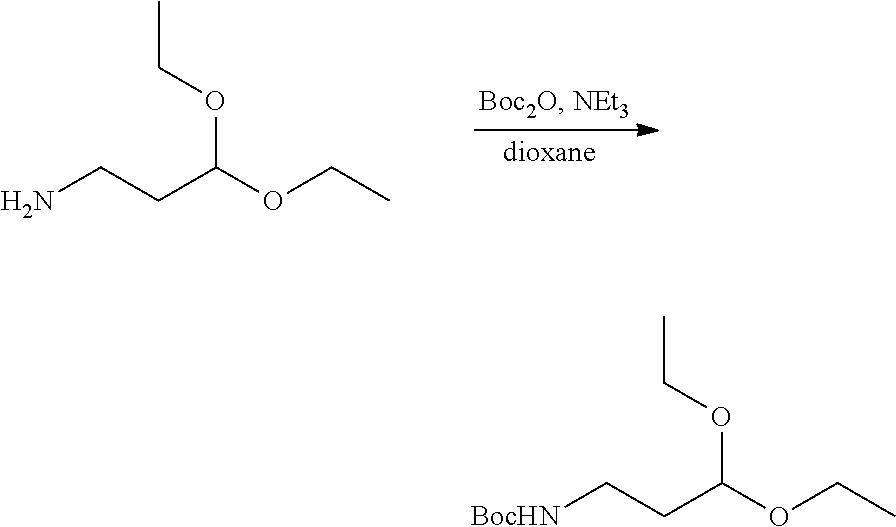


| EC50 (M) | A549 | MDA-MB-231 | MCF-7 | |
| Compound | ||||
| 15 | 1.45 × 10⁻¹⁰ | 1.70 × 10⁻¹⁰ | 7.15 × 10⁻¹⁰ | 2.18 × 10⁻¹⁰ |
| EC50 (M) | ||
| MDA- | |||
| No | Structure | A549 | MB-231 |
| 12 |
 |
1.48 × 10⁻¹⁰ | 5.80 × 10⁻¹⁰ |
| 15 |
 |
1.45 × 10⁻¹⁰ | 1.70 × 10⁻¹⁰ |
| Com- parative example 1 |
 |
3.76 × 10⁻⁹ | 2.29 × 10⁻⁹ |
| 13 |
 |
2.71 × 10⁻⁸ | 7.95 × 10⁻⁸ |
| Com- prative example 2 |
 |
4.03 × 10⁻⁷ | 9.75 × 10⁻⁷ |


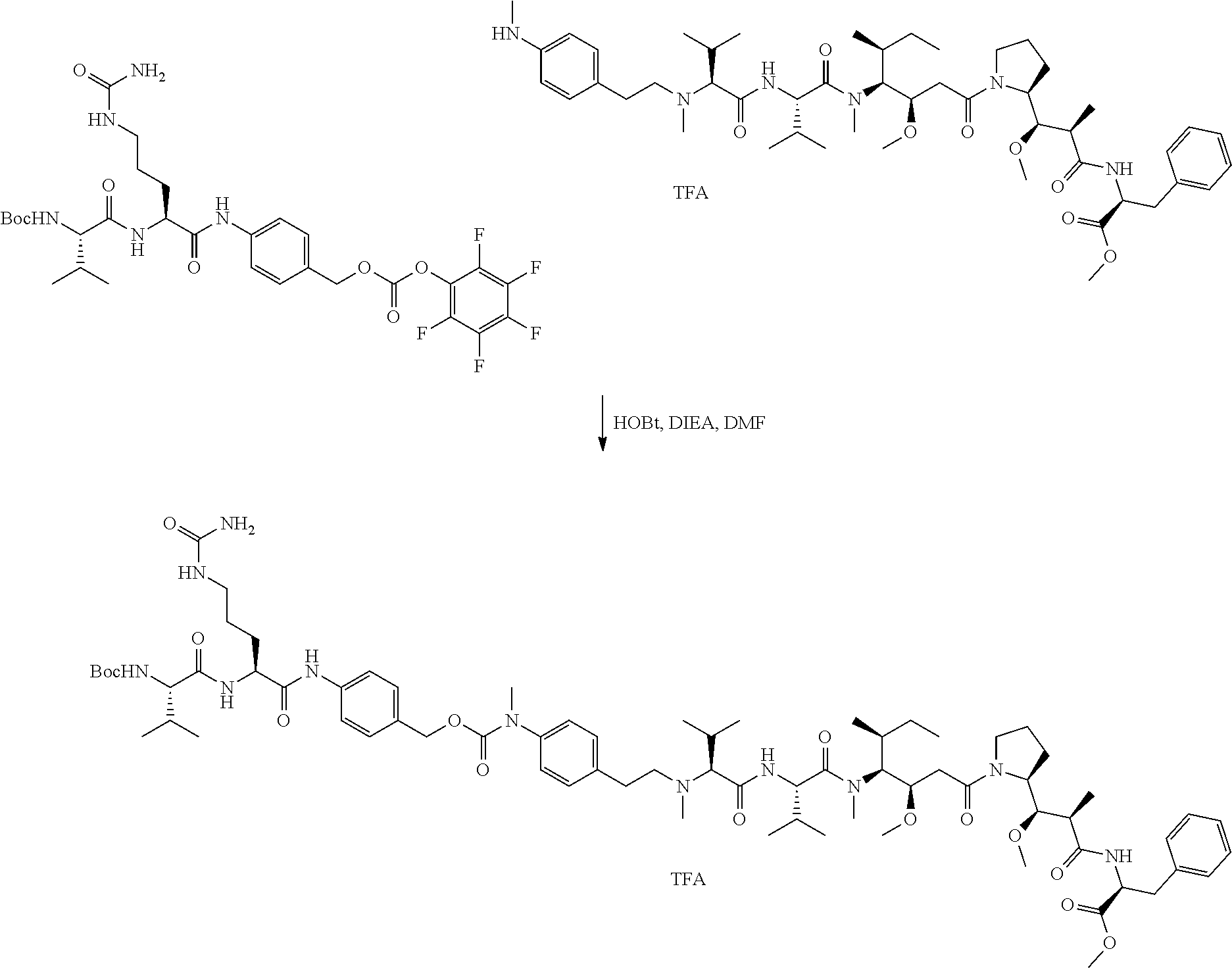


Claims (15)
Ab-(L-D)n (I)


Priority Applications (1)
| Application Number | Priority Date | Filing Date | Title |
|---|---|---|---|
| US14/923,022 US9669106B2 (en) | 2015-10-26 | 2015-10-26 | Conjugate of monomethyl auristatin F and trastuzumab and its use for the treatment of cancer |
Applications Claiming Priority (1)
| Application Number | Priority Date | Filing Date | Title |
|---|---|---|---|
| US14/923,022 US9669106B2 (en) | 2015-10-26 | 2015-10-26 | Conjugate of monomethyl auristatin F and trastuzumab and its use for the treatment of cancer |
Publications (2)
| Publication Number | Publication Date |
|---|---|
| US20170112943A1 US20170112943A1 (en) | 2017-04-27 |
| US9669106B2 true US9669106B2 (en) | 2017-06-06 |
Family
ID=58561612
Family Applications (1)
| Application Number | Title | Priority Date | Filing Date |
|---|---|---|---|
| US14/923,022 Expired - Fee Related US9669106B2 (en) | 2015-10-26 | 2015-10-26 | Conjugate of monomethyl auristatin F and trastuzumab and its use for the treatment of cancer |
Country Status (1)
| Country | Link |
|---|---|
| US (1) | US9669106B2 (en) |
Families Citing this family (1)
| Publication number | Priority date | Publication date | Assignee | Title |
|---|---|---|---|---|
| WO2017153432A1 (en) * | 2016-03-07 | 2017-09-14 | Pierre Fabre Medicament | A new universal method to capture and analyze adcs for characterization of drug distribution and the drug-to-antibody ratio in biological samples |
Citations (7)
| Publication number | Priority date | Publication date | Assignee | Title |
|---|---|---|---|---|
| US20090098115A1 (en) | 2006-10-20 | 2009-04-16 | Lisa Michele Crocker | Cell lines and animal models of HER2 expressing tumors |
| US7521541B2 (en) | 2004-09-23 | 2009-04-21 | Genetech Inc. | Cysteine engineered antibodies and conjugates |
| WO2009052249A1 (en) | 2007-10-19 | 2009-04-23 | Genentech, Inc. | Cysteine engineered anti-tenb2 antibodies and antibody drug conjugates |
| US7723485B2 (en) | 2007-05-08 | 2010-05-25 | Genentech, Inc. | Cysteine engineered anti-MUC16 antibodies and antibody drug conjugates |
| EP2589609A1 (en) | 2011-11-03 | 2013-05-08 | Pierre Fabre Medicament | Antigen binding protein and its use as addressing product for the treatment of cancer |
| WO2013185115A1 (en) | 2012-06-08 | 2013-12-12 | Sutro Biopharma, Inc. | Antibodies comprising site-specific non-natural amino acid residues, methods of their preparation and methods of their use |
| WO2015162293A1 (en) * | 2014-04-25 | 2015-10-29 | Pierre Fabre Medicament | Antibody-drug-conjugate and its use for the treatment of cancer |
-
2015
- 2015-10-26 US US14/923,022 patent/US9669106B2/en not_active Expired - Fee Related
Patent Citations (7)
| Publication number | Priority date | Publication date | Assignee | Title |
|---|---|---|---|---|
| US7521541B2 (en) | 2004-09-23 | 2009-04-21 | Genetech Inc. | Cysteine engineered antibodies and conjugates |
| US20090098115A1 (en) | 2006-10-20 | 2009-04-16 | Lisa Michele Crocker | Cell lines and animal models of HER2 expressing tumors |
| US7723485B2 (en) | 2007-05-08 | 2010-05-25 | Genentech, Inc. | Cysteine engineered anti-MUC16 antibodies and antibody drug conjugates |
| WO2009052249A1 (en) | 2007-10-19 | 2009-04-23 | Genentech, Inc. | Cysteine engineered anti-tenb2 antibodies and antibody drug conjugates |
| EP2589609A1 (en) | 2011-11-03 | 2013-05-08 | Pierre Fabre Medicament | Antigen binding protein and its use as addressing product for the treatment of cancer |
| WO2013185115A1 (en) | 2012-06-08 | 2013-12-12 | Sutro Biopharma, Inc. | Antibodies comprising site-specific non-natural amino acid residues, methods of their preparation and methods of their use |
| WO2015162293A1 (en) * | 2014-04-25 | 2015-10-29 | Pierre Fabre Medicament | Antibody-drug-conjugate and its use for the treatment of cancer |
Non-Patent Citations (14)
Also Published As
| Publication number | Publication date |
|---|---|
| US20170112943A1 (en) | 2017-04-27 |
Similar Documents
| Publication | Publication Date | Title |
|---|---|---|
| US12257281B2 (en) | Hydrophilic antibody-drug conjugates | |
| US20240247030A1 (en) | Targeted delivery of tertiary amine-containing drug substances | |
| US11918656B2 (en) | Antibody-drug-conjugate and its use for the treatment of cancer | |
| WO2016173682A1 (en) | Conjugate of monomethyl auristatin f and trastuzumab and its use for the treatment of cancer | |
| US11661457B2 (en) | IGF-1R antibody-drug-conjugate and its use for the treatment of cancer | |
| US20250000996A1 (en) | Camptothecin derivatives and conjugates thereof | |
| US20250262312A1 (en) | Selective drug release from internalized conjugates of biologically active compounds | |
| US11229708B2 (en) | Conjugates of quaternized tubulysin compounds | |
| US20240350657A1 (en) | Sulfomaleimide-based linkers and corresponding conjugates | |
| US20170112943A1 (en) | Conjugate of monomethyl auristatin f and trastuzumab and its use for the treatment of cancer | |
| US11793880B2 (en) | Conjugates of quaternized tubulysin compounds | |
| CN119894535A (en) | Oritastatin derivatives and conjugates thereof | |
| US20240156969A1 (en) | Conjugates of quaternized tubulysin compounds | |
| NZ722252B2 (en) | Hydrophilic antibody-drug conjugates |
Legal Events
| Date | Code | Title | Description |
|---|---|---|---|
| AS | Assignment |
Owner name: PIERRE FABRE MEDICAMENT, FRANCE Free format text: ASSIGNMENT OF ASSIGNORS INTEREST;ASSIGNORS:GOETSCH, LILIANE;JOUHANNEAUD, ALEXANDRA;PEREZ, MICHEL;REEL/FRAME:037718/0564 Effective date: 20160111 |
|
| FEPP | Fee payment procedure |
Free format text: PAYOR NUMBER ASSIGNED (ORIGINAL EVENT CODE: ASPN); ENTITY STATUS OF PATENT OWNER: LARGE ENTITY |
|
| STCF | Information on status: patent grant |
Free format text: PATENTED CASE |
|
| CC | Certificate of correction | ||
| LAPS | Lapse for failure to pay maintenance fees |
Free format text: PATENT EXPIRED FOR FAILURE TO PAY MAINTENANCE FEES (ORIGINAL EVENT CODE: EXP.); ENTITY STATUS OF PATENT OWNER: LARGE ENTITY |
|
| FEPP | Fee payment procedure |
Free format text: MAINTENANCE FEE REMINDER MAILED (ORIGINAL EVENT CODE: REM.); ENTITY STATUS OF PATENT OWNER: LARGE ENTITY |
|
| STCH | Information on status: patent discontinuation |
Free format text: PATENT EXPIRED DUE TO NONPAYMENT OF MAINTENANCE FEES UNDER 37 CFR 1.362 |
|
| FP | Lapsed due to failure to pay maintenance fee |
Effective date: 20210606 |