US9647860B2 - Soft demapper, calculating system, and method for calibrating soft data of multimedia data stream - Google Patents
Soft demapper, calculating system, and method for calibrating soft data of multimedia data stream Download PDFInfo
- Publication number
- US9647860B2 US9647860B2 US14/140,847 US201314140847A US9647860B2 US 9647860 B2 US9647860 B2 US 9647860B2 US 201314140847 A US201314140847 A US 201314140847A US 9647860 B2 US9647860 B2 US 9647860B2
- Authority
- US
- United States
- Prior art keywords
- soft
- data stream
- multimedia data
- scaling factor
- channel
- Prior art date
- Legal status (The legal status is an assumption and is not a legal conclusion. Google has not performed a legal analysis and makes no representation as to the accuracy of the status listed.)
- Expired - Fee Related, expires
Links
Images


Classifications
-
- H—ELECTRICITY
- H04—ELECTRIC COMMUNICATION TECHNIQUE
- H04L—TRANSMISSION OF DIGITAL INFORMATION, e.g. TELEGRAPHIC COMMUNICATION
- H04L25/00—Baseband systems
- H04L25/02—Details ; arrangements for supplying electrical power along data transmission lines
- H04L25/06—DC level restoring means; Bias distortion correction ; Decision circuits providing symbol by symbol detection
- H04L25/067—DC level restoring means; Bias distortion correction ; Decision circuits providing symbol by symbol detection providing soft decisions, i.e. decisions together with an estimate of reliability
-
- H—ELECTRICITY
- H04—ELECTRIC COMMUNICATION TECHNIQUE
- H04N—PICTORIAL COMMUNICATION, e.g. TELEVISION
- H04N21/00—Selective content distribution, e.g. interactive television or video on demand [VOD]
- H04N21/40—Client devices specifically adapted for the reception of or interaction with content, e.g. set-top-box [STB]; Operations thereof
- H04N21/43—Processing of content or additional data, e.g. demultiplexing additional data from a digital video stream; Elementary client operations, e.g. monitoring of home network or synchronising decoder's clock; Client middleware
- H04N21/438—Interfacing the downstream path of the transmission network originating from a server, e.g. retrieving encoded video stream packets from an IP network
- H04N21/4382—Demodulation or channel decoding, e.g. QPSK demodulation
-
- H—ELECTRICITY
- H04—ELECTRIC COMMUNICATION TECHNIQUE
- H04N—PICTORIAL COMMUNICATION, e.g. TELEVISION
- H04N5/00—Details of television systems
- H04N5/44—Receiver circuitry for the reception of television signals according to analogue transmission standards
- H04N5/455—Demodulation-circuits
Definitions
- the present invention discloses a method of calibrating soft data of multimedia data streams, a soft demapper and a multimedia data stream calculating system, and more particularly, to a method of calibrating soft data by a scaling factor corresponding to lowest bit error rate (BER), a soft demapper utilizing the mentioned method above, and a multimedia data stream calculating system utilizing the provided soft demapper.
- BER bit error rate
- an ideal Gaussian Model is usually applied in the simulations of channel (propagation) models for various channel signals.
- the simulation results according to the ideal Gaussian Model may have significant errors or deviations compared to real channel propagation models of various digital TV channel signals.
- multimedia data stream of digital TV signal contains soft data, which is simulated and computed according to Gaussian Model.
- Gaussian Model When simulation with Gaussian Model have significant deviations/errors compared to that in real situation in digital TV channel signal propagations, the correctness of data detection in multimedia data streams can be deteriorated seriously, and broadcasting quality of multimedia data stream in the digital TV signals by digital TV is also downgraded in consequence.
- FIG. 1 illustrates a signal strength diagram with respect to signal propagation of digital TV channels simulated according to a non-ideal channel model.
- a simulated signal strength ceiling SUP is generated when Gaussian Model is used to simulate channel model of the digital TV signal.
- Gaussian Model For digital TV signal receiver, in high-density urban areas or fully scattering environment, frequency variation of received signal (or symbol) can be overly large (the phenomenon is called fading), such that the signal strength of real digital TV signal RL may exceed the simulated signal strength ceiling SUP. Under such circumstances, the signal strength exceeding SUP is treated as the simulated signal strength ceiling SUP in Gaussian Model simulation. As a result, obvious errors are induced after the signals exceeding the ceiling SUP are converted to soft data. And playing quality of digital TV signal would be seriously downgraded in consequence.
- the present application discloses a method of calibrating soft data of multimedia data streams, a soft demapper, and a multimedia data stream calculating system.
- the method for calibrating soft data in multimedia data streams comprising: calculating a plurality of first soft data in a multimedia data stream; searching for a scaling factor in a lookup table, the scaling factor being corresponding to channel information and encoding rate information carried in the multimedia data stream, wherein the lookup table stores multiple combinations of multiple sets of channel information and multiple encoding rates, each of which comprises information of a scaling factor corresponding to a lowest bit error rate; determining a first channel response according to the channel information and performing correlation operation on the first channel response and the found scaling factor to generate a second channel response; and combining the second channel response and the plurality of first soft data to generate a plurality of second soft data.
- the soft demapper comprises a soft data generator, a scaling factor determination module, a channel response generation module, and a dynamic channel calibration module.
- the soft data generator is configured to calculate a plurality of first soft data in a multimedia data stream.
- the scaling factor determination module is configured to search for a scaling factor in a lookup table, the scaling factor being corresponding to channel information and encoding rate information carried in the multimedia data stream.
- the lookup table stores multiple combinations of multiple sets of channel information and multiple encoding rates, each of which comprises information of a scaling factor corresponding to a lowest bit error rate.
- the channel response generation module is configured to determine a first channel response according to the channel information and to perform correlation operation on the first channel response and the found scaling factor to generate a second channel response.
- the dynamic channel calibration module is configured to combine the second channel response and the plurality of first soft data to generate a plurality of second soft data.
- a multimedia data stream calculating system comprises a front end module, a soft demapper, and a back end module.
- the front end module is configured to perform channel equalizing, automatic gain control, and bit interleaving operations on a first multimedia data stream to generate a second multimedia data stream.
- the soft demapper comprises a soft data generator, a scaling factor determination module, a channel response generation module, and a dynamic channel calibration module.
- the soft data generator is configured to calculate a plurality of first soft data in the second multimedia data stream.
- the scaling factor determination module is configured to search for a scaling factor in a lookup table, the scaling factor being corresponding to channel information and encoding rate information carried in the multimedia data stream.
- the lookup table stores multiple combinations of multiple sets of channel information and multiple encoding rates, each of which comprises information of a scaling factor corresponding to a lowest bit error rate.
- the channel response generation module is configured to determine a first channel response according to the channel information and to perform correlation operation on the first channel response and the found scaling factor to generate a second channel response.
- the dynamic channel calibration module is configured to combine the second channel response and the plurality of first soft data to generate a plurality of second soft data.
- the back end module is configured to perform bit de-interleaving and decoding on the plurality of second soft data to generate a third multimedia data stream.
- FIG. 1 is a signal strength diagram with respect to signal propagation of digital TV channels simulated according to a non-ideal channel model.
- FIG. 2 is a block diagram of a soft demapper disclosed according to an embodiment of the present invention.
- FIG. 3 is a diagram of a relationship curve corresponding to the scaling factor and the bit error rate.
- FIG. 4 is a block diagram showing a multimedia data stream calculating system utilizing the disclosed soft demapper in accordance with an embodiment of the present invention.
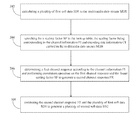
- FIG. 5 is a flowchart diagram showing a method for calibrating soft data of the multimedia data stream in accordance of an embodiment of the present invention.
- the soft demapper 100 comprises a soft data generator 110 , a scaling factor determination module 120 , a channel response generation module 130 , and a dynamic channel calibration module 140 .
- the soft data generator 110 is configured to calculate a plurality of first soft data SD 1 in one received multimedia data stream MDS.
- the scaling factor determination module 120 is configured to search for a scaling factor SF corresponding to channel information FI and encoding rate information CI in a lookup table stored in the scaling factor determination module 120 according to the channel information FI and encoding rate information CI contained in the multimedia data stream MDS. The details of searching for the scaling factor in the lookup table would be described later.
- the channel response generation module 130 is configured to generate a channel response FR according to a correlation operation on the found scaling factor SF and an initial channel response which is determined according to the channel information FI.
- the dynamic channel calibration module 140 is configured to generate a plurality of second soft data SD 2 , as the output signal of the soft demapper 100 , according to the channel response FR and the plurality of first soft data SD 1 .
- the scaling factor determination module 120 utilizes the look-up table to determine the scaling factor SF, where the look-up table is related to a curve defined by the scaling factor and the bit error rate (BER).
- FIG. 3 it shows a schematic diagram of the curve BEL defined by the scaling factors and the BERs.
- the curve BEL shown in the FIG. 3 is defined using various BERs of the soft demapper 100 estimated with respect to various scaling factors. For example, after the curve BEL is generated, assuming the lowest bit error rate BERmin exists at where the scaling factor equals to 0.01, then the 0.01 value of scaling factor, the corresponding channel response and encoding rate, with respect to the curve BEL, becomes an entry in the lookup table. In other words, the lookup table stores entries of scaling factors corresponding to the lowest bit error rates under various combinations of channel response and encoding rate.
- the scaling factor value 0.01 is used for the calibration of soft data.
- the combination of channel response and encoding rate would be used as an index by the scaling factor determination module 120 to search in the lookup table; in this particular case, the scaling factor value 0.01 is found according to the index.
- FIG. 4 depicts a block diagram showing a multimedia data stream calculating system 200 utilizing the soft demapper 100 in accordance with an embodiment of the present invention.
- the multimedia data stream calculating system 200 further comprises a front end module 210 and a back end module 220 .
- the front end module 210 is configured to perform channel equalizing, automatic gain control, and bit interleaving operations on an initial multimedia data stream to generate the multimedia data stream MDS to be sent to the soft demapper 100 .
- the back end module 220 is configured to perform bit de-interleaving and decoding on the plurality of second soft data SD 2 to generate the ultimate multimedia data stream to be played.
- the multimedia data streams conform to ISDB-T (Integrated Services Digital Broadcasting-Terrestrial) protocol.
- ISDB-T Integrated Services Digital Broadcasting-Terrestrial
- the channel responses indicated by the channel information FI comprise at least 16-point Quadrature Amplitude Modulation (QAM), 64-point QAM, or 4-bit Quadrature Phase-Shift Keying (QPSK).
- QAM Quadrature Amplitude Modulation
- QPSK 4-bit Quadrature Phase-Shift Keying
- the mentioned soft data can be Log-Likelihood Ratio (LLR) representing likelihood to the real soft data.
- LLR Log-Likelihood Ratio
- LLR represents the calculated likelihood value
- LLR(real) represents the real part of LLR value
- LLR(image) represents the imaginary part
- x and y are the real part and the imaginary part of a symbol r, respectively
- LLR represents the soft data of the symbol r
- Q x and Q y represent the real part variance and the imaginary part variance of the normal distribution of the symbol r, respectively.
- the probability density function could be represented as:
- LLR(real) logarithm function of the probability density functions ratio of the real part of the symbol r equal to 1 and equal to ⁇ 1 (minus one), represented as follows:
- LLR x ⁇ log ⁇ ( f ⁇ ( r
- x + 1 ) f ⁇ ( r
- the definition of the LLR(image) is the logarithm function of the probability density functions ratio of the imaginary part of the symbol equal to 1 and equal to ⁇ 1 (minus one), represented as follows:
- LLR y ⁇ log ⁇ ( f ⁇ ( r
- y + 1 ) f ⁇ ( r
- the channel information FI and encoding rate information CI are obtained from or determined by the scaling factor determination module 120 according to TMCC (Transmission and Multiplexing Configuration Control), information carried in the multimedia data stream MDS for performing search on the lookup table.
- TMCC Transmission and Multiplexing Configuration Control
- FIG. 5 depicts a flowchart diagram showing a method for calibrating soft data of the multimedia data stream in accordance of an embodiment of the present invention. As shown in the FIG. 5 , the method comprises steps as follows:
- Step 302 calculating a plurality of first soft data SD 1 in the multimedia data stream MDS.
- Step 304 searching for a scaling factor SF in the lookup table, the scaling factor being corresponding to the channel information FI and encoding rate information CI carried in the multimedia data stream MDS.
- Step 306 determining a first channel response according to the channel information FI and performing correlation operation on the first channel response and the found scaling factor SF to generate a second channel response FR.
- Step 308 combining the second channel response FR and the plurality of first soft data SD 1 to generate a plurality of second soft data SD 2 .
- the present invention discloses a method of calibrating soft data of multimedia data stream, a soft demapper and a multimedia data stream calculating system.
- the soft data with outstanding deviation/errors caused from simulation with Gaussian Model can be calibrated by amplifying effects of signals with low bit error rate and reducing effects of signals with high bit error rate.
- the broadcast quality is effectively maintained.
Landscapes
- Engineering & Computer Science (AREA)
- Power Engineering (AREA)
- Computer Networks & Wireless Communication (AREA)
- Signal Processing (AREA)
- Detection And Prevention Of Errors In Transmission (AREA)
- Two-Way Televisions, Distribution Of Moving Picture Or The Like (AREA)
Abstract
Description
where LLR represents the calculated likelihood value, LLR(real) represents the real part of LLR value, and LLR(image) represents the imaginary part; where x and y are the real part and the imaginary part of a symbol r, respectively; where LLR represents the soft data of the symbol r; Qx and Qy represent the real part variance and the imaginary part variance of the normal distribution of the symbol r, respectively. The calculations of Formula (1) and (2) are described below.
where exp( ) represents an natural exponential function on the basis of natural numbers. The definition of LLR(real) is the logarithm function of the probability density functions ratio of the real part of the symbol r equal to 1 and equal to −1 (minus one), represented as follows:
Claims (8)
Applications Claiming Priority (3)
| Application Number | Priority Date | Filing Date | Title |
|---|---|---|---|
| TW102101941A | 2013-01-18 | ||
| TW102101941 | 2013-01-18 | ||
| TW102101941A TWI479839B (en) | 2013-01-18 | 2013-01-18 | Method of calibrating soft data of multimedia data stream, soft demapper, and multimedia data stream calculating system |
Publications (2)
| Publication Number | Publication Date |
|---|---|
| US20140204997A1 US20140204997A1 (en) | 2014-07-24 |
| US9647860B2 true US9647860B2 (en) | 2017-05-09 |
Family
ID=51207662
Family Applications (1)
| Application Number | Title | Priority Date | Filing Date |
|---|---|---|---|
| US14/140,847 Expired - Fee Related US9647860B2 (en) | 2013-01-18 | 2013-12-26 | Soft demapper, calculating system, and method for calibrating soft data of multimedia data stream |
Country Status (2)
| Country | Link |
|---|---|
| US (1) | US9647860B2 (en) |
| TW (1) | TWI479839B (en) |
Citations (7)
| Publication number | Priority date | Publication date | Assignee | Title |
|---|---|---|---|---|
| US20020136320A1 (en) * | 2001-03-23 | 2002-09-26 | Jin Gary Q. | Flexible bit selection using turbo trellis-coded modulation |
| US20070041437A1 (en) * | 2005-08-18 | 2007-02-22 | Chun-Ming Kuo | Bit error probability estimating system and related method thereof |
| US20070288832A1 (en) * | 2006-05-24 | 2007-12-13 | Fujitsu Limited | Device and method for receiving digital signal transmitted using ofdm method |
| US20080291819A1 (en) * | 2007-05-25 | 2008-11-27 | Gwang-Hyun Gho | Soft-bit de-mapping device and method of generating soft bits for decoding |
| CN101471749A (en) * | 2007-12-28 | 2009-07-01 | 三星电子株式会社 | Method for generating log-likelihood ratio for QAM-OFDM modulating signal |
| US20090316841A1 (en) * | 2008-06-20 | 2009-12-24 | Advanced Micro Devices, Inc. | Null detection and erasure decoding for frequency selective channels in a broadcasting system |
| US20110035647A1 (en) * | 2005-11-03 | 2011-02-10 | Entropic Communications, Inc. | Broadband satellite system for the simultaneous reception of multiple channels using shared iterative decoder |
Family Cites Families (5)
| Publication number | Priority date | Publication date | Assignee | Title |
|---|---|---|---|---|
| TWI380649B (en) * | 2006-09-20 | 2012-12-21 | Ind Tech Res Inst | Methods for compensating iq imbalance |
| FI20065699A0 (en) * | 2006-11-06 | 2006-11-06 | Nokia Corp | HARQ reception in multi-radio device |
| TWI380647B (en) * | 2008-10-03 | 2012-12-21 | Ic Plus Corp | Transceiver apparatus, receiver and power saving method thereof |
| US9753877B2 (en) * | 2009-11-30 | 2017-09-05 | Avago Technologies General Ip (Singapore) Pte. Ltd. | Memory read-channel with signal processing on general purpose processor |
| US8503587B2 (en) * | 2011-05-23 | 2013-08-06 | Harris Corporation | Adaptive channel tracking using peak fade depth estimation over a slot |
-
2013
- 2013-01-18 TW TW102101941A patent/TWI479839B/en not_active IP Right Cessation
- 2013-12-26 US US14/140,847 patent/US9647860B2/en not_active Expired - Fee Related
Patent Citations (7)
| Publication number | Priority date | Publication date | Assignee | Title |
|---|---|---|---|---|
| US20020136320A1 (en) * | 2001-03-23 | 2002-09-26 | Jin Gary Q. | Flexible bit selection using turbo trellis-coded modulation |
| US20070041437A1 (en) * | 2005-08-18 | 2007-02-22 | Chun-Ming Kuo | Bit error probability estimating system and related method thereof |
| US20110035647A1 (en) * | 2005-11-03 | 2011-02-10 | Entropic Communications, Inc. | Broadband satellite system for the simultaneous reception of multiple channels using shared iterative decoder |
| US20070288832A1 (en) * | 2006-05-24 | 2007-12-13 | Fujitsu Limited | Device and method for receiving digital signal transmitted using ofdm method |
| US20080291819A1 (en) * | 2007-05-25 | 2008-11-27 | Gwang-Hyun Gho | Soft-bit de-mapping device and method of generating soft bits for decoding |
| CN101471749A (en) * | 2007-12-28 | 2009-07-01 | 三星电子株式会社 | Method for generating log-likelihood ratio for QAM-OFDM modulating signal |
| US20090316841A1 (en) * | 2008-06-20 | 2009-12-24 | Advanced Micro Devices, Inc. | Null detection and erasure decoding for frequency selective channels in a broadcasting system |
Non-Patent Citations (2)
| Title |
|---|
| China Patent Office "Offce Action" issued on Nov. 2, 2016, China. |
| Kim et al, "One-Dimensional Soft-Demapping using Decorrelation with Interference Cancellation for Rotated QAM Constellations", Jan. 2012. * |
Also Published As
| Publication number | Publication date |
|---|---|
| TWI479839B (en) | 2015-04-01 |
| TW201431356A (en) | 2014-08-01 |
| US20140204997A1 (en) | 2014-07-24 |
Similar Documents
| Publication | Publication Date | Title |
|---|---|---|
| CN101022444B (en) | Method and device for generating channel state information by terrestrial broadcasting digital video receiver | |
| US7483497B2 (en) | Method and apparatus for calculating log-likelihood ratio for decoding in a receiver for a mobile communication system | |
| US20050129136A1 (en) | OFDM receiver | |
| KR102021314B1 (en) | Apparatus and method for soft-decision demodulating in Non-square Quadrature Amplitude Modulation | |
| CN101471749A (en) | Method for generating log-likelihood ratio for QAM-OFDM modulating signal | |
| CN101406019A (en) | Method and apparatus for calculating likelihood metric of a received signal in a digital communication system | |
| CN101658006A (en) | Method and apparatus for mitigating interference in a multi-carrier modulation system | |
| US8284875B2 (en) | Methods and systems for frequency domain gain control in OFDM MIMO systems | |
| US8457184B2 (en) | Method and apparatus for performing log-likelihood calculations | |
| US20100149990A1 (en) | Channel estimation mehtod and apparatus using data channel | |
| US9071401B2 (en) | Pilot-less noise estimation | |
| US20090323866A1 (en) | Demodulation method | |
| US7936849B2 (en) | Decoding device and method | |
| US20140204997A1 (en) | Soft Demapper, Calculating System, and Method for Calibrating Soft Data of Multimedia Data Stream | |
| CN102457337B (en) | Receiving equipment and method, demodulated equipment and method | |
| US8358683B2 (en) | Channel equalizer | |
| CN103997674B (en) | Method for tuning soft data in multimedia data stream and soft data demapper | |
| US20070041437A1 (en) | Bit error probability estimating system and related method thereof | |
| US8218613B2 (en) | Channel estimator and channel estimation method | |
| CN105871396B (en) | Signal receiving end capable of adaptively adjusting soft information and signal processing method thereof | |
| JP5478327B2 (en) | Wireless communication system, receiver, and demodulation method for transmitting and receiving signals generated by modulo arithmetic | |
| US20100086014A1 (en) | Channel Estimator and Channel Estimation Method | |
| Karyakin | Evaluation of efficiency of fighting with interference distortion in Single-Frequency Networks of TV broadcasting | |
| JPH1198102A (en) | Ofdm receiver | |
| CN106230760A (en) | A kind of Soft Inform ation acquisition methods being applicable to pi/4_DQPSK and device |
Legal Events
| Date | Code | Title | Description |
|---|---|---|---|
| AS | Assignment |
Owner name: MSTAR SEMICONDUCTOR, INC., TAIWAN Free format text: ASSIGNMENT OF ASSIGNORS INTEREST;ASSIGNORS:JENG, YOU-TSAI;TUNG, TAI-LAI;LIN, TUNG-SHENG;AND OTHERS;SIGNING DATES FROM 20131029 TO 20131209;REEL/FRAME:031894/0490 |
|
| FEPP | Fee payment procedure |
Free format text: PAYOR NUMBER ASSIGNED (ORIGINAL EVENT CODE: ASPN); ENTITY STATUS OF PATENT OWNER: LARGE ENTITY |
|
| STCF | Information on status: patent grant |
Free format text: PATENTED CASE |
|
| AS | Assignment |
Owner name: MEDIATEK INC., TAIWAN Free format text: MERGER;ASSIGNOR:MSTAR SEMICONDUCTOR, INC.;REEL/FRAME:052931/0468 Effective date: 20190115 |
|
| MAFP | Maintenance fee payment |
Free format text: PAYMENT OF MAINTENANCE FEE, 4TH YEAR, LARGE ENTITY (ORIGINAL EVENT CODE: M1551); ENTITY STATUS OF PATENT OWNER: LARGE ENTITY Year of fee payment: 4 |
|
| AS | Assignment |
Owner name: XUESHAN TECHNOLOGIES INC., CANADA Free format text: ASSIGNMENT OF ASSIGNORS INTEREST;ASSIGNOR:MEDIATEK INC.;REEL/FRAME:056593/0167 Effective date: 20201223 |
|
| FEPP | Fee payment procedure |
Free format text: MAINTENANCE FEE REMINDER MAILED (ORIGINAL EVENT CODE: REM.); ENTITY STATUS OF PATENT OWNER: LARGE ENTITY |
|
| LAPS | Lapse for failure to pay maintenance fees |
Free format text: PATENT EXPIRED FOR FAILURE TO PAY MAINTENANCE FEES (ORIGINAL EVENT CODE: EXP.); ENTITY STATUS OF PATENT OWNER: LARGE ENTITY |
|
| STCH | Information on status: patent discontinuation |
Free format text: PATENT EXPIRED DUE TO NONPAYMENT OF MAINTENANCE FEES UNDER 37 CFR 1.362 |
|
| FP | Lapsed due to failure to pay maintenance fee |
Effective date: 20250509 |