US9646293B2 - In session charging notifications and recharging accounts - Google Patents
In session charging notifications and recharging accounts Download PDFInfo
- Publication number
- US9646293B2 US9646293B2 US13/804,170 US201313804170A US9646293B2 US 9646293 B2 US9646293 B2 US 9646293B2 US 201313804170 A US201313804170 A US 201313804170A US 9646293 B2 US9646293 B2 US 9646293B2
- Authority
- US
- United States
- Prior art keywords
- user
- credit
- user interface
- communication session
- enable
- Prior art date
- Legal status (The legal status is an assumption and is not a legal conclusion. Google has not performed a legal analysis and makes no representation as to the accuracy of the status listed.)
- Active, expires
Links
Images


Classifications
-
- G—PHYSICS
- G06—COMPUTING OR CALCULATING; COUNTING
- G06Q—INFORMATION AND COMMUNICATION TECHNOLOGY [ICT] SPECIALLY ADAPTED FOR ADMINISTRATIVE, COMMERCIAL, FINANCIAL, MANAGERIAL OR SUPERVISORY PURPOSES; SYSTEMS OR METHODS SPECIALLY ADAPTED FOR ADMINISTRATIVE, COMMERCIAL, FINANCIAL, MANAGERIAL OR SUPERVISORY PURPOSES, NOT OTHERWISE PROVIDED FOR
- G06Q20/00—Payment architectures, schemes or protocols
- G06Q20/08—Payment architectures
- G06Q20/12—Payment architectures specially adapted for electronic shopping systems
- G06Q20/127—Shopping or accessing services according to a time-limitation
-
- H—ELECTRICITY
- H04—ELECTRIC COMMUNICATION TECHNIQUE
- H04L—TRANSMISSION OF DIGITAL INFORMATION, e.g. TELEGRAPHIC COMMUNICATION
- H04L12/00—Data switching networks
- H04L12/02—Details
- H04L12/14—Charging, metering or billing arrangements specially adapted for data communications, e.g. authentication, authorisation and accounting [AAA] framework
- H04L12/141—Indication of costs
- H04L12/1414—Indication of costs in real-time
- H04L12/1417—Advice of charge with threshold, e.g. user indicating maximum cost
-
- H—ELECTRICITY
- H04—ELECTRIC COMMUNICATION TECHNIQUE
- H04M—TELEPHONIC COMMUNICATION
- H04M15/00—Arrangements for metering, time-control or time indication ; Metering, charging or billing arrangements for voice wireline or wireless communications, e.g. VoIP
- H04M15/82—Criteria or parameters used for performing billing operations
- H04M15/8228—Session based
-
- H—ELECTRICITY
- H04—ELECTRIC COMMUNICATION TECHNIQUE
- H04M—TELEPHONIC COMMUNICATION
- H04M15/00—Arrangements for metering, time-control or time indication ; Metering, charging or billing arrangements for voice wireline or wireless communications, e.g. VoIP
- H04M15/83—Notification aspects
- H04M15/84—Types of notifications
-
- H—ELECTRICITY
- H04—ELECTRIC COMMUNICATION TECHNIQUE
- H04M—TELEPHONIC COMMUNICATION
- H04M15/00—Arrangements for metering, time-control or time indication ; Metering, charging or billing arrangements for voice wireline or wireless communications, e.g. VoIP
- H04M15/83—Notification aspects
- H04M15/85—Notification aspects characterised by the type of condition triggering a notification
- H04M15/852—Low balance or limit reached
-
- H—ELECTRICITY
- H04—ELECTRIC COMMUNICATION TECHNIQUE
- H04M—TELEPHONIC COMMUNICATION
- H04M15/00—Arrangements for metering, time-control or time indication ; Metering, charging or billing arrangements for voice wireline or wireless communications, e.g. VoIP
- H04M15/88—Provision for limiting connection, or expenditure
-
- H—ELECTRICITY
- H04—ELECTRIC COMMUNICATION TECHNIQUE
- H04M—TELEPHONIC COMMUNICATION
- H04M15/00—Arrangements for metering, time-control or time indication ; Metering, charging or billing arrangements for voice wireline or wireless communications, e.g. VoIP
- H04M15/88—Provision for limiting connection, or expenditure
- H04M15/882—Provision for limiting connection, or expenditure for continuing the call beyond the limit using an alternative, e.g. alternative account
-
- H—ELECTRICITY
- H04—ELECTRIC COMMUNICATION TECHNIQUE
- H04M—TELEPHONIC COMMUNICATION
- H04M17/00—Prepayment of wireline communication systems, wireless communication systems or telephone systems
- H04M17/20—Prepayment of wireline communication systems, wireless communication systems or telephone systems with provision for recharging the prepaid account or card, or for credit establishment
-
- H—ELECTRICITY
- H04—ELECTRIC COMMUNICATION TECHNIQUE
- H04M—TELEPHONIC COMMUNICATION
- H04M17/00—Prepayment of wireline communication systems, wireless communication systems or telephone systems
- H04M17/20—Prepayment of wireline communication systems, wireless communication systems or telephone systems with provision for recharging the prepaid account or card, or for credit establishment
- H04M17/202—Prepayment of wireline communication systems, wireless communication systems or telephone systems with provision for recharging the prepaid account or card, or for credit establishment selecting interactively a payment method
-
- H—ELECTRICITY
- H04—ELECTRIC COMMUNICATION TECHNIQUE
- H04M—TELEPHONIC COMMUNICATION
- H04M17/00—Prepayment of wireline communication systems, wireless communication systems or telephone systems
- H04M17/20—Prepayment of wireline communication systems, wireless communication systems or telephone systems with provision for recharging the prepaid account or card, or for credit establishment
- H04M17/204—Prepayment of wireline communication systems, wireless communication systems or telephone systems with provision for recharging the prepaid account or card, or for credit establishment on-line recharging, e.g. cashless
-
- H—ELECTRICITY
- H04—ELECTRIC COMMUNICATION TECHNIQUE
- H04L—TRANSMISSION OF DIGITAL INFORMATION, e.g. TELEGRAPHIC COMMUNICATION
- H04L12/00—Data switching networks
- H04L12/02—Details
- H04L12/14—Charging, metering or billing arrangements specially adapted for data communications, e.g. authentication, authorisation and accounting [AAA] framework
- H04L12/1453—Methods or systems for payment or settlement of the charges for data transmission involving significant interaction with the data transmission network
- H04L12/1467—Methods or systems for payment or settlement of the charges for data transmission involving significant interaction with the data transmission network involving prepayment
-
- H—ELECTRICITY
- H04—ELECTRIC COMMUNICATION TECHNIQUE
- H04M—TELEPHONIC COMMUNICATION
- H04M2215/00—Metering arrangements; Time controlling arrangements; Time indicating arrangements
- H04M2215/28—SMS billing
-
- H—ELECTRICITY
- H04—ELECTRIC COMMUNICATION TECHNIQUE
- H04W—WIRELESS COMMUNICATION NETWORKS
- H04W4/00—Services specially adapted for wireless communication networks; Facilities therefor
- H04W4/12—Messaging; Mailboxes; Announcements
- H04W4/14—Short messaging services, e.g. short message services [SMS] or unstructured supplementary service data [USSD]
Definitions
- service providers offer users the various options such as purchasing pre-paid plans or placing limits on the usage of their accounts to allow users to better manage their subscriptions.
- Such approaches can be used in scenarios including telephony, video on demand, and the like. Although this can be a very powerful feature, it is often limited in scenarios such as those that include a user wishing to consciously extend or sidestep the budgeted amount.
- Various embodiments provide a subscription management service, which can be in-band or out-of-band, which allows users to extend their subscription or temporarily side-step payment limits on a subscription without disrupting the user's experience.
- the various embodiments can be operable in all on-demand services including, but not limited to, video services, voice services, video/voice services, text services, Web services, and the like.
- users can extend or customize their service subscription, while using the service, without degradation, suspension, or termination of their service experience.
- FIG. 1 is an illustration of an environment in an example implementation that is operable to perform the various embodiments described herein.
- FIG. 2 illustrates an example client architecture in accordance with one or more embodiments.
- FIG. 3 illustrates an example activity diagram in accordance with one or more embodiments.
- FIG. 4 is a flow diagram that describes steps in a method in accordance with one or more embodiments.
- FIG. 5 is a flow diagram that describes steps in a method in accordance with one or more embodiments.
- FIG. 6 illustrates an example user interface in accordance with one or more embodiments.
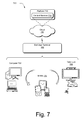
- FIG. 7 illustrates an example system that includes the various end user terminals as described with reference to FIG. 1 .
- Various embodiments provide a subscription management service, which can be in-band or out-of-band, which allows users to extend their subscription or temporarily side-step payment limits on a subscription without disrupting the user's experience.
- the various embodiments can be operable in all on-demand services including, but not limited to, video services, voice services, video/voice services, text services, Web services, and the like.
- users can extend or customize their service subscription, while using the service, without degradation, suspension, or termination of their service experience.
- the subscription management service provides an infrastructure around various services that enables users to extend the use of the service and/or temporarily ignore imposed monetary limits.
- service extension opportunities can be provided to the user while they are participating in the service without disrupting their current service session. This can be particularly useful in scenarios where expiration of a particular service is reached in the middle of an existing session, such as the typical pre-paid service scenario or service scenarios in which a user has pre-established monetary limits.
- the user when a user's credit is about to expire, the user is presented with an announcement or some other notification.
- the user acting on the announcement or notification, can take measures to prevent their credit from expiring through either in-band and/or out-of-band techniques which can temporarily or permanently recharge an associated account by a specified amount.
- the in-band and out-of-band techniques can include, by way of example and not limitation, dialing into a number, providing input via keys on a keypad, sending an SMS message during service consumption, and the like.
- service providers can also utilize supplementary applications on, for example, mobile devices, to notify users of charging events and subsequent payments.
- Example Environment describes an example environment in which the various embodiments can be utilized.
- Example Activity Diagram describes an example activity diagram in accordance with one or more embodiments.
- Example User Interfaces describes example user interfaces in accordance with one or more embodiments.
- Example System describes an example system and various devices that can be utilized to implement one or more embodiments.
- FIG. 1 is a schematic illustration of a communication system 100 which, in at least some embodiments, can be implemented over a packet-based network, here represented by communication cloud 110 in the form of the Internet, comprising a plurality of interconnected elements.
- each network element may be connected to the rest of the Internet, and is configured to communicate data with other such elements over the Internet by transmitting and receiving data in the form of Internet Protocol (IP) packets.
- IP Internet Protocol
- networks other than the Internet can be utilized.
- PSTN can route calls via non-IP protocols.
- calling can take place within private networks rather than the Internet.
- each element also has an associated IP address locating it within the Internet, and each packet includes a source and destination IP address in its header.
- the elements shown in FIG. 1 include a plurality of end-user terminals 102 ( a ), 102 ( b ), and 102 ( c ) such as desktop or laptop PCs or Internet-enabled mobile phones, a server 104 , such as a peer-to-peer server of an Internet-based communication system or a traditional server configured to enable client/server communication, a server 106 that supports or otherwise implements a subscription management service as described above and below, and a gateway 107 to another type of network 108 , such as to a traditional Public-Switched Telephone Network (PSTN) or other circuit switched network, and/or to a mobile cellular network.
- PSTN Public-Switched Telephone Network
- FIG. 1 the communications cloud 110 which typically includes many other end-user terminals, servers and gateways, as well as routers of Internet service providers (ISPs) and Internet backbone routers.
- ISPs Internet service providers
- the subscription management service offered by server 106 allows users to extend their subscription or temporarily side-step payment limits on a subscription without disrupting the user's experience.
- the various embodiments can be operable in all on-demand services including, but not limited to, video services, voice services, video/voice services, text services, Web services, and the like.
- users can extend or customize their service subscription, while using the service, without degradation, suspension, or termination of their service experience.
- the subscription management service provides an infrastructure around various services that enables users to extend the use of the service and/or temporarily ignore imposed monetary limits.
- service extension opportunities can be provided to the user while they are participating in the service without disrupting their current service session. This can be particularly useful in scenarios where expiration of a particular service is reached in the middle of an existing session, such as the typical pre-paid service scenario or service scenarios in which a user has pre-established monetary limits.
- end-user terminals 102 ( a ) to 102 ( c ) can communicate with one another, as well as other entities, by way of the communication cloud using any suitable techniques.
- end-user terminals can communicate through the communication cloud 110 , through the communication cloud 110 , gateway 107 and network 108 , or through server 104 using, for example Voice over IP (VoIP).
- VoIP Voice over IP
- a client executing on an initiating end user terminal acquires the IP address of the terminal on which another client is installed. This can be done using an address look-up or any suitable technique.
- Some Internet-based communication systems are managed by an operator, in that they rely on one or more centralized, operator-run servers for address look-up (not shown). In that case, when one client is to communicate with another, then the initiating client contacts a centralized server run by the system operator to obtain the callee's IP address.
- Other approaches can be utilized. For example, in some server-based systems, call requests are received by the server and media is relayed by the server. In this instance, there is not an end-to-end connection between the clients, but rather a server in between for the communication that takes place.
- Peer-to-peer In contrast to these operator managed systems, another type of Internet-based communication system is known as a “peer-to-peer” (P2P) system.
- Peer-to-peer (P2P) systems typically devolve responsibility away from centralized operator servers and into the end-users' own terminals. This means that responsibility for address look-up is devolved to end-user terminals like those labeled 102 ( a ) to 102 ( c ). Each end user terminal can run a P2P client application, and each such terminal forms a node of the P2P system.
- P2P address look-up works by distributing a database of IP addresses amongst some of the end user nodes.
- the database is a list which maps the usernames of all online or recently online users to the relevant IP addresses, such that the IP address can be determined given the username.
- the above constitutes but an example only. It is to be appreciated and understood that other approaches can be utilized without departing from the spirit and scope of the claimed subject matter. For example, some systems can utilize multiple IP addresses or utilize URIs which have DNS names.
- the address allows a user to establish a voice or video call, or send an instant message (IM) chat message or file transfer, etc. Additionally however, the address may also be used when the client itself needs to autonomously communicate information with another client.
- IM instant message
- the schematic block diagram of FIG. 2 shows an example of an end-user terminal 102 which is configured to act as a terminal of a system operating over the Internet.
- the system may comprise a P2P system and/or a non-P2P system and may use one or more different protocols to communicate.
- the terminal 102 comprises a processor or CPU 200 operatively coupled to: a network interface 202 such as modem or other interface for connecting to the Internet, a non-volatile storage device 204 such as a hard-drive or flash memory, and a volatile memory device such as a random access memory (RAM) 206 .
- a network interface 202 such as modem or other interface for connecting to the Internet
- a non-volatile storage device 204 such as a hard-drive or flash memory
- RAM random access memory
- the terminal 102 also comprises one or more user input devices, for example in the form of a keyboard or keypad 210 , a mouse 212 , a microphone 216 and a camera 218 such as a webcam, each operatively coupled to the CPU 200 .
- the terminal 102 further comprises one or more user output devices, for example in the form of a display 208 and speaker 214 , again each operatively coupled to the CPU 200 .
- the storage device 204 stores software including at least an operating system (OS) 220 , and packet-based communication software in the form of a client application 222 which may comprise a P2P application and/or a non-P2P application through which communication can take place over a network, such as the networks described in FIG. 1 .
- OS operating system
- client application 222 which may comprise a P2P application and/or a non-P2P application through which communication can take place over a network, such as the networks described in FIG. 1 .
- the operating system 220 is automatically loaded into the RAM 206 and from there is run by being executed on the CPU 200 .
- the operating system 220 can then run applications, such as the client application 222 , by loading them into the into the RAM 206 and executing them on the CPU 200 .
- the operating system 220 and client application 222 are shown within the CPU 200 .
- the client application 222 comprises a “stack” having three basic layers: an input and output (I/O) layer 224 , a client engine layer 226 , and a client user interface (UI) layer 228 .
- I/O input and output
- UI client user interface
- the functionality of these layers can be implemented by an architecture other than the one specifically depicted without departing from the spirit and scope of the claimed subject matter.
- Each layer or corresponding functionality module is responsible for specific functions. Because each successive layer usually communicates with two adjacent layers (or one in the case of the top layer), they are regarded as being arranged in a stack as shown in FIG. 2 .
- the client application 222 is said to be run “on” the operating system 220 . This means that in a multi-tasking environment it is scheduled for execution by the operating system 220 ; and further that inputs to the lowest (I/O) layer 224 of the client application 222 from network interface 202 , microphone 216 and camera 218 as well as outputs from the I/O layer 224 to network interface 202 , display 208 and speaker 214 may be mediated via suitable drivers and/or APIs of the operating system 220 .
- the client application 222 can be implemented to include a web-based interface that can be utilized to present audiovisual and interactive content.
- the I/O layer 224 of the client application comprises a voice engine and optionally a video engine in the form of audio and video codecs which receive incoming encoded streams and decodes them for output to speaker 214 and/or display 208 as appropriate, and which receive unencoded audio and/or video data from the microphone 216 and/or camera 218 and encodes them for transmission as streams to other end-user terminals 102 of a P2P system, or other entities in a PSTN and/or mobile network such as network 108 .
- the I/O layer 224 may also comprise a control signaling protocol for signaling control information between terminals 102 of the network.
- the client engine layer 226 then handles the connection management functions of the system as discussed above, such as establishing calls or other connections by P2P address look-up and authentication, as well as by other techniques.
- the client engine may also be responsible for other secondary functions of the system such as supplying up-to-date contact lists and/or avatar images of the user to the server 104 ( FIG. 1 ); or retrieving up-to-date contact lists of the user and retrieving up-to-date avatar images of other users from the server 104 .
- the client user interface layer 228 is responsible for presenting decoded content, such as audiovisual and/or interactive content to the user via the display 208 , for presenting the output on the display 208 along with other information such as presence and profile information and user controls such as buttons and menus, and for receiving inputs from the user via the presented controls.
- decoded content such as audiovisual and/or interactive content
- user controls such as buttons and menus
- any of the functions described herein can be implemented using software, firmware, hardware (e.g., fixed logic circuitry), or a combination of these implementations.
- the terms “module,” “functionality,” “component” and “logic” as used herein generally represent software, firmware, hardware, or a combination thereof.
- the module, functionality, or logic represents program code that performs specified tasks when executed on a processor (e.g., CPU or CPUs).
- the program code can be stored in one or more computer readable memory devices.
- the end user terminal 102 may also include an entity (e.g., software) that causes hardware or virtual machines of the end user terminal 102 to perform operations, e.g., processors, functional blocks, and so on.
- the end user terminal 102 may include a computer-readable medium that may be configured to maintain instructions that cause the end user terminal, and more particularly the operating system and associated hardware of the end user terminal 102 to perform operations.
- the instructions function to configure the operating system and associated hardware to perform the operations and in this way result in transformation of the operating system and associated hardware to perform functions.
- the instructions may be provided by the computer-readable medium to the end user terminal 102 through a variety of different configurations.
- One such configuration of a computer-readable medium is signal bearing medium and thus is configured to transmit the instructions (e.g., as a carrier wave) to the end user terminal, such as via a network.
- the computer-readable medium may also be configured as a computer-readable storage medium and thus is not a signal bearing medium. Examples of a computer-readable storage medium include a random-access memory (RAM), read-only memory (ROM), an optical disc, flash memory, hard disk memory, and other memory devices that may use magnetic, optical, and other techniques to store instructions and other data.
- FIG. 3 illustrates an example activity diagram in accordance with one or more embodiments, generally at 300 .
- three entities are illustrated—a user 302 , a service provider 304 , and a charging gateway 306 .
- service provider 304 can comprise any suitable type of service provider that provides any suitable type of service, examples of which are provided above.
- Charging gateway 306 represents an entity that is responsible for maintaining credit information for various users such as user 302 with respect to services that they consume through service provider 304 .
- the charging gateway 306 is shown as an entity separate from service provider 304 , such need not be the case.
- the charging gateway 306 can constitute part of service provider 304 .
- a user's credit is monitored by a remote, third-party entity which, in this case, is the charging gateway 306 .
- a user's credit can be monitored locally, by a suitably-configured client application an example of which is provided below.
- a user first initiates a service session with service provider 304 .
- service provider 304 can include those associated with any suitable type of on-demand service including, by way of example and not limitation, video services, voice services, video/voice services, text services, Web services, and the like.
- the voice services and video/voice services can include those associated with making calls over a network such as those networks described above.
- the service provider 304 When the service provider 304 receives the session initiation notification, it informs the charging gateway 306 of the start of the new session. This enables the charging gateway 306 to check for credit information associated with the user so that it can then return a notification to the service provider 304 indicating whether the user has adequate credit for the service session. Assuming the user has adequate credit for the service session, the service session can be started.
- the charging gateway 306 can monitor the user's credit and can notify the service provider 304 in the event the user's credit is to expire within a given time period.
- the service provider 304 dispatches a charging authorization and credit expiration announcement to the user 302 .
- This can be done in any suitable way.
- a client application executing on the user's client device and through which they are participating in the service session, can receive the charging authorization and credit expiration announcement and, through a suitably-configured user interface, provide the announcement to the user. This can be considered as an in-band notification.
- out-of-band notifications can be utilized. For example, assume that a user is participating in an on-line telephone call using their desktop computer. Responsive to their session credit falling below a certain threshold, a text message or e-mail message can be generated by the service provider 304 and sent to the user's handheld device cell phone, or a different application on the user's desktop computer. Examples of suitable user interfaces are provided below.
- an in-band method may involve responding by way of a user interface presented by the client application through which the user is participating in the service session.
- An out-of-band method may involve the user responding to the service provider 304 using a different mode of communication then that being used by the current service session.
- the credit authorization provided by the user can be such that it permits the current session to complete without extending additional, unused credit.
- the user can provide authorization for credit extension which, is subsequently billed or charged to the user when the session completes and the service provider ascertains how long the session took. This approach constitutes a post-paid approach in which the user pays for session that already completed.
- the credit authorization provided by the user can be such that it not only permits the current session to complete, but provides additional, unused credit for subsequent sessions.
- this approach constitutes one that includes a pre-paid approach insofar as enabling the user to pre-pay for sessions yet to be used.
- the pre-paid approach can include not only enabling the user to authorize credit for subsequent sessions, but pre-paid service packages can be offered as well. For example, the user may be presented with options to enroll in different services.
- the service provider 304 can notify the charging gateway 306 that the user has authorized a credit payment and/or otherwise wishes for the service session to continue.
- the charging gateway can then update the credit information for the user and generate a charge notification for the service provider.
- FIG. 4 is a flow diagram that describes steps in a method in accordance with one or more embodiments.
- the method can be performed in connection with any suitable hardware, software, firmware, or combination thereof.
- the method is performed by suitably-configured software.
- aspects of the method are shown to be performed by or on behalf of three different entities—a user, a service provider, and a charging gateway.
- the method can be performed by a suitably-configured client application, such as one described above.
- Step 400 initiates a communication session.
- This step can be performed in any suitable way.
- this step can be performed utilizing a client application in a manner that enables a user to place a call, or send an SMS message or email to one or more recipients.
- the user typically maintains an account that has a pre-paid amount or credit for the communication sessions.
- Step 402 receives the session initiation from the client application.
- the service provider can take the usual steps to place the call or establish the communication session.
- Step 404 notifies the charging gateway of the start of the communication session.
- a session check can include checking to ascertain whether the user has an appropriate amount of credit for the communication session.
- the session check can include ascertaining whether the user's credit is at or near a threshold value that would imply expiration of credit during the communication session.
- step 410 notifies the service provider of the session check and the information ascertained during performance thereof.
- the charging gateway can notify the service provider of the user's credit information to permit the service provider to establish the communication session.
- the service provider receives the notification of the session check and can take any appropriate actions, such as establishing the communication session.
- the charging gateway monitors credit parameters associated with the established communication session. This can include ensuring that the user has the appropriate amount of credit to continue the communication session. It is noted that the client application can, alternately or additionally, monitor the credit parameters and notify the service provider as described in the next step (and further in the example of FIG. 5 . Step 416 notifies the service provider upon one or more conditions being met. Conditions can include, by way of example and not limitation, the user's credit reaching a particular threshold, the user's credit expiring, and the like.
- Step 418 receives the notification from the charging gateway and step 420 sends a credit notification to the user by way of the client application.
- Step 422 receives the credit notification and step 424 presents a user interface to the user to inform the user of the credit information included in the credit notification.
- the user interface an example of which is provided below, can also provide a mechanism by which the user can extend their credit by adding additional money to their account, elect to change payment options so as to automatically add credit to their account when the credit expires, or perform any other suitable payment function.
- Step 426 receives credit authorization from the user and step 428 sends the credit authorization to the service provider. It is noted that these operations can be performed during the pendency of the communication session. In this way, a user is able to continue their communication session in an uninterrupted manner while, at the same time, add credit to their account or select a payment option in which credit can be automatically added to their account upon expiration of the credit.
- Step 430 receives the credit authorization and sends the credit authorization to the charging gateway for processing.
- Step 432 receives the credit authorization and updates the user's credit information.
- the above-described method provides a mechanism to notify users of a depleted credit balance or a credit balance that is approaching its account limits while, at the same time, enable users to authorize credit extensions or service registrations/renewals within the scope of the current communication session or call. This can be done without interrupting the communication session or meaningfully degrading the user's experience.
- FIG. 5 is a flow diagram that describes steps in a method in accordance with one or more embodiments.
- the method can be performed in connection with any suitable hardware, software, firmware, or combination thereof.
- the method is performed by suitably-configured software.
- aspects of the method are shown to be performed by or on behalf of two different entities—a user and a service provider.
- the method can be performed by a suitably-configured client application, such as one described above.
- Step 500 initiates a communication session. This step can be performed in any suitable way, examples of which are provided above.
- Step 502 receives the session initiation. Responsive to receiving the session initiation, the service provider can establish the communication session. This can be performed in any suitable way.
- step 504 monitors the user's credit amount with respect to the communication session currently underway. If, at step 506 , the user's credit amount is not below a defined threshold, step 508 continues the communication session. If, on the other hand, the user's credit amount is below the defined threshold, then step 510 notifies the service provider.
- the notification sent to the service provider can include a query as to whether the user is capable of purchasing credit using payment details stored by the service provider.
- Step 512 receives the notification from the client application and step 514 checks the user's credit information to ascertain whether credit extensions are authorized.
- Step 516 sends a response to the client application. This response can include an indication that the user has authorized credit extensions.
- Step 518 receives the response from the service provider and step 520 presents a user interface that enables the user to extend their credit. Any suitable type of user interface can be provided, an example of which is described just below.
- Step 522 receives credit authorization by way of the user interface.
- Step 524 sends the credit authorization to the service provider.
- Step 526 receives the credit authorization from the user and step 528 updates the user's credit information.
- the above-described method provides a mechanism to notify users of a depleted credit balance or a credit balance that is approaching its account limits while, at the same time, enable users to authorize credit extensions or service registrations/renewals within the scope of the current communication session or call. This can be done without interrupting the communication session or meaningfully degrading the user's experience.
- FIG. 6 illustrates an example user interface in accordance with one or more embodiments, generally at 600 .
- user interface 600 is provided by a suitably-configured client application and enables a user to initiate communication sessions including, by way of example and not limitation, e-mail sessions, voice calls, SMS sessions, and the like.
- user interface 600 includes a contacts section 602 that lists the user's contacts.
- a content portion 604 of the user interface provides the mechanism or means by which the user can participate in the communication session.
- the user “John Doe” is participating in an SMS session with “Jody Nelson”.
- this can be ascertained by the client application. Alternately or additionally, this can be ascertained by a third-party such as a service provider, charging gateway, or similar entity.
- a notification in the form of a user interface window 606 can be presented during the pendency of the user's SMS session to inform the user that their credit is about to run out.
- the user interface window 606 includes a prompt informing the user that their credit is about to run out and asking them if they would like to add credit now?
- a menu item 608 enables them to either accept a displayed amount or enter their own amount for increasing their credit using, in this example, a drop-down feature.
- the user interface can be configured to enable the user to authorize completion of the current session without necessarily pre-paying for subsequent sessions. Alternately or additionally, the user interface can be configured to enable the user to authorize completion of the current session as well as to pre-pay for additional subsequent sessions.
- user interface window 606 includes two menu items 610 and 612 .
- Menu item 610 enables the user to select an “auto-recharge” selection which, if selected, automatically adds credit to the user's account when the account drops below a pre-determined threshold.
- menu item 615 enables the user to agree to the “Terms of Service”.
- the user interface window 606 is presented on top of the content portion 604 through which the user engages in their communication session. Contemporaneously presenting the user interface window 606 during the pendency of the communication session enables the user experience to remain relatively undisturbed while the user selects to increase their credit. In addition, the other participants in the communication session are unaware of the transaction taking place with the user.
- FIG. 7 illustrates an example system 700 that includes the end user terminal 102 as described with reference to FIG. 1 .
- the example system 700 enables ubiquitous environments for a seamless user experience when running applications on a personal computer (PC), a television device, and/or a mobile device. Services and applications run substantially similar in all three environments for a common user experience when transitioning from one device to the next while utilizing an application, playing a video game, watching a video, and so on.
- PC personal computer
- Services and applications run substantially similar in all three environments for a common user experience when transitioning from one device to the next while utilizing an application, playing a video game, watching a video, and so on.
- multiple devices are interconnected through a central computing device.
- the central computing device may be local to the multiple devices or may be located remotely from the multiple devices.
- the central computing device may be a cloud of one or more server computers that implement a service provider and/or charging gateway, as described above. These computers can be connected to the multiple devices through a network, the Internet, or other data communication link.
- this interconnection architecture enables functionality to be delivered across multiple devices to provide a common and seamless experience to a user of the multiple devices.
- Each of the multiple devices may have different physical requirements and capabilities, and the central computing device uses a platform to enable the delivery of an experience to the device that is both tailored to the device and yet common to all devices.
- a class of target devices is created and experiences are tailored to the generic class of devices.
- a class of devices may be defined by physical features, types of usage, or other common characteristics of the devices.
- the end user terminal 102 may assume a variety of different configurations, such as for computer 702 , mobile 704 , and television 706 uses. Each of these configurations includes devices that may have generally different constructs and capabilities, and thus the end user terminal 102 may be configured according to one or more of the different device classes. For instance, the end user terminal 102 may be implemented as the computer 702 class of a device that includes a personal computer, desktop computer, a multi-screen computer, laptop computer, netbook, and so on. Each of these different configurations may employ the techniques described herein, through a suitably-configured client application which can serve to enable a user to make calls and/or participate in other communication sessions, as described above.
- the end user terminal 102 may also be implemented as the mobile 704 class of device that includes mobile devices, such as a mobile phone, portable music player, portable gaming device, a tablet computer, a multi-screen computer, and so on.
- the end user terminal 102 may also be implemented as the television 706 class of device that includes devices having or connected to generally larger screens in casual viewing environments. These devices include televisions, set-top boxes, gaming consoles, and so on.
- the techniques described herein may be supported by these various configurations of the end user terminal 102 and are not limited to the specific examples the techniques described herein.
- the cloud 708 includes and/or is representative of a platform 710 for content services 712 .
- the platform 710 abstracts underlying functionality of hardware (e.g., servers) and software resources of the cloud 708 .
- the content services 712 may include applications and/or data that can be utilized while computer processing is executed on servers that are remote from the end user terminal 102 .
- Content services 712 can be provided as a service over the Internet and/or through a subscriber network, such as a cellular or Wi-Fi network.
- the platform 710 may abstract resources and functions to connect the end user terminal 102 with other computing devices.
- the platform 710 may also serve to abstract scaling of resources to provide a corresponding level of scale to encountered demand for the content services 712 that are implemented via the platform 710 .
- implementation of functionality described herein may be distributed throughout the system 700 .
- the functionality may be implemented in part on the end user terminal 102 as well as via the platform 710 that abstracts the functionality of the cloud 708 .
- Various embodiments provide a subscription management service, which can be in-band or out-of-band, which allows users to extend their subscription or temporarily side-step payment limits on a subscription without disrupting the user's experience.
- the various embodiments can be operable in all on-demand services including, but not limited to, video services, voice services, video/voice services, text services, Web services, and the like.
Landscapes
- Engineering & Computer Science (AREA)
- Computer Networks & Wireless Communication (AREA)
- Signal Processing (AREA)
- Business, Economics & Management (AREA)
- Computer Security & Cryptography (AREA)
- Accounting & Taxation (AREA)
- Finance (AREA)
- Strategic Management (AREA)
- Physics & Mathematics (AREA)
- General Business, Economics & Management (AREA)
- General Physics & Mathematics (AREA)
- Theoretical Computer Science (AREA)
- Telephonic Communication Services (AREA)
Abstract
Description
Claims (20)
Priority Applications (1)
| Application Number | Priority Date | Filing Date | Title |
|---|---|---|---|
| US13/804,170 US9646293B2 (en) | 2013-03-14 | 2013-03-14 | In session charging notifications and recharging accounts |
Applications Claiming Priority (1)
| Application Number | Priority Date | Filing Date | Title |
|---|---|---|---|
| US13/804,170 US9646293B2 (en) | 2013-03-14 | 2013-03-14 | In session charging notifications and recharging accounts |
Publications (2)
| Publication Number | Publication Date |
|---|---|
| US20140269436A1 US20140269436A1 (en) | 2014-09-18 |
| US9646293B2 true US9646293B2 (en) | 2017-05-09 |
Family
ID=51526703
Family Applications (1)
| Application Number | Title | Priority Date | Filing Date |
|---|---|---|---|
| US13/804,170 Active 2034-12-20 US9646293B2 (en) | 2013-03-14 | 2013-03-14 | In session charging notifications and recharging accounts |
Country Status (1)
| Country | Link |
|---|---|
| US (1) | US9646293B2 (en) |
Families Citing this family (4)
| Publication number | Priority date | Publication date | Assignee | Title |
|---|---|---|---|---|
| CA2869233C (en) * | 2013-11-01 | 2022-07-19 | Blair LIVINGSTON | System and method for distribution and consumption of content |
| US10003659B2 (en) * | 2014-10-31 | 2018-06-19 | Qualcomm Incorporated | Efficient group communications leveraging LTE-D discovery for application layer contextual communication |
| US9762585B2 (en) | 2015-03-19 | 2017-09-12 | Microsoft Technology Licensing, Llc | Tenant lockbox |
| US10931682B2 (en) | 2015-06-30 | 2021-02-23 | Microsoft Technology Licensing, Llc | Privileged identity management |
Citations (7)
| Publication number | Priority date | Publication date | Assignee | Title |
|---|---|---|---|---|
| US6487401B2 (en) * | 2000-12-18 | 2002-11-26 | Sbc Technology Resources, Inc. | Prepaid wireless telephone account regeneration in a wireless access protocol system |
| US7242922B2 (en) | 2000-12-29 | 2007-07-10 | Vesta Corporation | Toll free calling account recharge system and method |
| US20080057917A1 (en) * | 2006-08-30 | 2008-03-06 | Daniela Oria | Service availability update for a user having a prepaid account at a service provider capable of providing one or more services over a communications network |
| US20090145972A1 (en) * | 2007-12-11 | 2009-06-11 | James Douglas Evans | Biometric authorization transaction |
| US7957720B2 (en) * | 2007-09-27 | 2011-06-07 | Verizon Patent And Licensing Inc. | Systems and methods for providing multiple simultaneous calls from the same prepaid account |
| US7991131B2 (en) | 2007-01-16 | 2011-08-02 | Alcatel-Lucent Usa Inc. | Control of prepaid balance status notification |
| US8509404B2 (en) * | 2010-03-26 | 2013-08-13 | Verizon Patent And Licensing Inc. | Prepaid automatic dialer |
-
2013
- 2013-03-14 US US13/804,170 patent/US9646293B2/en active Active
Patent Citations (7)
| Publication number | Priority date | Publication date | Assignee | Title |
|---|---|---|---|---|
| US6487401B2 (en) * | 2000-12-18 | 2002-11-26 | Sbc Technology Resources, Inc. | Prepaid wireless telephone account regeneration in a wireless access protocol system |
| US7242922B2 (en) | 2000-12-29 | 2007-07-10 | Vesta Corporation | Toll free calling account recharge system and method |
| US20080057917A1 (en) * | 2006-08-30 | 2008-03-06 | Daniela Oria | Service availability update for a user having a prepaid account at a service provider capable of providing one or more services over a communications network |
| US7991131B2 (en) | 2007-01-16 | 2011-08-02 | Alcatel-Lucent Usa Inc. | Control of prepaid balance status notification |
| US7957720B2 (en) * | 2007-09-27 | 2011-06-07 | Verizon Patent And Licensing Inc. | Systems and methods for providing multiple simultaneous calls from the same prepaid account |
| US20090145972A1 (en) * | 2007-12-11 | 2009-06-11 | James Douglas Evans | Biometric authorization transaction |
| US8509404B2 (en) * | 2010-03-26 | 2013-08-13 | Verizon Patent And Licensing Inc. | Prepaid automatic dialer |
Non-Patent Citations (7)
| Title |
|---|
| "Account Management", Retrieved at http://www.fido.ca/web/content/account/low-insufficient-balance-impacts, Retrieved Date: Mar. 13, 2013, p. 1. |
| "Business Terms of Use", Retrieved at <<http://www.skype.com/en/legal/business-tou/>>, In Skype Legal Business Terms, Retrieved Date: Mar. 13, 2013, pp. 28. |
| "Comviva's Next Generation PreTUPST Dominates Mobile Prepaid Recharge Market across the Globe", Retrieved at <<http://www.comviva.com/media/Comviva-Next-Generation-PreTUPS-Dominates-Mobile-Prepaid-Recharge-Market-across-the-Globe.htm>>, Jan. 17, 2013, pp. 3. |
| "Low Balance Notifications", Retrieved at https://trac.sippysoft.com/trac/wiki/public/Softswitch/Low-Balance-Notifications#LowBalanceNotifications>>, Retrieved Date: Mar. 13, 2013, pp. 2. |
| "Account Management", Retrieved at http://www.fido.ca/web/content/account/low—insufficient—balance—impacts, Retrieved Date: Mar. 13, 2013, p. 1. |
| "Low Balance Notifications", Retrieved at https://trac.sippysoft.com/trac/wiki/public/Softswitch/Low—Balance—Notifications#LowBalanceNotifications>>, Retrieved Date: Mar. 13, 2013, pp. 2. |
| Nigel., "How do I Set up Auto Recharges on My Prepaid Mobile Service?", Retrieved at <<https://community.virginmobile.com.au/t5/General-knowledge-base/How-do-i-set-up-auto-recharges-on-my-Prepaid-mobile-service/ta-p/840>>, Retrieved Date: Mar. 13, 2013, pp. 5. |
Also Published As
| Publication number | Publication date |
|---|---|
| US20140269436A1 (en) | 2014-09-18 |
Similar Documents
| Publication | Publication Date | Title |
|---|---|---|
| US9628753B2 (en) | Displaying video call data | |
| US9559867B2 (en) | Contact group dynamics in networked communication devices | |
| RU2519388C2 (en) | Policy service system architecture for sessions created using stun | |
| CN103155523B (en) | Method and apparatus for integrating communication systems of different communication providers | |
| US8363644B2 (en) | Presence information | |
| CN103339897B (en) | Method and device for online charging in IP multimedia subsystem | |
| KR102354425B1 (en) | Propagating communication awareness over a cellular network | |
| WO2011018362A1 (en) | Controlling multi-party communications | |
| US8244816B2 (en) | System and method for controlling regularity of presence status transmission based on resource usage of a user transmitting node | |
| US9332561B1 (en) | Hybrid communications system using peer-to-peer and centralized architecture | |
| CN103299597A (en) | Methods and apparatus for providing or receiving data connectivity | |
| JP2012090250A (en) | Multi-layer stack platform for cloud communications | |
| US20110276624A1 (en) | Converged communication with web 2.0 based screen triggers | |
| US20140269436A1 (en) | In Session Charging Notifications and Recharging Accounts | |
| US9635179B1 (en) | Consumer care system | |
| TW200937215A (en) | Dynamic, subscriber driven charging models for media distribution | |
| US20110188410A1 (en) | Using Consultation Call to Transfer Call Across Endpoints | |
| CN103081437B (en) | For communication system and the method for high-end communication session | |
| US10412124B2 (en) | Initiating a server-directed communication session | |
| US20080256244A1 (en) | Method, Apparatus, Computer Program Product and Network Node for Providing Remote Client Deactivation | |
| CN102546973A (en) | Context information application method and device adopting same | |
| CN111181740A (en) | Message sending method, device, application server and computer readable storage medium |
Legal Events
| Date | Code | Title | Description |
|---|---|---|---|
| AS | Assignment |
Owner name: MICROSOFT CORPORATION, WASHINGTON Free format text: ASSIGNMENT OF ASSIGNORS INTEREST;ASSIGNORS:KHANNA, NITIN;LAUR, AARNE;SIGNING DATES FROM 20130311 TO 20130312;REEL/FRAME:030026/0020 |
|
| AS | Assignment |
Owner name: MICROSOFT TECHNOLOGY LICENSING, LLC, WASHINGTON Free format text: ASSIGNMENT OF ASSIGNORS INTEREST;ASSIGNOR:MICROSOFT CORPORATION;REEL/FRAME:034747/0417 Effective date: 20141014 Owner name: MICROSOFT TECHNOLOGY LICENSING, LLC, WASHINGTON Free format text: ASSIGNMENT OF ASSIGNORS INTEREST;ASSIGNOR:MICROSOFT CORPORATION;REEL/FRAME:039025/0454 Effective date: 20141014 |
|
| STCF | Information on status: patent grant |
Free format text: PATENTED CASE |
|
| MAFP | Maintenance fee payment |
Free format text: PAYMENT OF MAINTENANCE FEE, 4TH YEAR, LARGE ENTITY (ORIGINAL EVENT CODE: M1551); ENTITY STATUS OF PATENT OWNER: LARGE ENTITY Year of fee payment: 4 |
|
| MAFP | Maintenance fee payment |
Free format text: PAYMENT OF MAINTENANCE FEE, 8TH YEAR, LARGE ENTITY (ORIGINAL EVENT CODE: M1552); ENTITY STATUS OF PATENT OWNER: LARGE ENTITY Year of fee payment: 8 |