US9631154B2 - Method and apparatus for removing high concentration acid gas from natural gas - Google Patents
Method and apparatus for removing high concentration acid gas from natural gas Download PDFInfo
- Publication number
- US9631154B2 US9631154B2 US14/277,255 US201414277255A US9631154B2 US 9631154 B2 US9631154 B2 US 9631154B2 US 201414277255 A US201414277255 A US 201414277255A US 9631154 B2 US9631154 B2 US 9631154B2
- Authority
- US
- United States
- Prior art keywords
- membrane
- concentration
- natural gas
- acid gas
- gas
- Prior art date
- Legal status (The legal status is an assumption and is not a legal conclusion. Google has not performed a legal analysis and makes no representation as to the accuracy of the status listed.)
- Active, expires
Links
Images


Classifications
-
- C—CHEMISTRY; METALLURGY
- C10—PETROLEUM, GAS OR COKE INDUSTRIES; TECHNICAL GASES CONTAINING CARBON MONOXIDE; FUELS; LUBRICANTS; PEAT
- C10L—FUELS NOT OTHERWISE PROVIDED FOR; NATURAL GAS; SYNTHETIC NATURAL GAS OBTAINED BY PROCESSES NOT COVERED BY SUBCLASSES C10G OR C10K; LIQUIFIED PETROLEUM GAS; USE OF ADDITIVES TO FUELS OR FIRES; FIRE-LIGHTERS
- C10L3/00—Gaseous fuels; Natural gas; Synthetic natural gas obtained by processes not covered by subclass C10G, C10K; Liquefied petroleum gas
- C10L3/06—Natural gas; Synthetic natural gas obtained by processes not covered by C10G, C10K3/02 or C10K3/04
- C10L3/10—Working-up natural gas or synthetic natural gas
- C10L3/101—Removal of contaminants
- C10L3/102—Removal of contaminants of acid contaminants
-
- B—PERFORMING OPERATIONS; TRANSPORTING
- B01—PHYSICAL OR CHEMICAL PROCESSES OR APPARATUS IN GENERAL
- B01D—SEPARATION
- B01D53/00—Separation of gases or vapours; Recovering vapours of volatile solvents from gases; Chemical or biological purification of waste gases, e.g. engine exhaust gases, smoke, fumes, flue gases, aerosols
- B01D53/14—Separation of gases or vapours; Recovering vapours of volatile solvents from gases; Chemical or biological purification of waste gases, e.g. engine exhaust gases, smoke, fumes, flue gases, aerosols by absorption
- B01D53/1431—Pretreatment by other processes
- B01D53/1443—Pretreatment by diffusion
-
- B—PERFORMING OPERATIONS; TRANSPORTING
- B01—PHYSICAL OR CHEMICAL PROCESSES OR APPARATUS IN GENERAL
- B01D—SEPARATION
- B01D53/00—Separation of gases or vapours; Recovering vapours of volatile solvents from gases; Chemical or biological purification of waste gases, e.g. engine exhaust gases, smoke, fumes, flue gases, aerosols
- B01D53/22—Separation of gases or vapours; Recovering vapours of volatile solvents from gases; Chemical or biological purification of waste gases, e.g. engine exhaust gases, smoke, fumes, flue gases, aerosols by diffusion
-
- B—PERFORMING OPERATIONS; TRANSPORTING
- B01—PHYSICAL OR CHEMICAL PROCESSES OR APPARATUS IN GENERAL
- B01D—SEPARATION
- B01D53/00—Separation of gases or vapours; Recovering vapours of volatile solvents from gases; Chemical or biological purification of waste gases, e.g. engine exhaust gases, smoke, fumes, flue gases, aerosols
- B01D53/22—Separation of gases or vapours; Recovering vapours of volatile solvents from gases; Chemical or biological purification of waste gases, e.g. engine exhaust gases, smoke, fumes, flue gases, aerosols by diffusion
- B01D53/225—Multiple stage diffusion
- B01D53/226—Multiple stage diffusion in serial connexion
-
- B—PERFORMING OPERATIONS; TRANSPORTING
- B01—PHYSICAL OR CHEMICAL PROCESSES OR APPARATUS IN GENERAL
- B01D—SEPARATION
- B01D53/00—Separation of gases or vapours; Recovering vapours of volatile solvents from gases; Chemical or biological purification of waste gases, e.g. engine exhaust gases, smoke, fumes, flue gases, aerosols
- B01D53/22—Separation of gases or vapours; Recovering vapours of volatile solvents from gases; Chemical or biological purification of waste gases, e.g. engine exhaust gases, smoke, fumes, flue gases, aerosols by diffusion
- B01D53/228—Separation of gases or vapours; Recovering vapours of volatile solvents from gases; Chemical or biological purification of waste gases, e.g. engine exhaust gases, smoke, fumes, flue gases, aerosols by diffusion characterised by specific membranes
-
- B—PERFORMING OPERATIONS; TRANSPORTING
- B01—PHYSICAL OR CHEMICAL PROCESSES OR APPARATUS IN GENERAL
- B01D—SEPARATION
- B01D71/00—Semi-permeable membranes for separation processes or apparatus characterised by the material; Manufacturing processes specially adapted therefor
- B01D71/06—Organic material
-
- B—PERFORMING OPERATIONS; TRANSPORTING
- B01—PHYSICAL OR CHEMICAL PROCESSES OR APPARATUS IN GENERAL
- B01D—SEPARATION
- B01D71/00—Semi-permeable membranes for separation processes or apparatus characterised by the material; Manufacturing processes specially adapted therefor
- B01D71/06—Organic material
- B01D71/08—Polysaccharides
- B01D71/12—Cellulose derivatives
- B01D71/14—Esters of organic acids
- B01D71/16—Cellulose acetate
-
- B—PERFORMING OPERATIONS; TRANSPORTING
- B01—PHYSICAL OR CHEMICAL PROCESSES OR APPARATUS IN GENERAL
- B01D—SEPARATION
- B01D71/00—Semi-permeable membranes for separation processes or apparatus characterised by the material; Manufacturing processes specially adapted therefor
- B01D71/06—Organic material
- B01D71/30—Polyalkenyl halides
- B01D71/32—Polyalkenyl halides containing fluorine atoms
-
- B—PERFORMING OPERATIONS; TRANSPORTING
- B01—PHYSICAL OR CHEMICAL PROCESSES OR APPARATUS IN GENERAL
- B01D—SEPARATION
- B01D71/00—Semi-permeable membranes for separation processes or apparatus characterised by the material; Manufacturing processes specially adapted therefor
- B01D71/06—Organic material
- B01D71/30—Polyalkenyl halides
- B01D71/32—Polyalkenyl halides containing fluorine atoms
- B01D71/34—Polyvinylidene fluoride
-
- B—PERFORMING OPERATIONS; TRANSPORTING
- B01—PHYSICAL OR CHEMICAL PROCESSES OR APPARATUS IN GENERAL
- B01D—SEPARATION
- B01D71/00—Semi-permeable membranes for separation processes or apparatus characterised by the material; Manufacturing processes specially adapted therefor
- B01D71/06—Organic material
- B01D71/50—Polycarbonates
-
- B—PERFORMING OPERATIONS; TRANSPORTING
- B01—PHYSICAL OR CHEMICAL PROCESSES OR APPARATUS IN GENERAL
- B01D—SEPARATION
- B01D71/00—Semi-permeable membranes for separation processes or apparatus characterised by the material; Manufacturing processes specially adapted therefor
- B01D71/06—Organic material
- B01D71/56—Polyamides, e.g. polyester-amides
-
- B—PERFORMING OPERATIONS; TRANSPORTING
- B01—PHYSICAL OR CHEMICAL PROCESSES OR APPARATUS IN GENERAL
- B01D—SEPARATION
- B01D71/00—Semi-permeable membranes for separation processes or apparatus characterised by the material; Manufacturing processes specially adapted therefor
- B01D71/06—Organic material
- B01D71/58—Other polymers having nitrogen in the main chain, with or without oxygen or carbon only
- B01D71/62—Polycondensates having nitrogen-containing heterocyclic rings in the main chain
- B01D71/64—Polyimides; Polyamide-imides; Polyester-imides; Polyamide acids or similar polyimide precursors
-
- B—PERFORMING OPERATIONS; TRANSPORTING
- B01—PHYSICAL OR CHEMICAL PROCESSES OR APPARATUS IN GENERAL
- B01D—SEPARATION
- B01D71/00—Semi-permeable membranes for separation processes or apparatus characterised by the material; Manufacturing processes specially adapted therefor
- B01D71/06—Organic material
- B01D71/66—Polymers having sulfur in the main chain, with or without nitrogen, oxygen or carbon only
- B01D71/68—Polysulfones; Polyethersulfones
-
- C—CHEMISTRY; METALLURGY
- C10—PETROLEUM, GAS OR COKE INDUSTRIES; TECHNICAL GASES CONTAINING CARBON MONOXIDE; FUELS; LUBRICANTS; PEAT
- C10L—FUELS NOT OTHERWISE PROVIDED FOR; NATURAL GAS; SYNTHETIC NATURAL GAS OBTAINED BY PROCESSES NOT COVERED BY SUBCLASSES C10G OR C10K; LIQUIFIED PETROLEUM GAS; USE OF ADDITIVES TO FUELS OR FIRES; FIRE-LIGHTERS
- C10L3/00—Gaseous fuels; Natural gas; Synthetic natural gas obtained by processes not covered by subclass C10G, C10K; Liquefied petroleum gas
- C10L3/06—Natural gas; Synthetic natural gas obtained by processes not covered by C10G, C10K3/02 or C10K3/04
- C10L3/10—Working-up natural gas or synthetic natural gas
-
- C—CHEMISTRY; METALLURGY
- C10—PETROLEUM, GAS OR COKE INDUSTRIES; TECHNICAL GASES CONTAINING CARBON MONOXIDE; FUELS; LUBRICANTS; PEAT
- C10L—FUELS NOT OTHERWISE PROVIDED FOR; NATURAL GAS; SYNTHETIC NATURAL GAS OBTAINED BY PROCESSES NOT COVERED BY SUBCLASSES C10G OR C10K; LIQUIFIED PETROLEUM GAS; USE OF ADDITIVES TO FUELS OR FIRES; FIRE-LIGHTERS
- C10L3/00—Gaseous fuels; Natural gas; Synthetic natural gas obtained by processes not covered by subclass C10G, C10K; Liquefied petroleum gas
- C10L3/06—Natural gas; Synthetic natural gas obtained by processes not covered by C10G, C10K3/02 or C10K3/04
- C10L3/10—Working-up natural gas or synthetic natural gas
- C10L3/101—Removal of contaminants
- C10L3/102—Removal of contaminants of acid contaminants
- C10L3/103—Sulfur containing contaminants
-
- C—CHEMISTRY; METALLURGY
- C10—PETROLEUM, GAS OR COKE INDUSTRIES; TECHNICAL GASES CONTAINING CARBON MONOXIDE; FUELS; LUBRICANTS; PEAT
- C10L—FUELS NOT OTHERWISE PROVIDED FOR; NATURAL GAS; SYNTHETIC NATURAL GAS OBTAINED BY PROCESSES NOT COVERED BY SUBCLASSES C10G OR C10K; LIQUIFIED PETROLEUM GAS; USE OF ADDITIVES TO FUELS OR FIRES; FIRE-LIGHTERS
- C10L3/00—Gaseous fuels; Natural gas; Synthetic natural gas obtained by processes not covered by subclass C10G, C10K; Liquefied petroleum gas
- C10L3/06—Natural gas; Synthetic natural gas obtained by processes not covered by C10G, C10K3/02 or C10K3/04
- C10L3/10—Working-up natural gas or synthetic natural gas
- C10L3/101—Removal of contaminants
- C10L3/102—Removal of contaminants of acid contaminants
- C10L3/104—Carbon dioxide
-
- B—PERFORMING OPERATIONS; TRANSPORTING
- B01—PHYSICAL OR CHEMICAL PROCESSES OR APPARATUS IN GENERAL
- B01D—SEPARATION
- B01D2256/00—Main component in the product gas stream after treatment
- B01D2256/24—Hydrocarbons
- B01D2256/245—Methane
-
- B—PERFORMING OPERATIONS; TRANSPORTING
- B01—PHYSICAL OR CHEMICAL PROCESSES OR APPARATUS IN GENERAL
- B01D—SEPARATION
- B01D2257/00—Components to be removed
- B01D2257/30—Sulfur compounds
- B01D2257/302—Sulfur oxides
-
- B—PERFORMING OPERATIONS; TRANSPORTING
- B01—PHYSICAL OR CHEMICAL PROCESSES OR APPARATUS IN GENERAL
- B01D—SEPARATION
- B01D2257/00—Components to be removed
- B01D2257/30—Sulfur compounds
- B01D2257/304—Hydrogen sulfide
-
- B—PERFORMING OPERATIONS; TRANSPORTING
- B01—PHYSICAL OR CHEMICAL PROCESSES OR APPARATUS IN GENERAL
- B01D—SEPARATION
- B01D2257/00—Components to be removed
- B01D2257/40—Nitrogen compounds
- B01D2257/408—Cyanides, e.g. hydrogen cyanide (HCH)
-
- B—PERFORMING OPERATIONS; TRANSPORTING
- B01—PHYSICAL OR CHEMICAL PROCESSES OR APPARATUS IN GENERAL
- B01D—SEPARATION
- B01D2257/00—Components to be removed
- B01D2257/50—Carbon oxides
- B01D2257/504—Carbon dioxide
-
- B—PERFORMING OPERATIONS; TRANSPORTING
- B01—PHYSICAL OR CHEMICAL PROCESSES OR APPARATUS IN GENERAL
- B01D—SEPARATION
- B01D2317/00—Membrane module arrangements within a plant or an apparatus
- B01D2317/02—Elements in series
- B01D2317/025—Permeate series
-
- C—CHEMISTRY; METALLURGY
- C10—PETROLEUM, GAS OR COKE INDUSTRIES; TECHNICAL GASES CONTAINING CARBON MONOXIDE; FUELS; LUBRICANTS; PEAT
- C10L—FUELS NOT OTHERWISE PROVIDED FOR; NATURAL GAS; SYNTHETIC NATURAL GAS OBTAINED BY PROCESSES NOT COVERED BY SUBCLASSES C10G OR C10K; LIQUIFIED PETROLEUM GAS; USE OF ADDITIVES TO FUELS OR FIRES; FIRE-LIGHTERS
- C10L2290/00—Fuel preparation or upgrading, processes or apparatus therefore, comprising specific process steps or apparatus units
- C10L2290/54—Specific separation steps for separating fractions, components or impurities during preparation or upgrading of a fuel
- C10L2290/548—Membrane- or permeation-treatment for separating fractions, components or impurities during preparation or upgrading of a fuel
-
- Y02C10/10—
-
- Y—GENERAL TAGGING OF NEW TECHNOLOGICAL DEVELOPMENTS; GENERAL TAGGING OF CROSS-SECTIONAL TECHNOLOGIES SPANNING OVER SEVERAL SECTIONS OF THE IPC; TECHNICAL SUBJECTS COVERED BY FORMER USPC CROSS-REFERENCE ART COLLECTIONS [XRACs] AND DIGESTS
- Y02—TECHNOLOGIES OR APPLICATIONS FOR MITIGATION OR ADAPTATION AGAINST CLIMATE CHANGE
- Y02C—CAPTURE, STORAGE, SEQUESTRATION OR DISPOSAL OF GREENHOUSE GASES [GHG]
- Y02C20/00—Capture or disposal of greenhouse gases
- Y02C20/40—Capture or disposal of greenhouse gases of CO2
Definitions
- This invention is directed to a multi-stage method and apparatus for removing an acid gas present in high concentrations in natural gas.
- Untreated natural gas can contain high concentrations, even majority concentrations of up to 80% by volume of acid gas.
- the acid gas is composed mainly or entirely of carbon dioxide, but can also include hydrogen sulfide, sulfur dioxide, carbon disulfide, hydrogen cyanide and carbonyl sulfide. Such high amounts of carbon dioxide and lesser amounts of other acid gases are unsuitable and unsafe for natural gas used in residential and industrial applications.
- Processes for removing acid gases from natural gas typically include membrane separators in which the natural gas is fed to one side of a membrane separator and the acid gas component is caused to diffuse through the membrane, separating it from the natural gas.
- These processes have drawbacks when the acid gas is present at high concentrations, due to the large size of the membrane separator required for effective treatment.
- high concentrations of acid gas such as carbon dioxide can plasticize the polymeric separator membranes and reduce their separation efficiency.
- these processes cannot achieve high removal effectiveness to achieve product gas quality in many cases.
- the present invention is directed to a multi-stage method and apparatus for removing an acid gas present in high concentrations in natural gas.
- the invention combines the advantages of physical solvents and chemical solvents in different stages of membrane separation to provide a solution that is cost-effective and durable.
- a physical solvent is employed in a first stage to reduce the concentration of acid gas from a first high level to a second lower level that can be more easily managed using a chemical solvent without requiring excessive size and expense.
- a chemical solvent is employed in second and, if needed, subsequent stages to reduce the concentration of acid gas to still lower levels that meet product specifications.
- the method includes the steps of supplying natural gas having a first concentration of acid gas to a first side of a first membrane, and supplying a physical solvent to a second side of the first membrane, suitably in a first membrane absorption contactor. Acid gas is selectively transferred from the natural gas through the first membrane from the first side to the second side, yielding natural gas having a second (lower) concentration of acid gas on the first side of the first membrane. The natural gas having the second concentration of acid gas is then supplied to the first side of a second membrane, suitably in a second membrane absorption contactor, and a chemical solvent is supplied to the second side of the second membrane.
- Acid gas is selectively transferred from the natural gas through the second membrane, from the first side to the second side of the second membrane, yielding natural gas having a third (lower) concentration of acid gas on the first side of the second membrane.
- the natural gas having the third concentration of acid gas is then recovered from the first side of the second membrane. The process can be continued in subsequent stages, as needed, until the natural gas reaches or falls below a specified concentration of acid gas.
- FIG. 1 schematically illustrates a multi-stage process of the invention, shown as including three stages, for removing acid gas from natural gas.
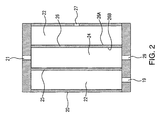
- FIG. 2 is a cutaway view of a membrane absorption contactor 20 shown in FIG. 1 , and is also representative of membrane absorption contactors 30 and 40 shown in FIG. 1 .
- Acid gases found in natural gas include, for example, carbon dioxide, hydrogen sulfide, sulfur dioxide, carbon disulfide, hydrogen cyanide and carbonyl sulfate. Acid gases, particularly carbon dioxide, can be present at up to 80% by volume of natural gas extracted from geological sources.
- the process 10 is designed to reduce the acid contents to commercially acceptable product levels (typically below 2% by volume for pipeline gas or below 50 ppmv for LNG specification gas), and is especially suitable for natural gas having initial acid gas concentrations of at least about 20% by volume, or at least about 35% by volume, or at least about 50% by volume, and up to about 80% by volume.
- the multi-stage process 10 is designed to reduce the acid gas concentration in the natural gas to not more than about 10% by volume in its first stage, not more than about 2% by volume in its second stage, and not more than about 0.1% by volume, suitably not more than about 50 ppm by volume in its third and/or final stage. While these limits apply to all acid gases combined, carbon dioxide is typically the primary acid gas component. In situations where the acid gas includes hydrogen sulfide in addition to carbon dioxide, the multi-stage process 10 is also designed to reduce the hydrogen sulfide content in the natural gas to not more than about 4 ppmv in the second stage or, if needed, in the third and/or final stage.
- Natural gas 12 having a first (high) concentration of acid gas is fed from a source 14 which can be a natural gas well or pipeline leading from a point of origin.
- the supply pressure and flow rate of the natural gas 12 can be regulated by valve 15 . If necessary, the natural gas 12 can be cooled using cooler 18 .
- the natural gas 12 is then supplied to an inlet 19 of a first stage membrane absorption contactor 20 .
- the first stage membrane absorption contactor 20 can include a shell side 22 and a bore side 24 separated by a membrane 26 as shown in FIG. 2 .
- the membrane 26 can be disposed in any suitable manner that permits the diffusion of acid gas through the membrane yet blocks the flow of natural gas.
- the membrane 26 surrounds a bore side 24 which can be defined by a rigid porous support plate or screen, or any suitable porous material shown at 25 .
- Membrane 26 is suitably a non-porous material that selectively diffuses the acid gas from the first side 26 A to the second side 26 B of the membrane, thus transferring the acid gas from the shell side 22 to the bore side 24 of the membrane absorption contactor 20 while maintaining the natural gas on the first side 26 A of the membrane and the shell side 22 of the membrane absorption contactor.
- the membrane 26 can be a microporous hydrophobic material with pores small enough to selectively permit the transfer of acid gas from natural gas into the physical or chemical solvent but not the transfer of solvent into the natural gas.
- Non-porous membranes are films made of polymers having amorphous segments that selectively allow acid gases to pass through by a solution diffusion mechanism. The selectivity and transfer rate of non-porous membranes are significantly affected by temperature. Suitable non-porous membrane polymers include without limitation polyvinylidene fluoride, polypropylene, cellulose acetate, polysulfone, polycarbonate, polyimide, polyamide, etc., and combinations thereof.
- Microporous hydrophobic membranes have voids connected by pores whose diameters are large enough to facilitate the transfer of acid gases but small enough to block the transfer of solvent into natural gas.
- Suitable microporous membrane polymers include without limitation polypropylene, polyethylene, polyperfluoroalkoxy, polyetheretherketone, polytetrafluoroethylene, polyvinylidene fluoride, etc., and combinations thereof.
- a physical solvent is supplied to the second side 26 B of the membrane 26 through an inlet 21 that passes into the bore side 24 of first stage membrane absorption contactor 20 .
- the physical solvent originates from source 11 , which can be a storage tank, and can be pumped using pump 16 and warmed or cooled using heat exchanger 13 .
- a physical solvent is a solvent that relies on physical solubility, as opposed to chemical reaction, to dissolve the acid gases.
- Suitable physical solvents include without limitation dimethyl ethers of polyethylene glycol, methanol, N-methyl-2-pyrrolidone, propylene carbonate, water, diethylene glycol, silicone fluid, aliphatic and aromatic hydrocarbons, alcohols, ketones, aldehydes, N-formyl morpholine, N-acetyl morpholine, etc., and combinations thereof. Because solubility decreases with increasing temperature, it is generally advantageous to cool the physical solvent using heat exchanger 13 .
- the acid gas from the natural gas 12 dissolves in the physical solvent and is transported (along with the physical solvent) through outlet 29 of membrane absorption contactor 20 .
- the selective transfer of acid gas through the membrane 26 yields natural gas having a second (lower) concentration of acid gas on the first side 26 A of the membrane 26 , the second concentration typically being not more than about 10% by volume.
- the physical solvent can be heated to reduce the solubility of the acid gas and cause substantial separation, flashed at a lower pressure to release the acid gas and cause substantial separation, or heated and flashed to release acid gas.
- the physical solvent can then be recycled for further use in the membrane absorption contactor 20 .
- the acid gas containing natural gas can be fed to the bore side 21 of the membrane absorption contactor 20 and the solvent fed to the shell side 19 of the membrane absorption contactor 20 .
- the sweet natural gas can then be recovered from the bore side outlet 29 and the acid gas laden solvent recovered from the shell side outlet 27 .
- the natural gas having the second concentration of acid gas exits membrane absorption contactor 20 via shell side outlet 27 and is supplied via transfer line 32 and heat exchanger 28 (if needed) to the shell side inlet 19 of the second stage membrane absorption contactor 30 .
- the second membrane absorption contactor 30 can be configured in the same or similar fashion as the first membrane absorption contactor 20 and is therefore described with like reference numerals as shown in FIG. 2 .
- the second membrane absorption contactor 30 includes a shell side 22 , a bore side 24 , a second membrane 26 having a first side 26 A and a second side 26 B and supported by a porous support or screen 25 , a shell side inlet 19 and outlet 27 , and a bore side inlet 23 and outlet 29 .
- the natural gas having the second concentration of acid gas is supplied to the first side 26 A of the second membrane 26 .
- a chemical solvent from source 31 which can be a holding tank, is supplied via pump 17 and heat exchanger 23 and bore side inlet 21 to the second side 26 B of the second membrane.
- a chemical solvent is one that chemically reacts with the acid gas to effect dissolution.
- Suitable chemical solvents include without limitation aqueous ethanolamine solutions, aqueous potassium, sodium, or ammonium carbonate solutions, other alkaline salt solutions, ionic liquids, ammonia, aqueous diglycolamine solutions, triazine solutions etc., and combinations thereof.
- the second stage membrane 26 may be non-porous or micro-porous as described above. Acid gas present in the natural gas having the second concentration is transferred through the second membrane 26 , from the first side 26 A to the second side 26 B, yielding natural gas having a third (lower) concentration of acid gas on the first side 26 A of second membrane 26 .
- the third concentration of acid gas is typically not more than about 2% by volume, which is a common pipeline specification for natural gas.
- the natural gas having the third concentration of acid gas is recovered from the shell side outlet 27 of second stage membrane absorption contactor 30 .
- the chemical solvent exits through bore side outlet 29 and can be separated from the acid gas and recycled using conventional methods of heating and stripping.
- first and second stage membrane absorption contactors 20 and 30 rely on the transfer of acid gas from the first side 26 A to the second side 26 B of a corresponding membrane 26 , it may be advantageous to provide a pressure differential across the membrane to facilitate such transfer. While the natural gas 12 provided from the source 14 may have a very high initial pressure of up to about 80 atmospheres, or up to 100 atmospheres or more, the pressure differential across the membranes 26 should not be so high as to damage the membranes 26 .
- the membrane absorption contactors 20 and 30 can operate without a pressure differential if it is advantageous to operate the membrane absorption contactors in such a manner.
- the natural gas having the third concentration is then carried via transfer line 42 and heat exchanger 38 (if needed) to the third stage membrane absorption contactor 40 which can be configured in the same or similar fashion as the first and second stage membrane absorption contactors 20 and 30 and can be described using the same reference numerals in FIG. 2 .
- the natural gas having the third concentration of acid gas is supplied via shell side inlet 19 to the first side 26 A of third membrane 26 in third stage membrane absorption contactor 40 , suitably under modest pressure as described above.
- a chemical solvent, which can be the same or different chemical solvent used in the second membrane absorption contactor 30 is supplied from a source 41 via pump 60 and heat exchanger 33 (if needed) and through the bore side inlet 21 , to the second side 26 B of third membrane 26 .
- Acid gas from the natural gas having the third concentration is transferred through the third membrane 26 , from the first side 26 A to the second side 26 B of the third membrane 26 , yielding natural gas having a fourth (lower) concentration of acid gas on the first side 26 A of third membrane 26 .
- the fourth concentration can be low enough to meet specifications for liquid natural gas and is suitably not more than about 50 ppm by volume.
- the natural gas having the fourth concentration of acid gas can then be recovered from the first side 26 A of third membrane 26 via the outlet 27 and flow regulator 59 .
- the chemical solvent can be recovered from the third membrane absorption contactor 40 via outlet 29 , and can be separated from the acid gas using known techniques and recycled.
- the invention is described in three membrane absorption contactor stages, the invention can be practiced using two, four or more membrane absorption contactor stages depending on the amounts and types of acids present in the incoming natural gas and the specifications for the product natural gas, as well as the natural gas flow rates and other process conditions.
- the invention saves money and space by combining the cost advantages of physical solvents with the performance advantages of chemical solvents to absorb acid gases through the respective membranes 26 and take the acid gas concentrations in natural gas from very high to very low levels.
Landscapes
- Chemical & Material Sciences (AREA)
- Chemical Kinetics & Catalysis (AREA)
- Oil, Petroleum & Natural Gas (AREA)
- Engineering & Computer Science (AREA)
- General Chemical & Material Sciences (AREA)
- Analytical Chemistry (AREA)
- Organic Chemistry (AREA)
- Separation Using Semi-Permeable Membranes (AREA)
Abstract
Description
Claims (16)
Priority Applications (2)
| Application Number | Priority Date | Filing Date | Title |
|---|---|---|---|
| US14/277,255 US9631154B2 (en) | 2014-05-14 | 2014-05-14 | Method and apparatus for removing high concentration acid gas from natural gas |
| US15/496,853 US9975079B2 (en) | 2014-05-14 | 2017-04-25 | Method and apparatus for removing high concentration acid gas from natural gas |
Applications Claiming Priority (1)
| Application Number | Priority Date | Filing Date | Title |
|---|---|---|---|
| US14/277,255 US9631154B2 (en) | 2014-05-14 | 2014-05-14 | Method and apparatus for removing high concentration acid gas from natural gas |
Related Child Applications (1)
| Application Number | Title | Priority Date | Filing Date |
|---|---|---|---|
| US15/496,853 Division US9975079B2 (en) | 2014-05-14 | 2017-04-25 | Method and apparatus for removing high concentration acid gas from natural gas |
Publications (2)
| Publication Number | Publication Date |
|---|---|
| US20150328583A1 US20150328583A1 (en) | 2015-11-19 |
| US9631154B2 true US9631154B2 (en) | 2017-04-25 |
Family
ID=54537711
Family Applications (2)
| Application Number | Title | Priority Date | Filing Date |
|---|---|---|---|
| US14/277,255 Active 2034-11-21 US9631154B2 (en) | 2014-05-14 | 2014-05-14 | Method and apparatus for removing high concentration acid gas from natural gas |
| US15/496,853 Active US9975079B2 (en) | 2014-05-14 | 2017-04-25 | Method and apparatus for removing high concentration acid gas from natural gas |
Family Applications After (1)
| Application Number | Title | Priority Date | Filing Date |
|---|---|---|---|
| US15/496,853 Active US9975079B2 (en) | 2014-05-14 | 2017-04-25 | Method and apparatus for removing high concentration acid gas from natural gas |
Country Status (1)
| Country | Link |
|---|---|
| US (2) | US9631154B2 (en) |
Cited By (3)
| Publication number | Priority date | Publication date | Assignee | Title |
|---|---|---|---|---|
| US9975079B2 (en) | 2014-05-14 | 2018-05-22 | Gas Technology Institute | Method and apparatus for removing high concentration acid gas from natural gas |
| CN108905636A (en) * | 2018-06-04 | 2018-11-30 | 苏州名列膜材料有限公司 | Polytetrafluoroethylcomposite composite micro porous film and preparation method thereof and preparation system |
| CN110898649A (en) * | 2018-09-18 | 2020-03-24 | 株式会社东芝 | Acid gas absorbent, acid gas removal method, and acid gas removal device |
Families Citing this family (6)
| Publication number | Priority date | Publication date | Assignee | Title |
|---|---|---|---|---|
| WO2018033838A1 (en) * | 2016-08-15 | 2018-02-22 | Poorkhalil Ali | Apparatus for extraction of a gas from a gaseous medium flow and method for manufacturing the same |
| FR3063436B1 (en) * | 2017-03-06 | 2021-04-16 | Centralesupelec | BIOGAS PURIFICATION PROCESS TO OBTAIN BIOMETHANE |
| US10106410B2 (en) | 2017-03-10 | 2018-10-23 | Saudi Arabian Oil Company | Enhancement of Claus tail gas treatment by sulfur dioxide-selective membrane technology |
| US10106411B2 (en) | 2017-03-13 | 2018-10-23 | Saudi Arabian Oil Company | Enhancement of claus tail gas treatment by sulfur dioxide-selective membrane technology and sulfur dioxide-selective absorption technology |
| RU2768147C1 (en) * | 2020-12-23 | 2022-03-23 | федеральное государственное бюджетное образовательное учреждение высшего образования "Нижегородский государственный технический университет им. Р.Е. Алексеева" (НГТУ) | Method for removing carbon dioxide and hydrogen sulfide from methane-containing gas mixtures |
| US20250114737A1 (en) * | 2023-10-04 | 2025-04-10 | Saudi Arabian Oil Company | Methods for dissolving target chemical species into absorbent liquids |
Citations (5)
| Publication number | Priority date | Publication date | Assignee | Title |
|---|---|---|---|---|
| US5100555A (en) | 1990-06-15 | 1992-03-31 | Matson Stephen L | Method and system for removing radon from radon containing water |
| US20080142441A1 (en) | 2004-12-22 | 2008-06-19 | Richard Mark Pashley | Methods for Degassing Hydrophobic Liquids and Emulsions Formed Therefrom |
| US20110223650A1 (en) * | 2008-07-31 | 2011-09-15 | Novozymes A/S | Modular Membrane Reactor and Process for Carbon Dioxide Extraction |
| US20140090556A1 (en) * | 2011-03-16 | 2014-04-03 | Aker Process Systems As | Method and system for gas purification with first direct absorption step and second absorption step by means of membrane contactor |
| US20150251134A1 (en) * | 2014-03-10 | 2015-09-10 | Uop Llc | Methods and apparatuses for removing impurities from a gaseous stream |
Family Cites Families (2)
| Publication number | Priority date | Publication date | Assignee | Title |
|---|---|---|---|---|
| US8480982B2 (en) * | 2007-02-22 | 2013-07-09 | Fluor Technologies Corporation | Configurations and methods for carbon dioxide and hydrogen production from gasification streams |
| US9631154B2 (en) | 2014-05-14 | 2017-04-25 | Gas Technology Institute | Method and apparatus for removing high concentration acid gas from natural gas |
-
2014
- 2014-05-14 US US14/277,255 patent/US9631154B2/en active Active
-
2017
- 2017-04-25 US US15/496,853 patent/US9975079B2/en active Active
Patent Citations (5)
| Publication number | Priority date | Publication date | Assignee | Title |
|---|---|---|---|---|
| US5100555A (en) | 1990-06-15 | 1992-03-31 | Matson Stephen L | Method and system for removing radon from radon containing water |
| US20080142441A1 (en) | 2004-12-22 | 2008-06-19 | Richard Mark Pashley | Methods for Degassing Hydrophobic Liquids and Emulsions Formed Therefrom |
| US20110223650A1 (en) * | 2008-07-31 | 2011-09-15 | Novozymes A/S | Modular Membrane Reactor and Process for Carbon Dioxide Extraction |
| US20140090556A1 (en) * | 2011-03-16 | 2014-04-03 | Aker Process Systems As | Method and system for gas purification with first direct absorption step and second absorption step by means of membrane contactor |
| US20150251134A1 (en) * | 2014-03-10 | 2015-09-10 | Uop Llc | Methods and apparatuses for removing impurities from a gaseous stream |
Non-Patent Citations (15)
| Title |
|---|
| "Gas/liquid membrane contactor based on disubstituted polyacetelyne for CO2 absorption liquid regeneration at high pressure and temperature" Trusov et al. Sep. 2, 2011, Journal of Membrane Science, p. 242. * |
| Brunetti, A., et al., "Membrane Technologies for CO2 Separation", Jnl of Membrane Science, 2010, v. 359, pp. 115-125. |
| Dept of Energy, "Efficient Regeneration of Physical and Chemical Solvents for CO2 Capture", http://www.netl.doe.gov/File%20Library/research/coal/carbon-storage/infrastructure/FE0002196.pdf, May 2010. |
| Dindore, V.Y., "Gas Purification Using Membrane Gas Absorption Processes", Thesis, Universiteit Twente, Netherlands, Nov. 19, 2003. |
| Dortmundt, D., et al., "Recent Developments in CO2 Removal Membrane Technology", UOP, LLC, 1999, Des Plaines, Illinois. |
| Hoff, K.A., "Modeling and Experimental Study of Carbon Dioxide Absorption in a Membrane Contactor", Thesis, Norwegian University of Science and Technology; Dept. of Chem. Eng., Mar. 2003. |
| Hussain, A., et al. , "A feasibility study of CO2 capture from flue gas by a facilitated transport membrane", Jnl of Membrane Science, 2010, v. 359, pp. 140-148. |
| Keshavarz, P., et al., "Analysis of CO2 separation and simulation of a partially wetted hollow fiber membrane contactor", Jnl of Hazardous Materials, 2008, v.152, pp. 1237-1247. |
| Khaisri, S. et al., "CO2 Stripping From Monoethanolamine Using a Membrane Contactor", Jnl of Membrane Science, Jul. 2011, v. 376, pp. 110-118. |
| Kovvali, A.S., et al., "Immobilized Liquid Membranes for CO2 Separation", http://web.anl.gov/PCS/acsfuel/preprint%20archive/Files/45-4-WASHINGTON%20DC-08-00-0665.pdf. |
| Kovvali, A.S., et al., "Immobilized Liquid Membranes for CO2 Separation", http://web.anl.gov/PCS/acsfuel/preprint%20archive/Files/45—4—WASHINGTON%20DC—08-00—0665.pdf. |
| Kumazawa, H., "Absorption and Desportion of CO2 by Aqueous Solutions of Sterically Hindered 2-Amino-2-Methyl-1-Propanol in Hydrophobic Microporous Hollow Fiber Contained Contactors", Chem. Eng. Communications, 2000, v. 184:1, pp. 163-179. |
| Meinema, H.A., et al., "Ceramic Membranes for Gas Separation-Recent Developments and State of the Art", Interceram, 2005, v. 54, pp. 86-91. |
| Reed, B.W. et al, "Membrane Separations Technology: Principles and Applications Chapter 10: Membrane Contactors", Elsevier Science B.V., 1995, p. 478. |
| Trusov, A. et al., "Gas/Liquid Membrane Contactors Based on Disubstituted Poly Acetylene for CO2 Absorption Liquid Regeneration at High Pressure and Temperature", Jnl of Membrane Science, Nov. 2011, v. 383, pp. 241-249. |
Cited By (3)
| Publication number | Priority date | Publication date | Assignee | Title |
|---|---|---|---|---|
| US9975079B2 (en) | 2014-05-14 | 2018-05-22 | Gas Technology Institute | Method and apparatus for removing high concentration acid gas from natural gas |
| CN108905636A (en) * | 2018-06-04 | 2018-11-30 | 苏州名列膜材料有限公司 | Polytetrafluoroethylcomposite composite micro porous film and preparation method thereof and preparation system |
| CN110898649A (en) * | 2018-09-18 | 2020-03-24 | 株式会社东芝 | Acid gas absorbent, acid gas removal method, and acid gas removal device |
Also Published As
| Publication number | Publication date |
|---|---|
| US20150328583A1 (en) | 2015-11-19 |
| US9975079B2 (en) | 2018-05-22 |
| US20170225116A1 (en) | 2017-08-10 |
Similar Documents
| Publication | Publication Date | Title |
|---|---|---|
| US9975079B2 (en) | Method and apparatus for removing high concentration acid gas from natural gas | |
| US10005023B2 (en) | Method and system for CO2 rejection with a two stage membrane process | |
| Gómez-Coma et al. | Non-dispersive absorption of CO2 in [emim][EtSO4] and [emim][Ac]: Temperature influence | |
| US10828599B2 (en) | Method of extracting components of gas mixtures by pertraction on nanoporous membranes | |
| KR20200016955A (en) | Helium recovery from gas stream | |
| WO2014000113A1 (en) | Techniques for biocatalytic treatment of co2-containing gas and for separation of biocatalyst from ion loaded streams | |
| Al-Marzouqi et al. | CO2 removal from CO2− CH4 gas mixture using different solvents and hollow fiber membranes | |
| CN110612150A (en) | Enhanced Claus Tail Gas Treatment Using Membranes and Reduction Steps | |
| JP2009528918A (en) | Membrane and method for acid recovery | |
| EP3946687B1 (en) | Improving sulfur recovery operation with improved carbon dioxide recovery | |
| Mirfendereski et al. | Selective removal of H2S from gas streams with high CO2 concentration using hollow‐fiber membrane contractors | |
| AU2014392793A1 (en) | A natural gas purification system and a process of using thereof | |
| AU2014352078B2 (en) | Device for the separation of water from a fluid flow containing water | |
| CN109906111B (en) | Combined acid gas capture and water extraction process | |
| US20110127218A1 (en) | Regenerator Configurations and Methods with Reduced Steam Demand | |
| US7122166B2 (en) | Concentration of hydrogen peroxide | |
| JP2020014995A (en) | Forward osmosis treatment method and forward osmosis treatment device | |
| EP3372297A1 (en) | Method for purifying gases, in particular biogas, in order to obtain biomethane | |
| CN105521690A (en) | Method for processing safety gas | |
| JP6210008B2 (en) | Water treatment equipment | |
| CN105658307B (en) | Handle the method and system of gas material | |
| EP3765172B1 (en) | Membrane contactor | |
| JP5803437B2 (en) | Waste water treatment method and waste water treatment apparatus | |
| Heydari Gorji et al. | Selective removal of carbon dioxide from wet CO2/H2 mixtures via facilitated transport membranes containing Amine blends as carriers | |
| Zainal Abidin et al. | Removal of amines from wastewater using membrane separation processes |
Legal Events
| Date | Code | Title | Description |
|---|---|---|---|
| AS | Assignment |
Owner name: GAS TECHNOLOGY INSTITUTE, ILLINOIS Free format text: ASSIGNMENT OF ASSIGNORS INTEREST;ASSIGNORS:ZHOU, SHAOJUN;MEYER, HOWARD S.;REEL/FRAME:032915/0407 Effective date: 20140508 |
|
| STCF | Information on status: patent grant |
Free format text: PATENTED CASE |
|
| MAFP | Maintenance fee payment |
Free format text: PAYMENT OF MAINTENANCE FEE, 4TH YR, SMALL ENTITY (ORIGINAL EVENT CODE: M2551); ENTITY STATUS OF PATENT OWNER: SMALL ENTITY Year of fee payment: 4 |
|
| MAFP | Maintenance fee payment |
Free format text: PAYMENT OF MAINTENANCE FEE, 8TH YR, SMALL ENTITY (ORIGINAL EVENT CODE: M2552); ENTITY STATUS OF PATENT OWNER: SMALL ENTITY Year of fee payment: 8 |