US9631101B2 - Ionic liquid release coat for use in metal flake manufacture - Google Patents
Ionic liquid release coat for use in metal flake manufacture Download PDFInfo
- Publication number
- US9631101B2 US9631101B2 US14/239,846 US201214239846A US9631101B2 US 9631101 B2 US9631101 B2 US 9631101B2 US 201214239846 A US201214239846 A US 201214239846A US 9631101 B2 US9631101 B2 US 9631101B2
- Authority
- US
- United States
- Prior art keywords
- metal
- layer
- ionic liquid
- substrate
- flake
- Prior art date
- Legal status (The legal status is an assumption and is not a legal conclusion. Google has not performed a legal analysis and makes no representation as to the accuracy of the status listed.)
- Expired - Fee Related, expires
Links
- 0 *N1CCN([1*])C1 Chemical compound *N1CCN([1*])C1 0.000 description 25
- LUVWFPSHRWDXOS-UHFFFAOYSA-N CC1=CN(C)[N+](C)=C1 Chemical compound CC1=CN(C)[N+](C)=C1 LUVWFPSHRWDXOS-UHFFFAOYSA-N 0.000 description 3
- BCDIWLCKOCHCIH-UHFFFAOYSA-M C[PH](=O)[O-] Chemical compound C[PH](=O)[O-] BCDIWLCKOCHCIH-UHFFFAOYSA-M 0.000 description 2
- RSURMXIQTZUCLX-UHFFFAOYSA-M CC(CC(C)(C)C)CP(=O)([O-])C(C)CC(C)(C)C.CCCCCCCCCCCCCC[P+](CCCCC)(CCCCCC)CCCCCC Chemical compound CC(CC(C)(C)C)CP(=O)([O-])C(C)CC(C)(C)C.CCCCCCCCCCCCCC[P+](CCCCC)(CCCCCC)CCCCCC RSURMXIQTZUCLX-UHFFFAOYSA-M 0.000 description 1
- IEYCIPNAVJELHM-UHFFFAOYSA-N CC1=CC=C(C)C=C1.CCC(C)[P+](CC)(C(C)CC)C(C)CC Chemical compound CC1=CC=C(C)C=C1.CCC(C)[P+](CC)(C(C)CC)C(C)CC IEYCIPNAVJELHM-UHFFFAOYSA-N 0.000 description 1
- OFHBXWMGEMWFRR-UHFFFAOYSA-M CCCC[P+](C)(CCCC)CCCC.CCOP(=O)([O-])OCC Chemical compound CCCC[P+](C)(CCCC)CCCC.CCOP(=O)([O-])OCC OFHBXWMGEMWFRR-UHFFFAOYSA-M 0.000 description 1
- BDAGIHXWWSANSR-UHFFFAOYSA-M O=C[O-] Chemical compound O=C[O-] BDAGIHXWWSANSR-UHFFFAOYSA-M 0.000 description 1
- JLBKRVUJUVNDES-UHFFFAOYSA-N O=[PH](=O)([N-]S(=O)(=O)C(F)(F)F)C(F)(F)F Chemical compound O=[PH](=O)([N-]S(=O)(=O)C(F)(F)F)C(F)(F)F JLBKRVUJUVNDES-UHFFFAOYSA-N 0.000 description 1
Images


Classifications
-
- C—CHEMISTRY; METALLURGY
- C09—DYES; PAINTS; POLISHES; NATURAL RESINS; ADHESIVES; COMPOSITIONS NOT OTHERWISE PROVIDED FOR; APPLICATIONS OF MATERIALS NOT OTHERWISE PROVIDED FOR
- C09D—COATING COMPOSITIONS, e.g. PAINTS, VARNISHES OR LACQUERS; FILLING PASTES; CHEMICAL PAINT OR INK REMOVERS; INKS; CORRECTING FLUIDS; WOODSTAINS; PASTES OR SOLIDS FOR COLOURING OR PRINTING; USE OF MATERIALS THEREFOR
- C09D7/00—Features of coating compositions, not provided for in group C09D5/00; Processes for incorporating ingredients in coating compositions
- C09D7/40—Additives
- C09D7/60—Additives non-macromolecular
- C09D7/61—Additives non-macromolecular inorganic
-
- C09D7/1291—
-
- B22F1/0055—
-
- B—PERFORMING OPERATIONS; TRANSPORTING
- B22—CASTING; POWDER METALLURGY
- B22F—WORKING METALLIC POWDER; MANUFACTURE OF ARTICLES FROM METALLIC POWDER; MAKING METALLIC POWDER; APPARATUS OR DEVICES SPECIALLY ADAPTED FOR METALLIC POWDER
- B22F1/00—Metallic powder; Treatment of metallic powder, e.g. to facilitate working or to improve properties
- B22F1/06—Metallic powder characterised by the shape of the particles
- B22F1/068—Flake-like particles
-
- B—PERFORMING OPERATIONS; TRANSPORTING
- B22—CASTING; POWDER METALLURGY
- B22F—WORKING METALLIC POWDER; MANUFACTURE OF ARTICLES FROM METALLIC POWDER; MAKING METALLIC POWDER; APPARATUS OR DEVICES SPECIALLY ADAPTED FOR METALLIC POWDER
- B22F9/00—Making metallic powder or suspensions thereof
- B22F9/02—Making metallic powder or suspensions thereof using physical processes
- B22F9/04—Making metallic powder or suspensions thereof using physical processes starting from solid material, e.g. by crushing, grinding or milling
-
- C—CHEMISTRY; METALLURGY
- C01—INORGANIC CHEMISTRY
- C01G—COMPOUNDS CONTAINING METALS NOT COVERED BY SUBCLASSES C01D OR C01F
- C01G19/00—Compounds of tin
- C01G19/02—Oxides
-
- C—CHEMISTRY; METALLURGY
- C09—DYES; PAINTS; POLISHES; NATURAL RESINS; ADHESIVES; COMPOSITIONS NOT OTHERWISE PROVIDED FOR; APPLICATIONS OF MATERIALS NOT OTHERWISE PROVIDED FOR
- C09D—COATING COMPOSITIONS, e.g. PAINTS, VARNISHES OR LACQUERS; FILLING PASTES; CHEMICAL PAINT OR INK REMOVERS; INKS; CORRECTING FLUIDS; WOODSTAINS; PASTES OR SOLIDS FOR COLOURING OR PRINTING; USE OF MATERIALS THEREFOR
- C09D7/00—Features of coating compositions, not provided for in group C09D5/00; Processes for incorporating ingredients in coating compositions
- C09D7/40—Additives
- C09D7/70—Additives characterised by shape, e.g. fibres, flakes or microspheres
-
- C—CHEMISTRY; METALLURGY
- C23—COATING METALLIC MATERIAL; COATING MATERIAL WITH METALLIC MATERIAL; CHEMICAL SURFACE TREATMENT; DIFFUSION TREATMENT OF METALLIC MATERIAL; COATING BY VACUUM EVAPORATION, BY SPUTTERING, BY ION IMPLANTATION OR BY CHEMICAL VAPOUR DEPOSITION, IN GENERAL; INHIBITING CORROSION OF METALLIC MATERIAL OR INCRUSTATION IN GENERAL
- C23C—COATING METALLIC MATERIAL; COATING MATERIAL WITH METALLIC MATERIAL; SURFACE TREATMENT OF METALLIC MATERIAL BY DIFFUSION INTO THE SURFACE, BY CHEMICAL CONVERSION OR SUBSTITUTION; COATING BY VACUUM EVAPORATION, BY SPUTTERING, BY ION IMPLANTATION OR BY CHEMICAL VAPOUR DEPOSITION, IN GENERAL
- C23C14/00—Coating by vacuum evaporation, by sputtering or by ion implantation of the coating forming material
- C23C14/0005—Separation of the coating from the substrate
-
- C—CHEMISTRY; METALLURGY
- C23—COATING METALLIC MATERIAL; COATING MATERIAL WITH METALLIC MATERIAL; CHEMICAL SURFACE TREATMENT; DIFFUSION TREATMENT OF METALLIC MATERIAL; COATING BY VACUUM EVAPORATION, BY SPUTTERING, BY ION IMPLANTATION OR BY CHEMICAL VAPOUR DEPOSITION, IN GENERAL; INHIBITING CORROSION OF METALLIC MATERIAL OR INCRUSTATION IN GENERAL
- C23C—COATING METALLIC MATERIAL; COATING MATERIAL WITH METALLIC MATERIAL; SURFACE TREATMENT OF METALLIC MATERIAL BY DIFFUSION INTO THE SURFACE, BY CHEMICAL CONVERSION OR SUBSTITUTION; COATING BY VACUUM EVAPORATION, BY SPUTTERING, BY ION IMPLANTATION OR BY CHEMICAL VAPOUR DEPOSITION, IN GENERAL
- C23C14/00—Coating by vacuum evaporation, by sputtering or by ion implantation of the coating forming material
- C23C14/001—Coating on a liquid substrate
-
- C—CHEMISTRY; METALLURGY
- C23—COATING METALLIC MATERIAL; COATING MATERIAL WITH METALLIC MATERIAL; CHEMICAL SURFACE TREATMENT; DIFFUSION TREATMENT OF METALLIC MATERIAL; COATING BY VACUUM EVAPORATION, BY SPUTTERING, BY ION IMPLANTATION OR BY CHEMICAL VAPOUR DEPOSITION, IN GENERAL; INHIBITING CORROSION OF METALLIC MATERIAL OR INCRUSTATION IN GENERAL
- C23C—COATING METALLIC MATERIAL; COATING MATERIAL WITH METALLIC MATERIAL; SURFACE TREATMENT OF METALLIC MATERIAL BY DIFFUSION INTO THE SURFACE, BY CHEMICAL CONVERSION OR SUBSTITUTION; COATING BY VACUUM EVAPORATION, BY SPUTTERING, BY ION IMPLANTATION OR BY CHEMICAL VAPOUR DEPOSITION, IN GENERAL
- C23C14/00—Coating by vacuum evaporation, by sputtering or by ion implantation of the coating forming material
- C23C14/06—Coating by vacuum evaporation, by sputtering or by ion implantation of the coating forming material characterised by the coating material
- C23C14/14—Metallic material, boron or silicon
-
- C—CHEMISTRY; METALLURGY
- C08—ORGANIC MACROMOLECULAR COMPOUNDS; THEIR PREPARATION OR CHEMICAL WORKING-UP; COMPOSITIONS BASED THEREON
- C08K—Use of inorganic or non-macromolecular organic substances as compounding ingredients
- C08K3/00—Use of inorganic substances as compounding ingredients
- C08K3/02—Elements
- C08K3/08—Metals
-
- C—CHEMISTRY; METALLURGY
- C08—ORGANIC MACROMOLECULAR COMPOUNDS; THEIR PREPARATION OR CHEMICAL WORKING-UP; COMPOSITIONS BASED THEREON
- C08K—Use of inorganic or non-macromolecular organic substances as compounding ingredients
- C08K3/00—Use of inorganic substances as compounding ingredients
- C08K3/10—Metal compounds
Definitions
- the present inventive subject matter relates generally to the art of functional and/or decorative flakes and/or the production thereof. Particular but not exclusive relevance is found in connection with high aspect ratio metal flakes for use in dispersions and/or suspensions, e.g., such as in inks, pigments, coatings and the like. It is to be appreciated however that aspects of the present inventive subject matter are also equally amenable to other like applications.
- metal flakes have been formed by vapor depositing a thin layer of metal, e.g., aluminum (Al), on a polyethylene terephthalate (PET) carrier.
- metal e.g., aluminum (Al)
- PET polyethylene terephthalate
- the carrier would first be provided with a release coating to facilitate subsequent removal of the metal from the carrier.
- the release coating could also act as stabilizer, e.g., for the resulting Al flakes.
- this release coating is typically applied to the carrier as a solvent-based resin solution. After application, the solvent is evaporated or otherwise driven off, e.g., by heating in an oven, to form a polymer release coating on a surface of the carrier.
- the thin metal layer is then vapor deposited over the resulting release coating.
- the thin metal layer is ultimately scraped and/or stripped from the carrier, e.g., with a doctor blade or another appropriate mechanical abrasion tool.
- a solvent e.g., such as acetone or the like
- the metal film is broken into particles by the stripping process and the particles may be further sized and/or refined in later milling and/or other suitable processing steps.
- Metal flakes produced by this process have been used in printing applications, e.g., such as inks, and may often have a particle size from about 4 to about 12 microns and a thickness from about 150 to about 250 angstroms.
- the flakes can generally have a smooth mirror-like surface and a high aspect ratio, and coatings made from these flakes typically have a high specular reflectance and a low diffuse reflectance.
- the carrier is generally undesirable waste material.
- solvents which may contain volatile organic compounds (VOCs) in the formation of the release coating and in the stripping process can be undesirable for environmental and/or other reasons.
- a method for producing metallic flakes using an ionic liquid as a release coating between a substrate and a thin metal film deposited thereover is provided.
- a method of producing metal flakes comprising: applying a layer of ionic liquid to a substrate; forming a layer of metal on the substrate over the ionic liquid; and removing the layer of metal from the substrate.
- a metal flake comprising a coating layer covering at least a part of a surface of the metal flake, the coating layer comprising an ionic liquid or fluid prepared from: (a) one or more cations selected from the group consisting of imidazolium; phosphonium; ammonium; pyrazolium; pyridinium; pyrrolidinium; sulfonium; and cationic polymers; wherein the cationic polymers, if present, are formed from one or more components selected from the group consisting of 4-chloromethylstyrene, 2-chloroethyl methacrylate, 2-chloroethyl acrylate, 4-chloro-1-butene, allyl chloride and allyl bromide reacted with butyl imidazole; and (b) one or more anions selected from the group consisting of bromide, nitrate, hexafluorophosphate, tetrafluoroborate,
- a dispersion comprising: (a) 2 to 20 weight percent of the above metal flake; (b) 0.1 to 5 weight percent of at least one ionic liquid; and (c) 75 to 97 weight percent of one or more solvents, on a basis of total weight of the dispersion.
- FIG. 1 is a diagrammatic illustration showing a vacuum chamber suitable for producing metallic flakes in accordance with aspects of the present inventive subject matter.
- FIG. 2 is a diagrammatic illustration showing multiple alternating layers of an IL release coating and a thin metal film being built-up on a surface of a drum in accordance with aspects of the present inventive subject matter.
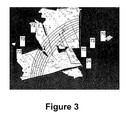
- FIG. 3 is a micrograph showing exemplary Al flakes produced in accordance with aspects of the present inventive subject matter.
- the present specification describes a flake manufacturing process employing one or more ionic liquids or fluids as a release coating.
- the ionic liquid (IL) release coat is essentially a salt in liquid state, which is largely made up of ion pairs, namely, cations (IF + ) and anions (X ⁇ ).
- Suitable ionic liquids may in general have: a freezing point below 100° C., for example; a high thermal stability (i.e., the IL will not decompose at high temperatures, e.g., in the range of approximately 250° C. to approximately 300° C. at normal atmospheric pressure and in the range of approximately 500° C. to approximately 600° C.
- an IL (IF + X ⁇ ) used for the release coat may comprise one or more cations (IF + ) selected from the following group:
- Ammonium e.g., in the form
- poly(ionic fluids) may also optionally be employed in and/or for the release coating.
- suitable starting components may include but are not restricted to 4-chloromethylstyrene, 2-chloroethyl methacrylate, 2-choroethyl acrylate, 4-chloro-1-butene and allyl chloride or bromide.
- R1 is the butyl group specifically here, but could be any R 1 as described below.
- poly[2-(1-butylimidazolium-3-yl)ethylmethacrylate]) e.g., in the form
- the IL (IF + X ⁇ ) used for the release coat may comprise one or more anions (X ⁇ ) selected from the following group:
- Tosylate i.e., toluene sulfonate or p-methylbenezenesulfonate
- Brosylate i.e., 4-Bromobenzene sulfonate
- OBs ⁇ 4-Bromobenzene sulfonate
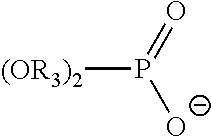
- Dialkylphosphate e.g., in the form
- Dialkylphosphinate e.g., in the form
- R 1 , R 2 , R 3 and R 4 refer to any hydrocarbon composed of 40 carbons or less with or without one or several heteroatoms of N, O, S and P and with or without one or several aromatic residue groups.
- R 1 , R 2 , R 3 and R 4 may be the same or dissimilar moieties.
- the IL used for the release coating in selected applications may be:
- Cyphos IL 104 was applied as a release coat on a substrate at a coverage density of about 0.0017 grams meter ⁇ 2 and a thin Al layer was formed thereover.
- the substrate was a PET carrier film and Al flakes were produced after removal of the metal from the substrate by mere shaking of the same.
- the IL provided an excellent release coat and dispersive properties for the Al flakes.
- FIG. 3 shows a microscopic image the Al flake obtained in this case.
- the resulting flakes exhibit a planar and/or otherwise desirable morphology with excellent metallic optical properties, e.g., as compared using a conventional release coat under similar conditions.
- ILs may have added benefits.
- copper is the metal being vapor deposited on a substrate over the IL release coat
- the following IL 1-methyl-3-hexadecylimidazolium tosylate, applied at about 0.1 to about 0.0034 grams m ⁇ 2 to the substrate, can provide adequate stabilization to prevent or retardoxidation of the resulting copper flake, e.g., as compared to 1-methyl-3-methylimidazolium and 1-methyl-3-ethylimidazolium which tend not to afford as much stabilization, and hence can permit oxidation of the copper flakes to occur.
- metal flakes are produced using the aforementioned IL release coating.
- the metal is vapor deposited in a thin layer on a substrate coated with the IL release coating.
- the substrate may provide a polished or otherwise smooth surface onto which a thin layer of the IL release coating and a thin layer of metal are stacked, deposited or otherwise applied in turn.
- the substrate is an outer curved surface of a rotating metal drum or the like.
- the substrate may be a flexible web or polymer carrier, e.g., such as PET or another polyester film or other similar carrier.
- the substrate surface is first coated with a thin layer of the IL release coating.
- Any suitable coating technique may be used to apply the IL release coating to the surface of the substrate, e.g., such as gravure or flexographic coating, vapor deposition, reverse-roll coating, etc.
- a thin layer of metal is formed over the IL release coating.
- the metal layer may be formed from aluminum, copper, silver, chromium, nichrome, tin, zinc, indium, indium tin oxide, zinc sulfide or suitable alloys of the foregoing.
- the thin metal layer is formed by vapor deposition, e.g., in a vacuum chamber or other like low pressure environment. Due to the low vapor pressure of the IL, the IL release coat can be employed in and/or otherwise withstand exposure to a vacuum chamber or other like low pressure environment. That is to say, due to the low vapor pressure of the IL, the IL release coating will for the most part remain as a liquid on the surface of the substrate and will not evaporate therefrom, e.g., even under a deep vacuum in a vacuum chamber suitable for vapor deposition of the subsequently formed metal layer. In fact, in one optional embodiment, the IL release coating may be applied to the surface of the substrate within the same vacuum chamber used to vapor deposit the metal layer thereover.
- the IL release coating facilitates this metal stripping and/or removal process by acting as a barrier between the metal layer and the underlying substrate, which barrier inhibits the metal layer from adhering or otherwise bonding directly to the surface of the substrate.
- a doctor blade or other suitable mechanical abrasion tool is used to scrape or otherwise strip the thin metal layer from the surface of the substrate. Alternately, other suitable stripping processes may be employed.
- the metal layer may be removed by simply shaking or vibrating the carrier or substrate so that the metal layer separates and/or is otherwise removed therefrom, e.g., without mechanical abrasion by a tool.
- the metal film is suitably broken into particles or flakes by the stripping and/or removal process and the particles or flakes may optionally be further sized and/or refined in later milling and/or other appropriate processing steps.
- the metal flakes are suitably collected in a storage bin or other appropriate container.
- the storage bin or container may also hold a suitable amount of IL to cover and/or pacify the collected flakes, e.g., protecting the collected flakes from exposure to water and/or oxygen so as to guard against a potential reaction of the flakes therewith.
- IL IL
- other non-volatile fluids may be employed for this purpose, e.g., oils, etc.
- additional milling and/or other suitable processing may be applied to the collected flakes to size, separate and/or otherwise refine the flakes as desired for selected applications.
- a dispersion comprising: (a) 2 to 20 weight percent of the metal flakes described herein; (b) 0.1 to 5 weight percent of at least one ionic liquid; and (c) 75 to 97 weight percent of one or more solvents, on a basis of total weight of the dispersion. It should be understood that any numerical range recited herein is intended to include all sub-ranges subsumed therein.
- a range of “2 to 20” is intended to include any and all sub-ranges between and including the recited minimum value of 2 and the recited maximum value of 20, that is, all sub-ranges beginning with a minimum value equal to or greater than 2 and ending with a maximum value equal to or less than 20, and all sub-ranges in between, e.g., 5 to 20, or 5.5 to 15, or 10 to 20.
- a dispersion comprising: (a) 3 to 18 weight percent of the metal flakes described herein; (b) 0.2 to 4 weight percent of at least one ionic liquid; and (c) 77 to 96 weight percent of one or more solvents, more preferred a dispersion comprising: (a) 4 to 15 weight percent of the metal flakes described herein; (b) 0.5 to 13 weight percent of at least one ionic liquid; and (c) 80 to 95 weight percent of one or more solvents, on a basis of total weight of the dispersion.
- the aforementioned amounts of components of the dispersion sum up to at least 90 weight percent, preferably at least 95 weight percent, more preferred to at least 98 weight percent, on the basis of the total weight of the dispersion. It is especially preferred that they sum up to at least 99.7 weight percent or even 100 weight percent.
- the amount of ionic liquids is preferably between 2 and 35 weight percent, more preferred between 3 and 22 weight percent, even more preferred between 4 and 15 weight percent, based on the weight of metal flakes.
- a vacuum chamber 10 which contains a rotating drum 20 that selectively rotates in the direction shown by arrow 22 .
- the vacuum chamber 10 is suitably subjected to a vacuum by a vacuum source (not shown) for evacuating the chamber 10 .
- a vacuum source not shown
- an auxiliary turbo pump may also be provided for holding the vacuum at a desired level within the chamber 10 without breaking the vacuum.
- a rotating outer surface 24 of the drum 20 acts as the above-mentioned substrate.
- a coater 30 suitable for applying a thin layer of the IL release coating 70 to the surface 24 of the drum 20 as it travels past the coater 30 .
- the coater 30 may comprise a reverse-roll coater, a gravure or flexographic coater, suitable vapor deposition equipment or other equipment adapted to apply the thin layer of the IL release coating 70 to the surface 24 of the drum 20 as it travels past the coater 30 .
- the IL release coating 70 may be applied at a coverage density of about 0.0017 grams meter ⁇ 2 .
- a metalizer 40 is contained in the vacuum chamber 10 .
- the metalizer 40 applies a thin layer of metal 72 over the IL release coating 70 carried on the surface 24 of the drum 20 as it travel past the metalizer 40 .
- the metalizer 40 may comprise suitable vapor deposition equipment for depositing the thin layer of metal 72 on the IL release coating 70 carried on the surface 24 of the drum 20 as it travels past the metalizer 40 .
- a stripper 50 is further provided in the vacuum chamber 10 .
- the stripper 50 scrapes and/or otherwise removes the metal layer 72 (and optionally the accompanying IL release coating layer 70 ) from the surface 24 of the drum 20 as it travels past the stripper 50 .
- the stripper 50 may comprise a doctor blade or other suitable abrasion tool adapted to remove the metal layer 72 from the surface 24 of the drum 20 as it travels past the stripper 50 .
- this stripping process breaks the metal layer 72 into flakes or particles 72 ′ which are collected in a collection bin or container 60 .
- the collection bin or container may also hold an additional amount of IL or other non-volatile fluid suitable to cover and/or pacify the collected flakes or particles 72 ′.
- additional milling and/or other suitable processing may optionally be applied to the collected flakes 72 ′ to size, separate and/or otherwise refine the flakes 72 ′ as desired for selected applications.
- a single layer 70 of the IL release coating and a single layer 72 of the metal are applied in turn on the surface 24 of the drum 20 before the stripping process is carried out by the stripper 50 .
- multiple alternating layers of the IL release coating 70 and the metal 72 may be built-up on the surface 24 of the drum 20 prior to the stripping process being executed by the stripper 50 . In this way, additional flake production can be achieved with each revolution of the drum 20 .
- FIG. 1 illustrates the outer surface 24 of the drum 20 providing the substrate on which the layers 70 and 72 are applied in turn
- the substrate may take the form of a PET or other polyester film or some other suitable carrier web or film.
- certain processing stations e.g., such as the coater 30 , the stripper 50 and the collection bin 60
- FIG. 1 illustrates the outer surface 24 of the drum 20 providing the substrate on which the layers 70 and 72 are applied in turn
- the substrate may take the form of a PET or other polyester film or some other suitable carrier web or film.
- certain processing stations e.g., such as the coater 30 , the stripper 50 and the collection bin 60
- one or more of these station may reside outside the vacuum chamber 10 .
- additional processing stations may be included either inside or outside the vacuum chamber.
- additional coaters or the like may be included to apply additional layers of material, such as protective coatings on either or both sides of the metal layer, or to create multilayer flakes, etc.
- additional processing stations may provide for embossing of the metal
- the invention relates to a method of producing metal flakes, said method comprising:
- the invention relates to the method of aspect 1, wherein said ionic liquid comprises at least one of triisobutylmethyl tosylate, tributylethylphosphonium diethylphosphate, trihexyltetradecylphosphonium bis(2,4,4-trimethylpentyl)phosphinate, and 1-methyl-3-hexadecylimidazolium tosylate.
- the invention relates to any of the methods of aspect 1 or 2, wherein forming the layer of metal includes vapor depositing the layer of metal on the substrate over the ionic liquid in a vacuum chamber.
- the invention relates to the method of aspect 3, wherein the layer of ionic liquid is applied to the substrate in the vacuum chamber.
- the invention relates to the method of aspect 3, wherein the layer of ionic liquid is applied to the substrate outside of the vacuum chamber.
- the invention relates to any of the methods of aspects 1 to 5, wherein the layer of ionic liquid is applied by one of reverse-roll coating, gravure coating, flexographic coating and vapor deposition, preferably by one of reverse-roll coating, gravure coating and flexographic coating.
- the invention relates to any of the methods of aspects 1 to 6, wherein the substrate comprises an outer rotating surface of a drum.
- the invention relates to any of the methods of aspects 1 to 7, wherein the substrate comprises a flexible polymer carrier.
- the invention relates to the method of aspect 8, wherein removing the layer of metal from the substrate comprises at least one of shaking or vibrating the carrier.
- the invention relates to any of the methods of aspects 1 to 9, wherein the layer of metal is removed from the substrate by mechanical abrasion with a tool.
- the invention relates to any of the methods of aspects 1 to 10, wherein removing the layer of metal from the substrate at least partially breaks the layer of metal into flakes.
- the invention relates to any of the methods of aspects 1 to 11, further comprising: collecting the flakes in a container, said container further holding an amount of non-volatile fluid sufficient to pacify the collected flakes.
- the invention relates to any of the methods of aspects 1 to 12, wherein the non-volatile fluid includes at least one of ionic liquid and oil.
- the invention relates to any of the methods of aspects 1 to 13, wherein said metal comprises: at least one of aluminum, copper, silver, gold and indium tin oxide.
- the invention relates to any of the methods of aspects 1 to 14, wherein said ionic liquid comprises trihexyltetradecylphosphonium bis(2,4,4-trimethylpentyl)phosphinate, and the metal layer comprises aluminum.
- the invention relates to any of the methods of aspects 1 to 15, wherein said ionic liquid comprises 1-methyl-3-hexadecylimidazolium tosylate, and the metal layer comprises copper.
- the invention relates to a metal flake made by a method according to any of the aspects 1 to 16.
- the invention relates to a dispersion, suspension, pigment, ink or coating comprising a metal flake made by the method according to any of aspects 1 to 16.
- the invention relates to a metal flake comprising a coating layer covering at least a part of the surface comprising an ionic liquid or fluid prepared from:
- the coating layer can be partly or even completely removed from the surface of the metal flakes, for example in which the metal flake is dispersed into a solvent.
- one or more components of the ionic liquid can stronger adhere to the surface and, thus, results in a surface in dispersion enriched by one or more of the components.
- one component might even be the sole component adhering to the surface of the metal flake.
- the metal flakes formed according to the present invention can have a residue of the ionic liquid or fluid thereon.
- the metal flakes formed according to the present invention can be present in the ionic liquid or fluid, for example to cover and/or pacify the flakes.
- the metal flakes can be formed by any of the methods of aspects 1 to 16. In other embodiments, the metal flakes can be any formed by any method other than those of aspects 1 to 16. Such other metal flakes can have essentially no coating thereon, or could be at least partially or fully coated with a suitable coating well known to those skilled in the art, prior to at least partial full coating with a layer of ionic liquid or fluid as disclosed above. Non-limiting examples of such other metal flakes include metal flakes that are commercially available from Eckart America Corporation of Painesville, Ohio.
- the ionic liquid or fluid can be applied at about 0.1 to about 0.0034 grams m ⁇ 2 to such other metal flakes, by any application method such as is disclosed above, for example one of reverse-roll coating, gravure coating, flexographic coating and vapor deposition.
- the invention relates to a metal flake according to aspect 19, wherein the coating layer covers at least one side, preferably the lower side, of the metal flake.
- the term “lower side” of the metal flake refers to the side of the flake originally oriented towards the substrate.
- the invention relates to a metal flake according to aspect 19, wherein the coating layer covers the lower and upper side of the metal flake. It is especially preferred according to a specific embodiment of this aspect that the sides of the flake are covered by a minor amount of said coating or are even essentially free of said coating layer.
- the invention relates to the metal flake of any of aspects 19 to 21, wherein the imidazolium cation is
- R 1 and R 2 are each independently selected from hydrocarbons composed of 40 carbons or less with or without one or several heteroatoms of N, O, S and P and with or without one or several aromatic residue groups.
- the invention relates to the metal flake of any of aspects 19 to 21, wherein the phosphonium cation is ⁇ P(R 1 R 2 R 3 R 4 ), wherein R 1 , R 2 , R 3 and R 4 are each independently selected from hydrocarbons composed of 40 carbons or less with or without one or several heteroatoms of N, O, S and P and with or without one or several aromatic residue groups.
- the invention relates to the metal flake of any of aspects 19 to 21, wherein the ammonium cation is
- R 1 , R 2 , R 3 and R 4 are each independently selected from hydrocarbons composed of 40 carbons or less with or without one or several heteroatoms of N, O, S and P and with or without one or several aromatic residue groups.
- the invention relates to the metal flake of any of aspects 19 to 21, wherein the pyrazolium cation is
- the invention relates to the metal flake of any of aspects 19 to 21, wherein the pyridinium cation is
- R 1 is selected from hydrocarbons composed of 40 carbons or less with or without one or several heteroatoms of N, O, S and P and with or without one or several aromatic residue groups.
- the invention relates to the metal flake of any of aspects 19 to 21, wherein the pyrrolidinium cation is
- R 1 and R 2 are each independently selected from hydrocarbons composed of 40 carbons or less with or without one or several heteroatoms of N, O, S and P and with or without one or several aromatic residue groups.
- the invention relates to the metal flake of any of aspects 19 to 21, wherein the sulfonium cation is
- R 1 , R 2 , R 3 and R 4 are each independently selected from hydrocarbons composed of 40 carbons or less with or without one or several heteroatoms of N, O, S and P and with or without one or several aromatic residue groups.
- the invention relates to the metal flake of any of aspects 19 to 21, wherein the cationic polymer comprises poly[1-(4-vinylbenzyl)-3-butylimidazolium].
- the invention relates to the metal flake of any of aspects 19 to 21, wherein the cationic polymer comprises:
- the invention relates to the metal flake of any of aspects 19 to 21, wherein the cationic polymer comprises poly[2-(1-butylimidazolium-3-yl)ethylmethacrylate].
- the invention relates to the metal flake of any of aspects 19 to 21, wherein the cationic polymer comprises:
- the invention relates to the metal flake of any of aspects 19 to 21, wherein the dialkyl phosphate anion is
- R 3 is selected from hydrocarbons composed of 40 carbons or less with or without one or several heteroatoms of N, O, S and P and with or without one or several aromatic residue groups.
- the invention relates to the metal flake of any of aspects 19 to 21, wherein the dialkyl phosphinate anion is
- R 3 is selected from hydrocarbons composed of 40 carbons or less with or without one or several heteroatoms of N, O, S and P and with or without one or several aromatic residue groups.
- the invention relates to the metal flake of any of aspects 19 to 21, wherein the ionic liquid or fluid comprises: at least one of triisobutylmethyl tosylate, tributylethylphosphonium diethylphosphate, trihexyltetradecylphosphonium bis(2,4,4-trimethylpentyl)phosphinate, and 1-methyl-3-hexadecylimidazolium tosylate.
- the invention relates to the metal flake of any of aspects 19 to 21, wherein the ionic liquid comprises trihexyltetradecylphosphonium bis(2,4,4-trimethylpentyl)phosphinate, and the metal layer comprises aluminum.
- the invention relates to the metal flake of any of aspects 19 to 21, wherein the ionic liquid comprises 1-methyl-3-hexadecylimidazolium tosylate, and the metal layer comprises copper.
- the invention relates to the metal flake of any of aspects 19 to 37, wherein the coverage density of the coating layer is about 0.1 to about 0.0034 grams m ⁇ 2 .
- the invention relates to the metal flake of any of aspects 19 to 38, wherein the metal flake comprises aluminum, copper, silver, chromium, nichrome, tin, zinc, indium, indium tin oxide, zinc sulfide, or alloys thereof.
- the invention relates to the metal flake of any of aspects 19 to 39, wherein the flake has a particle size from about 4 to about 12 microns.
- the invention relates to the metal flake of any of aspects 19 to 40, wherein the flake has a thickness of about 150 to about 250 angstroms.
- the invention relates to the metal flake of any of aspects 19 to 41, wherein the metal flake comprises alternating layers of coating and metal film.
- the invention relates to a dispersion, suspension, pigment, ink or coating comprising the metal flake according to any of aspects 19 to 42.
- the invention relates to a dispersion comprising the metal flake according to any of aspects 19 to 42.
- the invention relates to a dispersion comprising
- the invention relates to the dispersion according to aspect 45, wherein said metal comprises at least one of aluminum, copper, silver, gold and indium tin oxide.
- the invention relates to a dispersion according to any of aspects 45 to 46, wherein the amount of ionic liquids is between 2 and 35 weight percent, based on the weight of the metal flakes.
- the invention relates to a dispersion according to any of aspects 45 to 47, wherein the ionic liquid comprises at least one of triisobutylmethyl tosylate, tributylethylphosphonium diethylphosphate, trihexyltetradecylphosphonium bis(2,4,4-trimethylpentyl)phosphinate, and 1-methyl-3-hexadecylimidazolium tosylate.
- the invention relates to a dispersion according to any of aspects 45 to 47, wherein said ionic liquid comprises trihexyltetradecylphosphonium bis(2,4,4-trimethylpentyl)phosphinate, and the metal layer comprises aluminum.
- the invention relates to a dispersion according to any of aspects 45 to 47, wherein said ionic liquid comprises 1-methyl-3-hexadecylimidazolium tosylate, and the metal layer comprises copper.
- the invention relates to a dispersion according to any of aspects 45 to 50 wherein the dispersion further comprises another non-volatile fluid.
- the invention relates to a dispersion according to aspect 51, wherein the non-volatile fluid comprises oil.
- the invention relates to a dispersion according to any of aspects 45 to 52.
Landscapes
- Chemical & Material Sciences (AREA)
- Organic Chemistry (AREA)
- Engineering & Computer Science (AREA)
- Materials Engineering (AREA)
- Mechanical Engineering (AREA)
- Chemical Kinetics & Catalysis (AREA)
- Metallurgy (AREA)
- Life Sciences & Earth Sciences (AREA)
- Wood Science & Technology (AREA)
- Inorganic Chemistry (AREA)
- Nanotechnology (AREA)
- Pigments, Carbon Blacks, Or Wood Stains (AREA)
- Inks, Pencil-Leads, Or Crayons (AREA)
- Manufacture Of Metal Powder And Suspensions Thereof (AREA)
- Paints Or Removers (AREA)
Abstract
Description
-
- Imidazolium, e.g., in the form

-
- Phosphonium, e.g., in the form
- ⊕
- P(R1R2R3R4);
- Phosphonium, e.g., in the form


and


where R1 is the butyl group specifically here, but could be any R1 as described below. And (poly[2-(1-butylimidazolium-3-yl)ethylmethacrylate]), e.g., in the form

could be made from 2-chloroethyl methacrylate and butyl imidazole, where R1 is specifically the butyl group in this example but could be any R1 as described below in general. Moreover, by substituting selected IL cations above with a reaction of selected compounds listed above as reaction partners various suitable poly(ionic fluids) can be achieved and used for a release coating in accordance herewith.


-
- triisobutylmethyltosylate, e.g., in the form

-
- which is available under the trade designation Cyphos IL 106, from Cytec Industries, Inc., Five Garret Mountain Plaza, Woodland Park, N.J., 07424, USA;
- tributylethylphosphoniumdiethylphosphate, e.g., in the form

-
- which is available under the trade designation Cyphos IL 169, from the aforementioned Cytec Industries, Inc.; or
- trihexyltetradecylphosponiumbis(2,4,4-trimethylpentyl)phosphinate, e.g., in the form

-
- which is available under the trade designation Cyphos IL 104, from the aforementioned Cytec Industries, Inc.
| Sample | 60o gloss | Flop Index | L* | ||
| Control | 280 | 24.5 | 31.2 | ||
| 0.0017 g m−2 | 270 | 24.9 | 30.7 | ||
| Cyphos IL 104 | |||||
| on substrate | |||||
-
- applying a layer of ionic liquid to a substrate;
- forming a layer of metal on the substrate over the ionic liquid; and
- removing the layer of metal from the substrate.
-
- (a) one or more cations selected from the group consisting of imidazolium; phosphonium; ammonium; pyrazolium; pyridinium; pyrrolidinium; sulfonium; and cationic polymers;
- wherein the cationic polymers, if present, are formed from one or more components selected from the group consisting of 4-chloromethylstyrene, 2-chloroethyl methacrylate, 2-chloroethyl acrylate, 4-chloro-1-butene, allyl chloride and allyl bromide reacted with butyl imidazole; and
- (b) one or more anions selected from the group consisting of bromide, nitrate, hexafluorophosphate, tetrafluoroborate, tosylate, brosylate, dialkyl phosphate, dialkyl phosphinate, bis(trifluoromethylsulfonyl)imide, triflate, and bisulfate. Preferably the metal flake is prepared according to any of the aspects 1 to 16.

wherein R1 and R2 are each independently selected from hydrocarbons composed of 40 carbons or less with or without one or several heteroatoms of N, O, S and P and with or without one or several aromatic residue groups.

wherein R1, R2, R3 and R4 are each independently selected from hydrocarbons composed of 40 carbons or less with or without one or several heteroatoms of N, O, S and P and with or without one or several aromatic residue groups.


wherein R1 is selected from hydrocarbons composed of 40 carbons or less with or without one or several heteroatoms of N, O, S and P and with or without one or several aromatic residue groups.

wherein R1 and R2 are each independently selected from hydrocarbons composed of 40 carbons or less with or without one or several heteroatoms of N, O, S and P and with or without one or several aromatic residue groups.

wherein R1, R2, R3 and R4 are each independently selected from hydrocarbons composed of 40 carbons or less with or without one or several heteroatoms of N, O, S and P and with or without one or several aromatic residue groups.


wherein R3 is selected from hydrocarbons composed of 40 carbons or less with or without one or several heteroatoms of N, O, S and P and with or without one or several aromatic residue groups.

wherein R3 is selected from hydrocarbons composed of 40 carbons or less with or without one or several heteroatoms of N, O, S and P and with or without one or several aromatic residue groups.
-
- (a) 2 to 20 weight percent of any of the metal flake prepared by any of the methods of aspects 1 to 16 or any of the metal flake of aspects 17 and 19 to 42;
- (b) 0.1 to 5 weight percent of at least one ionic liquid;
- (c) 75 to 97 weight percent of one or more solvents,
- on a basis of total weight of the dispersion.
Claims (47)



Priority Applications (1)
| Application Number | Priority Date | Filing Date | Title |
|---|---|---|---|
| US14/239,846 US9631101B2 (en) | 2011-08-24 | 2012-08-24 | Ionic liquid release coat for use in metal flake manufacture |
Applications Claiming Priority (3)
| Application Number | Priority Date | Filing Date | Title |
|---|---|---|---|
| US201161526858P | 2011-08-24 | 2011-08-24 | |
| US14/239,846 US9631101B2 (en) | 2011-08-24 | 2012-08-24 | Ionic liquid release coat for use in metal flake manufacture |
| PCT/US2012/052257 WO2013028970A1 (en) | 2011-08-24 | 2012-08-24 | Ionic liquid release coat for use in metal flake manufacture |
Publications (2)
| Publication Number | Publication Date |
|---|---|
| US20140350147A1 US20140350147A1 (en) | 2014-11-27 |
| US9631101B2 true US9631101B2 (en) | 2017-04-25 |
Family
ID=46829891
Family Applications (1)
| Application Number | Title | Priority Date | Filing Date |
|---|---|---|---|
| US14/239,846 Expired - Fee Related US9631101B2 (en) | 2011-08-24 | 2012-08-24 | Ionic liquid release coat for use in metal flake manufacture |
Country Status (3)
| Country | Link |
|---|---|
| US (1) | US9631101B2 (en) |
| EP (1) | EP2747918A1 (en) |
| WO (1) | WO2013028970A1 (en) |
Families Citing this family (3)
| Publication number | Priority date | Publication date | Assignee | Title |
|---|---|---|---|---|
| JP6118235B2 (en) * | 2013-11-15 | 2017-04-19 | 尾池工業株式会社 | Method for producing scaly fine powder and apparatus for producing scaly fine powder |
| JP6118236B2 (en) * | 2013-11-15 | 2017-04-19 | 尾池工業株式会社 | Method for producing scaly fine powder |
| CN116536630B (en) * | 2023-05-08 | 2025-04-15 | 江苏亨通铜铝箔新材料研究院有限公司 | Composite conductive film, preparation process and application thereof |
Citations (4)
| Publication number | Priority date | Publication date | Assignee | Title |
|---|---|---|---|---|
| US20060235087A1 (en) | 2004-06-18 | 2006-10-19 | Paschalis Alexandridis | Preparation of metallic nanoparticles |
| US20080274354A1 (en) | 2005-04-26 | 2008-11-06 | Rettker James P | Embossed Metallic Flakes Process and Product |
| WO2009080522A1 (en) | 2007-12-19 | 2009-07-02 | Universität Potsdam | Synthesis of au, pd, pt or ag nano- or microcrystals via reduction of metal salts by cellulose in the ionic liquid 1-butyl-3-methyl imidazolium chloride |
| WO2010142567A1 (en) | 2009-06-08 | 2010-12-16 | Basf Se | Use of ionic fluids for pretreating plastic surfaces for metallization |
-
2012
- 2012-08-24 EP EP12756872.3A patent/EP2747918A1/en not_active Withdrawn
- 2012-08-24 US US14/239,846 patent/US9631101B2/en not_active Expired - Fee Related
- 2012-08-24 WO PCT/US2012/052257 patent/WO2013028970A1/en not_active Ceased
Patent Citations (5)
| Publication number | Priority date | Publication date | Assignee | Title |
|---|---|---|---|---|
| US20060235087A1 (en) | 2004-06-18 | 2006-10-19 | Paschalis Alexandridis | Preparation of metallic nanoparticles |
| US20080274354A1 (en) | 2005-04-26 | 2008-11-06 | Rettker James P | Embossed Metallic Flakes Process and Product |
| WO2009080522A1 (en) | 2007-12-19 | 2009-07-02 | Universität Potsdam | Synthesis of au, pd, pt or ag nano- or microcrystals via reduction of metal salts by cellulose in the ionic liquid 1-butyl-3-methyl imidazolium chloride |
| WO2010142567A1 (en) | 2009-06-08 | 2010-12-16 | Basf Se | Use of ionic fluids for pretreating plastic surfaces for metallization |
| US20120073978A1 (en) | 2009-06-08 | 2012-03-29 | Basf Se | Use of ionic liquids for the pretreatment of surfaces of plastics for metallization |
Also Published As
| Publication number | Publication date |
|---|---|
| WO2013028970A1 (en) | 2013-02-28 |
| US20140350147A1 (en) | 2014-11-27 |
| EP2747918A1 (en) | 2014-07-02 |
Similar Documents
| Publication | Publication Date | Title |
|---|---|---|
| Hayatgheib et al. | A comparative study on fabrication of a highly effective corrosion protective system based on graphene oxide-polyaniline nanofibers/epoxy composite | |
| Taheri et al. | Application of layer-by-layer assembled graphene oxide nanosheets/polyaniline/zinc cations for construction of an effective epoxy coating anti-corrosion system | |
| Akhtar et al. | Enhancement of anticorrosion property of 304 stainless steel using silane coatings | |
| Haddadi et al. | Fabrication and characterization of graphene-based carbon hollow spheres for encapsulation of organic corrosion inhibitors | |
| Alibakhshi et al. | Fabrication and characterization of layered double hydroxide/silane nanocomposite coatings for protection of mild steel | |
| Ruhi et al. | Designing of corrosion resistant epoxy coatings embedded with polypyrrole/SiO2 composite | |
| Izadi et al. | Active corrosion protection performance of an epoxy coating applied on the mild steel modified with an eco-friendly sol-gel film impregnated with green corrosion inhibitor loaded nanocontainers | |
| Compton et al. | Chemically active reduced graphene oxide with tunable C/O ratios | |
| Zheng et al. | Graphene oxide–poly (urea–formaldehyde) composites for corrosion protection of mild steel | |
| Izadi et al. | Electrochemical investigations of the corrosion resistance of a hybrid sol–gel film containing green corrosion inhibitor-encapsulated nanocontainers | |
| Chang et al. | Synergistic effects of hydrophobicity and gas barrier properties on the anticorrosion property of PMMA nanocomposite coatings embedded with graphene nanosheets | |
| US20140350147A1 (en) | Ionic liquid release coat for use in metal flake manufacture | |
| Coan et al. | A novel organic-inorganic PMMA/polysilazane hybrid polymer for corrosion protection | |
| Nazarlou et al. | Ti3C2 MXene/polyaniline/montmorillonite nanostructures toward solvent-free powder coatings with enhanced corrosion resistance and mechanical properties | |
| Gao et al. | Effect of amorphous phytic acid nanoparticles on the corrosion mitigation performance and stability of sol-gel coatings on cold-rolled steel substrates | |
| Lin et al. | Formation of tunable graphene oxide coating with high adhesion | |
| Lutz et al. | A multiple-action self-healing coating | |
| Pessoa et al. | Anticorrosion and adhesion performance of a monolayer and double layer silane-epoxy coating systems applied on carbon steel | |
| Shahryari et al. | Designing a dual barrier-self-healable functional epoxy nano-composite using 2D-carbon based nano-flakes functionalized with active corrosion inhibitors | |
| Cullen et al. | Correlation between the structure and the anticorrosion barrier properties of hybrid sol–gel coatings: application to the protection of AA2024-T3 alloys | |
| Soliveri et al. | Engineered organic/inorganic hybrids for superhydrophobic coatings by wet and vapour procedures | |
| Dalmoro et al. | Improving the corrosion performance of hybrid sol–gel matrix by modification with phosphonic acid | |
| Ehsani et al. | Graphene and graphene/polymer composites as the most efficient protective coatings for steel, aluminum and copper in corrosive media: A review of recent studies | |
| US20170044142A1 (en) | Novel complexes for the separation of cations | |
| Tunega et al. | Wettability of siloxane surfaces assessed by molecular dynamics, contact angle determination, and X-ray photoelectron spectroscopy |
Legal Events
| Date | Code | Title | Description |
|---|---|---|---|
| AS | Assignment |
Owner name: ECKART AMERICA CORPORATION, OHIO Free format text: ASSIGNMENT OF ASSIGNORS INTEREST;ASSIGNOR:MOFFATT, JOHN;REEL/FRAME:032017/0005 Effective date: 20131121 |
|
| AS | Assignment |
Owner name: ECKART AMERICA CORPORATION, OHIO Free format text: ASSIGNMENT OF ASSIGNORS INTEREST;ASSIGNOR:MOFFATT, JOHN R;REEL/FRAME:033527/0978 Effective date: 20140716 |
|
| FEPP | Fee payment procedure |
Free format text: PAYOR NUMBER ASSIGNED (ORIGINAL EVENT CODE: ASPN); ENTITY STATUS OF PATENT OWNER: LARGE ENTITY |
|
| STCF | Information on status: patent grant |
Free format text: PATENTED CASE |
|
| CC | Certificate of correction | ||
| FEPP | Fee payment procedure |
Free format text: MAINTENANCE FEE REMINDER MAILED (ORIGINAL EVENT CODE: REM.); ENTITY STATUS OF PATENT OWNER: LARGE ENTITY |
|
| LAPS | Lapse for failure to pay maintenance fees |
Free format text: PATENT EXPIRED FOR FAILURE TO PAY MAINTENANCE FEES (ORIGINAL EVENT CODE: EXP.); ENTITY STATUS OF PATENT OWNER: LARGE ENTITY |
|
| STCH | Information on status: patent discontinuation |
Free format text: PATENT EXPIRED DUE TO NONPAYMENT OF MAINTENANCE FEES UNDER 37 CFR 1.362 |
|
| FP | Lapsed due to failure to pay maintenance fee |
Effective date: 20210425 |