US9628807B2 - Chirp spread spectrum system and method - Google Patents
Chirp spread spectrum system and method Download PDFInfo
- Publication number
- US9628807B2 US9628807B2 US15/166,826 US201615166826A US9628807B2 US 9628807 B2 US9628807 B2 US 9628807B2 US 201615166826 A US201615166826 A US 201615166826A US 9628807 B2 US9628807 B2 US 9628807B2
- Authority
- US
- United States
- Prior art keywords
- block
- radio frequency
- chirp
- transmit symbols
- subcarriers
- Prior art date
- Legal status (The legal status is an assumption and is not a legal conclusion. Google has not performed a legal analysis and makes no representation as to the accuracy of the status listed.)
- Active
Links
Images




Classifications
-
- H—ELECTRICITY
- H04—ELECTRIC COMMUNICATION TECHNIQUE
- H04L—TRANSMISSION OF DIGITAL INFORMATION, e.g. TELEGRAPHIC COMMUNICATION
- H04L27/00—Modulated-carrier systems
- H04L27/26—Systems using multi-frequency codes
- H04L27/2601—Multicarrier modulation systems
- H04L27/2626—Arrangements specific to the transmitter only
- H04L27/2627—Modulators
- H04L27/2634—Inverse fast Fourier transform [IFFT] or inverse discrete Fourier transform [IDFT] modulators in combination with other circuits for modulation
- H04L27/2636—Inverse fast Fourier transform [IFFT] or inverse discrete Fourier transform [IDFT] modulators in combination with other circuits for modulation with FFT or DFT modulators, e.g. standard single-carrier frequency-division multiple access [SC-FDMA] transmitter or DFT spread orthogonal frequency division multiplexing [DFT-SOFDM]
-
- H—ELECTRICITY
- H04—ELECTRIC COMMUNICATION TECHNIQUE
- H04N—PICTORIAL COMMUNICATION, e.g. TELEVISION
- H04N19/00—Methods or arrangements for coding, decoding, compressing or decompressing digital video signals
- H04N19/10—Methods or arrangements for coding, decoding, compressing or decompressing digital video signals using adaptive coding
- H04N19/134—Methods or arrangements for coding, decoding, compressing or decompressing digital video signals using adaptive coding characterised by the element, parameter or criterion affecting or controlling the adaptive coding
- H04N19/156—Availability of hardware or computational resources, e.g. encoding based on power-saving criteria
-
- H—ELECTRICITY
- H04—ELECTRIC COMMUNICATION TECHNIQUE
- H04B—TRANSMISSION
- H04B1/00—Details of transmission systems, not covered by a single one of groups H04B3/00 - H04B13/00; Details of transmission systems not characterised by the medium used for transmission
- H04B1/69—Spread spectrum techniques
-
- H—ELECTRICITY
- H04—ELECTRIC COMMUNICATION TECHNIQUE
- H04L—TRANSMISSION OF DIGITAL INFORMATION, e.g. TELEGRAPHIC COMMUNICATION
- H04L27/00—Modulated-carrier systems
- H04L27/18—Phase-modulated carrier systems, i.e. using phase-shift keying
- H04L27/20—Modulator circuits; Transmitter circuits
- H04L27/2032—Modulator circuits; Transmitter circuits for discrete phase modulation, e.g. in which the phase of the carrier is modulated in a nominally instantaneous manner
- H04L27/2053—Modulator circuits; Transmitter circuits for discrete phase modulation, e.g. in which the phase of the carrier is modulated in a nominally instantaneous manner using more than one carrier, e.g. carriers with different phases
- H04L27/206—Modulator circuits; Transmitter circuits for discrete phase modulation, e.g. in which the phase of the carrier is modulated in a nominally instantaneous manner using more than one carrier, e.g. carriers with different phases using a pair of orthogonal carriers, e.g. quadrature carriers
-
- H—ELECTRICITY
- H04—ELECTRIC COMMUNICATION TECHNIQUE
- H04L—TRANSMISSION OF DIGITAL INFORMATION, e.g. TELEGRAPHIC COMMUNICATION
- H04L27/00—Modulated-carrier systems
- H04L27/26—Systems using multi-frequency codes
- H04L27/2601—Multicarrier modulation systems
- H04L27/2626—Arrangements specific to the transmitter only
- H04L27/2627—Modulators
- H04L27/2628—Inverse Fourier transform modulators, e.g. inverse fast Fourier transform [IFFT] or inverse discrete Fourier transform [IDFT] modulators
-
- H—ELECTRICITY
- H04—ELECTRIC COMMUNICATION TECHNIQUE
- H04N—PICTORIAL COMMUNICATION, e.g. TELEVISION
- H04N19/00—Methods or arrangements for coding, decoding, compressing or decompressing digital video signals
- H04N19/10—Methods or arrangements for coding, decoding, compressing or decompressing digital video signals using adaptive coding
- H04N19/134—Methods or arrangements for coding, decoding, compressing or decompressing digital video signals using adaptive coding characterised by the element, parameter or criterion affecting or controlling the adaptive coding
- H04N19/146—Data rate or code amount at the encoder output
- H04N19/15—Data rate or code amount at the encoder output by monitoring actual compressed data size at the memory before deciding storage at the transmission buffer
-
- H—ELECTRICITY
- H04—ELECTRIC COMMUNICATION TECHNIQUE
- H04N—PICTORIAL COMMUNICATION, e.g. TELEVISION
- H04N19/00—Methods or arrangements for coding, decoding, compressing or decompressing digital video signals
- H04N19/10—Methods or arrangements for coding, decoding, compressing or decompressing digital video signals using adaptive coding
- H04N19/169—Methods or arrangements for coding, decoding, compressing or decompressing digital video signals using adaptive coding characterised by the coding unit, i.e. the structural portion or semantic portion of the video signal being the object or the subject of the adaptive coding
- H04N19/17—Methods or arrangements for coding, decoding, compressing or decompressing digital video signals using adaptive coding characterised by the coding unit, i.e. the structural portion or semantic portion of the video signal being the object or the subject of the adaptive coding the unit being an image region, e.g. an object
- H04N19/176—Methods or arrangements for coding, decoding, compressing or decompressing digital video signals using adaptive coding characterised by the coding unit, i.e. the structural portion or semantic portion of the video signal being the object or the subject of the adaptive coding the unit being an image region, e.g. an object the region being a block, e.g. a macroblock
-
- H—ELECTRICITY
- H04—ELECTRIC COMMUNICATION TECHNIQUE
- H04B—TRANSMISSION
- H04B1/00—Details of transmission systems, not covered by a single one of groups H04B3/00 - H04B13/00; Details of transmission systems not characterised by the medium used for transmission
- H04B1/69—Spread spectrum techniques
- H04B2001/6912—Spread spectrum techniques using chirp
Definitions
- PA power amplifier
- PAPR Peak to Average Power Ratio
- a different method for reducing PAPR is to construct a transmit signal waveform that naturally has a low peak to average ratio.
- a method for reducing the PAPR is to pre-code the transmit modulation symbols using a Fourier Transform.
- This technique used in Long Term Evolution (LIE) 4G cellular systems, essentially gives the multi-carrier OFDM signal the characteristics of a much lower PAPR single carrier signal.
- Pre-coded OFDM or FDMA does not solve the problem since this type of modulation is designed for high rate (>1 bps/Hz) and is not extensible to lower data rates ( ⁇ 1 bps/Hz) that operate at very low signal to noise ratios.
- a reduced power system and method for transmission of data at low data rates is needed.
- a radio frequency receiver for receiving an interleaved single carrier chirp spread spectrum signal based on a chirp sequence includes: a demodulator configured to receive, demodulate, and digitize a modulated radio frequency (RF) signal to form a digital baseband signal; and a signal decoder configured to: despread the digital baseband signal by at least: buffering signal data into blocks of L samples; multiplying the blocks of data with a conjugate of the chirp sequence to form a result; and performing a Fast Fourier Transform (FFT) on the result; equalize data from the FFT to form N data values, where N is the number of subchannels; transform the N data values into N demodulation symbols via an N-point inverse Fourier transform; and decode the demodulation symbols to form codec symbols.
- RF radio frequency
- FIG. 1 shows a chirp-based communications system, consistent with an example embodiment of the invention.
- FIGS. 2A and 2B illustrate a transmitter, consistent with an example embodiment of the invention.
- FIG. 3 shows a method of interleaving symbols, consistent with an example embodiment of the invention.
- FIG. 4 shows a modulated signal, consistent with an example embodiment of the invention.
- FIGS. 5A and 5B illustrate a transmitter, consistent with an example embodiment of the invention.
- FIG. 6 shows a modulated signal, consistent with an example embodiment of the invention.
- FIGS. 7 and 8 illustrate transmitters, consistent with example embodiments of the invention.
- FIG. 9 illustrates a receiver, consistent with an example embodiment of the invention.
- FIG. 10 illustrates a Fast Fourier Transform and equalizer, consistent with an example embodiment of the invention.
- FIG. 11 illustrates a receiver, consistent with an example embodiment of the invention.
- chirp spread spectrum transmission modulation system 100 includes a transmitter 102 and a receiver 104 .
- PAPR is reduced via a multi-channel chirp spread spectrum modulation method that produces a transmit signal with a low PAPR characteristic.
- system 100 is implemented as a point-to-point system using low cost radios.
- transmitter 102 is an interleaved single carrier chirp spread spectrum (Interleaved SC-CSS) transmitter that performs a pre-coding function at 112 based on a Discrete Fourier Transform (DFT) prior to sub-carrier mapping at 114 .
- the pre-coding function is an N point Discrete Fourier Transform (DFT).
- this pre-coding function is added to the transmitter in order to reduce the Peak to Average Power Ratio (PAPR).
- PAPR Peak to Average Power Ratio
- N is a power of 2
- FFT Fast Fourier Transform
- a block of K information bits is mapped at 110 to a block of N transmit symbols.
- the symbols may be BPSK, QPSK, QAM, or any other known type of modulation.
- the block of symbols represented as a matrix of complex-valued data, are transformed at 112 into the frequency domain via an N point DFT.
- the N frequency domain values are then mapped at 114 to the inputs of an L-point iFFT using an interleaved subcarrier mapping. This maps each coded symbol to an individual subcarrier.
- An L point iFFT then transforms the data to the time domain at 116 .
- FIG. 3 A representative interleaved subcarrier mapping is shown in FIG. 3 .
- consecutive subcarriers are distributed, or interleaved.
- every L/N subcarrier is used as shown in FIG. 3 .
- the transmit symbol transformation may be mathematically represented more simply in the time domain.
- FIG. 2 b One such example is shown in FIG. 2 b below.
- transmitter 102 implements interleaved single carrier chirp spread spectrum (Interleaved SC-CSS) modulation.
- Interleaved SC-CSS interleaved single carrier chirp spread spectrum
- the block of time domain data produced at 116 is multiplied by a chirp sequence at 118 .
- This multiplication spreads each subcarrier across the occupied bandwidth of the system.
- Each coded symbol is then effectively mapped to an orthogonal chirp time offset. The mapping is spaced sufficiently to allow for multipath reception at the receiver without introducing any inter-channel interference.
- the output from 118 is then serialized (via a parallel to serial converter at 120 ), up-sampled and low pass filtered at 122 , and then converted to an analog signal by a digital to analog converter (DAC) at 124 .
- the analog signal is then, at 126 , converted to an RF signal, amplified, and routed to an antenna for transmission over the air.
- the PAPR of transmitter 102 would be high due to the fact that the transmit signal consists of the sum of multiple pseudo-random orthogonal symbols.
- the transmit signal characteristics are like that of a single carrier transmission, resulting in a pre-filtered signal having a constant envelope, or a PAPR value of one.
- the Interleaved SC-CSS transmitter 102 may be represented more simply in the time domain. This is shown in FIG. 2 b . Representing the symbol transformation entirely in the time domain simplifies the processing. The block of N symbols are simply repeated L/N times at 127 . At the receiver, the demodulator is able to recover the symbols by equalizing the signal in the frequency domain, similar to the uncoded FDMA case.
- FIG. 4 shows a plot of frequency versus time for two symbols using Interleaved SC-CSS modulation.
- both channels one labeled 130 and the other labeled 132 , sweep the full bandwidth using the same discrete frequencies.
- 32 channels and 1024 discrete frequencies are used across the bandwidth F.
- Channels 130 and 132 are orthogonal due to the time offset between them.
- the channels are separated sufficiently to prevent multipath from causing inter-channel interference.
- a disadvantage of the method of modulation of FIGS. 2 a and 2 b is that the number of symbols, N, per transmit block, L, is limited due to the risk of inter-channel interference. Therefore, this structure is best used for low data rates. To achieve higher data rates another type of chirp spreading is employed.
- One embodiment of a transmitter 102 using this alternate type of spreading and multiplexing is shown in FIGS. 5 a and 5 b .
- the block of coded symbols is repeated and multiplied by an interpolated chirp sequence in the frequency domain.
- the chirp sequence length is equal to L/N, as is the number of block repetitions.
- Each coded symbol is therefore spread by a length L/N chirp sequence.
- the chirp signal is interpolated at 128 by a factor of N to improve the PAPR of the time domain signal.
- This method results in a PAPR of unity for the pre-filtered transmit signal.
- Interleaved SC-OCDM Interleaved SC-OCDM
- a block of K information bits is mapped at 110 to a block of N transmit symbols.
- the symbols may be BPSK, QPSK, QAM, or any other known type of modulation.
- the block of symbols represented as a matrix of complex-valued data, are transformed at 112 into the frequency domain via an N point DFT.
- the block of N symbols in the frequency domain are simply repeated L/N times at 129 and then spread at 118 using an interpolated chirp sequence.
- the chirp sequence length is equal to L/N.
- the chirp sequence is interpolated at 128 .
- the L frequency domain values are then converted back into the time domain at 116 mapped at 114 to the inputs of an L-point iFFT using an interleaved subcarrier mapping. This maps each coded symbol to an individual subcarrier. An L point iFFT then transforms the data to the time domain at 116 .
- the transmit symbol transformation may also be mathematically represented in the time domain as shown in FIG. 5 b.
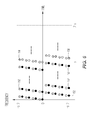
- FIG. 6 is a spectral plot of two symbols using Interleaved SC-OCDM modulation.
- the figure shows frequency versus time for two channels, one black/dark grey ( 152 ) the other medium gray/light grey ( 150 ), assuming a chirp length of 8 samples.
- the orthogonality of the two channels is due to the fact the channels operate on separate discrete frequencies.
- FIG. 7 An example embodiment of Interleaved SC-CSS is shown in FIG. 7 .
- a block of K information bits is encoded at 202 .
- forward error correction is used to provide a more robust communication link and to provide higher sensitivity at the receiver 104 .
- the information data is encoded by a convolutional encoder at 202 and the coded bits are distributed within a block of data by an interleaver at 204 .
- the coded bits are then mapped to modulation symbols by a QPSK encoder at 206 .
- the number of symbols, N, and the transmit block length, L are powers of 2 with N ⁇ L.
- the pre-coding is efficiently performed with an N point FFT at 208 .
- FIG. 8 An example embodiment of Interleaved SC-OCDM is shown in FIG. 8 .
- a block of K information bits is encoded at 202 .
- forward error correction is used to provide a more robust communication link and to provide higher sensitivity at the receiver 104 .
- the information data is encoded by a convolutional encoder at 202 and the coded bits are distributed within a block of data by an interleaver at 204 .
- the coded bits are then mapped to modulation symbols by a QPSK encoder at 206 .
- the number of symbols, N, and the transmit block length, L are powers of 2 with N ⁇ L.
- the pre-coding is efficiently performed with an N point FFT at 208 .
- L is equal to 1024. Due to the large symbol length, no cyclic prefix is added to each transmission symbol (since the degradation due to ISI is small).
- FIG. 9 shows a diagram of a receiver 104 which may be used to receive the signal transmitted by the Interleaved SC-CS S transmitter as shown in FIG. 7 .
- An RF demodulator 300 down-converts the RF signal to an analog baseband signal.
- the analog signal is converted to a digital baseband signal with an Analog to Digital Converter 302 .
- the digital baseband signal is then low-pass filtered by a digital filter 304 .
- the digital stream of data from the output of the filter is then correlated with the conjugate of the chirp signal at 306 . This is accomplished by buffering the data into a block of L samples, multiplying the block of data sample by sample with the conjugate of the length-L chirp signal, and then performing at 308 , a length L Fourier transform on the data.
- the data from the FFT is then equalized at 310 to form N data values, where N is the number of sub-channels.
- the N values are transformed at 320 by an N-point inverse Fourier transform to obtain N demodulation symbols.
- a QPSK decoder decodes the demodulation symbols at 322 to form codec symbols.
- the codec symbols are then de-interleaved at 324 and convolutionally decoded at 326 to obtain the recovered information data.
- the underlying modulation scheme is QPSK, but any other modulation may be used such as BPSK or m-ary QAM.
- the embodiment shown in FIG. 9 employs convolution coding error correction.
- the receiver 104 may use no forward error correction, or it may employ other known error correction codes such as Reed-Solomon, LDPC codes, or turbo codes.
- FIG. 10 An L-point FFT 308 that can be used in the SC Interleaved CSS Receiver 104 of FIG. 9 is shown in FIG. 10 .
- the figure depicts a K-tap equalizer 310 with N sub-channels.
- the outputs from the FFT are multiplied by the complex conjugate of the channel impulse response, C k .
- the results of the multiplications are summed to form a complex value for each of the sub-channels.
- FIG. 11 An SC Interleaved CSS Receiver which employs frequency domain demodulation is illustrated in FIG. 11 .
- the filtered, digital baseband signal is first buffered into a block of L samples and converted into the frequency domain using an L point FFT 312 . Conversion into the frequency domain may be desirable in order to easily filter (at 314 ) any narrowband interference which may appear in the pass-band.
- the block of data is correlated with the chirp signal at 306 by multiplying the data with the length L chirp signal, then performing an L point FFT at 308 .
- the remaining processing is the same as the time domain demodulator case as presented in FIG. 9 .
- the above described chirp spread spectrum modulation methods have the advantage that they exhibit low transmit signal PAPR, scalable data rates, wideband signal with multipath recoverable at receiver, coherent, high sensitivity acquisition and demodulation, high processing gains that are robust to interference and low inter-symbol and inter-channel interference.
Landscapes
- Engineering & Computer Science (AREA)
- Signal Processing (AREA)
- Computer Networks & Wireless Communication (AREA)
- Multimedia (AREA)
- Physics & Mathematics (AREA)
- Discrete Mathematics (AREA)
- General Physics & Mathematics (AREA)
- Mathematical Physics (AREA)
- Computing Systems (AREA)
- Theoretical Computer Science (AREA)
- Digital Transmission Methods That Use Modulated Carrier Waves (AREA)
Abstract
Description
Claims (12)
Priority Applications (1)
| Application Number | Priority Date | Filing Date | Title |
|---|---|---|---|
| US15/166,826 US9628807B2 (en) | 2013-03-12 | 2016-05-27 | Chirp spread spectrum system and method |
Applications Claiming Priority (3)
| Application Number | Priority Date | Filing Date | Title |
|---|---|---|---|
| US13/795,973 US9083444B2 (en) | 2013-03-12 | 2013-03-12 | Chirp spread spectrum system and method |
| US14/731,226 US9356646B2 (en) | 2013-03-12 | 2015-06-04 | Chirp spread spectrum system and method |
| US15/166,826 US9628807B2 (en) | 2013-03-12 | 2016-05-27 | Chirp spread spectrum system and method |
Related Parent Applications (1)
| Application Number | Title | Priority Date | Filing Date |
|---|---|---|---|
| US14/731,226 Continuation US9356646B2 (en) | 2013-03-12 | 2015-06-04 | Chirp spread spectrum system and method |
Publications (2)
| Publication Number | Publication Date |
|---|---|
| US20160277747A1 US20160277747A1 (en) | 2016-09-22 |
| US9628807B2 true US9628807B2 (en) | 2017-04-18 |
Family
ID=51526916
Family Applications (3)
| Application Number | Title | Priority Date | Filing Date |
|---|---|---|---|
| US13/795,973 Active 2033-05-02 US9083444B2 (en) | 2013-03-12 | 2013-03-12 | Chirp spread spectrum system and method |
| US14/731,226 Active US9356646B2 (en) | 2013-03-12 | 2015-06-04 | Chirp spread spectrum system and method |
| US15/166,826 Active US9628807B2 (en) | 2013-03-12 | 2016-05-27 | Chirp spread spectrum system and method |
Family Applications Before (2)
| Application Number | Title | Priority Date | Filing Date |
|---|---|---|---|
| US13/795,973 Active 2033-05-02 US9083444B2 (en) | 2013-03-12 | 2013-03-12 | Chirp spread spectrum system and method |
| US14/731,226 Active US9356646B2 (en) | 2013-03-12 | 2015-06-04 | Chirp spread spectrum system and method |
Country Status (1)
| Country | Link |
|---|---|
| US (3) | US9083444B2 (en) |
Families Citing this family (28)
| Publication number | Priority date | Publication date | Assignee | Title |
|---|---|---|---|---|
| WO2015046919A1 (en) | 2013-09-27 | 2015-04-02 | Lg Electronics Inc. | Apparatus for transmitting broadcast signals, apparatus for receiving broadcast signals, method for transmitting broadcast signals and method for receiving broadcast signals |
| KR102217030B1 (en) * | 2014-09-12 | 2021-02-19 | 삼성전자주식회사 | Modulation/demodulation apparatus and method for tranceiving signal in a wireless communication system |
| EP3002883B1 (en) * | 2014-09-30 | 2018-06-13 | Semtech Corporation | Wireless communication method |
| CN107005272A (en) * | 2014-10-21 | 2017-08-01 | 杰德烈·皮埃特里卡 | Systems and methods for communication signal processing for downhole applications |
| EP3264622B1 (en) * | 2016-07-01 | 2019-03-27 | Semtech Corporation | Low complexity, low power and long range radio receiver |
| EP3273607B1 (en) * | 2016-07-20 | 2023-01-18 | Semtech Corporation | Method and system of timing and localizing a radio signal |
| WO2018028775A1 (en) * | 2016-08-10 | 2018-02-15 | Huawei Technologies Co., Ltd. | Common synchronization signal for a new radio carrier supporting different subcarrier spacing |
| EP3306824B1 (en) * | 2016-10-07 | 2021-12-01 | Rohde & Schwarz GmbH & Co. KG | Method for detecting at least one broadband interferer and detecting system |
| US10735047B2 (en) * | 2018-04-05 | 2020-08-04 | Carnegie Mellon University | Methods, systems, and articles of manufacture for joint decoding of packets in wireless networks using chirp spread-spectrum modulation |
| JP7052526B2 (en) * | 2018-04-23 | 2022-04-12 | 富士通株式会社 | Spectrum analysis program, spectrum analysis method and spectrum analysis device |
| US10938440B2 (en) | 2018-05-17 | 2021-03-02 | Cisco Systems Canada Co. | Efficient methods for generating chirp spread spectrum signals |
| US11139853B2 (en) | 2018-07-06 | 2021-10-05 | Carnegie Mellon University | Low-power wide area networks |
| US11394594B2 (en) * | 2018-09-28 | 2022-07-19 | The Research Foundation For The State University Of New York | Method and apparatus for high data rate long range acoustic and RF communication using chirp waveform modulation |
| US11239882B2 (en) * | 2019-02-12 | 2022-02-01 | DecaWave, Ltd. | Method and apparatus for increasing bit rates in 4z |
| WO2020186424A1 (en) * | 2019-03-18 | 2020-09-24 | Zte Corporation | Systems and methods for conjugate data modulation |
| CN111786920B (en) * | 2019-04-03 | 2023-09-19 | 上海新岸线电子技术有限公司 | A multi-ary CSS signal demodulation method and device |
| US10778282B1 (en) | 2019-05-07 | 2020-09-15 | Cisco Technology, Inc. | Methods for improving flexibility and data rate of chirp spread spectrum systems in LoRaWAN |
| CN110488236B (en) * | 2019-07-30 | 2022-11-08 | 西北工业大学 | Ground clutter suppression method for GEO and LEO double-base configuration synthetic radar |
| CN111478754B (en) * | 2019-09-20 | 2023-03-21 | 上海磐启微电子有限公司 | Signal modulation method |
| WO2021254634A1 (en) * | 2020-06-19 | 2021-12-23 | Huawei Technologies Co., Ltd. | Generalized orthogonal chirp waveform |
| CN112738001B (en) * | 2020-11-25 | 2022-01-14 | 北京智芯微电子科技有限公司 | Quadrature keying modulation method, demodulation method, system, transmitter and receiver |
| CN113794662B (en) * | 2021-09-15 | 2022-06-17 | 西安电子科技大学广州研究院 | LFM technology-based satellite Internet of things transmission method and system |
| CN114301500B (en) * | 2021-11-22 | 2024-01-23 | 北京智芯微电子科技有限公司 | Synchronization method, device, receiving and transmitting device for multi-user spread spectrum communication system |
| WO2024108476A1 (en) * | 2022-11-24 | 2024-05-30 | Huawei Technologies Co., Ltd. | Method and apparatus using hybrid rf-domain and baseband-domain sensing signal |
| CN116232374B (en) * | 2023-01-12 | 2025-06-06 | 南京邮电大学 | A demodulation method for Chirp spread spectrum modulation with configurable spreading factor based on FFT |
| CN116405113B (en) * | 2023-03-07 | 2025-08-19 | 复旦大学 | PAM8 underwater visible light communication system based on conjugate frequency hopping and chaotic phase scrambling code encryption |
| CN116996796B (en) * | 2023-09-27 | 2023-12-22 | 北京邮电大学 | Array waveguide grating router based on staggered chirp array and optical routing method |
| WO2025120495A1 (en) * | 2023-12-07 | 2025-06-12 | Continental Automotive Technologies GmbH | Method of modulating and demodulating, respectively, wireless signals for high mobility communications, and apparatus implementing the methods |
Citations (19)
| Publication number | Priority date | Publication date | Assignee | Title |
|---|---|---|---|---|
| US4532603A (en) | 1983-03-09 | 1985-07-30 | The United States Of America As Represented By The Secretary Of The Army | Chirp transform correlator |
| US6396866B1 (en) | 1998-05-01 | 2002-05-28 | Trw Inc. | Symmetric chirp communications acquisition method and apparatus |
| US6493405B1 (en) | 1999-03-02 | 2002-12-10 | Harris Corporation | Correlator having enhanced memory for reference and input data |
| US20030022651A1 (en) | 1999-12-21 | 2003-01-30 | Rudolf Bannasch | Method and devices for transmitting and receiving information |
| WO2003092183A2 (en) | 2002-04-10 | 2003-11-06 | Nanotron Technologies Gmbh | Transceiver device |
| US20050163201A1 (en) | 2004-01-28 | 2005-07-28 | Krasner Norman F. | Rapid acquisition methods and apparatus for GPS signals |
| US6943405B2 (en) | 2003-07-01 | 2005-09-13 | International Business Machines Corporation | Integrated circuit having pairs of parallel complementary FinFETs |
| EP1599001A1 (en) | 2003-02-25 | 2005-11-23 | Yokohama TLO Company, Ltd. | Pulse waveform producing method |
| US20060114747A1 (en) | 2004-11-22 | 2006-06-01 | Baker Hughes Incorporated | Identification of the channel frequency response using chirps and stepped frequencies |
| US7068704B1 (en) | 2001-09-26 | 2006-06-27 | Itt Manufacturing Enterpprises, Inc. | Embedded chirp signal for position determination in cellular communication systems |
| US7177343B1 (en) | 2000-05-17 | 2007-02-13 | Zenith Electronics Corporation | Compound chirp and synchronizer for using same |
| US20080298502A1 (en) | 2007-05-18 | 2008-12-04 | Qualcomm Incorporated | Pilot structures for ack and cqi in a wireless communication system |
| US20080309543A1 (en) | 2007-06-18 | 2008-12-18 | Schaffner Terry M | System and method for obtaining frequency and time synchronization in a wideband communication system |
| US20080310481A1 (en) | 2007-06-18 | 2008-12-18 | Schaffner Terry M | System and method for transmitting and detecting spread spectrum signals |
| US7889802B2 (en) | 2006-02-06 | 2011-02-15 | Sony Corporation | Demodulating device, method and program |
| US20110188559A1 (en) | 2010-01-29 | 2011-08-04 | Qualcomm Incorporated | Reducing phase errors on a communication device |
| US7995689B2 (en) | 2006-03-14 | 2011-08-09 | Qualcomm Incorporated | Transmission/reception apparatus and method for frequency domain signal processing in a smart antenna system |
| US20130034089A1 (en) | 2010-02-12 | 2013-02-07 | Sharp Kabushiki Kaisha | Mobile station apparatus, communication method, integrated circuit, radio communication system, and control program |
| US8520748B2 (en) | 2005-10-03 | 2013-08-27 | Sharp Kabushiki Kaisha | Transmitter, OFDM communication system, and transmission method |
-
2013
- 2013-03-12 US US13/795,973 patent/US9083444B2/en active Active
-
2015
- 2015-06-04 US US14/731,226 patent/US9356646B2/en active Active
-
2016
- 2016-05-27 US US15/166,826 patent/US9628807B2/en active Active
Patent Citations (21)
| Publication number | Priority date | Publication date | Assignee | Title |
|---|---|---|---|---|
| US4532603A (en) | 1983-03-09 | 1985-07-30 | The United States Of America As Represented By The Secretary Of The Army | Chirp transform correlator |
| US6396866B1 (en) | 1998-05-01 | 2002-05-28 | Trw Inc. | Symmetric chirp communications acquisition method and apparatus |
| US6493405B1 (en) | 1999-03-02 | 2002-12-10 | Harris Corporation | Correlator having enhanced memory for reference and input data |
| US20030022651A1 (en) | 1999-12-21 | 2003-01-30 | Rudolf Bannasch | Method and devices for transmitting and receiving information |
| US7177343B1 (en) | 2000-05-17 | 2007-02-13 | Zenith Electronics Corporation | Compound chirp and synchronizer for using same |
| US7068704B1 (en) | 2001-09-26 | 2006-06-27 | Itt Manufacturing Enterpprises, Inc. | Embedded chirp signal for position determination in cellular communication systems |
| WO2003092183A2 (en) | 2002-04-10 | 2003-11-06 | Nanotron Technologies Gmbh | Transceiver device |
| EP1599001A1 (en) | 2003-02-25 | 2005-11-23 | Yokohama TLO Company, Ltd. | Pulse waveform producing method |
| US6943405B2 (en) | 2003-07-01 | 2005-09-13 | International Business Machines Corporation | Integrated circuit having pairs of parallel complementary FinFETs |
| US20050163201A1 (en) | 2004-01-28 | 2005-07-28 | Krasner Norman F. | Rapid acquisition methods and apparatus for GPS signals |
| US20060114747A1 (en) | 2004-11-22 | 2006-06-01 | Baker Hughes Incorporated | Identification of the channel frequency response using chirps and stepped frequencies |
| US8520748B2 (en) | 2005-10-03 | 2013-08-27 | Sharp Kabushiki Kaisha | Transmitter, OFDM communication system, and transmission method |
| US7889802B2 (en) | 2006-02-06 | 2011-02-15 | Sony Corporation | Demodulating device, method and program |
| US7995689B2 (en) | 2006-03-14 | 2011-08-09 | Qualcomm Incorporated | Transmission/reception apparatus and method for frequency domain signal processing in a smart antenna system |
| US20080298502A1 (en) | 2007-05-18 | 2008-12-04 | Qualcomm Incorporated | Pilot structures for ack and cqi in a wireless communication system |
| US20080309543A1 (en) | 2007-06-18 | 2008-12-18 | Schaffner Terry M | System and method for obtaining frequency and time synchronization in a wideband communication system |
| US20080310481A1 (en) | 2007-06-18 | 2008-12-18 | Schaffner Terry M | System and method for transmitting and detecting spread spectrum signals |
| EP2015464A1 (en) | 2007-06-18 | 2009-01-14 | Digi International Inc. | Method and apparatus for transmitting and detecting a spread spectrum chirp signal |
| EP2015463A1 (en) | 2007-06-18 | 2009-01-14 | Digi International Inc. | System and method for obtaining frequency and time synchronization in a wideband communication system |
| US20110188559A1 (en) | 2010-01-29 | 2011-08-04 | Qualcomm Incorporated | Reducing phase errors on a communication device |
| US20130034089A1 (en) | 2010-02-12 | 2013-02-07 | Sharp Kabushiki Kaisha | Mobile station apparatus, communication method, integrated circuit, radio communication system, and control program |
Non-Patent Citations (17)
| Title |
|---|
| Hengstler et al., "A Novel Chirp Modulation Spread Spectrum Technique for Multiple Access", "2002 IEEE Seventh International Symposium in Spread Spectrum Techniques and Applications", 2002, pp. 1-5. |
| Kowatsch, "A Spread-Spectrum Concept Combining Chirp Modulation and Pseudonoise Coding", "IEEE Transactions on Communications", Oct. 1983, pp. 1133-1142, vol. 31, No. 10. |
| Springer et al., "Spread Spectrum Communications Using Chirp Signals", "Information Systems for Enhanced Public Safety and Security", 2000, pp. 1-6, Publisher: IEEE/FCEA EUROCOMM 2000. |
| U.S. Patent and Trademark Office, "Examiner's Answer to Appeal Brief", "from U.S. Appl. No. 11/764,579", Feb. 17, 2012, pp. 1-17, Published in: US. |
| U.S. Patent and Trademark Office, "Examiner's Answer", "from U.S. Appl. No. 11/764,597", Nov. 14, 2011, pp. 1-18, Published in: US. |
| U.S. Patent and Trademark Office, "Final Office Action", "from U.S. Appl. No. 11/764,579", Aug. 6, 2010, pp. 1-12, Published in: US. |
| U.S. Patent and Trademark Office, "Final Office Action", "from U.S. Appl. No. 11/764,579", May 10, 2011, pp. 1-15, Published in: US. |
| U.S. Patent and Trademark Office, "Notice of Allowance", "from U.S. Appl. No. 13/795,973", Mar. 3, 2015, pp. 1-9, Published in: US. |
| U.S. Patent and Trademark Office, "Notice of Allowance", "from U.S. Appl. No. 14/731,226", Jan. 29, 2016, pp. 1-7, Published in: US. |
| U.S. Patent and Trademark Office, "Office Action", "from U.S. Appl. No. 11/764,579", Dec. 27, 2010, pp. 1-13, Published in: US. |
| U.S. Patent and Trademark Office, "Office Action", "from U.S. Appl. No. 13/209,744", Mar. 29, 2013, pp. 1-15, Published in: US. |
| U.S. Patent and Trademark Office, "Office Action", "from U.S. Appl. No. 13/795,973", Sep. 10, 2014, pp. 1-14, Published in: US. |
| U.S. Patent and Trademark Office, "Office Action", "from U.S. Appl. No. 14/731,226", Sep. 25, 2015, pp. 1-13, Published in: US. |
| U.S. Patent and Trademark Office, "Pre-Appeal Brief Conference Decision", "from U.S. Appl. No. 11/764,579", Oct. 19, 2010, pp. 1-2, Published in: US. |
| U.S. Patent and Trademark Office, "Pre-Appeal Brief Conference Decision", "from U.S. Appl. No. 11/764,597", Jul. 22, 2011, pp. 1-2, Published in: US. |
| U.S. Patent and Trademark Office, "Restriction Requirement", "from U.S. Appl. No. 13/795,973", Jul. 2, 2014, pp. 1-9, Published in: US. |
| U.S. Patent and Trademark Office, "Restriction Requirement", "from U.S. Appl. No. 14/731,226", Jun. 24, 2015, pp. 1-9, Published in: US. |
Also Published As
| Publication number | Publication date |
|---|---|
| US20150270866A1 (en) | 2015-09-24 |
| US20160277747A1 (en) | 2016-09-22 |
| US9356646B2 (en) | 2016-05-31 |
| US20140269843A1 (en) | 2014-09-18 |
| US9083444B2 (en) | 2015-07-14 |
Similar Documents
| Publication | Publication Date | Title |
|---|---|---|
| US9356646B2 (en) | Chirp spread spectrum system and method | |
| US8867587B2 (en) | Double-layer multi-carrier ultra-wideband wireless communication method | |
| KR100754621B1 (en) | Apparatus and Method for Reducing Peak Power vs. Average Power in Orthogonal Frequency Division Multiplexed Mobile Communication Systems | |
| KR100866181B1 (en) | Method and apparatus for transmitting and receiving signal in communication system | |
| EP1595350A1 (en) | Method of reducing papr in multiple antenna ofdm communication system and multiple antenna ofdm communication system using the method | |
| Sarowa et al. | Evolution of PAPR reduction techniques: A wavelet based OFDM approach | |
| KR20060059221A (en) | Apparatus and method for reducing peak-to-average power ratio in multicarrier communication systems | |
| US20250219885A1 (en) | Unified and configurable waveform framework for 6g | |
| Elavarasan et al. | Peak-power reduction using improved partial transmit sequence in orthogonal frequency division multiplexing systems | |
| Kumari et al. | A survey on various PAPR reduction techniques in OFDM communication systems | |
| Frank et al. | A survey on the envelope fluctuations of DFT precoded OFDMA signals | |
| JP4863262B2 (en) | Transmitter, communication system, and transmission method | |
| JP5213879B2 (en) | Transmitting apparatus and modulation method | |
| Pervej et al. | Analysis of PAPR reduction of DFT-SCFDMA system using different sub-carrier mapping schemes | |
| Elavarasan et al. | A summarization on PAPR techniques for OFDM systems | |
| Reddy et al. | Channel Coding and Clipping in OFDM for WiMAX using SDR | |
| US10149240B2 (en) | Communication system and method for achieving low peak-to-average power ratio | |
| Prethyoosha et al. | Performance analysis of DFT spreading and wavelet filtering in UFMC system | |
| Fidele et al. | Peak to average power ratio reduction for OFDM system using different peak windowing and modulation techniques | |
| CN102263759B (en) | Method for transmitting anti-interference mobile signals of digital broadcast single-frequency network | |
| Kaur et al. | Peak to average power ratio reduction of ofdm signal by combining clipping with walsh hadamard transform | |
| Mishra | PAPR reduction of OFDM signals using selected mapping technique | |
| Rashmi et al. | Power efficiency enhancement using hybrid techniques for OFDM | |
| Rajeswaran et al. | OFDM receiver design and characterization with reduction of PAPR | |
| Aldoseri | A Highly Reliable Radio Communication System for Wireless Sensor and Actuator Networks |
Legal Events
| Date | Code | Title | Description |
|---|---|---|---|
| AS | Assignment |
Owner name: DIGI INTERNATIONAL INCL, MINNESOTA Free format text: ASSIGNMENT OF ASSIGNORS INTEREST;ASSIGNOR:SCHAFFNER, TERRY MICHAEL;REEL/FRAME:038737/0532 Effective date: 20130311 |
|
| STCF | Information on status: patent grant |
Free format text: PATENTED CASE |
|
| AS | Assignment |
Owner name: BMO HARRIS BANK N.A., MINNESOTA Free format text: SECURITY INTEREST;ASSIGNOR:DIGI INTERNATIONAL INC.;REEL/FRAME:051370/0023 Effective date: 20191213 |
|
| MAFP | Maintenance fee payment |
Free format text: PAYMENT OF MAINTENANCE FEE, 4TH YEAR, LARGE ENTITY (ORIGINAL EVENT CODE: M1551); ENTITY STATUS OF PATENT OWNER: LARGE ENTITY Year of fee payment: 4 |
|
| AS | Assignment |
Owner name: BMO BANK N.A., AS ADMINISTRATIVE AGENT, MINNESOTA Free format text: SECURITY INTEREST;ASSIGNOR:DIGI INTERNATIONAL INC.;REEL/FRAME:065836/0981 Effective date: 20231207 Owner name: DIGI INTERNATIONAL INC., MINNESOTA Free format text: RELEASE BY SECURED PARTY;ASSIGNOR:BMO BANK N.A., AS ADMINISTRATIVE AGENT;REEL/FRAME:065835/0205 Effective date: 20231207 Owner name: DIGI INTERNATIONAL INC., MINNESOTA Free format text: RELEASE OF SECURITY INTEREST;ASSIGNOR:BMO BANK N.A., AS ADMINISTRATIVE AGENT;REEL/FRAME:065835/0205 Effective date: 20231207 |
|
| MAFP | Maintenance fee payment |
Free format text: PAYMENT OF MAINTENANCE FEE, 8TH YEAR, LARGE ENTITY (ORIGINAL EVENT CODE: M1552); ENTITY STATUS OF PATENT OWNER: LARGE ENTITY Year of fee payment: 8 |