US9618627B2 - Method for measuring a side slip angle in vehicles - Google Patents

Method for measuring a side slip angle in vehicles Download PDF

Info

Publication number
US9618627B2
US9618627B2 US15/229,933 US201615229933A US9618627B2 US 9618627 B2 US9618627 B2 US 9618627B2 US 201615229933 A US201615229933 A US 201615229933A US 9618627 B2 US9618627 B2 US 9618627B2
Authority
US
United States
Prior art keywords
mag
vehicle speed
vehicle
angle
determining
Prior art date
Legal status (The legal status is an assumption and is not a legal conclusion. Google has not performed a legal analysis and makes no representation as to the accuracy of the status listed.)
Expired - Fee Related
Application number
US15/229,933
Other versions
US20170038476A1 (en
Inventor
Andreas Unger
Current Assignee (The listed assignees may be inaccurate. Google has not performed a legal analysis and makes no representation or warranty as to the accuracy of the list.)
Audi AG
Original Assignee
Audi AG
Priority date (The priority date is an assumption and is not a legal conclusion. Google has not performed a legal analysis and makes no representation as to the accuracy of the date listed.)
Filing date
Publication date
Application filed by Audi AG filed Critical Audi AG
Assigned to AUDI AG reassignment AUDI AG ASSIGNMENT OF ASSIGNORS INTEREST (SEE DOCUMENT FOR DETAILS). Assignors: UNGER, ANDREAS
Publication of US20170038476A1 publication Critical patent/US20170038476A1/en
Application granted granted Critical
Publication of US9618627B2 publication Critical patent/US9618627B2/en
Expired - Fee Related legal-status Critical Current
Anticipated expiration legal-status Critical

Links

Images

Classifications

    • BPERFORMING OPERATIONS; TRANSPORTING
    • B60VEHICLES IN GENERAL
    • B60WCONJOINT CONTROL OF VEHICLE SUB-UNITS OF DIFFERENT TYPE OR DIFFERENT FUNCTION; CONTROL SYSTEMS SPECIALLY ADAPTED FOR HYBRID VEHICLES; ROAD VEHICLE DRIVE CONTROL SYSTEMS FOR PURPOSES NOT RELATED TO THE CONTROL OF A PARTICULAR SUB-UNIT
    • B60W40/00Estimation or calculation of non-directly measurable driving parameters for road vehicle drive control systems not related to the control of a particular sub unit, e.g. by using mathematical models
    • B60W40/10Estimation or calculation of non-directly measurable driving parameters for road vehicle drive control systems not related to the control of a particular sub unit, e.g. by using mathematical models related to vehicle motion
    • B60W40/103Side slip angle of vehicle body
    • GPHYSICS
    • G01MEASURING; TESTING
    • G01SRADIO DIRECTION-FINDING; RADIO NAVIGATION; DETERMINING DISTANCE OR VELOCITY BY USE OF RADIO WAVES; LOCATING OR PRESENCE-DETECTING BY USE OF THE REFLECTION OR RERADIATION OF RADIO WAVES; ANALOGOUS ARRANGEMENTS USING OTHER WAVES
    • G01S19/00Satellite radio beacon positioning systems; Determining position, velocity or attitude using signals transmitted by such systems
    • G01S19/38Determining a navigation solution using signals transmitted by a satellite radio beacon positioning system
    • G01S19/39Determining a navigation solution using signals transmitted by a satellite radio beacon positioning system the satellite radio beacon positioning system transmitting time-stamped messages, e.g. GPS [Global Positioning System], GLONASS [Global Orbiting Navigation Satellite System] or GALILEO
    • G01S19/42Determining position
    • G01S19/45Determining position by combining measurements of signals from the satellite radio beacon positioning system with a supplementary measurement
    • G01S19/47Determining position by combining measurements of signals from the satellite radio beacon positioning system with a supplementary measurement the supplementary measurement being an inertial measurement, e.g. tightly coupled inertial
    • BPERFORMING OPERATIONS; TRANSPORTING
    • B60VEHICLES IN GENERAL
    • B60WCONJOINT CONTROL OF VEHICLE SUB-UNITS OF DIFFERENT TYPE OR DIFFERENT FUNCTION; CONTROL SYSTEMS SPECIALLY ADAPTED FOR HYBRID VEHICLES; ROAD VEHICLE DRIVE CONTROL SYSTEMS FOR PURPOSES NOT RELATED TO THE CONTROL OF A PARTICULAR SUB-UNIT
    • B60W40/00Estimation or calculation of non-directly measurable driving parameters for road vehicle drive control systems not related to the control of a particular sub unit, e.g. by using mathematical models
    • B60W40/10Estimation or calculation of non-directly measurable driving parameters for road vehicle drive control systems not related to the control of a particular sub unit, e.g. by using mathematical models related to vehicle motion
    • BPERFORMING OPERATIONS; TRANSPORTING
    • B60VEHICLES IN GENERAL
    • B60WCONJOINT CONTROL OF VEHICLE SUB-UNITS OF DIFFERENT TYPE OR DIFFERENT FUNCTION; CONTROL SYSTEMS SPECIALLY ADAPTED FOR HYBRID VEHICLES; ROAD VEHICLE DRIVE CONTROL SYSTEMS FOR PURPOSES NOT RELATED TO THE CONTROL OF A PARTICULAR SUB-UNIT
    • B60W40/00Estimation or calculation of non-directly measurable driving parameters for road vehicle drive control systems not related to the control of a particular sub unit, e.g. by using mathematical models
    • B60W40/10Estimation or calculation of non-directly measurable driving parameters for road vehicle drive control systems not related to the control of a particular sub unit, e.g. by using mathematical models related to vehicle motion
    • B60W40/114Yaw movement
    • GPHYSICS
    • G01MEASURING; TESTING
    • G01CMEASURING DISTANCES, LEVELS OR BEARINGS; SURVEYING; NAVIGATION; GYROSCOPIC INSTRUMENTS; PHOTOGRAMMETRY OR VIDEOGRAMMETRY
    • G01C21/00Navigation; Navigational instruments not provided for in groups G01C1/00 - G01C19/00
    • G01C21/10Navigation; Navigational instruments not provided for in groups G01C1/00 - G01C19/00 by using measurements of speed or acceleration
    • G01C21/12Navigation; Navigational instruments not provided for in groups G01C1/00 - G01C19/00 by using measurements of speed or acceleration executed aboard the object being navigated; Dead reckoning
    • G01C21/16Navigation; Navigational instruments not provided for in groups G01C1/00 - G01C19/00 by using measurements of speed or acceleration executed aboard the object being navigated; Dead reckoning by integrating acceleration or speed, i.e. inertial navigation
    • GPHYSICS
    • G01MEASURING; TESTING
    • G01CMEASURING DISTANCES, LEVELS OR BEARINGS; SURVEYING; NAVIGATION; GYROSCOPIC INSTRUMENTS; PHOTOGRAMMETRY OR VIDEOGRAMMETRY
    • G01C21/00Navigation; Navigational instruments not provided for in groups G01C1/00 - G01C19/00
    • G01C21/10Navigation; Navigational instruments not provided for in groups G01C1/00 - G01C19/00 by using measurements of speed or acceleration
    • G01C21/12Navigation; Navigational instruments not provided for in groups G01C1/00 - G01C19/00 by using measurements of speed or acceleration executed aboard the object being navigated; Dead reckoning
    • G01C21/16Navigation; Navigational instruments not provided for in groups G01C1/00 - G01C19/00 by using measurements of speed or acceleration executed aboard the object being navigated; Dead reckoning by integrating acceleration or speed, i.e. inertial navigation
    • G01C21/165Navigation; Navigational instruments not provided for in groups G01C1/00 - G01C19/00 by using measurements of speed or acceleration executed aboard the object being navigated; Dead reckoning by integrating acceleration or speed, i.e. inertial navigation combined with non-inertial navigation instruments
    • G01C21/1654Navigation; Navigational instruments not provided for in groups G01C1/00 - G01C19/00 by using measurements of speed or acceleration executed aboard the object being navigated; Dead reckoning by integrating acceleration or speed, i.e. inertial navigation combined with non-inertial navigation instruments with electromagnetic compass
    • GPHYSICS
    • G01MEASURING; TESTING
    • G01CMEASURING DISTANCES, LEVELS OR BEARINGS; SURVEYING; NAVIGATION; GYROSCOPIC INSTRUMENTS; PHOTOGRAMMETRY OR VIDEOGRAMMETRY
    • G01C21/00Navigation; Navigational instruments not provided for in groups G01C1/00 - G01C19/00
    • G01C21/10Navigation; Navigational instruments not provided for in groups G01C1/00 - G01C19/00 by using measurements of speed or acceleration
    • G01C21/12Navigation; Navigational instruments not provided for in groups G01C1/00 - G01C19/00 by using measurements of speed or acceleration executed aboard the object being navigated; Dead reckoning
    • G01C21/16Navigation; Navigational instruments not provided for in groups G01C1/00 - G01C19/00 by using measurements of speed or acceleration executed aboard the object being navigated; Dead reckoning by integrating acceleration or speed, i.e. inertial navigation
    • G01C21/183Compensation of inertial measurements, e.g. for temperature effects
    • G01C21/188Compensation of inertial measurements, e.g. for temperature effects for accumulated errors, e.g. by coupling inertial systems with absolute positioning systems
    • GPHYSICS
    • G01MEASURING; TESTING
    • G01RMEASURING ELECTRIC VARIABLES; MEASURING MAGNETIC VARIABLES
    • G01R33/00Arrangements or instruments for measuring magnetic variables
    • G01R33/02Measuring direction or magnitude of magnetic fields or magnetic flux
    • GPHYSICS
    • G01MEASURING; TESTING
    • G01SRADIO DIRECTION-FINDING; RADIO NAVIGATION; DETERMINING DISTANCE OR VELOCITY BY USE OF RADIO WAVES; LOCATING OR PRESENCE-DETECTING BY USE OF THE REFLECTION OR RERADIATION OF RADIO WAVES; ANALOGOUS ARRANGEMENTS USING OTHER WAVES
    • G01S19/00Satellite radio beacon positioning systems; Determining position, velocity or attitude using signals transmitted by such systems
    • G01S19/38Determining a navigation solution using signals transmitted by a satellite radio beacon positioning system
    • G01S19/39Determining a navigation solution using signals transmitted by a satellite radio beacon positioning system the satellite radio beacon positioning system transmitting time-stamped messages, e.g. GPS [Global Positioning System], GLONASS [Global Orbiting Navigation Satellite System] or GALILEO
    • G01S19/52Determining velocity
    • GPHYSICS
    • G01MEASURING; TESTING
    • G01SRADIO DIRECTION-FINDING; RADIO NAVIGATION; DETERMINING DISTANCE OR VELOCITY BY USE OF RADIO WAVES; LOCATING OR PRESENCE-DETECTING BY USE OF THE REFLECTION OR RERADIATION OF RADIO WAVES; ANALOGOUS ARRANGEMENTS USING OTHER WAVES
    • G01S19/00Satellite radio beacon positioning systems; Determining position, velocity or attitude using signals transmitted by such systems
    • G01S19/38Determining a navigation solution using signals transmitted by a satellite radio beacon positioning system
    • G01S19/39Determining a navigation solution using signals transmitted by a satellite radio beacon positioning system the satellite radio beacon positioning system transmitting time-stamped messages, e.g. GPS [Global Positioning System], GLONASS [Global Orbiting Navigation Satellite System] or GALILEO
    • G01S19/53Determining attitude
    • BPERFORMING OPERATIONS; TRANSPORTING
    • B60VEHICLES IN GENERAL
    • B60WCONJOINT CONTROL OF VEHICLE SUB-UNITS OF DIFFERENT TYPE OR DIFFERENT FUNCTION; CONTROL SYSTEMS SPECIALLY ADAPTED FOR HYBRID VEHICLES; ROAD VEHICLE DRIVE CONTROL SYSTEMS FOR PURPOSES NOT RELATED TO THE CONTROL OF A PARTICULAR SUB-UNIT
    • B60W2420/00Indexing codes relating to the type of sensors based on the principle of their operation
    • B60W2420/50Magnetic or electromagnetic sensors
    • BPERFORMING OPERATIONS; TRANSPORTING
    • B60VEHICLES IN GENERAL
    • B60WCONJOINT CONTROL OF VEHICLE SUB-UNITS OF DIFFERENT TYPE OR DIFFERENT FUNCTION; CONTROL SYSTEMS SPECIALLY ADAPTED FOR HYBRID VEHICLES; ROAD VEHICLE DRIVE CONTROL SYSTEMS FOR PURPOSES NOT RELATED TO THE CONTROL OF A PARTICULAR SUB-UNIT
    • B60W2520/00Input parameters relating to overall vehicle dynamics
    • B60W2520/10Longitudinal speed
    • B60W2520/105Longitudinal acceleration
    • BPERFORMING OPERATIONS; TRANSPORTING
    • B60VEHICLES IN GENERAL
    • B60WCONJOINT CONTROL OF VEHICLE SUB-UNITS OF DIFFERENT TYPE OR DIFFERENT FUNCTION; CONTROL SYSTEMS SPECIALLY ADAPTED FOR HYBRID VEHICLES; ROAD VEHICLE DRIVE CONTROL SYSTEMS FOR PURPOSES NOT RELATED TO THE CONTROL OF A PARTICULAR SUB-UNIT
    • B60W2520/00Input parameters relating to overall vehicle dynamics
    • B60W2520/12Lateral speed
    • B60W2520/125Lateral acceleration
    • BPERFORMING OPERATIONS; TRANSPORTING
    • B60VEHICLES IN GENERAL
    • B60WCONJOINT CONTROL OF VEHICLE SUB-UNITS OF DIFFERENT TYPE OR DIFFERENT FUNCTION; CONTROL SYSTEMS SPECIALLY ADAPTED FOR HYBRID VEHICLES; ROAD VEHICLE DRIVE CONTROL SYSTEMS FOR PURPOSES NOT RELATED TO THE CONTROL OF A PARTICULAR SUB-UNIT
    • B60W2520/00Input parameters relating to overall vehicle dynamics
    • B60W2520/14Yaw
    • BPERFORMING OPERATIONS; TRANSPORTING
    • B60VEHICLES IN GENERAL
    • B60WCONJOINT CONTROL OF VEHICLE SUB-UNITS OF DIFFERENT TYPE OR DIFFERENT FUNCTION; CONTROL SYSTEMS SPECIALLY ADAPTED FOR HYBRID VEHICLES; ROAD VEHICLE DRIVE CONTROL SYSTEMS FOR PURPOSES NOT RELATED TO THE CONTROL OF A PARTICULAR SUB-UNIT
    • B60W2520/00Input parameters relating to overall vehicle dynamics
    • B60W2520/16Pitch
    • BPERFORMING OPERATIONS; TRANSPORTING
    • B60VEHICLES IN GENERAL
    • B60WCONJOINT CONTROL OF VEHICLE SUB-UNITS OF DIFFERENT TYPE OR DIFFERENT FUNCTION; CONTROL SYSTEMS SPECIALLY ADAPTED FOR HYBRID VEHICLES; ROAD VEHICLE DRIVE CONTROL SYSTEMS FOR PURPOSES NOT RELATED TO THE CONTROL OF A PARTICULAR SUB-UNIT
    • B60W2520/00Input parameters relating to overall vehicle dynamics
    • B60W2520/18Roll
    • BPERFORMING OPERATIONS; TRANSPORTING
    • B60VEHICLES IN GENERAL
    • B60WCONJOINT CONTROL OF VEHICLE SUB-UNITS OF DIFFERENT TYPE OR DIFFERENT FUNCTION; CONTROL SYSTEMS SPECIALLY ADAPTED FOR HYBRID VEHICLES; ROAD VEHICLE DRIVE CONTROL SYSTEMS FOR PURPOSES NOT RELATED TO THE CONTROL OF A PARTICULAR SUB-UNIT
    • B60W2556/00Input parameters relating to data
    • B60W2556/45External transmission of data to or from the vehicle
    • B60W2556/50External transmission of data to or from the vehicle of positioning data, e.g. GPS [Global Positioning System] data

Definitions

  • the present invention relates to a method for measuring a side slip angle in vehicles.
  • a satellite navigation system is used as first sensor which includes a receiver and an antenna.
  • the satellite navigation system determines a vehicle speed in geographic north direction and a vehicle speed in geographic east direction.
  • the effective vehicle speed vector can then be determined via vector addition of the vehicle speed in geographic north direction and the vehicle speed in geographic east direction.
  • a magnetic field sensor is used as second sensor which is installed along the vehicle longitudinal axis.
  • a two-axis magnetic field sensor is used for determining a magnetic field strength in vehicle longitudinal direction and a magnetic field strength in vehicle transverse direction.
  • additional measurement variables are used that recognize driving situations for which the side slip angle is zero, wherein the differential angle for each of these driving situations is stored and the differential angle is formed according to the relationship
  • ⁇ mag , ⁇ 1 n ⁇ ⁇ n ⁇ ⁇ ⁇ mag , ⁇ , n , wherein ⁇ mag, ⁇ designates the differential angle and ⁇ mag, ⁇ ,n the differential angle of a driving situation for which the side slip angle is zero.
  • FIG. 1 shows a schematic representation of angles, which can occur in different coordinate systems on a motor vehicle
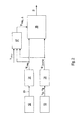
  • FIG. 2 shows a schematic representation of an exemplary embodiment of the method according to the invention.
  • FIG. 1 shows a schematic view onto a vehicle 10 .
  • a first coordinate system represents a vehicle-fixed local coordinate system and is indicated by the axes x and y.
  • the x axis hereby represents a vehicle longitudinal axis.
  • the y axis represents a vehicle transverse axis.
  • a second coordinate system represents a global geographic coordinate system and is characterized by the directions N for north and E for east, wherein the origin is vehicle-fixed.
  • FIG. 1 also shows different vectors.
  • the vector v x describes a vehicle longitudinal speed in the direction of the vehicle longitudinal axis x.
  • a vehicle speed v vhcl is determined which substantially points in vehicle longitudinal direction x.
  • the vector v y describes a vehicle speed in the direction of the vehicle transverse axis y. From these two components a vector for an effective vehicle speed v eff can be determined by vector addition.
  • the effective vehicle speed vector v eff has an angle relative to the vehicle longitudinal axis which is referred to as ⁇ and defines the side slip angle.
  • the side slip angle
  • a tan 2(v y ,v x ).
  • the mathematical function a tan 2 is hereby defined as follows:
  • the vector v N describes a vehicle speed in geographical north direction N.
  • the vector v E describes a vehicle speed in geographical east direction E. Also from these two components v N and v E the effective vehicle speed v eff can be determined by vector addition.
  • the vector of the effective vehicle speed v eff describes in the geographic coordinate system the direction in which the center of mass S of the vehicle 10 moves over the ground.
  • the direction in which the vehicle 10 moves is referred to as course and is blotted in relation to the axis N in the geographic coordinate system.
  • the angle enclosed by the vector of the effective vehicle speed v eff and the geographic north direction N of the geographic coordinate system is referred to as course angle ⁇ course .
  • the orientation of the vehicle longitudinal axis x and with this the vehicle longitudinal speed v x relative to a magnetic north direction M of the earth magnetic field is referred to a magnetic course or magnetic course angle ⁇ mag or also as yaw angle.
  • a magnetic course or magnetic course angle ⁇ mag or also as yaw angle.
  • ⁇ mag results between the magnetic north direction M and the geographic north direction N.
  • an error in the mounting position of a magnetic field sensor 12 ( FIG. 2 ) for example due to twisting contributes to the differential angle ⁇ mag, ⁇ .
  • the differential angle ⁇ mag, ⁇ is also referred to as declination.
  • the magnetic field sensor 12 is mounted along the vehicle longitudinal axis x.
  • the magnetic field sensor 12 is configured as a two-axis magnetic field sensor and enables measurement of magnetic field strengths of the earth magnetic field.
  • a two-axes magnetic field sensor is configured for measuring a magnetic filed strength m x in x-direction, i.e., the vehicle longitudinal direction x, and for measuring a magnetic field strength m y in y-direction, i.e., along the vehicle transverse direction y.
  • a satellite navigation system 15 such as for example a GPS (Global Positioning System)-sensor which includes a receiver and an antenna or another satellite navigation system (GLONASS, Galileo, Beidou) is also installed in the vehicle and is configured to determine a vehicle speed v N in geographic north direction N and a vehicle speed v E in the geographic east direction E.
  • GLONASS Global Positioning System
  • Galileo Galileo
  • Beidou another satellite navigation system
  • the vehicle speed v d Via wheel rotational speed sensors mounted on the wheels of the vehicle 10 the vehicle speed v d is measured.
  • the measured vehicle speed v vhcl points exclusively in vehicle longitudinal direction x and corresponds to the vehicle longitudinal speed v x at straight ahead drive without slipping wheels.
  • the orientation of the vehicle speed v vhcl thus corresponds to a vector without side slip angle beta in the direction of the vehicle longitudinal direction x.
  • the course angle ⁇ course and the yaw angle ⁇ mag a differential angle ⁇ mag, ⁇ is determined in step 17 of the method according to the invention.
  • ⁇ mag , ⁇ 1 n ⁇ ⁇ n ⁇ ⁇ ⁇ mag , ⁇ , n .

Landscapes

  • Engineering & Computer Science (AREA)
  • Remote Sensing (AREA)
  • Radar, Positioning & Navigation (AREA)
  • Physics & Mathematics (AREA)
  • General Physics & Mathematics (AREA)
  • Automation & Control Theory (AREA)
  • Computer Networks & Wireless Communication (AREA)
  • Mathematical Physics (AREA)
  • Transportation (AREA)
  • Mechanical Engineering (AREA)
  • Condensed Matter Physics & Semiconductors (AREA)
  • Electromagnetism (AREA)
  • Navigation (AREA)

Abstract

A method for determining a side slip angle in a vehicle, includes determining with a first sensor an orientation of an effective vehicle speed vector of the Vehicle in relation to a geographic coordinate system of the earth; determining with a second sensor an orientation of the vehicle in relation to a magnetic coordinate system of the earth magnetic field; determining a differential angle of the magnetic north direction of the earth relative to the geographic north direction of the earth by using a vehicle speed; and determining the side slip angle as a function of the orientation of the effective vehicle speed vector and the differential angle according to the relationship β=ψcoursemag,Δ−ψmag, wherein β designates the side slip angle, ψmag,Δ the differential angle, ψmag the orientation of the vehicle in relation to the magnetic north direction and ψcourse the orientation of the vehicle speed vector.

Description

CROSS-REFERENCES TO RELATED APPLICATIONS
This application claims the priority of German Patent Application, Serial No. 10 2015 010 173.0, filed Aug. 6, 2015, pursuant to 35 U.S.C. 119(a)-(d), the content of which is incorporated herein by reference in its entirety as if fully set forth herein.
BACKGROUND OF THE INVENTION
The present invention relates to a method for measuring a side slip angle in vehicles.
The following discussion of related art is provided to assist the reader in understanding the advantages of the invention, and is not to be construed as an admission that this related art is prior art to this invention.
In the literature diverse methods for determining the side slip angle are described. For example optical methods, involving camera systems or a Correvit sensor or the measurement via GPS (global positioning system)-antennas are used. Because a GPS-antenna only enables measurement of the movement of a point but not its orientation at least two GPS antennas are required for measuring the side slip angle.
There are also numerous methods for estimating the side slip angle from variables that can be directly measured such as the transverse acceleration, the yaw rate, the vehicle speed and the steering angle.
It would be desirable and advantageous to provide an improved method for determining a side slip angle in vehicles.
SUMMARY OF THE INVENTION
According to one aspect of the present invention, a method for determining a side slip angle in a vehicle, includes determining with a first sensor an orientation of an effective vehicle speed vector of the vehicle in relation to a geographic coordinate system of the earth; determining with a second sensor an orientation of the vehicle in relation to a magnetic coordinate system of the earth magnetic field; determining a differential angle of the magnetic north direction of the earth relative to the geographic north direction of the earth by using a vehicle speed; and determining the side slip angle as a function of the orientation of the effective vehicle speed vector and the differential angle according to the relationship β=ψcoursemag,Δ−ψmag, wherein β designates the side slip angle, ψmag,Δ the differential angle, ψmag the orientation of the vehicle in relation to the magnetic north direction and ψcourse the orientation of the vehicle speed vector.
According to another advantageous feature of the invention, a satellite navigation system is used as first sensor which includes a receiver and an antenna.
According to another advantageous feature of the invention, the satellite navigation system determines a vehicle speed in geographic north direction and a vehicle speed in geographic east direction. The effective vehicle speed vector can then be determined via vector addition of the vehicle speed in geographic north direction and the vehicle speed in geographic east direction.
According to another advantageous feature of the invention, a magnetic field sensor is used as second sensor which is installed along the vehicle longitudinal axis.
According to another advantageous feature of the invention, a two-axis magnetic field sensor is used for determining a magnetic field strength in vehicle longitudinal direction and a magnetic field strength in vehicle transverse direction.
According to another advantageous feature of the invention, it is assumed for determining the differential angle that the effective vehicle speed angle changes its sign wherein the side slip angle is zero.
According to another advantageous feature of the invention, the side slip angle is assumed to be zero at least for so long until the vehicle speed in geographic north direction and the vehicle speed in geographic east direction are provided by the satellite navigation system, wherein as soon as the vehicle speed in geographic north direction and the vehicle speed in geographic east direction are provided, the differential angle is determined once according to ψmag,Δmag−ψcourse, wherein ψmag,Δ designates the differential angle, ψmag The orientation of the vehicle in relation to the magnetic north direction or the yaw angle and ψcourse the orientation of the effective vehicle speed vector in relation to the geographic coordinate system, i.e., the geographic north direction or the course angle.
According to another advantageous feature of the invention, additional measurement variables are used that recognize driving situations for which the side slip angle is zero, wherein the differential angle for each of these driving situations is stored and the differential angle is formed according to the relationship
ψ mag , Δ = 1 n n ψ mag , Δ , n ,
wherein ψmag,Δ designates the differential angle and ψmag,Δ,n the differential angle of a driving situation for which the side slip angle is zero.
Further advantages and embodiments of the invention will become apparent from the description and the included drawings.
BRIEF DESCRIPTION OF THE DRAWING
Other features and advantages of the present invention will be more readily apparent upon reading the following description of currently preferred exemplified embodiments of the invention with reference to the accompanying drawing, in which:
FIG. 1 shows a schematic representation of angles, which can occur in different coordinate systems on a motor vehicle; and
FIG. 2 shows a schematic representation of an exemplary embodiment of the method according to the invention.
DETAILED DESCRIPTION OF PREFERRED EMBODIMENTS
Throughout all the Figures, same or corresponding elements may generally be indicated by same reference numerals. These depicted embodiments are to be understood as illustrative of the invention and not as limiting in any way. It should also be understood that the figures are not necessarily to scale and that the embodiments are sometimes illustrated by graphic symbols, phantom lines, diagrammatic representations and fragmentary views. In certain instances, details which are not necessary for an understanding of the present invention or which render other details difficult to perceive may have been omitted.
FIG. 1 shows a schematic view onto a vehicle 10. In the center of mass of the vehicle 10 two coordinate systems that are projected onto the ground have their common origin. A first coordinate system represents a vehicle-fixed local coordinate system and is indicated by the axes x and y. The x axis hereby represents a vehicle longitudinal axis. The y axis represents a vehicle transverse axis. A second coordinate system represents a global geographic coordinate system and is characterized by the directions N for north and E for east, wherein the origin is vehicle-fixed.
FIG. 1 also shows different vectors. In the vehicle-fixed, local coordinate system the vector vx describes a vehicle longitudinal speed in the direction of the vehicle longitudinal axis x. Via for example wheel rotational speed sensors of the vehicle a vehicle speed vvhcl is determined which substantially points in vehicle longitudinal direction x. During straight ahead driving in the absence of wheel slip the vehicle speed vvhcl corresponds to the vehicle longitudinal speed vx. The vector vy describes a vehicle speed in the direction of the vehicle transverse axis y. From these two components a vector for an effective vehicle speed veff can be determined by vector addition. In the presence of a transverse component vy the effective vehicle speed vector veff has an angle relative to the vehicle longitudinal axis which is referred to as β and defines the side slip angle. When the vehicle longitudinal speed vx and the vehicle transverse speed vy are known the side slip angle β can be determined by the relationship β=a tan 2(vy,vx). The mathematical function a tan 2 is hereby defined as follows:
a tan 2 ( y , x ) = { arctan ( y x ) x > 0 arctan ( y x ) + Π x < 0 , y 0 arctan ( y x ) - Π x < 0 , y < 0 Π 2 x = 0 , y > 0 - Π 2 x = 0 , y < 0 0 x = 0 , y = 0
In the geographical coordinate system the vector vN describes a vehicle speed in geographical north direction N. The vector vE describes a vehicle speed in geographical east direction E. Also from these two components vN and vE the effective vehicle speed veff can be determined by vector addition.
The vector of the effective vehicle speed veff describes in the geographic coordinate system the direction in which the center of mass S of the vehicle 10 moves over the ground. The direction in which the vehicle 10 moves is referred to as course and is blotted in relation to the axis N in the geographic coordinate system. The angle enclosed by the vector of the effective vehicle speed veff and the geographic north direction N of the geographic coordinate system is referred to as course angle ψcourse. The course angle ψcourse can be determined via the relationship ψcourse=a tan 2(vE, vN).
The orientation of the vehicle longitudinal axis x and with this the vehicle longitudinal speed vx relative to a magnetic north direction M of the earth magnetic field is referred to a magnetic course or magnetic course angle ψmag or also as yaw angle. Because the direction relative to the magnetic north pole M does not necessarily correspond to the direction to the geographic north pole N a differential angle ψmag,Δ results between the magnetic north direction M and the geographic north direction N. also an error in the mounting position of a magnetic field sensor 12 (FIG. 2) for example due to twisting, contributes to the differential angle ψmag,Δ. The differential angle ψmag,Δ is also referred to as declination.
The method according to the invention for determining the side slip angle β is described in more detail with reference to FIG. 2. The magnetic field sensor 12 is mounted along the vehicle longitudinal axis x. In an embodiment the magnetic field sensor 12 is configured as a two-axis magnetic field sensor and enables measurement of magnetic field strengths of the earth magnetic field. A two-axes magnetic field sensor is configured for measuring a magnetic filed strength mx in x-direction, i.e., the vehicle longitudinal direction x, and for measuring a magnetic field strength my in y-direction, i.e., along the vehicle transverse direction y. in step 14 of the method according to the invention the magnetic course angle ψmag,Δ or yaw angle is calculated via the magnetic field strengths mx and my from the relationship ψmag,Δ=a tan 2(my,mx).
When constant external interference magnetic fields are present, which may be the case for example due to other electrical devices mounted on the vehicle, or when the magnetic field sensor is tilted excessively it can be advantageous to compensate these interferences via methods known to the person skilled in the art. In particular in the case of excessive tilt angles it is advantageous to combine a 3-axes magnetic filed sensor with a 6D-IMU, which measures three yaw rates and three accelerations in order to compensate the tilt angles out of the magnetic field measurements.
A satellite navigation system 15, such as for example a GPS (Global Positioning System)-sensor which includes a receiver and an antenna or another satellite navigation system (GLONASS, Galileo, Beidou) is also installed in the vehicle and is configured to determine a vehicle speed vN in geographic north direction N and a vehicle speed vE in the geographic east direction E. in step 16 of the method according to the invention the course angle ψcourse is determined via the relationship ψcourse=a tan 2(vE,vN).
Via wheel rotational speed sensors mounted on the wheels of the vehicle 10 the vehicle speed vd is measured. The measured vehicle speed vvhcl points exclusively in vehicle longitudinal direction x and corresponds to the vehicle longitudinal speed vx at straight ahead drive without slipping wheels. The orientation of the vehicle speed vvhcl thus corresponds to a vector without side slip angle beta in the direction of the vehicle longitudinal direction x. By means of the measured vehicle speed vvhcl, the course angle ψcourse and the yaw angle ψmag a differential angle ψmag,Δ is determined in step 17 of the method according to the invention. Hereby it is assumed that the vehicle 10 after a standstill, i.e., vvhcl=0, accelerates for a brief time period without side slip angle, i.e., β=0 only in vehicle longitudinal direction x. usually the brief time period is about a few milliseconds, however at least so long until the satellite navigation system provides the values vE and vN. As soon as these values are available the differential value ψmag,Δ is set to ψmag,Δmag−ψcourse and is held until the next vehicle standstill, wherein ψmag,Δ designates the differential angle or he declination, ψmag the orientation of the vehicle in relation to the magnetic north direction M or the yaw angle and ψcourse the course angle. The differential angle ψmag,Δ is the deviation between the geographic north direction N and the magnetic north direction M of the earth. As a consequence the reliability of the subsequent side slip angle calculation is reduced the longer the vehicle 10 is in motion.
In order to improve the calculation of the differential angle or the declination ψmag,Δ further driving situations in which the side slip angle beta is zero can be identified with the vehicle speed vvhcl determined via the wheel rotational sped sensors. For this purpose, measurement values that are typical for driving dynamics such as transverse acceleration, yaw rate steering angle and wheel rotational speed can be used for example to identify straight ahead driving. When all valid differential angles ψmag,Δ, i.e., all differential angles for which the side slip angle β can be assumed to be zero, are stored the declination results as average value
ψ mag , Δ = 1 n n ψ mag , Δ , n .
In step 18 of the method according to the invention the side slip angle β is determined according to the relationships of FIG. 1 as β=ψcoursemag,Δ−ψmag, wherein β designates the side slip angle, ψmag,Δ the differential angle or the declination, ψmag the orientation of the vehicle in relation to the magnetic north direction M or the yaw angle and ψcourse the course angle.
With the method according to the invention conclusions can be drawn regarding the side slip angle β by using only one antenna of a satellite navigation system 15 and a magnetic field sensor 12 by combining measuring values derived therefrom. Use of a satellite navigation system 15 is widespread in today's vehicles. In contrast to a second satellite navigation antenna a magnetic field sensor 12 is significantly more cost-effective when taking the development costs for integrating the second antenna in the vehicle 10 into account.
While the invention has been illustrated and described in connection with currently preferred embodiments shown and described in detail, it is not intended to be limited to the details shown since various modifications and structural changes may be made without departing in any way from the spirit of the present invention. The embodiments were chosen and described in order to best explain the principles of the invention and practical application to thereby enable a person skilled in the art to best utilize the invention and various embodiments with various modifications as are suited to the particular use contemplated.
What is claimed as new and desired to be protected by Letters Patent is set forth in the appended claims and includes equivalents of the elements recited therein:

Claims (9)

What is claimed as new and desired to be protected by Letters Patent is set forth in the appended claims and includes equivalents of the elements recited therein:
1. A method for determining a side slip angle in a vehicle, comprising:
determining with a first sensor an orientation of an effective vehicle speed vector of the vehicle in relation to a geographic coordinate system of the earth;
determining with a second sensor an orientation of the vehicle in relation to a magnetic coordinate system of the earth magnetic field;
determining a differential angle of the magnetic north direction of the earth relative to the geographic north direction of the earth by using a vehicle speed; and
determining the side slip angle as a function of the orientation of the effective vehicle speed vector and the differential angle according to the relationship β=ψcoursemag,Δ−ψmag,
wherein β designates the side slip angle, ψmag,Δ the differential angle, ψmag the orientation of the vehicle in relation to the magnetic north direction and ψcourse the orientation of the vehicle speed vector.
2. The method of claim 1, wherein the first sensor is a satellite navigation system, which includes a receiver and an antenna.
3. The method of claim 2, further comprising determining by the satellite navigation device a vehicle speed in the geographic north direction and a vehicle speed in a geographic east direction.
4. The method of claim 3, further comprising holding the side slip angle at zero at least for a time period until the vehicle speed in geographic north direction and the vehicle speed in geographic east direction is provided by the satellite navigation device, and as soon as the vehicle speed in geographic north direction and the vehicle speed in geographic east direction are provided, determining the differential angle once according to the relationship ψmag,Δmag−ψcourse, wherein ψmag,Δ designates the differential angle or the declination, ψmag the orientation of the vehicle in relation to the magnetic north direction and ψcourse the orientation of the vehicle speed vector.
5. The method of claim 4, further comprising using further measuring variables, that recognize driving situations for which the side slip angle is zero, storing the differential angle for each of the driving situations and determining the differential angle according to the relationship
ψ mag , Δ = 1 n n ψ mag , Δ , n ,
wherein ψmag,Δ designates the differential angle or the declination and ψmag,Δ the differential angle of a driving situation for which the side slip angle is zero.
6. The method of claim 1, wherein the second sensor is a magnetic field sensor which is mounted along a vehicle longitudinal axis.
7. The method of claim 6, wherein the magnetic field sensor is a two-axes magnetic field sensor.
8. The method of claim 6, wherein the magnetic field sensor is a three-axes magnetic field sensor and is combined with a 6D inertia measuring unit, which is configured to measure three yaw rates and three accelerations.
9. The method of claim 1, wherein for determining the differential angle it is assumed that the vehicle speed vector changes its sign, wherein the side slip angle is zero.
US15/229,933 2015-08-06 2016-08-05 Method for measuring a side slip angle in vehicles Expired - Fee Related US9618627B2 (en)

Applications Claiming Priority (3)

Application Number Priority Date Filing Date Title
DE102015010173.0 2015-08-06
DE102015010173 2015-08-06
DE102015010173.0A DE102015010173B3 (en) 2015-08-06 2015-08-06 Method for measuring the angle of slip in vehicles

Publications (2)

Publication Number Publication Date
US20170038476A1 US20170038476A1 (en) 2017-02-09
US9618627B2 true US9618627B2 (en) 2017-04-11

Family

ID=56233479

Family Applications (1)

Application Number Title Priority Date Filing Date
US15/229,933 Expired - Fee Related US9618627B2 (en) 2015-08-06 2016-08-05 Method for measuring a side slip angle in vehicles

Country Status (2)

Country Link
US (1) US9618627B2 (en)
DE (1) DE102015010173B3 (en)

Cited By (1)

* Cited by examiner, † Cited by third party
Publication number Priority date Publication date Assignee Title
CN106990420A (en) * 2017-05-05 2017-07-28 苍穹数码技术股份有限公司 A kind of directional reference ejector being arranged on carrier and method

Families Citing this family (2)

* Cited by examiner, † Cited by third party
Publication number Priority date Publication date Assignee Title
US10816344B2 (en) * 2018-03-07 2020-10-27 Aptiv Technologies Limited Method and system for determining the pointing angle of a moving object
DE102019112900A1 (en) * 2019-05-16 2020-11-19 Wabco Gmbh Method for determining a slip angle while a motor vehicle is cornering, driver assistance system for carrying out the method and motor vehicle

Citations (6)

* Cited by examiner, † Cited by third party
Publication number Priority date Publication date Assignee Title
DE19829582C1 (en) 1998-07-02 2000-03-09 Daimler Chrysler Ag Rotation rate measuring method, e.g. for transverse rotation in automobile; compares output signal of rotation rate sensor with differential of angle sensor signal for zero point drift compensation
US6219609B1 (en) * 1997-10-21 2001-04-17 Fuji Jukogyo Kabushiki Kaisha Vehicle dynamic control system
DE10247991A1 (en) 2002-10-15 2004-04-29 Robert Bosch Gmbh Yaw angle determination method for a motor vehicle, e.g. for a dynamic control system, in which the velocity vector is determined by frequency analysis of a GPS receiver signal and is then combined with a measured yaw rate value
DE102008013102A1 (en) 2007-10-19 2009-04-23 Robert Bosch Gmbh Method for driving state observation
DE102013224305A1 (en) 2013-11-27 2015-05-28 Robert Bosch Gmbh Method for determining the angle of slip in a vehicle
US9397534B2 (en) 2013-01-17 2016-07-19 Audi Ag Device for damping vibrations with an energy recovery capability, and vehicle with such a device

Patent Citations (7)

* Cited by examiner, † Cited by third party
Publication number Priority date Publication date Assignee Title
US6219609B1 (en) * 1997-10-21 2001-04-17 Fuji Jukogyo Kabushiki Kaisha Vehicle dynamic control system
DE19829582C1 (en) 1998-07-02 2000-03-09 Daimler Chrysler Ag Rotation rate measuring method, e.g. for transverse rotation in automobile; compares output signal of rotation rate sensor with differential of angle sensor signal for zero point drift compensation
DE10247991A1 (en) 2002-10-15 2004-04-29 Robert Bosch Gmbh Yaw angle determination method for a motor vehicle, e.g. for a dynamic control system, in which the velocity vector is determined by frequency analysis of a GPS receiver signal and is then combined with a measured yaw rate value
US20040128036A1 (en) 2002-10-15 2004-07-01 Dietmar Arndt Method and device for determining the float angle of a motor vehicle
DE102008013102A1 (en) 2007-10-19 2009-04-23 Robert Bosch Gmbh Method for driving state observation
US9397534B2 (en) 2013-01-17 2016-07-19 Audi Ag Device for damping vibrations with an energy recovery capability, and vehicle with such a device
DE102013224305A1 (en) 2013-11-27 2015-05-28 Robert Bosch Gmbh Method for determining the angle of slip in a vehicle

Cited By (1)

* Cited by examiner, † Cited by third party
Publication number Priority date Publication date Assignee Title
CN106990420A (en) * 2017-05-05 2017-07-28 苍穹数码技术股份有限公司 A kind of directional reference ejector being arranged on carrier and method

Also Published As

Publication number Publication date
DE102015010173B3 (en) 2016-07-14
US20170038476A1 (en) 2017-02-09

Similar Documents

Publication Publication Date Title
US9921065B2 (en) Unit and method for improving positioning accuracy
CN107560612B (en) Method and device for determining the angular position of a vehicle
JP4466705B2 (en) Navigation device
JP5602070B2 (en) POSITIONING DEVICE, POSITIONING METHOD OF POSITIONING DEVICE, AND POSITIONING PROGRAM
JP5214100B2 (en) Portable map display device, method thereof, and program
EP3336488B9 (en) Method of verification of the installation of an apparatus mounted on board a vehicle, and related system
CN107084743A (en) Offset and Misalignment Compensation for a 6DOF Inertial Measurement Unit Using GNSS/INS Data
KR102245884B1 (en) In-vehicle equipment, computing devices and programs
US20150039154A1 (en) Method, system and apparatus for reducing the effect of inertial sensor&#39;s error in a vehicular navigation
US20100076681A1 (en) Dead reckoning system
CN108051839A (en) A kind of method of vehicle-mounted 3 D locating device and three-dimensional localization
JP6836446B2 (en) Vehicle lane estimation device
KR20190040818A (en) 3D vehicular navigation system using vehicular internal sensor, camera, and GNSS terminal
US9618627B2 (en) Method for measuring a side slip angle in vehicles
JP2017167053A (en) Vehicle location determination device
US20170240203A1 (en) Method and device for ascertaining the steering angle of a one-track vehicle
JP2004125689A (en) Position calculation system for self-contained navigation
CN115932924B (en) IMU-based auxiliary positioning method and system
JP2011209162A (en) Navigation system
JP2016091422A (en) Lane change determination system
JP2007033395A (en) Position correction method and navigation apparatus
JP5352922B2 (en) Angular velocity calculation device, navigation device
US8433514B1 (en) Navigation sensor mounting-angle calibration
WO2014171227A1 (en) Attitude angle estimation device and movement state detection device provided with same
JP2014215271A (en) Positioning device, positioning method and positioning program

Legal Events

Date Code Title Description
AS Assignment

Owner name: AUDI AG, GERMANY

Free format text: ASSIGNMENT OF ASSIGNORS INTEREST;ASSIGNOR:UNGER, ANDREAS;REEL/FRAME:039357/0152

Effective date: 20160803

STCF Information on status: patent grant

Free format text: PATENTED CASE

MAFP Maintenance fee payment

Free format text: PAYMENT OF MAINTENANCE FEE, 4TH YEAR, LARGE ENTITY (ORIGINAL EVENT CODE: M1551); ENTITY STATUS OF PATENT OWNER: LARGE ENTITY

Year of fee payment: 4

FEPP Fee payment procedure

Free format text: MAINTENANCE FEE REMINDER MAILED (ORIGINAL EVENT CODE: REM.); ENTITY STATUS OF PATENT OWNER: LARGE ENTITY

LAPS Lapse for failure to pay maintenance fees

Free format text: PATENT EXPIRED FOR FAILURE TO PAY MAINTENANCE FEES (ORIGINAL EVENT CODE: EXP.); ENTITY STATUS OF PATENT OWNER: LARGE ENTITY

STCH Information on status: patent discontinuation

Free format text: PATENT EXPIRED DUE TO NONPAYMENT OF MAINTENANCE FEES UNDER 37 CFR 1.362

FP Lapsed due to failure to pay maintenance fee

Effective date: 20250411