US9617292B2 - Method for producing novel organometallic complex and amine compound - Google Patents
Method for producing novel organometallic complex and amine compound Download PDFInfo
- Publication number
- US9617292B2 US9617292B2 US14/786,220 US201414786220A US9617292B2 US 9617292 B2 US9617292 B2 US 9617292B2 US 201414786220 A US201414786220 A US 201414786220A US 9617292 B2 US9617292 B2 US 9617292B2
- Authority
- US
- United States
- Prior art keywords
- group
- replaced
- heteroatom
- carbon atom
- aryl
- Prior art date
- Legal status (The legal status is an assumption and is not a legal conclusion. Google has not performed a legal analysis and makes no representation as to the accuracy of the status listed.)
- Active
Links
- -1 amine compound Chemical class 0.000 title claims description 194
- 238000004519 manufacturing process Methods 0.000 title claims description 41
- 125000002524 organometallic group Chemical group 0.000 title claims description 10
- 239000003054 catalyst Substances 0.000 claims abstract description 87
- 150000002902 organometallic compounds Chemical class 0.000 claims abstract description 36
- 125000005842 heteroatom Chemical group 0.000 claims description 156
- 229910052799 carbon Inorganic materials 0.000 claims description 155
- 125000001424 substituent group Chemical group 0.000 claims description 149
- 125000003118 aryl group Chemical group 0.000 claims description 144
- 238000006243 chemical reaction Methods 0.000 claims description 132
- 125000004435 hydrogen atom Chemical group [H]* 0.000 claims description 88
- 229920006395 saturated elastomer Polymers 0.000 claims description 82
- 125000000623 heterocyclic group Chemical group 0.000 claims description 71
- 150000001875 compounds Chemical class 0.000 claims description 69
- BDAGIHXWWSANSR-UHFFFAOYSA-N methanoic acid Natural products OC=O BDAGIHXWWSANSR-UHFFFAOYSA-N 0.000 claims description 56
- 125000004432 carbon atom Chemical group C* 0.000 claims description 54
- 125000004185 ester group Chemical group 0.000 claims description 48
- 229910003827 NRaRb Inorganic materials 0.000 claims description 40
- 125000003178 carboxy group Chemical group [H]OC(*)=O 0.000 claims description 40
- 125000002887 hydroxy group Chemical group [H]O* 0.000 claims description 39
- 125000002252 acyl group Chemical group 0.000 claims description 36
- 150000001728 carbonyl compounds Chemical class 0.000 claims description 33
- 125000001183 hydrocarbyl group Chemical group 0.000 claims description 33
- 125000002877 alkyl aryl group Chemical group 0.000 claims description 31
- 125000003710 aryl alkyl group Chemical group 0.000 claims description 31
- 125000003545 alkoxy group Chemical group 0.000 claims description 30
- 150000001768 cations Chemical class 0.000 claims description 30
- 150000001412 amines Chemical class 0.000 claims description 29
- OSWFIVFLDKOXQC-UHFFFAOYSA-N 4-(3-methoxyphenyl)aniline Chemical compound COC1=CC=CC(C=2C=CC(N)=CC=2)=C1 OSWFIVFLDKOXQC-UHFFFAOYSA-N 0.000 claims description 28
- 125000004093 cyano group Chemical group *C#N 0.000 claims description 28
- 235000019253 formic acid Nutrition 0.000 claims description 28
- 125000000449 nitro group Chemical group [O-][N+](*)=O 0.000 claims description 28
- 125000005843 halogen group Chemical group 0.000 claims description 27
- 150000002466 imines Chemical class 0.000 claims description 25
- 125000003367 polycyclic group Chemical group 0.000 claims description 25
- 150000002081 enamines Chemical class 0.000 claims description 24
- 229910052757 nitrogen Inorganic materials 0.000 claims description 24
- QVGXLLKOCUKJST-UHFFFAOYSA-N atomic oxygen Chemical group [O] QVGXLLKOCUKJST-UHFFFAOYSA-N 0.000 claims description 22
- 229910052760 oxygen Inorganic materials 0.000 claims description 22
- 239000001301 oxygen Chemical group 0.000 claims description 22
- UFHFLCQGNIYNRP-UHFFFAOYSA-N Hydrogen Chemical compound [H][H] UFHFLCQGNIYNRP-UHFFFAOYSA-N 0.000 claims description 21
- 125000003837 (C1-C20) alkyl group Chemical group 0.000 claims description 19
- 125000003808 silyl group Chemical group [H][Si]([H])([H])[*] 0.000 claims description 19
- QJGQUHMNIGDVPM-UHFFFAOYSA-N nitrogen group Chemical group [N] QJGQUHMNIGDVPM-UHFFFAOYSA-N 0.000 claims description 17
- 125000000472 sulfonyl group Chemical group *S(*)(=O)=O 0.000 claims description 17
- 239000001257 hydrogen Substances 0.000 claims description 16
- 229910052739 hydrogen Inorganic materials 0.000 claims description 16
- 238000005984 hydrogenation reaction Methods 0.000 claims description 16
- 125000004433 nitrogen atom Chemical group N* 0.000 claims description 15
- 125000000020 sulfo group Chemical group O=S(=O)([*])O[H] 0.000 claims description 15
- 125000003396 thiol group Chemical group [H]S* 0.000 claims description 15
- 125000003860 C1-C20 alkoxy group Chemical group 0.000 claims description 14
- 239000010948 rhodium Substances 0.000 claims description 14
- 125000005328 phosphinyl group Chemical group [PH2](=O)* 0.000 claims description 13
- MHOVAHRLVXNVSD-UHFFFAOYSA-N rhodium atom Chemical group [Rh] MHOVAHRLVXNVSD-UHFFFAOYSA-N 0.000 claims description 13
- 125000000475 sulfinyl group Chemical group [*:2]S([*:1])=O 0.000 claims description 13
- 229910052703 rhodium Inorganic materials 0.000 claims description 12
- 125000006575 electron-withdrawing group Chemical group 0.000 claims description 11
- 229910052741 iridium Chemical group 0.000 claims description 11
- GKOZUEZYRPOHIO-UHFFFAOYSA-N iridium atom Chemical group [Ir] GKOZUEZYRPOHIO-UHFFFAOYSA-N 0.000 claims description 11
- IJGRMHOSHXDMSA-UHFFFAOYSA-N nitrogen Substances N#N IJGRMHOSHXDMSA-UHFFFAOYSA-N 0.000 claims description 11
- 150000002894 organic compounds Chemical class 0.000 claims description 10
- 125000004434 sulfur atom Chemical group 0.000 claims description 10
- 150000002484 inorganic compounds Chemical class 0.000 claims description 9
- 229910010272 inorganic material Inorganic materials 0.000 claims description 9
- 125000000058 cyclopentadienyl group Chemical group C1(=CC=CC1)* 0.000 claims description 8
- 238000002156 mixing Methods 0.000 claims description 8
- 125000002950 monocyclic group Chemical group 0.000 claims description 8
- 125000000129 anionic group Chemical group 0.000 claims description 6
- 229910052717 sulfur Chemical group 0.000 claims description 6
- 239000013543 active substance Substances 0.000 claims description 5
- 125000004430 oxygen atom Chemical group O* 0.000 claims description 5
- BDAGIHXWWSANSR-UHFFFAOYSA-M Formate Chemical compound [O-]C=O BDAGIHXWWSANSR-UHFFFAOYSA-M 0.000 claims description 4
- 125000005010 perfluoroalkyl group Chemical group 0.000 claims description 4
- 150000003839 salts Chemical class 0.000 claims description 4
- 230000009467 reduction Effects 0.000 claims description 3
- NINIDFKCEFEMDL-UHFFFAOYSA-N Sulfur Chemical group [S] NINIDFKCEFEMDL-UHFFFAOYSA-N 0.000 claims 1
- 239000011593 sulfur Chemical group 0.000 claims 1
- 238000006268 reductive amination reaction Methods 0.000 abstract description 20
- 230000000694 effects Effects 0.000 abstract description 7
- 125000000524 functional group Chemical group 0.000 abstract description 4
- 150000001721 carbon Chemical group 0.000 description 94
- 239000000203 mixture Substances 0.000 description 90
- YMWUJEATGCHHMB-UHFFFAOYSA-N Dichloromethane Chemical class ClCCl YMWUJEATGCHHMB-UHFFFAOYSA-N 0.000 description 86
- OKKJLVBELUTLKV-UHFFFAOYSA-N Methanol Chemical compound OC OKKJLVBELUTLKV-UHFFFAOYSA-N 0.000 description 85
- XKRFYHLGVUSROY-UHFFFAOYSA-N Argon Chemical compound [Ar] XKRFYHLGVUSROY-UHFFFAOYSA-N 0.000 description 80
- 230000015572 biosynthetic process Effects 0.000 description 56
- 238000003786 synthesis reaction Methods 0.000 description 56
- 239000002904 solvent Substances 0.000 description 53
- HEDRZPFGACZZDS-MICDWDOJSA-N Trichloro(2H)methane Chemical compound [2H]C(Cl)(Cl)Cl HEDRZPFGACZZDS-MICDWDOJSA-N 0.000 description 52
- 230000002829 reductive effect Effects 0.000 description 51
- ZYGHJZDHTFUPRJ-UHFFFAOYSA-N coumarin Chemical compound C1=CC=C2OC(=O)C=CC2=C1 ZYGHJZDHTFUPRJ-UHFFFAOYSA-N 0.000 description 46
- 125000000217 alkyl group Chemical group 0.000 description 43
- 229910052786 argon Inorganic materials 0.000 description 40
- 125000000753 cycloalkyl group Chemical group 0.000 description 38
- 238000000034 method Methods 0.000 description 38
- 238000005160 1H NMR spectroscopy Methods 0.000 description 35
- 239000007789 gas Substances 0.000 description 35
- QTBSBXVTEAMEQO-UHFFFAOYSA-N Acetic acid Chemical compound CC(O)=O QTBSBXVTEAMEQO-UHFFFAOYSA-N 0.000 description 33
- ZMANZCXQSJIPKH-UHFFFAOYSA-N Triethylamine Chemical compound CCN(CC)CC ZMANZCXQSJIPKH-UHFFFAOYSA-N 0.000 description 33
- 239000000126 substance Substances 0.000 description 32
- 230000003287 optical effect Effects 0.000 description 31
- 0 *.[1*]N1C(C)([Ar])NCC([4*])([5*])C1([2*])[3*] Chemical compound *.[1*]N1C(C)([Ar])NCC([4*])([5*])C1([2*])[3*] 0.000 description 28
- 238000010438 heat treatment Methods 0.000 description 28
- XLYOFNOQVPJJNP-UHFFFAOYSA-N water Substances O XLYOFNOQVPJJNP-UHFFFAOYSA-N 0.000 description 26
- PMZURENOXWZQFD-UHFFFAOYSA-L Sodium Sulfate Chemical compound [Na+].[Na+].[O-]S([O-])(=O)=O PMZURENOXWZQFD-UHFFFAOYSA-L 0.000 description 25
- 239000012044 organic layer Substances 0.000 description 25
- 229910052938 sodium sulfate Inorganic materials 0.000 description 25
- 235000011152 sodium sulphate Nutrition 0.000 description 25
- 235000001671 coumarin Nutrition 0.000 description 23
- 229960000956 coumarin Drugs 0.000 description 23
- 238000011002 quantification Methods 0.000 description 23
- OKTJSMMVPCPJKN-UHFFFAOYSA-N Carbon Chemical compound [C] OKTJSMMVPCPJKN-UHFFFAOYSA-N 0.000 description 19
- RTZKZFJDLAIYFH-UHFFFAOYSA-N Diethyl ether Chemical compound CCOCC RTZKZFJDLAIYFH-UHFFFAOYSA-N 0.000 description 18
- JHIVVAPYMSGYDF-UHFFFAOYSA-N cyclohexanone Chemical compound O=C1CCCCC1 JHIVVAPYMSGYDF-UHFFFAOYSA-N 0.000 description 18
- 239000000047 product Substances 0.000 description 18
- VZTDIZULWFCMLS-UHFFFAOYSA-N ammonium formate Chemical compound [NH4+].[O-]C=O VZTDIZULWFCMLS-UHFFFAOYSA-N 0.000 description 16
- 239000013078 crystal Substances 0.000 description 16
- RQEUFEKYXDPUSK-UHFFFAOYSA-N 1-phenylethylamine Chemical compound CC(N)C1=CC=CC=C1 RQEUFEKYXDPUSK-UHFFFAOYSA-N 0.000 description 14
- HEDRZPFGACZZDS-UHFFFAOYSA-N Chloroform Chemical compound ClC(Cl)Cl HEDRZPFGACZZDS-UHFFFAOYSA-N 0.000 description 14
- 125000002496 methyl group Chemical group [H]C([H])([H])* 0.000 description 14
- 125000001997 phenyl group Chemical class [H]C1=C([H])C([H])=C(*)C([H])=C1[H] 0.000 description 14
- 125000004417 unsaturated alkyl group Chemical group 0.000 description 14
- RQEUFEKYXDPUSK-SSDOTTSWSA-N (1R)-1-phenylethanamine Chemical compound C[C@@H](N)C1=CC=CC=C1 RQEUFEKYXDPUSK-SSDOTTSWSA-N 0.000 description 13
- 125000000113 cyclohexyl group Chemical group [H]C1([H])C([H])([H])C([H])([H])C([H])(*)C([H])([H])C1([H])[H] 0.000 description 13
- 125000002911 monocyclic heterocycle group Chemical group 0.000 description 13
- 230000003197 catalytic effect Effects 0.000 description 12
- BGTOWKSIORTVQH-UHFFFAOYSA-N cyclopentanone Chemical compound O=C1CCCC1 BGTOWKSIORTVQH-UHFFFAOYSA-N 0.000 description 12
- 239000003446 ligand Substances 0.000 description 12
- 238000001644 13C nuclear magnetic resonance spectroscopy Methods 0.000 description 11
- KCKZIWSINLBROE-UHFFFAOYSA-N 3,4-dihydro-1h-naphthalen-2-one Chemical compound C1=CC=C2CC(=O)CCC2=C1 KCKZIWSINLBROE-UHFFFAOYSA-N 0.000 description 11
- LFQSCWFLJHTTHZ-UHFFFAOYSA-N Ethanol Chemical compound CCO LFQSCWFLJHTTHZ-UHFFFAOYSA-N 0.000 description 11
- KFZMGEQAYNKOFK-UHFFFAOYSA-N Isopropanol Chemical compound CC(C)O KFZMGEQAYNKOFK-UHFFFAOYSA-N 0.000 description 11
- 125000001511 cyclopentyl group Chemical group [H]C1([H])C([H])([H])C([H])([H])C([H])(*)C1([H])[H] 0.000 description 11
- 125000001495 ethyl group Chemical group [H]C([H])([H])C([H])([H])* 0.000 description 11
- UHOVQNZJYSORNB-UHFFFAOYSA-N monobenzene Natural products C1=CC=CC=C1 UHOVQNZJYSORNB-UHFFFAOYSA-N 0.000 description 11
- 239000003960 organic solvent Substances 0.000 description 11
- KDLHZDBZIXYQEI-UHFFFAOYSA-N palladium Substances [Pd] KDLHZDBZIXYQEI-UHFFFAOYSA-N 0.000 description 11
- 239000000843 powder Substances 0.000 description 11
- GMBFNZCPZFVKAT-UHFFFAOYSA-N 1-(2-methoxyphenyl)propan-2-one Chemical compound COC1=CC=CC=C1CC(C)=O GMBFNZCPZFVKAT-UHFFFAOYSA-N 0.000 description 10
- XEKOWRVHYACXOJ-UHFFFAOYSA-N Ethyl acetate Chemical class CCOC(C)=O XEKOWRVHYACXOJ-UHFFFAOYSA-N 0.000 description 10
- 229910021640 Iridium dichloride Inorganic materials 0.000 description 10
- RWRDLPDLKQPQOW-UHFFFAOYSA-N Pyrrolidine Chemical group C1CCNC1 RWRDLPDLKQPQOW-UHFFFAOYSA-N 0.000 description 10
- WGQKYBSKWIADBV-UHFFFAOYSA-N benzylamine Chemical compound NCC1=CC=CC=C1 WGQKYBSKWIADBV-UHFFFAOYSA-N 0.000 description 10
- 229930195735 unsaturated hydrocarbon Natural products 0.000 description 10
- 125000000391 vinyl group Chemical group [H]C([*])=C([H])[H] 0.000 description 10
- CSCPPACGZOOCGX-UHFFFAOYSA-N Acetone Chemical compound CC(C)=O CSCPPACGZOOCGX-UHFFFAOYSA-N 0.000 description 9
- QGZKDVFQNNGYKY-UHFFFAOYSA-N Ammonia Chemical compound N QGZKDVFQNNGYKY-UHFFFAOYSA-N 0.000 description 9
- JUJWROOIHBZHMG-UHFFFAOYSA-N Pyridine Chemical compound C1=CC=NC=C1 JUJWROOIHBZHMG-UHFFFAOYSA-N 0.000 description 9
- 125000003709 fluoroalkyl group Chemical group 0.000 description 9
- 125000004076 pyridyl group Chemical group 0.000 description 9
- 125000002777 acetyl group Chemical group [H]C([H])([H])C(*)=O 0.000 description 8
- 230000002378 acidificating effect Effects 0.000 description 8
- 125000003277 amino group Chemical group 0.000 description 8
- 150000001924 cycloalkanes Chemical class 0.000 description 8
- NNBZCPXTIHJBJL-UHFFFAOYSA-N decalin Chemical compound C1CCCC2CCCCC21 NNBZCPXTIHJBJL-UHFFFAOYSA-N 0.000 description 8
- 238000004817 gas chromatography Methods 0.000 description 8
- VLKZOEOYAKHREP-UHFFFAOYSA-N n-Hexane Chemical compound CCCCCC VLKZOEOYAKHREP-UHFFFAOYSA-N 0.000 description 8
- 230000009257 reactivity Effects 0.000 description 8
- 239000000758 substrate Substances 0.000 description 8
- 125000001622 2-naphthyl group Chemical group [H]C1=C([H])C([H])=C2C([H])=C(*)C([H])=C([H])C2=C1[H] 0.000 description 7
- 125000003903 2-propenyl group Chemical group [H]C([*])([H])C([H])=C([H])[H] 0.000 description 7
- 125000002541 furyl group Chemical group 0.000 description 7
- 239000000852 hydrogen donor Substances 0.000 description 7
- 125000002636 imidazolinyl group Chemical group 0.000 description 7
- 125000003454 indenyl group Chemical group C1(C=CC2=CC=CC=C12)* 0.000 description 7
- IYWYMFZAZUYNLC-UHFFFAOYSA-N n-benzylcyclohexanamine Chemical compound C=1C=CC=CC=1CNC1CCCCC1 IYWYMFZAZUYNLC-UHFFFAOYSA-N 0.000 description 7
- 125000001436 propyl group Chemical group [H]C([*])([H])C([H])([H])C([H])([H])[H] 0.000 description 7
- 238000000425 proton nuclear magnetic resonance spectrum Methods 0.000 description 7
- 229910052707 ruthenium Inorganic materials 0.000 description 7
- 125000002023 trifluoromethyl group Chemical group FC(F)(F)* 0.000 description 7
- 229920002554 vinyl polymer Chemical group 0.000 description 7
- ZVJHJDDKYZXRJI-UHFFFAOYSA-N 1-Pyrroline Chemical compound C1CC=NC1 ZVJHJDDKYZXRJI-UHFFFAOYSA-N 0.000 description 6
- NQRYJNQNLNOLGT-UHFFFAOYSA-N Piperidine Chemical compound C1CCNCC1 NQRYJNQNLNOLGT-UHFFFAOYSA-N 0.000 description 6
- SMWDFEZZVXVKRB-UHFFFAOYSA-N Quinoline Chemical group N1=CC=CC2=CC=CC=C21 SMWDFEZZVXVKRB-UHFFFAOYSA-N 0.000 description 6
- KJTLSVCANCCWHF-UHFFFAOYSA-N Ruthenium Chemical compound [Ru] KJTLSVCANCCWHF-UHFFFAOYSA-N 0.000 description 6
- YXFVVABEGXRONW-UHFFFAOYSA-N Toluene Chemical compound CC1=CC=CC=C1 YXFVVABEGXRONW-UHFFFAOYSA-N 0.000 description 6
- 125000003342 alkenyl group Chemical group 0.000 description 6
- 125000003368 amide group Chemical group 0.000 description 6
- 125000000484 butyl group Chemical group [H]C([*])([H])C([H])([H])C([H])([H])C([H])([H])[H] 0.000 description 6
- 239000006227 byproduct Substances 0.000 description 6
- 125000000609 carbazolyl group Chemical group C1(=CC=CC=2C3=CC=CC=C3NC12)* 0.000 description 6
- 150000003997 cyclic ketones Chemical class 0.000 description 6
- 125000000392 cycloalkenyl group Chemical group 0.000 description 6
- 125000001995 cyclobutyl group Chemical group [H]C1([H])C([H])([H])C([H])(*)C1([H])[H] 0.000 description 6
- 125000001559 cyclopropyl group Chemical group [H]C1([H])C([H])([H])C1([H])* 0.000 description 6
- 125000003187 heptyl group Chemical group [H]C([*])([H])C([H])([H])C([H])([H])C([H])([H])C([H])([H])C([H])([H])C([H])([H])[H] 0.000 description 6
- 125000004051 hexyl group Chemical group [H]C([H])([H])C([H])([H])C([H])([H])C([H])([H])C([H])([H])C([H])([H])* 0.000 description 6
- 229930195733 hydrocarbon Natural products 0.000 description 6
- QNXSIUBBGPHDDE-UHFFFAOYSA-N indan-1-one Chemical compound C1=CC=C2C(=O)CCC2=C1 QNXSIUBBGPHDDE-UHFFFAOYSA-N 0.000 description 6
- 125000001041 indolyl group Chemical group 0.000 description 6
- 125000001449 isopropyl group Chemical group [H]C([H])([H])C([H])(*)C([H])([H])[H] 0.000 description 6
- 150000002576 ketones Chemical class 0.000 description 6
- 125000004170 methylsulfonyl group Chemical group [H]C([H])([H])S(*)(=O)=O 0.000 description 6
- 125000001147 pentyl group Chemical group C(CCCC)* 0.000 description 6
- 125000004625 phenanthrolinyl group Chemical group N1=C(C=CC2=CC=C3C=CC=NC3=C12)* 0.000 description 6
- 125000004309 pyranyl group Chemical group O1C(C=CC=C1)* 0.000 description 6
- 125000000168 pyrrolyl group Chemical group 0.000 description 6
- 239000002994 raw material Substances 0.000 description 6
- 239000000376 reactant Substances 0.000 description 6
- 239000007787 solid Substances 0.000 description 6
- 125000004646 sulfenyl group Chemical group S(*)* 0.000 description 6
- 125000001544 thienyl group Chemical group 0.000 description 6
- 125000001834 xanthenyl group Chemical group C1=CC=CC=2OC3=CC=CC=C3C(C12)* 0.000 description 6
- 125000001637 1-naphthyl group Chemical group [H]C1=C([H])C([H])=C2C(*)=C([H])C([H])=C([H])C2=C1[H] 0.000 description 5
- VEXZGXHMUGYJMC-UHFFFAOYSA-N Hydrochloric acid Chemical compound Cl VEXZGXHMUGYJMC-UHFFFAOYSA-N 0.000 description 5
- 239000002841 Lewis acid Substances 0.000 description 5
- 239000003377 acid catalyst Substances 0.000 description 5
- 150000004716 alpha keto acids Chemical class 0.000 description 5
- 125000003236 benzoyl group Chemical group [H]C1=C([H])C([H])=C(C([H])=C1[H])C(*)=O 0.000 description 5
- 238000001914 filtration Methods 0.000 description 5
- 150000007517 lewis acids Chemical class 0.000 description 5
- BDERNNFJNOPAEC-UHFFFAOYSA-N propan-1-ol Chemical compound CCCO BDERNNFJNOPAEC-UHFFFAOYSA-N 0.000 description 5
- RQEUFEKYXDPUSK-ZETCQYMHSA-N (1S)-1-phenylethanamine Chemical compound C[C@H](N)C1=CC=CC=C1 RQEUFEKYXDPUSK-ZETCQYMHSA-N 0.000 description 4
- AUHZEENZYGFFBQ-UHFFFAOYSA-N 1,3,5-trimethylbenzene Chemical compound CC1=CC(C)=CC(C)=C1 AUHZEENZYGFFBQ-UHFFFAOYSA-N 0.000 description 4
- UMYZWICEDUEWIM-UHFFFAOYSA-N 1-(3,4-dimethoxyphenyl)propan-2-one Chemical compound COC1=CC=C(CC(C)=O)C=C1OC UMYZWICEDUEWIM-UHFFFAOYSA-N 0.000 description 4
- WFWKNGZODAOLEO-UHFFFAOYSA-N 1-(4-Methoxyphenyl)-2-propanone Chemical compound COC1=CC=C(CC(C)=O)C=C1 WFWKNGZODAOLEO-UHFFFAOYSA-N 0.000 description 4
- XHLHPRDBBAGVEG-UHFFFAOYSA-N 1-tetralone Chemical compound C1=CC=C2C(=O)CCCC2=C1 XHLHPRDBBAGVEG-UHFFFAOYSA-N 0.000 description 4
- UJBOOUHRTQVGRU-UHFFFAOYSA-N 3-methylcyclohexan-1-one Chemical compound CC1CCCC(=O)C1 UJBOOUHRTQVGRU-UHFFFAOYSA-N 0.000 description 4
- BGNLXETYTAAURD-UHFFFAOYSA-N 4-tert-butylcyclohexan-1-amine Chemical compound CC(C)(C)C1CCC(N)CC1 BGNLXETYTAAURD-UHFFFAOYSA-N 0.000 description 4
- KWOLFJPFCHCOCG-UHFFFAOYSA-N Acetophenone Chemical compound CC(=O)C1=CC=CC=C1 KWOLFJPFCHCOCG-UHFFFAOYSA-N 0.000 description 4
- NLXLAEXVIDQMFP-UHFFFAOYSA-N Ammonia chloride Chemical compound [NH4+].[Cl-] NLXLAEXVIDQMFP-UHFFFAOYSA-N 0.000 description 4
- BZLVMXJERCGZMT-UHFFFAOYSA-N Methyl tert-butyl ether Chemical compound COC(C)(C)C BZLVMXJERCGZMT-UHFFFAOYSA-N 0.000 description 4
- 238000005481 NMR spectroscopy Methods 0.000 description 4
- UIIMBOGNXHQVGW-UHFFFAOYSA-M Sodium bicarbonate Chemical compound [Na+].OC([O-])=O UIIMBOGNXHQVGW-UHFFFAOYSA-M 0.000 description 4
- DTQVDTLACAAQTR-UHFFFAOYSA-N Trifluoroacetic acid Chemical compound OC(=O)C(F)(F)F DTQVDTLACAAQTR-UHFFFAOYSA-N 0.000 description 4
- 229910021529 ammonia Inorganic materials 0.000 description 4
- 150000003863 ammonium salts Chemical class 0.000 description 4
- 125000005428 anthryl group Chemical group [H]C1=C([H])C([H])=C2C([H])=C3C(*)=C([H])C([H])=C([H])C3=C([H])C2=C1[H] 0.000 description 4
- 150000001491 aromatic compounds Chemical group 0.000 description 4
- 239000012298 atmosphere Substances 0.000 description 4
- NNTOJPXOCKCMKR-UHFFFAOYSA-N boron;pyridine Chemical compound [B].C1=CC=NC=C1 NNTOJPXOCKCMKR-UHFFFAOYSA-N 0.000 description 4
- 125000001246 bromo group Chemical group Br* 0.000 description 4
- 125000001309 chloro group Chemical group Cl* 0.000 description 4
- 125000000582 cycloheptyl group Chemical group [H]C1([H])C([H])([H])C([H])([H])C([H])([H])C([H])(*)C([H])([H])C1([H])[H] 0.000 description 4
- YKFKEYKJGVSEIX-UHFFFAOYSA-N cyclohexanone, 4-(1,1-dimethylethyl)- Chemical compound CC(C)(C)C1CCC(=O)CC1 YKFKEYKJGVSEIX-UHFFFAOYSA-N 0.000 description 4
- 125000003754 ethoxycarbonyl group Chemical group C(=O)(OCC)* 0.000 description 4
- PQNFLJBBNBOBRQ-UHFFFAOYSA-N indane Chemical group C1=CC=C2CCCC2=C1 PQNFLJBBNBOBRQ-UHFFFAOYSA-N 0.000 description 4
- 239000011261 inert gas Substances 0.000 description 4
- 125000002183 isoquinolinyl group Chemical group C1(=NC=CC2=CC=CC=C12)* 0.000 description 4
- BTNMPGBKDVTSJY-UHFFFAOYSA-N keto-phenylpyruvic acid Chemical compound OC(=O)C(=O)CC1=CC=CC=C1 BTNMPGBKDVTSJY-UHFFFAOYSA-N 0.000 description 4
- 125000001160 methoxycarbonyl group Chemical group [H]C([H])([H])OC(*)=O 0.000 description 4
- CWKLZLBVOJRSOM-UHFFFAOYSA-N methyl pyruvate Chemical compound COC(=O)C(C)=O CWKLZLBVOJRSOM-UHFFFAOYSA-N 0.000 description 4
- FKYZVQMLDJQCKR-UHFFFAOYSA-N n-(1-pyridin-2-ylethyl)methanesulfonamide Chemical compound CS(=O)(=O)NC(C)C1=CC=CC=N1 FKYZVQMLDJQCKR-UHFFFAOYSA-N 0.000 description 4
- 239000003444 phase transfer catalyst Substances 0.000 description 4
- 125000005561 phenanthryl group Chemical group 0.000 description 4
- UMJSCPRVCHMLSP-UHFFFAOYSA-N pyridine Natural products COC1=CC=CN=C1 UMJSCPRVCHMLSP-UHFFFAOYSA-N 0.000 description 4
- 239000011949 solid catalyst Substances 0.000 description 4
- 125000000999 tert-butyl group Chemical group [H]C([H])([H])C(*)(C([H])([H])[H])C([H])([H])[H] 0.000 description 4
- 125000005329 tetralinyl group Chemical group C1(CCCC2=CC=CC=C12)* 0.000 description 4
- DWKUKQRKVCMOLP-UHFFFAOYSA-N 1-piperideine Chemical group C1CCN=CC1 DWKUKQRKVCMOLP-UHFFFAOYSA-N 0.000 description 3
- YBYIRNPNPLQARY-UHFFFAOYSA-N 1H-indene Chemical group C1=CC=C2CC=CC2=C1 YBYIRNPNPLQARY-UHFFFAOYSA-N 0.000 description 3
- VSWICNJIUPRZIK-UHFFFAOYSA-N 2-piperideine Chemical compound C1CNC=CC1 VSWICNJIUPRZIK-UHFFFAOYSA-N 0.000 description 3
- YKAYMASDSHFOGI-UHFFFAOYSA-N 4-phenylcyclohexan-1-one Chemical compound C1CC(=O)CCC1C1=CC=CC=C1 YKAYMASDSHFOGI-UHFFFAOYSA-N 0.000 description 3
- WEVYAHXRMPXWCK-UHFFFAOYSA-N Acetonitrile Chemical compound CC#N WEVYAHXRMPXWCK-UHFFFAOYSA-N 0.000 description 3
- 239000007848 Bronsted acid Substances 0.000 description 3
- HHUCTUPDRKFQNI-HUUCEWRRSA-N COC1=C(C=CC=C1)C[C@@H](C)N[C@H](C)C1=CC=CC=C1 Chemical compound COC1=C(C=CC=C1)C[C@@H](C)N[C@H](C)C1=CC=CC=C1 HHUCTUPDRKFQNI-HUUCEWRRSA-N 0.000 description 3
- LRHPLDYGYMQRHN-UHFFFAOYSA-N N-Butanol Chemical compound CCCCO LRHPLDYGYMQRHN-UHFFFAOYSA-N 0.000 description 3
- 229910020889 NaBH3 Inorganic materials 0.000 description 3
- 239000002253 acid Substances 0.000 description 3
- 125000002178 anthracenyl group Chemical group C1(=CC=CC2=CC3=CC=CC=C3C=C12)* 0.000 description 3
- 125000006615 aromatic heterocyclic group Chemical group 0.000 description 3
- ZSIQJIWKELUFRJ-UHFFFAOYSA-N azepane Chemical compound C1CCCNCC1 ZSIQJIWKELUFRJ-UHFFFAOYSA-N 0.000 description 3
- JFDZBHWFFUWGJE-UHFFFAOYSA-N benzonitrile Chemical compound N#CC1=CC=CC=C1 JFDZBHWFFUWGJE-UHFFFAOYSA-N 0.000 description 3
- 125000001797 benzyl group Chemical group [H]C1=C([H])C([H])=C(C([H])=C1[H])C([H])([H])* 0.000 description 3
- QHXLIQMGIGEHJP-UHFFFAOYSA-N boron;2-methylpyridine Chemical compound [B].CC1=CC=CC=N1 QHXLIQMGIGEHJP-UHFFFAOYSA-N 0.000 description 3
- 150000001732 carboxylic acid derivatives Chemical class 0.000 description 3
- 239000007795 chemical reaction product Substances 0.000 description 3
- 239000003153 chemical reaction reagent Substances 0.000 description 3
- 239000003638 chemical reducing agent Substances 0.000 description 3
- 150000004696 coordination complex Chemical class 0.000 description 3
- 239000012043 crude product Substances 0.000 description 3
- 125000003983 fluorenyl group Chemical group C1(=CC=CC=2C3=CC=CC=C3CC12)* 0.000 description 3
- 125000001153 fluoro group Chemical group F* 0.000 description 3
- 125000002485 formyl group Chemical group [H]C(*)=O 0.000 description 3
- 125000001072 heteroaryl group Chemical group 0.000 description 3
- 125000002346 iodo group Chemical group I* 0.000 description 3
- AWJUIBRHMBBTKR-UHFFFAOYSA-N iso-quinoline Natural products C1=NC=CC2=CC=CC=C21 AWJUIBRHMBBTKR-UHFFFAOYSA-N 0.000 description 3
- 125000000959 isobutyl group Chemical group [H]C([H])([H])C([H])(C([H])([H])[H])C([H])([H])* 0.000 description 3
- 125000004123 n-propyl group Chemical group [H]C([H])([H])C([H])([H])C([H])([H])* 0.000 description 3
- 230000007935 neutral effect Effects 0.000 description 3
- 150000007524 organic acids Chemical class 0.000 description 3
- HFPZCAJZSCWRBC-UHFFFAOYSA-N p-cymene Chemical compound CC(C)C1=CC=C(C)C=C1 HFPZCAJZSCWRBC-UHFFFAOYSA-N 0.000 description 3
- 125000001828 phenalenyl group Chemical group C1(C=CC2=CC=CC3=CC=CC1=C23)* 0.000 description 3
- 125000001792 phenanthrenyl group Chemical group C1(=CC=CC=2C3=CC=CC=C3C=CC12)* 0.000 description 3
- QCCDLTOVEPVEJK-UHFFFAOYSA-N phenylacetone Chemical compound CC(=O)CC1=CC=CC=C1 QCCDLTOVEPVEJK-UHFFFAOYSA-N 0.000 description 3
- 125000002467 phosphate group Chemical group [H]OP(=O)(O[H])O[*] 0.000 description 3
- 238000006722 reduction reaction Methods 0.000 description 3
- 229930195734 saturated hydrocarbon Natural products 0.000 description 3
- 238000010898 silica gel chromatography Methods 0.000 description 3
- HLBBKKJFGFRGMU-UHFFFAOYSA-M sodium formate Chemical compound [Na+].[O-]C=O HLBBKKJFGFRGMU-UHFFFAOYSA-M 0.000 description 3
- 235000019254 sodium formate Nutrition 0.000 description 3
- 125000000026 trimethylsilyl group Chemical group [H]C([H])([H])[Si]([*])(C([H])([H])[H])C([H])([H])[H] 0.000 description 3
- OMJHYGQXULQISO-HUUCEWRRSA-N (2r)-1-(4-methoxyphenyl)-n-[(1r)-1-phenylethyl]propan-2-amine Chemical compound C1=CC(OC)=CC=C1C[C@@H](C)N[C@H](C)C1=CC=CC=C1 OMJHYGQXULQISO-HUUCEWRRSA-N 0.000 description 2
- DSSYKIVIOFKYAU-XCBNKYQSSA-N (R)-camphor Chemical compound C1C[C@@]2(C)C(=O)C[C@@H]1C2(C)C DSSYKIVIOFKYAU-XCBNKYQSSA-N 0.000 description 2
- TZIAZLUAMDLDJF-UHFFFAOYSA-N 1-(2-bromophenyl)propan-2-one Chemical compound CC(=O)CC1=CC=CC=C1Br TZIAZLUAMDLDJF-UHFFFAOYSA-N 0.000 description 2
- RMMRRRLPDBJBQL-UHFFFAOYSA-N 1-(3-methoxyphenyl)propan-2-one Chemical compound COC1=CC=CC(CC(C)=O)=C1 RMMRRRLPDBJBQL-UHFFFAOYSA-N 0.000 description 2
- ZKMZPXWMMSBLNO-UHFFFAOYSA-N 1-azabicyclo[2.2.2]octan-3-one Chemical compound C1CC2C(=O)CN1CC2 ZKMZPXWMMSBLNO-UHFFFAOYSA-N 0.000 description 2
- XCYJPXQACVEIOS-UHFFFAOYSA-N 1-isopropyl-3-methylbenzene Chemical compound CC(C)C1=CC=CC(C)=C1 XCYJPXQACVEIOS-UHFFFAOYSA-N 0.000 description 2
- BVBLXMIDAMCQJA-NSHDSACASA-N 1-phenyl-3-[(1s)-1-pyridin-2-ylethyl]urea Chemical compound N([C@@H](C)C=1N=CC=CC=1)C(=O)NC1=CC=CC=C1 BVBLXMIDAMCQJA-NSHDSACASA-N 0.000 description 2
- MXZPBZFUCVNOBV-UHFFFAOYSA-N 1-phenyl-N-(1-pyridin-2-ylethyl)methanesulfonamide Chemical compound C1(=CC=CC=C1)CS(=O)(=O)NC(C)C1=NC=CC=C1 MXZPBZFUCVNOBV-UHFFFAOYSA-N 0.000 description 2
- LFSAPCRASZRSKS-UHFFFAOYSA-N 2-methylcyclohexan-1-one Chemical compound CC1CCCCC1=O LFSAPCRASZRSKS-UHFFFAOYSA-N 0.000 description 2
- 239000001903 2-oxo-3-phenylpropanoic acid Substances 0.000 description 2
- DRLVMOAWNVOSPE-UHFFFAOYSA-N 2-phenylcyclohexan-1-one Chemical compound O=C1CCCCC1C1=CC=CC=C1 DRLVMOAWNVOSPE-UHFFFAOYSA-N 0.000 description 2
- IAWVHZJZHDSEOC-UHFFFAOYSA-N 3,3-dimethyl-2-oxobutanoic acid Chemical compound CC(C)(C)C(=O)C(O)=O IAWVHZJZHDSEOC-UHFFFAOYSA-N 0.000 description 2
- KSMVBYPXNKCPAJ-UHFFFAOYSA-N 4-Methylcyclohexylamine Chemical compound CC1CCC(N)CC1 KSMVBYPXNKCPAJ-UHFFFAOYSA-N 0.000 description 2
- VWMVAQHMFFZQGD-UHFFFAOYSA-N 4-hydroxyphenylacetone Chemical compound CC(=O)CC1=CC=C(O)C=C1 VWMVAQHMFFZQGD-UHFFFAOYSA-N 0.000 description 2
- KKADPXVIOXHVKN-UHFFFAOYSA-N 4-hydroxyphenylpyruvic acid Chemical compound OC(=O)C(=O)CC1=CC=C(O)C=C1 KKADPXVIOXHVKN-UHFFFAOYSA-N 0.000 description 2
- PAEVJKHOTNOYIJ-UHFFFAOYSA-N 4-methyl-n-(1-pyridin-2-ylethyl)benzenesulfonamide Chemical compound C=1C=CC=NC=1C(C)NS(=O)(=O)C1=CC=C(C)C=C1 PAEVJKHOTNOYIJ-UHFFFAOYSA-N 0.000 description 2
- VGVHNLRUAMRIEW-UHFFFAOYSA-N 4-methylcyclohexan-1-one Chemical compound CC1CCC(=O)CC1 VGVHNLRUAMRIEW-UHFFFAOYSA-N 0.000 description 2
- JOOXCMJARBKPKM-UHFFFAOYSA-N 4-oxopentanoic acid Chemical compound CC(=O)CCC(O)=O JOOXCMJARBKPKM-UHFFFAOYSA-N 0.000 description 2
- SJISCEAZUHNOMD-UHFFFAOYSA-N 4-phenylcyclohexan-1-amine Chemical compound C1CC(N)CCC1C1=CC=CC=C1 SJISCEAZUHNOMD-UHFFFAOYSA-N 0.000 description 2
- CVDLBKMNONQOHJ-UHFFFAOYSA-N 8-azabicyclo[3.2.1]octan-3-one Chemical compound C1C(=O)CC2CCC1N2 CVDLBKMNONQOHJ-UHFFFAOYSA-N 0.000 description 2
- USFZMSVCRYTOJT-UHFFFAOYSA-N Ammonium acetate Chemical compound N.CC(O)=O USFZMSVCRYTOJT-UHFFFAOYSA-N 0.000 description 2
- 239000005695 Ammonium acetate Substances 0.000 description 2
- ATRRKUHOCOJYRX-UHFFFAOYSA-N Ammonium bicarbonate Chemical compound [NH4+].OC([O-])=O ATRRKUHOCOJYRX-UHFFFAOYSA-N 0.000 description 2
- VHUUQVKOLVNVRT-UHFFFAOYSA-N Ammonium hydroxide Chemical compound [NH4+].[OH-] VHUUQVKOLVNVRT-UHFFFAOYSA-N 0.000 description 2
- ZOXJGFHDIHLPTG-UHFFFAOYSA-N Boron Chemical compound [B] ZOXJGFHDIHLPTG-UHFFFAOYSA-N 0.000 description 2
- BCKCTOXQPOKMMH-AWEZNQCLSA-N C1(=CC=CC=C1)[C@H](NC(C)=O)C1=NC=CC=C1 Chemical compound C1(=CC=CC=C1)[C@H](NC(C)=O)C1=NC=CC=C1 BCKCTOXQPOKMMH-AWEZNQCLSA-N 0.000 description 2
- JDEUKKHBDIZYQK-UHFFFAOYSA-N C1(=NC=CC2=CC=CC=C12)C1=C(C=CC2=CC=CC=C12)NC(C)=O Chemical compound C1(=NC=CC2=CC=CC=C12)C1=C(C=CC2=CC=CC=C12)NC(C)=O JDEUKKHBDIZYQK-UHFFFAOYSA-N 0.000 description 2
- 241000723346 Cinnamomum camphora Species 0.000 description 2
- IAZDPXIOMUYVGZ-WFGJKAKNSA-N Dimethyl sulfoxide Chemical compound [2H]C([2H])([2H])S(=O)C([2H])([2H])[2H] IAZDPXIOMUYVGZ-WFGJKAKNSA-N 0.000 description 2
- IAZDPXIOMUYVGZ-UHFFFAOYSA-N Dimethylsulphoxide Chemical compound CS(C)=O IAZDPXIOMUYVGZ-UHFFFAOYSA-N 0.000 description 2
- WHUUTDBJXJRKMK-UHFFFAOYSA-N Glutamic acid Natural products OC(=O)C(N)CCC(O)=O WHUUTDBJXJRKMK-UHFFFAOYSA-N 0.000 description 2
- XLYOFNOQVPJJNP-ZSJDYOACSA-N Heavy water Chemical compound [2H]O[2H] XLYOFNOQVPJJNP-ZSJDYOACSA-N 0.000 description 2
- WHUUTDBJXJRKMK-VKHMYHEASA-N L-glutamic acid Chemical compound OC(=O)[C@@H](N)CCC(O)=O WHUUTDBJXJRKMK-VKHMYHEASA-N 0.000 description 2
- SECXISVLQFMRJM-UHFFFAOYSA-N N-Methylpyrrolidone Chemical compound CN1CCCC1=O SECXISVLQFMRJM-UHFFFAOYSA-N 0.000 description 2
- AMQJEAYHLZJPGS-UHFFFAOYSA-N N-Pentanol Chemical compound CCCCCO AMQJEAYHLZJPGS-UHFFFAOYSA-N 0.000 description 2
- BKJPMNZBNZMSNK-ZDUSSCGKSA-N N-[(S)-phenyl(pyridin-2-yl)methyl]methanesulfonamide Chemical compound C1(=CC=CC=C1)[C@H](NS(=O)(=O)C)C1=NC=CC=C1 BKJPMNZBNZMSNK-ZDUSSCGKSA-N 0.000 description 2
- QQXLDOJGLXJCSE-UHFFFAOYSA-N N-methylnortropinone Natural products C1C(=O)CC2CCC1N2C QQXLDOJGLXJCSE-UHFFFAOYSA-N 0.000 description 2
- CTQNGGLPUBDAKN-UHFFFAOYSA-N O-Xylene Chemical compound CC1=CC=CC=C1C CTQNGGLPUBDAKN-UHFFFAOYSA-N 0.000 description 2
- URLKBWYHVLBVBO-UHFFFAOYSA-N Para-Xylene Chemical group CC1=CC=C(C)C=C1 URLKBWYHVLBVBO-UHFFFAOYSA-N 0.000 description 2
- ISWSIDIOOBJBQZ-UHFFFAOYSA-N Phenol Chemical compound OC1=CC=CC=C1 ISWSIDIOOBJBQZ-UHFFFAOYSA-N 0.000 description 2
- XYFCBTPGUUZFHI-UHFFFAOYSA-N Phosphine Chemical compound P XYFCBTPGUUZFHI-UHFFFAOYSA-N 0.000 description 2
- NBIIXXVUZAFLBC-UHFFFAOYSA-N Phosphoric acid Chemical compound OP(O)(O)=O NBIIXXVUZAFLBC-UHFFFAOYSA-N 0.000 description 2
- KAESVJOAVNADME-UHFFFAOYSA-N Pyrrole Chemical compound C=1C=CNC=1 KAESVJOAVNADME-UHFFFAOYSA-N 0.000 description 2
- LCTONWCANYUPML-UHFFFAOYSA-N Pyruvic acid Chemical compound CC(=O)C(O)=O LCTONWCANYUPML-UHFFFAOYSA-N 0.000 description 2
- NPXOKRUENSOPAO-UHFFFAOYSA-N Raney nickel Chemical compound [Al].[Ni] NPXOKRUENSOPAO-UHFFFAOYSA-N 0.000 description 2
- DRHKJLXJIQTDTD-OAHLLOKOSA-N Tamsulosine Chemical compound CCOC1=CC=CC=C1OCCN[C@H](C)CC1=CC=C(OC)C(S(N)(=O)=O)=C1 DRHKJLXJIQTDTD-OAHLLOKOSA-N 0.000 description 2
- WYURNTSHIVDZCO-UHFFFAOYSA-N Tetrahydrofuran Chemical compound C1CCOC1 WYURNTSHIVDZCO-UHFFFAOYSA-N 0.000 description 2
- QQXLDOJGLXJCSE-KNVOCYPGSA-N Tropinone Natural products C1C(=O)C[C@H]2CC[C@@H]1N2C QQXLDOJGLXJCSE-KNVOCYPGSA-N 0.000 description 2
- YGQHQTMRZPHIBB-UHFFFAOYSA-N Vanilpyruvic acid Chemical compound COC1=CC(CC(=O)C(O)=O)=CC=C1O YGQHQTMRZPHIBB-UHFFFAOYSA-N 0.000 description 2
- IYKFYARMMIESOX-SPJNRGJMSA-N adamantanone Chemical compound C([C@H](C1)C2)[C@H]3C[C@@H]1C(=O)[C@@H]2C3 IYKFYARMMIESOX-SPJNRGJMSA-N 0.000 description 2
- 125000002723 alicyclic group Chemical group 0.000 description 2
- DEDGUGJNLNLJSR-UHFFFAOYSA-N alpha-hydroxycinnamic acid Natural products OC(=O)C(O)=CC1=CC=CC=C1 DEDGUGJNLNLJSR-UHFFFAOYSA-N 0.000 description 2
- 235000001014 amino acid Nutrition 0.000 description 2
- 229940024606 amino acid Drugs 0.000 description 2
- 150000001413 amino acids Chemical class 0.000 description 2
- 235000019257 ammonium acetate Nutrition 0.000 description 2
- 229940043376 ammonium acetate Drugs 0.000 description 2
- 239000001099 ammonium carbonate Substances 0.000 description 2
- 235000019270 ammonium chloride Nutrition 0.000 description 2
- 229910052796 boron Inorganic materials 0.000 description 2
- VPEPQDBAIMZCGV-UHFFFAOYSA-N boron;5-ethyl-2-methylpyridine Chemical compound [B].CCC1=CC=C(C)N=C1 VPEPQDBAIMZCGV-UHFFFAOYSA-N 0.000 description 2
- 239000000872 buffer Substances 0.000 description 2
- BTANRVKWQNVYAZ-UHFFFAOYSA-N butan-2-ol Chemical compound CCC(C)O BTANRVKWQNVYAZ-UHFFFAOYSA-N 0.000 description 2
- 229960000846 camphor Drugs 0.000 description 2
- 229930008380 camphor Natural products 0.000 description 2
- DCZFGQYXRKMVFG-UHFFFAOYSA-N cyclohexane-1,4-dione Chemical compound O=C1CCC(=O)CC1 DCZFGQYXRKMVFG-UHFFFAOYSA-N 0.000 description 2
- 238000000354 decomposition reaction Methods 0.000 description 2
- 125000001664 diethylamino group Chemical group [H]C([H])([H])C([H])([H])N(*)C([H])([H])C([H])([H])[H] 0.000 description 2
- 125000002147 dimethylamino group Chemical group [H]C([H])([H])N(*)C([H])([H])[H] 0.000 description 2
- SQNZJJAZBFDUTD-UHFFFAOYSA-N durene Chemical compound CC1=CC(C)=C(C)C=C1C SQNZJJAZBFDUTD-UHFFFAOYSA-N 0.000 description 2
- 125000001301 ethoxy group Chemical group [H]C([H])([H])C([H])([H])O* 0.000 description 2
- FGSGHBPKHFDJOP-UHFFFAOYSA-N ethyl 2-oxocyclohexane-1-carboxylate Chemical compound CCOC(=O)C1CCCCC1=O FGSGHBPKHFDJOP-UHFFFAOYSA-N 0.000 description 2
- ZXYAWONOWHSQRU-UHFFFAOYSA-N ethyl 4-oxocyclohexanecarboxylate Chemical compound CCOC(=O)C1CCC(=O)CC1 ZXYAWONOWHSQRU-UHFFFAOYSA-N 0.000 description 2
- 125000002534 ethynyl group Chemical group [H]C#C* 0.000 description 2
- BPZSYCZIITTYBL-UHFFFAOYSA-N formoterol Chemical compound C1=CC(OC)=CC=C1CC(C)NCC(O)C1=CC=C(O)C(NC=O)=C1 BPZSYCZIITTYBL-UHFFFAOYSA-N 0.000 description 2
- 229960002848 formoterol Drugs 0.000 description 2
- 235000013922 glutamic acid Nutrition 0.000 description 2
- 239000004220 glutamic acid Substances 0.000 description 2
- YUWFEBAXEOLKSG-UHFFFAOYSA-N hexamethylbenzene Chemical group CC1=C(C)C(C)=C(C)C(C)=C1C YUWFEBAXEOLKSG-UHFFFAOYSA-N 0.000 description 2
- ZSIAUFGUXNUGDI-UHFFFAOYSA-N hexan-1-ol Chemical compound CCCCCCO ZSIAUFGUXNUGDI-UHFFFAOYSA-N 0.000 description 2
- 238000004128 high performance liquid chromatography Methods 0.000 description 2
- 239000002815 homogeneous catalyst Substances 0.000 description 2
- 150000004678 hydrides Chemical class 0.000 description 2
- XLSMFKSTNGKWQX-UHFFFAOYSA-N hydroxyacetone Chemical compound CC(=O)CO XLSMFKSTNGKWQX-UHFFFAOYSA-N 0.000 description 2
- TZBDEVBNMSLVKT-UHFFFAOYSA-N idramantone Chemical compound C1C(C2)CC3CC1(O)CC2C3=O TZBDEVBNMSLVKT-UHFFFAOYSA-N 0.000 description 2
- 239000007788 liquid Substances 0.000 description 2
- XKPJKVVZOOEMPK-UHFFFAOYSA-M lithium;formate Chemical compound [Li+].[O-]C=O XKPJKVVZOOEMPK-UHFFFAOYSA-M 0.000 description 2
- IVSZLXZYQVIEFR-UHFFFAOYSA-N m-xylene Chemical compound CC1=CC=CC(C)=C1 IVSZLXZYQVIEFR-UHFFFAOYSA-N 0.000 description 2
- 125000000956 methoxy group Chemical group [H]C([H])([H])O* 0.000 description 2
- MBNLVYPIKSWXCT-UHFFFAOYSA-N methyl 2-oxopentanoate Chemical compound CCCC(=O)C(=O)OC MBNLVYPIKSWXCT-UHFFFAOYSA-N 0.000 description 2
- XGLLQDIWQRQROJ-UHFFFAOYSA-N methyl 3,3,3-trifluoro-2-oxopropanoate Chemical compound COC(=O)C(=O)C(F)(F)F XGLLQDIWQRQROJ-UHFFFAOYSA-N 0.000 description 2
- YLHXLHGIAMFFBU-UHFFFAOYSA-N methyl phenylglyoxalate Chemical compound COC(=O)C(=O)C1=CC=CC=C1 YLHXLHGIAMFFBU-UHFFFAOYSA-N 0.000 description 2
- GYDFHSIUHZDGIW-IKJXHCRLSA-N n-[(1r)-1-phenylethyl]-1,2,3,4-tetrahydronaphthalen-2-amine Chemical compound C1([C@H](NC2CC3=CC=CC=C3CC2)C)=CC=CC=C1 GYDFHSIUHZDGIW-IKJXHCRLSA-N 0.000 description 2
- GYDFHSIUHZDGIW-PIVQAISJSA-N n-[(1s)-1-phenylethyl]-1,2,3,4-tetrahydronaphthalen-2-amine Chemical compound C1([C@@H](NC2CC3=CC=CC=C3CC2)C)=CC=CC=C1 GYDFHSIUHZDGIW-PIVQAISJSA-N 0.000 description 2
- FKYZVQMLDJQCKR-ZETCQYMHSA-N n-[(1s)-1-pyridin-2-ylethyl]methanesulfonamide Chemical compound CS(=O)(=O)N[C@@H](C)C1=CC=CC=N1 FKYZVQMLDJQCKR-ZETCQYMHSA-N 0.000 description 2
- PUJLAGXAGKDDEX-UHFFFAOYSA-N n-[1-(1,3-thiazol-2-yl)ethyl]methanesulfonamide Chemical compound CS(=O)(=O)NC(C)C1=NC=CS1 PUJLAGXAGKDDEX-UHFFFAOYSA-N 0.000 description 2
- BKJPMNZBNZMSNK-UHFFFAOYSA-N n-[phenyl(pyridin-2-yl)methyl]methanesulfonamide Chemical compound C=1C=CC=NC=1C(NS(=O)(=O)C)C1=CC=CC=C1 BKJPMNZBNZMSNK-UHFFFAOYSA-N 0.000 description 2
- PCOXFQPFGPYUBK-UHFFFAOYSA-N n-benzyl-2,3-dihydro-1h-inden-1-amine Chemical compound C1CC2=CC=CC=C2C1NCC1=CC=CC=C1 PCOXFQPFGPYUBK-UHFFFAOYSA-N 0.000 description 2
- 125000001624 naphthyl group Chemical group 0.000 description 2
- KPMKEVXVVHNIEY-UHFFFAOYSA-N norcamphor Chemical compound C1CC2C(=O)CC1C2 KPMKEVXVVHNIEY-UHFFFAOYSA-N 0.000 description 2
- 235000005985 organic acids Nutrition 0.000 description 2
- 125000006340 pentafluoro ethyl group Chemical group FC(F)(F)C(F)(F)* 0.000 description 2
- BASFCYQUMIYNBI-UHFFFAOYSA-N platinum Substances [Pt] BASFCYQUMIYNBI-UHFFFAOYSA-N 0.000 description 2
- WFIZEGIEIOHZCP-UHFFFAOYSA-M potassium formate Chemical compound [K+].[O-]C=O WFIZEGIEIOHZCP-UHFFFAOYSA-M 0.000 description 2
- UOHMMEJUHBCKEE-UHFFFAOYSA-N prehnitene Chemical compound CC1=CC=C(C)C(C)=C1C UOHMMEJUHBCKEE-UHFFFAOYSA-N 0.000 description 2
- 150000003141 primary amines Chemical class 0.000 description 2
- 230000005588 protonation Effects 0.000 description 2
- 239000011541 reaction mixture Substances 0.000 description 2
- 238000011160 research Methods 0.000 description 2
- YGSDEFSMJLZEOE-UHFFFAOYSA-N salicylic acid Chemical compound OC(=O)C1=CC=CC=C1O YGSDEFSMJLZEOE-UHFFFAOYSA-N 0.000 description 2
- 229910000030 sodium bicarbonate Inorganic materials 0.000 description 2
- 235000017557 sodium bicarbonate Nutrition 0.000 description 2
- 238000006467 substitution reaction Methods 0.000 description 2
- 229960002613 tamsulosin Drugs 0.000 description 2
- 239000010936 titanium Substances 0.000 description 2
- VXUYXOFXAQZZMF-UHFFFAOYSA-N titanium(IV) isopropoxide Chemical compound CC(C)O[Ti](OC(C)C)(OC(C)C)OC(C)C VXUYXOFXAQZZMF-UHFFFAOYSA-N 0.000 description 2
- JOXIMZWYDAKGHI-UHFFFAOYSA-N toluene-4-sulfonic acid Chemical compound CC1=CC=C(S(O)(=O)=O)C=C1 JOXIMZWYDAKGHI-UHFFFAOYSA-N 0.000 description 2
- MYAJTCUQMQREFZ-UHFFFAOYSA-K tppts Chemical compound [Na+].[Na+].[Na+].[O-]S(=O)(=O)C1=CC=CC(P(C=2C=C(C=CC=2)S([O-])(=O)=O)C=2C=C(C=CC=2)S([O-])(=O)=O)=C1 MYAJTCUQMQREFZ-UHFFFAOYSA-K 0.000 description 2
- HTSABYAWKQAHBT-UHFFFAOYSA-N trans 3-methylcyclohexanol Natural products CC1CCCC(O)C1 HTSABYAWKQAHBT-UHFFFAOYSA-N 0.000 description 2
- 125000002827 triflate group Chemical group FC(S(=O)(=O)O*)(F)F 0.000 description 2
- 125000001889 triflyl group Chemical group FC(F)(F)S(*)(=O)=O 0.000 description 2
- YWWDBCBWQNCYNR-UHFFFAOYSA-N trimethylphosphine Chemical compound CP(C)C YWWDBCBWQNCYNR-UHFFFAOYSA-N 0.000 description 2
- RIOQSEWOXXDEQQ-UHFFFAOYSA-N triphenylphosphine Chemical compound C1=CC=CC=C1P(C=1C=CC=CC=1)C1=CC=CC=C1 RIOQSEWOXXDEQQ-UHFFFAOYSA-N 0.000 description 2
- QQXLDOJGLXJCSE-KNVOCYPGSA-O tropiniumone Chemical compound C1C(=O)C[C@H]2CC[C@@H]1[NH+]2C QQXLDOJGLXJCSE-KNVOCYPGSA-O 0.000 description 2
- FLHJEJWJIZRYOL-CHWSQXEVSA-N (1r)-1-phenyl-n-[(1r)-1-pyridin-2-ylethyl]ethanamine Chemical compound C1([C@@H](C)N[C@H](C)C=2C=CC=CC=2)=CC=CC=N1 FLHJEJWJIZRYOL-CHWSQXEVSA-N 0.000 description 1
- QBYIENPQHBMVBV-HFEGYEGKSA-N (2R)-2-hydroxy-2-phenylacetic acid Chemical compound O[C@@H](C(O)=O)c1ccccc1.O[C@@H](C(O)=O)c1ccccc1 QBYIENPQHBMVBV-HFEGYEGKSA-N 0.000 description 1
- AHNYJYMYNMAPQD-DGCLKSJQSA-N (2R)-4-methyl-2-[[(1R)-1-phenylethyl]amino]pentanoic acid Chemical compound CC(C[C@H](C(=O)O)N[C@H](C)C1=CC=CC=C1)C AHNYJYMYNMAPQD-DGCLKSJQSA-N 0.000 description 1
- MTCFGRXMJLQNBG-REOHCLBHSA-N (2S)-2-Amino-3-hydroxypropansäure Chemical compound OC[C@H](N)C(O)=O MTCFGRXMJLQNBG-REOHCLBHSA-N 0.000 description 1
- NEGYEDYHPHMHGK-MRVPVSSYSA-N (2r)-1-(4-methoxyphenyl)propan-2-amine Chemical compound COC1=CC=C(C[C@@H](C)N)C=C1 NEGYEDYHPHMHGK-MRVPVSSYSA-N 0.000 description 1
- CVGPWMGXKOKNFD-CQSZACIVSA-N (2r)-n-benzyl-1-(4-methoxyphenyl)propan-2-amine Chemical compound C1=CC(OC)=CC=C1C[C@@H](C)NCC1=CC=CC=C1 CVGPWMGXKOKNFD-CQSZACIVSA-N 0.000 description 1
- OMJHYGQXULQISO-GJZGRUSLSA-N (2s)-1-(4-methoxyphenyl)-n-[(1s)-1-phenylethyl]propan-2-amine Chemical compound C1=CC(OC)=CC=C1C[C@H](C)N[C@@H](C)C1=CC=CC=C1 OMJHYGQXULQISO-GJZGRUSLSA-N 0.000 description 1
- 125000000008 (C1-C10) alkyl group Chemical group 0.000 description 1
- 125000006527 (C1-C5) alkyl group Chemical group 0.000 description 1
- 125000004169 (C1-C6) alkyl group Chemical group 0.000 description 1
- 125000006376 (C3-C10) cycloalkyl group Chemical group 0.000 description 1
- MIOPJNTWMNEORI-GMSGAONNSA-N (S)-camphorsulfonic acid Chemical compound C1C[C@@]2(CS(O)(=O)=O)C(=O)C[C@@H]1C2(C)C MIOPJNTWMNEORI-GMSGAONNSA-N 0.000 description 1
- ZXMGHDIOOHOAAE-UHFFFAOYSA-N 1,1,1-trifluoro-n-(trifluoromethylsulfonyl)methanesulfonamide Chemical group FC(F)(F)S(=O)(=O)NS(=O)(=O)C(F)(F)F ZXMGHDIOOHOAAE-UHFFFAOYSA-N 0.000 description 1
- GKNWQHIXXANPTN-UHFFFAOYSA-N 1,1,2,2,2-pentafluoroethanesulfonic acid Chemical group OS(=O)(=O)C(F)(F)C(F)(F)F GKNWQHIXXANPTN-UHFFFAOYSA-N 0.000 description 1
- BFIMMTCNYPIMRN-UHFFFAOYSA-N 1,2,3,5-tetramethylbenzene Chemical compound CC1=CC(C)=C(C)C(C)=C1 BFIMMTCNYPIMRN-UHFFFAOYSA-N 0.000 description 1
- JYEUMXHLPRZUAT-UHFFFAOYSA-N 1,2,3-triazine Chemical group C1=CN=NN=C1 JYEUMXHLPRZUAT-UHFFFAOYSA-N 0.000 description 1
- 125000001399 1,2,3-triazolyl group Chemical group N1N=NC(=C1)* 0.000 description 1
- 125000001376 1,2,4-triazolyl group Chemical group N1N=C(N=C1)* 0.000 description 1
- FUPIVZHYVSCYLX-UHFFFAOYSA-N 1,4-dihydronaphthalene Chemical compound C1=CC=C2CC=CCC2=C1 FUPIVZHYVSCYLX-UHFFFAOYSA-N 0.000 description 1
- FLBAYUMRQUHISI-UHFFFAOYSA-N 1,8-naphthyridine Chemical group N1=CC=CC2=CC=CN=C21 FLBAYUMRQUHISI-UHFFFAOYSA-N 0.000 description 1
- RAEVOBPXEHVUFY-UHFFFAOYSA-N 1-(4-nitrophenyl)ethanamine Chemical compound CC(N)C1=CC=C([N+]([O-])=O)C=C1 RAEVOBPXEHVUFY-UHFFFAOYSA-N 0.000 description 1
- WWRCMNKATXZARA-UHFFFAOYSA-N 1-Isopropyl-2-methylbenzene Chemical compound CC(C)C1=CC=CC=C1C WWRCMNKATXZARA-UHFFFAOYSA-N 0.000 description 1
- DVWQNBIUTWDZMW-UHFFFAOYSA-N 1-naphthalen-1-ylnaphthalen-2-ol Chemical compound C1=CC=C2C(C3=C4C=CC=CC4=CC=C3O)=CC=CC2=C1 DVWQNBIUTWDZMW-UHFFFAOYSA-N 0.000 description 1
- LNETULKMXZVUST-UHFFFAOYSA-N 1-naphthoic acid Chemical group C1=CC=C2C(C(=O)O)=CC=CC2=C1 LNETULKMXZVUST-UHFFFAOYSA-N 0.000 description 1
- ZJFCMJDNHPXGBY-UHFFFAOYSA-N 2,2,2-trifluoro-n-(1-phenylethyl)acetamide Chemical compound FC(F)(F)C(=O)NC(C)C1=CC=CC=C1 ZJFCMJDNHPXGBY-UHFFFAOYSA-N 0.000 description 1
- SCEIUGQQBYRBPP-UHFFFAOYSA-N 2,3,4,5-tetrahydro-1h-azepine Chemical compound C1CCC=CNC1 SCEIUGQQBYRBPP-UHFFFAOYSA-N 0.000 description 1
- PAWQVTBBRAZDMG-UHFFFAOYSA-N 2-(3-bromo-2-fluorophenyl)acetic acid Chemical compound OC(=O)CC1=CC=CC(Br)=C1F PAWQVTBBRAZDMG-UHFFFAOYSA-N 0.000 description 1
- AJKVQEKCUACUMD-UHFFFAOYSA-N 2-Acetylpyridine Chemical compound CC(=O)C1=CC=CC=N1 AJKVQEKCUACUMD-UHFFFAOYSA-N 0.000 description 1
- XNWFRZJHXBZDAG-UHFFFAOYSA-N 2-METHOXYETHANOL Chemical compound COCCO XNWFRZJHXBZDAG-UHFFFAOYSA-N 0.000 description 1
- XZXYQEHISUMZAT-UHFFFAOYSA-N 2-[(2-hydroxy-5-methylphenyl)methyl]-4-methylphenol Chemical compound CC1=CC=C(O)C(CC=2C(=CC=C(C)C=2)O)=C1 XZXYQEHISUMZAT-UHFFFAOYSA-N 0.000 description 1
- BRRAMKXUBQCNIZ-IENPIDJESA-N 2-[[(1s)-1-phenylethyl]amino]propanoic acid Chemical compound OC(=O)C(C)N[C@@H](C)C1=CC=CC=C1 BRRAMKXUBQCNIZ-IENPIDJESA-N 0.000 description 1
- KWIPUXXIFQQMKN-UHFFFAOYSA-N 2-azaniumyl-3-(4-cyanophenyl)propanoate Chemical compound OC(=O)C(N)CC1=CC=C(C#N)C=C1 KWIPUXXIFQQMKN-UHFFFAOYSA-N 0.000 description 1
- UOBYKYZJUGYBDK-UHFFFAOYSA-N 2-naphthoic acid Chemical group C1=CC=CC2=CC(C(=O)O)=CC=C21 UOBYKYZJUGYBDK-UHFFFAOYSA-N 0.000 description 1
- 125000003504 2-oxazolinyl group Chemical group O1C(=NCC1)* 0.000 description 1
- 125000004361 3,4,5-trifluorophenyl group Chemical group [H]C1=C(F)C(F)=C(F)C([H])=C1* 0.000 description 1
- 125000004211 3,5-difluorophenyl group Chemical group [H]C1=C(F)C([H])=C(*)C([H])=C1F 0.000 description 1
- GDDNTTHUKVNJRA-UHFFFAOYSA-N 3-bromo-3,3-difluoroprop-1-ene Chemical compound FC(F)(Br)C=C GDDNTTHUKVNJRA-UHFFFAOYSA-N 0.000 description 1
- FTAHXMZRJCZXDL-UHFFFAOYSA-N 3-piperideine Chemical compound C1CC=CCN1 FTAHXMZRJCZXDL-UHFFFAOYSA-N 0.000 description 1
- CANLULJYEHSQFU-UHFFFAOYSA-N 4-(1-aminoethyl)benzonitrile Chemical compound CC(N)C1=CC=C(C#N)C=C1 CANLULJYEHSQFU-UHFFFAOYSA-N 0.000 description 1
- XONXVTZYEWXAGJ-RRKGBCIJSA-N 4-[[(1r)-1-phenylethyl]amino]pentanoic acid Chemical compound OC(=O)CCC(C)N[C@H](C)C1=CC=CC=C1 XONXVTZYEWXAGJ-RRKGBCIJSA-N 0.000 description 1
- NLPHXWGWBKZSJC-UHFFFAOYSA-N 4-acetylbenzonitrile Chemical compound CC(=O)C1=CC=C(C#N)C=C1 NLPHXWGWBKZSJC-UHFFFAOYSA-N 0.000 description 1
- 125000004801 4-cyanophenyl group Chemical group [H]C1=C([H])C(C#N)=C([H])C([H])=C1* 0.000 description 1
- 125000001255 4-fluorophenyl group Chemical group [H]C1=C([H])C(*)=C([H])C([H])=C1F 0.000 description 1
- 125000004172 4-methoxyphenyl group Chemical group [H]C1=C([H])C(OC([H])([H])[H])=C([H])C([H])=C1* 0.000 description 1
- BKAJNAXTPSGJCU-UHFFFAOYSA-N 4-methyl-2-oxopentanoic acid Chemical compound CC(C)CC(=O)C(O)=O BKAJNAXTPSGJCU-UHFFFAOYSA-N 0.000 description 1
- 239000001142 4-methyl-2-oxopentanoic acid Substances 0.000 description 1
- YQYGPGKTNQNXMH-UHFFFAOYSA-N 4-nitroacetophenone Chemical compound CC(=O)C1=CC=C([N+]([O-])=O)C=C1 YQYGPGKTNQNXMH-UHFFFAOYSA-N 0.000 description 1
- DDFHBQSCUXNBSA-UHFFFAOYSA-N 5-(5-carboxythiophen-2-yl)thiophene-2-carboxylic acid Chemical compound S1C(C(=O)O)=CC=C1C1=CC=C(C(O)=O)S1 DDFHBQSCUXNBSA-UHFFFAOYSA-N 0.000 description 1
- 229910000013 Ammonium bicarbonate Inorganic materials 0.000 description 1
- 239000004254 Ammonium phosphate Substances 0.000 description 1
- 239000004475 Arginine Substances 0.000 description 1
- DCXYFEDJOCDNAF-UHFFFAOYSA-N Asparagine Natural products OC(=O)C(N)CC(N)=O DCXYFEDJOCDNAF-UHFFFAOYSA-N 0.000 description 1
- 206010004446 Benign prostatic hyperplasia Diseases 0.000 description 1
- LSNNMFCWUKXFEE-UHFFFAOYSA-M Bisulfite Chemical compound OS([O-])=O LSNNMFCWUKXFEE-UHFFFAOYSA-M 0.000 description 1
- YSQJUHGRIZIVON-ARLHGKGLSA-N C1(=CC=CC=C1)[C@@H](C)NC(CN1C(C=2C(C1=O)=CC=CC=2)=O)C Chemical compound C1(=CC=CC=C1)[C@@H](C)NC(CN1C(C=2C(C1=O)=CC=CC=2)=O)C YSQJUHGRIZIVON-ARLHGKGLSA-N 0.000 description 1
- VNGAWCOCKZNZIP-QVDQXJPCSA-N C1(=CC=CC=C1)[C@@H](C)NC(CO)C Chemical compound C1(=CC=CC=C1)[C@@H](C)NC(CO)C VNGAWCOCKZNZIP-QVDQXJPCSA-N 0.000 description 1
- 239000004215 Carbon black (E152) Substances 0.000 description 1
- FEWJPZIEWOKRBE-JCYAYHJZSA-N Dextrotartaric acid Chemical compound OC(=O)[C@H](O)[C@@H](O)C(O)=O FEWJPZIEWOKRBE-JCYAYHJZSA-N 0.000 description 1
- ZAFNJMIOTHYJRJ-UHFFFAOYSA-N Diisopropyl ether Chemical compound CC(C)OC(C)C ZAFNJMIOTHYJRJ-UHFFFAOYSA-N 0.000 description 1
- XUJNEKJLAYXESH-REOHCLBHSA-N L-Cysteine Chemical compound SC[C@H](N)C(O)=O XUJNEKJLAYXESH-REOHCLBHSA-N 0.000 description 1
- ONIBWKKTOPOVIA-BYPYZUCNSA-N L-Proline Chemical compound OC(=O)[C@@H]1CCCN1 ONIBWKKTOPOVIA-BYPYZUCNSA-N 0.000 description 1
- QNAYBMKLOCPYGJ-REOHCLBHSA-N L-alanine Chemical compound C[C@H](N)C(O)=O QNAYBMKLOCPYGJ-REOHCLBHSA-N 0.000 description 1
- ODKSFYDXXFIFQN-BYPYZUCNSA-P L-argininium(2+) Chemical compound NC(=[NH2+])NCCC[C@H]([NH3+])C(O)=O ODKSFYDXXFIFQN-BYPYZUCNSA-P 0.000 description 1
- DCXYFEDJOCDNAF-REOHCLBHSA-N L-asparagine Chemical compound OC(=O)[C@@H](N)CC(N)=O DCXYFEDJOCDNAF-REOHCLBHSA-N 0.000 description 1
- CKLJMWTZIZZHCS-REOHCLBHSA-N L-aspartic acid Chemical compound OC(=O)[C@@H](N)CC(O)=O CKLJMWTZIZZHCS-REOHCLBHSA-N 0.000 description 1
- ZDXPYRJPNDTMRX-VKHMYHEASA-N L-glutamine Chemical compound OC(=O)[C@@H](N)CCC(N)=O ZDXPYRJPNDTMRX-VKHMYHEASA-N 0.000 description 1
- HNDVDQJCIGZPNO-YFKPBYRVSA-N L-histidine Chemical compound OC(=O)[C@@H](N)CC1=CN=CN1 HNDVDQJCIGZPNO-YFKPBYRVSA-N 0.000 description 1
- AGPKZVBTJJNPAG-WHFBIAKZSA-N L-isoleucine Chemical compound CC[C@H](C)[C@H](N)C(O)=O AGPKZVBTJJNPAG-WHFBIAKZSA-N 0.000 description 1
- ROHFNLRQFUQHCH-YFKPBYRVSA-N L-leucine Chemical compound CC(C)C[C@H](N)C(O)=O ROHFNLRQFUQHCH-YFKPBYRVSA-N 0.000 description 1
- KDXKERNSBIXSRK-YFKPBYRVSA-N L-lysine Chemical compound NCCCC[C@H](N)C(O)=O KDXKERNSBIXSRK-YFKPBYRVSA-N 0.000 description 1
- FFEARJCKVFRZRR-BYPYZUCNSA-N L-methionine Chemical compound CSCC[C@H](N)C(O)=O FFEARJCKVFRZRR-BYPYZUCNSA-N 0.000 description 1
- COLNVLDHVKWLRT-QMMMGPOBSA-N L-phenylalanine Chemical compound OC(=O)[C@@H](N)CC1=CC=CC=C1 COLNVLDHVKWLRT-QMMMGPOBSA-N 0.000 description 1
- AYFVYJQAPQTCCC-GBXIJSLDSA-N L-threonine Chemical compound C[C@@H](O)[C@H](N)C(O)=O AYFVYJQAPQTCCC-GBXIJSLDSA-N 0.000 description 1
- QIVBCDIJIAJPQS-VIFPVBQESA-N L-tryptophane Chemical compound C1=CC=C2C(C[C@H](N)C(O)=O)=CNC2=C1 QIVBCDIJIAJPQS-VIFPVBQESA-N 0.000 description 1
- OUYCCCASQSFEME-QMMMGPOBSA-N L-tyrosine Chemical compound OC(=O)[C@@H](N)CC1=CC=C(O)C=C1 OUYCCCASQSFEME-QMMMGPOBSA-N 0.000 description 1
- KZSNJWFQEVHDMF-BYPYZUCNSA-N L-valine Chemical compound CC(C)[C@H](N)C(O)=O KZSNJWFQEVHDMF-BYPYZUCNSA-N 0.000 description 1
- ROHFNLRQFUQHCH-UHFFFAOYSA-N Leucine Natural products CC(C)CC(N)C(O)=O ROHFNLRQFUQHCH-UHFFFAOYSA-N 0.000 description 1
- KDXKERNSBIXSRK-UHFFFAOYSA-N Lysine Natural products NCCCCC(N)C(O)=O KDXKERNSBIXSRK-UHFFFAOYSA-N 0.000 description 1
- 239000004472 Lysine Substances 0.000 description 1
- YNAVUWVOSKDBBP-UHFFFAOYSA-N Morpholine Chemical group C1COCCN1 YNAVUWVOSKDBBP-UHFFFAOYSA-N 0.000 description 1
- ZMXDDKWLCZADIW-UHFFFAOYSA-N N,N-Dimethylformamide Chemical compound CN(C)C=O ZMXDDKWLCZADIW-UHFFFAOYSA-N 0.000 description 1
- GRYLNZFGIOXLOG-UHFFFAOYSA-N Nitric acid Chemical compound O[N+]([O-])=O GRYLNZFGIOXLOG-UHFFFAOYSA-N 0.000 description 1
- ONIBWKKTOPOVIA-UHFFFAOYSA-N Proline Natural products OC(=O)C1CCCN1 ONIBWKKTOPOVIA-UHFFFAOYSA-N 0.000 description 1
- OFOBLEOULBTSOW-UHFFFAOYSA-N Propanedioic acid Natural products OC(=O)CC(O)=O OFOBLEOULBTSOW-UHFFFAOYSA-N 0.000 description 1
- 208000004403 Prostatic Hyperplasia Diseases 0.000 description 1
- IWYDHOAUDWTVEP-UHFFFAOYSA-N R-2-phenyl-2-hydroxyacetic acid Natural products OC(=O)C(O)C1=CC=CC=C1 IWYDHOAUDWTVEP-UHFFFAOYSA-N 0.000 description 1
- MTCFGRXMJLQNBG-UHFFFAOYSA-N Serine Natural products OCC(N)C(O)=O MTCFGRXMJLQNBG-UHFFFAOYSA-N 0.000 description 1
- FEWJPZIEWOKRBE-UHFFFAOYSA-N Tartaric acid Natural products [H+].[H+].[O-]C(=O)C(O)C(O)C([O-])=O FEWJPZIEWOKRBE-UHFFFAOYSA-N 0.000 description 1
- DPOPAJRDYZGTIR-UHFFFAOYSA-N Tetrazine Chemical group C1=CN=NN=N1 DPOPAJRDYZGTIR-UHFFFAOYSA-N 0.000 description 1
- FZWLAAWBMGSTSO-UHFFFAOYSA-N Thiazole Chemical group C1=CSC=N1 FZWLAAWBMGSTSO-UHFFFAOYSA-N 0.000 description 1
- AYFVYJQAPQTCCC-UHFFFAOYSA-N Threonine Natural products CC(O)C(N)C(O)=O AYFVYJQAPQTCCC-UHFFFAOYSA-N 0.000 description 1
- 239000004473 Threonine Substances 0.000 description 1
- QIVBCDIJIAJPQS-UHFFFAOYSA-N Tryptophan Natural products C1=CC=C2C(CC(N)C(O)=O)=CNC2=C1 QIVBCDIJIAJPQS-UHFFFAOYSA-N 0.000 description 1
- KZSNJWFQEVHDMF-UHFFFAOYSA-N Valine Natural products CC(C)C(N)C(O)=O KZSNJWFQEVHDMF-UHFFFAOYSA-N 0.000 description 1
- 125000003668 acetyloxy group Chemical group [H]C([H])([H])C(=O)O[*] 0.000 description 1
- 150000007513 acids Chemical class 0.000 description 1
- 125000000641 acridinyl group Chemical group C1(=CC=CC2=NC3=CC=CC=C3C=C12)* 0.000 description 1
- 230000002411 adverse Effects 0.000 description 1
- 235000004279 alanine Nutrition 0.000 description 1
- 150000001298 alcohols Chemical class 0.000 description 1
- 125000005210 alkyl ammonium group Chemical group 0.000 description 1
- 125000000304 alkynyl group Chemical group 0.000 description 1
- SMZOGRDCAXLAAR-UHFFFAOYSA-N aluminium isopropoxide Chemical compound [Al+3].CC(C)[O-].CC(C)[O-].CC(C)[O-] SMZOGRDCAXLAAR-UHFFFAOYSA-N 0.000 description 1
- 229910000147 aluminium phosphate Inorganic materials 0.000 description 1
- 238000005576 amination reaction Methods 0.000 description 1
- 229940090948 ammonium benzoate Drugs 0.000 description 1
- 235000012538 ammonium bicarbonate Nutrition 0.000 description 1
- SWLVFNYSXGMGBS-UHFFFAOYSA-N ammonium bromide Chemical compound [NH4+].[Br-] SWLVFNYSXGMGBS-UHFFFAOYSA-N 0.000 description 1
- 235000012501 ammonium carbonate Nutrition 0.000 description 1
- 239000000908 ammonium hydroxide Substances 0.000 description 1
- 229940107816 ammonium iodide Drugs 0.000 description 1
- 229910000148 ammonium phosphate Inorganic materials 0.000 description 1
- 235000019289 ammonium phosphates Nutrition 0.000 description 1
- BFNBIHQBYMNNAN-UHFFFAOYSA-N ammonium sulfate Chemical compound N.N.OS(O)(=O)=O BFNBIHQBYMNNAN-UHFFFAOYSA-N 0.000 description 1
- 229910052921 ammonium sulfate Inorganic materials 0.000 description 1
- 235000011130 ammonium sulphate Nutrition 0.000 description 1
- SOIFLUNRINLCBN-UHFFFAOYSA-N ammonium thiocyanate Chemical compound [NH4+].[S-]C#N SOIFLUNRINLCBN-UHFFFAOYSA-N 0.000 description 1
- 150000001450 anions Chemical class 0.000 description 1
- 239000000010 aprotic solvent Substances 0.000 description 1
- ODKSFYDXXFIFQN-UHFFFAOYSA-N arginine Natural products OC(=O)C(N)CCCNC(N)=N ODKSFYDXXFIFQN-UHFFFAOYSA-N 0.000 description 1
- 125000002029 aromatic hydrocarbon group Chemical group 0.000 description 1
- 235000009582 asparagine Nutrition 0.000 description 1
- 229960001230 asparagine Drugs 0.000 description 1
- 235000003704 aspartic acid Nutrition 0.000 description 1
- 208000006673 asthma Diseases 0.000 description 1
- 125000002393 azetidinyl group Chemical group 0.000 description 1
- 125000001231 benzoyloxy group Chemical group C(C1=CC=CC=C1)(=O)O* 0.000 description 1
- OQFSQFPPLPISGP-UHFFFAOYSA-N beta-carboxyaspartic acid Natural products OC(=O)C(N)C(C(O)=O)C(O)=O OQFSQFPPLPISGP-UHFFFAOYSA-N 0.000 description 1
- SIPUZPBQZHNSDW-UHFFFAOYSA-N bis(2-methylpropyl)aluminum Chemical compound CC(C)C[Al]CC(C)C SIPUZPBQZHNSDW-UHFFFAOYSA-N 0.000 description 1
- KGBXLFKZBHKPEV-UHFFFAOYSA-N boric acid Chemical compound OB(O)O KGBXLFKZBHKPEV-UHFFFAOYSA-N 0.000 description 1
- 239000004327 boric acid Substances 0.000 description 1
- QDHFHIQKOVNCNC-UHFFFAOYSA-N butane-1-sulfonic acid Chemical group CCCCS(O)(=O)=O QDHFHIQKOVNCNC-UHFFFAOYSA-N 0.000 description 1
- 125000004369 butenyl group Chemical group C(=CCC)* 0.000 description 1
- 238000004364 calculation method Methods 0.000 description 1
- CREMABGTGYGIQB-UHFFFAOYSA-N carbon carbon Chemical compound C.C CREMABGTGYGIQB-UHFFFAOYSA-N 0.000 description 1
- 239000011203 carbon fibre reinforced carbon Substances 0.000 description 1
- 150000001735 carboxylic acids Chemical class 0.000 description 1
- 238000006555 catalytic reaction Methods 0.000 description 1
- 125000002091 cationic group Chemical group 0.000 description 1
- 239000007810 chemical reaction solvent Substances 0.000 description 1
- FOCAUTSVDIKZOP-UHFFFAOYSA-N chloroacetic acid Chemical compound OC(=O)CCl FOCAUTSVDIKZOP-UHFFFAOYSA-N 0.000 description 1
- 229940106681 chloroacetic acid Drugs 0.000 description 1
- 125000000259 cinnolinyl group Chemical group N1=NC(=CC2=CC=CC=C12)* 0.000 description 1
- 238000004440 column chromatography Methods 0.000 description 1
- 238000006482 condensation reaction Methods 0.000 description 1
- 150000001925 cycloalkenes Chemical class 0.000 description 1
- 125000001162 cycloheptenyl group Chemical group C1(=CCCCCC1)* 0.000 description 1
- HPXRVTGHNJAIIH-UHFFFAOYSA-N cyclohexanol Chemical compound OC1CCCCC1 HPXRVTGHNJAIIH-UHFFFAOYSA-N 0.000 description 1
- 125000000596 cyclohexenyl group Chemical group C1(=CCCCC1)* 0.000 description 1
- 125000004956 cyclohexylene group Chemical group 0.000 description 1
- XCIXKGXIYUWCLL-UHFFFAOYSA-N cyclopentanol Chemical compound OC1CCCC1 XCIXKGXIYUWCLL-UHFFFAOYSA-N 0.000 description 1
- 125000002433 cyclopentenyl group Chemical group C1(=CCCC1)* 0.000 description 1
- 235000018417 cysteine Nutrition 0.000 description 1
- XUJNEKJLAYXESH-UHFFFAOYSA-N cysteine Natural products SCC(N)C(O)=O XUJNEKJLAYXESH-UHFFFAOYSA-N 0.000 description 1
- 238000010511 deprotection reaction Methods 0.000 description 1
- MNNHAPBLZZVQHP-UHFFFAOYSA-N diammonium hydrogen phosphate Chemical compound [NH4+].[NH4+].OP([O-])([O-])=O MNNHAPBLZZVQHP-UHFFFAOYSA-N 0.000 description 1
- 238000011917 diastereoselective reduction Methods 0.000 description 1
- CGDXUTMWWHKMOE-UHFFFAOYSA-N difluoromethanesulfonic acid Chemical group OS(=O)(=O)C(F)F CGDXUTMWWHKMOE-UHFFFAOYSA-N 0.000 description 1
- 229910001873 dinitrogen Inorganic materials 0.000 description 1
- 238000004821 distillation Methods 0.000 description 1
- 206010013990 dysuria Diseases 0.000 description 1
- 239000003480 eluent Substances 0.000 description 1
- 230000007613 environmental effect Effects 0.000 description 1
- CCIVGXIOQKPBKL-UHFFFAOYSA-N ethanesulfonic acid Chemical group CCS(O)(=O)=O CCIVGXIOQKPBKL-UHFFFAOYSA-N 0.000 description 1
- 150000002170 ethers Chemical class 0.000 description 1
- 125000000031 ethylamino group Chemical group [H]C([H])([H])C([H])([H])N([H])[*] 0.000 description 1
- 230000001747 exhibiting effect Effects 0.000 description 1
- 238000000605 extraction Methods 0.000 description 1
- BTZNPZMHENLISZ-UHFFFAOYSA-N fluoromethanesulfonic acid Chemical group OS(=O)(=O)CF BTZNPZMHENLISZ-UHFFFAOYSA-N 0.000 description 1
- UQSQSQZYBQSBJZ-UHFFFAOYSA-M fluorosulfonate Chemical group [O-]S(F)(=O)=O UQSQSQZYBQSBJZ-UHFFFAOYSA-M 0.000 description 1
- ZDXPYRJPNDTMRX-UHFFFAOYSA-N glutamine Natural products OC(=O)C(N)CCC(N)=O ZDXPYRJPNDTMRX-UHFFFAOYSA-N 0.000 description 1
- 229910052736 halogen Inorganic materials 0.000 description 1
- 150000002367 halogens Chemical class 0.000 description 1
- 239000002638 heterogeneous catalyst Substances 0.000 description 1
- HNDVDQJCIGZPNO-UHFFFAOYSA-N histidine Natural products OC(=O)C(N)CC1=CN=CN1 HNDVDQJCIGZPNO-UHFFFAOYSA-N 0.000 description 1
- 238000007871 hydride transfer reaction Methods 0.000 description 1
- 150000002430 hydrocarbons Chemical group 0.000 description 1
- 150000002431 hydrogen Chemical class 0.000 description 1
- 125000002632 imidazolidinyl group Chemical group 0.000 description 1
- 125000002883 imidazolyl group Chemical group 0.000 description 1
- 150000007976 iminium ions Chemical class 0.000 description 1
- 125000003387 indolinyl group Chemical group N1(CCC2=CC=CC=C12)* 0.000 description 1
- 208000030603 inherited susceptibility to asthma Diseases 0.000 description 1
- 229910052500 inorganic mineral Inorganic materials 0.000 description 1
- 239000000543 intermediate Substances 0.000 description 1
- 238000011835 investigation Methods 0.000 description 1
- 239000002608 ionic liquid Substances 0.000 description 1
- 150000002503 iridium Chemical class 0.000 description 1
- GWVMLCQWXVFZCN-UHFFFAOYSA-N isoindoline Chemical group C1=CC=C2CNCC2=C1 GWVMLCQWXVFZCN-UHFFFAOYSA-N 0.000 description 1
- 238000002955 isolation Methods 0.000 description 1
- AGPKZVBTJJNPAG-UHFFFAOYSA-N isoleucine Natural products CCC(C)C(N)C(O)=O AGPKZVBTJJNPAG-UHFFFAOYSA-N 0.000 description 1
- 229960000310 isoleucine Drugs 0.000 description 1
- 125000003253 isopropoxy group Chemical group [H]C([H])([H])C([H])(O*)C([H])([H])[H] 0.000 description 1
- ZLTPDFXIESTBQG-UHFFFAOYSA-N isothiazole Chemical group C=1C=NSC=1 ZLTPDFXIESTBQG-UHFFFAOYSA-N 0.000 description 1
- 125000000842 isoxazolyl group Chemical group 0.000 description 1
- ROHFNLRQFUQHCH-UHFFFAOYSA-M leucinate Chemical compound CC(C)CC(N)C([O-])=O ROHFNLRQFUQHCH-UHFFFAOYSA-M 0.000 description 1
- 229940040102 levulinic acid Drugs 0.000 description 1
- VZCYOOQTPOCHFL-UPHRSURJSA-N maleic acid Chemical compound OC(=O)\C=C/C(O)=O VZCYOOQTPOCHFL-UPHRSURJSA-N 0.000 description 1
- 239000011976 maleic acid Substances 0.000 description 1
- 229960002510 mandelic acid Drugs 0.000 description 1
- 238000005259 measurement Methods 0.000 description 1
- 238000002844 melting Methods 0.000 description 1
- 230000008018 melting Effects 0.000 description 1
- 229910052751 metal Inorganic materials 0.000 description 1
- 239000002184 metal Substances 0.000 description 1
- UKVIEHSSVKSQBA-UHFFFAOYSA-N methane;palladium Chemical compound C.[Pd] UKVIEHSSVKSQBA-UHFFFAOYSA-N 0.000 description 1
- AFVFQIVMOAPDHO-UHFFFAOYSA-M methanesulfonate group Chemical group CS(=O)(=O)[O-] AFVFQIVMOAPDHO-UHFFFAOYSA-M 0.000 description 1
- 229930182817 methionine Natural products 0.000 description 1
- SKTCDJAMAYNROS-UHFFFAOYSA-N methoxycyclopentane Chemical compound COC1CCCC1 SKTCDJAMAYNROS-UHFFFAOYSA-N 0.000 description 1
- HIVDOHPKFIBYPZ-UHFFFAOYSA-N methyl 2-(benzylamino)propanoate Chemical compound COC(=O)C(C)NCC1=CC=CC=C1 HIVDOHPKFIBYPZ-UHFFFAOYSA-N 0.000 description 1
- KVBQEHKCAKTQNM-YHMJZVADSA-N methyl 2-[[(1r)-1-phenylethyl]amino]propanoate Chemical compound COC(=O)C(C)N[C@H](C)C1=CC=CC=C1 KVBQEHKCAKTQNM-YHMJZVADSA-N 0.000 description 1
- MQWCXKGKQLNYQG-UHFFFAOYSA-N methyl cyclohexan-4-ol Natural products CC1CCC(O)CC1 MQWCXKGKQLNYQG-UHFFFAOYSA-N 0.000 description 1
- 125000000250 methylamino group Chemical group [H]N(*)C([H])([H])[H] 0.000 description 1
- 239000011707 mineral Substances 0.000 description 1
- 235000010755 mineral Nutrition 0.000 description 1
- 150000007522 mineralic acids Chemical class 0.000 description 1
- 238000012986 modification Methods 0.000 description 1
- 230000004048 modification Effects 0.000 description 1
- BLXBDMPYFMHVDZ-UHFFFAOYSA-N n-(1-phenylethyl)-3,4-dihydronaphthalen-2-amine Chemical compound C=1C2=CC=CC=C2CCC=1NC(C)C1=CC=CC=C1 BLXBDMPYFMHVDZ-UHFFFAOYSA-N 0.000 description 1
- 125000004108 n-butyl group Chemical group [H]C([H])([H])C([H])([H])C([H])([H])C([H])([H])* 0.000 description 1
- 125000006126 n-butyl sulfonyl group Chemical group 0.000 description 1
- 125000001280 n-hexyl group Chemical group C(CCCCC)* 0.000 description 1
- 125000000740 n-pentyl group Chemical group [H]C([H])([H])C([H])([H])C([H])([H])C([H])([H])C([H])([H])* 0.000 description 1
- 125000006129 n-pentyl sulfonyl group Chemical group 0.000 description 1
- 125000006124 n-propyl sulfonyl group Chemical group 0.000 description 1
- 229910017604 nitric acid Inorganic materials 0.000 description 1
- 150000002892 organic cations Chemical group 0.000 description 1
- 125000002971 oxazolyl group Chemical group 0.000 description 1
- 125000004043 oxo group Chemical group O=* 0.000 description 1
- 125000000352 p-cymenyl group Chemical group C1(=C(C=C(C=C1)C)*)C(C)C 0.000 description 1
- 125000000636 p-nitrophenyl group Chemical group [H]C1=C([H])C(=C([H])C([H])=C1*)[N+]([O-])=O 0.000 description 1
- FJKROLUGYXJWQN-UHFFFAOYSA-N papa-hydroxy-benzoic acid Natural products OC(=O)C1=CC=C(O)C=C1 FJKROLUGYXJWQN-UHFFFAOYSA-N 0.000 description 1
- 125000000538 pentafluorophenyl group Chemical group FC1=C(F)C(F)=C(*)C(F)=C1F 0.000 description 1
- BEZDDPMMPIDMGJ-UHFFFAOYSA-N pentamethylbenzene Chemical compound CC1=CC(C)=C(C)C(C)=C1C BEZDDPMMPIDMGJ-UHFFFAOYSA-N 0.000 description 1
- RGSFGYAAUTVSQA-UHFFFAOYSA-N pentamethylene Natural products C1CCCC1 RGSFGYAAUTVSQA-UHFFFAOYSA-N 0.000 description 1
- VLTRZXGMWDSKGL-UHFFFAOYSA-N perchloric acid Chemical group OCl(=O)(=O)=O VLTRZXGMWDSKGL-UHFFFAOYSA-N 0.000 description 1
- 150000002989 phenols Chemical class 0.000 description 1
- WVDDGKGOMKODPV-ZQBYOMGUSA-N phenyl(114C)methanol Chemical compound O[14CH2]C1=CC=CC=C1 WVDDGKGOMKODPV-ZQBYOMGUSA-N 0.000 description 1
- COLNVLDHVKWLRT-UHFFFAOYSA-N phenylalanine Natural products OC(=O)C(N)CC1=CC=CC=C1 COLNVLDHVKWLRT-UHFFFAOYSA-N 0.000 description 1
- 125000003170 phenylsulfonyl group Chemical group C1(=CC=CC=C1)S(=O)(=O)* 0.000 description 1
- 150000003013 phosphoric acid derivatives Chemical class 0.000 description 1
- 229910000073 phosphorus hydride Inorganic materials 0.000 description 1
- LFSXCDWNBUNEEM-UHFFFAOYSA-N phthalazine Chemical group C1=NN=CC2=CC=CC=C21 LFSXCDWNBUNEEM-UHFFFAOYSA-N 0.000 description 1
- 230000000704 physical effect Effects 0.000 description 1
- 125000004193 piperazinyl group Chemical group 0.000 description 1
- 125000003386 piperidinyl group Chemical group 0.000 description 1
- 229910052697 platinum Inorganic materials 0.000 description 1
- 238000000711 polarimetry Methods 0.000 description 1
- 125000004585 polycyclic heterocycle group Chemical group 0.000 description 1
- 125000002924 primary amino group Chemical group [H]N([H])* 0.000 description 1
- KCXFHTAICRTXLI-UHFFFAOYSA-N propane-1-sulfonic acid Chemical group CCCS(O)(=O)=O KCXFHTAICRTXLI-UHFFFAOYSA-N 0.000 description 1
- HNDXKIMMSFCCFW-UHFFFAOYSA-N propane-2-sulphonic acid Chemical group CC(C)S(O)(=O)=O HNDXKIMMSFCCFW-UHFFFAOYSA-N 0.000 description 1
- 125000001325 propanoyl group Chemical group O=C([*])C([H])([H])C([H])([H])[H] 0.000 description 1
- 125000004368 propenyl group Chemical group C(=CC)* 0.000 description 1
- 125000002572 propoxy group Chemical group [*]OC([H])([H])C(C([H])([H])[H])([H])[H] 0.000 description 1
- 125000006239 protecting group Chemical group 0.000 description 1
- 239000003586 protic polar solvent Substances 0.000 description 1
- 238000000746 purification Methods 0.000 description 1
- 125000003373 pyrazinyl group Chemical group 0.000 description 1
- 125000003072 pyrazolidinyl group Chemical group 0.000 description 1
- 125000002755 pyrazolinyl group Chemical group 0.000 description 1
- 125000003226 pyrazolyl group Chemical group 0.000 description 1
- PBMFSQRYOILNGV-UHFFFAOYSA-N pyridazine Chemical group C1=CC=NN=C1 PBMFSQRYOILNGV-UHFFFAOYSA-N 0.000 description 1
- 125000000714 pyrimidinyl group Chemical group 0.000 description 1
- 125000001422 pyrrolinyl group Chemical group 0.000 description 1
- 229940107700 pyruvic acid Drugs 0.000 description 1
- 125000002294 quinazolinyl group Chemical group N1=C(N=CC2=CC=CC=C12)* 0.000 description 1
- 125000002943 quinolinyl group Chemical group N1=C(C=CC2=CC=CC=C12)* 0.000 description 1
- 125000001567 quinoxalinyl group Chemical group N1=C(C=NC2=CC=CC=C12)* 0.000 description 1
- SBYHFKPVCBCYGV-UHFFFAOYSA-N quinuclidine Chemical group C1CC2CCN1CC2 SBYHFKPVCBCYGV-UHFFFAOYSA-N 0.000 description 1
- 230000036632 reaction speed Effects 0.000 description 1
- 230000035484 reaction time Effects 0.000 description 1
- 238000001953 recrystallisation Methods 0.000 description 1
- 238000007363 ring formation reaction Methods 0.000 description 1
- 229960004889 salicylic acid Drugs 0.000 description 1
- 238000000926 separation method Methods 0.000 description 1
- 238000001228 spectrum Methods 0.000 description 1
- 238000010561 standard procedure Methods 0.000 description 1
- 239000007858 starting material Substances 0.000 description 1
- 239000011975 tartaric acid Substances 0.000 description 1
- 235000002906 tartaric acid Nutrition 0.000 description 1
- CESUXLKAADQNTB-UHFFFAOYSA-N tert-butanesulfinamide Chemical compound CC(C)(C)S(N)=O CESUXLKAADQNTB-UHFFFAOYSA-N 0.000 description 1
- DZLFLBLQUQXARW-UHFFFAOYSA-N tetrabutylammonium Chemical group CCCC[N+](CCCC)(CCCC)CCCC DZLFLBLQUQXARW-UHFFFAOYSA-N 0.000 description 1
- YLQBMQCUIZJEEH-UHFFFAOYSA-N tetrahydrofuran Natural products C=1C=COC=1 YLQBMQCUIZJEEH-UHFFFAOYSA-N 0.000 description 1
- CZDYPVPMEAXLPK-UHFFFAOYSA-N tetramethylsilane Chemical compound C[Si](C)(C)C CZDYPVPMEAXLPK-UHFFFAOYSA-N 0.000 description 1
- 125000003831 tetrazolyl group Chemical group 0.000 description 1
- LBLYYCQCTBFVLH-UHFFFAOYSA-M toluenesulfonate group Chemical group C=1(C(=CC=CC1)S(=O)(=O)[O-])C LBLYYCQCTBFVLH-UHFFFAOYSA-M 0.000 description 1
- 125000005425 toluyl group Chemical group 0.000 description 1
- 125000002088 tosyl group Chemical group [H]C1=C([H])C(=C([H])C([H])=C1C([H])([H])[H])S(*)(=O)=O 0.000 description 1
- 230000001988 toxicity Effects 0.000 description 1
- 231100000419 toxicity Toxicity 0.000 description 1
- VZCYOOQTPOCHFL-UHFFFAOYSA-N trans-butenedioic acid Natural products OC(=O)C=CC(O)=O VZCYOOQTPOCHFL-UHFFFAOYSA-N 0.000 description 1
- 229910052723 transition metal Inorganic materials 0.000 description 1
- 150000003624 transition metals Chemical class 0.000 description 1
- RXJKFRMDXUJTEX-UHFFFAOYSA-N triethylphosphine Chemical compound CCP(CC)CC RXJKFRMDXUJTEX-UHFFFAOYSA-N 0.000 description 1
- OUYCCCASQSFEME-UHFFFAOYSA-N tyrosine Natural products OC(=O)C(N)CC1=CC=C(O)C=C1 OUYCCCASQSFEME-UHFFFAOYSA-N 0.000 description 1
- 239000004474 valine Substances 0.000 description 1
Images


Classifications
-
- C—CHEMISTRY; METALLURGY
- C07—ORGANIC CHEMISTRY
- C07F—ACYCLIC, CARBOCYCLIC OR HETEROCYCLIC COMPOUNDS CONTAINING ELEMENTS OTHER THAN CARBON, HYDROGEN, HALOGEN, OXYGEN, NITROGEN, SULFUR, SELENIUM OR TELLURIUM
- C07F17/00—Metallocenes
- C07F17/02—Metallocenes of metals of Groups 8, 9 or 10 of the Periodic Table
-
- B—PERFORMING OPERATIONS; TRANSPORTING
- B01—PHYSICAL OR CHEMICAL PROCESSES OR APPARATUS IN GENERAL
- B01J—CHEMICAL OR PHYSICAL PROCESSES, e.g. CATALYSIS OR COLLOID CHEMISTRY; THEIR RELEVANT APPARATUS
- B01J31/00—Catalysts comprising hydrides, coordination complexes or organic compounds
- B01J31/16—Catalysts comprising hydrides, coordination complexes or organic compounds containing coordination complexes
- B01J31/18—Catalysts comprising hydrides, coordination complexes or organic compounds containing coordination complexes containing nitrogen, phosphorus, arsenic or antimony as complexing atoms, e.g. in pyridine ligands, or in resonance therewith, e.g. in isocyanide ligands C=N-R or as complexed central atoms
- B01J31/1805—Catalysts comprising hydrides, coordination complexes or organic compounds containing coordination complexes containing nitrogen, phosphorus, arsenic or antimony as complexing atoms, e.g. in pyridine ligands, or in resonance therewith, e.g. in isocyanide ligands C=N-R or as complexed central atoms the ligands containing nitrogen
- B01J31/181—Cyclic ligands, including e.g. non-condensed polycyclic ligands, comprising at least one complexing nitrogen atom as ring member, e.g. pyridine
- B01J31/1815—Cyclic ligands, including e.g. non-condensed polycyclic ligands, comprising at least one complexing nitrogen atom as ring member, e.g. pyridine with more than one complexing nitrogen atom, e.g. bipyridyl, 2-aminopyridine
-
- B—PERFORMING OPERATIONS; TRANSPORTING
- B01—PHYSICAL OR CHEMICAL PROCESSES OR APPARATUS IN GENERAL
- B01J—CHEMICAL OR PHYSICAL PROCESSES, e.g. CATALYSIS OR COLLOID CHEMISTRY; THEIR RELEVANT APPARATUS
- B01J31/00—Catalysts comprising hydrides, coordination complexes or organic compounds
- B01J31/16—Catalysts comprising hydrides, coordination complexes or organic compounds containing coordination complexes
- B01J31/18—Catalysts comprising hydrides, coordination complexes or organic compounds containing coordination complexes containing nitrogen, phosphorus, arsenic or antimony as complexing atoms, e.g. in pyridine ligands, or in resonance therewith, e.g. in isocyanide ligands C=N-R or as complexed central atoms
- B01J31/1805—Catalysts comprising hydrides, coordination complexes or organic compounds containing coordination complexes containing nitrogen, phosphorus, arsenic or antimony as complexing atoms, e.g. in pyridine ligands, or in resonance therewith, e.g. in isocyanide ligands C=N-R or as complexed central atoms the ligands containing nitrogen
- B01J31/181—Cyclic ligands, including e.g. non-condensed polycyclic ligands, comprising at least one complexing nitrogen atom as ring member, e.g. pyridine
- B01J31/1825—Ligands comprising condensed ring systems, e.g. acridine, carbazole
- B01J31/183—Ligands comprising condensed ring systems, e.g. acridine, carbazole with more than one complexing nitrogen atom, e.g. phenanthroline
-
- B—PERFORMING OPERATIONS; TRANSPORTING
- B01—PHYSICAL OR CHEMICAL PROCESSES OR APPARATUS IN GENERAL
- B01J—CHEMICAL OR PHYSICAL PROCESSES, e.g. CATALYSIS OR COLLOID CHEMISTRY; THEIR RELEVANT APPARATUS
- B01J31/00—Catalysts comprising hydrides, coordination complexes or organic compounds
- B01J31/16—Catalysts comprising hydrides, coordination complexes or organic compounds containing coordination complexes
- B01J31/22—Organic complexes
-
- B—PERFORMING OPERATIONS; TRANSPORTING
- B01—PHYSICAL OR CHEMICAL PROCESSES OR APPARATUS IN GENERAL
- B01J—CHEMICAL OR PHYSICAL PROCESSES, e.g. CATALYSIS OR COLLOID CHEMISTRY; THEIR RELEVANT APPARATUS
- B01J31/00—Catalysts comprising hydrides, coordination complexes or organic compounds
- B01J31/16—Catalysts comprising hydrides, coordination complexes or organic compounds containing coordination complexes
- B01J31/22—Organic complexes
- B01J31/2282—Unsaturated compounds used as ligands
- B01J31/2295—Cyclic compounds, e.g. cyclopentadienyls
-
- C—CHEMISTRY; METALLURGY
- C07—ORGANIC CHEMISTRY
- C07B—GENERAL METHODS OF ORGANIC CHEMISTRY; APPARATUS THEREFOR
- C07B43/00—Formation or introduction of functional groups containing nitrogen
- C07B43/04—Formation or introduction of functional groups containing nitrogen of amino groups
-
- C—CHEMISTRY; METALLURGY
- C07—ORGANIC CHEMISTRY
- C07C—ACYCLIC OR CARBOCYCLIC COMPOUNDS
- C07C209/00—Preparation of compounds containing amino groups bound to a carbon skeleton
- C07C209/24—Preparation of compounds containing amino groups bound to a carbon skeleton by reductive alkylation of ammonia, amines or compounds having groups reducible to amino groups, with carbonyl compounds
- C07C209/28—Preparation of compounds containing amino groups bound to a carbon skeleton by reductive alkylation of ammonia, amines or compounds having groups reducible to amino groups, with carbonyl compounds by reduction with other reducing agents
-
- C—CHEMISTRY; METALLURGY
- C07—ORGANIC CHEMISTRY
- C07C—ACYCLIC OR CARBOCYCLIC COMPOUNDS
- C07C211/00—Compounds containing amino groups bound to a carbon skeleton
- C07C211/01—Compounds containing amino groups bound to a carbon skeleton having amino groups bound to acyclic carbon atoms
- C07C211/26—Compounds containing amino groups bound to a carbon skeleton having amino groups bound to acyclic carbon atoms of an unsaturated carbon skeleton containing at least one six-membered aromatic ring
- C07C211/27—Compounds containing amino groups bound to a carbon skeleton having amino groups bound to acyclic carbon atoms of an unsaturated carbon skeleton containing at least one six-membered aromatic ring having amino groups linked to the six-membered aromatic ring by saturated carbon chains
-
- C—CHEMISTRY; METALLURGY
- C07—ORGANIC CHEMISTRY
- C07C—ACYCLIC OR CARBOCYCLIC COMPOUNDS
- C07C211/00—Compounds containing amino groups bound to a carbon skeleton
- C07C211/01—Compounds containing amino groups bound to a carbon skeleton having amino groups bound to acyclic carbon atoms
- C07C211/26—Compounds containing amino groups bound to a carbon skeleton having amino groups bound to acyclic carbon atoms of an unsaturated carbon skeleton containing at least one six-membered aromatic ring
- C07C211/29—Compounds containing amino groups bound to a carbon skeleton having amino groups bound to acyclic carbon atoms of an unsaturated carbon skeleton containing at least one six-membered aromatic ring the carbon skeleton being further substituted by halogen atoms or by nitro or nitroso groups
-
- C—CHEMISTRY; METALLURGY
- C07—ORGANIC CHEMISTRY
- C07C—ACYCLIC OR CARBOCYCLIC COMPOUNDS
- C07C211/00—Compounds containing amino groups bound to a carbon skeleton
- C07C211/33—Compounds containing amino groups bound to a carbon skeleton having amino groups bound to carbon atoms of rings other than six-membered aromatic rings
- C07C211/34—Compounds containing amino groups bound to a carbon skeleton having amino groups bound to carbon atoms of rings other than six-membered aromatic rings of a saturated carbon skeleton
- C07C211/35—Compounds containing amino groups bound to a carbon skeleton having amino groups bound to carbon atoms of rings other than six-membered aromatic rings of a saturated carbon skeleton containing only non-condensed rings
-
- C—CHEMISTRY; METALLURGY
- C07—ORGANIC CHEMISTRY
- C07C—ACYCLIC OR CARBOCYCLIC COMPOUNDS
- C07C211/00—Compounds containing amino groups bound to a carbon skeleton
- C07C211/33—Compounds containing amino groups bound to a carbon skeleton having amino groups bound to carbon atoms of rings other than six-membered aromatic rings
- C07C211/39—Compounds containing amino groups bound to a carbon skeleton having amino groups bound to carbon atoms of rings other than six-membered aromatic rings of an unsaturated carbon skeleton
- C07C211/40—Compounds containing amino groups bound to a carbon skeleton having amino groups bound to carbon atoms of rings other than six-membered aromatic rings of an unsaturated carbon skeleton containing only non-condensed rings
-
- C—CHEMISTRY; METALLURGY
- C07—ORGANIC CHEMISTRY
- C07C—ACYCLIC OR CARBOCYCLIC COMPOUNDS
- C07C211/00—Compounds containing amino groups bound to a carbon skeleton
- C07C211/33—Compounds containing amino groups bound to a carbon skeleton having amino groups bound to carbon atoms of rings other than six-membered aromatic rings
- C07C211/39—Compounds containing amino groups bound to a carbon skeleton having amino groups bound to carbon atoms of rings other than six-membered aromatic rings of an unsaturated carbon skeleton
- C07C211/41—Compounds containing amino groups bound to a carbon skeleton having amino groups bound to carbon atoms of rings other than six-membered aromatic rings of an unsaturated carbon skeleton containing condensed ring systems
- C07C211/42—Compounds containing amino groups bound to a carbon skeleton having amino groups bound to carbon atoms of rings other than six-membered aromatic rings of an unsaturated carbon skeleton containing condensed ring systems with six-membered aromatic rings being part of the condensed ring systems
-
- C—CHEMISTRY; METALLURGY
- C07—ORGANIC CHEMISTRY
- C07C—ACYCLIC OR CARBOCYCLIC COMPOUNDS
- C07C213/00—Preparation of compounds containing amino and hydroxy, amino and etherified hydroxy or amino and esterified hydroxy groups bound to the same carbon skeleton
- C07C213/02—Preparation of compounds containing amino and hydroxy, amino and etherified hydroxy or amino and esterified hydroxy groups bound to the same carbon skeleton by reactions involving the formation of amino groups from compounds containing hydroxy groups or etherified or esterified hydroxy groups
-
- C—CHEMISTRY; METALLURGY
- C07—ORGANIC CHEMISTRY
- C07C—ACYCLIC OR CARBOCYCLIC COMPOUNDS
- C07C213/00—Preparation of compounds containing amino and hydroxy, amino and etherified hydroxy or amino and esterified hydroxy groups bound to the same carbon skeleton
- C07C213/08—Preparation of compounds containing amino and hydroxy, amino and etherified hydroxy or amino and esterified hydroxy groups bound to the same carbon skeleton by reactions not involving the formation of amino groups, hydroxy groups or etherified or esterified hydroxy groups
-
- C—CHEMISTRY; METALLURGY
- C07—ORGANIC CHEMISTRY
- C07C—ACYCLIC OR CARBOCYCLIC COMPOUNDS
- C07C215/00—Compounds containing amino and hydroxy groups bound to the same carbon skeleton
- C07C215/02—Compounds containing amino and hydroxy groups bound to the same carbon skeleton having hydroxy groups and amino groups bound to acyclic carbon atoms of the same carbon skeleton
- C07C215/04—Compounds containing amino and hydroxy groups bound to the same carbon skeleton having hydroxy groups and amino groups bound to acyclic carbon atoms of the same carbon skeleton the carbon skeleton being saturated
- C07C215/06—Compounds containing amino and hydroxy groups bound to the same carbon skeleton having hydroxy groups and amino groups bound to acyclic carbon atoms of the same carbon skeleton the carbon skeleton being saturated and acyclic
- C07C215/08—Compounds containing amino and hydroxy groups bound to the same carbon skeleton having hydroxy groups and amino groups bound to acyclic carbon atoms of the same carbon skeleton the carbon skeleton being saturated and acyclic with only one hydroxy group and one amino group bound to the carbon skeleton
-
- C—CHEMISTRY; METALLURGY
- C07—ORGANIC CHEMISTRY
- C07C—ACYCLIC OR CARBOCYCLIC COMPOUNDS
- C07C217/00—Compounds containing amino and etherified hydroxy groups bound to the same carbon skeleton
- C07C217/54—Compounds containing amino and etherified hydroxy groups bound to the same carbon skeleton having etherified hydroxy groups bound to carbon atoms of at least one six-membered aromatic ring and amino groups bound to acyclic carbon atoms or to carbon atoms of rings other than six-membered aromatic rings of the same carbon skeleton
- C07C217/56—Compounds containing amino and etherified hydroxy groups bound to the same carbon skeleton having etherified hydroxy groups bound to carbon atoms of at least one six-membered aromatic ring and amino groups bound to acyclic carbon atoms or to carbon atoms of rings other than six-membered aromatic rings of the same carbon skeleton with amino groups linked to the six-membered aromatic ring, or to the condensed ring system containing that ring, by carbon chains not further substituted by singly-bound oxygen atoms
- C07C217/60—Compounds containing amino and etherified hydroxy groups bound to the same carbon skeleton having etherified hydroxy groups bound to carbon atoms of at least one six-membered aromatic ring and amino groups bound to acyclic carbon atoms or to carbon atoms of rings other than six-membered aromatic rings of the same carbon skeleton with amino groups linked to the six-membered aromatic ring, or to the condensed ring system containing that ring, by carbon chains not further substituted by singly-bound oxygen atoms linked by carbon chains having two carbon atoms between the amino groups and the six-membered aromatic ring or the condensed ring system containing that ring
-
- C—CHEMISTRY; METALLURGY
- C07—ORGANIC CHEMISTRY
- C07C—ACYCLIC OR CARBOCYCLIC COMPOUNDS
- C07C227/00—Preparation of compounds containing amino and carboxyl groups bound to the same carbon skeleton
- C07C227/04—Formation of amino groups in compounds containing carboxyl groups
- C07C227/06—Formation of amino groups in compounds containing carboxyl groups by addition or substitution reactions, without increasing the number of carbon atoms in the carbon skeleton of the acid
- C07C227/08—Formation of amino groups in compounds containing carboxyl groups by addition or substitution reactions, without increasing the number of carbon atoms in the carbon skeleton of the acid by reaction of ammonia or amines with acids containing functional groups
-
- C—CHEMISTRY; METALLURGY
- C07—ORGANIC CHEMISTRY
- C07C—ACYCLIC OR CARBOCYCLIC COMPOUNDS
- C07C227/00—Preparation of compounds containing amino and carboxyl groups bound to the same carbon skeleton
- C07C227/30—Preparation of optical isomers
- C07C227/32—Preparation of optical isomers by stereospecific synthesis
-
- C—CHEMISTRY; METALLURGY
- C07—ORGANIC CHEMISTRY
- C07C—ACYCLIC OR CARBOCYCLIC COMPOUNDS
- C07C229/00—Compounds containing amino and carboxyl groups bound to the same carbon skeleton
- C07C229/02—Compounds containing amino and carboxyl groups bound to the same carbon skeleton having amino and carboxyl groups bound to acyclic carbon atoms of the same carbon skeleton
- C07C229/04—Compounds containing amino and carboxyl groups bound to the same carbon skeleton having amino and carboxyl groups bound to acyclic carbon atoms of the same carbon skeleton the carbon skeleton being acyclic and saturated
- C07C229/06—Compounds containing amino and carboxyl groups bound to the same carbon skeleton having amino and carboxyl groups bound to acyclic carbon atoms of the same carbon skeleton the carbon skeleton being acyclic and saturated having only one amino and one carboxyl group bound to the carbon skeleton
- C07C229/08—Compounds containing amino and carboxyl groups bound to the same carbon skeleton having amino and carboxyl groups bound to acyclic carbon atoms of the same carbon skeleton the carbon skeleton being acyclic and saturated having only one amino and one carboxyl group bound to the carbon skeleton the nitrogen atom of the amino group being further bound to hydrogen atoms
-
- C—CHEMISTRY; METALLURGY
- C07—ORGANIC CHEMISTRY
- C07C—ACYCLIC OR CARBOCYCLIC COMPOUNDS
- C07C229/00—Compounds containing amino and carboxyl groups bound to the same carbon skeleton
- C07C229/02—Compounds containing amino and carboxyl groups bound to the same carbon skeleton having amino and carboxyl groups bound to acyclic carbon atoms of the same carbon skeleton
- C07C229/04—Compounds containing amino and carboxyl groups bound to the same carbon skeleton having amino and carboxyl groups bound to acyclic carbon atoms of the same carbon skeleton the carbon skeleton being acyclic and saturated
- C07C229/06—Compounds containing amino and carboxyl groups bound to the same carbon skeleton having amino and carboxyl groups bound to acyclic carbon atoms of the same carbon skeleton the carbon skeleton being acyclic and saturated having only one amino and one carboxyl group bound to the carbon skeleton
- C07C229/10—Compounds containing amino and carboxyl groups bound to the same carbon skeleton having amino and carboxyl groups bound to acyclic carbon atoms of the same carbon skeleton the carbon skeleton being acyclic and saturated having only one amino and one carboxyl group bound to the carbon skeleton the nitrogen atom of the amino group being further bound to acyclic carbon atoms or to carbon atoms of rings other than six-membered aromatic rings
- C07C229/14—Compounds containing amino and carboxyl groups bound to the same carbon skeleton having amino and carboxyl groups bound to acyclic carbon atoms of the same carbon skeleton the carbon skeleton being acyclic and saturated having only one amino and one carboxyl group bound to the carbon skeleton the nitrogen atom of the amino group being further bound to acyclic carbon atoms or to carbon atoms of rings other than six-membered aromatic rings to carbon atoms of carbon skeletons containing rings
-
- C—CHEMISTRY; METALLURGY
- C07—ORGANIC CHEMISTRY
- C07C—ACYCLIC OR CARBOCYCLIC COMPOUNDS
- C07C253/00—Preparation of carboxylic acid nitriles
- C07C253/30—Preparation of carboxylic acid nitriles by reactions not involving the formation of cyano groups
-
- C—CHEMISTRY; METALLURGY
- C07—ORGANIC CHEMISTRY
- C07C—ACYCLIC OR CARBOCYCLIC COMPOUNDS
- C07C255/00—Carboxylic acid nitriles
- C07C255/49—Carboxylic acid nitriles having cyano groups bound to carbon atoms of six-membered aromatic rings of a carbon skeleton
- C07C255/58—Carboxylic acid nitriles having cyano groups bound to carbon atoms of six-membered aromatic rings of a carbon skeleton containing cyano groups and singly-bound nitrogen atoms, not being further bound to other hetero atoms, bound to the carbon skeleton
-
- C—CHEMISTRY; METALLURGY
- C07—ORGANIC CHEMISTRY
- C07D—HETEROCYCLIC COMPOUNDS
- C07D209/00—Heterocyclic compounds containing five-membered rings, condensed with other rings, with one nitrogen atom as the only ring hetero atom
- C07D209/02—Heterocyclic compounds containing five-membered rings, condensed with other rings, with one nitrogen atom as the only ring hetero atom condensed with one carbocyclic ring
- C07D209/44—Iso-indoles; Hydrogenated iso-indoles
- C07D209/48—Iso-indoles; Hydrogenated iso-indoles with oxygen atoms in positions 1 and 3, e.g. phthalimide
-
- C—CHEMISTRY; METALLURGY
- C07—ORGANIC CHEMISTRY
- C07D—HETEROCYCLIC COMPOUNDS
- C07D213/00—Heterocyclic compounds containing six-membered rings, not condensed with other rings, with one nitrogen atom as the only ring hetero atom and three or more double bonds between ring members or between ring members and non-ring members
- C07D213/02—Heterocyclic compounds containing six-membered rings, not condensed with other rings, with one nitrogen atom as the only ring hetero atom and three or more double bonds between ring members or between ring members and non-ring members having three double bonds between ring members or between ring members and non-ring members
- C07D213/04—Heterocyclic compounds containing six-membered rings, not condensed with other rings, with one nitrogen atom as the only ring hetero atom and three or more double bonds between ring members or between ring members and non-ring members having three double bonds between ring members or between ring members and non-ring members having no bond between the ring nitrogen atom and a non-ring member or having only hydrogen or carbon atoms directly attached to the ring nitrogen atom
- C07D213/24—Heterocyclic compounds containing six-membered rings, not condensed with other rings, with one nitrogen atom as the only ring hetero atom and three or more double bonds between ring members or between ring members and non-ring members having three double bonds between ring members or between ring members and non-ring members having no bond between the ring nitrogen atom and a non-ring member or having only hydrogen or carbon atoms directly attached to the ring nitrogen atom with substituted hydrocarbon radicals attached to ring carbon atoms
- C07D213/36—Radicals substituted by singly-bound nitrogen atoms
- C07D213/38—Radicals substituted by singly-bound nitrogen atoms having only hydrogen or hydrocarbon radicals attached to the substituent nitrogen atom
-
- C—CHEMISTRY; METALLURGY
- C07—ORGANIC CHEMISTRY
- C07D—HETEROCYCLIC COMPOUNDS
- C07D213/00—Heterocyclic compounds containing six-membered rings, not condensed with other rings, with one nitrogen atom as the only ring hetero atom and three or more double bonds between ring members or between ring members and non-ring members
- C07D213/02—Heterocyclic compounds containing six-membered rings, not condensed with other rings, with one nitrogen atom as the only ring hetero atom and three or more double bonds between ring members or between ring members and non-ring members having three double bonds between ring members or between ring members and non-ring members
- C07D213/04—Heterocyclic compounds containing six-membered rings, not condensed with other rings, with one nitrogen atom as the only ring hetero atom and three or more double bonds between ring members or between ring members and non-ring members having three double bonds between ring members or between ring members and non-ring members having no bond between the ring nitrogen atom and a non-ring member or having only hydrogen or carbon atoms directly attached to the ring nitrogen atom
- C07D213/24—Heterocyclic compounds containing six-membered rings, not condensed with other rings, with one nitrogen atom as the only ring hetero atom and three or more double bonds between ring members or between ring members and non-ring members having three double bonds between ring members or between ring members and non-ring members having no bond between the ring nitrogen atom and a non-ring member or having only hydrogen or carbon atoms directly attached to the ring nitrogen atom with substituted hydrocarbon radicals attached to ring carbon atoms
- C07D213/36—Radicals substituted by singly-bound nitrogen atoms
- C07D213/42—Radicals substituted by singly-bound nitrogen atoms having hetero atoms attached to the substituent nitrogen atom
-
- C—CHEMISTRY; METALLURGY
- C07—ORGANIC CHEMISTRY
- C07D—HETEROCYCLIC COMPOUNDS
- C07D217/00—Heterocyclic compounds containing isoquinoline or hydrogenated isoquinoline ring systems
- C07D217/12—Heterocyclic compounds containing isoquinoline or hydrogenated isoquinoline ring systems with radicals, substituted by hetero atoms, attached to carbon atoms of the nitrogen-containing ring
- C07D217/14—Heterocyclic compounds containing isoquinoline or hydrogenated isoquinoline ring systems with radicals, substituted by hetero atoms, attached to carbon atoms of the nitrogen-containing ring other than aralkyl radicals
-
- C—CHEMISTRY; METALLURGY
- C07—ORGANIC CHEMISTRY
- C07D—HETEROCYCLIC COMPOUNDS
- C07D277/00—Heterocyclic compounds containing 1,3-thiazole or hydrogenated 1,3-thiazole rings
- C07D277/02—Heterocyclic compounds containing 1,3-thiazole or hydrogenated 1,3-thiazole rings not condensed with other rings
- C07D277/20—Heterocyclic compounds containing 1,3-thiazole or hydrogenated 1,3-thiazole rings not condensed with other rings having two or three double bonds between ring members or between ring members and non-ring members
- C07D277/22—Heterocyclic compounds containing 1,3-thiazole or hydrogenated 1,3-thiazole rings not condensed with other rings having two or three double bonds between ring members or between ring members and non-ring members with only hydrogen atoms, hydrocarbon or substituted hydrocarbon radicals, directly attached to ring carbon atoms
- C07D277/28—Radicals substituted by nitrogen atoms
-
- C—CHEMISTRY; METALLURGY
- C07—ORGANIC CHEMISTRY
- C07F—ACYCLIC, CARBOCYCLIC OR HETEROCYCLIC COMPOUNDS CONTAINING ELEMENTS OTHER THAN CARBON, HYDROGEN, HALOGEN, OXYGEN, NITROGEN, SULFUR, SELENIUM OR TELLURIUM
- C07F15/00—Compounds containing elements of Groups 8, 9, 10 or 18 of the Periodic Table
- C07F15/0006—Compounds containing elements of Groups 8, 9, 10 or 18 of the Periodic Table compounds of the platinum group
- C07F15/0033—Iridium compounds
-
- B—PERFORMING OPERATIONS; TRANSPORTING
- B01—PHYSICAL OR CHEMICAL PROCESSES OR APPARATUS IN GENERAL
- B01J—CHEMICAL OR PHYSICAL PROCESSES, e.g. CATALYSIS OR COLLOID CHEMISTRY; THEIR RELEVANT APPARATUS
- B01J2231/00—Catalytic reactions performed with catalysts classified in B01J31/00
- B01J2231/30—Addition reactions at carbon centres, i.e. to either C-C or C-X multiple bonds
- B01J2231/34—Other additions, e.g. Monsanto-type carbonylations, addition to 1,2-C=X or 1,2-C-X triplebonds, additions to 1,4-C=C-C=X or 1,4-C=-C-X triple bonds with X, e.g. O, S, NH/N
- B01J2231/341—1,2-additions, e.g. aldol or Knoevenagel condensations
-
- B—PERFORMING OPERATIONS; TRANSPORTING
- B01—PHYSICAL OR CHEMICAL PROCESSES OR APPARATUS IN GENERAL
- B01J—CHEMICAL OR PHYSICAL PROCESSES, e.g. CATALYSIS OR COLLOID CHEMISTRY; THEIR RELEVANT APPARATUS
- B01J2231/00—Catalytic reactions performed with catalysts classified in B01J31/00
- B01J2231/60—Reduction reactions, e.g. hydrogenation
- B01J2231/64—Reductions in general of organic substrates, e.g. hydride reductions or hydrogenations
-
- B—PERFORMING OPERATIONS; TRANSPORTING
- B01—PHYSICAL OR CHEMICAL PROCESSES OR APPARATUS IN GENERAL
- B01J—CHEMICAL OR PHYSICAL PROCESSES, e.g. CATALYSIS OR COLLOID CHEMISTRY; THEIR RELEVANT APPARATUS
- B01J2531/00—Additional information regarding catalytic systems classified in B01J31/00
- B01J2531/80—Complexes comprising metals of Group VIII as the central metal
- B01J2531/82—Metals of the platinum group
- B01J2531/822—Rhodium
-
- B—PERFORMING OPERATIONS; TRANSPORTING
- B01—PHYSICAL OR CHEMICAL PROCESSES OR APPARATUS IN GENERAL
- B01J—CHEMICAL OR PHYSICAL PROCESSES, e.g. CATALYSIS OR COLLOID CHEMISTRY; THEIR RELEVANT APPARATUS
- B01J2531/00—Additional information regarding catalytic systems classified in B01J31/00
- B01J2531/80—Complexes comprising metals of Group VIII as the central metal
- B01J2531/82—Metals of the platinum group
- B01J2531/827—Iridium
-
- C—CHEMISTRY; METALLURGY
- C07—ORGANIC CHEMISTRY
- C07B—GENERAL METHODS OF ORGANIC CHEMISTRY; APPARATUS THEREFOR
- C07B2200/00—Indexing scheme relating to specific properties of organic compounds
- C07B2200/07—Optical isomers
-
- C07C2101/14—
-
- C07C2102/08—
-
- C07C2102/10—
-
- C—CHEMISTRY; METALLURGY
- C07—ORGANIC CHEMISTRY
- C07C—ACYCLIC OR CARBOCYCLIC COMPOUNDS
- C07C2601/00—Systems containing only non-condensed rings
- C07C2601/12—Systems containing only non-condensed rings with a six-membered ring
- C07C2601/14—The ring being saturated
-
- C—CHEMISTRY; METALLURGY
- C07—ORGANIC CHEMISTRY
- C07C—ACYCLIC OR CARBOCYCLIC COMPOUNDS
- C07C2602/00—Systems containing two condensed rings
- C07C2602/02—Systems containing two condensed rings the rings having only two atoms in common
- C07C2602/04—One of the condensed rings being a six-membered aromatic ring
- C07C2602/08—One of the condensed rings being a six-membered aromatic ring the other ring being five-membered, e.g. indane
-
- C—CHEMISTRY; METALLURGY
- C07—ORGANIC CHEMISTRY
- C07C—ACYCLIC OR CARBOCYCLIC COMPOUNDS
- C07C2602/00—Systems containing two condensed rings
- C07C2602/02—Systems containing two condensed rings the rings having only two atoms in common
- C07C2602/04—One of the condensed rings being a six-membered aromatic ring
- C07C2602/10—One of the condensed rings being a six-membered aromatic ring the other ring being six-membered, e.g. tetraline
Definitions
- the present invention relates to a novel organometallic complex.
- the present invention also relates to a catalyst of superior practical use comprising said organometallic complex.
- the present invention further relates to a use of said catalyst in reductive amination reaction.
- reductive amination reaction Production method of amine compounds by the reaction of ammonia or a primary or secondary amine compound and a carbonyl compound is known as reductive amination reaction, which is one of the standard methods for producing amine compounds.
- methods for producing amine compounds by reductive amination reaction known from the prior art following methods are known: 1) a method by hydrogenation reaction using solid catalyst such as Raney Ni, Raney Co, Pt/activated carbon and Pd/activated carbon as heterogeneous catalyst, 2) a method using boron-based reactant such as NaBH 3 CN and NaBH(OAc) 3 as hydride reducing agent, and 3) a method using metal complex catalyst as homogeneous catalyst.
- a method of 1) is described in, for example, J. Am. Chem. Soc. 1941, 63, 749 (Non-patent Document 1) and J. Org. Chem. 1962, 27, 2205 (Non-Patent Document 2).
- Non-Patent Document 3 a method using NaBH 3 CN described in J. Am. Chem. Soc. 1971, 93, 2897
- Non-Patent Document 4 a method using NaBH(OAc) 3 described in J. Org. Chem. 1996, 61, 3849
- Non-patent document 4 a method using pyridine borane described in J. Org. Chem.
- Non-Patent Document 5 a method using 2-picoline borane described in JP A 2004-256511 (Patent Document 1), and e) a method using 5-ethyl-2-methylpyridine borane described in Tetrahedron Letters 2008, 49, 5152-5155 (non-Patent Document 6).
- Non-Patent Document 7 a method by hydrogenation reaction using a combination of [Rh(cod)Cl 2 ] 2 complex and TPPTS ligand described in Org. Lett.
- Non-Patent Document 8 a method using [Cp*RhCl 2 ] 2 as complex catalyst, ammonium formate as amine source and hydrogen source, described in J. Org. Chem. 2002, 67 8685-8687 (Non-Patent Document 9); and a method by reductive hydride-transfer amination of carbonyl compound and amine compound under the presence of hydrogen donor as reducing agent and transition metal complex catalyst containing at least one metal selected from the group consisting of Ru, Rh and Ir, described in JP A 2004-537588 (Patent Document 3).
- a pressure-resistant reactor is required because hydrogen is used as a hydrogen source, and its industrial implementation is problematic from the standpoint of safety and reaction operability because reaction is carried out at high temperature (150° C.) and high pressure (50 atm or more) conditions.
- the method described in Chem. Comm., 2000, 1867-1868 is a reaction under high pressure (50 atm), and alcohol by-products are produced and the selectivity of amine is poor, so that the method will not be an efficient production method of amine compounds.
- the hydrogenation reaction by combination of [Rh(cod)Cl] 2 complex and TPPTS ligand, described in J. Org. Lett. 2002, 4, 2055-2058, is performed at high temperature and high pressure conditions, so that its industrial implementation is problematic from the standpoint of safety and reaction operability.
- Non-Patent Document 10 A method for obtaining optically active amine by diastereoselective reductive amination reaction using optically active amine as an amine source is also known.
- optically active ⁇ -methylbenzylamine is used as an amine source, and under the co-presence of Lewis acid such as Ti(O-i-Pr) 4 and Yb(OAc) 3 , using a solid catalyst such as Raney Ni, Pd/C or Pt/C, a highly diastereoselective reductive amination reaction is carried out under hydrogenation conditions to obtain optically active amine by the deprotection of protecting groups.
- the former method requires an equimolar or more of Lewis acid relative to the substrate, and the amount of solid catalyst used is large; therefore, the production cost is high, and post-treatment after the reaction is complicated; thus, its industrial implementation is problematic from the viewpoint of reaction operability and safety.
- the latter reaction under cryogenic conditions of ⁇ 48° C., 2 equivalents of Lewis acid relative to the substrate and expensive amine are required; therefore, from the viewpoint of reaction operability, safety and economical aspect, the method cannot be a practical production method similar to the former method.
- JP A 2010-235604 Patent Document 4
- JP A 2012-062270 Patent Document 5
- a reductive amination reaction using formic acid or ammonium formate as a hydrogen source is described.
- An object of the present invention is to provide a novel production method of amine compounds using a highly versatile novel catalyst with high activity and superior functional group selectivity, for the production of amine compounds by reductive amination reaction.
- a further object of the present invention is to provide a novel production method of amine compounds, using inexpensive optically active amine as the amine source, and using a novel catalyst that enables highly diastereoselective reductive amination reaction that can be carried out with inexpensive reducing agents and in a small amount of catalyst.
- the present inventors have encountered a new problem during carrying out research on the production method of amine compounds by reductive amination reaction of carbonyl compounds and amine compounds; that is, in the production method described in Patent Document 4, when carrying out the reductive amination reaction using an optically active amine as the amine source, it is unclear that if the reaction proceeds in a highly diastereoselective manner, and whether optically active amines can be obtained with high efficiency.
- the present inventors have found that highly diastereoselective reductive amination reaction is possible by using ruthenium, rhodium and iridium complexes having nitrogen-containing ligands with a specific structure, and that optically active amine with high optical purity can be obtained. As a result of further investigation, the present inventors have completed the present invention
- the present invention relates to the following.
- Ar is an aromatic compound or a cyclopentadienyl group, in which one or more hydrogen atoms may be substituted by a substituent W
- the substituent W is a saturated or unsaturated C1-C20 hydrocarbon group, a 6- to 20-membered aryl group in which a carbon atom may be replaced by a heteroatom, a 3- to 20-membered heterocyclyl group, a C1-C20 alkoxy group, —C( ⁇ O)—R a , —C( ⁇ O)—OR a , a hydroxyl group, —NR a R b , —C( ⁇ O)—NR a R b , a nitro group, a cyano group, —PR a R b , a C1-C20 sulfenyl group, a sulfo group, a mercapto group, —SiR a R a R c , a halogen group or
- organometallic compound according to any one of [1] to [8], wherein an organometallic complex of general formula (1) is an optically active substance.
- [11]A method for producing an amine compound characterized in that the amine compound is produced, under the presence of the organometallic compound according to any one of [1] to [9], using a hydrogen-donating organic compound or inorganic compound or hydrogen as the hydrogen source, by the reduction or hydrogenation of one or more compounds selected from the group consisting of a compound of general formula (2):
- R 6 and R 7 are, independently of one another, a hydrogen atom, a hydrocarbyl group, an aryl group in which a carbon atom may be replaced by a heteroatom, a 6- to 20-membered alkylaryl group in which a carbon atom of the aryl may be replaced by a heteroatom, a 6- to 20-membered aralkyl group in which a carbon atom of the aryl may be replaced by a heteroatom, a heterocyclyl group, a carboxyl group, an ester group or an acyl group, wherein one or more hydrogen atoms of these groups may be substituted by a substituent W, R 8 is a hydrogen atom, a hydroxyl group, a hydrocarbyl group, an aryl group in which a carbon atom may be replaced by a heteroatom, a 6- to 20-membered alkylaryl group in which a carbon atom of the aryl may be replaced by a heteroatom, a 6- to 20-
- R 6 and R 7 represent the same meanings as defined above
- R 8 and R 9 are, independently of one another, a hydrogen atom, a hydroxyl group, a hydrocarbyl group, an aryl group in which a carbon atom may be replaced by a heteroatom, a 6- to 20-membered alkylaryl group in which a carbon atom of the aryl may be replaced by a heteroatom, a 6- to 20-membered aralkyl group in which a carbon atom of the aryl may be replaced by a heteroatom, a heterocyclyl group, a sulfonyl group in which a carbon atom may be replaced by a heteroatom, an alkoxy group, an acyl group, an ester group, a carboxyl group, a phosphinyl group, a sulfinyl group or a silyl group, wherein one or more hydrogen atoms of these groups may be substituted by a substituent W, one or more selected from
- R 6 , R 8 , and R 9 have the same meanings as defined above
- R 10 and R 11 are, independently of one another, a hydrogen atom, a hydrocarbyl group, an aryl group in which a carbon atom may be replaced by a heteroatom, a heterocyclyl group, a carboxyl group, an ester group, or an acyl group, wherein one or more hydrogen atoms of these groups may be substituted by a substituent W, one or more selected from R 6 and R 8 , R 6 and R 11 , R 8 and R 9 , R 9 and R 10 , and R 10 and R 11 , may be bonded to each other to form a ring; or one or more compounds selected from the group consisting of a compound of general formula (2), a cation of general formula (3), and a compound of general formula (4), which are generated by mixing a carbonyl compound and an amine compound in a system.
- [12]A method for producing an amine compound characterized in that the amine compound is produced, using a hydrogen-donating organic compound or inorganic compound or hydrogen as the hydrogen source, under the presence of an organometallic compound of general formula (5): [Formula 5] (ArMQ 2 ) p (5) wherein Ar is an aromatic compound or a cyclopentadienyl group, in which one or more hydrogen atoms may be substituted by a substituent W, the substituent W is a saturated or unsaturated C1-C20 hydrocarbon group, a 6- to 20-membered aryl group in which a carbon atom may be replaced by a heteroatom, a 3- to 20-membered heterocyclyl group, a C1-C20 alkoxy group, —C( ⁇ O)—R a , —C( ⁇ O)—OR a , a hydroxyl group, —NR a R b , —C( ⁇ O)—NR a R b ,
- R 1 is an electron withdrawing group
- R 2 , R 3 , R 4 and R 5 are, independently of one another, a hydrogen atom, a saturated or unsaturated C1-C20 alkyl group, a saturated or unsaturated C3-C20 cycloalkyl group, a 6- to 20-membered aryl group in which a carbon atom may be replaced by a heteroatom, a 3- to 20-membered heterocyclyl group, a C1-C20 alkoxy group, —C( ⁇ O)—OR a , a C1-C20 fluoroalkyl group, —C( ⁇ O)—R a , —S( ⁇ O) 2 —R a , a hydroxyl group, —NR a R b , —C( ⁇ O)—NR a R b , a C1-C20 sulfenyl group, or —SiR a R b R c , wherein one or
- R 6 and R 7 are, independently of one another, a hydrogen atom, a hydroxyl group, a hydrocarbyl group, an aryl group in which a carbon atom may be replaced by a heteroatom, a 3- to 20-membered alkylaryl group in which a carbon atom of the aryl may be replaced by a heteroatom, a 3- to 20-membered aralkyl group in which a carbon atom of the aryl may be replaced by a heteroatom, a heterocyclyl group, a carboxyl group, an ester group or an acyl group, wherein one or more hydrogen atoms of these groups may be substituted by the substituent W, R 8 is a hydrogen atom, a hydroxyl group, a hydrocarbyl group, an aryl group in which a carbon atom may be replaced by a heteroatom, a 3- to 20-membered alkylaryl group in which a carbon atom of the aryl may be replaced by a heteroatom,
- R 6 and R 7 represent the same meanings as defined above
- R 8 and R 9 are, independently of one another, a hydrogen atom, a hydroxyl group, a hydrocarbyl group, an aryl group in which a carbon atom may be replaced by a heteroatom, a heterocyclyl group, a sulfonyl group in which a carbon atom may be replaced by a heteroatom, an alkoxy group, an acyl group, an ester group, a carboxyl group, a phosphinyl group, a sulfinyl group or a silyl group, wherein one or more hydrogen atoms of these groups may be substituted by a substituent W, one or more selected from R 6 and R 7 , R 6 and R 8 , R 7 and R 9 , and R 8 and R 9 , may be bonded to each other to form a ring; and a compound of general formula (4):
- R 6 , R 7 , and R 9 have the same meanings as defined above
- R 10 and R 11 are, independently of one another, a hydrogen atom, a hydroxyl group, a hydrocarbyl group, an aryl group in which a carbon atom may be replaced by a heteroatom, a 3- to 20-membered alkylaryl group in which a carbon atom of the aryl may be replaced by a heteroatom, a 3- to 20-membered aralkyl group in which a carbon atom of the aryl may be replaced by a heteroatom, a heterocyclyl group, a carboxyl group, an ester group, or an acyl group, wherein one or more hydrogen atoms of these groups may be substituted by the substituent W, one or more selected from R 6 and R 8 , R 6 and R 11 , R 8 and R 9 , R 9 and R 10 , and R 10 and R 11 , may be bonded to each other to form a ring; or one or more
- X 1 and X 2 are, independently of one another, a hydrogen atom, a hydroxyl group, a hydrocarbyl group, an aryl group in which a carbon atom may be replaced by a heteroatom, an alkylaryl group in which a carbon atom of the aryl may be replaced by a heteroatom, an aralkyl group in which a carbon atom of the aryl may be replaced by a heteroatom, a heterocyclyl group, a carboxyl group, an ester group, or an acyl group, wherein one or more hydrogen atoms of these groups may be substituted by a substituent W, the substituent W is a saturated or unsaturated C1-C20 hydrocarbon group, a 6- to 20-membered aryl group in which a carbon atom may be replaced by a heteroatom, a 3- to 20-membered heterocyclyl group, a C1-C20 alkoxy group, —C( ⁇ O)—R a , —
- [15] The method for producing an amine compound according to any one of [11] to [14], characterized in that one or more compounds selected from the group consisting of a compound of general formula (2), a cation of general formula (3) and a compound of general formula (4) are optically active compounds.
- [17] The method for producing an amine compound according to any one of [11] to [16], wherein the hydrogen-donating organic or inorganic compound is formic acid or formate.
- the present invention enables to provide a novel catalyst with high versatility, high activity and superior functional group selectivity, as well as a highly-diastereoselective production method of amine compounds by reductive amination reaction of carbonyl compounds and amine compounds, using said catalyst. Furthermore, the invention enables to provide a highly diastereoselective and highly efficient production method of optically active amine using optically active amine as the amine source.
- a metal complex catalyst of the present invention is extremely useful in reductive amination reaction under acidic conditions, which has been difficult to carry out with conventional metal complex catalysts.
- Reductive amination reaction is generally carried out under acidic conditions; however, many of conventional organometallic complex catalysts show high catalytic activity under neutral to basic conditions, and there are only a few of them showing high catalytic activity under acidic conditions at present. This is considered to be because, under acidic conditions, ligand is detached due to protonation, etc. and the complex is decomposed.
- FIG. 1 shows organometallic complexes used in the Reaction Examples.
- FIG. 2 shows reaction formulae of Reaction Examples 1 to 6.
- FIG. 3 shows reaction formulae of Reaction Examples 7 to 14.
- FIG. 4 shows reaction formulae of Reaction Examples 15 to 24.
- FIG. 5 shows reaction formulae of Reaction Examples 25 to 30.
- FIG. 6 shows reaction formulae of Reaction Examples 31 to 37.
- FIG. 7 shows reaction formulae of Reaction Examples 38 to 40.
- the present invention relates to an organometallic compound of general formula (1):
- Ar is typically a cyclopentadienyl group or an aromatic compound, in which one or more hydrogen atoms may be substituted by a substituent, preferably by a substituent W.
- Specific examples of Ar include, but are not limited to, for example, unsubstituted benzene, toluene, o-, m- and p-xylene, o-, m- and p-cymene, 1,2,3-, 1,2,4- and 1,3,5-trimethylbenzene, 1,2,4,5-tetramethylbenzene, 1,2,3,4-tetramethylbenzene, 1,3,4,5-tetramethylbenzene, pentamethylbenzene, and benzene having alkyl groups such as hexamethylbenzene, benzene having unsaturated hydrocarbon groups such as benzyl, vinyl and allyl, and benzene having heteroatoms such as hydroxyl group, alkoxy group, ester group, amino group and halogen
- the number of substituents on the benzene ring is any number from 1 to 6, and arbitrary positions may be selected as substitution positions.
- Ar is preferably p-cymene, 1,3,5-trimethylbenzene, and hexamethylbenzene.
- cyclopentadienyl group which may have a substituent include, but are not limited to, cyclopentadienyl group, methylcyclopentadienyl group, ethylcyclopentadienyl group, isopropylcyclopentadienyl group, phenylcyclopentadienyl group, benzylcyclopentadienyl group, 1,2-dimethylcyclopentadienyl group, 1,3-dimethylcyclopentadienyl group, 1,2,3-trimethylcyclopentadienyl group, 1,2,4-trimethylcyclopentadienyl group, 1,2,3,4-tetramethylcyclopentadienyl group, 1,2,3,4,5-pentamethylcyclopentadienyl group (Cp*), etc.
- it is preferably 1,2,3,4,5-pentamethylcyclopentadienyl group
- the substituent W is, typically a saturated or unsaturated hydrocarbon group, an aryl group in which a carbon atom may be replaced by a heteroatom, a heterocyclyl group, an alkoxy group, a fluoroalkyl group, an acyl group, an ester group, a hydroxyl group, an amino group, an amide group, a carboxyl group, a sulfonyl group, a nitro group, a cyano group, a phosphino group, a sulfenyl group, a sulfo group, a mercapto group, a phosphino group, a silyl group or a halogen group, and in particular, it is a saturated or unsaturated C1-C20 hydrocarbon group, a 6- to 20-membered aryl group in which a carbon atom may be replaced by a heteroatom, a 3- to 20-membered heterocyclyl group, a C1-C20
- R a , R b and R c are, independently of one another, a hydrogen atom, a saturated or unsaturated C1-C20 alkyl group, a saturated or unsaturated C3-C20 cycloalkyl group, a 6- to 20-membered aryl group in which a carbon atom may be replaced by a heteroatom, a 3- to 20-membered heterocyclyl group, a 6- to 20-membered aralkyl group in which a carbon atom of the aryl may be replaced by a heteroatom, a 6- to 20-membered alkylaryl group in which a carbon atom of the aryl may be replaced by a heteroatom.
- hydrocarbon group and “hydrocarbyl group” are used interchangeably, and they mean a substituent consisting of a carbon backbone and a hydrogen atom attached thereto, and they include a saturated or unsaturated linear or cyclic hydrocarbon group.
- saturated or unsaturated linear hydrocarbon group include saturated or unsaturated linear or branched alkyl group
- saturated or unsaturated cyclic hydrocarbon group include saturated or unsaturated cycloalkyl group and aryl group.
- saturated or unsaturated alkyl group includes saturated straight or branched chain alkyl groups, and unsaturated straight or branched chain alkyl groups such as alkynyl group and alkenyl group. When it is described simply as “alkyl group”, unless otherwise indicated, it means a “saturated or unsaturated alkyl group”. As an alkyl group, C1-C20 alkyl groups are preferred, C1-C10 alkyl groups are more preferred, and C1-C5 alkyl groups are furthermore preferred.
- saturated or unsaturated cycloalkyl group includes saturated cycloalkyl group and unsaturated cycloalkenyl group. When it is described simply as “cycloalkyl group”, unless otherwise indicated, it means a “saturated or unsaturated cycloalkyl group”. As a cycloalkyl group, C3-C20 cycloalkyl groups are preferred, and C5-C10 cycloalkyl groups are more preferred.
- heterocyclyl group includes a group in which one or more carbon atoms of a saturated or unsaturated cycloalkyl group are replaced by heteroatoms such as nitrogen atom, oxygen atom and sulfur atom.
- a 6- to 20-membered aryl group in which a carbon atom may be replaced by a heteroatom includes a 6- to 20-membered heteroaromatic group in which one or more carbon atoms in the aromatic hydrocarbon group are replaced by one or more heteroatoms selected from nitrogen atom, oxygen atom and sulfur atom, etc.
- heteroaromatic group may be specifically referred to as “heteroaryl group”.
- aralkyl group means a group in which one hydrogen atom of the above alkyl group is substituted by an aryl group, and a carbon atom of said aryl may be replaced by a heteroatom.
- alkylaryl includes aryl groups in which one or more hydrogen atoms of the aryl group are substituted by an alkyl group, and a carbon atom of the aryl may be replaced by a heteroatom.
- W include, but are not limited to, phenyl group, naphthyl group, methyl group, ethyl group, n-propyl group, i-propyl group, n-butyl group, i-butyl, n-pentyl group, cyclopentyl group, n-hexyl group, cyclohexyl group, cyclohexylene group, vinyl group, propenyl group, butenyl group, phenyl group, toluyl group, naphthyl group, pyridyl group, furanyl group, methoxy group, ethoxy group, propoxy group, acetyl group, propanoyl group, cyclohexanecarbonyl group, benzoyl group, methoxycarbonyl group, ethoxycarbonyl group, hydroxyl group, methylamino group, ethylamino group, i-propylamino group, di
- M in general formula (1) is either ruthenium, rhodium or iridium. From the viewpoint of high catalytic activity, rhodium or iridium is preferred.
- Q in general formula (1) is a hydride group or an anionic group.
- Q include, but are not limited to, hydride group, hydroxy group, alkoxy group, cross-linked oxo group, fluoro group, bromo group, chloro group, iodo group, tetrafluoroborate group, tetrahydroborate group, tetrakis pentafluorophenyl borate group, tetrakis[3′,5′-bis(trifluoromethyl)phenyl]borate group, hexafluorophosphate group, hexafluoroantimonate group, hexachloroantimonate group, hexafluoroarsenate group, perchlorate group, acetoxy group, benzoyloxy group, (2′,6′-dihydroxybenzoyl)oxy group, (2′,5′-dihydroxybenzoyl)oxy group, (3′-aminobenzoyl)oxy group,
- M may be coordinated with coordination neutral molecule, in addition to the anionic group Q.
- molecules coordinated to M include water, alcohols such as methanol, ethanol, n-propanol, isopropanol and 2-methoxyethanol, tetrahydrofuran, ethers such as diethyl ether, diisopropyl ether, cyclopentyl methyl ether, methyl-tert-butyl ether, N,N′-dimethylformamide, N,N′-dimethylacetamide, N-methyl-2-pyrrolidone, dimethyl sulfoxide, acetone, chloroform, acetonitrile, benzonitrile, pyridine, trialkylphosphines such as trimethylphosphine, triethylphosphine or tricyclohexyl, triarylphosphines such as triphenylphosphine, etc. If such a neutral molecule is coordinated, a cationic
- R 1 is not particularly limited as long as it is an electron-withdrawing group.
- the electron-withdrawing group in the present invention is a substituent having electron withdrawing properties by electronic effects, and is a substituent exhibiting positive op value, that is a Hammett's substituent constant indicating measures of electron-withdrawing or electron-donating properties of a substituent.
- R 1 is —S( ⁇ O) 2 —R a , a 6- to 20-membered aryl group in which a carbon atom may be replaced by a heteroatom, —C( ⁇ O)—OR a , —C( ⁇ O)—R a , —C( ⁇ O)—NR a R b , —C( ⁇ S)—NR a R b , a C1-C20 sulfenyl group or a perfluoroalkyl group, wherein one or more hydrogen atoms of these groups may be substituted by a substituent, preferably by a substituent W.
- R a and R b are, each independently, a hydrogen atom, a saturated or unsaturated C1-C20 alkyl group, a saturated or unsaturated C3-C20 cycloalkyl group, a 6- to 20-membered aryl group in which a carbon atom may be replaced by a heteroatom, a 3- to 20-membered heterocyclyl group, a 6- to 20-membered aralkyl group in which a carbon atom of the aryl may be replaced by a heteroatom, a 6- to 20-membered alkylaryl group in which a carbon atom of the aryl may be replaced by a heteroatom.
- R 1 is preferably —S( ⁇ O) 2 —R a , —C( ⁇ O)—OR a , or —C( ⁇ O)—NR a R b , in which one or more hydrogen atoms of these groups may be substituted by a substituent W.
- the substituent R 1 is an electron-withdrawing group, decomposition of the complex by detachment of ligands under acidic conditions is considered be suppressed. As a result, it is believed that high catalytic activity and diastereoselectivity can be achieved.
- R 1 include, but are not limited to, methanesulfonyl group (Ms), ethanesulfonyl group (Es), n-propylsulfonyl group, i-propylsulfonyl group, n-butylsulfonyl group, i-butylsulfonyl group, n-pentylsulfonyl group, cyclopentylsulfonyl group, 1-octanesulfonyl group, 1-hexadecanesulfonyl group, o-toluenesulfonyl group, m-toluenesulfonyl group, p-toluenesulfonyl group (Ts), benzenesulfonyl group, 2,6-dimethylbenzenesulfonyl group, 3,5-dimethylbenzenesulfonyl group, 2,4,6-trime
- R 1 is preferably —S( ⁇ O)—R a , a 6- to 20-membered aryl group in which a carbon atom may be replaced by a heteroatom, —C( ⁇ O)—R a , —C( ⁇ O)—NR a R b , and particularly preferably methanesulfonyl group, ethanesulfonyl group, p-toluenesulfonyl group, benzyl sulfonyl group, acetyl group, and —C( ⁇ O)NHPh.
- R 2 , R 3 , R 4 and R 5 are, typically and independently of one another, a hydrogen atom, a saturated or unsaturated C1-C20 alkyl group, a saturated or unsaturated C3-C20 cycloalkyl group, a 6- to 20-membered aryl group in which a carbon atom may be replaced by a heteroatom, a 3- to 20-membered heterocyclyl group, a C1-C20 alkoxy group, —C( ⁇ O)—OR a , a C1-C20 fluoroalkyl group, —C( ⁇ O)—R a , —S( ⁇ O) 2 —R a , a hydroxyl group, —NR a R b , —C( ⁇ O)—NR a R b , a C1-C20 sulfenyl group, or —SiR a R b R c , wherein one or more hydrogen atoms of these groups
- R a , R b and R c are, typically and independently of one another, a hydrogen atom, a saturated or unsaturated C1-C20 alkyl group, a saturated or unsaturated C3-C20 cycloalkyl group, a 6- to 20-membered aryl group in which a carbon atom may be replaced by a heteroatom, a 3- to 20-membered heterocyclyl group, a 6- to 20-membered aralkyl group in which a carbon atom of the aryl may be replaced by a heteroatom, a 6- to 20-membered alkylaryl group in which a carbon atom of the aryl may be replaced by a heteroatom.
- R 2 , R 3 , R 4 and R 5 include, but are not limited to, hydrogen atom, methyl group, ethyl group, n-propyl group, i-propyl, tert-butyl group, isobutyl group, benzyl group, cyclohexyl group, phenyl group, pyridyl group, vinyl group, ethynyl group, a group having an ester bond, acetyl group, benzoyl group, methanesulfonyl group, ethanesulfonyl group, p-toluenesulfonyl group, trifluoromethanesulfonyl group, methylsilyl group, dimethylsilyl group, and trimethylsilyl group, etc.
- they are preferably hydrogen atom, methyl group, isopropyl group, tert-butyl group, isobutyl group, benzyl group, phenyl group, 4-methoxyphenyl group, 4-(dimethylamino)phenyl group, l-naphthyl group, 2-naphthyl group, anthracenyl group, fluorenyl group, phenalenyl group, phenanthrenyl group, and indenyl group, etc.
- R 2 and R 3 and/or R 4 and R 5 may be bonded to each other to form a ring.
- R 1 and R 2 , or R 1 and R 3 may be bonded to each other to form a ring.
- R 2 and R 3 , and one of R 4 and R 5 may be bonded to each other to form a ring, and when the formed ring represents an aromatic compound, then the bond between the carbon atom to which R 2 and R 3 are bonded, and the carbon atom to which R 4 and R 5 are bonded, is a double bond, and R 2 or R 3 and R 4 or R 5 which are not involved in the ring formation are unsubstituted.
- the carbon atoms to which R 2 and R 3 are bonded, and/or the carbon atom to which R 4 and R 5 are bonded may be asymmetric carbon atoms, and from the viewpoint of high enantioselectivity and diastereoselectivity, they are preferably asymmetric carbon atoms.
- n is typically an integer of 0 or 1, and is preferably 1.
- A is typically a saturated or unsaturated heterocycle containing at least one nitrogen atom, wherein one or more hydrogen atoms in the ring may be substituted by a substituent W.
- Heterocycle A may be monocyclic or polycyclic.
- examples of the monocyclic heterocycle A include, but are not limited to, a 4- to 7-membered, preferably 5- to 6-membered saturated or unsaturated heterocycle having only one nitrogen atom as a ring member heteroatom, and a 4- to 7-membered, preferably 5- to 6-membered saturated or unsaturated heterocycle having, in addition to one nitrogen atom, one or more heteroatoms selected from nitrogen atom, oxygen atom and sulfur atom, etc.
- polycyclic heterocycle A examples include, but are not limited to the following: the above-mentioned monocyclic heterocycle A to which one or more of monocyclic or polycyclic saturated or unsaturated hydrocarbon rings, or monocyclic or polycyclic saturated or unsaturated heterocycles are fused to form a saturated or unsaturated heterocycle, and preferably 2 to 5, more preferably 2 to 3 rings are fused to form a saturated or unsaturated heterocycle.
- A is a monocyclic or polycyclic aromatic ring.
- A include, in addition to 6-membered nitrogen-containing monocyclic aromatic rings such as pyridine ring, pyridazine ring, pyrazine ring, pyrimidine ring, triazine ring and tetrazine ring, polycyclic aromatic groups containing 6-membered nitrogen-containing aromatic ring structure, such as quinoline ring and isoquinoline ring, quinazoline ring, quinoxaline ring, acridine ring, cinnoline ring, phthalazine ring, naphthyridine ring, etc.
- 6-membered nitrogen-containing monocyclic aromatic rings such as pyridine ring, pyridazine ring, pyrazine ring, pyrimidine ring, triazine ring and tetrazine ring
- polycyclic aromatic groups containing 6-membered nitrogen-containing aromatic ring structure such as quinoline ring and isoquinoline ring, quinazoline ring
- such groups comprise nitrogen-containing aromatic ring structures, and the examples include 5,6,7,8-tetrahydroquinolyl group, etc.
- 5-membered nitrogen-containing ring include pyrazole ring, isoxazole ring, isothiazole ring, imidazole ring, oxazole ring, thiazole ring, 1,2,3-triazole ring, 1,2,4-triazole ring, and tetrazole ring, etc.
- Examples of the group containing non-aromatic nitrogen-containing ring structure include, 4-membered nitrogen-containing rings such as azetidine ring, 5-membered nitrogen-containing rings or a group containing thereof such as pyrrolidine ring, pyrroline ring, imidazolidine ring, imidazoline ring, pyrazolidine ring, pyrazoline ring, oxazoline ring, indoline ring and isoindoline ring, and 6-membered nitrogen-containing rings or a group containing thereof such as piperidine ring, piperazine ring, morpholine ring and quinuclidine ring, etc.
- 4-membered nitrogen-containing rings such as azetidine ring, 5-membered nitrogen-containing rings or a group containing thereof such as pyrrolidine ring, pyrroline ring, imidazolidine ring, imidazoline ring, pyrazolidine ring, pyrazoline ring, ox
- One aspect of the present invention relates to an organometallic compound of general formula (1) that is an optically active substance.
- Ar, Q and M are as defined above.
- R 1 is —S( ⁇ O) 2 —R a , a 6- to 20-membered aryl group in which a carbon atom may be replaced by a heteroatom, —C( ⁇ O)—OR a , —C( ⁇ O)—R a , —C( ⁇ O)—NR a R b , —C( ⁇ S)—NR a R b , a C1-C20 sulfenyl group or a perfluoroalkyl group,
- R 1 is preferably —S( ⁇ O) 2 —R a or a 6- to 20-membered aryl group in which a carbon atom may be replaced by a heteroatom, and particularly preferably mesyl group (Ms), tosyl group (Ts), benzylsulfonyl group (—SO 2 Bn), acetyl group, or —C( ⁇ O)NHPh.
- Ms mesyl group
- Ts tosyl group
- —SO 2 Bn benzylsulfonyl group
- acetyl group or —C( ⁇ O)NHPh.
- R 2 and R 3 are, independently of one another, a hydrogen atom, a saturated or unsaturated C1-C20 alkyl group, a saturated or unsaturated C3-C20 cycloalkyl group, a 6- to 20-membered aryl group in which a carbon atom may be replaced by a heteroatom, a 3- to 20-membered heterocyclyl group, a C1-C20 alkoxy group, —C( ⁇ O)—OR a , a C1-C20 fluoroalkyl group, —C( ⁇ O)—R a , —S( ⁇ O) 2 —R a , a hydroxyl group, —NR a R b , —C( ⁇ O)—NR a R b , a C1-C20 sulfenyl group, or —SiR a R b R c , wherein one or more hydrogen atoms of these groups may be substituted by the substituent W,
- the carbon atom to which R 2 and R 3 are bonded is an asymmetric carbon atom.
- R 2 and R 3 are as follows: preferably one of them is hydrogen atom, and the other is a saturated or unsaturated C1-C21 alkyl group or a saturated or unsaturated C3-C10 cycloalkyl group both of which may be substituted by a substituent W, or a 6- to 20-membered aryl group in which a carbon atom may be replaced by a heteroatom, or a 3- to 10-membered heterocyclyl group, and is particularly preferably C1-C6 alkyl or a 6- to 20-membered aryl group in which a carbon atom may be replaced by a heteroatom.
- a plurality of substituents W may be introduced into A, and the number of substitution j is an integer of 0-4, and k is an integer of 0-2.
- the substituent W to be introduced into A has the same meaning as mentioned above, and specific examples include methyl group, ethyl group, n-propyl group, i-propyl, tert-butyl group, cyclohexyl group, phenyl group, pyridyl group, vinyl group, ethynyl group, a group having ester bond, acetyl group, methoxy group, ethoxy group, isopropoxy group, dimethylamino group, diethylamino group, nitro group, cyano group, trifluoromethyl group, fluoro group, chloro group, bromo group, methanesulfonyl group, ethanesulfonyl group, p-toluenesulfonyl group, and trimethylsilyl group, etc., but they are not limited thereto.
- W is preferably methyl group, ethyl group, and propyl group
- the compound represented by general formula (1) can be obtained as racemates or as optically active forms.
- optically active amines the use of a compound of general formula (1) in an optically active form is preferred from the standpoint of highly efficient production.
- One aspect of the present invention relates to a catalyst used for a reducing reaction or a hydrogenation reaction of one or more kinds selected from the group consisting of imine, iminium cation and enamine, or for a reducing reaction or a hydrogenation reaction of one or more kinds selected from the group consisting of imine, iminium cation and enamine that are generated in a system of mixing a carbonyl compound and an amine compound, wherein the catalyst comprises at least one organometallic compound of general formula (1).
- the organometallic compound of general formula (1) per se can be used as a catalyst, thus the invention includes an embodiment wherein an organometallic compound of general formula (1) is used as a catalyst.
- iminium cation means an iminium ion wherein a proton or an organic cation is bonded to the imine nitrogen.
- enamine means a compound in which an amino group is present on the carbon of the double bond.
- Imine and enamine which have hydrogen on the ⁇ -carbon are generally tautomeric, and each word may include tautomeric forms unless otherwise stated.
- an amine compound by diastereoselective reduction of previously-prepared imine or enamine, or of one or more kinds selected from the group consisting of imine, iminium cation and enamine that have been generated in a system of mixing a carbonyl compound and an amine compound, using hydrogen gas or a hydrogen-donating organic or inorganic compound.
- catalysts may be used in the present invention in order to promote the reaction, in addition to the catalyst of the present invention; for example, an acid catalyst may be used for the generation of imine or enamine in the system.
- imine examples include, but are not limited to, a compound of general formula (2):
- R 6 and R 7 are, independently of one another, a hydrogen atom, a hydrocarbyl group, an aryl group in which a carbon atom may be replaced by a heteroatom, a 6- to 20-membered alkylaryl group in which a carbon atom of the aryl may be replaced by a heteroatom, a 6- to 20-membered aralkyl group in which a carbon atom of the aryl may be replaced by a heteroatom, a heterocyclyl group, a carboxyl group, an ester group or an acyl group, wherein one or more hydrogen atoms of these groups may be substituted by a substituent W.
- ester group include a group represented by —C( ⁇ O)—OR a
- examples of acyl group include a group represented by —C( ⁇ O)—R a .
- alkyl groups such as methyl, ethyl, propyl, butyl, pentyl, hexyl, heptyl, etc.
- fluoroalkyl groups such as trifluoromethyl group
- cycloalkyl groups such as cyclopropyl, cyclobutyl, cyclopentyl, cyclohexyl, etc.
- unsaturated hydrocarbons such as vinyl, allyl, etc.
- aromatic monocyclic or polycyclic groups such as phenyl, 1-naphthyl, 2-naphthyl, anthracenyl group, fluorenyl group, phenalenyl group, phenanthrenyl group, indenyl group, etc.
- heteromonocyclic or polycyclic groups such as thienyl, furyl, pyranyl, xanthenyl, pyridyl, pyrrolyl, imidazolinyl,
- R 8 is a hydrogen atom, a hydroxyl group, a hydrocarbyl group, an aryl group in which a carbon atom may be replaced by a heteroatom, a 6- to 20-membered alkylaryl group in which a carbon atom of the aryl may be replaced by a heteroatom, a 6- to 20-membered aralkyl group in which a carbon atom of the aryl may be replaced by a heteroatom, a heterocyclyl group, a sulfonyl group, an alkoxy group, an acyl group, an ester group, a carboxyl group, a phosphinyl group, a sulfinyl group or a silyl group, wherein one or more hydrogen atoms of these groups may be substituted by a substituent W.
- Examples of sulfony group include —S( ⁇ O) 2 —R a
- examples of acyl group include —C( ⁇ O)—R a
- examples of ester group include C( ⁇ O)—OR a
- examples of phosphinyl group include —P( ⁇ O)R a R b
- examples of sulfinyl group include —S( ⁇ O)—R a
- examples of silyl group include —SiR a R b R c , etc.
- alkyl groups such as methyl, ethyl, propyl, butyl, pentyl, hexyl, heptyl, etc.
- cycloalkyl groups such as cyclopropyl, cyclobutyl, cyclopentyl, cyclohexyl, etc.
- unsaturated hydrocarbons such as vinyl, allyl, etc.
- aromatic monocyclic or polycyclic groups such as phenyl, 1-naphthyl, 2-naphthyl, anthryl, phenanthryl, indenyl, etc.
- heteromonocyclic or polycyclic groups such as thienyl, furyl, pyranyl, xanthenyl, pyridyl, pyrrolyl, imidazolinyl, indolyl, carbazolyl, phenanthrolinyl, etc., and ferrocenyl group, etc.
- R 6 and R 7 or R 6 and R 8 may be bonded to each other to form a ring.
- the ring may be either monocyclic or polycyclic.
- R 6 and R 7 may form a ring, they may form, without limitation, a saturated or unsaturated cyclic hydrocarbon, a heteromonocyclic ring or polycyclic ring comprising heteroatoms such as nitrogen, oxygen, and sulfur atoms, etc., wherein one or more carbons of the ring may have a substituent, and preferred substituent includes a halogen atom, an oxygen-containing group such as alkoxy group, carboxyl group, and ester group, a nitro group, a cyano group, an alkyl group, preferably an alkyl group having carbon number of 1-20, an aryl group, an unsaturated alkyl group, a substituent having linear or cyclic hydrocarbon group containing a heteroatom.
- cycloalkanes such as cyclopentane ring, cyclohexane ring, and cycloheptane ring, which may have said substituent, 2,3-dihydro-1H-indene ring, or aryl-fused cycloalkanes such as 1,2,3,4-tetrahydronaphthalene ring, etc. which may have said substituent, and polycyclic alicyclic hydrocarbons such as decahydronaphthalene, etc.
- R 6 and R 8 When R 6 and R 8 are bonded to form a ring, it may be, without limitation, for example an unsaturated heterocycle, wherein one or more carbons of the ring may have a substituent, and preferred substituent includes a halogen atom, an oxygen-containing group such as alkoxy group, carboxyl group, and ester group, a nitro group, a cyano group, an alkyl group, preferably an alkyl group having carbon number of 1-20, an aryl group, an unsaturated alkyl group, a substituent having linear or cyclic hydrocarbon group containing a heteroatom.
- preferred substituent includes a halogen atom, an oxygen-containing group such as alkoxy group, carboxyl group, and ester group, a nitro group, a cyano group, an alkyl group, preferably an alkyl group having carbon number of 1-20, an aryl group, an unsaturated alkyl group, a substituent having linear or cyclic hydrocarbon
- Examples of the substituent may have various types such as a substituent W, and include hydrocarbon groups such as alkyl, alkenyl, cycloalkyl, cycloalkenyl, etc., a fluoroalkyl group, a halogen atom, oxygen-containing groups such as hydroxyl group, acyl group, alkoxy group, carboxyl group, ester group, etc., an amino group, an amide group, a sulfonyl group, a sulfenyl group, a sulfo group, a mercapto group, a silyl group, a nitro group, and a cyano group, etc.
- hydrocarbon groups such as alkyl, alkenyl, cycloalkyl, cycloalkenyl, etc.
- a fluoroalkyl group such as alkyl group, alkenyl, cycloalkyl, cycloalkenyl, etc.
- Iminium cation includes, for example, a cation of general formula (3):
- R 6 and R 7 represent the same meanings as defined above,
- R 8 and R 9 are, independently of one another, a hydrogen atom, a hydroxyl group, a hydrocarbyl group, an aryl group in which a carbon atom may be replaced by a heteroatom, a 6- to 20-membered alkylaryl group in which a carbon atom of the aryl may be replaced by a heteroatom, a 6- to 20-membered aralkyl group in which a carbon atom of the aryl may be replaced by a heteroatom, a heterocyclyl group, a sulfonyl group, an alkoxy group, an acyl group, an ester group, a carboxyl group, a phosphinyl group, a sulfinyl group or a silyl group, wherein one or more hydrogen atoms of these groups may be substituted by any substituent.
- Examples of acyl group include —C( ⁇ O)—R a
- examples of ester group include —C( ⁇ O)—OR a
- examples of phosphinyl group include —P( ⁇ O)R a R b
- examples of sulfinyl group include —S( ⁇ O)—R a
- examples of silyl group include —SiR a R b R c , etc.
- alkyl groups such as methyl, ethyl, propyl, butyl, pentyl, hexyl, heptyl, etc.
- cycloalkyl groups such as cyclopropyl, cyclobutyl, cyclopentyl, cyclohexyl, etc.
- unsaturated hydrocarbons such as vinyl, allyl, etc.
- aromatic monocyclic or polycyclic groups such as phenyl, 1-naphthyl, 2-naphthyl, anthryl, phenanthryl, indenyl, etc.
- heteromonocyclic or polycyclic groups such as thienyl, furyl, pyranyl, xanthenyl, pyridyl, pyrrolyl, imidazolinyl, indolyl, carbazolyl, phenanthrolinyl, etc., and ferrocenyl group, etc.
- R 6 and R 7 , R 6 and R 8 , R 7 and R 9 , and R 8 and R 9 may be bonded to each other to form a ring.
- the ring may be either monocyclic or polycyclic.
- R 6 and R 7 may form a ring, they may form, without limitation, a saturated or unsaturated cyclic hydrocarbon, a heteromonocyclic ring or polycyclic ring comprising heteroatoms such as nitrogen, oxygen, and sulfur atoms, etc., wherein one or more carbons of the ring may have a substituent, and preferred substituent includes a halogen atom, an oxygen-containing group such as alkoxy group, carboxyl group, and ester group, a nitro group, a cyano group, an alkyl group, preferably an alkyl group having carbon number of 1-20, an aryl group, an unsaturated alkyl group, a substituent having linear or cyclic hydrocarbon group containing a heteroatom.
- cycloalkanes such as cyclopentane ring, cyclohexane ring, and cycloheptane ring, which may have said substituent, 2,3-dihydro-1H-indene ring, or aryl-fused cycloalkanes such as 1,2,3,4-tetrahydronaphthalene ring, etc. which may have said substituent, and polycyclic alicyclic hydrocarbons such as decahydronaphthalene, etc.
- R 6 and R 8 and/or R 7 and R 9 are bonded to form a ring, it may be, without limitation, for example an unsaturated heterocycle, wherein one or more carbons of the ring may have a substituent, and preferred substituent includes a halogen atom, an oxygen-containing group such as alkoxy group, carboxyl group, and ester group, a nitro group, a cyano group, an alkyl group, preferably an alkyl group having carbon number of 1-20, an aryl group, an unsaturated alkyl group, a substituent having linear or cyclic hydrocarbon group containing a heteroatom.
- preferred substituent includes a halogen atom, an oxygen-containing group such as alkoxy group, carboxyl group, and ester group, a nitro group, a cyano group, an alkyl group, preferably an alkyl group having carbon number of 1-20, an aryl group, an unsaturated alkyl group, a substituent having linear or cyclic
- R 8 and R 9 When R 8 and R 9 are bonded to form a ring, it may be, without limitation, for example a saturated or unsaturated heterocycle, wherein one or more carbons of the ring may have a substituent, and preferred substituent includes a halogen atom, an oxygen-containing group such as alkoxy group, carboxyl group, and ester group, a nitro group, a cyano group, an alkyl group, preferably an alkyl group having carbon number of 1-20, an aryl group, an unsaturated alkyl group, a substituent having linear or cyclic hydrocarbon group containing a heteroatom.
- Specific examples include pyrrolidine, piperidine, and alicyclic heterocycles such as azepane, which may have said substituent.
- Examples of the substituent may have various types such as a substituent W, and include hydrocarbon groups such as alkyl, alkenyl, cycloalkyl, cycloalkenyl, etc., a fluoroalkyl group, a halogen atom, oxygen-containing groups such as hydroxyl group, acyl group, alkoxy group, carboxyl group, ester group, etc., an amino group, an amide group, a sulfonyl group, a sulfenyl group, a sulfo group, a mercapto group, a silyl group, a nitro group, and a cyano group, etc.
- hydrocarbon groups such as alkyl, alkenyl, cycloalkyl, cycloalkenyl, etc.
- a fluoroalkyl group such as alkyl group, alkenyl, cycloalkyl, cycloalkenyl, etc.
- Enamine includes, for example, a compound of general formula (4):
- It may also be an enaminium cation formed by protonation of enamine of general formula (4) on the nitrogen.
- R 6 , R 8 and R 9 represent the same meanings as indicated above.
- R 10 and R 11 are, independently of one another, a hydrogen atom, a hydrocarbyl group, an aryl group in which a carbon atom may be replaced by a heteroatom, a heterocyclyl group, a carboxyl group, an ester group or an acyl group, wherein one or more hydrogen atoms may be substituted by any substituent.
- ester group include a group represented by —C( ⁇ O)—OR a
- examples of acyl group include a group represented by —C( ⁇ O)—R a , etc.
- R 6 and R 8 , R 6 and R 11 , R 8 and R 9 , R 9 and R 10 , and R 10 and R 11 may be bonded to each other to form a ring.
- the ring may be either monocyclic or polycyclic.
- R 6 and R 11 may form a ring, they may form, without limitation, a saturated or unsaturated cyclic hydrocarbon, a heteromonocyclic ring or polycyclic ring comprising heteroatoms such as nitrogen, oxygen, and sulfur atoms, etc., wherein one or more carbons of the ring may have a substituent, and preferred substituent includes a halogen atom, an oxygen-containing group such as alkoxy group, carboxyl group, and ester group, a nitro group, a cyano group, an alkyl group, preferably an alkyl group having carbon number of 1-20, an aryl group, an unsaturated alkyl group, a substituent having linear or cyclic hydrocarbon group containing a heteroatom.
- cyclopentene ring and cyclohexene ring which may have said substituent
- unsaturated alicyclic hydrocarbons such as cycloheptene ring
- aryl-fused cycloalkenes such as 1,4-dihydronaphthalene
- unsaturated heterocycles such as 1,2,3,6-tetrahydropyridine, which may have said substituent.
- R 6 and R 8 When R 6 and R 8 are bonded to form a ring, it may be, without limitation, for example an unsaturated heterocycle, wherein one or more carbons of the ring may have a substituent, and preferred substituent includes a halogen atom, an oxygen-containing group such as alkoxy group, carboxyl group, and ester group, a nitro group, a cyano group, an alkyl group, preferably an alkyl group having carbon number of 1-20, an aryl group, an unsaturated alkyl group, a substituent having linear or cyclic hydrocarbon group containing a heteroatom.
- preferred substituent includes a halogen atom, an oxygen-containing group such as alkoxy group, carboxyl group, and ester group, a nitro group, a cyano group, an alkyl group, preferably an alkyl group having carbon number of 1-20, an aryl group, an unsaturated alkyl group, a substituent having linear or cyclic hydrocarbon
- R 8 and R 9 When R 8 and R 9 are bonded to form a ring, it may be, without limitation, for example a saturated or unsaturated heterocycle, wherein one or more carbons of the ring may have a substituent, and preferred substituent includes a halogen atom, an oxygen-containing group such as alkoxy group, carboxyl group, and ester group, a nitro group, a cyano group, an alkyl group, preferably an alkyl group having carbon number of 1-20, an aryl group, an unsaturated alkyl group, a substituent having linear or cyclic hydrocarbon group containing a heteroatom.
- Specific examples include pyrrolidine, piperidine, and alicyclic heterocycles such as azepane, which may have said substituent.
- R 10 and R 11 may form a ring, they may form, without limitation, a saturated or unsaturated cyclic hydrocarbon, a heteromonocyclic ring or polycyclic ring comprising heteroatoms such as nitrogen, oxygen, and sulfur atoms, etc., wherein one or more carbons of the ring may have a substituent, and preferred substituent includes a halogen atom, an oxygen-containing group such as alkoxy group, carboxyl group, and ester group, a nitro group, a cyano group, an alkyl group, preferably an alkyl group having carbon number of 1-20, an aryl group, an unsaturated alkyl group, a substituent having linear or cyclic hydrocarbon group containing a heteroatom.
- cycloalkanes such as cyclopentane ring, cyclohexane ring, and cycloheptane ring, which may have said substituent, 2,3-dihydro-1H-indene ring, or aryl-fused cycloalkanes such as 1,2,3,4-tetrahydronaphthalene ring, etc. which may have said substituent, and polycyclic alicyclic hydrocarbons such as decahydronaphthalene, etc.
- R 9 and R 10 When R 9 and R 10 are bonded to form a ring, it may be for example an unsaturated heterocycle, wherein one or more carbons in the ring may have a substituent, and preferred substituent includes a halogen atom, an oxygen-containing group such as alkoxy group, carboxyl group, and ester group, a nitro group, a cyano group, an alkyl group, preferably an alkyl group having carbon number of 1-20, an aryl group, an unsaturated alkyl group, a substituent having linear or cyclic hydrocarbon group containing a heteroatom.
- Specific examples include unsaturated heterocycles such as 1,2,3,4-tetrahydropyridine that may have a substituent.
- a cyclic enamine having a substituent in the side chain is preferable, and the examples include optically active N-(1-phenylethyl)-3,4-dihydronaphthalen-2-amine, etc.
- imines, iminium cations and enamines derived from cyclic ketones having a substituent on the side chain in order to carry out the reaction at a higher diastereoselectivity, imines, iminium cations and enamines derived from cyclic ketones having a substituent on the side chain, linear ketones having a substituent on the side chain, ⁇ -keto acids, and ⁇ -keto esters are preferred.
- cyclic ketones having a substituent on the side chain include cyclohexanone having a substituent at 2-position, cyclohexanone having a substituent at 3-position, cyclohexanone having a substituent at 4-position, cyclopentanone having a substituent at 2-position, cyclopentanone having a substituent at 3-position, azabicycloalkanone, adamantanone, cyclopentanone having substituents at 2- and 3-positions, cyclohexanone having substituents at 2- and 3-positions; more specifically, they include 2-methylcyclohexanone, 2-phenylcyclohexanone, ethyl 2-cyclohexanone carboxylate, 3-methylcyclohexanone, 4-phenylcyclohexanone, 4-tert-butylcyclohexanone, ethyl 4-cyclohexanone carboxylate, 1,4-cyclohexanedione, cyclopentan
- linear ketones having a substituent on the side chain include phenyl acetone, (2-bromophenyl)acetone, 2-methoxyphenylacetone, 3-methoxyphenylacetone, 4-methoxyphenylacetone, 3,4-dimethoxyphenylacetone, 4-hydroxyphenylacetone, etc.
- ⁇ -keto acids include 3,3-dimethyl-2-oxobutyric acid, phenylpyruvic acid, 4-hydroxyphenylpyruvic acid, 4-hydroxy-3-methoxyphenylpyruvic acid, etc.
- ⁇ -keto esters include methyl pyruvate, methyl 2-oxopentanoate, methyl trifluoropyruvate, and methyl benzoylformate, etc.
- Imine or enamine used in the reduction reaction of the present invention may be those generated simultaneously or those synthesized independently in a system, under the presence or absence of acid catalyst, using a carbonyl compound of general formula (6) and an amine compound of general formula (7) as raw materials.
- any various ones including substituent W may be present, and examples include, but are not limited to, hydrocarbon groups such as alkyl, alkenyl, cycloalkyl, cycloalkenyl, etc., fluoroalkyl group, halogen atom, oxygen-containing groups such as hydroxyl group, acyl group, alkoxy group, carboxyl group, ester group, etc., amino group, amide group, sulfonyl group, sulfenyl group, sulfo group, mercapto group, silyl group, nitro group, and cyano group, etc.
- hydrocarbon groups such as alkyl, alkenyl, cycloalkyl, cycloalkenyl, etc.
- fluoroalkyl group such as hydroxyl group, acyl group, alkoxy group, carboxyl group, ester group, etc.
- oxygen-containing groups such as hydroxyl group, acyl group, alkoxy group, carboxyl group, este
- a ruthenium, rhodium, or iridium complex of general formula (1) which is used in the present invention may be prepared by mixing an organometallic compound of general formula (5): [Formula 18] (ArMQ 2 ) p (5) (wherein p denotes an integer of 2 or more) and a nitrogen-containing ligand of general formula (6):
- a catalyst containing an organometallic complex of general formula (1) used in the present invention can be obtained as follows: under an inert gas atmosphere, an organometallic compound of general formula (5), a nitrogen-containing ligand of general formula (6) and a base are mixed in a halogen-based solvent, and the mixture is stirred at room temperature, then the resulting solution is washed with water, and dried under reduced pressure after distilling off the solvent.
- an amine compound as follows: under the presence of an organometallic compound of general formula (5), a nitrogen-containing ligand of general formula (6) and a base, one or more kinds selected from the group consisting of imine, iminium cation and enamine is reacted with hydrogen gas or a hydrogen-donating organic or inorganic compound.
- the carbonyl compound is a compound, for example, represented by general formula (7):
- X 1 and X 2 are, independently of one another, a hydrogen atom, a hydroxyl group, a hydrocarbyl group, an aryl group in which a carbon atom may be replaced by a heteroatom, an alkylaryl group in which a carbon atom of the aryl may be replaced by a heteroatom, an aralkyl group in which a carbon atom of the aryl may be replaced by a heteroatom, a heterocyclyl group, a carboxyl group, an ester group, or an acyl group, wherein one or more hydrogen atoms of these groups may be substituted by any substituent.
- ester group include a group represented by —C( ⁇ O)—OR a
- examples of acyl group include a group represented by —C( ⁇ O)—R a .
- alkyl groups such as methyl, ethyl, propyl, butyl, pentyl, hexyl, heptyl, etc.
- fluoroalkyl groups such as trifluoromethyl group
- cycloalkyl groups such as cyclopropyl, cyclobutyl, cyclopentyl, cyclohexyl, etc.
- unsaturated hydrocarbons such as vinyl, allyl, etc.
- aromatic monocyclic or polycyclic groups such as phenyl, 1-naphthyl, 2-naphthyl, anthryl, phenanthryl, indenyl group, etc.
- heteromonocyclic or polycyclic groups such as thienyl, furyl, pyranyl, xanthenyl, pyridyl, pyrrolyl, imidazolinyl, indolyl, carbazolyl, phenanthrolinyl, etc
- any various ones including substituent W may be present, and examples include, but are not limited to, hydrocarbon groups such as alkyl, alkenyl, cycloalkyl, cycloalkenyl, etc., fluoroalkyl group, halogen atom, oxygen-containing groups such as hydroxyl group, acyl group, alkoxy group, carboxyl group, ester group, etc., amino group, amide group, sulfonyl group, sulfenyl group, sulfo group, mercapto group, silyl group, nitro group, and cyano group, etc.
- hydrocarbon groups such as alkyl, alkenyl, cycloalkyl, cycloalkenyl, etc.
- fluoroalkyl group such as hydroxyl group, acyl group, alkoxy group, carboxyl group, ester group, etc.
- oxygen-containing groups such as hydroxyl group, acyl group, alkoxy group, carboxyl group, este
- X 1 and X 2 may be bonded to form a ring, and examples include, but are not limited to, a saturated or unsaturated cyclic hydrocarbon, a heteromonocyclic ring or polycyclic ring comprising heteroatoms such as nitrogen, oxygen, and sulfur atoms, etc., wherein one or more carbons of the ring may have a substituent, and preferred substituent includes a halogen atom, an oxygen-containing group such as alkoxy group, carboxyl group, and ester group, a nitro group, a cyano group, an alkyl group, preferably an alkyl group having carbon number of 1-20, an aryl group, an unsaturated alkyl group, a substituent having linear or cyclic hydrocarbon group containing a heteroatom.
- cycloalkanes such as cyclopentane ring, cyclohexane ring, and cycloheptane ring, which may have said substituent, 2,3-dihydro-1H-indene ring, or aryl-fused cycloalkanes such as 1,2,3,4-tetrahydronaphthalene ring, etc. which may have said substituent, and polycyclic alicyclic hydrocarbons such as decahydronaphthalene, etc.
- imines derived from cyclic ketones having a substituent on the side chain In order to carry out the reaction at a higher diastereoselectivity, imines derived from cyclic ketones having a substituent on the side chain, linear ketones having a substituent on the side chain, ⁇ -keto acids, and ⁇ -keto esters are preferred.
- cyclic ketones having a substituent on the side chain include cyclohexanone having a substituent at 2-position, cyclohexanone having a substituent at 3-position, cyclohexanone having a substituent at 4-position, cyclopentanone having a substituent at 2-position, cyclopentanone having a substituent at 3-position, azabicycloalkanone, adamantanone, cyclopentanone having substituents at 2- and 3-positions, cyclohexanone having substituents at 2- and 3-positions; more specifically, they include 2-methylcyclohexanone, 2-phenylcyclohexanone, ethyl 2-cyclohexanone carboxylate, 3-methylcyclohexanone, 4-phenylcyclohexanone, 4-tert-butylcyclohexanone, ethyl 4-cyclohexanone carboxylate, 1,4-cyclohexanedione, cyclopentan
- linear ketones having a substituent on the side chain include phenyl acetone, (2-bromophenyl)acetone, 2-methoxyphenylacetone, 3-methoxyphenylacetone, 4-methoxyphenylacetone, 3,4-dimethoxyphenylacetone, 4-hydroxyphenylacetone, etc.
- ⁇ -keto acids include 3,3-dimethyl-2-oxobutyric acid, phenylpyruvic acid, 4-hydroxyphenylpyruvic acid, 4-hydroxy-3-methoxyphenylpyruvic acid, etc.
- ⁇ -keto esters include methyl pyruvate, methyl 2-oxopentanoate, methyl trifluoropyruvate, and methyl benzoylformate, etc.
- the amine compound as a raw material of the present invention is, for example, a compound of general formula (8): [Formula 21] NHY 1 Y 2 (8) but is not limited thereto.
- Y 1 and Y 2 are a hydrogen atom, a hydroxyl group, a hydrocarbyl group, an aryl group in which a carbon atom may be replaced by a heteroatom, a heterocyclyl group, a sulfonyl group, an alkoxy group, an acyl group, an ester group, a carboxyl group, a phosphinyl group, a sulfinyl group or a silyl group, wherein one or more hydrogen atoms of these groups may be substituted by a substituent W.
- alkyl groups such as methyl, ethyl, propyl, butyl, pentyl, hexyl, heptyl, etc.
- cycloalkyl groups such as cyclopropyl, cyclobutyl, cyclopentyl, cyclohexyl, etc.
- unsaturated hydrocarbons such as vinyl, allyl, etc.
- aromatic monocyclic or polycyclic groups such as phenyl, 1-naphthyl, 2-naphthyl, anthryl, phenanthryl, indenyl, etc.
- heteromonocyclic or polycyclic groups such as thienyl, furyl, pyranyl, xanthenyl, pyridyl, pyrrolyl, imidazolinyl, indolyl, carbazolyl, phenanthrolinyl, etc., and ferrocenyl group, etc.
- substituent W examples of the substituent may have various types such as a substituent W, and the substituent may be hydrocarbon groups such as alkyl, alkenyl, cycloalkyl, cycloalkenyl, etc., a fluoroalkyl group, a halogen atom, oxygen-containing groups such as hydroxyl group, acyl group, alkoxy group, carboxyl group, ester group, etc., an amino group, an amide group, a sulfonyl group, a sulfenyl group, a sulfo group, a mercapto group, a silyl group, a nitro group, and a cyano group, etc.
- hydrocarbon groups such as alkyl, alkenyl, cycloalkyl, cycloalkenyl, etc.
- fluoroalkyl group such as alkyl group, alkenyl, cycloalkyl, cycloalkenyl, etc.
- Y 1 and Y 2 may be bonded to form a ring, and in such a case, the examples include, but are not limited to, saturated and unsaturated alicyclic groups which give cyclic ketones such as pyrrolidine, piperidine, azepane, pyrrole, tetrahydropyridine, tetrahydroazepine, etc., and saturated and unsaturated alicyclic groups having a substituent having a linear or cyclic hydrocarbon group containing, at its respective carbon, an alkyl group, an aryl group, an unsaturated alkyl group and a heteroatom, etc.
- These amine compounds may be in the form of ammonium salt obtained by reaction with organic acid or inorganic acid.
- ammonium salts benzylamine, racemic ⁇ -phenylethylamine, optically-active ⁇ -phenylethylamine are generally used.
- one or more kinds selected from the group consisting of imine, iminium cation and enamine are optically active substances.
- one or more kinds selected from the group consisting of imine, iminium cation and enamine are optically active substances generated by the reaction of an optically active amine and a carbonyl compound.
- Each of the imine, iminium cation, and enamine used in the present invention can also be easily obtained by condensation reaction of a carbonyl compound of general formula (7) and an amine compound of general formula (8), under the presence or absence of acid catalyst.
- a Bronsted acid or a Lewis acid examples include organic acids such as carboxylic acid, sulfonic acid, phenols, etc., or mineral acids such as phosphoric acid, boric acid, hydrochloric acid, nitric acid, etc.; specifically, examples of acid catalyst include, but are not limited to, Bronsted acids such as formic acid, acetic acid, chloroacetic acid, trifluoroacetic acid, salicylic acid, p-toluenesulfonic acid, phenol, binaphthol, etc., or Lewis acids such as titanium tetraisopropoxide, aluminum triisopropoxide, etc.
- Bronsted acids such as formic acid, acetic acid, chloroacetic acid, trifluoroacetic acid, salicylic acid, p-toluenesulfonic acid, phenol, binaphthol, etc.
- Lewis acids such as titanium tetraisopropoxide, aluminum triisopropoxide, etc
- optically active organic acids may be used, and as their specific examples, the following may be used: optically active carboxylic acids such as tartaric acid, mandelic acid, maleic acid, glutamic acid, camphorsulfonic acid, and derivatives thereof, amino acids such as alanine, arginine, asparagine, aspartic acid, cysteine, glutamine, glutamic acid, histidine, isoleucine, leucine, lysine, methionine, phenylalanine, proline, serine, threonine, tryptophan, tyrosine, valine, and derivatives thereof, or chiral phosphate compounds such as hydrogen phosphate-1,1′-binaphthyl-2,2′-diyl, and derivatives thereof.
- optically active carboxylic acids such as tartaric acid, mandelic acid, maleic acid, glutamic acid, camphorsulfonic acid, and derivatives thereof
- amino acids such as alanine,
- formic acid also acts as a hydrogen donor, it is a preferred Bronsead acid for the reductive amination reaction of carbonyl compound and amine compound.
- imines iminium cations and/or enamines
- acidic conditions since acidic conditions are preferred, it is also possible to use various buffers.
- Hydrogen donors used in this specification refer to a compound capable of donating hydrogen by thermal effects, or by catalytic actions, and the kind of such hydrogen-donating compound is not particularly limited.
- suitable hydrogen donor compounds include methanol, ethanol, 1-propanol, 2-propanol, 1-butanol, sec-butyl alcohol, n-pentyl alcohol, cyclopentyl alcohol, n-hexyl alcohol, cyclohexyl alcohol, benzyl alcohol, formic acid, HCOOK, HCOONa, HCOONa, HCOOLi, HCOONH 4 , etc.; and they may be used singly or in combination of plural kinds.
- preferable hydrogen donors are formic acid, formate, methanol, ethanol, and 2-propanol.
- the amount of the hydrogen-donating compound used can be, relative to the carbonyl compound, from 1 to 30 equivalents; in terms of reactivity and economic efficiency, preferably 1 to 10 equivalents.
- a formate such as HCOOK, HCOONa, HCOOLi, and HCOONH 4
- the reaction may be carried out by addition of a phase transfer catalyst, if necessary.
- the phase transfer catalyst which may be used may be any salts having a long-chain alkyl ammonium cation; from the viewpoint of reactivity and economic efficiency, it is preferably tetrabutylammonium salt.
- the amount of a phase transfer catalyst to be added is generally in the range of 0.001 to 10 molar equivalents relative to the carbonyl compound; from the viewpoint of reactivity and economic efficiency, it is preferably 0.01 to 0.1 molar equivalents.
- the amount of the amine compound used can be, relative to the carbonyl compound, generally from 1 to 30 equivalents; in terms of reactivity and economic efficiency, preferably 1 to 10 equivalents.
- a gas such as ammonia is used as the amine compound, it can be used directly as a gas or used by being dissolved in aqueous ammonia or a solvent, etc., or it can be used as an ammonium salt.
- the ammonium salt which may be used may be any salt containing ammonia, and examples include ammonium formate, ammonium acetate, ammonium chloride, ammonium bromide, ammonium fluoride, ammonium iodide, ammonium phosphate, ammonium hexafluorophosphate, ammonium thiocyanate, ammonium benzoate, ammonium hydroxide, ammonium perchlorate, ammonium sulfate, ammonium nitrate, ammonium carbonate, ammonium bicarbonate, etc.; from the viewpoint of reactivity and economic efficiency, it is preferably ammonium formate, ammonium acetate or ammonium chloride.
- the molar ratio of the carbonyl compound to the ruthenium, rhodium or iridium catalyst may be expressed as S/C (S represents the number of moles of carbonyl compound, imine or enamine, and C represents the number of moles of the catalyst).
- S/C represents the number of moles of carbonyl compound, imine or enamine
- C represents the number of moles of the catalyst.
- a reaction solvent may be appropriately used, with consideration given to physical properties and chemical properties of carbonyl compound, amine compound, imine, iminium cation, enamine, acid, hydrogen gas and hydrogen-donating compound.
- Protic solvents, aprotic solvents, ionic liquids, water and buffers may be used singly or in combination of plural kinds.
- Reaction temperature may be, considering the solubility and reactivity of substrate and product as well as economic efficiency, set at preferably from ⁇ 20° C. to approximately 100° C., and more preferably from 20° C. to 80° C. Reaction time varies depending on the reaction conditions such as substrate concentration, temperature and pressure, etc., however, the reaction will complete within a few minutes to 100 hours.
- Purification of the resulting amine compound can be carried out by a known method such as acid-base extraction, column chromatography, distillation, recrystallization or an appropriate combination thereof.
- an amine compound as follows: under the presence of an organometallic compound of general formula (5), a nitrogen-containing ligand of general formula (6) and a base, by reacting a carbonyl compound, an amine compound, and hydrogen gas or a hydrogen-donating organic or inorganic compound, or by reacting one or more kinds selected from the group consisting of imine, iminium cation and enamine with hydrogen gas or a hydrogen-donating organic or inorganic compound.
- the conversion rate into amine compound was calculated by [(Sum of the integral values of target product and by-products)/(Sum of each of the integral values of raw materials, target product and by-products)] ⁇ 100
- the reaction yield of amine compound was calculated by [(Integral value of target product)/(Sum of each of the integral values of raw materials, target product and by-products)] ⁇ 100.
- An isolation yield refers to the yield of a reaction product actually isolated, and is calculated by (mole number of isolated reaction product/mole number of starting compound) ⁇ 100.
- FIG. 1 shows complexes which are one embodiment of the organometallic compound of the present invention, used in the Reaction Examples.
- FIGS. 2-7 show reaction formulae of the Reaction Examples below.
- the following reactions were all carried out under acidic conditions.
- said reaction formulae when the complexes synthesized by the above-mentioned production method are used as a catalyst, said complexes are described as “catalyst” with the corresponding number. Namely, for example in the following reaction formula, when the complex 1 is used as the catalyst, the complex 1 is described as catalyst 1.
- the absolute configuration ((S) or (R)) is described before the notation “catalyst” when using optically active complexes, and when using racemic complexes, absolute configuration is not described.
- Methanol 5 mL
- 1-(4-nitrophenyl)ethanone (MW: 165.15) (826 mg, 5.0 mmol)
- ammonium formate (MW: 63.06) (946 mg, 15 mmol)
- acetic acid (MW: 60.05) (286 ⁇ L, 5.0 mmol) were added thereto, and the mixture was stirred with heating at 60° C. for 4 h.
- Methanol 5 mL
- 4-acetyl benzonitrile (MW: 145.16) (726 mg, 5.0 mmol)
- ammonium formate (MW: 63.06) (946 mg, 15 mmol)
- acetic acid (MW: 60.05) (286 ⁇ L, 5.0 mmol) were added thereto, and the mixture was stirred with heating at 60° C. for 4 h.
- ammonium formate (MW: 63.06) (946 mg, 15.0 mmol) was charged, and replaced with argon gas.
- ammonium formate (MW: 63.06) (946 mg, 15.0 mmol) was charged, and replaced with argon gas.
- ammonium formate (MW: 63.06) (189 mg, 3.0 mmol) was charged, and replaced with argon gas.
- Dehydrated methanol (1 mL), 4-tert-butylcyclohexanone (MW: 154.25) (154 mg, 1.0 mmol), acetic acid (57 ⁇ L, 1.0 mmol), and (S)-catalyst 9 (MW: 568.17) (2.84 mg, 0.005 mmol, S/C 200) were added thereto, and the mixture was stirred with heating at 60° C. for 4 h.
- ammonium formate (MW: 63.06) (946 mg, 15.0 mmol) was charged, and replaced with argon gas.
- ammonium formate (MW: 63.06) (946 mg, 15.0 mmol) was charged, and replaced with argon gas.
- the organic layer was dried over sodium sulfate, filtered, and diluted in a 50-mL measuring flask. Five mL of the solution was taken, the solvent was distilled off, and quantification by 1 H-NMR was carried out using coumarin as the internal standard substance. The yield of the obtained 1-phenylethylamine was 81%. It was derivatized to 2,2,2-trifluoro-N-(1-phenylethyl)acetamide by the reaction with 1-phenylethylamine and anhydrous trifluoroacetic acid, and its optical purity was measured by GC analysis to be 12% ee.
- ammonium formate (MW: 63.06) (946 mg, 15.0 mmol) was charged, and replaced with argon gas.
- the organic layer was dried over sodium sulfate, filtered, and diluted in a 50-mL measuring flask. Five mL of the solution was taken, the solvent was distilled off, and quantification by H-NMR was carried out using coumarin as the internal standard substance. The yield of the obtained DL-1-phenylethylamine was 92%.
- reaction was carried out under the same conditions as Reaction Example 20; the yield of the desired product was 90%.
- Diastereomer ratio can be determined from the chemical shift in 1 H-NMR spectrum in heavy water (major: ⁇ 1.24 ppm, minor: ⁇ 1.33 ppm), and the ratio of major to minor was 92:8 (84% de).
- Diastereomer ratio can be determined from the chemical shift in 1 H-NMR spectrum in deuterated chloroform (major: ⁇ 1.18 ppm, minor: ⁇ 1.26 ppm), and the ratio of major to minor was 83:17 (66% de).
- Diastereomer ratio can be determined from the chemical shift in 1H-NMR spectrum in deuterated chloroform (major: ⁇ 1.22 ppm, minor: ⁇ 1.28 ppm), and the ratio of major to minor was 92:8 (84% de).
- Diastereomer ratio can be determined from the chemical shift in 1 H-NMR spectrum in deuterated chloroform (major: ⁇ 1.15 ppm, minor: ⁇ 1.23 ppm), and the ratio of major to minor was 91:9 (82% de).
- the solvent was concentrated under reduced pressure, 1 M KOH (10 mL) was added, and the mixture was extracted with dichloromethane (40 mL), then the organic layer was dried over sodium sulfate, filtered, and diluted in a 50-mL measuring flask. Five mL of the solution was taken, the solvent was distilled off, and quantification by 1 H-NMR was carried out using coumarin as the internal standard substance (78% yield). The resulting compound was deprotected with Pd—C and acetylated, and the optical purity of the obtained acetyl amide compound was measured to be 85% ee.
- the solvent was concentrated under reduced pressure, 1 M KOH (10 mL) was added, and the mixture was extracted with dichloromethane (40 mL), then the organic layer was dried over sodium sulfate, filtered, and diluted in a 50-mL measuring flask. Five mL of the solution was taken, the solvent was distilled off, and quantification by 1 H-NMR was carried out using coumarin as the internal standard substance (84% yield). The resulting compound was deprotected with Pd—C and acetylated, and the optical purity of the obtained acetyl amide compound was measured to be 83% ee.
Landscapes
- Chemical & Material Sciences (AREA)
- Organic Chemistry (AREA)
- Chemical Kinetics & Catalysis (AREA)
- Inorganic Chemistry (AREA)
- Engineering & Computer Science (AREA)
- Materials Engineering (AREA)
- Organic Low-Molecular-Weight Compounds And Preparation Thereof (AREA)
- Low-Molecular Organic Synthesis Reactions Using Catalysts (AREA)
- Catalysts (AREA)
- Thiazole And Isothizaole Compounds (AREA)
- Other In-Based Heterocyclic Compounds (AREA)
- Pyridine Compounds (AREA)
Abstract
Description
- [Patent Document 1] JP A 2004-256511
- [Patent Document 2] JP No. 4059978
- [Patent Document 3] JP A 2004-537588
- [Patent Document 4] JP A 2010-235604
- [Patent Document 5] JP A 2012-062270
- [Non-Patent Document 1] J. Am. Chem. Soc. 1941, 63, 749.
- [Non-Patent Document 2] J. Org. Chem. 1962, 27, 2205.
- [Non-Patent Document 3] J. Am. Chem. Soc. 1971, 93, 2897.
- [Non-Patent Document 4] J. Org. Chem. 1996, 61, 3849.
- [Non-Patent Document 5] J. Org. Chem. 1995, 60, 5995.
- [Non-Patent Document 6] Tetrahedron Letters 2008, 49, 5152-5155.
- [Non-Patent Document 7] Chem. Comm., 2000, 1867-1868.
- [Non-Patent Document 8] Org. Lett. 2002, 4, 2055-2058.
- [Non-Patent Document 9] J. Org. Chem. 2002, 67, 8685-8687.
- [Non-Patent Document 10] Adv. Synth. Catal. 2010, 352, 753-819.

wherein
Ar is an aromatic compound or a cyclopentadienyl group, in which one or more hydrogen atoms may be substituted by a substituent W,
the substituent W is a saturated or unsaturated C1-C20 hydrocarbon group, a 6- to 20-membered aryl group in which a carbon atom may be replaced by a heteroatom, a 3- to 20-membered heterocyclyl group, a C1-C20 alkoxy group, —C(═O)—Ra, —C(═O)—ORa, a hydroxyl group, —NRaRb, —C(═O)—NRaRb, a nitro group, a cyano group, —PRaRb, a C1-C20 sulfenyl group, a sulfo group, a mercapto group, —SiRaRaRc,
a halogen group or —S(═O)1—Ra,
Q is a hydride group or an anionic group,
M is ruthenium, rhodium or iridium,
R1 is an electron withdrawing group,
R2, R3, R4 and R5 are, independently of one another, a hydrogen atom, a saturated or unsaturated C1-C20 alkyl group, a saturated or unsaturated C3-C20 cycloalkyl group, a 6- to 20-membered aryl group in which a carbon atom may be replaced by a heteroatom, a 3- to 20-membered heterocyclyl group, a C1-C20 alkoxy group, —C(═O)—ORa, a C1-C20 fluoroalkyl group, —C(═O)—Ra, —S(═O)2—Ra, a hydroxyl group, —NRaRb, —C(═O)—NRaRb, a C1-C20 sulfenyl group, or —SiRaRbRc, wherein one or more hydrogen atoms of these groups may be substituted by the substituent W,
Ra, Rb and Rc are, independently of one another, a hydrogen atom, a saturated or unsaturated C1-C20 alkyl group, a saturated or unsaturated C3-C20 cycloalkyl group, a 6- to 20-membered aryl group in which a carbon atom may be replaced by a heteroatom, a 3- to 20-membered heterocyclyl group, a 6- to 20-membered aralkyl group in which a carbon atom of the aryl may be replaced by a heteroatom, a 6- to 20-membered alkylaryl group in which a carbon atom of the aryl may be replaced by a heteroatom,
R2 and R3 and/or R4 and R5 may be bonded to each other to form a ring,
one of R2 and R3, and one of R4 or R5 may be bonded to each other to form a ring,
R1 and R2, or R1 and R3 may be bonded to each other to form a ring, the carbon atom to which R2 and R3 are bonded, and/or the carbon atom to which R4 and R5 are bonded is/are asymmetric carbon atoms,
n is an integer of 0 or 1,
A is a saturated or unsaturated heterocycle containing at least one nitrogen atom, wherein one or more hydrogen atoms may be substituted by a substituent W.
[2] The organometallic compound according to [1], wherein the electron-withdrawing group is —S(═O)2—Ra, a 6- to 20-membered aryl group in which a carbon atom may be replaced by a heteroatom, —C(═O)—ORa, —C(═O)—Ra, —C(═O)—NRaRb, —C(═S)—NRaRb, a C1-C20 sulfenyl group or a perfluoroalkyl group, in which one or more hydrogen atoms of these groups may be substituted by a substituent W.
[3] The organometallic compound according to [1] or [2], wherein the electron-withdrawing group is —S(═O)2—Ra, —C(═O)—Ra, or —C(═O)—NRaRb, in which one or more hydrogen atoms of these groups may be substituted by a substituent W.
[4] The organometallic compound according to any one of [1] to [3], characterized in that Ar is a cyclopentadienyl group in which one or more hydrogen atoms may be substituted by a substituent W, and M is iridium or rhodium.
[5] The organometallic compound according to any one of [1] to [4], characterized in that n=0.
[6] The organometallic compound according to any one of [1] to [5], wherein A is a saturated or unsaturated 4- to 6-membered heterocycle having only one nitrogen atom as the ring member heteroatom.
[7] The organometallic compound according to any one of [1] to [5], wherein A is a saturated or unsaturated 4- to 6-membered heterocycle comprising one or more heteroatoms selected from the group consisting of nitrogen atom, oxygen atom and sulfur atom, in addition to one nitrogen atom.
[8] The organometallic compound according to any one of [1] to [7], wherein A is an aromatic ring.
[9] The organometallic compound according to any one of [1] to [8], wherein an organometallic complex of general formula (1) is an optically active substance.
[10]A catalyst used for a reducing reaction or a hydrogenation reaction of one or more kinds selected from the group consisting of imine, iminium cation and enamine, or a reducing reaction or a hydrogenation reaction of one or more kinds selected from the group consisting of imine, iminium cation and enamine that are generated in a system of mixing a carbonyl compound and an amine compound, wherein the catalyst comprises at least one organometallic compound according to any one of [1] to [9].
[11]A method for producing an amine compound, characterized in that the amine compound is produced, under the presence of the organometallic compound according to any one of [1] to [9], using a hydrogen-donating organic compound or inorganic compound or hydrogen as the hydrogen source, by the reduction or hydrogenation of one or more compounds selected from the group consisting of a compound of general formula (2):

wherein
R6 and R7 are, independently of one another, a hydrogen atom, a hydrocarbyl group, an aryl group in which a carbon atom may be replaced by a heteroatom, a 6- to 20-membered alkylaryl group in which a carbon atom of the aryl may be replaced by a heteroatom, a 6- to 20-membered aralkyl group in which a carbon atom of the aryl may be replaced by a heteroatom, a heterocyclyl group, a carboxyl group, an ester group or an acyl group, wherein one or more hydrogen atoms of these groups may be substituted by a substituent W,
R8 is a hydrogen atom, a hydroxyl group, a hydrocarbyl group, an aryl group in which a carbon atom may be replaced by a heteroatom, a 6- to 20-membered alkylaryl group in which a carbon atom of the aryl may be replaced by a heteroatom, a 6- to 20-membered aralkyl group in which a carbon atom of the aryl may be replaced by a heteroatom, a heterocyclyl group, a sulfonyl group in which a carbon atom may be replaced by a heteroatom, an alkoxy group, an acyl group, an ester group, a carboxyl group, a phosphinyl group, a sulfinyl group or a silyl group, wherein one or more hydrogen atoms of these groups may be substituted by a substituent W, R6 and R7, or R6 and R8 may be bonded to each other to form a ring; a cation of general formula (3):

wherein
R6 and R7 represent the same meanings as defined above,
R8 and R9 are, independently of one another, a hydrogen atom, a hydroxyl group, a hydrocarbyl group, an aryl group in which a carbon atom may be replaced by a heteroatom, a 6- to 20-membered alkylaryl group in which a carbon atom of the aryl may be replaced by a heteroatom, a 6- to 20-membered aralkyl group in which a carbon atom of the aryl may be replaced by a heteroatom, a heterocyclyl group, a sulfonyl group in which a carbon atom may be replaced by a heteroatom, an alkoxy group, an acyl group, an ester group, a carboxyl group, a phosphinyl group, a sulfinyl group or a silyl group, wherein one or more hydrogen atoms of these groups may be substituted by a substituent W,
one or more selected from R6 and R7, R6 and R8, R7 and R9, and R8 and R9, may be bonded to each other to form a ring; and
a compound of general formula (4):
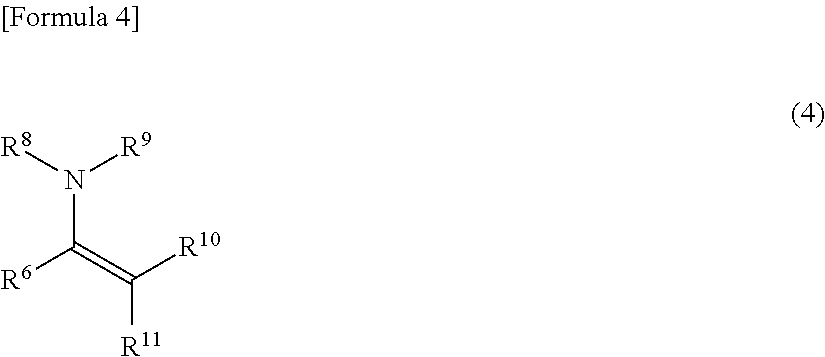
wherein
R6, R8, and R9 have the same meanings as defined above,
R10 and R11 are, independently of one another, a hydrogen atom, a hydrocarbyl group, an aryl group in which a carbon atom may be replaced by a heteroatom, a heterocyclyl group, a carboxyl group, an ester group, or an acyl group, wherein one or more hydrogen atoms of these groups may be substituted by a substituent W, one or more selected from R6 and R8, R6 and R11, R8 and R9, R9 and R10, and R10 and R11, may be bonded to each other to form a ring; or
one or more compounds selected from the group consisting of a compound of general formula (2), a cation of general formula (3), and a compound of general formula (4), which are generated by mixing a carbonyl compound and an amine compound in a system.
[12]A method for producing an amine compound, characterized in that the amine compound is produced, using a hydrogen-donating organic compound or inorganic compound or hydrogen as the hydrogen source, under the presence of an organometallic compound of general formula (5):
[Formula 5]
(ArMQ2)p (5)
wherein
Ar is an aromatic compound or a cyclopentadienyl group, in which one or more hydrogen atoms may be substituted by a substituent W,
the substituent W is a saturated or unsaturated C1-C20 hydrocarbon group, a 6- to 20-membered aryl group in which a carbon atom may be replaced by a heteroatom, a 3- to 20-membered heterocyclyl group, a C1-C20 alkoxy group, —C(═O)—Ra, —C(═O)—ORa, a hydroxyl group, —NRaRb, —C(═O)—NRaRb, a nitro group, a cyano group, —PRaRb,
a C1-C20 sulfenyl group, a sulfo group, a mercapto group, —SiRaRbRc,
a halogen group or —S(═O)2—Ra,
Q is a hydride group or an anionic group,
M is ruthenium, rhodium or iridium,
p represents an integer of 2 or greater; and
an organic compound of general formula (6):

wherein
R1 is an electron withdrawing group,
R2, R3, R4 and R5 are, independently of one another, a hydrogen atom, a saturated or unsaturated C1-C20 alkyl group, a saturated or unsaturated C3-C20 cycloalkyl group, a 6- to 20-membered aryl group in which a carbon atom may be replaced by a heteroatom, a 3- to 20-membered heterocyclyl group, a C1-C20 alkoxy group, —C(═O)—ORa, a C1-C20 fluoroalkyl group, —C(═O)—Ra, —S(═O)2—Ra, a hydroxyl group, —NRaRb, —C(═O)—NRaRb, a C1-C20 sulfenyl group, or —SiRaRbRc, wherein one or more hydrogen atoms of these groups may be substituted by a substituent W,
Ra, Rb and Rc are, independently of one another, a hydrogen atom, a saturated or unsaturated C1-C20 alkyl group, a saturated or unsaturated C3-C20 cycloalkyl group or a 6- to 20-membered aryl group in which a carbon atom may be replaced by a heteroatom, a 3- to 20-membered heterocyclyl group, a 6- to 20-membered aralkyl group in which a carbon atom of the aryl may be replaced by a heteroatom, a 6- to 20-membered alkylaryl group in which a carbon atom of the aryl may be replaced by a heteroatom,
R2 and R3 and/or R4 and R5 may be bonded to each other to form a ring,
one of R2 and R3, and one of R4 or R5 may be bonded to each other to form a ring,
R1 and R2, or R1 and R3 may be bonded to each other to form a ring, the carbon atom to which R2 and R3 are bonded, and/or the carbon atom to which R4 and R5 are bonded is/are asymmetric carbon atoms,
n is an integer of 0 or 1,
A is a saturated or unsaturated heterocycle containing at least one nitrogen atom, wherein one or more hydrogen atoms may be substituted by a substituent W;
by the reduction or hydrogenation of one or more compounds selected from the group consisting of a compound of general formula (2):

wherein
R6 and R7 are, independently of one another, a hydrogen atom, a hydroxyl group, a hydrocarbyl group, an aryl group in which a carbon atom may be replaced by a heteroatom, a 3- to 20-membered alkylaryl group in which a carbon atom of the aryl may be replaced by a heteroatom, a 3- to 20-membered aralkyl group in which a carbon atom of the aryl may be replaced by a heteroatom, a heterocyclyl group, a carboxyl group, an ester group or an acyl group, wherein one or more hydrogen atoms of these groups may be substituted by the substituent W,
R8 is a hydrogen atom, a hydroxyl group, a hydrocarbyl group, an aryl group in which a carbon atom may be replaced by a heteroatom, a 3- to 20-membered alkylaryl group in which a carbon atom of the aryl may be replaced by a heteroatom, a 3- to 20-membered aralkyl group in which a carbon atom of the aryl may be replaced by a heteroatom, a heterocyclyl group, a sulfonyl group in which a carbon atom may be replaced by a heteroatom, an alkoxy group, an acyl group, an ester group, a carboxyl group, a phosphinyl group, a sulfinyl group or a silyl group, wherein one or more hydrogen atoms of these groups may be substituted by a substituent W, R6 and R7, or R6 and R8 may be bonded to each other to form a ring; a cation of general formula (3):

wherein
R6 and R7 represent the same meanings as defined above,
R8 and R9 are, independently of one another, a hydrogen atom, a hydroxyl group, a hydrocarbyl group, an aryl group in which a carbon atom may be replaced by a heteroatom, a heterocyclyl group, a sulfonyl group in which a carbon atom may be replaced by a heteroatom, an alkoxy group, an acyl group, an ester group, a carboxyl group, a phosphinyl group, a sulfinyl group or a silyl group, wherein one or more hydrogen atoms of these groups may be substituted by a substituent W,
one or more selected from R6 and R7, R6 and R8, R7 and R9, and R8 and R9, may be bonded to each other to form a ring; and
a compound of general formula (4):

wherein
R6, R7, and R9 have the same meanings as defined above,
R10 and R11 are, independently of one another, a hydrogen atom, a hydroxyl group, a hydrocarbyl group, an aryl group in which a carbon atom may be replaced by a heteroatom, a 3- to 20-membered alkylaryl group in which a carbon atom of the aryl may be replaced by a heteroatom, a 3- to 20-membered aralkyl group in which a carbon atom of the aryl may be replaced by a heteroatom, a heterocyclyl group, a carboxyl group, an ester group, or an acyl group, wherein one or more hydrogen atoms of these groups may be substituted by the substituent W,
one or more selected from R6 and R8, R6 and R11, R8 and R9, R9 and R10, and R10 and R11, may be bonded to each other to form a ring; or
one or more compounds selected from the group consisting of a compound of general formula (2), a cation of general formula (3), and a compound of general formula (4), which are generated by mixing a carbonyl compound and an amine compound in a system.
[13] The method for producing an amine compound according to [12], characterized in that in the organometallic compound of general formula (5), Ar is a cyclopentadienyl group which may have a substituent, and M is rhodium or iridium.
[14] The method for producing an amine compound according to any one of [11] to [13], wherein the carbonyl compound is a compound of general formula (7):

wherein
X1 and X2 are, independently of one another, a hydrogen atom, a hydroxyl group, a hydrocarbyl group, an aryl group in which a carbon atom may be replaced by a heteroatom, an alkylaryl group in which a carbon atom of the aryl may be replaced by a heteroatom, an aralkyl group in which a carbon atom of the aryl may be replaced by a heteroatom, a heterocyclyl group, a carboxyl group, an ester group, or an acyl group, wherein one or more hydrogen atoms of these groups may be substituted by a substituent W,
the substituent W is a saturated or unsaturated C1-C20 hydrocarbon group, a 6- to 20-membered aryl group in which a carbon atom may be replaced by a heteroatom, a 3- to 20-membered heterocyclyl group, a C1-C20 alkoxy group, —C(═O)—Ra, —C(═O)—ORa, a hydroxyl group, —NRaRb, —C(═O)—NRaRb, a nitro group, a cyano group, —PRaRb, a C1-C20 sulfenyl group, a sulfo group, a mercapto group, —SiRaRbRc, a halogen group or —S(═O)2—Ra,
Ra, Rb and Rc are, independently of one another, a hydrogen atom, a saturated or unsaturated C1-C20 alkyl group, a saturated or unsaturated C3-C20 cycloalkyl group, a 6- to 20-membered aryl group in which a carbon atom may be replaced by a heteroatom, a 3- to 20-membered heterocyclyl group, a 6- to 20-membered aralkyl group in which a carbon atom of the aryl may be replaced by a heteroatom, a 6- to 20-membered alkylaryl group in which a carbon atom of the aryl may be replaced by a heteroatom,
X1 and X2 may be bonded to each other to form a ring; and the amine compound to be mixed with the carbonyl compound in a system is an amine of general formula (8) or a salt thereof:
[Formula 11]
NHY1Y2 (8)
wherein
Y1 and Y2 are, independently of one another, a hydrogen atom, a hydroxyl group, a hydrocarbyl group, an aryl group in which a carbon atom may be replaced by a heteroatom, a 6- to 20-membered aralkyl group in which a carbon atom of the aryl may be replaced by a heteroatom, a 6- to 20-membered alkylaryl group in which a carbon atom of the aryl may be replaced by a heteroatom, a heterocyclyl group, a sulfonyl group in which a carbon atom may be replaced by a heteroatom, an alkoxy group, an acyl group, an ester group, a carboxyl group, a phosphinyl group, a sulfinyl group or a silyl group, wherein one or more hydrogen atoms of these groups may be substituted by the substituent W,
Y1 and Y2 may be bonded to each other to form a ring.
[15] The method for producing an amine compound according to any one of [11] to [14], characterized in that one or more compounds selected from the group consisting of a compound of general formula (2), a cation of general formula (3) and a compound of general formula (4) are optically active compounds.
[16] The method for producing an amine compound according to any one of [11] to [14], characterized in that one or more compounds selected from the group consisting of a compound of general formula (2), a cation of general formula (3) and a compound of general formula (4) are optically active compounds generated by the reaction of an optically active amine and a carbonyl compound.
[17] The method for producing an amine compound according to any one of [11] to [16], wherein the hydrogen-donating organic or inorganic compound is formic acid or formate.


or of general formula (1-b):

is preferred.


but it is not limited thereto.

but it is not limited thereto.
[Formula 18]
(ArMQ2)p (5)
(wherein p denotes an integer of 2 or more)
and a nitrogen-containing ligand of general formula (6):


but is not limited thereto. In general formula (7), X1 and X2 are, independently of one another, a hydrogen atom, a hydroxyl group, a hydrocarbyl group, an aryl group in which a carbon atom may be replaced by a heteroatom, an alkylaryl group in which a carbon atom of the aryl may be replaced by a heteroatom, an aralkyl group in which a carbon atom of the aryl may be replaced by a heteroatom, a heterocyclyl group, a carboxyl group, an ester group, or an acyl group, wherein one or more hydrogen atoms of these groups may be substituted by any substituent. Examples of ester group include a group represented by —C(═O)—ORa, and examples of acyl group include a group represented by —C(═O)—Ra.
[Formula 21]
NHY1Y2 (8)
but is not limited thereto. In general formula (8), Y1 and Y2 are a hydrogen atom, a hydroxyl group, a hydrocarbyl group, an aryl group in which a carbon atom may be replaced by a heteroatom, a heterocyclyl group, a sulfonyl group, an alkoxy group, an acyl group, an ester group, a carboxyl group, a phosphinyl group, a sulfinyl group or a silyl group, wherein one or more hydrogen atoms of these groups may be substituted by a substituent W.
Claims (13)


NHY1Y2 (8)


Applications Claiming Priority (3)
| Application Number | Priority Date | Filing Date | Title |
|---|---|---|---|
| JP2013090782A JP6227889B2 (en) | 2013-04-23 | 2013-04-23 | Novel organometallic complex and method for producing amine compound |
| JP2013-090782 | 2013-04-23 | ||
| PCT/JP2014/061290 WO2014175267A1 (en) | 2013-04-23 | 2014-04-22 | Method for producing novel organometallic complex and amine compound |
Publications (2)
| Publication Number | Publication Date |
|---|---|
| US20160060282A1 US20160060282A1 (en) | 2016-03-03 |
| US9617292B2 true US9617292B2 (en) | 2017-04-11 |
Family
ID=51791839
Family Applications (1)
| Application Number | Title | Priority Date | Filing Date |
|---|---|---|---|
| US14/786,220 Active US9617292B2 (en) | 2013-04-23 | 2014-04-22 | Method for producing novel organometallic complex and amine compound |
Country Status (4)
| Country | Link |
|---|---|
| US (1) | US9617292B2 (en) |
| EP (1) | EP2990409B1 (en) |
| JP (1) | JP6227889B2 (en) |
| WO (1) | WO2014175267A1 (en) |
Families Citing this family (15)
| Publication number | Priority date | Publication date | Assignee | Title |
|---|---|---|---|---|
| US8193182B2 (en) | 2008-01-04 | 2012-06-05 | Intellikine, Inc. | Substituted isoquinolin-1(2H)-ones, and methods of use thereof |
| CA2711558C (en) | 2008-01-04 | 2016-12-13 | Intellikine, Inc. | Phosphatidyl inositol-3 kinase inhibiting compounds |
| AU2012205669B2 (en) | 2011-01-10 | 2015-08-20 | Infinity Pharmaceuticals Inc. | Processes for preparing isoquinolinones and solid forms of isoquinolinones |
| US8828998B2 (en) | 2012-06-25 | 2014-09-09 | Infinity Pharmaceuticals, Inc. | Treatment of lupus, fibrotic conditions, and inflammatory myopathies and other disorders using PI3 kinase inhibitors |
| KR102229478B1 (en) | 2012-11-01 | 2021-03-18 | 인피니티 파마슈티칼스, 인코포레이티드 | Treatment of cancers using pi3 kinase isoform modulators |
| US20150320755A1 (en) | 2014-04-16 | 2015-11-12 | Infinity Pharmaceuticals, Inc. | Combination therapies |
| JP6654107B2 (en) * | 2015-06-26 | 2020-02-26 | 日本曹達株式会社 | Iridium complex |
| MX391135B (en) | 2016-06-24 | 2025-03-21 | Infinity Pharmaceuticals Inc | COMBINATION THERAPIES. |
| WO2018194537A1 (en) * | 2017-04-17 | 2018-10-25 | Tiger Instruments, Llc | Iridium-based catalysts for highly efficient dehydrogenation and hydrogenation reactions in aqueous solution and applications thereof |
| CN109824520B (en) * | 2019-03-14 | 2021-07-23 | 苏州海犇药业有限公司 | Preparation method of cis-4-methylcyclohexylamine |
| JP7659381B2 (en) * | 2020-11-06 | 2025-04-09 | 関東化学株式会社 | Method for producing optically active amine compound |
| JP7659382B2 (en) * | 2020-11-06 | 2025-04-09 | 関東化学株式会社 | Method for producing primary and secondary amine compounds |
| CN112958162B (en) * | 2021-02-22 | 2022-05-24 | 江南大学 | Palladium catalyst for catalyzing quinazolinone synthesis and olefination reaction |
| CN115608361B (en) * | 2021-10-08 | 2024-04-23 | 厦门大学 | Catalyst for reductive amination and preparation method and application thereof |
| CN114456078B (en) * | 2022-01-19 | 2022-09-16 | 汉瑞药业(荆门)有限公司 | Preparation method of (R) -N-benzyl-1- (4-methoxyphenyl) propyl-2-amine |
Citations (6)
| Publication number | Priority date | Publication date | Assignee | Title |
|---|---|---|---|---|
| JP2004256511A (en) | 2003-02-27 | 2004-09-16 | Yasuo Kikukawa | Reduction reaction using picoline borane |
| JP2004537588A (en) | 2001-08-09 | 2004-12-16 | デグサ アクチエンゲゼルシャフト | Method for producing amine by reductive amination of carbonyl compound under transfer hydrogenation conditions |
| JP4059978B2 (en) | 1998-05-29 | 2008-03-12 | 株式会社クラレ | Production method of primary amine |
| US20100234596A1 (en) | 2009-03-12 | 2010-09-16 | Kanto Kagaku Kabushiki Kaisha | Novel organic metal complex and process for preparing amine compound |
| WO2011148124A1 (en) | 2010-05-22 | 2011-12-01 | University Of Warwick | Novel iridium/rhodium anti-cancer compounds |
| US20120065426A1 (en) | 2010-09-15 | 2012-03-15 | Kanto Kagaku Kabushiki Kaisha | Process for preparing amine compound |
Family Cites Families (1)
| Publication number | Priority date | Publication date | Assignee | Title |
|---|---|---|---|---|
| JPS61212438A (en) | 1985-03-18 | 1986-09-20 | Shimizu Constr Co Ltd | Manufacturing method for foundation reinforced columns |
-
2013
- 2013-04-23 JP JP2013090782A patent/JP6227889B2/en active Active
-
2014
- 2014-04-22 US US14/786,220 patent/US9617292B2/en active Active
- 2014-04-22 EP EP14788170.0A patent/EP2990409B1/en active Active
- 2014-04-22 WO PCT/JP2014/061290 patent/WO2014175267A1/en not_active Ceased
Patent Citations (10)
| Publication number | Priority date | Publication date | Assignee | Title |
|---|---|---|---|---|
| JP4059978B2 (en) | 1998-05-29 | 2008-03-12 | 株式会社クラレ | Production method of primary amine |
| JP2004537588A (en) | 2001-08-09 | 2004-12-16 | デグサ アクチエンゲゼルシャフト | Method for producing amine by reductive amination of carbonyl compound under transfer hydrogenation conditions |
| US20040267051A1 (en) | 2001-08-09 | 2004-12-30 | Amin Boerner | Method for the production of amines by reductive amination of carbonyl compounds under transfer-hydrogenation conditions |
| JP2004256511A (en) | 2003-02-27 | 2004-09-16 | Yasuo Kikukawa | Reduction reaction using picoline borane |
| US20100234596A1 (en) | 2009-03-12 | 2010-09-16 | Kanto Kagaku Kabushiki Kaisha | Novel organic metal complex and process for preparing amine compound |
| JP2010235604A (en) | 2009-03-12 | 2010-10-21 | Kanto Chem Co Inc | Novel organometallic complex and method for producing amine compound |
| WO2011148124A1 (en) | 2010-05-22 | 2011-12-01 | University Of Warwick | Novel iridium/rhodium anti-cancer compounds |
| US20130065864A1 (en) | 2010-05-22 | 2013-03-14 | University Of Warwick | Novel iridium/rhodium anti-cancer compounds |
| US20120065426A1 (en) | 2010-09-15 | 2012-03-15 | Kanto Kagaku Kabushiki Kaisha | Process for preparing amine compound |
| JP2012062270A (en) | 2010-09-15 | 2012-03-29 | Kanto Chem Co Inc | Method for producing amine compound |
Non-Patent Citations (17)
| Title |
|---|
| [No Author Listed] Nomenclature of Coordination Complexes. Sep. 7, 2015. Chemistry LibreTexts™. Retrieved from http://chem.libretexts.org/Core/Inorganic-Chemistry/Coordination-Chemistry/Basics-of Coordination-Chemistry/Nomenclature-of-Coordination-Complexes on Oct. 24, 2016. |
| [No Author Listed] Nomenclature of Coordination Complexes. Sep. 7, 2015. Chemistry LibreTexts™. Retrieved from http://chem.libretexts.org/Core/Inorganic—Chemistry/Coordination—Chemistry/Basics—of Coordination—Chemistry/Nomenclature—of—Coordination—Complexes on Oct. 24, 2016. |
| Abdel-Magid et al., Reductive Amination of Aldehydes and Ketones with Sodium Triacetoxyborohydride. Studies on Direct and Indirect Reductive Amination Procedures(1). J Org Chem. May 31, 2006;61(11):3849-3862. |
| Bomann et al., A Mild, Pyridine-Borane-Based Reductive Amination Protocol. J. Org. Chem. 1995;60(18):5995-5996. |
| Borch et al., the Cyanohydridoborate Anion as a Selective Reducing Agent. J. Am. Chem. Soc. 1971;93(12):2897-2904. |
| Burkhardt et al., Reductive amination with 5-ethyl-2-methylpyridine borane. Tetrahedron Lett. 2008;49(35):5152-5155. |
| Dickson et al., Anion Binding and Luminescent Sensing using Cationic Ruthenium(II) Aminopyridine Complexes. Chem Eur J. 2008;14:7296-7305. |
| Emerson et al., Secondary and tertiary amines from nitro compounds. JACS. Mar. 1941;63:749-751. |
| Gómez et al., Diastereospecific and diastereoselective syntheses of Ruthenium(II) complexes using N,N′bidentate ligands aryl-pyridin-2-ylmethyl-amine ArNH-CH2-2-C5H4N and their oxidation to imine ligands. Inorg Chem. Mar. 20, 2006;45(6):2483-93. |
| Gross et al., Synthesis of primary amines: first homogeneously catalyzed reductive amination with ammonia. Org Lett. Jun. 13, 2002;4(12):2055-8. |
| Johnson et al., N-Alkylation of amides. A novel procedure. J. Org. Chem. 1962. 27;2205. |
| Kitamura et al., Catalytic Leuckart-Wallach-type reductive amination of ketones. J Org Chem. Nov. 29, 2002;67(24):8685-7. |
| Lei et al., Fast reductive amination by transfer hydrogenation "on water". Chem Eur J. Mar. 18, 2013;19(12):4021-9. doi:10.1002/chem.201204194. |
| Nugent et al., Chiral Amine Synthesis-Recent Developments and Trends for Enamide Reduction, Reductive Amination, and Imine Reduction. Adv. Synth. Catal. 2010;352:753-819. |
| Nugent et al., Chiral Amine Synthesis—Recent Developments and Trends for Enamide Reduction, Reductive Amination, and Imine Reduction. Adv. Synth. Catal. 2010;352:753-819. |
| Tararov et al., On the reductive amination of aldehydes and ketones catalyzed by homogeneous Rh(I) complexes. Chem. Commun 2000;1867-1868. |
| Wang et al., A versatile catalyst for reductive amination by transfer hydrogenation. Angew Chem Int Ed Engl. Oct. 4, 2010;49(41):7548-52. doi: 10.1002/anie.201002944. |
Also Published As
| Publication number | Publication date |
|---|---|
| EP2990409A4 (en) | 2016-12-07 |
| EP2990409B1 (en) | 2019-12-25 |
| WO2014175267A1 (en) | 2014-10-30 |
| US20160060282A1 (en) | 2016-03-03 |
| JP6227889B2 (en) | 2017-11-08 |
| JP2014214096A (en) | 2014-11-17 |
| EP2990409A1 (en) | 2016-03-02 |
Similar Documents
| Publication | Publication Date | Title |
|---|---|---|
| EP2990409B1 (en) | Method for producing novel organometallic complex and amine compound | |
| Saha et al. | Photoinduced regioselective olefination of arenes at proximal and distal sites | |
| JP5847386B2 (en) | Method for producing amine compound | |
| Zhang et al. | Challenges and recent advancements in the synthesis of α, α-disubstituted α-amino acids | |
| Lin et al. | Native directed site-selective δ-C (sp3)–H and δ-C (sp2)–H arylation of primary amines | |
| JP5719115B2 (en) | Novel organometallic complex and method for producing amine compound | |
| Xia et al. | Mechanistic study of Ni and Cu dual catalyst for asymmetric C–C bond formation; asymmetric coupling of 1, 3-dienes with C-nucleophiles to construct vicinal stereocenters | |
| Kapoor et al. | Carbon dioxide-mediated C (sp 2)–H arylation of primary and secondary benzylamines | |
| Deb et al. | Detailed mechanistic studies on palladium-catalyzed selective C–H olefination with aliphatic alkenes: a significant influence of proton shuttling | |
| Boobalan et al. | Ruthenium-catalyzed C–H alkynylation of aromatic amides with hypervalent iodine–alkyne reagents | |
| Xie et al. | Ligand-controlled NiH-catalyzed regiodivergent and enantioselective hydroamination of alkenyl amides | |
| JP6254811B2 (en) | Organometallic compound having nitrogen-containing heterocyclic carbene ligand, catalyst containing the same, and method for producing amine compound | |
| Sharma et al. | Remote CH bond activation/transformations: A continuous growing synthetic tool; Part II | |
| Yan et al. | Synthesis of 7-Amido Indolines by Cp* Co (III)-Catalyzed C–H Bond Amidation | |
| P. Beletskaya et al. | Asymmetric friedel-crafts reactions of indole and its derivatives | |
| Li et al. | Direct ortho-Selective C–H Functionalization of Carboxybenzyl-Protected Arylalkylamines via Ir (III)-Catalyzed C–H Activation | |
| Deshpande et al. | Recent Advances in Copper‐Catalyzed Functionalization of Unactivated C (sp3)− H Bonds | |
| JP5462899B2 (en) | Process for producing β-aminoalcohols having a syn configuration | |
| JP4746749B2 (en) | Process for producing optically active amino alcohols | |
| JP2022516764A (en) | Its use in hydrogenation of manganese catalysts and ketones | |
| JPWO2000041997A1 (en) | Method for producing optically active amino alcohols | |
| Mendez et al. | Catalytic Enantioselective Alkylation of Indoles with trans-4-Methylthio-β-Nitrostyrene | |
| JP7659381B2 (en) | Method for producing optically active amine compound | |
| JP2912572B2 (en) | Method for producing optically active amines | |
| JP7659382B2 (en) | Method for producing primary and secondary amine compounds |
Legal Events
| Date | Code | Title | Description |
|---|---|---|---|
| AS | Assignment |
Owner name: KANTO KAGAKU KABUSHIKI KAISHA, JAPAN Free format text: ASSIGNMENT OF ASSIGNORS INTEREST;ASSIGNORS:WATANABE, MASAHITO;TAKEMOTO, TOSHIHIDE;TANAKA, KOUICHI;AND OTHERS;REEL/FRAME:038138/0028 Effective date: 20160129 |
|
| STCF | Information on status: patent grant |
Free format text: PATENTED CASE |
|
| MAFP | Maintenance fee payment |
Free format text: PAYMENT OF MAINTENANCE FEE, 4TH YEAR, LARGE ENTITY (ORIGINAL EVENT CODE: M1551); ENTITY STATUS OF PATENT OWNER: LARGE ENTITY Year of fee payment: 4 |
|
| MAFP | Maintenance fee payment |
Free format text: PAYMENT OF MAINTENANCE FEE, 8TH YEAR, LARGE ENTITY (ORIGINAL EVENT CODE: M1552); ENTITY STATUS OF PATENT OWNER: LARGE ENTITY Year of fee payment: 8 |