US9599121B2 - Device and method for controlling the pitch of blades - Google Patents

Device and method for controlling the pitch of blades Download PDF

Info

Publication number
US9599121B2
US9599121B2 US14/436,199 US201314436199A US9599121B2 US 9599121 B2 US9599121 B2 US 9599121B2 US 201314436199 A US201314436199 A US 201314436199A US 9599121 B2 US9599121 B2 US 9599121B2
Authority
US
United States
Prior art keywords
rotor
tilt
fan
pitch
blades
Prior art date
Legal status (The legal status is an assumption and is not a legal conclusion. Google has not performed a legal analysis and makes no representation as to the accuracy of the status listed.)
Active, expires
Application number
US14/436,199
Other versions
US20150285262A1 (en
Inventor
Adrien Fabre
Norbert Lartigue
Current Assignee (The listed assignees may be inaccurate. Google has not performed a legal analysis and makes no representation or warranty as to the accuracy of the list.)
Safran Aircraft Engines SAS
Original Assignee
SNECMA SAS
Priority date (The priority date is an assumption and is not a legal conclusion. Google has not performed a legal analysis and makes no representation as to the accuracy of the date listed.)
Filing date
Publication date
Application filed by SNECMA SAS filed Critical SNECMA SAS
Assigned to SNECMA reassignment SNECMA ASSIGNMENT OF ASSIGNORS INTEREST (SEE DOCUMENT FOR DETAILS). Assignors: LARTIGUE, NORBERT, FABRE, ADRIEN JACQUES PHILIPPE
Publication of US20150285262A1 publication Critical patent/US20150285262A1/en
Application granted granted Critical
Publication of US9599121B2 publication Critical patent/US9599121B2/en
Assigned to SAFRAN AIRCRAFT ENGINES reassignment SAFRAN AIRCRAFT ENGINES CHANGE OF NAME (SEE DOCUMENT FOR DETAILS). Assignors: SNECMA
Assigned to SAFRAN AIRCRAFT ENGINES reassignment SAFRAN AIRCRAFT ENGINES CORRECTIVE ASSIGNMENT TO CORRECT THE COVER SHEET TO REMOVE APPLICATION NOS. 10250419, 10786507, 10786409, 12416418, 12531115, 12996294, 12094637 12416422 PREVIOUSLY RECORDED ON REEL 046479 FRAME 0807. ASSIGNOR(S) HEREBY CONFIRMS THE CHANGE OF NAME. Assignors: SNECMA
Active legal-status Critical Current
Adjusted expiration legal-status Critical

Links

Images

Classifications

    • FMECHANICAL ENGINEERING; LIGHTING; HEATING; WEAPONS; BLASTING
    • F04POSITIVE - DISPLACEMENT MACHINES FOR LIQUIDS; PUMPS FOR LIQUIDS OR ELASTIC FLUIDS
    • F04DNON-POSITIVE-DISPLACEMENT PUMPS
    • F04D29/00Details, component parts, or accessories
    • F04D29/26Rotors specially for elastic fluids
    • F04D29/32Rotors specially for elastic fluids for axial flow pumps
    • F04D29/321Rotors specially for elastic fluids for axial flow pumps for axial flow compressors
    • F04D29/322Blade mountings
    • F04D29/323Blade mountings adjustable
    • BPERFORMING OPERATIONS; TRANSPORTING
    • B64AIRCRAFT; AVIATION; COSMONAUTICS
    • B64CAEROPLANES; HELICOPTERS
    • B64C11/00Propellers, e.g. of ducted type; Features common to propellers and rotors for rotorcraft
    • B64C11/30Blade pitch-changing mechanisms
    • B64C11/306Blade pitch-changing mechanisms specially adapted for contrarotating propellers
    • BPERFORMING OPERATIONS; TRANSPORTING
    • B64AIRCRAFT; AVIATION; COSMONAUTICS
    • B64CAEROPLANES; HELICOPTERS
    • B64C11/00Propellers, e.g. of ducted type; Features common to propellers and rotors for rotorcraft
    • B64C11/30Blade pitch-changing mechanisms
    • B64C11/306Blade pitch-changing mechanisms specially adapted for contrarotating propellers
    • B64C11/308Blade pitch-changing mechanisms specially adapted for contrarotating propellers automatic
    • FMECHANICAL ENGINEERING; LIGHTING; HEATING; WEAPONS; BLASTING
    • F01MACHINES OR ENGINES IN GENERAL; ENGINE PLANTS IN GENERAL; STEAM ENGINES
    • F01DNON-POSITIVE DISPLACEMENT MACHINES OR ENGINES, e.g. STEAM TURBINES
    • F01D7/00Rotors with blades adjustable in operation; Control thereof
    • FMECHANICAL ENGINEERING; LIGHTING; HEATING; WEAPONS; BLASTING
    • F02COMBUSTION ENGINES; HOT-GAS OR COMBUSTION-PRODUCT ENGINE PLANTS
    • F02KJET-PROPULSION PLANTS
    • F02K3/00Plants including a gas turbine driving a compressor or a ducted fan
    • F02K3/02Plants including a gas turbine driving a compressor or a ducted fan in which part of the working fluid by-passes the turbine and combustion chamber
    • F02K3/04Plants including a gas turbine driving a compressor or a ducted fan in which part of the working fluid by-passes the turbine and combustion chamber the plant including ducted fans, i.e. fans with high volume, low pressure outputs, for augmenting the jet thrust, e.g. of double-flow type
    • F02K3/072Plants including a gas turbine driving a compressor or a ducted fan in which part of the working fluid by-passes the turbine and combustion chamber the plant including ducted fans, i.e. fans with high volume, low pressure outputs, for augmenting the jet thrust, e.g. of double-flow type with counter-rotating, e.g. fan rotors
    • FMECHANICAL ENGINEERING; LIGHTING; HEATING; WEAPONS; BLASTING
    • F04POSITIVE - DISPLACEMENT MACHINES FOR LIQUIDS; PUMPS FOR LIQUIDS OR ELASTIC FLUIDS
    • F04DNON-POSITIVE-DISPLACEMENT PUMPS
    • F04D29/00Details, component parts, or accessories
    • F04D29/66Combating cavitation, whirls, noise, vibration or the like; Balancing
    • F04D29/661Combating cavitation, whirls, noise, vibration or the like; Balancing especially adapted for elastic fluid pumps
    • F04D29/663Sound attenuation
    • FMECHANICAL ENGINEERING; LIGHTING; HEATING; WEAPONS; BLASTING
    • F04POSITIVE - DISPLACEMENT MACHINES FOR LIQUIDS; PUMPS FOR LIQUIDS OR ELASTIC FLUIDS
    • F04DNON-POSITIVE-DISPLACEMENT PUMPS
    • F04D29/00Details, component parts, or accessories
    • F04D29/66Combating cavitation, whirls, noise, vibration or the like; Balancing
    • F04D29/661Combating cavitation, whirls, noise, vibration or the like; Balancing especially adapted for elastic fluid pumps
    • F04D29/668Combating cavitation, whirls, noise, vibration or the like; Balancing especially adapted for elastic fluid pumps damping or preventing mechanical vibrations
    • BPERFORMING OPERATIONS; TRANSPORTING
    • B64AIRCRAFT; AVIATION; COSMONAUTICS
    • B64CAEROPLANES; HELICOPTERS
    • B64C11/00Propellers, e.g. of ducted type; Features common to propellers and rotors for rotorcraft
    • B64C11/30Blade pitch-changing mechanisms
    • BPERFORMING OPERATIONS; TRANSPORTING
    • B64AIRCRAFT; AVIATION; COSMONAUTICS
    • B64CAEROPLANES; HELICOPTERS
    • B64C11/00Propellers, e.g. of ducted type; Features common to propellers and rotors for rotorcraft
    • B64C11/30Blade pitch-changing mechanisms
    • B64C11/32Blade pitch-changing mechanisms mechanical
    • BPERFORMING OPERATIONS; TRANSPORTING
    • B64AIRCRAFT; AVIATION; COSMONAUTICS
    • B64DEQUIPMENT FOR FITTING IN OR TO AIRCRAFT; FLIGHT SUITS; PARACHUTES; ARRANGEMENT OR MOUNTING OF POWER PLANTS OR PROPULSION TRANSMISSIONS IN AIRCRAFT
    • B64D27/00Arrangement or mounting of power plants in aircraft; Aircraft characterised by the type or position of power plants
    • B64D2027/005Aircraft with an unducted turbofan comprising contra-rotating rotors, e.g. contra-rotating open rotors [CROR]
    • FMECHANICAL ENGINEERING; LIGHTING; HEATING; WEAPONS; BLASTING
    • F04POSITIVE - DISPLACEMENT MACHINES FOR LIQUIDS; PUMPS FOR LIQUIDS OR ELASTIC FLUIDS
    • F04DNON-POSITIVE-DISPLACEMENT PUMPS
    • F04D29/00Details, component parts, or accessories
    • F04D29/26Rotors specially for elastic fluids
    • F04D29/32Rotors specially for elastic fluids for axial flow pumps
    • F04D29/34Blade mountings
    • F04D29/36Blade mountings adjustable
    • F04D29/362Blade mountings adjustable during rotation
    • FMECHANICAL ENGINEERING; LIGHTING; HEATING; WEAPONS; BLASTING
    • F05INDEXING SCHEMES RELATING TO ENGINES OR PUMPS IN VARIOUS SUBCLASSES OF CLASSES F01-F04
    • F05DINDEXING SCHEME FOR ASPECTS RELATING TO NON-POSITIVE-DISPLACEMENT MACHINES OR ENGINES, GAS-TURBINES OR JET-PROPULSION PLANTS
    • F05D2220/00Application
    • F05D2220/30Application in turbines
    • F05D2220/36Application in turbines specially adapted for the fan of turbofan engines
    • FMECHANICAL ENGINEERING; LIGHTING; HEATING; WEAPONS; BLASTING
    • F05INDEXING SCHEMES RELATING TO ENGINES OR PUMPS IN VARIOUS SUBCLASSES OF CLASSES F01-F04
    • F05DINDEXING SCHEME FOR ASPECTS RELATING TO NON-POSITIVE-DISPLACEMENT MACHINES OR ENGINES, GAS-TURBINES OR JET-PROPULSION PLANTS
    • F05D2260/00Function
    • F05D2260/70Adjusting of angle of incidence or attack of rotating blades
    • F05D2260/74Adjusting of angle of incidence or attack of rotating blades by turning around an axis perpendicular the rotor centre line
    • FMECHANICAL ENGINEERING; LIGHTING; HEATING; WEAPONS; BLASTING
    • F05INDEXING SCHEMES RELATING TO ENGINES OR PUMPS IN VARIOUS SUBCLASSES OF CLASSES F01-F04
    • F05DINDEXING SCHEME FOR ASPECTS RELATING TO NON-POSITIVE-DISPLACEMENT MACHINES OR ENGINES, GAS-TURBINES OR JET-PROPULSION PLANTS
    • F05D2260/00Function
    • F05D2260/96Preventing, counteracting or reducing vibration or noise
    • F05D2260/961Preventing, counteracting or reducing vibration or noise by mistuning rotor blades or stator vanes with irregular interblade spacing, airfoil shape
    • YGENERAL TAGGING OF NEW TECHNOLOGICAL DEVELOPMENTS; GENERAL TAGGING OF CROSS-SECTIONAL TECHNOLOGIES SPANNING OVER SEVERAL SECTIONS OF THE IPC; TECHNICAL SUBJECTS COVERED BY FORMER USPC CROSS-REFERENCE ART COLLECTIONS [XRACs] AND DIGESTS
    • Y02TECHNOLOGIES OR APPLICATIONS FOR MITIGATION OR ADAPTATION AGAINST CLIMATE CHANGE
    • Y02TCLIMATE CHANGE MITIGATION TECHNOLOGIES RELATED TO TRANSPORTATION
    • Y02T50/00Aeronautics or air transport
    • Y02T50/60Efficient propulsion technologies, e.g. for aircraft
    • Y02T50/66
    • Y02T50/673

Definitions

  • the invention relates to a device for controlling the pitch of the blades of a fan rotor, and a fan comprising such a device.
  • the invention also relates to a method for controlling the pitch of the blades of a fan rotor using this device.
  • Turbomachine fans comprising at least one rotor and variable pitch blades are known in the state of the art.
  • the geometric pitch is the angle formed by the chord of the profile of the blade and the engine rotation axis.
  • a cylinder controls the axial displacement of the axisymmetric part, which causes an axial displacement of the connecting rods so that the pitch of all the blades can be adjusted uniformly.
  • a non-homogeneous aerodynamic flow is applied to the blades due to various factors, particularly including the effects of the aircraft incidence, for example at takeoff, and wake effects due to the presence of the engine, wings, fuselage or other elements such as the pylon connecting the engine to the aircraft.
  • This non-homogeneity induces loads on the blades and more generally on the pitch control device.
  • the blades are also subject to deformations resulting from gyroscopic effects related to aircraft manoeuvres.
  • This coupling is both mechanical, which means that undesirable mechanical vibrations can be amplified, and noisy, which induces amplification of sound vibrations.
  • the invention discloses a device for controlling the pitch of fan rotor blades in order to overcome the disadvantages of the state-of-the-art, comprising a radial shaft linked to the blade by a pivot and a connecting rod for which axial displacement controls rotation of the radial shaft, characterised in that it comprises a first part that is mobile in rotation with the rotor about the fan axis and on which one end of each connecting rod is secured, a second part linked to the first part, and at least three cylinders capable of moving said second part in axial translation and varying its tilt, translation and tilt of the second part leading to a corresponding translation and tilt of the first part, such that when the first part rotates, each connecting rod follows an axial displacement with a variable amplitude that depends on the tilt of the first part, in order to vary the pitch of the blade during its revolution.
  • the invention relates to a turbomachine fan comprising at least one rotor and variable pitch blades, characterised in that it comprises said pitch control device for its blades.
  • the invention also relates to a method for controlling the pitch of the blades of a fan rotor making use of said control device, characterised in that it includes the step consisting of controlling the cylinders to modify the tilt of the first part, such that during rotation of the first part, an axial displacement is applied to each connecting rod, the amplitude of which is variable and depends on the tilt of the first part, the blade pitch varying during its revolution about the fan axis.
  • the invention can be used to vary the pitch of each blade during its rotation.
  • the blade pitch varies depending on its position within the turn.
  • an appropriate setting of the pitch control assures that the device and the fan are not subjected to aerodynamic flow disturbances due to specific obstacles (wings, fuselage, etc.).
  • the fan is more robust and has a longer life.
  • the device has a degraded operating mode which avoids the need to do an immediate engine shutdown.
  • FIG. 1 shows an embodiment of a device for controlling the pitch of the rotor blades of a fan
  • FIG. 2 shows a front view of a part of the device and connecting elements
  • FIGS. 3 and 4 show a three-dimensional view of part of the device
  • FIGS. 5 and 6 show a three-dimensional view of part of the device when one of the parts is tilted by means of the cylinders;
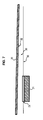
  • FIG. 7 shows an embodiment of the guidance of the device relative to tilted part of the rotor
  • FIG. 8 shows attachment parts of the device in a fan
  • FIG. 9 shows an embodiment of a method for controlling the blade pitch
  • FIGS. 10 and 11 show controls for varying the blade pitch during their revolution.
  • FIGS. 1 to 6 show one embodiment of a device 1 for controlling the pitch of the blades of a fan 4 rotor 3 .
  • the device 1 comprises a radial shaft 6 linked to the blade (not shown). Conventionally, the foot of the blade is mounted on the radial shaft 6 by means of a pivot.
  • the radial shaft 6 is capable of rotating about its axis.
  • the device 1 also comprises a connecting rod 8 for each blade, which axis displacement controls rotation of the radial shaft 6 about its axis.
  • a portion of the connecting 8 is linked to the radial shaft 6 for this purpose, for example through a pivot link.
  • the device 1 also comprises a first part 10 .
  • This first part 10 is secured to a rotor 3 of the fan 4 .
  • the first part 10 is that is mobile in rotation with the rotor 3 about the axis 11 of the fan 4 .
  • the other end 31 of the connecting rod 8 is secured to the first part 10 .
  • the device 1 also comprises a second part 12 linked to the first part 10 , the role of which is disclosed below.
  • the first and the second parts 10 , 12 are typically axisymmetric parts.
  • the first part 10 is annular
  • the second part 12 is a disk.
  • the device 1 comprises at least three cylinders 14 capable of moving said second part 12 in axial translation about the axis 11 of the fan 4 , and varying its tilt. Therefore the second part 12 has at least three degrees of freedom controlled by the cylinders 14 .
  • These cylinders 14 may for example be conventional hydraulic cylinders.
  • the second part 12 is generally arranged in a radial plane (vertical plane), the cylinders 14 being used to tilt the second part 12 relative to this nominal position.
  • these cylinders 14 are arranged at 120° from each other. In general, the cylinders 14 are located in the same plane.
  • the first part 10 and the second part 12 are mechanically linked, therefore the axial translation and the tilt of the second part 12 create a corresponding axial translation and tilt of the first part 10 .
  • the three cylinders have exactly the same extension.
  • the first part 10 and the second part 12 are positioned in a radial plane.
  • one of the cylinders receives an extension command (for example the cylinder changes from an extension of 150 mm to an extension of 200 mm), while the other cylinders ( 12 B, 12 C) keep their original extension.
  • an extension command for example the cylinder changes from an extension of 150 mm to an extension of 200 mm
  • Tilting the second part 12 tilts the first part 10 relative to a radial plane. Consequently, after tilting the first part 10 , the first part moves in rotation in a plane inclined from a radial plane.
  • each connecting rod 8 is subjected to an axial displacement with a variable amplitude. This is due to the fact that the end 31 of the connecting rod 8 is linked to the first part 10 , itself free to rotate in a plane inclined relative to a radial plane. Therefore, during a revolution, each connecting rod 8 has an axial displacement that varies around a turn.
  • the amplitude of the axial displacement of the connecting rod 8 depends on the tilt of the first part 10 .
  • the greater the tilt of the first part 10 the more variable its amplitude becomes around the turn.
  • the device 1 can be used to vary the pitch of the blade during its revolution.
  • the pitch of each blade depends on its position on the revolution. Therefore at a given instant, the different blades of the rotor have different pitches that depend on their position around the revolution.
  • Translation of the first part 10 adjusts the pitch of all blades, since this translation induces a common translation of the connecting rods 8 and therefore a rotation of the radial shafts 6 .
  • the inclination of the first part 10 produces a cyclic pitch control of the blades on the revolution.
  • the pitch of a given blade varies periodically depending on the axial displacement of the connecting rod 8 .
  • the second part 12 is connected to the first part 10 by a mechanical bearing 16 .
  • the second part 12 is linked to the casing (fixed part) of the fan, while the first part 10 is linked to the fan rotor 3 .
  • a ball bearing may be used.
  • the device 1 comprises connecting elements 22 , one embodiment of which is shown in FIGS. 1 and 2 .
  • the connecting elements 22 comprising a universal joint 21 in order to link the first part 10 to the rotor 3 rotating about the fan axis 11 .
  • This universal joint 21 is diagrammatically shown in FIG. 2 , in the form of two annular parts 33 , 34 connected by pins 35 and surrounding the first part 10 .
  • the connecting elements 22 are provided with keys or grooves 23 to enable axial guidance of the first part 10 relative to the rotor 3 .
  • These keys 23 are used for axial guidance of the first part 10 relative to the rotor 3 .
  • the keys 23 participate in axial guidance relative to the tilted shells 26 .
  • this may be the wall of the chamber containing fan oil, which must slope to enable drainage.
  • top and bottom surfaces of the keys 23 are parallel to the engine axis.
  • the shell 26 is also provided with grooves 30 complementary to the keys 23 .
  • These complementary grooves 30 have a tilted groove bottom surface 32 (tilted relative to the axis 11 of the fan 4 ) to implement the oil drainage function (which is the original function of the part 26 ).
  • the surface 36 of the top of the grooves 30 complementary to the keys 23 is horizontal, while the other surface 32 is tilted, to enable cooperation with the tilted part 26 .
  • the keys 23 are placed on an outside surface of the universal joint 21 .
  • the device 1 comprises a connecting bearing 18 linking the cylinders 14 to a structure of the rotor 3 . Axial and radial forces imposed by the device 1 are resisted by this bearing 18 .
  • the device 1 also comprises an elastic damper 19 linking the cylinders 14 to a duct 20 of the fan 4 .
  • This damper 19 attenuates axial deformations due to thermal effects and is advantageously positioned between the duct 20 and the structure of the rotor 3 onto which the bearing 18 is secured.
  • this damper 19 that may for example be a metal bellows, prevents axial load from being applied to the duct 20 and preventing the configuration from being statically indeterminate.
  • the duct 20 does not resist any structural loads due to the device 1 .
  • cylinders 14 are installed in the device 1 . These cylinders 14 are usually conventional cylinders that are simpler to install than annular cylinders according to prior art.
  • stops 29 are provided so as to limit the tilt of the first and/or the second part 10 , 12 , in order to avoid increasing the failure rate of the device.
  • the stops 29 may be installed on the universal joint 21 .
  • the stops 29 may be put into position on the second part 12 .
  • the variation amplitude of the blade pitch is limited for example to plus or minus 2° (these values are purely illustrative and are not limitative).
  • Cylinders 14 are controlled by a control unit, which may for example be integrated into the aircraft computer.
  • the control unit may be programmed to implement embodiments of the pitch control methods disclosed below.
  • the device 1 may be used in an open rotor type fan 4 , comprising two counter-rotating propellers.
  • a first device is used to set the pitch of rotor blades of the upstream propeller
  • a second device is used to set the pitch of rotor blades of the downstream propeller.
  • a method for controlling the pitch of the blades includes step E 1 consisting of controlling cylinders 14 to modify the tilt of the first part 10 .
  • each connecting rod 8 is moved along an axial displacement with a variable amplitude that depends on the tilt of the first part 10 .
  • the blade pitch varies during a revolution of the blade about the axis 11 of the fan 4 .
  • the control imposed by the cylinders 14 selects the tilt of the first part 10 , through the tilt of the second part 12 .
  • This control may vary during the flight, for example depending on flight conditions or depending on the state of the aircraft.
  • the translation control imposed by the cylinders 14 on the second part 12 also imposes a common modification to the pitch of all blades of the rotor 3 .
  • FIG. 10 A diagrammatic example of control is shown in FIG. 10 .
  • a translation command by cylinders 14 imposed on the second part 12 imposes a pitch of 45° on all blades (curve 39 ).
  • Tilting the second part 12 causes a tilt of the first part 10 which introduces a sinusoidal type variation of the pitch of each blade depending on the position of the blade around its revolution (curve 40 ).
  • the tilt of the first part 10 that controls the cyclic change in the pitch of the blades during a turn is chosen to reduce pressure and lift losses due to the presence of an obstacle on the upstream side of the fan 4 , for example such as a wing or the fuselage.
  • Losses of lift caused by the obstacle produce a loss of lift with a fixed profile that may be known by simulation or by test.
  • the blade pitch is chosen from these data, to compensate for losses of lift in zones in which these losses occur.
  • a multi-cyclic or sub-cyclic control is applied.
  • the method comprises a step consisting of fluctuating the tilt of the first part 10 of the device 1 at a frequency higher than the rotation speed of the rotor 3 (curve 41 ).
  • this may be a so-called multi-cyclic control, in other words for which the variation frequency is a multiple of the rotor rotation frequency.
  • the method comprises a step consisting of fluctuating the tilt of the first part 10 of the device 1 at a frequency less than the rotation speed of the rotor 3 (curve 42 ).
  • this may be a so-called sub-cyclic control, in other words for which the variation frequency is a fraction of the rotation frequency of the rotor.
  • these blade pitch controls can reduce undesirable sound and/or mechanical amplifications.
  • each propeller is broken, and interaction noise between the upstream propellers and downstream propellers can be reduced.
  • the method may include step E 2 1 that consists of obtaining a cyclic variation of the pitch of the blades of the upstream rotor 3 of the fan 4 during the revolution that is different from the cyclic variation of the pitch of the blades of the downstream rotor 3 of the fan 4 .
  • this step E 2 1 comprises the step E 2 2 consisting of fluctuating the tilt of the first part 10 of the upstream rotor or the downstream rotor about a nominal position.
  • the nominal position is chosen to correspond to the tilt and therefore to the pitch of the blades, which can reduce the aerodynamic influence of a given obstacle as disclosed above.
  • a fluctuation of the tilt about this nominal position is also made in order to also reduce the interaction noise between upstream and downstream blades, this fluctuation being different on the upstream and the downstream sides (for example due to the presence of an upstream fluctuation and the absence of a downstream fluctuation, or the choice of different fluctuations between the upstream and downstream sides).
  • Mechanical and acoustic coupling of the upstream and downstream blades is thus reduced or even eliminated.
  • the invention is capable of reducing the harmful effects of non-homogenous aerodynamic flows affecting fan blades, and noise caused by the blades.

Landscapes

  • Engineering & Computer Science (AREA)
  • Mechanical Engineering (AREA)
  • General Engineering & Computer Science (AREA)
  • Aviation & Aerospace Engineering (AREA)
  • Chemical & Material Sciences (AREA)
  • Combustion & Propulsion (AREA)
  • Structures Of Non-Positive Displacement Pumps (AREA)

Abstract

The invention concerns a device (1) for controlling the pitch of the blades of a fan (4) rotor (3), comprising a radial shaft (6) linked to the blade, a connection rod (8) of which the axial movement controls the rotation of the radial shaft (6), characterized in that it comprises:—a first part (10) that is mobile in rotation with the rotor (3) about the axis (11) of the fan (4), and on which one end of each connection rod (8) is secured,—a second part (12) linked to the first part (10), and—at least three cylinders (14) capable of moving said second part (12) in axial translation, and of varying the tilt of said second part, the translation and tilt of the second part (12) driving a corresponding translation and tilt of the first part (10), such that, when the first part (10) rotates, each connection rod (8) is subject to axial displacement of which the amplitude is variable and is a function of the tilt of the first part (10), making it possible to vary the pitch of the blade during the rotation of same. The invention also concerns a fan, and a method for controlling the pitch of blades.

Description

TECHNICAL FIELD
The invention relates to a device for controlling the pitch of the blades of a fan rotor, and a fan comprising such a device.
The invention also relates to a method for controlling the pitch of the blades of a fan rotor using this device.
PRESENTATION OF PRIOR ART
Turbomachine fans comprising at least one rotor and variable pitch blades are known in the state of the art.
The geometric pitch is the angle formed by the chord of the profile of the blade and the engine rotation axis.
This can be achieved using a known device comprising a radial shaft linked to the blade by a pivot, a connecting rod which axial displacement controls rotation of the radial shaft, and an axisymmetric part to which all connecting rods are attached.
A cylinder controls the axial displacement of the axisymmetric part, which causes an axial displacement of the connecting rods so that the pitch of all the blades can be adjusted uniformly.
A non-homogeneous aerodynamic flow is applied to the blades due to various factors, particularly including the effects of the aircraft incidence, for example at takeoff, and wake effects due to the presence of the engine, wings, fuselage or other elements such as the pylon connecting the engine to the aircraft.
This non-homogeneity induces loads on the blades and more generally on the pitch control device.
The blades are also subject to deformations resulting from gyroscopic effects related to aircraft manoeuvres.
The above-mentioned loads and deformations may lead to premature mechanical wear of fan parts, such as blades or the pitch control device.
In the case of fans comprising an upstream propeller rotor and a downstream propeller rotor, an undesirable coupling may exist between the blades of the upstream rotor and the blades of the downstream rotor.
This coupling is both mechanical, which means that undesirable mechanical vibrations can be amplified, and noisy, which induces amplification of sound vibrations.
PRESENTATION OF THE INVENTION
The invention discloses a device for controlling the pitch of fan rotor blades in order to overcome the disadvantages of the state-of-the-art, comprising a radial shaft linked to the blade by a pivot and a connecting rod for which axial displacement controls rotation of the radial shaft, characterised in that it comprises a first part that is mobile in rotation with the rotor about the fan axis and on which one end of each connecting rod is secured, a second part linked to the first part, and at least three cylinders capable of moving said second part in axial translation and varying its tilt, translation and tilt of the second part leading to a corresponding translation and tilt of the first part, such that when the first part rotates, each connecting rod follows an axial displacement with a variable amplitude that depends on the tilt of the first part, in order to vary the pitch of the blade during its revolution.
The invention relates to a turbomachine fan comprising at least one rotor and variable pitch blades, characterised in that it comprises said pitch control device for its blades.
Finally, the invention also relates to a method for controlling the pitch of the blades of a fan rotor making use of said control device, characterised in that it includes the step consisting of controlling the cylinders to modify the tilt of the first part, such that during rotation of the first part, an axial displacement is applied to each connecting rod, the amplitude of which is variable and depends on the tilt of the first part, the blade pitch varying during its revolution about the fan axis.
The invention can be used to vary the pitch of each blade during its rotation. In particular, the blade pitch varies depending on its position within the turn.
Thus, an appropriate setting of the pitch control assures that the device and the fan are not subjected to aerodynamic flow disturbances due to specific obstacles (wings, fuselage, etc.).
Consequently, the fan is more robust and has a longer life.
Moreover, coupling between the upstream rotor blades and the downstream rotor blades is reduced, which reduces undesirable mechanical and noise amplifications.
Finally if failure occurs, the device has a degraded operating mode which avoids the need to do an immediate engine shutdown.
PRESENTATION OF THE FIGURES
Other characteristics and advantages of the invention will become clear from the following description given purely for illustrative purposes and that is in no way limitative, and should be read with reference to the appended drawings in which:
FIG. 1 shows an embodiment of a device for controlling the pitch of the rotor blades of a fan;
FIG. 2 shows a front view of a part of the device and connecting elements;
FIGS. 3 and 4 show a three-dimensional view of part of the device;
FIGS. 5 and 6 show a three-dimensional view of part of the device when one of the parts is tilted by means of the cylinders;
FIG. 7 shows an embodiment of the guidance of the device relative to tilted part of the rotor;
FIG. 8 shows attachment parts of the device in a fan;
FIG. 9 shows an embodiment of a method for controlling the blade pitch;
FIGS. 10 and 11 show controls for varying the blade pitch during their revolution.
DETAILED DESCRIPTION Device for Controlling the Blade Pitch
FIGS. 1 to 6 show one embodiment of a device 1 for controlling the pitch of the blades of a fan 4 rotor 3.
The device 1 comprises a radial shaft 6 linked to the blade (not shown). Conventionally, the foot of the blade is mounted on the radial shaft 6 by means of a pivot. The radial shaft 6 is capable of rotating about its axis.
The device 1 also comprises a connecting rod 8 for each blade, which axis displacement controls rotation of the radial shaft 6 about its axis. A portion of the connecting 8 is linked to the radial shaft 6 for this purpose, for example through a pivot link.
The device 1 also comprises a first part 10. This first part 10 is secured to a rotor 3 of the fan 4.
Thus, the first part 10 is that is mobile in rotation with the rotor 3 about the axis 11 of the fan 4.
The other end 31 of the connecting rod 8 is secured to the first part 10.
The device 1 also comprises a second part 12 linked to the first part 10, the role of which is disclosed below.
The first and the second parts 10, 12 are typically axisymmetric parts. For example, the first part 10 is annular, and the second part 12 is a disk.
The device 1 comprises at least three cylinders 14 capable of moving said second part 12 in axial translation about the axis 11 of the fan 4, and varying its tilt. Therefore the second part 12 has at least three degrees of freedom controlled by the cylinders 14. These cylinders 14 may for example be conventional hydraulic cylinders.
If there is no control of the cylinders 14, the second part 12 is generally arranged in a radial plane (vertical plane), the cylinders 14 being used to tilt the second part 12 relative to this nominal position.
In one configuration, these cylinders 14 are arranged at 120° from each other. In general, the cylinders 14 are located in the same plane.
The first part 10 and the second part 12 are mechanically linked, therefore the axial translation and the tilt of the second part 12 create a corresponding axial translation and tilt of the first part 10.
For example in FIGS. 3 and 4, the three cylinders have exactly the same extension. The first part 10 and the second part 12 are positioned in a radial plane.
In FIGS. 5 and 6, one of the cylinders (cylinder 14 A) receives an extension command (for example the cylinder changes from an extension of 150 mm to an extension of 200 mm), while the other cylinders (12B, 12C) keep their original extension.
Consequently, the second part 12 and therefore the first part 10 are shifted towards a plane inclined relative to the radial plane.
Tilting the second part 12 tilts the first part 10 relative to a radial plane. Consequently, after tilting the first part 10, the first part moves in rotation in a plane inclined from a radial plane.
Due to this tilt, when the first part 10 rotates, each connecting rod 8 is subjected to an axial displacement with a variable amplitude. This is due to the fact that the end 31 of the connecting rod 8 is linked to the first part 10, itself free to rotate in a plane inclined relative to a radial plane. Therefore, during a revolution, each connecting rod 8 has an axial displacement that varies around a turn.
The amplitude of the axial displacement of the connecting rod 8 depends on the tilt of the first part 10. The greater the tilt of the first part 10, the more variable its amplitude becomes around the turn.
Due to this configuration, the device 1 can be used to vary the pitch of the blade during its revolution.
In particular, the pitch of each blade depends on its position on the revolution. Therefore at a given instant, the different blades of the rotor have different pitches that depend on their position around the revolution.
Translation of the first part 10 adjusts the pitch of all blades, since this translation induces a common translation of the connecting rods 8 and therefore a rotation of the radial shafts 6.
The inclination of the first part 10 produces a cyclic pitch control of the blades on the revolution. For a given tilt of the first part 10, the pitch of a given blade varies periodically depending on the axial displacement of the connecting rod 8.
According to one example embodiment, the second part 12 is connected to the first part 10 by a mechanical bearing 16.
Indeed, the second part 12 is linked to the casing (fixed part) of the fan, while the first part 10 is linked to the fan rotor 3.
For example, a ball bearing may be used.
In order to link the first part 10 to the rotor 3, the device 1 comprises connecting elements 22, one embodiment of which is shown in FIGS. 1 and 2.
The connecting elements 22 comprising a universal joint 21 in order to link the first part 10 to the rotor 3 rotating about the fan axis 11. This universal joint 21 is diagrammatically shown in FIG. 2, in the form of two annular parts 33, 34 connected by pins 35 and surrounding the first part 10.
Moreover, the connecting elements 22 are provided with keys or grooves 23 to enable axial guidance of the first part 10 relative to the rotor 3. These keys 23 are used for axial guidance of the first part 10 relative to the rotor 3.
In one embodiment, the keys 23 participate in axial guidance relative to the tilted shells 26. For example, this may be the wall of the chamber containing fan oil, which must slope to enable drainage.
The top and bottom surfaces of the keys 23 are parallel to the engine axis.
The shell 26 is also provided with grooves 30 complementary to the keys 23. These complementary grooves 30 have a tilted groove bottom surface 32 (tilted relative to the axis 11 of the fan 4) to implement the oil drainage function (which is the original function of the part 26).
The surface 36 of the top of the grooves 30 complementary to the keys 23 is horizontal, while the other surface 32 is tilted, to enable cooperation with the tilted part 26.
According to one example embodiment, the keys 23 are placed on an outside surface of the universal joint 21.
In some cases, as in the case of rotors located on the downstream side of some fans, the problem arises of securing the device 1 and particularly the cylinders 14.
In the case of these downstream rotors, there is no possible link with the fan structure because the parts at this level cannot resist the forces necessary for such a link. For example it may be the fan duct 20, containing hydraulic channels and electrical power supplies for some sensors, said duct 20 being incapable of resisting to forces imposed by the device 1.
Therefore, a fixed coordinate system has to be recreated.
To achieve this, according to one example embodiment, the device 1 comprises a connecting bearing 18 linking the cylinders 14 to a structure of the rotor 3. Axial and radial forces imposed by the device 1 are resisted by this bearing 18.
Furthermore according to one example, the device 1 also comprises an elastic damper 19 linking the cylinders 14 to a duct 20 of the fan 4. This damper 19 attenuates axial deformations due to thermal effects and is advantageously positioned between the duct 20 and the structure of the rotor 3 onto which the bearing 18 is secured. In particular, this damper 19 that may for example be a metal bellows, prevents axial load from being applied to the duct 20 and preventing the configuration from being statically indeterminate.
Thus, the duct 20 does not resist any structural loads due to the device 1.
In the device 1, at least three cylinders 14 are installed. These cylinders 14 are usually conventional cylinders that are simpler to install than annular cylinders according to prior art.
In one embodiment, stops 29 are provided so as to limit the tilt of the first and/or the second part 10, 12, in order to avoid increasing the failure rate of the device. For example, the stops 29 may be installed on the universal joint 21. Alternately, the stops 29 may be put into position on the second part 12.
By limiting the tilt to a threshold value, for example plus or minus 5°, the variation amplitude of the blade pitch is limited for example to plus or minus 2° (these values are purely illustrative and are not limitative).
Thus if there is a failure in one of the three cylinders 14, a degraded operating mode occurs but which does not require an engine shutdown, since the pitch variation amplitude is limited.
Cylinders 14 are controlled by a control unit, which may for example be integrated into the aircraft computer. The control unit may be programmed to implement embodiments of the pitch control methods disclosed below.
In particular, the device 1 may be used in an open rotor type fan 4, comprising two counter-rotating propellers. In this case, a first device is used to set the pitch of rotor blades of the upstream propeller, and a second device is used to set the pitch of rotor blades of the downstream propeller.
Control Method
In one embodiment, a method for controlling the pitch of the blades includes step E1 consisting of controlling cylinders 14 to modify the tilt of the first part 10.
During rotation of the first part 10, each connecting rod 8 is moved along an axial displacement with a variable amplitude that depends on the tilt of the first part 10.
Consequently, the blade pitch varies during a revolution of the blade about the axis 11 of the fan 4.
The control imposed by the cylinders 14 selects the tilt of the first part 10, through the tilt of the second part 12.
This control may vary during the flight, for example depending on flight conditions or depending on the state of the aircraft.
The translation control imposed by the cylinders 14 on the second part 12 also imposes a common modification to the pitch of all blades of the rotor 3.
A diagrammatic example of control is shown in FIG. 10. A translation command by cylinders 14 imposed on the second part 12 imposes a pitch of 45° on all blades (curve 39).
Tilting the second part 12 causes a tilt of the first part 10 which introduces a sinusoidal type variation of the pitch of each blade depending on the position of the blade around its revolution (curve 40).
The tilt of the first part 10 that controls the cyclic change in the pitch of the blades during a turn, is chosen to reduce pressure and lift losses due to the presence of an obstacle on the upstream side of the fan 4, for example such as a wing or the fuselage.
Losses of lift caused by the obstacle produce a loss of lift with a fixed profile that may be known by simulation or by test. The blade pitch is chosen from these data, to compensate for losses of lift in zones in which these losses occur.
In one embodiment shown in FIG. 11, a multi-cyclic or sub-cyclic control is applied.
According to one example, the method comprises a step consisting of fluctuating the tilt of the first part 10 of the device 1 at a frequency higher than the rotation speed of the rotor 3 (curve 41). In particular, this may be a so-called multi-cyclic control, in other words for which the variation frequency is a multiple of the rotor rotation frequency.
According to one example, the method comprises a step consisting of fluctuating the tilt of the first part 10 of the device 1 at a frequency less than the rotation speed of the rotor 3 (curve 42). In particular, this may be a so-called sub-cyclic control, in other words for which the variation frequency is a fraction of the rotation frequency of the rotor.
In particular, these blade pitch controls can reduce undesirable sound and/or mechanical amplifications.
In particular, the aero-acoustic symmetry of each propeller is broken, and interaction noise between the upstream propellers and downstream propellers can be reduced.
In the case of a fan 4 comprising an upstream rotor 3 and a downstream rotor 3, in one embodiment the method may include step E2 1 that consists of obtaining a cyclic variation of the pitch of the blades of the upstream rotor 3 of the fan 4 during the revolution that is different from the cyclic variation of the pitch of the blades of the downstream rotor 3 of the fan 4.
This can be done by imposing a tilt of the first part 10 of a device 1 of the rotor located on the upstream side that is different from the tilt of the first part 10 of another device 1 of a rotor on the downstream side.
Consequently, aero-acoustic coupling between the upstream and downstream blades is reduced which can reduce interaction noise between the blades and the amplification of mechanical vibrations.
According to one example embodiment, this step E2 1 comprises the step E2 2 consisting of fluctuating the tilt of the first part 10 of the upstream rotor or the downstream rotor about a nominal position.
For example, the nominal position is chosen to correspond to the tilt and therefore to the pitch of the blades, which can reduce the aerodynamic influence of a given obstacle as disclosed above.
A fluctuation of the tilt about this nominal position is also made in order to also reduce the interaction noise between upstream and downstream blades, this fluctuation being different on the upstream and the downstream sides (for example due to the presence of an upstream fluctuation and the absence of a downstream fluctuation, or the choice of different fluctuations between the upstream and downstream sides). Mechanical and acoustic coupling of the upstream and downstream blades is thus reduced or even eliminated.
As can be understood, the invention is capable of reducing the harmful effects of non-homogenous aerodynamic flows affecting fan blades, and noise caused by the blades.

Claims (13)

The invention claimed is:
1. Device for controlling the pitch of the blades of a fan rotor comprising a radial shaft linked to the blade, a connecting rod the axial displacement of which controls rotation of the radial shaft, comprising:
a first part that is mobile in rotation with the rotor about the fan axis and on which one end of each connecting rod is secured,
a second part linked to the first part, and
at least three cylinders capable of moving said second part in axial translation and varying its tilt, translation and tilt of the second part leading to a corresponding translation and tilt of the first part,
such that when the first part rotates, each connecting rod follows an axial displacement with a variable amplitude that depends on the tilt of the first part in order to vary the pitch of the blade during its revolution.
2. Device according to claim 1, in which the second part is linked to the first part by a mechanical bearing.
3. Device according to claim 1, comprising a connecting bearing linking the cylinders to the rotor.
4. Device according to claim 3, further comprising an elastic damper linking the cylinders to a duct of the fan.
5. Device according to claim 1, in which the first part is linked to the rotor by connecting elements comprising a universal joint.
6. Device according to claim 5, in which the connecting elements further comprise keys for axial guidance of the first part relative to the rotor.
7. Device according to claim 6, comprising grooves complementary to the keys, one surface of which is tilted to enable cooperation with a tilted part of the rotor.
8. Device according to claim 1, comprising stops limiting the tilt of the first and/or the second parts.
9. Fan of a turbomachine comprising:
at least one rotor and variable pitch blades, and a control device to set the pitch of its blades according to claim 1.
10. Method for controlling the pitch of the blades of a fan rotor, using the control device, according to claim 1, comprising a step consisting of controlling the cylinders to modify the tilt of the first part,
such that during rotation of the first part, each connecting rod is moved along an axial displacement with a variable amplitude that depends on the tilt of the first part, the blade pitch varying during its revolution about the axis of the fan.
11. Method according to claim 10, comprising a step of imposing a tilt on the first part of a device of a rotor located on the upstream side of a fan that is different from the tilt of the first part of another device of a rotor located on the downstream side of the fan.
12. Method according to claim 11, in which the step of imposing a tilt includes a step of fluctuating the tilt of the first part of the device or the upstream rotor or the downstream rotor about a nominal position.
13. Method according to claim 10, comprising the step of fluctuating the tilt of the first part of the device at a frequency higher or lower than the rotation speed of the rotor.
US14/436,199 2012-10-18 2013-10-08 Device and method for controlling the pitch of blades Active 2034-05-20 US9599121B2 (en)

Applications Claiming Priority (3)

Application Number Priority Date Filing Date Title
FR1259952 2012-10-18
FR1259952A FR2997138B1 (en) 2012-10-18 2012-10-18 DEVICE AND METHOD FOR CONTROLLING THE SHIFT OF THE BLADES
PCT/FR2013/052402 WO2014060681A1 (en) 2012-10-18 2013-10-08 Device and method for controlling the pitch of blades

Publications (2)

Publication Number Publication Date
US20150285262A1 US20150285262A1 (en) 2015-10-08
US9599121B2 true US9599121B2 (en) 2017-03-21

Family

ID=47425118

Family Applications (1)

Application Number Title Priority Date Filing Date
US14/436,199 Active 2034-05-20 US9599121B2 (en) 2012-10-18 2013-10-08 Device and method for controlling the pitch of blades

Country Status (9)

Country Link
US (1) US9599121B2 (en)
EP (1) EP2909447B1 (en)
JP (1) JP6195621B2 (en)
CN (1) CN104736798B (en)
BR (1) BR112015008713B1 (en)
CA (1) CA2888110C (en)
FR (1) FR2997138B1 (en)
RU (1) RU2649734C2 (en)
WO (1) WO2014060681A1 (en)

Cited By (4)

* Cited by examiner, † Cited by third party
Publication number Priority date Publication date Assignee Title
US10272998B2 (en) * 2016-05-18 2019-04-30 Blainjett Aviation Llc Variable pitch propeller apparatus and variable thrust aircraft using same
US20240051656A1 (en) * 2022-08-12 2024-02-15 General Electric Company Controlling excitation loads associated with open rotor aeronautical engines
US12253005B2 (en) 2022-06-17 2025-03-18 General Electric Company Rotating airfoil with a spring damper system
US12281582B2 (en) 2022-06-17 2025-04-22 General Electric Company Rotating airfoil assembly for an aircraft engine

Families Citing this family (9)

* Cited by examiner, † Cited by third party
Publication number Priority date Publication date Assignee Title
FR3046438B1 (en) * 2016-01-05 2019-01-25 Safran Aircraft Engines VARIABLE TIMING BLOWER WITH LOW NO TURBOMACHINE
WO2017118820A1 (en) * 2016-01-05 2017-07-13 Safran Aircraft Engines Low-pitch variable-setting fan of a turbine engine
EP3370052B1 (en) * 2017-03-01 2021-05-12 Christoph Böhmer Betriebsverpachtung GmbH Balancing device
US10801339B2 (en) 2017-07-11 2020-10-13 General Electric Company Aircraft gas turbine engine variable fan blade mechanism
FR3101664B1 (en) 2019-10-02 2021-09-03 Safran Aircraft Engines Cyclic blade pitch control system
US11970956B2 (en) * 2022-08-26 2024-04-30 General Electric Company Pitch change mechanism for a fan of a gas turbine engine
FR3149861A1 (en) 2023-06-15 2024-12-20 Safran Aircraft Engines Propulsion unit for aircraft provided with a propeller and a device for cyclic pitch of the propeller blades and method for regulating the cyclic pitch of the propeller blades
FR3161898A1 (en) 2024-05-02 2025-11-07 Safran Aircraft Engines Method for modifying the collective and cyclic blade pitch of a turbomachine propeller
FR3161899A1 (en) 2024-05-02 2025-11-07 Safran Aircraft Engines Collective and cyclic blade pitching system for a turbomachine propeller

Citations (12)

* Cited by examiner, † Cited by third party
Publication number Priority date Publication date Assignee Title
US3873236A (en) * 1973-12-26 1975-03-25 Gen Electric Fan with variable pitch blades and translating bearing actuation system
US4657484A (en) * 1984-09-04 1987-04-14 General Electric Company Blade pitch varying means
US4704862A (en) * 1985-05-29 1987-11-10 United Technologies Corporation Ducted prop engine
US4934140A (en) * 1988-05-13 1990-06-19 United Technologies Corporation Modular gas turbine engine
US5154580A (en) * 1990-07-23 1992-10-13 General Electric Company Propeller pitch change mechanism
US5242265A (en) * 1990-07-23 1993-09-07 General Electric Company Aircraft pitch change mechanism
FR2765550A1 (en) 1997-07-07 1999-01-08 Eurocopter France Device for locking pitch of rotary aircraft main rotor blades
WO2010086338A2 (en) 2009-01-31 2010-08-05 Deutsches Zentrum für Luft- und Raumfahrt e.V. Engine, in particular cror drive, for an aircraft
FR2942644A1 (en) 2009-02-27 2010-09-03 Snecma Fan part for turbofan engine of aircraft, has incidence setting system configured such that incidence of blade varies, according to cyclic setting law, based on angular position of blade along axis, where law is periodic of specific period
WO2010136684A1 (en) 2009-05-29 2010-12-02 Snecma Stationary actuator device for controlling the orientation of the blades of a turboprop fan
WO2012131271A1 (en) 2011-03-29 2012-10-04 Snecma System for changing the pitch of the contra-rotating propellers of a turboshaft engine
US8985954B2 (en) * 2009-05-29 2015-03-24 Snecma Device for controlling the pitch of fan blades of a turboprop

Family Cites Families (10)

* Cited by examiner, † Cited by third party
Publication number Priority date Publication date Assignee Title
DE2307656C3 (en) * 1973-02-16 1979-01-04 Motoren- Und Turbinen-Union Muenchen Gmbh, 8000 Muenchen Device for adjusting the fan blades of an impeller for turbine jet engines
US4718823A (en) * 1987-02-24 1988-01-12 United Technologies Corporation Pitch changing mechanism for fan blades
US5028210A (en) * 1990-01-05 1991-07-02 The United States Of America As Represented By The Secretary Of The Navy Propeller unit with controlled cyclic and collective blade pitch
RU2075423C1 (en) * 1994-04-05 1997-03-20 Михаил Андреевич Мамыкин Device for control of resultant aerodynamic force of propeller
RU2099243C1 (en) * 1996-10-17 1997-12-20 Йелстаун Корпорейшн Н.В. Coaxial propeller and method of its control
FR2768997B1 (en) * 1997-09-30 1999-12-03 Eurocopter France SWIMPLATE DEVICE FOR CONTROLLING THE BLADE OF A ROTOR WITH TRACK AND STOP PIN OF THE NON-TURNING PLATE
US8303248B2 (en) * 2005-10-05 2012-11-06 Sikorsky Aircraft Corporation Swash plate anti-torque mechanism
CN102333962A (en) * 2009-02-27 2012-01-25 斯奈克玛 Fan blades with cyclic setting
US20110024569A1 (en) * 2009-05-27 2011-02-03 Conax Florida Corporation Attenuated landing system
FR2956378B1 (en) * 2010-02-15 2012-05-11 Snecma TURBOPROPULSER WITH A PULSE ORIENTATION DEVICE

Patent Citations (12)

* Cited by examiner, † Cited by third party
Publication number Priority date Publication date Assignee Title
US3873236A (en) * 1973-12-26 1975-03-25 Gen Electric Fan with variable pitch blades and translating bearing actuation system
US4657484A (en) * 1984-09-04 1987-04-14 General Electric Company Blade pitch varying means
US4704862A (en) * 1985-05-29 1987-11-10 United Technologies Corporation Ducted prop engine
US4934140A (en) * 1988-05-13 1990-06-19 United Technologies Corporation Modular gas turbine engine
US5154580A (en) * 1990-07-23 1992-10-13 General Electric Company Propeller pitch change mechanism
US5242265A (en) * 1990-07-23 1993-09-07 General Electric Company Aircraft pitch change mechanism
FR2765550A1 (en) 1997-07-07 1999-01-08 Eurocopter France Device for locking pitch of rotary aircraft main rotor blades
WO2010086338A2 (en) 2009-01-31 2010-08-05 Deutsches Zentrum für Luft- und Raumfahrt e.V. Engine, in particular cror drive, for an aircraft
FR2942644A1 (en) 2009-02-27 2010-09-03 Snecma Fan part for turbofan engine of aircraft, has incidence setting system configured such that incidence of blade varies, according to cyclic setting law, based on angular position of blade along axis, where law is periodic of specific period
WO2010136684A1 (en) 2009-05-29 2010-12-02 Snecma Stationary actuator device for controlling the orientation of the blades of a turboprop fan
US8985954B2 (en) * 2009-05-29 2015-03-24 Snecma Device for controlling the pitch of fan blades of a turboprop
WO2012131271A1 (en) 2011-03-29 2012-10-04 Snecma System for changing the pitch of the contra-rotating propellers of a turboshaft engine

Non-Patent Citations (2)

* Cited by examiner, † Cited by third party
Title
French Preliminary Search Report dated Jul. 10, 2013 (PCT/FR2013/052402) ( 2 pages).
International Search Report dated Jan. 16, 2014 (FR 1259952) (3 pages).

Cited By (5)

* Cited by examiner, † Cited by third party
Publication number Priority date Publication date Assignee Title
US10272998B2 (en) * 2016-05-18 2019-04-30 Blainjett Aviation Llc Variable pitch propeller apparatus and variable thrust aircraft using same
US12253005B2 (en) 2022-06-17 2025-03-18 General Electric Company Rotating airfoil with a spring damper system
US12281582B2 (en) 2022-06-17 2025-04-22 General Electric Company Rotating airfoil assembly for an aircraft engine
US20240051656A1 (en) * 2022-08-12 2024-02-15 General Electric Company Controlling excitation loads associated with open rotor aeronautical engines
US12491988B2 (en) * 2022-08-12 2025-12-09 General Electric Company Controlling excitation loads associated with open rotor aeronautical engines

Also Published As

Publication number Publication date
WO2014060681A1 (en) 2014-04-24
FR2997138A1 (en) 2014-04-25
EP2909447B1 (en) 2016-12-07
JP6195621B2 (en) 2017-09-13
CN104736798B (en) 2016-08-24
US20150285262A1 (en) 2015-10-08
FR2997138B1 (en) 2014-11-14
RU2649734C2 (en) 2018-04-04
EP2909447A1 (en) 2015-08-26
CA2888110C (en) 2019-09-10
CN104736798A (en) 2015-06-24
RU2015118315A (en) 2016-12-10
CA2888110A1 (en) 2014-04-24
JP2016500603A (en) 2016-01-14
BR112015008713B1 (en) 2021-01-19

Similar Documents

Publication Publication Date Title
US9599121B2 (en) Device and method for controlling the pitch of blades
US11772777B2 (en) Variable pitch bladed disc
CN114630789B (en) System for controlling the cycle setting of blades
CN103085970B (en) Active Prop Rotor Stability System
RU2570971C2 (en) Flying vehicle propeller encased in cowl and rotorcraft
US7503750B1 (en) Variable pitch rotor blade with double flexible retention elements
US10415404B2 (en) Variable-pitch vane
US10479494B2 (en) Rotorcraft tail rotor, a rotorcraft fitted with such a tail rotor, and a method of statically and/or dynamically balancing a rotorcraft tail rotor
KR102077291B1 (en) Flight vehicle and controlling method thereof
US8579587B2 (en) Method of reducing or even eliminating the vibration of a rotorcraft lift and propulsion rotor, and an airfoil assembly and a rotor implementing said method
EP2233397A1 (en) Helicopter, rotor thereof, and method for controlling helicopter
CN101528540A (en) Step-over blade-pitch control system
US20200130813A1 (en) Method of improving a stability speed of a tiltrotor aircraft
US20190118942A1 (en) Tilt Rotor Flap Whirl Stability with Hub Shear Feedback for High Speed Aircraft
US11591913B2 (en) Variable pitch bladed disc
US20210276690A1 (en) Pivoting sail fairing
KR102614592B1 (en) A cyclic pitch angle adjustment apparatus
US10494085B2 (en) Blade pitch control
JP2002068090A (en) Rotor blade for helicopter
EP3059167A2 (en) Lift offset management and control systems for coaxial rotorcraft
WO2025132911A1 (en) Aircraft rotor assembly and aircraft
US20180057156A1 (en) Aircraft provided with a set of swashplates and with at least one servo-control that is inclined

Legal Events

Date Code Title Description
AS Assignment

Owner name: SNECMA, FRANCE

Free format text: ASSIGNMENT OF ASSIGNORS INTEREST;ASSIGNORS:FABRE, ADRIEN JACQUES PHILIPPE;LARTIGUE, NORBERT;SIGNING DATES FROM 20131007 TO 20131012;REEL/FRAME:036168/0456

STCF Information on status: patent grant

Free format text: PATENTED CASE

AS Assignment

Owner name: SAFRAN AIRCRAFT ENGINES, FRANCE

Free format text: CHANGE OF NAME;ASSIGNOR:SNECMA;REEL/FRAME:046479/0807

Effective date: 20160803

AS Assignment

Owner name: SAFRAN AIRCRAFT ENGINES, FRANCE

Free format text: CORRECTIVE ASSIGNMENT TO CORRECT THE COVER SHEET TO REMOVE APPLICATION NOS. 10250419, 10786507, 10786409, 12416418, 12531115, 12996294, 12094637 12416422 PREVIOUSLY RECORDED ON REEL 046479 FRAME 0807. ASSIGNOR(S) HEREBY CONFIRMS THE CHANGE OF NAME;ASSIGNOR:SNECMA;REEL/FRAME:046939/0336

Effective date: 20160803

MAFP Maintenance fee payment

Free format text: PAYMENT OF MAINTENANCE FEE, 4TH YEAR, LARGE ENTITY (ORIGINAL EVENT CODE: M1551); ENTITY STATUS OF PATENT OWNER: LARGE ENTITY

Year of fee payment: 4

MAFP Maintenance fee payment

Free format text: PAYMENT OF MAINTENANCE FEE, 8TH YEAR, LARGE ENTITY (ORIGINAL EVENT CODE: M1552); ENTITY STATUS OF PATENT OWNER: LARGE ENTITY

Year of fee payment: 8