US9598397B2 - Process for making reverse transcriptase inhibitors - Google Patents
Process for making reverse transcriptase inhibitors Download PDFInfo
- Publication number
- US9598397B2 US9598397B2 US15/100,940 US201415100940A US9598397B2 US 9598397 B2 US9598397 B2 US 9598397B2 US 201415100940 A US201415100940 A US 201415100940A US 9598397 B2 US9598397 B2 US 9598397B2
- Authority
- US
- United States
- Prior art keywords
- formula
- compound
- synthesizing
- base
- tert
- Prior art date
- Legal status (The legal status is an assumption and is not a legal conclusion. Google has not performed a legal analysis and makes no representation as to the accuracy of the status listed.)
- Active
Links
- 0 [1*]N1C(=O)NN=C1CN1C=CC([2*])=C(OC2=CC(C)=CC(C)=C2)C1=O Chemical compound [1*]N1C(=O)NN=C1CN1C=CC([2*])=C(OC2=CC(C)=CC(C)=C2)C1=O 0.000 description 22
- FOTWPARMSCBQBA-UHFFFAOYSA-N CC(=O)COC1=CC(C)=CC(C)=C1 Chemical compound CC(=O)COC1=CC(C)=CC(C)=C1 FOTWPARMSCBQBA-UHFFFAOYSA-N 0.000 description 5
- TUAMRELNJMMDMT-UHFFFAOYSA-N CC1=CC(C)=CC(O)=C1 Chemical compound CC1=CC(C)=CC(O)=C1 TUAMRELNJMMDMT-UHFFFAOYSA-N 0.000 description 2
- ZWEHNKRNPOVVGH-UHFFFAOYSA-N CCC(C)=O Chemical compound CCC(C)=O ZWEHNKRNPOVVGH-UHFFFAOYSA-N 0.000 description 2
- ZRZPXTLVRQCBNO-UHFFFAOYSA-N *.CC(=O)COC1=CC(Cl)=CC(C#N)=C1.N#CC1=CC(O)=CC(Cl)=C1 Chemical compound *.CC(=O)COC1=CC(Cl)=CC(C#N)=C1.N#CC1=CC(O)=CC(Cl)=C1 ZRZPXTLVRQCBNO-UHFFFAOYSA-N 0.000 description 1
- PDFPMUZFTKEMBE-UHFFFAOYSA-N C=C1NN=C(CN2C=CC(C(F)(F)F)=C(OC3=CC(C#N)=CC(Cl)=C3)C2=O)N1C Chemical compound C=C1NN=C(CN2C=CC(C(F)(F)F)=C(OC3=CC(C#N)=CC(Cl)=C3)C2=O)N1C PDFPMUZFTKEMBE-UHFFFAOYSA-N 0.000 description 1
- JZULTMVOMZNLBB-UHFFFAOYSA-M C=CC1=CC=CC=C1.CCOC(=O)CBr.CCOC(=O)COC1=CC(Cl)=CC(C#N)=C1.N#CC1=CC(Cl)=CC(Cl)=C1.N#CC1=CC(Cl)=CC(OCCC2=CC=CC=C2)=C1.N#CC1=CC(Cl)=CC([O-])=C1.OCCC1=CC=CC=C1.[NaH] Chemical compound C=CC1=CC=CC=C1.CCOC(=O)CBr.CCOC(=O)COC1=CC(Cl)=CC(C#N)=C1.N#CC1=CC(Cl)=CC(Cl)=C1.N#CC1=CC(Cl)=CC(OCCC2=CC=CC=C2)=C1.N#CC1=CC(Cl)=CC([O-])=C1.OCCC1=CC=CC=C1.[NaH] JZULTMVOMZNLBB-UHFFFAOYSA-M 0.000 description 1
- LPODLQCFPLQNHE-JIUHDXJQSA-M CC(=O)COC1=CC(Cl)=CC(C#N)=C1.CC1=C(OC2=CC(C#N)=CC(Cl)=C2)C(=O)NC=C1.CC1=C(OC2=CC(C#N)=CC(Cl)=C2)C(=O)NC=C1.CCO/C=C/C(=C(\OC1=CC(Cl)=CC(C#N)=C1)C(C)=O)C(F)(F)F.CCO/C=C/C(=O)C(F)(F)F.CCO/C=C/C([K]O)(C(OC1=CC(Cl)=CC(C#N)=C1)C(C)=O)C(F)(F)F.CO Chemical compound CC(=O)COC1=CC(Cl)=CC(C#N)=C1.CC1=C(OC2=CC(C#N)=CC(Cl)=C2)C(=O)NC=C1.CC1=C(OC2=CC(C#N)=CC(Cl)=C2)C(=O)NC=C1.CCO/C=C/C(=C(\OC1=CC(Cl)=CC(C#N)=C1)C(C)=O)C(F)(F)F.CCO/C=C/C(=O)C(F)(F)F.CCO/C=C/C([K]O)(C(OC1=CC(Cl)=CC(C#N)=C1)C(C)=O)C(F)(F)F.CO LPODLQCFPLQNHE-JIUHDXJQSA-M 0.000 description 1
- OAZRSBNAUUUZIQ-UHFFFAOYSA-N CC1=C(OC2=CC(C#N)=CC(Cl)=C2)C(=O)N(CC2=NNC(=O)N2C)C=C1.CC1=C(OC2=CC(C#N)=CC(Cl)=C2)C(=O)NC=C1.CCC(C)(C)O.CCN(C(C)C)C(C)C.CN1C(=O)NN=C1CCl.CN1C(=O)NN=C1CO.O=S(Cl)Cl Chemical compound CC1=C(OC2=CC(C#N)=CC(Cl)=C2)C(=O)N(CC2=NNC(=O)N2C)C=C1.CC1=C(OC2=CC(C#N)=CC(Cl)=C2)C(=O)NC=C1.CCC(C)(C)O.CCN(C(C)C)C(C)C.CN1C(=O)NN=C1CCl.CN1C(=O)NN=C1CO.O=S(Cl)Cl OAZRSBNAUUUZIQ-UHFFFAOYSA-N 0.000 description 1
- RCPCHFIGGPHTDS-WGYDUTHYSA-M CC1=C(OC2=CC(C#N)=CC(Cl)=C2)C(=O)N(CC2=NNC(=O)N2C)C=C1.CC1=C(OC2=CC(C#N)=CC(Cl)=C2)C(=O)NC=C1.CCO/C=C/C(=C(OC1=CC(Cl)=CC(C#N)=C1)C(C)=O)C(F)(F)F.CCO/C=C/C(C)=O.CCO/C=C/C([K]O)(C(OC1=CC(Cl)=CC(C#N)=C1)C(C)=O)C(F)(F)F.CCOC(=O)CBr.CCOC(=O)COC1=CC(C#N)=CC(Cl)=C1.CN1C(=O)NN=C1CCl.N#CC1=CC(Cl)=CC(O)=C1 Chemical compound CC1=C(OC2=CC(C#N)=CC(Cl)=C2)C(=O)N(CC2=NNC(=O)N2C)C=C1.CC1=C(OC2=CC(C#N)=CC(Cl)=C2)C(=O)NC=C1.CCO/C=C/C(=C(OC1=CC(Cl)=CC(C#N)=C1)C(C)=O)C(F)(F)F.CCO/C=C/C(C)=O.CCO/C=C/C([K]O)(C(OC1=CC(Cl)=CC(C#N)=C1)C(C)=O)C(F)(F)F.CCOC(=O)CBr.CCOC(=O)COC1=CC(C#N)=CC(Cl)=C1.CN1C(=O)NN=C1CCl.N#CC1=CC(Cl)=CC(O)=C1 RCPCHFIGGPHTDS-WGYDUTHYSA-M 0.000 description 1
- AQRGWWHAPXNMKL-ZOENUOFUSA-N CC1=C(OC2=CC(C#N)=CC(Cl)=C2)C(=O)N(CC2=NNC(=O)N2C)C=C1.CCO/C=C/C(=C(\OC1=CC(Cl)=CC(C#N)=C1)C(C)=O)C(F)(F)F.CN1C(=O)NN=C1CN Chemical compound CC1=C(OC2=CC(C#N)=CC(Cl)=C2)C(=O)N(CC2=NNC(=O)N2C)C=C1.CCO/C=C/C(=C(\OC1=CC(Cl)=CC(C#N)=C1)C(C)=O)C(F)(F)F.CN1C(=O)NN=C1CN AQRGWWHAPXNMKL-ZOENUOFUSA-N 0.000 description 1
- PACHTSDIHOLJJD-UHFFFAOYSA-M CN.CN1C(=O)NN=C1CCl.CN1C(=O)NN=C1CO.CNC(=O)NCC(=O)CO.CNC(=O)OC1=CC=CC=C1.NN.O=C(Cl)OC1=CC=CC=C1.O=C(O)CO.O=S(Cl)Cl.O[Na] Chemical compound CN.CN1C(=O)NN=C1CCl.CN1C(=O)NN=C1CO.CNC(=O)NCC(=O)CO.CNC(=O)OC1=CC=CC=C1.NN.O=C(Cl)OC1=CC=CC=C1.O=C(O)CO.O=S(Cl)Cl.O[Na] PACHTSDIHOLJJD-UHFFFAOYSA-M 0.000 description 1
- OTHJCNFPBZXTQM-UHFFFAOYSA-N CN.CNC(=O)OC1=CC=CC=C1.O=C(Cl)OC1=CC=CC=C1 Chemical compound CN.CNC(=O)OC1=CC=CC=C1.O=C(Cl)OC1=CC=CC=C1 OTHJCNFPBZXTQM-UHFFFAOYSA-N 0.000 description 1
- PXPDIRWLWXZMNT-UHFFFAOYSA-N CN1C(=O)NN=C1CCl.CN1C(=O)NN=C1CO.O=S(Cl)Cl Chemical compound CN1C(=O)NN=C1CCl.CN1C(=O)NN=C1CO.O=S(Cl)Cl PXPDIRWLWXZMNT-UHFFFAOYSA-N 0.000 description 1
- SBZXHHARMWLUTJ-UHFFFAOYSA-M CN1C(=O)NN=C1CO.CNC(=O)NCC(=O)CO.O[Na] Chemical compound CN1C(=O)NN=C1CO.CNC(=O)NCC(=O)CO.O[Na] SBZXHHARMWLUTJ-UHFFFAOYSA-M 0.000 description 1
- GBMVOVYDFFCHON-UHFFFAOYSA-N CNC(=O)NCC(=O)CO.CNC(=O)NN.CNC(=O)OC1=CC=CC=C1.NN.O=C(O)CO Chemical compound CNC(=O)NCC(=O)CO.CNC(=O)NN.CNC(=O)OC1=CC=CC=C1.NN.O=C(O)CO GBMVOVYDFFCHON-UHFFFAOYSA-N 0.000 description 1
Images

Classifications
-
- C—CHEMISTRY; METALLURGY
- C07—ORGANIC CHEMISTRY
- C07D—HETEROCYCLIC COMPOUNDS
- C07D401/00—Heterocyclic compounds containing two or more hetero rings, having nitrogen atoms as the only ring hetero atoms, at least one ring being a six-membered ring with only one nitrogen atom
- C07D401/02—Heterocyclic compounds containing two or more hetero rings, having nitrogen atoms as the only ring hetero atoms, at least one ring being a six-membered ring with only one nitrogen atom containing two hetero rings
- C07D401/06—Heterocyclic compounds containing two or more hetero rings, having nitrogen atoms as the only ring hetero atoms, at least one ring being a six-membered ring with only one nitrogen atom containing two hetero rings linked by a carbon chain containing only aliphatic carbon atoms
-
- A—HUMAN NECESSITIES
- A61—MEDICAL OR VETERINARY SCIENCE; HYGIENE
- A61K—PREPARATIONS FOR MEDICAL, DENTAL OR TOILETRY PURPOSES
- A61K31/00—Medicinal preparations containing organic active ingredients
- A61K31/33—Heterocyclic compounds
- A61K31/395—Heterocyclic compounds having nitrogen as a ring hetero atom, e.g. guanethidine or rifamycins
- A61K31/41—Heterocyclic compounds having nitrogen as a ring hetero atom, e.g. guanethidine or rifamycins having five-membered rings with two or more ring hetero atoms, at least one of which being nitrogen, e.g. tetrazole
- A61K31/4196—1,2,4-Triazoles
-
- A—HUMAN NECESSITIES
- A61—MEDICAL OR VETERINARY SCIENCE; HYGIENE
- A61K—PREPARATIONS FOR MEDICAL, DENTAL OR TOILETRY PURPOSES
- A61K31/00—Medicinal preparations containing organic active ingredients
- A61K31/33—Heterocyclic compounds
- A61K31/395—Heterocyclic compounds having nitrogen as a ring hetero atom, e.g. guanethidine or rifamycins
- A61K31/435—Heterocyclic compounds having nitrogen as a ring hetero atom, e.g. guanethidine or rifamycins having six-membered rings with one nitrogen as the only ring hetero atom
- A61K31/44—Non condensed pyridines; Hydrogenated derivatives thereof
- A61K31/4412—Non condensed pyridines; Hydrogenated derivatives thereof having oxo groups directly attached to the heterocyclic ring
-
- A—HUMAN NECESSITIES
- A61—MEDICAL OR VETERINARY SCIENCE; HYGIENE
- A61K—PREPARATIONS FOR MEDICAL, DENTAL OR TOILETRY PURPOSES
- A61K31/00—Medicinal preparations containing organic active ingredients
- A61K31/33—Heterocyclic compounds
- A61K31/395—Heterocyclic compounds having nitrogen as a ring hetero atom, e.g. guanethidine or rifamycins
- A61K31/435—Heterocyclic compounds having nitrogen as a ring hetero atom, e.g. guanethidine or rifamycins having six-membered rings with one nitrogen as the only ring hetero atom
- A61K31/44—Non condensed pyridines; Hydrogenated derivatives thereof
- A61K31/4427—Non condensed pyridines; Hydrogenated derivatives thereof containing further heterocyclic ring systems
- A61K31/4439—Non condensed pyridines; Hydrogenated derivatives thereof containing further heterocyclic ring systems containing a five-membered ring with nitrogen as a ring hetero atom, e.g. omeprazole
-
- C—CHEMISTRY; METALLURGY
- C07—ORGANIC CHEMISTRY
- C07D—HETEROCYCLIC COMPOUNDS
- C07D213/00—Heterocyclic compounds containing six-membered rings, not condensed with other rings, with one nitrogen atom as the only ring hetero atom and three or more double bonds between ring members or between ring members and non-ring members
- C07D213/02—Heterocyclic compounds containing six-membered rings, not condensed with other rings, with one nitrogen atom as the only ring hetero atom and three or more double bonds between ring members or between ring members and non-ring members having three double bonds between ring members or between ring members and non-ring members
- C07D213/04—Heterocyclic compounds containing six-membered rings, not condensed with other rings, with one nitrogen atom as the only ring hetero atom and three or more double bonds between ring members or between ring members and non-ring members having three double bonds between ring members or between ring members and non-ring members having no bond between the ring nitrogen atom and a non-ring member or having only hydrogen or carbon atoms directly attached to the ring nitrogen atom
- C07D213/60—Heterocyclic compounds containing six-membered rings, not condensed with other rings, with one nitrogen atom as the only ring hetero atom and three or more double bonds between ring members or between ring members and non-ring members having three double bonds between ring members or between ring members and non-ring members having no bond between the ring nitrogen atom and a non-ring member or having only hydrogen or carbon atoms directly attached to the ring nitrogen atom with hetero atoms or with carbon atoms having three bonds to hetero atoms with at the most one bond to halogen, e.g. ester or nitrile radicals, directly attached to ring carbon atoms
- C07D213/62—Oxygen or sulfur atoms
- C07D213/69—Two or more oxygen atoms
-
- C—CHEMISTRY; METALLURGY
- C07—ORGANIC CHEMISTRY
- C07D—HETEROCYCLIC COMPOUNDS
- C07D213/00—Heterocyclic compounds containing six-membered rings, not condensed with other rings, with one nitrogen atom as the only ring hetero atom and three or more double bonds between ring members or between ring members and non-ring members
- C07D213/02—Heterocyclic compounds containing six-membered rings, not condensed with other rings, with one nitrogen atom as the only ring hetero atom and three or more double bonds between ring members or between ring members and non-ring members having three double bonds between ring members or between ring members and non-ring members
- C07D213/04—Heterocyclic compounds containing six-membered rings, not condensed with other rings, with one nitrogen atom as the only ring hetero atom and three or more double bonds between ring members or between ring members and non-ring members having three double bonds between ring members or between ring members and non-ring members having no bond between the ring nitrogen atom and a non-ring member or having only hydrogen or carbon atoms directly attached to the ring nitrogen atom
- C07D213/60—Heterocyclic compounds containing six-membered rings, not condensed with other rings, with one nitrogen atom as the only ring hetero atom and three or more double bonds between ring members or between ring members and non-ring members having three double bonds between ring members or between ring members and non-ring members having no bond between the ring nitrogen atom and a non-ring member or having only hydrogen or carbon atoms directly attached to the ring nitrogen atom with hetero atoms or with carbon atoms having three bonds to hetero atoms with at the most one bond to halogen, e.g. ester or nitrile radicals, directly attached to ring carbon atoms
- C07D213/78—Carbon atoms having three bonds to hetero atoms, with at the most one bond to halogen, e.g. ester or nitrile radicals
Definitions
- HIV human immunodeficiency virus
- HIV-1 HIV type-1
- HIV-2 type-2
- AIDS immunosuppressive disease
- HIV seropositive individuals are initially asymptomatic but typically develop AIDS related complex (ARC) followed by AIDS.
- ARC AIDS related complex
- Affected individuals exhibit severe immunosuppression which makes them highly susceptible to debilitating and ultimately fatal opportunistic infections.
- Replication of HIV by a host cell requires integration of the viral genome into the host cell's DNA. Since HIV is a retrovirus, the HIV replication cycle requires transcription of the viral RNA genome into DNA via an enzyme known as reverse transcriptase (RT).
- RT reverse transcriptase
- Reverse transcriptase has three known enzymatic functions: The enzyme acts as an RNA-dependent DNA polymerase, as a ribonuclease, and as a DNA-dependent DNA polymerase. In its role as an RNA-dependent DNA polymerase, RT transcribes a single-stranded DNA copy of the viral RNA. As a ribonuclease, RT destroys the original viral RNA and frees the DNA just produced from the original RNA. And as a DNA-dependent DNA polymerase, RT makes a second, complementary DNA strand using the first DNA strand as a template. The two strands form double-stranded DNA, which is integrated into the host cell's genome by the integrase enzyme.
- RT inhibitors 3′-azido-3′-deoxythymidine (AZT), 2′,3′-dideoxyinosine (ddI), 2′,3′-dideoxycytidine (ddC), d4T, 3TC, nevirapine, delavirdine, efavirenz, abacavir, emtricitabine, and tenofovir.
- RT inhibitor 3-chloro-5-( ⁇ 1-[(4-methyl-5-oxo-4,5-dihydro-1H-1,2,4-triazol-3-yl)methyl]-2-oxo-4-(trifluoromethyl)-1,2-dihydropyridin-3-yl ⁇ oxy)benzonitrile related compounds and methods for making the same are illustrated in WO 2011/120133 A1, published on Oct. 6, 2011, and US 2011/0245296 A1, published on Oct. 6, 2011, both of which are hereby incorporated by reference in their entirety.
- the present invention is directed to a novel process for synthesizing 3-(substituted phenoxy)-1-[(5-oxo-4,5-dihydro-1H-1,2,4-triazol-3-yl)methyl])-pyridin-2(1H)-one derivatives.
- the compounds synthesized by the processes of the invention are HIV reverse transcriptase inhibitors useful for inhibiting reverse transcriptase and HIV replication, and the treatment of human immunodeficiency virus infection in humans.
- the present invention is directed to a novel process for synthesizing 3-(substituted phenoxy)-1-[(5-oxo-4,5-dihydro-1H-1,2,4-triazol-3-yl)methyl])-pyridin-2(1H)-one derivatives.
- the compounds synthesized by the processes of the invention are HIV reverse transcriptase inhibitors useful for inhibiting reverse transcriptase and HIV replication, and the treatment of human immunodeficiency virus infection in humans.
- FIG. 1 shows a schematic of the flow reactor for the aldol condensation step used in the process for synthesizing 3-(substituted phenoxy)-1-[(5-oxo-4,5-dihydro-1H-1,2,4-triazol-3-yl)methyl])-pyridin-2(1H)-one.
- the invention encompasses a method for synthesizing a compound of Formula I
- R 1 is C 1-6 alkyl
- K 1 and K 2 are independently CH 3 , CF 3 , CHF 2 , CH 2 CF 3 , OCH 3 , Cl, Br, F, CN or SCH 3
- R 2 is CF 3 , Cl or Br, comprising Step 1—conducting an aldol addition of an ester of Formula B
- Step 2 reacting Intermediate D with an organic acid anhydride or sulfonyl chloride in the presence of a second base, wherein the second base is a tertiary amine base, at a second reduced temperature in a hydrocarbon or ethereal organic solvent, which solvent can be the same or different as that in Step 1, to form Intermediate E, and optionally isolating Intermediate E
- Step 4 coupling the compound of Formula F with a compound of Formula A
- X 1 is a leaving group, in the presence of a third base selected from an inorganic base or a tertiary amine base in a polar aprotic or protic solvent to yield the compound of Formula I.
- Steps 3 and 4 described above can be replaced with Step 3A as follows:
- Step 3A cyclizing Intermediate E in the presence of a compound of Formula A
- the invention also encompasses a method for synthesizing a compound of Formula F
- K 1 and K 2 are independently CH 3 , CF 3 , CHF 2 , CH 2 CF 3 , OCH 3 , Cl, Br, F, CN or SCH 3 , and R 2 is CF 3 , Cl or Br, comprising Step 1—conducting an aldol addition of an ester of Formula B
- Step 2 reacting Intermediate D with an organic acid anhydride or sulfonyl chloride in the presence of a second base, wherein the second base is a tertiary amine base, at a second reduced temperature in a hydrocarbon or ethereal organic solvent, which solvent can be the same or different as that in Step 1, to form Intermediate E, and optionally isolating Intermediate E
- alkyl means straight or branched alkyl chains of the indicated number of carbon atoms, including for example, methyl (Me), ethyl (Et), propyl (Pr, n-Pr) isopropyl (i-Pr, i-Pr or i Pr) or tert-butyl (t-butyl, t-butyl).
- the first base is a metal alkoxide or metal amide base, for example.
- the first base is selected from: potassium tert-amylate, sodium bis(trimethylsilyl)amide, potassium or sodium tert-butoxide, lithium diisopropylamide or sodium or potassium ethoxide.
- the first base is potassium ten-amylate or sodium bis(trimethylsilyl)amide.
- the first reduced temperature and second reduced temperature are temperatures below room temperature.
- the first reduced temperature is in a range of about 15° C. to about ⁇ 50° C.
- the second reduced temperature is in a range of about 15° C. to about ⁇ 50° C.
- the second reduced temperature is in a range of about 0° C. to about 10° C.
- Hydrocarbon and ethereal organic solvents that may be utilized with the invention are known in the art and are, for example, tetrahydrofuran, diethyl ether, methyl tert-butyl ether, 2-methyltetrahydrofuran, toluene or xylenes.
- the hydrocarbon or ethereal organic solvent is selected from: toluene or tetrahydrofuran.
- the hydrocarbon or ethereal organic solvent is toluene.
- organic acid anhydride or sulfonyl chloride includes, for example acetic anhydride, trifluoroacetic anhydride, methanesulfonyl chloride, trifluoromethanesulfonyl chloride, or p-toluenesulfonyl chloride.
- the organic acid anhydride or sulfonyl chloride is selected from: trifluoroacetic anhydride, acetic anhydride or methanesulfonyl chloride.
- the organic acid anhydride or sulfonyl chloride is selected from: trifluoroacetic anhydride or methanesulfonyl chloride.
- the second base is a tertiary amine base.
- the third base is an inorganic or tertiary amine base.
- Inorganic bases include, for example, sodium hydroxide, lithium hydroxide, potassium hydroxide, sodium carbonate, lithium carbonate, potassium carbonate, cesium hydroxide, cesium carbonate, sodium hydrogen carbonate, potassium hydrogen carbonate, lithium hydrogen carbonate, lithium fluoride, sodium fluoride, potassium fluoride, cesium fluoride, lithium tert-butoxide, sodium tert-butoxide, potassium tert-butoxide, sodium phosphate and potassium phosphate.
- Tertiary amine bases include for example trimethylamine, dimethylethylamine, triethylamine, 1,4-diazobicyclo-[2,2,2]-octane, diisopropylethylamine, dicyclohexylethylamine.
- Suitable non-polar aprotic solvents include for example tetrahydrofuran, ethyl acetate, acetone, dimethylformamide, acetonitrile, dimethyl sulfoxide, dimethylacetomide, N-methylpyrrolidinone.
- the first base, second base and third base are selected independently from each other.
- the second base is selected from: trimethylamine, dimethylethylamine, triethylamine, 1,4-diazobicyclo-[2,2,2]-octane, diisopropylethylamine or dicyclohexylethylamine.
- the second base is triethylamine.
- the third base is selected from: sodium hydroxide, lithium hydroxide, potassium hydroxide, sodium carbonate, lithium carbonate, potassium carbonate, cesium hydroxide, cesium carbonate, sodium hydrogen carbonate, potassium hydrogen carbonate, lithium hydrogen carbonate, lithium fluoride, sodium fluoride, potassium fluoride, cesium fluoride, lithium tert-butoxide, sodium tert-butoxide, potassium tert-butoxide, sodium phosphate, potassium phosphate, trimethylamine, dimethylethylamine, triethylamine, 1,4-diazobicyclo-[2,2,2]-octane, diisopropylethylamine, or dicyclohexylethylamine.
- the third base is N,N-diisopropylethylamine.
- Another embodiment of the invention encompasses a method for synthesizing the compound of Formula I or Formula F in accordance with the invention, wherein Intermediate D and Intermediate E are not isolated and Step 1 and Step 2 are conducted in a flow reactor comprising two feed solution inlets and an outlet to a receiving vessel, wherein:
- FIG. 1 A flow reactor that can be utilized in accordance with the invention is illustrated in FIG. 1
- a non-coordinating counteranion is for example, tetrafluoroborate, hexafluorophosphate, hexafluoroantimonate or trifluoromethanesulfonate.
- the nitrogen source is a compound of Formula A wherein X 1 is NH 2 .
- first elevated temperature means a temperature above room temperature. In an embodiment, the first elevated temperature is in a range of about 25° C. to about 80° C. In another embodiment, the first elevated temperature is in a range of about 60° C. to about 80° C.
- a mixture of alcohol and organic solvent means a mixture of the two components in any ratio.
- the alcohol includes for example methanol, ethanol, n-propanol, isopropanol, ten-butanol, tert-amyl alcohol and the organic solvent includes for example: tetrahydrofuran, diethyl ether methyl tert-butyl ether, 2-methyltetrahydrofuran, toluene or xylenes.
- the term “leaving group” means an atom or atom group that leaves from a substrate in a substitution or elimination reaction and includes for example halogen and sulfonate.
- the invention encompasses the process described herein wherein X 1 is selected from: halogen, OMs (mesylate), OTs (tosylate), OBs (besylate), OP(O)(OR i ) 2 , OC(O)R i , OC(O)OR i or OC(O)NR i R ii , wherein R i and R ii are independently selected from H and C 1-6 alkyl.
- the invention encompasses the process described herein wherein X 1 is chloro.
- polar aprotic or protic solvent means a solvent with a large dipole moment.
- polar aprotic or protic solvent includes dimethyl sulfoxide, N,N-dimethylformamide, N,N-dimethylacetamide, N-methylpyrrolidinone, sulfolane, methanol, ethanol, isopropanol, tert-amyl alcohol or water.
- the polar aprotic or protic solvent is a mixture of alcohol and organic amide.
- the polar aprotic or protic solvent is a mixture of tert-amyl alcohol and N-methylpyrrolidinone.
- Another embodiment of the invention encompasses the method for synthesizing a compound of Formula I as described above, wherein Step 4 is conducted at a second elevated temperature.
- the term second elevated temperature means a temperature above room temperature, and is independent from the first elevated temperature.
- the second elevated temperature is in a range of about 25° C. to about 80° C. In another embodiment, the second elevated temperature is about 25° C.
- the invention also encompasses a method for synthesizing the compound of Formula I as previously described wherein:
- the first base is selected from: potassium tert-amylate or sodium bis(trimethylsilyl)amide;
- the first reduced temperature is in a range of about 0° C. to about ⁇ 50° C.
- hydrocarbon or ethereal organic solvent is toluene
- organic acid anhydride or sulfonyl chloride is selected from: trifluoroacetic anhydride or methanesulfonyl chloride;
- the second base is triethylamine
- the second reduced temperature is in a range of about 0° C. to about 10° C.
- the nitrogen source is NH 3 ;
- the first elevated temperature is in a range of about 60° C. to about 80° C.
- the mixture of alcohol and organic solvent is a mixture of methanol and toluene
- X 1 is chloro
- the third base is N,N-diisopropylethylamine
- the first polar aprotic or protic solvent is a mixture of tert-amyl alcohol and N-methylpyrrolidinone.
- the invention also encompasses a method for synthesizing the compound of Formula I or Formula F as previously described, further comprising making the ester of Formula
- X 2 is a halide or pseudo halide, in the presence of a fourth base in an organic polar aprotic solvent at a third elevated temperature, wherein the fourth base is a tertiary amine or inorganic carbonate, to make the ester of Formula B.
- X 2 is bromo; the fourth base is N,N-diisopropylethylamine; the organic polar aprotic solvent N,N-dimethylformamide or acetone; and the third elevated temperature is about 50° C.
- pseudo halide means for example methanesulfonate, p-toluenesulfonate, trifluoromethanesulfonate and diethyl phosphate.
- the invention also encompasses any of the above-described methods for synthesizing the compound of Formula I wherein in the compound of Formula I K 1 is Cl, K 2 is CN, R 1 is CH 3 and R 2 is CF 3 .
- the invention also encompasses any of the above-described methods for synthesizing the compound of Formula F wherein in the compound of Formula I K 1 is Cl, K 2 is CN and R 2 is CF 3 .
- the compound 3-chloro-5-( ⁇ 1-[(4-methyl-5-oxo-4,5-dihydro-1H-1,2,4-triazol-3-yl)methyl]-2-oxo-4-(trifluoromethyl)-1,2-dihydropyridin-3-yl ⁇ oxy)benzonitrile has the following chemical structure.
- the differential scanning calorimetry (DSC) curve for crystalline anhydrous Form II shows an endotherm with an onset at 230.8° C., a peak maximum at 245.2° C., and an enthalpy change of 3.7 J/g, which is due to polymorphic conversion of anhydrous Form II to anhydrous Form I, and a second melting endotherm with an onset at 283.1° C., a peak maximum at 284.8° C., and an enthalpy change of 135.9 J/g, due to melting of anhydrous Form I.
- Production and the ability of this compound to inhibit HIV reverse transcriptase is illustrated in WO 2011/120133 A1, published on Oct. 6, 2011, and US 2011/0245296 A1, published on Oct.
- Phenyl methylcarbamate 300 g, 1.95 mol was charged to a 2 L vessel with cooling jacket, overhead stirrer, temperature probe, reflux condenser and nitrogen inlet.
- IPA 390 mL was added at 23° C.
- Hydrazine hydrate 119 g, 2.33 mol was added and the slurry heated to 75° C. for 6 h.
- Part B On complete reaction (>99% conversion by HPLC), IPA (810 mL) and glycolic acid (222 g, 2.92 mol) were added and the mixture stirred at 83-85° C. for 10-12 h. The reaction mixture was initially a clear colorless solution. The mixture was seeded with product (0.5 g) after 4 h at 83-85° C. The slurry was slowly cooled to 20° C. over 2 h and aged for 1 h. Seed was used to advance the crystallization, but the crystalline product can be precipitated and isolated without seed by allowing the solution to age at 83-85° C. for 4 hours.
- the flow reactor consisted of two feed solution inlets and an outlet to a receiving vessel.
- the flow reactor schematic is shown in FIG. 1 .
- the ester solution was pumped to one flow reactor inlet. Potassium tert-amylate solution was pumped to the second reactor inlet. Trifluoroacetic anhydride was added continuously to the receiver vessel. Triethylamine was added continuously to the receiver vessel.
- the flow rates were: 13 mL/min ester solution, 7.8 mL/min potassium tert-amylate solution, 3.3 mL/min trifluoroacetic anhydride and 4.35 mL/min triethylamine.
- the resulting yellow slurry was warmed to room temperature and aged for 4.5 h. Charged methanol (160 mL) to afford a homogeneous solution which contained 81.20 LCAP diene.
- Step 3 Chlorination, Alkylation and Isolation of 3-Chloro-5-( ⁇ 1-[(4-methyl-5-oxo-4,5-dihydro-1H-1,2,4-triazol-3-yl)methyl]-2-oxo-4-(trifluoromethyl)-1,2-dihydropyridin-3-yl ⁇ oxy)benzonitrile
- the reaction is considered complete when HPLC indicated ⁇ 1% 3-chloro-5-((2-oxo-4-(trifluoromethyl)-1,2-dihydropyridin-3-yl)oxy)benzonitrile remaining.
- the tan solution was quenched with acetic acid (1.26 L, 22.0 mol) and aged at ambient temperature overnight. The tan solution was warmed to 70° C. Water (2.52 L) was added and the batch was seeded with anhydrate Form II (134 g)(procedures for making anhydrate Form II are described in WO2014/052171).
- the thin suspension was aged 1 h at 70° C. Additional water (14.3 L) was added evenly over 7 h.
- the slurry was aged 2 h at 70° C.
Landscapes
- Chemical & Material Sciences (AREA)
- Organic Chemistry (AREA)
- Health & Medical Sciences (AREA)
- General Health & Medical Sciences (AREA)
- Veterinary Medicine (AREA)
- Epidemiology (AREA)
- Life Sciences & Earth Sciences (AREA)
- Animal Behavior & Ethology (AREA)
- Medicinal Chemistry (AREA)
- Public Health (AREA)
- Pharmacology & Pharmacy (AREA)
- Plural Heterocyclic Compounds (AREA)
- Pharmaceuticals Containing Other Organic And Inorganic Compounds (AREA)
- Pyridine Compounds (AREA)
- Heterocyclic Carbon Compounds Containing A Hetero Ring Having Nitrogen And Oxygen As The Only Ring Hetero Atoms (AREA)
- Low-Molecular Organic Synthesis Reactions Using Catalysts (AREA)
- Organic Low-Molecular-Weight Compounds And Preparation Thereof (AREA)
Abstract
Description

wherein R1 is C1-6 alkyl, K1 and K2 are independently CH3, CF3, CHF2, CH2CF3, OCH3, Cl, Br, F, CN or SCH3, and R2 is CF3, Cl or Br,
comprising
Step 1—conducting an aldol addition of an ester of Formula B

with a compound of Formula C

in the presence of a first base in a hydrocarbon or ethereal organic solvent at a first reduced temperature, wherein the first base is a metal alkoxide or metal amide base, to form Intermediate D, and optionally isolating Intermediate D

Step 2—reacting Intermediate D with an organic acid anhydride or sulfonyl chloride in the presence of a second base, wherein the second base is a tertiary amine base, at a second reduced temperature in a hydrocarbon or ethereal organic solvent, which solvent can be the same or different as that in Step 1, to form Intermediate E, and optionally isolating Intermediate E

Step 3—cyclizing Intermediate E in the presence of a nitrogen source having formula NH3+nXn, wherein Xn=a non-coordinating counteranion and n=0 (zero) or 1,
at a first elevated temperature in a mixture of alcohol and organic solvent to make a compound of Formula F

and
Step 4—coupling the compound of Formula F with a compound of Formula A

wherein X1 is a leaving group,
in the presence of a third base selected from an inorganic base or a tertiary amine base in a polar aprotic or protic solvent to yield the compound of Formula I.

wherein X1 is NH2, at an elevated temperature in a mixture of alcohol and organic solvent to make a compound of Formula I.

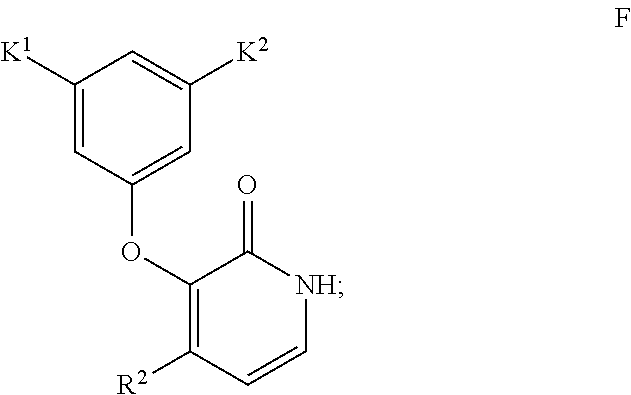
wherein K1 and K2 are independently CH3, CF3, CHF2, CH2CF3, OCH3, Cl, Br, F, CN or SCH3, and R2 is CF3, Cl or Br,
comprising
Step 1—conducting an aldol addition of an ester of Formula B

with a compound of Formula C

in the presence of a first base in a hydrocarbon or ethereal organic solvent at a first reduced temperature, wherein the first base is a metal alkoxide or metal amide base, to form Intermediate D, and optionally isolating Intermediate D

Step 2—reacting Intermediate D with an organic acid anhydride or sulfonyl chloride in the presence of a second base, wherein the second base is a tertiary amine base, at a second reduced temperature in a hydrocarbon or ethereal organic solvent, which solvent can be the same or different as that in Step 1, to form Intermediate E, and optionally isolating Intermediate E

Step 3—cyclizing Intermediate E in the presence of a nitrogen source having formula NH3+nXn, wherein Xn=a non-coordinating counteranion and n=0 or 1, at a first elevated temperature in a mixture of alcohol and organic solvent to make the compound of Formula F.

by reacting a compound of Formula G

with a compound of Formula H

wherein X2 is a halide or pseudo halide, in the presence of a fourth base in an organic polar aprotic solvent at a third elevated temperature, wherein the fourth base is a tertiary amine or inorganic carbonate, to make the ester of Formula B. In an embodiment of the invention, X2 is bromo; the fourth base is N,N-diisopropylethylamine; the organic polar aprotic solvent N,N-dimethylformamide or acetone; and the third elevated temperature is about 50° C.

-
- ° C.=degrees Celsius
- DMF=dimethylformamide
- NMP=N-methylpyrrolidinone
- g=gram(s)
- IPA=isopropyl alcohol
- NPA=n-propyl alcohol
- L=liter(s)
- mL=milliliter(s)
- LC=liquid chromatography
- LCAP=Liquid chromatography area percent
- Me=methyl
- h=hour(s)
- Hz=Hertz
- t=triplet
- d=doublet
- s=singlet
- br s=broad singlet
- IPA=2-propanol also known as n-propanol
- NMR=Nuclear Magnetic Resonance
- wt %=weight percent
- nm=nanometer(s)
- ug=microgram(s)
- DMF=N,N-dimethylformamide
- ppm=parts per million
- Ph=phenyl
- L=liter(s)
- HPLC=High Pressure Liquid Chromatography
- conc.=concentrated
- KOtAm=Potassium tert-amylate
- tAmOH=tert-amylalcohol
- TFAA=trifluoroacetic anhydride
- TEA=triethylamine
- mp=melting point
- GC/MS=gas chromatogtraphy/mass spectrometry
- BHT=butylated hydroxytoluene
- MTBE=tert-butylmethylether
- wt=weight


Claims (23)


Priority Applications (1)
| Application Number | Priority Date | Filing Date | Title |
|---|---|---|---|
| US15/100,940 US9598397B2 (en) | 2013-12-04 | 2014-12-02 | Process for making reverse transcriptase inhibitors |
Applications Claiming Priority (4)
| Application Number | Priority Date | Filing Date | Title |
|---|---|---|---|
| US201361911686P | 2013-12-04 | 2013-12-04 | |
| US201462017542P | 2014-06-26 | 2014-06-26 | |
| PCT/US2014/068008 WO2015084763A2 (en) | 2013-12-04 | 2014-12-02 | Process for making reverse transcriptase inhibitors |
| US15/100,940 US9598397B2 (en) | 2013-12-04 | 2014-12-02 | Process for making reverse transcriptase inhibitors |
Publications (2)
| Publication Number | Publication Date |
|---|---|
| US20160297794A1 US20160297794A1 (en) | 2016-10-13 |
| US9598397B2 true US9598397B2 (en) | 2017-03-21 |
Family
ID=53274271
Family Applications (1)
| Application Number | Title | Priority Date | Filing Date |
|---|---|---|---|
| US15/100,940 Active US9598397B2 (en) | 2013-12-04 | 2014-12-02 | Process for making reverse transcriptase inhibitors |
Country Status (10)
| Country | Link |
|---|---|
| US (1) | US9598397B2 (en) |
| EP (2) | EP3077376B1 (en) |
| JP (1) | JP6244028B2 (en) |
| KR (1) | KR101803671B1 (en) |
| CN (1) | CN105793240B (en) |
| BR (1) | BR112016012658B1 (en) |
| CA (1) | CA2930585A1 (en) |
| ES (2) | ES2977643T3 (en) |
| MX (1) | MX367369B (en) |
| WO (1) | WO2015084763A2 (en) |
Citations (7)
| Publication number | Priority date | Publication date | Assignee | Title |
|---|---|---|---|---|
| US20070021442A1 (en) | 2005-07-22 | 2007-01-25 | Saggar Sandeep A | HIV reverse transcriptase inhibitors |
| US20100034813A1 (en) | 2006-11-13 | 2010-02-11 | Yi Xia | Substituted pyrazole and triazole compounds as ksp inhibitors |
| US20100256181A1 (en) * | 2007-11-20 | 2010-10-07 | Tucker Thomas J | Non-nucleoside reverse transcriptase inhibitors |
| WO2011120133A1 (en) | 2010-03-30 | 2011-10-06 | Merck Frosst Canada Ltd. | Non-nucleoside reverse transcriptase inhibitors |
| US20130005744A1 (en) | 2010-03-04 | 2013-01-03 | Scott Wolkenberg | Inhibitors of catechol o-methyl transferase and their use in the treatment of psychotic disorders |
| WO2014052171A1 (en) | 2012-09-26 | 2014-04-03 | Merck Sharp & Dohme Corp. | Crystalline form of a reverse transcriptase inhibitor |
| WO2014089140A1 (en) | 2012-12-05 | 2014-06-12 | Merck Sharp & Dohme Corp. | Process for making reverse transcriptase inhibitors |
Family Cites Families (1)
| Publication number | Priority date | Publication date | Assignee | Title |
|---|---|---|---|---|
| GB9711114D0 (en) * | 1997-05-29 | 1997-07-23 | Merck Sharp & Dohme | Therapeutic agents |
-
2014
- 2014-12-02 EP EP14866855.1A patent/EP3077376B1/en active Active
- 2014-12-02 ES ES19197774T patent/ES2977643T3/en active Active
- 2014-12-02 MX MX2016007303A patent/MX367369B/en active IP Right Grant
- 2014-12-02 CN CN201480066277.2A patent/CN105793240B/en active Active
- 2014-12-02 BR BR112016012658-0A patent/BR112016012658B1/en active IP Right Grant
- 2014-12-02 ES ES14866855T patent/ES2759976T3/en active Active
- 2014-12-02 US US15/100,940 patent/US9598397B2/en active Active
- 2014-12-02 KR KR1020167014683A patent/KR101803671B1/en active Active
- 2014-12-02 WO PCT/US2014/068008 patent/WO2015084763A2/en not_active Ceased
- 2014-12-02 JP JP2016536221A patent/JP6244028B2/en active Active
- 2014-12-02 CA CA2930585A patent/CA2930585A1/en not_active Abandoned
- 2014-12-02 EP EP19197774.3A patent/EP3617193B1/en active Active
Patent Citations (8)
| Publication number | Priority date | Publication date | Assignee | Title |
|---|---|---|---|---|
| US20070021442A1 (en) | 2005-07-22 | 2007-01-25 | Saggar Sandeep A | HIV reverse transcriptase inhibitors |
| US20100034813A1 (en) | 2006-11-13 | 2010-02-11 | Yi Xia | Substituted pyrazole and triazole compounds as ksp inhibitors |
| US20100256181A1 (en) * | 2007-11-20 | 2010-10-07 | Tucker Thomas J | Non-nucleoside reverse transcriptase inhibitors |
| US20130005744A1 (en) | 2010-03-04 | 2013-01-03 | Scott Wolkenberg | Inhibitors of catechol o-methyl transferase and their use in the treatment of psychotic disorders |
| WO2011120133A1 (en) | 2010-03-30 | 2011-10-06 | Merck Frosst Canada Ltd. | Non-nucleoside reverse transcriptase inhibitors |
| US20110245296A1 (en) | 2010-03-30 | 2011-10-06 | Jason Burch | Non-nucleoside reverse transcriptase inhibitors |
| WO2014052171A1 (en) | 2012-09-26 | 2014-04-03 | Merck Sharp & Dohme Corp. | Crystalline form of a reverse transcriptase inhibitor |
| WO2014089140A1 (en) | 2012-12-05 | 2014-06-12 | Merck Sharp & Dohme Corp. | Process for making reverse transcriptase inhibitors |
Non-Patent Citations (3)
| Title |
|---|
| Cowden, et al, "A New Synthesis of 1,2,4-Triazolin-5-ones: Application to the Convergent Synthesis of an NK1 Antagonist", Tetrahedron Letters, 2000, pp. 8661-8664, vol. 41, No. 44, WO. |
| Jiang, B., et al, "Convenient Approaches to 4-Trifluoromethylpyridine", Organic Process Research & Developement, 2001, pp. 531-534, vol. 5. |
| Kondratov, I.S., et al, "New Synthetic Approach to Mevalonate and Mevaldate Fluoroanalogues", Tetrahedron: Asymmetry, 2007, pp. 1918-1925, vol. 18. |
Also Published As
| Publication number | Publication date |
|---|---|
| MX2016007303A (en) | 2016-08-04 |
| CA2930585A1 (en) | 2015-06-11 |
| EP3077376B1 (en) | 2019-10-16 |
| CN105793240A (en) | 2016-07-20 |
| BR112016012658A2 (en) | 2017-08-08 |
| JP6244028B2 (en) | 2017-12-06 |
| EP3077376A2 (en) | 2016-10-12 |
| KR101803671B1 (en) | 2017-11-30 |
| US20160297794A1 (en) | 2016-10-13 |
| WO2015084763A2 (en) | 2015-06-11 |
| JP2016540765A (en) | 2016-12-28 |
| ES2759976T3 (en) | 2020-05-12 |
| BR112016012658B1 (en) | 2022-06-21 |
| CN105793240B (en) | 2018-05-18 |
| KR20160082695A (en) | 2016-07-08 |
| EP3617193B1 (en) | 2024-03-27 |
| WO2015084763A3 (en) | 2015-11-05 |
| MX367369B (en) | 2019-08-16 |
| EP3077376A4 (en) | 2017-05-17 |
| EP3617193A1 (en) | 2020-03-04 |
| ES2977643T3 (en) | 2024-08-28 |
Similar Documents
| Publication | Publication Date | Title |
|---|---|---|
| KR102441177B1 (en) | Process for the preparation of 4-alkoxy-3-hydroxypicolinic acids | |
| KR20190013553A (en) | Improved process for preparing aminopyrimidine derivatives | |
| US9663490B2 (en) | Process for making reverse transcriptase inhibitors | |
| CN102245575A (en) | Process for preparing substituted 5-methoxymethylpyridine-2,3-dicarboxylic acid derivatives | |
| TW201105648A (en) | Process for preparing pyridyl-substituted pyrazoles | |
| US9951018B2 (en) | Process for the preparation of 4-alkoxy-3-hydroxypicolinic acids | |
| US20160297794A1 (en) | Process for making reverse transcriptase inhibitors | |
| US11505551B2 (en) | Methods for preparing substituted pyridinone-containing tricyclic compounds | |
| US20030162973A1 (en) | Process for the manufacture of arylsulfonyl chloride | |
| WO2011021216A2 (en) | Improved process for the preparation of 4-(1,1-dimethylethyl)-n-[6-(2-hydroxyethoxy)-5-(2-methoxyphenoxy)[2,2'-bipyrimidin]-4-yl]benzenesulfonamide | |
| WO2025085310A1 (en) | Processes for the preparation of substituted phenylacetonitriles and substituted phenylacetic acids | |
| WO2025102245A1 (en) | Synthesis method for dual endothelin receptor antagonist aprocitentan | |
| JPH0739413B2 (en) | Method for producing benzylphthalazinone derivative |
Legal Events
| Date | Code | Title | Description |
|---|---|---|---|
| AS | Assignment |
Owner name: MERCK SHARP & DOHME CORP., NEW JERSEY Free format text: ASSIGNMENT OF ASSIGNORS INTEREST;ASSIGNORS:CAO, YANG;GAUTHIER, DONALD R.;HUMPHREY, GUY R.;AND OTHERS;SIGNING DATES FROM 20141023 TO 20141029;REEL/FRAME:038778/0048 |
|
| STCF | Information on status: patent grant |
Free format text: PATENTED CASE |
|
| MAFP | Maintenance fee payment |
Free format text: PAYMENT OF MAINTENANCE FEE, 4TH YEAR, LARGE ENTITY (ORIGINAL EVENT CODE: M1551); ENTITY STATUS OF PATENT OWNER: LARGE ENTITY Year of fee payment: 4 |
|
| AS | Assignment |
Owner name: MERCK SHARP & DOHME LLC, NEW JERSEY Free format text: MERGER;ASSIGNOR:MERCK SHARP & DOHME CORP.;REEL/FRAME:061102/0145 Effective date: 20220407 |
|
| MAFP | Maintenance fee payment |
Free format text: PAYMENT OF MAINTENANCE FEE, 8TH YEAR, LARGE ENTITY (ORIGINAL EVENT CODE: M1552); ENTITY STATUS OF PATENT OWNER: LARGE ENTITY Year of fee payment: 8 |