US9592239B2 - Methods and compositions for ibogaine treatment of impulse control disorder, anxiety-related disorders, violence and/or anger, or regulating food intake - Google Patents
Methods and compositions for ibogaine treatment of impulse control disorder, anxiety-related disorders, violence and/or anger, or regulating food intake Download PDFInfo
- Publication number
- US9592239B2 US9592239B2 US14/635,905 US201514635905A US9592239B2 US 9592239 B2 US9592239 B2 US 9592239B2 US 201514635905 A US201514635905 A US 201514635905A US 9592239 B2 US9592239 B2 US 9592239B2
- Authority
- US
- United States
- Prior art keywords
- ibogaine
- disorder
- solvate
- patient
- pharmaceutically acceptable
- Prior art date
- Legal status (The legal status is an assumption and is not a legal conclusion. Google has not performed a legal analysis and makes no representation as to the accuracy of the status listed.)
- Active
Links
- 0 *C1=C([13*])C=C2C(=C1)c1c(N2[12*])C2([2*])C[C@@H]3CC([1*])C2N(CC1)C3 Chemical compound *C1=C([13*])C=C2C(=C1)c1c(N2[12*])C2([2*])C[C@@H]3CC([1*])C2N(CC1)C3 0.000 description 7
- HSIBGVUMFOSJPD-ARVVJUJJSA-N CCC1C[C@H]2CC3C4=C(CCN(C2)C13)C1=CC(OC)=CC=C1N4 Chemical compound CCC1C[C@H]2CC3C4=C(CCN(C2)C13)C1=CC(OC)=CC=C1N4 HSIBGVUMFOSJPD-ARVVJUJJSA-N 0.000 description 3
- RSWZLIOMBLFCBG-WIQYPWLWSA-N CCOC(=O)C12C[C@@H]3CC(CCO)C1N(CCC1=C2NC2=CC=C(OC)C=C21)C3 Chemical compound CCOC(=O)C12C[C@@H]3CC(CCO)C1N(CCC1=C2NC2=CC=C(OC)C=C21)C3 RSWZLIOMBLFCBG-WIQYPWLWSA-N 0.000 description 2
- MNUZZDWVZVKQMT-KXTCSVQQSA-N CCOC(=O)C12C[C@@H]3CC(CCOC(C)=O)C1N(CCC1=C2NC2=CC=CC=C21)C3 Chemical compound CCOC(=O)C12C[C@@H]3CC(CCOC(C)=O)C1N(CCC1=C2NC2=CC=CC=C21)C3 MNUZZDWVZVKQMT-KXTCSVQQSA-N 0.000 description 2
- FNIQOMIAGRZRDE-FWNJIHMDSA-N COC1=CC=C2NC3=C(CCN4C[C@H]5CC(CCO)C4C3(CO)C5)C2=C1 Chemical compound COC1=CC=C2NC3=C(CCN4C[C@H]5CC(CCO)C4C3(CO)C5)C2=C1 FNIQOMIAGRZRDE-FWNJIHMDSA-N 0.000 description 2
- DUFLXLVGASPEMV-VFJUUQJRSA-N CCC1C[C@@H]2CN3CCC4=C(NC5=CC(OC)=C(OC)C=C54)C(C(=O)OC)(C2)C13 Chemical compound CCC1C[C@@H]2CN3CCC4=C(NC5=CC(OC)=C(OC)C=C54)C(C(=O)OC)(C2)C13 DUFLXLVGASPEMV-VFJUUQJRSA-N 0.000 description 1
- MMAYTCMMKJYIAM-XKCGAMIGSA-N CCC1C[C@@H]2CN3CCC4=C(NC5=CC=C(OC)C=C54)C(C(=O)OC)(C2)C13 Chemical compound CCC1C[C@@H]2CN3CCC4=C(NC5=CC=C(OC)C=C54)C(C(=O)OC)(C2)C13 MMAYTCMMKJYIAM-XKCGAMIGSA-N 0.000 description 1
- HKNFFUBSNPPROI-BYRRSXPFSA-N CCC1C[C@@H]2CN3CCC4=C(NC5=CC=C(OC)C=C54)C(C(=O)OC)(C2)C13.CCC1C[C@@H]2CN3CCC4=C(NC5=CC=CC=C54)C(C(=O)OC)(C2)C13.CCC1C[C@H]2CC3C4=C(CCN(C2)C13)C1=CC=CC=C1N4.CCCCC1C[C@@H]2CN3CCC4=C(NC5=CC=CC=C54)C(C(=O)OC)(C2)C13.COCCC1C[C@@H]2CN3CCC4=C(NC5=CC=CC=C54)C(C(=O)OC)(C2)C13.COCCOC(=O)C12C[C@@H]3CC(CCOC)C1N(CCC1=C2NC2=CC=CC=C21)C3 Chemical compound CCC1C[C@@H]2CN3CCC4=C(NC5=CC=C(OC)C=C54)C(C(=O)OC)(C2)C13.CCC1C[C@@H]2CN3CCC4=C(NC5=CC=CC=C54)C(C(=O)OC)(C2)C13.CCC1C[C@H]2CC3C4=C(CCN(C2)C13)C1=CC=CC=C1N4.CCCCC1C[C@@H]2CN3CCC4=C(NC5=CC=CC=C54)C(C(=O)OC)(C2)C13.COCCC1C[C@@H]2CN3CCC4=C(NC5=CC=CC=C54)C(C(=O)OC)(C2)C13.COCCOC(=O)C12C[C@@H]3CC(CCOC)C1N(CCC1=C2NC2=CC=CC=C21)C3 HKNFFUBSNPPROI-BYRRSXPFSA-N 0.000 description 1
- NVVDQMVGALBDGE-FYCFHBCQSA-N CCC1C[C@@H]2CN3CCC4=C(NC5=CC=CC=C54)C(C(=O)OC)(C2)C13 Chemical compound CCC1C[C@@H]2CN3CCC4=C(NC5=CC=CC=C54)C(C(=O)OC)(C2)C13 NVVDQMVGALBDGE-FYCFHBCQSA-N 0.000 description 1
- VLOWUTVRYMTRJO-PXOPLXEFSA-N CCC1C[C@H]2CC3C4=C(CCN(C2)C13)C1=CC(OC)=C(OC)C=C1N4 Chemical compound CCC1C[C@H]2CC3C4=C(CCN(C2)C13)C1=CC(OC)=C(OC)C=C1N4 VLOWUTVRYMTRJO-PXOPLXEFSA-N 0.000 description 1
- LRLCVRYKAFDXKU-GWZFEWAGSA-N CCC1C[C@H]2CC3C4=C(CCN(C2)C13)C1=CC=CC=C1N4 Chemical compound CCC1C[C@H]2CC3C4=C(CCN(C2)C13)C1=CC=CC=C1N4 LRLCVRYKAFDXKU-GWZFEWAGSA-N 0.000 description 1
- ZORBVCNBYUQOFW-CWZSEHEPSA-N CCCCCCCCCCCC(=O)OCCC1C[C@@H]2CN3CCC4=C(NC5=CC(OC)=C(OC)C=C54)C(C(=O)OC)(C2)C13 Chemical compound CCCCCCCCCCCC(=O)OCCC1C[C@@H]2CN3CCC4=C(NC5=CC(OC)=C(OC)C=C54)C(C(=O)OC)(C2)C13 ZORBVCNBYUQOFW-CWZSEHEPSA-N 0.000 description 1
- ZAFMALXYBBFPQC-FTDJAVMZSA-N CCCCCCCCCCCC(=O)OCCC1C[C@@H]2CN3CCC4=C(NC5=CC(OC)=C(OC)C=C54)C(C(=O)OCC)(C2)C13 Chemical compound CCCCCCCCCCCC(=O)OCCC1C[C@@H]2CN3CCC4=C(NC5=CC(OC)=C(OC)C=C54)C(C(=O)OCC)(C2)C13 ZAFMALXYBBFPQC-FTDJAVMZSA-N 0.000 description 1
- LWDSBRDGJQLMKP-JKVUOHKZSA-N CCCCCCCCCCCC(=O)OCCC1C[C@@H]2CN3CCC4=C(NC5=CC=C(OC)C=C54)C(C(=O)OC)(C2)C13 Chemical compound CCCCCCCCCCCC(=O)OCCC1C[C@@H]2CN3CCC4=C(NC5=CC=C(OC)C=C54)C(C(=O)OC)(C2)C13 LWDSBRDGJQLMKP-JKVUOHKZSA-N 0.000 description 1
- ZWHQSQXNPJRVGJ-PMVKHWKVSA-N CCCCCCCCCCCC(=O)OCCC1C[C@@H]2CN3CCC4=C(NC5=CC=C(OC)C=C54)C(C(=O)OCC)(C2)C13 Chemical compound CCCCCCCCCCCC(=O)OCCC1C[C@@H]2CN3CCC4=C(NC5=CC=C(OC)C=C54)C(C(=O)OCC)(C2)C13 ZWHQSQXNPJRVGJ-PMVKHWKVSA-N 0.000 description 1
- MBKWLRGTSSAVAT-SAVBAIFISA-N CCCCCCCCCCCC(=O)OCCC1C[C@@H]2CN3CCC4=C(NC5=CC=CC=C54)C(C(=O)OC)(C2)C13 Chemical compound CCCCCCCCCCCC(=O)OCCC1C[C@@H]2CN3CCC4=C(NC5=CC=CC=C54)C(C(=O)OC)(C2)C13 MBKWLRGTSSAVAT-SAVBAIFISA-N 0.000 description 1
- VPKNFRJWOGESDW-ZILFAHQBSA-N CCCCCCCCCCCC(=O)OCCC1C[C@@H]2CN3CCC4=C(NC5=CC=CC=C54)C(C(=O)OCC)(C2)C13 Chemical compound CCCCCCCCCCCC(=O)OCCC1C[C@@H]2CN3CCC4=C(NC5=CC=CC=C54)C(C(=O)OCC)(C2)C13 VPKNFRJWOGESDW-ZILFAHQBSA-N 0.000 description 1
- MFVNTGORLLPIBM-UAVRNLFVSA-N CCOC(=O)C12C[C@@H]3CC(CCO)C1N(CCC1=C2NC2=CC(OC)=C(OC)C=C21)C3 Chemical compound CCOC(=O)C12C[C@@H]3CC(CCO)C1N(CCC1=C2NC2=CC(OC)=C(OC)C=C21)C3 MFVNTGORLLPIBM-UAVRNLFVSA-N 0.000 description 1
- BRBBQAXPSFISFU-VVTZATRYSA-N CCOC(=O)C12C[C@@H]3CC(CCO)C1N(CCC1=C2NC2=CC=CC=C21)C3 Chemical compound CCOC(=O)C12C[C@@H]3CC(CCO)C1N(CCC1=C2NC2=CC=CC=C21)C3 BRBBQAXPSFISFU-VVTZATRYSA-N 0.000 description 1
- VJSGCDPQENXVLL-GNOLOVOVSA-N CCOC(=O)C12C[C@@H]3CC(CCOC(C)=O)C1N(CCC1=C2NC2=CC(OC)=C(OC)C=C21)C3 Chemical compound CCOC(=O)C12C[C@@H]3CC(CCOC(C)=O)C1N(CCC1=C2NC2=CC(OC)=C(OC)C=C21)C3 VJSGCDPQENXVLL-GNOLOVOVSA-N 0.000 description 1
- KALYYTFGJLAALA-KYBPTBFFSA-N CCOC(=O)C12C[C@@H]3CC(CCOC(C)=O)C1N(CCC1=C2NC2=CC=C(OC)C=C21)C3 Chemical compound CCOC(=O)C12C[C@@H]3CC(CCOC(C)=O)C1N(CCC1=C2NC2=CC=C(OC)C=C21)C3 KALYYTFGJLAALA-KYBPTBFFSA-N 0.000 description 1
- PBLUHSOUNSFWRR-CQCZQOMBSA-N CCOC(=O)C12C[C@@H]3CC(CCOC)C1N(CCC1=C2NC2=CC(OC)=C(OC)C=C21)C3 Chemical compound CCOC(=O)C12C[C@@H]3CC(CCOC)C1N(CCC1=C2NC2=CC(OC)=C(OC)C=C21)C3 PBLUHSOUNSFWRR-CQCZQOMBSA-N 0.000 description 1
- IHEYCNOHENJVQM-JBRLKPPASA-N CCOC(=O)C12C[C@@H]3CC(CCOC)C1N(CCC1=C2NC2=CC=C(OC)C=C21)C3 Chemical compound CCOC(=O)C12C[C@@H]3CC(CCOC)C1N(CCC1=C2NC2=CC=C(OC)C=C21)C3 IHEYCNOHENJVQM-JBRLKPPASA-N 0.000 description 1
- UOPLJDGFSNMPPK-VCGCNWIPSA-N CCOC(=O)C12C[C@@H]3CC(CCOC)C1N(CCC1=C2NC2=CC=CC=C21)C3 Chemical compound CCOC(=O)C12C[C@@H]3CC(CCOC)C1N(CCC1=C2NC2=CC=CC=C21)C3 UOPLJDGFSNMPPK-VCGCNWIPSA-N 0.000 description 1
- MVCWOVBKAQKAPE-DYONGIRLSA-N CCOC(=O)C12C[C@@H]3CC(CCOCC4=CC=CC=C4)C1N(CCC1=C2NC2=CC(OC)=C(OC)C=C21)C3 Chemical compound CCOC(=O)C12C[C@@H]3CC(CCOCC4=CC=CC=C4)C1N(CCC1=C2NC2=CC(OC)=C(OC)C=C21)C3 MVCWOVBKAQKAPE-DYONGIRLSA-N 0.000 description 1
- HCIQPXAVDCLQOH-XMYIQKPJSA-N CCOC(=O)C12C[C@@H]3CC(CCOCC4=CC=CC=C4)C1N(CCC1=C2NC2=CC=C(OC)C=C21)C3 Chemical compound CCOC(=O)C12C[C@@H]3CC(CCOCC4=CC=CC=C4)C1N(CCC1=C2NC2=CC=C(OC)C=C21)C3 HCIQPXAVDCLQOH-XMYIQKPJSA-N 0.000 description 1
- CFEVFCWKJGVJKI-YOUOSYHVSA-N CCOC(=O)C12C[C@@H]3CC(CCOCC4=CC=CC=C4)C1N(CCC1=C2NC2=CC=CC=C21)C3 Chemical compound CCOC(=O)C12C[C@@H]3CC(CCOCC4=CC=CC=C4)C1N(CCC1=C2NC2=CC=CC=C21)C3 CFEVFCWKJGVJKI-YOUOSYHVSA-N 0.000 description 1
- RDTIMAPTSWPTQD-VJVDEUKGSA-N CCOC(=O)C12C[C@@H]3CC(CCOCOCCOC)C1N(CCC1=C2NC2=CC(OC)=C(OC)C=C21)C3 Chemical compound CCOC(=O)C12C[C@@H]3CC(CCOCOCCOC)C1N(CCC1=C2NC2=CC(OC)=C(OC)C=C21)C3 RDTIMAPTSWPTQD-VJVDEUKGSA-N 0.000 description 1
- PANIEPMTNLSKQK-NLKVXPGPSA-N CCOC(=O)C12C[C@@H]3CC(CCOCOCCOC)C1N(CCC1=C2NC2=CC=CC=C21)C3 Chemical compound CCOC(=O)C12C[C@@H]3CC(CCOCOCCOC)C1N(CCC1=C2NC2=CC=CC=C21)C3 PANIEPMTNLSKQK-NLKVXPGPSA-N 0.000 description 1
- UOMPJUOPZHQFRG-VFJUUQJRSA-N COC(=O)C12C[C@@H]3CC(CCO)C1N(CCC1=C2NC2=CC(OC)=C(OC)C=C21)C3 Chemical compound COC(=O)C12C[C@@H]3CC(CCO)C1N(CCC1=C2NC2=CC(OC)=C(OC)C=C21)C3 UOMPJUOPZHQFRG-VFJUUQJRSA-N 0.000 description 1
- OWRRTKQNTDMIMR-XKCGAMIGSA-N COC(=O)C12C[C@@H]3CC(CCO)C1N(CCC1=C2NC2=CC=C(OC)C=C21)C3 Chemical compound COC(=O)C12C[C@@H]3CC(CCO)C1N(CCC1=C2NC2=CC=C(OC)C=C21)C3 OWRRTKQNTDMIMR-XKCGAMIGSA-N 0.000 description 1
- FRCVRUHRFLXLAI-FYCFHBCQSA-N COC(=O)C12C[C@@H]3CC(CCO)C1N(CCC1=C2NC2=CC=CC=C21)C3 Chemical compound COC(=O)C12C[C@@H]3CC(CCO)C1N(CCC1=C2NC2=CC=CC=C21)C3 FRCVRUHRFLXLAI-FYCFHBCQSA-N 0.000 description 1
- IDJJGBWVGOPDMH-CQCZQOMBSA-N COC(=O)C12C[C@@H]3CC(CCOC(C)=O)C1N(CCC1=C2NC2=CC(OC)=C(OC)C=C21)C3 Chemical compound COC(=O)C12C[C@@H]3CC(CCOC(C)=O)C1N(CCC1=C2NC2=CC(OC)=C(OC)C=C21)C3 IDJJGBWVGOPDMH-CQCZQOMBSA-N 0.000 description 1
- YRWAABLSPFYKBO-JBRLKPPASA-N COC(=O)C12C[C@@H]3CC(CCOC(C)=O)C1N(CCC1=C2NC2=CC=C(OC)C=C21)C3 Chemical compound COC(=O)C12C[C@@H]3CC(CCOC(C)=O)C1N(CCC1=C2NC2=CC=C(OC)C=C21)C3 YRWAABLSPFYKBO-JBRLKPPASA-N 0.000 description 1
- HTVKUZYWUPCCBJ-VCGCNWIPSA-N COC(=O)C12C[C@@H]3CC(CCOC(C)=O)C1N(CCC1=C2NC2=CC=CC=C21)C3 Chemical compound COC(=O)C12C[C@@H]3CC(CCOC(C)=O)C1N(CCC1=C2NC2=CC=CC=C21)C3 HTVKUZYWUPCCBJ-VCGCNWIPSA-N 0.000 description 1
- RFSSDYIALLYNKN-KITRGUPNSA-N COC(=O)C12C[C@@H]3CC(CCOCC4=CC=CC=C4)C1N(CCC1=C2NC2=CC(OC)=C(OC)C=C21)C3 Chemical compound COC(=O)C12C[C@@H]3CC(CCOCC4=CC=CC=C4)C1N(CCC1=C2NC2=CC(OC)=C(OC)C=C21)C3 RFSSDYIALLYNKN-KITRGUPNSA-N 0.000 description 1
- RKGWSZGEFFPZSU-WUIWZNEKSA-N COC(=O)C12C[C@@H]3CC(CCOCC4=CC=CC=C4)C1N(CCC1=C2NC2=CC=C(OC)C=C21)C3 Chemical compound COC(=O)C12C[C@@H]3CC(CCOCC4=CC=CC=C4)C1N(CCC1=C2NC2=CC=C(OC)C=C21)C3 RKGWSZGEFFPZSU-WUIWZNEKSA-N 0.000 description 1
- JDFGPEMCSCTFBG-XGQXNIKOSA-N COC(=O)C12C[C@@H]3CC(CCOCC4=CC=CC=C4)C1N(CCC1=C2NC2=CC=CC=C21)C3 Chemical compound COC(=O)C12C[C@@H]3CC(CCOCC4=CC=CC=C4)C1N(CCC1=C2NC2=CC=CC=C21)C3 JDFGPEMCSCTFBG-XGQXNIKOSA-N 0.000 description 1
- XUJOBYIKOIKMJH-IPZXVODDSA-N COC1=C(OC)C=C2C(=C1)NC1=C2CCN2C[C@H]3CC(CCO)C2C1(CO)C3 Chemical compound COC1=C(OC)C=C2C(=C1)NC1=C2CCN2C[C@H]3CC(CCO)C2C1(CO)C3 XUJOBYIKOIKMJH-IPZXVODDSA-N 0.000 description 1
- WDJOAUZHUFDXEG-UAVRNLFVSA-N COCCC1C[C@@H]2CN3CCC4=C(NC5=CC(OC)=C(OC)C=C54)C(C(=O)OC)(C2)C13 Chemical compound COCCC1C[C@@H]2CN3CCC4=C(NC5=CC(OC)=C(OC)C=C54)C(C(=O)OC)(C2)C13 WDJOAUZHUFDXEG-UAVRNLFVSA-N 0.000 description 1
- GIUBRUXCAJEFIB-QSPUSDCTSA-N COCCC1C[C@@H]2CN3CCC4=C(NC5=CC(OC)=C(OC)C=C54)C(CO)(C2)C13 Chemical compound COCCC1C[C@@H]2CN3CCC4=C(NC5=CC(OC)=C(OC)C=C54)C(CO)(C2)C13 GIUBRUXCAJEFIB-QSPUSDCTSA-N 0.000 description 1
- JLHTUHPOTUETFI-WIQYPWLWSA-N COCCC1C[C@@H]2CN3CCC4=C(NC5=CC=C(OC)C=C54)C(C(=O)OC)(C2)C13 Chemical compound COCCC1C[C@@H]2CN3CCC4=C(NC5=CC=C(OC)C=C54)C(C(=O)OC)(C2)C13 JLHTUHPOTUETFI-WIQYPWLWSA-N 0.000 description 1
- MFBGRWCJEYSBHH-YEONKOQISA-N COCCC1C[C@@H]2CN3CCC4=C(NC5=CC=C(OC)C=C54)C(CO)(C2)C13 Chemical compound COCCC1C[C@@H]2CN3CCC4=C(NC5=CC=C(OC)C=C54)C(CO)(C2)C13 MFBGRWCJEYSBHH-YEONKOQISA-N 0.000 description 1
- DTJQBBHYRQYDEG-VVTZATRYSA-N COCCC1C[C@@H]2CN3CCC4=C(NC5=CC=CC=C54)C(C(=O)OC)(C2)C13 Chemical compound COCCC1C[C@@H]2CN3CCC4=C(NC5=CC=CC=C54)C(C(=O)OC)(C2)C13 DTJQBBHYRQYDEG-VVTZATRYSA-N 0.000 description 1
- WOWOZZZILGQJQV-XFMWWGCHSA-N COCCC1C[C@@H]2CN3CCC4=C(NC5=CC=CC=C54)C(CO)(C2)C13 Chemical compound COCCC1C[C@@H]2CN3CCC4=C(NC5=CC=CC=C54)C(CO)(C2)C13 WOWOZZZILGQJQV-XFMWWGCHSA-N 0.000 description 1
- FPZDKWNKFDNAID-VKHWVVTDSA-N COCCOCOCCC1C[C@@H]2CN3CCC4=C(NC5=CC(OC)=C(OC)C=C54)C(C(=O)OC)(C2)C13 Chemical compound COCCOCOCCC1C[C@@H]2CN3CCC4=C(NC5=CC(OC)=C(OC)C=C54)C(C(=O)OC)(C2)C13 FPZDKWNKFDNAID-VKHWVVTDSA-N 0.000 description 1
- GKWGTVFMGPWFTC-ZGSWHEEBSA-N COCCOCOCCC1C[C@@H]2CN3CCC4=C(NC5=CC=C(OC)C=C54)C(C(=O)OC)(C2)C13 Chemical compound COCCOCOCCC1C[C@@H]2CN3CCC4=C(NC5=CC=C(OC)C=C54)C(C(=O)OC)(C2)C13 GKWGTVFMGPWFTC-ZGSWHEEBSA-N 0.000 description 1
- ZCHOYJOJPBOKSE-CDVLQNEDSA-N COCCOCOCCC1C[C@@H]2CN3CCC4=C(NC5=CC=CC=C54)C(C(=O)OC)(C2)C13 Chemical compound COCCOCOCCC1C[C@@H]2CN3CCC4=C(NC5=CC=CC=C54)C(C(=O)OC)(C2)C13 ZCHOYJOJPBOKSE-CDVLQNEDSA-N 0.000 description 1
- NEQDLNSKPFFASR-LUTZKCTBSA-N OCCC1C[C@@H]2CN3CCC4=C(NC5=CC=CC=C54)C(CO)(C2)C13 Chemical compound OCCC1C[C@@H]2CN3CCC4=C(NC5=CC=CC=C54)C(CO)(C2)C13 NEQDLNSKPFFASR-LUTZKCTBSA-N 0.000 description 1
Classifications
-
- A—HUMAN NECESSITIES
- A61—MEDICAL OR VETERINARY SCIENCE; HYGIENE
- A61K—PREPARATIONS FOR MEDICAL, DENTAL OR TOILETRY PURPOSES
- A61K31/00—Medicinal preparations containing organic active ingredients
- A61K31/33—Heterocyclic compounds
- A61K31/395—Heterocyclic compounds having nitrogen as a ring hetero atom, e.g. guanethidine or rifamycins
- A61K31/55—Heterocyclic compounds having nitrogen as a ring hetero atom, e.g. guanethidine or rifamycins having seven-membered rings, e.g. azelastine, pentylenetetrazole
-
- A—HUMAN NECESSITIES
- A61—MEDICAL OR VETERINARY SCIENCE; HYGIENE
- A61K—PREPARATIONS FOR MEDICAL, DENTAL OR TOILETRY PURPOSES
- A61K31/00—Medicinal preparations containing organic active ingredients
Definitions
- This invention relates generally to methods for the treatment of anxiety-related disorders, including obsessive-compulsive disorder (OCD), or impulse control disorder by administering ibogaine, an ibogaine derivative, or a pharmaceutically acceptable salt and/or solvate thereof (hereinafter referred to as “ibogaine”).
- OCD obsessive-compulsive disorder
- ibogaine a pharmaceutically acceptable salt and/or solvate thereof
- This invention further relates generally to methods and compositions for the regulation of food intake by administering ibogaine, an ibogaine derivative, or a pharmaceutically acceptable salt thereof.
- This invention further relates generally to methods and compositions for treating anger and/or violence and disorders associated therewith by administering ibogaine, an ibogaine derivative, or a pharmaceutically acceptable salt thereof.
- Obsessive compulsive disorder is characterized by recurrent and persistent ideas, thoughts, impulses or images (obsessions) that are ego-dystonic and/or repetitive, purposeful and intentional behaviors (compulsions) that are recognized by the person as excessive or unreasonable (American Psychiatric Association, 1994a).
- the obsessions or compulsions cause marked distress, are time-consuming, and/or significantly interfere with social or occupational functioning.
- Panic disorder is characterized by recurrent unexpected panic attacks and associated concern about having additional attacks, worry about the implications or consequences of the attacks, and/or a significant change in behavior related to the attacks (American Psychiatric Association, 1994a).
- a panic attack is defined as a discrete period of intense fear or discomfort in which four (or more) of the following symptoms develop abruptly and reach a peak within 10 minutes: (1) palpitations, pounding heart, or accelerated heart rate; (2) sweating; (3) trembling or shaking; (4) sensations of shortness of breath or smothering; (5) feeling of choking; (6) chest pain or discomfort; (7) nausea or abdominal distress; (8) feeling dizzy, unsteady, lightheaded, or faint; (9) derealization (feelings of unreality) or depersonalization (being detached from oneself); fear of losing control; (11) fear of dying; (12) paresthesias (numbness or tingling sensations); (13) chills or hot flushes.
- Panic disorder may or may not be associated with agor
- Social anxiety disorder also known as social phobia
- social phobia is characterized by a marked and persistent fear of one or more social or performance situations in which the person is exposed to unfamiliar people or to possible scrutiny by others (American Psychiatric Association, 1994a). Exposure to the feared situation almost invariably provokes anxiety, which may approach the intensity of a panic attack. The feared situations are avoided or endured with intense anxiety or distress. The avoidance, anxious anticipation, or distress in the feared situation(s) interferes significantly with the person's normal routine, occupational or academic functioning, or social activities or relationships, or there is marked distress about having the phobias. Lesser degrees of performance anxiety or shyness generally do not require psychopharmacological treatment.
- Generalized anxiety disorder is characterized by excessive anxiety and worry (apprehensive expectation) that is persistent for at least 6 months and which the person finds difficult to control (American Psychiatric Association, 1994a). It must be associated with at least 3 of the following 6 symptoms: restlessness or feeling keyed up or on edge, being easily fatigued, difficulty concentrating or mind going blank, irritability, muscle tension, and sleep disturbance.
- the diagnostic criteria for this disorder are described in further detail in DSM-IV, which is incorporated herein by reference (American Psychiatric Association, 1994a).
- Impulse control disorder is a class of psychiatric disorders involving the failure to resist a temptation, urge, or impulse (impulsivity) where such impulse is potentially harmful to the patient and/or others.
- the American Psychiatric Association's DSM-5 (May 2013) includes impulse control disorders “characterized by problems in emotional and behavioral self-control”. These include borderline personality disorder, conduct disorder, antisocial personality disorder, attention deficit hyperactivity disorder (ADHD), schizophrenia, mood disorders, pathological gambling, pyromania, intermittent explosive disorder, kleptomania, sexual compulsion, paraphilia, internet addiction, trichotillomania, pathological skin picking, and compulsive shopping.
- Impulse control disorder may be related to anxiety disorder and/or OCD.
- Violence and anger particularly when out of proportion to a stimulus and/or a result of pathological anger, are associated with a number of mental disorders. These include oppositional defiant disorder, attention-deficit/hyperactivity disorder and conduct disorder (in children and adolescents), psychotic disorder, bipolar disorder, antisocial, borderline, paranoid and narcissistic personality disorders, adjustment disorder with disturbance of conduct, and intermittent explosive disorder.
- Pathological anger and violence account for a significant portion of violent crimes, including many high-profile crimes involving multiple victims. Highly volatile individuals are over-represented in the prison system in the United States.
- Ibogaine has been used as a botanical preparation from the root bark of iboga tabernathe for over 100 years both as a crude preparation and as semisynthetic ibogaine, which was marketed in France until about 1970. In the United States, ibogaine is classified as a Schedule I controlled substance.
- the use of ibogaine in humans is complicated by the fact that the ranges in the prior art are exceptionally broad (0.01 to 1000 mg/kg body weight). Furthermore, the ranges generally used to treat addiction (e.g., 15 mg/kg to 20 mg/kg) cause hallucinations and may be fatal.
- a prolonged QT interval is a marker of potential ventricular tachyarrhythmia which can result in death. Serious complications, including ventricular tachyarrhythmia and death, can result from prolongation of the treated patient's QT interval by ibogaine, rendering high doses of ibogaine unacceptable.
- ibogaine it was unclear whether a therapeutic dose of ibogaine could be found that resulted in QT interval prolongation within an acceptable range. It is expected that other compounds that share ibogaine's core structure will have a similar prolongation effect on QT interval. See, U.S. patent application Ser. No. 14/292,632 filed May 30, 2014 entitled METHOD FOR ACUTE AND LONG-TERM TREATMENT OF DRUG ADDICTION, which application is incorporated by reference in its entirety.
- the current invention is predicated on the surprising discovery that treatment with a narrow dosage range of ibogaine or pharmaceutically acceptable salt and/or solvate thereof, between greater than about 1 mg/kg body weight and about 4 mg/kg body weight, provides a therapeutic reduction in symptoms of anxiety disorders, impulse control disorder, anger/violence-related disorders in affected patients, or provides a therapeutic reduction in food consumption.
- the dose range that provides both therapeutic results and an acceptable QT interval prolongation of less than about 50 milliseconds is between about 1.3 mg per kg body weight and no more than about 4 mg per kg body weight and, more preferably between about 1 mg per kg body weight and no more than about 3 mg per kg body weight, or any subrange or subvalue within the aforementioned ranges.
- the dose that provides both therapeutic results and an acceptable QT interval prolongation of less than about 50 milliseconds is between about 60 mg and about 150 mg. In some embodiments, the dose that provides both therapeutic results and an acceptable QT interval prolongation of less than about 50 milliseconds is about 100 mg. In some embodiments, the dose that provides both therapeutic results and an acceptable QT interval prolongation of less than about 50 milliseconds is about 120 mg. In some embodiments, the dose that provides both therapeutic results and an acceptable QT interval prolongation of less than about 50 milliseconds is about 1.5 mg/kg body weight. In some embodiments, the dose that provides both therapeutic results and an acceptable QT interval prolongation of less than about 50 milliseconds is about 2 mg/kg body weight.
- the patient is administered an initial dose of ibogaine, ibogaine derivative, or pharmaceutically acceptable salt or solvate thereof, followed by one or more additional doses.
- the initial dose is from about 50 mg to about 120 mg.
- the one or more additional doses are lower than the initial dose.
- the one or more additional doses are from about 5 mg to about 50 mg.
- such a dosing regimen provides an average serum concentration of ibogaine of about 50 ng/mL to about 180 ng/mL.
- the one or more additional doses maintain an average serum concentration of about 50 ng/mL to about 180 ng/mL over a period of time.
- the one or more additional doses are administered periodically.
- direct blood stream delivery of ibogaine may reduce symptoms of anxiety disorders, impulse control disorder, anger/violence-related disorders, or provide regulation of food intake. Such dosing is well below that previously described.
- Direct blood stream delivery of ibogaine enhances the amount of ibogaine delivered to the brain, because ibogaine does not pass through the liver as it does when ingested.
- Direct blood stream delivery of ibogaine includes sublingual, pulmonary and intranasal delivery where the ibogaine is absorbed directly into the blood stream and then into the brain. The rapid delivery of ibogaine into the brain, e.g. less than about 15 minutes, may cause a significant reduction in symptoms of anxiety disorders, impulse control disorder, anger/violence-related disorders, or food cravings.
- this invention relates to treating anxiety disorders, impulse control disorder, anger/violence-related disorders, or regulation of food intake in a patient in need thereof comprising administering to the patient a therapeutically effective amount of ibogaine, ibogaine derivative, solvate, or pharmaceutically acceptable salt and/or solvate thereof.
- this invention treats an anxiety disorder.
- this invention treats OCD.
- this invention treats generalized anxiety disorder.
- this invention treats social anxiety disorder.
- this invention treats panic disorder.
- this invention treats impulse control disorder.
- this invention treats pathological anger and/or violence.
- this invention treats anger/violence-related disorders.
- this invention reduces pathological anger in a patient.
- this invention reduces violent outbursts in a patient. In another embodiment, this invention regulates food intake. In one embodiment, food consumption is reduced. In one embodiment, food cravings are reduced. In a preferred embodiment, the patient is not addicted to cocaine or an opiate.
- the therapeutic dose of ibogaine or pharmaceutically acceptable salt and/or solvate thereof administered to the patient is sufficient to provide a serum concentration of about 1000 to about 6000 ng ⁇ hour/mL (area under the curve for 24 hours). In some embodiments the therapeutic dose of ibogaine, ibogaine derivative, or pharmaceutically acceptable salt or solvate thereof administered to the patient is sufficient to provide a maximum serum concentration (Cmax) of less than about 250 ng/mL. In a preferred embodiment, the therapeutic dose provides a Cmax of about 100 ng/mL to about 200 ng/mL.
- the therapeutic dose of ibogaine, ibogaine derivative, or pharmaceutically acceptable salt or solvate thereof administered to the patient is sufficient to provide an average serum concentration of about 50 ng/mL to about 180 ng/mL, or any subrange or subvalue there between.
- the dose of ibogaine or pharmaceutically acceptable salt and/or solvate thereof administered to the patient provides an average serum concentration of about 50 ng/mL to about 110 ng/mL.
- the dose of ibogaine or pharmaceutically acceptable salt and/or solvate thereof administered to the patient provides an average serum concentration of about 50 ng/mL to about 100 ng/mL.
- the dose of ibogaine or pharmaceutically acceptable salt and/or solvate thereof administered to the patient provides an average serum concentration of less than about 50 ng/mL.
- the narrow therapeutic doses of ibogaine, ibogaine derivative, or pharmaceutically acceptable salt and/or solvate thereof described above unexpectedly do not prolong the QT interval to unacceptable levels in human patients.
- the patient will be pre-screened to evaluate tolerance for prolongation of QT interval, e.g., to determine whether the patient has any pre-existing cardiac conditions which would disqualify him/her from treatment with ibogaine or ibogaine derivative.
- the serum concentration is sufficient to inhibit or ameliorate symptoms of anxiety disorders, impulse control disorder, anger/violence-related disorders, or to regulate food intake while maintaining a QT interval of less than about 500 milliseconds (ms) during said treatment.
- the dose of ibogaine or pharmaceutically acceptable salt and/or solvate thereof maintains a QT interval of less than about 450 ms. In some embodiments, the dose of ibogaine or pharmaceutically acceptable salt and/or solvate thereof maintains a QT interval of less than about 420 ms.
- the dose of ibogaine or pharmaceutically acceptable salt and/or solvate thereof provides prolongation of the QT interval of less than about 50 ms. In some embodiments, the dose of ibogaine or pharmaceutically acceptable salt and/or solvate thereof provides prolongation of the QT interval of less than about 30 ms. In a preferred embodiment, the dose of ibogaine or pharmaceutically acceptable salt and/or solvate thereof provides prolongation of the QT interval of less than about 20 ms. In a preferred embodiment, the patient is tested to determine QT interval before treatment with ibogaine, and if clinician determines that the QT prolongation would be an unacceptable risk, ibogaine therapy will be contraindicated.
- this invention provides a method for treating anxiety disorders, impulse control disorder, anger/violence-related disorders, or regulating food intake in a patient in need thereof comprising administering to the patient ibogaine or an ibogaine derivative in a sustained release manner such that the concentration of ibogaine, ibogaine derivative, pharmaceutically acceptable salt and/or solvate thereof is maintained at a therapeutically effective amount for period of about 6 hours, about 12 hours, about 18 hours, about 24 hours, about 36 hours, about 48 hours, about 72 hours, about 96 hours, or a period of time between any two of these durations.
- the average serum concentration is maintained at a therapeutically effective level for several days, weeks, months, or a year or more.
- the maintenance dose of ibogaine is 5 mg to 100 mg. In some embodiments, the maintenance dose of ibogaine is about 1.5 mg/kg body weight. In some embodiments, the maintenance dose of ibogaine is about 1 mg/kg body weight. In some embodiments, the maintenance dose of ibogaine is about 0.9 mg/kg body weight. In some embodiments, the maintenance dose of ibogaine is about 0.8 mg/kg body weight. In some embodiments, the maintenance dose of ibogaine is about 0.7 mg/kg body weight. In some embodiments, the maintenance dose of ibogaine is about 0.6 mg/kg body weight. In some embodiments, the maintenance dose of ibogaine is about 0.5 mg/kg body weight.
- the maintenance dose of ibogaine is about 0.4 mg/kg body weight. In some embodiments, the maintenance dose of ibogaine is about 0.3 mg/kg body weight. In some embodiments, the maintenance dose of ibogaine is about 0.2 mg/kg body weight. In some embodiments, the maintenance dose of ibogaine is about 0.1 mg/kg body weight.
- administering refers to introducing an agent into a patient. Typically, an effective amount is administered, which amount can be determined by the treating physician or the like. Any route of administration, such as topical, subcutaneous, peritoneal, intraarterial, inhalation, vaginal, rectal, nasal, buccal, introduction into the cerebrospinal fluid, or instillation into body compartments can be used.
- the related terms and phrases “administering” and “administration of”, when used in connection with a compound or pharmaceutical composition (and grammatical equivalents) refer both to direct administration, which may be administration to a patient by a medical professional or by self-administration by the patient, and/or to indirect administration, which may be the act of prescribing a drug. For example, a physician who instructs a patient to self-administer a drug and/or provides a patient with a prescription for a drug is administering the drug to the patient.
- Periodic administration refers to multiple treatments that occur on a daily, weekly, or monthly basis. Periodic administration may also refer to administration of ibogaine, ibogaine derivative, or salt and/or solvate thereof one, two, three, or more times per day. Administration may be via transdermal patch, gum, lozenge, sublingual tablet, intranasal, buccal, intrapulmonary, oral administration, or any other mode of administration.
- compositions and methods include the recited elements, but not excluding others.
- Consisting essentially of when used to define compositions and methods, shall mean excluding other elements of any essential significance to the combination for the stated purpose. Thus, a composition consisting essentially of the elements as defined herein would not exclude other materials or steps that do not materially affect the basic and novel characteristic(s) of the claimed invention.
- Consisting of shall mean excluding more than trace elements of other ingredients and substantial method steps. Embodiments defined by each of these transition terms are within the scope of this invention.
- alkyl refers to monovalent saturated aliphatic hydrocarbyl groups having from 1 to 12 carbon atoms, 1 to 10 carbon atoms, preferably 1 to 6 carbon atoms, and more preferably 1 to 3 carbon atoms.
- This term includes, by way of example, linear and branched hydrocarbyl groups such as methyl (CH 3 —), ethyl (CH 3 CH 2 —), n-propyl (CH 3 CH 2 CH 2 —), isopropyl ((CH 3 ) 2 CH—), n-butyl (CH 3 CH 2 CH 2 CH 2 —), isobutyl ((CH 3 ) 2 CHCH 2 —), sec-butyl ((CH 3 )(CH 3 CH 2 )CH—), t-butyl ((CH 3 ) 3 C—), n-pentyl (CH 3 CH 2 CH 2 CH 2 CH 2 —), and neopentyl ((CH 3 ) 3 CCH 2 —).
- C x alkyl refers to an alkyl group having x carbon atoms, wherein x is an integer, for example, C 3 refers to an alkyl group having 3 carbon atoms.
- Substituted alkyl refers to an alkyl group having from 1 to 5, preferably 1 to 3, or more preferably 1 to 2 substituents selected from the group consisting of alkoxy, R 20 —C(O)—, —NR 20 C(O)R 20 ,
- R 20 —C(O)O—, —NR 20 R 20 , —C(O)NR 20 R 20 , —C(S)NR 20 R 20 , —NR 20 C(O)NR 20 R 20 , —NR 20 C(S)NR 20 R 20 , O—C(O)NR 20 R 20 , —S(O) 2 NR 20 R 20 , —O—S(O) 2 NR 20 R 20 , —NR 20 —S(O) 2 NR 20 R 20 , —C( ⁇ NR 20 )NR 20 R 20 , aryl, aryloxy, arylthio, azido, carboxyl, —C(O)O—R 21 , —NR 20 —C(O)O—R 21 , —O—C(O)O—R 21 , cyano, cycloalkyl, cycloalkyloxy, cycloalkylthio, —NR 20 C( ⁇ NR 20 )N(R 20
- Alkoxy refers to the group —O-alkyl wherein alkyl is defined herein. Alkoxy includes, by way of example, methoxy, ethoxy, n-propoxy, isopropoxy, n-butoxy, t-butoxy, sec-butoxy, and n-pentoxy.
- Aryl or “Ar” refers to a monovalent aromatic carbocyclic group of from 6 to 14 carbon atoms having a single ring (e.g., phenyl) or multiple condensed rings (e.g., naphthyl or anthryl) which condensed rings may or may not be aromatic (e.g., 2-benzoxazolinone, 2H-1,4-benzoxazin-3(4H)-one-7-yl, and the like) provided that the point of attachment is at an aromatic carbon atom.
- Preferred aryl groups include phenyl and naphthyl.
- Substituted aryl refers to aryl groups which are substituted with 1 to 5, preferably 1 to 3, or more preferably 1 to 2 substituents selected from the group consisting of alkyl, substituted alkyl, alkoxy, —C(O)—R 20 , —NR 20 C(O)R 20 ,
- R 20 —C(O)O—, —NR 20 R 20 , —C(O)NR 20 R 20 , —C(S)NR 20 R 20 , —NR 20 C(O)NR 20 R 20 , —NR 20 C(S)NR 20 R 20 , O—C(O)NR 20 R 20 , —S(O) 2 NR 20 R 20 , —O—S(O) 2 NR 20 R 20 , —NR 20 —S(O) 2 NR 20 R 20 , —C( ⁇ NR 20 )NR 20 R 20 aryl, aryloxy, arylthio, azido, carboxyl, —C(O)O—R 21 , —NR 20 —C(O)O—R 21 , —O—C(O)O—R 21 , cyano, cycloalkyl, cycloalkyloxy, cycloalkylthio, —NR 20 C( ⁇ NR 20 )N(R 20 )
- Cyano refers to the group —CN.
- Cycloalkyl refers to cyclic alkyl groups of from 3 to 10 or 3 to 8 carbon atoms having single or multiple cyclic rings including fused, bridged, and spiro ring systems.
- One or more of the rings can be aryl, heteroaryl, or heterocyclic provided that the point of attachment is through the non-aromatic, non-heterocyclic ring carbocyclic ring.
- suitable cycloalkyl groups include, for instance, adamantyl, cyclopropyl, cyclobutyl, cyclopentyl, and cyclooctyl.
- Other examples of cycloalkyl groups include bicycle[2,2,2,]octanyl, norbornyl, and spirobicyclo groups such as spiro[4.5]dec-8-yl.
- “Substituted cycloalkyl” refers to a cycloalkyl group having from 1 to 5 or preferably 1 to 3 substituents selected from the group consisting of oxo, thione, alkyl, substituted alkyl, alkoxy, —C(O)—R 20 , —NR 20 C(O)R 20 ,
- R 20 —C(O)O—, —NR 20 R 20 , —C(O)NR 20 R 20 , —C(S)NR 20 R 20 , —NR 20 C(O)NR 20 R 20 , —NR 20 C(S)NR 20 R 20 , —O—C(O)NR 20 R 20 , —S(O) 2 NR 20 R 20 , —O—S(O) 2 NR 20 R 20 , —NR 20 —S(O) 2 NR 20 R 20 , —C( ⁇ NR 20 )NR 20 R 20 , aryl, aryloxy, arylthio, azido, carboxyl, —C(O)O—R 21 , —NR 20 —C(O)O—R 21 , —O—C(O)O—R 21 , cyano, cycloalkyl, cycloalkyloxy, cycloalkylthio, —NR 20 C( ⁇ NR 20 )N(
- Halo or “halogen” refers to fluoro, chloro, bromo and iodo and preferably is fluoro or chloro.
- Haloalkyl refers to alkyl groups substituted with 1 to 5, 1 to 3, or 1 to 2 halo groups, wherein alkyl and halo are as defined herein.
- Heteroaryl refers to an aromatic group of from 5 to 14 ring atoms, including from 1 to 10 carbon atoms and 1 to 4 heteroatoms selected from the group consisting of oxygen, nitrogen and sulfur. In some embodiments, heteroaryl comprises 5, 6, or 7 ring atoms, including 1 to 4 heteroatoms.
- Such heteroaryl groups can have a single ring (e.g., pyridyl, pyridinyl or furyl) or multiple condensed rings (e.g., indolizinyl or benzothienyl) wherein the condensed rings may or may not be aromatic and/or contain a heteroatom provided that the point of attachment is through an atom of the aromatic heteroaryl group.
- the nitrogen and/or the sulfur ring atom(s) of the heteroaryl group are optionally oxidized to provide for the N-oxide (N ⁇ O), sulfinyl, and/or sulfonyl moieties.
- Preferred heteroaryls include pyridinyl, pyrrolyl, indolyl, thiophenyl, and furanyl.
- Substituted heteroaryl refers to heteroaryl groups that are substituted with from 1 to 5, preferably 1 to 3, or more preferably 1 to 2 substituents selected from the group consisting of the same group of substituents defined for substituted aryl.
- Heterocycle or “heterocyclic” or “heterocycloalkyl” or “heterocyclyl” refers to a saturated or partially saturated, but not aromatic, group having from 3 to 14 ring atoms, including from 1 to 10 ring carbon atoms and from 1 to 4 ring heteroatoms selected from the group consisting of nitrogen, sulfur, or oxygen.
- heteroaryl comprises 3, 4, 5, 6 or 7 ring atoms, including 1 to 4 heteroatoms.
- Heterocycle encompasses single ring or multiple condensed rings, including fused bridged and spiro ring systems.
- one or more the rings can be cycloalkyl, aryl, or heteroaryl provided that the point of attachment is through the non-aromatic heterocyclic ring.
- the nitrogen and/or sulfur atom(s) of the heterocyclic group are optionally oxidized to provide for the N-oxide, sulfinyl, and/or sulfonyl moieties.
- Substituted heterocyclic or “substituted heterocycloalkyl” or “substituted heterocyclyl” refers to heterocyclyl groups that are substituted with from 1 to 5 or preferably 1 to 3 of the same substituents as defined for substituted cycloalkyl.
- Substituted groups of this invention do not include polymers obtained by an infinite chain of substituted groups. At most, any substituted group can be substituted up to five times.
- Ibogaine is mentioned herein, one more polymorphs of ibogaine can be utilized and are contemplated. Ibogaine is isolated from Tabernanth iboga , a shrub of West Africa. Ibogaine can also be synthesized using known methods. See, e.g., Büchi, et al. (1966), J. Am. Chem Society, 88(13), 3099-3109.
- “Pharmaceutically acceptable composition” refers to a composition that is suitable for administration to a mammal, particularly, a human. Such compositions include various excipients, diluents, carriers, and such other inactive agents well known to the skilled artisan.
- “Pharmaceutically acceptable salt” refers to pharmaceutically acceptable salts, including pharmaceutically acceptable partial salts, of a compound, which salts are derived from a variety of organic and inorganic counter ions well known in the art and include, by way of example only, hydrochloric acid, hydrobromic acid, phosphoric acid, sulfuric acid, methane sulfonic acid, phosphorous acid, nitric acid, perchloric acid, acetic acid, tartaric acid, lactic acid, succinic acid, citric acid, malic acid, maleic acid, aconitic acid, salicylic acid, thalic acid, embonic acid, enanthic acid, oxalic acid and the like, and when the molecule contains an acidic functionality, include, by way of example only, sodium, potassium, calcium, magnesium, ammonium, tetraalkylammonium, and the like.
- “Therapeutically effective amount” refers to an amount of a drug or an agent that, when administered to a patient suffering from a condition, will have the intended therapeutic effect, e.g., alleviation, amelioration, palliation or elimination of one or more manifestations of the condition in the patient.
- the therapeutically effective amount will vary depending upon the patient and the condition being treated, the weight and age of the subject, the severity of the condition, the salt, solvate, or derivative of the active drug portion chosen, the particular composition or excipient chosen, the dosing regimen to be followed, timing of administration, the manner of administration and the like, all of which can be determined readily by one of ordinary skill in the art.
- a therapeutically effective amount may be administered in one or more administrations.
- a therapeutically effective amount of an agent in the context of treating anxiety disorders, impulse control disorder, and/or anger/violence-related disorders, refers to an amount of the agent that attenuates the anxiety disorder, impulse control disorder, or anger/violence-related disorders, and/or symptoms thereof, in the patient.
- a therapeutically effective amount of an agent in the context of regulating food intake and/or controlling food cravings, refers to an amount of the agent that reduces the patient's food intake and/or reduces food cravings in the patient.
- the therapeutically effective amount of the compound may be higher or lower, depending on the route of administration used. For example, when direct blood administration (e.g., sublingual, pulmonary, buccal, or intranasal delivery) is used, a lower dose of the compound is administered. In one aspect, a therapeutically effective amount of ibogaine or derivative is from about 50 ng to less than about 100 ⁇ g per kg of body weight. Where other routes of administration are used, a higher dose of the compound is administered. In one embodiment, the therapeutically effective amount of the compound is from about 1 mg to about 4 mg per kg of body weight per day.
- a “therapeutic level” of a drug is an amount of ibogaine or an ibogaine derivative that is sufficient to treat the anxiety disorder, impulse control disorder, anger/violence-related disorders, or to regulate food intake, but not high enough to pose any significant risk to the patient.
- Therapeutic levels of drugs can be determined by tests that measure the actual concentration of the compound in the blood of the patient. This concentration is referred to as the “serum concentration.” Where the serum concentration of ibogaine is mentioned, it is to be understood that the term “ibogaine” encompasses any form of ibogaine, including derivatives thereof.
- dose refers to a range of ibogaine, ibogaine derivative, or pharmaceutical salt or solvate thereof that provides a therapeutic serum level of ibogaine when given to a patient in need thereof.
- the dose is recited in a range, for example from about 20 mg to about 120 mg, and can be expressed either as milligrams or as mg/kg body weight.
- the attending clinician will select an appropriate dose from the range based on the patient's weight, age, degree of addiction, health, and other relevant factors, all of which are well within the skill of the art.
- unit dose refers to a dose of drug that is given to the patient to provide therapeutic results, independent of the weight of the patient.
- the unit dose is sold in a standard form (e.g., 20 mg tablet).
- the unit dose may be administered as a single dose or a series of subdoses.
- the unit dose provides a standardized level of drug to the patient, independent of weight of patient.
- Many medications are sold based on a dose that is therapeutic to all patients based on a therapeutic window. In such cases, it is not necessary to titrate the dosage amount based on the weight of the patient.
- Treatment covers the treatment of a human patient, and includes: (a) reducing the risk of occurrence of the condition in a patient determined to be predisposed to the disease but not yet diagnosed as having the condition, (b) impeding the development of the condition, and/or (c) relieving the condition, i.e., causing regression of the condition and/or relieving one or more symptoms of the condition.
- Treating” or “treatment of” a condition or patient refers to taking steps to obtain beneficial or desired results, including clinical results such as the reduction of symptoms.
- beneficial or desired clinical results include, but are not limited to, treating an anxiety disorder, impulse control disorder, anger/violence-related disorders, or regulating food intake.
- Anxiety disorders or impulse control disorders occurring as a result of withdraw and/or use of an opiate or other illicit drug or substance is not within the scope of this invention.
- QT interval refers to the measure of the time between the start of the Q wave and the end of the T wave in the electrical cycle of the heart. Prolongation of the QT interval refers to an increase in the QT interval. Measurement of the QT interval, and determination of the interval, can be performed by any method.
- patient refers to mammals and includes humans and non-human mammals.
- a “pharmaceutically acceptable solvate” or “hydrate” of a compound of the invention means a solvate or hydrate complex that is pharmaceutically acceptable and that possesses the desired pharmacological activity of the parent compound, and includes, but is not limited to, complexes of a compound of the invention with one or more solvent or water molecules, or 1 to about 100, or 1 to about 10, or one to about 2, 3 or 4, solvent or water molecules.
- solvate is taken to mean that a solid-form of a compound that crystallizes with one or more molecules of solvent trapped inside.
- solvents that can be used to create solvates, such as pharmaceutically acceptable solvates, include, but are certainly not limited to, water, methanol, ethanol, isopropanol, butanol, C1-C6 alcohols in general (and optionally substituted), tetrahydrofuran, acetone, ethylene glycol, propylene glycol, acetic acid, formic acid, water, and solvent mixtures thereof.
- Other such biocompatible solvents which may aid in making a pharmaceutically acceptable solvate are well known in the art and applicable to the present invention.
- solvate can be referred to as a hydrate.
- the compounds of the present invention may absorb moisture, may include one or more molecules of water in the formed crystal, and thus become a hydrate. Even when such hydrates are formed, they are included in the term “solvate”.
- Solvate also is meant to include such compositions where another compound or complex co-crystallizes with the compound of interest.
- this invention provides compositions for treating an anxiety disorder, impulse control disorder, anger/violence-related disorders, or regulating food intake, in a subject, comprising ibogaine, ibogaine derivatives, prodrugs of ibogaine, pharmaceutically acceptable salts and/or solvates of each thereof.
- This invention further provides compositions for treating, attenuating, or preventing anxiety disorder, impulse control disorder, anger/violence-related disorders, symptoms thereof, or food cravings in a subject, comprising ibogaine, ibogaine derivatives, prodrugs of ibogaine, pharmaceutically acceptable salts and/or solvates of each thereof.
- the composition is formulated for sublingual, intranasal, or intrapulmonary delivery.
- the invention provides a pharmaceutical composition comprising a pharmaceutically effective amount of ibogaine and a pharmaceutically acceptable excipient, wherein the therapeutically effective amount of ibogaine is an amount that delivers an aggregate amount of ibogaine of about 50 ng to less than about 100 ⁇ g per kg body weight per day.
- the therapeutically effective amount of ibogaine is an amount that delivers an aggregate amount of ibogaine of about 50 ng to about 50 ⁇ g per kg body weight per day.
- the therapeutically effective amount of ibogaine is an amount that delivers an aggregate amount of ibogaine of about 50 ng to about 10 ⁇ g per kg body weight per day. In some aspects, the therapeutically effective amount of ibogaine is an amount that delivers an aggregate amount of ibogaine of about 50 ng to about 1 ⁇ g per kg body weight per day. In some aspects, the composition is formulated for administration once per day. In some aspects, the composition is formulated for administration two or more times per day. The ranges include both extremes as well as any subranges there between.
- the composition is formulated for oral, buccal, transdermal, internal, pulmonary, rectal, nasal, vaginal, lingual, intravenous, intraarterial, intramuscular, intraperitoneal, intracutaneous or subcutaneous delivery.
- the therapeutically effective amount of the compound is from about 1 mg to about 4 mg per kg body weight per day. In another embodiment, the therapeutically effective amount of the compound is from about 1 mg to about 3 mg per kg body weight per day. In another embodiment, the therapeutically effective amount of the compound is from about 1 mg to about 2 mg per kg body weight per day. In another embodiment, the therapeutically effective amount of the compound is from about 1.3 mg to about 3 mg per kg body weight per day. In another embodiment, the therapeutically effective amount of the compound is from about 1.5 mg to about 3 mg per kg body weight per day. In another embodiment, the therapeutically effective amount of the compound is from about 1.7 mg to about 3 mg per kg body weight per day.
- the therapeutically effective amount of the compound is from about 1.3 mg to about 4 mg per kg body weight per day. In another embodiment, the therapeutically effective amount of the compound is from about 1.5 mg to about 4 mg per kg body weight per day. In another embodiment, the therapeutically effective amount of the compound is about 2 mg per kg body weight per day.
- the ranges include both extremes as well as any subrange or subvalue there between.
- the therapeutically effective amount of the compound is about 4 mg/kg body weight per day. In one embodiment, the therapeutically effective amount of the compound is about 3 mg/kg body weight per day. In another embodiment, the therapeutically effective amount of the compound is about 2 mg per kg body weight per day. In another embodiment, the therapeutically effective amount of the compound is about 1.7 mg per kg body weight per day. In another embodiment, the therapeutically effective amount of the compound is about 1.5 mg per kg body weight per day. In another embodiment, the therapeutically effective amount of the compound is about 1.2 mg per kg body weight per day. In another embodiment, the therapeutically effective amount of the compound is about 1 mg per kg body weight per day.
- the ibogaine or ibogaine derivative is represented by Formula I:
- the ibogaine or ibogaine derivative is represented by Formula II:
- R 12 is hydrogen
- R 1 is H. In one embodiment, R 1 is C 1 -C 3 alkyl, such as ethyl. In one embodiment, R 1 is CH 2 CH 2 OH. In one embodiment, R 1 is CH 2 CH 2 OCH 3 . In one embodiment, R 1 is CH 2 CH 2 OCH 2 Ph. In one embodiment, R 1 is CH 2 CH 2 OC(O)alkyl. In one embodiment, R 1 is CH 2 CH 2 O(CH 2 ) p O(CH 2 ) q O(CH 2 ) r CH 3 .
- R 2 is CH 2 OH and CH(OH)R 5 . In one embodiment, R 2 is CH 2 OR 5 . In one embodiment, R 2 is CO 2 R 5 . In one embodiment, R 2 is C(O)NH 2 , C(O)NHR 5 , or C(O)NR 5 R 6 . In one embodiment, R 2 is C(O)NHNH 2 , C(O)NHNHR 5 , C(O)NR NH 2 , C(O)NHNR 5 R 6 , C(O)NH NHR 6 , or C(O)NR NR 6 R 7 .
- R 2 is C(O)NHNH(C(O)R), C(O)NHNR 5 (C(O)R 6 ), C(O)NR 5 NH(C(O)R 6 ), or C(O)NR 5 NR 6 (C(O)R 7 ). In one embodiment, R 2 is C(O)R 5 .
- a compound utilized herein is represented by, or ibogaine as used herein is replaced by, a compound Formula I:
- R is hydrogen or C 1 -C 3 -alkoxy
- R 1 is hydrogen, C 1 -C 3 -alkyl, C 1 -C 3 alkoxy, or CH 2 —Y—CH 3 where Y is O or NH, and
- ibogaine or a pharmaceutically acceptable salt and/or solvate thereof is utilized.
- ibogaine or a pharmaceutically acceptable salt and/or solvate thereof is utilized.
- the ibogaine, ibogaine derivative is chosen from the group consisting of ibogaine, coronaridine, ibogamine, voacangine, 18-methoxycoronaridine, 2-methoxyethyl-18-methoxycoronaridinate, 18-methylaminocoronaridine or a pharmaceutically acceptable salt and/or solvate thereof.
- the compound utilized herein is chosen from the group consisting of ibogaine, coronaridine, ibogamine, voacangine, 18-methoxycoronaridine, 2-methoxyethyl-18-methoxycoronaridinate, 18-methylaminocoronaridine and a pharmaceutically acceptable salt and/or solvate.
- the compound utilized herein is selected from the group consisting of 16-hydroxymethyl-18-hydroxyibogaline, 16-hydroxymethyl-18-methoxyibogaline, 16-ethoxycarbonyl-18-hydroxyibogaline laurate, and 16-ethoxycarbonyl-18-hydroxyibogaline methoxyethoxymethyl ether and a pharmaceutically acceptable salt and/or solvate thereof.
- the ibogaine derivative is represented by Formula II:
- the ibogaine derivative is selected from the group consisting of coronaridine, ibogamine, voacangine, 18-methoxycoronaridine, 2-Methoxyethyl-18-methoxycoronaridinate, and 18-Methylaminocoronaridine.
- the ibogaine derivative is selected from the group consisting of 16-hydroxymethyl-18-hydroxyibogaline, 16-hydroxymethyl-18-methoxyibogaline, 16-ethoxycarbonyl-18-hydroxyibogaline laurate, and 16-ethoxycarbonyl-18-hydroxyibogaline methoxyethoxymethyl ether.
- the compound is of Formula IA:
- R is hydrogen or C 1 -C 3 -alkoxy
- R 1 is hydrogen, C 1 -C 3 -alkyl, C 1 -C 3 alkoxy, or CH 2 —Y—CH 3 where Y is O or NH, and
- the ibogaine derivative is represented by Formula II:
- R is OCH 3 ;
- R 1 is CH 2 CH 3 ;
- R 2 is COOR 4 , where R 4 is (CH 2 CH 2 O) n CH 3 , where n is 1.
- the compounds of formula I, II, and subformulas thereof as utilized herein exclude ibogaine.
- the compound utilized herein is:
- the ibogaine or ibogaine derivative is selected from:
- This invention is not limited to any particular chemical form of the compounds, and the drug may be given to patients either as a free base, solvate, or as a pharmaceutically acceptable acid addition salt.
- the hydrochloride salt is generally preferred, but other salts derived from organic or inorganic acids may also be used. Examples of such acids include, without limitation, those described below as “pharmaceutically acceptable salts” and the like.
- the ibogaine derivative is:
- this invention provides a method for treating anxiety disorder, impulse control disorder, anger/violence-related disorders, or regulating food intake in a patient in need thereof, comprising administering to the patient a therapeutically effective amount of ibogaine, an ibogaine derivative, or a pharmaceutically acceptable salt and/or solvate thereof.
- the patient is not addicted to cocaine or an opiate.
- Ibogaine derivatives include, but are not limited to, the compounds described in the “Compositions of the Invention” section above.
- anxiety disorders and impulse control disorders are provided for the purpose of facilitating an understanding of the utility of the compounds and compositions of this invention. Disorders associated with violence and/or anger are included in these descriptions.
- the definitions of anxiety disorders and impulse control disorders given below are those listed in American Psychiatric Association, 2013, American Psychiatric Association, 1994a, or American Psychiatric Association, 1987. Additional information regarding these disorders can be found in these references, as well as other references cited below, all of which are hereby incorporated herein by reference.
- Anxiety disorders include panic disorder, agoraphobia with or without history of panic disorder, specific phobia, social phobia, obsessive-compulsive disorder, post-traumatic stress disorder, acute stress disorder and generalized anxiety disorder. It is contemplated that the compounds of this invention will be effective in treating these disorders in patients who have been diagnosed as having such disorders.
- This invention provides for a method of treating a patient suffering from anxiety which comprises administering to the patient an amount of any of the compounds described herein effective to treat the subject's anxiety.
- the compounds described herein will be effective in treating obsessions and compulsions in patients who have been diagnosed as having obsessive compulsive disorder based upon administration of appropriate tests, which may include, but are not limited to any of the following: Yale Brown Obsessive Compulsive Scale (YBOCS) (for adults), National Institute of Mental Health Global OCD Scale (NIMH GOCS), CGI-Severity of Illness scale. It is further contemplated that the compounds described herein will be effective in inducing improvements in certain of the factors measured in these tests, such as a reduction of several points in the YBOCS total score. It is also contemplated that the compounds described herein will be effective in preventing relapse of obsessive compulsive disorder and/or symptoms thereof.
- This invention provides a method of treating obsessions and/or compulsions in a patient with obsessive compulsive disorder, which comprises administering to the patient a therapeutically effective amount of any of the compounds utilized herein effective to treat the subject's obsessions and/or compulsions.
- the compounds described herein will be effective in treating panic disorder in patients who have been diagnosed with panic disorder on the basis of frequency of occurrence of panic attacks, or by means of the CGI-Severity of Illness scale. It is further contemplated that the compounds described herein will be effective in inducing improvements in certain of the factors measured in these evaluations, such as a reduction in frequency or elimination of panic attacks, an improvement in the CGI-Severity of Illness scale or a CGI-Global Improvement score of 1 (very much improved), 2 (much improved) or 3 (minimally improved). It is also contemplated that the compounds described herein will be effective in preventing relapse of panic disorder.
- This invention provides a method of treating panic disorder, with or without agoraphobia, in a subject, which comprises administering to the patient a therapeutically effective amount of any of the compounds utilized herein to treat the subject's panic disorder.
- the compounds described herein can be effective in treating social anxiety disorder in patients who have been diagnosed as having social anxiety disorder based upon the administration of any of the following tests: the Liebowitz Social Anxiety Scale (LSAS), the CGI-Severity of Illness scale, the Hamilton Rating Scale for Anxiety (HAM-A), the Hamilton Rating Scale for Depression (HAM-D), the axis V Social and Occupational Functioning Assessment Scale of DSM-IV, the axis II (ICD-10) World Health Organization Disability Assessment, Schedule 2 (DAS-2), the Sheehan Disability Scales, the Schneier Disability Profile, the World Health Organization Quality of Life-100 (WHOQOL-100), or other tests as described in Bobes, 1998, which is incorporated herein by reference.
- LSAS Liebowitz Social Anxiety Scale
- HAM-A Hamilton Rating Scale for Anxiety
- HAM-D Hamilton Rating Scale for Depression
- axis V Social and Occupational Functioning Assessment Scale of DSM-IV the axis II (I
- the compounds described herein will be effective in inducing improvements as measured by these tests, such as the a change from baseline in the Liebowitz Social Anxiety Scale (LSAS), or a CGI-Global Improvement score of 1 (very much improved), 2 (much improved) or 3 (minimally improved). It is also contemplated that the compounds described herein will be effective in preventing relapse of social anxiety disorder.
- LSAS Liebowitz Social Anxiety Scale
- CGI-Global Improvement score of 1 (very much improved), 2 (much improved) or 3 (minimally improved). It is also contemplated that the compounds described herein will be effective in preventing relapse of social anxiety disorder.
- This invention provides a method of treating social anxiety disorder in a patient which comprises administering to the patient a therapeutically effective amount of any of the compounds utilized herein to treat the subject's social anxiety disorder.
- the compounds utilized herein can be effective in treating generalized anxiety disorder in patients who have been diagnosed as having this disorder based upon the diagnostic criteria described in DSM-IV or DSM-5. It is further contemplated that the compounds utilized herein will be effective in reducing symptoms of this disorder, such as the following: excessive worry and anxiety, difficulty controlling worry, restlessness or feeling keyed up or on edge, being easily fatigued, difficulty concentrating or mind going blank, irritability, muscle tension, or sleep disturbance. It is also contemplated that the compounds described herein will be effective in preventing relapse of general anxiety disorder.
- the invention provides a method of treating generalized anxiety disorder in a subject, which comprises administering to the patient an amount of any of the compounds described herein effective to treat the subject's generalized anxiety disorder.
- Impulse control disorders include pathological gambling (PG), kleptomania, trichotillomania (TTM), intermittent explosive disorder (IED), and pyromania.
- Impulse control disorders may also include pathological skin picking (PSP), compulsive sexual behavior (CSB), compulsive buying (CB), conduct disorder, antisocial personality disorder, oppositional defiant disorder, borderline personality disorder, attention deficit/hyperactivity disorder (ADHD, which includes attention deficit disorder, ADD), schizophrenia, mood disorders, paraphilia, and internet addiction.
- Symptoms of impulse control disorders include: repetitive participation in behavior despite adverse consequences, diminished control over the behavior, an urge/impulse to engage in the behavior, and feelings of pleasure while participating in the behavior.
- the compounds utilized herein can be effective in treating impulse control disorders in patients who have at least one impulse control disorder based upon the diagnostic criteria described in DSM-IV or DSM-5. It is further contemplated that the compounds utilized herein will be effective in reducing symptoms of this disorder, including impulsivity or lack of self-control. It is also contemplated that the compounds described herein will be effective in preventing relapse of the impulse control disorder.
- the compounds utilized herein can be effective in treating ADHD or ADD in patients who have the disorder, based upon the diagnostic criteria described in DSM-IV or DSM-5. It is further contemplated that the compounds utilized herein will be effective in reducing symptoms of this disorder, including impulsivity or lack of self-control. It is also contemplated that the compounds described herein will be effective in preventing relapse of ADD or ADHD.
- the compounds utilized herein can be effective in treating schizophrenia in patients who have the disorder, based upon the diagnostic criteria described in DSM-IV or DSM-5. Schizophrenia is characterized by delusions, hallucinations, disorganized speech and behavior, and other symptoms that cause social or occupational dysfunction. It is further contemplated that the compounds utilized herein will be effective in reducing symptoms of this disorder. It is also contemplated that the compounds described herein will be effective in preventing relapse of schizophrenia.
- the compounds described herein will be effective in treating non-suicidal self injury disorder in patients who have been diagnosed with this disorder based on the patient's exhibition of symptoms including deliberate tissue injury without suicidal intent (e.g., cutting, burning, self-poisoning, or self-mutilation). It is further contemplated that the compounds described herein will be effective in inducing improvements in certain of these factors, such as a reduction in frequency or elimination of self injury. It is also contemplated that the compounds described herein will be effective in preventing relapse of non-suicidal self injury disorder.
- This invention provides a method of treating non-suicidal self injury disorder in a subject, which comprises administering to the patient a therapeutically effective amount of any of the compounds utilized herein to treat the subject's non-suicidal self injury disorder.
- the compounds described herein will be effective in treating Münchausen syndrome in patients who have been diagnosed with this disorder based on the patient's propensity for feigning disease, illness, or psychological trauma to draw attention, sympathy, or reassurance to themselves. Symptoms may include frequent hospitalizations, knowledge of several illnesses, frequent requests for medication (e.g., pain killers), willingness to undergo extensive surgery, few to no visitors during hospitalizations, and exaggerated or fabricated stories about multiple medical problems. It is further contemplated that the compounds described herein will be effective in inducing improvements in certain of these factors, such as a reduction in frequency or elimination of one or more symptoms.
- Mnchausen syndrome also includes Münchausen syndrome by proxy, in which a caregiver exaggerates, fabricates, or induces illness in someone in his/her care.
- This invention provides a method of treating Münchausen syndrome in a subject, which comprises administering to the patient a therapeutically effective amount of any of the compounds utilized herein to treat the subject's Münchausen syndrome.
- the compounds described herein will be effective in treating disruptive mood dysregulation disorder in patients who have been diagnosed with this disorder on the basis of severe and recurrent temper outbursts, grossly out of proportion to the stimulus or situation, as well as a persistent irritable/angry mood most of the time. It is further contemplated that the compounds described herein will be effective in inducing improvements in certain of these factors, such as a reduction in frequency or elimination of temper outbursts and/or an improvement in mood. It is also contemplated that the compounds described herein will be effective in preventing relapse of disruptive mood dysregulation disorder.
- This invention provides a method of treating disruptive mood dysregulation disorder in a subject, which comprises administering to the patient a therapeutically effective amount of any of the compounds utilized herein to treat the subject's disruptive mood dysregulation disorder.
- the compounds utilized herein can be effective in reducing the frequency, intensity, and duration of anger and/or violence in individuals prone to one or both.
- anger and violence disorders other than those associated with other disorders (e.g., as described above) are not outlined in DSM IV or DSM 5, many health professionals recognize that such disorders are associated with significant dysfunction. Anger management training and other psychosocial treatments are often used in an effort to treat these individuals.
- This invention provides a method of treating anger-and/or violence-related disorder in a subject, which comprises administering to the patient a therapeutically effective amount of any of the compounds utilized herein to treat the subject's anger-and/or violence-related disorder.
- the compounds utilized herein can be effective in regulating food intake and/or reducing food cravings in patients in need thereof.
- the patient is overweight.
- the patient is obese.
- the patient exhibits comorbidities associated with overweight/obesity, for example coronary heart disease, high blood pressure, stroke, type 2 diabetes, abnormal levels of blood fats, metabolic syndrome, cancer, osteoarthritis, sleep apnea, reproductive issues, and/or gallstones.
- This invention provides a method of regulating food intake and/or reducing food cravings in a subject, which comprises administering to the patient a therapeutically effective amount of any of the compounds utilized herein to regulate/reduce the subject's food intake and/or food cravings.
- the invention provides a method for treating anxiety disorders, impulse control disorders, OCD, and/or anger/violence-related disorders, or regulating food intake and/or food cravings, in a patient in need thereof, comprising administering to the patient a therapeutically effective amount of ibogaine, ibogaine derivative, or a pharmaceutically acceptable salt and/or solvate thereof, wherein the patient is not addicted to cocaine or an opiate, and further wherein the therapeutically effective amount provides average ibogaine serum levels of between about 50 to about 180 ng/ml. In some embodiments, the average ibogaine serum level provided by the dosage is less than about 50 ng/mL. In one embodiment, the therapeutically effective amount is between about 1 mg to about 4 mg per kg of body weight.
- the therapeutically effective amount is between about 50 ng to about 100 ⁇ g per kg of body weight.
- an anxiety disorder is treated.
- OCD is treated.
- an impulse control disorder is treated.
- an anger-related disorder is treated.
- a violence-related disorder is treated.
- symptoms of anger are reduced or eliminated.
- violent outbursts are reduced or eliminated.
- food intake is regulated.
- food cravings are attenuated.
- the ibogaine, ibogaine derivative, or pharmaceutically acceptable salt and/or solvate thereof is administered by sublingual, buccal, intranasal, or intrapulmonary delivery.
- the composition is administered via sublingual, intranasal, buccal, or intrapulmonary delivery.
- the invention provides administering a pharmaceutical composition comprising a pharmaceutically effective amount of ibogaine and a pharmaceutically acceptable excipient, wherein the therapeutically effective amount of ibogaine is an amount that delivers an aggregate amount of ibogaine of about 50 ng to about 100 ⁇ g per kg body weight per day.
- the therapeutically effective amount of ibogaine is an amount that delivers an aggregate amount of ibogaine of about 50 ng to about 50 ⁇ g per kg body weight per day.
- the therapeutically effective amount of ibogaine is an amount that delivers an aggregate amount of ibogaine of about 50 ng to about 10 ⁇ g per kg body weight per day. In some aspects, the therapeutically effective amount of ibogaine is an amount that delivers an aggregate amount of ibogaine of about 50 ng to about 1 ⁇ g per kg body weight per day. In some aspects, the composition is administered once per day. In some aspects, the composition is administered two or more times per day. In some embodiments, the composition is administered less than once a day, for example once every two days, once every three days, once every four days, once a week, etc.
- the composition is administered via oral, buccal, transdermal, internal, pulmonary, rectal, nasal, vaginal, lingual, intravenous, intraarterial, intramuscular, intraperitoneal, intracutaneous or subcutaneous delivery.
- the dosage or aggregate dosage of compound is from about 1 mg to about 4 mg per kg body weight per day.
- the aggregate dosage is the combined dosage, for example the total amount of ibogaine, ibogaine derivative, or pharmaceutically acceptable salt and/or solvate thereof administered over a 24-hour period where smaller amounts are administered more than once per day.
- the dosage or aggregate dosage of ibogaine, ibogaine derivative, or salt or solvate thereof is from about 1 mg/kg to about 4 mg/kg body weight per day.
- the aggregate dosage is the combined dosage, for example the total amount of ibogaine, ibogaine derivative, or pharmaceutically acceptable salt or solvate thereof administered over a 24-hour period where smaller amounts are administered more than once per day.
- the dosage or aggregate dosage of ibogaine, ibogaine derivative, or salt or solvate thereof is from about 1.3 mg/kg to about 4 mg/kg body weight.
- the dosage or aggregate dosage of ibogaine, ibogaine derivative, or salt or solvate thereof is from about 1.3 mg/kg to about 3 mg/kg body weight.
- the dosage or aggregate dosage of ibogaine, ibogaine derivative, or salt or solvate thereof is from about 1.3 mg/kg to about 2 mg/kg body weight. In one embodiment, the dosage or aggregate dosage of ibogaine, ibogaine derivative, or salt or solvate thereof is from about 1.5 mg/kg to about 3 mg/kg body weight. In one embodiment, the dosage or aggregate dosage of ibogaine, ibogaine derivative, or salt or solvate thereof is from about 1.7 mg/kg to about 3 mg/kg body weight. In one embodiment, the dosage or aggregate dosage of ibogaine, ibogaine derivative, or salt or solvate thereof is from about 2 mg/kg to about 4 mg/kg body weight.
- the dosage or aggregate dosage of ibogaine, ibogaine derivative, or salt or solvate thereof is from about 2 mg/kg to about 3 mg/kg body weight. In one embodiment, the dosage or aggregate dosage of ibogaine, ibogaine derivative, or salt or solvate thereof is about 2 mg/kg body weight.
- the ranges include both extremes as well as any subrange or subvalue there between.
- the dosage or aggregate dosage of ibogaine, ibogaine derivative, or salt or solvate thereof is about 4 mg/kg body weight per day. In one embodiment, the dosage or aggregate dosage of ibogaine, ibogaine derivative, or salt or solvate thereof is about 3 mg/kg body weight per day. In one embodiment, the dosage or aggregate dosage of ibogaine, ibogaine derivative, or salt or solvate thereof is about 2 mg/kg body weight per day. In one embodiment, the dosage or aggregate dosage of ibogaine, ibogaine derivative, or salt or solvate thereof is about 1.9 mg/kg body weight per day.
- the dosage or aggregate dosage of ibogaine, ibogaine derivative, or salt or solvate thereof is about 1.8 mg/kg body weight per day. In one embodiment, the dosage or aggregate dosage of ibogaine, ibogaine derivative, or salt or solvate thereof is about 1.7 mg/kg body weight per day. In one embodiment, the dosage or aggregate dosage of ibogaine, ibogaine derivative, or salt or solvate thereof is about 1.6 mg/kg body weight per day. In one embodiment, the dosage or aggregate dosage of ibogaine, ibogaine derivative, or salt or solvate thereof is about 1.5 mg/kg body weight per day.
- the dosage or aggregate dosage of ibogaine, ibogaine derivative, or salt or solvate thereof is about 1.4 mg/kg body weight per day. In one embodiment, the dosage or aggregate dosage of ibogaine, ibogaine derivative, or salt or solvate thereof is about 1.3 mg/kg body weight per day. In one embodiment, the dosage or aggregate dosage of ibogaine, ibogaine derivative, or salt or solvate thereof is about 1.2 mg/kg body weight per day. In one embodiment, the dosage or aggregate dosage of ibogaine, ibogaine derivative, or salt or solvate thereof is about 1.1 mg/kg body weight per day. In one embodiment, the dosage or aggregate dosage of ibogaine, ibogaine derivative, or salt or solvate thereof is about 1 mg/kg body weight per day.
- the dosage or aggregate dosage of ibogaine, ibogaine derivative, or salt or solvate thereof is between about 70 mg and about 150 mg. In one embodiment, the dosage or aggregate dosage of ibogaine, ibogaine derivative, or salt or solvate thereof is between about 75 mg and about 150 mg. In one embodiment, the dosage or aggregate dosage of ibogaine, ibogaine derivative, or salt or solvate thereof is between about 80 mg and about 140 mg. In one embodiment, the dosage or aggregate dosage of ibogaine, ibogaine derivative, or salt or solvate thereof is between about 90 mg and about 140 mg. In one embodiment, the dosage or aggregate dosage of ibogaine, ibogaine derivative, or salt or solvate thereof is between about 90 mg and about 130 mg.
- the dosage or aggregate dosage of ibogaine, ibogaine derivative, or salt or solvate thereof is between about 100 mg and about 130 mg. In one embodiment, the dosage or aggregate dosage of ibogaine, ibogaine derivative, or salt or solvate thereof is between about 110 mg and about 130 mg. The ranges include both extremes as well as any subrange or subvalue there between.
- the average serum concentration of ibogaine is from about 50 ng/mL to about 180 ng/mL, or about 60 ng/mL to about 180 ng/mL. In one embodiment, the average serum concentration of ibogaine is from about 50 ng/mL to about 150 ng/mL, or about 60 ng/mL to about 150 ng/mL. In one embodiment, the average serum concentration of ibogaine is from about 50 ng/mL to about 100 ng/mL, or about 60 ng/mL to about 100 ng/mL. In one embodiment, the average serum concentration of ibogaine is from about 80 ng/mL to about 150 ng/mL. In one embodiment, the average serum concentration of ibogaine is from about 80 ng/mL to about 100 ng/mL. The ranges include both extremes as well as any subrange or subvalue there between.
- the dosage of ibogaine, ibogaine derivative, or pharmaceutically acceptable salt or solvate thereof provides a serum concentration of between about 1000 ng*hr/mL and about 6000 ng*hr/mL. In one embodiment, the dosage of ibogaine, ibogaine derivative, or pharmaceutically acceptable salt or solvate thereof provides a serum concentration of between about 1200 ng*hr/mL and about 5800 ng*hr/mL. In one embodiment, the dosage of ibogaine, ibogaine derivative, or pharmaceutically acceptable salt or solvate thereof provides a serum concentration of between about 1200 ng*hr/mL and about 5500 ng*hr/mL. The ranges include both extremes as well as any subrange or subvalue there between.
- the dosage of ibogaine, ibogaine derivative, or pharmaceutically acceptable salt or solvate thereof provides a maximum serum concentration (Cmax) of less than about 250 ng/mL. In one embodiment, the dosage of ibogaine, ibogaine derivative, or pharmaceutically acceptable salt or solvate thereof provides a Cmax between about 40 ng/mL and about 250 ng/mL. In a preferred embodiment, the dosage of ibogaine, ibogaine derivative, or pharmaceutically acceptable salt or solvate thereof provides a Cmax between about 60 ng/mL and about 200 ng/mL.
- the dosage of ibogaine, ibogaine derivative, or pharmaceutically acceptable salt or solvate thereof provides a Cmax between about 100 ng/mL and about 180 ng/mL.
- the ranges include both extremes as well as any subrange or subvalue there between.
- ibogaine is administered at an amount by weight that is twice that administered for noribogaine for treating a same or similar condition.
- an administration of a dose 80 mg ibogaine approximates a dose of 40 mg noribogaine.
- the patient is administered periodically, such as once, twice, three time, four times or five time daily with ibogaine, ibogaine derivative, or salt and/or solvate thereof.
- the administration is once daily, or once every second day, once every third day, three times a week, twice a week, or once a week.
- the dosage and frequency of the administration depends on the route of administration, content of composition, age and body weight of the patient, condition of the patient, without limitation. Determination of dosage and frequency suitable for the present technology can be readily made by a qualified clinician.
- a unit dose of ibogaine, ibogaine derivative, or salt or solvate thereof which is about 50 mg to about 200 mg per dose. In one embodiment, the unit dose is about 50 to about 120 mg per dose. In one embodiment, the unit dose is about 120 mg per dose. It being understood that the term “unit dose” means a dose sufficient to provide therapeutic results whether given all at once or serially over a period of time.
- the patient is administered an initial dose of ibogaine, ibogaine derivative, or pharmaceutically acceptable salt or solvate thereof, followed by one or more additional doses.
- a dosing regimen provides an average serum concentration of ibogaine of about 50 ng/mL to about 180 ng/mL.
- the one or more additional doses maintain an average serum concentration of about 50 ng/mL to about 180 ng/mL over a period of time.
- the initial dose of ibogaine, ibogaine derivative, or salt or solvate thereof is from about 75 mg to about 120 mg. In one embodiment, the initial dose is about 75 mg. In one embodiment, the initial dose is about 80 mg. In one embodiment, the initial dose is about 85 mg. In one embodiment, the initial dose is about 90 mg. In one embodiment, the initial dose is about 95 mg. In one embodiment, the initial dose is about 100 mg. In one embodiment, the initial dose is about 105 mg. In one embodiment, the initial dose is about 110 mg. In one embodiment, the initial dose is about 115 mg. In one embodiment, the initial dose is about 120 mg.
- the one or more additional doses are lower than the initial dose. In one embodiment, the one or more additional doses are from about 5 mg to about 50 mg. In one embodiment, the one or more additional doses may or may not comprise the same amount of ibogaine, ibogaine derivative, or salt or solvate thereof. In one embodiment, at least one additional dose is about 5 mg. In one embodiment, at least one additional dose is about 10 mg. In one embodiment, at least one additional dose is about 15 mg. In one embodiment, at least one additional dose is about 20 mg. In one embodiment, at least one additional dose is about 25 mg. In one embodiment, at least one additional dose is about 30 mg. In one embodiment, at least one additional dose is about 35 mg. In one embodiment, at least one additional dose is about 40 mg. In one embodiment, at least one additional dose is about 45 mg. In one embodiment, at least one additional dose is about 50 mg.
- the one or more additional doses are administered periodically. In one embodiment, the one or more additional doses are administered approximately every 4 hours. In one embodiment, the one or more additional doses are administered every 6 hours. In one embodiment, the one or more additional doses are administered approximately every 8 hours. In one embodiment, the one or more additional doses are administered approximately every 10 hours. In one embodiment, the one or more additional doses are administered approximately every 12 hours. In one embodiment, the one or more additional doses are administered approximately every 18 hours. In one embodiment, the one or more additional doses are administered approximately every 24 hours. In one embodiment, the one or more additional doses are administered approximately every 36 hours. In one embodiment, the one or more additional doses are administered approximately every 48 hours.
- this invention relates to a method for attenuating symptoms of anxiety disorder, impulse control disorder, or an anger and/or violence-related disorder in a human patient, comprising administering to the patient a dosage of ibogaine or pharmaceutically acceptable salt and/or solvate thereof that provides an average serum concentration of about 50 ng/mL to about 180 ng/mL, said concentration being sufficient to attenuate said symptoms while maintaining a QT interval of less than about 500 ms during said treatment.
- the concentration is sufficient to attenuate said symptoms while maintaining a QT interval of less than about 470 ms during treatment.
- the concentration is sufficient to attenuate said symptoms while maintaining a QT interval of less than about 450 ms during treatment.
- the concentration is sufficient to attenuate said symptoms while maintaining a QT interval of less than about 420 ms during treatment.
- this invention relates to a method for attenuating food cravings in a human patient, comprising administering to the patient a dosage of ibogaine or pharmaceutically acceptable salt and/or solvate thereof that provides an average serum concentration of about 50 ng/mL to about 250 ng/mL, said concentration being sufficient to attenuate said cravings while maintaining a QT interval of less than about 500 ms during said treatment.
- the concentration is sufficient to attenuate said cravings while maintaining a QT interval of less than about 470 ms during treatment.
- the concentration is sufficient to attenuate said cravings while maintaining a QT interval of less than about 450 ms during treatment.
- the concentration is sufficient to attenuate said cravings while maintaining a QT interval of less than about 420 ms during treatment.
- the QT interval is not prolonged more than about 50 ms. In one embodiment, the QT interval is not prolonged more than about 40 ms. In one embodiment, the QT interval is not prolonged more than about 30 ms. In a preferred embodiment, the QT interval is not prolonged more than about 20 ms. In one embodiment, the QT interval is not prolonged more than about 10 ms.
- compositions can be suitable for a variety of delivery modes including, without limitation, oral and transdermal delivery.
- Compositions suitable for internal, pulmonary, rectal, nasal, vaginal, lingual, intravenous, intraarterial, intramuscular, intraperitoneal, intracutaneous and subcutaneous routes may also be used.
- a particularly suitable composition comprises a composition suitable for a transdermal route of delivery in which the ibogaine or ibogaine derivative is applied as part of a cream, gel or, preferably, patch (for examples of transdermal formulations, see U.S. Pat. Nos.
- dosage forms include tablets, capsules, pills, powders, aerosols, suppositories, parenterals, and oral liquids, including suspensions, solutions and emulsions. Sustained release dosage forms may also be used. All dosage forms may be prepared using methods that are standard in the art (see e.g., Remington's Pharmaceutical Sciences, 16th ed., A. Oslo editor, Easton Pa. 1980).
- Ibogaine, an ibogaine derivative, or a pharmaceutically acceptable salt and/or solvate thereof can also be used in conjunction with any of the vehicles and excipients commonly employed in pharmaceutical preparations, e.g., talc, gum Arabic, lactose, starch, magnesium stearate, cocoa butter, aqueous or non-aqueous solvents, oils, paraffin derivatives, glycols, etc. Coloring and flavoring agents may also be added to preparations, particularly to those for oral administration. Solutions can be prepared using water or physiologically compatible organic solvents such as ethanol, 1,2-propylene glycol, polyglycols, dimethylsulfoxide, fatty alcohols, triglycerides, partial esters of glycerine and the like.
- compositions containing ibogaine may be prepared using conventional techniques that may include sterile isotonic saline, water, 1,3-butanediol, ethanol, 1,2-propylene glycol, polyglycols mixed with water, Ringer's solution, etc.
- Pre-screening of patients before treatment with ibogaine and/or monitoring of patients during ibogaine treatment may be required to ensure that QT interval is not prolonged beyond a certain value. For example, QT interval greater than about 500 ms can be considered dangerous for individual patients. Pre-screening and/or monitoring may be necessary at high levels of ibogaine treatment.
- a patient receiving a therapeutic dose of ibogaine is monitored in a clinical setting. Monitoring may be necessary to ensure the QT interval is not prolonged to an unacceptable degree.
- a “clinical setting” refers to an inpatient setting (e.g., inpatient clinic, hospital, or other facility) or an outpatient setting with frequent, regular monitoring (e.g., outpatient clinic that is visited daily or frequently). Monitoring includes monitoring of QT interval. Methods for monitoring of QT interval are well-known in the art, for example by ECG.
- the patient receiving treatment with ibogaine or derivative thereof is not monitored in a clinical setting.
- the patient is monitored periodically, for example daily, weekly, monthly, or occasionally.
- this invention relates to a method for treating an anxiety disorder, an impulse control disorder, or an anger/violence-related disorder, and/or treating or attenuating the symptoms thereof in a patient, comprising selecting a patient exhibiting symptoms of an anxiety disorder, impulse control disorder, or anger/violence-related disorder who is prescreened to evaluate the patient's expected tolerance for prolongation of QT interval, administering to the patient a dosage of ibogaine, ibogaine derivative, or pharmaceutically acceptable salt and/or solvate thereof that provides an average serum concentration of about 50 ng/mL to about 400 ng/mL, said concentration being sufficient to inhibit or ameliorate said disorder or symptoms while maintaining a QT interval of less than about 500 ms during said treatment.
- the concentration is sufficient to attenuate said symptoms while maintaining a QT interval of less than about 470 ms during treatment.
- the concentration is sufficient to attenuate said symptoms while maintaining a QT interval of less than about 450 ms during treatment.
- the concentration is sufficient to attenuate said symptoms while maintaining a QT interval of less than about 420 ms during treatment.
- this invention relates to a method for regulating food intake, and/or treating or attenuating food cravings, in a patient, comprising selecting an overweight or obese patient who is prescreened to evaluate the patient's expected tolerance for prolongation of QT interval, administering to the patient a dosage of ibogaine, ibogaine derivative, or pharmaceutically acceptable salt and/or solvate thereof that provides an average serum concentration of about 50 ng/mL to about 180 ng/mL, said concentration being sufficient to inhibit or ameliorate said disorder or symptoms while maintaining a QT interval of less than about 500 ms during said treatment.
- the concentration is sufficient to attenuate said symptoms while maintaining a QT interval of less than about 470 ms during treatment.
- the concentration is sufficient to attenuate said symptoms while maintaining a QT interval of less than about 450 ms during treatment. In one embodiment, the concentration is sufficient to attenuate said symptoms while maintaining a QT interval of less than about 420 ms during treatment.
- the method comprises prescreening the patient.
- prescreening of the patient comprises ascertaining that ibogaine treatment will not result in a QT interval over about 500 ms.
- prescreening of the patient comprises ascertaining that ibogaine treatment will not result in a QT interval over about 470 ms.
- prescreening comprises ascertaining that ibogaine treatment will not result in a QT interval over about 450 ms.
- prescreening comprises ascertaining that ibogaine treatment will not result in a QT interval over about 420 ms.
- prescreening comprises determining the patient's pre-treatment QT interval.
- patients may be selected based on any criteria as determined by the skilled clinician.
- criteria may include, by way of non-limiting example, pre-treatment QT interval, pre-existing cardiac conditions, risk of cardiac conditions, age, sex, general health, and the like.
- selection criteria for disallowing ibogaine treatment or restricting dose of ibogaine administered to the patient high QT interval before treatment (e.g., such that there is a risk of the patient's QT interval exceeding 500 ms during treatment); congenital long QT syndrome; bradycardia; hypokalemia or hypomagnesemia; recent acute myocardial infarction; uncompensated heart failure; and taking other drugs that increase QT interval.
- the methods can include selecting and/or administering/providing ibogaine to a patient that lacks one more of such criteria.
- this invention relates to pre-screening a patient to determine if the patient is at risk for prolongation of the QT interval beyond a safe level.
- a patient at risk for prolongation of the QT interval beyond a safe level is not administered ibogaine.
- a patient at risk for prolongation of the QT interval beyond a safe level is administered ibogaine at a limited dosage.
- this invention relates to monitoring a patient who is administered a therapeutic dose of ibogaine.
- the dose of ibogaine is reduced if the patient has serious adverse side effects.
- the ibogaine treatment is discontinued if the patient has serious adverse side effects.
- the adverse side effect is a QT interval that is prolonged beyond a safe level. The determination of a safe level of prolongation is within the skill of a qualified clinician.
- mice Male albino Sprague-Dawley rats (Taconic Farms, N.Y.) are housed in pairs under a 12 hr light dark cycle (lights on at 0700 hrs.) with free access to food and water.
- Rats are allowed to acclimate to the animal care facility for 5 days and are housed singly for 5 days prior to testing. Animals are handled for 5 minutes per day. On the test day, weight matched pairs of rats ( ⁇ 5%), unfamiliar to each other, are given identical treatments and returned to their home cages. Animals are randomly divided into 5 treatment groups, with 5 pairs per group, and are given one of the following i.p. treatments: Test Compound (1, 2 or 4 mg/kg), vehicle (1 ml/kg) or chlordiazepoxide (5 mg/kg). Dosing is done 1 hour prior to testing. Rats are subsequently placed in a white perspex test box or arena (54 ⁇ 37 ⁇ 26 cm), whose floor is divided up into 24 equal squares, for 15 minutes.
- An air conditioner is used to generate background noise and to keep the room at approximately 74° F. All sessions are videotaped using a JVC camcorder (model GR-SZ1, Elmwood Park, N.J.) with either TDK (HG ultimate brand) or Sony 30 minute videocassettes. All sessions are conducted between 13:00 and 16:30 hours. Active social interaction, defined as grooming, sniffing, biting, boxing, wrestling, following and crawling over or under, is scored using a stopwatch (Sportsline model no. 226, 1/100 sec. discriminability). The number of episodes of rearing (animal completely raises up its body on its hind limbs), grooming (licking, biting, scratching of body), and face ishing (i.e.
- the social interaction data time interacting, rearing and squares crossed
- the data are subjected to a randomized, one-way ANOVA and post hoc tests conducted using the Student-Newman-Keuls test.
- the data are subjected to a test of normality (Shapiro-Wilk test).
- the data are analyzed using the GBSTAT program, version 6.5 (Dynamics Microsystems, Inc., Silver Spring, Md., 1997).
- ibogaine, ibogaine derivative, or a pharmaceutically acceptable salt thereof is evaluated in participants undergoing treatment for an anxiety-related disorder in a randomized, placebo-controlled, double-blind trial. Patients are not taking any other medications to treat anxiety. Patients are administered placebo or 60 mg or 120 mg of the compound and QT interval is measured.
- ibogaine, ibogaine derivative, or a pharmaceutically acceptable salt thereof is evaluated in participants undergoing treatment for an impulse control disorder in a randomized, placebo-controlled, double-blind trial. Patients are not taking any other medications to treat anxiety. Patients are administered placebo or 60 mg or 120 mg of the compound and QT interval is measured.
- ibogaine, ibogaine derivative, or a pharmaceutically acceptable salt thereof is evaluated in participants undergoing treatment for a violence-related disorder in a randomized, placebo-controlled, double-blind trial. Patients are not taking any other medications to treat anxiety. Patients are administered placebo or 60 mg or 120 mg of the compound and QT interval is measured. Mean prolongation of the QT interval and/or the severity of violent outbursts, are determined by self-evaluation and clinical evaluation.
- ibogaine, ibogaine derivative, or a pharmaceutically acceptable salt thereof is evaluated in participants undergoing treatment for obesity related to over-eating in a randomized, placebo-controlled, double-blind trial. Patients are not taking any other medications to treat anxiety. Patients are administered placebo or 60 mg or 120 mg of the compound and QT interval is measured. Mean prolongation of the QT interval, weight loss and food intake and/or cravings, are determined by self-evaluation and clinical evaluation.
Landscapes
- Health & Medical Sciences (AREA)
- Chemical & Material Sciences (AREA)
- Medicinal Chemistry (AREA)
- Pharmacology & Pharmacy (AREA)
- Epidemiology (AREA)
- Life Sciences & Earth Sciences (AREA)
- Animal Behavior & Ethology (AREA)
- General Health & Medical Sciences (AREA)
- Public Health (AREA)
- Veterinary Medicine (AREA)
- Pharmaceuticals Containing Other Organic And Inorganic Compounds (AREA)
Abstract
Description

SO3H, —OS(O)2—R21, —S(O)2—R21, —C(S)—R21, thiocyanate, thiol, and alkylthio; each R20 is independently selected from the group consisting of hydrogen, alkyl, cycloalkyl, aryl, heteroaryl, and heterocycle, or two R20 groups attached to a common atom are optionally joined together with the atom bound thereto to form a heterocycle; and each R21 is independently selected from the group consisting of alkyl, cycloalkyl, aryl, heteroaryl, and heterocycle.
SO3H, —OS(O)2—R21, —S(O)2—R21, —C(S)—R21, thiocyanate, thiol, and alkylthio; each R20 is independently selected from the group consisting of hydrogen, alkyl, cycloalkyl, aryl, heteroaryl, and heterocycle, or two R20 groups attached to a common atom are optionally joined together with the atom bound thereto to form a heterocycle; and each R21 is independently selected from the group consisting of alkyl, cycloalkyl, aryl, heteroaryl, and heterocycle.
SO3H, —OS(O)2—R21, —S(O)2—R21, —C(S)—R21, thiocyanate, thiol, and alkylthio; each R20 is independently selected from the group consisting of hydrogen, alkyl, cycloalkyl, aryl, heteroaryl, and heterocycle, or two R20 groups attached to a common atom are optionally joined together with the atom bound thereto to form a heterocycle; and each R21 is independently selected from the group consisting of alkyl, cycloalkyl, aryl, heteroaryl, and heterocycle.

It should be understood that where “ibogaine” is mentioned herein, one more polymorphs of ibogaine can be utilized and are contemplated. Ibogaine is isolated from Tabernanth iboga, a shrub of West Africa. Ibogaine can also be synthesized using known methods. See, e.g., Büchi, et al. (1966), J. Am. Chem Society, 88(13), 3099-3109.

or a pharmaceutically acceptable salt and/or solvate thereof,
wherein
-
- R is H, halo, C1-C3 alkyl, substituted C1-C3 alkyl, OR10, NH2, NHR10, NR10R11, NHC(O)R10, or NR10C(O)R11;
- R1 is H, C1-C3 alkyl, substituted C1-C3 alkyl, C1-C3 alkoxy, CH2—X—CH3, or (CH2)mR3;
- R2 is H, COOH, COOR4, (CH2)nOH, CH(OH)R5, CH2OR5, C(O)NH2, C(O)NHR5, C(O)NR5R6, C(O)NHNH2, C(O)NHNHR5, C(O)NHNR5R6, C(O)NR5NH2, C(O)NR5NHR6, C(O)NR5NR6R7, C(O)NHNH(C(O)R5), C(O)NHNR5(C(O)R6), C(O)NR5NH(C(O)R6), C(O)NR5NR6(C(O)R7), CN, or C(O)R5;
- R3 is C1-C3 alkyl, benzyl, substituted C1-C3 alkyl, YH, YR8, YC(O)R8, C(O)YR8, C(O)NH2, C(O)NHR8, C(O)NR8R9, NH2, NHR8, NR8R9, NHC(O)R8, O(CH2)pO(CH2)qO(CH2)rCH3 or NR8C(O)R9;
- R4 is C1-C6 alkyl or (CH2CH2O)nCH3;
- R5, R6, R7, R8, R9, R10, and R11 are independently alkyl or substituted alkyl;
- R12 is H, alkyl, or substituted alkyl;
- R13 is H, OR10, alkyl, or substituted alkyl;
- X is O or NH;
- Y is O or S;
- m is an integer selected from 0-8;
- each of n, p and q is 1, 2 or 3; and
- r is 0, 1 or 2.

or a pharmaceutically acceptable salt and/or solvate thereof,
wherein
-
- R is hydrogen or C1-C3 alkoxy,
- R1 is hydrogen, C1-C3 alkyl, C1-C3 alkoxy, (CH2)mOC(O)alkyl, (CH2)mOH, (CH2)mOalkyl, (CH2)mO(CH2)pO(CH2)qO(CH2)rCH3 or CH2—Y—CH3 where each of m, p and q is 1, 2 or 3; and r is 0, 1 or 2, Y is O or NH, and
- R2 is H, (CH2)nOH, COOH, or COOR4, where R4 is C1-C6 alkyl or (CH2CH2O)nCH3,
- where n is 1, 2, or 3.

wherein

or a pharmaceutically acceptable salt and/or solvate thereof,
wherein
-
- R is hydrogen or C1-C3 alkoxy;
- R1 is hydrogen, C1-C3 alkyl, C1-C3 alkoxy, (CH2)mOC(O)alkyl, (CH2)mOH, (CH2)mOalkyl, (CH2)mO(CH2)pO(CH2)qO(CH2)rCH3 or CH2—Y—CH3 where each of m, p and q is 1, 2 or 3; and r is 0, 1 or 2, Y is O or NH; and
- R2 is H, (CH2)nOH, COOH, or COOR4, where R4 is C1-C6 alkyl or (CH2CH2O)nCH3, where n is 1, 2, or 3.

wherein
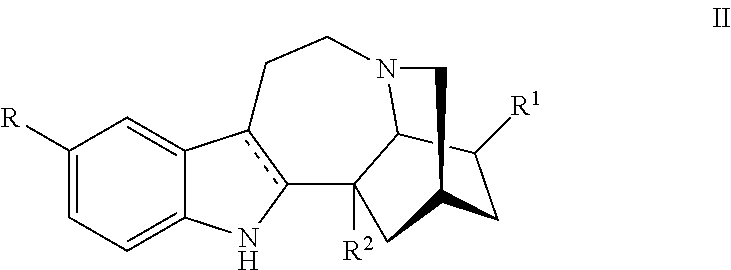
or a pharmaceutically acceptable salt and/or solvate thereof,
wherein

a pharmaceutically acceptable salt thereof, or a solvate of each thereof.
| Name | Structure |
| coronaridine |  |
| 18-hydroxycoronaridine |  |
| 18-methoxycoronaridine |  |
| 18-benzyloxycoronaridine |  |
| 18-hydroxycoronaridine laurate |  |
| 18-hydroxycoronaridine methoxyethoxymethyl ether |  |
| 18-hydroxycoronaridine acetate |  |
| voacangine |  |
| 18-hydroxyvoacangine | 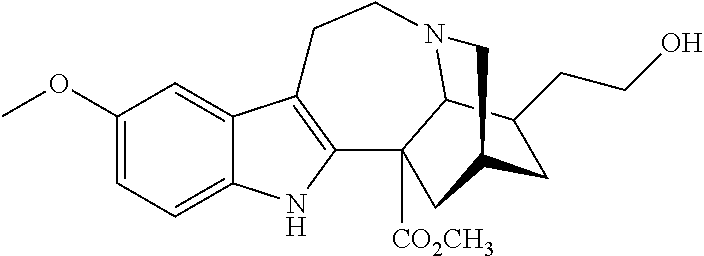 |
| 18-methoxyvoacangine |  |
| 18-benzyloxyvoacangine |  |
| 18-hydroxyvoacangine laurate |  |
| 18-hydroxyvoacangine acetate | 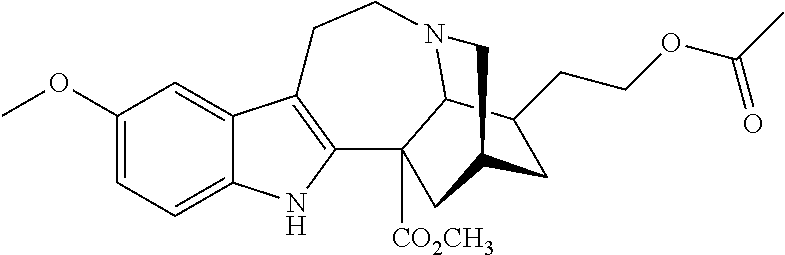 |
| 18-hydroxyvoacangine methoxyethoxymethyl ether |  |
| conopharyngine |  |
| 18-hydroxyconopharyngine |  |
| 18-methoxyconopharyngine |  |
| 18-benzyloxyconopharyngine |  |
| 18-hydroxyconopharyngine laurate |  |
| 18-hydroxyconopharyngine acetate |  |
| 18-hydroxyconopharyngine methoxyethoxymethyl ether |  |
| ibogamine |  |
| 16-ethoxycarbonyl-18- hydroxyibogamine |  |
| 16-hydroxymethyl-18- hydroxyibogamine |  |
| 16-ethoxycarbonyl-18- methoxyibogamine |  |
| 16-hydroxymethyl-18- methoxyibogamine |  |
| 16-ethoxycarbonyl-18- benzyloxyibogamine |  |
| 16-ethoxycarbonyl-18- hydroxyibogamine laurate |  |
| 16-ethoxycarbonyl-18- hydroxyibogamine acetate |  |
| 16-ethoxycarbonyl-18- hydroxyibogamine methoxyethoxymethyl ether |  |
| ibogaine |  |
| 16-ethoxycarbonyl-18-hydroxyibogaine |  |
| 16-hydroxymethyl-18-hydroxyibogaine |  |
| 16-ethoxycarbonyl-18-methoxyibogaine |  |
| 16-hydroxymethyl-18-methoxyibogaine |  |
| 16-ethoxycarbonyl-18- benzyloxyibogaine |  |
| 16-ethoxycarbonyl-18-hydroxyibogaine laurate |  |
| 16-ethoxycarbonyl-18-hydroxyibogaine acetate |  |
| 16-ethoxycarbonyl-18-hydroxyibogaine methoxyethoxymethyl ether |  |
| ibogaline |  |
| 16-ethoxycarbonyl-18-hydroxyibogaline |  |
| 16-hydroxymethyl-18-hydroxyibogaline |  |
| 16-ethoxycarbonyl-18- methoxyibogaline |  |
| 16-hydroxymethyl-18-methoxyibogaline |  |
| 16-ethoxycarbonyl-18- benzyloxyibogaline |  |
| 16-ethoxycarbonyl-18-hydroxyibogaline laurate |  |
| 16-ethoxycarbonyl-18-hydroxyibogaline acetate |  |
| 16-ethoxycarbonyl-18-hydroxyibogaline methoxyethoxymethyl ether |  |
and pharmaceutically acceptable salts and/or solvates thereof.

Methods of the Invention
Claims (14)
Priority Applications (2)
| Application Number | Priority Date | Filing Date | Title |
|---|---|---|---|
| US14/635,905 US9592239B2 (en) | 2014-09-12 | 2015-03-02 | Methods and compositions for ibogaine treatment of impulse control disorder, anxiety-related disorders, violence and/or anger, or regulating food intake |
| US15/454,305 US11077118B2 (en) | 2014-09-12 | 2017-03-09 | Methods and compositions for ibogaine treatment of impulse control disorder, anxiety-related disorders, violence and/or anger, or regulating food intake |
Applications Claiming Priority (2)
| Application Number | Priority Date | Filing Date | Title |
|---|---|---|---|
| US201462049968P | 2014-09-12 | 2014-09-12 | |
| US14/635,905 US9592239B2 (en) | 2014-09-12 | 2015-03-02 | Methods and compositions for ibogaine treatment of impulse control disorder, anxiety-related disorders, violence and/or anger, or regulating food intake |
Related Child Applications (1)
| Application Number | Title | Priority Date | Filing Date |
|---|---|---|---|
| US15/454,305 Continuation US11077118B2 (en) | 2014-09-12 | 2017-03-09 | Methods and compositions for ibogaine treatment of impulse control disorder, anxiety-related disorders, violence and/or anger, or regulating food intake |
Publications (2)
| Publication Number | Publication Date |
|---|---|
| US20160074414A1 US20160074414A1 (en) | 2016-03-17 |
| US9592239B2 true US9592239B2 (en) | 2017-03-14 |
Family
ID=55453714
Family Applications (2)
| Application Number | Title | Priority Date | Filing Date |
|---|---|---|---|
| US14/635,905 Active US9592239B2 (en) | 2014-09-12 | 2015-03-02 | Methods and compositions for ibogaine treatment of impulse control disorder, anxiety-related disorders, violence and/or anger, or regulating food intake |
| US15/454,305 Active 2035-09-06 US11077118B2 (en) | 2014-09-12 | 2017-03-09 | Methods and compositions for ibogaine treatment of impulse control disorder, anxiety-related disorders, violence and/or anger, or regulating food intake |
Family Applications After (1)
| Application Number | Title | Priority Date | Filing Date |
|---|---|---|---|
| US15/454,305 Active 2035-09-06 US11077118B2 (en) | 2014-09-12 | 2017-03-09 | Methods and compositions for ibogaine treatment of impulse control disorder, anxiety-related disorders, violence and/or anger, or regulating food intake |
Country Status (1)
| Country | Link |
|---|---|
| US (2) | US9592239B2 (en) |
Cited By (2)
| Publication number | Priority date | Publication date | Assignee | Title |
|---|---|---|---|---|
| US11680066B2 (en) | 2020-05-18 | 2023-06-20 | Jeffrey Alan McKinney | Ibogaine-related compounds and corresponding methods |
| US12396997B2 (en) | 2022-09-14 | 2025-08-26 | The Board Of Trustees Of The Leland Stanford Junior University | Methods of treatment with an iboga alkaloid |
Families Citing this family (4)
| Publication number | Priority date | Publication date | Assignee | Title |
|---|---|---|---|---|
| US9561233B2 (en) | 2014-03-13 | 2017-02-07 | Demerx, Inc. | Use of ibogaine for the treatment of pain |
| US9592239B2 (en) | 2014-09-12 | 2017-03-14 | Demerx, Inc. | Methods and compositions for ibogaine treatment of impulse control disorder, anxiety-related disorders, violence and/or anger, or regulating food intake |
| EP4279134A1 (en) | 2014-11-26 | 2023-11-22 | DemeRx, Inc. | Methods and compostions for potentiating the action of opioid analgesics using iboga alkaloids |
| US20220409628A1 (en) * | 2021-06-29 | 2022-12-29 | Mind Medicine, Inc. | 18-mc for treating obesity |
Citations (53)
| Publication number | Priority date | Publication date | Assignee | Title |
|---|---|---|---|---|
| US2817623A (en) | 1956-03-22 | 1957-12-24 | Ciba Pharm Prod Inc | Tabernanthine, ibogaine containing analgesic compositions |
| BE664377A (en) | 1964-05-30 | 1965-09-16 | ||
| DE1902227A1 (en) | 1968-01-31 | 1969-09-04 | Dominique Bocher | Medicines for psychotherapeutic use and processes for their manufacture |
| US3715361A (en) | 1971-10-08 | 1973-02-06 | American Cyanamid Co | Acyl derivatives of 10-methoxyibogamine |
| BE806438A (en) | 1973-10-24 | 1974-02-15 | Omnium Chimique Sa | NEW OXIDATION DERIVATIVES OF IBOGA TYPE ALKALOIDS AND PROCESS FOR OBTAINING |
| DE2410651A1 (en) | 1973-03-09 | 1974-09-26 | Omnium Chimique Sa | N-substd indole derivs prepn - esp pharmaceutically active alkaloids |
| US4499096A (en) | 1983-11-18 | 1985-02-12 | Lotsof Howard S | Rapid method for interrupting the narcotic addiction syndrome |
| US4626539A (en) | 1984-08-10 | 1986-12-02 | E. I. Dupont De Nemours And Company | Trandermal delivery of opioids |
| US4806341A (en) | 1985-02-25 | 1989-02-21 | Rutgers, The State University Of New Jersey | Transdermal absorption dosage unit for narcotic analgesics and antagonists and process for administration |
| US4857523A (en) | 1988-07-18 | 1989-08-15 | Nda International, Inc. | Rapid method for attenuating the alcohol dependency syndrome |
| US5026697A (en) | 1990-05-30 | 1991-06-25 | Nda International, Inc. | Rapid method for interrupting or attenuating the nicotine/tobacco dependency syndrome |
| WO1991018609A1 (en) | 1990-05-31 | 1991-12-12 | Nda International, Inc. | A rapid method for interrupting or attenuating poly-drug dependency syndromes |
| US5149538A (en) | 1991-06-14 | 1992-09-22 | Warner-Lambert Company | Misuse-resistive transdermal opioid dosage form |
| US5616575A (en) | 1995-12-04 | 1997-04-01 | Regents Of The University Of Minnesota | Bioactive tricyclic ibogaine analogs |
| WO1997029735A1 (en) | 1996-02-19 | 1997-08-21 | Monash University | Dermal penetration enhancers and drug delivery systems involving same |
| US5925634A (en) | 1989-10-20 | 1999-07-20 | Washington University | Use of ibogaine for treating neuropathic pain |
| WO2000017366A2 (en) | 1998-09-21 | 2000-03-30 | Transgene S.A. | Pharmaceutical composition for the pre-treatment of a patient in need of drug or pro-drug |
| WO2001052851A1 (en) | 2000-01-22 | 2001-07-26 | Albert Shulman | Methods for the treatment of substance abuse |
| US20030153552A1 (en) | 2002-02-14 | 2003-08-14 | Mash Deborah C. | Method of treating chemical dependency in mammals and a composition therefor |
| WO2003066030A2 (en) | 2002-02-07 | 2003-08-14 | Pharmacia Corporation | Pharmaceutical tablet |
| WO2003066029A2 (en) | 2002-02-07 | 2003-08-14 | Pharmacia Corporation | Pharmaceutical dosage form for mucosal delivery |
| US20030199439A1 (en) | 2002-04-22 | 2003-10-23 | Simon David Lew | Compositions of alpha3beta4 receptor antagonists and opioid agonist analgesics |
| US20050022270A1 (en) | 2002-07-15 | 2005-01-27 | David Hildebrand | Recombinant Stokesia epoxygenase gene |
| US20050148673A1 (en) | 2002-07-11 | 2005-07-07 | Harbut Ronald E. | Prolonged administration of NMDA antagonist and safener drug to alter neuropathic pain condition |
| WO2005079767A2 (en) | 2004-02-19 | 2005-09-01 | Universitätsklinikum Münster | Means for modulation of the effects of opioid-like substances |
| US20050203011A1 (en) | 2003-09-19 | 2005-09-15 | The Regents Of The University Of California | Mitigating symptoms and behaviors of substance abuse by modulating GDNF or BDNF pathway activity |
| US20050222270A1 (en) | 2004-02-26 | 2005-10-06 | Olney John W | Prolonged administration of NMDA antagonist drug and safener drug to create improved stable neural homeostasis |
| US20060128610A1 (en) | 2004-12-10 | 2006-06-15 | Protemix Corporation Limited | Methods of treatment |
| WO2008039179A1 (en) | 2006-09-26 | 2008-04-03 | Addiction Research Institute, Inc. | Compositions for the treatment of hepatitis c and methods for using compositions for the treatment of hepatitis c |
| DE202008007923U1 (en) | 2008-05-28 | 2008-09-04 | Lowinski, Thomas, Dr.med. | suppository |
| US20080234257A1 (en) | 2007-03-15 | 2008-09-25 | Auspex Pharmaceuticals, Inc. | Substituted phenethylamines with serotoninergic and/or norepinephrinergic activity |
| US20080280886A1 (en) | 2007-05-08 | 2008-11-13 | Auspex Pharmaceuticals, Inc. | Substituted ureas |
| US20090082388A1 (en) | 2007-09-21 | 2009-03-26 | Acadia Pharmaceuticals Inc. | Co-administration of pimavanserin with other agents |
| US20090098069A1 (en) | 2007-09-14 | 2009-04-16 | Drugtech Corporation | Transdermal, alcohol-free, pharmaceutical compositions |
| US20090252786A1 (en) | 2008-03-31 | 2009-10-08 | Christoph Hanz | Use of a Biologically Active Blood Serum for the Treatment of a Disorder Characterized in a Reduced Function of a GABA Receptor |
| US20090258869A1 (en) | 2008-02-08 | 2009-10-15 | The Regents Of The University Of California | Methods and compounds for treatment or prevention of substance-related disorders |
| US7638651B2 (en) | 2007-04-26 | 2009-12-29 | Auspex Pharmaceuticals | Substituted cyclohexanones |
| WO2012019106A2 (en) | 2010-08-06 | 2012-02-09 | Board Of Regents Of The University Of Nebraska | Positive and negative modulators of nmda receptors |
| US8362007B1 (en) | 2010-05-11 | 2013-01-29 | Demerx, Inc. | Substituted noribogaine |
| US8367693B1 (en) | 2007-05-22 | 2013-02-05 | Pisgah Laboratories, Inc. | Opioid salts and formulations exhibiting anti-abuse anti-dose dumping properties |
| WO2013063673A1 (en) | 2011-11-04 | 2013-05-10 | Hebron Farmacêutica Pesquisa, Desenvolvimento E Inovação Tecnológica Ltda. | Pharmaceutical composition and use thereof |
| US8741891B1 (en) | 2010-06-22 | 2014-06-03 | Demerx, Inc. | N-substituted noribogaine prodrugs |
| US20150231146A1 (en) | 2014-02-18 | 2015-08-20 | Demerx, Inc. | Methods for acute and long-term treatment of drug addiction |
| US20150246055A1 (en) | 2014-03-03 | 2015-09-03 | Demerx, Inc. | Methods for acute and long-term treatment of opioid and opioid-like drug addiction |
| WO2015134405A1 (en) | 2014-03-03 | 2015-09-11 | Demerx, Inc. | Therapeutic uses of ibogaine and related compounds |
| US20150258110A1 (en) | 2014-03-13 | 2015-09-17 | Demerx, Inc. | Methods for acute and long-term treatment of alcohol dependence using ibogaine |
| US20150258111A1 (en) | 2014-03-13 | 2015-09-17 | Demerx, Inc. | Methods and compositions for reducing tolerance to opioid analgesics using ibogaine and derivatives thereof |
| US20150258104A1 (en) | 2014-03-13 | 2015-09-17 | Demerx, Inc. | Use of noribogaine for the treatment of pain |
| US20150258109A1 (en) | 2014-03-13 | 2015-09-17 | Demerx, Inc. | Low dose administration of ibogaine for treating nicotine addiction and preventing relapse of nicotine use |
| US20150257667A1 (en) | 2014-03-13 | 2015-09-17 | Demerx, Inc. | Methods and compositions for pre-screening patients for treatment with noribogaine |
| US20150258112A1 (en) | 2014-03-13 | 2015-09-17 | Demerx, Inc. | Methods and compositions for treating depression using ibogaine |
| WO2015163844A1 (en) * | 2014-04-21 | 2015-10-29 | Demerx, Inc. | N-substituted noribogaine prodrugs |
| US20160074414A1 (en) | 2014-09-12 | 2016-03-17 | Demerx, Inc. | Methods and compositions for ibogaine treatment of impulse control disorder, anxiety-related disorders, violence and/or anger, or regulating food intake |
Family Cites Families (14)
| Publication number | Priority date | Publication date | Assignee | Title |
|---|---|---|---|---|
| ATE265213T1 (en) | 1997-09-04 | 2004-05-15 | Novoneuron Inc | NORIBOGAIN USED TO TREAT PAIN AND DRUG DEPENDENCE |
| CA2942638C (en) | 2013-03-15 | 2026-03-10 | Demerx, Inc. | Method for noribogaine treatment of addiction in patients on methadone |
| US9345711B2 (en) | 2014-02-18 | 2016-05-24 | Demerx, Inc. | Methods for acute and long-term treatment of drug addiction |
| US9561232B2 (en) | 2014-02-18 | 2017-02-07 | Demerx, Inc. | Low dose noribogaine for treating nicotine addiction and preventing relapse of nicotine use |
| US20150231147A1 (en) | 2014-02-18 | 2015-08-20 | Demerx, Inc. | Methods for acute and long-term treatment of drug addiction |
| US20150258114A1 (en) | 2014-03-13 | 2015-09-17 | Demerx, Inc. | Methods for acute and long-term treatment of substance abuse using ibogaine |
| US9561233B2 (en) | 2014-03-13 | 2017-02-07 | Demerx, Inc. | Use of ibogaine for the treatment of pain |
| US20150258105A1 (en) | 2014-03-13 | 2015-09-17 | Demerx, Inc. | Methods for acute and long-term treatment of alcohol dependence |
| US20150258107A1 (en) | 2014-03-13 | 2015-09-17 | Demerx, Inc. | Methods and compositions for treating depression |
| US20150258106A1 (en) | 2014-03-13 | 2015-09-17 | Demerx, Inc. | Methods for acute and long-term treatment of substance abuse |
| US20150342959A1 (en) | 2014-06-03 | 2015-12-03 | Demerx, Inc. | Methods and compositions for sustained noribogaine treatment |
| US9549935B2 (en) | 2014-07-14 | 2017-01-24 | Demerx, Inc. | Methods and compositions for treating migraines using noribogaine |
| US20160038505A1 (en) | 2014-08-05 | 2016-02-11 | Demerx, Inc. | Methods and compositions for treating impulse control disorder, anxiety-related disorders, violence and/or anger, or regulating food intake |
| EP4279134A1 (en) | 2014-11-26 | 2023-11-22 | DemeRx, Inc. | Methods and compostions for potentiating the action of opioid analgesics using iboga alkaloids |
-
2015
- 2015-03-02 US US14/635,905 patent/US9592239B2/en active Active
-
2017
- 2017-03-09 US US15/454,305 patent/US11077118B2/en active Active
Patent Citations (55)
| Publication number | Priority date | Publication date | Assignee | Title |
|---|---|---|---|---|
| US2817623A (en) | 1956-03-22 | 1957-12-24 | Ciba Pharm Prod Inc | Tabernanthine, ibogaine containing analgesic compositions |
| BE664377A (en) | 1964-05-30 | 1965-09-16 | ||
| DE1902227A1 (en) | 1968-01-31 | 1969-09-04 | Dominique Bocher | Medicines for psychotherapeutic use and processes for their manufacture |
| US3715361A (en) | 1971-10-08 | 1973-02-06 | American Cyanamid Co | Acyl derivatives of 10-methoxyibogamine |
| DE2410651A1 (en) | 1973-03-09 | 1974-09-26 | Omnium Chimique Sa | N-substd indole derivs prepn - esp pharmaceutically active alkaloids |
| DE2450188A1 (en) | 1973-10-24 | 1975-05-15 | Omnium Chimique Sa | Oxidn products of iboga alkaloids - as drugs of unspecified action |
| BE806438A (en) | 1973-10-24 | 1974-02-15 | Omnium Chimique Sa | NEW OXIDATION DERIVATIVES OF IBOGA TYPE ALKALOIDS AND PROCESS FOR OBTAINING |
| US4499096A (en) | 1983-11-18 | 1985-02-12 | Lotsof Howard S | Rapid method for interrupting the narcotic addiction syndrome |
| US4626539A (en) | 1984-08-10 | 1986-12-02 | E. I. Dupont De Nemours And Company | Trandermal delivery of opioids |
| US4806341A (en) | 1985-02-25 | 1989-02-21 | Rutgers, The State University Of New Jersey | Transdermal absorption dosage unit for narcotic analgesics and antagonists and process for administration |
| US4857523A (en) | 1988-07-18 | 1989-08-15 | Nda International, Inc. | Rapid method for attenuating the alcohol dependency syndrome |
| US5925634A (en) | 1989-10-20 | 1999-07-20 | Washington University | Use of ibogaine for treating neuropathic pain |
| US5026697A (en) | 1990-05-30 | 1991-06-25 | Nda International, Inc. | Rapid method for interrupting or attenuating the nicotine/tobacco dependency syndrome |
| WO1991018609A1 (en) | 1990-05-31 | 1991-12-12 | Nda International, Inc. | A rapid method for interrupting or attenuating poly-drug dependency syndromes |
| US5152994A (en) | 1990-05-31 | 1992-10-06 | Lotsof Howard S | Rapid method for interrupting or attenuating poly-drug dependency syndromes |
| US5149538A (en) | 1991-06-14 | 1992-09-22 | Warner-Lambert Company | Misuse-resistive transdermal opioid dosage form |
| US5616575A (en) | 1995-12-04 | 1997-04-01 | Regents Of The University Of Minnesota | Bioactive tricyclic ibogaine analogs |
| WO1997029735A1 (en) | 1996-02-19 | 1997-08-21 | Monash University | Dermal penetration enhancers and drug delivery systems involving same |
| WO2000017366A2 (en) | 1998-09-21 | 2000-03-30 | Transgene S.A. | Pharmaceutical composition for the pre-treatment of a patient in need of drug or pro-drug |
| WO2001052851A1 (en) | 2000-01-22 | 2001-07-26 | Albert Shulman | Methods for the treatment of substance abuse |
| WO2003066030A2 (en) | 2002-02-07 | 2003-08-14 | Pharmacia Corporation | Pharmaceutical tablet |
| WO2003066029A2 (en) | 2002-02-07 | 2003-08-14 | Pharmacia Corporation | Pharmaceutical dosage form for mucosal delivery |
| US20030153552A1 (en) | 2002-02-14 | 2003-08-14 | Mash Deborah C. | Method of treating chemical dependency in mammals and a composition therefor |
| US20030199439A1 (en) | 2002-04-22 | 2003-10-23 | Simon David Lew | Compositions of alpha3beta4 receptor antagonists and opioid agonist analgesics |
| US20050148673A1 (en) | 2002-07-11 | 2005-07-07 | Harbut Ronald E. | Prolonged administration of NMDA antagonist and safener drug to alter neuropathic pain condition |
| US20050022270A1 (en) | 2002-07-15 | 2005-01-27 | David Hildebrand | Recombinant Stokesia epoxygenase gene |
| US20050203011A1 (en) | 2003-09-19 | 2005-09-15 | The Regents Of The University Of California | Mitigating symptoms and behaviors of substance abuse by modulating GDNF or BDNF pathway activity |
| WO2005079767A2 (en) | 2004-02-19 | 2005-09-01 | Universitätsklinikum Münster | Means for modulation of the effects of opioid-like substances |
| US20050222270A1 (en) | 2004-02-26 | 2005-10-06 | Olney John W | Prolonged administration of NMDA antagonist drug and safener drug to create improved stable neural homeostasis |
| US20060128610A1 (en) | 2004-12-10 | 2006-06-15 | Protemix Corporation Limited | Methods of treatment |
| WO2008039179A1 (en) | 2006-09-26 | 2008-04-03 | Addiction Research Institute, Inc. | Compositions for the treatment of hepatitis c and methods for using compositions for the treatment of hepatitis c |
| US20080234257A1 (en) | 2007-03-15 | 2008-09-25 | Auspex Pharmaceuticals, Inc. | Substituted phenethylamines with serotoninergic and/or norepinephrinergic activity |
| US7638651B2 (en) | 2007-04-26 | 2009-12-29 | Auspex Pharmaceuticals | Substituted cyclohexanones |
| US20080280886A1 (en) | 2007-05-08 | 2008-11-13 | Auspex Pharmaceuticals, Inc. | Substituted ureas |
| US8367693B1 (en) | 2007-05-22 | 2013-02-05 | Pisgah Laboratories, Inc. | Opioid salts and formulations exhibiting anti-abuse anti-dose dumping properties |
| US20090098069A1 (en) | 2007-09-14 | 2009-04-16 | Drugtech Corporation | Transdermal, alcohol-free, pharmaceutical compositions |
| US20090082388A1 (en) | 2007-09-21 | 2009-03-26 | Acadia Pharmaceuticals Inc. | Co-administration of pimavanserin with other agents |
| US20090258869A1 (en) | 2008-02-08 | 2009-10-15 | The Regents Of The University Of California | Methods and compounds for treatment or prevention of substance-related disorders |
| US20090252786A1 (en) | 2008-03-31 | 2009-10-08 | Christoph Hanz | Use of a Biologically Active Blood Serum for the Treatment of a Disorder Characterized in a Reduced Function of a GABA Receptor |
| DE202008007923U1 (en) | 2008-05-28 | 2008-09-04 | Lowinski, Thomas, Dr.med. | suppository |
| US8362007B1 (en) | 2010-05-11 | 2013-01-29 | Demerx, Inc. | Substituted noribogaine |
| US8741891B1 (en) | 2010-06-22 | 2014-06-03 | Demerx, Inc. | N-substituted noribogaine prodrugs |
| WO2012019106A2 (en) | 2010-08-06 | 2012-02-09 | Board Of Regents Of The University Of Nebraska | Positive and negative modulators of nmda receptors |
| WO2013063673A1 (en) | 2011-11-04 | 2013-05-10 | Hebron Farmacêutica Pesquisa, Desenvolvimento E Inovação Tecnológica Ltda. | Pharmaceutical composition and use thereof |
| US20150231146A1 (en) | 2014-02-18 | 2015-08-20 | Demerx, Inc. | Methods for acute and long-term treatment of drug addiction |
| US20150246055A1 (en) | 2014-03-03 | 2015-09-03 | Demerx, Inc. | Methods for acute and long-term treatment of opioid and opioid-like drug addiction |
| WO2015134405A1 (en) | 2014-03-03 | 2015-09-11 | Demerx, Inc. | Therapeutic uses of ibogaine and related compounds |
| US20150258110A1 (en) | 2014-03-13 | 2015-09-17 | Demerx, Inc. | Methods for acute and long-term treatment of alcohol dependence using ibogaine |
| US20150258111A1 (en) | 2014-03-13 | 2015-09-17 | Demerx, Inc. | Methods and compositions for reducing tolerance to opioid analgesics using ibogaine and derivatives thereof |
| US20150258104A1 (en) | 2014-03-13 | 2015-09-17 | Demerx, Inc. | Use of noribogaine for the treatment of pain |
| US20150258109A1 (en) | 2014-03-13 | 2015-09-17 | Demerx, Inc. | Low dose administration of ibogaine for treating nicotine addiction and preventing relapse of nicotine use |
| US20150257667A1 (en) | 2014-03-13 | 2015-09-17 | Demerx, Inc. | Methods and compositions for pre-screening patients for treatment with noribogaine |
| US20150258112A1 (en) | 2014-03-13 | 2015-09-17 | Demerx, Inc. | Methods and compositions for treating depression using ibogaine |
| WO2015163844A1 (en) * | 2014-04-21 | 2015-10-29 | Demerx, Inc. | N-substituted noribogaine prodrugs |
| US20160074414A1 (en) | 2014-09-12 | 2016-03-17 | Demerx, Inc. | Methods and compositions for ibogaine treatment of impulse control disorder, anxiety-related disorders, violence and/or anger, or regulating food intake |
Non-Patent Citations (11)
| Title |
|---|
| Alper, K. R. et al., 'Treatment of acute opioid withdrawal with ibogaine', The American Journal on Addictions, 1999, vol. 8, No. 3, pp. 234-242. See abstract: and pp. 237 and 238. |
| Buchi et al., "Chemical Transformations of Ibogaine," Journal of the American Chemical Society, vol. 88, Jun. 5, 1966, pp. 2532-2535. |
| Buchi et al., "The Total Synthesis of Iboga Alkaloids," J. Am. Chem Society, 1966, 88 (13) pp. 3099-3109. |
| Buchi et al., The Total Synthesis of Iboga Alkaloids, 1996, J Am Chem Society, Jul. 5, 1996, 88:13, pp. 3099-3109. |
| Fermini et al., Nature Reviews Drug Discovery 2003, 2, pp. 439-447. |
| Hoelen et al., Long-QT Syndrome Induced by the Antiaddiction Drug Ibogaine, Jan. 15, 2009, N Engl J Med, 360(3) pp. 308-309. |
| ISR and Written Opinion issued on PCT/US2015/018356, mailed May 20, 2015. |
| Krantz et al., Annals of Internal Medicine, vol. 150, pp. 387-395, publ. 2009. |
| Lotsof and Wachtel, Manual for Ibogaine Therapy: Screening, Safety, Monitoring & Aftercare, 2d revision, 2003, www.ibogainedeskl.nl/manual.html. |
| Malik et al. Evaluation of drug-induced QT interval prolongation: implications for drug approval and labelling. Drug Safety, Adis International Ltd., vol. 24(5), pp. 323-351 (2001). |
| Rezvani, A. H. et al., 'Attenuation of alcohol intake by ibogaine in three strains of alcohol-preferring rats', Pharmacology Biochemistry and Behavior, 1995, vol. 52, No. 3, pp. 615-620. See abstract: and pp. 615 and 616. |
Cited By (3)
| Publication number | Priority date | Publication date | Assignee | Title |
|---|---|---|---|---|
| US11680066B2 (en) | 2020-05-18 | 2023-06-20 | Jeffrey Alan McKinney | Ibogaine-related compounds and corresponding methods |
| US20230303571A1 (en) * | 2020-05-18 | 2023-09-28 | Jeffrey Alan McKinney | Ibogaine-related compounds and corresponding methods |
| US12396997B2 (en) | 2022-09-14 | 2025-08-26 | The Board Of Trustees Of The Leland Stanford Junior University | Methods of treatment with an iboga alkaloid |
Also Published As
| Publication number | Publication date |
|---|---|
| US20160074414A1 (en) | 2016-03-17 |
| US11077118B2 (en) | 2021-08-03 |
| US20200093833A1 (en) | 2020-03-26 |
Similar Documents
| Publication | Publication Date | Title |
|---|---|---|
| US11077118B2 (en) | Methods and compositions for ibogaine treatment of impulse control disorder, anxiety-related disorders, violence and/or anger, or regulating food intake | |
| AU2020273281B2 (en) | Therapeutic uses of ibogaine and related compounds | |
| JP4097285B2 (en) | Compositions useful in the manufacture of a medicament for the treatment of various stubborn diseases | |
| US20030049272A1 (en) | Pharmaceutical composition which produces irritation | |
| AU2025210905A1 (en) | Method of treatment with tradipitant | |
| AU2020267217B2 (en) | Therapeutic methods employing noribogaine and related compounds | |
| JP2002532392A (en) | Exo-S-mecamylamine formulations and their use in therapy | |
| US6555576B1 (en) | Method for treating exercise induced asthma | |
| US9561233B2 (en) | Use of ibogaine for the treatment of pain | |
| BRPI0616344A2 (en) | Method for the treatment of chemical and behavioral dependence | |
| EP0481675A2 (en) | Preparation of medicaments for treating asthma using (S)-alpha-fluoromethyl histidine and esters thereof | |
| JP2020019790A (en) | How to treat Prader-Willi syndrome | |
| US20240408054A1 (en) | Compositions and methods for increasing exposure of r(-)-mda | |
| CN105209445B (en) | The method for treating dyskinesia and associated conditions | |
| KR20220113411A (en) | Use of KV7 potassium channel openers for the treatment of pain | |
| US20150258112A1 (en) | Methods and compositions for treating depression using ibogaine | |
| US20160038505A1 (en) | Methods and compositions for treating impulse control disorder, anxiety-related disorders, violence and/or anger, or regulating food intake | |
| US20060189612A1 (en) | Pharmaceutically active morpholinol | |
| US8258185B2 (en) | Use of neboglamine in the treatment of toxicodependency | |
| JP2005306882A (en) | Composition useful for preparation of medicine for treating emotional instability | |
| TW200914455A (en) | Uses of 2-[piperidinyl]methyl-2,3-dihydroimidazo[1,2-c]quinazolin-5(6H)-one for providing an analgesic effect, anti-allergic effect and histamine H1 receptor antagonism effect | |
| Aronson | New antihistamines | |
| DE102004040630A1 (en) | Combination therapy with procaine | |
| MXPA01008858A (en) | Method for treating exercise induced asthma | |
| HK1248552B (en) | Method of treatment with tradipitant |
Legal Events
| Date | Code | Title | Description |
|---|---|---|---|
| AS | Assignment |
Owner name: DEMERX, INC., FLORIDA Free format text: ASSIGNMENT OF ASSIGNORS INTEREST;ASSIGNOR:MAILLET, EMELINE;REEL/FRAME:036486/0264 Effective date: 20150429 |
|
| STCF | Information on status: patent grant |
Free format text: PATENTED CASE |
|
| MAFP | Maintenance fee payment |
Free format text: PAYMENT OF MAINTENANCE FEE, 4TH YR, SMALL ENTITY (ORIGINAL EVENT CODE: M2551); ENTITY STATUS OF PATENT OWNER: SMALL ENTITY Year of fee payment: 4 |
|
| AS | Assignment |
Owner name: DEMERX IB, INC., FLORIDA Free format text: ASSIGNMENT OF ASSIGNORS INTEREST;ASSIGNOR:DEMERX, INC.;REEL/FRAME:065856/0828 Effective date: 20231101 |
|
| AS | Assignment |
Owner name: ATAI THERAPEUTICS, INC., NEW YORK Free format text: ASSIGNMENT OF ASSIGNORS INTEREST;ASSIGNOR:DEMERX IB, INC.;REEL/FRAME:067302/0310 Effective date: 20231220 |
|
| MAFP | Maintenance fee payment |
Free format text: PAYMENT OF MAINTENANCE FEE, 8TH YR, SMALL ENTITY (ORIGINAL EVENT CODE: M2552); ENTITY STATUS OF PATENT OWNER: SMALL ENTITY Year of fee payment: 8 |