US9577226B2 - Rechargeable battery with buffer sheet between electrode assembly and battery case - Google Patents
Rechargeable battery with buffer sheet between electrode assembly and battery case Download PDFInfo
- Publication number
- US9577226B2 US9577226B2 US13/945,175 US201313945175A US9577226B2 US 9577226 B2 US9577226 B2 US 9577226B2 US 201313945175 A US201313945175 A US 201313945175A US 9577226 B2 US9577226 B2 US 9577226B2
- Authority
- US
- United States
- Prior art keywords
- buffer sheet
- inside surface
- springs
- rechargeable battery
- case
- Prior art date
- Legal status (The legal status is an assumption and is not a legal conclusion. Google has not performed a legal analysis and makes no representation as to the accuracy of the status listed.)
- Active, expires
Links
Images




Classifications
-
- H—ELECTRICITY
- H01—ELECTRIC ELEMENTS
- H01M—PROCESSES OR MEANS, e.g. BATTERIES, FOR THE DIRECT CONVERSION OF CHEMICAL ENERGY INTO ELECTRICAL ENERGY
- H01M50/00—Constructional details or processes of manufacture of the non-active parts of electrochemical cells other than fuel cells, e.g. hybrid cells
- H01M50/50—Current conducting connections for cells or batteries
- H01M50/572—Means for preventing undesired use or discharge
-
- H—ELECTRICITY
- H01—ELECTRIC ELEMENTS
- H01M—PROCESSES OR MEANS, e.g. BATTERIES, FOR THE DIRECT CONVERSION OF CHEMICAL ENERGY INTO ELECTRICAL ENERGY
- H01M50/00—Constructional details or processes of manufacture of the non-active parts of electrochemical cells other than fuel cells, e.g. hybrid cells
- H01M50/20—Mountings; Secondary casings or frames; Racks, modules or packs; Suspension devices; Shock absorbers; Transport or carrying devices; Holders
- H01M50/233—Mountings; Secondary casings or frames; Racks, modules or packs; Suspension devices; Shock absorbers; Transport or carrying devices; Holders characterised by physical properties of casings or racks, e.g. dimensions
- H01M50/24—Mountings; Secondary casings or frames; Racks, modules or packs; Suspension devices; Shock absorbers; Transport or carrying devices; Holders characterised by physical properties of casings or racks, e.g. dimensions adapted for protecting batteries from their environment, e.g. from corrosion
-
- H01M2/10—
-
- H01M2/0202—
-
- H01M2/0237—
-
- H01M2/025—
-
- H01M2/0262—
-
- H01M2/0275—
-
- H01M2/028—
-
- H01M2/0287—
-
- H01M2/1061—
-
- H01M2/1072—
-
- H01M2/1094—
-
- H01M2/14—
-
- H01M2/16—
-
- H01M2/1686—
-
- H01M2/18—
-
- H—ELECTRICITY
- H01—ELECTRIC ELEMENTS
- H01M—PROCESSES OR MEANS, e.g. BATTERIES, FOR THE DIRECT CONVERSION OF CHEMICAL ENERGY INTO ELECTRICAL ENERGY
- H01M50/00—Constructional details or processes of manufacture of the non-active parts of electrochemical cells other than fuel cells, e.g. hybrid cells
- H01M50/10—Primary casings; Jackets or wrappings
- H01M50/102—Primary casings; Jackets or wrappings characterised by their shape or physical structure
- H01M50/103—Primary casings; Jackets or wrappings characterised by their shape or physical structure prismatic or rectangular
-
- H—ELECTRICITY
- H01—ELECTRIC ELEMENTS
- H01M—PROCESSES OR MEANS, e.g. BATTERIES, FOR THE DIRECT CONVERSION OF CHEMICAL ENERGY INTO ELECTRICAL ENERGY
- H01M50/00—Constructional details or processes of manufacture of the non-active parts of electrochemical cells other than fuel cells, e.g. hybrid cells
- H01M50/10—Primary casings; Jackets or wrappings
- H01M50/116—Primary casings; Jackets or wrappings characterised by the material
- H01M50/124—Primary casings; Jackets or wrappings characterised by the material having a layered structure
-
- H—ELECTRICITY
- H01—ELECTRIC ELEMENTS
- H01M—PROCESSES OR MEANS, e.g. BATTERIES, FOR THE DIRECT CONVERSION OF CHEMICAL ENERGY INTO ELECTRICAL ENERGY
- H01M50/00—Constructional details or processes of manufacture of the non-active parts of electrochemical cells other than fuel cells, e.g. hybrid cells
- H01M50/10—Primary casings; Jackets or wrappings
- H01M50/138—Primary casings; Jackets or wrappings adapted for specific cells, e.g. electrochemical cells operating at high temperature
-
- H—ELECTRICITY
- H01—ELECTRIC ELEMENTS
- H01M—PROCESSES OR MEANS, e.g. BATTERIES, FOR THE DIRECT CONVERSION OF CHEMICAL ENERGY INTO ELECTRICAL ENERGY
- H01M50/00—Constructional details or processes of manufacture of the non-active parts of electrochemical cells other than fuel cells, e.g. hybrid cells
- H01M50/10—Primary casings; Jackets or wrappings
- H01M50/14—Primary casings; Jackets or wrappings for protecting against damage caused by external factors
-
- H—ELECTRICITY
- H01—ELECTRIC ELEMENTS
- H01M—PROCESSES OR MEANS, e.g. BATTERIES, FOR THE DIRECT CONVERSION OF CHEMICAL ENERGY INTO ELECTRICAL ENERGY
- H01M50/00—Constructional details or processes of manufacture of the non-active parts of electrochemical cells other than fuel cells, e.g. hybrid cells
- H01M50/40—Separators; Membranes; Diaphragms; Spacing elements inside cells
- H01M50/471—Spacing elements inside cells other than separators, membranes or diaphragms; Manufacturing processes thereof
- H01M50/474—Spacing elements inside cells other than separators, membranes or diaphragms; Manufacturing processes thereof characterised by their position inside the cells
-
- H—ELECTRICITY
- H01—ELECTRIC ELEMENTS
- H01M—PROCESSES OR MEANS, e.g. BATTERIES, FOR THE DIRECT CONVERSION OF CHEMICAL ENERGY INTO ELECTRICAL ENERGY
- H01M50/00—Constructional details or processes of manufacture of the non-active parts of electrochemical cells other than fuel cells, e.g. hybrid cells
- H01M50/40—Separators; Membranes; Diaphragms; Spacing elements inside cells
- H01M50/471—Spacing elements inside cells other than separators, membranes or diaphragms; Manufacturing processes thereof
- H01M50/477—Spacing elements inside cells other than separators, membranes or diaphragms; Manufacturing processes thereof characterised by their shape
-
- H—ELECTRICITY
- H01—ELECTRIC ELEMENTS
- H01M—PROCESSES OR MEANS, e.g. BATTERIES, FOR THE DIRECT CONVERSION OF CHEMICAL ENERGY INTO ELECTRICAL ENERGY
- H01M50/00—Constructional details or processes of manufacture of the non-active parts of electrochemical cells other than fuel cells, e.g. hybrid cells
- H01M50/50—Current conducting connections for cells or batteries
- H01M50/531—Electrode connections inside a battery casing
-
- H01M2/0217—
-
- H—ELECTRICITY
- H01—ELECTRIC ELEMENTS
- H01M—PROCESSES OR MEANS, e.g. BATTERIES, FOR THE DIRECT CONVERSION OF CHEMICAL ENERGY INTO ELECTRICAL ENERGY
- H01M50/00—Constructional details or processes of manufacture of the non-active parts of electrochemical cells other than fuel cells, e.g. hybrid cells
- H01M50/10—Primary casings; Jackets or wrappings
- H01M50/102—Primary casings; Jackets or wrappings characterised by their shape or physical structure
- H01M50/105—Pouches or flexible bags
-
- H—ELECTRICITY
- H01—ELECTRIC ELEMENTS
- H01M—PROCESSES OR MEANS, e.g. BATTERIES, FOR THE DIRECT CONVERSION OF CHEMICAL ENERGY INTO ELECTRICAL ENERGY
- H01M50/00—Constructional details or processes of manufacture of the non-active parts of electrochemical cells other than fuel cells, e.g. hybrid cells
- H01M50/10—Primary casings; Jackets or wrappings
- H01M50/102—Primary casings; Jackets or wrappings characterised by their shape or physical structure
- H01M50/107—Primary casings; Jackets or wrappings characterised by their shape or physical structure having curved cross-section, e.g. round or elliptic
-
- Y—GENERAL TAGGING OF NEW TECHNOLOGICAL DEVELOPMENTS; GENERAL TAGGING OF CROSS-SECTIONAL TECHNOLOGIES SPANNING OVER SEVERAL SECTIONS OF THE IPC; TECHNICAL SUBJECTS COVERED BY FORMER USPC CROSS-REFERENCE ART COLLECTIONS [XRACs] AND DIGESTS
- Y02—TECHNOLOGIES OR APPLICATIONS FOR MITIGATION OR ADAPTATION AGAINST CLIMATE CHANGE
- Y02E—REDUCTION OF GREENHOUSE GAS [GHG] EMISSIONS, RELATED TO ENERGY GENERATION, TRANSMISSION OR DISTRIBUTION
- Y02E60/00—Enabling technologies; Technologies with a potential or indirect contribution to GHG emissions mitigation
- Y02E60/10—Energy storage using batteries
-
- Y—GENERAL TAGGING OF NEW TECHNOLOGICAL DEVELOPMENTS; GENERAL TAGGING OF CROSS-SECTIONAL TECHNOLOGIES SPANNING OVER SEVERAL SECTIONS OF THE IPC; TECHNICAL SUBJECTS COVERED BY FORMER USPC CROSS-REFERENCE ART COLLECTIONS [XRACs] AND DIGESTS
- Y02—TECHNOLOGIES OR APPLICATIONS FOR MITIGATION OR ADAPTATION AGAINST CLIMATE CHANGE
- Y02P—CLIMATE CHANGE MITIGATION TECHNOLOGIES IN THE PRODUCTION OR PROCESSING OF GOODS
- Y02P70/00—Climate change mitigation technologies in the production process for final industrial or consumer products
- Y02P70/50—Manufacturing or production processes characterised by the final manufactured product
Definitions
- Example embodiments relate to a rechargeable battery. More particularly, example embodiments relate to a rechargeable battery with a structure capable of absorbing or damping impact and vibrations with respect to an electrode assembly.
- a rechargeable battery differs from a primary battery in that it can be repeatedly charged and discharged, while the primary battery cannot, i.e., the primary battery makes only an irreversible conversion of chemical to electrical energy.
- a low-capacity rechargeable battery may be used as a power supply for small electronic devices, e.g., cellular phones, notebook computers, and camcorders, while a high-capacity rechargeable battery may be used as a power supply for large devices, e.g., for driving motors in hybrid vehicles and the like.
- the high-power rechargeable battery may be constructed with a high-capacity rechargeable battery having a plurality of rechargeable cells coupled to each other in series, such that it can be used as the power supply for driving motors in electrical vehicles requiring high power.
- a conventional rechargeable battery may include an electrode assembly with positive and negative electrodes and a separator interposed between the two electrodes, a case mounting the electrode assembly therein, and positive and negative terminals electrically connected to the electrode assembly and protruded to the outside of the case.
- the rechargeable battery may have a cylindrical shape, a prismatic shape, a pouch shape, etc.
- Embodiments are directed to a rechargeable battery, which substantially overcomes one or more of the problems due to the limitations and disadvantages of the related art.
- a rechargeable battery including an electrode assembly in a battery case, and a buffer sheet between the electrode assembly and the battery case, the buffer sheet contacting the electrode assembly and the battery case.
- the rechargeable battery may further include electrode terminals electrically connected to the electrode assembly, the buffer sheet and the electrode terminals being on opposite sides of the electrode assembly.
- the buffer sheet may be a continuous flexible sheet extending at least along three different surfaces of the battery case.
- the buffer sheet may overlap at least five different surfaces of the electrode assembly.
- the buffer sheet may be configured to deform when positioned inside the battery case.
- the buffer sheet may contact the battery case and first and second electrode tabs, the first and second electrode tabs connecting the electrode assembly to respective first and second electrode terminals, and the buffer sheet being between the battery case and respective ones of the first and second electrodes tabs.
- the buffer sheet may include at least one plate connected to springs, the plate contacting the electrode assembly, and the springs extending between the plate and the battery case and configured to deform when contacting the battery case.
- the springs may extend along lateral edges of the plate and are angled with respect to the plate, the springs extending from the plate along respective sidewalls of the battery case.
- the springs may curve away from the electrode assembly, the plate being between the springs and the electrode assembly.
- the rechargeable battery may further include an insulator between the springs and the electrode assembly.
- the buffer sheet may include three plates overlapping three different surfaces of the electrode assembly, each plate including springs on opposite edges and contacting opposite surfaces of the battery case. The springs of the three plates may overlap only two different surfaces of the battery case.
- the three plates of the buffer sheet may extend along a bottom surface and two side surfaces of the battery case to have an inverted ⁇ shape. Two of the three plates may contact first and second electrode tabs, the first and second electrode tabs connecting the electrode assembly to electrode terminals.
- the buffer sheet may include a first plate facing a bottom of the battery case and second and third plates facing sidewalls of the battery case, the first through third plates being integral. A sum of widths of the at least one plate and the springs may be equal to or larger than a width of the battery case.
- a bottom of the battery case may be curved, and a width of the buffer sheet is larger than a width of the curved bottom of the battery case.
- FIG. 1 illustrates a perspective view of a rechargeable battery according to a first exemplary embodiment
- FIG. 2 illustrates a cross-sectional view of the rechargeable battery taken along line II-II of FIG. 1 ;
- FIG. 3 illustrates a perspective view of a buffer sheet before being inserted into a rechargeable battery according to a first exemplary embodiment
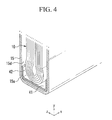
- FIG. 4 illustrates a vertical partial cut-away perspective view of a rechargeable battery according to a first exemplary embodiment
- FIG. 5 illustrates a horizontal partial cut-away perspective view of a rechargeable battery according to a first exemplary embodiment
- FIG. 6 illustrates a vertical sectional view of a rechargeable battery according to a second exemplary embodiment
- FIG. 7 illustrates a horizontal sectional view of a rechargeable battery according to a second exemplary embodiment
- FIG. 8 illustrates a perspective view of a buffer sheet of a rechargeable battery according to a third exemplary embodiment
- FIG. 9 illustrates a horizontal cut-away perspective view of a rechargeable battery according to a third exemplary embodiment.
- electrode assembly 11 positive electrode 11a: positive uncoated region 12: negative electrode 12a: negative uncoated region 13: separator 15: case 15a: rounded portion 15b: bottom surface 15c: lateral surface 20: cap assembly 21: positive terminal 22: negative terminal 28: cap plate 31, 32: lead tab 31a, 32a: tab hole 40, 50, 60: buffer sheet 41, 51, 61: bottom support plate 42, 52, 62: bottom spring 43, 53, 63: side support plate 45, 55, 65: side spring 63a: support plate hole 67: insulating film
- FIG. 1 illustrates a perspective view of a rechargeable battery according to a first exemplary embodiment.
- FIG. 2 illustrates a cross-sectional view of the rechargeable battery along line II-II of FIG. 1 .
- a rechargeable battery 110 may include an electrode assembly 10 performing charging and discharging operations, a case 15 mounting the electrode assembly 10 therein, and a cap assembly 20 sealing the case 15 .
- a lithium ion battery is exemplified as the rechargeable battery 110 according to the first exemplary embodiment.
- exemplary embodiments are not limited thereto, and may be applied to various types of batteries, e.g., a lithium polymer battery.
- the electrode assembly 10 may include wound positive and negative electrodes 11 and 12 , and a separator 13 therebetween.
- the positive electrode 11 , the negative electrode 12 , and the separator 13 may be band-shaped, and may be elongated in one direction.
- example embodiments are not limited thereto, and the electrode assembly 10 may be structured to have a plurality of positive and negative electrodes 11 and 12 alternately deposited while interposing a separator 13 therebetween.
- the positive electrode 11 may include a positive current collector and a positive active material-based layer formed on the positive current collector.
- a positive uncoated region 11 a with no positive active material may be formed along a one-sided lateral end of the positive electrode 11 in a longitudinal direction thereof.
- the negative electrode 12 may include a negative current collector and a negative active material-based layer formed on the negative current collector.
- a negative uncoated region 12 a with no negative active material may be formed along a one-sided lateral end of the negative electrode 12 in a longitudinal direction thereof.
- the case 15 defines an exterior of the rechargeable battery 110 and provides a space for mounting the electrode assembly 10 .
- the case 15 may have a cuboid shape having a one-sided opening for receiving a cuboid-shaped electrode assembly 10 therein.
- a rounded portion 15 a of the case 15 bent in a shape of an arc may be formed at each edge of the case 15 , i.e., a contact region between each two surfaces of the case 15 may have a rounded portion 15 a along the contact region.
- the rounded portion 15 a may be formed in a shape of an arc with a radius of about 2 mm or more at a bottom of the case 15 .
- the case 15 may be formed with various shapes, e.g., a cylindrical shape, a pouch shape, etc.
- the case 15 may be formed of metal, e.g., aluminum, aluminum alloy, nickel-plated steel, etc., or of a pouched laminate film.
- the cap assembly 20 may include a cap plate 28 fitted to the opening of the case 15 , a positive terminal 21 electrically connected to the positive electrode 11 and protruding to the outside of the case 15 , and a negative terminal 22 electrically connected to the negative electrode 12 and protruding to the outside of the case 15 .
- the cap plate 28 may be plate-shaped and may be fitted to the opening of the case 15 .
- a sealing cork 27 may be provided in an electrolyte injection hole 29 of the cap plate 28 .
- a vent plate 26 with a notch 26 a may be provided in a vent hole 24 of the cap plate 28 , so the vent plate 26 may open under a predetermined pressure.
- the positive and the negative terminals 21 and 22 may be electrically connected to the electrode assembly 10 , and may protrude to the outside of the case 15 .
- the positive and the negative terminals 21 and 22 may pass through the cap plate 28 , and flanges under the positive and the negative terminals 21 and 22 may be supported at the bottom of the cap plate 28 .
- External portions of the positive and the negative terminals 21 and 22 outside the case 15 i.e., outer circumference of the upper pillar protruded to the outside of the cap plate 28 , may be screw-processed.
- Nuts 35 may be coupled to the external portions of the positive and the negative terminals 21 and 22 , while supporting the positive and the negative terminals 21 and 22 from the top side.
- Upper and lower gaskets 38 and 39 may be installed between the cap plate 28 and, e.g., each of, the positive and the negative terminals 21 and 22 , so as to seal and insulate each of the positive and the negative terminals 21 and 22 from the cap plate 28 .
- the positive terminal 21 may be electrically connected to the positive electrode 11 via a first lead tab 31 .
- the negative terminal 22 may be electrically connected to the negative electrode 12 via a second lead tab 32 .
- the first and second lead tabs 31 and 32 may be disposed along lateral ends of the electrode assembly 10 .
- Tab holes 31 a and 32 a may be formed in the first and second lead tabs 31 and 32 , respectively, so as to discharge gas therethrough.
- a lower insulating member 34 may be disposed under the cap plate 28 , so bottom ends of the positive and negative terminals 21 and 22 , as well as top ends of the first and second lead tabs 31 and 32 , may be inserted into the lower insulating member 34 . Therefore, the first lead tab 31 may electrically interconnect the positive terminal 21 and the positive electrode 11 , and the second lead tab 32 may electrically interconnect the negative terminal 22 and the negative electrode 12 .
- a buffer sheet 40 may be installed between the electrode assembly 10 and the case 15 for support, e.g., the buffer sheet 40 may be external to the electrode assembly 10 and may be a discrete element with respect to the electrode assembly 10 . That is, the buffer sheet 40 may be, e.g., only, in a lower portion of the case 15 along bottom and/or lateral surfaces 15 b and 15 c of the case 15 , so as to support the electrode assembly 10 against the case 15 , e.g., while maintaining an empty space between the electrode assembly 10 and the case 15 in an upper portion of the case 15 .
- the buffer sheet 40 will be described in more detail below with reference to FIGS. 3-5 .
- FIG. 3 illustrates a perspective view of the buffer sheet 40 before insertion into the rechargeable battery 110 according to the first exemplary embodiment.
- the buffer sheet 40 may include at least one support plate with deformable springs between the support plate and the case 15 , e.g., a bottom support plate 41 and/or a side support plate 41 .
- the buffer sheet 40 may include a bottom support plate 41 , a side support plate 43 , bottom springs 42 , and side springs 45 , so the bottom springs 42 may be installed between the bottom support plate 41 and the case 15 , while the side springs 45 may be installed between the side support plate 43 and the case 15 .
- the bottom and side springs 42 and 45 may be elastically deformed between the case 15 and a respective support plate.
- the buffer sheet 40 may include the bottom support plate 41 facing the bottom surface 15 b of the case 15 and the side support plates 43 facing the lateral surfaces 15 c of the case 15 . Further, the buffer sheet 40 may include the bottom springs 42 pressing the bottom support plate 41 against the case 15 and the side springs 45 pressing the side support plate 43 against the case 15 .
- the buffer sheet 40 may be formed of a flexible material.
- the buffer sheet 40 may be formed of a polymer, e.g., polypropylene and/or polyethylene, or a laminate film having a metal film coated with a polymer film on each surface.
- the buffer sheet 40 may be originally, i.e., before installation within the case 15 , plate-shaped, and may have an elongated shape, e.g., an approximate rectangular shape.
- one side support plate 43 with the side springs 45 attached thereto may be connected to each end of the bottom support plate 41 , i.e., the bottom support plate 41 with the bottom springs 42 attached thereto may be between the two side support plates 43 , to form a single integral structure having a rectangular shape.
- the bottom and side springs 42 and 45 may be integrally formed with respective bottom and side support plates 41 and 43 , and may define a substantially flat structure with respective bottom and side support plates 41 and 43 .
- the support plate 41 When the buffer sheet 40 is mounted within the case 15 , the support plate 41 may extend along the bottom surface 15 b of the case 15 , e.g., the bottom support plate 41 may directly contact a bottom of the electrode assembly 10 , and the side support plates 43 may bend, e.g., perpendicularly with respect to the bottom support plate 41 , to extend along respective side surfaces 15 c of the case 15 , e.g., the side support plates 43 may directly contact respective first and second lead tabs 31 and 32 and extend to overlap the respective first and second lead tabs 31 and 32 . Accordingly, in a bent state, i.e., after installation within the case 15 , the buffer sheet 40 may have an approximate inverted- ⁇ shape that supports a lower portion of the electrode assembly 10 .
- the bottom and the side springs 42 and 45 are not formed at the regions where the bottom support plate 41 and the side support plates 43 are connected to each other.
- spaces may be formed between each bottom spring 42 and an adjacent side spring 45 , so a bending portion between the bottom support plate 41 and a respective side support plate 43 , e.g., a region corresponding to the rounded portion 15 a of the case 15 , may not contact the case 15 via a spring. Accordingly, the side support plates 43 may be easily bent with respect to the bottom support plate 41 .
- the bottom springs 42 may be formed along both lateral edges of the bottom support plate 41 , e.g., to define a substantially flat structure with the bottom support plate 41 before installation within the case 15 , and may be elastically deformable to contact inner side surfaces 15 d of the case 15 , i.e., when installed within the case 15 .
- the bottom springs 42 may be plate-shaped while elongated along both lateral edges of the bottom support plate 41 , and may contact and extend along the inner side surfaces 15 d of the case 15 to space the bottom support plate 41 from the inner side surfaces 15 d of the case 15 by a predetermined distance.
- the bottom springs 42 may be formed in the shape of a plate spring, and may be elastically deformed depending upon pressure applied thereto.
- the side springs 45 may be formed along both lateral edge of the side support plates 43 , e.g., to define a substantially flat structure with the side support plate 43 before installation within the case 15 , and may be elastically deformable to contact inner side surfaces 15 d of the case 15 , i.e., when installed within the case 15 .
- the side springs 45 may be plate-shaped while elongated along the lateral edges of the side support plates 43 , and may contact and extend along the inner side surfaces 15 d of the case 15 to space the side support plates 43 from the inner side surfaces 15 d of the case 15 by a predetermined distance.
- the side springs 45 may be formed in the shape of a plate spring, and may be elastically deformed depending upon pressure applied thereto.
- FIG. 4 illustrates a partial cut-away perspective view of the rechargeable battery 110 according to the first exemplary embodiment taken in the vertical direction, i.e., to illustrate the battery as viewed in the yz-plane.
- FIG. 5 illustrates a partial cut-away perspective view of the rechargeable battery 110 according to the first exemplary embodiment taken in the horizontal direction, i.e., to illustrate the battery as viewed in the xz-plane.
- a sum of widths of the bottom support plate 41 and the bottom springs 42 along the z-axis in an uninstalled stated, as illustrated in FIG. 3 , may be larger than or the same as an inner width of the case 15 along the z-axis. It is noted that the inner width of the case 15 along the z-axis is measured in a region above the rounded portions 15 a of the case 15 .
- the bottom springs 42 may be deformed while contacting the inner side surfaces 15 d of the case 15 at both edges thereof so as to space the bottom support plate 41 from the case 15 .
- the bottom springs 42 may be pushed by the inner side surfaces 15 d to angle with respect to the bottom support plate 41 .
- the bottom springs 42 may extend along the inner side surfaces 15 d of the case to space the bottom support plate 41 of the buffer sheet from the case 15 .
- the bottom springs 42 may be deformed by the rounded portions 15 a of the case 15 , thereby being tightly compressed between facing inner surfaces 15 d of the rounded portions 15 a .
- the width of the buffer sheet 40 may be larger than a width of the case 15 at the rounded portions 15 a .
- the bottom springs 42 may contact the inner surface 15 d of the case 15 , and the bottom support plate 41 may be spaced apart from the bottom of the case 15 by a predetermined distance.
- the case 15 may be rounded in the shape of an arc with a radius of about 2 mm or more, and the bottom springs 42 may have a greater curvature radius than the rounded portions 15 a.
- the bottom support plate 41 may stably support the electrode assembly 10 in upward and downward directions, e.g., along the vertical direction. Further, when external impact or vibration is applied to the case 15 , the bottom support plate 41 and the bottom springs 42 may stably prevent the electrode assembly 10 from being shaken. That is, the tightened bottom springs 42 between the lower portion of the case 15 and the bottom of the electrode assembly 10 , i.e., via the bottom support plate 41 , may secure the electrode assembly 10 and prevent its movement in the vertical direction.
- a sum of widths of the side support plates 43 and the side springs 45 along the z-axis in an uninstalled stated, as illustrated in FIG. 3 may be larger than or the same as the inner width of the case 15 along the z-axis.
- the side springs 45 may be deformed while contacting the inner side surfaces 15 d of the case 15 at both ends thereof, so as to space the side support plates 43 from the case 15 with a distance.
- the side springs 45 may be deformed while contacting the inner side surfaces 15 d in within the rounded portions 15 a of the case 15 .
- the side support plates 43 may laterally support the electrode assembly 10 in a stable manner. Furthermore, even under application of an external impact or vibration, the side support plates 43 and the side springs 45 may stably prevent the electrode assembly 10 from being shaken.
- a rechargeable battery may include the buffer sheet 40 with at least one support plate contacting the electrode assembly 10 and springs extending between the support plate and the case 15 .
- impact absorbing and/or vibration damping of the rechargeable battery 110 may be improved by way of the buffer sheet 40 . Accordingly, an increased contact resistance between the terminals 21 and 22 and the electrode assembly 10 due to impact or vibration may be prevented.
- the electrode assembly when an electrode assembly is mounted within a case and electrically connected to terminals in a conventional rechargeable battery, the electrode assembly may be shaken due to an external impact or vibration, thereby damaging its electrical connection to the terminals.
- a contact resistance between the electrode assembly and the terminals increases, the output of the rechargeable battery may be reduced and a large amount of heat, i.e., due to the high resistance, may be generated to increase the temperature of the rechargeable battery.
- the temperature of the rechargeable battery is increased, performance characteristics of the rechargeable battery may be deteriorated, or the rechargeable battery may explode due to the continual elevation in temperature.
- an inner short may occur, thereby increasing the internal temperature of the rechargeable battery.
- FIG. 6 illustrates a vertical sectional view of a rechargeable battery according to a second exemplary embodiment.
- FIG. 7 illustrates a horizontal sectional view of a rechargeable battery according to a second exemplary embodiment.
- a rechargeable battery 120 according to the second exemplary embodiment may be substantially the same in structure as the rechargeable battery 110 of the first exemplary embodiment described previously with reference to FIGS. 1-5 , except for a buffer sheet 50 . Therefore, repeated descriptions of same elements will not be repeated.
- the buffer sheet 50 may include a bottom support plate 51 , bottom springs 52 formed along both lateral edges of the bottom support plate 51 , side support plates 53 connected to the longitudinal ends of the bottom support plate 51 , and side springs 55 formed along both lateral edges of the side support plates 53 .
- the structures of the bottom and side support plates 51 and 53 may be substantially the same as the bottom and side support plates 41 and 43 of the rechargeable battery 110 described previously with reference to FIGS. 1-5 , e.g., the bottom support plate 51 may be connected between two side support plates 53 to form an integral rectangular structure.
- the bottom support plate 51 may be plate-shaped, and may be elongated along the bottom surface 15 b of the case 15 .
- the bottom support plate 51 may face the inner bottom surface of the case 15 and may contact the bottom of the electrode assembly 10 .
- the bottom springs 52 may be plate-shaped and may be elongated along both lateral edges of the bottom support plate 51 by two. That is, as illustrated in FIG. 6 , the bottom springs 52 may be bent by 180 degrees toward the case 15 , such that a top surface 52 a of the bottom spring 52 may contact the bottom surface 15 b of the case 15 to form the letter “C.”
- the bent portion of the bottom spring 52 may be elastically deformed.
- the bent bottom springs 52 may exhibit enhanced elasticity, and accordingly, may stably support the electrode assembly 10 in upward and downward directions, i.e., along the vertical direction, when an external impact or vibration is applied to the bottom support plate 51 .
- the bottom support plate 51 may bend, i.e., as illustrated by the dashed line in FIG. 6 , thereby absorbing the vibrations and preventing contact between the electrode assembly 10 and the bottom 15 b of the case 15 .
- the side support plate 53 may be plate-shaped and elongated along the side surface 15 c of the case 15 .
- the side support plate 53 may face the inner surface of the case 15 and may contact a lateral side of the electrode assembly 10 placed inwardly.
- the side springs 55 may be elongated along both lateral edges of the side support plate 53 by two. That is, the side springs 55 may be bent toward the case 15 by 180 degrees, such that a top surface 55 a of the side spring 55 may contact the side surface 15 c of the case 15 to form the letter “C.”
- the bent portion of the side springs 55 may be elastically deformed.
- the bent side springs 55 may exhibit enhanced elasticity, and accordingly, the side support plates 53 may laterally support the electrode assembly 10 in a stable manner.
- FIG. 8 illustrates a perspective view of a buffer sheet for a rechargeable battery according to a third exemplary embodiment.
- FIG. 9 illustrates a horizontal cut-away perspective view of a rechargeable battery according to the third exemplary embodiment.
- a rechargeable battery 130 according to the third exemplary embodiment is substantially the same in structure as the rechargeable battery 110 of the first exemplary embodiment, except for additionally including a buffer sheet 60 and an insulating film 67 . Therefore, descriptions of same elements will not be repeated.
- the buffer sheet 60 may include a bottom support plate 61 facing the bottom of the case 15 , bottom springs 62 formed along both lateral edges of the bottom support plate 61 , side support plates 63 facing the lateral surfaces of the case 15 , and side springs 65 formed along both lateral edges of the side support plates 63 . Further, the insulating film 67 may be fixed to the bottom springs 62 and the side springs 65 , e.g., by way of thermal fusion.
- the insulating film 67 may be attached to the two bottom springs 62 and the side springs 65 , respectively.
- the side springs 65 may be positioned between the insulating film 67 and the case 15 . Accordingly, when the buffer sheet 60 and the insulating film 67 are combined with each other, a resultant structure may have a shape of a hexahedron with a top opening.
- a support plate hole 63 a may be formed in the side support plate 63 , so as to discharge the gas passed through the tab holes 31 a and 32 a . Accordingly, the gas generated from the inside of the electrode assembly 10 easily flows to the top of the case 15 through the tab holes 31 a and 32 a and the support plate hole 63 a.
- the bottom and the side springs 62 and 65 may be supported at their lateral edges by the rounded portion 15 a of the case 15 , so as to space the bottom support plate 61 and the side support plates 63 from the case 15 by a predetermined distance. Accordingly, the bottom and the side support plates 61 and 63 may be spaced apart from the inner surface of the case 15 , so as to support the electrode assembly 10 , so the buffer sheet 60 may absorb external impact or damps vibration.
- the insulating film 67 may prevents the electrode assembly 10 and the case 15 from being short-circuited with each other.
- the insulating film 67 is fused to the buffer sheet 60 , the impact and vibrations are absorbed or damped, and the electrode assembly 10 and the case 15 are stably prevented from being short-circuited with each other.
- a buffer sheet may be positioned, e.g., to buffer, between an electrode assembly and a case.
- the buffer sheet may prevent or substantially minimize impacts or vibrations on the electrode assembly.
Landscapes
- Chemical & Material Sciences (AREA)
- Chemical Kinetics & Catalysis (AREA)
- Electrochemistry (AREA)
- General Chemical & Material Sciences (AREA)
- Secondary Cells (AREA)
- Sealing Battery Cases Or Jackets (AREA)
- Cell Separators (AREA)
- Battery Mounting, Suspending (AREA)
- Connection Of Batteries Or Terminals (AREA)
Abstract
A rechargeable battery includes an electrode assembly in a battery case, and a buffer sheet between the electrode assembly and the battery case, the buffer sheet contacting the electrode assembly and the battery case.
Description
This is a continuation application based on pending application Ser. No. 12/923,275 filed Sep. 13, 2010, which in turn claims priority from Provisional Application Ser. No. 61/272,579, filed Oct. 7, 2009, the entire contents of both of which is hereby incorporated by reference.
1. Field
Example embodiments relate to a rechargeable battery. More particularly, example embodiments relate to a rechargeable battery with a structure capable of absorbing or damping impact and vibrations with respect to an electrode assembly.
2. Description of the Related Art
A rechargeable battery differs from a primary battery in that it can be repeatedly charged and discharged, while the primary battery cannot, i.e., the primary battery makes only an irreversible conversion of chemical to electrical energy. A low-capacity rechargeable battery may be used as a power supply for small electronic devices, e.g., cellular phones, notebook computers, and camcorders, while a high-capacity rechargeable battery may be used as a power supply for large devices, e.g., for driving motors in hybrid vehicles and the like.
A high-power rechargeable battery using a non-aqueous electrolyte with a high energy density has been recently developed. For example, the high-power rechargeable battery may be constructed with a high-capacity rechargeable battery having a plurality of rechargeable cells coupled to each other in series, such that it can be used as the power supply for driving motors in electrical vehicles requiring high power.
A conventional rechargeable battery may include an electrode assembly with positive and negative electrodes and a separator interposed between the two electrodes, a case mounting the electrode assembly therein, and positive and negative terminals electrically connected to the electrode assembly and protruded to the outside of the case. The rechargeable battery may have a cylindrical shape, a prismatic shape, a pouch shape, etc.
The above information disclosed in this Description of the Related Art section is only for enhancement of understanding of the background of the invention and therefore it may contain information that does not form the prior art that is already known in this country to a person of ordinary skill in the art.
Embodiments are directed to a rechargeable battery, which substantially overcomes one or more of the problems due to the limitations and disadvantages of the related art.
It is therefore a feature of an embodiment to provide a rechargeable battery with a buffer sheet configured to absorb vibrations.
At least one of the above and other features and advantages may be realized by providing a rechargeable battery, including an electrode assembly in a battery case, and a buffer sheet between the electrode assembly and the battery case, the buffer sheet contacting the electrode assembly and the battery case.
The rechargeable battery may further include electrode terminals electrically connected to the electrode assembly, the buffer sheet and the electrode terminals being on opposite sides of the electrode assembly. The buffer sheet may be a continuous flexible sheet extending at least along three different surfaces of the battery case. The buffer sheet may overlap at least five different surfaces of the electrode assembly. The buffer sheet may be configured to deform when positioned inside the battery case. The buffer sheet may contact the battery case and first and second electrode tabs, the first and second electrode tabs connecting the electrode assembly to respective first and second electrode terminals, and the buffer sheet being between the battery case and respective ones of the first and second electrodes tabs.
The buffer sheet may include at least one plate connected to springs, the plate contacting the electrode assembly, and the springs extending between the plate and the battery case and configured to deform when contacting the battery case. The springs may extend along lateral edges of the plate and are angled with respect to the plate, the springs extending from the plate along respective sidewalls of the battery case. The springs may curve away from the electrode assembly, the plate being between the springs and the electrode assembly. The rechargeable battery may further include an insulator between the springs and the electrode assembly. The buffer sheet may include three plates overlapping three different surfaces of the electrode assembly, each plate including springs on opposite edges and contacting opposite surfaces of the battery case. The springs of the three plates may overlap only two different surfaces of the battery case. The three plates of the buffer sheet may extend along a bottom surface and two side surfaces of the battery case to have an inverted Π shape. Two of the three plates may contact first and second electrode tabs, the first and second electrode tabs connecting the electrode assembly to electrode terminals. The buffer sheet may include a first plate facing a bottom of the battery case and second and third plates facing sidewalls of the battery case, the first through third plates being integral. A sum of widths of the at least one plate and the springs may be equal to or larger than a width of the battery case. A bottom of the battery case may be curved, and a width of the buffer sheet is larger than a width of the curved bottom of the battery case.
The above and other features and advantages will become more apparent to those of ordinary skill in the art by describing in detail exemplary embodiments with reference to the attached drawings, in which:
| 110, 120: rechargeable battery | 10: electrode assembly | ||
| 11: |
11a: positive uncoated region | ||
| 12: |
12a: negative uncoated region | ||
| 13: separator | 15: |
||
| 15a: |
15b: |
||
| 15c: lateral surface | 20: cap assembly | ||
| 21: positive terminal | 22: negative terminal | ||
| 28: |
31, 32: |
||
| 31a, 32a: |
40, 50, 60: |
||
| 41, 51, 61: |
42, 52, 62: |
||
| 43, 53, 63: |
45, 55, 65: |
||
| 63a: support plate hole | 67: insulating film | ||
Example embodiments will now be described more fully hereinafter with reference to the accompanying drawings; however, they may be embodied in different forms and should not be construed as limited to the embodiments set forth herein. Rather, these embodiments are provided so that this disclosure will be thorough and complete, and will fully convey the scope of the invention to those skilled in the art.
In the drawing figures, the dimensions of layers and regions may be exaggerated for clarity of illustration. It will also be understood that when a layer or element is referred to as being “on” another layer or substrate, it can be directly on the other layer or substrate, or intervening layers may also be present. In addition, it will also be understood that when a layer is referred to as being “between” two layers, it can be the only layer between the two layers, or one or more intervening layers may also be present. Like reference numerals refer to like elements throughout.
Referring to FIG. 1 and FIG. 2 , a rechargeable battery 110 according to a first exemplary embodiment may include an electrode assembly 10 performing charging and discharging operations, a case 15 mounting the electrode assembly 10 therein, and a cap assembly 20 sealing the case 15. A lithium ion battery is exemplified as the rechargeable battery 110 according to the first exemplary embodiment. However, exemplary embodiments are not limited thereto, and may be applied to various types of batteries, e.g., a lithium polymer battery.
The electrode assembly 10 may include wound positive and negative electrodes 11 and 12, and a separator 13 therebetween. The positive electrode 11, the negative electrode 12, and the separator 13 may be band-shaped, and may be elongated in one direction. However, example embodiments are not limited thereto, and the electrode assembly 10 may be structured to have a plurality of positive and negative electrodes 11 and 12 alternately deposited while interposing a separator 13 therebetween.
The positive electrode 11 may include a positive current collector and a positive active material-based layer formed on the positive current collector. A positive uncoated region 11 a with no positive active material may be formed along a one-sided lateral end of the positive electrode 11 in a longitudinal direction thereof.
The negative electrode 12 may include a negative current collector and a negative active material-based layer formed on the negative current collector. A negative uncoated region 12 a with no negative active material may be formed along a one-sided lateral end of the negative electrode 12 in a longitudinal direction thereof.
The case 15 defines an exterior of the rechargeable battery 110 and provides a space for mounting the electrode assembly 10. For example, the case 15 may have a cuboid shape having a one-sided opening for receiving a cuboid-shaped electrode assembly 10 therein. A rounded portion 15 a of the case 15 bent in a shape of an arc may be formed at each edge of the case 15, i.e., a contact region between each two surfaces of the case 15 may have a rounded portion 15 a along the contact region. For example, the rounded portion 15 a may be formed in a shape of an arc with a radius of about 2 mm or more at a bottom of the case 15. However, example embodiments are not limited thereto, and the case 15 may be formed with various shapes, e.g., a cylindrical shape, a pouch shape, etc. For example, the case 15 may be formed of metal, e.g., aluminum, aluminum alloy, nickel-plated steel, etc., or of a pouched laminate film.
The cap assembly 20 may include a cap plate 28 fitted to the opening of the case 15, a positive terminal 21 electrically connected to the positive electrode 11 and protruding to the outside of the case 15, and a negative terminal 22 electrically connected to the negative electrode 12 and protruding to the outside of the case 15.
The cap plate 28 may be plate-shaped and may be fitted to the opening of the case 15. A sealing cork 27 may be provided in an electrolyte injection hole 29 of the cap plate 28. A vent plate 26 with a notch 26 a may be provided in a vent hole 24 of the cap plate 28, so the vent plate 26 may open under a predetermined pressure.
The positive and the negative terminals 21 and 22 may be electrically connected to the electrode assembly 10, and may protrude to the outside of the case 15. The positive and the negative terminals 21 and 22 may pass through the cap plate 28, and flanges under the positive and the negative terminals 21 and 22 may be supported at the bottom of the cap plate 28. External portions of the positive and the negative terminals 21 and 22 outside the case 15, i.e., outer circumference of the upper pillar protruded to the outside of the cap plate 28, may be screw-processed. Nuts 35 may be coupled to the external portions of the positive and the negative terminals 21 and 22, while supporting the positive and the negative terminals 21 and 22 from the top side. Upper and lower gaskets 38 and 39 may be installed between the cap plate 28 and, e.g., each of, the positive and the negative terminals 21 and 22, so as to seal and insulate each of the positive and the negative terminals 21 and 22 from the cap plate 28.
The positive terminal 21 may be electrically connected to the positive electrode 11 via a first lead tab 31. The negative terminal 22 may be electrically connected to the negative electrode 12 via a second lead tab 32. The first and second lead tabs 31 and 32 may be disposed along lateral ends of the electrode assembly 10. Tab holes 31 a and 32 a may be formed in the first and second lead tabs 31 and 32, respectively, so as to discharge gas therethrough. A lower insulating member 34 may be disposed under the cap plate 28, so bottom ends of the positive and negative terminals 21 and 22, as well as top ends of the first and second lead tabs 31 and 32, may be inserted into the lower insulating member 34. Therefore, the first lead tab 31 may electrically interconnect the positive terminal 21 and the positive electrode 11, and the second lead tab 32 may electrically interconnect the negative terminal 22 and the negative electrode 12.
A buffer sheet 40 may be installed between the electrode assembly 10 and the case 15 for support, e.g., the buffer sheet 40 may be external to the electrode assembly 10 and may be a discrete element with respect to the electrode assembly 10. That is, the buffer sheet 40 may be, e.g., only, in a lower portion of the case 15 along bottom and/or lateral surfaces 15 b and 15 c of the case 15, so as to support the electrode assembly 10 against the case 15, e.g., while maintaining an empty space between the electrode assembly 10 and the case 15 in an upper portion of the case 15. The buffer sheet 40 will be described in more detail below with reference to FIGS. 3-5 .
In further detail, as illustrated in FIGS. 2-3 , the buffer sheet 40 may include the bottom support plate 41 facing the bottom surface 15 b of the case 15 and the side support plates 43 facing the lateral surfaces 15 c of the case 15. Further, the buffer sheet 40 may include the bottom springs 42 pressing the bottom support plate 41 against the case 15 and the side springs 45 pressing the side support plate 43 against the case 15. The buffer sheet 40 may be formed of a flexible material. For example, the buffer sheet 40 may be formed of a polymer, e.g., polypropylene and/or polyethylene, or a laminate film having a metal film coated with a polymer film on each surface.
The buffer sheet 40 may be originally, i.e., before installation within the case 15, plate-shaped, and may have an elongated shape, e.g., an approximate rectangular shape. For example, one side support plate 43 with the side springs 45 attached thereto may be connected to each end of the bottom support plate 41, i.e., the bottom support plate 41 with the bottom springs 42 attached thereto may be between the two side support plates 43, to form a single integral structure having a rectangular shape. In other words, the bottom and side springs 42 and 45 may be integrally formed with respective bottom and side support plates 41 and 43, and may define a substantially flat structure with respective bottom and side support plates 41 and 43. When the buffer sheet 40 is mounted within the case 15, the support plate 41 may extend along the bottom surface 15 b of the case 15, e.g., the bottom support plate 41 may directly contact a bottom of the electrode assembly 10, and the side support plates 43 may bend, e.g., perpendicularly with respect to the bottom support plate 41, to extend along respective side surfaces 15 c of the case 15, e.g., the side support plates 43 may directly contact respective first and second lead tabs 31 and 32 and extend to overlap the respective first and second lead tabs 31 and 32. Accordingly, in a bent state, i.e., after installation within the case 15, the buffer sheet 40 may have an approximate inverted-Π shape that supports a lower portion of the electrode assembly 10.
It is noted that the bottom and the side springs 42 and 45 are not formed at the regions where the bottom support plate 41 and the side support plates 43 are connected to each other. In other words, as illustrated in FIG. 3 , spaces may be formed between each bottom spring 42 and an adjacent side spring 45, so a bending portion between the bottom support plate 41 and a respective side support plate 43, e.g., a region corresponding to the rounded portion 15 a of the case 15, may not contact the case 15 via a spring. Accordingly, the side support plates 43 may be easily bent with respect to the bottom support plate 41.
The bottom springs 42 may be formed along both lateral edges of the bottom support plate 41, e.g., to define a substantially flat structure with the bottom support plate 41 before installation within the case 15, and may be elastically deformable to contact inner side surfaces 15 d of the case 15, i.e., when installed within the case 15. The bottom springs 42 may be plate-shaped while elongated along both lateral edges of the bottom support plate 41, and may contact and extend along the inner side surfaces 15 d of the case 15 to space the bottom support plate 41 from the inner side surfaces 15 d of the case 15 by a predetermined distance. The bottom springs 42 may be formed in the shape of a plate spring, and may be elastically deformed depending upon pressure applied thereto.
The side springs 45 may be formed along both lateral edge of the side support plates 43, e.g., to define a substantially flat structure with the side support plate 43 before installation within the case 15, and may be elastically deformable to contact inner side surfaces 15 d of the case 15, i.e., when installed within the case 15. The side springs 45 may be plate-shaped while elongated along the lateral edges of the side support plates 43, and may contact and extend along the inner side surfaces 15 d of the case 15 to space the side support plates 43 from the inner side surfaces 15 d of the case 15 by a predetermined distance. The side springs 45 may be formed in the shape of a plate spring, and may be elastically deformed depending upon pressure applied thereto.
A detailed description of the buffer sheet 40 within the case 40 and its effects will be described with reference to FIGS. 4-5 . FIG. 4 illustrates a partial cut-away perspective view of the rechargeable battery 110 according to the first exemplary embodiment taken in the vertical direction, i.e., to illustrate the battery as viewed in the yz-plane. FIG. 5 illustrates a partial cut-away perspective view of the rechargeable battery 110 according to the first exemplary embodiment taken in the horizontal direction, i.e., to illustrate the battery as viewed in the xz-plane.
A sum of widths of the bottom support plate 41 and the bottom springs 42 along the z-axis in an uninstalled stated, as illustrated in FIG. 3 , may be larger than or the same as an inner width of the case 15 along the z-axis. It is noted that the inner width of the case 15 along the z-axis is measured in a region above the rounded portions 15 a of the case 15.
In case the sum of widths of the bottom support plate 41 and the bottom springs 42 is larger than the inner width of the case 15, as illustrated in FIG. 4 , the bottom springs 42 may be deformed while contacting the inner side surfaces 15 d of the case 15 at both edges thereof so as to space the bottom support plate 41 from the case 15. In other words, when the bottom support plate 41 is installed within the case 15, the bottom springs 42 may be pushed by the inner side surfaces 15 d to angle with respect to the bottom support plate 41. As such, the bottom springs 42 may extend along the inner side surfaces 15 d of the case to space the bottom support plate 41 of the buffer sheet from the case 15.
In case the sum of widths of the bottom support plate 41 and the bottom springs 42 is the same as the inner width of the case 15, the bottom springs 42 may be deformed by the rounded portions 15 a of the case 15, thereby being tightly compressed between facing inner surfaces 15 d of the rounded portions 15 a. As the inner width of the case 15 is gradually reduced at the rounded portions 15 a, the width of the buffer sheet 40 may be larger than a width of the case 15 at the rounded portions 15 a. As such, the bottom springs 42 may contact the inner surface 15 d of the case 15, and the bottom support plate 41 may be spaced apart from the bottom of the case 15 by a predetermined distance. The case 15 may be rounded in the shape of an arc with a radius of about 2 mm or more, and the bottom springs 42 may have a greater curvature radius than the rounded portions 15 a.
As the bottom springs 42 are tightly supported between side surfaces 15 d of the case 15 and the bottom support plate 41, and the bottom support plate 41 is tightly adhered to the bottom of the electrode assembly 10, the bottom support plate 41 may stably support the electrode assembly 10 in upward and downward directions, e.g., along the vertical direction. Further, when external impact or vibration is applied to the case 15, the bottom support plate 41 and the bottom springs 42 may stably prevent the electrode assembly 10 from being shaken. That is, the tightened bottom springs 42 between the lower portion of the case 15 and the bottom of the electrode assembly 10, i.e., via the bottom support plate 41, may secure the electrode assembly 10 and prevent its movement in the vertical direction.
A sum of widths of the side support plates 43 and the side springs 45 along the z-axis in an uninstalled stated, as illustrated in FIG. 3 , may be larger than or the same as the inner width of the case 15 along the z-axis. In case the sum of widths of the side support plates 43 and the side springs 45 is larger than the inner width of the case 15, as illustrated in FIG. 5 , the side springs 45 may be deformed while contacting the inner side surfaces 15 d of the case 15 at both ends thereof, so as to space the side support plates 43 from the case 15 with a distance. In case the sum of width of the side support plates 43 and the side springs 45 is the same as the inner width of the case 15, the side springs 45 may be deformed while contacting the inner side surfaces 15 d in within the rounded portions 15 a of the case 15.
As the side springs 42 are tightly supported against side surfaces 15 d of the case 15, and the side support plates 43 are tightly adhered to lateral surfaces of the electrode assembly 10, the side support plates 43 may laterally support the electrode assembly 10 in a stable manner. Furthermore, even under application of an external impact or vibration, the side support plates 43 and the side springs 45 may stably prevent the electrode assembly 10 from being shaken.
As described above, a rechargeable battery according to exemplary embodiments may include the buffer sheet 40 with at least one support plate contacting the electrode assembly 10 and springs extending between the support plate and the case 15. As the electrode assembly 10 is stably supported by the buffer sheet 40, impact absorbing and/or vibration damping of the rechargeable battery 110 may be improved by way of the buffer sheet 40. Accordingly, an increased contact resistance between the terminals 21 and 22 and the electrode assembly 10 due to impact or vibration may be prevented.
In contrast, when an electrode assembly is mounted within a case and electrically connected to terminals in a conventional rechargeable battery, the electrode assembly may be shaken due to an external impact or vibration, thereby damaging its electrical connection to the terminals. When a contact resistance between the electrode assembly and the terminals increases, the output of the rechargeable battery may be reduced and a large amount of heat, i.e., due to the high resistance, may be generated to increase the temperature of the rechargeable battery. When the temperature of the rechargeable battery is increased, performance characteristics of the rechargeable battery may be deteriorated, or the rechargeable battery may explode due to the continual elevation in temperature. Furthermore, in case the electrode assembly is broken or torn due to the external impact, an inner short may occur, thereby increasing the internal temperature of the rechargeable battery.
Referring to FIG. 6 and FIG. 7 , a rechargeable battery 120 according to the second exemplary embodiment may be substantially the same in structure as the rechargeable battery 110 of the first exemplary embodiment described previously with reference to FIGS. 1-5 , except for a buffer sheet 50. Therefore, repeated descriptions of same elements will not be repeated.
The buffer sheet 50 according to the second exemplary embodiment may include a bottom support plate 51, bottom springs 52 formed along both lateral edges of the bottom support plate 51, side support plates 53 connected to the longitudinal ends of the bottom support plate 51, and side springs 55 formed along both lateral edges of the side support plates 53. The structures of the bottom and side support plates 51 and 53 may be substantially the same as the bottom and side support plates 41 and 43 of the rechargeable battery 110 described previously with reference to FIGS. 1-5 , e.g., the bottom support plate 51 may be connected between two side support plates 53 to form an integral rectangular structure.
In detail, the bottom support plate 51 may be plate-shaped, and may be elongated along the bottom surface 15 b of the case 15. The bottom support plate 51 may face the inner bottom surface of the case 15 and may contact the bottom of the electrode assembly 10. The bottom springs 52 may be plate-shaped and may be elongated along both lateral edges of the bottom support plate 51 by two. That is, as illustrated in FIG. 6 , the bottom springs 52 may be bent by 180 degrees toward the case 15, such that a top surface 52 a of the bottom spring 52 may contact the bottom surface 15 b of the case 15 to form the letter “C.”
The bent portion of the bottom spring 52 may be elastically deformed. The bent bottom springs 52 may exhibit enhanced elasticity, and accordingly, may stably support the electrode assembly 10 in upward and downward directions, i.e., along the vertical direction, when an external impact or vibration is applied to the bottom support plate 51. For example, when an external force forces the electrode assembly 10 to vibrate against the bottom support plate 51, the bottom support plate 51 may bend, i.e., as illustrated by the dashed line in FIG. 6 , thereby absorbing the vibrations and preventing contact between the electrode assembly 10 and the bottom 15 b of the case 15.
As illustrated in FIG. 7 , the side support plate 53 may be plate-shaped and elongated along the side surface 15 c of the case 15. The side support plate 53 may face the inner surface of the case 15 and may contact a lateral side of the electrode assembly 10 placed inwardly. The side springs 55 may be elongated along both lateral edges of the side support plate 53 by two. That is, the side springs 55 may be bent toward the case 15 by 180 degrees, such that a top surface 55 a of the side spring 55 may contact the side surface 15 c of the case 15 to form the letter “C.”
The bent portion of the side springs 55 may be elastically deformed. The bent side springs 55 may exhibit enhanced elasticity, and accordingly, the side support plates 53 may laterally support the electrode assembly 10 in a stable manner.
Referring to FIG. 8 and FIG. 9 , a rechargeable battery 130 according to the third exemplary embodiment is substantially the same in structure as the rechargeable battery 110 of the first exemplary embodiment, except for additionally including a buffer sheet 60 and an insulating film 67. Therefore, descriptions of same elements will not be repeated.
The buffer sheet 60 may include a bottom support plate 61 facing the bottom of the case 15, bottom springs 62 formed along both lateral edges of the bottom support plate 61, side support plates 63 facing the lateral surfaces of the case 15, and side springs 65 formed along both lateral edges of the side support plates 63. Further, the insulating film 67 may be fixed to the bottom springs 62 and the side springs 65, e.g., by way of thermal fusion.
In detail, the insulating film 67 may be attached to the two bottom springs 62 and the side springs 65, respectively. For example, as illustrated in FIGS. 8-9 , the side springs 65 may be positioned between the insulating film 67 and the case 15. Accordingly, when the buffer sheet 60 and the insulating film 67 are combined with each other, a resultant structure may have a shape of a hexahedron with a top opening.
As further illustrated in FIG. 8 , a support plate hole 63 a may be formed in the side support plate 63, so as to discharge the gas passed through the tab holes 31 a and 32 a. Accordingly, the gas generated from the inside of the electrode assembly 10 easily flows to the top of the case 15 through the tab holes 31 a and 32 a and the support plate hole 63 a.
The bottom and the side springs 62 and 65 may be supported at their lateral edges by the rounded portion 15 a of the case 15, so as to space the bottom support plate 61 and the side support plates 63 from the case 15 by a predetermined distance. Accordingly, the bottom and the side support plates 61 and 63 may be spaced apart from the inner surface of the case 15, so as to support the electrode assembly 10, so the buffer sheet 60 may absorb external impact or damps vibration.
The insulating film 67 may prevents the electrode assembly 10 and the case 15 from being short-circuited with each other. When the insulating film 67 is fused to the buffer sheet 60, the impact and vibrations are absorbed or damped, and the electrode assembly 10 and the case 15 are stably prevented from being short-circuited with each other.
According to exemplary embodiments, a buffer sheet may be positioned, e.g., to buffer, between an electrode assembly and a case. As such, the buffer sheet may prevent or substantially minimize impacts or vibrations on the electrode assembly.
Exemplary embodiments have been disclosed herein, and although specific terms are employed, they are used and are to be interpreted in a generic and descriptive sense only and not for purpose of limitation. Accordingly, it will be understood by those of ordinary skill in the art that various changes in form and details may be made without departing from the spirit and scope of the present invention as set forth in the following claims.
Claims (18)
1. A rechargeable battery, comprising:
an electrode assembly in a battery case; and
a buffer sheet between the electrode assembly and the battery case, the buffer sheet contacting the electrode assembly and the battery case,
wherein the buffer sheet includes springs contacting opposite surfaces of the battery case to exert spring force against the opposite surfaces of the battery case and to maintain a center of the buffer sheet spaced apart from an inside surface of the battery case, the center of the buffer sheet overlapping at least a portion of an imaginary line extending equidistantly from the opposite surfaces of the battery case,
wherein the battery case includes an opening, a first inside surface, a second inside surface, a third inside surface, a fourth inside surface, and a fifth inside surface, the fifth inside surface being opposite the opening, the third and fourth inside surfaces each extending between the first inside surface and the second inside surface, and between the opening and the fifth inside surface, and
wherein the center of the buffer sheet is spaced apart from the fifth inside surface, the center of the buffer sheet overlapping and extending substantially in parallel to the fifth inside surface,
wherein the buffer sheet does not contact the fifth inside surface.
2. The rechargeable battery as claimed in claim 1 , wherein the springs exert spring force against the third inside surface and the fourth inside surface.
3. The rechargeable battery as claimed in claim 1 , wherein the springs exert spring force against the fifth inside surface.
4. The rechargeable battery as claimed in claim 1 , wherein the center of the buffer sheet is spaced apart from the first inside surface.
5. The rechargeable battery as claimed in claim 4 , wherein the springs exert spring force against the third inside surface and the fourth inside surface.
6. The rechargeable battery as claimed in claim 4 , wherein the springs exert spring force against the first inside surface.
7. The rechargeable battery as claimed in claim 1 , wherein:
a first portion of the center of the buffer sheet is spaced apart from the first inside surface, and a second portion of the center of the buffer sheet is spaced apart from the fifth inside surface.
8. The rechargeable battery as claimed in claim 7 , wherein:
the buffer sheet includes first springs corresponding to the first portion of the center of the buffer sheet, the first springs exert spring force against the third inside surface and the fourth inside surface, and
the buffer sheet includes second springs corresponding to the second portion of the center of the buffer sheet, the second springs exert spring force against the third inside surface and the fourth inside surface.
9. The rechargeable battery as claimed in claim 7 , wherein:
the buffer sheet includes first springs corresponding to the first portion of the center of the buffer sheet, the first springs exert spring force against the third inside surface and the fourth inside surface, and
the buffer sheet includes second springs corresponding to the second portion of the center of the buffer sheet, the second springs exert spring force against the fifth inside surface.
10. The rechargeable battery as claimed in claim 7 , wherein:
the buffer sheet includes first springs corresponding to the first portion of the center of the buffer sheet, the first springs exert spring force against the first inside surface, and
the buffer sheet includes second springs corresponding to the second portion of the center of the buffer sheet, the second springs exert spring force against the third inside surface and the fourth inside surface.
11. The rechargeable battery as claimed in claim 7 , wherein:
the buffer sheet includes first springs corresponding to the first portion of the center of the buffer sheet, the first springs exert spring force against the first inside surface, and
the buffer sheet includes second springs corresponding to the second portion of the center of the buffer sheet, the second springs exert spring force against the fifth inside surface.
12. The rechargeable battery as claimed in claim 1 , wherein the springs are interposed between the electrode assembly and the inside surface of the battery case.
13. The rechargeable battery as claimed in claim 1 , wherein the springs are interposed between a body of the buffer sheet and the inside surface of the battery case.
14. The rechargeable battery as claimed in claim 1 , wherein the buffer sheet is a continuous flexible sheet extending along three to five different inside surfaces of the battery case.
15. The rechargeable battery as claimed in claim 14 , wherein the buffer sheet deforms during positioning inside the battery case.
16. The rechargeable battery as claimed in claim 14 , wherein the springs of the buffer sheet are substantially flat and coplanar with the center of the buffer sheet before deformation.
17. The rechargeable battery as claimed in claim 16 , wherein the springs of the buffer sheet are substantially flat against the battery case after deformation.
18. The rechargeable battery as claimed in claim 1 , wherein the springs of the buffer sheet contact only two inner surfaces of the battery case.
Priority Applications (1)
| Application Number | Priority Date | Filing Date | Title |
|---|---|---|---|
| US13/945,175 US9577226B2 (en) | 2009-10-07 | 2013-07-18 | Rechargeable battery with buffer sheet between electrode assembly and battery case |
Applications Claiming Priority (3)
| Application Number | Priority Date | Filing Date | Title |
|---|---|---|---|
| US27257909P | 2009-10-07 | 2009-10-07 | |
| US12/923,275 US8492022B2 (en) | 2009-10-07 | 2010-09-13 | Rechargeable battery with buffer sheet between electrode assembly and battery case |
| US13/945,175 US9577226B2 (en) | 2009-10-07 | 2013-07-18 | Rechargeable battery with buffer sheet between electrode assembly and battery case |
Related Parent Applications (1)
| Application Number | Title | Priority Date | Filing Date |
|---|---|---|---|
| US12/923,275 Continuation US8492022B2 (en) | 2009-10-07 | 2010-09-13 | Rechargeable battery with buffer sheet between electrode assembly and battery case |
Publications (2)
| Publication Number | Publication Date |
|---|---|
| US20130302667A1 US20130302667A1 (en) | 2013-11-14 |
| US9577226B2 true US9577226B2 (en) | 2017-02-21 |
Family
ID=43236217
Family Applications (2)
| Application Number | Title | Priority Date | Filing Date |
|---|---|---|---|
| US12/923,275 Active 2031-06-29 US8492022B2 (en) | 2009-10-07 | 2010-09-13 | Rechargeable battery with buffer sheet between electrode assembly and battery case |
| US13/945,175 Active 2031-10-23 US9577226B2 (en) | 2009-10-07 | 2013-07-18 | Rechargeable battery with buffer sheet between electrode assembly and battery case |
Family Applications Before (1)
| Application Number | Title | Priority Date | Filing Date |
|---|---|---|---|
| US12/923,275 Active 2031-06-29 US8492022B2 (en) | 2009-10-07 | 2010-09-13 | Rechargeable battery with buffer sheet between electrode assembly and battery case |
Country Status (5)
| Country | Link |
|---|---|
| US (2) | US8492022B2 (en) |
| EP (1) | EP2309569B1 (en) |
| JP (1) | JP5241792B2 (en) |
| KR (1) | KR101182283B1 (en) |
| CN (1) | CN102035017B (en) |
Cited By (1)
| Publication number | Priority date | Publication date | Assignee | Title |
|---|---|---|---|---|
| US10388915B2 (en) | 2014-06-17 | 2019-08-20 | Samsung Sdi Co., Ltd. | Rechargeable battery |
Families Citing this family (48)
| Publication number | Priority date | Publication date | Assignee | Title |
|---|---|---|---|---|
| CN104600234B (en) | 2010-06-21 | 2017-12-01 | 株式会社东芝 | Battery |
| US20120028094A1 (en) * | 2010-07-27 | 2012-02-02 | Yongsam Kim | Battery pack |
| JP5887776B2 (en) * | 2010-12-10 | 2016-03-16 | 株式会社Gsユアサ | Electricity storage element |
| KR101222369B1 (en) * | 2011-01-05 | 2013-01-15 | 로베르트 보쉬 게엠베하 | Battery and battery pack comprising the same |
| JP5699811B2 (en) * | 2011-05-30 | 2015-04-15 | 株式会社Gsユアサ | Storage battery |
| JP5852926B2 (en) | 2011-07-01 | 2016-02-03 | 株式会社Gsユアサ | Storage element and spacer |
| KR20130049025A (en) * | 2011-11-03 | 2013-05-13 | 삼성에스디아이 주식회사 | Rechargeable battery |
| US8962177B2 (en) * | 2011-12-09 | 2015-02-24 | Samsung Sdi Co., Ltd. | Secondary battery |
| JP6102058B2 (en) * | 2012-02-15 | 2017-03-29 | 株式会社Gsユアサ | Electricity storage element |
| JP6040554B2 (en) * | 2012-03-30 | 2016-12-07 | 株式会社Gsユアサ | Electricity storage element |
| JP6052574B2 (en) * | 2012-05-16 | 2016-12-27 | 株式会社Gsユアサ | Power storage device and method for manufacturing power storage device |
| JP5956249B2 (en) * | 2012-05-23 | 2016-07-27 | シャープ株式会社 | Secondary battery |
| JP5869435B2 (en) | 2012-06-27 | 2016-02-24 | トヨタ自動車株式会社 | Square battery and method for manufacturing square battery |
| JP5480335B2 (en) * | 2012-06-28 | 2014-04-23 | トヨタ自動車株式会社 | Square battery and method for manufacturing square battery |
| CN102780042B (en) * | 2012-08-01 | 2015-04-15 | 浙江努奥罗新能源科技有限公司 | Lithium-ion power battery pack for electric bicycle |
| CN103000837A (en) * | 2012-08-14 | 2013-03-27 | 刘立文 | Anti-explosion battery box |
| DE102012217370A1 (en) * | 2012-09-26 | 2014-04-17 | Robert Bosch Gmbh | Battery cell with integrated insulation frame |
| US9876198B2 (en) | 2012-12-18 | 2018-01-23 | Samsung Sdi Co., Ltd. | Rechargeable battery |
| US9217084B2 (en) * | 2013-03-12 | 2015-12-22 | Hrl Laboratories, Llc | Constrained microlayer cellular material with high stiffness and damping |
| JP5804037B2 (en) * | 2013-12-13 | 2015-11-04 | 株式会社豊田自動織機 | Power storage device with current interrupt device |
| JP6519161B2 (en) | 2014-01-17 | 2019-05-29 | 株式会社Gsユアサ | Storage element |
| KR102257678B1 (en) | 2014-03-28 | 2021-05-28 | 삼성에스디아이 주식회사 | Secondary battery |
| KR102211365B1 (en) * | 2014-04-14 | 2021-02-03 | 삼성에스디아이 주식회사 | Secondary battery |
| WO2015173687A1 (en) * | 2014-05-16 | 2015-11-19 | Semiconductor Energy Laboratory Co., Ltd. | Electronic device with secondary battery |
| KR102222113B1 (en) * | 2014-07-14 | 2021-03-03 | 삼성에스디아이 주식회사 | Flexible secondary battery |
| KR102281038B1 (en) * | 2014-09-19 | 2021-07-23 | 삼성에스디아이 주식회사 | Rechargeable and battery module |
| JP5892226B2 (en) * | 2014-11-05 | 2016-03-23 | 株式会社Gsユアサ | battery |
| JP2016110787A (en) * | 2014-12-04 | 2016-06-20 | 日立オートモティブシステムズ株式会社 | Square secondary battery |
| KR102340114B1 (en) * | 2015-02-27 | 2021-12-15 | 삼성에스디아이 주식회사 | Rechargeable battery |
| KR101679982B1 (en) * | 2015-09-14 | 2016-11-25 | 현대자동차주식회사 | Battery device |
| JP6530819B2 (en) * | 2015-09-30 | 2019-06-12 | 日立オートモティブシステムズ株式会社 | Secondary battery |
| KR102071592B1 (en) * | 2016-09-21 | 2020-03-02 | 주식회사 엘지화학 | Rechargeable battery |
| JP6673858B2 (en) * | 2017-01-30 | 2020-03-25 | 株式会社Gsユアサ | Storage element |
| KR102425219B1 (en) * | 2017-09-07 | 2022-07-26 | 삼성에스디아이 주식회사 | Secondary Battery |
| KR102354401B1 (en) * | 2018-04-25 | 2022-01-20 | 주식회사 엘지에너지솔루션 | Battery module and battery pack including the same |
| CN110071318B (en) * | 2019-03-16 | 2021-12-28 | 洛阳师范学院 | Power supply device for aluminum-magnesium alloy fuel cell |
| DE102019211255A1 (en) * | 2019-07-29 | 2021-02-04 | Elringklinger Ag | Galvanic cells and battery modules |
| CN115699413B (en) * | 2020-12-17 | 2025-02-18 | 宁德时代新能源科技股份有限公司 | Battery cell, manufacturing method and manufacturing system thereof, battery and electricity utilization device |
| CN113471592B (en) * | 2021-05-27 | 2022-07-08 | 北京荣耀终端有限公司 | Electronic equipment and battery cover |
| US12244032B2 (en) * | 2021-09-21 | 2025-03-04 | Apple Inc. | Non-rectangular metal batteries |
| WO2023130238A1 (en) * | 2022-01-05 | 2023-07-13 | 宁德时代新能源科技股份有限公司 | Battery cell and manufacturing method and manufacturing system therefor, and battery and electric device |
| KR20230114017A (en) * | 2022-01-24 | 2023-08-01 | 삼성에스디아이 주식회사 | secondary battery |
| CN118975004A (en) * | 2022-11-08 | 2024-11-15 | 宁德时代新能源科技股份有限公司 | Battery cells, batteries and electrical equipment |
| KR20250077128A (en) * | 2023-11-23 | 2025-05-30 | 삼성에스디아이 주식회사 | Secondary battery having retainer |
| JP2025094734A (en) * | 2023-12-13 | 2025-06-25 | トヨタ自動車株式会社 | Battery manufacturing method |
| KR20250127514A (en) * | 2024-02-19 | 2025-08-26 | 삼성에스디아이 주식회사 | Battery cell and battery module including the same |
| SE2430336A1 (en) * | 2024-06-19 | 2025-12-20 | Northvolt Ab | Improved insulator for a battery cell |
| KR20260119017A (en) * | 2025-01-24 | 2026-07-31 | 삼성에스디아이 주식회사 | Secondary battery having bottom retainer and method of manufacturing same |
Citations (23)
| Publication number | Priority date | Publication date | Assignee | Title |
|---|---|---|---|---|
| US3773557A (en) | 1972-03-01 | 1973-11-20 | Wurlitzer Co | Solid state battery |
| US5234779A (en) * | 1992-08-17 | 1993-08-10 | General Motors Corporation | Battery having a retainer plate for holding the cell elements |
| JPH07130393A (en) | 1993-10-29 | 1995-05-19 | Sony Corp | Non-aqueous electrolyte secondary battery and manufacturing method thereof |
| US5558958A (en) * | 1994-10-13 | 1996-09-24 | Globe-Union, Inc. | Flexible core spacer for storage bateries |
| JPH09283112A (en) | 1996-04-16 | 1997-10-31 | Fuji Photo Film Co Ltd | Sealed non-aqueous secondary battery |
| JPH10189028A (en) | 1996-12-27 | 1998-07-21 | Sanyo Electric Co Ltd | Storage battery |
| JPH11121040A (en) | 1997-10-14 | 1999-04-30 | Ngk Insulators Ltd | Lithium secondary battery |
| JP2000150306A (en) | 1998-11-12 | 2000-05-30 | Toyota Motor Corp | Battery or capacitor current collection method |
| US6083640A (en) | 1998-09-22 | 2000-07-04 | Samsung Display Device Co., Ltd. | Secondary battery with electrode assembly fixing device |
| WO2000059063A1 (en) | 1999-03-26 | 2000-10-05 | Matsushita Electric Industrial Co., Ltd. | Laminate sheath type battery |
| EP1043782A2 (en) | 1999-03-30 | 2000-10-11 | Kabushiki Kaisha Toshiba | Secondary battery |
| JP2001357893A (en) | 2001-05-23 | 2001-12-26 | Ngk Insulators Ltd | Lithium secondary battery |
| JP2004207089A (en) | 2002-12-26 | 2004-07-22 | Toyota Motor Corp | Storage element |
| US20040191612A1 (en) | 2003-03-31 | 2004-09-30 | Hiroyuki Akita | Prismatic battery |
| US20060024578A1 (en) | 2004-07-28 | 2006-02-02 | Lee Sang-Won | Secondary battery |
| CN1753214A (en) | 2004-09-21 | 2006-03-29 | 三星Sdi株式会社 | Rechargeable battery having impact buffer function |
| US20060099504A1 (en) | 2004-09-24 | 2006-05-11 | Kim Kwang C | Secondary battery |
| CN1838473A (en) | 2005-03-25 | 2006-09-27 | 三星Sdi株式会社 | Polymer battery pack and method for manufacturing the same |
| US20070196729A1 (en) * | 2006-02-21 | 2007-08-23 | Sanyo Electric Co., Ltd. | Prismatic battery |
| JP2008040901A (en) | 2006-08-08 | 2008-02-21 | Nippon Telegr & Teleph Corp <Ntt> | Content information management system, server device, information processing device, program, and recording medium |
| KR20080024858A (en) | 2006-09-15 | 2008-03-19 | 삼성에스디아이 주식회사 | Secondary battery |
| US20080160399A1 (en) | 2006-12-29 | 2008-07-03 | Saehan Enertech, Inc. | Crude cell for large secondary battery and preparing method thereof |
| EP2228852A1 (en) | 2009-03-11 | 2010-09-15 | SB LiMotive Co., Ltd. | Rechargeable battery comprising current collecting plates with improved structure |
-
2010
- 2010-09-13 US US12/923,275 patent/US8492022B2/en active Active
- 2010-09-29 CN CN201010501845.0A patent/CN102035017B/en active Active
- 2010-09-29 EP EP10181694A patent/EP2309569B1/en active Active
- 2010-09-30 KR KR1020100095323A patent/KR101182283B1/en active Active
- 2010-10-01 JP JP2010224056A patent/JP5241792B2/en active Active
-
2013
- 2013-07-18 US US13/945,175 patent/US9577226B2/en active Active
Patent Citations (36)
| Publication number | Priority date | Publication date | Assignee | Title |
|---|---|---|---|---|
| US3773557A (en) | 1972-03-01 | 1973-11-20 | Wurlitzer Co | Solid state battery |
| US5234779A (en) * | 1992-08-17 | 1993-08-10 | General Motors Corporation | Battery having a retainer plate for holding the cell elements |
| JPH07130393A (en) | 1993-10-29 | 1995-05-19 | Sony Corp | Non-aqueous electrolyte secondary battery and manufacturing method thereof |
| US5558958A (en) * | 1994-10-13 | 1996-09-24 | Globe-Union, Inc. | Flexible core spacer for storage bateries |
| JPH09283112A (en) | 1996-04-16 | 1997-10-31 | Fuji Photo Film Co Ltd | Sealed non-aqueous secondary battery |
| JPH10189028A (en) | 1996-12-27 | 1998-07-21 | Sanyo Electric Co Ltd | Storage battery |
| JPH11121040A (en) | 1997-10-14 | 1999-04-30 | Ngk Insulators Ltd | Lithium secondary battery |
| US6083640A (en) | 1998-09-22 | 2000-07-04 | Samsung Display Device Co., Ltd. | Secondary battery with electrode assembly fixing device |
| JP2000150306A (en) | 1998-11-12 | 2000-05-30 | Toyota Motor Corp | Battery or capacitor current collection method |
| WO2000059063A1 (en) | 1999-03-26 | 2000-10-05 | Matsushita Electric Industrial Co., Ltd. | Laminate sheath type battery |
| EP1202371A1 (en) | 1999-03-26 | 2002-05-02 | Matsushita Electric Industrial Co., Ltd. | Laminate sheath type battery |
| US6743546B1 (en) | 1999-03-26 | 2004-06-01 | Matsushita Electric Industrial Co., Ltd. | Laminate sheath type battery |
| JP3602797B2 (en) | 1999-03-26 | 2004-12-15 | 松下電器産業株式会社 | Laminated battery |
| EP1043782A2 (en) | 1999-03-30 | 2000-10-11 | Kabushiki Kaisha Toshiba | Secondary battery |
| JP2001357893A (en) | 2001-05-23 | 2001-12-26 | Ngk Insulators Ltd | Lithium secondary battery |
| JP2004207089A (en) | 2002-12-26 | 2004-07-22 | Toyota Motor Corp | Storage element |
| US20040191612A1 (en) | 2003-03-31 | 2004-09-30 | Hiroyuki Akita | Prismatic battery |
| US20060024578A1 (en) | 2004-07-28 | 2006-02-02 | Lee Sang-Won | Secondary battery |
| CN1753214A (en) | 2004-09-21 | 2006-03-29 | 三星Sdi株式会社 | Rechargeable battery having impact buffer function |
| US7485392B2 (en) | 2004-09-21 | 2009-02-03 | Samsung Sdi Co., Ltd. | Rechargeable battery having impact buffer function |
| US20060099504A1 (en) | 2004-09-24 | 2006-05-11 | Kim Kwang C | Secondary battery |
| CN1838473A (en) | 2005-03-25 | 2006-09-27 | 三星Sdi株式会社 | Polymer battery pack and method for manufacturing the same |
| US20060214632A1 (en) | 2005-03-25 | 2006-09-28 | Lee Hyung B | Polymer battery pack and method for manufacturing the same |
| JP2006278333A (en) | 2005-03-25 | 2006-10-12 | Samsung Sdi Co Ltd | Polymer battery pack and manufacturing method thereof |
| US20120015217A1 (en) | 2005-03-25 | 2012-01-19 | Hyung Bok Lee | Polymer battery pack and method for manufacturing the same |
| US7597995B2 (en) | 2006-02-21 | 2009-10-06 | Sanyo Electric Co., Ltd. | Prismatic battery |
| CN101026233A (en) | 2006-02-21 | 2007-08-29 | 三洋电机株式会社 | Prismatic battery |
| US20070196729A1 (en) * | 2006-02-21 | 2007-08-23 | Sanyo Electric Co., Ltd. | Prismatic battery |
| JP2008040901A (en) | 2006-08-08 | 2008-02-21 | Nippon Telegr & Teleph Corp <Ntt> | Content information management system, server device, information processing device, program, and recording medium |
| KR20080024858A (en) | 2006-09-15 | 2008-03-19 | 삼성에스디아이 주식회사 | Secondary battery |
| US20080070097A1 (en) | 2006-09-15 | 2008-03-20 | Samsung Sdi Co., Ltd | Secondary battery |
| US20080160399A1 (en) | 2006-12-29 | 2008-07-03 | Saehan Enertech, Inc. | Crude cell for large secondary battery and preparing method thereof |
| JP2008166243A (en) | 2006-12-29 | 2008-07-17 | Saehan Enertech Inc | Crude cell for high-capacity secondary battery and its manufacturing method as well as high-capacity secondary battery |
| EP2228852A1 (en) | 2009-03-11 | 2010-09-15 | SB LiMotive Co., Ltd. | Rechargeable battery comprising current collecting plates with improved structure |
| US20100233521A1 (en) | 2009-03-11 | 2010-09-16 | Sang-Won Byun | Rechargeable battery |
| JP2010212241A (en) | 2009-03-11 | 2010-09-24 | Sb Limotive Co Ltd | Secondary battery |
Non-Patent Citations (9)
| Title |
|---|
| Chinese Office Action (from CN 2010 10501845.0) dated Dec. 26, 2012. |
| Chinese Office Action dated Jul. 24, 2013. |
| Chinese Office Action in CN 201010501845.0, dated Nov. 4, 2013, with English translation (Kim, et al.). |
| European Office Action (from EP 10 18 1694) dated Jun. 7, 2011. |
| Extended European Search Report (from EP 10 18 1694) dated Dec. 28, 2010. |
| Japanese Office Action dated Nov. 27, 2012. |
| Korean Office Action (from KR 10-2010-0095323) dated Aug. 31, 2012. |
| Korean Office Action (from KR 10-2010-0095323) dated Jan. 26, 2012. |
| Office Action mailed May 4, 2014 in corresponding Chinese Patent Application No. 201010501845.0. |
Cited By (1)
| Publication number | Priority date | Publication date | Assignee | Title |
|---|---|---|---|---|
| US10388915B2 (en) | 2014-06-17 | 2019-08-20 | Samsung Sdi Co., Ltd. | Rechargeable battery |
Also Published As
| Publication number | Publication date |
|---|---|
| EP2309569B1 (en) | 2013-02-13 |
| CN102035017B (en) | 2014-11-26 |
| US20110081573A1 (en) | 2011-04-07 |
| KR20110037866A (en) | 2011-04-13 |
| JP2011082162A (en) | 2011-04-21 |
| KR101182283B1 (en) | 2012-09-12 |
| US8492022B2 (en) | 2013-07-23 |
| US20130302667A1 (en) | 2013-11-14 |
| EP2309569A1 (en) | 2011-04-13 |
| JP5241792B2 (en) | 2013-07-17 |
| CN102035017A (en) | 2011-04-27 |
Similar Documents
| Publication | Publication Date | Title |
|---|---|---|
| US8492022B2 (en) | Rechargeable battery with buffer sheet between electrode assembly and battery case | |
| US8734974B2 (en) | Rechargeable battery | |
| EP2244328B1 (en) | Rechargeable battery having a current collecting plate | |
| US9184422B2 (en) | Rechargeable battery | |
| KR101125640B1 (en) | Rechargeable battery and battery module | |
| US8623537B2 (en) | Rechargeable battery and battery module | |
| US9251986B2 (en) | Rechargeable battery | |
| CN105280874B (en) | Secondary battery | |
| CN105322210B (en) | Rechargeable battery | |
| US9543612B2 (en) | Rechargeable battery | |
| US20120321922A1 (en) | Rechargeable battery having anti-vibration member | |
| US10553836B2 (en) | Rechargeable battery and rechargeable battery module using the same | |
| US20090092894A1 (en) | Rechargeable battery and battery module | |
| US20150072189A1 (en) | Rechargeable battery having short-circut member | |
| KR102425219B1 (en) | Secondary Battery | |
| US20130115494A1 (en) | Rechargeable battery | |
| US20120064380A1 (en) | Rechargeable battery | |
| KR101181803B1 (en) | Rechargeable battery | |
| CN103165857B (en) | Secondary cell | |
| KR101147176B1 (en) | Rechargeable battery | |
| KR102211530B1 (en) | Rechargeable battery | |
| KR20130027543A (en) | Rechargeable battery | |
| KR20160084066A (en) | Battery Cell Comprising Unified Cathode Lead and Anode Lead | |
| KR102571183B1 (en) | Rechargeable battery |
Legal Events
| Date | Code | Title | Description |
|---|---|---|---|
| STCF | Information on status: patent grant |
Free format text: PATENTED CASE |
|
| MAFP | Maintenance fee payment |
Free format text: PAYMENT OF MAINTENANCE FEE, 4TH YEAR, LARGE ENTITY (ORIGINAL EVENT CODE: M1551); ENTITY STATUS OF PATENT OWNER: LARGE ENTITY Year of fee payment: 4 |
|
| MAFP | Maintenance fee payment |
Free format text: PAYMENT OF MAINTENANCE FEE, 8TH YEAR, LARGE ENTITY (ORIGINAL EVENT CODE: M1552); ENTITY STATUS OF PATENT OWNER: LARGE ENTITY Year of fee payment: 8 |