US9574153B1 - Compositions having lubricant properties - Google Patents
Compositions having lubricant properties Download PDFInfo
- Publication number
- US9574153B1 US9574153B1 US14/876,898 US201514876898A US9574153B1 US 9574153 B1 US9574153 B1 US 9574153B1 US 201514876898 A US201514876898 A US 201514876898A US 9574153 B1 US9574153 B1 US 9574153B1
- Authority
- US
- United States
- Prior art keywords
- group
- composition
- average
- och
- independently selected
- Prior art date
- Legal status (The legal status is an assumption and is not a legal conclusion. Google has not performed a legal analysis and makes no representation as to the accuracy of the status listed.)
- Expired - Fee Related
Links
- 0 [1*][SiH2]C.[2*].[2*] Chemical compound [1*][SiH2]C.[2*].[2*] 0.000 description 12
- KOWXKIHEBFTVRU-UHFFFAOYSA-N CC.CC Chemical compound CC.CC KOWXKIHEBFTVRU-UHFFFAOYSA-N 0.000 description 3
- XHMZCDRDWAKBKT-UHFFFAOYSA-N *.CC(C)(C[SiH](O)O)OC(O)O Chemical compound *.CC(C)(C[SiH](O)O)OC(O)O XHMZCDRDWAKBKT-UHFFFAOYSA-N 0.000 description 1
- XTEFZSZVNXOBNH-UHFFFAOYSA-N *.CC(O)(C[SiH](O)O)OC(O)O Chemical compound *.CC(O)(C[SiH](O)O)OC(O)O XTEFZSZVNXOBNH-UHFFFAOYSA-N 0.000 description 1
- UAFSPWJHRLCIGF-UHFFFAOYSA-N *.OC(F)OC(O)(O)C[SiH](O)O Chemical compound *.OC(F)OC(O)(O)C[SiH](O)O UAFSPWJHRLCIGF-UHFFFAOYSA-N 0.000 description 1
- XHNVECVLQALMRZ-UHFFFAOYSA-N *.OC(O)OC(O)(O)C[SiH](O)O Chemical compound *.OC(O)OC(O)(O)C[SiH](O)O XHNVECVLQALMRZ-UHFFFAOYSA-N 0.000 description 1
- JEARWZGRJJBPTL-UHFFFAOYSA-N *.O[SiH](O)CC(O)(O)OC(F)F Chemical compound *.O[SiH](O)CC(O)(O)OC(F)F JEARWZGRJJBPTL-UHFFFAOYSA-N 0.000 description 1
- WPKVXEAFZZVOOE-UHFFFAOYSA-N C.C.C.C.CCO.CCOO[SiH2]OOCC.CCO[Si](OCC)(OCC)OCC.CO.CO[SiH2]OC.CO[Si](C)(OC)OC.CO[Si](F)(OC)OC.C[SiH](O)O.F.O.O Chemical compound C.C.C.C.CCO.CCOO[SiH2]OOCC.CCO[Si](OCC)(OCC)OCC.CO.CO[SiH2]OC.CO[Si](C)(OC)OC.CO[Si](F)(OC)OC.C[SiH](O)O.F.O.O WPKVXEAFZZVOOE-UHFFFAOYSA-N 0.000 description 1
- PHKRQYLYOWOUDX-UHFFFAOYSA-N C.C.CC.[2*].[2*].[2*].[2*].[2*].[2*] Chemical compound C.C.CC.[2*].[2*].[2*].[2*].[2*].[2*] PHKRQYLYOWOUDX-UHFFFAOYSA-N 0.000 description 1
- FTLSBVCQJNVBGF-UHFFFAOYSA-N C.C.CCO.CCO[Si](OCC)(OCC)OCC.CO.CO[Si](C)(OC)OC.CO[Si](F)(OC)OC.C[SiH](O)O.F.O.O.O[SiH2]O.O[SiH2]O[Si](O)(O)F Chemical compound C.C.CCO.CCO[Si](OCC)(OCC)OCC.CO.CO[Si](C)(OC)OC.CO[Si](F)(OC)OC.C[SiH](O)O.F.O.O.O[SiH2]O.O[SiH2]O[Si](O)(O)F FTLSBVCQJNVBGF-UHFFFAOYSA-N 0.000 description 1
- MALUFKAEXQPAOS-UHFFFAOYSA-N C.C.CCO.CO.C[SiH](O)O.F.O.O.O[SiH2]O.O[SiH2]O Chemical compound C.C.CCO.CO.C[SiH](O)O.F.O.O.O[SiH2]O.O[SiH2]O MALUFKAEXQPAOS-UHFFFAOYSA-N 0.000 description 1
- CRSOQBOWXPBRES-UHFFFAOYSA-N CC(C)(C)C Chemical compound CC(C)(C)C CRSOQBOWXPBRES-UHFFFAOYSA-N 0.000 description 1
- RFXXCSYYAMTBOW-UHFFFAOYSA-N CC(C)(CC(O)O)OC(O)O Chemical compound CC(C)(CC(O)O)OC(O)O RFXXCSYYAMTBOW-UHFFFAOYSA-N 0.000 description 1
- YBXNWCALDNONJH-UHFFFAOYSA-N C[SiH](O)O.C[SiH](O)O.O.O.O.O.O[SiH2]O.O[SiH2]O.O[SiH2]O Chemical compound C[SiH](O)O.C[SiH](O)O.O.O.O.O.O[SiH2]O.O[SiH2]O.O[SiH2]O YBXNWCALDNONJH-UHFFFAOYSA-N 0.000 description 1
Classifications
-
- C—CHEMISTRY; METALLURGY
- C10—PETROLEUM, GAS OR COKE INDUSTRIES; TECHNICAL GASES CONTAINING CARBON MONOXIDE; FUELS; LUBRICANTS; PEAT
- C10M—LUBRICATING COMPOSITIONS; USE OF CHEMICAL SUBSTANCES EITHER ALONE OR AS LUBRICATING INGREDIENTS IN A LUBRICATING COMPOSITION
- C10M105/00—Lubricating compositions characterised by the base-material being a non-macromolecular organic compound
- C10M105/76—Lubricating compositions characterised by the base-material being a non-macromolecular organic compound containing silicon
-
- C—CHEMISTRY; METALLURGY
- C07—ORGANIC CHEMISTRY
- C07F—ACYCLIC, CARBOCYCLIC OR HETEROCYCLIC COMPOUNDS CONTAINING ELEMENTS OTHER THAN CARBON, HYDROGEN, HALOGEN, OXYGEN, NITROGEN, SULFUR, SELENIUM OR TELLURIUM
- C07F7/00—Compounds containing elements of Groups 4 or 14 of the Periodic Table
- C07F7/02—Silicon compounds
- C07F7/08—Compounds having one or more C—Si linkages
- C07F7/18—Compounds having one or more C—Si linkages as well as one or more C—O—Si linkages
- C07F7/1804—Compounds having Si-O-C linkages
-
- C07F7/1816—
-
- C—CHEMISTRY; METALLURGY
- C10—PETROLEUM, GAS OR COKE INDUSTRIES; TECHNICAL GASES CONTAINING CARBON MONOXIDE; FUELS; LUBRICANTS; PEAT
- C10M—LUBRICATING COMPOSITIONS; USE OF CHEMICAL SUBSTANCES EITHER ALONE OR AS LUBRICATING INGREDIENTS IN A LUBRICATING COMPOSITION
- C10M105/00—Lubricating compositions characterised by the base-material being a non-macromolecular organic compound
- C10M105/80—Lubricating compositions characterised by the base-material being a non-macromolecular organic compound containing atoms of elements not provided for in groups C10M105/02 - C10M105/78
-
- C—CHEMISTRY; METALLURGY
- C10—PETROLEUM, GAS OR COKE INDUSTRIES; TECHNICAL GASES CONTAINING CARBON MONOXIDE; FUELS; LUBRICANTS; PEAT
- C10M—LUBRICATING COMPOSITIONS; USE OF CHEMICAL SUBSTANCES EITHER ALONE OR AS LUBRICATING INGREDIENTS IN A LUBRICATING COMPOSITION
- C10M107/00—Lubricating compositions characterised by the base-material being a macromolecular compound
- C10M107/50—Lubricating compositions characterised by the base-material being a macromolecular compound containing silicon
-
- C—CHEMISTRY; METALLURGY
- C10—PETROLEUM, GAS OR COKE INDUSTRIES; TECHNICAL GASES CONTAINING CARBON MONOXIDE; FUELS; LUBRICANTS; PEAT
- C10M—LUBRICATING COMPOSITIONS; USE OF CHEMICAL SUBSTANCES EITHER ALONE OR AS LUBRICATING INGREDIENTS IN A LUBRICATING COMPOSITION
- C10M173/00—Lubricating compositions containing more than 10% water
- C10M173/02—Lubricating compositions containing more than 10% water not containing mineral or fatty oils
-
- C—CHEMISTRY; METALLURGY
- C10—PETROLEUM, GAS OR COKE INDUSTRIES; TECHNICAL GASES CONTAINING CARBON MONOXIDE; FUELS; LUBRICANTS; PEAT
- C10M—LUBRICATING COMPOSITIONS; USE OF CHEMICAL SUBSTANCES EITHER ALONE OR AS LUBRICATING INGREDIENTS IN A LUBRICATING COMPOSITION
- C10M2229/00—Organic macromolecular compounds containing atoms of elements not provided for in groups C10M2205/00, C10M2209/00, C10M2213/00, C10M2217/00, C10M2221/00 or C10M2225/00 as ingredients in lubricant compositions
- C10M2229/04—Siloxanes with specific structure
-
- C—CHEMISTRY; METALLURGY
- C10—PETROLEUM, GAS OR COKE INDUSTRIES; TECHNICAL GASES CONTAINING CARBON MONOXIDE; FUELS; LUBRICANTS; PEAT
- C10M—LUBRICATING COMPOSITIONS; USE OF CHEMICAL SUBSTANCES EITHER ALONE OR AS LUBRICATING INGREDIENTS IN A LUBRICATING COMPOSITION
- C10M2229/00—Organic macromolecular compounds containing atoms of elements not provided for in groups C10M2205/00, C10M2209/00, C10M2213/00, C10M2217/00, C10M2221/00 or C10M2225/00 as ingredients in lubricant compositions
- C10M2229/04—Siloxanes with specific structure
- C10M2229/041—Siloxanes with specific structure containing aliphatic substituents
-
- C—CHEMISTRY; METALLURGY
- C10—PETROLEUM, GAS OR COKE INDUSTRIES; TECHNICAL GASES CONTAINING CARBON MONOXIDE; FUELS; LUBRICANTS; PEAT
- C10M—LUBRICATING COMPOSITIONS; USE OF CHEMICAL SUBSTANCES EITHER ALONE OR AS LUBRICATING INGREDIENTS IN A LUBRICATING COMPOSITION
- C10M2229/00—Organic macromolecular compounds containing atoms of elements not provided for in groups C10M2205/00, C10M2209/00, C10M2213/00, C10M2217/00, C10M2221/00 or C10M2225/00 as ingredients in lubricant compositions
- C10M2229/04—Siloxanes with specific structure
- C10M2229/041—Siloxanes with specific structure containing aliphatic substituents
- C10M2229/0415—Siloxanes with specific structure containing aliphatic substituents used as base material
-
- C—CHEMISTRY; METALLURGY
- C10—PETROLEUM, GAS OR COKE INDUSTRIES; TECHNICAL GASES CONTAINING CARBON MONOXIDE; FUELS; LUBRICANTS; PEAT
- C10M—LUBRICATING COMPOSITIONS; USE OF CHEMICAL SUBSTANCES EITHER ALONE OR AS LUBRICATING INGREDIENTS IN A LUBRICATING COMPOSITION
- C10M2229/00—Organic macromolecular compounds containing atoms of elements not provided for in groups C10M2205/00, C10M2209/00, C10M2213/00, C10M2217/00, C10M2221/00 or C10M2225/00 as ingredients in lubricant compositions
- C10M2229/04—Siloxanes with specific structure
- C10M2229/042—Siloxanes with specific structure containing aromatic substituents
-
- C—CHEMISTRY; METALLURGY
- C10—PETROLEUM, GAS OR COKE INDUSTRIES; TECHNICAL GASES CONTAINING CARBON MONOXIDE; FUELS; LUBRICANTS; PEAT
- C10M—LUBRICATING COMPOSITIONS; USE OF CHEMICAL SUBSTANCES EITHER ALONE OR AS LUBRICATING INGREDIENTS IN A LUBRICATING COMPOSITION
- C10M2229/00—Organic macromolecular compounds containing atoms of elements not provided for in groups C10M2205/00, C10M2209/00, C10M2213/00, C10M2217/00, C10M2221/00 or C10M2225/00 as ingredients in lubricant compositions
- C10M2229/04—Siloxanes with specific structure
- C10M2229/042—Siloxanes with specific structure containing aromatic substituents
- C10M2229/0425—Siloxanes with specific structure containing aromatic substituents used as base material
-
- C—CHEMISTRY; METALLURGY
- C10—PETROLEUM, GAS OR COKE INDUSTRIES; TECHNICAL GASES CONTAINING CARBON MONOXIDE; FUELS; LUBRICANTS; PEAT
- C10M—LUBRICATING COMPOSITIONS; USE OF CHEMICAL SUBSTANCES EITHER ALONE OR AS LUBRICATING INGREDIENTS IN A LUBRICATING COMPOSITION
- C10M2229/00—Organic macromolecular compounds containing atoms of elements not provided for in groups C10M2205/00, C10M2209/00, C10M2213/00, C10M2217/00, C10M2221/00 or C10M2225/00 as ingredients in lubricant compositions
- C10M2229/04—Siloxanes with specific structure
- C10M2229/045—Siloxanes with specific structure containing silicon-to-hydroxyl bonds
-
- C—CHEMISTRY; METALLURGY
- C10—PETROLEUM, GAS OR COKE INDUSTRIES; TECHNICAL GASES CONTAINING CARBON MONOXIDE; FUELS; LUBRICANTS; PEAT
- C10M—LUBRICATING COMPOSITIONS; USE OF CHEMICAL SUBSTANCES EITHER ALONE OR AS LUBRICATING INGREDIENTS IN A LUBRICATING COMPOSITION
- C10M2229/00—Organic macromolecular compounds containing atoms of elements not provided for in groups C10M2205/00, C10M2209/00, C10M2213/00, C10M2217/00, C10M2221/00 or C10M2225/00 as ingredients in lubricant compositions
- C10M2229/04—Siloxanes with specific structure
- C10M2229/045—Siloxanes with specific structure containing silicon-to-hydroxyl bonds
- C10M2229/0455—Siloxanes with specific structure containing silicon-to-hydroxyl bonds used as base material
-
- C—CHEMISTRY; METALLURGY
- C10—PETROLEUM, GAS OR COKE INDUSTRIES; TECHNICAL GASES CONTAINING CARBON MONOXIDE; FUELS; LUBRICANTS; PEAT
- C10N—INDEXING SCHEME ASSOCIATED WITH SUBCLASS C10M RELATING TO LUBRICATING COMPOSITIONS
- C10N2030/00—Specified physical or chemical properties which is improved by the additive characterising the lubricating composition, e.g. multifunctional additives
- C10N2030/06—Oiliness; Film-strength; Anti-wear; Resistance to extreme pressure
-
- C—CHEMISTRY; METALLURGY
- C10—PETROLEUM, GAS OR COKE INDUSTRIES; TECHNICAL GASES CONTAINING CARBON MONOXIDE; FUELS; LUBRICANTS; PEAT
- C10N—INDEXING SCHEME ASSOCIATED WITH SUBCLASS C10M RELATING TO LUBRICATING COMPOSITIONS
- C10N2030/00—Specified physical or chemical properties which is improved by the additive characterising the lubricating composition, e.g. multifunctional additives
- C10N2030/12—Inhibition of corrosion, e.g. anti-rust agents or anti-corrosives
-
- C—CHEMISTRY; METALLURGY
- C10—PETROLEUM, GAS OR COKE INDUSTRIES; TECHNICAL GASES CONTAINING CARBON MONOXIDE; FUELS; LUBRICANTS; PEAT
- C10N—INDEXING SCHEME ASSOCIATED WITH SUBCLASS C10M RELATING TO LUBRICATING COMPOSITIONS
- C10N2050/00—Form in which the lubricant is applied to the material being lubricated
- C10N2050/015—Dispersions of solid lubricants
- C10N2050/02—Dispersions of solid lubricants dissolved or suspended in a carrier which subsequently evaporates to leave a lubricant coating
-
- C—CHEMISTRY; METALLURGY
- C10—PETROLEUM, GAS OR COKE INDUSTRIES; TECHNICAL GASES CONTAINING CARBON MONOXIDE; FUELS; LUBRICANTS; PEAT
- C10N—INDEXING SCHEME ASSOCIATED WITH SUBCLASS C10M RELATING TO LUBRICATING COMPOSITIONS
- C10N2070/00—Specific manufacturing methods for lubricant compositions
Definitions
- This invention deals with new compositions of matter that provide lubricant properties when cured into a coating on a substrate.
- Such applications are, for example, coating wire and cable to allow sufficient pull through when such wire and cable is installed in a building.
- Another application is a solid coating for arrow shafts such that the arrows can be easily removed from bales and targets.
- Additional applications include process equipment that requires a solid lubricant, such as process equipment that is subjected to wear by solid materials.
- Such lubricant coatings should also have the benefit of anti-abrasion, anti-corrosion and or anti-erosion.
- Such equipment can be, for example, forming tools, extrusion and compounding equipment, size reduction and size classification equipment, engines, such as diesel, and turbines.
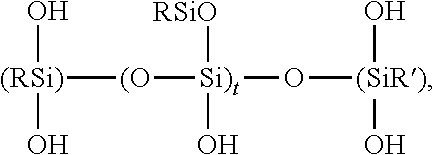
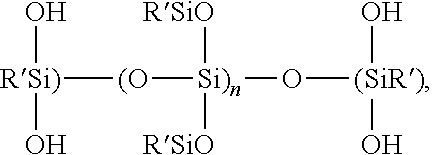
- W is independently selected from the group consisting essentially of Si, Ti, and Zr, and Al; wherein each R 1 is an aryl group with the proviso that there is present at least one R 1 group; R is selected from the group consisting essentially of R 1 , alkyl groups having 1 to 8 carbon atoms, each R 2 is a hydroxyl group, an aryl group, an alkoxy group having 1 to 8 carbon atoms, or an
- WO y is derived from W(OR 3 ) 4 wherein (OR 3 ) is independently selected from the group consisting of —OCH 3 , —OCH 2 CH 3 , —OCH(CH 3 ) 2 , —O(CH 2 ) 3 CH 3 , —OCH 2 CH(C 3 ) 2 , —O(2-ethylhexyl), acetoxy, and, oximo.
- Another embodiment of this invention is a water solution of the composition described just Supra.
- Still another embodiment of this invention is a water-alcohol solution of the composition described just Supra.
- An additional embodiment is a cured coating having lubricant properties.
- compositions of this invention are low molecular weight polysilicate compositions that have high silanol or alkoxy contents, that is, have a large number of silanols or alkoxy groups in the molecule.
- large number of silanols or alkoxy groups it is meant that at least half of the Si atoms in the molecule are bonded by hydroxy groups when fully hydrolyzed.
- One method for providing the materials of this invention comprises providing the components:
- molar ratio of x:y:z is 0.25-3:4:0.25-3, p and q each independently have a value of 2 or less, R′′′ is the same as R 3 ; R′′′′ is independently selected from the methyl group or the phenyl group, and co-hydrolyzing the components in the presence of a predetermined amount of water, and a catalyst for hydrolysis and condensation.
- the materials have the average general formula
- R, R′, R′′′′, W, x, y, and z all have the meanings set forth Supra, which is derived by the hydrolysis of the silane precursors
- orthosilicate, orthotitanate, orthozirconate or, orthoaluminate having the general formula ⁇ W(OR′′′) 4 ⁇ y , wherein the molar ratio of x:y:z is 0.25-3:4:0.25-3, in a controlled manner to avoid random products.
- This hydrolysis is carried out using a stoichiometric or less than stoichiometric amounts of water and a catalyst for hydrolysis.
- a stoichiometric amount of water or, an amount of water less than stoichiometric, results in low molecular weight materials, which is one of the objectives of the method in this invention.
- W in the case of this invention is independently selected from the group consisting of Si, Ti, and Zr. Preferred for this invention is Si and Ti and most preferred is Si.
- the (OR′′′) group is selected from the group consisting of —OCH 3 , —OCH 2 CH 3 , —OCH(CH 3 ) 2 , —O(CH 2 ) 2 CH 3 , —OCH 2 CH(CH 3 ) 2 , —O(2-ethylhexyl), acetoxy, and, oximo.
- Preferred for this invention are the groups —OCH 3 , —OCH 2 CH 3 , and —OCH(CH 3 ) 2 , and most preferred are the —OCH 3 and —OCH 2 CH 3 groups.
- Preferred orthosilicates and orthotitanates for this invention are Si(OCH 2 CH 3 ) 4 and Ti(OCH(CH 3 ) 2 ) 4 .
- Stoichiometry is based on the number of hydrolysable groups on the combined components.
- the reaction is carried out in the presence of base or acid, with acid being the preferred catalyst.
- the acid catalysts are preferred to be HCl, phosphoric, and acetic acids, with HCl and phosphoric acids being most preferred.
- Bases that are useable herein are amines, NaOH, KOH and the like and preferred for this invention is NaOH.
- the hydrolysis reaction is carried out by combining the components in a predetermined ratio and then adding predetermined amounts of acidic or basic water to the components at a controlled rate to form silanols from the alkoxy moieties.
- a slightly higher molecular weight higher number of silanol reactive groups
- the silicate component is treated for a short period of time by acidic or basic water to cause the silicate component to hydrolyze and mildly condense before the other components are added.
- a preferred material is
- the materials are liquids as prepared. In some cases, if preferred, the by-produced alcohols and any residual water can be removed to provide a solid material, and in some cases the solid material is hard and appears to be almost crystalline and in some cases, the material is waxy or paste-like.
- the polysilicates are combined with a condensation catalyst and allowed to cure on the appropriate substrate.
- the cured coating has lubricant properties.
- the mixtures were allowed to hydrolyze for about one hour.
Landscapes
- Chemical & Material Sciences (AREA)
- Organic Chemistry (AREA)
- Chemical Kinetics & Catalysis (AREA)
- General Chemical & Material Sciences (AREA)
- Oil, Petroleum & Natural Gas (AREA)
- Lubricants (AREA)
- Silicon Polymers (AREA)
Abstract
Description

wherein the average molar ratio of x:y:z is 0.25-3:4:0.25-3, W is independently selected from the group consisting essentially of Si, Ti, and Zr, and Al; wherein each R1 is an aryl group with the proviso that there is present at least one R1 group; R is selected from the group consisting essentially of R1, alkyl groups having 1 to 8 carbon atoms, each R2 is a hydroxyl group, an aryl group, an alkoxy group having 1 to 8
carbon atoms, or an

radical;
y has a value of 4;
s has an average value of about 1 to 5;
wherein WOy is derived from W(OR3)4 wherein (OR3) is independently selected from the group consisting of —OCH3, —OCH2CH3, —OCH(CH3)2, —O(CH2)3CH3, —OCH2 CH(C3)2, —O(2-ethylhexyl), acetoxy, and, oximo.

wherein the molar ratio of x:y:z is 0.25-3:4:0.25-3, p and q each independently have a value of 2 or less, R′″ is the same as R3; R″″ is independently selected from the methyl group or the phenyl group, and co-hydrolyzing the components in the presence of a predetermined amount of water, and a catalyst for hydrolysis and condensation.

are commercially available from several sources.

wherein R, R′, R″″, W, x, y, and z all have the meanings set forth Supra, which is derived by the hydrolysis of the silane precursors

in conjunction with the orthosilicate, orthotitanate, orthozirconate or, orthoaluminate, having the general formula {W(OR′″)4}y,
wherein the molar ratio of x:y:z is 0.25-3:4:0.25-3, in a controlled manner to avoid random products.


One can also provide a material having the formula:

by hydrolyzing the components 1 (CH3O)3Si(CH3), 3 Si(OCH2CH3)4 and 1 (CH3O)3Si— C6H5C6H4.

| TABLE I | ||||
| Sample # | mw | 1 | 2 | 3 |
| TEOS | 208 | 2.08 | 2.08 | 2.08 |
| Φtms | 196 | 3.96 | 5.94 | 5.94 |
| tΦms | 234 | |||
| H2O pH = 10 | 18 | 1.8 | 1.17 | 3.6 |
| Ratio moles |
| Teos/silane | 1.0/2.0 | 1.0/3.0 | 1.0/3.0 |
| Solution | Hazy | clear | cloudy |
| TEOS = Tetraethylorthosilicate | |||
| Φtms = phenyltrimethoxysilane | |||
| tΦms = triphenylmethoxysilane | |||
| 1. - cable lubricant | |||
| 2. —o— | |||
| 3. hardened to a precipitate upon standing. | |||
Claims (16)






Priority Applications (1)
| Application Number | Priority Date | Filing Date | Title |
|---|---|---|---|
| US14/876,898 US9574153B1 (en) | 2015-10-07 | 2015-10-07 | Compositions having lubricant properties |
Applications Claiming Priority (1)
| Application Number | Priority Date | Filing Date | Title |
|---|---|---|---|
| US14/876,898 US9574153B1 (en) | 2015-10-07 | 2015-10-07 | Compositions having lubricant properties |
Publications (1)
| Publication Number | Publication Date |
|---|---|
| US9574153B1 true US9574153B1 (en) | 2017-02-21 |
Family
ID=58017523
Family Applications (1)
| Application Number | Title | Priority Date | Filing Date |
|---|---|---|---|
| US14/876,898 Expired - Fee Related US9574153B1 (en) | 2015-10-07 | 2015-10-07 | Compositions having lubricant properties |
Country Status (1)
| Country | Link |
|---|---|
| US (1) | US9574153B1 (en) |
Citations (1)
| Publication number | Priority date | Publication date | Assignee | Title |
|---|---|---|---|---|
| US20070036906A1 (en) * | 2003-08-13 | 2007-02-15 | Reeve John A | Silicon-containing treatments for solid substrates |
-
2015
- 2015-10-07 US US14/876,898 patent/US9574153B1/en not_active Expired - Fee Related
Patent Citations (1)
| Publication number | Priority date | Publication date | Assignee | Title |
|---|---|---|---|---|
| US20070036906A1 (en) * | 2003-08-13 | 2007-02-15 | Reeve John A | Silicon-containing treatments for solid substrates |
Similar Documents
| Publication | Publication Date | Title |
|---|---|---|
| KR101877153B1 (en) | Alkoxy group-containing silicones with reactive functional groups of defined reactivity | |
| FI127433B (en) | Method of synthesizing siloxane monomers and use thereof | |
| US20100191001A1 (en) | Process for controlled hydrolysis and condensation of epoxy-functional organosilanes and the cocondensation thereof with further organofunctional alkoxysilanes | |
| US20100249339A1 (en) | Method for producing branched sih functional polysiloxanes and the use thereof for producing sic- and sioc-linked, branched organomodified polysiloxanes | |
| US9732191B2 (en) | Method for capping MQ-type silicone resins | |
| CN101998960A (en) | New guanidine compound useful as a catalyst for the polycondensation reaction of organopolysiloxane | |
| WO2010060877A1 (en) | Compounds with guanidine structure and uses thereof as organopolysiloxane polycondensation catalysts | |
| JPWO2008081890A1 (en) | Catalyst for dealcoholization condensation reaction and process for producing organopolysiloxane using the same | |
| CN103282801A (en) | Polyheterosiloxanes for high refractive index materials | |
| JP7718573B2 (en) | ORGANOPOLYSILOXANE AND ROOM-TEMPERATURE-CURABLE ORGANOPOLYSILOXANE COMPOSITION CONTAINING THE SAME | |
| CN103145991A (en) | Production of high-molecular-weight silicone resins | |
| CN107001638B (en) | Method for producing organosilicon compounds having amino groups | |
| TWI424027B (en) | Room temperature hardening organopolysiloxane composition | |
| US8664347B2 (en) | Reactive amine-functional silicone-polyether block copolymers | |
| EP3768778A1 (en) | Room temperature curable organopolysiloxane composition and electric/electronic apparatus | |
| CN102516869A (en) | Binder composition | |
| US5352751A (en) | Preparation of end-alkoxylated diorganopolysiloxanes | |
| US9221848B2 (en) | Method of forming an MT-propyl siloxane resin | |
| JP2004527609A (en) | Preparation of hydroxyalkyl polysiloxane | |
| JP4883269B2 (en) | Method for producing curable polymethylsiloxane resin | |
| CN101103064B (en) | Method of preparing polyorganosiloxane with functional groups in the presence of lithium silanolate | |
| JP7397558B2 (en) | Water- and oil-repellent film composition and its use | |
| WO2015071208A1 (en) | Process to produce stable alkoxy terminated aminofunctional silicone fluids | |
| MX2014000818A (en) | A cycloaliphatic resin, method for obtaining the same and its application in a high resistance coating. | |
| US11981828B2 (en) | Water repellent and oil repellent film composition and use thereof |
Legal Events
| Date | Code | Title | Description |
|---|---|---|---|
| STCF | Information on status: patent grant |
Free format text: PATENTED CASE |
|
| MAFP | Maintenance fee payment |
Free format text: PAYMENT OF MAINTENANCE FEE, 4TH YR, SMALL ENTITY (ORIGINAL EVENT CODE: M2551); ENTITY STATUS OF PATENT OWNER: SMALL ENTITY Year of fee payment: 4 |
|
| FEPP | Fee payment procedure |
Free format text: MAINTENANCE FEE REMINDER MAILED (ORIGINAL EVENT CODE: REM.); ENTITY STATUS OF PATENT OWNER: SMALL ENTITY |
|
| LAPS | Lapse for failure to pay maintenance fees |
Free format text: PATENT EXPIRED FOR FAILURE TO PAY MAINTENANCE FEES (ORIGINAL EVENT CODE: EXP.); ENTITY STATUS OF PATENT OWNER: SMALL ENTITY |
|
| STCH | Information on status: patent discontinuation |
Free format text: PATENT EXPIRED DUE TO NONPAYMENT OF MAINTENANCE FEES UNDER 37 CFR 1.362 |
|
| FP | Lapsed due to failure to pay maintenance fee |
Effective date: 20250221 |