US9568804B2 - Method and apparatus for generating high-power terahertz wave - Google Patents
Method and apparatus for generating high-power terahertz wave Download PDFInfo
- Publication number
- US9568804B2 US9568804B2 US14/843,518 US201514843518A US9568804B2 US 9568804 B2 US9568804 B2 US 9568804B2 US 201514843518 A US201514843518 A US 201514843518A US 9568804 B2 US9568804 B2 US 9568804B2
- Authority
- US
- United States
- Prior art keywords
- plasma
- laser
- laser beams
- waves
- power
- Prior art date
- Legal status (The legal status is an assumption and is not a legal conclusion. Google has not performed a legal analysis and makes no representation as to the accuracy of the status listed.)
- Expired - Fee Related
Links
Images


Classifications
-
- H—ELECTRICITY
- H01—ELECTRIC ELEMENTS
- H01S—DEVICES USING THE PROCESS OF LIGHT AMPLIFICATION BY STIMULATED EMISSION OF RADIATION [LASER] TO AMPLIFY OR GENERATE LIGHT; DEVICES USING STIMULATED EMISSION OF ELECTROMAGNETIC RADIATION IN WAVE RANGES OTHER THAN OPTICAL
- H01S1/00—Masers, i.e. devices using stimulated emission of electromagnetic radiation in the microwave range
- H01S1/005—Masers, i.e. devices using stimulated emission of electromagnetic radiation in the microwave range using a relativistic beam of charged particles, e.g. electron cyclotron maser, gyrotron
-
- G—PHYSICS
- G02—OPTICS
- G02F—OPTICAL DEVICES OR ARRANGEMENTS FOR THE CONTROL OF LIGHT BY MODIFICATION OF THE OPTICAL PROPERTIES OF THE MEDIA OF THE ELEMENTS INVOLVED THEREIN; NON-LINEAR OPTICS; FREQUENCY-CHANGING OF LIGHT; OPTICAL LOGIC ELEMENTS; OPTICAL ANALOGUE/DIGITAL CONVERTERS
- G02F2/00—Demodulating light; Transferring the modulation of modulated light; Frequency-changing of light
- G02F2/02—Frequency-changing of light, e.g. by quantum counters
-
- G—PHYSICS
- G02—OPTICS
- G02F—OPTICAL DEVICES OR ARRANGEMENTS FOR THE CONTROL OF LIGHT BY MODIFICATION OF THE OPTICAL PROPERTIES OF THE MEDIA OF THE ELEMENTS INVOLVED THEREIN; NON-LINEAR OPTICS; FREQUENCY-CHANGING OF LIGHT; OPTICAL LOGIC ELEMENTS; OPTICAL ANALOGUE/DIGITAL CONVERTERS
- G02F2203/00—Function characteristic
- G02F2203/13—Function characteristic involving THZ radiation
-
- H—ELECTRICITY
- H05—ELECTRIC TECHNIQUES NOT OTHERWISE PROVIDED FOR
- H05H—PLASMA TECHNIQUE; PRODUCTION OF ACCELERATED ELECTRICALLY-CHARGED PARTICLES OR OF NEUTRONS; PRODUCTION OR ACCELERATION OF NEUTRAL MOLECULAR OR ATOMIC BEAMS
- H05H2240/00—Testing
- H05H2240/10—Testing at atmospheric pressure
Definitions
- the present invention relates generally to a method and apparatus for generating terahertz waves using laser plasma.
- Terahertz waves are signals in the band between the band of microwaves and the band of far-infrared light waves in the electromagnetic spectra, thereby exhibiting characteristics of both microwaves and light waves.
- Terahertz waves have very important usages in spectroscopy or in the acquisition of high-density material transmission images thanks to the characteristics thereof.
- the development of terahertz wave applications has been slow because of the problem with the generation of electromagnetic waves in the corresponding frequency band and the difficulty in the implementation of measurement technology.
- terahertz waves have been generated and measured by the combination of a laser having a pulse width of hundreds of femto-seconds and an opto-photoconductive material having a carrier life time shorter than several pico-seconds, with the result that a variety of technologies using the characteristics of terahertz waves have been developed.
- terahertz waves can pass through materials though which microwaves and light waves cannot pass, various apparatuses using such characteristics of terahertz waves are now being developed.
- terahertz waves are evaluated as next-generation waves capable of replacing X rays because they can be used to analyze organisms without damage, the use of high-power terahertz waves has not yet been completely established.
- Terahertz (THz) waves generated by the interaction between plasma and one or more laser beams attract a lot of attention because they can achieve high power and various attainable frequencies.
- the principal methods of generating THz waves are illustrated in FIGS. 2A to 2C .
- FIG. 2A illustrates a 2-color method in which THz waves are generated by simultaneously radiating two low-power laser beams having different wavelengths into plasma.
- the generated THz waves have a field strength of several MV/cm.
- the 2-color method generates the highest power THz waves and relatively wide THz frequencies.
- FIG. 2B illustrates a linear mode transformation method in which THz waves are generated by radiating a high-power laser beam into a region where plasma varies in density.
- the generated THz waves have a field strength of several MV/cm and a relatively wide range of THz frequencies.
- FIG. 2C illustrates a Cherenkov wake method in which THz waves are generated by radiating a high-power laser beam into magnetized plasma. Since there is a limitation to the intensity of a magnetic field, the generated THz waves have a low power and a relatively narrow range of THz frequencies.
- the Cherenkov wake method can achieve a narrow range of THz frequencies.
- the Cherenkov method requires a high-power laser.
- Some embodiments of the present invention are directed to the provision of a method and apparatus for generating terahertz waves, in which low-power laser beams collide with each other at the periphery of magnetized plasma and then terahertz (THz) waves are generated by a current that is formed in fine plasma waves formed by the collision and also oscillates at a plasma frequency.
- THz terahertz
- a method of generating high-power terahertz waves including generating plasma by focusing a laser beam on a gas within a vacuum chamber; radiating laser beams into the magnetized plasma from opposite directions so that the laser beams collide with each other at a preset location; and generating terahertz waves of a predetermined frequency through the oscillation of the plasma generated by the collision of the laser beams.
- an apparatus for generating high-power terahertz waves including a vacuum chamber; a gas regulator configured to supply a gas to the vacuum chamber; a laser generator configured to generate laser beams having a preset level of energy and a preset or lower level of power, and to radiate two laser beams toward a periphery of plasma within the vacuum chamber from opposite directions so that the two laser beams collide with each other; a plasma generator configured to generate plasma in response to a laser beam radiated into the vacuum chamber and focused on the gas; and a magnetic field generator configured to magnetize the plasma generated by the plasma generator, and to generate terahertz waves of a predetermined frequency using oscillation of the plasma generated through the collision of the opposite laser beams by the laser generator.
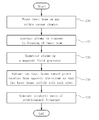
- FIG. 1 is a flowchart illustrating a method of generating high-power terahertz waves according to an embodiment of the present invention
- FIGS. 2A to 2C illustrate examples of a process related to a conventional method of generating terahertz waves
- FIG. 3 illustrates an example of a process related to the method of generating high-power terahertz waves according to the embodiment of the present invention
- FIGS. 4A and 4B are graphs illustrating theoretical and simulation results related to the generation of terahertz waves to which the method of generating high-power terahertz waves according to the embodiment of the present invention has been applied;
- FIG. 5 is a block diagram of an apparatus for generating high-power terahertz waves according to an embodiment of the present invention.
- the present invention relates to the generation of terahertz waves using laser plasma. More specifically, the present invention is intended to provide a technology, in which low-power laser beams collide with each other at the periphery of magnetized plasma and then terahertz (THz) waves are generated by a current that is formed in the fine plasma waves formed by the collision and also oscillates at a plasma frequency, thereby generating MW/cm 2 -level terahertz waves using a laser having a power ten times lower than that of a conventional high-power laser.
- THz terahertz
- a method of generating high-power terahertz waves according to one embodiment of the present invention will be described below in detail with reference to FIG. 1 .
- FIG. 1 is a flowchart illustrating the method of generating high-power terahertz waves according to the present embodiment.
- an apparatus for generating high-power terahertz waves focuses a laser beam on a gas within a vacuum chamber.
- the vacuum chamber provides a space for receiving a gas injected thereinto and exciting the gas into plasma, thereby providing a space for generating plasma.
- plasma is generated in response to the focusing of the laser beam.
- the reactant gas is activated and transformed into the plasma by the focused laser beams.
- a laser generator radiates a high-power laser beam onto a beam focusing unit
- the beam focusing unit reflects and focuses the corresponding laser beam at a predetermined location within the vacuum chamber, and a gas present at the predetermined location within the vacuum chamber and having spatially different pressures is ionized by the focused laser beam, thereby generating plasma.
- the generated plasma is magnetized by a magnetic field generator.
- laser beams are oppositely radiated into the magnetized plasma to collide with each other at a preset location, and in operation 120 , terahertz waves of a predetermined frequency are generated.
- the laser beams which are to be incident into the magnetized plasma are generated by the laser generator to have a preset level of energy and a preset or lower level of power.
- two laser beams are controlled such that they are directed toward a preset location, that is, the periphery of the plasma, from opposite directions, and thus collide with each other in the periphery of the plasma. This is the same as illustrated in FIG. 3 . As illustrated in FIG.
- Equation 1 An equation related to this phenomenon is given as Equation 1 below:
- ⁇ is the length of laser pulses/2
- k is the number of laser waves
- ⁇ 0 is the normalized vector potential of the laser beams
- ⁇ is laser beam duration/2
- ⁇ p is the plasma frequency
- ⁇ c is eB/m
- E THz is the magnitude of the terahertz electric field.
- Equation 2 the magnitude of the electric field inside the plasma is expressed by Equation 2 below:
- FIGS. 4A and 4B are graphs illustrating theoretical and simulation results related to the generation of terahertz waves to which the method of generating high-power terahertz waves according to the present embodiment has been applied.
- the results of the comparison between THz waves based on laser power indicate that the intensity of THz waves in two-beam simulation is ten times higher than that in one-beam simulation.
- a low-power laser having a potential ⁇ 0 less than 1 has to be used due to the wave breaking effect of plasma waves.
- Equation 3 the theoretical effective intensity is expressed by Equation 3 below, the same effect may be achieved at a somewhat higher laser power, as indicated in the results of the simulation:
- the results of the simulation to which the present invention has been applied indicate that THz waves have the highest intensity when a laser collision point is present at the boundary of plasma, and gradually decrease, as expressed by Equation 2 above, as the laser collision point moves from the boundary to the inside of the plasma.
- FIG. 5 is a block diagram of the apparatus for generating high-power terahertz waves according to the present embodiment.
- the apparatus to which the present invention has been applied includes a gas regulator 510 , a vacuum chamber 512 , and a laser generator 518 .
- the vacuum chamber 512 includes a plasma generator 514 , and provides a space for receiving a gas injected thereinto and then exciting the gas into plasma, thereby providing a space for generating plasma.
- the gas regulator 510 is mounted onto the vacuum chamber 512 , and supplies gas into the vacuum chamber 512 .
- the laser generator 518 generates laser beams having a preset level of energy and a preset or lower level of power and radiates two laser beams from opposite directions so that the two laser beams collide with each other at the periphery of plasma within the vacuum chamber 512 .
- the plasma generator 514 generates plasma in response to the laser beams radiated into the vacuum chamber 512 and focused on the gas.
- the plasma generator 514 generates terahertz waves of a predetermined frequency using the oscillation of plasma generated through the collision of the opposite laser beams by the laser generator 518 .
- the laser beams which are to be input to the magnetized plasma are generated by the laser generator 518 to have a preset level of energy and a preset or lower level of power.
- two laser beams are controlled such that they are directed toward a preset location, that is, the periphery of the plasma, from opposite directions, and thus collide with each other in the periphery of the plasma.
- fine plasma waves that are about ten times stronger than those in the case of a single laser beam are formed at the collision point of the laser beams, a current that is stationary but oscillates at a plasma frequency is formed by the plasma waves formed at the collision point of the laser beams, and terahertz waves are generated by the current.
- the present invention provides the method and apparatus for generating high-power terahertz waves, which are capable of generating MW/cm 2 -level terahertz waves using a laser having a power ten times lower than that of a conventional high-power laser.
Landscapes
- Physics & Mathematics (AREA)
- Optics & Photonics (AREA)
- General Physics & Mathematics (AREA)
- Nonlinear Science (AREA)
- Electromagnetism (AREA)
- Optical Modulation, Optical Deflection, Nonlinear Optics, Optical Demodulation, Optical Logic Elements (AREA)
- Lasers (AREA)
- Plasma Technology (AREA)
- Engineering & Computer Science (AREA)
- Plasma & Fusion (AREA)
- Spectroscopy & Molecular Physics (AREA)
Abstract
Description
where σ is the length of laser pulses/2, k is the number of laser waves, α0 is the normalized vector potential of the laser beams, τ is laser beam duration/2, ωp is the plasma frequency, ωc is eB/m, and ETHz is the magnitude of the terahertz electric field.
where J0 is a current density deduced from Equation 1.
Claims (7)
Applications Claiming Priority (2)
| Application Number | Priority Date | Filing Date | Title |
|---|---|---|---|
| KR1020140134835A KR101693339B1 (en) | 2014-10-07 | 2014-10-07 | Method and apparatus for generating high power terahertz |
| KR10-2014-0134835 | 2014-10-07 |
Publications (2)
| Publication Number | Publication Date |
|---|---|
| US20160100476A1 US20160100476A1 (en) | 2016-04-07 |
| US9568804B2 true US9568804B2 (en) | 2017-02-14 |
Family
ID=55633843
Family Applications (1)
| Application Number | Title | Priority Date | Filing Date |
|---|---|---|---|
| US14/843,518 Expired - Fee Related US9568804B2 (en) | 2014-10-07 | 2015-09-02 | Method and apparatus for generating high-power terahertz wave |
Country Status (2)
| Country | Link |
|---|---|
| US (1) | US9568804B2 (en) |
| KR (1) | KR101693339B1 (en) |
Families Citing this family (10)
| Publication number | Priority date | Publication date | Assignee | Title |
|---|---|---|---|---|
| CN106094050A (en) * | 2016-06-15 | 2016-11-09 | 中国工程物理研究院应用电子学研究所 | A kind of Terahertz active safety check instrument |
| CN106253030B (en) * | 2016-09-30 | 2019-05-21 | 西安交通大学 | Device and method for generating coordinated terahertz radiation from hollow laser plasma |
| CN107016184B (en) * | 2017-03-31 | 2021-02-12 | 西安理工大学 | Implementation method in two-dimensional high-precision iterative non-magnetized plasma |
| CN108322989B (en) * | 2018-03-12 | 2020-07-07 | 南京航空航天大学 | A device that radiates terahertz waves from plasma |
| CN110132884B (en) * | 2019-04-28 | 2021-08-06 | 中国科学院上海微系统与信息技术研究所 | Terahertz spectrum measurement system and method for analyzing terahertz spectrum of substances |
| CN110212394B (en) * | 2019-06-12 | 2020-08-04 | 中国科学院上海光学精密机械研究所 | KHz repetition frequency high energy terahertz generator |
| CN110104870A (en) * | 2019-06-18 | 2019-08-09 | 河南晶品新材料科技有限公司 | A kind of preparation method of the Terahertz drinking water with care treatment effect |
| CN111239134B (en) * | 2020-02-26 | 2022-08-26 | 中国人民解放军第四军医大学 | System and method for researching bioelectric effect of high-frequency electromagnetic radiation on in-vitro excitable cells |
| CN114389125B (en) * | 2021-12-14 | 2023-06-13 | 首都师范大学 | System and method for generating terahertz waves by circular airy three-color field laser |
| CN114945238B (en) * | 2022-03-30 | 2023-06-16 | 核工业西南物理研究院 | A multifunctional terahertz integrated diagnostic system |
Citations (5)
| Publication number | Priority date | Publication date | Assignee | Title |
|---|---|---|---|---|
| US20050147147A1 (en) * | 2004-01-07 | 2005-07-07 | Donald Umstadter | Ultra-short wavelength x-ray system |
| US20080258085A1 (en) * | 2004-07-28 | 2008-10-23 | Board Of Regents Of The University & Community College System Of Nevada On Behalf Of Unv | Electro-Less Discharge Extreme Ultraviolet Light Source |
| KR20100008052A (en) | 2008-07-15 | 2010-01-25 | 주식회사 엔피홀딩스 | Chemical vapor deposition apparatus |
| JP2011198568A (en) | 2010-03-18 | 2011-10-06 | Ihi Corp | X-ray generating apparatus |
| KR20120096781A (en) | 2011-02-23 | 2012-08-31 | 광주과학기술원 | Method and apparatus for generating terahertz wave using laser plasmas |
-
2014
- 2014-10-07 KR KR1020140134835A patent/KR101693339B1/en not_active Expired - Fee Related
-
2015
- 2015-09-02 US US14/843,518 patent/US9568804B2/en not_active Expired - Fee Related
Patent Citations (5)
| Publication number | Priority date | Publication date | Assignee | Title |
|---|---|---|---|---|
| US20050147147A1 (en) * | 2004-01-07 | 2005-07-07 | Donald Umstadter | Ultra-short wavelength x-ray system |
| US20080258085A1 (en) * | 2004-07-28 | 2008-10-23 | Board Of Regents Of The University & Community College System Of Nevada On Behalf Of Unv | Electro-Less Discharge Extreme Ultraviolet Light Source |
| KR20100008052A (en) | 2008-07-15 | 2010-01-25 | 주식회사 엔피홀딩스 | Chemical vapor deposition apparatus |
| JP2011198568A (en) | 2010-03-18 | 2011-10-06 | Ihi Corp | X-ray generating apparatus |
| KR20120096781A (en) | 2011-02-23 | 2012-08-31 | 광주과학기술원 | Method and apparatus for generating terahertz wave using laser plasmas |
Non-Patent Citations (1)
| Title |
|---|
| Office action issued on Oct. 28, 2015 from Korean Intellectual Property Office in a counterpart Korean Patent Application No. 10-2014-0134835. |
Also Published As
| Publication number | Publication date |
|---|---|
| KR20160041252A (en) | 2016-04-18 |
| KR101693339B1 (en) | 2017-01-06 |
| US20160100476A1 (en) | 2016-04-07 |
Similar Documents
| Publication | Publication Date | Title |
|---|---|---|
| US9568804B2 (en) | Method and apparatus for generating high-power terahertz wave | |
| Vlasov et al. | Overmoded GW-class surface-wave microwave oscillator | |
| Yugami et al. | Experimental observation of radiation from Cherenkov wakes in a magnetized plasma | |
| Sheng et al. | Emission of electromagnetic pulses from laser wakefields through linear mode conversion | |
| Malik et al. | Terahertz radiation generation by beating of two spatial-Gaussian lasers in the presence of a static magnetic field | |
| Varshney et al. | Strong terahertz radiation generation by beating of extra-ordinary mode lasers in a rippled density magnetized plasma | |
| Annenkov et al. | High-power terahertz emission from a plasma penetrated by counterstreaming different-size electron beams | |
| Sun et al. | Production of polarized particle beams via ultraintense laser pulses: T. Sun et al. | |
| Varshnety et al. | Effects of transverse static electric field on terahertz radiation generation by beating of two transversely modulated Gaussian laser beams in a plasma | |
| Kumar et al. | Simulation study of phase-matched THz emission from an axially modulated magnetized plasma | |
| Annenkov et al. | Second harmonic electromagnetic emission in a beam-driven plasma antenna | |
| Samimi et al. | On ion gyro-harmonic structuring in the stimulated electromagnetic emission spectrum during second electron gyro-harmonic heating | |
| US20160097722A1 (en) | Plasma diagnostic method and apparatus using raman scattering | |
| Volchok et al. | Coherent terahertz emission from a plasma layer due to linear conversion of laser wakefields on pre-modulated ion density | |
| Choobini et al. | Generation of high-power terahertz waves in a collisional and magnetized plasma by two-color femtosecond laser beams | |
| Timofeev et al. | Simulations of electromagnetic emission from colliding laser wakefields | |
| Molavi-Choobini et al. | Effects of polarization and laser profile on THz radiation generation through three-color laser pulses in ordinary and extraordinary modes | |
| Wani et al. | Self-focusing of a laser beam in the rippled density magnetoplasma | |
| Ghaffari-Oskooei et al. | Terahertz generation in magnetized plasma by irradiation of two-color lasers | |
| Safari et al. | About generation of terahertz radiation due to the nonlinear interaction of Gaussian and Hermite–Cosh–Gaussian laser beams in collisional plasma background: Optimization and field profile controlling | |
| Mehta et al. | Numerical investigation of nonlinear current density and terahertz field induced by laser-plasma interaction | |
| Volchok et al. | Electromagnetic emission due to nonlinear interaction of laser wakefields colliding in plasma at an oblique angle | |
| Van Compernolle et al. | Generation of suprathermal electrons and Alfvén waves by a high power pulse at the electron plasma frequency | |
| KR101017938B1 (en) | Terahertz wave generator and high power terahertz wave generation method using same | |
| Wu et al. | Laboratory experiments of kaws |
Legal Events
| Date | Code | Title | Description |
|---|---|---|---|
| AS | Assignment |
Owner name: UNIST ACADEMY-INDUSTRY RESEARCH CORPORATION, KOREA Free format text: ASSIGNMENT OF ASSIGNORS INTEREST;ASSIGNORS:HUR, MIN SUP;JO, MYUNG HOON;KIM, YOUNG KUK;REEL/FRAME:036480/0715 Effective date: 20150302 |
|
| AS | Assignment |
Owner name: ULSAN NATIONAL INSTITUTE OF SCIENCE AND TECHNOLOGY Free format text: ASSIGNMENT OF ASSIGNORS INTEREST;ASSIGNOR:UNIST ACADEMY-INDUSTRY RESEARCH CORPORATION;REEL/FRAME:037880/0556 Effective date: 20160223 |
|
| AS | Assignment |
Owner name: UNIST (ULSAN NATIONAL INSTITUTE OF SCIENCE AND TECHNOLOGY), KOREA, REPUBLIC OF Free format text: ASSIGNMENT OF ASSIGNORS INTEREST;ASSIGNOR:ULSAN NATIONAL INSTITUTE OF SCIENCE AND TECHNOLOGY;REEL/FRAME:038238/0905 Effective date: 20160323 Owner name: UNIST (ULSAN NATIONAL INSTITUTE OF SCIENCE AND TEC Free format text: ASSIGNMENT OF ASSIGNORS INTEREST;ASSIGNOR:ULSAN NATIONAL INSTITUTE OF SCIENCE AND TECHNOLOGY;REEL/FRAME:038238/0905 Effective date: 20160323 |
|
| STCF | Information on status: patent grant |
Free format text: PATENTED CASE |
|
| MAFP | Maintenance fee payment |
Free format text: PAYMENT OF MAINTENANCE FEE, 4TH YR, SMALL ENTITY (ORIGINAL EVENT CODE: M2551); ENTITY STATUS OF PATENT OWNER: SMALL ENTITY Year of fee payment: 4 |
|
| FEPP | Fee payment procedure |
Free format text: MAINTENANCE FEE REMINDER MAILED (ORIGINAL EVENT CODE: REM.); ENTITY STATUS OF PATENT OWNER: SMALL ENTITY |
|
| LAPS | Lapse for failure to pay maintenance fees |
Free format text: PATENT EXPIRED FOR FAILURE TO PAY MAINTENANCE FEES (ORIGINAL EVENT CODE: EXP.); ENTITY STATUS OF PATENT OWNER: SMALL ENTITY |
|
| STCH | Information on status: patent discontinuation |
Free format text: PATENT EXPIRED DUE TO NONPAYMENT OF MAINTENANCE FEES UNDER 37 CFR 1.362 |
|
| FP | Lapsed due to failure to pay maintenance fee |
Effective date: 20250214 |