US9564458B2 - TFT substrates and the manufacturing method thereof - Google Patents

TFT substrates and the manufacturing method thereof Download PDF

Info

Publication number
US9564458B2
US9564458B2 US14/433,630 US201414433630A US9564458B2 US 9564458 B2 US9564458 B2 US 9564458B2 US 201414433630 A US201414433630 A US 201414433630A US 9564458 B2 US9564458 B2 US 9564458B2
Authority
US
United States
Prior art keywords
electrode
layer
forming
black matrix
contacting hole
Prior art date
Legal status (The legal status is an assumption and is not a legal conclusion. Google has not performed a legal analysis and makes no representation as to the accuracy of the status listed.)
Active, expires
Application number
US14/433,630
Other versions
US20160148956A1 (en
Inventor
Shui-Chih Lien
Yuan Xiong
Current Assignee (The listed assignees may be inaccurate. Google has not performed a legal analysis and makes no representation or warranty as to the accuracy of the list.)
TCL China Star Optoelectronics Technology Co Ltd
Original Assignee
Shenzhen China Star Optoelectronics Technology Co Ltd
Priority date (The priority date is an assumption and is not a legal conclusion. Google has not performed a legal analysis and makes no representation as to the accuracy of the date listed.)
Filing date
Publication date
Priority claimed from CN201410698801.XA external-priority patent/CN104360529B/en
Application filed by Shenzhen China Star Optoelectronics Technology Co Ltd filed Critical Shenzhen China Star Optoelectronics Technology Co Ltd
Assigned to SHENZHEN CHINA STAR OPTOELECTRONICS TECHNOLOGY CO., LTD. reassignment SHENZHEN CHINA STAR OPTOELECTRONICS TECHNOLOGY CO., LTD. ASSIGNMENT OF ASSIGNORS INTEREST (SEE DOCUMENT FOR DETAILS). Assignors: LIEN, SHUI-CHIH, XIONG, YUAN
Publication of US20160148956A1 publication Critical patent/US20160148956A1/en
Application granted granted Critical
Publication of US9564458B2 publication Critical patent/US9564458B2/en
Active legal-status Critical Current
Adjusted expiration legal-status Critical

Links

Images

Classifications

    • H01L27/1255
    • GPHYSICS
    • G02OPTICS
    • G02FOPTICAL DEVICES OR ARRANGEMENTS FOR THE CONTROL OF LIGHT BY MODIFICATION OF THE OPTICAL PROPERTIES OF THE MEDIA OF THE ELEMENTS INVOLVED THEREIN; NON-LINEAR OPTICS; FREQUENCY-CHANGING OF LIGHT; OPTICAL LOGIC ELEMENTS; OPTICAL ANALOGUE/DIGITAL CONVERTERS
    • G02F1/00Devices or arrangements for the control of the intensity, colour, phase, polarisation or direction of light arriving from an independent light source, e.g. switching, gating or modulating; Non-linear optics
    • G02F1/01Devices or arrangements for the control of the intensity, colour, phase, polarisation or direction of light arriving from an independent light source, e.g. switching, gating or modulating; Non-linear optics for the control of the intensity, phase, polarisation or colour 
    • G02F1/13Devices or arrangements for the control of the intensity, colour, phase, polarisation or direction of light arriving from an independent light source, e.g. switching, gating or modulating; Non-linear optics for the control of the intensity, phase, polarisation or colour  based on liquid crystals, e.g. single liquid crystal display cells
    • G02F1/133Constructional arrangements; Operation of liquid crystal cells; Circuit arrangements
    • G02F1/136Liquid crystal cells structurally associated with a semi-conducting layer or substrate, e.g. cells forming part of an integrated circuit
    • G02F1/1362Active matrix addressed cells
    • G02F1/136209Light shielding layers, e.g. black matrix, incorporated in the active matrix substrate, e.g. structurally associated with the switching element
    • GPHYSICS
    • G02OPTICS
    • G02FOPTICAL DEVICES OR ARRANGEMENTS FOR THE CONTROL OF LIGHT BY MODIFICATION OF THE OPTICAL PROPERTIES OF THE MEDIA OF THE ELEMENTS INVOLVED THEREIN; NON-LINEAR OPTICS; FREQUENCY-CHANGING OF LIGHT; OPTICAL LOGIC ELEMENTS; OPTICAL ANALOGUE/DIGITAL CONVERTERS
    • G02F1/00Devices or arrangements for the control of the intensity, colour, phase, polarisation or direction of light arriving from an independent light source, e.g. switching, gating or modulating; Non-linear optics
    • G02F1/01Devices or arrangements for the control of the intensity, colour, phase, polarisation or direction of light arriving from an independent light source, e.g. switching, gating or modulating; Non-linear optics for the control of the intensity, phase, polarisation or colour 
    • G02F1/13Devices or arrangements for the control of the intensity, colour, phase, polarisation or direction of light arriving from an independent light source, e.g. switching, gating or modulating; Non-linear optics for the control of the intensity, phase, polarisation or colour  based on liquid crystals, e.g. single liquid crystal display cells
    • G02F1/133Constructional arrangements; Operation of liquid crystal cells; Circuit arrangements
    • G02F1/136Liquid crystal cells structurally associated with a semi-conducting layer or substrate, e.g. cells forming part of an integrated circuit
    • G02F1/1362Active matrix addressed cells
    • G02F1/136227Through-hole connection of the pixel electrode to the active element through an insulation layer
    • H01L27/124
    • H01L27/1248
    • H01L27/1259
    • H01L29/66765
    • H01L29/78669
    • H01L29/78678
    • HELECTRICITY
    • H10SEMICONDUCTOR DEVICES; ELECTRIC SOLID-STATE DEVICES NOT OTHERWISE PROVIDED FOR
    • H10DINORGANIC ELECTRIC SEMICONDUCTOR DEVICES
    • H10D30/00Field-effect transistors [FET]
    • H10D30/01Manufacture or treatment
    • H10D30/021Manufacture or treatment of FETs having insulated gates [IGFET]
    • H10D30/031Manufacture or treatment of FETs having insulated gates [IGFET] of thin-film transistors [TFT]
    • H10D30/0312Manufacture or treatment of FETs having insulated gates [IGFET] of thin-film transistors [TFT] characterised by the gate electrodes
    • H10D30/0316Manufacture or treatment of FETs having insulated gates [IGFET] of thin-film transistors [TFT] characterised by the gate electrodes of lateral bottom-gate TFTs comprising only a single gate
    • HELECTRICITY
    • H10SEMICONDUCTOR DEVICES; ELECTRIC SOLID-STATE DEVICES NOT OTHERWISE PROVIDED FOR
    • H10DINORGANIC ELECTRIC SEMICONDUCTOR DEVICES
    • H10D30/00Field-effect transistors [FET]
    • H10D30/01Manufacture or treatment
    • H10D30/021Manufacture or treatment of FETs having insulated gates [IGFET]
    • H10D30/031Manufacture or treatment of FETs having insulated gates [IGFET] of thin-film transistors [TFT]
    • H10D30/0321Manufacture or treatment of FETs having insulated gates [IGFET] of thin-film transistors [TFT] comprising silicon, e.g. amorphous silicon or polysilicon
    • HELECTRICITY
    • H10SEMICONDUCTOR DEVICES; ELECTRIC SOLID-STATE DEVICES NOT OTHERWISE PROVIDED FOR
    • H10DINORGANIC ELECTRIC SEMICONDUCTOR DEVICES
    • H10D30/00Field-effect transistors [FET]
    • H10D30/60Insulated-gate field-effect transistors [IGFET]
    • H10D30/67Thin-film transistors [TFT]
    • H10D30/6704Thin-film transistors [TFT] having supplementary regions or layers in the thin films or in the insulated bulk substrates for controlling properties of the device
    • H10D30/6723Thin-film transistors [TFT] having supplementary regions or layers in the thin films or in the insulated bulk substrates for controlling properties of the device having light shields
    • HELECTRICITY
    • H10SEMICONDUCTOR DEVICES; ELECTRIC SOLID-STATE DEVICES NOT OTHERWISE PROVIDED FOR
    • H10DINORGANIC ELECTRIC SEMICONDUCTOR DEVICES
    • H10D30/00Field-effect transistors [FET]
    • H10D30/60Insulated-gate field-effect transistors [IGFET]
    • H10D30/67Thin-film transistors [TFT]
    • H10D30/6729Thin-film transistors [TFT] characterised by the electrodes
    • HELECTRICITY
    • H10SEMICONDUCTOR DEVICES; ELECTRIC SOLID-STATE DEVICES NOT OTHERWISE PROVIDED FOR
    • H10DINORGANIC ELECTRIC SEMICONDUCTOR DEVICES
    • H10D30/00Field-effect transistors [FET]
    • H10D30/60Insulated-gate field-effect transistors [IGFET]
    • H10D30/67Thin-film transistors [TFT]
    • H10D30/6729Thin-film transistors [TFT] characterised by the electrodes
    • H10D30/673Thin-film transistors [TFT] characterised by the electrodes characterised by the shapes, relative sizes or dispositions of the gate electrodes
    • H10D30/6732Bottom-gate only TFTs
    • HELECTRICITY
    • H10SEMICONDUCTOR DEVICES; ELECTRIC SOLID-STATE DEVICES NOT OTHERWISE PROVIDED FOR
    • H10DINORGANIC ELECTRIC SEMICONDUCTOR DEVICES
    • H10D30/00Field-effect transistors [FET]
    • H10D30/60Insulated-gate field-effect transistors [IGFET]
    • H10D30/67Thin-film transistors [TFT]
    • H10D30/674Thin-film transistors [TFT] characterised by the active materials
    • H10D30/6741Group IV materials, e.g. germanium or silicon carbide
    • H10D30/6743Silicon
    • H10D30/6745Polycrystalline or microcrystalline silicon
    • HELECTRICITY
    • H10SEMICONDUCTOR DEVICES; ELECTRIC SOLID-STATE DEVICES NOT OTHERWISE PROVIDED FOR
    • H10DINORGANIC ELECTRIC SEMICONDUCTOR DEVICES
    • H10D30/00Field-effect transistors [FET]
    • H10D30/60Insulated-gate field-effect transistors [IGFET]
    • H10D30/67Thin-film transistors [TFT]
    • H10D30/674Thin-film transistors [TFT] characterised by the active materials
    • H10D30/6741Group IV materials, e.g. germanium or silicon carbide
    • H10D30/6743Silicon
    • H10D30/6746Amorphous silicon
    • HELECTRICITY
    • H10SEMICONDUCTOR DEVICES; ELECTRIC SOLID-STATE DEVICES NOT OTHERWISE PROVIDED FOR
    • H10DINORGANIC ELECTRIC SEMICONDUCTOR DEVICES
    • H10D86/00Integrated devices formed in or on insulating or conducting substrates, e.g. formed in silicon-on-insulator [SOI] substrates or on stainless steel or glass substrates
    • H10D86/01Manufacture or treatment
    • H10D86/021Manufacture or treatment of multiple TFTs
    • HELECTRICITY
    • H10SEMICONDUCTOR DEVICES; ELECTRIC SOLID-STATE DEVICES NOT OTHERWISE PROVIDED FOR
    • H10DINORGANIC ELECTRIC SEMICONDUCTOR DEVICES
    • H10D86/00Integrated devices formed in or on insulating or conducting substrates, e.g. formed in silicon-on-insulator [SOI] substrates or on stainless steel or glass substrates
    • H10D86/40Integrated devices formed in or on insulating or conducting substrates, e.g. formed in silicon-on-insulator [SOI] substrates or on stainless steel or glass substrates characterised by multiple TFTs
    • H10D86/441Interconnections, e.g. scanning lines
    • HELECTRICITY
    • H10SEMICONDUCTOR DEVICES; ELECTRIC SOLID-STATE DEVICES NOT OTHERWISE PROVIDED FOR
    • H10DINORGANIC ELECTRIC SEMICONDUCTOR DEVICES
    • H10D86/00Integrated devices formed in or on insulating or conducting substrates, e.g. formed in silicon-on-insulator [SOI] substrates or on stainless steel or glass substrates
    • H10D86/40Integrated devices formed in or on insulating or conducting substrates, e.g. formed in silicon-on-insulator [SOI] substrates or on stainless steel or glass substrates characterised by multiple TFTs
    • H10D86/451Integrated devices formed in or on insulating or conducting substrates, e.g. formed in silicon-on-insulator [SOI] substrates or on stainless steel or glass substrates characterised by multiple TFTs characterised by the compositions or shapes of the interlayer dielectrics
    • HELECTRICITY
    • H10SEMICONDUCTOR DEVICES; ELECTRIC SOLID-STATE DEVICES NOT OTHERWISE PROVIDED FOR
    • H10DINORGANIC ELECTRIC SEMICONDUCTOR DEVICES
    • H10D86/00Integrated devices formed in or on insulating or conducting substrates, e.g. formed in silicon-on-insulator [SOI] substrates or on stainless steel or glass substrates
    • H10D86/40Integrated devices formed in or on insulating or conducting substrates, e.g. formed in silicon-on-insulator [SOI] substrates or on stainless steel or glass substrates characterised by multiple TFTs
    • H10D86/481Integrated devices formed in or on insulating or conducting substrates, e.g. formed in silicon-on-insulator [SOI] substrates or on stainless steel or glass substrates characterised by multiple TFTs integrated with passive devices, e.g. auxiliary capacitors
    • HELECTRICITY
    • H10SEMICONDUCTOR DEVICES; ELECTRIC SOLID-STATE DEVICES NOT OTHERWISE PROVIDED FOR
    • H10DINORGANIC ELECTRIC SEMICONDUCTOR DEVICES
    • H10D86/00Integrated devices formed in or on insulating or conducting substrates, e.g. formed in silicon-on-insulator [SOI] substrates or on stainless steel or glass substrates
    • H10D86/40Integrated devices formed in or on insulating or conducting substrates, e.g. formed in silicon-on-insulator [SOI] substrates or on stainless steel or glass substrates characterised by multiple TFTs
    • H10D86/60Integrated devices formed in or on insulating or conducting substrates, e.g. formed in silicon-on-insulator [SOI] substrates or on stainless steel or glass substrates characterised by multiple TFTs wherein the TFTs are in active matrices
    • HELECTRICITY
    • H01ELECTRIC ELEMENTS
    • H01LSEMICONDUCTOR DEVICES NOT COVERED BY CLASS H10
    • H01L2924/00Indexing scheme for arrangements or methods for connecting or disconnecting semiconductor or solid-state bodies as covered by H01L24/00
    • HELECTRICITY
    • H01ELECTRIC ELEMENTS
    • H01LSEMICONDUCTOR DEVICES NOT COVERED BY CLASS H10
    • H01L2924/00Indexing scheme for arrangements or methods for connecting or disconnecting semiconductor or solid-state bodies as covered by H01L24/00
    • H01L2924/0001Technical content checked by a classifier
    • H01L2924/0002Not covered by any one of groups H01L24/00, H01L24/00 and H01L2224/00

Definitions

  • the present disclosure relates to liquid crystal display technology, and more particularly to a thin film transistor (TFT) substrate and the manufacturing method thereof.
  • TFT thin film transistor
  • Curved TVs typically are characterized by attributes including better contrastness, a wider viewing angle, and better user experience, and thus are very popular to customers.
  • FIG. 1 shows the masking effect of the BM 101 when the panel 100 has not been curved.
  • FIG. 2 shows the masking effect of the BM 101 when the panel 100 has been curved. It can be seen from FIGS. 1 and 2 that a portion of light beams may emit out from a lateral side of the BM 101 after the panel 100 is curved. The light leakage effect affects the masking effect of the BM 101 such that the contrastness of the panel 100 is lowered down.
  • a TFT substrate and the manufacturing method thereof can ensure the masking effect and can reduce the coupling capacitance between the data line and the scanning line may be reduced.
  • a manufacturing method of a TFT substrate includes: providing a substrate; forming a gate electrode on the substrate; forming a first insulation layer and an active layer on the gate electrode in turn; forming a first black matrix on the active layer; forming a source electrode and a drain electrode on the first black matrix;
  • the step of forming the gate electrode further comprises forming at least one scanning line on the substrate, the scanning line being arranged on the same layer with the gate electrode, and wherein the first insulation layer further covers the scanning line, and the active layer has not covered the scanning line; wherein the step of forming the first black matrix further comprises forming a second black matrix on the scanning line, and the second black matrix being arranged on the same layer with the first black matrix; wherein the step of forming the source electrode and the drain electrode on the first black matrix further comprises forming a capacitance electrode on the second black matrix, the capacitance electrode being arranged on the same layer with the source electrode and the drain electrode, wherein the second insulation layer further covers the capacitance electrode, and the pixel electrode being electrically connected to the capacitance electrode via the second insulation layer; and wherein the first black matrix and
  • the step of forming the first black matrix on the active layer further comprises: forming contacting holes respectively on the first black matrix and the second black matrix such that the source electrode and the drain electrode being contacted with the active layer via the contacting hole on the first black matrix, and the capacitance electrode being contacted with the first insulation layer via the contacting hole on the second black matrix.
  • the method further comprises: forming a photoresist layer between the pixel electrode and the second insulation layer; and forming an insulation protection layer between the photoresist layer and the pixel electrode.
  • the step of forming the photoresist layer between the pixel electrode and the second insulation layer further comprises forming a first contacting hold and a second contacting hole respectively in locations on the photoresist layer corresponding to the source or drain electrode and the capacitance electrode, wherein the second insulation layer being exposed by the first contacting hole, and the second contacting hole being passed through the second insulation layer such that the capacitance electrode being exposed; wherein the step of forming the insulation protection layer between the photoresist layer and the pixel electrode further comprises: forming the insulation protection layer within the first contacting hole and the second contacting hole;
  • the insulation protection layer within the second contacting hole being arranged on the second insulation layer, wherein the pixel electrode being electrically connected to the drain electrode or the source electrode via the third contacting hole, and the pixel electrode being electrically connected to the capacitance electrode via the second contacting hole.
  • a manufacturing method of a TFT substrate includes: providing a substrate; forming a gate electrode on the substrate; forming a first insulation layer and an active layer on the gate electrode in turn; forming a first black matrix on the active layer; forming a source electrode and a drain electrode on the first black matrix; forming a second insulation layer on the source electrode and the drain electrode; and
  • the pixel electrode being electrically connected to the source electrode or the drain electrode via the second insulation layer.
  • the step of forming the gate electrode further comprises forming at least one scanning line on the substrate, the scanning line being arranged on the same layer with the gate electrode, and wherein the first insulation layer further covers the scanning line, and the active layer has not covered the scanning line; wherein the step of forming the first black matrix further comprises forming a second black matrix on the scanning line, and the second black matrix being arranged on the same layer with the first black matrix; and wherein the step of forming the source electrode and the drain electrode on the first black matrix further comprises forming a capacitance electrode on the second black matrix, the capacitance electrode being arranged on the same layer with the source electrode and the drain electrode, wherein the second insulation layer further covers the capacitance electrode, and the pixel electrode being electrically connected to the capacitance electrode via the second insulation layer.
  • the step of forming the first black matrix on the active layer further comprises: forming contacting holes respectively on the first black matrix and the second black matrix such that the source electrode and the drain electrode being contacted with the active layer via the contacting hole on the first black matrix, and the capacitance electrode being contacted with the first insulation layer via the contacting hole on the second black matrix.
  • the step of forming the photoresist layer between the pixel electrode and the second insulation layer further comprises forming a first contacting hold and a second contacting hole respectively in locations on the photoresist layer corresponding to the source or drain electrode and the capacitance electrode, wherein the second insulation layer being exposed by the first contacting hole, and the second contacting hole being passed through the second insulation layer such that the capacitance electrode being exposed; wherein the step of forming the insulation protection layer between the photoresist layer and the pixel electrode further comprises: forming the insulation protection layer within the first contacting hole and the second contacting hole; forming a third contacting hole within the insulation protection layer of the first contacting hole and the third contacting hole, the insulation protection layer within the second contacting hole being arranged on the second insulation layer, wherein the pixel electrode being electrically connected to the drain electrode or the source electrode via the third contacting hole, and the pixel electrode being electrically connected to the capacitance electrode via the second contacting hole.
  • a TFT substrate in another aspect, includes: a substrate; a gate electrode being arranged on the substrate; a first insulation layer and an active layer being arranged on the gate electrode in turn; a first black matrix being arranged on the active layer; a source electrode and a drain electrode being arranged on the first black matrix; a second insulation layer being arranged on the source electrode and the drain electrode; and a pixel electrode being arranged on the second insulation layer, and he pixel electrode being electrically connected to the source electrode or the drain electrode via the second insulation layer.
  • the TFT substrate further comprises: a scanning line being arranged on the same layer with the gate electrode on the substrate, the first insulation layer further covers the scanning line, and the active layer has not covered the scanning line; a second black matrix being arranged on the scanning line, and the second black matrix being arranged on the same layer with the first black matrix; and an capacitance electrode being arranged on the second black matrix, the capacitance electrode being arranged on the same layer with the source electrode and the drain electrode, and the pixel electrode being electrically connected to the capacitance electrode via the second insulation layer.
  • first black matrix and the second black matrix respectively comprises contacting holes such that the source electrode and the drain electrode being contacted with the active layer via the contacting hole on the first black matrix, and the capacitance electrode being contacted with the first insulation layer via the contacting hole on the second black matrix.
  • the TFT substrate further comprises: a photoresist layer being arranged between the pixel electrode and the second insulation layer; and an insulation protection layer being arranged between the photoresist layer and the pixel electrode.
  • a first contacting hold and a second contacting hole are respectively formed in locations on the photoresist layer corresponding to the source or drain electrode and the capacitance electrode, wherein the second insulation layer being exposed by the first contacting hole, and the second contacting hole being passed through the second insulation layer such that the capacitance electrode being exposed;
  • the insulation protection layer is formed within the first contacting hole and the second contacting hole;
  • a third contacting hole is formed within the insulation protection layer of the first contacting hole and the second contacting hole, the insulation protection layer within the second contacting hole being arranged on the second insulation layer, wherein the pixel electrode being electrically connected to the drain electrode or the source electrode via the third contacting hole, and the pixel electrode being electrically connected to the capacitance electrode via the second contacting hole.
  • the black matrix is capable of masking the corresponding lights even the panel has been curved.
  • FIG. 1 shows the masking effect of the BM when the panel has not been curved.
  • FIG. 2 shows the masking effect of the BM when the panel has been curved.
  • FIG. 3 is a schematic view of the TFT substrate in accordance with one embodiment.
  • FIG. 4 is a schematic view of one pixel cell of the TFT substrate of FIG. 3 .
  • FIG. 5 is a cross section view of the pixel cell of FIG. 4 along the dashed line “EF”.
  • FIG. 6 is an enlarged view of the area A of FIG. 5 .
  • FIG. 7 is an enlarged view of the area B of FIG. 5 .
  • FIG. 8 shows the masking effect of the BM 101 when the panel assembled by the TFT substrate has been curved.
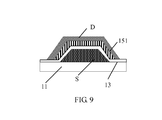
  • FIG. 9 is a cross section view of the pixel cell of FIG. 4 along the dashed line “CD”.
  • FIG. 10 is a flowchart of the manufacturing method of the TFT substrate in accordance with one embodiment.
  • FIGS. 11-12 is a flowchart of the manufacturing method of the TFT substrate of FIG. 10 .
  • FIG. 3 is a schematic view of the TFT substrate in accordance with one embodiment.
  • the TFT substrate 10 includes a plurality of pixel cells 110 .
  • the structure of the pixel cells 110 are substantially the same.
  • the structure of an pixel cell 110 will be taken as an example hereinafter.
  • FIG. 4 is a schematic view of one pixel cell of the TFT substrate of FIG. 3 .
  • FIG. 5 is a cross section view of the pixel cell of FIG. 4 along the dashed line “EF”.
  • FIG. 6 is an enlarged view of the area A of FIG. 5 .
  • FIG. 7 is an enlarged view of the area B of FIG. 5 .
  • the pixel cells 110 includes a substrate 11 , a gate electrode 12 , an active layer 14 , a BM 150 , a source electrode 16 , a drain electrode 17 , a second insulation layer 18 , and a pixel electrode 19 .
  • the gate electrode 12 is arranged on the substrate 11 .
  • the data line 13 and the active layer 14 are arranged on the gate electrode 12 in turn.
  • the BM 150 is arranged on the active layer 14 .
  • the source electrode 16 and the drain electrode 17 are arranged on the BM 150 .
  • the second insulation layer 18 is arranged on the source electrode 16 and the drain electrode 17 .
  • the pixel electrode 19 may be Indium Tin Oxide (ITO) transparent electrode arranged on the second insulation layer 18 .
  • the pixel electrode 19 electrically connects to the drain electrode 17 via the second insulation layer 18 . In other embodiments, the pixel electrode 19 may electrically connect to the source electrode 16 via the second insulation layer 18 .
  • ITO Indium Tin Oxide
  • the masking effect of the BM 150 may not be affected when the panel assembled by the TFT substrate 10 has been curved. As shown in FIG. 8 , the contrastness of the panel assembled by the TFT substrate 10 is enhanced.
  • the BM 150 may be made by black resin material, and the manufacturing temperature of the active layer 14 is usually 400 degrees. Under the temperature, the black resin material may greatly aging and may be carbonized to cause fire.
  • the BM 150 is formed after the active layer 14 is formed so as to avoid the above aging or fire issue. Not only the manufacturing process may be smoothly conducted, but also the performance of the BM 150 may be ensured.
  • FIG. 9 is a cross section view of the pixel cell of FIG. 4 along the dashed line “CD”.
  • the pixel cell 110 of the TFT substrate 10 also include a scanning line (S), a data line (D), and a BM 151 .
  • the scanning line (S) is arranged on the substrate 11 and is arranged on the same layer with the gate electrode 12 .
  • the data line 13 covers the scanning line (S).
  • the active layer 14 has not covered the scanning line (S).
  • the BM 151 is arranged on the scanning line (S) and is arranged on the same layer with the BM 150 .
  • the data line (D) is arranged on the BM 151 , and is arranged on the same layer with the source electrode 16 and the drain electrode 17 .
  • the BM 151 is arranged on the data line 13 .
  • the insulation between the data line (D) and the scanning line (S) has been increased, which decreases the coupling capacitance between the data line (D) and the scanning line (S). As such, the stability of the transmission between the data line (D) and the scanning line (S) is enhanced.
  • the pixel cell 110 of the TFT substrate 10 further includes capacitance electrodes 111 , 112 forming a common capacitance.
  • the capacitance electrode 112 is arranged on the substrate 11 , and is arranged on the same layer with the scanning line (S) and the gate electrode 12 .
  • the data line 13 further covers the capacitance electrode 112 .
  • the BM 151 is arranged on a corresponding capacitance electrode 112 of the first insulation layer 13 .
  • the capacitance electrode 111 is arranged on the BM 151 , and is arranged on the same layer with the source electrode 16 and the drain electrode 17 .
  • the second insulation layer 18 further covers the capacitance electrode 111 .
  • the pixel electrode 19 electrically connects to the capacitance electrode 111 via the second insulation layer 18 .
  • the BM 150 and the BM 151 are respectively formed with contacting holes M 1 , M 2 such that the source electrode 16 and the drain electrode 17 contact with the active layer 14 via the contacting hole M 1 on the BM 150 .
  • the capacitance electrode 111 contact with the first insulation layer 13 via the contacting hole M 2 on the BM 151 .
  • the TFT substrate 10 further includes a photoresist layer 113 and an insulation protection layer 114 .
  • the photoresist layer 113 is arranged between the second insulation layer 18 and the pixel electrode 19 .
  • the insulation protection layer 114 is arranged between the photoresist layer 113 and the pixel electrode 19 .
  • the photoresist layer 113 is made by red (R), green (G), and blue (B) materials. As the insulation protection layer 114 is formed on the photoresist layer 113 , the photoresist layer 113 and the components covered by the photoresist layer 113 may be well protected.
  • a first contacting hole M 3 and a second contacting hole M 4 are respectively formed are formed in locations on the photoresist layer 113 corresponding to the drain electrode 17 and the capacitance electrode 111 .
  • the second insulation layer 18 is exposed by the first contacting hole M 3 .
  • the second contacting hole M 4 passes through the second insulation layer 18 such that the capacitance electrode 111 is exposed.
  • the insulation protection layer 114 is arranged within the first contacting hole M 3 and the second contacting hole M 4 .
  • the insulation protection layer 114 within the first contacting hole M 3 and the second insulation layer 18 form a third contacting hole M 5 .
  • the third contacting hole M 5 exposes the drain electrode 17 .
  • the insulation protection layer 114 within the second contacting hole M 4 is arranged on the second insulation layer 18 in which the second contacting hole M 4 has not been covered.
  • the pixel electrode 19 electrically connects to the drain electrode 17 via the third contacting hole M 5 .
  • the pixel electrode 19 electrically connects to the capacitance electrode 111 via the second contacting hole M 4 .
  • the first contacting hole M 3 may be formed in a location on the photoresist layer 113 corresponding to the source electrode 16 so as to expose the second insulation layer 18 .
  • the third contacting hole M 5 is arranged corresponding to the location of the source electrode 16 .
  • the third contacting hole M 5 exposes the source electrode 16 .
  • the pixel electrode 19 electrically connects to the source electrode 16 via the third contacting hole M 5 .
  • the masking effect of the BM 150 may not be affected when the panel assembled by the TFT substrate 10 has been curved. As shown in FIG. 8 , the contrastness of the panel assembled by the TFT substrate 10 is enhanced.
  • the BM 151 is arranged between the data line (D) and the scanning line (S)
  • the insulation between the data line (D) and the scanning line (S) has been increased, which decreases the coupling capacitance between the data line (D) and the scanning line (S).
  • the stability of the transmission between the data line (D) and the scanning line (S) is enhanced.
  • FIG. 10 is a flowchart of the manufacturing method of the TFT substrate in accordance with one embodiment.
  • FIGS. 11-12 is a flowchart of the manufacturing method of the TFT substrate of FIG. 10 .
  • a substrate 11 is provided.
  • the gate electrode 12 is formed on the substrate 11 .
  • the capacitance electrode 112 and the scanning line (S) being arranged on the same layer with the gate electrode 12 is formed on the substrate 11
  • the first insulation layer 13 and the active layer 14 are formed on the gate electrode 12 in turn.
  • the first insulation layer 13 further covers the capacitance electrode 112 and the scanning line (S).
  • the active layer 14 has not covered the capacitance electrode 112 and the scanning line (S).
  • the BM 150 is formed on the active layer 14 .
  • the BM 151 being arranged on the same layer with the BM 150 is formed on the scanning line (S) and the capacitance electrode 112 .
  • the first insulation layer 13 covers the capacitance electrode 112 and the scanning line (S)
  • the BM 151 being arranged on the same layer with the BM 150 is respectively formed on the first insulation layer 13 corresponding to the scanning line (S) and the capacitance electrode 112 .
  • the source electrode 16 and the drain electrode 17 are formed on the BM 150 .
  • the data line (D) and the capacitance electrode 111 being arranged on the same layer with the source electrode 16 and the drain electrode 17 are formed on the BM 151 .
  • the BM 150 and the BM 151 are respectively formed with contacting holes M 1 , M 2 such that the source electrode 16 and the drain electrode 17 contact with the active layer 14 via the contacting hole M 1 on the BM 150 .
  • the capacitance electrode 111 contact with the first insulation layer 13 via the contacting hole M 2 on the BM 151 .
  • the second insulation layer 18 is formed on the source electrode 16 and the drain electrode 17 .
  • the second insulation layer 18 covers the data line (D) and the capacitance electrode 111 .
  • the pixel electrode 19 is formed on the second insulation layer 18 .
  • the pixel electrode 19 electrically connects to the source electrode 16 or the drain electrode 17 via the second insulation layer 18 .
  • the pixel electrode 19 electrically connects to the drain electrode 17 via the second insulation layer 18 .
  • the pixel electrode 19 electrically connects to the capacitance electrode 111 via the second insulation layer 18 .
  • the photoresist layer 113 is formed on the second insulation layer 18 .
  • the insulation protection layer 114 is formed on the photoresist layer 113 .
  • the pixel electrode 19 is formed on the insulation protection layer 114 . That is, the photoresist layer 113 is formed between the pixel electrode 19 and the second insulation layer 18 .
  • the insulation protection layer 114 is formed between the photoresist layer 113 and the insulation protection layer 114 . As the insulation protection layer 114 is formed on the photoresist layer 113 , the photoresist layer 113 and the components covered by the photoresist layer 113 may be well protected.
  • the pixel electrode 19 electrically connects to the drain electrode 17 and to the capacitance electrode 111 via the second insulation layer 18 . The detailed steps will be described hereinafter.
  • a first contacting hole M 3 and a second contacting hole M 4 are formed are respectively formed in locations on the photoresist layer 113 respectively corresponding to the drain electrode 17 and the capacitance electrode 111 .
  • the second insulation layer 18 is exposed by the first contacting hole M 3 .
  • the second contacting hole M 4 passes through the second insulation layer 18 such that the capacitance electrode 111 is exposed.
  • the insulation protection layer 114 When the insulation protection layer 114 is formed on the photoresist layer 113 , the insulation protection layer 114 is arranged within the first contacting hole M 3 and the second contacting hole M 4 at the same time.
  • the insulation protection layer 114 within the first contacting hole M 3 and the second insulation layer 18 form a third contacting hole M 5 .
  • the third contacting hole M 5 exposes the drain electrode 17 .
  • the insulation protection layer 114 within the second contacting hole M 4 is arranged on the second insulation layer 18 in which the second contacting hole M 4 has not been covered.
  • the pixel electrode 19 electrically connects to the drain electrode 17 via the third contacting hole M 5 .
  • the pixel electrode 19 electrically connects to the capacitance electrode 111 via the second contacting hole M 4 .
  • the first contacting hole M 3 may be formed in a location on the photoresist layer 113 corresponding to the source electrode 16 such that the third contacting hole M 5 corresponds to the location of the source electrode 16 . In this way, the pixel electrode 19 electrically connects to the source electrode 16 via the third contacting hole M 5 .
  • the masking effect of the BM 150 may not be affected when the panel assembled by the TFT substrate 10 has been curved. As shown in FIG. 8 , the contrastness of the panel assembled by the TFT substrate 10 is enhanced.
  • the BM 150 , 151 may be made by black resin material, and the manufacturing temperature of the active layer 14 is usually 400 degrees. Under the temperature, the black resin material may greatly aging and may be carbonized to cause fire.
  • the BM 150 , 151 are formed after the active layer 14 is formed so as to avoid the above aging or fire issue. Not only the manufacturing process may be smoothly conducted, but also the performance of the BM 150 , 151 may be ensured.
  • the BM 151 is arranged between the data line (D) and the scanning line (S)
  • the insulation between the data line (D) and the scanning line (S) has been increased, which decreases the coupling capacitance between the data line (D) and the scanning line (S).
  • the stability of the transmission between the data line (D) and the scanning line (S) is enhanced.

Landscapes

  • Physics & Mathematics (AREA)
  • Nonlinear Science (AREA)
  • Engineering & Computer Science (AREA)
  • Microelectronics & Electronic Packaging (AREA)
  • General Physics & Mathematics (AREA)
  • Optics & Photonics (AREA)
  • Crystallography & Structural Chemistry (AREA)
  • Chemical & Material Sciences (AREA)
  • Mathematical Physics (AREA)
  • Condensed Matter Physics & Semiconductors (AREA)
  • Computer Hardware Design (AREA)
  • Power Engineering (AREA)
  • Manufacturing & Machinery (AREA)
  • Liquid Crystal (AREA)
  • Devices For Indicating Variable Information By Combining Individual Elements (AREA)
  • Geometry (AREA)

Abstract

A TFT substrate and the manufacturing method thereof are disclosed. The method includes: providing a substrate; forming a gate electrode on the substrate; forming a first insulation layer and an active layer on the gate electrode in turn; forming a first black matrix on the active layer; forming a source electrode and a drain electrode on the first black matrix; forming a second insulation layer on the source electrode and the drain electrode; and forming a pixel electrode on the second insulation layer. The pixel electrode is electrically connected to the source electrode or the drain electrode via the second insulation layer. In this way, the masking effect of the display panel assembled by the TFT substrate can be ensured. In addition, the coupling capacitance between the data line and the scanning line may be reduced.

Description

BACKGROUND OF THE INVENTION
1. Field of the Invention
The present disclosure relates to liquid crystal display technology, and more particularly to a thin film transistor (TFT) substrate and the manufacturing method thereof.
2. Discussion of the Related Art
Curved TVs typically are characterized by attributes including better contrastness, a wider viewing angle, and better user experience, and thus are very popular to customers.
As the panel is curved to some degree, displacement may occur between the TFT substrate and the color filter (CF) substrate, which affects masking effects of the black matrix (BM) arranged on the CF substrate. FIG. 1 shows the masking effect of the BM 101 when the panel 100 has not been curved. FIG. 2 shows the masking effect of the BM 101 when the panel 100 has been curved. It can be seen from FIGS. 1 and 2 that a portion of light beams may emit out from a lateral side of the BM 101 after the panel 100 is curved. The light leakage effect affects the masking effect of the BM 101 such that the contrastness of the panel 100 is lowered down.
SUMMARY
A TFT substrate and the manufacturing method thereof can ensure the masking effect and can reduce the coupling capacitance between the data line and the scanning line may be reduced.
In one aspect, a manufacturing method of a TFT substrate includes: providing a substrate; forming a gate electrode on the substrate; forming a first insulation layer and an active layer on the gate electrode in turn; forming a first black matrix on the active layer; forming a source electrode and a drain electrode on the first black matrix;
forming a second insulation layer on the source electrode and the drain electrode; forming a pixel electrode on the second insulation layer, the pixel electrode being electrically connected to the source electrode or the drain electrode via the second insulation layer; wherein the step of forming the gate electrode further comprises forming at least one scanning line on the substrate, the scanning line being arranged on the same layer with the gate electrode, and wherein the first insulation layer further covers the scanning line, and the active layer has not covered the scanning line; wherein the step of forming the first black matrix further comprises forming a second black matrix on the scanning line, and the second black matrix being arranged on the same layer with the first black matrix; wherein the step of forming the source electrode and the drain electrode on the first black matrix further comprises forming a capacitance electrode on the second black matrix, the capacitance electrode being arranged on the same layer with the source electrode and the drain electrode, wherein the second insulation layer further covers the capacitance electrode, and the pixel electrode being electrically connected to the capacitance electrode via the second insulation layer; and wherein the first black matrix and the second matrix are made by black resin material.
Wherein the step of forming the first black matrix on the active layer further comprises: forming contacting holes respectively on the first black matrix and the second black matrix such that the source electrode and the drain electrode being contacted with the active layer via the contacting hole on the first black matrix, and the capacitance electrode being contacted with the first insulation layer via the contacting hole on the second black matrix.
Wherein the method further comprises: forming a photoresist layer between the pixel electrode and the second insulation layer; and forming an insulation protection layer between the photoresist layer and the pixel electrode.
Wherein the step of forming the photoresist layer between the pixel electrode and the second insulation layer further comprises forming a first contacting hold and a second contacting hole respectively in locations on the photoresist layer corresponding to the source or drain electrode and the capacitance electrode, wherein the second insulation layer being exposed by the first contacting hole, and the second contacting hole being passed through the second insulation layer such that the capacitance electrode being exposed; wherein the step of forming the insulation protection layer between the photoresist layer and the pixel electrode further comprises: forming the insulation protection layer within the first contacting hole and the second contacting hole;
forming a third contacting hole within the insulation protection layer of the first contacting hole and the second contacting hole, the insulation protection layer within the second contacting hole being arranged on the second insulation layer, wherein the pixel electrode being electrically connected to the drain electrode or the source electrode via the third contacting hole, and the pixel electrode being electrically connected to the capacitance electrode via the second contacting hole.
In another aspect, a manufacturing method of a TFT substrate includes: providing a substrate; forming a gate electrode on the substrate; forming a first insulation layer and an active layer on the gate electrode in turn; forming a first black matrix on the active layer; forming a source electrode and a drain electrode on the first black matrix; forming a second insulation layer on the source electrode and the drain electrode; and
forming a pixel electrode on the second insulation layer, the pixel electrode being electrically connected to the source electrode or the drain electrode via the second insulation layer.
Wherein the step of forming the gate electrode further comprises forming at least one scanning line on the substrate, the scanning line being arranged on the same layer with the gate electrode, and wherein the first insulation layer further covers the scanning line, and the active layer has not covered the scanning line; wherein the step of forming the first black matrix further comprises forming a second black matrix on the scanning line, and the second black matrix being arranged on the same layer with the first black matrix; and wherein the step of forming the source electrode and the drain electrode on the first black matrix further comprises forming a capacitance electrode on the second black matrix, the capacitance electrode being arranged on the same layer with the source electrode and the drain electrode, wherein the second insulation layer further covers the capacitance electrode, and the pixel electrode being electrically connected to the capacitance electrode via the second insulation layer.
Wherein the step of forming the first black matrix on the active layer further comprises: forming contacting holes respectively on the first black matrix and the second black matrix such that the source electrode and the drain electrode being contacted with the active layer via the contacting hole on the first black matrix, and the capacitance electrode being contacted with the first insulation layer via the contacting hole on the second black matrix.
Wherein forming a photoresist layer between the pixel electrode and the second insulation layer; and forming an insulation protection layer between the photoresist layer and the pixel electrode.
Wherein the step of forming the photoresist layer between the pixel electrode and the second insulation layer further comprises forming a first contacting hold and a second contacting hole respectively in locations on the photoresist layer corresponding to the source or drain electrode and the capacitance electrode, wherein the second insulation layer being exposed by the first contacting hole, and the second contacting hole being passed through the second insulation layer such that the capacitance electrode being exposed; wherein the step of forming the insulation protection layer between the photoresist layer and the pixel electrode further comprises: forming the insulation protection layer within the first contacting hole and the second contacting hole; forming a third contacting hole within the insulation protection layer of the first contacting hole and the third contacting hole, the insulation protection layer within the second contacting hole being arranged on the second insulation layer, wherein the pixel electrode being electrically connected to the drain electrode or the source electrode via the third contacting hole, and the pixel electrode being electrically connected to the capacitance electrode via the second contacting hole.
In another aspect, a TFT substrate includes: a substrate; a gate electrode being arranged on the substrate; a first insulation layer and an active layer being arranged on the gate electrode in turn; a first black matrix being arranged on the active layer; a source electrode and a drain electrode being arranged on the first black matrix; a second insulation layer being arranged on the source electrode and the drain electrode; and a pixel electrode being arranged on the second insulation layer, and he pixel electrode being electrically connected to the source electrode or the drain electrode via the second insulation layer.
Wherein the TFT substrate further comprises: a scanning line being arranged on the same layer with the gate electrode on the substrate, the first insulation layer further covers the scanning line, and the active layer has not covered the scanning line; a second black matrix being arranged on the scanning line, and the second black matrix being arranged on the same layer with the first black matrix; and an capacitance electrode being arranged on the second black matrix, the capacitance electrode being arranged on the same layer with the source electrode and the drain electrode, and the pixel electrode being electrically connected to the capacitance electrode via the second insulation layer.
Wherein the first black matrix and the second black matrix respectively comprises contacting holes such that the source electrode and the drain electrode being contacted with the active layer via the contacting hole on the first black matrix, and the capacitance electrode being contacted with the first insulation layer via the contacting hole on the second black matrix.
Wherein the TFT substrate further comprises: a photoresist layer being arranged between the pixel electrode and the second insulation layer; and an insulation protection layer being arranged between the photoresist layer and the pixel electrode.
Wherein a first contacting hold and a second contacting hole are respectively formed in locations on the photoresist layer corresponding to the source or drain electrode and the capacitance electrode, wherein the second insulation layer being exposed by the first contacting hole, and the second contacting hole being passed through the second insulation layer such that the capacitance electrode being exposed; the insulation protection layer is formed within the first contacting hole and the second contacting hole; a third contacting hole is formed within the insulation protection layer of the first contacting hole and the second contacting hole, the insulation protection layer within the second contacting hole being arranged on the second insulation layer, wherein the pixel electrode being electrically connected to the drain electrode or the source electrode via the third contacting hole, and the pixel electrode being electrically connected to the capacitance electrode via the second contacting hole.
In view of the above, by arranging the black matrix on the active layer and by forming the source electrode and drain electrode on the black matrix, the black matrix is capable of masking the corresponding lights even the panel has been curved.
BRIEF DESCRIPTION OF THE DRAWINGS
FIG. 1 shows the masking effect of the BM when the panel has not been curved.
FIG. 2 shows the masking effect of the BM when the panel has been curved.
FIG. 3 is a schematic view of the TFT substrate in accordance with one embodiment.
FIG. 4 is a schematic view of one pixel cell of the TFT substrate of FIG. 3.
FIG. 5 is a cross section view of the pixel cell of FIG. 4 along the dashed line “EF”.
FIG. 6 is an enlarged view of the area A of FIG. 5.
FIG. 7 is an enlarged view of the area B of FIG. 5.
FIG. 8 shows the masking effect of the BM 101 when the panel assembled by the TFT substrate has been curved.
FIG. 9 is a cross section view of the pixel cell of FIG. 4 along the dashed line “CD”.
FIG. 10 is a flowchart of the manufacturing method of the TFT substrate in accordance with one embodiment.
FIGS. 11-12 is a flowchart of the manufacturing method of the TFT substrate of FIG. 10.
DETAILED DESCRIPTION OF THE EMBODIMENTS
Embodiments of the invention will now be described more fully hereinafter with reference to the accompanying drawings, in which embodiments of the invention are shown.
FIG. 3 is a schematic view of the TFT substrate in accordance with one embodiment. The TFT substrate 10 includes a plurality of pixel cells 110. The structure of the pixel cells 110 are substantially the same. The structure of an pixel cell 110 will be taken as an example hereinafter.
FIG. 4 is a schematic view of one pixel cell of the TFT substrate of FIG. 3. FIG. 5 is a cross section view of the pixel cell of FIG. 4 along the dashed line “EF”. FIG. 6 is an enlarged view of the area A of FIG. 5. FIG. 7 is an enlarged view of the area B of FIG. 5. Referring to FIGS. 4 and 5, the pixel cells 110 includes a substrate 11, a gate electrode 12, an active layer 14, a BM 150, a source electrode 16, a drain electrode 17, a second insulation layer 18, and a pixel electrode 19.
The gate electrode 12 is arranged on the substrate 11. The data line 13 and the active layer 14 are arranged on the gate electrode 12 in turn. The BM 150 is arranged on the active layer 14. The source electrode 16 and the drain electrode 17 are arranged on the BM 150. The second insulation layer 18 is arranged on the source electrode 16 and the drain electrode 17. The pixel electrode 19 may be Indium Tin Oxide (ITO) transparent electrode arranged on the second insulation layer 18. The pixel electrode 19 electrically connects to the drain electrode 17 via the second insulation layer 18. In other embodiments, the pixel electrode 19 may electrically connect to the source electrode 16 via the second insulation layer 18.
Thus, in the embodiment, as the BM 150 is arranged on the side of the TFT substrate 10, the masking effect of the BM 150 may not be affected when the panel assembled by the TFT substrate 10 has been curved. As shown in FIG. 8, the contrastness of the panel assembled by the TFT substrate 10 is enhanced.
On the other hand, as the BM 150 may be made by black resin material, and the manufacturing temperature of the active layer 14 is usually 400 degrees. Under the temperature, the black resin material may greatly aging and may be carbonized to cause fire. By arranging the BM 150 on the active layer 14, the BM 150 is formed after the active layer 14 is formed so as to avoid the above aging or fire issue. Not only the manufacturing process may be smoothly conducted, but also the performance of the BM 150 may be ensured.
FIG. 9 is a cross section view of the pixel cell of FIG. 4 along the dashed line “CD”. As shown in FIGS. 4 and 9, the pixel cell 110 of the TFT substrate 10 also include a scanning line (S), a data line (D), and a BM 151.
The scanning line (S) is arranged on the substrate 11 and is arranged on the same layer with the gate electrode 12. The data line 13 covers the scanning line (S). The active layer 14 has not covered the scanning line (S). The BM 151 is arranged on the scanning line (S) and is arranged on the same layer with the BM 150. The data line (D) is arranged on the BM 151, and is arranged on the same layer with the source electrode 16 and the drain electrode 17. In the embodiment, as the data line 13 covers the scanning line (S), the BM 151 is arranged on the data line 13. In the embodiment, as the BM 151 is arranged between the data line (D) and the scanning line (S), the insulation between the data line (D) and the scanning line (S) has been increased, which decreases the coupling capacitance between the data line (D) and the scanning line (S). As such, the stability of the transmission between the data line (D) and the scanning line (S) is enhanced.
Also referring to FIG. 5, the pixel cell 110 of the TFT substrate 10 further includes capacitance electrodes 111, 112 forming a common capacitance. The capacitance electrode 112 is arranged on the substrate 11, and is arranged on the same layer with the scanning line (S) and the gate electrode 12. The data line 13 further covers the capacitance electrode 112. The BM 151 is arranged on a corresponding capacitance electrode 112 of the first insulation layer 13. The capacitance electrode 111 is arranged on the BM 151, and is arranged on the same layer with the source electrode 16 and the drain electrode 17. The second insulation layer 18 further covers the capacitance electrode 111. The pixel electrode 19 electrically connects to the capacitance electrode 111 via the second insulation layer 18.
Also referring to FIGS. 6 and 7, the BM 150 and the BM 151 are respectively formed with contacting holes M1, M2 such that the source electrode 16 and the drain electrode 17 contact with the active layer 14 via the contacting hole M1 on the BM 150. In addition, the capacitance electrode 111 contact with the first insulation layer 13 via the contacting hole M2 on the BM 151.
In the embodiment, the TFT substrate 10 further includes a photoresist layer 113 and an insulation protection layer 114. The photoresist layer 113 is arranged between the second insulation layer 18 and the pixel electrode 19. The insulation protection layer 114 is arranged between the photoresist layer 113 and the pixel electrode 19. The photoresist layer 113 is made by red (R), green (G), and blue (B) materials. As the insulation protection layer 114 is formed on the photoresist layer 113, the photoresist layer 113 and the components covered by the photoresist layer 113 may be well protected.
A first contacting hole M3 and a second contacting hole M4 are respectively formed are formed in locations on the photoresist layer 113 corresponding to the drain electrode 17 and the capacitance electrode 111. The second insulation layer 18 is exposed by the first contacting hole M3. The second contacting hole M4 passes through the second insulation layer 18 such that the capacitance electrode 111 is exposed.
The insulation protection layer 114 is arranged within the first contacting hole M3 and the second contacting hole M4. The insulation protection layer 114 within the first contacting hole M3 and the second insulation layer 18 form a third contacting hole M5. The third contacting hole M5 exposes the drain electrode 17. The insulation protection layer 114 within the second contacting hole M4 is arranged on the second insulation layer 18 in which the second contacting hole M4 has not been covered. The pixel electrode 19 electrically connects to the drain electrode 17 via the third contacting hole M5. In addition, the pixel electrode 19 electrically connects to the capacitance electrode 111 via the second contacting hole M4.
In other embodiments, the first contacting hole M3 may be formed in a location on the photoresist layer 113 corresponding to the source electrode 16 so as to expose the second insulation layer 18. Similarly, the third contacting hole M5 is arranged corresponding to the location of the source electrode 16. The third contacting hole M5 exposes the source electrode 16. The pixel electrode 19 electrically connects to the source electrode 16 via the third contacting hole M5.
As stated above, in the embodiment, as the BM 150 is arranged on the side of the TFT substrate 10, the masking effect of the BM 150 may not be affected when the panel assembled by the TFT substrate 10 has been curved. As shown in FIG. 8, the contrastness of the panel assembled by the TFT substrate 10 is enhanced.
On the other hand, as the BM 151 is arranged between the data line (D) and the scanning line (S), the insulation between the data line (D) and the scanning line (S) has been increased, which decreases the coupling capacitance between the data line (D) and the scanning line (S). As such, the stability of the transmission between the data line (D) and the scanning line (S) is enhanced.
FIG. 10 is a flowchart of the manufacturing method of the TFT substrate in accordance with one embodiment. FIGS. 11-12 is a flowchart of the manufacturing method of the TFT substrate of FIG. 10.
In block S1, a substrate 11 is provided. In block S2, the gate electrode 12 is formed on the substrate 11. In addition, as shown in FIG. 12, the capacitance electrode 112 and the scanning line (S) being arranged on the same layer with the gate electrode 12 is formed on the substrate 11
In block S3, the first insulation layer 13 and the active layer 14 are formed on the gate electrode 12 in turn. In addition, the first insulation layer 13 further covers the capacitance electrode 112 and the scanning line (S). The active layer 14 has not covered the capacitance electrode 112 and the scanning line (S).
In block S4, the BM 150 is formed on the active layer 14. In addition, the BM 151 being arranged on the same layer with the BM 150 is formed on the scanning line (S) and the capacitance electrode 112. As the first insulation layer 13 covers the capacitance electrode 112 and the scanning line (S), the BM 151 being arranged on the same layer with the BM 150 is respectively formed on the first insulation layer 13 corresponding to the scanning line (S) and the capacitance electrode 112.
In block S5, the source electrode 16 and the drain electrode 17 are formed on the BM 150. In addition, as shown in FIG. 12, the data line (D) and the capacitance electrode 111 being arranged on the same layer with the source electrode 16 and the drain electrode 17 are formed on the BM 151.
In block S4, the BM 150 and the BM 151 are respectively formed with contacting holes M1, M2 such that the source electrode 16 and the drain electrode 17 contact with the active layer 14 via the contacting hole M1 on the BM 150. In addition, the capacitance electrode 111 contact with the first insulation layer 13 via the contacting hole M2 on the BM 151.
In block S6, the second insulation layer 18 is formed on the source electrode 16 and the drain electrode 17. The second insulation layer 18 covers the data line (D) and the capacitance electrode 111.
In block S7, the pixel electrode 19 is formed on the second insulation layer 18. The pixel electrode 19 electrically connects to the source electrode 16 or the drain electrode 17 via the second insulation layer 18.
In the embodiment, the pixel electrode 19 electrically connects to the drain electrode 17 via the second insulation layer 18. The pixel electrode 19 electrically connects to the capacitance electrode 111 via the second insulation layer 18.
In addition, before the pixel electrode 19 is formed, the photoresist layer 113 is formed on the second insulation layer 18. The insulation protection layer 114 is formed on the photoresist layer 113. Lastly, the pixel electrode 19 is formed on the insulation protection layer 114. That is, the photoresist layer 113 is formed between the pixel electrode 19 and the second insulation layer 18. The insulation protection layer 114 is formed between the photoresist layer 113 and the insulation protection layer 114. As the insulation protection layer 114 is formed on the photoresist layer 113, the photoresist layer 113 and the components covered by the photoresist layer 113 may be well protected.
In the embodiment, the pixel electrode 19 electrically connects to the drain electrode 17 and to the capacitance electrode 111 via the second insulation layer 18. The detailed steps will be described hereinafter.
A first contacting hole M3 and a second contacting hole M4 are formed are respectively formed in locations on the photoresist layer 113 respectively corresponding to the drain electrode 17 and the capacitance electrode 111. The second insulation layer 18 is exposed by the first contacting hole M3. The second contacting hole M4 passes through the second insulation layer 18 such that the capacitance electrode 111 is exposed.
When the insulation protection layer 114 is formed on the photoresist layer 113, the insulation protection layer 114 is arranged within the first contacting hole M3 and the second contacting hole M4 at the same time. The insulation protection layer 114 within the first contacting hole M3 and the second insulation layer 18 form a third contacting hole M5. The third contacting hole M5 exposes the drain electrode 17. The insulation protection layer 114 within the second contacting hole M4 is arranged on the second insulation layer 18 in which the second contacting hole M4 has not been covered. The pixel electrode 19 electrically connects to the drain electrode 17 via the third contacting hole M5. In addition, the pixel electrode 19 electrically connects to the capacitance electrode 111 via the second contacting hole M4.
In other embodiments, the first contacting hole M3 may be formed in a location on the photoresist layer 113 corresponding to the source electrode 16 such that the third contacting hole M5 corresponds to the location of the source electrode 16. In this way, the pixel electrode 19 electrically connects to the source electrode 16 via the third contacting hole M5.
In view of the above, in the embodiment, as the BM 150 is arranged on the side of the TFT substrate 10, the masking effect of the BM 150 may not be affected when the panel assembled by the TFT substrate 10 has been curved. As shown in FIG. 8, the contrastness of the panel assembled by the TFT substrate 10 is enhanced.
On the other hand, as the BM 150, 151 may be made by black resin material, and the manufacturing temperature of the active layer 14 is usually 400 degrees. Under the temperature, the black resin material may greatly aging and may be carbonized to cause fire. By arranging the BM 150, 151 on the active layer 14, the BM 150, 151 are formed after the active layer 14 is formed so as to avoid the above aging or fire issue. Not only the manufacturing process may be smoothly conducted, but also the performance of the BM 150, 151 may be ensured.
In addition, as the BM 151 is arranged between the data line (D) and the scanning line (S), the insulation between the data line (D) and the scanning line (S) has been increased, which decreases the coupling capacitance between the data line (D) and the scanning line (S). As such, the stability of the transmission between the data line (D) and the scanning line (S) is enhanced.
It is believed that the present embodiments and their advantages will be understood from the foregoing description, and it will be apparent that various changes may be made thereto without departing from the spirit and scope of the invention or sacrificing all of its material advantages, the examples hereinbefore described merely being preferred or exemplary embodiments of the invention.

Claims (6)

What is claimed is:
1. A manufacturing method of a thin film transistor (TFT) substrate, comprising:
providing a substrate;
forming a gate electrode on the substrate;
forming a first insulation layer and an active layer on the gate electrode in turn;
forming a first black matrix on the active layer;
forming a source electrode and a drain electrode on the first black matrix;
forming a second insulation layer on the source electrode and the drain electrode;
forming a pixel electrode on the second insulation layer, the pixel electrode being electrically connected to the source electrode or the drain electrode via the second insulation layer;
wherein the step of forming the gate electrode further comprises forming at least one scanning line on the substrate, the scanning line being arranged on the same layer with the gate electrode, and wherein the first insulation layer further covers the scanning line, and the active layer has not covered the scanning line;
wherein the step of forming the first black matrix further comprises forming a second black matrix on the scanning line, and the second black matrix being arranged on the same layer with the first black matrix;
wherein the step of forming the source electrode and the drain electrode on the first black matrix further comprises forming a capacitance electrode on the second black matrix, the capacitance electrode being arranged on the same layer with the source electrode and the drain electrode, wherein the second insulation layer further covers the capacitance electrode, and the pixel electrode being electrically connected to the capacitance electrode via the second insulation layer; and
wherein the first black matrix and the second matrix are made by black resin material; the method further comprises:
forming a photoresist layer between the pixel electrode and the second insulation layer; and
forming an insulation protection layer between the photoresist layer and the pixel electrode;
wherein the step of forming the photoresist layer between the pixel electrode and the second insulation layer further comprises forming a first contacting hole and a second contacting hole respectively in locations on the photoresist layer corresponding to the source or drain electrode and the capacitance electrode, wherein the second insulation layer being exposed by the first contacting hole, and the second contacting hole being passed through the second insulation layer such that the capacitance electrode being exposed;
wherein the step of forming the insulation protection layer between the photoresist layer and the pixel electrode further comprises:
forming the insulation protection layer within the first contacting hole and the second contacting hole;
forming a third contacting hole within the insulation protection layer of the first contacting hole and the second contacting hole, the insulation protection layer within the second contacting hole being arranged on the second insulation layer, wherein the pixel electrode being electrically connected to the drain electrode or the source electrode via the third contacting hole, and the pixel electrode being electrically connected to the capacitance electrode via the second contacting hole.
2. The method as claimed in claim 1, wherein the step of forming the first black matrix on the active layer further comprises:
forming contacting holes respectively on the first black matrix and the second black matrix such that the source electrode and the drain electrode being contacted with the active layer via the contacting hole on the first black matrix, and the capacitance electrode being contacted with the first insulation layer via the contacting hole on the second black matrix.
3. A manufacturing method of a thin film transistor (TFT) substrate, comprising:
providing a substrate;
forming a gate electrode on the substrate;
forming a first insulation layer and an active layer on the gate electrode in turn;
forming a first black matrix on the active layer;
forming a source electrode and a drain electrode on the first black matrix;
forming a second insulation layer on the source electrode and the drain electrode; and
forming a pixel electrode on the second insulation layer, the pixel electrode being electrically connected to the source electrode or the drain electrode via the second insulation layer;
wherein the step of forming the gate electrode further comprises:
forming at least one scanning line on the substrate, the scanning line being arranged on the same layer with the gate electrode, and wherein the first insulation layer further covers the scanning line, and the active layer has not covered the scanning line;
wherein the step of forming the first black matrix further comprises forming a second black matrix on the scanning line, and the second black matrix being arranged on the same layer with the first black matrix; and
wherein the step of forming the source electrode and the drain electrode on the first black matrix further comprises forming a capacitance electrode on the second black matrix, the capacitance electrode being arranged on the same layer with the source electrode and the drain electrode, wherein the second insulation layer further covers the capacitance electrode, and the pixel electrode being electrically connected to the capacitance electrode via the second insulation layer;
wherein the method further comprises:
forming a photoresist layer between the pixel electrode and the second insulation layer; and
forming an insulation protection layer between the photoresist layer and the pixel electrode;
wherein the step of forming the photoresist layer between the pixel electrode and the second insulation layer further comprises forming a first contacting hole and a second contacting hole respectively in locations on the photoresist layer corresponding to the source or drain electrode and the capacitance electrode, wherein the second insulation layer being exposed by the first contacting hole, and the second contacting hole being passed through the second insulation layer such that the capacitance electrode being exposed;
wherein the step of forming the insulation protection layer between the photoresist layer and the pixel electrode further comprises:
forming the insulation protection layer within the first contacting hole and the second contacting hole;
forming a third contacting hole within the insulation protection layer of the first contacting hole and the third contacting hole, the insulation protection layer within the second contacting hole being arranged on the second insulation layer, wherein the pixel electrode being electrically connected to the drain electrode or the source electrode via the third contacting hole, and the pixel electrode being electrically connected to the capacitance electrode via the second contacting hole.
4. The method as claimed in claim 3, wherein the step of forming the first black matrix on the active layer further comprises:
forming contacting holes respectively on the first black matrix and the second black matrix such that the source electrode and the drain electrode being contacted with the active layer via the contacting hole on the first black matrix, and the capacitance electrode being contacted with the first insulation layer via the contacting hole on the second black matrix.
5. A thin film transistor (TFT) substrate, comprising:
a substrate;
a gate electrode being arranged on the substrate;
a first insulation layer and an active layer being arranged on the gate electrode in turn;
a first black matrix being arranged on the active layer;
a source electrode and a drain electrode being arranged on the first black matrix;
a second insulation layer being arranged on the source electrode and the drain electrode; and
a pixel electrode being arranged on the second insulation layer, and he pixel electrode being electrically connected to the source electrode or the drain electrode via the second insulation layer;
wherein the TFT substrate further comprises:
a scanning line being arranged on the same layer with the gate electrode on the substrate, the first insulation layer further covers the scanning line, and the active layer has not covered the scanning line;
a second black matrix being arranged on the scanning line, and the second black matrix being arranged on the same layer with the first black matrix; and
an capacitance electrode being arranged on the second black matrix, the capacitance electrode being arranged on the same layer with the source electrode and the drain electrode, and the pixel electrode being electrically connected to the capacitance electrode via the second insulation layer;
wherein the TFT substrate further comprises:
a photoresist layer being arranged between the pixel electrode and the second insulation layer; and
an insulation protection layer being arranged between the photoresist layer and the pixel electrode;
wherein a first contacting hole and a second contacting hole are respectively formed in locations on the photoresist layer corresponding to the source or drain electrode and the capacitance electrode, wherein the second insulation layer being exposed by the first contacting hole, and the second contacting hole being passed through the second insulation layer such that the capacitance electrode being exposed;
the insulation protection layer is formed within the first contacting hole and the second contacting hole;
a third contacting hole is formed within the insulation protection layer of the first contacting hole and the second contacting hole, the insulation protection layer within the second contacting hole being arranged on the second insulation layer, wherein the pixel electrode being electrically connected to the drain electrode or the source electrode via the third contacting hole, and the pixel electrode being electrically connected to the capacitance electrode via the second contacting hole.
6. The TFT substrate as claimed in claim 5, wherein the first black matrix and the second black matrix respectively comprises contacting holes such that the source electrode and the drain electrode being contacted with the active layer via the contacting hole on the first black matrix, and the capacitance electrode being contacted with the first insulation layer via the contacting hole on the second black matrix.
US14/433,630 2014-11-26 2014-12-09 TFT substrates and the manufacturing method thereof Active 2035-03-22 US9564458B2 (en)

Applications Claiming Priority (4)

Application Number Priority Date Filing Date Title
CN201410698801 2014-11-26
CN201410698801X 2014-11-26
CN201410698801.XA CN104360529B (en) 2014-11-26 2014-11-26 TFT (thin film transistor) substrate and manufacturing method thereof
PCT/CN2014/093349 WO2016082250A1 (en) 2014-11-26 2014-12-09 Tft substrate and manufacturing method therefor

Publications (2)

Publication Number Publication Date
US20160148956A1 US20160148956A1 (en) 2016-05-26
US9564458B2 true US9564458B2 (en) 2017-02-07

Family

ID=56010989

Family Applications (1)

Application Number Title Priority Date Filing Date
US14/433,630 Active 2035-03-22 US9564458B2 (en) 2014-11-26 2014-12-09 TFT substrates and the manufacturing method thereof

Country Status (1)

Country Link
US (1) US9564458B2 (en)

Families Citing this family (1)

* Cited by examiner, † Cited by third party
Publication number Priority date Publication date Assignee Title
CN110634451B (en) * 2018-06-25 2023-04-11 矽创电子股份有限公司 Driving method and driving circuit thereof

Citations (3)

* Cited by examiner, † Cited by third party
Publication number Priority date Publication date Assignee Title
KR100495793B1 (en) * 1997-10-07 2005-09-02 삼성전자주식회사 Thin film transistor substrate and manufacturing method for liquid crystal display
US20090206339A1 (en) * 2008-02-19 2009-08-20 Sung Jin Park Flat display device and method for manufacturing the same
US7645649B1 (en) * 2008-07-07 2010-01-12 Au Optronics Corporation Method for fabricating pixel structure

Patent Citations (3)

* Cited by examiner, † Cited by third party
Publication number Priority date Publication date Assignee Title
KR100495793B1 (en) * 1997-10-07 2005-09-02 삼성전자주식회사 Thin film transistor substrate and manufacturing method for liquid crystal display
US20090206339A1 (en) * 2008-02-19 2009-08-20 Sung Jin Park Flat display device and method for manufacturing the same
US7645649B1 (en) * 2008-07-07 2010-01-12 Au Optronics Corporation Method for fabricating pixel structure

Also Published As

Publication number Publication date
US20160148956A1 (en) 2016-05-26

Similar Documents

Publication Publication Date Title
US9673231B2 (en) Array substrate having via-hole conductive layer and display device
US10303021B2 (en) BOA liquid crystal display panel and manufacturing method thereof
KR101985481B1 (en) Display device and method of manufacturing the same
US20160342048A1 (en) Thin film transistor array substrate, liquid crystal panel and liquid crystal display device
US9335597B2 (en) Array substrate and manufacturing method thereof, liquid crystal display panel, and display device
US9146430B2 (en) Pixel structure and liquid crystal display panel having the same
US9366923B2 (en) Array substrate and method of fabricating the same, and display device
US20180188581A1 (en) Array substrates and the manufacturing methods thereof, and liquid crystal panels
CN104749841B (en) Thin-film transistor array base-plate and its manufacture method
CN105446031B (en) Display panel and display device
US20170059919A1 (en) Display Motherboard and Manufacturing Method Thereof, Display Panel and Display Device
KR101951725B1 (en) Display substrate, method of manufacturing the same and display apparatus having the same
CN105652526A (en) Display panel
US20140002764A1 (en) Liquid crystal display and method of manufacturing the same
CN105182610A (en) Display substrate, manufacturing method thereof and display device
US10042196B2 (en) Display and method for manufacturing display
US20150362771A1 (en) Color filter array substrate, display device and manufacturing method of color filter array substrate
CN204462602U (en) Array base palte and display device
US20160274427A1 (en) Tft substrate and method for manufacturing the same
US20150116640A1 (en) Liquid crystal component, method for fabricating the same, and liquid crystal display having the same
CN104360529B (en) TFT (thin film transistor) substrate and manufacturing method thereof
US20120081273A1 (en) Pixel structure, pixel array and display panel
US9564458B2 (en) TFT substrates and the manufacturing method thereof
US20150372201A1 (en) Array panel and manufacturing method for the same
KR20120004194A (en) Liquid crystal display panel and its manufacturing method

Legal Events

Date Code Title Description
AS Assignment

Owner name: SHENZHEN CHINA STAR OPTOELECTRONICS TECHNOLOGY CO.

Free format text: ASSIGNMENT OF ASSIGNORS INTEREST;ASSIGNORS:LIEN, SHUI-CHIH;XIONG, YUAN;SIGNING DATES FROM 20141217 TO 20150215;REEL/FRAME:035333/0766

FEPP Fee payment procedure

Free format text: PAYOR NUMBER ASSIGNED (ORIGINAL EVENT CODE: ASPN); ENTITY STATUS OF PATENT OWNER: LARGE ENTITY

STCF Information on status: patent grant

Free format text: PATENTED CASE

MAFP Maintenance fee payment

Free format text: PAYMENT OF MAINTENANCE FEE, 4TH YEAR, LARGE ENTITY (ORIGINAL EVENT CODE: M1551); ENTITY STATUS OF PATENT OWNER: LARGE ENTITY

Year of fee payment: 4

MAFP Maintenance fee payment

Free format text: PAYMENT OF MAINTENANCE FEE, 8TH YEAR, LARGE ENTITY (ORIGINAL EVENT CODE: M1552); ENTITY STATUS OF PATENT OWNER: LARGE ENTITY

Year of fee payment: 8