US9560390B2 - Asynchronous encoding of digital content - Google Patents
Asynchronous encoding of digital content Download PDFInfo
- Publication number
- US9560390B2 US9560390B2 US14/324,836 US201414324836A US9560390B2 US 9560390 B2 US9560390 B2 US 9560390B2 US 201414324836 A US201414324836 A US 201414324836A US 9560390 B2 US9560390 B2 US 9560390B2
- Authority
- US
- United States
- Prior art keywords
- user
- symbols
- symbol
- requested
- users
- Prior art date
- Legal status (The legal status is an assumption and is not a legal conclusion. Google has not performed a legal analysis and makes no representation as to the accuracy of the status listed.)
- Expired - Fee Related, expires
Links
Images


Classifications
-
- H—ELECTRICITY
- H04—ELECTRIC COMMUNICATION TECHNIQUE
- H04N—PICTORIAL COMMUNICATION, e.g. TELEVISION
- H04N21/00—Selective content distribution, e.g. interactive television or video on demand [VOD]
- H04N21/20—Servers specifically adapted for the distribution of content, e.g. VOD servers; Operations thereof
- H04N21/23—Processing of content or additional data; Elementary server operations; Server middleware
- H04N21/231—Content storage operation, e.g. caching movies for short term storage, replicating data over plural servers, prioritizing data for deletion
- H04N21/23106—Content storage operation, e.g. caching movies for short term storage, replicating data over plural servers, prioritizing data for deletion involving caching operations
-
- H—ELECTRICITY
- H04—ELECTRIC COMMUNICATION TECHNIQUE
- H04N—PICTORIAL COMMUNICATION, e.g. TELEVISION
- H04N21/00—Selective content distribution, e.g. interactive television or video on demand [VOD]
- H04N21/20—Servers specifically adapted for the distribution of content, e.g. VOD servers; Operations thereof
- H04N21/23—Processing of content or additional data; Elementary server operations; Server middleware
- H04N21/234—Processing of video elementary streams, e.g. splicing of video streams or manipulating encoded video stream scene graphs
- H04N21/2347—Processing of video elementary streams, e.g. splicing of video streams or manipulating encoded video stream scene graphs involving video stream encryption
-
- H—ELECTRICITY
- H04—ELECTRIC COMMUNICATION TECHNIQUE
- H04N—PICTORIAL COMMUNICATION, e.g. TELEVISION
- H04N21/00—Selective content distribution, e.g. interactive television or video on demand [VOD]
- H04N21/20—Servers specifically adapted for the distribution of content, e.g. VOD servers; Operations thereof
- H04N21/25—Management operations performed by the server for facilitating the content distribution or administrating data related to end-users or client devices, e.g. end-user or client device authentication, learning user preferences for recommending movies
- H04N21/262—Content or additional data distribution scheduling, e.g. sending additional data at off-peak times, updating software modules, calculating the carousel transmission frequency, delaying a video stream transmission, generating play-lists
- H04N21/26208—Content or additional data distribution scheduling, e.g. sending additional data at off-peak times, updating software modules, calculating the carousel transmission frequency, delaying a video stream transmission, generating play-lists the scheduling operation being performed under constraints
- H04N21/26216—Content or additional data distribution scheduling, e.g. sending additional data at off-peak times, updating software modules, calculating the carousel transmission frequency, delaying a video stream transmission, generating play-lists the scheduling operation being performed under constraints involving the channel capacity, e.g. network bandwidth
-
- H—ELECTRICITY
- H04—ELECTRIC COMMUNICATION TECHNIQUE
- H04N—PICTORIAL COMMUNICATION, e.g. TELEVISION
- H04N21/00—Selective content distribution, e.g. interactive television or video on demand [VOD]
- H04N21/20—Servers specifically adapted for the distribution of content, e.g. VOD servers; Operations thereof
- H04N21/25—Management operations performed by the server for facilitating the content distribution or administrating data related to end-users or client devices, e.g. end-user or client device authentication, learning user preferences for recommending movies
- H04N21/262—Content or additional data distribution scheduling, e.g. sending additional data at off-peak times, updating software modules, calculating the carousel transmission frequency, delaying a video stream transmission, generating play-lists
- H04N21/26208—Content or additional data distribution scheduling, e.g. sending additional data at off-peak times, updating software modules, calculating the carousel transmission frequency, delaying a video stream transmission, generating play-lists the scheduling operation being performed under constraints
- H04N21/26241—Content or additional data distribution scheduling, e.g. sending additional data at off-peak times, updating software modules, calculating the carousel transmission frequency, delaying a video stream transmission, generating play-lists the scheduling operation being performed under constraints involving the time of distribution, e.g. the best time of the day for inserting an advertisement or airing a children programme
-
- H—ELECTRICITY
- H04—ELECTRIC COMMUNICATION TECHNIQUE
- H04N—PICTORIAL COMMUNICATION, e.g. TELEVISION
- H04N21/00—Selective content distribution, e.g. interactive television or video on demand [VOD]
- H04N21/60—Network structure or processes for video distribution between server and client or between remote clients; Control signalling between clients, server and network components; Transmission of management data between server and client, e.g. sending from server to client commands for recording incoming content stream; Communication details between server and client
- H04N21/63—Control signaling related to video distribution between client, server and network components; Network processes for video distribution between server and clients or between remote clients, e.g. transmitting basic layer and enhancement layers over different transmission paths, setting up a peer-to-peer communication via Internet between remote STB's; Communication protocols; Addressing
- H04N21/64—Addressing
- H04N21/6405—Multicasting
-
- H—ELECTRICITY
- H04—ELECTRIC COMMUNICATION TECHNIQUE
- H04N—PICTORIAL COMMUNICATION, e.g. TELEVISION
- H04N21/00—Selective content distribution, e.g. interactive television or video on demand [VOD]
- H04N21/80—Generation or processing of content or additional data by content creator independently of the distribution process; Content per se
- H04N21/83—Generation or processing of protective or descriptive data associated with content; Content structuring
- H04N21/845—Structuring of content, e.g. decomposing content into time segments
- H04N21/8456—Structuring of content, e.g. decomposing content into time segments by decomposing the content in the time domain, e.g. in time segments
-
- H—ELECTRICITY
- H04—ELECTRIC COMMUNICATION TECHNIQUE
- H04N—PICTORIAL COMMUNICATION, e.g. TELEVISION
- H04N21/00—Selective content distribution, e.g. interactive television or video on demand [VOD]
- H04N21/80—Generation or processing of content or additional data by content creator independently of the distribution process; Content per se
- H04N21/85—Assembly of content; Generation of multimedia applications
- H04N21/854—Content authoring
Definitions
- the present disclosure relates generally to communication systems and, more particularly, to asynchronous encoding of digital content conveyed by communication systems.
- Content providers such as Netflix, Amazon, Hulu, YouTube, and Verizon provide digital content to end-users over wired or wireless communication networks.
- end-users may watch television shows or movies using video-on-demand or streaming services supported by the content providers. These services are very popular and may consume a significant portion of the bandwidth of the communication network during peak usage.
- Netflix alone has been estimated to use as much as a third of the bandwidth available in the U.S. between 9 PM and midnight.
- Caching portions of the digital content before it is requested by end-users may reduce the strain on the network. For example, randomly selected portions of different programs may be prefetched into caches associated with different users before the users choose one or more of the different programs for viewing. If the user then selects one of the programs for viewing, only the un-cached portion needs to be transmitted over the network.
- FIG. 1 is a block diagram of a communication system according to some embodiments.
- FIG. 2 is a diagram of an example of a data packet that can be used to transmit linear combinations of symbols according to some embodiments.
- FIG. 3 is a block diagram of a server for providing coded symbols in response to user requests according to some embodiments.
- FIG. 4 is a diagram of a sequence of user requests and a corresponding coded symbol queue of a server according to some embodiments.
- FIG. 5 is a plot illustrating scaling of a global coding gain as a function of the queue length for the ⁇ -fit threshold merging rule according to some embodiments.
- FIG. 6 is a plot illustrating scaling of the global coding gain as a function of the number of users for a system that implements a first-fit merging rule according to some embodiments.
- FIG. 7 is a flow diagram of a method for merging new symbol requests with queued symbol requests according to some embodiments.
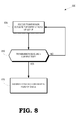
- FIG. 8 is a flow diagram of a method for determining whether to transmit a symbol or linear combination of symbols from an entry in a coded symbol queue according to some embodiments.
- the effectiveness of caching can be increased by prefetching different portions of programs (or other digital content) into caches associated with different users that share the same network connection to the content provider.
- the portions of the programs can be prefetched into the different caches so that the caches hold complementary portions of the programs. For example, if the content provider is providing two programs (A, B) that are each divided into two portions (A 1 , A 2 , B 1 , B 2 ), the cache associated with a first user may hold the portions (A 1 , B 1 ) and the cache associated with a second user may hold the complementary portions (A 2 , B 2 ). Then, if the users request different programs, the content provider can transmit linear combinations of the complementary portions cached in different caches over the shared network connection to the users.
- the users can use their cached portion to invert the linear combination and retrieve the un-cached portion of their requested programs. For example, if the first user requests program A and the second user requests program B, the content provider can transmit a linear combination such as A 2 ⁇ B 1 (where ⁇ represents the exclusive-OR (XOR) operation) over the shared network connection.
- the bandwidth needed to transmit the linear combination is half the bandwidth required to transmit the two portions A 2 and B 1 separately.
- Time-sensitive or delay-sensitive services such as video-on-demand or other streaming services must satisfy two basic constraints.
- the service must be able to respond to asynchronous user requests because users can request content (such as a movie or television program) at any time and at any point within the content, as well as being able to rewind or fast-forward through the content.
- the service must be able to provide the requested content within a time interval set by the delay sensitivity of the user. For example, when a program begins and a user is buffering the beginning of the program, the user may abandon the program if the user does not receive responses with a latency of less than about 0.5-2 seconds. Once the buffer is full, the required latency may be increased to approximately 30 seconds.
- the program may be re-buffered from its new starting point and the latency may be reduced to a smaller value such as 0.5-2 seconds until the re-buffering is complete.
- the bandwidth consumed by delay-sensitive applications can be reduced by generating linear combinations of symbols requested by a set of users when the symbols requested by each user in the set are cached by all of the other users in the set and each user has cached all the symbols requested by the other users.
- the linear combinations may then be transmitted prior to a minimum deadline requested by the users.
- a service provider can maintain a queue to store symbols or linear combinations of symbols requested by users. For example, the queue may store a first symbol that represents a portion of a program requested by a first user.
- a linear combination of the first symbol and a second symbol that represents a portion of a program requested by a second user may be formed and stored in the queue if the first user has cached the second symbol and the second user has cached the first symbol. This process can be repeated to incorporate symbols requested by subsequent users into the linear combination as long as the symbol requested by the subsequent user is cached by all the previously-incorporated users and all the symbols requested by the previously-incorporated users are cached by the subsequent user.
- the linear combination can then be transmitted to the first user, the second user, and any subsequently-incorporated users prior to a deadline requested by the first user, the second user, or the subsequently-incorporated users.
- Some embodiments may use a sequential rule to decide whether to form a linear combination of a requested symbol and a symbol or linear combination of symbols in a queue entry by comparing the requested symbol and cached symbols for a requesting user to the requested symbols and cached symbols for users associated with the queue entries.
- FIG. 1 is a block diagram of a communication system 100 according to some embodiments.
- the communication system 100 includes a network 105 that supports a network connection 110 between a content provider 115 and a plurality of users 120 , 121 , 122 (collectively referred to as the “users 120 - 122 ”).
- the term “user” may refer to a device that transmits or receives information over the network connection 110 , such as a desktop computer, laptop computer, tablet computer, a smart phone, or smart television, as well as the person that is using the device.
- each of the users 120 - 122 shown in FIG. 1 may represent a single user or a plurality of users. In the interest of clarity, FIG.
- the communication system 100 depicts one content provider 115 , one connection 110 and three users 120 - 122 .
- some embodiments of the communication system 100 may include different numbers of these elements.
- the communication system 100 may include hundreds, thousands, or millions of users 120 - 122 .
- the communication system 100 may include multiple content providers 115 and the content providers 115 may be implemented using a plurality of servers that may be geographically dispersed.
- Embodiments of the network 105 or the network connection 110 may be implemented using wired connections, wireless connections, or any combination thereof.
- the users 120 - 122 are associated with corresponding caches 125 , 126 , 127 (collectively referred to as “the caches 125 - 127 ”) that are used to store information received from the content provider 115 . Caching of the information received from the content provider may be performed before, after, or concurrently with providing this information to the users 120 - 122 .
- Some embodiments of the caches 125 - 127 include cache entries or cache lines and each cache entry or line may store a segment of a block of digital content received from the content provider.
- the caches 125 - 127 may be able to store segments of blocks of digital content selected from the blocks of digital content that are transmitted over the network connection 110 .
- Blocks, segments of blocks, or combinations of segments of blocks of digital content may be transmitted over the network connection 110 in response to requests for the blocks from one or more of the users 120 - 122 .
- the term “symbol” is used to refer to a portion of information that is requested by one of the users 120 - 122 for transmission by the content provider 115 .
- a requested symbol may include blocks, a segment or portion of a block, a combination of segments of blocks, or other parts of the digital content provided by the content provider 115 .
- Symbols may be pre-provisioned to the caches 125 - 127 or the caches 125 - 127 may cache symbols that were previously transmitted to the corresponding user 120 - 122 .
- the caches 125 - 127 may select and store transmitted symbols based on criteria including fullness of the caches 125 - 127 , a number of symbols cached in the caches 125 - 127 , and ages of symbols that are cached in the caches 125 - 127 .
- the cache selection process may therefore be referred to as a dynamic process or an “online” process because the caches 125 - 127 select symbols concurrently with provision of the digital content to the users 120 - 122 .
- the caches 125 - 127 may select and cache symbols that represent a television show that is currently being watched by the user 122 .
- the cache selection process may also be referred to as a “decentralized” process because the caches 125 - 127 may not communicate with each other and each cache 125 - 127 can independently select and cache symbols that are being conveyed over the network connection 110 . Consequently, the sets of symbols stored in the caches 125 - 127 may evolve and change as different programs are requested by the users 120 - 122 .
- the caches 125 - 127 may store different and complementary sets of symbols that have been requested by the users 120 - 122 , which may provide opportunities to reduce the volume of data transmitted over the network connection 110 by transmitting linear combinations of the symbols stored by the different caches 125 - 127 , as discussed herein.
- Some embodiments of the content provider 115 may reduce the network resources consumed by symbol transmissions by forming linear combinations of the requested symbols. For example, the content provider 115 may generate linear combinations of symbols requested by the set of users 120 - 122 when each symbol requested by one of the users 120 - 122 in the set is cached by all of the other users 120 - 122 in the set and each user 120 - 122 has cached all the symbols requested by the other users 120 - 122 in its associated cache 125 - 127 . Some embodiments of the content provider 115 may form the linear combination by performing an exclusive-OR of symbols requested by the users 120 - 122 . This process may be referred to as “coding” or “encoding” the symbols for transmission over the network 105 .
- Symbols and linear combinations of symbols may be stored in entries of a queue 130 and the symbols or the linear combinations may then be transmitted prior to a minimum deadline requested by the users 120 - 122 or prior to some other time indicated by transmission deadlines requested by the users 120 - 122 .
- the users 120 - 122 may reconstruct (or “decode”) their requested symbols using their cached symbols.
- FIG. 2 is a diagram of an example of a data packet 200 that can be used to transmit linear combinations of symbols according to some embodiments.
- Some embodiments of the data packet 200 include information identifying the symbols that contribute portions of the linear combinations transmitted by the data packet 200 .
- the identifying information may be transmitted in a header that includes symbol identifiers 205 that identify the different symbols represented in the linear combinations.
- a header including symbol identifiers 205 may include information identifying programs A and B if the invertible combination includes symbols from programs A and B such as A 2 and B 1 .
- the data packet 200 may also include linear combinations 210 of symbols.
- the data packet 200 may include a linear combination 210 such as A 2 ⁇ B 1 .
- FIG. 3 is a block diagram of a server 300 for providing coded symbols in response to user requests according to some embodiments.
- Content providers such as the content provider 115 shown in FIG. 1 may implement one or more servers 300 to provide coded symbols to users such as the users 120 - 122 shown in FIG. 1 .
- files including digital content that represent requested programming such as multimedia programming, television programming, films, live broadcast, and the like, may be stored by the server 300 or at an external location.
- the files may be split into a sequence of symbols of a fixed size (e.g., a size that may range from 1 kB to 10 kB).
- User requests may then be translated into symbol requests, which may allow the users to skip over content, ask for content at locations within the program, fast-forward, rewind, or perform other operations.
- Some embodiments of the request handler 310 may read requests 305 from a plurality of open network connections or sockets. The request handler 310 may then add the arriving requests 305 to entries of a request queue 315 .
- the request queue 315 includes entries to hold pending requests 305 and may be implemented as a first-in-first-out (FIFO) queue. New requests 305 may therefore be added to the tail of the request queue 315 and previously queued requests 305 may be removed from the head of the request queue 315 . For example, the request handler 310 may add the most recent request 305 to an entry at the tail of the request queue 315 .
- FIFO first-in-first-out
- the server 300 includes an encoder 320 that may form linear combinations of requested symbols and symbols or linear combinations of symbols stored in a coded symbol queue 325 . Some embodiments of the queue 130 shown FIG. 1 may be implemented using the coded symbol queue 315 .
- the encoder 320 may be able to remove requests from the entry at the head of the request queue 315 or, if the request queue 315 is empty, the encoder 320 may block further processing until a new request 305 is added to the request queue 315 .
- the encoder 320 can read the symbol requested by the request 305 , e.g., from a memory location in the server 300 or from an external memory device.
- the encoder 320 may then iterate over the entries of the coded symbol queue 325 to determine whether the requested symbol can be coded with a symbol or linear combination of symbols stored in one of the entries of the coded symbol queue 325 , as discussed herein. Some embodiments of the encoder 320 iterate over the entries of the coded symbol queue 325 according to a sequential rule. For example, the encoder 320 may iterate over the entries in a sequence based on the transmission deadlines associated with the entries so that entries corresponding to an earliest minimum deadline for transmitting a symbol or linear combination of symbols in the entry are accessed first and entries corresponding to the latest minimum deadline are accessed last. However, other sequences that are a function of the transmission deadlines may also be used.
- the encoder 320 may create a new coded content symbol containing only the requested symbol and add it to an entry at the tail of the coded symbol queue 325 .
- the coded symbol queue 325 includes entries to hold a list of coded symbols, which may include a single symbol or a linear combination of symbols. Some embodiments of the coded symbol queue 325 may be implemented as a FIFO queue 325 and therefore coded symbols may be added to an entry at the tail of the coded symbol queue 325 and removed from the entry at the head of the coded symbol queue 325 . Each entry is associated with a transmission deadline for the coded symbol and entries in the coded symbol queue 325 may be ordered according to the transmission deadline. The coded symbols may only be removed from the coded symbol queue 325 after remaining in the coded symbol queue 325 for an amount of time determined by the transmission deadline. For example, an entry at the head of the coded symbol queue 325 may be removed when the current time is equal to the transmission deadline.
- the server 300 includes a transmitter 330 that can remove coded symbols from entries at the head of the coded symbol queue 325 . If the coded symbol queue 325 is empty or the entry at the head of the coded symbol queue 325 does not satisfy the condition for removal indicated by its transmission deadline, the transmitter 330 may block further processing until a coded symbol at the head of the coded symbol queue 325 is eligible for transmission. The transmitter 330 may also determine the members of a multicast group that includes the set of users that requested symbols that were coded together in the entry that is ready for transmission. The transmitter 330 may then multicast or broadcast the coded symbol over the network to the set of users in the multicast group.
- the coded symbol queue 325 may be searched to determine the largest set of requests in the coded symbol queue 325 that can be coded together with the expiring request. If any such requests are found, the transmitter 330 may remove the requests from the coded symbol queue 325 . The removed requests may be merged with the expiring request and the transmitter 330 may multicast the resulting merged request to the set of users corresponding to the merged request.
- FIG. 4 is a diagram of a sequence 400 of user requests and a corresponding coded symbol queue 405 of a server according to some embodiments.
- the coded symbol queue 405 may be used as the coded symbol queue 325 shown in FIG. 3 .
- Time is measured in arbitrary units increasing from left to right as indicated by the numerals 1-9, which may refer to cycles, timeslots, or other time intervals.
- the sequence 400 depicts user requests from three users (User 1 , User 2 , and User 3 ) in each of the time intervals.
- the coded symbol queue 325 has at least three entries (Entry 1 , Entry 2 , and Entry 3 ) that can store symbols or linear combinations of symbols prior to transmission.
- the entries are associated with a corresponding transmission deadline, which is set to three time intervals for each of the entries.
- a symbol or a linear combination of symbols may remain in an entry of the coded symbol queue 405 for a maximum of three time intervals, after which the symbol or linear combination of symbols in the entry is to be transmitted.
- Some embodiments may use other definitions of the transmission deadline, such as a transmission deadline that indicates that the entry is to be transmitted when the transmission deadline is equal to a current time, and different transmission deadlines may be associated with different entries, as discussed herein.
- User 1 requests transmission of symbol A 1 .
- the server determines that the coded symbol queue 405 is empty and thus there are no opportunities for coding the requested symbol A 1 with a previously requested symbol.
- the requested symbol A 1 is therefore added to Entry 1 of the coded symbol queue 405 .
- the server determines (using embodiments of the techniques described herein) that the symbol B 1 may be coded with the previously requested symbol A 1 . For example, the server may determine that User 1 has cached the symbol B 1 and User 2 has cached the symbol A 1 . The server may therefore code the symbols A 1 and B 1 , e.g., by forming a linear combination A 1 ⁇ B 1 . In the illustrated embodiment, the symbol “ ⁇ ” indicates that the linear combination is an exclusive-OR operation, although linear combinations over fields larger than the binary field or functions other than linear combinations may also be used. The linear combination is then stored in Entry 1 of the coded symbol queue 405 .
- User 1 requests transmission of symbol A 2 .
- the server determines that the symbol A 2 is not eligible for combination with the linear combination A 1 ⁇ B 1 because the symbols A 1 and A 2 were both requested by User 1 , which does not have a cached copy of either symbol.
- the symbol A 2 may therefore be stored in Entry 2 of the coded symbol queue 405 .
- the symbol A 1 will have been in the coded symbol queue 405 for three time intervals at the expiration of time interval 3 .
- the linear combination A 1 ⁇ B 1 may therefore be removed from the coded symbol queue 405 and transmitted at the end of time interval 3 , as indicated by the dashed box around the linear combination A 1 ⁇ B 1 .
- User 3 requests transmission of symbol C 1 .
- the server determines (using embodiments of the techniques described herein) that the symbol C 1 may be coded with the previously requested symbol A 2 .
- the server may determine that User 1 has cached the symbol C 1 and User 3 has cached the symbol A 2 .
- the server may therefore code the symbols A 2 and C 1 by forming a linear combination A 2 ⁇ C 1 .
- the linear combination is then stored in Entry 1 of the coded symbol queue 405 .
- the server determines (using embodiments of the techniques described herein) that the symbol B 2 may be coded with the linear combination A 2 ⁇ C 1 .
- the server may determine that User 1 has cached the symbols B 2 and C 1 , User 2 has cached the symbols A 2 and C 1 , and User 3 has cached the symbols A 2 and B 2 .
- the server may therefore code the symbol B 2 by forming a linear combination A 2 ⁇ C 1 ⁇ B 2 .
- the symbol A 2 will have been in the coded symbol queue 405 for three time intervals at the expiration of time interval 5 .
- the linear combination A 2 ⁇ C 1 ⁇ B 2 may therefore be removed from the coded symbol queue 405 and transmitted at the end of time interval 5 , as indicated by the dashed box around the linear combination A 2 ⁇ C 1 ⁇ B 2 .
- User 3 requests transmission of symbol C 2 .
- the server determines that the coded symbol queue 405 is empty and thus there are no opportunities for coding the requested symbol C 2 with a previously requested symbol.
- the requested symbol C 2 is therefore added to Entry 1 of the coded symbol queue 405 .
- User 3 requests transmission of symbol C 3 .
- the server determines that the symbol C 3 is not eligible for combination with C 2 because both symbols were requested by User 3 , which does not have cached copies of either symbol.
- the symbol C 3 may therefore be stored in Entry 2 of the coded symbol queue 405 .
- the server determines (using embodiments of the techniques described herein) that the symbol A 3 may be coded with the symbol C 2 .
- the server may determine that User 1 has cached the symbol C 2 and User 3 has cached the symbol A 3 .
- the server may therefore code the symbols by forming a linear combination C 2 ⁇ A 3 .
- the symbol C 2 will have been in the coded symbol queue 405 for three time intervals at the expiration of time interval 8 .
- the linear combination C 2 ⁇ A 3 may therefore be removed from the coded symbol queue 405 and transmitted at the end of time interval 8 , as indicated by the dashed box around the linear combination C 2 ⁇ A 3 .
- User 2 requests transmission of symbol B 3 .
- the server determines that the symbol B 3 is not eligible for combination with C 3 .
- User 2 may not have a cached copy of the symbol C 3 or User 3 may not have a cached copy of the symbol B 3 .
- the symbol B 3 may therefore be stored in Entry 2 of the coded symbol queue 405 .
- the symbol C 3 will have been in the coded symbol queue 405 for three time intervals at the expiration of time interval 9 .
- the symbol C 3 may therefore be removed from the coded symbol queue 405 and transmitted at the end of time interval 9 , as indicated by the dashed box around the symbol C 3 .
- a server such as one or more servers implemented by the content provider 115 shown in FIG. 1 or the server 300 shown in FIG. 3 may utilize various criteria or thresholds to determine whether symbols requested by one set of users may be coded and transmitted together with symbols requested by another set of users.
- the user requests may be represented by a triple (k, S, t), where k ⁇ 1, 2, . . . , K ⁇ is the user requesting the symbol, S ⁇ 1, 2, . . . , K ⁇ is the subset of users that have already cached the requested symbol in their cache, and t is the transmission deadline that indicates when the request is to be served.
- the transmission deadline t is assumed to be an integer that represents an arbitrary time interval such as milliseconds, but other embodiments may use other deadlines.
- the triple (k, S, t) may be written (k, S) if the value of the deadline is not material. In this notation, the identifier of the actual symbol requested by the user is suppressed.
- each request (k, S) satisfies the property k ⁇ S because otherwise the request could be satisfied by a symbol cached by the requesting user.
- the video server may create coded multicasting opportunities for different users requesting symbols for a streaming application. For example, three users may issue a sequence of requests:
- the video server can satisfy requests (k 1 , S 1 , t 1 ), (k 2 , S 2 , t 2 ), . . . , (k L , S L , t L ) using a single coded multicast transmission if the symbols requested by each user in the set of requesting users are cached by all of the other users in the set and each user has cached all the symbols requested by the other users.
- This condition may be represented as:
- the shared request can therefore be indicated as (K, S, t).
- other functions besides a minimum function
- the transmission deadlines may be used to determine the request deadline.
- Two shared requests (K 1 , S 1 , t 1 ) and (K 2 , S 2 , t 2 ) can be merged so that they can be satisfied by a single coded multicast transmission from the video server if K 1 ⁇ S 2 and K 2 ⁇ S 1 .
- the merged request may then be represented as: ( K 1 ⁇ K 2 ;S 1 ⁇ S 2 ;min ⁇ t 1 ,t 2 ⁇ ).
- the video server may transmit the coded multicast packet including the linear combination of symbols when the current time is equal to the transmission deadline of the merged request.
- linear combinations of symbols associated with the merged requests may be stored in a queue that is maintained by the video server.
- other functions (besides a minimum function) of the transmission deadlines may be used to determine the request deadline for the merged requests.
- the size of the queue is a matter of design choice but may be quite large.
- the server queue may have approximately 103 (unmerged) requests at any time for an HTTP adaptive streaming application with 100 users, a video rate of 100 kb per second, a delay tolerance of two seconds, and the a size of 10 kB.
- the server queue may have approximately 106 (unmerged) requests at any time for a progressive download video-on-demand application with 600 users, a video rate of 1800 kb per second, a delay tolerance of 30 seconds, and a symbol size of 4 kB.
- the server queue may have approximately 109 (unmerged) requests at any time for a complete download video-on-demand application with 1000 users, a video rate of 2400 kb per second, a delay tolerance of 3600 seconds, and a symbol size of 1 kB.
- Some embodiments of the video server implement different request merging rules to determine when a newly received request should be merged with an existing request in one of the entries of the queue maintained by the video server.
- request merging rules include a first-fit rule, a perfect-fit rule and a ⁇ -fit threshold rule.
- some embodiments of the video server may implement other request merging rules.
- the first-fit rule compares the new request to an ordered sequence of requests such as the requests stored in entries of a queue maintained by the video server.
- the sequence of comparisons follows the ordered sequence of requests.
- the ordered sequence may include requests (K 1 , S 1 , t 1 ), (K 2 , S 2 , t 2 ), . . . , (K L-1 , S L-1 , t L-1 ), that are ordered based on their transmission deadlines such that t 1 ⁇ t 2 ⁇ . . . ⁇ t L-1 .
- the newly merged request may be represented as: ( K l ⁇ k L ⁇ ;S l ⁇ S L ;min ⁇ t l ,t L ⁇ ). If the video server is not able to find a request that satisfies the conditions, the new request (k L , S L , t L ) may be added to the server queue, e.g., to the tail of the server queue.
- the perfect-fit rule incorporates additional criteria for merging requests relative to the first-fit rule.
- the perfect-fit rule may be nearly optimal in a large queue regime (L ⁇ ) because the probability that there is a queued request that satisfies all three merging conditions increases as the queue length increases and the third condition ensures that the server bandwidth is minimized.
- the first-fit rule may be nearly optimal in the small queue regime (L ⁇ 0).
- the ⁇ -fit threshold rule is used to merge requests by comparing measures of a size (or cardinality) of a set of symbols that would be cached by the users associated with the merged request. Mergers that produce a larger set of commonly cached symbols have a higher probability of subsequently being merged with additional requests, whereas mergers that produce a smaller set of commonly cached symbols have a lower probability of subsequent merger with new requests. For example, if the users associated with a merger request do not have any cached symbols in common, no new requests can be merged with the previously merged request. Some embodiments may therefore define a misfit function for the potential merger of two requests (K 1 , S 1 , t 1 ) and (K 2 , S 2 , t 2 ):
- ⁇ ⁇ ( ( K 1 ; S 1 ) , ( K 2 ; S 2 ) ) ⁇ ⁇ ⁇ ⁇ ⁇ S 1 ⁇ ⁇ ( ⁇ S 2 ⁇ K 2 ) ⁇ + ⁇ S 2 ⁇ ⁇ ( ⁇ S 1 ⁇ K 1 ) ⁇ , if ⁇ ⁇ K 1 ⁇ S 2 ⁇ ⁇ and ⁇ ⁇ K 2 ⁇ S 1 ⁇ , otherwise .
- ” denotes the cardinality operator and the notation “ ⁇ ” denotes the set-theoretic difference or relative complement operator.
- the misfit between two requested mergers is a non-negative number taking values in the set ⁇ 0, 1, . . .
- the first-fit rule may be described as a sequential rule that merges the new request with a queued request with a finite misfit.
- the perfect-fit rule may be described as a sequential rule that merges the new request with the queued request with zero misfit.
- the ⁇ -fit threshold rule may therefore merge two requests (K L , S L , t L ) and (K 1 , S 1 , t 1 ) when the value of the misfit function is below a threshold value, ⁇ : ⁇ (( k L ;S L ),( K l ;S l )) ⁇ .
- Sequential rules such as the first-fit rule, the perfect-fit rule, and the ⁇ -fit threshold rule have a number of advantages.
- each queued request is considered only once and each merger determination is based only on information in the request and therefore takes O(1) time to evaluate.
- the computational complexity to insert one new request into the server queue is O(L), where L is the queue length.
- sequential rules can be easily parallelized. For example, several threads may sequentially traverse the queue in parallel, each handling the merging operation of one new request.
- FIG. 5 is a plot 500 illustrating scaling of a global coding gain as a function of queue length for a ⁇ -fit threshold rule according to some embodiments.
- the term “global coding gain” is defined as a ratio of the bandwidth for uncoded transmission of a set of symbols and the bandwidth for coded transmission of the set of symbols.
- the horizontal axis indicates the queue length and the vertical axis indicates the global coding gain.
- Kp 1 - ( 1 - p ) K where p is the caching probability for K users.
- p is the caching probability for K users.
- the global coding gain achieved by the perfect-fit rule is more than 4.5, corresponding to a server bandwidth reduction of more than 75%. This value is quite close to the limiting value of about 5.0 indicated by the above analytical expression.
- FIG. 6 is a plot 600 illustrating scaling of the global coding gain as a function of the number of users for a system that implements a first-fit merging rule according to some embodiments.
- the queue length L is set equal to the number of users K, which may correspond to each user having a constant delay requirement for a single outstanding symbol request.
- FIG. 7 is a flow diagram of a method 700 for merging new symbol requests with queued symbol requests according to some embodiments.
- the method 700 may be implemented in a server such as one or more servers implemented in some embodiments of the content provider 115 shown in FIG. 1 or the server 300 shown in FIG. 3 .
- the server receives a request for a symbol from a requesting user.
- the server compares the new request with a previous request associated with an entry at the head of a queue (such as a coded symbol queue) associated with the server. For example, the server may compare the symbol requested by the requesting user to symbols cached by one or more previous requesting users associated with the previous request.
- the server may also compare the symbols requested by the previous requesting users associated to symbols cached by the requesting user.
- the server determines whether the new request is eligible for linear combination with the request associated with the current entry. For example, the server may apply the first-fit rule, the perfect-fit rule, or the ⁇ -fit threshold rule to determine whether the new request is eligible for merging with the previous request. If not, the server determines whether there are more entries in the queue at decision block 720 . As long as there are more entries, the server continues to compare the new request with the next sequential entry in the queue at block 725 . If there are no more entries, the symbol requested in the new request may be stored in a tail entry of the queue at block 730 .
- the server may form a linear combination of the newly requested symbol and a symbol or linear combination of symbols stored in the queue entry at block 735 .
- the server stores the new linear combination in the current entry of the queue.
- the server updates the transmission deadline based on a function of the transmission deadlines associated with the new request and the previous request. For example, the transmission deadline for the merged request may be set equal to the shortest (or nearest or earliest) transmission deadline for the new request and the previous request.
- some embodiments of the server may also reorder the queue so that the queue is sequentially ordered from shortest (or nearest or earliest) transmission deadline to longest (or furthest or latest) transmission deadline.
- FIG. 8 is a flow diagram of a method 800 for determining whether to transmit a symbol or linear combination of symbols from an entry in a coded symbol queue according to some embodiments.
- the method 800 may be implemented in server such as one or more servers implemented in some embodiments of the content provider 115 shown in FIG. 1 or the server 300 shown in FIG. 3 .
- the server accesses the transmission deadline associated with an entry at the head of the coded symbol queue.
- the transmission deadline indicates a deadline for responding to the request by transmitting the coded symbols.
- the transmission deadline may indicate a duration of a time interval that a request is to spend in the coded symbol queue before transmission.
- the server determines whether the transmission deadline is equal to the current time. If not, the server may wait and perform the comparison again at a later time. If the current time is equal to the transmission deadline, the server removes the coded symbol from the entry at the head of the queue and transmits the symbol at block 815 . For example, the server may multicast the coded symbol to a set of users that requested information represented in the coded symbol, as discussed herein.
- certain aspects of the techniques described above may implemented by one or more processors of a processing system executing software.
- the software comprises one or more sets of executable instructions stored or otherwise tangibly embodied on a non-transitory computer readable storage medium.
- the software can include the instructions and certain data that, when executed by the one or more processors, manipulate the one or more processors to perform one or more aspects of the techniques described above.
- the non-transitory computer readable storage medium can include, for example, a magnetic or optical disk storage device, solid state storage devices such as Flash memory, a cache, random access memory (RAM) or other non-volatile memory device or devices, and the like.
- the executable instructions stored on the non-transitory computer readable storage medium may be in source code, assembly language code, object code, or other instruction format that is interpreted or otherwise executable by one or more processors.
- a computer readable storage medium may include any storage medium, or combination of storage media, accessible by a computer system during use to provide instructions and/or data to the computer system.
- Such storage media can include, but is not limited to, optical media (e.g., compact disc (CD), digital versatile disc (DVD), Blu-Ray disc), magnetic media (e.g., floppy disc, magnetic tape, or magnetic hard drive), volatile memory (e.g., random access memory (RAM) or cache), non-volatile memory (e.g., read-only memory (ROM) or Flash memory), or microelectromechanical systems (MEMS)-based storage media.
- optical media e.g., compact disc (CD), digital versatile disc (DVD), Blu-Ray disc
- magnetic media e.g., floppy disc, magnetic tape, or magnetic hard drive
- volatile memory e.g., random access memory (RAM) or cache
- non-volatile memory e.g., read-only memory (ROM) or Flash memory
- MEMS microelectro
- the computer readable storage medium may be embedded in the computing system (e.g., system RAM or ROM), fixedly attached to the computing system (e.g., a magnetic hard drive), removably attached to the computing system (e.g., an optical disc or Universal Serial Bus (USB)-based Flash memory), or coupled to the computer system via a wired or wireless network (e.g., network accessible storage (NAS)).
- system RAM or ROM system RAM or ROM
- USB Universal Serial Bus
- NAS network accessible storage
Landscapes
- Engineering & Computer Science (AREA)
- Multimedia (AREA)
- Signal Processing (AREA)
- Databases & Information Systems (AREA)
- Computer Security & Cryptography (AREA)
- Computer Networks & Wireless Communication (AREA)
- Business, Economics & Management (AREA)
- Marketing (AREA)
- Two-Way Televisions, Distribution Of Moving Picture Or The Like (AREA)
- Information Transfer Between Computers (AREA)
Abstract
Description
-
- (1; 2, 3) (2; 1) (2; 1, 3) (3; 1, 2) (1; 2)
The first request is fromuser 1 and indicates thatusers user 2 and indicates thatuser 1 has cached the requested symbol, etc.
- (1; 2, 3) (2; 1) (2; 1, 3) (3; 1, 2) (1; 2)
for all 1∈{1, 2, . . . , L}. The coded transmission can be interpreted as a request by users
K={k 1 ,k 2 , . . . ,k L}
with shared cache content
and a request deadline of:
The shared request can therefore be indicated as (K, S, t). In some embodiments, other functions (besides a minimum function) of the transmission deadlines may be used to determine the request deadline.
(K 1 ∪K 2 ;S 1 ∩S 2;min{t 1 ,t 2}).
The video server may transmit the coded multicast packet including the linear combination of symbols when the current time is equal to the transmission deadline of the merged request. As discussed herein, linear combinations of symbols associated with the merged requests may be stored in a queue that is maintained by the video server. In some embodiments, other functions (besides a minimum function) of the transmission deadlines may be used to determine the request deadline for the merged requests.
k L ∈S l,
K l ⊂S L.
The newly merged request may be represented as:
(K l ∪{k L };S l ∩S L;min{t l ,t L}).
If the video server is not able to find a request that satisfies the conditions, the new request (kL, SL, tL) may be added to the server queue, e.g., to the tail of the server queue.
-
- kL∈Sl,
- Kl⊂SL,
- SL∪Kl=Sl∪kL.
The first two conditions ensure that the two requests under consideration can be merged, as discussed herein. The third condition stipulates that the merging should be optimal in terms of the size of the intersection of cache availability S1 ∩S2 of the merged request.
Here, the notation “|·|” denotes the cardinality operator and the notation “\” denotes the set-theoretic difference or relative complement operator. In general, the misfit between two requested mergers is a non-negative number taking values in the set {0, 1, . . . , K−2, K−1, ∞}. The first-fit rule may be described as a sequential rule that merges the new request with a queued request with a finite misfit. The perfect-fit rule may be described as a sequential rule that merges the new request with the queued request with zero misfit.
ρ((k L ;S L),(K l ;S l))≦τ.
where p is the caching probability for K users. For example, for K=10, p=0.5, and L=50,000, the global coding gain achieved by the perfect-fit rule is more than 4.5, corresponding to a server bandwidth reduction of more than 75%. This value is quite close to the limiting value of about 5.0 indicated by the above analytical expression.
Claims (16)
Priority Applications (1)
| Application Number | Priority Date | Filing Date | Title |
|---|---|---|---|
| US14/324,836 US9560390B2 (en) | 2014-07-07 | 2014-07-07 | Asynchronous encoding of digital content |
Applications Claiming Priority (1)
| Application Number | Priority Date | Filing Date | Title |
|---|---|---|---|
| US14/324,836 US9560390B2 (en) | 2014-07-07 | 2014-07-07 | Asynchronous encoding of digital content |
Publications (2)
| Publication Number | Publication Date |
|---|---|
| US20160007057A1 US20160007057A1 (en) | 2016-01-07 |
| US9560390B2 true US9560390B2 (en) | 2017-01-31 |
Family
ID=55017955
Family Applications (1)
| Application Number | Title | Priority Date | Filing Date |
|---|---|---|---|
| US14/324,836 Expired - Fee Related US9560390B2 (en) | 2014-07-07 | 2014-07-07 | Asynchronous encoding of digital content |
Country Status (1)
| Country | Link |
|---|---|
| US (1) | US9560390B2 (en) |
Cited By (3)
| Publication number | Priority date | Publication date | Assignee | Title |
|---|---|---|---|---|
| US20170134040A1 (en) * | 2014-06-30 | 2017-05-11 | Indice Semiconductor Inc. | Asynchronous electrical circuitry techniques for producing stationary carrier signal to encode input signal amplitude into output signal time-sequence information |
| WO2019166106A1 (en) | 2018-03-02 | 2019-09-06 | Huawei Technologies Co., Ltd. | Devices and methods for coded caching |
| CN110248239A (en) * | 2019-06-24 | 2019-09-17 | 北京奇艺世纪科技有限公司 | A kind of video content download method and device |
Families Citing this family (4)
| Publication number | Priority date | Publication date | Assignee | Title |
|---|---|---|---|---|
| US9535837B2 (en) * | 2013-11-19 | 2017-01-03 | Alcatel-Lucent Usa Inc. | Decentralized online cache management for digital content conveyed over shared network connections based on cache fullness and cache eviction policies |
| US9990440B2 (en) * | 2013-12-30 | 2018-06-05 | Oath Inc. | Smart content pre-loading on client devices |
| US10972574B2 (en) * | 2016-04-27 | 2021-04-06 | Seven Bridges Genomics Inc. | Methods and systems for stream-processing of biomedical data |
| US11321737B2 (en) * | 2019-12-13 | 2022-05-03 | Ebay Inc. | Techniques of prefetching operation cost based digital content and digital content with emphasis |
Citations (3)
| Publication number | Priority date | Publication date | Assignee | Title |
|---|---|---|---|---|
| US20120254459A1 (en) | 2011-03-31 | 2012-10-04 | Alcatel-Lucent Usa Inc. | Managing data file transmission |
| US20130111520A1 (en) * | 2011-10-28 | 2013-05-02 | Qualcomm Incorporated | Method and apparatus to detect a demand for and to establish demand-based multimedia broadcast multicast service |
| US9288010B2 (en) * | 2009-08-19 | 2016-03-15 | Qualcomm Incorporated | Universal file delivery methods for providing unequal error protection and bundled file delivery services |
-
2014
- 2014-07-07 US US14/324,836 patent/US9560390B2/en not_active Expired - Fee Related
Patent Citations (4)
| Publication number | Priority date | Publication date | Assignee | Title |
|---|---|---|---|---|
| US9288010B2 (en) * | 2009-08-19 | 2016-03-15 | Qualcomm Incorporated | Universal file delivery methods for providing unequal error protection and bundled file delivery services |
| US20120254459A1 (en) | 2011-03-31 | 2012-10-04 | Alcatel-Lucent Usa Inc. | Managing data file transmission |
| US20140207913A1 (en) | 2011-03-31 | 2014-07-24 | Alcatel-Lucent Usa Inc. | System and method for managing distribution of network information |
| US20130111520A1 (en) * | 2011-10-28 | 2013-05-02 | Qualcomm Incorporated | Method and apparatus to detect a demand for and to establish demand-based multimedia broadcast multicast service |
Non-Patent Citations (2)
| Title |
|---|
| Mohammad Ali Maddah-Ali et al., "Fundamental Limits of Caching", 2013 IEEE International Symposium on Information Theory Proceedings (ISIT), Jul. 7, 2013, 19 pages. |
| U.S. Appl. No. 14/083,723, filed Nov. 19, 2013, entitled "Decentralized Online Cache Management for Digital Content". |
Cited By (4)
| Publication number | Priority date | Publication date | Assignee | Title |
|---|---|---|---|---|
| US20170134040A1 (en) * | 2014-06-30 | 2017-05-11 | Indice Semiconductor Inc. | Asynchronous electrical circuitry techniques for producing stationary carrier signal to encode input signal amplitude into output signal time-sequence information |
| US9813077B2 (en) * | 2014-06-30 | 2017-11-07 | Indice Semiconductor Inc. | Asynchronous electrical circuitry techniques for producing stationary carrier signal to encode input signal amplitude into output signal time-sequence information |
| WO2019166106A1 (en) | 2018-03-02 | 2019-09-06 | Huawei Technologies Co., Ltd. | Devices and methods for coded caching |
| CN110248239A (en) * | 2019-06-24 | 2019-09-17 | 北京奇艺世纪科技有限公司 | A kind of video content download method and device |
Also Published As
| Publication number | Publication date |
|---|---|
| US20160007057A1 (en) | 2016-01-07 |
Similar Documents
| Publication | Publication Date | Title |
|---|---|---|
| US9560390B2 (en) | Asynchronous encoding of digital content | |
| CA2965484C (en) | Adaptive bitrate streaming latency reduction | |
| US11418822B2 (en) | Player methods for chunked CMAF low latency playback | |
| US10164860B2 (en) | Modified content delivery based on network conditions | |
| WO2015035942A1 (en) | Method for playing back live video and device | |
| US9935655B2 (en) | Reading of distributed erasure-coded data from an enterprise object storage system | |
| US20160286252A1 (en) | Encoding Optimization Using Bitrate Range Comparisons for Encoded Segments | |
| US20200267234A1 (en) | Resource Request Management | |
| US20140337903A1 (en) | Seamless trick-mode with decreased latency for live transcode streaming | |
| US20120158988A1 (en) | Media Requests to Counter Latency and Minimize Network Bursts | |
| US12356034B2 (en) | Methods and systems for managing content quality in a storage medium | |
| US9680904B2 (en) | Adaptive buffers for media players | |
| US20250008001A1 (en) | Local Cache Bandwidth Matching | |
| WO2014001927A1 (en) | Incremental preparation of videos for delivery | |
| CN113742518B (en) | Methods, apparatus and computer program products for storing and providing video | |
| CN106658067B (en) | Method and device for setting cache | |
| US10609111B2 (en) | Client-driven, ABR flow rate shaping | |
| US20210127146A1 (en) | Method and apparatus for automatic hls bitrate adaptation | |
| US20190089785A1 (en) | Identification encoding device and identification decoding device for data distribution and networks, and network elements comprising such devices | |
| US9535837B2 (en) | Decentralized online cache management for digital content conveyed over shared network connections based on cache fullness and cache eviction policies | |
| US20190335218A1 (en) | Method of real-time file format conversion streaming service | |
| CN115988577B (en) | Data transmission method and device, storage medium and electronic equipment | |
| KR102511949B1 (en) | Method of Efficient Video Pacing Considering User's Random Watching Point and Apparatus therefor | |
| KR102491247B1 (en) | Method and Apparatus for Controlling User's QoE in Real-time Multimedia Service | |
| JPWO2017018072A1 (en) | Delivery rate selection device, delivery rate selection method, and program |
Legal Events
| Date | Code | Title | Description |
|---|---|---|---|
| AS | Assignment |
Owner name: ALCATEL-LUCENT USA INC., NEW JERSEY Free format text: ASSIGNMENT OF ASSIGNORS INTEREST;ASSIGNORS:NIESEN, URS;MADDAH-ALI, MOHAMMAD ALI;SIGNING DATES FROM 20140707 TO 20140709;REEL/FRAME:034134/0574 |
|
| FEPP | Fee payment procedure |
Free format text: PAYOR NUMBER ASSIGNED (ORIGINAL EVENT CODE: ASPN); ENTITY STATUS OF PATENT OWNER: LARGE ENTITY |
|
| FEPP | Fee payment procedure |
Free format text: PAYER NUMBER DE-ASSIGNED (ORIGINAL EVENT CODE: RMPN); ENTITY STATUS OF PATENT OWNER: LARGE ENTITY Free format text: PAYOR NUMBER ASSIGNED (ORIGINAL EVENT CODE: ASPN); ENTITY STATUS OF PATENT OWNER: LARGE ENTITY |
|
| STCF | Information on status: patent grant |
Free format text: PATENTED CASE |
|
| FEPP | Fee payment procedure |
Free format text: MAINTENANCE FEE REMINDER MAILED (ORIGINAL EVENT CODE: REM.); ENTITY STATUS OF PATENT OWNER: LARGE ENTITY |
|
| LAPS | Lapse for failure to pay maintenance fees |
Free format text: PATENT EXPIRED FOR FAILURE TO PAY MAINTENANCE FEES (ORIGINAL EVENT CODE: EXP.); ENTITY STATUS OF PATENT OWNER: LARGE ENTITY |
|
| STCH | Information on status: patent discontinuation |
Free format text: PATENT EXPIRED DUE TO NONPAYMENT OF MAINTENANCE FEES UNDER 37 CFR 1.362 |
|
| FP | Lapsed due to failure to pay maintenance fee |
Effective date: 20210131 |