US9559049B1 - Memory device and method of manufacturing the same - Google Patents

Memory device and method of manufacturing the same Download PDF

Info

Publication number
US9559049B1
US9559049B1 US14/827,971 US201514827971A US9559049B1 US 9559049 B1 US9559049 B1 US 9559049B1 US 201514827971 A US201514827971 A US 201514827971A US 9559049 B1 US9559049 B1 US 9559049B1
Authority
US
United States
Prior art keywords
memory device
conductive line
support structures
line layers
conductive lines
Prior art date
Legal status (The legal status is an assumption and is not a legal conclusion. Google has not performed a legal analysis and makes no representation as to the accuracy of the status listed.)
Active
Application number
US14/827,971
Other versions
US20170053867A1 (en
Inventor
Yuan-Chieh Chiu
Shih-Ping Hong
Yao-An Chung
Current Assignee (The listed assignees may be inaccurate. Google has not performed a legal analysis and makes no representation or warranty as to the accuracy of the list.)
Macronix International Co Ltd
Original Assignee
Macronix International Co Ltd
Priority date (The priority date is an assumption and is not a legal conclusion. Google has not performed a legal analysis and makes no representation as to the accuracy of the date listed.)
Filing date
Publication date
Application filed by Macronix International Co Ltd filed Critical Macronix International Co Ltd
Priority to US14/827,971 priority Critical patent/US9559049B1/en
Assigned to MACRONIX INTERNATIONAL CO., LTD. reassignment MACRONIX INTERNATIONAL CO., LTD. ASSIGNMENT OF ASSIGNORS INTEREST (SEE DOCUMENT FOR DETAILS). Assignors: CHIU, YUAN-CHIEH, CHUNG, YAO-AN, HONG, SHIH-PING
Application granted granted Critical
Publication of US9559049B1 publication Critical patent/US9559049B1/en
Publication of US20170053867A1 publication Critical patent/US20170053867A1/en
Active legal-status Critical Current
Anticipated expiration legal-status Critical

Links

Images

Classifications

    • HELECTRICITY
    • H01ELECTRIC ELEMENTS
    • H01LSEMICONDUCTOR DEVICES NOT COVERED BY CLASS H10
    • H01L23/00Details of semiconductor or other solid state devices
    • H01L23/52Arrangements for conducting electric current within the device in operation from one component to another, i.e. interconnections, e.g. wires, lead frames
    • H01L23/522Arrangements for conducting electric current within the device in operation from one component to another, i.e. interconnections, e.g. wires, lead frames including external interconnections consisting of a multilayer structure of conductive and insulating layers inseparably formed on the semiconductor body
    • H01L23/5222Capacitive arrangements or effects of, or between wiring layers
    • H10W20/495
    • HELECTRICITY
    • H01ELECTRIC ELEMENTS
    • H01LSEMICONDUCTOR DEVICES NOT COVERED BY CLASS H10
    • H01L21/00Processes or apparatus adapted for the manufacture or treatment of semiconductor or solid state devices or of parts thereof
    • H01L21/02Manufacture or treatment of semiconductor devices or of parts thereof
    • H01L21/04Manufacture or treatment of semiconductor devices or of parts thereof the devices having potential barriers, e.g. a PN junction, depletion layer or carrier concentration layer
    • H01L21/48Manufacture or treatment of parts, e.g. containers, prior to assembly of the devices, using processes not provided for in a single one of the groups H01L21/18 - H01L21/326 or H10D48/04 - H10D48/07
    • H01L21/4814Conductive parts
    • H01L21/4846Leads on or in insulating or insulated substrates, e.g. metallisation
    • HELECTRICITY
    • H01ELECTRIC ELEMENTS
    • H01LSEMICONDUCTOR DEVICES NOT COVERED BY CLASS H10
    • H01L21/00Processes or apparatus adapted for the manufacture or treatment of semiconductor or solid state devices or of parts thereof
    • H01L21/02Manufacture or treatment of semiconductor devices or of parts thereof
    • H01L21/04Manufacture or treatment of semiconductor devices or of parts thereof the devices having potential barriers, e.g. a PN junction, depletion layer or carrier concentration layer
    • H01L21/48Manufacture or treatment of parts, e.g. containers, prior to assembly of the devices, using processes not provided for in a single one of the groups H01L21/18 - H01L21/326 or H10D48/04 - H10D48/07
    • H01L21/4814Conductive parts
    • H01L21/4846Leads on or in insulating or insulated substrates, e.g. metallisation
    • H01L21/4853Connection or disconnection of other leads to or from a metallisation, e.g. pins, wires, bumps
    • HELECTRICITY
    • H01ELECTRIC ELEMENTS
    • H01LSEMICONDUCTOR DEVICES NOT COVERED BY CLASS H10
    • H01L21/00Processes or apparatus adapted for the manufacture or treatment of semiconductor or solid state devices or of parts thereof
    • H01L21/02Manufacture or treatment of semiconductor devices or of parts thereof
    • H01L21/04Manufacture or treatment of semiconductor devices or of parts thereof the devices having potential barriers, e.g. a PN junction, depletion layer or carrier concentration layer
    • H01L21/48Manufacture or treatment of parts, e.g. containers, prior to assembly of the devices, using processes not provided for in a single one of the groups H01L21/18 - H01L21/326 or H10D48/04 - H10D48/07
    • H01L21/4814Conductive parts
    • H01L21/4846Leads on or in insulating or insulated substrates, e.g. metallisation
    • H01L21/486Via connections through the substrate with or without pins
    • HELECTRICITY
    • H01ELECTRIC ELEMENTS
    • H01LSEMICONDUCTOR DEVICES NOT COVERED BY CLASS H10
    • H01L23/00Details of semiconductor or other solid state devices
    • H01L23/52Arrangements for conducting electric current within the device in operation from one component to another, i.e. interconnections, e.g. wires, lead frames
    • H01L23/522Arrangements for conducting electric current within the device in operation from one component to another, i.e. interconnections, e.g. wires, lead frames including external interconnections consisting of a multilayer structure of conductive and insulating layers inseparably formed on the semiconductor body
    • H01L23/5226Via connections in a multilevel interconnection structure
    • HELECTRICITY
    • H01ELECTRIC ELEMENTS
    • H01LSEMICONDUCTOR DEVICES NOT COVERED BY CLASS H10
    • H01L23/00Details of semiconductor or other solid state devices
    • H01L23/52Arrangements for conducting electric current within the device in operation from one component to another, i.e. interconnections, e.g. wires, lead frames
    • H01L23/522Arrangements for conducting electric current within the device in operation from one component to another, i.e. interconnections, e.g. wires, lead frames including external interconnections consisting of a multilayer structure of conductive and insulating layers inseparably formed on the semiconductor body
    • H01L23/528Layout of the interconnection structure
    • HELECTRICITY
    • H01ELECTRIC ELEMENTS
    • H01LSEMICONDUCTOR DEVICES NOT COVERED BY CLASS H10
    • H01L23/00Details of semiconductor or other solid state devices
    • H01L23/52Arrangements for conducting electric current within the device in operation from one component to another, i.e. interconnections, e.g. wires, lead frames
    • H01L23/522Arrangements for conducting electric current within the device in operation from one component to another, i.e. interconnections, e.g. wires, lead frames including external interconnections consisting of a multilayer structure of conductive and insulating layers inseparably formed on the semiconductor body
    • H01L23/532Arrangements for conducting electric current within the device in operation from one component to another, i.e. interconnections, e.g. wires, lead frames including external interconnections consisting of a multilayer structure of conductive and insulating layers inseparably formed on the semiconductor body characterised by the materials
    • H01L23/5329Insulating materials
    • HELECTRICITY
    • H10SEMICONDUCTOR DEVICES; ELECTRIC SOLID-STATE DEVICES NOT OTHERWISE PROVIDED FOR
    • H10BELECTRONIC MEMORY DEVICES
    • H10B43/00EEPROM devices comprising charge-trapping gate insulators
    • H10B43/20EEPROM devices comprising charge-trapping gate insulators characterised by three-dimensional arrangements, e.g. with cells on different height levels
    • H10W20/42
    • H10W20/43
    • H10W20/48
    • H10W70/05
    • H10W70/093
    • H10W70/095

Definitions

  • the invention relates to a memory device and a manufacturing method thereof, and more particularly relates to a memory device having a support structure and a manufacturing method thereof.
  • the memory devices have been developed from two-dimensional (2D) memory devices that have a planar gate structure to three-dimensional (3D) memory devices that have a vertically stacked gate structure.
  • the conventional 3D vertical gate (VG) framework provides a higher storage density than the vertical channel (VC) one because the total stacking layers of VC are limited by the finite bit-line driving current.
  • VG exhibits the higher possibility of CD shrinkage, it still faces a manufacturing issue because of distortion and collapse of the three-dimensional structure induced by a high aspect-ratio geometry.
  • how to develop a highly-integrated 3D memory device to seek for a higher storage density and how to develop a manufacturing method thereof while preventing the problems of distortion and collapse of the three-dimensional structure is an important issue that needs to be addressed.
  • the invention provides a 3D memory device having a support structure and a manufacturing method thereof, for preventing distortion and collapse of a three-dimensional memory device.
  • the invention provides a memory device, including a plurality of first conductive line layers, a plurality of support structures, a charge storage layer.
  • Each of the first conductive line layers extends along a plane defined by a first direction and a second direction, and each of the first conductive line layers includes a plurality of first conductive lines extending in the first direction.
  • the support structures are disposed between the adjacent first conductive line layers.
  • the support structures and the first conductive lines have different shapes.
  • the charge storage layer covers upper surfaces, lower surfaces, and two side surfaces of the first conductive lines, and surfaces of the support structures.
  • the first conductive lines and the support structures are formed of different materials.
  • the material of the support structures includes an insulating material, a dielectric material, a low-k material, or a combination thereof.
  • the material of the support structure includes SiO, SiN, SiON, SiOC, SiC, SiOF, SiOH, or a combination thereof.
  • each of the support structures is a continuous support structure and further passes through the first conductive lines.
  • the support structures include a pillar structure, a wave structure, a sheet structure, a corrugated structure, or a combination thereof.
  • the support structures include a plurality of pillar structures, and a profile of two sidewalls of the pillar structures includes a rectangle, a trapezoid, an hourglass shape, an egg shape, an irregular shape, or a combination thereof.
  • a shape of an upper surface of the support structures includes a circle, an ellipse, a square, a star shape, a heart shape, a mushroom shape, a double-peak shape, a bowknot shape, or a combination thereof.
  • the memory device further includes a plurality of second conductive line layers.
  • Each of the second conductive line layers extends along a plane defined by the second direction and a third direction.
  • Each of the second conductive line layers is disposed between adjacent two support structures and surrounds a portion of the charge storage layer around the corresponding one of the first conductive lines.
  • the first direction, the second direction, and the third direction are perpendicular to each other.
  • the memory device includes a plurality of memory cells that are arranged in a three-dimensional array.
  • Each of the memory cells includes a portion of one of the first conductive lines, a portion of the charge storage layer surrounding the corresponding one of the first conductive lines, and a portion of the second conductive line layer covering the corresponding charge storage layer.
  • At least one support structure is disposed between adjacent two memory cells.
  • the memory device further includes a plurality of dielectric pillars extending in the third direction and arranged alternately with the second conductive line layers in the first direction.
  • the invention provides a manufacturing method for manufacturing a memory device, which includes the following steps.
  • a stack layer is provided.
  • the stack layer includes a plurality of first conductive line layers and a plurality of support material layers.
  • the support material layers are disposed alternately with the first conductive line layers.
  • the first conductive line layers and the support material layers are formed of different materials.
  • the support material layers and the first conductive line layers extend along a plane defined by a first direction and a second direction.
  • a plurality of openings are formed in the stack layer. The openings pass through the stack layer.
  • a portion of the support material layers is removed through the openings by performing an etching process, so as to form a plurality of support structures between the first conductive line layers.
  • the etching process includes a dry etching process, a wet etching process, or a combination thereof.
  • an etching selectivity between the support material layers and the first conductive line layers is equal to or greater than 5.
  • the manufacturing method further includes forming a charge storage layer on surfaces of the first conductive line layers and the support structures after forming the support structures.
  • a plurality of second conductive line layers that are arranged in a second direction are formed between adjacent two support structures.
  • Each of the second conductive line layers extends along a plane defined by the second direction and a third direction.
  • Each of the second conductive line layers surrounds a portion of the charge storage layer around the corresponding one of the first conductive line layers.
  • the first direction, the second direction, and the third direction are perpendicular to each other.
  • a plurality of dielectric pillars are formed in the stack layer. The dielectric pillars extend in the third direction and are arranged alternately with the second conductive line layers in the first direction.
  • the invention provides a manufacturing method for manufacturing a memory device, which includes the following steps.
  • a stack layer is provided.
  • the stack layer includes a plurality of first conductive line layers and a plurality of first material layers.
  • the first material layers are disposed alternately with the first conductive line layers.
  • the first conductive line layers and the first material layers are formed of different materials.
  • the first material layers and the first conductive line layers extend along a plane defined by a first direction and a second direction.
  • a plurality of support structures are formed in the stack layer. Each of the support structures is a continuous support structure and passes through the first conductive line layers of the stack layer.
  • a plurality of openings are formed in the stack layer. The openings pass through the stack layer.
  • the first material layers are removed through the openings by performing an etching process.
  • the etching process includes a dry etching process, a wet etching process, or a combination thereof.
  • the first conductive line layers, the first material layers, and the support structures are formed of different materials.
  • An etching selectivity between the first material layers and the support structures and an etching selectivity between the first material layers and the first conductive line layers are equal to or greater than 5 respectively.
  • the manufacturing method further includes forming a charge storage layer on surfaces of the first conductive line layers and the support structures after performing the etching process.
  • a plurality of second conductive line layers are formed and arranged in a second direction. Each of the second conductive line layers is disposed between adjacent two support structures. Each of the second conductive line layers extends along a plane defined by the second direction and a third direction and surrounds a portion of the charge storage layer around the corresponding one of the first conductive line layers.
  • the first direction, the second direction, and the third direction are perpendicular to each other.
  • a plurality of dielectric pillars are formed in the stack layer. The dielectric pillars extend in the third direction and are arranged alternately with the second conductive line layers in the first direction.
  • the invention uses the aforementioned etching process to form multiple support structures between the patterned first conductive line layers (e.g., the first conductive lines).
  • the support structures of the invention also support the adjacent upper and lower first conductive lines, thereby preventing distortion and collapse of the first conductive lines and the three-dimensional memory device thereof.
  • FIG. 1A to FIG. 1G are schematic perspective views showing a method of manufacturing a memory device according to the first embodiment of the invention.
  • FIG. 2A is a schematic perspective view illustrating a memory device according to the first embodiment of the invention.
  • FIG. 2B is a schematic perspective view of a partial memory device of FIG. 2A .
  • FIG. 3A to FIG. 3G are schematic perspective views showing a method of manufacturing a memory device according to the second embodiment of the invention.
  • FIG. 4 is a schematic perspective view of a partial memory device of FIG. 3G .
  • FIG. 5A to FIG. 5H are schematic views showing the shapes of openings of FIG. 1B .
  • FIG. 6A to FIG. 6D are schematic cross-sectional views along the line A-A of FIG. 1B .
  • FIG. 7A to FIG. 7D are schematic cross-sectional views along the line B-B of FIG. 1C .
  • FIG. 8A to FIG. 8F are schematic cross-sectional views of a portion P of FIG. 7A .
  • FIG. 9A to FIG. 9X are schematic top views showing the shapes of the openings according to an embodiment of the invention.
  • FIG. 10A to FIG. 10X are schematic top views of support structures according to an embodiment of the invention.
  • FIG. 1A to FIG. 1G are schematic perspective views showing a method of manufacturing a memory device according to the first embodiment of the invention.
  • the stack layer 100 includes a plurality of first conductive line layers 102 and a plurality of support material layers 104 .
  • the support material layers 104 are disposed between the first conductive line layers 102 .
  • the first conductive line layers 102 and the support material layers 104 all extend along a plane (e.g., XY plane) defined by a first direction D 1 and a second direction D 2 and are arranged alternately in a third direction D 3 (e.g., a Z-axis direction).
  • the thickness of the first conductive line layer 102 is equal to or greater than 5 nm.
  • the thickness of the support material layer 104 is greater than or equal to 45 nm. In this embodiment, the thickness of the support material layer 104 may be 50 nm, for example.
  • the number of the first conductive line layers 102 and the number of the support material layers 104 of the stack layer 100 may respectively be eight, sixteen, thirty two, or more, for example. However, it should be noted that the invention is not limited thereto. To more clearly explain the technical features of the embodiment of the invention, FIG. 1A illustrates two support material layers 104 as an example, but the invention is not limited thereto. In other embodiments, one support material layer 104 is sufficient to show the spirit and scope of the invention. The same applies to the other embodiments described below. Thus, details thereof are not repeated hereinafter.
  • a forming method of the stack layer 100 includes alternately forming the first conductive line layers 102 and the support material layers 104 , for example.
  • the forming method is chemical vapor deposition or physical vapor deposition, for example.
  • the first conductive line layers 102 and the support material layers 104 are forming of different materials.
  • the material of the first conductive line layer 102 may include a conductor material.
  • the conductor material may be polysilicon, doped polysilicon, single crystalline silicon, metal silicide, Ti, TiN, W, WN, Ta, TaN, Pt, or a combination thereof, for example.
  • a dielectric material may be SiO, SiN, SiON, SiOC, SiC, SiOF, SiOH, or a combination thereof, for example.
  • the thickness of the first conductive line layer 102 is greater than or equal to 5 nm. In this embodiment, the thickness of the first conductive line layer 102 may be 20 nm, for example.
  • the material of the support material layer 104 includes an insulating material, a dielectric material, a low-k material, or a combination thereof.
  • the low-k material refers to a dielectric material having a dielectric constant equal to or less than 4.
  • the material of the support material layer 104 may be SiO, SiN, SiON, SiOC, SiC, SiOF, SiOH, or a combination thereof.
  • the thickness of the support material layer 104 is greater than or equal to 45 nm. In this embodiment, the thickness of the support material layer 104 may be 50 nm, for example.
  • the stack layer 100 is patterned to remove a portion of the first conductive line layers 102 and a portion of the support material layers 104 , so as to form a plurality of openings 106 in the stack layer 100 .
  • the openings 106 pass through the stack layer 100 in the third direction D 3 (e.g., the Z-axis direction).
  • the openings 106 may be arranged in an array or arranged in the closest manner, or a combination thereof.
  • a portion of patterned support material layers 104 a is removed through the openings 106 by performing an etching process, such that the support material layers 104 a remaining between the patterned first conductive line layers 102 a form a plurality of support structures 108 .
  • an etching selectivity between the patterned support material layers 104 a and the patterned first conductive line layers 102 a is equal to or greater than 5, when the etching process is performed, a large portion of the patterned support material layers 104 a is removed.
  • the remaining patterned support material layers 104 a form a plurality of support structures 108 between the patterned first conductive line layers 102 a.
  • rounded first conductive line layers 102 b are formed by selectively performing a rounding process on top corners and bottom corners of the openings 106 in the patterned first conductive line layers 102 a . Due to the rounded first conductive line layers 102 b , the device exhibits favorable electrical performance.
  • the rounding process includes performing an oxidation process on the patterned first conductive line layers 102 a by thermal oxidation, for example.
  • a silicon oxide layer is formed on a surface of the patterned first conductive line layer 102 a , and an etch-back process is performed on the silicon oxide layer on the surface of the patterned first conductive line layer 102 a by wet etching, so as to remove the silicon oxide layer on the surface of the patterned first conductive line layer 102 a.
  • the charge storage layer 110 is formed on the surfaces of the rounded first conductive line layer 102 b and the support structure 108 .
  • the charge storage layer 110 includes a composite layer composed of oxide/nitride/oxide (ONO) (this composite layer may include three or more layers) or a high-k material.
  • the high-k material may be HfO 2 , TiO 2 , ZrO 2 , Ta 2 O 5 , or Al 2 O 3 , for example.
  • a forming method thereof may be chemical vapor deposition, thermal oxidation, or atomic layer deposition.
  • the thickness of the charge storage layer 110 is in a range of 10 nm to 25 nm.
  • the thickness of the charge storage layer 110 is in a range of 15 nm to 20 nm, for example. This thickness is sufficient to completely cover the surfaces of the rounded first conductive line layers 102 b and the support structures 108 and leave gaps in the openings 106 a and 106 b.
  • a second conductive line layer 112 is formed on the charge storage layer 110 .
  • the second conductive line layer 112 is filled in the opening 106 a and the opening 106 b , and covers the surface of the charge storage layer 110 .
  • a material of the second conductive line layer 112 is polysilicon, metal, metal silicide, or a combination thereof, for example.
  • a forming method thereof may be chemical vapor deposition.
  • the metal silicide may be tungsten silicide or cobalt silicide, nickel silicide, titanium silicide, copper silicide, molybdenum silicide, tantalum silicide, erbium silicide, zirconium silicide, or platinum silicide, for example.
  • a plurality of dielectric pillars 114 are formed in the stack layer 100 .
  • the dielectric pillars 114 extend in the third direction D 3 (e.g., the Z-axis direction). Meanwhile, in an embodiment, each of the second conductive line layers 112 a insulated by the dielectric pillars 114 extends along a plane (e.g., a YZ plane) along the second direction D 2 and the third direction D 3 .
  • the second conductive line layers 112 a and the dielectric pillars 114 are alternately disposed in the first direction D 1 (e.g., the X-axis direction), so as to separate the rounded first conductive line layer 102 b into a plurality of first conductive lines 102 c .
  • the first direction D 1 , the second direction D 2 , and the third direction D 3 are perpendicular to each other.
  • the first conductive lines 102 c extend in the first direction D 1 , and likewise, the charge storage layer 110 a covering the surfaces of the first conductive lines 102 c also extend in the first direction D 1 .
  • a region where the second conductive line layer 112 surrounds a portion of the charge storage layer 110 around the corresponding first conductive line 102 c is a memory cell M. It is known from the above that the support structures 108 support the adjacent upper and lower first conductive lines 102 c , so as to prevent distortion and collapse of the three-dimensional memory device. In an embodiment, the memory device having the support structure of this embodiment is applicable to any three-dimensional or vertical type memory device.
  • FIG. 6A to FIG. 6D are schematic cross-sectional views along the line A-A of FIG. 1B .
  • a patterned first conductive line layer 302 a shown in FIG. 6A a patterned first conductive line layer 302 b shown in FIG. 6B , and the patterned first conductive line layer 102 a shown in FIG. 1B are the same or similar components.
  • a support material layer 304 a shown in FIG. 6A a support material layer 304 b shown in FIG. 6B , and the support material layer 104 a shown in FIG. 1B are the same or similar components.
  • a shape of two sidewalls of the opening may differ due to the adjustment of the etching parameters when the patterning process is performed on a high aspect ratio structure.
  • the shape of the two sidewalls of an opening 306 a is rectangular, and an angle ⁇ a thereof is 90 degrees.
  • the shape of the two sidewalls of an opening 306 b is inverted trapezoidal, and an angle ⁇ b thereof is in a range of 80 degrees to 90 degrees.
  • the shape of the two sidewalls of an opening 306 c is trapezoidal, and an angle ⁇ c thereof is in a range of 90 degrees to 95 degrees.
  • FIG. 6D the shape of the two sidewalls of an opening 306 d is bow-like, and an angle ⁇ d1 thereof is in a range of 90 degrees to 95 degrees while an angle ⁇ d2 thereof is in a range of 80 degrees to 90 degrees.
  • FIG. 6A to FIG. 6D respectively illustrate eight first conductive line layers 102 and eight support material layers 104 .
  • the relative positions thereof are as shown in the schematic cross-sectional view along the line A-A of FIG. 1B .
  • the two first conductive line layers 102 and two support material layers 104 of FIG. 1B may have similar technical features.
  • the shape of the opening 106 includes: circle (as shown in FIG. 9A to FIG. 9C ), ellipse (as shown in FIG. 9D to FIG. 9F ), square (as shown in FIG. 9G to FIG. 9H ), rhombus (as shown in FIG. 9I to FIG. 9J ), star shape (as shown in FIG. 9K to FIG. 9L ), hexagon (as shown in FIG. 9M to FIG. 9O ), mushroom shape (as shown in FIG. 5E ), heart shape (as shown in FIG. 5F ), double-peak shape (as shown in FIG. 5G ), bowknot shape (as shown in FIG. 5H ), or a combination thereof.
  • the invention is not intended to limit the shape of the opening 106 as long as the shape (as shown in FIG. 5A to FIG. 5D , for example) can be designed by the current lithography process.
  • the shape and arrangement of the openings 106 are highly relevant to the shape of the support structures 108 that are formed in the subsequent processes, which is explained in detail in the following paragraphs.
  • a removal amount X 1 of the topmost patterned support material layer 104 a (i.e., the support structure 108 ) and a removal amount X n of the bottommost patterned support material layer 104 a (i.e., the support structure 108 ) in FIG. 1B should be the same.
  • AR uniformity An equation representing the aspect ratio uniformity (AR uniformity) is provided below:
  • AR ⁇ ⁇ Uniformity X 1 - X n ( X 1 + X 2 + ... + X n ) ⁇ / ⁇ n ⁇ 100 ⁇ %
  • X 1 the removal amount of the topmost patterned support material layer 104 a
  • X n the removal amount of the bottommost patterned support material layer 104 a. Therefore, after performing the corresponding etching process, the cross-sectional view along the line B-B of FIG. 1C may be illustrated by FIG. 7A to FIG. 7D .
  • the etching process includes dry etching, wet etching, or a combination thereof.
  • the invention is not intended to limit the sequence of the combination of the dry etching and wet etching processes.
  • wet etching may be performed after dry etching, and vice versa.
  • the dry etching and wet etching may be performed simultaneously.
  • the dry etching process may include chemical dry etching (CDE) or SICONI etching, for example.
  • CDE chemical dry etching
  • SICONI SICONI etching
  • the chemical dry etching uses fluorine-based chemistry and oxygen as the etching gas for performing the etching process.
  • An etching selectivity of the silicon oxide and the polysilicon may be controlled by the contents of the fluorine-based chemistry and oxygen.
  • an equivalence ratio of the fluorine-based chemistry and oxygen is in a range of 1 to 20, and the etching selectivity of the silicon oxide and the polysilicon is in a range of 2 to 20.
  • the etching selectivity may be controlled by adjusting the etching parameters of the etching process.
  • the etching parameters include adjustments of the content of a non-etching gas, etching chamber pressure, RF power, and etching time. If the etching selectivity of the silicon oxide and the polysilicon is in a range of 2 to 20, the content of the introduced helium may be in a range of 10 wt % to 25 wt %; the etching chamber pressure may be in a range of 5 mtorr to 100 mtorr; the RF power may be in a range of 200 W to 2000 W; and the etching time may be in a range of 60 seconds to 300 seconds, for example.
  • the SICONI etching uses NH 3 and NF 3 as the etching gas for performing the etching process. If a ratio of NH 3 and NF 3 is in a range of 0.5 to 3, the etching selectivity of the silicon oxide and the polysilicon is equal to or greater than 10. If the etching chamber pressure is in a range of 1 torr to 5 torr; the RF power is in a range of 10 W to 50 W; and the etching time of each cycle is in a range of 5 seconds to 50 seconds when the number of the patterned support material layers 104 a is 8, the AR uniformity of the aforementioned aspect ratio (eight layers) is in a range of 0% to 10%. Thus, the AR uniformity is improved, and the critical dimension (CD) of the support structure 108 between the patterned first conductive line layers 102 a is maintained.
  • CD critical dimension
  • the wet etching process may use fluorine-based chemistry in solution form for performing the etching process.
  • concentration of the fluorine-based chemistry needs to be equal to or less than 1 wt %, so as to achieve favorable AR uniformity.
  • the AR uniformity is equal to or less than 10%.
  • the patterned first conductive line layer 302 a shown in FIG. 7A and a patterned first conductive line layer 402 a shown in FIG. 8A are the same or similar components.
  • the support material layer 304 a (i.e., the support structure 308 a ) shown in FIG. 7A and a support structure 408 a shown in FIG. 7A are the same or similar components.
  • the support structure 108 may be formed into a pillar structure, and two sidewalls of the pillar structure may have various profiles, such as rectangle, irregular shape, trapezoid, inverted trapezoid, hourglass shape, egg shape (as shown in FIG. 8A to FIG. 8F ), or a combination thereof, for example.
  • the profile of the two sidewalls of a support structure 408 f has an egg shape (as shown in FIG. 8F ).
  • the profile of the two sidewalls of a support structure 408 e has a hourglass shape (as shown in FIG. 8E ).
  • the profile of the two sidewalls of a support structure 408 a is rectangular (as shown in FIG. 8A ).
  • the critical dimensions of the various profiles of the two sidewalls of the support structure 108 are indicated in the following Table 1.
  • FIG. 8A to FIG. 8F are schematic cross-sectional views of a portion P of FIG. 7 A.
  • TCD represents the critical dimension of top portions of the two sidewalls of the support structure
  • MCD represents the critical dimension of middle portions of the two sidewalls of the support structure
  • BCD represents the critical dimension of bottom portions of the two sidewalls of the support structure
  • ⁇ BCD is the angle between the bottom portions of the two sidewalls of the support structure and the first conductive line layer.
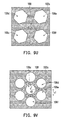
  • FIG. 9A to FIG. 9X are schematic top views showing the shapes of the openings according to an embodiment of the invention.
  • the openings 106 c to 106 f may be arranged in an array, and the support structure 108 is located between the adjacent four openings 106 c to 106 f .
  • the shape of the support structure 108 includes: circle, ellipse, square, star shape, heart shape, mushroom shape, double-peak shape, bowknot shape, or a combination thereof. As described in the foregoing paragraphs, the shape of the support structure 108 is relevant to the shape and arrangement of the openings 106 c to 106 f .
  • the shape of the support structure 108 changes from the star shape (as shown in FIG. 9A ) to rounded square (as shown in FIG. 9B ), and then to circle (as shown in FIG. 9C ).
  • the shapes of the openings 106 c to 160 f are elliptical and are arranged in an array, as the etching time increases, the shape of the support structure 108 changes from the star shape (as shown in FIG. 9D ) to rhombus (as shown in FIG. 9E ), and then to ellipse (as shown in FIG. 9F ).
  • the invention is not limited thereto, in other embodiments, when the openings 106 c to 106 f are elliptical, hexagonal, or polygonal, the shape of the support structure 108 formed accordingly also changes (as shown in FIG. 9G to FIG. 9H ; FIG. 9I to FIG. 9J ; FIG. 9K to FIG. 9L ; and FIG. 9M to FIG. 9O ). Normally, as the etching time increases, the shape of the support structure 108 formed accordingly becomes more similar to a curved shape and the support structure 108 has a smaller area.
  • the shape of the openings 106 c to 106 f are elliptical, hexagonal, or polygonal, and a rotation angle ⁇ thereof is in a range of 0 degree to 45 degrees, the shape and angle of the formed support structure 108 also change accordingly (as shown in FIG. 9P to FIG. 9R ; and FIG. 9S to FIG. 9U ).
  • a represents the distance between the centroid the opening 106 c and a side thereof (in the X-axis direction)
  • b represents the distance between the centroid of the opening 106 c and a side thereof (in the Y-axis direction)
  • c represents the distance between the opening 106 c and another opening 106 e in the diagonal direction
  • d 1 represents the distance between the opening 106 c and another opening 106 d in the Y-axis direction
  • d 2 represents the distance between the opening 106 c and another opening 106 f in the X-axis direction
  • represents the rotation angle of the openings 106 c to 106 f
  • XCD represents the critical dimension of the shape of the support structure in the X-axis direction
  • YCD represents the critical dimension of the shape of the support structure in the Y-axis direction.
  • the shape of the openings 106 c to 106 f is star-like (as shown in FIG. 9K to FIG.
  • the closest manner may be that c 1 ⁇ 2r, r+d 3 is a fixed value, and d 3 >10 nm, for example.
  • r is the radius of the opening 106
  • c is the distance between the opening 106 c and the opening 106 e (e.g., the distance on the Y-axis)
  • d 3 is the distance between the opening 106 c and the opening 106 f (e.g., the distance on the X-axis).
  • the support structure 108 is formed into a pillar structure that may have different shapes.
  • the embodiments of the invention are not limited thereto.
  • the formed support structure 108 may have a wave structure, a corrugated structure, and a sheet structure.
  • FIG. 10A to FIG. 10X are schematic top views of the support structure according to an embodiment of the invention.
  • the outer profile of the formed support structure 108 changes from the wave structure (as shown in FIG. 10A ) to the corrugated structure (as shown in FIG. 10B ), and then to the even smaller corrugated structure (as shown in FIG. 10C ), for example.
  • the structure of the formed support structure 108 also changes, such as pillar structure, wave structure, corrugated structure, sheet structure, or a combination thereof. Details thereof will not be repeated hereinafter.
  • FIG. 2A is a schematic perspective view illustrating a memory device according to the first embodiment of the invention.
  • FIG. 2B is a schematic perspective view of a partial memory device of FIG. 2A .
  • FIG. 2B illustrates a partial memory device 10 of FIG. 2A , wherein the charge storage layer 110 a , the second conductive line layer 112 a , and the dielectric pillar 114 are removed, and only the first conductive lines 102 c and the support structures 108 are retained.
  • the first conductive line is exemplified as a bit line BL
  • a second conductive line is exemplified as a word line WLL in order to more clearly describe the memory device of an embodiment of the invention.
  • an embodiment of the invention provides the memory device 10 , including a plurality of bit line layers BLL and a plurality of support structures 108 .
  • Each of the bit line layers BLL extends along the plane (e.g., the XY plane) defined by the first direction D 1 and the second direction D 2 .
  • Each of the bit line layers BLL has a plurality of bit lines BL extending in the first direction D 1 .
  • the support structures 108 are located between the adjacent bit line layers BLL. In other words, the support structures 108 are located between the upper and lower bit lines BL.
  • the support structures 108 and the bit lines BL have different shapes.
  • each bit line BL includes a plurality of wide portions 116 a and a plurality of narrow portions 116 b that are arranged alternately, wherein the width of the wide portion 116 a is greater than the width of the narrow portion 116 b .
  • Each of the support structures 108 is located between the wide portions 116 a of adjacent upper and lower two bit lines BL.
  • the memory device 10 of this embodiment of the invention includes a charge storage layer 110 a and a plurality of word line layers WLL.
  • the charge storage layer 110 a covers upper surfaces, lower surfaces, and two side surfaces of the bit lines BL and surfaces of the support structures 108 .
  • Each word line layer WLL is located between adjacent two support structures 108 and surrounds a portion of the charge storage layer 110 a around the corresponding bit line BL (i.e. the narrow portion 116 b of the bit line BL).
  • the word line layers WLL extend along the plane (e.g., the YZ plane) defined by the second direction D 2 and the third direction D 3 .
  • the first direction D 1 , the second direction D 2 , and the third direction D 3 are perpendicular to each other.
  • the memory device 10 includes a plurality of memory cells M that are arranged in a three-dimensional array.
  • Each memory cell M includes the narrow portion 116 b of the bit line BL, a portion of the charge storage layer 110 a surrounding the corresponding bit line BL, and a portion of the word line layer WLL covering the corresponding charge storage layer 110 a .
  • each memory cell M is formed by the narrow portion 116 b of each bit line BL, a portion of the charge storage layer 110 a covering the narrow portion 116 b , and a portion of the word line layer WLL. Since at least one support structure 118 is disposed between adjacent two memory cells M, the support structure 108 of the first embodiment of the invention supports the adjacent upper and lower bit lines BL and thereby prevents distortion and collapse of the bit line BL and the three-dimensional memory device thereof.
  • the first conductive line layer is a word line
  • the second conductive line layer is a bit line layer
  • the second embodiment of the invention provides another memory device 20 that includes a plurality of first conductive lines 202 c and a plurality of support structures 208 .
  • the second embodiment is similar to the first embodiment and a difference therebetween is that, in the first embodiment, the first conductive lines 102 c are supported by a plurality of non-continuous support structures 108 ( FIG. 2 ) in the third direction D 3 (e.g., the Z-axis direction). That is to say, the support structures 108 that are adjacent to each other in the Z-axis direction are separated by the first conductive lines 102 c and are non-continuous ( FIG. 2 ).
  • each support structure 208 is a continuous support structure 208 that passes through at least two first conductive lines 208 c , such that each support structure 208 has a continuous support structure ( FIG. 4 ).
  • FIG. 3A to FIG. 3G are schematic perspective views showing a method of manufacturing the memory device according to the second embodiment of the invention.
  • the same or similar elements, components, or layers are represented by similar reference numerals.
  • the first conductive line layer 102 and the first conductive line layer 202 are the same or similar elements.
  • the support structure 108 and the support structure 208 are the same or similar elements. Thus, details thereof are not repeated again.
  • the stack layer 200 includes a plurality of first conductive line layers 202 and a plurality of first material layers 204 .
  • the first material layers 204 are disposed between the first conductive line layers 202 .
  • the first conductive line layers 202 and the first material layers 204 both extend along the plane (e.g., the XY plane) defined by the first direction D 1 and the second direction D 2 and are arranged alternately in the third direction D 3 (e.g., the Z-axis direction).
  • the material, thickness, and forming method of the first conductive line layer 202 are the same as those of the first conductive line layer 102 of the first embodiment, as described above.
  • the material, thickness, and forming method of the first material layer 204 are the same as those of the support material layer 104 of the first embodiment, as described above. Thus, details thereof are not repeated hereinafter.
  • a plurality of support structures 208 are formed in the stack layer 200 .
  • the support structure 208 is a continuous structure and passes through the stack layer 200 in the third direction D 3 (e.g., the Z-axis direction). More specifically, a plurality of holes (not shown) are formed in the stack layer 200 by performing a lithography and etching process on the stack layer 200 . Then, a support structure material layer (not shown) is formed on the stack layer 200 and filled in the holes.
  • the material and forming method of the support structure material layer are the same as those of the support material layer 104 of the first embodiment, as described above. Thus, details thereof are not repeated hereinafter.
  • the planarization process may be chemical-mechanical polishing (CMP), for example.
  • CMP chemical-mechanical polishing
  • the first conductive line layer 202 , the first material layer 204 , and the support structure 208 are formed of different materials.
  • a portion of the first conductive line layers 202 and a portion of the first material layer 204 are removed by patterning the stack layer 200 , so as to form a plurality of openings 206 in the stack layer 200 .
  • the openings 206 pass through the stack layer 200 in the third direction D 3 (e.g., the Z-axis direction).
  • the shape and arrangement of the openings 206 and the support structures 208 are the same as those of the openings 106 and the support structures 108 of the first embodiment, as described above. Thus, details thereof are not repeated hereinafter.
  • a patterned first material layer 204 a is removed through the openings 206 by performing an etching process, so as to expose the support structures 208 between the patterned first conductive line layers 202 a . More specifically, because an etching selectivity between the patterned first material layer 204 a and the support structure 208 is equal to or greater than 5, and an etching selectivity between the patterned first material layer 204 a and the patterned first conductive line layer 202 a is equal to or greater than 5, when the etching process is performed, the patterned first material layer 204 a is removed completely, and only the patterned first conductive line layer 202 a and the support structure 208 that passes through the patterned first conductive line layer 202 a remain.
  • the manufacturing steps are the same as FIG. 1E to FIG. 1G , and the materials, thicknesses, and forming methods of the charge storage layer 210 and the conductor layer 212 are the same as those of the charge storage layer 110 and the second conductive line layer 112 of the first embodiment, as described above. Thus, details thereof are not repeated hereinafter.
  • the embodiments of the invention use the memory device having the support structure and the manufacturing method thereof to form multiple support structures between adjacent upper and lower two first conductive lines.
  • the parameters of the etching process are adjustable, and based on the shape and arrangement of the openings, the support structures are formed into various shapes and structures.
  • the support structures the embodiments of the invention support the adjacent upper and lower first conductive lines, so as to prevent distortion and collapse of the first conductive lines and the three-dimensional memory device thereof.

Landscapes

  • Engineering & Computer Science (AREA)
  • Physics & Mathematics (AREA)
  • Condensed Matter Physics & Semiconductors (AREA)
  • General Physics & Mathematics (AREA)
  • Computer Hardware Design (AREA)
  • Microelectronics & Electronic Packaging (AREA)
  • Power Engineering (AREA)
  • Ceramic Engineering (AREA)
  • Manufacturing & Machinery (AREA)
  • Geometry (AREA)
  • Semiconductor Memories (AREA)
  • Non-Volatile Memory (AREA)

Abstract

Provided is a memory device including a plurality of first conductive line layers, a plurality of support structures, and a charge storage layer. Each of the first conductive line layers extends along a plane defined by a first direction and a second direction. Each of the first conductive line layers includes a plurality of first conductive lines extending along the first direction. The support structures are located between the adjacent first conductive line layers. The charge storage layer covers upper surfaces, lower surfaces, and two side surfaces of the first conductive lines and surfaces of the support structures.

Description

BACKGROUND OF THE INVENTION
Field of the Invention
The invention relates to a memory device and a manufacturing method thereof, and more particularly relates to a memory device having a support structure and a manufacturing method thereof.
Description of Related Art
With the advancement of technology, the development of electronic devices has increased the need for larger storage capacity. In order to meet the demand for high storage density, the sizes of memory devices are reduced and the integration is improved. Therefore, the memory devices have been developed from two-dimensional (2D) memory devices that have a planar gate structure to three-dimensional (3D) memory devices that have a vertically stacked gate structure.
As the integration of 3D memory devices improves, the conventional 3D vertical gate (VG) framework provides a higher storage density than the vertical channel (VC) one because the total stacking layers of VC are limited by the finite bit-line driving current. However, even VG exhibits the higher possibility of CD shrinkage, it still faces a manufacturing issue because of distortion and collapse of the three-dimensional structure induced by a high aspect-ratio geometry. In view of the above, how to develop a highly-integrated 3D memory device to seek for a higher storage density and how to develop a manufacturing method thereof while preventing the problems of distortion and collapse of the three-dimensional structure is an important issue that needs to be addressed.
SUMMARY OF THE INVENTION
The invention provides a 3D memory device having a support structure and a manufacturing method thereof, for preventing distortion and collapse of a three-dimensional memory device.
The invention provides a memory device, including a plurality of first conductive line layers, a plurality of support structures, a charge storage layer. Each of the first conductive line layers extends along a plane defined by a first direction and a second direction, and each of the first conductive line layers includes a plurality of first conductive lines extending in the first direction. The support structures are disposed between the adjacent first conductive line layers. The support structures and the first conductive lines have different shapes. The charge storage layer covers upper surfaces, lower surfaces, and two side surfaces of the first conductive lines, and surfaces of the support structures.
In an embodiment of the invention, the first conductive lines and the support structures are formed of different materials.
In an embodiment of the invention, the material of the support structures includes an insulating material, a dielectric material, a low-k material, or a combination thereof.
In an embodiment of the invention, the material of the support structure includes SiO, SiN, SiON, SiOC, SiC, SiOF, SiOH, or a combination thereof.
In an embodiment of the invention, each of the support structures is a continuous support structure and further passes through the first conductive lines.
In an embodiment of the invention, the support structures include a pillar structure, a wave structure, a sheet structure, a corrugated structure, or a combination thereof.
In an embodiment of the invention, the support structures include a plurality of pillar structures, and a profile of two sidewalls of the pillar structures includes a rectangle, a trapezoid, an hourglass shape, an egg shape, an irregular shape, or a combination thereof.
In an embodiment of the invention, a shape of an upper surface of the support structures includes a circle, an ellipse, a square, a star shape, a heart shape, a mushroom shape, a double-peak shape, a bowknot shape, or a combination thereof.
In an embodiment of the invention, the memory device further includes a plurality of second conductive line layers. Each of the second conductive line layers extends along a plane defined by the second direction and a third direction. Each of the second conductive line layers is disposed between adjacent two support structures and surrounds a portion of the charge storage layer around the corresponding one of the first conductive lines. The first direction, the second direction, and the third direction are perpendicular to each other.
In an embodiment of the invention, the memory device includes a plurality of memory cells that are arranged in a three-dimensional array. Each of the memory cells includes a portion of one of the first conductive lines, a portion of the charge storage layer surrounding the corresponding one of the first conductive lines, and a portion of the second conductive line layer covering the corresponding charge storage layer.
In an embodiment of the invention, at least one support structure is disposed between adjacent two memory cells.
In an embodiment of the invention, the memory device further includes a plurality of dielectric pillars extending in the third direction and arranged alternately with the second conductive line layers in the first direction.
The invention provides a manufacturing method for manufacturing a memory device, which includes the following steps. A stack layer is provided. The stack layer includes a plurality of first conductive line layers and a plurality of support material layers. The support material layers are disposed alternately with the first conductive line layers. The first conductive line layers and the support material layers are formed of different materials. The support material layers and the first conductive line layers extend along a plane defined by a first direction and a second direction. A plurality of openings are formed in the stack layer. The openings pass through the stack layer. A portion of the support material layers is removed through the openings by performing an etching process, so as to form a plurality of support structures between the first conductive line layers.
In an embodiment of the invention, the etching process includes a dry etching process, a wet etching process, or a combination thereof.
In an embodiment of the invention, an etching selectivity between the support material layers and the first conductive line layers is equal to or greater than 5.
In an embodiment of the invention, the manufacturing method further includes forming a charge storage layer on surfaces of the first conductive line layers and the support structures after forming the support structures. A plurality of second conductive line layers that are arranged in a second direction are formed between adjacent two support structures. Each of the second conductive line layers extends along a plane defined by the second direction and a third direction. Each of the second conductive line layers surrounds a portion of the charge storage layer around the corresponding one of the first conductive line layers. The first direction, the second direction, and the third direction are perpendicular to each other. A plurality of dielectric pillars are formed in the stack layer. The dielectric pillars extend in the third direction and are arranged alternately with the second conductive line layers in the first direction.
The invention provides a manufacturing method for manufacturing a memory device, which includes the following steps. A stack layer is provided. The stack layer includes a plurality of first conductive line layers and a plurality of first material layers. The first material layers are disposed alternately with the first conductive line layers. The first conductive line layers and the first material layers are formed of different materials. The first material layers and the first conductive line layers extend along a plane defined by a first direction and a second direction. A plurality of support structures are formed in the stack layer. Each of the support structures is a continuous support structure and passes through the first conductive line layers of the stack layer. A plurality of openings are formed in the stack layer. The openings pass through the stack layer. The first material layers are removed through the openings by performing an etching process.
In an embodiment of the invention, the etching process includes a dry etching process, a wet etching process, or a combination thereof.
In an embodiment of the invention, the first conductive line layers, the first material layers, and the support structures are formed of different materials. An etching selectivity between the first material layers and the support structures and an etching selectivity between the first material layers and the first conductive line layers are equal to or greater than 5 respectively.
In an embodiment of the invention, the manufacturing method further includes forming a charge storage layer on surfaces of the first conductive line layers and the support structures after performing the etching process. A plurality of second conductive line layers are formed and arranged in a second direction. Each of the second conductive line layers is disposed between adjacent two support structures. Each of the second conductive line layers extends along a plane defined by the second direction and a third direction and surrounds a portion of the charge storage layer around the corresponding one of the first conductive line layers. The first direction, the second direction, and the third direction are perpendicular to each other. A plurality of dielectric pillars are formed in the stack layer. The dielectric pillars extend in the third direction and are arranged alternately with the second conductive line layers in the first direction.
Based on the above, because the etching selectivity between the first conductive line layer and the support material layer is equal to or greater than 5, the invention uses the aforementioned etching process to form multiple support structures between the patterned first conductive line layers (e.g., the first conductive lines). The support structures of the invention also support the adjacent upper and lower first conductive lines, thereby preventing distortion and collapse of the first conductive lines and the three-dimensional memory device thereof.
To make the aforementioned and other features and advantages of the invention more comprehensible, several embodiments accompanied with drawings are described in detail as follows.
BRIEF DESCRIPTION OF THE DRAWINGS
The accompanying drawings are included to provide a further understanding of the invention, and are incorporated in and constitute a part of this specification. The drawings illustrate exemplary embodiments of the invention and, together with the description, serve to explain the principles of the invention.
FIG. 1A to FIG. 1G are schematic perspective views showing a method of manufacturing a memory device according to the first embodiment of the invention.
FIG. 2A is a schematic perspective view illustrating a memory device according to the first embodiment of the invention.
FIG. 2B is a schematic perspective view of a partial memory device of FIG. 2A.
FIG. 3A to FIG. 3G are schematic perspective views showing a method of manufacturing a memory device according to the second embodiment of the invention.
FIG. 4 is a schematic perspective view of a partial memory device of FIG. 3G.
FIG. 5A to FIG. 5H are schematic views showing the shapes of openings of FIG. 1B.
FIG. 6A to FIG. 6D are schematic cross-sectional views along the line A-A of FIG. 1B.
FIG. 7A to FIG. 7D are schematic cross-sectional views along the line B-B of FIG. 1C.
FIG. 8A to FIG. 8F are schematic cross-sectional views of a portion P of FIG. 7A.
FIG. 9A to FIG. 9X are schematic top views showing the shapes of the openings according to an embodiment of the invention.
FIG. 10A to FIG. 10X are schematic top views of support structures according to an embodiment of the invention.
DESCRIPTION OF THE EMBODIMENTS
FIG. 1A to FIG. 1G are schematic perspective views showing a method of manufacturing a memory device according to the first embodiment of the invention.
With reference to FIG. 1A, a stack layer 100 is provided. The stack layer 100 includes a plurality of first conductive line layers 102 and a plurality of support material layers 104. The support material layers 104 are disposed between the first conductive line layers 102. The first conductive line layers 102 and the support material layers 104 all extend along a plane (e.g., XY plane) defined by a first direction D1 and a second direction D2 and are arranged alternately in a third direction D3 (e.g., a Z-axis direction). In an embodiment, the thickness of the first conductive line layer 102 is equal to or greater than 5 nm. The thickness of the support material layer 104 is greater than or equal to 45 nm. In this embodiment, the thickness of the support material layer 104 may be 50 nm, for example.
The number of the first conductive line layers 102 and the number of the support material layers 104 of the stack layer 100 may respectively be eight, sixteen, thirty two, or more, for example. However, it should be noted that the invention is not limited thereto. To more clearly explain the technical features of the embodiment of the invention, FIG. 1A illustrates two support material layers 104 as an example, but the invention is not limited thereto. In other embodiments, one support material layer 104 is sufficient to show the spirit and scope of the invention. The same applies to the other embodiments described below. Thus, details thereof are not repeated hereinafter.
A forming method of the stack layer 100 includes alternately forming the first conductive line layers 102 and the support material layers 104, for example. The forming method is chemical vapor deposition or physical vapor deposition, for example. In this embodiment, the first conductive line layers 102 and the support material layers 104 are forming of different materials. The material of the first conductive line layer 102 may include a conductor material. The conductor material may be polysilicon, doped polysilicon, single crystalline silicon, metal silicide, Ti, TiN, W, WN, Ta, TaN, Pt, or a combination thereof, for example. A dielectric material may be SiO, SiN, SiON, SiOC, SiC, SiOF, SiOH, or a combination thereof, for example. The thickness of the first conductive line layer 102 is greater than or equal to 5 nm. In this embodiment, the thickness of the first conductive line layer 102 may be 20 nm, for example.
The material of the support material layer 104 includes an insulating material, a dielectric material, a low-k material, or a combination thereof. The low-k material refers to a dielectric material having a dielectric constant equal to or less than 4. In an embodiment, the material of the support material layer 104 may be SiO, SiN, SiON, SiOC, SiC, SiOF, SiOH, or a combination thereof. The thickness of the support material layer 104 is greater than or equal to 45 nm. In this embodiment, the thickness of the support material layer 104 may be 50 nm, for example.
Next, with reference to FIG. 1B, the stack layer 100 is patterned to remove a portion of the first conductive line layers 102 and a portion of the support material layers 104, so as to form a plurality of openings 106 in the stack layer 100. The openings 106 pass through the stack layer 100 in the third direction D3 (e.g., the Z-axis direction). In an embodiment, the openings 106 may be arranged in an array or arranged in the closest manner, or a combination thereof.
Then, with reference to FIG. 1B and FIG. 1C, a portion of patterned support material layers 104 a is removed through the openings 106 by performing an etching process, such that the support material layers 104 a remaining between the patterned first conductive line layers 102 a form a plurality of support structures 108. Specifically, because an etching selectivity between the patterned support material layers 104 a and the patterned first conductive line layers 102 a is equal to or greater than 5, when the etching process is performed, a large portion of the patterned support material layers 104 a is removed. After adjusting etching parameters of the etching process, the remaining patterned support material layers 104 a form a plurality of support structures 108 between the patterned first conductive line layers 102 a.
With reference to FIG. 1D and FIG. 1E, before forming a charge storage layer 110, rounded first conductive line layers 102 b are formed by selectively performing a rounding process on top corners and bottom corners of the openings 106 in the patterned first conductive line layers 102 a. Due to the rounded first conductive line layers 102 b, the device exhibits favorable electrical performance. The rounding process includes performing an oxidation process on the patterned first conductive line layers 102 a by thermal oxidation, for example. Thereafter, a silicon oxide layer is formed on a surface of the patterned first conductive line layer 102 a, and an etch-back process is performed on the silicon oxide layer on the surface of the patterned first conductive line layer 102 a by wet etching, so as to remove the silicon oxide layer on the surface of the patterned first conductive line layer 102 a.
With reference to FIG. 1E, the charge storage layer 110 is formed on the surfaces of the rounded first conductive line layer 102 b and the support structure 108. In an embodiment, the charge storage layer 110 includes a composite layer composed of oxide/nitride/oxide (ONO) (this composite layer may include three or more layers) or a high-k material. The high-k material may be HfO2, TiO2, ZrO2, Ta2O5, or Al2O3, for example. A forming method thereof may be chemical vapor deposition, thermal oxidation, or atomic layer deposition. In an embodiment, the thickness of the charge storage layer 110 is in a range of 10 nm to 25 nm. In an embodiment, the thickness of the charge storage layer 110 is in a range of 15 nm to 20 nm, for example. This thickness is sufficient to completely cover the surfaces of the rounded first conductive line layers 102 b and the support structures 108 and leave gaps in the openings 106 a and 106 b.
With reference to FIG. 1F, a second conductive line layer 112 is formed on the charge storage layer 110. The second conductive line layer 112 is filled in the opening 106 a and the opening 106 b, and covers the surface of the charge storage layer 110. A material of the second conductive line layer 112 is polysilicon, metal, metal silicide, or a combination thereof, for example. A forming method thereof may be chemical vapor deposition. The metal silicide may be tungsten silicide or cobalt silicide, nickel silicide, titanium silicide, copper silicide, molybdenum silicide, tantalum silicide, erbium silicide, zirconium silicide, or platinum silicide, for example.
With reference to FIG. 1G, a plurality of dielectric pillars 114 are formed in the stack layer 100. The dielectric pillars 114 extend in the third direction D3 (e.g., the Z-axis direction). Meanwhile, in an embodiment, each of the second conductive line layers 112 a insulated by the dielectric pillars 114 extends along a plane (e.g., a YZ plane) along the second direction D2 and the third direction D3. The second conductive line layers 112 a and the dielectric pillars 114 are alternately disposed in the first direction D1 (e.g., the X-axis direction), so as to separate the rounded first conductive line layer 102 b into a plurality of first conductive lines 102 c. In an embodiment, the first direction D1, the second direction D2, and the third direction D3 are perpendicular to each other. The first conductive lines 102 c extend in the first direction D1, and likewise, the charge storage layer 110 a covering the surfaces of the first conductive lines 102 c also extend in the first direction D1. A region where the second conductive line layer 112 surrounds a portion of the charge storage layer 110 around the corresponding first conductive line 102 c is a memory cell M. It is known from the above that the support structures 108 support the adjacent upper and lower first conductive lines 102 c, so as to prevent distortion and collapse of the three-dimensional memory device. In an embodiment, the memory device having the support structure of this embodiment is applicable to any three-dimensional or vertical type memory device.
FIG. 6A to FIG. 6D are schematic cross-sectional views along the line A-A of FIG. 1B.
In the following embodiments, same or similar elements, components, and layers are referred to by similar reference numerals. For example, a patterned first conductive line layer 302 a shown in FIG. 6A, a patterned first conductive line layer 302 b shown in FIG. 6B, and the patterned first conductive line layer 102 a shown in FIG. 1B are the same or similar components. A support material layer 304 a shown in FIG. 6A, a support material layer 304 b shown in FIG. 6B, and the support material layer 104 a shown in FIG. 1B are the same or similar components. Thus, details in these respects are not reiterated in the following.
With reference to FIG. 1B, it should be noted that a shape of two sidewalls of the opening may differ due to the adjustment of the etching parameters when the patterning process is performed on a high aspect ratio structure. As shown in FIG. 6A, the shape of the two sidewalls of an opening 306 a is rectangular, and an angle θa thereof is 90 degrees. As shown in FIG. 6B, the shape of the two sidewalls of an opening 306 b is inverted trapezoidal, and an angle θb thereof is in a range of 80 degrees to 90 degrees. As shown in FIG. 6C, the shape of the two sidewalls of an opening 306 c is trapezoidal, and an angle θc thereof is in a range of 90 degrees to 95 degrees. As shown in FIG. 6D, the shape of the two sidewalls of an opening 306 d is bow-like, and an angle θd1 thereof is in a range of 90 degrees to 95 degrees while an angle θd2 thereof is in a range of 80 degrees to 90 degrees. To more clearly show the technical features of the embodiment of the invention, FIG. 6A to FIG. 6D respectively illustrate eight first conductive line layers 102 and eight support material layers 104. However, it is noted that the relative positions thereof are as shown in the schematic cross-sectional view along the line A-A of FIG. 1B. In other words, the two first conductive line layers 102 and two support material layers 104 of FIG. 1B may have similar technical features.
Moreover, from the perspective of the top view, the shape of the opening 106 includes: circle (as shown in FIG. 9A to FIG. 9C), ellipse (as shown in FIG. 9D to FIG. 9F), square (as shown in FIG. 9G to FIG. 9H), rhombus (as shown in FIG. 9I to FIG. 9J), star shape (as shown in FIG. 9K to FIG. 9L), hexagon (as shown in FIG. 9M to FIG. 9O), mushroom shape (as shown in FIG. 5E), heart shape (as shown in FIG. 5F), double-peak shape (as shown in FIG. 5G), bowknot shape (as shown in FIG. 5H), or a combination thereof. The invention is not intended to limit the shape of the opening 106 as long as the shape (as shown in FIG. 5A to FIG. 5D, for example) can be designed by the current lithography process. The shape and arrangement of the openings 106 are highly relevant to the shape of the support structures 108 that are formed in the subsequent processes, which is explained in detail in the following paragraphs.
In addition, in a condition of the optimal etching uniformity, a removal amount X1 of the topmost patterned support material layer 104 a (i.e., the support structure 108) and a removal amount Xn of the bottommost patterned support material layer 104 a (i.e., the support structure 108) in FIG. 1B should be the same. However, for a structure that has a higher aspect ratio, it is more difficult to achieve the optimal etching uniformity. An equation representing the aspect ratio uniformity (AR uniformity) is provided below:
AR Uniformity = X 1 - X n ( X 1 + X 2 + + X n ) / n × 100 %
wherein,
X1=the removal amount of the topmost patterned support material layer 104 a.
Xn=the removal amount of the bottommost patterned support material layer 104 a.
Therefore, after performing the corresponding etching process, the cross-sectional view along the line B-B of FIG. 1C may be illustrated by FIG. 7A to FIG. 7D.
In this embodiment, the etching process includes dry etching, wet etching, or a combination thereof. As to the process steps, the invention is not intended to limit the sequence of the combination of the dry etching and wet etching processes. For example, wet etching may be performed after dry etching, and vice versa. Alternatively, the dry etching and wet etching may be performed simultaneously.
In an embodiment, the dry etching process may include chemical dry etching (CDE) or SICONI etching, for example. For example, if the first conductive line layer 102 is polysilicon and the support material layer 104 is silicon oxide, the chemical dry etching uses fluorine-based chemistry and oxygen as the etching gas for performing the etching process. An etching selectivity of the silicon oxide and the polysilicon may be controlled by the contents of the fluorine-based chemistry and oxygen. In an embodiment, an equivalence ratio of the fluorine-based chemistry and oxygen is in a range of 1 to 20, and the etching selectivity of the silicon oxide and the polysilicon is in a range of 2 to 20. In addition, the etching selectivity may be controlled by adjusting the etching parameters of the etching process. The etching parameters include adjustments of the content of a non-etching gas, etching chamber pressure, RF power, and etching time. If the etching selectivity of the silicon oxide and the polysilicon is in a range of 2 to 20, the content of the introduced helium may be in a range of 10 wt % to 25 wt %; the etching chamber pressure may be in a range of 5 mtorr to 100 mtorr; the RF power may be in a range of 200 W to 2000 W; and the etching time may be in a range of 60 seconds to 300 seconds, for example. The SICONI etching uses NH3 and NF3 as the etching gas for performing the etching process. If a ratio of NH3 and NF3 is in a range of 0.5 to 3, the etching selectivity of the silicon oxide and the polysilicon is equal to or greater than 10. If the etching chamber pressure is in a range of 1 torr to 5 torr; the RF power is in a range of 10 W to 50 W; and the etching time of each cycle is in a range of 5 seconds to 50 seconds when the number of the patterned support material layers 104 a is 8, the AR uniformity of the aforementioned aspect ratio (eight layers) is in a range of 0% to 10%. Thus, the AR uniformity is improved, and the critical dimension (CD) of the support structure 108 between the patterned first conductive line layers 102 a is maintained.
Furthermore, the wet etching process may use fluorine-based chemistry in solution form for performing the etching process. The concentration of the fluorine-based chemistry needs to be equal to or less than 1 wt %, so as to achieve favorable AR uniformity. In an embodiment, when the number of the patterned support material layers 104 a is greater than 8, the AR uniformity is equal to or less than 10%.
In the following embodiments, same or similar elements, components, and layers are referred to by similar reference numerals. For example, the patterned first conductive line layer 302 a shown in FIG. 7A and a patterned first conductive line layer 402 a shown in FIG. 8A are the same or similar components. The support material layer 304 a (i.e., the support structure 308 a) shown in FIG. 7A and a support structure 408 a shown in FIG. 7A are the same or similar components. Thus, details in these respects are not reiterated in the following.
Moreover, by using different etching processes, the support structure 108 may be formed into a pillar structure, and two sidewalls of the pillar structure may have various profiles, such as rectangle, irregular shape, trapezoid, inverted trapezoid, hourglass shape, egg shape (as shown in FIG. 8A to FIG. 8F), or a combination thereof, for example. For example, when the dry etching process is performed, the profile of the two sidewalls of a support structure 408 f has an egg shape (as shown in FIG. 8F). When the wet etching process is performed, the profile of the two sidewalls of a support structure 408 e has a hourglass shape (as shown in FIG. 8E). When the dry etching process and the wet etching process are performed, the profile of the two sidewalls of a support structure 408 a is rectangular (as shown in FIG. 8A). The critical dimensions of the various profiles of the two sidewalls of the support structure 108 are indicated in the following Table 1.
FIG. 8A to FIG. 8F are schematic cross-sectional views of a portion P of FIG. 7A.
As shown in FIG. 8A to FIG. 8F, TCD represents the critical dimension of top portions of the two sidewalls of the support structure, MCD represents the critical dimension of middle portions of the two sidewalls of the support structure, BCD represents the critical dimension of bottom portions of the two sidewalls of the support structure, and θBCD is the angle between the bottom portions of the two sidewalls of the support structure and the first conductive line layer. As shown in FIG. 8A, if the profile of the two sidewalls of the support structure 408 a is rectangular, TCD=MCD=BCD. As shown in FIG. 8B, if the profile of the two sidewalls of the support structure 408 b has an irregular shape, TCD>MCD>BCD. As shown in FIG. 8C, if the profile of the two sidewalls of the support structure 408 c is a trapezoid, TCD<MCD<BCD. As shown in FIG. 8D, if the profile of the two sidewalls of the support structure 408 d is an inverted trapezoid, TCD>MCD>BCD. As shown in FIG. 8E, if the profile of the two sidewalls of the support structure 408 e has a hourglass shape, MCD<TCD and MCD<BCD. As shown in FIG. 8F, if the profile of the two sidewalls of the support structure 408 f has an egg shape, MCD>TCD and MCD>BCD.
FIG. 9A to FIG. 9X are schematic top views showing the shapes of the openings according to an embodiment of the invention.
From the perspective of the top view, as shown in FIG. 9A to FIG. 9X, the openings 106 c to 106 f may be arranged in an array, and the support structure 108 is located between the adjacent four openings 106 c to 106 f. The shape of the support structure 108 includes: circle, ellipse, square, star shape, heart shape, mushroom shape, double-peak shape, bowknot shape, or a combination thereof. As described in the foregoing paragraphs, the shape of the support structure 108 is relevant to the shape and arrangement of the openings 106 c to 106 f. For example, if the shape of the openings 106 c to 160 f are circular and arranged in an array, as the etching time increases, the shape of the support structure 108 changes from the star shape (as shown in FIG. 9A) to rounded square (as shown in FIG. 9B), and then to circle (as shown in FIG. 9C). If the shapes of the openings 106 c to 160 f are elliptical and are arranged in an array, as the etching time increases, the shape of the support structure 108 changes from the star shape (as shown in FIG. 9D) to rhombus (as shown in FIG. 9E), and then to ellipse (as shown in FIG. 9F). However, the invention is not limited thereto, in other embodiments, when the openings 106 c to 106 f are elliptical, hexagonal, or polygonal, the shape of the support structure 108 formed accordingly also changes (as shown in FIG. 9G to FIG. 9H; FIG. 9I to FIG. 9J; FIG. 9K to FIG. 9L; and FIG. 9M to FIG. 9O). Normally, as the etching time increases, the shape of the support structure 108 formed accordingly becomes more similar to a curved shape and the support structure 108 has a smaller area. Moreover, if the shape of the openings 106 c to 106 f are elliptical, hexagonal, or polygonal, and a rotation angle θ thereof is in a range of 0 degree to 45 degrees, the shape and angle of the formed support structure 108 also change accordingly (as shown in FIG. 9P to FIG. 9R; and FIG. 9S to FIG. 9U).
As shown in FIG. 9A to FIG. 9U, a represents the distance between the centroid the opening 106 c and a side thereof (in the X-axis direction), b represents the distance between the centroid of the opening 106 c and a side thereof (in the Y-axis direction), c represents the distance between the opening 106 c and another opening 106 e in the diagonal direction, d1 represents the distance between the opening 106 c and another opening 106 d in the Y-axis direction, d2 represents the distance between the opening 106 c and another opening 106 f in the X-axis direction, θ represents the rotation angle of the openings 106 c to 106 f, XCD represents the critical dimension of the shape of the support structure in the X-axis direction, and YCD represents the critical dimension of the shape of the support structure in the Y-axis direction. If the shape of the openings 106 c to 106 f 106 is circular (as shown in FIG. 9A to FIG. 9C), a=b and d1=d2 or d1≠d2. If the shape of the openings 106 c to 106 f is elliptical (as shown in FIG. 9D to FIG. 9F), a≠b and d1=d2 or d1≠d2. If the shape of the openings 106 c to 106 f is rectangular (as shown in FIG. 9G to FIG. 9H), a=b and d1=d2 or d1≠d2; or a≠b and d1=d2 or d1≠d2. If the shape of the openings 106 c to 106 f is rhombic (as shown in FIG. 9I to FIG. 9J), a≠b and d1=d2 or d1≠d2; or a≠b and d1=d2 or d1≠d2. If the shape of the openings 106 c to 106 f is star-like (as shown in FIG. 9K to FIG. 9L), a=b and d1=d2 or d1≠d2; or a≠b, and d1=d2 or d1≠d2. If the shape of the openings 106 c to 106 f is hexagonal (as shown in FIG. 9M to FIG. 9O), a=b and d1=d2 or d1≠d2; or a≠b and d1=d2 or d1≠d2. If the shape of the openings 106 c to 106 f is elliptical (as shown in FIG. 9P to FIG. 9R) and has the rotation angle θ, a≠b and d1=d2 or d1≠d2. If the shape of the openings 106 c to 106 f is hexagonal (as shown in FIG. 9S to FIG. 9U) and has the rotation angle, a=b and d1=d2 or d1≠d2; or a≠b and d1=d2 or d1≠d2.
An example is provided below, wherein if the openings 106 c to 106 f have various shapes and are arranged in an array, as the etching time changes, the shape of the support structure 108 is indicated in the following Table 3. Table 3 is given as an example in this embodiment. However, it should be noted that the invention is not limited thereto. In other embodiments, the support structure 108 may have different shapes.
TABLE 1
etching opening shape
time circle ellipse square rhombus star hexagon
short star star square rhombus circle square
middle square rhombus circle ellipse circle ellipse
long circle ellipse circle ellipse circle ellipse
In addition, if the shape of the opening 106 c to 106 f is circular and the openings 106 are arranged in the closest manner, and the support structure 108 is located between adjacent three openings 106 c to 106 e, as the etching time increases, the shape of the support structure 108 changes from the star shape (as shown in FIG. 9V) to triangle (as shown in FIG. 9W), and then to circle (as shown in FIG. 9X). Referring to FIG. 9V, in an embodiment, the closest manner may be that c1<2r, r+d3 is a fixed value, and d3>10 nm, for example. In addition, r is the radius of the opening 106, c is the distance between the opening 106 c and the opening 106 e (e.g., the distance on the Y-axis), and d3 is the distance between the opening 106 c and the opening 106 f (e.g., the distance on the X-axis).
With reference to FIG. 8A to FIG. 8F and FIG. 9A to FIG. 9X, in the above embodiment, by controlling the etching process, the support structure 108 is formed into a pillar structure that may have different shapes. However, the embodiments of the invention are not limited thereto. By changing d1 and d2 and controlling the etching time, the formed support structure 108 may have a wave structure, a corrugated structure, and a sheet structure.
FIG. 10A to FIG. 10X are schematic top views of the support structure according to an embodiment of the invention.
With reference to FIG. 10A to FIG. 10C, if the shape of the opening 106 is circular and the openings 106 are arranged in an array, as the etching time increases, the outer profile of the formed support structure 108 changes from the wave structure (as shown in FIG. 10A) to the corrugated structure (as shown in FIG. 10B), and then to the even smaller corrugated structure (as shown in FIG. 10C), for example. Similarly, referring to FIG. 10D to FIG. 10X, if the shape of the opening 106 is elliptical, rhombic, hexagonal, star-shaped, heart-shaped, mushroom-shaped, double-peak-shaped, bowknot-shaped, or a combination thereof, for example, as the etching time increases, the structure of the formed support structure 108 also changes, such as pillar structure, wave structure, corrugated structure, sheet structure, or a combination thereof. Details thereof will not be repeated hereinafter.
FIG. 2A is a schematic perspective view illustrating a memory device according to the first embodiment of the invention. FIG. 2B is a schematic perspective view of a partial memory device of FIG. 2A. With reference to FIG. 2A and FIG. 2B, FIG. 2B illustrates a partial memory device 10 of FIG. 2A, wherein the charge storage layer 110 a, the second conductive line layer 112 a, and the dielectric pillar 114 are removed, and only the first conductive lines 102 c and the support structures 108 are retained. In the following, the first conductive line is exemplified as a bit line BL, and a second conductive line is exemplified as a word line WLL in order to more clearly describe the memory device of an embodiment of the invention.
With reference to FIG. 2A and FIG. 2B, an embodiment of the invention provides the memory device 10, including a plurality of bit line layers BLL and a plurality of support structures 108. Each of the bit line layers BLL extends along the plane (e.g., the XY plane) defined by the first direction D1 and the second direction D2. Each of the bit line layers BLL has a plurality of bit lines BL extending in the first direction D1. The support structures 108 are located between the adjacent bit line layers BLL. In other words, the support structures 108 are located between the upper and lower bit lines BL. The support structures 108 and the bit lines BL have different shapes. More specifically, each bit line BL includes a plurality of wide portions 116 a and a plurality of narrow portions 116 b that are arranged alternately, wherein the width of the wide portion 116 a is greater than the width of the narrow portion 116 b. Each of the support structures 108 is located between the wide portions 116 a of adjacent upper and lower two bit lines BL. As shown in FIG. 2A, the memory device 10 of this embodiment of the invention includes a charge storage layer 110 a and a plurality of word line layers WLL. The charge storage layer 110 a covers upper surfaces, lower surfaces, and two side surfaces of the bit lines BL and surfaces of the support structures 108. Each word line layer WLL is located between adjacent two support structures 108 and surrounds a portion of the charge storage layer 110 a around the corresponding bit line BL (i.e. the narrow portion 116 b of the bit line BL). The word line layers WLL extend along the plane (e.g., the YZ plane) defined by the second direction D2 and the third direction D3. The first direction D1, the second direction D2, and the third direction D3 are perpendicular to each other.
In other words, in one embodiment of the invention, the memory device 10 includes a plurality of memory cells M that are arranged in a three-dimensional array. Each memory cell M includes the narrow portion 116 b of the bit line BL, a portion of the charge storage layer 110 a surrounding the corresponding bit line BL, and a portion of the word line layer WLL covering the corresponding charge storage layer 110 a. In other words, each memory cell M is formed by the narrow portion 116 b of each bit line BL, a portion of the charge storage layer 110 a covering the narrow portion 116 b, and a portion of the word line layer WLL. Since at least one support structure 118 is disposed between adjacent two memory cells M, the support structure 108 of the first embodiment of the invention supports the adjacent upper and lower bit lines BL and thereby prevents distortion and collapse of the bit line BL and the three-dimensional memory device thereof.
In another embodiment of the invention, the first conductive line layer is a word line, and the second conductive line layer is a bit line layer.
Then, with reference to FIG. 4, the second embodiment of the invention provides another memory device 20 that includes a plurality of first conductive lines 202 c and a plurality of support structures 208. The second embodiment is similar to the first embodiment and a difference therebetween is that, in the first embodiment, the first conductive lines 102 c are supported by a plurality of non-continuous support structures 108 (FIG. 2) in the third direction D3 (e.g., the Z-axis direction). That is to say, the support structures 108 that are adjacent to each other in the Z-axis direction are separated by the first conductive lines 102 c and are non-continuous (FIG. 2). In contrast, in the second embodiment, each support structure 208 is a continuous support structure 208 that passes through at least two first conductive lines 208 c, such that each support structure 208 has a continuous support structure (FIG. 4).
FIG. 3A to FIG. 3G are schematic perspective views showing a method of manufacturing the memory device according to the second embodiment of the invention. In the following embodiment, the same or similar elements, components, or layers are represented by similar reference numerals. For example, the first conductive line layer 102 and the first conductive line layer 202 are the same or similar elements. The support structure 108 and the support structure 208 are the same or similar elements. Thus, details thereof are not repeated again.
With reference to FIG. 3A, a stack layer 200 is provided. The stack layer 200 includes a plurality of first conductive line layers 202 and a plurality of first material layers 204. The first material layers 204 are disposed between the first conductive line layers 202. The first conductive line layers 202 and the first material layers 204 both extend along the plane (e.g., the XY plane) defined by the first direction D1 and the second direction D2 and are arranged alternately in the third direction D3 (e.g., the Z-axis direction). The material, thickness, and forming method of the first conductive line layer 202 are the same as those of the first conductive line layer 102 of the first embodiment, as described above. The material, thickness, and forming method of the first material layer 204 are the same as those of the support material layer 104 of the first embodiment, as described above. Thus, details thereof are not repeated hereinafter.
Next, with reference to FIG. 3B, a plurality of support structures 208 are formed in the stack layer 200. The support structure 208 is a continuous structure and passes through the stack layer 200 in the third direction D3 (e.g., the Z-axis direction). More specifically, a plurality of holes (not shown) are formed in the stack layer 200 by performing a lithography and etching process on the stack layer 200. Then, a support structure material layer (not shown) is formed on the stack layer 200 and filled in the holes. The material and forming method of the support structure material layer are the same as those of the support material layer 104 of the first embodiment, as described above. Thus, details thereof are not repeated hereinafter. Next, a top surface of the stack layer 200 is exposed by performing a planarization process on the support structure material layer. In an embodiment, the planarization process may be chemical-mechanical polishing (CMP), for example. In this embodiment, the first conductive line layer 202, the first material layer 204, and the support structure 208 are formed of different materials.
With reference to FIG. 3C, a portion of the first conductive line layers 202 and a portion of the first material layer 204 are removed by patterning the stack layer 200, so as to form a plurality of openings 206 in the stack layer 200. The openings 206 pass through the stack layer 200 in the third direction D3 (e.g., the Z-axis direction). The shape and arrangement of the openings 206 and the support structures 208 are the same as those of the openings 106 and the support structures 108 of the first embodiment, as described above. Thus, details thereof are not repeated hereinafter.
Thereafter, with reference to FIG. 3D, a patterned first material layer 204 a is removed through the openings 206 by performing an etching process, so as to expose the support structures 208 between the patterned first conductive line layers 202 a. More specifically, because an etching selectivity between the patterned first material layer 204 a and the support structure 208 is equal to or greater than 5, and an etching selectivity between the patterned first material layer 204 a and the patterned first conductive line layer 202 a is equal to or greater than 5, when the etching process is performed, the patterned first material layer 204 a is removed completely, and only the patterned first conductive line layer 202 a and the support structure 208 that passes through the patterned first conductive line layer 202 a remain.
With reference to FIG. 3E to FIG. 3G, the manufacturing steps are the same as FIG. 1E to FIG. 1G, and the materials, thicknesses, and forming methods of the charge storage layer 210 and the conductor layer 212 are the same as those of the charge storage layer 110 and the second conductive line layer 112 of the first embodiment, as described above. Thus, details thereof are not repeated hereinafter.
To sum up, the embodiments of the invention use the memory device having the support structure and the manufacturing method thereof to form multiple support structures between adjacent upper and lower two first conductive lines. Moreover, according to the embodiments of the invention, the parameters of the etching process are adjustable, and based on the shape and arrangement of the openings, the support structures are formed into various shapes and structures. The support structures the embodiments of the invention support the adjacent upper and lower first conductive lines, so as to prevent distortion and collapse of the first conductive lines and the three-dimensional memory device thereof.
It will be apparent to those skilled in the art that various modifications and variations can be made to the disclosed embodiments without departing from the scope or spirit of the invention. In view of the foregoing, it is intended that the invention covers modifications and variations provided that they fall within the scope of the following claims and their equivalents.

Claims (20)

What is claimed is:
1. A memory device, comprising:
a plurality of first conductive line layers extending along a plane defined by a first direction and a second direction, wherein each of the first conductive line layers comprises a plurality of first conductive lines extending in the first direction;
a plurality of support structures disposed between the adjacent first conductive line layers, wherein the support structures and the first conductive lines have different shapes; and
a charge storage layer touching upper surfaces, lower surfaces, and two side surfaces of the first conductive lines and surfaces of the support structures.
2. The memory device according to claim 1, wherein the first conductive lines and the support structures are formed of different materials.
3. The memory device according to claim 1, wherein the material of the support structures comprises an insulating material, a dielectric material, a low-k material, or a combination thereof.
4. The memory device according to claim 3, wherein the material of the support structure comprises SiO, SiN, SiON, SiOC, SiC, SiOF, SiOH, or a combination thereof.
5. The memory device according to claim 1, wherein each of the support structures is a continuous support structure and further passes through the first conductive lines.
6. The memory device according to claim 1, wherein the support structures comprise a pillar structure, a wave structure, a sheet structure, a corrugated structure, or a combination thereof.
7. The memory device according to claim 1, wherein the support structures comprise a plurality of pillar structures, and a profile of two sidewalls of the pillar structures comprises a rectangle, a trapezoid, a hourglass shape, an egg shape, an irregular shape, or a combination thereof.
8. The memory device according to claim 1, wherein a shape of an upper surface of the support structures comprises a circle, an ellipse, a square, a star shape, a heart shape, a mushroom shape, a double-peak shape, a bowknot shape, or a combination thereof.
9. The memory device according to claim 1, further comprising a plurality of second conductive line layers, wherein each of the second conductive line layers extends along a plane defined by the second direction and a third direction, and each of the second conductive line layers is disposed between adjacent two support structures and surrounds a portion of the charge storage layer around the corresponding one of the first conductive lines, wherein the first direction, the second direction, and the third direction are perpendicular to each other.
10. The memory device according to claim 9, comprising a plurality of memory cells that are arranged in a three-dimensional array, wherein each of the memory cells comprises a portion of one of the first conductive lines, a portion of the charge storage layer surrounding the corresponding one of the first conductive lines, and a portion of one of the second conductive line layers covering the corresponding charge storage layer.
11. The memory device according to claim 10, wherein at least one support structure is disposed between adjacent two memory cells.
12. The memory device according to claim 9, further comprising a plurality of dielectric pillars extending in the third direction and arranged alternately with the second conductive line layers in the first direction.
13. A memory device, comprising:
a plurality of first conductive line layers extending along a plane defined by a first direction and a second direction, wherein each of the first conductive line layers comprises a plurality of first conductive lines extending in the first direction, and each of the first conductive lines includes a plurality of wide portions and a plurality of narrow portions that are arranged alternately;
a plurality of support structures disposed between the adjacent first conductive line layers, wherein the support structures and the first conductive lines have different shapes; and
a charge storage layer covering upper surfaces, lower surfaces, and two side surfaces of the first conductive lines and surfaces of the support structures.
14. The memory device according to claim 13, wherein the first conductive lines and the support structures are formed of different materials.
15. The memory device according to claim 13, wherein the material of the support structures comprises an insulating material, a dielectric material, a low-k material, or a combination thereof.
16. The memory device according to claim 13, wherein each of the support structures is a continuous support structure and further passes through the first conductive lines.
17. The memory device according to claim 13, further comprising a plurality of second conductive line layers, wherein each of the second conductive line layers extends along a plane defined by the second direction and a third direction, and each of the second conductive line layers is disposed between adjacent two support structures and surrounds a portion of the charge storage layer around the corresponding one of the first conductive lines, wherein the first direction, the second direction, and the third direction are perpendicular to each other.
18. The memory device according to claim 17, comprising a plurality of memory cells that are arranged in a three-dimensional array, wherein each of the memory cells comprises a portion of one of the first conductive lines, a portion of the charge storage layer surrounding the corresponding one of the first conductive lines, and a portion of one of the second conductive line layers covering the corresponding charge storage layer.
19. The memory device according to claim 18, wherein at least one support structure is disposed between adjacent two memory cells.
20. The memory device according to claim 17, further comprising a plurality of dielectric pillars extending in the third direction and arranged alternately with the second conductive line layers in the first direction.
US14/827,971 2015-08-17 2015-08-17 Memory device and method of manufacturing the same Active US9559049B1 (en)

Priority Applications (1)

Application Number Priority Date Filing Date Title
US14/827,971 US9559049B1 (en) 2015-08-17 2015-08-17 Memory device and method of manufacturing the same

Applications Claiming Priority (1)

Application Number Priority Date Filing Date Title
US14/827,971 US9559049B1 (en) 2015-08-17 2015-08-17 Memory device and method of manufacturing the same

Publications (2)

Publication Number Publication Date
US9559049B1 true US9559049B1 (en) 2017-01-31
US20170053867A1 US20170053867A1 (en) 2017-02-23

Family

ID=57867527

Family Applications (1)

Application Number Title Priority Date Filing Date
US14/827,971 Active US9559049B1 (en) 2015-08-17 2015-08-17 Memory device and method of manufacturing the same

Country Status (1)

Country Link
US (1) US9559049B1 (en)

Cited By (3)

* Cited by examiner, † Cited by third party
Publication number Priority date Publication date Assignee Title
US20190035806A1 (en) * 2017-07-25 2019-01-31 Samsung Electronics Co., Ltd. Semiconductor devices
US20190363098A1 (en) * 2018-05-22 2019-11-28 Macronix International Co., Ltd. Pitch scalable 3d nand
US20240266210A1 (en) * 2023-02-03 2024-08-08 United Microelectronics Corp. Semiconductor circuit pattern and manufacturing method thereof

Families Citing this family (1)

* Cited by examiner, † Cited by third party
Publication number Priority date Publication date Assignee Title
JP2019067825A (en) * 2017-09-28 2019-04-25 東芝メモリ株式会社 Semiconductor device

Citations (1)

* Cited by examiner, † Cited by third party
Publication number Priority date Publication date Assignee Title
US20140124729A1 (en) * 2011-06-10 2014-05-08 Seoul National University R&Db Foundation 3-dimensional (3d) non-volatile memory device and method of fabricating the same

Patent Citations (1)

* Cited by examiner, † Cited by third party
Publication number Priority date Publication date Assignee Title
US20140124729A1 (en) * 2011-06-10 2014-05-08 Seoul National University R&Db Foundation 3-dimensional (3d) non-volatile memory device and method of fabricating the same

Cited By (8)

* Cited by examiner, † Cited by third party
Publication number Priority date Publication date Assignee Title
US20190035806A1 (en) * 2017-07-25 2019-01-31 Samsung Electronics Co., Ltd. Semiconductor devices
KR20190011870A (en) * 2017-07-25 2019-02-08 삼성전자주식회사 Semiconductor device
US10741574B2 (en) 2017-07-25 2020-08-11 Samsung Electronics Co., Ltd. Semiconductor devices
US11177282B2 (en) 2017-07-25 2021-11-16 Samsung Electronics Co., Ltd. Semiconductor devices
US11641743B2 (en) 2017-07-25 2023-05-02 Samsung Electronics Co., Ltd. Semiconductor devices
US20190363098A1 (en) * 2018-05-22 2019-11-28 Macronix International Co., Ltd. Pitch scalable 3d nand
US10840254B2 (en) * 2018-05-22 2020-11-17 Macronix International Co., Ltd. Pitch scalable 3D NAND
US20240266210A1 (en) * 2023-02-03 2024-08-08 United Microelectronics Corp. Semiconductor circuit pattern and manufacturing method thereof

Also Published As

Publication number Publication date
US20170053867A1 (en) 2017-02-23

Similar Documents

Publication Publication Date Title
EP3830871B1 (en) Three-dimensional memory devices and fabricating methods thereof
US10103163B2 (en) Semiconductor memory device
US9935123B2 (en) Within array replacement openings for a three-dimensional memory device
US8664101B2 (en) Multiple mold structure methods of manufacturing vertical memory devices
US11152369B2 (en) Method of forming an integrated circuit device including a lower electrode on a sidewall of a support column extending vertical on a top surface of a substrate, a dielectric layer surrounding the support column and the lower electrode, and an upper electrode surrounding the dielectric layer
CN113228251A (en) Three-dimensional memory device with self-aligned vertical conductive strips in a full wrap-around gate configuration and method of fabricating the same
US20200312859A1 (en) Three-dimensional memory device having double-width staircase regions and methods of manufacturing the same
US10886276B2 (en) Semiconductor memory device and method of fabricating the same
US20250151274A1 (en) Memory Circuitry Comprising a Vertical String of Memory Cells and a Conductive Via and Method Used in Forming a Vertical String of Memory Cells and a Conductive Via
US9269720B1 (en) Methods of fabricating semiconductor devices
KR20170030357A (en) Semiconductor devices and methods of manufacturing the same
US9559049B1 (en) Memory device and method of manufacturing the same
KR102754840B1 (en) Semiconductor structure, method of forming semiconductor structure and plate structure
US9530786B2 (en) Memory device and method for fabricating the same
TW202117934A (en) Three-dimensional and type flash memory and manufacturing method thereof
US11616118B2 (en) Integrated circuit semiconductor device
CN118829208A (en) Semiconductor memory devices
CN116075151B (en) memory
US11776583B2 (en) Semiconductor memory devices
US12477759B2 (en) Semiconductor device
CN106340518B (en) Memory element and method for manufacturing the same
TWI572017B (en) Memory device and method of forming the same
CN116888725A (en) Three-dimensional memory device with intermetallic barrier liner and method of forming the same
TWI856686B (en) Semiconductor structure, method for forming same and layout structure
US20250287567A1 (en) Semiconductor device having information storage structure

Legal Events

Date Code Title Description
AS Assignment

Owner name: MACRONIX INTERNATIONAL CO., LTD., TAIWAN

Free format text: ASSIGNMENT OF ASSIGNORS INTEREST;ASSIGNORS:CHIU, YUAN-CHIEH;HONG, SHIH-PING;CHUNG, YAO-AN;REEL/FRAME:036340/0898

Effective date: 20150810

STCF Information on status: patent grant

Free format text: PATENTED CASE

MAFP Maintenance fee payment

Free format text: PAYMENT OF MAINTENANCE FEE, 4TH YEAR, LARGE ENTITY (ORIGINAL EVENT CODE: M1551); ENTITY STATUS OF PATENT OWNER: LARGE ENTITY

Year of fee payment: 4

MAFP Maintenance fee payment

Free format text: PAYMENT OF MAINTENANCE FEE, 8TH YEAR, LARGE ENTITY (ORIGINAL EVENT CODE: M1552); ENTITY STATUS OF PATENT OWNER: LARGE ENTITY

Year of fee payment: 8