US9550907B2 - Carbon nanostructure preblends and their applications - Google Patents
Carbon nanostructure preblends and their applications Download PDFInfo
- Publication number
- US9550907B2 US9550907B2 US14/633,458 US201514633458A US9550907B2 US 9550907 B2 US9550907 B2 US 9550907B2 US 201514633458 A US201514633458 A US 201514633458A US 9550907 B2 US9550907 B2 US 9550907B2
- Authority
- US
- United States
- Prior art keywords
- preblend
- carbon
- cnt
- carbon black
- composition
- Prior art date
- Legal status (The legal status is an assumption and is not a legal conclusion. Google has not performed a legal analysis and makes no representation as to the accuracy of the status listed.)
- Active
Links
Images




Classifications
-
- C—CHEMISTRY; METALLURGY
- C08—ORGANIC MACROMOLECULAR COMPOUNDS; THEIR PREPARATION OR CHEMICAL WORKING-UP; COMPOSITIONS BASED THEREON
- C08J—WORKING-UP; GENERAL PROCESSES OF COMPOUNDING; AFTER-TREATMENT NOT COVERED BY SUBCLASSES C08B, C08C, C08F, C08G or C08H
- C08J3/00—Processes of treating or compounding macromolecular substances
- C08J3/20—Compounding polymers with additives, e.g. colouring
- C08J3/22—Compounding polymers with additives, e.g. colouring using masterbatch techniques
-
- C01B31/02—
-
- C01B31/0253—
-
- C01B31/0273—
-
- C—CHEMISTRY; METALLURGY
- C01—INORGANIC CHEMISTRY
- C01B—NON-METALLIC ELEMENTS; COMPOUNDS THEREOF; METALLOIDS OR COMPOUNDS THEREOF NOT COVERED BY SUBCLASS C01C
- C01B32/00—Carbon; Compounds thereof
- C01B32/05—Preparation or purification of carbon not covered by groups C01B32/15, C01B32/20, C01B32/25, C01B32/30
-
- C—CHEMISTRY; METALLURGY
- C01—INORGANIC CHEMISTRY
- C01B—NON-METALLIC ELEMENTS; COMPOUNDS THEREOF; METALLOIDS OR COMPOUNDS THEREOF NOT COVERED BY SUBCLASS C01C
- C01B32/00—Carbon; Compounds thereof
- C01B32/15—Nano-sized carbon materials
- C01B32/152—Fullerenes
-
- C—CHEMISTRY; METALLURGY
- C01—INORGANIC CHEMISTRY
- C01B—NON-METALLIC ELEMENTS; COMPOUNDS THEREOF; METALLOIDS OR COMPOUNDS THEREOF NOT COVERED BY SUBCLASS C01C
- C01B32/00—Carbon; Compounds thereof
- C01B32/15—Nano-sized carbon materials
- C01B32/158—Carbon nanotubes
- C01B32/168—After-treatment
-
- C—CHEMISTRY; METALLURGY
- C01—INORGANIC CHEMISTRY
- C01B—NON-METALLIC ELEMENTS; COMPOUNDS THEREOF; METALLOIDS OR COMPOUNDS THEREOF NOT COVERED BY SUBCLASS C01C
- C01B32/00—Carbon; Compounds thereof
- C01B32/15—Nano-sized carbon materials
- C01B32/158—Carbon nanotubes
- C01B32/168—After-treatment
- C01B32/174—Derivatisation; Solubilisation; Dispersion in solvents
-
- C—CHEMISTRY; METALLURGY
- C08—ORGANIC MACROMOLECULAR COMPOUNDS; THEIR PREPARATION OR CHEMICAL WORKING-UP; COMPOSITIONS BASED THEREON
- C08J—WORKING-UP; GENERAL PROCESSES OF COMPOUNDING; AFTER-TREATMENT NOT COVERED BY SUBCLASSES C08B, C08C, C08F, C08G or C08H
- C08J3/00—Processes of treating or compounding macromolecular substances
- C08J3/20—Compounding polymers with additives, e.g. colouring
-
- C—CHEMISTRY; METALLURGY
- C08—ORGANIC MACROMOLECULAR COMPOUNDS; THEIR PREPARATION OR CHEMICAL WORKING-UP; COMPOSITIONS BASED THEREON
- C08J—WORKING-UP; GENERAL PROCESSES OF COMPOUNDING; AFTER-TREATMENT NOT COVERED BY SUBCLASSES C08B, C08C, C08F, C08G or C08H
- C08J3/00—Processes of treating or compounding macromolecular substances
- C08J3/20—Compounding polymers with additives, e.g. colouring
- C08J3/22—Compounding polymers with additives, e.g. colouring using masterbatch techniques
- C08J3/223—Packed additives
-
- C—CHEMISTRY; METALLURGY
- C08—ORGANIC MACROMOLECULAR COMPOUNDS; THEIR PREPARATION OR CHEMICAL WORKING-UP; COMPOSITIONS BASED THEREON
- C08K—Use of inorganic or non-macromolecular organic substances as compounding ingredients
- C08K3/00—Use of inorganic substances as compounding ingredients
- C08K3/02—Elements
- C08K3/04—Carbon
-
- C—CHEMISTRY; METALLURGY
- C08—ORGANIC MACROMOLECULAR COMPOUNDS; THEIR PREPARATION OR CHEMICAL WORKING-UP; COMPOSITIONS BASED THEREON
- C08K—Use of inorganic or non-macromolecular organic substances as compounding ingredients
- C08K3/00—Use of inorganic substances as compounding ingredients
- C08K3/02—Elements
- C08K3/04—Carbon
- C08K3/041—Carbon nanotubes
-
- C—CHEMISTRY; METALLURGY
- C08—ORGANIC MACROMOLECULAR COMPOUNDS; THEIR PREPARATION OR CHEMICAL WORKING-UP; COMPOSITIONS BASED THEREON
- C08K—Use of inorganic or non-macromolecular organic substances as compounding ingredients
- C08K3/00—Use of inorganic substances as compounding ingredients
- C08K3/02—Elements
- C08K3/04—Carbon
- C08K3/042—Graphene or derivatives, e.g. graphene oxides
-
- C—CHEMISTRY; METALLURGY
- C08—ORGANIC MACROMOLECULAR COMPOUNDS; THEIR PREPARATION OR CHEMICAL WORKING-UP; COMPOSITIONS BASED THEREON
- C08K—Use of inorganic or non-macromolecular organic substances as compounding ingredients
- C08K5/00—Use of organic ingredients
- C08K5/02—Halogenated hydrocarbons
- C08K5/03—Halogenated hydrocarbons aromatic, e.g. C6H5-CH2-Cl
-
- C—CHEMISTRY; METALLURGY
- C08—ORGANIC MACROMOLECULAR COMPOUNDS; THEIR PREPARATION OR CHEMICAL WORKING-UP; COMPOSITIONS BASED THEREON
- C08K—Use of inorganic or non-macromolecular organic substances as compounding ingredients
- C08K7/00—Use of ingredients characterised by shape
- C08K7/22—Expanded, porous or hollow particles
- C08K7/24—Expanded, porous or hollow particles inorganic
-
- C—CHEMISTRY; METALLURGY
- C09—DYES; PAINTS; POLISHES; NATURAL RESINS; ADHESIVES; COMPOSITIONS NOT OTHERWISE PROVIDED FOR; APPLICATIONS OF MATERIALS NOT OTHERWISE PROVIDED FOR
- C09C—TREATMENT OF INORGANIC MATERIALS, OTHER THAN FIBROUS FILLERS, TO ENHANCE THEIR PIGMENTING OR FILLING PROPERTIES ; PREPARATION OF CARBON BLACK ; PREPARATION OF INORGANIC MATERIALS WHICH ARE NO SINGLE CHEMICAL COMPOUNDS AND WHICH ARE MAINLY USED AS PIGMENTS OR FILLERS
- C09C1/00—Treatment of specific inorganic materials other than fibrous fillers; Preparation of carbon black
- C09C1/44—Carbon
-
- C—CHEMISTRY; METALLURGY
- C09—DYES; PAINTS; POLISHES; NATURAL RESINS; ADHESIVES; COMPOSITIONS NOT OTHERWISE PROVIDED FOR; APPLICATIONS OF MATERIALS NOT OTHERWISE PROVIDED FOR
- C09C—TREATMENT OF INORGANIC MATERIALS, OTHER THAN FIBROUS FILLERS, TO ENHANCE THEIR PIGMENTING OR FILLING PROPERTIES ; PREPARATION OF CARBON BLACK ; PREPARATION OF INORGANIC MATERIALS WHICH ARE NO SINGLE CHEMICAL COMPOUNDS AND WHICH ARE MAINLY USED AS PIGMENTS OR FILLERS
- C09C1/00—Treatment of specific inorganic materials other than fibrous fillers; Preparation of carbon black
- C09C1/44—Carbon
- C09C1/46—Graphite
-
- C—CHEMISTRY; METALLURGY
- C09—DYES; PAINTS; POLISHES; NATURAL RESINS; ADHESIVES; COMPOSITIONS NOT OTHERWISE PROVIDED FOR; APPLICATIONS OF MATERIALS NOT OTHERWISE PROVIDED FOR
- C09C—TREATMENT OF INORGANIC MATERIALS, OTHER THAN FIBROUS FILLERS, TO ENHANCE THEIR PIGMENTING OR FILLING PROPERTIES ; PREPARATION OF CARBON BLACK ; PREPARATION OF INORGANIC MATERIALS WHICH ARE NO SINGLE CHEMICAL COMPOUNDS AND WHICH ARE MAINLY USED AS PIGMENTS OR FILLERS
- C09C1/00—Treatment of specific inorganic materials other than fibrous fillers; Preparation of carbon black
- C09C1/44—Carbon
- C09C1/48—Carbon black
-
- C—CHEMISTRY; METALLURGY
- C09—DYES; PAINTS; POLISHES; NATURAL RESINS; ADHESIVES; COMPOSITIONS NOT OTHERWISE PROVIDED FOR; APPLICATIONS OF MATERIALS NOT OTHERWISE PROVIDED FOR
- C09C—TREATMENT OF INORGANIC MATERIALS, OTHER THAN FIBROUS FILLERS, TO ENHANCE THEIR PIGMENTING OR FILLING PROPERTIES ; PREPARATION OF CARBON BLACK ; PREPARATION OF INORGANIC MATERIALS WHICH ARE NO SINGLE CHEMICAL COMPOUNDS AND WHICH ARE MAINLY USED AS PIGMENTS OR FILLERS
- C09C1/00—Treatment of specific inorganic materials other than fibrous fillers; Preparation of carbon black
- C09C1/44—Carbon
- C09C1/48—Carbon black
- C09C1/56—Treatment of carbon black ; Purification
- C09C1/58—Agglomerating, pelleting, or the like by wet methods
-
- C—CHEMISTRY; METALLURGY
- C09—DYES; PAINTS; POLISHES; NATURAL RESINS; ADHESIVES; COMPOSITIONS NOT OTHERWISE PROVIDED FOR; APPLICATIONS OF MATERIALS NOT OTHERWISE PROVIDED FOR
- C09D—COATING COMPOSITIONS, e.g. PAINTS, VARNISHES OR LACQUERS; FILLING PASTES; CHEMICAL PAINT OR INK REMOVERS; INKS; CORRECTING FLUIDS; WOODSTAINS; PASTES OR SOLIDS FOR COLOURING OR PRINTING; USE OF MATERIALS THEREFOR
- C09D123/00—Coating compositions based on homopolymers or copolymers of unsaturated aliphatic hydrocarbons having only one carbon-to-carbon double bond; Coating compositions based on derivatives of such polymers
- C09D123/02—Coating compositions based on homopolymers or copolymers of unsaturated aliphatic hydrocarbons having only one carbon-to-carbon double bond; Coating compositions based on derivatives of such polymers not modified by chemical after-treatment
- C09D123/16—Elastomeric ethylene-propylene or ethylene-propylene-diene copolymers, e.g. EPR and EPDM rubbers
-
- H—ELECTRICITY
- H01—ELECTRIC ELEMENTS
- H01G—CAPACITORS; CAPACITORS, RECTIFIERS, DETECTORS, SWITCHING DEVICES, LIGHT-SENSITIVE OR TEMPERATURE-SENSITIVE DEVICES OF THE ELECTROLYTIC TYPE
- H01G11/00—Hybrid capacitors, i.e. capacitors having different positive and negative electrodes; Electric double-layer [EDL] capacitors; Processes for the manufacture thereof or of parts thereof
- H01G11/54—Electrolytes
- H01G11/58—Liquid electrolytes
- H01G11/62—Liquid electrolytes characterised by the solute, e.g. salts, anions or cations therein
-
- H—ELECTRICITY
- H01—ELECTRIC ELEMENTS
- H01M—PROCESSES OR MEANS, e.g. BATTERIES, FOR THE DIRECT CONVERSION OF CHEMICAL ENERGY INTO ELECTRICAL ENERGY
- H01M4/00—Electrodes
- H01M4/02—Electrodes composed of, or comprising, active material
- H01M4/62—Selection of inactive substances as ingredients for active masses, e.g. binders, fillers
- H01M4/624—Electric conductive fillers
- H01M4/625—Carbon or graphite
-
- C—CHEMISTRY; METALLURGY
- C01—INORGANIC CHEMISTRY
- C01B—NON-METALLIC ELEMENTS; COMPOUNDS THEREOF; METALLOIDS OR COMPOUNDS THEREOF NOT COVERED BY SUBCLASS C01C
- C01B2202/00—Structure or properties of carbon nanotubes
- C01B2202/02—Single-walled nanotubes
-
- C—CHEMISTRY; METALLURGY
- C01—INORGANIC CHEMISTRY
- C01B—NON-METALLIC ELEMENTS; COMPOUNDS THEREOF; METALLOIDS OR COMPOUNDS THEREOF NOT COVERED BY SUBCLASS C01C
- C01B2202/00—Structure or properties of carbon nanotubes
- C01B2202/06—Multi-walled nanotubes
-
- C—CHEMISTRY; METALLURGY
- C01—INORGANIC CHEMISTRY
- C01P—INDEXING SCHEME RELATING TO STRUCTURAL AND PHYSICAL ASPECTS OF SOLID INORGANIC COMPOUNDS
- C01P2002/00—Crystal-structural characteristics
- C01P2002/80—Crystal-structural characteristics defined by measured data other than those specified in group C01P2002/70
- C01P2002/82—Crystal-structural characteristics defined by measured data other than those specified in group C01P2002/70 by IR- or Raman-data
-
- C—CHEMISTRY; METALLURGY
- C01—INORGANIC CHEMISTRY
- C01P—INDEXING SCHEME RELATING TO STRUCTURAL AND PHYSICAL ASPECTS OF SOLID INORGANIC COMPOUNDS
- C01P2004/00—Particle morphology
- C01P2004/01—Particle morphology depicted by an image
- C01P2004/03—Particle morphology depicted by an image obtained by SEM
-
- C—CHEMISTRY; METALLURGY
- C01—INORGANIC CHEMISTRY
- C01P—INDEXING SCHEME RELATING TO STRUCTURAL AND PHYSICAL ASPECTS OF SOLID INORGANIC COMPOUNDS
- C01P2004/00—Particle morphology
- C01P2004/10—Particle morphology extending in one dimension, e.g. needle-like
- C01P2004/13—Nanotubes
-
- C—CHEMISTRY; METALLURGY
- C01—INORGANIC CHEMISTRY
- C01P—INDEXING SCHEME RELATING TO STRUCTURAL AND PHYSICAL ASPECTS OF SOLID INORGANIC COMPOUNDS
- C01P2004/00—Particle morphology
- C01P2004/10—Particle morphology extending in one dimension, e.g. needle-like
- C01P2004/13—Nanotubes
- C01P2004/133—Multiwall nanotubes
-
- C—CHEMISTRY; METALLURGY
- C01—INORGANIC CHEMISTRY
- C01P—INDEXING SCHEME RELATING TO STRUCTURAL AND PHYSICAL ASPECTS OF SOLID INORGANIC COMPOUNDS
- C01P2004/00—Particle morphology
- C01P2004/80—Particles consisting of a mixture of two or more inorganic phases
- C01P2004/82—Particles consisting of a mixture of two or more inorganic phases two phases having the same anion, e.g. both oxidic phases
- C01P2004/84—Particles consisting of a mixture of two or more inorganic phases two phases having the same anion, e.g. both oxidic phases one phase coated with the other
-
- C—CHEMISTRY; METALLURGY
- C08—ORGANIC MACROMOLECULAR COMPOUNDS; THEIR PREPARATION OR CHEMICAL WORKING-UP; COMPOSITIONS BASED THEREON
- C08J—WORKING-UP; GENERAL PROCESSES OF COMPOUNDING; AFTER-TREATMENT NOT COVERED BY SUBCLASSES C08B, C08C, C08F, C08G or C08H
- C08J2300/00—Characterised by the use of unspecified polymers
- C08J2300/26—Elastomers
-
- C—CHEMISTRY; METALLURGY
- C08—ORGANIC MACROMOLECULAR COMPOUNDS; THEIR PREPARATION OR CHEMICAL WORKING-UP; COMPOSITIONS BASED THEREON
- C08J—WORKING-UP; GENERAL PROCESSES OF COMPOUNDING; AFTER-TREATMENT NOT COVERED BY SUBCLASSES C08B, C08C, C08F, C08G or C08H
- C08J2323/00—Characterised by the use of homopolymers or copolymers of unsaturated aliphatic hydrocarbons having only one carbon-to-carbon double bond; Derivatives of such polymers
- C08J2323/02—Characterised by the use of homopolymers or copolymers of unsaturated aliphatic hydrocarbons having only one carbon-to-carbon double bond; Derivatives of such polymers not modified by chemical after treatment
- C08J2323/04—Homopolymers or copolymers of ethene
- C08J2323/08—Copolymers of ethene
-
- C—CHEMISTRY; METALLURGY
- C08—ORGANIC MACROMOLECULAR COMPOUNDS; THEIR PREPARATION OR CHEMICAL WORKING-UP; COMPOSITIONS BASED THEREON
- C08J—WORKING-UP; GENERAL PROCESSES OF COMPOUNDING; AFTER-TREATMENT NOT COVERED BY SUBCLASSES C08B, C08C, C08F, C08G or C08H
- C08J2323/00—Characterised by the use of homopolymers or copolymers of unsaturated aliphatic hydrocarbons having only one carbon-to-carbon double bond; Derivatives of such polymers
- C08J2323/02—Characterised by the use of homopolymers or copolymers of unsaturated aliphatic hydrocarbons having only one carbon-to-carbon double bond; Derivatives of such polymers not modified by chemical after treatment
- C08J2323/16—Ethene-propene or ethene-propene-diene copolymers
-
- C—CHEMISTRY; METALLURGY
- C08—ORGANIC MACROMOLECULAR COMPOUNDS; THEIR PREPARATION OR CHEMICAL WORKING-UP; COMPOSITIONS BASED THEREON
- C08J—WORKING-UP; GENERAL PROCESSES OF COMPOUNDING; AFTER-TREATMENT NOT COVERED BY SUBCLASSES C08B, C08C, C08F, C08G or C08H
- C08J2323/00—Characterised by the use of homopolymers or copolymers of unsaturated aliphatic hydrocarbons having only one carbon-to-carbon double bond; Derivatives of such polymers
- C08J2323/02—Characterised by the use of homopolymers or copolymers of unsaturated aliphatic hydrocarbons having only one carbon-to-carbon double bond; Derivatives of such polymers not modified by chemical after treatment
- C08J2323/18—Homopolymers or copolymers of hydrocarbons having four or more carbon atoms
- C08J2323/20—Homopolymers or copolymers of hydrocarbons having four or more carbon atoms having four to nine carbon atoms
-
- C—CHEMISTRY; METALLURGY
- C08—ORGANIC MACROMOLECULAR COMPOUNDS; THEIR PREPARATION OR CHEMICAL WORKING-UP; COMPOSITIONS BASED THEREON
- C08J—WORKING-UP; GENERAL PROCESSES OF COMPOUNDING; AFTER-TREATMENT NOT COVERED BY SUBCLASSES C08B, C08C, C08F, C08G or C08H
- C08J2323/00—Characterised by the use of homopolymers or copolymers of unsaturated aliphatic hydrocarbons having only one carbon-to-carbon double bond; Derivatives of such polymers
- C08J2323/02—Characterised by the use of homopolymers or copolymers of unsaturated aliphatic hydrocarbons having only one carbon-to-carbon double bond; Derivatives of such polymers not modified by chemical after treatment
- C08J2323/18—Homopolymers or copolymers of hydrocarbons having four or more carbon atoms
- C08J2323/20—Homopolymers or copolymers of hydrocarbons having four or more carbon atoms having four to nine carbon atoms
- C08J2323/22—Copolymers of isobutene; butyl rubber
-
- C08K2003/045—
-
- C—CHEMISTRY; METALLURGY
- C08—ORGANIC MACROMOLECULAR COMPOUNDS; THEIR PREPARATION OR CHEMICAL WORKING-UP; COMPOSITIONS BASED THEREON
- C08K—Use of inorganic or non-macromolecular organic substances as compounding ingredients
- C08K2201/00—Specific properties of additives
- C08K2201/011—Nanostructured additives
-
- C—CHEMISTRY; METALLURGY
- C08—ORGANIC MACROMOLECULAR COMPOUNDS; THEIR PREPARATION OR CHEMICAL WORKING-UP; COMPOSITIONS BASED THEREON
- C08K—Use of inorganic or non-macromolecular organic substances as compounding ingredients
- C08K3/00—Use of inorganic substances as compounding ingredients
- C08K3/02—Elements
- C08K3/04—Carbon
- C08K3/045—Fullerenes
-
- C—CHEMISTRY; METALLURGY
- C09—DYES; PAINTS; POLISHES; NATURAL RESINS; ADHESIVES; COMPOSITIONS NOT OTHERWISE PROVIDED FOR; APPLICATIONS OF MATERIALS NOT OTHERWISE PROVIDED FOR
- C09C—TREATMENT OF INORGANIC MATERIALS, OTHER THAN FIBROUS FILLERS, TO ENHANCE THEIR PIGMENTING OR FILLING PROPERTIES ; PREPARATION OF CARBON BLACK ; PREPARATION OF INORGANIC MATERIALS WHICH ARE NO SINGLE CHEMICAL COMPOUNDS AND WHICH ARE MAINLY USED AS PIGMENTS OR FILLERS
- C09C1/00—Treatment of specific inorganic materials other than fibrous fillers; Preparation of carbon black
- C09C1/0081—Composite particulate pigments or fillers, i.e. containing at least two solid phases, except those consisting of coated particles of one compound
-
- Y—GENERAL TAGGING OF NEW TECHNOLOGICAL DEVELOPMENTS; GENERAL TAGGING OF CROSS-SECTIONAL TECHNOLOGIES SPANNING OVER SEVERAL SECTIONS OF THE IPC; TECHNICAL SUBJECTS COVERED BY FORMER USPC CROSS-REFERENCE ART COLLECTIONS [XRACs] AND DIGESTS
- Y02—TECHNOLOGIES OR APPLICATIONS FOR MITIGATION OR ADAPTATION AGAINST CLIMATE CHANGE
- Y02E—REDUCTION OF GREENHOUSE GAS [GHG] EMISSIONS, RELATED TO ENERGY GENERATION, TRANSMISSION OR DISTRIBUTION
- Y02E60/00—Enabling technologies; Technologies with a potential or indirect contribution to GHG emissions mitigation
- Y02E60/10—Energy storage using batteries
-
- Y—GENERAL TAGGING OF NEW TECHNOLOGICAL DEVELOPMENTS; GENERAL TAGGING OF CROSS-SECTIONAL TECHNOLOGIES SPANNING OVER SEVERAL SECTIONS OF THE IPC; TECHNICAL SUBJECTS COVERED BY FORMER USPC CROSS-REFERENCE ART COLLECTIONS [XRACs] AND DIGESTS
- Y02—TECHNOLOGIES OR APPLICATIONS FOR MITIGATION OR ADAPTATION AGAINST CLIMATE CHANGE
- Y02E—REDUCTION OF GREENHOUSE GAS [GHG] EMISSIONS, RELATED TO ENERGY GENERATION, TRANSMISSION OR DISTRIBUTION
- Y02E60/00—Enabling technologies; Technologies with a potential or indirect contribution to GHG emissions mitigation
- Y02E60/13—Energy storage using capacitors
Definitions
- This invention relates generally to methods of dispersing carbon nanostructures such as nanotubes in polymers, for example to make elastomer compositions, methods for forming carbon nanostructure preblends for the same, and applications of the resulting preblends and compositions.
- CNT carbon nanotubes
- U.S. Pat. No. 7,785,701 B2 discloses a carbon fiber composite material comprising an elastomer and a carbon nanofiber dispersed in the elastomer, wherein the elastomer has an unsaturated bond or a group, having affinity to the carbon nanofiber.
- the affinity of the elastomer for the nanofiber is high, the dispersion is reportedly easy by the shear force of mixing, e.g. on an open roll mill. Dispersion is reportedly not so easy for nonpolar elastomers such as EPDM.
- the resulting mill-mixed compositions show an increase in modulus and strength but a decrease in elongation as is typical of many reinforcing fillers, relative to the composition without nanofiber.
- EP 2,138,535 B1 discloses a vulcanizable composition containing a specific hydrogenated carboxylated nitrile rubber (HXNBR), a cross-linking agent and carbon nanotubes and a process for preparing such compositions. It is reported therein that solvent mixing, melt mixing and the spray drying process have been employed as processing methods to prepare some rubber/CNT composites.
- MWCNT multi-wall carbon nanotubes
- the examples of multi-wall carbon nanotubes (“MWCNT”) in HXNBR were conventionally mixed in an internal mixer and two-roll mill. The resulting compositions showed an increase in modulus and strength but essentially the same elongation.
- the present invention is directed to improved methods of dispersing carbon nanostructures, such as nanotubes, in elastomers through the formation of preblend compositions containing carbon nanostructures and the resulting elastomer compositions and articles made therefrom.
- the invention is directed to a method including the steps of forming a carbon preblend by dispersing carbon nanostructures in a liquid medium, mixing with a particulate solid, such as carbon black, and drying to remove the liquid, resulting in a preblend of nanostructures and the particles, for example a preblend of CNT and carbon black.
- the preblend may then be dispersed in a polymer matrix, such as an elastomer matrix.
- the invention is also directed to the resulting polymer or elastomer or rubber composition and to articles made from the composition, such as tires, power transmission belts, transport belting, or hose.
- the inventive method may include suspending or dissolving both CNT and carrier particles such as carbon black in a solvent, mixing and finally drying them.
- the inventive method can lead to inventive CNT-coated particles or particles coated with other carbon nanostructured materials to form a preblend
- a structure consisting of a CNT network in which particles are dispersed can be formed.
- a CNT/carbon black preblend may provide particularly improved dispersion of single-wall carbon nanotubes (“SWCNT”) in an ethylene-alpha-olefin rubber composition, resulting in improved reinforcement from the SWCNT.
- SWCNT single-wall carbon nanotubes
- the amount of CNT or other nanostructured carbon in the elastomer compositions of the invention may be from 0.5, 1, or 2 weight % up to 2, 3, 4, or 5 weight %.
- the amount of CNT in the preblend may be from 1%, or 5%, or 7% up to about 20%, or up to 30%, or up to 50% by weight based on the weight of the preblend.
- inventive elastomer compositions may be formed into useful rubber articles, such as tires, belts, hose, or vibration control components.
- Power transmission belts include V-belts, multi-v-ribbed belts, synchronous belts, flat belts, and the like, without limit.
- the improved elastomer compositions containing some amount of the CNT preblend may show simultaneous improvement in both modulus and in elongation at break.
- the compositions may also show improvements in tear strength, cut or crack growth rates and fatigue resistance.
- FIG. 1 is a flow chart of an embodiment of the inventive method.
- FIG. 2 is a Raman spectrum measured at 785 nm of preblend material consisting of N550 carbon black and SWCNT in a 13:1 ratio mixed in ethanol.
- FIG. 3A is a Scanning Electron Microscopy (SEM) image of preblend material consisting of N550 carbon black and SWCNT in a 13:1 ratio mixed in ethanol followed by filtration and drying overnight at 60° C. magnified by: ⁇ 2,500;
- SEM Scanning Electron Microscopy
- FIG. 3B is an SEM of the material of FIG. 3A magnified by: ⁇ 35,000;
- FIG. 3C is an SEM of the material of FIG. 3A magnified by: ⁇ 120,000;
- FIG. 3D is another SEM of the material of FIG. 3A magnified by: ⁇ 120,000 according to an embodiment of the invention.
- FIG. 4 is an SEM of polymer beads coated with single-walled carbon nanotubes according to an embodiment of the invention.
- FIG. 5 is an FE-SEM image of a control rubber compound with a magnification of ⁇ 35,000, with carbon black only added to rubber;
- FIG. 6 is an FE-SEM image of a control rubber compound with a magnification of ⁇ 35,000 made by separate addition to rubber of N550 carbon black and SWCNT;
- FIG. 7 is an FE-SEM image of a rubber compound with a magnification of ⁇ 35,000 with N550 carbon black/SWCNT preblend wet-mixed in ethanol and added to rubber according to an embodiment of the invention.
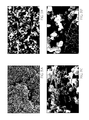
- FIG. 8 is an SEM image of a carbon black/SWCNT preblend prepared by mixing in o-dichlorobenzene: N220 carbon black/SWCNT (5:1), magnified ⁇ 40,000;
- FIG. 9 is an SEM image of a carbon black/SWCNT preblend prepared by mixing in o-dichlorobenzene: N220 carbon black/SWCNT (7:1), magnified ⁇ 40,000;
- FIG. 10A is an SEM image of a carbon black/SWCNT preblend prepared by mixing in o-dichlorobenzene: N550 carbon black/SWCNT (5:1): magnified ⁇ 25,000;
- FIG. 10B is an SEM image of the preblend of FIG. 10A magnified ⁇ 70,000;
- FIG. 11A is an SEM image of a carbon black/SWCNT preblend prepared by mixing in o-dichlorobenzene: N550 carbon black/SWCNT (7:1): magnified ⁇ 25,000; and
- FIG. 11B is an SEM image of the preblend of FIG. 11A magnified ⁇ 70,000.
- the methods and elastomer compositions according to the invention include a method for forming a preblend of carbon nanostructures, such as CNT, with a particulate solid, such as carbon black and further methods for the dispersion of the prebelends in elastomers.
- Carbon nanostructures are carbon-based materials in which at least one dimension is on the order of less than one to several nanometers. They include but are not limited to structured nanocarbons such as single-walled, double-walled, few-walled or multi-walled carbon nanotubes, graphene, few-walled graphenes, graphene oxides, fullerenic and forms of structured carbons and their chemical derivatives.
- carbon nanostructures include fullerene molecules such as C60, C70, C84, etc., and fullerene molecules containing another atom or atoms inside or outside the fullerene cage or one or more functional groups.
- Other carbon nanostructures include spheroids or spherules of carbon made up of curved carbon sheets or layers which have substantial fullerenic character. Fullerenic character is noted by the presence among six-member and sometimes seven member rings of five-membered carbon rings which result in curved sheets of carbon.
- Chemical derivatives of carbon nanostructures include any of the carbon-based materials described above that are functionalized, i.e. have added groups, e.g. by addition reactions.
- carbon nanostructures include structured fragments of any of the structured nanocarbons described above.
- a preblend is a mixture of materials made in advance of another mixing process, e.g. a rubber composition mixing process.
- the preblend is accordingly mixed into an elastomer together with other desired ingredients to make an elastomer composition suitable for molding useful elastomeric articles.
- FIG. 1 shows a flow chart of the method according to an embodiment of the invention. Preblends are also sometimes referred to as “predispersions” or simply “blends.”
- method 100 includes the steps of blending 112 , mixing 120 , and making an article 124 .
- the blending step 112 includes as inputs carrier particles 102 such as carbon black, carbon nanotubes 104 , carrier liquid medium 106 and optionally other additives 105 .
- the wet blending 112 step may include various orders of addition and/or mixing.
- CNT 104 is dispersed in liquid medium 106 first, followed by addition of particulate solid 102 .
- CNT 104 and particulate solid 106 are each dispersed in separate liquid media 106 , and then the two dispersions are combined.
- the wet blending 112 is followed by drying 118 .
- the resulting CNT preblend 119 may be introduced into mixing step 120 along with desired polymer or rubber ingredients 122 to obtain a rubber compound suitable for making article 124 .
- Mixing step 120 may optionally include multiple mixing process steps and/or multiple ingredient additions.
- CNT in FIG. 1 may be replaced by some other carbon nanostructure as defined above or mixtures thereof.
- the carbon nanotubes (CNT) are very strong molecular fibers with small dimensions across the fiber and reasonably large L/D ratios.
- CVD chemical vapor deposition
- EAD electric arc discharge
- combustion as disclosed, e.g., in U.S. Pat. No. 7,887,775 and U.S. Pat. No. 7,396,520, among the more common methods used.
- the dimensions depend on the manufacturing process.
- Single-walled carbon nanotubes (SWCNT) may range from 0.5 to 6 nanometers (nm) in diameter have lengths ranging from 0.1 to 5 microns ( ⁇ m) in length, preferably 0.5 to 5 ⁇ m in length.
- a single-wall carbon nanotube is formed from a single graphene sheet folded into a cylinder.
- Multi-walled carbon nanotubes range from 2 to 110 nm in diameter and from 0.1 to 1000 ⁇ m, preferably from 0.1 to 50 ⁇ m in length, and consist of multiple layers of graphene rolled up on themselves to form a tube shape. These dimensional variations depend on the process and manufacturer. Either single-wall carbon nanotubes or multi-wall carbon nanotubes may be used in the inventive methods and compositions, but single-wall carbon nanotubes are preferred.
- the carbon nanotube preblend comprises carbon nanotubes and a particulate solid such as carbon black.
- Particulate solids of particular usefulness are those commonly used as reinforcing fillers or non-reinforcing fillers in polymer or elastomer compositions, including silica, carbon black, clay, whiting, various metal oxides and hydroxides, and the like.
- Carbon black is preferred because of its widespread use in rubber and its chemical compatibility with carbon nanotubes.
- Types of carbon black suitable for use in the present method include those identified in ASTM D1765. Two suitable examples, as will be seen below, include N550 and N220.
- the amount of CNT in the preblend may be from 1%, or 5%, or 7% up to about 50%, or up to 30%, or up to 20% by weight based on the weight of the preblend.
- the amount of CNT in the preblend may be expressed as a ratio of particles to carbon nanotubes, and the ratio may be from about 4:1 to 99:1 or to 20:1 by weight, or from 6:1 to 15:1, or about 9:1 to about 14:1.
- the CNT may be readily blended with carbon black according to the methods described herein, and a CNT/carbon black preblend is very compatible with ethylene-alpha-olefin elastomers such as EPDM.
- carrier liquid or “liquid medium” refers to a liquid in which carbon nanotubes may be dissolved, dispersed or suspended.
- the carrier liquid may be removed by evaporation or drying, leaving the nanotubes coated on or intermixed with the carbon black.
- Suitable carrier liquids include water or organic solvents including alcohols, chlorinated aliphatic or aromatic solvents, ketones, other oxygen-containing or halogen-containing hydrocarbon liquids.
- substituted aromatic molecules alkyl substituted aromatics, halogenated substituted molecules, halogenated alkanes, partially hydrogenated aromatics, alkylamines, cyclic ethers, o-dichlorobenzene, toluene, xylene, benzene, dimethylformamide (“DMF”), ethylene chloride, chloroform, 1,2,4-trimethylbenzene, 1,2,3,4-tetramethylbenzene, tetrahydrofuran, 1,2-dibromobenzene, 1,1,2,2-tetrachloroethane, 1,2,3,4-tetrahydronapthalene, octadecylamine, acetone.
- DMF dimethylformamide
- liquids which can be used include systems based, e.g., on water stabilized by means of surfactant with such surfactant being at least one member selected from the group consisting of sodium cholate, (“NaDDBS”; C 12 H 25 C 6 H 4 SO 3 Na), sodium octylbenzene sulfonate (NaOBS; C 8 H 17 C 6 H 4 SO 3 Na), sodium butylbenzene sulfonate (“NaBBS”; C 4 H 9 C 6 H 4 SO 3 Na), sodium benzoate (C 6 H 5 CO 2 Na), sodium dodecyl sulfate (“SDS”; CH 3 (CH 2 ) 11 —OSO 3 Na), Triton (trademark of Dow Chemical Co.) X-100 (“TX100”; C 8 H 17 C 6 H 4 (OCH 2 CH 2 ) n —OH; n ⁇ 10), dodecyltrimethylammonium bromide (“DTAB”; CH 3 (CH 2 ) 11
- non-ionic dispersal aids such as outlined, e.g., in International Appl. No. PCT/US2010/045391 and U.S. patent application Ser. No. 13/725,080, can be used in water or solvent-based systems. Temperature adjustments can also be used in water or solvent-based systems in order to enhance the dispersion or solution properties. Two suitable examples, as will be seen below, include ethanol and o-dichlorobenzene.
- polymer includes thermoplastic, elastomeric and thermoset polymeric materials.
- rubber and elastomer may be used somewhat interchangeably, but rubber generally implies a crosslinked elastomer material, while some elastomers may in general be thermoplastic or may be crosslinked.
- rubber and “elastomer” are used herein to refer to the elastomeric or rubbery polymer which forms a primary elastomeric constituent of an elastomeric or rubbery material
- rubber composition and “elastomer composition” are used to refer to a mixture of a primary elastomeric constituent with one or more other compounding ingredients, such as fillers, fibers, antidegradants, process aids, curatives, cure accelerators, coagents, softeners, extenders, and the like.
- Any suitable elastomer may be used, including without limit, natural rubber (NR), epoxidized natural rubber (ENR), isoprene rubber (IR), styrene-butadiene rubber (SBR), nitrile rubber (NBR), hydrogenated nitrile (HNBR), chloroprene rubber (CR), ethylene- ⁇ -olefin elastomers such as ethylene propylene rubber (EPM or EPDM), ethylene butene (EBM) or ethylene octene (EOM), butyl rubber (IIR), chlorobutyl rubber (CIIR), acrylic rubber (ACM), silicone rubber (Q), fluorine rubber (FKM), butadiene rubber (BR), epoxidized butadiene rubber (EBR), epichlorohydrin rubber (ECO), cast urethane elastomers (PU), or polysulfide rubber (T); a thermoplastic elastomer such as an olefin-based elastomer (TPO
- Embodiments of the method are particularly useful for ethylene- ⁇ -olefin elastomers including difficult-to-disperse, non-polar elastomers such as EPM or EPDM, EBM, or EOM.
- the method of making the CNT/carbon black preblend is to wet mix them in a suitable liquid.
- the mixing may be carried out in or with any suitable mixer, whether batch-wise or continuous, such as, for example, internal mixers, ribbon-blade batch mixers, high-shear batch mixers, single-screw extruders, and twin-screw extruders.
- the mixture may then be dried using any suitable drying equipment, whether batch-wise or continuous, such as for example, spray dryers, vacuum dryers, tray dryers, drum dryers, conveyor dryers, and the like. Filtering may be included in the drying processing to concentrate the solids.
- the preblended carbon nanostructures in preblend form may be added to a polymer or an elastomer composition according to known methods of compounding polymers, rubber and elastomers.
- the rubber and its various ingredients may be compounded with the preblend using an internal batch mixer, a single-screw extruder, a twin-screw extruder, two-roll mill, or the like.
- the various ingredients may be added in stages, or all at once.
- the compound is mixed in multiple stages if in a batch mixer.
- the preblended carbon nanostructures comprising, e.g., carbon nanotubes, carbon black, graphitic carbon particles and or glassy carbon particles can also be used in many other applications besides the incorporation of such a preblend in an elastomer or other polymer.
- Such extended applications include among others, use of the preblends in battery electrodes, in particular lithium battery electrodes, battery electrolyte compositions, and in super capacitors.
- the carbon preblend described above can be used as a conductive material in a secondary battery as part of a battery electrode in various proportions with an active material and a binder.
- Examples of common active materials that can be used in combination with the carbon preblend are LiCoO 2 , LiNiO 2 , LiFeO 2 , LiMnO 2 , LiVO 2 , or a combination where a given transition metal ion (Co, Ni, Fe, Mn and V) is partially substituted by other transition metal ions.
- binders include polytetrafluoroethylene, polyvinylidene fluoride, polyethylene, polypropylene and synthetic rubbers among others.
- solvents for mixing of the dry form of carbon preblend with other kinds of conductive, active, or electrolytic materials, for use for example in battery electrolyte compositions.
- solvents for example, propylene carbonate, ethylene carbonate, butylene carbonate, diethyl carbonate, dimethyl carbonate, methyl ethyl carbonate and acetonitrile can be used alone or in combination with other solvents to form a slurry.
- a thick film electrode can be formed on flexible polymeric substrates or paper using a range of deposition techniques comprising doctor blade coating, printing, rod coating or spray coating.
- the carbon preblend of the subject invention can also be used, for instance, as part of electrical double layer capacitors (commonly known as super capacitors), including use as electrolyte in combination with other forms of carbons, conductive materials, electrolytes, solvents and salts.
- electrical double layer capacitors commonly known as super capacitors
- electrolyte in combination with other forms of carbons, conductive materials, electrolytes, solvents and salts.
- an electrolyte which might be used with the carbon preblend is acetonitrile used alone or in combination with a salt such as tetraethylammonium tetrafluoroborate (C 2 H 5 ) 4 NBF 4 .
- the preblend composition can be applied on to various substrates in the form of a paint, coating, or slurry, or used as a component of a paint, coating, or slurry.
- a preblend including N550 carbon black and SWCNT is prepared to evaluate whether preblends of CNT can subsequently assist in the dispersion of the CNT in EPDM elastomer compositions.
- Single-walled carbon nanotubes were provided by Nano-C, Inc. of Westwood, Mass.
- the diameter ranges from 0.8 to 1.9 nm with a higher abundance between 0.8 and 1.3 nm.
- the SWCNT bundle length it ranges from 0.4 to 2 micrometer, most abundant from 0.5 to 1 micrometer. All other ingredients mentioned herein were obtained from commercial distributors and used as provided.
- a first example blend of the single-walled carbon nanotubes with N550 carbon black had a SWCNT content of 7.18% by weight, or 13:1 ratio of carbon black to CNT.
- This blend was prepared by first mixing the SWCNT in ethanol (1 gram of SWCNT in 35 ml of ethanol) and sonicating for 15 minutes. Also, carbon black was dispersed in ethanol at a about 30 gm/l and mixed with an IKA T25 disperser (sold under the IKA trademark by IKA Works Inc.) for 15 minutes. The CNT solution was then added to an appropriate amount of carbon black solution and mixed with the IKA T25 disperser for 15 more minutes. The solvent was then removed by filtration and the carbon preblend material isolated and dried in a 60° C. oven overnight. This material was then characterized assessing the degree of homogeneity and the identity of the resulting product.
- FIG. 3A-3D shows a preblend material with unique morphology in which both constituent materials became intimately mixed.
- the new material consists of nanotube network(s) surrounding carbon black particles, or, in other words, of a nanotube network with carbon black particles dispersed therein.
- this unique preblend structure provides improvements in subsequent dispersion of the nanotubes in an elastomer composition.
- carbon-based particles consisting of graphitic, glassy or structure-less carbon can be used as the carrier particulate solid or mixtures thereof, instead of or in addition to carbon black.
- Particle shape of the carrier can be regular or irregular.
- fullerenic or nano-structured carbon materials such as spheroidal fullerenes (C 60 , C 70 , . . . , C 84 , . . . ), graphenes, functionalized or not, can be used instead of carbon nanotubes.
- the carbon-based carrier particles are larger than both the width and length of the material with which they are mixed, a unique core-shell material in which nanotubes or other fullerenic materials (“the shell”) cover the surface of the graphitic, glassy or structure-less “core.” Coverage may be up to 50% or 50 to 100%.
- the diameter of the carbon-based or other particulate core material can be between 20 nm and 20 ⁇ m while the longest dimension of the nanocarbon shell material can be between 0.7 nm and 2.0 ⁇ m.
- FIG. 4 An illustration of a core covered with carbon nanotubes as the shell is given in FIG. 4 in which polymer beads with diameters of approximately 1 ⁇ m coated with single-walled carbon nanotubes are shown.
- the rubber compounding herein utilized a conventional B-Banbury lab mixer with 1571 ml internal volume.
- the control elastomer composition was 100 parts by weight Vistalon 706 (EPM) sold under that trade named by Exxon Chemicals; with 60 parts per hundred parts of elastomer (“phr”) of N550 carbon black, and 5 phr of peroxide curative (Vul-Cup 40KE).
- the composition also included 0.3 phr of a retarder and 1 phr of an antioxidant.
- This composition (Comp. Ex. 1) was mixed as the control example (i.e., with no CNT).
- a second comparative example (Comp. Ex.
- Tests are at room temperature (“RT”) and in the with-grain (“w/g”) direction unless otherwise indicated. Cross-grain tests are indicated as “x/g”.
- Table 1 The formulations and results are shown in Table 1. It can be seen that mixing the SWCNT into the rubber composition produces the following results.
- the Mooney viscosity (ML/132° C.) for these compounds (at a lower temperature than the MDR) showed a small increase with the addition of the carbon nanotubes. There is essentially no difference in the viscosity for either route of incorporation of the nanotubes.
- the dynamic modulus of the two compounds with nanotubes was determined at 175° C. on the Rubber Process Analyzer (RPA) according to ASTM D-6601.
- Table 1 shows the same lower modulus (G′) for the nanotubes-containing compounds seen with the MDR.
- G′ lower modulus
- the resulting material was slightly stiffer than simple addition of the two materials separately. This is an indication of some improvement in nanotubes dispersion using the carbon black/nanotubes blend.
- the small increase in modulus observed with pre-blending the two materials is accompanied by an increase in hysteresis (tan 6), but only up to the level of the control.
- Room temperature 10% modulus shows an increase in modulus with the introduction of nanotubes into the compound and this is further increased with the pre-blending of the two materials prior to compounding.
- the largest increase in each case is in the with-grain direction and very slight in the cross-grain direction.
- the increase in modulus is marginal, following the trend indicated by the RPA and MDR data.
- There is no significant decline in modulus over the control at high temperature as was seen in previous studies of wax/CNT predispersions.
- the method of preblending CNT with carbon black provides more temperature stability than another method.
- Elongation at break shows a noticeable increase with introduction of CNT in the compound and an additional increase when the CNT are pre-blended with carbon black. This trend is consistent with or across the grain of orientation from processing. At elevated temperature (125° C.), the trend is the same but the increases are all smaller than at RT. Toughness is also improved by CNT.
- Tear properties show a steady increase with the addition of the CNT and further increase with the pre-blending. Also, anisotropy is increased slightly with the introduction of the CNT. Tear also is slightly increased over the control at increased temperature.
- the Shore A hardness for these compounds is essentially the same.
- the DeMattia test was carried out in accordance with ASTM D-813 with a pierced specimen.
- the cut growth rate is reported as the extrapolated number of mega-cycles to reach a 1-inch cut width, i.e., Mcycles/in.
- DeMattia crack growth rates showed a marked improvement regardless of the orientation, if any, of the CNT in the compound. This was evaluated at 125° C., and the improvement occurs in spite of the fact that there is some increase in stiffness of the compound.
- FIGS. 5-7 show FE-SEM pictures at 30,000 ⁇ of three rubber compounds: FIG. 5 shows a control, carbon black only added to rubber; FIG. 6 shows separate addition to rubber of carbon black and SWCNT; and FIG. 7 shows carbon black/SWCNT preblend prepared in liquid at Nano-C and added to rubber.
- the sample ( FIG. 5 ) with carbon black-only shows carbon black on the surface.
- the two samples with the CNT ( FIGS. 6-7 ) show the carbon nanotubes interacting with the rubber and generating a web-like surface feature. On the basis of these photographs, it is believed the dispersion of the nanotubes was better for the Ex. 3 material than for Comp. Ex. 2.
- CNT preblended with carbon black can improve rubber physical properties such as elongation at break, modulus, crack growth resistance and conductivity while other properties are unaffected or slightly improved.
- the same SWCNT as the first example was used.
- a different liquid medium was used to prepare two preblends of different ratios.
- These preblends of CNT and carbon black were made using o-dichlorobenzene as the organic liquid.
- the blends were prepared by first mixing the SWCNT in o-dicholorobenzene at a concentration of about 30 grams of SWCNT per liter of solvent with the IKA T25 mixer for 15 minutes. Then the carbon black was mixed in o-dicholorobenzene for 25 minutes at a concentration of about 20 to 30 grams per liter of solvent.
- FIGS. 10A and 11A show N550 carbon black/SWCNT preblends at a 5:1 and 7:1 ratio, respectively, with FIGS. 10A and 11A at 25,000 ⁇ , and FIGS. 10B and 11B at 70,000 ⁇ .
- the base EPM elastomer composition, the rubber mixing and the testing were the same as for the first series.
- the rubber formulations used and the results are shown in Table 2 below.
- the invention may be characterized by the simultaneous increase in modulus (e.g. 10% modulus) and elongation at break relative to the same composition without CNT.
- the increase in one or both properties is in the range of at least 20%, or at least 30%, or at least 50%.
- conductivity of the rubber did not seem to be dependent on the method of dispersing the CNT, just on their presence in sufficient amounts and the type of carbon black used.
- the carbon black used is not very conductive, we see a difference in the conductivity, favoring the solution blended CB/SWCNT over simple SWCNT addition.
- the carbon black is very conductive—i.e. N220—we see a much smaller difference.
- inventive method of dispersing CNT using a carbon black/CNT preblend in elastomers results in improved dispersion over prior art methods, resulting in simultaneously increased modulus and elongation in the resulting elastomer composition.
- inventive elastomer compositions may be used to make various rubber articles, for example, belts, hose, vibration control components, tires, sheet goods, and the like.
Landscapes
- Chemical & Material Sciences (AREA)
- Organic Chemistry (AREA)
- Chemical Kinetics & Catalysis (AREA)
- Health & Medical Sciences (AREA)
- Polymers & Plastics (AREA)
- Medicinal Chemistry (AREA)
- Engineering & Computer Science (AREA)
- Materials Engineering (AREA)
- Nanotechnology (AREA)
- Inorganic Chemistry (AREA)
- Electrochemistry (AREA)
- Life Sciences & Earth Sciences (AREA)
- Wood Science & Technology (AREA)
- Power Engineering (AREA)
- Microelectronics & Electronic Packaging (AREA)
- General Chemical & Material Sciences (AREA)
- Composite Materials (AREA)
- Compositions Of Macromolecular Compounds (AREA)
- General Life Sciences & Earth Sciences (AREA)
- Geology (AREA)
- Manufacturing & Machinery (AREA)
- Paints Or Removers (AREA)
- Electric Double-Layer Capacitors Or The Like (AREA)
- Battery Electrode And Active Subsutance (AREA)
- Processes Of Treating Macromolecular Substances (AREA)
- Carbon And Carbon Compounds (AREA)
- Pigments, Carbon Blacks, Or Wood Stains (AREA)
Abstract
Description
| TABLE 1 | ||||
| Comp. | Comp. | |||
| Ex. 1 | Ex. 2 | Ex. 3 | ||
| |
100 | 100 | 100 |
| Carbon Black1 | 60 | 50 | 0 |
| ZDMA Coagent | 15 | 15 | 15 |
| Paraffin Oil | 10 | 10 | 10 |
| |
1 | 1 | 1 |
| SWCNT | — | 3.87 | — |
| CB/SWCNT Preblend | — | — | 53.87 |
| Retarder | 0.3 | 0.3 | 0.3 |
| Peroxide (40KE) | 5 | 5 | 5 |
| SWCNT (vol. %) | 0 | 1.25 | 1.25 |
| MDR-ML (lb-in) | 1.99 | 2.16 | 2.42 |
| MDR-MH (lb-in) | 31.2 | 26.7 | 27.8 |
| MDR-t90 (min) | 10.89 | 7.4 | 7.69 |
| MV/132° C. (mu) | 68.8 | 74.0 | 74.0 |
| RPA-G′ (kPa)2 | 3867 | 2970 | 3405 |
| RPA-tan δ2 | 0.142 | 0.082 | 0.145 |
| % Elong. at Break (RT) | 296 | 390 | 403 |
| 10% Modulus (psi) (RT) | 190.9 | 210.3 | 220.0 |
| Toughness (RT) | 4328 | 5361 | 5886 |
| Shore A Hardness | 78 | 78 | 78 |
| % Elong 125° C. | 168.8 | 209.7 | 234.6 |
| 10% Mod. 125° C. (psi) | 130.2 | 137.3 | 137.2 |
| Toughness 125° C | 987 | 1126 | 1380 |
| DeMattia 125° C. (Mcycle/in) | 3.3 | 1250 | 1167 |
| C-Tear x/g (lb/in) (RT) | 290.1 | 373.8 | 391.5 |
| C-Tear w/g (lb/in) (RT) | 292.9 | 358.7 | 371.3 |
| 1N550; | |||
| 21000 CPM, 0.18° strain, 175° C. | |||
| TABLE 2 | ||||||||
| Comp. | Comp. | Comp. | Comp. | |||||
| Ex. 4 | Ex. 5 | Ex. 6 | Ex. 7 | Ex. 8 | Ex. 9 | Ex. 10 | ||
| |
100 | 100 | 100 | 100 | 100 | 100 | 100 |
| N550 | 60 | 50 | 0 | 30.65 | 0 | 0 | 0 |
| N220 | 0 | 0 | 0 | 0 | 60 | 50 | 30.65 |
| ZDMA Coagent | 15 | 15 | 15 | 15 | 15 | 15 | 15 |
| Paraffin Oil | 10 | 10 | 10 | 10 | 10 | 10 | 10 |
| |
1 | 1 | 1 | 1 | 1 | 1 | 1 |
| SWCNT | — | 3.87 | — | — | — | 3.87 | — |
| N550, 5:1 CB:CNT | — | — | — | 23.22 | — | — | — |
| N550, 13:1 CB:CNT | — | — | 53.87 | — | — | — | — |
| N220, 5:1 CB:CNT | — | — | — | — | — | — | 23.22 |
| Retarder | 0.3 | 0.3 | 0.3 | 0.3 | 0.3 | 0.3 | 0.3 |
| Peroxide (40KE) | 5 | 5 | 5 | 5 | 5 | 5 | 5 |
| SWCNT (vol. %) | 0 | 1.25 | 1.25 | 1.25 | 0 | 1.25 | 1.25 |
| MDR-ML (lb-in) | 1.85 | 1.89 | 2.12 | 1.96 | 2.73 | 2.79 | 2.62 |
| MDR-MH (lb-in) | 32.51 | 25.8 | 24.89 | 23.42 | 32.36 | 26.88 | 26.33 |
| MDR-t90 (min) | 11.46 | 8.04 | 6.35 | 6.51 | 10.66 | 7.61 | 7.78 |
| MV/132° C. (mu) | 59.4 | 58.1 | 63.3 | 59.7 | 74.9 | 76.5 | 68.7 |
| RPA-G′ (kPa) | 3513 | 2737 | 2740 | 2636 | 3903 | 3323 | 3159 |
| RPA-tan δ | 0.070 | 0.082 | 0.102 | 0.104 | 0.098 | 0.117 | 0.110 |
| Stress at Break (psi) (RT) | 3179 | 3080 | 3154 | 3450 | 3977 | 3319 | 3859 |
| % Elong. at Break (RT) | 331.3 | 508.6 | 529.0 | 557.0 | 388.8 | 481.6 | 509.4 |
| 10% Modulus (psi) | 185.8 | 192.4 | 225.6 | 220.3 | 212.6 | 239.0 | 234.1 |
| Shore A Hardness | 79 | 78 | 79 | 79 | 80 | 81 | 80 |
| Stress at Break 125° C. | 925 | 825 | 1031 | 925 | 1221 | 961 | 1002 |
| % Elong at break 125° C. | 177.6 | 289.1 | ~315 | ~330 | 212.8 | ~305 | ~420 |
| 10% Mod. 125° C. (psi) | 114 | 97 | 84 | 98 | 108 | 103 | 102 |
| DeMattia 125° C. (Mcycle/in) | 3.3 | 1200 | 1333 | 1333 | 28 | 700 | 783 |
| C-Tear w/g (lb/in) (RT) | 327 | 394 | 405 | 410 | 308 | 390 | 402 |
| C-Tear w/g (lb/in) (125° C.) | 117 | 133 | 144 | 141 | 128 | 144 | 141 |
Claims (35)
Priority Applications (10)
| Application Number | Priority Date | Filing Date | Title |
|---|---|---|---|
| US14/633,458 US9550907B2 (en) | 2015-02-27 | 2015-02-27 | Carbon nanostructure preblends and their applications |
| KR1020177027253A KR101996071B1 (en) | 2015-02-27 | 2016-02-23 | Carbon nanostructure preliminary blend and its application |
| EP16709864.9A EP3262105B1 (en) | 2015-02-27 | 2016-02-23 | Method for making carbon nanostructure preblends |
| CN201680018767.4A CN107428953A (en) | 2015-02-27 | 2016-02-23 | Carbon nano-structured pre-blend and its application |
| JP2017545400A JP6652572B2 (en) | 2015-02-27 | 2016-02-23 | Carbon nanostructure preblend and its use |
| EP23204958.5A EP4286465A3 (en) | 2015-02-27 | 2016-02-23 | Carbon nanostructure preblends and their applications |
| PCT/US2016/019173 WO2016138024A1 (en) | 2015-02-27 | 2016-02-23 | Carbon nanostructure preblends and their applications |
| US15/413,013 US9938383B2 (en) | 2015-02-27 | 2017-01-23 | Carbon nanostructure preblends and their applications |
| US15/948,632 US10308773B2 (en) | 2015-02-27 | 2018-04-09 | Carbon nanostructure preblends and their applications |
| US16/431,499 US20190322818A1 (en) | 2015-02-27 | 2019-06-04 | Carbon nanostructure preblends and their applications |
Applications Claiming Priority (1)
| Application Number | Priority Date | Filing Date | Title |
|---|---|---|---|
| US14/633,458 US9550907B2 (en) | 2015-02-27 | 2015-02-27 | Carbon nanostructure preblends and their applications |
Related Child Applications (1)
| Application Number | Title | Priority Date | Filing Date |
|---|---|---|---|
| US15/413,013 Division US9938383B2 (en) | 2015-02-27 | 2017-01-23 | Carbon nanostructure preblends and their applications |
Publications (2)
| Publication Number | Publication Date |
|---|---|
| US20160251534A1 US20160251534A1 (en) | 2016-09-01 |
| US9550907B2 true US9550907B2 (en) | 2017-01-24 |
Family
ID=55527643
Family Applications (4)
| Application Number | Title | Priority Date | Filing Date |
|---|---|---|---|
| US14/633,458 Active US9550907B2 (en) | 2015-02-27 | 2015-02-27 | Carbon nanostructure preblends and their applications |
| US15/413,013 Active US9938383B2 (en) | 2015-02-27 | 2017-01-23 | Carbon nanostructure preblends and their applications |
| US15/948,632 Active US10308773B2 (en) | 2015-02-27 | 2018-04-09 | Carbon nanostructure preblends and their applications |
| US16/431,499 Abandoned US20190322818A1 (en) | 2015-02-27 | 2019-06-04 | Carbon nanostructure preblends and their applications |
Family Applications After (3)
| Application Number | Title | Priority Date | Filing Date |
|---|---|---|---|
| US15/413,013 Active US9938383B2 (en) | 2015-02-27 | 2017-01-23 | Carbon nanostructure preblends and their applications |
| US15/948,632 Active US10308773B2 (en) | 2015-02-27 | 2018-04-09 | Carbon nanostructure preblends and their applications |
| US16/431,499 Abandoned US20190322818A1 (en) | 2015-02-27 | 2019-06-04 | Carbon nanostructure preblends and their applications |
Country Status (6)
| Country | Link |
|---|---|
| US (4) | US9550907B2 (en) |
| EP (2) | EP3262105B1 (en) |
| JP (1) | JP6652572B2 (en) |
| KR (1) | KR101996071B1 (en) |
| CN (1) | CN107428953A (en) |
| WO (1) | WO2016138024A1 (en) |
Families Citing this family (14)
| Publication number | Priority date | Publication date | Assignee | Title |
|---|---|---|---|---|
| KR102196063B1 (en) * | 2016-02-10 | 2020-12-30 | 캐보트 코포레이션 | Elastomer formulation |
| US10707531B1 (en) | 2016-09-27 | 2020-07-07 | New Dominion Enterprises Inc. | All-inorganic solvents for electrolytes |
| CN108020572B (en) * | 2016-10-31 | 2020-07-10 | 清华大学 | Characterization of carbon nanotubes |
| JP6805863B2 (en) * | 2017-02-13 | 2020-12-23 | 住友ゴム工業株式会社 | Rubber composition for tires and pneumatic tires |
| WO2018227036A1 (en) | 2017-06-09 | 2018-12-13 | Keane Group Holdings, Llc | Compositions and methods to optimize dust control in hydraulic fracturing |
| WO2020061988A1 (en) * | 2018-09-28 | 2020-04-02 | Dow Silicones Corporation | Liquid silicone rubber composition |
| WO2020137936A1 (en) * | 2018-12-27 | 2020-07-02 | 昭和電工株式会社 | Resin additive composition and method for manufacturing same, and resin composition and method for manufacturing same |
| CN113939670B (en) * | 2019-06-07 | 2023-06-20 | 阪东化学株式会社 | Transmission belt |
| KR102524378B1 (en) * | 2019-09-27 | 2023-04-20 | 주식회사 엘지화학 | Latex composition for dip-forming, method for preparing the composition and article formed by the composition |
| CN111607296A (en) * | 2020-06-02 | 2020-09-01 | 上海金狮化工有限公司 | Functional graphene modified water-based leather color paste and preparation method thereof |
| RU2767647C1 (en) * | 2021-03-05 | 2022-03-18 | МСД Текнолоджис С.а р.л. | Additive to rubber compositions, method of producing additive, method of producing rubber with high electrical conductivity and physical and mechanical properties and rubber |
| JP2024515825A (en) * | 2021-04-28 | 2024-04-10 | ネモ ナノマテエリアルズ リミテッド | Extrudable Compositions Containing Polymer Particles Coated with Carbon Nanotubes - Patent application |
| WO2024005669A1 (en) * | 2022-06-27 | 2024-01-04 | Общество С Ограниченной Ответственностью "Ампертекс" | Electrically conductive composite fibre and method for producing and using same |
| JP7230269B1 (en) | 2022-07-29 | 2023-02-28 | 大日精化工業株式会社 | Carbon material dispersion and its use |
Citations (15)
| Publication number | Priority date | Publication date | Assignee | Title |
|---|---|---|---|---|
| US4125493A (en) | 1977-04-01 | 1978-11-14 | The Gates Rubber Company | Fibrated admix or polymer and process therefore |
| US4244847A (en) | 1978-08-10 | 1981-01-13 | The Gates Rubber Company | Fibrated admix or polymer and process therefore |
| US4508860A (en) | 1982-02-25 | 1985-04-02 | Westvaco Corporation | Discontinuous fiber pretreatment |
| EP0232592B1 (en) | 1985-11-18 | 1991-03-13 | Polysar Limited | Dispersions of fibres in rubber |
| US5217801A (en) | 1990-06-21 | 1993-06-08 | Mitsubishi Belting Ltd. | Rubber composite material mixed with short staple reinforcing fibers and method of manufacturing the same |
| JP2006045034A (en) | 2004-08-09 | 2006-02-16 | Futaba Corp | Composite material of carbon nanotube and its manufacturing method |
| US20080233402A1 (en) | 2006-06-08 | 2008-09-25 | Sid Richardson Carbon & Gasoline Co. | Carbon black with attached carbon nanotubes and method of manufacture |
| US20090318606A1 (en) * | 2009-07-08 | 2009-12-24 | Sheikhaleslami Mohamad Ali Sha | Method of preparing phenolic resin/carbon nano materials (hybrid resin) |
| WO2010008014A1 (en) | 2008-07-18 | 2010-01-21 | 国立大学法人 北海道大学 | Carbon nanoprecursor, method for producing the same, carbon nanocomposite and method for producing the same |
| US20100172818A1 (en) | 2009-01-06 | 2010-07-08 | Tatung University | Method of preparing carbon nanotube complexes |
| US20120112134A1 (en) * | 2009-06-30 | 2012-05-10 | Hanwha Chemical Corporation | Blending Improvement Carbon-Composite having Carbon-Nanotube and its Continuous Manufacturing Method and Apparatus |
| KR20120056075A (en) | 2010-11-24 | 2012-06-01 | 주식회사 어플라이드카본나노 | Method of conductive inorganic carbon nano composite powder |
| JP2013179909A (en) * | 2012-03-02 | 2013-09-12 | Tosoh Corp | Method for producing d-lactic acid |
| EP2778266A1 (en) | 2013-03-14 | 2014-09-17 | Showa Denko K.K. | Composite carbon fibers |
| US20150171421A1 (en) * | 2012-05-31 | 2015-06-18 | Mitsubishi Materials Corporation | Electrode for lithium ion secondary cell, method for preparing paste for said electrode and method for manufacturing said electrode |
Family Cites Families (12)
| Publication number | Priority date | Publication date | Assignee | Title |
|---|---|---|---|---|
| JPS6344740A (en) * | 1986-08-12 | 1988-02-25 | Fujitsu Ltd | Manufacture of semiconductor device |
| US7125502B2 (en) * | 2001-07-06 | 2006-10-24 | William Marsh Rice University | Fibers of aligned single-wall carbon nanotubes and process for making the same |
| JP4208714B2 (en) | 2001-08-31 | 2009-01-14 | ナノ−シー,インク. | Method for combustion synthesis of fullerenes |
| US7335344B2 (en) | 2003-03-14 | 2008-02-26 | Massachusetts Institute Of Technology | Method and apparatus for synthesizing filamentary structures |
| JP4005048B2 (en) | 2003-04-09 | 2007-11-07 | 日信工業株式会社 | Carbon fiber composite material and method for producing the same |
| WO2009155728A1 (en) | 2008-06-23 | 2009-12-30 | Lanxess Deutschland Gmbh | Carbon nanotube containing rubber compositions |
| CN102306553B (en) * | 2011-06-29 | 2013-01-16 | 马俊武 | Composite type activated carbon electrode material for super capacitor |
| JP2014001266A (en) * | 2012-06-15 | 2014-01-09 | Canon Inc | Polyester molded article and method for manufacturing the same |
| KR102121868B1 (en) * | 2012-08-28 | 2020-06-11 | 덴카 주식회사 | Electrode material for lithium ion secondary batteries, method for producing same, and lithium ion secondary battery |
| US10505180B2 (en) * | 2012-11-07 | 2019-12-10 | The Regents Of The University Of California | Core-shell structured nanoparticles for lithium-sulfur cells |
| CN103642198B (en) * | 2013-12-02 | 2015-11-04 | 厦门凯纳石墨烯技术有限公司 | Graphene/carbon black thermoplastic resin master batch with polymolecularity and preparation method thereof |
| JP6442160B2 (en) * | 2014-05-09 | 2018-12-19 | 日本ゼオン株式会社 | Method for producing carbon nanotube composite material |
-
2015
- 2015-02-27 US US14/633,458 patent/US9550907B2/en active Active
-
2016
- 2016-02-23 EP EP16709864.9A patent/EP3262105B1/en active Active
- 2016-02-23 WO PCT/US2016/019173 patent/WO2016138024A1/en not_active Ceased
- 2016-02-23 KR KR1020177027253A patent/KR101996071B1/en active Active
- 2016-02-23 JP JP2017545400A patent/JP6652572B2/en active Active
- 2016-02-23 CN CN201680018767.4A patent/CN107428953A/en active Pending
- 2016-02-23 EP EP23204958.5A patent/EP4286465A3/en active Pending
-
2017
- 2017-01-23 US US15/413,013 patent/US9938383B2/en active Active
-
2018
- 2018-04-09 US US15/948,632 patent/US10308773B2/en active Active
-
2019
- 2019-06-04 US US16/431,499 patent/US20190322818A1/en not_active Abandoned
Patent Citations (16)
| Publication number | Priority date | Publication date | Assignee | Title |
|---|---|---|---|---|
| US4125493A (en) | 1977-04-01 | 1978-11-14 | The Gates Rubber Company | Fibrated admix or polymer and process therefore |
| US4244847A (en) | 1978-08-10 | 1981-01-13 | The Gates Rubber Company | Fibrated admix or polymer and process therefore |
| US4508860A (en) | 1982-02-25 | 1985-04-02 | Westvaco Corporation | Discontinuous fiber pretreatment |
| EP0232592B1 (en) | 1985-11-18 | 1991-03-13 | Polysar Limited | Dispersions of fibres in rubber |
| US5217801A (en) | 1990-06-21 | 1993-06-08 | Mitsubishi Belting Ltd. | Rubber composite material mixed with short staple reinforcing fibers and method of manufacturing the same |
| JP2006045034A (en) | 2004-08-09 | 2006-02-16 | Futaba Corp | Composite material of carbon nanotube and its manufacturing method |
| US20080233402A1 (en) | 2006-06-08 | 2008-09-25 | Sid Richardson Carbon & Gasoline Co. | Carbon black with attached carbon nanotubes and method of manufacture |
| WO2010008014A1 (en) | 2008-07-18 | 2010-01-21 | 国立大学法人 北海道大学 | Carbon nanoprecursor, method for producing the same, carbon nanocomposite and method for producing the same |
| US20100172818A1 (en) | 2009-01-06 | 2010-07-08 | Tatung University | Method of preparing carbon nanotube complexes |
| US20120112134A1 (en) * | 2009-06-30 | 2012-05-10 | Hanwha Chemical Corporation | Blending Improvement Carbon-Composite having Carbon-Nanotube and its Continuous Manufacturing Method and Apparatus |
| US20090318606A1 (en) * | 2009-07-08 | 2009-12-24 | Sheikhaleslami Mohamad Ali Sha | Method of preparing phenolic resin/carbon nano materials (hybrid resin) |
| KR20120056075A (en) | 2010-11-24 | 2012-06-01 | 주식회사 어플라이드카본나노 | Method of conductive inorganic carbon nano composite powder |
| JP2013179909A (en) * | 2012-03-02 | 2013-09-12 | Tosoh Corp | Method for producing d-lactic acid |
| US20150171421A1 (en) * | 2012-05-31 | 2015-06-18 | Mitsubishi Materials Corporation | Electrode for lithium ion secondary cell, method for preparing paste for said electrode and method for manufacturing said electrode |
| JPWO2013179909A1 (en) * | 2012-05-31 | 2016-01-18 | 三菱マテリアル株式会社 | ELECTRODE FOR LITHIUM ION SECONDARY BATTERY, METHOD FOR PREPARING THE ELECTRODE PASTE, AND METHOD FOR PRODUCING THE ELECTRODE |
| EP2778266A1 (en) | 2013-03-14 | 2014-09-17 | Showa Denko K.K. | Composite carbon fibers |
Non-Patent Citations (4)
| Title |
|---|
| European Patent Office, International Search Report PCT/US2016/019173, Mailing date Jun. 7, 2016. |
| S. Rooj, A. Das, K.W. Stöckelhuber, S. Wiebetaner, D. Fischer, U. Reuter, G. Heinrich; Expanded organoclay' assisted dispersion and simultaneous structural alterations of multiwall carbon nanotube (MWCNT) clusters in natural rubber; Composites Science and Technology, journal homepage: www.elsevier.com/ locate/compscitech, Composites Science and Technology 107 (2015) 36-43, 2014. |
| S. Rooj, A. Das, K.W. Stöckelhuber, S. Wieβner, D. Fischer, U. Reuter, G. Heinrich; Expanded organoclay' assisted dispersion and simultaneous structural alterations of multiwall carbon nanotube (MWCNT) clusters in natural rubber; Composites Science and Technology, journal homepage: www.elsevier.com/ locate/compscitech, Composites Science and Technology 107 (2015) 36-43, 2014. |
| Zhang et al., J. Mater. Chem., 21, 6916-6921, 2011. * |
Also Published As
| Publication number | Publication date |
|---|---|
| CN107428953A (en) | 2017-12-01 |
| US9938383B2 (en) | 2018-04-10 |
| US10308773B2 (en) | 2019-06-04 |
| KR101996071B1 (en) | 2019-07-05 |
| EP3262105B1 (en) | 2023-11-08 |
| JP2018518541A (en) | 2018-07-12 |
| KR20170125363A (en) | 2017-11-14 |
| US20160251534A1 (en) | 2016-09-01 |
| US20180223052A1 (en) | 2018-08-09 |
| EP3262105A1 (en) | 2018-01-03 |
| JP6652572B2 (en) | 2020-02-26 |
| EP4286465A3 (en) | 2024-02-28 |
| EP4286465A2 (en) | 2023-12-06 |
| US20170130010A1 (en) | 2017-05-11 |
| US20190322818A1 (en) | 2019-10-24 |
| WO2016138024A1 (en) | 2016-09-01 |
Similar Documents
| Publication | Publication Date | Title |
|---|---|---|
| US10308773B2 (en) | Carbon nanostructure preblends and their applications | |
| JP5207351B2 (en) | Melt-kneaded product, resin molded product and method for producing the same | |
| US9006327B2 (en) | Process for preparing precomposites based on nanotubes, particularly carbon nanotubes | |
| CN115768824A (en) | Elastomeric compositions with carbon nanostructure fillers | |
| JP2006507380A (en) | Conductive thermoplastic composite and manufacturing method | |
| CN104603184A (en) | Composite material with very low concentration of carbon nanofillers, method for its preparation and use of said material | |
| JP7173023B2 (en) | rubber composition | |
| CN107250279A (en) | Rubber composition and sulfide | |
| JP2006083249A (en) | Method for producing nanocarbon-containing rubber composition dispersion solution | |
| WO2010007705A1 (en) | Process for combining one-dimensional structures with zero-dimensional structures and composites obtained by the process | |
| JP2012167216A (en) | Conductive rubber composition and master batch as raw material of the same | |
| Espinosa-González et al. | Polystyrene composites with very high carbon nanotubes loadings by in situ grafting polymerization | |
| JP2024510922A (en) | Additive for rubber compounds and manufacturing method thereof | |
| Song et al. | Facile Fabrication of Polyolefin/Carbon Nanotube Composites via in Situ Friedel–Crafts Polyalkylation: Structure and Properties | |
| JP5432974B2 (en) | Method for producing carbon fiber composite material and carbon fiber composite material | |
| JP7155567B2 (en) | molding | |
| KR20150045169A (en) | Rubber composition for tire containing carbon nanotube | |
| JP5767466B2 (en) | Highly compounded rubber particles of carbon nanotubes and method for producing the same | |
| Mittal | Overview of polymer nanotube nanocomposites | |
| Chen et al. | Compounding Clay Gel Into Hydrophilically Treated Styrene‐Butadiene Rubber to Obtain High‐Performance Rubber/Clay Nanocomposites | |
| JP2011162755A (en) | Composite material and process for producing the same | |
| JP2008200867A (en) | Rubber composition |
Legal Events
| Date | Code | Title | Description |
|---|---|---|---|
| AS | Assignment |
Owner name: NANO-C, INC., MASSACHUSETTS Free format text: ASSIGNMENT OF ASSIGNORS INTEREST;ASSIGNOR:VEJINS, VIKTOR;REEL/FRAME:035268/0120 Effective date: 20150227 Owner name: NANO-C, INC., MASSACHUSETTS Free format text: ASSIGNMENT OF ASSIGNORS INTEREST;ASSIGNOR:RICHTER, HENNING;REEL/FRAME:035268/0054 Effective date: 20150227 |
|
| AS | Assignment |
Owner name: GATES CORPORATION, COLORADO Free format text: ASSIGNMENT OF ASSIGNORS INTEREST;ASSIGNOR:NANO-C, INC.;REEL/FRAME:035276/0816 Effective date: 20150227 Owner name: GATES CORPORATION, COLORADO Free format text: ASSIGNMENT OF ASSIGNORS INTEREST;ASSIGNOR:BURLETT, DONALD JAMES;REEL/FRAME:035334/0066 Effective date: 20150225 Owner name: NANO-C, INC., MASSACHUSETTS Free format text: ASSIGNMENT OF ASSIGNORS INTEREST;ASSIGNOR:SIVARAJAN, RAMESH;REEL/FRAME:035276/0650 Effective date: 20150227 |
|
| STCF | Information on status: patent grant |
Free format text: PATENTED CASE |
|
| MAFP | Maintenance fee payment |
Free format text: PAYMENT OF MAINTENANCE FEE, 4TH YEAR, LARGE ENTITY (ORIGINAL EVENT CODE: M1551); ENTITY STATUS OF PATENT OWNER: LARGE ENTITY Year of fee payment: 4 |
|
| MAFP | Maintenance fee payment |
Free format text: PAYMENT OF MAINTENANCE FEE, 8TH YEAR, LARGE ENTITY (ORIGINAL EVENT CODE: M1552); ENTITY STATUS OF PATENT OWNER: LARGE ENTITY Year of fee payment: 8 |