US9547520B1 - Virtual machine load balancing - Google Patents
Virtual machine load balancing Download PDFInfo
- Publication number
- US9547520B1 US9547520B1 US14/865,011 US201514865011A US9547520B1 US 9547520 B1 US9547520 B1 US 9547520B1 US 201514865011 A US201514865011 A US 201514865011A US 9547520 B1 US9547520 B1 US 9547520B1
- Authority
- US
- United States
- Prior art keywords
- memory
- amount
- virtual machine
- virtual machines
- application
- Prior art date
- Legal status (The legal status is an assumption and is not a legal conclusion. Google has not performed a legal analysis and makes no representation as to the accuracy of the status listed.)
- Active
Links
Images



Classifications
-
- G—PHYSICS
- G06—COMPUTING OR CALCULATING; COUNTING
- G06F—ELECTRIC DIGITAL DATA PROCESSING
- G06F9/00—Arrangements for program control, e.g. control units
- G06F9/06—Arrangements for program control, e.g. control units using stored programs, i.e. using an internal store of processing equipment to receive or retain programs
- G06F9/44—Arrangements for executing specific programs
- G06F9/455—Emulation; Interpretation; Software simulation, e.g. virtualisation or emulation of application or operating system execution engines
- G06F9/45533—Hypervisors; Virtual machine monitors
- G06F9/45558—Hypervisor-specific management and integration aspects
-
- G—PHYSICS
- G06—COMPUTING OR CALCULATING; COUNTING
- G06F—ELECTRIC DIGITAL DATA PROCESSING
- G06F9/00—Arrangements for program control, e.g. control units
- G06F9/06—Arrangements for program control, e.g. control units using stored programs, i.e. using an internal store of processing equipment to receive or retain programs
- G06F9/44—Arrangements for executing specific programs
- G06F9/455—Emulation; Interpretation; Software simulation, e.g. virtualisation or emulation of application or operating system execution engines
- G06F9/45533—Hypervisors; Virtual machine monitors
- G06F9/45558—Hypervisor-specific management and integration aspects
- G06F2009/4557—Distribution of virtual machine instances; Migration and load balancing
-
- G—PHYSICS
- G06—COMPUTING OR CALCULATING; COUNTING
- G06F—ELECTRIC DIGITAL DATA PROCESSING
- G06F9/00—Arrangements for program control, e.g. control units
- G06F9/06—Arrangements for program control, e.g. control units using stored programs, i.e. using an internal store of processing equipment to receive or retain programs
- G06F9/44—Arrangements for executing specific programs
- G06F9/455—Emulation; Interpretation; Software simulation, e.g. virtualisation or emulation of application or operating system execution engines
- G06F9/45533—Hypervisors; Virtual machine monitors
- G06F9/45558—Hypervisor-specific management and integration aspects
- G06F2009/45583—Memory management, e.g. access or allocation
-
- G—PHYSICS
- G06—COMPUTING OR CALCULATING; COUNTING
- G06F—ELECTRIC DIGITAL DATA PROCESSING
- G06F9/00—Arrangements for program control, e.g. control units
- G06F9/06—Arrangements for program control, e.g. control units using stored programs, i.e. using an internal store of processing equipment to receive or retain programs
- G06F9/44—Arrangements for executing specific programs
- G06F9/455—Emulation; Interpretation; Software simulation, e.g. virtualisation or emulation of application or operating system execution engines
- G06F9/45533—Hypervisors; Virtual machine monitors
- G06F9/45558—Hypervisor-specific management and integration aspects
- G06F2009/45595—Network integration; Enabling network access in virtual machine instances
Definitions
- the present invention relates to a computer-implemented method of managing a computer system comprising a processor arrangement adapted to host a plurality of virtual machines and computer systems adapted to implement such a method.
- VM virtual machine
- VM virtual machine
- Virtual machines operate based on the computer architecture and functions of a real or hypothetical computer, and the computer's implementations may involve specialized hardware, software, or a combination of both.
- Native execution is based on direct virtualization of the underlying raw hardware, thus it provides multiple “instances” of the same architecture a real machine is based on, capable of running complete operating systems.
- Some virtual machines can also emulate different architectures and allow execution of software applications and operating systems written for another CPU or architecture.
- Operating-system-level virtualization allows the resources of a computer to be partitioned via kernel's support for multiple isolated user space instances, which are usually called containers and may look and feel like real machines to the end users.
- Embodiments of the present invention disclose a method, computer program product, and system for managing a computer system.
- the computer-implemented method includes estimating, by one or more computer processors, an amount of unused memory in a memory allocation of one or more virtual machines based on a data associated with one or more applications previously dispatched to the one or more virtual machines.
- the method further includes receiving, by one or more computer processors, a request for executing a new application.
- the method further includes estimating, by one or more computer processors, an amount of memory utilized by one of the one or more virtual machines to execute the new application.
- the method further includes identifying, by one or more computer processors, one or more virtual machines having an amount of unused memory exceeding the estimated amount of required memory to execute the new application.
- the method further includes dispatching, by one or more computer processors, the new application to one of the one or more virtual machine having an amount of unused memory exceeding the estimated amount of memory required to execute the new application.
- the method further includes updating, by one or more computer processors, the data associated with the one or more applications previously dispatched to the one or more virtual machines by adding an identifier of the new application to the data.
- FIG. 1 is a functional block diagram illustrating a distributed data processing environment, in accordance with an embodiment of the present invention
- FIG. 2 depicts an operating principle of a computer system according to an embodiment of the present invention
- FIG. 3 is a flow chart of an aspect of a load balancing method according to an embodiment of the present invention.
- FIG. 4 is a flow chart of another aspect of a load balancing method according to an embodiment of the present invention.
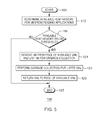
- FIG. 5 is a flow chart of yet another aspect of a load balancing method according to an embodiment of the present invention.
- FIG. 6 depicts a block diagram of components of computing devices of FIG. 1 , in accordance with an embodiment of the present invention.
- Embodiments, of the present invention recognize that virtual machines (VMs) such as JavaTM virtual machines (JVMs) are well-known abstract computing machines, which when run on a computer system such as a server environment, implement a set of functions or services provided by the computer system.
- VMs virtual machines
- JVMs JavaTM virtual machines
- the VMs execute requests for such functions of services by creating tasks or objects, with the VM reserving a (contiguous) portion of its so-called heap memory to store and retrieve data associated with an active task or object.
- Such data may remain in the system memory after completion of the task or object, where it blocks available memory resources as the memory locations storing this data are not recognized as being available.
- garbage Such stale data is commonly referred to as garbage, which periodically needs to be removed from the heap memory to free up memory for new tasks or objects.
- the VM typically pauses the VM's in-flight workload (i.e. active tasks or objects), which therefore delays the completion of the workload. This may not be acceptable for time-critical tasks or objects.
- a system may deploy load balancing techniques in which new tasks or objects are not assigned to unavailable VMs to avoid the risk of new tasks and objects being delayed.
- the performance penalty associated with garbage collection can be reduced by reducing the size of heap memory, as it will take less time to collect garbage from a smaller memory allocation. This limits the amount of data that a single VM can execute and may therefore require a large number of VMs to be deployed if large volumes of data require executing, which can cause performance degradation due to communication overheads between VMs.
- embodiments of the present invention constitute a method
- a method is a process for execution by a computer or computer system, i.e. is a computer-implementable method.
- the various steps of the method therefore reflect various parts of a computer program, e.g., various parts of one or more algorithms.
- a virtual machine In the context of the present application, where reference is made to a virtual machine, this is intended to describe a software implementation of a machine (for example, a computer) that executes programs, e.g., applications, like a physical machine.
- the virtual machine is a JavaTM Virtual Machine (JVM) although the present invention is not limited thereto.
- JVM JavaTM Virtual Machine
- a virtual machine is typically hosted on a computer system, that is, executed on a processor arrangement of the computer system, with the virtual machine having been assigned an allocation of memory of the computer system, e.g., system memory, which allocation may be used by the virtual machine to store data associated with the execution of one or more programs, e.g., applications, by the virtual machine. Such an allocation will also be referred to as heap memory.
- FIG. 1 schematically depicts a network environment 10 in which embodiments of the present invention may be advantageously deployed.
- Network environment 10 may contain a number of client devices 20 that can connect to a computer system 40 over a network 30 .
- Each client device 20 may be at least one of a variety of conventional computing devices, including a desktop personal computer (PC), workstation, mainframe computer, Internet appliance, and set-top box. Further, client device 20 may be at least one of any device that is capable of being associated with network 30 by a wired and/or wireless link, including a personal digital assistant (PDA), laptop computer, cellular telephone, and so on. It should be understood that three client devices 20 are shown by way of non-limiting example only; network environment 10 may include client devices 20 described above in various quantities and/or combinations thereof.
- Network 30 may represent any of a variety of conventional network topologies and types, which may include wired and/or wireless networks. Network 30 may further utilize any of a variety of conventional network protocols, including public and/or proprietary protocols. Network 30 may include, for example, the Internet as well at least portions of one or more local area networks (also referred to, individually, as a “LAN”); a personal area network (i.e., PAN).
- LAN local area network
- PAN personal area network
- the computer system 40 may be any type of computer system that can be accessed by a client device 20 over a network 30 .
- the computer system 40 may be a standalone computer 50 , e.g., a standalone server, or may contain a plurality of such computers 50 , which may be spatially clustered, e.g., within a single computer housing, within a server rack, within a plurality of adjacent server racks in a space such as a data center, and so on, or may be spatially distributed.
- each computer 50 may be individually one of a network server, an application server, or a blade server and so on. Two or more networked servers may share in the execution of at least portions of a same application, program, function, or other assemblage of programmable and executable code.
- each computer 50 is at least configured to execute computer program code causing computers 50 to host one or more virtual machines, such as JVMs.
- each computer 50 typically comprises a processor arrangement 52 that is communicatively coupled to a computer memory 54 .
- the processor arrangement 52 may be a single processor or a cluster or otherwise grouped collection of processors, which may be any suitable type of processor, e.g., a single core processor, a multi-core processor, an application specific integrated circuit (ASIC) and so on.
- ASIC application specific integrated circuit
- Computer memory 54 may be embodied by any suitable data storage device, such as a volatile memory, a non-volatile memory, a flash memory, a solid state memory, and so on.
- Computer memory 54 may be a contiguous memory contained in a single memory device, or a distributed memory distributed over multiple memory devices, which multiple memory devices may be spatially clustered or spatially distributed over computer system 40 , e.g., physically located in different entities of computer system 40 , e.g., physically located in different computers 50 .
- computers 50 may be connected to network 30 via a further network 42 , e.g., an internal network such as a local area network, a wide area network, and so on, which may be a physical network comprising wires over which computers 50 communicate with network 30 or may at least partially be a wireless network employing any suitable wireless communication protocol.
- a further network 42 e.g., an internal network such as a local area network, a wide area network, and so on, which may be a physical network comprising wires over which computers 50 communicate with network 30 or may at least partially be a wireless network employing any suitable wireless communication protocol.
- FIG. 2 schematically depicts an application layer according to an embodiment, which application layer is hosted on computer system 40 .
- computer system 40 implements an execution environment comprising a plurality of virtual machines 80 under control of load balancer 70 after receiving request 60 .
- a plurality of virtual machines 80 are typically hosted by one or more processor arrangements 52 of one or more computers 50 of computer system 40 as described above.
- the virtual machines are JVMs.
- Each virtual machine 80 is typically allocated a portion of memory heap 82 of the system memory 54 , such as a contiguous portion of memory heap 82 .
- the allocation portion of memory heap 82 of system memory 54 is used by virtual machine 80 as a memory heap for storing data associated with the execution of one or more applications by virtual machine 80 .
- the size of the allocation i.e. the portion of memory heap 82 , may be decided in any suitable manner.
- the size of the allocation may be encoded in the computer program code of virtual machine 80 , such that processor arrangement 52 executing the computer program code in the process of hosting virtual machine 80 will dynamically reserve the memory heap in system memory 50 .
- the size of the allocation may be determined at run-time, e.g., by load balancer 70 , for instance based on system memory utilization, e.g., due to the number of virtual machines 80 being hosted.
- load balancer 70 e.g., based on system memory utilization, e.g., due to the number of virtual machines 80 being hosted.
- Other suitable ways of determining and assigning the size of the memory heap will be immediately apparent to those of ordinary skill in the art.
- each virtual machine 80 assigns a portion of memory heap 82 to an application it is requested to execute, e.g., an application dispatched to virtual machine by load balancer 70 .
- the capacity of memory heap 82 is gradually consumed by the applications executed by virtual machine 80 .
- the data in memory heap 82 associated with the execution of the application may remain in memory heap 82 even though the data is no longer referenced by an active application.
- Such data is sometimes referred to as stale data.
- the stale data needs to be removed from memory heap 82 in order to free up memory for the execution of new applications. This is typically done in a process referred to as garbage collection.
- Load balancer 70 is configured to try and minimize the number of applications which execution needs to be paused due to virtual machine 80 of load balancer 70 performing the execution requiring garbage collection in order to free up memory heap 82 of virtual machine 80 .
- Load balancer 70 may be implemented in software on processor arrangement 52 , e.g., on the same one or more processors hosting one or more virtual machines 80 or on a separate processor, which may be a dedicated processor for implementing load balancer 70 .
- load balancer 70 may be implemented in part in hardware, i.e. by way of hardware/software co-design or in its entirety in hardware, for instance using conventional hardware building blocks, e.g., logic gates, registers and so on.
- the load balancer 70 is implemented by the execution of computer program code on processor arrangement 52 of computer system 40 .
- load balancer 70 The operation of load balancer 70 according to at least some embodiments will be explained in further detail with the aid of FIG. 3-5 , each showing a flowchart of a particular aspect of the operation of the load balancer 70 including operations invoked by load balancer 70 .
- Load balancer 70 is adapted to maintain data associated with the active applications dispatched to the each of the one or more virtual machines 80 , such as a log 72 of active applications dispatched to the each of the one or more virtual machines 80 , which may include applications in execution on virtual machine 80 and applications queuing for execution by virtual machine 80 .
- a log or register may be any suitable data structure for identifying the active or past applications dispatched to the each of the one or more virtual machines 80 .
- Log 72 may be stored in a data storage device, e.g., a portion of system memory 54 or a separate memory, e.g., a cache memory of processor arrangement 52 hosting load balancer 70 , and so on.
- each virtual machine 80 may keep log 72 of active applications dispatched to that virtual machine, with load balancer 70 configured to access respective logs 72 , e.g., by communicating with virtual machine 80 to retrieve the required information.
- FIG. 3 is a flow chart of a virtual machine load balancing method 100 implemented by load balancer 70 .
- Method 100 launches in step 101 load balancer 70 and may subsequently receive in step 103 a request to execute a new application on one of the virtual machines 70 .
- load balancer 70 maintains a data structure such as register 74 in a list of application types that is stored, with each application type entry in register 74 comprising an indication of expected memory usage by virtual machine 80 .
- An application type may be a group of applications sharing certain characteristics or may be a single application. Examples of application types include GET, POST, DELETE applications. Other examples will be immediately apparent to those of ordinary skill in the art.
- register 74 may be stored in any suitable form on any suitable data storage device, e.g., a dedicated register, a look-up table stored in system memory or in cache memory of a hardware device such as a processor implementing load balancer 70 , and so on.
- Load balancer 70 identifies the application type of the new application in step 105 , e.g., from the name or any other suitable identifier of the requested application, after which it is checked in decision step 107 if the identified application type of the new application is already present in register 74 . If the identified application type is present in register 74 (yes branch, decision step 107 ), the method 100 proceeds to step 111 in which the forecasted memory usage by an application of the identified application type is retrieved from register 74 .
- step 109 in which an estimate of the memory usage by an application of the identified application type is made, for instance by identifying a comparable application type in the register (e.g., by labeling each application in the register with its application type and matching the identified application type of the new application with register entries having the same application type.
- load balancer 70 estimates how much of memory heap 82 and virtual machine 80 is likely to have available for the execution of the new application. For example, load balancer 70 may investigate log 72 associated with virtual machine 80 under investigation to determine actual memory usage. A distinction can be made between application types having (approximately) static memory heap usage, i.e. usage of memory heap 82 that does not (significantly) change over time and application types having dynamic memory heap usage, i.e. usage of memory heap 82 that (linearly) increases with time. In an embodiment, load balancer 70 identifies the applications running on virtual machine 80 under investigation, e.g., by checking log 72 or by communication with virtual machine 80 .
- Load balancer 70 identifies the application types of these running applications, e.g., as stored in log 72 , as obtained from the communication with virtual machine 80 or by checking register 74 upon determining the identity of the application executing on the virtual machine 80 .
- Load balancer 70 investigates register 74 to determine forecasted memory usage of memory heap 82 by applications of this type, e.g., the overall memory heap usage by these applications upon execution completion by virtual machine 80 .
- the combined forecasted memory usage of memory heap 82 for the applications running of virtual machine 80 under investigation can be determined by summing all individual forecasted memory usages as retrieved from register 74 , which, when deducted from the total size of memory heap 82 gives the available work volume of memory heap 82 of virtual machine 80 under investigation.
- Load balancer 70 typically performs this exercise for one or more virtual machines 80 to create a pool of one or more virtual machines 80 that have an available work volume exceeding the estimated or forecasted memory usage of the new application to be dispatched to one of the one or more virtual machines 80 and dispatches the new application to one of the one or more virtual machines 80 in the pool in step 115 . Then the dispatch aspect of method 100 implemented by load balancer 70 terminates in step 117 . In this manner, the risk that the dispatch of a new application to virtual machine 70 triggers a garbage collection is reduced due to the fact that new applications are only dispatched to virtual machines having sufficient available work volume in their respective one or more memory heaps 82 .
- load balancer 70 may dispatch in the new application in step 115 to virtual machine 80 in the pool that has the largest available work volume in memory heap 82 of virtual machine 80 .
- This is particularly good practice where the new application is of an application type previously absent in register 74 such that the estimate of the memory usage by the new application of the identified application type may be inaccurate, i.e. larger than estimated. Dispatching the new application to virtual machine 80 with the largest available work volume in memory heap 82 minimizes the risk of a garbage collection being triggered by a virtual machine 80 running out of available work volume in memory heap 82 due to a new application dispatched to virtual machine 80 by load balancer 70 requiring more memory than expected.
- the application types entries in register 74 may, in addition to the forecasted memory usage of the application type, comprise an indication of the duration of the execution of an application of the application type.
- an indication of duration may be used in a number of ways. For example, where virtual machine 80 executes one or more applications of an application type exhibiting dynamic memory heap usage, load balancer 70 may determine actual time Ta and the time of dispatch Ts (or time of start of execution if different) for such an application, as well as the memory heap usage Ma at Ta by that application.
- C the capacity or overall size of memory heap 82 of virtual machine 80
- N the number of applications in execution and queuing for execution of virtual machine 80 .
- a linear relation between execution progress and memory usage by an application is assumed, which is therefore less reliant on the accuracy of the forecasted memory usage stored in register 74 for each application type, as this parameter (forecasted memory usage) is not necessarily used in this alternative approach.
- the forecasted execution duration of an application of a particular type stored in register 74 is further used to determine if the new application can be executed by virtual machine 80 prior to a scheduled garbage collection from memory heap 82 of virtual machine 80 .
- load balancer 70 checks in step 113 for each virtual machine 80 if the duration to a next scheduled garbage collection of memory heap 82 in each virtual machine 80 , e.g., as retrieved from a garbage collection schedule for one or more virtual machines 80 , exceeds the forecasted duration of the new application of the application type identified in step 111 .
- the application may be added to the previously mentioned pool as there is minimal risk that the new application will be delayed by a scheduled garbage collection of memory heap 82 of one or more virtual machines 80 .
- the application may be added to the previously mentioned pool as there is minimal risk that the new application will be delayed by a scheduled garbage collection of memory heap 82 of one or more virtual machines 80 .
- the application may be added to the previously mentioned pool as there is minimal risk that the new application will be delayed by a scheduled garbage collection of memory heap 82 of one or more virtual machines 80 .
- only virtual machine 80 having sufficient available work volume as well as sufficient duration until the next scheduled garbage collection are added to the pool.
- both the memory usage and the duration of the execution of an application of this application type may be added to register 74 in step 109 as explained above.
- the duration of the execution of an application of this application type may be estimated in any suitable manner. For instance, by identifying a comparable application type in the register and using the forecasted execution duration of an application of the comparable application type as an estimate of the execution duration of an application of the identified application type. Also, by averaging the forecasted execution durations of all or a subset of the application types in the register 74 as an estimate of the execution duration of an application of the identified application type, and so on. Other estimation approaches can be easily thought of by one of ordinary skill in the art. Once an estimate has been made of the memory usage by and the execution duration of an application of the identified application type, the new application type and its estimated memory usage and execution duration is added to register 74 .
- Step 131 typically begins after termination of the dispatch aspect of method 100 in step 117 , in which load balancer 70 monitors the memory usage of memory heap 82 and, where applicable, the duration of the execution of the application by virtual machine 80 .
- load balancer 70 may check memory heap 82 to determine which memory allocations are referenced by the application.
- Load balancer 70 may monitor memory heap usage by virtual machine 80 .
- Virtual machine 80 may inform load balancer 70 of the memory heap usage on virtual machine 80 and so on. Alternatively, each virtual machine 80 may monitor the memory usage of memory heap 82 for each virtual machine 80 by a particular application and, where applicable, the duration of each virtual machine 80 executions of the application.
- load balancer 70 or virtual machine 80 Upon determining the memory usage of memory heap 82 for a particular application and, where applicable, the duration of the execution of the application by virtual machine 80 , load balancer 70 or virtual machine 80 checks register 74 in decision step 133 to identify the application type of the monitored application and compare the registered forecasted memory usage. Where applicable, the forecasted duration of the execution of the application against the actual memory usage (and execution duration) of the application of that application type as determined in step 131 .
- Ma(t1) is the actual memory usage of this other application at the start of the execution of the application under consideration, and Ts is the execution start time of the other application, as previously explained. It should be understood that these are merely examples of how such memory usage may be calculated and that those of ordinary skill in the art will readily construct many other suitable algorithms for calculation such memory usage.
- step 133 If the forecasted memory usage for the application type as stored in register 74 differs from the actual memory usage of the application of that application type (e.g., differs by an amount above a defined difference threshold) (yes branch, decision step 133 ), then method 100 proceeds to step 135 in which the entry of the identified application type in register 74 is updated using the actual memory usage determined in step 131 . For example, replacing the forecasted memory usage with the actual memory usage or by performing some averaging of the forecasted memory usage and the actual memory usage (e.g., keeping track (in the register 74 ) of the number of times an application of that particular application type has been executed by virtual machine 80 and using this metric as a scaling factor in the averaging operation).
- M (new) (x*M (old)+Ma)/(x+1), wherein M (new) is the updated forecasted memory usage of the application type to be stored in register 74 , M (old) is the previous forecasted memory usage of the application type stored in register 74 , x is the number of previous executions of an application of that application type, and Ma is the determined actual memory usage of an application of that application type as determined in step 131 .
- the method 100 may in step 135 update the entry of the identified application type in register 74 using the duration of the execution of the application of that application type as determined in step 131 .
- replacing the forecasted duration of the execution with the actual duration of the execution or by performing some averaging of the forecasted duration of the execution and the actual duration of the execution e.g., by keeping track, in register 74 , of the number of times an application of that particular application type has been executed by virtual machine 80 and using this metric as a scaling factor in the averaging operation.
- D (new) is the updated forecasted duration of the execution of the application type to be stored in register 74
- D (old) is the previous forecasted duration of the execution of the application type stored in register 74
- x is the number of previous executions of an application of that application type
- Ma is the determined actual duration of the execution of an application of that application type as determined in step 131 .
- the method 100 may skip updating of register 74 in step 135 and proceed directly to step 137 (no branch, decision step 133 ).
- step 137 the application of which the execution is completed is removed from log 72 of active applications, i.e. applications in execution or queuing for execution.
- log 72 of active applications
- virtual machine 80 may update log 72 , e.g. in case of maintaining its own log 72 .
- This updating aspect from method 100 may subsequently terminate in step 139 .
- load balancer 70 determines in step 113 for each virtual machine 80 the amount of volume that is available in memory heap 82 for each virtual machine 80 . This information may be used in an embodiment to control garbage collection in selected memory heaps. This garbage collection aspect of method 100 will be explained in further detail with the aid of FIG. 5 .
- the method 100 Upon determining the available work volume in step 113 , as explained in more detail above, the method 100 proceeds to decision step 119 in which the load balancer checks if the available work volume of memory heap 82 is below a critical threshold. In an example, the size of the available work volume is too small to accommodate the execution of a new application. If this is the case, the method 100 proceeds to step 121 in which memory heap 82 and/or the associated one or more virtual machines 80 are made unavailable for consideration for dispatching new applications to that virtual machine 80 and shortlisted for garbage collection (yes branch, decision step 119 ).
- the method proceeds to step 123 in which a garbage collection operation is performed on one or more memory heaps 82 of the shortlisted one or more virtual machines 80 .
- the exact implementation of the garbage collection operation is not particularly critical.
- the garbage collection operation may be performed sequentially on one or more memory heaps 82 of the shortlisted one or more virtual machines 80 . At least some of the one or more memory heaps 82 of the shortlisted one or more virtual machines 80 may be grouped together with the garbage collection operation being performed on such a group and so on.
- the garbage collection operation may be a simple operation in which only stale data objects are removed from memory heap 82 and remaining data objects optionally are regrouped. For example, to restore the contiguous nature of the data. If the remaining data objects are not regrouped, a more complex operation, such as a garbage collection on memory heap 82 divided into two areas (or generations) called the nursery (or young space) and the old or tenured space, in which the nursery is a part of memory heap 82 reserved for allocation of new data objects.
- garbage may be collected by running a special young collection, where all data objects that have lived long enough in the nursery are promoted (moved) to the old or tenured space, thus freeing up the nursery for more object allocation.
- the tenured space becomes full garbage is collected from the tenured space.
- Such types of memory heap organization and garbage collection are well-known per se and it suffices to say that those of ordinary skill in the art would readily contemplate many suitable alternatives to the above non-limiting examples.
- the method 100 Upon completion of the garbage collection, the method 100 , e.g., as implemented by load balancer 70 , returns the shortlisted one or more virtual machines 80 to active duty in step 125 by making one or more virtual machines 80 available again for dispatching new applications to these one or more virtual machines 80 , after which the garbage collection aspect of the method 100 terminates in step 127 . It is noted that if the method 100 decides in step 119 that no virtual machine 80 has a memory heap 82 having an available work volume below the previously mentioned threshold, no immediate garbage collection is required and the method 100 may proceeds from step 119 directly to step 127 (no branch, decision step 119 ).
- FIG. 6 depicts a block diagram of components of computer 600 , which is representative of computer system 40 , in accordance with an illustrative embodiment of the present invention. It should be appreciated that FIG. 6 provides only an illustration of one implementation and does not imply any limitations with regard to the environments in which different embodiments may be implemented. Many modifications to the depicted environment may be made.
- Computer 600 includes communications fabric 602 , which provides communications between computer processor(s) 604 , memory 606 , persistent storage 608 , communications unit 610 , and input/output (I/O) interface(s) 612 .
- Communications fabric 602 can be implemented with any architecture designed for passing data and/or control information between processors (such as microprocessors, communications, and network processors, etc.), system memory, peripheral devices, and any other hardware components within a system.
- processors such as microprocessors, communications, and network processors, etc.
- Communications fabric 602 can be implemented with one or more buses.
- Memory 606 and persistent storage 608 are computer readable storage media.
- memory 606 includes random access memory (RAM) 614 and cache 616 .
- RAM random access memory
- cache 616 In general, memory 606 can include any suitable volatile or non-volatile computer readable storage media.
- Software and data 622 are stored in persistent storage 608 for access and/or execution by processor(s) 604 via one or more memories of memory 606 . With respect to computer system 40 , software and data 622 represents load balancer 70 .
- persistent storage 608 includes a magnetic hard disk drive.
- persistent storage 608 can include a solid-state hard drive, a semiconductor storage device, a read-only memory (ROM), an erasable programmable read-only memory (EPROM), a flash memory, or any other computer readable storage media that is capable of storing program instructions or digital information.
- the media used by persistent storage 608 may also be removable.
- a removable hard drive may be used for persistent storage 608 .
- Other examples include optical and magnetic disks, thumb drives, and smart cards that are inserted into a drive for transfer onto another computer readable storage medium that is also part of persistent storage 608 .
- Communications unit 610 in these examples, provides for communications with other data processing systems or devices.
- communications unit 610 includes one or more network interface cards.
- Communications unit 610 may provide communications through the use of either or both physical and wireless communications links.
- Software and data 622 may be downloaded to persistent storage 608 through communications unit 610 .
- I/O interface(s) 612 allows for input and output of data with other devices that may be connected to computer 600 .
- I/O interface(s) 612 may provide a connection to external device(s) 618 , such as a keyboard, a keypad, a touch screen, and/or some other suitable input device.
- External device(s) 618 can also include portable computer readable storage media, such as, for example, thumb drives, portable optical or magnetic disks, and memory cards.
- Software and data 622 can be stored on such portable computer readable storage media and can be loaded onto persistent storage 608 via I/O interface(s) 612 .
- I/O interface(s) 612 also connect to a display 620 .
- Display 620 provides a mechanism to display data to a user and may be, for example, a computer monitor.
- the present invention may be a system, a method, and/or a computer program product at any possible technical detail level of integration
- the computer program product may include a computer readable storage medium (or media) having computer readable program instructions thereon for causing a processor to carry out aspects of the present invention
- the computer readable storage medium can be a tangible device that can retain and store instructions for use by an instruction execution device.
- the computer readable storage medium may be, for example, but is not limited to, an electronic storage device, a magnetic storage device, an optical storage device, an electromagnetic storage device, a semiconductor storage device, or any suitable combination of the foregoing.
- a non-exhaustive list of more specific examples of the computer readable storage medium includes the following: a portable computer diskette, a hard disk, a random access memory (RAM), a read-only memory (ROM), an erasable programmable read-only memory (EPROM or Flash memory), a static random access memory (SRAM), a portable compact disc read-only memory (CD-ROM), a digital versatile disk (DVD), a memory stick, a floppy disk, a mechanically encoded device such as punch-cards or raised structures in a groove having instructions recorded thereon, and any suitable combination of the foregoing.
- RAM random access memory
- ROM read-only memory
- EPROM or Flash memory erasable programmable read-only memory
- SRAM static random access memory
- CD-ROM compact disc read-only memory
- DVD digital versatile disk
- memory stick a floppy disk
- a mechanically encoded device such as punch-cards or raised structures in a groove having instructions recorded thereon
- a computer readable storage medium is not to be construed as being transitory signals per se, such as radio waves or other freely propagating electromagnetic waves, electromagnetic waves propagating through a waveguide or other transmission media (e.g., light pulses passing through a fiber-optic cable), or electrical signals transmitted through a wire.
- Computer readable program instructions described herein can be downloaded to respective computing/processing devices from a computer readable storage medium or to an external computer or external storage device via a network, for example, the Internet, a local area network, a wide area network and/or a wireless network.
- the network may comprise copper transmission cables, optical transmission fibers, wireless transmission, routers, firewalls, switches, gateway computers and/or edge servers.
- a network adapter card or network interface in each computing/processing device receives computer readable program instructions from the network and forwards the computer readable program instructions for storage in a computer readable storage medium within the respective computing/processing device.
- Computer readable program instructions for carrying out operations of the present invention may be assembler instructions, instruction-set-architecture (ISA) instructions, machine instructions, machine dependent instructions, microcode, firmware instructions, state-setting data, configuration data for integrated circuitry, or either source code or object code written in any combination of one or more programming languages, including an object oriented programming language such as Smalltalk, C++, or the like, and procedural programming languages, such as the “C” programming language or similar programming languages.
- the computer readable program instructions may execute entirely on the user's computer, partly on the user's computer, as a stand-alone software package, partly on the user's computer and partly on a remote computer or entirely on the remote computer or server.
- the remote computer may be connected to the user's computer through any type of network, including a local area network (LAN) or a wide area network (WAN), or the connection may be made to an external computer (for example, through the Internet using an Internet Service Provider).
- electronic circuitry including, for example, programmable logic circuitry, field-programmable gate arrays (FPGA), or programmable logic arrays (PLA) may execute the computer readable program instructions by utilizing state information of the computer readable program instructions to personalize the electronic circuitry, in order to perform aspects of the present invention.
- These computer readable program instructions may be provided to a processor of a general purpose computer, special purpose computer, or other programmable data processing apparatus to produce a machine, such that the instructions, which execute via the processor of the computer or other programmable data processing apparatus, create means for implementing the functions/acts specified in the flowchart and/or block diagram block or blocks.
- These computer readable program instructions may also be stored in a computer readable storage medium that can direct a computer, a programmable data processing apparatus, and/or other devices to function in a particular manner, such that the computer readable storage medium having instructions stored therein comprises an article of manufacture including instructions which implement aspects of the function/act specified in the flowchart and/or block diagram block or blocks.
- the computer readable program instructions may also be loaded onto a computer, other programmable data processing apparatus, or other device to cause a series of operational steps to be performed on the computer, other programmable apparatus or other device to produce a computer implemented process, such that the instructions which execute on the computer, other programmable apparatus, or other device implement the functions/acts specified in the flowchart and/or block diagram block or blocks.
- each block in the flowchart or block diagrams may represent a module, segment, or portion of instructions, which comprises one or more executable instructions for implementing the specified logical function(s).
- the functions noted in the blocks may occur out of the order noted in the Figures.
- two blocks shown in succession may, in fact, be executed substantially concurrently, or the blocks may sometimes be executed in the reverse order, depending upon the functionality involved.
Landscapes
- Engineering & Computer Science (AREA)
- Software Systems (AREA)
- Theoretical Computer Science (AREA)
- Physics & Mathematics (AREA)
- General Engineering & Computer Science (AREA)
- General Physics & Mathematics (AREA)
- Debugging And Monitoring (AREA)
Abstract
Description
Claims (20)
Priority Applications (1)
| Application Number | Priority Date | Filing Date | Title |
|---|---|---|---|
| US14/865,011 US9547520B1 (en) | 2015-09-25 | 2015-09-25 | Virtual machine load balancing |
Applications Claiming Priority (1)
| Application Number | Priority Date | Filing Date | Title |
|---|---|---|---|
| US14/865,011 US9547520B1 (en) | 2015-09-25 | 2015-09-25 | Virtual machine load balancing |
Publications (1)
| Publication Number | Publication Date |
|---|---|
| US9547520B1 true US9547520B1 (en) | 2017-01-17 |
Family
ID=57748995
Family Applications (1)
| Application Number | Title | Priority Date | Filing Date |
|---|---|---|---|
| US14/865,011 Active US9547520B1 (en) | 2015-09-25 | 2015-09-25 | Virtual machine load balancing |
Country Status (1)
| Country | Link |
|---|---|
| US (1) | US9547520B1 (en) |
Cited By (8)
| Publication number | Priority date | Publication date | Assignee | Title |
|---|---|---|---|---|
| US20150293823A1 (en) * | 2012-12-14 | 2015-10-15 | Zte Corporation | High Availability Method and System for Improving the Utility of Physical Servers in Cloud Computing Resource Pool |
| CN107231421A (en) * | 2017-05-27 | 2017-10-03 | 北京力尊信通科技股份有限公司 | A kind of virtual machine computing capability dynamic adjusting method, device and system |
| US10733109B1 (en) * | 2017-01-21 | 2020-08-04 | Virtuozzo International Gmbh | Memory reclaim management for virtual machines |
| CN112231066A (en) * | 2020-10-29 | 2021-01-15 | 北京思特奇信息技术股份有限公司 | JVM (Java virtual machine) memory use-based optimization processing method and system |
| CN112241299A (en) * | 2019-07-18 | 2021-01-19 | 上海达龙信息科技有限公司 | Operation management method, system, medium and server for electronic equipment |
| US11263130B2 (en) | 2019-07-11 | 2022-03-01 | International Business Machines Corporation | Data processing for allocating memory to application containers |
| US20220276907A1 (en) * | 2021-02-26 | 2022-09-01 | Netapp, Inc. | Dynamic load balancing by analyzing performance of volume to quality of service |
| US11526434B1 (en) | 2019-06-25 | 2022-12-13 | Amazon Technologies, Inc. | Network-level garbage collection in an on-demand code execution system |
Citations (9)
| Publication number | Priority date | Publication date | Assignee | Title |
|---|---|---|---|---|
| US20030056076A1 (en) * | 2001-07-19 | 2003-03-20 | Jeremy Cook | Memory management system |
| US20050188163A1 (en) * | 2004-02-25 | 2005-08-25 | Atul Asthana | Memory management system and method for a mobile device |
| EP1717706A1 (en) | 2005-04-29 | 2006-11-02 | Alcatel | Method to reduce the latency caused by garbage collection in a java virtual machine |
| US20070136402A1 (en) * | 2005-11-30 | 2007-06-14 | International Business Machines Corporation | Automatic prediction of future out of memory exceptions in a garbage collected virtual machine |
| US20070162526A1 (en) * | 2005-12-19 | 2007-07-12 | Sun Microsystems, Inc. | Method and apparatus for tracking activity of a garbage collector with a plurality of threads that operate concurrently with an application program |
| US20090300092A1 (en) * | 2008-06-02 | 2009-12-03 | Ibm Corporation | Enhancing real-time performance for java application serving |
| US8234378B2 (en) | 2005-10-20 | 2012-07-31 | Microsoft Corporation | Load balancing in a managed execution environment |
| CN103514102A (en) | 2013-10-25 | 2014-01-15 | 中国联合网络通信集团有限公司 | Memory garbage collecting method and device for Java virtual machine |
| US20140038718A1 (en) * | 2007-08-31 | 2014-02-06 | Adobe Systems Incorporated | Dedicated device ports for data exchange |
-
2015
- 2015-09-25 US US14/865,011 patent/US9547520B1/en active Active
Patent Citations (9)
| Publication number | Priority date | Publication date | Assignee | Title |
|---|---|---|---|---|
| US20030056076A1 (en) * | 2001-07-19 | 2003-03-20 | Jeremy Cook | Memory management system |
| US20050188163A1 (en) * | 2004-02-25 | 2005-08-25 | Atul Asthana | Memory management system and method for a mobile device |
| EP1717706A1 (en) | 2005-04-29 | 2006-11-02 | Alcatel | Method to reduce the latency caused by garbage collection in a java virtual machine |
| US8234378B2 (en) | 2005-10-20 | 2012-07-31 | Microsoft Corporation | Load balancing in a managed execution environment |
| US20070136402A1 (en) * | 2005-11-30 | 2007-06-14 | International Business Machines Corporation | Automatic prediction of future out of memory exceptions in a garbage collected virtual machine |
| US20070162526A1 (en) * | 2005-12-19 | 2007-07-12 | Sun Microsystems, Inc. | Method and apparatus for tracking activity of a garbage collector with a plurality of threads that operate concurrently with an application program |
| US20140038718A1 (en) * | 2007-08-31 | 2014-02-06 | Adobe Systems Incorporated | Dedicated device ports for data exchange |
| US20090300092A1 (en) * | 2008-06-02 | 2009-12-03 | Ibm Corporation | Enhancing real-time performance for java application serving |
| CN103514102A (en) | 2013-10-25 | 2014-01-15 | 中国联合网络通信集团有限公司 | Memory garbage collecting method and device for Java virtual machine |
Non-Patent Citations (4)
| Title |
|---|
| IBM, "Method to schedule workload based on JVM garbage collection activity", An IP.com Prior Art Database Technical Disclosure, Original Publication Date: Sep. 30, 2006, IP.com No. 000141083, 8 pages, . |
| IBM, "Method to schedule workload based on JVM garbage collection activity", An IP.com Prior Art Database Technical Disclosure, Original Publication Date: Sep. 30, 2006, IP.com No. 000141083, 8 pages, <https://priorart.ip.com/IPCOM/000141083>. |
| Portillo-Dominguez et al., "Adaptive GC-Aware Load Balancing Strategy for High-Assurance Java Distributed Systems", 2015 IEEE 16th International Symposium on High Assurance Systems Engineering, Date of Conference: Jan. 8-10, 2015, © 2015 IEEE, pp. 68-75. |
| Portillo-Dominguez et al., "Load Balancing of Java Applications by Forecasting Garbage Collections", 2014 13th International Symposium on Parallel and Distributed Computing, Date of Conference: Jun. 24-27, 2014, © 2014 IEEE, pp. 127-134, <http://ieeexplore.ieee.org/xpl/login.jsp?tp=&arnumber=6900210&url=http%3A%2F%2Fieeexplore.ieee.org%2Fxpls%2Fabs-all.jsp%3Farnumber%3D6900210>. |
Cited By (12)
| Publication number | Priority date | Publication date | Assignee | Title |
|---|---|---|---|---|
| US20150293823A1 (en) * | 2012-12-14 | 2015-10-15 | Zte Corporation | High Availability Method and System for Improving the Utility of Physical Servers in Cloud Computing Resource Pool |
| US9760454B2 (en) * | 2012-12-14 | 2017-09-12 | Zte Corporation | High availability method and system for improving the utility of physical servers in cloud computing resource pool |
| US10733109B1 (en) * | 2017-01-21 | 2020-08-04 | Virtuozzo International Gmbh | Memory reclaim management for virtual machines |
| CN107231421A (en) * | 2017-05-27 | 2017-10-03 | 北京力尊信通科技股份有限公司 | A kind of virtual machine computing capability dynamic adjusting method, device and system |
| US11526434B1 (en) | 2019-06-25 | 2022-12-13 | Amazon Technologies, Inc. | Network-level garbage collection in an on-demand code execution system |
| US11263130B2 (en) | 2019-07-11 | 2022-03-01 | International Business Machines Corporation | Data processing for allocating memory to application containers |
| CN112241299A (en) * | 2019-07-18 | 2021-01-19 | 上海达龙信息科技有限公司 | Operation management method, system, medium and server for electronic equipment |
| CN112241299B (en) * | 2019-07-18 | 2023-08-18 | 上海达龙信息科技有限公司 | Operation management method, system, medium and server of electronic equipment |
| CN112231066A (en) * | 2020-10-29 | 2021-01-15 | 北京思特奇信息技术股份有限公司 | JVM (Java virtual machine) memory use-based optimization processing method and system |
| CN112231066B (en) * | 2020-10-29 | 2024-02-13 | 北京思特奇信息技术股份有限公司 | Optimization processing method and system based on JVM memory use |
| US20220276907A1 (en) * | 2021-02-26 | 2022-09-01 | Netapp, Inc. | Dynamic load balancing by analyzing performance of volume to quality of service |
| US11886933B2 (en) * | 2021-02-26 | 2024-01-30 | Netapp, Inc. | Dynamic load balancing by analyzing performance of volume to quality of service |
Similar Documents
| Publication | Publication Date | Title |
|---|---|---|
| US9547520B1 (en) | Virtual machine load balancing | |
| US11714686B2 (en) | Resource oversubscription based on utilization patterns in computing systems | |
| US10372435B2 (en) | System, method and program product for updating virtual machine images | |
| CN110249311B (en) | Resource management for virtual machines in cloud computing systems | |
| US11693698B2 (en) | System and method for infrastructure scaling | |
| US9009384B2 (en) | Virtual machine memory management in systems with asymmetric memory | |
| US10394477B2 (en) | Method and system for memory allocation in a disaggregated memory architecture | |
| US20210004000A1 (en) | Automated maintenance window predictions for datacenters | |
| US10896059B2 (en) | Dynamically allocating cache in a multi-tenant processing infrastructure | |
| US20160241637A1 (en) | Automated profiling of resource usage | |
| US10628230B2 (en) | Software based collection of performance metrics for allocation adjustment of virtual resources | |
| US10102033B2 (en) | Method and system for performance ticket reduction | |
| US20140373010A1 (en) | Intelligent resource management for virtual machines | |
| US11188364B1 (en) | Compilation strategy for a sharable application snapshot | |
| US9270539B2 (en) | Predicting resource provisioning times in a computing environment | |
| US9501313B2 (en) | Resource management and allocation using history information stored in application's commit signature log | |
| US10411977B2 (en) | Visualization of workload distribution on server resources | |
| US10901798B2 (en) | Dependency layer deployment optimization in a workload node cluster | |
| US20180276112A1 (en) | Balancing memory pressure across systems | |
| US20180227201A1 (en) | System, method and computer program product for test-driven node selection for a distributed system | |
| US9715448B2 (en) | Efficiently using memory for Java collection objects | |
| US20230244528A1 (en) | Service update management | |
| US11263130B2 (en) | Data processing for allocating memory to application containers | |
| US10387218B2 (en) | Lock profiling tool to identify code bottlenecks in a storage controller | |
| US12386664B2 (en) | Determining optimal data access for deep learning applications on a cluster |
Legal Events
| Date | Code | Title | Description |
|---|---|---|---|
| AS | Assignment |
Owner name: INTERNATIONAL BUSINESS MACHINES CORPORATION, NEW Y Free format text: ASSIGNMENT OF ASSIGNORS INTEREST;ASSIGNORS:BAILEY, CHRISTOPHER N.;KELLY, ALEXANDER J.;MIRSKI-FITTON, ALEXANDER D.S.;AND OTHERS;SIGNING DATES FROM 20150921 TO 20150923;REEL/FRAME:036653/0052 |
|
| STCF | Information on status: patent grant |
Free format text: PATENTED CASE |
|
| FEPP | Fee payment procedure |
Free format text: MAINTENANCE FEE REMINDER MAILED (ORIGINAL EVENT CODE: REM.); ENTITY STATUS OF PATENT OWNER: LARGE ENTITY |
|
| FEPP | Fee payment procedure |
Free format text: SURCHARGE FOR LATE PAYMENT, LARGE ENTITY (ORIGINAL EVENT CODE: M1554); ENTITY STATUS OF PATENT OWNER: LARGE ENTITY |
|
| MAFP | Maintenance fee payment |
Free format text: PAYMENT OF MAINTENANCE FEE, 4TH YEAR, LARGE ENTITY (ORIGINAL EVENT CODE: M1551); ENTITY STATUS OF PATENT OWNER: LARGE ENTITY Year of fee payment: 4 |
|
| AS | Assignment |
Owner name: MAPLEBEAR INC., CALIFORNIA Free format text: ASSIGNMENT OF ASSIGNORS INTEREST;ASSIGNOR:INTERNATIONAL BUSINESS MACHINES CORPORATION;REEL/FRAME:055155/0943 Effective date: 20210126 |
|
| MAFP | Maintenance fee payment |
Free format text: PAYMENT OF MAINTENANCE FEE, 8TH YEAR, LARGE ENTITY (ORIGINAL EVENT CODE: M1552); ENTITY STATUS OF PATENT OWNER: LARGE ENTITY Year of fee payment: 8 |