US9542546B2 - System and method for implicitly resolving query scope in a multi-client and multi-tenant datastore - Google Patents
System and method for implicitly resolving query scope in a multi-client and multi-tenant datastore Download PDFInfo
- Publication number
- US9542546B2 US9542546B2 US13/631,391 US201213631391A US9542546B2 US 9542546 B2 US9542546 B2 US 9542546B2 US 201213631391 A US201213631391 A US 201213631391A US 9542546 B2 US9542546 B2 US 9542546B2
- Authority
- US
- United States
- Prior art keywords
- tenant
- token
- application
- datastore
- query
- Prior art date
- Legal status (The legal status is an assumption and is not a legal conclusion. Google has not performed a legal analysis and makes no representation as to the accuracy of the status listed.)
- Active, expires
Links
Images




Classifications
-
- G—PHYSICS
- G06—COMPUTING OR CALCULATING; COUNTING
- G06F—ELECTRIC DIGITAL DATA PROCESSING
- G06F21/00—Security arrangements for protecting computers, components thereof, programs or data against unauthorised activity
- G06F21/30—Authentication, i.e. establishing the identity or authorisation of security principals
- G06F21/31—User authentication
- G06F21/33—User authentication using certificates
- G06F21/335—User authentication using certificates for accessing specific resources, e.g. using Kerberos tickets
-
- H—ELECTRICITY
- H04—ELECTRIC COMMUNICATION TECHNIQUE
- H04L—TRANSMISSION OF DIGITAL INFORMATION, e.g. TELEGRAPHIC COMMUNICATION
- H04L63/00—Network architectures or network communication protocols for network security
- H04L63/08—Network architectures or network communication protocols for network security for authentication of entities
- H04L63/0807—Network architectures or network communication protocols for network security for authentication of entities using tickets, e.g. Kerberos
-
- H—ELECTRICITY
- H04—ELECTRIC COMMUNICATION TECHNIQUE
- H04L—TRANSMISSION OF DIGITAL INFORMATION, e.g. TELEGRAPHIC COMMUNICATION
- H04L2463/00—Additional details relating to network architectures or network communication protocols for network security covered by H04L63/00
- H04L2463/102—Additional details relating to network architectures or network communication protocols for network security covered by H04L63/00 applying security measure for e-commerce
Definitions
- a multi-tenant database or datastore system may have multiple subscribing tenants that access applications and/or data from a network source.
- Each tenant may, for example, be a merchant that owns a website or electronic store (e-store) maintained by the datastore system. The merchant may use the website to sell products, service, and/or information to customers.
- e-store electronic store
- the tenants may have an advantage in the fact that they do not need to install and maintain all hardware and software from the e-store. Rather, each tenant may only need a computing device with network connectivity, such as a desktop computer with Internet access and a web browser. With the computing device, the tenant may access the multi-tenant datastore to operate applications and/or data.
- Third party developers may also be involved to provide various third party applications to the datastore system. Since different parties including tenants, customers, and third party developers may share a common datastore, it is necessary to prevent unwarranted data/application accesses (e.g., one tenant from accessing data belonging to other tenants). Thus, it is desirable to develop secure and reliable data access schemes to accommodate service to multiple parties involved in the datastore system.
- the disclosure includes an apparatus comprising a multi-tenant datastore and a processor coupled to the multi-tenant datastore, wherein the processor is configured to receive a request comprising one or more security tokens, wherein the one or more security tokens comprise identification information, and generate a query based on the request to access the multi-tenant datastore, wherein generating the query comprises deriving a query scope based on the one or more security tokens.
- the disclosure includes a method of accessing a datastore comprising receiving a request comprising one or more security tokens, wherein the one or more security tokens comprise identification information, and generating a query based on the request to access the datastore, wherein generating the query comprises deriving a query scope based on the one or more security tokens.
- the disclosure includes an apparatus comprising a datastore, and a web server coupled to the datastore, wherein the web server is configured to receive a request comprising at least one security token, wherein the at least one security token comprises identification information, determine a validity of the at least one security token, generate a query based on the request to access the datastore if all of the one or more security tokens are valid, wherein generating the query comprises deriving a query scope based on the at least one security token, and generate an error message if not all of the one or more security tokens are valid.
- FIG. 1 is a schematic diagram of an exemplary system architecture in which embodiments of the present disclosure may operate.
- FIG. 2 is a schematic diagram of an embodiment of a datastore access scheme.
- FIG. 3 is a flowchart of an embodiment of a datastore access method.
- FIG. 4 is a schematic diagram of a general-purpose computer system.
- a multi-tenant datastore system may involve multiple parties including the implementer of the datastore system, tenants, customers, and independent developers.
- the implementer may equip the datastore system with infrastructure and built-in applications, while the independent developers may enrich the datastore system with third party applications.
- a request may be sent from the end of a tenant, a customer, or a third party developer to the datastore system.
- a server in the system may generate a query based on the request to access the datastore. In generating the query, the server needs to identify a scope of the data that the query pertains to.
- the implementation mechanisms of this scope may vary across datastores, and the management of datastores across a physical environment may cause data to be moved between different datastore instances or servers. Consequently, managing the variety of data and/or applications in a multi-tenant datastore system may sometimes be complicated. For example, the multi-tenancy may restrict the implementer or administrator of the datastore system from being able to change how a query scope is managed. Additionally, it may force the implementer to share the contract of how to negotiate a query scope with a third party developer. If the scope is explicitly provided to the third party developer, it may offer an opportunity for the third party developer to maliciously or erroneously access data in an unauthorized scope.
- the third party developer may be forced to understand and manage semantics of query scope identifiers, which may cause undue complexity.
- building and managing multi-tenant applications and/or data may be complex for both the implementer and third party developers.
- the complexity may lead to undesirable consequences, such as slowing down the rate of innovation at which third party developers add to the platform provided by the implementer.
- the present disclosure may implicitly derive or resolve a scope of the query, which determines the scope or context of data the query may access.
- the present disclosure may use one or more authentication or security tokens and a tenant identification (ID) to implicitly derive the query scope.
- the security tokens may be verified by the system in order to limit access of the query to valid applications, tenants, and users.
- Two exemplary tokens are described herein, including an application token and a user token.
- the application token may comprise information regarding an application ID
- the user token may comprise information regarding a user ID.
- the query scope may be automatically derived. Since the disclosed schemes may use already existing security tokens in implicitly deriving the query scope, no additional information from an outside party may be required. Thus, if the query scope is being changed by the implementer of the datastore system, the change may not need to be known by the outside party, which simplifies implementation.
- FIG. 1 illustrates an exemplary system architecture 100 in which embodiments of the present disclosure may operate.
- the system architecture 100 may comprise several parties including a platform provider 110 , a plurality of tenants 120 , a plurality of customers 130 , and one or more third party developers 140 . Each of these parties may communicate with each other through a network 150 .
- the network 150 may be any combination of routers and other processing equipment necessary to transmit data or information between the parties 110 - 140 in the system architecture 100 .
- the network 150 may be, for example, the public Internet or a local Ethernet network.
- the parties 110 - 140 may be connected to the network 150 via wired or wireless links. These parties may or may not be separated in terms of physical location (e.g., all parties may be at a same location with different roles).
- the platform provider 110 may host and manage a website on behalf of each tenant 120 , which may be a merchant subscribing to the platform provider 110 .
- the various websites may serve any purpose such as the sale of goods, services, and/or information to the customers 130 , in which case the system architecture 100 may be referred to as an electronic commerce (e-commerce) system.
- e-commerce electronic commerce
- the websites are not limited to e-stores for business purposes, as they may also provide other services to the customers 130 , such as public information, personal blog/space, and so forth.
- the platform provider 110 provides a platform or hosting system, which may include both hardware (e.g., infrastructure including server machine, data storage media, networking facility, etc.) and software (e.g., operating systems, applications, etc.).
- the tenants 120 may only need to have a computing device (e.g., a desktop computer, laptop computer, smart phone, etc.) with access to the network 150 and a web browser to create their own website or e-store, maintain their e-store, and complete transactions with the customers 130 .
- a computing device e.g., a desktop computer, laptop computer, smart phone, etc.
- each of the customers 130 may only need a computing device with a web browser and access to the network 150 in order to complete transactions.
- the terms “tenant” and “customer” in this disclosure may include a computing device of some sort to access the hosting system managed by the platform provider 110 via the network 150 .
- the hosting system or datastore system may comprise a web server 112 and a datastore 114 .
- the web server 112 may be equipped with a processor, a memory, an operating system, as well as various built-in applications (including application 116 ), which are software programs implemented by the platform provider 110 to facilitate services to the other parties.
- the application 116 may be a shipping label printing application that a tenant 120 uses when shipping an order to a customer 130 .
- the application 116 may be a product recommendation engine. When a customer 130 is shopping on the website of a tenant 120 , the recommendation engine may list certain goods on top of a webpage based on any personal preference the customer 130 may have (and that are known or detectable by the application 116 ).
- the datastore 114 may be coupled to the web server 112 , or may be included in the web server 112 .
- the datastore 114 may be any type of datastore or database, may be configured to store any suitable data or information, and may be managed by any suitable data management system.
- the datastore 114 may be a relational datastore. In this case, it may be managed by, for example, structured query language (SQL), which is a programming language designed for managing data in relational database management systems (RDBMS).
- SQL structured query language
- RDBMS relational database management systems
- the datastore 114 may be a non-relational datastore managed by a non-relational database management system (NDBMS, also referred to sometimes as NoSQL).
- NDBMS non-relational database management system
- the non-relational datastore may be a key-value store allowing data to be stored in a schema-less way (e.g., in a data type of a programming language or an object).
- Various types of non-relational datastores or NDBMS may include, but are not limited to, Apache Cassandra, Dynamo, Hibari, OpenLink Virtuoso, Project Voldemort, Riak, Greystone Technology M (GT.M), InterSystems Caché, Freebase, Google Appengine, Cloudant Data Layer, Oracle Coherence, NCache, Redis, Hazelcast, Tuple Space, Velocity, BigTable, Berkeley Database (DB), International Business Machines (IBM) Informix C-ISAM, InfinityDB, MemcacheDB, MongoDB, Northgate Information Solutions Reality, Extensible Storage Engine (ESE), jBASE, OpenQM, RavenDB, Revelation Software's OpenInsight, Rocket U2, D3 Pick database, InterSystems Caché, InfinityDB, database for objects (
- the datastore 114 is a multi-tenant datastore accessible to the plurality of tenants 120 through built-in applications, such as the application 116 .
- each tenant 120 may be limited or restricted to access data authorized to him by the platform provider 110 .
- the datastore 114 may comprise a plurality of tables divided into small groups. Each group of tables may be assigned to a tenant, thus the tenant may only access the group of tables assigned to him. Identification information of the tenant may be used to determine the scope of accessible data.
- the application 142 may be a shipping label printing application that performs better than the built-in shipping label printing application.
- a tenant 120 may elect to subscribe to the third party shipping label-printing application.
- the application 142 may be a product recommendation engine that offers more features or functionalities than the built-in product recommendation engine.
- a customer 130 may shop on the website of a tenant 120 while being logged onto a social or personal networking site such as FACEBOOK or TWITTER.
- the third party recommendation engine may call an application programming interface (API) released by the social site and thereby extract personal preferences of the customer 130 (e.g., favorite book, movie, etc.). Based on the personal preferences, the third party recommendation engine may determine that certain goods are more appealing to the customer 130 , and thus list these goods on top of the website of the tenant 120 .
- API application programming interface
- an application (e.g., the application 142 ) developed by a third party developer 140 may be considered a client, while the hosting system provided by the platform provider 110 may be considered a server.
- Each client may access the web server 112 via an API, which is a software-to-software interface designed to facilitate communication between two software programs or applications.
- the API may be released by an entity such as the platform provider 110 to the public, so that third party applications developed by other entities may communicate seamlessly with built-in applications to access the datastore 110 .
- the API is implemented in the background, thus a user using the third party applications may not be aware of its existence.
- the term “user” as used herein may refer to any person interacting with the host system typically via a computer.
- the user may be someone associated with a tenant 120 (e.g., owner, administrator, employee, contractor of the tenant website).
- the user may be a customer 130 interacting with the tenant website, which integrates one or more third party applications.
- the user may also be a third party developer 140 or someone on behalf of the third party developer 140 .
- the datastore 114 may be a multi-client, multi-tenant datastore that supports multiple tenants 120 , multiple clients (e.g., the application 142 ), and multiple customers 130 . Consequently, data stored in the datastore 114 may correspond to a variety of scopes or contexts. Thus, embodiments of datastore access schemes are described herein to regulate data access and prevent a user from accessing data assigned to other users, a tenant from accessing data assigned to other tenants, and/or an application from accessing data assigned to other applications.
- FIG. 2 illustrates an embodiment of a datastore access scheme 200 , which may be implemented in the system architecture 100 .
- the web server 112 may be configured to receive a request from outside the hosting system (i.e., from the third party application 142 or a user end 202 ), accept the request, and generate a datastore query based on the request to access the datastore 114 .
- generating the query comprises deriving a scope of the query from one or more security tokens contained in the request. The query scope, once derived, may determine the scope or context of data the query may access.
- the web server 112 may be configured to verify or authenticate the validity of the one or more security tokens contained in the request.
- Each security token may be a piece of software code or information designed to identify a user or an application.
- one security token may be an application token, which comprises encrypted information about an application ID.
- the application ID may be sent by a third party application calling the API 118 , and may uniquely identify the third party application from any other application.
- the application ID comprises a function identification variable (FID) and a shared secret.
- FID function identification variable
- the application ID may be set up by the hosting system or negotiated between the third party application and the hosting system. A copy of the application ID is stored in the datastore 114 . After that, at any given time the third party application 142 may initiate a communication session with the web server 112 . In an embodiment, the third party application may initiate the communication by sending its application ID to the web server 112 , which may then compare the application ID with another copy in the datastore 114 . If the application ID is determined to be valid, the web server 112 may issue an application token back to the third party application. Otherwise, if the application ID is determined to be invalid, the web server 112 may respond by sending an error signal or message back to the third party application 142 .
- the third party application 142 may, for a period of time, freely access its authorized application data in the datastore 114 .
- the third party application 142 may attach it in every request (e.g., as part of the header) being sent to the web server 112 .
- the application token may be updated after each period of time, a length of which is pre-determined by the web server 112 .
- the web server 112 may require the third party application 142 to re-send the application token after every 15 minutes.
- the web server 112 may not require the third party application 142 to re-send the application token unless the application 142 is restarted or has not been active for more than 30 minutes.
- a user token may be another security token contained in a request sent from a user end 202 to the web server 112 .
- the user end 202 may represent the end of a tenant, a customer, or a third party developer.
- the request from the user end 202 may call the web server 112 directly if no third party application is involved. Otherwise, if the third party application 142 is involved, the request may call the API 118 through the third party application 142 .
- the user token may comprise encrypted information about a user ID, which uniquely identifies a user at the user end 202 from any other user.
- the user ID comprises a user name and a password.
- the user ID may be negotiated between the user end 202 and the hosting system. A copy of the user ID is stored in the datastore 114 . After that, at any given time the added user may initiate a communication session with the web server 112 . In an embodiment, the user may initiate the communication by sending its user ID to the web server 112 , which may then compare the user ID with another copy in the datastore 114 . If the user ID is determined to be valid, the web server 112 may issue a user token back to the user. If the user ID is determined to be invalid, the web server 112 may respond by sending an error signal or message back to the user.
- the user may, for a period of time, freely access user data authorized to him.
- the user token may be attached in the header of every user request being sent to the web server 112 .
- the user token may be updated after each period of time, a length of which is pre-determined.
- the web server 112 may require the user end 202 to re-send the user token after every 15 minutes.
- the web server 112 may not require the user end 202 to re-send the user token unless the user end 202 is logged off and back on, or has not been active for more than 30 minutes.
- the web server may generate a query based on a received request, wherein the query scope is derived from one or more security tokens described above.
- a hypertext transfer protocol HTTP
- the received request may further contain a uniform resource locator (URL), and deriving the query scope is further based on the URL.
- URL uniform resource locator
- a site or tenant ID may be directly extracted from the URL or translated from the URL. For example, if the URL is “www.kittenmittens.com/api/userdata”, the tenant ID may simply be the base portion “www.kittenmittens.com” or “kittenmittens”.
- the tenant ID may be used together with a user token and/or an application token to derive the query scope.
- Each tenant ID may uniquely identify a tenant from other tenants.
- HTTP is used as an exemplary protocol, it should be understood that any other suitable protocol may also be utilized without departing from principles of the present disclosure.
- a request received by the web server 112 may contain an application token, a user token, or a tenant ID, or various combinations of the three.
- various query scopes may be derived in the web server 112 , and different data types may be accessed in the datastore 114 .
- Some data in the datastore 114 may be specific to an application but global for all tenants.
- a shipping label printing application may have configuration settings or variables, such as default page setup, page range control, default portrait/landscape orientation, etc., that are globally applicable to all subscribing tenants.
- a query scope may limit a query to access these configuration variables based on an application token.
- Application data belonging to other applications e.g., the product recommendation engine may be excluded from the query scope.
- Other data in the datastore 114 may be specific to an application as well as a tenant.
- the shipping label printing application may have tenant-specific information, such as merchant name, logo, etc., which may be stored as tenant data of the application.
- a query scope may limit a query to access the tenant data of the application based on an application token and a tenant ID. Tenant data belonging to other tenants (who also use the same application) may be excluded from the query scope.
- Yet other data in the datastore 114 may be specific to an application, a tenant, and a user of the application and/or tenant.
- the shipping label printing application may have tenant-and-user-specific information, such as a tenant user's preference in interface color, window size, and so forth.
- a query scope may limit a query to access the tenant-and-user-specific information based on an application token, a user token, and a tenant ID.
- User data belonging to other users of the same tenant (or other tenants who also uses the same application) may be excluded from the query scope.
- Yet other data in the datastore 114 may be specific to a user of a tenant, but independent of any application that may be used by the tenant.
- the website of the tenant may have many user accounts, each of which is identified by a user name and password.
- Each user account may have account-specific information, such as user profile, credit card information, and so forth.
- a query scope may limit a query to access the account-specific information based on a user token (comprising the username and password) and a tenant ID. Account-specific information belonging to other users of the same tenant as well as information belonging to other tenants may be excluded from the query scope.
- Yet other types of data may still be present in the datastore 114 , such as data specific to each tenant but global to all applications and all users, data specific to each user of an application but global to all tenants, and so forth.
- a query scope to access these other types of data may be similarly derived using principles of the present disclosure.
- the scope of accessible data for the query may be determined.
- the web server 112 may perform any suitable read/write operation within the authorized data scope. For example, the web server 112 may create, read, update, and/or delete any data from the authorized data scope. If data or information requested by the request can be located or generated in the hosting system, the web server 112 may generate a response comprising the requested information. Otherwise, if information requested by the request cannot be located or generated in the hosting system, the web server 112 may generate a response comprising an error message or a reminder message.
- the disclosed data access scheme 200 may require no additional information in the implicit derivation of query scopes. This may provide convenience to a client (e.g., third party application), as it does not need to provide any additional data (other than application ID) or concern about the contract of query scope negotiation. From the platform provider point of view, the implicit derivation of query scopes may prevent clients from accessing data in an unauthorized scope, because valid credentials are required to generate the security tokens. Further, the disclosed scheme may also allow the platform provider to change implementation details of the scope management solution without having to coordinate with any other parties, since the other parties are shielded from understanding the identifier semantics and implementation details of the query scope. Briefly, users may have a multi-client, multi-tenant datastore without having to worry about multi-client, multi-tenant management.
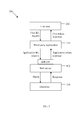
- FIG. 3 is a flowchart of an embodiment of a datastore access method 300 , which may be implemented in the system architecture 100 .
- the method 300 assumes that a user token and an application token have been established previously between a hosting system and a user/application.
- the method 300 uses HTTP as an example, although any other protocol may also be used.
- the method 300 starts in step 310 , where a request may be generated from a user end, and the request may comprise a URL and the user token. If the request calls a third party application, the request may be sent to the end of the third party application.
- a third party application may receive and process the request. For example, if the user end is requesting to print a shipping label, the shipping label printing application may translate or convert the request into another request to gather information such as configuration variables, tenant-specific information, and user preferences, etc.
- the third party application may call the API of the hosting system with the request comprising the URL, the user token, and an application token. If no third party application is needed, the steps 320 and 330 may be replaced by a step where the request from the user end is directly received by the hosting system.
- the method 300 may determine whether the user and application tokens contained in the request from the application is valid. If the tokens are invalid, the method 300 may proceed to step 350 , where the web server of the hosting system may generate an error message indicating the invalidity of the tokens. Otherwise, the method 300 may proceed to step 360 where the web server may generate a query based on the request received from the application. Generating the query may comprise deriving a query scope from the user token, the application token, as well as the URL. In step 370 , the query may access a datastore in the hosting system, and a response comprising requested information may be generated. The response may be sent back to the user end via the third party application.
- the method 300 may only include only a portion of necessary steps in data communication between a hosting system and a user end. Accordingly, other steps, such as the establishment of application and/or user tokens, configuration of error messages if token validity fails, periodical updating of security tokens, etc., may be incorporated into the method 300 wherever appropriate. Moreover, the execution order or sequence of steps may be flexibly changed, e.g., if a step does not depend on a preceding step.
- FIG. 4 illustrates a typical, general-purpose network component or computer system 400 suitable for implementing one or more embodiments of the methods disclosed herein, such as the datastore access scheme 200 and the datastore access method 300 .
- the general-purpose network component or computer system 400 includes a processor 402 (which may be referred to as a central processor unit or CPU) that is in communication with memory devices including secondary storage 404 , read only memory (ROM) 406 , random access memory (RAM) 408 , input/output (I/O) devices 410 , and network connectivity devices 412 .
- ROM read only memory
- RAM random access memory
- I/O input/output
- the processor 402 may be implemented as one or more CPU chips, one or more cores (e.g., a multi-core processor), or may be part of one or more application specific integrated circuits (ASICs) and/or digital signal processors (DSPs).
- the processor 402 may be part of the web server 112 in FIG. 1 .
- the processor 402 may be configured to implement any of the schemes described herein, including the datastore access scheme 200 and the datastore access method 300 .
- the processor 402 may be implemented using hardware, software, or both.
- the secondary storage 404 is typically comprised of one or more disk drives or tape drives and is used for non-volatile storage of data and as an over-flow data storage device if RAM 408 is not large enough to hold all working data. Secondary storage 404 may be used to store programs that are loaded into RAM 408 when such programs are selected for execution.
- the ROM 406 is used to store instructions and perhaps data that are read during program execution. ROM 406 is a non-volatile memory device that typically has a small memory capacity relative to the larger memory capacity of secondary storage 404 .
- the RAM 408 is used to store volatile data and perhaps to store instructions. Access to both ROM 406 and RAM 408 is typically faster than to secondary storage 404 .
- R 1 a numerical range with a lower limit, R 1 , and an upper limit, R u , any number falling within the range is specifically disclosed.
- R R 1 +k*(R u ⁇ R 1 ), wherein k is a variable ranging from 1 percent to 100 percent with a 1 percent increment, i.e., k is 1 percent, 2 percent, 3 percent, 4 percent, 7 percent, . . . , 70 percent, 71 percent, 72 percent, . . . , 95 percent, 96 percent, 97 percent, 98 percent, 99 percent, or 100 percent.
- any numerical range defined by two R numbers as defined in the above is also specifically disclosed.
Landscapes
- Engineering & Computer Science (AREA)
- Computer Security & Cryptography (AREA)
- Computer Hardware Design (AREA)
- General Engineering & Computer Science (AREA)
- Theoretical Computer Science (AREA)
- Computing Systems (AREA)
- Computer Networks & Wireless Communication (AREA)
- Signal Processing (AREA)
- Software Systems (AREA)
- Physics & Mathematics (AREA)
- General Physics & Mathematics (AREA)
- Information Transfer Between Computers (AREA)
Abstract
Description
Claims (11)
Priority Applications (1)
| Application Number | Priority Date | Filing Date | Title |
|---|---|---|---|
| US13/631,391 US9542546B2 (en) | 2012-09-28 | 2012-09-28 | System and method for implicitly resolving query scope in a multi-client and multi-tenant datastore |
Applications Claiming Priority (1)
| Application Number | Priority Date | Filing Date | Title |
|---|---|---|---|
| US13/631,391 US9542546B2 (en) | 2012-09-28 | 2012-09-28 | System and method for implicitly resolving query scope in a multi-client and multi-tenant datastore |
Publications (2)
| Publication Number | Publication Date |
|---|---|
| US20140096221A1 US20140096221A1 (en) | 2014-04-03 |
| US9542546B2 true US9542546B2 (en) | 2017-01-10 |
Family
ID=50386599
Family Applications (1)
| Application Number | Title | Priority Date | Filing Date |
|---|---|---|---|
| US13/631,391 Active 2033-10-12 US9542546B2 (en) | 2012-09-28 | 2012-09-28 | System and method for implicitly resolving query scope in a multi-client and multi-tenant datastore |
Country Status (1)
| Country | Link |
|---|---|
| US (1) | US9542546B2 (en) |
Cited By (5)
| Publication number | Priority date | Publication date | Assignee | Title |
|---|---|---|---|---|
| US20190095532A1 (en) * | 2017-09-27 | 2019-03-28 | Salesforce.Com, Inc. | Run-time querying of multi-tenant non-relational platform objects |
| US10536446B2 (en) | 2017-01-31 | 2020-01-14 | Microsoft Technology Licensing, Llc. | Single authentication to a multi-tenancy single-page cloud application |
| US11038886B1 (en) * | 2018-02-08 | 2021-06-15 | Wells Fargo Bank, N.A. | Compliance management system |
| US11700150B2 (en) * | 2019-07-31 | 2023-07-11 | Vmware, Inc. | Allocation of tokens for network packets based on application type |
| US12432184B2 (en) | 2022-05-02 | 2025-09-30 | VMware LLC | Flow-based secure packet forwarding |
Families Citing this family (11)
| Publication number | Priority date | Publication date | Assignee | Title |
|---|---|---|---|---|
| US10516733B2 (en) | 2014-11-25 | 2019-12-24 | Auth0, Inc. | Multi-tenancy via code encapsulated in server requests |
| US10320844B2 (en) * | 2016-01-13 | 2019-06-11 | Microsoft Technology Licensing, Llc | Restricting access to public cloud SaaS applications to a single organization |
| JP6491796B2 (en) | 2016-05-11 | 2019-03-27 | オラクル・インターナショナル・コーポレイション | Multi-tenant identity and data security management cloud service |
| US20180115542A1 (en) * | 2016-10-24 | 2018-04-26 | Caradigm Usa Llc | Security mechanism for multi-tiered server-implemented applications |
| CA3006893C (en) * | 2017-09-07 | 2023-01-10 | The Toronto-Dominion Bank | Digital identity network interface system |
| US10719533B2 (en) * | 2018-01-03 | 2020-07-21 | Salesforce.Com, Inc. | Multi-tenant tables of a distributed database |
| US11216568B2 (en) * | 2018-01-10 | 2022-01-04 | Dropbox, Inc. | Server-side rendering password protected documents |
| US11095657B2 (en) * | 2018-02-12 | 2021-08-17 | Slack Technologies, Inc. | Method, apparatus, and computer program product for selectively granting permissions to group-based objects in a group-based communication system |
| US20200074562A1 (en) * | 2018-08-28 | 2020-03-05 | American Express Travel Related Services Company, Inc. | Systems and methods for generating product-merchant data links |
| US11188228B1 (en) * | 2019-03-25 | 2021-11-30 | Amazon Technologies, Inc. | Graphing transaction operations for transaction compliance analysis |
| CN114499977B (en) * | 2021-12-28 | 2023-08-08 | 天翼云科技有限公司 | Authentication method and device |
Citations (10)
| Publication number | Priority date | Publication date | Assignee | Title |
|---|---|---|---|---|
| US20090077233A1 (en) * | 2006-04-26 | 2009-03-19 | Ryosuke Kurebayashi | Load Control Device and Method Thereof |
| US20100017415A1 (en) * | 2008-07-16 | 2010-01-21 | Fujitsu Limited | Data access control method and data access control apparatus |
| US20120117167A1 (en) * | 2010-11-09 | 2012-05-10 | Sony Corporation | System and method for providing recommendations to a user in a viewing social network |
| US20120174198A1 (en) * | 2010-12-30 | 2012-07-05 | Verisign, Inc. | Shared Registration Multi-Factor Authentication Tokens |
| US20130024919A1 (en) * | 2011-07-21 | 2013-01-24 | Microsoft Corporation | Cloud service authentication |
| US20130110961A1 (en) * | 2011-08-02 | 2013-05-02 | Ajay JADHAV | Cloud-based distributed persistence and cache data model |
| US20130138810A1 (en) * | 2011-09-09 | 2013-05-30 | Shuki Binyamin | Systems and Methods for Workspace Interaction with Cloud-Based Applications |
| US20130218919A1 (en) * | 2012-02-20 | 2013-08-22 | Aleksey Solonchev | Method and apparatus for managing content |
| US20130312087A1 (en) * | 2012-05-15 | 2013-11-21 | Sap Ag | Personal authentications on computing devices |
| US20140007195A1 (en) * | 2012-06-27 | 2014-01-02 | Vikas Gupta | User Authentication of Applications on Third-Party Devices Via User Devices |
-
2012
- 2012-09-28 US US13/631,391 patent/US9542546B2/en active Active
Patent Citations (10)
| Publication number | Priority date | Publication date | Assignee | Title |
|---|---|---|---|---|
| US20090077233A1 (en) * | 2006-04-26 | 2009-03-19 | Ryosuke Kurebayashi | Load Control Device and Method Thereof |
| US20100017415A1 (en) * | 2008-07-16 | 2010-01-21 | Fujitsu Limited | Data access control method and data access control apparatus |
| US20120117167A1 (en) * | 2010-11-09 | 2012-05-10 | Sony Corporation | System and method for providing recommendations to a user in a viewing social network |
| US20120174198A1 (en) * | 2010-12-30 | 2012-07-05 | Verisign, Inc. | Shared Registration Multi-Factor Authentication Tokens |
| US20130024919A1 (en) * | 2011-07-21 | 2013-01-24 | Microsoft Corporation | Cloud service authentication |
| US20130110961A1 (en) * | 2011-08-02 | 2013-05-02 | Ajay JADHAV | Cloud-based distributed persistence and cache data model |
| US20130138810A1 (en) * | 2011-09-09 | 2013-05-30 | Shuki Binyamin | Systems and Methods for Workspace Interaction with Cloud-Based Applications |
| US20130218919A1 (en) * | 2012-02-20 | 2013-08-22 | Aleksey Solonchev | Method and apparatus for managing content |
| US20130312087A1 (en) * | 2012-05-15 | 2013-11-21 | Sap Ag | Personal authentications on computing devices |
| US20140007195A1 (en) * | 2012-06-27 | 2014-01-02 | Vikas Gupta | User Authentication of Applications on Third-Party Devices Via User Devices |
Cited By (7)
| Publication number | Priority date | Publication date | Assignee | Title |
|---|---|---|---|---|
| US10536446B2 (en) | 2017-01-31 | 2020-01-14 | Microsoft Technology Licensing, Llc. | Single authentication to a multi-tenancy single-page cloud application |
| US20190095532A1 (en) * | 2017-09-27 | 2019-03-28 | Salesforce.Com, Inc. | Run-time querying of multi-tenant non-relational platform objects |
| US11714811B2 (en) * | 2017-09-27 | 2023-08-01 | Salesforce, Inc. | Run-time querying of multi-tenant non-relational platform objects |
| US11038886B1 (en) * | 2018-02-08 | 2021-06-15 | Wells Fargo Bank, N.A. | Compliance management system |
| US12052251B1 (en) | 2018-02-08 | 2024-07-30 | Wells Fargo Bank, N.A. | Compliance management system |
| US11700150B2 (en) * | 2019-07-31 | 2023-07-11 | Vmware, Inc. | Allocation of tokens for network packets based on application type |
| US12432184B2 (en) | 2022-05-02 | 2025-09-30 | VMware LLC | Flow-based secure packet forwarding |
Also Published As
| Publication number | Publication date |
|---|---|
| US20140096221A1 (en) | 2014-04-03 |
Similar Documents
| Publication | Publication Date | Title |
|---|---|---|
| US20140096221A1 (en) | System and Method for Implicitly Resolving Query Scope in a Multi-Client and Multi-Tenant Datastore | |
| US12598227B2 (en) | Systems and methods for controlling sign-on to web applications | |
| US10673866B2 (en) | Cross-account role management | |
| US11153294B2 (en) | Background authentication refresh | |
| US10484385B2 (en) | Accessing an application through application clients and web browsers | |
| US10348718B2 (en) | Sharing credentials and other secret data in collaborative environment in a secure manner | |
| CN104769914B (en) | How to handle requests for digital services | |
| US12206739B2 (en) | Systems and methods for monitoring cross-domain applications in web environments | |
| CN107852417B (en) | Multi-tenant identity and data security management cloud service | |
| US20160072839A1 (en) | Facilitating dynamic management of participating devices within a network in an on-demand services environment | |
| US20130283362A1 (en) | Authenticating user through web extension using token based authentication scheme | |
| US10972444B1 (en) | Mapping account information | |
| US12236446B2 (en) | Automated transactional offers using a browser extension | |
| US12242649B2 (en) | Super-cookie identification for stolen cookie detection | |
| US12284175B2 (en) | Context specific user chatbot | |
| US12452247B1 (en) | Access management for applications using attribute based access control | |
| CN110036387A (en) | Integrated agreement system | |
| US12407671B2 (en) | Systems and methods for linking security accounts to application accounts and converging multiple identity systems | |
| US10742635B2 (en) | Multilevel sign-on | |
| HK1209931B (en) | Method of processing requests for digital services |
Legal Events
| Date | Code | Title | Description |
|---|---|---|---|
| AS | Assignment |
Owner name: VOLUSION, INC., TEXAS Free format text: ASSIGNMENT OF ASSIGNORS INTEREST;ASSIGNORS:WALLIS, JASON;GILL, JONATHAN;MURRAY, GREGORY;AND OTHERS;REEL/FRAME:029206/0852 Effective date: 20121024 |
|
| AS | Assignment |
Owner name: SILICON VALLEY BANK, CALIFORNIA Free format text: SECURITY AGREEMENT;ASSIGNOR:VOLUSION, INC.;REEL/FRAME:031891/0144 Effective date: 20131230 |
|
| AS | Assignment |
Owner name: SILICON VALLEY BANK, TEXAS Free format text: SECURITY AGREEMENT;ASSIGNOR:VOLUSION, INC.;REEL/FRAME:031893/0001 Effective date: 20131230 |
|
| AS | Assignment |
Owner name: MAIN STREET CAPITAL CORPORATION, TEXAS Free format text: AMENDED AND RESTATED INTELLECTUAL PROPERTY SECURITY AGREEMENT;ASSIGNOR:VOLUSION, LLC;REEL/FRAME:040680/0529 Effective date: 20161123 |
|
| STCF | Information on status: patent grant |
Free format text: PATENTED CASE |
|
| AS | Assignment |
Owner name: VOLUSION, LLC, TEXAS Free format text: CHANGE OF NAME;ASSIGNOR:VOLUSION, INC.;REEL/FRAME:045760/0392 Effective date: 20150126 |
|
| MAFP | Maintenance fee payment |
Free format text: PAYMENT OF MAINTENANCE FEE, 4TH YR, SMALL ENTITY (ORIGINAL EVENT CODE: M2551); ENTITY STATUS OF PATENT OWNER: SMALL ENTITY Year of fee payment: 4 |
|
| MAFP | Maintenance fee payment |
Free format text: PAYMENT OF MAINTENANCE FEE, 8TH YR, SMALL ENTITY (ORIGINAL EVENT CODE: M2552); ENTITY STATUS OF PATENT OWNER: SMALL ENTITY Year of fee payment: 8 |