US9537460B2 - Apparatus and method for automatic gain control - Google Patents
Apparatus and method for automatic gain control Download PDFInfo
- Publication number
- US9537460B2 US9537460B2 US13/189,191 US201113189191A US9537460B2 US 9537460 B2 US9537460 B2 US 9537460B2 US 201113189191 A US201113189191 A US 201113189191A US 9537460 B2 US9537460 B2 US 9537460B2
- Authority
- US
- United States
- Prior art keywords
- speech
- signal
- power level
- speech signal
- envelope tracking
- Prior art date
- Legal status (The legal status is an assumption and is not a legal conclusion. Google has not performed a legal analysis and makes no representation as to the accuracy of the status listed.)
- Active, expires
Links
Images


Classifications
-
- H—ELECTRICITY
- H03—ELECTRONIC CIRCUITRY
- H03G—CONTROL OF AMPLIFICATION
- H03G3/00—Gain control in amplifiers or frequency changers
- H03G3/20—Automatic control
- H03G3/30—Automatic control in amplifiers having semiconductor devices
- H03G3/3089—Control of digital or coded signals
-
- H—ELECTRICITY
- H03—ELECTRONIC CIRCUITRY
- H03G—CONTROL OF AMPLIFICATION
- H03G3/00—Gain control in amplifiers or frequency changers
- H03G3/20—Automatic control
- H03G3/30—Automatic control in amplifiers having semiconductor devices
- H03G3/3005—Automatic control in amplifiers having semiconductor devices in amplifiers suitable for low-frequencies, e.g. audio amplifiers
-
- H—ELECTRICITY
- H04—ELECTRIC COMMUNICATION TECHNIQUE
- H04M—TELEPHONIC COMMUNICATION
- H04M1/00—Substation equipment, e.g. for use by subscribers
- H04M1/60—Substation equipment, e.g. for use by subscribers including speech amplifiers
- H04M1/6008—Substation equipment, e.g. for use by subscribers including speech amplifiers in the transmitter circuit
Definitions
- the invention relates generally to providing voice signals to users, and, more specifically to providing automatic gain control for these signals.
- AGC Automatic gain control
- Still another problem associated with previous AGC approaches is the tendency to over or under amplify the input signal under certain conditions, creating a non-desirable output. More specifically and when normalizing audio signals, unintentional over-amplification can produce a noticeably unpleasant (e.g., noisy) output. When used in vehicle-based hands-free applications where an AGC algorithm is intended to normalize speech, over amplified signals can be unintentionally produced by noise and other sounds common to the environment in the input signal that are misrecognised as speech.
- FIG. 1 comprises a block diagram of an apparatus that provides automatic gain control according to various embodiments of the present invention
- FIG. 2 comprises a flowchart of an approach for providing automatic gain control according to various embodiments of the present invention
- FIG. 3 comprises a flowchart of an approach for providing automatic gain control according to various embodiments of the present invention
- FIG. 4 comprises a flowchart showing an approach for providing automatic gain control according to various embodiments of the present invention
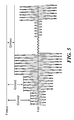
- FIG. 5 comprises a graph showing the provision of gain control according to various embodiments of the present invention.
- noise-adaptive Automatic Gain Control (AGC) algorithms that are particularly applicable and effective in noisy environments (e.g., vehicular applications) are provided.
- AGC Automatic Gain Control
- AGC approaches tend to increase the noise power level much more than speech signals which is not desired. Consequently, many of the present approaches employ a robust noise adaptive mechanism that controls the amplification of noise and, as a result, the noise power level is not increased more than the speech power level.
- the approaches described herein are also applicable to a wide range of applications such as hands-free communications in vehicles. Many of these approaches are based upon calculations involving the background noise estimate, slow and fast envelope tracking of speech signals, speech pause detection, and speech peak power estimate, among other factors.
- AGC Automatic Gain Control
- a speech signal is received at an input. At least one electrical value associated with the received speech signal is tracked. A dynamic adjustment of the speech signal is determined. The dynamic adjustment is selected at least in part so as to minimize a distortion and minimize an over-amplification of the speech signal based at least in part upon an analysis of the at least one electrical value. The dynamic adjustment is further selected to obtain a desired output signal characteristic for the speech signal presented at an output. The dynamic adjustment value is applied to the speech signal and the adjusted speech signal is presented at the output.
- a power level is measured that is associated with an electrical envelope.
- a speech pause associated with an electrical envelope is detected.
- the tracking may include tracking at least one difference between a power level associated with the speech signal and a desired power level.
- the dynamic adjustment is effective to maintain the signal at the output at substantially the desired power level.
- Other tracking approaches may also be used.
- the analysis may include a variety of different calculations.
- the analysis includes a computation of a maximum gain based upon a desired output divided by the input and applying the dynamic adjustment value includes limiting the gain of the adjusted speech signal at the output to substantially the maximum computed gain.
- the speech signal is transmitted to an audio application in a vehicle.
- the audio application may be a speaker associated with any application such as hands-free applications in vehicles.
- a speech signal is received. Based upon at least one characteristic of the speech signal and at least one characteristic of the desired output signal, a maximum gain so as to limit over amplification of the received speech signal is determined. The determined maximum gain is applied to the signal so as to limit over-amplification of the input signal.
- the maximum gain is the gain that would be effective to saturate the speech signal. In other aspects, the maximum gain is the maximum desired output divided by a maximum magnitude of the received speech signal.
- the interface includes an input and an output and the input is configured to receive a speech signal.
- the controller is coupled to the interface and configured to track at least one electrical value associated with the received speech signal.
- the controller is further configured to determine a dynamic adjustment of the speech signal and the dynamic adjustment is selected at least in part so as to minimize a distortion and minimize an over-amplification of the speech signal based at least in part upon an analysis by the controller of the at least one electrical value.
- the dynamic adjustment is further selected to obtain a desired output signal characteristic for the speech signal to be presented at the output.
- the controller is configured to apply the dynamic adjustment value to the speech signal and present the adjusted speech signal at the output of the interface.
- the controller is configured to track a power level measured associated with an electrical envelope. In other aspects, the controller is configured to detect a speech pause associated with an electrical envelope. In yet other aspects, the controller is configured to track at least one difference between a power level associated with the speech signal and a desired power level, and the dynamic adjustment is effective to maintain the signal at the output at substantially the desired power level.
- the analysis performs a computation of a maximum gain based upon a desired output divided by the input and the gain of the adjusted speech signal is limited at the output to substantially the maximum gain.
- the output is coupled to an audio application in a vehicle.
- the audio application is selected from the group consisting of a speaker and a microphone.
- Other examples of audio applications and environments are possible.
- the approaches described herein are often described as being implemented in vehicular environments, they may be applied to any environment and are in no way limited to vehicular environments.
- an apparatus 100 configured to control automatic gain control for speech signals includes an interface 102 and a controller 104 .
- the interface 102 includes an input 106 and an output 108 and the input 106 is configured to receive a speech signal 110 .
- the controller 104 is coupled to the interface 102 and is configured to track at least one electrical value associated with the received speech signal 110 .
- the controller 104 is further configured to determine a dynamic adjustment of the speech signal 110 and the dynamic adjustment is selected at least in part so as to minimize a distortion and minimize an over-amplification of the speech signal 110 based at least in part upon an analysis by the controller 104 of the at least one electrical value.
- the dynamic adjustment is further selected to obtain a desired output signal characteristic for the modified speech signal 112 to be presented at the output 108 .
- the controller 104 is configured to apply the dynamic adjustment value to the speech signal 110 and present the adjusted speech signal 112 at the output 108 of the interface 102 .
- the controller 104 is configured to track a power level measured associated with an electrical envelope. In yet other aspects, the controller 104 is configured to track at least one difference between a power level associated with the speech signal 110 and a desired power level, and the dynamic adjustment is effective to maintain the signal at the output signal 112 at substantially the desired power level.
- the controller 104 computes a maximum gain based upon a desired output divided the input.
- the gain of the adjusted speech signal 112 is limited at the output to substantially the maximum gain.
- the output 108 is coupled to an audio application 114 in a vehicle.
- the audio application may be or may utilize a speaker and a microphone as used, for example, in hands-free vehicle applications.
- the speech signal 110 is scaled very effectively without depending on the level of input speech (e.g., approximately 40 dB/sec of gain is applied to the speech signal 110 where is necessary without adding any noticeable distortion to speech).
- the relative power ratio between the instantaneous speech power level and desired speech power level may be compared.
- the AGC scaling rate is determined.
- possible AGC scaling rates may be split into multiple regions and then the actual rate selected from these regions and according to various conditions including the above-mentioned ratio.
- the AGC scaling rate is split into three regions: (a) a low AGC scaling rate; (b) a medium AGC scaling rate; and (c) a high AGC scaling rate.
- a low AGC scaling rate means that the instantaneous speech power and desired speech power levels are very close therefore, the AGC gain applied to signal vary very slowly from one frame to another (e.g., applying 0.5 dB per second AGC gain).
- a medium AGC scaling rate means that the instantaneous speech power and desired speech power levels are not that close in which case, AGC gain applied to signal is in the middle range (e.g., applying 7 dB per second AGC gain).
- a high AGC scaling rate means that the difference between the instantaneous speech power level and desired speech power level are very big in which case, the AGC gain applied to signal should be in the high range (e.g., applying 40 dB per second AGC gain). In these approaches speech levels are normalized as effectively as possible in a short period of time and, hence, providing the desire speech level at the output of HF system.
- speech pauses are detected based on the slow and fast envelope tracking mechanisms. If the speech pauses are detected, then the signal is not scaled and as a result of this the noise power is not amplified.
- the degree of periodicity measure for speech signals may also be introduced and utilized. Combining both of these methods, the AGC algorithms become very robust in heavy noisy environments and eliminate (or substantially eliminate) the AGC creep problem without amplifying noise while still amplifying speech signals.
- a speech signal is received at an input.
- at least one electrical value associated with the received speech signal is tracked.
- a power level is measured that is associated with an electrical envelope is tracked.
- a speech pause associated with an electrical envelope is tracked.
- the tracking may include tracking at least one difference between a power level associated with the speech signal and a desired power level. In this case and to take one example, the dynamic adjustment is effective to maintain the signal at the output at substantially the desired power level.
- a dynamic adjustment of the speech signal is determined.
- the dynamic adjustment is selected at least in part so as to minimize a distortion and minimize an over-amplification of the speech signal based at least in part upon an analysis of the at least one electrical value.
- the dynamic adjustment is further selected to obtain a desired output signal characteristic for the speech signal presented at an output.
- the analysis may utilize a variety of different calculations.
- the analysis includes a computation of a maximum gain based upon a desired output divided the input and applying the dynamic adjustment value comprises limiting the gain of the adjusted speech signal at the output to substantially the maximum computed gain.
- the dynamic adjustment value is applied to the speech signal and the adjusted speech signal is presented at the output.
- the speech signal may then be transmitted to an audio application in a vehicle.
- the audio application may be a speaker associated with any application such as hands-free applications in vehicles. Other examples of audio applications are possible.
- a speech signal is received. Based upon at least one characteristic of the speech signal and at least one characteristic of the desired output signal, at step 304 , a maximum gain so as to limit over amplification of the received speech signal is determined.
- the maximum gain comprises a gain that would be effective to saturate the speech signal.
- the maximum gain comprises a maximum desired output divided by a maximum magnitude of the received speech signal.
- G (max) is Max Amplitude (O) /Max Amplitude (I) and the input and output signals share a common maximum dynamic range.
- the choice of LL can be arbitrary or determined by knowledge concerning the limits of I and O. For example, if the amplitude of the output signal cannot exceed that of the input signal, LL is 0 dB (no gain). Thus, the choice of LL reduces under-amplification error.
- MaxAmplitude (O) is pre-determined, G will vary with MaxAmplitude (I) and will be bounded by LL below. It will only change (and only ever downwards) when a higher-than-previously-seen MaxAmplitude (I) is encountered for a given input/output set.
- the determined maximum gain is applied to the signal so as to limit over-amplification of the input signal. Since G is now bounded by the above formula, the level of over-amplification the AGC process can apply is limited, reducing its effect. The effect is most pronounced when the signal to be normalized (e.g. speech) is substantially greater in magnitude than the signals that may be misrecognised and normalized erroneously (e.g. noise).
- An example application would be the normalization of the signal received from a telephony device where the input is normalized to maximize use of the dynamic range of the output signal.
- LL will be 0 dB and G will be limited by the maximum amplitude of the input signal, which may range from full-scale (limiting G to 0 dB) to a lower (normally at most 6 dB, or half) value.
- the AGC since the AGC will be operating near G (max) (to normalize speech to full scale), the AGC will be prevented from substantially over-amplifying smaller signals (such as noise) that are misrecognised as speech.
- FIG. 4 an example of an approach at AGC is described.
- This approach describes various modules that can be used to implement the functions described with respect to FIGS. 1 and 2 above. It will be appreciated that these functions may be implemented by any combination of hardware and/or software (e.g., computer instructions stored on computer media).
- the approach of FIG. 4 utilizes a speech power computation module 402 , a background noise estimator, a slow envelope tracking module 406 , a speech pause detection module 408 , a fast envelope tracking module 410 , a peak power estimator 412 , a sudden power change detection module 414 , an AGC rate module 416 , an AGC gain computational module 418 , and a summer 420 .
- the speech power computation module 402 computes power of the speech.
- the average power, P 0 of a speech segment, s m (n) is computed for the m th speech frame as follows:
- the slow envelope tracking module 406 provides for the slow envelope tracking, first order IIR smoothing of the average power for the input speech signal.
- ⁇ S (m) The time variant constant, ⁇ S (m) for the IIR filter is chosen differentially for rising and falling signal edges as given in the following equation:
- a rising signal edge is followed faster than a falling one as: 0 ⁇ S,r ⁇ S,f ⁇ 1 (4)
- the fast envelope tracking module 410 performs the fast envelope tracking, P F (m) for the m th frame and is computed in the same manner as the slow envelope tracking as given in the following equation:
- the background noise estimator module 404 provides for estimation of the background noise level, minimum statistics and power smoothing only during speech pauses is used for the AGC algorithm.
- ⁇ is a small positive value that controls the maximum speed for increasing the estimated noise level.
- ⁇ should be chosen such that ⁇ ( ⁇ ) is within the interval 0.5 dB/second and 3 dB/second.
- the speech pause detection module 408 compares the outputs of the fast and slow envelope tracking estimators and is the first stage of a simple speech pause detector. At the beginning of speech interval, the output of the fast envelope tracking estimator rises faster than that of the slow one. Due to short term power variations during speech activity on one hand and the choices of the time constants on the other hand, the output signal of the fast envelope tracking estimator is always larger than its slow counterpart. At the end of the voice activity period, the output of the slow envelope tracking estimator does not decrease as rapidly as does that of the fast envelope tracking estimator, and now the output of the slow envelope tracking estimator exceeds that of the fast one.
- B N (m) ⁇ P BNE ( m ) (12)
- the peak power estimator module 412 estimates the peak power of speech signals. During voice intervals, the peak amplitude level is tracked. This is performed again by first order IIR filtering as:
- the filter is updated only if there is speech activity; otherwise the filter keeps its old output values.
- the fast envelope tracking estimator is used as an input. In order to avoid an excessive rapid decreases P P (m) during wrong decision of speech pause detection, a very long time constant for falling signal edges was chosen as:
- ⁇ P ⁇ ( m ) ⁇ ⁇ P , r ; P F ⁇ ( m ) > P P ⁇ ( m - 1 ) ⁇ P , f ; otherwise ⁇ ⁇ Where ( 16 ) 0 ⁇ ⁇ ⁇ N , r ⁇ ⁇ N , f ⁇ 1 ( 17 )
- the sudden power change detection module 414 and AGC rate determination module 416 are used to determine the AGC rate that will be applied during AGC gain computation. Additionally, the sudden power change detection pre-determined variety of AGC variables (i.e., peak power estimate, slow envelope tracking, fast envelope tracking, and background noise estimate) and AGC gain are used in order to more effectively eliminate the sudden power change affects in a short period of time.
- AGC variables i.e., peak power estimate, slow envelope tracking, fast envelope tracking, and background noise estimate
- the AGC gain computation module 418 performs signal scaling. During speech intervals the short term power of the input speech signal is estimated and compared to a desired value. If the speech level exceeds an upper bound, the gain factor, G(m) for the m th frame is decreased—in the other case the gain is increased. In order to avoid fast gain variations during short speech pauses, G(m) is incremented or decremented in very small steps. The gain factors, G(m) is updated only during the periods of speech activity as:
- the scaling factor, ⁇ is computed by comparing the amplified or attenuated (depending on G(m ⁇ 1)) speech level estimator, P P (m) with the desired level, D L . If the speech level after scaling with G(m ⁇ 1) is still small, the gain factor is increased as:
- ⁇ is a small positive value that controls the maximum speed for increasing or decreasing the AGC gain in a second.
- ⁇ ( ⁇ ) f s 20 log 10 (1+ ⁇ ) (21)
- FIG. 5 an example graph showing the change in G (max) in response to increasingly larger input signals is described. For each successively higher input sample, G (max) is reduced accordingly. With the upper bound on G shrinking in this fashion, it can be seen that the maximum possible over amplification error (which is often applied to smaller input signals) has been limited by the larger input signals. Thus, over-amplification is prevented and signal quality is improved.
- a processing device e.g., a microprocessor, controller, or the like.
Landscapes
- Engineering & Computer Science (AREA)
- Multimedia (AREA)
- Control Of Amplification And Gain Control (AREA)
Abstract
Description
LL>=G>=Max Amplitude(O)/Max Amplitude(I)
P S(m)=βS(m)P S(m−1)+(1−βS(m))√{square root over (P 0)} (2)
0<<βS,r<βS,f<1 (4)
βS,r>βF,r
βS,f>βF,f (7)
P N(m)=βN(m)P N(m−1)+(1−βN(m))P 0 (8)
P BNE(m)=min{P N(m),P BNE(m−1)}(1+ε) (10)
Δ(ε)=f s10 log10(1+ε) (11)
B N(m)=αP BNE(m) (12)
T(m)=max{P S(m),√{square root over (B N(m))}} (13)
Δ(μ)=f s20 log10(1+μ) (21)
s 0(m,n)=G(m)s m(n) (22)
Claims (12)
Priority Applications (2)
| Application Number | Priority Date | Filing Date | Title |
|---|---|---|---|
| US13/189,191 US9537460B2 (en) | 2011-07-22 | 2011-07-22 | Apparatus and method for automatic gain control |
| PCT/US2012/041024 WO2013015887A1 (en) | 2011-07-22 | 2012-06-06 | Apparatus and method for automatic gain control |
Applications Claiming Priority (1)
| Application Number | Priority Date | Filing Date | Title |
|---|---|---|---|
| US13/189,191 US9537460B2 (en) | 2011-07-22 | 2011-07-22 | Apparatus and method for automatic gain control |
Publications (2)
| Publication Number | Publication Date |
|---|---|
| US20130024193A1 US20130024193A1 (en) | 2013-01-24 |
| US9537460B2 true US9537460B2 (en) | 2017-01-03 |
Family
ID=46420524
Family Applications (1)
| Application Number | Title | Priority Date | Filing Date |
|---|---|---|---|
| US13/189,191 Active 2033-09-10 US9537460B2 (en) | 2011-07-22 | 2011-07-22 | Apparatus and method for automatic gain control |
Country Status (2)
| Country | Link |
|---|---|
| US (1) | US9537460B2 (en) |
| WO (1) | WO2013015887A1 (en) |
Cited By (1)
| Publication number | Priority date | Publication date | Assignee | Title |
|---|---|---|---|---|
| US11164592B1 (en) * | 2019-05-09 | 2021-11-02 | Amazon Technologies, Inc. | Responsive automatic gain control |
Families Citing this family (8)
| Publication number | Priority date | Publication date | Assignee | Title |
|---|---|---|---|---|
| US8862465B2 (en) * | 2010-09-17 | 2014-10-14 | Qualcomm Incorporated | Determining pitch cycle energy and scaling an excitation signal |
| US9070371B2 (en) * | 2012-10-22 | 2015-06-30 | Ittiam Systems (P) Ltd. | Method and system for peak limiting of speech signals for delay sensitive voice communication |
| EP3274993B1 (en) | 2015-04-23 | 2019-06-12 | Huawei Technologies Co. Ltd. | An audio signal processing apparatus for processing an input earpiece audio signal upon the basis of a microphone audio signal |
| GB2547459B (en) * | 2016-02-19 | 2019-01-09 | Imagination Tech Ltd | Dynamic gain controller |
| US9749733B1 (en) * | 2016-04-07 | 2017-08-29 | Harman Intenational Industries, Incorporated | Approach for detecting alert signals in changing environments |
| US10540990B2 (en) | 2017-11-01 | 2020-01-21 | International Business Machines Corporation | Processing of speech signals |
| CN112669878B (en) * | 2020-12-23 | 2024-04-19 | 北京声智科技有限公司 | Sound gain value calculation method and device and electronic equipment |
| CN120166333B (en) * | 2025-03-17 | 2025-10-21 | 东莞阳康电子有限公司 | A gradual change loudspeaker box and loudspeaker control method thereof |
Citations (17)
| Publication number | Priority date | Publication date | Assignee | Title |
|---|---|---|---|---|
| US4057690A (en) * | 1975-07-03 | 1977-11-08 | Telettra Laboratori Di Telefonia Elettronica E Radio S.P.A. | Method and apparatus for detecting the presence of a speech signal on a voice channel signal |
| US5301364A (en) * | 1988-11-30 | 1994-04-05 | Motorola, Inc. | Method and apparatus for digital automatic gain control in a receiver |
| US5396576A (en) * | 1991-05-22 | 1995-03-07 | Nippon Telegraph And Telephone Corporation | Speech coding and decoding methods using adaptive and random code books |
| US6212273B1 (en) | 1998-03-20 | 2001-04-03 | Crystal Semiconductor Corporation | Full-duplex speakerphone circuit including a control interface |
| US6420986B1 (en) * | 1999-10-20 | 2002-07-16 | Motorola, Inc. | Digital speech processing system |
| WO2002097977A2 (en) | 2001-05-30 | 2002-12-05 | Intel Corporation | Enhancing the intelligibility of received speech in a noisy environment |
| US20040076271A1 (en) * | 2000-12-29 | 2004-04-22 | Tommi Koistinen | Audio signal quality enhancement in a digital network |
| US20050071155A1 (en) * | 2003-09-30 | 2005-03-31 | Walter Etter | Method and apparatus for adjusting the level of a speech signal in its encoded format |
| US7155385B2 (en) * | 2002-05-16 | 2006-12-26 | Comerica Bank, As Administrative Agent | Automatic gain control for adjusting gain during non-speech portions |
| JP2006350246A (en) * | 2005-06-20 | 2006-12-28 | Nhk Engineering Services Inc | Speech / pause section detection device |
| US20090010453A1 (en) * | 2007-07-02 | 2009-01-08 | Motorola, Inc. | Intelligent gradient noise reduction system |
| EP2048659A1 (en) * | 2007-10-08 | 2009-04-15 | Harman Becker Automotive Systems GmbH | Gain and spectral shape adjustment in audio signal processing |
| US20090187065A1 (en) * | 2008-01-21 | 2009-07-23 | Otologics, Llc | Automatic gain control for implanted microphone |
| US20100150374A1 (en) * | 2008-12-15 | 2010-06-17 | Bryson Michael A | Vehicular automatic gain control (agc) microphone system and method for post processing optimization of a microphone signal |
| US20100208908A1 (en) * | 2007-10-19 | 2010-08-19 | Nec Corporation | Echo supressing method and apparatus |
| US20100278353A1 (en) * | 2009-04-29 | 2010-11-04 | Step Labs, Inc. | System and Method For Intelligibility Enhancement of Audio Information |
| US20110131044A1 (en) * | 2009-11-30 | 2011-06-02 | International Business Machines Corporation | Target voice extraction method, apparatus and program product |
-
2011
- 2011-07-22 US US13/189,191 patent/US9537460B2/en active Active
-
2012
- 2012-06-06 WO PCT/US2012/041024 patent/WO2013015887A1/en not_active Ceased
Patent Citations (17)
| Publication number | Priority date | Publication date | Assignee | Title |
|---|---|---|---|---|
| US4057690A (en) * | 1975-07-03 | 1977-11-08 | Telettra Laboratori Di Telefonia Elettronica E Radio S.P.A. | Method and apparatus for detecting the presence of a speech signal on a voice channel signal |
| US5301364A (en) * | 1988-11-30 | 1994-04-05 | Motorola, Inc. | Method and apparatus for digital automatic gain control in a receiver |
| US5396576A (en) * | 1991-05-22 | 1995-03-07 | Nippon Telegraph And Telephone Corporation | Speech coding and decoding methods using adaptive and random code books |
| US6212273B1 (en) | 1998-03-20 | 2001-04-03 | Crystal Semiconductor Corporation | Full-duplex speakerphone circuit including a control interface |
| US6420986B1 (en) * | 1999-10-20 | 2002-07-16 | Motorola, Inc. | Digital speech processing system |
| US20040076271A1 (en) * | 2000-12-29 | 2004-04-22 | Tommi Koistinen | Audio signal quality enhancement in a digital network |
| WO2002097977A2 (en) | 2001-05-30 | 2002-12-05 | Intel Corporation | Enhancing the intelligibility of received speech in a noisy environment |
| US7155385B2 (en) * | 2002-05-16 | 2006-12-26 | Comerica Bank, As Administrative Agent | Automatic gain control for adjusting gain during non-speech portions |
| US20050071155A1 (en) * | 2003-09-30 | 2005-03-31 | Walter Etter | Method and apparatus for adjusting the level of a speech signal in its encoded format |
| JP2006350246A (en) * | 2005-06-20 | 2006-12-28 | Nhk Engineering Services Inc | Speech / pause section detection device |
| US20090010453A1 (en) * | 2007-07-02 | 2009-01-08 | Motorola, Inc. | Intelligent gradient noise reduction system |
| EP2048659A1 (en) * | 2007-10-08 | 2009-04-15 | Harman Becker Automotive Systems GmbH | Gain and spectral shape adjustment in audio signal processing |
| US20100208908A1 (en) * | 2007-10-19 | 2010-08-19 | Nec Corporation | Echo supressing method and apparatus |
| US20090187065A1 (en) * | 2008-01-21 | 2009-07-23 | Otologics, Llc | Automatic gain control for implanted microphone |
| US20100150374A1 (en) * | 2008-12-15 | 2010-06-17 | Bryson Michael A | Vehicular automatic gain control (agc) microphone system and method for post processing optimization of a microphone signal |
| US20100278353A1 (en) * | 2009-04-29 | 2010-11-04 | Step Labs, Inc. | System and Method For Intelligibility Enhancement of Audio Information |
| US20110131044A1 (en) * | 2009-11-30 | 2011-06-02 | International Business Machines Corporation | Target voice extraction method, apparatus and program product |
Non-Patent Citations (3)
| Title |
|---|
| Archibald "Software Implementation of Automatic Gain Controller for Speech Signal," 2008, SPRAAL1 Texas Instrument, pp. 1-15. * |
| International Search Report and Written Opinion dated Aug. 24, 2012, from corresponding International Patent Application No. PCT/US2012/041024. |
| Kuphaldt "Lessons in Electric Circuits, vol. III-Semiconductors," Fifth Edition, Mar. 29, 2009, http://www.allaboutcircuits.com/pdf/SEMI.pdf, http://www.allaboutcircuits.com/vol-3/chpt-1/4.html. * |
Cited By (1)
| Publication number | Priority date | Publication date | Assignee | Title |
|---|---|---|---|---|
| US11164592B1 (en) * | 2019-05-09 | 2021-11-02 | Amazon Technologies, Inc. | Responsive automatic gain control |
Also Published As
| Publication number | Publication date |
|---|---|
| WO2013015887A1 (en) | 2013-01-31 |
| US20130024193A1 (en) | 2013-01-24 |
Similar Documents
| Publication | Publication Date | Title |
|---|---|---|
| US20130024193A1 (en) | Apparatus and method for automatic gain control | |
| US8244523B1 (en) | Systems and methods for noise reduction | |
| JP5678445B2 (en) | Audio processing apparatus, audio processing method and program | |
| US8260612B2 (en) | Robust noise estimation | |
| US6529868B1 (en) | Communication system noise cancellation power signal calculation techniques | |
| US9401685B2 (en) | Systems and methods for adjusting automatic gain control | |
| EP2704141B1 (en) | Enhancement of a voice signal in a noisy environment | |
| EP2738763B1 (en) | Speech enhancement apparatus and speech enhancement method | |
| CN1867965B (en) | Voice Activity Detection Using Adaptive Noise Floor Tracking | |
| US20090304191A1 (en) | Automatic gain control system applied to an audio signal as a function of ambient noise | |
| US8838444B2 (en) | Method of estimating noise levels in a communication system | |
| US11128954B2 (en) | Method and electronic device for managing loudness of audio signal | |
| CN102077274A (en) | Multi-microphone voice activity detector | |
| WO2004075167A2 (en) | Log-likelihood ratio method for detecting voice activity and apparatus | |
| US8477887B2 (en) | Systems and methods providing frequency-domain automatic gain control (AGC) | |
| CN105845151B (en) | Audio gain method of adjustment and device applied to speech recognition front-ends | |
| US8489393B2 (en) | Speech intelligibility | |
| US6169971B1 (en) | Method to suppress noise in digital voice processing | |
| US7885810B1 (en) | Acoustic signal enhancement method and apparatus | |
| US9065409B2 (en) | Method and arrangement for processing of audio signals | |
| US11374663B2 (en) | Variable-frequency smoothing | |
| US9779754B2 (en) | Speech enhancement device and speech enhancement method | |
| JP3929686B2 (en) | Voice switching apparatus and method | |
| US8243955B2 (en) | System for attenuating noise in an input signal | |
| US11264015B2 (en) | Variable-time smoothing for steady state noise estimation |
Legal Events
| Date | Code | Title | Description |
|---|---|---|---|
| AS | Assignment |
Owner name: CONTINENTAL AUTOMOTIVE SYSTEMS, INC., MICHIGAN Free format text: ASSIGNMENT OF ASSIGNORS INTEREST;ASSIGNORS:BARRON, DAVID;KIRBY, ANDREW;REEL/FRAME:026636/0713 Effective date: 20110606 |
|
| FEPP | Fee payment procedure |
Free format text: PAYOR NUMBER ASSIGNED (ORIGINAL EVENT CODE: ASPN); ENTITY STATUS OF PATENT OWNER: LARGE ENTITY |
|
| STCF | Information on status: patent grant |
Free format text: PATENTED CASE |
|
| MAFP | Maintenance fee payment |
Free format text: PAYMENT OF MAINTENANCE FEE, 4TH YEAR, LARGE ENTITY (ORIGINAL EVENT CODE: M1551); ENTITY STATUS OF PATENT OWNER: LARGE ENTITY Year of fee payment: 4 |