US9536757B2 - Device manufacturing cleaning process using vaporized solvent - Google Patents
Device manufacturing cleaning process using vaporized solvent Download PDFInfo
- Publication number
- US9536757B2 US9536757B2 US14/020,526 US201314020526A US9536757B2 US 9536757 B2 US9536757 B2 US 9536757B2 US 201314020526 A US201314020526 A US 201314020526A US 9536757 B2 US9536757 B2 US 9536757B2
- Authority
- US
- United States
- Prior art keywords
- solvent
- substrate
- vapor
- containing solution
- chamber
- Prior art date
- Legal status (The legal status is an assumption and is not a legal conclusion. Google has not performed a legal analysis and makes no representation as to the accuracy of the status listed.)
- Expired - Fee Related, expires
Links
Images




Classifications
-
- H01L21/67051—
-
- H—ELECTRICITY
- H10—SEMICONDUCTOR DEVICES; ELECTRIC SOLID-STATE DEVICES NOT OTHERWISE PROVIDED FOR
- H10P—GENERIC PROCESSES OR APPARATUS FOR THE MANUFACTURE OR TREATMENT OF DEVICES COVERED BY CLASS H10
- H10P72/00—Handling or holding of wafers, substrates or devices during manufacture or treatment thereof
- H10P72/04—Apparatus for manufacture or treatment
- H10P72/0402—Apparatus for fluid treatment
- H10P72/0406—Apparatus for fluid treatment for cleaning followed by drying, rinsing, stripping, blasting or the like
- H10P72/0411—Apparatus for fluid treatment for cleaning followed by drying, rinsing, stripping, blasting or the like for wet cleaning or washing
- H10P72/0414—Apparatus for fluid treatment for cleaning followed by drying, rinsing, stripping, blasting or the like for wet cleaning or washing using mainly spraying means, e.g. nozzles
-
- H01L21/02057—
-
- H01L21/67028—
-
- H—ELECTRICITY
- H10—SEMICONDUCTOR DEVICES; ELECTRIC SOLID-STATE DEVICES NOT OTHERWISE PROVIDED FOR
- H10P—GENERIC PROCESSES OR APPARATUS FOR THE MANUFACTURE OR TREATMENT OF DEVICES COVERED BY CLASS H10
- H10P70/00—Cleaning of wafers, substrates or parts of devices
- H10P70/20—Cleaning during device manufacture
-
- H—ELECTRICITY
- H10—SEMICONDUCTOR DEVICES; ELECTRIC SOLID-STATE DEVICES NOT OTHERWISE PROVIDED FOR
- H10P—GENERIC PROCESSES OR APPARATUS FOR THE MANUFACTURE OR TREATMENT OF DEVICES COVERED BY CLASS H10
- H10P72/00—Handling or holding of wafers, substrates or devices during manufacture or treatment thereof
- H10P72/04—Apparatus for manufacture or treatment
- H10P72/0402—Apparatus for fluid treatment
- H10P72/0406—Apparatus for fluid treatment for cleaning followed by drying, rinsing, stripping, blasting or the like
-
- B—PERFORMING OPERATIONS; TRANSPORTING
- B08—CLEANING
- B08B—CLEANING IN GENERAL; PREVENTION OF FOULING IN GENERAL
- B08B3/00—Cleaning by methods involving the use or presence of liquid or steam
- B08B3/04—Cleaning involving contact with liquid
Definitions
- Semiconductor devices are produced and used throughout the world in electronic and various other types of devices. Semiconductor devices are formed on semiconductor chips, and are often referred to as chips, which include millions of features and components that combine to form an integrated circuit or other semiconductor device. There is a constant push to increase integration levels of semiconductor devices by including more components on a chip of a given size, so that the increased functionality can be achieved on each semiconductor device chip. As such, semiconductor device features continue to shrink and there is an ongoing drive to shrink features and components further. One aspect of feature sizes that continue to shrink is the production of high aspect ratio features on or in a substrate.
- the lateral dimensions of holes, trenches, gaps, or other features that extend downwardly into a substrate or into a film or films formed over a substrate continue to shrink.
- Advanced processing techniques allow for these holes, trenches, or gaps with shrinking lateral dimensions to be formed deeper and deeper into substrates or film or films formed above the substrates. As such, the aspect ratio continues to become greater.
- the wet processing operations include cleaning operations and etching operations.
- the aspect ratio of holes, trenches, or gaps formed on or over the substrate become greater, it becomes increasingly more difficult for the cleaning or etching solvents to extend downward to completely fill the holes, trenches, or gaps and the efficiency of the cleaning process becomes lower.
- the etching or cleaning solvent does not extend to the bottom of the holes, trenches, or gaps, undesirable residue or debris can remain after cleaning operations and undesirable material intended to be etched, can remain after etching operations. This is due, at least in part, to surface tension of the solvent liquid that is introduced onto the surface as an etching or cleaning fluid, and can also be due to reaction products or by-products.
- wet solvent that is used in the cleaning or etching process it is difficult for the wet solvent that is used in the cleaning or etching process to flow into and out of voids or openings that may exist in microscopic residue, debris, or contaminants on the substrate.
- some cleaning methods use physical force, such as megasonic power, ultrasonic power, or fluid jet to assist the solvent in removing undesirable residue.
- physical force such as megasonic power, ultrasonic power, or fluid jet to assist the solvent in removing undesirable residue.
- the physical force or pressure from the sprayed solvent may cause lateral damage, such as pattern collapse (e.g., photoresist layer or permanent layer), especially in advance node devices.
- FIG. 1 is a flowchart of one embodiment of a method for cleaning a structure according to various aspects of the present disclosure.
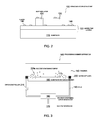
- FIG. 2 is a cross-sectional view of one embodiment of a semiconductor structure in a cleaning process according to various aspects of the present disclosure.
- FIG. 3 is a cross-sectional view of one embodiment of a processing chamber apparatus employed in a cleaning process in which a solvent-containing vapor is generated and conducted to a substrate to be cleaned, according to various aspects of the present disclosure.
- FIG. 4 is a cross-sectional view of one embodiment of a semiconductor structure in a cleaning process according to various aspects of the present disclosure, where a condensed solvent-containing solution on a substrate undergoes a cooling process.
- FIG. 5 is a cross-sectional magnified view of one embodiment of the semiconductor structure in FIG. 4 where condensed solvent vapor permeates voids or openings of debris or contaminants on the surface of a substrate.
- FIG. 6 is a cross-sectional view of one embodiment of a semiconductor structure in a cleaning process according to various aspects of the present disclosure, where a frozen solvent-containing solution on a substrate undergoes a heating process.
- FIG. 7 is a cross-sectional view of one embodiment of a semiconductor structure in a cleaning process according to various aspects of the present disclosure, where a substrate undergoes a purging and spinning process to remove solvent-containing solution and debris or contaminants.
- FIG. 1 is a flowchart of one embodiment of a method 2 for cleaning a structure according to various aspects of the present disclosure.
- the method 2 includes block 4 , in which a solvent-containing vapor is generated, where the solvent-containing vapor comprises a solvent.
- the method 2 includes block 6 , in which the solvent-containing vapor is conducted to a substrate having debris or contaminants to clean the substrate.
- the solvent-containing vapor condenses to form a liquid on a surface of the substrate.
- the method 2 includes block 8 , in which the liquid is cooled to freeze it.
- the method 2 includes block 10 , in which the frozen liquid is heated in order to melt the liquid.
- the method 2 includes block 12 , in which the substrate is spun dried to remove the melted liquid and the debris or contaminants.
- FIGS. 2-7 are diagrammatic fragmentary cross-sectional side views of a semiconductor structure 100 at various wet processing stages according to embodiments of the method 2 of FIG. 1 . It is understood that FIGS. 2-7 have been simplified for a better understanding of the inventive concepts of the present disclosure. It should be appreciated that the processing solutions, materials, geometries, dimensions, structures, and process parameters described herein are exemplary only, and are not intended to be, and should not be construed to be, limiting to the invention claimed herein. Many alternatives and modifications will be apparent to those skilled in the art, once informed by the present disclosure.
- the semiconductor structure 100 includes a semiconductor wafer. It is understood that the semiconductor structure 100 may be any structure that may benefit from the present disclosure. Further, it is understood that the semiconductor structure 100 may include various devices and features, such as other types of transistors such as bipolar junction transistors, resistors, capacitors, diodes, fuses, etc. Additional features can be added in the semiconductor structure 100 , and some of the features described below can be replaced or eliminated in other embodiments of the semiconductor structure 100 .
- the semiconductor structure 100 includes a substrate 110 .
- the substrate 110 is a substrate of a semiconductor wafer.
- the substrate 110 includes an elementary semiconductor, such as silicon or germanium in a crystalline structure; a compound semiconductor, such as silicon germanium, silicon carbide, gallium arsenic, gallium phosphide, indium phoshide, indium arsenide, and/or indium antimonide; or combinations thereof.
- underlying layers 120 Formed over a surface of substrate 110 are one or more underlying layers 120 including various materials such as conductive materials and dielectric materials.
- the underlying layers 120 can include patterned or unpatterned layers. Forming the underlying layers 120 may include single or multiple patterning and deposition processes, etching processes, chemical mechanical polishing (CMP) processes, a combination of these processes, or any other suitable process.
- CMP chemical mechanical polishing
- the surface layer 130 may be a patterned or an unpatterned layer. Depending on the purpose of the surface layer 130 , the surface layer 130 may include a dielectric material, a conductive material, a combination thereof, or any other suitable material. Forming the surface layer 130 may include single or multiple patterning and deposition processes, wet/dry etching processes, chemical mechanical polishing (CMP) processes, a combination of these processes, or any other suitable process. In one embodiment, the surface layer 130 is a photoresist layer patterned by any suitable process.
- Patterning the photoresist layer may include exposing the photoresist layer to a pattern, performing a post-exposure bake process, and developing the photoresist layer thereby forming a patterned photoresist layer.
- the patterning may also be implemented or replaced by other proper methods, such as maskless photolithography, electron-beam writing, ion-beam writing, and molecular imprint.
- the surface layer 130 (photoresist) is a temporary layer used in processing of the final device and which will ultimately be removed. It is understood that the surface layer 130 may be a permanent layer that will be included in a final device and may be formed of and/or include any other suitable conductive and/or dielectric materials, according to design requirements.
- contamination debris 140 such as organic particles, particles from the patterned surface layer 130 , particles from other layers, particles from processing solutions, or other unwanted contaminants may be present on exposed surfaces of the surface layer 130 or on exposed surfaces of the underlying layers 120 .
- the debris 140 may be evenly or unevenly disbursed on all or some of the exposed surfaces.
- FIG. 3 is a cross-sectional view of one embodiment of a processing chamber apparatus 145 in which a solvent-containing vapor is generated and introduced into a chamber 150 to a workpiece or substrate 110 to be cleaned according to various aspects of the present disclosure.
- the processing chamber apparatus 145 may be a single-wafer processing chamber in which a substrate is disposed therein or a batch processing chamber in which multiple substrates are disposed therein for processing.
- the processing chamber apparatus 145 includes a chamber 150 for receiving the substrate 110 to be cleaned, a substrate retaining member 160 for supporting substrate 110 , solvent reservoir 170 for storing a solvent-containing solution, a solvent-containing vapor generator 180 for generating a solvent-containing vapor 220 a from a solvent-containing solution, and conduits or pipes 190 extending from the solvent-containing vapor generator 180 to chamber 150 , wherein the conduits 190 are configured to carry the solvent-containing vapor into chamber 15 .
- Some embodiments of the processing chamber apparatus 145 may include vapor diffusers 200 that receive the solvent-containing vapor from vapor generator 180 for diffusion into chamber 150 .
- Vapor diffusers 200 provide for the solvent-containing vapor 220 a to be sprayed on the exposed surface of substrate 110 .
- the substrate 110 may be exposed to the solvent-containing vapor 220 a by any appropriate processes.
- Some embodiments of the processing chamber apparatus 145 may include a vapor controller 210 for controlling the amount of the solvent-containing vapor 220 a to be delivered into chamber or to the vapor diffusers 200 .
- Chamber 150 takes on various shapes and sizes, and in various embodiments. Chamber 150 may be a sealed chamber or un-sealed chamber. Chamber 150 is a pressure controlled chamber in some embodiments and in some embodiments, the pressure within chamber 150 is lower than 1 atmosphere. In some embodiments, the pressure within chamber 150 is at ambient pressure and in some embodiments, the pressure maintained within chamber 150 is greater than 1 atmosphere. Various pressure controllers (not shown) for controlling and/or maintaining the pressure in the chamber 150 are used in various embodiments. In some embodiments, chamber 150 is not a pressurized chamber.
- substrate retaining member 160 is capable of rotation so that the solvent-containing solution including any debris 140 flow outwardly due to centrifugal force.
- substrate 110 is retained in a stationary manner during processing.
- solvent-containing vapor generator 180 is disposed inside of chamber 150 .
- solvent-containing vapor 220 a is generated by solvent-containing vapor generator 180 , and introduced into chamber 150 .
- solvent-containing vapor 220 a is generated by heating the solvent-containing solution using a heater (not shown) in solvent-containing vapor generator 180 .
- the solvent-containing solution is heated to between about 90 Celsius and about 100 Celsius, although higher or lower temperatures may be used in other embodiments.
- the heater may be built in the solvent-containing vapor generator 180 or may be located close to pipes 190 , so that the efficiency in generating the solvent-containing vapor 220 a is increased.
- the solvent-containing vapor 220 a may be generated by other suitable methods in other embodiments, such as by high frequency oscillation of the solvent-containing solution, by changing the pressure of the solvent-containing solution, and the like.
- Solvent-containing vapor 220 a may include a vapor of a solvent-containing solution.
- the solvent-containing solution is a cleaning liquid in some embodiments that can remove and/or dissolve debris 140 and the solvent-containing solution is an etching liquid in other embodiments and the solvent-containing solution is used for various other functions in other embodiments.
- processing liquids include IPA (isopropyl alcohol), NH4OH, KOH, TMAH (tetramethylammonium hydroxide), TBAH (tetrabutylammonium hydroxide), H2O, NH4OH/H2O2/H2O, NH4OH/H2O, HCI/H2O2/H2O, HCI/H2O, H2O4/H2O2, Hf/H2O, Hf/H2O2/H2O, Hf/NH4/H2O, Acetic Acid mixture, HNO3/H2O, HNO3/HCI/H2O, and H3PO4/H2O.
- the processing liquid includes deionized water.
- the solvent-containing solution includes a surfactant to enhance particle removal capability.
- the surfactant may be cationic, anionic, or nonionic surfactant.
- the surfactant may be a commercially available surfactant such as BASF C-2101, or any suitable surfactant. When the surfactant is put into the solvent-containing solution, it will readily dissolve if the surfactant concentration is low.
- the surfactant concentration may range from about 0.001 wt % to about 1.0 wt % in some embodiments.
- solvent-containing vapor 220 a may include steam.
- the solvent-containing solution in solvent-containing vapor 220 a may range from about 0.1 weigh percent and about 20 weight percent, although different weight percents may be used.
- solvent-containing vapor 220 a that is conducted into chamber 150 permeates into the voids or openings of debris 140 .
- Solvent-containing vapor 220 a may be at the room temperature or at an elevated temperature, such as between 70 Celsius and about 90 Celsius, although different temperatures may be used in different embodiments.
- the solvent-containing vapor 220 a may be introduced into chamber 150 for a duration, for example, between about 1 minute and about 15 minutes. In some embodiments, the time duration may be different.
- the pressure in chamber 150 during this time may be between 1 atmosphere and about 2 atmospheres, although different pressures may be used.
- Solvent-containing vapor 220 a condenses as a condensed solvent-containing solution 220 b on a surface of substrate 110 , as shown in FIG. 4 .
- the micro-droplets in the solvent-containing vapor 220 a has better ability in penetrating into small gaps than liquid solvent that is sprayed on semiconductor devices or work pieces.
- FIG. 5 is a magnified view of a cross-section of a semiconductor structure 100 showing a debris 140 on underlying layers 120 . Solvent-containing vapor 220 a enters into the gaps, voids, or openings 137 of debris 140 and condenses as condensed solvent-containing solution 220 b .
- the low surface tension of the solvent vapor makes it easier to diffuse into the gaps, voids, or openings 137 between the debris 140 and a surface of the underlying layers 120 .
- the solvent-containing vapor 220 a along with any additional pressurized gas, enables solvent-containing vapor 220 a to overcome any liquid-air surface tensions, liquid-solid surface tensions, and/or solid-air surface tensions and completely fill the gaps, voids, or openings 137 in debris 140 .
- the semiconductor structure 100 is subject to a phase change process in which the liquid phase of the solvent-containing solution 220 b is changed to a solid phase.
- this phase change can be accomplished by a cooling process.
- a cooling process a cooling gas 230 is sprayed by one or more nozzles 240 onto a surface of substrate 110 to thereby cool and freeze the condensed solvent-containing solution 220 b , according to one embodiment.
- the substrate retaining member 160 can itself be cooled by applying a low temperature gas that thereafter cools the substrate 110 upon which the condensed solvent-containing solution 220 b sits.
- the solvent-containing solution 220 b can be cooled by a coolant compression process, an expansion process, or by electronic coolers.
- cooling gases either in gaseous or liquid forms include nitrogen, argon, helium, hydrogen, clean dry air, or other inert gases.
- the preceding list of cooling gases is intended to be exemplary only, and not limiting.
- the solvent solution 220 b is cooled to a temperature of about 0 Celsius for from about 1 second to about 600 seconds.
- changing the liquid phase of the solvent-containing solution 220 b to a solid phase can also be accomplished by changing the pressure within the chamber 150 .
- liquid water changes to a solid (e.g., ice).
- the semiconductor structure 100 undergoes a heating process, according to one embodiment of the present disclosure.
- a heater 245 heats the substrate 110 to melt the frozen condensed solvent-containing solution 220 b .
- the substrate retaining member 160 may itself provide the heating of the target substrate.
- the substrate is heated to between about 30 Celsius and about 60 Celsius for from about 1 second to about 300 seconds.
- the substrate 110 is heated to approximately 40 Celsius. In other embodiments, higher or lower temperatures may be used in order to melt the frozen solvent-containing solution 220 b.
- the frozen condensed solvent-containing solution 220 b can be melted by changing the pressure with the chamber 150 .
- solid water e.g., ice
- the substrate 110 undergoes a purging and/or spinning process to remove the melted solvent-containing solution and debris or contaminants 140 , according to one embodiment of the present disclosure.
- a purging gas 260 is sprayed by one or more nozzle 240 onto a surface of substrate 110 to substantially remove debris 140 and the melted solvent solution.
- the substrate 110 is exposed to the purging gas 260 by any other suitable methods.
- purging gases include nitrogen, argon, helium, IPA vapor, air, or other inert gases or their mixtures. The preceding list of gases is intended to be exemplary only, and not limiting.
- the substrate 110 may be spun or rotated to shed off any remaining melted solvent solution and debris and contaminants.
- the substrate 110 is spun as the purging gas 260 is provided to a surface of the substrate 110 .
- the substrate 110 may be rotated, for example, at approximately 800 rpm, during the spray. In another embodiment, the substrate 110 is rotated at approximately 754 rpm for about from 1 minute to about 5 minutes.
- the particle removal efficiency in the present processing method compared to that of conventional methods is enhanced without causing pattern collapse on substrates.
- the low surface tension of solvent vapor makes it easier to diffuse into the voids between contaminants and a surface of the wafer.
- solvent consumption is lower using vaporized solvent compared to wet solvent processing methods.
- a cleaned surface reduces manufacturing cost, cycle time, and provides for higher production yields, when compared with traditional manufacturing processes. Further, the methods described therein can be easily implemented into current manufacturing process and technology, thereby lowering cost and minimizing complexity. Different embodiments may have different advantages, and no particular advantage is necessarily required of any embodiment.
- the methods and apparatuses of the present disclosure apply to liquids used for cleaning, etching, and other processing purposes in the semiconductor manufacturing industry and any industry in which wet processing takes place and it is desirable for the wet processing liquid or vapor to completely fill various types of openings, trenches, and the like in patterned layers on a work piece, such as a semiconductor substrate or the gaps or openings in debris or contaminants.
- a cleaning method using vaporized solvent is provided.
- a solvent-containing vapor is generated, wherein the solvent-containing vapor comprises a solvent.
- the solvent-containing vapor is conducted to a substrate having debris or contaminants to clean the substrate, wherein the solvent-containing vapor condenses to form a liquid on a surface of the substrate.
- the liquid phase of the solvent-containing vapor is changed to a solid phase.
- the solid phase of the solvent-containing vapor is changed back to a liquid phase.
- the substrate is spun dried to remove the solvent-containing vapor in liquid phase and any debris or contaminants.
- a cleaning method using vaporized solvent includes placing a substrate into a chamber.
- a solvent-containing vapor from a solvent-containing solution is conducted into the chamber.
- the chamber is sealed.
- the solvent-containing vapor condenses as a condensed solvent-containing solution on a surface of the substrate, with the solvent-containing vapor capable of permeating into voids or openings of debris or contaminants on the surface of the substrate.
- the condensed solvent-containing solution is thereafter cooled to freeze the solution.
- the frozen solvent-containing solution is then heated to melt the solution.
- a purging gas is conducted into the chamber to remove the solvent-containing solution and the debris or contaminants.
- an apparatus for cleaning a substrate includes a solvent-containing vapor generation chamber.
- the solvent-containing vapor generation chamber includes a reservoir for storing a solvent-containing solution.
- the chamber also includes a solvent-containing vapor generator for generating solvent-containing vapor from the solvent-containing solution.
- Also included in the chamber is a conduit that extends from the solvent-containing vapor generator to inside the solvent-containing vapor generation chamber, wherein the conduit is configured to carry the solvent-containing vapor into the chamber.
Landscapes
- Cleaning Or Drying Semiconductors (AREA)
Abstract
Description
Claims (20)
Priority Applications (1)
| Application Number | Priority Date | Filing Date | Title |
|---|---|---|---|
| US14/020,526 US9536757B2 (en) | 2013-09-06 | 2013-09-06 | Device manufacturing cleaning process using vaporized solvent |
Applications Claiming Priority (1)
| Application Number | Priority Date | Filing Date | Title |
|---|---|---|---|
| US14/020,526 US9536757B2 (en) | 2013-09-06 | 2013-09-06 | Device manufacturing cleaning process using vaporized solvent |
Publications (2)
| Publication Number | Publication Date |
|---|---|
| US20150068559A1 US20150068559A1 (en) | 2015-03-12 |
| US9536757B2 true US9536757B2 (en) | 2017-01-03 |
Family
ID=52624312
Family Applications (1)
| Application Number | Title | Priority Date | Filing Date |
|---|---|---|---|
| US14/020,526 Expired - Fee Related US9536757B2 (en) | 2013-09-06 | 2013-09-06 | Device manufacturing cleaning process using vaporized solvent |
Country Status (1)
| Country | Link |
|---|---|
| US (1) | US9536757B2 (en) |
Citations (5)
| Publication number | Priority date | Publication date | Assignee | Title |
|---|---|---|---|---|
| US20030015217A1 (en) * | 2001-07-19 | 2003-01-23 | International Business Machines Corporation | Method of cleaning contaminants from the surface of a substrate |
| US20070221254A1 (en) * | 2006-03-24 | 2007-09-27 | Akira Izumi | Substrate processing apparatus and substrate processing method |
| US20130068257A1 (en) * | 2011-09-21 | 2013-03-21 | Hiroshi Tomita | Method and device for cleaning semiconductor substrate |
| US20130167877A1 (en) * | 2011-12-28 | 2013-07-04 | Dainippon Screen Mfg. Co., Ltd. | Substrate processing apparatus and substrate processing method |
| US20150200086A1 (en) * | 2014-01-15 | 2015-07-16 | Kabushiki Kaisha Toshiba | Semiconductor manufacturing apparatus and manufacturing method of semiconductor device |
-
2013
- 2013-09-06 US US14/020,526 patent/US9536757B2/en not_active Expired - Fee Related
Patent Citations (5)
| Publication number | Priority date | Publication date | Assignee | Title |
|---|---|---|---|---|
| US20030015217A1 (en) * | 2001-07-19 | 2003-01-23 | International Business Machines Corporation | Method of cleaning contaminants from the surface of a substrate |
| US20070221254A1 (en) * | 2006-03-24 | 2007-09-27 | Akira Izumi | Substrate processing apparatus and substrate processing method |
| US20130068257A1 (en) * | 2011-09-21 | 2013-03-21 | Hiroshi Tomita | Method and device for cleaning semiconductor substrate |
| US20130167877A1 (en) * | 2011-12-28 | 2013-07-04 | Dainippon Screen Mfg. Co., Ltd. | Substrate processing apparatus and substrate processing method |
| US20150200086A1 (en) * | 2014-01-15 | 2015-07-16 | Kabushiki Kaisha Toshiba | Semiconductor manufacturing apparatus and manufacturing method of semiconductor device |
Also Published As
| Publication number | Publication date |
|---|---|
| US20150068559A1 (en) | 2015-03-12 |
Similar Documents
| Publication | Publication Date | Title |
|---|---|---|
| US10242861B2 (en) | Processing apparatus, processing method, and manufacturing method of electronic device | |
| JP2014523636A (en) | Substrate freeze-drying apparatus and method | |
| JP4036751B2 (en) | Cleaning and etching method and apparatus | |
| US20120260517A1 (en) | Apparatus and Method for Reducing Substrate Pattern Collapse During Drying Operations | |
| JP2014090167A (en) | Delamination drying apparatus and method | |
| TW201021101A (en) | Method and apparatus for cleaning semiconductor device fabrication equipment using supercritical fluids | |
| TWI666697B (en) | Substrate processing method, substrate processing device and memory medium | |
| US8637408B2 (en) | In-situ reclaim of volatile components | |
| US8961696B2 (en) | Method and device for cleaning semiconductor substrate | |
| KR20190071844A (en) | Drying of high aspect ratio features | |
| US20150200086A1 (en) | Semiconductor manufacturing apparatus and manufacturing method of semiconductor device | |
| US10957530B2 (en) | Freezing a sacrificial material in forming a semiconductor | |
| JP2009021324A (en) | Cleaning method and cleaning device | |
| US8464736B1 (en) | Reclaim chemistry | |
| KR101941214B1 (en) | method of drying substrate | |
| Saga et al. | Wafer cleaning using supercritical CO2 in semiconductor and nanoelectronic device fabrication | |
| JP2009513015A (en) | Non-plasma method to remove photoresist from substrate | |
| JP6462462B2 (en) | Substrate processing apparatus and substrate processing method | |
| WO2020105376A1 (en) | Substrate processing method and substrate processing device | |
| US20150068559A1 (en) | Device Manufacturing Cleaning Process Using Vaporized Solvent | |
| US11530375B2 (en) | Substrate cleaning compositions, substrate cleaning method and substrate treating apparatus | |
| US20060144420A1 (en) | Apparatus and method for manufacturing semiconductor device | |
| CN116092915B (en) | Method for cleaning substrate and system for cleaning substrate | |
| US20230147501A1 (en) | Method for cleaning substrate and system for cleaning substrate | |
| KR100431186B1 (en) | Cleaning and drying method for wafer |
Legal Events
| Date | Code | Title | Description |
|---|---|---|---|
| AS | Assignment |
Owner name: TAIWAN SEMICONDUCTOR MANUFACTURING COMPANY, LTD., Free format text: ASSIGNMENT OF ASSIGNORS INTEREST;ASSIGNORS:CHEN, ALBERT PO CHIA;CHUANG, KUO-SHENG;YANG, CHI-MING;REEL/FRAME:031161/0188 Effective date: 20130823 |
|
| STCF | Information on status: patent grant |
Free format text: PATENTED CASE |
|
| MAFP | Maintenance fee payment |
Free format text: PAYMENT OF MAINTENANCE FEE, 4TH YEAR, LARGE ENTITY (ORIGINAL EVENT CODE: M1551); ENTITY STATUS OF PATENT OWNER: LARGE ENTITY Year of fee payment: 4 |
|
| FEPP | Fee payment procedure |
Free format text: MAINTENANCE FEE REMINDER MAILED (ORIGINAL EVENT CODE: REM.); ENTITY STATUS OF PATENT OWNER: LARGE ENTITY |
|
| LAPS | Lapse for failure to pay maintenance fees |
Free format text: PATENT EXPIRED FOR FAILURE TO PAY MAINTENANCE FEES (ORIGINAL EVENT CODE: EXP.); ENTITY STATUS OF PATENT OWNER: LARGE ENTITY |
|
| STCH | Information on status: patent discontinuation |
Free format text: PATENT EXPIRED DUE TO NONPAYMENT OF MAINTENANCE FEES UNDER 37 CFR 1.362 |
|
| FP | Lapsed due to failure to pay maintenance fee |
Effective date: 20250103 |