US9536753B2 - Circuit substrate interconnect - Google Patents
Circuit substrate interconnect Download PDFInfo
- Publication number
- US9536753B2 US9536753B2 US14/504,971 US201414504971A US9536753B2 US 9536753 B2 US9536753 B2 US 9536753B2 US 201414504971 A US201414504971 A US 201414504971A US 9536753 B2 US9536753 B2 US 9536753B2
- Authority
- US
- United States
- Prior art keywords
- substrate
- die
- pad
- insulating layer
- pads
- Prior art date
- Legal status (The legal status is an assumption and is not a legal conclusion. Google has not performed a legal analysis and makes no representation as to the accuracy of the status listed.)
- Active
Links
Images


Classifications
-
- H—ELECTRICITY
- H10—SEMICONDUCTOR DEVICES; ELECTRIC SOLID-STATE DEVICES NOT OTHERWISE PROVIDED FOR
- H10P—GENERIC PROCESSES OR APPARATUS FOR THE MANUFACTURE OR TREATMENT OF DEVICES COVERED BY CLASS H10
- H10P50/00—Etching of wafers, substrates or parts of devices
- H10P50/20—Dry etching; Plasma etching; Reactive-ion etching
- H10P50/28—Dry etching; Plasma etching; Reactive-ion etching of insulating materials
- H10P50/282—Dry etching; Plasma etching; Reactive-ion etching of insulating materials of inorganic materials
- H10P50/283—Dry etching; Plasma etching; Reactive-ion etching of insulating materials of inorganic materials by chemical means
-
- H01L21/31111—
-
- H01L21/268—
-
- H01L21/565—
-
- H01L21/76802—
-
- H01L21/76877—
-
- H01L23/3107—
-
- H01L23/3135—
-
- H01L23/49517—
-
- H01L23/5386—
-
- H01L23/5389—
-
- H01L24/24—
-
- H01L24/73—
-
- H01L24/82—
-
- H01L24/92—
-
- H01L24/97—
-
- H—ELECTRICITY
- H10—SEMICONDUCTOR DEVICES; ELECTRIC SOLID-STATE DEVICES NOT OTHERWISE PROVIDED FOR
- H10P—GENERIC PROCESSES OR APPARATUS FOR THE MANUFACTURE OR TREATMENT OF DEVICES COVERED BY CLASS H10
- H10P34/00—Irradiation with electromagnetic or particle radiation of wafers, substrates or parts of devices
- H10P34/40—Irradiation with electromagnetic or particle radiation of wafers, substrates or parts of devices with high-energy radiation
- H10P34/42—Irradiation with electromagnetic or particle radiation of wafers, substrates or parts of devices with high-energy radiation with electromagnetic radiation, e.g. laser annealing
-
- H—ELECTRICITY
- H10—SEMICONDUCTOR DEVICES; ELECTRIC SOLID-STATE DEVICES NOT OTHERWISE PROVIDED FOR
- H10W—GENERIC PACKAGES, INTERCONNECTIONS, CONNECTORS OR OTHER CONSTRUCTIONAL DETAILS OF DEVICES COVERED BY CLASS H10
- H10W20/00—Interconnections in chips, wafers or substrates
- H10W20/01—Manufacture or treatment
- H10W20/031—Manufacture or treatment of conductive parts of the interconnections
- H10W20/056—Manufacture or treatment of conductive parts of the interconnections by filling conductive material into holes, grooves or trenches
-
- H—ELECTRICITY
- H10—SEMICONDUCTOR DEVICES; ELECTRIC SOLID-STATE DEVICES NOT OTHERWISE PROVIDED FOR
- H10W—GENERIC PACKAGES, INTERCONNECTIONS, CONNECTORS OR OTHER CONSTRUCTIONAL DETAILS OF DEVICES COVERED BY CLASS H10
- H10W20/00—Interconnections in chips, wafers or substrates
- H10W20/01—Manufacture or treatment
- H10W20/071—Manufacture or treatment of dielectric parts thereof
- H10W20/081—Manufacture or treatment of dielectric parts thereof by forming openings in the dielectric parts
-
- H—ELECTRICITY
- H10—SEMICONDUCTOR DEVICES; ELECTRIC SOLID-STATE DEVICES NOT OTHERWISE PROVIDED FOR
- H10W—GENERIC PACKAGES, INTERCONNECTIONS, CONNECTORS OR OTHER CONSTRUCTIONAL DETAILS OF DEVICES COVERED BY CLASS H10
- H10W70/00—Package substrates; Interposers; Redistribution layers [RDL]
- H10W70/40—Leadframes
- H10W70/464—Additional interconnections in combination with leadframes
-
- H—ELECTRICITY
- H10—SEMICONDUCTOR DEVICES; ELECTRIC SOLID-STATE DEVICES NOT OTHERWISE PROVIDED FOR
- H10W—GENERIC PACKAGES, INTERCONNECTIONS, CONNECTORS OR OTHER CONSTRUCTIONAL DETAILS OF DEVICES COVERED BY CLASS H10
- H10W70/00—Package substrates; Interposers; Redistribution layers [RDL]
- H10W70/60—Insulating or insulated package substrates; Interposers; Redistribution layers
- H10W70/611—Insulating or insulated package substrates; Interposers; Redistribution layers for connecting multiple chips together
-
- H—ELECTRICITY
- H10—SEMICONDUCTOR DEVICES; ELECTRIC SOLID-STATE DEVICES NOT OTHERWISE PROVIDED FOR
- H10W—GENERIC PACKAGES, INTERCONNECTIONS, CONNECTORS OR OTHER CONSTRUCTIONAL DETAILS OF DEVICES COVERED BY CLASS H10
- H10W70/00—Package substrates; Interposers; Redistribution layers [RDL]
- H10W70/60—Insulating or insulated package substrates; Interposers; Redistribution layers
- H10W70/611—Insulating or insulated package substrates; Interposers; Redistribution layers for connecting multiple chips together
- H10W70/614—Insulating or insulated package substrates; Interposers; Redistribution layers for connecting multiple chips together the multiple chips being integrally enclosed
-
- H—ELECTRICITY
- H10—SEMICONDUCTOR DEVICES; ELECTRIC SOLID-STATE DEVICES NOT OTHERWISE PROVIDED FOR
- H10W—GENERIC PACKAGES, INTERCONNECTIONS, CONNECTORS OR OTHER CONSTRUCTIONAL DETAILS OF DEVICES COVERED BY CLASS H10
- H10W70/00—Package substrates; Interposers; Redistribution layers [RDL]
- H10W70/60—Insulating or insulated package substrates; Interposers; Redistribution layers
- H10W70/62—Insulating or insulated package substrates; Interposers; Redistribution layers characterised by their interconnections
- H10W70/65—Shapes or dispositions of interconnections
-
- H—ELECTRICITY
- H10—SEMICONDUCTOR DEVICES; ELECTRIC SOLID-STATE DEVICES NOT OTHERWISE PROVIDED FOR
- H10W—GENERIC PACKAGES, INTERCONNECTIONS, CONNECTORS OR OTHER CONSTRUCTIONAL DETAILS OF DEVICES COVERED BY CLASS H10
- H10W74/00—Encapsulations, e.g. protective coatings
- H10W74/01—Manufacture or treatment
-
- H—ELECTRICITY
- H10—SEMICONDUCTOR DEVICES; ELECTRIC SOLID-STATE DEVICES NOT OTHERWISE PROVIDED FOR
- H10W—GENERIC PACKAGES, INTERCONNECTIONS, CONNECTORS OR OTHER CONSTRUCTIONAL DETAILS OF DEVICES COVERED BY CLASS H10
- H10W74/00—Encapsulations, e.g. protective coatings
- H10W74/01—Manufacture or treatment
- H10W74/014—Manufacture or treatment using batch processing
-
- H—ELECTRICITY
- H10—SEMICONDUCTOR DEVICES; ELECTRIC SOLID-STATE DEVICES NOT OTHERWISE PROVIDED FOR
- H10W—GENERIC PACKAGES, INTERCONNECTIONS, CONNECTORS OR OTHER CONSTRUCTIONAL DETAILS OF DEVICES COVERED BY CLASS H10
- H10W74/00—Encapsulations, e.g. protective coatings
- H10W74/01—Manufacture or treatment
- H10W74/016—Manufacture or treatment using moulds
-
- H—ELECTRICITY
- H10—SEMICONDUCTOR DEVICES; ELECTRIC SOLID-STATE DEVICES NOT OTHERWISE PROVIDED FOR
- H10W—GENERIC PACKAGES, INTERCONNECTIONS, CONNECTORS OR OTHER CONSTRUCTIONAL DETAILS OF DEVICES COVERED BY CLASS H10
- H10W74/00—Encapsulations, e.g. protective coatings
- H10W74/10—Encapsulations, e.g. protective coatings characterised by their shape or disposition
- H10W74/111—Encapsulations, e.g. protective coatings characterised by their shape or disposition the semiconductor body being completely enclosed
- H10W74/121—Encapsulations, e.g. protective coatings characterised by their shape or disposition the semiconductor body being completely enclosed by multiple encapsulations, e.g. by a thin protective coating and a thick encapsulation
-
- H01L2224/04—
-
- H01L2224/04042—
-
- H01L2224/18—
-
- H01L2224/24226—
-
- H01L2224/245—
-
- H01L2224/48091—
-
- H01L2224/48227—
-
- H01L2224/73227—
-
- H01L2224/73265—
-
- H01L2224/73267—
-
- H01L2224/82—
-
- H01L2224/8203—
-
- H01L2224/82104—
-
- H01L2224/85—
-
- H01L2224/92164—
-
- H01L2224/92244—
-
- H01L2224/92247—
-
- H01L2224/97—
-
- H01L24/05—
-
- H01L24/48—
-
- H01L24/85—
-
- H01L2924/00012—
-
- H01L2924/00014—
-
- H01L2924/01029—
-
- H01L2924/01047—
-
- H01L2924/01079—
-
- H01L2924/14—
-
- H01L2924/181—
-
- H01L2924/386—
-
- H—ELECTRICITY
- H10—SEMICONDUCTOR DEVICES; ELECTRIC SOLID-STATE DEVICES NOT OTHERWISE PROVIDED FOR
- H10W—GENERIC PACKAGES, INTERCONNECTIONS, CONNECTORS OR OTHER CONSTRUCTIONAL DETAILS OF DEVICES COVERED BY CLASS H10
- H10W70/00—Package substrates; Interposers; Redistribution layers [RDL]
- H10W70/01—Manufacture or treatment
- H10W70/05—Manufacture or treatment of insulating or insulated package substrates, or of interposers, or of redistribution layers
- H10W70/093—Connecting or disconnecting other interconnections thereto or therefrom, e.g. connecting bond wires or bumps
-
- H—ELECTRICITY
- H10—SEMICONDUCTOR DEVICES; ELECTRIC SOLID-STATE DEVICES NOT OTHERWISE PROVIDED FOR
- H10W—GENERIC PACKAGES, INTERCONNECTIONS, CONNECTORS OR OTHER CONSTRUCTIONAL DETAILS OF DEVICES COVERED BY CLASS H10
- H10W70/00—Package substrates; Interposers; Redistribution layers [RDL]
- H10W70/099—Connecting interconnections to insulating or insulated package substrates, interposers or redistribution layers
-
- H—ELECTRICITY
- H10—SEMICONDUCTOR DEVICES; ELECTRIC SOLID-STATE DEVICES NOT OTHERWISE PROVIDED FOR
- H10W—GENERIC PACKAGES, INTERCONNECTIONS, CONNECTORS OR OTHER CONSTRUCTIONAL DETAILS OF DEVICES COVERED BY CLASS H10
- H10W70/00—Package substrates; Interposers; Redistribution layers [RDL]
- H10W70/60—Insulating or insulated package substrates; Interposers; Redistribution layers
-
- H—ELECTRICITY
- H10—SEMICONDUCTOR DEVICES; ELECTRIC SOLID-STATE DEVICES NOT OTHERWISE PROVIDED FOR
- H10W—GENERIC PACKAGES, INTERCONNECTIONS, CONNECTORS OR OTHER CONSTRUCTIONAL DETAILS OF DEVICES COVERED BY CLASS H10
- H10W72/00—Interconnections or connectors in packages
- H10W72/01—Manufacture or treatment
- H10W72/0198—Manufacture or treatment batch processes
-
- H—ELECTRICITY
- H10—SEMICONDUCTOR DEVICES; ELECTRIC SOLID-STATE DEVICES NOT OTHERWISE PROVIDED FOR
- H10W—GENERIC PACKAGES, INTERCONNECTIONS, CONNECTORS OR OTHER CONSTRUCTIONAL DETAILS OF DEVICES COVERED BY CLASS H10
- H10W72/00—Interconnections or connectors in packages
- H10W72/071—Connecting or disconnecting
- H10W72/073—Connecting or disconnecting of die-attach connectors
-
- H—ELECTRICITY
- H10—SEMICONDUCTOR DEVICES; ELECTRIC SOLID-STATE DEVICES NOT OTHERWISE PROVIDED FOR
- H10W—GENERIC PACKAGES, INTERCONNECTIONS, CONNECTORS OR OTHER CONSTRUCTIONAL DETAILS OF DEVICES COVERED BY CLASS H10
- H10W72/00—Interconnections or connectors in packages
- H10W72/071—Connecting or disconnecting
- H10W72/075—Connecting or disconnecting of bond wires
-
- H—ELECTRICITY
- H10—SEMICONDUCTOR DEVICES; ELECTRIC SOLID-STATE DEVICES NOT OTHERWISE PROVIDED FOR
- H10W—GENERIC PACKAGES, INTERCONNECTIONS, CONNECTORS OR OTHER CONSTRUCTIONAL DETAILS OF DEVICES COVERED BY CLASS H10
- H10W72/00—Interconnections or connectors in packages
- H10W72/50—Bond wires
- H10W72/59—Bond pads specially adapted therefor
-
- H—ELECTRICITY
- H10—SEMICONDUCTOR DEVICES; ELECTRIC SOLID-STATE DEVICES NOT OTHERWISE PROVIDED FOR
- H10W—GENERIC PACKAGES, INTERCONNECTIONS, CONNECTORS OR OTHER CONSTRUCTIONAL DETAILS OF DEVICES COVERED BY CLASS H10
- H10W72/00—Interconnections or connectors in packages
- H10W72/851—Dispositions of multiple connectors or interconnections
- H10W72/853—On the same surface
-
- H—ELECTRICITY
- H10—SEMICONDUCTOR DEVICES; ELECTRIC SOLID-STATE DEVICES NOT OTHERWISE PROVIDED FOR
- H10W—GENERIC PACKAGES, INTERCONNECTIONS, CONNECTORS OR OTHER CONSTRUCTIONAL DETAILS OF DEVICES COVERED BY CLASS H10
- H10W72/00—Interconnections or connectors in packages
- H10W72/851—Dispositions of multiple connectors or interconnections
- H10W72/874—On different surfaces
-
- H—ELECTRICITY
- H10—SEMICONDUCTOR DEVICES; ELECTRIC SOLID-STATE DEVICES NOT OTHERWISE PROVIDED FOR
- H10W—GENERIC PACKAGES, INTERCONNECTIONS, CONNECTORS OR OTHER CONSTRUCTIONAL DETAILS OF DEVICES COVERED BY CLASS H10
- H10W72/00—Interconnections or connectors in packages
- H10W72/851—Dispositions of multiple connectors or interconnections
- H10W72/874—On different surfaces
- H10W72/884—Die-attach connectors and bond wires
-
- H—ELECTRICITY
- H10—SEMICONDUCTOR DEVICES; ELECTRIC SOLID-STATE DEVICES NOT OTHERWISE PROVIDED FOR
- H10W—GENERIC PACKAGES, INTERCONNECTIONS, CONNECTORS OR OTHER CONSTRUCTIONAL DETAILS OF DEVICES COVERED BY CLASS H10
- H10W72/00—Interconnections or connectors in packages
- H10W72/90—Bond pads, in general
-
- H—ELECTRICITY
- H10—SEMICONDUCTOR DEVICES; ELECTRIC SOLID-STATE DEVICES NOT OTHERWISE PROVIDED FOR
- H10W—GENERIC PACKAGES, INTERCONNECTIONS, CONNECTORS OR OTHER CONSTRUCTIONAL DETAILS OF DEVICES COVERED BY CLASS H10
- H10W74/00—Encapsulations, e.g. protective coatings
-
- H—ELECTRICITY
- H10—SEMICONDUCTOR DEVICES; ELECTRIC SOLID-STATE DEVICES NOT OTHERWISE PROVIDED FOR
- H10W—GENERIC PACKAGES, INTERCONNECTIONS, CONNECTORS OR OTHER CONSTRUCTIONAL DETAILS OF DEVICES COVERED BY CLASS H10
- H10W74/00—Encapsulations, e.g. protective coatings
- H10W74/10—Encapsulations, e.g. protective coatings characterised by their shape or disposition
- H10W74/111—Encapsulations, e.g. protective coatings characterised by their shape or disposition the semiconductor body being completely enclosed
-
- H—ELECTRICITY
- H10—SEMICONDUCTOR DEVICES; ELECTRIC SOLID-STATE DEVICES NOT OTHERWISE PROVIDED FOR
- H10W—GENERIC PACKAGES, INTERCONNECTIONS, CONNECTORS OR OTHER CONSTRUCTIONAL DETAILS OF DEVICES COVERED BY CLASS H10
- H10W90/00—Package configurations
-
- H—ELECTRICITY
- H10—SEMICONDUCTOR DEVICES; ELECTRIC SOLID-STATE DEVICES NOT OTHERWISE PROVIDED FOR
- H10W—GENERIC PACKAGES, INTERCONNECTIONS, CONNECTORS OR OTHER CONSTRUCTIONAL DETAILS OF DEVICES COVERED BY CLASS H10
- H10W90/00—Package configurations
- H10W90/701—Package configurations characterised by the relative positions of pads or connectors relative to package parts
- H10W90/751—Package configurations characterised by the relative positions of pads or connectors relative to package parts of bond wires
- H10W90/754—Package configurations characterised by the relative positions of pads or connectors relative to package parts of bond wires between a chip and a stacked insulating package substrate, interposer or RDL
Definitions
- wire bonding is typically used to connect pads of a chip to a lead frame.
- wire bonding a wire interconnection is formed using a capillary, and the process starts by creating a ball at the end of the wire via electronic flame off. Thereafter, the ball is bonded to a first pad, and the wire is extended and boned to a second pad to electrically connect the pads.
- a packaged integrated circuit includes a substrate comprising a first substrate pad disposed on a first side of the substrate, an IC die disposed on the first side of the substrate, the die comprising a first die pad on a side of the die opposite from a side of the die adjacent to the first side of the substrate, and a first insulating layer molded over the IC die and the substrate.
- the first insulating layer includes a first channel extending through the first insulating layer to the first substrate pad, a second channel extending through the first insulating layer to the first die pad, conductive paste filling the first channel and in contact with the first substrate pad, and conductive paste filling the second channel and in contact with the die pad.
- a method for packaging an integrated circuit includes affixing an IC die to a package substrate, over-molding a first insulating layer over the IC die and the package substrate, forming a first passage from an outer surface of the first insulating layer to a first die pad of the die, forming a second passage from the outer surface of the first insulating layer to a first substrate pad of the substrate, and filling the first passage and the second passage with a conductive paste to electrically connect the first die pad and the first substrate pad to the outer surface of the insulating layer.
- a circuit assembly includes a substrate comprising a plurality of substrate pads disposed on a first side of the substrate, a plurality of integrated circuit (IC) dies disposed on the first side of the substrate, each of the dies comprising a plurality of die pads on a side of the die opposite from a side of the die adjacent to the first side of the substrate, and a first insulating layer molded over the IC dies and the substrate.
- IC integrated circuit
- the first insulating layer includes a first plurality of channels extending through the first insulating layer to the substrate pads, a second plurality of channels extending through the first insulating layer to the die pads, and conductive paste filling the first plurality of channels and the second plurality of channels to electrically connect the substrate pads and the die pads to an outer surface of the first insulating layer.
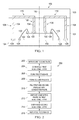
- FIG. 1 shows a packaged integrated circuit (IC) including interconnections formed using a two-step over-molding method in accordance with various embodiments;
- FIG. 2 shows a flow chart for a two-step over-molding method to form an interconnection between two pads in accordance with various embodiments
- FIGS. 3A-3E show an example to illustrate separating a packaged integrated circuit (IC) from a common package substrate in accordance with various embodiments.
- An interconnection between an integrated circuit (IC) die and a substrate may provide a path to distribute power and signal.
- One of the most frequently used technologies to provide such an interconnection is wire bonding.
- Wire bonding is commonly performed during a process to assemble a semiconductor such as an IC.
- wire bonding is referred to as a method of making interconnections between an IC die or other semiconductor device and packaging (e.g., a lead frame, a substrate) surrounding the die.
- wire bonding is implemented via a capillary to cause a wire to extend from a first pad (e.g., a pad on an IC die) to a second pad (e.g., a pad on a substrate).
- the wire may have a very small diameter, for example, as small as 15 ⁇ m in diameter. More specifically, the wire bonding starts with the capillary forming an initial ball at the tip end of the capillary. The capillary descends to a distance close enough to the first pad so as to form a first bond at the first pad. Subsequently, the capillary is moved upward (i.e., ascend) and toward the second pad while feeding the wire in a looping operation. Finally, the wire is bonded to the second pad via the capillary.
- a wire short is generally described as an unintentional short of at least two wires that are intended to be electrically isolated.
- interference between the capillary and an existing bonded wire may occur. Such interference may result in wire shorts or wire breakage.
- Embodiments disclosed herein apply a two-step over-molding process to form first and second insulating layers, thereby eliminating interference caused by the capillary. More specifically, embodiments form a wire via using a passage through the first insulating layer that may advantageously increase a robustness of an interconnection (i.e., wire) that is formed using the two-step over-molding process, especially when the diameter of the interconnection shrinks to a finer size (e.g., 15 ⁇ m).
- a finer size e.g. 15 ⁇ m
- FIG. 1 shows a packaged integrated circuit (IC) 100 to illustrate the disclosed interconnection between two pads in accordance with various embodiments.
- the packaged IC 100 includes a substrate 104 , an IC die 102 , first and second insulating layers 101 and 103 , die pads 122 and 124 , substrate pads 126 and 128 , passages 106 and 108 , and traces 110 .
- the passages 106 and 108 are filled with a conductive material 134 (e.g., the same conductive material deposited to form traces 110 ).
- the IC die 102 is generally deposited on a surface 132 of the substrate 104 , and the substrate pads 126 and 128 are also deposited on the surface 132 of the substrate 104 .
- the die pads 122 and 124 are preferably to be deposited on a surface of the IC die 102 which is opposite to a surface of the IC die 102 that is adjacent to the substrate 104 .
- the packaged IC 100 includes a bonded wire 130 to interconnect the die pad 124 and the substrate pad 126 .
- the bonded wire 130 may be formed using a capillary.
- a distance between the die pad 124 and the substrate pad 126 may be less than a distance between the die pad 122 and the substrate pad 128 .
- the packaged IC 100 is shown in symmetry with respect to the dashed line 199 .
- the disclosed embodiments create multiple passages 106 and 108 through the insulating layers (e.g., the first and second insulating layers 101 and 103 ) formed by over-molding to interconnect two pads.
- the capillary may not be required to form bonded wires between two pads.
- the interference caused by the capillary may be avoided.
- the passage 106 is formed through the first insulating layer 101 and extends from the die pad 122 to a surface of the first insulating layer 101 .
- the passage 108 is formed within the first insulating layer 101 as well but is configured to extend from the substrate pad 128 to the surface of the first insulating layer 101 .
- the trace 110 is formed of a deposited conductive material, such as conductive paste.
- the trace 110 is deposited on the surface of the first insulating layer 101 , and connects the passages 106 and 108 , which in turn connects the pads 122 and 128 via conductive paste filling the passages 106 and 108 .
- the second insulating layer 103 is deposited on the first insulating layer 101 so as to cover the trace 110 .
- Each of the interconnections between the die pad 122 and the substrate pad 128 formed with the conductive paste is electrically isolated. Interconnections formed of conductive paste are also electrically isolated from the bonded wire 130 .
- FIG. 2 shows a flow chart for a method 200 for forming the interconnections between two pads in accordance with various embodiments. Through depicted sequentially as a matter of convenience, at least some of the actions shown may be performed in a different order and/or performed in parallel. Additionally, some embodiments may perform only some of the actions shown.
- the method 200 starts in block 202 with affixing the IC die 102 to the package substrate 104 .
- Multiple pads on the IC die 102 and the package substrate 104 respectively may be formed before or after the die 102 is affixed to the substrate 104 .
- the substrate pads 126 and 128 and the die pads 122 and 124 may be respectively formed before affixing the IC die 102 to the package substrate 104 .
- the substrate pads 126 and 128 and the die pads 122 and 124 may be formed after the IC die 102 has been affixed to the package substrate 104 .
- the method 200 continues in block 204 with over-molding the first insulating layer 101 to cover the IC die 102 , the pads (e.g., die pads 122 , substrate pads 128 ), and the package substrate 104 .
- the method 200 continues with forming the first passage 106 from the outer surface of the first insulating layer 101 to the die pad 122 of the IC die 102 .
- forming the passage 106 is implemented using a vertical interconnect access (VIA) technology such as laser drilling, chemical etching, etc.
- VOA vertical interconnect access
- the method 200 continues in block 208 with forming the second passage 108 from the outer surface of the first insulating layer 101 to the substrate pad 128 .
- the second passage 108 may be formed using the aforementioned VIA technology.
- the method 200 continues in block 210 with filling the first and second passages 106 and 108 with conductive paste so as to electrically connect the die pad 122 and the substrate pad 128 to the outer surface of the first insulating layer 101 .
- the conductive paste may include material such as copper, gold, and/or silver.
- the method 200 continues in block 212 with depositing the conductive paste on the first insulating layer 101 to form the trace 110 . Further, the trace 110 is configured to electrically connect the conductive pastes filled in the passages 106 and 108 . After the trace 110 is formed on the surface of the first insulating later 101 , the method 200 continues in block 214 with over-molding the second insulating layer 214 .
- the package substrate 104 may include more than one IC die affixed on the substrate. To individualize each IC die after its interconnections between the die pad and the substrate pad is formed, the flow chart 200 may further continues in block 216 with separating a packaged IC.
- the packaged IC may include the IC die 102 , a portion of the package substrate 104 , and the trace 110 from a different packaged IC formed on the package substrate 104 . Details of the separation will be described with respect to the diagram in FIG. 3 .
- the method 200 may include wire bonding the die pad 124 to the substrate pad 126 .
- the wire bonding may be implemented using a capillary.
- FIG. 3A-3E show operations 300 that illustrate steps to separate a single packaged IC from a common package substrate that includes multiple packaged ICs in accordance with various embodiments.
- the operations 300 start with step 302 in FIG. 3A .
- the package substrate 104 includes three IC dies 102 , 301 , and 303 affixed on the substrate 104 .
- each IC die includes a bonded wire that connects a die pad on the IC die to a substrate pad on the substrate.
- the IC die 102 includes wires 130 ;
- the IC die 301 includes wires 331 ;
- the IC die 303 includes wires 333 .
- the wires 130 , 331 , and 333 may be formed by capillary facilitated wire bonding.
- the first insulating layer 101 is formed to cover the IC dies 102 , 301 and 303 , the bonded wires 130 , 331 and 333 , and the package substrate 104 .
- step 307 of FIG. 3C for each IC die, passages from the outer surface of the first insulating layer 101 to the die pads and substrate pads are formed respectively. More specifically, for the IC die 102 , passages 106 are formed from the surface of the layer 101 to the die pads of the IC die 102 , and passages 108 are formed from the surface of the layer 101 to the substrate pads of the substrate 104 . Similarly, the passages 306 and 308 are formed for the IC die 301 , and the passages 316 and 318 are formed for the IC die 303 .
- the passages are filled with conductive paste, and conductive paste is deposited to form an associated trace that electrically connects the conductive paste filling the passages.
- the conductive paste 350 fills the passages 106 and 108 and further includes an associated trace deposited on the surface of the layer 101 .
- the IC dies 301 and 303 also include the respective conductive pastes 351 and 353 .
- the second insulating layer 103 is deposited on the first insulating layer 101 and the conductive pastes 350 , 351 , and 353 .
- the second insulating layer 103 electrically isolates the conductive pastes 350 , 351 and 353 from further packaging steps.
- the packaged ICs are separated (e.g., along dashed lines 361 , 362 , 363 , and 364 ) using a singulation process such as sawing, laser cutting, etc.
Landscapes
- Physics & Mathematics (AREA)
- Electromagnetism (AREA)
- Optics & Photonics (AREA)
- Chemical & Material Sciences (AREA)
- Chemical Kinetics & Catalysis (AREA)
- General Chemical & Material Sciences (AREA)
- Geometry (AREA)
- Wire Bonding (AREA)
- Engineering & Computer Science (AREA)
- Manufacturing & Machinery (AREA)
Abstract
Description
Claims (13)
Priority Applications (1)
| Application Number | Priority Date | Filing Date | Title |
|---|---|---|---|
| US14/504,971 US9536753B2 (en) | 2014-10-02 | 2014-10-02 | Circuit substrate interconnect |
Applications Claiming Priority (1)
| Application Number | Priority Date | Filing Date | Title |
|---|---|---|---|
| US14/504,971 US9536753B2 (en) | 2014-10-02 | 2014-10-02 | Circuit substrate interconnect |
Publications (2)
| Publication Number | Publication Date |
|---|---|
| US20160099226A1 US20160099226A1 (en) | 2016-04-07 |
| US9536753B2 true US9536753B2 (en) | 2017-01-03 |
Family
ID=55633334
Family Applications (1)
| Application Number | Title | Priority Date | Filing Date |
|---|---|---|---|
| US14/504,971 Active US9536753B2 (en) | 2014-10-02 | 2014-10-02 | Circuit substrate interconnect |
Country Status (1)
| Country | Link |
|---|---|
| US (1) | US9536753B2 (en) |
Cited By (1)
| Publication number | Priority date | Publication date | Assignee | Title |
|---|---|---|---|---|
| US11508687B2 (en) | 2020-02-07 | 2022-11-22 | Samsung Electronics Co., Ltd. | Semiconductor package |
Citations (6)
| Publication number | Priority date | Publication date | Assignee | Title |
|---|---|---|---|---|
| US20060019484A1 (en) * | 2004-07-23 | 2006-01-26 | Industrial Technology Research Institute | Wafer-leveled chip packaging structure and method thereof |
| US20080237879A1 (en) * | 2007-03-30 | 2008-10-02 | Wen-Kun Yang | Semiconductor device package with die receiving through-hole and dual build-up layers over both side-surfaces for wlp and method of the same |
| US20090039523A1 (en) * | 2007-08-07 | 2009-02-12 | Tongbi Jiang | Packaged integrated circuit devices with through-body conductive vias, and methods of making same |
| US20100078655A1 (en) * | 2008-09-25 | 2010-04-01 | Wen-Kun Yang | Substrate structure with die embedded inside and dual build-up layers over both side surfaces and method of the same |
| US20110298120A1 (en) * | 2008-06-09 | 2011-12-08 | Stats Chippac, Ltd. | Apparatus for Thermally Enhanced Semiconductor Package |
| US20120211892A1 (en) * | 2011-02-22 | 2012-08-23 | Stats Chippac, Ltd. | Semiconductor Device and Method of Forming WLCSP Structure Using Protruded MLP |
-
2014
- 2014-10-02 US US14/504,971 patent/US9536753B2/en active Active
Patent Citations (7)
| Publication number | Priority date | Publication date | Assignee | Title |
|---|---|---|---|---|
| US20060019484A1 (en) * | 2004-07-23 | 2006-01-26 | Industrial Technology Research Institute | Wafer-leveled chip packaging structure and method thereof |
| US20070197018A1 (en) * | 2004-07-23 | 2007-08-23 | Industrial Technology Research Institute | Wafer-leveled chip packaging structure and method thereof |
| US20080237879A1 (en) * | 2007-03-30 | 2008-10-02 | Wen-Kun Yang | Semiconductor device package with die receiving through-hole and dual build-up layers over both side-surfaces for wlp and method of the same |
| US20090039523A1 (en) * | 2007-08-07 | 2009-02-12 | Tongbi Jiang | Packaged integrated circuit devices with through-body conductive vias, and methods of making same |
| US20110298120A1 (en) * | 2008-06-09 | 2011-12-08 | Stats Chippac, Ltd. | Apparatus for Thermally Enhanced Semiconductor Package |
| US20100078655A1 (en) * | 2008-09-25 | 2010-04-01 | Wen-Kun Yang | Substrate structure with die embedded inside and dual build-up layers over both side surfaces and method of the same |
| US20120211892A1 (en) * | 2011-02-22 | 2012-08-23 | Stats Chippac, Ltd. | Semiconductor Device and Method of Forming WLCSP Structure Using Protruded MLP |
Cited By (1)
| Publication number | Priority date | Publication date | Assignee | Title |
|---|---|---|---|---|
| US11508687B2 (en) | 2020-02-07 | 2022-11-22 | Samsung Electronics Co., Ltd. | Semiconductor package |
Also Published As
| Publication number | Publication date |
|---|---|
| US20160099226A1 (en) | 2016-04-07 |
Similar Documents
| Publication | Publication Date | Title |
|---|---|---|
| TWI651828B (en) | Chip package structure and method of manufacturing same | |
| US9583449B2 (en) | Semiconductor package | |
| US20110057323A1 (en) | Packaging structure having embedded semiconductor element and method for fabricating the same | |
| US20100230828A1 (en) | Microelectronic assembly with impedance controlled wirebond and conductive reference element | |
| US8828796B1 (en) | Semiconductor package and method of manufacturing the same | |
| US20120264257A1 (en) | Mold array process method to prevent exposure of substrate peripheries | |
| KR101685068B1 (en) | System in package and method for manufacturing the same | |
| US6853202B1 (en) | Non-stick detection method and mechanism for array molded laminate packages | |
| CN110828389A (en) | Semiconductor device and method of manufacturing the same | |
| US7638862B2 (en) | Die attach paddle for mounting integrated circuit die | |
| US9536753B2 (en) | Circuit substrate interconnect | |
| US20130075881A1 (en) | Memory card package with a small substrate | |
| US20040152242A1 (en) | Device package utilizing interconnect strips to make connections between package and die | |
| US20140284803A1 (en) | Semiconductor package and fabrication method thereof | |
| JP6210533B2 (en) | Printed circuit board and manufacturing method thereof | |
| US8405214B2 (en) | Semiconductor package structure with common gold plated metal conductor on die and substrate | |
| CN116918062A (en) | Buried three-dimensional fan-out packaging structure and preparation method thereof | |
| US20160093556A1 (en) | Quad-flat non-lead package structure and method of packaging the same | |
| KR102040171B1 (en) | Semiconductor Package of using the Printed Circuit Board | |
| US7271469B2 (en) | Methods of making integrated circuits | |
| US20130292832A1 (en) | Semiconductor package and fabrication method thereof | |
| KR20150094185A (en) | SemiConductor Package and the Method of Manufacturing for the same | |
| KR101594495B1 (en) | Bga bump pad structure and method thereof | |
| KR20150029855A (en) | Semiconductor package and method for manufacturing the same | |
| CN113644044B (en) | Semiconductor structure and its formation method |
Legal Events
| Date | Code | Title | Description |
|---|---|---|---|
| AS | Assignment |
Owner name: TEXAS INSTRUMENTS INCORPORATED, TEXAS Free format text: ASSIGNMENT OF ASSIGNORS INTEREST;ASSIGNORS:KOTO, YOHEI;HAYATA, KAZUNORI;OKAMOTO, DAN;SIGNING DATES FROM 20140921 TO 20140930;REEL/FRAME:033875/0444 |
|
| STCF | Information on status: patent grant |
Free format text: PATENTED CASE |
|
| MAFP | Maintenance fee payment |
Free format text: PAYMENT OF MAINTENANCE FEE, 4TH YEAR, LARGE ENTITY (ORIGINAL EVENT CODE: M1551); ENTITY STATUS OF PATENT OWNER: LARGE ENTITY Year of fee payment: 4 |
|
| MAFP | Maintenance fee payment |
Free format text: PAYMENT OF MAINTENANCE FEE, 8TH YEAR, LARGE ENTITY (ORIGINAL EVENT CODE: M1552); ENTITY STATUS OF PATENT OWNER: LARGE ENTITY Year of fee payment: 8 |