US9533957B2 - Tetrazines and method of synthezising the same - Google Patents
Tetrazines and method of synthezising the same Download PDFInfo
- Publication number
- US9533957B2 US9533957B2 US14/507,509 US201414507509A US9533957B2 US 9533957 B2 US9533957 B2 US 9533957B2 US 201414507509 A US201414507509 A US 201414507509A US 9533957 B2 US9533957 B2 US 9533957B2
- Authority
- US
- United States
- Prior art keywords
- substituted
- unsubstituted
- moiety
- tetrazine
- cyclopropene
- Prior art date
- Legal status (The legal status is an assumption and is not a legal conclusion. Google has not performed a legal analysis and makes no representation as to the accuracy of the status listed.)
- Active
Links
- 238000000034 method Methods 0.000 title claims abstract description 74
- 150000004905 tetrazines Chemical class 0.000 title abstract description 29
- DPOPAJRDYZGTIR-UHFFFAOYSA-N Tetrazine Chemical compound C1=CN=NN=N1 DPOPAJRDYZGTIR-UHFFFAOYSA-N 0.000 claims abstract description 93
- 238000006243 chemical reaction Methods 0.000 claims description 196
- -1 3,6-disubstituted 1,2,4,5-tetrazine compound Chemical class 0.000 claims description 144
- 125000004404 heteroalkyl group Chemical group 0.000 claims description 88
- 229910001868 water Inorganic materials 0.000 claims description 86
- XLYOFNOQVPJJNP-UHFFFAOYSA-N water Substances O XLYOFNOQVPJJNP-UHFFFAOYSA-N 0.000 claims description 85
- 125000000217 alkyl group Chemical group 0.000 claims description 84
- 125000003118 aryl group Chemical group 0.000 claims description 74
- 229910052739 hydrogen Inorganic materials 0.000 claims description 74
- 239000001257 hydrogen Substances 0.000 claims description 74
- 125000001072 heteroaryl group Chemical group 0.000 claims description 72
- 125000000592 heterocycloalkyl group Chemical group 0.000 claims description 72
- 125000000753 cycloalkyl group Chemical group 0.000 claims description 66
- 125000000449 nitro group Chemical group [O-][N+](*)=O 0.000 claims description 62
- 150000002431 hydrogen Chemical class 0.000 claims description 57
- 229910052736 halogen Inorganic materials 0.000 claims description 54
- 150000002367 halogens Chemical class 0.000 claims description 52
- 125000002947 alkylene group Chemical group 0.000 claims description 47
- 125000004474 heteroalkylene group Chemical group 0.000 claims description 47
- 125000002023 trifluoromethyl group Chemical group FC(F)(F)* 0.000 claims description 45
- 125000003178 carboxy group Chemical group [H]OC(*)=O 0.000 claims description 43
- 229910005948 SO2Cl Inorganic materials 0.000 claims description 37
- 229910006074 SO2NH2 Inorganic materials 0.000 claims description 37
- 229910006069 SO3H Inorganic materials 0.000 claims description 37
- 125000005549 heteroarylene group Chemical group 0.000 claims description 25
- 125000006588 heterocycloalkylene group Chemical group 0.000 claims description 23
- 125000000732 arylene group Chemical group 0.000 claims description 22
- 125000002993 cycloalkylene group Chemical group 0.000 claims description 22
- 125000000956 methoxy group Chemical group [H]C([H])([H])O* 0.000 claims description 22
- OAKJQQAXSVQMHS-UHFFFAOYSA-N Hydrazine Chemical compound NN OAKJQQAXSVQMHS-UHFFFAOYSA-N 0.000 claims description 21
- 150000002825 nitriles Chemical class 0.000 claims description 21
- WEVYAHXRMPXWCK-UHFFFAOYSA-N Acetonitrile Chemical group CC#N WEVYAHXRMPXWCK-UHFFFAOYSA-N 0.000 claims description 19
- 125000000717 hydrazino group Chemical group [H]N([*])N([H])[H] 0.000 claims description 18
- UFHFLCQGNIYNRP-UHFFFAOYSA-N Hydrogen Chemical compound [H][H] UFHFLCQGNIYNRP-UHFFFAOYSA-N 0.000 claims description 17
- 125000004429 atom Chemical group 0.000 claims description 16
- 229910052751 metal Inorganic materials 0.000 claims description 15
- 239000002184 metal Substances 0.000 claims description 15
- 230000002194 synthesizing effect Effects 0.000 claims description 15
- 150000003839 salts Chemical class 0.000 claims description 14
- 239000011968 lewis acid catalyst Substances 0.000 claims description 6
- 229910052759 nickel Inorganic materials 0.000 claims description 4
- 229910052725 zinc Inorganic materials 0.000 claims description 4
- 150000001450 anions Chemical class 0.000 claims description 3
- 229910052794 bromium Inorganic materials 0.000 claims description 3
- 229910052801 chlorine Inorganic materials 0.000 claims description 3
- 229910052802 copper Inorganic materials 0.000 claims description 3
- 229910052748 manganese Inorganic materials 0.000 claims description 3
- 229910052769 Ytterbium Inorganic materials 0.000 claims description 2
- 229910052740 iodine Inorganic materials 0.000 claims description 2
- 229910052749 magnesium Inorganic materials 0.000 claims description 2
- 229910052706 scandium Inorganic materials 0.000 claims description 2
- ITMCEJHCFYSIIV-UHFFFAOYSA-M triflate Chemical compound [O-]S(=O)(=O)C(F)(F)F ITMCEJHCFYSIIV-UHFFFAOYSA-M 0.000 claims description 2
- 230000015572 biosynthetic process Effects 0.000 abstract description 50
- 238000003786 synthesis reaction Methods 0.000 abstract description 36
- BJXJOUTVMDPTGC-UHFFFAOYSA-N (2e)-2-diazobicyclo[4.1.0]hepta-3,5-diene Chemical class [N-]=[N+]=C1C=CC=C2CC12 BJXJOUTVMDPTGC-UHFFFAOYSA-N 0.000 abstract description 27
- 239000000203 mixture Substances 0.000 abstract description 21
- 238000001514 detection method Methods 0.000 abstract description 12
- HEDRZPFGACZZDS-MICDWDOJSA-N Trichloro(2H)methane Chemical compound [2H]C(Cl)(Cl)Cl HEDRZPFGACZZDS-MICDWDOJSA-N 0.000 description 166
- 150000001875 compounds Chemical class 0.000 description 164
- 239000000243 solution Substances 0.000 description 110
- 210000004027 cell Anatomy 0.000 description 106
- XEKOWRVHYACXOJ-UHFFFAOYSA-N Ethyl acetate Chemical compound CCOC(C)=O XEKOWRVHYACXOJ-UHFFFAOYSA-N 0.000 description 98
- VLKZOEOYAKHREP-UHFFFAOYSA-N n-Hexane Chemical class CCCCCC VLKZOEOYAKHREP-UHFFFAOYSA-N 0.000 description 93
- 125000001424 substituent group Chemical group 0.000 description 84
- 150000007523 nucleic acids Chemical class 0.000 description 74
- 239000000523 sample Substances 0.000 description 70
- OOXWYYGXTJLWHA-UHFFFAOYSA-N cyclopropene Chemical compound C1C=C1 OOXWYYGXTJLWHA-UHFFFAOYSA-N 0.000 description 68
- 0 *CCC1=NN=C(CC[4*])N=N1 Chemical compound *CCC1=NN=C(CC[4*])N=N1 0.000 description 67
- VYPSYNLAJGMNEJ-UHFFFAOYSA-N silicon dioxide Inorganic materials O=[Si]=O VYPSYNLAJGMNEJ-UHFFFAOYSA-N 0.000 description 62
- 238000005160 1H NMR spectroscopy Methods 0.000 description 56
- 235000019439 ethyl acetate Nutrition 0.000 description 49
- 239000000047 product Substances 0.000 description 49
- 108020004414 DNA Proteins 0.000 description 48
- 102000039446 nucleic acids Human genes 0.000 description 47
- 108020004707 nucleic acids Proteins 0.000 description 47
- YMWUJEATGCHHMB-UHFFFAOYSA-N Dichloromethane Chemical compound ClCCl YMWUJEATGCHHMB-UHFFFAOYSA-N 0.000 description 44
- 125000004093 cyano group Chemical group *C#N 0.000 description 44
- 150000001413 amino acids Chemical class 0.000 description 43
- OKKJLVBELUTLKV-UHFFFAOYSA-N Methanol Chemical compound OC OKKJLVBELUTLKV-UHFFFAOYSA-N 0.000 description 39
- 235000001014 amino acid Nutrition 0.000 description 39
- 229940024606 amino acid Drugs 0.000 description 39
- FAPWRFPIFSIZLT-UHFFFAOYSA-M Sodium chloride Chemical compound [Na+].[Cl-] FAPWRFPIFSIZLT-UHFFFAOYSA-M 0.000 description 34
- 238000007792 addition Methods 0.000 description 31
- 238000009396 hybridization Methods 0.000 description 29
- 239000011701 zinc Substances 0.000 description 29
- 239000000872 buffer Substances 0.000 description 28
- 125000002496 methyl group Chemical group [H]C([H])([H])* 0.000 description 28
- 239000000126 substance Substances 0.000 description 28
- IAZDPXIOMUYVGZ-UHFFFAOYSA-N Dimethylsulphoxide Chemical compound CS(C)=O IAZDPXIOMUYVGZ-UHFFFAOYSA-N 0.000 description 27
- 239000000377 silicon dioxide Substances 0.000 description 27
- SHDPRTQPPWIEJG-UHFFFAOYSA-N 1-methylcyclopropene Chemical compound CC1=CC1 SHDPRTQPPWIEJG-UHFFFAOYSA-N 0.000 description 26
- 238000001644 13C nuclear magnetic resonance spectroscopy Methods 0.000 description 26
- 108091034117 Oligonucleotide Proteins 0.000 description 26
- 238000004440 column chromatography Methods 0.000 description 25
- 150000002632 lipids Chemical class 0.000 description 25
- KWYUFKZDYYNOTN-UHFFFAOYSA-M Potassium hydroxide Chemical compound [OH-].[K+] KWYUFKZDYYNOTN-UHFFFAOYSA-M 0.000 description 24
- 239000011734 sodium Substances 0.000 description 24
- 125000003729 nucleotide group Chemical group 0.000 description 23
- VEXZGXHMUGYJMC-UHFFFAOYSA-N Hydrochloric acid Chemical compound Cl VEXZGXHMUGYJMC-UHFFFAOYSA-N 0.000 description 22
- ZMANZCXQSJIPKH-UHFFFAOYSA-N Triethylamine Chemical compound CCN(CC)CC ZMANZCXQSJIPKH-UHFFFAOYSA-N 0.000 description 22
- 239000002773 nucleotide Substances 0.000 description 22
- KVRSDIJOUNNFMZ-UHFFFAOYSA-L nickel(2+);trifluoromethanesulfonate Chemical compound [Ni+2].[O-]S(=O)(=O)C(F)(F)F.[O-]S(=O)(=O)C(F)(F)F KVRSDIJOUNNFMZ-UHFFFAOYSA-L 0.000 description 20
- 238000003384 imaging method Methods 0.000 description 19
- 239000007787 solid Substances 0.000 description 19
- 238000004809 thin layer chromatography Methods 0.000 description 19
- 108091032973 (ribonucleotides)n+m Proteins 0.000 description 18
- 238000012746 preparative thin layer chromatography Methods 0.000 description 18
- 239000002751 oligonucleotide probe Substances 0.000 description 17
- 239000011780 sodium chloride Substances 0.000 description 17
- 238000006352 cycloaddition reaction Methods 0.000 description 16
- 125000005842 heteroatom Chemical group 0.000 description 16
- MWUXSHHQAYIFBG-UHFFFAOYSA-N Nitric oxide Chemical compound O=[N] MWUXSHHQAYIFBG-UHFFFAOYSA-N 0.000 description 15
- 235000018102 proteins Nutrition 0.000 description 15
- 102000004169 proteins and genes Human genes 0.000 description 15
- 108090000623 proteins and genes Proteins 0.000 description 15
- HZAXFHJVJLSVMW-UHFFFAOYSA-N 2-Aminoethan-1-ol Chemical compound NCCO HZAXFHJVJLSVMW-UHFFFAOYSA-N 0.000 description 14
- PMZURENOXWZQFD-UHFFFAOYSA-L Sodium Sulfate Chemical compound [Na+].[Na+].[O-]S([O-])(=O)=O PMZURENOXWZQFD-UHFFFAOYSA-L 0.000 description 14
- 150000001943 cyclopropenes Chemical class 0.000 description 14
- 238000002844 melting Methods 0.000 description 14
- 230000008018 melting Effects 0.000 description 14
- 108090000765 processed proteins & peptides Proteins 0.000 description 14
- 229910052938 sodium sulfate Inorganic materials 0.000 description 14
- 238000010186 staining Methods 0.000 description 14
- 239000012103 Alexa Fluor 488 Substances 0.000 description 13
- 238000010521 absorption reaction Methods 0.000 description 13
- 239000012043 crude product Substances 0.000 description 13
- LOKCTEFSRHRXRJ-UHFFFAOYSA-I dipotassium trisodium dihydrogen phosphate hydrogen phosphate dichloride Chemical compound P(=O)(O)(O)[O-].[K+].P(=O)(O)([O-])[O-].[Na+].[Na+].[Cl-].[K+].[Cl-].[Na+] LOKCTEFSRHRXRJ-UHFFFAOYSA-I 0.000 description 13
- 230000000694 effects Effects 0.000 description 13
- 238000005259 measurement Methods 0.000 description 13
- 239000002953 phosphate buffered saline Substances 0.000 description 13
- 102000004196 processed proteins & peptides Human genes 0.000 description 13
- 239000000460 chlorine Substances 0.000 description 12
- 125000005647 linker group Chemical group 0.000 description 12
- PXHVJJICTQNCMI-UHFFFAOYSA-N nickel Substances [Ni] PXHVJJICTQNCMI-UHFFFAOYSA-N 0.000 description 12
- 229920001184 polypeptide Polymers 0.000 description 12
- MSWZFWKMSRAUBD-UHFFFAOYSA-N 2-Amino-2-Deoxy-Hexose Chemical compound NC1C(O)OC(CO)C(O)C1O MSWZFWKMSRAUBD-UHFFFAOYSA-N 0.000 description 11
- 108020005187 Oligonucleotide Probes Proteins 0.000 description 11
- 239000012230 colorless oil Substances 0.000 description 11
- 239000000376 reactant Substances 0.000 description 11
- 125000006527 (C1-C5) alkyl group Chemical group 0.000 description 10
- CRSOQBOWXPBRES-UHFFFAOYSA-N CC(C)(C)C Chemical compound CC(C)(C)C CRSOQBOWXPBRES-UHFFFAOYSA-N 0.000 description 10
- UIIMBOGNXHQVGW-UHFFFAOYSA-M Sodium bicarbonate Chemical compound [Na+].OC([O-])=O UIIMBOGNXHQVGW-UHFFFAOYSA-M 0.000 description 10
- 230000008901 benefit Effects 0.000 description 10
- 238000002474 experimental method Methods 0.000 description 10
- 239000007789 gas Substances 0.000 description 10
- 150000004676 glycans Chemical class 0.000 description 10
- 238000011534 incubation Methods 0.000 description 10
- LPXPTNMVRIOKMN-UHFFFAOYSA-M sodium nitrite Chemical compound [Na+].[O-]N=O LPXPTNMVRIOKMN-UHFFFAOYSA-M 0.000 description 10
- 239000007858 starting material Substances 0.000 description 10
- 239000007993 MOPS buffer Substances 0.000 description 9
- 239000007832 Na2SO4 Substances 0.000 description 9
- 150000001412 amines Chemical class 0.000 description 9
- 125000004432 carbon atom Chemical group C* 0.000 description 9
- 239000003054 catalyst Substances 0.000 description 9
- 238000007667 floating Methods 0.000 description 9
- 238000002866 fluorescence resonance energy transfer Methods 0.000 description 9
- 229910052757 nitrogen Inorganic materials 0.000 description 9
- 239000002243 precursor Substances 0.000 description 9
- 150000003254 radicals Chemical class 0.000 description 9
- 230000009257 reactivity Effects 0.000 description 9
- 150000003384 small molecules Chemical class 0.000 description 9
- 238000006467 substitution reaction Methods 0.000 description 9
- WFDIJRYMOXRFFG-UHFFFAOYSA-N Acetic anhydride Chemical compound CC(=O)OC(C)=O WFDIJRYMOXRFFG-UHFFFAOYSA-N 0.000 description 8
- IJGRMHOSHXDMSA-UHFFFAOYSA-N Atomic nitrogen Chemical compound N#N IJGRMHOSHXDMSA-UHFFFAOYSA-N 0.000 description 8
- 108020004705 Codon Proteins 0.000 description 8
- IAZDPXIOMUYVGZ-WFGJKAKNSA-N Dimethyl sulfoxide Chemical compound [2H]C([2H])([2H])S(=O)C([2H])([2H])[2H] IAZDPXIOMUYVGZ-WFGJKAKNSA-N 0.000 description 8
- TWRXJAOTZQYOKJ-UHFFFAOYSA-L Magnesium chloride Chemical compound [Mg+2].[Cl-].[Cl-] TWRXJAOTZQYOKJ-UHFFFAOYSA-L 0.000 description 8
- 108091028043 Nucleic acid sequence Proteins 0.000 description 8
- HLYLNLIUGSGTSS-UHFFFAOYSA-N carbamic acid;1-methylcyclopropene Chemical compound CC1=CC1.NC(O)=O HLYLNLIUGSGTSS-UHFFFAOYSA-N 0.000 description 8
- 229910052799 carbon Inorganic materials 0.000 description 8
- 230000000295 complement effect Effects 0.000 description 8
- 230000005284 excitation Effects 0.000 description 8
- 238000004128 high performance liquid chromatography Methods 0.000 description 8
- 238000004895 liquid chromatography mass spectrometry Methods 0.000 description 8
- 108020004999 messenger RNA Proteins 0.000 description 8
- 239000003921 oil Substances 0.000 description 8
- 239000012044 organic layer Substances 0.000 description 8
- 150000003904 phospholipids Chemical class 0.000 description 8
- 108091033319 polynucleotide Proteins 0.000 description 8
- 102000040430 polynucleotide Human genes 0.000 description 8
- 239000002157 polynucleotide Substances 0.000 description 8
- 238000000746 purification Methods 0.000 description 8
- 238000010791 quenching Methods 0.000 description 8
- 150000003335 secondary amines Chemical class 0.000 description 8
- ZUHQCDZJPTXVCU-UHFFFAOYSA-N C1#CCCC2=CC=CC=C2C2=CC=CC=C21 Chemical compound C1#CCCC2=CC=CC=C2C2=CC=CC=C21 ZUHQCDZJPTXVCU-UHFFFAOYSA-N 0.000 description 7
- 230000003321 amplification Effects 0.000 description 7
- 230000027455 binding Effects 0.000 description 7
- GNBHRKFJIUUOQI-UHFFFAOYSA-N fluorescein Chemical compound O1C(=O)C2=CC=CC=C2C21C1=CC=C(O)C=C1OC1=CC(O)=CC=C21 GNBHRKFJIUUOQI-UHFFFAOYSA-N 0.000 description 7
- 238000010859 live-cell imaging Methods 0.000 description 7
- 238000003199 nucleic acid amplification method Methods 0.000 description 7
- 239000003960 organic solvent Substances 0.000 description 7
- 229910052760 oxygen Inorganic materials 0.000 description 7
- 239000012071 phase Substances 0.000 description 7
- 239000011541 reaction mixture Substances 0.000 description 7
- 241000894007 species Species 0.000 description 7
- 238000003756 stirring Methods 0.000 description 7
- GQHTUMJGOHRCHB-UHFFFAOYSA-N 2,3,4,6,7,8,9,10-octahydropyrimido[1,2-a]azepine Chemical compound C1CCCCN2CCCN=C21 GQHTUMJGOHRCHB-UHFFFAOYSA-N 0.000 description 6
- MSWZFWKMSRAUBD-CBPJZXOFSA-N 2-amino-2-deoxy-D-mannopyranose Chemical compound N[C@@H]1C(O)O[C@H](CO)[C@@H](O)[C@@H]1O MSWZFWKMSRAUBD-CBPJZXOFSA-N 0.000 description 6
- OKKJLVBELUTLKV-MZCSYVLQSA-N Deuterated methanol Chemical compound [2H]OC([2H])([2H])[2H] OKKJLVBELUTLKV-MZCSYVLQSA-N 0.000 description 6
- ZHNUHDYFZUAESO-UHFFFAOYSA-N Formamide Chemical compound NC=O ZHNUHDYFZUAESO-UHFFFAOYSA-N 0.000 description 6
- UQSXHKLRYXJYBZ-UHFFFAOYSA-N Iron oxide Chemical compound [Fe]=O UQSXHKLRYXJYBZ-UHFFFAOYSA-N 0.000 description 6
- 238000005481 NMR spectroscopy Methods 0.000 description 6
- JLCPHMBAVCMARE-UHFFFAOYSA-N [3-[[3-[[3-[[3-[[3-[[3-[[3-[[3-[[3-[[3-[[3-[[5-(2-amino-6-oxo-1H-purin-9-yl)-3-[[3-[[3-[[3-[[3-[[3-[[5-(2-amino-6-oxo-1H-purin-9-yl)-3-[[5-(2-amino-6-oxo-1H-purin-9-yl)-3-hydroxyoxolan-2-yl]methoxy-hydroxyphosphoryl]oxyoxolan-2-yl]methoxy-hydroxyphosphoryl]oxy-5-(5-methyl-2,4-dioxopyrimidin-1-yl)oxolan-2-yl]methoxy-hydroxyphosphoryl]oxy-5-(6-aminopurin-9-yl)oxolan-2-yl]methoxy-hydroxyphosphoryl]oxy-5-(6-aminopurin-9-yl)oxolan-2-yl]methoxy-hydroxyphosphoryl]oxy-5-(6-aminopurin-9-yl)oxolan-2-yl]methoxy-hydroxyphosphoryl]oxy-5-(6-aminopurin-9-yl)oxolan-2-yl]methoxy-hydroxyphosphoryl]oxyoxolan-2-yl]methoxy-hydroxyphosphoryl]oxy-5-(5-methyl-2,4-dioxopyrimidin-1-yl)oxolan-2-yl]methoxy-hydroxyphosphoryl]oxy-5-(4-amino-2-oxopyrimidin-1-yl)oxolan-2-yl]methoxy-hydroxyphosphoryl]oxy-5-(5-methyl-2,4-dioxopyrimidin-1-yl)oxolan-2-yl]methoxy-hydroxyphosphoryl]oxy-5-(5-methyl-2,4-dioxopyrimidin-1-yl)oxolan-2-yl]methoxy-hydroxyphosphoryl]oxy-5-(6-aminopurin-9-yl)oxolan-2-yl]methoxy-hydroxyphosphoryl]oxy-5-(6-aminopurin-9-yl)oxolan-2-yl]methoxy-hydroxyphosphoryl]oxy-5-(4-amino-2-oxopyrimidin-1-yl)oxolan-2-yl]methoxy-hydroxyphosphoryl]oxy-5-(4-amino-2-oxopyrimidin-1-yl)oxolan-2-yl]methoxy-hydroxyphosphoryl]oxy-5-(4-amino-2-oxopyrimidin-1-yl)oxolan-2-yl]methoxy-hydroxyphosphoryl]oxy-5-(6-aminopurin-9-yl)oxolan-2-yl]methoxy-hydroxyphosphoryl]oxy-5-(4-amino-2-oxopyrimidin-1-yl)oxolan-2-yl]methyl [5-(6-aminopurin-9-yl)-2-(hydroxymethyl)oxolan-3-yl] hydrogen phosphate Chemical class Cc1cn(C2CC(OP(O)(=O)OCC3OC(CC3OP(O)(=O)OCC3OC(CC3O)n3cnc4c3nc(N)[nH]c4=O)n3cnc4c3nc(N)[nH]c4=O)C(COP(O)(=O)OC3CC(OC3COP(O)(=O)OC3CC(OC3COP(O)(=O)OC3CC(OC3COP(O)(=O)OC3CC(OC3COP(O)(=O)OC3CC(OC3COP(O)(=O)OC3CC(OC3COP(O)(=O)OC3CC(OC3COP(O)(=O)OC3CC(OC3COP(O)(=O)OC3CC(OC3COP(O)(=O)OC3CC(OC3COP(O)(=O)OC3CC(OC3COP(O)(=O)OC3CC(OC3COP(O)(=O)OC3CC(OC3COP(O)(=O)OC3CC(OC3COP(O)(=O)OC3CC(OC3COP(O)(=O)OC3CC(OC3COP(O)(=O)OC3CC(OC3CO)n3cnc4c(N)ncnc34)n3ccc(N)nc3=O)n3cnc4c(N)ncnc34)n3ccc(N)nc3=O)n3ccc(N)nc3=O)n3ccc(N)nc3=O)n3cnc4c(N)ncnc34)n3cnc4c(N)ncnc34)n3cc(C)c(=O)[nH]c3=O)n3cc(C)c(=O)[nH]c3=O)n3ccc(N)nc3=O)n3cc(C)c(=O)[nH]c3=O)n3cnc4c3nc(N)[nH]c4=O)n3cnc4c(N)ncnc34)n3cnc4c(N)ncnc34)n3cnc4c(N)ncnc34)n3cnc4c(N)ncnc34)O2)c(=O)[nH]c1=O JLCPHMBAVCMARE-UHFFFAOYSA-N 0.000 description 6
- 239000002253 acid Substances 0.000 description 6
- 150000001299 aldehydes Chemical class 0.000 description 6
- 125000003277 amino group Chemical group 0.000 description 6
- 239000007864 aqueous solution Substances 0.000 description 6
- DNNUIINGVPAQRE-UHFFFAOYSA-N carbamic acid;cyclopropene Chemical compound C1C=C1.NC(O)=O DNNUIINGVPAQRE-UHFFFAOYSA-N 0.000 description 6
- 230000001413 cellular effect Effects 0.000 description 6
- 238000005859 coupling reaction Methods 0.000 description 6
- 125000004122 cyclic group Chemical group 0.000 description 6
- 150000002148 esters Chemical class 0.000 description 6
- 230000006870 function Effects 0.000 description 6
- 238000002372 labelling Methods 0.000 description 6
- 238000003752 polymerase chain reaction Methods 0.000 description 6
- 230000008569 process Effects 0.000 description 6
- 230000000171 quenching effect Effects 0.000 description 6
- 238000002390 rotary evaporation Methods 0.000 description 6
- 210000002966 serum Anatomy 0.000 description 6
- 239000000741 silica gel Substances 0.000 description 6
- 229910002027 silica gel Inorganic materials 0.000 description 6
- 239000002904 solvent Substances 0.000 description 6
- 235000000346 sugar Nutrition 0.000 description 6
- FPGGTKZVZWFYPV-UHFFFAOYSA-M tetrabutylammonium fluoride Chemical compound [F-].CCCC[N+](CCCC)(CCCC)CCCC FPGGTKZVZWFYPV-UHFFFAOYSA-M 0.000 description 6
- VYEWZWBILJHHCU-OMQUDAQFSA-N (e)-n-[(2s,3r,4r,5r,6r)-2-[(2r,3r,4s,5s,6s)-3-acetamido-5-amino-4-hydroxy-6-(hydroxymethyl)oxan-2-yl]oxy-6-[2-[(2r,3s,4r,5r)-5-(2,4-dioxopyrimidin-1-yl)-3,4-dihydroxyoxolan-2-yl]-2-hydroxyethyl]-4,5-dihydroxyoxan-3-yl]-5-methylhex-2-enamide Chemical compound N1([C@@H]2O[C@@H]([C@H]([C@H]2O)O)C(O)C[C@@H]2[C@H](O)[C@H](O)[C@H]([C@@H](O2)O[C@@H]2[C@@H]([C@@H](O)[C@H](N)[C@@H](CO)O2)NC(C)=O)NC(=O)/C=C/CC(C)C)C=CC(=O)NC1=O VYEWZWBILJHHCU-OMQUDAQFSA-N 0.000 description 5
- HVCOBJNICQPDBP-UHFFFAOYSA-N 3-[3-[3,5-dihydroxy-6-methyl-4-(3,4,5-trihydroxy-6-methyloxan-2-yl)oxyoxan-2-yl]oxydecanoyloxy]decanoic acid;hydrate Chemical compound O.OC1C(OC(CC(=O)OC(CCCCCCC)CC(O)=O)CCCCCCC)OC(C)C(O)C1OC1C(O)C(O)C(O)C(C)O1 HVCOBJNICQPDBP-UHFFFAOYSA-N 0.000 description 5
- 206010006187 Breast cancer Diseases 0.000 description 5
- 208000026310 Breast neoplasm Diseases 0.000 description 5
- DTQVDTLACAAQTR-UHFFFAOYSA-N Trifluoroacetic acid Chemical compound OC(=O)C(F)(F)F DTQVDTLACAAQTR-UHFFFAOYSA-N 0.000 description 5
- YJQCOFNZVFGCAF-UHFFFAOYSA-N Tunicamycin II Natural products O1C(CC(O)C2C(C(O)C(O2)N2C(NC(=O)C=C2)=O)O)C(O)C(O)C(NC(=O)C=CCCCCCCCCC(C)C)C1OC1OC(CO)C(O)C(O)C1NC(C)=O YJQCOFNZVFGCAF-UHFFFAOYSA-N 0.000 description 5
- 150000001408 amides Chemical class 0.000 description 5
- 150000001540 azides Chemical class 0.000 description 5
- PFYXSUNOLOJMDX-UHFFFAOYSA-N bis(2,5-dioxopyrrolidin-1-yl) carbonate Chemical compound O=C1CCC(=O)N1OC(=O)ON1C(=O)CCC1=O PFYXSUNOLOJMDX-UHFFFAOYSA-N 0.000 description 5
- 150000001720 carbohydrates Chemical class 0.000 description 5
- 230000015556 catabolic process Effects 0.000 description 5
- 239000007795 chemical reaction product Substances 0.000 description 5
- 239000002872 contrast media Substances 0.000 description 5
- ZFXMETNFCWBEGJ-UHFFFAOYSA-N cyclopropene azide Chemical compound [N-]=[N+]=[N-].C1=CC1 ZFXMETNFCWBEGJ-UHFFFAOYSA-N 0.000 description 5
- IYXBNXWLNACYEV-UHFFFAOYSA-N cyclopropene;tetrazine Chemical compound C1C=C1.C1=CN=NN=N1 IYXBNXWLNACYEV-UHFFFAOYSA-N 0.000 description 5
- 238000006731 degradation reaction Methods 0.000 description 5
- 238000005516 engineering process Methods 0.000 description 5
- 238000000684 flow cytometry Methods 0.000 description 5
- 239000007850 fluorescent dye Substances 0.000 description 5
- 239000003517 fume Substances 0.000 description 5
- 125000000524 functional group Chemical group 0.000 description 5
- 239000007788 liquid Substances 0.000 description 5
- 230000005291 magnetic effect Effects 0.000 description 5
- 230000004048 modification Effects 0.000 description 5
- 238000012986 modification Methods 0.000 description 5
- 239000012074 organic phase Substances 0.000 description 5
- 238000005192 partition Methods 0.000 description 5
- 238000000926 separation method Methods 0.000 description 5
- 229910000030 sodium bicarbonate Inorganic materials 0.000 description 5
- 235000010288 sodium nitrite Nutrition 0.000 description 5
- 235000011152 sodium sulphate Nutrition 0.000 description 5
- 231100000331 toxic Toxicity 0.000 description 5
- 230000002588 toxic effect Effects 0.000 description 5
- MEYZYGMYMLNUHJ-UHFFFAOYSA-N tunicamycin Natural products CC(C)CCCCCCCCCC=CC(=O)NC1C(O)C(O)C(CC(O)C2OC(C(O)C2O)N3C=CC(=O)NC3=O)OC1OC4OC(CO)C(O)C(O)C4NC(=O)C MEYZYGMYMLNUHJ-UHFFFAOYSA-N 0.000 description 5
- 125000003837 (C1-C20) alkyl group Chemical group 0.000 description 4
- ONBQEOIKXPHGMB-VBSBHUPXSA-N 1-[2-[(2s,3r,4s,5r)-3,4-dihydroxy-5-(hydroxymethyl)oxolan-2-yl]oxy-4,6-dihydroxyphenyl]-3-(4-hydroxyphenyl)propan-1-one Chemical compound O[C@@H]1[C@H](O)[C@@H](CO)O[C@H]1OC1=CC(O)=CC(O)=C1C(=O)CCC1=CC=C(O)C=C1 ONBQEOIKXPHGMB-VBSBHUPXSA-N 0.000 description 4
- NGNBDVOYPDDBFK-UHFFFAOYSA-N 2-[2,4-di(pentan-2-yl)phenoxy]acetyl chloride Chemical compound CCCC(C)C1=CC=C(OCC(Cl)=O)C(C(C)CCC)=C1 NGNBDVOYPDDBFK-UHFFFAOYSA-N 0.000 description 4
- ZGUGQUBAKCMKMJ-UHFFFAOYSA-N 3,6-dibenzyl-1,2,4,5-tetrazine Chemical compound N=1N=C(CC=2C=CC=CC=2)N=NC=1CC1=CC=CC=C1 ZGUGQUBAKCMKMJ-UHFFFAOYSA-N 0.000 description 4
- DGLYTMLIGRQDPE-UHFFFAOYSA-N 3,6-dimethyl-1,2,4,5-tetrazine Chemical compound CC1=NN=C(C)N=N1 DGLYTMLIGRQDPE-UHFFFAOYSA-N 0.000 description 4
- BVARMSJELYFCRL-UHFFFAOYSA-N 3,6-ditert-butyl-1,2,4,5-tetrazine Chemical compound CC(C)(C)C1=NN=C(C(C)(C)C)N=N1 BVARMSJELYFCRL-UHFFFAOYSA-N 0.000 description 4
- FWBHETKCLVMNFS-UHFFFAOYSA-N 4',6-Diamino-2-phenylindol Chemical compound C1=CC(C(=N)N)=CC=C1C1=CC2=CC=C(C(N)=N)C=C2N1 FWBHETKCLVMNFS-UHFFFAOYSA-N 0.000 description 4
- XWFUOIKKJWHUTQ-UHFFFAOYSA-N 5-methyltetrazine Chemical compound CC1=CN=NN=N1 XWFUOIKKJWHUTQ-UHFFFAOYSA-N 0.000 description 4
- CJGXJKVMUHXVHL-UHFFFAOYSA-N CC(C)(C)CC1=CC=CC=C1 Chemical compound CC(C)(C)CC1=CC=CC=C1 CJGXJKVMUHXVHL-UHFFFAOYSA-N 0.000 description 4
- PSABUFWDVWCFDP-UHFFFAOYSA-N CCCCCC(C)(C)C Chemical compound CCCCCC(C)(C)C PSABUFWDVWCFDP-UHFFFAOYSA-N 0.000 description 4
- OKTJSMMVPCPJKN-UHFFFAOYSA-N Carbon Chemical compound [C] OKTJSMMVPCPJKN-UHFFFAOYSA-N 0.000 description 4
- 102000053602 DNA Human genes 0.000 description 4
- RRSNDVCODIMOFX-MPKOGUQCSA-N Fc1c(Cl)cccc1[C@H]1[C@@H](NC2(CCCCC2)[C@@]11C(=O)Nc2cc(Cl)ccc12)C(=O)Nc1ccc(cc1)C(=O)NCCCCCc1cccc2C(=O)N(Cc12)C1CCC(=O)NC1=O Chemical compound Fc1c(Cl)cccc1[C@H]1[C@@H](NC2(CCCCC2)[C@@]11C(=O)Nc2cc(Cl)ccc12)C(=O)Nc1ccc(cc1)C(=O)NCCCCCc1cccc2C(=O)N(Cc12)C1CCC(=O)NC1=O RRSNDVCODIMOFX-MPKOGUQCSA-N 0.000 description 4
- FFEARJCKVFRZRR-BYPYZUCNSA-N L-methionine Chemical group CSCC[C@H](N)C(O)=O FFEARJCKVFRZRR-BYPYZUCNSA-N 0.000 description 4
- JUJWROOIHBZHMG-UHFFFAOYSA-N Pyridine Chemical compound C1=CC=NC=C1 JUJWROOIHBZHMG-UHFFFAOYSA-N 0.000 description 4
- HGMISDAXLUIXKM-YJUJGKJLSA-N [(2r,3r,4r,5r)-3,4,6-triacetyloxy-5-[(2-azidoacetyl)amino]oxan-2-yl]methyl acetate Chemical compound CC(=O)OC[C@H]1OC(OC(C)=O)[C@H](NC(=O)CN=[N+]=[N-])[C@@H](OC(C)=O)[C@H]1OC(C)=O HGMISDAXLUIXKM-YJUJGKJLSA-N 0.000 description 4
- 150000001336 alkenes Chemical class 0.000 description 4
- 238000004458 analytical method Methods 0.000 description 4
- 125000002915 carbonyl group Chemical group [*:2]C([*:1])=O 0.000 description 4
- 230000008859 change Effects 0.000 description 4
- 239000003153 chemical reaction reagent Substances 0.000 description 4
- 229940126142 compound 16 Drugs 0.000 description 4
- 238000004624 confocal microscopy Methods 0.000 description 4
- 230000008878 coupling Effects 0.000 description 4
- 238000010168 coupling process Methods 0.000 description 4
- POIHZHZUTZWYJR-UHFFFAOYSA-N cyclopropen-1-ol Chemical compound OC1=CC1 POIHZHZUTZWYJR-UHFFFAOYSA-N 0.000 description 4
- 238000010511 deprotection reaction Methods 0.000 description 4
- MKRTXPORKIRPDG-UHFFFAOYSA-N diphenylphosphoryl azide Chemical compound C=1C=CC=CC=1P(=O)(N=[N+]=[N-])C1=CC=CC=C1 MKRTXPORKIRPDG-UHFFFAOYSA-N 0.000 description 4
- 230000008034 disappearance Effects 0.000 description 4
- 238000009826 distribution Methods 0.000 description 4
- 239000000975 dye Substances 0.000 description 4
- 238000010828 elution Methods 0.000 description 4
- 125000001495 ethyl group Chemical group [H]C([H])([H])C([H])([H])* 0.000 description 4
- 235000013312 flour Nutrition 0.000 description 4
- 239000000543 intermediate Substances 0.000 description 4
- 230000003834 intracellular effect Effects 0.000 description 4
- 229910001629 magnesium chloride Inorganic materials 0.000 description 4
- 230000002503 metabolic effect Effects 0.000 description 4
- 229930182817 methionine Chemical group 0.000 description 4
- 238000012544 monitoring process Methods 0.000 description 4
- 239000001301 oxygen Substances 0.000 description 4
- 229920000642 polymer Polymers 0.000 description 4
- 229920001282 polysaccharide Polymers 0.000 description 4
- 239000005017 polysaccharide Substances 0.000 description 4
- 150000003141 primary amines Chemical class 0.000 description 4
- 230000009467 reduction Effects 0.000 description 4
- UCSJYZPVAKXKNQ-HZYVHMACSA-N streptomycin Chemical compound CN[C@H]1[C@H](O)[C@@H](O)[C@H](CO)O[C@H]1O[C@@H]1[C@](C=O)(O)[C@H](C)O[C@H]1O[C@@H]1[C@@H](NC(N)=N)[C@H](O)[C@@H](NC(N)=N)[C@H](O)[C@H]1O UCSJYZPVAKXKNQ-HZYVHMACSA-N 0.000 description 4
- 239000000758 substrate Substances 0.000 description 4
- LEIMLDGFXIOXMT-UHFFFAOYSA-N trimethylsilyl cyanide Chemical compound C[Si](C)(C)C#N LEIMLDGFXIOXMT-UHFFFAOYSA-N 0.000 description 4
- RIOQSEWOXXDEQQ-UHFFFAOYSA-N triphenylphosphine Chemical compound C1=CC=CC=C1P(C=1C=CC=CC=1)C1=CC=CC=C1 RIOQSEWOXXDEQQ-UHFFFAOYSA-N 0.000 description 4
- GLGNXYJARSMNGJ-VKTIVEEGSA-N (1s,2s,3r,4r)-3-[[5-chloro-2-[(1-ethyl-6-methoxy-2-oxo-4,5-dihydro-3h-1-benzazepin-7-yl)amino]pyrimidin-4-yl]amino]bicyclo[2.2.1]hept-5-ene-2-carboxamide Chemical compound CCN1C(=O)CCCC2=C(OC)C(NC=3N=C(C(=CN=3)Cl)N[C@H]3[C@H]([C@@]4([H])C[C@@]3(C=C4)[H])C(N)=O)=CC=C21 GLGNXYJARSMNGJ-VKTIVEEGSA-N 0.000 description 3
- SZUVGFMDDVSKSI-WIFOCOSTSA-N (1s,2s,3s,5r)-1-(carboxymethyl)-3,5-bis[(4-phenoxyphenyl)methyl-propylcarbamoyl]cyclopentane-1,2-dicarboxylic acid Chemical compound O=C([C@@H]1[C@@H]([C@](CC(O)=O)([C@H](C(=O)N(CCC)CC=2C=CC(OC=3C=CC=CC=3)=CC=2)C1)C(O)=O)C(O)=O)N(CCC)CC(C=C1)=CC=C1OC1=CC=CC=C1 SZUVGFMDDVSKSI-WIFOCOSTSA-N 0.000 description 3
- GHYOCDFICYLMRF-UTIIJYGPSA-N (2S,3R)-N-[(2S)-3-(cyclopenten-1-yl)-1-[(2R)-2-methyloxiran-2-yl]-1-oxopropan-2-yl]-3-hydroxy-3-(4-methoxyphenyl)-2-[[(2S)-2-[(2-morpholin-4-ylacetyl)amino]propanoyl]amino]propanamide Chemical compound C1(=CCCC1)C[C@@H](C(=O)[C@@]1(OC1)C)NC([C@H]([C@@H](C1=CC=C(C=C1)OC)O)NC([C@H](C)NC(CN1CCOCC1)=O)=O)=O GHYOCDFICYLMRF-UTIIJYGPSA-N 0.000 description 3
- VIMMECPCYZXUCI-MIMFYIINSA-N (4s,6r)-6-[(1e)-4,4-bis(4-fluorophenyl)-3-(1-methyltetrazol-5-yl)buta-1,3-dienyl]-4-hydroxyoxan-2-one Chemical compound CN1N=NN=C1C(\C=C\[C@@H]1OC(=O)C[C@@H](O)C1)=C(C=1C=CC(F)=CC=1)C1=CC=C(F)C=C1 VIMMECPCYZXUCI-MIMFYIINSA-N 0.000 description 3
- QGKMIGUHVLGJBR-UHFFFAOYSA-M (4z)-1-(3-methylbutyl)-4-[[1-(3-methylbutyl)quinolin-1-ium-4-yl]methylidene]quinoline;iodide Chemical compound [I-].C12=CC=CC=C2N(CCC(C)C)C=CC1=CC1=CC=[N+](CCC(C)C)C2=CC=CC=C12 QGKMIGUHVLGJBR-UHFFFAOYSA-M 0.000 description 3
- 150000004907 1,2,4,5-tetrazines Chemical class 0.000 description 3
- XPIKYYQQGGNKAK-UHFFFAOYSA-N 2-(6-methyl-1,2,4,5-tetrazin-3-yl)ethanol Chemical compound CC1=NN=C(CCO)N=N1 XPIKYYQQGGNKAK-UHFFFAOYSA-N 0.000 description 3
- TZNOWMYISKGWCY-UHFFFAOYSA-N 2-[4-(6-methyl-1,2,4,5-tetrazin-3-yl)phenyl]acetic acid Chemical compound N1=NC(C)=NN=C1C1=CC=C(CC(O)=O)C=C1 TZNOWMYISKGWCY-UHFFFAOYSA-N 0.000 description 3
- UOFJMRKZZFFUSK-UHFFFAOYSA-N 3-benzyl-6-methyl-1,2,4,5-tetrazine Chemical compound N1=NC(C)=NN=C1CC1=CC=CC=C1 UOFJMRKZZFFUSK-UHFFFAOYSA-N 0.000 description 3
- WQYZHGNJBULAME-UHFFFAOYSA-N 4-(6-methyl-1,2,4,5-tetrazin-3-yl)phenol Chemical compound Cc1nnc(nn1)-c1ccc(O)cc1 WQYZHGNJBULAME-UHFFFAOYSA-N 0.000 description 3
- QTBSBXVTEAMEQO-UHFFFAOYSA-N Acetic acid Chemical compound CC(O)=O QTBSBXVTEAMEQO-UHFFFAOYSA-N 0.000 description 3
- 239000012114 Alexa Fluor 647 Substances 0.000 description 3
- 108091003079 Bovine Serum Albumin Proteins 0.000 description 3
- HNRMPXKDFBEGFZ-UHFFFAOYSA-N CCC(C)(C)C Chemical compound CCC(C)(C)C HNRMPXKDFBEGFZ-UHFFFAOYSA-N 0.000 description 3
- MRPSGJJZWKZAHA-UHFFFAOYSA-N CCC1OC(OC(C)=O)C(N)C(OC(C)=O)C1C Chemical compound CCC1OC(OC(C)=O)C(N)C(OC(C)=O)C1C MRPSGJJZWKZAHA-UHFFFAOYSA-N 0.000 description 3
- 239000003298 DNA probe Substances 0.000 description 3
- 238000005698 Diels-Alder reaction Methods 0.000 description 3
- 239000006144 Dulbecco’s modified Eagle's medium Substances 0.000 description 3
- 108090000790 Enzymes Proteins 0.000 description 3
- 102000004190 Enzymes Human genes 0.000 description 3
- 229910052688 Gadolinium Inorganic materials 0.000 description 3
- GYHNNYVSQQEPJS-YPZZEJLDSA-N Gallium-68 Chemical compound [68Ga] GYHNNYVSQQEPJS-YPZZEJLDSA-N 0.000 description 3
- QNAYBMKLOCPYGJ-REOHCLBHSA-N L-alanine Chemical compound C[C@H](N)C(O)=O QNAYBMKLOCPYGJ-REOHCLBHSA-N 0.000 description 3
- ZDXPYRJPNDTMRX-VKHMYHEASA-N L-glutamine Chemical compound OC(=O)[C@@H](N)CCC(N)=O ZDXPYRJPNDTMRX-VKHMYHEASA-N 0.000 description 3
- 108091028664 Ribonucleotide Proteins 0.000 description 3
- 229910004161 SiNa Inorganic materials 0.000 description 3
- HEMHJVSKTPXQMS-UHFFFAOYSA-M Sodium hydroxide Chemical compound [OH-].[Na+] HEMHJVSKTPXQMS-UHFFFAOYSA-M 0.000 description 3
- DGAQXVLUQBVTTN-UHFFFAOYSA-N [4-(1,2,4,5-tetrazin-3-yl)phenyl]methanol Chemical compound C1=CC(CO)=CC=C1C1=NN=CN=N1 DGAQXVLUQBVTTN-UHFFFAOYSA-N 0.000 description 3
- HKDALLWYCNNVAJ-UHFFFAOYSA-N [4-(6-methyl-1,2,4,5-tetrazin-3-yl)phenyl]methanol Chemical compound N1=NC(C)=NN=C1C1=CC=C(CO)C=C1 HKDALLWYCNNVAJ-UHFFFAOYSA-N 0.000 description 3
- 238000002835 absorbance Methods 0.000 description 3
- 230000001464 adherent effect Effects 0.000 description 3
- 235000004279 alanine Nutrition 0.000 description 3
- 238000000137 annealing Methods 0.000 description 3
- QVGXLLKOCUKJST-UHFFFAOYSA-N atomic oxygen Chemical compound [O] QVGXLLKOCUKJST-UHFFFAOYSA-N 0.000 description 3
- JFDZBHWFFUWGJE-UHFFFAOYSA-N benzonitrile Chemical compound N#CC1=CC=CC=C1 JFDZBHWFFUWGJE-UHFFFAOYSA-N 0.000 description 3
- 150000001721 carbon Chemical group 0.000 description 3
- 229910002092 carbon dioxide Inorganic materials 0.000 description 3
- 238000001460 carbon-13 nuclear magnetic resonance spectrum Methods 0.000 description 3
- PFKFTWBEEFSNDU-UHFFFAOYSA-N carbonyldiimidazole Chemical compound C1=CN=CN1C(=O)N1C=CN=C1 PFKFTWBEEFSNDU-UHFFFAOYSA-N 0.000 description 3
- 238000006555 catalytic reaction Methods 0.000 description 3
- 239000003795 chemical substances by application Substances 0.000 description 3
- 238000011097 chromatography purification Methods 0.000 description 3
- KRKNYBCHXYNGOX-UHFFFAOYSA-N citric acid Chemical compound OC(=O)CC(O)(C(O)=O)CC(O)=O KRKNYBCHXYNGOX-UHFFFAOYSA-N 0.000 description 3
- 229940125904 compound 1 Drugs 0.000 description 3
- 229940125797 compound 12 Drugs 0.000 description 3
- 229940126543 compound 14 Drugs 0.000 description 3
- 229940125758 compound 15 Drugs 0.000 description 3
- 239000013068 control sample Substances 0.000 description 3
- RYGMFSIKBFXOCR-IGMARMGPSA-N copper-64 Chemical compound [64Cu] RYGMFSIKBFXOCR-IGMARMGPSA-N 0.000 description 3
- 239000007819 coupling partner Substances 0.000 description 3
- 230000001419 dependent effect Effects 0.000 description 3
- 239000012091 fetal bovine serum Substances 0.000 description 3
- YCKRFDGAMUMZLT-BJUDXGSMSA-N fluorine-18 atom Chemical compound [18F] YCKRFDGAMUMZLT-BJUDXGSMSA-N 0.000 description 3
- UIWYJDYFSGRHKR-UHFFFAOYSA-N gadolinium atom Chemical compound [Gd] UIWYJDYFSGRHKR-UHFFFAOYSA-N 0.000 description 3
- 230000002068 genetic effect Effects 0.000 description 3
- VANNPISTIUFMLH-UHFFFAOYSA-N glutaric anhydride Chemical compound O=C1CCCC(=O)O1 VANNPISTIUFMLH-UHFFFAOYSA-N 0.000 description 3
- 125000000623 heterocyclic group Chemical group 0.000 description 3
- 150000008273 hexosamines Chemical class 0.000 description 3
- 239000005556 hormone Substances 0.000 description 3
- 229940088597 hormone Drugs 0.000 description 3
- RAXXELZNTBOGNW-UHFFFAOYSA-N imidazole Natural products C1=CNC=N1 RAXXELZNTBOGNW-UHFFFAOYSA-N 0.000 description 3
- 238000011065 in-situ storage Methods 0.000 description 3
- PWBYYTXZCUZPRD-UHFFFAOYSA-N iron platinum Chemical compound [Fe][Pt][Pt] PWBYYTXZCUZPRD-UHFFFAOYSA-N 0.000 description 3
- 239000010410 layer Substances 0.000 description 3
- 238000007834 ligase chain reaction Methods 0.000 description 3
- 230000007774 longterm Effects 0.000 description 3
- 150000008276 mannosamines Chemical class 0.000 description 3
- 239000012528 membrane Substances 0.000 description 3
- 238000000386 microscopy Methods 0.000 description 3
- 125000004433 nitrogen atom Chemical group N* 0.000 description 3
- 150000002482 oligosaccharides Polymers 0.000 description 3
- 229910052698 phosphorus Inorganic materials 0.000 description 3
- 125000001436 propyl group Chemical group [H]C([*])([H])C([H])([H])C([H])([H])[H] 0.000 description 3
- 230000002829 reductive effect Effects 0.000 description 3
- RWWYLEGWBNMMLJ-YSOARWBDSA-N remdesivir Chemical compound NC1=NC=NN2C1=CC=C2[C@]1([C@@H]([C@@H]([C@H](O1)CO[P@](=O)(OC1=CC=CC=C1)N[C@H](C(=O)OCC(CC)CC)C)O)O)C#N RWWYLEGWBNMMLJ-YSOARWBDSA-N 0.000 description 3
- 230000004044 response Effects 0.000 description 3
- 239000002336 ribonucleotide Substances 0.000 description 3
- 229910052711 selenium Inorganic materials 0.000 description 3
- 239000011669 selenium Substances 0.000 description 3
- 238000007086 side reaction Methods 0.000 description 3
- 229910052710 silicon Inorganic materials 0.000 description 3
- 238000003860 storage Methods 0.000 description 3
- 229910052717 sulfur Inorganic materials 0.000 description 3
- 238000010189 synthetic method Methods 0.000 description 3
- WJXZJIAOEKEAER-UHFFFAOYSA-N tetrazine-5-carboxylic acid Chemical compound OC(=O)c1cnnnn1 WJXZJIAOEKEAER-UHFFFAOYSA-N 0.000 description 3
- 230000001225 therapeutic effect Effects 0.000 description 3
- 210000001519 tissue Anatomy 0.000 description 3
- 238000004448 titration Methods 0.000 description 3
- URYYVOIYTNXXBN-OWOJBTEDSA-N trans-cyclooctene Chemical class C1CCC\C=C\CC1 URYYVOIYTNXXBN-OWOJBTEDSA-N 0.000 description 3
- 125000000026 trimethylsilyl group Chemical group [H]C([H])([H])[Si]([*])(C([H])([H])[H])C([H])([H])[H] 0.000 description 3
- 229930003231 vitamin Natural products 0.000 description 3
- 239000011782 vitamin Substances 0.000 description 3
- 235000013343 vitamin Nutrition 0.000 description 3
- 229940088594 vitamin Drugs 0.000 description 3
- 238000010626 work up procedure Methods 0.000 description 3
- VNDYJBBGRKZCSX-UHFFFAOYSA-L zinc bromide Chemical compound Br[Zn]Br VNDYJBBGRKZCSX-UHFFFAOYSA-L 0.000 description 3
- ZWGKEUBNJYCXGM-UHFFFAOYSA-N (2-methyl-3-trimethylsilylcycloprop-2-en-1-yl)methanol Chemical compound CC1=C([Si](C)(C)C)C1CO ZWGKEUBNJYCXGM-UHFFFAOYSA-N 0.000 description 2
- QFLWZFQWSBQYPS-AWRAUJHKSA-N (3S)-3-[[(2S)-2-[[(2S)-2-[5-[(3aS,6aR)-2-oxo-1,3,3a,4,6,6a-hexahydrothieno[3,4-d]imidazol-4-yl]pentanoylamino]-3-methylbutanoyl]amino]-3-(4-hydroxyphenyl)propanoyl]amino]-4-[1-bis(4-chlorophenoxy)phosphorylbutylamino]-4-oxobutanoic acid Chemical compound CCCC(NC(=O)[C@H](CC(O)=O)NC(=O)[C@H](Cc1ccc(O)cc1)NC(=O)[C@@H](NC(=O)CCCCC1SC[C@@H]2NC(=O)N[C@H]12)C(C)C)P(=O)(Oc1ccc(Cl)cc1)Oc1ccc(Cl)cc1 QFLWZFQWSBQYPS-AWRAUJHKSA-N 0.000 description 2
- 125000004178 (C1-C4) alkyl group Chemical group 0.000 description 2
- 125000004209 (C1-C8) alkyl group Chemical group 0.000 description 2
- IGVKWAAPMVVTFX-BUHFOSPRSA-N (e)-octadec-5-en-7,9-diynoic acid Chemical compound CCCCCCCCC#CC#C\C=C\CCCC(O)=O IGVKWAAPMVVTFX-BUHFOSPRSA-N 0.000 description 2
- HTJMXYRLEDBSLT-UHFFFAOYSA-N 1,2,4,5-tetrazine Chemical compound C1=NN=CN=N1 HTJMXYRLEDBSLT-UHFFFAOYSA-N 0.000 description 2
- TZCPCKNHXULUIY-RGULYWFUSA-N 1,2-distearoyl-sn-glycero-3-phosphoserine Chemical compound CCCCCCCCCCCCCCCCCC(=O)OC[C@H](COP(O)(=O)OC[C@H](N)C(O)=O)OC(=O)CCCCCCCCCCCCCCCCC TZCPCKNHXULUIY-RGULYWFUSA-N 0.000 description 2
- SLJKKTFIAUAYGR-UHFFFAOYSA-N 2-[4-(1,2,4,5-tetrazin-3-yl)phenyl]acetic acid Chemical compound C1=CC(CC(=O)O)=CC=C1C1=NN=CN=N1 SLJKKTFIAUAYGR-UHFFFAOYSA-N 0.000 description 2
- MSWZFWKMSRAUBD-IVMDWMLBSA-N 2-amino-2-deoxy-D-glucopyranose Chemical compound N[C@H]1C(O)O[C@H](CO)[C@@H](O)[C@@H]1O MSWZFWKMSRAUBD-IVMDWMLBSA-N 0.000 description 2
- JJRXIQLPUUCXQP-UHFFFAOYSA-N 2-methylcycloprop-2-ene-1-carboxamide Chemical compound CC1=CC1C(N)=O JJRXIQLPUUCXQP-UHFFFAOYSA-N 0.000 description 2
- RFLCJNCFCQBQSV-UHFFFAOYSA-N 3,6-dipentyl-1,2,4,5-tetrazine Chemical compound CCCCCC1=NN=C(CCCCC)N=N1 RFLCJNCFCQBQSV-UHFFFAOYSA-N 0.000 description 2
- QCJRZNJQNLUPPJ-UHFFFAOYSA-N 3-benzyl-6-pentyl-1,2,4,5-tetrazine Chemical compound N1=NC(CCCCC)=NN=C1CC1=CC=CC=C1 QCJRZNJQNLUPPJ-UHFFFAOYSA-N 0.000 description 2
- RVQKMKYDHUSWDQ-UHFFFAOYSA-N 3-methyl-6-(1h-pyrrol-2-yl)-1,2,4,5-tetrazine Chemical compound N1=NC(C)=NN=C1C1=CC=CN1 RVQKMKYDHUSWDQ-UHFFFAOYSA-N 0.000 description 2
- KTTUJRHEJYDHOL-UHFFFAOYSA-N 3-methyl-6-pentyl-1,2,4,5-tetrazine Chemical compound CCCCCC1=NN=C(C)N=N1 KTTUJRHEJYDHOL-UHFFFAOYSA-N 0.000 description 2
- VHYFNPMBLIVWCW-UHFFFAOYSA-N 4-Dimethylaminopyridine Chemical compound CN(C)C1=CC=NC=C1 VHYFNPMBLIVWCW-UHFFFAOYSA-N 0.000 description 2
- OMMLUKLXGSRPHK-UHFFFAOYSA-N CC(C)(C)C(C)(C)C Chemical compound CC(C)(C)C(C)(C)C OMMLUKLXGSRPHK-UHFFFAOYSA-N 0.000 description 2
- FVEINXLJOJPHLH-UHFFFAOYSA-N CC(C)(C)C1=CC=C(CO)C=C1 Chemical compound CC(C)(C)C1=CC=C(CO)C=C1 FVEINXLJOJPHLH-UHFFFAOYSA-N 0.000 description 2
- FKAZOECVVBJPEX-UHFFFAOYSA-N CC1=NN=C(C2=CC=C(I)C=C2)N=N1 Chemical compound CC1=NN=C(C2=CC=C(I)C=C2)N=N1 FKAZOECVVBJPEX-UHFFFAOYSA-N 0.000 description 2
- STOYRPKFTJIVEM-UHFFFAOYSA-N CCC1=CC=C(C2=NN=C(C)N=N2)C=C1 Chemical compound CCC1=CC=C(C2=NN=C(C)N=N2)C=C1 STOYRPKFTJIVEM-UHFFFAOYSA-N 0.000 description 2
- XOXVMZJKJWSCJL-UHFFFAOYSA-N CCC1=NN=C(C)N=N1 Chemical compound CCC1=NN=C(C)N=N1 XOXVMZJKJWSCJL-UHFFFAOYSA-N 0.000 description 2
- FIISQXWQOIMOMP-UHFFFAOYSA-N CCC1=NN=C(CNC(=O)OC(C)(C)C)N=N1 Chemical compound CCC1=NN=C(CNC(=O)OC(C)(C)C)N=N1 FIISQXWQOIMOMP-UHFFFAOYSA-N 0.000 description 2
- KXDHJXZQYSOELW-UHFFFAOYSA-M Carbamate Chemical compound NC([O-])=O KXDHJXZQYSOELW-UHFFFAOYSA-M 0.000 description 2
- CURLTUGMZLYLDI-UHFFFAOYSA-N Carbon dioxide Chemical compound O=C=O CURLTUGMZLYLDI-UHFFFAOYSA-N 0.000 description 2
- 206010009944 Colon cancer Diseases 0.000 description 2
- CBOJBBMQJBVCMW-UHFFFAOYSA-N D-(+)-Galactosamine Chemical compound Cl.O=CC(N)C(O)C(O)C(O)CO CBOJBBMQJBVCMW-UHFFFAOYSA-N 0.000 description 2
- 108020003215 DNA Probes Proteins 0.000 description 2
- 238000006117 Diels-Alder cycloaddition reaction Methods 0.000 description 2
- LFQSCWFLJHTTHZ-UHFFFAOYSA-N Ethanol Chemical compound CCO LFQSCWFLJHTTHZ-UHFFFAOYSA-N 0.000 description 2
- WHUUTDBJXJRKMK-UHFFFAOYSA-N Glutamic acid Natural products OC(=O)C(N)CCC(O)=O WHUUTDBJXJRKMK-UHFFFAOYSA-N 0.000 description 2
- DHMQDGOQFOQNFH-UHFFFAOYSA-N Glycine Chemical compound NCC(O)=O DHMQDGOQFOQNFH-UHFFFAOYSA-N 0.000 description 2
- 229930186217 Glycolipid Natural products 0.000 description 2
- 229940121672 Glycosylation inhibitor Drugs 0.000 description 2
- 238000005873 Huisgen reaction Methods 0.000 description 2
- WHUUTDBJXJRKMK-VKHMYHEASA-N L-glutamic acid Chemical compound OC(=O)[C@@H](N)CCC(O)=O WHUUTDBJXJRKMK-VKHMYHEASA-N 0.000 description 2
- 229930182816 L-glutamine Natural products 0.000 description 2
- LRQKBLKVPFOOQJ-YFKPBYRVSA-N L-norleucine Chemical group CCCC[C@H]([NH3+])C([O-])=O LRQKBLKVPFOOQJ-YFKPBYRVSA-N 0.000 description 2
- QIVBCDIJIAJPQS-VIFPVBQESA-N L-tryptophane Chemical compound C1=CC=C2C(C[C@H](N)C(O)=O)=CNC2=C1 QIVBCDIJIAJPQS-VIFPVBQESA-N 0.000 description 2
- 229910010084 LiAlH4 Inorganic materials 0.000 description 2
- 108060001084 Luciferase Proteins 0.000 description 2
- 239000005089 Luciferase Substances 0.000 description 2
- 241001465754 Metazoa Species 0.000 description 2
- NUGPIZCTELGDOS-QHCPKHFHSA-N N-[(1S)-3-[4-(3-methyl-5-propan-2-yl-1,2,4-triazol-4-yl)piperidin-1-yl]-1-pyridin-3-ylpropyl]cyclopentanecarboxamide Chemical compound C(C)(C)C1=NN=C(N1C1CCN(CC1)CC[C@@H](C=1C=NC=CC=1)NC(=O)C1CCCC1)C NUGPIZCTELGDOS-QHCPKHFHSA-N 0.000 description 2
- OVRNDRQMDRJTHS-ZTVVOAFPSA-N N-acetyl-D-mannosamine Chemical compound CC(=O)N[C@@H]1C(O)O[C@H](CO)[C@@H](O)[C@@H]1O OVRNDRQMDRJTHS-ZTVVOAFPSA-N 0.000 description 2
- 239000012124 Opti-MEM Substances 0.000 description 2
- 229930182555 Penicillin Natural products 0.000 description 2
- JGSARLDLIJGVTE-MBNYWOFBSA-N Penicillin G Chemical compound N([C@H]1[C@H]2SC([C@@H](N2C1=O)C(O)=O)(C)C)C(=O)CC1=CC=CC=C1 JGSARLDLIJGVTE-MBNYWOFBSA-N 0.000 description 2
- 108091093037 Peptide nucleic acid Proteins 0.000 description 2
- NBIIXXVUZAFLBC-UHFFFAOYSA-N Phosphoric acid Chemical compound OP(O)(O)=O NBIIXXVUZAFLBC-UHFFFAOYSA-N 0.000 description 2
- KAESVJOAVNADME-UHFFFAOYSA-N Pyrrole Chemical compound C=1C=CNC=1 KAESVJOAVNADME-UHFFFAOYSA-N 0.000 description 2
- 108020004682 Single-Stranded DNA Proteins 0.000 description 2
- 108020004459 Small interfering RNA Proteins 0.000 description 2
- 229930182558 Sterol Natural products 0.000 description 2
- NINIDFKCEFEMDL-UHFFFAOYSA-N Sulfur Chemical group [S] NINIDFKCEFEMDL-UHFFFAOYSA-N 0.000 description 2
- YZCKVEUIGOORGS-NJFSPNSNSA-N Tritium Chemical compound [3H] YZCKVEUIGOORGS-NJFSPNSNSA-N 0.000 description 2
- QIVBCDIJIAJPQS-UHFFFAOYSA-N Tryptophan Natural products C1=CC=C2C(CC(N)C(O)=O)=CNC2=C1 QIVBCDIJIAJPQS-UHFFFAOYSA-N 0.000 description 2
- HGMISDAXLUIXKM-ALTVCHKUSA-N [(2r,3s,4r,5r)-3,4,6-triacetyloxy-5-[(2-azidoacetyl)amino]oxan-2-yl]methyl acetate Chemical compound CC(=O)OC[C@H]1OC(OC(C)=O)[C@H](NC(=O)CN=[N+]=[N-])[C@@H](OC(C)=O)[C@@H]1OC(C)=O HGMISDAXLUIXKM-ALTVCHKUSA-N 0.000 description 2
- 238000000862 absorption spectrum Methods 0.000 description 2
- XPOLVIIHTDKJRY-UHFFFAOYSA-N acetic acid;methanimidamide Chemical compound NC=N.CC(O)=O XPOLVIIHTDKJRY-UHFFFAOYSA-N 0.000 description 2
- 125000002252 acyl group Chemical group 0.000 description 2
- 150000001298 alcohols Chemical class 0.000 description 2
- 125000003545 alkoxy group Chemical group 0.000 description 2
- 125000006242 amine protecting group Chemical group 0.000 description 2
- 239000003125 aqueous solvent Substances 0.000 description 2
- GDTBXPJZTBHREO-UHFFFAOYSA-N bromine Chemical compound BrBr GDTBXPJZTBHREO-UHFFFAOYSA-N 0.000 description 2
- 238000012512 characterization method Methods 0.000 description 2
- HVYWMOMLDIMFJA-DPAQBDIFSA-N cholesterol Chemical compound C1C=C2C[C@@H](O)CC[C@]2(C)[C@@H]2[C@@H]1[C@@H]1CC[C@H]([C@H](C)CCCC(C)C)[C@@]1(C)CC2 HVYWMOMLDIMFJA-DPAQBDIFSA-N 0.000 description 2
- 229960001231 choline Drugs 0.000 description 2
- 208000029742 colonic neoplasm Diseases 0.000 description 2
- 229940125782 compound 2 Drugs 0.000 description 2
- 229940126214 compound 3 Drugs 0.000 description 2
- 229940125898 compound 5 Drugs 0.000 description 2
- 239000010949 copper Substances 0.000 description 2
- DBWAQSJZNKRLLE-UHFFFAOYSA-N cycloprop-2-ene carboxylic acid Chemical class OC(=O)C1C=C1 DBWAQSJZNKRLLE-UHFFFAOYSA-N 0.000 description 2
- PZWUXJGZLJCNGN-UHFFFAOYSA-N cyclopropene-1-carboxamide Chemical compound NC(=O)C1=CC1 PZWUXJGZLJCNGN-UHFFFAOYSA-N 0.000 description 2
- 125000000298 cyclopropenyl group Chemical group [H]C1=C([H])C1([H])* 0.000 description 2
- 238000012217 deletion Methods 0.000 description 2
- 230000037430 deletion Effects 0.000 description 2
- 239000005547 deoxyribonucleotide Substances 0.000 description 2
- 125000002637 deoxyribonucleotide group Chemical group 0.000 description 2
- 230000001687 destabilization Effects 0.000 description 2
- XBDQKXXYIPTUBI-UHFFFAOYSA-N dimethylselenoniopropionate Natural products CCC(O)=O XBDQKXXYIPTUBI-UHFFFAOYSA-N 0.000 description 2
- 239000012154 double-distilled water Substances 0.000 description 2
- 238000000295 emission spectrum Methods 0.000 description 2
- RTZKZFJDLAIYFH-UHFFFAOYSA-N ether Substances CCOCC RTZKZFJDLAIYFH-UHFFFAOYSA-N 0.000 description 2
- 210000003527 eukaryotic cell Anatomy 0.000 description 2
- 238000001704 evaporation Methods 0.000 description 2
- 239000000706 filtrate Substances 0.000 description 2
- MHMNJMPURVTYEJ-UHFFFAOYSA-N fluorescein-5-isothiocyanate Chemical compound O1C(=O)C2=CC(N=C=S)=CC=C2C21C1=CC=C(O)C=C1OC1=CC(O)=CC=C21 MHMNJMPURVTYEJ-UHFFFAOYSA-N 0.000 description 2
- 125000001153 fluoro group Chemical group F* 0.000 description 2
- 239000006260 foam Substances 0.000 description 2
- 238000007429 general method Methods 0.000 description 2
- 235000013922 glutamic acid Nutrition 0.000 description 2
- 239000004220 glutamic acid Substances 0.000 description 2
- 150000002337 glycosamines Chemical class 0.000 description 2
- 150000002339 glycosphingolipids Chemical class 0.000 description 2
- 125000001188 haloalkyl group Chemical group 0.000 description 2
- 125000005843 halogen group Chemical group 0.000 description 2
- 210000005260 human cell Anatomy 0.000 description 2
- 125000004435 hydrogen atom Chemical group [H]* 0.000 description 2
- 230000002209 hydrophobic effect Effects 0.000 description 2
- 125000002887 hydroxy group Chemical group [H]O* 0.000 description 2
- 150000002463 imidates Chemical class 0.000 description 2
- 239000012280 lithium aluminium hydride Substances 0.000 description 2
- 239000011572 manganese Substances 0.000 description 2
- WPBNNNQJVZRUHP-UHFFFAOYSA-L manganese(2+);methyl n-[[2-(methoxycarbonylcarbamothioylamino)phenyl]carbamothioyl]carbamate;n-[2-(sulfidocarbothioylamino)ethyl]carbamodithioate Chemical compound [Mn+2].[S-]C(=S)NCCNC([S-])=S.COC(=O)NC(=S)NC1=CC=CC=C1NC(=S)NC(=O)OC WPBNNNQJVZRUHP-UHFFFAOYSA-L 0.000 description 2
- 230000007246 mechanism Effects 0.000 description 2
- 239000002609 medium Substances 0.000 description 2
- 229910021645 metal ion Inorganic materials 0.000 description 2
- 125000004573 morpholin-4-yl group Chemical group N1(CCOCC1)* 0.000 description 2
- 239000002858 neurotransmitter agent Substances 0.000 description 2
- 230000007935 neutral effect Effects 0.000 description 2
- QJGQUHMNIGDVPM-UHFFFAOYSA-N nitrogen group Chemical group [N] QJGQUHMNIGDVPM-UHFFFAOYSA-N 0.000 description 2
- 230000009871 nonspecific binding Effects 0.000 description 2
- JFNLZVQOOSMTJK-KNVOCYPGSA-N norbornene Chemical compound C1[C@@H]2CC[C@H]1C=C2 JFNLZVQOOSMTJK-KNVOCYPGSA-N 0.000 description 2
- 238000002515 oligonucleotide synthesis Methods 0.000 description 2
- 238000005457 optimization Methods 0.000 description 2
- 230000005298 paramagnetic effect Effects 0.000 description 2
- 230000036961 partial effect Effects 0.000 description 2
- 229940049954 penicillin Drugs 0.000 description 2
- SUSQOBVLVYHIEX-UHFFFAOYSA-N phenylacetonitrile Chemical compound N#CCC1=CC=CC=C1 SUSQOBVLVYHIEX-UHFFFAOYSA-N 0.000 description 2
- WTJKGGKOPKCXLL-RRHRGVEJSA-N phosphatidylcholine Chemical compound CCCCCCCCCCCCCCCC(=O)OC[C@H](COP([O-])(=O)OCC[N+](C)(C)C)OC(=O)CCCCCCCC=CCCCCCCCC WTJKGGKOPKCXLL-RRHRGVEJSA-N 0.000 description 2
- 150000008104 phosphatidylethanolamines Chemical class 0.000 description 2
- 150000003905 phosphatidylinositols Chemical class 0.000 description 2
- 150000004804 polysaccharides Polymers 0.000 description 2
- 229920002451 polyvinyl alcohol Polymers 0.000 description 2
- 210000001236 prokaryotic cell Anatomy 0.000 description 2
- UMJSCPRVCHMLSP-UHFFFAOYSA-N pyridine Natural products COC1=CC=CN=C1 UMJSCPRVCHMLSP-UHFFFAOYSA-N 0.000 description 2
- 239000002096 quantum dot Substances 0.000 description 2
- 239000010453 quartz Substances 0.000 description 2
- 230000002285 radioactive effect Effects 0.000 description 2
- 239000012713 reactive precursor Substances 0.000 description 2
- 125000002652 ribonucleotide group Chemical group 0.000 description 2
- 125000006413 ring segment Chemical group 0.000 description 2
- 235000017557 sodium bicarbonate Nutrition 0.000 description 2
- 238000000638 solvent extraction Methods 0.000 description 2
- 238000001228 spectrum Methods 0.000 description 2
- 150000003432 sterols Chemical class 0.000 description 2
- 235000003702 sterols Nutrition 0.000 description 2
- 229960005322 streptomycin Drugs 0.000 description 2
- 125000000547 substituted alkyl group Chemical group 0.000 description 2
- 125000003107 substituted aryl group Chemical group 0.000 description 2
- 125000005346 substituted cycloalkyl group Chemical group 0.000 description 2
- 150000008163 sugars Chemical class 0.000 description 2
- XOAAWQZATWQOTB-UHFFFAOYSA-N taurine Chemical compound NCCS(O)(=O)=O XOAAWQZATWQOTB-UHFFFAOYSA-N 0.000 description 2
- DYHSDKLCOJIUFX-UHFFFAOYSA-N tert-butoxycarbonyl anhydride Chemical compound CC(C)(C)OC(=O)OC(=O)OC(C)(C)C DYHSDKLCOJIUFX-UHFFFAOYSA-N 0.000 description 2
- ZKCNBDFBCVJXDK-UHFFFAOYSA-N tert-butyl n-[[4-(6-methyl-1,2,4,5-tetrazin-3-yl)phenyl]methyl]carbamate Chemical compound N1=NC(C)=NN=C1C1=CC=C(CNC(=O)OC(C)(C)C)C=C1 ZKCNBDFBCVJXDK-UHFFFAOYSA-N 0.000 description 2
- 238000012360 testing method Methods 0.000 description 2
- RWQNBRDOKXIBIV-UHFFFAOYSA-N thymine Chemical group CC1=CNC(=O)NC1=O RWQNBRDOKXIBIV-UHFFFAOYSA-N 0.000 description 2
- 229910052722 tritium Inorganic materials 0.000 description 2
- 125000004417 unsaturated alkyl group Chemical group 0.000 description 2
- 150000003722 vitamin derivatives Chemical class 0.000 description 2
- 238000005406 washing Methods 0.000 description 2
- UAYWVJHJZHQCIE-UHFFFAOYSA-L zinc iodide Chemical compound I[Zn]I UAYWVJHJZHQCIE-UHFFFAOYSA-L 0.000 description 2
- AFPPICUIMCKSQO-UHFFFAOYSA-N (2-methylcycloprop-2-en-1-yl)methyl n-(2-hydroxyethyl)carbamate Chemical compound CC1=CC1COC(=O)NCCO AFPPICUIMCKSQO-UHFFFAOYSA-N 0.000 description 1
- FDKWRPBBCBCIGA-REOHCLBHSA-N (2r)-2-azaniumyl-3-$l^{1}-selanylpropanoate Chemical compound [Se]C[C@H](N)C(O)=O FDKWRPBBCBCIGA-REOHCLBHSA-N 0.000 description 1
- 125000004769 (C1-C4) alkylsulfonyl group Chemical group 0.000 description 1
- 125000000229 (C1-C4)alkoxy group Chemical group 0.000 description 1
- 125000006833 (C1-C5) alkylene group Chemical group 0.000 description 1
- 125000006552 (C3-C8) cycloalkyl group Chemical group 0.000 description 1
- PHIQHXFUZVPYII-ZCFIWIBFSA-N (R)-carnitine Chemical compound C[N+](C)(C)C[C@H](O)CC([O-])=O PHIQHXFUZVPYII-ZCFIWIBFSA-N 0.000 description 1
- 125000003088 (fluoren-9-ylmethoxy)carbonyl group Chemical group 0.000 description 1
- 102000040650 (ribonucleotides)n+m Human genes 0.000 description 1
- UKAUYVFTDYCKQA-UHFFFAOYSA-N -2-Amino-4-hydroxybutanoic acid Natural products OC(=O)C(N)CCO UKAUYVFTDYCKQA-UHFFFAOYSA-N 0.000 description 1
- PORPENFLTBBHSG-MGBGTMOVSA-N 1,2-dihexadecanoyl-sn-glycerol-3-phosphate Chemical compound CCCCCCCCCCCCCCCC(=O)OC[C@H](COP(O)(O)=O)OC(=O)CCCCCCCCCCCCCCC PORPENFLTBBHSG-MGBGTMOVSA-N 0.000 description 1
- MWRBNPKJOOWZPW-NYVOMTAGSA-N 1,2-dioleoyl-sn-glycero-3-phosphoethanolamine zwitterion Chemical compound CCCCCCCC\C=C/CCCCCCCC(=O)OC[C@H](COP(O)(=O)OCCN)OC(=O)CCCCCCC\C=C/CCCCCCCC MWRBNPKJOOWZPW-NYVOMTAGSA-N 0.000 description 1
- RYHBNJHYFVUHQT-UHFFFAOYSA-N 1,4-Dioxane Chemical compound C1COCCO1 RYHBNJHYFVUHQT-UHFFFAOYSA-N 0.000 description 1
- SONZQXSTWXOYSD-UHFFFAOYSA-N 1-n,2-n-di(propan-2-yl)benzene-1,2-diamine Chemical compound CC(C)NC1=CC=CC=C1NC(C)C SONZQXSTWXOYSD-UHFFFAOYSA-N 0.000 description 1
- 125000001637 1-naphthyl group Chemical group [H]C1=C([H])C([H])=C2C(*)=C([H])C([H])=C([H])C2=C1[H] 0.000 description 1
- 125000004214 1-pyrrolidinyl group Chemical group [H]C1([H])N(*)C([H])([H])C([H])([H])C1([H])[H] 0.000 description 1
- 125000001462 1-pyrrolyl group Chemical group [*]N1C([H])=C([H])C([H])=C1[H] 0.000 description 1
- VGIRNWJSIRVFRT-UHFFFAOYSA-N 2',7'-difluorofluorescein Chemical compound OC(=O)C1=CC=CC=C1C1=C2C=C(F)C(=O)C=C2OC2=CC(O)=C(F)C=C21 VGIRNWJSIRVFRT-UHFFFAOYSA-N 0.000 description 1
- 125000004206 2,2,2-trifluoroethyl group Chemical group [H]C([H])(*)C(F)(F)F 0.000 description 1
- MSWZFWKMSRAUBD-GASJEMHNSA-N 2-amino-2-deoxy-D-galactopyranose Chemical group N[C@H]1C(O)O[C@H](CO)[C@H](O)[C@@H]1O MSWZFWKMSRAUBD-GASJEMHNSA-N 0.000 description 1
- AFNOHTDETQTADW-IANFNVNHSA-N 2-azido-n-[(3r,4r,5r,6r)-2,4,5-trihydroxy-6-(hydroxymethyl)oxan-3-yl]acetamide Chemical compound OC[C@H]1OC(O)[C@H](NC(=O)CN=[N+]=[N-])[C@@H](O)[C@H]1O AFNOHTDETQTADW-IANFNVNHSA-N 0.000 description 1
- 125000004174 2-benzimidazolyl group Chemical group [H]N1C(*)=NC2=C([H])C([H])=C([H])C([H])=C12 0.000 description 1
- NYEZZYQZRQDLEH-UHFFFAOYSA-N 2-ethyl-4,5-dihydro-1,3-oxazole Chemical group CCC1=NCCO1 NYEZZYQZRQDLEH-UHFFFAOYSA-N 0.000 description 1
- 125000002941 2-furyl group Chemical group O1C([*])=C([H])C([H])=C1[H] 0.000 description 1
- RONDSBCNTXHHBV-UHFFFAOYSA-N 2-methylcycloprop-2-ene-1-carboxylic acid Chemical compound CC1=CC1C(O)=O RONDSBCNTXHHBV-UHFFFAOYSA-N 0.000 description 1
- 125000001622 2-naphthyl group Chemical group [H]C1=C([H])C([H])=C2C([H])=C(*)C([H])=C([H])C2=C1[H] 0.000 description 1
- 125000003903 2-propenyl group Chemical group [H]C([*])([H])C([H])=C([H])[H] 0.000 description 1
- 125000004105 2-pyridyl group Chemical group N1=C([*])C([H])=C([H])C([H])=C1[H] 0.000 description 1
- 125000000389 2-pyrrolyl group Chemical group [H]N1C([*])=C([H])C([H])=C1[H] 0.000 description 1
- 125000000175 2-thienyl group Chemical group S1C([*])=C([H])C([H])=C1[H] 0.000 description 1
- OERDYIICRFFDHR-UHFFFAOYSA-N 3-[4-(iodomethyl)phenyl]-6-methyl-1,2,4,5-tetrazine Chemical compound N1=NC(C)=NN=C1C1=CC=C(CI)C=C1 OERDYIICRFFDHR-UHFFFAOYSA-N 0.000 description 1
- BMYNFMYTOJXKLE-UHFFFAOYSA-N 3-azaniumyl-2-hydroxypropanoate Chemical compound NCC(O)C(O)=O BMYNFMYTOJXKLE-UHFFFAOYSA-N 0.000 description 1
- 125000000474 3-butynyl group Chemical group [H]C#CC([H])([H])C([H])([H])* 0.000 description 1
- 125000003682 3-furyl group Chemical group O1C([H])=C([*])C([H])=C1[H] 0.000 description 1
- ASFAFOSQXBRFMV-LJQANCHMSA-N 3-n-(2-benzyl-1,3-dihydroxypropan-2-yl)-1-n-[(1r)-1-(4-fluorophenyl)ethyl]-5-[methyl(methylsulfonyl)amino]benzene-1,3-dicarboxamide Chemical compound N([C@H](C)C=1C=CC(F)=CC=1)C(=O)C(C=1)=CC(N(C)S(C)(=O)=O)=CC=1C(=O)NC(CO)(CO)CC1=CC=CC=C1 ASFAFOSQXBRFMV-LJQANCHMSA-N 0.000 description 1
- 125000003349 3-pyridyl group Chemical group N1=C([H])C([*])=C([H])C([H])=C1[H] 0.000 description 1
- 125000001397 3-pyrrolyl group Chemical group [H]N1C([H])=C([*])C([H])=C1[H] 0.000 description 1
- 125000001541 3-thienyl group Chemical group S1C([H])=C([*])C([H])=C1[H] 0.000 description 1
- WDBQJSCPCGTAFG-QHCPKHFHSA-N 4,4-difluoro-N-[(1S)-3-[4-(3-methyl-5-propan-2-yl-1,2,4-triazol-4-yl)piperidin-1-yl]-1-pyridin-3-ylpropyl]cyclohexane-1-carboxamide Chemical compound FC1(CCC(CC1)C(=O)N[C@@H](CCN1CCC(CC1)N1C(=NN=C1C)C(C)C)C=1C=NC=CC=1)F WDBQJSCPCGTAFG-QHCPKHFHSA-N 0.000 description 1
- XAASLEJRGFPHEV-UHFFFAOYSA-N 4-cyanobenzyl alcohol Chemical compound OCC1=CC=C(C#N)C=C1 XAASLEJRGFPHEV-UHFFFAOYSA-N 0.000 description 1
- 229960000549 4-dimethylaminophenol Drugs 0.000 description 1
- 125000000339 4-pyridyl group Chemical group N1=C([H])C([H])=C([*])C([H])=C1[H] 0.000 description 1
- KDDQRKBRJSGMQE-UHFFFAOYSA-N 4-thiazolyl Chemical group [C]1=CSC=N1 KDDQRKBRJSGMQE-UHFFFAOYSA-N 0.000 description 1
- CWDWFSXUQODZGW-UHFFFAOYSA-N 5-thiazolyl Chemical group [C]1=CN=CS1 CWDWFSXUQODZGW-UHFFFAOYSA-N 0.000 description 1
- ZCYVEMRRCGMTRW-UHFFFAOYSA-N 7553-56-2 Chemical group [I] ZCYVEMRRCGMTRW-UHFFFAOYSA-N 0.000 description 1
- HBAQYPYDRFILMT-UHFFFAOYSA-N 8-[3-(1-cyclopropylpyrazol-4-yl)-1H-pyrazolo[4,3-d]pyrimidin-5-yl]-3-methyl-3,8-diazabicyclo[3.2.1]octan-2-one Chemical class C1(CC1)N1N=CC(=C1)C1=NNC2=C1N=C(N=C2)N1C2C(N(CC1CC2)C)=O HBAQYPYDRFILMT-UHFFFAOYSA-N 0.000 description 1
- 108700028369 Alleles Proteins 0.000 description 1
- USFZMSVCRYTOJT-UHFFFAOYSA-N Ammonium acetate Chemical compound N.CC(O)=O USFZMSVCRYTOJT-UHFFFAOYSA-N 0.000 description 1
- 239000005695 Ammonium acetate Substances 0.000 description 1
- 239000004475 Arginine Substances 0.000 description 1
- DCXYFEDJOCDNAF-UHFFFAOYSA-N Asparagine Natural products OC(=O)C(N)CC(N)=O DCXYFEDJOCDNAF-UHFFFAOYSA-N 0.000 description 1
- 241000894006 Bacteria Species 0.000 description 1
- ZOXJGFHDIHLPTG-UHFFFAOYSA-N Boron Chemical compound [B] ZOXJGFHDIHLPTG-UHFFFAOYSA-N 0.000 description 1
- KICYMBBLQLFEOK-UHFFFAOYSA-L C.NC1=CC=C2C(=C1S(=O)(=O)O)OC1=C(S(=O)(=O)O)C(=[NH2+])C=CC1=C2C1=CC=C(C(=O)NCC2=CC=C(C3=NN=CN=N3)C=C2)C=C1C(=O)[O-].NC1=CC=C2C(=C1S(=O)(=O)[O-])OC1=C(S(=O)(=O)[O-])C(=[NH2+])C=CC1=C2C1=CC=C(C(=O)OC2=C(F)C(F)=CC(F)=C2F)C=C1C(=O)[O-].NCC1=CC=C(C2=NN=CN=N2)C=C1.O=C(O)C(F)(F)F Chemical compound C.NC1=CC=C2C(=C1S(=O)(=O)O)OC1=C(S(=O)(=O)O)C(=[NH2+])C=CC1=C2C1=CC=C(C(=O)NCC2=CC=C(C3=NN=CN=N3)C=C2)C=C1C(=O)[O-].NC1=CC=C2C(=C1S(=O)(=O)[O-])OC1=C(S(=O)(=O)[O-])C(=[NH2+])C=CC1=C2C1=CC=C(C(=O)OC2=C(F)C(F)=CC(F)=C2F)C=C1C(=O)[O-].NCC1=CC=C(C2=NN=CN=N2)C=C1.O=C(O)C(F)(F)F KICYMBBLQLFEOK-UHFFFAOYSA-L 0.000 description 1
- VEMYBZWGNZBZOM-NYONGVCJSA-N C1(=CC1)CC(=O)N[C@@H]1C(O)O[C@@H]([C@H]([C@@H]1O)O)CO Chemical compound C1(=CC1)CC(=O)N[C@@H]1C(O)O[C@@H]([C@H]([C@@H]1O)O)CO VEMYBZWGNZBZOM-NYONGVCJSA-N 0.000 description 1
- WMGQXTGLBYQUQI-UHFFFAOYSA-N C1=CC=C(P(C2=CC=CC=C2)C2=CC=CC=C2)C=C1.CC1=C([Si](C)(C)C)C1CN.CC1=C([Si](C)(C)C)C1CN=[N+]=[N-].CC1=C([Si](C)(C)C)C1CO Chemical compound C1=CC=C(P(C2=CC=CC=C2)C2=CC=CC=C2)C=C1.CC1=C([Si](C)(C)C)C1CN.CC1=C([Si](C)(C)C)C1CN=[N+]=[N-].CC1=C([Si](C)(C)C)C1CO WMGQXTGLBYQUQI-UHFFFAOYSA-N 0.000 description 1
- 125000004406 C3-C8 cycloalkylene group Chemical group 0.000 description 1
- USWHQRLUOGFMBV-UHFFFAOYSA-N CC#CC#CC#CC#CC#CC#CC#CC#CC(=O)OCC(COP(=O)(O)OCCNC(=O)OCC1C=C1C)OC(=O)C#CC#CC#CC#CC#CC#CC#CC#CC.CC1=C([Si](C)(C)C)C1CO.CC1=CC1COC(=O)N1C=CN=C1.[HH].[HH].[HH].[HH].[HH].[HH].[HH].[HH].[HH].[HH].[HH].[HH].[HH].[HH].[HH].[HH].[HH].[HH].[HH].[HH].[HH].[HH].[HH].[HH].[HH].[HH].[HH].[HH].[HH].[HH] Chemical compound CC#CC#CC#CC#CC#CC#CC#CC#CC(=O)OCC(COP(=O)(O)OCCNC(=O)OCC1C=C1C)OC(=O)C#CC#CC#CC#CC#CC#CC#CC#CC.CC1=C([Si](C)(C)C)C1CO.CC1=CC1COC(=O)N1C=CN=C1.[HH].[HH].[HH].[HH].[HH].[HH].[HH].[HH].[HH].[HH].[HH].[HH].[HH].[HH].[HH].[HH].[HH].[HH].[HH].[HH].[HH].[HH].[HH].[HH].[HH].[HH].[HH].[HH].[HH].[HH] USWHQRLUOGFMBV-UHFFFAOYSA-N 0.000 description 1
- UDRUVTZEGKIFET-AWPCVQSWSA-N CC#CC#CC#CC#CC#CC#CC#CC#CC(=O)OCC(COPOCCN)OC(=O)C#CC#CC#CC#CC#CC#CC#CC#CC.CC1=C([Si](C)(C)C)C1CO.CC1=CC1COC(=O)N1C=CN=C1.CCCCCCCC/C=C\CCCCCCCC(=O)OCC(COP(=O)(O)OCCCC(=O)OCC1C=C1C)OC(=O)CCCCCCC/C=C\CCCCCCCC.O.O.[HH].[HH].[HH].[HH].[HH].[HH].[HH].[HH].[HH].[HH].[HH].[HH].[HH].[HH].[HH].[HH].[HH].[HH].[HH].[HH].[HH].[HH].[HH].[HH].[HH].[HH].[HH].[HH].[HH].[HH] Chemical compound CC#CC#CC#CC#CC#CC#CC#CC#CC(=O)OCC(COPOCCN)OC(=O)C#CC#CC#CC#CC#CC#CC#CC#CC.CC1=C([Si](C)(C)C)C1CO.CC1=CC1COC(=O)N1C=CN=C1.CCCCCCCC/C=C\CCCCCCCC(=O)OCC(COP(=O)(O)OCCCC(=O)OCC1C=C1C)OC(=O)CCCCCCC/C=C\CCCCCCCC.O.O.[HH].[HH].[HH].[HH].[HH].[HH].[HH].[HH].[HH].[HH].[HH].[HH].[HH].[HH].[HH].[HH].[HH].[HH].[HH].[HH].[HH].[HH].[HH].[HH].[HH].[HH].[HH].[HH].[HH].[HH] UDRUVTZEGKIFET-AWPCVQSWSA-N 0.000 description 1
- RUAYXHSDAMWEDR-UHFFFAOYSA-N CC(C)(C)C1=CC=C(CC(=O)O)C=C1 Chemical compound CC(C)(C)C1=CC=C(CC(=O)O)C=C1 RUAYXHSDAMWEDR-UHFFFAOYSA-N 0.000 description 1
- WQVIVQDHNKQWTM-UHFFFAOYSA-N CC(C)(C)C1=CC=C(I)C=C1 Chemical compound CC(C)(C)C1=CC=C(I)C=C1 WQVIVQDHNKQWTM-UHFFFAOYSA-N 0.000 description 1
- QHPQWRBYOIRBIT-UHFFFAOYSA-N CC(C)(C)C1=CC=C(O)C=C1 Chemical compound CC(C)(C)C1=CC=C(O)C=C1 QHPQWRBYOIRBIT-UHFFFAOYSA-N 0.000 description 1
- DUXCSEISVMREAX-UHFFFAOYSA-N CC(C)(C)CCO Chemical compound CC(C)(C)CCO DUXCSEISVMREAX-UHFFFAOYSA-N 0.000 description 1
- IOOROWOQVSDKDD-UHFFFAOYSA-N CC(C)(C)OC(=O)N1C=CC=C1C(C)(C)C Chemical compound CC(C)(C)OC(=O)N1C=CC=C1C(C)(C)C IOOROWOQVSDKDD-UHFFFAOYSA-N 0.000 description 1
- PJNYVLOLQNLWLG-GIFWAJLGSA-N CC(C)(C)OC(=O)NC1C(O)OC(CO)[C@@H](O)[C@@H]1O.CCC1OC(OC(C)=O)C(NC(=O)OC(C)(C)C)[C@@H](C)[C@@H]1C.Cl.NC1C(O)OC(CO)[C@@H](O)[C@@H]1O Chemical compound CC(C)(C)OC(=O)NC1C(O)OC(CO)[C@@H](O)[C@@H]1O.CCC1OC(OC(C)=O)C(NC(=O)OC(C)(C)C)[C@@H](C)[C@@H]1C.Cl.NC1C(O)OC(CO)[C@@H](O)[C@@H]1O PJNYVLOLQNLWLG-GIFWAJLGSA-N 0.000 description 1
- XMQNAMRTNCVNQG-UHFFFAOYSA-N CC(C)(C)OC(=O)NCc1ccc(cc1)-c1nncnn1 Chemical compound CC(C)(C)OC(=O)NCc1ccc(cc1)-c1nncnn1 XMQNAMRTNCVNQG-UHFFFAOYSA-N 0.000 description 1
- FFXWYTYNILTGIL-UHFFFAOYSA-N CC(C)(C)[Si](C)(C)C Chemical compound CC(C)(C)[Si](C)(C)C FFXWYTYNILTGIL-UHFFFAOYSA-N 0.000 description 1
- SPPWGCYEYAMHDT-UHFFFAOYSA-N CC(C)C1=CC=C(C(C)C)C=C1 Chemical compound CC(C)C1=CC=C(C(C)C)C=C1 SPPWGCYEYAMHDT-UHFFFAOYSA-N 0.000 description 1
- ISMYJPWQIXVBDI-UHFFFAOYSA-N CC(C)c1ccc[n]1C(OC(C)(C)C)=O Chemical compound CC(C)c1ccc[n]1C(OC(C)(C)C)=O ISMYJPWQIXVBDI-UHFFFAOYSA-N 0.000 description 1
- VHYGDKGKZQDBQT-UHFFFAOYSA-N CC(OCC(C(C(C1N[IH]I)OC(C)=O)OC(C)=O)OC1OC(C)=O)=O Chemical compound CC(OCC(C(C(C1N[IH]I)OC(C)=O)OC(C)=O)OC1OC(C)=O)=O VHYGDKGKZQDBQT-UHFFFAOYSA-N 0.000 description 1
- JTZRYNJFNQMPPP-UHFFFAOYSA-N CC.CC12C=NN=C(C3=CC=C(CO)C=C3)C1C2COC(=O)NCCO.CC1=C([Si](C)(C)C)C1CO.CC1=CC1C(=O)CCCO.CC1=CC1C(=O)Cl.CC1=CC1COC(=O)NCCO.CCOC(=O)C1C(C)=C1[Si](C)(C)C.CCOC(=O)C1C(C)=C1[Si](C)(C)C.NCCO.OCC1=CC=C(C2=NN=CN=N2)C=C1 Chemical compound CC.CC12C=NN=C(C3=CC=C(CO)C=C3)C1C2COC(=O)NCCO.CC1=C([Si](C)(C)C)C1CO.CC1=CC1C(=O)CCCO.CC1=CC1C(=O)Cl.CC1=CC1COC(=O)NCCO.CCOC(=O)C1C(C)=C1[Si](C)(C)C.CCOC(=O)C1C(C)=C1[Si](C)(C)C.NCCO.OCC1=CC=C(C2=NN=CN=N2)C=C1 JTZRYNJFNQMPPP-UHFFFAOYSA-N 0.000 description 1
- OEJQMJMYIQLOSM-UHFFFAOYSA-N CC.CC1=CC(C)=C2C=C3C=CC(CCC(=O)NCC4=CC=C(C5=NN=CC6(C)C(COC(=O)CCCO)C56)C=C4)=N3B(F)(F)B12.CC1=CC(C)=C2C=C3C=CC(CCC(=O)NCC4=CC=C(C5=NN=CN=N5)C=C4)=N3B(F)(F)B12.CC1=CC1COC(=O)NCCO Chemical compound CC.CC1=CC(C)=C2C=C3C=CC(CCC(=O)NCC4=CC=C(C5=NN=CC6(C)C(COC(=O)CCCO)C56)C=C4)=N3B(F)(F)B12.CC1=CC(C)=C2C=C3C=CC(CCC(=O)NCC4=CC=C(C5=NN=CN=N5)C=C4)=N3B(F)(F)B12.CC1=CC1COC(=O)NCCO OEJQMJMYIQLOSM-UHFFFAOYSA-N 0.000 description 1
- DRSGCVHWNKATJV-ZAJOEONNSA-N CC1=C([Si](C)(C)C)C1/C=C/CO.CC1=C([Si](C)(C)C)C1C=O.CC1=C([Si](C)(C)C)C1CO.CC1=CC1/C=C/C(=O)NCCO.CC1=CC1/C=C/C(=O)O.CC1=CC1/C=C/CO.COC(=O)/C=C/C1C(C)=C1[Si](C)(C)C.COC(=O)/C=C/C1C(C)=C1[Si](C)(C)C Chemical compound CC1=C([Si](C)(C)C)C1/C=C/CO.CC1=C([Si](C)(C)C)C1C=O.CC1=C([Si](C)(C)C)C1CO.CC1=CC1/C=C/C(=O)NCCO.CC1=CC1/C=C/C(=O)O.CC1=CC1/C=C/CO.COC(=O)/C=C/C1C(C)=C1[Si](C)(C)C.COC(=O)/C=C/C1C(C)=C1[Si](C)(C)C DRSGCVHWNKATJV-ZAJOEONNSA-N 0.000 description 1
- DBYAZRZFGLWLHA-ZMVRRDJGSA-N CC1=C([Si](C)(C)C)C1C=O.CC1=C([Si](C)(C)C)C1CO.COC(=O)/C=C/C1C(C)=C1[Si](C)(C)C.COP(CC(C)=O)OC.O Chemical compound CC1=C([Si](C)(C)C)C1C=O.CC1=C([Si](C)(C)C)C1CO.COC(=O)/C=C/C1C(C)=C1[Si](C)(C)C.COP(CC(C)=O)OC.O DBYAZRZFGLWLHA-ZMVRRDJGSA-N 0.000 description 1
- OOYMLSDGHSBGGW-UHFFFAOYSA-N CC1=C([Si](C)(C)C)C1CN(CC(=O)O)C(=O)OCC1C2=C(C=CC=C2)C2=C1C=CC=C2.CO.[H]N(CC(=O)N([H])CCO)CC1C=C1C.[H]N(CC(=O)OC)CC1C(C)=C1[Si](C)(C)C.[H]N(CCO)C(=O)CN(CC1C(C)=C1[Si](C)(C)C)C(=O)OCC1C2=C(C=CC=C2)C2=C1C=CC=C2 Chemical compound CC1=C([Si](C)(C)C)C1CN(CC(=O)O)C(=O)OCC1C2=C(C=CC=C2)C2=C1C=CC=C2.CO.[H]N(CC(=O)N([H])CCO)CC1C=C1C.[H]N(CC(=O)OC)CC1C(C)=C1[Si](C)(C)C.[H]N(CCO)C(=O)CN(CC1C(C)=C1[Si](C)(C)C)C(=O)OCC1C2=C(C=CC=C2)C2=C1C=CC=C2 OOYMLSDGHSBGGW-UHFFFAOYSA-N 0.000 description 1
- VURBJDXOTNOSSG-UHFFFAOYSA-N CC1=C([Si](C)(C)C)C1CN(CC(=O)O)C(=O)OCC1C2=C(C=CC=C2)C2=C1C=CC=C2.O.O=C1CCC(=O)N1.[H]N(CCO)C(=O)CN(CC1C(C)=C1[Si](C)(C)C)C(=O)OCC1C2=C(C=CC=C2)C2=C1C=CC=C2 Chemical compound CC1=C([Si](C)(C)C)C1CN(CC(=O)O)C(=O)OCC1C2=C(C=CC=C2)C2=C1C=CC=C2.O.O=C1CCC(=O)N1.[H]N(CCO)C(=O)CN(CC1C(C)=C1[Si](C)(C)C)C(=O)OCC1C2=C(C=CC=C2)C2=C1C=CC=C2 VURBJDXOTNOSSG-UHFFFAOYSA-N 0.000 description 1
- JJYQCGLJKCIJHL-UHFFFAOYSA-N CC1=C([Si](C)(C)C)C1CN(CC(=O)O)C(=O)OCC1C2=C(C=CC=C2)C2=C1C=CC=C2.[H]N(CC(=O)OC)CC1C(C)=C1[Si](C)(C)C Chemical compound CC1=C([Si](C)(C)C)C1CN(CC(=O)O)C(=O)OCC1C2=C(C=CC=C2)C2=C1C=CC=C2.[H]N(CC(=O)OC)CC1C(C)=C1[Si](C)(C)C JJYQCGLJKCIJHL-UHFFFAOYSA-N 0.000 description 1
- HCLLKCOUKDIADW-UHFFFAOYSA-N CC1=C([Si](C)(C)C)C1CN.CC1=C([Si](C)(C)C)C1CN.CC1=C([Si](C)(C)C)C1CN=[N+]=[N-].CC1=C([Si](C)(C)C)C1CNC(=O)CCCC(=O)NCCO.CC1=C([Si](C)(C)C)C1CO.CC1=CC1CNC(=O)CCCC(=O)NCCO.[H]N(CC(=O)O)CC1C=C1C.[H]N(CC(=O)OC)CC1C(C)=C1[Si](C)(C)C Chemical compound CC1=C([Si](C)(C)C)C1CN.CC1=C([Si](C)(C)C)C1CN.CC1=C([Si](C)(C)C)C1CN=[N+]=[N-].CC1=C([Si](C)(C)C)C1CNC(=O)CCCC(=O)NCCO.CC1=C([Si](C)(C)C)C1CO.CC1=CC1CNC(=O)CCCC(=O)NCCO.[H]N(CC(=O)O)CC1C=C1C.[H]N(CC(=O)OC)CC1C(C)=C1[Si](C)(C)C HCLLKCOUKDIADW-UHFFFAOYSA-N 0.000 description 1
- LIDQKIWSUGKBBX-UHFFFAOYSA-N CC1=C([Si](C)(C)C)C1CN.CC1=C([Si](C)(C)C)C1CNC(=O)CCCC(=O)NCCO.O=C1CCCC(=O)O1 Chemical compound CC1=C([Si](C)(C)C)C1CN.CC1=C([Si](C)(C)C)C1CNC(=O)CCCC(=O)NCCO.O=C1CCCC(=O)O1 LIDQKIWSUGKBBX-UHFFFAOYSA-N 0.000 description 1
- HWQNQXIMHIYBIH-UHFFFAOYSA-N CC1=C([Si](C)(C)C)C1CN.COC(=O)CBr.[H]N(CC(=O)OC)CC1C(C)=C1[Si](C)(C)C Chemical compound CC1=C([Si](C)(C)C)C1CN.COC(=O)CBr.[H]N(CC(=O)OC)CC1C(C)=C1[Si](C)(C)C HWQNQXIMHIYBIH-UHFFFAOYSA-N 0.000 description 1
- GDUTWAZZXSZHPB-UHFFFAOYSA-N CC1=C([Si](C)(C)C)C1CO.CC1=C([Si](C)(C)C)C1COC(=O)NCCO.CC1=CC1COC(=O)NCCO Chemical compound CC1=C([Si](C)(C)C)C1CO.CC1=C([Si](C)(C)C)C1COC(=O)NCCO.CC1=CC1COC(=O)NCCO GDUTWAZZXSZHPB-UHFFFAOYSA-N 0.000 description 1
- BLMUFIILJFSSCO-UHFFFAOYSA-N CC1=C([Si](C)(C)C)C1CO.CCOC(=O)C1C(C)=C1[Si](C)(C)C.[H]C Chemical compound CC1=C([Si](C)(C)C)C1CO.CCOC(=O)C1C(C)=C1[Si](C)(C)C.[H]C BLMUFIILJFSSCO-UHFFFAOYSA-N 0.000 description 1
- VDJXLPBSYGHTDS-UHFFFAOYSA-N CC1=CC1(=O)O.CC1=CC1(=O)ON1C(=O)CCC1=O Chemical compound CC1=CC1(=O)O.CC1=CC1(=O)ON1C(=O)CCC1=O VDJXLPBSYGHTDS-UHFFFAOYSA-N 0.000 description 1
- TVNVWLUGMVVTLT-GJTLHLLZSA-N CC1=CC1/C=C/C(=O)NCCO.CC1=CC1/C=C/C(=O)O.COC(=O)/C=C/C1C(C)=C1[Si](C)(C)C Chemical compound CC1=CC1/C=C/C(=O)NCCO.CC1=CC1/C=C/C(=O)O.COC(=O)/C=C/C1C(C)=C1[Si](C)(C)C TVNVWLUGMVVTLT-GJTLHLLZSA-N 0.000 description 1
- UZPLSNQPWGGHBR-NSCUHMNNSA-N CC1=CC1/C=C/C(NCCO)=O Chemical compound CC1=CC1/C=C/C(NCCO)=O UZPLSNQPWGGHBR-NSCUHMNNSA-N 0.000 description 1
- JBGJQZOKTNGGQQ-UHFFFAOYSA-N CC1=CC1C(=O)Cl.CC1=CC1C(=O)NCCO.CCOC(=O)C1C(C)=C1[Si](C)(C)C.NCCO Chemical compound CC1=CC1C(=O)Cl.CC1=CC1C(=O)NCCO.CCOC(=O)C1C(C)=C1[Si](C)(C)C.NCCO JBGJQZOKTNGGQQ-UHFFFAOYSA-N 0.000 description 1
- YKRCSYUOKMHHFI-RELKIINOSA-N CC1=CC1C(=O)Cl.CCC1OC(OC(C)=O)C(NC(=O)C2C=C2C)[C@@H](C)[C@@H]1C.CCC1OC(OC(C)=O)C(NC(=O)OC(C)(C)C)[C@@H](C)[C@@H]1C Chemical compound CC1=CC1C(=O)Cl.CCC1OC(OC(C)=O)C(NC(=O)C2C=C2C)[C@@H](C)[C@@H]1C.CCC1OC(OC(C)=O)C(NC(=O)OC(C)(C)C)[C@@H](C)[C@@H]1C YKRCSYUOKMHHFI-RELKIINOSA-N 0.000 description 1
- XXSBSSQQNXJZQU-SQOZYVKRSA-N CC1=CC1C(=O)NC1C(O)OC(CO)[C@@H](O)[C@@H]1O.CC1=CC1C(=O)ON1C(=O)CCC1=O.CCC1OC(OC(C)=O)C(NC(=O)C2C=C2C)[C@@H](C)[C@@H]1C.Cl.NC1C(O)OC(CO)[C@@H](O)[C@@H]1O Chemical compound CC1=CC1C(=O)NC1C(O)OC(CO)[C@@H](O)[C@@H]1O.CC1=CC1C(=O)ON1C(=O)CCC1=O.CCC1OC(OC(C)=O)C(NC(=O)C2C=C2C)[C@@H](C)[C@@H]1C.Cl.NC1C(O)OC(CO)[C@@H](O)[C@@H]1O XXSBSSQQNXJZQU-SQOZYVKRSA-N 0.000 description 1
- YFRAJPNSRMGWOR-UHFFFAOYSA-N CC1=CC1C(=O)NCCO.CC1=CC1COC(=O)NCCO.[H]C1=NN=C(C2=CC=C(CO)C=C2)N=N1 Chemical compound CC1=CC1C(=O)NCCO.CC1=CC1COC(=O)NCCO.[H]C1=NN=C(C2=CC=C(CO)C=C2)N=N1 YFRAJPNSRMGWOR-UHFFFAOYSA-N 0.000 description 1
- MRMSEVGNMUEGSG-UHFFFAOYSA-N CC1=CC1COC(=O)NCCO.CC1=CC1COC(=O)NCCOC(=O)ON1C(=O)CCC1=O Chemical compound CC1=CC1COC(=O)NCCO.CC1=CC1COC(=O)NCCOC(=O)ON1C(=O)CCC1=O MRMSEVGNMUEGSG-UHFFFAOYSA-N 0.000 description 1
- KDWPZODRJXVEOS-UHFFFAOYSA-N CC1=NN=C(C2=CC=C(CNC(=O)CCCC(=O)ON3C(=O)CCC3=O)C=C2)N=N1.CC1=NN=C(C2=CC=C(CNC(=O)OC(C)(C)C)C=C2)N=N1.O=C1CCCC(=O)O1 Chemical compound CC1=NN=C(C2=CC=C(CNC(=O)CCCC(=O)ON3C(=O)CCC3=O)C=C2)N=N1.CC1=NN=C(C2=CC=C(CNC(=O)OC(C)(C)C)C=C2)N=N1.O=C1CCCC(=O)O1 KDWPZODRJXVEOS-UHFFFAOYSA-N 0.000 description 1
- GXJHIGQAKAFHMI-UHFFFAOYSA-N CC1=NN=C(C2=CC=CC2)N=N1.N#CC1=CC=CC1 Chemical compound CC1=NN=C(C2=CC=CC2)N=N1.N#CC1=CC=CC1 GXJHIGQAKAFHMI-UHFFFAOYSA-N 0.000 description 1
- IHUWQJZIOBUOFA-UHFFFAOYSA-N CCC1=CC=C(C#N)C=C1.CCC1=CC=C(C2=NN=CN=N2)C=C1 Chemical compound CCC1=CC=C(C#N)C=C1.CCC1=CC=C(C2=NN=CN=N2)C=C1 IHUWQJZIOBUOFA-UHFFFAOYSA-N 0.000 description 1
- OYBFKZHDPTTWGE-UHFFFAOYSA-N CCC1=CC=C(C(C)(C)C)C=C1 Chemical compound CCC1=CC=C(C(C)(C)C)C=C1 OYBFKZHDPTTWGE-UHFFFAOYSA-N 0.000 description 1
- ROOAVWARLKOUPF-GUQMGHKMSA-N CCC1O[C@H](OC(C)=O)C(NC(=O)C2C=C2C)[C@@H](C)[C@@H]1C Chemical compound CCC1O[C@H](OC(C)=O)C(NC(=O)C2C=C2C)[C@@H](C)[C@@H]1C ROOAVWARLKOUPF-GUQMGHKMSA-N 0.000 description 1
- QCMYYKRYFNMIEC-UHFFFAOYSA-N COP(O)=O Chemical class COP(O)=O QCMYYKRYFNMIEC-UHFFFAOYSA-N 0.000 description 1
- OKTJSMMVPCPJKN-NJFSPNSNSA-N Carbon-14 Chemical compound [14C] OKTJSMMVPCPJKN-NJFSPNSNSA-N 0.000 description 1
- 102000053642 Catalytic RNA Human genes 0.000 description 1
- 108090000994 Catalytic RNA Proteins 0.000 description 1
- KZBUYRJDOAKODT-UHFFFAOYSA-N Chlorine Chemical compound ClCl KZBUYRJDOAKODT-UHFFFAOYSA-N 0.000 description 1
- RYGMFSIKBFXOCR-UHFFFAOYSA-N Copper Chemical compound [Cu] RYGMFSIKBFXOCR-UHFFFAOYSA-N 0.000 description 1
- FDKWRPBBCBCIGA-UWTATZPHSA-N D-Selenocysteine Natural products [Se]C[C@@H](N)C(O)=O FDKWRPBBCBCIGA-UWTATZPHSA-N 0.000 description 1
- 238000006646 Dess-Martin oxidation reaction Methods 0.000 description 1
- YZCKVEUIGOORGS-OUBTZVSYSA-N Deuterium Chemical compound [2H] YZCKVEUIGOORGS-OUBTZVSYSA-N 0.000 description 1
- 229920002307 Dextran Polymers 0.000 description 1
- KCXVZYZYPLLWCC-UHFFFAOYSA-N EDTA Chemical compound OC(=O)CN(CC(O)=O)CCN(CC(O)=O)CC(O)=O KCXVZYZYPLLWCC-UHFFFAOYSA-N 0.000 description 1
- 241000196324 Embryophyta Species 0.000 description 1
- PXGOKWXKJXAPGV-UHFFFAOYSA-N Fluorine Chemical compound FF PXGOKWXKJXAPGV-UHFFFAOYSA-N 0.000 description 1
- PNKUSGQVOMIXLU-UHFFFAOYSA-N Formamidine Chemical class NC=N PNKUSGQVOMIXLU-UHFFFAOYSA-N 0.000 description 1
- JZNWSCPGTDBMEW-UHFFFAOYSA-N Glycerophosphorylethanolamin Natural products NCCOP(O)(=O)OCC(O)CO JZNWSCPGTDBMEW-UHFFFAOYSA-N 0.000 description 1
- ZWZWYGMENQVNFU-UHFFFAOYSA-N Glycerophosphorylserin Natural products OC(=O)C(N)COP(O)(=O)OCC(O)CO ZWZWYGMENQVNFU-UHFFFAOYSA-N 0.000 description 1
- 239000004471 Glycine Substances 0.000 description 1
- 241000238631 Hexapoda Species 0.000 description 1
- 238000006546 Horner-Wadsworth-Emmons reaction Methods 0.000 description 1
- PMMYEEVYMWASQN-DMTCNVIQSA-N Hydroxyproline Chemical compound O[C@H]1CN[C@H](C(O)=O)C1 PMMYEEVYMWASQN-DMTCNVIQSA-N 0.000 description 1
- 241000283891 Kobus Species 0.000 description 1
- AHLPHDHHMVZTML-BYPYZUCNSA-N L-Ornithine Chemical compound NCCC[C@H](N)C(O)=O AHLPHDHHMVZTML-BYPYZUCNSA-N 0.000 description 1
- DCXYFEDJOCDNAF-REOHCLBHSA-N L-asparagine Chemical compound OC(=O)[C@@H](N)CC(N)=O DCXYFEDJOCDNAF-REOHCLBHSA-N 0.000 description 1
- CKLJMWTZIZZHCS-REOHCLBHSA-N L-aspartic acid Chemical compound OC(=O)[C@@H](N)CC(O)=O CKLJMWTZIZZHCS-REOHCLBHSA-N 0.000 description 1
- UKAUYVFTDYCKQA-VKHMYHEASA-N L-homoserine Chemical group OC(=O)[C@@H](N)CCO UKAUYVFTDYCKQA-VKHMYHEASA-N 0.000 description 1
- AGPKZVBTJJNPAG-WHFBIAKZSA-N L-isoleucine Chemical compound CC[C@H](C)[C@H](N)C(O)=O AGPKZVBTJJNPAG-WHFBIAKZSA-N 0.000 description 1
- ROHFNLRQFUQHCH-YFKPBYRVSA-N L-leucine Chemical compound CC(C)C[C@H](N)C(O)=O ROHFNLRQFUQHCH-YFKPBYRVSA-N 0.000 description 1
- QEFRNWWLZKMPFJ-ZXPFJRLXSA-N L-methionine (R)-S-oxide Chemical group C[S@@](=O)CC[C@H]([NH3+])C([O-])=O QEFRNWWLZKMPFJ-ZXPFJRLXSA-N 0.000 description 1
- QEFRNWWLZKMPFJ-UHFFFAOYSA-N L-methionine sulphoxide Chemical group CS(=O)CCC(N)C(O)=O QEFRNWWLZKMPFJ-UHFFFAOYSA-N 0.000 description 1
- COLNVLDHVKWLRT-QMMMGPOBSA-N L-phenylalanine Chemical compound OC(=O)[C@@H](N)CC1=CC=CC=C1 COLNVLDHVKWLRT-QMMMGPOBSA-N 0.000 description 1
- ZFOMKMMPBOQKMC-KXUCPTDWSA-N L-pyrrolysine Chemical compound C[C@@H]1CC=N[C@H]1C(=O)NCCCC[C@H]([NH3+])C([O-])=O ZFOMKMMPBOQKMC-KXUCPTDWSA-N 0.000 description 1
- OUYCCCASQSFEME-QMMMGPOBSA-N L-tyrosine Chemical compound OC(=O)[C@@H](N)CC1=CC=C(O)C=C1 OUYCCCASQSFEME-QMMMGPOBSA-N 0.000 description 1
- KZSNJWFQEVHDMF-BYPYZUCNSA-N L-valine Chemical compound CC(C)[C@H](N)C(O)=O KZSNJWFQEVHDMF-BYPYZUCNSA-N 0.000 description 1
- ROHFNLRQFUQHCH-UHFFFAOYSA-N Leucine Natural products CC(C)CC(N)C(O)=O ROHFNLRQFUQHCH-UHFFFAOYSA-N 0.000 description 1
- KDXKERNSBIXSRK-UHFFFAOYSA-N Lysine Natural products NCCCCC(N)C(O)=O KDXKERNSBIXSRK-UHFFFAOYSA-N 0.000 description 1
- 239000004472 Lysine Substances 0.000 description 1
- PWHULOQIROXLJO-UHFFFAOYSA-N Manganese Chemical compound [Mn] PWHULOQIROXLJO-UHFFFAOYSA-N 0.000 description 1
- 102000015728 Mucins Human genes 0.000 description 1
- 108010063954 Mucins Proteins 0.000 description 1
- VSWIZNMLXKGLEF-UHFFFAOYSA-N N#CC1=CC=C(CO)C=C1.OCC1=CC=C(C2=NN=CN=N2)C=C1 Chemical compound N#CC1=CC=C(CO)C=C1.OCC1=CC=C(C2=NN=CN=N2)C=C1 VSWIZNMLXKGLEF-UHFFFAOYSA-N 0.000 description 1
- TXZBZODXIKVHOK-KEWYIRBNSA-N N(=[N+]=[N-])N[C@H]1C(O)(O[C@@H]([C@H]([C@@H]1O)O)CO)C(C)=O Chemical compound N(=[N+]=[N-])N[C@H]1C(O)(O[C@@H]([C@H]([C@@H]1O)O)CO)C(C)=O TXZBZODXIKVHOK-KEWYIRBNSA-N 0.000 description 1
- NQTADLQHYWFPDB-UHFFFAOYSA-N N-Hydroxysuccinimide Chemical compound ON1C(=O)CCC1=O NQTADLQHYWFPDB-UHFFFAOYSA-N 0.000 description 1
- BJUUCDAQDBOZMV-UHFFFAOYSA-N N1=NN=NC=C1.C(C1=CC=CC=C1)O Chemical compound N1=NN=NC=C1.C(C1=CC=CC=C1)O BJUUCDAQDBOZMV-UHFFFAOYSA-N 0.000 description 1
- 229910017852 NH2NH2 Inorganic materials 0.000 description 1
- 206010028980 Neoplasm Diseases 0.000 description 1
- 229910021585 Nickel(II) bromide Inorganic materials 0.000 description 1
- 229910021586 Nickel(II) chloride Inorganic materials 0.000 description 1
- 229910021588 Nickel(II) iodide Inorganic materials 0.000 description 1
- 238000000636 Northern blotting Methods 0.000 description 1
- LLQLOWLNBIFZQR-UHFFFAOYSA-M O[K].[H]N(CC(=O)O)CC1C=C1C.[H]N(CC(=O)OC)CC1C(C)=C1[Si](C)(C)C.[H]N(CC(=O)OC)CC1C=C1C Chemical compound O[K].[H]N(CC(=O)O)CC1C=C1C.[H]N(CC(=O)OC)CC1C(C)=C1[Si](C)(C)C.[H]N(CC(=O)OC)CC1C=C1C LLQLOWLNBIFZQR-UHFFFAOYSA-M 0.000 description 1
- AHLPHDHHMVZTML-UHFFFAOYSA-N Orn-delta-NH2 Natural products NCCCC(N)C(O)=O AHLPHDHHMVZTML-UHFFFAOYSA-N 0.000 description 1
- UTJLXEIPEHZYQJ-UHFFFAOYSA-N Ornithine Natural products OC(=O)C(C)CCCN UTJLXEIPEHZYQJ-UHFFFAOYSA-N 0.000 description 1
- 238000012408 PCR amplification Methods 0.000 description 1
- OAICVXFJPJFONN-UHFFFAOYSA-N Phosphorus Chemical compound [P] OAICVXFJPJFONN-UHFFFAOYSA-N 0.000 description 1
- 239000002202 Polyethylene glycol Substances 0.000 description 1
- 108010066717 Q beta Replicase Proteins 0.000 description 1
- 230000006819 RNA synthesis Effects 0.000 description 1
- BUGBHKTXTAQXES-UHFFFAOYSA-N Selenium Chemical compound [Se] BUGBHKTXTAQXES-UHFFFAOYSA-N 0.000 description 1
- MTCFGRXMJLQNBG-UHFFFAOYSA-N Serine Natural products OCC(N)C(O)=O MTCFGRXMJLQNBG-UHFFFAOYSA-N 0.000 description 1
- 229910007161 Si(CH3)3 Inorganic materials 0.000 description 1
- XUIMIQQOPSSXEZ-UHFFFAOYSA-N Silicon Chemical compound [Si] XUIMIQQOPSSXEZ-UHFFFAOYSA-N 0.000 description 1
- 108020004688 Small Nuclear RNA Proteins 0.000 description 1
- 102000039471 Small Nuclear RNA Human genes 0.000 description 1
- 102000042773 Small Nucleolar RNA Human genes 0.000 description 1
- 108020003224 Small Nucleolar RNA Proteins 0.000 description 1
- FBPFZTCFMRRESA-NQAPHZHOSA-N Sorbitol Polymers OCC(O)[C@H](O)[C@@H](O)[C@H](O)CO FBPFZTCFMRRESA-NQAPHZHOSA-N 0.000 description 1
- 238000002105 Southern blotting Methods 0.000 description 1
- 241000256248 Spodoptera Species 0.000 description 1
- RYYWUUFWQRZTIU-UHFFFAOYSA-N Thiophosphoric acid Chemical class OP(O)(S)=O RYYWUUFWQRZTIU-UHFFFAOYSA-N 0.000 description 1
- AYFVYJQAPQTCCC-UHFFFAOYSA-N Threonine Natural products CC(O)C(N)C(O)=O AYFVYJQAPQTCCC-UHFFFAOYSA-N 0.000 description 1
- 239000004473 Threonine Substances 0.000 description 1
- 239000007983 Tris buffer Substances 0.000 description 1
- KZSNJWFQEVHDMF-UHFFFAOYSA-N Valine Natural products CC(C)C(N)C(O)=O KZSNJWFQEVHDMF-UHFFFAOYSA-N 0.000 description 1
- 241000282485 Vulpes vulpes Species 0.000 description 1
- HGMISDAXLUIXKM-LIADDWGISA-N [(2r,3s,4r,5s)-3,4,6-triacetyloxy-5-[(2-azidoacetyl)amino]oxan-2-yl]methyl acetate Chemical compound CC(=O)OC[C@H]1OC(OC(C)=O)[C@@H](NC(=O)CN=[N+]=[N-])[C@@H](OC(C)=O)[C@@H]1OC(C)=O HGMISDAXLUIXKM-LIADDWGISA-N 0.000 description 1
- JGCOJRPYFRRONJ-UHFFFAOYSA-N [4-(1,2,4,5-tetrazin-3-yl)phenyl]methanamine Chemical compound C1=CC(CN)=CC=C1C1=NN=CN=N1 JGCOJRPYFRRONJ-UHFFFAOYSA-N 0.000 description 1
- QKPHLMQCRVSIEO-UHFFFAOYSA-N [H]N(CC(=O)N([H])CCO)CC1C=C1C.[H]N(CCO)C(=O)CN(CC1C(C)=C1[Si](C)(C)C)C(=O)OCC1C2=C(C=CC=C2)C2=C1C=CC=C2 Chemical compound [H]N(CC(=O)N([H])CCO)CC1C=C1C.[H]N(CCO)C(=O)CN(CC1C(C)=C1[Si](C)(C)C)C(=O)OCC1C2=C(C=CC=C2)C2=C1C=CC=C2 QKPHLMQCRVSIEO-UHFFFAOYSA-N 0.000 description 1
- 238000011481 absorbance measurement Methods 0.000 description 1
- 238000009825 accumulation Methods 0.000 description 1
- 235000011054 acetic acid Nutrition 0.000 description 1
- CSCPPACGZOOCGX-WFGJKAKNSA-N acetone d6 Chemical compound [2H]C([2H])([2H])C(=O)C([2H])([2H])[2H] CSCPPACGZOOCGX-WFGJKAKNSA-N 0.000 description 1
- 230000000397 acetylating effect Effects 0.000 description 1
- 230000021736 acetylation Effects 0.000 description 1
- 238000006640 acetylation reaction Methods 0.000 description 1
- 239000013543 active substance Substances 0.000 description 1
- 125000003158 alcohol group Chemical group 0.000 description 1
- 125000003342 alkenyl group Chemical group 0.000 description 1
- 125000004390 alkyl sulfonyl group Chemical group 0.000 description 1
- 125000005237 alkyleneamino group Chemical group 0.000 description 1
- 125000005238 alkylenediamino group Chemical group 0.000 description 1
- 125000005530 alkylenedioxy group Chemical group 0.000 description 1
- 125000005529 alkyleneoxy group Chemical group 0.000 description 1
- 125000000304 alkynyl group Chemical group 0.000 description 1
- HSFWRNGVRCDJHI-UHFFFAOYSA-N alpha-acetylene Natural products C#C HSFWRNGVRCDJHI-UHFFFAOYSA-N 0.000 description 1
- 230000004075 alteration Effects 0.000 description 1
- 229910000147 aluminium phosphate Inorganic materials 0.000 description 1
- 150000001409 amidines Chemical class 0.000 description 1
- 235000019257 ammonium acetate Nutrition 0.000 description 1
- 229940043376 ammonium acetate Drugs 0.000 description 1
- 229940053202 antiepileptics carboxamide derivative Drugs 0.000 description 1
- 239000000074 antisense oligonucleotide Substances 0.000 description 1
- 238000012230 antisense oligonucleotides Methods 0.000 description 1
- 239000002787 antisense oligonuctleotide Substances 0.000 description 1
- 229920006187 aquazol Polymers 0.000 description 1
- 239000012062 aqueous buffer Substances 0.000 description 1
- ODKSFYDXXFIFQN-UHFFFAOYSA-N arginine Natural products OC(=O)C(N)CCCNC(N)=N ODKSFYDXXFIFQN-UHFFFAOYSA-N 0.000 description 1
- 125000003710 aryl alkyl group Chemical group 0.000 description 1
- 235000009582 asparagine Nutrition 0.000 description 1
- 229960001230 asparagine Drugs 0.000 description 1
- 235000003704 aspartic acid Nutrition 0.000 description 1
- 238000003556 assay Methods 0.000 description 1
- 238000010461 azide-alkyne cycloaddition reaction Methods 0.000 description 1
- OQFSQFPPLPISGP-UHFFFAOYSA-N beta-carboxyaspartic acid Natural products OC(=O)C(N)C(C(O)=O)C(O)=O OQFSQFPPLPISGP-UHFFFAOYSA-N 0.000 description 1
- 239000012472 biological sample Substances 0.000 description 1
- 238000007413 biotinylation Methods 0.000 description 1
- 230000006287 biotinylation Effects 0.000 description 1
- 125000000319 biphenyl-4-yl group Chemical group [H]C1=C([H])C([H])=C([H])C([H])=C1C1=C([H])C([H])=C([*])C([H])=C1[H] 0.000 description 1
- KGBXLFKZBHKPEV-UHFFFAOYSA-N boric acid Chemical compound OB(O)O KGBXLFKZBHKPEV-UHFFFAOYSA-N 0.000 description 1
- 239000004327 boric acid Substances 0.000 description 1
- 229910052796 boron Inorganic materials 0.000 description 1
- 101150039352 can gene Proteins 0.000 description 1
- 201000011510 cancer Diseases 0.000 description 1
- 235000014633 carbohydrates Nutrition 0.000 description 1
- 239000001569 carbon dioxide Substances 0.000 description 1
- 150000003857 carboxamides Chemical class 0.000 description 1
- UHBYWPGGCSDKFX-UHFFFAOYSA-N carboxyglutamic acid Chemical compound OC(=O)C(N)CC(C(O)=O)C(O)=O UHBYWPGGCSDKFX-UHFFFAOYSA-N 0.000 description 1
- 150000001732 carboxylic acid derivatives Chemical class 0.000 description 1
- 229960004203 carnitine Drugs 0.000 description 1
- 230000003197 catalytic effect Effects 0.000 description 1
- 230000010261 cell growth Effects 0.000 description 1
- 230000006800 cellular catabolic process Effects 0.000 description 1
- 230000033077 cellular process Effects 0.000 description 1
- 239000012069 chiral reagent Substances 0.000 description 1
- 235000012000 cholesterol Nutrition 0.000 description 1
- 238000013375 chromatographic separation Methods 0.000 description 1
- 235000015165 citric acid Nutrition 0.000 description 1
- 238000012411 cloning technique Methods 0.000 description 1
- 230000002860 competitive effect Effects 0.000 description 1
- 230000009918 complex formation Effects 0.000 description 1
- 229940125773 compound 10 Drugs 0.000 description 1
- 238000004590 computer program Methods 0.000 description 1
- 230000021615 conjugation Effects 0.000 description 1
- 238000007796 conventional method Methods 0.000 description 1
- 238000001816 cooling Methods 0.000 description 1
- SBTSVTLGWRLWOD-UHFFFAOYSA-L copper(ii) triflate Chemical compound [Cu+2].[O-]S(=O)(=O)C(F)(F)F.[O-]S(=O)(=O)C(F)(F)F SBTSVTLGWRLWOD-UHFFFAOYSA-L 0.000 description 1
- 230000009260 cross reactivity Effects 0.000 description 1
- 125000000392 cycloalkenyl group Chemical group 0.000 description 1
- 125000001995 cyclobutyl group Chemical group [H]C1([H])C([H])([H])C([H])(*)C1([H])[H] 0.000 description 1
- 125000000582 cycloheptyl group Chemical group [H]C1([H])C([H])([H])C([H])([H])C([H])([H])C([H])(*)C([H])([H])C1([H])[H] 0.000 description 1
- 125000000113 cyclohexyl group Chemical group [H]C1([H])C([H])([H])C([H])([H])C([H])(*)C([H])([H])C1([H])[H] 0.000 description 1
- JWZVIRNOHHPTHQ-UHFFFAOYSA-N cyclooctyne;azide Chemical compound [N-]=[N+]=[N-].C1CCCC#CCC1 JWZVIRNOHHPTHQ-UHFFFAOYSA-N 0.000 description 1
- 125000001511 cyclopentyl group Chemical group [H]C1([H])C([H])([H])C([H])([H])C([H])(*)C1([H])[H] 0.000 description 1
- ZYYZWCHPJMNJGY-UHFFFAOYSA-N cyclopropene-1-carboxylic acid Chemical compound OC(=O)C1=CC1 ZYYZWCHPJMNJGY-UHFFFAOYSA-N 0.000 description 1
- 125000001559 cyclopropyl group Chemical group [H]C1([H])C([H])([H])C1([H])* 0.000 description 1
- 125000004980 cyclopropylene group Chemical group 0.000 description 1
- 235000018417 cysteine Nutrition 0.000 description 1
- XUJNEKJLAYXESH-UHFFFAOYSA-N cysteine Natural products SCC(N)C(O)=O XUJNEKJLAYXESH-UHFFFAOYSA-N 0.000 description 1
- 238000000354 decomposition reaction Methods 0.000 description 1
- 230000003247 decreasing effect Effects 0.000 description 1
- 230000000593 degrading effect Effects 0.000 description 1
- 238000004925 denaturation Methods 0.000 description 1
- 230000036425 denaturation Effects 0.000 description 1
- 238000013461 design Methods 0.000 description 1
- NKLCNNUWBJBICK-UHFFFAOYSA-N dess–martin periodinane Chemical compound C1=CC=C2I(OC(=O)C)(OC(C)=O)(OC(C)=O)OC(=O)C2=C1 NKLCNNUWBJBICK-UHFFFAOYSA-N 0.000 description 1
- 230000000368 destabilizing effect Effects 0.000 description 1
- 229910052805 deuterium Inorganic materials 0.000 description 1
- 125000001028 difluoromethyl group Chemical group [H]C(F)(F)* 0.000 description 1
- 230000003292 diminished effect Effects 0.000 description 1
- 230000003467 diminishing effect Effects 0.000 description 1
- PBTPREHATAFBEN-UHFFFAOYSA-N dipyrromethane Chemical compound C=1C=CNC=1CC1=CC=CN1 PBTPREHATAFBEN-UHFFFAOYSA-N 0.000 description 1
- 238000006073 displacement reaction Methods 0.000 description 1
- PMMYEEVYMWASQN-UHFFFAOYSA-N dl-hydroxyproline Natural products OC1C[NH2+]C(C([O-])=O)C1 PMMYEEVYMWASQN-UHFFFAOYSA-N 0.000 description 1
- 238000001035 drying Methods 0.000 description 1
- 229920001971 elastomer Polymers 0.000 description 1
- 230000008030 elimination Effects 0.000 description 1
- 238000003379 elimination reaction Methods 0.000 description 1
- 238000011067 equilibration Methods 0.000 description 1
- 238000010931 ester hydrolysis Methods 0.000 description 1
- 125000002534 ethynyl group Chemical group [H]C#C* 0.000 description 1
- 230000008020 evaporation Effects 0.000 description 1
- 238000013213 extrapolation Methods 0.000 description 1
- 238000001914 filtration Methods 0.000 description 1
- 238000000799 fluorescence microscopy Methods 0.000 description 1
- 239000011737 fluorine Substances 0.000 description 1
- 229910052731 fluorine Inorganic materials 0.000 description 1
- 125000004216 fluoromethyl group Chemical group [H]C([H])(F)* 0.000 description 1
- 238000011010 flushing procedure Methods 0.000 description 1
- 125000002485 formyl group Chemical group [H]C(*)=O 0.000 description 1
- 238000004108 freeze drying Methods 0.000 description 1
- 229960003692 gamma aminobutyric acid Drugs 0.000 description 1
- BTCSSZJGUNDROE-UHFFFAOYSA-N gamma-aminobutyric acid Chemical compound NCCCC(O)=O BTCSSZJGUNDROE-UHFFFAOYSA-N 0.000 description 1
- 229960002442 glucosamine Drugs 0.000 description 1
- 150000002303 glucose derivatives Polymers 0.000 description 1
- 150000002304 glucoses Polymers 0.000 description 1
- 125000002791 glucosyl group Polymers C1([C@H](O)[C@@H](O)[C@H](O)[C@H](O1)CO)* 0.000 description 1
- ZDXPYRJPNDTMRX-UHFFFAOYSA-N glutamine Natural products OC(=O)C(N)CCC(N)=O ZDXPYRJPNDTMRX-UHFFFAOYSA-N 0.000 description 1
- 150000002314 glycerols Polymers 0.000 description 1
- 125000003827 glycol group Chemical group 0.000 description 1
- 230000013595 glycosylation Effects 0.000 description 1
- 238000006206 glycosylation reaction Methods 0.000 description 1
- 229930004094 glycosylphosphatidylinositol Natural products 0.000 description 1
- 230000012010 growth Effects 0.000 description 1
- 230000036541 health Effects 0.000 description 1
- 238000010438 heat treatment Methods 0.000 description 1
- 125000004366 heterocycloalkenyl group Chemical group 0.000 description 1
- AILKHAQXUAOOFU-UHFFFAOYSA-N hexanenitrile Chemical compound CCCCCC#N AILKHAQXUAOOFU-UHFFFAOYSA-N 0.000 description 1
- 238000004896 high resolution mass spectrometry Methods 0.000 description 1
- 150000002430 hydrocarbons Chemical group 0.000 description 1
- 238000005984 hydrogenation reaction Methods 0.000 description 1
- 230000007062 hydrolysis Effects 0.000 description 1
- 238000006460 hydrolysis reaction Methods 0.000 description 1
- 229960002591 hydroxyproline Drugs 0.000 description 1
- 238000007654 immersion Methods 0.000 description 1
- 230000006872 improvement Effects 0.000 description 1
- 238000000338 in vitro Methods 0.000 description 1
- 238000001727 in vivo Methods 0.000 description 1
- 239000003112 inhibitor Substances 0.000 description 1
- 230000002401 inhibitory effect Effects 0.000 description 1
- 229910052500 inorganic mineral Inorganic materials 0.000 description 1
- ZCYVEMRRCGMTRW-YPZZEJLDSA-N iodine-125 Chemical compound [125I] ZCYVEMRRCGMTRW-YPZZEJLDSA-N 0.000 description 1
- 229940044173 iodine-125 Drugs 0.000 description 1
- HVTICUPFWKNHNG-UHFFFAOYSA-N iodoethane Chemical compound CCI HVTICUPFWKNHNG-UHFFFAOYSA-N 0.000 description 1
- INQOMBQAUSQDDS-UHFFFAOYSA-N iodomethane Chemical compound IC INQOMBQAUSQDDS-UHFFFAOYSA-N 0.000 description 1
- 125000000959 isobutyl group Chemical group [H]C([H])([H])C([H])(C([H])([H])[H])C([H])([H])* 0.000 description 1
- AGPKZVBTJJNPAG-UHFFFAOYSA-N isoleucine Natural products CCC(C)C(N)C(O)=O AGPKZVBTJJNPAG-UHFFFAOYSA-N 0.000 description 1
- 229960000310 isoleucine Drugs 0.000 description 1
- 125000001449 isopropyl group Chemical group [H]C([H])([H])C([H])(*)C([H])([H])[H] 0.000 description 1
- 230000000155 isotopic effect Effects 0.000 description 1
- ZLVXBBHTMQJRSX-VMGNSXQWSA-N jdtic Chemical compound C1([C@]2(C)CCN(C[C@@H]2C)C[C@H](C(C)C)NC(=O)[C@@H]2NCC3=CC(O)=CC=C3C2)=CC=CC(O)=C1 ZLVXBBHTMQJRSX-VMGNSXQWSA-N 0.000 description 1
- 150000002576 ketones Chemical group 0.000 description 1
- 230000002045 lasting effect Effects 0.000 description 1
- 230000000670 limiting effect Effects 0.000 description 1
- 230000029226 lipidation Effects 0.000 description 1
- 238000004811 liquid chromatography Methods 0.000 description 1
- 239000011777 magnesium Substances 0.000 description 1
- 210000004962 mammalian cell Anatomy 0.000 description 1
- 238000004949 mass spectrometry Methods 0.000 description 1
- 239000000463 material Substances 0.000 description 1
- 238000001840 matrix-assisted laser desorption--ionisation time-of-flight mass spectrometry Methods 0.000 description 1
- 238000001466 metabolic labeling Methods 0.000 description 1
- 239000002207 metabolite Substances 0.000 description 1
- 150000002739 metals Chemical class 0.000 description 1
- YDCHPLOFQATIDS-UHFFFAOYSA-N methyl 2-bromoacetate Chemical compound COC(=O)CBr YDCHPLOFQATIDS-UHFFFAOYSA-N 0.000 description 1
- SIGOIUCRXKUEIG-UHFFFAOYSA-N methyl 2-dimethoxyphosphorylacetate Chemical compound COC(=O)CP(=O)(OC)OC SIGOIUCRXKUEIG-UHFFFAOYSA-N 0.000 description 1
- UQRPEQQJUODWMS-UHFFFAOYSA-N methyl cyclopropene-1-carboxylate Chemical compound COC(=O)C1=CC1 UQRPEQQJUODWMS-UHFFFAOYSA-N 0.000 description 1
- 125000001570 methylene group Chemical group [H]C([H])([*:1])[*:2] 0.000 description 1
- LSDPWZHWYPCBBB-UHFFFAOYSA-O methylsulfide anion Chemical compound [SH2+]C LSDPWZHWYPCBBB-UHFFFAOYSA-O 0.000 description 1
- 108091070501 miRNA Proteins 0.000 description 1
- 239000002679 microRNA Substances 0.000 description 1
- 235000010755 mineral Nutrition 0.000 description 1
- 239000011707 mineral Substances 0.000 description 1
- 239000002480 mineral oil Substances 0.000 description 1
- 235000010446 mineral oil Nutrition 0.000 description 1
- 239000007758 minimum essential medium Substances 0.000 description 1
- 108091005601 modified peptides Proteins 0.000 description 1
- 125000006682 monohaloalkyl group Chemical group 0.000 description 1
- 239000000178 monomer Substances 0.000 description 1
- 125000004572 morpholin-3-yl group Chemical group N1C(COCC1)* 0.000 description 1
- 229940051875 mucins Drugs 0.000 description 1
- 230000035772 mutation Effects 0.000 description 1
- COCAUCFPFHUGAA-MGNBDDOMSA-N n-[3-[(1s,7s)-5-amino-4-thia-6-azabicyclo[5.1.0]oct-5-en-7-yl]-4-fluorophenyl]-5-chloropyridine-2-carboxamide Chemical compound C=1C=C(F)C([C@@]23N=C(SCC[C@@H]2C3)N)=CC=1NC(=O)C1=CC=C(Cl)C=N1 COCAUCFPFHUGAA-MGNBDDOMSA-N 0.000 description 1
- 125000004108 n-butyl group Chemical group [H]C([H])([H])C([H])([H])C([H])([H])C([H])([H])* 0.000 description 1
- 125000003136 n-heptyl group Chemical group [H]C([H])([H])C([H])([H])C([H])([H])C([H])([H])C([H])([H])C([H])([H])C([H])([H])* 0.000 description 1
- 125000001280 n-hexyl group Chemical group C(CCCCC)* 0.000 description 1
- 125000000740 n-pentyl group Chemical group [H]C([H])([H])C([H])([H])C([H])([H])C([H])([H])C([H])([H])* 0.000 description 1
- 125000004123 n-propyl group Chemical group [H]C([H])([H])C([H])([H])C([H])([H])* 0.000 description 1
- 150000002815 nickel Chemical class 0.000 description 1
- QMMRZOWCJAIUJA-UHFFFAOYSA-L nickel dichloride Chemical compound Cl[Ni]Cl QMMRZOWCJAIUJA-UHFFFAOYSA-L 0.000 description 1
- IPLJNQFXJUCRNH-UHFFFAOYSA-L nickel(2+);dibromide Chemical compound [Ni+2].[Br-].[Br-] IPLJNQFXJUCRNH-UHFFFAOYSA-L 0.000 description 1
- BFSQJYRFLQUZKX-UHFFFAOYSA-L nickel(ii) iodide Chemical compound I[Ni]I BFSQJYRFLQUZKX-UHFFFAOYSA-L 0.000 description 1
- FEMOMIGRRWSMCU-UHFFFAOYSA-N ninhydrin Chemical compound C1=CC=C2C(=O)C(O)(O)C(=O)C2=C1 FEMOMIGRRWSMCU-UHFFFAOYSA-N 0.000 description 1
- 238000007826 nucleic acid assay Methods 0.000 description 1
- 238000007899 nucleic acid hybridization Methods 0.000 description 1
- 239000012038 nucleophile Substances 0.000 description 1
- 230000000269 nucleophilic effect Effects 0.000 description 1
- 230000003287 optical effect Effects 0.000 description 1
- 150000007524 organic acids Chemical class 0.000 description 1
- 150000002894 organic compounds Chemical class 0.000 description 1
- 229960003104 ornithine Drugs 0.000 description 1
- AICOOMRHRUFYCM-ZRRPKQBOSA-N oxazine, 1 Chemical compound C([C@@H]1[C@H](C(C[C@]2(C)[C@@H]([C@H](C)N(C)C)[C@H](O)C[C@]21C)=O)CC1=CC2)C[C@H]1[C@@]1(C)[C@H]2N=C(C(C)C)OC1 AICOOMRHRUFYCM-ZRRPKQBOSA-N 0.000 description 1
- 125000004043 oxo group Chemical group O=* 0.000 description 1
- 125000001997 phenyl group Chemical group [H]C1=C([H])C([H])=C(*)C([H])=C1[H] 0.000 description 1
- COLNVLDHVKWLRT-UHFFFAOYSA-N phenylalanine Natural products OC(=O)C(N)CC1=CC=CC=C1 COLNVLDHVKWLRT-UHFFFAOYSA-N 0.000 description 1
- 125000002467 phosphate group Chemical group [H]OP(=O)(O[H])O[*] 0.000 description 1
- 150000008298 phosphoramidates Chemical class 0.000 description 1
- 239000011574 phosphorus Substances 0.000 description 1
- BZQFBWGGLXLEPQ-REOHCLBHSA-N phosphoserine Chemical compound OC(=O)[C@@H](N)COP(O)(O)=O BZQFBWGGLXLEPQ-REOHCLBHSA-N 0.000 description 1
- 230000004962 physiological condition Effects 0.000 description 1
- 125000000587 piperidin-1-yl group Chemical group [H]C1([H])N(*)C([H])([H])C([H])([H])C([H])([H])C1([H])[H] 0.000 description 1
- 125000004483 piperidin-3-yl group Chemical group N1CC(CCC1)* 0.000 description 1
- 229920001583 poly(oxyethylated polyols) Polymers 0.000 description 1
- 229920001223 polyethylene glycol Polymers 0.000 description 1
- 125000006684 polyhaloalkyl group Polymers 0.000 description 1
- 230000004481 post-translational protein modification Effects 0.000 description 1
- 239000012286 potassium permanganate Substances 0.000 description 1
- 238000011533 pre-incubation Methods 0.000 description 1
- 239000002244 precipitate Substances 0.000 description 1
- 229930010796 primary metabolite Natural products 0.000 description 1
- 238000012545 processing Methods 0.000 description 1
- 235000019260 propionic acid Nutrition 0.000 description 1
- 125000000561 purinyl group Chemical group N1=C(N=C2N=CNC2=C1)* 0.000 description 1
- 125000003373 pyrazinyl group Chemical group 0.000 description 1
- 125000001453 quaternary ammonium group Chemical group 0.000 description 1
- IUVKMZGDUIUOCP-BTNSXGMBSA-N quinbolone Chemical compound O([C@H]1CC[C@H]2[C@H]3[C@@H]([C@]4(C=CC(=O)C=C4CC3)C)CC[C@@]21C)C1=CCCC1 IUVKMZGDUIUOCP-BTNSXGMBSA-N 0.000 description 1
- 230000035484 reaction time Effects 0.000 description 1
- 239000000985 reactive dye Substances 0.000 description 1
- 238000003753 real-time PCR Methods 0.000 description 1
- 238000010188 recombinant method Methods 0.000 description 1
- 238000006479 redox reaction Methods 0.000 description 1
- 238000012827 research and development Methods 0.000 description 1
- 230000002441 reversible effect Effects 0.000 description 1
- 229910052703 rhodium Inorganic materials 0.000 description 1
- 239000010948 rhodium Substances 0.000 description 1
- MHOVAHRLVXNVSD-UHFFFAOYSA-N rhodium atom Chemical compound [Rh] MHOVAHRLVXNVSD-UHFFFAOYSA-N 0.000 description 1
- 108091092562 ribozyme Proteins 0.000 description 1
- 229920006395 saturated elastomer Polymers 0.000 description 1
- 229930195734 saturated hydrocarbon Natural products 0.000 description 1
- 125000002914 sec-butyl group Chemical group [H]C([H])([H])C([H])([H])C([H])(*)C([H])([H])[H] 0.000 description 1
- 229930000044 secondary metabolite Natural products 0.000 description 1
- 238000002098 selective ion monitoring Methods 0.000 description 1
- 229940055619 selenocysteine Drugs 0.000 description 1
- ZKZBPNGNEQAJSX-UHFFFAOYSA-N selenocysteine Natural products [SeH]CC(N)C(O)=O ZKZBPNGNEQAJSX-UHFFFAOYSA-N 0.000 description 1
- 235000016491 selenocysteine Nutrition 0.000 description 1
- 230000035945 sensitivity Effects 0.000 description 1
- 238000004904 shortening Methods 0.000 description 1
- 230000019491 signal transduction Effects 0.000 description 1
- 239000010703 silicon Substances 0.000 description 1
- AKHNMLFCWUSKQB-UHFFFAOYSA-L sodium thiosulfate Chemical compound [Na+].[Na+].[O-]S([O-])(=O)=S AKHNMLFCWUSKQB-UHFFFAOYSA-L 0.000 description 1
- 235000019345 sodium thiosulphate Nutrition 0.000 description 1
- 125000006850 spacer group Chemical group 0.000 description 1
- 230000003595 spectral effect Effects 0.000 description 1
- 238000004611 spectroscopical analysis Methods 0.000 description 1
- 239000007921 spray Substances 0.000 description 1
- 125000002328 sterol group Chemical group 0.000 description 1
- 239000011550 stock solution Substances 0.000 description 1
- 125000005717 substituted cycloalkylene group Chemical group 0.000 description 1
- 239000011593 sulfur Substances 0.000 description 1
- 125000004434 sulfur atom Chemical group 0.000 description 1
- 230000001502 supplementing effect Effects 0.000 description 1
- 229960003080 taurine Drugs 0.000 description 1
- 230000002123 temporal effect Effects 0.000 description 1
- KSXICBRMKVPZIL-UHFFFAOYSA-N tert-butyl N-[(6-methyl-1,2,4,5-tetrazin-3-yl)methyl]carbamate Chemical compound CC1=NN=C(CNC(=O)OC(C)(C)C)N=N1 KSXICBRMKVPZIL-UHFFFAOYSA-N 0.000 description 1
- 125000000999 tert-butyl group Chemical group [H]C([H])([H])C(*)(C([H])([H])[H])C([H])([H])[H] 0.000 description 1
- UDNUCWXKUSLVPB-UHFFFAOYSA-N tert-butyl n-[[6-[[(2-methylpropan-2-yl)oxycarbonylamino]methyl]-1,2,4,5-tetrazin-3-yl]methyl]carbamate Chemical compound CC(C)(C)OC(=O)NCC1=NN=C(CNC(=O)OC(C)(C)C)N=N1 UDNUCWXKUSLVPB-UHFFFAOYSA-N 0.000 description 1
- IZPYBIJFRFWRPR-UHFFFAOYSA-N tert-butyl pyrrole-1-carboxylate Chemical group CC(C)(C)OC(=O)N1C=CC=C1 IZPYBIJFRFWRPR-UHFFFAOYSA-N 0.000 description 1
- 125000005931 tert-butyloxycarbonyl group Chemical group [H]C([H])([H])C(OC(*)=O)(C([H])([H])[H])C([H])([H])[H] 0.000 description 1
- 125000004192 tetrahydrofuran-2-yl group Chemical group [H]C1([H])OC([H])(*)C([H])([H])C1([H])[H] 0.000 description 1
- 125000005309 thioalkoxy group Chemical group 0.000 description 1
- 150000003573 thiols Chemical class 0.000 description 1
- 229940113082 thymine Drugs 0.000 description 1
- FGMPLJWBKKVCDB-UHFFFAOYSA-N trans-L-hydroxy-proline Natural products ON1CCCC1C(O)=O FGMPLJWBKKVCDB-UHFFFAOYSA-N 0.000 description 1
- 230000002103 transcriptional effect Effects 0.000 description 1
- 239000012096 transfection reagent Substances 0.000 description 1
- 238000012546 transfer Methods 0.000 description 1
- 230000032258 transport Effects 0.000 description 1
- LENZDBCJOHFCAS-UHFFFAOYSA-N tris Chemical compound OCC(N)(CO)CO LENZDBCJOHFCAS-UHFFFAOYSA-N 0.000 description 1
- OUYCCCASQSFEME-UHFFFAOYSA-N tyrosine Natural products OC(=O)C(N)CC1=CC=C(O)C=C1 OUYCCCASQSFEME-UHFFFAOYSA-N 0.000 description 1
- 239000004474 valine Substances 0.000 description 1
- 125000000391 vinyl group Chemical group [H]C([*])=C([H])[H] 0.000 description 1
- 229920002554 vinyl polymer Polymers 0.000 description 1
- 230000003612 virological effect Effects 0.000 description 1
- 238000011179 visual inspection Methods 0.000 description 1
- 210000005253 yeast cell Anatomy 0.000 description 1
- 150000003751 zinc Chemical class 0.000 description 1
- 239000011592 zinc chloride Substances 0.000 description 1
- JIAARYAFYJHUJI-UHFFFAOYSA-L zinc dichloride Chemical compound [Cl-].[Cl-].[Zn+2] JIAARYAFYJHUJI-UHFFFAOYSA-L 0.000 description 1
- CITILBVTAYEWKR-UHFFFAOYSA-L zinc trifluoromethanesulfonate Chemical class [Zn+2].[O-]S(=O)(=O)C(F)(F)F.[O-]S(=O)(=O)C(F)(F)F CITILBVTAYEWKR-UHFFFAOYSA-L 0.000 description 1
Images


Classifications
-
- C—CHEMISTRY; METALLURGY
- C07—ORGANIC CHEMISTRY
- C07D—HETEROCYCLIC COMPOUNDS
- C07D237/00—Heterocyclic compounds containing 1,2-diazine or hydrogenated 1,2-diazine rings
- C07D237/26—Heterocyclic compounds containing 1,2-diazine or hydrogenated 1,2-diazine rings condensed with carbocyclic rings or ring systems
-
- C—CHEMISTRY; METALLURGY
- C07—ORGANIC CHEMISTRY
- C07D—HETEROCYCLIC COMPOUNDS
- C07D257/00—Heterocyclic compounds containing rings having four nitrogen atoms as the only ring hetero atoms
- C07D257/02—Heterocyclic compounds containing rings having four nitrogen atoms as the only ring hetero atoms not condensed with other rings
- C07D257/08—Six-membered rings
-
- C—CHEMISTRY; METALLURGY
- C07—ORGANIC CHEMISTRY
- C07D—HETEROCYCLIC COMPOUNDS
- C07D403/00—Heterocyclic compounds containing two or more hetero rings, having nitrogen atoms as the only ring hetero atoms, not provided for by group C07D401/00
- C07D403/14—Heterocyclic compounds containing two or more hetero rings, having nitrogen atoms as the only ring hetero atoms, not provided for by group C07D401/00 containing three or more hetero rings
-
- C—CHEMISTRY; METALLURGY
- C07—ORGANIC CHEMISTRY
- C07F—ACYCLIC, CARBOCYCLIC OR HETEROCYCLIC COMPOUNDS CONTAINING ELEMENTS OTHER THAN CARBON, HYDROGEN, HALOGEN, OXYGEN, NITROGEN, SULFUR, SELENIUM OR TELLURIUM
- C07F5/00—Compounds containing elements of Groups 3 or 13 of the Periodic Table
- C07F5/02—Boron compounds
- C07F5/022—Boron compounds without C-boron linkages
-
- C—CHEMISTRY; METALLURGY
- C07—ORGANIC CHEMISTRY
- C07H—SUGARS; DERIVATIVES THEREOF; NUCLEOSIDES; NUCLEOTIDES; NUCLEIC ACIDS
- C07H13/00—Compounds containing saccharide radicals esterified by carbonic acid or derivatives thereof, or by organic acids, e.g. phosphonic acids
- C07H13/02—Compounds containing saccharide radicals esterified by carbonic acid or derivatives thereof, or by organic acids, e.g. phosphonic acids by carboxylic acids
- C07H13/08—Compounds containing saccharide radicals esterified by carbonic acid or derivatives thereof, or by organic acids, e.g. phosphonic acids by carboxylic acids having the esterifying carboxyl radicals directly attached to carbocyclic rings
-
- C—CHEMISTRY; METALLURGY
- C07—ORGANIC CHEMISTRY
- C07H—SUGARS; DERIVATIVES THEREOF; NUCLEOSIDES; NUCLEOTIDES; NUCLEIC ACIDS
- C07H21/00—Compounds containing two or more mononucleotide units having separate phosphate or polyphosphate groups linked by saccharide radicals of nucleoside groups, e.g. nucleic acids
Definitions
- a method of synthesizing a 3,6-disubstituted 1,2,4,5-tetrazine includes combining in a reaction vessel a first substituted nitrile having the formula
- a method for synthesizing a diazonorcaradiene includes contacting a compound of formula
- L 1A , L 1B , L 2A , L 2B , L 3A , and L 4A are independently a bond, —C(O)—, —O—, —S—, —NH—, —NR 5 —, —C(O)NR 6 —, —S(O) n —, —S(O)NR 7 —, —OP(O)(OR 8 )O—, substituted or unsubstituted alkylene, substituted or unsubstituted heteroalkylene, substituted or unsubstituted cycloalkylene, substituted or unsubstituted heterocycloalkylene, substituted or unsubstituted arylene, substituted or unsubstituted arylene-alkylene, or substituted or unsubstituted heteroarylene.
- R 1 , R 3 , and R 4 are independently hydrogen, halogen, —N 3 , —CF 3 , —CCl 3 , —CBr 3 , —CI 3 , —CN, —CHO, —OH, —NH, —NH 2 , —COOH, —CONH 2 , —NO 2 , —S, —SH, —SO 2 , —SO 2 Cl, —SO 3 H, —SO 4 H, —SO 2 NH 2 , —NHNH 2 , —ONH 2 , —NHC(O)NHNH 2 , substituted or unsubstituted alkyl, substituted or unsubstituted heteroalkyl, substituted or unsubstituted cycloalkyl, substituted or unsubstituted heterocycloalkyl, substituted or unsubstituted aryl, substituted or unsubstituted heteroaryl, a detectable moiety, a water
- R 2 is C 1 -C 5 substituted or unsubstituted alkyl.
- R 5 , R 6 , R 7 , R 8 are independently hydrogen, halogen, —N 3 , —NO 2 , —CF 3 , —CCl 3 , —CBr 3 , —CI 3 , —CN, —OH, —NH 2 , —COOH, —CONH 2 , —NO 2 , —SH, —SO 2 Cl, —SO 3 H, —SO 4 H, —SO 2 NH 2 , —NHNH 2 , —ONH 2 , —OCH 3 , —NHCNHNH 2 , substituted or unsubstituted alkyl, substituted or unsubstituted heteroalkyl, substituted or unsubstituted cycloalkyl, substituted or unsubstituted heterocycloalkyl, substituted or unsubstituted aryl, or substituted or
- the method includes contacting a peracetylated hexosamine having formula
- a method for detecting the presence of a compound in a cell. The method includes contacting a cell or organism with a compound of formula
- R 2 is a compound moiety.
- the organism or cell is allowed to process the compound of formula (II).
- the method further includes contacting the cell with a compound of formula
- R 3 is a detectable moiety and allowing the compound of formula (III) to react with the compound of formula (II) thereby forming the diazonorcaradiene of formula
- the detectable moiety is then detected thereby detecting the presence of the compound moiety in the cell.
- a method for ligating a first nucleic acid and a second nucleic acid includes combining a template nucleic acid, the compound of formula
- the template nucleic acid includes a first nucleic acid sequence that is at least partially complementary to the first nucleic acid and a second nucleic acid sequence that is at least partially complement to the second nucleic acid.
- the first nucleic acid moiety and the second nucleic acid moiety are allowed to hybridize to the template nucleic acid.
- the compound of formula (II) as described is allowed to react with a compound of formula (III) to from a diazonorcaradiene for formula
- R 1 is the first nucleic acid moiety and R 3 is the second nucleic acid moiety, thereby ligating the first nucleic acid moiety and the second nucleic acid moiety.
- L 1A , L 1B , L 2A , L 2B , L 3A , and L 3B are independently a bond, —C(O)—, —O—, —S—, —NH—, —NR 5 —, —C(O)NR 6 —, —S(O) n —, —S(O)NR 7 —, —OP(O)(OR 8 )O—, substituted or unsubstituted alkylene, substituted or unsubstituted heteroalkylene, substituted or unsubstituted cycloalkylene, substituted or unsubstituted heterocycloalkylene, unsubstituted arylene, substituted or unsubstituted arylene-alkylene, or substituted or unsubstituted heteroarylene.
- R 1 , R 3 , and R 4 are independently hydrogen, halogen, —N 3 , —CF 3 , —CCl 3 , —CBr 3 , —Cl 3 , —CN, —CHO, —OH, —NH, —NH 2 , —COOH, —CONH 2 , —NO 2 , —S, —SH, —SO 2 , —SO 2 Cl, —SO 3 H, —SO 4 H, —SO 2 NH 2 , —NHNH 2 , —ONH 2 , —NHC(O)NHNH 2 , substituted or unsubstituted alkyl, substituted or unsubstituted heteroalkyl, substituted or unsubstituted cycloalkyl, substituted or unsubstituted heterocycloalkyl, substituted or unsubstituted aryl, substituted or unsubstituted heteroaryl, a detectable moiety, a
- R 2 is C 1 -C 5 substituted or unsubstituted alkyl.
- R 5 , R 6 , R 7 , R 8 are independently hydrogen, halogen, —N 3 , —NO 2 , —CF 3 , —CCl 3 , —CBr 3 , —CI 3 , —CN, —OH, —NH 2 , —COOH, —CONH 2 , —NO 2 , —SH, —SO 2 Cl, —SO 3 H, —SO 4 H, —SO 2 NH 2 , —NHNH 2 , —ONH 2 , —OCH 3 , —NHCNHNH 2 , substituted or unsubstituted alkyl, substituted or unsubstituted heteroalkyl, substituted or unsubstituted cycloalkyl, substituted or unsubstituted heterocycloalkyl, substituted or unsubstituted aryl, or substituted or
- L 1A and L 1B are independently a bond, —C(O)—, —O—, —S—, —NH—, —NR 5 —, —C(O)NR 6 —, —S(O) n —, —S(O)NR 7 —, —OP(O)(OR 8 )O—, substituted or unsubstituted alkylene, substituted or unsubstituted heteroalkylene, substituted or unsubstituted cycloalkylene, substituted or unsubstituted heterocycloalkylene, substituted or unsubstituted arylene, or substituted or unsubstituted heteroarylene.
- R 1 is hydrogen, halogen, —N 3 , —CF 3 , —CCl 3 , —CBr 3 , —CI 3 , —CN, —CHO, —O, —OH, —NH, —NH 2 , —COOH, —CONH 2 , —NO 2 , —S, —SH, —SO 2 , —SO 2 Cl, —SO 3 H, —SO 4 H, —SO 2 NH 2 , —NHNH 2 , —ONH 2 , —NHC(O)NHNH 2 , substituted or unsubstituted alkyl, substituted or unsubstituted heteroalkyl, substituted or unsubstituted cycloalkyl, substituted or unsubstituted heterocycloalkyl, substituted or unsubstituted aryl, substituted or unsubstituted heteroaryl, a detectable moiety, a water soluble moiety or
- R 2 is C 1 -C 5 substituted or unsubstituted alkyl.
- R 5 , R 6 , R 7 , R 8 are independently hydrogen, halogen, —N 3 , —NO 2 , —CF 3 , —CCl 3 , —CBr 3 , —CI 3 , —CN, —OH, —NH 2 , —COOH, —CONH 2 , —NO 2 , —SH, —SO 2 Cl, —SO 3 H, —SO 4 H, —SO 2 NH 2 , —NHNH 2 , —ONH 2 , —OCH 3 , —NHCNHNH 2 , substituted or unsubstituted alkyl, substituted or unsubstituted heteroalkyl, substituted or unsubstituted cycloalkyl, substituted or unsubstituted heterocycloalkyl, substituted or unsubstituted aryl, or substituted or
- L 2A , L 2B , L 3A , and L 3B a L are independently a bond, —C(O)—, —O—, —S—, —NH—, —NR 5 —, —C(O)NR 6 —, —S(O) n —, —S(O)NR 7 —, —OP(O)(OR 8 )O—, substituted or unsubstituted alkylene, substituted or unsubstituted heteroalkylene, substituted or unsubstituted cycloalkylene, substituted or unsubstituted heterocycloalkylene, substituted or unsubstituted arylene, substituted or unsubstituted arylene-alkylene, or substituted or unsubstituted heteroarylene.
- R 3 and R 4 are independently hydrogen, halogen, —N 3 , —CF 3 , —CCl 3 , —CBr 3 , —CI 3 , —CN, —CHO, —OH, —NH, —NH 2 , —COOH, —CONH 2 , —NO 2 , —S, —SH, —SO 2 , —SO 2 Cl, —SO 3 H, —SO 4 H, —SO 2 NH 2 , —NHNH 2 , —ONH 2 , —NHC(O)NHNH 2 , substituted or unsubstituted alkyl, substituted or unsubstituted heteroalkyl, substituted or unsubstituted cycloalkyl, substituted or unsubstituted heterocycloalkyl, substituted or unsubstituted aryl, substituted or unsubstituted heteroaryl, a detectable moiety, a water soluble moiety or
- R 5 , R 6 , R 7 , R 8 are independently hydrogen, halogen, —N 3 , —NO 2 , —CF 3 , —CCl 3 , —CBr 3 , —CI 3 , —CN, —OH, —NH 2 , —COOH, —CONH 2 , —NO 2 , —SH, —SO 2 Cl, —SO 3 H, —SO 4 H, —SO 2 NH 2 , —NHNH 2 , —ONH 2 , —OCH 3 , —NHCNHNH 2 , substituted or unsubstituted alkyl, substituted or unsubstituted heteroalkyl, substituted or unsubstituted cycloalkyl, substituted or unsubstituted heterocycloalkyl, substituted or unsubstituted aryl, or substituted or unsubstituted heteroaryl.
- the symbol n is 1 or 2.
- L 1A and L 1B are independently a bond, —C(O)—, —O—, —S—, —NR 5 —, —C(O)NR 6 —, —S(O) n —, —S(O)NR 7 —, —OP(O)(OR 8 )O—, substituted or unsubstituted alkylene, substituted or unsubstituted heteroalkylene, substituted or unsubstituted cycloalkylene, substituted or unsubstituted heterocycloalkylene, substituted or unsubstituted arylene, or substituted or unsubstituted heteroarylene.
- R 1 is hydrogen, halogen, —N 3 , —CF 3 , —CCl 3 , —CBr 3 , —Cl 3 , —CN, —CHO, —OH, —NH, —NH 2 , —COOH, —CONH 2 , —NO 2 , —S, —SH, —SO 2 , —SO 2 Cl, —SO 3 H, —SO 4 H, —SO 2 NH 2 , —NHNH 2 , —ONH 2 , —NHC(O)NHNH 2 , substituted or unsubstituted alkyl, substituted or unsubstituted heteroalkyl, substituted or unsubstituted cycloalkyl, substituted or unsubstituted heterocycloalkyl, substituted or unsubstituted aryl, substituted or unsubstituted heteroaryl, a detectable moiety, a water soluble moiety or a biomolecule
- R 2 is C 1 -C 5 substituted or unsubstituted alkyl.
- R 5 , R 6 , R 7 , R 8 are independently hydrogen, halogen, —N 3 , —NO 2 , —CF 3 , —CCl 3 , —CBr 3 , —CI 3 , —CN, —OH, —NH 2 , —COOH, —CONH 2 , —NO 2 , —SH, —SO 2 Cl, —SO 3 H, —SO 4 H, —SO 2 NH 2 , —NHNH 2 , —ONH 2 , —OCH 3 , —NHCNHNH 2 , substituted or unsubstituted alkyl, substituted or unsubstituted heteroalkyl, substituted or unsubstituted cycloalkyl, substituted or unsubstituted heterocycloalkyl, substituted or unsubstituted aryl, or substituted or
- FIG. 1 MALDI MS m/z spectra of modified oligonucleotides.
- FIG. 2 TOF MS of modified oligonucleotide ligation products.
- FIG. 3 LC/MS traces of representative hybridization reactions showing 260 nm absorption peaks for detected oligonucleotide species overlaid with the reaction mixture after completion (cyclopropene1 elution at 4.8 min, tetrazine at 7.5, 27mer DNA template eluting at 2.5 min, the modified DNA product at 6 min).
- FIG. 4 Measure of tetrazine solution stability over time and tetrazine-cyclopropene small molecule precursor reaction using a Thermo Fisher Nanodrop 2000c spectrometer, in 250 mM NaCl, 50 mM MOPS pH 7.5 with a tetrazine carboxylic acid at 1 mM concentration and a 10 mM excess cyclopropene alcohol (structures indicated)
- FIG. 5 Fluorogenic tetrazine probe does not turn on in the absence of template (dashed lines indicate completed reaction extrapolation); a) shows reaction in the presence and absence of DNA template of 1 ⁇ M reactants in hybridization buffer (250 mM NaCl, 50 mM MOPS pH 7.5) at 25° C.; b) shows reaction in the presence and absence of DNA template of 1 ⁇ M reactants in C-DMEM media in serum at 37° C.
- hybridization buffer 250 mM NaCl, 50 mM MOPS pH 7.5
- FIG. 6 Effect of gap length in tetrazine-cyclopropene modified DNA reaction efficiency: DNA templates of increasing center sequence insert length were used to react 13merFltet and 13mer3′cycp1 in 150 mM MOPS buffer pH 7.5 at 25° C. (The number of nucleotides in the non-hybridizing gap region are indicated next to the data points and fitted lines).
- FIG. 7 Oligonucleotide probe stability in cell media: Each probe (13mer5′tet and 13mer 3′cycp1) (concentrations kept at 1 ⁇ M) was incubated for 3 h at room temperature in C-DMEM media in serum and allowed to react with the corresponding probe in the presence of template for an additional 1 h whereupon the final 4 h tetrazine fluorescence timepoints were taken and averaged, and the baseline tetrazine intensities were subtracted and compared to control reaction denoting a fully reacted 13mer5′tet+13mer3′cycp1+27nt template with no incubation.
- FIG. 8 Oligonucleotide probe fidelity in the presence of mismatched template: tetrazine and cyclopropene probes (13mer5′tet and 7mer3′cycp1) at 1 ⁇ M were reacted with a fully matched 1 ⁇ M template (labelled “Rxn”) or 1 ⁇ M single nucleotide mismatch (“Mismatch”), or a mix of 1 ⁇ M fully matched and 1 ⁇ M singly mismatched template (“Mix”).
- FIG. 9 Template titration into the probe solution: a) shows a 27nt template added at 0.1 ⁇ M increments from 0 to the final 1 ⁇ M concentration into a solution containing 1 ⁇ M 13mer5′tet and 1 ⁇ M 13mer3′cycp1 in the hybridization buffer at room temperature (50 mM MOPS pH 8.5, 250 mM NaCl) and the reaction was allowed to proceed for 15-20 min prior to the tetrazine peak intensity scan at each titration point; b) shows linear tetrazine peak intensity increase during 27nt template titration; c) shows the control probe solution performed in parallel, and allowed to incubate with no addition of template.
- FIG. 10 Oligonucleotide probe reaction inside live cells: SKBR3 human breast cancer cells were incubated with oligofectamine/DNA for 4 h and imaged using an Olympus FV1000 confocal microscope ando reaction was observed in cells that were not exposed to a fully matched 27 nt template (first row with tet and cycp1 only).
- FIG. 11 Short oligonucleotide probes are equally effective in ligating with an RNA template: the corresponding 27mer RNA template was used in ligating 13merF15′tet and 13mer3′cycp1.
- FIG. 12 a) shows emission spectra demonstrating the fluorogenic response of tetrazine-Alexa Fluor 488 before and after incubation with Ac 4 ManNCyc 3; b) shows flow cytometry indicating fluorescent staining of SKBR3 cells incubated with Ac 4 ManNCyc followed by tetrazine-Alexa Fluor 488 wherein the control cells not exposed to the cyclopropene registered significantly less fluorescence intensity.
- FIG. 13 Imaging SKBR3 cells: Separate populations of SKBR3 cells were incubated for 48 hours with (a) Ac 4 ManNCyc, (b) Ac 4 ManNCyc and 1.2 ⁇ M tunicamycin, and (c) a control solution lacking a mannosamine derivative, then reacted with 10 ⁇ M tetrazine-Alexa Fluor 488 and imaged by confocal microscopy with cells receiving only Ac 4 ManNCyc showing bright surface staining
- FIG. 14 Cross reactivity studies: SKBR3 cell surfaces were incubated for 48 hours with Ac 4 ManNCyc and Ac 4 GalNAz reacted with both tetrazine-Alexa Fluor 488 and DIBO Alexa Fluor 647 and imaged by confocal microscopy in (a) the 488 channel and (d) the 647 channel; (b) shows cells that were incubated for 48 hours with Ac 4 ManNCyc and reacted with DIBO Alexa Fluor 647; (c) shows incubated with Ac 4 ManNAz and reacted with tetrazine-Alexa Fluor 488.
- FIG. 15 Stability determination of cyclopropene derivative 13 using 1H NMR.
- FIG. 16 Stability determination of cyclopropene derivative 5 using 1H NMR.
- FIG. 17 Stability determination of cyclopropene derivative using 1H NMR.
- FIG. 18 Stability determination of cyclopropene derivative using 1H NMR.
- FIG. 19 Stability determination of cyclopropene derivative using 1H NMR.
- FIG. 20 Stability determination of cyclopropene derivative 11 using 1H NMR.
- FIG. 21 Stability determination of cyclopropene derivative 7 using 1H NMR.
- FIG. 22 a) Synthesis of 2-methylcycloprop-2-enecarboxamide 2; b) Reaction of 2 with monoaryl tetrazine 3 leads to formation of diazonorcaradiene isomers (only a single regioisomer depicted); c) Plots of tetrazine absorbance versus time during reaction between 0.6 mM tetrazine 3 and 6, 8, or 10 mM of cyclopropene 2 (data was fit to a first order exponential decay and k obs plotted against concentration (inset) with the slope taken as the second order rate constant); d) Synthesis of 2-methyl-cyclopropene carbamate 5; e) Reaction of 5 with monoaryl tetrazine 3 leads to formation of diazonorcaradiene isomers (only a single regioisomer depicted); f) Plots of tetrazine absorbance versus time during reaction between 0.6 mM tetrazine
- FIG. 23 Reaction of fluorogenic tetrazine-BODIPY FL 6 with methylcyclopropene 5: a) shows the reaction scheme; b) shows the emission spectrum of tetrazine-BODIPY FL before reaction with cyclopropene 5 and after reaction (the intensity at 512 nm increases approximately 22 times). Data was collected in phosphate buffered saline at 20° C.
- FIG. 25 Kinetics of the tetrazine 3 reaction with cyclopropene 5 at 20° C.: experiment was done with 0.6 mM tetrazine 3 and increasing excess of cyclopropene 5: 6.0 mM, 8.0 mM, 10.0 mM; the insert shows the corresponding observed reaction rates (kobs) from the fitted data (individual fits shown as lines in the main graph) plotted against cyclopropene 5 concentrations and the slope of the resulting line was used to determine the second-order rate constant, indicated in the upper right corner.
- FIG. 26 Time course of stability of cyclopropene carbamate 5 by 1 H NMR peak abundance at 6.21 ppm over 24 h.
- FIG. 27 Reaction between tetrazine-BODIPY FL 6 with cyclopropene 5: HPLC trace of purified tetrazine-BODIPY FL 6 (0.08 mM in 8% DMF/H2O) overlaid with HPLC trace of the reaction products from addition of cyclopropene 5 to tetrazine-BODIPY FL 6: the insert shows the MS trace of the reaction solution, selected ion monitoring at m/z 605 (i.e. [M+H]+ peak).
- FIG. 28 Emission intensity measurements of the tetrazine-BODIPY FL 6 reaction with cyclopropene 5: emission of the reaction mixture is shown at 30 min, 90 min, and 120 min. and the corresponding control sample lacking cyclopropene 5 was measured initially at 0 min and 120 min.
- FIG. 29 Tetrazine peak absorption measurements for the reaction rate determination.
- a representative reaction of 0.6 mM tetrazine 3 with 6.0 mM cyclopropene 2 at 37° C. is shown;
- (b) shows the measured absorption traces over time for the above reaction, shown at a few reaction timepoints (in seconds: 0; 185; 324, 614, 954, 1753, 2620, 4224).
- FIG. 30 Tetrazine-cyclopropene reaction kinetics comparison: tetrazine 3 (concentration of 0.6 mM in both cases) absorption peak intensity was measured as a function of time while reacting with cyclopropenes: cyclopropene 5 at 37° C. and cyclopropene 2 at 37° C., at 8.0 mM (the corresponding data fits are shown as lines).
- FIG. 31 Staining of SKBR3 cells with cyclopropene 5 and tetrazine-BODIPY FL: DAPI fluorescence (left panel) indicates the stained nuclei and the fluorescence (middle panel) is the result of the cycloaddition of the quenched tetrazine-BODIPY FL probe with the methyl-cyclopropene carbamate; the right panel shows the overlay of the two signals.
- FIG. 32 Antisense oligonucleotide probe design: (A) DNA probe ligation scheme, catalyzed by hybridization against a template; (B) Actual reactant structures; (C) Sequences of the template 27mer and the corresponding 13mer DNA probes and the probe truncations (to 7- and 5mers) and template extensions (in the gap region) are indicated in the main text; (D) Structures of tetrazine and cyclopropene reactants used in this study; (E) Fluorescence emission scans upon 480/5 nm excitation shown before and after the reaction of 27mer DNA template with 13merF15′tet+13mer3′cycp1 in hybridization buffer and the insert shows UV irradiated 1 ⁇ M solutions of tetrazine and cyclopropene probes in the absence ( ⁇ ) and presence (+) of oligonucleotide template after 5 min incubation. Sequence legend: TTG ACG CCA TCG AAG GTA GT
- FIG. 33 Effect of the probe and template constructs on the ligation reaction:
- FIG. 34 depicts cartoon outlining proposed fluorescent staining of glycans using tetrazine-cyclopropene chemistry.
- Ac 4 ManNCyc 3 is incubated with live cells for 48 hours. If the unnatural mannosamine derivative is processed by the cell, methyl-cyclopropenes will be displayed on the surface and tagged by fluorogenic tetrazine-Alexa Fluor 488.
- substituent groups are specified by their conventional chemical formulae, written from left to right, they equally encompass the chemically identical substituents that would result from writing the structure from right to left, e.g., —CH 2 O— is equivalent to —OCH 2 —.
- alkyl by itself or as part of another substituent, means, unless otherwise stated, a straight (i.e., unbranched) or branched chain, or combination thereof, which may be fully saturated, mono- or polyunsaturated and can include di- and multivalent radicals, having the number of carbon atoms designated (i.e., C 1 -C 10 means one to ten carbons).
- saturated hydrocarbon radicals include, but are not limited to, groups such as methyl, ethyl, n-propyl, isopropyl, n-butyl, t-butyl, isobutyl, sec-butyl, (cyclohexyl)methyl, homologs and isomers of, for example, n-pentyl, n-hexyl, n-heptyl, n-octyl, and the like.
- An unsaturated alkyl group is one having one or more double bonds or triple bonds.
- unsaturated alkyl groups include, but are not limited to, vinyl, 2-propenyl, crotyl, 2-isopentenyl, 2-(butadienyl), 2,4-pentadienyl, 3-(1,4-pentadienyl), ethynyl, 1- and 3-propynyl, 3-butynyl, and the higher homologs and isomers.
- An alkoxy is an alkyl attached to the remainder of the molecule via an oxygen linker (—O—).
- alkylene by itself or as part of another substituent, means, unless otherwise stated, a divalent radical derived from an alkyl, as exemplified, but not limited by, —CH 2 CH 2 CH 2 CH 2 —. Typically, an alkyl (or alkylene) group will have from 1 to 24 carbon atoms.
- a “lower alkyl” or “lower alkylene” is a shorter chain alkyl or alkylene group, generally having eight or fewer carbon atoms.
- heteroalkyl by itself or in combination with another term, means, unless otherwise stated, a stable straight or branched chain, or combinations thereof, consisting of at least one carbon atom and at least one heteroatom selected from the group consisting of O, N, P, S, Se and Si, and wherein the nitrogen, selenium, and sulfur atoms may optionally be oxidized, and the nitrogen heteroatom may optionally be quaternized.
- the heteroatom(s) O, N, P, S, Se, and Si may be placed at any interior position of the heteroalkyl group or at the position at which the alkyl group is attached to the remainder of the molecule.
- Examples include, but are not limited to: —CH 2 —CH 2 —O—CH 3 , —CH 2 —CH 2 —NH—CH 3 , —CH 2 —CH 2 —N(CH 3 )—CH 3 , —CH 2 —S—CH 2 —CH 3 , —CH 2 —CH 2 , —S(O)—CH 3 , —CH 2 —CH 2 —S(O) 2 —CH 3 , —CH ⁇ CH—O—CH 3 , —Si(CH 3 ) 3 , —CH 2 —CH ⁇ N—OCH 3 , —CH ⁇ CH—N(CH 3 )—CH 3 , —O—CH 3 , —O—CH 2 —CH 3 , and —CN.
- Up to two heteroatoms may be consecutive, such as, for example, —CH 2 —NH—OCH 3 .
- heteroalkylene by itself or as part of another substituent, means, unless otherwise stated, a divalent radical derived from heteroalkyl, as exemplified, but not limited by, —CH 2 —CH 2 —S—CH 2 —CH 2 — and —CH 2 —S—CH 2 —CH 2 —NH—CH 2 —.
- heteroatoms can also occupy either or both of the chain termini (e.g., alkyleneoxy, alkylenedioxy, alkyleneamino, alkylenediamino, and the like).
- heteroalkyl groups include those groups that are attached to the remainder of the molecule through a heteroatom, such as —C(O)R′, —C(O)NR′, —NR′R′′, —OR′, —SeR′, —SR′, and/or —SO 2 R′.
- heteroalkyl is recited, followed by recitations of specific heteroalkyl groups, such as —NR′R′′ or the like, it will be understood that the terms heteroalkyl and —NR′R′′ are not redundant or mutually exclusive. Rather, the specific heteroalkyl groups are recited to add clarity. Thus, the term “heteroalkyl” should not be interpreted herein as excluding specific heteroalkyl groups, such as —NR′R′′ or the like.
- cycloalkyl and heterocycloalkyl mean, unless otherwise stated, cyclic versions of “alkyl” and “heteroalkyl,” respectively. Additionally, for heterocycloalkyl, a heteroatom can occupy the position at which the heterocycle is attached to the remainder of the molecule. Examples of cycloalkyl include, but are not limited to, cyclopropyl, cyclobutyl, cyclopentyl, cyclohexyl, 1-cyclohexenyl, 3-cyclohexenyl, cycloheptyl, and the like.
- heterocycloalkyl examples include, but are not limited to, 1-(1,2,5,6-tetrahydropyridyl), 1-piperidinyl, 2-piperidinyl, 3-piperidinyl, 4-morpholinyl, 3-morpholinyl, tetrahydrofuran-2-yl, tetrahydrofuran-3-yl, tetrahydrothien-2-yl, tetrahydrothien-3-yl, 1-piperazinyl, 2-piperazinyl, and the like.
- a “cycloalkylene” and a “heterocycloalkylene,” alone or as part of another substituent, means a divalent radical derived from a cycloalkyl and heterocycloalkyl, respectively.
- halo or “halogen,” by themselves or as part of another substituent, mean, unless otherwise stated, a fluorine, chlorine, bromine, or iodine atom. Additionally, terms such as “haloalkyl” are meant to include monohaloalkyl and polyhaloalkyl.
- halo(C 1 -C 4 )alkyl includes, but is not limited to, fluoromethyl, difluoromethyl, trifluoromethyl, 2,2,2-trifluoroethyl, 4-chlorobutyl, 3-bromopropyl, and the like.
- acyl means, unless otherwise stated, —C(O)R where R is a substituted or unsubstituted alkyl, substituted or unsubstituted cycloalkyl, substituted or unsubstituted heteroalkyl, substituted or unsubstituted heterocycloalkyl, substituted or unsubstituted aryl, or substituted or unsubstituted heteroaryl.
- aryl means, unless otherwise stated, a polyunsaturated, aromatic, hydrocarbon substituent, which can be a single ring or multiple rings (e.g. 1 to 3 rings) that are fused together (i.e., a fused ring aryl) or linked covalently.
- a fused ring aryl refers to multiple rings fused together wherein at least one of the fused rings is an aryl ring.
- heteroaryl refers to aryl groups (or rings) that contain from one to four heteroatoms (e.g. N, O, or S), wherein sulfur heteroatoms are optionally oxidized, and the nitrogen heteroatoms are optionally quaternized.
- heteroaryl includes fused ring heteroaryl groups (i.e., multiple rings fused together wherein at least one of the fused rings is a heteroaromatic ring).
- a 5,6-fused ring heteroarylene refers to two rings fused together, wherein one ring has 5 members and the other ring has 6 members, and wherein at least one ring is a heteroaryl ring.
- a 6,6-fused ring heteroarylene refers to two rings fused together, wherein one ring has 6 members and the other ring has 6 members, and wherein at least one ring is a heteroaryl ring.
- a 6,5-fused ring heteroarylene refers to two rings fused together, wherein one ring has 6 members and the other ring has 5 members, and wherein at least one ring is a heteroaryl ring.
- a heteroaryl group can be attached to the remainder of the molecule through a carbon or heteroatom.
- Non-limiting examples of aryl and heteroaryl groups include phenyl, 1-naphthyl, 2-naphthyl, 4-biphenyl, 1-pyrrolyl, 2-pyrrolyl, 3-pyrrolyl, 3-pyrazolyl, 2-imidazolyl, 4-imidazolyl, pyrazinyl, 2-oxazolyl, 4-oxazolyl, 2-phenyl-4-oxazolyl, 5-oxazolyl, 3-isoxazolyl, 4-isoxazolyl, 5-isoxazolyl, 2-thiazolyl, 4-thiazolyl, 5-thiazolyl, 2-furyl, 3-furyl, 2-thienyl, 3-thienyl, 2-pyridyl, 3-pyridyl, 4-pyridyl, 2-pyrimidyl, 4-pyrimidyl, 5-benzothiazolyl, purinyl, 2-benzimidazolyl, 5-indolyl, 1-isoquinoly
- arylene and heteroarylene are selected from the group of acceptable substituents described below.
- a fused ring heterocyloalkyl-aryl is an aryl fused to a heterocycloalkyl.
- a fused ring heterocycloalkyl-heteroaryl is a heteroaryl fused to a heterocycloalkyl.
- a fused ring heterocycloalkyl-cycloalkyl is a heterocycloalkyl fused to a cycloalkyl.
- a fused ring heterocycloalkyl-heterocycloalkyl is a heterocycloalkyl fused to another heterocycloalkyl.
- Fused ring heterocycloalkyl-aryl, fused ring heterocycloalkyl-heteroaryl, fused ring heterocycloalkyl-cycloalkyl, or fused ring heterocycloalkyl-heterocycloalkyl may each independently be unsubstituted or substituted with one or more of the substitutents described herein.
- Spirocyclic rings are two or more rings wherein adjacent rings are attached through a single atom.
- the individual rings within spirocyclic rings may be identical or different. Individual rings in spirocyclic rings may be substituted or unsubstituted and may have different substituents from other individual rings within a set of spirocyclic rings.
- Spirocylic rings may be substituted or unsubstituted cycloalkyl, substituted or unsubstituted cycloalkylene, substituted or unsubstituted heterocycloalkyl or substituted or unsubstituted heterocycloalkylene and individual rings within a spirocyclic ring group may be any of the immediately previous list, including having all rings of one type (e.g.
- heterocyclic spirocyclic rings means a spirocyclic rings wherein at least one ring is a heterocyclic ring and wherein each ring may be a different ring.
- substituted spirocyclic rings means that at least one ring is substituted and each substituent may optionally be different.
- arylene-alkylene is an arylene moiety substituted with an alkylene moiety.
- an arylene-alkylene may be a -phenylene-methylene such as
- oxo means an oxygen that is double bonded to a carbon atom.
- alkylsulfonyl means a moiety having the formula —S(O 2 )—R′, where R′ is an alkyl group as defined above. R′ may have a specified number of carbons (e.g., “C 1 -C 4 alkylsulfonyl”).
- Substituents for the alkyl and heteroalkyl radicals can be one or more of a variety of groups selected from, but not limited to, —OR′, ⁇ O, ⁇ NR′, ⁇ N—OR′, —NR′R′′, —SR′, -halogen, —SiR′R′′R′′′, —OC(O)R′, —C(O)R′, —CO 2 R′, —CONR′R′′, —OC(O)NR′R′′, —NR′′C(O)R′, —NR′—C(O)NR′′R′′′, —NR′′C(O) 2 R′, —NR—C(NR′R′′R′′′) ⁇ NR′′′,
- R′, R′′, R′′′, and R′′′′ each preferably independently refer to hydrogen, substituted or unsubstituted heteroalkyl, substituted or unsubstituted cycloalkyl, substituted or unsubstituted heterocycloalkyl, substituted or unsubstituted aryl (e.g., aryl substituted with 1-3 halogens), substituted or unsubstituted alkyl, alkoxy, or thioalkoxy groups, or arylalkyl groups.
- each of the R groups is independently selected as are each R′, R′′, R′′′, and R′′′′ group when more than one of these groups is present.
- R′ and R′′ When R′ and R′′ are attached to the same nitrogen atom, they can be combined with the nitrogen atom to form a 4-, 5-, 6-, or 7-membered ring.
- —NR′R′′ includes, but is not limited to, 1-pyrrolidinyl and 4-morpholinyl.
- alkyl is meant to include groups including carbon atoms bound to groups other than hydrogen groups, such as haloalkyl (e.g., —CF 3 and —CH 2 CF 3 ) and acyl (e.g., —C(O)CH 3 , —C(O)CF 3 , —C(O)CH 2 OCH 3 , and the like).
- substituents for the aryl and heteroaryl groups are varied and are selected from, for example: —OR′, —NR′R′′, —SR′, -halogen, —SiR′R′′R′′′, —OC(O)R′, —C(O)R′, —CO 2 R′, —CONR′R′′, —OC(O)NR′R′′, —NR′′C(O)R′, —NR′—C(O)NR′′R′′′, —NR′′C(O) 2 R′, —NR—C(NR′R′′R′′′) ⁇ NR′′′′, —NR—C(NR′R′′) ⁇ NR′′′, —S(O)R′, —S(O) 2 R′, —S(O) 2 NR′R′′, —NRSO 2 R′, —CN, —NO 2 , —R′, —N 3 , —CH(Ph
- Substituents for rings may be depicted as substituents on the ring rather than on a specific atom of a ring (commonly referred to as a floating substituent).
- the substituent may be attached to any of the ring atoms (obeying the rules of chemical valency) and in the case of fused rings or spirocyclic rings, a substituent depicted as associated with one member of the fused rings or spirocyclic rings (a floating substituent on a single ring), may be a substituent on any of the fused rings or spirocyclic rings (a floating substituent on multiple rings).
- the multiple substituents may be on the same atom, same ring, different atoms, different fused rings, different spirocyclic rings, and each substituent may optionally be different.
- a point of attachment of a ring to the remainder of a molecule is not limited to a single atom (a floating substituent)
- the attachment point may be any atom of the ring and in the case of a fused ring or spirocyclic ring, any atom of any of the fused rings or spirocyclic rings while obeying the rules of chemical valency.
- a ring, fused rings, or spirocyclic rings contain one or more ring heteroatoms and the ring, fused rings, or spirocyclic rings are shown with one more more floating substituents (including, but not limited to, points of attachment to the remainder of the molecule), the floating substituents may be bonded to the heteroatoms.
- the ring heteroatoms are shown bound to one or more hydrogens (e.g. a ring nitrogen with two bonds to ring atoms and a third bond to a hydrogen) in the structure or formula with the floating substituent, when the heteroatom is bonded to the floating substituent, the substituent will be understood to replace the hydrogen, while obeying the rules of chemical valency.
- Two or more substituents may optionally be joined to form aryl, heteroaryl, cycloalkyl, or heterocycloalkyl groups.
- Such so-called ring-forming substituents are typically, though not necessarily, found attached to a cyclic base structure.
- the ring-forming substituents are attached to adjacent members of the base structure.
- two ring-forming substituents attached to adjacent members of a cyclic base structure create a fused ring structure.
- the ring-forming substituents are attached to a single member of the base structure.
- two ring-forming substituents attached to a single member of a cyclic base structure create a spirocyclic structure.
- the ring-forming substituents are attached to non-adjacent members of the base structure.
- Two of the substituents on adjacent atoms of the aryl or heteroaryl ring may optionally form a ring of the formula -T-C(O)—(CRR′) q —U—, wherein T and U are independently —NR—, —O—, —CRR′—, or a single bond, and q is an integer of from 0 to 3.
- two of the substituents on adjacent atoms of the aryl or heteroaryl ring may optionally be replaced with a substituent of the formula -A-(CH 2 ) r —B—, wherein A and B are independently —CRR′—, —O—, —NR—, —S—, —S(O)—, —S(O) 2 —, —S(O) 2 NR′—, or a single bond, and r is an integer of from 1 to 4.
- One of the single bonds of the new ring so formed may optionally be replaced with a double bond.
- two of the substituents on adjacent atoms of the aryl or heteroaryl ring may optionally be replaced with a substituent of the formula —(CRR′) s —X′—(C′′R′′′) d —, where s and d are independently integers of from 0 to 3, and X′ is —O—, —NR′—, —S—, —S(O)—, —S(O) 2 —, or —S(O) 2 NR′—.
- R, R′, R′′, and R′′′ are preferably independently selected from hydrogen, substituted or unsubstituted alkyl, substituted or unsubstituted cycloalkyl, substituted or unsubstituted heterocycloalkyl, substituted or unsubstituted aryl, and substituted or unsubstituted heteroaryl.
- heteroatom or “ring heteroatom” are meant to include oxygen (O), nitrogen (N), sulfur (S), phosphorus (P), and silicon (Si).
- a “substituent group,” as used herein, means a group selected from the following moieties:
- a “size-limited substituent” or “size-limited substituent group,” as used herein, means a group selected from all of the substituents described above for a “substituent group,” wherein each substituted or unsubstituted alkyl is a substituted or unsubstituted C 1 -C 20 alkyl, each substituted or unsubstituted heteroalkyl is a substituted or unsubstituted 2 to 20 membered heteroalkyl, each substituted or unsubstituted cycloalkyl is a substituted or unsubstituted C 3 -C 5 cycloalkyl, and each substituted or unsubstituted heterocycloalkyl is a substituted or unsubstituted 3 to 8 membered heterocycloalkyl.
- a “lower substituent” or “lower substituent group,” as used herein, means a group selected from all of the substituents described above for a “substituent group,” wherein each substituted or unsubstituted alkyl is a substituted or unsubstituted C 1 -C 8 alkyl, each substituted or unsubstituted heteroalkyl is a substituted or unsubstituted 2 to 8 membered heteroalkyl, each substituted or unsubstituted cycloalkyl is a substituted or unsubstituted C 3 -C 7 cycloalkyl, and each substituted or unsubstituted heterocycloalkyl is a substituted or unsubstituted 3 to 7 membered heterocycloalkyl.
- each substituted group described in the compounds herein is substituted with at least one substituent group. More specifically, in some embodiments, each substituted alkyl, substituted heteroalkyl, substituted cycloalkyl, substituted heterocycloalkyl, substituted aryl, substituted heteroaryl, substituted alkylene, substituted heteroalkylene, substituted cycloalkylene, substituted heterocycloalkylene, substituted arylene, and/or substituted heteroarylene described in the compounds herein are substituted with at least one substituent group. In other embodiments, at least one or all of these groups are substituted with at least one size-limited substituent group. In other embodiments, at least one or all of these groups are substituted with at least one lower substituent group.
- each substituted or unsubstituted alkyl may be a substituted or unsubstituted C 1 -C 20 alkyl
- each substituted or unsubstituted heteroalkyl is a substituted or unsubstituted 2 to 20 membered heteroalkyl
- each substituted or unsubstituted cycloalkyl is a substituted or unsubstituted C 3 -C 8 cycloalkyl
- each substituted or unsubstituted heterocycloalkyl is a substituted or unsubstituted 3 to 8 membered heterocycloalkyl.
- each substituted or unsubstituted alkylene is a substituted or unsubstituted C 1 -C 20 alkylene
- each substituted or unsubstituted heteroalkylene is a substituted or unsubstituted 2 to 20 membered heteroalkylene
- each substituted or unsubstituted cycloalkylene is a substituted or unsubstituted C 3 -C 8 cycloalkylene
- each substituted or unsubstituted heterocycloalkylene is a substituted or unsubstituted 3 to 8 membered heterocycloalkylene.
- each substituted or unsubstituted alkyl is a substituted or unsubstituted C 1 -C 8 alkyl
- each substituted or unsubstituted heteroalkyl is a substituted or unsubstituted 2 to 8 membered heteroalkyl
- each substituted or unsubstituted cycloalkyl is a substituted or unsubstituted C 3 -C 7 cycloalkyl
- each substituted or unsubstituted heterocycloalkyl is a substituted or unsubstituted 3 to 7 membered heterocycloalkyl.
- each substituted or unsubstituted alkylene is a substituted or unsubstituted C 1 -C 8 alkylene
- each substituted or unsubstituted heteroalkylene is a substituted or unsubstituted 2 to 8 membered heteroalkylene
- each substituted or unsubstituted cycloalkylene is a substituted or unsubstituted C 3 -C 7 cycloalkylene
- each substituted or unsubstituted heterocycloalkylene is a substituted or unsubstituted 3 to 7 membered heterocycloalkylene.
- Certain compounds of the present invention possess asymmetric carbon atoms (optical or chiral centers) or double bonds; the enantiomers, racemates, diastereomers, tautomers, geometric isomers, stereoisometric forms that may be defined, in terms of absolute stereochemistry, as (R)- or (S)- or, as (D)- or (L)- for amino acids, and individual isomers are encompassed within the scope of the present invention.
- the compounds of the present invention do not include those which are known in art to be too unstable to synthesize and/or isolate.
- the present invention is meant to include compounds in racemic and optically pure forms.
- Optically active (R)- and (S)-, or (D)- and (L)-isomers may be prepared using chiral synthons or chiral reagents, or resolved using conventional techniques.
- the compounds described herein contain olefinic bonds or other centers of geometric asymmetry, and unless specified otherwise, it is intended that the compounds include both E and Z geometric isomers.
- isomers refers to compounds having the same number and kind of atoms, and hence the same molecular weight, but differing in respect to the structural arrangement or configuration of the atoms.
- tautomer refers to one of two or more structural isomers which exist in equilibrium and which are readily converted from one isomeric form to another.
- structures depicted herein are also meant to include all stereochemical forms of the structure; i.e., the R and S configurations for each asymmetric center. Therefore, single stereochemical isomers as well as enantiomeric and diastereomeric mixtures of the present compounds are within the scope of the invention.
- structures depicted herein are also meant to include compounds which differ only in the presence of one or more isotopically enriched atoms.
- compounds having the present structures except for the replacement of a hydrogen by a deuterium or tritium, or the replacement of a carbon by 13 C- or 14 C-enriched carbon are within the scope of this invention.
- the compounds of the present invention may also contain unnatural proportions of atomic isotopes at one or more of the atoms that constitute such compounds.
- the compounds may be radiolabeled with radioactive isotopes, such as for example tritium ( 3 H), iodine-125 ( 125 I), or carbon-14 ( 14 C). All isotopic variations of the compounds of the present invention, whether radioactive or not, are encompassed within the scope of the present invention.
- a or “an,” as used in herein means one or more.
- substituted with a[n] means the specified group may be substituted with one or more of any or all of the named substituents.
- a group such as an alkyl or heteroaryl group, is “substituted with an unsubstituted C 1 -C 20 alkyl, or unsubstituted 2 to 20 membered heteroalkyl,” the group may contain one or more unsubstituted C 1 -C 20 alkyls, and/or one or more unsubstituted 2 to 20 membered heteroalkyls.
- R-substituted where a moiety is substituted with an R substituent, the group may be referred to as “R-substituted.” Where a moiety is R-substituted, the moiety is substituted with at least one R substituent and each R substituent is optionally different. Where a particular R group is present in the description of a chemical genus (such as Formula (I)), a Roman alphabetic symbol may be used to distinguish each appearance of that particular R group. For example, where multiple R 13 substituents are present, each R 13 substituent may be distinguished as R 13A , R 13B , R 13C , R 13D , etc., wherein each of R 13A , R 13B , R 13C , R 13D , etc. is defined within the scope of the definition of R 13 and optionally differently.
- salt refers to acid or base salts of the compounds used in the methods of the present invention.
- acceptable salts are mineral acid (hydrochloric acid, hydrobromic acid, phosphoric acid, and the like) salts, organic acid (acetic acid, propionic acid, glutamic acid, citric acid and the like) salts, quaternary ammonium (methyl iodide, ethyl iodide, and the like) salts.
- tetrazine refers in the customary sense to a six-membered ring containing four nitrogen atoms. Absent express indication otherwise, the term tetrazine as used herein refers to the isomer of tetrazine with formula 1,2,4,5-tetrazine.
- symmetric in the context of substitution of a chemical moiety, e.g., substitution of tetrazine, refers in the customary sense to disubstitution with the same substituent, e.g., 3,6-dimethyl-1,2,4,5-tetrazine. Conversely, the term “asymmetric” in this context refers to disubstitution with different substituents.
- a “nitrile” refers to a organic compound having a —CN group.
- a “diazonorcaradiene” as used herein refers to a fused ring compound having a formula:
- L 1A , L 1B , L 2A , L 2B , L 3A , L 3B , R 1 , R 2 , R 3 and R 4 are as defined herein.
- hexosamine refers to a six-carbon amino sugar in which at least one of the sugar hydroxyls (—OH) has been replaced with an amine (—NH 2 ).
- exemplary hexosamines include mannosamine and glucosamine.
- a molecule is “peracetylated” when all its functional groups (e.g. reactive groups) have been acetylated.
- Such exemplary peracetylated molecules are peracetylated-hexosamines in which all hydroxyl (—OH) moieties of the amino sugar are acetylated. Peracetylation may provide for greater solubility of non-peracetylated counterparts.
- Exemplary peraceylated molecules may have the formula:
- a “protected secondary amine” refers to the covalent attachment of a monovalent chemical moiety to an amine nitrogen atom that functions to prevent the amine moiety from reacting with reagents used in the chemical synthetic methods described herein (commonly referred to as “protecting” the amine group) and may be removed under conditions that do not substantially degrade the molecule of which the amine moiety forms a part (commonly referred to as “deprotecting” the amine group) thereby yielding a free amine.
- An amine protecting group can be acid labile, base labile, or labile in the presence of other reagents.
- Amine protecting groups include but are not limited to: -carbamates (such as -carbobnzyloxy (Cbz), -t-butoxycarbonyl (t-Boc), -fluorenylmethyloxycarbonyl (Fmoc), and -allyl carbmates), -benzyl, -4-methoxyphenyl, or -2,4-dimethoxyphenyl.
- -carbamates such as -carbobnzyloxy (Cbz), -t-butoxycarbonyl (t-Boc), -fluorenylmethyloxycarbonyl (Fmoc), and -allyl carbmates
- -benzyl -4-methoxyphenyl, or -2,4-dimethoxyphenyl.
- Contacting is used in accordance with its plain ordinary meaning and refers to the process of allowing at least two distinct species (e.g. chemical compounds including biomolecules or cells) to become sufficiently proximal to react, interact or physically touch. It should be appreciated; however, the resulting reaction product can be produced directly from a reaction between the added reagents or from an intermediate from one or more of the added reagents which can be produced in the reaction mixture.
- species e.g. chemical compounds including biomolecules or cells
- contacting may include allowing two species to react, interact, or physically touch, wherein the two species may be a compound as described herein and a protein or enzyme. In some embodiments contacting includes allowing a compound described herein to interact with a protein or enzyme that is involved in a signaling pathway.
- Nucleic acid refers to deoxyribonucleotides or ribonucleotides and polymers thereof in either single- or double-stranded form, and complements thereof.
- polynucleotide refers to a linear sequence of nucleotides.
- nucleotide typically refers to a single unit of a polynucleotide, i.e., a monomer. Nucleotides can be ribonucleotides, deoxyribonucleotides, or modified versions thereof.
- nucleic acid as used herein also refers nucleic acids that have the same basic chemical structure as a naturally occurring nucleic acids. Such analogues have modified sugars and/or modified ring substituents, but retain the same basic chemical structure as the naturally occurring nucleic acid.
- a nucleic acid mimetic refers to chemical compounds that have a structure that is different the general chemical structure of a nucleic acid, but that functions in a manner similar to a naturally occurring nucleic acid.
- Examples of such analogues include, without limitation, phosphorothioates, phosphoramidates, methyl phosphonates, chiral-methyl phosphonates, 2-O-methyl ribonucleotides, and peptide-nucleic acids (PNAs).
- Synthetic mRNA refers to any mRNA derived through non-natural means such as standard oligonucleotide synthesis techniques or cloning techniques. Such mRNA may also include non-proteinogenic derivatives of naturally occurring nucleotides. Additionally, “synthetic mRNA” herein also includes mRNA that has been expressed through recombinant techniques or exogenously, using any expression vehicle, including but not limited to prokaryotic cells, eukaryotic cell lines, and viral methods. “Synthetic mRNA” includes such mRNA that has been purified or otherwise obtained from an expression vehicle or system.
- complementarity refers to the ability of a nucleic acid in a polynucleotide to form a base pair with another nucleic acid in a second polynucleotide.
- sequence A-G-T is complementary to the sequence T-C-A.
- Complementarity may be partial, in which only some of the nucleic acids match according to base pairing, or complete, where all the nucleic acids match according to base pairing.
- nucleic acids refer to two or more sequences or subsequences that are the same or have a specified percentage of nucleotides that are the same (i.e., about 60% identity, preferably 65%, 70%, 75%, 80%, 85%, 90%, 91%, 92%, 93%, 94%, 95%, 96%, 97%, 98%, 99%, or higher identity over a specified region, when compared and aligned for maximum correspondence over a comparison window or designated region) as measured using a BLAST or BLAST 2.0 sequence comparison algorithms with default parameters described below, or by manual alignment and visual inspection.
- sequences are then said to be “substantially identical.”
- This definition also refers to, or may be applied to, the compliment of a test sequence.
- the definition also includes sequences that have deletions and/or additions, as well as those that have substitutions.
- the preferred algorithms can account for gaps and the like.
- identity exists over a region that is at least about 25 amino acids or nucleotides in length, or more preferably over a region that is 50-100 amino acids or nucleotides in length.
- DNA and RNA measurements that use nucleic acid hybridization techniques are known to those of skill in the art (see, Sambrook, Id.). Some methods involve electrophoretic separation (e.g., Southern blot for detecting DNA, and Northern blot for detecting RNA), but measurement of DNA and RNA can also be carried out in the absence of electrophoretic separation (e.g., quantitative PCR, dot blot, or array).
- electrophoretic separation e.g., Southern blot for detecting DNA, and Northern blot for detecting RNA
- measurement of DNA and RNA can also be carried out in the absence of electrophoretic separation (e.g., quantitative PCR, dot blot, or array).
- the sensitivity of the hybridization assays may be enhanced through use of a nucleic acid amplification system that multiplies the target nucleic acid being detected.
- Amplification can also be used for direct detection techniques. Examples of such systems include the polymerase chain reaction (PCR) system and the ligase chain reaction (LCR) system.
- PCR polymerase chain reaction
- LCR ligase chain reaction
- Other methods include the nucleic acid sequence based amplification (NASBA, Cangene, Mississauga, Ontario) and Q Beta Replicase systems. These systems can be used to directly identify mutants where the PCR or LCR primers are designed to be extended or ligated only when a selected sequence is present.
- the selected sequences can be generally amplified using, for example, nonspecific PCR primers and the amplified target region later probed for a specific sequence indicative of a mutation. It is understood that various detection probes, including Taqman® and molecular beacon probes can be used to monitor amplification reaction products in real time.
- stringent hybridization conditions refers to conditions under which a probe will hybridize to its target subsequence, typically in a complex mixture of nucleic acids, but to no other sequences. Stringent conditions are sequence-dependent and will be different in different circumstances. Longer sequences hybridize specifically at higher temperatures. An extensive guide to the hybridization of nucleic acids is found in Tijssen, Techniques in Biochemistry and Molecular Biology—Hybridization with Nucleic Probes , “Overview of principles of hybridization and the strategy of nucleic acid assays” (1993). Generally, stringent conditions are selected to be about 5-10° C. lower than the thermal melting point (T m ) for the specific sequence at a defined ionic strength pH.
- T m thermal melting point
- the T m is the temperature (under defined ionic strength, pH, and nucleic concentration) at which 50% of the probes complementary to the target hybridize to the target sequence at equilibrium (as the target sequences are present in excess, at T m , 50% of the probes are occupied at equilibrium).
- Stringent conditions may also be achieved with the addition of destabilizing agents such as formamide.
- a positive signal is at least two times background, preferably 10 times background hybridization.
- Exemplary stringent hybridization conditions can be as following: 50% formamide, 5 ⁇ SSC, and 1% SDS, incubating at 42° C., or, 5 ⁇ SSC, 1% SDS, incubating at 65° C., with wash in 0.2 ⁇ SSC, and 0.1% SDS at 65° C.
- Nucleic acids that do not hybridize to each other under stringent conditions are still substantially identical if the polypeptides which they encode are substantially identical. This occurs, for example, when a copy of a nucleic acid is created using the maximum codon degeneracy permitted by the genetic code. In such cases, the nucleic acids typically hybridize under moderately stringent hybridization conditions.
- Exemplary “moderately stringent hybridization conditions” include a hybridization in a buffer of 40% formamide, 1 M NaCl, 1% SDS at 37° C., and a wash in 1 ⁇ SSC at 45° C. A positive hybridization is at least twice background.
- Those of ordinary skill will readily recognize that alternative hybridization and wash conditions can be utilized to provide conditions of similar stringency. Additional guidelines for determining hybridization parameters are provided in numerous reference, e.g., and Current Protocols in Molecular Biology , ed. Ausubel, et al., John Wiley & Sons.
- a temperature of about 36° C. is typical for low stringency amplification, although annealing temperatures may vary between about 32° C. and 48° C. depending on primer length.
- a temperature of about 62° C. is typical, although high stringency annealing temperatures can range from about 50° C. to about 65° C., depending on the primer length and specificity.
- Typical cycle conditions for both high and low stringency amplifications include a denaturation phase of 90° C.-95° C. for 30 sec-2 min., an annealing phase lasting 30 sec.-2 min., and an extension phase of about 72° C. for 1-2 min. Protocols and guidelines for low and high stringency amplification reactions are provided, e.g., in Innis et al. (1990) PCR Protocols, A Guide to Methods and Applications , Academic Press, Inc. N.Y.).
- amino acid refers to naturally occurring and synthetic amino acids, as well as amino acid analogs and amino acid mimetics that function in a manner similar to the naturally occurring amino acids.
- Naturally occurring amino acids are those encoded by the genetic code, as well as those amino acids that are later modified, e.g., hydroxyproline, ⁇ -carboxyglutamate, and O-phosphoserine.
- Amino acid analogs refers to compounds that have the same basic chemical structure as a naturally occurring amino acid, i.e., an ⁇ carbon that is bound to a hydrogen, a carboxyl group, an amino group, and an R group, e.g., homoserine, norleucine, methionine sulfoxide, methionine methyl sulfonium. Such analogs have modified R groups (e.g., norleucine) or modified peptide backbones, but retain the same basic chemical structure as a naturally occurring amino acid.
- Amino acid mimetics refers to chemical compounds that have a structure that is different from the general chemical structure of an amino acid, but that functions in a manner similar to a naturally occurring amino acid.
- Amino acids may be referred to herein by either their commonly known three letter symbols or by the one-letter symbols recommended by the IUPAC-IUB Biochemical Nomenclature Commission. Nucleotides, likewise, may be referred to by their commonly accepted single-letter codes.
- “Conservatively modified variants” applies to both amino acid and nucleic acid sequences. With respect to particular nucleic acid sequences, conservatively modified variants refers to those nucleic acids which encode identical or essentially identical amino acid sequences, or where the nucleic acid does not encode an amino acid sequence, to essentially identical sequences. Because of the degeneracy of the genetic code, a large number of functionally identical nucleic acids encode any given protein. For instance, the codons GCA, GCC, GCG and GCU all encode the amino acid alanine Thus, at every position where an alanine is specified by a codon, the codon can be altered to any of the corresponding codons described without altering the encoded polypeptide.
- nucleic acid variations are “silent variations,” which are one species of conservatively modified variations. Every nucleic acid sequence herein which encodes a polypeptide also describes every possible silent variation of the nucleic acid.
- each codon in a nucleic acid except AUG, which is ordinarily the only codon for methionine, and TGG, which is ordinarily the only codon for tryptophan
- TGG which is ordinarily the only codon for tryptophan
- amino acid sequences one of skill will recognize that individual substitutions, deletions or additions to a nucleic acid, peptide, polypeptide, or protein sequence which alters, adds or deletes a single amino acid or a small percentage of amino acids in the encoded sequence is a “conservatively modified variant” where the alteration results in the substitution of an amino acid with a chemically similar amino acid. Conservative substitution tables providing functionally similar amino acids are well known in the art. Such conservatively modified variants are in addition to and do not exclude polymorphic variants, interspecies homologs, and alleles of the invention.
- the following eight groups each contain amino acids that are conservative substitutions for one another: 1) Alanine (A), Glycine (G); 2) Aspartic acid (D), Glutamic acid (E); 3) Asparagine (N), Glutamine (Q); 4) Arginine (R), Lysine (K); 5) Isoleucine (I), Leucine (L), Methionine (M), Valine (V); 6) Phenylalanine (F), Tyrosine (Y), Tryptophan (W); 7) Serine (S), Threonine (T); and 8) Cysteine (C), Methionine (M) (see, e.g., Creighton, Proteins (1984)).
- protein denotes an amino acid polymer or a set of two or more interacting or bound amino acid polymers.
- a cell can be identified by well-known methods in the art including, for example, presence of an intact membrane, staining by a particular dye, ability to produce progeny or, in the case of a gamete, ability to combine with a second gamete to produce a viable offspring.
- Cells may include prokaryotic and eukaroytic cells.
- Prokaryotic cells include but are not limited to bacteria.
- Eukaryotic cells include but are not limited to yeast cells and cells derived from plants and animals, for example mammalian, insect (e.g., spodoptera ) and human cells. Cells may be useful when they are naturally nonadherent or have been treated not to adhere to surfaces, for example by trypsinization.
- the cell is a cancer cell line such as SKBR3 or LS174T.
- Biomolecule refers any molecule produced in a living cell or any synthetically derived molecule that mimics or is an analogue of a molecule produced in a living cell.
- Biomolecules herein include nucleotides, polynucleotides (e.g. RNA, DNA), amino acids, peptides, polypeptides, proteins, polysaccharides, lipids. glycans, and small molecules (e.g. vitamins, primary and secondary metabolites, hormones, neurotransmitters).
- Amino acids may include moieties other than those found in the naturally occurring 20 amino acids (e.g.
- Amino acids may also include non-proteinogenic functional groups (e.g. CF 3 , N 3 , F, NO 2 ).
- polypeptides and proteins may contain such amino acids.
- Polysaccharides include mono-, di-, and oligo-saccharides including O- and N-glycosyl-linkages. Polysaccharides may include functional group moieties not commonly found in a cellular environment (e.g. cyclopropene, halogens, and nitriles).
- Lipids include amphipathic-, phospho-, and glycol-lipids and sterols such as cholesterol.
- An “amphipathic lipid” refers to a lipid having hydrophilic and hydrophobic characteristics.
- a “phospholipid” refers to a lipid bound to a phosphate group and carries a charge. Exemplary phospholipids include phosphatidic acid, phosphatidylethanolamine, phosphatidylcholine, phosphatidylserine, and phosphatidylinositol.
- a “glycolipid” refers to a lipid bound to a poly- or oligo-saccharide.
- glycolipids include galactolipids, sulfolipids, glycosphingolipids, and glycosylphosphatidylinositol.
- Lipids may include substituents not commonly found in the cellular environment (e.g. cyclopropene, halogens, and nitriles).
- a “small molecule” as used herein refers to any small molecule produced naturally in a biological environment and may contain unnatural moieties or linkages not typically found in a cell but tolerated during processing within a cell (e.g. cyclopropene, halogens, nitriles).
- a “detectable moiety” as used herein refers to a moiety that can be covalently or noncovalently attached to a compound or biomolecule that can be detected for instance, using techniques known in the art.
- the detectable moiety is covalently attached.
- the detection moiety may provide for imaging of the attached compound or biomolecule.
- the detection moiety may indicate the contacting between two compounds.
- Exemplary detectable moieties are fluorophores, antibodies, reactive dies, radio-labeled moieties, magnetic contrast agents, and quantum dots.
- Exemplary fluorophores include fluorescein, BODIPY, and cyanine dyes.
- Exemplary radionuclides include Fluorine-18, Gallium-68, and Copper-64.
- Exemplary magnetic contrast agents include gadolinium, iron oxide and iron platinum, and manganese.
- a “water soluble moiety” as used herein refers to any moiety that enhances the water solubility of the compound or molecule to which it is bound.
- a water soluble moiety may alter the partitioning coefficient of a compound or molecule to which it is bound thereby making the molecule more or less hydrophilic.
- the more hydrophobic a compound the higher its partition constant.
- the more hydrophilic a compound the lower its partition constant.
- the water soluble groups can decrease the partition constant of precursor molecules (which have a higher partition constant before attachment of the water soluble group) at least by about 10%, 20%, 30%, 40%, 50%, 60%, 70%, 80%, or 90%.
- the water soluble groups described herein can decrease the partition constant of precursor molecules by 1-fold, 2-fold, 3-fold, 4-fold, or greater.
- exemplary water soluble moieties include moieties such as poly(oxyethylated polyols) such as poly(oxyethylated glycerol), poly(oxyethylated sorbitol), and poly(oxyethylated glucose); poly(vinyl alcohol) (“PVA”); dextran; carbohydrate-based polymers and the like (including linear chains or branched chains); polyethylene glycol moieties of formula
- y is an integer from 1 to 50 and R 29 is —OH or —OMe; polyvinylpyroolidone moieties; or poly 2-ethyl oxazoline moieties.
- the water soluble group can include a moiety containing a heteroatom (e.g., oxygen or nitrogen).
- a water soluble group is covalently attached at one or more positions.
- Such moieties include substituted alkyl moiety, substituted heteroalkyl moiety, substituted cycloalkyl moiety, substituted heteroalkyl moiety, or substituted aryl moiety.
- the moiety contains an alcohol moiety (an organic moiety having an —OH bound to a carbon atom), ester linker moiety (the linker moiety —C(O)O— between two carbon atoms), ether linker moiety (the linker moiety —O— between two carbon atoms), amine (—NH 2 ) moiety, nitrile (—CN) moiety, ketone moiety (the linker moiety —C(O)— between two carbon atoms), or aldehyde (—C(O)H) moiety.
- alcohol moiety an organic moiety having an —OH bound to a carbon atom
- ester linker moiety the linker moiety —C(O)O— between two carbon atoms
- ether linker moiety the linker moiety —O— between two carbon atoms
- amine (—NH 2 ) moiety nitrile (—CN) moiety
- ketone moiety the linker moiety —C(O)— between two
- L 1A , L 1B , L 2A , L 2B , L 3A , and L 3B are independently a bond, —C(O)—, —O—, —S—, —NH—, —NR 5 —, —C(O)NR 6 —, —S(O) n —, —S(O)NR 7 —, —OP(O)(OR 8 )O—, substituted or unsubstituted alkylene, substituted or unsubstituted heteroalkylene, substituted or unsubstituted cycloalkylene, substituted or unsubstituted hetercycloalkylene, substituted or unsubstituted arylene-alkylene, substituted or unsubstituted arylene, or substituted or unsubstituted heteroarylene.
- R 1 , R 3 and R 4 are independently hydrogen, halogen, —N 3 , —CF 3 , —CCl 3 , —CBr 3 , —CI 3 , —CN, —CHO, —OH, —NH, —NH 2 , —COOH, —CONH 2 , —NO 2 , —S, —SH, —SO 2 , —SO 2 Cl, —SO 3 H, —SO 4 H, —SO 2 NH 2 , —NHNH 2 , —ONH 2 , —NHC(O)NHNH 2 , substituted or unsubstituted alkyl, substituted or unsubstituted heteroalkyl, substituted or unsubstituted cycloalkyl, substituted or unsubstituted heterocycloalkyl, substituted or unsubstituted aryl, substituted or unsubstituted heteroaryl, a detectable moiety, a water soluble
- R 2 is C 1 -C 5 substituted or unsubstituted alkyl.
- R 5 , R 6 , R 7 , and R 8 are independently hydrogen, halogen, —N 3 , —NO 2 , —CF 3 , —CCl 3 , —CBr 3 , —Cl 3 , —CN, —OH, —NH 2 , —COOH, —CONH 2 , —NO 2 , —SH, —SO 2 Cl, —SO 3 H, —SO 4 H, —SO 2 NH 2 , —NHNH 2 , —ONH 2 , —OCH 3 , —NHCNHNH 2 , substituted or unsubstituted alkyl, substituted or unsubstituted heteroalkyl, substituted or unsubstituted cycloalkyl, substituted or unsubstituted heterocycloalkyl, substituted or unsubstituted aryl, or substitute
- n is independently 1 or 2.
- -L 3A L 3B -R 4 is the same as -L 2A -L 2B -R 3 .
- -L 3A L 3B -R 4 and -L 2A -L 2B -R 3 are different.
- L 1A , L 1B , L 2B , and L 3B are independently a bond, —C(O)—, —O—, —S—, —NH—, —NR 5 —, —C(O)NR 6 —, —S(O) n —, —S(O)NR 7 —, —OP(O)(OR 8 )—, substituted or unsubstituted alkylene, substituted or unsubstituted heteroalkylene, substituted or unsubstituted cycloalkylene, substituted or unsubstituted hetercycloalkylene, substituted or unsubstituted arylene, or substituted or unsubstituted heteroarylene.
- R 1 , R 3 and R 4 are independently hydrogen, halogen, —N 3 , —CF 3 , —CCl 3 , —CBr 3 , —Cl 3 , —CN, —CHO, —OH, —NH, —NH 2 , —COOH, —CONH 2 , —NO 2 , —S, —SH, —SO 2 , —SO 2 Cl, —SO 3 H, —SO 4 H, —SO 2 NH 2 , —NHNH 2 , —ONH 2 , —NHC(O)NHNH 2 , substituted or unsubstituted alkyl, substituted or unsubstituted heteroalkyl, substituted or unsubstituted cycloalkyl, substituted or unsubstituted heterocycloalkyl, substituted or unsubstituted aryl, substituted or unsubstituted heteroaryl, a detectable moiety, a water
- L 2A and L 3A are independently a bond, —C(O)—, —O—, —S—, —NH—, —NR 5 —, —C(O)NR 6 —, —S(O) n —, —S(O)NR 7 —, —OP(O)(OR 8 )O—, substituted or unsubstituted alkylene, substituted or unsubstituted heteroalkylene, substituted or unsubstituted cycloalkylene, substituted or unsubstituted hetercycloalkylene, substituted or unsubstituted arylene-alkylene, substituted or unsubstituted arylene, or substituted or unsubstituted heteroarylene.
- R 1 , R 3 and R 4 are independently hydrogen, halogen, —N 3 , —CF 3 , —CCl 3 , —CBr 3 , —Cl 3 , —CN, CHO, —OH, —NH, —NH 2 , —COOH, —CONH 2 , —NO 2 , —S, —SH, —SO 2 , —SO 2 Cl, —SO 3 H, —SO 4 H, —SO 2 NH 2 , —NHNH 2 , —ONH 2 , —NHC(O)NHNH 2 , substituted or unsubstituted alkyl, substituted or unsubstituted heteroalkyl, substituted or unsubstituted cycloalkyl, substituted or unsubstituted heterocycloalkyl, substituted or unsubstituted aryl, substituted or unsubstituted heteroaryl, a detectable moiety, a water soluble
- L 1A may independently be a bond, —C(O)—, —O—, —S—, —NH—, —NR 5 —, —C(O)NR 6 —, —S(O) n —, —S(O)NR 7 —, —OP(O)(OR 8 )O—, R 1Aa -substituted or unsubstituted alkylene, R 1Aa -substituted or unsubstituted heteroalkylene, R 1Aa -substituted or unsubstituted cycloalkylene, R 1Aa -substituted or unsubstituted heterocycloalkylene, R 1Aa -substituted or unsubstituted arylene, or R 1Aa -substituted or unsubstituted heteroarylene.
- R 1Aa is independently hydrogen, halogen, —N 3 , —NO 2 , —CF 3 , —CCl 3 , —CBr 3 , —CI 3 , —CN, —OH, —NH 2 , —COOH, —CONH 2 , —NO 2 , —SH, —SO 2 Cl, —SO 3 H, —SO 4 H, —SO 2 NH 2 , —NHNH 2 , —ONH 2 , —OCH 3 , —NHCNHNH 2 , R 1Ab -substituted or unsubstituted alkyl, R 1Ab -substituted or unsubstituted heteroalkyl, R 1Ab -substituted or unsubstituted cycloalkyl, R 1Ab -substituted or unsubstituted heterocycloalkyl, R 1Ab -substituted or unsubstituted ary
- R 1Ab is hydrogen, halogen, —N 3 , —NO 2 , —CF 3 , —CCl 3 , —CBr 3 , —CI 3 , —CN, —OH, —NH 2 , —COOH, —CONH 2 , —NO 2 , —SH, —SO 2 Cl, —SO 3 H, —SO 4 H, —SO 2 NH 2 , —NHNH 2 , —ONH 2 , —OCH 3 , —NHCNHNH 2 , unsubstituted alkyl, unsubstituted heteroalkyl, unsubstituted cycloalkyl, unsubstituted heterocycloalkyl, unsubstituted aryl, or unsubstituted heteroaryl.
- L 1B may independently be a bond, —C(O)—, —O—, —S—, —NH—, —NR 5 —, —C(O)NR 6 —, —S(O) n —, —S(O)NR 7 —, —OP(O)(OR 8 )O—, R 1Ba -substituted or unsubstituted alkylene, R 1Ba -substituted or unsubstituted heteroalkylene, R 1Ba -substituted or unsubstituted cycloalkylene, R 1Ba -substituted or unsubstituted heterocycloalkylene, R 1Ba -substituted or unsubstituted arylene, or R 1Ba -substituted or unsubstituted heteroarylene.
- R 1Ba is independently hydrogen, halogen, —N 3 , —NO 2 , —CF 3 , —CCl 3 , —CBr 3 , —CI 3 , —CN, —OH, —NH 2 , —COOH, —CONH 2 , —NO 2 , —SH, —SO 2 Cl, —SO 3 H, —SO 4 H, —SO 2 NH 2 , —NHNH 2 , —ONH 2 , —OCH 3 , —NHCNHNH 2 , R 1Bb -substituted or unsubstituted alkyl, R 1Bb -substituted or unsubstituted heteroalkyl, R 1Bb -substituted or unsubstituted cycloalkyl, R 1Bb -substituted or unsubstituted heterocycloalkyl, R 1Bb -substituted or unsubsti
- R 1Bb is hydrogen, halogen, —N 3 , —NO 2 , —CF 3 , —CCl 3 , —CBr 3 , —Cl 3 , —CN, —OH, —NH 2 , —COOH, —CONH 2 , —NO 2 , —SH, —SO 2 Cl, —SO 3 H, —SO 4 H, —SO 2 NH 2 , —NHNH 2 , —ONH 2 , —OCH 3 , —NHCNHNH 2 , unsubstituted alkyl, unsubstituted heteroalkyl, unsubstituted cycloalkyl, unsubstituted heterocycloalkyl, unsubstituted aryl, or unsubstituted heteroaryl.
- L 2A may independently be a bond, —C(O)—, —O—, —S—, —NH—, —NR 5 —, —C(O)NR 6 —, —S(O) n —, —S(O)NR 7 —, —OP(O)(OR 8 )O—, R 2Aa -substituted or unsubstituted alkylene, R 2Aa -substituted or unsubstituted heteroalkylene, R 2Aa -substituted or unsubstituted cycloalkylene, R 2Aa -substituted or unsubstituted heterocycloalkylene, R 2Aa -substituted or unsubstituted arylene, or R 2Aa -substituted or unsubstituted heteroarylene.
- R 2Aa is independently hydrogen, halogen, —N 3 , —NO 2 , —CF 3 , —CCl 3 , —CBr 3 , —Cl 3 , —CN, —OH, —NH 2 , —COOH, —CONH 2 , —NO 2 , —SH, —SO 2 Cl, —SO 3 H, —SO 4 H, —SO 2 NH 2 , —NHNH 2 , —ONH 2 , —OCH 3 , —NHCNHNH 2 , R 2Ab -substituted or unsubstituted alkyl, R 2Ab -substituted or unsubstituted heteroalkyl, R 2Ab -substituted or unsubstituted cycloalkyl, R 2Ab -substituted or unsubstituted heterocycloalkyl, R 2Ab -substituted or unsubstituted
- R 2Ab is hydrogen, halogen, —N 3 , —NO 2 , —CF 3 , —CCl 3 , —CBr 3 , —Cl 3 , —CN, —OH, —NH 2 , —COOH, —CONH 2 , —NO 2 , —SH, —SO 2 Cl, —SO 3 H, —SO 4 H, —SO 2 NH 2 , —NHNH 2 , —ONH 2 , —OCH 3 , —NHCNHNH 2 , unsubstituted alkyl, unsubstituted heteroalkyl, unsubstituted cycloalkyl, unsubstituted heterocycloalkyl, unsubstituted aryl, or unsubstituted heteroaryl.
- L 2B may independently be a bond, —C(O)—, —O—, —S—, —NH—, —NR 5 —, —C(O)NR 6 —, —S(O) n —, —S(O)NR 7 —, —OP(O)(OR 8 )O—, R 2Ba -substituted or unsubstituted alkylene, R 2Ba -substituted or unsubstituted heteroalkylene, R 2Ba -substituted or unsubstituted cycloalkylene, R 2Ba -substituted or unsubstituted heterocycloalkylene, R 2Ba -substituted substituted or unsubstituted arylene, or R 2Ba -substituted or unsubstituted heteroarylene.
- R 2Ba is independently hydrogen, halogen, —N 3 , —NO 2 , —CF 3 , —CCl 3 , —CBr 3 , —Cl 3 , —CN, —OH, —NH 2 , —COOH, —CONH 2 , —NO 2 , —SH, —SO 2 Cl, —SO 3 H, —SO 4 H, —SO 2 NH 2 , —NHNH 2 , —ONH 2 , —OCH 3 , —NHCNHNH 2 , R 2Bb -substituted or unsubstituted alkyl, R 2Bb -substituted or unsubstituted heteroalkyl, R 2Bb -substituted or unsubstituted cycloalkyl, R 2Bb -substituted or unsubstituted heterocycloalkyl, R 2Bb -substituted or unsub
- R 2Bb is hydrogen, halogen, —N 3 , —NO 2 , —CF 3 , —CCl 3 , —CBr 3 , —CI 3 , —CN, —OH, —NH 2 , —COOH, —CONH 2 , —NO 2 , —SH, —SO 2 Cl, —SO 3 H, —SO 4 H, —SO 2 NH 2 , —NHNH 2 , —ONH 2 , —OCH 3 , —NHCNHNH 2 unsubstituted alkyl, unsubstituted heteroalkyl, unsubstituted cycloalkyl, unsubstituted heterocycloalkyl, unsubstituted aryl, or unsubstituted heteroaryl.
- L 1A and L 1B may independently be unsubstituted alkylene, unsubstituted heteroalkylene, —O—, —NH— or —OP(O)(OR 8 )O—.
- L 1A is —CHCH—
- L 1B may be unsubstituted alkylene, heteroalkylene, —O—, —NH—, or —OP(O)(OR 8 )O—, wherein R 8 is unsubstituted C 1 -C 5 alkyl or unsubstituted 2 to 5 membered heteroalkyl.
- L 1A When L 1A is —CH 2 NH—, L 1B may be unsubstituted alkylene, heteroalkylene, —O—, —NH—, or —OP(O)(OR 8 )O—, wherein R 8 is unsubstituted C 1 -C 5 alkyl or unsubstituted 2 to 5 membered heteroalkyl.
- L 1A When L 1A is —CH 2 O—, L 1B may be unsubstituted alkylene, heteroalkylene, —O—, —NH—, or —OP(O)(OR 8 )O—, wherein R 8 is unsubstituted C 1 -C 5 alkyl or unsubstituted 2 to 5 membered heteroalkyl.
- L 1A is —C(O)—
- L 1B may be unsubstituted alkylene, heteroalkylene, —O—, —NH—, or —OP(O)(OR 8 )O—, wherein R 8 is unsubstituted C 1 -C 5 alkyl or unsubstituted 2 to 5 membered heteroalkyl.
- L 2A and L 2B may independently be —O—, —NH—, substituted or unsubstituted alkylene, substituted or unsubstituted heteroalkylene, unsubstituted arylene, or substituted or unsubstituted heteroarylene.
- L 2A may be C 1 -C 5 unsubstituted alkylene, 2 to 5 membered unsubstituted heteroalkylene, or 5 to 6 membered unsubstituted heteroarylene.
- L 2A may be phenylene, 4-substituted phenylene, or unsubstituted phenylene-methylene.
- L 2B may be C 1 -C 5 unsubstituted alkylene, or 2 to 5 membered unsubstituted heteroalkylene.
- L 2A When L 2A is unsubstituted alkylene, L 2B may be unsubstituted alkylene, unsubstituted heteroalkylene, —O—, —NH—, or —OP(O)(OR 8 )O—, wherein R 8 is unsubstituted C 1 -C 5 alkyl or unsubstituted 2 to 5 membered heteroalkyl.
- L 2A When L 2A is unsubstituted heteroalkylene, L 2B may be unsubstituted alkylene, unsubstituted heteroalkylene, —O—, —NH—, or —OP(O)(OR 8 )O—, wherein R 8 is unsubstituted C 1 -C 5 alkyl or unsubstituted 2 to 5 membered heteroalkyl.
- L 2A When L 2A is unsubstituted arylene, L 2B may be unsubstituted alkylene, unsubstituted heteroalkylene, —O—, —NH—, or —OP(O)(OR 8 )O—, wherein R 8 is unsubstituted C 1 -C 5 alkyl or unsubstituted 2 to 5 membered unsubstituted heteroalkyl.
- L 2B may be unsubstituted alkylene, unsubstituted heteroalkylene, —O—, —NH—, or —OP(O)(OR 8 )O—, wherein R 8 is unsubstituted C 1 -C 5 alkyl or unsubstituted 2 to 5 membered heteroalkyl.
- L 2A is —CH 2 (C 6 H 6 )O—
- L 2B may be unsubstituted heteroalkylene, —O—, or —OP(O)(OR 8 )O—, wherein R 8 is unsubstituted C 1 -C 5 alkyl or unsubstituted 2 to 5 membered heteroalkyl.
- L 2A may be unsubstituted alkylene or unsubstituted heteroalkylene.
- L 2A may be —(CH 2 ) x1 —NH—C(O)—(CH 2 ) x2 —C(O)—NH—(CH 2 ) x3 — where x1, x2, and x3 are independently 2-6.
- x1 is 1.
- x2 is 3.
- x3 is 6.
- L 2B may be unsubstituted alkylene, unsubstituted heteroalkylene, or —OP(O)(OR 8 )O—, wherein R 8 is unsubstituted alkyl or unsubstituted heteroalkyl.
- R 8 may be a C 1 -C 6 unsubstituted alkyl.
- R 8 may be a C 6 unsubstituted alkyl.
- L 1A may be unsubstituted alkylene or unsubstituted heteroalkylene.
- L 1A may be a C 1 -C 5 alkylene or a 2 to 5 membered heteroalkylene.
- L 1A is the alkylene or heteroalkylene shown in Table 2.
- L 1B may be unsubstituted alkylene, unsubstituted heteroalkylene, or —OP(O)(OR 8 )O—, wherein R 8 is a unsubstituted alkyl or unsubstituted heteroalkyl.
- L 3A may independently be a bond, —C(O)—, —O—, —S—, —NH—, —NR—, —C(O)NR 6 —, —S(O) n —, —S(O)NR 7 —, —OP(O)(OR 8 )O—, R 3Aa -substituted or unsubstituted alkylene, R 3Aa -substituted or unsubstituted heteroalkylene, R 3Aa -substituted or unsubstituted cycloalkylene, R 3Aa -substituted or unsubstituted heterocycloalkylene, R 3Aa -substituted or unsubstituted arylene, or R 3Aa -substituted or unsubstituted heteroarylene.
- R 5 , R 6 , R 7 and R 8 are hydrogen
- R 3Aa is independently hydrogen, halogen, —N 3 , —NO 2 , —CF 3 , —CCl 3 , —CBr 3 , —CI 3 , —CN, —OH, —NH 2 , —COOH, —CONH 2 , —NO 2 , —SH, —SO 2 Cl, —SO 3 H, —SO 4 H, —SO 2 NH 2 , —NHNH 2 , —ONH 2 , —OCH 3 , —NHCNHNH 2 , R 3Ab -substituted or unsubstituted alkyl, R 3Ab -substituted or unsubstituted heteroalkyl, R 3Ab -substituted or unsubstituted cycloalkyl, R 3Ab -substituted or unsubstituted heterocycloalkyl, R 3Ab -substituted or unsubstituted ary
- R 3Ab is hydrogen, halogen, —N 3 , —NO 2 , —CF 3 , —CCl 3 , —CBr 3 , —CI 3 , —CN, —OH, —NH 2 , —COOH, —CONH 2 , —NO 2 , —SH, —SO 2 Cl, —SO 3 H, —SO 4 H, —SO 2 NH 2 , —NHNH 2 , —ONH 2 , —OCH 3 , —NHCNHNH 2 unsubstituted alkyl, unsubstituted heteroalkyl, unsubstituted cycloalkyl, unsubstituted heterocycloalkyl, unsubstituted aryl, or unsubstituted heteroaryl.
- L 3B may independently be a bond, —C(O)—, —O—, —S—, —NH—, —NR 5 —, —C(O)NR 6 —, —S(O) n —, —S(O)NR 7 —, —OP(O)(OR 8 )O—, R 3Ba -substituted or unsubstituted alkylene, R 3Ba -substituted or unsubstituted heteroalkylene, R 3Ba -substituted or unsubstituted cycloalkylene, R 3Ba -substituted or unsubstituted heterocycloalkylene, R 3Ba -substituted or unsubstituted arylene, or R 3Ba -substituted or unsubstituted heteroarylene.
- R 3Ba is independently hydrogen, halogen, —N 3 , —NO 2 , —CF 3 , —CCl 3 , —CBr 3 , —CI 3 , —CN, —OH, —NH 2 , —COOH, —CONH 2 , —NO 2 , —SH, —SO 2 Cl, —SO 3 H, —SO 4 H, —SO 2 NH 2 , —NHNH 2 , —ONH 2 , —OCH 3 , —NHCNHNH 2 , R 3Bb -substituted or unsubstituted alkyl, R 3Bb -substituted or unsubstituted heteroalkyl, R 3Bb -substituted or unsubstituted cycloalkyl, R 3Bb -substituted or unsubstituted heterocycloalkyl, R 3Bb -substituted or unsubsti
- R 3Bb is hydrogen, halogen, —N 3 , —NO 2 , —CF 3 , —CCl 3 , —CBr 3 , —CI 3 , —CN, —OH, —NH 2 , —COOH, —CONH 2 , —NO 2 , —SH, —SO 2 Cl, —SO 3 H, —SO 4 H, —SO 2 NH 2 , —NHNH 2 , —ONH 2 , —OCH 3 , —NHCNHNH 2 unsubstituted alkyl, unsubstituted heteroalkyl, unsubstituted cycloalkyl, unsubstituted heterocycloalkyl, unsubstituted aryl, or unsubstituted heteroaryl.
- R 1 may be hydrogen, halogen, —N 3 , —CF 3 , —CCl 3 , —CBr 3 , —CI 3 , —CN, —CHO, —OH, —NH, —NH 2 , —COOH, —CONH 2 , —NO 2 , —S, —SH, —SO 2 , —SO 2 Cl, —SO 3 H, —SO 4 H, —SO 2 NH 2 , —NHNH 2 , —ONH 2 , —NHC(O)NHNH 2 , R 1a -substituted or unsubstituted alkyl, R 1a -substituted or unsubstituted heteroalkyl, R 1a -substituted or unsubstituted cycloalkyl, R 1a -substituted or unsubstituted heterocycloalkyl, R 1a -substituted or unsub
- R 1a is hydrogen, halogen, —N 3 , —CF 3 , —CCl 3 , —CBr 3 , —CI 3 , —CN, —CHO, —OH, —NH, —NH 2 , —COOH, —CONH 2 , —NO 2 , —S, —SH, —SO 2 , —SO 2 Cl, —SO 3 H, —SO 4 H, —SO 2 NH 2 , —NHNH 2 , —ONH 2 , —NHC(O)NHNH 2 , R 1b -substituted or unsubstituted alkyl, R 1b -substituted or unsubstituted heteroalkyl, R 1b -substituted or unsubstituted cycloalkyl, R 1b -substituted or unsubstituted heterocycloalkyl, R 1b -substituted or unsub
- R 1b is independently hydrogen, halogen, —N 3 , —CF 3 , —CCl 3 , —CBr 3 , —CI 3 , —CN, —CHO, —OH, —NH 2 , —COOH, —CONH 2 , —NO 2 , —SH, —SO 2 , —SO 2 Cl, —SO 3 H, —SO 4 H, —SO 2 NH 2 , —NHNH 2 , —ONH 2 , —NHC(O)NHNH 2 , unsubstituted alkyl, unsubstituted heteroalkyl, unsubstituted cycloalkyl, unsubstituted heterocycloalkyl, unsubstituted aryl, or unsubstituted heteroaryl.
- R 1 may be hydrogen, halogen, —OH, —NH 2 , —COOH, substituted or unsubstituted alkyl, a biomolecule moiety, a detectable moiety, or a water soluble moiety.
- R 1 may be —OH.
- R 1 may be a biomolecule moiety.
- R 1 may be a detectable moiety.
- R 2 may be methyl, ethyl, or propyl.
- R 2 may be methyl.
- R 3 may be hydrogen, halogen, —N 3 , —CF 3 , —CCl 3 , —CBr 3 , —CI 3 , —CN, —CHO, —OH, —NH, —NH 2 , —COOH, —CONH 2 , —NO 2 , —S, —SH, —SO 2 , —SO 2 Cl, —SO 3 H, —SO 4 H, —SO 2 NH 2 , —NHNH 2 , —ONH 2 , —NHC(O)NHNH 2 , R 3a -substituted or unsubstituted alkyl, R 3a -substituted or unsubstituted heteroalkyl, R 3a -substituted or unsubstituted cycloalkyl, R 3a -substituted or unsubstituted heterocycloalkyl, R 3a -substituted or unsub
- R 3a is hydrogen, halogen, —N 3 , —CF 3 , —CCl 3 , —CBr 3 , —CI 3 , —CN, —CHO, —OH, —NH, —NH 2 , —COOH, —CONH 2 , —NO 2 , —S, —SH, —SO 2 , —SO 2 Cl, —SO 3 H, —SO 4 H, —SO 2 NH 2 , —NHNH 2 , —ONH 2 , —NHC(O)NHNH 2 , R 3b -substituted or unsubstituted alkyl, R 3b -substituted or unsubstituted heteroalkyl, R 3b -substituted or unsubstituted cycloalkyl, R 3b -substituted or unsubstituted heterocycloalkyl, R 3b -substituted or unsub
- R 3b is independently hydrogen, halogen, —N 3 , —CF 3 , —CCl 3 , —CBr 3 , —CI 3 , —CN, —CHO, —OH, —NH 2 , —COOH, —CONH 2 , —NO 2 , —SH, —SO 2 , —SO 2 Cl, —SO 3 H, —SO 4 H, —SO 2 NH 2 , —NHNH 2 , —ONH 2 , —NHC(O)NHNH 2 , unsubstituted alkyl, unsubstituted heteroalkyl, unsubstituted cycloalkyl, unsubstituted heterocycloalkyl, unsubstituted aryl, or unsubstituted heteroaryl.
- R 4 may be hydrogen, halogen, —N 3 , —CF 3 , —CCl 3 , —CBr 3 , —CI 3 , —CN, —CHO, —OH, —NH, —NH 2 , —COOH, —CONH 2 , —NO 2 , —S, —SH, —SO 2 , —SO 2 Cl, —SO 3 H, —SO 4 H, —SO 2 NH 2 , —NHNH 2 , —ONH 2 , —NHC(O)NHNH 2 , R 4a -substituted or unsubstituted alkyl, R 4a -substituted or unsubstituted heteroalkyl, R 4a -substituted or unsubstituted cycloalkyl, R 4a -substituted or unsubstituted heterocycloalkyl, R 4a -substituted or unsub
- R 4a is hydrogen, halogen, —N 3 , —CF 3 , —CCl 3 , —CBr 3 , —CI 3 , —CN, —CHO, —OH, —NH, —NH 2 , —COOH, —CONH 2 , —NO 2 , —S, —SH, —SO 2 , —SO 2 Cl, —SO 3 H, —SO 4 H, —SO 2 NH 2 , —NHNH 2 , —ONH 2 , —NHC(O)NHNH 2 , R 4b -substituted or unsubstituted alkyl, R 4b -substituted or unsubstituted heteroalkyl, R 4b -substituted or unsubstituted cycloalkyl, R 4b -substituted or unsubstituted heterocycloalkyl, R 4b -substituted or unsub
- R 4b is independently hydrogen, halogen, —N 3 , —CF 3 , —CCl 3 , —CBr 3 , —CI 3 , —CN, —CHO, —OH, —NH 2 , —COOH, —CONH 2 , —NO 2 , —SH, —SO 2 , —SO 2 Cl, —SO 3 H, —SO 4 H, —SO 2 NH 2 , —NHNH 2 , —ONH 2 , —NHC(O)NHNH 2 , unsubstituted alkyl, unsubstituted heteroalkyl, unsubstituted cycloalkyl, unsubstituted heterocycloalkyl, unsubstituted aryl, or unsubstituted heteroaryl.
- R 3 and R 4 are independently hydrogen, halogen, —OH, —NH 2 , —COOH, substituted or unsubstituted alkyl, substituted or unsubstituted heteroalkyl, substituted or unsubstituted cycloalkyl, substituted or unsubstituted aryl, substituted or unsubstituted heteroaryl, a detectable moiety, a water soluble moiety or a biomolecule moiety, a detectable moiety, a water soluble moiety or a biomolecule.
- R 3 may be hydrogen, halogen, —OH, C 1 -C 5 unsubstituted alkyl, or C 5 -C 6 unsubstituted aryl.
- R 3 may be a biomolecule moiety.
- R 3 may be a detectable moiety.
- R 3 may be a water soluble moiety.
- R 4 may be hydrogen, unsubstituted alkyl, unsubstituted heteroalkyl, unsubstituted aryl, unsubstituted heteroaryl, a detectable moiety, a water soluble moiety or a biomolecule.
- R 4 may be hydrogen or methyl.
- R 4 may be hydrogen.
- R 4 may be methyl.
- R 4 may be a biomolecule moiety.
- R 4 may be a detectable moiety.
- R 4 may be a water soluble moiety.
- the detectable moiety may be a fluorophore, antibody, reactive dye, radio-labeled moiety, magnetic contrast agent, or quantum dot.
- the detectable moiety may be a fluorophore, a radionuclide, or a magnetic contrast agent.
- the detectable moiety may be fluorescein, BODIPY, or a cyanine dye.
- the detectable moiety may be Fluorine-18, Gallium-68, or Copper-64.
- the detectable moiety may be gadolinium, iron oxide, iron platinum, manganese, or a paramagnetic species.
- the detectable moiety may be attached to a biomolecule.
- the detectable moiety may be a biomolecule such as GFP or luciferase.
- the biomolecule i.e. biomolecule moiety
- the biomolecule may be a nucleic acid (e.g. a nucleotide or polynucleotide), an amino acid, a polypeptide, a protein, a lipid, a polysaccharide, or a small molecule such as a vitamin, a metabolite, a sterol, a hormone, or a neurotransmitter.
- a nucleic acid e.g. a nucleotide or polynucleotide
- an amino acid e.g. a polypeptide
- a protein e.g. a protein
- a lipid e.g. a polysaccharide
- a small molecule such as a vitamin, a metabolite, a sterol, a hormone, or a neurotransmitter.
- R 1 , R 3 or R 4 may be a biomolecule.
- the biomolecule moiety is a nucleic acid
- the biomolecule may be a RNA moiety, including but not limited to mRNA moiety, tRNA moiety, rRNA moiety, miRNA moiety, siRNA moiety, snRNA moiety, or snoRNA moiety.
- the biomolecule may be a DNA moiety.
- the DNA may be linear or helical.
- the biomolecule moiety may be a synthetically derived RNA moiety or DNA moiety.
- the biomolecule moiety may be a RNA moiety or DNA moiety isolated from a source prior to attaching to the diazonorcaradiene compound.
- the RNA moiety or DNA moiety includes a detectable moiety.
- the biomolecule moiety may be an amino acid moiety, a polypeptide moiety or a protein moiety.
- the amino acid may be a naturally occurring amino acid or an amino acid analogue.
- the biomolecule moiety is a polypeptide
- the polypeptide may be linear or may have secondary, tertiary, or quaternary structure.
- the biomolecule moiety is a protein
- the protein may exhibit secondary, tertiary, or quaternary structure.
- the protein may be folded or unfolded.
- the protein may have activity.
- the amino acid, polypeptide, or protein includes a detectable moiety.
- the biomolecule moiety may be a lipid moiety.
- the lipid may be an amphipathic lipid moiety, a phospholipid moiety, a glycolipid moiety, or a sterol moiety.
- the lipid may be a glycolipid moiety.
- the lipid moiety may be a phospholipid moiety such as phosphatidylethanolamine moiety, phosphatidylcholine moiety, phosphatidylserine moiety, or phosphatidylinositol moiety.
- the lipid moiety may be a choline phospholipid moiety.
- R 1 may be a lipid moiety.
- R 1 may be a phospholipid moiety or a glycolipid moiety.
- the lipid moiety may be a glycolipid moiety such as a glycosphingolipid moiety.
- the lipid includes a detectable moiety.
- the biomolecule moiety may be a carbohydrate moiety such as a saccharide moiety.
- the saccharide moiety may be a mono-, di-, poly-, or oligo-saccharide moiety.
- the biomolecule moiety may be a glycan moiety.
- the biomolecule may be an hexosamine moiety such as mannosamine moiety, galactosamine moiety, or glucosamine moiety.
- R 1 may be a saccharide moiety or an amino-sugar moiety.
- the biomolecule moiety may be a small molecule moiety such as a vitamin moiety or hormone moiety that can be labeled with a compound of formula (II) or formula (III).
- R′, R 3 , and R 4 may be a small molecule as described herein.
- the water soluble moiety may be a charged or charge-neutral moiety as defined herein, that enhances the water solubility of the compound.
- the water soluble moiety may be a compound moiety or biomolecule moiety, as defined herein, that enhances the water solubility of the compound.
- the water soluble moiety may alter the partitioning coefficient of the compound thereby altering the hydrophilicity or hydrophobicity of the compound.
- One or more of R 1 , R 3 , or R 4 may be a water soluble moiety.
- L 2A , L 2B , L 3A , L 3B , R 3 , and R 4 are as defined herein, including embodiments thereof.
- the compound of formula (III) may have the formula:
- R 4 , L 2B , L 3A , L 3B , and R 3 are as defined above.
- R 4 may be hydrogen, methyl, a biomolecule, a detectable moiety, or a water soluble moiety.
- R 4 may be methyl.
- R 4 may be hydrogen.
- R 3 may be hydrogen, a biomolecule, a detectable moiety, or a water soluble moiety.
- R 3 may be a biomolecule.
- R 3 may be a detectable moiety.
- the compound of formula (III) may include one or more of the compounds set forth in Table 1.
- L 1A , L 1B , R 1 , and R 2 are as defined herein, including embodiments thereof.
- the compound of formula (II) may have the formula:
- L 1A , L 1B and R 1 are as described herein, including embodiments thereof.
- the compound of formula (II) may have the formula:
- L 1B and R 1 are as described herein, including embodiments thereof.
- the compound of formula (II) may have the formula:
- L 1B and R 1 are as described herein, including embodiments thereof.
- R 1 may be hydrogen, a biomolecule, a detectable moiety, or a water soluble moiety.
- the compound of formula (II) may have formula:
- L 1B and R 1 are as described herein, including embodiments thereof.
- R 1 may be hydrogen, a biomolecule, a detectable moiety, or a water soluble moiety.
- the compound of formula (II) may have the formula:
- L 1B and R 1 are as described herein, including embodiments thereof.
- R 1 may be hydrogen, a biomolecule, a detectable moiety, or a water soluble moiety.
- the compound of formula (II) may have the formula:
- L 1B and R 1 are as described herein, including embodiments thereof.
- R 1 may be hydrogen, a biomolecule, a detectable moiety, or a water soluble moiety.
- the compound of formula (II) may have formula set forth in Table 2.
- L 1B and R 1 are as defined herein, including embodiments thereof.
- L 1B may be a bond, unsubstituted alkylene, heteroalkylene, —O—, —NH— or —OP(O)(OR 8 )O—.
- R 1 may be hydrogen, a biomolecule, a detectable moiety, or a water soluble moiety. In embodiments, L 1B is a bond.
- L 1A , L 1B and R 2 are as described herein, including embodiments thereof.
- L 1A and L 1B may independently a bond, —C(O)—, —O—, —S—, —NR 5 —, —C(O)NR 6 —, —S(O) n —, —S(O)NR 7 —, —OP(O)(OR 8 )O—, substituted or unsubstituted alkylene, substituted or unsubstituted heteroalkylene, substituted or unsubstituted cycloalkylene, substituted or unsubstituted heterocycloalkylene, substituted or unsubstituted arylene, or substituted or unsubstituted heteroarylene.
- R 5 , R 6 , R 7 , and R 8 may independently be hydrogen.
- R 8 may be C 1 -C 5 unsubstituted alkyl, 2 to 5 membered heteroalkyl, or 5 to 6 membered aryl.
- L 1B is a bond.
- R 2 may be C 1 -C 5 substituted or unsubstituted alkyl.
- R 2 may be methyl, ethyl, or propyl. R 2 may be methyl.
- the compound of formula (VIII) may have the formula:
- L 1A , L 1B and R 2 are as described herein, including embodiments thereof.
- the compound of formula (VIII) may have formula:
- L 1B and R 2 are as described herein, including embodiments thereof.
- the compound of formula (VIII) may have the formula:
- R 2 is as described herein, including embodiments thereof.
- the compound of formula (VIII) may have the formula:
- a method of synthesizing a 3,6-disubstituted 1,2,4,5-tetrazine includes combining in a reaction vessel (i.e. a contained volume that allows for reactants to sufficiently contact to react and form one or more chemical products) a first substituted nitrile having the formula
- -L 3A L 3B -R 4 is the same as -L 2A -L 2B -R 3 . In embodiments, -L 3A L 3B -R 4 and -L 2A -L 2B -R 3 are different.
- the first substituted nitrile and/or the second substituted nitrile may be an unactivated substituted nitrile such as acetonitrile.
- the method may include synthesizing an unsymmetric tetrazine (i.e. where -L 3A -L 3B -R 4 and -L 2A -L 2B -R 3 are different).
- the method may include synthesizing a symmetric tetrazine (i.e. where -L 3A -L 3B -R 4 and -L 2A -L 2B -R 3 are the same).
- the Lewis acid catalyst may be a metal such as Zn, Mg, Cu, Mn, Co, Yb, Sc, or Ni. Such metals may exist as metal salts.
- the metal salt may be a metal triflate such as Zn(OTf) 2 , Cu(OTf) 2 , or Ni(OTf) 2 .
- the metal salt may include anions such as Cl, Br, or I (e.g. ZnCl 2 , ZnBr 2 , ZnI 2 , NiCl 2 , NiBr 2 , or NiI 2 ).
- the Lewis acid catalyst may be Zn or Ni.
- the catalyst may be a Zn or Ni salt.
- the synthesized 3,6-disubstituted 1,2,4,5-tetrazine may be one or more of the compounds set forth in Table 1.
- a method for synthesizing a diazonorcaradiene includes contacting a compound of formula
- R 1 , R 2 , R 3 , R 4 , L 1A , L 1B , L 2A , L 2B , L 3A , and L 3B are as defined herein, including embodiments thereof.
- the compound of formula (II) may have formula:
- L 1A , L 1B , and R 1 are as described herein, including embodiments thereof.
- the compound of formula (II) may have formula:
- L 1B , R 1 and R 2 are as described herein, including embodiments thereof.
- R 2 may be methyl, ethyl, or propyl. R 2 may be methyl.
- L 1A and L 1B may independently be substituted or unsubstituted alkylene or substituted or unsubstituted heteroalkylene.
- R 1 may be hydrogen, halogen, —OH, —NH 2 , —COOH, substituted or unsubstituted alkyl, a biomolecule, a detectable moiety, or a water soluble moiety.
- R 1 may be —OH.
- R 1 may be a biomolecule.
- R 1 may be a detectable moiety.
- R 3 and R 4 may independently be hydrogen, halogen, —OH, —NH 2 , —COOH, substituted or unsubstituted alkyl, substituted or unsubstituted heteroalkyl, substituted or unsubstituted cycloalkyl, substituted or unsubstituted aryl, substituted or unsubstituted heteroaryl, a detectable moiety, a water soluble moiety or a biomolecule, a detectable moiety, a water soluble moiety or a biomolecule.
- R 3 may be hydrogen, halogen, —OH, C 1 -C 5 unsubstituted alkyl, or C 5 -C 6 unsubstituted aryl.
- R 3 may be a biomolecule.
- R 3 may be a detectable moiety.
- R 3 may be a water soluble moiety.
- R 4 may be hydrogen, unsubstituted alkyl, unsubstituted heteroalkyl, unsubstituted aryl, unsubstituted heteroaryl, a detectable moiety, a water soluble moiety or a biomolecule.
- R 4 may be hydrogen or methyl.
- R 4 may be hydrogen.
- R 4 may be methyl.
- R 4 may be a biomolecule.
- R 4 may be a detectable moiety.
- R 4 may be a water soluble moiety.
- the compound of formula (III) may have formula (III1).
- R 4 may be hydrogen.
- R 4 may be methyl.
- R 4 may be a biomolecule.
- R 4 may be a detectable moiety.
- the compound of formula (III) may have formula as set forth in Table 1.
- the contacting of a compound of formula (II) with a compound of formula (III) may be performed in a cell.
- the contacting may be performed when R 1 , R 3 , or R 4 is a detectable moiety, a biomolecule, or a water soluble moiety.
- R 1 , R 3 , or R 4 may be a detectable moiety, a biomolecule, or a water soluble moiety.
- any appropriate method may be used to detect the detectable moiety and thereby detect the diazonorcaradiene.
- the detectable moiety may be a fluorophore, a radionuclide, or a magnetic contrast agent.
- the detectable moiety may be fluorescein, BODIPY, or a cyanine dye.
- the detectable moiety may be Fluorine-18, Gallium-68, or Copper-64.
- the detectable moiety may be gadolinium, iron oxide, iron platinum, manganese, or a paramagnetic species.
- the detectable moiety may be attached to a biomolecule.
- the detectable moiety may be a biomolecule such as GFP or luciferase.
- the detection of diazonorcaradiene is performed in combination with other techniques, such as biotinylation or Huisgen reactions, wherein such techniques use at least one compound covalently attached to a detectable moiety.
- the diazonorcaradiene compound of formula I may include a first detectable moiety and a second detectable moiety, wherein the first detectable moiety interacts with the second datectable moiety to modify the detectable signal.
- the first detectable moiety may quench the detectable signal (e.g., fluorescense) of the second detectable moiety.
- the first detectable moiety may be a FRET donor and the second detectable moiety may be FRET acceptor or vice cersa.
- the formation of the diazonorcaradiene may be detected by detecting the quenching of a first detectable moiety (e.g.
- a compound of formula (II) having a FRET acceptor may be contacted with a compound of formula (III) having a FRET donor thereby forming the diazonorcaradiene compound of formula (I). The quenching of the FRET pair is detected thereby detecting the formation of the diazonorcaradiene compound of formula (I).
- the decrease in the signal may be about 1 ⁇ , 2 ⁇ , 3 ⁇ , 4 ⁇ , 5 ⁇ , 6 ⁇ , 7 ⁇ , 8 ⁇ , 9 ⁇ , 10 ⁇ , 15 ⁇ , 20 ⁇ , 25 ⁇ , or 30 ⁇ the intensity before forming the diazonorcaradiene.
- the tetrazine moiety of formula (III) is capable of quenching a detectable signal from a detectable moiety with R 1 , R 3 or R 4 .
- the R 1 , R 3 or R 4 include (or are) a FRET donor and the tetrazine moiety of formula (III) is a FRET acceptor.
- the formation of the diazonorcaradiene compound of formula (I) may be detected by the loss of signal quenching between the tetrazine moiety of formula (III) and a FRET donor within R 1 , R 3 or R 4 .
- the increase in the signal may be about 1 ⁇ , 2 ⁇ , 3 ⁇ , 4 ⁇ , 5 ⁇ , 6 ⁇ , 7 ⁇ , 8 ⁇ , 9 ⁇ , 10 ⁇ , 15 ⁇ , 20 ⁇ , 25 ⁇ , or 30 ⁇ the intensity before forming the diazonorcaradiene.
- R 1 , R 3 , or R 4 may be or include a detectable moiety.
- a method for ligating a first nucleic acid and a second nucleic acid.
- the method includes combining a template nucleic acid, the compound of formula (II) as described herein and a compound of formula (III) as described herein in a reaction vessel, wherein R 1 is a first nucleic acid moiety and R 3 is a second nucleic acid moiety.
- the template nucleic acid includes a first nucleic acid sequence that is at least partially complementary to the first nucleic acid moiety (e.g. hybridizable under stringent conditions) and a second nucleic acid sequence that is at least partially complement to the second nucleic acid moiety (e.g. hybridizable under stringent conditions).
- the first nucleic acid moiety and the second nucleic acid moiety are allowed to hybridize to the template nucleic acid.
- the compound of formula (II) as described is allowed to react with a compound of formula (III) to from a diazonorcaradiene for formula I as described above, wherein R 1 is the first nucleic acid moiety and R 3 is the second nucleic acid moiety, thereby ligating the first nucleic acid moiety and the second nucleic acid moiety.
- the reaction vessel may be any appropriate vessel, including a cell.
- the first nucleic acid or the second nucleic acid (or both) may include a detectable moiety. In certain embodiments, the first and second nucleic acids are ligated in the absence of a detection moiety.
- the compounds of formulae (II) and (III) may be attached to the 3′ end or the 5′ end of the nucleic acid moieties. In embodiments, where the compound of formula (II) is attached to the 3′ end, the compound of formula (III) is attached to the 5′end. In embodiments, where the compound of formula (II) is attached to the 5′ end, the compound of formula (III) is attached to the 3′end.
- R 4 may be a C 1 -C 5 alkyl, a biomolecule or a detectable moiety.
- R 4 may be methyl.
- R 4 may be a detectable moiety.
- the detectable moiety may be within 1 to 10 base pairs of the compound of formula (III) or formula (II).
- the compound of formula (III) may quench the emission of the detectable moiety (e.g. tetrazine may act as a FRET acceptor as described above).
- the emission of the detectable moiety may be unquenched upon formation of a diazonorcaradiene.
- the detecting of the oligonucleotide-templated ligation may be observed by an increase in fluorescence.
- the compound of formula (II) may contain a detectable moiety.
- the compound of formula (II) may be attached to the 5′ end of the first oligonucleotide.
- the diazonorcaradiene-linked first and second nucleic acid also referred to herein as the diazonorcaradiene
- the diazonorcaradiene different melting temperature to their complementary sequence than the melting temperature in the absence of the diazonorcaradiene moiety (i.e. free nucleic acid not linked to the diasonorcaradiene).
- Changes in the melting temperature of the diazonorcaradiene-oligonucleotide may be useful in detecting nucleotide mismatches, wherein a lowered melting temperature may indicate a nucleotide mismatch.
- the lowered melting temperature may be a result of destabilization of the oligonucleotide binding.
- the method may detect oligonucleotide sequences having a single nucleotide mismatch.
- the formation of the diazonorcaradiene may occur within 1-10,000 seconds.
- the formation may occur within 1-1000 seconds.
- the formation may occur within 20-240 seconds.
- the concentration of the cyclopropene-oligonucleotide probe and the tetrazine-oligonucleotide probe may be about equal.
- the concentration of the cyclopropene-oligonucleotide probe and the tetrazine-oligonucleotide probe may be about 0.1 uM to about 2 uM.
- the concentration of the cyclopropene-oligonucleotide probe and the tetrazine-oligonucleotide probe may be about 1 uM.
- the oligonucleotide may be an RNA or DNA.
- the oligonucleotide may be a DNA sequence.
- a method for detecting the presence of a compound in a cell.
- the method includes contacting a cell or organism with a compound of formula (II) wherein R 2 is a compound moiety (e.g. a biomolecule moiety).
- the organism or cell is allowed to process (e.g. metabolize, catabolize or otherwise process) the compound of formula (II).
- the method further includes contacting the cell with a compound of formula (III) wherein R 3 is a detectable moiety and allowing the compound of formula (III) to react with the compound of formula (II) thereby forming the diazonorcaradiene of formula (I) as described above.
- the detectable moiety is then detected thereby detecting the presence of the compound moiety in the cell.
- the method may further include a wash step, wherein the cells contacted with a compound of formula (II) are washed (e.g. buffer or media exchange) before the contacting with a compound of formula (III).
- the molecule moiety may be a glycan moiety.
- the glycan moiety may be a hexosamine moiety.
- the compound of formula (II) may be a compound having formula (VIII), (VIII1), (VIII2), (VIII3), or (VIII4).
- the method includes contacting a peracetylated hexosamine having formula
- the method may include forming a hexosamine protected secondary amine from a hexosamine, acetylating the alcohols of the hexosamine protected secondary amine to form a peracetylated hexosamine protected secondary amine and deprotecting the peracetylated hexosamine protected secondary amine to form a peracetylated hexosamine.
- the compound of formula (VIII) may have formula (VIII1), (VIII2), (VIII3) or (VIII4).
- L 1A , L 1B , and R 2 are as described herein, including embodiments thereof.
- End-modified DNA oligonucleotides were purchased from Integrated DNA Techologies, Inc and used after HPLC purification, lyophilization and resuspension in ddi H 2 O.
- DNA and RNA templates of 27-37 nucleotide length were purchased from IDT and used upon resuspension in ddi H 2 O without further purification.
- DNA template 5′-TTG ACG CCA TCG A A G G[ T]A GTG TTG AAT -3′ (linker region underlined, single mismatch position in brackets)(SEQ ID NO:1); 13merF15′tet: 5′-tetrazine-/5AmMC6//iFluorT/CG ATG GCG TCA A-3′ (modified nucleotides indicated following the manufacturer′s nomenclature)(SEQ ID NO:4); 13mer3′cyclopropene: 5′-ATT CAA CAC TAC C/3AmMO/-cyclopropene-3′ (SEQ ID NO:5); 7mer3′cyclopropene: 5′-CAC TAC C/3AmMO/-cyclopropene-3′; 5mer 3′cyclopropene: 5′-CTA CC/3AmMO/-cyclopropene-3′.
- Amine-modified oligonucleotide sequences at selected terminus were modified by reacting with excess cyclopropene or tetrazine carboxylic acid NHS ester in 50 mM sodium bicarbonate buffer containing 100-1000 mM NaCl. Main product formed without significant side reactions. Cyclopropene or tetrazine carboxylic acid NHS esters were dissolved in DMF at 100 mM concentration, and added at 5 ⁇ excess to the aqueous reaction solution containing 0.1-1.5 mM oligonucleotide. Upon partial reaction or NHS ester hydrolysis, another 5 ⁇ excess was added 30-60 min later, and the process was repeated until no more reactant oligonucleotide was detected by HPLC.
- Oligonucleotide detection by HPLC was done using Agilent 1260 Infinity LC/MS system with Phenomenox Oligo-MS 150-4.6 mm column. About 20 pmol samples were injected and eluted with a gradient of 6-18% acetonitrile in 5 mM ammonium acetate at pH 7.25.
- FIG. 3 An example HPLC reaction ( Figure S 3 ) shows the typical ligation reaction upon completion, with overlaid reactant elution peaks using Agilent Technologies 1260 Infinity LC/MS (equipped with a 6120 quadrupole MS ionization-spray detector) with the gradient elution described above.
- Tetrazine and cyclopropene-modified oligonucleotide probes were ligated in the presence of a DNA or RNA template at a 1:1:1 ratio. Reactions were done in varying solution and temperature conditions, as indicated.
- Main hybridization buffer was 50 mM MOPS at pH 7.5, 250 mM NaCl. Ligation reactions with a mismatched DNA template were performed in 5 mM MgCl 2 in standard 1 ⁇ Tris-borate buffer (purchased as 10 ⁇ UltraPure TBE from Invitrogen: 1.0 M Tris pH 8.4, 0.9 M Boric acid, 10 mM EDTA).
- Tetrazine stability was tested by taking Nanodrop UV-Vis absorbance measurements over time. Characteristic tetrazine absorbance peak intensity at 520 nm was measured by first subtracting the background level intensity at each point, estimated as the trendline between the intensity levels immediately preceding and following the tetrazine peak. Tetrazine and cyclopropene modification analogs used for this reaction are indicated next to the corresponding data trends in Figure S 3 . Reactions were done in the standard hybridization buffer at room temperature of approximately 22° C. at 1 mM tetrazine and 10 mM cyclopropene concentrations.
- Ligation reactions were done in standard 96 fluorescence well plates using SpectraMax GeminiXS (Molecular Devices). Temperature was set by the instrument. Where indicated by standard deviations, experiments were performed multiple times. In order to avoid any secondary structure artifacts, DNA or RNA template with added tetrazine probe was first heated to 90° C. and crash-cooled on ice for 2 min right before the experiment. Each well was filled with a total of 100 ⁇ L reaction solution, and reactions were timed from the addition of the cyclopropene probe as the last step before starting the measurements. Wells were scanned every 20-60 s depending on the speed of the reactions by using 485 nm excitation and 538 nm emission with the cutoff set at 495 nm.
- Oligonucleotide probes were tested for stability in media over the typical timescales of probe incubation for cellular delivery.
- the 13mer5′tet probe and template DNA were incubated in D-MEM media (Dulbecco's Modified Eagle Medium, Gibco) in 10% BenchMark fetal bovine serum (Gemini Bio-Products) for 3 h at room temperature and allowed to react for 1 h with 13mer3′cycp1. All DNA concentrations were kept at 1 ⁇ M. Measurements were taken right before addition of the cycp1 probe in order to establish the baseline, which was subtracted from the final tetrazine peak intensity after full reaction.
- Fluorescence measurements were done using a Perkin Elmer LD-45 spectrophotometer equipped with a single cuvette reader, with the excitation and emission wavelengths set to 485/5 nm and 520/5 nm, respectively (spectral slitwidths indicated). Multiple reads were taken for each sample.
- a single nucleotide mismatch effect was determined on reaction completion in discriminating conditions from FIG. 2C and is depicted in Figure S8 .
- TBE 1 ⁇ buffer pH 8.4, Invitrogen
- 5 mM MgCl 2 solution at 37° C. was used for incubation of 13mer5′tet with 13mer3′cycp1 in the presence of a fully matched template, or a sample containing a fully matched template and a single mismatched template, and a sample with only a singly-mismatched template. All DNA concentrations were kept at 1 ⁇ M.
- Fluorescence measurements were taken using a Perkin Elmer LD-45 spectrophotometer, as described above, with the samples in the quartz cuvettes warmed with attached circulating water bath. Initial timepoints were taken of prewarmed samples prior to template addition, and subtracted from the final intensity values ( Figure S8 ).
- oligofectamine was used for intracellular oligonucleotide probe delivery according to manufacturer's instructions. Briefly, oligofectamine was preincubated in OptiMEM media (Invitrogen) for 10 min before adding the probes and template in separate eppendorf tubes for oligofectamine/DNA complex formation over 30 min. These initial DNA/oligofectamine-containing solutions were added to a final of 150 ⁇ L OptiMEM media over SKBR3 cells in Glass-Tec slides, with the resulting DNA concentration of 0.5 ⁇ M each. SKBR3 cells were incubated at 37° C. for 4 h and imaged using an Olympus FV1000 confocal microscope. Images were processed using ImageJ 1.47 g software package.
- a tetrazine-dienophile pair was required that would not appreciably react at micromolar concentrations over a period of days, but when brought into close proximity by an oligonucleotide template, would react rapidly and produce a fluorescence signal.
- the reaction between methyl-terminated tetrazines and methyl-cyclopropene dienophiles was explored.
- an asymmetric methyl-tetrazine was synthesized from an alkyl nitrile and hydrazine using a recently disclosed metal catalyzed reaction.
- methyl modification lowers the reactivity of tetrazines while simultaneously greatly increasing their stability in physiological media.
- the tetrazine was appended to the 5′ position of a 13mer oligonucleotide using an amide coupling reaction. Adjacent to the tetrazine, an internal fluorescein was included off a terminal thymine base. Despite the flexible linker distance between the resultant tetrazine and fluorescein, significant quenching was observed. For the dienophile probe, methyl-cyclopropene derivatives were appended at the 3′ end of oligonucleotides due to their moderate reactivity, high stability, and small size.
- methyl-cyclopropene derivatives are stable reaction partners with fluorogenic tetrazines. 22
- a reactive methyl-cyclopropene carbamate cycp1
- a less reactive methyl-cyclopropene carboxyamide cycp2
- Reaction of the tetrazine probe with the cyclopropene probe in the presence of a DNA template led to a 9.3-fold increase in the peak emission intensity.
- the quenched tetrazine probes are extremely stable in buffer and cell media at room temperature and 37° C., in line with previous reports on related methyl-terminated tetrazines.
- the DNA template was optimized with respect to the template nucleotide gap length between the ligating tetrazine and cyclopropene probe binding sites.
- a gap of a single nucleotide resulted in the fastest ligation kinetics, and was used for all further experiments.
- the observed distance dependency of the fluorogenic reaction kinetics provides information on the proximity of bound probes, functioning as a molecular ruler.
- Reactant 13merF15′tet and 13mer3′cycp1 probe melting temperatures were significantly lower (57.4 and 50.4° C., respectively) than that of the ligation product (65.8° C.).
- the tetrazine/cyclopropene product melting temperature is 9.7° C. lower than the melting temperature of a 27mer matching DNA sequence (75.5° C.), indicating that the internal reaction product loop has a slight destabilization effect.
- the first order reaction rate was determined to be (3.7 ⁇ 0.3) ⁇ 10 ⁇ 4 s ⁇ 1 , with a half-life of 1882 ⁇ 132 s (31 min) and an estimated effective molarity of 123 mM.
- bioorthogonal chemistry allows the use of rapidly reacting chemoselective coupling partners without an obligatory increase of background reactions in aqueous buffers or physiological media.
- Other popular ligation strategies that rely on nucleophilic displacement or redox reactions are limited in their ability to increase ligation rates due to a concomitant increase in background side reactions since biological media contains high concentrations of nucleophiles such as amines and thiols, as well as redox active agents. Indeed, the minimal autohydrolytic turn-on of the 13merF15′tet over a 35-hour period points to this benefit.
- Rapid reaction kinetics are important not only in the presence of off-pathway side reactions or cellular degradation, but also because the reaction rate determines the limit of temporal resolution of target oligonucleotide detection. For instance, there is significant interest in monitoring the transcriptional dynamics of RNA synthesis and degradation. Optimal ligation kinetics will match the timescales of such processes, which can be on the order of minutes in live cells. Since these ligations are tunable, optimization of linker length and coupling partners may further improve kinetics.
- the oligonucleotide template enforces an effective molarity in the 50-120 mM range, depending on the linker constructs used. This large effective concentration allows reactions to proceed rapidly only in the presence of sequence-specific targets, with minimal background reaction in the absence of templates. Bioorthogonal reaction-dependent fluorescence benefits detection as tetrazines are not prone to autohydrolysis. Reactivity of the system can be tuned by varying the tetrazine, dienophile, oligonucleotide probe length, linker length, and template gap width spanning the reaction space.
- probes may have a myriad of applications not only in the detection and imaging of DNA and RNA in live cells or biological samples, but also in therapeutic applications such as the delivery and in situ assembly of antisense probes and therapeutic ribozymes
- SKBR3 and LS 174T cells were grown in cDMEM media supplemented with 10% fetal bovine serum, 1% L-glutamine, 1% penicillin/streptomycin. Cells were incubated in 5.0% carbon dioxide, 95% humidity at 37° C. Generally, cells were grown in T-75 tissue culture flasks, seeded at densities between 500,000 and 750,000 cells per flask (cells were quantified with the Life Technologies Countess automated cell counter). The cells were trypsinized with TrypLE Express and resuspended in cDMEM.
- the SKBR3 and LS174T cells were incubated for two days in the presence of 100 ⁇ M of Ac 4 ManNCyc and/or 50 ⁇ M Ac 4 GlcNAz on a Lab-Tek chamber slide maintained in cDMEM medium.
- Treatment of cells with tunicamycin was done by preparing a 0.2 mg/mL stock in DMSO, which was diluted to a final working concentration of 1.2 ⁇ M tunicamycin in cDMEM (0.5% DMSO). Cells were washed 3 ⁇ with phosphate-buffered saline (PBS) and incubated for 1 hour at 37° C.
- PBS phosphate-buffered saline
- the adherent SKBR3 cells After the incubating the adherent SKBR3 cells in 100 ⁇ M of Ac 4 ManNCyc (1.2 ⁇ M tunicamycin and/or 1 mM aBnGalNAc was used in experiments requiring glycosylation inhibitors) they were washed twice in PBS and then incubated in 10 ⁇ M of tetrazine-Alexa flour 488 for 1 hour at 37° C. Control cells were not exposed to Ac 4 ManNCyc and incubated in 10 ⁇ M of tetrazine-Alexa flour 488 for 1 hour at 37° C. Cells were then resuspended in 1-2 ml of cDMEM (5.0 ⁇ 10 5 to 1.0 ⁇ 10 6 per ml) using a rubber policeman.
- Ac 4 ManNCyc 1.2 ⁇ M tunicamycin and/or 1 mM aBnGalNAc was used in experiments requiring glycosylation inhibitors
- the cells were passed through a 25 gauge syringe to ameliorate excessive clumping, and subjected to analysis by flow cytometry using a 200 mW 488 nm blue solid state laser on the Partec Space Flow Cytometer (Partec).
- Mannosamine-cyclopropene (Ac 4 ManNCyc) and tetrazine-Alexa-Fluor 488 stocks were prepared at 1 and 0.1 mM, respectively, in phosphate-buffered saline (PBS) pH 7.4. Fluorescence turn-on was measured using a Perkin Elmer LD-45 spectrometer, with the excitation wavelength set to 480/5 nm, and emission scanned over 490-620 nm (5-nm slit width) at a rate of 50 nm/min. Reaction conditions were 50 ⁇ M tetrazine-Alexa-Fluor 488 and 100 ⁇ M Ac 4 ManNCyc in PBS pH 7.4 buffer at room temperature.
- 1,3,4,6-tetra-O-acety-D-mannosamine TFA salt was dissolved in CH 2 Cl 2 , after adding Et 3 N (32 mg, 0.32 mmol), and DMAP (3.9 mg, 0.032).
- Methyl cyclopropene acid chloride[1] (4.0 mg, 0.312 mmol) was added and the resulting solution was stirred for 30 minutes at room temperature.
- LC-MS showed the reaction was finished, and the reaction solution was evaporated to afford the crude product.
- Methyl-cyclopropene amides are known to react slower with tetrazine handles compared to faster methyl-cyclopropene carbamates.
- the reported reaction rates for the methyl-cyclopropene amides are comparable to alternative bioorthogonal reactions used for live-cell imaging.
- the molecular weight of the methyl-cyclopropene amide handle is similar to the azide handles that have been previously used for imaging glycans, making it an attractive derivative.
- one of the benefits of tetrazine cycloadditions is the ability to utilize fluorogenic probes that increase in emission intensity after cycloaddition.
- reaction of Ac 4 ManNCyc 3 elicits fluorogenic responses from quenched tetrazine probes such as tetrazine-Alexa Fluor 488.
- fluorogenic reactions are valuable for live-cell imaging and can improve the signal to background by diminishing signal from non-specifically bound or trapped fluorescent probes.
- methyl-cyclopropene handles such as those we have previously developed, should be mutually orthogonal to azide cyclooctyne reactions.
- LS174T human colon cancer cells 100 ⁇ M Ac 4 ManNCyc and Ac 4 GalNAz for 2 days. After incubation, we sequentially stained the cells with 10 ⁇ M tetrazine-Alexa Fluor 488 and 15 ⁇ M dibenzocyclooctyne (DIBO) 647. Fluorescent microscopy demonstrated cell surface staining in both the fluorescent channels. Similar results were obtained with the SKBR3 cell line.
- Dess-Martin reagent 750 mg, 1.75 mmol was added to a stirred solution of compound cyclopropene 1 (250 mg, 1.6 mmol) in CH 2 Cl 2 (10.0 mL) at 0° C. The reaction solution was stirred at 0° C. for one hour. The reaction was washed with sodium thiosulfate and sodium bicarbonate aqueous solution three times. The organic layer was collected and dried over Na 2 SO 4 , followed by evaporation at 100 torr. (room temperature). This afforded the crude aldehyde 11.
- reaction with glutaric anhydride or methylbromoacetate formed the corresponding cyclopropene amide 4 and secondary amine 10. These compounds were amenable to long term storage.
- the introduced carboxyl handle at could also be further coupled with primary amines such as ethanolamine to afford compounds 5 and 10.
- This agent could react with amines forming stable cyclopropene amides.
- 13 could coupled to with ethanolamine to form cyclopropene amide 14.
- eliminating an electron withdrawing carbonyl group can improve the rate of cyclopropene cycloaddition with tetrazine coupling partners.
- To test the effect of the carbonyl group we synthesized cyclopropene alcohol 16 through first reducing cyclopropene ester 12 followed by trimethylsilyl deprotection.
- compound 16 was not stable to long-term storage at ⁇ 20° C., and was used immediately following purification.
- cyclopropene amide (entry 2) is the fastest, with a second order rate constant of 0.74 M ⁇ 1 sec ⁇ 1 .
- This rate with methyl tetrazine (19) is approximately twice as fast as the reaction between the previously fastest reported methyl cyclopropene carbamate (entry 3).
- conjugation with primary amines to form an amide (entry 5) greatly improved stability, but significantly lowered the rate of reaction with tetrazines.
- cyclopropene amide was relatively sluggish with respect to tetrazine reactivity, but also proved to be highly stable. For comparison, the rate of reaction of cyclopropene amide is approximately 138 times slower than the fastest stable handle.
- reaction rate constants are expected to dramatically change based on the tetrazine handle used.
- our previous studies reported the rates of cycloaddition for cyclopropene carbamate and amide with a faster reacting, though less stable, unsubstituted tetrazine and these rates were 36 and 29 fold faster, respectively, than the rates reported with methyl-tetrazine.
- This substrate can't be dissolved in NH2NH2 at room temperature, which resulted in very low yields when using the above reaction conditions.
- the scope of this method extends to asymmetric 3,6-disubstituted 1,2,4,5-tetrazines, which are among the most challenging tetrazines to synthesize.
- Metal ions could readily promote the formation of 6-methyl-terminated tetrazines from acetonitrile and aromatic nitriles in 40-70% yield.
- Alkyl nitriles and acetonitrile could also combine with hydrazine to yield 6-methyl-terminated alkyl tetrazines in 36-40% yield.
- Several of these tetrazines possess functional group handles to facilitate their use in biological applications.
- methyl-terminated tetrazines are highly stable partners in bioorthogonal cycloadditions and can be used in a mutually orthogonal fashion with azide-alkyne cycloadditions.
- 6-Methyl-terminated tetrazines were previously only accessible from reactive precursors such as imidates and amidine salts and in lower yield.
- Dialkyl asymmetric tetrazines with bulkier substituents are extremely difficult to isolate, even from imidates and amidines.
- the above compound 4b was dissolved in dry THF (5.0 mL) and followed by addition of 1,2-dioleoyl-sn-glycero-3-phosphoethanolamine (DOPE) lipid (200 mg, 0.27 mmol) and imidazole (45 mg, 0.66 mmol).
- DOPE 1,2-dioleoyl-sn-glycero-3-phosphoethanolamine
- the reaction solution was stirred at 60° C. for 48 hours.
- the reaction solution was evaporated and the residue dissolved with 20 mL EtOAc and washed with 1 M HCl (20 mL ⁇ 2), dried over the organic layer with Na 2 SO 4 and evaporated to afford the crude product.
- DMSO-d 6 10:1
- 1 H NMR was taken over a period of 24 h at the following time points: 0.0, 0.5, 1.0, 1.5, 3.0, 6.0 and 24.0 h.
- Tetrazine-BODIPY FL 6 (1.0 mM in dry DMF, 20 ⁇ L) and Cyclopropene 5 (1.0 mM in H 2 O, 20 ⁇ L) were combined in 210 ⁇ L of H 2 O at a final concentration of 0.08 mM for tetrazine-BODIPY FL 6.
- the reaction solution was agitated for 3 hours at room temperature and then analyzed by LC-MS. Multiple peaks were identified with molecular mass corresponding to diazonorcaradiene adducts (m/z 605 [M+H] + ). The multiple peaks are expected given the previously demonstrated potential to form several isomeric products.
- the reaction based on the remaining signal from the tetrazine-BODIPY FL 6, went to completion.
- Freshly-purified tetrazine-BODIPY FL 6 was dissolved in DMF and reacted with 10-fold excess cyclopropene 5 at the final concentrations of 10 ⁇ M tetrazine and 100 ⁇ M cyclopropene in 1% v/v DMF/ddH 2 O.
- the reaction mixture was kept at room temperature (20° C.).
- Emission scans were recorded using a Perkin Elmer LD-45 spectrometer, with the excitation wavelength of 470 nm (2.5-nm slit width), and emission signal was tracked over the 485-640 nm range (5.0-nm slit width). Emission was measured over time and compared against a control sample lacking cyclopropylene.
- a tetrazine 3 stock solution was prepared in DMSO and used to prepare tetrazine solutions at 0.6 mM final concentration in 12% v/v DMSO in ddH 2 O. Reactions were initiated with excess cyclopropene at final concentrations of 6.0, 8.0, and 10.0 mM. The disappearance of the tetrazine absorption peak at 520 nm was tracked over the reaction timeframe by measuring the absorption spectra using a NanoDrop 2000c spectrophotometer (Thermo Scientific). Samples were placed in a quartz cuvette with 10-mm pathlength and stirred at the maximum speed setting of the instrument. The temperature was uncontrolled by the instrument for room temperature (20° C.) measurements, and set and equilibrated at 37° C. for the higher temperature experiments.
- Absorption spectra were measured manually over time. Absorption peak signal was taken as the average of measurements at 519-521 nm. Baseline signal was determined as the sloping line connecting the measured background levels preceding and following the tetrazine peak (410-430 nm and 590-610 nm, respectively). Final peak intensity value was taken as the signal above the baseline. Reaction rates were obtained by fitting the exponential decays of tetrazine peak absorption intensity as a pseudo first order reaction. Nonlinear data fits were performed with GraphPad Prism. Tetrazine reactions with cyclopropene carbamate 5 were carried out at 20 and 37° C. (data points and corresponding fitted curves at 20° C. in FIG. 51 , 37° C. in FIG.
- Human breast cancer SKBR3 cells were received from Professor Jered Haun (University of California, Irvine). The cells were incubated overnight on a Lab-Tek chamber slide maintained in cDMEM medium (10% fetal bovine serum, 1% L-glutamine, 1% penicillin/streptomycin). Cells were washed with phosphate-buffered saline (PBS) and incubated in cDMEM with 100 ⁇ M of cyclopropene 5 for 1 hour at 37° C. The media was aspirated, and cells were washed twice with PBS.
- cDMEM medium % fetal bovine serum, 1% L-glutamine, 1% penicillin/streptomycin. Cells were washed with phosphate-buffered saline (PBS) and incubated in cDMEM with 100 ⁇ M of cyclopropene 5 for 1 hour at 37° C. The media was aspirated, and cells were washed twice with PBS.
- Cyclopropene 5 could be stored at ⁇ 20° C. for extended periods without degradation and displayed excellent stability in aqueous solutions at 37° C. with no significant degradation observed over 24 hours.
- Fluorogenic probes are highly valuable in live-cell imaging applications due to inherent lowering of background fluorescence due to non-specific binding or accumulation. This is particularly relevant for imaging of intracellular molecules as washout can prove problematic.
- tetrazines are capable of significantly quenching several bright fluorescent probes, potentially through a resonant energy transfer mechanism. These probes show significant fluorescent “turn-on” after reaction with dienophiles, are easy to synthesize from commercially available reactive precursors, and use bright, conveniently excited fluorophores which are commonly used in cellular imaging, such as boron dipyrromethane (BODIPY) and Oregon-Green.
- Tetrazine-BODIPY FL probe 6 reacts rapidly with cyclopropene carbamate 5 with concomitant increase in fluorescence. In phosphate buffered saline there is a 22-fold increase in fluorescence intensity after excess cyclopropene addition, similar to previous observations of fluorescence increase after reaction with alternative strained dienophiles. The reaction can also be monitored by liquid-chromatography/mass spectrometry.
- Bioorthogonal reactions are increasingly used for lipid imaging and labeling, and there have been several exciting applications include metabolic labeling of choline phospholipids, high-throughput analysis of protein lipidation, and monitoring the trafficking of soluble lipids.
- Cyclopropene-tetrazine cycloadditions would offer the important advantage of intracellular imaging in live cells using lipophilic fluorogenic tetrazines. Additionally, in vitro applications would benefit from improved reaction kinetics and the lack of redox-active copper catalysts which can potentially damage biomolecules while adding an extra layer of complexity.
- SKBR3 breast cancer cells in media (cDMEM) containing 100 ⁇ M 7 for one hour. After washing with media, the cells were subsequently incubated with 10 ⁇ M of tetrazine-BODIPY FL for one hour. Cells were then washed and imaged using fluorescence microscopy. Staining of membrane structures could be readily observed with a noticeable absence of staining within the nucleus.
- control cells that were not exposed to the cyclopropene lipid but were treated with the tetrazine-BODIPY FL probe showed relatively negligible background staining, demonstrating the benefit of using a fluorogenic cycloaddition which significantly mitigates signal due to non-specific binding.
- cyclopropene 7 to visualize phospholipid uptake in several model systems.
- methyl-cyclopropenes will extend the advantages of tetrazine cycloadditions to small molecule tracking applications that require minimal reaction partners.
Landscapes
- Chemical & Material Sciences (AREA)
- Organic Chemistry (AREA)
- Health & Medical Sciences (AREA)
- Life Sciences & Earth Sciences (AREA)
- Biochemistry (AREA)
- Molecular Biology (AREA)
- Engineering & Computer Science (AREA)
- Biotechnology (AREA)
- General Health & Medical Sciences (AREA)
- Genetics & Genomics (AREA)
- Measuring Or Testing Involving Enzymes Or Micro-Organisms (AREA)
- Plural Heterocyclic Compounds (AREA)
Abstract

and diazonorcaradienes.
Description

a second nitrile having the formula

hydrazine and a Lewis Acid catalyst thereby forming a tetrazine of formula


with a compound of formula

A diazonorcaradiene of the formula

is thereby formed. L1A, L1B, L2A, L2B, L3A, and L4A are independently a bond, —C(O)—, —O—, —S—, —NH—, —NR5—, —C(O)NR6—, —S(O)n—, —S(O)NR7—, —OP(O)(OR8)O—, substituted or unsubstituted alkylene, substituted or unsubstituted heteroalkylene, substituted or unsubstituted cycloalkylene, substituted or unsubstituted heterocycloalkylene, substituted or unsubstituted arylene, substituted or unsubstituted arylene-alkylene, or substituted or unsubstituted heteroarylene. R1, R3, and R4 are independently hydrogen, halogen, —N3, —CF3, —CCl3, —CBr3, —CI3, —CN, —CHO, —OH, —NH, —NH2, —COOH, —CONH2, —NO2, —S, —SH, —SO2, —SO2Cl, —SO3H, —SO4H, —SO2NH2, —NHNH2, —ONH2, —NHC(O)NHNH2, substituted or unsubstituted alkyl, substituted or unsubstituted heteroalkyl, substituted or unsubstituted cycloalkyl, substituted or unsubstituted heterocycloalkyl, substituted or unsubstituted aryl, substituted or unsubstituted heteroaryl, a detectable moiety, a water soluble moiety or a biomolecule. R2 is C1-C5 substituted or unsubstituted alkyl. R5, R6, R7, R8 are independently hydrogen, halogen, —N3, —NO2, —CF3, —CCl3, —CBr3, —CI3, —CN, —OH, —NH2, —COOH, —CONH2, —NO2, —SH, —SO2Cl, —SO3H, —SO4H, —SO2NH2, —NHNH2, —ONH2, —OCH3, —NHCNHNH2, substituted or unsubstituted alkyl, substituted or unsubstituted heteroalkyl, substituted or unsubstituted cycloalkyl, substituted or unsubstituted heterocycloalkyl, substituted or unsubstituted aryl, or substituted or unsubstituted heteroaryl. The symbol n is 1 or 2

The method includes contacting a peracetylated hexosamine having formula

with a compound having formula

thereby synthesizing a compound having formula (VIII).

wherein R2 is a compound moiety. The organism or cell is allowed to process the compound of formula (II). The method further includes contacting the cell with a compound of formula

wherein R3 is a detectable moiety and allowing the compound of formula (III) to react with the compound of formula (II) thereby forming the diazonorcaradiene of formula

as described above. The detectable moiety is then detected thereby detecting the presence of the compound moiety in the cell.

as described herein and a compound of formula

as described herein in a reaction vessel, wherein R1 is a first nucleic acid moiety and R3 is a second nucleic acid moiety. The template nucleic acid includes a first nucleic acid sequence that is at least partially complementary to the first nucleic acid and a second nucleic acid sequence that is at least partially complement to the second nucleic acid. The first nucleic acid moiety and the second nucleic acid moiety are allowed to hybridize to the template nucleic acid. The compound of formula (II) as described is allowed to react with a compound of formula (III) to from a diazonorcaradiene for formula

wherein R1 is the first nucleic acid moiety and R3 is the second nucleic acid moiety, thereby ligating the first nucleic acid moiety and the second nucleic acid moiety.

L1A, L1B, L2A, L2B, L3A, and L3B are independently a bond, —C(O)—, —O—, —S—, —NH—, —NR5—, —C(O)NR6—, —S(O)n—, —S(O)NR7—, —OP(O)(OR8)O—, substituted or unsubstituted alkylene, substituted or unsubstituted heteroalkylene, substituted or unsubstituted cycloalkylene, substituted or unsubstituted heterocycloalkylene, unsubstituted arylene, substituted or unsubstituted arylene-alkylene, or substituted or unsubstituted heteroarylene. R1, R3, and R4 are independently hydrogen, halogen, —N3, —CF3, —CCl3, —CBr3, —Cl3, —CN, —CHO, —OH, —NH, —NH2, —COOH, —CONH2, —NO2, —S, —SH, —SO2, —SO2Cl, —SO3H, —SO4H, —SO2NH2, —NHNH2, —ONH2, —NHC(O)NHNH2, substituted or unsubstituted alkyl, substituted or unsubstituted heteroalkyl, substituted or unsubstituted cycloalkyl, substituted or unsubstituted heterocycloalkyl, substituted or unsubstituted aryl, substituted or unsubstituted heteroaryl, a detectable moiety, a water soluble moiety or a biomolecule. R2 is C1-C5 substituted or unsubstituted alkyl. R5, R6, R7, R8, are independently hydrogen, halogen, —N3, —NO2, —CF3, —CCl3, —CBr3, —CI3, —CN, —OH, —NH2, —COOH, —CONH2, —NO2, —SH, —SO2Cl, —SO3H, —SO4H, —SO2NH2, —NHNH2, —ONH2, —OCH3, —NHCNHNH2, substituted or unsubstituted alkyl, substituted or unsubstituted heteroalkyl, substituted or unsubstituted cycloalkyl, substituted or unsubstituted heterocycloalkyl, substituted or unsubstituted aryl, or substituted or unsubstituted heteroaryl. The symbol n is 1 or 2.

L1A and L1B are independently a bond, —C(O)—, —O—, —S—, —NH—, —NR5—, —C(O)NR6—, —S(O)n—, —S(O)NR7—, —OP(O)(OR8)O—, substituted or unsubstituted alkylene, substituted or unsubstituted heteroalkylene, substituted or unsubstituted cycloalkylene, substituted or unsubstituted heterocycloalkylene, substituted or unsubstituted arylene, or substituted or unsubstituted heteroarylene. R1 is hydrogen, halogen, —N3, —CF3, —CCl3, —CBr3, —CI3, —CN, —CHO, —O, —OH, —NH, —NH2, —COOH, —CONH2, —NO2, —S, —SH, —SO2, —SO2Cl, —SO3H, —SO4H, —SO2NH2, —NHNH2, —ONH2, —NHC(O)NHNH2, substituted or unsubstituted alkyl, substituted or unsubstituted heteroalkyl, substituted or unsubstituted cycloalkyl, substituted or unsubstituted heterocycloalkyl, substituted or unsubstituted aryl, substituted or unsubstituted heteroaryl, a detectable moiety, a water soluble moiety or a biomolecule. R2 is C1-C5 substituted or unsubstituted alkyl. R5, R6, R7, R8, are independently hydrogen, halogen, —N3, —NO2, —CF3, —CCl3, —CBr3, —CI3, —CN, —OH, —NH2, —COOH, —CONH2, —NO2, —SH, —SO2Cl, —SO3H, —SO4H, —SO2NH2, —NHNH2, —ONH2, —OCH3, —NHCNHNH2, substituted or unsubstituted alkyl, substituted or unsubstituted heteroalkyl, substituted or unsubstituted cycloalkyl, substituted or unsubstituted heterocycloalkyl, substituted or unsubstituted aryl, or substituted or unsubstituted heteroaryl. The symbol n is 1 or 2.

L2A, L2B, L3A, and L3B a L are independently a bond, —C(O)—, —O—, —S—, —NH—, —NR5—, —C(O)NR6—, —S(O)n—, —S(O)NR7—, —OP(O)(OR8)O—, substituted or unsubstituted alkylene, substituted or unsubstituted heteroalkylene, substituted or unsubstituted cycloalkylene, substituted or unsubstituted heterocycloalkylene, substituted or unsubstituted arylene, substituted or unsubstituted arylene-alkylene, or substituted or unsubstituted heteroarylene. R3 and R4 are independently hydrogen, halogen, —N3, —CF3, —CCl3, —CBr3, —CI3, —CN, —CHO, —OH, —NH, —NH2, —COOH, —CONH2, —NO2, —S, —SH, —SO2, —SO2Cl, —SO3H, —SO4H, —SO2NH2, —NHNH2, —ONH2, —NHC(O)NHNH2, substituted or unsubstituted alkyl, substituted or unsubstituted heteroalkyl, substituted or unsubstituted cycloalkyl, substituted or unsubstituted heterocycloalkyl, substituted or unsubstituted aryl, substituted or unsubstituted heteroaryl, a detectable moiety, a water soluble moiety or a biomolecule. R5, R6, R7, R8, are independently hydrogen, halogen, —N3, —NO2, —CF3, —CCl3, —CBr3, —CI3, —CN, —OH, —NH2, —COOH, —CONH2, —NO2, —SH, —SO2Cl, —SO3H, —SO4H, —SO2NH2, —NHNH2, —ONH2, —OCH3, —NHCNHNH2, substituted or unsubstituted alkyl, substituted or unsubstituted heteroalkyl, substituted or unsubstituted cycloalkyl, substituted or unsubstituted heterocycloalkyl, substituted or unsubstituted aryl, or substituted or unsubstituted heteroaryl. The symbol n is 1 or 2.

L1A and L1B are independently a bond, —C(O)—, —O—, —S—, —NR5—, —C(O)NR6—, —S(O)n—, —S(O)NR7—, —OP(O)(OR8)O—, substituted or unsubstituted alkylene, substituted or unsubstituted heteroalkylene, substituted or unsubstituted cycloalkylene, substituted or unsubstituted heterocycloalkylene, substituted or unsubstituted arylene, or substituted or unsubstituted heteroarylene. R1 is hydrogen, halogen, —N3, —CF3, —CCl3, —CBr3, —Cl3, —CN, —CHO, —OH, —NH, —NH2, —COOH, —CONH2, —NO2, —S, —SH, —SO2, —SO2Cl, —SO3H, —SO4H, —SO2NH2, —NHNH2, —ONH2, —NHC(O)NHNH2, substituted or unsubstituted alkyl, substituted or unsubstituted heteroalkyl, substituted or unsubstituted cycloalkyl, substituted or unsubstituted heterocycloalkyl, substituted or unsubstituted aryl, substituted or unsubstituted heteroaryl, a detectable moiety, a water soluble moiety or a biomolecule. R2 is C1-C5 substituted or unsubstituted alkyl. R5, R6, R7, R8, are independently hydrogen, halogen, —N3, —NO2, —CF3, —CCl3, —CBr3, —CI3, —CN, —OH, —NH2, —COOH, —CONH2, —NO2, —SH, —SO2Cl, —SO3H, —SO4H, —SO2NH2, —NHNH2, —ONH2, —OCH3, —NHCNHNH2, substituted or unsubstituted alkyl, substituted or unsubstituted heteroalkyl, substituted or unsubstituted cycloalkyl, substituted or unsubstituted heterocycloalkyl, substituted or unsubstituted aryl, or substituted or unsubstituted heteroaryl. The symbol n is 1 or 2.

-
- (i) oxo, —OH, —NH2, —SH, —CN, —CF3, —NO2, halogen, unsubstituted alkyl, unsubstituted heteroalkyl, unsubstituted cycloalkyl, unsubstituted heterocycloalkyl, unsubstituted aryl, unsubstituted heteroaryl, and
- (ii) alkyl, heteroalkyl, cycloalkyl, heterocycloalkyl, aryl, and heteroaryl, substituted with at least one substituent selected from:
- (a) oxo, —OH, —NH2, —SH, —CN, —CF3, —NO2, halogen, unsubstituted alkyl, unsubstituted heteroalkyl, unsubstituted cycloalkyl, unsubstituted heterocycloalkyl, unsubstituted aryl, unsubstituted heteroaryl, and
- (b) alkyl, heteroalkyl, cycloalkyl, heterocycloalkyl, aryl, or heteroaryl, substituted with at least one substituent selected from: oxo, —OH, —NH2, —SH, —CN, —CF3, —NO2, halogen, unsubstituted alkyl, unsubstituted heteroalkyl, unsubstituted cycloalkyl, unsubstituted heterocycloalkyl, unsubstituted aryl, and unsubstituted heteroaryl.


wherein L1A, L1B, L2A, L2B, L3A, L3B, R1, R2, R3 and R4 are as defined herein.


wherein y is an integer from 1 to 50 and R29 is —OH or —OMe; polyvinylpyroolidone moieties; or poly 2-ethyl oxazoline moieties.

L1A, L1B, L2A, L2B, L3A, and L3B are independently a bond, —C(O)—, —O—, —S—, —NH—, —NR5—, —C(O)NR6—, —S(O)n—, —S(O)NR7—, —OP(O)(OR8)O—, substituted or unsubstituted alkylene, substituted or unsubstituted heteroalkylene, substituted or unsubstituted cycloalkylene, substituted or unsubstituted hetercycloalkylene, substituted or unsubstituted arylene-alkylene, substituted or unsubstituted arylene, or substituted or unsubstituted heteroarylene. R1, R3 and R4 are independently hydrogen, halogen, —N3, —CF3, —CCl3, —CBr3, —CI3, —CN, —CHO, —OH, —NH, —NH2, —COOH, —CONH2, —NO2, —S, —SH, —SO2, —SO2Cl, —SO3H, —SO4H, —SO2NH2, —NHNH2, —ONH2, —NHC(O)NHNH2, substituted or unsubstituted alkyl, substituted or unsubstituted heteroalkyl, substituted or unsubstituted cycloalkyl, substituted or unsubstituted heterocycloalkyl, substituted or unsubstituted aryl, substituted or unsubstituted heteroaryl, a detectable moiety, a water soluble moiety or a biomolecule. R2 is C1-C5 substituted or unsubstituted alkyl. R5, R6, R7, and R8 are independently hydrogen, halogen, —N3, —NO2, —CF3, —CCl3, —CBr3, —Cl3, —CN, —OH, —NH2, —COOH, —CONH2, —NO2, —SH, —SO2Cl, —SO3H, —SO4H, —SO2NH2, —NHNH2, —ONH2, —OCH3, —NHCNHNH2, substituted or unsubstituted alkyl, substituted or unsubstituted heteroalkyl, substituted or unsubstituted cycloalkyl, substituted or unsubstituted heterocycloalkyl, substituted or unsubstituted aryl, or substituted or unsubstituted heteroaryl. The symbol n is independently 1 or 2. In embodiments, -L3AL3B-R4 is the same as -L2A-L2B-R3. In embodiments, -L3AL3B-R4 and -L2A-L2B-R3 are different.


R4, L2B, L3A, L3B, and R3 are as defined above. R4 may be hydrogen, methyl, a biomolecule, a detectable moiety, or a water soluble moiety. R4 may be methyl. R4 may be hydrogen. R3 may be hydrogen, a biomolecule, a detectable moiety, or a water soluble moiety. R3 may be a biomolecule. R3 may be a detectable moiety.

L1A, L1B, R1, and R2 are as defined herein, including embodiments thereof.

L1A, L1B and R1 are as described herein, including embodiments thereof.

L1B and R1 are as described herein, including embodiments thereof.

L1B and R1 are as described herein, including embodiments thereof. R1 may be hydrogen, a biomolecule, a detectable moiety, or a water soluble moiety.

L1B and R1 are as described herein, including embodiments thereof. R1 may be hydrogen, a biomolecule, a detectable moiety, or a water soluble moiety.

L1B and R1 are as described herein, including embodiments thereof. R1 may be hydrogen, a biomolecule, a detectable moiety, or a water soluble moiety.

L1B and R1 are as described herein, including embodiments thereof. R1 may be hydrogen, a biomolecule, a detectable moiety, or a water soluble moiety.
| TABLE 2 |
| Formula (II) exemplary compounds. |
| entry | cyclopropene |
| I1 |  |
| IV2 |  |
| IV3 |  |
| V1 |  |
| V2 |  |
| V3 |  |
| VI1 |  |
| VII1 |  |
In Table 2, L1B and R1 are as defined herein, including embodiments thereof. L1B may be a bond, unsubstituted alkylene, heteroalkylene, —O—, —NH— or —OP(O)(OR8)O—. R1 may be hydrogen, a biomolecule, a detectable moiety, or a water soluble moiety. In embodiments, L1B is a bond.

L1A, L1B and R2 are as described herein, including embodiments thereof. L1A and L1B may independently a bond, —C(O)—, —O—, —S—, —NR5—, —C(O)NR6—, —S(O)n—, —S(O)NR7—, —OP(O)(OR8)O—, substituted or unsubstituted alkylene, substituted or unsubstituted heteroalkylene, substituted or unsubstituted cycloalkylene, substituted or unsubstituted heterocycloalkylene, substituted or unsubstituted arylene, or substituted or unsubstituted heteroarylene. R5, R6, R7, and R8 may independently be hydrogen. R8 may be C1-C5 unsubstituted alkyl, 2 to 5 membered heteroalkyl, or 5 to 6 membered aryl. In embodiments, L1B is a bond. R2 may be C1-C5 substituted or unsubstituted alkyl.

In formula VIII1, L1A, L1B and R2 are as described herein, including embodiments thereof.

L1B and R2 are as described herein, including embodiments thereof.

R2 is as described herein, including embodiments thereof.


a second nitrile having the formula

hydrazine and a Lewis Acid catalyst thereby forming a tetrazine of formula

In embodiments, -L3AL3B-R4 is the same as -L2A-L2B-R3. In embodiments, -L3AL3B-R4 and -L2A-L2B-R3 are different.
| TABLE 1 |
| Synthesis of exemplary 1,2,4,5-tetrazine compounds: |
| Yield | |||||
| Entry | R1 | R2 | Catalyst | Product | (%) |
| 1 |
 |
 |
Ni |
 |
95 |
| 2 |
 |
 |
Zn |
 |
59 |
| 3 |
 |
 |
Zn |
 |
24 |
| 4 |
 |
 |
Zn |
 |
32 |
| 5b |
 |
 |
Ni |
 |
58 |
| 6 |
 |
 |
Ni |
 |
68 |
| 7 |
 |
 |
Ni |
 |
66 |
| 8 |
 |
 |
Ni |
 |
41 |
| 9 |
 |
 |
Zn |
 |
43 |
| 10 |
 |
 |
Ni |
 |
70 |
| 11 |
 |
 |
Zn |
 |
40 |
| 12c |
 |
 |
Zn |
 |
36 |
| 13 |
 |
 |
Ni |
 |
36 |
| 14 |
 |
 |
Zn |
 |
40 |
| 15 |
 |
 |
Zn |
 |
12 |
| 16 |
 |
 |
Zn |
 |
30 |

with a compound of formula

A diazonorcaradiene of the formula

is thereby formed.

L1A, L1B, and R1 are as described herein, including embodiments thereof.

L1B, R1 and R2 are as described herein, including embodiments thereof.


with a compound having formula

thereby synthesizing a compound of formula (VIII). The method may include forming a hexosamine protected secondary amine from a hexosamine, acetylating the alcohols of the hexosamine protected secondary amine to form a peracetylated hexosamine protected secondary amine and deprotecting the peracetylated hexosamine protected secondary amine to form a peracetylated hexosamine. The compound of formula (VIII) may have formula (VIII1), (VIII2), (VIII3) or (VIII4). L1A, L1B, and R2 are as described herein, including embodiments thereof.
| DNA template: |
| 5′-TTG ACG CCA TCG A A G G[T]A GTG TTG AAT -3′ |
| (linker region underlined, single mismatch |
| position in brackets)(SEQ ID NO:1); |
| 13merF15′tet: |
| 5′-tetrazine-/5AmMC6//iFluorT/CG ATG GCG TCA A-3′ |
| (modified nucleotides indicated following the |
| manufacturer′s nomenclature)(SEQ ID NO:4); |
| 13mer3′cyclopropene: |
| 5′-ATT CAA CAC TAC C/3AmMO/-cyclopropene-3′ |
| (SEQ ID NO:5); |
| 7mer3′cyclopropene: |
| 5′-CAC TAC C/3AmMO/-cyclopropene-3′; |
| 5mer 3′cyclopropene: |
| 5′-CTA CC/3AmMO/-cyclopropene-3′. |


| TABLE |
| Melting temperatures of DNA template with |
| the reacted oligonucleotide target. |
| Tem- | Melting | ||
| plate | Hybridization target | Solution conditions | T (° C.) |
| 27mer | 27mer | 250 mM NaCl in buffer | 75.5 |
| 27mer | | 250 mM NaCl in buffer | 57.4 |
| 27mer | 13mer3′cycp1 | 250 mM NaCl in buffer | 50.4 |
| 27mer | 5mer3′cycp1 | 250 mM NaCl in buffer | 41.4 |
| 27mer | 13merFl5′tet + | 250 mM NaCl in buffer | 65.8 |
| 13mer3′cycp1 | |||
| 27mer | 13merFl5′tet + | 250 mM NaCl in buffer | 65.8 |
| 13mer3′cycp2 | |||
| 27mer | 13merFl5′tet + | 250 mM NaCl in buffer | 59.9 |
| 7mer3′cycp1 | |||
| 27mer | 13merFl5′tet + | 250 mM NaCl in buffer | 56.9 |
| 5mer3′cycp1 | |||
Table: Oligonucleotide Probe Binding Site Separation Effect on the Ligation Reaction Kinetics.
| Template gap length | Rate constant (s−1) | t1/2 (s) |
| 1 | 0.0018 | 382.8 |
| 2 | 0.0018 | 385.8 |
| 3 | 0.0012 | 578.8 |
| 4 | 0.00050 | 1399 |
| 5 | 0.00025 | 2727 |
| 6 | 0.00021 | 3343 |
| 7 | 0.000079 | 8803 |
| 8 | 0.000033 | 21081 |
| 9 | 0.000013 | 54453 |
| 10 | 0.0000049 | 142580 |


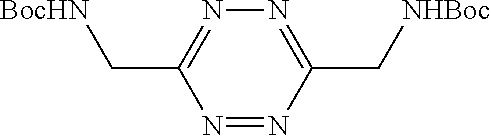

when R1 is N-Boc-pyrrole, the Boc will be deprotected to give pyrrole


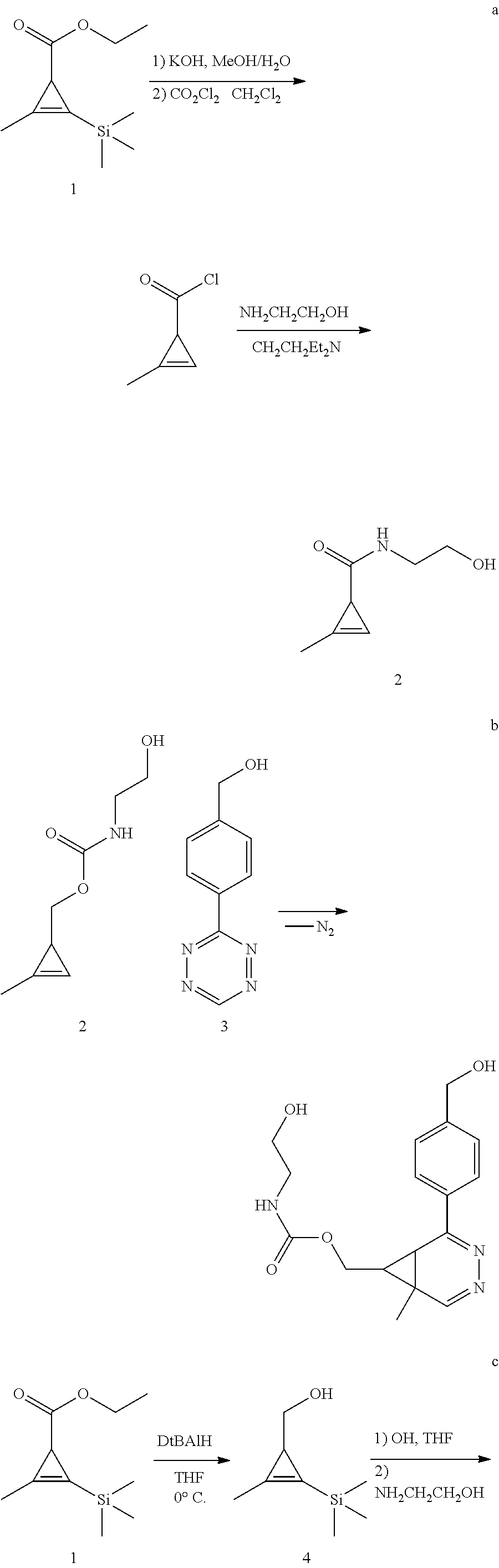


- a) J. M. Baskin, J. A. Prescher, S. T. Laughlin, N. J. Agard, P. V. Chang, I. A. Miller, A. Lo, J. A. Codelli, C. R. Bertozzi, Proceedings of the National Academy of Sciences of the United States of America 2007, 104, 16793-16797; b) K. Lang, L. Davis, J. Torres-Kolbus, C. Chou, A. Deiters, J. Chin,
Nat Chem 2012, 4, 298-304; c) J. Ngo, D. Tirrell, Acc Chem Res 2011, 44, 677-685; d) K. Rangan, Y. Yang, G. Charron, H. Hang, J Am Chem Soc 2010, 132, 10628-10629; e) A. Salic, T. Mitchison, Proceedings of the National Academy of Sciences of the United States of America 2008, 105, 2415-2420. - N. Devaraj, R. Weissleder, Acc Chem Res 2011, 44, 816-827.
- a) N. Devaraj, R. Upadhyay, J. Haun, S. Hilderbrand, R. Weissleder, Angew Chem Int Ed Engl 2009, 48, 7013-7016; b) N. Devaraj, S. Hilderbrand, R. Upadhyay, R. Mazitschek, R. Weissleder, Angew Chem Int Ed Engl 2010, 49, 2869-2872.
- a) T. Plass, S. Milles, C. Koehler, J. Szymanski, R. Mueller, M. Wiessler, C. Schultz, E. Lemke, Angew Chem Int Ed Engl 2012, 51, 4166-4170; b) G. Budin, K. Yang, T. Reiner, R. Weissleder, Angew Chem
Int Ed Engl 2011, 50, 9378-9381. - J. Yang, J. Seckute, C. Cole, N. Devaraj, Angew Chem Int Ed Engl 2012, 51, 7476-7479.
- a) M. Blackman, M. Royzen, J. Fox, J Am Chem Soc 2008, 130, 13518-13519; b) N. Devaraj, R. Weissleder, S. Hilderbrand, Bioconjug Chem 2008, 19, 2297-2299; c) M. Wiessler, W. Waldeck, C. Kliem, R. Pipkorn, K. Braun, Int
J Med Sci 2009, 7, 19-28; d) N. Devaraj, G. Thurber, E. Keliher, B. Marinelli, R. Weissleder, Proceedings of the National Academy of Sciences of the United States of America 2012, 109, 4762-4767; e) R. Rossin, P. Verkerk, S. van den Bosch, R. Vulders, I. Verel, J. Lub, M. Robillard, Angew Chem Int Ed Engl 2010, 49, 3375-3378; f) M. Karver, R. Weissleder, S. Hilderbrand, Angew Chem Int Ed Engl 2012, 51, 920-922. - a) Z. Yu, Y. Pan, Z. Wang, J. Wang, Q. Lin, Angew Chem Int Ed Engl 2012, ASAP; b) D. Patterson, L. Nazarova, B. Xie, D. Kamber, J. Prescher, J Am Chem Soc 2012, 134, 18638-18643.
- a) S. Luchansky, S. Goon, C. Bertozzi,
Chembiochem 2004, 5, 371-374; b) C. Oetke, R. Brossmer, L. Mantey, S. Hinderlich, R. Isecke, W. Reutter, O. Keppler, M. Pawlita, J Biol Chem 2002, 277, 6688-6695. - S. Han, B. Collins, P. Bengtson, J. Paulson,
Nat Chem Riot 2005, 1, 93-97. - a) E. Saxon, C. Bertozzi,
Science 2000, 287, 2007-2010; b) E. Sletten, C. Bertozzi, Acc Chem Res 2011, 44, 666-676. - a) H. Kayser, R. Zeitler, C. Kannicht, D. Grunow, R. Nuck, W. Reutter, J Biol Chem 1992, 267, 16934-16938; b) O. Keppler, R. Horstkorte, M. Pawlita, C. Schmidt, W. Reutter,
Glycobiology 2001, 11, 11R-18R. - C. Jacobs, S. Goon, K. Yarema, S. Hinderlich, H. Hang, D. Chai, C. Bertozzi,
Biochemistry 2001, 40, 12864-12874. - C. Jacobs, K. Yarema, L. Mahal, D. Nauman, N. Charters, C. Bertozzi,
Methods Enzymol 2000, 327, 260-275. - E. Saxon, S. Luchansky, H. Hang, C. Yu, S. Lee, C. Bertozzi, J Am Chem Soc 2002, 124, 14893-14902.
- H. Hang, C. Yu, D. Kato, C. Bertozzi, Proceedings of the National Academy of Sciences of the United States of
America 2003, 100, 14846-14851. - Y. Liang, J. Mackey, S. Lopez, F. Liu, K. Houk, J Am Chem Soc 2012, Accepted
- Devaraj, N. K.; Weissleder, R. Acc Chem Res 2011, 44, 816.
- Lang, K.; Davis, L.; Torres-Kolbus, J.; Chou, C.; Deiters, A.; Chin, J. W.
Nat Chem 2012, 4, 298. - Hansell, C. F.; Espeel, P.; Stamenovic, M. M.; Barker, I. A.; Dove, A. P.; Du Prez, F. E.; O'Reilly, R. K. J Am Chem Soc 2011, 133, 13828.
- Zhou, H.; Johnson, J. A. Angew Chem Int Ed Engl 2013, 52, 2235.
- Devaraj, N. K.; Thurber, G. M.; Keliher, E. J.; Marinelli, B.; Weissleder, R. Proc Natl Acad Sci USA 2012, 109, 4762.
- Blackman, M. L.; Royzen, M.; Fox, J. M. J Am Chem Soc 2008, 130, 13518.
- Devaraj, N. K.; Weissleder, R.; Hilderbrand, S. A. Bioconjug Chem 2008, 19, 2297.
- Rostovtsev, V. V.; Green, L. G.; Fokin, V. V.; Sharpless, K. B. Angew Chem Int Ed Engl 2002, 41, 2596.
- Kolb, H. C.; Finn, M. G.; Sharpless, K. B. Angew Chem
Int Ed Engl 2001, 40, 2004. - Yang, J.; Karver, M. R.; Li, W.; Sahu, S.; Devaraj, N. K. Angew Chem Int Ed Engl 2012, 51, 5222.
- Sletten, E. M.; Bertozzi, C. R. Angew Chem Int Ed Engl 2009, 48, 6974.
- Saxon, E.; Luchansky, S. J.; Hang, H. C.; Yu, C.; Lee, S. C.; Bertozzi, C. R. J Am Chem Soc 2002, 124, 14893.
- Taylor, M. T.; Blackman, M. L.; Dmitrenko, O.; Fox, J. M. J Am Chem Soc 2011, 133, 9646.
- Yang, J.; Seckute, J.; Cole, C. M.; Devaraj, N. K. Angew Chem Int Ed Engl 2012, 51, 7476.
- Sauer, J.; Heinrichs,
G. Tetrahedron Letters 1966, 7, 4979. - Dowd, P.; Gold,
A. Tetrahedron Letters 1969, 10, 85. - Yan, N.; Liu, X.; Pallerla, M. K.; Fox, J. M. The Journal of organic chemistry 2008, 73, 4283.
- Yu, Z.; Pan, Y.; Wang, Z.; Wang, J.; Lin, Q. Angew Chem Int Ed Engl 2012, 51, 10600.
- Patterson, D. M.; Nazarova, L. A.; Xie, B.; Kamber, D. N.; Prescher, J. A. J Am Chem Soc 2012, 134, 18638.
- Liang, Y.; Mackey, J. L.; Lopez, S. A.; Liu, F.; Houk, K. N. J Am Chem Soc 2012, 134, 17904.
- Cole, C. M.; Yang, J.; Seckute, J.; Devaraj, N. K. ChemBioChem 2013, 14, 205.
- Sauer, J.; Heldmann, D. K.; Hetzenegger, J.; Krauthan, J.; Sichert, H.; Schuster, J. Eur J Org Chem 1998, 2885.
- Thalhammer, F.; Wallfahrer, U.; Sauer, J. Tetrahedron Letters 1990, 31, 6851
- J. Yang, J. {hacek over (S)}e{hacek over (c)}lutė, C. M. Cole, N. K. Devaraj, Angew. Chem. Int. Ed. 2012, 51, 7476-7479.
- Liu, J., Cao, Z. & Lu, Y. Functional Nucleic Acid Sensors. Chetn Rev 109, 1948-1998 (2009).
- Armitage, B. A. Imaging of RNA in live cells. Curr
Opin Chem Biol 15, 806-812 (2011). - Silverman, A. P. & Kool, E. T. Detecting RNA and DNA with Templated Chemical Reactions. Chem Inform 37, (2006).
- Marti, A. A., Jockusch, S., Stevens, N., Ju, J. & Turro, N. J. Fluorescent Hybridization Probes for Sensitive and Selective DNA and RNA Detection. Ace. Chem. Res. 40, 402-409 (2007).
- Guo, J., Ju, J. & Turro, N. J. Fluorescent hybridization probes for nucleic acid detection. Analytical and bioanalytical chemistry 402, 3115-3125 (20 12).
- Stojanovic, M. N., de Prada, P. & Landry, D. W. Catalytic molecular beacons.
Chem Bio Chem 2, 411-415 (2001). - Dave, N. & Liu, J. Fast Molecular Beacon Hybridization in Organic Solvents with Improved Target Specificity. J Plzys Chern B 114, 15694-15699 (2010).
- Chen, A. K., Davydenko, O., Behlke, M. A. & Tsourkas, A. Ratiometric bimolecular beacons for the sensitive detection of RNA in single living cells. Nucleic Acids Res 38, e148 (2010).
- Wang, K. et al. Molecular Engineering of DNA: Molecular Beacons. Angew. Chem. Int. Ed. 48, 856-870 (2009).
- [40] Tsourkas, A., Behlke, M. A., Rose, S. D. & Bao, G. Hybridization kinetics and thermodynamics of molecular beacons. Nucleic Acids Res 31, 1319-1330 (2003).
- Tyagi, S. Imaging intracellular RNA distribution and dynamics in living cells.
Nature Methods 6, 331-338 (2009). - Mhlanga, M. M., Vargas, D. Y., Fung, C. W., Kramer, F. R. & Tyagi, S. tRNA-linked molecular beacons for imaging mRNAs in the cytoplasm of living cells. Nucleic Acids Res 33, 1902-1912 (2005).
- Gryaznov, S. M., Schultz, R., Chaturvedi, S. K. & Letsinger, R. L Enhancement of selectivity in recognition of nucleic acids via chemical autoligation.
Nucleic Acids Res 22, 2366-2369 (1994). - Kumar, R. et al. Template-directed oligonucleotide strand ligation, covalent intramolecular DNA circularization and catenation using click chemistry. J Am Chem Soc 129, 6859-6864 (2007).
- Rohatgi, R., Bartel, D. P. & Szostak, J. W. Nonenzymatic, Template-Directed Ligation of Oligoribonucleotides Is Highly Regioselective for the Formation of 3′-5′ Phosphodiester Bonds. J Am Clzem Soc 118, 3340-3344 (1996).
- Sarkar, T., Conwell, C. C., Harvey, L C., Santai, C. T. & Hud, N. V. Condensation of oligonucleotides assembled into nicked and gapped duplexes: potential structures for oligonucleotide delivery. Nucleic Acids Res 33, 143-151 (2005).
- Bruick, R. K., Dawson, P. E., Kent, S. B., Usman, N. & Joyce, G. F. Template-directed ligation of peptides to oligonucleotides. Chern. Bioi. 3, 49-56 (1996).
- Peng, X., Li, H. & Seidman, M. A Template-Mediated Click-Click Reaction: PNA-DNA, PNAPNA (or Peptide) Ligation, and Single Nucleotide Discrimination. Eur. J. Org. Chem. 2010, 4194-4197 (2010).
- Peelen, D. & Smith, L M. Immobilization of Amine-Modified Oligonucleotides on AldehydeTerminated Alkanethiol Monolayers on Gold. J Am Chem Soc 21, 266-271 (2005).
- Xu, Y., Karalkar, N. B. & Kool, E. T. Nonenzymatic autoligation in direct three-color detection of RNA and DNA point mutations. Nature Biotechnology 19, 148-152 (2001).
- Silverman, A. P. & Kool, E. T. Quenched probes for highly specific detection of cellular RNAs. Trends Bioteclzno/23, 225-230 (2005).
- Shibata, A., Abe, H. & Ito, Y. Oligonucleotide-templated reactions for sensing nucleic acids.
Molecules 17, 2446-2463 (2012).
- Sando, S., Abe, H. & Kool, E. T. Quenched Auto-Ligating DNAs: Multicolor Identification of Nucleic Acids at Single Nucleotide Resolution. J Am Chem Soc 126, 1081-1087 (2004).
- Devaraj, N. K., Hilderbrand, S., Upadhyay, R., Mazitschek, R. & Weissleder, R. Bioorthogonal Turn-On Probes for Imaging Small Molecules inside Living Cells. Angew. Chem. Int. Ed. 49, 2869-2872 (2010).
- Devaraj, N. K. & Weissleder, R. Biomedical Applications of Tetrazine Cycloadditions. Ace. Chem. Res. 44, 816-827 (2011).
- Liu, D. S. et al. Diels-Alder Cycloaddition for Fluorophore Targeting to Specific Proteins inside Living Cells. J Am Chem Soc 134, 792-795 (2012).
- Plass, T. et al. Amino Acids for Diels-Alder Reactions in Living Cells. Angew. Chem. Int. Ed. 51, 4166-4170 (2012).
- Dumas-Verdes, C. et al. BODIPY—Tetrazine Multichromophoric Derivatives. Angew. Chem. Int. Ed. Engl. 2010, 2525-2535 (2010).
- Budin, G., Yang, K. S., Reiner, T. & Weissleder, R. Bioorthogonal Probes for Polo-like Kinase I Imaging and Quantification. Angew. Chem. Int. Ed. 50, 9378-9381 (2011).
- Lang, K. et al. Genetically encoded norbornene directs site-specific cellular protein labelling via a rapid bioorthogonal reaction.
Nat Chem 4, 298-304 (2012). - Yang, J., Seckute, J., Cole, C. M. & Devaraj, N. K. Live-cell imaging of cyclopropene tags with fluorogenic tetrazine cycloadditions. Angew. Chem. Int. Ed. 51, 7476-7479 (2012).
- Sletten, E. M. & Bertozzi, C. R. From Mechanism to Mouse: A Tale of Two Bioorthogonal Reactions. Ace. Chem. Res. 44, 666-676 (2011).
- Blackman, M. L., Royzen, M. & Fox, J. M. Tetrazine ligation: fast bioconjugation based on inverse-electron-demand Diels-Alder reactivity. J Am Chem Soc 130, 13518-13519 (2008).
- Devaraj, N. K., Weissleder, R. & Hilderbrand, S. A. Tetrazine-based cycloadditions: application to pretargeted live cell imaging. Bioconjugate Chem. 19, 2297-2299 (2008).
- Yang, J., Karver, M. R., Li, W., Sahu, S. & Devaraj, N. K. Metal-Catalyzed One-Pot Synthesis of Tetrazines Directly from Aliphatic Nitriles and Hydrazine. Angew. Chem. Int. Ed. Engl. 124, 5312-5315 (2012).
- Karver, M. R., Weissleder, R. & Hilderbrand, S. A. Synthesis and Evaluation of a Series of 1,2,4,5-Tetrazines for Bioorthogonal Conjugation. Bioconjugate Chem. 22, 2263-2270 (2011).
- Li, X. & Liu, D. R. DNA-Templated Organic Synthesis: Nature's Strategy for Controlling Chemical Reactivity Applied to Synthetic Molecules. Angew. Chem. Int. Ed. 43, 4848-4870 (2004).
- Herschlag, D. Implications of ribozyme kinetics for targeting the cleavage of specific RNA molecules in vivo: more isn't always better. Proc Nat! Acad Sci USA 88, 6921-6925 (1991).
- 40. Elghanian, R., Storhoff, J. J., Mucic, R. C., Letsinger, R. L. & Mirkin, C. A. Selective colorimetric detection of polynucleotides based on the distance-dependent optical properties of gold nanoparticles. Science 277, 1078-1081 (1997).
- Xu, Y. & Kool, E. T. High sequence fidelity in a non-enzymatic DNA autoligation reaction. Nucleic Acids Res 27, 875-881 (1999).
- Tang, Z. et al. Real-time monitoring of nucleic acid ligation in homogenous solutions using molecular beacons. Nucleic Acids Res 31, e148-e148 (2003).
- Tong, J., Cao, W. & Barany, F. Biochemical properties of a high fidelity DNA ligase from Thermus species AK16D. Nucleic Acids Res 27, 788-794 (1999).
- Darzacq, X. et al. In vivo dynamics of RNA polymerase II transcription. Nat Struct Mol Bio/14, 796-806 (2007).
Claims (6)


Priority Applications (1)
| Application Number | Priority Date | Filing Date | Title |
|---|---|---|---|
| US14/507,509 US9533957B2 (en) | 2012-04-06 | 2014-10-06 | Tetrazines and method of synthezising the same |
Applications Claiming Priority (4)
| Application Number | Priority Date | Filing Date | Title |
|---|---|---|---|
| US201261621254P | 2012-04-06 | 2012-04-06 | |
| US201261736844P | 2012-12-13 | 2012-12-13 | |
| PCT/US2013/035676 WO2013152359A1 (en) | 2012-04-06 | 2013-04-08 | Novel tetrazines and method of synthesizing the same |
| US14/507,509 US9533957B2 (en) | 2012-04-06 | 2014-10-06 | Tetrazines and method of synthezising the same |
Related Parent Applications (1)
| Application Number | Title | Priority Date | Filing Date |
|---|---|---|---|
| PCT/US2013/035676 Continuation WO2013152359A1 (en) | 2012-04-06 | 2013-04-08 | Novel tetrazines and method of synthesizing the same |
Publications (2)
| Publication Number | Publication Date |
|---|---|
| US20150099277A1 US20150099277A1 (en) | 2015-04-09 |
| US9533957B2 true US9533957B2 (en) | 2017-01-03 |
Family
ID=49301111
Family Applications (1)
| Application Number | Title | Priority Date | Filing Date |
|---|---|---|---|
| US14/507,509 Active US9533957B2 (en) | 2012-04-06 | 2014-10-06 | Tetrazines and method of synthezising the same |
Country Status (2)
| Country | Link |
|---|---|
| US (1) | US9533957B2 (en) |
| WO (1) | WO2013152359A1 (en) |
Cited By (1)
| Publication number | Priority date | Publication date | Assignee | Title |
|---|---|---|---|---|
| US20160223559A1 (en) * | 2015-02-02 | 2016-08-04 | The Regents Of The University Of California | Tetrazine-containing compounds and synthetic methods thereof |
Families Citing this family (44)
| Publication number | Priority date | Publication date | Assignee | Title |
|---|---|---|---|---|
| WO2013066438A2 (en) | 2011-07-22 | 2013-05-10 | President And Fellows Of Harvard College | Evaluation and improvement of nuclease cleavage specificity |
| US10545093B2 (en) | 2013-04-06 | 2020-01-28 | Massachusetts Institute Of Technology | Selective detection of alkenes or alkynes |
| US20150044192A1 (en) | 2013-08-09 | 2015-02-12 | President And Fellows Of Harvard College | Methods for identifying a target site of a cas9 nuclease |
| US9359599B2 (en) | 2013-08-22 | 2016-06-07 | President And Fellows Of Harvard College | Engineered transcription activator-like effector (TALE) domains and uses thereof |
| US9340799B2 (en) | 2013-09-06 | 2016-05-17 | President And Fellows Of Harvard College | MRNA-sensing switchable gRNAs |
| US9526784B2 (en) | 2013-09-06 | 2016-12-27 | President And Fellows Of Harvard College | Delivery system for functional nucleases |
| US9388430B2 (en) | 2013-09-06 | 2016-07-12 | President And Fellows Of Harvard College | Cas9-recombinase fusion proteins and uses thereof |
| US20150166984A1 (en) | 2013-12-12 | 2015-06-18 | President And Fellows Of Harvard College | Methods for correcting alpha-antitrypsin point mutations |
| JP6479022B2 (en) | 2014-01-14 | 2019-03-06 | ヨーロピアン モレキュラー バイオロジー ラボラトリーEuropean Molecular Biology Laboratory | Multiple cycloaddition reactions for molecular labeling |
| WO2016022363A2 (en) | 2014-07-30 | 2016-02-11 | President And Fellows Of Harvard College | Cas9 proteins including ligand-dependent inteins |
| US20180244643A1 (en) * | 2014-12-30 | 2018-08-30 | The Regents Of The University Of California | Highly sensitive detection of biomolecules using proximity induced bioorthogonal reactions |
| SG10202104041PA (en) | 2015-10-23 | 2021-06-29 | Harvard College | Nucleobase editors and uses thereof |
| CN105884689B (en) * | 2016-05-26 | 2018-08-24 | 陕西师范大学 | A kind of synthetic method of methyl cyclopropene probe |
| KR20250103795A (en) | 2016-08-03 | 2025-07-07 | 프레지던트 앤드 펠로우즈 오브 하바드 칼리지 | Adenosine nucleobase editors and uses thereof |
| US11661590B2 (en) | 2016-08-09 | 2023-05-30 | President And Fellows Of Harvard College | Programmable CAS9-recombinase fusion proteins and uses thereof |
| WO2018039438A1 (en) | 2016-08-24 | 2018-03-01 | President And Fellows Of Harvard College | Incorporation of unnatural amino acids into proteins using base editing |
| SG11201903089RA (en) | 2016-10-14 | 2019-05-30 | Harvard College | Aav delivery of nucleobase editors |
| WO2018119359A1 (en) | 2016-12-23 | 2018-06-28 | President And Fellows Of Harvard College | Editing of ccr5 receptor gene to protect against hiv infection |
| EP3592381A1 (en) | 2017-03-09 | 2020-01-15 | President and Fellows of Harvard College | Cancer vaccine |
| US11898179B2 (en) | 2017-03-09 | 2024-02-13 | President And Fellows Of Harvard College | Suppression of pain by gene editing |
| WO2018165629A1 (en) | 2017-03-10 | 2018-09-13 | President And Fellows Of Harvard College | Cytosine to guanine base editor |
| WO2018176009A1 (en) | 2017-03-23 | 2018-09-27 | President And Fellows Of Harvard College | Nucleobase editors comprising nucleic acid programmable dna binding proteins |
| AU2018239671B2 (en) | 2017-03-24 | 2024-08-15 | Trait Biosciences, Inc. | High level In vivo biosynthesis and isolation of water-soluble cannabinoids in plant systems |
| WO2018209320A1 (en) | 2017-05-12 | 2018-11-15 | President And Fellows Of Harvard College | Aptazyme-embedded guide rnas for use with crispr-cas9 in genome editing and transcriptional activation |
| US11946059B2 (en) | 2017-07-11 | 2024-04-02 | Trait Biosciences, Inc. | In vivo generation of water-soluble cannabinoids in plant cell suspension cultures |
| EP3730145A1 (en) | 2017-07-11 | 2020-10-28 | Trait Biosciences, Inc. | Generation of water-soluble cannabinoid compounds in yeast and plant cell suspension cultures and compositions of matter |
| US11905543B2 (en) | 2017-07-11 | 2024-02-20 | Trait Biosceinces, Inc. | In vivo generation of water-soluble acetylated cannabinoid glycoside compounds in plant cell suspension cultures |
| CN111801345A (en) | 2017-07-28 | 2020-10-20 | 哈佛大学的校长及成员们 | Methods and compositions for evolutionary base editors using phage-assisted sequential evolution (PACE) |
| CN107522673B (en) * | 2017-08-16 | 2020-05-19 | 北京师范大学 | 1,2,4,5-tetrazine compound for bioorthogonal reaction and preparation method and application thereof |
| EP3676376B1 (en) | 2017-08-30 | 2025-01-15 | President and Fellows of Harvard College | High efficiency base editors comprising gam |
| US11795443B2 (en) | 2017-10-16 | 2023-10-24 | The Broad Institute, Inc. | Uses of adenosine base editors |
| WO2019118949A1 (en) | 2017-12-15 | 2019-06-20 | The Broad Institute, Inc. | Systems and methods for predicting repair outcomes in genetic engineering |
| US12157760B2 (en) | 2018-05-23 | 2024-12-03 | The Broad Institute, Inc. | Base editors and uses thereof |
| EP3820495A4 (en) | 2018-07-09 | 2022-07-20 | The Broad Institute Inc. | RNA PROGRAMMABLE EPIGENETIC RNA MODIFIERS AND THEIR USES |
| WO2020092453A1 (en) | 2018-10-29 | 2020-05-07 | The Broad Institute, Inc. | Nucleobase editors comprising geocas9 and uses thereof |
| US12351837B2 (en) | 2019-01-23 | 2025-07-08 | The Broad Institute, Inc. | Supernegatively charged proteins and uses thereof |
| EP3942043A2 (en) | 2019-03-19 | 2022-01-26 | The Broad Institute, Inc. | Methods and compositions for editing nucleotide sequences |
| WO2020214842A1 (en) | 2019-04-17 | 2020-10-22 | The Broad Institute, Inc. | Adenine base editors with reduced off-target effects |
| US12435330B2 (en) | 2019-10-10 | 2025-10-07 | The Broad Institute, Inc. | Methods and compositions for prime editing RNA |
| BR112022022603A2 (en) | 2020-05-08 | 2023-01-17 | Broad Inst Inc | METHODS AND COMPOSITIONS FOR SIMULTANEOUS EDITING OF BOTH DUAL-STRANDED NUCLEOTIDE TARGET SEQUENCE STRAINS |
| CN114106027B (en) * | 2021-11-10 | 2023-11-17 | 四川大学华西医院 | Fluoroboron fluorescent dye-tetrazine fluorescent probe and preparation method and application thereof |
| WO2023250342A2 (en) * | 2022-06-22 | 2023-12-28 | Quantum-Si Incorporated | Cyclopropene phosphoramidites and conjugates thereof |
| CN116947824B (en) * | 2023-07-24 | 2026-03-31 | 北京大学 | A monosubstituted 1,2,4,5-tetraazine compound based on a five-membered heterocycle and its preparation method |
| WO2025043219A1 (en) * | 2023-08-24 | 2025-02-27 | The Regents Of The University Of California | Methods for uncaging tetrazines |
-
2013
- 2013-04-08 WO PCT/US2013/035676 patent/WO2013152359A1/en not_active Ceased
-
2014
- 2014-10-06 US US14/507,509 patent/US9533957B2/en active Active
Non-Patent Citations (12)
| Title |
|---|
| Beynon, G.et al. (1979). "Some 3,4-diazanorcaradienes," Bulletin des Societes Chimiques Belges 88(11):905-909. |
| Clavier, G. et al. (Jun. 9, 2010). "s-Tetrazines as building blocks for new functional molecules and molecular materials," Chem Rev 110(6):3299-3314. |
| Devaraj, N.K. et al. (2011, e-published May 31, 2011). "Biomedical Applications of Tetrazine Cycloadditions," Accounts of Chemical Research 44(9):816-827. |
| Hsieh, C-C et al. (2009, e-published Aug. 5, 2009). Effects of Counteranion on the Pyrazole-Nitrile Coupling Reaction Mediated by Nickel (II) Ions, Organomettalics 28:4923-4928. |
| International Search Report mailed on Jul. 25, 2013, for PCT Application No. PCT/US2013/035676, filed on Apr. 8, 2013, 5 pages. |
| Kukushkin, V.Y. et al. (2002). "Additions to Metal-Activated Organonitriles," Chem Rev 102(5):1771-1802. |
| Lim et al. Synthesis of symmetric 3,6-disubstituted-1,2,4,5-tetrazines using an activated catalyst prepared by the reaction of copper nitrate with excess zinc in the presence of hydrazine monohydrate. Bulletin of the Korean Chemical Society, 1995, 16, 374-7- (abstract included only). * |
| Mason, R. et al. (1973). "Reactions of Hydrazines with Platinum-Nitrile Complexes; X-Ray Structural Characterization and Electrochemistry of trans-Bis-1-acetyl-3-t-butyl-1,2,4-triaza-butadieneplatimun." J.C.S. Chem Comm pp. 297-299. |
| Rousselet, G. et al. (1993). "Copper(I)-Induced Addition of Amines to Unactivated Nitriles: The First General One-Step Synthesis of Alkyl Amidines," Tetrahedron Letters 34(40):6395-6398. |
| Sauer, J. et al. (2001). "The Cycloaddition-Cycloelimination Pathway to Homotropilidenes-Synthesis and Properties of Homotropilidenes," Eur J Org Chem 2001(14):2639-2657. |
| Yang et al. Metal-Catalyzed One-Pot Synthesis of Tetrazines Directly from Aliphatic Nitriles and Hydrazine. Angewandte Chemie, International Edition (2012), 51(21), 5222-5225). * |
| Zajac, W.W. et al. (1971). "Reaction of Nitriles with Hydrazine Hydrate and Raney Nickel," J Org Chem 36(23):3539-3541. |
Cited By (1)
| Publication number | Priority date | Publication date | Assignee | Title |
|---|---|---|---|---|
| US20160223559A1 (en) * | 2015-02-02 | 2016-08-04 | The Regents Of The University Of California | Tetrazine-containing compounds and synthetic methods thereof |
Also Published As
| Publication number | Publication date |
|---|---|
| US20150099277A1 (en) | 2015-04-09 |
| WO2013152359A1 (en) | 2013-10-10 |
Similar Documents
| Publication | Publication Date | Title |
|---|---|---|
| US20150099277A1 (en) | Novel tetrazines and method of synthezising the same | |
| US11357873B2 (en) | Chiral cyclen compounds and their uses | |
| Vanasschen et al. | Novel CDTA-based, bifunctional chelators for stable and inert MnII complexation: synthesis and physicochemical characterization | |
| US9714260B2 (en) | Asymmetrical Si rhodamine and rhodol synthesis | |
| Maggi et al. | Development of a novel antibody–tetrazine conjugate for bioorthogonal pretargeting | |
| JP6612131B2 (en) | Iron (II) ion detection agent and detection method using the same | |
| US8759331B2 (en) | X-ray and gamma-photon activable organic compounds, their preparation and their uses | |
| US10005793B2 (en) | Bodipy dyes for biological imaging | |
| Wu et al. | Synthesis and assessment of a maleimide functionalized BF 2 azadipyrromethene near-infrared fluorochrome | |
| US20180244643A1 (en) | Highly sensitive detection of biomolecules using proximity induced bioorthogonal reactions | |
| US11097017B2 (en) | Gadolinium-based contrast agents for sensitive detection of Zn2+with MRI | |
| CN110092779A (en) | A kind of substituted phenyl compound and its application | |
| CN114437053A (en) | Nano probe and application thereof in detecting superoxide anion in Golgi apparatus | |
| US8530675B2 (en) | Process for the synthesis of 4,5,6,7-tetrachloro-3′,6′-dihydroxy-2′,4′,5′,7′-tetraiodo-3H-spiro[isobenzofuran-1,9′-xanthen]-3-one (rose bengal) and related xanthenes | |
| US20220322945A1 (en) | Use of fluorophore compounds of the aza- bodipy type as contrast agents in the short wave infrared region | |
| US11267842B2 (en) | Enzymatic modification of nucleic acids | |
| US20240252652A1 (en) | Proteins having unnatural amino acids and methods of use | |
| CA2996666A1 (en) | Compounds as stimuli-responsive probes, methods and applications thereof | |
| JP5991831B2 (en) | Fluorescent probe | |
| Khmelevskaya et al. | Synthesis and biological study of benzothiophene-fused azaenediyne hybrids as potential anticancer agents | |
| US20110021765A1 (en) | Fluorinated lanthanide probes for 19f magnetic resonance applications | |
| CN115894450A (en) | Novel polycyclic compound, composition and application thereof | |
| EP4551210A1 (en) | Bifacial peptide nucleic acid probes and methods of using thereof | |
| Danyliuk et al. | Visible-light-induced photocatalytic iododi (per) fluoroalkylation of 5-amino-N-allyl-1, 2, 3-triazole-4-carboxamides | |
| US9133220B2 (en) | Boron-containing 5-arylidene-3,5-dihydro-4H-imidazol-4-ones |
Legal Events
| Date | Code | Title | Description |
|---|---|---|---|
| AS | Assignment |
Owner name: NATIONAL INSTITUTES OF HEALTH (NIH), U.S. DEPT. OF Free format text: CONFIRMATORY LICENSE;ASSIGNOR:UNIVERSITY OF CALIFORNIA SAN DIEGO;REEL/FRAME:034116/0994 Effective date: 20141028 |
|
| AS | Assignment |
Owner name: THE REGENTS OF THE UNIVERSITY OF CALIFORNIA, CALIF Free format text: ASSIGNMENT OF ASSIGNORS INTEREST;ASSIGNORS:DEVARAJ, NEAL KRISHNA;YANG, JUN;SECKUTE, JOLITA;REEL/FRAME:035601/0107 Effective date: 20130405 |
|
| STCF | Information on status: patent grant |
Free format text: PATENTED CASE |
|
| MAFP | Maintenance fee payment |
Free format text: PAYMENT OF MAINTENANCE FEE, 4TH YR, SMALL ENTITY (ORIGINAL EVENT CODE: M2551); ENTITY STATUS OF PATENT OWNER: SMALL ENTITY Year of fee payment: 4 |