US9528990B2 - Fluorogenic/fluorescent probes derivative from sulfoxanthene, and use thereof - Google Patents
Fluorogenic/fluorescent probes derivative from sulfoxanthene, and use thereof Download PDFInfo
- Publication number
- US9528990B2 US9528990B2 US14/720,017 US201514720017A US9528990B2 US 9528990 B2 US9528990 B2 US 9528990B2 US 201514720017 A US201514720017 A US 201514720017A US 9528990 B2 US9528990 B2 US 9528990B2
- Authority
- US
- United States
- Prior art keywords
- obscure
- activity
- group
- bond
- organic group
- Prior art date
- Legal status (The legal status is an assumption and is not a legal conclusion. Google has not performed a legal analysis and makes no representation as to the accuracy of the status listed.)
- Active
Links
- 0 *N=NC.*N=NC.CC.CC.CN.CN.NC1=CC2=C(C=C1)C(C1=C(S(=O)(=O)[O-])C=C(S(=O)(=O)O)C=C1)=C1C=C3CCC[N+]4=C3C(=C1O2)CCC4.NC1=CC2=C(C=C1)C1=C(C=C2)C(C2=C(S(=O)(=O)[O-])C=C(S(=O)(=O)O)C=C2)=C2C=C3CCC[N+]4=C3C(=C2O1)CCC4.[1*]N=NC.[1*]N=NC.[1*]N=NC1=CC2=C(C=C1)C(C1=C(S(=O)(=O)[O-])C=C(S(=O)(=O)O)C=C1)=C1C=C3CCC[N+]4=C3C(=C1O2)CCC4.[1*]N=NC1=CC2=C(C=C1)C1=C(C=C2)C(C2=C(S(=O)(=O)[O-])C=C(S(=O)(=O)O)C=C2)=C2C=C3CCC[N+]4=C3C(=C2O1)CCC4 Chemical compound *N=NC.*N=NC.CC.CC.CN.CN.NC1=CC2=C(C=C1)C(C1=C(S(=O)(=O)[O-])C=C(S(=O)(=O)O)C=C1)=C1C=C3CCC[N+]4=C3C(=C1O2)CCC4.NC1=CC2=C(C=C1)C1=C(C=C2)C(C2=C(S(=O)(=O)[O-])C=C(S(=O)(=O)O)C=C2)=C2C=C3CCC[N+]4=C3C(=C2O1)CCC4.[1*]N=NC.[1*]N=NC.[1*]N=NC1=CC2=C(C=C1)C(C1=C(S(=O)(=O)[O-])C=C(S(=O)(=O)O)C=C1)=C1C=C3CCC[N+]4=C3C(=C1O2)CCC4.[1*]N=NC1=CC2=C(C=C1)C1=C(C=C2)C(C2=C(S(=O)(=O)[O-])C=C(S(=O)(=O)O)C=C2)=C2C=C3CCC[N+]4=C3C(=C2O1)CCC4 0.000 description 21
- RLBPXBYXQAPJBX-UHFFFAOYSA-N CC1=C/C2=C(\C=C/1)C1=C(C=C2)C(C2=C(S(=O)(=O)[O-])C=C(S(=O)(=O)O)C=C2)=C2C=C3CCC[N+]4=C3C(=C2O1)CCC4.CC1=CC2=C(C=C1)C(C1=C(S(=O)(=O)[O-])C=C(S(=O)(=O)O)C=C1)=C1C=C3CCC[N+]4=C3C(=C1O2)CCC4 Chemical compound CC1=C/C2=C(\C=C/1)C1=C(C=C2)C(C2=C(S(=O)(=O)[O-])C=C(S(=O)(=O)O)C=C2)=C2C=C3CCC[N+]4=C3C(=C2O1)CCC4.CC1=CC2=C(C=C1)C(C1=C(S(=O)(=O)[O-])C=C(S(=O)(=O)O)C=C1)=C1C=C3CCC[N+]4=C3C(=C1O2)CCC4 RLBPXBYXQAPJBX-UHFFFAOYSA-N 0.000 description 9
- XAIPYJZNBINMEZ-UHFFFAOYSA-N COC1=C([Re])C(C)=C(C)C([Rb])=C1[RaH] Chemical compound COC1=C([Re])C(C)=C(C)C([Rb])=C1[RaH] XAIPYJZNBINMEZ-UHFFFAOYSA-N 0.000 description 9
- HSHNITRMYYLLCV-UHFFFAOYSA-N CC1=CC(=O)OC2=C1C=CC(O)=C2 Chemical compound CC1=CC(=O)OC2=C1C=CC(O)=C2 HSHNITRMYYLLCV-UHFFFAOYSA-N 0.000 description 4
- NBCANZGIXPCTGT-UHFFFAOYSA-N NC1=CC2=C(C=C1)/C(C1=C(S(=O)(=O)[O-])C=C(S(=O)(=O)O)C=C1)=C1/C=C3CCC[N+]4=C3C(=C1O2)CCC4.O=S(=O)([O-])C1=C(/C2=C3\C=C4CCC[N+]5=C4C(=C3OC3=C2C=CC(O)=C3)CCC5)C=CC(S(=O)(=O)O)=C1 Chemical compound NC1=CC2=C(C=C1)/C(C1=C(S(=O)(=O)[O-])C=C(S(=O)(=O)O)C=C1)=C1/C=C3CCC[N+]4=C3C(=C1O2)CCC4.O=S(=O)([O-])C1=C(/C2=C3\C=C4CCC[N+]5=C4C(=C3OC3=C2C=CC(O)=C3)CCC5)C=CC(S(=O)(=O)O)=C1 NBCANZGIXPCTGT-UHFFFAOYSA-N 0.000 description 2
- KZEWBFUECHUQQM-UHFFFAOYSA-N NC1=CC2=C(C=C1)C1=C(/C=C\2)C(C2=C(S(=O)(=O)[O-])C=C(S(=O)(=O)O)C=C2)=C2C=C3CCC[N+]4=C3C(=C2O1)CCC4.O=S(=O)([O-])C1=C(C2=C3C=C4CCC[N+]5=C4C(=C3OC3=C2/C=C\C2=C3C=CC(O)=C2)CCC5)C=CC(S(=O)(=O)O)=C1 Chemical compound NC1=CC2=C(C=C1)C1=C(/C=C\2)C(C2=C(S(=O)(=O)[O-])C=C(S(=O)(=O)O)C=C2)=C2C=C3CCC[N+]4=C3C(=C2O1)CCC4.O=S(=O)([O-])C1=C(C2=C3C=C4CCC[N+]5=C4C(=C3OC3=C2/C=C\C2=C3C=CC(O)=C2)CCC5)C=CC(S(=O)(=O)O)=C1 KZEWBFUECHUQQM-UHFFFAOYSA-N 0.000 description 2
- YKGGGCXBWXHKIZ-UHFFFAOYSA-M O=C1C=CC2=C(C3=CC=CC=C3C(=O)[O-])C3=CC=C(O)C=C3OC2=C1 Chemical compound O=C1C=CC2=C(C3=CC=CC=C3C(=O)[O-])C3=CC=C(O)C=C3OC2=C1 YKGGGCXBWXHKIZ-UHFFFAOYSA-M 0.000 description 2
- OURSXMMBJOSRNK-UHFFFAOYSA-N BN=NC1=CC=C(N(C)C)C=C1 Chemical compound BN=NC1=CC=C(N(C)C)C=C1 OURSXMMBJOSRNK-UHFFFAOYSA-N 0.000 description 1
- OLDVUWCLOXWLDL-UHFFFAOYSA-N BN=NC1=CC=C(N(CCN2C=C(C[N+]3(C)CCCC3)N=N2)CCN2C=C(C[N+]3(C)CCCC3)N=N2)C=C1 Chemical compound BN=NC1=CC=C(N(CCN2C=C(C[N+]3(C)CCCC3)N=N2)CCN2C=C(C[N+]3(C)CCCC3)N=N2)C=C1 OLDVUWCLOXWLDL-UHFFFAOYSA-N 0.000 description 1
- HYYLLXJEWGXROH-UHFFFAOYSA-N BN=NC1=CC=C(N(CCN2C=C(C[N+]3(CCCC)CCCCC3)N=N2)CCN2C=C(C[N+]3(CCCS(=O)(=O)[O-])CCCCC3)N=N2)C=C1 Chemical compound BN=NC1=CC=C(N(CCN2C=C(C[N+]3(CCCC)CCCCC3)N=N2)CCN2C=C(C[N+]3(CCCS(=O)(=O)[O-])CCCCC3)N=N2)C=C1 HYYLLXJEWGXROH-UHFFFAOYSA-N 0.000 description 1
- XZXRBYVNIUWJIZ-UHFFFAOYSA-N BN=NC1=CC=C(N(CCN=[N+]=[N-])CCN=[N+]=[N-])C=C1 Chemical compound BN=NC1=CC=C(N(CCN=[N+]=[N-])CCN=[N+]=[N-])C=C1 XZXRBYVNIUWJIZ-UHFFFAOYSA-N 0.000 description 1
- IVWSVRXJYIGNBI-UHFFFAOYSA-N C#CCCN(C)C1=CC=C(/N=N/C2=CC3=C(C=C2)C(C2=CC=C(S(=O)(=O)O)C=C2S(=O)(=O)[O-])=C2C=C4CCC[N+]5=C4C(=C2O3)CCC5)C=C1.CCCCCN(C)C1=CC=C(/N=N/C2=CC3=C(C=C2)C(C2=CC=C(S(=O)(=O)O)C=C2S(=O)(=O)[O-])=C2C=C4CCC[N+]5=C4C(=C2O3)CCC5)C=C1.CCCCN(C)C1=CC=C(/N=N/C2=CC3=C(C=C2)C(C2=CC=C(S(=O)(=O)O)C=C2S(=O)(=O)[O-])=C2C=C4CCC[N+]5=C4C(=C2O3)CCC5)C=C1.CCCN(C)C1=CC=C(/N=N/C2=CC3=C(C=C2)C(C2=CC=C(S(=O)(=O)O)C=C2S(=O)(=O)[O-])=C2C=C4CCC[N+]5=C4C(=C2O3)CCC5)C=C1.CN(CCCN1C(=O)C=CC1=O)C1=CC=C(/N=N/C2=CC3=C(C=C2)C(C2=CC=C(S(=O)(=O)O)C=C2S(=O)(=O)[O-])=C2C=C4CCC[N+]5=C4C(=C2O3)CCC5)C=C1.O=[N+]([O-])C1=CC2=C(C=C1)C(C1=C(S(=O)(=O)[O-])C=C(S(=O)(=O)O)C=C1)=C1C=C3CCC[N+]4=C3C(=C1O2)CCC4 Chemical compound C#CCCN(C)C1=CC=C(/N=N/C2=CC3=C(C=C2)C(C2=CC=C(S(=O)(=O)O)C=C2S(=O)(=O)[O-])=C2C=C4CCC[N+]5=C4C(=C2O3)CCC5)C=C1.CCCCCN(C)C1=CC=C(/N=N/C2=CC3=C(C=C2)C(C2=CC=C(S(=O)(=O)O)C=C2S(=O)(=O)[O-])=C2C=C4CCC[N+]5=C4C(=C2O3)CCC5)C=C1.CCCCN(C)C1=CC=C(/N=N/C2=CC3=C(C=C2)C(C2=CC=C(S(=O)(=O)O)C=C2S(=O)(=O)[O-])=C2C=C4CCC[N+]5=C4C(=C2O3)CCC5)C=C1.CCCN(C)C1=CC=C(/N=N/C2=CC3=C(C=C2)C(C2=CC=C(S(=O)(=O)O)C=C2S(=O)(=O)[O-])=C2C=C4CCC[N+]5=C4C(=C2O3)CCC5)C=C1.CN(CCCN1C(=O)C=CC1=O)C1=CC=C(/N=N/C2=CC3=C(C=C2)C(C2=CC=C(S(=O)(=O)O)C=C2S(=O)(=O)[O-])=C2C=C4CCC[N+]5=C4C(=C2O3)CCC5)C=C1.O=[N+]([O-])C1=CC2=C(C=C1)C(C1=C(S(=O)(=O)[O-])C=C(S(=O)(=O)O)C=C1)=C1C=C3CCC[N+]4=C3C(=C1O2)CCC4 IVWSVRXJYIGNBI-UHFFFAOYSA-N 0.000 description 1
- SHXASEOVKJXXBG-UHFFFAOYSA-N C#CCCN(C)C1=CC=C(C)C=C1 Chemical compound C#CCCN(C)C1=CC=C(C)C=C1 SHXASEOVKJXXBG-UHFFFAOYSA-N 0.000 description 1
- HIIMARDFSFTREN-UHFFFAOYSA-N C#CC[N+]1(C)CCCC1.[Br-] Chemical compound C#CC[N+]1(C)CCCC1.[Br-] HIIMARDFSFTREN-UHFFFAOYSA-N 0.000 description 1
- WPQPZQPKEVGYJS-UHFFFAOYSA-N C#CC[N+]1(CCCS(=O)(=O)[O-])CCCCC1 Chemical compound C#CC[N+]1(CCCS(=O)(=O)[O-])CCCCC1 WPQPZQPKEVGYJS-UHFFFAOYSA-N 0.000 description 1
- GRQQDCIQHYJIHH-UHFFFAOYSA-N C.C.C.C.CC.CC.CC.CC.CC.CC.CC(=O)NC1=CC2=C(C=C1)C(C1=C(S(=O)(=O)[O-])C=C(S(=O)(=O)O)C=C1)=C1C=C3CCC[N+]4=C3C(=C1O2)CCC4.CC(=O)NC1=CC2=C(C=C1)C1=C(C=C2)C(C2=C(S(=O)(=O)[O-])C=C(S(=O)(=O)O)C=C2)=C2C=C3CCC[N+]4=C3C(=C2O1)CCC4.CN.CN.NC1=CC2=C(C=C1)C(C1=C(S(=O)(=O)[O-])C=C(S(=O)(=O)O)C=C1)=C1C=C3CCC[N+]4=C3C(=C1O2)CCC4.NC1=CC2=C(C=C1)C1=C(C=C2)C(C2=C(S(=O)(=O)[O-])C=C(S(=O)(=O)O)C=C2)=C2C=C3CCC[N+]4=C3C(=C2O1)CCC4 Chemical compound C.C.C.C.CC.CC.CC.CC.CC.CC.CC(=O)NC1=CC2=C(C=C1)C(C1=C(S(=O)(=O)[O-])C=C(S(=O)(=O)O)C=C1)=C1C=C3CCC[N+]4=C3C(=C1O2)CCC4.CC(=O)NC1=CC2=C(C=C1)C1=C(C=C2)C(C2=C(S(=O)(=O)[O-])C=C(S(=O)(=O)O)C=C2)=C2C=C3CCC[N+]4=C3C(=C2O1)CCC4.CN.CN.NC1=CC2=C(C=C1)C(C1=C(S(=O)(=O)[O-])C=C(S(=O)(=O)O)C=C1)=C1C=C3CCC[N+]4=C3C(=C1O2)CCC4.NC1=CC2=C(C=C1)C1=C(C=C2)C(C2=C(S(=O)(=O)[O-])C=C(S(=O)(=O)O)C=C2)=C2C=C3CCC[N+]4=C3C(=C2O1)CCC4 GRQQDCIQHYJIHH-UHFFFAOYSA-N 0.000 description 1
- MARIOEASVPMYJO-UHFFFAOYSA-N C.C.C.C.CC.CC.CC.CC.CN.CN.C[N+](=O)[O-].C[N+](=O)[O-].NC1=CC2=C(C=C1)C(C1=C(S(=O)(=O)[O-])C=C(S(=O)(=O)O)C=C1)=C1C=C3CCC[N+]4=C3C(=C1O2)CCC4.NC1=CC2=C(C=C1)C1=C(C=C2)C(C2=C(S(=O)(=O)[O-])C=C(S(=O)(=O)O)C=C2)=C2C=C3CCC[N+]4=C3C(=C2O1)CCC4.O=[N+]([O-])C1=CC2=C(C=C1)C(C1=C(S(=O)(=O)[O-])C=C(S(=O)(=O)O)C=C1)=C1C=C3CCC[N+]4=C3C(=C1O2)CCC4.O=[N+]([O-])C1=CC2=C(C=C1)C1=C(C=C2)C(C2=C(S(=O)(=O)[O-])C=C(S(=O)(=O)O)C=C2)=C2C=C3CCC[N+]4=C3C(=C2O1)CCC4 Chemical compound C.C.C.C.CC.CC.CC.CC.CN.CN.C[N+](=O)[O-].C[N+](=O)[O-].NC1=CC2=C(C=C1)C(C1=C(S(=O)(=O)[O-])C=C(S(=O)(=O)O)C=C1)=C1C=C3CCC[N+]4=C3C(=C1O2)CCC4.NC1=CC2=C(C=C1)C1=C(C=C2)C(C2=C(S(=O)(=O)[O-])C=C(S(=O)(=O)O)C=C2)=C2C=C3CCC[N+]4=C3C(=C2O1)CCC4.O=[N+]([O-])C1=CC2=C(C=C1)C(C1=C(S(=O)(=O)[O-])C=C(S(=O)(=O)O)C=C1)=C1C=C3CCC[N+]4=C3C(=C1O2)CCC4.O=[N+]([O-])C1=CC2=C(C=C1)C1=C(C=C2)C(C2=C(S(=O)(=O)[O-])C=C(S(=O)(=O)O)C=C2)=C2C=C3CCC[N+]4=C3C(=C2O1)CCC4 MARIOEASVPMYJO-UHFFFAOYSA-N 0.000 description 1
- YFPZQBZWUFCSPL-UHFFFAOYSA-N C.CC1=CC2=C(C=C1)C(C1=C(S(=O)(=O)[O-])C=C(S(=O)(=O)O)C=C1)=C1C=C3CCC[N+]4=C3C(=C1O2)CCC4.CC1=CC2=C(C=C1)C(C1=C(S(=O)(=O)[O-])C=C(S(=O)(=O)O)C=C1)=C1C=C3CCC[N+]4=C3C(=C1O2)CCC4.CC1=CC2=C(C=C1)C1=C(C=C2)C(C2=C(S(=O)(=O)[O-])C=C(S(=O)(=O)O)C=C2)=C2C=C3CCC[N+]4=C3C(=C2O1)CCC4.CC1=CC2=C(C=C1)C1=C(C=C2)C(C2=C(S(=O)(=O)[O-])C=C(S(=O)(=O)O)C=C2)=C2C=C3CCC[N+]4=C3C(=C2O1)CCC4.II Chemical compound C.CC1=CC2=C(C=C1)C(C1=C(S(=O)(=O)[O-])C=C(S(=O)(=O)O)C=C1)=C1C=C3CCC[N+]4=C3C(=C1O2)CCC4.CC1=CC2=C(C=C1)C(C1=C(S(=O)(=O)[O-])C=C(S(=O)(=O)O)C=C1)=C1C=C3CCC[N+]4=C3C(=C1O2)CCC4.CC1=CC2=C(C=C1)C1=C(C=C2)C(C2=C(S(=O)(=O)[O-])C=C(S(=O)(=O)O)C=C2)=C2C=C3CCC[N+]4=C3C(=C2O1)CCC4.CC1=CC2=C(C=C1)C1=C(C=C2)C(C2=C(S(=O)(=O)[O-])C=C(S(=O)(=O)O)C=C2)=C2C=C3CCC[N+]4=C3C(=C2O1)CCC4.II YFPZQBZWUFCSPL-UHFFFAOYSA-N 0.000 description 1
- LFORDCCWACZNFL-UHFFFAOYSA-N CC(=O)CC1=C/C=C2\C(C3=CC=C(S(=O)(=O)[O-])C=C3S(=O)(=O)O)=C3C=C4CCC[N+]5=C4C(=C3O/C2=C/1)CCC5 Chemical compound CC(=O)CC1=C/C=C2\C(C3=CC=C(S(=O)(=O)[O-])C=C3S(=O)(=O)O)=C3C=C4CCC[N+]5=C4C(=C3O/C2=C/1)CCC5 LFORDCCWACZNFL-UHFFFAOYSA-N 0.000 description 1
- VQWPVWYKOAPHPN-PLHJLJMGSA-W CC(=O)CC1=CC=C2C(=C1)OC1=C3CCC[N+]4=C3C(=CC1=C2C1=CC=C(S(=O)(=O)[O-])C=C1S(=O)(=O)O)CCC4.CC1=C(C2=C3C=C4CCC[N+]5=C4C(=C3OC3=CC(CC(=O)C4CCC(=O)N4)=CC=C32)CCC5)C=CC(S(=O)(=O)O)=C1.CC1=C(C2=C3C=C4CCC[N+]5=C4C(=C3OC3=CC(CC(=O)CC[NH3+])=CC=C32)CCC5)C=CC(S(=O)(=O)O)=C1.CC1=C(C2=C3C=C4CCC[N+]5=C4C(=C3OC3=CC(CC(=O)C[NH3+])=CC=C32)CCC5)C=CC(S(=O)(=O)O)=C1.NC1=CC=C(OC2=C/C3=CC=C4C(=C3\C=C/2)OC2=C3CCC[N+]5=C3C(=CC2=C4C2=CC=C(S(=O)(=O)O)C=C2S(=O)(=O)O)CCC5)C=C1.O=S(=O)([O-])C1=CC=C(C2=C3C=C4CCC[N+]5=C4C(=C3OC3=C4/C=C\C(O[SH](=O)(O)O)=C/C4=CC=C32)CCC5)C(S(=O)(=O)O)=C1.O=[N+]([O-])C1=CC=C(OC2=C/C3=CC=C4C(=C3\C=C/2)OC2=C3CCC[N+]5=C3C(=CC2=C4C2=CC=C(S(=O)(=O)O)C=C2S(=O)(=O)O)CCC5)C=C1.[H][N+]1([H])CCC[C@H]1C(=O)CC1=CC=C2C(=C1)OC1=C3CCC[N+]4=C3C(=CC1=C2C1=C(C)C=C(S(=O)(=O)O)C=C1)CCC4 Chemical compound CC(=O)CC1=CC=C2C(=C1)OC1=C3CCC[N+]4=C3C(=CC1=C2C1=CC=C(S(=O)(=O)[O-])C=C1S(=O)(=O)O)CCC4.CC1=C(C2=C3C=C4CCC[N+]5=C4C(=C3OC3=CC(CC(=O)C4CCC(=O)N4)=CC=C32)CCC5)C=CC(S(=O)(=O)O)=C1.CC1=C(C2=C3C=C4CCC[N+]5=C4C(=C3OC3=CC(CC(=O)CC[NH3+])=CC=C32)CCC5)C=CC(S(=O)(=O)O)=C1.CC1=C(C2=C3C=C4CCC[N+]5=C4C(=C3OC3=CC(CC(=O)C[NH3+])=CC=C32)CCC5)C=CC(S(=O)(=O)O)=C1.NC1=CC=C(OC2=C/C3=CC=C4C(=C3\C=C/2)OC2=C3CCC[N+]5=C3C(=CC2=C4C2=CC=C(S(=O)(=O)O)C=C2S(=O)(=O)O)CCC5)C=C1.O=S(=O)([O-])C1=CC=C(C2=C3C=C4CCC[N+]5=C4C(=C3OC3=C4/C=C\C(O[SH](=O)(O)O)=C/C4=CC=C32)CCC5)C(S(=O)(=O)O)=C1.O=[N+]([O-])C1=CC=C(OC2=C/C3=CC=C4C(=C3\C=C/2)OC2=C3CCC[N+]5=C3C(=CC2=C4C2=CC=C(S(=O)(=O)O)C=C2S(=O)(=O)O)CCC5)C=C1.[H][N+]1([H])CCC[C@H]1C(=O)CC1=CC=C2C(=C1)OC1=C3CCC[N+]4=C3C(=CC1=C2C1=C(C)C=C(S(=O)(=O)O)C=C1)CCC4 VQWPVWYKOAPHPN-PLHJLJMGSA-W 0.000 description 1
- FKNHFIJFYPYPCB-UHFFFAOYSA-N CC(=O)CC1=CC=C2C(=C1)OC1=CC(CC(C)=O)=CC=C1C21OC(=O)C2=C1C=CC=C2 Chemical compound CC(=O)CC1=CC=C2C(=C1)OC1=CC(CC(C)=O)=CC=C1C21OC(=O)C2=C1C=CC=C2 FKNHFIJFYPYPCB-UHFFFAOYSA-N 0.000 description 1
- PNBULAPAVMWXBE-UHFFFAOYSA-N CC(=O)OC1=C/C2=CC=C3C(=C2\C=C/1)OC1=C2CCC[N+]4=C2C(=CC1=C3C1=CC=C(S(=O)(=O)[O-])C=C1S(=O)(=O)O)CCC4.CC(=O)OC1=CC=C2C(=C1)OC1=C3CCC[N+]4=C3C(=CC1=C2C1=CC=C(S(=O)(=O)[O-])C=C1S(=O)(=O)O)CCC4.CCCCCCCCCCCC(=O)OC1=C/C2=CC=C3C(=C2\C=C/1)OC1=C2CCC[N+]4=C2C(=CC1=C3C1=CC=C(S(=O)(=O)[O-])C=C1S(=O)(=O)O)CCC4.O=P(OCC1=CC=CC=C1)(OCC1=CC=CC=C1)OC1=C/C2=CC=C3C(=C2\C=C/1)OC1=C2CCC[N+]4=C2C(=CC1=C3C1=CC=C(S(=O)(=O)[O-])C=C1S(=O)(=O)O)CCC4.O=S(=O)(O)OC1=C/C2=CC=C3C(=C2\C=C/1)OC1=C2CCC[N+]4=C2C(=CC1=C3C1=CC=C(S(=O)(=O)[O-])C=C1S(=O)(=O)O)CCC4 Chemical compound CC(=O)OC1=C/C2=CC=C3C(=C2\C=C/1)OC1=C2CCC[N+]4=C2C(=CC1=C3C1=CC=C(S(=O)(=O)[O-])C=C1S(=O)(=O)O)CCC4.CC(=O)OC1=CC=C2C(=C1)OC1=C3CCC[N+]4=C3C(=CC1=C2C1=CC=C(S(=O)(=O)[O-])C=C1S(=O)(=O)O)CCC4.CCCCCCCCCCCC(=O)OC1=C/C2=CC=C3C(=C2\C=C/1)OC1=C2CCC[N+]4=C2C(=CC1=C3C1=CC=C(S(=O)(=O)[O-])C=C1S(=O)(=O)O)CCC4.O=P(OCC1=CC=CC=C1)(OCC1=CC=CC=C1)OC1=C/C2=CC=C3C(=C2\C=C/1)OC1=C2CCC[N+]4=C2C(=CC1=C3C1=CC=C(S(=O)(=O)[O-])C=C1S(=O)(=O)O)CCC4.O=S(=O)(O)OC1=C/C2=CC=C3C(=C2\C=C/1)OC1=C2CCC[N+]4=C2C(=CC1=C3C1=CC=C(S(=O)(=O)[O-])C=C1S(=O)(=O)O)CCC4 PNBULAPAVMWXBE-UHFFFAOYSA-N 0.000 description 1
- RSUGQIPOWVTTFX-UHFFFAOYSA-N CC(=O)OC1=C/C=C2\C(C3=CC=C(S(=O)(=O)[O-])C=C3S(=O)(=O)O)=C3C=C4CCC[N+]5=C4C(=C3O/C2=C/1)CCC5 Chemical compound CC(=O)OC1=C/C=C2\C(C3=CC=C(S(=O)(=O)[O-])C=C3S(=O)(=O)O)=C3C=C4CCC[N+]5=C4C(=C3O/C2=C/1)CCC5 RSUGQIPOWVTTFX-UHFFFAOYSA-N 0.000 description 1
- VQNHSWJMKLYROW-UHFFFAOYSA-N CC(=O)OC1=CC2=C/C=C3\C(C4=CC=C(S(=O)(=O)[O-])C=C4S(=O)(=O)O)=C4C=C5CCC[N+]6=C5C(=C4O/C3=C/2C=C1)CCC6 Chemical compound CC(=O)OC1=CC2=C/C=C3\C(C4=CC=C(S(=O)(=O)[O-])C=C4S(=O)(=O)O)=C4C=C5CCC[N+]6=C5C(=C4O/C3=C/2C=C1)CCC6 VQNHSWJMKLYROW-UHFFFAOYSA-N 0.000 description 1
- CHADEQDQBURGHL-UHFFFAOYSA-N CC(=O)OC1=CC=C2C(=C1)OC1=CC(OC(C)=O)=CC=C1C21OC(=O)C2=C1C=CC=C2 Chemical compound CC(=O)OC1=CC=C2C(=C1)OC1=CC(OC(C)=O)=CC=C1C21OC(=O)C2=C1C=CC=C2 CHADEQDQBURGHL-UHFFFAOYSA-N 0.000 description 1
- FSPNOTNJABIEGV-UHFFFAOYSA-N CC.CC.CN(C)C1=CC=C(/N=N/C2=C/C3=C(\C=C/2)C2=C(C=C3)C(C3=C(S(=O)(=O)[O-])C=C(S(=O)(=O)O)C=C3)=C3C=C4CCC[N+]5=C4C(=C3O2)CCC5)C=C1.CN(C)C1=CC=C(/N=N/C2=CC3=C(C=C2)C(C2=C(S(=O)(=O)[O-])C=C(S(=O)(=O)O)C=C2)=C2C=C4CCC[N+]5=C4C(=C2O3)CCC5)C=C1.CN(C)C1=CC=CC=C1.NC1=CC2=C(C=C1)C(C1=C(S(=O)(=O)[O-])C=C(S(=O)(=O)O)C=C1)=C1C=C3CCC[N+]4=C3C(=C1O2)CCC4.NC1=CC2=C(C=C1)C1=C(C=C2)C(C2=C(S(=O)(=O)[O-])C=C(S(=O)(=O)O)C=C2)=C2C=C3CCC[N+]4=C3C(=C2O1)CCC4 Chemical compound CC.CC.CN(C)C1=CC=C(/N=N/C2=C/C3=C(\C=C/2)C2=C(C=C3)C(C3=C(S(=O)(=O)[O-])C=C(S(=O)(=O)O)C=C3)=C3C=C4CCC[N+]5=C4C(=C3O2)CCC5)C=C1.CN(C)C1=CC=C(/N=N/C2=CC3=C(C=C2)C(C2=C(S(=O)(=O)[O-])C=C(S(=O)(=O)O)C=C2)=C2C=C4CCC[N+]5=C4C(=C2O3)CCC5)C=C1.CN(C)C1=CC=CC=C1.NC1=CC2=C(C=C1)C(C1=C(S(=O)(=O)[O-])C=C(S(=O)(=O)O)C=C1)=C1C=C3CCC[N+]4=C3C(=C1O2)CCC4.NC1=CC2=C(C=C1)C1=C(C=C2)C(C2=C(S(=O)(=O)[O-])C=C(S(=O)(=O)O)C=C2)=C2C=C3CCC[N+]4=C3C(=C2O1)CCC4 FSPNOTNJABIEGV-UHFFFAOYSA-N 0.000 description 1
- ADYUIRAMIZCIAP-UHFFFAOYSA-L CC1=C(C2=C3C=C4CCCN5=C4C(=C3OC3=CC(CCC(=O)OC(C)(C)C)=CC=C32)CCC5)C=CC(S(=O)(=O)O)=C1.CC1=C(C2=C3C=C4CCCN5=C4C(=C3OC3=CC(N)=CC=C32)CCC5)C=CC(S(=O)(=O)O)=C1.CCC1=CC=C2C(=C1)OC1=C3CCCN4=C3C(=CC1=C2C1=C(C)C=C(S(=O)(=O)O)C=C1)CCC4.O=C([O-])C(F)(F)F.O=C([O-])C(F)(F)F Chemical compound CC1=C(C2=C3C=C4CCCN5=C4C(=C3OC3=CC(CCC(=O)OC(C)(C)C)=CC=C32)CCC5)C=CC(S(=O)(=O)O)=C1.CC1=C(C2=C3C=C4CCCN5=C4C(=C3OC3=CC(N)=CC=C32)CCC5)C=CC(S(=O)(=O)O)=C1.CCC1=CC=C2C(=C1)OC1=C3CCCN4=C3C(=CC1=C2C1=C(C)C=C(S(=O)(=O)O)C=C1)CCC4.O=C([O-])C(F)(F)F.O=C([O-])C(F)(F)F ADYUIRAMIZCIAP-UHFFFAOYSA-L 0.000 description 1
- QQCRZQYLYMVFNZ-UHFFFAOYSA-O CC1=C(C2=C3C=C4CCC[N+]5=C4C(=C3O/C3=C/C(CC(=O)C4CCC(=O)N4)=C\C=C\23)CCC5)C=CC(S(=O)(=O)O)=C1 Chemical compound CC1=C(C2=C3C=C4CCC[N+]5=C4C(=C3O/C3=C/C(CC(=O)C4CCC(=O)N4)=C\C=C\23)CCC5)C=CC(S(=O)(=O)O)=C1 QQCRZQYLYMVFNZ-UHFFFAOYSA-O 0.000 description 1
- IMDRLYFVNFXPNW-LPCSYZHESA-T CC1=C(C2=C3C=C4CCC[N+]5=C4C(=C3O/C3=C/C(CC(=O)CC[NH3+])=C\C=C\23)CCC5)C=CC(S(=O)(=O)O)=C1.CC1=C(C2=C3C=C4CCC[N+]5=C4C(=C3O/C3=C/C(CC(=O)C[NH3+])=C\C=C\23)CCC5)C=CC(S(=O)(=O)O)=C1.[H][N+]1([H])CCC[C@H]1C(=O)CC1=C/C=C2\C(C3=C(C)C=C(S(=O)(=O)O)C=C3)=C3C=C4CCC[N+]5=C4C(=C3O/C2=C/1)CCC5 Chemical compound CC1=C(C2=C3C=C4CCC[N+]5=C4C(=C3O/C3=C/C(CC(=O)CC[NH3+])=C\C=C\23)CCC5)C=CC(S(=O)(=O)O)=C1.CC1=C(C2=C3C=C4CCC[N+]5=C4C(=C3O/C3=C/C(CC(=O)C[NH3+])=C\C=C\23)CCC5)C=CC(S(=O)(=O)O)=C1.[H][N+]1([H])CCC[C@H]1C(=O)CC1=C/C=C2\C(C3=C(C)C=C(S(=O)(=O)O)C=C3)=C3C=C4CCC[N+]5=C4C(=C3O/C2=C/1)CCC5 IMDRLYFVNFXPNW-LPCSYZHESA-T 0.000 description 1
- BCHIXGBGRHLSBE-UHFFFAOYSA-N CC1=CC(=O)OC2=C1C=CC(OP(=O)(O)O)=C2 Chemical compound CC1=CC(=O)OC2=C1C=CC(OP(=O)(O)O)=C2 BCHIXGBGRHLSBE-UHFFFAOYSA-N 0.000 description 1
- CYBDGWFDZXOFSR-UHFFFAOYSA-N CC1=CC(=O)OC2=C1C=CC(OS(C)(=O)=O)=C2 Chemical compound CC1=CC(=O)OC2=C1C=CC(OS(C)(=O)=O)=C2 CYBDGWFDZXOFSR-UHFFFAOYSA-N 0.000 description 1
- MUMAHEBVYSIROC-UHFFFAOYSA-N CC1=CC2=C(C=C1)C(C)=CC(=O)O2 Chemical compound CC1=CC2=C(C=C1)C(C)=CC(=O)O2 MUMAHEBVYSIROC-UHFFFAOYSA-N 0.000 description 1
- IZSDEBHCMMWWRU-UHFFFAOYSA-N CC1=CC2=C(C=C1)C(C1=C(S(=O)(=O)[O-])C=C(S(=O)(=O)O)C=C1)=C1C=C3CCC[N+]4=C3C(=C1O2)CCC4.CC1=CC2=C(C=C1)C(C1=C(S(=O)(=O)[O-])C=C(S(=O)(=O)O)C=C1)=C1C=C3CCC[N+]4=C3C(=C1O2)CCC4.CC1=CC2=C(C=C1)C1=C(C=C2)C(C2=C(S(=O)(=O)[O-])C=C(S(=O)(=O)O)C=C2)=C2C=C3CCC[N+]4=C3C(=C2O1)CCC4.CC1=CC2=C(C=C1)C1=C(C=C2)C(C2=C(S(=O)(=O)[O-])C=C(S(=O)(=O)O)C=C2)=C2C=C3CCC[N+]4=C3C(=C2O1)CCC4 Chemical compound CC1=CC2=C(C=C1)C(C1=C(S(=O)(=O)[O-])C=C(S(=O)(=O)O)C=C1)=C1C=C3CCC[N+]4=C3C(=C1O2)CCC4.CC1=CC2=C(C=C1)C(C1=C(S(=O)(=O)[O-])C=C(S(=O)(=O)O)C=C1)=C1C=C3CCC[N+]4=C3C(=C1O2)CCC4.CC1=CC2=C(C=C1)C1=C(C=C2)C(C2=C(S(=O)(=O)[O-])C=C(S(=O)(=O)O)C=C2)=C2C=C3CCC[N+]4=C3C(=C2O1)CCC4.CC1=CC2=C(C=C1)C1=C(C=C2)C(C2=C(S(=O)(=O)[O-])C=C(S(=O)(=O)O)C=C2)=C2C=C3CCC[N+]4=C3C(=C2O1)CCC4 IZSDEBHCMMWWRU-UHFFFAOYSA-N 0.000 description 1
- JHOXCTLUTYTWAU-UHFFFAOYSA-N CC1=CC2=CC=C3C(=C2C=C1)OC1=C2C=CC(C)=CC2=CC=C1C31OC(=O)C2=C1C=CC=C2 Chemical compound CC1=CC2=CC=C3C(=C2C=C1)OC1=C2C=CC(C)=CC2=CC=C1C31OC(=O)C2=C1C=CC=C2 JHOXCTLUTYTWAU-UHFFFAOYSA-N 0.000 description 1
- GYVGXEWAOAAJEU-UHFFFAOYSA-N CC1=CC=C(N(C)C)C=C1 Chemical compound CC1=CC=C(N(C)C)C=C1 GYVGXEWAOAAJEU-UHFFFAOYSA-N 0.000 description 1
- SYMFGIBKDKITCG-UHFFFAOYSA-M CC1=CC=C(N(C)CCCC(=O)[O-])C=C1 Chemical compound CC1=CC=C(N(C)CCCC(=O)[O-])C=C1 SYMFGIBKDKITCG-UHFFFAOYSA-M 0.000 description 1
- VAYURLNVYHMSCX-UHFFFAOYSA-N CC1=CC=C(N(C)CCCN)C=C1 Chemical compound CC1=CC=C(N(C)CCCN)C=C1 VAYURLNVYHMSCX-UHFFFAOYSA-N 0.000 description 1
- FTVFQYJRICGBEP-UHFFFAOYSA-N CC1=CC=C(N(C)CCCN2C(=O)C=CC2=O)C=C1 Chemical compound CC1=CC=C(N(C)CCCN2C(=O)C=CC2=O)C=C1 FTVFQYJRICGBEP-UHFFFAOYSA-N 0.000 description 1
- POSBCAIUJJPQND-UHFFFAOYSA-N CC1=CC=C(N(C)CCN=[N+]=[N-])C=C1 Chemical compound CC1=CC=C(N(C)CCN=[N+]=[N-])C=C1 POSBCAIUJJPQND-UHFFFAOYSA-N 0.000 description 1
- LCVUBFJUHBDATC-UHFFFAOYSA-N CC1=CC=C(N(CCN2C=C(C[N+]3(C)CCCC3)N=N2)CCN2C=C(C[N+]3(C)CCCC3)N=N2)C=C1 Chemical compound CC1=CC=C(N(CCN2C=C(C[N+]3(C)CCCC3)N=N2)CCN2C=C(C[N+]3(C)CCCC3)N=N2)C=C1 LCVUBFJUHBDATC-UHFFFAOYSA-N 0.000 description 1
- LNCNXPRWSLOLAW-UHFFFAOYSA-N CC1=CC=C(N(CCN=[N+]=[N-])CCN=[N+]=[N-])C=C1 Chemical compound CC1=CC=C(N(CCN=[N+]=[N-])CCN=[N+]=[N-])C=C1 LNCNXPRWSLOLAW-UHFFFAOYSA-N 0.000 description 1
- NWGXXELBLAMSTL-UHFFFAOYSA-N CC1=CC=C2C(=C1)OC1=CC(C)=CC=C1C21OC(=O)C2=C1C=CC=C2 Chemical compound CC1=CC=C2C(=C1)OC1=CC(C)=CC=C1C21OC(=O)C2=C1C=CC=C2 NWGXXELBLAMSTL-UHFFFAOYSA-N 0.000 description 1
- WKPUJZVCZXWKCK-UHFFFAOYSA-N CCCC(=O)OC1=CC2=C(C=C1)C(C)=CC(=O)O2 Chemical compound CCCC(=O)OC1=CC2=C(C=C1)C(C)=CC(=O)O2 WKPUJZVCZXWKCK-UHFFFAOYSA-N 0.000 description 1
- RYCQIHZWBHWIFC-UHFFFAOYSA-O CCCCCCCCCCCC(=O)OC1=CC2=C/C=C3\C(C4=CC=C(S(=O)(=O)O)C=C4S(=O)(=O)O)=C4C=C5CCC[N+]6=C5C(=C4O/C3=C/2C=C1)CCC6 Chemical compound CCCCCCCCCCCC(=O)OC1=CC2=C/C=C3\C(C4=CC=C(S(=O)(=O)O)C=C4S(=O)(=O)O)=C4C=C5CCC[N+]6=C5C(=C4O/C3=C/2C=C1)CCC6 RYCQIHZWBHWIFC-UHFFFAOYSA-O 0.000 description 1
- MCWTXLZZZUPLNW-UHFFFAOYSA-O CCCC[N+]1(CC2=CN(CCN(CCN3C=C(C[N+]4(CCCC)CCCCC4)N=N3)C3=CC=C(/N=N/C4=CC5=C(C=C4)C4=C(C=C5)C(C5=CC=C(S(=O)(=O)O)C=C5S(=O)(=O)[O-])=C5C=C6CCC[N+]7=C6C(=C5O4)CCC7)C=C3)N=N2)CCCCC1.CCCN(CCN=[N+]=[N-])C1=CC=C(/N=N/C2=CC3=C(C=C2)C2=C(C=C3)C(C3=CC=C(S(=O)(=O)O)C=C3S(=O)(=O)[O-])=C3C=C4CCC[N+]5=C4C(=C3O2)CCC5)C=C1.CN(C)C1=CC=C(/N=N/C2=CC3=C(C=C2)C2=C(C=C3)C(C3=CC=C(S(=O)(=O)O)C=C3S(=O)(=O)[O-])=C3C=C4CCC[N+]5=C4C(=C3O2)CCC5)C=C1 Chemical compound CCCC[N+]1(CC2=CN(CCN(CCN3C=C(C[N+]4(CCCC)CCCCC4)N=N3)C3=CC=C(/N=N/C4=CC5=C(C=C4)C4=C(C=C5)C(C5=CC=C(S(=O)(=O)O)C=C5S(=O)(=O)[O-])=C5C=C6CCC[N+]7=C6C(=C5O4)CCC7)C=C3)N=N2)CCCCC1.CCCN(CCN=[N+]=[N-])C1=CC=C(/N=N/C2=CC3=C(C=C2)C2=C(C=C3)C(C3=CC=C(S(=O)(=O)O)C=C3S(=O)(=O)[O-])=C3C=C4CCC[N+]5=C4C(=C3O2)CCC5)C=C1.CN(C)C1=CC=C(/N=N/C2=CC3=C(C=C2)C2=C(C=C3)C(C3=CC=C(S(=O)(=O)O)C=C3S(=O)(=O)[O-])=C3C=C4CCC[N+]5=C4C(=C3O2)CCC5)C=C1 MCWTXLZZZUPLNW-UHFFFAOYSA-O 0.000 description 1
- KYFRHVHLBUCTMU-UHFFFAOYSA-N CCCC[N+]1(CC2=CN(CCN(CCN3C=C(C[N+]4(CCCS(=O)(=O)[O-])CCCCC4)N=N3)C3=CC=C(C)C=C3)N=N2)CCCCC1 Chemical compound CCCC[N+]1(CC2=CN(CCN(CCN3C=C(C[N+]4(CCCS(=O)(=O)[O-])CCCCC4)N=N3)C3=CC=C(C)C=C3)N=N2)CCCCC1 KYFRHVHLBUCTMU-UHFFFAOYSA-N 0.000 description 1
- JLTDJTHDQAWBAV-UHFFFAOYSA-N CN(C)C1=CC=CC=C1 Chemical compound CN(C)C1=CC=CC=C1 JLTDJTHDQAWBAV-UHFFFAOYSA-N 0.000 description 1
- CVVDFFHDNJMWGM-UHFFFAOYSA-O C[N+]1(CC2=CN(CCN(CCN3C=C(C[N+]4(C)CCCC4)N=N3)C3=CC=C(/N=N/C4=CC5=C(C=C4)C4=C(C=C5)C(C5=CC=C(S(=O)(=O)O)C=C5S(=O)(=O)[O-])=C5C=C6CCC[N+]7=C6C(=C5O4)CCC7)C=C3)N=N2)CCCC1 Chemical compound C[N+]1(CC2=CN(CCN(CCN3C=C(C[N+]4(C)CCCC4)N=N3)C3=CC=C(/N=N/C4=CC5=C(C=C4)C4=C(C=C5)C(C5=CC=C(S(=O)(=O)O)C=C5S(=O)(=O)[O-])=C5C=C6CCC[N+]7=C6C(=C5O4)CCC7)C=C3)N=N2)CCCC1 CVVDFFHDNJMWGM-UHFFFAOYSA-O 0.000 description 1
- UYQUYAAKXDAHDB-UHFFFAOYSA-M NC1=CC2=C(C=C(C(=O)[O-])C(=O)O2)C2=CC=CC=C=21 Chemical compound NC1=CC2=C(C=C(C(=O)[O-])C(=O)O2)C2=CC=CC=C=21 UYQUYAAKXDAHDB-UHFFFAOYSA-M 0.000 description 1
- AGOPNCLIIOIYOF-UHFFFAOYSA-N NC1=CC2=C(C=C1)C(C1=C(S(=O)(=O)[O-])C=C(S(=O)(=O)O)C=C1)=C1C=C3CCC[N+]4=C3C(=C1O2)CCC4 Chemical compound NC1=CC2=C(C=C1)C(C1=C(S(=O)(=O)[O-])C=C(S(=O)(=O)O)C=C1)=C1C=C3CCC[N+]4=C3C(=C1O2)CCC4 AGOPNCLIIOIYOF-UHFFFAOYSA-N 0.000 description 1
- ATSLYTTWINBBBD-UHFFFAOYSA-N NC1=CC2=C(C=C1)C1=C(C=C2)C(C2=C(S(=O)(=O)[O-])C=C(S(=O)(=O)O)C=C2)=C2C=C3CCC[N+]4=C3C(=C2O1)CCC4 Chemical compound NC1=CC2=C(C=C1)C1=C(C=C2)C(C2=C(S(=O)(=O)[O-])C=C(S(=O)(=O)O)C=C2)=C2C=C3CCC[N+]4=C3C(=C2O1)CCC4 ATSLYTTWINBBBD-UHFFFAOYSA-N 0.000 description 1
- JAAPUKSXAVXHLU-UHFFFAOYSA-O NC1=CC=C(OC2=C/C3=CC=C4C(=C3\C=C/2)OC2=C3CCC[N+]5=C3C(=CC2=C4C2=CC=C(S(=O)(=O)O)C=C2S(=O)(=O)O)CCC5)C=C1 Chemical compound NC1=CC=C(OC2=C/C3=CC=C4C(=C3\C=C/2)OC2=C3CCC[N+]5=C3C(=CC2=C4C2=CC=C(S(=O)(=O)O)C=C2S(=O)(=O)O)CCC5)C=C1 JAAPUKSXAVXHLU-UHFFFAOYSA-O 0.000 description 1
- UPZKDDJKJWYWHQ-UHFFFAOYSA-N NC1=CC=C2C(=C1)OC1=CC(=[NH2+])C=CC1=C2C1=CC=CC=C1C(=O)[O-] Chemical compound NC1=CC=C2C(=C1)OC1=CC(=[NH2+])C=CC1=C2C1=CC=CC=C1C(=O)[O-] UPZKDDJKJWYWHQ-UHFFFAOYSA-N 0.000 description 1
- YBQXLCUHZVOUGU-UHFFFAOYSA-N NOC1=C/C2=C(\C=C/1)C(C1=C(S(=O)(=O)[O-])C=C(S(=O)(=O)O)C=C1)=C1C=C3CCC[N+]4=C3C(=C1O2)CCC4.NOC1=CC2=C(C=C1)C1=C(/C=C\2)C(C2=C(S(=O)(=O)[O-])C=C(S(=O)(=O)O)C=C2)=C2C=C3CCC[N+]4=C3C(=C2O1)CCC4 Chemical compound NOC1=C/C2=C(\C=C/1)C(C1=C(S(=O)(=O)[O-])C=C(S(=O)(=O)O)C=C1)=C1C=C3CCC[N+]4=C3C(=C1O2)CCC4.NOC1=CC2=C(C=C1)C1=C(/C=C\2)C(C2=C(S(=O)(=O)[O-])C=C(S(=O)(=O)O)C=C2)=C2C=C3CCC[N+]4=C3C(=C2O1)CCC4 YBQXLCUHZVOUGU-UHFFFAOYSA-N 0.000 description 1
- UPZKDDJKJWYWHQ-UHFFFAOYSA-O Nc(cc1O2)ccc1C(c1ccccc1C(O)=O)=C(C=C1)C2=CC1=[NH2+] Chemical compound Nc(cc1O2)ccc1C(c1ccccc1C(O)=O)=C(C=C1)C2=CC1=[NH2+] UPZKDDJKJWYWHQ-UHFFFAOYSA-O 0.000 description 1
- NOPRJPURIVEVCN-UHFFFAOYSA-M O=C([O-])C1=CC2=C(C=C([N+](=O)[O-])C3=CC=CC=C=32)OC1=O Chemical compound O=C([O-])C1=CC2=C(C=C([N+](=O)[O-])C3=CC=CC=C=32)OC1=O NOPRJPURIVEVCN-UHFFFAOYSA-M 0.000 description 1
- LFZLBQHTPRXHSQ-UHFFFAOYSA-M O=C1C=CC2=C3OC4=C5C=CC(O)=CC5=CC=C4C(C4=CC=CC=C4C(=O)[O-])=C3C=CC2=C1 Chemical compound O=C1C=CC2=C3OC4=C5C=CC(O)=CC5=CC=C4C(C4=CC=CC=C4C(=O)[O-])=C3C=CC2=C1 LFZLBQHTPRXHSQ-UHFFFAOYSA-M 0.000 description 1
- DSGYRIOMXTXTTA-UHFFFAOYSA-N O=P(O)(O)OC1=CC2=C/C=C3\C(C4=CC=C(S(=O)(=O)[O-])C=C4S(=O)(=O)O)=C4C=C5CCC[N+]6=C5C(=C4O/C3=C/2C=C1)CCC6 Chemical compound O=P(O)(O)OC1=CC2=C/C=C3\C(C4=CC=C(S(=O)(=O)[O-])C=C4S(=O)(=O)O)=C4C=C5CCC[N+]6=C5C(=C4O/C3=C/2C=C1)CCC6 DSGYRIOMXTXTTA-UHFFFAOYSA-N 0.000 description 1
- AUDQLPCTGKYBGV-UHFFFAOYSA-N O=P(OCC1=CC=CC=C1)(OCC1=CC=CC=C1)OC1=CC2=C/C=C3\C(C4=CC=C(S(=O)(=O)[O-])C=C4S(=O)(=O)O)=C4C=C5CCC[N+]6=C5C(=C4O/C3=C/2C=C1)CCC6 Chemical compound O=P(OCC1=CC=CC=C1)(OCC1=CC=CC=C1)OC1=CC2=C/C=C3\C(C4=CC=C(S(=O)(=O)[O-])C=C4S(=O)(=O)O)=C4C=C5CCC[N+]6=C5C(=C4O/C3=C/2C=C1)CCC6 AUDQLPCTGKYBGV-UHFFFAOYSA-N 0.000 description 1
- BIQIGEJZCZSOPL-UHFFFAOYSA-N O=S(=O)(O)OC1=CC2=C/C=C3\C(C4=CC=C(S(=O)(=O)[O-])C=C4S(=O)(=O)O)=C4C=C5CCC[N+]6=C5C(=C4O/C3=C/2C=C1)CCC6 Chemical compound O=S(=O)(O)OC1=CC2=C/C=C3\C(C4=CC=C(S(=O)(=O)[O-])C=C4S(=O)(=O)O)=C4C=C5CCC[N+]6=C5C(=C4O/C3=C/2C=C1)CCC6 BIQIGEJZCZSOPL-UHFFFAOYSA-N 0.000 description 1
- SMVGHXDEZILVAN-UHFFFAOYSA-N O=S(=O)([O-])C1=C(C2=C3C=C4CCC[N+]5=C4C(=C3OC3=C2/C=C\C(Br)=C/3)CCC5)C=CC(S(=O)(=O)O)=C1 Chemical compound O=S(=O)([O-])C1=C(C2=C3C=C4CCC[N+]5=C4C(=C3OC3=C2/C=C\C(Br)=C/3)CCC5)C=CC(S(=O)(=O)O)=C1 SMVGHXDEZILVAN-UHFFFAOYSA-N 0.000 description 1
- QDWRAMBVYIEPBB-UHFFFAOYSA-N O=S(=O)([O-])C1=C(C2=C3C=C4CCC[N+]5=C4C(=C3OC3=C2C=CC(O)=C3)CCC5)C=CC(S(=O)(=O)O)=C1 Chemical compound O=S(=O)([O-])C1=C(C2=C3C=C4CCC[N+]5=C4C(=C3OC3=C2C=CC(O)=C3)CCC5)C=CC(S(=O)(=O)O)=C1 QDWRAMBVYIEPBB-UHFFFAOYSA-N 0.000 description 1
- YPSWUQPDADNTBD-UHFFFAOYSA-N O=S(=O)([O-])C1=C(C2=C3C=C4CCC[N+]5=C4C(=C3OC3=C2C=CC2=C3C=CC(O)=C2)CCC5)C=CC(S(=O)(=O)O)=C1 Chemical compound O=S(=O)([O-])C1=C(C2=C3C=C4CCC[N+]5=C4C(=C3OC3=C2C=CC2=C3C=CC(O)=C2)CCC5)C=CC(S(=O)(=O)O)=C1 YPSWUQPDADNTBD-UHFFFAOYSA-N 0.000 description 1
- DBOFDIYTWPAQTF-UHFFFAOYSA-N O=[N+]([O-])C1=C/C2=C(\C=C/1)C(C1=C(S(=O)(=O)[O-])C=C(S(=O)(=O)O)C=C1)=C1C=C3CCC[N+]4=C3C(=C1O2)CCC4 Chemical compound O=[N+]([O-])C1=C/C2=C(\C=C/1)C(C1=C(S(=O)(=O)[O-])C=C(S(=O)(=O)O)C=C1)=C1C=C3CCC[N+]4=C3C(=C1O2)CCC4 DBOFDIYTWPAQTF-UHFFFAOYSA-N 0.000 description 1
- SJWANRLBBAXKHD-UHFFFAOYSA-O O=[N+]([O-])C1=CC=C(OC2=C/C3=CC=C4C(=C3\C=C/2)OC2=C3CCC[N+]5=C3C(=CC2=C4C2=CC=C(S(=O)(=O)O)C=C2S(=O)(=O)O)CCC5)C=C1 Chemical compound O=[N+]([O-])C1=CC=C(OC2=C/C3=CC=C4C(=C3\C=C/2)OC2=C3CCC[N+]5=C3C(=CC2=C4C2=CC=C(S(=O)(=O)O)C=C2S(=O)(=O)O)CCC5)C=C1 SJWANRLBBAXKHD-UHFFFAOYSA-O 0.000 description 1
- YKGGGCXBWXHKIZ-UHFFFAOYSA-N OC(c(cccc1)c1C(c(ccc(O)c1)c1O1)=C(C=C2)C1=CC2=O)=O Chemical compound OC(c(cccc1)c1C(c(ccc(O)c1)c1O1)=C(C=C2)C1=CC2=O)=O YKGGGCXBWXHKIZ-UHFFFAOYSA-N 0.000 description 1
Images


Classifications
-
- C—CHEMISTRY; METALLURGY
- C12—BIOCHEMISTRY; BEER; SPIRITS; WINE; VINEGAR; MICROBIOLOGY; ENZYMOLOGY; MUTATION OR GENETIC ENGINEERING
- C12Q—MEASURING OR TESTING PROCESSES INVOLVING ENZYMES, NUCLEIC ACIDS OR MICROORGANISMS; COMPOSITIONS OR TEST PAPERS THEREFOR; PROCESSES OF PREPARING SUCH COMPOSITIONS; CONDITION-RESPONSIVE CONTROL IN MICROBIOLOGICAL OR ENZYMOLOGICAL PROCESSES
- C12Q1/00—Measuring or testing processes involving enzymes, nucleic acids or microorganisms; Compositions therefor; Processes of preparing such compositions
- C12Q1/26—Measuring or testing processes involving enzymes, nucleic acids or microorganisms; Compositions therefor; Processes of preparing such compositions involving oxidoreductase
-
- G—PHYSICS
- G01—MEASURING; TESTING
- G01N—INVESTIGATING OR ANALYSING MATERIALS BY DETERMINING THEIR CHEMICAL OR PHYSICAL PROPERTIES
- G01N33/00—Investigating or analysing materials by specific methods not covered by groups G01N1/00 - G01N31/00
- G01N33/48—Biological material, e.g. blood, urine; Haemocytometers
- G01N33/50—Chemical analysis of biological material, e.g. blood, urine; Testing involving biospecific ligand binding methods; Immunological testing
- G01N33/53—Immunoassay; Biospecific binding assay; Materials therefor
- G01N33/573—Immunoassay; Biospecific binding assay; Materials therefor for enzymes or isoenzymes
-
- C—CHEMISTRY; METALLURGY
- C09—DYES; PAINTS; POLISHES; NATURAL RESINS; ADHESIVES; COMPOSITIONS NOT OTHERWISE PROVIDED FOR; APPLICATIONS OF MATERIALS NOT OTHERWISE PROVIDED FOR
- C09B—ORGANIC DYES OR CLOSELY-RELATED COMPOUNDS FOR PRODUCING DYES, e.g. PIGMENTS; MORDANTS; LAKES
- C09B11/00—Diaryl- or thriarylmethane dyes
- C09B11/04—Diaryl- or thriarylmethane dyes derived from triarylmethanes, i.e. central C-atom is substituted by amino, cyano, alkyl
- C09B11/10—Amino derivatives of triarylmethanes
- C09B11/24—Phthaleins containing amino groups ; Phthalanes; Fluoranes; Phthalides; Rhodamine dyes; Phthaleins having heterocyclic aryl rings; Lactone or lactame forms of triarylmethane dyes
-
- C—CHEMISTRY; METALLURGY
- C09—DYES; PAINTS; POLISHES; NATURAL RESINS; ADHESIVES; COMPOSITIONS NOT OTHERWISE PROVIDED FOR; APPLICATIONS OF MATERIALS NOT OTHERWISE PROVIDED FOR
- C09B—ORGANIC DYES OR CLOSELY-RELATED COMPOUNDS FOR PRODUCING DYES, e.g. PIGMENTS; MORDANTS; LAKES
- C09B49/00—Sulfur dyes
- C09B49/12—Sulfur dyes from other compounds, e.g. other heterocyclic compounds
- C09B49/126—Sulfur dyes from other compounds, e.g. other heterocyclic compounds from triarylmethane compounds
-
- C—CHEMISTRY; METALLURGY
- C12—BIOCHEMISTRY; BEER; SPIRITS; WINE; VINEGAR; MICROBIOLOGY; ENZYMOLOGY; MUTATION OR GENETIC ENGINEERING
- C12Q—MEASURING OR TESTING PROCESSES INVOLVING ENZYMES, NUCLEIC ACIDS OR MICROORGANISMS; COMPOSITIONS OR TEST PAPERS THEREFOR; PROCESSES OF PREPARING SUCH COMPOSITIONS; CONDITION-RESPONSIVE CONTROL IN MICROBIOLOGICAL OR ENZYMOLOGICAL PROCESSES
- C12Q1/00—Measuring or testing processes involving enzymes, nucleic acids or microorganisms; Compositions therefor; Processes of preparing such compositions
- C12Q1/34—Measuring or testing processes involving enzymes, nucleic acids or microorganisms; Compositions therefor; Processes of preparing such compositions involving hydrolase
-
- G—PHYSICS
- G01—MEASURING; TESTING
- G01N—INVESTIGATING OR ANALYSING MATERIALS BY DETERMINING THEIR CHEMICAL OR PHYSICAL PROPERTIES
- G01N33/00—Investigating or analysing materials by specific methods not covered by groups G01N1/00 - G01N31/00
- G01N33/48—Biological material, e.g. blood, urine; Haemocytometers
- G01N33/50—Chemical analysis of biological material, e.g. blood, urine; Testing involving biospecific ligand binding methods; Immunological testing
- G01N33/53—Immunoassay; Biospecific binding assay; Materials therefor
- G01N33/536—Immunoassay; Biospecific binding assay; Materials therefor with immune complex formed in liquid phase
- G01N33/542—Immunoassay; Biospecific binding assay; Materials therefor with immune complex formed in liquid phase with steric inhibition or signal modification, e.g. fluorescent quenching
-
- G—PHYSICS
- G01—MEASURING; TESTING
- G01N—INVESTIGATING OR ANALYSING MATERIALS BY DETERMINING THEIR CHEMICAL OR PHYSICAL PROPERTIES
- G01N33/00—Investigating or analysing materials by specific methods not covered by groups G01N1/00 - G01N31/00
- G01N33/48—Biological material, e.g. blood, urine; Haemocytometers
- G01N33/50—Chemical analysis of biological material, e.g. blood, urine; Testing involving biospecific ligand binding methods; Immunological testing
- G01N33/58—Chemical analysis of biological material, e.g. blood, urine; Testing involving biospecific ligand binding methods; Immunological testing involving labelled substances
- G01N33/581—Chemical analysis of biological material, e.g. blood, urine; Testing involving biospecific ligand binding methods; Immunological testing involving labelled substances with enzyme label (including co-enzymes, co-factors, enzyme inhibitors or substrates)
-
- G—PHYSICS
- G01—MEASURING; TESTING
- G01N—INVESTIGATING OR ANALYSING MATERIALS BY DETERMINING THEIR CHEMICAL OR PHYSICAL PROPERTIES
- G01N2333/00—Assays involving biological materials from specific organisms or of a specific nature
- G01N2333/90—Enzymes; Proenzymes
- G01N2333/902—Oxidoreductases (1.)
-
- G—PHYSICS
- G01—MEASURING; TESTING
- G01N—INVESTIGATING OR ANALYSING MATERIALS BY DETERMINING THEIR CHEMICAL OR PHYSICAL PROPERTIES
- G01N2333/00—Assays involving biological materials from specific organisms or of a specific nature
- G01N2333/90—Enzymes; Proenzymes
- G01N2333/902—Oxidoreductases (1.)
- G01N2333/906—Oxidoreductases (1.) acting on nitrogen containing compounds as donors (1.4, 1.5, 1.7)
- G01N2333/90688—Oxidoreductases (1.) acting on nitrogen containing compounds as donors (1.4, 1.5, 1.7) acting on other nitrogen compounds as donors (1.7)
-
- G—PHYSICS
- G01—MEASURING; TESTING
- G01N—INVESTIGATING OR ANALYSING MATERIALS BY DETERMINING THEIR CHEMICAL OR PHYSICAL PROPERTIES
- G01N2333/00—Assays involving biological materials from specific organisms or of a specific nature
- G01N2333/90—Enzymes; Proenzymes
- G01N2333/902—Oxidoreductases (1.)
- G01N2333/908—Oxidoreductases (1.) acting on hydrogen peroxide as acceptor (1.11)
-
- G—PHYSICS
- G01—MEASURING; TESTING
- G01N—INVESTIGATING OR ANALYSING MATERIALS BY DETERMINING THEIR CHEMICAL OR PHYSICAL PROPERTIES
- G01N2333/00—Assays involving biological materials from specific organisms or of a specific nature
- G01N2333/90—Enzymes; Proenzymes
- G01N2333/914—Hydrolases (3)
- G01N2333/916—Hydrolases (3) acting on ester bonds (3.1), e.g. phosphatases (3.1.3), phospholipases C or phospholipases D (3.1.4)
-
- G—PHYSICS
- G01—MEASURING; TESTING
- G01N—INVESTIGATING OR ANALYSING MATERIALS BY DETERMINING THEIR CHEMICAL OR PHYSICAL PROPERTIES
- G01N2333/00—Assays involving biological materials from specific organisms or of a specific nature
- G01N2333/90—Enzymes; Proenzymes
- G01N2333/914—Hydrolases (3)
- G01N2333/916—Hydrolases (3) acting on ester bonds (3.1), e.g. phosphatases (3.1.3), phospholipases C or phospholipases D (3.1.4)
- G01N2333/918—Carboxylic ester hydrolases (3.1.1)
-
- G—PHYSICS
- G01—MEASURING; TESTING
- G01N—INVESTIGATING OR ANALYSING MATERIALS BY DETERMINING THEIR CHEMICAL OR PHYSICAL PROPERTIES
- G01N2333/00—Assays involving biological materials from specific organisms or of a specific nature
- G01N2333/90—Enzymes; Proenzymes
- G01N2333/914—Hydrolases (3)
- G01N2333/948—Hydrolases (3) acting on peptide bonds (3.4)
Definitions
- the present invention relates to fluorogenic/fluorescent probes technology field, as well as to microbiology technology field. More particularly, it concerns microbial detection/identification testing and fluorogenic/fluorescent probes useful to detect/identify enzyme activities. It also relates to methods of detecting/identifying microorganisms in samples, wherein at least one step is dedicated to an enzyme activity screening.
- microbiology detection and/or quantification of specific enzyme activities are very useful to discriminate microorganisms—for example a particular group, genus or species of bacteria—, for clinical purposes and/or for quality control considerations specific to some industrial sectors (e.g. pharmaceutical, cosmetic or food industries).
- fluorogenic/fluorescent probes consist in fluorogenic (i.e. non-fluorescent) molecules designed to act as synthetic substrates, more or less specific of targeted enzymes, and to be converted by the associated targeted enzyme activities to fluorescent reporter molecules whose optical properties can be detected/measured.
- Table 1 provides some known fluorogenic substrate/fluorescent probes.
- the invention proposes a new family of fluorogenic/fluorescent probes, whose fluorescent reporter molecules provide an emission of fluorescence ( ⁇ em ) in orange, far-red and the near infra-red (about 550-750 nm).
- the fluorogenic substrate/fluorescent probes of the invention are especially useful for the detection of enzyme activity such as: nitroreductase, azoreductase, peptidase, glycosidase, esterase and myeloperoxidase activities.
- Fluorogenic (enzyme) substrate is understood to mean a non-fluorescent synthetic molecule when exposed to an excitation light energy of particular wavelength, and which may be modified by enzyme catalysis into a “fluorophore” (i.e. a fluorescent molecule), the fluorescence of which is optically detectable when said fluorophore is submitted to the same previously mentioned excitation light energy of particular wavelength.
- Said enzyme catalysis can involve one particular enzyme specific to the fluorogenic substrate, or different enzymes acting alone and similarly on the fluorogenic substrate, or several enzymes acting in combination on the fluorogenic substrate.
- fluorescent reporter molecule is also used.
- the compounds of the invention can be observed in several ionization states, in accordance with the pH of the medium/environment in which they are implemented.
- said compounds of the invention may also be salified, that is to say they can exist and/or be prepared in the form of salts such as chloride, bromide, iodide, potassium or trifluoroacetate.
- salts such as chloride, bromide, iodide, potassium or trifluoroacetate.
- the used chemical formulas representative thereof, as well as their description do refer to one specific ionization state.
- the compounds of the invention are not limited to the specific ionization state here described.
- reaction medium is understood to mean a medium comprising the elements necessary for the expression of a metabolism and/or for the growth of microorganisms, of a cell or of an organelle.
- a reaction medium may be used in flow cytometry, histoenzymology, cell culture and the like, or as a medium for detection and/or identification of microorganisms. It may be solid, semisolid or liquid.
- solid medium is understood to mean for example a gel medium.
- Agar is the traditional gelling agent in microbiology for the culture of microorganisms, but it is possible to use gelatin or agarose.
- a number of preparations are commercially available, such as for example Columbia agar, trypcase-soy agar, MacConkey agar, Sabouraud agar or more generally those described in the Handbook of Microbiological Media (CRC Press).
- a reaction medium may be a “detection and/or identification medium”, that is to say a visualization medium, or a culture and visualization medium.
- the microorganisms are cultured before inoculation and, in the second case, the detection and/or identification medium also constitutes the culture medium.
- Biological sample is understood to mean a clinical sample, obtained from a sample of biological fluid, or a food sample, obtained from any type of food or a cosmetic or pharmaceutical or environmental sample obtained from any cosmetic or pharmaceutical preparation or from any environment.
- This sample may thus be gaseous, liquid or solid and there may be mentioned, without limitation, a clinical blood, plasma, urine or stool sample, samples from the nose, throat, skin, sores, cerebrospinal fluid, a food sample of water, drinks such as milk, a fruit juice; of yoghurt, meat, eggs, vegetables, mayonnaise, cheese; of fish and the like, a food sample obtained from animal feed, such as in particular a sample obtained from bone meal.
- the sample may also be taken from a clinical environment, a breeding environment or a food, cosmetic or pharmaceutical production environment.
- the expression sample taken from an environment is understood to mean in particular a surface sample, a sample of liquid, a sample of atmosphere, of raw material or of product.
- sample is therefore understood to mean the sample proper (swab, stool, food and the like) as well as colonies of microorganisms obtained from said sample (for example after isolation on a gel culture medium, or in an enrichment broth inoculated with said sample).
- microorganism covers bacteria, in particular Gram-negative and Gram-positive bacteria, yeasts, molds, and more generally organisms that are generally unicellular and invisible to the naked eye, which may be multiplied and manipulated in the laboratory.
- Organic group is understood to mean a linear or cyclic hydrocarbon substituent, saturated or unsaturated. It includes substituents such as alkyls, alkenyls, aryls, cycloalkyls, cycloalkenyls and theirs derivatives (including oxygenated, nitrated, sulfured, halogenated, “metal” derivatives).
- An “organic group” can possibly be branched and/or functionalized (that is to say, it comprises at least one functional group such as: halogenated groups (fluoro, chloro, bromo, iodo), hydroxyl, thiol, carbonyl, aldehyde, esters (carbonate ester, phosphate, sulfate), amide, carboxylate/carboxyl, ether, sulfide alkyloxy, peroxy, amine/ammonium, pyridyl, phosphono . . . ).
- halogenated groups fluoro, chloro, bromo, iodo
- hydroxyl thiol
- carbonyl aldehyde
- esters carbonate ester, phosphate, sulfate
- amide carboxylate/carboxyl
- ether sulfide alkyloxy, peroxy, amine/ammonium, pyridyl, phosphono
- Alkyl substituent is preferentially understood to mean a saturated hydrocarbon chain, such as, in particular, a C 1 -C 20 alkyl, that is to say a linear or branched alkyl having from 1 to 20 carbon atoms.
- a C 1 -C 20 alkyl that is to say a linear or branched alkyl having from 1 to 20 carbon atoms.
- Aryl substituent is preferentially understood to mean a substituent derived from an aromatic ring such as in particular an aromatic C 6 -C 10 ring, in particular phenyl, benzyl, 1-naphtyl or 2-naphtyl.
- the present invention is therefore directed to a fluorogenic or fluorescent compound of formula I′′ or II′′:
- Z is a chosen between:
- the present invention is also directed to a particular use of such fluorescent/fluorogenic probes, for the detection of an enzyme activity, namely an enzyme selected in the group consisting of: nitroreductase, azoreductase, peptidase, glycosidase, esterase and myeloperoxidase activities.
- an enzyme activity namely an enzyme selected in the group consisting of: nitroreductase, azoreductase, peptidase, glycosidase, esterase and myeloperoxidase activities.
- qu. is a fluorescence quencher group as previously defined.
- This fluorescence quencher group constitutive of the used fluorogenic substrate, is chosen among the fluorescence quenchers, as previously listed, in accordance with the enzyme activity to detect. As a result, when this fluorogenic substrate is subjected to the appropriate enzyme activity, it forms a fluorescent reporter molecule of formula I′ or II′:
- the invention also relates to a method of detecting, in microorganisms, an enzyme activity selected in the group consisting of nitroreductase, azoreductase, peptidase, glycosidase, esterase and myeloperoxidase activities, comprising the following steps:
- reaction medium comprising at least one fluorogenic substrate of formula (I) or (II), as previously defined
- the present invention is also directed to a detecting agent, for detecting of an enzyme activity, namely an enzyme selected from the group consisting of: nitroreductase, azoreductase, peptidase, glycosidase, esterase and myeloperoxidase activities, wherein said detecting agent comprises a fluorogenic substrate of formula (I) or (II):
- qu. is a fluorescence quencher group as previously defined.
- the present invention is thus based on the observation of interesting fluorescence properties of the following fluorophores, which derivate from sulfoxanthene and do correspond to compounds of formula I′′ or II′′, wherein Z is —NH 2 or —OH:
- pKa values quoted for SR101-110 and SR101-NaphtNH 2 refer to respective acid-base couples RNH 3 + /RNH 2 and RNH 2 /RNH ⁇ ).
- the absorption and emission wavelengths are measured in a phosphate buffered saline, at 25° C.
- a nitrate group (—NO 2 ) has the ability to disturb sufficiently the electronic environment of the aromatic core constitutive of a compound of formula I or II according to the invention, so as to quench/switch-off its intrinsic fluorescence. This fluorescence is then released on a nitroreductase activity. Consequently, a compound of formula I or II, as previously defined and wherein qu. is a —NO 2 group, can advantageously be used as a fluorogenic enzyme substrate for the detection of a nitroreductase activity.
- any quencher group qu. can be envisaged for the preparation of fluorogenic substrates of formula I or II according to the invention, provided:
- R 1 , Pept., Glyc., R 2 , R 2 ′, and R a to R e can be advantageously chosen for their intrinsic properties, particularly their hydrophilic/hydrophobic properties, for instance so as to modulate the properties of diffusibility of the resulting fluorogenic substrate, consistent with the medium wherein the latter will/would be implemented in (e.g. a liquid, solid or semisolid reaction medium).
- Pept., Glyc., R 2 and R 2 ′ also depends on the targeted enzymes.
- Pept., Glyc., R 2 and R 2 ′ are therefore advantageously designed so as to mimic natural substrates of the targeted enzymes; more particularly, they comprises patterns that are recognized by the targeted enzymes.
- the present invention concerns a method of detecting a nitroreductase activity, as well as a method of detecting/identifying microorganisms expressing a nitroreductase activity, wherein at least one fluorogenic substrate of formula I or II, with qu. designating a —NO 2 group, as previously defined, is used.
- nitrogen fluorogenic nitro-substrate of the invention namely SR101-110 or SR101-NaphtNH 2
- intermediary forms any enzyme activity that is capable of convert a fluorogenic nitro-substrate of the invention into an amino fluorophore of the invention (namely SR101-110 or SR101-NaphtNH 2 ) or into the following intermediary forms:
- the reduction of these hydroxylamino products into an amino fluorophore of the invention can further involve either an enzymatic or a chemical reaction.
- the nitro fluorogenic substrates of the invention have the advantage to produce a fluorescence even in the first stage of the nitroreduction reaction.
- flavin such as flavin mononucleotide (FMN), as a coenzyme, and/or NAD(P)H, as a cofactor.
- FMN flavin mononucleotide
- NAD(P)H NAD(P)H
- a nitroreductase activity is searched in a biological sample, even if the latter can already comprise FMN and NADH and/or NADPH (for example, intrinsically provided by the tested microorganisms themselves), further to an appropriate fluorogenic substrate, an additional quantity of flavin (for example FMN), as well as a possible additional quantity of NADH and/or NADPH, are advantageously used.
- the present invention concerns a method of detecting an azoreductase activity, as well as a method of detecting/identifying microorganisms expressing an azoreductase activity, wherein at least one fluorogenic substrate of formula I or II, with qu. designating —N ⁇ N—R 1 , is used; R 1 is any organic group that does not obscure the azo bond (that is directly linked to the aromatic core).
- azoreductase activity any enzyme activity that is capable of catalyzing the chemical reaction schematically illustrated in below Scheme 3, that is to say an enzyme activity that is capable to convert a fluorogenic azo substrate of the invention into an amino fluorophore of the invention (namely SR101-110 or SR101-NaphtNH 2 ).
- azoreductases are enzymes that need flavin, such as FMN, and NAD(P)H to operate.
- flavin such as FMN, and NAD(P)H
- an azoreductase activity is searched in a biological sample, even if the latter can already comprises FMN and NADH and/or NADPH (for example, intrinsically provided by the tested microorganisms themselves), further to an appropriate fluorogenic substrate of the invention, an additional quantity of flavin (for example of FMN), as well as a possible additional quantity of NADH and/or NADPH, are advantageously used.
- R 1 designates any organic group that does not obscure the corresponding azo bond.
- R 1 is an organic group having a main chain formed by 1 to 30 atoms, most of carbon atoms and possibly nitrogen, oxygen and/or sulfur atoms. Also, said main chain being possibly functionalized and/or branched with at least one organic side chain.
- said main chain and/or said at least one organic side chain correspond to a C 1 -C 20 hydrocarbon chain selected in the group consisting of: alkyl, alkenyl (mono- or poly-insaturated), aryl, cycloalkyl and/or cycloalkenyl (mono- or poly-insaturated).
- R 1 is a branched and/or functionalized aryl, more preferentially a branched and/or functionalized phenyl, and even more preferentially, it is chosen in the group consisting of:
- the present invention concerns a method of detecting a peptidase activity, as well as a method of detecting/identifying microorganisms expressing a peptidase activity, wherein at least one fluorogenic substrate of formula I or II, with qu. designating —NHCO-Pept., is used; Pept. is any peptide residue or any organic group that does not obscure the amide bond that is directly linked to the aromatic core.
- peptidase activity any enzyme activity that is capable of catalyzing the chemical reaction schematically illustrated in below Scheme 4, that is to say any enzyme activity that is capable to convert a fluorogenic peptide substrate of the invention into an amino fluorophore of the invention (namely SR101-110 or SR101-NaphtNH 2 ).
- peptide residue is understood to mean an oligopeptide chain comprising from 1 to 10 amino acid residues, the C-terminus amino acid residue of which forms an amide bond with the aromatic core.
- Said oligopeptide chain may possibly comprise a blocking agent at its N-terminus end.
- a blocking agent such as t-butoxycarbonyl (Boc), 9-fluorenylmethyloxycarbonyl (Fmoc), a solubilizing agent such as succinoyl (HO 2 C—(CH 2 ) 2 —CO), or else a non-metabolizable amino acid, i.e. an unnatural amino acid, such as pipecolic acid, isonipecotic acid or the D form of an amino acid, such as D-phenylalanine, alpha-sulfo-beta-alanine and 4-amino-2-sulfobutyric acid.
- Boc t-butoxycarbonyl
- Fmoc 9-fluorenylmethyloxycarbonyl
- solubilizing agent such as succinoyl (HO 2 C—(CH 2 ) 2 —CO)
- a non-metabolizable amino acid i.e. an
- Pept. is designed so as to mimic a natural substrate of a targeted peptidase; particularly, it comprises peptidic patterns recognized by a specific peptidase (see for examples, Orenga et al., J. Microbiol. Meth., 2009, 79: 139-155;and Rawlings et al., Nucleic Acids Res., 2014, 42).
- Pept. is an oligopeptide residue comprising 1 to 6 amino acid residues. Even more preferentially, Pept. is chosen in the group consisting of: L-alanyl, L-glycyl, pyro-glutamyl, beta-alanyl, L-prolyl, Boc-Val-Pro-Arg, Ala-Ala-Ala.
- the present invention concerns a method of detecting a glycosidase activity, as well as a method of detecting/identifying microorganisms expressing a glycosidase activity, wherein at least one fluorogenic substrate of formula I or II, with qu. designating —O-Glyc., is used; Glyc. is an oligoglycoside residue that does not obscure the glycosidic bond that is directly linked to the aromatic core.
- glycosidase activity any enzyme activity that is capable of catalyzing the chemical reaction schematically illustrated in below Scheme 5, that is to say any enzyme activity that is capable to convert a fluorogenic glycosyl substrate of the invention into a hydroxylated fluorophore of the invention (namely SR101-OH or SR101-NaphtOH).
- oligoglycoside residue is understood to mean a residue of monoglycoside or polyglycoside (homo- or hetero-polyglycoside). More particularly, an olicoglycoside residue according to the invention comprises preferentially 1 to 5 glycosidic units, each glycosidic unit being chosen in the group consisting of: glucosyl, galactosyl, mannosyl, fructosyl, glucuronyl, hexosaminyl, arabinosyl, fucosyl, xylosyl and ribosyl.
- Glyc. is chosen in the group consisting of residues of: glucoside, arabinoside, fucoside, xyloside, cellobioside, galactoside, mannoside, glucuronide, hexosaminide, chitoside, maltoside and riboside.
- said glycosidase activity is chosen in the group consisting of: glucosidase, amylase, arabinosidase, fucosidase, xylosidase, cellobiosidase, galactosidase, mannosidase, glucuronidase, hexosaminidase, chitobiosidase, maltosidase and ribosidase.
- the present invention concerns a method of detecting an esterase activity—more specifically a carboxylic esterase (or carboxylesterase) activity, a phosphatase (or phosphate esterase or phosphoesterase) activity or a sulfatase (or sulfate esterase, or sulfoesterase) activity—, as well as a method of detecting/identifying microorganisms expressing an esterase activity, wherein it is used at least one fluorogenic substrate of formula I or II, as previously defined and wherein qu.
- an esterase activity more specifically a carboxylic esterase (or carboxylesterase) activity, a phosphatase (or phosphate esterase or phosphoesterase) activity or a sulfatase (or sulfate esterase, or sulfoesterase) activity—, as well as a method of detecting/identifying microorganisms expressing an esterase activity, wherein it is used at least one fluorogenic substrate of formula I or II
- R 2 and R 2 ′ being a hydrogen atom or any organic group that does not obscure the ester bond.
- R 2 and R 2 ′ are organic groups with a main chain formed by 1 to 30 atoms, most of carbon atoms and possibly nitrogen, oxygen and/or sulfur atoms. Also, said main chain being possibly functionalized and/or branched with at least one organic side chain. Preferentially, said main chain and/or said at least one organic side chain, correspond to a C 1 -C 20 hydrocarbon chain selected in the group consisting of: alkyl, alkenyl (mono- or poly-insaturated), aryl, cycloalkyl and/or cycloalkenyl (mono- or poly-insaturated).
- R 2 and R 2 ′ is independently chosen in the group consisting of: hydrogen atom, methyl, ethyl, propyl, isopropyl, butyl, t-butyl, phenyl and benzyl.
- carboxylesterase activity (or carboxylic-ester hydrolase) any enzyme activity that is capable of catalyzing the chemical reaction schematically represented in below Scheme 6a, that is to say any enzyme activity that is capable to convert fluorogenic carboxyester of the invention into a hydroxylated fluorophore of the invention (namely SR101-OH or SR101-NaphtOH).
- phosphatase activity any enzyme activity that is capable of catalyzing the dephosphorylation reaction schematically illustrated in below Scheme 6b, that is to say any enzyme activity that is capable to convert an appropriate fluorogenic phosphoester (phosphomonoester or phosphodiester) of the invention into a hydroxylated fluorophore of the invention (namely SR101-OH or SR101-NaphtOH).
- PLC phospholipases C
- PLC phospholipases C
- phospholipases C refer to a particular class of phosphatases that, in physiological conditions, are involved in the cleavage of phospholipids (such as, for instance, phosphatidylinositol-4,5-bisphosphate, 5-bromo-4-chloro-3-indoxyl myo-inositol-1-phosphate, ammonium salt, 5-bromo-4-chloro-3-indoxyl choline phosphate).
- the fluorogenic phosphoesters of the invention can be prepared and used as fluorogenic substrates for detecting a large variety of phosphoesterase activities, including a phospholipase C activity.
- sulfatase activity any enzyme activity that is capable of catalyzing the reaction schematically represented in below scheme 6c, that is to say an enzyme activity that is capable to convert an appropriate fluorogenic sulfate ester of the invention into a hydroxylated fluorophore of the invention (namely SR101-OH or SR101-NaphtOH).
- the present invention concerns a method of detecting a myeloperoxidase activity, as well as a method of detecting/identifying microorganisms expressing a myeloperoxidase activity, wherein at least one fluorogenic substrate of formula I or II, with qu. designating:
- R a , R b , R c , R d and R e being a hydrogen atom or any organic group that does not obscure the arylether bond that is directly linked to the aromatic core.
- myeloperoxidase activity any enzyme activity that is capable of catalyzing the chemical reaction schematically illustrated in below Scheme 7, that is to say any enzyme activity that is capable to convert a fluorogenic arylether substrate of the invention into an hydroxylated fluorophore of the invention (namely SR101-OH or SR101-NaphtOH).
- one of any R a , R b , R c , R d and R e is —NO 2 or —NH 2 , and the others hydrogen atoms. More preferentially, R c is —NO 2 or —NH 2 , and R a , R b , R d and R e are hydrogen atoms.
- the invention is also directed to a reaction medium allowing to carry out a method of detecting a particular enzyme activity, in microorganisms, according to the invention.
- Said reaction medium notably useful for the detection and/or identification of microorganisms, comprises at least one fluorogenic substrate of formula (I) or (II), as previously disclosed.
- said reaction medium may also comprise a quantity of NADH and/or NADPH, and possibly a quantity of flavin (for example FMN).
- the invention also relates to a fluorogenic substrate and/or a fluorescent reporter molecule of the invention, a use of said compounds as probes for the detection of an enzyme activity, a method of detecting in microorganisms an enzyme activity, and a reaction medium (for example, useful for the detection and/or identification of microorganisms) which comprises a fluorogenic substrate of the invention, characterized in combination by all or some of the features mentioned above or below.
- FIGS. 1 a , 5 a , 5 b , 6 and 7 are graphics showing the appearance of a fluorescence and the enhancement of its intensity indicating the conversion of fluorogenic substrates of the invention (respectively SR101-NO 2 , SR101-NaphtOAc, SR101-NaphtO-lauric acid, SR101-NaphtO(SO 3 H) and SR101-NaphtO(para-aminophenyl)) into fluorophores of the invention, under the action of an appropriate catalytic activity (namely a nitroreductase, an ethanoate esterase, and a sulfatase activities, as well as a chemical simulated myeloperoxidase activity);
- an appropriate catalytic activity namely a nitroreductase, an ethanoate esterase, and a sulfatase activities, as well as a chemical simulated myeloperoxidas
- FIG. 1 b is a graphic showing two red fluorescence emission spectra, related to two states of a reaction medium comprising a particular fluorogenic substrate of the invention (SR101-NO 2 );
- FIG. 1 c is a graphic showing the kinetic reduction of a SR101-110/SR101-NO 2 mixture, by an Escherichia coli strain
- FIG. 2 is a graphic showing the appearance of a fluorescence and the enhancement of its intensity indicating the azoreduction of SR101-Q-CO 2 H;
- FIG. 3 is a graphic showing the appearance of a fluorescence and the enhancement of its intensity indicating the azoreduction of SR101-Q-CO 2 H, at different concentrations, by Candida albicans;
- FIG. 4 a and FIG. 4 b are graphics showing the appearance of a fluorescence and the enhancement of its intensity indicating the azoreduction of SR101-Q-CO 2 H, performed by different microorganisms.
- the four fluorescent compounds of the invention can be synthesized according to the following general procedure.
- a mixture of 8-hydroxyjulolidine (1 equiv.) and 4-formylbenzene-1,3-disulfonic acid, dipotassium salt (1 equiv.) are dissolved in methanesulfonic acid and the mixture is heated at 150° C. for 15 min, using a sealed tube. Thereafter, upon cooling to room temperature, the phenolic reaction partner (1 equiv.) is added and the mixture is stirred at 150° C. The reaction is checked for completion by RP-HPLC, diluted with ultrapure water and finally purified by semi-preparative RP-HPLC. The product-containing fractions is lyophilized to give the targeted fluorescent compound as a TFA salt.
- fluorogenic azo substrates of the invention can be synthesized from the amino fluorophores of the invention (SR101-110; SR101-NaphtNH 2 ), by performing the following general procedure.
- TFA salt of an amino fluorophore of the invention (1 equiv.) and TEA (1 equiv.) are dissolved in dry CH 3 CN (0.38 mL) and the mixture is cooled to 0° C. and kept under an argon atmosphere. Then, solid NOBF 4 (1.5 equiv.) is added and the reaction mixture is stirred at 0° C. for 15 min.
- the crude mixture is diluted with aqueous 0.1% TFA and purified by semi-preparative RP-HPLC.
- the product-containing fractions are lyophilized to give the TFA salt of the targeted fluorogenic azo substrate.
- SR101-NaphtNH 2 -Hyp-Sulfobetain can be prepared with the following procedure.
- SR101-NaphtNH 2 -(N 3 ) 2 (1 equiv.) and 3-(1-(prop-2-yn-1-yl)piperidin-1-ium-1-yl)propane-1-sulfonate (2.1 equiv.) are dissolved in a mixture of dimethylformamide (DMF) and water (1:1, v/v).
- Aqueous solutions of sodium ascorbate (0.5 equiv.) and CuSO 4 .5 H 2 O (0.25 equiv.) are sequentially added and the resulting reaction mixture is stirred at room temperature under an argon atmosphere for 2 h. The reaction is checked for completion by RP-HPLC.
- TEAB triethylammonium bicarbonate, 50 mM, pH 7.5
- purified by semi-preparative RP-HPLC to give, after lyophilization, a dark blue amorphous powder.
- SR101-NaphtNH 2 -Hyp-Ammonium is prepared from SR101-NaphtNH 2 -Hyp-(N 3 ) 2 and 1-methyl-1-(prop-2-yn-1-yl)pyrrolidin-1-ium bromide (in replacement of 3-(1-(prop-2-yn-1-yl)piperidin-1-ium-1-yl)propane-1-sulfonate).
- One strategy for preparing the fluorogenic nitroreductase substrates according to the invention can consist in a nucleophilic aromatic substitution of SR101-Br or SR101-NaphtBr, as generally illustrated by Scheme 9.
- SR101-NO 2 can be prepared using this strategy.
- TFA salt of SR101-Br (1 equiv.), K 3 PO 4 (10 equiv.) and NaNO 2 (10 equiv.) are dissolved in NMP (200 ⁇ L).
- NMP 200 ⁇ L
- the mixture is kept under an argon atmosphere and stirred at room temperature for 12 h. Reaction completion is assessed by RP-HPLC. Thereafter, the crude mixture is diluted with aqueous 0.1% TFA (1.5 mL) and purified by semi preparative RP-HPLC.
- SR101-OH (1 equiv.) is dissolved in acetic anhydride (Ac 2 O). Dry pyridine (1.2 equiv.) is added dropwise and the resulting reaction mixture is stirred at room temperature for 2 h. The completion of the reaction is checked by RP-HPLC and glacial acetic acid (AcOH) is added to quench the excess of pyridine. Then, the crude mixture is diluted with aqueous 0.1% TFA and directly purified by semi-preparative RP-HPLC.
- SR101-NaphtOAc is prepared in the same way than SR101-OAc, by replacing SR101-OH by SR101-NaphtOH (1 equiv.) as starting material. Lyophilized, SR101-NaphtOAc appears as a purple amorphous powder.
- SR101-NaphtOH (1 equiv.) is dissolved in dry DMF (500 ⁇ L) and TEA (5 equiv.) and lauroyl chloride (5 equiv.) are sequentially added dropwise.
- the resulting reaction mixture is stirred at 50° C. for 4 h.
- the completion of the reaction is checked by RP-HPLC and glacial AcOH is added to quench the excess of TEA.
- the crude mixture is purified by preparative TLC (thick silica layer: 0.25 mm, CH 2 Cl 2 /CH 3 OH (85:15, v/v) as eluent).
- the mixture is subjected to an automated flash-purification on a RP-C18 cartridge in order to remove excess of TEA salt.
- the product-containing fractions are lyophilized to give SR101-NaphtO-lauric acid as a purple solid.
- SR101-NaphtOH (1 equiv.) is dissolved in dry DMF (300 ⁇ L) and SO 3 .Me 3 N complex (30 equiv.) is added. The resulting reaction mixture is stirred at room temperature overnight. Thereafter, diethyl ether (Et 2 O) is added and the newly formed precipitate is recovered by centrifugation and subsequently purified by semi-preparative RP-HPLC to give the TEA salt of SR101-NaphtO(SO 3 H) as a purple solid.
- Et 2 O diethyl ether
- SR101-NaptOH (1 equiv.) is dissolved in dry CH 3 CN.
- DMAP 4-N,N-dimethylaminopyridine; 0.3 equiv.
- CCl 4 tetrachloromethane; 5 equiv.
- DIEA N,N-diisopropylethylamine: 2.1 equiv.
- dibenzylphosphite (1.45 equiv.) is added and the resulting reaction mixture is kept under stirring at 0° C. for 30 min, then at room temperature for 2 h.
- SR101-NaphtO(PO(OBn) 2 ) (1 equiv) is dissolved in a mixture of trifluoroacetic acid (TFA) and water (10:1, v/v), and the resulting solution is stirred at room temperature for 2 h. Thereafter, the crude is concentrated under reduced pressure and directly purified by semi-preparative RP-HPLC, to give after lyophilization the TEA salt of the targeted fluorogenic substrate, as a purple solid.
- TFA trifluoroacetic acid
- SR101-NH 2 (1 equiv.) is dissolved in Ac 2 O (concentration: 0.1 M) and dry pyridine (4 equiv.) is added. The resulting reaction mixture is stirred at 80° C. for 3 h. Thereafter, the mixture is poured into diethyl ether and the resulting precipitate is collected by filtration and subsequently purified by semi-preparative RP-HPLC to give after lyophilization the targeted fluorogenic substrate, as a red solid.
- L-Pyr-SR101-110 was obtained by a direct coupling reaction between L-pyroglutamate and SR101-110, carried out with conditions extrapolated from the method for preparing peptidase substrates as previously disclosed.
- L-Pyr-SR101-110 so prepared was analyzed by RP-HPLC, under the same conditions as for Gly-SR101-110 and ⁇ -Ala-SR101-110. Two atropoisomers were obtained, with as retention times: 15.4 min and 15.9 min.
- SR101-NaphtO(para-nitrophenyl) (1 equiv.) is dissolved in a mixture H 2 O/CH 3 OH (1:1, v/v, 5.0 mL) and Pd/C (10 wt. % loading, 30 mg) is added and the resulting mixture is kept under an argon atmosphere. Then, H 2 atmosphere is established and the reaction mixture is stirred at room temperature for 4 h. The completion of the reaction is checked by RP-HPLC. Thereafter, the solution is filtered through a pad of Celite 545, washed with CH 3 OH (50 mL) and concentrated under reduced pressure. The crude mixture is purified by semi-preparative RP-HPLC to give the TFA salt of SR101-NaphtO(para-aminophenyl) as a purple solid.
- SR101-NaphtOH (1 equiv.) is dissolved in dry DMF (1 mL), and K 2 CO 3 (5 equiv.) and 1-fluoro-4-nitrobenzene (3 equiv.) are sequentially added. The resulting reaction mixture is stirred overnight at 50° C. The completion of the reaction is checked by RP-HPLC. Thereafter, diethyl ether is added and the newly formed precipitate is recovered by centrifugation and subsequently purified by semi-preparative RP-HPLC to give the TFA salt of SR101-NaphtO(para-nitrophenyl) as a purple solid.
- a kinetic study was carried out by incubating the substrate SR101-NO 2 in PBS at 37.5° C., at a concentration of about 5 ⁇ M.
- FIG. 1 a shows the evolution of the intensity of fluorescence obtained during this study.
- NADH 0.5 mM
- the emitted fluorescence was recorded before and after the reduction of SR101-NO 2 , showing a quenching efficiency of 92% with a fluorescence enhancement of a factor of 15 (see FIG. 1 b ).
- the fluorescence at 580 nm was measured, under an excitation wavelength of 550 nm.
- the evolution of this intensity of fluorescence is presented in FIG. 1 c.
- a kinetic study was carried out by incubating the substrate SR101-Q-CO 2 H in phosphate buffer at 37° C., at a concentration of about 100 ⁇ M in presence of NADPH (500 or 1000 ⁇ M), FMN (5 ⁇ M) and 10 mg/L of azoreductase (AzoR) from E. coli (Mercier C. et al., J. Appl. Microb., 2013, 15: 1012-1022). The fluorescence emission at 580 nm was measured, upon excitation at 550 nm.
- FIG. 2 shows the evolution of the intensity of fluorescence obtained.
- the reduction of SR101-Q-CO 2 H is quite instantaneous and is limited by the amount of NADH or NADPH available.
- the optimal concentration of SR101-Q-CO 2 H was 20 ⁇ M, as the final level of fluorescence was as high as at 50 ⁇ M but with a lower level of initial fluorescence ( FIG. 3 ).
Landscapes
- Health & Medical Sciences (AREA)
- Life Sciences & Earth Sciences (AREA)
- Chemical & Material Sciences (AREA)
- Engineering & Computer Science (AREA)
- Immunology (AREA)
- Organic Chemistry (AREA)
- Molecular Biology (AREA)
- Hematology (AREA)
- Biomedical Technology (AREA)
- Urology & Nephrology (AREA)
- Physics & Mathematics (AREA)
- Microbiology (AREA)
- Biotechnology (AREA)
- Biochemistry (AREA)
- Analytical Chemistry (AREA)
- General Health & Medical Sciences (AREA)
- Wood Science & Technology (AREA)
- Zoology (AREA)
- Proteomics, Peptides & Aminoacids (AREA)
- Food Science & Technology (AREA)
- Cell Biology (AREA)
- Medicinal Chemistry (AREA)
- General Physics & Mathematics (AREA)
- Pathology (AREA)
- Genetics & Genomics (AREA)
- General Engineering & Computer Science (AREA)
- Bioinformatics & Cheminformatics (AREA)
- Biophysics (AREA)
- Measuring Or Testing Involving Enzymes Or Micro-Organisms (AREA)
- Micro-Organisms Or Cultivation Processes Thereof (AREA)
- Nitrogen Condensed Heterocyclic Rings (AREA)
- Investigating Or Analysing Materials By The Use Of Chemical Reactions (AREA)
Abstract

wherein Z is chosen between:
-
- —NH2 and —OH,
or in the fluorescence quencher group consisting of: - —NO2;
- —N═N—R1; R1 being any organic group that does not obscure the corresponding azo bond;
- —NHCO-Pept.; Pept. being a peptide residue or any organic group that does not obscure the corresponding amide bond;
- —O-Glyc.; Glyc. being a oligoglycoside residue that does not obscure the corresponding glycosidic bond;
- —O—C(O)—R2; —O—P(O)(OR2)(OR2′) and —O—S(O)2—R2; R2 and R2′ being independently a hydrogen atom or an organic group that does not obscure the corresponding ester bond; and
- —NH2 and —OH,

-
- Ra, Rb, Rc, Rd and Re being independently a hydrogen atom or any organic group that does not obscure the corresponding arylether bond so as not to prevent its possible cleavage by a myeloperoxidase activity.
Description
| TABLE 1 |
| Examples of fluorogenic/fluorescent probes of prior art |
| Fluorescent reporter molecules | |||
| Fluorogenic subtrates | Enzyme activities | (Fluorophores) | |
 |
 |
 |
|
 |
 |
 |
|
 |
 |
 |
|
 |
 |
 |
|
 |
 |
 |
|
 |
 |
 |
|
 |
 |
 |
|
 |
 |
 |
|
 |
 |
 |
|

wherein Z is a chosen between:
-
- —NH2 and —OH,
or in the fluorescence quencher group consisting of: - —NO2;
- —N═N—R1; R1 being any organic group that does not obscure the corresponding azo bond so as not to prevent its possible cleavage by an azoreductase activity;
- —NHCO-Pept.; Pept. being a peptide residue (a peptidyl without its terminal carbonyl moiety) or any organic group that does not obscure the corresponding amide bond so as not to prevent its possible cleavage by a peptidase activity;
- —O-Glyc.; Glyc. being an oligoglycoside residue that does not obscure the corresponding glycosidic bond so as not to prevent its possible cleavage by a glycosidase activity;
- —O—C(O)—R2; —O—P(O)(OR2)(OR2′) and —O—S(O)2—R2; R2 and R2′ being independently a hydrogen atom or an organic group that does not obscure the corresponding ester bond (carboxylester, phosphoester or sulfoester bond) so as not to prevent its possible cleavage by an appropriate esterase activity (i.e. a carboxylesterase, a phosphoesterase or a sulfoesterase activity); and
- —NH2 and —OH,

-
- Ra, Rb, Rc, Rd and Re being independently a hydrogen atom or any organic group that does not obscure the corresponding arylether bond so as not to prevent its possible cleavage by a myeloperoxidase activity.

wherein qu. is a fluorescence quencher group as previously defined.


(the pKa values quoted for SR101-110 and SR101-NaphtNH2 refer to respective acid-base couples RNH3 +/RNH2 and RNH2/RNH−).

-
- when it is covalently bound to the aromatic core, modifies the electronic environment thereof so as to switch-off significantly its fluorescence, and
- under an appropriate enzyme activity, is released from said aromatic core which recovers its —NH2 or —OH function, and accordingly its fluorescence.
-
- it involves a direct linkage with the corresponding aromatic core,
- it is chosen in the group consisting of: an azo bond, an amide bond, a glycosidic bond, an ester bond (including carboxyl ester, phospho(mono or di)ester and sulfoester) and an arylether bond.


the reduction of these hydroxylamino products into an amino fluorophore of the invention (namely SR101-110 or SR101-NaphtNH2) can further involve either an enzymatic or a chemical reaction.


- 4-(N-butanoate, N-methyl)anilinyl:

- 4-(N-azidoethyl, N-methyl)anilinyl:

- 4-amino(N-methyl, N-ethylaniline)phenyl:

- 4-(N-3-maleimidylpropyl,N-methyl)anilinyl:

- 4-(N-3-aminopropyl,N-methyl)anilinyl:

- 4-(N,N-dimethyl)anilinyl:

- 4-(N,N-di-3-azidoethyl)anilinyl:

- 1,1′-((1,1′-((phenylazanediyl)bis(ethane-2,1-diyl))bis(1H-1,2,3-triazole-4,1-diyl))bis(methylene))bis(1-methylpyrrolidin-1-ium):

- 3,3′-(1,1′-((phenylazanediyl)bis(ethane-2,1-diyl))bis(1H-1,2,3-triazole-4,1-diyl)bis(methylene))bis(piperidine-1-ium-1,1-diyl)bis(propane-1-sulfonate):


is used; Ra, Rb, Rc, Rd and Re being a hydrogen atom or any organic group that does not obscure the arylether bond that is directly linked to the aromatic core.


| TABLE 2 |
| Synthesis of the fluorescent compounds of the invention |
“Phenolic reaction partner”  |
Fluorescent sulfoxanthene derivatives and characterization by 1H NMR (300 MHz, DMSO-d6) |
| 3-aminophenol |
 |
1H NMR: δ = 1.73 (bs, 4H), 2.35 (bs, 4H), 3.32 (bs, 4H), 6.31 (s, 1H), 6.40 (d, 3J(H—H) = 9.5 Hz, 1H), 6.50 (bs, 1H), 6.70 (d, 3J(H—H) = 9.1 Hz, 1H), 7.09 (d, 3J(H—H) = 7.8 Hz, 1H), 7.96 (d, 3J(H—H) = 7.8 Hz), 8.40 (bs, 1H) ppm. HRMS (ESI−) calcd for [M − H]− C25H22N2O7S2 − 525.0796, found 525.0787 |
| SR101-110 | ||
| 1,3-dihydroxybenzene |
 |
1H NMR: δ = 1.73 (bs, 4H), 2.35 (bs, 4H), 3.32 (bs, 4H), 6.31 (s, 1H), 6.40 (d, 3J(H—H) = 9.5 Hz, 1H), 6.50 (bs, 1H), 6.70 (d, 3J(H—H) = 9.1 Hz, 1H), 7.09 (d, 3J(H—H) = 7.8 Hz, 1H), 7.96 (d, 3J(H—H) = 7.8 Hz), 8.40 (bs, 1H) ppm. HRMS (ESI−) calcd for [M − H]− C25H21NO8S2 − 526.0636, found 526.0635. |
| SR101- |
||
| 1,6-dihydroxy- naphthalene |
 |
1H NMR: δ = 1.90 (bs, 2H), 2.05 (bs, 2H), 2.73 (bs, 2H), 3.06 (bs, 2H), 3.62 (bs, 4H), 6.85 (s, 1H), 6.94 (d, 3J(H—H) = 8.6 Hz, 1H), 7.20 (d, 3J (H—H) = 7.3 Hz, 1H), 7.26 (s, 1H), 7.32 (d, 3J (H—H) = 8.8 Hz, 1H), 7.58 (d, 3J (H—H) = 9.0 Hz, 1H), 7.78 (d, 3J (H—H) = 7.3 Hz, 1H), 8.29 (s, 1H), 8.52 (d, 3J(H—H) = 8.8 Hz, 1H) ppm. HRMS (ESI−) calcd for [M − H]− C29H23NO8S2 − 576.0792, found 576.0803 |
| SR101-NaphtOH | ||
| 6-aminonaphthol |
 |
1H NMR: δ = 1.91 (bs, 2H), 2.10 (bs, 2H), 2.73 (bs, 2H), 3.18 (bs, 2H), 3.66 (bs, 4H), 6.89 (s, 1H), 6.96 (d, 3J(H—H) = 8.6 Hz, 1H), 7.19 (d, 3J(H—H) = 7.3 Hz, 1H), 7.31 (d, 4J(H—H) = 2.3 Hz, 1H), 7.40 (dd, 3J(HH) = 9.0 Hz, 4J(H—H) = 2.3 Hz, 1H), 7.60 (d, 3J(H—H)) = 9.0 Hz, 1H), 7.76 (dd, 3J(H—H) = 7.8 Hz, 4J(H—H) = 1.7 Hz, 1H), 8.28 (d, 4J(H—H) = 1.7 Hz, 1H), 8.63 (d, 3J(H—H) = 9.0 Hz, 1H)ppm. HRMS (ESI−) calcd for [M − H]− C29H24N2O7S2 − 575.0952, found 575.0938 |
| SR101-NaphtNH2 | ||

| TABLE 3 |
| Examples of fluorogenic azoreductase substrates of the invention |
Tertiary aniline  |
Azoreductase substrates and characterization by 1H NMR (300 MHz, DMSO-d6)  |
| 4- (Methyl(phenyl) amino)butanoic acid |
 |
1H NMR: δ = 1.80 (q, J = 6.9 Hz 2H), 1.87 (bs, 2H), 2.06 (bs, 2H), 2.31 (t, J = 6.9 Hz, 2H), 2.70 (bs, 2H), 3.02 (q, J = 7.2 Hz, 2H), 3.09 (s, 3H), 3.52 (t, J = 6.9 Hz, 2H), 3.68 (bs, 4H), 6.81 (s, 1H), 6.92 (d, J = 9.2 Hz, 2H), 7.22 (d, J = 4.9 Hz, 1H), 7.25 (d, J = 4.1 Hz, 1H), 7.75 (dd, 3J = 8.7 Hz, 4J = 1.7 Hz, 1H), 7.78 (dd, 3J = 7.8 Hz, 4J = 1.5 Hz, 1H), 7.85 (d, J = 9.2 Hz, 2H), 7.96 (d, J = 1.7 Hz, 1H), 8.27 (d, J = 1.5 Hz, 1H). HRMS (ESI−) calcd for [M − H]− C36H32N4O9S2 + 729.1689, |
| found 729.1680. | ||
| SR101-Q-CO2H | ||
| N-(2-Azidoethyl)- N-methylaniline |
 |
1H NMR: δ = 1.89 (bs, 2H), 2.07 (bs, 2H), 2.70 (bs, 2H), 3.02 (m 2H), 3.13 (s, 3H), 3.59 (t, J = 6.0 Hz, 2H), 3.5-4.0 (m, 6H, masked by H2O signal), 6.84 (s, 1H), 6.95 (s, 1H), 6.99 (s, 1H), 7.22 (d, J = 4.7 Hz, 1H), 7.25 (d, J = 5.6 Hz, 1H), 7.75 (m, 1H), 7.78 (m, 1H), 7.87 (s, 1H), 7.9 (s, 1H), 8.02 (d, J = 1.8 Hz, 1H), 8.28 (d, J = 1.5 Hz, 1H). HRMS (ESI+) calcd for [M + H]+ C34H32N7O7S2 + 714.1805, found 714.1838 |
| SR101-Q-N3 | ||
| N-methyl-N-(pent- 4-ynyl)aniline |
 |
1H NMR: δ = 1.89 (bs, 2H), 2.07 (bs, 2H), 2.70 (bs, 2H), 3.02 (m 2H), 3.13 (s, 3H), 3.59 (t, J = 6.0 Hz, 2H), 3.5-4.0 (m, 6H, masked by H2O signal), 6.84 (s, 1H), 6.95 (s, 1H), 6.99 (s, 1H), 7.22 (d, J = 4.7 Hz, 1H), 7.25 (d, J = 5.6 Hz, 1H), 7.75 (m, 1H), 7.78 (m, 1H), 7.87 (s, 1H), 7.9 (s, 1H), 8.02 (d, J = 1.8 Hz, 1H), 8.28 (d, J = 1.5 Hz, 1H). HRMS (ESI+) calcd for [M + H]+ C37H36N4O7S2 + 711.1947, found 711.1937 |
| SR101-Q-CCH | ||
| 4-(N-3- maleimidylpropyl,N- methyl)anilinyl |
 |
1H NMR: δ = 1.89 (bs, 4H), 2.07 (bs, 2H), 2.70 (bs, 2H), 3.02 (m 2H), 3.13 (s, 3H), 3.49 (t, J = 6.0 Hz, 2H), 3.7 (m, 6H, masked by H2O signal), 6.84 (s, 1H), 6.95 (s, 1H), 6.99 (s, 1H), 7.22 (d, J = 4.7 Hz, 1H), 7.25 (d, J = 5.6 Hz, 1H), 7.75 (m, 1H), 7.78 (m, 1H), 7.87 (s, 1H), 7.9 (s, 1H), 8.02 (d, J = 1.8 Hz, 1H), 8.28 (d, J = 1.5 Hz, 1H). HRMS (ESI+) calcd for [M + H]+ C39H36N5O9S2 + 782.1949, found 782.1981 |
| SR101-Q-Mal | ||
| Boc-protected derivative of N-(3- aminopropyl)-N- methylaniline |
 |
1H NMR: δ = 1.87 (bs, 4H), 2.05 (bs, 2H), 2.68 (bs, 2H), 2.86 (bs, 2H), 2.99 (bs, 2H), 3.08 (s, 3H), 3.5-3.7 (bs, 6H), 6.81 (s, 1H), 6.93 (d, J = 9.1 Hz, 2H), 7.25 (m, 2H), 7.70 (bs, 2H), 7.75-79 (m, 4H), 7.93 (bs, 1H), 8.28 (d, J = 1.5 Hz, 1H). HRMS (ESI+) calcd for [M + H]+ C35H37N5O7S2 + 702.2056, found 702.2068 |
| SR101-Q-NH2 | ||
| N,N- dimethylaniline |
 |
1H NMR: δ = 8.49 (d, 3J = 9.0 Hz, 1H), 8.31 (d, 4J = 1.6 Hz, 1H), 8.24 (s, 1H), 8.02 (d, 3J = 9.0 Hz, 1H), 7.94-7.81 (m, 2H), 7.78 (d, 3J = 9.0 Hz, 2H), 7.35 (d, 3J = 7.8 Hz, 1H), 7.05 (d, 3J = 8.9 Hz, 1H), 6.9-6.75 (m, 3H), 3.68 (m, 1H), 3.56 (m, 2H), 3.1 (q, 3J = 7.3 Hz, 6H, CH2-TEA), 3.08 (s, 6H), 2.60 (m, |
| 2H), 2.11 (m, 2H), 1.83 (m, 2H), 1.16 (t, | ||
| SR101-NaphtNH2-Hyp | 3J = 7.3 Hz, 9H, CH3-TEA) ppm. LRMS | |
| (ESI−): calcd for C37H31N7O7S2 − 707.16 | ||
| found: 707.27 | ||
| N,N-diazidoethyl- aniline |
 |
1H NMR: δ = 8.60 (d, 3J = 9.1 Hz, 1H), 8.32 (m, 2H), 8.10 (d, 3J = 9.1 Hz, 1H), 7.95-7.80 (m, 4H), 7.35 (d, 3J = 7.8 Hz, 1H), 7.10-6.95 (m, 3H), 6.84 (s, 1H) 3.9-3.5 (m, 12H), 3.2 (m, 2H), 3.06 (q, 3J = 7.3 Hz, 6H, CH2-TEA), 2.62 (m, 2H), 2.15 (m, 2H), 1.83 (m, 2H), 1.16 (t, 3J = 7.3 Hz, 9H, CH3-TEA) ppm LRMS (ESI−): calcd for C39H33N10O7S2 − [M − H]− 817.20 found: 817.13 |
| SR101-NaphtNH2-Hyp-(N3)2 | ||


| TABLE 4 | |
| Gly-SR101-110: | 12.4 min |
| N-Boc-Gly-SR101-110: | 18.0 min |
| β-Ala-SR101-110: | 13.9 min |
| N-Boc-β-Ala-SR101-110: | 20.6 min |
| Syncronis ™ HPLC column 150 mm × 4.6 mm, | 5 μm |
| Debit: | 1 mL/min |
| Eluant gradient: |
| t (min) | % CH3CN | % H2O 0.1 |
| 0 | 5 | 95 |
| 5 | 5 | 95 |
| 40 | 100 | 0 |
| 42 | 100 | 0 |
| 45 | 5 | 95 |
| 62 | 5 | 95 |
| L-Pro-SR101-110 (2 atropoisomers): | 13.1 and 13.9 min |
| N-Boc-L-Pro-SR101-110: (2 atropoisomers) | 18.6 and 18.7 min |
| Hypersil GOLD HPLC column 150 mm × 4.6 mm, | 5 μm |
| Debit: | 1 mL/min |
| Eluant gradient: |
| t (min) | % CH3CN | % H2O 0.1 |
| 0 | 5 | 95 |
| 5 | 5 | 95 |
| 40 | 100 | 0 |
| 42 | 100 | 0 |
| 45 | 5 | 95 |
| 62 | 5 | 95 |
c) Preparation of L-Pyr-SR101-110


Claims (21)


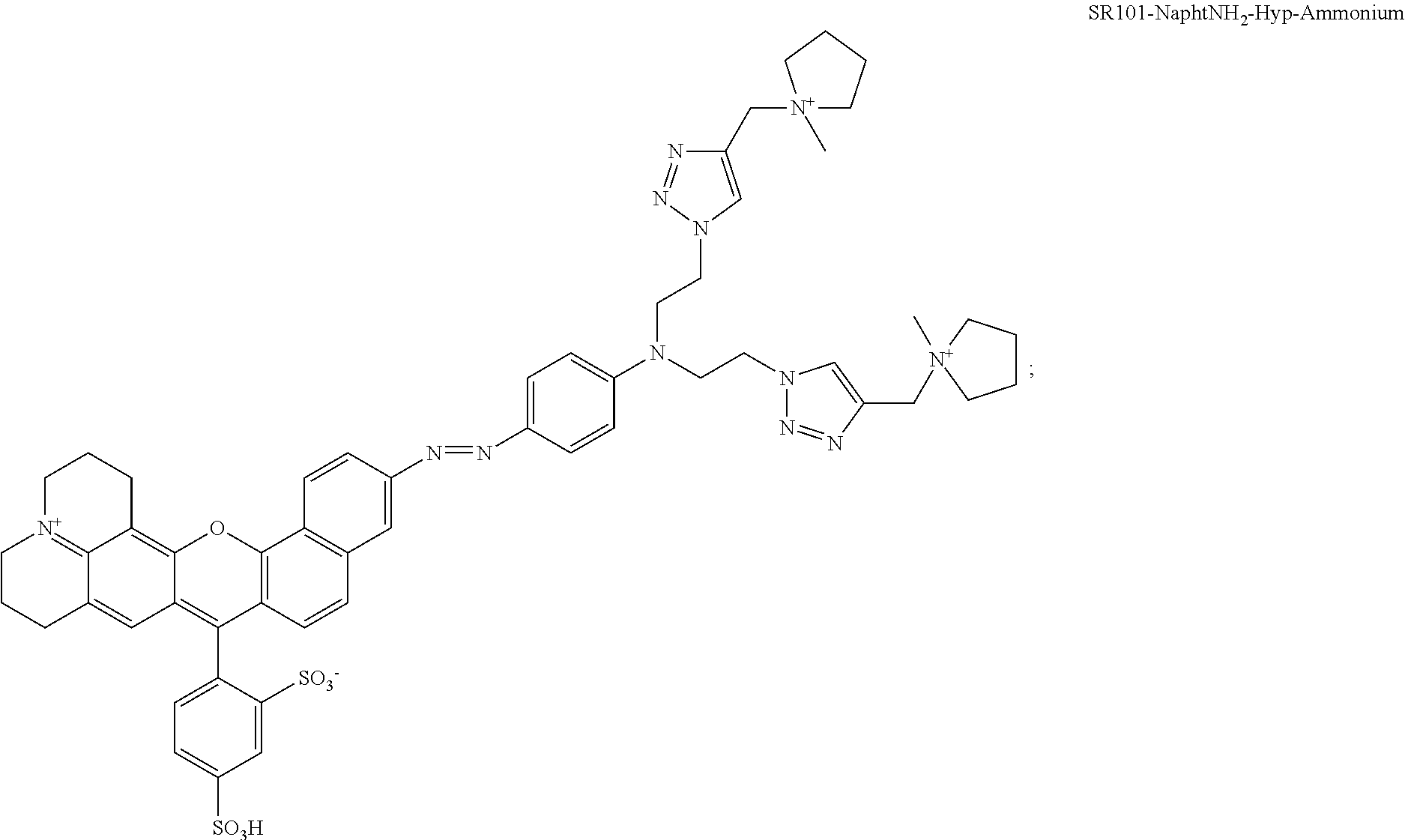


Applications Claiming Priority (3)
| Application Number | Priority Date | Filing Date | Title |
|---|---|---|---|
| JP2014238419A JP2016096801A (en) | 2014-11-26 | 2014-11-26 | Fluorescent production/fluorescent probe derivative derived from sulfoxanthene, and use thereof |
| JP2014238419 | 2014-11-26 | ||
| JP2014-238419 | 2014-11-26 |
Publications (2)
| Publication Number | Publication Date |
|---|---|
| US20160146814A1 US20160146814A1 (en) | 2016-05-26 |
| US9528990B2 true US9528990B2 (en) | 2016-12-27 |
Family
ID=56009948
Family Applications (1)
| Application Number | Title | Priority Date | Filing Date |
|---|---|---|---|
| US14/720,017 Active US9528990B2 (en) | 2014-11-26 | 2015-05-22 | Fluorogenic/fluorescent probes derivative from sulfoxanthene, and use thereof |
Country Status (2)
| Country | Link |
|---|---|
| US (1) | US9528990B2 (en) |
| JP (1) | JP2016096801A (en) |
Families Citing this family (3)
| Publication number | Priority date | Publication date | Assignee | Title |
|---|---|---|---|---|
| CN114621174B (en) * | 2022-03-15 | 2023-04-07 | 新乡学院 | Fluorescent probe for detecting peroxynitrite anion and preparation method and application thereof |
| CN115260209B (en) * | 2022-07-14 | 2023-04-11 | 郑州大学 | Fluorescent probe and application thereof in nitrite ion detection |
| CN119462678B (en) * | 2025-01-17 | 2025-05-13 | 安徽中医药大学 | Fluorescent probe for detecting metal palladium, fluorescent nanofiber membrane, and preparation method and application of fluorescent probe |
Citations (1)
| Publication number | Priority date | Publication date | Assignee | Title |
|---|---|---|---|---|
| US8828678B2 (en) * | 2010-11-16 | 2014-09-09 | Enzo Life Sciences, Inc. | Self-immolative probes for enzyme activity detection |
Family Cites Families (1)
| Publication number | Priority date | Publication date | Assignee | Title |
|---|---|---|---|---|
| FR2986010A1 (en) * | 2012-01-19 | 2013-07-26 | Biomerieux Sa | IN VITRO DETECTION OF MICROORGANISMS WITH AZOREDUCTASE ACTIVITY |
-
2014
- 2014-11-26 JP JP2014238419A patent/JP2016096801A/en active Pending
-
2015
- 2015-05-22 US US14/720,017 patent/US9528990B2/en active Active
Patent Citations (1)
| Publication number | Priority date | Publication date | Assignee | Title |
|---|---|---|---|---|
| US8828678B2 (en) * | 2010-11-16 | 2014-09-09 | Enzo Life Sciences, Inc. | Self-immolative probes for enzyme activity detection |
Also Published As
| Publication number | Publication date |
|---|---|
| JP2016096801A (en) | 2016-05-30 |
| US20160146814A1 (en) | 2016-05-26 |
Similar Documents
| Publication | Publication Date | Title |
|---|---|---|
| US9410958B2 (en) | Alkyne-activated fluorogenic azide compounds and methods of use thereof | |
| Feng et al. | Real-time identification of gut microbiota with aminopeptidase N using an activable NIR fluorescent probe | |
| EP1219628B1 (en) | Novel substrates for detection of microbial metabolites | |
| EP2111460A2 (en) | Medium for the detection and/or identification of bacteria | |
| US20160146814A1 (en) | Fluorogenic/Fluorescent Probes Derivative from Sulfoxanthene, and Use Thereof | |
| FR2912425A1 (en) | Detecting E. coli in biological samples comprises seeding sample on detection medium having tryptophan and enzyme A substrate and detecting colonies expressing enzyme activity and colonies that do not express enzyme activity by indole test | |
| CN104870651B (en) | Include the microorganism detection medium of at least one alkyl (thio) glucosides | |
| CN1226420C (en) | Alizarin-based chromogenic substrates | |
| EP2981619B1 (en) | Use of at least one chromogenic and/or fluorogenic phosphatase substrate for the detection and/or enumeration of enterobacteria in a sample | |
| Váradi et al. | A selective, dual emission β-alanine aminopeptidase activated fluorescent probe for the detection of pseudomonas aeruginosa, burkholderia cepacia, and serratia marcescens | |
| US8535903B2 (en) | Nitroreductase enzymatic substrates | |
| Wei et al. | Recent advances in glycosidase probes used in Escherichia Coli detection | |
| US8883437B2 (en) | Nitroreductase enzymatic substrates | |
| US8535901B2 (en) | Peptidase substrates | |
| US8592175B2 (en) | Nitroreductase enzymatic substrates | |
| EP2459734B1 (en) | Novel peptidase substrates | |
| CN104114712A (en) | In vitro detection of microorganisms with azoreductase activity | |
| Truong | Synthesis and Evaluation of Novel Enzymatic Substrates to Aid the Detection and Identification of Clinically Important Microorganisms | |
| Shipman et al. | Selective capture, isolation, and characterization of mucin foraging neu-raminidase-active bacteria from microbiomes using a non-inhibitory activ-ity-based probe | |
| Reed | Synthesis and characterisation of novel glycosidase substrates and evaluation of applications in biomedical science | |
| Schoonover | Development of bacterial oxidative stress assays: towards using fluorescence methods | |
| EP2459733A2 (en) | Novel peptidase substrates |
Legal Events
| Date | Code | Title | Description |
|---|---|---|---|
| AS | Assignment |
Owner name: CENTRE NATIONAL DE LA RECHERCHE SCIENTIFIQUE, FRAN Free format text: ASSIGNMENT OF ASSIGNORS INTEREST;ASSIGNORS:ORENGA, SYLVAIN;CHALANSONNET, VALERIE;CHEVALIER, ARNAUD;AND OTHERS;SIGNING DATES FROM 20150809 TO 20150902;REEL/FRAME:036766/0124 Owner name: BIOMERIEUX, S.A., FRANCE Free format text: ASSIGNMENT OF ASSIGNORS INTEREST;ASSIGNORS:ORENGA, SYLVAIN;CHALANSONNET, VALERIE;CHEVALIER, ARNAUD;AND OTHERS;SIGNING DATES FROM 20150809 TO 20150902;REEL/FRAME:036766/0124 Owner name: UNIVERSITE DE ROUEN, FRANCE Free format text: ASSIGNMENT OF ASSIGNORS INTEREST;ASSIGNORS:ORENGA, SYLVAIN;CHALANSONNET, VALERIE;CHEVALIER, ARNAUD;AND OTHERS;SIGNING DATES FROM 20150809 TO 20150902;REEL/FRAME:036766/0124 |
|
| STCF | Information on status: patent grant |
Free format text: PATENTED CASE |
|
| AS | Assignment |
Owner name: CENTRE NATIONAL DE LA RECHERCHE SCIENTIFIQUE, FRAN Free format text: ASSIGNMENT OF ASSIGNORS INTEREST;ASSIGNORS:BIOMERIEUX, S.A.;CENTRE NATIONAL DE LA RECHERCHE SCIENTIFIQUE;UNIVERSITE DE ROUEN;REEL/FRAME:051170/0478 Effective date: 20190930 Owner name: UNIVERSITE DE ROUEN, FRANCE Free format text: ASSIGNMENT OF ASSIGNORS INTEREST;ASSIGNORS:BIOMERIEUX, S.A.;CENTRE NATIONAL DE LA RECHERCHE SCIENTIFIQUE;UNIVERSITE DE ROUEN;REEL/FRAME:051170/0478 Effective date: 20190930 Owner name: BIOMERIEUX, S.A., FRANCE Free format text: ASSIGNMENT OF ASSIGNORS INTEREST;ASSIGNORS:BIOMERIEUX, S.A.;CENTRE NATIONAL DE LA RECHERCHE SCIENTIFIQUE;UNIVERSITE DE ROUEN;REEL/FRAME:051170/0478 Effective date: 20190930 Owner name: INSTITUT NATIONAL DES SCIENCES APPLIQUEES DE ROUEN Free format text: ASSIGNMENT OF ASSIGNORS INTEREST;ASSIGNORS:BIOMERIEUX, S.A.;CENTRE NATIONAL DE LA RECHERCHE SCIENTIFIQUE;UNIVERSITE DE ROUEN;REEL/FRAME:051170/0478 Effective date: 20190930 |
|
| MAFP | Maintenance fee payment |
Free format text: PAYMENT OF MAINTENANCE FEE, 4TH YEAR, LARGE ENTITY (ORIGINAL EVENT CODE: M1551); ENTITY STATUS OF PATENT OWNER: LARGE ENTITY Year of fee payment: 4 |