US9527744B2 - Method for manufacturing reduced graphene oxide using solid hydrazine derivative - Google Patents
Method for manufacturing reduced graphene oxide using solid hydrazine derivative Download PDFInfo
- Publication number
- US9527744B2 US9527744B2 US14/438,000 US201314438000A US9527744B2 US 9527744 B2 US9527744 B2 US 9527744B2 US 201314438000 A US201314438000 A US 201314438000A US 9527744 B2 US9527744 B2 US 9527744B2
- Authority
- US
- United States
- Prior art keywords
- graphene oxide
- carbons
- reduced graphene
- group
- reducing
- Prior art date
- Legal status (The legal status is an assumption and is not a legal conclusion. Google has not performed a legal analysis and makes no representation as to the accuracy of the status listed.)
- Expired - Fee Related, expires
Links
- OKTJSMMVPCPJKN-UHFFFAOYSA-N Carbon Chemical compound [C] OKTJSMMVPCPJKN-UHFFFAOYSA-N 0.000 title claims abstract description 204
- 229910021389 graphene Inorganic materials 0.000 title claims abstract description 191
- 238000000034 method Methods 0.000 title claims abstract description 43
- 239000007787 solid Substances 0.000 title claims abstract description 33
- 150000002429 hydrazines Chemical class 0.000 title claims abstract description 17
- 238000004519 manufacturing process Methods 0.000 title description 5
- 125000001931 aliphatic group Chemical group 0.000 claims description 43
- OAKJQQAXSVQMHS-UHFFFAOYSA-N Hydrazine Chemical compound NN OAKJQQAXSVQMHS-UHFFFAOYSA-N 0.000 claims description 37
- CURLTUGMZLYLDI-UHFFFAOYSA-N Carbon dioxide Chemical compound O=C=O CURLTUGMZLYLDI-UHFFFAOYSA-N 0.000 claims description 29
- 229910052760 oxygen Inorganic materials 0.000 claims description 29
- RTZKZFJDLAIYFH-UHFFFAOYSA-N Diethyl ether Chemical compound CCOCC RTZKZFJDLAIYFH-UHFFFAOYSA-N 0.000 claims description 26
- 229910052710 silicon Inorganic materials 0.000 claims description 24
- 229910052698 phosphorus Inorganic materials 0.000 claims description 23
- 239000000126 substance Substances 0.000 claims description 23
- 229910052717 sulfur Inorganic materials 0.000 claims description 23
- 125000003118 aryl group Chemical group 0.000 claims description 22
- 239000002904 solvent Substances 0.000 claims description 21
- 125000004122 cyclic group Chemical group 0.000 claims description 19
- 238000006243 chemical reaction Methods 0.000 claims description 15
- 229910002092 carbon dioxide Inorganic materials 0.000 claims description 14
- 125000006615 aromatic heterocyclic group Chemical group 0.000 claims description 13
- 239000001569 carbon dioxide Substances 0.000 claims description 13
- 239000003638 chemical reducing agent Substances 0.000 claims description 13
- IJGRMHOSHXDMSA-UHFFFAOYSA-N Atomic nitrogen Chemical compound N#N IJGRMHOSHXDMSA-UHFFFAOYSA-N 0.000 claims description 12
- LFQSCWFLJHTTHZ-UHFFFAOYSA-N Ethanol Chemical compound CCO LFQSCWFLJHTTHZ-UHFFFAOYSA-N 0.000 claims description 12
- 125000000623 heterocyclic group Chemical group 0.000 claims description 12
- -1 hydrazine derivative compound Chemical class 0.000 claims description 12
- 239000007789 gas Substances 0.000 claims description 11
- 229910052785 arsenic Inorganic materials 0.000 claims description 10
- 239000001257 hydrogen Substances 0.000 claims description 8
- 229910052739 hydrogen Inorganic materials 0.000 claims description 8
- XKRFYHLGVUSROY-UHFFFAOYSA-N Argon Chemical compound [Ar] XKRFYHLGVUSROY-UHFFFAOYSA-N 0.000 claims description 6
- QVGXLLKOCUKJST-UHFFFAOYSA-N atomic oxygen Chemical compound [O] QVGXLLKOCUKJST-UHFFFAOYSA-N 0.000 claims description 6
- 229910052757 nitrogen Inorganic materials 0.000 claims description 6
- 239000001301 oxygen Substances 0.000 claims description 6
- 238000010438 heat treatment Methods 0.000 claims description 5
- 125000004435 hydrogen atom Chemical group [H]* 0.000 claims description 5
- 238000005119 centrifugation Methods 0.000 claims description 4
- 229910052786 argon Inorganic materials 0.000 claims description 3
- 238000000227 grinding Methods 0.000 claims description 3
- 239000012046 mixed solvent Substances 0.000 claims description 3
- 239000010409 thin film Substances 0.000 claims description 3
- 239000010408 film Substances 0.000 claims description 2
- 238000003801 milling Methods 0.000 claims description 2
- 238000002156 mixing Methods 0.000 claims description 2
- 239000002002 slurry Substances 0.000 claims description 2
- 238000000859 sublimation Methods 0.000 claims 1
- 230000008022 sublimation Effects 0.000 claims 1
- 238000000921 elemental analysis Methods 0.000 description 24
- 238000002441 X-ray diffraction Methods 0.000 description 21
- OKKJLVBELUTLKV-UHFFFAOYSA-N Methanol Chemical compound OC OKKJLVBELUTLKV-UHFFFAOYSA-N 0.000 description 18
- OWIUPIRUAQMTTK-UHFFFAOYSA-N carbazic acid Chemical compound NNC(O)=O OWIUPIRUAQMTTK-UHFFFAOYSA-N 0.000 description 14
- 125000000217 alkyl group Chemical group 0.000 description 12
- 238000001228 spectrum Methods 0.000 description 11
- 230000008569 process Effects 0.000 description 9
- 125000001424 substituent group Chemical group 0.000 description 9
- 125000003710 aryl alkyl group Chemical group 0.000 description 8
- 229910002804 graphite Inorganic materials 0.000 description 7
- 239000010439 graphite Substances 0.000 description 7
- 125000001072 heteroaryl group Chemical group 0.000 description 7
- LYCAIKOWRPUZTN-UHFFFAOYSA-N Ethylene glycol Chemical compound OCCO LYCAIKOWRPUZTN-UHFFFAOYSA-N 0.000 description 6
- PEDCQBHIVMGVHV-UHFFFAOYSA-N Glycerine Chemical compound OCC(O)CO PEDCQBHIVMGVHV-UHFFFAOYSA-N 0.000 description 6
- 239000007788 liquid Substances 0.000 description 6
- 125000002496 methyl group Chemical group [H]C([H])([H])* 0.000 description 6
- 238000002360 preparation method Methods 0.000 description 6
- 238000006722 reduction reaction Methods 0.000 description 6
- 238000003756 stirring Methods 0.000 description 6
- 238000002411 thermogravimetry Methods 0.000 description 6
- 238000004566 IR spectroscopy Methods 0.000 description 5
- 239000003125 aqueous solvent Substances 0.000 description 5
- 229910052799 carbon Inorganic materials 0.000 description 5
- KBPLFHHGFOOTCA-UHFFFAOYSA-N 1-Octanol Chemical compound CCCCCCCCO KBPLFHHGFOOTCA-UHFFFAOYSA-N 0.000 description 4
- BBMCTIGTTCKYKF-UHFFFAOYSA-N 1-heptanol Chemical compound CCCCCCCO BBMCTIGTTCKYKF-UHFFFAOYSA-N 0.000 description 4
- LCGLNKUTAGEVQW-UHFFFAOYSA-N Dimethyl ether Chemical compound COC LCGLNKUTAGEVQW-UHFFFAOYSA-N 0.000 description 4
- KFZMGEQAYNKOFK-UHFFFAOYSA-N Isopropanol Chemical compound CC(C)O KFZMGEQAYNKOFK-UHFFFAOYSA-N 0.000 description 4
- LRHPLDYGYMQRHN-UHFFFAOYSA-N N-Butanol Chemical compound CCCCO LRHPLDYGYMQRHN-UHFFFAOYSA-N 0.000 description 4
- AMQJEAYHLZJPGS-UHFFFAOYSA-N N-Pentanol Chemical compound CCCCCO AMQJEAYHLZJPGS-UHFFFAOYSA-N 0.000 description 4
- DKGAVHZHDRPRBM-UHFFFAOYSA-N Tert-Butanol Chemical compound CC(C)(C)O DKGAVHZHDRPRBM-UHFFFAOYSA-N 0.000 description 4
- WYURNTSHIVDZCO-UHFFFAOYSA-N Tetrahydrofuran Chemical compound C1CCOC1 WYURNTSHIVDZCO-UHFFFAOYSA-N 0.000 description 4
- YXFVVABEGXRONW-UHFFFAOYSA-N Toluene Chemical compound CC1=CC=CC=C1 YXFVVABEGXRONW-UHFFFAOYSA-N 0.000 description 4
- 0 [1*]N([2*])N([H])C.[1*]N([2*])N([H])[H].[1*]N([2*])N([H])[H].[1*][N+]([2*])([H])N([H])C(C)=O Chemical compound [1*]N([2*])N([H])C.[1*]N([2*])N([H])[H].[1*]N([2*])N([H])[H].[1*][N+]([2*])([H])N([H])C(C)=O 0.000 description 4
- 125000003545 alkoxy group Chemical group 0.000 description 4
- 150000005347 biaryls Chemical group 0.000 description 4
- BTANRVKWQNVYAZ-UHFFFAOYSA-N butan-2-ol Chemical compound CCC(C)O BTANRVKWQNVYAZ-UHFFFAOYSA-N 0.000 description 4
- 125000004093 cyano group Chemical group *C#N 0.000 description 4
- MWKFXSUHUHTGQN-UHFFFAOYSA-N decan-1-ol Chemical compound CCCCCCCCCCO MWKFXSUHUHTGQN-UHFFFAOYSA-N 0.000 description 4
- 229960004132 diethyl ether Drugs 0.000 description 4
- LQZZUXJYWNFBMV-UHFFFAOYSA-N dodecan-1-ol Chemical compound CCCCCCCCCCCCO LQZZUXJYWNFBMV-UHFFFAOYSA-N 0.000 description 4
- 125000005843 halogen group Chemical group 0.000 description 4
- ZSIAUFGUXNUGDI-UHFFFAOYSA-N hexan-1-ol Chemical compound CCCCCCO ZSIAUFGUXNUGDI-UHFFFAOYSA-N 0.000 description 4
- 125000002887 hydroxy group Chemical group [H]O* 0.000 description 4
- ZXEKIIBDNHEJCQ-UHFFFAOYSA-N isobutanol Chemical compound CC(C)CO ZXEKIIBDNHEJCQ-UHFFFAOYSA-N 0.000 description 4
- 125000000449 nitro group Chemical group [O-][N+](*)=O 0.000 description 4
- ZWRUINPWMLAQRD-UHFFFAOYSA-N nonan-1-ol Chemical compound CCCCCCCCCO ZWRUINPWMLAQRD-UHFFFAOYSA-N 0.000 description 4
- REIUXOLGHVXAEO-UHFFFAOYSA-N pentadecan-1-ol Chemical compound CCCCCCCCCCCCCCCO REIUXOLGHVXAEO-UHFFFAOYSA-N 0.000 description 4
- 125000001997 phenyl group Chemical group [H]C1=C([H])C([H])=C(*)C([H])=C1[H] 0.000 description 4
- 230000009467 reduction Effects 0.000 description 4
- 238000003746 solid phase reaction Methods 0.000 description 4
- XLYOFNOQVPJJNP-UHFFFAOYSA-N water Substances O XLYOFNOQVPJJNP-UHFFFAOYSA-N 0.000 description 4
- FMMWHPNWAFZXNH-UHFFFAOYSA-N Benz[a]pyrene Chemical compound C1=C2C3=CC=CC=C3C=C(C=C3)C2=C2C3=CC=CC2=C1 FMMWHPNWAFZXNH-UHFFFAOYSA-N 0.000 description 3
- UFHFLCQGNIYNRP-UHFFFAOYSA-N Hydrogen Chemical compound [H][H] UFHFLCQGNIYNRP-UHFFFAOYSA-N 0.000 description 3
- 238000001237 Raman spectrum Methods 0.000 description 3
- 125000003342 alkenyl group Chemical group 0.000 description 3
- 229910052782 aluminium Inorganic materials 0.000 description 3
- XAGFODPZIPBFFR-UHFFFAOYSA-N aluminium Chemical compound [Al] XAGFODPZIPBFFR-UHFFFAOYSA-N 0.000 description 3
- 239000010407 anodic oxide Substances 0.000 description 3
- 230000000052 comparative effect Effects 0.000 description 3
- 150000001875 compounds Chemical class 0.000 description 3
- GVEPBJHOBDJJJI-UHFFFAOYSA-N fluoranthene Chemical compound C1=CC(C2=CC=CC=C22)=C3C2=CC=CC3=C1 GVEPBJHOBDJJJI-UHFFFAOYSA-N 0.000 description 3
- 239000000843 powder Substances 0.000 description 3
- QLBFDRTZORJYCV-UHFFFAOYSA-N (2-hydroxyethylamino)carbamic acid Chemical compound OCCNNC(O)=O QLBFDRTZORJYCV-UHFFFAOYSA-N 0.000 description 2
- NWZSZGALRFJKBT-KNIFDHDWSA-N (2s)-2,6-diaminohexanoic acid;(2s)-2-hydroxybutanedioic acid Chemical compound OC(=O)[C@@H](O)CC(O)=O.NCCCC[C@H](N)C(O)=O NWZSZGALRFJKBT-KNIFDHDWSA-N 0.000 description 2
- 125000000008 (C1-C10) alkyl group Chemical group 0.000 description 2
- RHUYHJGZWVXEHW-UHFFFAOYSA-N 1,1-Dimethyhydrazine Chemical compound CN(C)N RHUYHJGZWVXEHW-UHFFFAOYSA-N 0.000 description 2
- HGUFODBRKLSHSI-UHFFFAOYSA-N 2,3,7,8-tetrachloro-dibenzo-p-dioxin Chemical compound O1C2=CC(Cl)=C(Cl)C=C2OC2=C1C=C(Cl)C(Cl)=C2 HGUFODBRKLSHSI-UHFFFAOYSA-N 0.000 description 2
- MSXVEPNJUHWQHW-UHFFFAOYSA-N 2-methylbutan-2-ol Chemical compound CCC(C)(C)O MSXVEPNJUHWQHW-UHFFFAOYSA-N 0.000 description 2
- FBPFZTCFMRRESA-KVTDHHQDSA-N D-Mannitol Chemical compound OC[C@@H](O)[C@@H](O)[C@H](O)[C@H](O)CO FBPFZTCFMRRESA-KVTDHHQDSA-N 0.000 description 2
- 239000004386 Erythritol Substances 0.000 description 2
- UNXHWFMMPAWVPI-UHFFFAOYSA-N Erythritol Natural products OCC(O)C(O)CO UNXHWFMMPAWVPI-UHFFFAOYSA-N 0.000 description 2
- 229930195725 Mannitol Natural products 0.000 description 2
- UFWIBTONFRDIAS-UHFFFAOYSA-N Naphthalene Chemical compound C1=CC=CC2=CC=CC=C21 UFWIBTONFRDIAS-UHFFFAOYSA-N 0.000 description 2
- OFBQJSOFQDEBGM-UHFFFAOYSA-N Pentane Chemical compound CCCCC OFBQJSOFQDEBGM-UHFFFAOYSA-N 0.000 description 2
- 238000001069 Raman spectroscopy Methods 0.000 description 2
- TVXBFESIOXBWNM-UHFFFAOYSA-N Xylitol Natural products OCCC(O)C(O)C(O)CCO TVXBFESIOXBWNM-UHFFFAOYSA-N 0.000 description 2
- BWZGYUDPHQDBOE-UHFFFAOYSA-N [(pyridin-2-ylamino)azaniumyl]formate Chemical compound OC(=O)NNC1=CC=CC=N1 BWZGYUDPHQDBOE-UHFFFAOYSA-N 0.000 description 2
- CWRYPZZKDGJXCA-UHFFFAOYSA-N acenaphthalene Natural products C1=CC(CC2)=C3C2=CC=CC3=C1 CWRYPZZKDGJXCA-UHFFFAOYSA-N 0.000 description 2
- HXGDTGSAIMULJN-UHFFFAOYSA-N acenaphthylene Chemical compound C1=CC(C=C2)=C3C2=CC=CC3=C1 HXGDTGSAIMULJN-UHFFFAOYSA-N 0.000 description 2
- 150000001338 aliphatic hydrocarbons Chemical class 0.000 description 2
- HDZGCSFEDULWCS-UHFFFAOYSA-O amino(methyl)azanium Chemical compound CN[NH3+] HDZGCSFEDULWCS-UHFFFAOYSA-O 0.000 description 2
- 238000004458 analytical method Methods 0.000 description 2
- MWPLVEDNUUSJAV-UHFFFAOYSA-N anthracene Chemical compound C1=CC=CC2=CC3=CC=CC=C3C=C21 MWPLVEDNUUSJAV-UHFFFAOYSA-N 0.000 description 2
- 239000007864 aqueous solution Substances 0.000 description 2
- 230000008901 benefit Effects 0.000 description 2
- FTOVXSOBNPWTSH-UHFFFAOYSA-N benzo[b]fluoranthene Chemical compound C12=CC=CC=C1C1=CC3=CC=CC=C3C3=C1C2=CC=C3 FTOVXSOBNPWTSH-UHFFFAOYSA-N 0.000 description 2
- TXVHTIQJNYSSKO-UHFFFAOYSA-N benzo[e]pyrene Chemical compound C1=CC=C2C3=CC=CC=C3C3=CC=CC4=CC=C1C2=C34 TXVHTIQJNYSSKO-UHFFFAOYSA-N 0.000 description 2
- 235000011089 carbon dioxide Nutrition 0.000 description 2
- 239000003054 catalyst Substances 0.000 description 2
- 238000005229 chemical vapour deposition Methods 0.000 description 2
- WDECIBYCCFPHNR-UHFFFAOYSA-N chrysene Chemical compound C1=CC=CC2=CC=C3C4=CC=CC=C4C=CC3=C21 WDECIBYCCFPHNR-UHFFFAOYSA-N 0.000 description 2
- 230000000694 effects Effects 0.000 description 2
- 238000005516 engineering process Methods 0.000 description 2
- UNXHWFMMPAWVPI-ZXZARUISSA-N erythritol Chemical compound OC[C@H](O)[C@H](O)CO UNXHWFMMPAWVPI-ZXZARUISSA-N 0.000 description 2
- 235000019414 erythritol Nutrition 0.000 description 2
- 229940009714 erythritol Drugs 0.000 description 2
- 229940093476 ethylene glycol Drugs 0.000 description 2
- NIHNNTQXNPWCJQ-UHFFFAOYSA-N fluorene Chemical compound C1=CC=C2CC3=CC=CC=C3C2=C1 NIHNNTQXNPWCJQ-UHFFFAOYSA-N 0.000 description 2
- 239000011521 glass Substances 0.000 description 2
- 229960005150 glycerol Drugs 0.000 description 2
- 235000011187 glycerol Nutrition 0.000 description 2
- 125000005842 heteroatom Chemical group 0.000 description 2
- IKDUDTNKRLTJSI-UHFFFAOYSA-N hydrazine monohydrate Substances O.NN IKDUDTNKRLTJSI-UHFFFAOYSA-N 0.000 description 2
- 150000002430 hydrocarbons Chemical group 0.000 description 2
- 239000012535 impurity Substances 0.000 description 2
- 238000002329 infrared spectrum Methods 0.000 description 2
- PHTQWCKDNZKARW-UHFFFAOYSA-N isoamylol Chemical compound CC(C)CCO PHTQWCKDNZKARW-UHFFFAOYSA-N 0.000 description 2
- 239000000594 mannitol Substances 0.000 description 2
- 235000010355 mannitol Nutrition 0.000 description 2
- 229960001855 mannitol Drugs 0.000 description 2
- 238000010297 mechanical methods and process Methods 0.000 description 2
- HEBKCHPVOIAQTA-UHFFFAOYSA-N meso ribitol Natural products OCC(O)C(O)C(O)CO HEBKCHPVOIAQTA-UHFFFAOYSA-N 0.000 description 2
- VNWKTOKETHGBQD-UHFFFAOYSA-N methane Chemical compound C VNWKTOKETHGBQD-UHFFFAOYSA-N 0.000 description 2
- 239000011812 mixed powder Substances 0.000 description 2
- 238000012986 modification Methods 0.000 description 2
- 230000004048 modification Effects 0.000 description 2
- 239000004570 mortar (masonry) Substances 0.000 description 2
- 230000003287 optical effect Effects 0.000 description 2
- JYVLIDXNZAXMDK-UHFFFAOYSA-N pentan-2-ol Chemical compound CCCC(C)O JYVLIDXNZAXMDK-UHFFFAOYSA-N 0.000 description 2
- YNPNZTXNASCQKK-UHFFFAOYSA-N phenanthrene Chemical compound C1=CC=C2C3=CC=CC=C3C=CC2=C1 YNPNZTXNASCQKK-UHFFFAOYSA-N 0.000 description 2
- HKOOXMFOFWEVGF-UHFFFAOYSA-N phenylhydrazine Chemical compound NNC1=CC=CC=C1 HKOOXMFOFWEVGF-UHFFFAOYSA-N 0.000 description 2
- 230000000704 physical effect Effects 0.000 description 2
- 229920005862 polyol Polymers 0.000 description 2
- 150000003077 polyols Chemical class 0.000 description 2
- 239000012286 potassium permanganate Substances 0.000 description 2
- BDERNNFJNOPAEC-UHFFFAOYSA-N propan-1-ol Chemical compound CCCO BDERNNFJNOPAEC-UHFFFAOYSA-N 0.000 description 2
- BBEAQIROQSPTKN-UHFFFAOYSA-N pyrene Chemical compound C1=CC=C2C=CC3=CC=CC4=CC=C1C2=C43 BBEAQIROQSPTKN-UHFFFAOYSA-N 0.000 description 2
- 239000002356 single layer Substances 0.000 description 2
- 239000000243 solution Substances 0.000 description 2
- 239000000758 substrate Substances 0.000 description 2
- 230000002194 synthesizing effect Effects 0.000 description 2
- KJIOQYGWTQBHNH-UHFFFAOYSA-N undecanol Chemical compound CCCCCCCCCCCO KJIOQYGWTQBHNH-UHFFFAOYSA-N 0.000 description 2
- 125000000391 vinyl group Chemical group [H]C([*])=C([H])[H] 0.000 description 2
- 239000000811 xylitol Substances 0.000 description 2
- HEBKCHPVOIAQTA-SCDXWVJYSA-N xylitol Chemical compound OC[C@H](O)[C@@H](O)[C@H](O)CO HEBKCHPVOIAQTA-SCDXWVJYSA-N 0.000 description 2
- 235000010447 xylitol Nutrition 0.000 description 2
- 229960002675 xylitol Drugs 0.000 description 2
- 125000006273 (C1-C3) alkyl group Chemical group 0.000 description 1
- MWOODERJGVWYJE-UHFFFAOYSA-N 1-methyl-1-phenylhydrazine Chemical compound CN(N)C1=CC=CC=C1 MWOODERJGVWYJE-UHFFFAOYSA-N 0.000 description 1
- 125000003903 2-propenyl group Chemical group [H]C([*])([H])C([H])=C([H])[H] 0.000 description 1
- DFRJQXMMQAYBAZ-UHFFFAOYSA-N CNC.CN(C)N Chemical compound CNC.CN(C)N DFRJQXMMQAYBAZ-UHFFFAOYSA-N 0.000 description 1
- RYGMFSIKBFXOCR-UHFFFAOYSA-N Copper Chemical compound [Cu] RYGMFSIKBFXOCR-UHFFFAOYSA-N 0.000 description 1
- 229910017852 NH2NH2 Inorganic materials 0.000 description 1
- 229910000831 Steel Inorganic materials 0.000 description 1
- QAOWNCQODCNURD-UHFFFAOYSA-N Sulfuric acid Chemical compound OS(O)(=O)=O QAOWNCQODCNURD-UHFFFAOYSA-N 0.000 description 1
- 239000002250 absorbent Substances 0.000 description 1
- 230000002745 absorbent Effects 0.000 description 1
- 239000003929 acidic solution Substances 0.000 description 1
- 230000002730 additional effect Effects 0.000 description 1
- 125000000304 alkynyl group Chemical group 0.000 description 1
- 239000012298 atmosphere Substances 0.000 description 1
- 125000005605 benzo group Chemical group 0.000 description 1
- 125000004369 butenyl group Chemical group C(=CCC)* 0.000 description 1
- 230000008859 change Effects 0.000 description 1
- 239000002800 charge carrier Substances 0.000 description 1
- 229910052802 copper Inorganic materials 0.000 description 1
- 239000010949 copper Substances 0.000 description 1
- 230000008878 coupling Effects 0.000 description 1
- 238000010168 coupling process Methods 0.000 description 1
- 238000005859 coupling reaction Methods 0.000 description 1
- 230000003247 decreasing effect Effects 0.000 description 1
- 125000002704 decyl group Chemical group [H]C([H])([H])C([H])([H])C([H])([H])C([H])([H])C([H])([H])C([H])([H])C([H])([H])C([H])([H])C([H])([H])C([H])([H])* 0.000 description 1
- 230000007547 defect Effects 0.000 description 1
- 230000006866 deterioration Effects 0.000 description 1
- 229910003460 diamond Inorganic materials 0.000 description 1
- 239000010432 diamond Substances 0.000 description 1
- 239000003344 environmental pollutant Substances 0.000 description 1
- 125000001495 ethyl group Chemical group [H]C([H])([H])C([H])([H])* 0.000 description 1
- 125000003187 heptyl group Chemical group [H]C([*])([H])C([H])([H])C([H])([H])C([H])([H])C([H])([H])C([H])([H])C([H])([H])[H] 0.000 description 1
- 125000004051 hexyl group Chemical group [H]C([H])([H])C([H])([H])C([H])([H])C([H])([H])C([H])([H])C([H])([H])* 0.000 description 1
- 239000000976 ink Substances 0.000 description 1
- 125000000959 isobutyl group Chemical group [H]C([H])([H])C([H])(C([H])([H])[H])C([H])([H])* 0.000 description 1
- 125000000555 isopropenyl group Chemical group [H]\C([H])=C(\*)C([H])([H])[H] 0.000 description 1
- 125000001449 isopropyl group Chemical group [H]C([H])([H])C([H])(*)C([H])([H])[H] 0.000 description 1
- 238000002372 labelling Methods 0.000 description 1
- 239000010410 layer Substances 0.000 description 1
- 125000002960 margaryl group Chemical group [H]C([*])([H])C([H])([H])C([H])([H])C([H])([H])C([H])([H])C([H])([H])C([H])([H])C([H])([H])C([H])([H])C([H])([H])C([H])([H])C([H])([H])C([H])([H])C([H])([H])C([H])([H])C([H])([H])C([H])([H])[H] 0.000 description 1
- 229910052751 metal Inorganic materials 0.000 description 1
- 239000002184 metal Substances 0.000 description 1
- CSJDCSCTVDEHRN-UHFFFAOYSA-N methane;molecular oxygen Chemical compound C.O=O CSJDCSCTVDEHRN-UHFFFAOYSA-N 0.000 description 1
- 239000000203 mixture Substances 0.000 description 1
- 125000002950 monocyclic group Chemical group 0.000 description 1
- XZYCZGSFHJJQKL-UHFFFAOYSA-N n-(dimethylamino)carbamate;dimethylazanium Chemical compound C[NH2+]C.CN(C)NC([O-])=O XZYCZGSFHJJQKL-UHFFFAOYSA-N 0.000 description 1
- 125000001400 nonyl group Chemical group [H]C([*])([H])C([H])([H])C([H])([H])C([H])([H])C([H])([H])C([H])([H])C([H])([H])C([H])([H])C([H])([H])[H] 0.000 description 1
- 125000002347 octyl group Chemical group [H]C([*])([H])C([H])([H])C([H])([H])C([H])([H])C([H])([H])C([H])([H])C([H])([H])C([H])([H])[H] 0.000 description 1
- 239000007800 oxidant agent Substances 0.000 description 1
- 230000001590 oxidative effect Effects 0.000 description 1
- 125000002958 pentadecyl group Chemical group [H]C([*])([H])C([H])([H])C([H])([H])C([H])([H])C([H])([H])C([H])([H])C([H])([H])C([H])([H])C([H])([H])C([H])([H])C([H])([H])C([H])([H])C([H])([H])C([H])([H])C([H])([H])[H] 0.000 description 1
- 125000001147 pentyl group Chemical group C(CCCC)* 0.000 description 1
- 125000003367 polycyclic group Chemical group 0.000 description 1
- 239000011148 porous material Substances 0.000 description 1
- 125000004368 propenyl group Chemical group C(=CC)* 0.000 description 1
- 125000001436 propyl group Chemical group [H]C([*])([H])C([H])([H])C([H])([H])[H] 0.000 description 1
- 239000012217 radiopharmaceutical Substances 0.000 description 1
- 229940121896 radiopharmaceutical Drugs 0.000 description 1
- 230000002799 radiopharmaceutical effect Effects 0.000 description 1
- 230000035484 reaction time Effects 0.000 description 1
- 229920006395 saturated elastomer Polymers 0.000 description 1
- 229930195734 saturated hydrocarbon Natural products 0.000 description 1
- 125000002914 sec-butyl group Chemical group [H]C([H])([H])C([H])([H])C([H])(*)C([H])([H])[H] 0.000 description 1
- 238000000926 separation method Methods 0.000 description 1
- 239000010703 silicon Substances 0.000 description 1
- 239000012279 sodium borohydride Substances 0.000 description 1
- 229910000033 sodium borohydride Inorganic materials 0.000 description 1
- 239000010959 steel Substances 0.000 description 1
- 238000006467 substitution reaction Methods 0.000 description 1
- 125000000999 tert-butyl group Chemical group [H]C([H])([H])C(*)(C([H])([H])[H])C([H])([H])[H] 0.000 description 1
- 125000002889 tridecyl group Chemical group [H]C([*])([H])C([H])([H])C([H])([H])C([H])([H])C([H])([H])C([H])([H])C([H])([H])C([H])([H])C([H])([H])C([H])([H])C([H])([H])C([H])([H])C([H])([H])[H] 0.000 description 1
- 125000002948 undecyl group Chemical group [H]C([*])([H])C([H])([H])C([H])([H])C([H])([H])C([H])([H])C([H])([H])C([H])([H])C([H])([H])C([H])([H])C([H])([H])C([H])([H])[H] 0.000 description 1
- 229930195735 unsaturated hydrocarbon Natural products 0.000 description 1
- 229920002554 vinyl polymer Polymers 0.000 description 1
Images


Classifications
-
- C01B31/0446—
-
- C—CHEMISTRY; METALLURGY
- C01—INORGANIC CHEMISTRY
- C01B—NON-METALLIC ELEMENTS; COMPOUNDS THEREOF; METALLOIDS OR COMPOUNDS THEREOF NOT COVERED BY SUBCLASS C01C
- C01B32/00—Carbon; Compounds thereof
- C01B32/20—Graphite
- C01B32/21—After-treatment
- C01B32/23—Oxidation
-
- C—CHEMISTRY; METALLURGY
- C01—INORGANIC CHEMISTRY
- C01B—NON-METALLIC ELEMENTS; COMPOUNDS THEREOF; METALLOIDS OR COMPOUNDS THEREOF NOT COVERED BY SUBCLASS C01C
- C01B32/00—Carbon; Compounds thereof
- C01B32/15—Nano-sized carbon materials
- C01B32/182—Graphene
- C01B32/184—Preparation
-
- C01B31/0438—
-
- C—CHEMISTRY; METALLURGY
- C01—INORGANIC CHEMISTRY
- C01B—NON-METALLIC ELEMENTS; COMPOUNDS THEREOF; METALLOIDS OR COMPOUNDS THEREOF NOT COVERED BY SUBCLASS C01C
- C01B32/00—Carbon; Compounds thereof
- C01B32/15—Nano-sized carbon materials
- C01B32/182—Graphene
- C01B32/198—Graphene oxide
-
- C—CHEMISTRY; METALLURGY
- C07—ORGANIC CHEMISTRY
- C07C—ACYCLIC OR CARBOCYCLIC COMPOUNDS
- C07C243/00—Compounds containing chains of nitrogen atoms singly-bound to each other, e.g. hydrazines, triazanes
- C07C243/10—Hydrazines
-
- B—PERFORMING OPERATIONS; TRANSPORTING
- B82—NANOTECHNOLOGY
- B82Y—SPECIFIC USES OR APPLICATIONS OF NANOSTRUCTURES; MEASUREMENT OR ANALYSIS OF NANOSTRUCTURES; MANUFACTURE OR TREATMENT OF NANOSTRUCTURES
- B82Y40/00—Manufacture or treatment of nanostructures
-
- Y—GENERAL TAGGING OF NEW TECHNOLOGICAL DEVELOPMENTS; GENERAL TAGGING OF CROSS-SECTIONAL TECHNOLOGIES SPANNING OVER SEVERAL SECTIONS OF THE IPC; TECHNICAL SUBJECTS COVERED BY FORMER USPC CROSS-REFERENCE ART COLLECTIONS [XRACs] AND DIGESTS
- Y10—TECHNICAL SUBJECTS COVERED BY FORMER USPC
- Y10S—TECHNICAL SUBJECTS COVERED BY FORMER USPC CROSS-REFERENCE ART COLLECTIONS [XRACs] AND DIGESTS
- Y10S977/00—Nanotechnology
- Y10S977/70—Nanostructure
- Y10S977/734—Fullerenes, i.e. graphene-based structures, such as nanohorns, nanococoons, nanoscrolls or fullerene-like structures, e.g. WS2 or MoS2 chalcogenide nanotubes, planar C3N4, etc.
-
- Y—GENERAL TAGGING OF NEW TECHNOLOGICAL DEVELOPMENTS; GENERAL TAGGING OF CROSS-SECTIONAL TECHNOLOGIES SPANNING OVER SEVERAL SECTIONS OF THE IPC; TECHNICAL SUBJECTS COVERED BY FORMER USPC CROSS-REFERENCE ART COLLECTIONS [XRACs] AND DIGESTS
- Y10—TECHNICAL SUBJECTS COVERED BY FORMER USPC
- Y10S—TECHNICAL SUBJECTS COVERED BY FORMER USPC CROSS-REFERENCE ART COLLECTIONS [XRACs] AND DIGESTS
- Y10S977/00—Nanotechnology
- Y10S977/84—Manufacture, treatment, or detection of nanostructure
- Y10S977/842—Manufacture, treatment, or detection of nanostructure for carbon nanotubes or fullerenes
Definitions
- the present invention relates to a method for preparing reduced graphene oxide from graphene oxide using a solid hydrazine derivative.
- Graphene purely consists of carbon and has an aligned hexagonal structure formed into a honeycomb shape similar to graphite.
- graphene is formed of a monoatomic layer and thus basically has a big difference in physical property from graphite having a layered structure formed by layering numerous sheets of graphene.
- graphene behaves like Dirac fermions with a zero effective mass and is transparent enough to transmit more than 98% of light; it is about 200 times stronger than steel, two or more times higher in thermal conductivity than diamond, higher in electrical conductivity than copper, and higher in charge carrier mobility than silicon.
- Graphene has been expected to be widely applied to flexible displays, transparent electrodes, solar cells, etc. due to its excellent optical, mechanical, and electrical properties. Therefore, a lot of studies on the method for mass-producing graphene, the method for improving electrical conductivity, etc. have been conducted.
- the chemical vapor deposition method has advantages in that it is suitable for mass production and can obtain a relatively high-quality multilayer graphene thin film, but has a disadvantage in that graphene is grown only on a specific metal used as a catalyst and the grown graphene needs to be transferred to another substrate.
- graphite is oxidized in an acidic solution with addition of a strong oxidizer such as KMnO 4 or H 2 O 2 to produce graphene oxide containing oxygen, and then, reduced graphene oxide is prepared through a solution process of adding a reducing agent such as hydrazine (NH 2 NH 2 ) or NaBH 4 or a heat treatment in a vacuum or in a hydrogen atmosphere.
- the chemical method is relatively easily performed and economical, and, thus, can produce reduced graphene oxide which can be applied in various ways.
- the chemical method has a disadvantage in that graphene loses its own optical and electrical properties due to defects and nitrogen doping, etc., and, thus, cannot exhibit all of its properties. Nonetheless, studies on the process for preparing reduced graphene oxide have been continuously conducted. This is because reduced graphene oxide has enough properties to be applied to various fields such as electrodes, conductive inks, catalyst supports, etc.
- a method using a liquid hydrazine is suitable for mass production and enables a graphene surface to be easily functionalized and also readily produces relatively high-purity graphene without metallic impurities.
- a method using a liquid hydrazine is suitable for mass production and enables a graphene surface to be easily functionalized and also readily produces relatively high-purity graphene without metallic impurities.
- the reduced graphene oxide prepared using liquid hydrazine has a low carbon-oxygen atomic ratio of about 10 due to water contained during the process and also has a low conductivity due to a high content of nitrogen.
- the chemical reduction methods using hydrazine includes a solution process using a solvent containing water, and, thus, an additional dehydrating and solvent-removing process such as a high-temperature heat treatment are required. Due to that a small amount of moisture remains in the reduced graphene oxide despite of such an additional process, its durability is decreased and also, its conductivity becomes lower than that of graphene.
- one purpose of the present disclosure is to provide a method for preparing a high-conductivity reduced graphene oxide from graphene oxide using a stable and highly reactive solid hydrazine derivative in a dry condition without moisture.
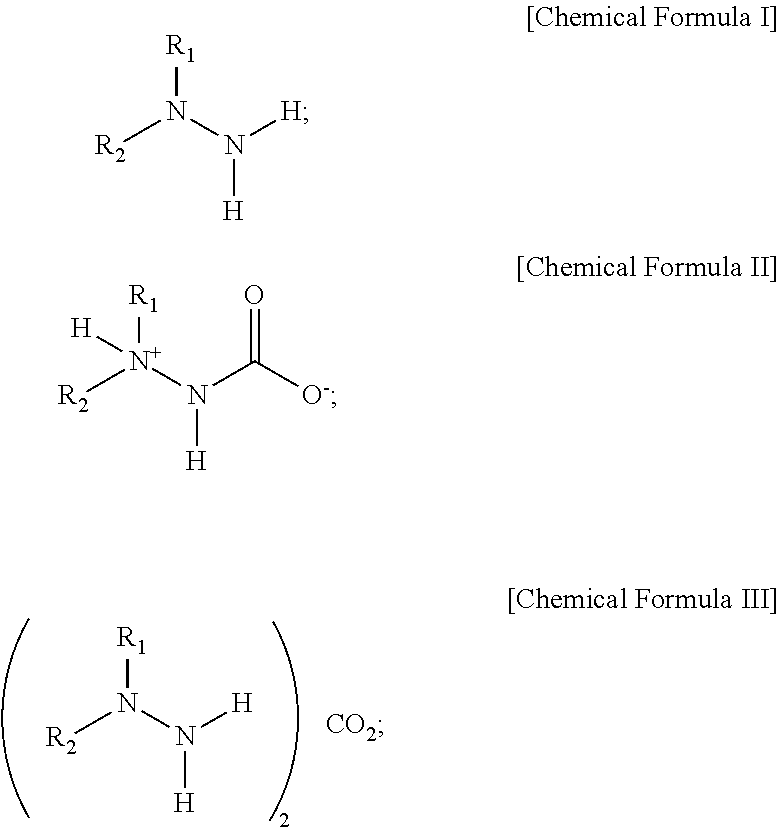
- a method for preparing a reduced graphene oxide including: reducing a graphene oxide using, as a reducing agent, a solid hydrazine derivative compound represented by the following Chemical Formula II or Chemical Formula III that is generated from a reaction between a hydrazine represented by the following Chemical Formula I or its derivative with carbon dioxide:
- the reduced graphene oxide that is prepared via solid-phase reaction by reacting graphene oxide with a stable and highly reactive solid hydrazine derivative in a dry condition without moisture contains a very small amount of impurity, has a high conductivity, and contains almost no moisture, resulting in an effect of minimizing deterioration in a physical property caused by moisture. Further, there is provided an additional effect in that a process for synthesizing reduced graphene oxide is very simple and it is a highly eco-friendly without producing environmental pollutants and highly economical process.
- graphene oxide powder and solid hydrazine derivative powder are subject to a solid-phase reaction by grinding those without using a solvent to prepare reduced graphene oxide. Therefore, an additional separation process is not needed, and reduced graphene oxide having a high purity and high conductivity can be prepared.
- FIG. 1A shows an XRD (X-ray diffraction) spectrum of graphene oxide in accordance with an example of the present disclosure.
- FIG. 1B shows an XRD (X-ray diffraction) spectrum of reduced graphene oxide in accordance with an example of the present disclosure.
- FIG. 2 shows a Raman spectrum of reduced graphene oxide in accordance with an example of the present disclosure.
- FIG. 3 shows an IR (infra-red spectroscopy) spectrum of reduced graphene oxide in accordance with an example of the present disclosure.
- a peak at a wave number of around 2300 is a peak of carbon dioxide.
- FIG. 4 shows TGA (thermogravimetric analysis) data of graphene oxide and reduced graphene oxide in accordance with an example of the present disclosure.
- FIG. 5 shows a Raman spectrum of reduced graphene oxide in accordance with an example of the present disclosure.
- FIG. 6 shows an IR spectrum of reduced graphene oxide in accordance with an example of the present disclosure.
- a peak at a wave number of around 2300 is a peak of carbon dioxide.
- FIG. 7 shows TGA data of graphene oxide, reduced graphene oxide, and graphite in accordance with an example of the present disclosure.
- FIG. 8 shows an I/V (current/voltage) curve of reduced graphene oxide in accordance with an example of the present disclosure.
- FIG. 9 shows an XRD spectrum of reduced graphene oxide in accordance with an example of the present disclosure.
- FIG. 10 shows an XRD spectrum of reduced graphene oxide in accordance with an example of the present disclosure.
- FIG. 11 shows a Raman spectrum of reduced graphene oxide in accordance with an example of the present disclosure.
- FIG. 12 shows an IR spectrum of reduced graphene oxide in accordance with an example of the present disclosure.
- a peak at a wave number of around 2300 is a peak of carbon dioxide.
- FIG. 13 shows an XRD spectrum of reduced graphene oxide in accordance with an example of the present disclosure.
- FIG. 14A shows an XRD spectrum of reduced graphene oxide prepared using 2-methyl hydrazinium carboxylate in accordance with an example of the present disclosure.
- FIG. 14B shows an XRD spectrum of reduced graphene oxide prepared using dimethylammonium 2,2-dimethyl hydrazine carboxylate in accordance with an example of the present disclosure.
- FIG. 14C shows an XRD spectrum of reduced graphene oxide prepared using 2-phenyl hydrazinium carboxylate in accordance with an example of the present disclosure.
- FIG. 14D shows an XRD spectrum of reduced graphene oxide prepared using 2-(pyridin-2-yl)hydrazinium carboxylate in accordance with an example of the present disclosure.
- FIG. 14E shows an XRD spectrum of reduced graphene oxide prepared using 2-(2-hydroxyethyl)hydrazinium carboxylate in accordance with an example of the present disclosure
- connection or coupling that is used to designate a connection or coupling of one element to another element includes both a case that an element is “directly connected or coupled to” another element and a case that an element is “electronically connected or coupled to” another element via still another element.
- the term “on” that is used to designate a position of one element with respect to another element includes both a case that the one element is adjacent to the another element and a case that any other element exists between these two elements.
- the term “comprises or includes” and/or “comprising or including” used in the document means that one or more other components, steps, operation and/or existence or addition of elements are not excluded in addition to the described components, steps, operation and/or elements unless context dictates otherwise.
- the term “about or approximately” or “substantially” is intended to have meanings close to numerical values or ranges specified with an allowable error and intended to prevent accurate or absolute numerical values disclosed for understanding of the present disclosure from being illegally or unfairly used by any unconscionable third party.
- the term “step of” does not mean “step for”.
- an alkyl means a straight- or branched, non-substituted or substituted saturated hydrocarbon group having 1 to 30 carbons, for example, 1 to 20, 1 to 10, or 1 to 5 carbons, and may include, for example, methyl, ethyl, propyl, isopropyl, isobutyl, sec butyl, tert butyl, pentyl, hexyl, heptyl, octyl, nonyl, decyl, undecyl, tridecyl, pentadecyl, heptadecyl, and the like.
- C 1 -C 10 alkyl means an alkyl group having an alkyl unit of 1 to 10 carbons, and does not include the number of carbons of a substituent when the C 1 -C 10 alkyl is substituted.
- an aliphatic hydrocarbon may be saturated or unsaturated aliphatic hydrocarbon, and may include, for example, but not limited to, an alkyl, an alkenyl, an alkynyl, and the like.
- an alkenyl means a straight- or branched non-substituted or substituted unsaturated hydrocarbon group having a designated number of carbons, for example, 2 to 30, 2 to 20, 2 to 10, or 2 to 5 carbons, and may include, for example, but not limited to, ethenyl, vinyl, propenyl, allyl, isopropenyl, butenyl, isobutenyl, t-butenyl, n-pentenyl and n-hexenyl.
- an aromatic cycle or substituted aromatic heterocycle may include, for example, but not limited to, an aryl compound, hetero aryl, aryl alkyl, a fused aryl group, and the like.
- an aryl means an overall or partially unsaturated, substituted or non-substituted monocyclic or polycyclic carbocycle.
- C 6 -C 30 aryl means an aryl group having a carbocyclic atom of 6 to 30 carbons, and does not include the number of carbons of a substituent when the C 6 -C 30 aryl is substituted.
- an aryl is monoaryl or biaryl. The monoaryl desirably has 5 to 6 carbons, and the biaryl desirably has 9 to 10 carbons. Most desirably, the aryl is substituted or non-substituted phenyl.
- the substitution may occur at various positions by various substituents, e.g., a halo, hydroxy, nitro, cyano, or a C 1 -C 4 substituted or non-substituted straight- or branched-chain alkyl or a C 1 -C 4 straight- or branched-chain alkoxy group.
- substituents e.g., a halo, hydroxy, nitro, cyano, or a C 1 -C 4 substituted or non-substituted straight- or branched-chain alkyl or a C 1 -C 4 straight- or branched-chain alkoxy group.
- a heteroaryl is a heterocyclic aromatic group, and may include Si, O, S, Se, N, P or As as a hetero atom.
- C 3 -C 30 heteroaryl means a heteroaryl group having a carbocyclic atom of 3 to 30 carbons, and does not include the number of carbons of a substituent when the C 3 -C 30 heteroaryl is substituted.
- the number of the hetero atoms is preferably 1 to 2.
- aryl is desirably monoaryl or biaryl, and most desirably, monoaryl.
- the heteroaryl may be substituted at various positions by various substituents, e.g., a halo, hydroxy, nitro, cyano, or a C 1 -C 4 substituted or non-substituted straight- or branched-chain alkyl, or a C 1 -C 4 straight- or branched-chain alkoxy group.
- substituents e.g., a halo, hydroxy, nitro, cyano, or a C 1 -C 4 substituted or non-substituted straight- or branched-chain alkyl, or a C 1 -C 4 straight- or branched-chain alkoxy group.
- an arylalkyl means an alkyl group substituted with an aryl group.
- C 6 -C 30 arylalkyl means arylalkyl having an arylalkyl unit having 6 to 30 carbons, and does not include the number of carbons of a substituent when the C 6 -C 30 arylalkyl is substituted.
- aryl is desirably monoaryl or biaryl
- alkyl is desirably C 1 -C 3 alkyl, and more desirably, C 1 alkyl.
- aryl may be substituted at various positions by various substituents, e.g., a halo, hydroxy, nitro, cyano, or a C 1 -C 4 substituted or non-substituted straight- or branched-chain alkyl, a C 1 -C 4 straight- or branched-chain alkoxy or alkylcarboxylnitro group.
- substituents e.g., a halo, hydroxy, nitro, cyano, or a C 1 -C 4 substituted or non-substituted straight- or branched-chain alkyl, a C 1 -C 4 straight- or branched-chain alkoxy or alkylcarboxylnitro group.
- a fused aryl group means a cyclic form consisting of fused multiple aryl rings, and may include naphthalene, phenanthrene, anthracene, benzo[a]pyrene, benzo[b]pyrene, benzo[e]pyrene, acenaphthalene, acenaphthene, benzo[b]fluoranthene, benzo[j]fluroranthene, chrysene, fluoranthene, fluorene, pyrene, and the like, which are substituted or non-substituted fused aryl groups.
- the fused aryl group may be substituted at various positions by various substituents, e.g., a halo, hydroxy, nitro, cyano, or a C 1 -C 4 substituted or non-substituted straight- or branched-chain alkyl, or a C 1 -C 4 straight- or branched-chain alkoxy group.
- substituents e.g., a halo, hydroxy, nitro, cyano, or a C 1 -C 4 substituted or non-substituted straight- or branched-chain alkyl, or a C 1 -C 4 straight- or branched-chain alkoxy group.
- a method for preparing a reduced graphene oxide including reducing a graphene oxide using, as a reducing agent, a solid hydrazine derivative compounds represented by the following Chemical Formula II or Chemical Formula III that is generated from a reaction between a hydrazine represented by the following Chemical Formula I or its derivative with carbon dioxide:
- each of the R 1 and R 2 is independently hydrogen; or a member selected from the group consisting of an aliphatic hydrocarbon group or substituted aliphatic hydrocarbon group of 1 to 30 carbons, for example, 1 to 25, 1 to 20, 1 to 15, or 1 to 10 carbons, and a substituted aliphatic cyclic group, aliphatic heterocyclic group, aromatic cyclic group, and aromatic heterocyclic group of 3 to 30 carbons, for example, 3 to 25, 3 to 20, 3 to 15, or 3 to 10 carbons; or, a member selected from the group consisting of an aliphatic hydrocarbon group and aliphatic cyclic group of 1 to 30 carbons, for example, 1 to 25, 1 to 20, 1 to 15, and 1 to 10 carbons, including at least one of Si, O, S, Se, N, P or As, and an aliphatic heterocyclic group and aromatic heterocyclic group of 3 to 30 carbons, for example, 3 to 25, 3 to 20, 3 to 15, or 3 to 10 carbons, including at least one of Si, O, S
- Chemical Formula I for a quantitative (1:1) reaction of hydrazine or its derivatives with carbon dioxide, a compound represented by the following Chemical Formula I is reacted with high-pressure carbon dioxide, so that hydrazine or its derivative compound, to which carbon dioxide is chemically bonded and which is represented by the following Chemical Formula II, can be synthesized.
- the synthesized compound of Chemical Formula II can be converted into Chemical Formula III at a proper temperature depending on a substituent as shown in Reaction Formula 1.
- Chemical Formulas I, II and III may have the following structures:
- the solid hydrazine derivative represented by Chemical Formulas II and III can be obtained under a solvent-free condition or under water, an alcohol of C 1 -C 12 , an ether of C 2 -C 12 , or a mixed solvent thereof. Especially, when the reaction is accomplished under an alcohol solvent of C 1 -C 12 , a hydrazine carboxylic acid or a derivative thereof having a high purity can be obtained.
- the solvent may include methanol, ethanol, propanol, isopropanol, n-butanol, isobutanol, sec-butanol, tert-butanol, n-pentanol, isopentanol, sec-pentanol, tert-pentanol, hexanol, heptanol, octanol, nonanol, decanol, undecanol, dodecanol, pentadecanol, and the like, but may not be limited thereto.
- the solvent may include a polyol such as ethyleneglycol, glycerol, erythritol, xylitol, or mannitol, but may not be limited thereto.
- the solvent may include dimethylether, diethylether, THF, dioxin, and the like, but may not be limited thereto.
- carbon dioxide not only vapor or liquid carbon dioxide but also carbon dioxide in a supercritical state or a solid-state dry ice may be used, but may not be limited thereto.
- the solid hydrazine derivative represented by Chemical Formulas II and III may be prepared under a high-pressure condition. After the reaction under the high-pressure condition, the pressure may be reduced to from about 0.01 MPa to about 0.1 MPa to evaporize excess carbon dioxide, but may not be limited thereto.
- the reducing the graphene oxide may be performed without using a solvent, but may not be limited thereto.
- the reducing the graphene oxide may include mixing the solid hydrazine derivative compound with the graphene oxide by grinding or milling those so as to be reacted in a solid state, but may not be limited thereto.
- the reducing the graphene oxide may be performed at about 80° C. or less, for example, from room temperature to about 80° C., from about 30° C. to about 80° C., from about 40° C. to about 80° C., from about 50° C. to about 80° C., from about 60° C. to about 80° C., from about 70° C.
- the reducing the graphene oxide may be performed for about from about 24 hours to about 60 hours, from about 30 hours to about 60 hours, from about 40 hours to about 60 hours, from about 50 hours to about 60 hours, from about 24 hours to about 50 hours, from about 24 hours to about 40 hours, or from about 24 hours to about 30 hours, but may not be limited thereto.
- the reduction reaction is slowly performed even at room temperature, so that reduced graphene oxide is produced.
- a reduction rate is very sharply increased when a reaction temperature is increased to about 80° C. According to the present disclosure, since the reduction can be performed in a solid state even at room temperature, the preparing process is simple and reduced graphene oxide having excellent properties can be mass-produced.
- the reducing the graphene oxide may be performed by heating and sublimating the solid hydrazine derivative so as to be reacted with the graphene oxide, but may not be limited thereto.
- the solid hydrazine derivative may be heated and sublimated at a temperature range of about 250° C. or less, for example, from about 30° C. to about 250° C., from about 50° C. to about 250° C., from about 100° C. to about 250° C., from about 150° C. to about 250° C., from about 200° C. to about 250° C., from about 30° C.
- the graphene oxide can be used in a form of a film or thin film, but may not be limited thereto.
- the reducing the graphene oxide may be performed by reducing the solid hydrazine derivative compound and the graphene oxide in a slurry state in the presence of a non-aqueous solvent, but may not be limited thereto.
- the non-aqueous solvent may include solvents including an aliphatic hydrocarbon group of 1 to 30 carbons, a substitutable aliphatic hydrocarbon group of 1 to 30 carbons, a substitutable aliphatic cyclic group of 3 to 30 carbons, an aliphatic heterocyclic group of 3 to 30 carbons, an aromatic cyclic group of 6 to 30 carbons, an aromatic heterocyclic group of 6 to 30 carbons, an aliphatic hydrocarbon group of 1 to 30 carbons including at least one of Si, O, S, Se, N, P or As, an aliphatic cyclic group of 3 to 30 carbons including at least one of Si, O, S, Se, N, P or As, an aliphatic heterocyclic group of 3 to 30 carbons including at least one of Si, O, S, Se, N, P or As, an aromatic heterocyclic group of 6 to 30 carbons including at least one of Si, O, S, Se, N, P or As, an alcohol of C 1 -C 12 , and an ether of
- the aliphatic hydrocarbon group may include an alkyl, an alkenyl group, and the like, but may not be limited thereto.
- the alcohol solvent may include methanol, ethanol, propanol, isopropanol, n-butanol, isobutanol, sec-butanol, tert-butanol, n-pentanol, isopentanol, sec-pentanol, tert-pentanol, hexanol, heptanol, octanol, nonanol, decanol, undecanol, dodecanol, pentadecanol, and the like, but may not be limited thereto.
- the alcohol solvent may include a polyol such as ethyleneglycol, glycerol, erythritol, xylitol, and mannitol, but may not be limited thereto.
- the ether may include dimethylether, diethylether, THF, dioxin, and the like, but may not be limited thereto.
- a weight ratio of the solid hydrazine derivative with respect to the graphene oxide may be about 1:about 0.1 to about 5, but may not be limited thereto.
- a weight ratio of the solid hydrazine derivative with respect to the graphene oxide may be about 1:about 0.1, about 1:about 0.5, about 1:about 1, about 1 about 2, about 1:about 3, about 1:about 4, or about 1:about 5, but may not be limited thereto.
- the reducing the graphene oxide may be performed in a pressured-vessel using a gas having a pressure of from about 0.1 atm to about 500 atm, from about 1 atm to about 500 atm, from about 5 atm to about 500 atm, from about 10 atm to about 500 atm, from about 20 atm to about 500 atm, from about 50 atm to about 500 atm, from about 100 atm to about 500 atm, from about 200 atm to about 500 atm, from about 300 atm to about 500 atm, from about 0.1 atm to about 400 atm, from about 0.1 atm to about 300 atm, from about 0.1 atm to about 200 atm, from about 0.1 atm to about 100 atm, from about 0.1 atm to about 50 atm, or from about 0.1 atm to about 10 atm, but may not be limited thereto.
- the gas may include a member selected from the group consisting of oxygen, nitrogen, argon, hydrogen and combinations thereof, but may not be limited thereto.
- the as-prepared reduced graphene oxide has a very high carbon to oxygen ratio of from about 15 to about 20 and a very high carbon to nitrogen ratio of from about 45 to about 55 and exhibits a very high electrical conductivity ( ⁇ 50 ohm).
- Reduced graphene oxide prepared by a conventional process using liquid hydrazine has a carbon to oxygen ratio of from about 8 to about 12 and a carbon to nitrogen ratio of from about 15 to about 25. Thus, it can be confirmed that the reduced graphene oxide according to the present disclosure has excellent properties.
- Graphene oxide was prepared from graphite powder (Aldrich, ⁇ 20 ⁇ m) by the modified Hummers' method using H 2 SO 4 and KMnO 4 and then used. After 0.5 g of the graphene oxide and 0.2 g of hydrazinium carboxylate (H 3 N + NHCO 2 ⁇ ) were ground in a mortar or ball mill, the mixed powder was put into a glass vial and the glass vial was filled with argon of atmospheric pressure and then kept at room temperature for 48 hours. The graphene oxide was converted into reduced graphene oxide according to the reaction time. After about 48 hours, all the graphene oxide was converted into reduced graphene oxide.
- Example 2 was carried out in the same manner as Example 1 except a reaction temperature.
- Mixed powder of graphene oxide and hydrazinium carboxylate (H 3 N + NHCO 2 ⁇ ) was kept in an oven at 80° C., instead of room temperature, for 30 minutes, so that reduced graphene oxide was obtained.
- Change before and after the reaction was checked by XRD, Raman, IR, TGA, and I/V (current/voltage) analysis. The results thereof were as shown in FIG. 5 to FIG. 9 , which were identical with those of FIG. 1A to FIG. 4 .
- a graphene oxide aqueous solution was prepared at a concentration of 0.2 mg/mL. Then, graphene oxide in 20 ⁇ L of the graphene oxide aqueous solution was fixed on an AAO (aluminum anodic oxide) disc (diameter: 13 mm, pore size: 0.2 ⁇ m) using a vacuum filter.
- the graphene oxide fixed on the AAO (aluminum anodic oxide) disc was not in a direct contact with hydrazinium carboxylate (H 3 N + NHCO 2 ⁇ ), and about 0.2 g of hydrazinium carboxylate (H 3 N + NHCO 2 ⁇ ) was placed on the bottom of a vessel and kept at 90° C. for 12 hours for a reaction there between. The reduction was carried out using vapor gas generated at that time. The other details were the same as those of Example 2.
- the result of XRD analysis was as shown in FIG. 13 .
- Example 1 0.4 g of liquid hydrazine hydrate (60 wt. %) was used as a reducing agent instead of the solid hydrazine.
- the other details were the same as those of Example 1.
- Example 2 0.5 g of hydrazinium carboxylate was used as a reducing agent. The other details were the same as those of Example 2.
- RGO Reduced graphene oxide
- Example 2 0.05 g of hydrazinium carboxylate was used as a reducing agent. The other details were the same as those of Example 2.
- Example 2 50 mL of methanol solvent was used with stirring. The other details were the same as those of Example 1. After 12 hours, the solvent was removed by centrifugation, and the resulting product was dried in an oven, so that 0.5 g of reduced graphene oxide was obtained.
- Example 8 50 mL of a diethylether solvent was used with stirring. The other details were the same as those of Example 8. 0.5 g of reduced graphene oxide was obtained.
- Example 8 50 mL of toluene solvent was used with stirring. The other details were the same as those of Example 8. 0.5 g of reduced graphene oxide was obtained.
- RGO Reduced graphene oxide
- a gas having air of 1 atm was used in a pressured-vessel.
- the other details were the same as those of Example 2.
- a gas having oxygen of 5 atm was used in a pressured-vessel.
- the other details were the same as those of Example 2.
- a gas having hydrogen of 5 atm was used in a pressured-vessel.
- the other details were the same as those of Example 2.
- Example 3 The other details were the same as those of Example 3.
- the result of XRD analysis was as shown in FIG. 14D .
Landscapes
- Chemical & Material Sciences (AREA)
- Organic Chemistry (AREA)
- Inorganic Chemistry (AREA)
- Engineering & Computer Science (AREA)
- Materials Engineering (AREA)
- Nanotechnology (AREA)
- Life Sciences & Earth Sciences (AREA)
- General Life Sciences & Earth Sciences (AREA)
- Geology (AREA)
- Carbon And Carbon Compounds (AREA)
Abstract
Description
-
- wherein in Chemical Formulas I, II and III,
- each of R1 and R2 is independently hydrogen; or, a member selected from the group consisting of an aliphatic hydrocarbon group of 1 to 30 carbons, a substitutable aliphatic hydrocarbon group of 1 to 30 carbons, a substitutable aliphatic cyclic group of 3 to 30 carbons, an aliphatic heterocyclic group of 3 to 30 carbons, an aromatic cyclic group of 6 to 30 carbons, and an aromatic heterocyclic group of 6 to 30 carbons; or, a member selected from the group consisting of an aliphatic hydrocarbon group of 1 to 30 carbons including at least one of Si, O, S, Se, N, P, or As, an aliphatic cyclic group of 3 to 30 carbons including at least one of Si, O, S, Se, N, P, or As, an aliphatic heterocyclic group of 3 to 30 carbons including at least one of Si, O, S, Se, N, P, or As, and an aromatic heterocyclic group of 6 to 30 carbons including at least one of Si, O, S, Se, N, P, or As.

-
- each of R1 and R2 is independently hydrogen; or, a member selected from the group consisting of an aliphatic hydrocarbon group of 1 to 30 carbons, a substitutable aliphatic hydrocarbon group of 1 to 30 carbons, a substitutable aliphatic cyclic group of 3 to 30 carbons, an aliphatic heterocyclic group of 3 to 30 carbons, an aromatic cyclic group of 6 to 30 carbons, and an aromatic heterocyclic group of 6 to 30 carbons; or, a member selected from the group consisting of an aliphatic hydrocarbon group of 1 to 30 carbons including at least one of Si, O, S, Se, N, P, or As, an aliphatic cyclic group of 3 to 30 carbons including at least one of Si, O, S, Se, N, P, or As, an aliphatic heterocyclic group of 3 to 30 carbons including at least one of Si, O, S, Se, N, P, or As, and an aromatic heterocyclic group of 6 to 30 carbons including at least one of Si, O, S, Se, N, P, or As.

Claims (13)

Applications Claiming Priority (3)
| Application Number | Priority Date | Filing Date | Title |
|---|---|---|---|
| KR10-2012-0128862 | 2012-11-14 | ||
| KR1020120128862A KR101554170B1 (en) | 2012-11-14 | 2012-11-14 | Producing method of reduced graphene oxide using solid hydrazine derivatives |
| PCT/KR2013/010349 WO2014077602A1 (en) | 2012-11-14 | 2013-11-14 | Method for manufacturing reduced graphene oxide using solid hydrazine derivative |
Publications (2)
| Publication Number | Publication Date |
|---|---|
| US20150344311A1 US20150344311A1 (en) | 2015-12-03 |
| US9527744B2 true US9527744B2 (en) | 2016-12-27 |
Family
ID=50731447
Family Applications (1)
| Application Number | Title | Priority Date | Filing Date |
|---|---|---|---|
| US14/438,000 Expired - Fee Related US9527744B2 (en) | 2012-11-14 | 2013-11-14 | Method for manufacturing reduced graphene oxide using solid hydrazine derivative |
Country Status (3)
| Country | Link |
|---|---|
| US (1) | US9527744B2 (en) |
| KR (1) | KR101554170B1 (en) |
| WO (1) | WO2014077602A1 (en) |
Families Citing this family (2)
| Publication number | Priority date | Publication date | Assignee | Title |
|---|---|---|---|---|
| KR101894778B1 (en) * | 2016-03-11 | 2018-09-04 | 서강대학교산학협력단 | Method for preparing alkyl halides |
| CN107652204A (en) * | 2017-09-30 | 2018-02-02 | 山东理工大学 | A kind of epoxides grafting hydrazine reduction prepares and the method for dispersed graphite alkene |
Citations (5)
| Publication number | Priority date | Publication date | Assignee | Title |
|---|---|---|---|---|
| KR20110110067A (en) | 2010-03-29 | 2011-10-06 | 성균관대학교산학협력단 | Graphene oxide reducing agent including a reducing agent containing a halogen element, a method for producing a reduced graphene oxide and the use of the prepared reduced graphene oxide |
| KR101093140B1 (en) | 2011-05-25 | 2011-12-13 | 한국과학기술연구원 | Method for preparing reduced graphene oxide and reduced graphene oxide-polymer composite |
| KR20120039799A (en) | 2010-10-18 | 2012-04-26 | 한국전기연구원 | Stable dispersion of reduced graphene oxide and its reduced graphene oxide solution |
| KR20120073996A (en) | 2010-12-27 | 2012-07-05 | 서강대학교산학협력단 | Method for producing solid carbazic acid derivative powder |
| KR20120114112A (en) | 2011-04-06 | 2012-10-16 | 서강대학교산학협력단 | Processes for manufacture of anhydrous hydrazine or derivatives of the same |
-
2012
- 2012-11-14 KR KR1020120128862A patent/KR101554170B1/en not_active Expired - Fee Related
-
2013
- 2013-11-14 WO PCT/KR2013/010349 patent/WO2014077602A1/en not_active Ceased
- 2013-11-14 US US14/438,000 patent/US9527744B2/en not_active Expired - Fee Related
Patent Citations (5)
| Publication number | Priority date | Publication date | Assignee | Title |
|---|---|---|---|---|
| KR20110110067A (en) | 2010-03-29 | 2011-10-06 | 성균관대학교산학협력단 | Graphene oxide reducing agent including a reducing agent containing a halogen element, a method for producing a reduced graphene oxide and the use of the prepared reduced graphene oxide |
| KR20120039799A (en) | 2010-10-18 | 2012-04-26 | 한국전기연구원 | Stable dispersion of reduced graphene oxide and its reduced graphene oxide solution |
| KR20120073996A (en) | 2010-12-27 | 2012-07-05 | 서강대학교산학협력단 | Method for producing solid carbazic acid derivative powder |
| KR20120114112A (en) | 2011-04-06 | 2012-10-16 | 서강대학교산학협력단 | Processes for manufacture of anhydrous hydrazine or derivatives of the same |
| KR101093140B1 (en) | 2011-05-25 | 2011-12-13 | 한국과학기술연구원 | Method for preparing reduced graphene oxide and reduced graphene oxide-polymer composite |
Non-Patent Citations (6)
| Title |
|---|
| Dreyer, et al., The chemistry of graphene oxide, Chem. Soc. Rev. 2010; 39: 228-240. * |
| Gao, et al., Hydrazine and Thermal Reduction of Graphene Oxide: Reaction Mechanisms, Production Structures, and Reaction Design, J. Phys. Chem. C 2010; 114: 832-842. * |
| International Search Report from International Application No. PCT/KR2013/010349 mailed Jan. 28, 2014. |
| Lee, et al., Large scale production of highly conductive reduced graphene oxide sheets by a solvent-free low temperature reduction, Carbon 2014; 69: 327-335. * |
| Park, et al., Hydrazine-reduction of graphite- and graphene oxide, Carbon 2011; 49: 3019-3023. * |
| Stankovich, et al., Synthesis of graphene-based nanosheets via chemical reduction of exfoliated graphite oxide, Carbon 2007; 45: 1558-1565. * |
Also Published As
| Publication number | Publication date |
|---|---|
| WO2014077602A1 (en) | 2014-05-22 |
| KR101554170B1 (en) | 2015-09-21 |
| US20150344311A1 (en) | 2015-12-03 |
| KR20140062655A (en) | 2014-05-26 |
Similar Documents
| Publication | Publication Date | Title |
|---|---|---|
| US11213800B2 (en) | Covalent organic framework films, and methods of making and uses of same | |
| US20140148596A1 (en) | Covalent Organic Frameworks and Methods of Making Same | |
| Cai et al. | Tunable electrical conductivity in oriented thin films of tetrathiafulvalene-based covalent organic framework | |
| Luo et al. | High-energy, stable and recycled molecular solar thermal storage materials using AZO/graphene hybrids by optimizing hydrogen bonds | |
| US10030155B2 (en) | Graphene nanodispersion and method for preparing same | |
| US9090805B2 (en) | Graphene oxide reducing agent comprising a reducing agent containing a halogen element, method for manufacturing a reduced graphene oxide using same, and use of the reduced graphene oxide manufactured by the method | |
| Salonen et al. | A supramolecular strategy based on molecular dipole moments for high-quality covalent organic frameworks | |
| Liu et al. | Synthesis of nitrogen-doped graphene by pyrolysis of ionic-liquid-functionalized graphene | |
| Dogru et al. | Facile synthesis of a mesoporous benzothiadiazole-COF based on a transesterification process | |
| Liu et al. | Easily solution-processed, high-performance microribbon transistors based on a 2D condensed benzothiophene derivative | |
| CN102502593A (en) | Preparation method of grapheme or doped graphene or graphene complex | |
| KR20190127851A (en) | LGPS solid electrolyte manufacturing method | |
| JP2016510295A (en) | Edge halogenation of graphene materials | |
| CN114316952B (en) | Double-layer DJ-type lead-iodine perovskite constructed of aromatic amines and preparation methods and applications | |
| CN110194718A (en) | A kind of highly stable lead base hybrid inorganic-organic perovskite nanometer piece preparation method | |
| Yuan et al. | Assemblies of covalent organic framework microcrystals: multiple-dimensional manipulation for enhanced applications | |
| Chen et al. | Phenylene segments of zigzag carbon nanotubes synthesized by metal-mediated dimerization | |
| Liang et al. | Flat-on ambipolar triphenylamine/C 60 nano-stacks formed from the self-organization of a pyramid-sphere-shaped amphiphile | |
| US20150344311A1 (en) | Method for manufacturing reduced graphene oxide using solid hydrazine derivative | |
| CN108910954B (en) | Two-dimensional material and stripping method and application thereof | |
| CN104291278A (en) | Method for synthesizing beta-phase indium selenide flaky nanocrystalline by using hydrazine hydrate-assisted polyhydric alcohol solution | |
| CN104310322B (en) | Ionic liquid prepares carbon cladding carbonitride and the method nitrogenizing graphene composite material | |
| CN102897722B (en) | A kind of solvothermal synthesis method of α-In2Se3 nano curd | |
| Xu et al. | Functionalization of graphene by tetraphenylethylene using nitrene chemistry | |
| Malik et al. | AACVD of Cu 2− x S, In 2 S 3 and CuInS 2 thin films from [Cu (i Bu 2 PS 2)(PPh 3) 2] and [In (i Bu 2 PS 2) 3] as single source precursors |
Legal Events
| Date | Code | Title | Description |
|---|---|---|---|
| AS | Assignment |
Owner name: SOGANG UNIVERSITY RESEARCH FOUNDATION, KOREA, REPU Free format text: ASSIGNMENT OF ASSIGNORS INTEREST;ASSIGNORS:HUR, NAM HWI;LEE, BYEONGNO;LEE, KYU HYUNG;REEL/FRAME:035481/0192 Effective date: 20150422 |
|
| STCF | Information on status: patent grant |
Free format text: PATENTED CASE |
|
| FEPP | Fee payment procedure |
Free format text: PAYOR NUMBER ASSIGNED (ORIGINAL EVENT CODE: ASPN); ENTITY STATUS OF PATENT OWNER: SMALL ENTITY |
|
| MAFP | Maintenance fee payment |
Free format text: PAYMENT OF MAINTENANCE FEE, 4TH YR, SMALL ENTITY (ORIGINAL EVENT CODE: M2551); ENTITY STATUS OF PATENT OWNER: SMALL ENTITY Year of fee payment: 4 |
|
| FEPP | Fee payment procedure |
Free format text: MAINTENANCE FEE REMINDER MAILED (ORIGINAL EVENT CODE: REM.); ENTITY STATUS OF PATENT OWNER: SMALL ENTITY |
|
| LAPS | Lapse for failure to pay maintenance fees |
Free format text: PATENT EXPIRED FOR FAILURE TO PAY MAINTENANCE FEES (ORIGINAL EVENT CODE: EXP.); ENTITY STATUS OF PATENT OWNER: SMALL ENTITY |
|
| STCH | Information on status: patent discontinuation |
Free format text: PATENT EXPIRED DUE TO NONPAYMENT OF MAINTENANCE FEES UNDER 37 CFR 1.362 |
|
| FP | Lapsed due to failure to pay maintenance fee |
Effective date: 20241227 |