US9522996B2 - Composition comprising a copolymer - Google Patents
Composition comprising a copolymer Download PDFInfo
- Publication number
- US9522996B2 US9522996B2 US14/761,840 US201414761840A US9522996B2 US 9522996 B2 US9522996 B2 US 9522996B2 US 201414761840 A US201414761840 A US 201414761840A US 9522996 B2 US9522996 B2 US 9522996B2
- Authority
- US
- United States
- Prior art keywords
- radical
- mixture
- atoms
- hydrocarbon
- carboxylic
- Prior art date
- Legal status (The legal status is an assumption and is not a legal conclusion. Google has not performed a legal analysis and makes no representation as to the accuracy of the status listed.)
- Active
Links
- 0 [1*]/C(C)=C(\[2*])[Y].[1*]C1=C([2*])C(=O)CC1=O Chemical compound [1*]/C(C)=C(\[2*])[Y].[1*]C1=C([2*])C(=O)CC1=O 0.000 description 12
- KMLAHMFUPVRXEL-UHFFFAOYSA-N C=COCCCCOCCOCC(C)OCCOCCO Chemical compound C=COCCCCOCCOCC(C)OCCOCCO KMLAHMFUPVRXEL-UHFFFAOYSA-N 0.000 description 1
Classifications
-
- C—CHEMISTRY; METALLURGY
- C08—ORGANIC MACROMOLECULAR COMPOUNDS; THEIR PREPARATION OR CHEMICAL WORKING-UP; COMPOSITIONS BASED THEREON
- C08L—COMPOSITIONS OF MACROMOLECULAR COMPOUNDS
- C08L33/00—Compositions of homopolymers or copolymers of compounds having one or more unsaturated aliphatic radicals, each having only one carbon-to-carbon double bond, and only one being terminated by only one carboxyl radical, or of salts, anhydrides, esters, amides, imides or nitriles thereof; Compositions of derivatives of such polymers
- C08L33/02—Homopolymers or copolymers of acids; Metal or ammonium salts thereof
-
- C—CHEMISTRY; METALLURGY
- C04—CEMENTS; CONCRETE; ARTIFICIAL STONE; CERAMICS; REFRACTORIES
- C04B—LIME, MAGNESIA; SLAG; CEMENTS; COMPOSITIONS THEREOF, e.g. MORTARS, CONCRETE OR LIKE BUILDING MATERIALS; ARTIFICIAL STONE; CERAMICS; REFRACTORIES; TREATMENT OF NATURAL STONE
- C04B14/00—Use of inorganic materials as fillers, e.g. pigments, for mortars, concrete or artificial stone; Treatment of inorganic materials specially adapted to enhance their filling properties in mortars, concrete or artificial stone
- C04B14/02—Granular materials, e.g. microballoons
- C04B14/26—Carbonates
- C04B14/28—Carbonates of calcium
-
- C—CHEMISTRY; METALLURGY
- C04—CEMENTS; CONCRETE; ARTIFICIAL STONE; CERAMICS; REFRACTORIES
- C04B—LIME, MAGNESIA; SLAG; CEMENTS; COMPOSITIONS THEREOF, e.g. MORTARS, CONCRETE OR LIKE BUILDING MATERIALS; ARTIFICIAL STONE; CERAMICS; REFRACTORIES; TREATMENT OF NATURAL STONE
- C04B20/00—Use of materials as fillers for mortars, concrete or artificial stone according to more than one of groups C04B14/00 - C04B18/00 and characterised by shape or grain distribution; Treatment of materials according to more than one of the groups C04B14/00 - C04B18/00 specially adapted to enhance their filling properties in mortars, concrete or artificial stone; Expanding or defibrillating materials
- C04B20/0076—Use of materials as fillers for mortars, concrete or artificial stone according to more than one of groups C04B14/00 - C04B18/00 and characterised by shape or grain distribution; Treatment of materials according to more than one of the groups C04B14/00 - C04B18/00 specially adapted to enhance their filling properties in mortars, concrete or artificial stone; Expanding or defibrillating materials characterised by the grain distribution
-
- C—CHEMISTRY; METALLURGY
- C04—CEMENTS; CONCRETE; ARTIFICIAL STONE; CERAMICS; REFRACTORIES
- C04B—LIME, MAGNESIA; SLAG; CEMENTS; COMPOSITIONS THEREOF, e.g. MORTARS, CONCRETE OR LIKE BUILDING MATERIALS; ARTIFICIAL STONE; CERAMICS; REFRACTORIES; TREATMENT OF NATURAL STONE
- C04B22/00—Use of inorganic materials as active ingredients for mortars, concrete or artificial stone, e.g. accelerators or shrinkage compensating agents
- C04B22/08—Acids or salts thereof
- C04B22/10—Acids or salts thereof containing carbon in the anion, e.g. carbonates
-
- C—CHEMISTRY; METALLURGY
- C04—CEMENTS; CONCRETE; ARTIFICIAL STONE; CERAMICS; REFRACTORIES
- C04B—LIME, MAGNESIA; SLAG; CEMENTS; COMPOSITIONS THEREOF, e.g. MORTARS, CONCRETE OR LIKE BUILDING MATERIALS; ARTIFICIAL STONE; CERAMICS; REFRACTORIES; TREATMENT OF NATURAL STONE
- C04B24/00—Use of organic materials as active ingredients for mortars, concrete or artificial stone, e.g. plasticisers
-
- C—CHEMISTRY; METALLURGY
- C04—CEMENTS; CONCRETE; ARTIFICIAL STONE; CERAMICS; REFRACTORIES
- C04B—LIME, MAGNESIA; SLAG; CEMENTS; COMPOSITIONS THEREOF, e.g. MORTARS, CONCRETE OR LIKE BUILDING MATERIALS; ARTIFICIAL STONE; CERAMICS; REFRACTORIES; TREATMENT OF NATURAL STONE
- C04B24/00—Use of organic materials as active ingredients for mortars, concrete or artificial stone, e.g. plasticisers
- C04B24/04—Carboxylic acids; Salts, anhydrides or esters thereof
- C04B24/06—Carboxylic acids; Salts, anhydrides or esters thereof containing hydroxy groups
-
- C—CHEMISTRY; METALLURGY
- C04—CEMENTS; CONCRETE; ARTIFICIAL STONE; CERAMICS; REFRACTORIES
- C04B—LIME, MAGNESIA; SLAG; CEMENTS; COMPOSITIONS THEREOF, e.g. MORTARS, CONCRETE OR LIKE BUILDING MATERIALS; ARTIFICIAL STONE; CERAMICS; REFRACTORIES; TREATMENT OF NATURAL STONE
- C04B24/00—Use of organic materials as active ingredients for mortars, concrete or artificial stone, e.g. plasticisers
- C04B24/24—Macromolecular compounds
- C04B24/26—Macromolecular compounds obtained by reactions only involving carbon-to-carbon unsaturated bonds
-
- C—CHEMISTRY; METALLURGY
- C04—CEMENTS; CONCRETE; ARTIFICIAL STONE; CERAMICS; REFRACTORIES
- C04B—LIME, MAGNESIA; SLAG; CEMENTS; COMPOSITIONS THEREOF, e.g. MORTARS, CONCRETE OR LIKE BUILDING MATERIALS; ARTIFICIAL STONE; CERAMICS; REFRACTORIES; TREATMENT OF NATURAL STONE
- C04B24/00—Use of organic materials as active ingredients for mortars, concrete or artificial stone, e.g. plasticisers
- C04B24/24—Macromolecular compounds
- C04B24/26—Macromolecular compounds obtained by reactions only involving carbon-to-carbon unsaturated bonds
- C04B24/2623—Polyvinylalcohols; Polyvinylacetates
-
- C—CHEMISTRY; METALLURGY
- C04—CEMENTS; CONCRETE; ARTIFICIAL STONE; CERAMICS; REFRACTORIES
- C04B—LIME, MAGNESIA; SLAG; CEMENTS; COMPOSITIONS THEREOF, e.g. MORTARS, CONCRETE OR LIKE BUILDING MATERIALS; ARTIFICIAL STONE; CERAMICS; REFRACTORIES; TREATMENT OF NATURAL STONE
- C04B24/00—Use of organic materials as active ingredients for mortars, concrete or artificial stone, e.g. plasticisers
- C04B24/24—Macromolecular compounds
- C04B24/26—Macromolecular compounds obtained by reactions only involving carbon-to-carbon unsaturated bonds
- C04B24/2641—Polyacrylates; Polymethacrylates
- C04B24/2647—Polyacrylates; Polymethacrylates containing polyether side chains
-
- C—CHEMISTRY; METALLURGY
- C04—CEMENTS; CONCRETE; ARTIFICIAL STONE; CERAMICS; REFRACTORIES
- C04B—LIME, MAGNESIA; SLAG; CEMENTS; COMPOSITIONS THEREOF, e.g. MORTARS, CONCRETE OR LIKE BUILDING MATERIALS; ARTIFICIAL STONE; CERAMICS; REFRACTORIES; TREATMENT OF NATURAL STONE
- C04B24/00—Use of organic materials as active ingredients for mortars, concrete or artificial stone, e.g. plasticisers
- C04B24/24—Macromolecular compounds
- C04B24/26—Macromolecular compounds obtained by reactions only involving carbon-to-carbon unsaturated bonds
- C04B24/2652—Nitrogen containing polymers, e.g. polyacrylamides, polyacrylonitriles
- C04B24/2658—Nitrogen containing polymers, e.g. polyacrylamides, polyacrylonitriles containing polyether side chains
-
- C—CHEMISTRY; METALLURGY
- C04—CEMENTS; CONCRETE; ARTIFICIAL STONE; CERAMICS; REFRACTORIES
- C04B—LIME, MAGNESIA; SLAG; CEMENTS; COMPOSITIONS THEREOF, e.g. MORTARS, CONCRETE OR LIKE BUILDING MATERIALS; ARTIFICIAL STONE; CERAMICS; REFRACTORIES; TREATMENT OF NATURAL STONE
- C04B24/00—Use of organic materials as active ingredients for mortars, concrete or artificial stone, e.g. plasticisers
- C04B24/24—Macromolecular compounds
- C04B24/26—Macromolecular compounds obtained by reactions only involving carbon-to-carbon unsaturated bonds
- C04B24/2664—Macromolecular compounds obtained by reactions only involving carbon-to-carbon unsaturated bonds of ethylenically unsaturated dicarboxylic acid polymers, e.g. maleic anhydride copolymers
- C04B24/267—Macromolecular compounds obtained by reactions only involving carbon-to-carbon unsaturated bonds of ethylenically unsaturated dicarboxylic acid polymers, e.g. maleic anhydride copolymers containing polyether side chains
-
- C—CHEMISTRY; METALLURGY
- C04—CEMENTS; CONCRETE; ARTIFICIAL STONE; CERAMICS; REFRACTORIES
- C04B—LIME, MAGNESIA; SLAG; CEMENTS; COMPOSITIONS THEREOF, e.g. MORTARS, CONCRETE OR LIKE BUILDING MATERIALS; ARTIFICIAL STONE; CERAMICS; REFRACTORIES; TREATMENT OF NATURAL STONE
- C04B24/00—Use of organic materials as active ingredients for mortars, concrete or artificial stone, e.g. plasticisers
- C04B24/24—Macromolecular compounds
- C04B24/36—Bituminous materials, e.g. tar, pitch
-
- C—CHEMISTRY; METALLURGY
- C04—CEMENTS; CONCRETE; ARTIFICIAL STONE; CERAMICS; REFRACTORIES
- C04B—LIME, MAGNESIA; SLAG; CEMENTS; COMPOSITIONS THEREOF, e.g. MORTARS, CONCRETE OR LIKE BUILDING MATERIALS; ARTIFICIAL STONE; CERAMICS; REFRACTORIES; TREATMENT OF NATURAL STONE
- C04B28/00—Compositions of mortars, concrete or artificial stone, containing inorganic binders or the reaction product of an inorganic and an organic binder, e.g. polycarboxylate cements
- C04B28/02—Compositions of mortars, concrete or artificial stone, containing inorganic binders or the reaction product of an inorganic and an organic binder, e.g. polycarboxylate cements containing hydraulic cements other than calcium sulfates
-
- C—CHEMISTRY; METALLURGY
- C04—CEMENTS; CONCRETE; ARTIFICIAL STONE; CERAMICS; REFRACTORIES
- C04B—LIME, MAGNESIA; SLAG; CEMENTS; COMPOSITIONS THEREOF, e.g. MORTARS, CONCRETE OR LIKE BUILDING MATERIALS; ARTIFICIAL STONE; CERAMICS; REFRACTORIES; TREATMENT OF NATURAL STONE
- C04B28/00—Compositions of mortars, concrete or artificial stone, containing inorganic binders or the reaction product of an inorganic and an organic binder, e.g. polycarboxylate cements
- C04B28/14—Compositions of mortars, concrete or artificial stone, containing inorganic binders or the reaction product of an inorganic and an organic binder, e.g. polycarboxylate cements containing calcium sulfate cements
- C04B28/16—Compositions of mortars, concrete or artificial stone, containing inorganic binders or the reaction product of an inorganic and an organic binder, e.g. polycarboxylate cements containing calcium sulfate cements containing anhydrite, e.g. Keene's cement
-
- C—CHEMISTRY; METALLURGY
- C04—CEMENTS; CONCRETE; ARTIFICIAL STONE; CERAMICS; REFRACTORIES
- C04B—LIME, MAGNESIA; SLAG; CEMENTS; COMPOSITIONS THEREOF, e.g. MORTARS, CONCRETE OR LIKE BUILDING MATERIALS; ARTIFICIAL STONE; CERAMICS; REFRACTORIES; TREATMENT OF NATURAL STONE
- C04B40/00—Processes, in general, for influencing or modifying the properties of mortars, concrete or artificial stone compositions, e.g. their setting or hardening ability
- C04B40/0028—Aspects relating to the mixing step of the mortar preparation
- C04B40/0039—Premixtures of ingredients
-
- C—CHEMISTRY; METALLURGY
- C04—CEMENTS; CONCRETE; ARTIFICIAL STONE; CERAMICS; REFRACTORIES
- C04B—LIME, MAGNESIA; SLAG; CEMENTS; COMPOSITIONS THEREOF, e.g. MORTARS, CONCRETE OR LIKE BUILDING MATERIALS; ARTIFICIAL STONE; CERAMICS; REFRACTORIES; TREATMENT OF NATURAL STONE
- C04B40/00—Processes, in general, for influencing or modifying the properties of mortars, concrete or artificial stone compositions, e.g. their setting or hardening ability
- C04B40/06—Inhibiting the setting, e.g. mortars of the deferred action type containing water in breakable containers ; Inhibiting the action of active ingredients
- C04B40/0608—Dry ready-made mixtures, e.g. mortars at which only water or a water solution has to be added before use
-
- C—CHEMISTRY; METALLURGY
- C04—CEMENTS; CONCRETE; ARTIFICIAL STONE; CERAMICS; REFRACTORIES
- C04B—LIME, MAGNESIA; SLAG; CEMENTS; COMPOSITIONS THEREOF, e.g. MORTARS, CONCRETE OR LIKE BUILDING MATERIALS; ARTIFICIAL STONE; CERAMICS; REFRACTORIES; TREATMENT OF NATURAL STONE
- C04B7/00—Hydraulic cements
- C04B7/02—Portland cement
-
- C—CHEMISTRY; METALLURGY
- C04—CEMENTS; CONCRETE; ARTIFICIAL STONE; CERAMICS; REFRACTORIES
- C04B—LIME, MAGNESIA; SLAG; CEMENTS; COMPOSITIONS THEREOF, e.g. MORTARS, CONCRETE OR LIKE BUILDING MATERIALS; ARTIFICIAL STONE; CERAMICS; REFRACTORIES; TREATMENT OF NATURAL STONE
- C04B7/00—Hydraulic cements
- C04B7/32—Aluminous cements
- C04B7/323—Calcium aluminosulfate cements, e.g. cements hydrating into ettringite
-
- C—CHEMISTRY; METALLURGY
- C04—CEMENTS; CONCRETE; ARTIFICIAL STONE; CERAMICS; REFRACTORIES
- C04B—LIME, MAGNESIA; SLAG; CEMENTS; COMPOSITIONS THEREOF, e.g. MORTARS, CONCRETE OR LIKE BUILDING MATERIALS; ARTIFICIAL STONE; CERAMICS; REFRACTORIES; TREATMENT OF NATURAL STONE
- C04B2103/00—Function or property of ingredients for mortars, concrete or artificial stone
- C04B2103/40—Surface-active agents, dispersants
-
- C—CHEMISTRY; METALLURGY
- C04—CEMENTS; CONCRETE; ARTIFICIAL STONE; CERAMICS; REFRACTORIES
- C04B—LIME, MAGNESIA; SLAG; CEMENTS; COMPOSITIONS THEREOF, e.g. MORTARS, CONCRETE OR LIKE BUILDING MATERIALS; ARTIFICIAL STONE; CERAMICS; REFRACTORIES; TREATMENT OF NATURAL STONE
- C04B2103/00—Function or property of ingredients for mortars, concrete or artificial stone
- C04B2103/50—Defoamers, air detrainers
-
- C—CHEMISTRY; METALLURGY
- C08—ORGANIC MACROMOLECULAR COMPOUNDS; THEIR PREPARATION OR CHEMICAL WORKING-UP; COMPOSITIONS BASED THEREON
- C08L—COMPOSITIONS OF MACROMOLECULAR COMPOUNDS
- C08L2201/00—Properties
- C08L2201/56—Non-aqueous solutions or dispersions
Definitions
- the invention relates to a composition
- a composition comprising a copolymer, an emulsifier, and a hydrocarbon liquid at 20° C. or a hydrocarbon mixture. Further disclosed are a process for preparing the composition and also the use thereof in a pulverulent mixture, more particularly in a dry-mix mortar.
- inorganic suspensions of solids In order to achieve improved processing qualities, i.e., kneadability, spreadability, sprayability, pumpability, or fluidity, for inorganic suspensions of solids, such suspensions are often admixed with admixtures in the form of dispersants or plasticizers.
- the inorganic suspensions of solids generally further comprise fillers, more particularly aggregate consisting of, for example, calcium carbonate, quartz, or other natural rocks in different granular sizes and granular morphologies, and also further inorganic and/or organic additives (admixtures) for the targeted influencing of properties of chemical-based construction products, such as hydration kinetics, rheology, or air content, for example. Additionally it is possible for organic binders to be present, such as latex powders, for example.
- admixtures are used which within the construction chemicals segment are generally referred to as water reducers or plasticizers.
- Known such admixtures include, in particular, polycondensation products based on naphthalenesulfonic or alkylnaphthalenesulfonic acids, or melamine-formaldehyde resins containing sulfonic acid groups.
- DE 3530258 describes the use of water-soluble sodium naphthalenesulfonic acid-formaldehyde condensates as admixtures for inorganic binders and building materials. These admixtures are described for improving the fluidity of the binders such as cement, anhydride, or gypsum, for example, and also the building materials produced using them.
- DE 2948698 describes hydraulic mortars for screeds that comprise plasticizers based on melamine-formaldehyde condensation products, and/or sulfonated formaldehyde-naphthalene condensates and/or lignosulfonate, and comprising, as binders, Portland cement, clay-containing lime marl, clay clinker and soft-fired clinker.
- plasticizers which comprise essentially carboxylic acid groups and sulfonic acid groups
- a more recent group of plasticizers described comprises weakly anionic comb polymers, which typically carry anionic charges on the main chain and include nonionic polyalkylene oxide side chains.
- WO 01/96007 describes these weakly anionic plasticizers and grinding assistants for aqueous mineral suspensions which are prepared by radical polymerization of monomers containing vinyl groups and which include polyalkylene oxide groups as a main component.
- the aim of adding plasticizers in the construction industry is either to increase the plasticity of the binder system or to reduce the amount of water required under given processing conditions.
- plasticizers based on lignosulfonate, melaminesulfonate, and polynaphthalenesulfonate are significantly inferior in their activity to the weakly anionic, polyalkylene oxide-containing copolymers.
- These copolymers are also referred to as polycarboxylate ethers (PCEs).
- PCEs polycarboxylate ethers
- Polycarboxylic ethers not only disperse the inorganic particles via electrostatic charging, owing to the anionic groups (carboxylate groups, sulfonate groups) present on the main chain, but also, furthermore, stabilize the dispersed particles by steric effects, owing to the polyalkylene oxide side chains, which by absorbing water molecules form a stabilizing protective layer around the particles.
- the addition of the polycarboxylate ethers reduces the plasticity of the wet building-material mixture to such an extent that it is possible to produce self-compacting concrete or self-compacting mortar with low water/cement ratios.
- the use of the polycarboxylate ethers also makes it possible to produce ready-mixed concrete or ready-mixed mortar that remains pumpable for lengthy periods of time, or to produce high-strength concretes or high-strength mortars through the formulation of a low water/cement ratio.
- polycarboxylate esters In addition to the polycarboxylate ethers described, a series of derivatives with a modified activity profile have also since become known.
- US 2009312460 describes polycarboxylate esters, the ester function being hydrolyzed, following introduction into an aqueous, cementitious mixture and thereby forming a polycarboxylate ether.
- An advantage of polycarboxylate esters is that they develop their activity in the cementitious mixture only after a certain time, and consequently the dispersing effect can be maintained over a lengthy period of time.
- Dispersants based on polycarboxylate ethers and derivatives thereof are available either as solids in powder form or as aqueous solutions.
- Polycarboxylate ethers in powder form can be admixed to a factory dry-mix mortar, for example, in the course of its production. When the dry-mix mortar is batched with water, the polycarboxylate ethers dissolve and are able subsequently to develop their effect.
- polycarboxylate ethers or derivatives thereof may be added to the inorganic suspension of solids in dissolved form.
- the dispersant may more particularly be metered directly into the mixing water.
- composition comprising 1 to 70 wt %, preferably 20 to 50 wt %, of at least one copolymer obtainable by polymerizing a mixture of monomers comprising
- a pulverulent mixture which may in particular comprise an inorganic binder, exhibits excellent processing properties after the composition of the invention has been added, in addition to the outstanding dispersibility at the same time. More particularly it has been possible to observe a marked reduction in dusting during handling of the pulverulent composition. A further surprise was that the shelf life of the pulverulent composition of the invention was not impaired, or not substantially impaired, by the liquid component.
- the at least one hydrocarbon liquid at 20° C. or hydrocarbon mixture of the invention is preferably at least one aliphatic hydrocarbon or a hydrocarbon mixture, more particularly linear or branched, preferably linear, saturated or unsaturated, preferably at least one saturated aliphatic hydrocarbon or a hydrocarbon mixture, preferably having boiling points or boiling ranges of 100 to 400° C., more particularly 150 to 350° C., preferably 200 to 300° C., based on atmospheric pressure.
- the aliphatic hydrocarbons or hydrocarbon mixtures that are used with preference may, however, include certain aromatic fractions, more particularly aromatic hydrocarbons; this is the case in particular when technical-grade hydrocarbons or hydrocarbon mixtures are employed, examples being technical-grade mineral oils, which often include aromatic fractions.
- the aromatic fraction based on the total hydrocarbons or total hydrocarbon mixtures employed, ought advantageously not to exceed 30 wt %, preferably 20 wt %, more preferably 17.5 wt %, very preferably 15 wt %.
- the aliphatic hydrocarbons or hydrocarbon mixtures having the aforementioned properties also comprise aromatic fractions, examples being aromatic hydrocarbons
- their boiling points or boiling ranges ought advantageously to be above 100° C., more particularly above 150° C., preferably above 200° C.
- aromatic hydrocarbons of this kind are generally not volatile, and so the treated pulverulent mixtures comprising an inorganic binder are odorless or of low odor. It also ensures, furthermore, that the processing properties and application properties of the pulverulent mixtures treated in this way and comprising an inorganic binder are unaffected, or not significantly affected.
- the hydrocarbon liquid at 20° C. or hydrocarbon mixture comprises at least one hydrocarbon or a hydrocarbon mixture having more than 10 carbon atoms, more particularly more than 15 carbon atoms, preferably more than 20 carbon atoms, and/or the at least one hydrocarbon liquid at 20° C. or hydrocarbon mixture comprises at least one hydrocarbon or a hydrocarbon mixture having a carbon number of between 10 and 100, preferably between 10 and 40, more preferably between 15 and 30, and/or the hydrocarbon liquid at 20° C.
- hydrocarbon or hydrocarbon mixture comprises at least one hydrocarbon or a hydrocarbon mixture having a weight-average molecular mass of 100 to 4000 g/mol, more particularly 100 to 2000 g/mol, preferably 150 to 1000 g/mol, more preferably 200 to 750 g/mol, very preferably 250 to 500 g/mol.
- a kinematic viscosity ISO 3014 or DIN 51 562/T1
- the hydrocarbons or hydrocarbon mixtures employed have densities in the range from 800 to 900 kg/m 3 , more particularly 825 to 875 kg/m 3 . It is also preferable for the hydrocarbon liquid at 20° C. and employed in accordance with the invention, or the hydrocarbon mixture, to have a loss on evaporation at a temperature of 107° C. over 24 hours of less than 5 wt %, preferably of less than 2 wt %, more preferably of less than 1 wt %, based on the hydrocarbons or hydrocarbon mixtures. This ensures that the pulverulent mixture of the invention, comprising an inorganic binder, is at least substantially odorless or of low odor, since no hydrocarbons or hydrocarbon mixtures are released in significant amounts.
- copolymers in accordance with the present invention comprise at least two monomer units. It may, though, also be advantageous to use copolymers having three or more monomer units.
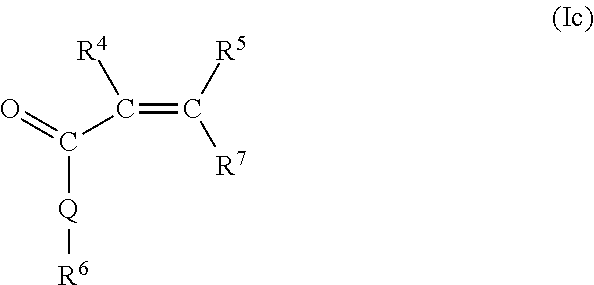
- the ethylenically unsaturated monomer (I) is represented by at least one of the following general formulae from the group (Ia), (Ib), and (Ic):
- R 1 and R 2 independently of one another are hydrogen or an aliphatic hydrocarbon radical having 1 to 20 C atoms, preferably a methyl group.
- Y is H, —COOM a , —CO—O(C q H 2q O) r —R 3 , or —CO—NH—(C q H 2q O) r —R 3 .
- Organic amine radicals used are preferably substituted ammonium groups deriving from primary, secondary, or tertiary C 1-20 alkylamines, C 1-20 alkanolamines, C 5-8 cycloalkylamines, and C 6-14 arylamines.
- amines in question are methylamine, dimethylamine, trimethylamine, ethanolamine, diethanolamine, triethanolamine, methyldiethanolamine, cyclohexylamine, dicyclohexylamine, phenylamine, and diphenylamine in the protonated (ammonium) form.
- the aliphatic hydrocarbons here may be linear or branched and also saturated or unsaturated.
- Preferred cycloalkyl radicals are considered to be cyclopentyl or cyclohexyl radicals, and preferred aryl radicals are considered to be phenyl or naphthyl radicals, which in particular may also be substituted by hydroxyl, carboxyl, or sulfonic acid groups.
- R 4 and R 5 independently of one another are hydrogen or an aliphatic hydrocarbon radical having 1 to 20 C atoms, a cycloaliphatic hydrocarbon radical having 5 to 8 C atoms, an optionally substituted aryl radical having 6 to 14 C atoms.
- Q may be identical or different and is represented by NH, NR 3 , or O, with R 3 possessing the definitions stated above.
- R 7 is H, —COOM a , —CO—O(C q H 2q O) r —R 3 , or —CO—NH—(C q H 2q O) r —R 3 , where M a , R 3 , q, and r possess the definitions stated above.
- R 8 is hydrogen, an aliphatic hydrocarbon radical having 1 to 10 C atoms, a cycloaliphatic hydrocarbon radical having 5 to 8 C atoms, or an optionally substituted aryl radical having 6 to 14 C atoms.
- the ethylenically unsaturated monomer (II) is represented by the following general formula:
- R 1 , R 2 , and R 3 possess the definition stated above.
- p is an integer between 0 and 4
- v is an integer between 5 and 250
- w independently at each occurrence for each (C w H 2w O) unit is identical or different and is 2 or 3.
- p is 4, v is an integer between 10 and 120, and w independently at each occurrence for each (C w H 2w O) unit is identical or different and is 2 or 3, T is oxygen, and y is 0.
- at least one subregion to be formed by a random ethylene oxide/propylene oxide copolymer and for the molar fraction of propylene oxide units to be preferably 10 to 30 mol %, based on the sum of the ethylene oxide units and propylene oxide units in the random ethylene oxide/propylene oxide copolymer or in the corresponding subregion.
- the at least one ethylenically unsaturated monomer having a polyalkylene oxide radical (II) may be a compound of the formula (III).
- the block A consists of a polyethylene oxide unit, with n preferably representing a number from 20 to 30.
- the block B consists of a random ethylene oxide/propylene oxide copolymer unit, with k preferably representing a number from 5 to 10 and l preferably representing a number from 20 to 35.
- the ethylenically unsaturated monomer (II) comprises at least one compound of the general formulae (IV), (V), (VI), and (VII),
- R 10 , R 11 , and R 12 are each identical or different and independently of one another represented by H and/or an unbranched or branched C 1 -C 4 alkyl group, preferably H and/or CH 3 ;
- E is identical or different and is represented by an unbranched or branched C 1 -C 6 alkylene group, more particularly C 1 , C 2 , C 3 , C 4 , C 5 , or C 6 , admittedly in each case typically, but preferably C 2 and C 4 , a cyclohexyl group, CH 2 —C 6 H 10 , C 6 H 4 present in ortho, meta, or para substituted form, and/or an absent unit, i.e., E is not present;
- G is identical or different and is represented by O, NH and/or CO—NH, with the proviso that if E is an absent unit, G is also an absent unit, i.e., G is not present;
- A is identical or different and is represented by C x H
- R 14 is identical or different and is represented by H and/or an unbranched or branched C 1 -C 4 alkyl group, preferably H;
- E is identical or different and is represented by an unbranched or branched C 1 -C 6 alkylene group, preferably C 2 H 4 , a cyclohexyl group, CH 2 —C 6 H 10 , C 6 H 4 present in ortho, meta, or para substituted form, and/or by an absent unit, i.e., E is not present;
- G is identical or different and is represented by an absent unit, O, NH and/or CO—NH, with the proviso that if E is an absent unit, G is also an absent unit, i.e., G is not present;
- n is identical or different and is represented by 0, 1, 2, 3, 4 and
- R 16 , R 17 , and R 18 are each identical or different and independently of one another are represented by H and/or an unbranched or branched C 1 -C 4 alkyl group, preferably H and/or CH 3 ;
- E is identical or different and is represented by an unbranched or branched C 1 -C 6 alkylene group, preferably C 2 H 4 or C 4 H 8 , a cyclohexyl group, CH 2 —C 6 H 10 , C 6 H 4 present in ortho, meta, or para substituted form, and/or an absent unit, i.e., E is not present;
- n is identical or different and is represented by 0, 1, 2, 3, 4 and/or 5;
- R 27 , R 28 , and R 29 are identical or different and independently of one another are H and/or an unbranched or branched C 1 -C 4 alkyl radical;
- a are identical or different and are an integer between 2 and 350;
- R 30 are identical or different and are H and/or an unbranched or branched C 1 -C 4 alkyl radical.
- the polyalkoxy side chains (AO) a of the polyether macro-monomers are very preferably pure polyethoxy side chains, although there may preferably also be mixed polyalkoxy side chains present, more particularly those which contain both propoxy groups and ethoxy groups.
- alkoxylated isoprenol i.e., alkoxylated 3-methyl-3-buten-1-ol
- alkoxylated hydroxybutyl vinyl ether and/or alkoxylated (meth)allyl alcohol with allyl alcohol being preferred over methallyl alcohol, having normally in each case an arithmetically mean number of oxyalkylene groups of 4 to 350.
- alkoxylated hydroxybutyl vinyl ether is particularly preferred.
- the molar fraction of the monomers (I) and (II) in the copolymer of the invention may be selected freely within wide ranges. It has proven particularly advantageous if the fraction of the monomer (I) in the copolymer is 5 to 90 mol %, preferably 30 to 85 mol %, and more particularly 55 to 80 mol %. In a further-preferred embodiment, the fraction of the monomer (II) in the copolymer is 10 to 95 mol %, more particularly 15 to 70 mol %, and more preferably 20 to 45 mol %.
- copolymers of the invention used may also be those with amide groups and ester groups, which are preparable by reaction of homopolymers or copolymers of (meth)acrylic acid with a monohydroxy compound at a temperature up to 200° C., forming not only ester groups but also anhydride groups, with the anhydride groups formed being reacted, in a subsequent step, with a monoamine compound at temperatures below 100° C.
- EP 1 577 327 A1 which pertains, among other things, to the preparation of copolymers having amide groups and ester groups, is incorporated in full by reference into the present specification. More particularly suitable as copolymers are the compounds described on page 3, line 27 to page 8, line 17.
- the monomer (II) it is considered preferable for the monomer (II) to have a molecular weight of 500 to 10000 g/mol.
- the copolymer of the invention possesses a molecular weight of 10000 to 100000 g/mol, determined by gel permeation chromatography against polyethylene glycol standards.
- the composition of the invention may also comprise water.
- a high water content in the liquid component may result in a deterioration in the shelf life of the pulverulent mixture. This is dependent in particular on the inorganic binder employed.
- the water content of the composition of the invention is therefore more preferably ⁇ 5 wt %, more particularly ⁇ 3 wt %, and very preferably less than 2 wt %. Accordingly, in particular, the use of water scavengers in the pulverulent mixture may be advantageous.
- water scavengers bind water either into their crystal structure, or consume the water by other mechanisms, before the binder can react with it and before an adverse effect on product qualities is caused.
- the scavenger in question may more particularly be at least one molecular sieve or may comprise salts which bind water quickly, such as CaO, for example.
- Water scavengers can lead to high water tolerance on the part of the pulverulent mixture of the invention, and in that case no deterioration is observed in the shelf life of the pulverulent composition of the invention.
- the emulsifier comprises at least one emulsifier suitable for emulsion polymerizations.
- the emulsifier is a copolymer. Suitable more particularly are amphiphilic diblock copolymers with a hydrophilic block and a hydrophobic block, the hydrophobic block being the heavier block. These copolymers are obtainable by blockwise controlled radical polymerization (RAFT, MADIX, ATRP, etc.). Particularly suitable examples are poly(ethylhexyl acrylate-block-vinylpyrrolidone) and poly(acrylic acid-block-butyl acrylate). The emulsifier is employed with particular preference in the form of a dispersion.
- EP 1 889 858 B1 which pertains, among other things to these above-listed compounds and to the preparation of diblock copolymers, is incorporated fully by reference into the present specification. More particularly suitable as emulsifiers are the compounds described on page 4, line 29 to page 13, line 8.
- polymeric emulsifiers are also suitable as polymeric emulsifiers.
- A-B-A triblock copolymer structures described in EP 0 000 424 A1. are polyester-PEG-polyester structures.
- the content of EP 0 000 424 A1, which pertains, among other things, to these above-listed compounds and to the preparation of A-B-A triblock copolymer structures, is incorporated fully by reference into the present specification. More particularly suitable as emulsifiers are the compounds described on page 1, line 1 to page 16, line 27.
- polymeric stabilizers for water-in-oil suspensions are copolymers of ceto-stearyl methacrylate and methacrylate. These and other copolymers are described in publications including EP 0 126 528 A1. The content of EP 0 126 528 A1 is incorporated fully by reference into the present specification. More particularly suitable as emulsifiers are the compounds described on page 4, line 25 to page 23, line 33.
- the emulsifier of the invention is an emulsifier based on a copolymer comprising water-soluble monomers (A) and water-insoluble monomers (B).
- the corresponding structures may be arranged blockwise, e.g., poly(A-block-B) or poly(A-block-B-block-A) or poly(B-block-A-block-B), or else may be randomly distributed, e.g., poly(A-ran-B), or else may be distributed in alternation, e.g., poly(A-alt-B).
- Also suitable for stabilizing the water-in-oil or polymer-in-oil dispersion are mixtures of polymeric emulsifiers or stabilizers and surfactants. Use may be used here of anionic, cationic, or nonionic surfactants in combination with the abovementioned polymeric emulsifiers.
- the composition of the invention consists of at least one copolymer, at least one emulsifier, and at least one hydrocarbon liquid at 20° C. or hydrocarbon mixture.
- a suitable solvent in the preparation of the copolymers of the invention is water in particular.
- the polymerization reaction takes place preferably in the temperature range between 0 and 180° C., more preferably between 10 and 100° C., and also under atmospheric pressure or under elevated or reduced pressure.
- the polymerization may optionally also be performed under an inert gas atmosphere, preferably under nitrogen.
- azo initiators such as organic peroxides, examples being benzoyl peroxide, tert-butyl hydroperoxide, methyl ethyl ketone peroxide, cumoyl peroxide, dilauroyl peroxide, or azo initiators, such as azodiisobutyronitrile, azobisamidopropyl hydrochloride, and 2,2′-azobis(2-methyl-butyronitrile), for example.
- organic peroxides examples being benzoyl peroxide, tert-butyl hydroperoxide, methyl ethyl ketone peroxide, cumoyl peroxide, dilauroyl peroxide, or azo initiators, such as azodiisobutyronitrile, azobisamidopropyl hydrochloride, and 2,2′-azobis(2-methyl-butyronitrile), for example.
- inorganic peroxy compounds such as ammonium peroxodisulfate, potassium peroxodisulfate, or hydrogen peroxide, for example, optionally in combination with reducing agents (e.g., sodium hydrogensulfite, ascorbic acid, iron(II) sulfate) or redox systems, which as reducing component comprise an aliphatic or aromatic sulfonic acid (e.g., benzenesulfonic acid, toluenesulfonic acid).
- reducing agents e.g., sodium hydrogensulfite, ascorbic acid, iron(II) sulfate
- redox systems which as reducing component comprise an aliphatic or aromatic sulfonic acid (e.g., benzenesulfonic acid, toluenesulfonic acid).
- Particular preference is given to a mixture of at least one sulfinic acid with at least one iron(III) salt, and/or to a mixture of ascorbic acid with at least one iron(III) salt.
- Chain transfer agents used, which regulate the molecular weight, are the customary compounds. Suitable known such agents are, for example, alcohols, such as methanol, ethanol, propanol, isopropanol, n-butanol, sec-butanol.
- aldehydes ketones
- alkylthiols such as dodecylthiol and tert-dodecylthiol
- thioglycolic acid isooctyl thioglycolate
- 2-mercaptoethanol 2-mercaptopropionic acid
- 3-mercaptopropionic acid and some halogen compounds, such as carbon tetrachloride, chloroform, and methylene chloride, for example.
- halogen compounds such as carbon tetrachloride, chloroform, and methylene chloride, for example.
- the process for preparing the copolymers of the invention may also be carried out in an organic solvent or in a mixture of two or more organic solvents.
- the polymerization of the monomers (I) and (II) is carried out in a water-containing solvent, with the water content of the overall reaction mixture being more than 20 wt %, preferably between 30 and 75 wt %.
- the polymerization product is subsequently admixed with the emulsifier and the at least one hydrocarbon liquid at 20° C. or hydrocarbon mixture, and the water is removed.
- shearing power of more than 10 3 W/m 3 , more particularly more than 10 4 W/m 3 , very preferably more than 10 6 W/m 3 , is introduced into the composition before the water is removed.
- the copolymer in the water-containing solvent is preferably mixed first of all with the emulsifier and with the at least one hydrocarbon liquid at 20° C. or hydrocarbon mixture, this mixing possibly taking place by means of a paddle stirrer, for example.
- the shearing power is introduced, something which may be done, for example, using at least one device from the series toothed colloid mill, bead mill, ultrasound devices, rotor-stator (e.g., IKA Ultra-Turrax), and dissolver disk.
- the subsequent removal of the water may be carried out by any of the processes known to the skilled person for such removal. In particular, thin-film evaporation or distillation have proven particularly suitable.
- the composition of the invention may comprise 0.5 to 69 wt % of at least one further additive.
- the composition of the invention may comprise 0.5 to 69 wt % of at least one further additive.
- one or more further additives may be introduced in a simple way, this representing a typically economical procedure and possibly also obviating a separate drying step.
- the further additives may more particularly be at least one from the series consisting of plasticizers, defoamers, stabilizers, water retention agents, thickeners, flow control agents, dedusting agents, and pigments.
- a pulverulent mixture comprising the composition of the invention.
- the pulverulent mixture may comprise 0.01 to 50 wt %, 0.01 to 10 wt %, or 0.05 to 2 wt % of the composition of the invention, based on the overall mass of the pulverulent mixture.
- the contacting of the pulverulent mixtures with the composition of the invention may take place in any way known to the skilled person for that purpose. It has proven particularly suitable for the composition of the invention to be contacted with the powder by spray application or atomizing, the method preferably comprising a mixing step. In this way it is possible to ensure homogeneous application in a simple way with accompanying good adhesion and initial adhesion.
- the contacting of the powder with the liquid component may of course also be accomplished in any other suitable way. Contemplated here more particularly are also blending or stirring in, although there is a clear preference for spray application because it constitutes the most simple and most economically attractive form of application.
- composition of the invention in a pulverulent mixture for accelerating the development of the dispersing effect of the copolymer over time following addition of the mixing water, with 0.01 to 10 wt %, more particularly 0.05 to 2 wt %, of the composition of the invention being used, based on the overall mass.
- the pulverulent mixture comprises an inorganic binder and/or an inorganic filler.
- the pulverulent mixture consists to an extent of at least 80 wt %, more particularly at least 90 wt %, and very preferably more than 95 wt %, of an inorganic binder and/or an inorganic filler.
- the inorganic binder may more particularly be at least one from the series of cement based on Portland cement, white cement, calcium aluminate cement, calcium sulfoaluminate cement, calcium sulfate n-hydrate, or latent hydraulic or pozzolanic binder such as, for example, fly ash, metakaolin, silica dust, and slag sand. Particularly preferred are cement based on Portland cement, calcium sulfate hemihydrate, calcium sulfate anhydrite, and calcium aluminate cement.
- the inorganic filler may preferably be at least one from the series of silica sand, finely ground quartz, limestone, heavy spar, calcite, dolomite, talc, kaolin, mica, and chalk.
- the pulverulent mixture is a factory dry-mix mortar, more particularly masonry mortars, render mortars, mortars for thermal insulation composite systems, renovating renders, jointing mortars, tile adhesives, thin-bed mortars, screed mortars, casting mortars, injection mortars, filling compounds, grouts, or lining mortars.
- the factory dry-mix mortar here can be contacted directly with the composition of the invention, and this may take place in particular by spray application or atomizing. It is alternatively possible first to contact the inorganic binder with the composition of the invention, and to mix in the other components, more particularly inorganic fillers and additives, in a subsequent step.
- the inorganic filler is first of all contacted with the composition of the invention, and the other components, more particularly inorganic binders and additives, are admixed in a subsequent step.
- the pulverulent mixture consisting of inorganic filler and the composition of the invention may preferably comprise up to 90 wt % of the composition of the invention, based on the overall mass of the pulverulent mixture.
- the binder which may comprise cement and/or lime and/or calcium sulfate, for example, is admixed with further additives or admixtures in order to adapt the factory dry-mix mortar to the specific application.
- the additives and admixtures in question may include, for example, shrinkage reducers, expansion agents, accelerators, retardants, dispersants, thickeners, defoamers, air entrainers, and corrosion inhibitors.
- the factory dry-mix mortar of the invention may also be a self-leveling underlayment composition. This is particularly advantageous since pulverulent compositions of this kind, for low layer thicknesses, are generally very fine and their mixing up with water is therefore comparatively slow.
- the inorganic binder may also be gypsum.
- gypsum is used synonymously in the present context with calcium sulfate, and the calcium sulfate may be present in its various anhydrous and hydrated forms with and without water of crystallization.
- Natural gypsum substantially comprises calcium sulfate dihydrate (“dihydrate”).
- the natural form of calcium sulfate, free from water of crystallization, is encompassed by the expression “anhydrite”.
- anhydrite As well as the naturally occurring forms, calcium sulfate is a typical byproduct of industrial operations, and is then referred to as “synthetic gypsum”.
- synthetic gypsum One typical example of a synthetic gypsum from industrial operations is flue gas desulfurization.
- Synthetic gypsum may equally also be formed as the byproduct of phosphoric acid or hydrofluoric acid production processes.
- Typical gypsum (CaSO 4 ⁇ 2 H 2 O) can be calcined, with the water of crystallization being removed.
- Products of the wide variety of different calcination processes are ⁇ - or ⁇ -hemihydrate.
- ⁇ -Hemihydrate results from rapid heating in open vessels, accompanied by rapid evaporation of water, forming voids.
- ⁇ -Hemihydrate is produced by the dewatering of gypsum in closed autoclaves. The crystal habit in this case is relatively impervious, and so this binder requires less water for liquefaction than does ⁇ -hemihydrate.
- hemihydrate undergoes rehydration with water to form dihydrate crystals.
- Gypsum hydration customarily takes from several minutes to hours, resulting in a shortened working time in comparison to cements, which require several hours to days for complete hydration.
- ⁇ -hemihydrate The form selected for a wide variety of applications is ⁇ -hemihydrate, since it has better availability and exhibits numerous advantages from an economic standpoint. These advantages, however, are in part negated by the greater water demand of ⁇ -hemihydrate in use in order for fluid suspensions to be obtained at all. Moreover, the dried gypsum products produced therefrom tend to have a certain weakness, which can be attributed to quantities of residual water which have remained in the crystal matrix on curing. For this reason, corresponding products exhibit less hardness than gypsum products prepared with smaller amounts of mixing water.
- Gypsum for the purposes of the present invention is more preferably ⁇ -calcium sulfate hemihydrate.
- ⁇ -Calcium sulfate hemihydrate of the invention is especially suitable here for use in gypsum-based self-leveling screed.
- polycarboxylic ethers allow sufficient reduction of water, but the development rate of polycarboxylate ethers conforming to the prior art is too slow for machine-applied self-leveling screeds.
- Machine-applied, gypsum-based, self-leveling screeds based on ⁇ -calcium sulfate hemihydrate of the invention can be worked, in contrast, like the anhydrite- or ⁇ -hemihydrate-based self-leveling, gypsum-based screeds known in the prior art, and have comparable or even better mechanical strength, stability, and durability of adhesion.
- the pulverulent mixture of the invention which comprises the composition of the invention may in particular also comprise a binder mixture.
- a binder mixture In the present context this means mixtures of at least two binders from the series of cement, pozzolanic and/or latent hydraulic binder, white cement, specialty cement, calcium aluminate cement, calcium sulfoaluminate cement, and the various water-containing and water-free calcium sulfates. They may then optionally comprise further additives as well.
- the pulverulent mixture ought preferably to be in dry form, this meaning that it has a Karl-Fischer water content of less than 5 wt %, preferably less than 1 wt %, and more preferably of less than 0.1 wt %.
- the powder prefferably has an average particle size of between 0.1 and 1000 ⁇ m, more preferably between 1 and 200 ⁇ m.
- the particle size here is determined by means of laser diffractometry.
- the pulverulent mixture of the invention comprising the composition of the invention, comprises preferably between 2 and 99.9 wt %, more particularly between 8 and 50 wt %, and more preferably between 10 and 40 wt % of an inorganic binder.
- Sample preparation for determination of the molar weight was carried out by dissolving copolymer solution in the GPC eluent, giving a polymer concentration in the GPC eluent of 0.5 wt %. Thereafter this solution was filtered through a syringe filter with polyethersulfone membrane and a pore size of 0.45 ⁇ m. The injection volume of this filtrate was 50-100 ⁇ l.
- the average molecular weights were determined on a GPC instrument from Waters with the model name Alliance 2690 with a UV detector (Waters 2487) and RI detector (Waters 2410).
- the molecular weights of the copolymers were determined relative to polyethylene glycol standards from the company PSS Polymer Standards Service GmbH.
- the molecular weight distribution curves of the polyethylene glycol standards were determined by means of light scattering.
- the masses of the polyethylene glycol standards were 682000, 164000, 114000, 57100, 40000, 26100, 22100, 12300, 6240, 3120, 2010, 970, 430, 194, and 106 g/mol.
- a 5-liter vessel is charged with 400 g of white oil (ADDINOL WX 32).
- emulsifier Rhodibloc RS disersion of amphiphilic diblock copolymers with a hydrophilic block and a hydrophobic block.
- the mixture is mixed by means of a paddle stirrer. Metered into this mixture with stirring are 800 g of a 50 wt % strength aqueous solution of the copolymer (see table 1) in about 1 minute.
- the pulverulent mixture is prepared by homogenizing the various components (see table 3) for 10 minutes in an SK450 shaker (from Fast&Fluid Management B.V.).
- copolymer A is added in the form of a white oil emulsion to the pulverulent preparation (see protocol D in table 4a and example 2 in table 4b).
- the pulverulent mixture here is mixed with the emulsion of copolymer A (see example 1 in table 2) in white oil with a shearing energy of 8000 rpm in a Grindomix GM 200 (Retsch GmbH).
- the pulverulent mixture is admixed with the pulverulent component A, after which mixing water is added (protocol A, table 4a).
- the pulverulent mixture is mixed separately with white oil and polymer powder at 8000 rpm (protocol B, table 4a), and then the mixing water is added.
- the mixing water admixed beforehand with the white oil/polymer emulsion, is added to the pulverulent mixture (protocol C, table 4a).
- the pulverulent mixture is placed in a beaker and stirred at 500 revolutions per minute using an axial stirrer. Then the mixing water (63 g of water, or 21 wt %, based on the weight of the pulverulent mixture) is added and a measurement is made of the time after which, visually, the consistency of the resulting fresh mortar is homogeneous (see table 4b).
- Table 4b shows that the pulverulent mixture which has been treated, before the mixing water is added, with an emulsion of the copolymer A in white oil, according to the invention (example 2), displays a much quicker development of the dispersing effect over time of the copolymer A, after addition of the mixing water, than in the case of examples C1 to C3.
- the finely ground limestone thus treated is mixed with 285 g of the pulverulent mixture according to table 3.
- the corresponding amount of the treated finely ground limestone (see table 5) is homogenized with the pulverulent mixture for 1 minute in the SK450 shaker.
- Example 4 exhibits a very rapid development of the dispersing effect of the copolymer A following addition of the mixing water, with homogenization being attained after 7 seconds.
- Example 4 amount in grams amount in grams Pulverulent mixture according 285 285 to table 2 Copolymer A 0.75 Coated finely ground limestone 15 from example 3 White oil in mixing water 0.75 Omyacarb 20 BG 13.5 Water 57 57 Time until mixture 10 7 homogeneous [s]
Landscapes
- Chemical & Material Sciences (AREA)
- Engineering & Computer Science (AREA)
- Ceramic Engineering (AREA)
- Organic Chemistry (AREA)
- Materials Engineering (AREA)
- Structural Engineering (AREA)
- Chemical Kinetics & Catalysis (AREA)
- Inorganic Chemistry (AREA)
- Health & Medical Sciences (AREA)
- Medicinal Chemistry (AREA)
- Polymers & Plastics (AREA)
- Addition Polymer Or Copolymer, Post-Treatments, Or Chemical Modifications (AREA)
- Compositions Of Macromolecular Compounds (AREA)
- Curing Cements, Concrete, And Artificial Stone (AREA)
- Macromonomer-Based Addition Polymer (AREA)
- Civil Engineering (AREA)
- Adhesives Or Adhesive Processes (AREA)
Abstract
Description
- (I) at least one ethylenically unsaturated monomer which comprises at least one radical from the series carboxylic acid, carboxylic salt, carboxylic ester, carboxylic amide, carboxylic anhydride, and carboxylic imide, and
- (II) at least one ethylenically unsaturated monomer having a polyalkylene oxide radical,
0.01 to 10 wt %, preferably 1 to 3 wt %, of at least one emulsifier, and
29 to 98 wt %, preferably 50 to 80 wt %, of at least one hydrocarbon liquid at 20° C. or a hydrocarbon mixture.


where p is an integer between 0 and 6, y is 0 or 1, v is an integer between 3 and 250, and w independently at each occurrence for each (CwH2wO) unit is identical or different and is an integer between 2 and 18, and also T is oxygen or a chemical bond. R1, R2, and R3 possess the definition stated above.


where
R10, R11, and R12 are each identical or different and independently of one another represented by H and/or an unbranched or branched C1-C4 alkyl group, preferably H and/or CH3;
E is identical or different and is represented by an unbranched or branched C1-C6 alkylene group, more particularly C1, C2, C3, C4, C5, or C6, admittedly in each case typically, but preferably C2 and C4, a cyclohexyl group, CH2—C6H10, C6H4 present in ortho, meta, or para substituted form, and/or an absent unit, i.e., E is not present;
G is identical or different and is represented by O, NH and/or CO—NH, with the proviso that if E is an absent unit, G is also an absent unit, i.e., G is not present;
A is identical or different and is represented by CxH2x with x=2, 3, 4, and/or 5, preferably x=2, and/or CH2CH(C6H5);
n is identical or different and is represented by 0, 1, 2, 3, 4 and/or 5;
a is identical or different and is represented by an integer from 2 to 350, preferably 10-200;
R13 is identical or different and is represented by H, an unbranched or branched C1-C4 alkyl group, CO—NH2, and/or COCH3, preferably H or CH3;

where
R14 is identical or different and is represented by H and/or an unbranched or branched C1-C4 alkyl group, preferably H;
E is identical or different and is represented by an unbranched or branched C1-C6 alkylene group, preferably C2H4, a cyclohexyl group, CH2—C6H10, C6H4 present in ortho, meta, or para substituted form, and/or by an absent unit, i.e., E is not present;
G is identical or different and is represented by an absent unit, O, NH and/or CO—NH, with the proviso that if E is an absent unit, G is also an absent unit, i.e., G is not present;
A is identical or different and is represented by CxH2x with x=2, 3, 4, and/or 5, preferably x=2, and/or CH2CH(C6H5);
n is identical or different and is represented by 0, 1, 2, 3, 4 and/or 5;
a is identical or different and is represented by an integer from 2 to 350, preferably 10-200;
D is identical or different and is represented by an absent unit, i.e., D is not present, or by NH and/or O, with the proviso that if D is an absent unit: b=0, 1, 2, 3, or 4 and also c=0, 1, 2, 3, or 4, with b+c=3 or 4, and
with the proviso that if D is NH and/or O: b=0, 1, 2, or 3, c=0, 1, 2, or 3, and b+c=2 or 3;
R15 is identical or different and is represented by H, an unbranched or branched C1-C4 alkyl group, CO—NH2, and/or COCH3, preferably H;

where
R16, R17, and R18 are each identical or different and independently of one another are represented by H and/or an unbranched or branched C1-C4 alkyl group, preferably H and/or CH3;
E is identical or different and is represented by an unbranched or branched C1-C6 alkylene group, preferably C2H4 or C4H8, a cyclohexyl group, CH2—C6H10, C6H4 present in ortho, meta, or para substituted form, and/or an absent unit, i.e., E is not present;
A is identical or different and is represented by CxH2x with x=2, 3, 4 and/or 5, preferably x=2, and/or CH2CH(C6H5);
n is identical or different and is represented by 0, 1, 2, 3, 4 and/or 5;
L is identical or different and is represented by CxH2x with x=2, 3, 4 and/or 5, preferably x=2, and/or CH2—CH(C6—H5);
a is identical or different and is represented by an integer from 2 to 350, preferably 10-200;
d is identical or different and is represented by an integer from 1 to 350, preferably 10-200;
R19 is identical or different and is represented by H and/or an unbranched or branched C1-C4 alkyl group, preferably H,
R20 is identical or different and is represented by H and/or an unbranched C1-C4 alkyl group, preferably H.

in which
R27, R28, and R29 are identical or different and independently of one another are H and/or an unbranched or branched C1-C4 alkyl radical;
A are identical or different and denote CxH2x with x=2, 3, 4 and/or 5 and/or CH2CH(C6H5);
a are identical or different and are an integer between 2 and 350;
R30 are identical or different and are H and/or an unbranched or branched C1-C4 alkyl radical.
- Columns: Shodex SB-G Guard Column for SB-800 HQ series
- Shodex OHpak SB 804HQ and 802.5HQ
- (PHM gel, 8×300 mm, pH 4.0 to 7.5)
- Eluent: 0.05 M aqueous ammonium formate/methanol mixture=80:20 (parts by volume)
- Flow rate: 0.5 ml/min
- Temperature: 50° C.
- Injection: 50 to 100 μl
- Detection: RI and UV
| TABLE 1 | |||||
| Mol of | |||||
| Co- | acrylic | Mol of | Mw | Solids | |
| polymer | acid | macromonomer | Macromonomer | (g/mol) | % |
| A | 5 | 1 | VOBPEG-3000 | 32 000 | 51 |
| TABLE 2 | ||||||
| Exam- | Co- | Amount of | White | Emulsi- | Paddle | Ultra |
| ple | polymer | copolymer | oil | fier | stirrer | Turrax |
| 1 | A | 800 g 50% | 400 g | 32 g | 30 min | 5 min |
| strength | Rhodibloc | at 800 | at 24000 | |||
| solution | RS | rpm | rpm | |||
| TABLE 3 | ||
| Parts by | ||
| Manufacturer | weight | |
| Portland cement (Milke CEM I 52.5N) | Heidelberg Cement | 30.00 |
| AG | ||
| Calcium aluminate cement | Kerneos Inc | 10.00 |
| (Fondu Ciment) | ||
| Calciumsulfate binder CAB 30 | Lanxess AG | 6.00 |
| Calcium carbonate (Omyacarb 6AL) | Omya GmbH | 10.00 |
| Calcium carbonate (OMYACARB 15AL) | Omya GmbH | 15.00 |
| Calcium carbonate (Omyacarb 130AL) | Omya GmbH | 26.38 |
| Lithium carbonate | Chemmetall GmbH | 0.10 |
| Defoamer (Vinapor DF 9010 F) | BASF Construction | 0.15 |
| Polymers GmbH | ||
| Dispersible powder (Vinnapas 5023L) | Wacker AG | 2.00 |
| Tartaric acid | DU Chemie GmbH | 0.12 |
| TABLE 4a |
| Mixing protocols |
| Protocol | Liquid phase | Solid phase |
| A | Mixing water | SLU formulation mixed with |
| polymer A powder | ||
| B | Mixing water | White oil admixed to SLU |
| formulation at shear rate of 8000 rpm, | ||
| then polymer A mixed with this | ||
| C | Mixing water + white | Untreated SLU formulation |
| oil/polymer A | ||
| emulsion | ||
| D | Mixing water | SLU formulation mixed with a |
| 50% white oil/polymer A emulsion | ||
| at 8000 rpm | ||
| TABLE 4b |
| Mixing speed on addition of the polymer/white oil emulsions |
| Example |
| C1 | C2 | C3 | 2 | ||
| Protocol | A | B | C | D |
| Shear rate [rpm] | 8000 | 8000 | ||
| Pulverulent mixture from table 2 | 299.25 | 298.5 | 298.5 | 298.5 |
| Polymer A powder [g] | 0.75 | 0.75 | ||
| White oil [g] | 0.75 | |||
| Emulsion from example 1 [g] | 1.5 | 1.5 | ||
| H2O [g] | 60 | 60 | 60 | 60 |
| Time until mixture homogeneous [s] | 15 | 12 | 21 | 6 |
| TABLE 5 | ||
| Application example | ||
| Example C4 | Example 4 | ||
| amount in grams | amount in grams | ||
| Pulverulent mixture according | 285 | 285 |
| to table 2 | ||
| Copolymer A | 0.75 | |
| Coated finely ground limestone | 15 | |
| from example 3 | ||
| White oil in mixing water | 0.75 | |
| Omyacarb 20 BG | 13.5 | |
| Water | 57 | 57 |
| Time until mixture | 10 | 7 |
| homogeneous [s] | ||
Claims (15)


Applications Claiming Priority (4)
| Application Number | Priority Date | Filing Date | Title |
|---|---|---|---|
| EP13161138 | 2013-03-26 | ||
| EP13161138.6A EP2784038A1 (en) | 2013-03-26 | 2013-03-26 | Flow agent on additives |
| EP13161138.6 | 2013-03-26 | ||
| PCT/EP2014/055780 WO2014154600A1 (en) | 2013-03-26 | 2014-03-24 | Composition comprising a copolymer |
Publications (2)
| Publication Number | Publication Date |
|---|---|
| US20160002454A1 US20160002454A1 (en) | 2016-01-07 |
| US9522996B2 true US9522996B2 (en) | 2016-12-20 |
Family
ID=48049781
Family Applications (1)
| Application Number | Title | Priority Date | Filing Date |
|---|---|---|---|
| US14/761,840 Active US9522996B2 (en) | 2013-03-26 | 2014-03-24 | Composition comprising a copolymer |
Country Status (6)
| Country | Link |
|---|---|
| US (1) | US9522996B2 (en) |
| EP (2) | EP2784038A1 (en) |
| JP (1) | JP6400076B2 (en) |
| CN (1) | CN105050980B (en) |
| CA (1) | CA2902266C (en) |
| WO (1) | WO2014154600A1 (en) |
Families Citing this family (5)
| Publication number | Priority date | Publication date | Assignee | Title |
|---|---|---|---|---|
| CN107082599A (en) * | 2016-02-16 | 2017-08-22 | 瓦克化学公司 | A kind of purposes of cohesive promotion compositions of additives |
| CH714974A1 (en) * | 2018-05-09 | 2019-11-15 | Baustoffe Schollberg Ag | Ultra-high-performance concrete. |
| KR102636349B1 (en) * | 2018-10-30 | 2024-02-15 | 비와이케이-케미 게엠베하 | Ceramic slurry composition and method of making layered ceramic components |
| KR102027818B1 (en) * | 2019-05-02 | 2019-10-02 | 주식회사 실크로드시앤티 | high performance admixture improved in material separation resistance |
| US12090218B2 (en) * | 2019-06-14 | 2024-09-17 | Shiseido Company, Ltd. | Water-in-oil emulsion composition |
Citations (21)
| Publication number | Priority date | Publication date | Assignee | Title |
|---|---|---|---|---|
| EP0000424A1 (en) | 1977-07-12 | 1979-01-24 | Imperial Chemical Industries Plc | Linear or branched ester-ether block copolymers and their use as surfactants either alone or in blends with conventional surfactants |
| DE2948698A1 (en) | 1979-12-04 | 1981-06-11 | Cempro Ag, Vaduz | Hydraulic mortar for sound and heat insulating tile prodn. - comprising e.g. melamine formaldehyde! resin fluidiser, Portland cement and clay binder, accelerator and sand |
| EP0126528A2 (en) | 1983-04-06 | 1984-11-28 | Ciba Specialty Chemicals Water Treatments Limited | Polymer dispersions and their preparation |
| DE3530258A1 (en) | 1985-08-23 | 1987-02-26 | Lentia Gmbh | USE OF SALTS OF WATER-SOLUBLE NAPHTALINE SULPHONIC ACID FORMALDEHYDE CONDENSATES AS ADDITIVES FOR INORGANIC BINDERS AND BUILDING MATERIAL |
| EP0287138A1 (en) | 1987-03-26 | 1988-10-19 | Akzo N.V. | Non-dusting, electrically conductive carbon black, a process for the preparation thereof and synthetic compositions containing this carbon black |
| DE19513126A1 (en) | 1995-04-07 | 1996-10-10 | Sueddeutsche Kalkstickstoff | Copolymers based on oxyalkylene glycol alkenyl ethers and unsaturated dicarboxylic acid derivatives |
| DE19834173A1 (en) | 1997-08-01 | 1999-02-04 | Sueddeutsche Kalkstickstoff | Copolymer based on unsaturated di:carboxylic acid derivatives and oxyalkylene glycol-alkenyl ether(s) |
| DE19905488A1 (en) | 1999-02-10 | 2000-08-17 | Sueddeutsche Kalkstickstoff | Powdery polymer compositions based on polyether carboxylates |
| EP1052232A1 (en) | 1998-11-30 | 2000-11-15 | Taiheiyo Cement Corporation | Process for producing dispersant for powdery hydraulic composition |
| WO2001042162A1 (en) | 1999-12-10 | 2001-06-14 | Mbt Holding Ag | Solubilized defoamers for cementitious compositions |
| WO2001096007A1 (en) | 2000-06-15 | 2001-12-20 | Coatex S.A. | Use of weakly anionic copolymers as dispersing and/or grinding aid agent of an aqueous suspension of mineral materials |
| US6869988B2 (en) * | 2003-04-16 | 2005-03-22 | Arco Chemical Technology, L.P. | Solid supported comb-branched copolymers as an additive for gypsum compositions |
| EP1577327A1 (en) | 2004-03-19 | 2005-09-21 | Sika Technology AG | Polymer containing amid and ester groups, its preparation and use |
| WO2006027363A1 (en) | 2004-09-06 | 2006-03-16 | Sika Technology Ag | Method for producing a coated basic material for a hydraulic composition, coated basic material for a hydraulic composition, additive for a hydraulic composition and method for producing a hydraulic composition |
| WO2006084588A2 (en) | 2005-02-09 | 2006-08-17 | Henkel Kommanditgesellschaft Auf Aktien | Use of aliphatic hydrocarbons and hydrocarbon mixtures in powdery chemical products for construction |
| WO2006133933A2 (en) | 2005-06-14 | 2006-12-21 | Basf Construction Polymers Gmbh | Polyether-containing copolymer |
| EP1889858A1 (en) | 2006-08-17 | 2008-02-20 | Rhodia Recherches et Technologies | block copolymer, process for making the same, and use in emulsions |
| EP2020422A1 (en) | 2007-07-31 | 2009-02-04 | Sika Technology AG | Emulgating polymers and their use |
| US20090312460A1 (en) | 2008-06-16 | 2009-12-17 | Lorenz Klaus K | Copolymer Admixture System for Workability Retention of Cementitious Compositions |
| US20100210761A1 (en) | 2005-06-14 | 2010-08-19 | Basf Construction Polymers Gmbh | Liquid admixture composition |
| CN101962273A (en) | 2010-09-27 | 2011-02-02 | 上海三瑞化学有限公司 | Method for preparing powdery polycarboxylic acid hyperdispersant |
Family Cites Families (7)
| Publication number | Priority date | Publication date | Assignee | Title |
|---|---|---|---|---|
| JPS6390537A (en) * | 1986-10-06 | 1988-04-21 | Mitsui Saianamitsudo Kk | Water-in-oil type water-swellable polymer emulsion |
| JP4233294B2 (en) * | 2001-09-28 | 2009-03-04 | 株式会社日本触媒 | Cement admixture, cement composition, and method for producing cement admixture |
| JP4989458B2 (en) * | 2004-04-06 | 2012-08-01 | チバ ホールディング インコーポレーテッド | Polymer dispersion composition, its preparation and its use |
| US20080017078A1 (en) * | 2005-06-14 | 2008-01-24 | Manfred Bichler | Liquid admixture composition |
| JP2010503646A (en) * | 2006-09-15 | 2010-02-04 | ロレアル | Leave-in hair dyeing method using a composition comprising a colored polymer and an active cosmetic agent |
| EP2660218A1 (en) * | 2012-05-04 | 2013-11-06 | Construction Research & Technology GmbH | Process for manufacturing a hydraulic bonding agent, corresponding additive and its use. |
| EP2687496A1 (en) * | 2012-07-20 | 2014-01-22 | BASF Construction Polymers GmbH | Synthesis and use of plaster seeding material |
-
2013
- 2013-03-26 EP EP13161138.6A patent/EP2784038A1/en not_active Withdrawn
-
2014
- 2014-03-24 US US14/761,840 patent/US9522996B2/en active Active
- 2014-03-24 JP JP2016504598A patent/JP6400076B2/en active Active
- 2014-03-24 WO PCT/EP2014/055780 patent/WO2014154600A1/en not_active Ceased
- 2014-03-24 EP EP14717108.6A patent/EP2978725B1/en active Active
- 2014-03-24 CN CN201480016807.2A patent/CN105050980B/en active Active
- 2014-03-24 CA CA2902266A patent/CA2902266C/en active Active
Patent Citations (40)
| Publication number | Priority date | Publication date | Assignee | Title |
|---|---|---|---|---|
| EP0000424A1 (en) | 1977-07-12 | 1979-01-24 | Imperial Chemical Industries Plc | Linear or branched ester-ether block copolymers and their use as surfactants either alone or in blends with conventional surfactants |
| US4203877A (en) | 1977-07-12 | 1980-05-20 | Imperial Chemical Industries Limited | Block or graft copolymers and their use as surfactants |
| DE2948698A1 (en) | 1979-12-04 | 1981-06-11 | Cempro Ag, Vaduz | Hydraulic mortar for sound and heat insulating tile prodn. - comprising e.g. melamine formaldehyde! resin fluidiser, Portland cement and clay binder, accelerator and sand |
| EP0126528A2 (en) | 1983-04-06 | 1984-11-28 | Ciba Specialty Chemicals Water Treatments Limited | Polymer dispersions and their preparation |
| US4528321A (en) | 1983-04-06 | 1985-07-09 | Allied Colloids Limited | Polymer dispersions and their preparation |
| DE3530258A1 (en) | 1985-08-23 | 1987-02-26 | Lentia Gmbh | USE OF SALTS OF WATER-SOLUBLE NAPHTALINE SULPHONIC ACID FORMALDEHYDE CONDENSATES AS ADDITIVES FOR INORGANIC BINDERS AND BUILDING MATERIAL |
| US4725665A (en) | 1985-08-23 | 1988-02-16 | Chemie Linz Aktiengesellschaft | Use of salts of water-soluble |
| EP0287138A1 (en) | 1987-03-26 | 1988-10-19 | Akzo N.V. | Non-dusting, electrically conductive carbon black, a process for the preparation thereof and synthetic compositions containing this carbon black |
| DE19513126A1 (en) | 1995-04-07 | 1996-10-10 | Sueddeutsche Kalkstickstoff | Copolymers based on oxyalkylene glycol alkenyl ethers and unsaturated dicarboxylic acid derivatives |
| US5798425A (en) | 1995-04-07 | 1998-08-25 | Skw Trostberg Aktiengesellschaft | Co-polymers based on oxyalkyleneglycol alkenyl ethers and unsaturated dicarboxylic acid derivatives |
| DE19834173A1 (en) | 1997-08-01 | 1999-02-04 | Sueddeutsche Kalkstickstoff | Copolymer based on unsaturated di:carboxylic acid derivatives and oxyalkylene glycol-alkenyl ether(s) |
| US6211317B1 (en) | 1997-08-01 | 2001-04-03 | Swk Bauchemie Gmbh | Copolymers based on unsaturated dicarboxylic acid derivatives and oxyalkylene glycol alkenyl ethers |
| EP1052232A1 (en) | 1998-11-30 | 2000-11-15 | Taiheiyo Cement Corporation | Process for producing dispersant for powdery hydraulic composition |
| US6437027B1 (en) * | 1998-11-30 | 2002-08-20 | Taiheiyo Cement Corporation | Process for producing dispersant for powdery hydraulic composition |
| DE19905488A1 (en) | 1999-02-10 | 2000-08-17 | Sueddeutsche Kalkstickstoff | Powdery polymer compositions based on polyether carboxylates |
| US6620879B1 (en) * | 1999-02-10 | 2003-09-16 | Degussa Construction Chemicals Gmbh | Powdery polyether carboxylate-based polymeric compositions |
| WO2001042162A1 (en) | 1999-12-10 | 2001-06-14 | Mbt Holding Ag | Solubilized defoamers for cementitious compositions |
| US6569924B2 (en) | 1999-12-10 | 2003-05-27 | Mbt Holdingag | Solubilized defoamers for cementitious compositions |
| US20050143511A1 (en) | 2000-06-15 | 2005-06-30 | Coatex S.A.S. | Use of weakly anionic copolymers as dispersing and/or grinding aid agent of an aqueous suspension of mineral materials |
| WO2001096007A1 (en) | 2000-06-15 | 2001-12-20 | Coatex S.A. | Use of weakly anionic copolymers as dispersing and/or grinding aid agent of an aqueous suspension of mineral materials |
| US6946510B2 (en) | 2000-06-15 | 2005-09-20 | Coatex S.A.S | Use of weakly anionic copolymers as dispersing and/or grinding aid agent of an aqueous suspension of mineral materials |
| US6869988B2 (en) * | 2003-04-16 | 2005-03-22 | Arco Chemical Technology, L.P. | Solid supported comb-branched copolymers as an additive for gypsum compositions |
| US7994259B2 (en) | 2004-03-19 | 2011-08-09 | Sika Technology Ag | Polymer comprising amide and ester groups, method for production and use thereof |
| EP1577327A1 (en) | 2004-03-19 | 2005-09-21 | Sika Technology AG | Polymer containing amid and ester groups, its preparation and use |
| US20110245379A1 (en) | 2004-03-19 | 2011-10-06 | Sika Technology Ag | Polymer comprising amide and ester groups, method for production and use thereof |
| WO2006027363A1 (en) | 2004-09-06 | 2006-03-16 | Sika Technology Ag | Method for producing a coated basic material for a hydraulic composition, coated basic material for a hydraulic composition, additive for a hydraulic composition and method for producing a hydraulic composition |
| US8481116B2 (en) * | 2004-09-06 | 2013-07-09 | Sika Technology Ag | Method for producing a coated basic material for a hydraulic composition, coated basic material for a hydraulic composition, additive for a hydraulic composition and method for producing a hydraulic composition |
| WO2006084588A2 (en) | 2005-02-09 | 2006-08-17 | Henkel Kommanditgesellschaft Auf Aktien | Use of aliphatic hydrocarbons and hydrocarbon mixtures in powdery chemical products for construction |
| US20100210761A1 (en) | 2005-06-14 | 2010-08-19 | Basf Construction Polymers Gmbh | Liquid admixture composition |
| US8349979B2 (en) | 2005-06-14 | 2013-01-08 | Basf Construction Polymers Gmbh | Liquid admixture composition |
| WO2006133933A2 (en) | 2005-06-14 | 2006-12-21 | Basf Construction Polymers Gmbh | Polyether-containing copolymer |
| US20110040025A1 (en) | 2006-08-17 | 2011-02-17 | Rhodia Operations | Block Copolymer, Process For Making The Same, And Use In Emulsions |
| EP1889858A1 (en) | 2006-08-17 | 2008-02-20 | Rhodia Recherches et Technologies | block copolymer, process for making the same, and use in emulsions |
| EP2020422A1 (en) | 2007-07-31 | 2009-02-04 | Sika Technology AG | Emulgating polymers and their use |
| US8273814B2 (en) | 2007-07-31 | 2012-09-25 | Sika Technology Ag | Emulsifying polymers and their use |
| US20090312460A1 (en) | 2008-06-16 | 2009-12-17 | Lorenz Klaus K | Copolymer Admixture System for Workability Retention of Cementitious Compositions |
| US7973110B2 (en) | 2008-06-16 | 2011-07-05 | Construction Research & Technology Gmbh | Copolymer synthesis process |
| US8242218B2 (en) | 2008-06-16 | 2012-08-14 | Construction Research & Technology Gmbh | Copolymer synthesis process |
| US8519029B2 (en) | 2008-06-16 | 2013-08-27 | Construction Research & Technology Gmbh | Copolymer admixture system for workability retention of cementitious compositions |
| CN101962273A (en) | 2010-09-27 | 2011-02-02 | 上海三瑞化学有限公司 | Method for preparing powdery polycarboxylic acid hyperdispersant |
Also Published As
| Publication number | Publication date |
|---|---|
| CA2902266C (en) | 2021-07-06 |
| CA2902266A1 (en) | 2014-10-02 |
| JP6400076B2 (en) | 2018-10-03 |
| EP2784038A1 (en) | 2014-10-01 |
| US20160002454A1 (en) | 2016-01-07 |
| CN105050980A (en) | 2015-11-11 |
| EP2978725A1 (en) | 2016-02-03 |
| EP2978725B1 (en) | 2018-05-30 |
| WO2014154600A1 (en) | 2014-10-02 |
| CN105050980B (en) | 2017-11-28 |
| JP2016515650A (en) | 2016-05-30 |
Similar Documents
| Publication | Publication Date | Title |
|---|---|---|
| US10273188B2 (en) | Powder composition for rapid suspension | |
| US10266700B2 (en) | Rapidly suspendable pulverulent composition | |
| EP2181079B1 (en) | A liquid admixture composition | |
| JP2014512328A (en) | Accelerator composition | |
| EP2978725B1 (en) | Composition comprising a copolymer | |
| US10005695B2 (en) | Composition based on calcium silicate hydrate | |
| US9586864B2 (en) | Rapidly suspendable pulverulent composition | |
| CA2908396A1 (en) | Use of comb polymers for controlling the rheology of mineral binder compositions | |
| RU2741290C2 (en) | Dispersant composition for suspensions of inorganic solid substances | |
| CA3045210C (en) | Functionalized polyacrylate polymer compositions | |
| US20190330108A9 (en) | Rheology modifier for inorganic suspensions |
Legal Events
| Date | Code | Title | Description |
|---|---|---|---|
| AS | Assignment |
Owner name: BASF SE, GERMANY Free format text: ASSIGNMENT OF ASSIGNORS INTEREST;ASSIGNORS:BICHLER, MANFRED;SCHINABECK, MICHAEL;GAEDT, TORBEN;SIGNING DATES FROM 20150731 TO 20150831;REEL/FRAME:036565/0081 |
|
| STCF | Information on status: patent grant |
Free format text: PATENTED CASE |
|
| MAFP | Maintenance fee payment |
Free format text: PAYMENT OF MAINTENANCE FEE, 4TH YEAR, LARGE ENTITY (ORIGINAL EVENT CODE: M1551); ENTITY STATUS OF PATENT OWNER: LARGE ENTITY Year of fee payment: 4 |
|
| MAFP | Maintenance fee payment |
Free format text: PAYMENT OF MAINTENANCE FEE, 8TH YEAR, LARGE ENTITY (ORIGINAL EVENT CODE: M1552); ENTITY STATUS OF PATENT OWNER: LARGE ENTITY Year of fee payment: 8 |