US9520472B2 - Growth of cubic crystalline phase strucure on silicon substrates and devices comprising the cubic crystalline phase structure - Google Patents
Growth of cubic crystalline phase strucure on silicon substrates and devices comprising the cubic crystalline phase structure Download PDFInfo
- Publication number
- US9520472B2 US9520472B2 US14/383,833 US201314383833A US9520472B2 US 9520472 B2 US9520472 B2 US 9520472B2 US 201314383833 A US201314383833 A US 201314383833A US 9520472 B2 US9520472 B2 US 9520472B2
- Authority
- US
- United States
- Prior art keywords
- gan
- layer
- epitaxially grown
- substrate
- semiconductor device
- Prior art date
- Legal status (The legal status is an assumption and is not a legal conclusion. Google has not performed a legal analysis and makes no representation as to the accuracy of the status listed.)
- Active
Links
Images




Classifications
-
- H—ELECTRICITY
- H10—SEMICONDUCTOR DEVICES; ELECTRIC SOLID-STATE DEVICES NOT OTHERWISE PROVIDED FOR
- H10D—INORGANIC ELECTRIC SEMICONDUCTOR DEVICES
- H10D62/00—Semiconductor bodies, or regions thereof, of devices having potential barriers
- H10D62/80—Semiconductor bodies, or regions thereof, of devices having potential barriers characterised by the materials
- H10D62/85—Semiconductor bodies, or regions thereof, of devices having potential barriers characterised by the materials being Group III-V materials, e.g. GaAs
- H10D62/8503—Nitride Group III-V materials, e.g. AlN or GaN
-
- H01L29/2003—
-
- H01L21/02381—
-
- H01L21/02395—
-
- H01L21/0243—
-
- H01L21/02433—
-
- H01L21/02458—
-
- H01L21/02494—
-
- H01L21/02502—
-
- H01L21/0251—
-
- H01L21/0254—
-
- H01L21/02546—
-
- H01L21/02549—
-
- H01L21/02587—
-
- H01L21/02598—
-
- H01L21/02658—
-
- H01L29/15—
-
- H01L33/16—
-
- H01L33/24—
-
- H—ELECTRICITY
- H10—SEMICONDUCTOR DEVICES; ELECTRIC SOLID-STATE DEVICES NOT OTHERWISE PROVIDED FOR
- H10D—INORGANIC ELECTRIC SEMICONDUCTOR DEVICES
- H10D62/00—Semiconductor bodies, or regions thereof, of devices having potential barriers
- H10D62/80—Semiconductor bodies, or regions thereof, of devices having potential barriers characterised by the materials
- H10D62/81—Semiconductor bodies, or regions thereof, of devices having potential barriers characterised by the materials of structures exhibiting quantum-confinement effects, e.g. single quantum wells; of structures having periodic or quasi-periodic potential variation
- H10D62/815—Semiconductor bodies, or regions thereof, of devices having potential barriers characterised by the materials of structures exhibiting quantum-confinement effects, e.g. single quantum wells; of structures having periodic or quasi-periodic potential variation of structures having periodic or quasi-periodic potential variation, e.g. superlattices or multiple quantum wells [MQW]
-
- H—ELECTRICITY
- H10—SEMICONDUCTOR DEVICES; ELECTRIC SOLID-STATE DEVICES NOT OTHERWISE PROVIDED FOR
- H10H—INORGANIC LIGHT-EMITTING SEMICONDUCTOR DEVICES HAVING POTENTIAL BARRIERS
- H10H20/00—Individual inorganic light-emitting semiconductor devices having potential barriers, e.g. light-emitting diodes [LED]
- H10H20/80—Constructional details
- H10H20/81—Bodies
- H10H20/817—Bodies characterised by the crystal structures or orientations, e.g. polycrystalline, amorphous or porous
-
- H—ELECTRICITY
- H10—SEMICONDUCTOR DEVICES; ELECTRIC SOLID-STATE DEVICES NOT OTHERWISE PROVIDED FOR
- H10H—INORGANIC LIGHT-EMITTING SEMICONDUCTOR DEVICES HAVING POTENTIAL BARRIERS
- H10H20/00—Individual inorganic light-emitting semiconductor devices having potential barriers, e.g. light-emitting diodes [LED]
- H10H20/80—Constructional details
- H10H20/81—Bodies
- H10H20/819—Bodies characterised by their shape, e.g. curved or truncated substrates
- H10H20/821—Bodies characterised by their shape, e.g. curved or truncated substrates of the light-emitting regions, e.g. non-planar junctions
-
- H—ELECTRICITY
- H10—SEMICONDUCTOR DEVICES; ELECTRIC SOLID-STATE DEVICES NOT OTHERWISE PROVIDED FOR
- H10P—GENERIC PROCESSES OR APPARATUS FOR THE MANUFACTURE OR TREATMENT OF DEVICES COVERED BY CLASS H10
- H10P14/00—Formation of materials, e.g. in the shape of layers or pillars
- H10P14/20—Formation of materials, e.g. in the shape of layers or pillars of semiconductor materials
- H10P14/29—Formation of materials, e.g. in the shape of layers or pillars of semiconductor materials characterised by the substrates
- H10P14/2901—Materials
- H10P14/2902—Materials being Group IVA materials
- H10P14/2905—Silicon, silicon germanium or germanium
-
- H—ELECTRICITY
- H10—SEMICONDUCTOR DEVICES; ELECTRIC SOLID-STATE DEVICES NOT OTHERWISE PROVIDED FOR
- H10P—GENERIC PROCESSES OR APPARATUS FOR THE MANUFACTURE OR TREATMENT OF DEVICES COVERED BY CLASS H10
- H10P14/00—Formation of materials, e.g. in the shape of layers or pillars
- H10P14/20—Formation of materials, e.g. in the shape of layers or pillars of semiconductor materials
- H10P14/29—Formation of materials, e.g. in the shape of layers or pillars of semiconductor materials characterised by the substrates
- H10P14/2901—Materials
- H10P14/2907—Materials being Group IIIA-VA materials
- H10P14/2911—Arsenides
-
- H—ELECTRICITY
- H10—SEMICONDUCTOR DEVICES; ELECTRIC SOLID-STATE DEVICES NOT OTHERWISE PROVIDED FOR
- H10P—GENERIC PROCESSES OR APPARATUS FOR THE MANUFACTURE OR TREATMENT OF DEVICES COVERED BY CLASS H10
- H10P14/00—Formation of materials, e.g. in the shape of layers or pillars
- H10P14/20—Formation of materials, e.g. in the shape of layers or pillars of semiconductor materials
- H10P14/29—Formation of materials, e.g. in the shape of layers or pillars of semiconductor materials characterised by the substrates
- H10P14/2924—Structures
- H10P14/2925—Surface structures
-
- H—ELECTRICITY
- H10—SEMICONDUCTOR DEVICES; ELECTRIC SOLID-STATE DEVICES NOT OTHERWISE PROVIDED FOR
- H10P—GENERIC PROCESSES OR APPARATUS FOR THE MANUFACTURE OR TREATMENT OF DEVICES COVERED BY CLASS H10
- H10P14/00—Formation of materials, e.g. in the shape of layers or pillars
- H10P14/20—Formation of materials, e.g. in the shape of layers or pillars of semiconductor materials
- H10P14/29—Formation of materials, e.g. in the shape of layers or pillars of semiconductor materials characterised by the substrates
- H10P14/2926—Crystal orientations
-
- H—ELECTRICITY
- H10—SEMICONDUCTOR DEVICES; ELECTRIC SOLID-STATE DEVICES NOT OTHERWISE PROVIDED FOR
- H10P—GENERIC PROCESSES OR APPARATUS FOR THE MANUFACTURE OR TREATMENT OF DEVICES COVERED BY CLASS H10
- H10P14/00—Formation of materials, e.g. in the shape of layers or pillars
- H10P14/20—Formation of materials, e.g. in the shape of layers or pillars of semiconductor materials
- H10P14/32—Formation of materials, e.g. in the shape of layers or pillars of semiconductor materials characterised by intermediate layers between substrates and deposited layers
- H10P14/3202—Materials thereof
- H10P14/3214—Materials thereof being Group IIIA-VA semiconductors
- H10P14/3216—Nitrides
-
- H—ELECTRICITY
- H10—SEMICONDUCTOR DEVICES; ELECTRIC SOLID-STATE DEVICES NOT OTHERWISE PROVIDED FOR
- H10P—GENERIC PROCESSES OR APPARATUS FOR THE MANUFACTURE OR TREATMENT OF DEVICES COVERED BY CLASS H10
- H10P14/00—Formation of materials, e.g. in the shape of layers or pillars
- H10P14/20—Formation of materials, e.g. in the shape of layers or pillars of semiconductor materials
- H10P14/32—Formation of materials, e.g. in the shape of layers or pillars of semiconductor materials characterised by intermediate layers between substrates and deposited layers
- H10P14/3242—Structure
-
- H—ELECTRICITY
- H10—SEMICONDUCTOR DEVICES; ELECTRIC SOLID-STATE DEVICES NOT OTHERWISE PROVIDED FOR
- H10P—GENERIC PROCESSES OR APPARATUS FOR THE MANUFACTURE OR TREATMENT OF DEVICES COVERED BY CLASS H10
- H10P14/00—Formation of materials, e.g. in the shape of layers or pillars
- H10P14/20—Formation of materials, e.g. in the shape of layers or pillars of semiconductor materials
- H10P14/32—Formation of materials, e.g. in the shape of layers or pillars of semiconductor materials characterised by intermediate layers between substrates and deposited layers
- H10P14/3242—Structure
- H10P14/3244—Layer structure
- H10P14/3248—Layer structure consisting of two layers
-
- H—ELECTRICITY
- H10—SEMICONDUCTOR DEVICES; ELECTRIC SOLID-STATE DEVICES NOT OTHERWISE PROVIDED FOR
- H10P—GENERIC PROCESSES OR APPARATUS FOR THE MANUFACTURE OR TREATMENT OF DEVICES COVERED BY CLASS H10
- H10P14/00—Formation of materials, e.g. in the shape of layers or pillars
- H10P14/20—Formation of materials, e.g. in the shape of layers or pillars of semiconductor materials
- H10P14/32—Formation of materials, e.g. in the shape of layers or pillars of semiconductor materials characterised by intermediate layers between substrates and deposited layers
- H10P14/3242—Structure
- H10P14/3244—Layer structure
- H10P14/3254—Graded layers
-
- H—ELECTRICITY
- H10—SEMICONDUCTOR DEVICES; ELECTRIC SOLID-STATE DEVICES NOT OTHERWISE PROVIDED FOR
- H10P—GENERIC PROCESSES OR APPARATUS FOR THE MANUFACTURE OR TREATMENT OF DEVICES COVERED BY CLASS H10
- H10P14/00—Formation of materials, e.g. in the shape of layers or pillars
- H10P14/20—Formation of materials, e.g. in the shape of layers or pillars of semiconductor materials
- H10P14/34—Deposited materials, e.g. layers
- H10P14/3402—Deposited materials, e.g. layers characterised by the chemical composition
- H10P14/3414—Deposited materials, e.g. layers characterised by the chemical composition being group IIIA-VIA materials
- H10P14/3416—Nitrides
-
- H—ELECTRICITY
- H10—SEMICONDUCTOR DEVICES; ELECTRIC SOLID-STATE DEVICES NOT OTHERWISE PROVIDED FOR
- H10P—GENERIC PROCESSES OR APPARATUS FOR THE MANUFACTURE OR TREATMENT OF DEVICES COVERED BY CLASS H10
- H10P14/00—Formation of materials, e.g. in the shape of layers or pillars
- H10P14/20—Formation of materials, e.g. in the shape of layers or pillars of semiconductor materials
- H10P14/34—Deposited materials, e.g. layers
- H10P14/3402—Deposited materials, e.g. layers characterised by the chemical composition
- H10P14/3414—Deposited materials, e.g. layers characterised by the chemical composition being group IIIA-VIA materials
- H10P14/3421—Arsenides
-
- H—ELECTRICITY
- H10—SEMICONDUCTOR DEVICES; ELECTRIC SOLID-STATE DEVICES NOT OTHERWISE PROVIDED FOR
- H10P—GENERIC PROCESSES OR APPARATUS FOR THE MANUFACTURE OR TREATMENT OF DEVICES COVERED BY CLASS H10
- H10P14/00—Formation of materials, e.g. in the shape of layers or pillars
- H10P14/20—Formation of materials, e.g. in the shape of layers or pillars of semiconductor materials
- H10P14/34—Deposited materials, e.g. layers
- H10P14/3402—Deposited materials, e.g. layers characterised by the chemical composition
- H10P14/3414—Deposited materials, e.g. layers characterised by the chemical composition being group IIIA-VIA materials
- H10P14/3422—Antimonides
-
- H—ELECTRICITY
- H10—SEMICONDUCTOR DEVICES; ELECTRIC SOLID-STATE DEVICES NOT OTHERWISE PROVIDED FOR
- H10P—GENERIC PROCESSES OR APPARATUS FOR THE MANUFACTURE OR TREATMENT OF DEVICES COVERED BY CLASS H10
- H10P14/00—Formation of materials, e.g. in the shape of layers or pillars
- H10P14/20—Formation of materials, e.g. in the shape of layers or pillars of semiconductor materials
- H10P14/34—Deposited materials, e.g. layers
- H10P14/3451—Structure
-
- H—ELECTRICITY
- H10—SEMICONDUCTOR DEVICES; ELECTRIC SOLID-STATE DEVICES NOT OTHERWISE PROVIDED FOR
- H10P—GENERIC PROCESSES OR APPARATUS FOR THE MANUFACTURE OR TREATMENT OF DEVICES COVERED BY CLASS H10
- H10P14/00—Formation of materials, e.g. in the shape of layers or pillars
- H10P14/20—Formation of materials, e.g. in the shape of layers or pillars of semiconductor materials
- H10P14/34—Deposited materials, e.g. layers
- H10P14/3451—Structure
- H10P14/3452—Microstructure
- H10P14/3458—Monocrystalline
-
- H—ELECTRICITY
- H10—SEMICONDUCTOR DEVICES; ELECTRIC SOLID-STATE DEVICES NOT OTHERWISE PROVIDED FOR
- H10P—GENERIC PROCESSES OR APPARATUS FOR THE MANUFACTURE OR TREATMENT OF DEVICES COVERED BY CLASS H10
- H10P14/00—Formation of materials, e.g. in the shape of layers or pillars
- H10P14/20—Formation of materials, e.g. in the shape of layers or pillars of semiconductor materials
- H10P14/36—Formation of materials, e.g. in the shape of layers or pillars of semiconductor materials characterised by treatments done before the formation of the materials
Definitions
- the present application is directed to a method of growing cubic crystalline phase structure and devices made therefrom.
- III-N semiconductors are promising optoelectronic materials whose direct bandgap optical emission spans the ultraviolet to infrared.
- LEDs visible light-emitting diodes
- the green gap refers to the fact that today's InGaN LEDs emitting in the green have lower efficiencies than comparable devices in the blue, or to red LEDs in the AlInGaP material system. This is an issue since the sensitivity of the human eye peaks in the green.
- Efficiency droop is the reduction in efficiency at high drive levels, suitable for illumination. The exact origins of these effects are not fully understood, but often the polarization fields in the InGaN wurtzite material system are thought to be a root cause.
- GaN and alloys including AlGaN and InGaN (or GaInN) exhibit both hexagonal (wurtzite) and cubic (e.g., zinc-blende) phases.
- AlGaN, InGaN and GaInN are shorthand notations common in the field for Al x Ga 1-x N, In y Ga 1-y N and Ga 1-y In y N.
- the hexagonal (h-GaN) phase is energetically preferred and with a few exceptions, all device applications including high-power transistors, light-emitting diodes (LEDs) and laser diodes have been developed with h-GaN material.
- c-GaN cubic (c-GaN) material.
- One advantage is that the (001) direction (i.e., the direction of growth on the (001) crystal face) is not only free of spontaneous polarization, but also free of piezo-electric polarization.
- the bandgap of the cubic nitrides is slightly smaller than that of the wurtzite polytypes, and therefore the band-edge emission in bulk crystals of cubic GaInN has longer wavelength than in wurtzite crystals with the same indium concentration.
- the general absence of internal electric fields in c-GaN LEDs can eliminate the redshift associated with the quantum-confined Stark effect (QCSE).
- c-GaN has been successfully grown by plasma assisted molecular beam epitaxy (MBE) or MOVPE on different substrates, including 3C—SiC, 6H—SiC (as super lattice), GaAs, and Si (001). Also, growth of nano-wires with cubic GaN has been demonstrated by MBE. In the case of growth on GaAs, large free-standing samples with 100 ⁇ m thickness have been achieved.
- MBE plasma assisted molecular beam epitaxy
- Novikov also recently demonstrated the feasibility of growing freestanding cubic GaN with a thickness of more than 50 ⁇ m on a GaAs substrate of 7.62 cm (3 inch) diameter. “Zinc-blend (cubic) GaN bulk crystals grown by molecular beam epitaxy,” Phys. Stat. Sol . ( c ), vol. 8, no. 5, pp. 1439-1444, May 2011. Novikov also demonstrated cubic Al x Ga 1-x N layers in a very wide range of alloy compositions. While these are impressive results, it is generally agreed that such long growths are not compatible with cost-effective manufacturing of LEDs in high volume.
- a p-GaN/i-GaN/n-AlGaN junction LED (emission at 477 nm) as well as a double heterojunction LED with GaInN active layer grown on GaAs (emission at 430 nm and 470 nm) have been demonstrated. It can be inferred from the published EL spectra of these devices that the intensity depends linearly on the drive current. However, the total light output power from these devices is not known.
- GaInN/GaN LED grown by ammonia-MBE has been demonstrated. It was grown on freestanding cubic GaN templates by MBE on GaAs and showed EL around 460 nm. There is also published work on short wavelength devices. Near UV emission at 370 nm in PL from cubic AlGaN/GaN multi-quantum wells with varying width can be modeled using square-well potentials, which was interpreted as absence of polarization fields along the (001) direction.
- An embodiment of the present disclosure is directed to a semiconductor device.
- the semiconductor device includes a substrate comprising a groove.
- a buffer layer is formed on a surface of the groove.
- the buffer layer comprising at least one material chosen from AlN, GaN or Al x Ga 1-x N, where x is between zero and one.
- An epitaxially grown semiconductor material is disposed over the buffer layer, at least a portion of the epitaxially grown semiconductor material having a cubic crystalline phase structure.
- Another embodiment of the present disclosure is directed to a method of forming a semiconductor device.
- the method comprises providing a planar crystalline substrate comprising a groove exposing different crystal faces than the planar surface.
- a buffer layer is deposited over the substrate.
- the buffer layer comprises at least one material chosen from AlN, GaN or Al x Ga 1-x N, where x is between zero and one.
- a semiconductor layer is epitaxially grown over the buffer layer, at least a portion of the epitaxially grown semiconductor layer having a cubic crystalline phase structure.
- FIGS. 1A to 1C illustrate a method of epitaxially growing a cubic lattice semiconductor and a resulting device structure formed using the method, according to an embodiment of the present disclosure.
- FIGS. 2A and 2B show examples of different buffer layers, according to embodiments of the present disclosure.
- FIGS. 3A and 3B show growth of buffer layers with different substrate patterns, according to embodiments of the present disclosure.
- FIG. 4 shows a result of a 30 min GaN growth, which resulted in irregular GaN growth and alloying problems.
- FIGS. 5A and 5B show a thicker AlN buffer layer that reduced or eliminated the alloying problem shown in FIG. 4 , according to an embodiment of the present disclosure.
- FIG. 5A shows a cross-section of the thicker buffer layer in wide grooves.
- FIG. 5B shows fully merged sidewalls in a V-shaped groove.
- FIGS. 6A and 6B show an example of structures grown after the optimization of nucleation and buffer layers.
- FIG. 7A shows a top-view image with striations in the central part of the V-groove and perpendicular to the V-groove direction.
- FIG. 7B shows a birds-eye-view of a cross-section of a regrown sample.
- FIG. 8A shows the cross-section of an exemplary individual GaN stripe (with enhanced contrast for clarity).
- FIG. 8B illustrates an epitaxially grown MQW structure, according to an embodiment of the present disclosure.
- FIGS. 9A, 9B, and 9C are SEM images of example groove cross-sections.
- FIG. 9A shows an array of v-grooves fabricated into a Si(001) substrate.
- FIG. 9B is an SEM image of the cross section of the epitaxial layers grown on the grooves in FIG. 9A with a planar top surface.
- FIG. 9C reveals the surface morphology in top-down view that is slightly roughened by surface undulation along and some bumps near the edges of each stripe.
- FIG. 10 shows a cross section TEM image of the epilayers on a single v-groove corresponding to the dashed box in FIG. 9B .
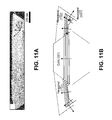
- FIG. 11A shows a STEM image of the solid box in FIG. 10 revealing example In x Ga 1-x N/GaN MQWs.
- FIG. 11B is a crystal orientation map identified from the five In x Ga 1-x N layers of FIG. 11A .
- FIGS. 12A and 12B present the details of change in crystal shape through faceting at the front growth surface as revealed in FIG. 11A .
- FIG. 13 presents PL spectra in the temperature range of 10-290 K obtained from example In x Ga 1-x N/GaN quantum wells.
- FIGS. 14A and 14B show examples of neighboring GaN stripes.
- FIG. 15A shows an SEM cross-section of an example LED structure.
- FIG. 15B shows a schematic drawing of the LED structure of FIG. 15A .
- FIG. 16A illustrates a schematic cross-section of an LED with a cubic GaN active region, according to an embodiment of the present disclosure.
- FIG. 16B illustrates an assembly of the multiple stripes of FIG. 16B into a large area LED using an interconnect layer, according to an embodiment of the present disclosure.
- FIG. 17 illustrates a method of using a mask to block h-GaN growth, thereby allowing only the c-GaN to continue growing, according to an embodiment of the present disclosure.
- FIG. 18 shows an exemplary cubic GaN LED device.
- FIGS. 19, 20A, 20B, 21A and 21B show graphs of data collected from several examples of the present disclosure.
- FIG. 22 shows a region where focused ion-beam milling had been used to remove the h-GaN regions from InGaN quantum well structures, according to an example of the present disclosure.
- FIGS. 23A and 23B show graphs of data collected from examples of the present disclosure.
- FIG. 24 shows an example of a Ga—Si alloying problem that can be reduced by employing a buffer layer.
- FIG. 25 illustrates a transistor, according to an embodiment of the present disclosure.
- FIG. 26A to 26F illustrate a schematic process sequence for the removal of a semiconductor substrate from a device formed thereon, according to an embodiment of the present disclosure.
- FIG. 27 illustrates a photodetector, according to an embodiment of the present disclosure.
- FIG. 28A illustrates a laser geometry in an as-grown configuration
- FIG. 28B illustrates the laser geometry after removal of the semiconductor substrate.
- An embodiment of the present disclosure is directed to a semiconductor device 10 , as illustrated in FIG. 1C .
- the device comprises a substrate 12 .
- the substrate comprises a groove 14 formed in crystalline semiconductor.
- the sidewalls of the groove are (111) faces of the crystalline semiconductor.
- a buffer layer 16 is formed in the groove 14 .
- the buffer layer 16 comprises at least one material chosen from AlN, GaN or Al x Ga 1-x N, where x is between zero and one.
- An epitaxially grown semiconductor layer 18 is disposed over the buffer layer 16 .
- a portion of the epitaxially grown layer 18 has a cubic crystalline phase structure 18 b.
- the substrate 12 employed for manufacturing the devices of the present disclosure can be any type of substrate comprising single crystal silicon having a (100) lattice structure.
- the substrate 12 can be a free-standing silicon wafer, such as those cut from a single crystal boule, as is well known in the art.
- the substrate can comprise other materials on which the single crystal silicon material is a portion thereof, such as, for example, a silicon-on-glass substrate or a silicon epitaxial layer grown on, or bonded to, a base substrate, referred to as silicon-on-insulator.
- the silicon can be doped or undoped.
- a substrate comprising GaAs having a (100) lattice structure can be employed.
- the substrate 12 comprises at least one groove 14 .
- the groove can be any shape that provides (111)-faceted groove surfaces that are suitable for epitaxial crystal growth of the buffer layer 16 .
- a v-groove or a flat-bottomed groove can be formed in a silicon or GaAs substrate to provide (111)-faceted sidewalls.
- the width of the groove, W can range from a few nanometers to any width that will allow formation of the cubic lattice region.
- W is comparable to a diffusion length of a Ga adatom under the epitaxial growth conditions, which is generally several microns, or less.
- the width can be about 3, 5, 8 or 10 microns or less.
- the length of the groove can be any desired length, limited only by the size of the available wafer.
- the length of groove 14 can be comparable to the width of groove 14 or longer, such as a length ranging from about 10 or 100 times longer to about 1,000,000 times longer than the width of groove 14 .
- the groove can be formed by any suitable method that provides the desired (111)-faceted surfaces.
- suitable methods include lithographic patterning and etching techniques, such as interferometric lithography followed by an anisotropic wet etch of the patterned surface using, for example, KOH or related wet-etch chemistries, including solvent-based chemistries.
- KOH lithographic patterning and etching techniques
- anisotropic wet etch of the patterned surface using, for example, KOH or related wet-etch chemistries, including solvent-based chemistries.
- KOH lithographic patterning and etching techniques
- a variety of other lithographic and etching techniques can be employed, as would be understood by one of ordinary skill in the art.
- buffer layer 16 can be epitaxially grown in groove 14 .
- the buffer layer comprises an AlN nucleation layer.
- An Al x Ga 1-x N interlayer can be deposited on the nucleation layer, where x can range from 0 to 1 (thereby encompassing AlN and GaN), for the purpose of growing cubic III-nitrides on silicon wafers. In an embodiment, x is greater than 0 and less than 1.
- Buffer layer 16 plays a part in the overall success of the growth process.
- Buffer layer 16 can serve as a strain relief layer to increase the crystal quality of the grown cubic III-nitride material. Additionally, buffer layer 16 can reduce or prevent alloying of the subsequently formed crystal layer 18 with material from the substrate. For example, Ga—Si alloying has been shown to occur during epitaxial growth of GaN on silicon substrates. An example of the alloying problem is shown in FIG. 24 .
- the buffer layer 16 can be sufficiently thick to prevent such alloying, which can be problematic. On the other hand, if buffer layer 16 is too thick, cracking of the buffer layer is likely.
- the thickness of the buffer layer can be in the range for example, from sub-monolayer up to about 1 ⁇ m, such as about 1 nm to about 1 micron, or about 5 nm or 10 nm to about 100 nm or 500 nm.
- the concentration of Al and Ga in the buffer layer 16 is graded through at least a portion of the thickness of the buffer layer. In an alternative embodiment, the concentration of Al and Ga in buffer layer 16 is substantially constant through the thickness of buffer layer 16 .
- the concentration of Al and Ga varies in a stepwise manner though at least a portion of the thickness of buffer layer 16 .
- buffer layer 16 can comprise two or more layers with one or more different Al x Ga 1-x N compositions having stepped concentrations.
- the concentration can be stepped in any desired manner.
- in one layered portion of the buffer layer x can be about 0.7, and in a second layered portion of the buffer layer x can be about 0.3.
- Another embodiment can use one or more graded buffer layers, where x varies continuously from, for example, about 1 to zero, through the thickness of the layer.
- the buffer layer may or may not include a nucleation layer, such as AlN, in addition to the Al x Ga 1-x N layers.
- an AlN layer is employed alone, without a Ga containing portion of the buffer layer.
- the Al x Ga 1-x N buffer layers can be smooth or rough.
- a relatively smooth buffer layer can have a root-mean-square (RMS) surface roughness value in the range from about 0.1 nm up to and including 1 nm, or more, depending on the crystal plane.
- the surface roughness value is generally less than 1 nm, such as about 0.2 to about 0.3 nm (RMS); and would be considered relatively rough with a surface roughness value larger than 1 nm (RMS); such as a value ranging from 1.1 nm to about 2 nm or 20 nm (RMS).
- a smooth value may range from about 1 nm to about 2 nm (RMS).
- any suitable epitaxial growth method can be used to form the buffer layer.
- Suitable examples include MBE and MOVPE.
- MOVPE MOVPE
- each MOVPE reactor system is slightly different, and therefore optimal growth conditions on Si (111) faceted sidewalls of a groove can vary.
- the potential parameter space can be large, because many combinations of temperature, pressure, gas flows, and layer compositions are possible. Selected example growth runs are described herein to provide some guidance in the selection of MOVPE growth conditions.
- the epitaxially grown layer 18 comprises a cubic III-nitride material.
- the epitaxially grown layer can comprise c-GaN and/or c-In y Ga 1-y N, where y is greater than zero and equal to or less than one.
- suitable cubic III-nitride materials include GaAsSbN, InAlAsN, InGaAsN, and AlGaN.
- Still other cubic III-V materials could be formed, such as GaAs, AlGaAs or InGaAs.
- the epitaxially grown layer 18 comprises a second crystalline lattice structure in addition to the cubic lattice structure.
- epitaxially grown layer 18 includes both a hexagonal lattice outer region 18 a and a cubic lattice inner region 18 b.
- the c-axis is the direction of the h-GaN (or h-InGaN) with a larger lattice constant than the other two orthogonal crystal directions, e.g. the h-GaN (or h-InGaN) lattice is elongated along the c-axis direction.
- the two c-axes directions cannot co-exist in the overlap region as the material grows up from the two sides of the v-groove without forming a heavily defected region.
- the underlying symmetry of the Si substrate provides a driving force for a phase segregation leading to the formation of the c-GaN (or c-InGaN) material in or near the center of the v-groove where the growth regimes overlap. This is different than growing GaN on planar Si(001) or a shaped surface that does not provide the desired driving force, in which you get a random phase separation that is not useful. It should be noted that while the symmetry of the epitaxial layer is the same as that of the Si substrate, the lattice constant of the c-GaN (or c-InGaN) is fully relaxed and is not constrained by the underlying Si lattice constant.
- FIG. 8B illustrates an epitaxially grown MQW structure formed in an epitaxially grown layer 18 , according to an embodiment of the present disclosure.
- the epitaxially grown layer includes an inner region 20 of c-GaN and an outer region 22 of h-GaN.
- Region 24 of FIG. 8B illustrates alternating layers of thicker GaN and thinner In y Ga 1-y N that form quantum wells.
- Employing alternating layers to form quantum wells is generally well known in the art. As illustrated, these alternating layers are formed in both the cubic inner region 20 and the hexagonal outer region 22 .
- epitaxial layer 18 can be grown by any suitable method, such as MBE or MOVPE.
- the selected method can be the same as or different than the epitaxial method used to grow the buffer layer 16 .
- Any suitable source materials can be employed.
- gallium, nitrogen and indium source materials can be employed.
- Suitable source materials for use in MBE and MOVPE are well known in the art.
- Al containing materials are generally highly reactive with atmospheric oxygen.
- Suitable encapsulation and in-situ etching techniques can be used to protect and/or remove native oxides if the Al-containing layer is to be exposed to air during transfer between growth modalities. Determining suitable encapsulation and/or in-situ etching techniques is within the capabilities of a person of ordinary skill in the art.
- the epitaxially grown layer can have any desired thickness.
- the epitaxially grown layer 18 can have a thickness ranging from a sub-monolayer to about 10 ⁇ m.
- the length and width dimensions of the epitaxially grown layer 18 can largely be determined by the structuring of the substrate (e.g., the length and width of the groove 14 ).
- the length of layer 18 may range from, for example, about 10 or 100 times longer to about 1,000,000 times longer than the width of groove 14 .
- Such structures can be referred to as nanowires or quantum wires.
- a plurality of the epitaxially grown cubic layers can simultaneously be grown in a plurality of adjacent grooves.
- Each of the plurality of epitaxial layers can comprise both hexagonal and cubic phase lattice structures, such as c-GaN/c-In y Ga 1-y N regions and h-GaN/h-In y Ga 1-y N regions.
- the resulting epitaxially grown layers can comprise a plurality of separated MQW cubic regions.
- the separate cubic regions can subsequently be electrically connected in parallel, series or any combination thereof.
- a blocking layer can be formed to reduce or prevent growth of the hexagonal phase portion of the epitaxial layer 18 .
- a c-GaN region and a h-GaN region can be separated by a blocking layer.
- An example of a technique employing a blocking layer is discussed below in the description of FIG. 17 .
- the cubic phase epitaxial layers of the present disclosure can be employed in a variety of semiconductor devices. Examples of such devices include light emitting diodes (LEDs), laser diodes, photodetectors and transistors.
- LEDs light emitting diodes
- laser diodes laser diodes
- photodetectors photodetectors and transistors.
- a semiconductor device comprises strips of the epitaxially grown layers and silicon regions. Electronic devices can be positioned in both the epitaxially grown layer and the silicon regions.
- forming the devices of the present disclosure can involve removing at least a portion of the substrate 12 .
- Example techniques for removing the substrate are described in more detail below.
- forming the devices described herein can involve completely or partially removing h-GaN or h-InGaN quantum wells from the epitaxially grown layer.
- FIG. 25 shows one example of a MOSFET transistor 30 in a cross-section of a cubic lattice region 18 b , formed according to methods of the present disclosure.
- the transistor can include a gate electrode 32 , source and drain regions 34 and a gate dielectric 38 , as is well known in the art.
- Source and drain regions can be doped with n-type or p-type dopants, as can some or all of the remaining portion of cubic region 18 b .
- Doping to form MOSFET active regions is well known in the art.
- the source and drain regions 34 can be doped with an n-type dopant and the remaining portion of the cubic lattice region 18 b can be doped with a p-type dopant, or vice versa.
- portions of the MOSFET can also be formed in hexagonal lattice regions of the heterophase lattice structures described herein.
- transistor 30 is illustrated with the width of gate 32 parallel with the width of the cubic lattice region, the transistor can be positioned in any desired manner with respect to the cubic lattice region 18 b .
- the position of transistor 30 can be rotated 90° so that the width of gate 32 is formed parallel to a length of the cubic lattice region, which runs into the page in FIG. 25 .
- FIG. 27 illustrates one example of a photodetector that employs a cubic lattice region 18 b , formed according to methods of the present disclosure.
- the substrate 12 can be any substrate material disclosed herein, such as, for example, Si or GaAs.
- the regions 18 a and 18 b can respectively be any hexagonal or cubic semiconductor materials disclosed herein, such as a h-GaN region 18 a and a c-GaN region 18 b .
- the active region 62 can be an InGaN quantum well, or any other quantum well material disclosed herein.
- the regions 18 a , 18 b and 62 can be doped to form heterojunction(s) so as to provide a functional photodetector, as is well known in the art.
- any desired technique can be used to electrically connect devices formed in the cubic lattice regions with each other and with other devices on the substrate surface.
- selective area decomposition of precursor gas is used to form electrical connections to the cubic crystalline devices. Suitable methods for performing selective area decomposition are well known in the art.
- the widths of the groove 14 can be adjusted. Any suitable size groove widths can be employed. For example, groove widths of 100 nm to 10 ⁇ m were investigated, although groove widths outside of this range can be used. It is reasonable to expect that the resulting cubic GaN regions are of similar size as the groove widths, which would be sufficient to fabricate LED devices. Cubic GaN regions with ⁇ m-sized widths have been obtained using the methods of the present disclosure.
- FIG. 16A illustrates a schematic cross-section of a proposed LED with a cubic GaN active region.
- Individual stripes can be separated by etching and the top contact can be a transparent conductive oxide or a semi-transparent metal.
- the grown GaN layers are patterned by conventional photolithography to create the stripes of cubic GaN.
- the quantum-well active region and the p-GaN and n-GaN layers can be formed as part of a single GaN growth sequence.
- the wafer with the cubic GaN can be patterned, and then a growth mask can be used to selectively re-grow the cubic GaN active region only on the exposed cubic GaN regions.
- FIG. 16B illustrates an assembly of multiple stripes of FIG. 16A into a large area LED using an interconnect layer, according to an embodiment of the present disclosure.
- Metal can be deposited on the back-side and/or front side of the wafer to provide desired contact formation. Since the silicon substrate is non-transparent, the light can be extracted through the top contact, which can be a transparent conducting oxide or a thin, semi-transparent metal or layers of other conductive materials (e.g., graphene or graphene-like materials).
- Multiple stripes can be electrically connected together with an insulating interlayer dielectric (ILD) and interconnects, which can comprise any suitable conducting material, such as metal, doped polysilicon or graphene, that only occupy a small fraction of the final device, as illustrated in FIG. 16B . In such a configuration the loss of effective light-emitting area could be reduced.
- ILD interlayer dielectric
- both geometries shown in FIGS. 16 and 17 retain the Si substrate, which can be an issue for LEDs because of the strong Si visible absorption.
- This can be accomplished using any suitable technique.
- the sample can be bonded to a new handle substrate, such as a transparent, non-transparent, or reflective substrate, with a transparent contact layer such as ITO.
- the Si substrate can then be selectively removed by any suitable method.
- the back side of the substrate can be coated to form the second contact.
- a flip-chip bonding technique for electrical connection to LEDs is described in more detail below. The resulting triangular shape of the new top surface that results from this technique could be interesting for optimization of light extraction.
- FIG. 26A is the as-grown c-GaN/h-GaN ( 18 b / 18 a ) on a Si substrate ( 12 ) as discussed above, including, for example, InGaN quantum wells and p-n junctions.
- An optional process (not shown) is to fill the spaces between the GaN growth and above the GaN with a dielectric material that could include, for example, SiO 2 (such as TEOS) or polymers such as, but not limited to, benzocyclobutene (BCB), which is generally well known in the art as a dielectric for use in microelectronics.
- a dielectric material could include, for example, SiO 2 (such as TEOS) or polymers such as, but not limited to, benzocyclobutene (BCB), which is generally well known in the art as a dielectric for use in microelectronics.
- FIG. 26B shows a handle wafer ( 52 ) with two or more additional thin film layers ( 53 , 54 ) to provide electrical and mechanical contact to the GaN.
- FIG. 26C the GaN wafer is inverted and bonded to the handle wafer, making electrical contact to one side of the p-n junction.
- FIG. 26D the Si substrate 12 is removed, using a combination of polishing and selective etching of the Si and of any dielectric layer in the case of SOL
- FIG. 26E shows an optional step of removing the h-GaN, leaving just the c-GaN material.
- 26F shows two additional layers, a dielectric isolation layer ( 55 ) and a top contact layer ( 56 ).
- This bonding scheme is well developed in many other cases, such as, for example the bonding of infrared detector arrays, fabricated in materials such as InSb, HgCdTe or GaAs to silicon read out integrated circuits. Such bonding is routinely carried out with many millions of individual contacts.
- the steps presented here are exemplary only. Further process details can be worked out following well known industry practice adapted for GaN materials, as would be readily understood by one of ordinary skill in the art.
- a growth mask comprising, for example, SiO 2
- SiO 2 can be employed so that only the cubic phase can grow further and these regions can then coalesce by lateral overgrowth over the mask.
- the growth of these structures could include a GaN capping layer to clad the ends of the QWs to reduce nonradiative transitions at the interface with amorphous materials (interlayer dielectric or air).
- FIG. 17 illustrates a method of using a mask 48 to block the h-GaN, thereby allowing only the c-GaN to continue. This method is described in more detail in U.S. Pat. No. 8,313,967, issued on Nov. 20, 2012, the disclosure of which is hereby incorporated by reference in its entirety.
- Patterning conductive layers which can comprise metal, doped polysilicon or any other conductive material suitable for device fabrication, for electrically connecting the devices of the present application can be performed by any suitable method.
- Optical lithography tools are commercially available that have the alignment and patterning capability to form electrical contacts useful in sub micron dimension cubic lattice regions of the present disclosure.
- such lithography tools are currently relatively expensive, and without such tools, the experimental realization of the proposed electrically connected stripe LEDs, or other device cubic lattice devices of the present disclosure, can prove challenging.
- To provide a method that can utilize less expensive tools for alignment and patterning of the cubic lattice regions an approach was adopted that employs selective area decomposition of a precursor gas. This method includes providing an array of insulated pads for probing. In an embodiment, this was accomplished using photolithography and lift-off, as discussed in greater detail below. However, any suitable method could be employed for providing the desired electrical contacts.
- Regions for the contact pads were defined by photoresist, and electron-beam evaporation was used to deposit a stack of SiO 2 (200 nm), Ti (20 nm), and Au (100 nm).
- a fine metal (Pt) contact was deposited reaching from the contact pad to the center of an individual GaN stripe by beam induced machining (BIM).
- BIM beam induced machining
- Other insulators and metals can be used instead of SiO 2 , Ti and Au.
- Other metals suitable for contacts, such as tungsten, can also be used instead of Pt.
- BIM is usually performed by the use of a focused ion beam (FIB) tool to remove material.
- FIB focused ion beam
- BIM can also be used to deposit new material, including conductive material, such as metal or doped polysilicon; dielectric material or semiconductive material.
- Selective decomposition of precursor gas is one form of BIM that can be employed, although other forms of BIM could also be used.
- the gas can be supplied by means of a gas injection system that transports the gas near the region where the planned deposition will occur.
- the precursor gas is decomposed by a beam of electrons or ions, and leaves a residue of material determined by the precursor gas in the area where the beam has induced the decomposition.
- the beam diameter, scanning rate, duration and gas flow rates determine the final form and amount of material that gets deposited.
- a precursor gas containing platinum and the electron beam of a commercially available combined SEM-FIB tool was used for the selective decomposition. This yielded an approximately 100 nm wide metal line. The thickness of this metal line was controlled by the deposition time, and a duration of several tens of seconds yielded thicknesses on the order of 1 ⁇ m.
- the result for one cubic GaN LED device is shown in FIG. 18 .
- the part of the Pt contact 52 on the GaN stripe 54 has a length of 7.8 ⁇ m.
- the contact to the n-side of the structure (not shown) was made by soldering the Si-wafer to a copper block. Part of the probing pad 50 is visible, and the Pt metal line in the center contacts to the p-side of the GaN stripe.
- the stripes of the LED devices of the present disclosure can form one dimensional waveguide structures with only a small number of modes.
- This geometry is well suited to the realization of laser structures.
- the number of modes is roughly given by A/( ⁇ /2n) 2 where A is the cross section of the stripe and n is the refractive index of the GaN.
- the number of modes can vary depending on the device. For the example structure of the LED device of FIG. 18 , the number of modes was roughly about 25. A smaller v-groove would result in a significantly reduced number of modes.
- the length of the stripes can be any suitable length, limited only by the lithographic capability and size of the substrate.
- Example nanowire structures have been made that are about 1 cm, which is believed to be far longer than other known nanowire structures.
- Example lengths of the stripes can range from about 10 nm or less to about 50 cm, such as about 1, 10 or 100 microns to about 1, 10 or 30 cm.
- the material can cleave perpendicular to the stripe, providing good mirror surfaces. Even without a good cleaved surface, the small number of modes means that there is high reflectivity back into the propagating modes in the stripe.
- the Si is highly absorbing to radiation at visible wavelengths, which can potentially be problematic for laser structures.
- Another possible problem is that the h-InGaN quantum wells to the side of the c-InGaN wells may provide a lower energy level, siphoning carriers from the c-InGaN. This can be addressed by removing the h-GaN QW regions.
- FIG. 22 shows a region where focused ion-beam milling has been used to remove the h-GaN regions.
- the blocking technique of FIG. 17 discussed above, can be applied before the growth of the InGaN QWs.
- FIGS. 23A and 23B The light-output power vs. current graphs for the same cubic GaN LEDs as in FIGS. 20 and 21 are shown in FIGS. 23A and 23B , respectively.
- This data shows that in both devices there is a current range in which the light output power increases faster than linearly proportional to the current. Specifically, for FIG. 23A this is observed in the range of 50 ⁇ A to 140 ⁇ A. Specifically, for FIG. 23B this is observed in the range of 40 ⁇ A to 60 ⁇ A. Both those findings are indications that light amplification by stimulated emission may be occurring. Furthermore, it is possible that by the specifics of the described structure an optical cavity may have been formed that could act as a resonator to support such stimulated emission to induce laser diode action in these device structures.
- FIG. 28A illustrates a quantum well laser device 70 comprising a semiconductor substrate 12 on which a heterophase lattice region 72 is formed.
- the region 72 can comprise outer h-GaN and inner c-GaN lattice regions. Any of the other group III nitrides as described herein can be employed in place of GaN.
- Laser device 70 includes a quantum well region 74 , as is well known in the art.
- Quantum well region 74 can comprise a suitable group III nitride material, such as InGaN.
- Semiconductor regions above and below the quantum well can be doped with p-type or n-type dopants, as is well known in the art.
- a region immediately below the quantum well 74 can be doped with n-type dopants and a region immediately above quantum well 74 can be doped with p-type dopants, or vice versa.
- multiple quantum wells can be employed instead of a single quantum well, as is also well known in the art.
- FIG. 28B illustrates another embodiment of a device 76 in which the Si substrate 12 has been removed and the heterophase lattice region 72 has been bonded to another substrate 78 .
- the heterophase lattice region 72 can be made of the same materials and/or doped as described for the device of FIG. 28A .
- Multiple quantum wells can be formed if desired.
- Substrate 78 can be any suitable material, such as doped or undoped semiconductor or insulator material. In an embodiment, the substrate 78 is transparent to the radiation emitted by the quantum well laser device 76 .
- the present disclosure teaches, among other things, growth on sub- ⁇ m-sized and ⁇ m-sized V-grooves in silicon as a method for forming cubic GaN structures and cubic GaN LEDs.
- a contrast change in SEM is observed between the GaN near the groove sidewalls and the material near the groove center.
- These cubic regions can have a width on the order of, for example, several hundred nanometers.
- the cubic phase in the stripe center was confirmed by Electron backscattering diffraction (EBSD) phase identification.
- EBSD Electron backscattering diffraction
- the top surface of the cubic region in the MQW structure exhibited a (001) plane. Band-edge emission and luminescence from GaInN/GaN MQWs in cubic GaN were observed by CL.
- a line array of v-grooves with a period of 1.8 microns was fabricated into a Si(001) substrate by interferometric lithography with a single longitudinal transverse mode, frequency-tripled, yttrium aluminum garnet laser at a wavelength of 355-nm and anisotropic wet etching based on potassium hydroxide.
- the lithographic pattern was aligned so that the v-grooves were aligned approximately along the ⁇ 110> direction of the Si surface. This led to the revealing of ⁇ 111 ⁇ sidewalls after KOH etching.
- As a substrate boron-doped Si(001) wafers with resistivity of ⁇ 10 ohm-cm were used.
- Each groove comprises two (111)-type facets forming a v-shape valley when viewed in cross section.
- the groove width was kept at ⁇ 0.8 microns and the corresponding depth was then ⁇ 0.6 microns.
- a buffer comprising a thin AlN and 450 nm-thick GaN layer was grown first by MOVPE.
- the thin AlN was employed to avoid any nitridation on the Si surface at the beginning of deposition.
- Example 2 On a patterned substrate similar to that of Example 1, an additional 5 stacks of a ⁇ 3 nm-thick In x Ga 1-x N well with a ⁇ 20 nm-thick GaN spacer, and an ⁇ 8 nm-thick GaN capping layer were consecutively grown on the 450-nm-thick GaN buffer layer. All layer thicknesses, both in Example 1 and Example 2, were calibrated on a sapphire (0001) plane as a reference. The total amount of deposition was sufficient to induce the phase transition to cubic phase by filling up each v-groove. At the same time, the deposition was controlled to avoid any coalescence between the epitaxial layers grown on adjacent grooves. Thus, most of the epitaxial layers grown on individual grooves kept the identical crystal shape even when growing beyond their initial filling of their respective groove.
- FIG. 2 Examples of different buffer layers are shown in FIG. 2 .
- the nucleation layer is about 25% thinner than in FIG. 2A .
- the resulting growth looks similar in both cases, showing good and selective nucleation normal to ⁇ 111 ⁇ planes.
- no growth occurred on the flat top Si (100) surfaces between the v-grooves.
- the GaN on the sidewalls was smooth and continuous, but the top edges were irregularly shaped. Voids can form where the two wings from adjacent v-grooves join.
- FIG. 3 The effect of different substrate patterns was studied in wide grooves with flat bottoms and sharp v grooves, as shown in FIG. 3 .
- FIG. 3A illustrating grooves with relatively wide spacing between the sidewalls, the GaN was thicker than in 3 B, indicating that due to the reduced nucleation area, the growth rate increases. This is a well-known effect in selective area growth.
- the GaN thickness is 510 nm and 380 nm in FIGS. 3A and 3B , respectively.
- FIG. 4 shows irregular GaN growth and alloying problem due to increased growth time. The crystal quality was degraded and some parts of the structure show the alloying problem discussed above. A thicker AlN buffer, as shown in FIG. 5A , eliminated the alloying problem, as can be seen in FIG. 5B .
- the thickness of the AlN nucleation layer can be varied to prevent or reduce the alloying problem. For long growth times this alone may not be enough and a combination of low GaN growth temperature and AlGaN interlayer can be employed.
- the use of the AlGaN interlayer is a trade-off between selectivity and prevention of alloying.
- FIG. 6 An example of structures grown after the optimization of the nucleation and buffer layers is shown in FIG. 6 .
- the structure is uniform on the scale of several mm 2 , and the SEM images reveal that the two growth fronts in the grooves merged completely.
- the top surface in the center region is not completely smooth, but shows steps and striations.
- the top surface of GaN near the sidewalls is angled away from the horizontal and it shows a slightly smoother morphology than the center region.
- the v-groove depth was on the order of 0.7 ⁇ m and the GaN thickness between the v-shaped contrast line and the silicon was around 0.2 ⁇ m (measured perpendicular to the Si ⁇ 111 ⁇ sidewalls).
- the MQW comprises 7 pairs of GaInN/GaN layers.
- the equivalent super-lattice period for one pair in a planar layer is 25.2 nm.
- An optical microscope image in Nomarski mode and a PL image are shown in FIG. 8 .
- FIGS. 7A and 7B show SEM micrographs of the regrown cyan MQW structure.
- FIG. 7A shows a top-view image showing striations in the central part perpendicular to V-groove direction. These striations extended to the sloped sidewall regions. The arrows mark the total width (1.3 ⁇ m) and central region width (0.9 ⁇ m).
- FIG. 7B shows a birds-eye-view of a cross-section of the regrown sample. The annotations identify the different regions. From FIG. 7 it is evident that the morphology of the re-grown MQW conformed to the template structure. The striations on the top surface were more pronounced and also the polycrystalline growth between the adjacent stripes had increased.
- the width of the central region in FIG. 7A was 0.9 ⁇ m, whereas the total width of the GaN stripe was 1.4 ⁇ m.
- the (tilted) cross-section view in FIG. 7B shows the uniform growth in several grooves. It is observed that after the MQW regrowth the GaN protruded above the silicon surface, and for the most part, the structure above the Si surface was similar to that inside the groove. Only a slight lateral overgrowth was visible, starting from the sidewalls and extending over the region between adjacent stripes.
- FIG. 8A shows the cross-section of an individual GaN stripe (with enhanced contrast for clarity). As shown, a large V-shaped contrast separated the sidewalls from the central region. Several layers can be seen near the top surface. These layers were the re-grown MQWs and they conformed to the shape determined by the template structure. It was evident that the MQWs grew parallel to the top surface in the central region and they were inclined away from the horizontal on the sidewall top surfaces. In addition, they also grew on the (inclined) vertical sidewalls. The growth rate in this direction was strongly reduced, as evident from the drastically reduced spacing between the MQWs (see FIG. 8 B)).
- FIGS. 9A, 9B, and 9C are cross-section SEM images.
- FIG. 9A shows an array of v-grooves fabricated into a Si(001) substrate.
- FIG. 9B is an SEM image of the cross section of the epitaxial layers grown on the grooves in FIG. 9A with a planar top surface.
- FIG. 9C reveals the surface morphology in top-down view that is slightly roughened by surface undulation along and some bumps near the edges of each stripe.
- the top transverse lateral dimension of each epitaxial layer extends up to ⁇ 1.5 microns.
- FIG. 10 is a TEM image corresponding to the dashed box in FIG. 9B .
- the region above the dashed line corresponds to c-GaN and c-In x G 1-x N layers.
- the insets show high resolution TEM images of the h-GaN buffer near the interface (right) and the c-GaN in the middle of the v-groove indicated by the arrows.
- the inset images confirm that h-GaN was grown at the initial stage of growth and changed to the cubic phase in the middle of the v-groove.
- the region above the dashed line in FIG. 10 corresponds to c-GaN and c-In x Ga 1-x N.
- FIG. 11A shows a STEM image of the solid box in FIG. 10 revealing the In x Ga 1-x N/GaN MQWs.
- FIG. 11B is a crystal orientation map identified from the five In x Ga 1-x N layers in FIG. 11A .
- the five bright lines near the top surface in FIG. 11A correspond to the five In x Ga 1-x N QW layers and play a role of markers revealing the front growth surface faceting that evolves during epitaxy.
- the top surface comprises three major facets, cubic (001) at the center, and hexagonal (0001) and ⁇ 1101 ⁇ near both edges.
- the c-In x Ga 1-x N is formed in the middle of the v-groove and laterally extends up to 1 ⁇ m over the groove.
- the c-GaN facets are nonpolar and free from the piezoelectric effects impacting the optical properties of III-N's.
- the dotted and the dashed lines represent real (below the solid line of the top surface) and imaginary (above the solid line of the top surface) cubic/hexagonal phase boundaries and the expected growth pattern for continued growth.
- FIGS. 12A and 12B present the details of the change in crystal shape through the faceting at the front growth surface as revealed in FIG. 11 . While the crystal shape in FIGS. 10 and 11 is terminated only with three facets; as can be seen in FIG. 11B and FIG. 12B , at least four different facets were involved during growth. In particular, there was an additional ⁇ 1 1 00 ⁇ facet from the hexagonal phase at both edges in addition to the three facets already identified. Based on the profile of the In x Ga 1-x N layers shown in FIG.
- t 000 1 :t 1 1 01 :t 001 :t 1 1 00 ⁇ 23 nm: ⁇ 83 nm: ⁇ 107 nm: ⁇ 230 nm, (1) where t 1 1 00 is the deposition thickness from the first GaN spacer to the third In x Ga 1-x N QW layer (i.e., two pairs of a GaN spacer and an In x Ga 1-x N QW) since the ⁇ 1 1 01 ⁇ facet is no longer available at the fourth In x Ga 1-x N QW layer.
- the thickness of the ⁇ 000 1 ⁇ layer is less than the nominal deposition thickness while the ⁇ 1 1 01 ⁇ , (001) and ⁇ 1 1 00 ⁇ thickness are greater than the nominal deposition thickness.
- r X represents the relative growth rate of each facet normalized by that of the h-GaN(000 1 ).
- (000 1 ) is the lowest in growth rate while ⁇ 1 1 00 ⁇ has the highest growth rate among the given facets.
- the ⁇ 1 1 00 ⁇ -type facet and/or plane grows very fast but ultimately disappears from the growth front surface in continued epitaxy. Since the filling of individual grooves with h-GaN in [0001] as well as c-GaN in [001] preferentially proceeds at the initial stage of growth, it can be conjectured that the growth rate of (0001) should be considerably greater than that of (000 1 ) observed at the edge of each epilayer in Equation (1). That is, (000 1 ) and (0001) are very different in growth rate under the given conditions. Then, Equation (2) is consistent with reported data where the observed growth rates vary from lowest to highest along ⁇ 1 1 01 ⁇ , ⁇ 1 1 00 ⁇ , and (0001).
- FIG. 12A shows magnifications of areas at the junction of (001) and ⁇ 1 1 00 ⁇ .
- FIG. 12B reveals the disappearance of the ⁇ 1 1 00 ⁇ facet near the right edge of the epilayer in FIG. 11 .
- the arrows in each figure indicate In x Ga 1-x N layers on individual facets.
- a surface analysis shows that (000 1 ) and (0001) are a Ga-terminated (gallided) and a N-terminated (nitrided) surface, respectively, and the gallided surface is energetically more stable than the nitrided surface for GaN. A more stable surface is less active in bonding adatoms for nucleation.
- the epitaxy proceeds with the minimization of total surface free energy at the given cross sectional area. This drives the shape of an epilayer to the equilibrium crystal shape (ECS) for the specific growth conditions.
- ECS equilibrium crystal shape
- every facet on the epilayer has the equal accessibility to the source gases supplied into an MOVPE reactor, and a lateral dimension less than or comparable to the adatom surface migration length
- the lowest total surface free energy can be maintained at any stage of the epitaxy by contracting [expanding] the areas of higher [lower] surface energy facets (e.g., the lengths of a facet in the cross section of FIG. 11 ). This coincides with adatom migration across facet boundaries.
- Equation (1) implies that surface free energy of (000 1 ) is the lowest of the other facets involved in the crystal shape of the epilayer. On the other hand, ⁇ 1 1 00 ⁇ has the highest free surface energy.
- the top surface of c-GaN before the deposition of the first c-In x Ga 1-x N layer is already flat. While some of the epilayers show noticeable fluctuation in planarization up to the 2nd In x Ga 1-x N deposition, most of them attain the planar surface before deposition of In x Ga 1-x N MQWs. Thus, at least three c-In x Ga 1-x N QW layers from the top keep planar interface parallel to Si(001) across the cubic phase region.
- r 001 greater than r 1 1 01 in Equation (2) implies that the free surface energy of the c-GaN (001) facet is higher than that of the h-GaN ⁇ 1 1 01 ⁇ and this facet will ultimately vanish out from the front growth surface as epitaxy proceeds further.
- FIG. 11 also implies the annihilation of (001) in continued epitaxy, with the dashed lines representing an imaginary front growth surface that would be formed with continued epitaxy beyond the capping layer surface. Then, the resulting cross section would comprise a rhombus-shape c-GaN totally enclosed within h-GaN.
- cross section is very important in device applications of c-III-N's.
- the growth In order to have the maximized cubic phase top (001) surface, the growth must be controlled to stop near the point where the cross section of the cubic phase attains the shape of a half of the rhombus in cross section, as in FIG. 10 .
- the single v-groove epilayer shown in FIG. 10 is composed of spatially separated, two phase materials exposing several different facets along a single top surface.
- a theoretical calculation suggests that critical thickness of In x Ga 1-x N on GaN with In composition of ⁇ 0.2 is lower by up to 20% in hexagonal phase compared with the same constituent material in the cubic phase.
- nucleation depends on substrate orientation in the epitaxial growth of strained heterostructures.
- the cubic (001) orientation has a different misfit stress than the neighboring hexagonal ⁇ 1 1 01 ⁇ and ⁇ 1 1 00 ⁇ facets.
- Equation (2) can be applied to In x Ga 1-x N QW layers to evaluate thicknesses over different facets.
- the ratio of the thickness on ⁇ 1 1 01 ⁇ to the thickness on ⁇ 1 1 00 ⁇ for In x Ga 1-x N is not noticeably different from that for GaN.
- FIG. 13 presents the PL spectra in the temperature range of 10-290 K obtained from In x Ga 1-x N/GaN quantum wells of the present disclosure, such as those in FIG. 12 .
- a single broad peak is observed at a wavelength of 491.9 nm. This peak follows the temperature-dependent bandgap of GaN and shifts to 478.6 nm at 10 K.
- Another narrow peak at 510.1 nm is evident below 60 K.
- the narrow peak is strengthened and becomes comparable to the broad peak in intensity at 10 K.
- the investigation of the origin of the narrow peak is presently underway. Assuming that both peaks are from the MQWs, the range of In composition can be roughly estimated as 0.2-0.3 in the consideration of both hexagonal and cubic phase.
- STEM reveals the possibility that the spatial inhomogeneity of the In atoms within each QW layer and c-In x Ga 1-x N/GaN MQW could have the peak separation from h-MQWs that is less than the bandgap difference between c- and h-In x Ga 1-x N, as a result of both thickness and concentration variations, and this may impact the peak splitting and the linewidth broadening.
- FIG. 14 shows a strong contrast difference between the central region and the sidewalls.
- the stripes showed the familiar striations perpendicular to the groove direction, just like those observed in undoped GaN and the MQW structures. It was particularly interesting to find that the basic growth scheme continued even once the GaN had grown significantly out of the initial V-groove ( FIG. 14B ).
- the individual stripes showed some variation in height, and therefore even if merging of the cubic GaN regions of neighboring stripes were possible (for example using growth masks or etching), the height difference would make it difficult to achieve consistent crystal quality.
- FIG. 15A From the SEM cross-sections ( FIG. 15A ), the Mg-doped layer on top of the LED structures was clearly visible with its brighter contrast. This is also commonly observed in wurtzite LEDs on sapphire. A schematic of the structure is shown in FIG. 15B .
- the introduction of the Mg dopant did not change the growth properties significantly. There was little Mg-doped GaN on the sidewalls (facing adjacent grooves) since the GaN stripes almost touched each other before this layer was grown, and therefore little material could enter the gap between two adjacent stripes.
- FIG. 19 The IV characteristics of two cubic GaN LEDs, which were made according to the methods of the present disclosure and that were similar to the device illustrated in FIG. 18 , are shown in FIG. 19 . These two LED devices were labeled as M7 and O8 in FIG. 19 . The data for these device shows clear diode behavior with moderate leakage. The rectifying ratio of current in forward to current in reverse direction is as high as 4.8 at ⁇ 15V for the device labeled M7. Given the dimensions of the small p-side contacts, which have an area less than 1 ⁇ m 2 , the calculated current density is on the order of tens of kA/cm 2 .
- FIG. 20 shows spectra of device M7 in FIG. 20A (linear) and FIG. 20B (semi-logarithmic) plots.
- FIG. 21 shows spectra of device M7 in 21 A (linear) and 21 B (semi-logarithmic plots).
- the EL for other devices showed parasitic bluish emission from directly under the probing needle or the corners of the probing pad.
- the parasitic emission was often flickering, whereas the emission from the region with intentionally fabricated contacts was stable.
- the light from the devices was collected by an optical fiber (400 ⁇ m silica core) positioned a few mm above the LED.
- the spectral sensitivity of the setup was calibrated indirectly using an intermediate light source. This resulted in small artifacts in the recorded spectra in the form of shoulders on the main peak. It must be noted that the absolute power calibration using this approach has a potential large error and therefore has to be regarded as an order-of-magnitude estimate.
- the wavelength of the main peak in FIG. 20A is at 489 nm at a current of 140 ⁇ A, indicating that wavelength-stable electroluminescence at 489 nm was achieved. There was negligible wavelength shift as the current was decreased, which is evident from FIG. 20B .
- 140 ⁇ A there are two peaks in the red spectral region, one at 597 nm and one at 614 nm. There is also very little shift in the position of these two peaks over the measured current range.
- the main peak at 100 ⁇ A is at 487 nm, and there is no shift in the range from 20-100 ⁇ A.
- the strongest peaks in the red spectral region are at 586 nm and 600 nm (at 100 ⁇ A).
- the 600 nm peak shows no shift in the current range from 40-100 ⁇ A.
Landscapes
- Led Devices (AREA)
- Chemical & Material Sciences (AREA)
- Crystallography & Structural Chemistry (AREA)
Abstract
Description
t 000
where t1
r 1
Here, rX represents the relative growth rate of each facet normalized by that of the h-GaN(000
Claims (20)
Priority Applications (1)
| Application Number | Priority Date | Filing Date | Title |
|---|---|---|---|
| US14/383,833 US9520472B2 (en) | 2012-05-04 | 2013-03-15 | Growth of cubic crystalline phase strucure on silicon substrates and devices comprising the cubic crystalline phase structure |
Applications Claiming Priority (3)
| Application Number | Priority Date | Filing Date | Title |
|---|---|---|---|
| US201261642680P | 2012-05-04 | 2012-05-04 | |
| US14/383,833 US9520472B2 (en) | 2012-05-04 | 2013-03-15 | Growth of cubic crystalline phase strucure on silicon substrates and devices comprising the cubic crystalline phase structure |
| PCT/US2013/032613 WO2013165620A1 (en) | 2012-05-04 | 2013-03-15 | Growth of cubic crystalline phase structure on silicon substrates and devices comprising the cubic crystalline phase structure |
Related Parent Applications (1)
| Application Number | Title | Priority Date | Filing Date |
|---|---|---|---|
| PCT/US2013/032613 A-371-Of-International WO2013165620A1 (en) | 2012-05-04 | 2013-03-15 | Growth of cubic crystalline phase structure on silicon substrates and devices comprising the cubic crystalline phase structure |
Related Child Applications (2)
| Application Number | Title | Priority Date | Filing Date |
|---|---|---|---|
| US15/374,547 Continuation-In-Part US10453996B2 (en) | 2012-05-04 | 2016-12-09 | Growth of cubic crystalline phase structure on silicon substrates and devices comprising the cubic crystalline phase structure |
| US15/374,547 Continuation US10453996B2 (en) | 2012-05-04 | 2016-12-09 | Growth of cubic crystalline phase structure on silicon substrates and devices comprising the cubic crystalline phase structure |
Publications (2)
| Publication Number | Publication Date |
|---|---|
| US20150108427A1 US20150108427A1 (en) | 2015-04-23 |
| US9520472B2 true US9520472B2 (en) | 2016-12-13 |
Family
ID=49514736
Family Applications (1)
| Application Number | Title | Priority Date | Filing Date |
|---|---|---|---|
| US14/383,833 Active US9520472B2 (en) | 2012-05-04 | 2013-03-15 | Growth of cubic crystalline phase strucure on silicon substrates and devices comprising the cubic crystalline phase structure |
Country Status (2)
| Country | Link |
|---|---|
| US (1) | US9520472B2 (en) |
| WO (1) | WO2013165620A1 (en) |
Cited By (3)
| Publication number | Priority date | Publication date | Assignee | Title |
|---|---|---|---|---|
| US20170194476A1 (en) * | 2012-05-04 | 2017-07-06 | Stc.Unm | Growth of cubic crystalline phase structure on silicon substrates and devices comprising the cubic crystalline phase structure |
| US20170213892A1 (en) * | 2013-06-28 | 2017-07-27 | Intel Corporation | NANOSTRUCTURES AND NANOFEATURES WITH Si (111) PLANES ON Si (100) WAFERS FOR III-N EPITAXY |
| US10453996B2 (en) * | 2012-05-04 | 2019-10-22 | Stc.Unm | Growth of cubic crystalline phase structure on silicon substrates and devices comprising the cubic crystalline phase structure |
Families Citing this family (19)
| Publication number | Priority date | Publication date | Assignee | Title |
|---|---|---|---|---|
| US8313967B1 (en) * | 2009-01-21 | 2012-11-20 | Stc.Unm | Cubic phase, nitrogen-based compound semiconductor films epitaxially grown on a grooved Si <001> substrate |
| JP6088807B2 (en) * | 2012-11-19 | 2017-03-01 | スタンレー電気株式会社 | Semiconductor light emitting device and manufacturing method thereof |
| CN103730336B (en) * | 2013-12-30 | 2016-07-06 | 深圳市华星光电技术有限公司 | The method in definition polycrystalline silicon growth direction |
| US9171719B2 (en) | 2013-12-30 | 2015-10-27 | Shenzhen China Star Optoelectronics Technology Co., Ltd | Method of defining poly-silicon growth direction |
| WO2016085890A1 (en) * | 2014-11-24 | 2016-06-02 | Innosys, Inc. | Gallium nitride growth on silicon |
| US9608160B1 (en) * | 2016-02-05 | 2017-03-28 | International Business Machines Corporation | Polarization free gallium nitride-based photonic devices on nanopatterned silicon |
| US10027086B2 (en) * | 2016-04-21 | 2018-07-17 | Board Of Trustees Of The University Of Illinois | Maximizing cubic phase group III-nitride on patterned silicon |
| CN106784239A (en) * | 2016-12-22 | 2017-05-31 | 温州益泰光电有限公司 | A kind of LED chip package substrate with back light export function |
| CN108258042A (en) * | 2016-12-28 | 2018-07-06 | 财团法人工业技术研究院 | Semiconductor structure and manufacturing method thereof |
| JP6953843B2 (en) * | 2017-07-07 | 2021-10-27 | セイコーエプソン株式会社 | Single crystal substrate and silicon carbide substrate |
| US10564356B2 (en) * | 2017-11-16 | 2020-02-18 | Samsung Electronics Co., Ltd. | Heterogeneous integrated circuit for short wavelengths |
| US11393765B2 (en) | 2017-11-16 | 2022-07-19 | Samsung Electronics Co., Ltd. | Heterogeneous integrated circuit for short wavelengths |
| US10818778B2 (en) * | 2017-11-27 | 2020-10-27 | Taiwan Semiconductor Manufacturing Co., Ltd. | Heterogeneous semiconductor device substrates with high quality epitaxy |
| DE102019100521A1 (en) * | 2019-01-10 | 2020-07-16 | Osram Opto Semiconductors Gmbh | METHOD FOR PRODUCING AN OPTOELECTRONIC COMPONENT AND OPTOELECTRONIC COMPONENT |
| JP7444285B2 (en) * | 2020-11-19 | 2024-03-06 | 日本電信電話株式会社 | Semiconductor structure and field effect transistor fabrication method |
| US11527562B1 (en) * | 2021-06-23 | 2022-12-13 | Aeluma, Inc. | Photodetector module comprising emitter and receiver |
| US11862668B2 (en) * | 2021-07-02 | 2024-01-02 | Micron Technology, Inc. | Single-crystal transistors for memory devices |
| JP2023094009A (en) * | 2021-12-23 | 2023-07-05 | セイコーエプソン株式会社 | Light-emitting devices, projectors, and displays |
| US12412751B2 (en) * | 2022-01-21 | 2025-09-09 | The Board Of Trustees Of The University Of Illinois | Large area synthesis of cubic phase gallium nitride on silicon |
Citations (8)
| Publication number | Priority date | Publication date | Assignee | Title |
|---|---|---|---|---|
| US4999314A (en) | 1988-04-05 | 1991-03-12 | Thomson-Csf | Method for making an alternation of layers of monocrystalline semiconducting material and layers of insulating material |
| US6358316B1 (en) | 1992-09-10 | 2002-03-19 | Mitsubishi Denki Kabushiki Kaisha | Method for producing semiconductor device, method for producing semiconductor laser device, and method for producing quantum wire structure |
| US20030031219A1 (en) | 2001-08-08 | 2003-02-13 | Nobuhiko Sawaki | Semiconductor laser device and fabrication method thereof |
| US20060169987A1 (en) | 2005-01-13 | 2006-08-03 | Makoto Miura | Semiconductor device and manufacturing method thereof |
| US7790045B1 (en) | 2006-09-13 | 2010-09-07 | Massachusetts Institute Of Technology | Formation of close-packed sphere arrays in V-shaped grooves |
| US20110114917A1 (en) | 2008-07-21 | 2011-05-19 | Pan Shaoher X | Light emitting device |
| US8222063B2 (en) * | 2008-03-26 | 2012-07-17 | Lattice Power (Jiangxi) Corporation | Method for fabricating robust light-emitting diodes |
| US8313967B1 (en) | 2009-01-21 | 2012-11-20 | Stc.Unm | Cubic phase, nitrogen-based compound semiconductor films epitaxially grown on a grooved Si <001> substrate |
-
2013
- 2013-03-15 WO PCT/US2013/032613 patent/WO2013165620A1/en not_active Ceased
- 2013-03-15 US US14/383,833 patent/US9520472B2/en active Active
Patent Citations (9)
| Publication number | Priority date | Publication date | Assignee | Title |
|---|---|---|---|---|
| US4999314A (en) | 1988-04-05 | 1991-03-12 | Thomson-Csf | Method for making an alternation of layers of monocrystalline semiconducting material and layers of insulating material |
| US6358316B1 (en) | 1992-09-10 | 2002-03-19 | Mitsubishi Denki Kabushiki Kaisha | Method for producing semiconductor device, method for producing semiconductor laser device, and method for producing quantum wire structure |
| US20030031219A1 (en) | 2001-08-08 | 2003-02-13 | Nobuhiko Sawaki | Semiconductor laser device and fabrication method thereof |
| US20060169987A1 (en) | 2005-01-13 | 2006-08-03 | Makoto Miura | Semiconductor device and manufacturing method thereof |
| US7790045B1 (en) | 2006-09-13 | 2010-09-07 | Massachusetts Institute Of Technology | Formation of close-packed sphere arrays in V-shaped grooves |
| US8222063B2 (en) * | 2008-03-26 | 2012-07-17 | Lattice Power (Jiangxi) Corporation | Method for fabricating robust light-emitting diodes |
| US20110114917A1 (en) | 2008-07-21 | 2011-05-19 | Pan Shaoher X | Light emitting device |
| US8313967B1 (en) | 2009-01-21 | 2012-11-20 | Stc.Unm | Cubic phase, nitrogen-based compound semiconductor films epitaxially grown on a grooved Si <001> substrate |
| US9153431B1 (en) | 2009-01-21 | 2015-10-06 | Stc.Unm | Cubic phase, nitrogen-based compound semiconductor films |
Non-Patent Citations (5)
| Title |
|---|
| International Search Report dated Jul. 23, 2013 from International Application No. PCT/US2013/032613; pp. 1-11. |
| Lee et al., "Phase control of GaN on Si by nanoscale faceting in metalorganic vapor-phase epitaxy," Journal of Crystal Growth, 272 (2004), pp. 2-8. |
| Lee et al., "Spatial phase separation of GaN selectively grown on a nanoscale faceted Si surface," Applied Physics Letters, vol. 84, No. 12, Mar. 22, 2004, pp. 2079-2081. |
| S. C. Lee et al. Nanoscale Spatial Phase Modulation of GaN on a V-Grooved Si Substrate-Cubic Phase GaN on Si (001) for Monolithic Integration. IEEE Journal of Quantum Electronics, Apr. 2005, vol. 41, No. 4, pp. 598-605. |
| Seung-Chang Lee et al., "Cubic Phased, Nitrogen-Based Compound Semiconductor Films", U.S. Appl. No. 13/670,391, filed Nov. 6, 2012. |
Cited By (9)
| Publication number | Priority date | Publication date | Assignee | Title |
|---|---|---|---|---|
| US20170194476A1 (en) * | 2012-05-04 | 2017-07-06 | Stc.Unm | Growth of cubic crystalline phase structure on silicon substrates and devices comprising the cubic crystalline phase structure |
| US10164082B2 (en) * | 2012-05-04 | 2018-12-25 | Stc.Unm | Growth of cubic crystalline phase structure on silicon substrates and devices comprising the cubic crystalline phase structure |
| US10453996B2 (en) * | 2012-05-04 | 2019-10-22 | Stc.Unm | Growth of cubic crystalline phase structure on silicon substrates and devices comprising the cubic crystalline phase structure |
| US20200006597A1 (en) * | 2012-05-04 | 2020-01-02 | Stc.Unm | Growth of cubic crystalline phase structure on silicon substrates and devices comprising the cubic crystalline phase structure |
| US10644144B2 (en) | 2012-05-04 | 2020-05-05 | Stc.Unm | Growth of cubic crystalline phase structure on silicon substrates and devices comprising the cubic crystalline phase structure |
| US10957819B2 (en) * | 2012-05-04 | 2021-03-23 | Unm Rainforest Innovations | Growth of cubic crystalline phase structure on silicon substrates and devices comprising the cubic crystalline phase structure |
| US20210234070A1 (en) * | 2012-05-04 | 2021-07-29 | Unm Rainforest Innovations | Growth of cubic crystalline phase structure on silicon substrates and devices comprising the cubic crystalline phase structure |
| US12183852B2 (en) * | 2012-05-04 | 2024-12-31 | Unm Rainforest Innovations | Growth of cubic crystalline phase structure on silicon substrates and devices comprising the cubic crystalline phase structure |
| US20170213892A1 (en) * | 2013-06-28 | 2017-07-27 | Intel Corporation | NANOSTRUCTURES AND NANOFEATURES WITH Si (111) PLANES ON Si (100) WAFERS FOR III-N EPITAXY |
Also Published As
| Publication number | Publication date |
|---|---|
| WO2013165620A1 (en) | 2013-11-07 |
| US20150108427A1 (en) | 2015-04-23 |
Similar Documents
| Publication | Publication Date | Title |
|---|---|---|
| US12183852B2 (en) | Growth of cubic crystalline phase structure on silicon substrates and devices comprising the cubic crystalline phase structure | |
| US10644144B2 (en) | Growth of cubic crystalline phase structure on silicon substrates and devices comprising the cubic crystalline phase structure | |
| US20150108427A1 (en) | Growth of cubic crystalline phase strucure on silicon substrates and devices comprising the cubic crystalline phase structure | |
| US20240063340A1 (en) | METHOD FOR RELAXING SEMICONDUCTOR FILMS INCLUDING THE FABRICATION OF PSEUDO-SUBSTRATES AND FORMATION OF COMPOSITES ALLOWING THE ADDITION OF PREVIOUSLY UN-ACCESSIBLE FUNCTIONALITY OF GROUP lll-NITRIDES | |
| US9773704B2 (en) | Method for the reuse of gallium nitride epitaxial substrates | |
| US12581773B2 (en) | Indium gallium nitride light emitting diodes with reduced strain | |
| US20060223211A1 (en) | Semiconductor devices based on coalesced nano-rod arrays | |
| US20100309943A1 (en) | LONG WAVELENGTH NONPOLAR AND SEMIPOLAR (Al,Ga,In)N BASED LASER DIODES | |
| US20110163295A1 (en) | Semiconductor with low dislocation | |
| CN102484047A (en) | Semipolar nitride-based devices on partially or fully relaxed alloys with misfit dislocations at the heterointerface | |
| US11411137B2 (en) | III-nitride light emitting diodes with tunnel junctions wafer bonded to a conductive oxide and having optically pumped layers | |
| KR20140085443A (en) | Suppression of relaxation by limited area epitaxy on non-c-plane (In,Al,B,Ga)N | |
| US20240030380A1 (en) | Light emitting devices with reduced strain | |
| KR101355086B1 (en) | Method for manufacturing semi-polar nitride using nano pillar structure | |
| WO2023034608A1 (en) | Iii-nitride-based devices grown on or above a strain compliant template | |
| KR101250475B1 (en) | Heterogeneous substrate having insulating material pattern and nitride-based semiconductor device using the same | |
| US11990562B1 (en) | Ultraviolet light-emitting devices having enhanced light output | |
| US12542413B2 (en) | Relaxed Wurtzite Ingan layers | |
| Leute | Galliumnitride nanostripes with semipolar quantum wells for LED and laser applications |
Legal Events
| Date | Code | Title | Description |
|---|---|---|---|
| AS | Assignment |
Owner name: THE REGENTS OF THE UNIVERSITY OF NEW MEXICO, NEW M Free format text: ASSIGNMENT OF ASSIGNORS INTEREST;ASSIGNORS:BRUECK, STEVEN R.J.;LEE, SEUNG-CHANG;SIGNING DATES FROM 20141008 TO 20141027;REEL/FRAME:034428/0027 Owner name: STC.UNM, NEW MEXICO Free format text: ASSIGNMENT OF ASSIGNORS INTEREST;ASSIGNOR:THE REGENTS OF THE UNIVERSITY OF NEW MEXICO;REEL/FRAME:034428/0040 Effective date: 20141104 |
|
| AS | Assignment |
Owner name: NATIONAL SCIENCE FOUNDATION, VIRGINIA Free format text: CONFIRMATORY LICENSE;ASSIGNOR:UNIVERSITY OF NEW MEXICO;REEL/FRAME:035506/0639 Effective date: 20130903 |
|
| STCF | Information on status: patent grant |
Free format text: PATENTED CASE |
|
| MAFP | Maintenance fee payment |
Free format text: PAYMENT OF MAINTENANCE FEE, 4TH YR, SMALL ENTITY (ORIGINAL EVENT CODE: M2551); ENTITY STATUS OF PATENT OWNER: SMALL ENTITY Year of fee payment: 4 |
|
| AS | Assignment |
Owner name: RENSSELAER POLYTECHNIC INSTITUTE, NEW YORK Free format text: ASSIGNMENT OF ASSIGNORS INTEREST;ASSIGNORS:WETZEL, CHRISTIAN;DETCHPROHM, THEERADETCH;REEL/FRAME:061151/0355 Effective date: 20190418 |
|
| MAFP | Maintenance fee payment |
Free format text: PAYMENT OF MAINTENANCE FEE, 8TH YR, SMALL ENTITY (ORIGINAL EVENT CODE: M2552); ENTITY STATUS OF PATENT OWNER: SMALL ENTITY Year of fee payment: 8 |