US9515206B2 - Electron-deficient fluorous porphyrins and methods of making and their use in organic solar cells - Google Patents

Electron-deficient fluorous porphyrins and methods of making and their use in organic solar cells Download PDF

Info

Publication number
US9515206B2
US9515206B2 US13/818,802 US201113818802A US9515206B2 US 9515206 B2 US9515206 B2 US 9515206B2 US 201113818802 A US201113818802 A US 201113818802A US 9515206 B2 US9515206 B2 US 9515206B2
Authority
US
United States
Prior art keywords
integer
electron
fluorous
deficient
group
Prior art date
Legal status (The legal status is an assumption and is not a legal conclusion. Google has not performed a legal analysis and makes no representation as to the accuracy of the status listed.)
Expired - Fee Related, expires
Application number
US13/818,802
Other versions
US20130206231A1 (en
Inventor
Haoran Sun
Current Assignee (The listed assignees may be inaccurate. Google has not performed a legal analysis and makes no representation or warranty as to the accuracy of the list.)
University of South Dakota
Original Assignee
University of South Dakota
Priority date (The priority date is an assumption and is not a legal conclusion. Google has not performed a legal analysis and makes no representation as to the accuracy of the date listed.)
Filing date
Publication date
Application filed by University of South Dakota filed Critical University of South Dakota
Priority to US13/818,802 priority Critical patent/US9515206B2/en
Assigned to THE UNIVERSITY OF SOUTH DAKOTA reassignment THE UNIVERSITY OF SOUTH DAKOTA ASSIGNMENT OF ASSIGNORS INTEREST (SEE DOCUMENT FOR DETAILS). Assignors: SUN, HAORAN
Publication of US20130206231A1 publication Critical patent/US20130206231A1/en
Application granted granted Critical
Publication of US9515206B2 publication Critical patent/US9515206B2/en
Expired - Fee Related legal-status Critical Current
Adjusted expiration legal-status Critical

Links

Images

Classifications

    • CCHEMISTRY; METALLURGY
    • C07ORGANIC CHEMISTRY
    • C07DHETEROCYCLIC COMPOUNDS
    • C07D487/00Heterocyclic compounds containing nitrogen atoms as the only ring hetero atoms in the condensed system, not provided for by groups C07D451/00 - C07D477/00
    • C07D487/22Heterocyclic compounds containing nitrogen atoms as the only ring hetero atoms in the condensed system, not provided for by groups C07D451/00 - C07D477/00 in which the condensed system contains four or more hetero rings
    • H01L31/0256
    • CCHEMISTRY; METALLURGY
    • C09DYES; PAINTS; POLISHES; NATURAL RESINS; ADHESIVES; COMPOSITIONS NOT OTHERWISE PROVIDED FOR; APPLICATIONS OF MATERIALS NOT OTHERWISE PROVIDED FOR
    • C09BORGANIC DYES OR CLOSELY-RELATED COMPOUNDS FOR PRODUCING DYES, e.g. PIGMENTS; MORDANTS; LAKES
    • C09B47/00Porphines; Azaporphines
    • CCHEMISTRY; METALLURGY
    • C09DYES; PAINTS; POLISHES; NATURAL RESINS; ADHESIVES; COMPOSITIONS NOT OTHERWISE PROVIDED FOR; APPLICATIONS OF MATERIALS NOT OTHERWISE PROVIDED FOR
    • C09BORGANIC DYES OR CLOSELY-RELATED COMPOUNDS FOR PRODUCING DYES, e.g. PIGMENTS; MORDANTS; LAKES
    • C09B47/00Porphines; Azaporphines
    • C09B47/04Phthalocyanines abbreviation: Pc
    • C09B47/045Special non-pigmentary uses, e.g. catalyst, photosensitisers of phthalocyanine dyes or pigments
    • CCHEMISTRY; METALLURGY
    • C09DYES; PAINTS; POLISHES; NATURAL RESINS; ADHESIVES; COMPOSITIONS NOT OTHERWISE PROVIDED FOR; APPLICATIONS OF MATERIALS NOT OTHERWISE PROVIDED FOR
    • C09BORGANIC DYES OR CLOSELY-RELATED COMPOUNDS FOR PRODUCING DYES, e.g. PIGMENTS; MORDANTS; LAKES
    • C09B47/00Porphines; Azaporphines
    • C09B47/04Phthalocyanines abbreviation: Pc
    • C09B47/06Preparation from carboxylic acids or derivatives thereof, e.g. anhydrides, amides, mononitriles, phthalimide, o-cyanobenzamide
    • C09B47/062Preparation from carboxylic acids or derivatives thereof, e.g. anhydrides, amides, mononitriles, phthalimide, o-cyanobenzamide having alkyl radicals linked directly to the Pc skeleton; having carboxylic groups directly linked to the skeleton, e.g. phenyl
    • CCHEMISTRY; METALLURGY
    • C09DYES; PAINTS; POLISHES; NATURAL RESINS; ADHESIVES; COMPOSITIONS NOT OTHERWISE PROVIDED FOR; APPLICATIONS OF MATERIALS NOT OTHERWISE PROVIDED FOR
    • C09BORGANIC DYES OR CLOSELY-RELATED COMPOUNDS FOR PRODUCING DYES, e.g. PIGMENTS; MORDANTS; LAKES
    • C09B47/00Porphines; Azaporphines
    • C09B47/04Phthalocyanines abbreviation: Pc
    • C09B47/08Preparation from other phthalocyanine compounds, e.g. cobaltphthalocyanineamine complex
    • C09B47/12Obtaining compounds having alkyl radicals, or alkyl radicals substituted by hetero atoms, bound to the phthalocyanine skeleton
    • C09B47/14Obtaining compounds having alkyl radicals, or alkyl radicals substituted by hetero atoms, bound to the phthalocyanine skeleton having alkyl radicals substituted by halogen atoms
    • H01L51/0077
    • HELECTRICITY
    • H10SEMICONDUCTOR DEVICES; ELECTRIC SOLID-STATE DEVICES NOT OTHERWISE PROVIDED FOR
    • H10FINORGANIC SEMICONDUCTOR DEVICES SENSITIVE TO INFRARED RADIATION, LIGHT, ELECTROMAGNETIC RADIATION OF SHORTER WAVELENGTH OR CORPUSCULAR RADIATION
    • H10F77/00Constructional details of devices covered by this subclass
    • H10F77/10Semiconductor bodies
    • H10F77/12Active materials
    • HELECTRICITY
    • H10SEMICONDUCTOR DEVICES; ELECTRIC SOLID-STATE DEVICES NOT OTHERWISE PROVIDED FOR
    • H10KORGANIC ELECTRIC SOLID-STATE DEVICES
    • H10K30/00Organic devices sensitive to infrared radiation, light, electromagnetic radiation of shorter wavelength or corpuscular radiation
    • H10K30/50Photovoltaic [PV] devices
    • HELECTRICITY
    • H10SEMICONDUCTOR DEVICES; ELECTRIC SOLID-STATE DEVICES NOT OTHERWISE PROVIDED FOR
    • H10KORGANIC ELECTRIC SOLID-STATE DEVICES
    • H10K85/00Organic materials used in the body or electrodes of devices covered by this subclass
    • H10K85/30Coordination compounds
    • H01L2251/308
    • H01L51/4246
    • HELECTRICITY
    • H10SEMICONDUCTOR DEVICES; ELECTRIC SOLID-STATE DEVICES NOT OTHERWISE PROVIDED FOR
    • H10KORGANIC ELECTRIC SOLID-STATE DEVICES
    • H10K2102/00Constructional details relating to the organic devices covered by this subclass
    • H10K2102/10Transparent electrodes, e.g. using graphene
    • H10K2102/101Transparent electrodes, e.g. using graphene comprising transparent conductive oxides [TCO]
    • H10K2102/103Transparent electrodes, e.g. using graphene comprising transparent conductive oxides [TCO] comprising indium oxides, e.g. ITO
    • HELECTRICITY
    • H10SEMICONDUCTOR DEVICES; ELECTRIC SOLID-STATE DEVICES NOT OTHERWISE PROVIDED FOR
    • H10KORGANIC ELECTRIC SOLID-STATE DEVICES
    • H10K30/00Organic devices sensitive to infrared radiation, light, electromagnetic radiation of shorter wavelength or corpuscular radiation
    • H10K30/20Organic devices sensitive to infrared radiation, light, electromagnetic radiation of shorter wavelength or corpuscular radiation comprising organic-organic junctions, e.g. donor-acceptor junctions
    • H10K30/211Organic devices sensitive to infrared radiation, light, electromagnetic radiation of shorter wavelength or corpuscular radiation comprising organic-organic junctions, e.g. donor-acceptor junctions comprising multiple junctions, e.g. double heterojunctions
    • YGENERAL TAGGING OF NEW TECHNOLOGICAL DEVELOPMENTS; GENERAL TAGGING OF CROSS-SECTIONAL TECHNOLOGIES SPANNING OVER SEVERAL SECTIONS OF THE IPC; TECHNICAL SUBJECTS COVERED BY FORMER USPC CROSS-REFERENCE ART COLLECTIONS [XRACs] AND DIGESTS
    • Y02TECHNOLOGIES OR APPLICATIONS FOR MITIGATION OR ADAPTATION AGAINST CLIMATE CHANGE
    • Y02EREDUCTION OF GREENHOUSE GAS [GHG] EMISSIONS, RELATED TO ENERGY GENERATION, TRANSMISSION OR DISTRIBUTION
    • Y02E10/00Energy generation through renewable energy sources
    • Y02E10/50Photovoltaic [PV] energy
    • Y02E10/542Dye sensitized solar cells
    • YGENERAL TAGGING OF NEW TECHNOLOGICAL DEVELOPMENTS; GENERAL TAGGING OF CROSS-SECTIONAL TECHNOLOGIES SPANNING OVER SEVERAL SECTIONS OF THE IPC; TECHNICAL SUBJECTS COVERED BY FORMER USPC CROSS-REFERENCE ART COLLECTIONS [XRACs] AND DIGESTS
    • Y02TECHNOLOGIES OR APPLICATIONS FOR MITIGATION OR ADAPTATION AGAINST CLIMATE CHANGE
    • Y02EREDUCTION OF GREENHOUSE GAS [GHG] EMISSIONS, RELATED TO ENERGY GENERATION, TRANSMISSION OR DISTRIBUTION
    • Y02E10/00Energy generation through renewable energy sources
    • Y02E10/50Photovoltaic [PV] energy
    • Y02E10/549Organic PV cells

Definitions

  • This application relates generally to fluorinated porphyrins.
  • Fluorinated aromatics and related materials offer many advantages over non-fluorinated materials in a variety of different optoelectronic devices such as, but not limited to, organic light emitting diodes, organic field-effect transistors, organic solar cells, and dye-sensitized solar cells. These fluorinated materials have processing advantages and are thermally and photochemically stable. They have reduced flammability tolerance to extreme environmental conditions. Fluorinated materials also have advantages in tuning the electronic and optical properties of these devices. For example, these materials can be used to produce air stable n-type semiconductors.
  • Solution processability of organic semiconductor materials is key to lower the cost of large scale production of different optoelectronic devices such as organic solar cells, organic field-effect transistors, and organic light emitting diodes. It is one of the bottlenecks that limit the wide spread of application of these devices. Orthogonal processing would be ideal for organic semiconductor thin film device production.
  • the solubility of some perfluoroalkylated aromatics is good in fluorocarbon based solvents, however, is very poor in hydrocarbon based solvents. This solubility difference in hydrocarbon and fluorocarbon based solvents provides the foundation of orthogonal solution processing for organic semiconductor devices.
  • Organic solar cells generally have an active layer including an electron donor molecule and an electron acceptor molecule.
  • Fullerene based molecules e.g. PCBM
  • PCBM fullerene based molecules
  • these materials are expensive, have weak solar absorption and poor solution processability. These weakness of the electron acceptor limits the widely spread application of organic solar cells.
  • a molecule with dual functions of light harvesting and electron accepting or donating is ideal for organic solar cell application.
  • the present invention pertains to molecules having dual functions of light harvesting and electron accepting or donating.
  • the invention provides for a new class of electron-deficient porphyrins and methods for making such porphyrins and usage of such porphyrins as electron acceptors and light harvesters in organic solar cells.
  • One or more embodiments of the present invention provide a novel process for the preparation of beta-perfluoroalkyl-porphyrins and corresponding metal complexes that overcomes some of the difficulties of the preparation processes known in the art.
  • One or more embodiments of the present invention provide a novel process for the preparation of perfluoroalkyl-benzoporphyrins and corresponding metal complexes.
  • Still other embodiments of the present invention provide a new method of making multiple-perfluoroalkyl substituted aromatic compounds by using fluorinated solvents where else other methods are not possible.
  • Such multiple-perfluoroalkyl substitutes on the same aromatic compound are useful for the electron-deficient and fluorous properties of the materials.
  • Yet other embodiments of the present invention provide electron deficient and fluorous porphyrins for use in bulk heterojunction and homojunction organic solar cells.
  • Yet other embodiments provide metalloporphyrin catalysts used in fluorous solvents in which separating the product and the metalloporphyrin catalysts and reusing or recycling of the metalloporphyrin catalysts is easy.
  • FIG. 1 is a cross section diagram representation of a bulk heterojunction organic solar cell.
  • the present invention pertains to molecules having dual functions of light harvesting and electron accepting or donating. These molecules are ideally suited for use in organic solar cells.
  • electron-deficient fluorous porphyrins may be of the formula as shown in structure I:
  • the porphyrin free base ligands may be synthesized by de-metalizing perfluoroalkylated porphyrins by acids or bases. Further metallization of the porphyrin ligands are done by reacting the porphyrin free base ligands with corresponding metal salts.
  • beta-octaperfluoroalkyl-meso-tetraarylporphyrins (see structure II) and their metallic complexes (see structure III) are synthesized from corresponding beta-octabromo-meso-tetraarylporphyrin nickel complexes and perfluoroalkyl halides (I, Br, Cl) via a copper mediated cross coupling in aprotic solvents and polar fluorinated solvents.
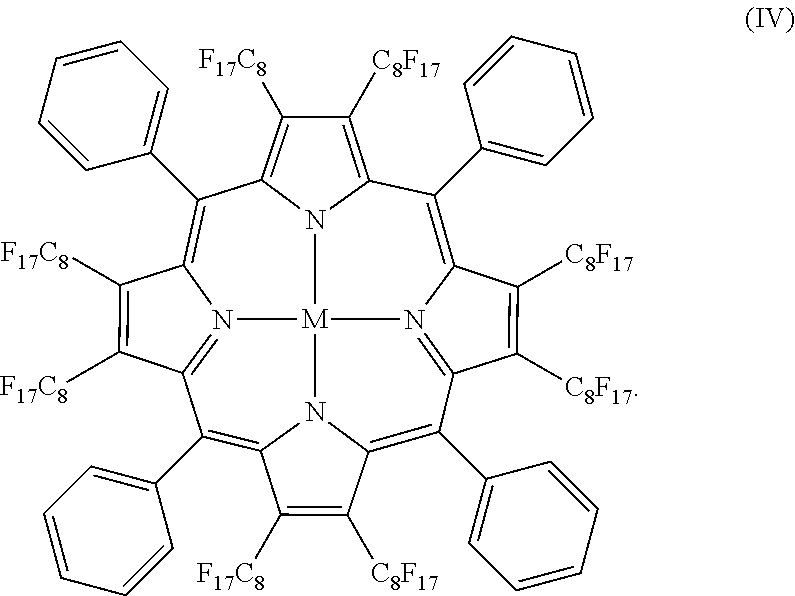
  • beta-octaperfluorooctyl-meso-tetraphenylporphyrin nickel compound (structure IV) may be synthesized from a corresponding beta-octabromo-meso-tetraphenylporphyrin nickel complexes and perfluorooctyl iodide via a copper mediated cross coupling in DMSO and benzotrifluoride, as shown in Scheme I.
  • the extreme electron-deficient and fluorous porphyrin materials may be of the formula as shown in structure (V):
  • the porphyrin free base ligands may be synthesized by de-metalizing perfluoroalkylated-benzoporphyrins by acids or bases. Further metallization of the porphyrin ligands are done by reacting the porphyrin ligands with metal salts.
  • perfluoroalkylated benzo-porphyrins such as perfluorooctyl-tetra-(p-perfluorooctyl-phenyl) benzoporphyrin compound (structure VI) may be synthesized. Structure VI is shown below:
  • perfluoroalklyated prophyrin compounds are synthesized via copper mediated perfluoroalkylation reactions from corresponding bromo-substituted aromatics.
  • the reactions are carried out under nitrogen atmosphere in anhydrous aprotic solvents (e.g. DMSO, DMF, CH 3 CN) with polar fluorophilic solvents as co-solvents to dissolve the reaction intermediates to drive the perfluoroalkylation reaction to completion.
  • the fluorophilic solvents include benzotrifluoride, HFE-7500®, HFE-7100®, HFE-7200®, 3M Novec engineering fluids.
  • one synthetic method is to start with perfluoroalkylated precursors and use transition metal ion as template to synthetic benzoporphyrin according to the reaction scheme (II) shown below:
  • perfluoralkylated precursors are directly made from commercially available materials and the cyclization reactions can be done in solid state at elevated temperature.
  • the compounds may be synthesized as discussed below.
  • the significant solubility change between hydrocarbon-based solvents and polar fluorophilic solvents are excellent for orthogonal solution processing of C sp 3 —F functionalized organic semiconducting materials, including photolithography to build organic electronics and optoelectronics.
  • polar fluorophilic solvents were used for making multiple perfluoroalkyl substitutions within the same porphyrins.
  • Some embodiments used perfluoroalkylation reaction that involves polar aprotic or hydrocarbon solvents, such as DMSO, DMF, with copper mediator, and works well for many aromatic halides (bromide and iodide).
  • reaction intermediates of perfluoroalkylated compounds are almost insoluble in these fluorophobic solvents.
  • the insolubility of the reaction intermediates lead to an incomplete reaction and multiple side products, including isomers that are very difficult to separate.
  • One synthetic method is to directly perfluoroalkylate bromo-porphyrins and bromometalloporphyrins with perfluoroalkyl iodide via a copper mediated cross-coupling reaction.
  • the reaction is done in aprotic solvents (e.g. DMF, DMSO, CH3CN) or mixtures of fluorocarbon and nonfluorocarbon solvents (e.g. a,a,a-trifluorotoluene and DMSO, HFE-7100 and DMSO, HFE-7200 and DMSO, and HFE-7500 and DMSO) at temperatures ranging from about 25 to about 250° C., at, or below, or above atmospheric pressure.
  • aprotic solvents e.g. DMF, DMSO, CH3CN
  • fluorocarbon and nonfluorocarbon solvents e.g. a,a,a-trifluorotoluene and DMSO, HFE-7100 and DMSO
  • a mixture of fluorocarbon solvents and hydrocarbon solvents are used with perfluoroalkylated metalloporphyrin catalysts.
  • Such solvent systems allow for easy separation of the catalyst, and hence the ability to reuse the catalyst. Ease of separation further reduces cost of production.
  • the perfluoroalkylated porphyrins catalysts may be used in catalytic oxidation reactions such as alkene oxidation, epoxide formation and alkyl oxidation reactions, photodynamic therapy, fluorocarbon or hydrocarbon solvents, and organic semiconductor devices including organic solar cells, organic light-emitting diodes organic field-effects transistors, near-IR two-photon absorption materials and near IR laser diodes.
  • the extreme electron-deficient and fluorous porphyrin materials are used in organic solar cells. In one embodiment, the extreme electron-deficient and fluorous porphyrin materials are used in bulk hetero-junction organic solar cells as both light harvester and electron acceptor, wherein fullerene based PCBM electron acceptor is replaced with said porphyrin materials.
  • FIG. 1 is a schematic illustration of a bulk heterojunction organic solar cell 10 .
  • the solar cell 10 includes an aluminum electrode layer 12 , a lithium fluoride layer 14 , an active layer 16 , an EBL/HTL layer 18 , an ITO (tin-doped indium oxide) layer 20 and a glass substrate 22 .
  • the EBL/HTL layer (electron block layer/hole transfer layer) may include either a PEDOT:PSS layer, which is poly(3,4-ethylenedioxythiophene):poly(styrenesulfonate) or a semiconducting metal oxide film.
  • the active layer 16 includes both electron donors and electron acceptors.
  • the electron donors may be P3HT, which is regioregular poly(3-hexylthiophene), or a derivative thereof
  • the electron acceptors may be the electron deficient fluoroporphyrins described herein.
  • the EBL/HTL layer 18 may have a thickness of about 1 nanometer to about 100 nanometers thick. In some embodiments, the active layer 16 may have a thickness of about 1 nanometer to about 100 micrometer. In some embodiments, the lithium fluoride layer 14 may have a thickness of about 0.5 nanometers to about 50 nanometers. In some embodiments, the ITO layer 20 may have a thickness that is about 10 nanometers to about 500 micrometers.
  • Perfluorooctyl iodide (C8F17I, 1.86 g, 3.4 mmol) was added into a mixture of octabromotetraphenyl porphyrin nickel (0.22 g, 0.17 mmol) and copper powder (435 mg, 6.8 mmol) in anhydrous a,a,a -trifluorotoluene (7 ml) and anhydrous DMSO (3 ml) under nitrogen protection at 130-135° C. The reaction was monitored by TLC and quenched after 4 hours with ice water. The mixture was worked up with standard extraction with methylene chloride and washed with water.
  • Perfluorooctyl iodide (C8F17I, 0.186 g, 0.34 mmol) was added into a mixture of octabromo-tetraphenyl porphyrin nickel (22 mg, 0.017 mmol) and copper powder (43.5 mg, 0.68 mmol) in HFE-7200 (3 ml) and anhydrous DMSO (2 ml) in a sealed tube at 145° C. for 36 hours. The reaction mixture was then cooled down to room temperature. The product went into HFE-7200 after the reaction was done. The product layer was simply separated by separatory funnel and washed with water.

Landscapes

  • Chemical & Material Sciences (AREA)
  • Organic Chemistry (AREA)
  • Chemical Kinetics & Catalysis (AREA)
  • Physics & Mathematics (AREA)
  • Electromagnetism (AREA)
  • Inorganic Chemistry (AREA)
  • Engineering & Computer Science (AREA)
  • Materials Engineering (AREA)
  • Nitrogen Condensed Heterocyclic Rings (AREA)

Abstract

Electron-deficient fluorous porphyrin molecules may have dual functions of light harvesting and electron accepting or donating and may be ideally suited for use in organic solar cells. Methods of making electron-deficient fluorous porphyrin molecules are described.

Description

RELATED APPLICATIONS
This application claims the benefit of U.S. Provisional Application No. 61/376,961 filed Aug. 25, 2010 entitled “BETA-FLUORINATED PORPHYRINS AND RELATED COMPOUNDS AND METHODS OF MAKING” and U.S. Provisional Application No. 61/385,015 filed Sep. 21, 2010 entitled “PERFLUOROALKYLATED BENZOPORPHYRINS AND RELATED COMPOUNDS AND METHODS OF MAKING.” Both applications are incorporated by reference herein in their entireties.
TECHNICAL FIELD
This application relates generally to fluorinated porphyrins.
BACKGROUND
Fluorinated aromatics and related materials offer many advantages over non-fluorinated materials in a variety of different optoelectronic devices such as, but not limited to, organic light emitting diodes, organic field-effect transistors, organic solar cells, and dye-sensitized solar cells. These fluorinated materials have processing advantages and are thermally and photochemically stable. They have reduced flammability tolerance to extreme environmental conditions. Fluorinated materials also have advantages in tuning the electronic and optical properties of these devices. For example, these materials can be used to produce air stable n-type semiconductors.
Solution processability of organic semiconductor materials is key to lower the cost of large scale production of different optoelectronic devices such as organic solar cells, organic field-effect transistors, and organic light emitting diodes. It is one of the bottlenecks that limit the wide spread of application of these devices. Orthogonal processing would be ideal for organic semiconductor thin film device production. The solubility of some perfluoroalkylated aromatics is good in fluorocarbon based solvents, however, is very poor in hydrocarbon based solvents. This solubility difference in hydrocarbon and fluorocarbon based solvents provides the foundation of orthogonal solution processing for organic semiconductor devices.
Organic solar cells generally have an active layer including an electron donor molecule and an electron acceptor molecule. Fullerene based molecules (e.g. PCBM) are commonly used as electron acceptors. However, these materials are expensive, have weak solar absorption and poor solution processability. These weakness of the electron acceptor limits the widely spread application of organic solar cells. A molecule with dual functions of light harvesting and electron accepting or donating is ideal for organic solar cell application.
SUMMARY
In some embodiments, the present invention pertains to molecules having dual functions of light harvesting and electron accepting or donating. In some embodiments, the invention provides for a new class of electron-deficient porphyrins and methods for making such porphyrins and usage of such porphyrins as electron acceptors and light harvesters in organic solar cells.
Other embodiments of the present invention provide a new method to making novel superhydrophobic and oleophilic electron-deficient porphyrins.
One or more embodiments of the present invention provide a novel process for the preparation of beta-perfluoroalkyl-porphyrins and corresponding metal complexes that overcomes some of the difficulties of the preparation processes known in the art.
One or more embodiments of the present invention provide a novel process for the preparation of perfluoroalkyl-benzoporphyrins and corresponding metal complexes.
Still other embodiments of the present invention provide a new method of making multiple-perfluoroalkyl substituted aromatic compounds by using fluorinated solvents where else other methods are not possible. Such multiple-perfluoroalkyl substitutes on the same aromatic compound are useful for the electron-deficient and fluorous properties of the materials.
Other embodiments of the present invention provide dual function solar cell materials for use in organic solar cells.
Yet other embodiments of the present invention provide electron deficient and fluorous porphyrins for use in bulk heterojunction and homojunction organic solar cells.
Yet other embodiments provide metalloporphyrin catalysts used in fluorous solvents in which separating the product and the metalloporphyrin catalysts and reusing or recycling of the metalloporphyrin catalysts is easy.
While multiple embodiments are disclosed, still other embodiments of the present invention will become apparent to those skilled in the art from the following detailed description, which shows and describes illustrative embodiments of the invention. Accordingly, the drawings and detailed description are to be regarded as illustrative in nature and not restrictive.
BRIEF DESCRIPTION OF THE FIGURE
FIG. 1 is a cross section diagram representation of a bulk heterojunction organic solar cell.
While the invention is amenable to various modifications and alternative forms, specific embodiments have been shown by way of example in the drawing and are described in detail below. The intention, however, is not to limit the invention to the particular embodiments described. On the contrary, the invention is intended to cover all modifications, equivalents, and alternatives falling within the scope of the invention as defined by the appended claims.
DETAILED DESCRIPTION
In some embodiments, the present invention pertains to molecules having dual functions of light harvesting and electron accepting or donating. These molecules are ideally suited for use in organic solar cells.
In some embodiments, electron-deficient fluorous porphyrins may be of the formula as shown in structure I:
Figure US09515206-20161206-C00001
    • in which each R1, R2, R3, R4 are independently an aryl group bearing substituents having 3 to about 60 carbons and other atoms including one or more of F, Cl, Br, N, O, S, P and H;
    • each R5, R6, R7, R8, R5′, R6′, R7′, R8′, R5″, R6″, R7″, R8″, R5′″, R6′″, R7′″, R8′″ is independently a perfluoroalkyl group with a formula of CmF(2m+1) wherein m is integer from 1 to 30; or
    • each R5, R6, R7, R8, R5′, R6′, R7′, R8′, R5″, R6″, R7″, R8″, R5′″, R6′″, R7′″, R8′″ is independently a perfluoropolyether group with a formula of CkF(2k+1)Ox wherein k is integer from 1 to 1000 and x is an integer from 1 to k−1;
    • or R5, R6, R7, R8, R5′, R6′, R7′, R8′, R5″, R6″, R7″, R8″, R5′″, R6′″, R7′″, R8′″ are combination of perfluoroalkyl group with a formula of CmF(2m+1) wherein m is integer from 1 to 30, perfluoropolyether group with a formula of CkF(2k+1)Ox wherein k is integer from 1 to 1000, wherein x is an integer from 1 to k−1;
    • or R5, R6, R7, R8, R5′, R6′, R7′, R8′, R5″, R6″, R7″, R8″, R5′″, R6′″, R7′″, R8′″ are combination of perfluoroalkyl group with a formula of CmF(2m+1) wherein m is integer from 1 to 30, perfluoropolyether group with a formula of CkF(2k+1)Ox wherein k is integer from 1 to 1000, wherein x is an integer from 1 to k−1, or groups having 3 to 60 carbons and other atoms including one or more of F, Cl, Br, N, O, S, P and H;
    • n is integer from 0 to 3;
    • and M may be 2H, Li, Na, K, Mg, Ca, Al, P, S, Se, As, Ge, Ga, In, Sn, Sb, TI, Pb, Bi, Sr, Ba, Sc, Y, Ti, V, Cr, Mn, Zr, Nb, Mo, Ru, Rh, Pd, Ag, Cd, Fe, Co, Ni, Cu, Zn, Hf, Ta, W, Re, Os, Ir, Pt, Au, Hg or Lanthanides with formal oxidation states from +1 to +6.
In some embodiments, the porphyrin free base ligands may be synthesized by de-metalizing perfluoroalkylated porphyrins by acids or bases. Further metallization of the porphyrin ligands are done by reacting the porphyrin free base ligands with corresponding metal salts.
In some embodiments, beta-octaperfluoroalkyl-meso-tetraarylporphyrins (see structure II) and their metallic complexes (see structure III) are synthesized from corresponding beta-octabromo-meso-tetraarylporphyrin nickel complexes and perfluoroalkyl halides (I, Br, Cl) via a copper mediated cross coupling in aprotic solvents and polar fluorinated solvents.
Structure II is shown below:
Figure US09515206-20161206-C00002
    • in which each Rf is independently a perfluoroalkyl group with a formula of CpF2p+1 or CqF2q+1Oy or a combination of CpF2p+1 and CqF2q+1Oy, wherein p is an integer from 1 to 30, q is an integer from 1 to 1000 and y is an integer from 1 to q−1, and Ar is an aryl group bearing substituents having 3 to about 60 carbons and other atoms including one or more of F, Cl, Br, N, O, S, P and H.
Structure III is shown below:
Figure US09515206-20161206-C00003
    • in which each Rf is independently a perfluoroalkyl group with a formula of CpF2p+1 or CqF2q+1Oy or a combination of CpF2p+1 and CqF2q+1Oy, wherein p is an integer from 1 to 30, q is an integer from 1 to 1000 and y is an integer from 1 to q−1,and Ar is an aryl group bearing substituents having 3 to about 60 carbons and other atoms including one or more of F, Cl, Br, N, O, S, P and H; and
    • wherein M is selected from the group consisting of Li, Na, K, Mg, Ca, Al, P, S, Se, As, Ge, Ga, In, Sn, Sb, Tl, Pb, Bi, Sr, Ba, Sc, Y, Ti, V, Cr, Mn, Zr, Nb, Mo, Ru, Rh, Pd, Ag, Cd, Fe, Co, Ni, Cu, Zn, Hf, Ta, W, Re, Os, Ir, Pt, Au, Hg, and Lanthanides with formal oxidation states from +1 to +6.
In an embodiment, beta-octaperfluorooctyl-meso-tetraphenylporphyrin nickel compound (structure IV) may be synthesized from a corresponding beta-octabromo-meso-tetraphenylporphyrin nickel complexes and perfluorooctyl iodide via a copper mediated cross coupling in DMSO and benzotrifluoride, as shown in Scheme I.
Structure IV is shown below:
Figure US09515206-20161206-C00004
Scheme I is shown below:
Figure US09515206-20161206-C00005
In some embodiments, the extreme electron-deficient and fluorous porphyrin materials may be of the formula as shown in structure (V):
Figure US09515206-20161206-C00006
    • in which each Rf is independently a perfluoroalkyl group with a formula of CpF2p+1 or CqF2q+1Oy or a combination of CpF2p+1 and CqF2q+1Oy, wherein p is an integer from 1 to 30, q is an integer from 1 to 1000 and y is an integer from 1 to q−1,and Ar is an aryl group bearing substituents having 3 to about 60 carbons and other atoms including one or more of F, Cl, Br, N, O, S, P and H; and
    • M may be Li, Na, K, Mg, Ca, Al, P, S, Se, As, Ge, Ga, In, Sn, Sb, Tl, Pb, Bi, Sr, Ba, Sc, Y, Ti, V, Cr, Mn, Zr, Nb, Mo, Ru, Rh, Pd, Ag, Cd, Fe, Co, Ni, Cu, Zn, Hf, Ta, W, Re, Os, Ir, Pt, Au, Hg or Lanthanides with formal oxidation states from +1 to +6. The Rf groups may be in various ring positions and the total number of Rf groups may be 1 to 16.
In some embodiments, the porphyrin free base ligands may be synthesized by de-metalizing perfluoroalkylated-benzoporphyrins by acids or bases. Further metallization of the porphyrin ligands are done by reacting the porphyrin ligands with metal salts.
In some embodiments, perfluoroalkylated benzo-porphyrins such as perfluorooctyl-tetra-(p-perfluorooctyl-phenyl) benzoporphyrin compound (structure VI) may be synthesized. Structure VI is shown below:
Figure US09515206-20161206-C00007
    • in which M may be 2H, Li, Na, K, Mg, Ca, Al, P, S, Se, As, Ge, Ga, In, Sn, Sb, Tl, Pb, Bi, Sr, Ba, Sc, Y, Ti, V, Cr, Mn, Zr, Nb, Mo, Ru, Rh, Pd, Ag, Cd, Fe, Co, Ni, Cu, Zn, Hf, Ta, W, Re, Os, Ir, Pt, Au, Hg or Lanthanides with formal oxidation states from +1 to +6.
In some embodiments, perfluoroalklyated prophyrin compounds are synthesized via copper mediated perfluoroalkylation reactions from corresponding bromo-substituted aromatics. The reactions are carried out under nitrogen atmosphere in anhydrous aprotic solvents (e.g. DMSO, DMF, CH3CN) with polar fluorophilic solvents as co-solvents to dissolve the reaction intermediates to drive the perfluoroalkylation reaction to completion. In some embodiments, the fluorophilic solvents include benzotrifluoride, HFE-7500®, HFE-7100®, HFE-7200®, 3M Novec engineering fluids.
In some embodiments, one synthetic method is to start with perfluoroalkylated precursors and use transition metal ion as template to synthetic benzoporphyrin according to the reaction scheme (II) shown below:
Figure US09515206-20161206-C00008
    • in which M may be Li, Na, K, Mg, Ca, Al, P, S, Se, As, Ge, Ga, In, Sn, Sb, Tl, Pb, Bi, Sr, Ba, Sc, Y, Ti, V, Cr, Mn, Zr, Nb, Mo, Ru, Rh, Pd, Ag, Cd, Fe, Co, Ni, Cu, Zn, Hf, Ta, W, Re, Os, Ir, Pt, Au, Hg or Lanthanides with formal oxidation states from +1 to +6.
In some embodiments, perfluoralkylated precursors are directly made from commercially available materials and the cyclization reactions can be done in solid state at elevated temperature.
In some embodiments, the compounds may be synthesized as discussed below. The significant solubility change between hydrocarbon-based solvents and polar fluorophilic solvents are excellent for orthogonal solution processing of Csp 3—F functionalized organic semiconducting materials, including photolithography to build organic electronics and optoelectronics.
In some embodiments, polar fluorophilic solvents were used for making multiple perfluoroalkyl substitutions within the same porphyrins. Some embodiments used perfluoroalkylation reaction that involves polar aprotic or hydrocarbon solvents, such as DMSO, DMF, with copper mediator, and works well for many aromatic halides (bromide and iodide).
However, since DMSO and DMF are fluorophobic instead of fluorophilic, the reaction intermediates of perfluoroalkylated compounds are almost insoluble in these fluorophobic solvents. The insolubility of the reaction intermediates lead to an incomplete reaction and multiple side products, including isomers that are very difficult to separate.
The insolubility arises possibly because the interaction between C—H and C—F bonds are weaker than corresponding C—H to C—H interaction and C—F to C—F interaction. The lack of the interaction causes perfluoroalkylated compounds are poorly solvated in hydrocarbon. To solve this problem, polar fluorophilic solvents (e.g. benzotrifluoride and hydrofluoroether solvents) were added as co-solvents to dissolve the reaction intermediates. Using this novel reaction condition, the perfluoroalkylation reaction goes to completion and gives almost exclusively the target product for the reactions under optimized conditions.
One synthetic method is to directly perfluoroalkylate bromo-porphyrins and bromometalloporphyrins with perfluoroalkyl iodide via a copper mediated cross-coupling reaction. The reaction is done in aprotic solvents (e.g. DMF, DMSO, CH3CN) or mixtures of fluorocarbon and nonfluorocarbon solvents (e.g. a,a,a-trifluorotoluene and DMSO, HFE-7100 and DMSO, HFE-7200 and DMSO, and HFE-7500 and DMSO) at temperatures ranging from about 25 to about 250° C., at, or below, or above atmospheric pressure.
In other embodiments, a mixture of fluorocarbon solvents and hydrocarbon solvents are used with perfluoroalkylated metalloporphyrin catalysts. Such solvent systems allow for easy separation of the catalyst, and hence the ability to reuse the catalyst. Ease of separation further reduces cost of production.
The perfluoroalkylated porphyrins catalysts may be used in catalytic oxidation reactions such as alkene oxidation, epoxide formation and alkyl oxidation reactions, photodynamic therapy, fluorocarbon or hydrocarbon solvents, and organic semiconductor devices including organic solar cells, organic light-emitting diodes organic field-effects transistors, near-IR two-photon absorption materials and near IR laser diodes.
In some embodiments, the extreme electron-deficient and fluorous porphyrin materials are used in organic solar cells. In one embodiment, the extreme electron-deficient and fluorous porphyrin materials are used in bulk hetero-junction organic solar cells as both light harvester and electron acceptor, wherein fullerene based PCBM electron acceptor is replaced with said porphyrin materials.
DETAILED DESCRIPTION OF THE FIGURE
FIG. 1 is a schematic illustration of a bulk heterojunction organic solar cell 10. The solar cell 10 includes an aluminum electrode layer 12, a lithium fluoride layer 14, an active layer 16, an EBL/HTL layer 18, an ITO (tin-doped indium oxide) layer 20 and a glass substrate 22. In some embodiments, the EBL/HTL layer (electron block layer/hole transfer layer) may include either a PEDOT:PSS layer, which is poly(3,4-ethylenedioxythiophene):poly(styrenesulfonate) or a semiconducting metal oxide film. In some embodiments, the active layer 16 includes both electron donors and electron acceptors. The electron donors may be P3HT, which is regioregular poly(3-hexylthiophene), or a derivative thereof The electron acceptors may be the electron deficient fluoroporphyrins described herein.
In some embodiments, the EBL/HTL layer 18 may have a thickness of about 1 nanometer to about 100 nanometers thick. In some embodiments, the active layer 16 may have a thickness of about 1 nanometer to about 100 micrometer. In some embodiments, the lithium fluoride layer 14 may have a thickness of about 0.5 nanometers to about 50 nanometers. In some embodiments, the ITO layer 20 may have a thickness that is about 10 nanometers to about 500 micrometers.
EXPERIMENTAL SECTION Example 1 Synthesis of beta-octaperfluorooctyl-tetraphenyl porphyrin nickel(II) in DMSO and a,a,a-trifluorotoluene
Perfluorooctyl iodide (C8F17I, 1.86 g, 3.4 mmol) was added into a mixture of octabromotetraphenyl porphyrin nickel (0.22 g, 0.17 mmol) and copper powder (435 mg, 6.8 mmol) in anhydrous a,a,a -trifluorotoluene (7 ml) and anhydrous DMSO (3 ml) under nitrogen protection at 130-135° C. The reaction was monitored by TLC and quenched after 4 hours with ice water. The mixture was worked up with standard extraction with methylene chloride and washed with water. Evaporation of methylene chloride gave beta-octaperfluorooctyl-tetraphenyl porphyrin nickel(II) in good yield. Characterization: 1H NMR, 8.0 ppm (8H), 7.7 ppm (12H); 19F NMR, 80.7 ppm (3F), −81.7 (2F, the peak separated into two peaks at −80.8 ppm and −82.6 ppm because of the slow conformation change), −111 ppm (2F, separated into two peaks at −110.9 ppm and −111.1 ppm because of slow conformation change), 121-124 ppm (multiple peaks overlapping, 8F), and −126 ppm (2F); MALDI TOF MS (negative ion detection) [M-H] 4014.8 (calcd M 4015.8).
Example 2 Synthesis of beta-octaperfluorooctyl-tetraphenyl porphyrin nickel(II) in DMSO and HFE-7200
Perfluorooctyl iodide (C8F17I, 0.186 g, 0.34 mmol) was added into a mixture of octabromo-tetraphenyl porphyrin nickel (22 mg, 0.017 mmol) and copper powder (43.5 mg, 0.68 mmol) in HFE-7200 (3 ml) and anhydrous DMSO (2 ml) in a sealed tube at 145° C. for 36 hours. The reaction mixture was then cooled down to room temperature. The product went into HFE-7200 after the reaction was done. The product layer was simply separated by separatory funnel and washed with water. After the evaporation of HFE-7200, beta-octaperfluorooctyl-tetraphenyl porphyrin nickel(II) was obtained. Characterization: 1H NMR, 8.0 ppm (8H), 7.7 ppm (12H); 19F NMR, 80.7 ppm (3F), −81.7 (2F, the peak separated into two peaks at −80.8 ppm and −82.6 ppm because of the slow conformation change), −111 ppm (2F, separated into two peaks at −110.9 ppm and −111.1 ppm because of slow conformation change), 121-124 ppm (multiple peaks overlapping, 8F), and −126 ppm (2F); MALDI TOF MS (negative ion detection) [M-H] 4014.8 (calcd M 4015.8).
Example 3 Prophetic Example of Synthesis of perfluoroalkylated benzoporphyrins
5,6-bis(perfluorooctyl)-1H-isoindole-1,3(2H)-dione (1.97 g, 2 mmol) is mixed well with sodium [4-(heptadecafluorooctyl)phenyl]acetate (1.15 g, 2 mmol) and ZnCl2 (68 mg, 0.5 mmol) in a nitrogen atmosphere glovebox in a 20 ml sealed tube equipped with a pressure ventilation valve. The reaction mixture is then heated at 350° C. for 5 hours. After cooling down, the reaction mixture is extracted with HFE-7200 and target product is obtained after evaporating the solvent. Further recrystallization from HFE-7200 is to give analytical pure product (structure VI).
Various modifications and additions can be made to the exemplary embodiments discussed without departing from the scope of the present invention. For example, while the embodiments described above refer to particular features, the scope of this invention also includes embodiments having different combinations of features and embodiments that do not include all of the described features. Accordingly, the scope of the present invention is intended to embrace all such alternatives, modifications, and variations as fall within the scope of the claims, together with all equivalents thereof.

Claims (14)

What is claimed is:
1. An electron deficient fluorous porphyrin having the structure (I):
Figure US09515206-20161206-C00009
in which each R1, R2, R3, R4 is independently an aryl group bearing substituents having 3 to 60 carbon atoms and other atoms including one or more of F, Cl, Br, N, O, S, P and H;
each R5, R6, R7, R8, R5′, R6′, R7′, R8′, R5″, R6″, R7″, R8″, R5′″, R6′″, R7′″, R8′″ are each independently a perfluoroalkyl group with a formula of CmF(2m+1) or a perfluoropolyether group with a formula of CkF(2k+1)Ox wherein m is integer from 1 to 30, k is an integer from 1 to 1000 and x is an integer less than k;
or R5, R6, R7, R8, R5′, R6′, R7′, R8′, R5″, R6″, R7″, R8″, R5′″, R6′″, R7′″, R8′″ are each independently combination of perfluoroalkyl group with a formula of CmF(2m+1) wherein m is integer from 1 to 30, a perfluoropolyether group with a formula of CkF(2k+1)Ox wherein k isinteger from 1 to 1000, wherein x is an integer from 1 to k−1, or groups having 3 to 60 carbons and other atoms including one or more of F, Cl, Br, N, O, S, P and H, wherein the group of substituents R5, R6, R7, R8, R5′, R6′, R7′, R8′, R5″, R6″, R7″, R8″, R5′″, R6′″, R7′″, R8′″ includes at least two of the perfluoroalkyl group, the perfluoropolyether group, and the group having 3 to 60 carbons and other atoms;
n is integer from 1 to 3; and
M is selected from the group consisting of 2H, Li, Na, K, Mg, Ca, Al, P, S, Se, As, Ge, Ga, In, Sn, Sb, TI, Pb, Bi, Sr, Ba, Sc, Y, Ti, V, Cr, Mn, Zr, Nb, Mo, Ru, Rh, Pd, Ag, Cd, Fe, Co, Ni, Cu, Au, Hf, Ta, W, Re, Os, Ir, Pt, Zn, Hg and Lanthanides with formal oxidation states from +1 to +6.
2. The electron deficient fluorous porphyrin of claim 1, comprising the molecular structure (IV):
Figure US09515206-20161206-C00010
3. The electron deficient fluorous porphyrn of compound of claim 2, wherein the molecule is characterized by the following data:
1H NMR, 8.0 ppm (8H), 7.7 ppm (12H); 19F NMR, 80.7 ppm (3F), −81.7 (2F, the peak separated into two peaks at −80.8 ppm and −82.6 ppm because of the slow conformation change), −111 ppm (2F, separated into two peaks at −110.9 ppm and −111.1 ppm because of slow conformation change), 121-124 ppm (multiple peaks overlapping, 8F), and −126 ppm (2F); MALDI TOF MS (negative ion detection) [M-H] 4014.8 (calcd M 4015.8).
4. The electron deficient fluorous porphyrin of claim 1, comprising the molecular structure (V):
Figure US09515206-20161206-C00011
in which each Rf is independently a perfluoroalkyl group with a formula of CpF(2p+1) or CqF(2q+1) Oy or a combination of CpF(2p+1) and CqF(2q+1) Oy, wherein p is an integer from 1 to 30, q is an integer from 1 to 1000 and y is an integer from 1 to q−1;
each Rf may have various ring positions;
a total number of Rf groups is from 1 to 16;
Ar is an aryl group bearing substituents having 3 to about 60 carbons and other atoms including one or more of F, Cl, Br, N, O, S, P and H; and
M is selected from the group consisting of 2H, Li, Na, K, Mg, Ca, Al, P, S, Se, As, Ge, Ga, In, Sn, Sb, Tl, Pb, Bi, Sr, Ba, Sc, Y, Ti, V, Cr, Mn, Zr, Nb, Mo, Ru, Rh, Pd, Ag, Cd, Fe, Co, Ni, Cu, Au, Hf, Ta, W, Re, Os, Ir, Pt, Zn, Hg, and Lanthanides with formal oxidation states from +1 to +6.
5. The electron deficient fluorous porphyrin of claim 1, comprising the molecular structure (VI)
Figure US09515206-20161206-C00012
in which M is selected from the group consisting of 2H, Li, Na, K, Mg, Ca, Al, P, S, Se, As, Ge, Ga, In, Sn, Sb, Tl, Pb, Bi, Sr, Ba, Sc, Y, Ti, V, Cr, Mn, Zr, Nb, Mo, Ru, Rh, Pd, Ag, Cd, Fe, Co, Ni, Cu, Au, Hf, Ta, W, Re, Os, Ir, Pt, Zn, Hg, and Lanthanides with formal oxidation states from +1 to +6.
6. An organic solar cell comprising:
a glass substrate;
an ITO layer disposed on the glass substrate;
an EBL/HTL layer disposed on the ITO layer;
an active layer disposed on the EBL/HTL layer, the active layer including an electron-deficient fluorous porphyrin material according to claim 1;
an LiF layer disposed on the active layer; and
an aluminum layer disposed on the LiF layer.
7. The solar cell of claim 6, wherein the electron-deficient fluorous porphyrin material comprises a compound having the molecular structure (IV):
Figure US09515206-20161206-C00013
8. The solar cell of claim 6, wherein the electron-deficient fluorous phorphrin material comprises a compound with the molecular structure (V):
Figure US09515206-20161206-C00014
in which each Rf is independently a perfluoroalkyl group with a formula of CpF(2p+1) or CqF(2q+1)Oy or a combination of CpF(2p+1) and CqF(2q+1)Oy, wherein p is an integer from 1 to 30, q is an integer from 1 to 1000 and y is an integer from 1 to q-1;
each Rf may have various ring positions;
a total number of Rf groups is from 1 to 16;
Ar is an aryl group bearing substituents having 3 to about 60 carbons and other atoms including one or more of F, Cl, Br, N, 0, S, P and H; and
M is selected from the group consisting of 2H, Li, Na, K, Mg, Ca, Al, P, S, Se, As, Ge, Ga, In, Sn, Sb, Tl, Pb, Bi, Sr, Ba, Sc, Y, Ti, V, Cr, Mn, Zr, Nb, Mo, Ru, Rh, Pd, Ag, Cd, Fe, Co, Ni, Cu, Au, Hf, Ta, W, Re, Os, Ir, Pt, Zn, Hg, and Lanthanides with formal oxidation states from +1 to +6.
9. The solar cell of claim 6, wherein the electron-deficient fluorous porphyrin material comprises a compound having the molecular structure (VI):
Figure US09515206-20161206-C00015
in which M is selected from the group consisting of 2H, Li, Na, K, Mg, Ca, Al, P, S, Se, As, Ge, Ga, In, Sn, Sb, Tl, Pb, Bi, Sr, Ba, Sc, Y, Ti, V, Cr, Mn, Zr, Nb, Mo, Ru, Rh, Pd, Ag, Cd, Fe, Co, Ni, Cu, Au, Hf, Ta, W, Re, Os, Ir, Pt, Zn, Hg, and Lanthanides with formal oxidation states from +1 to +6.
10. A process for making an electron-deficient fluorous porphyrin, the process comprising:
reacting halogenated porphyrin with perfluoroalkyl halide with a formula of CjF(2j+1)X or CwF(2w+1)OzX or the combination of CjF(2j+1)X and CwF(2w+1)OzX in the presence of copper, aprotic solvents, and fluorinated solvents, said reacting forming the electron-deficient fluorous porphyrin of claim 1;
wherein j is an integer from 1 to 30, w is an integer from 1 to 1000, z is an integer from 1 to w-1, and
X is Cl, Br, I.
11. The process of claim 10, wherein the electron-deficient fluorous porphyrin comprises a compound with the molecular structure (IV):
Figure US09515206-20161206-C00016
12. The process of claim 10, wherein more than a stoichiometric amount of copper is present and the copper functions as a catalyst and a reactant.
13. The process of claim 10, wherein a reaction mixture automatically separates itself when the reaction is cooled.
14. The process of claim 13, wherein the reaction mixture contains fluorocarbon and hydrocarbon solvents that exhibit automatic phase separation.
US13/818,802 2010-08-25 2011-08-25 Electron-deficient fluorous porphyrins and methods of making and their use in organic solar cells Expired - Fee Related US9515206B2 (en)

Priority Applications (1)

Application Number Priority Date Filing Date Title
US13/818,802 US9515206B2 (en) 2010-08-25 2011-08-25 Electron-deficient fluorous porphyrins and methods of making and their use in organic solar cells

Applications Claiming Priority (4)

Application Number Priority Date Filing Date Title
US37696110P 2010-08-25 2010-08-25
US38501510P 2010-09-21 2010-09-21
US13/818,802 US9515206B2 (en) 2010-08-25 2011-08-25 Electron-deficient fluorous porphyrins and methods of making and their use in organic solar cells
PCT/US2011/049193 WO2012027593A1 (en) 2010-08-25 2011-08-25 Electron-deficient fluorous porphyrins and methods of making and their use in organic solar cells

Publications (2)

Publication Number Publication Date
US20130206231A1 US20130206231A1 (en) 2013-08-15
US9515206B2 true US9515206B2 (en) 2016-12-06

Family

ID=44583474

Family Applications (1)

Application Number Title Priority Date Filing Date
US13/818,802 Expired - Fee Related US9515206B2 (en) 2010-08-25 2011-08-25 Electron-deficient fluorous porphyrins and methods of making and their use in organic solar cells

Country Status (2)

Country Link
US (1) US9515206B2 (en)
WO (1) WO2012027593A1 (en)

Families Citing this family (7)

* Cited by examiner, † Cited by third party
Publication number Priority date Publication date Assignee Title
CA2904127C (en) 2013-03-14 2023-10-17 Profusa, Inc. Polymer based oxygen sensors
CN113274007B (en) 2013-03-14 2024-10-18 普罗菲尤萨股份有限公司 Method and device for correcting an optical signal
EP2842949A1 (en) * 2013-09-02 2015-03-04 Université d'Aix-Marseille Analogues of porphyrins, their method of preparation and use thereof especially in dye-sensitive solar cells
CN110352036B (en) 2016-12-21 2022-11-15 普罗菲尤萨股份有限公司 polymerizable near-infrared dyes
CN108084450B (en) * 2017-12-22 2021-05-07 湘潭大学 Polymerization complex containing vinylphenyl and p-vinylphenol methylamine derivative cadmium and preparation method and application thereof
US11534503B2 (en) 2017-12-28 2022-12-27 Profusa, Inc. Oxidase-based sensors and methods of using
CA3104346A1 (en) 2018-06-27 2020-01-02 Profusa, Inc. Near-ir glucose sensors

Citations (5)

* Cited by examiner, † Cited by third party
Publication number Priority date Publication date Assignee Title
WO2002009196A1 (en) 2000-07-21 2002-01-31 North Carolina State University Light harvesting arrays
US20050039274A1 (en) * 2003-08-08 2005-02-24 Jin Yang Fluorinated dyes or colorants and their uses
US20080061681A1 (en) * 2006-09-11 2008-03-13 The Trustees Of Princeton University Near-infrared emitting organic compounds and organic devices using the same
WO2008109467A1 (en) 2007-03-02 2008-09-12 Arizona Board Of Regents For And On Behalf Of Arizona State University Electrically conducting porphyrin and porphyrin-fullerene electropolymers
WO2010047864A1 (en) 2008-10-22 2010-04-29 Kent State University Liquid crystalline blends, device thereof and method thereof

Patent Citations (5)

* Cited by examiner, † Cited by third party
Publication number Priority date Publication date Assignee Title
WO2002009196A1 (en) 2000-07-21 2002-01-31 North Carolina State University Light harvesting arrays
US20050039274A1 (en) * 2003-08-08 2005-02-24 Jin Yang Fluorinated dyes or colorants and their uses
US20080061681A1 (en) * 2006-09-11 2008-03-13 The Trustees Of Princeton University Near-infrared emitting organic compounds and organic devices using the same
WO2008109467A1 (en) 2007-03-02 2008-09-12 Arizona Board Of Regents For And On Behalf Of Arizona State University Electrically conducting porphyrin and porphyrin-fullerene electropolymers
WO2010047864A1 (en) 2008-10-22 2010-04-29 Kent State University Liquid crystalline blends, device thereof and method thereof

Non-Patent Citations (6)

* Cited by examiner, † Cited by third party
Title
C. Hansch, et al., "A Survey of Hammett Substituent Constants and Resonance and Field Parameters," Chem Rev., 1991, 91, pp. 165-195.
International Search Report and Written Opinin issued in PCT/US2011/019193, mailed Dec. 27, 2011, 15 pages.
Liu et al. Fluoroalkylation of Prophyrins: A Facile Synthesis of Trifluoromethylated Porphyrins by a Palladium-Catalyzed Cross-Coupling Reaction. European Journal of Organic Chemistry 2005, pp. 3680-3686. *
N. Miayaura, et al., "Palladium-Catalyzed Inter- and Intramolecular Cross-Coupling Reactions of B-Alkyl-9-borabicyclo[3.3.1]nonane Derivatives with 1-Halo-1-alkenes or Haloarenes. Syntheses of Funcitonalzed Alkenes, Arenes, and Cycloalkenes via a Hydroboration-Coupling Sequence," J. Am. Chem. Soc., 1989, 111, pp. 314-321.
Sieu (Chapter 2 Hydrocarbons, pp. 1-21, http://www.siue.edu/~tpatric/Ch%2002%20Hydrocarb%20H%20T%20l.pdf accessed Dec. 7, 2015). *
Sieu (Chapter 2 Hydrocarbons, pp. 1-21, http://www.siue.edu/˜tpatric/Ch%2002%20Hydrocarb%20H%20T%20l.pdf accessed Dec. 7, 2015). *

Also Published As

Publication number Publication date
US20130206231A1 (en) 2013-08-15
WO2012027593A1 (en) 2012-03-01

Similar Documents

Publication Publication Date Title
US9515206B2 (en) Electron-deficient fluorous porphyrins and methods of making and their use in organic solar cells
Wu et al. Influence of nonfused cores on the photovoltaic performance of linear triphenylamine-based hole-transporting materials for perovskite solar cells
KR101971629B1 (en) Electronic device and compound
EP2828902B1 (en) Inert solution-processable molecular chromophores for organic electronic devices
CN111094298A (en) organic semiconductor compounds
KR20160065885A (en) Photoactive organic material for optoelectronic components
US20200369824A1 (en) Organic semiconducting compounds
US8802975B2 (en) Compounds for organic thin-film solar cells and organic thin-film solar cells
Singh et al. Bis (diphenylamine)-tethered carbazolyl anthracene derivatives as hole-transporting materials for stable and high-performance perovskite solar cells
JP2012151149A (en) Functional electronic element containing boron-containing compound
CN117836265A (en) Organic compounds and their applications, passivation films, solar cells and electrical devices
CN117024427B (en) Phenanthroline derivative and organic electroluminescent device containing same
Lin et al. Isomerically Pure Oxindole‐Terminated Quinoids for n‐Type Organic Thin‐Film Transistors Enabled by the Chlorination of Quinoidal Core
WO2020161052A1 (en) Organic semiconducting polymers
JP5531241B2 (en) Fullerene derivatives, semiconductor materials, photoelectric conversion elements and solar cells
JP6945841B2 (en) Near-infrared absorption squarylium derivatives and organic electronic devices containing them
CN115838480B (en) Polyfullerene polymer material and preparation method and application thereof
JP5730031B2 (en) Fullerene derivative and photoelectric conversion element using the same
EP3275865A1 (en) Amide-based hole-transporting or hole-injecting materials
KR20140083969A (en) Bibenzo[b]furan compound, photoelectric conversion material, and photoelectric conversion element
Lu et al. Synthesis of oligofluorene modified C 60 derivatives for organic solar cell applications
KR101620138B1 (en) Fused cyclic compound, organic solar cell comprising the same and fabricating method thereof
KR102730882B1 (en) Novel organic monomolecular compound with modified hole transport property and device including same
KR101605937B1 (en) Fused cyclic compound, organic solar cell comprising the same and fabricating method thereof
US20200331906A1 (en) Compound, method of synthesizing compound with pyridine ring and light-emitting element

Legal Events

Date Code Title Description
AS Assignment

Owner name: THE UNIVERSITY OF SOUTH DAKOTA, SOUTH DAKOTA

Free format text: ASSIGNMENT OF ASSIGNORS INTEREST;ASSIGNOR:SUN, HAORAN;REEL/FRAME:030243/0417

Effective date: 20130416

STCF Information on status: patent grant

Free format text: PATENTED CASE

FEPP Fee payment procedure

Free format text: MAINTENANCE FEE REMINDER MAILED (ORIGINAL EVENT CODE: REM.); ENTITY STATUS OF PATENT OWNER: SMALL ENTITY

LAPS Lapse for failure to pay maintenance fees

Free format text: PATENT EXPIRED FOR FAILURE TO PAY MAINTENANCE FEES (ORIGINAL EVENT CODE: EXP.); ENTITY STATUS OF PATENT OWNER: SMALL ENTITY

STCH Information on status: patent discontinuation

Free format text: PATENT EXPIRED DUE TO NONPAYMENT OF MAINTENANCE FEES UNDER 37 CFR 1.362

FP Lapsed due to failure to pay maintenance fee

Effective date: 20201206