US9514356B2 - Method and apparatus for generating facial feature verification model - Google Patents
Method and apparatus for generating facial feature verification model Download PDFInfo
- Publication number
- US9514356B2 US9514356B2 US14/841,928 US201514841928A US9514356B2 US 9514356 B2 US9514356 B2 US 9514356B2 US 201514841928 A US201514841928 A US 201514841928A US 9514356 B2 US9514356 B2 US 9514356B2
- Authority
- US
- United States
- Prior art keywords
- representation
- intrinsic representation
- model
- training sample
- samples
- Prior art date
- Legal status (The legal status is an assumption and is not a legal conclusion. Google has not performed a legal analysis and makes no representation as to the accuracy of the status listed.)
- Expired - Fee Related
Links
Images



Classifications
-
- G06K9/00288—
-
- G—PHYSICS
- G06—COMPUTING OR CALCULATING; COUNTING
- G06V—IMAGE OR VIDEO RECOGNITION OR UNDERSTANDING
- G06V40/00—Recognition of biometric, human-related or animal-related patterns in image or video data
- G06V40/10—Human or animal bodies, e.g. vehicle occupants or pedestrians; Body parts, e.g. hands
- G06V40/16—Human faces, e.g. facial parts, sketches or expressions
- G06V40/172—Classification, e.g. identification
-
- G06K9/00268—
-
- G06K9/6232—
-
- G—PHYSICS
- G06—COMPUTING OR CALCULATING; COUNTING
- G06V—IMAGE OR VIDEO RECOGNITION OR UNDERSTANDING
- G06V10/00—Arrangements for image or video recognition or understanding
- G06V10/70—Arrangements for image or video recognition or understanding using pattern recognition or machine learning
- G06V10/77—Processing image or video features in feature spaces; using data integration or data reduction, e.g. principal component analysis [PCA] or independent component analysis [ICA] or self-organising maps [SOM]; Blind source separation
- G06V10/7715—Feature extraction, e.g. by transforming the feature space, e.g. multi-dimensional scaling [MDS]; Mappings, e.g. subspace methods
-
- G—PHYSICS
- G06—COMPUTING OR CALCULATING; COUNTING
- G06V—IMAGE OR VIDEO RECOGNITION OR UNDERSTANDING
- G06V40/00—Recognition of biometric, human-related or animal-related patterns in image or video data
- G06V40/10—Human or animal bodies, e.g. vehicle occupants or pedestrians; Body parts, e.g. hands
- G06V40/16—Human faces, e.g. facial parts, sketches or expressions
- G06V40/168—Feature extraction; Face representation
Definitions
- the present disclosure relates to image processing technologies, and in particular, to a method and an apparatus for generating a facial feature verification model.
- a facial feature identification method has the following advantages: non-compulsory and non-contacting. Different from iris, fingerprint, and other authentication methods, the facial feature identification method does not require cooperation of a user, and can acquire a facial image of the user at a long distance to perform identification; and a single device may collect multiple faces at the same time and perform concurrent operations.
- the face identity verification refers to that two facial images are given, and it is determined whether identities of persons in the two facial images are of a same person.
- the face identity identification refers to that a database including multiple faces and corresponding identities is given, for a specified face, it is determined whether the specified face is of a same identity as a face in the database, and if yes, identity information of the face is given.
- the face identity verification is the basis of the face identity identification.
- a task of face identity identification can be completed by verifying, one by one, whether a specified face is of a same person as a face in a database.
- a facial image becomes a sample x after certain preprocessing.
- a discriminant function f(•,•) is obtained through training by using a machine learning method.
- two face samples y 1 , y 2 are obtained, and whether the two face samples y 1 , y 2 are of a same person or different persons is determined according to a value obtained by f(y 1 , y 2 ).
- a common method is that when f(y 1 , y 2 )>0, the samples represent a person of a same identity; otherwise, the samples represent persons of different identities.
- a main method of a Bayesian model includes the following basic parts: a model learning phase and a model testing phase.
- the model learning phase includes the following several steps.
- Prepare a training sample set: collecting a facial image set V ⁇ v 1 , . . . , v M ⁇ , where the M images come from N persons of different identities. Generally, M>>N, each person corresponds to multiple different images in the image set, and M and N are both positive integers.
- g includes image preprocessing, for example, i) extracting a facial area from an image, ii) performing an operation of face alignment, and iii) extracting a particular feature from an aligned facial image area.
- ⁇ E ) are obtained by learning the sample set ⁇ .
- ⁇ I and ⁇ E separately represent assumptions whether ⁇ is an intra-class change (a change of a person of a same identity shown in different images), or an inter-class change (a change of persons of different identities shown in different images).
- ⁇ E ) are both preset as Gaussian distribution models, and an objective of model learning is to obtain parameters of the two Gaussian distribution models.
- steps of testing include the following.
- digital vectors x ⁇ , x ⁇ are obtained after the same functional transformation g as in the training phase.
- ⁇ ⁇ x ⁇ ⁇ x ⁇ ,
- the foregoing descriptions are application steps of a classical Bayesian model.
- the classical Bayesian model has the following several obvious defects.
- the model is based on a difference between feature representations of two input faces, some discrimination information is lost, and distinguishability of samples is reduced.
- ⁇ E ) are assumed as Gaussian models, which is a kind of excessively simplified processing in actual use.
- a Gaussian model cannot entirely process a difference of posture, illumination, expression, age, blockage, hairstyle, or the like between different facial images.
- an effective digital feature expression of a face is mainly learned by using a deep network, that is, a function g is simulated by using the deep network, and an input (an original facial image or an extracted feature) of a neural network is transformed into a more effective digital feature x, so as to facilitate further identity verification.
- digital feature expressions x ⁇ and x ⁇ are obtained by using a deep neural network.
- x ⁇ and x ⁇ are used as inputs.
- Multiple classification methods may be used to map a feature pair (x ⁇ , x ⁇ ) to two types ⁇ a same person, different persons ⁇ .
- the above-described Bayesian method may be used for implementation, or a relative simple classification method, such as Soft-max or support vector machines (SVM), may be used to classify features.
- the deep neural network model has an advantage of desirable discrimination performance, but also has very serious defects.
- Main defects of the deep neural network model lie in two aspects.
- the model is highly complex, and the model has a large quantity of parameters, which are inconvenient to store.
- a quantity of model parameters generally involved is about 12 million.
- a calculation amount for testing is also large, making implementation at a terminal difficult.
- An excessively huge amount of training data is needed, which is a common problem for a deep-learning-based technical framework.
- a quantity of marked images involved in training reaches millions. Lots of manpower and material resources are needed to collect, mark, and check related image data.
- embodiments of the present disclosure provide a method and an apparatus for generating a facial feature verification model.
- a model that is obtained through learning of an intrinsic representation has strong representability and discrimination performance during processing of intra-class and inter-class changes of posture, illumination, expression, age, and the like under different photographing scenarios;
- a learning model has a low error rate in facial image verification, and is close to an identification level of a human eye in a standard Internet image test;
- the model has low complexity and a small calculation amount.
- the present disclosure provides a method for generating a facial feature verification model, and the method includes acquiring N input facial images, where the N input facial images correspond to M persons with independent identities, N is an integer greater than 2, and M is an integer greater than 2, performing feature extraction on the N input facial images, to obtain an original feature representation of each facial image, and forming a face sample library according to obtained original feature representations, grouping samples corresponding to one person with an independent identity in the face sample library, to obtain c groups of face samples, where c is an integer greater than or equal to 2, for samples of each person with an independent identity, obtaining a common intrinsic representation of the c groups of face samples according to manifold relevance determination, obtaining a training sample set of an intrinsic representation according to the common intrinsic representation of the c groups of face samples of the person with an independent identity in the M persons with independent identities, training the training sample set of the intrinsic representation, to obtain a Bayesian model of the intrinsic representation, and obtaining a facial feature verification model according to a preset model mapping relationship and
- the obtaining a common intrinsic representation of the c groups of face samples according to manifold relevance determination includes a quantity of face samples in each group of the c groups of face samples being the same, and obtaining, according to a preset likelihood function and the manifold relevance determination, a private intrinsic representation of each group of face samples in the c groups of face samples and the common intrinsic representation of the c groups of face samples.
- the obtaining a training sample set of an intrinsic representation according to the common intrinsic representation of the c groups of face samples includes obtaining a positive training sample set and a negative training sample set according to the obtained common intrinsic representation of the c groups of face samples, where one training sample pair in the positive training sample set comes from a same person, and one training sample pair in the negative training sample set comes from different persons, and correspondingly, the training the training sample set of the intrinsic representation, to obtain a Bayesian model of the intrinsic representation includes training the positive training sample set and the negative training sample set, to obtain the Bayesian model of the intrinsic representation.
- the training the training sample set of the intrinsic representation, to obtain a Bayesian model of the intrinsic representation includes training the training sample set of the intrinsic representation according to an expectation-maximization algorithm, to obtain the Bayesian model of the intrinsic representation.
- the obtaining a facial feature verification model according to a preset model mapping relationship and the Bayesian model of the intrinsic representation includes mapping the Bayesian model of the intrinsic representation by means of Gaussian process regression of the preset model mapping relationship, to obtain a Bayesian model of an original feature representation, where the Bayesian model of the original feature representation is the facial feature verification model.
- an embodiment of the present disclosure discloses an apparatus for generating a facial feature verification model, and the apparatus includes an acquiring module configured to acquire N input facial images, where the N input facial images correspond to M persons with independent identities, N is an integer greater than 2, and M is an integer greater than 2, a feature extracting module configured to perform feature extraction on the N input facial images, to obtain an original feature representation of each facial image, and form a face sample library according to obtained original feature representations, a grouping module configured to group samples corresponding to one person with an independent identity in the face sample library, to obtain c groups of face samples, where c is an integer greater than or equal to 2, a module for generating a Bayesian model of an intrinsic representation configured to, for samples of each person with an independent identity, obtain a common intrinsic representation of the c groups of face samples according to manifold relevance determination, obtain a training sample set of an intrinsic representation according to the obtained common intrinsic representation of the c groups of face samples, and train the training sample set of the intrinsic representation, to obtain a Baye
- the module for generating a Bayesian model of an intrinsic representation is configured to, for the samples of each person with an independent identity, obtain, according to a preset likelihood function and the manifold relevance determination, a private intrinsic representation of each group of face samples in the c groups of face samples and the common intrinsic representation of the c groups of face samples, where a quantity of face samples in each group of the c groups of face samples is the same, obtain the training sample set of the intrinsic representation according to the obtained common intrinsic representation of the c groups of face samples, and train the training sample set of the intrinsic representation, to obtain the Bayesian model of the intrinsic representation.
- the module for generating a Bayesian model of an intrinsic representation is configured to, for the samples of each person with an independent identity, obtain the common intrinsic representation of the c groups of face samples according to the manifold relevance determination, obtain a positive training sample set and a negative training sample set according to the obtained common intrinsic representation of the c groups of face samples, where one training sample pair in the positive training sample set comes from a same person, and one training sample pair in the negative training sample set comes from different persons, and train the positive training sample set and the negative training sample set, to obtain the Bayesian model of the intrinsic representation.
- the module for generating a Bayesian model of an intrinsic representation is configured to, for the samples of each person with an independent identity, obtain the common intrinsic representation of the c groups of face samples according to the manifold relevance determination, obtain the training sample set of the intrinsic representation according to the obtained common intrinsic representation of the c groups of face samples, and train the training sample set of the intrinsic representation according to an expectation-maximization algorithm, to obtain the Bayesian model of the intrinsic representation.
- the module for generating a facial feature verification model is configured to map the Bayesian model of the intrinsic representation by means of Gaussian process regression of the preset model mapping relationship, to obtain a Bayesian model of an original feature representation, where the Bayesian model of the original feature representation is the facial feature verification model.
- a model that is obtained through learning of an intrinsic representation has strong representability and discrimination performance during processing of intra-class and inter-class changes of posture, illumination, expression, age, and the like under different photographing scenarios; a learning model has a low error rate in facial image verification, and is close to an identification level of a human eye in a standard Internet image test; the model has low complexity and a small calculation amount.
- FIG. 1 is a flowchart of a method for generating a facial feature verification model according to an embodiment of the present disclosure.
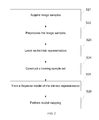
- FIG. 2 is a flowchart of a method for generating a facial feature verification model according to another embodiment of the present disclosure.
- FIG. 3 is a structural diagram of an apparatus for generating a facial feature verification model according to an embodiment of the present disclosure.
- a method for generating a facial feature verification model in an embodiment of the present disclosure is described below with reference to FIG. 1 .
- the method for generating a facial feature verification model mainly includes S 11 : Acquire N input facial images, where the N input facial images correspond to M persons with independent identities, N is an integer greater than 2, and M is an integer greater than 2.
- S 12 Perform feature extraction on the N input facial images, to obtain an original feature representation of each facial image, and form a face sample library according to obtained original feature representations.
- S 15 Obtain a training sample set of an intrinsic representation according to the common intrinsic representation of the c groups of face samples of the person with an independent identity.
- S 17 Obtain a facial feature verification model according to a preset model mapping relationship and the Bayesian model of the intrinsic representation.
- a model that is obtained through learning of an intrinsic representation has strong representability and discrimination performance during processing of intra-class and inter-class changes of posture, illumination, expression, age, and the like under different photographing scenarios; a learning model has a low error rate in facial image verification, and is close to an identification level of a human eye in a standard Internet image test; the model has low complexity and a small calculation amount.
- a method for generating a facial feature verification model in an embodiment of the present disclosure is described below with reference to FIG. 2 .
- the method for generating a facial feature verification model mainly includes Step S 21 : Acquire image samples.
- Step S 22 Preprocess the image samples.
- step S 21 the image samples acquired in step S 21 are preprocessed, to obtain a face sample library.
- preprocessing of the image samples may include the following steps: (1) obtaining a facial image with a size being W ⁇ H from an image sample, where W and H are positive integers, and a unit is a quantity of pixels, (2) performing registration and alignment on the obtained facial image with several standard templates, and (3) extracting a digital feature of the facial image on which the registration and alignment have been performed, to form a digital vector having D dimensions, where D is a positive integer.
- Steps (1), (2), and (3) are repeated on each image sample.
- the face sample library is a set of obtained digital vectors of all images and identities of persons corresponding to all the images.
- face samples in the face sample library are grouped.
- a quantity of groups is determined. It may be understood that whether face samples in the face sample library belong to a same person may be determined in a manner of manual determining, or using any other manner. For example, an identification (ID) number of a person may be marked in an image sample. A same ID number represents a same person, and different ID numbers represent different persons.
- ID identification
- Step S 23 Learn an intrinsic representation.
- MRD manifold relevance determination
- a main objective of learning of an intrinsic representation is to reduce adverse impacts caused by the foregoing factors on a facial recognition model.
- a set X i of all face samples that belong to a same person (which may be the i th person in a sorted order, where i is a positive integer) is equally divided into c portions, where c is a positive integer, and an operation of learning an intrinsic representation is not performed on extra samples.
- n i a quantity of samples included in each equal portion
- n i ⁇ D a quantity of data dimensions of each equal portion
- Z i a quantity of dimensions is n i ⁇ Q, Q>>D
- GP Gaussian process
- a function F i,j may be selected through independent sampling.
- the Gaussian process refers to a set of such random variables. When a finite quantity of random variables in the set are selected, joint distribution of the finite quantity of random variables is Gaussian distribution.
- the Gaussian process is determined by two parameters m, K, where m is a mean value function, and K is a covariance function. reference may be made to M. Ebden, “Gaussian Processes for Regression: A Quick Introduction”, 2008.
- the following likelihood function can be obtained according to the foregoing steps p(X i 1 , . . . , X i c
- Z i , w i,j , ⁇ i,j ) may be modeled by using a product of a series of Gaussian processes that have a parameter k i,j .
- a likelihood function of the sample set ⁇ X i 1 , . . . , X i c ⁇ may be expressed as p(X i 1 , . . . , X i c
- ⁇ X i , ⁇ Z i ) ⁇ p(X i 1 , . . . , X i c
- the likelihood function is mainly used to determine an effect of a training model. Values that are obtained by the likelihood function according to different variables may be used to indicate quality of a training model.
- ⁇ X i , ⁇ Z i ) is maximized, an intrinsic representation of samples, and corresponding parameters ⁇ Z i , ⁇ X i , ⁇ Z i ⁇ may be obtained by using an MRD method.
- MRD method For a specific MRD method, reference may be made to “A. C. Damianou, Carl Henrik Ek, Michalis K. Tistias, Neil D. Lawrence, “Manifold Relevance Determination”, International Conference on Machine Learning (ICML), 2012.”, and no further details are provided herein again.
- Z i (Z i S , Z i 1 , . . . , Z i c ), where Z i j is a private intrinsic representation corresponding to X i j , and Z i S is a common intrinsic representation of all c portions of samples.
- Components of Z i S are formed by all q components, in Q dimensions of Z i , that satisfy a weight w q i,1 , . . . , w q i,c > ⁇ (1 ⁇ q ⁇ Q) of automatic relevance determination (ARD).
- Z i j is formed by all q components that satisfy w q i,j > ⁇ , w q i,1 . .
- ⁇ is a threshold selected by a user.
- a quantity of dimensions of Z i S is denoted as Q S i .
- An intrinsic representation set Z 1 s , . . . , Z M S is obtained, and quantities of dimensions corresponding to elements in the set are respectively Q S 1 , . . . , Q S M .
- Q S min(Q S 1 , . . . , Q S M ) is denoted; for Z j s , ARD weights corresponding to each dimension are sorted in descending order, and first Q S components are kept.
- Step S 24 Construct a training sample set.
- the training sample set is a set of several samples.
- the set is used to perform training of a pattern determination model.
- the training sample set may also be written as a training set in short.
- corresponding c samples x n i,1 , . . . , x n i,j , . . . , x n i,c may be found in original samples, where x n i,j ⁇ X i j . In this way, for samples of the i th person, the following correspondence may be established
- t k , x k are in a one-to-one correspondence.
- i a ⁇ i b ⁇ , and corresponding positive and negative original training sample sets ⁇ X + ⁇ x k
- ⁇ T + and ⁇ X + are in a one-to-one correspondence, and elements in ⁇ T ⁇ and ⁇ X ⁇ are in a one-to-one correspondence.
- Positive training samples represent a same person, and negative training samples represent different persons.
- Step S 25 Train a Bayesian model of an intrinsic representation.
- a random variable corresponding to an intrinsic representation is denoted as t ⁇ 2Qs .
- Gaussian mixture models (GMM) p(t
- EM expectation-maximization
- EM is a method for estimating a parameter of a GMM model.
- a Gaussian mixture model is such a kind of model: a density function of a random variable is a probability model of a linear combination of multiple Gaussian density functions that have different parameters, and the parameters of the Gaussian density functions are formed by linear weighted factors a 1 , . . .
- Step S 26 Perform model mapping.
- a Bayesian model of an original sample is obtained by means of Gaussian process regression (GPR).
- GPR Gaussian process regression
- the Gaussian process regression refers to a method that uses a Gaussian process to perform modeling on existing data, and uses an obtained model to perform related prediction and determining on newly input data.
- a function ⁇ T + ⁇ X + may be constructed.
- a distribution function, learned by using the training set ⁇ T + , of an intrinsic sample pair t can be mapped to a distribution function, determined by ⁇ X + , of an original feature sample pair x.
- an ARD covariance function of a given Gaussian process is
- LSO Leave-set-out
- f(t k ) x k , p(t k
- ⁇ + l , ⁇ + l ) max ⁇ p(z k
- a function LSO is maximized to a corresponding parameter ⁇ by using a conjugate gradient descent method.
- ⁇ I ) is calculated by using determined ⁇ .
- ⁇ T ⁇ and ⁇ X ⁇ are used to determine p(x
- s ⁇ ( x * ) log ⁇ ( p ⁇ ( x *
- the apparatus 300 for generating a facial feature verification model includes an acquiring module 310 configured to acquire N input facial images, where the N input facial images correspond to M persons with independent identities, N is an integer greater than 2, and M is an integer greater than 2, a feature extracting module 320 configured to perform feature extraction on the N input facial images, to obtain an original feature representation of each facial image, and form a face sample library according to obtained original feature representations, a grouping module 330 configured to group samples corresponding to one person with an independent identity in the face sample library, to obtain c groups of face samples, where c is an integer greater than or equal to 2, a module 340 for generating a Bayesian model of an intrinsic representation configured to, for samples of each person with an independent identity, obtain a common intrinsic representation of the c groups of face samples according to manifold relevance determination, obtain a training sample set of an intrinsic representation according to the obtained common
- the module 340 for generating a Bayesian model of an intrinsic representation is configured to, for the samples of each person with an independent identity, obtain, according to a preset likelihood function and the manifold relevance determination, a private intrinsic representation of each group of face samples in the c groups of face samples and the common intrinsic representation of the c groups of face samples, where a quantity of face samples in each group of the c groups of face samples is the same, obtain the training sample set of the intrinsic representation according to the obtained common intrinsic representation of the c groups of face samples, and train the training sample set of the intrinsic representation, to obtain the Bayesian model of the intrinsic representation.
- the module 340 for generating a Bayesian model of an intrinsic representation is configured to, for the samples of each person with an independent identity, obtain the common intrinsic representation of the c groups of face samples according to the manifold relevance determination, obtain a positive training sample set and a negative training sample set according to the obtained common intrinsic representation of the c groups of face samples, where one training sample pair in the positive training sample set comes from a same person, and one training sample pair in the negative training sample set comes from different persons, and train the positive training sample set and the negative training sample set, to obtain the Bayesian model of the intrinsic representation.
- the module 340 for generating a Bayesian model of an intrinsic representation is configured to, for the samples of each person with an independent identity, obtain the common intrinsic representation of the c groups of face samples according to the manifold relevance determination, obtain the training sample set of the intrinsic representation according to the obtained common intrinsic representation of the c groups of face samples, and train the training sample set of the intrinsic representation according to an expectation-maximization algorithm, to obtain the Bayesian model of the intrinsic representation.
- the module 350 for generating a facial feature verification model is configured to map the Bayesian model of the intrinsic representation by means of Gaussian process regression of the preset model mapping relationship, to obtain a Bayesian model of an original feature representation, where the Bayesian model of the original feature representation is the facial feature verification model.
- a model that is obtained through learning of an intrinsic representation has strong representability and discrimination performance during processing of intra-class and inter-class changes of posture, illumination, expression, age, and the like under different photographing scenarios; a learning model has a low error rate in facial image verification, and is close to an identification level of a human eye in a standard Internet image test; the model has low complexity and a small calculation amount.
- module division is merely logical function division and may be other division in actual implementation.
- a plurality of units or components may be combined or integrated into another system, or some features may be ignored or not performed.
- the displayed or discussed mutual couplings or direct couplings or communication connections may be implemented by using some interfaces.
- the indirect couplings or communication connections between the apparatuses or units may be implemented in electronic, mechanical, or other forms.
- the functions When the functions are implemented in the form of a software functional unit and sold or used as an independent product, the functions may be stored in a computer-readable storage medium. Based on such an understanding, the technical solutions of the present disclosure essentially, or the part contributing to the, or some of the technical solutions may be implemented in a form of a software product.
- the computer software product is stored in a storage medium, and includes several instructions for instructing a computer device (which may be a personal computer, a server, or a network device) to perform all or some of the steps of the methods described in the embodiments of the present disclosure.
- the foregoing storage medium includes any medium that can store program code, such as a universal serial bus (USB) flash drive, a removable hard disk, a read-only memory (ROM), a random access memory (RAM), a magnetic disk, or an optical disc.
- USB universal serial bus
- ROM read-only memory
- RAM random access memory
- magnetic disk or an optical disc.
Landscapes
- Engineering & Computer Science (AREA)
- Theoretical Computer Science (AREA)
- Health & Medical Sciences (AREA)
- Computer Vision & Pattern Recognition (AREA)
- Multimedia (AREA)
- General Health & Medical Sciences (AREA)
- General Physics & Mathematics (AREA)
- Physics & Mathematics (AREA)
- Oral & Maxillofacial Surgery (AREA)
- Human Computer Interaction (AREA)
- Computing Systems (AREA)
- Software Systems (AREA)
- Medical Informatics (AREA)
- Evolutionary Computation (AREA)
- Databases & Information Systems (AREA)
- Artificial Intelligence (AREA)
- Image Analysis (AREA)
- Image Processing (AREA)
Abstract
Description
is calculated by using the probability models p(δ|ΩI), p(δ|ΩE).
a function Fi,j may be selected through independent sampling.


if a random variable t satisfies distribution
Σx=(
C=[x 1 , . . . ,x K ]K −1

k=[{circumflex over (k)}(t 1 ,t), . . . ,{circumflex over (k)}(t K ,t)]T
K=[{circumflex over (k)}(t a ,t b)]a,b=1 . . . K


and if s(x*)>0, the two facial images come from a same person; otherwise, the two faces represent different persons.
Claims (10)
Applications Claiming Priority (3)
| Application Number | Priority Date | Filing Date | Title |
|---|---|---|---|
| CN201410451701 | 2014-09-05 | ||
| CN201410451701.7A CN104239858B (en) | 2014-09-05 | 2014-09-05 | A kind of method and apparatus of face characteristic checking |
| CN201410451701.7 | 2014-09-05 |
Publications (2)
| Publication Number | Publication Date |
|---|---|
| US20160070956A1 US20160070956A1 (en) | 2016-03-10 |
| US9514356B2 true US9514356B2 (en) | 2016-12-06 |
Family
ID=52227884
Family Applications (1)
| Application Number | Title | Priority Date | Filing Date |
|---|---|---|---|
| US14/841,928 Expired - Fee Related US9514356B2 (en) | 2014-09-05 | 2015-09-01 | Method and apparatus for generating facial feature verification model |
Country Status (3)
| Country | Link |
|---|---|
| US (1) | US9514356B2 (en) |
| EP (1) | EP2993616A1 (en) |
| CN (1) | CN104239858B (en) |
Cited By (3)
| Publication number | Priority date | Publication date | Assignee | Title |
|---|---|---|---|---|
| CN108399379A (en) * | 2017-08-11 | 2018-08-14 | 北京市商汤科技开发有限公司 | The method, apparatus and electronic equipment at facial age for identification |
| CN108898094A (en) * | 2018-06-26 | 2018-11-27 | 华中科技大学 | A kind of face comparison method and system based on series connection integrated form RMML metric learning |
| US20220147765A1 (en) * | 2020-11-10 | 2022-05-12 | Nec Laboratories America, Inc. | Face recognition from unseen domains via learning of semantic features |
Families Citing this family (20)
| Publication number | Priority date | Publication date | Assignee | Title |
|---|---|---|---|---|
| CN104573652B (en) * | 2015-01-04 | 2017-12-22 | 华为技术有限公司 | Determine the method, apparatus and terminal of the identity of face in facial image |
| US10230860B2 (en) * | 2016-08-08 | 2019-03-12 | Kabushiki Kaisha Toshiba | Authentication apparatus for carrying out authentication based on captured image, authentication method and server |
| US10198626B2 (en) | 2016-10-19 | 2019-02-05 | Snap Inc. | Neural networks for facial modeling |
| CN107992728B (en) * | 2016-10-27 | 2022-05-20 | 腾讯科技(深圳)有限公司 | Face verification method and device |
| US11537869B2 (en) * | 2017-02-17 | 2022-12-27 | Twitter, Inc. | Difference metric for machine learning-based processing systems |
| CN106934373A (en) * | 2017-03-14 | 2017-07-07 | 重庆文理学院 | A kind of library book damages assessment method and system |
| CN107506694B (en) * | 2017-07-27 | 2021-02-09 | 南京邮电大学 | Robust face recognition method based on local median representation |
| CN108197532B (en) * | 2017-12-18 | 2019-08-16 | 深圳励飞科技有限公司 | The method, apparatus and computer installation of recognition of face |
| WO2019119396A1 (en) * | 2017-12-22 | 2019-06-27 | 中国科学院深圳先进技术研究院 | Facial expression recognition method and device |
| CN108491923B (en) * | 2018-04-10 | 2021-09-24 | 吉林大学 | Pest Image Recognition Method Based on Improved Wolf Pack Algorithm Optimizing Bayesian Network |
| CN108446674A (en) * | 2018-04-28 | 2018-08-24 | 平安科技(深圳)有限公司 | Electronic device, personal identification method and storage medium based on facial image and voiceprint |
| CN108960103B (en) * | 2018-06-25 | 2021-02-19 | 西安交通大学 | An identity authentication method and system integrating face and lip language |
| CN108805101A (en) * | 2018-06-28 | 2018-11-13 | 陈静飞 | A kind of recognition methods of the parasite egg based on deep learning |
| CN109492702B (en) * | 2018-11-21 | 2020-09-22 | 中国科学院自动化研究所 | Pedestrian re-identification method, system and device based on ranking measurement function |
| CN111353943B (en) * | 2018-12-20 | 2023-12-26 | 杭州海康威视数字技术股份有限公司 | A face image recovery method, device and readable storage medium |
| CN110472489B (en) * | 2019-07-05 | 2023-05-05 | 五邑大学 | Face beauty grade prediction method, device and storage medium |
| CN111626191B (en) * | 2020-05-26 | 2023-06-30 | 深圳地平线机器人科技有限公司 | Model generation method, device, computer readable storage medium and electronic equipment |
| CN115147886B (en) * | 2021-03-30 | 2024-12-06 | 中南大学 | Cross-domain key point detection method compatible with real faces and comic faces |
| CN113763366B (en) * | 2021-09-10 | 2023-07-25 | 网易(杭州)网络有限公司 | Face changing method, device, equipment and storage medium |
| CN114360025A (en) * | 2022-01-10 | 2022-04-15 | 山东工商学院 | Image sample screening method and device and storage medium |
Citations (1)
| Publication number | Priority date | Publication date | Assignee | Title |
|---|---|---|---|---|
| US8811726B2 (en) * | 2011-06-02 | 2014-08-19 | Kriegman-Belhumeur Vision Technologies, Llc | Method and system for localizing parts of an object in an image for computer vision applications |
Family Cites Families (3)
| Publication number | Priority date | Publication date | Assignee | Title |
|---|---|---|---|---|
| US5612928A (en) * | 1992-05-28 | 1997-03-18 | Northrop Grumman Corporation | Method and apparatus for classifying objects in sonar images |
| CN1866270B (en) * | 2004-05-17 | 2010-09-08 | 香港中文大学 | face recognition method based on video |
| CN101464950B (en) * | 2009-01-16 | 2011-05-04 | 北京航空航天大学 | Video human face identification and retrieval method based on on-line learning and Bayesian inference |
-
2014
- 2014-09-05 CN CN201410451701.7A patent/CN104239858B/en not_active Expired - Fee Related
-
2015
- 2015-08-13 EP EP15180883.9A patent/EP2993616A1/en not_active Withdrawn
- 2015-09-01 US US14/841,928 patent/US9514356B2/en not_active Expired - Fee Related
Patent Citations (1)
| Publication number | Priority date | Publication date | Assignee | Title |
|---|---|---|---|---|
| US8811726B2 (en) * | 2011-06-02 | 2014-08-19 | Kriegman-Belhumeur Vision Technologies, Llc | Method and system for localizing parts of an object in an image for computer vision applications |
Non-Patent Citations (13)
| Title |
|---|
| Bishop, C., "Pattern Recognition and Machine Learning," 2006, 703 pages. |
| Chaochao Lu and Xiaoou Tang, "Learning the Face Prior for Bayesian Face Recognition", Department of Information Engineering The Chinese University of Hong Kong, Hong Kong, Aug. 29, 2014, Retrieved from the internet: URL:https://github.com/Chao-Chao/Chao-Chao.github.io/blob/546d37b587f86d13c4cd7b551f18603070da0a79/papers/LearnedBayesian.pdf, 16. * |
| Chen, D., et al., "Bayesian Face Revisited: A Joint Formulation," Computer Vision, ECCV 2012, vol. 7574 of the series Lecture Notes in Computer Science, 14 pages. |
| Damianou, A., et al., "Manifold Relevance Determination, Proceedings of the 29th International Conference on Machine Learning," 2012, 8 pages. |
| Ebden, M., et al., "Gaussian Processes for Regression: A Quick Introduction," Aug. 2008, 11 pages. |
| Foreign Communication From A Counterpart Application, European Application No. 15180883.9, Extended European Search Report dated Jan. 15, 2016, 6 pages. |
| Lu, C., et al., "Learning the Face Prior for Bayesian Face Recognition," Department of Information Engineering, Retrieved from the Internet: URL:https://github.io/blob/546d37b587f86d13c4cd7b551f18603070da0a79/papers/learnedBayesian.pdf [retrieved on Jan. 7, 2016], Aug. 29, 2014, 16 pages. |
| Moghaddam, B., et al., "Bayesian Face Recognition," Mitsubishi Electric Research Laboratories, TR2000-42, Feb. 2002, 16 pages. |
| Nabney, I., "Netlab: Algorithms for Pattern Recognition," Advances in Computer Vision and Pattern Recognition, 2002, 444 pages. |
| Rasmussen, C.E., et al., "Gaussian Processes for Machine Learning," Advanced Lectures on Machine Learning, vol. 3176 of the series Lecture Notes in Computer Science, 2006, 266 pages. |
| Sun, Y., et al., "Deep Learning Face Representation from Predicting 10,000 Classes," CVPR '14 Proceedings of the IEEE Conference on Computer Vision and Pattern Recognition, 2014, 8 pages. |
| Taigman, Y., et al., "DeepFace: Closing the Gap to Human-Level Performance in Face Verification," IEEE Conference on Computer Vision and Pattern Recognition, 2014, 8 pages. |
| Wasserman, L., "All of Nonparametric Statistics," Springer Texts in Statistics, 2006, 292 pages. |
Cited By (8)
| Publication number | Priority date | Publication date | Assignee | Title |
|---|---|---|---|---|
| CN108399379A (en) * | 2017-08-11 | 2018-08-14 | 北京市商汤科技开发有限公司 | The method, apparatus and electronic equipment at facial age for identification |
| US20190138787A1 (en) * | 2017-08-11 | 2019-05-09 | Beijing Sensetime Technology Development Co., Ltd | Method and apparatus for facial age identification, and electronic device |
| CN108399379B (en) * | 2017-08-11 | 2021-02-12 | 北京市商汤科技开发有限公司 | Method and device for identifying face age and electronic equipment |
| US11003890B2 (en) * | 2017-08-11 | 2021-05-11 | Beijing Sensetime Technology Development Co., Ltd | Method and apparatus for facial age identification, and electronic device |
| CN108898094A (en) * | 2018-06-26 | 2018-11-27 | 华中科技大学 | A kind of face comparison method and system based on series connection integrated form RMML metric learning |
| CN108898094B (en) * | 2018-06-26 | 2020-06-05 | 华中科技大学 | Face comparison method and system based on series integrated RMML metric learning |
| US20220147765A1 (en) * | 2020-11-10 | 2022-05-12 | Nec Laboratories America, Inc. | Face recognition from unseen domains via learning of semantic features |
| US11947626B2 (en) * | 2020-11-10 | 2024-04-02 | Nec Corporation | Face recognition from unseen domains via learning of semantic features |
Also Published As
| Publication number | Publication date |
|---|---|
| EP2993616A1 (en) | 2016-03-09 |
| CN104239858B (en) | 2017-06-09 |
| US20160070956A1 (en) | 2016-03-10 |
| CN104239858A (en) | 2014-12-24 |
Similar Documents
| Publication | Publication Date | Title |
|---|---|---|
| US9514356B2 (en) | Method and apparatus for generating facial feature verification model | |
| Agarwal et al. | Face recognition using eigen faces and artificial neural network | |
| CN106897675B (en) | A face detection method based on the combination of binocular visual depth feature and apparent feature | |
| CN103258204B (en) | A kind of automatic micro-expression recognition method based on Gabor and EOH feature | |
| Tome et al. | The 1st competition on counter measures to finger vein spoofing attacks | |
| Bekhouche et al. | Facial age estimation and gender classification using multi level local phase quantization | |
| US20180293429A1 (en) | Age invariant face recognition using convolutional neural networks and set distances | |
| US9633044B2 (en) | Apparatus and method for recognizing image, and method for generating morphable face images from original image | |
| CN113205002B (en) | Low-definition face recognition method, device, equipment and medium for unlimited video monitoring | |
| CN109919252A (en) | The method for generating classifier using a small number of mark images | |
| Chandran et al. | Missing child identification system using deep learning and multiclass SVM | |
| Pratama et al. | Face recognition for presence system by using residual networks-50 architecture | |
| CN104123543A (en) | Eyeball movement identification method based on face identification | |
| CN109902223A (en) | A method for filtering objectionable content based on multimodal information features | |
| CN113436735A (en) | Body weight index prediction method, device and storage medium based on face structure measurement | |
| CN114882320B (en) | Object recognition method, network training method, device, equipment and medium | |
| CN112308035A (en) | Image detection method, image detection device, computer equipment and storage medium | |
| Verissimo et al. | Transfer learning for face anti-spoofing detection | |
| CN111401105B (en) | A video expression recognition method, device and equipment | |
| CN114550224A (en) | Fingerprint image identification comparison method and device based on deep learning and electronic equipment | |
| CN104978569A (en) | Sparse representation based incremental face recognition method | |
| CN114333019A (en) | Training method of living body detection model, living body detection method and related device | |
| Kumar et al. | Deep Learning Based Image Classification for Automated Face Spoofing Detection Using Machine Learning: Convolutional Neural Network | |
| CN117011568A (en) | Image classification method, device, electronic equipment and storage medium | |
| CN120543750A (en) | A craniofacial restoration method based on diffusion model |
Legal Events
| Date | Code | Title | Description |
|---|---|---|---|
| AS | Assignment |
Owner name: HUAWEI TECHNOLOGIES CO., LTD., CHINA Free format text: ASSIGNMENT OF ASSIGNORS INTEREST;ASSIGNORS:LU, CHAOCHAO;XU, CHUNJING;TANG, XIAOOU;REEL/FRAME:036466/0648 Effective date: 20150831 |
|
| STCF | Information on status: patent grant |
Free format text: PATENTED CASE |
|
| MAFP | Maintenance fee payment |
Free format text: PAYMENT OF MAINTENANCE FEE, 4TH YEAR, LARGE ENTITY (ORIGINAL EVENT CODE: M1551); ENTITY STATUS OF PATENT OWNER: LARGE ENTITY Year of fee payment: 4 |
|
| FEPP | Fee payment procedure |
Free format text: MAINTENANCE FEE REMINDER MAILED (ORIGINAL EVENT CODE: REM.); ENTITY STATUS OF PATENT OWNER: LARGE ENTITY |
|
| LAPS | Lapse for failure to pay maintenance fees |
Free format text: PATENT EXPIRED FOR FAILURE TO PAY MAINTENANCE FEES (ORIGINAL EVENT CODE: EXP.); ENTITY STATUS OF PATENT OWNER: LARGE ENTITY |
|
| STCH | Information on status: patent discontinuation |
Free format text: PATENT EXPIRED DUE TO NONPAYMENT OF MAINTENANCE FEES UNDER 37 CFR 1.362 |
|
| FP | Lapsed due to failure to pay maintenance fee |
Effective date: 20241206 |