US9512074B2 - Radiolabeled inhibitors of the amino acid transporters ASCT1 and ASCT2 - Google Patents
Radiolabeled inhibitors of the amino acid transporters ASCT1 and ASCT2 Download PDFInfo
- Publication number
- US9512074B2 US9512074B2 US14/515,103 US201414515103A US9512074B2 US 9512074 B2 US9512074 B2 US 9512074B2 US 201414515103 A US201414515103 A US 201414515103A US 9512074 B2 US9512074 B2 US 9512074B2
- Authority
- US
- United States
- Prior art keywords
- proline
- hydroxy
- cbz
- compounds
- trans
- Prior art date
- Legal status (The legal status is an assumption and is not a legal conclusion. Google has not performed a legal analysis and makes no representation as to the accuracy of the status listed.)
- Active, expires
Links
- 0 *[C@H]1[C@@H](C(=O)[O-])[NH2+]C[C@@H]1O.*[C@H]1[C@H](O)C[NH2+][C@@H]1C(=O)[O-] Chemical compound *[C@H]1[C@@H](C(=O)[O-])[NH2+]C[C@@H]1O.*[C@H]1[C@H](O)C[NH2+][C@@H]1C(=O)[O-] 0.000 description 12
- HYNIQZVJTQYPRL-LYFYHCNISA-N CC(C)O[C@H]1C[NH2+][C@H](C(=O)[O-])[C@@H]1O Chemical compound CC(C)O[C@H]1C[NH2+][C@H](C(=O)[O-])[C@@H]1O HYNIQZVJTQYPRL-LYFYHCNISA-N 0.000 description 2
- LIQTXFDXRXIXCL-WISUUJSJSA-N CO[C@@H]1C[NH2+][C@H](C(=O)[O-])[C@H]1O Chemical compound CO[C@@H]1C[NH2+][C@H](C(=O)[O-])[C@H]1O LIQTXFDXRXIXCL-WISUUJSJSA-N 0.000 description 2
- KPCWMMDGZFFCTA-NJGYIYPDSA-N C[C@@]1(O)C[NH2+][C@H](C(=O)[O-])C1 Chemical compound C[C@@]1(O)C[NH2+][C@H](C(=O)[O-])C1 KPCWMMDGZFFCTA-NJGYIYPDSA-N 0.000 description 2
- KPCWMMDGZFFCTA-UJURSFKZSA-N C[C@]1(O)C[NH2+][C@H](C(=O)[O-])C1 Chemical compound C[C@]1(O)C[NH2+][C@H](C(=O)[O-])C1 KPCWMMDGZFFCTA-UJURSFKZSA-N 0.000 description 2
- HYNIQZVJTQYPRL-VQVTYTSYSA-N CC(C)O[C@@H]1C[NH2+][C@H](C(=O)[O-])[C@H]1O Chemical compound CC(C)O[C@@H]1C[NH2+][C@H](C(=O)[O-])[C@H]1O HYNIQZVJTQYPRL-VQVTYTSYSA-N 0.000 description 1
- BGWTVMDAEYKBIG-OAINAWNSSA-N CC.O=C([O-])[C@H]1[NH2+]C[C@H](O)[C@H]1OC1=CC=CC=C1 Chemical compound CC.O=C([O-])[C@H]1[NH2+]C[C@H](O)[C@H]1OC1=CC=CC=C1 BGWTVMDAEYKBIG-OAINAWNSSA-N 0.000 description 1
- WHUABNGAQYJBEV-SQNIBIBYSA-N CC1=CC(C2=CC=C(CO[C@@H]3C[NH2+][C@H](C(=O)[O-])[C@H]3O)C=C2)=CC=C1 Chemical compound CC1=CC(C2=CC=C(CO[C@@H]3C[NH2+][C@H](C(=O)[O-])[C@H]3O)C=C2)=CC=C1 WHUABNGAQYJBEV-SQNIBIBYSA-N 0.000 description 1
- SOWBHTFQTRXGPZ-QDSKXPNFSA-N CC1=CC(CO[C@@H]2C[NH2+][C@H](C(=O)[O-])[C@H]2O)=CC(C)=C1C1=C(C)C(C)=C(C)C(C)=C1C Chemical compound CC1=CC(CO[C@@H]2C[NH2+][C@H](C(=O)[O-])[C@H]2O)=CC(C)=C1C1=C(C)C(C)=C(C)C(C)=C1C SOWBHTFQTRXGPZ-QDSKXPNFSA-N 0.000 description 1
- WIAKXAGCJUDEFR-WOPDTQHZSA-N CC1=CC(CO[C@@H]2C[NH2+][C@H](C(=O)[O-])[C@H]2O)=CC=C1 Chemical compound CC1=CC(CO[C@@H]2C[NH2+][C@H](C(=O)[O-])[C@H]2O)=CC=C1 WIAKXAGCJUDEFR-WOPDTQHZSA-N 0.000 description 1
- QRUFETBOMQXZMY-SQNIBIBYSA-N CC1=CC(CO[C@@H]2C[NH2+][C@H](C(=O)[O-])[C@H]2O)=CC=C1C1=CC=CC=C1 Chemical compound CC1=CC(CO[C@@H]2C[NH2+][C@H](C(=O)[O-])[C@H]2O)=CC=C1C1=CC=CC=C1 QRUFETBOMQXZMY-SQNIBIBYSA-N 0.000 description 1
- KIOFKMNQSFUJOH-SQNIBIBYSA-N CC1=CC=C(C2=CC=C(CO[C@@H]3C[NH2+][C@H](C(=O)[O-])[C@H]3O)C=C2)C=C1 Chemical compound CC1=CC=C(C2=CC=C(CO[C@@H]3C[NH2+][C@H](C(=O)[O-])[C@H]3O)C=C2)C=C1 KIOFKMNQSFUJOH-SQNIBIBYSA-N 0.000 description 1
- CUPLVXJGWBEYQP-WOPDTQHZSA-N CC1=CC=C(CO[C@@H]2C[NH2+][C@H](C(=O)[O-])[C@H]2O)C=C1 Chemical compound CC1=CC=C(CO[C@@H]2C[NH2+][C@H](C(=O)[O-])[C@H]2O)C=C1 CUPLVXJGWBEYQP-WOPDTQHZSA-N 0.000 description 1
- WVKSNPRRBAXZDK-RHDSIKIFSA-M CC1=CC=C(S(=O)(=O)O[C@@H]2C[C@@H](C(=O)OCC3=CC=CC=C3)N(C)C2)C=C1.CN1CC=C[C@H]1C(=O)OCC1=CC=CC=C1.CN1C[C@@H]([Se]C2=CC=CC=C2)C[C@H]1C(=O)OCC1=CC=CC=C1.CN1C[C@@H]2O[C@@H]2[C@H]1C(=O)OCC1=CC=CC=C1.CN1C[C@H](O)C[C@H]1C(=O)OCC1=CC=CC=C1.CN1C[C@H](O)C[C@H]1C(=O)[O-].CN1C[C@H]2O[C@H]2[C@H]1C(=O)OCC1=CC=CC=C1.O=C([O-])[C@@H]1C[C@@H](O)C[NH2+]1 Chemical compound CC1=CC=C(S(=O)(=O)O[C@@H]2C[C@@H](C(=O)OCC3=CC=CC=C3)N(C)C2)C=C1.CN1CC=C[C@H]1C(=O)OCC1=CC=CC=C1.CN1C[C@@H]([Se]C2=CC=CC=C2)C[C@H]1C(=O)OCC1=CC=CC=C1.CN1C[C@@H]2O[C@@H]2[C@H]1C(=O)OCC1=CC=CC=C1.CN1C[C@H](O)C[C@H]1C(=O)OCC1=CC=CC=C1.CN1C[C@H](O)C[C@H]1C(=O)[O-].CN1C[C@H]2O[C@H]2[C@H]1C(=O)OCC1=CC=CC=C1.O=C([O-])[C@@H]1C[C@@H](O)C[NH2+]1 WVKSNPRRBAXZDK-RHDSIKIFSA-M 0.000 description 1
- PRLRSINHBIODPV-SQNIBIBYSA-N CC1=CC=CC=C1C1=CC=C(CO[C@@H]2C[NH2+][C@H](C(=O)[O-])[C@H]2O)C=C1 Chemical compound CC1=CC=CC=C1C1=CC=C(CO[C@@H]2C[NH2+][C@H](C(=O)[O-])[C@H]2O)C=C1 PRLRSINHBIODPV-SQNIBIBYSA-N 0.000 description 1
- OGOLWFWNUGUQMR-WOPDTQHZSA-N CC1=CC=CC=C1CO[C@@H]1C[NH2+][C@H](C(=O)[O-])[C@H]1O Chemical compound CC1=CC=CC=C1CO[C@@H]1C[NH2+][C@H](C(=O)[O-])[C@H]1O OGOLWFWNUGUQMR-WOPDTQHZSA-N 0.000 description 1
- LOJQUXMONDSTLP-YZIHBCAYSA-N CN1CC=C[C@H]1C(=O)O.CN1CC=C[C@H]1C(=O)OCC1=CC=CC=C1.CN1C[C@H](O)C[C@H]1C(=O)O.CSC(=S)O[C@@H]1C[C@@H](C(=O)O)N(C)C1.CSC(=S)O[C@@H]1C[C@@H](C(=O)OCC2=CC=CC=C2)N(C)C1 Chemical compound CN1CC=C[C@H]1C(=O)O.CN1CC=C[C@H]1C(=O)OCC1=CC=CC=C1.CN1C[C@H](O)C[C@H]1C(=O)O.CSC(=S)O[C@@H]1C[C@@H](C(=O)O)N(C)C1.CSC(=S)O[C@@H]1C[C@@H](C(=O)OCC2=CC=CC=C2)N(C)C1 LOJQUXMONDSTLP-YZIHBCAYSA-N 0.000 description 1
- LIQTXFDXRXIXCL-VAYJURFESA-N CO[C@H]1C[NH2+][C@H](C(=O)[O-])[C@@H]1O Chemical compound CO[C@H]1C[NH2+][C@H](C(=O)[O-])[C@@H]1O LIQTXFDXRXIXCL-VAYJURFESA-N 0.000 description 1
- COHFSKKGVFGDFH-WISUUJSJSA-N C[C@@H]1C[NH2+][C@H](C(=O)[O-])[C@H]1O Chemical compound C[C@@H]1C[NH2+][C@H](C(=O)[O-])[C@H]1O COHFSKKGVFGDFH-WISUUJSJSA-N 0.000 description 1
- OKDDZUAFBARWMD-WISUUJSJSA-N C[C@H]1[C@@H](C(=O)[O-])[NH2+]C[C@@H]1O Chemical compound C[C@H]1[C@@H](C(=O)[O-])[NH2+]C[C@@H]1O OKDDZUAFBARWMD-WISUUJSJSA-N 0.000 description 1
- PIZUEVNGSMOVGW-IKGGRYGDSA-O O=C(O)[C@H]1[NH2+]C[C@@H](OCC2=CC=C(C3=CC=CC=C3)C=C2)[C@@H]1O Chemical compound O=C(O)[C@H]1[NH2+]C[C@@H](OCC2=CC=C(C3=CC=CC=C3)C=C2)[C@@H]1O PIZUEVNGSMOVGW-IKGGRYGDSA-O 0.000 description 1
- NOZKFGZJRDPOEQ-VWYCJHECSA-O O=C(O)[C@H]1[NH2+]C[C@@H](OCC2=CC=CC=C2)[C@@H]1O Chemical compound O=C(O)[C@H]1[NH2+]C[C@@H](OCC2=CC=CC=C2)[C@@H]1O NOZKFGZJRDPOEQ-VWYCJHECSA-O 0.000 description 1
- NOZKFGZJRDPOEQ-GARJFASQSA-O O=C(O)[C@H]1[NH2+]C[C@H](OCC2=CC=CC=C2)[C@H]1O Chemical compound O=C(O)[C@H]1[NH2+]C[C@H](OCC2=CC=CC=C2)[C@H]1O NOZKFGZJRDPOEQ-GARJFASQSA-O 0.000 description 1
- PMMYEEVYMWASQN-IMJSIDKUSA-N O=C([O-])[C@@H]1C[C@H](O)C[NH2+]1 Chemical compound O=C([O-])[C@@H]1C[C@H](O)C[NH2+]1 PMMYEEVYMWASQN-IMJSIDKUSA-N 0.000 description 1
- HJBYLYJLYYFRKO-JYJNAYRXSA-N O=C([O-])[C@H]1[NH2+]C[C@@H](C2=CC(C3=CC=CC=C3)=CC=C2)[C@@H]1O Chemical compound O=C([O-])[C@H]1[NH2+]C[C@@H](C2=CC(C3=CC=CC=C3)=CC=C2)[C@@H]1O HJBYLYJLYYFRKO-JYJNAYRXSA-N 0.000 description 1
- KGOQHGIQWAYCNA-JYJNAYRXSA-N O=C([O-])[C@H]1[NH2+]C[C@@H](C2=CC=C(C3=CC=CC=C3)C=C2)[C@@H]1O Chemical compound O=C([O-])[C@H]1[NH2+]C[C@@H](C2=CC=C(C3=CC=CC=C3)C=C2)[C@@H]1O KGOQHGIQWAYCNA-JYJNAYRXSA-N 0.000 description 1
- YBIVPIORRPLUIK-GUBZILKMSA-N O=C([O-])[C@H]1[NH2+]C[C@@H](C2=CC=CC=C2)[C@@H]1O Chemical compound O=C([O-])[C@H]1[NH2+]C[C@@H](C2=CC=CC=C2)[C@@H]1O YBIVPIORRPLUIK-GUBZILKMSA-N 0.000 description 1
- PTPGFKSPHOWXSC-XCRWLTKQSA-N O=C([O-])[C@H]1[NH2+]C[C@@H](C2=CC=CC=C2)[C@@H]1O.O=C([O-])[C@H]1[NH2+]C[C@H](O)[C@H]1C1=CC=CC=C1 Chemical compound O=C([O-])[C@H]1[NH2+]C[C@@H](C2=CC=CC=C2)[C@@H]1O.O=C([O-])[C@H]1[NH2+]C[C@H](O)[C@H]1C1=CC=CC=C1 PTPGFKSPHOWXSC-XCRWLTKQSA-N 0.000 description 1
- YEMCPYMMNVWKBB-JYJNAYRXSA-N O=C([O-])[C@H]1[NH2+]C[C@@H](C2=CC=CC=C2C2=CC=CC=C2)[C@@H]1O Chemical compound O=C([O-])[C@H]1[NH2+]C[C@@H](C2=CC=CC=C2C2=CC=CC=C2)[C@@H]1O YEMCPYMMNVWKBB-JYJNAYRXSA-N 0.000 description 1
- TXOCNKOSBOWCMF-UTLUCORTSA-N O=C([O-])[C@H]1[NH2+]C[C@@H](OC2=CC=CC=C2)[C@@H]1O Chemical compound O=C([O-])[C@H]1[NH2+]C[C@@H](OC2=CC=CC=C2)[C@@H]1O TXOCNKOSBOWCMF-UTLUCORTSA-N 0.000 description 1
- LSEHRLRLBXFFAN-AALLBADNSA-N O=C([O-])[C@H]1[NH2+]C[C@@H](OC2=CC=CC=C2)[C@@H]1O.O=C([O-])[C@H]1[NH2+]C[C@H](O)[C@H]1OC1=CC=CC=C1 Chemical compound O=C([O-])[C@H]1[NH2+]C[C@@H](OC2=CC=CC=C2)[C@@H]1O.O=C([O-])[C@H]1[NH2+]C[C@H](O)[C@H]1OC1=CC=CC=C1 LSEHRLRLBXFFAN-AALLBADNSA-N 0.000 description 1
- PIZUEVNGSMOVGW-IKGGRYGDSA-N O=C([O-])[C@H]1[NH2+]C[C@@H](OCC2=CC=C(C3=CC=CC=C3)C=C2)[C@@H]1O Chemical compound O=C([O-])[C@H]1[NH2+]C[C@@H](OCC2=CC=C(C3=CC=CC=C3)C=C2)[C@@H]1O PIZUEVNGSMOVGW-IKGGRYGDSA-N 0.000 description 1
- DJMYNZMHFSXKTN-SQNIBIBYSA-N O=C([O-])[C@H]1[NH2+]C[C@@H](OCC2=CC=C3C(=C2)CC2=CC=CC=C23)[C@@H]1O Chemical compound O=C([O-])[C@H]1[NH2+]C[C@@H](OCC2=CC=C3C(=C2)CC2=CC=CC=C23)[C@@H]1O DJMYNZMHFSXKTN-SQNIBIBYSA-N 0.000 description 1
- DQXMPCWSOUMOKA-IKGGRYGDSA-N O=C([O-])[C@H]1[NH2+]C[C@@H](OCC2=CC=CC(C3=CC=CC=C3)=C2)[C@@H]1O Chemical compound O=C([O-])[C@H]1[NH2+]C[C@@H](OCC2=CC=CC(C3=CC=CC=C3)=C2)[C@@H]1O DQXMPCWSOUMOKA-IKGGRYGDSA-N 0.000 description 1
- GLFGWXQMSYYYPQ-IKGGRYGDSA-N O=C([O-])[C@H]1[NH2+]C[C@@H](OCC2=CC=CC(OC3=CC=CC=C3)=C2)[C@@H]1O Chemical compound O=C([O-])[C@H]1[NH2+]C[C@@H](OCC2=CC=CC(OC3=CC=CC=C3)=C2)[C@@H]1O GLFGWXQMSYYYPQ-IKGGRYGDSA-N 0.000 description 1
- NOZKFGZJRDPOEQ-VWYCJHECSA-N O=C([O-])[C@H]1[NH2+]C[C@@H](OCC2=CC=CC=C2)[C@@H]1O Chemical compound O=C([O-])[C@H]1[NH2+]C[C@@H](OCC2=CC=CC=C2)[C@@H]1O NOZKFGZJRDPOEQ-VWYCJHECSA-N 0.000 description 1
- USOREECWWPHFRO-AEJSXWLSSA-N O=C([O-])[C@H]1[NH2+]C[C@H](O)[C@H]1C1=CC=CC=C1 Chemical compound O=C([O-])[C@H]1[NH2+]C[C@H](O)[C@H]1C1=CC=CC=C1 USOREECWWPHFRO-AEJSXWLSSA-N 0.000 description 1
- MISHPERJVSYTIY-LPEHRKFASA-N O=C([O-])[C@H]1[NH2+]C[C@H](O)[C@H]1OC1=CC=CC=C1 Chemical compound O=C([O-])[C@H]1[NH2+]C[C@H](O)[C@H]1OC1=CC=CC=C1 MISHPERJVSYTIY-LPEHRKFASA-N 0.000 description 1
- NOZKFGZJRDPOEQ-GARJFASQSA-N O=C([O-])[C@H]1[NH2+]C[C@H](OCC2=CC=CC=C2)[C@H]1O Chemical compound O=C([O-])[C@H]1[NH2+]C[C@H](OCC2=CC=CC=C2)[C@H]1O NOZKFGZJRDPOEQ-GARJFASQSA-N 0.000 description 1
- PIZUEVNGSMOVGW-UHFFFAOYSA-O OC1C(C(O)=O)[NH2+]CC1OCc(cc1)ccc1-c1ccccc1 Chemical compound OC1C(C(O)=O)[NH2+]CC1OCc(cc1)ccc1-c1ccccc1 PIZUEVNGSMOVGW-UHFFFAOYSA-O 0.000 description 1
- NOZKFGZJRDPOEQ-UHFFFAOYSA-O OC1C(C(O)=O)[NH2+]CC1OCc1ccccc1 Chemical compound OC1C(C(O)=O)[NH2+]CC1OCc1ccccc1 NOZKFGZJRDPOEQ-UHFFFAOYSA-O 0.000 description 1
- USOREECWWPHFRO-UHFFFAOYSA-N [O-]C(C(C1c2ccccc2)[NH2+]CC1O)=O Chemical compound [O-]C(C(C1c2ccccc2)[NH2+]CC1O)=O USOREECWWPHFRO-UHFFFAOYSA-N 0.000 description 1
Images


Classifications
-
- C—CHEMISTRY; METALLURGY
- C07—ORGANIC CHEMISTRY
- C07D—HETEROCYCLIC COMPOUNDS
- C07D207/00—Heterocyclic compounds containing five-membered rings not condensed with other rings, with one nitrogen atom as the only ring hetero atom
- C07D207/02—Heterocyclic compounds containing five-membered rings not condensed with other rings, with one nitrogen atom as the only ring hetero atom with only hydrogen or carbon atoms directly attached to the ring nitrogen atom
- C07D207/04—Heterocyclic compounds containing five-membered rings not condensed with other rings, with one nitrogen atom as the only ring hetero atom with only hydrogen or carbon atoms directly attached to the ring nitrogen atom having no double bonds between ring members or between ring members and non-ring members
- C07D207/10—Heterocyclic compounds containing five-membered rings not condensed with other rings, with one nitrogen atom as the only ring hetero atom with only hydrogen or carbon atoms directly attached to the ring nitrogen atom having no double bonds between ring members or between ring members and non-ring members with hetero atoms or with carbon atoms having three bonds to hetero atoms with at the most one bond to halogen, e.g. ester or nitrile radicals, directly attached to ring carbon atoms
- C07D207/16—Carbon atoms having three bonds to hetero atoms with at the most one bond to halogen, e.g. ester or nitrile radicals
-
- A—HUMAN NECESSITIES
- A61—MEDICAL OR VETERINARY SCIENCE; HYGIENE
- A61K—PREPARATIONS FOR MEDICAL, DENTAL OR TOILETRY PURPOSES
- A61K51/00—Preparations containing radioactive substances for use in therapy or testing in vivo
- A61K51/02—Preparations containing radioactive substances for use in therapy or testing in vivo characterised by the carrier, i.e. characterised by the agent or material covalently linked or complexing the radioactive nucleus
- A61K51/04—Organic compounds
- A61K51/041—Heterocyclic compounds
- A61K51/044—Heterocyclic compounds having nitrogen as a ring hetero atom, e.g. guanethidine, rifamycins
- A61K51/0446—Heterocyclic compounds having nitrogen as a ring hetero atom, e.g. guanethidine, rifamycins having five-membered rings with one nitrogen as the only ring hetero atom, e.g. sulpiride, succinimide, tolmetin, buflomedil
-
- C—CHEMISTRY; METALLURGY
- C07—ORGANIC CHEMISTRY
- C07B—GENERAL METHODS OF ORGANIC CHEMISTRY; APPARATUS THEREFOR
- C07B59/00—Introduction of isotopes of elements into organic compounds ; Labelled organic compounds per se
- C07B59/002—Heterocyclic compounds
Definitions
- the ASCT2 (SLC1A5) and ASCT1 (SLC1A4) transporters are transporters of neutral amino acids such as glutamine and a range of other neutral amino acids in and out of a cell in a Na + dependent, obligate amino acid exchange process. These transporters, by shuttling of various amino acids across the cell membrane, may facilitate or regulate various physiological processes such as cell growth, proliferation, or even glutamatergic neurotransmission via the glutamate/glutamine cycle.
- ASCT2 inhibitors such as L- ⁇ -glutamyl-p-nitroanilide (GPNA) can be used as pharmacologic research tools to inhibit and investigate ASCT2-mediated amino acid transport and function.
- Such inhibitors can be used as chemotherapeutic agents alone or in combination with other chemotherapeutic agents to treat various human or mammalian tumors or cancers.
- These compounds can be used as anti-metabolite agents alone or in combination with other chemotherapeutic agents to slow or prevent growth of various human or mammalian tumors and they can serve as effective anti-microbial agents to suppress growth of various pathogenic microbes.
- a need remains for additional inhibitors of ASCT transporters that can be used as pharmacologic tools to evaluate the physiologic significance of the ASCT transporter by pharmacologic intervention and thus better understand its role in various biologic pathways.
- the present invention features novel trans-3-hydroxy-cis-4-benzyloxy-L-proline analogs that selectively and potently inhibit the neutral amino acid transporters ASCT2 (also known as SLC1A5) and ASCT1 (also known as SLC1A4).
- ASCT2 also known as SLC1A5
- ASCT1 also known as SLC1A4
- the compounds of the invention were screened by electrophysiological and radioligand uptake screening.
- the compounds of the invention can be used by neurophysiologists or molecular/cellular biologists to study the function and physiologic significance of the ASCT1 and ASCT2 transporters in a multitude of human and mammalian cells and tissues, including, e.g., tumor cell lines such as neuroblastomas, to study cell growth, proliferation, and glutamatergic neurotransmission via the glutamate/glutamine cycle.
- the compounds of the invention can further be used to treat patients (e.g., humans) suffering from diseases, conditions, disorders, or syndromes caused or influenced by abnormal ASCT1 or ASCT2 transporter dysfunction.
- diseases, conditions, disorders, and syndromes include, e.g., cancer, microbial infections, and ischemia-related central nervous system (CNS) injuries.
- CNS central nervous system
- a cell includes a plurality of cells, including mixtures thereof.
- a nucleic acid molecule includes a plurality of nucleic acid molecules.
- acyl refers to a carbonyl attached to an alkenyl, alkyl, aryl, cycloalkyl, heteroaryl, heterocyclyl, or any other moiety where the atom attached to the carbonyl is carbon.
- An “acetyl” group refers to a —C(O)CH 3 group.
- alkylcarbonyl or “alkanoyl” group refers to an alkyl group attached to the parent molecular moiety through a carbonyl group. Examples of such groups include methylcarbonyl and ethylcarbonyl. Examples of acyl groups include formyl, alkanoyl and aroyl.
- alkenyl refers to a straight-chain or branched-chain hydrocarbon radical having one or more double bonds optionally substituted and containing from 2 to 20, preferably 2 to 6, carbon atoms.
- Alkenylene refers to a carbon-carbon double bond system attached at two or more positions such as ethenylene [(—CH ⁇ CH—),(—C::C—)].
- alkenyl radicals include ethenyl, propenyl, 2-methylpropenyl, 1,4-butadienyl and the like.
- alkoxy refers to an alkyl ether radical, optionally substituted wherein the term alkyl is as defined below.
- alkyl ether radicals include methoxy, ethoxy, n-propoxy, isopropoxy, n-butoxy, iso-butoxy, sec-butoxy, tert-butoxy, and the like.
- alkyl refers to a straight-chain or branched-chain alkyl radical optionally substituted containing from 1 to 20 and including 20, preferably 1 to 10, and more preferably 1 to 6, carbon atoms. Alkyl groups may be optionally substituted as defined herein. Examples of alkyl radicals include methyl, ethyl, n-propyl, isopropyl, n-butyl, isobutyl, sec-butyl, tert-butyl, pentyl, iso-amyl, hexyl, octyl, noyl and the like.
- alkylamino refers to an alkyl group optionally substituted attached to the parent molecular moiety through an amino group.
- Alkylamino groups may be mono- or dialkylated, forming groups such as, for example, N-methylamino. N-ethylamino, N,N-dimethylamino, N,N-ethylmethylamino and the like.
- alkylthio refers to an alkyl thioether (R—S—) radical wherein the term alkyl is as defined above and wherein the sulfur may be singly or doubly oxidized.
- alkyl thioether radicals include methylthio, ethylthio, n-propylthio, isopropylthio, n-butylthio, iso-butylthio, sec-butylthio, tert-butylthio, methanesulfonyl, ethanesulfinyl, and the like.
- alkynyl refers to a straight-chain or branched chain hydrocarbon radical having one or more triple bonds and containing from 2 to 20, preferably from 2 to 6, more preferably from 2 to 4, carbon atoms.
- Alkynylene refers to a carbon-carbon triple bond attached at two positions such as ethynylene (—(C:::C—, —C ⁇ C—).
- alkynyl radicals include ethynyl, propynyl, hydroxypropynyl, butyn-1-yl, butyn-2-yl, pentyn-1-yl, 3-methylbutyn-1-yl, hexyn-2-yl, and the like.
- amino and “carbamoyl,” as used herein, alone or in combination, refer to an amino group as described below attached to the parent molecular moiety through a carbonyl group, or vice versa.
- amino refers to —NRR′, wherein R and R′ are independently selected from the group consisting of hydrogen, alkyl, acyl, heteroalkyl, aryl, cycloalkyl, heteroaryl, and heterocycloalkyl, any of which may themselves be optionally substituted.
- aryl as used herein, alone or in combination, means a carbocyclic aromatic system containing one, two or three rings wherein such rings may be attached together in a pendent manner or may be fused optionally substituted with at least one halogen, an alkyl containing from 1 to 3 carbon atoms, an alkoxyl, an aryl radical, a nitro function, a polyether radical, a heteroaryl radical, a benzoyl radical, an alkyl ester group, a carboxylic acid, a hydroxyl optionally protected with an acetyl or benzoyl group, or an amino function optionally protected with an acetyl or benzoyl group or optionally substituted with at least one alkyl containing from 1 to 12 carbon atoms.
- arylalkyl or “aralkyl,” as used herein, alone or in combination, refers to an aryl group attached to the parent molecular moiety through an alkyl group.
- aryloxy refers to an aryl group attached to the parent molecular moiety through an oxygen atom.
- polyether radical means a polyether radical containing from 2 to 6 carbon atoms interrupted with at least one oxygen atom, such as methoxymethyl, ethoxymethyl or methoxyethoxymethyl radicals or methoxyethyl.
- benzo and “benz,” as used herein, alone or in combination, refer to the divalent radical C 6 H 4 ⁇ derived from benzene. Examples include benzothiophene and benzimidazole.
- carbamate refers to an ester of carbamic acid (—NHCOO—) which may be attached to the parent molecular moiety from either the nitrogen or acid end, and which may be optionally substituted as defined herein.
- carbonyl when alone includes formyl [—C(O)H] and in combination is a —C(O)— group.
- carboxy refers to —C(O)OH or the corresponding “carboxylate” anion, such as is in a carboxylic acid salt.
- An “O-carboxy” group refers to a RC(O)O— group, where R is as defined herein.
- a “C-carboxy” group refers to a —C(O)OR groups where R is as defined herein.
- cyano as used herein, alone or in combination, refers to —CN.
- cycloalkyl or, alternatively, “carbocycle,” as used herein, alone or in combination, refers to a saturated or partially saturated monocyclic, bicyclic or tricyclic alkyl radical wherein each cyclic moiety contains from 3 to 12, preferably five to seven, carbon atom ring members and which may optionally be a benzo-fused ring system which is optionally substituted as defined herein.
- cycloalkyl radicals examples include cyclopropyl, cyclobutyl, cyclopentyl, cyclohexyl, cycloheptyl, octahydronaphthyl, 2,3-dihydro-1H-indenyl, adamantyl and the like.
- “Bicyclic” and “tricyclic” as used herein are intended to include both fused ring systems, such as decahydonapthalene, octahydronapthalene as well as the multicyclic (multicentered) saturated or partially unsaturated type. The latter type of isomer is exemplified in general by, bicyclo[1,1,1]pentane, camphor, adamantane, and bicyclo[3,2,1]octane.
- esters refers to a carboxy group bridging two moieties linked at carbon atoms.
- ether refers to an oxygen atom bridging two moieties linked at carbon atoms.
- halo or halogen, as used herein, alone or in combination, refers to fluorine, chlorine, bromine, or iodine.
- haloalkyl refers to an alkyl radical having the meaning as defined above wherein one or more hydrogens are replaced with a halogen. Specifically embraced are monohaloalkyl, dihaloalkyl and polyhaloalkyl radicals.
- a monohaloalkyl radical for one example, may have an iodo, bromo, chloro or fluoro atom within the radical.
- Dihalo and polyhaloalkyl radicals may have two or more of the same halo atoms or a combination of different halo radicals.
- haloalkyl radicals include fluoromethyl, difluoromethyl, trifluoromethyl, chloromethyl, dichloromethyl, trichloromethyl, pentafluoroethyl, heptafluoropropyl, difluorochloromethyl, dichlorofluoromethyl, difluorocthyl, difluoropropyl, dichloroethyl and dichloropropyl.
- Haloalkylene refers to a haloalkyl group attached at two or more positions. Examples include fluoromethylene (—CFH—), difluoromethylene (—CF 2 —), chloromethylene (—CHCl—) and the like.
- heteroalkyl refers to a stable straight or branched chain, or cyclic hydrocarbon radical, or combinations thereof, fully saturated or containing from 1 to 3 degrees of unsaturation, consisting of the stated number of carbon atoms and from one to three heteroatoms selected from the group consisting of O, N, and S, and wherein the nitrogen and sulfur atoms may optionally be oxidized and the nitrogen heteroatom may optionally be quaternized.
- the heteroatom(s) O, N and S may be placed at any interior position of the heteroalkyl group. Up to two heteroatoms may be consecutive, such as, for example, —CH 2 —NH—OCH 3 .
- heteroaryl refers to 3 to 7 membered, preferably 5 to 7 membered, unsaturated heteromonocyclic rings, or fused polycyclic rings in which at least one of the fused rings is unsaturated, wherein at least one atom is selected from the group consisting of O, S, and N.
- the term also embraces fused polycyclic groups wherein heterocyclic radicals are fused with aryl radicals, wherein heteroaryl radicals are fused with other heteroaryl radicals, or wherein heteroaryl radicals are fused with cycloalkyl radicals.
- heteroaryl groups include pyrrolyl, pyrrolinyl, imidazolyl, pyrazolyl, pyridyl, pyrimidinyl, pyrazinyl, pyridazinyl, triazolyl, pyranyl, furyl, thienyl, oxazolyl, isoxazolyl, oxadiazolyl, thiazolyl, thiadiazolyl, isothiazolyl, indolyl, isoindolyl, indolizinyl, benzimidazolyl, quinolyl, isoquinolyl, quinoxalinyl, quinazolinyl, indazolyl, benzotriazolyl, benzodioxolyl, benzopyranyl, benzoxazolyl, benzoxadiazolyl, benzothiazolyl, benzothiadiazolyl, benzofuryl, benzothienyl, chromonyl,
- Exemplary tricyclic heterocyclic groups include carbazolyl, benzidolyl, phenanthrolinyl, dibenzofuranyl, acridinyl, phenanthridinyl, xanthenyl and the like.
- heterocycloalkyl and, interchangeably, “heterocyclyl,” as used herein, alone or in combination, each refer to a saturated, partially unsaturated, or fully unsaturated monocyclic, bicyclic, or tricyclic heterocyclic radical containing at least one, preferably 1 to 4, and more preferably 1 to 2 heteroatoms as ring members, wherein each said heteroatom may be independently selected from the group consisting of nitrogen, oxygen, and sulfur, and wherein there are preferably 3 to 8 ring members in each ring, more preferably 3 to 7 ring members in each ring, and most preferably 5 to 6 ring members in each ring.
- Heterocycloalkyl and “heterocyclyl” are intended to include sulfones, sulfoxides. N-oxides of tertiary nitrogen ring members, and carbocyclic fused and benzo fused ring systems; additionally, both terms also include systems where a heterocycle ring is fused to an aryl group, as defined herein, or an additional heterocycle group.
- Heterocyclyl groups of the invention are exemplified by aziridinyl, azetidinyl, 1,3-benzodioxolyl, dihydroisoindolyl, dihydroisoquinolinyl, dihydrocinnolinyl, dihydrobenzodioxinyl, dihydro[1,3]oxazolo[4,5-b]pyridinyl, benzothiazolyl, dihydroindolyl, dihy-dropyridinyl, 1,3-dioxanyl, 1,4-dioxanyl, 1,3-dioxolanyl, isoindolinyl, morpholinyl, piperazinyl, pyrrolidinyl, tetrahydropyridinyl, piperidinyl, thiomorpholinyl, and the like.
- the heterocyclyl groups may be optionally substituted unless specifically prohibited.
- the phrase “in the main chain” refers to the longest contiguous or adjacent chain of carbon atoms starting at the point of attachment of a group to the compounds of this invention.
- linear chain of atoms refers to the longest straight chain of atoms independently selected from carbon, nitrogen, oxygen and sulfur.
- lower means containing from 1 to and including 6 carbon atoms.
- nitro refers to —NO 2 .
- perhaloalkyl refers to an alkyl group where all of the hydrogen atoms are replaced by halogen atoms.
- any definition herein may be used in combination with any other definition to describe a composite structural group.
- the trailing element of any such definition is that which attaches to the parent moiety.
- the composite group alkylamido would represent an alkyl group attached to the parent molecule through an amido group
- the term alkoxyalkyl would represent an alkoxy group attached to the parent molecule through an alkyl group.
- the term “optionally substituted” means the anteceding group may be substituted or unsubstituted.
- the substituents of an “optionally substituted” group may include, without limitation, one or more substituents independently selected from the following groups or a particular designated set of groups, alone or in combination: lower alkyl, lower alkenyl, lower alkynyl, lower alkanoyl, lower heteroalkyl, lower heterocycloalkyl, lower haloalkyl, lower haloalkenyl, lower haloalkynyl, lower perhaloalkyl, lower perhaloalkoxy, lower cycloalkyl, phenyl, aryl, aryloxy, lower alkoxy, lower haloalkoxy, oxo, lower acyloxy, carbonyl, carboxyl, lower alkylcarbonyl, lower carboxyester, lower carboxamido, cyano, hydrogen, halogen, hydroxy, amino, lower alkylamino
- Two substituents may be joined together to form a fused five-, six-, or seven-membered carbocyclic or heterocyclic ring consisting of zero to three heteroatoms, for example forming methylenedioxy or ethylenedioxy.
- An optionally substituted group may be unsubstituted (e.g., —CH 2 CH 3 ), fully substituted (e.g., —CF 2 CF 3 ), monosubstituted (e.g., —CH 2 CH 2 F) or substituted at a level anywhere in-between fully substituted and monosubstituted (e.g., —CH 2 CF 3 ).
- Individual stereoisomers of compounds can be prepared synthetically from commercially available starting materials which contain chiral centers or by preparation of mixtures of enantiomeric products followed by separation such as conversion to a mixture of diastereomers followed by separation or recrystallization, chromatographic techniques, direct separation of enantiomers on chiral chromatographic columns, or any other appropriate method known in the art.
- Starting compounds of particular stereochemistry are either commercially available or can be made and resolved by techniques known in the art.
- the compounds of the present invention may exist as geometric isomers.
- the present invention includes all cis, trans, syn, anti,
- compounds may exist as tautomers; all tautomeric isomers are provided by this invention.
- the compounds of the present invention can exist in unsolvated as well as solvated forms with pharmaceutically acceptable solvents such as water, ethanol, and the like. In general, the solvated forms are considered equivalent to the unsolvated forms for the purposes of the present invention.
- Optical isomers are compounds with the same molecular formula but differ in the way they rotate plane polarized light.
- the first type of optical isomers are compounds that are mirror images of one another but cannot be superimposed on each other. These isomers are called “enantiomers.”
- the second type of optical isomers are molecules that are not mirror images but each molecule rotates plane polarized light and are considered optically-active. Such molecules are called “diastereoisomers.”
- Diasteroisomers differ not only in the way they rotate plane polarized light, but also their physical properties.
- the term “optical isomer” comprises more particularly the enantiomers and the diastereoisomers, in pure form or in the form of a mixture.
- bonds refers to a covalent linkage between two atoms, or two moieties when the atoms joined by the bond are considered to be part of larger substructure.
- a bond may be single, double, or triple unless otherwise specified.
- a dashed line between two atoms in a drawing of a molecule indicates that an additional bond may be present or absent at that position.
- cancer refers to or describes the physiological condition in mammals that is typically characterized by unregulated cell growth.
- examples of cancer include but are not limited to, carcinoma, lymphoma, blastoma, sarcoma, and leukemia. More particular examples of such cancers include squamous cell cancer, small-cell lung cancer, non-small cell lung cancer, adenocarcinoma of the lung, squamous carcinoma of the lung, cancer of the peritoneum, hepatocellular cancer, gastrointestinal cancer, pancreatic cancer, glioblastoma, cervical cancer, ovarian cancer, liver cancer, bladder cancer, hepatoma, breast cancer, colon cancer, colorectal cancer, endometrial or uterine carcinoma, salivary gland carcinoma, kidney cancer, liver cancer, prostate cancer, vulval cancer, thyroid cancer, hepatic carcinoma and various types of head and neck cancer.
- combination therapy means the administration of two or more therapeutic agents to treat a therapeutic condition or disorder described in the present disclosure. Such administration encompasses co-administration of these therapeutic agents in a substantially simultaneous manner, such as in a single capsule having a fixed ratio of active ingredients or in multiple, separate capsules for each active ingredient. In addition, such administration also encompasses use of each type of therapeutic agent in a sequential manner. In either case, the treatment regimen will provide beneficial effects of the drug combination in treating the conditions or disorders described herein.
- imaging agent refers to any moiety useful for the detection, tracing, or visualization of a compound of the invention when coupled thereto.
- Imaging agents include, e.g., an enzyme, a fluorescent label (e.g., fluorescein), a luminescent label, a bioluminescent label, a magnetic label, a metallic particle (e.g., a gold particle), a nanoparticle, an antibody or fragment thereof (e.g., a Fab, Fab′, or F(ab′) 2 molecule), and biotin.
- An imaging agent can be coupled to a compound of the invention by, for example, a covalent bond, ionic bond, van der Waals interaction or a hydrophobic bond.
- An imaging agent of the invention can be a radiolabel coupled to a compound of the invention, or a radioisotope incorporated into the chemical structure of a compound of the invention. Methods of detecting such imaging agents include, but are not limited to, positron emission tomography (PET), X-ray computed tomography (CT) and magnetic resonance imaging (MRI).
- terapéuticaally effective is intended to qualify the amount of active ingredients used in the treatment of a disease or disorder. This amount will achieve the goal of reducing or eliminating the disease or disorder.
- terapéuticaally acceptable refers to those compounds (or salts, esters, prodrugs, tautomers, zwitterionic forms, etc. thereof) which are suitable for use in contact with the tissues of patients without undue toxicity, irritation, and allergic response, are commensurate with a reasonable benefit/risk ratio, and are effective for their intended use.
- patient means all mammals including humans. Examples of patients include humans, cows, dogs, cats, goats, sheep, pigs, rabbits, and rodents (e.g., rats, mice, and guinea pigs).
- rodents e.g., rats, mice, and guinea pigs.
- prodrug refers to a compound that is made more active in vivo.
- Certain compounds of the present invention may also exist as prodrugs, as described in Hydrolysis in Drug and Prodrug Metabolism: Chemistry, Biochemistry, and Enzymology , Testa, Bernard and Wiley-VHCA, Zurich, Switzerland 2003.
- Prodrugs of the compounds described herein are structurally modified forms of the compound that readily undergo chemical changes under physiological conditions to provide the compound.
- prodrugs can be converted to the compound by chemical or biochemical methods in an ex vivo environment. For example, prodrugs can be slowly converted to a compound when placed in a transdermal patch reservoir with a suitable enzyme or chemical reagent.
- Prodrugs are often useful because, in some situations, they may be easier to administer than the compound, or parent drug. They may, for instance, be bio-available by oral administration whereas the parent drug is not. The prodrug may also have improved solubility in pharmaceutical compositions over the parent drug.
- a wide variety of prodrug derivatives are known in the art, such as those that rely on hydrolytic cleavage or oxidative activation of the prodrug.
- An example, without limitation, of a prodrug is a compound which is administered as an ester (the “prodrug”), but then is metabolically hydrolyzed to the carboxylic acid, the active entity. Additional examples include peptidyl derivatives of a compound.
- the compounds of the invention can exist as therapeutically acceptable salts.
- the present invention includes compounds listed above in the form of salts, in particular acid addition salts. Suitable salts include those formed with both organic and inorganic acids. Such acid addition salts will normally be pharmaceutically acceptable. However, salts of non-pharmaceutically acceptable salts may be of utility in the preparation and purification of the compound in question. Basic addition salts may also be formed and be pharmaceutically acceptable. For a more complete discussion of the preparation and selection of salts, refer to Stahl, P. Heinrich. Pharmaceutical Salts: Properties, Selection, and Use , Wiley-VCHA, Zurich, Switzerland (2002).
- terapéuticaally acceptable salt represents salts or zwitterionic forms of the compounds of the present invention which are water or oil-soluble or dispersible and therapeutically acceptable as defined herein.
- the salts can be prepared during the final isolation and purification of the compounds or separately by reacting the appropriate compound in the form of the free base with a suitable acid.
- Representative acid addition salts include acetate, adipate, alginate, L-ascorbate, aspartate, benzoate, benzenesulfonate (besylate), bisulfate, butyrate, camphorate, camphorsulfonate, citrate, digluconate, formate, fumarate, gentisate, glutarate, glycerophosphate, glycolate, hemisulfate, heptanoate, hexanoate, hippurate, hydrochloride, hydrobromide, hydroiodide, 2-hydroxyethansulfonate (isethionate), lactate, maleate, malonate, DL-mandelate, mesitylenesulfonate, methanesulfonate, naphthylenesulfonate, nicotinate, 2-naphthalenesulfonate, oxalate, pamoate, pectinate, persulfate, 3-phenyl
- basic groups in the compounds of the present invention can be quaternized with methyl, ethyl, propyl, and butyl chlorides, bromides, and iodides; dimethyl, diethyl, dibutyl, and diamyl sulfates; decyl, lauryl, myristyl, and steryl chlorides, bromides, and iodides; and benzyl and phenethyl bromides.
- acids which can be employed to form therapeutically acceptable addition salts include inorganic acids such as hydrochloric, hydrobromic, sulfuric, and phosphoric, and organic acids such as oxalic, maleic, succinic, and citric. Salts can also be formed by coordination of the compounds with an alkali metal or alkaline earth ion.
- the present invention contemplates sodium, potassium, magnesium, and calcium salts of the compounds of the compounds of the present invention and the like.
- FIG. 1 shows the chemical structures of exemplary substituted prolinol compounds of the invention.
- FIG. 2 shows the chemical structures of exemplary ether substituted prolinol compounds of the invention.
- FIG. 3 shows the chemical structures of exemplary alkyl, aryl and phenol-ether prolinol compounds of the invention.
- FIG. 4 shows hydroxy proline derivatives CSE 121 (300 ⁇ M) and CSE 122 (300 ⁇ M) blocking a leak current in mASCT2 and hASCT1, opposite the current induced by substrate ( ⁇ 20 mV).
- A. Inset The current and voltage relationship for hASCT1 currents activated by alanine or blocked by CSE 122 resolved by subtracting away voltage jumps in Ringer solution.
- B. Inset The current and voltage relationship for mASCT2 currents activated by glutamine or blocked by CSE 121 resolved by subtracting away voltage jumps in Ringer solution.
- FIG. 5 shows three exemplary chemical synthetic pathways to produce a radiolabeled compound of the invention.
- the methods A, B, C may be used to produce fluorine-18-CSE-131.
- the present invention features alkyl, alkyl-ether, aryl and aryl-ether substituted hydroxy-L-proline derivative compounds that are useful as pharmacologic inhibitors of the amino acid transporters ASCT2 (gene SLC1A5) and ASCT1 (gene SLC1A4).
- the compounds of the invention can be used, without limitation, to inhibit ASCT2 or ASCT 1 as cancer chemotherapeutic agents (e.g., to treat a patient (e.g., a human)), as neuroprotective agents in ischemia-related central nervous system (CNS) injuries, as inhibitors of microbial growth or infection, and as pharmacological tools to investigate ASCT1 or ASCT2 physiological functions (e.g., in clinical or research settings).
- the compounds of the invention are useful for in diagnostic imaging applications, such as the imaging of ASCT 1 and ASCT2 by radiography, such as positron emission tomography (PET).
- PET positron emission tomography
- R is selected from the group consisting of alkyl, alkyl-ether, aryl, and aryl-ether.
- the compounds of the invention can be prepared in combination with a pharmaceutically acceptable excipient.
- the invention further features compounds and methods useful for in vivo or in vitro radiographic imaging studies of ASCT1/ASCT2 activity or expression in a patient (e.g., a human) or a sample derived therefrom (e.g., a biopsy).
- a patient e.g., a human
- a sample derived therefrom e.g., a biopsy
- the discovery of these compounds and related processes represent an unexpected advance in the art of radiotracer chemistry as fluorine-18 complexes are notoriously difficult to synthesize (Lee et al., A Fluoride-Derived Electrophilic Late-State Fluorination Reagent for PET Imaging, Science 334:639 (2011), hereby incorporated by reference).
- a radionuclide tag e.g., fluorine-18
- ASCT1 and ASCT2 inhibitors described above yield a “diagnostic” compound that can be imaged using, e.g., a PET scanner. Diagnostic imaging studies using these diagnostic compounds of the invention can be performed in vivo or in patient biopsies and tissue samples ex vivo. Similarly, the diagnostic compounds of the invention are also useful for the in vitro or ex vivo study of ASCT1 and ASCT2 activity and disease processes for biomedical research purposes.
- a radionuclide tag e.g., fluorine-18
- the invention also features methods of synthesizing the compounds of the invention described herein, as well as methods of treating a patient (e.g., a human) suffering from, or at risk of developing, a condition characterized by or related to ASCT1 or ASCT2, including but not limited to cancer, ischemia-related central nervous system (CNS) injuries, and microbial infections.
- a patient e.g., a human
- ASCT1 or ASCT2 ischemia-related central nervous system (CNS) injuries
- CNS central nervous system
- the compounds of the invention can be used to treat a patient (e.g., a human) that suffers from or is at risk of suffering from a disease, disorder, condition, or symptom caused by or related to ASCT1 or ASCT2 functional abnormality, including, but not limited to, cancer and ischemia-related central nervous system injuries.
- a patient e.g., a human
- ASCT1 or ASCT2 functional abnormality including, but not limited to, cancer and ischemia-related central nervous system injuries.
- the compounds of the invention can be used alone or in combination with other agents and compounds to treat such diseases, disorders, conditions, and symptoms.
- Each such treatment described herein includes the step of administering to a patient in need thereof a therapeutically effective amount of a compound of the invention described herein to delay, reduce or prevent such disease, disorder, condition, or symptom.
- ASCT1/ASCT2 play a role in several disease processes, including cancer and ischemia-related central nervous system injuries. Accordingly, inhibition of ASCT1/ASCT2 has been shown effective to prevent or treat these disease processes. For example, targeting the ASCT2 transporter has been identified as a therapy to inhibit cancer cells (reviewed in: Nakanishi et al., J. Pharm. Sci. 100:3731 (2011)). Antisense mRNA to specifically down-regulate ASCT2 effectively inhibits survival of human hepatoma cells (Fuchs et al., Am. J. Physiol. Cell. Physiol. 293 C55 (2007)).
- ASCT1/ASCT2 glutamine transport abnormality or dysfunction is involved in a broad spectrum of cancer types and subtypes.
- glutamine metabolism and glutamine transport by the ASCT2 transporter is up-regulated in a wide variety of tumor cell types, which gives them a growth advantage over normal cells (Fuchs et al., Sem. Cancer Biol., 15:254-266 (2005)).
- ASCT2 was upregulated (statistically significant) in brain, colon, eye, kidney, liver, lung, lymph node, mammary gland, muscle, pancreas, placenta, skin, and stomach.
- ASCT1/ASCT2 glutamine transport abnormalities also play a role in ischemia-related central nervous system injuries.
- glutamate transporters such as ASCT1/2
- NMDAR receptor activity has been correlated with neuronal damage following ischemia (i.e., stroke).
- One way to control NMDAR activity is to limit the availability of its agonist ligand, D-serine.
- Glutamate ASCT1/2 inhibition limits the level of D-serine available to NMDAR receptors, thereby limiting NMDAR activity and conferring a neuroprotective benefit.
- the compounds and formulations of the present invention are also useful for the treatment of ASCT1 and ASCT2 functional abnormality in animals, e.g., the veterinary treatment of domesticated animal, companion animals (e.g., dogs and cats), exotic animals, farm animals (e.g., ungulates, including horses, cows, sheep, goats, and pigs), and animals used in scientific research (e.g., rodents).
- animals e.g., the veterinary treatment of domesticated animal, companion animals (e.g., dogs and cats), exotic animals, farm animals (e.g., ungulates, including horses, cows, sheep, goats, and pigs), and animals used in scientific research (e.g., rodents).
- Compounds of the invention that contain a radionuclide, such as fluorine-18, can also be used, alone or in combination with other agents and compounds, in radiographic medical imaging applications in a patient (e.g., a human) to diagnose or follow the progression of diseases, disorders, conditions or symptoms related to a disease, disorder, condition, or symptom caused by or related to ASCT1 or ASCT2 functional abnormality, including, but not limited to, cancer, microbial infections, and ischemia-related central nervous system injuries.
- a radionuclide such as fluorine-18
- Radiologists and other medical clinicians are skilled in the use of radiographic imaging devices, such as positron emission tomography (PET) scanners, and methods of imaging diagnostic compounds, such as the radionuclide compounds of the invention, in a patient are widely known (e.g., Saha, Basics of PET Imaging: Physics, Chemistry, and Regulations, Springer (2010) ISBN 978-1-4419-0804-9, hereby incorporated by reference).
- PET positron emission tomography
- the radionuclide compounds and formulations of the present invention are also useful for the medical imaging of animals, e.g., the veterinary treatment of domesticated animal, companion animals (e.g., dogs and cats), exotic animals, farm animals (e.g., ungulates, including horses, cows, sheep, goats, and pigs), and animals used in scientific research (e.g., rodents and non-human primates).
- animals e.g., the veterinary treatment of domesticated animal, companion animals (e.g., dogs and cats), exotic animals, farm animals (e.g., ungulates, including horses, cows, sheep, goats, and pigs), and animals used in scientific research (e.g., rodents and non-human primates).
- radionuclide diagnostic compounds of the invention can be synthesized by several techniques known to persons skilled in the art. For example, for the substitution of a carbon atom by a carbon-11, several derivatives such as [ 11 C]methyl iodide or [ 11 C]methyl triflate (Welch et al., In Handbook of Radiopharmaceuticals-Radiochemistry and Applications (Welch M J, Redvanly C S Eds.), New York-Chiley-Brisbane-Toronto, Wiley-Interscience Pub., 1-848 (2003)).
- the radioisotope may be directly attached to a core structure by nucleophilic aliphatic or aromatic (including heteroaromatic (Dollé et al., Curr. Pharm. Design 11:3221-3235 (2005)) substitutions or electrophilic substitutions or linked through the addition of a spacer group, both techniques known to persons skilled in the art (Kilbourn, In fluorine-18 Labeling of Radiopharmaceuticals, Nuclear Science Series (Kilbourn M R Ed.), National Academy Press, Washington, D.C., 1-149 (1990); Lasne et al., Topics in Current Chemistry 222:201-258 (2002); Cai et al., Eur. J. Org.
- radionuclide e.g., fluorine-18
- U.S. Patent Application Publications No. 2006/0100465, 2010/0292478, and 2011/0184159 are described in U.S. Patent Application Publications No. 2006/0100465, 2010/0292478, and 2011/0184159, each hereby incorporated by reference.
- the radioisotope may also be directly attached by nucleophilic or electrophilic substitutions to a core structure or linked through the addition of a spacer group, both techniques known to persons skilled in the art (Maziere et al., Curr. Pharm. Des. 7:1931-1943 (2001); and Coenen et al., In Radioiodination reactions for pharmaceuticals-Compendium for effective synthesis strategies, Coenen H. H., Mertens J., Maziere B. (Eds), Springer Verlag, Berlin-Heidelberg, 1-101 (2006)).
- halogens e.g., bromine-76, iodine-123 or iodine-124
- the preferred approach used is the use of a bifunctional chelating agent based on, for example, the open-chain polyaminocarboxylates ethylenediamine tetraacetic acid (EDTA) and diethylenetriamine pentaacetic acid (DTPA), the polyaminocarboxylic macrocycle 1,4,7,10-tetraazacyclododecane-1,4,7,10-tetraacetic acid (DOTA), mercaptoacetyldi- and triglycine (MAG2, MAG3), bis-(S-benzoyl-thioglycoloyl)diaminopropanoate ((SBT) 2 DAP) and hydrazinonicotinic acid (HYNIC), facilitating the complexation of the radiometal cation at one function and
- the diagnostic compounds of the invention described herein that include a radionuclide can be synthesized to adjust the specific activity of the compound.
- Specific activity should not be confused with the concentration of a compound containing a radionuclide, which are generally expressed in mCi/mL or MBq/mL.
- the specific activity is an important parameter to consider in radiolabeling and in vivo biodistribution of tracers, such as the radionuclide compounds of the invention.
- Cold molecules in low specific activity radiopharmaceuticals compete with radioactive molecules and lower the uptake of the tracer in the target tissue(s).
- low specific activity radionuclides yield poor radiolabeling, and hence, poor radiography (e.g., PET).
- the diagnostic compounds of the invention containing fluorine-18 are synthesized having a specific activity of at least 1.0, 1.2, 1.4, 1.8, 2.0, 2.2, 2.4, or 2.6 Ci/mmol.
- the fluorine-18 diagnostic compound has a specific activity of at least 1.0 Ci/mmol.
- Basic addition salts can be prepared during the final isolation and purification of the compounds by reaction of a carboxy group with a suitable base such as the hydroxide, carbonate, or bicarbonate of a metal cation or with ammonia or an organic primary, secondary, or tertiary amine.
- a suitable base such as the hydroxide, carbonate, or bicarbonate of a metal cation or with ammonia or an organic primary, secondary, or tertiary amine.
- the cations of therapeutically acceptable salts include lithium, sodium, potassium, calcium, magnesium, and aluminum, as well as nontoxic quaternary amine cations such as ammonium, tetramethylammonium, tetraethylammonium, methylamine, dimethylamine, trimethylamine, triethylamine, diethylamine, ethylamine, tributylamine, pyridine, N,N-dimethylaniline, N-methylpiperidine, N-methylmorpholine, dicyclohexylamine, procaine, dibenzylamine, N,N-dibenzylphenethylamine, 1-ephenamine, and N,N′-dibenzylethylenediamine.
- Other representative organic amines useful for the formation of base addition salts include ethylenediamine, ethanolamine, diethanolamine, piperidine, and piperazine.
- a salt of a compound can be made by reacting the appropriate compound in the form of the free base with the appropriate acid.
- the novel compounds described herein can be prepared in a form of pharmaceutically acceptable salts that will be prepared from nontoxic inorganic or organic bases including but not limited to aluminum, ammonium, calcium, copper, ferric, ferrous, lithium, magnesium, manganic salts, manganous, potassium, sodium, zinc, and the like.
- Salts derived from pharmaceutically acceptable organic non-toxic bases include salts of primary, secondary, and tertiary amines, substituted amines including naturally-occurring substituted amines, cyclic amines, and basic ion exchange resins, such as arginine, betaine, caffeine, choline, ethylamine, 2-diethylaminoethano, 1,2-dimethylaminoethanol, ethanolarnine, ethylenediamine, N-ethyl-morpholine, N-ethylpiperidine, glucamine, glucosamine, histidine, hydrabamine, isopropylamine, lysine, methylglucamine, morpholine, piperazine, piperidine, polyamine resins, procaine, purines, theobromine, triethylamine, trimethylamine, trishydroxylmethyl amino methane, tripropyl amine, and tromethamine.
- basic ion exchange resins
- salts could be prepared in a form of pharmaceutically acceptable salts that will be prepared from nontoxic inorganic or organic acids including but not limited to hydrochloric, hydrobromic, phosphoric, sulfuric, tartaric, citric, acetic, fumaric, alkylsulphonic, naphthalenesulphonic, para-toluenesulphonic, camphoric acids, benzenesulfonic, benzoic, camphorsulfonic, citric, ethanesulfonic, gluconic, glutamic, isethonic, lactic, maleic, malic, mandelic, methanesulfonic, mucic, nitric, pamoic, pantothenic, phosphoric, and succinic.
- nontoxic inorganic or organic acids including but not limited to hydrochloric, hydrobromic, phosphoric, sulfuric, tartaric, citric, acetic, fumaric, alkylsulphonic, naphthalenesulphonic, para
- the present invention provides a pharmaceutical formulation comprising a compound or a pharmaceutically acceptable salt, ester, prodrug or solvate thereof, together with one or more pharmaceutically acceptable carriers thereof and optionally one or more other therapeutic ingredients.
- the carrier(s) must be “acceptable” in the sense of being compatible with the other ingredients of the formulation and not deleterious to the recipient thereof. Proper formulation is dependent upon the route of administration chosen. Any of the well-known techniques, carriers, and excipients may be used as suitable and as understood in the art; e.g., in Remington's Pharmaceutical Sciences.
- compositions of the present invention may be manufactured in a manner that is itself known, e.g., by means of conventional mixing, dissolving, granulating, dragee-making, levigating, emulsifying, encapsulating, entrapping or compression processes.
- the formulations include those suitable for oral, parenteral (including subcutaneous, intradermal, intramuscular, intravenous, intraarticular, and intramedullary), intraperitoneal, transmucosal, transdermal, rectal and topical (including dermal, buccal, sublingual and intraocular) administration although the most suitable route may depend upon for example the condition and disorder of the recipient.
- the formulations may conveniently be presented in unit dosage form and may be prepared by any of the methods well known in the art of pharmacy. All methods include the step of bringing into association a compound of the present invention or a pharmaceutically acceptable salt, ester, prodrug or solvate thereof (“active ingredient”) with the carrier which constitutes one or more accessory ingredients.
- active ingredient a pharmaceutically acceptable salt, ester, prodrug or solvate thereof
- the formulations are prepared by uniformly and intimately bringing into association the active ingredient with liquid carriers or finely divided solid carriers or both and then, if necessary, shaping the product into the desired formulation.
- Formulations of the present invention suitable for oral administration may be presented as discrete units such as capsules, cachets or tablets each containing a predetermined amount of the active ingredient; as a powder or granules; as a solution or a suspension in an aqueous liquid or a non-aqueous liquid; or as an oil-in-water liquid emulsion or a water-in-oil liquid emulsion.
- the active ingredient may also be presented as a bolus, electuary or paste.
- compositions which can be used orally include tablets, push-fit capsules made of gelatin, as well as soft, sealed capsules made of gelatin and a plasticizer, such as glycerol or sorbitol. Tablets may be made by compression or molding, optionally with one or more accessory ingredients. Compressed tablets may be prepared by compressing in a suitable machine the active ingredient in a free-flowing form such as a powder or granules, optionally mixed with binders, inert diluents, or lubricating, surface active or dispersing agents. Molded tablets may be made by molding in a suitable machine a mixture of the powdered compound moistened with an inert liquid diluent.
- the tablets may optionally be coated or scored and may be formulated so as to provide slow or controlled release of the active ingredient therein. All formulations for oral administration should be in dosages suitable for such administration.
- the push-fit capsules can contain the active ingredients in admixture with filler such as lactose, binders such as starches, and/or lubricants such as talc or magnesium stearate and, optionally, stabilizers.
- the active compounds may be dissolved or suspended in suitable liquids, such as fatty oils, liquid paraffin, or liquid polyethylene glycols.
- stabilizers may be added.
- Dragee cores are provided with suitable coatings.
- concentrated sugar solutions may be used, which may optionally contain gum arabic, talc, polyvinyl pyrrolidone, carbopol gel, polyethylene glycol, and/or titanium dioxide, lacquer solutions, and suitable organic solvents or solvent mixtures.
- Dyestuffs or pigments may be added to the tablets or dragee coatings for identification or to characterize different combinations of active compound doses.
- the compounds of the invention may be formulated for parenteral administration by injection, e.g., by bolus injection or continuous infusion.
- Formulations for injection may be presented in unit dosage form, e.g., in ampoules or in multi-dose containers, with an added preservative.
- the compositions may take such forms as suspensions, solutions or emulsions in oily or aqueous vehicles, and may contain formulatory agents such as suspending, stabilizing and/or dispersing agents.
- the formulations may be presented in unit-dose or multi-dose containers, for example sealed ampoules and vials, and may be stored in powder form or in a freeze-dried (lyophilized) condition requiring only the addition of the sterile liquid carrier, for example, saline or sterile pyrogen-free water, immediately prior to use.
- sterile liquid carrier for example, saline or sterile pyrogen-free water
- Extemporaneous injection solutions and suspensions may be prepared from sterile powders, granules and tablets of the kind previously described.
- Formulations for parenteral administration include aqueous and non-aqueous (oily) sterile injection solutions of the active compounds which may contain antioxidants, buffers, bacteriostats and solutes which render the formulation isotonic with the blood of the intended recipient; and aqueous and non-aqueous sterile suspensions which may include suspending agents and thickening agents.
- Suitable lipophilic solvents or vehicles include fatty oils such as sesame oil, or synthetic fatty acid esters, such as ethyl oleate or triglycerides, or liposomes.
- Aqueous injection suspensions may contain substances which increase the viscosity of the suspension, such as sodium carboxymethyl cellulose, sorbitol, or dextran.
- the suspension may also contain suitable stabilizers or agents which increase the solubility of the compounds to allow for the preparation of highly concentrated solutions.
- the compounds of the invention may also be formulated as a depot preparation. Such long acting formulations may be administered by implantation (for example subcutaneously or intramuscularly) or by intramuscular injection.
- the compounds may be formulated with suitable polymeric or hydrophobic materials (for example, as an emulsion in an acceptable oil) or ion exchange resins, or as sparingly soluble derivatives, for example, as a sparingly soluble salt.
- the compounds of the invention may take the form of tablets, lozenges, pastilles, or gels formulated in conventional manner.
- Such compositions may comprise the active ingredient in a flavored basis such as sucrose and acacia or tragacanth.
- the compounds of the invention may also be formulated in rectal compositions such as suppositories or retention enemas, e.g., containing conventional suppository bases such as cocoa butter, polyethylene glycol, or other glycerides.
- Compounds of the invention may be administered topically, that is by non-systemic administration. This includes the application of a compound of the present invention externally to the epidermis or the buccal cavity and the instillation of such a compound into the ear, eye and nose, such that the compound does not significantly enter the blood stream.
- systemic administration refers to oral, intravenous, intraperitoneal and intramuscular administration.
- Formulations suitable for topical administration include solid, liquid or semi-liquid preparations suitable for penetration through the skin to the site of inflammation such as gels, liniments, lotions, creams, ointments or pastes, and drops suitable for administration to the eye, ear or nose.
- the active ingredient may comprise, for topical administration, from 0.001% to 10% w/w, for instance from 1% to 2% by weight of the formulation. It may however comprise as much as 10% w/w but preferably will comprise less than 5% w/w, more preferably from 0.1% to 1% w/w of the formulation.
- the pharmaceutical composition according to the invention may be in the form of liquid or semi liquid such as ointments, or in the form of solid such as powders. It may also be in the form of suspensions such as polymeric microspheres, or polymer patches and hydrogels allowing a controlled release.
- This topical composition may be in anhydrous form, in aqueous form or in the form of an emulsion.
- the compounds are used topically at a concentration generally of between 0.001% and 10% by weight and preferably between 0.01% and 1% by weight, relative to the total weight of the composition.
- the compounds of the invention presented herein may also find an application in cosmetics, in particular in body and hair hygiene and more particularly for regulating and/or restoring skin lipid metabolism.
- Cosmetic use of a composition comprising, in a physiologically acceptable support, at least one of the compounds described herein for body or hair hygiene are presented.
- the cosmetic composition in a cosmetically acceptable support, at least one compound and/or an optical or geometrical isomer thereof or a salt thereof, and may be in the form of liquid or semi liquid such as ointments, creams or in the form of solid such as powders. It may also be in the form of suspensions such as polymeric microspheres or polymer patches and hydrogels allowing a controlled release.
- This topical composition may be in anhydrous form, in aqueous form or in the form of an emulsion.
- the concentration of compound in the cosmetic composition is between 0.001% and 5% by weight relative to the total weight of the composition.
- the present invention provides a cosmetic process for enhancing the skin, which consists in applying to the skin a composition comprising at least one compound presented herein.
- the compounds according to the invention are conveniently delivered from an insufflator, nebulizer pressurized packs or other convenient means of delivering an aerosol spray.
- Pressurized packs may comprise a suitable propellant such as dichlorodifluoromethane, trichlorofluoromethane, dichlorotetrafluoroethane, carbon dioxide or other suitable gas.
- the dosage unit may be determined by providing a valve to deliver a metered amount.
- the compounds according to the invention may take the form of a dry powder composition, for example a powder mix of the compound and a suitable powder base such as lactose or starch.
- the powder composition may be presented in unit dosage form, in for example, capsules, cartridges, gelatin or blister packs from which the powder may be administered with the aid of an inhalator or insufflator.
- Preferred unit dosage formulations are those containing an effective dose, as herein below recited, or an appropriate fraction thereof, of the active ingredient.
- formulations of this invention may include other agents conventional in the art having regard to the type of formulation in question, for example those suitable for oral administration may include flavoring agents.
- Compounds according to the invention can be administered at a daily dose of about 0.001 mg/kg to 100 mg/kg of body weight, in 1 to 3 dosage intakes. Further, compounds can be used systemically, at a concentration generally of between 0.001% and 10% by weight and preferably between 0.01% and 1% by weight, relative to the weight of the composition.
- the amount of active ingredient that may be combined with the carrier materials to produce a single dosage form will vary depending upon the host treated and the particular mode of administration.
- the compounds of the invention can be administered in various modes, e.g. orally, topically, or by injection.
- the precise amount of compound administered to a patient will be the responsibility of the attendant physician.
- the specific dose level for any particular patient will depend upon a variety of factors including the activity of the specific compound employed, the age, body weight, general health, sex, diets, time of administration, route of administration, rate of excretion, drug combination, the precise disorder being treated, and the severity of the indication or condition being treated.
- the route of administration may vary depending on the condition and its severity.
- the compounds of the invention described herein may be administered in combination with another therapeutic agent.
- another therapeutic agent such as a pharmaceutically acceptable salt, ester, or prodrug thereof.
- the therapeutic effectiveness of one of the compounds described herein may be enhanced by administration of an adjuvant (i.e., by itself the adjuvant may only have minimal therapeutic benefit, but in combination with another therapeutic agent, the overall therapeutic benefit to the patient is enhanced).
- the benefit experienced by a patient may be increased by administering one of the compounds described herein with another therapeutic agent (which also includes a therapeutic regimen) that also has therapeutic benefit.
- another therapeutic agent which also includes a therapeutic regimen
- increased therapeutic benefit may result by also providing the patient with another therapeutic agent for pain.
- the overall benefit experienced by the patient may simply be additive of the two therapeutic agents or the patient may experience a synergistic benefit.
- combination therapies include use of the compounds of the invention together with inert or active compounds, or other drugs including wetting agents, flavor enhancers, preserving agents, stabilizers, humidity regulators, pH regulators, osmotic pressure modifiers, emulsifiers, UV-A and UV-B screening agents, antioxidants, depigmenting agents such as hydroquinone or kojic acid, emollients, moisturizers, for instance glycerol, PEG 400, or urea, antiseborrhoeic or antiacne agents, such as S-carboxymethylcysteine, S-benzylcysteamine, salts thereof or derivatives thereof, or benzoyl peroxide, antibiotics, for instance erythromycin and tetracyclines, chemotherapeutic agent, for example, paclitaxel, antifungal agents such as ketoconazole, agents for promoting regrowth of the hair, for example, minoxidil (2,4-di),
- RAR or RXR receptor ligands which may be natural or synthetic, corticosteroids or oestrogens, alpha-hydroxy acids and a-keto acids or derivatives thereof, such as lactic acid, malic acid, citric acid, and also the salts, amides or esters thereof, or p-hydroxy acids or derivatives thereof, such as salicylic acid and the salts, amides or esters thereof, ion-channel blockers such as potassium-channel blockers, or alternatively, more particularly for the pharmaceutical compositions, in combination with medicaments known to interfere with the immune system, anticonvulsant agents include, and are not limited to, topiramate, analogs of topiramate, carbamazepine, valproic acid, lamotrigine, gabapentin, phenytoin and the like and mixtures or pharmaceutically acceptable salts thereof.
- a person skilled in the art will take care to select the other compound(s) to be added to these compositions such that the advantageous properties intrinsically associated with the compounds of
- the multiple therapeutic agents may be administered in any order or even simultaneously. If simultaneously, the multiple therapeutic agents may be provided in a single, unified form, or in multiple forms (by way of example only, either as a single pill or as two separate pills). One of the therapeutic agents may be given in multiple doses, or both may be given as multiple doses. If not simultaneous, the timing between the multiple doses may be any duration of time ranging from a few minutes to four weeks.
- a patient e.g., a human or animal patient
- methods for treating diseases, disorders, conditions, or symptoms in a patient comprising the step of administering to the patient an amount of a compound of the invention effective to reduce or prevent the disease, disorder, condition, or symptom, in combination with at least one additional agent for the treatment of said disorder that is known in the art.
- compositions having at least one novel compound of the invention described herein can be administered in combination with one or more additional agents for the treatment of any of the diseases, disorders, conditions, or symptoms described herein.
- trans-4-hydroxy-L-proline was converted to the protected trans- and cis-3,4-epoxides 13a & 13b as outlined in Scheme 1 or alternatively through elimination of a methyl-xanthate and epoxidation by mCPBA (Scheme 2).
- N-Cbz-4-tosyl-L-proline benzyl ester was then separated by silica gel.
- the tosyl group was then displaced via nucleophilic substitution with reduced phenyl selenide, prepared by reduction of diphenyldiselenide using NaBH 4 (sodium borohydide) in tert-butanol at reflux.
- the isolated phenylseleno proline was then oxidized in an elimination reaction using H 2 O 2 in CH 2 Cl 2 at 0° C. to produce the fully protected 3,4-dehydro-L-proline 12. It was extremely important to perform this reaction in cold, dilute conditions to avoid overheating and a possible H 2 O 2 driven explosion.
- the protected 3,4-dehydro-L-proline 12 once isolated, was then treated with mCPBA (meta-chloro-peroxybenzoic acid) in CH 2 Cl 2 at reflux to give the protected trans- and cis-3,4-epoxy-prolines at ratios of 6:4 respectively.
- the trans- and cis-epoxides were efficiently isolated by silica gel with overall modest yield of 53% for the entire synthetic scheme.
- the epoxide intermediates 13a or 13b were then used directly in an acid catalyzed ring opening addition step (Scheme 3) or converted to the free acid prior to an addition under basic conditions (Scheme 4).
- the mixture was then diluted by addition of 200 mL water and then extracted with 3 ⁇ 200 mL toluene (to remove remaining benzyl chloroformate).
- the aqueous layer was then salted with NaCl until saturated and the pH was adjusted to approximately 2 by addition of HCl conc. This was then extracted with 4 ⁇ 200 mL of ethyl acetate.
- the ethyl acetate washes were then combined and concentrated via rotovap, leaving an oil residue.
- Dichloromethane (50 mL) was added 4 times to remaining oil and then removed by vacuum.
- N-Cbz-4-hydroxyproline (40.00 g, 150.8 mmol) 8 was dissolved into 110 mL DMF. To this mixture was added 45.85 g of K 2 CO 3 (2.2 eq; 331.7 mmol) and 2.30 g of NaI (0.1 eq). The reaction flask was purged with argon and 55.4 mL of benzylbromide (3 eq; 452 mmol) was added dropwise. This mixture was then stirred over night at room temperature. The reaction was then diluted with 300 mL ethyl acetate and washed with water (8 ⁇ 200 mL) to remove DMF, followed by washing with 100 mL brine.
- N-Cbz-4-p-toluenesulphonyl-ether-proline-benzyl ester 10 BRL: 205
- N-Cbz-4-hydroxyproline benzyl ester (21.77 g, 61.3 mmol) 9 was dissolved into 150 mL cold pyridine 0° C. Immediately, 12.976 g of p-toluenesulfonyl chloride (1.1 eq.; 67.4 mmol) was added. The flask containing this mixture was then purged with argon and placed into a refrigerator at approximately 0° C. for one full week with occasional vortex. After one week it was observed that a significant amount of pyridine-HCl had formed and all the starting material appeared to have been consumed (determined by TLC).
- N-Cbz-4-phenylseleno-L-proline-benzyl ester 11 BRL: 211
- Diphenyldiselenide (9.504 g, 0.6 eq.; 30.2 mmol) was dissolved into 60 mL of tBuOH and purged of air by vacuum and replaced with argon. The solution was brought to a reflux where of NaBH 4 (2.293 g, 1.2 eq, 60.3 mmol) was added slowly over 15 min. This mixture was refluxed for 30 min. until the mixture had turned completely white. To this was added N-Cbz-4-p-toluenesulphonyl-ether-proline-benzyl ester 10 (25.6 g, 50.2 mmol) in 40 mL tBuOH. The reflux was continued under argon for approximately 3 h then allowed to cool to room temperature.
- N-Cbz-3,4-dehydro-L-proline-benzyl ester 12 BRL: 212
- N-Cbz-4-phenylseleno-L-proline-benzyl ester 11 (22.11 g, 44.7 mmol) was dissolved in 80 mL CH 2 Cl 2 (warning! explosive conditions: needs to be performed in more dilute conditions than in this example or approximately 200 mL per 10 g of starting material).
- the solution was chilled on ice bath over argon and 4.9 mL pyridine (1.34 eq.; 60 mmol) was added followed by addition of 11.50 mL 30% H 2 O 2 (2.5 eq.; 112.0 mmol) drop wise.
- the solution was gradually allowed to return to room temperature over the course of 1 h where it was stirred for 2.5 h.
- N-Cbz-3,4-dehydro-L-proline-benzyl ester (9.80 g, 29.0 mmol) 12 was dissolved into 12 mL CH 2 Cl 2 . To this was added mCPBA (14.3 g, 70% weight; 58.1 mmol; 2 eq.) and 2,8-di-tert-butyl-4-methylphenol (30 mg, radical inhibitor). The solution was heated to reflux and allowed to stir overnight under argon balloon. An additional 1 eq. of mCPBA (7.15 g) was added and the solution was allowed to reflux again overnight. The flask was then placed on an ice bath where a white precipitate formed and was subsequently filtered using cold dichloromethane to wash.
- 1 H and 13 C NMR spectra for both diastereomers were in agreement with 1 H and 13 C NMR spectra previously reported (Robinson et al., 1998).
- N-Cbz-trans-4-hydroxy-L-proline 8 was used in an esterification with CS 2 and iodomethane using NaH as a base in THF to produce N-Cbz-trans-4-methylxanthate-L-proline 9a.
- benzyl-ester derivative 10a (N-Cbz-trans-4-methylxanthate-L-proline benzyl ester) were synthesized under standard conditions as shown in Scheme 1 (ii). Both methyl xanthate conjugated prolines 9a and 10a were successfully eliminated under open container pyrolysis like conditions using microwave radiation, sodium carbonate as a base, and water as a semi-solvent to produce 3,4-dehydroprolines 12a and 12.
- N-Cbz-trans-4-methylxanthate-L-proline 9a BRL: 131
- N-Cbz-trans-4-hydroxy-L-proline 8 was added 35 mL of dry THF and slow addition of 1.73 g of NaH (95%; 5 eq.; 68.5 mmol). The solution was then purged with argon and allowed to stir for 10 min. To this was added 4.14 mL of CS 2 (68.5 mmol; 5 eq.) and allowed to stir for 2 h at rt, forming the xanthate salt. To the flask was then added 2.87 mL of iodomethane (48.0 mmol; 3.5 eq) and allowed to stir overnight at room temperature and under argon balloon.
- N-Cbz-3,4-dehydro-L-proline 12a BRL: 177
- a pressure flask containing a mixture of 0.240 g (0.675 mmol) of N-Cbz-trans-4-methylxanthate-L-proline 9a, 1 mL ethanol, 10 mL water, and 42 mg Na 2 CO 3 (anhydrous; 0.5 eq) was placed into a microwave on medium (100 watt noncontinous radiation; retail purchased Sunbeam microwave) for approximately 3-4 min.
- the contents were allowed to cool to room temperature (keep in hood; xanthate elimination creates a very undesirable smell).
- the reaction mixture was diluted with 20 mL water and the pH was adjusted to approximately 2-3 by addition of H 3 PO 4 .
- a pressure flask containing a mixture of 0.551 g (1.28 mmol) of N-Cbz-trans-4-methylxanthate-L-proline benzyl ester 10a, 1 mL ethanol, 10 mL water, and 68 mg Na 2 CO 3 (anhydrous; 0.5 eq; 0.64 mmol) was placed into a microwave on medium low (100 watt noncontinous radiation, retail purchased Sunbeam microwave) for approximately 7 min. The contents were allowed to cool to room temperature (keep in hood). The reaction mixture was diluted with 20 mL water and then extracted with 3 ⁇ 50 mL Et 2 O, washed 2 ⁇ 50 mL water, dried over Na 2 SO 4 , and concentrated to a crude orange oil.
- FIG. 2 A series of ether substituted prolinols ( FIG. 2 ) were synthesized to act as selective inhibitors of the ASC transporters. This was accomplished by a BF 3 .Et 2 O catalyzed nucleophillic ring opening of the epoxide 13a or 13b by an alcohol and subsequent deprotection via a 10% Pd/C catalyzed hydrogenation to produce trans-hydroxy derivative 15 or cis-hydroxy derivatives 17a & 17b (Scheme 3).
- BF 3 .Et 2 O as a catalyst provided far superior product yields (quantitative) as opposed to using toluene sulfonic acid which produced multiple undesired products, including nucleophillic addition of the tosyl (tosic acid) group itself as a major product. It was also observed that ring opening of trans-epoxide 13a under these conditions produced exclusively one regioisomer, the N-Cbz-trans-3-hydroxy-cis-4-ether-L-proline benzyl ester 14.
- reaction mixture was quenched by the addition of 20 mL saturated NaHCO 3 solution and allowed to stir for approximately 30 min.
- the mixture was then diluted with 100 mL CH 2 Cl 2 , washed with 3 ⁇ 100 mL water, 50 mL brine, dried over Na 2 SO 4 and concentrated by rotovap to a foam.
- a portion of the regioisomer mixture were isolated by reverse phase HPLC (C18, 250 mm ⁇ 21.2 mm, 10 ⁇ ) (85% 0.05 M NH 4 OAc, 15% acetonitrile, 9 mL/min) at retention times of 48 min for N-Cbz-cis-3-hydroxy-4-trans-methoxy-L-proline & 52 min. for the other isomer and concentrated by freezing/lyophilization. The material was used in the next step without further purification.
- the separated organic solution was filtered and run through a silica plug using 90% hexanes 10% ethyl acetate to remove most of the excess benzyl alcohol. The product was then eluted with 1:1 hexanes/ethyl acetate and concentrated.
- the reaction was quenched by the addition of 20 mL saturated NaHCO 3 solution and allowed to stir for an additional 30 min.
- the contents of the flask were then diluted with 100 mL CH 2 Cl 2 , washed with water (3 ⁇ 100 mL), washed with 50 mL brine, dried over Na 2 SO 4 and concentrated to a white solid by rotovap.
- Epoxidation of the free acid olefin with mCPBA (meta-chloroperoxybenzoic acid) under CH 2 Cl 2 reflux w/1% radical inhibitor produced the trans-epoxide 13c in excellent yields with no detectable cis-epoxide. Epoxidation by dimethyldioxirane or peracidic acid were also met with the same results, however, in lower overall yield.
- the N-protected prolinol derivatives 18a and 18b were finally obtained from the epoxide by transformation of the organolithium reagent to a higher order cuprate, a rearrangement & complexation between 2 eq organolithium reagent and 1 eq CuCN in Et 2 O at approximately ⁇ 40° C. (Scheme 4; iii).
- the prolinol products were isolated together by silica gel in yields of 90-95% with regioisomer ratio's of nearly 1:1.
- N-protected phenoxy prolinols 20a & 20b were synthesized from the free acid trans-epoxide 13c by the addition of a sodium phenoxide in THF at room temperature in regioisomeric ratios of 12:1, 3-hydroxy:4-hydroxy respectively, with overall respectable yields of 80-85%.
- Hydrogenolysis of the N-benzylcarbamate (Cbz) of protected prolinols 18a, 18b, 20a, or 20b via 10% Pd/carbon at 40 psi H 2 (g) in methanol and subsequent separation of the regioisomers by reverse phase HPLC afforded the substituted prolinol products 19a, 19b, 21a and 21b.
- N-Cbz-3,4-dehydro-L-proline 12a BRL: 256
- N-Cbz-trans-3,4-epoxy-L-proline 12a BRL: 257
- N-Cbz-3,4-dehydro-L-proline 12a was added 20 mL CH 2 Cl 2 , 4.73 g (2 eq; 19.2 mmol) of 70% mCPBA, and 10 mg of (0.4% weight) 2,6-ditertbutyl-4-methyl phenol. The mixture was then refluxed under argon balloon overnight. Another 2.00 g (0.85 eq) of mCPBA was added to the reaction mixture and reflux was continued overnight. The mixture, now with white precipitate, was cooled over ice bath and filtered using 20 mL cold CH 2 Cl 2 to wash.
- the product 1.68 g of N-Cbz-trans-3,4-epoxy-L-proline 12a, was separated from the crude mixture consisting of excess mCPBA by a series of two silica gel columns; the first using 50% hexanes, 49% ethyl acetate, 1% AcOH as a mobile phase and the second using 96% CH 2 Cl 2 , 3% MeOH, 1% AcOH. Recovered epoxide product resulted in a yield of 67%, however, this represents only isolated product from two columns; a higher yield was possible with further purification via flash chromatography. The epoxide was used in the next step without further purification.
- N-trityl-trans-4-hydroxy-L-proline ethyl ester or benzylchloroformate NaOH, H 2 O, 22° C.
- the protected 4-hydroxy proline was then oxidized to the 4-keto-proline via Swern oxidation (1. Oxalyl chloride, DMSO 2. TEA) (if trityl protecting group was present) or by Jones oxidation (CrO 3 , H 2 SO 4 , Acetone) (if Cbz protecting group was present) and isolated by silica gel.
- the isolated protected 4-keto-proline was then transformed to the 4-alkyl-4-hydroxy proline via Cu(I) catalyzed (R 2 CuMgBr) Grignard or organo lithium (R 2 CuLi) addition at ⁇ 20° C. in Et 2 O.
- R 2 CuMgBr Cu(I) catalyzed
- R 2 CuLi organo lithium
- TAA triethylamine
- N-trityl-4,4-alkyl-hydroxy-proline was hydrolyzed followed by dilute HCl 1.2 eq. in THF at room temperature and isolated by washing with 1:1 EtOAc, CH 2 Cl 2 and ion exchange.
- N-Cbz-4,4-alkyl-hydroxy-proline was deprotected by hydrogenolysis with 10% Pd/carbon (0.1 eq) at 22° C. in MeOH and isolated by washing with 1:1 EtOAc, CH 2 Cl 2 and ion exchange. The final product dissolved in water/buffer from the ion exchange, regardless of the protection groups used, was then concentrated by lyophilization to a dry solid.
- Human ASCT1 and murine ASCT2 cRNA were microinjected in stage V-VI oocytes. Uncoupled anion currents associated with the transport of substrate were recorded 3-5 days later as previously described (Zerangue & Kavanaugh, 1996). Recording solution contained 50 mM NaCl, 50 mM NaSCN, 2 mM KCl, 1 mM MgCl 2 , 1.8 mM CaCl 2 , and 5 mM HEPES (pH 7.4). Using two-electrode voltage clamp (TEVC), oocytes were held at ⁇ 20 mV. Microelectrodes were filled with 3M KCl and had resistances from 1 to 3 M ⁇ . Recordings were performed at 22° C.
- TEVC two-electrode voltage clamp
- Table 1 shows K i estimates or actual K i (*) derived from inhibition of an anion leak current by the compounds of the invention (i.e., CSE compounds) in Xenopus oocytes expressing human ASCT1 or mouse ASCT2. The lower the number the more active or potent the prolinol is towards inhibiting the ASC transporters.
- uptake in oocytes was measured 3-5 days following microinjection of 50 ng of hASCT1 or mASCT2 cRNA as described (Zerangue and Kavanaugh, “ASCT-1 is a Neutral Amino Acid Exchanger with Chloride Channel Activity,” J. Bio. Chem. 271(45):27991-27994 (1996), herein incorporated by reference in its entirety). Uptake was measured following 10 minute incubation in [ 3 H]L-alanine or [ 3 H]L-glutamine, respectively (10 ⁇ M; 1 ⁇ Ci/mL in ND96 Ringer pH 7.4). Assays were performed in the presence or absence of varying concentrations of test compounds.
- oocytes were lysed by addition of 2 M NaOH (1 mL) and placed in vials for quantification by scintillation spectroscopy.
- Homo- or hetero-exchange of intracellular L-[ 3 H]-alanine preloaded into oocytes expressing hASCT1 or mASCT2 over a course of 20 minutes was measured by quantifying radioactivity release induced by 1 mM of substrates (L-glutamine, or L-alanine) or 1 mM trans-3-hydroxy-L-proline or other test compounds in 2 mL ND96 buffer. 10 ⁇ L samples were taken at 1 min. intervals and placed into scintillation vial for quantification.
- the compounds of the subject invention can be used as pharmacologic tools to study effects, including, but not limited to, the inhibition of amino acid transport.
- the compounds of the invention can be used to delineate the function and physiological significance of the excitatory amino acid transporters (EAATs) or to investigate the function and significance of the System A transporters such as ATA1, ATA2, and SAT2.
- EAATs excitatory amino acid transporters
- System A transporters such as ATA1, ATA2, and SAT2.
- the compounds of the invention can be used experimentally in in vitro or in vivo studies.
- culture media 400 ⁇ L
- HPLC high-performance liquid chromatography
- cells are scraped into 0.05 M perchloric acid (100 ⁇ L per sample), lysed at 4° C. for 60 min., and stored at ⁇ 80° C. until analysis to determine intracellular amino acid concentrations after neutralization with 0.05 M NaOH.
- Intracellular and extracellular amino acid concentrations are determined after pre-column derivatization by isocratic HPLC analysis of ortho-phtalaldehyde derivatives of glutamate, aspartate, and glutamine.
- Statistical analysis is performed by first testing differences between particular experimental groups (Student's t-test) followed by multivariate ANOVA design with [Gln], [KCl], and incubation time used as fixed variables.
- monkey kidney fibroblasts (CV-1 cells) are plated on collagen-coated 12-well dishes (2E5 cells/well) in DMEM containing 10% FBS, penicillin (100 units/mL), streptomycin (100 mg/mL), and glutamine (4 mM).
- Cells are rinsed with DMEM without serum, antibiotics, or glutamine, infected with recombinant virus (e.g., a vaccinia, adeno-, or lentivirus encoding an experimental protein not the subject of the present invention) at 10 plaque-forming units/cell for 30 min., and then transfecting with plasmid containing, e.g., SAT2 cDNA in CDM7/amp (1 ug/mL) by lipofection in the same medium.
- recombinant virus e.g., a vaccinia, adeno-, or lentivirus encoding an experimental protein not the subject of the present invention
- the cells are rinsed with uptake buffer containing 125 mM NaCl, 4.8 mM KCl, 1.2 mM KH 2 PO 4 , 1.2 mM MgSO 4 , 1.2 mM CaCl 2 , 5.6 mM glucose, and 25 mM HEPES, pH 7.4, and preincubated in the same buffer for 5 min. at 37° C.
- the medium is removed and replaced with fresh buffer at the indicated pH values to which various concentrations of unlabelled alanine of glutamine and 2.5 ⁇ Ci of [ 3 H]alanine or [ 3 H]glutamine or 0.25 ⁇ Ci (10 uM) of a [ 14 C]-labeled compound of the invention is added.
- the aryl or aryl-ether-trans-hydroxy-L-proline analog compounds of the invention can be optimized to alter the potency or selectivity of ASCT2 or ASCT1 inhibition.
- X halogens
- Table 2 illustrate such analog optimization encompassed by the present invention.
- radiolabeled fluorine can be used to allow for the facile and direct incorporation of radiolabeled fluorine into compounds of the invention, including compounds with complex functional groups.
- Such compounds are useful as diagnostic agents in, e.g., positron emission tomography (PET).
- PET positron emission tomography
- CSE-13 Three different methods of radiofluorinating an exemplary compound of the invention, CSE-13, for use as positron emission tomography (PET) agent, are shown in FIG. 5 .
- Method A which uses the readily available Aryl triflates and CsF as the fluorinating agent, was the first palladium catalyzed method which proceeds in high conversion and relatively short reaction times, necessary for the use of 18 F with a half-life of 110 minutes. Some complications are observed with proto-detriflylation, and in some cases mixtures of regioisomers were observed (the later is not a major issue for CSE-131).
- Method B begins with aryl boronates, which are reacted to form stable palladium complexes, and the reaction time with a second electrophilic fluoride palladium complex takes place in high radiochemical yield (RCY) in acetone at 85° C. in 10 minutes.
- RCY radiochemical yield
- the Ni 2+ /oxidant method uses an aqueous 18 F solution, and as such eliminates the need for time-consuming anion-exchange and azeotropic drying steps during the synthesis of the diagnostic PET compound. Radiofluorination takes place selectively in the presence of normally sensitive functional groups such as ester and protected nitrogen, proceeds at room temperature and is complete within less than one minute.
- the Nickel complexes are isolable and stable, and prepared from the bromides.
Landscapes
- Chemical & Material Sciences (AREA)
- Organic Chemistry (AREA)
- Health & Medical Sciences (AREA)
- Life Sciences & Earth Sciences (AREA)
- Medicinal Chemistry (AREA)
- Physics & Mathematics (AREA)
- Proteomics, Peptides & Aminoacids (AREA)
- Optics & Photonics (AREA)
- Pharmacology & Pharmacy (AREA)
- Epidemiology (AREA)
- Animal Behavior & Ethology (AREA)
- General Health & Medical Sciences (AREA)
- Public Health (AREA)
- Veterinary Medicine (AREA)
- Pharmaceuticals Containing Other Organic And Inorganic Compounds (AREA)
Abstract

or a salt thereof, wherein R is described herein. The compounds are novel hydroxy-proline analog inhibitors of the ASCT1 and ASCT2 neutral amino acid transporters.
Description

or a salt, ester or prodrug thereof, wherein R is selected from the group consisting of alkyl, alkyl-ether, aryl, and aryl-ether. The compounds of the invention can be prepared in combination with a pharmaceutically acceptable excipient.


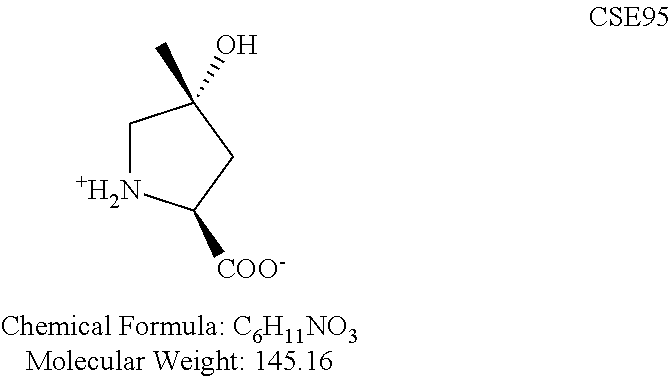

| TABLE 1 | |||
| Ki (μM) | Ki (μM) | ||
| CSE # | Chemical Structure | ACST1 | ASCT2 |
| CSE95 |
 |
>500 | 926 +/−252 |
| CSE96 |
 |
>500 | 1077 +/−322 |
| CSE103 |
 |
332 +/−74 | 1128 +/−318 |
| CSE104 |
 |
>500 | >500 |
| CSE109 |
 |
564 +/−149 | 922 +/−316 |
| CSE110 |
 |
1050 +/−110 | 1149 +/−283 |
| CSE111 |
 |
805 +/−148 | 872 +/−201 |
| CSE113 |
 |
493 +/−61 | 828 +/−248 |
| CSE115 |
 |
214* +/−32 | 235* +/−69 |
| CSE117 |
 |
594 +/−191 | 502 +/−110 |
| CSE118 |
 |
150 +/−43 | 141* +/−20 |
| CSE121 |
 |
39* +/−5 | 69* +/−7 |
| CSE122 |
 |
237* +/−40 | 268* +/−70 |
| CSE124 |
 |
481 +/−77 | 600 +/−176 |
| CSE127 |
 |
>500 | >500 |
| CSE130 |
 |
13* +/−2 | 10* +/−2 |
| CSE131 |
 |
0.31* +/−0.04 | 0.24* +/−0.04 |
| CSE132 |
 |
~10 | ~10 |
| TABLE 2 |
 |
 |
 |
 |
 |
 |
 |
 |
 |
 |
 |
 |
 |

Claims (8)

Priority Applications (1)
| Application Number | Priority Date | Filing Date | Title |
|---|---|---|---|
| US14/515,103 US9512074B2 (en) | 2011-07-15 | 2014-10-15 | Radiolabeled inhibitors of the amino acid transporters ASCT1 and ASCT2 |
Applications Claiming Priority (3)
| Application Number | Priority Date | Filing Date | Title |
|---|---|---|---|
| US201161508512P | 2011-07-15 | 2011-07-15 | |
| US13/549,779 US8895607B2 (en) | 2011-07-15 | 2012-07-16 | Inhibitors of the amino acid transporters ASCT1 and ASCT2 |
| US14/515,103 US9512074B2 (en) | 2011-07-15 | 2014-10-15 | Radiolabeled inhibitors of the amino acid transporters ASCT1 and ASCT2 |
Related Parent Applications (1)
| Application Number | Title | Priority Date | Filing Date |
|---|---|---|---|
| US13/549,779 Continuation-In-Part US8895607B2 (en) | 2011-07-15 | 2012-07-16 | Inhibitors of the amino acid transporters ASCT1 and ASCT2 |
Publications (2)
| Publication Number | Publication Date |
|---|---|
| US20150056138A1 US20150056138A1 (en) | 2015-02-26 |
| US9512074B2 true US9512074B2 (en) | 2016-12-06 |
Family
ID=52480558
Family Applications (1)
| Application Number | Title | Priority Date | Filing Date |
|---|---|---|---|
| US14/515,103 Active 2032-10-15 US9512074B2 (en) | 2011-07-15 | 2014-10-15 | Radiolabeled inhibitors of the amino acid transporters ASCT1 and ASCT2 |
Country Status (1)
| Country | Link |
|---|---|
| US (1) | US9512074B2 (en) |
-
2014
- 2014-10-15 US US14/515,103 patent/US9512074B2/en active Active
Non-Patent Citations (1)
| Title |
|---|
| Antonia Sacchi et al (Journal of heterocyclic chemistry (1995) vol. 32 pp. 1067-1069). * |
Also Published As
| Publication number | Publication date |
|---|---|
| US20150056138A1 (en) | 2015-02-26 |
Similar Documents
| Publication | Publication Date | Title |
|---|---|---|
| US8895607B2 (en) | Inhibitors of the amino acid transporters ASCT1 and ASCT2 | |
| US20220340524A1 (en) | Myeloperoxidase Imaging Agents | |
| RU2376282C2 (en) | Stereo-selective synthesis of amino acids for production of tumor image | |
| CA2920257C (en) | Kdm1a inhibitors for the treatment of disease | |
| AU2019265022B2 (en) | KDM1A inhibitors for the treatment of disease | |
| WO2014164867A1 (en) | Kdm1a inhibitors for the treatment of disease | |
| US10450307B2 (en) | Compounds having estrogen receptor alpha degradation activity and uses thereof | |
| ES2387405T3 (en) | Prolinamide derivatives as sodium channel modulators | |
| US20170096426A1 (en) | Novel Tricyclic Modulators of Cannabinoid Receptors | |
| JP2013500342A (en) | Prodrugs of desazades ferrothiocin polyether analogs as metal chelators | |
| CA3082437A1 (en) | Smac mimetics used as iap inhibitors and use thereof | |
| US9499472B2 (en) | Aspartylamide inhibitors of excitatory amino acid transporters | |
| KR20240128050A (en) | Aromatic vinyl compounds, metal complexes thereof, and methods for their preparation and use | |
| US20150056138A1 (en) | Radiolabeled Inhibitors of the Amino Acid Transporters ASCT1 and ASCT2 | |
| CA2911307C (en) | Use of fluorinated derivatives of 4-aminopyridine in therapeutics and medical imaging | |
| JP6408489B2 (en) | Treatments (compounds) | |
| US20170197996A1 (en) | Cholinesterase Inhibitors | |
| US20130261133A1 (en) | Therapeutic Compounds for Protozoal and Microbial Infections and Cancer | |
| RU2813145C2 (en) | Lysine-specific histone demethylase 1a (kdm1a) inhibitors for disease therapy | |
| CN118354999A (en) | A pyridazine-1(6H)-6-oxo compound and its preparation method and application | |
| US9255091B2 (en) | Benzothiazole-based pyridinium compounds | |
| CN103613589B (en) | A kind of for the Novel PET imaging agent precursor in nerve degenerative diseases field and the synthetic method of standard substance | |
| HK40014041B (en) | Myeloperoxidase imaging agents | |
| NZ716427B2 (en) | Kdm1a inhibitors for the treatment of disease | |
| HK1225331B (en) | Kdm1a inhibitors for the treatment of disease |
Legal Events
| Date | Code | Title | Description |
|---|---|---|---|
| AS | Assignment |
Owner name: THE UNIVERSITY OF MONTANA, MONTANA Free format text: ASSIGNMENT OF ASSIGNORS INTEREST;ASSIGNORS:ESSLINGER, CHRISTOPHER SEAN;LYDA, BRENT;KAVANAUGH, MICHAEL P.;AND OTHERS;SIGNING DATES FROM 20160314 TO 20160518;REEL/FRAME:038734/0425 |
|
| STCF | Information on status: patent grant |
Free format text: PATENTED CASE |
|
| FEPP | Fee payment procedure |
Free format text: MAINTENANCE FEE REMINDER MAILED (ORIGINAL EVENT CODE: REM.); ENTITY STATUS OF PATENT OWNER: SMALL ENTITY |
|
| FEPP | Fee payment procedure |
Free format text: ENTITY STATUS SET TO MICRO (ORIGINAL EVENT CODE: MICR); ENTITY STATUS OF PATENT OWNER: MICROENTITY |
|
| FEPP | Fee payment procedure |
Free format text: SURCHARGE FOR LATE PAYMENT, MICRO ENTITY (ORIGINAL EVENT CODE: M3554); ENTITY STATUS OF PATENT OWNER: MICROENTITY |
|
| MAFP | Maintenance fee payment |
Free format text: PAYMENT OF MAINTENANCE FEE, 4TH YEAR, MICRO ENTITY (ORIGINAL EVENT CODE: M3551); ENTITY STATUS OF PATENT OWNER: MICROENTITY Year of fee payment: 4 |
|
| FEPP | Fee payment procedure |
Free format text: MAINTENANCE FEE REMINDER MAILED (ORIGINAL EVENT CODE: REM.); ENTITY STATUS OF PATENT OWNER: MICROENTITY |
|
| FEPP | Fee payment procedure |
Free format text: SURCHARGE FOR LATE PAYMENT, MICRO ENTITY (ORIGINAL EVENT CODE: M3555); ENTITY STATUS OF PATENT OWNER: MICROENTITY |
|
| MAFP | Maintenance fee payment |
Free format text: PAYMENT OF MAINTENANCE FEE, 8TH YEAR, MICRO ENTITY (ORIGINAL EVENT CODE: M3552); ENTITY STATUS OF PATENT OWNER: MICROENTITY Year of fee payment: 8 |